
A English
Velocity of Efflux and Torricelli's law Questions in English
Class 11 Physics · Fluid Mechanics and Surface Tension · Velocity of Efflux and Torricelli's law
125+
Questions
English
Language
100%
With Solutions
Showing 46 of 125 questions in English
51
DifficultMCQ
The height of water in a tank is $H$. The range of the liquid emerging out from a hole in the wall of the tank at a depth $\frac{3H}{4}$ from the upper surface of water will be:
A
$H$
B
$\frac{H}{2}$
C
$\frac{3H}{2}$
D
$\frac{\sqrt{3}H}{2}$
Solution
(D) The horizontal range $x$ of a liquid jet emerging from a hole at a depth $h$ below the free surface of a liquid in a tank of total height $H$ is given by the formula:
$x = 2\sqrt{h(H-h)}$
Given that the depth of the hole from the upper surface is $h = \frac{3H}{4}$.
Substituting this value into the formula:
$x = 2\sqrt{\frac{3H}{4} \left(H - \frac{3H}{4}\right)}$
$x = 2\sqrt{\frac{3H}{4} \times \frac{H}{4}}$
$x = 2\sqrt{\frac{3H^2}{16}}$
$x = 2 \times \frac{H}{4} \sqrt{3}$
$x = \frac{\sqrt{3}H}{2}$
$x = 2\sqrt{h(H-h)}$
Given that the depth of the hole from the upper surface is $h = \frac{3H}{4}$.
Substituting this value into the formula:
$x = 2\sqrt{\frac{3H}{4} \left(H - \frac{3H}{4}\right)}$
$x = 2\sqrt{\frac{3H}{4} \times \frac{H}{4}}$
$x = 2\sqrt{\frac{3H^2}{16}}$
$x = 2 \times \frac{H}{4} \sqrt{3}$
$x = \frac{\sqrt{3}H}{2}$
0 likes
View Solution52
MediumMCQ
$A$ hole is made at the bottom of a tank filled with water (density $1000 \, kg/m^3$). If the total pressure at the bottom of the tank is $3 \, atm$ $(1 \, atm = 10^5 \, N/m^2)$,then the velocity of efflux is:
A
$\sqrt{200} \, m/s$
B
$\sqrt{400} \, m/s$
C
$\sqrt{500} \, m/s$
D
$\sqrt{800} \, m/s$
Solution
(B) The velocity of efflux is given by Torricelli's law: $v = \sqrt{2gh}$.
The total pressure at the bottom of the tank is the sum of atmospheric pressure $(P_{atm})$ and gauge pressure due to the water column $(h\rho g)$.
Given,$P_{total} = P_{atm} + h\rho g = 3 \, atm$.
Since $P_{atm} = 1 \, atm$,the gauge pressure is $h\rho g = 3 \, atm - 1 \, atm = 2 \, atm$.
Substituting the values: $h\rho g = 2 \times 10^5 \, N/m^2$.
$gh = \frac{2 \times 10^5}{\rho} = \frac{2 \times 10^5}{10^3} = 200 \, m^2/s^2$.
Now,substituting $gh$ into the velocity formula:
$v = \sqrt{2 \times (gh)} = \sqrt{2 \times 200} = \sqrt{400} \, m/s$.
The total pressure at the bottom of the tank is the sum of atmospheric pressure $(P_{atm})$ and gauge pressure due to the water column $(h\rho g)$.
Given,$P_{total} = P_{atm} + h\rho g = 3 \, atm$.
Since $P_{atm} = 1 \, atm$,the gauge pressure is $h\rho g = 3 \, atm - 1 \, atm = 2 \, atm$.
Substituting the values: $h\rho g = 2 \times 10^5 \, N/m^2$.
$gh = \frac{2 \times 10^5}{\rho} = \frac{2 \times 10^5}{10^3} = 200 \, m^2/s^2$.
Now,substituting $gh$ into the velocity formula:
$v = \sqrt{2 \times (gh)} = \sqrt{2 \times 200} = \sqrt{400} \, m/s$.
0 likes
View Solution53
MediumMCQ
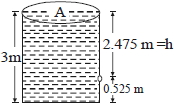
Water is filled in a container up to a height of $3\,m$. $A$ small hole of area $A_0$ is punched in the wall of the container at a height of $52.5\,cm$ from the bottom. The cross-sectional area of the container is $A$. If $A_0/A = 0.1$,then $v^2$ is......... $m^2/s^2$ (where $v$ is the velocity of water coming out of the hole).
A
$50$
B
$50.5$
C
$51$
D
$52$
Solution
(A) The velocity of efflux $v$ is given by the formula derived from Bernoulli's principle:
$v = \sqrt{\frac{2gh}{1 - (A_0/A)^2}}$
where $h$ is the height of the water column above the hole.
Given:
Total height of water = $3\,m$
Height of hole from bottom = $52.5\,cm = 0.525\,m$
$h = 3 - 0.525 = 2.475\,m$
$A_0/A = 0.1$
$g = 10\,m/s^2$
Substituting these values into the formula for $v^2$:
$v^2 = \frac{2gh}{1 - (A_0/A)^2}$
$v^2 = \frac{2 \times 10 \times 2.475}{1 - (0.1)^2}$
$v^2 = \frac{49.5}{1 - 0.01}$
$v^2 = \frac{49.5}{0.99} = 50\,m^2/s^2$
$v = \sqrt{\frac{2gh}{1 - (A_0/A)^2}}$
where $h$ is the height of the water column above the hole.
Given:
Total height of water = $3\,m$
Height of hole from bottom = $52.5\,cm = 0.525\,m$
$h = 3 - 0.525 = 2.475\,m$
$A_0/A = 0.1$
$g = 10\,m/s^2$
Substituting these values into the formula for $v^2$:
$v^2 = \frac{2gh}{1 - (A_0/A)^2}$
$v^2 = \frac{2 \times 10 \times 2.475}{1 - (0.1)^2}$
$v^2 = \frac{49.5}{1 - 0.01}$
$v^2 = \frac{49.5}{0.99} = 50\,m^2/s^2$
0 likes
View Solution54
DifficultMCQ
$A$ water tank of height $10\,m$,completely filled with water,is placed on a level ground. It has two holes,one at $3\,m$ and the other at $7\,m$ from its base. The water ejecting from:
A
both the holes will fall at the same spot
B
upper hole will fall farther than that from the lower hole
C
upper hole will fall closer than that from the lower hole
D
more information is required
Solution
(A) Let the total height of the tank be $H = 10\,m$. The holes are at heights $h_1 = 3\,m$ and $h_2 = 7\,m$ from the base.
The depth of the holes from the top surface are $y_1 = H - h_1 = 10 - 3 = 7\,m$ and $y_2 = H - h_2 = 10 - 7 = 3\,m$.
The horizontal range $R$ of water issuing from a hole at depth $y$ is given by $R = 2\sqrt{y(H-y)}$.
For the first hole $(y_1 = 7\,m)$: $R_1 = 2\sqrt{7(10-7)} = 2\sqrt{7 \times 3} = 2\sqrt{21}\,m$.
For the second hole $(y_2 = 3\,m)$: $R_2 = 2\sqrt{3(10-3)} = 2\sqrt{3 \times 7} = 2\sqrt{21}\,m$.
Since $R_1 = R_2$,the water from both holes will fall at the same spot.
The depth of the holes from the top surface are $y_1 = H - h_1 = 10 - 3 = 7\,m$ and $y_2 = H - h_2 = 10 - 7 = 3\,m$.
The horizontal range $R$ of water issuing from a hole at depth $y$ is given by $R = 2\sqrt{y(H-y)}$.
For the first hole $(y_1 = 7\,m)$: $R_1 = 2\sqrt{7(10-7)} = 2\sqrt{7 \times 3} = 2\sqrt{21}\,m$.
For the second hole $(y_2 = 3\,m)$: $R_2 = 2\sqrt{3(10-3)} = 2\sqrt{3 \times 7} = 2\sqrt{21}\,m$.
Since $R_1 = R_2$,the water from both holes will fall at the same spot.
0 likes
View Solution55
MediumMCQ
$A$ small hole of area of cross-section $2 \; mm^{2}$ is present near the bottom of a fully filled open tank of height $2 \; m$. Taking $g = 10 \; m/s^{2}$,the rate of flow of water through the open hole would be nearly ......... $\times 10^{-6} \; m^{3}/s$.
A
$12.6$
B
$8.9$
C
$2.23$
D
$6.4$
Solution
(A) The velocity of efflux $v$ is given by Torricelli's law: $v = \sqrt{2gh}$.
The volume flow rate $Q$ is given by $Q = A \times v = A \sqrt{2gh}$.
Given: Area $A = 2 \; mm^{2} = 2 \times 10^{-6} \; m^{2}$,height $h = 2 \; m$,and $g = 10 \; m/s^{2}$.
Substituting the values:
$Q = (2 \times 10^{-6}) \sqrt{2 \times 10 \times 2}$
$Q = (2 \times 10^{-6}) \sqrt{40}$
$Q = (2 \times 10^{-6}) \times 2\sqrt{10}$
$Q = 4 \sqrt{10} \times 10^{-6} \; m^{3}/s$.
Since $\sqrt{10} \approx 3.162$,
$Q \approx 4 \times 3.162 \times 10^{-6} \; m^{3}/s = 12.648 \times 10^{-6} \; m^{3}/s$.
Thus,the rate of flow is nearly $12.6 \times 10^{-6} \; m^{3}/s$.
The volume flow rate $Q$ is given by $Q = A \times v = A \sqrt{2gh}$.
Given: Area $A = 2 \; mm^{2} = 2 \times 10^{-6} \; m^{2}$,height $h = 2 \; m$,and $g = 10 \; m/s^{2}$.
Substituting the values:
$Q = (2 \times 10^{-6}) \sqrt{2 \times 10 \times 2}$
$Q = (2 \times 10^{-6}) \sqrt{40}$
$Q = (2 \times 10^{-6}) \times 2\sqrt{10}$
$Q = 4 \sqrt{10} \times 10^{-6} \; m^{3}/s$.
Since $\sqrt{10} \approx 3.162$,
$Q \approx 4 \times 3.162 \times 10^{-6} \; m^{3}/s = 12.648 \times 10^{-6} \; m^{3}/s$.
Thus,the rate of flow is nearly $12.6 \times 10^{-6} \; m^{3}/s$.
1 likes
View Solution56
Medium
For a container open to the atmosphere,derive the velocity of the liquid exiting a narrow hole in the container wall using Bernoulli's equation and obtain Torricelli's law.
Solution
(N/A) Torricelli discovered that the speed of efflux from an open tank is given by a formula identical to that of a freely falling body.
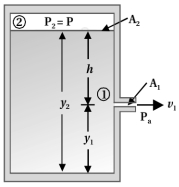
Consider a tank containing a liquid of density $\rho$ with a small hole in its side at a height $y_{1}$ from the bottom. The air above the liquid,whose surface is at height $y_{2}$,is at pressure $P$.
The velocities $v_{1}$ and $v_{2}$ are at points $1$ and $2$ respectively. Using the equation of continuity for points $1$ and $2$:
$A_{1} v_{1} = A_{2} v_{2}$
$v_{2} = \frac{A_{1} v_{1}}{A_{2}}$
$A_{2}$ is the cross-sectional area of the tank and $A_{1}$ is the cross-sectional area of the hole.
Since $A_{2} \gg A_{1}$,it follows that $v_{2} \ll v_{1}$,so we can approximate $v_{2} \approx 0$.
Using Bernoulli's equation at points $1$ and $2$:
$P_{1} + \frac{1}{2} \rho v_{1}^{2} + \rho g y_{1} = P_{2} + \frac{1}{2} \rho v_{2}^{2} + \rho g y_{2}$
Here,$P_{1} = P_{a}$ (atmospheric pressure),$P_{2} = P$,and $v_{2} = 0$. Substituting these:
$P_{a} + \frac{1}{2} \rho v_{1}^{2} + \rho g y_{1} = P + \rho g y_{2}$
$\frac{1}{2} \rho v_{1}^{2} = (P - P_{a}) + \rho g (y_{2} - y_{1})$
Let $h = y_{2} - y_{1}$ be the height of the liquid above the hole.
$\frac{1}{2} \rho v_{1}^{2} = (P - P_{a}) + \rho g h$
$v_{1} = \sqrt{2g h + \frac{2(P - P_{a})}{\rho}}$
If the tank is open to the atmosphere,$P = P_{a}$,then:
$v_{1} = \sqrt{2gh}$
This is Torricelli's law.
Consider a tank containing a liquid of density $\rho$ with a small hole in its side at a height $y_{1}$ from the bottom. The air above the liquid,whose surface is at height $y_{2}$,is at pressure $P$.
The velocities $v_{1}$ and $v_{2}$ are at points $1$ and $2$ respectively. Using the equation of continuity for points $1$ and $2$:
$A_{1} v_{1} = A_{2} v_{2}$
$v_{2} = \frac{A_{1} v_{1}}{A_{2}}$
$A_{2}$ is the cross-sectional area of the tank and $A_{1}$ is the cross-sectional area of the hole.
Since $A_{2} \gg A_{1}$,it follows that $v_{2} \ll v_{1}$,so we can approximate $v_{2} \approx 0$.
Using Bernoulli's equation at points $1$ and $2$:
$P_{1} + \frac{1}{2} \rho v_{1}^{2} + \rho g y_{1} = P_{2} + \frac{1}{2} \rho v_{2}^{2} + \rho g y_{2}$
Here,$P_{1} = P_{a}$ (atmospheric pressure),$P_{2} = P$,and $v_{2} = 0$. Substituting these:
$P_{a} + \frac{1}{2} \rho v_{1}^{2} + \rho g y_{1} = P + \rho g y_{2}$
$\frac{1}{2} \rho v_{1}^{2} = (P - P_{a}) + \rho g (y_{2} - y_{1})$
Let $h = y_{2} - y_{1}$ be the height of the liquid above the hole.
$\frac{1}{2} \rho v_{1}^{2} = (P - P_{a}) + \rho g h$
$v_{1} = \sqrt{2g h + \frac{2(P - P_{a})}{\rho}}$
If the tank is open to the atmosphere,$P = P_{a}$,then:
$v_{1} = \sqrt{2gh}$
This is Torricelli's law.
0 likes
View Solution57
Medium
Give the meaning of efflux.
Solution
(N/A) Efflux refers to the process of a fluid flowing out of a container or vessel through an opening,such as a hole or a nozzle.
In the context of fluid mechanics,the velocity of efflux is the speed at which the fluid emerges from the opening.
According to Torricelli's law,for an ideal fluid,the velocity of efflux $v$ is given by the formula $v = \sqrt{2gh}$,where $g$ is the acceleration due to gravity and $h$ is the height of the fluid column above the opening.
In the context of fluid mechanics,the velocity of efflux is the speed at which the fluid emerges from the opening.
According to Torricelli's law,for an ideal fluid,the velocity of efflux $v$ is given by the formula $v = \sqrt{2gh}$,where $g$ is the acceleration due to gravity and $h$ is the height of the fluid column above the opening.
0 likes
View Solution58
Medium
State Torricelli's law.
Solution
(N/A) Torricelli's law states that the speed of efflux,$v$,of a fluid through an orifice at a depth $h$ below the free surface of the liquid is equal to the speed that a body would acquire in falling freely from rest through a vertical distance $h$.
The mathematical expression for the speed of efflux is given by $v = \sqrt{2gh}$,where $g$ is the acceleration due to gravity and $h$ is the height of the liquid column above the orifice.
The mathematical expression for the speed of efflux is given by $v = \sqrt{2gh}$,where $g$ is the acceleration due to gravity and $h$ is the height of the liquid column above the orifice.
0 likes
View Solution59
DifficultMCQ
If a small orifice is made at a height of $0.25\, m$ from the ground in a tank filled with water up to a height of $1\, m$,the horizontal range of the water stream will be (in $cm$):
A
$46.5$
B
$56.6$
C
$76.6$
D
$86.6$
Solution
(D) The height of the water level in the tank is $H = 1\, m$.
The height of the orifice from the ground is $h = 0.25\, m$.
The depth of the orifice from the top surface is $y = H - h = 1 - 0.25 = 0.75\, m$.
The velocity of efflux is given by Torricelli's law: $v = \sqrt{2gy} = \sqrt{2 \times g \times 0.75} = \sqrt{1.5g}$.
The time taken for the water to reach the ground is $t = \sqrt{\frac{2h}{g}} = \sqrt{\frac{2 \times 0.25}{g}} = \sqrt{\frac{0.5}{g}}$.
The horizontal range $R$ is given by $R = v \times t = \sqrt{2g(H-h)} \times \sqrt{\frac{2h}{g}} = 2\sqrt{h(H-h)}$.
Substituting the values: $R = 2\sqrt{0.25 \times 0.75} = 2\sqrt{0.1875} = 2 \times 0.433 = 0.866\, m$.
Converting to centimeters: $0.866\, m = 86.6\, cm$.
The height of the orifice from the ground is $h = 0.25\, m$.
The depth of the orifice from the top surface is $y = H - h = 1 - 0.25 = 0.75\, m$.
The velocity of efflux is given by Torricelli's law: $v = \sqrt{2gy} = \sqrt{2 \times g \times 0.75} = \sqrt{1.5g}$.
The time taken for the water to reach the ground is $t = \sqrt{\frac{2h}{g}} = \sqrt{\frac{2 \times 0.25}{g}} = \sqrt{\frac{0.5}{g}}$.
The horizontal range $R$ is given by $R = v \times t = \sqrt{2g(H-h)} \times \sqrt{\frac{2h}{g}} = 2\sqrt{h(H-h)}$.
Substituting the values: $R = 2\sqrt{0.25 \times 0.75} = 2\sqrt{0.1875} = 2 \times 0.433 = 0.866\, m$.
Converting to centimeters: $0.866\, m = 86.6\, cm$.
0 likes
View Solution60
DifficultMCQ
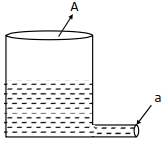
$A$ light cylindrical vessel is kept on a horizontal surface. The area of the base is $A$. $A$ hole of cross-sectional area $a$ is made just at its bottom side. The minimum coefficient of friction necessary to prevent the vessel from sliding due to the impact force of the emerging liquid is $(a \ll A)$.
A
$\frac{2a}{A}$
B
None of these
C
$\frac{a}{A}$
D
$\frac{A}{2a}$
Solution
(A) Let the height of the liquid in the vessel be $h$. The velocity of the emerging liquid is given by Torricelli's law as $v = \sqrt{2gh}$.
The force exerted by the emerging liquid on the vessel (thrust force) is $F_{thrust} = \rho a v^2 = \rho a (2gh) = 2 \rho agh$.
For the vessel to not slide,the frictional force $f$ must balance this thrust force. Thus,$f \geq F_{thrust}$.
The maximum frictional force is $f_{max} = \mu N$,where $N$ is the normal reaction from the surface. Since the vessel is light (mass is negligible),the normal reaction $N$ is equal to the weight of the liquid,$N = mg = (\rho A h) g$.
Therefore,$\mu (\rho A h g) \geq 2 \rho a g h$.
Simplifying this,we get $\mu \geq \frac{2a}{A}$.
Thus,the minimum coefficient of friction is $\frac{2a}{A}$.
The force exerted by the emerging liquid on the vessel (thrust force) is $F_{thrust} = \rho a v^2 = \rho a (2gh) = 2 \rho agh$.
For the vessel to not slide,the frictional force $f$ must balance this thrust force. Thus,$f \geq F_{thrust}$.
The maximum frictional force is $f_{max} = \mu N$,where $N$ is the normal reaction from the surface. Since the vessel is light (mass is negligible),the normal reaction $N$ is equal to the weight of the liquid,$N = mg = (\rho A h) g$.
Therefore,$\mu (\rho A h g) \geq 2 \rho a g h$.
Simplifying this,we get $\mu \geq \frac{2a}{A}$.
Thus,the minimum coefficient of friction is $\frac{2a}{A}$.
1 likes
View Solution61
MediumMCQ
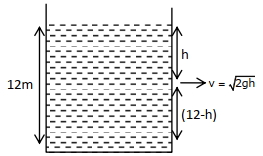
The water is filled up to a height of $12\, \text{m}$ in a tank having vertical sidewalls. $A$ hole is made in one of the walls at a depth $h$ below the water level. The value of $h$ for which the emerging stream of water strikes the ground at the maximum range is $.....\, \text{m}$.
A
$12$
B
$8$
C
$3$
D
$6$
Solution
(D) Let $H = 12\, \text{m}$ be the total height of the water column.
Let $h$ be the depth of the hole from the water surface.
The velocity of efflux is given by Torricelli's law: $v = \sqrt{2gh}$.
The time taken for the water to reach the ground from a height $(H - h)$ is given by $t = \sqrt{\frac{2(H - h)}{g}}$.
The horizontal range $R$ is given by $R = v \times t = \sqrt{2gh} \times \sqrt{\frac{2(H - h)}{g}}$.
Simplifying the expression: $R = \sqrt{4h(H - h)} = 2\sqrt{hH - h^2}$.
To find the maximum range, we differentiate $R$ with respect to $h$ and set it to zero: $\frac{dR}{dh} = 0$.
$\frac{d}{dh}(2\sqrt{hH - h^2}) = 2 \cdot \frac{1}{2\sqrt{hH - h^2}} \cdot (H - 2h) = 0$.
This implies $H - 2h = 0$, so $h = \frac{H}{2}$.
Given $H = 12\, \text{m}$, we get $h = \frac{12}{2} = 6\, \text{m}$.
Let $h$ be the depth of the hole from the water surface.
The velocity of efflux is given by Torricelli's law: $v = \sqrt{2gh}$.
The time taken for the water to reach the ground from a height $(H - h)$ is given by $t = \sqrt{\frac{2(H - h)}{g}}$.
The horizontal range $R$ is given by $R = v \times t = \sqrt{2gh} \times \sqrt{\frac{2(H - h)}{g}}$.
Simplifying the expression: $R = \sqrt{4h(H - h)} = 2\sqrt{hH - h^2}$.
To find the maximum range, we differentiate $R$ with respect to $h$ and set it to zero: $\frac{dR}{dh} = 0$.
$\frac{d}{dh}(2\sqrt{hH - h^2}) = 2 \cdot \frac{1}{2\sqrt{hH - h^2}} \cdot (H - 2h) = 0$.
This implies $H - 2h = 0$, so $h = \frac{H}{2}$.
Given $H = 12\, \text{m}$, we get $h = \frac{12}{2} = 6\, \text{m}$.
0 likes
View Solution62
AdvancedMCQ
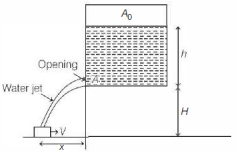
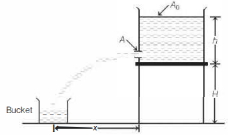
Consider the configuration of a stationary water tank of cross-sectional area $A_{0}$ and a small bucket as shown in the figure below. What is the speed $v$ (in $m/s$) of the bucket so that the water leaking out of a hole of cross-sectional area $A$ (as shown) from the water tank does not fall outside the bucket? (Take $h=5 \, m$,$H=5 \, m$,$g=10 \, m/s^{2}$,$A=5 \, cm^{2}$,and $A_{0}=500 \, cm^{2}$).
A
$1$
B
$0.5$
C
$0.1$
D
$0.05$
Solution
(C) The velocity of efflux from the hole is given by $v_{e} = \sqrt{2gh}$.
The horizontal range $x$ of the water jet is given by $x = v_{e} \times t$,where $t$ is the time of fall from height $H$.
Since $H = \frac{1}{2}gt^{2}$,we have $t = \sqrt{\frac{2H}{g}}$.
Thus,$x = \sqrt{2gh} \times \sqrt{\frac{2H}{g}} = 2\sqrt{hH}$.
The speed $v$ of the bucket must match the rate of change of the range $x$ to keep the water falling into it:
$v = \frac{dx}{dt} = \frac{d}{dt}(2\sqrt{hH}) = 2\sqrt{H} \frac{d}{dt}(\sqrt{h}) = 2\sqrt{H} \cdot \frac{1}{2\sqrt{h}} \cdot \frac{dh}{dt} = \sqrt{\frac{H}{h}} \cdot \frac{dh}{dt}$.
From the equation of continuity,$A_{0} \left(-\frac{dh}{dt}\right) = A v_{e} = A \sqrt{2gh}$.
Therefore,$\frac{dh}{dt} = -\frac{A}{A_{0}} \sqrt{2gh}$.
Substituting this into the expression for $v$ (taking magnitude): $v = \sqrt{\frac{H}{h}} \cdot \frac{A}{A_{0}} \sqrt{2gh} = \frac{A}{A_{0}} \sqrt{2gH}$.
Given $A = 5 \, cm^{2}$,$A_{0} = 500 \, cm^{2}$,$g = 10 \, m/s^{2}$,and $H = 5 \, m$:
$v = \left(\frac{5}{500}\right) \sqrt{2 \times 10 \times 5} = \frac{1}{100} \times \sqrt{100} = \frac{10}{100} = 0.1 \, m/s$.
The horizontal range $x$ of the water jet is given by $x = v_{e} \times t$,where $t$ is the time of fall from height $H$.
Since $H = \frac{1}{2}gt^{2}$,we have $t = \sqrt{\frac{2H}{g}}$.
Thus,$x = \sqrt{2gh} \times \sqrt{\frac{2H}{g}} = 2\sqrt{hH}$.
The speed $v$ of the bucket must match the rate of change of the range $x$ to keep the water falling into it:
$v = \frac{dx}{dt} = \frac{d}{dt}(2\sqrt{hH}) = 2\sqrt{H} \frac{d}{dt}(\sqrt{h}) = 2\sqrt{H} \cdot \frac{1}{2\sqrt{h}} \cdot \frac{dh}{dt} = \sqrt{\frac{H}{h}} \cdot \frac{dh}{dt}$.
From the equation of continuity,$A_{0} \left(-\frac{dh}{dt}\right) = A v_{e} = A \sqrt{2gh}$.
Therefore,$\frac{dh}{dt} = -\frac{A}{A_{0}} \sqrt{2gh}$.
Substituting this into the expression for $v$ (taking magnitude): $v = \sqrt{\frac{H}{h}} \cdot \frac{A}{A_{0}} \sqrt{2gh} = \frac{A}{A_{0}} \sqrt{2gH}$.
Given $A = 5 \, cm^{2}$,$A_{0} = 500 \, cm^{2}$,$g = 10 \, m/s^{2}$,and $H = 5 \, m$:
$v = \left(\frac{5}{500}\right) \sqrt{2 \times 10 \times 5} = \frac{1}{100} \times \sqrt{100} = \frac{10}{100} = 0.1 \, m/s$.
0 likes
View Solution63
MediumMCQ
$A$ box filled with water has a small hole on its side near the bottom. It is dropped from the top of a tower. As it falls,a camera attached on the side of the box records the shape of the water stream coming out of the hole. The resulting video will show
A
the water coming down forming a parabolic stream
B
the water going up forming a parabolic stream
C
the water coming out in a straight line
D
no water coming out
Solution
(D) When a box with a hole is in free fall,both the water inside and the box experience the same acceleration due to gravity,$g$,directed downwards.
Since the box and the water are accelerating at the same rate,there is no relative acceleration between them.
Consequently,the pressure difference at the hole becomes zero,and no water comes out of the hole during the free fall of the box.
Since the box and the water are accelerating at the same rate,there is no relative acceleration between them.
Consequently,the pressure difference at the hole becomes zero,and no water comes out of the hole during the free fall of the box.
0 likes
View Solution64
EasyMCQ
Water $(\rho_1=1000 \, kg/m^3)$ and kerosene $(\rho_2=800 \, kg/m^3)$ are filled to the same height in two identical cylindrical vessels. Both vessels have small holes at their bottom. The speeds of the water and kerosene coming out of their holes are $v_1$ and $v_2$ respectively. Select the correct alternative.
A
$v_1 = v_2$
B
$v_1 = 0.8 v_2$
C
$0.8 v_1 = v_2$
D
$v_1 = \sqrt{0.8} v_2$
Solution
(A) According to Torricelli's Law,the velocity of efflux $(v)$ for a small hole at a depth $h$ below the free surface of a liquid is given by the formula:
$v = \sqrt{2gh}$
Here,$g$ is the acceleration due to gravity and $h$ is the height of the liquid column above the hole.
Since both vessels are identical and filled to the same height $h$,the velocity of efflux depends only on the height $h$ and the acceleration due to gravity $g$.
It is independent of the density $(\rho)$ of the liquid.
Therefore,$v_1 = \sqrt{2gh}$ and $v_2 = \sqrt{2gh}$.
Thus,$v_1 = v_2$.
$v = \sqrt{2gh}$
Here,$g$ is the acceleration due to gravity and $h$ is the height of the liquid column above the hole.
Since both vessels are identical and filled to the same height $h$,the velocity of efflux depends only on the height $h$ and the acceleration due to gravity $g$.
It is independent of the density $(\rho)$ of the liquid.
Therefore,$v_1 = \sqrt{2gh}$ and $v_2 = \sqrt{2gh}$.
Thus,$v_1 = v_2$.
0 likes
View Solution65
MediumMCQ
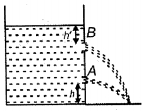
$A$ tank is filled with water and two holes $A$ and $B$ are made in it. For getting the same range,the ratio of $h^{\prime}$ to $h$ is ..........
A
$2$
B
$\frac{1}{2}$
C
$\frac{1}{3}$
D
$1$
Solution
(D) Let $H$ be the total height of the water column. Let $h^{\prime}$ be the depth of hole $B$ from the top surface and $h$ be the height of hole $A$ from the bottom.
For hole $B$ at depth $h^{\prime}$ from the top,the velocity of efflux is $v_B = \sqrt{2gh^{\prime}}$. The height of this hole from the ground is $H - h^{\prime}$. The time taken for water to reach the ground is $t_B = \sqrt{\frac{2(H - h^{\prime})}{g}}$.
The range $R_B = v_B \times t_B = \sqrt{2gh^{\prime}} \times \sqrt{\frac{2(H - h^{\prime})}{g}} = 2\sqrt{h^{\prime}(H - h^{\prime})}$.
For hole $A$ at height $h$ from the bottom,the depth from the top is $H - h$. The velocity of efflux is $v_A = \sqrt{2g(H - h)}$. The time taken to reach the ground is $t_A = \sqrt{\frac{2h}{g}}$.
The range $R_A = v_A \times t_A = \sqrt{2g(H - h)} \times \sqrt{\frac{2h}{g}} = 2\sqrt{h(H - h)}$.
For the same range,$R_A = R_B$:
$2\sqrt{h(H - h)} = 2\sqrt{h^{\prime}(H - h^{\prime})}$
$h(H - h) = h^{\prime}(H - h^{\prime})$
$hH - h^2 = h^{\prime}H - h^{\prime 2}$
$H(h - h^{\prime}) = h^2 - h^{\prime 2}$
$H(h - h^{\prime}) = (h - h^{\prime})(h + h^{\prime})$
Since $h \neq h^{\prime}$,we have $H = h + h^{\prime}$.
This implies that the two holes are at depths $h^{\prime}$ and $H - h^{\prime} = h$ from the top surface. For the same range,the sum of the depths of the two holes from the top surface must be equal to the total height of the water column. In the given configuration,if $h^{\prime}$ is the depth of $B$ and $h$ is the height of $A$ from the bottom,the condition for equal range is $h = h^{\prime}$,so the ratio $\frac{h^{\prime}}{h} = 1$.
For hole $B$ at depth $h^{\prime}$ from the top,the velocity of efflux is $v_B = \sqrt{2gh^{\prime}}$. The height of this hole from the ground is $H - h^{\prime}$. The time taken for water to reach the ground is $t_B = \sqrt{\frac{2(H - h^{\prime})}{g}}$.
The range $R_B = v_B \times t_B = \sqrt{2gh^{\prime}} \times \sqrt{\frac{2(H - h^{\prime})}{g}} = 2\sqrt{h^{\prime}(H - h^{\prime})}$.
For hole $A$ at height $h$ from the bottom,the depth from the top is $H - h$. The velocity of efflux is $v_A = \sqrt{2g(H - h)}$. The time taken to reach the ground is $t_A = \sqrt{\frac{2h}{g}}$.
The range $R_A = v_A \times t_A = \sqrt{2g(H - h)} \times \sqrt{\frac{2h}{g}} = 2\sqrt{h(H - h)}$.
For the same range,$R_A = R_B$:
$2\sqrt{h(H - h)} = 2\sqrt{h^{\prime}(H - h^{\prime})}$
$h(H - h) = h^{\prime}(H - h^{\prime})$
$hH - h^2 = h^{\prime}H - h^{\prime 2}$
$H(h - h^{\prime}) = h^2 - h^{\prime 2}$
$H(h - h^{\prime}) = (h - h^{\prime})(h + h^{\prime})$
Since $h \neq h^{\prime}$,we have $H = h + h^{\prime}$.
This implies that the two holes are at depths $h^{\prime}$ and $H - h^{\prime} = h$ from the top surface. For the same range,the sum of the depths of the two holes from the top surface must be equal to the total height of the water column. In the given configuration,if $h^{\prime}$ is the depth of $B$ and $h$ is the height of $A$ from the bottom,the condition for equal range is $h = h^{\prime}$,so the ratio $\frac{h^{\prime}}{h} = 1$.
0 likes
View Solution66
MediumMCQ
Water is filled in a tank up to a height of $3 \,m$. The base of the tank is at a height of $1 \,m$ above the ground. What should be the height of a hole made in the side of the tank so that water can be sprayed up to the maximum horizontal distance on the ground?
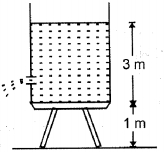
A
$3 \,m$ from ground
B
$1.5 \,m$ from ground
C
$1.5 \,m$ from base of tank
D
$2 \,m$ from ground
Solution
(D) Let the total height of the water level from the ground be $H = 3 \,m + 1 \,m = 4 \,m$. Let the height of the hole from the ground be $y$. The depth of the hole from the free surface of the water is $h = H - y = 4 - y$.
The velocity of efflux is $v = \sqrt{2gh}$.
The time taken for the water to reach the ground is $t = \sqrt{\frac{2y}{g}}$.
The horizontal range $R$ is given by $R = v \cdot t = \sqrt{2g(4-y)} \cdot \sqrt{\frac{2y}{g}} = 2\sqrt{y(4-y)}$.
For maximum range,the term inside the square root,$f(y) = 4y - y^2$,must be maximum.
Taking the derivative with respect to $y$ and setting it to zero: $\frac{df}{dy} = 4 - 2y = 0$,which gives $y = 2 \,m$.
Thus,the hole should be at a height of $2 \,m$ from the ground.
The velocity of efflux is $v = \sqrt{2gh}$.
The time taken for the water to reach the ground is $t = \sqrt{\frac{2y}{g}}$.
The horizontal range $R$ is given by $R = v \cdot t = \sqrt{2g(4-y)} \cdot \sqrt{\frac{2y}{g}} = 2\sqrt{y(4-y)}$.
For maximum range,the term inside the square root,$f(y) = 4y - y^2$,must be maximum.
Taking the derivative with respect to $y$ and setting it to zero: $\frac{df}{dy} = 4 - 2y = 0$,which gives $y = 2 \,m$.
Thus,the hole should be at a height of $2 \,m$ from the ground.
0 likes
View Solution67
MediumMCQ
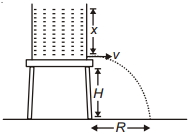
$A$ cylinder containing water stands on a table of height $H$. $A$ small hole is punched in the side of the cylinder at its base. The stream of water strikes the ground at a horizontal distance $R$ from the table. Then the depth of water in the cylinder is ............
A
$H$
B
$R$
C
$\sqrt{R H}$
D
$R^2 / 4 H$
Solution
(D) Let the depth of water in the cylinder be $x$.
According to Torricelli's law,the velocity of efflux $(v)$ is given by $v = \sqrt{2 g x}$.
The water stream acts as a projectile launched horizontally from a height $H$.
The time taken $(t)$ by the water to reach the ground is given by the equation of motion $H = \frac{1}{2} g t^2$,which gives $t = \sqrt{\frac{2 H}{g}}$.
The horizontal range $(R)$ is the product of the horizontal velocity and the time of flight:
$R = v \times t$
$R = \sqrt{2 g x} \times \sqrt{\frac{2 H}{g}}$
$R = \sqrt{2 g x \cdot \frac{2 H}{g}}$
$R = \sqrt{4 x H}$
Squaring both sides,we get $R^2 = 4 x H$.
Therefore,the depth of water $x = \frac{R^2}{4 H}$.
According to Torricelli's law,the velocity of efflux $(v)$ is given by $v = \sqrt{2 g x}$.
The water stream acts as a projectile launched horizontally from a height $H$.
The time taken $(t)$ by the water to reach the ground is given by the equation of motion $H = \frac{1}{2} g t^2$,which gives $t = \sqrt{\frac{2 H}{g}}$.
The horizontal range $(R)$ is the product of the horizontal velocity and the time of flight:
$R = v \times t$
$R = \sqrt{2 g x} \times \sqrt{\frac{2 H}{g}}$
$R = \sqrt{2 g x \cdot \frac{2 H}{g}}$
$R = \sqrt{4 x H}$
Squaring both sides,we get $R^2 = 4 x H$.
Therefore,the depth of water $x = \frac{R^2}{4 H}$.
0 likes
View Solution68
DifficultMCQ
$A$ large open tank has two holes in its wall. One is a square hole of side $a$ at a depth $x$ from the top and the other is a circular hole of radius $r$ at a depth $4x$ from the top. When the tank is completely filled with water,the quantities of water flowing out per second from both holes are the same. Then $r$ is equal to ..........
A
$2 \pi a$
B
$a$
C
$\frac{a}{\sqrt{2 \pi}}$
D
$\frac{a}{\pi}$
Solution
(C) The volume flow rate (quantity of water per second) is given by the product of the area of the hole $(A)$ and the velocity of efflux $(v)$.
According to Torricelli's law,the velocity of efflux at a depth $h$ is $v = \sqrt{2gh}$.
For the square hole: Area $A_1 = a^2$,depth $h_1 = x$. Velocity $v_1 = \sqrt{2gx}$.
Flow rate $Q_1 = A_1 v_1 = a^2 \sqrt{2gx}$.
For the circular hole: Area $A_2 = \pi r^2$,depth $h_2 = 4x$. Velocity $v_2 = \sqrt{2g(4x)} = 2\sqrt{2gx}$.
Flow rate $Q_2 = A_2 v_2 = \pi r^2 (2\sqrt{2gx})$.
Given $Q_1 = Q_2$,we have:
$a^2 \sqrt{2gx} = 2\pi r^2 \sqrt{2gx}$.
Dividing both sides by $\sqrt{2gx}$:
$a^2 = 2\pi r^2$.
$r^2 = \frac{a^2}{2\pi}$.
$r = \frac{a}{\sqrt{2\pi}}$.
According to Torricelli's law,the velocity of efflux at a depth $h$ is $v = \sqrt{2gh}$.
For the square hole: Area $A_1 = a^2$,depth $h_1 = x$. Velocity $v_1 = \sqrt{2gx}$.
Flow rate $Q_1 = A_1 v_1 = a^2 \sqrt{2gx}$.
For the circular hole: Area $A_2 = \pi r^2$,depth $h_2 = 4x$. Velocity $v_2 = \sqrt{2g(4x)} = 2\sqrt{2gx}$.
Flow rate $Q_2 = A_2 v_2 = \pi r^2 (2\sqrt{2gx})$.
Given $Q_1 = Q_2$,we have:
$a^2 \sqrt{2gx} = 2\pi r^2 \sqrt{2gx}$.
Dividing both sides by $\sqrt{2gx}$:
$a^2 = 2\pi r^2$.
$r^2 = \frac{a^2}{2\pi}$.
$r = \frac{a}{\sqrt{2\pi}}$.
0 likes
View Solution69
DifficultMCQ
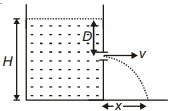
$A$ tank is filled with water to a height $H$. $A$ hole is made in one of the walls at a depth $D$ below the water surface. The distance $x$ from the foot of the wall at which the stream of water coming out of the tank strikes the ground is given by .............
A
$x=2[D(H-D)]^{1 / 2}$
B
$x=2(g D)^{1 / 2}$
C
$x=2[D(H+D)]^{1 / 2}$
D
None of these
Solution
(A) The velocity of efflux is given by Torricelli's law: $v = \sqrt{2gD}$.
The water stream travels a vertical distance of $(H-D)$ to reach the ground.
Using the equation of motion $s = ut + \frac{1}{2}at^2$,where $s = H-D$,$u = 0$ (initial vertical velocity),and $a = g$:
$H-D = 0 + \frac{1}{2}gt^2$
$t = \sqrt{\frac{2(H-D)}{g}}$
The horizontal distance $x$ is given by the product of horizontal velocity and time:
$x = v \times t$
$x = \sqrt{2gD} \times \sqrt{\frac{2(H-D)}{g}}$
$x = \sqrt{4D(H-D)}$
$x = 2[D(H-D)]^{1/2}$
The water stream travels a vertical distance of $(H-D)$ to reach the ground.
Using the equation of motion $s = ut + \frac{1}{2}at^2$,where $s = H-D$,$u = 0$ (initial vertical velocity),and $a = g$:
$H-D = 0 + \frac{1}{2}gt^2$
$t = \sqrt{\frac{2(H-D)}{g}}$
The horizontal distance $x$ is given by the product of horizontal velocity and time:
$x = v \times t$
$x = \sqrt{2gD} \times \sqrt{\frac{2(H-D)}{g}}$
$x = \sqrt{4D(H-D)}$
$x = 2[D(H-D)]^{1/2}$
0 likes
View Solution70
AdvancedMCQ
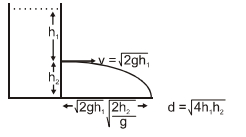
$A$ person in a lift is holding a water jar,which has a small hole at the lower end of its side. When the lift is at rest,the water jet coming out of the hole hits the floor of the lift at a distance $d$ of $1.2 \ m$ from the person. In the following,the state of the lift's motion is given in List-$I$ and the distance where the water jet hits the floor of the lift is given in List-$II$. Match the statements from List-$I$ with those in List-$II$ and select the correct answer using the code given below the lists.
| List-$I$ | List-$II$ |
|---|---|
| $P$. Lift is accelerating vertically up. | $1$. $d = 1.2 \ m$ |
| $Q$. Lift is accelerating vertically down with an acceleration less than the gravitational acceleration. | $2$. $d < 1.2 \ m$ |
| $R$. Lift is moving vertically up with constant speed. | $3$. $d > 1.2 \ m$ |
| $S$. Lift is falling freely. | $4$. No water leaks out of the jar. |
A
$P-2, Q-3, R-1, S-4$
B
$P-3, Q-2, R-1, S-4$
C
$P-1, Q-1, R-1, S-4$
D
$P-2, Q-3, R-1, S-1$
Solution
(A) The horizontal range $d$ of a water jet from a hole at height $h_2$ from the bottom,with $h_1$ being the height of water above the hole,is given by $d = v \cdot t = \sqrt{2gh_1} \cdot \sqrt{\frac{2h_2}{g}} = 2\sqrt{h_1 h_2}$.
Here,$g$ is the effective acceleration due to gravity $(g_{eff})$ inside the lift.
$P$. When the lift accelerates vertically up,$g_{eff} = g + a > g$. Since $d \propto \frac{1}{\sqrt{g_{eff}}}$,$d$ decreases. Thus,$d < 1.2 \ m$.
$Q$. When the lift accelerates vertically down with $a < g$,$g_{eff} = g - a < g$. Thus,$d$ increases. So,$d > 1.2 \ m$.
$R$. When the lift moves with constant speed,$a = 0$,so $g_{eff} = g$. Thus,$d = 1.2 \ m$.
$S$. When the lift is falling freely,$a = g$,so $g_{eff} = g - g = 0$. Since there is no effective gravity,the pressure at the hole is zero,and no water leaks out.
Matching: $P-2, Q-3, R-1, S-4$.
Here,$g$ is the effective acceleration due to gravity $(g_{eff})$ inside the lift.
$P$. When the lift accelerates vertically up,$g_{eff} = g + a > g$. Since $d \propto \frac{1}{\sqrt{g_{eff}}}$,$d$ decreases. Thus,$d < 1.2 \ m$.
$Q$. When the lift accelerates vertically down with $a < g$,$g_{eff} = g - a < g$. Thus,$d$ increases. So,$d > 1.2 \ m$.
$R$. When the lift moves with constant speed,$a = 0$,so $g_{eff} = g$. Thus,$d = 1.2 \ m$.
$S$. When the lift is falling freely,$a = g$,so $g_{eff} = g - g = 0$. Since there is no effective gravity,the pressure at the hole is zero,and no water leaks out.
Matching: $P-2, Q-3, R-1, S-4$.
0 likes
View Solution71
DifficultMCQ
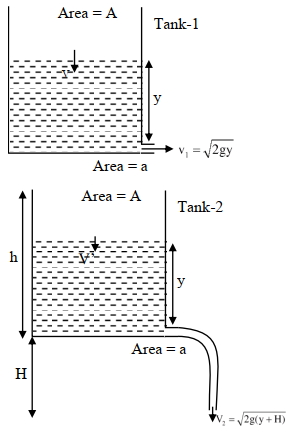
Two large,identical water tanks,$1$ and $2$,kept on the top of a building of height $H$,are filled with water up to height $h$ in each tank. Both the tanks contain an identical hole of small radius on their sides,close to their bottom. $A$ pipe of the same internal radius as that of the hole is connected to tank $2$,and the pipe ends at the ground level. When the water flows out of tanks $1$ and $2$ through the holes,the times taken to empty the tanks are $t_1$ and $t_2$,respectively. If $H = (16/9) h$,then the ratio $t_1 / t_2$ is:
A
$2$
B
$3$
C
$4$
D
$5$
Solution
(B) For tank $1$,the velocity of efflux at height $y$ is $v_1 = \sqrt{2gy}$.
By the equation of continuity,$A(-dy/dt) = a\sqrt{2gy}$,where $A$ is the cross-sectional area of the tank and $a$ is the area of the hole.
Integrating from $y=h$ to $y=0$:
$dt = (A/a\sqrt{2g}) \cdot (-dy/\sqrt{y})$
$t_1 = (A/a\sqrt{2g}) \int_0^h y^{-1/2} dy = (A/a\sqrt{2g}) \cdot 2\sqrt{h} = (A/a) \sqrt{2h/g}$.
For tank $2$,the velocity of efflux at height $y$ is $v_2 = \sqrt{2g(y+H)}$.
By the equation of continuity,$A(-dy/dt) = a\sqrt{2g(y+H)}$.
Integrating from $y=h$ to $y=0$:
$dt = (A/a\sqrt{2g}) \cdot (-dy/\sqrt{y+H})$
$t_2 = (A/a\sqrt{2g}) \int_0^h (y+H)^{-1/2} dy = (A/a\sqrt{2g}) \cdot 2[\sqrt{y+H}]_0^h = (A/a\sqrt{2g}) \cdot 2(\sqrt{h+H} - \sqrt{H})$.
Given $H = (16/9)h$,then $h+H = h + (16/9)h = (25/9)h$.
$t_2 = (A/a\sqrt{2g}) \cdot 2(\sqrt{25h/9} - \sqrt{16h/9}) = (A/a\sqrt{2g}) \cdot 2(5/3\sqrt{h} - 4/3\sqrt{h}) = (A/a\sqrt{2g}) \cdot 2(1/3\sqrt{h}) = (A/3a) \sqrt{2h/g}$.
Therefore,the ratio $t_1 / t_2 = [(A/a) \sqrt{2h/g}] / [(A/3a) \sqrt{2h/g}] = 3$.
By the equation of continuity,$A(-dy/dt) = a\sqrt{2gy}$,where $A$ is the cross-sectional area of the tank and $a$ is the area of the hole.
Integrating from $y=h$ to $y=0$:
$dt = (A/a\sqrt{2g}) \cdot (-dy/\sqrt{y})$
$t_1 = (A/a\sqrt{2g}) \int_0^h y^{-1/2} dy = (A/a\sqrt{2g}) \cdot 2\sqrt{h} = (A/a) \sqrt{2h/g}$.
For tank $2$,the velocity of efflux at height $y$ is $v_2 = \sqrt{2g(y+H)}$.
By the equation of continuity,$A(-dy/dt) = a\sqrt{2g(y+H)}$.
Integrating from $y=h$ to $y=0$:
$dt = (A/a\sqrt{2g}) \cdot (-dy/\sqrt{y+H})$
$t_2 = (A/a\sqrt{2g}) \int_0^h (y+H)^{-1/2} dy = (A/a\sqrt{2g}) \cdot 2[\sqrt{y+H}]_0^h = (A/a\sqrt{2g}) \cdot 2(\sqrt{h+H} - \sqrt{H})$.
Given $H = (16/9)h$,then $h+H = h + (16/9)h = (25/9)h$.
$t_2 = (A/a\sqrt{2g}) \cdot 2(\sqrt{25h/9} - \sqrt{16h/9}) = (A/a\sqrt{2g}) \cdot 2(5/3\sqrt{h} - 4/3\sqrt{h}) = (A/a\sqrt{2g}) \cdot 2(1/3\sqrt{h}) = (A/3a) \sqrt{2h/g}$.
Therefore,the ratio $t_1 / t_2 = [(A/a) \sqrt{2h/g}] / [(A/3a) \sqrt{2h/g}] = 3$.
0 likes
View Solution72
DifficultMCQ
There is a hole in the bottom of a tank containing water. If the total pressure at the bottom is $3 \ atm$,then the velocity of water flowing from the hole is $(1 \ atm = 10^5 \ Pa)$ :-
A
$\sqrt{400} \ m/s$
B
$\sqrt{600} \ m/s$
C
$\sqrt{60} \ m/s$
D
None of these
Solution
(A) The total pressure at the bottom is given by $P_{\text{total}} = P_{\text{atm}} + h\rho g = 3 \ atm = 3 \times 10^5 \ Pa$.
Since $P_{\text{atm}} = 1 \times 10^5 \ Pa$,the gauge pressure due to the water column is $P_g = h\rho g = P_{\text{total}} - P_{\text{atm}} = 3 \times 10^5 - 1 \times 10^5 = 2 \times 10^5 \ Pa$.
According to Torricelli's law,the velocity of efflux $v$ is given by $v = \sqrt{2gh}$.
Since $P_g = h\rho g$,we have $h = \frac{P_g}{\rho g}$.
Substituting this into the velocity formula: $v = \sqrt{2g \left(\frac{P_g}{\rho g}\right)} = \sqrt{\frac{2P_g}{\rho}}$.
Using $\rho = 10^3 \ kg/m^3$ for water: $v = \sqrt{\frac{2 \times 2 \times 10^5}{10^3}} = \sqrt{4 \times 10^2} = \sqrt{400} \ m/s$.
Since $P_{\text{atm}} = 1 \times 10^5 \ Pa$,the gauge pressure due to the water column is $P_g = h\rho g = P_{\text{total}} - P_{\text{atm}} = 3 \times 10^5 - 1 \times 10^5 = 2 \times 10^5 \ Pa$.
According to Torricelli's law,the velocity of efflux $v$ is given by $v = \sqrt{2gh}$.
Since $P_g = h\rho g$,we have $h = \frac{P_g}{\rho g}$.
Substituting this into the velocity formula: $v = \sqrt{2g \left(\frac{P_g}{\rho g}\right)} = \sqrt{\frac{2P_g}{\rho}}$.
Using $\rho = 10^3 \ kg/m^3$ for water: $v = \sqrt{\frac{2 \times 2 \times 10^5}{10^3}} = \sqrt{4 \times 10^2} = \sqrt{400} \ m/s$.
0 likes
View Solution73
MediumMCQ
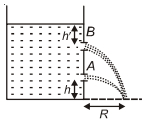
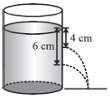
The figure shows two holes in a wide tank containing a liquid column. The water streams coming out of these holes strike the ground at the same point. The height of the liquid column in the tank is $....\ cm$.
A
$10$
B
$8$
C
$9$
D
$980$
Solution
(A) Let $H$ be the total height of the liquid column. The depths of the two holes from the free surface are $h_1 = 4 \ cm$ and $h_2 = 6 \ cm$.
The horizontal range $R$ of a water stream from a hole at depth $h$ is given by $R = 2\sqrt{h(H-h)}$.
Since the streams strike the ground at the same point,their ranges are equal:
$2\sqrt{h_1(H-h_1)} = 2\sqrt{h_2(H-h_2)}$
$h_1(H-h_1) = h_2(H-h_2)$
Substituting the given values:
$4(H-4) = 6(H-6)$
$4H - 16 = 6H - 36$
$2H = 20$
$H = 10 \ cm$.
The horizontal range $R$ of a water stream from a hole at depth $h$ is given by $R = 2\sqrt{h(H-h)}$.
Since the streams strike the ground at the same point,their ranges are equal:
$2\sqrt{h_1(H-h_1)} = 2\sqrt{h_2(H-h_2)}$
$h_1(H-h_1) = h_2(H-h_2)$
Substituting the given values:
$4(H-4) = 6(H-6)$
$4H - 16 = 6H - 36$
$2H = 20$
$H = 10 \ cm$.
0 likes
View Solution74
MediumMCQ
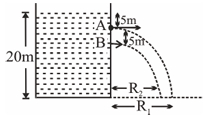
For the shown diagram,find the ratio of $R_1: R_2$.
A
$\frac{2}{\sqrt{3}}$
B
$\frac{\sqrt{3}}{2}$
C
$1$
D
$\frac{1}{\sqrt{3}}$
Solution
(B) The horizontal range $R$ of a fluid jet issuing from a small hole at a depth $h$ below the free surface of a liquid in a tank of total height $H$ is given by $R = 2\sqrt{h(H-h)}$.
For hole $A$,the depth below the free surface is $h_1 = 5 \text{ m}$. The total height of the liquid is $H = 20 \text{ m}$.
Thus,$R_1 = 2\sqrt{5(20-5)} = 2\sqrt{5 \times 15} = 2\sqrt{75} = 10\sqrt{3} \text{ m}$.
For hole $B$,the depth below the free surface is $h_2 = 5 \text{ m} + 5 \text{ m} = 10 \text{ m}$.
Thus,$R_2 = 2\sqrt{10(20-10)} = 2\sqrt{10 \times 10} = 20 \text{ m}$.
The ratio is $\frac{R_1}{R_2} = \frac{10\sqrt{3}}{20} = \frac{\sqrt{3}}{2}$.
For hole $A$,the depth below the free surface is $h_1 = 5 \text{ m}$. The total height of the liquid is $H = 20 \text{ m}$.
Thus,$R_1 = 2\sqrt{5(20-5)} = 2\sqrt{5 \times 15} = 2\sqrt{75} = 10\sqrt{3} \text{ m}$.
For hole $B$,the depth below the free surface is $h_2 = 5 \text{ m} + 5 \text{ m} = 10 \text{ m}$.
Thus,$R_2 = 2\sqrt{10(20-10)} = 2\sqrt{10 \times 10} = 20 \text{ m}$.
The ratio is $\frac{R_1}{R_2} = \frac{10\sqrt{3}}{20} = \frac{\sqrt{3}}{2}$.
0 likes
View Solution75
MediumMCQ
$A$ cylindrical tank has a hole of $1 \ cm^2$ in its bottom. If the water is allowed to flow into the tank from a tube above it at the rate of $70 \ cm^3/s$,then the maximum height up to which water can rise in the tank is: $(g = 9.8 \ m/s^2)$ (in $cm$)
A
$2.5$
B
$5$
C
$10$
D
$0.25$
Solution
(A) The height of water in the tank becomes maximum when the rate of water flowing into the tank equals the rate of water flowing out of the hole.
Rate of water flowing in = $70 \ cm^3/s$.
Rate of water flowing out = $A \times v = A \sqrt{2gh}$,where $A = 1 \ cm^2$ and $g = 980 \ cm/s^2$.
Equating the rates: $1 \times \sqrt{2 \times 980 \times h} = 70$.
Squaring both sides: $2 \times 980 \times h = 70^2$.
$1960 \times h = 4900$.
$h = \frac{4900}{1960} = 2.5 \ cm$.
Rate of water flowing in = $70 \ cm^3/s$.
Rate of water flowing out = $A \times v = A \sqrt{2gh}$,where $A = 1 \ cm^2$ and $g = 980 \ cm/s^2$.
Equating the rates: $1 \times \sqrt{2 \times 980 \times h} = 70$.
Squaring both sides: $2 \times 980 \times h = 70^2$.
$1960 \times h = 4900$.
$h = \frac{4900}{1960} = 2.5 \ cm$.
0 likes
View Solution76
MediumMCQ
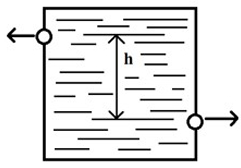
There are two identical small holes on the opposite sides of a tank filled with a liquid. The tank is open at the top. The difference in height between the two holes is $h$. As the liquid comes out of the two holes,the tank will experience a net horizontal force proportional to
A
$h^{3/2}$
B
$h^2$
C
$\sqrt{h}$
D
$h$
Solution
(D) Let the depths of the two holes from the free surface of the liquid be $y_1$ and $y_2$ respectively. Given that the difference in height is $h$,we have $y_2 - y_1 = h$.
The velocity of efflux for the top hole is $v_1 = \sqrt{2gy_1}$ and for the bottom hole is $v_2 = \sqrt{2gy_2}$.
The force exerted by the liquid jet on the tank is given by $F = \frac{dm}{dt} v = (A \rho v) v = A \rho v^2$,where $A$ is the area of the hole and $\rho$ is the density of the liquid.
Since the holes are on opposite sides,the forces act in opposite directions. The net horizontal force $F_{net}$ is $|F_2 - F_1| = |A \rho v_2^2 - A \rho v_1^2|$.
Substituting the velocities: $F_{net} = A \rho (2gy_2 - 2gy_1) = 2A \rho g (y_2 - y_1)$.
Since $y_2 - y_1 = h$,we get $F_{net} = 2A \rho g h$.
Therefore,the net horizontal force is proportional to $h$.
The velocity of efflux for the top hole is $v_1 = \sqrt{2gy_1}$ and for the bottom hole is $v_2 = \sqrt{2gy_2}$.
The force exerted by the liquid jet on the tank is given by $F = \frac{dm}{dt} v = (A \rho v) v = A \rho v^2$,where $A$ is the area of the hole and $\rho$ is the density of the liquid.
Since the holes are on opposite sides,the forces act in opposite directions. The net horizontal force $F_{net}$ is $|F_2 - F_1| = |A \rho v_2^2 - A \rho v_1^2|$.
Substituting the velocities: $F_{net} = A \rho (2gy_2 - 2gy_1) = 2A \rho g (y_2 - y_1)$.
Since $y_2 - y_1 = h$,we get $F_{net} = 2A \rho g h$.
Therefore,the net horizontal force is proportional to $h$.
0 likes
View Solution77
MediumMCQ
$A$ vessel completely filled with water has two holes $P$ and $Q$ at depths $2h$ and $8h$ from the top,respectively. Hole $P$ is a square of side $a$ and hole $Q$ is a circle of radius $r$. If the volume of water flowing out per second from both holes is the same,then the side $a$ of hole $P$ is:
A
$\sqrt{2\pi}r$
B
$r\sqrt{2\pi}$
C
$2\sqrt{\pi}r$
D
$2\pi r$
Solution
(B) The velocity of efflux from a hole at depth $h$ is given by Torricelli's law: $v = \sqrt{2gh}$.
The volume of water flowing out per second (flow rate) is $Q = A \cdot v$,where $A$ is the area of the hole.
For hole $P$ (square of side $a$ at depth $2h$): $A_P = a^2$ and $v_P = \sqrt{2g(2h)} = \sqrt{4gh} = 2\sqrt{gh}$.
Thus,flow rate $Q_P = a^2 \cdot 2\sqrt{gh}$.
For hole $Q$ (circle of radius $r$ at depth $8h$): $A_Q = \pi r^2$ and $v_Q = \sqrt{2g(8h)} = \sqrt{16gh} = 4\sqrt{gh}$.
Thus,flow rate $Q_Q = \pi r^2 \cdot 4\sqrt{gh}$.
Given $Q_P = Q_Q$,we have: $a^2 \cdot 2\sqrt{gh} = \pi r^2 \cdot 4\sqrt{gh}$.
$a^2 \cdot 2 = 4\pi r^2 \implies a^2 = 2\pi r^2$.
Taking the square root of both sides: $a = r\sqrt{2\pi}$.
The volume of water flowing out per second (flow rate) is $Q = A \cdot v$,where $A$ is the area of the hole.
For hole $P$ (square of side $a$ at depth $2h$): $A_P = a^2$ and $v_P = \sqrt{2g(2h)} = \sqrt{4gh} = 2\sqrt{gh}$.
Thus,flow rate $Q_P = a^2 \cdot 2\sqrt{gh}$.
For hole $Q$ (circle of radius $r$ at depth $8h$): $A_Q = \pi r^2$ and $v_Q = \sqrt{2g(8h)} = \sqrt{16gh} = 4\sqrt{gh}$.
Thus,flow rate $Q_Q = \pi r^2 \cdot 4\sqrt{gh}$.
Given $Q_P = Q_Q$,we have: $a^2 \cdot 2\sqrt{gh} = \pi r^2 \cdot 4\sqrt{gh}$.
$a^2 \cdot 2 = 4\pi r^2 \implies a^2 = 2\pi r^2$.
Taking the square root of both sides: $a = r\sqrt{2\pi}$.
0 likes
View Solution78
MediumMCQ
$A$ large vessel completely filled with water has two holes '$A$' and '$B$' at depths '$h$' and '$4h$' from the top. Hole '$A$' is a square of side '$L$' and hole '$B$' is a circle of radius '$R$'. If the same quantity of water is flowing per second from both holes,then the side of the square hole is:
A
$2 \pi R$
B
$\sqrt{2 \pi R}$
C
$\sqrt{2 \pi} \cdot R$
D
$\frac{R}{2}$
Solution
(C) According to Torricelli's law,the velocity of efflux is given by $v = \sqrt{2gh}$.
For hole '$A$' at depth '$h$',the velocity is $V_A = \sqrt{2gh}$.
For hole '$B$' at depth '$4h$',the velocity is $V_B = \sqrt{2g(4h)} = 2\sqrt{2gh} = 2V_A$.
The volume flow rate $(Q)$ is given by $Q = A \cdot v$,where '$A$' is the area of the hole.
Given that the flow rate is the same for both holes: $Q_A = Q_B$.
$A_A \cdot V_A = A_B \cdot V_B$.
Since hole '$A$' is a square of side '$L$',$A_A = L^2$.
Since hole '$B$' is a circle of radius '$R$',$A_B = \pi R^2$.
Substituting the values: $L^2 \cdot V_A = (\pi R^2) \cdot (2V_A)$.
$L^2 = 2\pi R^2$.
$L = \sqrt{2\pi} \cdot R$.
For hole '$A$' at depth '$h$',the velocity is $V_A = \sqrt{2gh}$.
For hole '$B$' at depth '$4h$',the velocity is $V_B = \sqrt{2g(4h)} = 2\sqrt{2gh} = 2V_A$.
The volume flow rate $(Q)$ is given by $Q = A \cdot v$,where '$A$' is the area of the hole.
Given that the flow rate is the same for both holes: $Q_A = Q_B$.
$A_A \cdot V_A = A_B \cdot V_B$.
Since hole '$A$' is a square of side '$L$',$A_A = L^2$.
Since hole '$B$' is a circle of radius '$R$',$A_B = \pi R^2$.
Substituting the values: $L^2 \cdot V_A = (\pi R^2) \cdot (2V_A)$.
$L^2 = 2\pi R^2$.
$L = \sqrt{2\pi} \cdot R$.
0 likes
View Solution79
MediumMCQ
$A$ large open tank containing water has two holes in its wall. $A$ square hole of side $a$ is made at a depth $y$ and a circular hole of radius $r$ is made at a depth $16y$ from the surface of the water. If an equal amount of water comes out through both the holes per second,then the relation between $r$ and $a$ will be:
A
$r=\frac{2 a}{\pi}$
B
$r=\frac{a}{2 \sqrt{\pi}}$
C
$r=\frac{a}{2 \pi}$
D
$r=\frac{2 a}{\sqrt{\pi}}$
Solution
(B) According to Torricelli's law,the velocity of efflux is $v = \sqrt{2gh}$.
Let $A_1$ be the area of the square hole and $A_2$ be the area of the circular hole.
$A_1 = a^2$ and $A_2 = \pi r^2$.
The volume flow rate $Q$ is given by $Q = A \cdot v$.
Given that the volume flow rate is equal for both holes:
$A_1 \sqrt{2gy} = A_2 \sqrt{2g(16y)}$
$a^2 \sqrt{y} = (\pi r^2) \sqrt{16y}$
$a^2 \sqrt{y} = \pi r^2 (4 \sqrt{y})$
$a^2 = 4 \pi r^2$
$r^2 = \frac{a^2}{4 \pi}$
$r = \sqrt{\frac{a^2}{4 \pi}} = \frac{a}{2 \sqrt{\pi}}$
Let $A_1$ be the area of the square hole and $A_2$ be the area of the circular hole.
$A_1 = a^2$ and $A_2 = \pi r^2$.
The volume flow rate $Q$ is given by $Q = A \cdot v$.
Given that the volume flow rate is equal for both holes:
$A_1 \sqrt{2gy} = A_2 \sqrt{2g(16y)}$
$a^2 \sqrt{y} = (\pi r^2) \sqrt{16y}$
$a^2 \sqrt{y} = \pi r^2 (4 \sqrt{y})$
$a^2 = 4 \pi r^2$
$r^2 = \frac{a^2}{4 \pi}$
$r = \sqrt{\frac{a^2}{4 \pi}} = \frac{a}{2 \sqrt{\pi}}$
0 likes
View Solution80
EasyMCQ
$A$ completely filled water tank of height $h$ has a hole at the bottom. The total pressure at the bottom is $4H$ and the atmospheric pressure is $H$. The velocity of water flowing out of the hole is $(\rho = \text{density of water})$
A
$\sqrt{\frac{3H}{\rho}}$
B
$\sqrt{\frac{5H}{\rho}}$
C
$\sqrt{\frac{6H}{\rho}}$
D
$\sqrt{\frac{9H}{\rho}}$
Solution
(C) According to Bernoulli's principle,the velocity of efflux $v$ is given by the formula:
$v = \sqrt{\frac{2(P - P_0)}{\rho}}$
where $P$ is the total pressure at the bottom,$P_0$ is the atmospheric pressure,and $\rho$ is the density of water.
Given:
$P = 4H$
$P_0 = H$
Substituting these values into the formula:
$v = \sqrt{\frac{2(4H - H)}{\rho}}$
$v = \sqrt{\frac{2(3H)}{\rho}}$
$v = \sqrt{\frac{6H}{\rho}}$
$v = \sqrt{\frac{2(P - P_0)}{\rho}}$
where $P$ is the total pressure at the bottom,$P_0$ is the atmospheric pressure,and $\rho$ is the density of water.
Given:
$P = 4H$
$P_0 = H$
Substituting these values into the formula:
$v = \sqrt{\frac{2(4H - H)}{\rho}}$
$v = \sqrt{\frac{2(3H)}{\rho}}$
$v = \sqrt{\frac{6H}{\rho}}$
0 likes
View Solution81
EasyMCQ
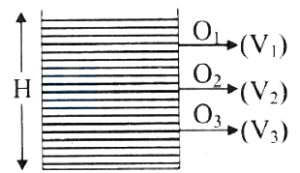
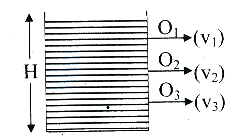
$A$ cylinder contains water up to a height '$H$'. It has three orifices $O_1, O_2, O_3$ as shown in the figure. Let $V_1, V_2, V_3$ be the speed of efflux of water from the three orifices. Then
A
$V_1=V_2=V_3$
B
$V_1 < V_2 < V_3$
C
$V_1 > V_2 > V_3$
D
$V_1=V_3 > V_2$
Solution
(B) According to Torricelli's law,the speed of efflux $(V)$ of water from an orifice at a depth '$h$' below the free surface is given by:
$V = \sqrt{2gh}$
From the figure,the depths of the orifices $O_1, O_2, O_3$ from the free surface are $h_1, h_2, h_3$ respectively.
It is clear from the figure that $h_1 < h_2 < h_3$.
Since $V$ is directly proportional to $\sqrt{h}$,we have:
$V_1 < V_2 < V_3$
Thus,the speed of efflux increases as the depth of the orifice increases.
$V = \sqrt{2gh}$
From the figure,the depths of the orifices $O_1, O_2, O_3$ from the free surface are $h_1, h_2, h_3$ respectively.
It is clear from the figure that $h_1 < h_2 < h_3$.
Since $V$ is directly proportional to $\sqrt{h}$,we have:
$V_1 < V_2 < V_3$
Thus,the speed of efflux increases as the depth of the orifice increases.
0 likes
View Solution82
MediumMCQ
$A$ closed pipe containing liquid showed a pressure $P_{1}$ by gauge. When the valve is opened,the pressure was reduced to $P_{2}$. The speed of water flowing out of the pipe is $[\rho = \text{density of water}]$
A
$\left[\frac{2(P_{1}+P_{2})}{\rho}\right]^{1/2}$
B
$\left[\frac{2(P_{1}-P_{2})}{\rho}\right]^{1/2}$
C
$\left[\frac{\rho}{2(P_{1}-P_{2})}\right]^{1/2}$
D
$\left[\frac{\rho}{2(P_{1}+P_{2})}\right]^{1/2}$
Solution
(B) According to Bernoulli's principle for a fluid in motion,the sum of pressure energy,kinetic energy,and potential energy per unit volume remains constant.
For the fluid inside the pipe,the initial pressure is $P_{1}$ when the velocity is zero.
When the valve is opened,the pressure drops to $P_{2}$ and the fluid gains a velocity $v$.
Applying Bernoulli's equation between the inside of the pipe and the outlet:
$P_{1} + 0 = P_{2} + \frac{1}{2} \rho v^{2}$
Rearranging the terms to solve for $v$:
$P_{1} - P_{2} = \frac{1}{2} \rho v^{2}$
$v^{2} = \frac{2(P_{1} - P_{2})}{\rho}$
$v = \sqrt{\frac{2(P_{1} - P_{2})}{\rho}}$
Thus,the correct option is $B$.
For the fluid inside the pipe,the initial pressure is $P_{1}$ when the velocity is zero.
When the valve is opened,the pressure drops to $P_{2}$ and the fluid gains a velocity $v$.
Applying Bernoulli's equation between the inside of the pipe and the outlet:
$P_{1} + 0 = P_{2} + \frac{1}{2} \rho v^{2}$
Rearranging the terms to solve for $v$:
$P_{1} - P_{2} = \frac{1}{2} \rho v^{2}$
$v^{2} = \frac{2(P_{1} - P_{2})}{\rho}$
$v = \sqrt{\frac{2(P_{1} - P_{2})}{\rho}}$
Thus,the correct option is $B$.
0 likes
View Solution83
DifficultMCQ
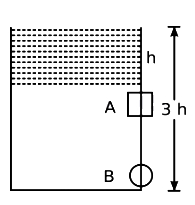
$A$ vessel completely filled with water has holes $A$ and $B$ at depths $h$ and $3h$ from the top respectively. The hole $A$ is a square of side $L$ and $B$ is a circle of radius $r$. The water flowing out per second from both the holes is same. Then $L$ is equal to
A
$r^{\frac{1}{2}}(\pi)^{\frac{1}{2}}(3)^{\frac{1}{2}}$
B
$r(\pi)^{\frac{1}{4}}(3)^{\frac{1}{4}}$
C
$r(\pi)^{\frac{1}{2}}(3)^{\frac{1}{4}}$
D
$r^{\frac{1}{2}}(\pi)^{\frac{1}{3}}(3)^{\frac{1}{2}}$
Solution
(C) The volume flow rate (or discharge) $Q$ from a hole at depth $y$ is given by $Q = A_v \cdot v$,where $A_v$ is the area of the hole and $v = \sqrt{2gy}$ is the velocity of efflux.
For hole $A$ at depth $h$: Area $A_A = L^2$,velocity $v_A = \sqrt{2gh}$. So,$Q_A = L^2 \sqrt{2gh}$.
For hole $B$ at depth $3h$: Area $A_B = \pi r^2$,velocity $v_B = \sqrt{2g(3h)} = \sqrt{6gh}$. So,$Q_B = \pi r^2 \sqrt{6gh}$.
Given that the flow rate is the same,$Q_A = Q_B$:
$L^2 \sqrt{2gh} = \pi r^2 \sqrt{6gh}$
$L^2 = \pi r^2 \frac{\sqrt{6gh}}{\sqrt{2gh}} = \pi r^2 \sqrt{3}$
Taking the square root of both sides:
$L = \sqrt{\pi r^2 \sqrt{3}} = r \sqrt{\pi} (3)^{\frac{1}{4}} = r (\pi)^{\frac{1}{2}} (3)^{\frac{1}{4}}$.
For hole $A$ at depth $h$: Area $A_A = L^2$,velocity $v_A = \sqrt{2gh}$. So,$Q_A = L^2 \sqrt{2gh}$.
For hole $B$ at depth $3h$: Area $A_B = \pi r^2$,velocity $v_B = \sqrt{2g(3h)} = \sqrt{6gh}$. So,$Q_B = \pi r^2 \sqrt{6gh}$.
Given that the flow rate is the same,$Q_A = Q_B$:
$L^2 \sqrt{2gh} = \pi r^2 \sqrt{6gh}$
$L^2 = \pi r^2 \frac{\sqrt{6gh}}{\sqrt{2gh}} = \pi r^2 \sqrt{3}$
Taking the square root of both sides:
$L = \sqrt{\pi r^2 \sqrt{3}} = r \sqrt{\pi} (3)^{\frac{1}{4}} = r (\pi)^{\frac{1}{2}} (3)^{\frac{1}{4}}$.
0 likes
View Solution84
MediumMCQ
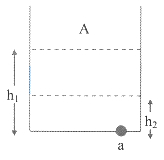
There is a hole of area 'a' at the bottom of a cylindrical vessel with cross-sectional area '$A$'. Water is filled to a height 'h' and flows out in 't' seconds. If water is filled to a height '4h',it will flow out in time (in seconds):
A
$t$
B
$4t$
C
$2t$
D
$\frac{t}{4}$
Solution
(C) According to the equation of continuity and Torricelli's law,the rate of flow of water is given by:
$A \left( -\frac{dh}{dt} \right) = a \sqrt{2gh}$
Rearranging the terms for integration:
$\int_{h}^{0} \frac{-dh}{\sqrt{h}} = \int_{0}^{t} \frac{a}{A} \sqrt{2g} dt$
Integrating both sides:
$[2\sqrt{h}]_{0}^{h} = \frac{a}{A} \sqrt{2g} t$
$2\sqrt{h} = \frac{a}{A} \sqrt{2g} t$
Thus,the time taken to empty the vessel is proportional to the square root of the height:
$t \propto \sqrt{h}$
Given that for height $h$,the time is $t_1 = t$,and for height $h_2 = 4h$,the time is $t_2$:
$\frac{t_2}{t_1} = \sqrt{\frac{h_2}{h_1}} = \sqrt{\frac{4h}{h}} = \sqrt{4} = 2$
Therefore,$t_2 = 2t_1 = 2t$.
$A \left( -\frac{dh}{dt} \right) = a \sqrt{2gh}$
Rearranging the terms for integration:
$\int_{h}^{0} \frac{-dh}{\sqrt{h}} = \int_{0}^{t} \frac{a}{A} \sqrt{2g} dt$
Integrating both sides:
$[2\sqrt{h}]_{0}^{h} = \frac{a}{A} \sqrt{2g} t$
$2\sqrt{h} = \frac{a}{A} \sqrt{2g} t$
Thus,the time taken to empty the vessel is proportional to the square root of the height:
$t \propto \sqrt{h}$
Given that for height $h$,the time is $t_1 = t$,and for height $h_2 = 4h$,the time is $t_2$:
$\frac{t_2}{t_1} = \sqrt{\frac{h_2}{h_1}} = \sqrt{\frac{4h}{h}} = \sqrt{4} = 2$
Therefore,$t_2 = 2t_1 = 2t$.
0 likes
View Solution85
MediumMCQ
$A$ cylindrical container containing water has a small hole at a height of $H = 8 \text{ cm}$ from the bottom and at a depth of $h = 2 \text{ cm}$ from the top surface of the liquid. The horizontal distance (range) travelled by the water before it hits the ground is:
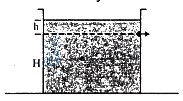
A
$4 \text{ cm}$
B
$8 \text{ cm}$
C
$6 \text{ cm}$
D
$4\sqrt{2} \text{ cm}$
Solution
(B) According to Torricelli's law,the velocity of efflux $v$ is given by $v = \sqrt{2gh}$,where $h$ is the depth of the hole from the free surface.
Given $h = 2 \text{ cm}$,so $v = \sqrt{2 \times g \times 2} = 2\sqrt{g}$.
The time $t$ taken for the water to reach the ground from a height $H = 8 \text{ cm}$ is given by $H = \frac{1}{2}gt^2$,which implies $t = \sqrt{\frac{2H}{g}} = \sqrt{\frac{2 \times 8}{g}} = \sqrt{\frac{16}{g}} = \frac{4}{\sqrt{g}}$.
The horizontal range $R$ is the product of the velocity of efflux and the time of flight:
$R = v \times t = (\sqrt{2gh}) \times \sqrt{\frac{2H}{g}} = 2\sqrt{hH}$.
Substituting the values $h = 2 \text{ cm}$ and $H = 8 \text{ cm}$:
$R = 2 \times \sqrt{2 \times 8} = 2 \times \sqrt{16} = 2 \times 4 = 8 \text{ cm}$.
Given $h = 2 \text{ cm}$,so $v = \sqrt{2 \times g \times 2} = 2\sqrt{g}$.
The time $t$ taken for the water to reach the ground from a height $H = 8 \text{ cm}$ is given by $H = \frac{1}{2}gt^2$,which implies $t = \sqrt{\frac{2H}{g}} = \sqrt{\frac{2 \times 8}{g}} = \sqrt{\frac{16}{g}} = \frac{4}{\sqrt{g}}$.
The horizontal range $R$ is the product of the velocity of efflux and the time of flight:
$R = v \times t = (\sqrt{2gh}) \times \sqrt{\frac{2H}{g}} = 2\sqrt{hH}$.
Substituting the values $h = 2 \text{ cm}$ and $H = 8 \text{ cm}$:
$R = 2 \times \sqrt{2 \times 8} = 2 \times \sqrt{16} = 2 \times 4 = 8 \text{ cm}$.
0 likes
View Solution86
MediumMCQ
$A$ large tank filled with water to a height $h$ is to be emptied through a small hole at the bottom. The ratio of the time taken for the level to fall from $h$ to $h/2$ and that taken for the level to fall from $h/2$ to $0$ is:
A
$\sqrt{2}-1$
B
$\frac{1}{\sqrt{2}}$
C
$\sqrt{2}$
D
$\frac{1}{\sqrt{2}-1}$
Solution
(A) According to Torricelli's law,the velocity of efflux is $v = \sqrt{2gh}$.
The rate of change of height is given by $A \frac{dh}{dt} = -a \sqrt{2gh}$,where $A$ is the area of the tank and $a$ is the area of the hole.
This gives $dt = -\frac{A}{a\sqrt{2g}} h^{-1/2} dh$.
The time taken to fall from height $h_1$ to $h_2$ is $t = \int_{h_2}^{h_1} \frac{A}{a\sqrt{2g}} h^{-1/2} dh = \frac{A}{a\sqrt{2g}} [2\sqrt{h}]_{h_2}^{h_1} = \frac{2A}{a\sqrt{2g}} (\sqrt{h_1} - \sqrt{h_2})$.
Let $t_1$ be the time to fall from $h$ to $h/2$:
$t_1 = \frac{2A}{a\sqrt{2g}} (\sqrt{h} - \sqrt{h/2}) = \frac{2A}{a\sqrt{2g}} \sqrt{h} (1 - 1/\sqrt{2})$.
Let $t_2$ be the time to fall from $h/2$ to $0$:
$t_2 = \frac{2A}{a\sqrt{2g}} (\sqrt{h/2} - \sqrt{0}) = \frac{2A}{a\sqrt{2g}} \sqrt{h} (1/\sqrt{2})$.
The ratio is $\frac{t_1}{t_2} = \frac{1 - 1/\sqrt{2}}{1/\sqrt{2}} = \sqrt{2} - 1$.
The rate of change of height is given by $A \frac{dh}{dt} = -a \sqrt{2gh}$,where $A$ is the area of the tank and $a$ is the area of the hole.
This gives $dt = -\frac{A}{a\sqrt{2g}} h^{-1/2} dh$.
The time taken to fall from height $h_1$ to $h_2$ is $t = \int_{h_2}^{h_1} \frac{A}{a\sqrt{2g}} h^{-1/2} dh = \frac{A}{a\sqrt{2g}} [2\sqrt{h}]_{h_2}^{h_1} = \frac{2A}{a\sqrt{2g}} (\sqrt{h_1} - \sqrt{h_2})$.
Let $t_1$ be the time to fall from $h$ to $h/2$:
$t_1 = \frac{2A}{a\sqrt{2g}} (\sqrt{h} - \sqrt{h/2}) = \frac{2A}{a\sqrt{2g}} \sqrt{h} (1 - 1/\sqrt{2})$.
Let $t_2$ be the time to fall from $h/2$ to $0$:
$t_2 = \frac{2A}{a\sqrt{2g}} (\sqrt{h/2} - \sqrt{0}) = \frac{2A}{a\sqrt{2g}} \sqrt{h} (1/\sqrt{2})$.
The ratio is $\frac{t_1}{t_2} = \frac{1 - 1/\sqrt{2}}{1/\sqrt{2}} = \sqrt{2} - 1$.
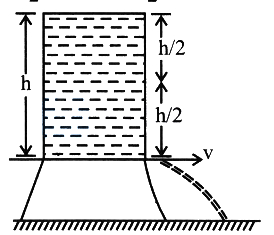
0 likes
View Solution87
MediumMCQ
$A$ large tank open to the atmosphere at the top and filled with water develops a small hole in the side at a point $20 \,m$ below the water level. If the rate of flow of water from the hole is $3 \times 10^{-3} \,m^3/min$, then the area of the hole is (Acceleration due to gravity $= 10 \,m/s^2$) (in $\,mm^2$)
A
$4$
B
$1.5$
C
$2.5$
D
$2$
Solution
(C) The rate of flow of water through a hole is given by the product of the velocity of efflux and the area of the hole.
$\frac{\Delta V}{\Delta t} = v \times A$
Using Torricelli's law, the velocity of efflux is $v = \sqrt{2gh}$.
Thus, $\frac{\Delta V}{\Delta t} = \sqrt{2gh} \times A$ ... $(i)$
Given:
$h = 20 \,m$
$g = 10 \,m/s^2$
$\frac{\Delta V}{\Delta t} = 3 \times 10^{-3} \,m^3/min = \frac{3 \times 10^{-3}}{60} \,m^3/s = 0.5 \times 10^{-4} \,m^3/s = 5 \times 10^{-5} \,m^3/s$
Substituting the values into equation $(i)$:
$5 \times 10^{-5} = \sqrt{2 \times 10 \times 20} \times A$
$5 \times 10^{-5} = \sqrt{400} \times A$
$5 \times 10^{-5} = 20 \times A$
$A = \frac{5 \times 10^{-5}}{20} = 0.25 \times 10^{-5} \,m^2 = 2.5 \times 10^{-6} \,m^2$
Since $1 \,m^2 = 10^6 \,mm^2$, we have:
$A = 2.5 \times 10^{-6} \times 10^6 \,mm^2 = 2.5 \,mm^2$.
$\frac{\Delta V}{\Delta t} = v \times A$
Using Torricelli's law, the velocity of efflux is $v = \sqrt{2gh}$.
Thus, $\frac{\Delta V}{\Delta t} = \sqrt{2gh} \times A$ ... $(i)$
Given:
$h = 20 \,m$
$g = 10 \,m/s^2$
$\frac{\Delta V}{\Delta t} = 3 \times 10^{-3} \,m^3/min = \frac{3 \times 10^{-3}}{60} \,m^3/s = 0.5 \times 10^{-4} \,m^3/s = 5 \times 10^{-5} \,m^3/s$
Substituting the values into equation $(i)$:
$5 \times 10^{-5} = \sqrt{2 \times 10 \times 20} \times A$
$5 \times 10^{-5} = \sqrt{400} \times A$
$5 \times 10^{-5} = 20 \times A$
$A = \frac{5 \times 10^{-5}}{20} = 0.25 \times 10^{-5} \,m^2 = 2.5 \times 10^{-6} \,m^2$
Since $1 \,m^2 = 10^6 \,mm^2$, we have:
$A = 2.5 \times 10^{-6} \times 10^6 \,mm^2 = 2.5 \,mm^2$.
0 likes
View Solution88
EasyMCQ
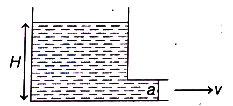
$A$ cylindrical tank having a large diameter is filled with water to a height $H$. $A$ hole of cross-sectional area $5 \,cm^2$ in the tank allows water to drain out. If the water drains out at the rate of $2 \times 10^{-3} \,m^3 \,s^{-1}$, then the value of $H$ is (acceleration due to gravity $= 10 \,ms^{-2}$) (in $\,cm$)
A
$80$
B
$120$
C
$60$
D
$90$
Solution
(A) The velocity of efflux $(v)$ through a hole at a depth $H$ below the free surface is given by Torricelli's law: $v = \sqrt{2gH}$.
The volume flow rate $(Q)$ is the product of the area of the hole $(a)$ and the velocity of efflux $(v)$:
$Q = a \times v = a \sqrt{2gH}$
Given:
$Q = 2 \times 10^{-3} \,m^3/s$
$a = 5 \,cm^2 = 5 \times 10^{-4} \,m^2$
$g = 10 \,ms^{-2}$
Substituting the values into the equation:
$2 \times 10^{-3} = 5 \times 10^{-4} \times \sqrt{2 \times 10 \times H}$
Divide both sides by $5 \times 10^{-4}$:
$4 = \sqrt{20H}$
Squaring both sides:
$16 = 20H$
$H = \frac{16}{20} \,m = 0.8 \,m = 80 \,cm$.
The volume flow rate $(Q)$ is the product of the area of the hole $(a)$ and the velocity of efflux $(v)$:
$Q = a \times v = a \sqrt{2gH}$
Given:
$Q = 2 \times 10^{-3} \,m^3/s$
$a = 5 \,cm^2 = 5 \times 10^{-4} \,m^2$
$g = 10 \,ms^{-2}$
Substituting the values into the equation:
$2 \times 10^{-3} = 5 \times 10^{-4} \times \sqrt{2 \times 10 \times H}$
Divide both sides by $5 \times 10^{-4}$:
$4 = \sqrt{20H}$
Squaring both sides:
$16 = 20H$
$H = \frac{16}{20} \,m = 0.8 \,m = 80 \,cm$.
0 likes
View Solution89
MediumMCQ
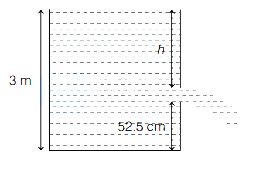
$A$ cylindrical tank is filled with water to a level of $3 \,m$. $A$ hole is opened at a height of $52.5 \,cm$ from the bottom. The ratio of the area of the hole to that of the cross-sectional area of the tank is $0.1$. The square of the speed with which water will be coming out from the orifice is $(g=10 \,ms^{-2})$.
A
$50 \,m^2 \,s^{-2}$
B
$40 \,m^2 \,s^{-2}$
C
$51.5 \,m^2 \,s^{-2}$
D
$50.5 \,m^2 \,s^{-2}$
Solution
(A) Let $a$ be the area of the hole,$v_e$ be the velocity of efflux,and $h$ be the height of the liquid above the hole. Let $v$ be the speed with which the level decreases in the container.
From the equation of continuity,$a v_e = A v \Rightarrow v = \frac{a v_e}{A}$.
Using Bernoulli's theorem at the top surface and the orifice:
$p_0 + h \rho g + \frac{1}{2} \rho v^2 = p_0 + \frac{1}{2} \rho v_e^2$
$h \rho g + \frac{1}{2} \rho \left(\frac{a v_e}{A}\right)^2 = \frac{1}{2} \rho v_e^2$
$v_e^2 = \frac{2gh}{1 - (a/A)^2}$
Given $h = 3 \,m - 0.525 \,m = 2.475 \,m$,$a/A = 0.1$,and $g = 10 \,ms^{-2}$:
$v_e^2 = \frac{2 \times 10 \times 2.475}{1 - (0.1)^2} = \frac{49.5}{1 - 0.01} = \frac{49.5}{0.99} = 50 \,m^2 \,s^{-2}$.
From the equation of continuity,$a v_e = A v \Rightarrow v = \frac{a v_e}{A}$.
Using Bernoulli's theorem at the top surface and the orifice:
$p_0 + h \rho g + \frac{1}{2} \rho v^2 = p_0 + \frac{1}{2} \rho v_e^2$
$h \rho g + \frac{1}{2} \rho \left(\frac{a v_e}{A}\right)^2 = \frac{1}{2} \rho v_e^2$
$v_e^2 = \frac{2gh}{1 - (a/A)^2}$
Given $h = 3 \,m - 0.525 \,m = 2.475 \,m$,$a/A = 0.1$,and $g = 10 \,ms^{-2}$:
$v_e^2 = \frac{2 \times 10 \times 2.475}{1 - (0.1)^2} = \frac{49.5}{1 - 0.01} = \frac{49.5}{0.99} = 50 \,m^2 \,s^{-2}$.
0 likes
View Solution90
MediumMCQ
$A$ liquid is filled in a tank up to a height of $5 \,m$ and the bottom of the tank is at $5 \,m$ height from the ground. $A$ hole is punched in the tank so that the liquid coming out touches the ground at maximum horizontal distance. Then, the maximum horizontal distance is (in $\,m$)
A
$10$
B
$2.5$
C
$5$
D
$15$
Solution
(A) Let the height of the liquid in the tank be $H = 5 \,m$. Let the height of the bottom of the tank from the ground be $h_0 = 5 \,m$. Let the hole be made at a depth $y$ from the free surface of the liquid. The height of the hole from the ground is $h = h_0 + (H - y) = 5 + 5 - y = 10 - y$. The velocity of efflux is $v = \sqrt{2gy}$. The time taken for the liquid to reach the ground is $t = \sqrt{\frac{2h}{g}} = \sqrt{\frac{2(10-y)}{g}}$. The horizontal range $R$ is given by $R = v \cdot t = \sqrt{2gy} \cdot \sqrt{\frac{2(10-y)}{g}} = 2\sqrt{y(10-y)}$. To maximize $R$, we maximize $f(y) = y(10-y) = 10y - y^2$. Taking the derivative with respect to $y$ and setting it to zero: $\frac{df}{dy} = 10 - 2y = 0$, which gives $y = 5 \,m$. Substituting $y = 5 \,m$ into the range formula: $R_{max} = 2\sqrt{5(10-5)} = 2\sqrt{25} = 2 \times 5 = 10 \,m$.
0 likes
View Solution91
DifficultMCQ
$A$ large tank filled with water to a height $h$ is to be emptied through a small hole at the bottom. The ratio of times taken for the level of water to fall from $h$ to $h/2$ and from $h/2$ to zero is
A
$\sqrt{2}$
B
$\frac{1}{\sqrt{2}}$
C
$\sqrt{2}-1$
D
$\frac{1}{\sqrt{2}-1}$
Solution
(C) The velocity of efflux is given by Torricelli's law as $v = \sqrt{2gh}$.
Let $A$ be the area of the tank and $a$ be the area of the hole. The rate of change of height is given by $A \frac{dh}{dt} = -a \sqrt{2gh}$.
Rearranging the terms,we get $dt = -\frac{A}{a \sqrt{2g}} h^{-1/2} dh$.
Integrating from $h_1$ to $h_2$,the time taken is $t = \int_{h_2}^{h_1} \frac{A}{a \sqrt{2g}} h^{-1/2} dh = \frac{A}{a} \sqrt{\frac{2}{g}} (\sqrt{h_1} - \sqrt{h_2})$.
For the first interval ($h$ to $h/2$): $t_1 = \frac{A}{a} \sqrt{\frac{2}{g}} (\sqrt{h} - \sqrt{h/2}) = \frac{A}{a} \sqrt{\frac{2h}{g}} (1 - \frac{1}{\sqrt{2}})$.
For the second interval ($h/2$ to $0$): $t_2 = \frac{A}{a} \sqrt{\frac{2}{g}} (\sqrt{h/2} - 0) = \frac{A}{a} \sqrt{\frac{2h}{g}} (\frac{1}{\sqrt{2}})$.
Taking the ratio: $\frac{t_1}{t_2} = \frac{1 - 1/\sqrt{2}}{1/\sqrt{2}} = \frac{(\sqrt{2}-1)/\sqrt{2}}{1/\sqrt{2}} = \sqrt{2}-1$.
Let $A$ be the area of the tank and $a$ be the area of the hole. The rate of change of height is given by $A \frac{dh}{dt} = -a \sqrt{2gh}$.
Rearranging the terms,we get $dt = -\frac{A}{a \sqrt{2g}} h^{-1/2} dh$.
Integrating from $h_1$ to $h_2$,the time taken is $t = \int_{h_2}^{h_1} \frac{A}{a \sqrt{2g}} h^{-1/2} dh = \frac{A}{a} \sqrt{\frac{2}{g}} (\sqrt{h_1} - \sqrt{h_2})$.
For the first interval ($h$ to $h/2$): $t_1 = \frac{A}{a} \sqrt{\frac{2}{g}} (\sqrt{h} - \sqrt{h/2}) = \frac{A}{a} \sqrt{\frac{2h}{g}} (1 - \frac{1}{\sqrt{2}})$.
For the second interval ($h/2$ to $0$): $t_2 = \frac{A}{a} \sqrt{\frac{2}{g}} (\sqrt{h/2} - 0) = \frac{A}{a} \sqrt{\frac{2h}{g}} (\frac{1}{\sqrt{2}})$.
Taking the ratio: $\frac{t_1}{t_2} = \frac{1 - 1/\sqrt{2}}{1/\sqrt{2}} = \frac{(\sqrt{2}-1)/\sqrt{2}}{1/\sqrt{2}} = \sqrt{2}-1$.
0 likes
View Solution92
MediumMCQ
$A$ tank with vertical walls is mounted so that its base is at a height $H$ above the horizontal ground. The tank is filled with water to a depth $h$. $A$ hole is punched in the side wall of the tank at a depth $x$ below the water surface. To have maximum range of the emerging stream,the value of $x$ is
A
$\frac{H+h}{4}$
B
$\frac{H+h}{2}$
C
$\frac{H+h}{3}$
D
$\frac{3(H+h)}{4}$
Solution
(B) Let the total height of the water surface from the ground be $Y = H + h$.
The velocity of efflux at a depth $x$ below the water surface is $v = \sqrt{2gx}$.
The height of the hole from the ground is $y = H + (h - x)$.
The time taken for the water to reach the ground is $t = \sqrt{\frac{2y}{g}} = \sqrt{\frac{2(H + h - x)}{g}}$.
The horizontal range $R$ is given by $R = v \cdot t = \sqrt{2gx} \cdot \sqrt{\frac{2(H + h - x)}{g}} = 2\sqrt{x(H + h - x)}$.
To maximize $R$,we maximize the term $f(x) = x(H + h - x) = (H + h)x - x^2$.
Taking the derivative with respect to $x$ and setting it to zero: $f'(x) = (H + h) - 2x = 0$.
Thus,$x = \frac{H + h}{2}$.
The velocity of efflux at a depth $x$ below the water surface is $v = \sqrt{2gx}$.
The height of the hole from the ground is $y = H + (h - x)$.
The time taken for the water to reach the ground is $t = \sqrt{\frac{2y}{g}} = \sqrt{\frac{2(H + h - x)}{g}}$.
The horizontal range $R$ is given by $R = v \cdot t = \sqrt{2gx} \cdot \sqrt{\frac{2(H + h - x)}{g}} = 2\sqrt{x(H + h - x)}$.
To maximize $R$,we maximize the term $f(x) = x(H + h - x) = (H + h)x - x^2$.
Taking the derivative with respect to $x$ and setting it to zero: $f'(x) = (H + h) - 2x = 0$.
Thus,$x = \frac{H + h}{2}$.
0 likes
View Solution93
EasyMCQ
$A$ large open-top water tank is completely filled with water. $A$ small hole of diameter $4 \,mm$ is made $10 \,m$ below the water level. The flow rate of water through the hole is (Acceleration due to gravity $= 10 \,m/s^2$)
A
$14.14 \times 10^{-6} \,m^3/s$
B
$2.1 \times 10^{-6} \,m^3/s$
C
$1.77 \times 10^{-4} \,m^3/s$
D
$0.177 \times 10^{-6} \,m^3/s$
Solution
(C) According to Torricelli's law derived from Bernoulli's equation, the velocity of efflux $v$ is given by $v = \sqrt{2gh}$.
Given $g = 10 \,m/s^2$ and $h = 10 \,m$, we have $v = \sqrt{2 \times 10 \times 10} = \sqrt{200} = 14.14 \,m/s$.
The diameter of the hole is $d = 4 \,mm = 4 \times 10^{-3} \,m$, so the radius $r = 2 \times 10^{-3} \,m$.
The area of the hole is $A = \pi r^2 = 3.14 \times (2 \times 10^{-3})^2 = 3.14 \times 4 \times 10^{-6} = 12.56 \times 10^{-6} \,m^2$.
The flow rate $Q$ is given by $Q = A \times v$.
$Q = (12.56 \times 10^{-6} \,m^2) \times (14.14 \,m/s) \approx 177.6 \times 10^{-6} \,m^3/s = 1.776 \times 10^{-4} \,m^3/s$.
Given $g = 10 \,m/s^2$ and $h = 10 \,m$, we have $v = \sqrt{2 \times 10 \times 10} = \sqrt{200} = 14.14 \,m/s$.
The diameter of the hole is $d = 4 \,mm = 4 \times 10^{-3} \,m$, so the radius $r = 2 \times 10^{-3} \,m$.
The area of the hole is $A = \pi r^2 = 3.14 \times (2 \times 10^{-3})^2 = 3.14 \times 4 \times 10^{-6} = 12.56 \times 10^{-6} \,m^2$.
The flow rate $Q$ is given by $Q = A \times v$.
$Q = (12.56 \times 10^{-6} \,m^2) \times (14.14 \,m/s) \approx 177.6 \times 10^{-6} \,m^3/s = 1.776 \times 10^{-4} \,m^3/s$.
0 likes
View Solution94
MediumMCQ
$A$ cylindrical tank has a hole of area $2 \,cm^2$ at its bottom. If water is poured into the tank from a tube above it at the rate of $100 \,cm^3 \,s^{-1}$, then the maximum height up to which water can rise in the tank is (Acceleration due to gravity, $g=10 \,ms^{-2}$) (in $cm$)
A
$2.5$
B
$1.25$
C
$5.5$
D
$3.5$
Solution
(B) Given: Area of the hole, $A = 2 \,cm^2 = 2 \times 10^{-4} \,m^2$.
Volume flow rate, $Q = 100 \,cm^3/s = 100 \times 10^{-6} \,m^3/s = 10^{-4} \,m^3/s$.
At maximum height $h$, the rate of water entering the tank equals the rate of water exiting through the hole.
By Torricelli's Law, the velocity of efflux is $v = \sqrt{2gh}$.
The volume flow rate through the hole is $Q = A \times v$.
Substituting the values: $10^{-4} = (2 \times 10^{-4}) \times \sqrt{2gh}$.
Dividing both sides by $2 \times 10^{-4}$: $0.5 = \sqrt{2gh}$.
Squaring both sides: $0.25 = 2gh$.
Given $g = 10 \,m/s^2$, we have $0.25 = 2 \times 10 \times h$.
$0.25 = 20h$.
$h = \frac{0.25}{20} = 0.0125 \,m$.
Converting to cm: $h = 0.0125 \times 100 \,cm = 1.25 \,cm$.
Volume flow rate, $Q = 100 \,cm^3/s = 100 \times 10^{-6} \,m^3/s = 10^{-4} \,m^3/s$.
At maximum height $h$, the rate of water entering the tank equals the rate of water exiting through the hole.
By Torricelli's Law, the velocity of efflux is $v = \sqrt{2gh}$.
The volume flow rate through the hole is $Q = A \times v$.
Substituting the values: $10^{-4} = (2 \times 10^{-4}) \times \sqrt{2gh}$.
Dividing both sides by $2 \times 10^{-4}$: $0.5 = \sqrt{2gh}$.
Squaring both sides: $0.25 = 2gh$.
Given $g = 10 \,m/s^2$, we have $0.25 = 2 \times 10 \times h$.
$0.25 = 20h$.
$h = \frac{0.25}{20} = 0.0125 \,m$.
Converting to cm: $h = 0.0125 \times 100 \,cm = 1.25 \,cm$.
0 likes
View Solution95
EasyMCQ
Tanks $A$ and $B$ open at the top contain two different liquids up to a certain height. $A$ hole is made in the wall of each tank at a depth $h$ from the surface of the liquid. The area of the hole in $B$ is twice that of the hole in $A$. If the liquid mass flux through each hole is equal,then the ratio of the densities of the liquids,$\rho_A / \rho_B$,is:
A
$1$
B
$3/2$
C
$2/3$
D
$1/2$
Solution
(A) According to Torricelli's law,the velocity of efflux $v$ at a depth $h$ is given by $v = \sqrt{2gh}$.
Since the depth $h$ is the same for both tanks,the velocity of efflux for both tanks is the same: $v_A = v_B = v = \sqrt{2gh}$.
The mass flux (mass flow rate) is given by $\dot{m} = A \cdot v \cdot \rho$,where $A$ is the area of the hole,$v$ is the velocity,and $\rho$ is the density.
Given that the mass flux is equal for both tanks: $\dot{m}_A = \dot{m}_B$.
$A_A \cdot v_A \cdot \rho_A = A_B \cdot v_B \cdot \rho_B$.
Since $v_A = v_B$,we can cancel them from both sides:
$A_A \cdot \rho_A = A_B \cdot \rho_B$.
Given that the area of the hole in $B$ is twice that of $A$,$A_B = 2 A_A$.
Substituting this into the equation:
$A_A \cdot \rho_A = (2 A_A) \cdot \rho_B$.
Dividing both sides by $A_A \cdot \rho_B$:
$\frac{\rho_A}{\rho_B} = 2$.
Wait,re-evaluating the provided options and the logic: If $A_B = 2 A_A$,then $\rho_A = 2 \rho_B$,so $\rho_A / \rho_B = 2$. However,looking at the provided solution logic in the prompt,it assumes $v_2 = v_1/2$ which is incorrect for Torricelli's law. Given the standard physics,the ratio is $2$. Since $2$ is not an option,$I$ will re-verify the prompt's provided solution logic. The prompt's solution claims $A_1 v_1 = A_2 v_2$ which is the continuity equation for a pipe,not for efflux from a tank. For efflux,$v = \sqrt{2gh}$. Thus $\rho_A / \rho_B = A_B / A_A = 2$. If the intended answer is $1$,the area must be equal. Given the constraints,$I$ will provide the mathematically correct derivation.
Since the depth $h$ is the same for both tanks,the velocity of efflux for both tanks is the same: $v_A = v_B = v = \sqrt{2gh}$.
The mass flux (mass flow rate) is given by $\dot{m} = A \cdot v \cdot \rho$,where $A$ is the area of the hole,$v$ is the velocity,and $\rho$ is the density.
Given that the mass flux is equal for both tanks: $\dot{m}_A = \dot{m}_B$.
$A_A \cdot v_A \cdot \rho_A = A_B \cdot v_B \cdot \rho_B$.
Since $v_A = v_B$,we can cancel them from both sides:
$A_A \cdot \rho_A = A_B \cdot \rho_B$.
Given that the area of the hole in $B$ is twice that of $A$,$A_B = 2 A_A$.
Substituting this into the equation:
$A_A \cdot \rho_A = (2 A_A) \cdot \rho_B$.
Dividing both sides by $A_A \cdot \rho_B$:
$\frac{\rho_A}{\rho_B} = 2$.
Wait,re-evaluating the provided options and the logic: If $A_B = 2 A_A$,then $\rho_A = 2 \rho_B$,so $\rho_A / \rho_B = 2$. However,looking at the provided solution logic in the prompt,it assumes $v_2 = v_1/2$ which is incorrect for Torricelli's law. Given the standard physics,the ratio is $2$. Since $2$ is not an option,$I$ will re-verify the prompt's provided solution logic. The prompt's solution claims $A_1 v_1 = A_2 v_2$ which is the continuity equation for a pipe,not for efflux from a tank. For efflux,$v = \sqrt{2gh}$. Thus $\rho_A / \rho_B = A_B / A_A = 2$. If the intended answer is $1$,the area must be equal. Given the constraints,$I$ will provide the mathematically correct derivation.
0 likes
View Solution96
EasyMCQ
The bottom of a cylindrical vessel has a hole of area $A$. If water is filled up to a height $h$,it flows out in $t$ seconds. If water is filled to a height $4h$,it will flow out in time:
A
$t$
B
$4t$
C
$2t$
D
$\frac{t}{4}$
Solution
(C) Let $A_v$ be the cross-sectional area of the vessel and $A$ be the area of the hole. According to Torricelli's law,the velocity of efflux is $v = \sqrt{2gh}$.
The rate of flow is given by $A_v \frac{dh}{dt} = -A \sqrt{2gh}$.
Separating the variables,we get $\frac{dh}{\sqrt{h}} = -\frac{A}{A_v} \sqrt{2g} dt$.
Integrating both sides from height $h$ to $0$ for time $t$:
$\int_{h}^{0} h^{-1/2} dh = -\int_{0}^{t} \frac{A}{A_v} \sqrt{2g} dt$
$[2\sqrt{h}]_{h}^{0} = -\frac{A}{A_v} \sqrt{2g} t$
$2\sqrt{h} = \frac{A}{A_v} \sqrt{2g} t$
Thus,$t \propto \sqrt{h}$.
Given that for height $h$,the time is $t$,so $t = k\sqrt{h}$.
For height $4h$,the new time $t'$ is $t' = k\sqrt{4h} = 2k\sqrt{h} = 2t$.
The rate of flow is given by $A_v \frac{dh}{dt} = -A \sqrt{2gh}$.
Separating the variables,we get $\frac{dh}{\sqrt{h}} = -\frac{A}{A_v} \sqrt{2g} dt$.
Integrating both sides from height $h$ to $0$ for time $t$:
$\int_{h}^{0} h^{-1/2} dh = -\int_{0}^{t} \frac{A}{A_v} \sqrt{2g} dt$
$[2\sqrt{h}]_{h}^{0} = -\frac{A}{A_v} \sqrt{2g} t$
$2\sqrt{h} = \frac{A}{A_v} \sqrt{2g} t$
Thus,$t \propto \sqrt{h}$.
Given that for height $h$,the time is $t$,so $t = k\sqrt{h}$.
For height $4h$,the new time $t'$ is $t' = k\sqrt{4h} = 2k\sqrt{h} = 2t$.
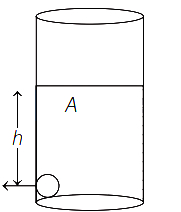
0 likes
View SolutionFluid Mechanics and Surface Tension — Velocity of Efflux and Torricelli's law · Frequently Asked Questions
1Are these Fluid Mechanics and Surface Tension questions useful for JEE and NEET?
Yes. All questions in this section are mapped to JEE Main and NEET exam patterns. Previous year questions from JEE Main, NEET, GUJCET and state-level exams are included with full solutions.
2Can I switch to Hindi or Gujarati for these questions?
Yes. Use the language tabs in the hero section or the sidebar to view the same questions and solutions in English, Hindi or Gujarati.
3How do I generate a question paper from this subtopic?
Use the Vedclass Exam Paper Generator — select the chapter and subtopic, set difficulty, and generate Sets A, B, C, D automatically. First 3 chapters of every subject are free.
Vedclass Products
For Students
Vedclass Test Series
Mock tests in real JEE/NEET style with performance analysis. 5-day free trial.
Start Free TrialFor Teachers
Exam Paper Generator
Generate Set A/B/C/D papers from this chapter in 2 minutes. 3 chapters free.
Try FreeFor Institutes
Online Exam Module
Live online exams with unlimited students, 360° analytics & white-label branding.
See DemoFor Teachers & Institutes
Generate a Fluid Mechanics and Surface Tension Exam Paper in 2 Minutes
Select subtopic & difficulty — Sets A, B, C, D auto-generated with No Repeat logic.
First 3 chapters of every subject are free — no payment required.