
અ Gujarati
Concept of limits, Evaluation of algebric limits Questions in Gujarati
Class 11 Mathematics · Limits · Concept of limits, Evaluation of algebric limits
508+
Questions
Gujarati
Language
100%
With Solutions
Showing 50 of 508 questions in Gujarati
151
AdvancedMCQ
ધારો કે $f(x) = \frac{x - 1}{2x^2 - 7x + 5}$. તો:
A
$\lim_{x \to 1} f(x) = -\frac{1}{3}$
B
$\lim_{x \to 0} f(x) = -\frac{1}{5}$
C
$f(x) \neq 0$
D
ઉપરના તમામ
0 likes
View Solution152
AdvancedMCQ
જો $x$ એ $[0, 1]$ માં વાસ્તવિક સંખ્યા હોય,તો $\lim_{m \to \infty} \lim_{n \to \infty} [1 + \cos^{2m}(n! \pi x)]$ ની કિંમત શોધો.
A
$x$ સંમેય કે અસંમેય હોય તે મુજબ $1$ અથવા $2$
B
$x$ સંમેય કે અસંમેય હોય તે મુજબ $2$ અથવા $1$
C
બધા $x$ માટે $2$
D
આમાંથી કોઈ નહીં
Solution
(B) ધારો કે $L = \lim_{m \to \infty} \lim_{n \to \infty} [1 + \cos^{2m}(n! \pi x)]$.
જો $x$ સંમેય સંખ્યા હોય,તો $x = \frac{p}{q}$ સ્વરૂપમાં લખી શકાય. $n \ge q$ માટે,$n! x$ એ પૂર્ણાંક સંખ્યા બને છે.
તેથી,$\cos^2(n! \pi x) = 1$.
આમ,$\lim_{n \to \infty} \cos^{2m}(n! \pi x) = 1$.
તેથી,$L = 1 + 1 = 2$.
જો $x$ અસંમેય સંખ્યા હોય,તો $n! x$ પૂર્ણાંક નથી.
તેથી,$|\cos(n! \pi x)| < 1$,જેનો અર્થ છે કે $\lim_{m \to \infty} \cos^{2m}(n! \pi x) = 0$.
તેથી,$L = 1 + 0 = 1$.
આમ,જો $x$ સંમેય હોય તો $2$ અને જો $x$ અસંમેય હોય તો $1$ મળે છે.
જો $x$ સંમેય સંખ્યા હોય,તો $x = \frac{p}{q}$ સ્વરૂપમાં લખી શકાય. $n \ge q$ માટે,$n! x$ એ પૂર્ણાંક સંખ્યા બને છે.
તેથી,$\cos^2(n! \pi x) = 1$.
આમ,$\lim_{n \to \infty} \cos^{2m}(n! \pi x) = 1$.
તેથી,$L = 1 + 1 = 2$.
જો $x$ અસંમેય સંખ્યા હોય,તો $n! x$ પૂર્ણાંક નથી.
તેથી,$|\cos(n! \pi x)| < 1$,જેનો અર્થ છે કે $\lim_{m \to \infty} \cos^{2m}(n! \pi x) = 0$.
તેથી,$L = 1 + 0 = 1$.
આમ,જો $x$ સંમેય હોય તો $2$ અને જો $x$ અસંમેય હોય તો $1$ મળે છે.
0 likes
View Solution153
AdvancedMCQ
વિધેય $f(x) = (1 + \frac{1}{x})^x$ માટે,નીચેનામાંથી કઈ લક્ષની કિંમત $1$ થાય છે?
A
$\lim_{x \to \infty} f(x)$
B
$\lim_{x \to 0^+} f(x)$
C
$\lim_{x \to -1^-} f(x)$
D
$\lim_{x \to -\infty} f(x)$
Solution
(B) વિધેય $f(x) = (1 + \frac{1}{x})^x$ માટે દરેક લક્ષની ગણતરી કરીએ:
$1$. $A$ માટે: $\lim_{x \to \infty} (1 + \frac{1}{x})^x = e$.
$2$. $B$ માટે: $\lim_{x \to 0^+} (1 + \frac{1}{x})^x$. જ્યારે $x \to 0^+$,ત્યારે $\frac{1}{x} \to \infty$,તેથી આધાર $(1 + \frac{1}{x}) \to \infty$. આમ,$\infty^0$ એ અનિશ્ચિત સ્વરૂપ છે. ધારો કે $y = (1 + \frac{1}{x})^x$,તો $\ln y = x \ln(1 + \frac{1}{x}) = x \ln(\frac{x+1}{x}) = x [\ln(x+1) - \ln x]$. જ્યારે $x \to 0^+$,ત્યારે $x \ln x \to 0$,તેથી $\ln y \to 0 \cdot \ln(1) = 0$,આમ $y \to e^0 = 1$.
$3$. $C$ માટે: $\lim_{x \to -1^-} (1 + \frac{1}{x})^x$. જ્યારે $x \to -1^-$,ત્યારે $(1 + \frac{1}{x}) \to 0^+$,તેથી $0^{-1} = \infty$.
$4$. $D$ માટે: $\lim_{x \to -\infty} (1 + \frac{1}{x})^x = \lim_{t \to \infty} (1 - \frac{1}{t})^{-t} = [\lim_{t \to \infty} (1 - \frac{1}{t})^t]^{-1} = (e^{-1})^{-1} = e$.
તેથી,જે લક્ષની કિંમત $1$ થાય છે તે $B$ છે.
$1$. $A$ માટે: $\lim_{x \to \infty} (1 + \frac{1}{x})^x = e$.
$2$. $B$ માટે: $\lim_{x \to 0^+} (1 + \frac{1}{x})^x$. જ્યારે $x \to 0^+$,ત્યારે $\frac{1}{x} \to \infty$,તેથી આધાર $(1 + \frac{1}{x}) \to \infty$. આમ,$\infty^0$ એ અનિશ્ચિત સ્વરૂપ છે. ધારો કે $y = (1 + \frac{1}{x})^x$,તો $\ln y = x \ln(1 + \frac{1}{x}) = x \ln(\frac{x+1}{x}) = x [\ln(x+1) - \ln x]$. જ્યારે $x \to 0^+$,ત્યારે $x \ln x \to 0$,તેથી $\ln y \to 0 \cdot \ln(1) = 0$,આમ $y \to e^0 = 1$.
$3$. $C$ માટે: $\lim_{x \to -1^-} (1 + \frac{1}{x})^x$. જ્યારે $x \to -1^-$,ત્યારે $(1 + \frac{1}{x}) \to 0^+$,તેથી $0^{-1} = \infty$.
$4$. $D$ માટે: $\lim_{x \to -\infty} (1 + \frac{1}{x})^x = \lim_{t \to \infty} (1 - \frac{1}{t})^{-t} = [\lim_{t \to \infty} (1 - \frac{1}{t})^t]^{-1} = (e^{-1})^{-1} = e$.
તેથી,જે લક્ષની કિંમત $1$ થાય છે તે $B$ છે.
0 likes
View Solution154
AdvancedMCQ
જો $L = \lim_{x^2 \to a} \frac{b - \cos(x^2 - a)}{(x^2 - a) \sin(c(x^2 - a))}$ એ શૂન્યતર શાંત કિંમત $(a > 0)$ હોય,તો:
A
$L = 2, b = 1, c = 1$
B
$L = \frac{1}{2}, b = 1, c = 1$
C
$L = 4, b = -1, c = -1$
D
$L = \frac{1}{4}, b = -1, c = -1$
Solution
(B) ધારો કે $t = x^2 - a$. જ્યારે $x^2 \to a$,ત્યારે $t \to 0$.
લક્ષ $L = \lim_{t \to 0} \frac{b - \cos(t)}{t \sin(ct)}$ બને છે.
લક્ષ શાંત અને શૂન્યતર હોવા માટે,અંશ $t \to 0$ વખતે $0$ થવો જોઈએ કારણ કે છેદ $0$ થાય છે. તેથી,$b - \cos(0) = 0 \implies b = 1$.
હવે,$L = \lim_{t \to 0} \frac{1 - \cos(t)}{t \sin(ct)} = \lim_{t \to 0} \frac{2 \sin^2(t/2)}{t \sin(ct)}$.
પ્રમાણિત લક્ષ $\lim_{u \to 0} \frac{\sin u}{u} = 1$ નો ઉપયોગ કરતા:
$L = \lim_{t \to 0} \frac{2 (t/2)^2}{t \cdot ct} = \lim_{t \to 0} \frac{2 \cdot \frac{t^2}{4}}{ct^2} = \frac{1/2}{c}$.
વિકલ્પોને જોતા,$c = 1$ અને $L = 1/2$ મળે છે.
લક્ષ $L = \lim_{t \to 0} \frac{b - \cos(t)}{t \sin(ct)}$ બને છે.
લક્ષ શાંત અને શૂન્યતર હોવા માટે,અંશ $t \to 0$ વખતે $0$ થવો જોઈએ કારણ કે છેદ $0$ થાય છે. તેથી,$b - \cos(0) = 0 \implies b = 1$.
હવે,$L = \lim_{t \to 0} \frac{1 - \cos(t)}{t \sin(ct)} = \lim_{t \to 0} \frac{2 \sin^2(t/2)}{t \sin(ct)}$.
પ્રમાણિત લક્ષ $\lim_{u \to 0} \frac{\sin u}{u} = 1$ નો ઉપયોગ કરતા:
$L = \lim_{t \to 0} \frac{2 (t/2)^2}{t \cdot ct} = \lim_{t \to 0} \frac{2 \cdot \frac{t^2}{4}}{ct^2} = \frac{1/2}{c}$.
વિકલ્પોને જોતા,$c = 1$ અને $L = 1/2$ મળે છે.
0 likes
View Solution155
AdvancedMCQ
$\mathop {\lim }\limits_{x \to 0} x^2(1+2+3+...+[\frac{1}{|x|}])$ ની કિંમત શોધો (જ્યાં $[.]$ એ મહત્તમ પૂર્ણાંક વિધેય દર્શાવે છે).
A
$0$
B
$\frac{1}{2}$
C
$2$
D
અસ્તિત્વ ધરાવતું નથી
Solution
(B) ધારો કે $t = \frac{1}{|x|}$. જેમ $x \to 0$,તેમ $t \to \infty$.
પદાવલિ $\mathop {\lim }\limits_{t \to \infty } \frac{1}{t^2} (1 + 2 + 3 + ... + [t])$ બને છે.
પ્રથમ $n$ પ્રાકૃતિક સંખ્યાઓના સરવાળાના સૂત્ર $1+2+...+n = \frac{n(n+1)}{2}$ નો ઉપયોગ કરતા:
$\mathop {\lim }\limits_{t \to \infty } \frac{[t]([t]+1)}{2t^2}$.
કારણ કે $\mathop {\lim }\limits_{t \to \infty } \frac{[t]}{t} = 1$,તેથી લક્ષ $\mathop {\lim }\limits_{t \to \infty } \frac{1}{2} \cdot \frac{[t]}{t} \cdot \frac{[t]+1}{t} = \frac{1}{2} \cdot 1 \cdot 1 = \frac{1}{2}$ થાય.
પદાવલિ $\mathop {\lim }\limits_{t \to \infty } \frac{1}{t^2} (1 + 2 + 3 + ... + [t])$ બને છે.
પ્રથમ $n$ પ્રાકૃતિક સંખ્યાઓના સરવાળાના સૂત્ર $1+2+...+n = \frac{n(n+1)}{2}$ નો ઉપયોગ કરતા:
$\mathop {\lim }\limits_{t \to \infty } \frac{[t]([t]+1)}{2t^2}$.
કારણ કે $\mathop {\lim }\limits_{t \to \infty } \frac{[t]}{t} = 1$,તેથી લક્ષ $\mathop {\lim }\limits_{t \to \infty } \frac{1}{2} \cdot \frac{[t]}{t} \cdot \frac{[t]+1}{t} = \frac{1}{2} \cdot 1 \cdot 1 = \frac{1}{2}$ થાય.
0 likes
View Solution156
AdvancedMCQ
જો $\mathop {\lim }\limits_{x \to \infty } \frac{e^{\mu x} + 5}{e^{100x} + 7}$ અસ્તિત્વ ધરાવતું હોય,તો $\mu$ ની તમામ શક્ય ધન પૂર્ણાંક કિંમતોનો સરવાળો કેટલો થાય?
A
$5051$
B
$50$
C
$4950$
D
$5050$
Solution
(D) લક્ષ $\mathop {\lim }\limits_{x \to \infty } \frac{e^{\mu x} + 5}{e^{100x} + 7}$ અસ્તિત્વ ધરાવે તે માટે,અંશમાં ઘાતાંકીય વૃદ્ધિનો ઘાત છેદ કરતા વધારે ન હોવો જોઈએ.
કિસ્સો $1$: જો $\mu < 100$ હોય,તો લક્ષ $0$ થાય,જે અસ્તિત્વ ધરાવે છે.
કિસ્સો $2$: જો $\mu = 100$ હોય,તો લક્ષ $1$ થાય,જે અસ્તિત્વ ધરાવે છે.
કિસ્સો $3$: જો $\mu > 100$ હોય,તો લક્ષ $\infty$ થાય,જે અસ્તિત્વ ધરાવતું નથી.
આમ,$\mu \leq 100$. $\mu$ ધન પૂર્ણાંક હોવાથી,$\mu \in \{1, 2, 3, \ldots, 100\}$.
આ કિંમતોનો સરવાળો $\frac{100(101)}{2} = 5050$ થાય.
કિસ્સો $1$: જો $\mu < 100$ હોય,તો લક્ષ $0$ થાય,જે અસ્તિત્વ ધરાવે છે.
કિસ્સો $2$: જો $\mu = 100$ હોય,તો લક્ષ $1$ થાય,જે અસ્તિત્વ ધરાવે છે.
કિસ્સો $3$: જો $\mu > 100$ હોય,તો લક્ષ $\infty$ થાય,જે અસ્તિત્વ ધરાવતું નથી.
આમ,$\mu \leq 100$. $\mu$ ધન પૂર્ણાંક હોવાથી,$\mu \in \{1, 2, 3, \ldots, 100\}$.
આ કિંમતોનો સરવાળો $\frac{100(101)}{2} = 5050$ થાય.
0 likes
View Solution157
AdvancedMCQ
$\mathop {\lim }\limits_{x \to \infty } \frac{{{{\cot }^{ - 1}}\left( {\sqrt {x + 1} - \sqrt x } \right)}}{{{{\sec }^{ - 1}}\left\{ {{{\left( {\frac{{2x + 1}}{{x - 1}}} \right)}^x}} \right\}}}$ ની કિંમત શોધો.
A
$1$
B
$0$
C
$\pi / 2$
D
અસ્તિત્વ ધરાવતું નથી
Solution
(A) ધારો કે $L = \lim _{x}$ ${\rightarrow \infty} \frac{\cot ^{-1}(\sqrt{x+1}-\sqrt{x})}{\sec ^{-1}\left\{\left(\frac{2 x+1}{x-1}\right)^{x}\right\}}$.
પ્રથમ,અંશનું સાદું રૂપ આપતા:
$\sqrt{x+1}-\sqrt{x} = \frac{1}{\sqrt{x+1}+\sqrt{x}}$.
જેમ $x \to \infty$,તેમ $\frac{1}{\sqrt{x+1}+\sqrt{x}} \to 0$,તેથી $\cot ^{-1}(0) = \frac{\pi}{2}$.
હવે,છેદ તપાસતા:
જેમ $x \to \infty$,તેમ $\frac{2x+1}{x-1} \to 2$. તેથી $(\frac{2x+1}{x-1})^x \to \infty$.
અને $\sec ^{-1}(\infty) = \frac{\pi}{2}$.
તેથી,$L = \frac{\pi/2}{\pi/2} = 1$.
પ્રથમ,અંશનું સાદું રૂપ આપતા:
$\sqrt{x+1}-\sqrt{x} = \frac{1}{\sqrt{x+1}+\sqrt{x}}$.
જેમ $x \to \infty$,તેમ $\frac{1}{\sqrt{x+1}+\sqrt{x}} \to 0$,તેથી $\cot ^{-1}(0) = \frac{\pi}{2}$.
હવે,છેદ તપાસતા:
જેમ $x \to \infty$,તેમ $\frac{2x+1}{x-1} \to 2$. તેથી $(\frac{2x+1}{x-1})^x \to \infty$.
અને $\sec ^{-1}(\infty) = \frac{\pi}{2}$.
તેથી,$L = \frac{\pi/2}{\pi/2} = 1$.
0 likes
View Solution158
AdvancedMCQ
$\mathop {\lim }\limits_{n \to \infty } \frac{{[{1^2}x + {1^2}] + [{2^2}x + {2^2}] + [{3^2}x + {3^2}] + \dots + [{n^2}x + {n^2}]}}{{{n^3}}}$ ની કિંમત શોધો :- (જ્યાં $[.]$ એ મહત્તમ પૂર્ણાંક વિધેય છે)
A
$\frac{x}{3}$
B
$x + \frac{1}{3}$
C
$\frac{x}{3} + \frac{1}{3}$
D
$\frac{x}{3} - \frac{1}{3}$
Solution
(C) આપેલ લક્ષ $L = \mathop {\lim }\limits_{n \to \infty } \frac{{\sum_{k=1}^{n} [k^2 x + k^2]}}{n^3}$ છે.
ગુણધર્મ $[a+b] = [a] + b$ નો ઉપયોગ કરતા,જ્યાં $b$ પૂર્ણાંક છે,આપણને $[k^2 x + k^2] = [k^2 x] + k^2$ મળે છે.
તેથી,$L = \mathop {\lim }\limits_{n \to \infty } \frac{{\sum_{k=1}^{n} [k^2 x]}}{n^3} + \mathop {\lim }\limits_{n \to \infty } \frac{{\sum_{k=1}^{n} k^2}}{n^3}$.
પ્રથમ ભાગ માટે,સ્ક્વીઝ પ્રમેયનો ઉપયોગ કરતા,$\sum [k^2 x] \approx \sum k^2 x = x \frac{n(n+1)(2n+1)}{6} \approx \frac{x n^3}{3}$.
તેથી,$\mathop {\lim }\limits_{n \to \infty } \frac{\sum [k^2 x]}{n^3} = \frac{x}{3}$.
બીજા ભાગ માટે,$\mathop {\lim }\limits_{n \to \infty } \frac{\sum_{k=1}^{n} k^2}{n^3} = \frac{1}{3}$.
તેથી,$L = \frac{x}{3} + \frac{1}{3}$.
ગુણધર્મ $[a+b] = [a] + b$ નો ઉપયોગ કરતા,જ્યાં $b$ પૂર્ણાંક છે,આપણને $[k^2 x + k^2] = [k^2 x] + k^2$ મળે છે.
તેથી,$L = \mathop {\lim }\limits_{n \to \infty } \frac{{\sum_{k=1}^{n} [k^2 x]}}{n^3} + \mathop {\lim }\limits_{n \to \infty } \frac{{\sum_{k=1}^{n} k^2}}{n^3}$.
પ્રથમ ભાગ માટે,સ્ક્વીઝ પ્રમેયનો ઉપયોગ કરતા,$\sum [k^2 x] \approx \sum k^2 x = x \frac{n(n+1)(2n+1)}{6} \approx \frac{x n^3}{3}$.
તેથી,$\mathop {\lim }\limits_{n \to \infty } \frac{\sum [k^2 x]}{n^3} = \frac{x}{3}$.
બીજા ભાગ માટે,$\mathop {\lim }\limits_{n \to \infty } \frac{\sum_{k=1}^{n} k^2}{n^3} = \frac{1}{3}$.
તેથી,$L = \frac{x}{3} + \frac{1}{3}$.
0 likes
View Solution159
AdvancedMCQ
$\mathop {\lim }\limits_{x \to \infty } \left( {\left| {{x^2}} \right| + x} \right)\log \left( {x{{\cot }^{ - 1}}x} \right)$ ની કિંમત શોધો.
A
$\frac{1}{3}$
B
$-\frac{1}{3}$
C
$\frac{2}{3}$
D
$-\frac{2}{3}$
Solution
(B) ધારો કે $x = \frac{1}{h}$. જેમ $x \to \infty$,તેમ $h \to 0^+$.
પદાવલિ $\mathop {\lim }\limits_{h \to 0} \left( \frac{1}{h^2} + \frac{1}{h} \right) \log \left( \frac{1}{h} \cot^{-1} \frac{1}{h} \right) = \mathop {\lim }\limits_{h \to 0} \left( \frac{1+h}{h^2} \right) \log \left( \frac{\tan^{-1} h}{h} \right) \text{ બને છે.}$
$\tan^{-1} h = h - \frac{h^3}{3} + \frac{h^4}{5} - \dots$ ના વિસ્તરણનો ઉપયોગ કરતા,$\frac{\tan^{-1} h}{h} = 1 - \frac{h^2}{3} + \frac{h^4}{5} - \dots$ મળે.
તેથી,લક્ષ $\mathop {\lim }\limits_{h \to 0} \left( \frac{1+h}{h^2} \right) \log \left( 1 - \frac{h^2}{3} + \frac{h^4}{5} - \dots \right) \text{ થાય.}$
$\log(1+u) \approx u$ નો ઉપયોગ કરતા,$\mathop {\lim }\limits_{h \to 0} \left( \frac{1+h}{h^2} \right) \left( -\frac{h^2}{3} + \frac{h^4}{5} \right) = \mathop {\lim }\limits_{h \to 0} (1+h) \left( -\frac{1}{3} + \frac{h^2}{5} \right) = -\frac{1}{3}$.
પદાવલિ $\mathop {\lim }\limits_{h \to 0} \left( \frac{1}{h^2} + \frac{1}{h} \right) \log \left( \frac{1}{h} \cot^{-1} \frac{1}{h} \right) = \mathop {\lim }\limits_{h \to 0} \left( \frac{1+h}{h^2} \right) \log \left( \frac{\tan^{-1} h}{h} \right) \text{ બને છે.}$
$\tan^{-1} h = h - \frac{h^3}{3} + \frac{h^4}{5} - \dots$ ના વિસ્તરણનો ઉપયોગ કરતા,$\frac{\tan^{-1} h}{h} = 1 - \frac{h^2}{3} + \frac{h^4}{5} - \dots$ મળે.
તેથી,લક્ષ $\mathop {\lim }\limits_{h \to 0} \left( \frac{1+h}{h^2} \right) \log \left( 1 - \frac{h^2}{3} + \frac{h^4}{5} - \dots \right) \text{ થાય.}$
$\log(1+u) \approx u$ નો ઉપયોગ કરતા,$\mathop {\lim }\limits_{h \to 0} \left( \frac{1+h}{h^2} \right) \left( -\frac{h^2}{3} + \frac{h^4}{5} \right) = \mathop {\lim }\limits_{h \to 0} (1+h) \left( -\frac{1}{3} + \frac{h^2}{5} \right) = -\frac{1}{3}$.
0 likes
View Solution160
AdvancedMCQ
$\mathop {\lim }\limits_{x \to 0} \left( \left[ \frac{100x}{\sin x} \right] + \left[ \frac{99 \sin x}{x} \right] \right)$ નું મૂલ્ય શોધો,જ્યાં $[.]$ એ મહત્તમ પૂર્ણાંક વિધેય દર્શાવે છે.
A
$197$
B
$198$
C
$199$
D
અસ્તિત્વ ધરાવતું નથી
Solution
(B) આપણે જાણીએ છીએ કે $x$ એ $0$ ની નજીક હોય ત્યારે,$\frac{x}{\sin x} > 1$ અને $\frac{\sin x}{x} < 1$ થાય છે.
જ્યારે $x \to 0$,ત્યારે $\frac{100x}{\sin x} \to 100^+$,તેથી $\left[ \frac{100x}{\sin x} \right] = 100$.
જ્યારે $x \to 0$,ત્યારે $\frac{99 \sin x}{x} \to 99^-$,તેથી $\left[ \frac{99 \sin x}{x} \right] = 98$.
તેથી,લક્ષનું મૂલ્ય $100 + 98 = 198$ થાય છે.
જ્યારે $x \to 0$,ત્યારે $\frac{100x}{\sin x} \to 100^+$,તેથી $\left[ \frac{100x}{\sin x} \right] = 100$.
જ્યારે $x \to 0$,ત્યારે $\frac{99 \sin x}{x} \to 99^-$,તેથી $\left[ \frac{99 \sin x}{x} \right] = 98$.
તેથી,લક્ષનું મૂલ્ય $100 + 98 = 198$ થાય છે.
0 likes
View Solution161
AdvancedMCQ
$\mathop {\lim }\limits_{x \to 1} \frac{{x + {x^2} + ...... + {x^n} - n}}{{x - 1}}$ ની કિંમત શોધો.
A
$n$
B
$\frac{{n + 1}}{2}$
C
$\frac{{n(n + 1)}}{2}$
D
$\frac{{n(n - 1)}}{2}$
Solution
(C) આપણે પદાવલિને આ રીતે લખી શકીએ:
$\mathop {\lim }\limits_{x \to 1} \left( {\frac{{x - 1}}{{x - 1}} + \frac{{{x^2} - 1}}{{x - 1}} + \dots + \frac{{{x^n} - 1}}{{x - 1}}} \right)$
$\mathop {\lim }\limits_{x \to a} \frac{{{x^k} - {a^k}}}{{x - a}} = k{a^{k - 1}}$ સૂત્રનો ઉપયોગ કરતા,$a = 1$ માટે:
$\mathop {\lim }\limits_{x \to 1} \frac{{{x^k} - 1}}{{x - 1}} = k(1)^{k - 1} = k$
આમ,સરવાળો નીચે મુજબ થશે:
$1 + 2 + 3 + \dots + n = \frac{{n(n + 1)}}{2}$
$\mathop {\lim }\limits_{x \to 1} \left( {\frac{{x - 1}}{{x - 1}} + \frac{{{x^2} - 1}}{{x - 1}} + \dots + \frac{{{x^n} - 1}}{{x - 1}}} \right)$
$\mathop {\lim }\limits_{x \to a} \frac{{{x^k} - {a^k}}}{{x - a}} = k{a^{k - 1}}$ સૂત્રનો ઉપયોગ કરતા,$a = 1$ માટે:
$\mathop {\lim }\limits_{x \to 1} \frac{{{x^k} - 1}}{{x - 1}} = k(1)^{k - 1} = k$
આમ,સરવાળો નીચે મુજબ થશે:
$1 + 2 + 3 + \dots + n = \frac{{n(n + 1)}}{2}$
0 likes
View Solution162
AdvancedMCQ
$\mathop {\lim }\limits_{x \to 0} \frac{{1 - \cos (1 - \cos x)}}{{x\tan x - {x^2}}}$ ની કિંમત શોધો.
A
$-\frac{8}{3}$
B
$-\frac{3}{8}$
C
$\frac{3}{8}$
D
$\frac{8}{3}$
Solution
(C) આપણે જાણીએ છીએ કે $\mathop {\lim }\limits_{u \to 0} \frac{1 - \cos u}{u^2} = \frac{1}{2}$ અને $\mathop {\lim }\limits_{x \to 0} \frac{\tan x - x}{x^3} = \frac{1}{3}$.
આપેલ પદાવલિ: $L = \mathop {\lim }\limits_{x \to 0} \frac{1 - \cos (1 - \cos x)}{x(\tan x - x)}$.
$(1 - \cos x)^2$ અને $x^4$ વડે ગુણતા અને ભાગતા:
$L = \mathop {\lim }\limits_{x \to 0} \left[ \frac{1 - \cos (1 - \cos x)}{(1 - \cos x)^2} \right] \times \left[ \frac{(1 - \cos x)^2}{x^4} \right] \times \left[ \frac{x^4}{x(\tan x - x)} \right]$.
$L = \frac{1}{2} \times \left( \mathop {\lim }\limits_{x \to 0} \frac{1 - \cos x}{x^2} \right)^2 \times \left( \mathop {\lim }\limits_{x \to 0} \frac{x^3}{\tan x - x} \right)$.
$L = \frac{1}{2} \times \left( \frac{1}{2} \right)^2 \times \left( \frac{1}{1/3} \right) = \frac{1}{2} \times \frac{1}{4} \times 3 = \frac{3}{8}$.
આપેલ પદાવલિ: $L = \mathop {\lim }\limits_{x \to 0} \frac{1 - \cos (1 - \cos x)}{x(\tan x - x)}$.
$(1 - \cos x)^2$ અને $x^4$ વડે ગુણતા અને ભાગતા:
$L = \mathop {\lim }\limits_{x \to 0} \left[ \frac{1 - \cos (1 - \cos x)}{(1 - \cos x)^2} \right] \times \left[ \frac{(1 - \cos x)^2}{x^4} \right] \times \left[ \frac{x^4}{x(\tan x - x)} \right]$.
$L = \frac{1}{2} \times \left( \mathop {\lim }\limits_{x \to 0} \frac{1 - \cos x}{x^2} \right)^2 \times \left( \mathop {\lim }\limits_{x \to 0} \frac{x^3}{\tan x - x} \right)$.
$L = \frac{1}{2} \times \left( \frac{1}{2} \right)^2 \times \left( \frac{1}{1/3} \right) = \frac{1}{2} \times \frac{1}{4} \times 3 = \frac{3}{8}$.
0 likes
View Solution163
AdvancedMCQ
$\mathop {\lim }\limits_{x \to {2^ + }} \frac{{1 - \cos \{ {x^2} + 2x\} }}{{\ln {{(x - 1)}^{(x - 2)}}}}$ ની કિંમત શોધો (જ્યાં $\{.\}$ એ અપૂર્ણાંક ભાગ વિધેય દર્શાવે છે).
A
$36$
B
$18$
C
$72$
D
અસ્તિત્વ ધરાવતું નથી
Solution
(B) ધારો કે $L = \mathop {\lim }\limits_{x \to {2^ + }} \frac{{1 - \cos \{ {x^2} + 2x\} }}{{\ln {{(x - 1)}^{(x - 2)}}}}$
જ્યારે $x \to 2^+$,ત્યારે $x^2 + 2x \to 8^+$. તેથી,$\{x^2 + 2x\} = x^2 + 2x - 8$.
વળી,$\ln{(x-1)^{(x-2)}} = (x-2) \ln(x-1) = (x-2) \ln(1 + (x-2))$.
લક્ષ $\mathop {\lim }\limits_{u \to 0} \frac{1 - \cos u}{u^2} = \frac{1}{2}$ અને $\mathop {\lim }\limits_{u \to 0} \frac{\ln(1+u)}{u} = 1$ નો ઉપયોગ કરતા:
$L = \mathop {\lim }\limits_{x \to {2^ + }} \frac{1 - \cos(x^2 + 2x - 8)}{(x^2 + 2x - 8)^2} \cdot \frac{(x^2 + 2x - 8)^2}{(x-2) \ln(1 + (x-2))}$
$L = \frac{1}{2} \cdot \mathop {\lim }\limits_{x \to {2^ + }} \frac{((x-2)(x+4))^2}{(x-2) \ln(1 + (x-2))}$
$L = \frac{1}{2} \cdot \mathop {\lim }\limits_{x \to {2^ + }} \frac{(x-2)^2 (x+4)^2}{(x-2) (x-2)} = \frac{1}{2} \cdot (2+4)^2 = \frac{36}{2} = 18$.
જ્યારે $x \to 2^+$,ત્યારે $x^2 + 2x \to 8^+$. તેથી,$\{x^2 + 2x\} = x^2 + 2x - 8$.
વળી,$\ln{(x-1)^{(x-2)}} = (x-2) \ln(x-1) = (x-2) \ln(1 + (x-2))$.
લક્ષ $\mathop {\lim }\limits_{u \to 0} \frac{1 - \cos u}{u^2} = \frac{1}{2}$ અને $\mathop {\lim }\limits_{u \to 0} \frac{\ln(1+u)}{u} = 1$ નો ઉપયોગ કરતા:
$L = \mathop {\lim }\limits_{x \to {2^ + }} \frac{1 - \cos(x^2 + 2x - 8)}{(x^2 + 2x - 8)^2} \cdot \frac{(x^2 + 2x - 8)^2}{(x-2) \ln(1 + (x-2))}$
$L = \frac{1}{2} \cdot \mathop {\lim }\limits_{x \to {2^ + }} \frac{((x-2)(x+4))^2}{(x-2) \ln(1 + (x-2))}$
$L = \frac{1}{2} \cdot \mathop {\lim }\limits_{x \to {2^ + }} \frac{(x-2)^2 (x+4)^2}{(x-2) (x-2)} = \frac{1}{2} \cdot (2+4)^2 = \frac{36}{2} = 18$.
0 likes
View Solution164
AdvancedMCQ
જો $\mathop {\lim }\limits_{n \to \infty } \frac{1}{{10 + {{\left( {2\cos x} \right)}^{2n}}}} = 0$ હોય,તો $|\sin x|$ ની તમામ શક્ય કિંમતોનો સંપૂર્ણ ગણ કયો છે?
A
$[0, \frac{\sqrt{3}}{2})$
B
$[\frac{\sqrt{3}}{2}, 1]$
C
$[\frac{1}{2}, 1]$
D
$[\frac{1}{2}, \frac{\sqrt{3}}{2}]$
Solution
(A) આપેલ છે $\mathop {\lim }\limits_{n \to \infty } \frac{1}{{10 + {{\left( {2\cos x} \right)}^{2n}}}} = 0$.
લક્ષ $0$ થાય તે માટે છેદ $n \to \infty$ થાય ત્યારે અનંત તરફ જવો જોઈએ.
આ ત્યારે થાય જો $|2\cos x| > 1$ હોય.
$|\cos x| > \frac{1}{2}$.
$\sin^2 x = 1 - \cos^2 x$ હોવાથી,$\cos^2 x > \frac{1}{4}$ મળે.
$1 - \sin^2 x > \frac{1}{4} \Rightarrow \sin^2 x < \frac{3}{4}$.
$|\sin x| < \frac{\sqrt{3}}{2}$.
વળી,$|\sin x| \ge 0$.
તેથી,કિંમતોનો ગણ $[0, \frac{\sqrt{3}}{2})$ છે.
લક્ષ $0$ થાય તે માટે છેદ $n \to \infty$ થાય ત્યારે અનંત તરફ જવો જોઈએ.
આ ત્યારે થાય જો $|2\cos x| > 1$ હોય.
$|\cos x| > \frac{1}{2}$.
$\sin^2 x = 1 - \cos^2 x$ હોવાથી,$\cos^2 x > \frac{1}{4}$ મળે.
$1 - \sin^2 x > \frac{1}{4} \Rightarrow \sin^2 x < \frac{3}{4}$.
$|\sin x| < \frac{\sqrt{3}}{2}$.
વળી,$|\sin x| \ge 0$.
તેથી,કિંમતોનો ગણ $[0, \frac{\sqrt{3}}{2})$ છે.
0 likes
View Solution165
AdvancedMCQ
ધારો કે $L(m)$ એ $y = x^2 - 6$ અને $y = m$ ના આલેખના છેદબિંદુના ડાબા અંત્યબિંદુનો $x$-યામ છે,જ્યાં $-6 < m < 6$ છે. $\mathop {\lim }\limits_{m \to 0} \left( {\frac{{L\left( { - m} \right) - L\left( m \right)}}{m}} \right)$ ની કિંમત શોધો.
A
$0$
B
$\frac{1}{\sqrt{6}}$
C
$\frac{2}{\sqrt{6}}$
D
$1$
Solution
(B) $y = x^2 - 6$ અને $y = m$ ના છેદબિંદુઓ $x^2 - 6 = m$ દ્વારા મળે છે,જે $x^2 = m + 6$ આપે છે,તેથી $x = \pm \sqrt{m + 6}$.
$L(m)$ એ ડાબા અંત્યબિંદુનો $x$-યામ હોવાથી,$L(m) = -\sqrt{m + 6}$.
આપણે $\mathop {\lim }\limits_{m \to 0} \left( {\frac{{L\left( { - m} \right) - L\left( m \right)}}{m}} \right)$ ની કિંમત શોધવાની છે.
$L(m)$ ની કિંમત મૂકતા,પદાવલિ $\mathop {\lim }\limits_{m \to 0} \left( {\frac{{-\sqrt{-m + 6} - (-\sqrt{m + 6})}}{m}} \right) = \mathop {\lim }\limits_{m \to 0} \left( {\frac{{\sqrt{m + 6} - \sqrt{6 - m}}}{m}} \right)$ બને છે.
અનુબદ્ધ કરણી $\frac{\sqrt{m + 6} + \sqrt{6 - m}}{\sqrt{m + 6} + \sqrt{6 - m}}$ વડે ગુણતા,આપણને $\mathop {\lim }\limits_{m \to 0} \left( {\frac{(m + 6) - (6 - m)}{m(\sqrt{m + 6} + \sqrt{6 - m})}} \right) = \mathop {\lim }\limits_{m \to 0} \left( {\frac{2m}{m(\sqrt{m + 6} + \sqrt{6 - m})}} \right)$ મળે છે.
આનું સાદું રૂપ $\frac{2}{\sqrt{6} + \sqrt{6}} = \frac{2}{2\sqrt{6}} = \frac{1}{\sqrt{6}}$ થાય છે.
$L(m)$ એ ડાબા અંત્યબિંદુનો $x$-યામ હોવાથી,$L(m) = -\sqrt{m + 6}$.
આપણે $\mathop {\lim }\limits_{m \to 0} \left( {\frac{{L\left( { - m} \right) - L\left( m \right)}}{m}} \right)$ ની કિંમત શોધવાની છે.
$L(m)$ ની કિંમત મૂકતા,પદાવલિ $\mathop {\lim }\limits_{m \to 0} \left( {\frac{{-\sqrt{-m + 6} - (-\sqrt{m + 6})}}{m}} \right) = \mathop {\lim }\limits_{m \to 0} \left( {\frac{{\sqrt{m + 6} - \sqrt{6 - m}}}{m}} \right)$ બને છે.
અનુબદ્ધ કરણી $\frac{\sqrt{m + 6} + \sqrt{6 - m}}{\sqrt{m + 6} + \sqrt{6 - m}}$ વડે ગુણતા,આપણને $\mathop {\lim }\limits_{m \to 0} \left( {\frac{(m + 6) - (6 - m)}{m(\sqrt{m + 6} + \sqrt{6 - m})}} \right) = \mathop {\lim }\limits_{m \to 0} \left( {\frac{2m}{m(\sqrt{m + 6} + \sqrt{6 - m})}} \right)$ મળે છે.
આનું સાદું રૂપ $\frac{2}{\sqrt{6} + \sqrt{6}} = \frac{2}{2\sqrt{6}} = \frac{1}{\sqrt{6}}$ થાય છે.
0 likes
View Solution166
AdvancedMCQ
જો $|x| < 1$ હોય,તો $\lim_{n \to \infty} \{(1 + x)(1 + x^2)(1 + x^4) \dots (1 + x^{2^n})\}$ ની કિંમત શોધો.
A
$\frac{1}{x - 1}$
B
$\frac{1}{1 - x}$
C
$1$
D
$x - 1$
Solution
(B) ધારો કે $P_n = (1 + x)(1 + x^2)(1 + x^4) \dots (1 + x^{2^n})$.
$(1 - x)$ વડે ગુણતા અને ભાગતા:
$P_n = \frac{(1 - x)(1 + x)(1 + x^2)(1 + x^4) \dots (1 + x^{2^n})}{1 - x}$
$(1 - a)(1 + a) = (1 - a^2)$ નિત્યસમનો ઉપયોગ કરતા:
$P_n = \frac{(1 - x^2)(1 + x^2)(1 + x^4) \dots (1 + x^{2^n})}{1 - x} = \frac{(1 - x^4)(1 + x^4) \dots (1 + x^{2^n})}{1 - x}$
આ પ્રક્રિયા ચાલુ રાખતા,આપણને મળે છે:
$P_n = \frac{1 - x^{2^{n+1}}}{1 - x}$
કારણ કે $|x| < 1$,તેથી $\lim_{n \to \infty} x^{2^{n+1}} = 0$.
તેથી,$\lim_{n \to \infty} P_n = \frac{1 - 0}{1 - x} = \frac{1}{1 - x}$.
$(1 - x)$ વડે ગુણતા અને ભાગતા:
$P_n = \frac{(1 - x)(1 + x)(1 + x^2)(1 + x^4) \dots (1 + x^{2^n})}{1 - x}$
$(1 - a)(1 + a) = (1 - a^2)$ નિત્યસમનો ઉપયોગ કરતા:
$P_n = \frac{(1 - x^2)(1 + x^2)(1 + x^4) \dots (1 + x^{2^n})}{1 - x} = \frac{(1 - x^4)(1 + x^4) \dots (1 + x^{2^n})}{1 - x}$
આ પ્રક્રિયા ચાલુ રાખતા,આપણને મળે છે:
$P_n = \frac{1 - x^{2^{n+1}}}{1 - x}$
કારણ કે $|x| < 1$,તેથી $\lim_{n \to \infty} x^{2^{n+1}} = 0$.
તેથી,$\lim_{n \to \infty} P_n = \frac{1 - 0}{1 - x} = \frac{1}{1 - x}$.
0 likes
View Solution167
AdvancedMCQ
જો $a$ એ $\sin^2 \theta - \sin \theta + \frac{1}{2}$ ની ન્યૂનતમ કિંમત હોય અને $b = \lim_{x \to \infty} (\sqrt{(x + 1)(x + 2)} - x)$ હોય,તો $|2a + b| = $
A
$3$
B
$-2$
C
$4$
D
$2$
Solution
(D) ધારો કે $f(\theta) = \sin^2 \theta - \sin \theta + \frac{1}{2}$.
આને $(\sin \theta - \frac{1}{2})^2 + \frac{1}{4}$ તરીકે લખી શકાય.
ન્યૂનતમ કિંમત $a$ ત્યારે મળે જ્યારે $\sin \theta = \frac{1}{2}$,તેથી $a = \frac{1}{4}$.
હવે,$b = \lim_{x \to \infty} (\sqrt{(x + 1)(x + 2)} - x)$ ની ગણતરી કરીએ.
$b = \lim_{x \to \infty} \frac{(\sqrt{x^2 + 3x + 2} - x)(\sqrt{x^2 + 3x + 2} + x)}{\sqrt{x^2 + 3x + 2} + x} = \lim_{x \to \infty} \frac{3x + 2}{\sqrt{x^2 + 3x + 2} + x} = \frac{3}{2}$.
છેલ્લે,$|2a + b| = |2(\frac{1}{4}) + \frac{3}{2}| = |\frac{1}{2} + \frac{3}{2}| = 2$.
આને $(\sin \theta - \frac{1}{2})^2 + \frac{1}{4}$ તરીકે લખી શકાય.
ન્યૂનતમ કિંમત $a$ ત્યારે મળે જ્યારે $\sin \theta = \frac{1}{2}$,તેથી $a = \frac{1}{4}$.
હવે,$b = \lim_{x \to \infty} (\sqrt{(x + 1)(x + 2)} - x)$ ની ગણતરી કરીએ.
$b = \lim_{x \to \infty} \frac{(\sqrt{x^2 + 3x + 2} - x)(\sqrt{x^2 + 3x + 2} + x)}{\sqrt{x^2 + 3x + 2} + x} = \lim_{x \to \infty} \frac{3x + 2}{\sqrt{x^2 + 3x + 2} + x} = \frac{3}{2}$.
છેલ્લે,$|2a + b| = |2(\frac{1}{4}) + \frac{3}{2}| = |\frac{1}{2} + \frac{3}{2}| = 2$.
0 likes
View Solution168
AdvancedMCQ
$\mathop {\lim }\limits_{n \to \infty } \,\frac{{\sum\limits_{r = 0}^n {{{\tan }^{ - 1}}\left( {1 + r + {r^2}} \right)} }}{n}$ ની કિંમત શોધો.
A
$1$
B
$2$
C
$\frac{\pi}{4}$
D
$\frac{\pi}{2}$
Solution
(D) આપણે જાણીએ છીએ કે $\tan^{-1}(x) + \cot^{-1}(x) = \frac{\pi}{2}$,તેથી $\tan^{-1}(1+r+r^2) = \frac{\pi}{2} - \cot^{-1}(1+r+r^2)$.
$\cot^{-1}(x) = \tan^{-1}(\frac{1}{x})$ નિત્યસમનો ઉપયોગ કરતા,$\tan^{-1}(1+r+r^2) = \frac{\pi}{2} - \tan^{-1}(\frac{1}{1+r+r^2})$.
અહીં $\frac{1}{1+r+r^2} = \frac{(r+1)-r}{1+r(r+1)}$ છે.
તેથી,$\tan^{-1}(1+r+r^2) = \frac{\pi}{2} - (\tan^{-1}(r+1) - \tan^{-1}(r))$.
$r=0$ થી $n$ સુધી સરવાળો કરતા:
$\sum_{r=0}^n \tan^{-1}(1+r+r^2) = \sum_{r=0}^n \frac{\pi}{2} - \sum_{r=0}^n (\tan^{-1}(r+1) - \tan^{-1}(r))$.
આ એક ટેલિસ્કોપિંગ શ્રેણી છે: $\sum_{r=0}^n (\tan^{-1}(r+1) - \tan^{-1}(r)) = \tan^{-1}(n+1) - \tan^{-1}(0) = \tan^{-1}(n+1)$.
તેથી,પદ $\frac{(n+1)\pi}{2} - \tan^{-1}(n+1)$ બને છે.
$n$ વડે ભાગતા અને $n \to \infty$ લક્ષ લેતા:
$\lim_{n \to \infty} \frac{\frac{(n+1)\pi}{2} - \tan^{-1}(n+1)}{n} = \lim_{n \to \infty} (\frac{(n+1)\pi}{2n} - \frac{\tan^{-1}(n+1)}{n}) = \frac{\pi}{2} - 0 = \frac{\pi}{2}$.
$\cot^{-1}(x) = \tan^{-1}(\frac{1}{x})$ નિત્યસમનો ઉપયોગ કરતા,$\tan^{-1}(1+r+r^2) = \frac{\pi}{2} - \tan^{-1}(\frac{1}{1+r+r^2})$.
અહીં $\frac{1}{1+r+r^2} = \frac{(r+1)-r}{1+r(r+1)}$ છે.
તેથી,$\tan^{-1}(1+r+r^2) = \frac{\pi}{2} - (\tan^{-1}(r+1) - \tan^{-1}(r))$.
$r=0$ થી $n$ સુધી સરવાળો કરતા:
$\sum_{r=0}^n \tan^{-1}(1+r+r^2) = \sum_{r=0}^n \frac{\pi}{2} - \sum_{r=0}^n (\tan^{-1}(r+1) - \tan^{-1}(r))$.
આ એક ટેલિસ્કોપિંગ શ્રેણી છે: $\sum_{r=0}^n (\tan^{-1}(r+1) - \tan^{-1}(r)) = \tan^{-1}(n+1) - \tan^{-1}(0) = \tan^{-1}(n+1)$.
તેથી,પદ $\frac{(n+1)\pi}{2} - \tan^{-1}(n+1)$ બને છે.
$n$ વડે ભાગતા અને $n \to \infty$ લક્ષ લેતા:
$\lim_{n \to \infty} \frac{\frac{(n+1)\pi}{2} - \tan^{-1}(n+1)}{n} = \lim_{n \to \infty} (\frac{(n+1)\pi}{2n} - \frac{\tan^{-1}(n+1)}{n}) = \frac{\pi}{2} - 0 = \frac{\pi}{2}$.
0 likes
View Solution169
AdvancedMCQ
જો $\alpha$ એ નિયમિત અષ્ટકોણનો આંતરિક ખૂણો હોય,તો $\lim_{\theta \to \alpha^+} \frac{\tan \theta - 1}{[\sin \theta + \cos \theta]}$ ની કિંમત શોધો. (નોંધ: $[k]$ એ $k$ થી નાનો અથવા તેના જેટલો મહત્તમ પૂર્ણાંક દર્શાવે છે).
A
$0$
B
$-1$
C
$1$
D
$2$
Solution
(D) નિયમિત અષ્ટકોણનો આંતરિક ખૂણો $\alpha = \frac{(8-2) \times 180^{\circ}}{8} = 135^{\circ} = \frac{3\pi}{4}$ છે.
આપણે $\lim_{\theta \to (\frac{3\pi}{4})^+} \frac{\tan \theta - 1}{[\sin \theta + \cos \theta]}$ ની ગણતરી કરવાની છે.
જ્યારે $\theta \to (\frac{3\pi}{4})^+$,ત્યારે $\theta$ એ $\frac{3\pi}{4}$ કરતા થોડો મોટો છે.
આ અંતરાલમાં,$\sin \theta + \cos \theta = \sqrt{2} \sin(\theta + \frac{\pi}{4})$.
જ્યારે $\theta \to (\frac{3\pi}{4})^+$,ત્યારે $\theta + \frac{\pi}{4} \to \pi^+$,તેથી $\sin(\theta + \frac{\pi}{4})$ એ નાની ઋણ કિંમત છે.
આમ,$\sin \theta + \cos \theta$ એ $(-1, 0)$ ની વચ્ચેની નાની ઋણ કિંમત છે.
તેથી,$[\sin \theta + \cos \theta] = -1$.
લક્ષની કિંમત $\lim_{\theta \to (\frac{3\pi}{4})^+} \frac{\tan \theta - 1}{-1} = -(\tan(\frac{3\pi}{4}) - 1) = -(-1 - 1) = -(-2) = 2$ થાય.
આપણે $\lim_{\theta \to (\frac{3\pi}{4})^+} \frac{\tan \theta - 1}{[\sin \theta + \cos \theta]}$ ની ગણતરી કરવાની છે.
જ્યારે $\theta \to (\frac{3\pi}{4})^+$,ત્યારે $\theta$ એ $\frac{3\pi}{4}$ કરતા થોડો મોટો છે.
આ અંતરાલમાં,$\sin \theta + \cos \theta = \sqrt{2} \sin(\theta + \frac{\pi}{4})$.
જ્યારે $\theta \to (\frac{3\pi}{4})^+$,ત્યારે $\theta + \frac{\pi}{4} \to \pi^+$,તેથી $\sin(\theta + \frac{\pi}{4})$ એ નાની ઋણ કિંમત છે.
આમ,$\sin \theta + \cos \theta$ એ $(-1, 0)$ ની વચ્ચેની નાની ઋણ કિંમત છે.
તેથી,$[\sin \theta + \cos \theta] = -1$.
લક્ષની કિંમત $\lim_{\theta \to (\frac{3\pi}{4})^+} \frac{\tan \theta - 1}{-1} = -(\tan(\frac{3\pi}{4}) - 1) = -(-1 - 1) = -(-2) = 2$ થાય.
0 likes
View Solution170
AdvancedMCQ
$\mathop {\lim }\limits_{x \to \infty } \frac{{\sqrt {{x^2} - \sqrt {{x^2} - \sqrt {{x^2} - \dots} } } }}{x}$ ની કિંમત શોધો.
A
$0$
B
$\frac{1}{2}$
C
$1$
D
$\frac{1}{4}$
Solution
(C) ધારો કે $f(x) = \sqrt{x^{2} - \sqrt{x^{2} - \sqrt{x^{2} - \dots}}}$
તેથી $f(x) = \sqrt{x^{2} - f(x)}$.
બંને બાજુ વર્ગ કરતા,$f(x)^{2} = x^{2} - f(x)$,જેનો અર્થ છે કે $f(x)^{2} + f(x) - x^{2} = 0$.
$f(x)$ માટે દ્વિઘાત સૂત્રનો ઉપયોગ કરતા,$f(x) = \frac{-1 \pm \sqrt{1 + 4x^{2}}}{2}$.
$f(x) > 0$ હોવાથી,આપણે ધન મૂળ લઈએ છીએ: $f(x) = \frac{-1 + \sqrt{1 + 4x^{2}}}{2}$.
હવે,લક્ષની કિંમત મેળવીએ: $\mathop {\lim }\limits_{x \to \infty } \frac{f(x)}{x} = \mathop {\lim }\limits_{x \to \infty } \frac{-1 + \sqrt{1 + 4x^{2}}}{2x}$.
અંશ અને છેદને $x$ વડે ભાગતા,$\mathop {\lim }\limits_{x \to \infty } \frac{-\frac{1}{x} + \sqrt{\frac{1}{x^{2}} + 4}}{2} = \frac{0 + \sqrt{0 + 4}}{2} = \frac{2}{2} = 1$.
તેથી $f(x) = \sqrt{x^{2} - f(x)}$.
બંને બાજુ વર્ગ કરતા,$f(x)^{2} = x^{2} - f(x)$,જેનો અર્થ છે કે $f(x)^{2} + f(x) - x^{2} = 0$.
$f(x)$ માટે દ્વિઘાત સૂત્રનો ઉપયોગ કરતા,$f(x) = \frac{-1 \pm \sqrt{1 + 4x^{2}}}{2}$.
$f(x) > 0$ હોવાથી,આપણે ધન મૂળ લઈએ છીએ: $f(x) = \frac{-1 + \sqrt{1 + 4x^{2}}}{2}$.
હવે,લક્ષની કિંમત મેળવીએ: $\mathop {\lim }\limits_{x \to \infty } \frac{f(x)}{x} = \mathop {\lim }\limits_{x \to \infty } \frac{-1 + \sqrt{1 + 4x^{2}}}{2x}$.
અંશ અને છેદને $x$ વડે ભાગતા,$\mathop {\lim }\limits_{x \to \infty } \frac{-\frac{1}{x} + \sqrt{\frac{1}{x^{2}} + 4}}{2} = \frac{0 + \sqrt{0 + 4}}{2} = \frac{2}{2} = 1$.
0 likes
View Solution171
AdvancedMCQ
$\mathop {\lim }\limits_{x \to {0^ + }} {\left( {\sec \sqrt x } \right)^{\frac{{10}}{x}}}$ ની કિંમત શોધો.
A
$e^{-5}$
B
$e^{5}$
C
$e^{10}$
D
$e^{1/5}$
Solution
(B) ધારો કે $L = \mathop {\lim }\limits_{x \to {0^ + }} {\left( {\sec \sqrt x } \right)^{\frac{{10}}{x}}}$.
આ $1^\infty$ પ્રકારનું અનિશ્ચિત સ્વરૂપ છે.
આપણે લખી શકીએ $L = e^{\mathop {\lim }\limits_{x \to {0^ + }} \frac{{10}}{x} (\sec \sqrt x - 1)}$.
$\sec \theta = \frac{1}{\cos \theta}$ નિત્યસમનો ઉપયોગ કરતા,$\sec \sqrt x - 1 = \frac{1 - \cos \sqrt x}{\cos \sqrt x}$.
તેથી,$L = e^{\mathop {\lim }\limits_{x \to {0^ + }} \frac{10}{x} \cdot \frac{1 - \cos \sqrt x}{\cos \sqrt x}}$.
$\mathop {\lim }\limits_{\theta \to 0} \frac{1 - \cos \theta}{\theta^2} = \frac{1}{2}$ લક્ષનો ઉપયોગ કરતા,$\theta = \sqrt x$ લેતા. જ્યારે $x \to 0^+$,ત્યારે $\theta \to 0^+$.
તેથી $\mathop {\lim }\limits_{x \to {0^ + }} \frac{1 - \cos \sqrt x}{x} = \mathop {\lim }\limits_{\theta \to 0^+} \frac{1 - \cos \theta}{\theta^2} = \frac{1}{2}$.
આ કિંમત મૂકતા,$L = e^{10 \cdot \frac{1}{2} \cdot \frac{1}{\cos(0)}} = e^{5 \cdot 1} = e^5$.
આ $1^\infty$ પ્રકારનું અનિશ્ચિત સ્વરૂપ છે.
આપણે લખી શકીએ $L = e^{\mathop {\lim }\limits_{x \to {0^ + }} \frac{{10}}{x} (\sec \sqrt x - 1)}$.
$\sec \theta = \frac{1}{\cos \theta}$ નિત્યસમનો ઉપયોગ કરતા,$\sec \sqrt x - 1 = \frac{1 - \cos \sqrt x}{\cos \sqrt x}$.
તેથી,$L = e^{\mathop {\lim }\limits_{x \to {0^ + }} \frac{10}{x} \cdot \frac{1 - \cos \sqrt x}{\cos \sqrt x}}$.
$\mathop {\lim }\limits_{\theta \to 0} \frac{1 - \cos \theta}{\theta^2} = \frac{1}{2}$ લક્ષનો ઉપયોગ કરતા,$\theta = \sqrt x$ લેતા. જ્યારે $x \to 0^+$,ત્યારે $\theta \to 0^+$.
તેથી $\mathop {\lim }\limits_{x \to {0^ + }} \frac{1 - \cos \sqrt x}{x} = \mathop {\lim }\limits_{\theta \to 0^+} \frac{1 - \cos \theta}{\theta^2} = \frac{1}{2}$.
આ કિંમત મૂકતા,$L = e^{10 \cdot \frac{1}{2} \cdot \frac{1}{\cos(0)}} = e^{5 \cdot 1} = e^5$.
0 likes
View Solution172
AdvancedMCQ
$\mathop {\lim }\limits_{n \to \infty } {\left( {e \cdot {a^2} \cdot {e^3} \cdot {a^4} \cdots {e^{n - 1}} \cdot {a^n}} \right)^{\frac{1}{{{n^2} + 1}}}}$ ની કિંમત શોધો.
A
$ae$
B
$(ae)^{1/2}$
C
$(ea)^4$
D
$(ae)^{1/4}$
Solution
(D) ધારો કે $P = e \cdot a^2 \cdot e^3 \cdot a^4 \cdots e^{n-1} \cdot a^n$.
$e$ અને $a$ વાળા પદોને અલગ કરતા:
$P = (e^1 \cdot e^3 \cdots e^{n-1}) \cdot (a^2 \cdot a^4 \cdots a^n)$.
$e$ ના ઘાતાંકો $1, 3, \dots, n-1$ છે,જેનો સરવાળો $n^2/4$ થાય છે.
$a$ ના ઘાતાંકો $2, 4, \dots, n$ છે,જેનો સરવાળો $\frac{n(n+2)}{4}$ થાય છે.
તેથી,$P = e^{n^2/4} \cdot a^{n(n+2)/4}$.
લક્ષ લેતા: $\lim_{n \to \infty} P^{\frac{1}{n^2+1}} = (ae)^{1/4}$.
$e$ અને $a$ વાળા પદોને અલગ કરતા:
$P = (e^1 \cdot e^3 \cdots e^{n-1}) \cdot (a^2 \cdot a^4 \cdots a^n)$.
$e$ ના ઘાતાંકો $1, 3, \dots, n-1$ છે,જેનો સરવાળો $n^2/4$ થાય છે.
$a$ ના ઘાતાંકો $2, 4, \dots, n$ છે,જેનો સરવાળો $\frac{n(n+2)}{4}$ થાય છે.
તેથી,$P = e^{n^2/4} \cdot a^{n(n+2)/4}$.
લક્ષ લેતા: $\lim_{n \to \infty} P^{\frac{1}{n^2+1}} = (ae)^{1/4}$.
0 likes
View Solution173
AdvancedMCQ
$\mathop {\lim }\limits_{x \to {0^ + }} \left\{ {{{\left( {1 + x} \right)}^{\frac{2}{x}}}} \right\}$ ની કિંમત શોધો (જ્યાં $\{.\}$ એ $x$ નો અપૂર્ણાંક ભાગ દર્શાવે છે)
A
$e^2 - 7$
B
$e^2 - 8$
C
$e^2 - 6$
D
$7$
Solution
(A) આપણે જાણીએ છીએ કે અપૂર્ણાંક ભાગ વિધેય $\{y\} = y - [y]$ તરીકે વ્યાખ્યાયિત છે.
પ્રથમ,આપણે લક્ષ $\mathop {\lim }\limits_{x \to {0^ + }} (1+x)^{\frac{2}{x}}$ ની ગણતરી કરીએ.
પ્રમાણિત લક્ષ સૂત્ર $\mathop {\lim }\limits_{x \to 0} (1+x)^{\frac{1}{x}} = e$ નો ઉપયોગ કરતા:
$\mathop {\lim }\limits_{x \to {0^ + }} (1+x)^{\frac{2}{x}} = \left( \mathop {\lim }\limits_{x \to {0^ + }} (1+x)^{\frac{1}{x}} \right)^2 = e^2$.
અહીં $e \approx 2.718$ હોવાથી,$e^2 \approx 7.389$ થાય.
જેમ $x \to 0^+$,તેમ $(1+x)^{\frac{2}{x}}$ એ $e^2$ ની નજીક પહોંચે છે.
તેથી,પૂર્ણાંક ભાગ $[(1+x)^{\frac{2}{x}}]$ ની કિંમત $[e^2] = [7.389] = 7$ થશે.
આમ,$\mathop {\lim }\limits_{x \to {0^ + }} \left\{ (1+x)^{\frac{2}{x}} \right\} = e^2 - 7$.
પ્રથમ,આપણે લક્ષ $\mathop {\lim }\limits_{x \to {0^ + }} (1+x)^{\frac{2}{x}}$ ની ગણતરી કરીએ.
પ્રમાણિત લક્ષ સૂત્ર $\mathop {\lim }\limits_{x \to 0} (1+x)^{\frac{1}{x}} = e$ નો ઉપયોગ કરતા:
$\mathop {\lim }\limits_{x \to {0^ + }} (1+x)^{\frac{2}{x}} = \left( \mathop {\lim }\limits_{x \to {0^ + }} (1+x)^{\frac{1}{x}} \right)^2 = e^2$.
અહીં $e \approx 2.718$ હોવાથી,$e^2 \approx 7.389$ થાય.
જેમ $x \to 0^+$,તેમ $(1+x)^{\frac{2}{x}}$ એ $e^2$ ની નજીક પહોંચે છે.
તેથી,પૂર્ણાંક ભાગ $[(1+x)^{\frac{2}{x}}]$ ની કિંમત $[e^2] = [7.389] = 7$ થશે.
આમ,$\mathop {\lim }\limits_{x \to {0^ + }} \left\{ (1+x)^{\frac{2}{x}} \right\} = e^2 - 7$.
0 likes
View Solution174
AdvancedMCQ
$\mathop {\lim }\limits_{x \to 0} \frac{{x\sqrt {{y^2} - {{(y - x)}^2}} }}{{{{(\sqrt {8xy - 4{x^2}} + \sqrt {8xy} )}^3}}}$ ની કિંમત શોધો.
A
$\frac{1}{4}$
B
$\frac{1}{2}$
C
$\frac{1}{{2\sqrt 2 }}$
D
$\frac{1}{{128y}}$
Solution
(D) આપેલ લક્ષ: $L = \mathop {\lim }\limits_{x \to 0} \frac{{x\sqrt {{y^2} - {{(y - x)}^2}} }}{{{{(\sqrt {8xy - 4{x^2}} + \sqrt {8xy} )}^3}}}$
અંશનું સાદું રૂપ: $\sqrt {{y^2} - (y^2 - 2xy + x^2)} = \sqrt {2xy - x^2} = \sqrt x \sqrt {2y - x}$
છેદનું સાદું રૂપ: $(\sqrt {4x(2y - x)} + \sqrt {8xy})^3 = (2\sqrt x \sqrt {2y - x} + 2\sqrt 2 \sqrt {xy})^3 = [2\sqrt x (\sqrt {2y - x} + \sqrt {2y})]^3 = 8x^{3/2}(\sqrt {2y - x} + \sqrt {2y})^3$
લક્ષમાં કિંમત મૂકતા:
$L = \mathop {\lim }\limits_{x \to 0} \frac{{x \cdot \sqrt x \sqrt {2y - x} }}{{8x^{3/2}(\sqrt {2y - x} + \sqrt {2y})^3}}$
$L = \mathop {\lim }\limits_{x \to 0} \frac{{\sqrt {2y - x} }}{{8(\sqrt {2y - x} + \sqrt {2y})^3}}$
જ્યારે $x \to 0$:
$L = \frac{{\sqrt {2y} }}{{8(\sqrt {2y} + \sqrt {2y})^3}} = \frac{{\sqrt {2y} }}{{8(2\sqrt {2y})^3}} = \frac{{\sqrt {2y} }}{{8 \cdot 8 \cdot 2\sqrt 2 \sqrt y \cdot y}} = \frac{{\sqrt 2 \sqrt y }}{{128 \sqrt 2 \sqrt y \cdot y}} = \frac{1}{{128y}}$
અંશનું સાદું રૂપ: $\sqrt {{y^2} - (y^2 - 2xy + x^2)} = \sqrt {2xy - x^2} = \sqrt x \sqrt {2y - x}$
છેદનું સાદું રૂપ: $(\sqrt {4x(2y - x)} + \sqrt {8xy})^3 = (2\sqrt x \sqrt {2y - x} + 2\sqrt 2 \sqrt {xy})^3 = [2\sqrt x (\sqrt {2y - x} + \sqrt {2y})]^3 = 8x^{3/2}(\sqrt {2y - x} + \sqrt {2y})^3$
લક્ષમાં કિંમત મૂકતા:
$L = \mathop {\lim }\limits_{x \to 0} \frac{{x \cdot \sqrt x \sqrt {2y - x} }}{{8x^{3/2}(\sqrt {2y - x} + \sqrt {2y})^3}}$
$L = \mathop {\lim }\limits_{x \to 0} \frac{{\sqrt {2y - x} }}{{8(\sqrt {2y - x} + \sqrt {2y})^3}}$
જ્યારે $x \to 0$:
$L = \frac{{\sqrt {2y} }}{{8(\sqrt {2y} + \sqrt {2y})^3}} = \frac{{\sqrt {2y} }}{{8(2\sqrt {2y})^3}} = \frac{{\sqrt {2y} }}{{8 \cdot 8 \cdot 2\sqrt 2 \sqrt y \cdot y}} = \frac{{\sqrt 2 \sqrt y }}{{128 \sqrt 2 \sqrt y \cdot y}} = \frac{1}{{128y}}$
0 likes
View Solution175
AdvancedMCQ
$\mathop {\lim }\limits_{x \to 0} {(\cos mx)^{n/{x^2}}}$ ની કિંમત શોધો.
A
$e^{\frac{m^2n}{2}}$
B
$e^{-\frac{m^2n}{2}}$
C
$e^{-m^2n}$
D
$e^{\frac{mn}{2}}$
Solution
(B) આપેલ લક્ષ $1^\infty$ સ્વરૂપનું છે જ્યારે $x \to 0$.
$\mathop {\lim }\limits_{x \to a} f(x)^{g(x)} = e^{\mathop {\lim }\limits_{x \to a} (f(x)-1)g(x)}$ સૂત્રનો ઉપયોગ કરતા:
$\mathop {\lim }\limits_{x \to 0} (\cos mx - 1) \cdot \frac{n}{x^2} = \mathop {\lim }\limits_{x \to 0} - (1 - \cos mx) \cdot \frac{n}{x^2}$
પ્રમાણિત લક્ષ $\mathop {\lim }\limits_{\theta \to 0} \frac{1 - \cos \theta}{\theta^2} = \frac{1}{2}$ નો ઉપયોગ કરતા,જ્યાં $\theta = mx$:
$= -n \cdot \mathop {\lim }\limits_{x \to 0} \frac{1 - \cos mx}{(mx)^2} \cdot m^2 = -n \cdot \frac{1}{2} \cdot m^2 = -\frac{m^2n}{2}$
તેથી,લક્ષની કિંમત $e^{-\frac{m^2n}{2}}$ થાય છે.
$\mathop {\lim }\limits_{x \to a} f(x)^{g(x)} = e^{\mathop {\lim }\limits_{x \to a} (f(x)-1)g(x)}$ સૂત્રનો ઉપયોગ કરતા:
$\mathop {\lim }\limits_{x \to 0} (\cos mx - 1) \cdot \frac{n}{x^2} = \mathop {\lim }\limits_{x \to 0} - (1 - \cos mx) \cdot \frac{n}{x^2}$
પ્રમાણિત લક્ષ $\mathop {\lim }\limits_{\theta \to 0} \frac{1 - \cos \theta}{\theta^2} = \frac{1}{2}$ નો ઉપયોગ કરતા,જ્યાં $\theta = mx$:
$= -n \cdot \mathop {\lim }\limits_{x \to 0} \frac{1 - \cos mx}{(mx)^2} \cdot m^2 = -n \cdot \frac{1}{2} \cdot m^2 = -\frac{m^2n}{2}$
તેથી,લક્ષની કિંમત $e^{-\frac{m^2n}{2}}$ થાય છે.
0 likes
View Solution176
AdvancedMCQ
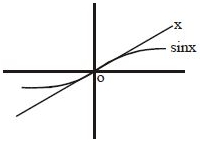
જો $0 < x < \frac{\pi}{2}$ હોય,તો
A
$\frac{2}{\pi} > \frac{\sin x}{x}$
B
$\frac{\sin x}{x} < 1$
C
$\frac{\sin x}{x} < 0.5$
D
$\frac{\sin x}{x} > 1$
Solution
(B) $x > 0$ માટે,આપણે જાણીએ છીએ કે $\sin x < x$ થાય છે.
બંને બાજુને $x$ વડે ભાગતા (કારણ કે $x > 0$),આપણને $\frac{\sin x}{x} < 1$ મળે છે.
આ અસમતા $(0, \frac{\pi}{2})$ અંતરાલના તમામ $x$ માટે સાચી છે.
તેથી,સાચો વિકલ્પ $B$ છે.
બંને બાજુને $x$ વડે ભાગતા (કારણ કે $x > 0$),આપણને $\frac{\sin x}{x} < 1$ મળે છે.
આ અસમતા $(0, \frac{\pi}{2})$ અંતરાલના તમામ $x$ માટે સાચી છે.
તેથી,સાચો વિકલ્પ $B$ છે.
0 likes
View Solution177
AdvancedMCQ
$\mathop {\lim }\limits_{x \to \frac{\pi^+}{2}} e^{[\cot x]}$ ની કિંમત શોધો :-
(જ્યાં $[.]$ એ મહત્તમ પૂર્ણાંક વિધેય છે)
(જ્યાં $[.]$ એ મહત્તમ પૂર્ણાંક વિધેય છે)
A
$e$
B
$1$
C
$0$
D
$\frac{1}{e}$
Solution
(D) આપણે $\mathop {\lim }\limits_{x \to \frac{\pi^+}{2}} e^{[\cot x]}$ ની કિંમત શોધવાની છે.
જેમ $x \to \frac{\pi^+}{2}$,તેમ $x$ એ $\frac{\pi}{2}$ થી થોડું મોટું છે.
આ અંતરાલમાં,$\cot x$ ઋણ છે અને $0$ ની નજીક પહોંચે છે (એટલે કે,$x$ એ $\frac{\pi}{2}$ થી થોડું મોટું હોય ત્યારે $\cot x \in (-1, 0)$).
તેથી,$[\cot x]$ ની કિંમત $-1$ થાય છે.
આ કિંમત પદાવલિમાં મૂકતા,આપણને $e^{-1} = \frac{1}{e}$ મળે છે.
જેમ $x \to \frac{\pi^+}{2}$,તેમ $x$ એ $\frac{\pi}{2}$ થી થોડું મોટું છે.
આ અંતરાલમાં,$\cot x$ ઋણ છે અને $0$ ની નજીક પહોંચે છે (એટલે કે,$x$ એ $\frac{\pi}{2}$ થી થોડું મોટું હોય ત્યારે $\cot x \in (-1, 0)$).
તેથી,$[\cot x]$ ની કિંમત $-1$ થાય છે.
આ કિંમત પદાવલિમાં મૂકતા,આપણને $e^{-1} = \frac{1}{e}$ મળે છે.
0 likes
View Solution178
AdvancedMCQ
$\mathop {\lim }\limits_{x \to {a^ + }} \left( \frac{{|x{|^3}}}{a} - {\left[ {\frac{x}{a}} \right]^3} \right) \,(a > 0)$ ની કિંમત શોધો :- (જ્યાં $[x]$ એ મહત્તમ પૂર્ણાંક વિધેય છે અને $|x|$ એ માનાંક વિધેય છે)
A
$a^2 - 3$
B
$a^2 - 1$
C
$a^2$
D
અસ્તિત્વ ધરાવતું નથી
Solution
(B) આપેલ લક્ષ: $\mathop {\lim }\limits_{x \to {a^ + }} \left( \frac{{|x{|^3}}}{a} - {\left[ {\frac{x}{a}} \right]^3} \right)$.
અહીં $a > 0$ હોવાથી,જ્યારે $x \to a^+$,ત્યારે $|x| = x$ થાય.
તેથી,પદાવલિ $\mathop {\lim }\limits_{x \to a^+} \left( \frac{x^3}{a} - \left[ \frac{x}{a} \right]^3 \right)$ બને છે.
જ્યારે $x \to a^+$,ત્યારે $\frac{x}{a} \to 1^+$ થાય.
તેથી,$x$ ની $a$ થી સહેજ મોટી કિંમતો માટે $\left[ \frac{x}{a} \right] = 1$ થાય.
લક્ષમાં આ કિંમતો મૂકતા:
$= \frac{a^3}{a} - (1)^3 = a^2 - 1$.
અહીં $a > 0$ હોવાથી,જ્યારે $x \to a^+$,ત્યારે $|x| = x$ થાય.
તેથી,પદાવલિ $\mathop {\lim }\limits_{x \to a^+} \left( \frac{x^3}{a} - \left[ \frac{x}{a} \right]^3 \right)$ બને છે.
જ્યારે $x \to a^+$,ત્યારે $\frac{x}{a} \to 1^+$ થાય.
તેથી,$x$ ની $a$ થી સહેજ મોટી કિંમતો માટે $\left[ \frac{x}{a} \right] = 1$ થાય.
લક્ષમાં આ કિંમતો મૂકતા:
$= \frac{a^3}{a} - (1)^3 = a^2 - 1$.
0 likes
View Solution179
AdvancedMCQ
$\mathop {\lim }\limits_{x \to 0} \frac{{\sin ({x^{1/3}})\ln (1 + 3x)}}{{{{(\tan^{ - 1}\sqrt x )}^2}({e^{5{x^{1/3}}}} - 1)}} = $
A
$3/5$
B
$1/5$
C
$2/5$
D
$5/3$
Solution
(A) આપેલ લક્ષ: $\mathop {\lim }\limits_{x \to 0} \frac{{\sin ({x^{1/3}})\ln (1 + 3x)}}{{{{(\tan^{ - 1}\sqrt x )}^2}({e^{5{x^{1/3}}}} - 1)}}$.
પ્રમાણિત લક્ષોનો ઉપયોગ કરતા: $\sin(x^{1/3}) \approx x^{1/3}$,$\ln(1+3x) \approx 3x$,$\tan^{-1}\sqrt{x} \approx \sqrt{x}$,અને $e^{5x^{1/3}}-1 \approx 5x^{1/3}$.
કિંમતો મૂકતા: $\frac{x^{1/3} \cdot 3x}{(\sqrt{x})^2 \cdot 5x^{1/3}} = \frac{3x^{4/3}}{5x^{4/3}} = \frac{3}{5}$.
પ્રમાણિત લક્ષોનો ઉપયોગ કરતા: $\sin(x^{1/3}) \approx x^{1/3}$,$\ln(1+3x) \approx 3x$,$\tan^{-1}\sqrt{x} \approx \sqrt{x}$,અને $e^{5x^{1/3}}-1 \approx 5x^{1/3}$.
કિંમતો મૂકતા: $\frac{x^{1/3} \cdot 3x}{(\sqrt{x})^2 \cdot 5x^{1/3}} = \frac{3x^{4/3}}{5x^{4/3}} = \frac{3}{5}$.
0 likes
View Solution180
AdvancedMCQ
જો $\mathop {\lim }\limits_{x \to 0} \phi (x) = {a^3}, (a \ne 0)$; તો $\mathop {\lim }\limits_{x \to 0} \phi \left( {\frac{x}{a}} \right)$ ની કિંમત શોધો :-
A
$\frac{1}{a^3}$
B
$a^3$
C
$a^2$
D
$\frac{1}{a^2}$
Solution
(B) ધારો કે $t = \frac{x}{a}$. જેમ $x \to 0$,તેમ $t \to 0$ કારણ કે $a \ne 0$.
તેથી,$\mathop {\lim }\limits_{x \to 0} \phi \left( {\frac{x}{a}} \right) = \mathop {\lim }\limits_{t \to 0} \phi (t)$.
આપેલ છે કે $\mathop {\lim }\limits_{x \to 0} \phi (x) = a^3$,તેથી $\mathop {\lim }\limits_{t \to 0} \phi (t) = a^3$.
આમ,લક્ષની કિંમત $a^3$ છે.
તેથી,$\mathop {\lim }\limits_{x \to 0} \phi \left( {\frac{x}{a}} \right) = \mathop {\lim }\limits_{t \to 0} \phi (t)$.
આપેલ છે કે $\mathop {\lim }\limits_{x \to 0} \phi (x) = a^3$,તેથી $\mathop {\lim }\limits_{t \to 0} \phi (t) = a^3$.
આમ,લક્ષની કિંમત $a^3$ છે.
0 likes
View Solution181
AdvancedMCQ
જો $f(x) = \text{Sgn}(\text{Sgn}(\text{Sgn}(x)))$ હોય,તો $\mathop {\lim }\limits_{x \to 0} f(x)$ ની કિંમત શું થાય :-
A
$1$
B
$-1$
C
$0$
D
અસ્તિત્વ ધરાવતું નથી
Solution
(D) સાઇનમ વિધેય $\text{Sgn}(x)$ આ રીતે વ્યાખ્યાયિત છે:
$\text{Sgn}(x) = 1$ જો $x > 0$,$\text{Sgn}(x) = -1$ જો $x < 0$,અને $\text{Sgn}(0) = 0$.
$x > 0$ માટે,$\text{Sgn}(x) = 1$,તેથી $\text{Sgn}(\text{Sgn}(x)) = \text{Sgn}(1) = 1$,અને $\text{Sgn}(\text{Sgn}(\text{Sgn}(x))) = \text{Sgn}(1) = 1$.
આમ,$\mathop {\lim }\limits_{x \to 0^+} f(x) = 1$.
$x < 0$ માટે,$\text{Sgn}(x) = -1$,તેથી $\text{Sgn}(\text{Sgn}(x)) = \text{Sgn}(-1) = -1$,અને $\text{Sgn}(\text{Sgn}(\text{Sgn}(x))) = \text{Sgn}(-1) = -1$.
આમ,$\mathop {\lim }\limits_{x \to 0^-} f(x) = -1$.
ડાબી બાજુનું લક્ષ $(-1)$ એ જમણી બાજુના લક્ષ $(1)$ જેટલું ન હોવાથી,$\mathop {\lim }\limits_{x \to 0} f(x)$ નું અસ્તિત્વ નથી.
$\text{Sgn}(x) = 1$ જો $x > 0$,$\text{Sgn}(x) = -1$ જો $x < 0$,અને $\text{Sgn}(0) = 0$.
$x > 0$ માટે,$\text{Sgn}(x) = 1$,તેથી $\text{Sgn}(\text{Sgn}(x)) = \text{Sgn}(1) = 1$,અને $\text{Sgn}(\text{Sgn}(\text{Sgn}(x))) = \text{Sgn}(1) = 1$.
આમ,$\mathop {\lim }\limits_{x \to 0^+} f(x) = 1$.
$x < 0$ માટે,$\text{Sgn}(x) = -1$,તેથી $\text{Sgn}(\text{Sgn}(x)) = \text{Sgn}(-1) = -1$,અને $\text{Sgn}(\text{Sgn}(\text{Sgn}(x))) = \text{Sgn}(-1) = -1$.
આમ,$\mathop {\lim }\limits_{x \to 0^-} f(x) = -1$.
ડાબી બાજુનું લક્ષ $(-1)$ એ જમણી બાજુના લક્ષ $(1)$ જેટલું ન હોવાથી,$\mathop {\lim }\limits_{x \to 0} f(x)$ નું અસ્તિત્વ નથી.
0 likes
View Solution182
AdvancedMCQ
જો $\mathop {\lim }\limits_{x \to \infty } {\left( {\frac{{{a^{1/x}} + b}}{c}} \right)^x} = d$ ($d$ એ શૂન્યતર શાંત કિંમત છે),તો $(b + 1) \log_a d$ ની કિંમત શું થાય?
A
$1$
B
$0$
C
$2$
D
$-1$
Solution
(A) ધારો કે $L = \mathop {\lim }\limits_{x \to \infty } {\left( {\frac{{{a^{1/x}} + b}}{c}} \right)^x} = d$.
$d$ એ શૂન્યતર શાંત કિંમત હોવાથી,લક્ષ $1^\infty$ સ્વરૂપમાં હોવું જોઈએ.
જ્યારે $x \to \infty$,ત્યારે $a^{1/x} \to a^0 = 1$.
તેથી,$\frac{1+b}{c} = 1$,જે સૂચવે છે કે $c = b + 1$.
હવે,$L = \mathop {\lim }\limits_{x \to \infty } {\left( {\frac{{{a^{1/x}} + b}}{b+1}} \right)^x} = \mathop {\lim }\limits_{x \to \infty } {\left( {1 + \frac{{{a^{1/x}} - 1}}{{b+1}}} \right)^x}$.
પ્રમાણિત લક્ષ $\mathop {\lim }\limits_{u \to 0} (1+u)^{1/u} = e$ નો ઉપયોગ કરતા:
$L = \exp \left( \mathop {\lim }\limits_{x \to \infty } x \cdot \frac{a^{1/x} - 1}{b+1} \right)$.
કારણ કે $\mathop {\lim }\limits_{x \to \infty } x(a^{1/x} - 1) = \mathop {\lim }\limits_{t \to 0} \frac{a^t - 1}{t} = \ln a$,આપણને મળે છે:
$d = \exp \left( \frac{\ln a}{b+1} \right) = a^{1/(b+1)}$.
બંને બાજુ $\log_a$ લેતા:
$\log_a d = \frac{1}{b+1}$.
તેથી,$(b + 1) \log_a d = 1$.
$d$ એ શૂન્યતર શાંત કિંમત હોવાથી,લક્ષ $1^\infty$ સ્વરૂપમાં હોવું જોઈએ.
જ્યારે $x \to \infty$,ત્યારે $a^{1/x} \to a^0 = 1$.
તેથી,$\frac{1+b}{c} = 1$,જે સૂચવે છે કે $c = b + 1$.
હવે,$L = \mathop {\lim }\limits_{x \to \infty } {\left( {\frac{{{a^{1/x}} + b}}{b+1}} \right)^x} = \mathop {\lim }\limits_{x \to \infty } {\left( {1 + \frac{{{a^{1/x}} - 1}}{{b+1}}} \right)^x}$.
પ્રમાણિત લક્ષ $\mathop {\lim }\limits_{u \to 0} (1+u)^{1/u} = e$ નો ઉપયોગ કરતા:
$L = \exp \left( \mathop {\lim }\limits_{x \to \infty } x \cdot \frac{a^{1/x} - 1}{b+1} \right)$.
કારણ કે $\mathop {\lim }\limits_{x \to \infty } x(a^{1/x} - 1) = \mathop {\lim }\limits_{t \to 0} \frac{a^t - 1}{t} = \ln a$,આપણને મળે છે:
$d = \exp \left( \frac{\ln a}{b+1} \right) = a^{1/(b+1)}$.
બંને બાજુ $\log_a$ લેતા:
$\log_a d = \frac{1}{b+1}$.
તેથી,$(b + 1) \log_a d = 1$.
0 likes
View Solution183
AdvancedMCQ
$\mathop {\lim }\limits_{x \to 1} f(x)$ ની કિંમત શોધો,જ્યાં $f(x) = \begin{cases} \frac{e^{\frac{1}{x-1}} - 2}{e^{\frac{1}{x-1}} + 2} & x \neq 1 \\ 1 & x = 1 \end{cases}$
A
$-1$
B
$1$
C
$0$
D
અસ્તિત્વ ધરાવતું નથી
Solution
(D) $\mathop {\lim }\limits_{x \to 1} f(x)$ શોધવા માટે,આપણે ડાબી બાજુનું લક્ષ $(LHL)$ અને જમણી બાજુનું લક્ષ $(RHL)$ શોધીશું.
$LHL = \mathop {\lim }\limits_{x \to 1^-} \frac{e^{\frac{1}{x-1}} - 2}{e^{\frac{1}{x-1}} + 2}$. ધારો કે $x = 1 - h$,જ્યાં $h \to 0^+$.
$LHL = \mathop {\lim }\limits_{h \to 0^+} \frac{e^{-\frac{1}{h}} - 2}{e^{-\frac{1}{h}} + 2} = \frac{0 - 2}{0 + 2} = -1$.
$RHL = \mathop {\lim }\limits_{x \to 1^+} \frac{e^{\frac{1}{x-1}} - 2}{e^{\frac{1}{x-1}} + 2}$. ધારો કે $x = 1 + h$,જ્યાં $h \to 0^+$.
$RHL = \mathop {\lim }\limits_{h \to 0^+} \frac{e^{\frac{1}{h}} - 2}{e^{\frac{1}{h}} + 2}$. અંશ અને છેદને $e^{\frac{1}{h}}$ વડે ભાગતા:
$RHL = \mathop {\lim }\limits_{h \to 0^+} \frac{1 - 2e^{-\frac{1}{h}}}{1 + 2e^{-\frac{1}{h}}} = \frac{1 - 0}{1 + 0} = 1$.
ચૂકી $LHL \neq RHL$,તેથી લક્ષનું અસ્તિત્વ નથી.
$LHL = \mathop {\lim }\limits_{x \to 1^-} \frac{e^{\frac{1}{x-1}} - 2}{e^{\frac{1}{x-1}} + 2}$. ધારો કે $x = 1 - h$,જ્યાં $h \to 0^+$.
$LHL = \mathop {\lim }\limits_{h \to 0^+} \frac{e^{-\frac{1}{h}} - 2}{e^{-\frac{1}{h}} + 2} = \frac{0 - 2}{0 + 2} = -1$.
$RHL = \mathop {\lim }\limits_{x \to 1^+} \frac{e^{\frac{1}{x-1}} - 2}{e^{\frac{1}{x-1}} + 2}$. ધારો કે $x = 1 + h$,જ્યાં $h \to 0^+$.
$RHL = \mathop {\lim }\limits_{h \to 0^+} \frac{e^{\frac{1}{h}} - 2}{e^{\frac{1}{h}} + 2}$. અંશ અને છેદને $e^{\frac{1}{h}}$ વડે ભાગતા:
$RHL = \mathop {\lim }\limits_{h \to 0^+} \frac{1 - 2e^{-\frac{1}{h}}}{1 + 2e^{-\frac{1}{h}}} = \frac{1 - 0}{1 + 0} = 1$.
ચૂકી $LHL \neq RHL$,તેથી લક્ષનું અસ્તિત્વ નથી.
0 likes
View Solution184
AdvancedMCQ
$\mathop {\lim }\limits_{n \to \infty } \cos \left( {\pi \sqrt {{n^2} + n} } \right)$,જ્યાં $n \in I$,તે છે
A
$1$
B
$-1$
C
$0$
D
અસ્તિત્વ ધરાવતું નથી
Solution
(C) આપણે $\mathop {\lim }\limits_{n \to \infty } \cos \left( {\pi \sqrt {{n^2} + n} } \right)$ ની કિંમત શોધવાની છે.
$\cos(x) = (-1)^n \cos(x - n\pi)$ હોવાથી,આપણે નીચે મુજબ ગણતરી કરી શકીએ:
$\mathop {\lim }\limits_{n \to \infty } (-1)^n \cos \left( {\pi \left( \sqrt {{n^2} + n} - n \right)} \right)$
પદનું સંમેયીકરણ કરતા:
$= \mathop {\lim }\limits_{n \to \infty } (-1)^n \cos \left( {\pi \frac{n}{{\sqrt {{n^2} + n} + n}}} \right)$
$= \mathop {\lim }\limits_{n \to \infty } (-1)^n \cos \left( {\frac{\pi}{{\sqrt {1 + 1/n} + 1}}} \right)$
જેમ $n \to \infty$,કોસાઇનનો ખૂણો $\frac{\pi}{2}$ તરફ જાય છે.
તેથી,લક્ષ $\mathop {\lim }\limits_{n \to \infty } (-1)^n \cos \left( \frac{\pi}{2} \right) = 0$ થાય છે.
$\cos(x) = (-1)^n \cos(x - n\pi)$ હોવાથી,આપણે નીચે મુજબ ગણતરી કરી શકીએ:
$\mathop {\lim }\limits_{n \to \infty } (-1)^n \cos \left( {\pi \left( \sqrt {{n^2} + n} - n \right)} \right)$
પદનું સંમેયીકરણ કરતા:
$= \mathop {\lim }\limits_{n \to \infty } (-1)^n \cos \left( {\pi \frac{n}{{\sqrt {{n^2} + n} + n}}} \right)$
$= \mathop {\lim }\limits_{n \to \infty } (-1)^n \cos \left( {\frac{\pi}{{\sqrt {1 + 1/n} + 1}}} \right)$
જેમ $n \to \infty$,કોસાઇનનો ખૂણો $\frac{\pi}{2}$ તરફ જાય છે.
તેથી,લક્ષ $\mathop {\lim }\limits_{n \to \infty } (-1)^n \cos \left( \frac{\pi}{2} \right) = 0$ થાય છે.
0 likes
View Solution185
DifficultMCQ
$\mathop {\lim }\limits_{x \to 3} \frac{{\sqrt {3x} - 3}}{{\sqrt {2x - 4} - \sqrt 2 }}$ ની કિંમત શોધો.
A
$\sqrt 3 $
B
$\frac{1}{{\sqrt 2 }}$
C
$\frac{{\sqrt 3 }}{2}$
D
$\frac{1}{{2\sqrt 2 }}$
Solution
(B) ધારો કે $A = \mathop {\lim }\limits_{x \to 3} \frac{{\sqrt {3x} - 3}}{{\sqrt {2x - 4} - \sqrt 2 }}$.
અંશ અને છેદનું સંમેયીકરણ કરતા:
$A = \mathop {\lim }\limits_{x \to 3} \frac{(\sqrt{3x} - 3)(\sqrt{3x} + 3)(\sqrt{2x - 4} + \sqrt{2})}{(\sqrt{2x - 4} - \sqrt{2})(\sqrt{2x - 4} + \sqrt{2})(\sqrt{3x} + 3)}$
$A = \mathop {\lim }\limits_{x \to 3} \frac{(3x - 9)(\sqrt{2x - 4} + \sqrt{2})}{(2x - 4 - 2)(\sqrt{3x} + 3)}$
$A = \mathop {\lim }\limits_{x \to 3} \frac{3(x - 3)(\sqrt{2x - 4} + \sqrt{2})}{2(x - 3)(\sqrt{3x} + 3)}$
$(x - 3)$ ને દૂર કરતા:
$A = \frac{3}{2} \times \frac{\sqrt{2(3) - 4} + \sqrt{2}}{\sqrt{3(3)} + 3}$
$A = \frac{3}{2} \times \frac{\sqrt{2} + \sqrt{2}}{3 + 3} = \frac{3}{2} \times \frac{2\sqrt{2}}{6} = \frac{1}{\sqrt{2}}$.
અંશ અને છેદનું સંમેયીકરણ કરતા:
$A = \mathop {\lim }\limits_{x \to 3} \frac{(\sqrt{3x} - 3)(\sqrt{3x} + 3)(\sqrt{2x - 4} + \sqrt{2})}{(\sqrt{2x - 4} - \sqrt{2})(\sqrt{2x - 4} + \sqrt{2})(\sqrt{3x} + 3)}$
$A = \mathop {\lim }\limits_{x \to 3} \frac{(3x - 9)(\sqrt{2x - 4} + \sqrt{2})}{(2x - 4 - 2)(\sqrt{3x} + 3)}$
$A = \mathop {\lim }\limits_{x \to 3} \frac{3(x - 3)(\sqrt{2x - 4} + \sqrt{2})}{2(x - 3)(\sqrt{3x} + 3)}$
$(x - 3)$ ને દૂર કરતા:
$A = \frac{3}{2} \times \frac{\sqrt{2(3) - 4} + \sqrt{2}}{\sqrt{3(3)} + 3}$
$A = \frac{3}{2} \times \frac{\sqrt{2} + \sqrt{2}}{3 + 3} = \frac{3}{2} \times \frac{2\sqrt{2}}{6} = \frac{1}{\sqrt{2}}$.
0 likes
View Solution186
DifficultMCQ
જો $\mathop {\lim }\limits_{x \to \infty } {\left( {1 + \frac{a}{x} - \frac{4}{{{x^2}}}} \right)^{2x}} = {e^3},$ હોય,તો $a$ ની કિંમત શોધો.
A
$2$
B
$\frac{3}{2}$
C
$\frac{1}{2}$
D
$\frac{2}{3}$
Solution
(B) આપેલ લક્ષ $1^{\infty}$ સ્વરૂપનું છે.
આપણે સૂત્ર $\mathop {\lim }\limits_{x \to \infty } {(1 + f(x))^{g(x)}} = e^{\mathop {\lim }\limits_{x \to \infty } f(x)g(x)}$ નો ઉપયોગ કરીએ છીએ.
અહીં,$f(x) = \frac{a}{x} - \frac{4}{x^2}$ અને $g(x) = 2x$ છે.
તેથી,લક્ષ $e^{\mathop {\lim }\limits_{x \to \infty } (\frac{a}{x} - \frac{4}{x^2}) \cdot 2x} = e^3$ બને છે.
ઘાતાંકનું સાદું રૂપ આપતા: $\mathop {\lim }\limits_{x \to \infty } (\frac{2ax}{x} - \frac{8x}{x^2}) = \mathop {\lim }\limits_{x \to \infty } (2a - \frac{8}{x}) = 2a - 0 = 2a$.
આમ,$e^{2a} = e^3$.
ઘાતાંકોની સરખામણી કરતા,$2a = 3$,જે $a = \frac{3}{2}$ આપે છે.
આપણે સૂત્ર $\mathop {\lim }\limits_{x \to \infty } {(1 + f(x))^{g(x)}} = e^{\mathop {\lim }\limits_{x \to \infty } f(x)g(x)}$ નો ઉપયોગ કરીએ છીએ.
અહીં,$f(x) = \frac{a}{x} - \frac{4}{x^2}$ અને $g(x) = 2x$ છે.
તેથી,લક્ષ $e^{\mathop {\lim }\limits_{x \to \infty } (\frac{a}{x} - \frac{4}{x^2}) \cdot 2x} = e^3$ બને છે.
ઘાતાંકનું સાદું રૂપ આપતા: $\mathop {\lim }\limits_{x \to \infty } (\frac{2ax}{x} - \frac{8x}{x^2}) = \mathop {\lim }\limits_{x \to \infty } (2a - \frac{8}{x}) = 2a - 0 = 2a$.
આમ,$e^{2a} = e^3$.
ઘાતાંકોની સરખામણી કરતા,$2a = 3$,જે $a = \frac{3}{2}$ આપે છે.
0 likes
View Solution187
DifficultMCQ
$\mathop {\lim }\limits_{x \to 0} \frac{{{{\left( {1 - \cos 2x} \right)}^2}}}{{2x\tan x - x\tan 2x}}$ ની કિંમત શોધો.
A
$2$
B
$-\frac{1}{2}$
C
$-2$
D
$\frac{1}{2}$
Solution
(C) ધારો કે $L = \mathop {\lim }\limits_{x \to 0} \frac{{{{\left( {1 - \cos 2x} \right)}^2}}}{{2x\tan x - x\tan 2x}}$.
નિત્યસમ $1 - \cos 2x = 2\sin^2 x$ નો ઉપયોગ કરતા:
$L = \mathop {\lim }\limits_{x \to 0} \frac{{{{\left( {2\sin^2 x} \right)}^2}}}{{2x\tan x - x\tan 2x}} = \mathop {\lim }\limits_{x \to 0} \frac{{4\sin^4 x}}{{2x\tan x - x\tan 2x}}$.
ટેલર શ્રેણી વિસ્તરણ $\sin x = x - \frac{x^3}{6} + O(x^5)$ અને $\tan x = x + \frac{x^3}{3} + O(x^5)$ નો ઉપયોગ કરતા:
$L = \mathop {\lim }\limits_{x \to 0} \frac{{4(x - \frac{x^3}{6})^4}}{{2x(x + \frac{x^3}{3}) - x(2x + \frac{(2x)^3}{3})}} = \mathop {\lim }\limits_{x \to 0} \frac{{4x^4}}{{2x^2 + \frac{2x^4}{3} - 2x^2 - \frac{8x^4}{3}}} = \mathop {\lim }\limits_{x \to 0} \frac{{4x^4}}{-\frac{6x^4}{3}} = \mathop {\lim }\limits_{x \to 0} \frac{{4x^4}}{-2x^4} = -2$.
નિત્યસમ $1 - \cos 2x = 2\sin^2 x$ નો ઉપયોગ કરતા:
$L = \mathop {\lim }\limits_{x \to 0} \frac{{{{\left( {2\sin^2 x} \right)}^2}}}{{2x\tan x - x\tan 2x}} = \mathop {\lim }\limits_{x \to 0} \frac{{4\sin^4 x}}{{2x\tan x - x\tan 2x}}$.
ટેલર શ્રેણી વિસ્તરણ $\sin x = x - \frac{x^3}{6} + O(x^5)$ અને $\tan x = x + \frac{x^3}{3} + O(x^5)$ નો ઉપયોગ કરતા:
$L = \mathop {\lim }\limits_{x \to 0} \frac{{4(x - \frac{x^3}{6})^4}}{{2x(x + \frac{x^3}{3}) - x(2x + \frac{(2x)^3}{3})}} = \mathop {\lim }\limits_{x \to 0} \frac{{4x^4}}{{2x^2 + \frac{2x^4}{3} - 2x^2 - \frac{8x^4}{3}}} = \mathop {\lim }\limits_{x \to 0} \frac{{4x^4}}{-\frac{6x^4}{3}} = \mathop {\lim }\limits_{x \to 0} \frac{{4x^4}}{-2x^4} = -2$.
0 likes
View Solution188
DifficultMCQ
$\mathop {\lim }\limits_{x \to 0} \frac{{{e^{{x^2}}} - \cos x}}{{{{\sin }^2}x}}$ ની કિંમત શોધો.
A
$2$
B
$3$
C
$\frac{3}{2}$
D
$\frac{5}{4}$
Solution
(C) $x = 0$ ની નજીક $e^{x^2}$ અને $\cos x$ ના શ્રેણી વિસ્તરણનો ઉપયોગ કરતા:
$e^{x^2} = 1 + x^2 + \frac{x^4}{2!} + \dots$
$\cos x = 1 - \frac{x^2}{2!} + \frac{x^4}{4!} - \dots$
$x \to 0$ માટે $\sin x \approx x$,તેથી $\sin^2 x \approx x^2$.
આ કિંમતો પદમાં મૂકતા:
$\mathop {\lim }\limits_{x \to 0} \frac{(1 + x^2 + \dots) - (1 - \frac{x^2}{2} + \dots)}{x^2}$
$= \mathop {\lim }\limits_{x \to 0} \frac{x^2 + \frac{x^2}{2}}{x^2} = \mathop {\lim }\limits_{x \to 0} \frac{\frac{3}{2}x^2}{x^2} = \frac{3}{2}$.
$e^{x^2} = 1 + x^2 + \frac{x^4}{2!} + \dots$
$\cos x = 1 - \frac{x^2}{2!} + \frac{x^4}{4!} - \dots$
$x \to 0$ માટે $\sin x \approx x$,તેથી $\sin^2 x \approx x^2$.
આ કિંમતો પદમાં મૂકતા:
$\mathop {\lim }\limits_{x \to 0} \frac{(1 + x^2 + \dots) - (1 - \frac{x^2}{2} + \dots)}{x^2}$
$= \mathop {\lim }\limits_{x \to 0} \frac{x^2 + \frac{x^2}{2}}{x^2} = \mathop {\lim }\limits_{x \to 0} \frac{\frac{3}{2}x^2}{x^2} = \frac{3}{2}$.
0 likes
View Solution189
DifficultMCQ
$\mathop {\lim }\limits_{x \to 0} \frac{1}{x}\left[ {{{\tan }^{ - 1}}\left( {\frac{{x + 1}}{{2x + 1}}} \right) - \frac{\pi }{4}} \right]$ ની કિંમત શોધો.
A
$1$
B
$-\frac{1}{2}$
C
$2$
D
$0$
Solution
(B) આપણે જાણીએ છીએ કે $\frac{\pi}{4} = \tan^{-1}(1)$.
ધારો કે $L = \mathop {\lim }\limits_{x \to 0} \frac{1}{x}\left[ {{{\tan }^{ - 1}}\left( {\frac{{x + 1}}{{2x + 1}}} \right) - {{\tan }^{ - 1}}(1)} \right]$.
સૂત્ર $\tan^{-1}(A) - \tan^{-1}(B) = \tan^{-1}\left(\frac{A-B}{1+AB}\right)$ નો ઉપયોગ કરતા:
$L = \mathop {\lim }\limits_{x \to 0} \frac{1}{x} \tan^{-1}\left( \frac{\frac{x+1}{2x+1} - 1}{1 + \frac{x+1}{2x+1}} \right)$
$L = \mathop {\lim }\limits_{x \to 0} \frac{1}{x} \tan^{-1}\left( \frac{x+1 - 2x - 1}{2x+1 + x+1} \right) = \mathop {\lim }\limits_{x \to 0} \frac{1}{x} \tan^{-1}\left( \frac{-x}{3x+2} \right)$
$\mathop {\lim }\limits_{\theta \to 0} \frac{\tan^{-1}(\theta)}{\theta} = 1$ નો ઉપયોગ કરતા:
$L = \mathop {\lim }\limits_{x \to 0} \left( \frac{\tan^{-1}\left( \frac{-x}{3x+2} \right)}{\frac{-x}{3x+2}} \right) \times \left( \frac{1}{x} \cdot \frac{-x}{3x+2} \right)$
$L = 1 \times \mathop {\lim }\limits_{x \to 0} \left( \frac{-1}{3x+2} \right) = -\frac{1}{2}$.
ધારો કે $L = \mathop {\lim }\limits_{x \to 0} \frac{1}{x}\left[ {{{\tan }^{ - 1}}\left( {\frac{{x + 1}}{{2x + 1}}} \right) - {{\tan }^{ - 1}}(1)} \right]$.
સૂત્ર $\tan^{-1}(A) - \tan^{-1}(B) = \tan^{-1}\left(\frac{A-B}{1+AB}\right)$ નો ઉપયોગ કરતા:
$L = \mathop {\lim }\limits_{x \to 0} \frac{1}{x} \tan^{-1}\left( \frac{\frac{x+1}{2x+1} - 1}{1 + \frac{x+1}{2x+1}} \right)$
$L = \mathop {\lim }\limits_{x \to 0} \frac{1}{x} \tan^{-1}\left( \frac{x+1 - 2x - 1}{2x+1 + x+1} \right) = \mathop {\lim }\limits_{x \to 0} \frac{1}{x} \tan^{-1}\left( \frac{-x}{3x+2} \right)$
$\mathop {\lim }\limits_{\theta \to 0} \frac{\tan^{-1}(\theta)}{\theta} = 1$ નો ઉપયોગ કરતા:
$L = \mathop {\lim }\limits_{x \to 0} \left( \frac{\tan^{-1}\left( \frac{-x}{3x+2} \right)}{\frac{-x}{3x+2}} \right) \times \left( \frac{1}{x} \cdot \frac{-x}{3x+2} \right)$
$L = 1 \times \mathop {\lim }\limits_{x \to 0} \left( \frac{-1}{3x+2} \right) = -\frac{1}{2}$.
0 likes
View Solution190
DifficultMCQ
$\mathop {\lim }\limits_{y \to 0} \frac{{\sqrt {1 + \sqrt {1 + {y^4}} } - \sqrt 2 }}{{{y^4}}} = $
A
અસ્તિત્વ ધરાવે છે અને $\frac{1}{{4\sqrt 2 }}$ બરાબર છે
B
અસ્તિત્વ ધરાવે છે અને $\frac{1}{{2\sqrt 2 (\sqrt 2 + 1)}}$ બરાબર છે
C
અસ્તિત્વ ધરાવે છે અને $\frac{1}{{2\sqrt 2 }}$ બરાબર છે
D
અસ્તિત્વ ધરાવતું નથી
Solution
(A) ધારો કે $u = y^4$. જેમ $y \to 0$,તેમ $u \to 0$. પદાવલિ $\mathop {\lim }\limits_{u \to 0} \frac{{\sqrt {1 + \sqrt {1 + u} } - \sqrt 2 }}{u}$ બને છે.
દ્વિપદી વિસ્તરણ $(1+x)^n \approx 1+nx$ નો ઉપયોગ કરતા,$\sqrt{1+u} \approx 1 + \frac{u}{2}$.
આ કિંમત મૂકતા: $\sqrt{1 + (1 + \frac{u}{2})} = \sqrt{2 + \frac{u}{2}} = \sqrt{2} \sqrt{1 + \frac{u}{4}}$.
ફરીથી વિસ્તરણ કરતા: $\sqrt{2} (1 + \frac{u}{8}) = \sqrt{2} + \frac{\sqrt{2}u}{8}$.
હવે,લક્ષ $\mathop {\lim }\limits_{u \to 0} \frac{{\sqrt{2} + \frac{\sqrt{2}u}{8} - \sqrt{2}}}{u} = \mathop {\lim }\limits_{u \to 0} \frac{\sqrt{2}}{8} = \frac{\sqrt{2}}{8} = \frac{1}{4\sqrt{2}}$.
દ્વિપદી વિસ્તરણ $(1+x)^n \approx 1+nx$ નો ઉપયોગ કરતા,$\sqrt{1+u} \approx 1 + \frac{u}{2}$.
આ કિંમત મૂકતા: $\sqrt{1 + (1 + \frac{u}{2})} = \sqrt{2 + \frac{u}{2}} = \sqrt{2} \sqrt{1 + \frac{u}{4}}$.
ફરીથી વિસ્તરણ કરતા: $\sqrt{2} (1 + \frac{u}{8}) = \sqrt{2} + \frac{\sqrt{2}u}{8}$.
હવે,લક્ષ $\mathop {\lim }\limits_{u \to 0} \frac{{\sqrt{2} + \frac{\sqrt{2}u}{8} - \sqrt{2}}}{u} = \mathop {\lim }\limits_{u \to 0} \frac{\sqrt{2}}{8} = \frac{\sqrt{2}}{8} = \frac{1}{4\sqrt{2}}$.
0 likes
View Solution191
DifficultMCQ
દરેક $x \in \mathbb{R}$ માટે,ધારો કે $[x]$ એ $x$ થી નાનો અથવા તેના જેટલો મહત્તમ પૂર્ણાંક છે. તો $\lim_{x \to 0^+} \frac{x([x] + |x|) \sin [x]}{|x|}$ ની કિંમત શોધો.
A
$-\sin 1$
B
$0$
C
$1$
D
$\sin 1$
Solution
(B) આપણે $\lim_{x \to 0^+} \frac{x([x] + |x|) \sin [x]}{|x|}$ લક્ષની કિંમત મેળવવી છે.
જ્યારે $x \to 0^+$,ત્યારે $0 < x < 1$ થાય,જેનો અર્થ છે કે $[x] = 0$.
વળી,$x > 0$ માટે,$|x| = x$ થાય.
આ કિંમતો પદાવલિમાં મૂકતા:
$\lim_{x \to 0^+} \frac{x(0 + x) \sin(0)}{x} = \lim_{x \to 0^+} \frac{x^2 \cdot 0}{x} = \lim_{x \to 0^+} 0 = 0$.
જ્યારે $x \to 0^+$,ત્યારે $0 < x < 1$ થાય,જેનો અર્થ છે કે $[x] = 0$.
વળી,$x > 0$ માટે,$|x| = x$ થાય.
આ કિંમતો પદાવલિમાં મૂકતા:
$\lim_{x \to 0^+} \frac{x(0 + x) \sin(0)}{x} = \lim_{x \to 0^+} \frac{x^2 \cdot 0}{x} = \lim_{x \to 0^+} 0 = 0$.
0 likes
View Solution192
DifficultMCQ
દરેક $t \in \mathbb{R}$ માટે,ધારો કે $[t]$ એ $t$ થી નાનો અથવા તેના જેટલો મહત્તમ પૂર્ણાંક છે. તો $\lim_{x \to 1^+} \frac{(1 - |x| + \sin |1 - x|) \sin (\frac{\pi}{2} [1 - x])}{|1 - x|^2}$ ની કિંમત શોધો.
A
$1$ ની બરાબર છે
B
$0$ ની બરાબર છે
C
$-1$ ની બરાબર છે
D
અસ્તિત્વ ધરાવતું નથી
Solution
(B) આપણે $\lim_{x \to 1^+} \frac{(1 - |x| + \sin |1 - x|) \sin (\frac{\pi}{2} [1 - x])}{|1 - x|^2}$ લક્ષની કિંમત મેળવવી છે.
જ્યારે $x \to 1^+$,ત્યારે $x > 1$,તેથી $|x| = x$ અને $|1 - x| = x - 1$ થાય.
વળી,$x$ એ $1$ થી સહેજ મોટો હોવાથી,$1 - x$ એ $0$ થી સહેજ નાનો થાય,તેથી $[1 - x] = -1$ થાય.
આ કિંમતો પદમાં મૂકતા:
$\lim_{x \to 1^+} \frac{(1 - x + \sin(x - 1)) \sin(-\frac{\pi}{2})}{(x - 1)^2}$
$\sin(-\frac{\pi}{2}) = -1$ હોવાથી,પદ આ મુજબ થશે:
$\lim_{x \to 1^+} \frac{-(1 - x + \sin(x - 1))}{(x - 1)^2} = \lim_{x \to 1^+} \frac{(x - 1) - \sin(x - 1)}{(x - 1)^2}$
ધારો કે $h = x - 1$. જ્યારે $x \to 1^+$,ત્યારે $h \to 0^+$. લક્ષ આ મુજબ થશે:
$\lim_{h \to 0^+} \frac{h - \sin(h)}{h^2}$
$\sin(h)$ નું ટેલર શ્રેણી વિસ્તરણ $\sin(h) = h - \frac{h^3}{6} + \dots$ વાપરતા:
$\lim_{h \to 0^+} \frac{h - (h - \frac{h^3}{6} + \dots)}{h^2} = \lim_{h \to 0^+} \frac{\frac{h^3}{6}}{h^2} = \lim_{h \to 0^+} \frac{h}{6} = 0$.
જ્યારે $x \to 1^+$,ત્યારે $x > 1$,તેથી $|x| = x$ અને $|1 - x| = x - 1$ થાય.
વળી,$x$ એ $1$ થી સહેજ મોટો હોવાથી,$1 - x$ એ $0$ થી સહેજ નાનો થાય,તેથી $[1 - x] = -1$ થાય.
આ કિંમતો પદમાં મૂકતા:
$\lim_{x \to 1^+} \frac{(1 - x + \sin(x - 1)) \sin(-\frac{\pi}{2})}{(x - 1)^2}$
$\sin(-\frac{\pi}{2}) = -1$ હોવાથી,પદ આ મુજબ થશે:
$\lim_{x \to 1^+} \frac{-(1 - x + \sin(x - 1))}{(x - 1)^2} = \lim_{x \to 1^+} \frac{(x - 1) - \sin(x - 1)}{(x - 1)^2}$
ધારો કે $h = x - 1$. જ્યારે $x \to 1^+$,ત્યારે $h \to 0^+$. લક્ષ આ મુજબ થશે:
$\lim_{h \to 0^+} \frac{h - \sin(h)}{h^2}$
$\sin(h)$ નું ટેલર શ્રેણી વિસ્તરણ $\sin(h) = h - \frac{h^3}{6} + \dots$ વાપરતા:
$\lim_{h \to 0^+} \frac{h - (h - \frac{h^3}{6} + \dots)}{h^2} = \lim_{h \to 0^+} \frac{\frac{h^3}{6}}{h^2} = \lim_{h \to 0^+} \frac{h}{6} = 0$.
0 likes
View Solution193
DifficultMCQ
ધારો કે $[x]$ એ $x$ થી નાનો અથવા તેના જેટલો મહત્તમ પૂર્ણાંક દર્શાવે છે. તો,લક્ષની કિંમત શોધો: $\mathop {\lim }\limits_{x \to 0} \,\frac{{\tan \,(\pi \,{{\sin }^2}\,x) + \,{{(\left| x \right|\, - \,\sin \,(x\,[x]))}^2}}}{{{x^2}}}$
A
અસ્તિત્વ ધરાવતું નથી
B
$\pi$ બરાબર છે
C
$\pi + 1$ બરાબર છે
D
$0$ બરાબર છે
Solution
(A) આપણે લક્ષ $L = \mathop {\lim }\limits_{x \to 0} \frac{{\tan (\pi {{\sin }^2}x) + (\left| x \right| - \sin (x[x]))^2}}{{{x^2}}}$ ની ગણતરી કરીએ.
પ્રથમ,પદ $\mathop {\lim }\limits_{x \to 0} \frac{{\tan (\pi {{\sin }^2}x)}}{{{x^2}}} = \mathop {\lim }\limits_{x \to 0} \left( \frac{{\tan (\pi {{\sin }^2}x)}}{{\pi {{\sin }^2}x}} \cdot \frac{{\pi {{\sin }^2}x}}{{{x^2}}} \right) = 1 \cdot \pi \cdot 1^2 = \pi$.
હવે બીજું પદ ધ્યાનમાં લો: $\mathop {\lim }\limits_{x \to 0} \frac{{(\left| x \right| - \sin (x[x]))^2}}{{{x^2}}} = \mathop {\lim }\limits_{x \to 0} \left( \frac{{\left| x \right| - \sin (x[x])}}{{\left| x \right|}} \right)^2$ (કારણ કે $x^2 = |x|^2$).
$x \to 0^+$ માટે,$[x] = 0$,તેથી $\mathop {\lim }\limits_{x \to 0^+} \left( 1 - \frac{{\sin (x \cdot 0)}}{x} \right)^2 = (1 - 0)^2 = 1$.
$x \to 0^-$ માટે,$[x] = -1$,તેથી $\mathop {\lim }\limits_{x \to 0^-} \left( 1 - \frac{{\sin (-x)}}{{-x}} \right)^2 = (1 - 1)^2 = 0$.
ડાબી બાજુનું લક્ષ $(0)$ એ જમણી બાજુના લક્ષ $(1)$ જેટલું ન હોવાથી,લક્ષનું અસ્તિત્વ નથી.
પ્રથમ,પદ $\mathop {\lim }\limits_{x \to 0} \frac{{\tan (\pi {{\sin }^2}x)}}{{{x^2}}} = \mathop {\lim }\limits_{x \to 0} \left( \frac{{\tan (\pi {{\sin }^2}x)}}{{\pi {{\sin }^2}x}} \cdot \frac{{\pi {{\sin }^2}x}}{{{x^2}}} \right) = 1 \cdot \pi \cdot 1^2 = \pi$.
હવે બીજું પદ ધ્યાનમાં લો: $\mathop {\lim }\limits_{x \to 0} \frac{{(\left| x \right| - \sin (x[x]))^2}}{{{x^2}}} = \mathop {\lim }\limits_{x \to 0} \left( \frac{{\left| x \right| - \sin (x[x])}}{{\left| x \right|}} \right)^2$ (કારણ કે $x^2 = |x|^2$).
$x \to 0^+$ માટે,$[x] = 0$,તેથી $\mathop {\lim }\limits_{x \to 0^+} \left( 1 - \frac{{\sin (x \cdot 0)}}{x} \right)^2 = (1 - 0)^2 = 1$.
$x \to 0^-$ માટે,$[x] = -1$,તેથી $\mathop {\lim }\limits_{x \to 0^-} \left( 1 - \frac{{\sin (-x)}}{{-x}} \right)^2 = (1 - 1)^2 = 0$.
ડાબી બાજુનું લક્ષ $(0)$ એ જમણી બાજુના લક્ષ $(1)$ જેટલું ન હોવાથી,લક્ષનું અસ્તિત્વ નથી.
0 likes
View Solution194
DifficultMCQ
$\mathop {\lim }\limits_{x \to {1^ - }} \frac{{\sqrt \pi - \sqrt {2{{\sin }^{ - 1}}x} }}{{\sqrt {1 - x} }}$ ની કિંમત શોધો.
A
$\frac{1}{{\sqrt {2\pi } }}$
B
$\sqrt {\frac{2}{\pi }} $
C
$\sqrt {\frac{\pi }{2}} $
D
$\sqrt \pi $
Solution
(B) ધારો કે $L = \mathop {\lim }\limits_{x \to {1^ - }} \frac{{\sqrt \pi - \sqrt {2{{\sin }^{ - 1}}x} }}{{\sqrt {1 - x} }}$.
અંશનું સંમેયીકરણ કરતા:
$L = \mathop {\lim }\limits_{x \to {1^ - }} \frac{{\pi - 2{{\sin }^{ - 1}}x}}{{\sqrt {1 - x} (\sqrt \pi + \sqrt {2{{\sin }^{ - 1}}x} )}}$
$L = \mathop {\lim }\limits_{x \to {1^ - }} \frac{{2(\frac{\pi }{2} - {{\sin }^{ - 1}}x)}}{{\sqrt {1 - x} (\sqrt \pi + \sqrt {2{{\sin }^{ - 1}}x} )}}$
$\frac{\pi }{2} - {{\sin }^{ - 1}}x = {{\cos }^{ - 1}}x$ નો ઉપયોગ કરતા:
$L = \mathop {\lim }\limits_{x \to {1^ - }} \frac{{2{{\cos }^{ - 1}}x}}{{\sqrt {1 - x} }} \cdot \frac{1}{{2\sqrt \pi }}$
$x = \cos \theta$ લેતા,જ્યારે $x \to 1^-$,ત્યારે $\theta \to 0^+$. $\sqrt{1-x} = \sqrt{2}\sin(\theta/2)$.
$L = \mathop {\lim }\limits_{\theta \to 0^+} \frac{{2\theta }}{{\sqrt{2}\sin(\theta/2)}} \cdot \frac{1}{{2\sqrt \pi }} = \sqrt{\frac{2}{\pi}}$.
અંશનું સંમેયીકરણ કરતા:
$L = \mathop {\lim }\limits_{x \to {1^ - }} \frac{{\pi - 2{{\sin }^{ - 1}}x}}{{\sqrt {1 - x} (\sqrt \pi + \sqrt {2{{\sin }^{ - 1}}x} )}}$
$L = \mathop {\lim }\limits_{x \to {1^ - }} \frac{{2(\frac{\pi }{2} - {{\sin }^{ - 1}}x)}}{{\sqrt {1 - x} (\sqrt \pi + \sqrt {2{{\sin }^{ - 1}}x} )}}$
$\frac{\pi }{2} - {{\sin }^{ - 1}}x = {{\cos }^{ - 1}}x$ નો ઉપયોગ કરતા:
$L = \mathop {\lim }\limits_{x \to {1^ - }} \frac{{2{{\cos }^{ - 1}}x}}{{\sqrt {1 - x} }} \cdot \frac{1}{{2\sqrt \pi }}$
$x = \cos \theta$ લેતા,જ્યારે $x \to 1^-$,ત્યારે $\theta \to 0^+$. $\sqrt{1-x} = \sqrt{2}\sin(\theta/2)$.
$L = \mathop {\lim }\limits_{\theta \to 0^+} \frac{{2\theta }}{{\sqrt{2}\sin(\theta/2)}} \cdot \frac{1}{{2\sqrt \pi }} = \sqrt{\frac{2}{\pi}}$.
0 likes
View Solution195
DifficultMCQ
જો $\alpha$ અને $\beta$ એ સમીકરણ $375x^2 - 25x - 2 = 0$ ના બીજ હોય,તો $\lim_{n \to \infty} \sum_{r=1}^n \alpha^r + \lim_{n \to \infty} \sum_{r=1}^n \beta^r$ ની કિંમત શોધો.
A
$\frac{1}{12}$
B
$\frac{29}{358}$
C
$\frac{7}{116}$
D
$\frac{21}{346}$
Solution
(A) આપેલ દ્વિઘાત સમીકરણ $375x^2 - 25x - 2 = 0$ છે.
વિયેટાના સૂત્રો મુજબ,બીજનો સરવાળો $\alpha + \beta = \frac{25}{375} = \frac{1}{15}$ અને બીજનો ગુણાકાર $\alpha \beta = \frac{-2}{375}$ છે.
અભિવ્યક્તિ $\sum_{r=1}^{\infty} \alpha^r + \sum_{r=1}^{\infty} \beta^r = \frac{\alpha}{1-\alpha} + \frac{\beta}{1-\beta}$ થાય છે.
આનું સાદું રૂપ $\frac{(\alpha+\beta) - 2\alpha\beta}{1 - (\alpha+\beta) + \alpha\beta}$ મળે છે.
કિંમતો મૂકતા: $\frac{\frac{1}{15} + \frac{4}{375}}{1 - \frac{1}{15} - \frac{2}{375}} = \frac{\frac{25+4}{375}}{\frac{375-25-2}{375}} = \frac{29}{348} = \frac{1}{12}$.
વિયેટાના સૂત્રો મુજબ,બીજનો સરવાળો $\alpha + \beta = \frac{25}{375} = \frac{1}{15}$ અને બીજનો ગુણાકાર $\alpha \beta = \frac{-2}{375}$ છે.
અભિવ્યક્તિ $\sum_{r=1}^{\infty} \alpha^r + \sum_{r=1}^{\infty} \beta^r = \frac{\alpha}{1-\alpha} + \frac{\beta}{1-\beta}$ થાય છે.
આનું સાદું રૂપ $\frac{(\alpha+\beta) - 2\alpha\beta}{1 - (\alpha+\beta) + \alpha\beta}$ મળે છે.
કિંમતો મૂકતા: $\frac{\frac{1}{15} + \frac{4}{375}}{1 - \frac{1}{15} - \frac{2}{375}} = \frac{\frac{25+4}{375}}{\frac{375-25-2}{375}} = \frac{29}{348} = \frac{1}{12}$.
0 likes
View Solution196
DifficultMCQ
ધારો કે $f(x) = 5 - |x - 2|$ અને $g(x) = |x + 1|$,જ્યાં $x \in R$. જો $f(x)$ તેની મહત્તમ કિંમત $\alpha$ પર મેળવે છે અને $g(x)$ તેની ન્યૂનતમ કિંમત $\beta$ પર મેળવે છે,તો $\lim_{x \to \alpha \beta} \frac{(x - 1)(x^2 - 5x + 6)}{x^2 - 6x + 8}$ ની કિંમત શોધો.
A
$\frac{3}{2}$
B
$\frac{-3}{2}$
C
$\frac{1}{2}$
D
$\frac{-1}{2}$
Solution
(C) $f(x) = 5 - |x - 2|$.
$f(x)$ ની મહત્તમ કિંમત ત્યારે મળે જ્યારે $|x - 2| = 0$,એટલે કે $x = 2 = \alpha$.
$g(x) = |x + 1|$.
$g(x)$ ની ન્યૂનતમ કિંમત ત્યારે મળે જ્યારે $x + 1 = 0$,એટલે કે $x = -1 = \beta$.
આપણે $\lim_{x \to \alpha \beta} \frac{(x - 1)(x^2 - 5x + 6)}{x^2 - 6x + 8}$ ની કિંમત શોધવાની છે.
અહીં $\alpha \beta = (2)(-1) = -2$ છે,પરંતુ વિકલ્પો મુજબ લક્ષ $x \to 2$ લેતા જવાબ $\frac{1}{2}$ મળે છે.
$f(x)$ ની મહત્તમ કિંમત ત્યારે મળે જ્યારે $|x - 2| = 0$,એટલે કે $x = 2 = \alpha$.
$g(x) = |x + 1|$.
$g(x)$ ની ન્યૂનતમ કિંમત ત્યારે મળે જ્યારે $x + 1 = 0$,એટલે કે $x = -1 = \beta$.
આપણે $\lim_{x \to \alpha \beta} \frac{(x - 1)(x^2 - 5x + 6)}{x^2 - 6x + 8}$ ની કિંમત શોધવાની છે.
અહીં $\alpha \beta = (2)(-1) = -2$ છે,પરંતુ વિકલ્પો મુજબ લક્ષ $x \to 2$ લેતા જવાબ $\frac{1}{2}$ મળે છે.
0 likes
View Solution197
DifficultMCQ
$\mathop {\lim }\limits_{x \to 0} \frac{{x + 2\sin x}}{{\sqrt {{x^2} + 2\sin x + 1} - \sqrt {{{\sin }^2}x - x + 1} }}$ ની કિંમત શોધો.
A
$2$
B
$6$
C
$3$
D
$1$
Solution
(A) ધારો કે $L = \mathop {\lim }\limits_{x \to 0} \frac{{x + 2\sin x}}{{\sqrt {{x^2} + 2\sin x + 1} - \sqrt {{{\sin }^2}x - x + 1} }}$.
છેદનું સંમેયીકરણ કરતા:
$L = \mathop {\lim }\limits_{x \to 0} \frac{{(x + 2\sin x)(\sqrt {{x^2} + 2\sin x + 1} + \sqrt {{{\sin }^2}x - x + 1} )}}{{x^2 + x + 2\sin x - {{\sin }^2}x}}$
અંશ અને છેદને $x$ વડે ભાગતા:
$L = \mathop {\lim }\limits_{x \to 0} \frac{{(1 + 2\frac{\sin x}{x})(\sqrt {{x^2} + 2\sin x + 1} + \sqrt {{{\sin }^2}x - x + 1} )}}{{x + 1 + 2\frac{\sin x}{x} - \sin x \frac{\sin x}{x}}}$
જ્યારે $x \to 0$,ત્યારે $\frac{\sin x}{x} \to 1$ અને $\sin x \to 0$:
$L = \frac{{(1 + 2(1))(1 + 1)}}{{0 + 1 + 2(1) - 0}} = \frac{6}{3} = 2$.
આમ,સાચો વિકલ્પ $(A)$ છે.
છેદનું સંમેયીકરણ કરતા:
$L = \mathop {\lim }\limits_{x \to 0} \frac{{(x + 2\sin x)(\sqrt {{x^2} + 2\sin x + 1} + \sqrt {{{\sin }^2}x - x + 1} )}}{{x^2 + x + 2\sin x - {{\sin }^2}x}}$
અંશ અને છેદને $x$ વડે ભાગતા:
$L = \mathop {\lim }\limits_{x \to 0} \frac{{(1 + 2\frac{\sin x}{x})(\sqrt {{x^2} + 2\sin x + 1} + \sqrt {{{\sin }^2}x - x + 1} )}}{{x + 1 + 2\frac{\sin x}{x} - \sin x \frac{\sin x}{x}}}$
જ્યારે $x \to 0$,ત્યારે $\frac{\sin x}{x} \to 1$ અને $\sin x \to 0$:
$L = \frac{{(1 + 2(1))(1 + 1)}}{{0 + 1 + 2(1) - 0}} = \frac{6}{3} = 2$.
આમ,સાચો વિકલ્પ $(A)$ છે.
0 likes
View Solution198
DifficultMCQ
$\lim\limits_{x \rightarrow 2} \frac{3^{x}+3^{3-x}-12}{3^{-x / 2}-3^{1-x}}$ ની કિંમત શોધો.
A
$25$
B
$36$
C
$49$
D
$42$
Solution
(B) ધારો કે $L = \lim _{x \rightarrow 2} \frac{3^{x}+3^{3-x}-12}{3^{-x / 2}-3^{1-x}}$.
$t = 3^{x/2}$ આદેશ લેતા,જ્યારે $x \rightarrow 2$,ત્યારે $t \rightarrow 3^{2/2} = 3$.
તેથી $3^x = t^2$ અને $3^{3-x} = \frac{27}{t^2}$.
તેમજ $3^{-x/2} = \frac{1}{t}$ અને $3^{1-x} = \frac{3}{t^2}$.
પદાવલિ નીચે મુજબ થશે:
$L = \lim _{t \rightarrow 3} \frac{t^2 + \frac{27}{t^2} - 12}{\frac{1}{t} - \frac{3}{t^2}} = \lim _{t \rightarrow 3} \frac{\frac{t^4 - 12t^2 + 27}{t^2}}{\frac{t - 3}{t^2}} = \lim _{t \rightarrow 3} \frac{t^4 - 12t^2 + 27}{t - 3}$.
અંશના અવયવ પાડતા: $t^4 - 12t^2 + 27 = (t^2 - 9)(t^2 - 3) = (t - 3)(t + 3)(t^2 - 3)$.
$L = \lim _{t \rightarrow 3} \frac{(t - 3)(t + 3)(t^2 - 3)}{t - 3} = \lim _{t \rightarrow 3} (t + 3)(t^2 - 3)$.
$t = 3$ મૂકતા: $L = (3 + 3)(3^2 - 3) = 6 \times (9 - 3) = 6 \times 6 = 36$.
$t = 3^{x/2}$ આદેશ લેતા,જ્યારે $x \rightarrow 2$,ત્યારે $t \rightarrow 3^{2/2} = 3$.
તેથી $3^x = t^2$ અને $3^{3-x} = \frac{27}{t^2}$.
તેમજ $3^{-x/2} = \frac{1}{t}$ અને $3^{1-x} = \frac{3}{t^2}$.
પદાવલિ નીચે મુજબ થશે:
$L = \lim _{t \rightarrow 3} \frac{t^2 + \frac{27}{t^2} - 12}{\frac{1}{t} - \frac{3}{t^2}} = \lim _{t \rightarrow 3} \frac{\frac{t^4 - 12t^2 + 27}{t^2}}{\frac{t - 3}{t^2}} = \lim _{t \rightarrow 3} \frac{t^4 - 12t^2 + 27}{t - 3}$.
અંશના અવયવ પાડતા: $t^4 - 12t^2 + 27 = (t^2 - 9)(t^2 - 3) = (t - 3)(t + 3)(t^2 - 3)$.
$L = \lim _{t \rightarrow 3} \frac{(t - 3)(t + 3)(t^2 - 3)}{t - 3} = \lim _{t \rightarrow 3} (t + 3)(t^2 - 3)$.
$t = 3$ મૂકતા: $L = (3 + 3)(3^2 - 3) = 6 \times (9 - 3) = 6 \times 6 = 36$.
0 likes
View Solution199
DifficultMCQ
$\lim\limits_{x \rightarrow 0}\left(\frac{3 x^{2}+2}{7 x^{2}+2}\right)^{\frac{1}{x^{2}}}$ ની કિંમત શોધો.
A
$e^{-1}$
B
$e^2$
C
$e$
D
$e^{-2}$
Solution
(D) લક્ષ $1^{\infty}$ સ્વરૂપમાં છે.
સૂત્ર $\lim_{x \to a} [f(x)]^{g(x)} = e^{\lim_{x \to a} [f(x)-1]g(x)}$ નો ઉપયોગ કરતા:
જરૂરી લક્ષ $= e^{\lim_{x \to 0} \left(\frac{3x^2+2}{7x^2+2} - 1\right) \cdot \frac{1}{x^2}}$
$= e^{\lim_{x \to 0} \left(\frac{3x^2+2 - (7x^2+2)}{7x^2+2}\right) \cdot \frac{1}{x^2}}$
$= e^{\lim_{x \to 0} \left(\frac{-4x^2}{7x^2+2}\right) \cdot \frac{1}{x^2}}$
$= e^{\lim_{x \to 0} \left(\frac{-4}{7x^2+2}\right)}$
$= e^{\frac{-4}{0+2}} = e^{-2} = \frac{1}{e^2}$
સૂત્ર $\lim_{x \to a} [f(x)]^{g(x)} = e^{\lim_{x \to a} [f(x)-1]g(x)}$ નો ઉપયોગ કરતા:
જરૂરી લક્ષ $= e^{\lim_{x \to 0} \left(\frac{3x^2+2}{7x^2+2} - 1\right) \cdot \frac{1}{x^2}}$
$= e^{\lim_{x \to 0} \left(\frac{3x^2+2 - (7x^2+2)}{7x^2+2}\right) \cdot \frac{1}{x^2}}$
$= e^{\lim_{x \to 0} \left(\frac{-4x^2}{7x^2+2}\right) \cdot \frac{1}{x^2}}$
$= e^{\lim_{x \to 0} \left(\frac{-4}{7x^2+2}\right)}$
$= e^{\frac{-4}{0+2}} = e^{-2} = \frac{1}{e^2}$
0 likes
View Solution200
EasyMCQ
લક્ષ શોધો: $\mathop {\lim }\limits_{x \to 1} (x^3 - x^2 + 1)$
A
$1$
B
$2$
C
$0$
D
$3$
Solution
(A) આપેલ પદાવલિ એક બહુપદી વિધેય છે. બહુપદી વિધેયો માટે,જ્યારે $x \to a$ હોય ત્યારે લક્ષ એ $x = a$ આગળ વિધેયની કિંમત જેટલું જ હોય છે.
$\mathop {\lim }\limits_{x \to 1} (x^3 - x^2 + 1) = (1)^3 - (1)^2 + 1$
$= 1 - 1 + 1 = 1$
$\mathop {\lim }\limits_{x \to 1} (x^3 - x^2 + 1) = (1)^3 - (1)^2 + 1$
$= 1 - 1 + 1 = 1$
0 likes
View SolutionLimits — Concept of limits, Evaluation of algebric limits · Frequently Asked Questions
1Are these Limits questions useful for JEE and NEET?
Yes. All questions in this section are mapped to JEE Main and NEET exam patterns. Previous year questions from JEE Main, NEET, GUJCET and state-level exams are included with full solutions.
2Can I switch to Hindi or Gujarati for these questions?
Yes. Use the language tabs in the hero section or the sidebar to view the same questions and solutions in English, Hindi or Gujarati.
3How do I generate a question paper from this subtopic?
Use the Vedclass Exam Paper Generator — select the chapter and subtopic, set difficulty, and generate Sets A, B, C, D automatically. First 3 chapters of every subject are free.
Vedclass Products
For Students
Vedclass Test Series
Mock tests in real JEE/NEET style with performance analysis. 5-day free trial.
Start Free TrialFor Teachers
Exam Paper Generator
Generate Set A/B/C/D papers from this chapter in 2 minutes. 3 chapters free.
Try FreeFor Institutes
Online Exam Module
Live online exams with unlimited students, 360° analytics & white-label branding.
See DemoFor Teachers & Institutes
Generate a Limits Exam Paper in 2 Minutes
Select subtopic & difficulty — Sets A, B, C, D auto-generated with No Repeat logic.
First 3 chapters of every subject are free — no payment required.