
A English
Mix Examples - Electricity Questions in English
Class 10 Science · Electricity · Mix Examples - Electricity
449+
Questions
English
Language
100%
With Solutions
Showing 50 of 449 questions in English
201
Medium
Resistivity of two elements $A$ and $B$ are $1.62 \times 10^{-8} \, \Omega m$ and $520 \times 10^{-8} \, \Omega m$ respectively. Out of these two,name the element that can be used to make
$(i)$ filament of electric bulb.
$(ii)$ wires for electrical transmission lines. Justify your answer in each case.
$(i)$ filament of electric bulb.
$(ii)$ wires for electrical transmission lines. Justify your answer in each case.
Solution
(A-B, B-A) $(i)$ Element $B$: It is used for the filament of an electric bulb because it has a high resistivity $\left(520 \times 10^{-8} \, \Omega m\right)$. High resistivity allows the filament to produce a large amount of heat when current passes through it,enabling it to glow.
$(ii)$ Element $A$: It is used for electrical transmission lines because it has a very low resistivity $\left(1.62 \times 10^{-8} \, \Omega m\right)$. Low resistivity ensures minimal energy loss in the form of heat during the transmission of electric power over long distances.
$(ii)$ Element $A$: It is used for electrical transmission lines because it has a very low resistivity $\left(1.62 \times 10^{-8} \, \Omega m\right)$. Low resistivity ensures minimal energy loss in the form of heat during the transmission of electric power over long distances.
0 likes
View Solution202
MediumMCQ
State $Ohm's$ law. Calculate the resistance of a conductor,if the current flowing through it is $0.2 \, A$ when the applied potential difference is $0.8 \, V$.
A
$4 \, \Omega$
B
$0.16 \, \Omega$
C
$0.4 \, \Omega$
D
$2 \, \Omega$
Solution
(A) $Ohm's$ law states that the electric current flowing through a metallic conductor is directly proportional to the potential difference across its ends,provided that the physical conditions (like temperature) remain constant.
Given:
Current $(I)$ = $0.2 \, A$
Potential difference $(V)$ = $0.8 \, V$
Using the formula $R = V / I$:
$R = 0.8 \, V / 0.2 \, A$
$R = 4 \, \Omega$
Therefore,the resistance of the conductor is $4 \, \Omega$.
Given:
Current $(I)$ = $0.2 \, A$
Potential difference $(V)$ = $0.8 \, V$
Using the formula $R = V / I$:
$R = 0.8 \, V / 0.2 \, A$
$R = 4 \, \Omega$
Therefore,the resistance of the conductor is $4 \, \Omega$.
0 likes
View Solution203
Medium
State reasons for the following:
$(a)$ Tungsten is used for making bulb filaments.
$(b)$ Copper and aluminium are generally used for electricity transmission.
$(c)$ Alloys are commonly used in electrical heating devices such as electric iron and toaster.
$(a)$ Tungsten is used for making bulb filaments.
$(b)$ Copper and aluminium are generally used for electricity transmission.
$(c)$ Alloys are commonly used in electrical heating devices such as electric iron and toaster.
Solution
(N/A) Tungsten is a metal that has a very high melting point and high resistivity,which allows it to glow at high temperatures without melting,making it ideal for bulb filaments.
$(b)$ Copper and aluminium are excellent conductors of electricity because they possess very low resistivity,which minimizes energy loss during the transmission of electric current.
$(c)$ Alloys are used in electrical heating devices because their resistivity is significantly higher than that of their constituent pure metals,and they do not oxidize (burn) readily at high temperatures.
$(b)$ Copper and aluminium are excellent conductors of electricity because they possess very low resistivity,which minimizes energy loss during the transmission of electric current.
$(c)$ Alloys are used in electrical heating devices because their resistivity is significantly higher than that of their constituent pure metals,and they do not oxidize (burn) readily at high temperatures.
0 likes
View Solution204
Medium
Describe the nature of the $V-I$ graph for a nichrome wire. ($V =$ Potential difference,$I =$ Current)
$A$ metallic wire of $625 \, mm$ length offers a $4 \, \Omega$ resistance. If the resistivity of the metal is $4.8 \times 10^{-7} \, \Omega \cdot m$,calculate the cross-sectional area of the wire.
$A$ metallic wire of $625 \, mm$ length offers a $4 \, \Omega$ resistance. If the resistivity of the metal is $4.8 \times 10^{-7} \, \Omega \cdot m$,calculate the cross-sectional area of the wire.
Solution
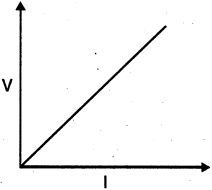
(N/A) The $V-I$ graph for a nichrome wire is a straight line passing through the origin,as nichrome follows Ohm's law.
Given:
Resistivity $\rho = 4.8 \times 10^{-7} \, \Omega \cdot m$
Length $L = 625 \, mm = 0.625 \, m$
Resistance $R = 4 \, \Omega$
Using the formula for resistance: $R = \frac{\rho L}{A}$
Rearranging for area $A$: $A = \frac{\rho L}{R}$
Substituting the values:
$A = \frac{4.8 \times 10^{-7} \times 0.625}{4}$
$A = 1.2 \times 10^{-7} \times 0.625$
$A = 0.75 \times 10^{-7} \, m^2$ or $7.5 \times 10^{-8} \, m^2$
Given:
Resistivity $\rho = 4.8 \times 10^{-7} \, \Omega \cdot m$
Length $L = 625 \, mm = 0.625 \, m$
Resistance $R = 4 \, \Omega$
Using the formula for resistance: $R = \frac{\rho L}{A}$
Rearranging for area $A$: $A = \frac{\rho L}{R}$
Substituting the values:
$A = \frac{4.8 \times 10^{-7} \times 0.625}{4}$
$A = 1.2 \times 10^{-7} \times 0.625$
$A = 0.75 \times 10^{-7} \, m^2$ or $7.5 \times 10^{-8} \, m^2$
0 likes
View Solution205
Difficult
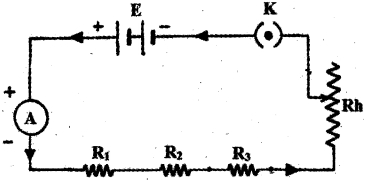
Draw a labelled circuit diagram showing three resistors $R_{1}, R_{2}$ and $R_{3}$ connected in series with a battery $(E)$,a rheostat $(Rh)$,a plug key $(K)$ and an ammeter $(A)$ using standard circuit symbols. Use this circuit to show that the same current flows through every part of the circuit. List two precautions you would observe while performing the experiment.
Solution
(N/A) The circuit diagram is as shown in the image.
Join three resistors of different values in series. Connect them with a battery,an ammeter,a rheostat,and a plug key,as shown in the figure. Close the plug key. Note the ammeter reading. Change the position of the ammeter to anywhere in between the resistors. Note the ammeter reading each time. We observe that the value of the current in the ammeter is the same,independent of its position in the electric circuit. It means that in a series combination of resistors,the current is the same in every part of the circuit or the same current flows through each resistor.
Precautions:
$(i)$ The current should not be passed for a long time to avoid heating.
$(ii)$ All the connections should be tight.
Join three resistors of different values in series. Connect them with a battery,an ammeter,a rheostat,and a plug key,as shown in the figure. Close the plug key. Note the ammeter reading. Change the position of the ammeter to anywhere in between the resistors. Note the ammeter reading each time. We observe that the value of the current in the ammeter is the same,independent of its position in the electric circuit. It means that in a series combination of resistors,the current is the same in every part of the circuit or the same current flows through each resistor.
Precautions:
$(i)$ The current should not be passed for a long time to avoid heating.
$(ii)$ All the connections should be tight.
0 likes
View Solution206
Medium
$(a)$ Derive the formula for the calculation of work done when current flows through a resistor.
$(b)$ One electric bulb is rated $40 \ W$ and $240 \ V$ and another is $25 \ W$ and $240 \ V$. Which bulb has higher resistance and how many times?
$(b)$ One electric bulb is rated $40 \ W$ and $240 \ V$ and another is $25 \ W$ and $240 \ V$. Which bulb has higher resistance and how many times?
Solution
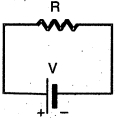
(N/A) Suppose a current $I$ flows through a conductor of resistance $R$ for time $t$ under a potential difference of $V$ volts.
The charge flowing through the conductor is $Q = I \times t$.
The work done $(W)$ in moving a charge $Q$ across a potential difference $V$ is given by:
$W = V \times Q$
Substituting $Q = I \times t$ into the equation:
$W = V \times I \times t$
$(b)$ Given:
For bulb $1$: $P_1 = 40 \ W$,$V_1 = 240 \ V$
For bulb $2$: $P_2 = 25 \ W$,$V_2 = 240 \ V$
We know that $P = \frac{V^2}{R}$,so $R = \frac{V^2}{P}$.
$R_1 = \frac{240^2}{40} = \frac{57600}{40} = 1440 \ \Omega$
$R_2 = \frac{240^2}{25} = \frac{57600}{25} = 2304 \ \Omega$
Comparing $R_1$ and $R_2$,$R_2 > R_1$.
Ratio: $\frac{R_2}{R_1} = \frac{2304}{1440} = 1.6$
Thus,the $25 \ W$ bulb has higher resistance,and it is $1.6$ times the resistance of the $40 \ W$ bulb.
The charge flowing through the conductor is $Q = I \times t$.
The work done $(W)$ in moving a charge $Q$ across a potential difference $V$ is given by:
$W = V \times Q$
Substituting $Q = I \times t$ into the equation:
$W = V \times I \times t$
$(b)$ Given:
For bulb $1$: $P_1 = 40 \ W$,$V_1 = 240 \ V$
For bulb $2$: $P_2 = 25 \ W$,$V_2 = 240 \ V$
We know that $P = \frac{V^2}{R}$,so $R = \frac{V^2}{P}$.
$R_1 = \frac{240^2}{40} = \frac{57600}{40} = 1440 \ \Omega$
$R_2 = \frac{240^2}{25} = \frac{57600}{25} = 2304 \ \Omega$
Comparing $R_1$ and $R_2$,$R_2 > R_1$.
Ratio: $\frac{R_2}{R_1} = \frac{2304}{1440} = 1.6$
Thus,the $25 \ W$ bulb has higher resistance,and it is $1.6$ times the resistance of the $40 \ W$ bulb.
0 likes
View Solution207
Medium
$(a)$ Name an instrument that measures electric current in a circuit. Define the unit of electric current.
$(b)$ What do the following symbols mean in an electric circuit?
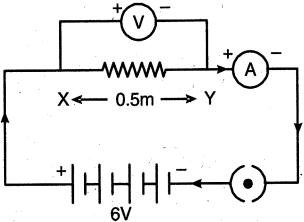
$(c)$ Draw a closed circuit diagram consisting of a $0.5\, m$ long nichrome wire $XY$,an ammeter,a voltmeter,four cells of $1.5\, V$ each,and a plug key.
$(b)$ What do the following symbols mean in an electric circuit?
$(c)$ Draw a closed circuit diagram consisting of a $0.5\, m$ long nichrome wire $XY$,an ammeter,a voltmeter,four cells of $1.5\, V$ each,and a plug key.

Solution
(N/A) The instrument used to measure electric current in a circuit is an ammeter.
The unit of electric current is the ampere $(A)$. One ampere is defined as the flow of $1$ coulomb of electric charge through a cross-section of a conductor in $1$ second.
$(b)$ $(i)$ The symbol represents a rheostat or variable resistance.
$(ii)$ The symbol represents a closed plug key or a closed switch.
$(c)$ The circuit diagram consists of a battery of four cells (total $6\, V$),a plug key (closed),an ammeter connected in series with the $0.5\, m$ nichrome wire $XY$,and a voltmeter connected in parallel across the wire $XY$.
The unit of electric current is the ampere $(A)$. One ampere is defined as the flow of $1$ coulomb of electric charge through a cross-section of a conductor in $1$ second.
$(b)$ $(i)$ The symbol represents a rheostat or variable resistance.
$(ii)$ The symbol represents a closed plug key or a closed switch.
$(c)$ The circuit diagram consists of a battery of four cells (total $6\, V$),a plug key (closed),an ammeter connected in series with the $0.5\, m$ nichrome wire $XY$,and a voltmeter connected in parallel across the wire $XY$.
0 likes
View Solution208
Medium
What is meant by resistance of a conductor? Name and define its $SI$ unit. List the factors on which the resistance of a conductor depends. How is the resistance of a wire affected if
$(i)$ its length is doubled,
$(ii)$ its radius is doubled?
$(i)$ its length is doubled,
$(ii)$ its radius is doubled?
Solution
(N/A) Resistance is the property of a conductor to oppose the flow of electric current through it.
The $SI$ unit of resistance is $Ohm$ ($\Omega$). One $Ohm$ is defined as the resistance of a conductor through which a current of $1$ $Ampere$ flows when a potential difference of $1$ $Volt$ is applied across its ends.
The factors on which the resistance of a conductor depends are:
$1$. Length of the conductor $(l)$
$2$. Area of cross-section $(A)$
$3$. Nature of the material (resistivity, $\rho$)
$4$. Temperature of the conductor
$(i)$ Since resistance $R \propto l$, if the length is doubled, the resistance becomes $2$ times the original value.
$(ii)$ Since resistance $R \propto \frac{1}{A}$ and $A = \pi r^2$, if the radius $r$ is doubled, the area $A$ becomes $4$ times $(A' = \pi(2r)^2 = 4\pi r^2)$. Consequently, the resistance becomes $\frac{1}{4}$th of its original value.
The $SI$ unit of resistance is $Ohm$ ($\Omega$). One $Ohm$ is defined as the resistance of a conductor through which a current of $1$ $Ampere$ flows when a potential difference of $1$ $Volt$ is applied across its ends.
The factors on which the resistance of a conductor depends are:
$1$. Length of the conductor $(l)$
$2$. Area of cross-section $(A)$
$3$. Nature of the material (resistivity, $\rho$)
$4$. Temperature of the conductor
$(i)$ Since resistance $R \propto l$, if the length is doubled, the resistance becomes $2$ times the original value.
$(ii)$ Since resistance $R \propto \frac{1}{A}$ and $A = \pi r^2$, if the radius $r$ is doubled, the area $A$ becomes $4$ times $(A' = \pi(2r)^2 = 4\pi r^2)$. Consequently, the resistance becomes $\frac{1}{4}$th of its original value.
0 likes
View Solution209
Medium
What do you mean by the heating effect of electric current? Explain the production of heat in a resistor by the flow of electric current through it. Name two devices based on the heating effect of current.
Solution
(N/A) The heating effect of electric current is the phenomenon where heat is generated in a conductor when an electric current passes through it.
When an electric current flows through a resistor,the electrons move through the conductor and collide with the atoms or ions of the resistor. During these collisions,the kinetic energy of the electrons is transferred to the atoms of the resistor,causing them to vibrate more vigorously. This increase in the vibrational energy of the atoms manifests as an increase in the temperature of the resistor,resulting in the production of heat.
Two devices based on the heating effect of electric current are:
$(i)$ Electric iron
$(ii)$ Electric geyser
When an electric current flows through a resistor,the electrons move through the conductor and collide with the atoms or ions of the resistor. During these collisions,the kinetic energy of the electrons is transferred to the atoms of the resistor,causing them to vibrate more vigorously. This increase in the vibrational energy of the atoms manifests as an increase in the temperature of the resistor,resulting in the production of heat.
Two devices based on the heating effect of electric current are:
$(i)$ Electric iron
$(ii)$ Electric geyser
0 likes
View Solution210
Medium
$(a)$ Name an instrument that measures potential difference between two points in a circuit. Define the unit of potential difference in terms of $SI$ unit of charge and work. Draw the circuit symbols for $(i)$ variable resistor,$(ii)$ a plug key which is closed.
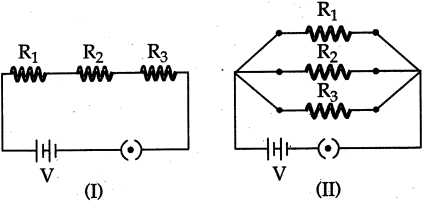
$(b)$ Two electric circuits $(I)$ and $(II)$ are shown below.
$(i)$ Which of the two circuits has more resistance?
$(ii)$ Through which circuit does more current pass?
$(iii)$ In which circuit is the potential difference across each resistor equal?
$(iv)$ If $R_{1} > R_{2} > R_{3}$,in which circuit will more heat be produced in $R_{1}$ as compared to the other two resistors?
$(b)$ Two electric circuits $(I)$ and $(II)$ are shown below.
$(i)$ Which of the two circuits has more resistance?
$(ii)$ Through which circuit does more current pass?
$(iii)$ In which circuit is the potential difference across each resistor equal?
$(iv)$ If $R_{1} > R_{2} > R_{3}$,in which circuit will more heat be produced in $R_{1}$ as compared to the other two resistors?
Solution
(A) The instrument used to measure the potential difference between two points in a circuit is a Voltmeter.
The $SI$ unit of potential difference is the Volt $(V)$. It is defined as the amount of work done $(W)$ in moving a unit positive charge $(q)$ from one point to another,i.e.,$V = \frac{W}{q}$. Thus,$1 \text{ Volt} = 1 \text{ Joule} / 1 \text{ Coulomb}$.
The circuit symbols are:
$(i)$ Variable resistor: $A$ resistor symbol with an arrow pointing across it.
$(ii)$ Closed plug key: $A$ circle with a dot inside it.
$(b)$ $(i)$ Circuit $(I)$ has more resistance because the resistors are connected in series,and the equivalent resistance is the sum of individual resistances $(R_{eq} = R_{1} + R_{2} + R_{3})$.
$(ii)$ More current passes through circuit $(II)$ because the equivalent resistance in parallel is less than the individual resistances,leading to a higher total current from the source.
$(iii)$ In circuit $(II)$,the potential difference across each resistor is equal because they are connected in parallel.
$(iv)$ In circuit $(I)$,more heat is produced in $R_{1}$ because in a series circuit,the current $(I)$ is the same through all resistors,and heat produced $H = I^{2}Rt$. Since $R_{1}$ is the largest resistance,it will produce the most heat.
The $SI$ unit of potential difference is the Volt $(V)$. It is defined as the amount of work done $(W)$ in moving a unit positive charge $(q)$ from one point to another,i.e.,$V = \frac{W}{q}$. Thus,$1 \text{ Volt} = 1 \text{ Joule} / 1 \text{ Coulomb}$.
The circuit symbols are:
$(i)$ Variable resistor: $A$ resistor symbol with an arrow pointing across it.
$(ii)$ Closed plug key: $A$ circle with a dot inside it.
$(b)$ $(i)$ Circuit $(I)$ has more resistance because the resistors are connected in series,and the equivalent resistance is the sum of individual resistances $(R_{eq} = R_{1} + R_{2} + R_{3})$.
$(ii)$ More current passes through circuit $(II)$ because the equivalent resistance in parallel is less than the individual resistances,leading to a higher total current from the source.
$(iii)$ In circuit $(II)$,the potential difference across each resistor is equal because they are connected in parallel.
$(iv)$ In circuit $(I)$,more heat is produced in $R_{1}$ because in a series circuit,the current $(I)$ is the same through all resistors,and heat produced $H = I^{2}Rt$. Since $R_{1}$ is the largest resistance,it will produce the most heat.

0 likes
View Solution211
Medium
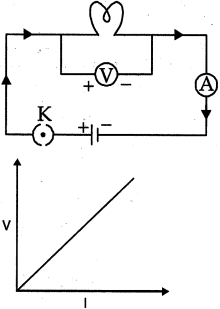
When a high resistance voltmeter is connected directly across an electric bulb,its reading is $2 \ V$. An electric cell is sending a current of $0.4 \ A$ (measured by an ammeter) in the electric circuit.
$(a)$ Draw the circuit.
$(b)$ Find the resistance of the electric bulb.
$(c)$ State the law that is applied for making these calculations. If a graph is plotted between $V$ and $I$,show the nature of the graph obtained.
$(a)$ Draw the circuit.
$(b)$ Find the resistance of the electric bulb.
$(c)$ State the law that is applied for making these calculations. If a graph is plotted between $V$ and $I$,show the nature of the graph obtained.
Solution
(B) The circuit diagram consists of an electric bulb,a voltmeter connected in parallel to the bulb,an ammeter connected in series,a cell,and a key,as shown in the provided image.
$(b)$ Given:
Current $(I) = 0.4 \ A$
Potential difference $(V) = 2 \ V$
According to Ohm's law,$V = IR$
Therefore,$R = \frac{V}{I} = \frac{2 \ V}{0.4 \ A} = 5 \ \Omega$
So,the resistance of the electric bulb is $5 \ \Omega$.
$(c)$ The law applied is Ohm's law. The $V-I$ graph for an ohmic conductor is a straight line passing through the origin,as shown in the provided image.
$(b)$ Given:
Current $(I) = 0.4 \ A$
Potential difference $(V) = 2 \ V$
According to Ohm's law,$V = IR$
Therefore,$R = \frac{V}{I} = \frac{2 \ V}{0.4 \ A} = 5 \ \Omega$
So,the resistance of the electric bulb is $5 \ \Omega$.
$(c)$ The law applied is Ohm's law. The $V-I$ graph for an ohmic conductor is a straight line passing through the origin,as shown in the provided image.
0 likes
View Solution212
Medium
$(a)$ What is meant by saying that the potential difference between two points is $1$ volt?
$(b)$ Why does the connecting cord of an electrical heater not glow while the heating element does?
$(c)$ Electrical resistivities of some substances at $20^{\circ}C$ are given below:
Answer the following questions in relation to them:
$(i)$ Among silver and copper, which one is a better conductor? Why?
$(ii)$ Which material would you advise to use in electrical heating devices? Why?
$(b)$ Why does the connecting cord of an electrical heater not glow while the heating element does?
$(c)$ Electrical resistivities of some substances at $20^{\circ}C$ are given below:
| Silver | $1.60 \times 10^{-8} \, \Omega m$ |
| Copper | $1.62 \times 10^{-8} \, \Omega m$ |
| Tungsten | $5.2 \times 10^{-8} \, \Omega m$ |
| Iron | $10.0 \times 10^{-8} \, \Omega m$ |
| Mercury | $94.0 \times 10^{-8} \, \Omega m$ |
| Nichrome | $100 \times 10^{-6} \, \Omega m$ |
Answer the following questions in relation to them:
$(i)$ Among silver and copper, which one is a better conductor? Why?
$(ii)$ Which material would you advise to use in electrical heating devices? Why?
Solution
(N/A) The potential difference between two points is said to be $1$ volt if $1$ joule of work is done in moving a charge of $1$ coulomb from one point to another.
$(b)$ The heating element of an electrical heater is made of an alloy (like nichrome) which has high resistivity. Due to high resistivity, it produces a large amount of heat when current passes through it, causing it to glow. In contrast, the connecting cord is made of copper, which has very low resistivity, so it does not produce significant heat and does not glow.
$(c)$ $(i)$ Silver is a better conductor than copper because it has lower electrical resistivity ($1.60 \times 10^{-8} \, \Omega m$ for silver vs $1.62 \times 10^{-8} \, \Omega m$ for copper).
$(ii)$ Nichrome is advised for electrical heating devices because it has a very high resistivity compared to other materials listed, which allows it to generate more heat according to Joule's law of heating $(H = I^2Rt)$.
$(b)$ The heating element of an electrical heater is made of an alloy (like nichrome) which has high resistivity. Due to high resistivity, it produces a large amount of heat when current passes through it, causing it to glow. In contrast, the connecting cord is made of copper, which has very low resistivity, so it does not produce significant heat and does not glow.
$(c)$ $(i)$ Silver is a better conductor than copper because it has lower electrical resistivity ($1.60 \times 10^{-8} \, \Omega m$ for silver vs $1.62 \times 10^{-8} \, \Omega m$ for copper).
$(ii)$ Nichrome is advised for electrical heating devices because it has a very high resistivity compared to other materials listed, which allows it to generate more heat according to Joule's law of heating $(H = I^2Rt)$.
0 likes
View Solution213
Difficult
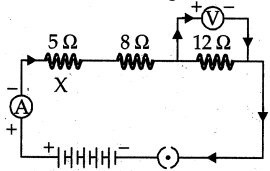
Draw a schematic diagram of an electric circuit (in the "on" position) consisting of a battery of five cells of $2\, V$ each, a $5\, \Omega$ resistor, a $8\, \Omega$ resistor, a $12\, \Omega$ resistor and a plug key, all connected in series. An ammeter is put in the circuit to measure the electric current through the resistors and a voltmeter is connected so as to measure the potential difference across the $12\, \Omega$ resistor.
Calculate the reading shown by the
$(a)$ ammeter
$(b)$ voltmeter in the given electric circuit.
Calculate the reading shown by the
$(a)$ ammeter
$(b)$ voltmeter in the given electric circuit.
Solution
$(a)$ Total resistance $R = 5\, \Omega + 8\, \Omega + 12\, \Omega = 25\, \Omega$.
Total voltage $V = 5 \times 2\, V = 10\, V$.
Using Ohm's law, the current $I = \frac{V}{R} = \frac{10\, V}{25\, \Omega} = 0.4\, A$.
Therefore, the ammeter reading is $0.4\, A$.
$(b)$ The potential difference across the $12\, \Omega$ resistor is $V' = I \times R_{12} = 0.4\, A \times 12\, \Omega = 4.8\, V$.
Therefore, the voltmeter reading is $4.8\, V$.
Total voltage $V = 5 \times 2\, V = 10\, V$.
Using Ohm's law, the current $I = \frac{V}{R} = \frac{10\, V}{25\, \Omega} = 0.4\, A$.
Therefore, the ammeter reading is $0.4\, A$.
$(b)$ The potential difference across the $12\, \Omega$ resistor is $V' = I \times R_{12} = 0.4\, A \times 12\, \Omega = 4.8\, V$.
Therefore, the voltmeter reading is $4.8\, V$.
0 likes
View Solution214
Difficult
$(a)$ Explain how a cell maintains current in a circuit.
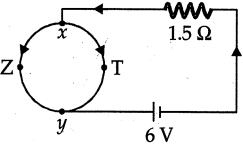
$(b)$ In the circuit given below,the resistance of the path $xTy = 2 \, \Omega$ and that of $xZy = 6 \, \Omega$.
$(i)$ Find the equivalent resistance between $x$ and $y$.
$(ii)$ Find the current in the main circuit.
$(iii)$ Calculate the current that flows through the path $xTy$ and $xZy$.
$(b)$ In the circuit given below,the resistance of the path $xTy = 2 \, \Omega$ and that of $xZy = 6 \, \Omega$.
$(i)$ Find the equivalent resistance between $x$ and $y$.
$(ii)$ Find the current in the main circuit.
$(iii)$ Calculate the current that flows through the path $xTy$ and $xZy$.
Solution
(N/A) The chemical action within a cell generates a potential difference across its terminals. This potential difference drives and maintains the flow of electric current in the circuit.
$(b)$ $(i)$ The paths $xTy$ and $xZy$ are connected in parallel between points $x$ and $y$. The equivalent resistance $R_e$ is given by:
$\frac{1}{R_e} = \frac{1}{2} + \frac{1}{6} = \frac{3+1}{6} = \frac{4}{6} = \frac{2}{3} \, \Omega^{-1}$
$R_e = 1.5 \, \Omega$
$(ii)$ The total resistance of the circuit is the sum of the equivalent resistance $R_e$ and the series resistor of $1.5 \, \Omega$:
$R_{total} = 1.5 \, \Omega + 1.5 \, \Omega = 3 \, \Omega$
Using Ohm's law,the main current $I = \frac{V}{R_{total}} = \frac{6 \, V}{3 \, \Omega} = 2 \, A$
$(iii)$ The potential difference across the parallel combination of $xTy$ and $xZy$ is $V_{xy} = I \times R_e = 2 \, A \times 1.5 \, \Omega = 3 \, V$.
Current through path $xTy$ $(2 \, \Omega)$: $I_1 = \frac{V_{xy}}{R_1} = \frac{3 \, V}{2 \, \Omega} = 1.5 \, A$
Current through path $xZy$ $(6 \, \Omega)$: $I_2 = \frac{V_{xy}}{R_2} = \frac{3 \, V}{6 \, \Omega} = 0.5 \, A$
$(b)$ $(i)$ The paths $xTy$ and $xZy$ are connected in parallel between points $x$ and $y$. The equivalent resistance $R_e$ is given by:
$\frac{1}{R_e} = \frac{1}{2} + \frac{1}{6} = \frac{3+1}{6} = \frac{4}{6} = \frac{2}{3} \, \Omega^{-1}$
$R_e = 1.5 \, \Omega$
$(ii)$ The total resistance of the circuit is the sum of the equivalent resistance $R_e$ and the series resistor of $1.5 \, \Omega$:
$R_{total} = 1.5 \, \Omega + 1.5 \, \Omega = 3 \, \Omega$
Using Ohm's law,the main current $I = \frac{V}{R_{total}} = \frac{6 \, V}{3 \, \Omega} = 2 \, A$
$(iii)$ The potential difference across the parallel combination of $xTy$ and $xZy$ is $V_{xy} = I \times R_e = 2 \, A \times 1.5 \, \Omega = 3 \, V$.
Current through path $xTy$ $(2 \, \Omega)$: $I_1 = \frac{V_{xy}}{R_1} = \frac{3 \, V}{2 \, \Omega} = 1.5 \, A$
Current through path $xZy$ $(6 \, \Omega)$: $I_2 = \frac{V_{xy}}{R_2} = \frac{3 \, V}{6 \, \Omega} = 0.5 \, A$
0 likes
View Solution215
Medium
$(a)$ State the commercial unit of electric energy and find its relation with its $SI$ unit.
$(b)$ The current through a resistor is made three times its initial value. Calculate how it will affect the heat produced in the resistor.
$(c)$ Find the increase in the amount of heat generated in a conductor if another conductor of double resistance is connected in the circuit,keeping all other factors unchanged.
$(b)$ The current through a resistor is made three times its initial value. Calculate how it will affect the heat produced in the resistor.
$(c)$ Find the increase in the amount of heat generated in a conductor if another conductor of double resistance is connected in the circuit,keeping all other factors unchanged.
Solution
(N/A) The commercial unit of electric energy is kilowatt-hour $(kWh)$.
The $SI$ unit of electrical energy is Joule $(J)$.
$1 \, kWh = 1000 \, W \times 3600 \, s = 3.6 \times 10^6 \, J$.
$(b)$ According to Joule's law of heating,$H = I^2Rt$.
If the current $I$ becomes $3I$,the new heat $H' = (3I)^2Rt = 9I^2Rt = 9H$.
Thus,the heat produced will become nine times the initial value.
$(c)$ Initial heat $H = I^2Rt$.
If the resistance $R$ is replaced by a conductor of double resistance $(2R)$,the new heat $H' = I^2(2R)t = 2I^2Rt = 2H$.
Thus,the heat produced will become twice the initial value.
The $SI$ unit of electrical energy is Joule $(J)$.
$1 \, kWh = 1000 \, W \times 3600 \, s = 3.6 \times 10^6 \, J$.
$(b)$ According to Joule's law of heating,$H = I^2Rt$.
If the current $I$ becomes $3I$,the new heat $H' = (3I)^2Rt = 9I^2Rt = 9H$.
Thus,the heat produced will become nine times the initial value.
$(c)$ Initial heat $H = I^2Rt$.
If the resistance $R$ is replaced by a conductor of double resistance $(2R)$,the new heat $H' = I^2(2R)t = 2I^2Rt = 2H$.
Thus,the heat produced will become twice the initial value.
0 likes
View Solution216
Medium
State $Ohm's$ law. How can it be verified?
Solution
(N/A) Ohm's law states that the current flowing through a metallic conductor is directly proportional to the potential difference applied across its ends,provided its physical conditions (like temperature) remain constant.
Mathematically,this is expressed as:
$V \propto I$
$V = IR$
Here,$V$ is the potential difference,$I$ is the current,and $R$ is the constant of proportionality known as the resistance of the conductor.
Verification:
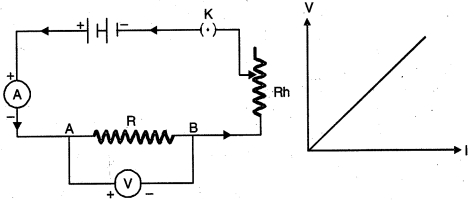
To verify Ohm's law,set up a circuit as shown in the figure,consisting of a nichrome wire $R$,an ammeter,a voltmeter,a battery,and a rheostat $(Rh)$.
$1$. Close the key $K$ and note the current $I$ in the ammeter and potential difference $V$ in the voltmeter for a specific position of the rheostat.
$2$. Change the position of the rheostat to vary the current in the circuit and record the corresponding values of $V$ and $I$.
$3$. Calculate the ratio $V/I$ for each set of readings. You will observe that the ratio $V/I$ is constant.
$4$. Plot a graph of $V$ (on the y-axis) against $I$ (on the x-axis). The graph will be a straight line passing through the origin,which confirms that $V$ is directly proportional to $I$,thus verifying Ohm's law.
Mathematically,this is expressed as:
$V \propto I$
$V = IR$
Here,$V$ is the potential difference,$I$ is the current,and $R$ is the constant of proportionality known as the resistance of the conductor.
Verification:
To verify Ohm's law,set up a circuit as shown in the figure,consisting of a nichrome wire $R$,an ammeter,a voltmeter,a battery,and a rheostat $(Rh)$.
$1$. Close the key $K$ and note the current $I$ in the ammeter and potential difference $V$ in the voltmeter for a specific position of the rheostat.
$2$. Change the position of the rheostat to vary the current in the circuit and record the corresponding values of $V$ and $I$.
$3$. Calculate the ratio $V/I$ for each set of readings. You will observe that the ratio $V/I$ is constant.
$4$. Plot a graph of $V$ (on the y-axis) against $I$ (on the x-axis). The graph will be a straight line passing through the origin,which confirms that $V$ is directly proportional to $I$,thus verifying Ohm's law.
0 likes
View Solution217
Medium
$(a)$ Name an instrument that measures electric current in a circuit. Define the unit of electric current.
$(b)$ What do the following symbols mean in circuit diagrams?
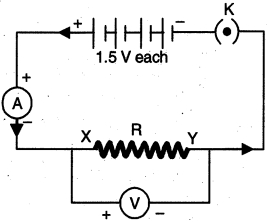
$(c)$ An electric circuit consisting of a $0.5 \ m$ long nichrome wire $XY$,an ammeter,a voltmeter,four cells of $1.5 \ V$ each and a plug key was set up.
$(i)$ Draw a diagram of this electric circuit to study the relation between the potential difference maintained between the points $X$ and $Y$ and the electric current flowing through $XY$.
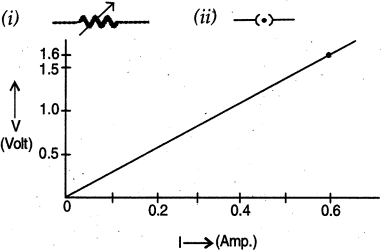
$(ii)$ The following graph was plotted between $V$ and $I$ values. What would be the values of $V/I$ ratios when the potential difference is $0.8 \ V$,$1.2 \ V$ and $1.6 \ V$ respectively? What conclusion do you draw from these values?
$(b)$ What do the following symbols mean in circuit diagrams?
$(c)$ An electric circuit consisting of a $0.5 \ m$ long nichrome wire $XY$,an ammeter,a voltmeter,four cells of $1.5 \ V$ each and a plug key was set up.
$(i)$ Draw a diagram of this electric circuit to study the relation between the potential difference maintained between the points $X$ and $Y$ and the electric current flowing through $XY$.
$(ii)$ The following graph was plotted between $V$ and $I$ values. What would be the values of $V/I$ ratios when the potential difference is $0.8 \ V$,$1.2 \ V$ and $1.6 \ V$ respectively? What conclusion do you draw from these values?
Solution
(N/A) An ammeter is used to measure electric current in an electric circuit.
One ampere is defined as the flow of one coulomb of electric charge through a circuit in one second.
$(b)$ $(i)$ Variable resistor (Rheostat) and $(ii)$ Closed plug key (switch).
$(c)$ $(i)$ The circuit diagram consists of a battery of four cells,an ammeter in series,a nichrome wire $XY$ in series,and a voltmeter connected in parallel across $XY$.
$(ii)$ Since the graph is a straight line passing through the origin,the ratio $V/I$ is constant,which represents the resistance $R$ of the nichrome wire.
From the graph,at $V = 1.6 \ V$,$I = 0.6 \ A$.
$R = V/I = 1.6 / 0.6 = 2.67 \ \Omega$.
Since the ratio $V/I$ is constant for all values $(0.8 \ V, 1.2 \ V, 1.6 \ V)$,it confirms Ohm's Law.
One ampere is defined as the flow of one coulomb of electric charge through a circuit in one second.
$(b)$ $(i)$ Variable resistor (Rheostat) and $(ii)$ Closed plug key (switch).
$(c)$ $(i)$ The circuit diagram consists of a battery of four cells,an ammeter in series,a nichrome wire $XY$ in series,and a voltmeter connected in parallel across $XY$.
$(ii)$ Since the graph is a straight line passing through the origin,the ratio $V/I$ is constant,which represents the resistance $R$ of the nichrome wire.
From the graph,at $V = 1.6 \ V$,$I = 0.6 \ A$.
$R = V/I = 1.6 / 0.6 = 2.67 \ \Omega$.
Since the ratio $V/I$ is constant for all values $(0.8 \ V, 1.2 \ V, 1.6 \ V)$,it confirms Ohm's Law.
0 likes
View Solution218
Difficult
$(a)$ $(i)$ What is meant by saying that the potential difference between two points is $1 \, V$? $(ii)$ How much energy is given to $5 \, C$ of charge passing through a $12 \, V$ battery? $(b)$ Describe an activity with a necessary electric circuit to study the factors on which the resistance of a conducting wire depends.
Solution
(A) $(i)$ It means that the work done in moving a charge of $1 \, C$ between the two points is $1 \, J$.
$(ii)$ Using the formula $W = qV$,where $q = 5 \, C$ and $V = 12 \, V$,we get $W = 5 \times 12 = 60 \, J$.
$(b)$ To study the factors affecting resistance:
$(i)$ Set up a circuit with a cell,an ammeter,a nichrome wire of length $l$,and a plug key.
$(ii)$ Close the key and note the current reading in the ammeter.
$(iii)$ Replace the wire with another nichrome wire of the same thickness but double the length $(2l)$. Note the current.
$(iv)$ Replace the wire with a thicker nichrome wire of the same length $l$. Note the current.
$(v)$ Replace the wire with a copper wire of the same length and thickness as the first nichrome wire. Note the current.
$(vi)$ Observe that the current varies in each case,demonstrating that resistance depends on length,cross-sectional area,and the material of the conductor.
$(ii)$ Using the formula $W = qV$,where $q = 5 \, C$ and $V = 12 \, V$,we get $W = 5 \times 12 = 60 \, J$.
$(b)$ To study the factors affecting resistance:
$(i)$ Set up a circuit with a cell,an ammeter,a nichrome wire of length $l$,and a plug key.
$(ii)$ Close the key and note the current reading in the ammeter.
$(iii)$ Replace the wire with another nichrome wire of the same thickness but double the length $(2l)$. Note the current.
$(iv)$ Replace the wire with a thicker nichrome wire of the same length $l$. Note the current.
$(v)$ Replace the wire with a copper wire of the same length and thickness as the first nichrome wire. Note the current.
$(vi)$ Observe that the current varies in each case,demonstrating that resistance depends on length,cross-sectional area,and the material of the conductor.
1 likes
View Solution219
Medium
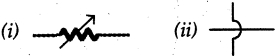
$(a)$ What do the following symbols represent in a circuit? Write the name and one function of each.
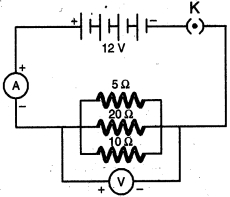
$(b)$ Draw a schematic diagram of a circuit consisting of a battery of $12 \, V$,three resistors of $5 \, \Omega$,$10 \, \Omega$,and $20 \, \Omega$ connected in parallel,an ammeter to measure the total current through the circuit,and a voltmeter to measure the potential difference across the combination of resistors.
$(c)$ State any one advantage of connecting electrical devices in parallel with the mains instead of connecting them in series in a household circuit.
$(b)$ Draw a schematic diagram of a circuit consisting of a battery of $12 \, V$,three resistors of $5 \, \Omega$,$10 \, \Omega$,and $20 \, \Omega$ connected in parallel,an ammeter to measure the total current through the circuit,and a voltmeter to measure the potential difference across the combination of resistors.
$(c)$ State any one advantage of connecting electrical devices in parallel with the mains instead of connecting them in series in a household circuit.
Solution
(N/A) $(i)$ Variable resistor or rheostat: It is used to change the resistance in a circuit,thereby controlling the current flowing through it.
$(ii)$ Wires crossing without joining: It represents two wires that cross each other without making any electrical contact.
$(b)$ The circuit diagram consists of a $12 \, V$ battery,a switch $(K)$,an ammeter $(A)$ in series with the combination,and a voltmeter $(V)$ connected in parallel across the three resistors ($5 \, \Omega$,$10 \, \Omega$,and $20 \, \Omega$) which are themselves connected in parallel.
$(c)$ Advantage of parallel connection: In a parallel circuit,if one electrical device stops working due to a defect or switch-off,the other devices continue to operate independently because each device has its own separate circuit path.
$(ii)$ Wires crossing without joining: It represents two wires that cross each other without making any electrical contact.
$(b)$ The circuit diagram consists of a $12 \, V$ battery,a switch $(K)$,an ammeter $(A)$ in series with the combination,and a voltmeter $(V)$ connected in parallel across the three resistors ($5 \, \Omega$,$10 \, \Omega$,and $20 \, \Omega$) which are themselves connected in parallel.
$(c)$ Advantage of parallel connection: In a parallel circuit,if one electrical device stops working due to a defect or switch-off,the other devices continue to operate independently because each device has its own separate circuit path.
0 likes
View Solution220
Medium
$(a)$ Why is the series arrangement not used for domestic circuits?
$(b)$ Why is tungsten used almost exclusively for the filament of electric lamps?
$(c)$ Why are the conductors of electric heating devices,such as bread toasters and electric irons,made of an alloy rather than a pure metal?
$(d)$ Why are copper and aluminium wires usually employed for electricity transmission?
$(e)$ Why does the cord of an electric heater not glow while the heating element does?
$(b)$ Why is tungsten used almost exclusively for the filament of electric lamps?
$(c)$ Why are the conductors of electric heating devices,such as bread toasters and electric irons,made of an alloy rather than a pure metal?
$(d)$ Why are copper and aluminium wires usually employed for electricity transmission?
$(e)$ Why does the cord of an electric heater not glow while the heating element does?
Solution
(N/A) In a series arrangement,if any one component stops working,the circuit breaks,and none of the other devices will function.
$(b)$ Tungsten is used because it has a very high melting point $(3380 ^\circ C)$ and high resistivity,allowing it to emit light without melting.
$(c)$ Alloys have higher resistivity than pure metals and do not oxidize (burn) easily at high temperatures,making them ideal for heating elements.
$(d)$ Copper and aluminium have very low resistivity,which minimizes energy loss during the transmission of electricity.
$(e)$ The cord has very low resistance,so it produces negligible heat,whereas the heating element has high resistance,causing it to glow due to the heating effect of current.
$(b)$ Tungsten is used because it has a very high melting point $(3380 ^\circ C)$ and high resistivity,allowing it to emit light without melting.
$(c)$ Alloys have higher resistivity than pure metals and do not oxidize (burn) easily at high temperatures,making them ideal for heating elements.
$(d)$ Copper and aluminium have very low resistivity,which minimizes energy loss during the transmission of electricity.
$(e)$ The cord has very low resistance,so it produces negligible heat,whereas the heating element has high resistance,causing it to glow due to the heating effect of current.
0 likes
View Solution221
Medium
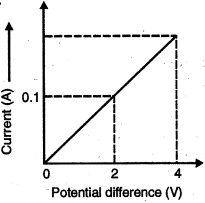
$(a)$ Calculate the resistance of the wire using the graph.
$(b)$ How many $176 \,\Omega$ resistors in parallel are required to carry $5\, A$ on a $220\, V$ line?
$(c)$ Define electric power. Derive the relation between power,potential difference,and resistance.
$(b)$ How many $176 \,\Omega$ resistors in parallel are required to carry $5\, A$ on a $220\, V$ line?
$(c)$ Define electric power. Derive the relation between power,potential difference,and resistance.
Solution
(N/A) The resistance $R$ is given by Ohm's law: $R = V / I$.
From the graph,at $V = 2 \, V$,the current $I = 0.1 \, A$.
Therefore,$R = 2 \, V / 0.1 \, A = 20 \, \Omega$.
$(b)$ Given: Total current $I = 5 \, A$,Voltage $V = 220 \, V$.
The required total resistance $R_{eq}$ of the circuit is $R_{eq} = V / I = 220 \, V / 5 \, A = 44 \, \Omega$.
Let $n$ resistors of $176 \, \Omega$ each be connected in parallel.
The equivalent resistance for $n$ resistors in parallel is $1 / R_{eq} = n / R$.
$1 / 44 = n / 176$.
$n = 176 / 44 = 4$.
Thus,$4$ resistors are required.
$(c)$ Electric power is defined as the rate at which electric energy is dissipated or consumed in an electric circuit.
We know that power $P = W / t$ and work done $W = V \cdot I \cdot t$.
So,$P = (V \cdot I \cdot t) / t = V \cdot I$.
From Ohm's law,$I = V / R$.
Substituting $I$ in the power equation: $P = V \cdot (V / R) = V^2 / R$.
From the graph,at $V = 2 \, V$,the current $I = 0.1 \, A$.
Therefore,$R = 2 \, V / 0.1 \, A = 20 \, \Omega$.
$(b)$ Given: Total current $I = 5 \, A$,Voltage $V = 220 \, V$.
The required total resistance $R_{eq}$ of the circuit is $R_{eq} = V / I = 220 \, V / 5 \, A = 44 \, \Omega$.
Let $n$ resistors of $176 \, \Omega$ each be connected in parallel.
The equivalent resistance for $n$ resistors in parallel is $1 / R_{eq} = n / R$.
$1 / 44 = n / 176$.
$n = 176 / 44 = 4$.
Thus,$4$ resistors are required.
$(c)$ Electric power is defined as the rate at which electric energy is dissipated or consumed in an electric circuit.
We know that power $P = W / t$ and work done $W = V \cdot I \cdot t$.
So,$P = (V \cdot I \cdot t) / t = V \cdot I$.
From Ohm's law,$I = V / R$.
Substituting $I$ in the power equation: $P = V \cdot (V / R) = V^2 / R$.
0 likes
View Solution222
Medium
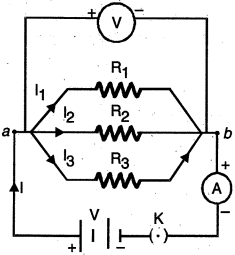
$(a)$ Three resistors $R_{1}, R_{2}$ and $R_{3}$ are connected in parallel and the combination is connected to a battery,ammeter,voltmeter,and key. Draw a suitable circuit diagram. Obtain an expression for the effective resistance of the combination of resistors in parallel.
$(b)$ Why are electric bulbs filled with chemically inactive nitrogen or argon?
$(c)$ What is meant by the statement that the rating of a fuse in a circuit is $5 \ A$?
$(b)$ Why are electric bulbs filled with chemically inactive nitrogen or argon?
$(c)$ What is meant by the statement that the rating of a fuse in a circuit is $5 \ A$?
Solution
(N/A) The circuit diagram shows three resistors $R_{1}, R_{2}, R_{3}$ connected in parallel across a potential difference $V$. The total current $I$ splits into $I_{1}, I_{2}, I_{3}$ through the resistors.
Since they are in parallel,the potential difference $V$ across each resistor is the same.
Total current $I = I_{1} + I_{2} + I_{3}$.
Using Ohm's law,$I_{1} = V/R_{1}$,$I_{2} = V/R_{2}$,and $I_{3} = V/R_{3}$.
If $R_{p}$ is the equivalent resistance,$I = V/R_{p}$.
Substituting these,$V/R_{p} = V/R_{1} + V/R_{2} + V/R_{3}$.
Thus,$1/R_{p} = 1/R_{1} + 1/R_{2} + 1/R_{3}$.
$(b)$ Electric bulbs are filled with chemically inactive gases like nitrogen or argon to prevent the oxidation of the tungsten filament at high temperatures,thereby prolonging its life.
$(c)$ The statement means that the fuse is designed to allow a maximum current of $5 \ A$ to flow through the circuit. If the current exceeds this value,the fuse wire melts due to excessive heating and breaks the circuit,protecting the appliances.
Since they are in parallel,the potential difference $V$ across each resistor is the same.
Total current $I = I_{1} + I_{2} + I_{3}$.
Using Ohm's law,$I_{1} = V/R_{1}$,$I_{2} = V/R_{2}$,and $I_{3} = V/R_{3}$.
If $R_{p}$ is the equivalent resistance,$I = V/R_{p}$.
Substituting these,$V/R_{p} = V/R_{1} + V/R_{2} + V/R_{3}$.
Thus,$1/R_{p} = 1/R_{1} + 1/R_{2} + 1/R_{3}$.
$(b)$ Electric bulbs are filled with chemically inactive gases like nitrogen or argon to prevent the oxidation of the tungsten filament at high temperatures,thereby prolonging its life.
$(c)$ The statement means that the fuse is designed to allow a maximum current of $5 \ A$ to flow through the circuit. If the current exceeds this value,the fuse wire melts due to excessive heating and breaks the circuit,protecting the appliances.
0 likes
View Solution223
Medium
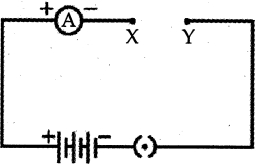
$(a)$ In the circuit shown, connect a nichrome wire of length $L$ between points $X$ and $Y$ and note the ammeter reading.
$(i)$ When this experiment is repeated by inserting another nichrome wire of the same thickness but twice the length $(2L)$, what changes are observed in the ammeter reading?
$(ii)$ State the changes that are observed in the ammeter reading if we double the area of cross-section without changing the length in the above experiment. Justify your answer in both cases.
$(b)$ "Potential difference between points $A$ and $B$ in an electric field is $1\, V$." Explain the statement.
$(i)$ When this experiment is repeated by inserting another nichrome wire of the same thickness but twice the length $(2L)$, what changes are observed in the ammeter reading?
$(ii)$ State the changes that are observed in the ammeter reading if we double the area of cross-section without changing the length in the above experiment. Justify your answer in both cases.
$(b)$ "Potential difference between points $A$ and $B$ in an electric field is $1\, V$." Explain the statement.
Solution
(N/A) $(i)$ The ammeter reading will decrease (become half). This is because resistance $R$ is directly proportional to length $L$ $(R \propto L)$. When length is doubled, resistance doubles, and according to Ohm's law $(I = V/R)$, the current $I$ becomes half.
$(ii)$ The ammeter reading will increase (become two times). This is because resistance $R$ is inversely proportional to the area of cross-section $A$ $(R \propto 1/A)$. When the area is doubled, resistance becomes half, and consequently, the current $I$ becomes double.
$(b)$ It means that $1\, J$ of work is being done to move a charge of $1\, C$ from point $A$ to point $B$.
$(ii)$ The ammeter reading will increase (become two times). This is because resistance $R$ is inversely proportional to the area of cross-section $A$ $(R \propto 1/A)$. When the area is doubled, resistance becomes half, and consequently, the current $I$ becomes double.
$(b)$ It means that $1\, J$ of work is being done to move a charge of $1\, C$ from point $A$ to point $B$.
0 likes
View Solution224
Medium
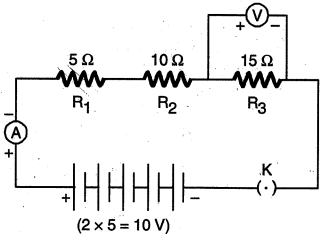
Draw a circuit diagram for a circuit consisting of a battery of five cells of $2 \text{ V}$ each, a $5 \, \Omega$ resistor, a $10 \, \Omega$ resistor, and a $15 \, \Omega$ resistor, an ammeter, and a plug key; all connected in series. Also, connect a voltmeter to record the potential difference across the $15 \, \Omega$ resistor and calculate:
$(i)$ the electric current passing through the above circuit and
$(ii)$ the potential difference across the $5 \, \Omega$ resistor when the key is closed.
$(i)$ the electric current passing through the above circuit and
$(ii)$ the potential difference across the $5 \, \Omega$ resistor when the key is closed.
Solution
(A) The circuit diagram is as shown in the provided image.
Given:
Total voltage $V = 5 \times 2 \text{ V} = 10 \text{ V}$.
Resistors in series: $R_{1} = 5 \, \Omega$, $R_{2} = 10 \, \Omega$, $R_{3} = 15 \, \Omega$.
The equivalent resistance $R$ of the series combination is:
$R = R_{1} + R_{2} + R_{3} = 5 + 10 + 15 = 30 \, \Omega$.
$(i)$ The electric current $I$ passing through the circuit is:
$I = V / R = 10 \text{ V} / 30 \, \Omega = 1/3 \text{ A} \approx 0.33 \text{ A}$.
$(ii)$ The potential difference $V_{1}$ across the $5 \, \Omega$ resistor is:
$V_{1} = I \times R_{1} = (1/3) \text{ A} \times 5 \, \Omega = 5/3 \text{ V} \approx 1.67 \text{ V}$.
Given:
Total voltage $V = 5 \times 2 \text{ V} = 10 \text{ V}$.
Resistors in series: $R_{1} = 5 \, \Omega$, $R_{2} = 10 \, \Omega$, $R_{3} = 15 \, \Omega$.
The equivalent resistance $R$ of the series combination is:
$R = R_{1} + R_{2} + R_{3} = 5 + 10 + 15 = 30 \, \Omega$.
$(i)$ The electric current $I$ passing through the circuit is:
$I = V / R = 10 \text{ V} / 30 \, \Omega = 1/3 \text{ A} \approx 0.33 \text{ A}$.
$(ii)$ The potential difference $V_{1}$ across the $5 \, \Omega$ resistor is:
$V_{1} = I \times R_{1} = (1/3) \text{ A} \times 5 \, \Omega = 5/3 \text{ V} \approx 1.67 \text{ V}$.
0 likes
View Solution225
Medium
$(a)$ What is an electric circuit?
$(b)$ Calculate the number of electrons that flow per second to constitute a current of one ampere. The charge on an electron is $1.6 \times 10^{-19} \ C$.
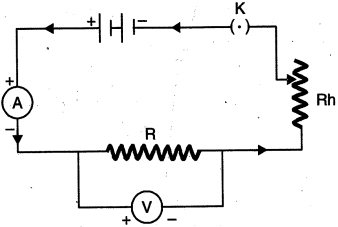
$(c)$ Draw an electric circuit for studying Ohm's law. Label the circuit components used to measure electric current and potential difference.
$(b)$ Calculate the number of electrons that flow per second to constitute a current of one ampere. The charge on an electron is $1.6 \times 10^{-19} \ C$.
$(c)$ Draw an electric circuit for studying Ohm's law. Label the circuit components used to measure electric current and potential difference.
Solution
(N/A) An electric circuit is a continuous and closed path in which an electric current can flow.
$(b)$ We know that $I = Q / t$ and $Q = n e$,where $n$ is the number of electrons and $e$ is the charge on an electron. Therefore,we have:
$I = n e / t$
$n = (I \times t) / e = (1 \ \text{A} \times 1 \ \text{s}) / (1.6 \times 10^{-19} \ \text{C})$
$n = 6.25 \times 10^{18}$ electrons.
$(c)$ The circuit diagram used to study Ohm's law is shown below.
Electric current is measured by an Ammeter $(A)$.
Potential difference is measured by a Voltmeter $(V)$.
$(b)$ We know that $I = Q / t$ and $Q = n e$,where $n$ is the number of electrons and $e$ is the charge on an electron. Therefore,we have:
$I = n e / t$
$n = (I \times t) / e = (1 \ \text{A} \times 1 \ \text{s}) / (1.6 \times 10^{-19} \ \text{C})$
$n = 6.25 \times 10^{18}$ electrons.
$(c)$ The circuit diagram used to study Ohm's law is shown below.
Electric current is measured by an Ammeter $(A)$.
Potential difference is measured by a Voltmeter $(V)$.
0 likes
View Solution226
Medium
$(a)$ Define potential difference between two points in a conductor.
$(b)$ Name the instrument used to measure the potential difference in a circuit. How is it connected?
$(c)$ $A$ current of $2 \, A$ passes through a circuit for $1$ minute. If the potential difference between the terminals of the circuit is $3 \, V$, what is the work done in transferring the charges?
$(b)$ Name the instrument used to measure the potential difference in a circuit. How is it connected?
$(c)$ $A$ current of $2 \, A$ passes through a circuit for $1$ minute. If the potential difference between the terminals of the circuit is $3 \, V$, what is the work done in transferring the charges?
Solution
$(a)$ Electric potential difference between two points in an electric circuit carrying current is defined as the work done to move a unit positive charge from one point to the other.
$(b)$ The instrument used to measure potential difference is a Voltmeter. It is always connected in parallel across the points between which the potential difference is to be measured.
$(c)$ Given: Current $(I) = 2 \, A$, Time $(t) = 1 \, \text{minute} = 60 \, s$, Potential difference $(V) = 3 \, V$.
First, calculate the total charge $(Q)$ transferred: $Q = I \times t = 2 \, A \times 60 \, s = 120 \, C$.
Now, calculate the work done $(W)$ using the formula $W = V \times Q$: $W = 3 \, V \times 120 \, C = 360 \, J$.
Thus, the work done is $360 \, J$.
$(b)$ The instrument used to measure potential difference is a Voltmeter. It is always connected in parallel across the points between which the potential difference is to be measured.
$(c)$ Given: Current $(I) = 2 \, A$, Time $(t) = 1 \, \text{minute} = 60 \, s$, Potential difference $(V) = 3 \, V$.
First, calculate the total charge $(Q)$ transferred: $Q = I \times t = 2 \, A \times 60 \, s = 120 \, C$.
Now, calculate the work done $(W)$ using the formula $W = V \times Q$: $W = 3 \, V \times 120 \, C = 360 \, J$.
Thus, the work done is $360 \, J$.
0 likes
View Solution227
Medium
State $Ohm's$ law. Write the mathematical representation of $Ohm's$ law. Use this relationship to define $1\, ohm.$ List two disadvantages of connecting different electrical appliances in series.
Solution
(N/A) $Ohm's$ law: The potential difference across the ends of a resistor is directly proportional to the current flowing through it, provided its temperature remains constant.
Mathematical representation: $V = IR$ or $R = V / I$, where $V$ is the potential difference, $I$ is the current, and $R$ is the resistance.
Definition of $1\, ohm$: If the potential difference across the two ends of a conductor is $1\, V$ and the current flowing through it is $1\, A$, then the resistance $R$ of the conductor is $1\, ohm$ $(1\, \Omega = 1\, V / 1\, A)$.
Disadvantages of series connection:
$(i)$ Different electrical appliances require different values of current to operate properly, which is not possible in a series circuit because the current remains the same throughout.
$(ii)$ If one appliance fails or is switched off, the entire circuit is broken, and none of the other appliances will work.
Mathematical representation: $V = IR$ or $R = V / I$, where $V$ is the potential difference, $I$ is the current, and $R$ is the resistance.
Definition of $1\, ohm$: If the potential difference across the two ends of a conductor is $1\, V$ and the current flowing through it is $1\, A$, then the resistance $R$ of the conductor is $1\, ohm$ $(1\, \Omega = 1\, V / 1\, A)$.
Disadvantages of series connection:
$(i)$ Different electrical appliances require different values of current to operate properly, which is not possible in a series circuit because the current remains the same throughout.
$(ii)$ If one appliance fails or is switched off, the entire circuit is broken, and none of the other appliances will work.
0 likes
View Solution228
Medium
Define power. State the difference between $1$ watt and $1$ watt hour. Establish the relationship between the commercial unit of electric energy and the $SI$ unit of energy. An electric heater rated $1000 \ W / 220 \ V$ operates for $2$ hours daily. Calculate the cost of energy to operate it for $30$ days at the rate of ₹ $5.00$ per $kWh$.
Solution
(N/A) Power is defined as the rate at which electric energy is dissipated or consumed in an electric circuit.
$1$ watt is the power consumed by a device that carries a current of $1 \ A$ when operated at a potential difference of $1 \ V$, whereas $1$ watt hour is the amount of energy consumed when $1$ watt of power is used for $1$ hour.
The commercial unit of electric energy is $kWh$.
$1 \ kWh = 1000 \ W \times 3600 \ s = 3.6 \times 10^6 \ J$.
Total energy consumed by the heater in $30$ days:
$E = \text{Power} \times \text{Time} \times \text{Days} = 1000 \ W \times 2 \ h \times 30 = 60000 \ Wh = 60 \ kWh$.
Cost of energy = $60 \ kWh \times ₹ 5.00/kWh = ₹ 300$.
$1$ watt is the power consumed by a device that carries a current of $1 \ A$ when operated at a potential difference of $1 \ V$, whereas $1$ watt hour is the amount of energy consumed when $1$ watt of power is used for $1$ hour.
The commercial unit of electric energy is $kWh$.
$1 \ kWh = 1000 \ W \times 3600 \ s = 3.6 \times 10^6 \ J$.
Total energy consumed by the heater in $30$ days:
$E = \text{Power} \times \text{Time} \times \text{Days} = 1000 \ W \times 2 \ h \times 30 = 60000 \ Wh = 60 \ kWh$.
Cost of energy = $60 \ kWh \times ₹ 5.00/kWh = ₹ 300$.
0 likes
View Solution229
Medium
$(a)$ Derive an expression to find the equivalent resistance of three resistors connected in series. Also,draw the schematic diagram of the circuit.
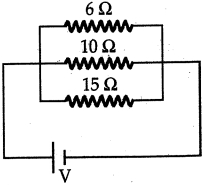
$(b)$ Find the equivalent resistance of the following circuit.
$(b)$ Find the equivalent resistance of the following circuit.
Solution
(N/A) When three resistors $R_1, R_2,$ and $R_3$ are connected in series,the same current $I$ flows through each resistor. The potential difference across each resistor is $V_1 = IR_1, V_2 = IR_2,$ and $V_3 = IR_3$. The total potential difference $V$ is $V = V_1 + V_2 + V_3 = I(R_1 + R_2 + R_3)$. If $R_s$ is the equivalent resistance,then $V = IR_s$. Thus,$R_s = R_1 + R_2 + R_3$.
$(b)$ The given circuit shows three resistors connected in parallel with values $R_1 = 6 \Omega, R_2 = 10 \Omega,$ and $R_3 = 15 \Omega$.
For parallel connection,the equivalent resistance $R_p$ is given by:
$\frac{1}{R_p} = \frac{1}{R_1} + \frac{1}{R_2} + \frac{1}{R_3}$
$\frac{1}{R_p} = \frac{1}{6} + \frac{1}{10} + \frac{1}{15}$
$\frac{1}{R_p} = \frac{5 + 3 + 2}{30} = \frac{10}{30} = \frac{1}{3}$
Therefore,$R_p = 3 \Omega$.
$(b)$ The given circuit shows three resistors connected in parallel with values $R_1 = 6 \Omega, R_2 = 10 \Omega,$ and $R_3 = 15 \Omega$.
For parallel connection,the equivalent resistance $R_p$ is given by:
$\frac{1}{R_p} = \frac{1}{R_1} + \frac{1}{R_2} + \frac{1}{R_3}$
$\frac{1}{R_p} = \frac{1}{6} + \frac{1}{10} + \frac{1}{15}$
$\frac{1}{R_p} = \frac{5 + 3 + 2}{30} = \frac{10}{30} = \frac{1}{3}$
Therefore,$R_p = 3 \Omega$.
0 likes
View Solution230
Medium
$(i)$ Name and state the law that gives the relationship between the current through a conductor and the potential difference across its two terminals. Also,express this law mathematically.
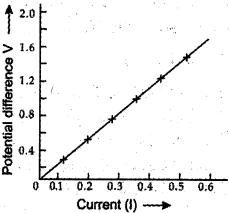
$(ii)$ Draw the $V-I$ graph for this law. Justify your answer.
$(iii)$ Write the name and use of the circuit components whose symbols are given below:
$(a)$ $A$ resistor with an arrow through it.
$(b)$ $A$ circle with a dot inside,connected to two lines.
$(ii)$ Draw the $V-I$ graph for this law. Justify your answer.
$(iii)$ Write the name and use of the circuit components whose symbols are given below:
$(a)$ $A$ resistor with an arrow through it.
$(b)$ $A$ circle with a dot inside,connected to two lines.

Solution
(N/A) $(i)$ Ohm's law.
It states that,provided the physical conditions remain the same,the current flowing through a conductor is directly proportional to the potential difference across its two ends.
Mathematically,we have $V \propto I$ or $V = IR$,where $R$ is the resistance of the conductor.
$(ii)$ The $V-I$ graph is a straight line passing through the origin. This justifies the law because a straight-line graph indicates that the potential difference $V$ is directly proportional to the current $I$ $(V \propto I)$.
$(iii)$ $(a)$ Variable resistor (Rheostat): It is used to vary the resistance in the circuit to control the current.
$(b)$ Closed switch (or closed key): It allows the current to flow through the circuit by completing the path.
It states that,provided the physical conditions remain the same,the current flowing through a conductor is directly proportional to the potential difference across its two ends.
Mathematically,we have $V \propto I$ or $V = IR$,where $R$ is the resistance of the conductor.
$(ii)$ The $V-I$ graph is a straight line passing through the origin. This justifies the law because a straight-line graph indicates that the potential difference $V$ is directly proportional to the current $I$ $(V \propto I)$.
$(iii)$ $(a)$ Variable resistor (Rheostat): It is used to vary the resistance in the circuit to control the current.
$(b)$ Closed switch (or closed key): It allows the current to flow through the circuit by completing the path.
0 likes
View Solution231
Medium
Define resistance of a conductor. State the factors on which resistance of a conductor depends. Name the device which is often used to change the resistance without changing the voltage source in an electric circuit.
Calculate the resistance of $50 \, m$ length of wire of cross-sectional area $0.01 \, mm^2$ and of resistivity $5 \times 10^{-8} \, \Omega \, m$.
Calculate the resistance of $50 \, m$ length of wire of cross-sectional area $0.01 \, mm^2$ and of resistivity $5 \times 10^{-8} \, \Omega \, m$.
Solution
(D) Resistance is defined as the opposition offered by a conductor to the flow of electric current.
It depends on the following factors:
$(i)$ Nature of the material of the conductor.
$(ii)$ Length of the conductor $(L)$.
$(iii)$ Area of cross-section of the conductor $(A)$.
$A$ rheostat or variable resistor is the device used to change the resistance in an electric circuit without changing the voltage source.
Calculation:
Given: $L = 50 \, m$,$A = 0.01 \, mm^2 = 0.01 \times 10^{-6} \, m^2$,$\rho = 5 \times 10^{-8} \, \Omega \, m$.
Using the formula $R = \frac{\rho L}{A}$:
$R = \frac{5 \times 10^{-8} \times 50}{0.01 \times 10^{-6}}$
$R = \frac{250 \times 10^{-8}}{10^{-8}}$
$R = 250 \, \Omega$.
It depends on the following factors:
$(i)$ Nature of the material of the conductor.
$(ii)$ Length of the conductor $(L)$.
$(iii)$ Area of cross-section of the conductor $(A)$.
$A$ rheostat or variable resistor is the device used to change the resistance in an electric circuit without changing the voltage source.
Calculation:
Given: $L = 50 \, m$,$A = 0.01 \, mm^2 = 0.01 \times 10^{-6} \, m^2$,$\rho = 5 \times 10^{-8} \, \Omega \, m$.
Using the formula $R = \frac{\rho L}{A}$:
$R = \frac{5 \times 10^{-8} \times 50}{0.01 \times 10^{-6}}$
$R = \frac{250 \times 10^{-8}}{10^{-8}}$
$R = 250 \, \Omega$.
0 likes
View Solution232
Medium
An electric iron has a rating of $750\, W; 200\, V$. Calculate:
$(i)$ The current required.
$(ii)$ The resistance of its heating element.
$(iii)$ Energy consumed by the iron in $2$ hours.
$(i)$ The current required.
$(ii)$ The resistance of its heating element.
$(iii)$ Energy consumed by the iron in $2$ hours.
Solution
(N/A) $(i)$ Current $(I)$ is calculated using the formula $P = V \times I$,so $I = P / V = 750\, W / 200\, V = 3.75\, A$.
$(ii)$ Resistance $(R)$ is calculated using Ohm's Law $V = I \times R$,so $R = V / I = 200\, V / 3.75\, A \approx 53.33\, \Omega$.
$(iii)$ Energy consumed $(E)$ is calculated as $E = P \times t = 750\, W \times 2\, h = 1500\, Wh = 1.5\, kWh$.
$(ii)$ Resistance $(R)$ is calculated using Ohm's Law $V = I \times R$,so $R = V / I = 200\, V / 3.75\, A \approx 53.33\, \Omega$.
$(iii)$ Energy consumed $(E)$ is calculated as $E = P \times t = 750\, W \times 2\, h = 1500\, Wh = 1.5\, kWh$.
0 likes
View Solution233
Difficult
$A$ piece of wire is redrawn,without change in volume,so that its radius is halved. Compare the new resistance with the original resistance.
Solution
(D) Let the length of the original wire be $l$ and its radius be $r$.
The original resistance is given by $R = \rho \frac{l}{A} = \rho \frac{l}{\pi r^2}$.
The original volume is $V_1 = \pi r^2 l$.
When the radius is halved,the new radius becomes $r' = \frac{r}{2}$. Let the new length be $l'$.
Since the volume remains constant,$V_1 = V_2$,so $\pi r^2 l = \pi (\frac{r}{2})^2 l'$.
$\pi r^2 l = \pi \frac{r^2}{4} l'$,which simplifies to $l' = 4l$.
The new resistance is $R' = \rho \frac{l'}{\pi (r')^2} = \rho \frac{4l}{\pi (r/2)^2}$.
$R' = \rho \frac{4l}{\pi (r^2/4)} = 16 \left( \rho \frac{l}{\pi r^2} \right)$.
Therefore,$R' = 16R$.
The new resistance is $16$ times the original resistance.
The original resistance is given by $R = \rho \frac{l}{A} = \rho \frac{l}{\pi r^2}$.
The original volume is $V_1 = \pi r^2 l$.
When the radius is halved,the new radius becomes $r' = \frac{r}{2}$. Let the new length be $l'$.
Since the volume remains constant,$V_1 = V_2$,so $\pi r^2 l = \pi (\frac{r}{2})^2 l'$.
$\pi r^2 l = \pi \frac{r^2}{4} l'$,which simplifies to $l' = 4l$.
The new resistance is $R' = \rho \frac{l'}{\pi (r')^2} = \rho \frac{4l}{\pi (r/2)^2}$.
$R' = \rho \frac{4l}{\pi (r^2/4)} = 16 \left( \rho \frac{l}{\pi r^2} \right)$.
Therefore,$R' = 16R$.
The new resistance is $16$ times the original resistance.
0 likes
View Solution234
EasyMCQ
The potential difference across the terminals of a cell is $1.5 \ V$. If it is connected with a resistance of $30 \ \Omega$,calculate the current flowing through the circuit. (in $A$)
A
$0.05$
B
$0.5$
C
$0.005$
D
$5$
Solution
(A) Given: Potential difference $(V)$ = $1.5 \ V$,Resistance $(R)$ = $30 \ \Omega$.
According to Ohm's Law,$V = IR$.
Therefore,the current $(I)$ is given by the formula: $I = \frac{V}{R}$.
Substituting the values: $I = \frac{1.5}{30} = 0.05 \ A$.
Thus,the current flowing through the circuit is $0.05 \ A$.
According to Ohm's Law,$V = IR$.
Therefore,the current $(I)$ is given by the formula: $I = \frac{V}{R}$.
Substituting the values: $I = \frac{1.5}{30} = 0.05 \ A$.
Thus,the current flowing through the circuit is $0.05 \ A$.
0 likes
View Solution235
EasyMCQ
$A$ current of $0.5\, A$ is drawn by a filament of an electric bulb for $10$ minutes. Find the amount of electric charge that flows through the circuit. (in $C$)
A
$300$
B
$30$
C
$3000$
D
$5$
Solution
(A) Given: Current $I = 0.5\, A$, Time $t = 10\, \text{min} = 10 \times 60 = 600\, \text{s}$.
The formula for electric charge $Q$ is $Q = I \times t$.
Substituting the values: $Q = 0.5\, A \times 600\, \text{s} = 300\, C$.
Therefore, the amount of electric charge that flows through the circuit is $300\, C$.
The formula for electric charge $Q$ is $Q = I \times t$.
Substituting the values: $Q = 0.5\, A \times 600\, \text{s} = 300\, C$.
Therefore, the amount of electric charge that flows through the circuit is $300\, C$.
0 likes
View Solution236
EasyMCQ
How much work is done in moving a charge of $2 \, C$ across two points having a potential difference of $12 \, V$ (in $, J$)?
A
$14$
B
$24$
C
$6$
D
$10$
Solution
(B) Given: Charge $(Q) = 2 \, C$,Potential difference $(V) = 12 \, V$.
The formula for work done $(W)$ in moving a charge between two points is given by $W = Q \times V$.
Substituting the given values into the formula:
$W = 2 \, C \times 12 \, V = 24 \, J$.
Therefore,the work done is $24 \, J$.
The formula for work done $(W)$ in moving a charge between two points is given by $W = Q \times V$.
Substituting the given values into the formula:
$W = 2 \, C \times 12 \, V = 24 \, J$.
Therefore,the work done is $24 \, J$.
0 likes
View Solution237
Medium
$(a)$ How much current will an electric bulb draw from a $220 \ V$ source,if the resistance of the bulb filament is $1200 \ \Omega$?
$(b)$ How much current will an electric heater coil draw from a $220 \ V$ source,if the resistance of the heater coil is $100 \ \Omega$?
$(b)$ How much current will an electric heater coil draw from a $220 \ V$ source,if the resistance of the heater coil is $100 \ \Omega$?
Solution
(N/A) Given: Potential difference $V = 220 \ V$,Resistance $R = 1200 \ \Omega$.
According to Ohm's law,$V = IR$,so $I = V / R$.
$I = 220 \ V / 1200 \ \Omega = 0.1833 \ A \approx 0.18 \ A$.
$(b)$ Given: Potential difference $V = 220 \ V$,Resistance $R = 100 \ \Omega$.
According to Ohm's law,$I = V / R$.
$I = 220 \ V / 100 \ \Omega = 2.2 \ A$.
According to Ohm's law,$V = IR$,so $I = V / R$.
$I = 220 \ V / 1200 \ \Omega = 0.1833 \ A \approx 0.18 \ A$.
$(b)$ Given: Potential difference $V = 220 \ V$,Resistance $R = 100 \ \Omega$.
According to Ohm's law,$I = V / R$.
$I = 220 \ V / 100 \ \Omega = 2.2 \ A$.
0 likes
View Solution238
MediumMCQ
The potential difference between the terminals of an electric heater is $60\, V$ when it draws a current of $4\, A$ from the source. What current will the heater draw,if the potential difference is increased to $120\, V$ (in $, A$)?
A
$4$
B
$8$
C
$12$
D
$16$
Solution
(B) Given: Initial potential difference $V_1 = 60\, V$,Initial current $I_1 = 4\, A$.
According to Ohm's law,$V = IR$,where $R$ is the resistance of the heater. Since the heater remains the same,its resistance $R$ is constant.
First,calculate the resistance: $R = V_1 / I_1 = 60\, V / 4\, A = 15\, \Omega$.
Now,for the new potential difference $V_2 = 120\, V$,the new current $I_2$ is calculated as:
$I_2 = V_2 / R = 120\, V / 15\, \Omega = 8\, A$.
Alternatively,since $I \propto V$,doubling the potential difference from $60\, V$ to $120\, V$ will double the current from $4\, A$ to $8\, A$.
According to Ohm's law,$V = IR$,where $R$ is the resistance of the heater. Since the heater remains the same,its resistance $R$ is constant.
First,calculate the resistance: $R = V_1 / I_1 = 60\, V / 4\, A = 15\, \Omega$.
Now,for the new potential difference $V_2 = 120\, V$,the new current $I_2$ is calculated as:
$I_2 = V_2 / R = 120\, V / 15\, \Omega = 8\, A$.
Alternatively,since $I \propto V$,doubling the potential difference from $60\, V$ to $120\, V$ will double the current from $4\, A$ to $8\, A$.
0 likes
View Solution239
MediumMCQ
Resistance of a metal wire of length $1\, m$ is $26\, \Omega$ at $20^{\circ} C$. If the diameter of the wire is $0.3\, mm$,what will be the resistivity of the metal at that temperature?
A
$1.84 \times 10^{-6} \, \Omega \, m$
B
$2.84 \times 10^{-6} \, \Omega \, m$
C
$1.84 \times 10^{-5} \, \Omega \, m$
D
$2.84 \times 10^{-5} \, \Omega \, m$
Solution
(A) Given:
Resistance $R = 26 \, \Omega$
Length $L = 1 \, m$
Diameter $D = 0.3 \, mm = 3 \times 10^{-4} \, m$
Radius $r = D/2 = 1.5 \times 10^{-4} \, m$
The formula for resistance is $R = \rho \frac{L}{A}$,where $A = \pi r^2 = \pi (D/2)^2 = \frac{\pi D^2}{4}$.
Rearranging for resistivity $\rho$:
$\rho = \frac{R A}{L} = \frac{R \pi D^2}{4 L}$
Substituting the values:
$\rho = \frac{26 \times 3.14 \times (3 \times 10^{-4})^2}{4 \times 1}$
$\rho = \frac{26 \times 3.14 \times 9 \times 10^{-8}}{4}$
$\rho = 1.8369 \times 10^{-6} \, \Omega \, m \approx 1.84 \times 10^{-6} \, \Omega \, m$.
Resistance $R = 26 \, \Omega$
Length $L = 1 \, m$
Diameter $D = 0.3 \, mm = 3 \times 10^{-4} \, m$
Radius $r = D/2 = 1.5 \times 10^{-4} \, m$
The formula for resistance is $R = \rho \frac{L}{A}$,where $A = \pi r^2 = \pi (D/2)^2 = \frac{\pi D^2}{4}$.
Rearranging for resistivity $\rho$:
$\rho = \frac{R A}{L} = \frac{R \pi D^2}{4 L}$
Substituting the values:
$\rho = \frac{26 \times 3.14 \times (3 \times 10^{-4})^2}{4 \times 1}$
$\rho = \frac{26 \times 3.14 \times 9 \times 10^{-8}}{4}$
$\rho = 1.8369 \times 10^{-6} \, \Omega \, m \approx 1.84 \times 10^{-6} \, \Omega \, m$.
0 likes
View Solution240
MediumMCQ
$A$ $4 \, \Omega$ resistance wire is doubled on itself. Calculate the new resistance of the wire.
A
$1 \, \Omega$
B
$2 \, \Omega$
C
$4 \, \Omega$
D
$16 \, \Omega$
Solution
(A) Given initial resistance $R = 4 \, \Omega$.
When a wire is doubled on itself,its length $L$ becomes half $(L_n = L/2)$ and its area of cross-section $A$ becomes double $(A_n = 2A)$.
The resistance of a wire is given by the formula $R = \rho \frac{L}{A}$,where $\rho$ is the resistivity of the material.
The new resistance $R_n$ is given by:
$R_n = \rho \frac{L_n}{A_n} = \rho \frac{L/2}{2A} = \frac{1}{4} \left( \rho \frac{L}{A} \right) = \frac{R}{4}$.
Substituting the value of $R = 4 \, \Omega$:
$R_n = \frac{4 \, \Omega}{4} = 1 \, \Omega$.
Thus,the new resistance of the wire is $1 \, \Omega$.
When a wire is doubled on itself,its length $L$ becomes half $(L_n = L/2)$ and its area of cross-section $A$ becomes double $(A_n = 2A)$.
The resistance of a wire is given by the formula $R = \rho \frac{L}{A}$,where $\rho$ is the resistivity of the material.
The new resistance $R_n$ is given by:
$R_n = \rho \frac{L_n}{A_n} = \rho \frac{L/2}{2A} = \frac{1}{4} \left( \rho \frac{L}{A} \right) = \frac{R}{4}$.
Substituting the value of $R = 4 \, \Omega$:
$R_n = \frac{4 \, \Omega}{4} = 1 \, \Omega$.
Thus,the new resistance of the wire is $1 \, \Omega$.
0 likes
View Solution241
Medium
An electric iron consumes energy at a rate of $840\, W$ when heating is at the maximum rate and $360\, W$ when the heating is at the minimum. The voltage is $220\, V$. What are the current and the resistance in each case?
Solution
(N/A) We know that the power input is $P = V \times I$.
Thus,the current is $I = P / V$.
$(a)$ When heating is at the maximum rate $(P = 840\, W)$:
$I = 840 / 220 = 3.82\, A$.
The resistance is $R = V / I = 220 / 3.82 = 57.60\, \Omega$.
$(b)$ When heating is at the minimum rate $(P = 360\, W)$:
$I = 360 / 220 = 1.64\, A$.
The resistance is $R = V / I = 220 / 1.64 = 134.15\, \Omega$.
Thus,the current is $I = P / V$.
$(a)$ When heating is at the maximum rate $(P = 840\, W)$:
$I = 840 / 220 = 3.82\, A$.
The resistance is $R = V / I = 220 / 3.82 = 57.60\, \Omega$.
$(b)$ When heating is at the minimum rate $(P = 360\, W)$:
$I = 360 / 220 = 1.64\, A$.
The resistance is $R = V / I = 220 / 1.64 = 134.15\, \Omega$.
0 likes
View Solution242
EasyMCQ
$100 \, J$ of heat is produced each second in a $4 \, \Omega$ resistance. Find the potential difference across the resistor. (in $, V$)
A
$10$
B
$20$
C
$30$
D
$40$
Solution
(B) Given: Heat produced $H = 100 \, J$,Resistance $R = 4 \, \Omega$,Time $t = 1 \, s$.
We know that the formula for heat produced is $H = I^2 R t$.
Rearranging to find current $I$:
$I = \sqrt{\frac{H}{R t}} = \sqrt{\frac{100}{4 \times 1}} = \sqrt{25} = 5 \, A$.
Now,using Ohm's Law to find the potential difference $V$:
$V = I \times R$
$V = 5 \, A \times 4 \, \Omega = 20 \, V$.
Therefore,the potential difference across the resistor is $20 \, V$.
We know that the formula for heat produced is $H = I^2 R t$.
Rearranging to find current $I$:
$I = \sqrt{\frac{H}{R t}} = \sqrt{\frac{100}{4 \times 1}} = \sqrt{25} = 5 \, A$.
Now,using Ohm's Law to find the potential difference $V$:
$V = I \times R$
$V = 5 \, A \times 4 \, \Omega = 20 \, V$.
Therefore,the potential difference across the resistor is $20 \, V$.
0 likes
View Solution243
EasyMCQ
An electric bulb is connected to a $220 \ V$ generator. The current is $0.50 \ A$. What is the power of the bulb?
A
$110 \ W$
B
$440 \ W$
C
$110 \ J$
D
$220 \ W$
Solution
(A) Given: Potential difference $V = 220 \ V$ and current $I = 0.50 \ A$.
The formula for electric power is $P = V \times I$.
Substituting the given values: $P = 220 \ V \times 0.50 \ A$.
Therefore,the power of the bulb is $P = 110 \ W$.
The formula for electric power is $P = V \times I$.
Substituting the given values: $P = 220 \ V \times 0.50 \ A$.
Therefore,the power of the bulb is $P = 110 \ W$.
0 likes
View Solution244
MediumMCQ
An electric refrigerator rated $400 \ W$ operates $8 \ h$ per day. What is the cost of the energy to operate it for $30$ days at ₹ $3.00$ per $kWh$?
A
₹ $288.00$
B
₹ $300.00$
C
₹ $250.00$
D
₹ $320.00$
Solution
(A) Given: Power $P = 400 \ W$,Time $t = 8 \ h$ per day for $30$ days,Rate $= ₹ 3.00$ per $kWh$.
Total time in hours $= 8 \times 30 = 240 \ h$.
Total energy consumed in $kWh = \frac{P \times t}{1000} = \frac{400 \times 240}{1000} = 96 \ kWh$.
Cost of energy $= \text{Total energy} \times \text{Rate} = 96 \times 3 = ₹ 288.00$.
Therefore,the cost to operate the refrigerator for $30$ days is ₹ $288.00$.
Total time in hours $= 8 \times 30 = 240 \ h$.
Total energy consumed in $kWh = \frac{P \times t}{1000} = \frac{400 \times 240}{1000} = 96 \ kWh$.
Cost of energy $= \text{Total energy} \times \text{Rate} = 96 \times 3 = ₹ 288.00$.
Therefore,the cost to operate the refrigerator for $30$ days is ₹ $288.00$.
0 likes
View Solution245
Medium
Calculate the equivalent resistance in the combination shown in the figure below.
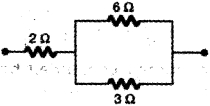
Solution
(N/A) The resistors $6 \, \Omega$ and $3 \, \Omega$ are connected in parallel.
Therefore,the equivalent resistance $R_P$ is given by:
$\frac{1}{R_P} = \frac{1}{R_1} + \frac{1}{R_2}$
$\frac{1}{R_P} = \frac{1}{3} + \frac{1}{6} = \frac{2+1}{6} = \frac{3}{6} = \frac{1}{2}$
Thus,$R_P = 2 \, \Omega$.
Now,the $2 \, \Omega$ resistor and the parallel combination $R_P$ are in series.
Therefore,the total equivalent resistance $R$ is:
$R = 2 \, \Omega + R_P = 2 \, \Omega + 2 \, \Omega = 4 \, \Omega$.
The equivalent resistance of the circuit is $4 \, \Omega$.
Therefore,the equivalent resistance $R_P$ is given by:
$\frac{1}{R_P} = \frac{1}{R_1} + \frac{1}{R_2}$
$\frac{1}{R_P} = \frac{1}{3} + \frac{1}{6} = \frac{2+1}{6} = \frac{3}{6} = \frac{1}{2}$
Thus,$R_P = 2 \, \Omega$.
Now,the $2 \, \Omega$ resistor and the parallel combination $R_P$ are in series.
Therefore,the total equivalent resistance $R$ is:
$R = 2 \, \Omega + R_P = 2 \, \Omega + 2 \, \Omega = 4 \, \Omega$.
The equivalent resistance of the circuit is $4 \, \Omega$.
0 likes
View Solution246
EasyMCQ
An electric bulb of resistance $480 \Omega$ is connected to a $220 \text{ V}$ main. Find the amount of electrical energy consumed in $10 \text{ seconds}$. (in $J$)
A
$1008.3$
B
$1000$
C
$1050$
D
$950$
Solution
(A) Given:
Resistance $R = 480 \Omega$
Voltage $V = 220 \text{ V}$
Time $t = 10 \text{ s}$
The formula for electrical energy consumed is $E = \frac{V^2 t}{R}$.
Substituting the given values:
$E = \frac{(220)^2 \times 10}{480}$
$E = \frac{48400 \times 10}{480}$
$E = \frac{484000}{480}$
$E \approx 1008.33 \text{ J}$.
Resistance $R = 480 \Omega$
Voltage $V = 220 \text{ V}$
Time $t = 10 \text{ s}$
The formula for electrical energy consumed is $E = \frac{V^2 t}{R}$.
Substituting the given values:
$E = \frac{(220)^2 \times 10}{480}$
$E = \frac{48400 \times 10}{480}$
$E = \frac{484000}{480}$
$E \approx 1008.33 \text{ J}$.
0 likes
View Solution247
EasyMCQ
How much work is done in moving a charge of $2 \ C$ from a point at $118 \ V$ to a point at $128 \ V$ (in $J$)?
A
$10$
B
$20$
C
$30$
D
$40$
Solution
(B) Given: Charge $q = 2 \ C$,Initial potential $V_1 = 118 \ V$,Final potential $V_2 = 128 \ V$.
We know that the potential difference $V$ is defined as the work done $W$ per unit charge $q$,i.e.,$V = W / q$.
Therefore,the work done $W = q \times (V_2 - V_1)$.
Substituting the values: $W = 2 \times (128 - 118) = 2 \times 10 = 20 \ J$.
Thus,the total work done is $20 \ J$.
We know that the potential difference $V$ is defined as the work done $W$ per unit charge $q$,i.e.,$V = W / q$.
Therefore,the work done $W = q \times (V_2 - V_1)$.
Substituting the values: $W = 2 \times (128 - 118) = 2 \times 10 = 20 \ J$.
Thus,the total work done is $20 \ J$.
0 likes
View Solution248
Medium
Two resistors are connected in series as shown in the diagram. $(i)$ What is the current through the $5 \, \Omega$ resistor? (ii) What is the current through $R$? (iii) What is the value of $R$? (iv) What is the value of $V$?
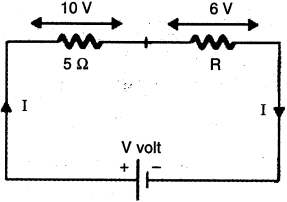
Solution
(A) Given:
Potential difference across $5 \, \Omega$ resistor $(V_1)$ = $10 \, V$
Potential difference across $R \, \Omega$ resistor $(V_2)$ = $6 \, V$
Resistance $R_1 = 5 \, \Omega$
$(i)$ By Ohm's law,the current $(I)$ through the $5 \, \Omega$ resistor is:
$I = \frac{V_1}{R_1} = \frac{10 \, V}{5 \, \Omega} = 2 \, A$
(ii) Since the two resistors are connected in series,the current remains the same throughout the circuit. Therefore,the current through resistor $R$ is also $2 \, A$.
(iii) Using Ohm's law for resistor $R$:
$R = \frac{V_2}{I} = \frac{6 \, V}{2 \, A} = 3 \, \Omega$
(iv) Since the resistors are in series,the total voltage $V$ is the sum of the potential differences across each resistor:
$V = V_1 + V_2 = 10 \, V + 6 \, V = 16 \, V$
Potential difference across $5 \, \Omega$ resistor $(V_1)$ = $10 \, V$
Potential difference across $R \, \Omega$ resistor $(V_2)$ = $6 \, V$
Resistance $R_1 = 5 \, \Omega$
$(i)$ By Ohm's law,the current $(I)$ through the $5 \, \Omega$ resistor is:
$I = \frac{V_1}{R_1} = \frac{10 \, V}{5 \, \Omega} = 2 \, A$
(ii) Since the two resistors are connected in series,the current remains the same throughout the circuit. Therefore,the current through resistor $R$ is also $2 \, A$.
(iii) Using Ohm's law for resistor $R$:
$R = \frac{V_2}{I} = \frac{6 \, V}{2 \, A} = 3 \, \Omega$
(iv) Since the resistors are in series,the total voltage $V$ is the sum of the potential differences across each resistor:
$V = V_1 + V_2 = 10 \, V + 6 \, V = 16 \, V$
0 likes
View Solution249
Medium
$A$ $100 \text{ W}$ electric bulb is lighted for $2 \text{ hours}$ daily,and four $40 \text{ W}$ bulbs are lighted for $4 \text{ hours}$ everyday. Calculate the energy consumed (in $\text{kWh}$) in $30 \text{ days}$.
Solution
(25.2 KWH) Energy consumed by one $100 \text{ W}$ bulb working for $2 \text{ hours}$ daily:
$= \frac{100 \text{ W}}{1000} \times 2 \text{ h} = 0.2 \text{ kWh}$
Energy consumed by four $40 \text{ W}$ bulbs working for $4 \text{ hours}$ daily:
$= \frac{4 \times 40 \text{ W}}{1000} \times 4 \text{ h} = 0.64 \text{ kWh}$
Total energy consumed everyday:
$= 0.2 \text{ kWh} + 0.64 \text{ kWh} = 0.84 \text{ kWh}$
Total energy consumed in $30 \text{ days}$:
$= 0.84 \text{ kWh} \times 30 = 25.2 \text{ kWh}$
$= \frac{100 \text{ W}}{1000} \times 2 \text{ h} = 0.2 \text{ kWh}$
Energy consumed by four $40 \text{ W}$ bulbs working for $4 \text{ hours}$ daily:
$= \frac{4 \times 40 \text{ W}}{1000} \times 4 \text{ h} = 0.64 \text{ kWh}$
Total energy consumed everyday:
$= 0.2 \text{ kWh} + 0.64 \text{ kWh} = 0.84 \text{ kWh}$
Total energy consumed in $30 \text{ days}$:
$= 0.84 \text{ kWh} \times 30 = 25.2 \text{ kWh}$
0 likes
View Solution250
Difficult
Calculate the equivalent resistance between the points $A$ and $B$ in the following combination.
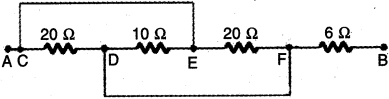
Solution
$(11 \Omega)$ The given circuit can be redrawn by identifying the nodes connected by wires. Points $A$ and $C$ are at the same potential, and points $E$ and $F$ are connected to $D$ via a wire, effectively making them parallel.
It is clear that the resistances $20 \Omega$ (between $C$ and $D$), $10 \Omega$ (between $D$ and $E$), and $20 \Omega$ (between $E$ and $F$) are in a parallel combination between the effective nodes.
If $R_{1}$ is the effective resistance of these three parallel resistors, then:
$\frac{1}{R_{1}} = \frac{1}{20} + \frac{1}{10} + \frac{1}{20}$
$\frac{1}{R_{1}} = \frac{1 + 2 + 1}{20} = \frac{4}{20} = \frac{1}{5}$
Therefore, $R_{1} = 5 \Omega$.
Now, the resistor $R_{1}$ and the $6 \Omega$ resistor are in series. Therefore, the equivalent resistance $R$ between $A$ and $B$ is:
$R = R_{1} + 6 \Omega$
$R = 5 \Omega + 6 \Omega = 11 \Omega$.
It is clear that the resistances $20 \Omega$ (between $C$ and $D$), $10 \Omega$ (between $D$ and $E$), and $20 \Omega$ (between $E$ and $F$) are in a parallel combination between the effective nodes.
If $R_{1}$ is the effective resistance of these three parallel resistors, then:
$\frac{1}{R_{1}} = \frac{1}{20} + \frac{1}{10} + \frac{1}{20}$
$\frac{1}{R_{1}} = \frac{1 + 2 + 1}{20} = \frac{4}{20} = \frac{1}{5}$
Therefore, $R_{1} = 5 \Omega$.
Now, the resistor $R_{1}$ and the $6 \Omega$ resistor are in series. Therefore, the equivalent resistance $R$ between $A$ and $B$ is:
$R = R_{1} + 6 \Omega$
$R = 5 \Omega + 6 \Omega = 11 \Omega$.
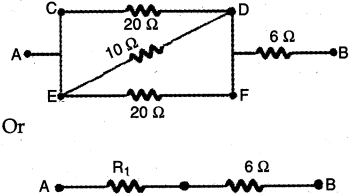
0 likes
View SolutionElectricity — Mix Examples - Electricity · Frequently Asked Questions
1Are these Electricity questions useful for JEE and NEET?
Yes. All questions in this section are mapped to JEE Main and NEET exam patterns. Previous year questions from JEE Main, NEET, GUJCET and state-level exams are included with full solutions.
2Can I switch to Hindi or Gujarati for these questions?
Yes. Use the language tabs in the hero section or the sidebar to view the same questions and solutions in English, Hindi or Gujarati.
3How do I generate a question paper from this subtopic?
Use the Vedclass Exam Paper Generator — select the chapter and subtopic, set difficulty, and generate Sets A, B, C, D automatically. First 3 chapters of every subject are free.
Vedclass Products
For Students
Vedclass Test Series
Mock tests in real JEE/NEET style with performance analysis. 5-day free trial.
Start Free TrialFor Teachers
Exam Paper Generator
Generate Set A/B/C/D papers from this chapter in 2 minutes. 3 chapters free.
Try FreeFor Institutes
Online Exam Module
Live online exams with unlimited students, 360° analytics & white-label branding.
See DemoFor Teachers & Institutes
Generate a Electricity Exam Paper in 2 Minutes
Select subtopic & difficulty — Sets A, B, C, D auto-generated with No Repeat logic.
First 3 chapters of every subject are free — no payment required.