
A English
Mix Examples - Electricity Questions in English
Class 10 Science · Electricity · Mix Examples - Electricity
449+
Questions
English
Language
100%
With Solutions
Showing 50 of 449 questions in English
251
DifficultMCQ
When two resistors of resistances $R_{1}$ and $R_{2}$ are connected in parallel,the net resistance is $3 \, \Omega$. When connected in series,its value is $16 \, \Omega$. Calculate the values of $R_{1}$ and $R_{2}$.
A
$4 \, \Omega$ and $12 \, \Omega$
B
$6 \, \Omega$ and $10 \, \Omega$
C
$8 \, \Omega$ and $8 \, \Omega$
D
$2 \, \Omega$ and $14 \, \Omega$
Solution
(A) When $R_{1}$ and $R_{2}$ are connected in parallel,the net resistance $(R_{p})$ is given by:
$\frac{1}{R_{p}} = \frac{1}{R_{1}} + \frac{1}{R_{2}}$
Therefore,we have:
$R_{p} = \frac{R_{1} R_{2}}{R_{1} + R_{2}} = 3 \, \Omega$ $...(1)$
When $R_{1}$ and $R_{2}$ are connected in series,the net resistance $(R_{s})$ is given by:
$R_{s} = R_{1} + R_{2} = 16 \, \Omega$ $...(2)$
Substituting equation $(2)$ into equation $(1)$:
$\frac{R_{1} R_{2}}{16} = 3 \implies R_{1} R_{2} = 48$ $...(3)$
From equation $(2)$,$R_{2} = 16 - R_{1}$. Substituting this into equation $(3)$:
$R_{1}(16 - R_{1}) = 48$
$16R_{1} - R_{1}^{2} = 48$
$R_{1}^{2} - 16R_{1} + 48 = 0$
$(R_{1} - 12)(R_{1} - 4) = 0$
Thus,$R_{1} = 12 \, \Omega$ or $R_{1} = 4 \, \Omega$.
If $R_{1} = 12 \, \Omega$,then $R_{2} = 4 \, \Omega$. If $R_{1} = 4 \, \Omega$,then $R_{2} = 12 \, \Omega$.
Therefore,the resistances are $4 \, \Omega$ and $12 \, \Omega$.
$\frac{1}{R_{p}} = \frac{1}{R_{1}} + \frac{1}{R_{2}}$
Therefore,we have:
$R_{p} = \frac{R_{1} R_{2}}{R_{1} + R_{2}} = 3 \, \Omega$ $...(1)$
When $R_{1}$ and $R_{2}$ are connected in series,the net resistance $(R_{s})$ is given by:
$R_{s} = R_{1} + R_{2} = 16 \, \Omega$ $...(2)$
Substituting equation $(2)$ into equation $(1)$:
$\frac{R_{1} R_{2}}{16} = 3 \implies R_{1} R_{2} = 48$ $...(3)$
From equation $(2)$,$R_{2} = 16 - R_{1}$. Substituting this into equation $(3)$:
$R_{1}(16 - R_{1}) = 48$
$16R_{1} - R_{1}^{2} = 48$
$R_{1}^{2} - 16R_{1} + 48 = 0$
$(R_{1} - 12)(R_{1} - 4) = 0$
Thus,$R_{1} = 12 \, \Omega$ or $R_{1} = 4 \, \Omega$.
If $R_{1} = 12 \, \Omega$,then $R_{2} = 4 \, \Omega$. If $R_{1} = 4 \, \Omega$,then $R_{2} = 12 \, \Omega$.
Therefore,the resistances are $4 \, \Omega$ and $12 \, \Omega$.
0 likes
View Solution252
Medium
An electric bulb is rated at $200 \ V - 100 \ W$. What is its resistance? If five such bulbs burn for $4 \ hours$, what is the total electrical energy consumed? Calculate the cost, if the rate is $50$ paise per unit.
Solution
(N/A) Given: Voltage $V = 200 \ V$, Power $P = 100 \ W$, Number of bulbs $n = 5$, Time $t = 4 \ hours$.
$(a)$ We know that $P = \frac{V^2}{R}$, therefore, the resistance of each bulb is:
$R = \frac{V^2}{P} = \frac{(200)^2}{100} = \frac{40000}{100} = 400 \ \Omega$.
$(b)$ Electrical energy consumed by one bulb in $4 \ hours$ is:
$E_1 = P \times t = 100 \ W \times 4 \ h = 400 \ Wh$.
Total energy consumed by $5$ bulbs in $4 \ hours$ is:
$E_{total} = 5 \times 400 \ Wh = 2000 \ Wh = 2 \ kWh$.
$(c)$ Cost of consumed electricity:
Since $1 \ unit = 1 \ kWh$ and the rate is $50 \ paise = ₹ 0.50$ per unit:
$Cost = 2 \ units \times ₹ 0.50/unit = ₹ 1.00$.
$(a)$ We know that $P = \frac{V^2}{R}$, therefore, the resistance of each bulb is:
$R = \frac{V^2}{P} = \frac{(200)^2}{100} = \frac{40000}{100} = 400 \ \Omega$.
$(b)$ Electrical energy consumed by one bulb in $4 \ hours$ is:
$E_1 = P \times t = 100 \ W \times 4 \ h = 400 \ Wh$.
Total energy consumed by $5$ bulbs in $4 \ hours$ is:
$E_{total} = 5 \times 400 \ Wh = 2000 \ Wh = 2 \ kWh$.
$(c)$ Cost of consumed electricity:
Since $1 \ unit = 1 \ kWh$ and the rate is $50 \ paise = ₹ 0.50$ per unit:
$Cost = 2 \ units \times ₹ 0.50/unit = ₹ 1.00$.
0 likes
View Solution253
DifficultMCQ
$A$ torch bulb is rated $5\,V$ and $500\,mA$. Calculate its $(i)$ power,$(ii)$ resistance,and $(iii)$ energy consumed when it is lighted for $4$ hours.
A
$2.5\,W, 10\,\Omega, 36000\,J$
B
$5\,W, 5\,\Omega, 18000\,J$
C
$1.25\,W, 20\,\Omega, 72000\,J$
D
$2.5\,W, 5\,\Omega, 10000\,J$
Solution
(A) Given: Voltage $V = 5\,V$,Current $I = 500\,mA = 0.5\,A$,Time $t = 4\,\text{hours} = 4 \times 3600\,s = 14400\,s$.
$(i)$ Power $P = V \times I = 5\,V \times 0.5\,A = 2.5\,W$.
$(ii)$ Resistance $R = V / I = 5\,V / 0.5\,A = 10\,\Omega$.
$(iii)$ Energy consumed $E = P \times t = 2.5\,W \times 14400\,s = 36000\,J$.
$(i)$ Power $P = V \times I = 5\,V \times 0.5\,A = 2.5\,W$.
$(ii)$ Resistance $R = V / I = 5\,V / 0.5\,A = 10\,\Omega$.
$(iii)$ Energy consumed $E = P \times t = 2.5\,W \times 14400\,s = 36000\,J$.
0 likes
View Solution254
Medium
If a $12 \ V$ battery is connected to the arrangement of resistances given below,calculate
$(i)$ the total effective resistance of the arrangement and
$(ii)$ the total current flowing in the circuit.
$(i)$ the total effective resistance of the arrangement and
$(ii)$ the total current flowing in the circuit.
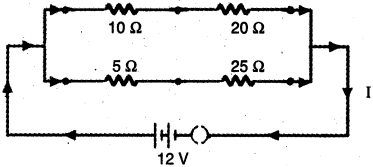
Solution
(N/A) $(i)$ Resistors of value $10 \ \Omega$ and $20 \ \Omega$ are connected in series,therefore,their equivalent resistance is
$R_{S} = 10 + 20 = 30 \ \Omega$
Similarly,resistors of value $5 \ \Omega$ and $25 \ \Omega$ are in series,therefore,their equivalent resistance is
$R_{S_{1}} = 5 + 25 = 30 \ \Omega$
Now,$R_{S}$ and $R_{S_{1}}$ are in parallel,therefore,we have
$R_{P} = \frac{R_{S} \times R_{S_{1}}}{R_{S} + R_{S_{1}}} = \frac{30 \times 30}{30 + 30} = \frac{900}{60} = 15 \ \Omega$
$(ii)$ The total current is given by Ohm's law:
$I = \frac{V}{R_{P}} = \frac{12}{15} = 0.8 \ A$
$R_{S} = 10 + 20 = 30 \ \Omega$
Similarly,resistors of value $5 \ \Omega$ and $25 \ \Omega$ are in series,therefore,their equivalent resistance is
$R_{S_{1}} = 5 + 25 = 30 \ \Omega$
Now,$R_{S}$ and $R_{S_{1}}$ are in parallel,therefore,we have
$R_{P} = \frac{R_{S} \times R_{S_{1}}}{R_{S} + R_{S_{1}}} = \frac{30 \times 30}{30 + 30} = \frac{900}{60} = 15 \ \Omega$
$(ii)$ The total current is given by Ohm's law:
$I = \frac{V}{R_{P}} = \frac{12}{15} = 0.8 \ A$
0 likes
View Solution255
MediumMCQ
Two electric lamps of $100\, W$ and $25\, W$ respectively are joined in parallel to a supply of $200\, V$. Calculate the total current flowing through the circuit. (in $, A$)
A
$0.5$
B
$0.625$
C
$0.75$
D
$0.8$
Solution
(B) When electric lamps are connected in parallel,the total power consumed by the circuit is the sum of the power of individual lamps.
Total power,$P = P_{1} + P_{2} = 100\, W + 25\, W = 125\, W$.
The relationship between power $(P)$,voltage $(V)$,and current $(I)$ is given by the formula $P = V \times I$.
To find the total current $(I)$,we rearrange the formula: $I = \frac{P}{V}$.
Substituting the given values: $I = \frac{125\, W}{200\, V} = 0.625\, A$.
Therefore,the total current flowing through the circuit is $0.625\, A$.
Total power,$P = P_{1} + P_{2} = 100\, W + 25\, W = 125\, W$.
The relationship between power $(P)$,voltage $(V)$,and current $(I)$ is given by the formula $P = V \times I$.
To find the total current $(I)$,we rearrange the formula: $I = \frac{P}{V}$.
Substituting the given values: $I = \frac{125\, W}{200\, V} = 0.625\, A$.
Therefore,the total current flowing through the circuit is $0.625\, A$.
0 likes
View Solution256
MediumMCQ
Two identical resistors,each of resistance $2 \Omega$,are connected in turn: $(i)$ in series,and $(ii)$ in parallel to a battery of $12 \text{ V}$. Calculate the ratio of power consumed in the two cases.
A
$1:4$
B
$4:1$
C
$1:2$
D
$2:1$
Solution
(B) Given: $R_{1} = 2 \Omega, R_{2} = 2 \Omega, V = 12 \text{ V}$.
$(i)$ When resistors are connected in series,the equivalent resistance is:
$R_{S} = R_{1} + R_{2} = 2 + 2 = 4 \Omega$.
Power consumed in series is:
$P_{S} = \frac{V^{2}}{R_{S}} = \frac{12^{2}}{4} = \frac{144}{4} = 36 \text{ W}$.
$(ii)$ When resistors are connected in parallel,the equivalent resistance is:
$R_{P} = \frac{R_{1} R_{2}}{R_{1} + R_{2}} = \frac{2 \times 2}{2 + 2} = \frac{4}{4} = 1 \Omega$.
Power consumed in parallel is:
$P_{P} = \frac{V^{2}}{R_{P}} = \frac{12^{2}}{1} = 144 \text{ W}$.
The ratio of power consumed in the two cases (parallel to series) is:
$\frac{P_{P}}{P_{S}} = \frac{144}{36} = 4:1$.
$(i)$ When resistors are connected in series,the equivalent resistance is:
$R_{S} = R_{1} + R_{2} = 2 + 2 = 4 \Omega$.
Power consumed in series is:
$P_{S} = \frac{V^{2}}{R_{S}} = \frac{12^{2}}{4} = \frac{144}{4} = 36 \text{ W}$.
$(ii)$ When resistors are connected in parallel,the equivalent resistance is:
$R_{P} = \frac{R_{1} R_{2}}{R_{1} + R_{2}} = \frac{2 \times 2}{2 + 2} = \frac{4}{4} = 1 \Omega$.
Power consumed in parallel is:
$P_{P} = \frac{V^{2}}{R_{P}} = \frac{12^{2}}{1} = 144 \text{ W}$.
The ratio of power consumed in the two cases (parallel to series) is:
$\frac{P_{P}}{P_{S}} = \frac{144}{36} = 4:1$.
0 likes
View Solution257
Easy
In the given circuit,calculate $(i)$ total resistance of the circuit,and (ii) current shown by the ammeter.
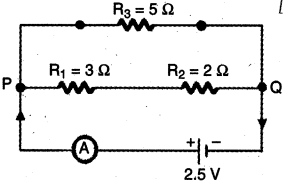
Solution
(N/A) $(i)$ Since $R_{1}$ and $R_{2}$ are in series,their resultant resistance,
$R_{S} = R_{1} + R_{2} = 3 + 2 = 5 \Omega$
Further,$R_{S}$ and $R_{3}$ are in parallel,their resultant resistance is given by
$R_{P} = \frac{R_{S} \times R_{3}}{R_{S} + R_{3}} = \frac{5 \times 5}{5 + 5} = 2.5 \Omega$
(ii) Also,the current $I$ shown by the ammeter is given by Ohm's law:
$I = \frac{V}{R_{P}} = \frac{2.5 \text{ V}}{2.5 \Omega} = 1 \text{ A}$
$R_{S} = R_{1} + R_{2} = 3 + 2 = 5 \Omega$
Further,$R_{S}$ and $R_{3}$ are in parallel,their resultant resistance is given by
$R_{P} = \frac{R_{S} \times R_{3}}{R_{S} + R_{3}} = \frac{5 \times 5}{5 + 5} = 2.5 \Omega$
(ii) Also,the current $I$ shown by the ammeter is given by Ohm's law:
$I = \frac{V}{R_{P}} = \frac{2.5 \text{ V}}{2.5 \Omega} = 1 \text{ A}$
0 likes
View Solution258
Medium
In a household,$5$ tube lights of $40 \text{ W}$ each are used for $5 \text{ hours}$ and an electric press of $500 \text{ W}$ for $4 \text{ hours}$ everyday. Calculate the total energy consumed by the tube lights and press in a month of $30 \text{ days}$.
Solution
$1$. Energy consumed by $5$ tube lights of $40 \text{ W}$ each for $5 \text{ hours}$ per day:
$E_1 = 5 \times 40 \text{ W} \times 5 \text{ h} = 1000 \text{ Wh} = 1 \text{ kWh}$.
$2$. Energy consumed by an electric press of $500 \text{ W}$ for $4 \text{ hours}$ per day:
$E_2 = 500 \text{ W} \times 4 \text{ h} = 2000 \text{ Wh} = 2 \text{ kWh}$.
$3$. Total energy consumed per day:
$E_{\text{total/day}} = 1 \text{ kWh} + 2 \text{ kWh} = 3 \text{ kWh}$.
$4$. Total energy consumed in a month of $30 \text{ days}$:
$E_{\text{month}} = 3 \text{ kWh/day} \times 30 \text{ days} = 90 \text{ kWh}$.
$E_1 = 5 \times 40 \text{ W} \times 5 \text{ h} = 1000 \text{ Wh} = 1 \text{ kWh}$.
$2$. Energy consumed by an electric press of $500 \text{ W}$ for $4 \text{ hours}$ per day:
$E_2 = 500 \text{ W} \times 4 \text{ h} = 2000 \text{ Wh} = 2 \text{ kWh}$.
$3$. Total energy consumed per day:
$E_{\text{total/day}} = 1 \text{ kWh} + 2 \text{ kWh} = 3 \text{ kWh}$.
$4$. Total energy consumed in a month of $30 \text{ days}$:
$E_{\text{month}} = 3 \text{ kWh/day} \times 30 \text{ days} = 90 \text{ kWh}$.
0 likes
View Solution259
Medium
In the circuit shown below, calculate:
$(a)$ total resistance in arm $CE$,
$(b)$ total current drawn from the battery, and
$(c)$ current in each arm, i.e., $AB$ and $CE$ of the circuit.
$(a)$ total resistance in arm $CE$,
$(b)$ total current drawn from the battery, and
$(c)$ current in each arm, i.e., $AB$ and $CE$ of the circuit.
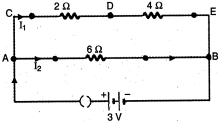
Solution
(N/A) In arm $CE$, the resistors of value $2 \, \Omega$ and $4 \, \Omega$ are connected in series. Therefore, the total resistance in arm $CE = 2 \, \Omega + 4 \, \Omega = 6 \, \Omega$.
$(b)$ The circuit consists of two parallel branches, arm $CE$ and arm $AB$, each having a resistance of $6 \, \Omega$. The total resistance of the circuit $R_P$ is given by:
$R_P = \frac{6 \, \Omega \times 6 \, \Omega}{6 \, \Omega + 6 \, \Omega} = 3 \, \Omega$.
Therefore, the total current $I$ drawn from the battery is:
$I = \frac{V}{R_P} = \frac{3 \, V}{3 \, \Omega} = 1 \, A$.
$(c)$ Since both arms $CE$ and $AB$ have the same resistance $(6 \, \Omega)$, the total current is split equally between them. Hence, the current in each arm ($AB$ and $CE$) is $0.5 \, A$.
$(b)$ The circuit consists of two parallel branches, arm $CE$ and arm $AB$, each having a resistance of $6 \, \Omega$. The total resistance of the circuit $R_P$ is given by:
$R_P = \frac{6 \, \Omega \times 6 \, \Omega}{6 \, \Omega + 6 \, \Omega} = 3 \, \Omega$.
Therefore, the total current $I$ drawn from the battery is:
$I = \frac{V}{R_P} = \frac{3 \, V}{3 \, \Omega} = 1 \, A$.
$(c)$ Since both arms $CE$ and $AB$ have the same resistance $(6 \, \Omega)$, the total current is split equally between them. Hence, the current in each arm ($AB$ and $CE$) is $0.5 \, A$.
0 likes
View Solution260
Medium
$A$ piece of wire having resistance $R$ is cut into four equal parts. $(a)$ How will the resistance of each part compare with the original resistance? $(b)$ If the four parts are placed in parallel,how will the joint resistance compare with the resistance of the original wire?
Solution
(N/A) Since the wire is divided into four equal parts,the new length of each part becomes one-fourth of the original length. Since resistance is directly proportional to length $(R \propto l)$,the resistance of each part becomes one-fourth of the original resistance,$i.e., R' = R/4$.
$(b)$ When these four parts are connected in parallel,the equivalent resistance $R_p$ is given by the formula:
$\frac{1}{R_p} = \frac{1}{R'} + \frac{1}{R'} + \frac{1}{R'} + \frac{1}{R'}$
Substituting $R' = R/4$:
$\frac{1}{R_p} = \frac{4}{R} + \frac{4}{R} + \frac{4}{R} + \frac{4}{R} = \frac{16}{R}$
Therefore,$R_p = R/16$.
Thus,the joint resistance is $1/16$ times the resistance of the original wire.
$(b)$ When these four parts are connected in parallel,the equivalent resistance $R_p$ is given by the formula:
$\frac{1}{R_p} = \frac{1}{R'} + \frac{1}{R'} + \frac{1}{R'} + \frac{1}{R'}$
Substituting $R' = R/4$:
$\frac{1}{R_p} = \frac{4}{R} + \frac{4}{R} + \frac{4}{R} + \frac{4}{R} = \frac{16}{R}$
Therefore,$R_p = R/16$.
Thus,the joint resistance is $1/16$ times the resistance of the original wire.
0 likes
View Solution261
Medium
An electric lamp is marked $100 \, W, 220 \, V$. It is used for $5$ hours daily. Calculate: $(i)$ its resistance while glowing. $(ii)$ energy consumed in $kWh$ per day.
Solution
(N/A) $(i)$ The resistance $R$ of the lamp is calculated using the formula $R = \frac{V^2}{P}$. Substituting the given values: $R = \frac{(220)^2}{100} = \frac{48400}{100} = 484 \, \Omega$.
$(ii)$ The energy consumed $E$ is calculated using the formula $E = P \times t$. Given $P = 100 \, W$ and $t = 5 \, h$,we get $E = 100 \, W \times 5 \, h = 500 \, Wh$. Converting to $kWh$,$E = \frac{500}{1000} \, kWh = 0.5 \, kWh$.
$(ii)$ The energy consumed $E$ is calculated using the formula $E = P \times t$. Given $P = 100 \, W$ and $t = 5 \, h$,we get $E = 100 \, W \times 5 \, h = 500 \, Wh$. Converting to $kWh$,$E = \frac{500}{1000} \, kWh = 0.5 \, kWh$.
0 likes
View Solution262
EasyMCQ
$A$ wire is $1.0 \, m$ long,$0.2 \, mm$ in diameter and has a resistance of $10 \, \Omega$. Calculate the resistivity of its material.
A
$3.14 \times 10^{-7} \, \Omega \cdot m$
B
$3.14 \times 10^{-6} \, \Omega \cdot m$
C
$1.57 \times 10^{-7} \, \Omega \cdot m$
D
$6.28 \times 10^{-7} \, \Omega \cdot m$
Solution
(A) Given: Length $L = 1.0 \, m$,Diameter $D = 0.2 \, mm = 0.2 \times 10^{-3} \, m$.
Radius $r = D/2 = 0.1 \times 10^{-3} \, m = 10^{-4} \, m$.
Resistance $R = 10 \, \Omega$.
Formula for resistivity: $\rho = \frac{R \cdot A}{L}$,where $A = \pi r^2$.
Substituting the values: $A = 3.14 \times (10^{-4})^2 = 3.14 \times 10^{-8} \, m^2$.
$\rho = \frac{10 \times 3.14 \times 10^{-8}}{1.0} = 3.14 \times 10^{-7} \, \Omega \cdot m$.
Radius $r = D/2 = 0.1 \times 10^{-3} \, m = 10^{-4} \, m$.
Resistance $R = 10 \, \Omega$.
Formula for resistivity: $\rho = \frac{R \cdot A}{L}$,where $A = \pi r^2$.
Substituting the values: $A = 3.14 \times (10^{-4})^2 = 3.14 \times 10^{-8} \, m^2$.
$\rho = \frac{10 \times 3.14 \times 10^{-8}}{1.0} = 3.14 \times 10^{-7} \, \Omega \cdot m$.
0 likes
View Solution263
EasyMCQ
Calculate the resistance of an electric bulb which allows a $10 \ A$ current when connected to a $220 \ V$ power source. (in $Omega$)
A
$22$
B
$2200$
C
$2.2$
D
$0.22$
Solution
(A) Given: Current $I = 10 \ A$,Potential difference $V = 220 \ V$.
According to Ohm's law,the relationship between voltage,current,and resistance is given by $V = I \times R$.
To find the resistance $R$,we rearrange the formula: $R = V / I$.
Substituting the given values: $R = 220 \ V / 10 \ A$.
Therefore,$R = 22 \ \Omega$.
According to Ohm's law,the relationship between voltage,current,and resistance is given by $V = I \times R$.
To find the resistance $R$,we rearrange the formula: $R = V / I$.
Substituting the given values: $R = 220 \ V / 10 \ A$.
Therefore,$R = 22 \ \Omega$.
0 likes
View Solution264
Medium
The rating of an electric heater is $1100 \ W, 220 \ V$. Calculate its resistance when it operates at $220 \ V$. Also,calculate the energy consumed in $kWh$ in the month of November,if the heater is used daily for four hours at the rated voltage.
Solution
(N/A) Given: Power $P = 1100 \ W$,Voltage $V = 220 \ V$.
$1$. Calculation of Resistance:
Using the formula $R = \frac{V^2}{P}$,we have:
$R = \frac{(220)^2}{1100} = \frac{48400}{1100} = 44 \ \Omega$.
$2$. Calculation of Energy Consumed:
The month of November has $30$ days.
Total time $t = 4 \ \text{hours/day} \times 30 \ \text{days} = 120 \ \text{hours}$.
Energy $E = P \times t = 1100 \ \text{W} \times 120 \ \text{h} = 132000 \ \text{Wh}$.
To convert into $kWh$,divide by $1000$:
$E = \frac{132000}{1000} = 132 \ kWh$.
$1$. Calculation of Resistance:
Using the formula $R = \frac{V^2}{P}$,we have:
$R = \frac{(220)^2}{1100} = \frac{48400}{1100} = 44 \ \Omega$.
$2$. Calculation of Energy Consumed:
The month of November has $30$ days.
Total time $t = 4 \ \text{hours/day} \times 30 \ \text{days} = 120 \ \text{hours}$.
Energy $E = P \times t = 1100 \ \text{W} \times 120 \ \text{h} = 132000 \ \text{Wh}$.
To convert into $kWh$,divide by $1000$:
$E = \frac{132000}{1000} = 132 \ kWh$.
0 likes
View Solution265
Medium
$(a)$ For the circuit shown in the diagram,calculate:
$(i)$ The value of current through the $30\, \Omega$ resistor.
$(ii)$ The total resistance of the circuit.
$(b)$ Give two advantages of connecting electrical devices in parallel with a battery.
$(i)$ The value of current through the $30\, \Omega$ resistor.
$(ii)$ The total resistance of the circuit.
$(b)$ Give two advantages of connecting electrical devices in parallel with a battery.
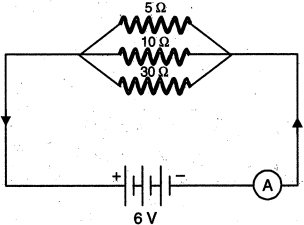
Solution
(N/A) $(i)$ According to Ohm's law,the current $I$ through a resistor is given by $I = V / R$. Since the resistors are connected in parallel,the potential difference across each resistor is the same,i.e.,$V = 6\, V$.
For the $30\, \Omega$ resistor:
$I = 6\, V / 30\, \Omega = 0.2\, A$.
$(ii)$ For a parallel combination of resistors $R_1 = 5\, \Omega$,$R_2 = 10\, \Omega$,and $R_3 = 30\, \Omega$,the equivalent resistance $R_P$ is given by:
$1 / R_P = 1 / R_1 + 1 / R_2 + 1 / R_3$
$1 / R_P = 1 / 5 + 1 / 10 + 1 / 30$
$1 / R_P = (6 + 3 + 1) / 30 = 10 / 30 = 1 / 3$
Therefore,$R_P = 3\, \Omega$.
$(b)$ Two advantages of connecting electrical devices in parallel are:
$(i)$ If one device fails or is switched off,the others continue to work.
$(ii)$ Each device gets the full voltage of the power supply.
For the $30\, \Omega$ resistor:
$I = 6\, V / 30\, \Omega = 0.2\, A$.
$(ii)$ For a parallel combination of resistors $R_1 = 5\, \Omega$,$R_2 = 10\, \Omega$,and $R_3 = 30\, \Omega$,the equivalent resistance $R_P$ is given by:
$1 / R_P = 1 / R_1 + 1 / R_2 + 1 / R_3$
$1 / R_P = 1 / 5 + 1 / 10 + 1 / 30$
$1 / R_P = (6 + 3 + 1) / 30 = 10 / 30 = 1 / 3$
Therefore,$R_P = 3\, \Omega$.
$(b)$ Two advantages of connecting electrical devices in parallel are:
$(i)$ If one device fails or is switched off,the others continue to work.
$(ii)$ Each device gets the full voltage of the power supply.
0 likes
View Solution266
Medium
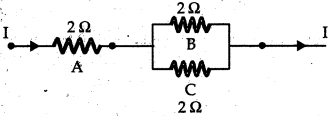
Three $2 \,\Omega$ resistors,$A, B$ and $C,$ are connected as shown in the figure. Each of them dissipates energy and can withstand a maximum power of $18 \,W$ without melting. Find the maximum current $I$ that can flow through the circuit.
Solution
(3 A) The power dissipated by a resistor is given by the formula $P = I^2 R$.
Given that the maximum power each resistor can withstand is $P_{max} = 18 \,W$ and the resistance is $R = 2 \,\Omega$.
First,calculate the maximum current $I_{max}$ that any single resistor can handle:
$I_{max}^2 = P_{max} / R = 18 / 2 = 9$
$I_{max} = \sqrt{9} = 3 \,A$.
In the given circuit,resistor $A$ is in series with the parallel combination of resistors $B$ and $C$.
The total current $I$ flows through resistor $A$. Therefore,the maximum current $I$ that can flow through the circuit is limited by the maximum current capacity of resistor $A$,which is $3 \,A$.
If $I = 3 \,A$ flows through the circuit,then at the parallel junction,the current splits equally between $B$ and $C$ (since $R_B = R_C = 2 \,\Omega$).
Thus,current through $B$ is $I_B = 1.5 \,A$ and current through $C$ is $I_C = 1.5 \,A$.
Since $1.5 \,A < 3 \,A$,both $B$ and $C$ are safe.
Therefore,the maximum current that can flow through the circuit is $3 \,A$.
Given that the maximum power each resistor can withstand is $P_{max} = 18 \,W$ and the resistance is $R = 2 \,\Omega$.
First,calculate the maximum current $I_{max}$ that any single resistor can handle:
$I_{max}^2 = P_{max} / R = 18 / 2 = 9$
$I_{max} = \sqrt{9} = 3 \,A$.
In the given circuit,resistor $A$ is in series with the parallel combination of resistors $B$ and $C$.
The total current $I$ flows through resistor $A$. Therefore,the maximum current $I$ that can flow through the circuit is limited by the maximum current capacity of resistor $A$,which is $3 \,A$.
If $I = 3 \,A$ flows through the circuit,then at the parallel junction,the current splits equally between $B$ and $C$ (since $R_B = R_C = 2 \,\Omega$).
Thus,current through $B$ is $I_B = 1.5 \,A$ and current through $C$ is $I_C = 1.5 \,A$.
Since $1.5 \,A < 3 \,A$,both $B$ and $C$ are safe.
Therefore,the maximum current that can flow through the circuit is $3 \,A$.
0 likes
View Solution267
Medium
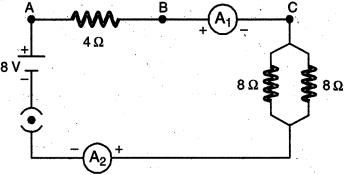
Find out the following in the electric circuit given in the figure:
$(a)$ Effective resistance of two $8\, \Omega$ resistors in the combination.
$(b)$ Current flowing through $4\, \Omega$ resistor.
$(c)$ Potential difference across $4\, \Omega$ resistor.
$(d)$ Power dissipated in $4\, \Omega$ resistor.
$(e)$ Difference in ammeter readings,if any.
$(a)$ Effective resistance of two $8\, \Omega$ resistors in the combination.
$(b)$ Current flowing through $4\, \Omega$ resistor.
$(c)$ Potential difference across $4\, \Omega$ resistor.
$(d)$ Power dissipated in $4\, \Omega$ resistor.
$(e)$ Difference in ammeter readings,if any.
Solution
(N/A) The two $8\, \Omega$ resistors are connected in parallel. Their effective resistance $R_P$ is given by:
$R_P = \frac{R_1 R_2}{R_1 + R_2} = \frac{8 \times 8}{8 + 8} = \frac{64}{16} = 4\, \Omega$
$(b)$ The total resistance of the circuit $R_{eq} = R_{series} + R_P = 4\, \Omega + 4\, \Omega = 8\, \Omega$. The total current $I$ in the circuit is:
$I = \frac{V}{R_{eq}} = \frac{8\, V}{8\, \Omega} = 1\, A$. Since the $4\, \Omega$ resistor is in series with the rest of the circuit,the same current flows through it.
$(c)$ The potential difference $V$ across the $4\, \Omega$ resistor is:
$V = I \times R = 1\, A \times 4\, \Omega = 4\, V$
$(d)$ The power $P$ dissipated in the $4\, \Omega$ resistor is:
$P = I^2 R = (1\, A)^2 \times 4\, \Omega = 4\, W$
$(e)$ There is no difference in the ammeter readings. In a series circuit,the current remains the same at all points,so both ammeters $A_1$ and $A_2$ will show the same reading of $1\, A$.
$R_P = \frac{R_1 R_2}{R_1 + R_2} = \frac{8 \times 8}{8 + 8} = \frac{64}{16} = 4\, \Omega$
$(b)$ The total resistance of the circuit $R_{eq} = R_{series} + R_P = 4\, \Omega + 4\, \Omega = 8\, \Omega$. The total current $I$ in the circuit is:
$I = \frac{V}{R_{eq}} = \frac{8\, V}{8\, \Omega} = 1\, A$. Since the $4\, \Omega$ resistor is in series with the rest of the circuit,the same current flows through it.
$(c)$ The potential difference $V$ across the $4\, \Omega$ resistor is:
$V = I \times R = 1\, A \times 4\, \Omega = 4\, V$
$(d)$ The power $P$ dissipated in the $4\, \Omega$ resistor is:
$P = I^2 R = (1\, A)^2 \times 4\, \Omega = 4\, W$
$(e)$ There is no difference in the ammeter readings. In a series circuit,the current remains the same at all points,so both ammeters $A_1$ and $A_2$ will show the same reading of $1\, A$.
0 likes
View Solution268
MediumMCQ
An electric heater rated $600 \ W$ operates $6$ hours per day. Find the cost to operate it for $30$ days at ₹ $3.00$ per unit.
A
₹ $300$
B
₹ $324$
C
₹ $350$
D
₹ $400$
Solution
(B) Given:
Power $(P)$ = $600 \ W = 0.6 \ kW$
Time $(t)$ = $6 \ hours/day \times 30 \ days = 180 \ hours$
Energy consumed $(E)$ = $P \times t = 0.6 \ kW \times 180 \ h = 108 \ kWh$
Since $1 \ unit = 1 \ kWh$, the total energy consumed is $108 \ units$.
Cost = Energy consumed $\times$ Rate per unit
Cost = $108 \times 3 = ₹ \ 324$.
Power $(P)$ = $600 \ W = 0.6 \ kW$
Time $(t)$ = $6 \ hours/day \times 30 \ days = 180 \ hours$
Energy consumed $(E)$ = $P \times t = 0.6 \ kW \times 180 \ h = 108 \ kWh$
Since $1 \ unit = 1 \ kWh$, the total energy consumed is $108 \ units$.
Cost = Energy consumed $\times$ Rate per unit
Cost = $108 \times 3 = ₹ \ 324$.
0 likes
View Solution269
Medium
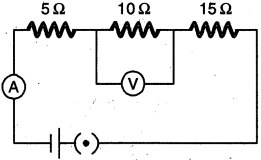
Three resistors of $5 \, \Omega$,$10 \, \Omega$,and $15 \, \Omega$ are connected in series,and the combination is connected to a battery of $30 \, V$. An ammeter and a voltmeter are connected in the circuit. Draw a circuit diagram to connect all the devices in the correct order. What is the current flowing through the circuit and the potential difference across the $10 \, \Omega$ resistor?
Solution
(N/A) The circuit diagram is as shown in the image.
Given:
$R_1 = 5 \, \Omega$,$R_2 = 10 \, \Omega$,$R_3 = 15 \, \Omega$
$V = 30 \, V$
Since the resistors are connected in series,the total resistance $R$ is:
$R = R_1 + R_2 + R_3$
$R = 5 + 10 + 15 = 30 \, \Omega$
The current $I$ flowing through the circuit is given by Ohm's Law:
$I = V / R = 30 \, V / 30 \, \Omega = 1 \, A$
The potential difference $V'$ across the $10 \, \Omega$ resistor is:
$V' = I \times R_2 = 1 \, A \times 10 \, \Omega = 10 \, V$
Given:
$R_1 = 5 \, \Omega$,$R_2 = 10 \, \Omega$,$R_3 = 15 \, \Omega$
$V = 30 \, V$
Since the resistors are connected in series,the total resistance $R$ is:
$R = R_1 + R_2 + R_3$
$R = 5 + 10 + 15 = 30 \, \Omega$
The current $I$ flowing through the circuit is given by Ohm's Law:
$I = V / R = 30 \, V / 30 \, \Omega = 1 \, A$
The potential difference $V'$ across the $10 \, \Omega$ resistor is:
$V' = I \times R_2 = 1 \, A \times 10 \, \Omega = 10 \, V$
0 likes
View Solution270
Difficult
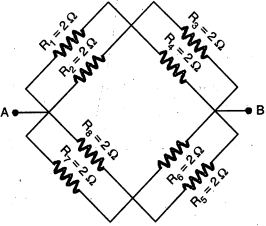
Find the equivalent resistance across the two ends $A$ and $B$ of this circuit.
Solution
(1) From the diagram,we observe that the following pairs of resistors are in parallel:
$R_1$ and $R_2$,$R_3$ and $R_4$,$R_5$ and $R_6$,and $R_7$ and $R_8$.
Since each resistor has a value of $2 \, \Omega$,the equivalent resistance for each parallel pair is:
$\frac{1}{R_{12}} = \frac{1}{R_1} + \frac{1}{R_2} = \frac{1}{2} + \frac{1}{2} = 1 \, \Omega \implies R_{12} = 1 \, \Omega$.
Similarly,$R_{34} = 1 \, \Omega$,$R_{56} = 1 \, \Omega$,and $R_{78} = 1 \, \Omega$.
Now,$R_{12}$ and $R_{34}$ are in series,so their equivalent resistance is:
$R_{1234} = R_{12} + R_{34} = 1 + 1 = 2 \, \Omega$.
Also,$R_{56}$ and $R_{78}$ are in series,so their equivalent resistance is:
$R_{5678} = R_{56} + R_{78} = 1 + 1 = 2 \, \Omega$.
Finally,$R_{1234}$ and $R_{5678}$ are in parallel between points $A$ and $B$. The net resistance $R_{eq}$ is:
$\frac{1}{R_{eq}} = \frac{1}{R_{1234}} + \frac{1}{R_{5678}} = \frac{1}{2} + \frac{1}{2} = 1 \, \Omega^{-1}$.
Therefore,the equivalent resistance is $1 \, \Omega$.
$R_1$ and $R_2$,$R_3$ and $R_4$,$R_5$ and $R_6$,and $R_7$ and $R_8$.
Since each resistor has a value of $2 \, \Omega$,the equivalent resistance for each parallel pair is:
$\frac{1}{R_{12}} = \frac{1}{R_1} + \frac{1}{R_2} = \frac{1}{2} + \frac{1}{2} = 1 \, \Omega \implies R_{12} = 1 \, \Omega$.
Similarly,$R_{34} = 1 \, \Omega$,$R_{56} = 1 \, \Omega$,and $R_{78} = 1 \, \Omega$.
Now,$R_{12}$ and $R_{34}$ are in series,so their equivalent resistance is:
$R_{1234} = R_{12} + R_{34} = 1 + 1 = 2 \, \Omega$.
Also,$R_{56}$ and $R_{78}$ are in series,so their equivalent resistance is:
$R_{5678} = R_{56} + R_{78} = 1 + 1 = 2 \, \Omega$.
Finally,$R_{1234}$ and $R_{5678}$ are in parallel between points $A$ and $B$. The net resistance $R_{eq}$ is:
$\frac{1}{R_{eq}} = \frac{1}{R_{1234}} + \frac{1}{R_{5678}} = \frac{1}{2} + \frac{1}{2} = 1 \, \Omega^{-1}$.
Therefore,the equivalent resistance is $1 \, \Omega$.
0 likes
View Solution271
Medium
An electric oven hot plate is connected to a $200 \, V$ line. It has two resistance coils $A$ and $B$,each of $30 \, \Omega$,which may be used separately,in series,or in parallel. Find the value of the current required in each of the three cases.
Solution
(N/A) Given: Voltage $V = 200 \, V$,Resistance of coil $A$ $(R_A)$ = $30 \, \Omega$,Resistance of coil $B$ $(R_B)$ = $30 \, \Omega$.
$(i)$ When coil $A$ or $B$ is used separately:
$I = V / R = 200 / 30 = 6.67 \, A$.
(ii) When the coils are connected in series:
Total resistance $R_S = R_A + R_B = 30 + 30 = 60 \, \Omega$.
$I_S = V / R_S = 200 / 60 = 3.33 \, A$.
(iii) When the coils are connected in parallel:
Total resistance $1 / R_P = 1 / R_A + 1 / R_B = 1 / 30 + 1 / 30 = 2 / 30 = 1 / 15$.
$R_P = 15 \, \Omega$.
$I_P = V / R_P = 200 / 15 = 13.33 \, A$.
$(i)$ When coil $A$ or $B$ is used separately:
$I = V / R = 200 / 30 = 6.67 \, A$.
(ii) When the coils are connected in series:
Total resistance $R_S = R_A + R_B = 30 + 30 = 60 \, \Omega$.
$I_S = V / R_S = 200 / 60 = 3.33 \, A$.
(iii) When the coils are connected in parallel:
Total resistance $1 / R_P = 1 / R_A + 1 / R_B = 1 / 30 + 1 / 30 = 2 / 30 = 1 / 15$.
$R_P = 15 \, \Omega$.
$I_P = V / R_P = 200 / 15 = 13.33 \, A$.
0 likes
View Solution272
MediumMCQ
An electric heater rated $1200 \ W$ operates $2 \ h$ per day. Find the cost of the energy required to operate it for $30$ days at ₹ $5.00$ per unit.
A
₹ $300$
B
₹ $360$
C
₹ $400$
D
₹ $450$
Solution
(B) Power of the electric heater $= 1200 \ W = 1.2 \ kW$.
Time used per day $= 2 \ h$.
Energy consumed per day $= \text{Power} \times \text{Time} = 1.2 \ kW \times 2 \ h = 2.4 \ kWh$.
Total energy consumed in $30$ days $= 2.4 \ kWh/day \times 30 \ days = 72 \ kWh$.
Since $1 \ kWh = 1 \ \text{unit}$, total energy $= 72 \ \text{units}$.
Cost of energy $= \text{Total units} \times \text{Rate per unit} = 72 \times 5 = ₹ \ 360$.
Time used per day $= 2 \ h$.
Energy consumed per day $= \text{Power} \times \text{Time} = 1.2 \ kW \times 2 \ h = 2.4 \ kWh$.
Total energy consumed in $30$ days $= 2.4 \ kWh/day \times 30 \ days = 72 \ kWh$.
Since $1 \ kWh = 1 \ \text{unit}$, total energy $= 72 \ \text{units}$.
Cost of energy $= \text{Total units} \times \text{Rate per unit} = 72 \times 5 = ₹ \ 360$.
0 likes
View Solution273
Medium
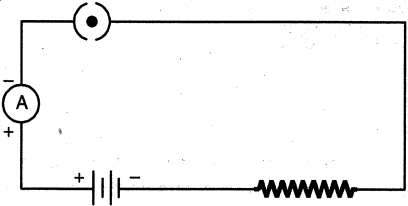
What is meant by an electric circuit? Draw a circuit diagram to show an electric circuit comprising a battery of two cells,a resistor,an ammeter,and a plug key when the circuit is closed.
Solution
(N/A) An electric circuit is a continuous and closed path in which an electric current flows.
The circuit diagram consists of a battery of two cells,a resistor,an ammeter,and a closed plug key connected in series. The ammeter is connected in series with the resistor,and the positive terminal of the battery is connected to the positive terminal of the ammeter.
The circuit diagram consists of a battery of two cells,a resistor,an ammeter,and a closed plug key connected in series. The ammeter is connected in series with the resistor,and the positive terminal of the battery is connected to the positive terminal of the ammeter.
0 likes
View Solution274
Easy
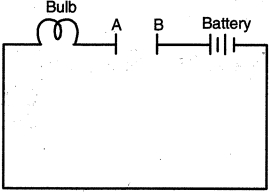
In an experimental set-up as shown below,a piece of silver was placed touching points $A$ and $B$. Next time it was replaced by a piece of wood. In which case did the bulb glow? Give reason to justify the observation.
Solution
(N/A) The bulb will glow only when the piece of silver is placed between points $A$ and $B$.
Silver is a metal and acts as a good conductor of electricity,which completes the electrical circuit and allows current to flow through the bulb.
In contrast,wood is an insulator (a bad conductor of electricity). When a piece of wood is placed between points $A$ and $B$,it breaks the electrical circuit,preventing the flow of current,and therefore the bulb does not glow.
Silver is a metal and acts as a good conductor of electricity,which completes the electrical circuit and allows current to flow through the bulb.
In contrast,wood is an insulator (a bad conductor of electricity). When a piece of wood is placed between points $A$ and $B$,it breaks the electrical circuit,preventing the flow of current,and therefore the bulb does not glow.
0 likes
View Solution275
Medium
What is meant by "electrical resistance" of a conductor? State how the resistance of a conductor is affected when $(i)$ a low current passes through it for a short duration; $(ii)$ a heavy current passes through it for about $30$ seconds.
Solution
(N/A) Electrical resistance is the property of a conductor to oppose the flow of electric current through it.
$(i)$ When a low current passes through a conductor for a short duration, the temperature of the conductor does not change significantly. Therefore, the resistance remains constant.
$(ii)$ When a heavy current passes through a conductor for about $30$ seconds, the conductor heats up due to the heating effect of electric current $(H = I^2Rt)$. Since the resistance of a metallic conductor increases with an increase in temperature, the resistance of the conductor will increase.
$(i)$ When a low current passes through a conductor for a short duration, the temperature of the conductor does not change significantly. Therefore, the resistance remains constant.
$(ii)$ When a heavy current passes through a conductor for about $30$ seconds, the conductor heats up due to the heating effect of electric current $(H = I^2Rt)$. Since the resistance of a metallic conductor increases with an increase in temperature, the resistance of the conductor will increase.
0 likes
View Solution276
Medium
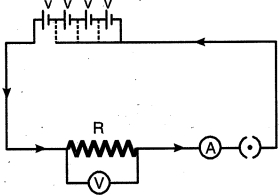
State with the help of a circuit diagram an activity to find the resistance $R$ of a given wire. $A$ current of $0.2 \, A$ passes through a resistor of $20 \, \Omega$. Find the potential difference across its ends.
Solution
(N/A) The circuit diagram is as shown in the image.
Activity to find the resistance $R$:
$1$. Set up a circuit using the wire of resistance $R$,an ammeter,a voltmeter,a plug key,and four cells of $1.5 \, V$ each.
$2$. First,use one cell as the source and note the readings of the ammeter $(I)$ and voltmeter $(V)$.
$3$. Increase the number of cells one by one and note the corresponding readings of $I$ and $V$.
$4$. Calculate the ratio $V/I$ for each set of readings. The average of these ratios gives the resistance $R$ of the wire.
Numerical calculation:
Given: Current $(I) = 0.2 \, A$,Resistance $(R) = 20 \, \Omega$.
Using Ohm's Law: $V = I \times R$
$V = 0.2 \, A \times 20 \, \Omega = 4 \, V$.
Thus,the potential difference across the ends of the resistor is $4 \, V$.
Activity to find the resistance $R$:
$1$. Set up a circuit using the wire of resistance $R$,an ammeter,a voltmeter,a plug key,and four cells of $1.5 \, V$ each.
$2$. First,use one cell as the source and note the readings of the ammeter $(I)$ and voltmeter $(V)$.
$3$. Increase the number of cells one by one and note the corresponding readings of $I$ and $V$.
$4$. Calculate the ratio $V/I$ for each set of readings. The average of these ratios gives the resistance $R$ of the wire.
Numerical calculation:
Given: Current $(I) = 0.2 \, A$,Resistance $(R) = 20 \, \Omega$.
Using Ohm's Law: $V = I \times R$
$V = 0.2 \, A \times 20 \, \Omega = 4 \, V$.
Thus,the potential difference across the ends of the resistor is $4 \, V$.
0 likes
View Solution277
Medium
The table given below provides the resistivity of three samples in $\Omega \cdot m$:
$(a)$ Which of them is a good conductor? Which is an insulator? Why?
$(b)$ $A$ wire of resistance $4 \ \Omega$ is folded on itself to double its thickness. Calculate the new resistance of the wire.
| Sample | Resistivity $(\Omega \cdot m)$ |
| $A$ | $1.6 \times 10^{-8}$ |
| $B$ | $7.5 \times 10^{17}$ |
| $C$ | $44 \times 10^{-6}$ |
$(a)$ Which of them is a good conductor? Which is an insulator? Why?
$(b)$ $A$ wire of resistance $4 \ \Omega$ is folded on itself to double its thickness. Calculate the new resistance of the wire.
Solution
$(A)$ Sample $A$ is a good conductor, and sample $B$ is an insulator.
Metals and alloys typically have low resistivity in the range of $10^{-8} \ \Omega \cdot m$ to $10^{-6} \ \Omega \cdot m$, making them good conductors of electricity. In contrast, insulators possess very high resistivity, typically in the order of $10^{12} \ \Omega \cdot m$ to $10^{17} \ \Omega \cdot m$.
$(b)$ When a wire of resistance $R = 4 \ \Omega$ is folded on itself, its length $l$ becomes $l' = l/2$ and its cross-sectional area $A$ becomes $A' = 2A$.
The resistance formula is $R = \rho (l/A)$.
The new resistance $R'$ is given by:
$R' = \rho (l'/A') = \rho ((l/2) / (2A)) = (1/4) \times \rho (l/A) = R/4$.
Substituting $R = 4 \ \Omega$:
$R' = 4 \ \Omega / 4 = 1 \ \Omega$.
Therefore, the new resistance is $1 \ \Omega$.
Metals and alloys typically have low resistivity in the range of $10^{-8} \ \Omega \cdot m$ to $10^{-6} \ \Omega \cdot m$, making them good conductors of electricity. In contrast, insulators possess very high resistivity, typically in the order of $10^{12} \ \Omega \cdot m$ to $10^{17} \ \Omega \cdot m$.
$(b)$ When a wire of resistance $R = 4 \ \Omega$ is folded on itself, its length $l$ becomes $l' = l/2$ and its cross-sectional area $A$ becomes $A' = 2A$.
The resistance formula is $R = \rho (l/A)$.
The new resistance $R'$ is given by:
$R' = \rho (l'/A') = \rho ((l/2) / (2A)) = (1/4) \times \rho (l/A) = R/4$.
Substituting $R = 4 \ \Omega$:
$R' = 4 \ \Omega / 4 = 1 \ \Omega$.
Therefore, the new resistance is $1 \ \Omega$.
0 likes
View Solution278
Difficult
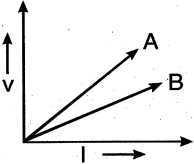
The $V-I$ graphs for two wires $A$ and $B$ are shown in the figure. If we connect both the wires one by one to the same battery, which of the two will produce more heat per unit time? Give justification for your answer.
Solution
(B) The heat produced per unit time is given by the power formula $P = \frac{V^2}{R}$, where $V$ is the potential difference and $R$ is the resistance.
Since both wires are connected to the same battery, $V$ is constant for both.
Therefore, $P \propto \frac{1}{R}$, meaning the wire with lower resistance will produce more heat.
In a $V-I$ graph, the slope represents the resistance $(R = \frac{V}{I})$. The slope of wire $A$ is greater than the slope of wire $B$, which means $R_A > R_B$.
Since $R_B < R_A$, wire $B$ will have a lower resistance and thus will produce more heat per unit time.
Since both wires are connected to the same battery, $V$ is constant for both.
Therefore, $P \propto \frac{1}{R}$, meaning the wire with lower resistance will produce more heat.
In a $V-I$ graph, the slope represents the resistance $(R = \frac{V}{I})$. The slope of wire $A$ is greater than the slope of wire $B$, which means $R_A > R_B$.
Since $R_B < R_A$, wire $B$ will have a lower resistance and thus will produce more heat per unit time.
0 likes
View Solution279
Medium
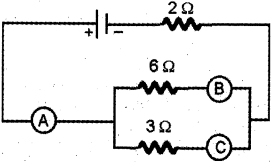
In the figure given below,$A, B$,and $C$ are three ammeters. The ammeter $B$ reads $0.5\, A$. (All the ammeters have negligible resistance.) Calculate:
$(i)$ the readings in the ammeters $A$ and $C$.
$(ii)$ the total resistance of the circuit.
$(i)$ the readings in the ammeters $A$ and $C$.
$(ii)$ the total resistance of the circuit.
Solution
(A) $(i)$ The current in the parallel branches is inversely proportional to the resistance of the branch. The branches containing ammeters $B$ and $C$ have resistances of $6\,\Omega$ and $3\,\Omega$ respectively.
$\frac{\text{Reading of ammeter } C}{\text{Reading of ammeter } B} = \frac{6\,\Omega}{3\,\Omega} = 2$
Therefore,the reading of ammeter $C = 2 \times 0.5\, A = 1.0\, A$.
The reading of ammeter $A$ is the total current in the circuit,which is the sum of currents in the parallel branches:
Reading of ammeter $A = (0.5 + 1.0)\, A = 1.5\, A$.
$(ii)$ Let the total resistance of the circuit be $R$. The circuit consists of a $2\,\Omega$ resistor in series with a parallel combination of $3\,\Omega$ and $6\,\Omega$ resistors.
First,calculate the equivalent resistance of the parallel part $(R_p)$:
$\frac{1}{R_p} = \frac{1}{3} + \frac{1}{6} = \frac{2+1}{6} = \frac{3}{6} = \frac{1}{2}$
$R_p = 2\,\Omega$
Now,the total resistance $R = 2\,\Omega + R_p = 2\,\Omega + 2\,\Omega = 4\,\Omega$.
$\frac{\text{Reading of ammeter } C}{\text{Reading of ammeter } B} = \frac{6\,\Omega}{3\,\Omega} = 2$
Therefore,the reading of ammeter $C = 2 \times 0.5\, A = 1.0\, A$.
The reading of ammeter $A$ is the total current in the circuit,which is the sum of currents in the parallel branches:
Reading of ammeter $A = (0.5 + 1.0)\, A = 1.5\, A$.
$(ii)$ Let the total resistance of the circuit be $R$. The circuit consists of a $2\,\Omega$ resistor in series with a parallel combination of $3\,\Omega$ and $6\,\Omega$ resistors.
First,calculate the equivalent resistance of the parallel part $(R_p)$:
$\frac{1}{R_p} = \frac{1}{3} + \frac{1}{6} = \frac{2+1}{6} = \frac{3}{6} = \frac{1}{2}$
$R_p = 2\,\Omega$
Now,the total resistance $R = 2\,\Omega + R_p = 2\,\Omega + 2\,\Omega = 4\,\Omega$.
0 likes
View Solution280
Medium
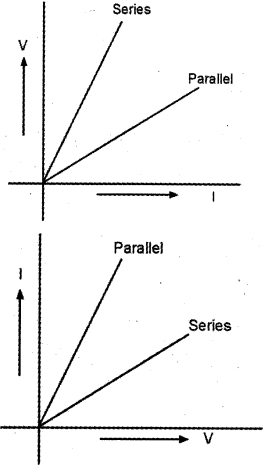
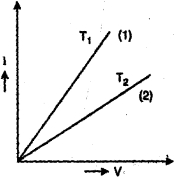
Two students perform experiments on series and parallel combinations of two given resistors $R_{1}$ and $R_{2}$ and plot the following $V-I$ and $I-V$ graphs. Which of the graphs is (are) correctly labelled in terms of the words 'series' and 'parallel'? Justify your answer.
Solution
(A) In a series combination,the equivalent resistance $R_{s} = R_{1} + R_{2}$ is greater than the individual resistances. In a parallel combination,the equivalent resistance $R_{p} = (R_{1}R_{2}) / (R_{1} + R_{2})$ is smaller than the individual resistances.
$1$. For the $V-I$ graph (top): The slope of the graph represents resistance $(R = V/I)$. Since $R_{s} > R_{p}$,the line for 'series' must have a steeper slope than the line for 'parallel'. Thus,the top graph is correctly labelled.
$2$. For the $I-V$ graph (bottom): The slope of the graph represents conductance $(1/R = I/V)$. Since $R_{s} > R_{p}$,the conductance for parallel $(1/R_{p})$ is greater than for series $(1/R_{s})$. Therefore,the line for 'parallel' must have a steeper slope than the line for 'series'. Thus,the bottom graph is also correctly labelled.
Conclusion: Both graphs are correctly labelled.
$1$. For the $V-I$ graph (top): The slope of the graph represents resistance $(R = V/I)$. Since $R_{s} > R_{p}$,the line for 'series' must have a steeper slope than the line for 'parallel'. Thus,the top graph is correctly labelled.
$2$. For the $I-V$ graph (bottom): The slope of the graph represents conductance $(1/R = I/V)$. Since $R_{s} > R_{p}$,the conductance for parallel $(1/R_{p})$ is greater than for series $(1/R_{s})$. Therefore,the line for 'parallel' must have a steeper slope than the line for 'series'. Thus,the bottom graph is also correctly labelled.
Conclusion: Both graphs are correctly labelled.
0 likes
View Solution281
Medium
In a household electric circuit,different appliances are connected in parallel to one another. Give two reasons for this. An electrician puts a fuse of rating $5 \, A$ in that part of a domestic electrical circuit in which an electrical heater of rating $1.5 \, kW, 220 \, V$ is operating. What is likely to happen in this case and why? What change,if any,needs to be made?
Solution
(D) Reasons for parallel connection:
$(i)$ Each appliance receives the same potential difference (voltage) as the supply source.
$(ii)$ If one appliance fails or is switched off,the others continue to operate independently.
$(b)$ Calculation:
Given: Fuse rating $= 5 \, A$,Power $(P) = 1.5 \, kW = 1500 \, W$,Voltage $(V) = 220 \, V$.
Using the formula $I = \frac{P}{V}$:
$I = \frac{1500}{220} \approx 6.82 \, A$.
Since the current required by the heater $(6.82 \, A)$ is greater than the fuse rating $(5 \, A)$,the fuse will melt (blow off) and the circuit will break.
$(c)$ Required change:
$A$ fuse with a higher rating,typically $10 \, A$,should be installed to accommodate the current drawn by the heater.
$(i)$ Each appliance receives the same potential difference (voltage) as the supply source.
$(ii)$ If one appliance fails or is switched off,the others continue to operate independently.
$(b)$ Calculation:
Given: Fuse rating $= 5 \, A$,Power $(P) = 1.5 \, kW = 1500 \, W$,Voltage $(V) = 220 \, V$.
Using the formula $I = \frac{P}{V}$:
$I = \frac{1500}{220} \approx 6.82 \, A$.
Since the current required by the heater $(6.82 \, A)$ is greater than the fuse rating $(5 \, A)$,the fuse will melt (blow off) and the circuit will break.
$(c)$ Required change:
$A$ fuse with a higher rating,typically $10 \, A$,should be installed to accommodate the current drawn by the heater.
0 likes
View Solution282
EasyMCQ
There is a frill of $20$ bulbs connected in series in a room. One bulb gets fused. The remaining $19$ are again joined in series and connected to the same supply. Will the light increase or decrease in the room?
A
Increase
B
Decrease
C
Remain the same
D
Zero
Solution
(A) The light will increase.
In a series circuit,the total resistance $R$ is the sum of the resistances of individual bulbs $(R = R_1 + R_2 + ... + R_{20})$.
The power consumed by the circuit is given by the formula $P = \frac{V^2}{R}$,where $V$ is the supply voltage and $R$ is the total resistance.
When one bulb is removed (or fused),the total resistance of the circuit decreases because there are now only $19$ bulbs in series.
Since the power $P$ is inversely proportional to the resistance $R$ $(P \propto \frac{1}{R})$,a decrease in total resistance leads to an increase in the total power consumed by the remaining bulbs.
Therefore,the brightness of the light in the room will increase.
In a series circuit,the total resistance $R$ is the sum of the resistances of individual bulbs $(R = R_1 + R_2 + ... + R_{20})$.
The power consumed by the circuit is given by the formula $P = \frac{V^2}{R}$,where $V$ is the supply voltage and $R$ is the total resistance.
When one bulb is removed (or fused),the total resistance of the circuit decreases because there are now only $19$ bulbs in series.
Since the power $P$ is inversely proportional to the resistance $R$ $(P \propto \frac{1}{R})$,a decrease in total resistance leads to an increase in the total power consumed by the remaining bulbs.
Therefore,the brightness of the light in the room will increase.
0 likes
View Solution283
Medium
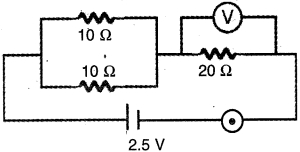
You are given three resistors of $10\, \Omega, 10\, \Omega, 20\, \Omega$,a battery of emf $2.5\, V$,a key,an ammeter,and a voltmeter. Draw a circuit diagram showing the correct connections of the given components such that the voltmeter gives a reading of $2.0\, V$.
Solution
(N/A) To get a reading of $2.0\, V$ across the $20\, \Omega$ resistor,we need to arrange the circuit such that the voltage divider rule provides the desired potential difference.
$1$. Connect the two $10\, \Omega$ resistors in parallel. Their equivalent resistance is $R_p = \frac{10 \times 10}{10 + 10} = 5\, \Omega$.
$2$. Connect this parallel combination $(5\, \Omega)$ in series with the $20\, \Omega$ resistor.
$3$. The total resistance of the circuit is $R_{eq} = 5\, \Omega + 20\, \Omega = 25\, \Omega$.
$4$. The total current in the circuit is $I = \frac{V}{R_{eq}} = \frac{2.5\, V}{25\, \Omega} = 0.1\, A$.
$5$. The voltage across the $20\, \Omega$ resistor is $V = I \times R = 0.1\, A \times 20\, \Omega = 2.0\, V$.
$6$. Thus,the voltmeter should be connected in parallel across the $20\, \Omega$ resistor as shown in the diagram.
$1$. Connect the two $10\, \Omega$ resistors in parallel. Their equivalent resistance is $R_p = \frac{10 \times 10}{10 + 10} = 5\, \Omega$.
$2$. Connect this parallel combination $(5\, \Omega)$ in series with the $20\, \Omega$ resistor.
$3$. The total resistance of the circuit is $R_{eq} = 5\, \Omega + 20\, \Omega = 25\, \Omega$.
$4$. The total current in the circuit is $I = \frac{V}{R_{eq}} = \frac{2.5\, V}{25\, \Omega} = 0.1\, A$.
$5$. The voltage across the $20\, \Omega$ resistor is $V = I \times R = 0.1\, A \times 20\, \Omega = 2.0\, V$.
$6$. Thus,the voltmeter should be connected in parallel across the $20\, \Omega$ resistor as shown in the diagram.
0 likes
View Solution284
EasyMCQ
The electrical resistivity of a few materials is given below in ohm-metre. Which of these materials can be used for making the element of a heating device?
| $A$. $6.84 \times 10^{-8} \, \Omega m$ |
| $B$. $1.60 \times 10^{-8} \, \Omega m$ |
| $C$. $1.00 \times 10^{-4} \, \Omega m$ |
| $D$. $2.50 \times 10^{12} \, \Omega m$ |
| $E$. $4.40 \times 10^{-5} \, \Omega m$ |
| $F$. $2.30 \times 10^{17} \, \Omega m$ |
A
$A$
B
$B$
C
$C$
D
$D$
Solution
(C) Heating elements in devices like toasters, heaters, and irons require materials with high electrical resistivity so that they can generate significant heat when current passes through them (Joule's heating effect, $H = I^2Rt$).
Comparing the given values:
$A$: $6.84 \times 10^{-8} \, \Omega m$ (Conductor)
$B$: $1.60 \times 10^{-8} \, \Omega m$ (Conductor)
$C$: $1.00 \times 10^{-4} \, \Omega m$ (Alloy/Resistive material)
$D$: $2.50 \times 10^{12} \, \Omega m$ (Insulator)
$E$: $4.40 \times 10^{-5} \, \Omega m$ (Alloy/Resistive material)
$F$: $2.30 \times 10^{17} \, \Omega m$ (Insulator)
Materials $C$ and $E$ have significantly higher resistivity compared to conductors like $A$ and $B$, making them suitable for heating elements. Among the options provided, $C$ is a standard choice for such applications.
Comparing the given values:
$A$: $6.84 \times 10^{-8} \, \Omega m$ (Conductor)
$B$: $1.60 \times 10^{-8} \, \Omega m$ (Conductor)
$C$: $1.00 \times 10^{-4} \, \Omega m$ (Alloy/Resistive material)
$D$: $2.50 \times 10^{12} \, \Omega m$ (Insulator)
$E$: $4.40 \times 10^{-5} \, \Omega m$ (Alloy/Resistive material)
$F$: $2.30 \times 10^{17} \, \Omega m$ (Insulator)
Materials $C$ and $E$ have significantly higher resistivity compared to conductors like $A$ and $B$, making them suitable for heating elements. Among the options provided, $C$ is a standard choice for such applications.
0 likes
View Solution285
Medium
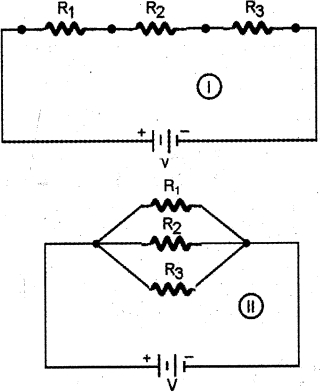
Two electric circuits $I$ and $II$ are shown in the figure.
$(i)$ Which of the two circuits has more resistance?
$(ii)$ Through which circuit does more current pass?
$(iii)$ In which circuit is the potential difference across each resistor equal?
$(i)$ Which of the two circuits has more resistance?
$(ii)$ Through which circuit does more current pass?
$(iii)$ In which circuit is the potential difference across each resistor equal?
Solution
(N/A) $(i)$ The net resistance of a series combination of resistors is greater than the net resistance of a parallel combination of resistors. Therefore,the resistance of circuit $I$ is greater than the resistance of circuit $II$.
$(ii)$ Since current is inversely proportional to resistance for the same potential difference $(I = V/R)$,the current in circuit $II$ is greater than the current in circuit $I$.
$(iii)$ In a parallel circuit,the potential difference across each resistor is equal. Therefore,the potential difference across each resistor in circuit $II$ is equal.
$(ii)$ Since current is inversely proportional to resistance for the same potential difference $(I = V/R)$,the current in circuit $II$ is greater than the current in circuit $I$.
$(iii)$ In a parallel circuit,the potential difference across each resistor is equal. Therefore,the potential difference across each resistor in circuit $II$ is equal.
0 likes
View Solution286
MediumMCQ
Two electric bulbs $A$ and $B$ are marked $220\, V, 60\, W$ and $220\, V, 100\, W$ respectively. Which one of the two has greater resistance?
A
$A$ has greater resistance
B
$B$ has greater resistance
C
Both have equal resistance
D
Resistance cannot be determined
Solution
(A) The resistance $R$ of an electric bulb is calculated using the formula $R = \frac{V^2}{P}$,where $V$ is the voltage and $P$ is the power.
For bulb $A$: $R_A = \frac{220^2}{60} \approx 806.67\, \Omega$.
For bulb $B$: $R_B = \frac{220^2}{100} = 484\, \Omega$.
Since the voltage $V$ is constant for both bulbs,the resistance is inversely proportional to the power $(R \propto \frac{1}{P})$.
Therefore,the bulb with the lower power rating $(60\, W)$ will have a higher resistance.
Thus,bulb $A$ has greater resistance.
For bulb $A$: $R_A = \frac{220^2}{60} \approx 806.67\, \Omega$.
For bulb $B$: $R_B = \frac{220^2}{100} = 484\, \Omega$.
Since the voltage $V$ is constant for both bulbs,the resistance is inversely proportional to the power $(R \propto \frac{1}{P})$.
Therefore,the bulb with the lower power rating $(60\, W)$ will have a higher resistance.
Thus,bulb $A$ has greater resistance.
0 likes
View Solution287
EasyMCQ
The applied potential difference across a given resistor is altered so that the heat produced per second increases by a factor of $16.$ By what factor does the applied potential difference change?
A
$2$
B
$4$
C
$8$
D
$16$
Solution
(B) The heat produced per second in a resistor is given by the power formula $P = \frac{V^2}{R}$,where $V$ is the potential difference and $R$ is the resistance.
Since the resistance $R$ remains constant,the heat produced per second is directly proportional to the square of the potential difference,i.e.,$P \propto V^2$.
If the heat produced per second increases by a factor of $16$,then $P' = 16P$.
Substituting this into the proportionality,we get $16P \propto (V')^2$.
Since $P \propto V^2$,we have $16V^2 = (V')^2$.
Taking the square root of both sides,we get $V' = 4V$.
Therefore,the applied potential difference changes by a factor of $4$.
Since the resistance $R$ remains constant,the heat produced per second is directly proportional to the square of the potential difference,i.e.,$P \propto V^2$.
If the heat produced per second increases by a factor of $16$,then $P' = 16P$.
Substituting this into the proportionality,we get $16P \propto (V')^2$.
Since $P \propto V^2$,we have $16V^2 = (V')^2$.
Taking the square root of both sides,we get $V' = 4V$.
Therefore,the applied potential difference changes by a factor of $4$.
0 likes
View Solution288
EasyMCQ
Two bulbs are marked $60\, W, 220\, V$ and $100\, W, 220\, V$. These are connected in parallel to a $220\, V$ mains. Which one out of the two will glow brighter?
A
$60\, W$ bulb
B
$100\, W$ bulb
C
Both will glow equally
D
None of these
Solution
(B) When bulbs are connected in parallel,the potential difference across each bulb remains the same,which is equal to the supply voltage $(220\, V)$.
The brightness of a bulb depends on the power consumed by it,which is given by the formula $P = V^2 / R$.
Since the voltage $V$ is constant for both bulbs,the power consumed is directly proportional to the rated power of the bulb.
The bulb with the higher wattage rating $(100\, W)$ will consume more power and therefore glow brighter than the $60\, W$ bulb.
The brightness of a bulb depends on the power consumed by it,which is given by the formula $P = V^2 / R$.
Since the voltage $V$ is constant for both bulbs,the power consumed is directly proportional to the rated power of the bulb.
The bulb with the higher wattage rating $(100\, W)$ will consume more power and therefore glow brighter than the $60\, W$ bulb.
0 likes
View Solution289
EasyMCQ
$A$ heater is joined in parallel with a $60\, W$ bulb and connected to the mains. If the $60\, W$ bulb is replaced by a $100\, W$ bulb,will the rate of heat produced by the heater be more,less,or remain the same?
A
More
B
Less
C
Remain the same
D
Cannot be determined
Solution
(C) In a parallel circuit,the voltage across each component remains the same as the supply voltage $(V)$.
The rate of heat produced by a heater is given by the formula $P = V^2 / R$,where $V$ is the voltage and $R$ is the resistance of the heater.
Since the heater is connected in parallel to the mains,its voltage $V$ remains constant regardless of the bulb connected in parallel with it.
Therefore,replacing the $60\, W$ bulb with a $100\, W$ bulb does not change the voltage across the heater.
Consequently,the rate of heat produced by the heater remains the same.
The rate of heat produced by a heater is given by the formula $P = V^2 / R$,where $V$ is the voltage and $R$ is the resistance of the heater.
Since the heater is connected in parallel to the mains,its voltage $V$ remains constant regardless of the bulb connected in parallel with it.
Therefore,replacing the $60\, W$ bulb with a $100\, W$ bulb does not change the voltage across the heater.
Consequently,the rate of heat produced by the heater remains the same.
0 likes
View Solution290
EasyMCQ
Two conductors,one having resistance $R$ and another $2R$ are connected in turn across a $dc$ source. If the rate of heat produced in the two conductors is $Q_{1}$ and $Q_{2}$ respectively,what is the value of $Q_{1} / Q_{2}$?
A
$1:2$
B
$2:1$
C
$1:4$
D
$4:1$
Solution
(B) The rate of heat produced in a conductor is given by the formula $P = \frac{V^2}{R}$,where $V$ is the potential difference and $R$ is the resistance.
Since both conductors are connected across the same $dc$ source,the potential difference $V$ remains constant for both.
Therefore,the rate of heat produced is inversely proportional to the resistance: $Q \propto \frac{1}{R}$.
For the first conductor with resistance $R_1 = R$,the rate of heat is $Q_1 = \frac{V^2}{R}$.
For the second conductor with resistance $R_2 = 2R$,the rate of heat is $Q_2 = \frac{V^2}{2R}$.
Calculating the ratio $Q_1 / Q_2$:
$\frac{Q_1}{Q_2} = \frac{V^2 / R}{V^2 / 2R} = \frac{V^2}{R} \times \frac{2R}{V^2} = 2$.
Thus,the value of $Q_1 / Q_2$ is $2$.
Since both conductors are connected across the same $dc$ source,the potential difference $V$ remains constant for both.
Therefore,the rate of heat produced is inversely proportional to the resistance: $Q \propto \frac{1}{R}$.
For the first conductor with resistance $R_1 = R$,the rate of heat is $Q_1 = \frac{V^2}{R}$.
For the second conductor with resistance $R_2 = 2R$,the rate of heat is $Q_2 = \frac{V^2}{2R}$.
Calculating the ratio $Q_1 / Q_2$:
$\frac{Q_1}{Q_2} = \frac{V^2 / R}{V^2 / 2R} = \frac{V^2}{R} \times \frac{2R}{V^2} = 2$.
Thus,the value of $Q_1 / Q_2$ is $2$.
0 likes
View Solution291
EasyMCQ
Two wires $A$ and $B$ are of the same metal,have the same area of cross-section,and have their lengths in the ratio $2:1$. What will be the ratio of currents flowing through them respectively,when the same potential difference is applied across each of them?
A
$1:2$
B
$2:1$
C
$1:4$
D
$4:1$
Solution
(A) The resistance $R$ of a wire is given by the formula $R = \rho \frac{L}{A}$,where $\rho$ is the resistivity,$L$ is the length,and $A$ is the area of cross-section.
Since both wires are of the same metal,their resistivity $\rho$ is the same. Given that $A$ is the same for both,$R \propto L$.
Therefore,the ratio of resistances is $\frac{R_A}{R_B} = \frac{L_A}{L_B} = \frac{2}{1}$.
According to Ohm's Law,$I = \frac{V}{R}$. Since the potential difference $V$ is the same for both,$I \propto \frac{1}{R}$.
Thus,the ratio of currents is $\frac{I_A}{I_B} = \frac{R_B}{R_A} = \frac{1}{2}$.
Since both wires are of the same metal,their resistivity $\rho$ is the same. Given that $A$ is the same for both,$R \propto L$.
Therefore,the ratio of resistances is $\frac{R_A}{R_B} = \frac{L_A}{L_B} = \frac{2}{1}$.
According to Ohm's Law,$I = \frac{V}{R}$. Since the potential difference $V$ is the same for both,$I \propto \frac{1}{R}$.
Thus,the ratio of currents is $\frac{I_A}{I_B} = \frac{R_B}{R_A} = \frac{1}{2}$.
0 likes
View Solution292
Medium
An electric bulb rated $220 \, V, 60 \, W$ is working at full efficiency. $(i)$ State the resistance of the coil of the bulb. Another identical bulb is connected in series with the first one and the system is connected across the mains as shown below. $(ii)$ State the rate of conversion of energy in each bulb. $(iii)$ Calculate the total power. $(iv)$ What will be the total power if the bulbs are connected in parallel?
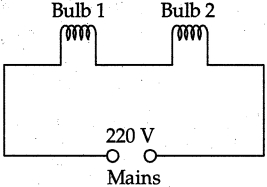
Solution
(N/A) Given: Rated voltage $V = 220 \, V$,Rated power $P = 60 \, W$.
$(i)$ Using the formula $P = \frac{V^2}{R}$,the resistance $R$ of the bulb is:
$R = \frac{V^2}{P} = \frac{(220)^2}{60} = \frac{48400}{60} \approx 806.67 \, \Omega$.
$(ii)$ When two identical bulbs are connected in series,the total resistance $R_T = R + R = 2R = 2 \times 806.67 = 1613.34 \, \Omega$.
The current $I$ flowing through the circuit is $I = \frac{V}{R_T} = \frac{220}{1613.34} \approx 0.136 \, A$.
The rate of energy conversion (power consumed) in each bulb is $P' = I^2 R = (0.136)^2 \times 806.67 \approx 15 \, W$.
$(iii)$ Total power consumed in series connection is $P_{total} = I^2 R_T = (0.136)^2 \times 1613.34 \approx 30 \, W$.
$(iv)$ If the bulbs are connected in parallel,the total power is $P_{total} = P_1 + P_2 = 60 + 60 = 120 \, W$.
$(i)$ Using the formula $P = \frac{V^2}{R}$,the resistance $R$ of the bulb is:
$R = \frac{V^2}{P} = \frac{(220)^2}{60} = \frac{48400}{60} \approx 806.67 \, \Omega$.
$(ii)$ When two identical bulbs are connected in series,the total resistance $R_T = R + R = 2R = 2 \times 806.67 = 1613.34 \, \Omega$.
The current $I$ flowing through the circuit is $I = \frac{V}{R_T} = \frac{220}{1613.34} \approx 0.136 \, A$.
The rate of energy conversion (power consumed) in each bulb is $P' = I^2 R = (0.136)^2 \times 806.67 \approx 15 \, W$.
$(iii)$ Total power consumed in series connection is $P_{total} = I^2 R_T = (0.136)^2 \times 1613.34 \approx 30 \, W$.
$(iv)$ If the bulbs are connected in parallel,the total power is $P_{total} = P_1 + P_2 = 60 + 60 = 120 \, W$.
0 likes
View Solution293
MediumMCQ
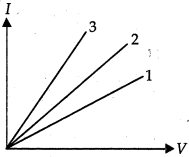
The $I-V$ graph for a given metallic wire at three different temperatures is shown. Which of these represents the highest temperature?
A
$1$
B
$2$
C
$3$
D
All are at the same temperature
Solution
(A) For a metallic wire,the slope of the $I-V$ graph represents the conductance,which is the reciprocal of resistance $(R = V/I)$.
From the graph,the slope is given by $\Delta I / \Delta V = 1/R$.
As the temperature of a metallic conductor increases,its resistance $(R)$ increases.
Since $R$ increases with temperature,the slope $(1/R)$ decreases as the temperature increases.
Therefore,the line with the smallest slope corresponds to the highest temperature.
In the given graph,line $1$ has the smallest slope,so it represents the highest temperature.
From the graph,the slope is given by $\Delta I / \Delta V = 1/R$.
As the temperature of a metallic conductor increases,its resistance $(R)$ increases.
Since $R$ increases with temperature,the slope $(1/R)$ decreases as the temperature increases.
Therefore,the line with the smallest slope corresponds to the highest temperature.
In the given graph,line $1$ has the smallest slope,so it represents the highest temperature.
0 likes
View Solution294
Easy
$A$ potential difference $V$ is applied across a conductor of length $L$ and diameter $D$. How is the resistance $R$ of the conductor affected,when in turn $(i)$ $V$ is halved,$(ii)$ $L$ is halved,and $(iii)$ $D$ is doubled? Justify your answer in each case.
Solution
(A) The resistance $R$ of a conductor is given by the formula $R = \rho \frac{L}{A}$,where $\rho$ is the resistivity,$L$ is the length,and $A$ is the cross-sectional area. The area $A = \pi r^2 = \pi (D/2)^2 = \frac{\pi D^2}{4}$.
$(i)$ When $V$ is halved: The resistance $R$ depends only on the physical dimensions and material properties of the conductor. Therefore,$R$ remains unchanged.
$(ii)$ When $L$ is halved: Since $R \propto L$,if the length $L$ is halved,the resistance $R$ also becomes halved.
$(iii)$ When $D$ is doubled: Since $R \propto \frac{1}{A}$ and $A \propto D^2$,we have $R \propto \frac{1}{D^2}$. If $D$ is doubled,$R$ becomes $\frac{1}{(2)^2} = \frac{1}{4}$ of its original value.
$(i)$ When $V$ is halved: The resistance $R$ depends only on the physical dimensions and material properties of the conductor. Therefore,$R$ remains unchanged.
$(ii)$ When $L$ is halved: Since $R \propto L$,if the length $L$ is halved,the resistance $R$ also becomes halved.
$(iii)$ When $D$ is doubled: Since $R \propto \frac{1}{A}$ and $A \propto D^2$,we have $R \propto \frac{1}{D^2}$. If $D$ is doubled,$R$ becomes $\frac{1}{(2)^2} = \frac{1}{4}$ of its original value.
0 likes
View Solution295
Medium
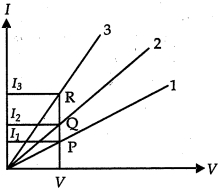
The $I-V$ graphs of two resistors,and their series combination,are shown below. Which one of these graphs represents the series combination of the other two? Give reasons for your answer.
Solution
(A) In an $I-V$ graph,the slope represents the conductance,which is the reciprocal of resistance $(1/R)$.
To determine the series combination,draw a vertical line from any point on the $V$ axis such that it intersects the graphs $1, 2,$ and $3$ at points $P, Q,$ and $R$ respectively,as shown in the provided solution image.
For a constant potential $V$,the currents corresponding to the three graphs are $I_1, I_2,$ and $I_3$.
From the graph,we observe that $I_1 < I_2 < I_3$.
Since $R = V/I$,for a fixed $V$,a smaller current implies a larger resistance. Therefore,$R_1 > R_2 > R_3$.
In a series combination,the equivalent resistance $(R_s = R_a + R_b)$ is always greater than the individual resistances ($R_a$ and $R_b$).
Since graph $1$ has the lowest current for a given potential,it corresponds to the highest resistance. Thus,graph $1$ represents the series combination of the other two resistors (graphs $2$ and $3$).
To determine the series combination,draw a vertical line from any point on the $V$ axis such that it intersects the graphs $1, 2,$ and $3$ at points $P, Q,$ and $R$ respectively,as shown in the provided solution image.
For a constant potential $V$,the currents corresponding to the three graphs are $I_1, I_2,$ and $I_3$.
From the graph,we observe that $I_1 < I_2 < I_3$.
Since $R = V/I$,for a fixed $V$,a smaller current implies a larger resistance. Therefore,$R_1 > R_2 > R_3$.
In a series combination,the equivalent resistance $(R_s = R_a + R_b)$ is always greater than the individual resistances ($R_a$ and $R_b$).
Since graph $1$ has the lowest current for a given potential,it corresponds to the highest resistance. Thus,graph $1$ represents the series combination of the other two resistors (graphs $2$ and $3$).
0 likes
View Solution296
Medium
The voltage-current variation of two metallic wires $X$ and $Y$ at constant temperature are shown below. Assuming that the wires have the same length and the same diameter, explain which of the two wires will have larger resistivity.
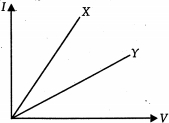
Solution
(B) The graph shows the variation of current $(I)$ on the $y$-axis with respect to voltage $(V)$ on the $x$-axis.
According to Ohm's law, $V = IR$, which implies $I = (1/R)V$.
The slope of the $I-V$ graph is given by $\text{slope} = I/V = 1/R$.
From the graph, the slope of line $X$ is greater than the slope of line $Y$ $(\text{slope}_X > \text{slope}_Y)$.
Since $\text{slope} = 1/R$, this means $1/R_X > 1/R_Y$, which implies $R_X < R_Y$.
Resistance $(R)$ is related to resistivity $(\rho)$ by the formula $R = \rho(L/A)$.
Given that both wires have the same length $(L)$ and the same diameter (and thus the same cross-sectional area $A$), the resistance is directly proportional to the resistivity $(R \propto \rho)$.
Since $R_Y > R_X$, it follows that the resistivity of wire $Y$ is greater than the resistivity of wire $X$ $(\rho_Y > \rho_X)$.
According to Ohm's law, $V = IR$, which implies $I = (1/R)V$.
The slope of the $I-V$ graph is given by $\text{slope} = I/V = 1/R$.
From the graph, the slope of line $X$ is greater than the slope of line $Y$ $(\text{slope}_X > \text{slope}_Y)$.
Since $\text{slope} = 1/R$, this means $1/R_X > 1/R_Y$, which implies $R_X < R_Y$.
Resistance $(R)$ is related to resistivity $(\rho)$ by the formula $R = \rho(L/A)$.
Given that both wires have the same length $(L)$ and the same diameter (and thus the same cross-sectional area $A$), the resistance is directly proportional to the resistivity $(R \propto \rho)$.
Since $R_Y > R_X$, it follows that the resistivity of wire $Y$ is greater than the resistivity of wire $X$ $(\rho_Y > \rho_X)$.
0 likes
View Solution297
Medium
The $V-I$ graphs for two resistors of the same material and the same radii with lengths $L_{1}$ and $L_{2}$ are shown below. If $L_{1} > L_{2}$, state with reason, which of these graphs represents voltage-current change for $L_{1}$?
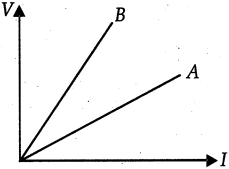
Solution
(B) The resistance $R$ of a conductor is given by $R = \rho \frac{L}{A}$, where $\rho$ is the resistivity, $L$ is the length, and $A$ is the cross-sectional area.
Since both resistors are made of the same material ($\rho$ is constant) and have the same radii ($A$ is constant), the resistance $R$ is directly proportional to the length $L$ $(R \propto L)$.
Given $L_{1} > L_{2}$, it follows that $R_{1} > R_{2}$.
In a $V-I$ graph, the slope represents the resistance $(R = \frac{V}{I} = \text{slope})$. A steeper slope indicates a higher resistance.
Comparing the two graphs, graph $B$ has a greater slope than graph $A$, meaning the resistance of graph $B$ is greater than that of graph $A$.
Since $R_{1} > R_{2}$, graph $B$ corresponds to the longer length $L_{1}$.
Since both resistors are made of the same material ($\rho$ is constant) and have the same radii ($A$ is constant), the resistance $R$ is directly proportional to the length $L$ $(R \propto L)$.
Given $L_{1} > L_{2}$, it follows that $R_{1} > R_{2}$.
In a $V-I$ graph, the slope represents the resistance $(R = \frac{V}{I} = \text{slope})$. A steeper slope indicates a higher resistance.
Comparing the two graphs, graph $B$ has a greater slope than graph $A$, meaning the resistance of graph $B$ is greater than that of graph $A$.
Since $R_{1} > R_{2}$, graph $B$ corresponds to the longer length $L_{1}$.
0 likes
View Solution298
EasyMCQ
No current flows between two charged bodies when connected,if they have the same
A
capacity
B
quantity of charge
C
charge to potential ratio
D
potential
Solution
(D) Electric current is defined as the flow of electric charge from a region of higher potential to a region of lower potential.
When two charged bodies are connected,the flow of charge occurs due to a potential difference between them.
If both bodies have the same potential,there is no potential difference $(V_1 - V_2 = 0)$.
Consequently,no current will flow between the two bodies.
When two charged bodies are connected,the flow of charge occurs due to a potential difference between them.
If both bodies have the same potential,there is no potential difference $(V_1 - V_2 = 0)$.
Consequently,no current will flow between the two bodies.
0 likes
View Solution299
EasyMCQ
If a wire of resistance $R$ is melted and recast to half of its length,then the new resistance of the wire will be
A
$R / 4$
B
$R / 2$
C
$R$
D
$2\, R$
Solution
(A) The resistance of a wire is given by the formula $R = \rho \frac{L}{A}$,where $\rho$ is the resistivity,$L$ is the length,and $A$ is the cross-sectional area.
When the wire is melted and recast to half its length $(L' = L / 2)$,its volume remains constant.
Since $V = A \times L$,we have $A \times L = A' \times L'$.
Substituting $L' = L / 2$,we get $A \times L = A' \times (L / 2)$,which implies $A' = 2A$.
The new resistance $R'$ is given by $R' = \rho \frac{L'}{A'}$.
Substituting the new values: $R' = \rho \frac{L / 2}{2A} = \frac{1}{4} \times \rho \frac{L}{A}$.
Therefore,$R' = R / 4$.
When the wire is melted and recast to half its length $(L' = L / 2)$,its volume remains constant.
Since $V = A \times L$,we have $A \times L = A' \times L'$.
Substituting $L' = L / 2$,we get $A \times L = A' \times (L / 2)$,which implies $A' = 2A$.
The new resistance $R'$ is given by $R' = \rho \frac{L'}{A'}$.
Substituting the new values: $R' = \rho \frac{L / 2}{2A} = \frac{1}{4} \times \rho \frac{L}{A}$.
Therefore,$R' = R / 4$.
0 likes
View Solution300
EasyMCQ
$n$ equal resistors are first connected in series and then connected in parallel. The ratio of the maximum to the minimum resistance is
A
$n$
B
$n^{2}$
C
$1 / n$
D
$1 / n^{2}$
Solution
(B) Let the resistance of each resistor be $R$.
When $n$ resistors are connected in series,the equivalent resistance is $R_{s} = nR$.
When $n$ resistors are connected in parallel,the equivalent resistance is $R_{p} = R / n$.
The ratio of the maximum resistance (series) to the minimum resistance (parallel) is given by:
Ratio $= R_{s} / R_{p} = (nR) / (R / n) = n^{2}$.
When $n$ resistors are connected in series,the equivalent resistance is $R_{s} = nR$.
When $n$ resistors are connected in parallel,the equivalent resistance is $R_{p} = R / n$.
The ratio of the maximum resistance (series) to the minimum resistance (parallel) is given by:
Ratio $= R_{s} / R_{p} = (nR) / (R / n) = n^{2}$.
0 likes
View SolutionElectricity — Mix Examples - Electricity · Frequently Asked Questions
1Are these Electricity questions useful for JEE and NEET?
Yes. All questions in this section are mapped to JEE Main and NEET exam patterns. Previous year questions from JEE Main, NEET, GUJCET and state-level exams are included with full solutions.
2Can I switch to Hindi or Gujarati for these questions?
Yes. Use the language tabs in the hero section or the sidebar to view the same questions and solutions in English, Hindi or Gujarati.
3How do I generate a question paper from this subtopic?
Use the Vedclass Exam Paper Generator — select the chapter and subtopic, set difficulty, and generate Sets A, B, C, D automatically. First 3 chapters of every subject are free.
Vedclass Products
For Students
Vedclass Test Series
Mock tests in real JEE/NEET style with performance analysis. 5-day free trial.
Start Free TrialFor Teachers
Exam Paper Generator
Generate Set A/B/C/D papers from this chapter in 2 minutes. 3 chapters free.
Try FreeFor Institutes
Online Exam Module
Live online exams with unlimited students, 360° analytics & white-label branding.
See DemoFor Teachers & Institutes
Generate a Electricity Exam Paper in 2 Minutes
Select subtopic & difficulty — Sets A, B, C, D auto-generated with No Repeat logic.
First 3 chapters of every subject are free — no payment required.