
A English
Mix Examples - Electricity Questions in English
Class 10 Science · Electricity · Mix Examples - Electricity
449+
Questions
English
Language
100%
With Solutions
Showing 50 of 449 questions in English
151
Easy
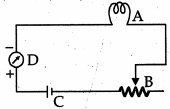
Given below is a circuit showing current flowing in it. Identify each component $A, B, C, D$ of this circuit.
Solution
(N/A) Based on standard circuit symbols:
$A$ represents an electric bulb,which is a load in the circuit.
$B$ represents a rheostat (variable resistor),used to control the current in the circuit.
$C$ represents an electric cell,which acts as the source of potential difference.
$D$ represents an ammeter,which is used to measure the electric current flowing through the circuit.
$A$ represents an electric bulb,which is a load in the circuit.
$B$ represents a rheostat (variable resistor),used to control the current in the circuit.
$C$ represents an electric cell,which acts as the source of potential difference.
$D$ represents an ammeter,which is used to measure the electric current flowing through the circuit.
0 likes
View Solution152
Easy
State the factors on which the heat produced in a current-carrying conductor depends. Give one practical application of this effect.
Solution
(N/A) The heat produced $(H)$ in a current-carrying conductor is given by Joule's Law of Heating: $H = I^2Rt$.
$(i)$ The factors on which the heat produced depends are:
$(a)$ The square of the current flowing through the conductor $(I^2)$.
$(b)$ The resistance of the conductor $(R)$.
$(c)$ The time for which the current flows through the conductor $(t)$.
$(ii)$ $A$ practical application of this heating effect is the electric iron,which converts electrical energy into heat energy to press clothes.
$(i)$ The factors on which the heat produced depends are:
$(a)$ The square of the current flowing through the conductor $(I^2)$.
$(b)$ The resistance of the conductor $(R)$.
$(c)$ The time for which the current flows through the conductor $(t)$.
$(ii)$ $A$ practical application of this heating effect is the electric iron,which converts electrical energy into heat energy to press clothes.
0 likes
View Solution153
Medium
$A$ large number of free electrons are present in metals,yet no current flows in the absence of electric potential across it. Explain the statement with reason.
Solution
(N/A) In metals,free electrons are in a state of random thermal motion. In the absence of an external electric field,the average velocity of these electrons in any given direction is zero,meaning there is no net flow of charge. Current is defined as the rate of flow of charge. For a net flow to occur,an external electric potential difference must be applied across the conductor. This potential difference creates an electric field that exerts a force on the electrons,causing them to drift in a specific direction,thereby establishing an electric current.
0 likes
View Solution154
Easy
How much current will an electric bulb of resistance $1100 \ \Omega$ draw from a $220 \ V$ source? If a heater of resistance $100 \ \Omega$ is connected to the same source instead of the bulb,calculate the current drawn by the heater.
Solution
(0.2 A, 2.2 A) According to Ohm's law,the current $I$ is given by the formula $I = \frac{V}{R}$.
For the electric bulb:
Given,$V = 220 \ V$ and $R = 1100 \ \Omega$.
$I = \frac{220}{1100} = 0.2 \ A$.
For the electric heater:
Given,$V = 220 \ V$ and $R = 100 \ \Omega$.
$I = \frac{220}{100} = 2.2 \ A$.
For the electric bulb:
Given,$V = 220 \ V$ and $R = 1100 \ \Omega$.
$I = \frac{220}{1100} = 0.2 \ A$.
For the electric heater:
Given,$V = 220 \ V$ and $R = 100 \ \Omega$.
$I = \frac{220}{100} = 2.2 \ A$.
0 likes
View Solution155
Easy
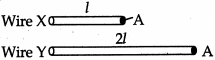
Out of the two wires $X$ and $Y$ shown below,which one has greater resistance? Justify your answer.
Solution
(B) Wire $Y$ has greater resistance.
Resistance $(R)$ of a conductor is given by the formula $R = \rho \frac{l}{A}$,where $\rho$ is the resistivity,$l$ is the length,and $A$ is the cross-sectional area.
Since both wires have the same cross-sectional area $(A)$ and are made of the same material (same $\rho$),the resistance is directly proportional to the length $(l)$ of the wire $(R \propto l)$.
As the length of wire $Y$ $(2l)$ is greater than the length of wire $X$ $(l)$,wire $Y$ has greater resistance.
Resistance $(R)$ of a conductor is given by the formula $R = \rho \frac{l}{A}$,where $\rho$ is the resistivity,$l$ is the length,and $A$ is the cross-sectional area.
Since both wires have the same cross-sectional area $(A)$ and are made of the same material (same $\rho$),the resistance is directly proportional to the length $(l)$ of the wire $(R \propto l)$.
As the length of wire $Y$ $(2l)$ is greater than the length of wire $X$ $(l)$,wire $Y$ has greater resistance.
0 likes
View Solution156
MediumMCQ
If you connect three resistors having values $2 \, \Omega$, $3 \, \Omega$, and $5 \, \Omega$ in parallel, will the value of total resistance be less than $2 \, \Omega$, greater than $5 \, \Omega$, or lie between $2 \, \Omega$ and $5 \, \Omega$? Explain.
A
Less than $2 \, \Omega$
B
Greater than $5 \, \Omega$
C
Between $2 \, \Omega$ and $5 \, \Omega$
D
Equal to $10 \, \Omega$
Solution
(A) In a parallel combination of resistors, the equivalent resistance is always less than the smallest individual resistance in the circuit.
Since the smallest resistor is $2 \, \Omega$, the total resistance must be less than $2 \, \Omega$.
This can be calculated using the formula for parallel resistors:
$\frac{1}{R_p} = \frac{1}{R_1} + \frac{1}{R_2} + \frac{1}{R_3}$
$\frac{1}{R_p} = \frac{1}{2} + \frac{1}{3} + \frac{1}{5}$
$\frac{1}{R_p} = \frac{15 + 10 + 6}{30} = \frac{31}{30}$
$R_p = \frac{30}{31} \approx 0.967 \, \Omega$
Thus, the total resistance is approximately $0.967 \, \Omega$, which is less than $2 \, \Omega$.
Since the smallest resistor is $2 \, \Omega$, the total resistance must be less than $2 \, \Omega$.
This can be calculated using the formula for parallel resistors:
$\frac{1}{R_p} = \frac{1}{R_1} + \frac{1}{R_2} + \frac{1}{R_3}$
$\frac{1}{R_p} = \frac{1}{2} + \frac{1}{3} + \frac{1}{5}$
$\frac{1}{R_p} = \frac{15 + 10 + 6}{30} = \frac{31}{30}$
$R_p = \frac{30}{31} \approx 0.967 \, \Omega$
Thus, the total resistance is approximately $0.967 \, \Omega$, which is less than $2 \, \Omega$.
0 likes
View Solution157
MediumMCQ
Three bulbs of $40\, W$,$60\, W$,and $100\, W$ are connected in series across the mains. Across which bulb is the potential difference highest? Across which is it lowest?
A
$40\, W$ (highest),$100\, W$ (lowest)
B
$100\, W$ (highest),$40\, W$ (lowest)
C
$60\, W$ (highest),$40\, W$ (lowest)
D
$40\, W$ (highest),$60\, W$ (lowest)
Solution
(A) In a series circuit,the current $(I)$ flowing through all components is the same.
According to Ohm's Law,the potential difference $(V)$ across a resistor is given by $V = I \times R$.
Since $I$ is constant,$V$ is directly proportional to the resistance $(R)$: $V \propto R$.
The power rating of a bulb is given by $P = \frac{V^2}{R}$,which implies $R = \frac{V^2}{P}$.
For a fixed voltage rating,the resistance is inversely proportional to the power rating $(R \propto \frac{1}{P})$.
Therefore,the bulb with the lowest wattage $(40\, W)$ has the highest resistance,and the bulb with the highest wattage $(100\, W)$ has the lowest resistance.
Consequently,the potential difference is highest across the $40\, W$ bulb and lowest across the $100\, W$ bulb.
According to Ohm's Law,the potential difference $(V)$ across a resistor is given by $V = I \times R$.
Since $I$ is constant,$V$ is directly proportional to the resistance $(R)$: $V \propto R$.
The power rating of a bulb is given by $P = \frac{V^2}{R}$,which implies $R = \frac{V^2}{P}$.
For a fixed voltage rating,the resistance is inversely proportional to the power rating $(R \propto \frac{1}{P})$.
Therefore,the bulb with the lowest wattage $(40\, W)$ has the highest resistance,and the bulb with the highest wattage $(100\, W)$ has the lowest resistance.
Consequently,the potential difference is highest across the $40\, W$ bulb and lowest across the $100\, W$ bulb.
0 likes
View Solution158
Medium
State the factors on which the resistance of a cylindrical conductor depends. How will the resistance of a conductor change if it is stretched so that its length is doubled?
Solution
(D) The resistance $R$ of a cylindrical conductor depends on the following factors:
$(i)$ Length $(l)$: Resistance is directly proportional to the length $(R \propto l)$.
$(ii)$ Area of cross-section $(A)$: Resistance is inversely proportional to the area of cross-section $(R \propto 1/A)$.
$(iii)$ Nature of the material (resistivity,$\rho$).
$(iv)$ Temperature.
When a conductor is stretched to double its length,its volume remains constant. If the original length is $l$ and the new length is $l' = 2l$,then the new area of cross-section $A'$ will be $A/2$ because $V = A \times l = A' \times l'$.
The new resistance $R'$ is given by:
$R' = \rho \times (l' / A') = \rho \times (2l / (A/2)) = 4 \times (\rho \times l / A) = 4R$.
Thus,the resistance becomes $4$ times the original resistance.
$(i)$ Length $(l)$: Resistance is directly proportional to the length $(R \propto l)$.
$(ii)$ Area of cross-section $(A)$: Resistance is inversely proportional to the area of cross-section $(R \propto 1/A)$.
$(iii)$ Nature of the material (resistivity,$\rho$).
$(iv)$ Temperature.
When a conductor is stretched to double its length,its volume remains constant. If the original length is $l$ and the new length is $l' = 2l$,then the new area of cross-section $A'$ will be $A/2$ because $V = A \times l = A' \times l'$.
The new resistance $R'$ is given by:
$R' = \rho \times (l' / A') = \rho \times (2l / (A/2)) = 4 \times (\rho \times l / A) = 4R$.
Thus,the resistance becomes $4$ times the original resistance.
0 likes
View Solution159
Easy
$(a)$ What material is used in making the filament of an electric bulb?
$(b)$ Name the characteristics which make it suitable for this.
$(b)$ Name the characteristics which make it suitable for this.
Solution
(N/A) The filament of an electric bulb is made of $Tungsten$.
$(b)$ The characteristics that make $Tungsten$ suitable for this purpose are:
$1$. It has a very high melting point (approximately $3380^{\circ}C$),which prevents it from melting even when it becomes white-hot during the emission of light.
$2$. It has high resistivity,which allows it to produce a large amount of heat when an electric current passes through it,enabling it to glow brightly.
$(b)$ The characteristics that make $Tungsten$ suitable for this purpose are:
$1$. It has a very high melting point (approximately $3380^{\circ}C$),which prevents it from melting even when it becomes white-hot during the emission of light.
$2$. It has high resistivity,which allows it to produce a large amount of heat when an electric current passes through it,enabling it to glow brightly.
0 likes
View Solution160
Medium
How are ammeters and voltmeters connected in a circuit? What do they help us measure?
Solution
(N/A) An ammeter is always connected in series with the circuit components. It measures the electric current flowing through the circuit.
$A$ voltmeter is always connected in parallel across the points between which the potential difference is to be measured. It measures the potential difference across a conductor.
$A$ voltmeter is always connected in parallel across the points between which the potential difference is to be measured. It measures the potential difference across a conductor.
0 likes
View Solution161
Easy
The following table provides the resistivity of three samples:
Which of them is suitable for heating elements of electrical appliances and why?
| Sample | $A$ | $B$ | $C$ |
| Resistivity | $1.6 \times 10^{-8} \Omega \cdot m$ | $5.2 \times 10^{-8} \Omega \cdot m$ | $100 \times 10^{-6} \Omega \cdot m$ |
Which of them is suitable for heating elements of electrical appliances and why?
Solution
(C) Sample $C$ is suitable for heating elements of electrical appliances.
Reason: Heating elements require materials with high resistivity so that they can produce a significant amount of heat when an electric current passes through them, according to Joule's Law of heating $(H = I^2Rt)$. Among the given samples, Sample $C$ has the highest resistivity $(100 \times 10^{-6} \Omega \cdot m)$, making it the most efficient choice for generating heat.
Reason: Heating elements require materials with high resistivity so that they can produce a significant amount of heat when an electric current passes through them, according to Joule's Law of heating $(H = I^2Rt)$. Among the given samples, Sample $C$ has the highest resistivity $(100 \times 10^{-6} \Omega \cdot m)$, making it the most efficient choice for generating heat.
0 likes
View Solution162
Medium
$(a)$ Give reasons why tungsten is used for making the filament of electric lamps.
$(b)$ Why are the heating elements of electrical appliances made up of an alloy rather than a pure metal?
$(b)$ Why are the heating elements of electrical appliances made up of an alloy rather than a pure metal?
Solution
(N/A) Tungsten is used for making the filament of electric lamps because:
$(i)$ It has a very high melting point (approximately $3380^{\circ}C$),which allows it to glow at high temperatures without melting.
$(ii)$ It has high resistivity,which allows it to produce a large amount of heat when current passes through it.
$(b)$ Heating elements are made of alloys because:
$(i)$ Alloys have higher resistivity than pure metals,which generates more heat.
$(ii)$ Alloys do not oxidize (burn) easily even at high temperatures,which increases the longevity of the appliance.
$(i)$ It has a very high melting point (approximately $3380^{\circ}C$),which allows it to glow at high temperatures without melting.
$(ii)$ It has high resistivity,which allows it to produce a large amount of heat when current passes through it.
$(b)$ Heating elements are made of alloys because:
$(i)$ Alloys have higher resistivity than pure metals,which generates more heat.
$(ii)$ Alloys do not oxidize (burn) easily even at high temperatures,which increases the longevity of the appliance.
0 likes
View Solution163
Medium
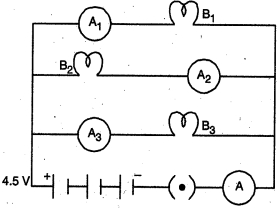
$B_{1}$,$B_{2}$ and $B_{3}$ are three identical bulbs connected as shown in the figure. When all the three bulbs glow,a current of $3 \, A$ is recorded by the ammeter $A$.
$(i)$ What happens to the glow of the other two bulbs when the bulb $B_{1}$ gets fused?
$(ii)$ What happens to the reading of $A_{1}$,$A_{2}$,$A_{3}$ and $A$ when the bulb $B_{2}$ gets fused?
$(i)$ What happens to the glow of the other two bulbs when the bulb $B_{1}$ gets fused?
$(ii)$ What happens to the reading of $A_{1}$,$A_{2}$,$A_{3}$ and $A$ when the bulb $B_{2}$ gets fused?
Solution
(N/A) $(i)$ Since the bulbs are connected in parallel,the potential difference across each bulb remains the same $(4.5 \, V)$. Therefore,if bulb $B_{1}$ fuses,the other two bulbs ($B_{2}$ and $B_{3}$) will continue to glow with the same intensity.
$(ii)$ Initially,the total current $I = 3 \, A$ is divided equally among the three identical bulbs in parallel,so each bulb draws $I_{1} = I_{2} = I_{3} = 1 \, A$.
When bulb $B_{2}$ fuses,it creates an open circuit in its branch,so the current through it becomes zero. Thus,the reading of $A_{2}$ becomes $0 \, A$.
Since $B_{1}$ and $B_{3}$ remain connected in parallel,they still experience the same potential difference and draw $1 \, A$ each. Therefore,$A_{1}$ shows $1 \, A$ and $A_{3}$ shows $1 \, A$.
The total current $A$ recorded by the main ammeter will be the sum of the currents in the remaining branches: $A = 1 \, A + 1 \, A = 2 \, A$.
$(ii)$ Initially,the total current $I = 3 \, A$ is divided equally among the three identical bulbs in parallel,so each bulb draws $I_{1} = I_{2} = I_{3} = 1 \, A$.
When bulb $B_{2}$ fuses,it creates an open circuit in its branch,so the current through it becomes zero. Thus,the reading of $A_{2}$ becomes $0 \, A$.
Since $B_{1}$ and $B_{3}$ remain connected in parallel,they still experience the same potential difference and draw $1 \, A$ each. Therefore,$A_{1}$ shows $1 \, A$ and $A_{3}$ shows $1 \, A$.
The total current $A$ recorded by the main ammeter will be the sum of the currents in the remaining branches: $A = 1 \, A + 1 \, A = 2 \, A$.
0 likes
View Solution164
MediumMCQ
Why do the wires connecting an electric heater to the mains not glow while its heating element does?
A
The connecting wires have high resistance.
B
The heating element has low resistance.
C
The heating element has high resistance,while the connecting wires have negligible resistance.
D
The current flowing through the heating element is higher than the current in the connecting wires.
Solution
(C) The wires of the connecting cord of an electric heater are typically made of copper $(Cu)$,which has extremely low electrical resistance. According to Joule's law of heating,$H = I^2Rt$,the heat produced is directly proportional to the resistance $(R)$. Since the resistance of copper wires is negligible,very little heat is produced,and they do not glow.
Conversely,the heating element is made of an alloy like nichrome,which has a very high electrical resistance. Due to this high resistance,a large amount of heat is generated when current flows through it,causing it to glow red-hot.
Conversely,the heating element is made of an alloy like nichrome,which has a very high electrical resistance. Due to this high resistance,a large amount of heat is generated when current flows through it,causing it to glow red-hot.
0 likes
View Solution165
Medium
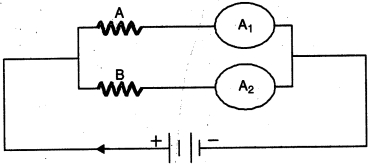
In the circuit diagram shown,the two resistance wires $A$ and $B$ are of the same area of cross-section and same material,but $A$ is longer than $B$. Which ammeter,$A_{1}$ or $A_{2}$,will indicate a higher reading for current? Give a reason.
Solution
(B) Ammeter $A_{2}$ will show a higher reading.
According to the formula for resistance,$R = \rho \frac{l}{A}$,where $\rho$ is the resistivity,$l$ is the length,and $A$ is the area of cross-section.
Since both wires have the same material ($\rho$ is constant) and the same area of cross-section,the resistance is directly proportional to the length $(R \propto l)$.
Given that wire $A$ is longer than wire $B$,the resistance of wire $A$ $(R_{A})$ is greater than the resistance of wire $B$ $(R_{B})$.
According to Ohm's law,$I = \frac{V}{R}$. Since both resistors are connected in parallel,the potential difference $(V)$ across them is the same.
Therefore,current is inversely proportional to resistance $(I \propto \frac{1}{R})$.
Since $R_{A} > R_{B}$,the current flowing through wire $A$ $(I_{A})$ will be less than the current flowing through wire $B$ $(I_{B})$.
Thus,ammeter $A_{2}$ (connected in series with wire $B$) will show a higher reading than ammeter $A_{1}$ (connected in series with wire $A$).
According to the formula for resistance,$R = \rho \frac{l}{A}$,where $\rho$ is the resistivity,$l$ is the length,and $A$ is the area of cross-section.
Since both wires have the same material ($\rho$ is constant) and the same area of cross-section,the resistance is directly proportional to the length $(R \propto l)$.
Given that wire $A$ is longer than wire $B$,the resistance of wire $A$ $(R_{A})$ is greater than the resistance of wire $B$ $(R_{B})$.
According to Ohm's law,$I = \frac{V}{R}$. Since both resistors are connected in parallel,the potential difference $(V)$ across them is the same.
Therefore,current is inversely proportional to resistance $(I \propto \frac{1}{R})$.
Since $R_{A} > R_{B}$,the current flowing through wire $A$ $(I_{A})$ will be less than the current flowing through wire $B$ $(I_{B})$.
Thus,ammeter $A_{2}$ (connected in series with wire $B$) will show a higher reading than ammeter $A_{1}$ (connected in series with wire $A$).
0 likes
View Solution166
Difficult
How would the reading of the voltmeter $(V)$ change if it is connected between points $B$ and $C$? Justify your answer.
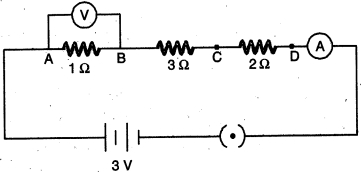
Solution
(N/A) The total resistance of the circuit is $R = R_1 + R_2 + R_3 = 1 \Omega + 3 \Omega + 2 \Omega = 6 \Omega$.
The total current in the circuit is $I = \frac{V}{R} = \frac{3 \text{ V}}{6 \Omega} = 0.5 \text{ A}$.
When the voltmeter is connected between $B$ and $C$,it measures the potential difference across the $3 \Omega$ resistor.
The potential difference across the $3 \Omega$ resistor is $V_{BC} = I \times R_{BC} = 0.5 \text{ A} \times 3 \Omega = 1.5 \text{ V}$.
Initially,the voltmeter was connected across the $1 \Omega$ resistor,measuring $V_{AB} = I \times R_{AB} = 0.5 \text{ A} \times 1 \Omega = 0.5 \text{ V}$.
Therefore,the reading of the voltmeter will increase from $0.5 \text{ V}$ to $1.5 \text{ V}$.
The total current in the circuit is $I = \frac{V}{R} = \frac{3 \text{ V}}{6 \Omega} = 0.5 \text{ A}$.
When the voltmeter is connected between $B$ and $C$,it measures the potential difference across the $3 \Omega$ resistor.
The potential difference across the $3 \Omega$ resistor is $V_{BC} = I \times R_{BC} = 0.5 \text{ A} \times 3 \Omega = 1.5 \text{ V}$.
Initially,the voltmeter was connected across the $1 \Omega$ resistor,measuring $V_{AB} = I \times R_{AB} = 0.5 \text{ A} \times 1 \Omega = 0.5 \text{ V}$.
Therefore,the reading of the voltmeter will increase from $0.5 \text{ V}$ to $1.5 \text{ V}$.
0 likes
View Solution167
Medium
In the circuit diagram shown,the two resistance wires $A$ and $B$ are of the same length and same material,but $A$ is thicker than $B$. Which ammeter,$A_{1}$ or $A_{2}$,will indicate a higher reading for current? Give a reason.
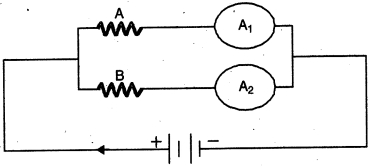
Solution
(A) Ammeter $A_{1}$ will show a higher reading.
Resistance $R$ of a wire is given by the formula $R = \rho \frac{l}{A_{c}}$,where $\rho$ is resistivity,$l$ is length,and $A_{c}$ is the cross-sectional area.
Since wires $A$ and $B$ are of the same material and length,$\rho$ and $l$ are constant.
Therefore,$R \propto \frac{1}{A_{c}}$.
Since wire $A$ is thicker than wire $B$,it has a larger cross-sectional area $(A_{c})$,which means it has lower resistance.
According to Ohm's law,$I = \frac{V}{R}$. Since both wires are connected in parallel,the potential difference $V$ across them is the same.
Because wire $A$ has lower resistance,the current $I$ flowing through it will be higher.
Thus,ammeter $A_{1}$ will show a higher reading.
Resistance $R$ of a wire is given by the formula $R = \rho \frac{l}{A_{c}}$,where $\rho$ is resistivity,$l$ is length,and $A_{c}$ is the cross-sectional area.
Since wires $A$ and $B$ are of the same material and length,$\rho$ and $l$ are constant.
Therefore,$R \propto \frac{1}{A_{c}}$.
Since wire $A$ is thicker than wire $B$,it has a larger cross-sectional area $(A_{c})$,which means it has lower resistance.
According to Ohm's law,$I = \frac{V}{R}$. Since both wires are connected in parallel,the potential difference $V$ across them is the same.
Because wire $A$ has lower resistance,the current $I$ flowing through it will be higher.
Thus,ammeter $A_{1}$ will show a higher reading.
0 likes
View Solution168
Easy
Tungsten is used almost exclusively for filaments of electric bulbs. List two reasons.
Solution
(N/A) $1$. Tungsten has a very high melting point (approximately $3380 ^\circ C$), which allows it to glow at high temperatures without melting.
$2$. It has a high resistance, which allows it to produce a large amount of heat and light when an electric current passes through it.
$2$. It has a high resistance, which allows it to produce a large amount of heat and light when an electric current passes through it.
0 likes
View Solution169
Medium
Three $V-I$ graphs are drawn individually for two resistors and their series combination. Out of $A, B, C$,which one represents the graph for the series combination of the other two? Give a reason for your answer.
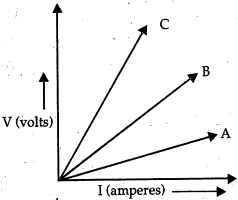
Solution
(C) We know that for a $V-I$ graph,the slope represents the resistance $(R = V/I)$.
In a series combination,the equivalent resistance $(R_s = R_1 + R_2)$ is always greater than the individual resistances ($R_1$ and $R_2$).
Therefore,the graph with the highest slope represents the series combination.
In the given graph,line $C$ has the maximum slope compared to lines $A$ and $B$.
Thus,$C$ represents the series combination of the other two resistors.
In a series combination,the equivalent resistance $(R_s = R_1 + R_2)$ is always greater than the individual resistances ($R_1$ and $R_2$).
Therefore,the graph with the highest slope represents the series combination.
In the given graph,line $C$ has the maximum slope compared to lines $A$ and $B$.
Thus,$C$ represents the series combination of the other two resistors.
0 likes
View Solution170
Easy
Mention the condition under which charges can move in a conductor. Name the device which is used to maintain this condition in an electric circuit.
Solution
(N/A) Charges can move in a conductor only if there is a potential difference across its two ends. This potential difference is necessary to create an electric field that exerts a force on the charges,causing them to flow. The device used to maintain this potential difference in an electric circuit is an electric cell or a battery (a combination of one or more cells).
0 likes
View Solution171
Easy
$(a)$ Name the effect of electric current which is utilised in the working of an electrical fuse.
$(b)$ How is a fuse connected in a domestic circuit?
$(b)$ How is a fuse connected in a domestic circuit?
Solution
(N/A) The electrical fuse works on the heating effect of electric current. When the current exceeds the safe limit,the heat generated melts the fuse wire,breaking the circuit.
$(b)$ An electrical fuse is always connected in series with the live wire of the domestic circuit to protect appliances from high current surges.
$(b)$ An electrical fuse is always connected in series with the live wire of the domestic circuit to protect appliances from high current surges.
0 likes
View Solution172
Medium
$V-I$ graphs for two wires $A$ and $B$ are shown in the figure. If both the wires are made of the same material and are of equal thickness,which of the two is of more length? Give justification for your answer.
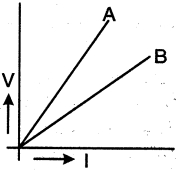
Solution
(A) We know that $V = IR$,which implies $R = V/I$. The slope of the $V-I$ graph represents the resistance $R$ of the wire.
From the given graph,the slope of line $A$ is greater than the slope of line $B$,therefore,the resistance of wire $A$ $(R_A)$ is greater than the resistance of wire $B$ $(R_B)$.
We know that the resistance of a wire is given by the formula $R = \rho \frac{l}{A}$,where $\rho$ is the resistivity,$l$ is the length,and $A$ is the cross-sectional area.
Since both wires are made of the same material,their resistivity $\rho$ is the same. Since they are of equal thickness,their cross-sectional area $A$ is also the same.
Thus,$R \propto l$. Since $R_A > R_B$,it follows that the length of wire $A$ is greater than the length of wire $B$.
From the given graph,the slope of line $A$ is greater than the slope of line $B$,therefore,the resistance of wire $A$ $(R_A)$ is greater than the resistance of wire $B$ $(R_B)$.
We know that the resistance of a wire is given by the formula $R = \rho \frac{l}{A}$,where $\rho$ is the resistivity,$l$ is the length,and $A$ is the cross-sectional area.
Since both wires are made of the same material,their resistivity $\rho$ is the same. Since they are of equal thickness,their cross-sectional area $A$ is also the same.
Thus,$R \propto l$. Since $R_A > R_B$,it follows that the length of wire $A$ is greater than the length of wire $B$.
0 likes
View Solution173
MediumMCQ
What is meant by "electrical resistance" of a conductor? State how the resistance of a conductor is affected when $(i)$ a low current passes through it for a short duration; $(ii)$ a heavy current passes through it for about $30$ seconds.
A
$N/A$
B
$N/A$
C
$N/A$
D
$N/A$
Solution
(N/A) Electrical resistance is the property of a conductor to oppose the flow of electric current through it.
$(i)$ When a low current passes through a conductor for a short duration, the heat generated $(H = I^2Rt)$ is negligible. Therefore, there is no significant rise in temperature, and the resistance remains effectively unchanged.
$(ii)$ When a heavy current passes through a conductor for about $30$ seconds, a significant amount of heat is produced. This leads to a considerable rise in the temperature of the conductor. Since the resistance of most metallic conductors increases with an increase in temperature, the resistance of the conductor will increase.
$(i)$ When a low current passes through a conductor for a short duration, the heat generated $(H = I^2Rt)$ is negligible. Therefore, there is no significant rise in temperature, and the resistance remains effectively unchanged.
$(ii)$ When a heavy current passes through a conductor for about $30$ seconds, a significant amount of heat is produced. This leads to a considerable rise in the temperature of the conductor. Since the resistance of most metallic conductors increases with an increase in temperature, the resistance of the conductor will increase.
0 likes
View Solution174
MediumMCQ
Name and define the $SI$ unit of current. Calculate the number of electrons that flow through a conductor in $1$ second to constitute a current of $1$ ampere. (Charge on an electron $= 1.6 \times 10^{-19} \text{ C}$)
A
Ampere,$6.25 \times 10^{18}$ electrons
B
Coulomb,$1.6 \times 10^{19}$ electrons
C
Volt,$6.25 \times 10^{19}$ electrons
D
Ohm,$1.0 \times 10^{18}$ electrons
Solution
(A) The $SI$ unit of electric current is the ampere $(A)$.
One ampere is defined as the flow of $1$ coulomb of charge per second through a conductor $(1 \text{ A} = 1 \text{ C/s})$.
To calculate the number of electrons $(n)$:
Given: Current $(I)$ = $1 \text{ A}$,Time $(t)$ = $1 \text{ s}$,Charge on an electron $(e)$ = $1.6 \times 10^{-19} \text{ C}$.
Using the formula $Q = I \times t$ and $Q = n \times e$,we get $n = \frac{I \times t}{e}$.
$n = \frac{1 \text{ A} \times 1 \text{ s}}{1.6 \times 10^{-19} \text{ C}} = \frac{1}{1.6} \times 10^{19} = 6.25 \times 10^{18}$.
Thus,$6.25 \times 10^{18}$ electrons flow through the conductor in $1$ second.
One ampere is defined as the flow of $1$ coulomb of charge per second through a conductor $(1 \text{ A} = 1 \text{ C/s})$.
To calculate the number of electrons $(n)$:
Given: Current $(I)$ = $1 \text{ A}$,Time $(t)$ = $1 \text{ s}$,Charge on an electron $(e)$ = $1.6 \times 10^{-19} \text{ C}$.
Using the formula $Q = I \times t$ and $Q = n \times e$,we get $n = \frac{I \times t}{e}$.
$n = \frac{1 \text{ A} \times 1 \text{ s}}{1.6 \times 10^{-19} \text{ C}} = \frac{1}{1.6} \times 10^{19} = 6.25 \times 10^{18}$.
Thus,$6.25 \times 10^{18}$ electrons flow through the conductor in $1$ second.
0 likes
View Solution175
MediumMCQ
Electric current flows through three lamps when arranged in $(a)$ a series and $(b)$ a parallel circuit. If the filament of one lamp breaks,explain what happens to the other two lamps in both cases.
A
In a series circuit,the other two lamps will stop glowing.
B
In a parallel circuit,the other two lamps will continue to glow normally.
C
In a series circuit,the other two lamps will glow brighter.
D
In a parallel circuit,the other two lamps will stop glowing.
Solution
(A) In a series combination,all components are connected in a single path. If the filament of one lamp breaks,the circuit becomes open,and the flow of current is interrupted throughout the entire circuit. Therefore,the other two lamps will stop glowing.
$(b)$ In a parallel combination,each lamp is connected in a separate branch across the power source. If the filament of one lamp breaks,it only affects that specific branch. The other two lamps remain connected to the voltage source and will continue to glow normally.
$(b)$ In a parallel combination,each lamp is connected in a separate branch across the power source. If the filament of one lamp breaks,it only affects that specific branch. The other two lamps remain connected to the voltage source and will continue to glow normally.
0 likes
View Solution176
Medium
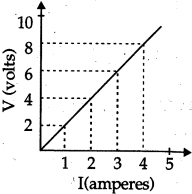
Study the $V - I$ graph for a resistor as shown in the figure and prepare a table showing the values of $I$ (in amperes) corresponding to four different values of $V$ (in volts). Find the value of current $I$ (amperes) for $V=10$ volts. How can we determine the resistance of the resistor from this graph?
Solution
(N/A) Based on the provided $V-I$ graph,we can observe the relationship between voltage $(V)$ and current $(I)$. The table below shows the values of $I$ corresponding to four different values of $V$:
From the graph,when $V = 10 \text{ volts}$,the corresponding value of current $I$ is $5 \text{ amperes}$.
To determine the resistance $(R)$ of the resistor,we use Ohm's Law,which states $R = \frac{V}{I}$. The resistance is equal to the reciprocal of the slope of the $I-V$ graph,or the slope of the $V-I$ graph itself. Using the values from the graph:
$R = \frac{V}{I} = \frac{10 \text{ V}}{5 \text{ A}} = 2 \ \Omega$.
| $V$ (volts) | $2$ | $4$ | $6$ | $8$ |
|---|---|---|---|---|
| $I$ (amperes) | $1$ | $2$ | $3$ | $4$ |
From the graph,when $V = 10 \text{ volts}$,the corresponding value of current $I$ is $5 \text{ amperes}$.
To determine the resistance $(R)$ of the resistor,we use Ohm's Law,which states $R = \frac{V}{I}$. The resistance is equal to the reciprocal of the slope of the $I-V$ graph,or the slope of the $V-I$ graph itself. Using the values from the graph:
$R = \frac{V}{I} = \frac{10 \text{ V}}{5 \text{ A}} = 2 \ \Omega$.
0 likes
View Solution177
MediumMCQ
Find the number of electrons transferred between two points kept at a potential difference of $20 \ V$ if $40 \ J$ of work is done.
A
$1.25 \times 10^{19}$
B
$2.5 \times 10^{19}$
C
$0.5 \times 10^{19}$
D
$1.6 \times 10^{19}$
Solution
(A) Given: Potential difference $(V) = 20 \ V$,Work $(W) = 40 \ J$.
We know that the work done in moving a charge $(Q)$ between two points is given by the formula:
$W = Q \times V$
Substituting the given values:
$40 \ J = Q \times 20 \ V$
$Q = \frac{40 \ J}{20 \ V} = 2 \ C$
We also know that the total charge $(Q)$ is related to the number of electrons $(n)$ by the relation:
$Q = n \times e$
where $e$ is the elementary charge,$e = 1.6 \times 10^{-19} \ C$.
Therefore,the number of electrons $(n)$ is:
$n = \frac{Q}{e} = \frac{2 \ C}{1.6 \times 10^{-19} \ C} = 1.25 \times 10^{19}$
We know that the work done in moving a charge $(Q)$ between two points is given by the formula:
$W = Q \times V$
Substituting the given values:
$40 \ J = Q \times 20 \ V$
$Q = \frac{40 \ J}{20 \ V} = 2 \ C$
We also know that the total charge $(Q)$ is related to the number of electrons $(n)$ by the relation:
$Q = n \times e$
where $e$ is the elementary charge,$e = 1.6 \times 10^{-19} \ C$.
Therefore,the number of electrons $(n)$ is:
$n = \frac{Q}{e} = \frac{2 \ C}{1.6 \times 10^{-19} \ C} = 1.25 \times 10^{19}$
0 likes
View Solution178
Medium
Name and define the $SI$ unit of resistance. Calculate the resistance of a resistor if the current flowing through it is $200\, mA$, when the applied potential difference is $0.8\, V$.
Solution
(A) $(i)$ The $SI$ unit of resistance is $Ohm (\Omega)$.
$(ii)$ One $Ohm$ is defined as the resistance of a conductor such that when a potential difference of $1\, V$ is applied across its ends, a current of $1\, A$ flows through it.
$(iii)$ Given:
$I = 200\, mA = 0.2\, A$
$V = 0.8\, V$
Using Ohm's Law, $V = IR$:
$R = \frac{V}{I}$
$R = \frac{0.8\, V}{0.2\, A}$
$R = 4\, \Omega$
$(ii)$ One $Ohm$ is defined as the resistance of a conductor such that when a potential difference of $1\, V$ is applied across its ends, a current of $1\, A$ flows through it.
$(iii)$ Given:
$I = 200\, mA = 0.2\, A$
$V = 0.8\, V$
Using Ohm's Law, $V = IR$:
$R = \frac{V}{I}$
$R = \frac{0.8\, V}{0.2\, A}$
$R = 4\, \Omega$
0 likes
View Solution179
Medium
$(a)$ Explain why a conductor offers resistance to the flow of current.
$(b)$ Differentiate between conductor,resistor,and resistance.
$(b)$ Differentiate between conductor,resistor,and resistance.
Solution
(N/A) The flow of electric current in a conductor is due to the motion of electrons. These electrons are not completely free to move; they collide with the atoms and ions of the conductor as they drift. These collisions and the electrostatic attraction exerted by the atoms hinder the motion of electrons,which manifests as resistance.
$(b)$ Conductor: $A$ material that allows electric current to flow through it easily due to the presence of free electrons.
Resistor: $A$ component or conductor that has a specific,significant amount of resistance,used to control or limit the flow of current in a circuit.
Resistance: It is the inherent property of a material by virtue of which it opposes the flow of electric current through it.
$(b)$ Conductor: $A$ material that allows electric current to flow through it easily due to the presence of free electrons.
Resistor: $A$ component or conductor that has a specific,significant amount of resistance,used to control or limit the flow of current in a circuit.
Resistance: It is the inherent property of a material by virtue of which it opposes the flow of electric current through it.
0 likes
View Solution180
Medium
$A$ piece of wire of resistance $6 \, \Omega$ is connected to a battery of $12 \, V$. Find the amount of current flowing through it. Now,the same wire is redrawn by stretching it to double its length. Find the resistance of the new (redrawn) wire.
Solution
(D) Given: Resistance $(R) = 6 \, \Omega$,Potential difference $(V) = 12 \, V$.
Using Ohm's law: $V = IR$.
Therefore,current $(I) = \frac{V}{R} = \frac{12 \, V}{6 \, \Omega} = 2 \, A$.
For the second part,the original resistance is $R = \rho \frac{l}{A}$.
When the wire is stretched to double its length,the new length $l' = 2l$. Since the volume of the wire remains constant,$V = A \times l = A' \times l'$.
Thus,$A' = \frac{A \times l}{l'} = \frac{A \times l}{2l} = \frac{A}{2}$.
The new resistance $R' = \rho \frac{l'}{A'} = \rho \frac{2l}{A/2} = 4 \left( \rho \frac{l}{A} \right) = 4R$.
Substituting the original resistance value: $R' = 4 \times 6 \, \Omega = 24 \, \Omega$.
Using Ohm's law: $V = IR$.
Therefore,current $(I) = \frac{V}{R} = \frac{12 \, V}{6 \, \Omega} = 2 \, A$.
For the second part,the original resistance is $R = \rho \frac{l}{A}$.
When the wire is stretched to double its length,the new length $l' = 2l$. Since the volume of the wire remains constant,$V = A \times l = A' \times l'$.
Thus,$A' = \frac{A \times l}{l'} = \frac{A \times l}{2l} = \frac{A}{2}$.
The new resistance $R' = \rho \frac{l'}{A'} = \rho \frac{2l}{A/2} = 4 \left( \rho \frac{l}{A} \right) = 4R$.
Substituting the original resistance value: $R' = 4 \times 6 \, \Omega = 24 \, \Omega$.
0 likes
View Solution181
Medium
$A$ wire of length $L$ and resistance $R$ is stretched so that the length is doubled and area of cross-section is halved. How will its
$(a)$ resistance change?
$(b)$ resistivity change?
$(a)$ resistance change?
$(b)$ resistivity change?
Solution
(A) $R = \rho \frac{L}{A}$
Where $R$ is the resistance and $\rho$ is the resistivity of the material.
Initial length of the wire $= L$. The new length is $L' = 2L$ and the new area of cross-section is $A' = A/2$.
$(a)$ The new resistance $R'$ is given by:
$R' = \rho \frac{L'}{A'} = \rho \frac{2L}{A/2} = 4 \left( \rho \frac{L}{A} \right) = 4R$.
Thus,the resistance becomes $4$ times the original resistance.
$(b)$ Resistivity $(\rho)$ is an intrinsic property of the material and depends only on the nature of the material and temperature. Therefore,it remains unchanged.
Where $R$ is the resistance and $\rho$ is the resistivity of the material.
Initial length of the wire $= L$. The new length is $L' = 2L$ and the new area of cross-section is $A' = A/2$.
$(a)$ The new resistance $R'$ is given by:
$R' = \rho \frac{L'}{A'} = \rho \frac{2L}{A/2} = 4 \left( \rho \frac{L}{A} \right) = 4R$.
Thus,the resistance becomes $4$ times the original resistance.
$(b)$ Resistivity $(\rho)$ is an intrinsic property of the material and depends only on the nature of the material and temperature. Therefore,it remains unchanged.
0 likes
View Solution182
MediumMCQ
$A$ nichrome wire has a resistance of $10\, \Omega$. Find the resistance of another nichrome wire,whose length is three times and area of cross-section four times the first wire.
A
$7.5\, \Omega$
B
$10\, \Omega$
C
$13.33\, \Omega$
D
$15\, \Omega$
Solution
(A) The resistance $(R)$ of a wire is given by the formula $R = \rho \frac{l}{A}$,where $\rho$ is the resistivity,$l$ is the length,and $A$ is the area of cross-section.
For the first wire,$R_1 = 10\, \Omega = \rho \frac{l}{A}$.
For the second wire,the length $l' = 3l$ and the area $A' = 4A$.
The resistance of the second wire is $R_2 = \rho \frac{l'}{A'} = \rho \frac{3l}{4A}$.
Substituting the value of $R_1$ into the equation,we get $R_2 = \frac{3}{4} \times R_1$.
$R_2 = \frac{3}{4} \times 10\, \Omega = 7.5\, \Omega$.
For the first wire,$R_1 = 10\, \Omega = \rho \frac{l}{A}$.
For the second wire,the length $l' = 3l$ and the area $A' = 4A$.
The resistance of the second wire is $R_2 = \rho \frac{l'}{A'} = \rho \frac{3l}{4A}$.
Substituting the value of $R_1$ into the equation,we get $R_2 = \frac{3}{4} \times R_1$.
$R_2 = \frac{3}{4} \times 10\, \Omega = 7.5\, \Omega$.
0 likes
View Solution183
MediumMCQ
$A$ hot plate of an electric oven connected to a $220 \ V$ line has two resistors $A$ and $B$ each of $22 \ \Omega$ resistance. These resistors may be used separately,in series,or in parallel. Find the current flowing in all the three cases.
A
$10 \ A, 5 \ A, 20 \ A$
B
$5 \ A, 10 \ A, 20 \ A$
C
$20 \ A, 10 \ A, 5 \ A$
D
$10 \ A, 20 \ A, 5 \ A$
Solution
(A) Separately: Current $I = \frac{V}{R} = \frac{220 \ V}{22 \ \Omega} = 10 \ A$.
$(b)$ In series: Total resistance $R_s = R_1 + R_2 = 22 \ \Omega + 22 \ \Omega = 44 \ \Omega$.
Therefore,current $I = \frac{V}{R_s} = \frac{220 \ V}{44 \ \Omega} = 5 \ A$.
$(c)$ In parallel: Total resistance $\frac{1}{R_p} = \frac{1}{R_1} + \frac{1}{R_2} = \frac{1}{22} + \frac{1}{22} = \frac{2}{22} = \frac{1}{11} \ \Omega^{-1}$.
Therefore,$R_p = 11 \ \Omega$.
Thus,current $I = \frac{V}{R_p} = \frac{220 \ V}{11 \ \Omega} = 20 \ A$.
$(b)$ In series: Total resistance $R_s = R_1 + R_2 = 22 \ \Omega + 22 \ \Omega = 44 \ \Omega$.
Therefore,current $I = \frac{V}{R_s} = \frac{220 \ V}{44 \ \Omega} = 5 \ A$.
$(c)$ In parallel: Total resistance $\frac{1}{R_p} = \frac{1}{R_1} + \frac{1}{R_2} = \frac{1}{22} + \frac{1}{22} = \frac{2}{22} = \frac{1}{11} \ \Omega^{-1}$.
Therefore,$R_p = 11 \ \Omega$.
Thus,current $I = \frac{V}{R_p} = \frac{220 \ V}{11 \ \Omega} = 20 \ A$.
0 likes
View Solution184
Difficult
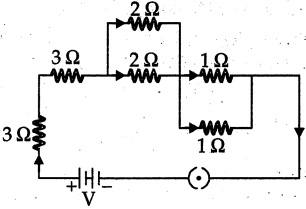
Find the equivalent resistance of the following circuit.
Solution
$(7.5 \, \Omega)$ The circuit consists of resistors in series and parallel combinations.
First, consider the two $2 \, \Omega$ resistors connected in parallel. Let their combined resistance be $R_{P1}$.
$\frac{1}{R_{P1}} = \frac{1}{2} + \frac{1}{2} = 1 \implies R_{P1} = 1 \, \Omega$.
Next, consider the two $1 \, \Omega$ resistors connected in parallel. Let their combined resistance be $R_{P2}$.
$\frac{1}{R_{P2}} = \frac{1}{1} + \frac{1}{1} = 2 \implies R_{P2} = 0.5 \, \Omega$.
Finally, the total equivalent resistance $R$ of the circuit is the sum of the series components:
$R = 3 \, \Omega + 3 \, \Omega + R_{P1} + R_{P2}$
$R = 6 \, \Omega + 1 \, \Omega + 0.5 \, \Omega = 7.5 \, \Omega$.
First, consider the two $2 \, \Omega$ resistors connected in parallel. Let their combined resistance be $R_{P1}$.
$\frac{1}{R_{P1}} = \frac{1}{2} + \frac{1}{2} = 1 \implies R_{P1} = 1 \, \Omega$.
Next, consider the two $1 \, \Omega$ resistors connected in parallel. Let their combined resistance be $R_{P2}$.
$\frac{1}{R_{P2}} = \frac{1}{1} + \frac{1}{1} = 2 \implies R_{P2} = 0.5 \, \Omega$.
Finally, the total equivalent resistance $R$ of the circuit is the sum of the series components:
$R = 3 \, \Omega + 3 \, \Omega + R_{P1} + R_{P2}$
$R = 6 \, \Omega + 1 \, \Omega + 0.5 \, \Omega = 7.5 \, \Omega$.
0 likes
View Solution185
Difficult
Two lamps,one rated $100 \, W$ at $220 \, V$ and the other $60 \, W$ at $220 \, V$,are connected in parallel to a $220 \, V$ supply. Find the current drawn from the supply line.
Solution
(D) The power $P$ and voltage $V$ are given for both lamps. The current $I$ drawn by each lamp can be calculated using the formula $P = VI$,or $I = P/V$.
For the first lamp,$I_1 = P_1 / V = 100 \, W / 220 \, V = 10/22 \, A = 5/11 \, A$.
For the second lamp,$I_2 = P_2 / V = 60 \, W / 220 \, V = 6/22 \, A = 3/11 \, A$.
Since the lamps are connected in parallel,the total current $I$ drawn from the supply is the sum of the individual currents:
$I = I_1 + I_2 = 5/11 \, A + 3/11 \, A = 8/11 \, A$.
$I \approx 0.727 \, A$.
For the first lamp,$I_1 = P_1 / V = 100 \, W / 220 \, V = 10/22 \, A = 5/11 \, A$.
For the second lamp,$I_2 = P_2 / V = 60 \, W / 220 \, V = 6/22 \, A = 3/11 \, A$.
Since the lamps are connected in parallel,the total current $I$ drawn from the supply is the sum of the individual currents:
$I = I_1 + I_2 = 5/11 \, A + 3/11 \, A = 8/11 \, A$.
$I \approx 0.727 \, A$.
0 likes
View Solution186
Medium
An electric kettle of $2 kW$ works for $2 h$ daily. Calculate the $(a)$ energy consumed in $SI$ and commercial units, and $(b)$ cost of running it in the month of June at the rate of ₹ $3.00$ per unit.
Solution
(N/A) Given: Power, $P = 2 kW = 2000 W$, Time, $t = 2 h$ daily.
Energy consumed per day, $E = P \times t = 2 kW \times 2 h = 4 kWh$.
In $SI$ units (Joules): $4 kWh = 4 \times 3.6 \times 10^6 J = 14.4 \times 10^6 J$.
In commercial units: $4 kWh$ (or $4$ units).
$(b)$ Total energy consumed in June ($30$ days):
Total Energy $= 4 kWh/day \times 30 days = 120 kWh$.
Cost of electricity $= 120 \text{ units} \times ₹ 3.00/unit = ₹ 360$.
Energy consumed per day, $E = P \times t = 2 kW \times 2 h = 4 kWh$.
In $SI$ units (Joules): $4 kWh = 4 \times 3.6 \times 10^6 J = 14.4 \times 10^6 J$.
In commercial units: $4 kWh$ (or $4$ units).
$(b)$ Total energy consumed in June ($30$ days):
Total Energy $= 4 kWh/day \times 30 days = 120 kWh$.
Cost of electricity $= 120 \text{ units} \times ₹ 3.00/unit = ₹ 360$.
0 likes
View Solution187
Medium
Two bulbs $A$ and $B$ are rated as $90 \, W - 120 \, V$ and $60 \, W - 120 \, V$ respectively. They are connected in parallel across a $120 \, V$ source. Find the current in each bulb. Which bulb will consume more energy?
Solution
(A) $(i)$ For bulb $A$:
Resistance,$R_{A} = \frac{V^{2}}{P_{A}} = \frac{(120)^{2}}{90} = 160 \, \Omega$.
Therefore,current $I_{A} = \frac{V}{R_{A}} = \frac{120}{160} = 0.75 \, A$.
For bulb $B$:
Resistance,$R_{B} = \frac{V^{2}}{P_{B}} = \frac{(120)^{2}}{60} = 240 \, \Omega$.
Therefore,current $I_{B} = \frac{V}{R_{B}} = \frac{120}{240} = 0.5 \, A$.
$(ii)$ Since the bulbs are connected in parallel to a $120 \, V$ source,each bulb operates at its rated voltage. Bulb $A$ has a higher power rating $(90 \, W)$ compared to bulb $B$ $(60 \, W)$,therefore bulb $A$ will consume more energy.
Resistance,$R_{A} = \frac{V^{2}}{P_{A}} = \frac{(120)^{2}}{90} = 160 \, \Omega$.
Therefore,current $I_{A} = \frac{V}{R_{A}} = \frac{120}{160} = 0.75 \, A$.
For bulb $B$:
Resistance,$R_{B} = \frac{V^{2}}{P_{B}} = \frac{(120)^{2}}{60} = 240 \, \Omega$.
Therefore,current $I_{B} = \frac{V}{R_{B}} = \frac{120}{240} = 0.5 \, A$.
$(ii)$ Since the bulbs are connected in parallel to a $120 \, V$ source,each bulb operates at its rated voltage. Bulb $A$ has a higher power rating $(90 \, W)$ compared to bulb $B$ $(60 \, W)$,therefore bulb $A$ will consume more energy.
0 likes
View Solution188
MediumMCQ
$A$ wire connected to a bulb does not glow,whereas the filament of the bulb glows when the same current is passed through them. Why?
A
The wire has high resistance.
B
The filament has high resistance compared to the connecting wire.
C
The current in the wire is less than in the filament.
D
The wire is made of a different material.
Solution
(B) The filament of the bulb and the connecting wires are connected in series,so the same current flows through both.
According to Joule's law of heating,the heat produced is given by $H = I^2Rt$.
Since the resistance $(R)$ of the connecting wires is negligibly small compared to the resistance of the filament,the heat produced in the wires is negligible.
Conversely,the filament has a high resistance,which leads to a significant amount of heat production,causing it to glow.
Therefore,the bulb glows while the connecting wires remain cool.
According to Joule's law of heating,the heat produced is given by $H = I^2Rt$.
Since the resistance $(R)$ of the connecting wires is negligibly small compared to the resistance of the filament,the heat produced in the wires is negligible.
Conversely,the filament has a high resistance,which leads to a significant amount of heat production,causing it to glow.
Therefore,the bulb glows while the connecting wires remain cool.
0 likes
View Solution189
Medium
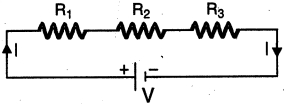
Derive the relation $R = R_{1} + R_{2} + R_{3}$ when three resistors $R_{1}, R_{2}$ and $R_{3}$ are connected in series in an electric circuit.
Solution
(N/A) Consider three resistors of resistances $R_{1}, R_{2}$ and $R_{3}$ connected in series to a cell of potential $V$ as shown in the figure. Since the three resistors are connected in series,the current $I$ flowing through each of them is the same.
By Ohm's law,the potential drop across each resistor is given by:
$V_{1} = IR_{1}, V_{2} = IR_{2}$ and $V_{3} = IR_{3}$
Since $V$ is the total potential in the circuit,by the conservation of energy,we have:
$V = V_{1} + V_{2} + V_{3}$ $...(1)$
Substituting the values of $V_{1}, V_{2}$ and $V_{3}$ in equation $(1)$,we get:
$V = IR_{1} + IR_{2} + IR_{3}$ $...(2)$
If $R_{S}$ is the equivalent resistance of the series combination,then by Ohm's law:
$V = IR_{S}$ $...(3)$
Comparing equations $(2)$ and $(3)$,we have:
$IR_{S} = IR_{1} + IR_{2} + IR_{3}$
Dividing both sides by $I$,we get:
$R_{S} = R_{1} + R_{2} + R_{3}$ $...(4)$
Thus,in a series combination,the equivalent resistance is the sum of the individual resistances.
By Ohm's law,the potential drop across each resistor is given by:
$V_{1} = IR_{1}, V_{2} = IR_{2}$ and $V_{3} = IR_{3}$
Since $V$ is the total potential in the circuit,by the conservation of energy,we have:
$V = V_{1} + V_{2} + V_{3}$ $...(1)$
Substituting the values of $V_{1}, V_{2}$ and $V_{3}$ in equation $(1)$,we get:
$V = IR_{1} + IR_{2} + IR_{3}$ $...(2)$
If $R_{S}$ is the equivalent resistance of the series combination,then by Ohm's law:
$V = IR_{S}$ $...(3)$
Comparing equations $(2)$ and $(3)$,we have:
$IR_{S} = IR_{1} + IR_{2} + IR_{3}$
Dividing both sides by $I$,we get:
$R_{S} = R_{1} + R_{2} + R_{3}$ $...(4)$
Thus,in a series combination,the equivalent resistance is the sum of the individual resistances.
0 likes
View Solution190
Medium
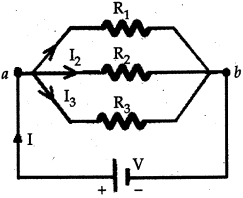
Derive an expression for equivalent resistance when three resistors of resistance $R_{1}, R_{2}$ and $R_{3}$ are connected in parallel.
Solution
(N/A) Consider three resistors $R_{1}, R_{2}$ and $R_{3}$ connected in parallel as shown in the figure.
When the total current $I$ reaches point $a$,it splits into three parts: $I_{1}$ flowing through $R_{1}$,$I_{2}$ flowing through $R_{2}$,and $I_{3}$ flowing through $R_{3}$.
Since charge must be conserved,the total current $I$ entering point $a$ must be equal to the sum of the currents leaving that point. Therefore,we have:
$I = I_{1} + I_{2} + I_{3}$ $...(1)$
Since the resistors are connected in parallel,the potential difference $V$ across each resistor is the same. According to Ohm's law,the current through each resistor is:
$I_{1} = \frac{V}{R_{1}}, I_{2} = \frac{V}{R_{2}}, I_{3} = \frac{V}{R_{3}}$
Substituting these values into equation $(1)$,we get:
$I = \frac{V}{R_{1}} + \frac{V}{R_{2}} + \frac{V}{R_{3}}$ $...(2)$
If $R_{P}$ is the equivalent resistance of the parallel combination,then the total current $I$ can be written as:
$I = \frac{V}{R_{P}}$ $...(3)$
Comparing equations $(2)$ and $(3)$,we have:
$\frac{V}{R_{P}} = \frac{V}{R_{1}} + \frac{V}{R_{2}} + \frac{V}{R_{3}}$
Dividing both sides by $V$,we get the expression for equivalent resistance:
$\frac{1}{R_{P}} = \frac{1}{R_{1}} + \frac{1}{R_{2}} + \frac{1}{R_{3}}$
When the total current $I$ reaches point $a$,it splits into three parts: $I_{1}$ flowing through $R_{1}$,$I_{2}$ flowing through $R_{2}$,and $I_{3}$ flowing through $R_{3}$.
Since charge must be conserved,the total current $I$ entering point $a$ must be equal to the sum of the currents leaving that point. Therefore,we have:
$I = I_{1} + I_{2} + I_{3}$ $...(1)$
Since the resistors are connected in parallel,the potential difference $V$ across each resistor is the same. According to Ohm's law,the current through each resistor is:
$I_{1} = \frac{V}{R_{1}}, I_{2} = \frac{V}{R_{2}}, I_{3} = \frac{V}{R_{3}}$
Substituting these values into equation $(1)$,we get:
$I = \frac{V}{R_{1}} + \frac{V}{R_{2}} + \frac{V}{R_{3}}$ $...(2)$
If $R_{P}$ is the equivalent resistance of the parallel combination,then the total current $I$ can be written as:
$I = \frac{V}{R_{P}}$ $...(3)$
Comparing equations $(2)$ and $(3)$,we have:
$\frac{V}{R_{P}} = \frac{V}{R_{1}} + \frac{V}{R_{2}} + \frac{V}{R_{3}}$
Dividing both sides by $V$,we get the expression for equivalent resistance:
$\frac{1}{R_{P}} = \frac{1}{R_{1}} + \frac{1}{R_{2}} + \frac{1}{R_{3}}$
0 likes
View Solution191
Medium
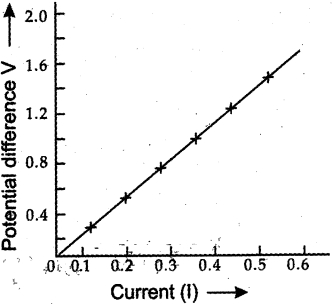
State the formula correlating the electric current flowing in a conductor and the voltage applied across it. Also, show this relationship by drawing a graph. What would be the resistance of a conductor, if the current flowing through it is $0.35 \ A$ when the potential difference across it is $1.4 \ V$?
Solution
(N/A) The relationship is defined by Ohm's Law, which states that: "Provided the physical conditions (like temperature) remain constant, the electric current flowing through a conductor is directly proportional to the potential difference applied across its two ends."
The formula is $V = I \times R$, where $V$ is potential difference, $I$ is current, and $R$ is resistance.
The graph of potential difference $(V)$ versus current $(I)$ is a straight line passing through the origin.
Given:
Potential difference $(V)$ = $1.4 \ V$
Current $(I)$ = $0.35 \ A$
Using Ohm's Law, the resistance $(R)$ is calculated as:
$R = \frac{V}{I}$
$R = \frac{1.4}{0.35}$
$R = 4 \ \Omega$
Thus, the resistance of the conductor is $4 \ \Omega$.
The formula is $V = I \times R$, where $V$ is potential difference, $I$ is current, and $R$ is resistance.
The graph of potential difference $(V)$ versus current $(I)$ is a straight line passing through the origin.
Given:
Potential difference $(V)$ = $1.4 \ V$
Current $(I)$ = $0.35 \ A$
Using Ohm's Law, the resistance $(R)$ is calculated as:
$R = \frac{V}{I}$
$R = \frac{1.4}{0.35}$
$R = 4 \ \Omega$
Thus, the resistance of the conductor is $4 \ \Omega$.
0 likes
View Solution192
Medium
$(a)$ Define the term 'volt'.
$(b)$ State the relation between work,charge,and potential difference for an electric circuit. Calculate the potential difference between the two terminals of a battery,if $100 \ J$ of work is required to transfer $20 \ C$ of charge from one terminal of the battery to the other.
$(b)$ State the relation between work,charge,and potential difference for an electric circuit. Calculate the potential difference between the two terminals of a battery,if $100 \ J$ of work is required to transfer $20 \ C$ of charge from one terminal of the battery to the other.
Solution
(N/A) One volt is defined as the potential difference between two points in a current-carrying conductor when $1 \ J$ of work is done to move a charge of $1 \ C$ from one point to the other.
$(b)$ The relation between potential difference $(V)$,work $(W)$,and charge $(Q)$ is given by the formula: $V = W / Q$.
Given:
Work $(W)$ = $100 \ J$
Charge $(Q)$ = $20 \ C$
Using the formula $V = W / Q$:
$V = 100 \ J / 20 \ C = 5 \ V$.
Therefore,the potential difference between the two terminals of the battery is $5 \ V$.
$(b)$ The relation between potential difference $(V)$,work $(W)$,and charge $(Q)$ is given by the formula: $V = W / Q$.
Given:
Work $(W)$ = $100 \ J$
Charge $(Q)$ = $20 \ C$
Using the formula $V = W / Q$:
$V = 100 \ J / 20 \ C = 5 \ V$.
Therefore,the potential difference between the two terminals of the battery is $5 \ V$.
0 likes
View Solution193
Medium
$(a)$ How is the direction of electric current related to the direction of flow of electrons in a wire?
$(b)$ Calculate the current in a circuit,if $500 \, C$ of charge passes through it in $10$ minutes.
$(b)$ Calculate the current in a circuit,if $500 \, C$ of charge passes through it in $10$ minutes.
Solution
(N/A) The direction of electric current is conventionally defined as opposite to the direction of the flow of electrons in a wire.
$(b)$ Given:
Charge $(Q) = 500 \, C$
Time $(t) = 10 \, \text{minutes} = 10 \times 60 \, \text{s} = 600 \, \text{s}$
Using the formula for electric current:
$I = \frac{Q}{t}$
$I = \frac{500 \, C}{600 \, \text{s}}$
$I = 0.833 \, \text{A}$
Therefore,the current in the circuit is approximately $0.833 \, \text{A}$.
$(b)$ Given:
Charge $(Q) = 500 \, C$
Time $(t) = 10 \, \text{minutes} = 10 \times 60 \, \text{s} = 600 \, \text{s}$
Using the formula for electric current:
$I = \frac{Q}{t}$
$I = \frac{500 \, C}{600 \, \text{s}}$
$I = 0.833 \, \text{A}$
Therefore,the current in the circuit is approximately $0.833 \, \text{A}$.
0 likes
View Solution194
Medium
Define electric current and state its $SI$ unit. With the help of $Ohm's$ law,explain the meaning of $1$ ohm resistance.
Solution
(N/A) Electric current is defined as the rate of flow of electric charge through a conductor.
The $SI$ unit of electric current is the ampere $(A)$.
According to $Ohm's$ law,$V = I \times R$,where $V$ is the potential difference,$I$ is the current,and $R$ is the resistance.
From this,$R = V / I$.
If the potential difference across a conductor is $1$ volt and the current flowing through it is $1$ ampere,then the resistance $R$ is given by $R = 1 \text{ volt} / 1 \text{ ampere} = 1 \text{ ohm } (\Omega)$.
Thus,$1$ ohm is defined as the resistance of a conductor when a potential difference of $1$ volt applied across its ends causes a current of $1$ ampere to flow through it.
The $SI$ unit of electric current is the ampere $(A)$.
According to $Ohm's$ law,$V = I \times R$,where $V$ is the potential difference,$I$ is the current,and $R$ is the resistance.
From this,$R = V / I$.
If the potential difference across a conductor is $1$ volt and the current flowing through it is $1$ ampere,then the resistance $R$ is given by $R = 1 \text{ volt} / 1 \text{ ampere} = 1 \text{ ohm } (\Omega)$.
Thus,$1$ ohm is defined as the resistance of a conductor when a potential difference of $1$ volt applied across its ends causes a current of $1$ ampere to flow through it.
0 likes
View Solution195
Medium
$(a)$ What is the total resistance of $n$ resistors each of resistance $R$ connected in:
$(i)$ series?
$(ii)$ parallel?
$(b)$ Calculate the resultant resistance of $3$ resistors $3 \ \Omega, 4 \ \Omega$,and $12 \ \Omega$ connected in parallel.
$(i)$ series?
$(ii)$ parallel?
$(b)$ Calculate the resultant resistance of $3$ resistors $3 \ \Omega, 4 \ \Omega$,and $12 \ \Omega$ connected in parallel.
Solution
(N/A) In a series combination,the total resistance is the sum of individual resistances:
$R_{S} = R + R + \dots + R \ (n \ \text{times}) = nR$
In a parallel combination,the reciprocal of the total resistance is the sum of the reciprocals of individual resistances:
$\frac{1}{R_{P}} = \frac{1}{R} + \frac{1}{R} + \dots + \frac{1}{R} \ (n \ \text{times}) = \frac{n}{R}$
Therefore,$R_{P} = \frac{R}{n}$
$(b)$ For resistors connected in parallel,the resultant resistance $R_{P}$ is given by:
$\frac{1}{R_{P}} = \frac{1}{R_{1}} + \frac{1}{R_{2}} + \frac{1}{R_{3}}$
$\frac{1}{R_{P}} = \frac{1}{3} + \frac{1}{4} + \frac{1}{12}$
Taking the least common multiple $(LCM)$ of $3, 4$,and $12$,which is $12$:
$\frac{1}{R_{P}} = \frac{4 + 3 + 1}{12} = \frac{8}{12} = \frac{2}{3}$
$R_{P} = \frac{3}{2} = 1.5 \ \Omega$
$R_{S} = R + R + \dots + R \ (n \ \text{times}) = nR$
In a parallel combination,the reciprocal of the total resistance is the sum of the reciprocals of individual resistances:
$\frac{1}{R_{P}} = \frac{1}{R} + \frac{1}{R} + \dots + \frac{1}{R} \ (n \ \text{times}) = \frac{n}{R}$
Therefore,$R_{P} = \frac{R}{n}$
$(b)$ For resistors connected in parallel,the resultant resistance $R_{P}$ is given by:
$\frac{1}{R_{P}} = \frac{1}{R_{1}} + \frac{1}{R_{2}} + \frac{1}{R_{3}}$
$\frac{1}{R_{P}} = \frac{1}{3} + \frac{1}{4} + \frac{1}{12}$
Taking the least common multiple $(LCM)$ of $3, 4$,and $12$,which is $12$:
$\frac{1}{R_{P}} = \frac{4 + 3 + 1}{12} = \frac{8}{12} = \frac{2}{3}$
$R_{P} = \frac{3}{2} = 1.5 \ \Omega$
0 likes
View Solution196
Medium
$(a)$ State $Ohm's$ law. Express it mathematically.
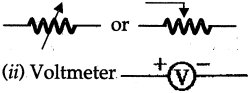
$(b)$ Write symbols used in electric circuits to represent:
$(i)$ Variable resistance.
$(ii)$ Voltmeter.
$(c)$ An electric bulb is rated $220 \, V$ and $100 \, W$. When it is operated on $110 \, V$,what will be the power consumed?
$(b)$ Write symbols used in electric circuits to represent:
$(i)$ Variable resistance.
$(ii)$ Voltmeter.
$(c)$ An electric bulb is rated $220 \, V$ and $100 \, W$. When it is operated on $110 \, V$,what will be the power consumed?
Solution
(N/A) $Ohm's$ law states that the current flowing through a conductor is directly proportional to the potential difference across its ends,provided the temperature and other physical conditions remain constant.
Mathematically: $V = IR$,where $V$ is potential difference,$I$ is current,and $R$ is resistance.
$(b)$ $(i)$ Variable resistance: Represented by a resistor symbol with an arrow or a sliding contact.
$(ii)$ Voltmeter: Represented by a circle with a '$V$' inside,having positive and negative terminals.
$(c)$ Given: Rated power $P = 100 \, W$,Rated voltage $V = 220 \, V$.
First,calculate the resistance of the bulb:
$R = \frac{V^2}{P} = \frac{(220)^2}{100} = \frac{48400}{100} = 484 \, \Omega$.
Now,calculate the power consumed at $V_1 = 110 \, V$:
$P_{new} = \frac{V_1^2}{R} = \frac{(110)^2}{484} = \frac{12100}{484} = 25 \, W$.
The power consumed will be $25 \, W$.
Mathematically: $V = IR$,where $V$ is potential difference,$I$ is current,and $R$ is resistance.
$(b)$ $(i)$ Variable resistance: Represented by a resistor symbol with an arrow or a sliding contact.
$(ii)$ Voltmeter: Represented by a circle with a '$V$' inside,having positive and negative terminals.
$(c)$ Given: Rated power $P = 100 \, W$,Rated voltage $V = 220 \, V$.
First,calculate the resistance of the bulb:
$R = \frac{V^2}{P} = \frac{(220)^2}{100} = \frac{48400}{100} = 484 \, \Omega$.
Now,calculate the power consumed at $V_1 = 110 \, V$:
$P_{new} = \frac{V_1^2}{R} = \frac{(110)^2}{484} = \frac{12100}{484} = 25 \, W$.
The power consumed will be $25 \, W$.
0 likes
View Solution197
MediumMCQ
Two conducting wires of the same material,equal length,and equal diameter are connected in series. How does the heat produced by the combination of resistance change?
A
It becomes double the heat produced by a single wire.
B
It becomes half the heat produced by a single wire.
C
It remains the same.
D
It becomes four times the heat produced by a single wire.
Solution
(B) Let the resistance of each wire be $R$.
When connected in series,the total resistance is $R_{S} = R + R = 2R$.
The heat produced by the series combination is given by $H = \frac{V^{2}}{R_{S}} t = \frac{V^{2}}{2R} t$.
The heat produced by an individual resistor (if connected alone to the same voltage source) is $H' = \frac{V^{2}}{R} t$.
Comparing the two,we find $H = \frac{1}{2} \left( \frac{V^{2}}{R} t \right) = \frac{H'}{2}$.
Thus,the heat produced by the series combination is half the heat produced by a single wire.
When connected in series,the total resistance is $R_{S} = R + R = 2R$.
The heat produced by the series combination is given by $H = \frac{V^{2}}{R_{S}} t = \frac{V^{2}}{2R} t$.
The heat produced by an individual resistor (if connected alone to the same voltage source) is $H' = \frac{V^{2}}{R} t$.
Comparing the two,we find $H = \frac{1}{2} \left( \frac{V^{2}}{R} t \right) = \frac{H'}{2}$.
Thus,the heat produced by the series combination is half the heat produced by a single wire.
0 likes
View Solution198
Medium
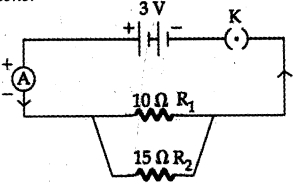
Study the following circuit and answer the following questions:
$(i)$ State the type of combination of the two resistors in the circuit.
$(ii)$ How much current would flow through:
$(a)$ $10 \, \Omega$ resistor and
$(b)$ $15 \, \Omega$ resistor?
$(iii)$ What would be the ammeter reading?
$(i)$ State the type of combination of the two resistors in the circuit.
$(ii)$ How much current would flow through:
$(a)$ $10 \, \Omega$ resistor and
$(b)$ $15 \, \Omega$ resistor?
$(iii)$ What would be the ammeter reading?
Solution
(N/A) $(i)$ The two resistors are connected in a parallel combination because both ends of the resistors are connected to the same two points in the circuit.
$(ii)$ According to Ohm's law,$I = \frac{V}{R}$. Since the resistors are in parallel,the potential difference $(V)$ across each resistor is $3 \, V$.
$(a)$ Current through the $10 \, \Omega$ resistor: $I_1 = \frac{V}{R_1} = \frac{3 \, V}{10 \, \Omega} = 0.3 \, A$.
$(b)$ Current through the $15 \, \Omega$ resistor: $I_2 = \frac{V}{R_2} = \frac{3 \, V}{15 \, \Omega} = 0.2 \, A$.
$(iii)$ The ammeter measures the total current $(I)$ flowing through the circuit,which is the sum of the currents through the individual branches:
$I = I_1 + I_2 = 0.3 \, A + 0.2 \, A = 0.5 \, A$.
Therefore,the ammeter reading is $0.5 \, A$.
$(ii)$ According to Ohm's law,$I = \frac{V}{R}$. Since the resistors are in parallel,the potential difference $(V)$ across each resistor is $3 \, V$.
$(a)$ Current through the $10 \, \Omega$ resistor: $I_1 = \frac{V}{R_1} = \frac{3 \, V}{10 \, \Omega} = 0.3 \, A$.
$(b)$ Current through the $15 \, \Omega$ resistor: $I_2 = \frac{V}{R_2} = \frac{3 \, V}{15 \, \Omega} = 0.2 \, A$.
$(iii)$ The ammeter measures the total current $(I)$ flowing through the circuit,which is the sum of the currents through the individual branches:
$I = I_1 + I_2 = 0.3 \, A + 0.2 \, A = 0.5 \, A$.
Therefore,the ammeter reading is $0.5 \, A$.
0 likes
View Solution199
Medium
$(a)$ Why are copper or aluminium wires generally used for electrical transmission and distribution purposes?
$(b)$ Two wires,one of copper and the other of manganin,have equal lengths and equal resistances. Which wire is thicker? Given that the resistivity of copper is lower than that of manganin.
$(b)$ Two wires,one of copper and the other of manganin,have equal lengths and equal resistances. Which wire is thicker? Given that the resistivity of copper is lower than that of manganin.
Solution
(B) Copper and aluminium are used because they have low electrical resistivity,which results in low resistance and minimal energy loss during transmission. Additionally,they are highly ductile,allowing them to be easily drawn into thin wires.
$(b)$ The resistance of a wire is given by the formula $R = \frac{\rho L}{A}$,where $\rho$ is resistivity,$L$ is length,and $A$ is the cross-sectional area.
Since $R$ and $L$ are equal for both wires,we have $A = \frac{\rho L}{R}$,which implies $A \propto \rho$.
Given that the resistivity of manganin is higher than that of copper $(\rho_{\text{manganin}} > \rho_{\text{copper}})$,it follows that the cross-sectional area of the manganin wire must be greater than that of the copper wire $(A_{\text{manganin}} > A_{\text{copper}})$.
Therefore,the manganin wire is thicker.
$(b)$ The resistance of a wire is given by the formula $R = \frac{\rho L}{A}$,where $\rho$ is resistivity,$L$ is length,and $A$ is the cross-sectional area.
Since $R$ and $L$ are equal for both wires,we have $A = \frac{\rho L}{R}$,which implies $A \propto \rho$.
Given that the resistivity of manganin is higher than that of copper $(\rho_{\text{manganin}} > \rho_{\text{copper}})$,it follows that the cross-sectional area of the manganin wire must be greater than that of the copper wire $(A_{\text{manganin}} > A_{\text{copper}})$.
Therefore,the manganin wire is thicker.
0 likes
View Solution200
MediumMCQ
$(a)$ $A$ Nichrome wire of length $L$ and radius $r$ has a resistance of $10 \, \Omega$. How would the resistance of the wire change when:
$(i)$ only the length of the wire is doubled?
$(ii)$ only the diameter of the wire is doubled? Justify your answer.
$(b)$ Why are the elements of electrical heating devices made up of alloys?
$(i)$ only the length of the wire is doubled?
$(ii)$ only the diameter of the wire is doubled? Justify your answer.
$(b)$ Why are the elements of electrical heating devices made up of alloys?
A
$N$/$A$
B
$N$/$A$
C
$N$/$A$
D
$N$/$A$
Solution
(N/A) $(i)$ The resistance $R$ of a wire is directly proportional to its length $L$ $(R \propto L)$. When the length is doubled,the resistance also becomes double. Therefore,the new resistance is $2 \times 10 \, \Omega = 20 \, \Omega$.
$(ii)$ The resistance $R$ is inversely proportional to the square of the diameter $D$ $(R \propto 1/D^2)$. When the diameter is doubled,the resistance becomes $1/4$ of its original value. Therefore,the new resistance is $10/4 \, \Omega = 2.5 \, \Omega$.
$(b)$ The heating elements of electrical devices are made of alloys because alloys have a much higher resistivity than their constituent metals. Furthermore,alloys do not oxidize (burn) readily even at high temperatures,which increases the durability and efficiency of the heating element.
$(ii)$ The resistance $R$ is inversely proportional to the square of the diameter $D$ $(R \propto 1/D^2)$. When the diameter is doubled,the resistance becomes $1/4$ of its original value. Therefore,the new resistance is $10/4 \, \Omega = 2.5 \, \Omega$.
$(b)$ The heating elements of electrical devices are made of alloys because alloys have a much higher resistivity than their constituent metals. Furthermore,alloys do not oxidize (burn) readily even at high temperatures,which increases the durability and efficiency of the heating element.
0 likes
View SolutionElectricity — Mix Examples - Electricity · Frequently Asked Questions
1Are these Electricity questions useful for JEE and NEET?
Yes. All questions in this section are mapped to JEE Main and NEET exam patterns. Previous year questions from JEE Main, NEET, GUJCET and state-level exams are included with full solutions.
2Can I switch to Hindi or Gujarati for these questions?
Yes. Use the language tabs in the hero section or the sidebar to view the same questions and solutions in English, Hindi or Gujarati.
3How do I generate a question paper from this subtopic?
Use the Vedclass Exam Paper Generator — select the chapter and subtopic, set difficulty, and generate Sets A, B, C, D automatically. First 3 chapters of every subject are free.
Vedclass Products
For Students
Vedclass Test Series
Mock tests in real JEE/NEET style with performance analysis. 5-day free trial.
Start Free TrialFor Teachers
Exam Paper Generator
Generate Set A/B/C/D papers from this chapter in 2 minutes. 3 chapters free.
Try FreeFor Institutes
Online Exam Module
Live online exams with unlimited students, 360° analytics & white-label branding.
See DemoFor Teachers & Institutes
Generate a Electricity Exam Paper in 2 Minutes
Select subtopic & difficulty — Sets A, B, C, D auto-generated with No Repeat logic.
First 3 chapters of every subject are free — no payment required.