
A English
Mix Examples - Electricity Questions in English
Class 10 Science · Electricity · Mix Examples - Electricity
449+
Questions
English
Language
100%
With Solutions
Showing 50 of 449 questions in English
101
EasyMCQ
Does an ammeter have a low or a high resistance?
A
Low resistance
B
High resistance
C
Infinite resistance
D
Zero resistance
Solution
(A) An ammeter is a device used to measure the electric current in a circuit.
To measure current accurately,it must be connected in series with the circuit components.
If an ammeter had high resistance,it would significantly reduce the total current flowing through the circuit,leading to inaccurate readings.
Therefore,an ideal ammeter is designed to have a very low resistance so that it does not impede the flow of current.
To measure current accurately,it must be connected in series with the circuit components.
If an ammeter had high resistance,it would significantly reduce the total current flowing through the circuit,leading to inaccurate readings.
Therefore,an ideal ammeter is designed to have a very low resistance so that it does not impede the flow of current.
0 likes
View Solution102
Easy
Why is an ammeter likely to be burnt if you connect it in parallel?
Solution
(N/A) An ammeter is designed to have a very low resistance so that it can measure current without significantly altering the circuit. When connected in parallel,the potential difference across the ammeter is the same as the potential difference across the circuit components. Due to its extremely low resistance,a very large amount of current flows through the ammeter according to Ohm's Law $(I = V/R)$. This excessive current generates significant heat $(H = I^2Rt)$,which causes the internal components of the ammeter to overheat and burn out.
0 likes
View Solution103
EasyMCQ
What is the resistance of an ideal ammeter?
A
Infinite
B
Zero
C
Very high
D
Very low
Solution
(B) An ideal ammeter is designed to measure the current in a circuit without affecting the current flow.
To ensure that the current remains unchanged,an ideal ammeter must have zero resistance.
If the resistance were not zero,it would cause a voltage drop across the ammeter,thereby altering the total current in the circuit.
To ensure that the current remains unchanged,an ideal ammeter must have zero resistance.
If the resistance were not zero,it would cause a voltage drop across the ammeter,thereby altering the total current in the circuit.
0 likes
View Solution104
EasyMCQ
What is the resistance of an ideal voltmeter?
A
Zero
B
Low
C
High
D
Infinite
Solution
(D) An ideal voltmeter is designed to measure the potential difference between two points in a circuit without drawing any current from the circuit.
To ensure that no current flows through the voltmeter,it must have an extremely high resistance.
Therefore,the resistance of an ideal voltmeter is considered to be infinite.
To ensure that no current flows through the voltmeter,it must have an extremely high resistance.
Therefore,the resistance of an ideal voltmeter is considered to be infinite.
0 likes
View Solution105
EasyMCQ
What can be the difference between the specific resistance for a thin and thick wire made of the same material?
A
The thin wire has higher specific resistance.
B
The thick wire has higher specific resistance.
C
The specific resistance is the same for both wires.
D
The specific resistance depends on the length of the wire.
Solution
(C) Specific resistance, also known as resistivity $(\rho)$, is an intrinsic property of a material.
It depends only on the nature of the material and the temperature of the conductor.
It does not depend on the physical dimensions of the conductor, such as its length or cross-sectional area.
Therefore, since both wires are made of the same material, their specific resistance will be identical regardless of their thickness.
It depends only on the nature of the material and the temperature of the conductor.
It does not depend on the physical dimensions of the conductor, such as its length or cross-sectional area.
Therefore, since both wires are made of the same material, their specific resistance will be identical regardless of their thickness.
0 likes
View Solution106
EasyMCQ
$A$ bulb gets dimmer for a moment when a geyser,connected across the same source,is switched on. Why?
A
The geyser consumes all the energy.
B
The geyser draws a heavy current,causing a voltage drop in the supply line.
C
The resistance of the bulb increases.
D
The total resistance of the circuit decreases.
Solution
(B) When a high-power appliance like a geyser is switched on,it draws a large amount of current from the source.
Due to the internal resistance of the supply lines and the source,this high current causes a significant potential drop (voltage drop) across the supply lines.
As a result,the voltage available to the bulb decreases momentarily.
Since the power consumed by the bulb is given by $P = V^2 / R$,a decrease in voltage $(V)$ leads to a decrease in the power output of the bulb,making it appear dimmer.
Due to the internal resistance of the supply lines and the source,this high current causes a significant potential drop (voltage drop) across the supply lines.
As a result,the voltage available to the bulb decreases momentarily.
Since the power consumed by the bulb is given by $P = V^2 / R$,a decrease in voltage $(V)$ leads to a decrease in the power output of the bulb,making it appear dimmer.
0 likes
View Solution107
Easy
Why is very less heat generated in long electric cables than in filaments of electric bulbs?
Solution
(N/A) The heat generated in a conductor is given by Joule's law of heating,$H = I^2Rt$,where $I$ is the current,$R$ is the resistance,and $t$ is the time.
Since the electric cables are made of good conductors like copper or aluminum,they have very low electrical resistance $(R)$.
In contrast,the filament of an electric bulb is made of tungsten,which has a very high melting point and high electrical resistance $(R)$ to produce light through incandescence.
Because the heat generated $(H)$ is directly proportional to the resistance $(R)$,the high resistance of the filament results in significant heat production,whereas the low resistance of the cables results in minimal heat generation.
Since the electric cables are made of good conductors like copper or aluminum,they have very low electrical resistance $(R)$.
In contrast,the filament of an electric bulb is made of tungsten,which has a very high melting point and high electrical resistance $(R)$ to produce light through incandescence.
Because the heat generated $(H)$ is directly proportional to the resistance $(R)$,the high resistance of the filament results in significant heat production,whereas the low resistance of the cables results in minimal heat generation.
0 likes
View Solution108
Medium
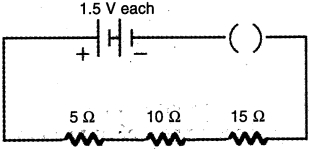
Draw a schematic diagram of an electric circuit consisting of a battery of two cells each of $1.5\, V$,$5\, \Omega$,$10\, \Omega$ and $15\, \Omega$ resistors and a plug key,all connected in series.
Solution
(N/A) To construct the circuit,connect the two $1.5\, V$ cells in series to form a battery of $3\, V$.
Connect this battery in series with the three resistors of $5\, \Omega$,$10\, \Omega$,and $15\, \Omega$ and a plug key.
The schematic diagram is shown below.
Connect this battery in series with the three resistors of $5\, \Omega$,$10\, \Omega$,and $15\, \Omega$ and a plug key.
The schematic diagram is shown below.
0 likes
View Solution109
Easy
Define an electric circuit. Distinguish between an open and a closed circuit.
Solution
(N/A) An electric circuit is a continuous and closed path along which an electric current flows.
An open circuit is a circuit in which the path is broken or the switch is in the $OFF$ position,preventing the flow of current.
$A$ closed circuit is a circuit in which the path is complete and the switch is in the $ON$ position,allowing the electric current to flow continuously.
An open circuit is a circuit in which the path is broken or the switch is in the $OFF$ position,preventing the flow of current.
$A$ closed circuit is a circuit in which the path is complete and the switch is in the $ON$ position,allowing the electric current to flow continuously.
0 likes
View Solution110
MediumMCQ
What is the lowest resistance that can be obtained by combining four coils of resistances $4\, \Omega, 8\, \Omega, 12\, \Omega$ and $24\, \Omega$?
A
$2\, \Omega$
B
$1\, \Omega$
C
$4\, \Omega$
D
$48\, \Omega$
Solution
(A) To obtain the lowest equivalent resistance from a given set of resistors,they must be connected in a parallel combination.
For resistors connected in parallel,the equivalent resistance $R_p$ is given by the formula:
$\frac{1}{R_p} = \frac{1}{R_1} + \frac{1}{R_2} + \frac{1}{R_3} + \frac{1}{R_4}$
Substituting the given values $R_1 = 4\, \Omega, R_2 = 8\, \Omega, R_3 = 12\, \Omega$,and $R_4 = 24\, \Omega$:
$\frac{1}{R_p} = \frac{1}{4} + \frac{1}{8} + \frac{1}{12} + \frac{1}{24}$
The least common multiple $(LCM)$ of $4, 8, 12$,and $24$ is $24$.
$\frac{1}{R_p} = \frac{6 + 3 + 2 + 1}{24} = \frac{12}{24} = \frac{1}{2}$
Therefore,$R_p = 2\, \Omega$.
For resistors connected in parallel,the equivalent resistance $R_p$ is given by the formula:
$\frac{1}{R_p} = \frac{1}{R_1} + \frac{1}{R_2} + \frac{1}{R_3} + \frac{1}{R_4}$
Substituting the given values $R_1 = 4\, \Omega, R_2 = 8\, \Omega, R_3 = 12\, \Omega$,and $R_4 = 24\, \Omega$:
$\frac{1}{R_p} = \frac{1}{4} + \frac{1}{8} + \frac{1}{12} + \frac{1}{24}$
The least common multiple $(LCM)$ of $4, 8, 12$,and $24$ is $24$.
$\frac{1}{R_p} = \frac{6 + 3 + 2 + 1}{24} = \frac{12}{24} = \frac{1}{2}$
Therefore,$R_p = 2\, \Omega$.
0 likes
View Solution111
Easy
Nichrome is used to make the element of an electric heater. Why?
Solution
(N/A) Nichrome is an alloy that possesses high electrical resistivity,which allows it to generate a significant amount of heat when an electric current passes through it.
Additionally,it has a very high melting point,which prevents it from melting or burning out even when it becomes extremely hot during operation.
Additionally,it has a very high melting point,which prevents it from melting or burning out even when it becomes extremely hot during operation.
0 likes
View Solution112
EasyMCQ
What happens to the resistance of a conductor when the length of the conductor is reduced to half?
A
It becomes double
B
It becomes half
C
It remains the same
D
It becomes four times
Solution
(B) The resistance $R$ of a conductor is directly proportional to its length $l$,given by the formula $R = \rho \frac{l}{A}$,where $\rho$ is the resistivity and $A$ is the cross-sectional area.
Since $R \propto l$,if the length $l$ is reduced to half $(l' = l/2)$,the new resistance $R'$ will be $R' = \rho \frac{l/2}{A} = \frac{1}{2} R$.
Therefore,the resistance reduces to half of its original value.
Since $R \propto l$,if the length $l$ is reduced to half $(l' = l/2)$,the new resistance $R'$ will be $R' = \rho \frac{l/2}{A} = \frac{1}{2} R$.
Therefore,the resistance reduces to half of its original value.
0 likes
View Solution113
EasyMCQ
What happens to the resistance of a conductor when its temperature is increased?
A
It increases
B
It decreases
C
It remains constant
D
It becomes zero
Solution
(A) When the temperature of a metallic conductor is increased,the atoms or ions in the metal lattice vibrate with greater amplitude. This leads to more frequent collisions between the free electrons and the vibrating atoms,which increases the opposition to the flow of current. Therefore,the resistance of a conductor increases with an increase in temperature.
0 likes
View Solution114
Easy
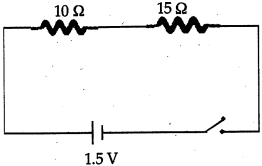
Draw a schematic diagram of a circuit consisting of a cell of $1.5 \, V$, a $10 \, \Omega$ resistor, a $15 \, \Omega$ resistor, and a plug key, all connected in series.
Solution
(N/A) To draw the circuit diagram in series, connect the components one after another in a single loop. The circuit includes a cell of $1.5 \, V$, two resistors of $10 \, \Omega$ and $15 \, \Omega$, and a plug key, all joined in a series combination as shown in the diagram.
0 likes
View Solution115
EasyMCQ
Why do we use copper and aluminium wire for the transmission of electric current?
A
They are cheap and easily available.
B
They have low resistivity and are good conductors of electricity.
C
They have high melting points.
D
They are ductile and can be drawn into thin wires.
Solution
(B) Copper and aluminium are used for the transmission of electric current because they possess very low electrical resistivity.
Due to this low resistivity,they act as excellent conductors of electricity,allowing current to flow with minimal energy loss in the form of heat.
Additionally,they are relatively inexpensive and possess good mechanical properties,making them suitable for long-distance power transmission.
Due to this low resistivity,they act as excellent conductors of electricity,allowing current to flow with minimal energy loss in the form of heat.
Additionally,they are relatively inexpensive and possess good mechanical properties,making them suitable for long-distance power transmission.
0 likes
View Solution116
Easy
Give an example of a metal which is the best conductor of heat.
Solution
(A) Silver $(Ag)$ is considered the best conductor of heat among all metals. Copper $(Cu)$ is also an excellent conductor of heat and is widely used in cooking utensils and electrical wiring.
0 likes
View Solution117
EasyMCQ
The amount of charge passing through a cell in $4 \, s$ is $12 \, C$. Find the current supplied by the cell. (in $, A$)
A
$3$
B
$4$
C
$12$
D
$48$
Solution
(A) Given: Charge $Q = 12 \, C$,time $t = 4 \, s$.
The formula for electric current $I$ is given by $I = \frac{Q}{t}$.
Substituting the values,we get $I = \frac{12 \, C}{4 \, s} = 3 \, A$.
Therefore,the current supplied by the cell is $3 \, A$.
The formula for electric current $I$ is given by $I = \frac{Q}{t}$.
Substituting the values,we get $I = \frac{12 \, C}{4 \, s} = 3 \, A$.
Therefore,the current supplied by the cell is $3 \, A$.
0 likes
View Solution118
MediumMCQ
Calculate the number of electrons that would flow per second through the cross-section of a wire when $1 \, A$ current flows in it.
A
$6.25 \times 10^{18}$
B
$1.6 \times 10^{19}$
C
$6.25 \times 10^{19}$
D
$1.6 \times 10^{18}$
Solution
(A) Given: Current $I = 1 \, A$, Time $t = 1 \, s$.
We know that charge $Q = I \times t$.
Therefore, $Q = 1 \, A \times 1 \, s = 1 \, C$.
The charge of a single electron is $e = 1.6 \times 10^{-19} \, C$.
The number of electrons $n$ is given by the formula $n = \frac{Q}{e}$.
Substituting the values: $n = \frac{1 \, C}{1.6 \times 10^{-19} \, C}$.
$n = 0.625 \times 10^{19} = 6.25 \times 10^{18}$ electrons per second.
We know that charge $Q = I \times t$.
Therefore, $Q = 1 \, A \times 1 \, s = 1 \, C$.
The charge of a single electron is $e = 1.6 \times 10^{-19} \, C$.
The number of electrons $n$ is given by the formula $n = \frac{Q}{e}$.
Substituting the values: $n = \frac{1 \, C}{1.6 \times 10^{-19} \, C}$.
$n = 0.625 \times 10^{19} = 6.25 \times 10^{18}$ electrons per second.
0 likes
View Solution119
Easy
Name the device/instrument used to measure potential difference. How is it connected in an electric circuit?
Solution
(N/A) The device used to measure the potential difference between two points in an electric circuit is called a $Voltmeter$.
To measure the potential difference, a $Voltmeter$ is always connected in $parallel$ across the two points where the potential difference is to be measured.
To measure the potential difference, a $Voltmeter$ is always connected in $parallel$ across the two points where the potential difference is to be measured.
0 likes
View Solution120
MediumMCQ
What is the resistance of an ideal voltmeter?
A
Zero
B
Low
C
High
D
Infinite
Solution
(D) voltmeter is used to measure the potential difference between two points in a circuit. To ensure that it does not draw any current from the circuit (which would alter the potential difference being measured),it must have a very high resistance. For an ideal voltmeter,the resistance is considered to be infinite.
0 likes
View Solution121
Medium
List in a tabular form two differences between a voltmeter and an ammeter.
Solution
(N/A)
| Voltmeter | Ammeter |
| $(a)$ It is used to measure the potential difference between two points in a circuit. | $(a)$ It is used to measure the electric current flowing through a circuit. |
| $(b)$ It is always connected in parallel across the component. | $(b)$ It is always connected in series with the component. |
| $(c)$ It has a very high resistance to ensure minimal current flows through it. | $(c)$ It has a very low resistance to ensure minimal voltage drop across it. |
0 likes
View Solution122
Medium
$(a)$ What are the values of $mA$ and $\mu A$ in terms of Ampere $(A)$?
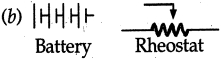
$(b)$ Draw the symbols of a battery and a rheostat.
$(b)$ Draw the symbols of a battery and a rheostat.
Solution
(N/A) The values are as follows:
$1 \text{ mA (milliampere)} = 10^{-3} \text{ A} = \frac{1}{1000} \text{ A}$
$1 \text{ } \mu\text{A (microampere)} = 10^{-6} \text{ A} = \frac{1}{1000000} \text{ A}$
$(b)$ The symbols for a battery and a rheostat are shown in the image provided.
$1 \text{ mA (milliampere)} = 10^{-3} \text{ A} = \frac{1}{1000} \text{ A}$
$1 \text{ } \mu\text{A (microampere)} = 10^{-6} \text{ A} = \frac{1}{1000000} \text{ A}$
$(b)$ The symbols for a battery and a rheostat are shown in the image provided.
0 likes
View Solution123
Medium
$(a)$ Resistivity of iron is $10 \times 10^{-8} \; \Omega m$ and of mercury is $94 \times 10^{-8} \; \Omega m$. Which among iron and mercury is a better conductor? Give reason.
$(b)$ Resistivity of a material $A$ is in the range of $10^{10}-10^{14} \; \Omega m$ while that of $B$ is in the range of $10^{-6}-10^{-8} \; \Omega m$. Which of the two will behave as an insulator and why?
$(b)$ Resistivity of a material $A$ is in the range of $10^{10}-10^{14} \; \Omega m$ while that of $B$ is in the range of $10^{-6}-10^{-8} \; \Omega m$. Which of the two will behave as an insulator and why?
Solution
(A) Iron is a better conductor. The reason is that electrical conductivity is inversely proportional to resistivity. Since the resistivity of iron $(10 \times 10^{-8} \; \Omega m)$ is significantly lower than that of mercury $(94 \times 10^{-8} \; \Omega m)$,iron allows electric current to flow more easily.
$(b)$ Material $A$ will behave as an insulator. Insulators are materials that offer very high resistance to the flow of electric current,which corresponds to a very high resistivity. Since the resistivity of material $A$ $(10^{10}-10^{14} \; \Omega m)$ is extremely high compared to material $B$,it acts as an insulator.
$(b)$ Material $A$ will behave as an insulator. Insulators are materials that offer very high resistance to the flow of electric current,which corresponds to a very high resistivity. Since the resistivity of material $A$ $(10^{10}-10^{14} \; \Omega m)$ is extremely high compared to material $B$,it acts as an insulator.
0 likes
View Solution124
Medium
Elements of electric toasters and electric irons are made of an alloy rather than a pure metal. Give two reasons to justify the statement.
Solution
(N/A) Alloys do not oxidise readily at high temperatures,which makes them more resistant to corrosion.
$(b)$ Alloys have higher electrical resistivity (lower electrical conductivity) than pure metals,which allows them to generate more heat when current passes through them.
$(b)$ Alloys have higher electrical resistivity (lower electrical conductivity) than pure metals,which allows them to generate more heat when current passes through them.
0 likes
View Solution125
Easy
$A$ thick wire and a thin wire of the same material are successively connected to the same circuit to find their respective resistance. Which one will have lower resistance? Give reason.
Solution
(A) The thick wire will have lower resistance.
According to the formula for resistance,$R = \rho \frac{L}{A}$,where $R$ is resistance,$\rho$ is resistivity,$L$ is length,and $A$ is the area of cross-section.
Since both wires are made of the same material,their resistivity $(\rho)$ is the same.
For a given length,resistance is inversely proportional to the area of cross-section $(R \propto \frac{1}{A})$.
$A$ thick wire has a larger area of cross-section compared to a thin wire.
Therefore,the thick wire offers less opposition to the flow of current,resulting in lower resistance.
According to the formula for resistance,$R = \rho \frac{L}{A}$,where $R$ is resistance,$\rho$ is resistivity,$L$ is length,and $A$ is the area of cross-section.
Since both wires are made of the same material,their resistivity $(\rho)$ is the same.
For a given length,resistance is inversely proportional to the area of cross-section $(R \propto \frac{1}{A})$.
$A$ thick wire has a larger area of cross-section compared to a thin wire.
Therefore,the thick wire offers less opposition to the flow of current,resulting in lower resistance.
0 likes
View Solution126
Medium
Mention two special features of the material to be used as an element of an electric iron.
Solution
(N/A) The material used for the heating element of an electric iron must possess the following two special features:
$(a)$ High resistivity: This ensures that the material produces a large amount of heat when an electric current passes through it,according to Joule's law of heating $(H = I^2Rt)$.
$(b)$ High melting point: This prevents the element from melting or breaking down even when it becomes extremely hot during continuous operation.
$(a)$ High resistivity: This ensures that the material produces a large amount of heat when an electric current passes through it,according to Joule's law of heating $(H = I^2Rt)$.
$(b)$ High melting point: This prevents the element from melting or breaking down even when it becomes extremely hot during continuous operation.
0 likes
View Solution127
Medium
Give reasons for the following:
$(i)$ Tungsten is used almost exclusively for the filament of electric lamps.
$(ii)$ Why do we use copper and aluminium wires for the transmission of electric current?
$(i)$ Tungsten is used almost exclusively for the filament of electric lamps.
$(ii)$ Why do we use copper and aluminium wires for the transmission of electric current?
Solution
(N/A) $(i)$ Tungsten is used in making the filament of an electric bulb because:
$(a)$ Tungsten has a very high melting point $(3380 \ ^\circ C)$,which allows it to glow at high temperatures without melting.
$(b)$ It has high resistivity,which allows it to produce a large amount of heat when current passes through it.
$(ii)$ Copper and aluminium are used for the transmission of electric current because:
$(a)$ They have very low electrical resistivity,which minimizes energy loss during transmission.
$(b)$ They are excellent conductors of electricity,allowing current to flow efficiently over long distances.
$(a)$ Tungsten has a very high melting point $(3380 \ ^\circ C)$,which allows it to glow at high temperatures without melting.
$(b)$ It has high resistivity,which allows it to produce a large amount of heat when current passes through it.
$(ii)$ Copper and aluminium are used for the transmission of electric current because:
$(a)$ They have very low electrical resistivity,which minimizes energy loss during transmission.
$(b)$ They are excellent conductors of electricity,allowing current to flow efficiently over long distances.
0 likes
View Solution128
EasyMCQ
Find the resistance of a bulb rated as $100 \, W - 250 \, V$.
A
$625 \, \Omega$
B
$250 \, \Omega$
C
$100 \, \Omega$
D
$2.5 \, \Omega$
Solution
(A) The power $P$ and voltage $V$ are given as $P = 100 \, W$ and $V = 250 \, V$.
Using the formula for electrical power,$P = \frac{V^2}{R}$,we can rearrange it to solve for resistance $R$:
$R = \frac{V^2}{P}$.
Substituting the given values:
$R = \frac{250 \times 250}{100} = \frac{62500}{100} = 625 \, \Omega$.
Therefore,the resistance of the bulb is $625 \, \Omega$.
Using the formula for electrical power,$P = \frac{V^2}{R}$,we can rearrange it to solve for resistance $R$:
$R = \frac{V^2}{P}$.
Substituting the given values:
$R = \frac{250 \times 250}{100} = \frac{62500}{100} = 625 \, \Omega$.
Therefore,the resistance of the bulb is $625 \, \Omega$.
0 likes
View Solution129
Medium
Explain the terms potential and potential difference. Give their $SI$ units.
Solution
(N/A) Potential: The electric potential at a point in an electric field is defined as the amount of work done in moving a unit positive charge from infinity to that point.
Potential difference: The potential difference between two points in an electric circuit is defined as the amount of work done in moving a unit positive charge from one point to the other.
The $SI$ unit for both electric potential and potential difference is the volt $(V)$.
Potential difference: The potential difference between two points in an electric circuit is defined as the amount of work done in moving a unit positive charge from one point to the other.
The $SI$ unit for both electric potential and potential difference is the volt $(V)$.
0 likes
View Solution130
Easy
Define $1$ volt.
Solution
(N/A) The potential difference between two points in a current-carrying conductor is said to be $1$ volt when $1$ joule of work is done to move a charge of $1$ coulomb from one point to the other.
Mathematically,$V = W / Q$,where $V = 1$ volt,$W = 1$ joule,and $Q = 1$ coulomb.
Mathematically,$V = W / Q$,where $V = 1$ volt,$W = 1$ joule,and $Q = 1$ coulomb.
0 likes
View Solution131
Medium
What are the conditions under which $Ohm's$ law is not obeyed?
Solution
(N/A) $Ohm's$ law is not obeyed under the following conditions:
$(i)$ The relationship between potential difference $(V)$ and current $(I)$ is non-linear.
$(ii)$ For a given value of $V$,there is more than one value of $I$ (i.e.,the relation is non-unique).
$(iii)$ The relationship between $V$ and $I$ depends on the sign of $V$ (i.e.,if the direction of current is reversed,the magnitude of current for the same potential difference changes).
$(i)$ The relationship between potential difference $(V)$ and current $(I)$ is non-linear.
$(ii)$ For a given value of $V$,there is more than one value of $I$ (i.e.,the relation is non-unique).
$(iii)$ The relationship between $V$ and $I$ depends on the sign of $V$ (i.e.,if the direction of current is reversed,the magnitude of current for the same potential difference changes).
0 likes
View Solution132
Easy
Name a device that can be used to maintain a potential difference across a conductor. Also,draw its circuit symbol.
Solution
(N/A) device that maintains a potential difference across a conductor is called a cell or a battery.
The circuit symbol for a cell consists of two parallel vertical lines,where the longer line represents the positive terminal $(+)$ and the shorter,thicker line represents the negative terminal $(-)$.
Circuit symbol for a cell:
$| |$ (Longer line: $+$,Shorter line: $-$)
The circuit symbol for a cell consists of two parallel vertical lines,where the longer line represents the positive terminal $(+)$ and the shorter,thicker line represents the negative terminal $(-)$.
Circuit symbol for a cell:
$| |$ (Longer line: $+$,Shorter line: $-$)
0 likes
View Solution133
Easy
Name a few practical applications of the heating effect of current.
Solution
(N/A) The heating effect of electric current is utilized in various electrical appliances to produce heat for specific purposes.
Some common practical applications include:
$1$. Electric Iron: Used for pressing clothes.
$2$. Electric Toaster: Used for browning bread.
$3$. Electric Oven: Used for baking and cooking.
$4$. Electric Kettle: Used for boiling water.
$5$. Electric Geyser: Used for heating water.
$6$. Electric Fuse: $A$ safety device that melts and breaks the circuit when excessive current flows,protecting appliances from damage.
$7$. Electric Bulb: Uses the heating effect to produce light through a tungsten filament.
Some common practical applications include:
$1$. Electric Iron: Used for pressing clothes.
$2$. Electric Toaster: Used for browning bread.
$3$. Electric Oven: Used for baking and cooking.
$4$. Electric Kettle: Used for boiling water.
$5$. Electric Geyser: Used for heating water.
$6$. Electric Fuse: $A$ safety device that melts and breaks the circuit when excessive current flows,protecting appliances from damage.
$7$. Electric Bulb: Uses the heating effect to produce light through a tungsten filament.
0 likes
View Solution134
Easy
Why are alloys used to make standard resistors?
Solution
(N/A) Alloys like Manganin or Constantan are used to make standard resistors because they have a very low temperature coefficient of resistance. This means that there is a negligible change in the resistance of an alloy with a change in temperature,ensuring that the resistance value remains stable even if the operating temperature fluctuates.
0 likes
View Solution135
Easy
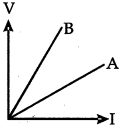
The $V-I$ graph for series and parallel combination of two metallic resistors is as shown in the figure. Which graph represents parallel combination? Justify your answer.
Solution
(A) According to Ohm's law, $V = IR$, which implies $R = V/I$.
In a $V-I$ graph, the slope of the line represents the resistance $(R = \text{slope} = \tan \theta)$.
Graph $A$ has a smaller slope compared to graph $B$, which means graph $A$ represents a lower resistance.
In a parallel combination of resistors, the equivalent resistance is always less than the individual resistances, whereas in a series combination, the equivalent resistance is greater than the individual resistances.
Therefore, graph $A$ represents the parallel combination because it corresponds to the lower resistance value.
In a $V-I$ graph, the slope of the line represents the resistance $(R = \text{slope} = \tan \theta)$.
Graph $A$ has a smaller slope compared to graph $B$, which means graph $A$ represents a lower resistance.
In a parallel combination of resistors, the equivalent resistance is always less than the individual resistances, whereas in a series combination, the equivalent resistance is greater than the individual resistances.
Therefore, graph $A$ represents the parallel combination because it corresponds to the lower resistance value.
0 likes
View Solution136
MediumMCQ
Out of the following bulbs rated $40 \ W, 220 \ V$,$60 \ W, 220 \ V$,and $100 \ W, 220 \ V$,which one will glow the brightest when connected in series to a supply of $220 \ V$?
A
$40 \ W$ bulb
B
$60 \ W$ bulb
C
$100 \ W$ bulb
D
All will glow with equal brightness
Solution
(A) The resistance of a bulb is given by the formula $R = \frac{V^2}{P}$.
Since all bulbs have the same voltage rating $(V = 220 \ V)$,the resistance is inversely proportional to the power $(R \propto \frac{1}{P})$.
Therefore,the $40 \ W$ bulb has the highest resistance.
When bulbs are connected in series,the same current $(I)$ flows through each bulb.
The power dissipated (brightness) in each bulb is given by $P_{actual} = I^2 R$.
Since $I$ is constant for all bulbs in series,the brightness is directly proportional to the resistance $(P_{actual} \propto R)$.
Because the $40 \ W$ bulb has the highest resistance,it will dissipate the most power and glow the brightest.
Since all bulbs have the same voltage rating $(V = 220 \ V)$,the resistance is inversely proportional to the power $(R \propto \frac{1}{P})$.
Therefore,the $40 \ W$ bulb has the highest resistance.
When bulbs are connected in series,the same current $(I)$ flows through each bulb.
The power dissipated (brightness) in each bulb is given by $P_{actual} = I^2 R$.
Since $I$ is constant for all bulbs in series,the brightness is directly proportional to the resistance $(P_{actual} \propto R)$.
Because the $40 \ W$ bulb has the highest resistance,it will dissipate the most power and glow the brightest.
0 likes
View Solution137
Easy
What is a voltmeter? How is it connected in a circuit?
Solution
(N/A) voltmeter is an electrical instrument used to measure the potential difference between two points in an electrical circuit.
It is always connected in parallel across the component or the part of the circuit where the potential difference is to be measured.
It is always connected in parallel across the component or the part of the circuit where the potential difference is to be measured.
0 likes
View Solution138
Easy
Define current,give its mathematical expression. What is its $SI$ unit?
Solution
(N/A) Electric current is defined as the rate of flow of electric charge through a conductor.
Mathematically,it is expressed as $I = \frac{Q}{t}$,where $I$ is the current,$Q$ is the net charge flowing through a cross-section,and $t$ is the time taken.
The $SI$ unit of electric current is the ampere $(A)$.
Mathematically,it is expressed as $I = \frac{Q}{t}$,where $I$ is the current,$Q$ is the net charge flowing through a cross-section,and $t$ is the time taken.
The $SI$ unit of electric current is the ampere $(A)$.
0 likes
View Solution139
EasyMCQ
If $2 \times 10^{-3} \text{ J}$ of work is done in moving a particle carrying a charge of $10 \times 10^{-6} \text{ C}$ from infinity to a point $P$, what will be the potential at the point $P$ (in $\text{ V}$)?
A
$200$
B
$20$
C
$2000$
D
$0.2$
Solution
(A) The electric potential $V$ at a point is defined as the amount of work done $W$ in moving a unit positive charge $q$ from infinity to that point.
The formula is given by $V = \frac{W}{q}$.
Given values are $W = 2 \times 10^{-3} \text{ J}$ and $q = 10 \times 10^{-6} \text{ C}$.
Substituting these values into the formula:
$V = \frac{2 \times 10^{-3}}{10 \times 10^{-6}} = \frac{2}{10} \times 10^{(-3 + 6)} = 0.2 \times 10^3 = 200 \text{ V}$.
Therefore, the potential at point $P$ is $200 \text{ V}$.
The formula is given by $V = \frac{W}{q}$.
Given values are $W = 2 \times 10^{-3} \text{ J}$ and $q = 10 \times 10^{-6} \text{ C}$.
Substituting these values into the formula:
$V = \frac{2 \times 10^{-3}}{10 \times 10^{-6}} = \frac{2}{10} \times 10^{(-3 + 6)} = 0.2 \times 10^3 = 200 \text{ V}$.
Therefore, the potential at point $P$ is $200 \text{ V}$.
0 likes
View Solution140
Easy
Define one ampere.
Solution
(N/A) The current through a conductor is said to be $1$ ampere if a charge of $1$ coulomb flows through it in $1$ second. Mathematically,it is expressed as $I = Q/t$,where $I = 1 \text{ A}$,$Q = 1 \text{ C}$,and $t = 1 \text{ s}$.
0 likes
View Solution141
Medium
Explain the term resistance. Give its $SI$ unit of measurement.
Solution
(N/A) Resistance is the property of a conductor to oppose the flow of electric charges through it.
When a potential difference is applied across a conductor,free electrons begin to move,constituting an electric current.
During their motion,these electrons collide with other electrons and atoms of the conductor.
These collisions hinder the flow of electrons,thereby opposing the current.
This opposition to the flow of current is known as resistance.
The $SI$ unit of resistance is the $\text{ohm}$ $(\Omega)$.
When a potential difference is applied across a conductor,free electrons begin to move,constituting an electric current.
During their motion,these electrons collide with other electrons and atoms of the conductor.
These collisions hinder the flow of electrons,thereby opposing the current.
This opposition to the flow of current is known as resistance.
The $SI$ unit of resistance is the $\text{ohm}$ $(\Omega)$.
0 likes
View Solution142
Medium
Explain how do we classify materials as conductors and insulators on the basis of their resistance.
Solution
(N/A) Conductors are materials that possess a large number of free electrons $(\simeq 10^{28} \text{ m}^{-3})$ and exhibit very low resistivity $(\simeq 10^{-8} \Omega \text{ m})$. The resistivity of an ideal conductor is zero,and it increases with a rise in temperature in metals.
Insulators are substances that have practically no free electrons and possess very high resistivity $(\simeq 10^{16} \Omega \text{ m})$. The resistivity of an ideal insulator is infinity and decreases with a rise in temperature. Mica,rubber,glass,and porcelain are some examples of insulators.
Insulators are substances that have practically no free electrons and possess very high resistivity $(\simeq 10^{16} \Omega \text{ m})$. The resistivity of an ideal insulator is infinity and decreases with a rise in temperature. Mica,rubber,glass,and porcelain are some examples of insulators.
0 likes
View Solution143
Easy
Define electric power. Give its $SI$ units and write its mathematical equation.
Solution
(N/A) Electric power is defined as the rate at which electrical energy is consumed or dissipated in an electric circuit.
Mathematically,it is expressed as:
$P = \frac{W}{t} = VI = I^2R = \frac{V^2}{R}$
Where:
$P$ = Electric power
$W$ = Work done or energy consumed
$t$ = Time taken
$V$ = Potential difference
$I$ = Current
$R$ = Resistance
The $SI$ unit of electric power is the watt $(W)$,which is equivalent to $1 \text{ joule/second}$ $(1 \text{ J/s})$.
Mathematically,it is expressed as:
$P = \frac{W}{t} = VI = I^2R = \frac{V^2}{R}$
Where:
$P$ = Electric power
$W$ = Work done or energy consumed
$t$ = Time taken
$V$ = Potential difference
$I$ = Current
$R$ = Resistance
The $SI$ unit of electric power is the watt $(W)$,which is equivalent to $1 \text{ joule/second}$ $(1 \text{ J/s})$.
0 likes
View Solution144
Medium
Name the commercial unit of electrical energy. Convert it into joule. What is the other name of the commercial unit?
Solution
(N/A) The commercial unit of electrical energy is kilowatt-hour $(kWh)$.
$1 kWh = 1 kW \times 1 \text{ hour}$
$= 1000 W \times 3600 s$
$= 1000 J/s \times 3600 s$
$= 3.6 \times 10^6 J$
It is also known as the Board of Trade Unit $(BOTU)$.
$1 kWh = 1 kW \times 1 \text{ hour}$
$= 1000 W \times 3600 s$
$= 1000 J/s \times 3600 s$
$= 3.6 \times 10^6 J$
It is also known as the Board of Trade Unit $(BOTU)$.
0 likes
View Solution145
Medium
State Joule's law of heating and write its mathematical form.
Solution
(N/A) Joule's law of heating states that the heat produced $(H)$ in a conductor is:
$(i)$ Directly proportional to the square of the current $(I)$ flowing through it, i.e., $H \propto I^2$.
$(ii)$ Directly proportional to the resistance $(R)$ of the conductor, i.e., $H \propto R$.
$(iii)$ Directly proportional to the time $(t)$ for which the current flows through the conductor, i.e., $H \propto t$.
Combining these three factors, we get the mathematical expression:
$H = I^2Rt$
Where $H$ is the heat energy in Joules, $I$ is the current in Amperes, $R$ is the resistance in Ohms, and $t$ is the time in seconds.
$(i)$ Directly proportional to the square of the current $(I)$ flowing through it, i.e., $H \propto I^2$.
$(ii)$ Directly proportional to the resistance $(R)$ of the conductor, i.e., $H \propto R$.
$(iii)$ Directly proportional to the time $(t)$ for which the current flows through the conductor, i.e., $H \propto t$.
Combining these three factors, we get the mathematical expression:
$H = I^2Rt$
Where $H$ is the heat energy in Joules, $I$ is the current in Amperes, $R$ is the resistance in Ohms, and $t$ is the time in seconds.
0 likes
View Solution146
Easy
An electric bulb draws a current of $0.2 A$ when the voltage is $220 V$. Calculate the amount of charge flowing through it in one hour.
Solution
(720 C) The formula for electric charge is $Q = I \times t$.
Given:
Current $(I)$ = $0.2 A$
Time $(t)$ = $1 \text{ hour} = 3600 s$
Calculation:
$Q = 0.2 A \times 3600 s$
$Q = 720 C$
Therefore,the total charge flowing through the bulb is $720 C$.
Given:
Current $(I)$ = $0.2 A$
Time $(t)$ = $1 \text{ hour} = 3600 s$
Calculation:
$Q = 0.2 A \times 3600 s$
$Q = 720 C$
Therefore,the total charge flowing through the bulb is $720 C$.
0 likes
View Solution147
EasyMCQ
An electric iron draws a current of $0.5\, A$ when the voltage is $200\, V$. Calculate the amount of electric charge flowing through it in one hour. (in $C$)
A
$1800$
B
$3600$
C
$720$
D
$900$
Solution
(A) Given:
Current $(I)$ = $0.5\, A$
Time $(t)$ = $1\, \text{hour} = 60 \times 60 = 3600\, s$
Voltage $(V)$ = $200\, V$
Formula for electric charge is $Q = I \times t$
Substituting the values:
$Q = 0.5\, A \times 3600\, s = 1800\, C$
Therefore, the amount of electric charge flowing through the electric iron is $1800\, C$.
Current $(I)$ = $0.5\, A$
Time $(t)$ = $1\, \text{hour} = 60 \times 60 = 3600\, s$
Voltage $(V)$ = $200\, V$
Formula for electric charge is $Q = I \times t$
Substituting the values:
$Q = 0.5\, A \times 3600\, s = 1800\, C$
Therefore, the amount of electric charge flowing through the electric iron is $1800\, C$.
0 likes
View Solution148
Easy
An electric appliance draws a current of $0.4\, A$ when the voltage is $200\, V$. Calculate the amount of charge flowing through it in one hour.
Solution
(1440 C) The formula for electric charge is $Q = I \times t$.
Given:
Current $(I)$ = $0.4\, A$
Time $(t)$ = $1\, \text{hour} = 60 \times 60\, s = 3600\, s$.
Substituting the values into the formula:
$Q = 0.4\, A \times 3600\, s$
$Q = 1440\, C$.
Therefore, the total charge flowing through the appliance is $1440\, C$.
Given:
Current $(I)$ = $0.4\, A$
Time $(t)$ = $1\, \text{hour} = 60 \times 60\, s = 3600\, s$.
Substituting the values into the formula:
$Q = 0.4\, A \times 3600\, s$
$Q = 1440\, C$.
Therefore, the total charge flowing through the appliance is $1440\, C$.
0 likes
View Solution149
Easy
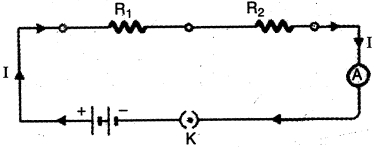
$(i)$ Draw a circuit diagram to show how two resistors are connected in series.
$(ii)$ In a circuit,if two resistors of $5 \ \Omega$ and $10 \ \Omega$ are connected in series,how does the current passing through the two resistors compare?
$(ii)$ In a circuit,if two resistors of $5 \ \Omega$ and $10 \ \Omega$ are connected in series,how does the current passing through the two resistors compare?
Solution
(N/A) $(i)$ The circuit diagram showing two resistors $R_1$ and $R_2$ connected in series is provided in the image.
$(ii)$ When resistors are connected in series,the same amount of electric current $(I)$ flows through each resistor. Therefore,the current passing through the $5 \ \Omega$ resistor is equal to the current passing through the $10 \ \Omega$ resistor.
$(ii)$ When resistors are connected in series,the same amount of electric current $(I)$ flows through each resistor. Therefore,the current passing through the $5 \ \Omega$ resistor is equal to the current passing through the $10 \ \Omega$ resistor.
0 likes
View Solution150
MediumMCQ
$A$ bulb is rated at $5.0 \text{ V}, 100 \text{ mA}$. Calculate its
$(i)$ power and $(ii)$ resistance.
$(i)$ power and $(ii)$ resistance.
A
$0.5 \text{ W}, 50 \, \Omega$
B
$0.5 \text{ W}, 5 \, \Omega$
C
$5.0 \text{ W}, 50 \, \Omega$
D
$0.05 \text{ W}, 500 \, \Omega$
Solution
(A) Given:
Voltage $(V) = 5.0 \text{ V}$
Current $(I) = 100 \text{ mA} = 100 \times 10^{-3} \text{ A} = 0.1 \text{ A}$
$(i)$ Power $(P)$ is calculated as:
$P = V \times I = 5.0 \text{ V} \times 0.1 \text{ A} = 0.5 \text{ W}$
$(ii)$ Resistance $(R)$ is calculated using Ohm's Law:
$R = \frac{V}{I} = \frac{5.0 \text{ V}}{0.1 \text{ A}} = 50 \, \Omega$
Voltage $(V) = 5.0 \text{ V}$
Current $(I) = 100 \text{ mA} = 100 \times 10^{-3} \text{ A} = 0.1 \text{ A}$
$(i)$ Power $(P)$ is calculated as:
$P = V \times I = 5.0 \text{ V} \times 0.1 \text{ A} = 0.5 \text{ W}$
$(ii)$ Resistance $(R)$ is calculated using Ohm's Law:
$R = \frac{V}{I} = \frac{5.0 \text{ V}}{0.1 \text{ A}} = 50 \, \Omega$
0 likes
View SolutionElectricity — Mix Examples - Electricity · Frequently Asked Questions
1Are these Electricity questions useful for JEE and NEET?
Yes. All questions in this section are mapped to JEE Main and NEET exam patterns. Previous year questions from JEE Main, NEET, GUJCET and state-level exams are included with full solutions.
2Can I switch to Hindi or Gujarati for these questions?
Yes. Use the language tabs in the hero section or the sidebar to view the same questions and solutions in English, Hindi or Gujarati.
3How do I generate a question paper from this subtopic?
Use the Vedclass Exam Paper Generator — select the chapter and subtopic, set difficulty, and generate Sets A, B, C, D automatically. First 3 chapters of every subject are free.
Vedclass Products
For Students
Vedclass Test Series
Mock tests in real JEE/NEET style with performance analysis. 5-day free trial.
Start Free TrialFor Teachers
Exam Paper Generator
Generate Set A/B/C/D papers from this chapter in 2 minutes. 3 chapters free.
Try FreeFor Institutes
Online Exam Module
Live online exams with unlimited students, 360° analytics & white-label branding.
See DemoFor Teachers & Institutes
Generate a Electricity Exam Paper in 2 Minutes
Select subtopic & difficulty — Sets A, B, C, D auto-generated with No Repeat logic.
First 3 chapters of every subject are free — no payment required.