
A English
Mix Examples - Areas Related to Circles Questions in English
Class 10 Mathematics · Areas Related to Circles · Mix Examples - Areas Related to Circles
215+
Questions
English
Language
100%
With Solutions
Showing 50 of 215 questions in English
1
EasyMCQ
If the area of a circle is $154 \, cm^2$,then its perimeter (circumference) is (in $cm$):
A
$44$
B
$22$
C
$11$
D
$55$
Solution
(A) Given,the area of the circle $A = 154 \, cm^2$.
The formula for the area of a circle is $A = \pi r^2$,where $r$ is the radius.
Substituting the value: $154 = \frac{22}{7} \times r^2$.
$r^2 = 154 \times \frac{7}{22}$.
$r^2 = 7 \times 7 = 49$.
$r = \sqrt{49} = 7 \, cm$.
The perimeter (circumference) of the circle is given by $C = 2 \pi r$.
$C = 2 \times \frac{22}{7} \times 7$.
$C = 2 \times 22 = 44 \, cm$.
The formula for the area of a circle is $A = \pi r^2$,where $r$ is the radius.
Substituting the value: $154 = \frac{22}{7} \times r^2$.
$r^2 = 154 \times \frac{7}{22}$.
$r^2 = 7 \times 7 = 49$.
$r = \sqrt{49} = 7 \, cm$.
The perimeter (circumference) of the circle is given by $C = 2 \pi r$.
$C = 2 \times \frac{22}{7} \times 7$.
$C = 2 \times 22 = 44 \, cm$.
0 likes
View Solution2
EasyMCQ
If $\theta$ is the angle (in degrees) of a sector of a circle of radius $r$,then the area of the sector is:
A
$\frac{\pi r^{2} \theta}{180}$
B
$\frac{\pi r^{2} \theta}{360}$
C
$\frac{2 \pi r \theta}{360}$
D
$\frac{2 \pi r \theta}{180}$
Solution
(B) The area of a full circle with radius $r$ is given by the formula $A = \pi r^2$.
This area corresponds to a central angle of $360^{\circ}$.
By the unitary method,the area of a sector with a central angle of $\theta$ degrees is proportional to the ratio of the angle $\theta$ to the total angle $360^{\circ}$.
Therefore,$\text{Area of sector} = \frac{\theta}{360^{\circ}} \times \pi r^2$.
This simplifies to $\frac{\pi r^2 \theta}{360}$.
This area corresponds to a central angle of $360^{\circ}$.
By the unitary method,the area of a sector with a central angle of $\theta$ degrees is proportional to the ratio of the angle $\theta$ to the total angle $360^{\circ}$.
Therefore,$\text{Area of sector} = \frac{\theta}{360^{\circ}} \times \pi r^2$.
This simplifies to $\frac{\pi r^2 \theta}{360}$.
0 likes
View Solution3
EasyMCQ
If the sum of the areas of two circles with radii $R_{1}$ and $R_{2}$ is equal to the area of a circle of radius $R$,then
A
$R_{1} + R_{2} = R$
B
$R_{1} + R_{2} < R$
C
$R_{1}^{2} + R_{2}^{2} = R^{2}$
D
$R_{1}^{2} + R_{2}^{2} < R^{2}$
Solution
(C) According to the given condition,
Area of circle with radius $R$ = Area of circle with radius $R_{1}$ + Area of circle with radius $R_{2}$
Since the area of a circle is given by the formula $\pi r^{2}$,we have:
$\pi R^{2} = \pi R_{1}^{2} + \pi R_{2}^{2}$
Dividing both sides by $\pi$,we get:
$R^{2} = R_{1}^{2} + R_{2}^{2}$
Area of circle with radius $R$ = Area of circle with radius $R_{1}$ + Area of circle with radius $R_{2}$
Since the area of a circle is given by the formula $\pi r^{2}$,we have:
$\pi R^{2} = \pi R_{1}^{2} + \pi R_{2}^{2}$
Dividing both sides by $\pi$,we get:
$R^{2} = R_{1}^{2} + R_{2}^{2}$
0 likes
View Solution4
EasyMCQ
If the sum of the circumferences of two circles with radii $R_{1}$ and $R_{2}$ is equal to the circumference of a circle of radius $R$,then
A
$R_{1} + R_{2} < R$
B
$R_{1} + R_{2} > R$
C
Nothing definite can be said about the relation among $R_{1}, R_{2}$ and $R$
D
$R_{1} + R_{2} = R$
Solution
(D) According to the given condition,
Circumference of circle with radius $R$ $=$ Circumference of circle with radius $R_{1}$ $+$ Circumference of circle with radius $R_{2}$
Using the formula for circumference $C = 2 \pi r$:
$2 \pi R = 2 \pi R_{1} + 2 \pi R_{2}$
Dividing both sides by $2 \pi$:
$R = R_{1} + R_{2}$
Therefore,the correct relation is $R_{1} + R_{2} = R$.
Circumference of circle with radius $R$ $=$ Circumference of circle with radius $R_{1}$ $+$ Circumference of circle with radius $R_{2}$
Using the formula for circumference $C = 2 \pi r$:
$2 \pi R = 2 \pi R_{1} + 2 \pi R_{2}$
Dividing both sides by $2 \pi$:
$R = R_{1} + R_{2}$
Therefore,the correct relation is $R_{1} + R_{2} = R$.
0 likes
View Solution5
MediumMCQ
If the circumference of a circle and the perimeter of a square are equal,then
A
Area of the circle $>$ Area of the square
B
Area of the circle $=$ Area of the square
C
Area of the circle $ < $ Area of the square
D
Nothing definite can be said about the relation between the areas of the circle and square.
Solution
(A) Let the radius of the circle be $r$ and the side of the square be $a$.
According to the given condition,the circumference of the circle equals the perimeter of the square:
$2 \pi r = 4a$
$\pi r = 2a$
$a = \frac{\pi r}{2}$
Now,the area of the circle is $A_1 = \pi r^2$.
The area of the square is $A_2 = a^2 = (\frac{\pi r}{2})^2 = \frac{\pi^2 r^2}{4}$.
Comparing $A_1$ and $A_2$:
$\frac{A_1}{A_2} = \frac{\pi r^2}{\frac{\pi^2 r^2}{4}} = \frac{4}{\pi}$.
Since $\pi \approx 3.14$,$\frac{4}{3.14} > 1$.
Therefore,$A_1 > A_2$,which means the area of the circle is greater than the area of the square.
According to the given condition,the circumference of the circle equals the perimeter of the square:
$2 \pi r = 4a$
$\pi r = 2a$
$a = \frac{\pi r}{2}$
Now,the area of the circle is $A_1 = \pi r^2$.
The area of the square is $A_2 = a^2 = (\frac{\pi r}{2})^2 = \frac{\pi^2 r^2}{4}$.
Comparing $A_1$ and $A_2$:
$\frac{A_1}{A_2} = \frac{\pi r^2}{\frac{\pi^2 r^2}{4}} = \frac{4}{\pi}$.
Since $\pi \approx 3.14$,$\frac{4}{3.14} > 1$.
Therefore,$A_1 > A_2$,which means the area of the circle is greater than the area of the square.
0 likes
View Solution6
MediumMCQ
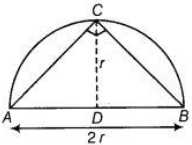
Area of the largest triangle that can be inscribed in a semi-circle of radius $r$ units is
A
$\frac{1}{2} r^{2}$ sq. units
B
$r^{2}$ sq. units
C
$2 r^{2}$ sq. units
D
$\sqrt{2} r^{2}$ sq. units
Solution
(B) To find the area of the largest triangle inscribed in a semi-circle,we consider the base of the triangle as the diameter of the semi-circle.
Let the diameter be $AB = 2r$.
For the triangle to have the maximum area,its height must be the maximum possible,which is the radius of the semi-circle,$r$.
Let $C$ be the vertex on the circumference such that the altitude $CD$ is perpendicular to $AB$. Here,$CD = r$.
Thus,the area of the triangle $ABC = \frac{1}{2} \times \text{base} \times \text{height}$.
Area $= \frac{1}{2} \times (2r) \times r = r^{2}$ sq. units.
Let the diameter be $AB = 2r$.
For the triangle to have the maximum area,its height must be the maximum possible,which is the radius of the semi-circle,$r$.
Let $C$ be the vertex on the circumference such that the altitude $CD$ is perpendicular to $AB$. Here,$CD = r$.
Thus,the area of the triangle $ABC = \frac{1}{2} \times \text{base} \times \text{height}$.
Area $= \frac{1}{2} \times (2r) \times r = r^{2}$ sq. units.
0 likes
View Solution7
MediumMCQ
If the perimeter of a circle is equal to that of a square,then the ratio of their areas is
A
$22: 7$
B
$7: 22$
C
$14: 11$
D
$11: 14$
Solution
(C) Let the radius of the circle be $r$ and the side of the square be $a$.
According to the given condition,
Perimeter of a circle = Perimeter of a square
$2 \pi r = 4a \Rightarrow a = \frac{\pi r}{2}$ ...............$(i)$
Now,the ratio of their areas is:
$\frac{\text{Area of circle}}{\text{Area of square}} = \frac{\pi r^2}{a^2} = \frac{\pi r^2}{(\frac{\pi r}{2})^2}$ [from Eq. $(i)$]
$= \frac{\pi r^2}{\frac{\pi^2 r^2}{4}} = \frac{4}{\pi} = \frac{4}{\frac{22}{7}} = \frac{4 \times 7}{22} = \frac{28}{22} = \frac{14}{11}$
Thus,the ratio of their areas is $14: 11$.
According to the given condition,
Perimeter of a circle = Perimeter of a square
$2 \pi r = 4a \Rightarrow a = \frac{\pi r}{2}$ ...............$(i)$
Now,the ratio of their areas is:
$\frac{\text{Area of circle}}{\text{Area of square}} = \frac{\pi r^2}{a^2} = \frac{\pi r^2}{(\frac{\pi r}{2})^2}$ [from Eq. $(i)$]
$= \frac{\pi r^2}{\frac{\pi^2 r^2}{4}} = \frac{4}{\pi} = \frac{4}{\frac{22}{7}} = \frac{4 \times 7}{22} = \frac{28}{22} = \frac{14}{11}$
Thus,the ratio of their areas is $14: 11$.
0 likes
View Solution8
DifficultMCQ
It is proposed to build a single circular park equal in area to the sum of areas of two circular parks of diameters $16 \, m$ and $12 \, m$ in a locality. The radius of the new park would be (in $m$)
A
$24$
B
$20$
C
$15$
D
$10$
Solution
(D) Area of the first circular park with diameter $d_1 = 16 \, m$ is $A_1 = \pi r_1^2 = \pi (8)^2 = 64\pi \, m^2$,where $r_1 = 8 \, m$.
Area of the second circular park with diameter $d_2 = 12 \, m$ is $A_2 = \pi r_2^2 = \pi (6)^2 = 36\pi \, m^2$,where $r_2 = 6 \, m$.
Let the radius of the new circular park be $R$. According to the problem,the area of the new park is equal to the sum of the areas of the two parks:
$\pi R^2 = A_1 + A_2$
$\pi R^2 = 64\pi + 36\pi$
$\pi R^2 = 100\pi$
$R^2 = 100$
$R = \sqrt{100} = 10 \, m$.
Thus,the radius of the new park is $10 \, m$.
Area of the second circular park with diameter $d_2 = 12 \, m$ is $A_2 = \pi r_2^2 = \pi (6)^2 = 36\pi \, m^2$,where $r_2 = 6 \, m$.
Let the radius of the new circular park be $R$. According to the problem,the area of the new park is equal to the sum of the areas of the two parks:
$\pi R^2 = A_1 + A_2$
$\pi R^2 = 64\pi + 36\pi$
$\pi R^2 = 100\pi$
$R^2 = 100$
$R = \sqrt{100} = 10 \, m$.
Thus,the radius of the new park is $10 \, m$.
0 likes
View Solution9
MediumMCQ
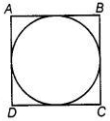
The area of the circle that can be inscribed in a square of side $6 \, cm$ is (in $cm^2$) (in $\pi$)
A
$9$
B
$12$
C
$18$
D
$36$
Solution
(A) Given, side of the square $= 6 \, cm$.
Since the circle is inscribed in the square, the diameter of the circle is equal to the side of the square.
Therefore, diameter $(d) = 6 \, cm$.
Radius of the circle $(r) = \frac{d}{2} = \frac{6}{2} = 3 \, cm$.
Area of the circle $= \pi r^2$.
Area $= \pi (3)^2 = 9 \pi \, cm^2$.
Since the circle is inscribed in the square, the diameter of the circle is equal to the side of the square.
Therefore, diameter $(d) = 6 \, cm$.
Radius of the circle $(r) = \frac{d}{2} = \frac{6}{2} = 3 \, cm$.
Area of the circle $= \pi r^2$.
Area $= \pi (3)^2 = 9 \pi \, cm^2$.
0 likes
View Solution10
DifficultMCQ
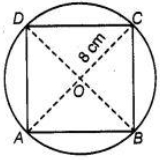
What is the area (in $cm^2$) of a square inscribed in a circle of radius $8 \, cm$?
A
$256$
B
$128$
C
$64 \sqrt{2}$
D
$64$
Solution
(B) Given that the radius of the circle is $r = OC = 8 \, cm$.
Therefore,the diameter of the circle is $AC = 2 \times OC = 2 \times 8 = 16 \, cm$.
This diameter is equal to the length of the diagonal of the square.
Let the side of the square be $x$.
In the right-angled $\triangle ABC$,by the Pythagorean theorem,$AC^2 = AB^2 + BC^2$.
$(16)^2 = x^2 + x^2$.
$256 = 2x^2$.
$x^2 = 128$.
Therefore,the area of the square is $x^2 = 128 \, cm^2$.
Therefore,the diameter of the circle is $AC = 2 \times OC = 2 \times 8 = 16 \, cm$.
This diameter is equal to the length of the diagonal of the square.
Let the side of the square be $x$.
In the right-angled $\triangle ABC$,by the Pythagorean theorem,$AC^2 = AB^2 + BC^2$.
$(16)^2 = x^2 + x^2$.
$256 = 2x^2$.
$x^2 = 128$.
Therefore,the area of the square is $x^2 = 128 \, cm^2$.
0 likes
View Solution11
MediumMCQ
The radius of a circle whose circumference is equal to the sum of the circumferences of the two circles of diameters $36 \, cm$ and $20 \, cm$ is (in $cm$)
A
$56$
B
$42$
C
$28$
D
$16$
Solution
(C) Let the diameter of the first circle be $d_1 = 36 \, cm$ and the diameter of the second circle be $d_2 = 20 \, cm$.
Circumference of the first circle $C_1 = \pi d_1 = 36 \pi \, cm$.
Circumference of the second circle $C_2 = \pi d_2 = 20 \pi \, cm$.
Let the diameter of the new circle be $D$ and its circumference be $C$.
According to the problem,$C = C_1 + C_2$.
$\pi D = 36 \pi + 20 \pi$.
$\pi D = 56 \pi$.
$D = 56 \, cm$.
The radius of the new circle is $r = \frac{D}{2} = \frac{56}{2} = 28 \, cm$.
Circumference of the first circle $C_1 = \pi d_1 = 36 \pi \, cm$.
Circumference of the second circle $C_2 = \pi d_2 = 20 \pi \, cm$.
Let the diameter of the new circle be $D$ and its circumference be $C$.
According to the problem,$C = C_1 + C_2$.
$\pi D = 36 \pi + 20 \pi$.
$\pi D = 56 \pi$.
$D = 56 \, cm$.
The radius of the new circle is $r = \frac{D}{2} = \frac{56}{2} = 28 \, cm$.
0 likes
View Solution12
MediumMCQ
The diameter of a circle whose area is equal to the sum of the areas of the two circles of radii $24 \, cm$ and $7 \, cm$ is (in $cm$):
A
$31$
B
$25$
C
$62$
D
$50$
Solution
(D) Let the radii of the two circles be $r_{1} = 24 \, cm$ and $r_{2} = 7 \, cm$.
The area of the first circle is $A_{1} = \pi r_{1}^{2} = \pi(24)^{2} = 576\pi \, cm^{2}$.
The area of the second circle is $A_{2} = \pi r_{2}^{2} = \pi(7)^{2} = 49\pi \, cm^{2}$.
Let the radius of the new circle be $R$. According to the problem,the area of the new circle is equal to the sum of the areas of the two circles:
$\pi R^{2} = A_{1} + A_{2}$
$\pi R^{2} = 576\pi + 49\pi$
$\pi R^{2} = 625\pi$
$R^{2} = 625$
$R = \sqrt{625} = 25 \, cm$.
The diameter of the new circle is $D = 2R = 2 \times 25 = 50 \, cm$.
The area of the first circle is $A_{1} = \pi r_{1}^{2} = \pi(24)^{2} = 576\pi \, cm^{2}$.
The area of the second circle is $A_{2} = \pi r_{2}^{2} = \pi(7)^{2} = 49\pi \, cm^{2}$.
Let the radius of the new circle be $R$. According to the problem,the area of the new circle is equal to the sum of the areas of the two circles:
$\pi R^{2} = A_{1} + A_{2}$
$\pi R^{2} = 576\pi + 49\pi$
$\pi R^{2} = 625\pi$
$R^{2} = 625$
$R = \sqrt{625} = 25 \, cm$.
The diameter of the new circle is $D = 2R = 2 \times 25 = 50 \, cm$.
0 likes
View Solution13
Easy
Is the following statement true? Give reasons for your answer.
Area of a segment of a circle $=$ area of the corresponding sector $-$ area of the corresponding triangle.
Area of a segment of a circle $=$ area of the corresponding sector $-$ area of the corresponding triangle.
Solution
(B) The statement is not universally true. It is only true for a minor segment.
For a minor segment,the area is calculated by subtracting the area of the triangle formed by the chord and the radii from the area of the corresponding sector.
However,in the case of a major segment,the area of the triangle must be added to the area of the corresponding sector to obtain the total area of the major segment.
For a minor segment,the area is calculated by subtracting the area of the triangle formed by the chord and the radii from the area of the corresponding sector.
However,in the case of a major segment,the area of the triangle must be added to the area of the corresponding sector to obtain the total area of the major segment.
0 likes
View Solution14
Easy
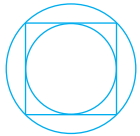
In the figure,a circle is inscribed in a square of side $5 \, cm$ and another circle is circumscribing the square. Is it true to say that the area of the outer circle is two times the area of the inner circle? Give reasons for your answer.
Solution
(A) Yes,it is true.
Let the side of the square be $a = 5 \, cm$.
The diameter of the inner circle is equal to the side of the square,so $d_{inner} = a = 5 \, cm$. The radius is $r = \frac{5}{2} \, cm$.
The area of the inner circle is $A_{inner} = \pi r^2 = \pi \left(\frac{5}{2}\right)^2 = \frac{25\pi}{4} \, cm^2$.
The diameter of the outer circle is equal to the diagonal of the square,so $d_{outer} = a\sqrt{2} = 5\sqrt{2} \, cm$. The radius is $R = \frac{5\sqrt{2}}{2} \, cm$.
The area of the outer circle is $A_{outer} = \pi R^2 = \pi \left(\frac{5\sqrt{2}}{2}\right)^2 = \pi \left(\frac{25 \times 2}{4}\right) = \frac{50\pi}{4} = \frac{25\pi}{2} \, cm^2$.
Comparing the two areas: $\frac{A_{outer}}{A_{inner}} = \frac{25\pi / 2}{25\pi / 4} = \frac{4}{2} = 2$.
Thus,the area of the outer circle is indeed two times the area of the inner circle.
Let the side of the square be $a = 5 \, cm$.
The diameter of the inner circle is equal to the side of the square,so $d_{inner} = a = 5 \, cm$. The radius is $r = \frac{5}{2} \, cm$.
The area of the inner circle is $A_{inner} = \pi r^2 = \pi \left(\frac{5}{2}\right)^2 = \frac{25\pi}{4} \, cm^2$.
The diameter of the outer circle is equal to the diagonal of the square,so $d_{outer} = a\sqrt{2} = 5\sqrt{2} \, cm$. The radius is $R = \frac{5\sqrt{2}}{2} \, cm$.
The area of the outer circle is $A_{outer} = \pi R^2 = \pi \left(\frac{5\sqrt{2}}{2}\right)^2 = \pi \left(\frac{25 \times 2}{4}\right) = \frac{50\pi}{4} = \frac{25\pi}{2} \, cm^2$.
Comparing the two areas: $\frac{A_{outer}}{A_{inner}} = \frac{25\pi / 2}{25\pi / 4} = \frac{4}{2} = 2$.
Thus,the area of the outer circle is indeed two times the area of the inner circle.
0 likes
View Solution15
Medium
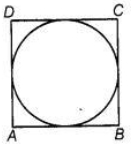
Is the area of the circle inscribed in a square of side $a \, cm$ equal to $\pi a^2 \, cm^2$? Give reasons for your answer.
Solution
(N/A) False.
Let $ABCD$ be a square of side $a$.
The circle is inscribed in the square,so its diameter is equal to the side of the square.
$\therefore \text{Diameter of circle} = a \, cm$.
$\therefore \text{Radius of circle} (r) = \frac{a}{2} \, cm$.
Now,the area of the circle is given by the formula $\pi r^2$.
$\therefore \text{Area} = \pi \left( \frac{a}{2} \right)^2 = \pi \left( \frac{a^2}{4} \right) = \frac{\pi a^2}{4} \, cm^2$.
Since $\frac{\pi a^2}{4} \neq \pi a^2$,the given statement is false.
Let $ABCD$ be a square of side $a$.
The circle is inscribed in the square,so its diameter is equal to the side of the square.
$\therefore \text{Diameter of circle} = a \, cm$.
$\therefore \text{Radius of circle} (r) = \frac{a}{2} \, cm$.
Now,the area of the circle is given by the formula $\pi r^2$.
$\therefore \text{Area} = \pi \left( \frac{a}{2} \right)^2 = \pi \left( \frac{a^2}{4} \right) = \frac{\pi a^2}{4} \, cm^2$.
Since $\frac{\pi a^2}{4} \neq \pi a^2$,the given statement is false.
0 likes
View Solution16
Medium
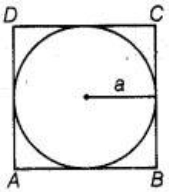
Will it be true to say that the perimeter of a square circumscribing a circle of radius $a \, cm$ is $8 a \, cm$? Give reasons for your answer.
Solution
(A) True.
Given,radius of the circle,$r = a \, cm$.
Therefore,the diameter of the circle,$d = 2 \times \text{radius} = 2a \, cm$.
Since the square circumscribes the circle,the side of the square is equal to the diameter of the circle.
Therefore,the side of the square $= 2a \, cm$.
Now,the perimeter of a square $= 4 \times \text{side} = 4 \times 2a = 8a \, cm$.
Hence,it is true that the perimeter of the square is $8a \, cm$.
Given,radius of the circle,$r = a \, cm$.
Therefore,the diameter of the circle,$d = 2 \times \text{radius} = 2a \, cm$.
Since the square circumscribes the circle,the side of the square is equal to the diameter of the circle.
Therefore,the side of the square $= 2a \, cm$.
Now,the perimeter of a square $= 4 \times \text{side} = 4 \times 2a = 8a \, cm$.
Hence,it is true that the perimeter of the square is $8a \, cm$.
0 likes
View Solution17
Medium
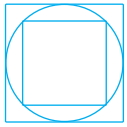
In the figure,a square is inscribed in a circle of diameter $d$ and another square is circumscribing the circle. Is the area of the outer square four times the area of the inner square? Give reasons for your answer.
Solution
(N/A) The statement is False.
Given the diameter of the circle is $d$.
$1$. For the inner square inscribed in the circle,the diagonal of the square is equal to the diameter of the circle.
Diagonal $= d$.
Let the side of the inner square be $x$.
Using the property of a square,the diagonal is $\sqrt{2} \times \text{side}$.
So,$\sqrt{2}x = d \Rightarrow x = \frac{d}{\sqrt{2}}$.
Area of the inner square $= x^2 = (\frac{d}{\sqrt{2}})^2 = \frac{d^2}{2}$.
$2$. For the outer square circumscribing the circle,the side of the square is equal to the diameter of the circle.
Side $= d$.
Area of the outer square $= d^2$.
$3$. Comparing the areas:
Ratio $= \frac{\text{Area of outer square}}{\text{Area of inner square}} = \frac{d^2}{d^2/2} = 2$.
Thus,the area of the outer square is twice the area of the inner square,not four times.
Given the diameter of the circle is $d$.
$1$. For the inner square inscribed in the circle,the diagonal of the square is equal to the diameter of the circle.
Diagonal $= d$.
Let the side of the inner square be $x$.
Using the property of a square,the diagonal is $\sqrt{2} \times \text{side}$.
So,$\sqrt{2}x = d \Rightarrow x = \frac{d}{\sqrt{2}}$.
Area of the inner square $= x^2 = (\frac{d}{\sqrt{2}})^2 = \frac{d^2}{2}$.
$2$. For the outer square circumscribing the circle,the side of the square is equal to the diameter of the circle.
Side $= d$.
Area of the outer square $= d^2$.
$3$. Comparing the areas:
Ratio $= \frac{\text{Area of outer square}}{\text{Area of inner square}} = \frac{d^2}{d^2/2} = 2$.
Thus,the area of the outer square is twice the area of the inner square,not four times.
0 likes
View Solution18
Easy
Is it true to say that the area of a segment of a circle is less than the area of its corresponding sector? Why?
Solution
(B) The statement is false.
$1$. $A$ segment of a circle is the region bounded by a chord and an arc. $A$ sector of a circle is the region bounded by two radii and an arc.
$2$. For a minor segment,the area is indeed less than the area of the corresponding minor sector because the minor segment is a part of the minor sector (the sector includes the triangle formed by the two radii and the chord).
$3$. However,for a major segment,the area is always greater than the area of the corresponding major sector. Therefore,the statement is not universally true.
$1$. $A$ segment of a circle is the region bounded by a chord and an arc. $A$ sector of a circle is the region bounded by two radii and an arc.
$2$. For a minor segment,the area is indeed less than the area of the corresponding minor sector because the minor segment is a part of the minor sector (the sector includes the triangle formed by the two radii and the chord).
$3$. However,for a major segment,the area is always greater than the area of the corresponding major sector. Therefore,the statement is not universally true.
0 likes
View Solution19
Easy
Is it true that the distance travelled by a circular wheel of diameter $d \text{ cm}$ in one revolution is $2 \pi d \text{ cm}$? Why?
Solution
(B) False.
The distance travelled by a circular wheel in one revolution is equal to its circumference.
The circumference of a circle with diameter $d$ is given by the formula $\pi d$.
Since $d = 2r$ (where $r$ is the radius),the circumference is $\pi(2r) = 2 \pi r$.
Therefore,the distance travelled in one revolution is $\pi d$,not $2 \pi d$.
The distance travelled by a circular wheel in one revolution is equal to its circumference.
The circumference of a circle with diameter $d$ is given by the formula $\pi d$.
Since $d = 2r$ (where $r$ is the radius),the circumference is $\pi(2r) = 2 \pi r$.
Therefore,the distance travelled in one revolution is $\pi d$,not $2 \pi d$.
0 likes
View Solution20
Easy
In covering a distance $s$ metres,a circular wheel of radius $r$ metres makes $\frac{s}{2 \pi r}$ revolutions. Is this statement true? Why?
Solution
(A) The statement is true.
The distance covered by a wheel in one complete revolution is equal to its circumference,which is given by the formula $2 \pi r$ metres.
To find the total number of revolutions made in covering a distance of $s$ metres,we divide the total distance by the distance covered in one revolution:
$\text{Number of revolutions} = \frac{\text{Total distance}}{\text{Distance in one revolution}} = \frac{s}{2 \pi r}$.
The distance covered by a wheel in one complete revolution is equal to its circumference,which is given by the formula $2 \pi r$ metres.
To find the total number of revolutions made in covering a distance of $s$ metres,we divide the total distance by the distance covered in one revolution:
$\text{Number of revolutions} = \frac{\text{Total distance}}{\text{Distance in one revolution}} = \frac{s}{2 \pi r}$.
0 likes
View Solution21
Easy
The numerical value of the area of a circle is greater than the numerical value of its circumference. Is this statement true? Why?
Solution
(B) The statement is false.
Let the radius of the circle be $r$.
The area of the circle is $A = \pi r^2$.
The circumference of the circle is $C = 2\pi r$.
Comparing the two,we look at the inequality $\pi r^2 > 2\pi r$.
Dividing both sides by $\pi r$ (assuming $r > 0$),we get $r > 2$.
Therefore,the area is greater than the circumference only when the radius $r > 2$.
If $0 < r < 2$,the circumference is greater than the area.
If $r = 2$,the numerical values are equal.
Thus,the statement is not universally true.
Let the radius of the circle be $r$.
The area of the circle is $A = \pi r^2$.
The circumference of the circle is $C = 2\pi r$.
Comparing the two,we look at the inequality $\pi r^2 > 2\pi r$.
Dividing both sides by $\pi r$ (assuming $r > 0$),we get $r > 2$.
Therefore,the area is greater than the circumference only when the radius $r > 2$.
If $0 < r < 2$,the circumference is greater than the area.
If $r = 2$,the numerical values are equal.
Thus,the statement is not universally true.
0 likes
View Solution22
Difficult
If the length of an arc of a circle of radius $r$ is equal to that of an arc of a circle of radius $2r$,then the angle of the corresponding sector of the first circle is double the angle of the corresponding sector of the other circle. Is this statement false? Why?
Solution
(A) The statement is true,not false.
Let two circles $C_1$ and $C_2$ have radii $r$ and $2r$ with centers $O$ and $O'$,respectively.
It is given that the arc length $l_1$ of $C_1$ is equal to the arc length $l_2$ of $C_2$,i.e.,$l_1 = l_2 = l$.
Let $\theta_1$ be the angle subtended by the arc of $C_1$ and $\theta_2$ be the angle subtended by the arc of $C_2$ at their respective centers.
The formula for arc length is $l = \frac{\theta}{360^\circ} \times 2\pi R$.
For $C_1$: $l = \frac{\theta_1}{360^\circ} \times 2\pi r$ ........... $(i)$
For $C_2$: $l = \frac{\theta_2}{360^\circ} \times 2\pi(2r) = \frac{\theta_2}{360^\circ} \times 4\pi r$ ........... $(ii)$
Equating $(i)$ and $(ii)$:
$\frac{\theta_1}{360^\circ} \times 2\pi r = \frac{\theta_2}{360^\circ} \times 4\pi r$
$\theta_1 = 2\theta_2$
Thus,the angle of the sector of the first circle is double the angle of the sector of the second circle. Therefore,the statement is true.
Let two circles $C_1$ and $C_2$ have radii $r$ and $2r$ with centers $O$ and $O'$,respectively.
It is given that the arc length $l_1$ of $C_1$ is equal to the arc length $l_2$ of $C_2$,i.e.,$l_1 = l_2 = l$.
Let $\theta_1$ be the angle subtended by the arc of $C_1$ and $\theta_2$ be the angle subtended by the arc of $C_2$ at their respective centers.
The formula for arc length is $l = \frac{\theta}{360^\circ} \times 2\pi R$.
For $C_1$: $l = \frac{\theta_1}{360^\circ} \times 2\pi r$ ........... $(i)$
For $C_2$: $l = \frac{\theta_2}{360^\circ} \times 2\pi(2r) = \frac{\theta_2}{360^\circ} \times 4\pi r$ ........... $(ii)$
Equating $(i)$ and $(ii)$:
$\frac{\theta_1}{360^\circ} \times 2\pi r = \frac{\theta_2}{360^\circ} \times 4\pi r$
$\theta_1 = 2\theta_2$
Thus,the angle of the sector of the first circle is double the angle of the sector of the second circle. Therefore,the statement is true.
0 likes
View Solution23
Easy
The areas of two sectors of two different circles with equal corresponding arc lengths are equal. Is this statement true? Why?
Solution
(B) The statement is False.
Let the radii of the two circles be $r_1$ and $r_2$,and the lengths of the arcs be $l_1$ and $l_2$. Given that the arc lengths are equal,we have $l_1 = l_2 = l$.
The formula for the length of an arc is $l = r \theta$,where $\theta$ is the angle in radians.
The area of a sector is given by $A = \frac{1}{2} r^2 \theta$.
Since $l = r \theta$,we can write $\theta = \frac{l}{r}$.
Substituting this into the area formula,we get $A = \frac{1}{2} r^2 (\frac{l}{r}) = \frac{1}{2} rl$.
For two different circles with the same arc length $l$,the areas are $A_1 = \frac{1}{2} r_1 l$ and $A_2 = \frac{1}{2} r_2 l$.
Since the circles are different,their radii $r_1$ and $r_2$ are not equal $(r_1 \neq r_2)$.
Therefore,$A_1 \neq A_2$. Thus,the areas are not necessarily equal.
Let the radii of the two circles be $r_1$ and $r_2$,and the lengths of the arcs be $l_1$ and $l_2$. Given that the arc lengths are equal,we have $l_1 = l_2 = l$.
The formula for the length of an arc is $l = r \theta$,where $\theta$ is the angle in radians.
The area of a sector is given by $A = \frac{1}{2} r^2 \theta$.
Since $l = r \theta$,we can write $\theta = \frac{l}{r}$.
Substituting this into the area formula,we get $A = \frac{1}{2} r^2 (\frac{l}{r}) = \frac{1}{2} rl$.
For two different circles with the same arc length $l$,the areas are $A_1 = \frac{1}{2} r_1 l$ and $A_2 = \frac{1}{2} r_2 l$.
Since the circles are different,their radii $r_1$ and $r_2$ are not equal $(r_1 \neq r_2)$.
Therefore,$A_1 \neq A_2$. Thus,the areas are not necessarily equal.
0 likes
View Solution24
EasyMCQ
The areas of two sectors of two different circles are equal. Is it necessary that their corresponding arc lengths are equal? Why?
A
Yes
B
No
C
Only if radii are equal
D
Only if central angles are equal
Solution
(B) No,it is not necessary that their corresponding arc lengths are equal.
The area of a sector is given by $A = \frac{\theta}{360^\circ} \times \pi r^2$,where $r$ is the radius and $\theta$ is the central angle.
The arc length is given by $L = \frac{\theta}{360^\circ} \times 2\pi r$.
From the area formula,we have $\frac{\theta}{360^\circ} = \frac{A}{\pi r^2}$.
Substituting this into the arc length formula,we get $L = \frac{A}{\pi r^2} \times 2\pi r = \frac{2A}{r}$.
Since the areas $A$ are equal,the arc length $L$ depends inversely on the radius $r$. If the radii of the two circles are different,the arc lengths will be different even if the areas of the sectors are equal.
The area of a sector is given by $A = \frac{\theta}{360^\circ} \times \pi r^2$,where $r$ is the radius and $\theta$ is the central angle.
The arc length is given by $L = \frac{\theta}{360^\circ} \times 2\pi r$.
From the area formula,we have $\frac{\theta}{360^\circ} = \frac{A}{\pi r^2}$.
Substituting this into the arc length formula,we get $L = \frac{A}{\pi r^2} \times 2\pi r = \frac{2A}{r}$.
Since the areas $A$ are equal,the arc length $L$ depends inversely on the radius $r$. If the radii of the two circles are different,the arc lengths will be different even if the areas of the sectors are equal.
0 likes
View Solution25
Easy
Is the area of the largest circle that can be drawn inside a rectangle of length $a \, cm$ and breadth $b \, cm$ $(a > b)$ equal to $\pi b^{2} \, cm^{2}$? Why?
Solution
(B) The statement is False.
The largest circle that can be drawn inside a rectangle of length $a$ and breadth $b$ (where $a > b$) is limited by the smaller dimension of the rectangle,which is the breadth $b$.
The diameter of this largest circle is equal to the breadth of the rectangle,$d = b$.
Therefore,the radius of the circle is $r = \frac{b}{2}$.
The area of the circle is given by the formula $A = \pi r^{2}$.
Substituting the value of $r$,we get $A = \pi \left(\frac{b}{2}\right)^{2} = \frac{\pi b^{2}}{4} \, cm^{2}$.
Thus,the area is $\frac{\pi b^{2}}{4} \, cm^{2}$,not $\pi b^{2} \, cm^{2}$.
The largest circle that can be drawn inside a rectangle of length $a$ and breadth $b$ (where $a > b$) is limited by the smaller dimension of the rectangle,which is the breadth $b$.
The diameter of this largest circle is equal to the breadth of the rectangle,$d = b$.
Therefore,the radius of the circle is $r = \frac{b}{2}$.
The area of the circle is given by the formula $A = \pi r^{2}$.
Substituting the value of $r$,we get $A = \pi \left(\frac{b}{2}\right)^{2} = \frac{\pi b^{2}}{4} \, cm^{2}$.
Thus,the area is $\frac{\pi b^{2}}{4} \, cm^{2}$,not $\pi b^{2} \, cm^{2}$.
0 likes
View Solution26
EasyMCQ
Circumferences of two circles are equal. Is it necessary that their areas be equal? Why?
A
Yes, because their radii must be equal.
B
No, because area depends on the square of the radius.
C
Yes, but only if the circles are in the same plane.
D
No, because circumference is independent of area.
Solution
(A) Yes, it is necessary that their areas be equal.
Let the circumferences of two circles be $C_1$ and $C_2$, and their radii be $r_1$ and $r_2$ respectively.
Given that $C_1 = C_2$, we have $2\pi r_1 = 2\pi r_2$.
Dividing both sides by $2\pi$, we get $r_1 = r_2$.
The area of a circle is given by $A = \pi r^2$.
Since $r_1 = r_2$, it follows that $\pi r_1^2 = \pi r_2^2$, which means $A_1 = A_2$.
Therefore, if the circumferences of two circles are equal, their areas must also be equal.
Let the circumferences of two circles be $C_1$ and $C_2$, and their radii be $r_1$ and $r_2$ respectively.
Given that $C_1 = C_2$, we have $2\pi r_1 = 2\pi r_2$.
Dividing both sides by $2\pi$, we get $r_1 = r_2$.
The area of a circle is given by $A = \pi r^2$.
Since $r_1 = r_2$, it follows that $\pi r_1^2 = \pi r_2^2$, which means $A_1 = A_2$.
Therefore, if the circumferences of two circles are equal, their areas must also be equal.
0 likes
View Solution27
Easy
Areas of two circles are equal. Is it necessary that their circumferences are equal? Why?
Solution
(A) Yes,it is necessary that their circumferences are equal.
Let the radii of the two circles be $r_1$ and $r_2$ respectively.
The area of a circle is given by the formula $A = \pi r^2$.
Given that the areas are equal,we have $\pi r_1^2 = \pi r_2^2$.
Dividing both sides by $\pi$,we get $r_1^2 = r_2^2$,which implies $r_1 = r_2$ (since radius must be positive).
The circumference of a circle is given by $C = 2\pi r$.
Since $r_1 = r_2$,it follows that $2\pi r_1 = 2\pi r_2$.
Therefore,the circumferences of the two circles must be equal.
Let the radii of the two circles be $r_1$ and $r_2$ respectively.
The area of a circle is given by the formula $A = \pi r^2$.
Given that the areas are equal,we have $\pi r_1^2 = \pi r_2^2$.
Dividing both sides by $\pi$,we get $r_1^2 = r_2^2$,which implies $r_1 = r_2$ (since radius must be positive).
The circumference of a circle is given by $C = 2\pi r$.
Since $r_1 = r_2$,it follows that $2\pi r_1 = 2\pi r_2$.
Therefore,the circumferences of the two circles must be equal.
0 likes
View Solution28
EasyMCQ
Is it true to say that the area of a square inscribed in a circle of diameter $p \, cm$ is $p^{2} \, cm^{2}$? Why?
A
Yes,because the side of the square is equal to the diameter.
B
No,because the diagonal of the square is equal to the diameter of the circle.
C
Yes,because the area of a square is always the square of the diameter.
D
No,because the area of the square is $\frac{1}{2} p^{2} \, cm^{2}$.
Solution
(D) The statement is false.
When a square is inscribed in a circle,the diagonal of the square is equal to the diameter of the circle.
Let the side of the square be $a$ and the diameter of the circle be $p$.
According to the property of a square,the diagonal $d = a\sqrt{2}$.
Since the diagonal equals the diameter,we have $a\sqrt{2} = p$,which implies $a = \frac{p}{\sqrt{2}}$.
The area of the square is $a^{2} = (\frac{p}{\sqrt{2}})^{2} = \frac{p^{2}}{2} \, cm^{2}$.
Therefore,the area is $\frac{1}{2} p^{2} \, cm^{2}$,not $p^{2} \, cm^{2}$.
When a square is inscribed in a circle,the diagonal of the square is equal to the diameter of the circle.
Let the side of the square be $a$ and the diameter of the circle be $p$.
According to the property of a square,the diagonal $d = a\sqrt{2}$.
Since the diagonal equals the diameter,we have $a\sqrt{2} = p$,which implies $a = \frac{p}{\sqrt{2}}$.
The area of the square is $a^{2} = (\frac{p}{\sqrt{2}})^{2} = \frac{p^{2}}{2} \, cm^{2}$.
Therefore,the area is $\frac{1}{2} p^{2} \, cm^{2}$,not $p^{2} \, cm^{2}$.
0 likes
View Solution29
MediumMCQ
Find the diameter of the circle whose area is equal to the sum of the areas of the two circles of diameters $20 \, cm$ and $48 \, cm$. (in $cm$)
A
$52$
B
$26$
C
$676$
D
$24$
Solution
(A) Given,diameter of the first circle $d_{1} = 20 \, cm$,so its radius $r_{1} = \frac{20}{2} = 10 \, cm$.
Diameter of the second circle $d_{2} = 48 \, cm$,so its radius $r_{2} = \frac{48}{2} = 24 \, cm$.
Sum of the areas of the two circles $= \pi r_{1}^{2} + \pi r_{2}^{2} = \pi(10)^{2} + \pi(24)^{2} = \pi(100 + 576) = 676\pi \, cm^{2}$.
Let the radius of the new circle be $r$. Its area is $\pi r^{2}$.
According to the problem,$\pi r^{2} = 676\pi$.
$r^{2} = 676$.
$r = \sqrt{676} = 26 \, cm$.
Therefore,the diameter of the new circle $= 2r = 2 \times 26 = 52 \, cm$.
Diameter of the second circle $d_{2} = 48 \, cm$,so its radius $r_{2} = \frac{48}{2} = 24 \, cm$.
Sum of the areas of the two circles $= \pi r_{1}^{2} + \pi r_{2}^{2} = \pi(10)^{2} + \pi(24)^{2} = \pi(100 + 576) = 676\pi \, cm^{2}$.
Let the radius of the new circle be $r$. Its area is $\pi r^{2}$.
According to the problem,$\pi r^{2} = 676\pi$.
$r^{2} = 676$.
$r = \sqrt{676} = 26 \, cm$.
Therefore,the diameter of the new circle $= 2r = 2 \times 26 = 52 \, cm$.
0 likes
View Solution30
EasyMCQ
Find the area of a sector of a circle of radius $21 \, cm$ and central angle $120^{\circ}$. (in $cm^{2}$)
A
$222$
B
$462$
C
$452$
D
$242$
Solution
(B) The formula for the area of a sector is given by: $\text{Area} = \frac{\theta}{360^{\circ}} \times \pi r^{2}$.
Given,radius $r = 21 \, cm$ and central angle $\theta = 120^{\circ}$.
Substituting the values into the formula:
$\text{Area} = \frac{120}{360} \times \frac{22}{7} \times (21)^{2} \, cm^{2}$.
$\text{Area} = \frac{1}{3} \times \frac{22}{7} \times 21 \times 21 \, cm^{2}$.
$\text{Area} = \frac{1}{3} \times 22 \times 3 \times 21 \, cm^{2}$.
$\text{Area} = 22 \times 21 \, cm^{2} = 462 \, cm^{2}$.
Given,radius $r = 21 \, cm$ and central angle $\theta = 120^{\circ}$.
Substituting the values into the formula:
$\text{Area} = \frac{120}{360} \times \frac{22}{7} \times (21)^{2} \, cm^{2}$.
$\text{Area} = \frac{1}{3} \times \frac{22}{7} \times 21 \times 21 \, cm^{2}$.
$\text{Area} = \frac{1}{3} \times 22 \times 3 \times 21 \, cm^{2}$.
$\text{Area} = 22 \times 21 \, cm^{2} = 462 \, cm^{2}$.
0 likes
View Solution31
MediumMCQ
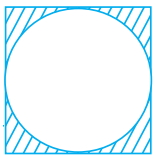
In the figure, a circle of radius $7.5 \, cm$ is inscribed in a square. Find the area of the shaded region (Use $\pi = 3.14$) (in $cm^2$).
A
$176.625$
B
$225$
C
$48.375$
D
$150$
Solution
(C) Area of the circle $= \pi r^2$
$= 3.14 \times (7.5)^2 \, cm^2$
$= 3.14 \times 56.25 \, cm^2 = 176.625 \, cm^2$
Clearly, the side of the square $=$ diameter of the circle $= 2 \times 7.5 \, cm = 15 \, cm$.
So, the area of the square $= (\text{side})^2 = 15^2 \, cm^2 = 225 \, cm^2$.
Therefore, the area of the shaded region $=$ Area of the square $-$ Area of the circle
$= 225 \, cm^2 - 176.625 \, cm^2 = 48.375 \, cm^2$.
$= 3.14 \times (7.5)^2 \, cm^2$
$= 3.14 \times 56.25 \, cm^2 = 176.625 \, cm^2$
Clearly, the side of the square $=$ diameter of the circle $= 2 \times 7.5 \, cm = 15 \, cm$.
So, the area of the square $= (\text{side})^2 = 15^2 \, cm^2 = 225 \, cm^2$.
Therefore, the area of the shaded region $=$ Area of the square $-$ Area of the circle
$= 225 \, cm^2 - 176.625 \, cm^2 = 48.375 \, cm^2$.
0 likes
View Solution32
MediumMCQ
Area of a sector of a circle of radius $36 \, cm$ is $54 \pi \, cm^{2}$. Find the length of the corresponding arc of the sector (in $cm$). (in $pi$)
A
$3$
B
$2$
C
$6$
D
$4$
Solution
(A) Given: Radius $r = 36 \, cm$ and Area of the sector $A = 54 \pi \, cm^{2}$.
The formula for the area of a sector is $A = \frac{1}{2} \times l \times r$,where $l$ is the length of the arc.
Substituting the given values into the formula:
$54 \pi = \frac{1}{2} \times l \times 36$
$54 \pi = 18 \times l$
$l = \frac{54 \pi}{18}$
$l = 3 \pi \, cm$.
Thus,the length of the corresponding arc is $3 \pi \, cm$.
The formula for the area of a sector is $A = \frac{1}{2} \times l \times r$,where $l$ is the length of the arc.
Substituting the given values into the formula:
$54 \pi = \frac{1}{2} \times l \times 36$
$54 \pi = 18 \times l$
$l = \frac{54 \pi}{18}$
$l = 3 \pi \, cm$.
Thus,the length of the corresponding arc is $3 \pi \, cm$.
0 likes
View Solution33
MediumMCQ
Find the radius of a circle whose circumference is equal to the sum of the circumferences of two circles of radii $15 \, cm$ and $18 \, cm$ (in $cm$).
A
$33$
B
$32$
C
$35$
D
$34$
Solution
(A) Let the radius of the required circle be $r$.
The circumference of a circle is given by the formula $C = 2 \pi r$.
Let the radii of the two given circles be $r_1 = 15 \, cm$ and $r_2 = 18 \, cm$.
According to the problem,the circumference of the new circle is equal to the sum of the circumferences of the two given circles:
$2 \pi r = 2 \pi r_1 + 2 \pi r_2$
Dividing both sides by $2 \pi$,we get:
$r = r_1 + r_2$
Substituting the values:
$r = 15 \, cm + 18 \, cm$
$r = 33 \, cm$
Thus,the radius of the required circle is $33 \, cm$.
The circumference of a circle is given by the formula $C = 2 \pi r$.
Let the radii of the two given circles be $r_1 = 15 \, cm$ and $r_2 = 18 \, cm$.
According to the problem,the circumference of the new circle is equal to the sum of the circumferences of the two given circles:
$2 \pi r = 2 \pi r_1 + 2 \pi r_2$
Dividing both sides by $2 \pi$,we get:
$r = r_1 + r_2$
Substituting the values:
$r = 15 \, cm + 18 \, cm$
$r = 33 \, cm$
Thus,the radius of the required circle is $33 \, cm$.
0 likes
View Solution34
Medium
In the figure,a square of diagonal $8\, cm$ is inscribed in a circle. Find the area of the shaded region.
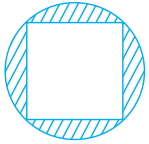
Solution
(N/A) Let the side of the square be $a$ and the radius of the circle be $r$.
Given that,the length of the diagonal of the square $= 8\, cm$.
Since the diagonal of a square $= a\sqrt{2}$,we have:
$a\sqrt{2} = 8$
$a = \frac{8}{\sqrt{2}} = 4\sqrt{2}\, cm$.
When a square is inscribed in a circle,the diagonal of the square is equal to the diameter of the circle.
Therefore,the diameter of the circle $= 8\, cm$.
Radius of the circle $r = \frac{\text{Diameter}}{2} = \frac{8}{2} = 4\, cm$.
Area of the circle $= \pi r^2 = \pi(4)^2 = 16\pi\, cm^2$.
Area of the square $= a^2 = (4\sqrt{2})^2 = 16 \times 2 = 32\, cm^2$.
The area of the shaded region is the difference between the area of the circle and the area of the square:
Area of shaded region $= \text{Area of circle} - \text{Area of square}$
$= (16\pi - 32)\, cm^2$.
Hence,the required area of the shaded region is $(16\pi - 32)\, cm^2$.
Given that,the length of the diagonal of the square $= 8\, cm$.
Since the diagonal of a square $= a\sqrt{2}$,we have:
$a\sqrt{2} = 8$
$a = \frac{8}{\sqrt{2}} = 4\sqrt{2}\, cm$.
When a square is inscribed in a circle,the diagonal of the square is equal to the diameter of the circle.
Therefore,the diameter of the circle $= 8\, cm$.
Radius of the circle $r = \frac{\text{Diameter}}{2} = \frac{8}{2} = 4\, cm$.
Area of the circle $= \pi r^2 = \pi(4)^2 = 16\pi\, cm^2$.
Area of the square $= a^2 = (4\sqrt{2})^2 = 16 \times 2 = 32\, cm^2$.
The area of the shaded region is the difference between the area of the circle and the area of the square:
Area of shaded region $= \text{Area of circle} - \text{Area of square}$
$= (16\pi - 32)\, cm^2$.
Hence,the required area of the shaded region is $(16\pi - 32)\, cm^2$.
0 likes
View Solution35
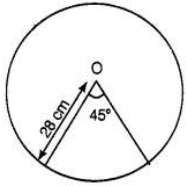
MediumMCQ
Find the area of a sector of a circle of radius $28 \,cm$ and central angle $45^{\circ}$. (in $cm^{2}$)
A
$228$
B
$288$
C
$308$
D
$380$
Solution
(C) Given that,the radius of the circle,$r = 28 \,cm$.
The measure of the central angle,$\theta = 45^{\circ}$.
The formula for the area of a sector of a circle is given by: $\text{Area} = \frac{\theta}{360^{\circ}} \times \pi r^{2}$.
Substituting the given values:
$\text{Area} = \frac{45^{\circ}}{360^{\circ}} \times \frac{22}{7} \times (28)^{2}$
$\text{Area} = \frac{1}{8} \times \frac{22}{7} \times 28 \times 28$
$\text{Area} = \frac{1}{8} \times 22 \times 4 \times 28$
$\text{Area} = \frac{1}{8} \times 22 \times 112$
$\text{Area} = 22 \times 14 = 308 \,cm^{2}$.
Thus,the area of the sector is $308 \,cm^{2}$.
The measure of the central angle,$\theta = 45^{\circ}$.
The formula for the area of a sector of a circle is given by: $\text{Area} = \frac{\theta}{360^{\circ}} \times \pi r^{2}$.
Substituting the given values:
$\text{Area} = \frac{45^{\circ}}{360^{\circ}} \times \frac{22}{7} \times (28)^{2}$
$\text{Area} = \frac{1}{8} \times \frac{22}{7} \times 28 \times 28$
$\text{Area} = \frac{1}{8} \times 22 \times 4 \times 28$
$\text{Area} = \frac{1}{8} \times 22 \times 112$
$\text{Area} = 22 \times 14 = 308 \,cm^{2}$.
Thus,the area of the sector is $308 \,cm^{2}$.
0 likes
View Solution36
MediumMCQ
The wheel of a motorcycle has a radius of $35 \, cm$. How many revolutions per minute must the wheel make to maintain a speed of $66 \, km/h$?
A
$600$
B
$300$
C
$550$
D
$500$
Solution
(D) Given,radius of the wheel,$r = 35 \, cm$.
The circumference of the wheel is given by $C = 2 \pi r$.
$C = 2 \times \frac{22}{7} \times 35 = 220 \, cm$.
The speed of the motorcycle is $66 \, km/h$. We need to convert this into $cm/min$:
$66 \, km/h = \frac{66 \times 1000 \, m}{60 \, min} = 1100 \, m/min$.
Since $1 \, m = 100 \, cm$,the speed is $1100 \times 100 = 110000 \, cm/min$.
The number of revolutions per minute is calculated by dividing the total distance covered in one minute by the circumference of the wheel:
$\text{Number of revolutions} = \frac{\text{Total distance per minute}}{\text{Circumference}} = \frac{110000}{220} = 500$.
Therefore,the wheel must make $500$ revolutions per minute.
The circumference of the wheel is given by $C = 2 \pi r$.
$C = 2 \times \frac{22}{7} \times 35 = 220 \, cm$.
The speed of the motorcycle is $66 \, km/h$. We need to convert this into $cm/min$:
$66 \, km/h = \frac{66 \times 1000 \, m}{60 \, min} = 1100 \, m/min$.
Since $1 \, m = 100 \, cm$,the speed is $1100 \times 100 = 110000 \, cm/min$.
The number of revolutions per minute is calculated by dividing the total distance covered in one minute by the circumference of the wheel:
$\text{Number of revolutions} = \frac{\text{Total distance per minute}}{\text{Circumference}} = \frac{110000}{220} = 500$.
Therefore,the wheel must make $500$ revolutions per minute.
0 likes
View Solution37
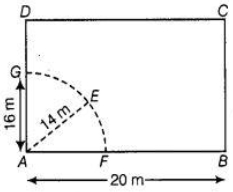
MediumMCQ
$A$ cow is tied with a rope of length $14 \, m$ at the corner of a rectangular field of dimensions $20 \, m \times 16 \, m$. Find the area of the field in which the cow can graze. (in $m^2$)
A
$154$
B
$166$
C
$140$
D
$180$
Solution
(A) Let $ABCD$ be a rectangular field of dimensions $20 \, m \times 16 \, m$.
Suppose,a cow is tied at a corner $A$. Let the length of the rope be $r = 14 \, m$.
The area that the cow can graze is a sector of a circle with radius $r = 14 \, m$ and central angle $\theta = 90^{\circ}$ (since the corner of a rectangle is $90^{\circ}$).
Area of the sector $= \frac{\theta}{360^{\circ}} \times \pi r^2$
$= \frac{90^{\circ}}{360^{\circ}} \times \frac{22}{7} \times (14)^2$
$= \frac{1}{4} \times \frac{22}{7} \times 196$
$= \frac{1}{4} \times 22 \times 28$
$= 22 \times 7 = 154 \, m^2$.
Suppose,a cow is tied at a corner $A$. Let the length of the rope be $r = 14 \, m$.
The area that the cow can graze is a sector of a circle with radius $r = 14 \, m$ and central angle $\theta = 90^{\circ}$ (since the corner of a rectangle is $90^{\circ}$).
Area of the sector $= \frac{\theta}{360^{\circ}} \times \pi r^2$
$= \frac{90^{\circ}}{360^{\circ}} \times \frac{22}{7} \times (14)^2$
$= \frac{1}{4} \times \frac{22}{7} \times 196$
$= \frac{1}{4} \times 22 \times 28$
$= 22 \times 7 = 154 \, m^2$.
0 likes
View Solution38
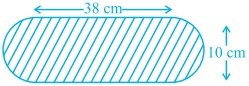
Medium
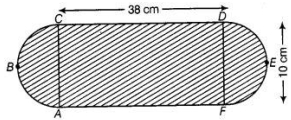
Find the area of the flower bed (with semi-circular ends) shown in the figure.
Solution
(N/A) The flower bed consists of a central rectangular part and two semi-circular ends.
The length of the rectangular part is $38 \, cm$ and its breadth is $10 \, cm$.
Area of the rectangle $= \text{Length} \times \text{Breadth} = 38 \times 10 = 380 \, cm^2$.
The two semi-circular ends together form one complete circle with a diameter of $10 \, cm$.
Radius of the circle $(r) = \frac{10}{2} = 5 \, cm$.
Area of the two semi-circles $= \pi r^2 = \pi \times (5)^2 = 25 \pi \, cm^2$.
Total area of the flower bed $= \text{Area of rectangle} + \text{Area of two semi-circles} = (380 + 25 \pi) \, cm^2$.
The length of the rectangular part is $38 \, cm$ and its breadth is $10 \, cm$.
Area of the rectangle $= \text{Length} \times \text{Breadth} = 38 \times 10 = 380 \, cm^2$.
The two semi-circular ends together form one complete circle with a diameter of $10 \, cm$.
Radius of the circle $(r) = \frac{10}{2} = 5 \, cm$.
Area of the two semi-circles $= \pi r^2 = \pi \times (5)^2 = 25 \pi \, cm^2$.
Total area of the flower bed $= \text{Area of rectangle} + \text{Area of two semi-circles} = (380 + 25 \pi) \, cm^2$.
0 likes
View Solution39
DifficultMCQ
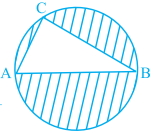
In the figure,$AB$ is a diameter of the circle,$AC = 6 \, cm$ and $BC = 8 \, cm$. Find the area of the shaded region (Use $\pi = 3.14$). (in $cm^2$)
A
$78.5$
B
$24$
C
$54.5$
D
$60$
Solution
(C) Given,$AC = 6 \, cm$ and $BC = 8 \, cm$.
We know that an angle in a semi-circle is a right angle. Therefore,$\angle C = 90^{\circ}$.
In the right-angled $\triangle ACB$,using the Pythagoras theorem:
$AB^2 = AC^2 + BC^2$
$AB^2 = 6^2 + 8^2 = 36 + 64 = 100$
$AB = \sqrt{100} = 10 \, cm$ (since length cannot be negative).
Area of $\triangle ACB = \frac{1}{2} \times \text{base} \times \text{height} = \frac{1}{2} \times 8 \times 6 = 24 \, cm^2$.
The diameter of the circle is $AB = 10 \, cm$,so the radius $r = \frac{10}{2} = 5 \, cm$.
Area of the circle $= \pi r^2 = 3.14 \times (5)^2 = 3.14 \times 25 = 78.5 \, cm^2$.
Area of the shaded region = Area of the circle - Area of $\triangle ACB$
$= 78.5 - 24 = 54.5 \, cm^2$.
We know that an angle in a semi-circle is a right angle. Therefore,$\angle C = 90^{\circ}$.
In the right-angled $\triangle ACB$,using the Pythagoras theorem:
$AB^2 = AC^2 + BC^2$
$AB^2 = 6^2 + 8^2 = 36 + 64 = 100$
$AB = \sqrt{100} = 10 \, cm$ (since length cannot be negative).
Area of $\triangle ACB = \frac{1}{2} \times \text{base} \times \text{height} = \frac{1}{2} \times 8 \times 6 = 24 \, cm^2$.
The diameter of the circle is $AB = 10 \, cm$,so the radius $r = \frac{10}{2} = 5 \, cm$.
Area of the circle $= \pi r^2 = 3.14 \times (5)^2 = 3.14 \times 25 = 78.5 \, cm^2$.
Area of the shaded region = Area of the circle - Area of $\triangle ACB$
$= 78.5 - 24 = 54.5 \, cm^2$.
0 likes
View Solution40
Medium
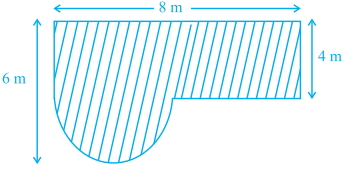
Find the area of the shaded field shown in the figure.
Solution
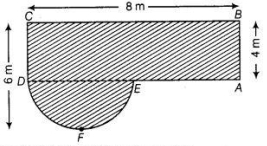
(N/A) In the given figure,join $DE$.
From the figure,the diameter of the semi-circle $DFE$ is $6 - 4 = 2 \, m$. Therefore,the radius $r = 2 / 2 = 1 \, m$.
Now,the area of the rectangle $ABCD$ is $BC \times AB = 8 \times 4 = 32 \, m^2$.
The area of the semi-circle $DFE$ is $\frac{\pi r^2}{2} = \frac{\pi}{2}(1)^2 = 0.5 \pi \, m^2$.
Therefore,the total area of the shaded region = Area of rectangle $ABCD$ + Area of semi-circle $DFE$.
Total area = $(32 + 0.5 \pi) \, m^2$.
From the figure,the diameter of the semi-circle $DFE$ is $6 - 4 = 2 \, m$. Therefore,the radius $r = 2 / 2 = 1 \, m$.
Now,the area of the rectangle $ABCD$ is $BC \times AB = 8 \times 4 = 32 \, m^2$.
The area of the semi-circle $DFE$ is $\frac{\pi r^2}{2} = \frac{\pi}{2}(1)^2 = 0.5 \pi \, m^2$.
Therefore,the total area of the shaded region = Area of rectangle $ABCD$ + Area of semi-circle $DFE$.
Total area = $(32 + 0.5 \pi) \, m^2$.
0 likes
View Solution41
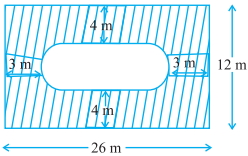
Difficult
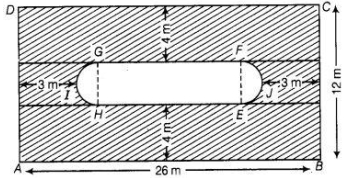
Find the area of the shaded region in the given figure.
Solution
(N/A) The outer rectangle $ABCD$ has length $L = 26 \, m$ and breadth $B = 12 \, m$.
Area of outer rectangle $= L \times B = 26 \times 12 = 312 \, m^2$.
The inner unshaded region consists of a rectangle and two semi-circles.
The breadth of the inner rectangle is $12 - (4 + 4) = 4 \, m$. This is also the diameter of the two semi-circles.
Radius of each semi-circle $r = 4 / 2 = 2 \, m$.
The length of the inner rectangle is $26 - (3 + 3 + 2 + 2) = 16 \, m$ (subtracting the $3 \, m$ gaps and the two radii of the semi-circles).
Area of inner rectangle $= 16 \times 4 = 64 \, m^2$.
Area of two semi-circles $= 2 \times (\frac{1}{2} \pi r^2) = \pi r^2 = \pi (2)^2 = 4\pi \, m^2$.
Total unshaded area $= 64 + 4\pi \, m^2$.
Area of shaded region $=$ Area of outer rectangle $-$ Total unshaded area
$= 312 - (64 + 4\pi) = (248 - 4\pi) \, m^2$.
Area of outer rectangle $= L \times B = 26 \times 12 = 312 \, m^2$.
The inner unshaded region consists of a rectangle and two semi-circles.
The breadth of the inner rectangle is $12 - (4 + 4) = 4 \, m$. This is also the diameter of the two semi-circles.
Radius of each semi-circle $r = 4 / 2 = 2 \, m$.
The length of the inner rectangle is $26 - (3 + 3 + 2 + 2) = 16 \, m$ (subtracting the $3 \, m$ gaps and the two radii of the semi-circles).
Area of inner rectangle $= 16 \times 4 = 64 \, m^2$.
Area of two semi-circles $= 2 \times (\frac{1}{2} \pi r^2) = \pi r^2 = \pi (2)^2 = 4\pi \, m^2$.
Total unshaded area $= 64 + 4\pi \, m^2$.
Area of shaded region $=$ Area of outer rectangle $-$ Total unshaded area
$= 312 - (64 + 4\pi) = (248 - 4\pi) \, m^2$.
0 likes
View Solution42
DifficultMCQ
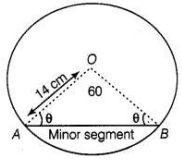
Find the area of the minor segment of a circle of radius $14 \, cm$,when the angle of the corresponding sector is $60^{\circ}$. (in $cm^{2}$)
A
$45 \sqrt{2}$
B
$49 \sqrt{3}$
C
$49 \sqrt{7}$
D
$59 \sqrt{3}$
Solution
(B) Given,radius of the circle $(r) = 14 \, cm$ and central angle $(\theta) = 60^{\circ}$.
The area of the minor segment is given by the formula: Area of sector - Area of triangle.
Area of sector $= \frac{\theta}{360^{\circ}} \times \pi r^{2} = \frac{60^{\circ}}{360^{\circ}} \times \frac{22}{7} \times 14 \times 14 = \frac{1}{6} \times 22 \times 2 \times 14 = \frac{308}{3} \approx 102.67 \, cm^{2}$.
Since the central angle is $60^{\circ}$ and the two sides are radii,the triangle formed is an equilateral triangle.
Area of equilateral triangle $= \frac{\sqrt{3}}{4} \times (\text{side})^{2} = \frac{\sqrt{3}}{4} \times 14^{2} = \frac{\sqrt{3}}{4} \times 196 = 49 \sqrt{3} \, cm^{2} \approx 84.87 \, cm^{2}$.
Area of minor segment $= \frac{308}{3} - 49 \sqrt{3} \, cm^{2} \approx 102.67 - 84.87 = 17.8 \, cm^{2}$.
Note: The provided options seem to represent the area of the triangle rather than the segment. Based on the standard calculation for the area of the minor segment,the result is $\frac{308}{3} - 49 \sqrt{3}$. However,if the question implies the area of the triangle formed by the chord,the answer is $49 \sqrt{3}$.
The area of the minor segment is given by the formula: Area of sector - Area of triangle.
Area of sector $= \frac{\theta}{360^{\circ}} \times \pi r^{2} = \frac{60^{\circ}}{360^{\circ}} \times \frac{22}{7} \times 14 \times 14 = \frac{1}{6} \times 22 \times 2 \times 14 = \frac{308}{3} \approx 102.67 \, cm^{2}$.
Since the central angle is $60^{\circ}$ and the two sides are radii,the triangle formed is an equilateral triangle.
Area of equilateral triangle $= \frac{\sqrt{3}}{4} \times (\text{side})^{2} = \frac{\sqrt{3}}{4} \times 14^{2} = \frac{\sqrt{3}}{4} \times 196 = 49 \sqrt{3} \, cm^{2} \approx 84.87 \, cm^{2}$.
Area of minor segment $= \frac{308}{3} - 49 \sqrt{3} \, cm^{2} \approx 102.67 - 84.87 = 17.8 \, cm^{2}$.
Note: The provided options seem to represent the area of the triangle rather than the segment. Based on the standard calculation for the area of the minor segment,the result is $\frac{308}{3} - 49 \sqrt{3}$. However,if the question implies the area of the triangle formed by the chord,the answer is $49 \sqrt{3}$.
0 likes
View Solution43
MediumMCQ
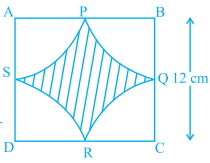
Find the area of the shaded region in the figure where arcs drawn with centers $A, B, C,$ and $D$ intersect in pairs at mid-points $P, Q, R,$ and $S$ of the sides $AB, BC, CD,$ and $DA,$ respectively of a square $ABCD$ (Use $\pi = 3.14$) (in $cm^{2}$).
A
$144$
B
$113.04$
C
$30.96$
D
$123.44$
Solution
(C) Given,side of square $ABCD = 12 \, cm$.
Since $P, Q, R, S$ are mid-points of sides $AB, BC, CD, DA$ respectively,the radius of each quadrant arc is $r = \frac{12}{2} = 6 \, cm$.
Area of one quadrant = $\frac{1}{4} \pi r^{2} = \frac{1}{4} \times 3.14 \times (6)^{2} = \frac{3.14 \times 36}{4} = 3.14 \times 9 = 28.26 \, cm^{2}$.
Area of four such quadrants = $4 \times 28.26 = 113.04 \, cm^{2}$.
Area of square $ABCD = (side)^{2} = (12)^{2} = 144 \, cm^{2}$.
Area of the shaded region = Area of square $ABCD - $ Area of four quadrants.
Area of the shaded region = $144 - 113.04 = 30.96 \, cm^{2}$.
Since $P, Q, R, S$ are mid-points of sides $AB, BC, CD, DA$ respectively,the radius of each quadrant arc is $r = \frac{12}{2} = 6 \, cm$.
Area of one quadrant = $\frac{1}{4} \pi r^{2} = \frac{1}{4} \times 3.14 \times (6)^{2} = \frac{3.14 \times 36}{4} = 3.14 \times 9 = 28.26 \, cm^{2}$.
Area of four such quadrants = $4 \times 28.26 = 113.04 \, cm^{2}$.
Area of square $ABCD = (side)^{2} = (12)^{2} = 144 \, cm^{2}$.
Area of the shaded region = Area of square $ABCD - $ Area of four quadrants.
Area of the shaded region = $144 - 113.04 = 30.96 \, cm^{2}$.
0 likes
View Solution44
MediumMCQ
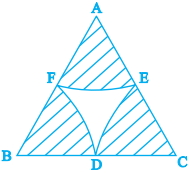
In the figure,arcs are drawn by taking vertices $A, B$ and $C$ of an equilateral triangle of side $10 \, cm$ as centers to intersect the sides $BC, CA$ and $AB$ at their respective mid-points $D, E$ and $F$. Find the area of the shaded region (Use $\pi = 3.14$) (in $cm^2$).
A
$35$
B
$13.83$
C
$78.5$
D
$39.25$
Solution
(D) Given that $ABC$ is an equilateral triangle with side length $10 \, cm$.
Therefore,$\angle A = \angle B = \angle C = 60^{\circ}$.
Since $D, E$ and $F$ are mid-points of sides $BC, CA$ and $AB$ respectively,the radius of each arc is $r = 5 \, cm$.
The shaded region consists of three sectors,each with a central angle of $60^{\circ}$ and radius $r = 5 \, cm$.
Area of one sector $= \frac{\theta}{360^{\circ}} \times \pi r^2 = \frac{60^{\circ}}{360^{circ}} \times 3.14 \times (5)^2$.
Area of one sector $= \frac{1}{6} \times 3.14 \times 25 = \frac{78.5}{6} \approx 13.0833 \, cm^2$.
Total area of the shaded region $= 3 \times (\text{Area of one sector}) = 3 \times \frac{78.5}{6} = \frac{78.5}{2} = 39.25 \, cm^2$.
Therefore,$\angle A = \angle B = \angle C = 60^{\circ}$.
Since $D, E$ and $F$ are mid-points of sides $BC, CA$ and $AB$ respectively,the radius of each arc is $r = 5 \, cm$.
The shaded region consists of three sectors,each with a central angle of $60^{\circ}$ and radius $r = 5 \, cm$.
Area of one sector $= \frac{\theta}{360^{\circ}} \times \pi r^2 = \frac{60^{\circ}}{360^{circ}} \times 3.14 \times (5)^2$.
Area of one sector $= \frac{1}{6} \times 3.14 \times 25 = \frac{78.5}{6} \approx 13.0833 \, cm^2$.
Total area of the shaded region $= 3 \times (\text{Area of one sector}) = 3 \times \frac{78.5}{6} = \frac{78.5}{2} = 39.25 \, cm^2$.
0 likes
View Solution45
DifficultMCQ
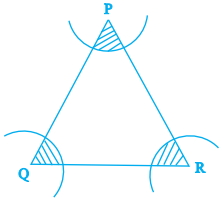
In the figure,arcs have been drawn with radii $14 \, cm$ each and with centres $P$,$Q$,and $R$. Find the area of the shaded region (in $cm^{2}$).
A
$308$
B
$196$
C
$340$
D
$298$
Solution
(A) Given that,the radius of each arc $(r)$ $= 14 \, cm$.
The area of a sector with central angle $\theta$ is given by $\frac{\theta}{360^{\circ}} \times \pi r^{2}$.
For the three sectors with central angles $\angle P$,$\angle Q$,and $\angle R$,the sum of their areas is:
Area $= \frac{\angle P}{360^{\circ}} \times \pi r^{2} + \frac{\angle Q}{360^{\circ}} \times \pi r^{2} + \frac{\angle R}{360^{\circ}} \times \pi r^{2}$
Area $= \frac{(\angle P + \angle Q + \angle R)}{360^{\circ}} \times \pi r^{2}$
Since the sum of the interior angles of a triangle is $180^{\circ}$,we have $\angle P + \angle Q + \angle R = 180^{\circ}$.
Area $= \frac{180^{\circ}}{360^{\circ}} \times \pi \times (14)^{2}$
Area $= \frac{1}{2} \times \frac{22}{7} \times 196$
Area $= \frac{1}{2} \times 22 \times 28 = 11 \times 28 = 308 \, cm^{2}$.
Thus,the area of the shaded region is $308 \, cm^{2}$.
The area of a sector with central angle $\theta$ is given by $\frac{\theta}{360^{\circ}} \times \pi r^{2}$.
For the three sectors with central angles $\angle P$,$\angle Q$,and $\angle R$,the sum of their areas is:
Area $= \frac{\angle P}{360^{\circ}} \times \pi r^{2} + \frac{\angle Q}{360^{\circ}} \times \pi r^{2} + \frac{\angle R}{360^{\circ}} \times \pi r^{2}$
Area $= \frac{(\angle P + \angle Q + \angle R)}{360^{\circ}} \times \pi r^{2}$
Since the sum of the interior angles of a triangle is $180^{\circ}$,we have $\angle P + \angle Q + \angle R = 180^{\circ}$.
Area $= \frac{180^{\circ}}{360^{\circ}} \times \pi \times (14)^{2}$
Area $= \frac{1}{2} \times \frac{22}{7} \times 196$
Area $= \frac{1}{2} \times 22 \times 28 = 11 \times 28 = 308 \, cm^{2}$.
Thus,the area of the shaded region is $308 \, cm^{2}$.
0 likes
View Solution46
DifficultMCQ
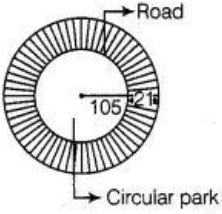
$A$ circular park is surrounded by a road $21\, m$ wide. If the radius of the park is $105\, m$,find the area of the road in $m^2$.
A
$15300$
B
$15246$
C
$16246$
D
$15642$
Solution
(B) Given that,a circular park is surrounded by a road.
Width of the road $= 21\, m$.
Radius of the park $(r_i) = 105\, m$.
Therefore,the radius of the whole circular portion (park + road) is $r_e = 105 + 21 = 126\, m$.
Now,the area of the road $=$ Area of the whole circular portion $-$ Area of the circular park.
Area of road $= \pi r_e^2 - \pi r_i^2 = \pi(r_e^2 - r_i^2)$.
Using the identity $a^2 - b^2 = (a - b)(a + b)$:
Area of road $= \frac{22}{7} \times (126^2 - 105^2) = \frac{22}{7} \times (126 + 105)(126 - 105)$.
Area of road $= \frac{22}{7} \times 231 \times 21$.
Area of road $= 22 \times 231 \times 3 = 15246\, m^2$.
Hence,the required area of the road is $15246\, m^2$.
Width of the road $= 21\, m$.
Radius of the park $(r_i) = 105\, m$.
Therefore,the radius of the whole circular portion (park + road) is $r_e = 105 + 21 = 126\, m$.
Now,the area of the road $=$ Area of the whole circular portion $-$ Area of the circular park.
Area of road $= \pi r_e^2 - \pi r_i^2 = \pi(r_e^2 - r_i^2)$.
Using the identity $a^2 - b^2 = (a - b)(a + b)$:
Area of road $= \frac{22}{7} \times (126^2 - 105^2) = \frac{22}{7} \times (126 + 105)(126 - 105)$.
Area of road $= \frac{22}{7} \times 231 \times 21$.
Area of road $= 22 \times 231 \times 3 = 15246\, m^2$.
Hence,the required area of the road is $15246\, m^2$.
0 likes
View Solution47
DifficultMCQ
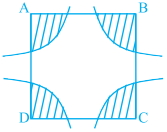
In the figure,arcs have been drawn with a radius of $21 \, cm$ each,using vertices $A, B, C,$ and $D$ of quadrilateral $ABCD$ as centers. Find the area of the shaded region in $cm^2$.
A
$1200$
B
$1300$
C
$1386$
D
$1286$
Solution
(C) Given that the radius of each arc is $r = 21 \, cm$.
The area of a sector with central angle $\theta$ is given by $\frac{\theta}{360^{\circ}} \times \pi r^2$.
The sum of the areas of the four sectors at vertices $A, B, C,$ and $D$ is:
Area $= \frac{\angle A}{360^{\circ}} \times \pi r^2 + \frac{\angle B}{360^{\circ}} \times \pi r^2 + \frac{\angle C}{360^{\circ}} \times \pi r^2 + \frac{\angle D}{360^{\circ}} \times \pi r^2$
Area $= \frac{(\angle A + \angle B + \angle C + \angle D)}{360^{\circ}} \times \pi r^2$
Since the sum of the interior angles of any quadrilateral is $360^{\circ}$,we have:
Area $= \frac{360^{\circ}}{360^{\circ}} \times \pi r^2 = \pi r^2$
Substituting $r = 21 \, cm$ and $\pi = \frac{22}{7}$:
Area $= \frac{22}{7} \times 21 \times 21 = 22 \times 3 \times 21 = 1386 \, cm^2$.
Thus,the area of the shaded region is $1386 \, cm^2$.
The area of a sector with central angle $\theta$ is given by $\frac{\theta}{360^{\circ}} \times \pi r^2$.
The sum of the areas of the four sectors at vertices $A, B, C,$ and $D$ is:
Area $= \frac{\angle A}{360^{\circ}} \times \pi r^2 + \frac{\angle B}{360^{\circ}} \times \pi r^2 + \frac{\angle C}{360^{\circ}} \times \pi r^2 + \frac{\angle D}{360^{\circ}} \times \pi r^2$
Area $= \frac{(\angle A + \angle B + \angle C + \angle D)}{360^{\circ}} \times \pi r^2$
Since the sum of the interior angles of any quadrilateral is $360^{\circ}$,we have:
Area $= \frac{360^{\circ}}{360^{\circ}} \times \pi r^2 = \pi r^2$
Substituting $r = 21 \, cm$ and $\pi = \frac{22}{7}$:
Area $= \frac{22}{7} \times 21 \times 21 = 22 \times 3 \times 21 = 1386 \, cm^2$.
Thus,the area of the shaded region is $1386 \, cm^2$.
0 likes
View Solution48
MediumMCQ
$A$ piece of wire $20 \,cm$ long is bent into the form of an arc of a circle subtending an angle of $60^{\circ}$ at its centre. Find the radius of the circle. (in $cm$)
A
$\frac{90}{\pi}$
B
$\frac{160}{\pi}$
C
$\frac{20}{\pi}$
D
$\frac{60}{\pi}$
Solution
(D) The length of the arc of the circle is given as $20 \,cm$.
The central angle subtended by the arc is $\theta = 60^{\circ}$.
The formula for the length of an arc is $L = \frac{\theta}{360^{\circ}} \times 2 \pi r$.
Substituting the given values into the formula:
$20 = \frac{60^{\circ}}{360^{\circ}} \times 2 \pi r$
Simplify the fraction:
$20 = \frac{1}{6} \times 2 \pi r$
$20 = \frac{\pi r}{3}$
Solving for $r$:
$r = \frac{20 \times 3}{\pi} = \frac{60}{\pi} \,cm$.
Thus,the radius of the circle is $\frac{60}{\pi} \,cm$.
The central angle subtended by the arc is $\theta = 60^{\circ}$.
The formula for the length of an arc is $L = \frac{\theta}{360^{\circ}} \times 2 \pi r$.
Substituting the given values into the formula:
$20 = \frac{60^{\circ}}{360^{\circ}} \times 2 \pi r$
Simplify the fraction:
$20 = \frac{1}{6} \times 2 \pi r$
$20 = \frac{\pi r}{3}$
Solving for $r$:
$r = \frac{20 \times 3}{\pi} = \frac{60}{\pi} \,cm$.
Thus,the radius of the circle is $\frac{60}{\pi} \,cm$.
0 likes
View Solution49
DifficultMCQ
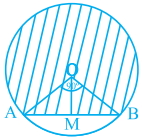
$A$ chord of a circle of radius $20\, cm$ subtends an angle of $90^{\circ}$ at the centre. Find the area of the corresponding major segment of the circle. (Use $\pi=3.14$) (in $cm^2$)
A
$285.5$
B
$290$
C
$295.5$
D
$1142.5$
Solution
(D) Given: Radius $r = 20\, cm$,central angle $\theta = 90^{\circ}$.
Area of the major sector $= \frac{360^{\circ} - 90^{\circ}}{360^{\circ}} \times \pi r^2 = \frac{270}{360} \times 3.14 \times (20)^2 = \frac{3}{4} \times 3.14 \times 400 = 3 \times 3.14 \times 100 = 942\, cm^2$.
Area of $\triangle OAB = \frac{1}{2} \times r^2 \times \sin(90^{\circ}) = \frac{1}{2} \times 20 \times 20 \times 1 = 200\, cm^2$.
Area of the major segment = Area of the major sector + Area of $\triangle OAB = 942 + 200 = 1142\, cm^2$.
Area of the major sector $= \frac{360^{\circ} - 90^{\circ}}{360^{\circ}} \times \pi r^2 = \frac{270}{360} \times 3.14 \times (20)^2 = \frac{3}{4} \times 3.14 \times 400 = 3 \times 3.14 \times 100 = 942\, cm^2$.
Area of $\triangle OAB = \frac{1}{2} \times r^2 \times \sin(90^{\circ}) = \frac{1}{2} \times 20 \times 20 \times 1 = 200\, cm^2$.
Area of the major segment = Area of the major sector + Area of $\triangle OAB = 942 + 200 = 1142\, cm^2$.
0 likes
View Solution50
DifficultMCQ
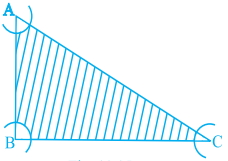
With the vertices $A, B$ and $C$ of a triangle $ABC$ as centres,arcs are drawn with radii $5 \, cm$ each as shown in the figure. If $AB = 14 \, cm, BC = 48 \, cm$ and $CA = 50 \, cm$,then find the area of the shaded region. (Use $\pi = 3.14$) (in $cm^2$)
A
$336$
B
$296.75$
C
$392.5$
D
$157.85$
Solution
(B) The sum of the areas of the three sectors at vertices $A, B,$ and $C$ is given by:
Area $= \frac{\angle A}{360^{\circ}} \times \pi r^2 + \frac{\angle B}{360^{\circ}} \times \pi r^2 + \frac{\angle C}{360^{\circ}} \times \pi r^2$
$= \frac{(\angle A + \angle B + \angle C)}{360^{\circ}} \times \pi r^2$
Since the sum of angles in a triangle is $180^{\circ}$,the area of the three sectors is:
$= \frac{180^{\circ}}{360^{\circ}} \times 3.14 \times (5)^2 = 0.5 \times 3.14 \times 25 = 39.25 \, cm^2$
Now,we calculate the area of $\triangle ABC$. Since $14^2 + 48^2 = 196 + 2304 = 2500 = 50^2$,the triangle is a right-angled triangle with base $48 \, cm$ and height $14 \, cm$.
Area of $\triangle ABC = \frac{1}{2} \times \text{base} \times \text{height} = \frac{1}{2} \times 48 \times 14 = 336 \, cm^2$
The area of the shaded region is the area of the triangle minus the area of the three sectors:
Area $= 336 - 39.25 = 296.75 \, cm^2$
Area $= \frac{\angle A}{360^{\circ}} \times \pi r^2 + \frac{\angle B}{360^{\circ}} \times \pi r^2 + \frac{\angle C}{360^{\circ}} \times \pi r^2$
$= \frac{(\angle A + \angle B + \angle C)}{360^{\circ}} \times \pi r^2$
Since the sum of angles in a triangle is $180^{\circ}$,the area of the three sectors is:
$= \frac{180^{\circ}}{360^{\circ}} \times 3.14 \times (5)^2 = 0.5 \times 3.14 \times 25 = 39.25 \, cm^2$
Now,we calculate the area of $\triangle ABC$. Since $14^2 + 48^2 = 196 + 2304 = 2500 = 50^2$,the triangle is a right-angled triangle with base $48 \, cm$ and height $14 \, cm$.
Area of $\triangle ABC = \frac{1}{2} \times \text{base} \times \text{height} = \frac{1}{2} \times 48 \times 14 = 336 \, cm^2$
The area of the shaded region is the area of the triangle minus the area of the three sectors:
Area $= 336 - 39.25 = 296.75 \, cm^2$
0 likes
View SolutionAreas Related to Circles — Mix Examples - Areas Related to Circles · Frequently Asked Questions
1Are these Areas Related to Circles questions useful for JEE and NEET?
Yes. All questions in this section are mapped to JEE Main and NEET exam patterns. Previous year questions from JEE Main, NEET, GUJCET and state-level exams are included with full solutions.
2Can I switch to Hindi or Gujarati for these questions?
Yes. Use the language tabs in the hero section or the sidebar to view the same questions and solutions in English, Hindi or Gujarati.
3How do I generate a question paper from this subtopic?
Use the Vedclass Exam Paper Generator — select the chapter and subtopic, set difficulty, and generate Sets A, B, C, D automatically. First 3 chapters of every subject are free.
Vedclass Products
For Students
Vedclass Test Series
Mock tests in real JEE/NEET style with performance analysis. 5-day free trial.
Start Free TrialFor Teachers
Exam Paper Generator
Generate Set A/B/C/D papers from this chapter in 2 minutes. 3 chapters free.
Try FreeFor Institutes
Online Exam Module
Live online exams with unlimited students, 360° analytics & white-label branding.
See DemoFor Teachers & Institutes
Generate a Areas Related to Circles Exam Paper in 2 Minutes
Select subtopic & difficulty — Sets A, B, C, D auto-generated with No Repeat logic.
First 3 chapters of every subject are free — no payment required.