
A English
Textbook - Areas Related to Circles Questions in English
Class 10 Mathematics · Areas Related to Circles · Textbook - Areas Related to Circles
41+
Questions
English
Language
100%
With Solutions
Showing 41 of 41 questions in English
1
MediumMCQ
The cost of fencing a circular field at the rate of $Rs. 24$ per metre is $Rs. 5280$. The field is to be ploughed at the rate of $Rs. 0.50$ per $m^2$. Find the cost of ploughing the field (Take $\pi = \frac{22}{7}$). (in $Rs.$)
A
$1925$
B
$220$
C
$1800$
D
$1850$
Solution
(A) Length of the fence (in $m$) $= \frac{\text{Total cost}}{\text{Rate}} = \frac{5280}{24} = 220$.
So,the circumference of the field $= 220\, m$.
Let $r$ be the radius of the field. Then,$2\pi r = 220$.
$2 \times \frac{22}{7} \times r = 220$.
$r = \frac{220 \times 7}{2 \times 22} = 35\, m$.
Area of the field $= \pi r^2 = \frac{22}{7} \times 35 \times 35 = 22 \times 5 \times 35 = 3850\, m^2$.
Cost of ploughing $1\, m^2$ of the field $= Rs. 0.50$.
Total cost of ploughing the field $= 3850 \times 0.50 = Rs. 1925$.
So,the circumference of the field $= 220\, m$.
Let $r$ be the radius of the field. Then,$2\pi r = 220$.
$2 \times \frac{22}{7} \times r = 220$.
$r = \frac{220 \times 7}{2 \times 22} = 35\, m$.
Area of the field $= \pi r^2 = \frac{22}{7} \times 35 \times 35 = 22 \times 5 \times 35 = 3850\, m^2$.
Cost of ploughing $1\, m^2$ of the field $= Rs. 0.50$.
Total cost of ploughing the field $= 3850 \times 0.50 = Rs. 1925$.
0 likes
View Solution2
EasyMCQ
The radii of two circles are $19\, cm$ and $9\, cm$ respectively. Find the radius of the circle which has circumference equal to the sum of the circumferences of the two circles. (in $cm$) [use $\pi=\frac{22}{7}$]
A
$14$
B
$28$
C
$42$
D
$38$
Solution
(B) Radius $(r_1)$ of the $1^{st}$ circle $= 19\, cm$.
Radius $(r_2)$ of the $2^{nd}$ circle $= 9\, cm$.
Let the radius of the $3^{rd}$ circle be $r$.
Circumference of the $1^{st}$ circle $= 2\pi r_1 = 2\pi(19) = 38\pi$.
Circumference of the $2^{nd}$ circle $= 2\pi r_2 = 2\pi(9) = 18\pi$.
Circumference of the $3^{rd}$ circle $= 2\pi r$.
According to the problem,the circumference of the $3^{rd}$ circle is equal to the sum of the circumferences of the first two circles:
$2\pi r = 38\pi + 18\pi$
$2\pi r = 56\pi$
Dividing both sides by $2\pi$:
$r = \frac{56\pi}{2\pi} = 28\, cm$.
Therefore,the radius of the required circle is $28\, cm$.
Radius $(r_2)$ of the $2^{nd}$ circle $= 9\, cm$.
Let the radius of the $3^{rd}$ circle be $r$.
Circumference of the $1^{st}$ circle $= 2\pi r_1 = 2\pi(19) = 38\pi$.
Circumference of the $2^{nd}$ circle $= 2\pi r_2 = 2\pi(9) = 18\pi$.
Circumference of the $3^{rd}$ circle $= 2\pi r$.
According to the problem,the circumference of the $3^{rd}$ circle is equal to the sum of the circumferences of the first two circles:
$2\pi r = 38\pi + 18\pi$
$2\pi r = 56\pi$
Dividing both sides by $2\pi$:
$r = \frac{56\pi}{2\pi} = 28\, cm$.
Therefore,the radius of the required circle is $28\, cm$.
0 likes
View Solution3
MediumMCQ
The radii of two circles are $8 \, cm$ and $6 \, cm$ respectively. Find the radius of the circle having area equal to the sum of the areas of the two circles. [use $\pi = \frac{22}{7}$] (in $cm$)
A
$100$
B
$20$
C
$10$
D
$64$
Solution
(C) Radius $(r_1)$ of the $1^{st}$ circle $= 8 \, cm$.
Radius $(r_2)$ of the $2^{nd}$ circle $= 6 \, cm$.
Let the radius of the $3^{rd}$ circle be $r$.
Area of the $1^{st}$ circle $= \pi r_1^2 = \pi(8)^2 = 64\pi \, cm^2$.
Area of the $2^{nd}$ circle $= \pi r_2^2 = \pi(6)^2 = 36\pi \, cm^2$.
According to the problem,the area of the $3^{rd}$ circle is equal to the sum of the areas of the two circles:
$\pi r^2 = \pi r_1^2 + \pi r_2^2$
$\pi r^2 = 64\pi + 36\pi$
$\pi r^2 = 100\pi$
$r^2 = 100$
$r = \sqrt{100} = 10 \, cm$.
Since the radius cannot be negative,the radius of the $3^{rd}$ circle is $10 \, cm$.
Radius $(r_2)$ of the $2^{nd}$ circle $= 6 \, cm$.
Let the radius of the $3^{rd}$ circle be $r$.
Area of the $1^{st}$ circle $= \pi r_1^2 = \pi(8)^2 = 64\pi \, cm^2$.
Area of the $2^{nd}$ circle $= \pi r_2^2 = \pi(6)^2 = 36\pi \, cm^2$.
According to the problem,the area of the $3^{rd}$ circle is equal to the sum of the areas of the two circles:
$\pi r^2 = \pi r_1^2 + \pi r_2^2$
$\pi r^2 = 64\pi + 36\pi$
$\pi r^2 = 100\pi$
$r^2 = 100$
$r = \sqrt{100} = 10 \, cm$.
Since the radius cannot be negative,the radius of the $3^{rd}$ circle is $10 \, cm$.
0 likes
View Solution4
Medium
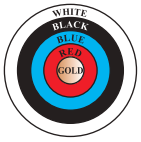
Fig. depicts an archery target marked with its five scoring regions from the centre outwards as $Gold, Red, Blue, Black$ and $White.$ The $diameter$ of the region representing Gold score is $21\, cm$ and each of the other bands is $10.5 \,cm$ wide. Find the area of each of the five scoring regions. [use $\pi=\frac{22}{7}$]
Solution
(N/A) Radius $(r_1)$ of the gold region (i.e.,$1^{st}$ circle) $= \frac{21}{2} = 10.5\, cm$.
Given that each circle is $10.5\, cm$ wider than the previous circle.
Therefore,radius $(r_2)$ of the $2^{nd}$ circle $= 10.5 + 10.5 = 21\, cm$.
Radius $(r_3)$ of the $3^{rd}$ circle $= 21 + 10.5 = 31.5\, cm$.
Radius $(r_4)$ of the $4^{th}$ circle $= 31.5 + 10.5 = 42\, cm$.
Radius $(r_5)$ of the $5^{th}$ circle $= 42 + 10.5 = 52.5\, cm$.
Area of gold region $= \pi r_1^2 = \frac{22}{7} \times (10.5)^2 = 346.5\, cm^2$.
Area of red region $= \pi r_2^2 - \pi r_1^2 = \frac{22}{7} \times (21^2 - 10.5^2) = 1039.5\, cm^2$.
Area of blue region $= \pi r_3^2 - \pi r_2^2 = \frac{22}{7} \times (31.5^2 - 21^2) = 1732.5\, cm^2$.
Area of black region $= \pi r_4^2 - \pi r_3^2 = \frac{22}{7} \times (42^2 - 31.5^2) = 2425.5\, cm^2$.
Area of white region $= \pi r_5^2 - \pi r_4^2 = \frac{22}{7} \times (52.5^2 - 42^2) = 3118.5\, cm^2$.
Thus,the areas of the $Gold, Red, Blue, Black,$ and $White$ regions are $346.5\, cm^2, 1039.5\, cm^2, 1732.5\, cm^2, 2425.5\, cm^2,$ and $3118.5\, cm^2$ respectively.
Given that each circle is $10.5\, cm$ wider than the previous circle.
Therefore,radius $(r_2)$ of the $2^{nd}$ circle $= 10.5 + 10.5 = 21\, cm$.
Radius $(r_3)$ of the $3^{rd}$ circle $= 21 + 10.5 = 31.5\, cm$.
Radius $(r_4)$ of the $4^{th}$ circle $= 31.5 + 10.5 = 42\, cm$.
Radius $(r_5)$ of the $5^{th}$ circle $= 42 + 10.5 = 52.5\, cm$.
Area of gold region $= \pi r_1^2 = \frac{22}{7} \times (10.5)^2 = 346.5\, cm^2$.
Area of red region $= \pi r_2^2 - \pi r_1^2 = \frac{22}{7} \times (21^2 - 10.5^2) = 1039.5\, cm^2$.
Area of blue region $= \pi r_3^2 - \pi r_2^2 = \frac{22}{7} \times (31.5^2 - 21^2) = 1732.5\, cm^2$.
Area of black region $= \pi r_4^2 - \pi r_3^2 = \frac{22}{7} \times (42^2 - 31.5^2) = 2425.5\, cm^2$.
Area of white region $= \pi r_5^2 - \pi r_4^2 = \frac{22}{7} \times (52.5^2 - 42^2) = 3118.5\, cm^2$.
Thus,the areas of the $Gold, Red, Blue, Black,$ and $White$ regions are $346.5\, cm^2, 1039.5\, cm^2, 1732.5\, cm^2, 2425.5\, cm^2,$ and $3118.5\, cm^2$ respectively.
0 likes
View Solution5
EasyMCQ
The wheels of a car have a diameter of $80\, cm$ each. How many complete revolutions does each wheel make in $10\, minutes$ when the car is travelling at a speed of $66\, km/h$? [Use $\pi = \frac{22}{7}$]
A
$4375$
B
$4300$
C
$4350$
D
$4475$
Solution
(A) Diameter of the wheel $= 80\, cm$.
Radius $(r)$ of the wheel $= 40\, cm$.
Circumference of the wheel $= 2\pi r = 2 \times \frac{22}{7} \times 40 = \frac{1760}{7}\, cm$.
Speed of the car $= 66\, km/h = \frac{66 \times 100000\, cm}{60\, min} = 110000\, cm/min$.
Distance travelled in $10\, minutes = 110000 \times 10 = 1100000\, cm$.
Let the number of revolutions be $n$.
$n \times \text{Circumference} = \text{Total distance}$.
$n \times \frac{1760}{7} = 1100000$.
$n = \frac{1100000 \times 7}{1760} = \frac{110000 \times 7}{176} = 4375$.
Thus,each wheel makes $4375$ complete revolutions.
Radius $(r)$ of the wheel $= 40\, cm$.
Circumference of the wheel $= 2\pi r = 2 \times \frac{22}{7} \times 40 = \frac{1760}{7}\, cm$.
Speed of the car $= 66\, km/h = \frac{66 \times 100000\, cm}{60\, min} = 110000\, cm/min$.
Distance travelled in $10\, minutes = 110000 \times 10 = 1100000\, cm$.
Let the number of revolutions be $n$.
$n \times \text{Circumference} = \text{Total distance}$.
$n \times \frac{1760}{7} = 1100000$.
$n = \frac{1100000 \times 7}{1760} = \frac{110000 \times 7}{176} = 4375$.
Thus,each wheel makes $4375$ complete revolutions.
0 likes
View Solution6
EasyMCQ
Tick the correct answer in the following and justify your choice: If the perimeter and the area of a circle are numerically equal,then the radius of the circle is ......... $units$.
A
$2\pi$
B
$2$
C
$4$
D
$7$
Solution
(B) Let the radius of the circle be $r$ $units$.
The circumference (perimeter) of the circle is given by the formula $C = 2\pi r$.
The area of the circle is given by the formula $A = \pi r^2$.
According to the problem,the numerical values of the perimeter and the area are equal,so we set $C = A$.
$2\pi r = \pi r^2$
Dividing both sides by $\pi r$ (assuming $r \neq 0$):
$2 = r$
Therefore,the radius of the circle is $2$ $units$.
The circumference (perimeter) of the circle is given by the formula $C = 2\pi r$.
The area of the circle is given by the formula $A = \pi r^2$.
According to the problem,the numerical values of the perimeter and the area are equal,so we set $C = A$.
$2\pi r = \pi r^2$
Dividing both sides by $\pi r$ (assuming $r \neq 0$):
$2 = r$
Therefore,the radius of the circle is $2$ $units$.
0 likes
View Solution7
Medium
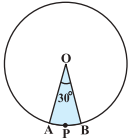
Find the area of the sector of a circle with radius $4\, cm$ and of angle $30^{\circ}$. Also,find the area of the corresponding major sector (in $cm^2$) (Use $\pi = 3.14$).
Solution
(N/A) Given radius $r = 4\, cm$ and central angle $\theta = 30^{\circ}$.
Area of the sector $= \frac{\theta}{360^{\circ}} \times \pi r^{2}$
$= \frac{30}{360} \times 3.14 \times 4 \times 4\, cm^{2}$
$= \frac{1}{12} \times 3.14 \times 16\, cm^{2} = \frac{50.24}{12}\, cm^{2} \approx 4.19\, cm^{2}$.
Area of the corresponding major sector $= \pi r^{2} - \text{Area of minor sector}$
$= (3.14 \times 4^{2}) - 4.19\, cm^{2}$
$= (3.14 \times 16) - 4.19\, cm^{2}$
$= 50.24 - 4.19 = 46.05\, cm^{2} \approx 46.1\, cm^{2}$.
Area of the sector $= \frac{\theta}{360^{\circ}} \times \pi r^{2}$
$= \frac{30}{360} \times 3.14 \times 4 \times 4\, cm^{2}$
$= \frac{1}{12} \times 3.14 \times 16\, cm^{2} = \frac{50.24}{12}\, cm^{2} \approx 4.19\, cm^{2}$.
Area of the corresponding major sector $= \pi r^{2} - \text{Area of minor sector}$
$= (3.14 \times 4^{2}) - 4.19\, cm^{2}$
$= (3.14 \times 16) - 4.19\, cm^{2}$
$= 50.24 - 4.19 = 46.05\, cm^{2} \approx 46.1\, cm^{2}$.
0 likes
View Solution8
Difficult
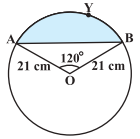
Find the area of the segment $AYB$ shown in the figure if the radius of the circle is $21 \, cm$ and $\angle AOB = 120^{\circ}$. (Use $\pi = \frac{22}{7}$)
Solution
(N/A) Area of the segment $AYB = \text{Area of sector } OAYB - \text{Area of } \triangle OAB$ ......$(1)$
Now,area of the sector $OAYB = \frac{120}{360} \times \frac{22}{7} \times 21 \times 21 \, cm^2 = 462 \, cm^2$ ......$(2)$
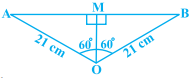
For finding the area of $\triangle OAB$,draw $OM \perp AB$ as shown in the figure.
Note that $OA = OB$. Therefore,by $RHS$ congruence,$\triangle AMO \cong \triangle BMO$.
So,$M$ is the mid-point of $AB$ and $\angle AOM = \angle BOM = \frac{1}{2} \times 120^{\circ} = 60^{\circ}$.
Let $OM = x \, cm$.
So,from $\triangle OMA$,$\frac{OM}{OA} = \cos 60^{\circ}$.
$\frac{x}{21} = \frac{1}{2} \implies x = \frac{21}{2}$.
So,$OM = \frac{21}{2} \, cm$.
Also,$\frac{AM}{OA} = \sin 60^{\circ} = \frac{\sqrt{3}}{2}$.
So,$AM = \frac{21\sqrt{3}}{2} \, cm$.
Therefore,$AB = 2 \times AM = 2 \times \frac{21\sqrt{3}}{2} = 21\sqrt{3} \, cm$.
So,area of $\triangle OAB = \frac{1}{2} \times AB \times OM = \frac{1}{2} \times 21\sqrt{3} \times \frac{21}{2} = \frac{441\sqrt{3}}{4} \, cm^2$ ......$(3)$
Therefore,area of the segment $AYB = \left( 462 - \frac{441\sqrt{3}}{4} \right) cm^2$ [From $(1), (2)$ and $(3)$].
$= \frac{21}{4} (88 - 21\sqrt{3}) \, cm^2$.
Now,area of the sector $OAYB = \frac{120}{360} \times \frac{22}{7} \times 21 \times 21 \, cm^2 = 462 \, cm^2$ ......$(2)$
For finding the area of $\triangle OAB$,draw $OM \perp AB$ as shown in the figure.
Note that $OA = OB$. Therefore,by $RHS$ congruence,$\triangle AMO \cong \triangle BMO$.
So,$M$ is the mid-point of $AB$ and $\angle AOM = \angle BOM = \frac{1}{2} \times 120^{\circ} = 60^{\circ}$.
Let $OM = x \, cm$.
So,from $\triangle OMA$,$\frac{OM}{OA} = \cos 60^{\circ}$.
$\frac{x}{21} = \frac{1}{2} \implies x = \frac{21}{2}$.
So,$OM = \frac{21}{2} \, cm$.
Also,$\frac{AM}{OA} = \sin 60^{\circ} = \frac{\sqrt{3}}{2}$.
So,$AM = \frac{21\sqrt{3}}{2} \, cm$.
Therefore,$AB = 2 \times AM = 2 \times \frac{21\sqrt{3}}{2} = 21\sqrt{3} \, cm$.
So,area of $\triangle OAB = \frac{1}{2} \times AB \times OM = \frac{1}{2} \times 21\sqrt{3} \times \frac{21}{2} = \frac{441\sqrt{3}}{4} \, cm^2$ ......$(3)$
Therefore,area of the segment $AYB = \left( 462 - \frac{441\sqrt{3}}{4} \right) cm^2$ [From $(1), (2)$ and $(3)$].
$= \frac{21}{4} (88 - 21\sqrt{3}) \, cm^2$.
0 likes
View Solution9
MediumMCQ
Find the area of a sector of a circle with radius $6 \, cm$ if the angle of the sector is $60^{\circ}$. [use $\pi = \frac{22}{7}$]
A
$132/7 \, cm^2$
B
$130/7 \, cm^2$
C
$135/7 \, cm^2$
D
$120/7 \, cm^2$
Solution
(A) Let $OACB$ be a sector of the circle making a $60^{\circ}$ angle at the centre $O$ of the circle.
The formula for the area of a sector with angle $\theta$ is given by:
$\text{Area of sector} = \frac{\theta}{360^{\circ}} \times \pi r^{2}$
Given:
Radius $r = 6 \, cm$
Angle $\theta = 60^{\circ}$
$\pi = \frac{22}{7}$
Substituting the values into the formula:
$\text{Area} = \frac{60^{\circ}}{360^{\circ}} \times \frac{22}{7} \times (6)^{2}$
$\text{Area} = \frac{1}{6} \times \frac{22}{7} \times 36$
$\text{Area} = \frac{1}{6} \times \frac{22}{7} \times 6 \times 6$
$\text{Area} = \frac{22 \times 6}{7} = \frac{132}{7} \, cm^{2}$
Therefore,the area of the sector is $\frac{132}{7} \, cm^{2}$.
The formula for the area of a sector with angle $\theta$ is given by:
$\text{Area of sector} = \frac{\theta}{360^{\circ}} \times \pi r^{2}$
Given:
Radius $r = 6 \, cm$
Angle $\theta = 60^{\circ}$
$\pi = \frac{22}{7}$
Substituting the values into the formula:
$\text{Area} = \frac{60^{\circ}}{360^{\circ}} \times \frac{22}{7} \times (6)^{2}$
$\text{Area} = \frac{1}{6} \times \frac{22}{7} \times 36$
$\text{Area} = \frac{1}{6} \times \frac{22}{7} \times 6 \times 6$
$\text{Area} = \frac{22 \times 6}{7} = \frac{132}{7} \, cm^{2}$
Therefore,the area of the sector is $\frac{132}{7} \, cm^{2}$.
0 likes
View Solution10
Medium
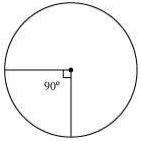
Find the area of a quadrant of a circle whose circumference is $22 \, cm$. [use $\pi = \frac{22}{7}$]
Solution
(N/A) Let the radius of the circle be $r$.
Circumference $= 2 \pi r = 22 \, cm$.
$r = \frac{22}{2 \pi} = \frac{11}{\pi} = \frac{11}{22/7} = \frac{11 \times 7}{22} = 3.5 \, cm$.
$A$ quadrant of a circle subtends an angle of $90^{\circ}$ at the centre.
Area of the quadrant $= \frac{90^{\circ}}{360^{\circ}} \times \pi r^{2} = \frac{1}{4} \times \frac{22}{7} \times (3.5)^{2}$.
Area $= \frac{1}{4} \times \frac{22}{7} \times 3.5 \times 3.5 = \frac{1}{4} \times 22 \times 0.5 \times 3.5$.
Area $= \frac{11 \times 3.5}{4} = \frac{38.5}{4} = 9.625 \, cm^{2}$.
Circumference $= 2 \pi r = 22 \, cm$.
$r = \frac{22}{2 \pi} = \frac{11}{\pi} = \frac{11}{22/7} = \frac{11 \times 7}{22} = 3.5 \, cm$.
$A$ quadrant of a circle subtends an angle of $90^{\circ}$ at the centre.
Area of the quadrant $= \frac{90^{\circ}}{360^{\circ}} \times \pi r^{2} = \frac{1}{4} \times \frac{22}{7} \times (3.5)^{2}$.
Area $= \frac{1}{4} \times \frac{22}{7} \times 3.5 \times 3.5 = \frac{1}{4} \times 22 \times 0.5 \times 3.5$.
Area $= \frac{11 \times 3.5}{4} = \frac{38.5}{4} = 9.625 \, cm^{2}$.
0 likes
View Solution11
Medium
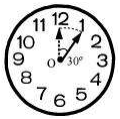
The length of the minute hand of a clock is $14 \, cm$. Find the area swept by the minute hand in $5 \, minutes$. [use $\pi = \frac{22}{7}$]
Solution
(N/A) We know that in $1$ hour (i.e.,$60$ minutes),the minute hand rotates $360^{\circ}$.
In $5$ minutes,the minute hand will rotate $= \frac{360^{\circ}}{60} \times 5 = 30^{\circ}$.
Therefore,the area swept by the minute hand in $5$ minutes will be the area of a sector of $30^{\circ}$ in a circle of radius $14 \, cm$.
Area of sector of angle $\theta = \frac{\theta}{360^{\circ}} \times \pi r^{2}$.
Area $= \frac{30^{\circ}}{360^{\circ}} \times \frac{22}{7} \times 14 \times 14$.
Area $= \frac{1}{12} \times 22 \times 2 \times 14$.
Area $= \frac{11 \times 14}{3} = \frac{154}{3} \, cm^{2}$.
Therefore,the area swept by the minute hand in $5$ minutes is $\frac{154}{3} \, cm^{2}$.
In $5$ minutes,the minute hand will rotate $= \frac{360^{\circ}}{60} \times 5 = 30^{\circ}$.
Therefore,the area swept by the minute hand in $5$ minutes will be the area of a sector of $30^{\circ}$ in a circle of radius $14 \, cm$.
Area of sector of angle $\theta = \frac{\theta}{360^{\circ}} \times \pi r^{2}$.
Area $= \frac{30^{\circ}}{360^{\circ}} \times \frac{22}{7} \times 14 \times 14$.
Area $= \frac{1}{12} \times 22 \times 2 \times 14$.
Area $= \frac{11 \times 14}{3} = \frac{154}{3} \, cm^{2}$.
Therefore,the area swept by the minute hand in $5$ minutes is $\frac{154}{3} \, cm^{2}$.
1 likes
View Solution12
Difficult
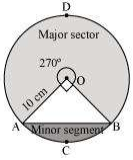
$A$ chord of a circle of radius $10\, cm$ subtends a right angle at the centre. Find the area of the corresponding:
$(i)$ minor segment $\&$ $(ii)$ major sector. (Use $\pi=3.14$ )
$(i)$ minor segment $\&$ $(ii)$ major sector. (Use $\pi=3.14$ )
Solution
(N/A) Let $AB$ be the chord of the circle subtending a $90^{\circ}$ angle at the centre $O$ of the circle.
Area of the major sector $OADB = \left(\frac{360^{\circ}-90^{\circ}}{360^{\circ}}\right) \times \pi r^{2} = \left(\frac{270^{\circ}}{360^{\circ}}\right) \times 3.14 \times 10^{2}$
$= \frac{3}{4} \times 3.14 \times 100 = 235.5\, cm^{2}$
Area of the minor sector $OACB = \frac{90^{\circ}}{360^{\circ}} \times \pi r^{2} = \frac{1}{4} \times 3.14 \times 100 = 78.5\, cm^{2}$
Area of $\triangle OAB = \frac{1}{2} \times OA \times OB = \frac{1}{2} \times 10 \times 10 = 50\, cm^{2}$
Area of the minor segment $ACB = \text{Area of minor sector } OACB - \text{Area of } \triangle OAB = 78.5 - 50 = 28.5\, cm^{2}$
Area of the major sector $OADB = \left(\frac{360^{\circ}-90^{\circ}}{360^{\circ}}\right) \times \pi r^{2} = \left(\frac{270^{\circ}}{360^{\circ}}\right) \times 3.14 \times 10^{2}$
$= \frac{3}{4} \times 3.14 \times 100 = 235.5\, cm^{2}$
Area of the minor sector $OACB = \frac{90^{\circ}}{360^{\circ}} \times \pi r^{2} = \frac{1}{4} \times 3.14 \times 100 = 78.5\, cm^{2}$
Area of $\triangle OAB = \frac{1}{2} \times OA \times OB = \frac{1}{2} \times 10 \times 10 = 50\, cm^{2}$
Area of the minor segment $ACB = \text{Area of minor sector } OACB - \text{Area of } \triangle OAB = 78.5 - 50 = 28.5\, cm^{2}$
0 likes
View Solution13
Medium
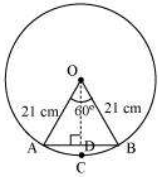
In a circle of radius $21\, cm$,an arc subtends an angle of $60^{\circ}$ at the centre. Find:
$(i)$ the length of the arc
$(ii)$ area of the sector formed by the arc
$(iii)$ area of the segment formed by the corresponding chord [Use $\pi = \frac{22}{7}$]
$(i)$ the length of the arc
$(ii)$ area of the sector formed by the arc
$(iii)$ area of the segment formed by the corresponding chord [Use $\pi = \frac{22}{7}$]
Solution
(N/A) Radius $(r)$ of the circle $= 21\, cm$.
Angle subtended by the given arc at the centre $(\theta) = 60^{\circ}$.
$(i)$ Length of the arc $= \frac{\theta}{360^{\circ}} \times 2 \pi r$
$= \frac{60^{\circ}}{360^{\circ}} \times 2 \times \frac{22}{7} \times 21$
$= \frac{1}{6} \times 2 \times 22 \times 3 = 22\, cm$.
$(ii)$ Area of the sector $= \frac{\theta}{360^{\circ}} \times \pi r^{2}$
$= \frac{60^{\circ}}{360^{\circ}} \times \frac{22}{7} \times 21 \times 21$
$= \frac{1}{6} \times 22 \times 3 \times 21 = 231\, cm^{2}$.
$(iii)$ In $\Delta OAB$,$OA = OB = 21\, cm$ and $\angle AOB = 60^{\circ}$.
Since the two sides are equal,$\angle OAB = \angle OBA$.
In $\Delta OAB$,$\angle OAB + \angle OBA + \angle AOB = 180^{\circ}$.
$2 \angle OAB + 60^{\circ} = 180^{\circ} \implies 2 \angle OAB = 120^{\circ} \implies \angle OAB = 60^{\circ}$.
Thus,$\Delta OAB$ is an equilateral triangle.
Area of $\Delta OAB = \frac{\sqrt{3}}{4} \times (side)^{2} = \frac{\sqrt{3}}{4} \times (21)^{2} = \frac{441\sqrt{3}}{4}\, cm^{2}$.
Area of the segment = Area of sector $OACB - \text{Area of } \Delta OAB$
$= (231 - \frac{441\sqrt{3}}{4})\, cm^{2}$.
Angle subtended by the given arc at the centre $(\theta) = 60^{\circ}$.
$(i)$ Length of the arc $= \frac{\theta}{360^{\circ}} \times 2 \pi r$
$= \frac{60^{\circ}}{360^{\circ}} \times 2 \times \frac{22}{7} \times 21$
$= \frac{1}{6} \times 2 \times 22 \times 3 = 22\, cm$.
$(ii)$ Area of the sector $= \frac{\theta}{360^{\circ}} \times \pi r^{2}$
$= \frac{60^{\circ}}{360^{\circ}} \times \frac{22}{7} \times 21 \times 21$
$= \frac{1}{6} \times 22 \times 3 \times 21 = 231\, cm^{2}$.
$(iii)$ In $\Delta OAB$,$OA = OB = 21\, cm$ and $\angle AOB = 60^{\circ}$.
Since the two sides are equal,$\angle OAB = \angle OBA$.
In $\Delta OAB$,$\angle OAB + \angle OBA + \angle AOB = 180^{\circ}$.
$2 \angle OAB + 60^{\circ} = 180^{\circ} \implies 2 \angle OAB = 120^{\circ} \implies \angle OAB = 60^{\circ}$.
Thus,$\Delta OAB$ is an equilateral triangle.
Area of $\Delta OAB = \frac{\sqrt{3}}{4} \times (side)^{2} = \frac{\sqrt{3}}{4} \times (21)^{2} = \frac{441\sqrt{3}}{4}\, cm^{2}$.
Area of the segment = Area of sector $OACB - \text{Area of } \Delta OAB$
$= (231 - \frac{441\sqrt{3}}{4})\, cm^{2}$.
0 likes
View Solution14
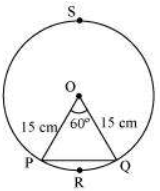
Medium
$A$ chord of a circle of radius $15 \, cm$ subtends an angle of $60^{\circ}$ at the centre. Find the areas of the corresponding minor and major segments of the circle.
(Use $\pi = 3.14$ and $\sqrt{3} = 1.73$)
(Use $\pi = 3.14$ and $\sqrt{3} = 1.73$)
Solution
(N/A) Radius $(r)$ of the circle $= 15 \, cm$.
Area of sector $OPRQ = \frac{60^{\circ}}{360^{\circ}} \times \pi r^{2}$
$= \frac{1}{6} \times 3.14 \times (15)^{2}$
$= \frac{1}{6} \times 3.14 \times 225 = 117.75 \, cm^{2}$.
In $\triangle OPQ$,since $OP = OQ = 15 \, cm$,the angles opposite to these sides are equal,i.e.,$\angle OPQ = \angle OQP$.
Since $\angle POQ = 60^{\circ}$,the sum of the other two angles is $180^{\circ} - 60^{\circ} = 120^{\circ}$.
Thus,$\angle OPQ = \angle OQP = 60^{\circ}$.
Since all angles are $60^{\circ}$,$\triangle OPQ$ is an equilateral triangle.
Area of $\triangle OPQ = \frac{\sqrt{3}}{4} \times (\text{side})^{2}$
$= \frac{1.73}{4} \times (15)^{2} = \frac{1.73}{4} \times 225 = 97.3125 \, cm^{2}$.
Area of minor segment $PRQ = \text{Area of sector } OPRQ - \text{Area of } \triangle OPQ$
$= 117.75 - 97.3125 = 20.4375 \, cm^{2}$.
Area of major segment $PSQ = \text{Area of circle} - \text{Area of minor segment } PRQ$
$= \pi r^{2} - 20.4375$
$= 3.14 \times 225 - 20.4375 = 706.5 - 20.4375 = 686.0625 \, cm^{2}$.
Area of sector $OPRQ = \frac{60^{\circ}}{360^{\circ}} \times \pi r^{2}$
$= \frac{1}{6} \times 3.14 \times (15)^{2}$
$= \frac{1}{6} \times 3.14 \times 225 = 117.75 \, cm^{2}$.
In $\triangle OPQ$,since $OP = OQ = 15 \, cm$,the angles opposite to these sides are equal,i.e.,$\angle OPQ = \angle OQP$.
Since $\angle POQ = 60^{\circ}$,the sum of the other two angles is $180^{\circ} - 60^{\circ} = 120^{\circ}$.
Thus,$\angle OPQ = \angle OQP = 60^{\circ}$.
Since all angles are $60^{\circ}$,$\triangle OPQ$ is an equilateral triangle.
Area of $\triangle OPQ = \frac{\sqrt{3}}{4} \times (\text{side})^{2}$
$= \frac{1.73}{4} \times (15)^{2} = \frac{1.73}{4} \times 225 = 97.3125 \, cm^{2}$.
Area of minor segment $PRQ = \text{Area of sector } OPRQ - \text{Area of } \triangle OPQ$
$= 117.75 - 97.3125 = 20.4375 \, cm^{2}$.
Area of major segment $PSQ = \text{Area of circle} - \text{Area of minor segment } PRQ$
$= \pi r^{2} - 20.4375$
$= 3.14 \times 225 - 20.4375 = 706.5 - 20.4375 = 686.0625 \, cm^{2}$.
0 likes
View Solution15
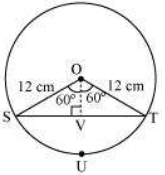
DifficultMCQ
$A$ chord of a circle of radius $12 \, cm$ subtends an angle of $120^{\circ}$ at the centre. Find the area of the corresponding segment of the circle. (in $cm^2$)
(Use $\pi = 3.14$ and $\sqrt{3} = 1.73$)
(Use $\pi = 3.14$ and $\sqrt{3} = 1.73$)
A
$22.44$
B
$150.72$
C
$88.44$
D
$62.28$
Solution
(C) Let us draw a perpendicular $OV$ on chord $ST$. It will bisect the chord $ST$.
$SV = VT$
In $\triangle OVS$,
$\frac{OV}{OS} = \cos 60^{\circ}$
$\frac{OV}{12} = \frac{1}{2}$
$OV = 6 \, cm$
$\frac{SV}{SO} = \sin 60^{\circ} = \frac{\sqrt{3}}{2}$
$\frac{SV}{12} = \frac{\sqrt{3}}{2}$
$SV = 6\sqrt{3} \, cm$
$ST = 2SV = 2 \times 6\sqrt{3} = 12\sqrt{3} \, cm$
Area of $\triangle OST = \frac{1}{2} \times ST \times OV$
$= \frac{1}{2} \times 12\sqrt{3} \times 6$
$= 36\sqrt{3} = 36 \times 1.73 = 62.28 \, cm^2$
Area of sector $OSUT = \frac{120^{\circ}}{360^{\circ}} \times \pi(12)^2$
$= \frac{1}{3} \times 3.14 \times 144 = 150.72 \, cm^2$
Area of segment $SUT = \text{Area of sector } OSUT - \text{Area of } \triangle OST$
$= 150.72 - 62.28$
$= 88.44 \, cm^2$
$SV = VT$
In $\triangle OVS$,
$\frac{OV}{OS} = \cos 60^{\circ}$
$\frac{OV}{12} = \frac{1}{2}$
$OV = 6 \, cm$
$\frac{SV}{SO} = \sin 60^{\circ} = \frac{\sqrt{3}}{2}$
$\frac{SV}{12} = \frac{\sqrt{3}}{2}$
$SV = 6\sqrt{3} \, cm$
$ST = 2SV = 2 \times 6\sqrt{3} = 12\sqrt{3} \, cm$
Area of $\triangle OST = \frac{1}{2} \times ST \times OV$
$= \frac{1}{2} \times 12\sqrt{3} \times 6$
$= 36\sqrt{3} = 36 \times 1.73 = 62.28 \, cm^2$
Area of sector $OSUT = \frac{120^{\circ}}{360^{\circ}} \times \pi(12)^2$
$= \frac{1}{3} \times 3.14 \times 144 = 150.72 \, cm^2$
Area of segment $SUT = \text{Area of sector } OSUT - \text{Area of } \triangle OST$
$= 150.72 - 62.28$
$= 88.44 \, cm^2$
0 likes
View Solution16
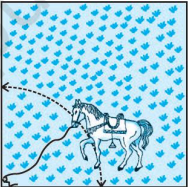
Difficult
$A$ horse is tied to a peg at one corner of a square-shaped grass field of side $15 \, m$ by means of a $5 \, m$ long rope (see figure). Find:
$(i)$ The area of that part of the field in which the horse can graze.
$(ii)$ The increase in the grazing area if the rope were $10 \, m$ long instead of $5 \, m$. (Use $\pi = 3.14$)
$(i)$ The area of that part of the field in which the horse can graze.
$(ii)$ The increase in the grazing area if the rope were $10 \, m$ long instead of $5 \, m$. (Use $\pi = 3.14$)
Solution
(N/A) From the figure,it can be observed that the horse can graze a sector of $90^{\circ}$ in a circle of $5 \, m$ radius.
Area that can be grazed by the horse $=$ Area of sector with radius $r = 5 \, m$ and angle $\theta = 90^{\circ}$.
Area $= \frac{\theta}{360^{\circ}} \times \pi r^{2}$
$= \frac{90^{\circ}}{360^{\circ}} \times 3.14 \times (5)^{2}$
$= \frac{1}{4} \times 3.14 \times 25$
$= 19.625 \, m^{2}$
Area that can be grazed by the horse when the length of the rope is $10 \, m$ long $(r = 10 \, m)$:
Area $= \frac{90^{\circ}}{360^{\circ}} \times \pi \times (10)^{2}$
$= \frac{1}{4} \times 3.14 \times 100$
$= 78.5 \, m^{2}$
Increase in grazing area $= (78.5 - 19.625) \, m^{2}$
$= 58.875 \, m^{2}$
Area that can be grazed by the horse $=$ Area of sector with radius $r = 5 \, m$ and angle $\theta = 90^{\circ}$.
Area $= \frac{\theta}{360^{\circ}} \times \pi r^{2}$
$= \frac{90^{\circ}}{360^{\circ}} \times 3.14 \times (5)^{2}$
$= \frac{1}{4} \times 3.14 \times 25$
$= 19.625 \, m^{2}$
Area that can be grazed by the horse when the length of the rope is $10 \, m$ long $(r = 10 \, m)$:
Area $= \frac{90^{\circ}}{360^{\circ}} \times \pi \times (10)^{2}$
$= \frac{1}{4} \times 3.14 \times 100$
$= 78.5 \, m^{2}$
Increase in grazing area $= (78.5 - 19.625) \, m^{2}$
$= 58.875 \, m^{2}$
0 likes
View Solution17
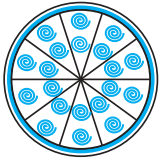
Medium
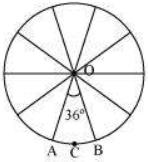
$A$ brooch is made with silver wire in the form of a circle with diameter $35 \, mm$. The wire is also used in making $5$ diameters which divide the circle into $10$ equal sectors as shown in the figure. Find:
$(i)$ The total length of the silver wire required.
$(ii)$ The area of each sector of the brooch. [Use $\pi = \frac{22}{7}$]
$(i)$ The total length of the silver wire required.
$(ii)$ The area of each sector of the brooch. [Use $\pi = \frac{22}{7}$]
Solution
(N/A) The total length of wire required is the sum of the lengths of $5$ diameters and the circumference of the brooch.
Radius of the circle $r = \frac{35}{2} \, mm$.
Circumference of the brooch $= 2 \pi r = 2 \times \frac{22}{7} \times \frac{35}{2} = 110 \, mm$.
Length of $5$ diameters $= 5 \times 35 = 175 \, mm$.
Total length of wire required $= 110 + 175 = 285 \, mm$.
It can be observed from the figure that each of the $10$ sectors of the circle subtends an angle of $\frac{360^{\circ}}{10} = 36^{\circ}$ at the centre of the circle.
Therefore,the area of each sector $= \frac{36^{\circ}}{360^{\circ}} \times \pi r^{2} = \frac{1}{10} \times \frac{22}{7} \times \left(\frac{35}{2}\right) \times \left(\frac{35}{2}\right) = \frac{385}{4} \, mm^{2} = 96.25 \, mm^{2}$.
Radius of the circle $r = \frac{35}{2} \, mm$.
Circumference of the brooch $= 2 \pi r = 2 \times \frac{22}{7} \times \frac{35}{2} = 110 \, mm$.
Length of $5$ diameters $= 5 \times 35 = 175 \, mm$.
Total length of wire required $= 110 + 175 = 285 \, mm$.
It can be observed from the figure that each of the $10$ sectors of the circle subtends an angle of $\frac{360^{\circ}}{10} = 36^{\circ}$ at the centre of the circle.
Therefore,the area of each sector $= \frac{36^{\circ}}{360^{\circ}} \times \pi r^{2} = \frac{1}{10} \times \frac{22}{7} \times \left(\frac{35}{2}\right) \times \left(\frac{35}{2}\right) = \frac{385}{4} \, mm^{2} = 96.25 \, mm^{2}$.
0 likes
View Solution18
Medium
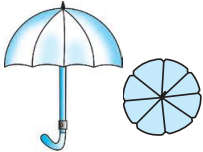
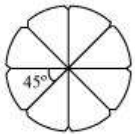
An umbrella has $8$ ribs which are equally spaced (see $Fig.$). Assuming the umbrella to be a flat circle of radius $45 \, cm ,$ find the area between the two consecutive ribs of the umbrella. [use $\pi=\frac{22}{7}$]
Solution
(N/A) An umbrella has $8$ ribs,which divide the circular area into $8$ equal sectors.
The angle subtended by each sector at the center is $\theta = \frac{360^{\circ}}{8} = 45^{\circ}$.
The radius of the circle is $r = 45 \, cm$.
The area of a sector is given by the formula: $\text{Area} = \frac{\theta}{360^{\circ}} \times \pi r^{2}$.
Substituting the values:
$\text{Area} = \frac{45^{\circ}}{360^{\circ}} \times \frac{22}{7} \times (45)^{2}$
$\text{Area} = \frac{1}{8} \times \frac{22}{7} \times 2025$
$\text{Area} = \frac{11}{4 \times 7} \times 2025 = \frac{11 \times 2025}{28}$
$\text{Area} = \frac{22275}{28} \, cm^{2} \approx 795.54 \, cm^{2}$.
The angle subtended by each sector at the center is $\theta = \frac{360^{\circ}}{8} = 45^{\circ}$.
The radius of the circle is $r = 45 \, cm$.
The area of a sector is given by the formula: $\text{Area} = \frac{\theta}{360^{\circ}} \times \pi r^{2}$.
Substituting the values:
$\text{Area} = \frac{45^{\circ}}{360^{\circ}} \times \frac{22}{7} \times (45)^{2}$
$\text{Area} = \frac{1}{8} \times \frac{22}{7} \times 2025$
$\text{Area} = \frac{11}{4 \times 7} \times 2025 = \frac{11 \times 2025}{28}$
$\text{Area} = \frac{22275}{28} \, cm^{2} \approx 795.54 \, cm^{2}$.
0 likes
View Solution19
Medium
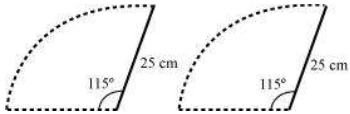
$A$ car has two wipers which do not overlap. Each wiper has a blade of length $25 \, cm$ sweeping through an angle of $115^{\circ}.$ Find the total area cleaned at each sweep of the blades. [use $\pi=\frac{22}{7}$]
Solution
(N/A) It can be observed that each blade of the wiper sweeps an area of a sector of $115^{\circ}$ in a circle of radius $r = 25 \, cm$.
The area of a sector of a circle with angle $\theta$ and radius $r$ is given by the formula: $\text{Area} = \frac{\theta}{360^{\circ}} \times \pi r^{2}$.
Area of one sector $= \frac{115^{\circ}}{360^{\circ}} \times \frac{22}{7} \times (25)^{2}$
$= \frac{23}{72} \times \frac{22}{7} \times 625$
$= \frac{23 \times 11 \times 625}{36 \times 7} = \frac{158125}{252} \, cm^{2}$.
Since there are two wipers,the total area cleaned by both blades is:
Total Area $= 2 \times \left( \frac{158125}{252} \right)$
$= \frac{158125}{126} \, cm^{2} \approx 1254.96 \, cm^{2}$.
The area of a sector of a circle with angle $\theta$ and radius $r$ is given by the formula: $\text{Area} = \frac{\theta}{360^{\circ}} \times \pi r^{2}$.
Area of one sector $= \frac{115^{\circ}}{360^{\circ}} \times \frac{22}{7} \times (25)^{2}$
$= \frac{23}{72} \times \frac{22}{7} \times 625$
$= \frac{23 \times 11 \times 625}{36 \times 7} = \frac{158125}{252} \, cm^{2}$.
Since there are two wipers,the total area cleaned by both blades is:
Total Area $= 2 \times \left( \frac{158125}{252} \right)$
$= \frac{158125}{126} \, cm^{2} \approx 1254.96 \, cm^{2}$.
0 likes
View Solution20
DifficultMCQ
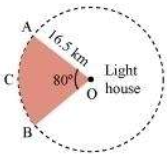
To warn ships for underwater rocks,a lighthouse spreads a red coloured light over a sector of angle $80^{\circ}$ to a distance of $16.5 \, km$. Find the area of the sea over which the ships are warned. (in $km^2$) (Use $\pi=3.14$)
A
$185.14$
B
$205$
C
$36.84$
D
$189.97$
Solution
(D) The lighthouse spreads light over a sector of a circle with radius $r = 16.5 \, km$ and central angle $\theta = 80^{\circ}$.
The area of the sector is given by the formula:
$\text{Area} = \frac{\theta}{360^{\circ}} \times \pi r^2$
Substituting the given values:
$\text{Area} = \frac{80^{\circ}}{360^{\circ}} \times 3.14 \times (16.5)^2$
$= \frac{2}{9} \times 3.14 \times 272.25$
$= \frac{2}{9} \times 854.865$
$= 189.97 \, km^2$
Thus,the area of the sea over which the ships are warned is $189.97 \, km^2$.
The area of the sector is given by the formula:
$\text{Area} = \frac{\theta}{360^{\circ}} \times \pi r^2$
Substituting the given values:
$\text{Area} = \frac{80^{\circ}}{360^{\circ}} \times 3.14 \times (16.5)^2$
$= \frac{2}{9} \times 3.14 \times 272.25$
$= \frac{2}{9} \times 854.865$
$= 189.97 \, km^2$
Thus,the area of the sea over which the ships are warned is $189.97 \, km^2$.
0 likes
View Solution21
MediumMCQ
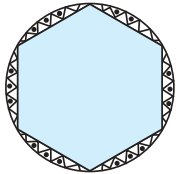
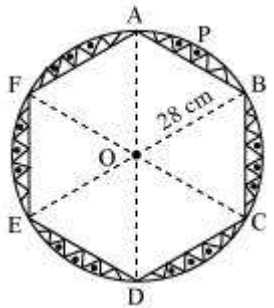
$A$ round table cover has six equal designs as shown in the figure. If the radius of the cover is $28\, cm$,find the cost of making the designs at the rate of $Rs.\, 0.35$ per $cm^2$. (in $Rs.$) (Use $\sqrt{3}=1.7$)
A
$162.68$
B
$175.59$
C
$333.2$
D
$123.2$
Solution
(A) The designs are segments of the circle.
Consider segment $APB$. Chord $AB$ is a side of the regular hexagon inscribed in the circle.
Each chord subtends an angle of $\frac{360^{\circ}}{6} = 60^{\circ}$ at the center $O$.
In $\triangle OAB$,$OA = OB = 28\, cm$ (radii).
Since $\angle AOB = 60^{\circ}$ and $OA = OB$,$\triangle OAB$ is an equilateral triangle.
Area of $\triangle OAB = \frac{\sqrt{3}}{4} \times (side)^2 = \frac{1.7}{4} \times 28 \times 28 = 1.7 \times 7 \times 28 = 333.2\, cm^2$.
Area of sector $OAPB = \frac{60^{\circ}}{360^{\circ}} \times \pi r^2 = \frac{1}{6} \times \frac{22}{7} \times 28 \times 28 = \frac{1232}{3} \approx 410.67\, cm^2$.
Area of one segment = Area of sector $OAPB - \text{Area of } \triangle OAB = \frac{1232}{3} - 333.2 = 410.67 - 333.2 = 77.47\, cm^2$.
Total area of $6$ designs = $6 \times 77.47 = 464.82\, cm^2$.
Cost of making designs = $464.82 \times 0.35 = Rs.\, 162.687 \approx Rs.\, 162.68$.
Consider segment $APB$. Chord $AB$ is a side of the regular hexagon inscribed in the circle.
Each chord subtends an angle of $\frac{360^{\circ}}{6} = 60^{\circ}$ at the center $O$.
In $\triangle OAB$,$OA = OB = 28\, cm$ (radii).
Since $\angle AOB = 60^{\circ}$ and $OA = OB$,$\triangle OAB$ is an equilateral triangle.
Area of $\triangle OAB = \frac{\sqrt{3}}{4} \times (side)^2 = \frac{1.7}{4} \times 28 \times 28 = 1.7 \times 7 \times 28 = 333.2\, cm^2$.
Area of sector $OAPB = \frac{60^{\circ}}{360^{\circ}} \times \pi r^2 = \frac{1}{6} \times \frac{22}{7} \times 28 \times 28 = \frac{1232}{3} \approx 410.67\, cm^2$.
Area of one segment = Area of sector $OAPB - \text{Area of } \triangle OAB = \frac{1232}{3} - 333.2 = 410.67 - 333.2 = 77.47\, cm^2$.
Total area of $6$ designs = $6 \times 77.47 = 464.82\, cm^2$.
Cost of making designs = $464.82 \times 0.35 = Rs.\, 162.687 \approx Rs.\, 162.68$.
0 likes
View Solution22
MediumMCQ
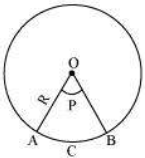
Area of a sector of angle $p$ (in degrees) of a circle with radius $R$ is
A
$\frac{p}{180} \times 2 \pi R$
B
$\frac{p}{720} \times 2 \pi R^{2}$
C
$\frac{p}{360} \times 2 \pi R$
D
$\frac{p}{180} \times \pi R^{2}$
Solution
(B) The area of a circle is $\pi R^{2}$.
The area of a sector with angle $\theta$ at the center is given by the formula:
$\text{Area of sector} = \frac{\theta}{360^{\circ}} \times \pi R^{2}$
Given the angle is $p$,the area of the sector is:
$\text{Area} = \frac{p}{360^{\circ}} \times \pi R^{2}$
To match this with the given options,we can multiply the numerator and denominator by $2$:
$\text{Area} = \frac{p \times 2}{360^{\circ} \times 2} \times \pi R^{2} = \frac{p}{720^{\circ}} \times 2 \pi R^{2}$
Thus,the correct option is $B$.
The area of a sector with angle $\theta$ at the center is given by the formula:
$\text{Area of sector} = \frac{\theta}{360^{\circ}} \times \pi R^{2}$
Given the angle is $p$,the area of the sector is:
$\text{Area} = \frac{p}{360^{\circ}} \times \pi R^{2}$
To match this with the given options,we can multiply the numerator and denominator by $2$:
$\text{Area} = \frac{p \times 2}{360^{\circ} \times 2} \times \pi R^{2} = \frac{p}{720^{\circ}} \times 2 \pi R^{2}$
Thus,the correct option is $B$.
0 likes
View Solution23
DifficultMCQ
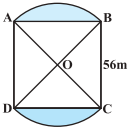
In the figure,two circular flower beds are shown on two sides of a square lawn $ABCD$ of side $56 \, m$. If the centre of each circular flower bed is the point of intersection $O$ of the diagonals of the square lawn,find the sum of the areas of the lawn and the flower beds (in $m^2$).
A
$2016$
B
$5672$
C
$4032$
D
$5656$
Solution
(C) The side of the square $ABCD$ is $a = 56 \, m$.
Area of the square lawn $ABCD = a^2 = 56 \times 56 = 3136 \, m^2$.
The diagonals of the square intersect at $O$. The distance from $O$ to the sides is half the side length,i.e.,$28 \, m$. The radius of the circular sectors forming the flower beds is $r = OA = OB = OC = OD$. In $\triangle OAB$,$OA^2 + OB^2 = AB^2$,so $2r^2 = 56^2$,which gives $r^2 = \frac{56 \times 56}{2} = 1568$.
The area of one circular sector (flower bed) with central angle $90^\circ$ is $\frac{90}{360} \times \pi r^2 = \frac{1}{4} \times \frac{22}{7} \times 1568 = 1232 \, m^2$.
There are two such flower beds,so their total area is $2 \times 1232 = 2464 \, m^2$.
However,the flower beds are segments of the circle. The area of one segment is (Area of sector $OAB$ - Area of $\triangle OAB$).
Area of $\triangle OAB = \frac{1}{2} \times \text{base} \times \text{height} = \frac{1}{2} \times 56 \times 28 = 784 \, m^2$.
Area of one flower bed segment = $1232 - 784 = 448 \, m^2$.
Total area = Area of square + $2$ $\times$ Area of segment = $3136 + 2 \times 448 = 3136 + 896 = 4032 \, m^2$.
Area of the square lawn $ABCD = a^2 = 56 \times 56 = 3136 \, m^2$.
The diagonals of the square intersect at $O$. The distance from $O$ to the sides is half the side length,i.e.,$28 \, m$. The radius of the circular sectors forming the flower beds is $r = OA = OB = OC = OD$. In $\triangle OAB$,$OA^2 + OB^2 = AB^2$,so $2r^2 = 56^2$,which gives $r^2 = \frac{56 \times 56}{2} = 1568$.
The area of one circular sector (flower bed) with central angle $90^\circ$ is $\frac{90}{360} \times \pi r^2 = \frac{1}{4} \times \frac{22}{7} \times 1568 = 1232 \, m^2$.
There are two such flower beds,so their total area is $2 \times 1232 = 2464 \, m^2$.
However,the flower beds are segments of the circle. The area of one segment is (Area of sector $OAB$ - Area of $\triangle OAB$).
Area of $\triangle OAB = \frac{1}{2} \times \text{base} \times \text{height} = \frac{1}{2} \times 56 \times 28 = 784 \, m^2$.
Area of one flower bed segment = $1232 - 784 = 448 \, m^2$.
Total area = Area of square + $2$ $\times$ Area of segment = $3136 + 2 \times 448 = 3136 + 896 = 4032 \, m^2$.
0 likes
View Solution24
MediumMCQ
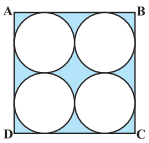
Find the area of the shaded region in the figure,where $ABCD$ is a square of side $14 \, cm$. (in $cm^2$)
A
$77$
B
$196$
C
$154$
D
$42$
Solution
(D) Area of square $ABCD = 14 \times 14 \, cm^2 = 196 \, cm^2$.
Since there are four circles in the square,the diameter of each circle is half the side of the square.
Diameter of each circle $= \frac{14}{2} \, cm = 7 \, cm$.
Radius of each circle $(r) = \frac{7}{2} \, cm = 3.5 \, cm$.
Area of one circle $= \pi r^2 = \frac{22}{7} \times \frac{7}{2} \times \frac{7}{2} \, cm^2 = \frac{77}{2} \, cm^2 = 38.5 \, cm^2$.
Area of four circles $= 4 \times 38.5 \, cm^2 = 154 \, cm^2$.
Area of the shaded region = Area of square - Area of four circles.
Area of the shaded region $= 196 \, cm^2 - 154 \, cm^2 = 42 \, cm^2$.
Since there are four circles in the square,the diameter of each circle is half the side of the square.
Diameter of each circle $= \frac{14}{2} \, cm = 7 \, cm$.
Radius of each circle $(r) = \frac{7}{2} \, cm = 3.5 \, cm$.
Area of one circle $= \pi r^2 = \frac{22}{7} \times \frac{7}{2} \times \frac{7}{2} \, cm^2 = \frac{77}{2} \, cm^2 = 38.5 \, cm^2$.
Area of four circles $= 4 \times 38.5 \, cm^2 = 154 \, cm^2$.
Area of the shaded region = Area of square - Area of four circles.
Area of the shaded region $= 196 \, cm^2 - 154 \, cm^2 = 42 \, cm^2$.
0 likes
View Solution25
DifficultMCQ
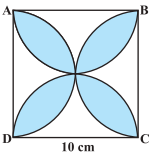
Find the area of the shaded design in the figure where $ABCD$ is a square of side $10 \, cm$ and semicircles are drawn with each side of the square as diameter. (in $cm^2$) (Use $\pi = 3.14$)
A
$57$
B
$21.5$
C
$78.5$
D
$25$
Solution
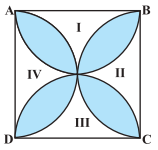
(A) Let us mark the four unshaded regions as $I, II, III$ and $IV$ (see figure).
Area of $I +$ Area of $III = \text{Area of square } ABCD - \text{Area of two semicircles with diameter } 10 \, cm$.
Since the side of the square is $10 \, cm$,the radius of each semicircle is $r = 5 \, cm$.
Area of $I + III = (10 \times 10) - 2 \times (\frac{1}{2} \times \pi \times 5^2) \, cm^2$
$= 100 - (3.14 \times 25) \, cm^2 = 100 - 78.5 = 21.5 \, cm^2$.
Similarly,Area of $II + IV = 21.5 \, cm^2$.
Now,the area of the shaded design is the area of the square minus the sum of the areas of the four unshaded regions $(I, II, III, IV)$:
Area of shaded design $= \text{Area of } ABCD - (\text{Area of } I + II + III + IV)$
$= 100 - (21.5 + 21.5) \, cm^2 = 100 - 43 = 57 \, cm^2$.
Area of $I +$ Area of $III = \text{Area of square } ABCD - \text{Area of two semicircles with diameter } 10 \, cm$.
Since the side of the square is $10 \, cm$,the radius of each semicircle is $r = 5 \, cm$.
Area of $I + III = (10 \times 10) - 2 \times (\frac{1}{2} \times \pi \times 5^2) \, cm^2$
$= 100 - (3.14 \times 25) \, cm^2 = 100 - 78.5 = 21.5 \, cm^2$.
Similarly,Area of $II + IV = 21.5 \, cm^2$.
Now,the area of the shaded design is the area of the square minus the sum of the areas of the four unshaded regions $(I, II, III, IV)$:
Area of shaded design $= \text{Area of } ABCD - (\text{Area of } I + II + III + IV)$
$= 100 - (21.5 + 21.5) \, cm^2 = 100 - 43 = 57 \, cm^2$.
0 likes
View Solution26
Medium
Find the area of the shaded region in the figure if $PQ = 24 \, cm$,$PR = 7 \, cm$ and $O$ is the centre of the circle. [Use $\pi = \frac{22}{7}$]
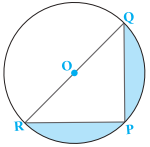
Solution
(N/A) $1$. Since $RQ$ is a diameter of the circle,the angle in the semicircle is a right angle. Therefore,$\angle QPR = 90^{\circ}$.
$2$. In the right-angled triangle $\triangle QPR$,by Pythagoras theorem:
$RQ^2 = PQ^2 + PR^2$
$RQ^2 = 24^2 + 7^2 = 576 + 49 = 625$
$RQ = \sqrt{625} = 25 \, cm$.
$3$. The radius of the circle $r = \frac{RQ}{2} = \frac{25}{2} = 12.5 \, cm$.
$4$. The area of the semicircle is $\frac{1}{2} \pi r^2 = \frac{1}{2} \times \frac{22}{7} \times (12.5)^2 = \frac{11}{7} \times 156.25 = \frac{1718.75}{7} \approx 245.536 \, cm^2$.
$5$. The area of $\triangle QPR = \frac{1}{2} \times \text{base} \times \text{height} = \frac{1}{2} \times 7 \times 24 = 84 \, cm^2$.
$6$. The area of the shaded region = Area of semicircle - Area of $\triangle QPR = \frac{1718.75}{7} - 84 = \frac{1718.75 - 588}{7} = \frac{1130.75}{7} \approx 161.54 \, cm^2$.
$2$. In the right-angled triangle $\triangle QPR$,by Pythagoras theorem:
$RQ^2 = PQ^2 + PR^2$
$RQ^2 = 24^2 + 7^2 = 576 + 49 = 625$
$RQ = \sqrt{625} = 25 \, cm$.
$3$. The radius of the circle $r = \frac{RQ}{2} = \frac{25}{2} = 12.5 \, cm$.
$4$. The area of the semicircle is $\frac{1}{2} \pi r^2 = \frac{1}{2} \times \frac{22}{7} \times (12.5)^2 = \frac{11}{7} \times 156.25 = \frac{1718.75}{7} \approx 245.536 \, cm^2$.
$5$. The area of $\triangle QPR = \frac{1}{2} \times \text{base} \times \text{height} = \frac{1}{2} \times 7 \times 24 = 84 \, cm^2$.
$6$. The area of the shaded region = Area of semicircle - Area of $\triangle QPR = \frac{1718.75}{7} - 84 = \frac{1718.75 - 588}{7} = \frac{1130.75}{7} \approx 161.54 \, cm^2$.
0 likes
View Solution27
Difficult
Find the area of the shaded region in the figure,if the radii of the two concentric circles with center $O$ are $7\, cm$ and $14\, cm$ respectively and $\angle AOC = 40^{\circ}$. [Use $\pi = \frac{22}{7}$]
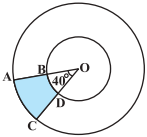
Solution
(N/A) The shaded region is the area of the sector of the larger circle minus the area of the sector of the smaller circle.
Let $R = 14\, cm$ be the radius of the larger circle and $r = 7\, cm$ be the radius of the smaller circle.
The central angle $\theta = 40^{\circ}$.
The area of a sector is given by the formula $\frac{\theta}{360^{\circ}} \times \pi r^2$.
Area of the shaded region = Area of sector $OAC$ - Area of sector $OBD$
$= \frac{40^{\circ}}{360^{\circ}} \times \pi R^2 - \frac{40^{\circ}}{360^{\circ}} \times \pi r^2$
$= \frac{1}{9} \times \pi (R^2 - r^2)$
$= \frac{1}{9} \times \frac{22}{7} \times (14^2 - 7^2)$
$= \frac{1}{9} \times \frac{22}{7} \times (196 - 49)$
$= \frac{1}{9} \times \frac{22}{7} \times 147$
$= \frac{1}{9} \times 22 \times 21$
$= \frac{462}{9} = \frac{154}{3} \approx 51.33\, cm^2$.
Let $R = 14\, cm$ be the radius of the larger circle and $r = 7\, cm$ be the radius of the smaller circle.
The central angle $\theta = 40^{\circ}$.
The area of a sector is given by the formula $\frac{\theta}{360^{\circ}} \times \pi r^2$.
Area of the shaded region = Area of sector $OAC$ - Area of sector $OBD$
$= \frac{40^{\circ}}{360^{\circ}} \times \pi R^2 - \frac{40^{\circ}}{360^{\circ}} \times \pi r^2$
$= \frac{1}{9} \times \pi (R^2 - r^2)$
$= \frac{1}{9} \times \frac{22}{7} \times (14^2 - 7^2)$
$= \frac{1}{9} \times \frac{22}{7} \times (196 - 49)$
$= \frac{1}{9} \times \frac{22}{7} \times 147$
$= \frac{1}{9} \times 22 \times 21$
$= \frac{462}{9} = \frac{154}{3} \approx 51.33\, cm^2$.
1 likes
View Solution28
MediumMCQ
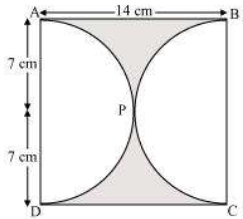
Find the area of the shaded region in the figure if $ABCD$ is a square of side $14 \, cm$ and $APD$ and $BPC$ are semicircles. (in $cm^2$) [Use $\pi = \frac{22}{7}$]
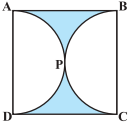
A
$77$
B
$196$
C
$154$
D
$42$
Solution
(D) It can be observed from the figure that the side of the square is $14 \, cm$. Therefore,the diameter of each semicircle is $14 \, cm$,and the radius $(r)$ of each semicircle is $7 \, cm$.
Area of one semicircle $= \frac{1}{2} \pi r^2 = \frac{1}{2} \times \frac{22}{7} \times (7)^2 = \frac{1}{2} \times \frac{22}{7} \times 49 = 77 \, cm^2$.
Area of two semicircles $= 2 \times 77 = 154 \, cm^2$.
Area of square $ABCD = (\text{side})^2 = (14)^2 = 196 \, cm^2$.
Area of the shaded region $=$ Area of square $ABCD -$ Area of two semicircles.
Area of the shaded region $= 196 \, cm^2 - 154 \, cm^2 = 42 \, cm^2$.
Area of one semicircle $= \frac{1}{2} \pi r^2 = \frac{1}{2} \times \frac{22}{7} \times (7)^2 = \frac{1}{2} \times \frac{22}{7} \times 49 = 77 \, cm^2$.
Area of two semicircles $= 2 \times 77 = 154 \, cm^2$.
Area of square $ABCD = (\text{side})^2 = (14)^2 = 196 \, cm^2$.
Area of the shaded region $=$ Area of square $ABCD -$ Area of two semicircles.
Area of the shaded region $= 196 \, cm^2 - 154 \, cm^2 = 42 \, cm^2$.
0 likes
View Solution29
Difficult
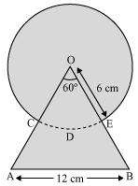
Find the area of the shaded region in the figure,where a circular arc of radius $6 \, cm$ has been drawn with vertex $O$ of an equilateral triangle $OAB$ of side $12 \, cm$ as centre. $\left[ \text{Use } \pi = \frac{22}{7} \right]$
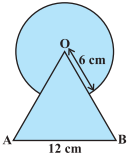
Solution
(N/A) The shaded region consists of the area of the equilateral triangle $OAB$ and the area of the major circle excluding the sector $OCDE$ that overlaps with the triangle.
$1$. Area of equilateral triangle $OAB = \frac{\sqrt{3}}{4} \times (side)^2 = \frac{\sqrt{3}}{4} \times (12)^2 = 36\sqrt{3} \, cm^2$.
$2$. Area of the circle with radius $r = 6 \, cm = \pi r^2 = \frac{22}{7} \times 6^2 = \frac{792}{7} \, cm^2$.
$3$. The angle of the equilateral triangle is $60^{\circ}$. The area of the sector $OCDE$ (which is the overlapping part) $= \frac{60^{\circ}}{360^{\circ}} \times \pi r^2 = \frac{1}{6} \times \frac{22}{7} \times 36 = \frac{132}{7} \, cm^2$.
$4$. Total area of the shaded region = Area of $\triangle OAB +$ Area of circle $-$ Area of sector $OCDE$.
$= 36\sqrt{3} + \frac{792}{7} - \frac{132}{7} = 36\sqrt{3} + \frac{660}{7} \, cm^2$.
$1$. Area of equilateral triangle $OAB = \frac{\sqrt{3}}{4} \times (side)^2 = \frac{\sqrt{3}}{4} \times (12)^2 = 36\sqrt{3} \, cm^2$.
$2$. Area of the circle with radius $r = 6 \, cm = \pi r^2 = \frac{22}{7} \times 6^2 = \frac{792}{7} \, cm^2$.
$3$. The angle of the equilateral triangle is $60^{\circ}$. The area of the sector $OCDE$ (which is the overlapping part) $= \frac{60^{\circ}}{360^{\circ}} \times \pi r^2 = \frac{1}{6} \times \frac{22}{7} \times 36 = \frac{132}{7} \, cm^2$.
$4$. Total area of the shaded region = Area of $\triangle OAB +$ Area of circle $-$ Area of sector $OCDE$.
$= 36\sqrt{3} + \frac{792}{7} - \frac{132}{7} = 36\sqrt{3} + \frac{660}{7} \, cm^2$.
0 likes
View Solution30
Medium
From each corner of a square of side $4\, cm$,a quadrant of a circle of radius $1\, cm$ is cut and also a circle of diameter $2\, cm$ is cut as shown in the figure. Find the area of the remaining portion of the square. [Use $\pi = \frac{22}{7}$]
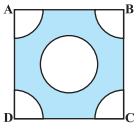
Solution
(N/A) $1$. Area of the square $= (\text{side})^2 = (4\, cm)^2 = 16\, cm^2$.
$2$. Area of each quadrant of a circle with radius $r = 1\, cm$ is $\frac{1}{4} \pi r^2 = \frac{1}{4} \times \frac{22}{7} \times (1)^2 = \frac{22}{28} = \frac{11}{14}\, cm^2$.
$3$. Total area of $4$ quadrants $= 4 \times \frac{11}{14} = \frac{22}{7}\, cm^2$.
$4$. Area of the central circle with diameter $2\, cm$ (radius $r = 1\, cm$) $= \pi r^2 = \frac{22}{7} \times (1)^2 = \frac{22}{7}\, cm^2$.
$5$. Area of the remaining portion $= \text{Area of square} - (\text{Total area of } 4 \text{ quadrants} + \text{Area of central circle})$.
$6$. Area $= 16 - (\frac{22}{7} + \frac{22}{7}) = 16 - \frac{44}{7} = \frac{112 - 44}{7} = \frac{68}{7}\, cm^2$.
$2$. Area of each quadrant of a circle with radius $r = 1\, cm$ is $\frac{1}{4} \pi r^2 = \frac{1}{4} \times \frac{22}{7} \times (1)^2 = \frac{22}{28} = \frac{11}{14}\, cm^2$.
$3$. Total area of $4$ quadrants $= 4 \times \frac{11}{14} = \frac{22}{7}\, cm^2$.
$4$. Area of the central circle with diameter $2\, cm$ (radius $r = 1\, cm$) $= \pi r^2 = \frac{22}{7} \times (1)^2 = \frac{22}{7}\, cm^2$.
$5$. Area of the remaining portion $= \text{Area of square} - (\text{Total area of } 4 \text{ quadrants} + \text{Area of central circle})$.
$6$. Area $= 16 - (\frac{22}{7} + \frac{22}{7}) = 16 - \frac{44}{7} = \frac{112 - 44}{7} = \frac{68}{7}\, cm^2$.
0 likes
View Solution31
Medium
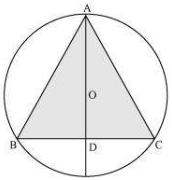
In a circular table cover of radius $32 \, cm$,a design is formed by leaving an equilateral triangle $ABC$ in the middle as shown in the figure. Find the area of the design. [Use $\pi = \frac{22}{7}$]
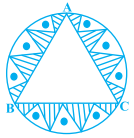
Solution
(N/A) Radius $(r)$ of the circle $= 32 \, cm$.
$AD$ is the median of $\triangle ABC$.
Since $O$ is the centroid of the equilateral triangle,$AO = \frac{2}{3} AD = 32 \, cm$.
Therefore,$AD = 32 \times \frac{3}{2} = 48 \, cm$.
In $\triangle ABD$,by Pythagoras theorem:
$AB^2 = AD^2 + BD^2$
$AB^2 = (48)^2 + \left(\frac{AB}{2}\right)^2$
$AB^2 - \frac{AB^2}{4} = 2304$
$\frac{3 AB^2}{4} = 2304$
$AB^2 = \frac{2304 \times 4}{3} = 3072$
$AB = \sqrt{3072} = 32 \sqrt{3} \, cm$.
Area of equilateral triangle $\triangle ABC = \frac{\sqrt{3}}{4} \times (side)^2 = \frac{\sqrt{3}}{4} \times (32 \sqrt{3})^2$
$= \frac{\sqrt{3}}{4} \times 1024 \times 3 = 768 \sqrt{3} \, cm^2$.
Area of circle $= \pi r^2 = \frac{22}{7} \times (32)^2 = \frac{22}{7} \times 1024 = \frac{22528}{7} \, cm^2$.
Area of the design = Area of circle $-$ Area of $\triangle ABC$
$= \left(\frac{22528}{7} - 768 \sqrt{3}\right) \, cm^2$.
$AD$ is the median of $\triangle ABC$.
Since $O$ is the centroid of the equilateral triangle,$AO = \frac{2}{3} AD = 32 \, cm$.
Therefore,$AD = 32 \times \frac{3}{2} = 48 \, cm$.
In $\triangle ABD$,by Pythagoras theorem:
$AB^2 = AD^2 + BD^2$
$AB^2 = (48)^2 + \left(\frac{AB}{2}\right)^2$
$AB^2 - \frac{AB^2}{4} = 2304$
$\frac{3 AB^2}{4} = 2304$
$AB^2 = \frac{2304 \times 4}{3} = 3072$
$AB = \sqrt{3072} = 32 \sqrt{3} \, cm$.
Area of equilateral triangle $\triangle ABC = \frac{\sqrt{3}}{4} \times (side)^2 = \frac{\sqrt{3}}{4} \times (32 \sqrt{3})^2$
$= \frac{\sqrt{3}}{4} \times 1024 \times 3 = 768 \sqrt{3} \, cm^2$.
Area of circle $= \pi r^2 = \frac{22}{7} \times (32)^2 = \frac{22}{7} \times 1024 = \frac{22528}{7} \, cm^2$.
Area of the design = Area of circle $-$ Area of $\triangle ABC$
$= \left(\frac{22528}{7} - 768 \sqrt{3}\right) \, cm^2$.
0 likes
View Solution32
EasyMCQ
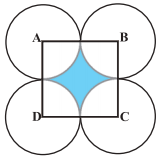
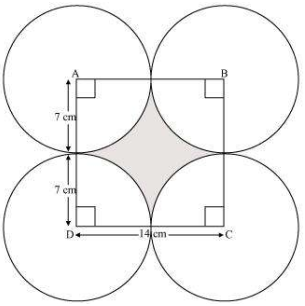
In $Fig.$,$ABCD$ is a square of side $14 \, cm$. With centres $A, B, C$ and $D$,four circles are drawn such that each circle touches externally two of the remaining three circles. Find the area of the shaded region (in $cm^2$). $\left[\text{Use } \pi = \frac{22}{7}\right]$
A
$196$
B
$154$
C
$77$
D
$42$
Solution
(D) The area of each of the $4$ sectors is equal to each other,and each is a sector of $90^{\circ}$ in a circle of $7 \, cm$ radius.
Area of each sector $= \frac{90^{\circ}}{360^{\circ}} \times \pi(7)^{2}$
$= \frac{1}{4} \times \frac{22}{7} \times 7 \times 7$
$= \frac{77}{2} \, cm^{2} = 38.5 \, cm^{2}$
Area of square $ABCD = (\text{Side})^{2} = (14)^{2} = 196 \, cm^{2}$
Area of shaded portion = Area of square $ABCD - 4 \times$ (Area of each sector)
$= 196 - 4 \times \frac{77}{2}$
$= 196 - 154$
$= 42 \, cm^{2}$
Therefore,the area of the shaded portion is $42 \, cm^{2}$.
Area of each sector $= \frac{90^{\circ}}{360^{\circ}} \times \pi(7)^{2}$
$= \frac{1}{4} \times \frac{22}{7} \times 7 \times 7$
$= \frac{77}{2} \, cm^{2} = 38.5 \, cm^{2}$
Area of square $ABCD = (\text{Side})^{2} = (14)^{2} = 196 \, cm^{2}$
Area of shaded portion = Area of square $ABCD - 4 \times$ (Area of each sector)
$= 196 - 4 \times \frac{77}{2}$
$= 196 - 154$
$= 42 \, cm^{2}$
Therefore,the area of the shaded portion is $42 \, cm^{2}$.
0 likes
View Solution33
Medium
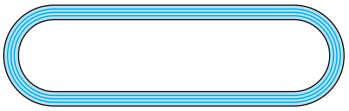
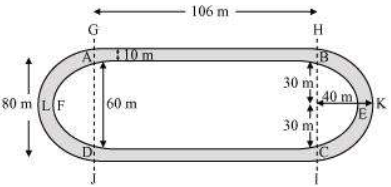
The figure depicts a racing track whose left and right ends are semicircular.
The distance between the two inner parallel line segments is $60 \, m$ and they are each $106 \, m$ long. If the track is $10 \, m$ wide,find:
$(i)$ the distance around the track along its inner edge
$(ii)$ the area of the track. $\left[ \text{Use } \pi = \frac{22}{7} \right]$
The distance between the two inner parallel line segments is $60 \, m$ and they are each $106 \, m$ long. If the track is $10 \, m$ wide,find:
$(i)$ the distance around the track along its inner edge
$(ii)$ the area of the track. $\left[ \text{Use } \pi = \frac{22}{7} \right]$
Solution
(N/A) Given:
Inner length of the straight parts $= 106 \, m$
Inner width (distance between parallel lines) $= 60 \, m$
Inner radius $(r) = \frac{60}{2} = 30 \, m$
Width of the track $= 10 \, m$
Outer radius $(R) = 30 + 10 = 40 \, m$
$(i)$ Distance around the track along its inner edge $= AB + \text{arc } BEC + CD + \text{arc } DFA$
$= 106 + (\pi r) + 106 + (\pi r)$
$= 212 + 2 \pi r$
$= 212 + 2 \times \frac{22}{7} \times 30$
$= 212 + \frac{1320}{7} = \frac{1484 + 1320}{7} = \frac{2804}{7} \, m \approx 400.57 \, m$
$(ii)$ Area of the track $= 2 \times (\text{Area of rectangle } 106 \times 10) + 2 \times (\text{Area of semi-circular ring})$
$= 2 \times (106 \times 10) + 2 \times \left[ \frac{1}{2} \pi (R^2 - r^2) \right]$
$= 2120 + \pi (40^2 - 30^2)$
$= 2120 + \frac{22}{7} (1600 - 900)$
$= 2120 + \frac{22}{7} \times 700$
$= 2120 + 2200 = 4320 \, m^2$
Inner length of the straight parts $= 106 \, m$
Inner width (distance between parallel lines) $= 60 \, m$
Inner radius $(r) = \frac{60}{2} = 30 \, m$
Width of the track $= 10 \, m$
Outer radius $(R) = 30 + 10 = 40 \, m$
$(i)$ Distance around the track along its inner edge $= AB + \text{arc } BEC + CD + \text{arc } DFA$
$= 106 + (\pi r) + 106 + (\pi r)$
$= 212 + 2 \pi r$
$= 212 + 2 \times \frac{22}{7} \times 30$
$= 212 + \frac{1320}{7} = \frac{1484 + 1320}{7} = \frac{2804}{7} \, m \approx 400.57 \, m$
$(ii)$ Area of the track $= 2 \times (\text{Area of rectangle } 106 \times 10) + 2 \times (\text{Area of semi-circular ring})$
$= 2 \times (106 \times 10) + 2 \times \left[ \frac{1}{2} \pi (R^2 - r^2) \right]$
$= 2120 + \pi (40^2 - 30^2)$
$= 2120 + \frac{22}{7} (1600 - 900)$
$= 2120 + \frac{22}{7} \times 700$
$= 2120 + 2200 = 4320 \, m^2$
0 likes
View Solution34
DifficultMCQ
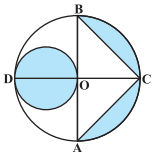
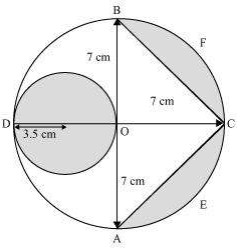
In the figure,$AB$ and $CD$ are two diameters of a circle (with centre $O$) perpendicular to each other. $OD$ is the diameter of the smaller circle. If $OA = 7 \, cm$,find the area of the shaded region in $cm^2$. [Use $\pi = \frac{22}{7}$]
A
$49$
B
$66.5$
C
$49.8$
D
$77.20$
Solution
(B) Radius $(r_1)$ of the larger circle $= 7 \, cm$.
Radius $(r_2)$ of the smaller circle $= \frac{7}{2} \, cm = 3.5 \, cm$.
Area of the smaller circle $= \pi r_2^2 = \frac{22}{7} \times 3.5 \times 3.5 = 38.5 \, cm^2$.
Area of the semi-circle $ACB$ of the larger circle $= \frac{1}{2} \pi r_1^2 = \frac{1}{2} \times \frac{22}{7} \times 7^2 = 77 \, cm^2$.
Area of $\triangle ABC = \frac{1}{2} \times \text{base} \times \text{height} = \frac{1}{2} \times AB \times OC = \frac{1}{2} \times 14 \times 7 = 49 \, cm^2$.
Area of the shaded region $=$ Area of the smaller circle $+$ (Area of semi-circle $ACB - \text{Area of } \triangle ABC$).
Area of the shaded region $= 38.5 + (77 - 49) = 38.5 + 28 = 66.5 \, cm^2$.
Radius $(r_2)$ of the smaller circle $= \frac{7}{2} \, cm = 3.5 \, cm$.
Area of the smaller circle $= \pi r_2^2 = \frac{22}{7} \times 3.5 \times 3.5 = 38.5 \, cm^2$.
Area of the semi-circle $ACB$ of the larger circle $= \frac{1}{2} \pi r_1^2 = \frac{1}{2} \times \frac{22}{7} \times 7^2 = 77 \, cm^2$.
Area of $\triangle ABC = \frac{1}{2} \times \text{base} \times \text{height} = \frac{1}{2} \times AB \times OC = \frac{1}{2} \times 14 \times 7 = 49 \, cm^2$.
Area of the shaded region $=$ Area of the smaller circle $+$ (Area of semi-circle $ACB - \text{Area of } \triangle ABC$).
Area of the shaded region $= 38.5 + (77 - 49) = 38.5 + 28 = 66.5 \, cm^2$.
0 likes
View Solution35
MediumMCQ
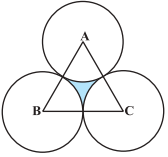
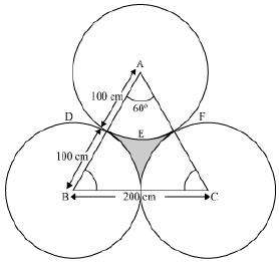
The area of an equilateral triangle $ABC$ is $17320.5 \, cm^2$. With each vertex of the triangle as a centre,a circle is drawn with a radius equal to half the length of the side of the triangle (see figure). Find the area of the shaded region in $cm^2$. (Use $\pi = 3.14$ and $\sqrt{3} = 1.73205$)
A
$1570$
B
$1732.0$
C
$1620.5$
D
$1880.5$
Solution
(C) Let the side of the equilateral triangle be $a$.
Area of equilateral triangle $= 17320.5 \, cm^2$.
$\frac{\sqrt{3}}{4} a^2 = 17320.5$
$\frac{1.73205}{4} a^2 = 17320.5$
$a^2 = 4 \times 10000 = 40000$
$a = 200 \, cm$.
The radius of each circle is $r = \frac{a}{2} = \frac{200}{2} = 100 \, cm$.
Each interior angle of an equilateral triangle is $60^{\circ}$.
Area of one sector $= \frac{60^{\circ}}{360^{\circ}} \times \pi r^2 = \frac{1}{6} \times 3.14 \times (100)^2 = \frac{31400}{6} = \frac{15700}{3} \, cm^2$.
Area of three sectors $= 3 \times \frac{15700}{3} = 15700 \, cm^2$.
Area of the shaded region $=$ Area of equilateral triangle $-$ Area of three sectors
$= 17320.5 - 15700 = 1620.5 \, cm^2$.
Area of equilateral triangle $= 17320.5 \, cm^2$.
$\frac{\sqrt{3}}{4} a^2 = 17320.5$
$\frac{1.73205}{4} a^2 = 17320.5$
$a^2 = 4 \times 10000 = 40000$
$a = 200 \, cm$.
The radius of each circle is $r = \frac{a}{2} = \frac{200}{2} = 100 \, cm$.
Each interior angle of an equilateral triangle is $60^{\circ}$.
Area of one sector $= \frac{60^{\circ}}{360^{\circ}} \times \pi r^2 = \frac{1}{6} \times 3.14 \times (100)^2 = \frac{31400}{6} = \frac{15700}{3} \, cm^2$.
Area of three sectors $= 3 \times \frac{15700}{3} = 15700 \, cm^2$.
Area of the shaded region $=$ Area of equilateral triangle $-$ Area of three sectors
$= 17320.5 - 15700 = 1620.5 \, cm^2$.
0 likes
View Solution36
EasyMCQ
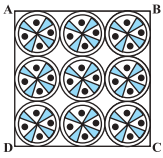
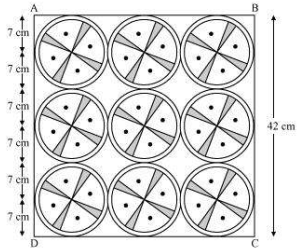
On a square handkerchief,nine circular designs each of radius $7\, cm$ are made (see figure). Find the area of the remaining portion of the handkerchief. (in $cm^2$) $\left[\right.$ Use $\left.\pi=\frac{22}{7}\right]$
A
$154$
B
$907$
C
$1386$
D
$378$
Solution
(D) From the figure,it can be observed that the side of the square is $3 \times (2 \times 7) = 42\, cm$.
Area of square $= (\text{Side})^2 = (42)^2 = 1764\, cm^2$.
Area of one circle $= \pi r^2 = \frac{22}{7} \times (7)^2 = 154\, cm^2$.
Area of $9$ circles $= 9 \times 154 = 1386\, cm^2$.
Area of the remaining portion of the handkerchief $= \text{Area of square} - \text{Area of } 9 \text{ circles} = 1764 - 1386 = 378\, cm^2$.
Area of square $= (\text{Side})^2 = (42)^2 = 1764\, cm^2$.
Area of one circle $= \pi r^2 = \frac{22}{7} \times (7)^2 = 154\, cm^2$.
Area of $9$ circles $= 9 \times 154 = 1386\, cm^2$.
Area of the remaining portion of the handkerchief $= \text{Area of square} - \text{Area of } 9 \text{ circles} = 1764 - 1386 = 378\, cm^2$.
0 likes
View Solution37
Medium
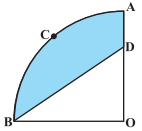
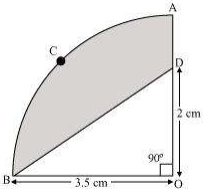
In the given figure,$OACB$ is a quadrant of a circle with centre $O$ and radius $3.5 \, cm$. If $OD = 2 \, cm$,find the area of the:
$(i)$ quadrant $OACB$,
$(ii)$ shaded region. $\left[ \text{Use } \pi = \frac{22}{7} \right]$
$(i)$ quadrant $OACB$,
$(ii)$ shaded region. $\left[ \text{Use } \pi = \frac{22}{7} \right]$
Solution
(N/A) $(i)$ Since $OACB$ is a quadrant,it subtends a $90^{\circ}$ angle at the centre $O$.
Area of quadrant $OACB = \frac{90^{\circ}}{360^{\circ}} \times \pi r^{2}$
$= \frac{1}{4} \times \frac{22}{7} \times (3.5)^{2} = \frac{1}{4} \times \frac{22}{7} \times \left( \frac{7}{2} \right)^{2}$
$= \frac{1}{4} \times \frac{22}{7} \times \frac{49}{4} = \frac{11 \times 7}{8} = \frac{77}{8} \, cm^{2} = 9.625 \, cm^{2}$.
$(ii)$ Area of $\triangle BOD = \frac{1}{2} \times \text{base} \times \text{height} = \frac{1}{2} \times OB \times OD$
$= \frac{1}{2} \times 3.5 \times 2 = 3.5 \, cm^{2} = \frac{7}{2} \, cm^{2}$.
Area of the shaded region = Area of quadrant $OACB - \text{Area of } \triangle BOD$
$= \frac{77}{8} - \frac{7}{2} = \frac{77 - 28}{8} = \frac{49}{8} \, cm^{2} = 6.125 \, cm^{2}$.
Area of quadrant $OACB = \frac{90^{\circ}}{360^{\circ}} \times \pi r^{2}$
$= \frac{1}{4} \times \frac{22}{7} \times (3.5)^{2} = \frac{1}{4} \times \frac{22}{7} \times \left( \frac{7}{2} \right)^{2}$
$= \frac{1}{4} \times \frac{22}{7} \times \frac{49}{4} = \frac{11 \times 7}{8} = \frac{77}{8} \, cm^{2} = 9.625 \, cm^{2}$.
$(ii)$ Area of $\triangle BOD = \frac{1}{2} \times \text{base} \times \text{height} = \frac{1}{2} \times OB \times OD$
$= \frac{1}{2} \times 3.5 \times 2 = 3.5 \, cm^{2} = \frac{7}{2} \, cm^{2}$.
Area of the shaded region = Area of quadrant $OACB - \text{Area of } \triangle BOD$
$= \frac{77}{8} - \frac{7}{2} = \frac{77 - 28}{8} = \frac{49}{8} \, cm^{2} = 6.125 \, cm^{2}$.
0 likes
View Solution38
MediumMCQ
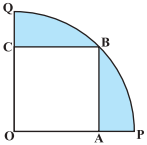
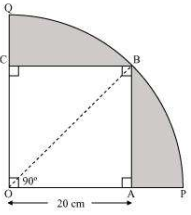
In the figure,a square $OABC$ is inscribed in a quadrant $OPBQ$. If $OA = 20 \, cm,$ find the area of the shaded region. (in $cm^2$) (Use $\pi = 3.14$)
A
$628$
B
$228$
C
$202$
D
$400$
Solution
(B) In $\triangle OAB$,since $OABC$ is a square,$\angle OAB = 90^{\circ}$.
By Pythagoras theorem,$OB^2 = OA^2 + AB^2$.
Since $OA = AB = 20 \, cm$,we have $OB^2 = 20^2 + 20^2 = 400 + 400 = 800$.
Thus,the radius $(r)$ of the quadrant is $OB = \sqrt{800} = 20\sqrt{2} \, cm$.
The area of the quadrant $OPBQ = \frac{1}{4} \times \pi r^2 = \frac{1}{4} \times 3.14 \times (20\sqrt{2})^2$.
$= \frac{1}{4} \times 3.14 \times 800 = 3.14 \times 200 = 628 \, cm^2$.
The area of the square $OABC = (\text{side})^2 = 20^2 = 400 \, cm^2$.
The area of the shaded region = Area of quadrant $OPBQ$ - Area of square $OABC$.
$= 628 \, cm^2 - 400 \, cm^2 = 228 \, cm^2$.
By Pythagoras theorem,$OB^2 = OA^2 + AB^2$.
Since $OA = AB = 20 \, cm$,we have $OB^2 = 20^2 + 20^2 = 400 + 400 = 800$.
Thus,the radius $(r)$ of the quadrant is $OB = \sqrt{800} = 20\sqrt{2} \, cm$.
The area of the quadrant $OPBQ = \frac{1}{4} \times \pi r^2 = \frac{1}{4} \times 3.14 \times (20\sqrt{2})^2$.
$= \frac{1}{4} \times 3.14 \times 800 = 3.14 \times 200 = 628 \, cm^2$.
The area of the square $OABC = (\text{side})^2 = 20^2 = 400 \, cm^2$.
The area of the shaded region = Area of quadrant $OPBQ$ - Area of square $OABC$.
$= 628 \, cm^2 - 400 \, cm^2 = 228 \, cm^2$.
0 likes
View Solution39
Medium
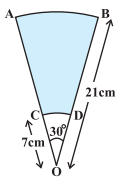
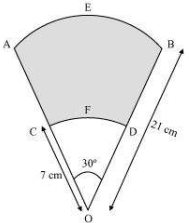
$AB$ and $CD$ are respectively arcs of two concentric circles of radii $21\, cm$ and $7\, cm$ with centre $O$ (see figure). If $\angle AOB = 30^{\circ}$,find the area of the shaded region.
Solution
(N/A) The area of the shaded region is the difference between the area of the larger sector $OAB$ and the smaller sector $OCD$.
Area of sector $OAB = \frac{\theta}{360^{\circ}} \times \pi R^2 = \frac{30^{\circ}}{360^{\circ}} \times \frac{22}{7} \times (21)^2 = \frac{1}{12} \times \frac{22}{7} \times 441 = \frac{1}{12} \times 22 \times 63 = \frac{1386}{12} = 115.5\, cm^2$.
Area of sector $OCD = \frac{\theta}{360^{\circ}} \times \pi r^2 = \frac{30^{\circ}}{360^{\circ}} \times \frac{22}{7} \times (7)^2 = \frac{1}{12} \times \frac{22}{7} \times 49 = \frac{1}{12} \times 22 \times 7 = \frac{154}{12} = \frac{77}{6}\, cm^2$.
Area of the shaded region = Area of sector $OAB$ $-$ Area of sector $OCD = 115.5 - \frac{77}{6} = \frac{693 - 77}{6} = \frac{616}{6} = \frac{308}{3}\, cm^2$.
Area of sector $OAB = \frac{\theta}{360^{\circ}} \times \pi R^2 = \frac{30^{\circ}}{360^{\circ}} \times \frac{22}{7} \times (21)^2 = \frac{1}{12} \times \frac{22}{7} \times 441 = \frac{1}{12} \times 22 \times 63 = \frac{1386}{12} = 115.5\, cm^2$.
Area of sector $OCD = \frac{\theta}{360^{\circ}} \times \pi r^2 = \frac{30^{\circ}}{360^{\circ}} \times \frac{22}{7} \times (7)^2 = \frac{1}{12} \times \frac{22}{7} \times 49 = \frac{1}{12} \times 22 \times 7 = \frac{154}{12} = \frac{77}{6}\, cm^2$.
Area of the shaded region = Area of sector $OAB$ $-$ Area of sector $OCD = 115.5 - \frac{77}{6} = \frac{693 - 77}{6} = \frac{616}{6} = \frac{308}{3}\, cm^2$.
0 likes
View Solution40
EasyMCQ
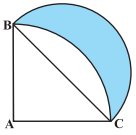
In the figure,$ABC$ is a quadrant of a circle of radius $14 \, cm$ and a semicircle is drawn with $BC$ as diameter. Find the area of the shaded region. (in $cm^2$) [Use $\pi = \frac{22}{7}$]
A
$168$
B
$189$
C
$208$
D
$98$
Solution
(D) Since $ABC$ is a quadrant of the circle,$\angle BAC = 90^{\circ}$.
In $\triangle ABC$,by Pythagoras theorem:
$BC^2 = AC^2 + AB^2 = (14)^2 + (14)^2 = 196 + 196 = 392$.
$BC = \sqrt{392} = 14\sqrt{2} \, cm$.
Radius $(r_1)$ of the semicircle drawn on $BC = \frac{14\sqrt{2}}{2} = 7\sqrt{2} \, cm$.
Area of $\triangle ABC = \frac{1}{2} \times AB \times AC = \frac{1}{2} \times 14 \times 14 = 98 \, cm^2$.
Area of quadrant $ABC = \frac{1}{4} \times \pi \times r^2 = \frac{1}{4} \times \frac{22}{7} \times 14 \times 14 = 154 \, cm^2$.
Area of segment $BC$ (the region between chord $BC$ and arc $BC$) = Area of quadrant $ABC - \text{Area of } \triangle ABC = 154 - 98 = 56 \, cm^2$.
Area of semicircle on $BC = \frac{1}{2} \times \pi \times r_1^2 = \frac{1}{2} \times \frac{22}{7} \times (7\sqrt{2})^2 = \frac{1}{2} \times \frac{22}{7} \times 98 = 154 \, cm^2$.
Area of shaded region = Area of semicircle on $BC - \text{Area of segment } BC = 154 - 56 = 98 \, cm^2$.
In $\triangle ABC$,by Pythagoras theorem:
$BC^2 = AC^2 + AB^2 = (14)^2 + (14)^2 = 196 + 196 = 392$.
$BC = \sqrt{392} = 14\sqrt{2} \, cm$.
Radius $(r_1)$ of the semicircle drawn on $BC = \frac{14\sqrt{2}}{2} = 7\sqrt{2} \, cm$.
Area of $\triangle ABC = \frac{1}{2} \times AB \times AC = \frac{1}{2} \times 14 \times 14 = 98 \, cm^2$.
Area of quadrant $ABC = \frac{1}{4} \times \pi \times r^2 = \frac{1}{4} \times \frac{22}{7} \times 14 \times 14 = 154 \, cm^2$.
Area of segment $BC$ (the region between chord $BC$ and arc $BC$) = Area of quadrant $ABC - \text{Area of } \triangle ABC = 154 - 98 = 56 \, cm^2$.
Area of semicircle on $BC = \frac{1}{2} \times \pi \times r_1^2 = \frac{1}{2} \times \frac{22}{7} \times (7\sqrt{2})^2 = \frac{1}{2} \times \frac{22}{7} \times 98 = 154 \, cm^2$.
Area of shaded region = Area of semicircle on $BC - \text{Area of segment } BC = 154 - 56 = 98 \, cm^2$.
0 likes
View Solution41
Difficult
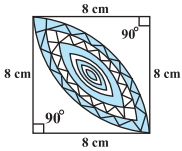
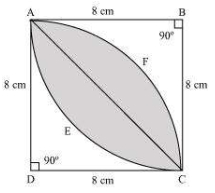
Calculate the area of the designed region in the figure,which is common between the two quadrants of circles of radius $8 \, cm$ each. $\left[\text{Use } \pi = \frac{22}{7}\right]$
Solution
(N/A) The designed area is the common region between two sectors $BAEC$ and $DAFC$.
Area of sector $BAEC = \frac{90^{\circ}}{360^{\circ}} \times \frac{22}{7} \times (8)^{2}$
$= \frac{1}{4} \times \frac{22}{7} \times 64$
$= \frac{22 \times 16}{7} = \frac{352}{7} \, cm^{2}$
Area of $\triangle BAC = \frac{1}{2} \times BA \times BC$
$= \frac{1}{2} \times 8 \times 8 = 32 \, cm^{2}$
Area of the designed portion $= 2 \times (\text{Area of segment } AEC)$
$= 2 \times (\text{Area of sector } BAEC - \text{Area of } \triangle BAC)$
$= 2 \times \left(\frac{352}{7} - 32\right) = 2 \left(\frac{352 - 224}{7}\right)$
$= \frac{2 \times 128}{7} = \frac{256}{7} \, cm^{2}$
Area of sector $BAEC = \frac{90^{\circ}}{360^{\circ}} \times \frac{22}{7} \times (8)^{2}$
$= \frac{1}{4} \times \frac{22}{7} \times 64$
$= \frac{22 \times 16}{7} = \frac{352}{7} \, cm^{2}$
Area of $\triangle BAC = \frac{1}{2} \times BA \times BC$
$= \frac{1}{2} \times 8 \times 8 = 32 \, cm^{2}$
Area of the designed portion $= 2 \times (\text{Area of segment } AEC)$
$= 2 \times (\text{Area of sector } BAEC - \text{Area of } \triangle BAC)$
$= 2 \times \left(\frac{352}{7} - 32\right) = 2 \left(\frac{352 - 224}{7}\right)$
$= \frac{2 \times 128}{7} = \frac{256}{7} \, cm^{2}$
0 likes
View SolutionAreas Related to Circles — Textbook - Areas Related to Circles · Frequently Asked Questions
1Are these Areas Related to Circles questions useful for JEE and NEET?
Yes. All questions in this section are mapped to JEE Main and NEET exam patterns. Previous year questions from JEE Main, NEET, GUJCET and state-level exams are included with full solutions.
2Can I switch to Hindi or Gujarati for these questions?
Yes. Use the language tabs in the hero section or the sidebar to view the same questions and solutions in English, Hindi or Gujarati.
3How do I generate a question paper from this subtopic?
Use the Vedclass Exam Paper Generator — select the chapter and subtopic, set difficulty, and generate Sets A, B, C, D automatically. First 3 chapters of every subject are free.
Vedclass Products
For Students
Vedclass Test Series
Mock tests in real JEE/NEET style with performance analysis. 5-day free trial.
Start Free TrialFor Teachers
Exam Paper Generator
Generate Set A/B/C/D papers from this chapter in 2 minutes. 3 chapters free.
Try FreeFor Institutes
Online Exam Module
Live online exams with unlimited students, 360° analytics & white-label branding.
See DemoFor Teachers & Institutes
Generate a Areas Related to Circles Exam Paper in 2 Minutes
Select subtopic & difficulty — Sets A, B, C, D auto-generated with No Repeat logic.
First 3 chapters of every subject are free — no payment required.