
A English
Mix Examples - Areas Related to Circles Questions in English
Class 10 Mathematics · Areas Related to Circles · Mix Examples - Areas Related to Circles
215+
Questions
English
Language
100%
With Solutions
Showing 50 of 215 questions in English
101
EasyMCQ
In a circle with radius $8.4 \, cm$,a minor arc subtends an angle of $60^{\circ}$ at the centre. Find the area of the minor sector and the major sector corresponding to this arc.
A
$36.96 \, cm^2, 184.8 \, cm^2$
B
$36.96 \, cm^2, 190.5 \, cm^2$
C
$38.50 \, cm^2, 184.8 \, cm^2$
D
$36.96 \, cm^2, 221.76 \, cm^2$
Solution
(A) Given: Radius $r = 8.4 \, cm$,Central angle $\theta = 60^{\circ}$.
Area of minor sector = $\frac{\theta}{360^{\circ}} \times \pi r^2 = \frac{60}{360} \times \frac{22}{7} \times 8.4 \times 8.4 = \frac{1}{6} \times 22 \times 1.2 \times 8.4 = 36.96 \, cm^2$.
Area of circle = $\pi r^2 = \frac{22}{7} \times 8.4 \times 8.4 = 221.76 \, cm^2$.
Area of major sector = Area of circle - Area of minor sector = $221.76 - 36.96 = 184.8 \, cm^2$.
Area of minor sector = $\frac{\theta}{360^{\circ}} \times \pi r^2 = \frac{60}{360} \times \frac{22}{7} \times 8.4 \times 8.4 = \frac{1}{6} \times 22 \times 1.2 \times 8.4 = 36.96 \, cm^2$.
Area of circle = $\pi r^2 = \frac{22}{7} \times 8.4 \times 8.4 = 221.76 \, cm^2$.
Area of major sector = Area of circle - Area of minor sector = $221.76 - 36.96 = 184.8 \, cm^2$.
0 likes
View Solution102
DifficultMCQ
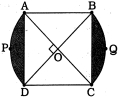
The length of the diagonals of a square garden $ABCD$ is $120\, m$. As shown in the figure,there are flower beds on two opposite sides of the garden in the shape of minor segments,the center of which is the point of intersection of the diagonals. Find the area of these flower beds. $(\pi=3.14)$ (in $m^2$)
A
$1032$
B
$2052$
C
$2210$
D
$3240$
Solution
(B) Let the side of the square be $a$. The length of the diagonal of a square is $d = a\sqrt{2}$.
Given $d = 120\, m$,so $a\sqrt{2} = 120$,which implies $a = \frac{120}{\sqrt{2}} = 60\sqrt{2}\, m$.
The diagonals of a square bisect each other at $90^\circ$. Thus,the distance from the center $O$ to each vertex is $r = \frac{120}{2} = 60\, m$.
Each flower bed is a minor segment of a circle with radius $r = 60\, m$ and central angle $\theta = 90^\circ$.
The area of one minor segment is given by the formula: $\text{Area} = \frac{\theta}{360^\circ} \times \pi r^2 - \frac{1}{2} r^2 \sin\theta$.
Substituting the values: $\text{Area} = \frac{90}{360} \times 3.14 \times (60)^2 - \frac{1}{2} \times (60)^2 \times \sin(90^\circ)$.
$\text{Area} = \frac{1}{4} \times 3.14 \times 3600 - \frac{1}{2} \times 3600 \times 1$.
$\text{Area} = 3.14 \times 900 - 1800 = 2826 - 1800 = 1026\, m^2$.
Since there are two such flower beds,the total area is $2 \times 1026 = 2052\, m^2$.
Given $d = 120\, m$,so $a\sqrt{2} = 120$,which implies $a = \frac{120}{\sqrt{2}} = 60\sqrt{2}\, m$.
The diagonals of a square bisect each other at $90^\circ$. Thus,the distance from the center $O$ to each vertex is $r = \frac{120}{2} = 60\, m$.
Each flower bed is a minor segment of a circle with radius $r = 60\, m$ and central angle $\theta = 90^\circ$.
The area of one minor segment is given by the formula: $\text{Area} = \frac{\theta}{360^\circ} \times \pi r^2 - \frac{1}{2} r^2 \sin\theta$.
Substituting the values: $\text{Area} = \frac{90}{360} \times 3.14 \times (60)^2 - \frac{1}{2} \times (60)^2 \times \sin(90^\circ)$.
$\text{Area} = \frac{1}{4} \times 3.14 \times 3600 - \frac{1}{2} \times 3600 \times 1$.
$\text{Area} = 3.14 \times 900 - 1800 = 2826 - 1800 = 1026\, m^2$.
Since there are two such flower beds,the total area is $2 \times 1026 = 2052\, m^2$.
1 likes
View Solution103
MediumMCQ
The radius of a field in the shape of a sector is $50 \, m$. The cost of fencing its boundary is ₹ $5400$ at the rate of ₹ $30 / m$. Find the cost of tilling at the rate of ₹ $15 / m^2$. (in ₹)
A
$22500$
B
$25301$
C
$30000$
D
$40000$
Solution
(C) The perimeter of the sector is given by $P = \frac{\text{Total Cost}}{\text{Rate}} = \frac{5400}{30} = 180 \, m$.
The perimeter of a sector is $P = 2r + l$,where $r = 50 \, m$ and $l$ is the arc length.
$180 = 2(50) + l \implies 180 = 100 + l \implies l = 80 \, m$.
The area of the sector is $A = \frac{1}{2} \times l \times r = \frac{1}{2} \times 80 \times 50 = 2000 \, m^2$.
The cost of tilling is $\text{Area} \times \text{Rate} = 2000 \times 15 = ₹ 30,000$.
The perimeter of a sector is $P = 2r + l$,where $r = 50 \, m$ and $l$ is the arc length.
$180 = 2(50) + l \implies 180 = 100 + l \implies l = 80 \, m$.
The area of the sector is $A = \frac{1}{2} \times l \times r = \frac{1}{2} \times 80 \times 50 = 2000 \, m^2$.
The cost of tilling is $\text{Area} \times \text{Rate} = 2000 \times 15 = ₹ 30,000$.
0 likes
View Solution104
MediumMCQ
From a circular metallic sheet with radius $21\, cm$,a regular hexagon of side $21\, cm$ is cut off. Find the area of the remaining sheet. $(\sqrt{3} = 1.73)$ (in $cm^2$)
A
$302.145$
B
$243.01$
C
$265.102$
D
$241.605$
Solution
(D) The area of the circular sheet is given by $A_{circle} = \pi r^2 = \frac{22}{7} \times 21 \times 21 = 22 \times 3 \times 21 = 1386\, cm^2$.
$A$ regular hexagon with side length $a = 21\, cm$ consists of $6$ equilateral triangles with side $21\, cm$.
The area of the regular hexagon is $A_{hexagon} = 6 \times \frac{\sqrt{3}}{4} a^2 = \frac{3\sqrt{3}}{2} \times (21)^2$.
Substituting $\sqrt{3} = 1.73$ and $a = 21$:
$A_{hexagon} = \frac{3 \times 1.73}{2} \times 441 = 1.5 \times 1.73 \times 441 = 2.595 \times 441 = 1144.395\, cm^2$.
The area of the remaining sheet is $A_{remaining} = A_{circle} - A_{hexagon} = 1386 - 1144.395 = 241.605\, cm^2$.
$A$ regular hexagon with side length $a = 21\, cm$ consists of $6$ equilateral triangles with side $21\, cm$.
The area of the regular hexagon is $A_{hexagon} = 6 \times \frac{\sqrt{3}}{4} a^2 = \frac{3\sqrt{3}}{2} \times (21)^2$.
Substituting $\sqrt{3} = 1.73$ and $a = 21$:
$A_{hexagon} = \frac{3 \times 1.73}{2} \times 441 = 1.5 \times 1.73 \times 441 = 2.595 \times 441 = 1144.395\, cm^2$.
The area of the remaining sheet is $A_{remaining} = A_{circle} - A_{hexagon} = 1386 - 1144.395 = 241.605\, cm^2$.
0 likes
View Solution105
EasyMCQ
$A$ field is in the shape of an equilateral triangle in which the length of each side is $70\, m$. $A$ cow is tethered at one of its vertices by a $5\, m$ long rope. Find the area of the region in the field in which the cow can graze. $(\pi = 3.14)$ (in $m^2$)
A
$13.08$
B
$12.54$
C
$11.03$
D
$23.01$
Solution
(A) The field is an equilateral triangle,so each interior angle is $60^{\circ}$.
The cow is tethered at one vertex,so the area it can graze is a sector of a circle with radius $r = 5\, m$ and central angle $\theta = 60^{\circ}$.
The formula for the area of a sector is $A = \frac{\theta}{360^{\circ}} \times \pi r^2$.
Substituting the values: $A = \frac{60^{\circ}}{360^{\circ}} \times 3.14 \times (5)^2$.
$A = \frac{1}{6} \times 3.14 \times 25$.
$A = \frac{78.5}{6} \approx 13.0833\, m^2$.
Rounding to two decimal places,the area is $13.08\, m^2$.
The cow is tethered at one vertex,so the area it can graze is a sector of a circle with radius $r = 5\, m$ and central angle $\theta = 60^{\circ}$.
The formula for the area of a sector is $A = \frac{\theta}{360^{\circ}} \times \pi r^2$.
Substituting the values: $A = \frac{60^{\circ}}{360^{\circ}} \times 3.14 \times (5)^2$.
$A = \frac{1}{6} \times 3.14 \times 25$.
$A = \frac{78.5}{6} \approx 13.0833\, m^2$.
Rounding to two decimal places,the area is $13.08\, m^2$.
0 likes
View Solution106
EasyMCQ
The length of the minute hand of a clock is $17.5\, cm$. Find the area of the region swept by it in $15$ minutes time duration. (in $cm^2$)
A
$235.142$
B
$240.625$
C
$340.213$
D
$510.243$
Solution
(B) The length of the minute hand is the radius of the circle,$r = 17.5\, cm$.
The minute hand completes a full circle $(360^{\circ})$ in $60$ minutes.
In $15$ minutes,the angle swept by the minute hand is $\theta = (360^{\circ} / 60) \times 15 = 90^{\circ}$.
The area swept by the minute hand is the area of a sector with angle $\theta = 90^{\circ}$ and radius $r = 17.5\, cm$.
Area of sector $= (\theta / 360^{\circ}) \times \pi r^2$.
Area $= (90^{\circ} / 360^{\circ}) \times (22 / 7) \times 17.5 \times 17.5$.
Area $= (1 / 4) \times (22 / 7) \times 17.5 \times 17.5$.
Area $= (1 / 4) \times 22 \times 2.5 \times 17.5$.
Area $= 0.25 \times 22 \times 43.75 = 240.625\, cm^2$.
The minute hand completes a full circle $(360^{\circ})$ in $60$ minutes.
In $15$ minutes,the angle swept by the minute hand is $\theta = (360^{\circ} / 60) \times 15 = 90^{\circ}$.
The area swept by the minute hand is the area of a sector with angle $\theta = 90^{\circ}$ and radius $r = 17.5\, cm$.
Area of sector $= (\theta / 360^{\circ}) \times \pi r^2$.
Area $= (90^{\circ} / 360^{\circ}) \times (22 / 7) \times 17.5 \times 17.5$.
Area $= (1 / 4) \times (22 / 7) \times 17.5 \times 17.5$.
Area $= (1 / 4) \times 22 \times 2.5 \times 17.5$.
Area $= 0.25 \times 22 \times 43.75 = 240.625\, cm^2$.
0 likes
View Solution107
MediumMCQ
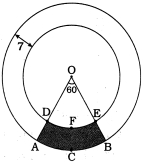
The radius of a circular ground is $56\,m$. $A$ $7\,m$ wide road runs around its boundary inside the ground. Some region of the road as shown by the shaded part in the diagram is to be repaired. Find the cost of repairing at the rate of ₹ $40/m^2$ (in ₹).
A
$12500$
B
$14600$
C
$15400$
D
$10456$
Solution
(C) The outer radius of the circular ground is $R = 56\,m$.
The width of the road is $7\,m$,so the inner radius is $r = 56 - 7 = 49\,m$.
The shaded region is a sector of an annulus with a central angle $\theta = 60^\circ$.
The area of the shaded region is given by the formula:
Area $= \frac{\theta}{360^\circ} \times \pi \times (R^2 - r^2)$
Area $= \frac{60^\circ}{360^\circ} \times \frac{22}{7} \times (56^2 - 49^2)$
Area $= \frac{1}{6} \times \frac{22}{7} \times (56 - 49)(56 + 49)$
Area $= \frac{1}{6} \times \frac{22}{7} \times 7 \times 105$
Area $= \frac{1}{6} \times 22 \times 105 = 11 \times 35 = 385\,m^2$.
The cost of repairing is at the rate of ₹ $40/m^2$.
Total cost $= 385 \times 40 = ₹ 15400$.
The width of the road is $7\,m$,so the inner radius is $r = 56 - 7 = 49\,m$.
The shaded region is a sector of an annulus with a central angle $\theta = 60^\circ$.
The area of the shaded region is given by the formula:
Area $= \frac{\theta}{360^\circ} \times \pi \times (R^2 - r^2)$
Area $= \frac{60^\circ}{360^\circ} \times \frac{22}{7} \times (56^2 - 49^2)$
Area $= \frac{1}{6} \times \frac{22}{7} \times (56 - 49)(56 + 49)$
Area $= \frac{1}{6} \times \frac{22}{7} \times 7 \times 105$
Area $= \frac{1}{6} \times 22 \times 105 = 11 \times 35 = 385\,m^2$.
The cost of repairing is at the rate of ₹ $40/m^2$.
Total cost $= 385 \times 40 = ₹ 15400$.
0 likes
View Solution108
Difficult
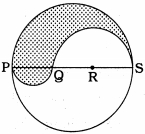
In the adjoining figure,$PS$ is the diameter of a circle and $PS = 12$. $PQ = QR = RS$. Semicircles are drawn with diameters $\overline{PQ}$ and $\overline{QS}$. Find the perimeter and the area of the shaded region. $(\pi = 3.14)$
Solution
(N/A) Here,$PS = 12 \text{ cm}$ and $PQ = QR = RS$.
$\therefore PQ = QR = RS = \frac{12}{3} = 4 \text{ cm}$.
The radii of semicircles with diameters $\overline{PS}$,$\overline{QS}$,and $\overline{PQ}$ are:
$r_1 = \frac{PS}{2} = \frac{12}{2} = 6 \text{ cm}$,
$r_2 = \frac{QS}{2} = \frac{4+4}{2} = 4 \text{ cm}$,and
$r_3 = \frac{PQ}{2} = \frac{4}{2} = 2 \text{ cm}$ respectively.
Perimeter of the shaded region:
$= \text{Sum of the lengths of all the three semicircular arcs}$
$= \pi r_1 + \pi r_2 + \pi r_3$
$= \pi(r_1 + r_2 + r_3)$
$= 3.14(6 + 4 + 2)$
$= 37.68 \text{ cm}$.
Area of the shaded region:
$= \text{Area of the semicircle with radius } r_1 + \text{Area of the semicircle with radius } r_3 - \text{Area of the semicircle with radius } r_2$
$= \frac{1}{2} \pi r_1^2 + \frac{1}{2} \pi r_3^2 - \frac{1}{2} \pi r_2^2$
$= \frac{1}{2} \pi(r_1^2 + r_3^2 - r_2^2)$
$= \frac{1}{2} \times 3.14(6^2 + 2^2 - 4^2)$
$= \frac{1}{2} \times 3.14 \times (36 + 4 - 16)$
$= \frac{1}{2} \times 3.14 \times 24$
$= 37.68 \text{ cm}^2$.
Thus,the perimeter of the shaded region is $37.68 \text{ cm}$ and its area is $37.68 \text{ cm}^2$.
$\therefore PQ = QR = RS = \frac{12}{3} = 4 \text{ cm}$.
The radii of semicircles with diameters $\overline{PS}$,$\overline{QS}$,and $\overline{PQ}$ are:
$r_1 = \frac{PS}{2} = \frac{12}{2} = 6 \text{ cm}$,
$r_2 = \frac{QS}{2} = \frac{4+4}{2} = 4 \text{ cm}$,and
$r_3 = \frac{PQ}{2} = \frac{4}{2} = 2 \text{ cm}$ respectively.
Perimeter of the shaded region:
$= \text{Sum of the lengths of all the three semicircular arcs}$
$= \pi r_1 + \pi r_2 + \pi r_3$
$= \pi(r_1 + r_2 + r_3)$
$= 3.14(6 + 4 + 2)$
$= 37.68 \text{ cm}$.
Area of the shaded region:
$= \text{Area of the semicircle with radius } r_1 + \text{Area of the semicircle with radius } r_3 - \text{Area of the semicircle with radius } r_2$
$= \frac{1}{2} \pi r_1^2 + \frac{1}{2} \pi r_3^2 - \frac{1}{2} \pi r_2^2$
$= \frac{1}{2} \pi(r_1^2 + r_3^2 - r_2^2)$
$= \frac{1}{2} \times 3.14(6^2 + 2^2 - 4^2)$
$= \frac{1}{2} \times 3.14 \times (36 + 4 - 16)$
$= \frac{1}{2} \times 3.14 \times 24$
$= 37.68 \text{ cm}^2$.
Thus,the perimeter of the shaded region is $37.68 \text{ cm}$ and its area is $37.68 \text{ cm}^2$.
0 likes
View Solution109
MediumMCQ
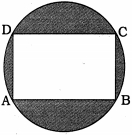
As shown in the diagram,rectangle $ABCD$ is inscribed in a circle. If $AB = 8 \, cm$ and $BC = 6 \, cm$,find the area of the shaded region in the diagram. $(\pi = 3.14)$ (in $cm^2$)
A
$30.5$
B
$20.9$
C
$37.4$
D
$43.7$
Solution
(A) $1$. The diagonal of the rectangle $ABCD$ is the diameter of the circle.
$2$. Using the Pythagorean theorem in $\triangle ABC$,the diagonal $AC = \sqrt{AB^2 + BC^2} = \sqrt{8^2 + 6^2} = \sqrt{64 + 36} = \sqrt{100} = 10 \, cm$.
$3$. The diameter of the circle is $10 \, cm$,so the radius $r = 5 \, cm$.
$4$. The area of the circle is $\pi r^2 = 3.14 \times 5^2 = 3.14 \times 25 = 78.5 \, cm^2$.
$5$. The area of the rectangle $ABCD$ is $AB \times BC = 8 \times 6 = 48 \, cm^2$.
$6$. The area of the shaded region is the area of the circle minus the area of the rectangle: $78.5 - 48 = 30.5 \, cm^2$.
$2$. Using the Pythagorean theorem in $\triangle ABC$,the diagonal $AC = \sqrt{AB^2 + BC^2} = \sqrt{8^2 + 6^2} = \sqrt{64 + 36} = \sqrt{100} = 10 \, cm$.
$3$. The diameter of the circle is $10 \, cm$,so the radius $r = 5 \, cm$.
$4$. The area of the circle is $\pi r^2 = 3.14 \times 5^2 = 3.14 \times 25 = 78.5 \, cm^2$.
$5$. The area of the rectangle $ABCD$ is $AB \times BC = 8 \times 6 = 48 \, cm^2$.
$6$. The area of the shaded region is the area of the circle minus the area of the rectangle: $78.5 - 48 = 30.5 \, cm^2$.
0 likes
View Solution110
MediumMCQ
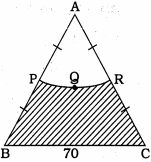
As shown in the diagram,$\triangle ABC$ is an equilateral triangle in which $BC = 70 \, cm$ and $P$ and $R$ are midpoints of $\overline{AB}$ and $\overline{AC}$ respectively. $\widehat{PQR}$ is an arc of $\odot(A, AP)$. Find the area of the shaded region. $(\sqrt{3} = 1.73)$ (in $cm^2$)
A
$1296.56$
B
$1477.58$
C
$1423.58$
D
$1325.75$
Solution
(B) $1$. The side of the equilateral triangle $\triangle ABC$ is $a = 70 \, cm$.
$2$. The area of $\triangle ABC = \frac{\sqrt{3}}{4} \times a^2 = \frac{1.73}{4} \times 70^2 = 0.4325 \times 4900 = 2119.25 \, cm^2$.
$3$. $P$ and $R$ are midpoints of $AB$ and $AC$,so $AP = AR = \frac{70}{2} = 35 \, cm$. This is the radius $r$ of the sector $APR$.
$4$. Since $\triangle ABC$ is equilateral,$\angle A = 60^\circ$.
$5$. The area of the sector $APR = \frac{\theta}{360^\circ} \times \pi r^2 = \frac{60}{360} \times \frac{22}{7} \times 35 \times 35 = \frac{1}{6} \times 22 \times 5 \times 35 = \frac{3850}{6} \approx 641.67 \, cm^2$.
$6$. The shaded area is the area of $\triangle ABC$ minus the area of the sector $APR$.
$7$. Shaded Area $= 2119.25 - 641.67 = 1477.58 \, cm^2$.
$2$. The area of $\triangle ABC = \frac{\sqrt{3}}{4} \times a^2 = \frac{1.73}{4} \times 70^2 = 0.4325 \times 4900 = 2119.25 \, cm^2$.
$3$. $P$ and $R$ are midpoints of $AB$ and $AC$,so $AP = AR = \frac{70}{2} = 35 \, cm$. This is the radius $r$ of the sector $APR$.
$4$. Since $\triangle ABC$ is equilateral,$\angle A = 60^\circ$.
$5$. The area of the sector $APR = \frac{\theta}{360^\circ} \times \pi r^2 = \frac{60}{360} \times \frac{22}{7} \times 35 \times 35 = \frac{1}{6} \times 22 \times 5 \times 35 = \frac{3850}{6} \approx 641.67 \, cm^2$.
$6$. The shaded area is the area of $\triangle ABC$ minus the area of the sector $APR$.
$7$. Shaded Area $= 2119.25 - 641.67 = 1477.58 \, cm^2$.
0 likes
View Solution111
MediumMCQ
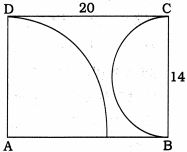
As shown in the diagram, rectangle $ABCD$ is a metal sheet in which $CD = 20 \, cm$ and $BC = 14 \, cm$. From it, a semicircle with diameter $\overline{BC}$ and a sector with centre $A$ and radius $AD$ is cut off. Find the area of the remaining sheet in $cm^2$.
A
$34$
B
$59$
C
$49$
D
$51$
Solution
(C) $1$. Area of rectangle $ABCD = \text{length} \times \text{breadth} = 20 \times 14 = 280 \, cm^2$.
$2$. Area of the semicircle with diameter $BC = 14 \, cm$ (radius $r = 7 \, cm$): $\frac{1}{2} \pi r^2 = \frac{1}{2} \times \frac{22}{7} \times 7 \times 7 = 77 \, cm^2$.
$3$. Area of the sector with centre $A$ and radius $AD = 14 \, cm$ (angle $\theta = 90^{\circ}$): $\frac{90}{360} \times \pi r^2 = \frac{1}{4} \times \frac{22}{7} \times 14 \times 14 = 154 \, cm^2$.
$4$. Area of the remaining sheet = Area of rectangle - (Area of semicircle + Area of sector) = $280 - (77 + 154) = 280 - 231 = 49 \, cm^2$.
$2$. Area of the semicircle with diameter $BC = 14 \, cm$ (radius $r = 7 \, cm$): $\frac{1}{2} \pi r^2 = \frac{1}{2} \times \frac{22}{7} \times 7 \times 7 = 77 \, cm^2$.
$3$. Area of the sector with centre $A$ and radius $AD = 14 \, cm$ (angle $\theta = 90^{\circ}$): $\frac{90}{360} \times \pi r^2 = \frac{1}{4} \times \frac{22}{7} \times 14 \times 14 = 154 \, cm^2$.
$4$. Area of the remaining sheet = Area of rectangle - (Area of semicircle + Area of sector) = $280 - (77 + 154) = 280 - 231 = 49 \, cm^2$.
0 likes
View Solution112
DifficultMCQ
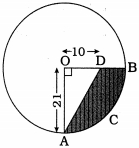
As shown in the diagram,$\overline{ OA }$ and $\overline{ OB }$ are two radii of $\odot( O , 21 \text{ cm} )$ perpendicular to each other. If $OD = 10 \text{ cm}$,find the area of the shaded region. (in $\text{cm}^2$)
A
$112.5$
B
$110.6$
C
$120.8$
D
$241.5$
Solution
(D) The shaded region is the area of the quadrant $OAB$ minus the area of the triangle $OD A$.
Given radius $r = 21 \text{ cm}$.
Area of quadrant $OAB = \frac{1}{4} \pi r^2 = \frac{1}{4} \times \frac{22}{7} \times 21 \times 21 = \frac{1}{4} \times 22 \times 3 \times 21 = \frac{1386}{4} = 346.5 \text{ cm}^2$.
Area of $\triangle ODA = \frac{1}{2} \times \text{base} \times \text{height} = \frac{1}{2} \times OD \times OA = \frac{1}{2} \times 10 \times 21 = 105 \text{ cm}^2$.
Area of shaded region = Area of quadrant $OAB - \text{Area of } \triangle ODA = 346.5 - 105 = 241.5 \text{ cm}^2$.
Given radius $r = 21 \text{ cm}$.
Area of quadrant $OAB = \frac{1}{4} \pi r^2 = \frac{1}{4} \times \frac{22}{7} \times 21 \times 21 = \frac{1}{4} \times 22 \times 3 \times 21 = \frac{1386}{4} = 346.5 \text{ cm}^2$.
Area of $\triangle ODA = \frac{1}{2} \times \text{base} \times \text{height} = \frac{1}{2} \times OD \times OA = \frac{1}{2} \times 10 \times 21 = 105 \text{ cm}^2$.
Area of shaded region = Area of quadrant $OAB - \text{Area of } \triangle ODA = 346.5 - 105 = 241.5 \text{ cm}^2$.
0 likes
View Solution113
DifficultMCQ
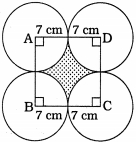
The side length of square $ABCD$ is $14 \, cm$. As shown in the diagram,circles with radius $7 \, cm$ are drawn with each vertex as the centre so that each circle touches two other circles externally. Find the area of the shaded region in $cm^2$.
A
$42$
B
$54$
C
$48$
D
$56$
Solution
(A) The side length of the square $ABCD$ is $s = 14 \, cm$.
The area of the square $ABCD = s^2 = 14^2 = 196 \, cm^2$.
Each vertex of the square is the centre of a circle with radius $r = 7 \, cm$.
Inside the square,there are four sectors,each with a central angle of $90^\circ$ (since it is a square).
The sum of the areas of these four sectors is $4 \times (\frac{90}{360} \times \pi r^2) = \pi r^2$.
Substituting $r = 7 \, cm$,the area of the four sectors $= \frac{22}{7} \times 7 \times 7 = 154 \, cm^2$.
The area of the shaded region = (Area of square) - (Sum of areas of four sectors).
Area of shaded region $= 196 - 154 = 42 \, cm^2$.
The area of the square $ABCD = s^2 = 14^2 = 196 \, cm^2$.
Each vertex of the square is the centre of a circle with radius $r = 7 \, cm$.
Inside the square,there are four sectors,each with a central angle of $90^\circ$ (since it is a square).
The sum of the areas of these four sectors is $4 \times (\frac{90}{360} \times \pi r^2) = \pi r^2$.
Substituting $r = 7 \, cm$,the area of the four sectors $= \frac{22}{7} \times 7 \times 7 = 154 \, cm^2$.
The area of the shaded region = (Area of square) - (Sum of areas of four sectors).
Area of shaded region $= 196 - 154 = 42 \, cm^2$.
0 likes
View Solution114
DifficultMCQ
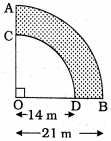
In the given diagram,the shaded portion represents a flower bed in a plot. If $m \angle O = 90^\circ$,$OB = 21 \, \text{m}$,and $OD = 14 \, \text{m}$,find the area of the flower bed in $\text{m}^2$.
A
$187.6$
B
$192.5$
C
$165.3$
D
$176.1$
Solution
(B) The shaded region is the area between two sectors of circles with the same central angle $\theta = 90^\circ$.
Let $R$ be the radius of the outer sector $(OB = 21 \, \text{m})$ and $r$ be the radius of the inner sector $(OD = 14 \, \text{m})$.
The area of a sector is given by $\frac{\theta}{360^\circ} \times \pi R^2$.
The area of the shaded region = (Area of outer sector) - (Area of inner sector)
$= \frac{90^\circ}{360^\circ} \times \pi \times R^2 - \frac{90^\circ}{360^\circ} \times \pi \times r^2$
$= \frac{1}{4} \times \pi \times (R^2 - r^2)$
$= \frac{1}{4} \times \frac{22}{7} \times (21^2 - 14^2)$
$= \frac{1}{4} \times \frac{22}{7} \times (441 - 196)$
$= \frac{1}{4} \times \frac{22}{7} \times 245$
$= \frac{1}{4} \times 22 \times 35$
$= \frac{770}{4} = 192.5 \, \text{m}^2$.
Let $R$ be the radius of the outer sector $(OB = 21 \, \text{m})$ and $r$ be the radius of the inner sector $(OD = 14 \, \text{m})$.
The area of a sector is given by $\frac{\theta}{360^\circ} \times \pi R^2$.
The area of the shaded region = (Area of outer sector) - (Area of inner sector)
$= \frac{90^\circ}{360^\circ} \times \pi \times R^2 - \frac{90^\circ}{360^\circ} \times \pi \times r^2$
$= \frac{1}{4} \times \pi \times (R^2 - r^2)$
$= \frac{1}{4} \times \frac{22}{7} \times (21^2 - 14^2)$
$= \frac{1}{4} \times \frac{22}{7} \times (441 - 196)$
$= \frac{1}{4} \times \frac{22}{7} \times 245$
$= \frac{1}{4} \times 22 \times 35$
$= \frac{770}{4} = 192.5 \, \text{m}^2$.
1 likes
View Solution115
DifficultMCQ
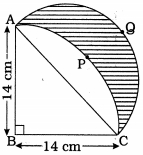
In the given diagram,$\Delta ABC$ is a right-angled triangle in which $m \angle B = 90^{\circ}$ and $AB = BC = 14 \text{ cm}$. $A$ minor sector $BAPC$ is a sector of a circle with center $B$ and radius $BA$. $A$ semicircle arc $\widehat{AQC}$ is drawn on diameter $\overline{AC}$. Find the area of the shaded region in $\text{cm}^2$.
A
$90$
B
$86$
C
$98$
D
$104$
Solution
(C) Given: $AB = BC = 14 \text{ cm}$ and $\angle B = 90^{\circ}$.
First,find the length of the hypotenuse $AC$ using the Pythagorean theorem:
$AC^2 = AB^2 + BC^2 = 14^2 + 14^2 = 196 + 196 = 392$.
$AC = \sqrt{392} = 14\sqrt{2} \text{ cm}$.
The radius of the semicircle with diameter $AC$ is $r = \frac{14\sqrt{2}}{2} = 7\sqrt{2} \text{ cm}$.
Area of the semicircle with diameter $AC = \frac{1}{2} \pi r^2 = \frac{1}{2} \times \frac{22}{7} \times (7\sqrt{2})^2 = \frac{1}{2} \times \frac{22}{7} \times 98 = 11 \times 14 = 154 \text{ cm}^2$.
Area of $\Delta ABC = \frac{1}{2} \times \text{base} \times \text{height} = \frac{1}{2} \times 14 \times 14 = 98 \text{ cm}^2$.
Area of the segment of the circle (bounded by chord $AC$ and arc $APC$) = Area of sector $BAPC$ - Area of $\Delta ABC$.
Area of sector $BAPC = \frac{90}{360} \times \pi \times (14)^2 = \frac{1}{4} \times \frac{22}{7} \times 196 = 154 \text{ cm}^2$.
Area of segment $APC = 154 - 98 = 56 \text{ cm}^2$.
The shaded region is the area of the semicircle minus the area of the segment $APC$.
Area of shaded region = $154 - 56 = 98 \text{ cm}^2$.
First,find the length of the hypotenuse $AC$ using the Pythagorean theorem:
$AC^2 = AB^2 + BC^2 = 14^2 + 14^2 = 196 + 196 = 392$.
$AC = \sqrt{392} = 14\sqrt{2} \text{ cm}$.
The radius of the semicircle with diameter $AC$ is $r = \frac{14\sqrt{2}}{2} = 7\sqrt{2} \text{ cm}$.
Area of the semicircle with diameter $AC = \frac{1}{2} \pi r^2 = \frac{1}{2} \times \frac{22}{7} \times (7\sqrt{2})^2 = \frac{1}{2} \times \frac{22}{7} \times 98 = 11 \times 14 = 154 \text{ cm}^2$.
Area of $\Delta ABC = \frac{1}{2} \times \text{base} \times \text{height} = \frac{1}{2} \times 14 \times 14 = 98 \text{ cm}^2$.
Area of the segment of the circle (bounded by chord $AC$ and arc $APC$) = Area of sector $BAPC$ - Area of $\Delta ABC$.
Area of sector $BAPC = \frac{90}{360} \times \pi \times (14)^2 = \frac{1}{4} \times \frac{22}{7} \times 196 = 154 \text{ cm}^2$.
Area of segment $APC = 154 - 98 = 56 \text{ cm}^2$.
The shaded region is the area of the semicircle minus the area of the segment $APC$.
Area of shaded region = $154 - 56 = 98 \text{ cm}^2$.
0 likes
View Solution116
DifficultMCQ
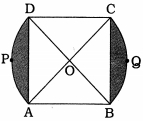
As shown in the diagram,the side length of square garden $ABCD$ is $60\, m$. Flower beds are prepared in the shape of circular segments on two opposite sides of the square. The centre of the circles for these segments is the point of intersection $O$ of the diagonals of square $ABCD$. Find the total area of the two flower beds. (Use $\pi=3.14$) (in $m^2$)
A
$1436$
B
$1216$
C
$1289$
D
$1026$
Solution
(D) $1$. The side of the square $ABCD$ is $a = 60\, m$.
$2$. The diagonals of the square intersect at $O$. The distance from $O$ to any side is half the side length,i.e.,$h = 60/2 = 30\, m$.
$3$. The radius $r$ of the circle forming the segment is the distance from $O$ to a vertex (e.g.,$OA$). In a square of side $60\, m$,the diagonal is $60\sqrt{2}\, m$. Thus,$r = OA = (60\sqrt{2})/2 = 30\sqrt{2}\, m$.
$4$. The central angle $\theta$ subtended by the side $AD$ at the center $O$ is $90^\circ$ (since diagonals of a square are perpendicular).
$5$. The area of one circular segment is given by: $\text{Area} = \frac{\theta}{360^\circ} \times \pi r^2 - \text{Area of } \triangle OAD$.
$6$. $\text{Area of } \triangle OAD = \frac{1}{2} \times \text{base} \times \text{height} = \frac{1}{2} \times 60 \times 30 = 900\, m^2$.
$7$. $\text{Area of segment} = (\frac{90}{360} \times 3.14 \times (30\sqrt{2})^2) - 900 = (0.25 \times 3.14 \times 1800) - 900 = 1413 - 900 = 513\, m^2$.
$8$. Since there are two such flower beds,the total area is $2 \times 513 = 1026\, m^2$.
$2$. The diagonals of the square intersect at $O$. The distance from $O$ to any side is half the side length,i.e.,$h = 60/2 = 30\, m$.
$3$. The radius $r$ of the circle forming the segment is the distance from $O$ to a vertex (e.g.,$OA$). In a square of side $60\, m$,the diagonal is $60\sqrt{2}\, m$. Thus,$r = OA = (60\sqrt{2})/2 = 30\sqrt{2}\, m$.
$4$. The central angle $\theta$ subtended by the side $AD$ at the center $O$ is $90^\circ$ (since diagonals of a square are perpendicular).
$5$. The area of one circular segment is given by: $\text{Area} = \frac{\theta}{360^\circ} \times \pi r^2 - \text{Area of } \triangle OAD$.
$6$. $\text{Area of } \triangle OAD = \frac{1}{2} \times \text{base} \times \text{height} = \frac{1}{2} \times 60 \times 30 = 900\, m^2$.
$7$. $\text{Area of segment} = (\frac{90}{360} \times 3.14 \times (30\sqrt{2})^2) - 900 = (0.25 \times 3.14 \times 1800) - 900 = 1413 - 900 = 513\, m^2$.
$8$. Since there are two such flower beds,the total area is $2 \times 513 = 1026\, m^2$.
0 likes
View Solution117
DifficultMCQ
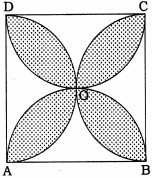
The side length of square $ABCD$ shown in the diagram is $42 \ cm$. The shaded design is formed by drawing semicircles on all the sides of the square. Find the area of the shaded design in $cm^2$.
A
$1008$
B
$1013$
C
$1248$
D
$1140$
Solution
(A) The side of the square $ABCD$ is $a = 42 \ cm$.
Area of the square $ABCD = a^2 = 42^2 = 1764 \ cm^2$.
There are four semicircles drawn on the sides of the square,each with a diameter equal to the side of the square,$d = 42 \ cm$. Therefore,the radius $r = 21 \ cm$.
The area of the four semicircles is $4 \times (\frac{1}{2} \pi r^2) = 2 \pi r^2$.
Area $= 2 \times \frac{22}{7} \times 21 \times 21 = 2 \times 22 \times 3 \times 21 = 2772 \ cm^2$.
The shaded area is the area of the four semicircles minus the area of the square,as the overlapping regions are counted twice.
Shaded Area $= 2772 - 1764 = 1008 \ cm^2$.
Area of the square $ABCD = a^2 = 42^2 = 1764 \ cm^2$.
There are four semicircles drawn on the sides of the square,each with a diameter equal to the side of the square,$d = 42 \ cm$. Therefore,the radius $r = 21 \ cm$.
The area of the four semicircles is $4 \times (\frac{1}{2} \pi r^2) = 2 \pi r^2$.
Area $= 2 \times \frac{22}{7} \times 21 \times 21 = 2 \times 22 \times 3 \times 21 = 2772 \ cm^2$.
The shaded area is the area of the four semicircles minus the area of the square,as the overlapping regions are counted twice.
Shaded Area $= 2772 - 1764 = 1008 \ cm^2$.
0 likes
View Solution118
DifficultMCQ
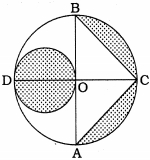
In the adjoining diagram, $\overline{ AB }$ and $\overline{ CD }$ are diameters of $\odot( O , 7\, cm )$ perpendicular to each other. $A$ circle is drawn with diameter $\overline{ OD }$. Find the area of the shaded region. (in $cm^2$)
A
$78.2$
B
$66.5$
C
$64.5$
D
$59.3$
Solution
(B) Given: Radius of the large circle $R = 7\, cm$.
Diameter of the small circle is $OD = R = 7\, cm$,so its radius $r = 3.5\, cm$.
Area of the small shaded circle = $\pi r^2 = \frac{22}{7} \times 3.5 \times 3.5 = 38.5\, cm^2$.
Area of $\triangle ABC$ = $\frac{1}{2} \times \text{base} \times \text{height} = \frac{1}{2} \times AB \times OC = \frac{1}{2} \times 14 \times 7 = 49\, cm^2$.
Area of the semi-circle $ACB$ = $\frac{1}{2} \pi R^2 = \frac{1}{2} \times \frac{22}{7} \times 7 \times 7 = 77\, cm^2$.
Area of the shaded segment (excluding the small circle) = Area of semi-circle $ACB$ - Area of $\triangle ABC = 77 - 49 = 28\, cm^2$.
Total shaded area = Area of small circle + Area of shaded segment = $38.5 + 28 = 66.5\, cm^2$.
Diameter of the small circle is $OD = R = 7\, cm$,so its radius $r = 3.5\, cm$.
Area of the small shaded circle = $\pi r^2 = \frac{22}{7} \times 3.5 \times 3.5 = 38.5\, cm^2$.
Area of $\triangle ABC$ = $\frac{1}{2} \times \text{base} \times \text{height} = \frac{1}{2} \times AB \times OC = \frac{1}{2} \times 14 \times 7 = 49\, cm^2$.
Area of the semi-circle $ACB$ = $\frac{1}{2} \pi R^2 = \frac{1}{2} \times \frac{22}{7} \times 7 \times 7 = 77\, cm^2$.
Area of the shaded segment (excluding the small circle) = Area of semi-circle $ACB$ - Area of $\triangle ABC = 77 - 49 = 28\, cm^2$.
Total shaded area = Area of small circle + Area of shaded segment = $38.5 + 28 = 66.5\, cm^2$.
0 likes
View Solution119
DifficultMCQ
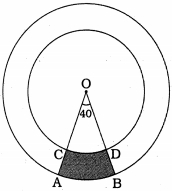
As shown in the diagram,the radii of two concentric circles are $21 \, cm$ and $28 \, cm$. If $m \angle AOB = 40^\circ$,find the area of the shaded region. (in $cm^2$)
A
$125.65$
B
$175.36$
C
$119.78$
D
$114.46$
Solution
(C) The shaded region is a sector of an annulus (a circular ring). The area of a sector of a circle with radius $r$ and central angle $\theta$ is given by $\frac{\theta}{360^\circ} \times \pi r^2$.
Here,the shaded region is the difference between the area of the sector of the larger circle (radius $R = 28 \, cm$) and the area of the sector of the smaller circle (radius $r = 21 \, cm$),both with the same central angle $\theta = 40^\circ$.
Area of shaded region = $\frac{\theta}{360^\circ} \times \pi R^2 - \frac{\theta}{360^\circ} \times \pi r^2$
Area = $\frac{\theta}{360^\circ} \times \pi (R^2 - r^2)$
Area = $\frac{40}{360} \times \frac{22}{7} \times (28^2 - 21^2)$
Area = $\frac{1}{9} \times \frac{22}{7} \times (784 - 441)$
Area = $\frac{1}{9} \times \frac{22}{7} \times 343$
Area = $\frac{1}{9} \times 22 \times 49$
Area = $\frac{1078}{9} \approx 119.777... \, cm^2$
Rounding to two decimal places,we get $119.78 \, cm^2$.
Here,the shaded region is the difference between the area of the sector of the larger circle (radius $R = 28 \, cm$) and the area of the sector of the smaller circle (radius $r = 21 \, cm$),both with the same central angle $\theta = 40^\circ$.
Area of shaded region = $\frac{\theta}{360^\circ} \times \pi R^2 - \frac{\theta}{360^\circ} \times \pi r^2$
Area = $\frac{\theta}{360^\circ} \times \pi (R^2 - r^2)$
Area = $\frac{40}{360} \times \frac{22}{7} \times (28^2 - 21^2)$
Area = $\frac{1}{9} \times \frac{22}{7} \times (784 - 441)$
Area = $\frac{1}{9} \times \frac{22}{7} \times 343$
Area = $\frac{1}{9} \times 22 \times 49$
Area = $\frac{1078}{9} \approx 119.777... \, cm^2$
Rounding to two decimal places,we get $119.78 \, cm^2$.
0 likes
View Solution120
DifficultMCQ
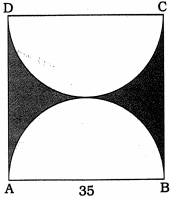
As shown in the diagram,the side length of square $ABCD$ is $35 \, cm$. Two semicircles are drawn on its sides $\overline{AB}$ and $\overline{CD}$ as diameters. Find the area of the shaded region in $cm^2$.
A
$365.4$
B
$214.6$
C
$274.6$
D
$262.5$
Solution
(D) The side length of the square $ABCD$ is $s = 35 \, cm$.
The area of the square $ABCD = s^2 = 35^2 = 1225 \, cm^2$.
There are two semicircles drawn on sides $\overline{AB}$ and $\overline{CD}$ with diameter $d = 35 \, cm$,so the radius $r = \frac{35}{2} = 17.5 \, cm$.
The area of two semicircles = $2 \times (\frac{1}{2} \pi r^2) = \pi r^2 = \frac{22}{7} \times 17.5 \times 17.5 = 22 \times 2.5 \times 17.5 = 962.5 \, cm^2$.
The area of the shaded region = (Area of square) - (Area of two semicircles) = $1225 - 962.5 = 262.5 \, cm^2$.
The area of the square $ABCD = s^2 = 35^2 = 1225 \, cm^2$.
There are two semicircles drawn on sides $\overline{AB}$ and $\overline{CD}$ with diameter $d = 35 \, cm$,so the radius $r = \frac{35}{2} = 17.5 \, cm$.
The area of two semicircles = $2 \times (\frac{1}{2} \pi r^2) = \pi r^2 = \frac{22}{7} \times 17.5 \times 17.5 = 22 \times 2.5 \times 17.5 = 962.5 \, cm^2$.
The area of the shaded region = (Area of square) - (Area of two semicircles) = $1225 - 962.5 = 262.5 \, cm^2$.
0 likes
View Solution121
MediumMCQ
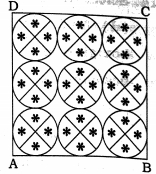
Nine circular designs are made in a square show-piece as shown in the diagram. If the radius of each circle is $21\, cm$,find the area of the region without design. (in $cm^2$)
A
$3402$
B
$3520$
C
$3120$
D
$3024$
Solution
(A) The radius of each circle is $r = 21\, cm$.
Diameter of each circle is $d = 2r = 2 \times 21 = 42\, cm$.
Since there are $3$ circles along each side of the square,the side length of the square is $S = 3 \times d = 3 \times 42 = 126\, cm$.
Area of the square $ABCD = S^2 = 126^2 = 15876\, cm^2$.
Area of one circle = $\pi r^2 = \frac{22}{7} \times 21 \times 21 = 22 \times 3 \times 21 = 1386\, cm^2$.
Area of $9$ circles = $9 \times 1386 = 12474\, cm^2$.
Area of the region without design = Area of square - Area of $9$ circles.
Area = $15876 - 12474 = 3402\, cm^2$.
Diameter of each circle is $d = 2r = 2 \times 21 = 42\, cm$.
Since there are $3$ circles along each side of the square,the side length of the square is $S = 3 \times d = 3 \times 42 = 126\, cm$.
Area of the square $ABCD = S^2 = 126^2 = 15876\, cm^2$.
Area of one circle = $\pi r^2 = \frac{22}{7} \times 21 \times 21 = 22 \times 3 \times 21 = 1386\, cm^2$.
Area of $9$ circles = $9 \times 1386 = 12474\, cm^2$.
Area of the region without design = Area of square - Area of $9$ circles.
Area = $15876 - 12474 = 3402\, cm^2$.
0 likes
View Solution122
MediumMCQ
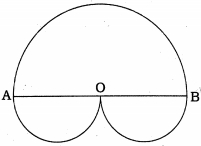
The diagram below is formed by three semicircles. If $OA = OB = 70\, cm,$ find the area of the figure formed (in $cm^2$).
A
$11586$
B
$11550$
C
$12051$
D
$17361$
Solution
(B) The figure consists of one large semicircle with diameter $AB$ and two smaller semicircles with diameters $OA$ and $OB$.
Given $OA = 70\, cm$ and $OB = 70\, cm$,the diameter of the large semicircle is $AB = OA + OB = 70 + 70 = 140\, cm$.
The radius of the large semicircle is $R = 140 / 2 = 70\, cm$.
The radius of each smaller semicircle is $r = 70 / 2 = 35\, cm$.
The area of the large semicircle is $\frac{1}{2} \pi R^2 = \frac{1}{2} \times \frac{22}{7} \times 70 \times 70 = 11 \times 10 \times 70 = 7700\, cm^2$.
The area of the two smaller semicircles is $2 \times (\frac{1}{2} \pi r^2) = \pi r^2 = \frac{22}{7} \times 35 \times 35 = 22 \times 5 \times 35 = 3850\, cm^2$.
The total area of the figure is the sum of the area of the large semicircle and the two smaller semicircles: $7700 + 3850 = 11550\, cm^2$.
Given $OA = 70\, cm$ and $OB = 70\, cm$,the diameter of the large semicircle is $AB = OA + OB = 70 + 70 = 140\, cm$.
The radius of the large semicircle is $R = 140 / 2 = 70\, cm$.
The radius of each smaller semicircle is $r = 70 / 2 = 35\, cm$.
The area of the large semicircle is $\frac{1}{2} \pi R^2 = \frac{1}{2} \times \frac{22}{7} \times 70 \times 70 = 11 \times 10 \times 70 = 7700\, cm^2$.
The area of the two smaller semicircles is $2 \times (\frac{1}{2} \pi r^2) = \pi r^2 = \frac{22}{7} \times 35 \times 35 = 22 \times 5 \times 35 = 3850\, cm^2$.
The total area of the figure is the sum of the area of the large semicircle and the two smaller semicircles: $7700 + 3850 = 11550\, cm^2$.
0 likes
View Solution123
MediumMCQ
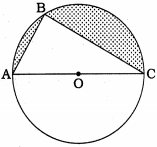
As shown in the diagram,$\overline{AC}$ is a diameter of the circle with centre $O$. $\Delta ABC$ is inscribed in the circle. If $AC = 35 \, cm$,$AB = 21 \, cm$ and $BC = 28 \, cm$,find the area of the shaded region in $cm^2$.
A
$185.31$
B
$184.69$
C
$187.25$
D
$145.23$
Solution
(C) The area of the shaded region is equal to the area of the semicircle minus the area of $\Delta ABC$.
Since $\overline{AC}$ is the diameter,$\angle ABC = 90^{\circ}$.
Radius $r = \frac{AC}{2} = \frac{35}{2} = 17.5 \, cm$.
Area of the semicircle $= \frac{1}{2} \pi r^2 = \frac{1}{2} \times \frac{22}{7} \times 17.5 \times 17.5 = 481.25 \, cm^2$.
Area of $\Delta ABC = \frac{1}{2} \times AB \times BC = \frac{1}{2} \times 21 \times 28 = 294 \, cm^2$.
Area of the shaded region $= 481.25 - 294 = 187.25 \, cm^2$.
Since $\overline{AC}$ is the diameter,$\angle ABC = 90^{\circ}$.
Radius $r = \frac{AC}{2} = \frac{35}{2} = 17.5 \, cm$.
Area of the semicircle $= \frac{1}{2} \pi r^2 = \frac{1}{2} \times \frac{22}{7} \times 17.5 \times 17.5 = 481.25 \, cm^2$.
Area of $\Delta ABC = \frac{1}{2} \times AB \times BC = \frac{1}{2} \times 21 \times 28 = 294 \, cm^2$.
Area of the shaded region $= 481.25 - 294 = 187.25 \, cm^2$.
0 likes
View Solution124
MediumMCQ
The radius of a circular ground is $90\, m$. Inside it,a road of width $10\, m$ runs around its boundary. Find the area of the road. $(\pi=3.14)$ (in $m^2$)
A
$5216$
B
$4535$
C
$5139$
D
$5338$
Solution
(D) The radius of the outer circle is $R = 90\, m$.
The width of the road is $10\, m$,so the radius of the inner circle is $r = 90 - 10 = 80\, m$.
The area of the road is the difference between the area of the outer circle and the area of the inner circle.
Area of the road $= \pi R^2 - \pi r^2 = \pi(R^2 - r^2)$.
Area $= 3.14 \times (90^2 - 80^2)$.
Area $= 3.14 \times (8100 - 6400)$.
Area $= 3.14 \times 1700$.
Area $= 5338\, m^2$.
The width of the road is $10\, m$,so the radius of the inner circle is $r = 90 - 10 = 80\, m$.
The area of the road is the difference between the area of the outer circle and the area of the inner circle.
Area of the road $= \pi R^2 - \pi r^2 = \pi(R^2 - r^2)$.
Area $= 3.14 \times (90^2 - 80^2)$.
Area $= 3.14 \times (8100 - 6400)$.
Area $= 3.14 \times 1700$.
Area $= 5338\, m^2$.
0 likes
View Solution125
Medium
In a circle with radius $11.2 \, cm$,two radii are perpendicular to each other. Find the area of the minor sector,the major sector,and the minor segment corresponding to these radii.
Solution
(N/A) Given: Radius $r = 11.2 \, cm$,Central angle $\theta = 90^{\circ}$.
Area of the circle $A = \pi r^2 = \frac{22}{7} \times 11.2 \times 11.2 = 394.24 \, cm^2$.
Area of the minor sector $= \frac{\theta}{360^{\circ}} \times \pi r^2 = \frac{90}{360} \times 394.24 = \frac{1}{4} \times 394.24 = 98.56 \, cm^2$.
Area of the major sector $=$ Area of circle $-$ Area of minor sector $= 394.24 - 98.56 = 295.68 \, cm^2$.
Area of the minor segment $=$ Area of minor sector $-$ Area of $\triangle OAB = 98.56 - (\frac{1}{2} \times r^2 \times \sin 90^{\circ}) = 98.56 - (0.5 \times 11.2 \times 11.2 \times 1) = 98.56 - 62.72 = 35.84 \, cm^2$.
Area of the circle $A = \pi r^2 = \frac{22}{7} \times 11.2 \times 11.2 = 394.24 \, cm^2$.
Area of the minor sector $= \frac{\theta}{360^{\circ}} \times \pi r^2 = \frac{90}{360} \times 394.24 = \frac{1}{4} \times 394.24 = 98.56 \, cm^2$.
Area of the major sector $=$ Area of circle $-$ Area of minor sector $= 394.24 - 98.56 = 295.68 \, cm^2$.
Area of the minor segment $=$ Area of minor sector $-$ Area of $\triangle OAB = 98.56 - (\frac{1}{2} \times r^2 \times \sin 90^{\circ}) = 98.56 - (0.5 \times 11.2 \times 11.2 \times 1) = 98.56 - 62.72 = 35.84 \, cm^2$.
1 likes
View Solution126
MediumMCQ
The length of the minute hand of a clock is $10.5 \, cm$. Find the area of the region swept by it between $2.25 \, PM$ and $2.40 \, PM$. (in $cm^2$)
A
$84.698$
B
$86.625$
C
$68.246$
D
$98.356$
Solution
(B) The length of the minute hand $(r)$ is $10.5 \, cm$.
The time interval between $2.25 \, PM$ and $2.40 \, PM$ is $15 \, \text{minutes}$.
$A$ minute hand completes a full circle $(360^{\circ})$ in $60 \, \text{minutes}$.
Therefore,the angle swept in $15 \, \text{minutes}$ is $\theta = (15/60) \times 360^{\circ} = 90^{\circ}$.
The area swept by the minute hand is the area of a sector with radius $r = 10.5 \, cm$ and angle $\theta = 90^{\circ}$.
Area $= (\theta / 360^{\circ}) \times \pi r^2 = (90^{\circ} / 360^{\circ}) \times (22/7) \times 10.5 \times 10.5$.
Area $= (1/4) \times (22/7) \times 10.5 \times 10.5 = (1/4) \times 22 \times 1.5 \times 10.5$.
Area $= 0.25 \times 22 \times 15.75 = 5.5 \times 15.75 = 86.625 \, cm^2$.
The time interval between $2.25 \, PM$ and $2.40 \, PM$ is $15 \, \text{minutes}$.
$A$ minute hand completes a full circle $(360^{\circ})$ in $60 \, \text{minutes}$.
Therefore,the angle swept in $15 \, \text{minutes}$ is $\theta = (15/60) \times 360^{\circ} = 90^{\circ}$.
The area swept by the minute hand is the area of a sector with radius $r = 10.5 \, cm$ and angle $\theta = 90^{\circ}$.
Area $= (\theta / 360^{\circ}) \times \pi r^2 = (90^{\circ} / 360^{\circ}) \times (22/7) \times 10.5 \times 10.5$.
Area $= (1/4) \times (22/7) \times 10.5 \times 10.5 = (1/4) \times 22 \times 1.5 \times 10.5$.
Area $= 0.25 \times 22 \times 15.75 = 5.5 \times 15.75 = 86.625 \, cm^2$.
0 likes
View Solution127
MediumMCQ
In a circle with radius $r,$ an arc subtends an angle of measure $\theta$ at the centre. Then,the area of the major sector is $=$ ..........
A
$\frac{\pi r \theta}{180}$
B
$2 \pi r - \frac{\pi r \theta}{180}$
C
$\pi r^{2} - \frac{\pi r^{2} \theta}{360}$
D
$\frac{\pi r^{2} \theta}{360}$
Solution
(C) The area of a circle is given by $A = \pi r^{2}$.
The area of a minor sector subtending an angle $\theta$ at the centre is given by the formula $\frac{\theta}{360} \times \pi r^{2}$.
The major sector is the remaining part of the circle.
Therefore,the area of the major sector = (Area of the circle) - (Area of the minor sector).
Area of major sector = $\pi r^{2} - \frac{\pi r^{2} \theta}{360}$.
The area of a minor sector subtending an angle $\theta$ at the centre is given by the formula $\frac{\theta}{360} \times \pi r^{2}$.
The major sector is the remaining part of the circle.
Therefore,the area of the major sector = (Area of the circle) - (Area of the minor sector).
Area of major sector = $\pi r^{2} - \frac{\pi r^{2} \theta}{360}$.
0 likes
View Solution128
EasyMCQ
In a circle with radius $r$,the area of a sector formed by an arc of length $l$ is.........
A
$\frac{1}{2} r^{2} l$
B
$\frac{4}{3} r l$
C
$\frac{3}{2} r l$
D
$\frac{1}{2} r l$
Solution
(D) The area of a sector of a circle is given by the formula $A = \frac{\theta}{360^\circ} \times \pi r^2$,where $\theta$ is the central angle in degrees.
We know that the length of an arc $l$ is given by $l = \frac{\theta}{360^\circ} \times 2 \pi r$.
From this,we can express the term $\frac{\theta}{360^\circ}$ as $\frac{l}{2 \pi r}$.
Substituting this into the area formula: $A = \left( \frac{l}{2 \pi r} \right) \times \pi r^2$.
Simplifying the expression: $A = \frac{l \times \pi r^2}{2 \pi r} = \frac{1}{2} r l$.
We know that the length of an arc $l$ is given by $l = \frac{\theta}{360^\circ} \times 2 \pi r$.
From this,we can express the term $\frac{\theta}{360^\circ}$ as $\frac{l}{2 \pi r}$.
Substituting this into the area formula: $A = \left( \frac{l}{2 \pi r} \right) \times \pi r^2$.
Simplifying the expression: $A = \frac{l \times \pi r^2}{2 \pi r} = \frac{1}{2} r l$.
0 likes
View Solution129
EasyMCQ
In a circle with radius $20\, cm$,the area of a sector formed by an arc of length $10\, cm$ is ............. $cm^2$.
A
$100$
B
$200$
C
$50$
D
$150$
Solution
(A) The formula for the area of a sector $(A)$ given the radius $(r)$ and the arc length $(l)$ is $A = \frac{1}{2} \times l \times r$.
Given:
Radius $(r)$ = $20\, cm$
Arc length $(l)$ = $10\, cm$
Substituting the values into the formula:
$A = \frac{1}{2} \times 10\, cm \times 20\, cm$
$A = 5\, cm \times 20\, cm$
$A = 100\, cm^2$.
Therefore,the area of the sector is $100\, cm^2$.
Given:
Radius $(r)$ = $20\, cm$
Arc length $(l)$ = $10\, cm$
Substituting the values into the formula:
$A = \frac{1}{2} \times 10\, cm \times 20\, cm$
$A = 5\, cm \times 20\, cm$
$A = 100\, cm^2$.
Therefore,the area of the sector is $100\, cm^2$.
0 likes
View Solution130
EasyMCQ
The ratio of the radii of two circles is $4: 5$. Then,the ratio of their areas is...........
A
$4: 5$
B
$16: 25$
C
$25: 16$
D
$5: 4$
Solution
(B) Let the radii of the two circles be $r_1$ and $r_2$. Given that $r_1 : r_2 = 4 : 5$.
The area of a circle is given by the formula $A = \pi r^2$.
Therefore,the ratio of their areas is $\frac{A_1}{A_2} = \frac{\pi r_1^2}{\pi r_2^2} = \left(\frac{r_1}{r_2}\right)^2$.
Substituting the given ratio: $\left(\frac{4}{5}\right)^2 = \frac{16}{25}$.
Thus,the ratio of their areas is $16 : 25$.
The area of a circle is given by the formula $A = \pi r^2$.
Therefore,the ratio of their areas is $\frac{A_1}{A_2} = \frac{\pi r_1^2}{\pi r_2^2} = \left(\frac{r_1}{r_2}\right)^2$.
Substituting the given ratio: $\left(\frac{4}{5}\right)^2 = \frac{16}{25}$.
Thus,the ratio of their areas is $16 : 25$.
0 likes
View Solution131
MediumMCQ
In a circle with radius $20 \,cm$,the measures of the angle subtended at the centre for two distinct sectors are $15^{\circ}$ and $90^{\circ}$. Then,the ratio of the areas of those sectors is $\ldots \ldots \ldots$.
A
$1: 4$
B
$1: 16$
C
$1: 6$
D
$1: 36$
Solution
(C) The area of a sector of a circle with radius $r$ and central angle $\theta$ is given by the formula: $A = \frac{\theta}{360^{\circ}} \times \pi r^2$.
Let the two sectors have angles $\theta_1 = 15^{\circ}$ and $\theta_2 = 90^{\circ}$.
The ratio of the areas of the two sectors is:
$\frac{A_1}{A_2} = \frac{\frac{\theta_1}{360^{\circ}} \times \pi r^2}{\frac{\theta_2}{360^{\circ}} \times \pi r^2} = \frac{\theta_1}{\theta_2}$.
Substituting the given values:
$\frac{A_1}{A_2} = \frac{15^{\circ}}{90^{\circ}} = \frac{1}{6}$.
Thus,the ratio of the areas of the sectors is $1: 6$.
Let the two sectors have angles $\theta_1 = 15^{\circ}$ and $\theta_2 = 90^{\circ}$.
The ratio of the areas of the two sectors is:
$\frac{A_1}{A_2} = \frac{\frac{\theta_1}{360^{\circ}} \times \pi r^2}{\frac{\theta_2}{360^{\circ}} \times \pi r^2} = \frac{\theta_1}{\theta_2}$.
Substituting the given values:
$\frac{A_1}{A_2} = \frac{15^{\circ}}{90^{\circ}} = \frac{1}{6}$.
Thus,the ratio of the areas of the sectors is $1: 6$.
0 likes
View Solution132
EasyMCQ
If the radius of a circle is doubled,its area becomes $\ldots \ldots \ldots$ times the area of the original circle.
A
$2$
B
$8$
C
$6$
D
$4$
Solution
(D) Let the radius of the original circle be $r$.
The area of the original circle is $A_1 = \pi r^2$.
If the radius is doubled,the new radius becomes $R = 2r$.
The area of the new circle is $A_2 = \pi R^2 = \pi (2r)^2 = 4 \pi r^2$.
Comparing the two areas,$A_2 = 4 A_1$.
Therefore,the area becomes $4$ times the area of the original circle.
The area of the original circle is $A_1 = \pi r^2$.
If the radius is doubled,the new radius becomes $R = 2r$.
The area of the new circle is $A_2 = \pi R^2 = \pi (2r)^2 = 4 \pi r^2$.
Comparing the two areas,$A_2 = 4 A_1$.
Therefore,the area becomes $4$ times the area of the original circle.
0 likes
View Solution133
EasyMCQ
The ratio of the areas of two circles is $25: 36$. Then,the ratio of their circumferences is:
A
$5: 6$
B
$6: 5$
C
$25: 36$
D
$36: 25$
Solution
(A) Let the radii of the two circles be $r_1$ and $r_2$ respectively.
The area of a circle is given by the formula $A = \pi r^2$.
The ratio of the areas is given as $\frac{A_1}{A_2} = \frac{\pi r_1^2}{\pi r_2^2} = \frac{r_1^2}{r_2^2} = \frac{25}{36}$.
Taking the square root of both sides,we get $\frac{r_1}{r_2} = \sqrt{\frac{25}{36}} = \frac{5}{6}$.
The circumference of a circle is given by $C = 2\pi r$.
The ratio of their circumferences is $\frac{C_1}{C_2} = \frac{2\pi r_1}{2\pi r_2} = \frac{r_1}{r_2}$.
Therefore,the ratio of their circumferences is $5: 6$.
The area of a circle is given by the formula $A = \pi r^2$.
The ratio of the areas is given as $\frac{A_1}{A_2} = \frac{\pi r_1^2}{\pi r_2^2} = \frac{r_1^2}{r_2^2} = \frac{25}{36}$.
Taking the square root of both sides,we get $\frac{r_1}{r_2} = \sqrt{\frac{25}{36}} = \frac{5}{6}$.
The circumference of a circle is given by $C = 2\pi r$.
The ratio of their circumferences is $\frac{C_1}{C_2} = \frac{2\pi r_1}{2\pi r_2} = \frac{r_1}{r_2}$.
Therefore,the ratio of their circumferences is $5: 6$.
0 likes
View Solution134
EasyMCQ
In a circle with radius $8.4 \, cm$,two radii are perpendicular to each other. The area of the minor sector formed by these radii is $\ldots \ldots \ldots \, cm^2$.
A
$110.88$
B
$55.44$
C
$166.32$
D
$27.72$
Solution
(B) The radius of the circle is $r = 8.4 \, cm$.
Since the two radii are perpendicular to each other,the central angle of the minor sector is $\theta = 90^\circ$.
The formula for the area of a sector is $\text{Area} = \frac{\theta}{360^\circ} \times \pi r^2$.
Substituting the values: $\text{Area} = \frac{90^\circ}{360^\circ} \times \frac{22}{7} \times (8.4)^2$.
$\text{Area} = \frac{1}{4} \times \frac{22}{7} \times 8.4 \times 8.4$.
$\text{Area} = \frac{1}{4} \times 22 \times 1.2 \times 8.4$.
$\text{Area} = 5.5 \times 1.2 \times 8.4 = 55.44 \, cm^2$.
Since the two radii are perpendicular to each other,the central angle of the minor sector is $\theta = 90^\circ$.
The formula for the area of a sector is $\text{Area} = \frac{\theta}{360^\circ} \times \pi r^2$.
Substituting the values: $\text{Area} = \frac{90^\circ}{360^\circ} \times \frac{22}{7} \times (8.4)^2$.
$\text{Area} = \frac{1}{4} \times \frac{22}{7} \times 8.4 \times 8.4$.
$\text{Area} = \frac{1}{4} \times 22 \times 1.2 \times 8.4$.
$\text{Area} = 5.5 \times 1.2 \times 8.4 = 55.44 \, cm^2$.
0 likes
View Solution135
MediumMCQ
The length of the minute hand of a clock is $14\, cm$. The area of the region swept by it in $10$ minutes is $\ldots \ldots \ldots \, cm^2$.
A
$616$
B
$154$
C
$102.67$
D
$308$
Solution
(C) The length of the minute hand is the radius of the circle,$r = 14\, cm$.
In $60$ minutes,the minute hand completes one full rotation $(360^{\circ})$.
In $1$ minute,the angle swept is $\frac{360^{\circ}}{60} = 6^{\circ}$.
In $10$ minutes,the angle swept $( heta)$ is $10 \times 6^{\circ} = 60^{\circ}$.
The area of the sector swept is given by the formula: $\text{Area} = \frac{\theta}{360^{\circ}} \times \pi r^2$.
Substituting the values: $\text{Area} = \frac{60^{\circ}}{360^{\circ}} \times \frac{22}{7} \times 14 \times 14$.
$\text{Area} = \frac{1}{6} \times 22 \times 2 \times 14 = \frac{1}{3} \times 22 \times 28 = \frac{616}{6} \approx 102.67\, cm^2$.
In $60$ minutes,the minute hand completes one full rotation $(360^{\circ})$.
In $1$ minute,the angle swept is $\frac{360^{\circ}}{60} = 6^{\circ}$.
In $10$ minutes,the angle swept $( heta)$ is $10 \times 6^{\circ} = 60^{\circ}$.
The area of the sector swept is given by the formula: $\text{Area} = \frac{\theta}{360^{\circ}} \times \pi r^2$.
Substituting the values: $\text{Area} = \frac{60^{\circ}}{360^{\circ}} \times \frac{22}{7} \times 14 \times 14$.
$\text{Area} = \frac{1}{6} \times 22 \times 2 \times 14 = \frac{1}{3} \times 22 \times 28 = \frac{616}{6} \approx 102.67\, cm^2$.
0 likes
View Solution136
EasyMCQ
The maximum area of a triangle inscribed in a semicircle with diameter $30 \, cm$ is $\ldots \ldots \ldots \, cm^{2}$.
A
$450$
B
$625$
C
$900$
D
$225$
Solution
(D) For a triangle inscribed in a semicircle,the base of the triangle is the diameter of the semicircle,and the height is the radius of the semicircle.
Given,diameter $d = 30 \, cm$.
Therefore,radius $r = \frac{d}{2} = \frac{30}{2} = 15 \, cm$.
The base of the triangle $b = 30 \, cm$.
The maximum height of the triangle is equal to the radius of the semicircle,$h = 15 \, cm$.
Area of the triangle $= \frac{1}{2} \times \text{base} \times \text{height}$.
Area $= \frac{1}{2} \times 30 \times 15 = 15 \times 15 = 225 \, cm^{2}$.
Given,diameter $d = 30 \, cm$.
Therefore,radius $r = \frac{d}{2} = \frac{30}{2} = 15 \, cm$.
The base of the triangle $b = 30 \, cm$.
The maximum height of the triangle is equal to the radius of the semicircle,$h = 15 \, cm$.
Area of the triangle $= \frac{1}{2} \times \text{base} \times \text{height}$.
Area $= \frac{1}{2} \times 30 \times 15 = 15 \times 15 = 225 \, cm^{2}$.
0 likes
View Solution137
EasyMCQ
The area of a circle is $3850 \, cm^2$. In that circle,the length of an arc subtending a right angle at the centre is $\ldots \ldots \ldots \, cm$.
A
$55$
B
$33$
C
$110$
D
$27.5$
Solution
(A) Given,the area of the circle $A = 3850 \, cm^2$.
We know that the area of a circle is given by $A = \pi r^2$.
So,$\pi r^2 = 3850$.
Taking $\pi = \frac{22}{7}$,we have $\frac{22}{7} \times r^2 = 3850$.
$r^2 = \frac{3850 \times 7}{22} = 175 \times 7 = 1225$.
$r = \sqrt{1225} = 35 \, cm$.
The length of an arc subtending an angle $\theta$ at the centre is given by $L = \frac{\theta}{360^\circ} \times 2 \pi r$.
Here,$\theta = 90^\circ$ (right angle).
$L = \frac{90^\circ}{360^\circ} \times 2 \times \frac{22}{7} \times 35$.
$L = \frac{1}{4} \times 2 \times 22 \times 5 = \frac{220}{4} = 55 \, cm$.
We know that the area of a circle is given by $A = \pi r^2$.
So,$\pi r^2 = 3850$.
Taking $\pi = \frac{22}{7}$,we have $\frac{22}{7} \times r^2 = 3850$.
$r^2 = \frac{3850 \times 7}{22} = 175 \times 7 = 1225$.
$r = \sqrt{1225} = 35 \, cm$.
The length of an arc subtending an angle $\theta$ at the centre is given by $L = \frac{\theta}{360^\circ} \times 2 \pi r$.
Here,$\theta = 90^\circ$ (right angle).
$L = \frac{90^\circ}{360^\circ} \times 2 \times \frac{22}{7} \times 35$.
$L = \frac{1}{4} \times 2 \times 22 \times 5 = \frac{220}{4} = 55 \, cm$.
0 likes
View Solution138
MediumMCQ
In $\odot (P, 20)$,the area of a minor sector is $150\, cm^2$. The length of the arc corresponding to that sector is $\dots\, cm$.
A
$30$
B
$15$
C
$7.5$
D
$45$
Solution
(B) Given: Radius $r = 20\, cm$ and Area of sector $A = 150\, cm^2$.
The formula for the area of a sector is $A = \frac{1}{2} \times l \times r$,where $l$ is the length of the arc.
Substituting the given values into the formula:
$150 = \frac{1}{2} \times l \times 20$
$150 = l \times 10$
$l = \frac{150}{10} = 15\, cm$.
Therefore,the length of the arc is $15\, cm$.
The formula for the area of a sector is $A = \frac{1}{2} \times l \times r$,where $l$ is the length of the arc.
Substituting the given values into the formula:
$150 = \frac{1}{2} \times l \times 20$
$150 = l \times 10$
$l = \frac{150}{10} = 15\, cm$.
Therefore,the length of the arc is $15\, cm$.
0 likes
View Solution139
MediumMCQ
The circumference of a circle is $88 \, cm$. The length of each side of a square inscribed in that circle is $\ldots \ldots \ldots \, cm$.
A
$28 \sqrt{2}$
B
$56 \sqrt{2}$
C
$14 \sqrt{2}$
D
$28$
Solution
(C) Given,the circumference of the circle is $C = 88 \, cm$.
Using the formula $C = 2 \pi r$,we have $2 \times \frac{22}{7} \times r = 88$.
$r = \frac{88 \times 7}{44} = 14 \, cm$.
The diameter of the circle is $d = 2r = 28 \, cm$.
When a square is inscribed in a circle,the diagonal of the square is equal to the diameter of the circle.
Let the side of the square be $a$. Then,the diagonal is $a \sqrt{2}$.
Equating the diagonal to the diameter: $a \sqrt{2} = 28$.
$a = \frac{28}{\sqrt{2}} = \frac{28 \times \sqrt{2}}{2} = 14 \sqrt{2} \, cm$.
Using the formula $C = 2 \pi r$,we have $2 \times \frac{22}{7} \times r = 88$.
$r = \frac{88 \times 7}{44} = 14 \, cm$.
The diameter of the circle is $d = 2r = 28 \, cm$.
When a square is inscribed in a circle,the diagonal of the square is equal to the diameter of the circle.
Let the side of the square be $a$. Then,the diagonal is $a \sqrt{2}$.
Equating the diagonal to the diameter: $a \sqrt{2} = 28$.
$a = \frac{28}{\sqrt{2}} = \frac{28 \times \sqrt{2}}{2} = 14 \sqrt{2} \, cm$.
0 likes
View Solution140
MediumMCQ
The area of a square inscribed in a circle with radius $70 \, cm$ is $\ldots \ldots \ldots \, cm^2$.
A
$4900$
B
$2450$
C
$19600$
D
$9800$
Solution
(D) When a square is inscribed in a circle,the diagonal of the square is equal to the diameter of the circle.
Given radius $r = 70 \, cm$.
Diameter of the circle $d = 2 \times r = 2 \times 70 = 140 \, cm$.
Let the side of the square be $a$.
The diagonal of the square is $a\sqrt{2}$.
Therefore,$a\sqrt{2} = 140$.
$a = \frac{140}{\sqrt{2}} = 70\sqrt{2} \, cm$.
The area of the square is $a^2 = (70\sqrt{2})^2 = 4900 \times 2 = 9800 \, cm^2$.
Given radius $r = 70 \, cm$.
Diameter of the circle $d = 2 \times r = 2 \times 70 = 140 \, cm$.
Let the side of the square be $a$.
The diagonal of the square is $a\sqrt{2}$.
Therefore,$a\sqrt{2} = 140$.
$a = \frac{140}{\sqrt{2}} = 70\sqrt{2} \, cm$.
The area of the square is $a^2 = (70\sqrt{2})^2 = 4900 \times 2 = 9800 \, cm^2$.
0 likes
View Solution141
MediumMCQ
If the radius of a circle is increased by $10 \%,$ its area will increase by $\ldots \ldots \ldots . \%$
A
$21$
B
$25$
C
$10$
D
$20$
Solution
(A) Let the initial radius of the circle be $r$. The initial area is $A_1 = \pi r^2$.
If the radius is increased by $10 \%$,the new radius $r'$ becomes $r + 0.10r = 1.1r$.
The new area $A_2$ is $\pi (1.1r)^2 = \pi (1.21r^2) = 1.21 \pi r^2$.
The increase in area is $A_2 - A_1 = 1.21 \pi r^2 - \pi r^2 = 0.21 \pi r^2$.
The percentage increase in area is $\frac{0.21 \pi r^2}{\pi r^2} \times 100 \% = 21 \%$.
If the radius is increased by $10 \%$,the new radius $r'$ becomes $r + 0.10r = 1.1r$.
The new area $A_2$ is $\pi (1.1r)^2 = \pi (1.21r^2) = 1.21 \pi r^2$.
The increase in area is $A_2 - A_1 = 1.21 \pi r^2 - \pi r^2 = 0.21 \pi r^2$.
The percentage increase in area is $\frac{0.21 \pi r^2}{\pi r^2} \times 100 \% = 21 \%$.
0 likes
View Solution142
MediumMCQ
The maximum area of a triangle inscribed in a semicircle with diameter $50 \, cm$ is ........... $cm^{2}$.
A
$1250$
B
$625$
C
$2500$
D
$312.5$
Solution
(B) The diameter of the semicircle is $d = 50 \, cm$,so the radius is $r = 25 \, cm$.
For a triangle inscribed in a semicircle,the base of the triangle is the diameter of the semicircle $(b = 50 \, cm)$.
The height of the triangle is the radius of the semicircle $(h = r = 25 \, cm)$ because the maximum height is achieved when the vertex is at the midpoint of the arc.
The area of the triangle is given by the formula $A = \frac{1}{2} \times \text{base} \times \text{height}$.
Substituting the values: $A = \frac{1}{2} \times 50 \times 25 = 25 \times 25 = 625 \, cm^{2}$.
For a triangle inscribed in a semicircle,the base of the triangle is the diameter of the semicircle $(b = 50 \, cm)$.
The height of the triangle is the radius of the semicircle $(h = r = 25 \, cm)$ because the maximum height is achieved when the vertex is at the midpoint of the arc.
The area of the triangle is given by the formula $A = \frac{1}{2} \times \text{base} \times \text{height}$.
Substituting the values: $A = \frac{1}{2} \times 50 \times 25 = 25 \times 25 = 625 \, cm^{2}$.
0 likes
View Solution143
MediumMCQ
The length of the minute hand of a clock is $7\,cm$. The area of the region swept by it in $20$ minutes is $\ldots \ldots \ldots \,cm^2$.
A
$154$
B
$77$
C
$\frac{154}{3}$
D
$\frac{77}{3}$
Solution
(C) The length of the minute hand is the radius of the circle,$r = 7\,cm$.
$A$ minute hand completes a full rotation $(360^\circ)$ in $60$ minutes.
In $1$ minute,the angle swept is $\frac{360^\circ}{60} = 6^\circ$.
In $20$ minutes,the angle swept by the minute hand is $\theta = 20 \times 6^\circ = 120^\circ$.
The area of the sector swept is given by the formula: $\text{Area} = \frac{\theta}{360^\circ} \times \pi r^2$.
Substituting the values: $\text{Area} = \frac{120^\circ}{360^\circ} \times \frac{22}{7} \times 7 \times 7$.
$\text{Area} = \frac{1}{3} \times 22 \times 7 = \frac{154}{3}\,cm^2$.
$A$ minute hand completes a full rotation $(360^\circ)$ in $60$ minutes.
In $1$ minute,the angle swept is $\frac{360^\circ}{60} = 6^\circ$.
In $20$ minutes,the angle swept by the minute hand is $\theta = 20 \times 6^\circ = 120^\circ$.
The area of the sector swept is given by the formula: $\text{Area} = \frac{\theta}{360^\circ} \times \pi r^2$.
Substituting the values: $\text{Area} = \frac{120^\circ}{360^\circ} \times \frac{22}{7} \times 7 \times 7$.
$\text{Area} = \frac{1}{3} \times 22 \times 7 = \frac{154}{3}\,cm^2$.
0 likes
View Solution144
MediumMCQ
The area of a minor sector of $\odot(P, 30)$ is $300 \, cm^2$. The length of the arc corresponding to it is .......... $cm$.
A
$40$
B
$30$
C
$10$
D
$20$
Solution
(D) The area of a sector is given by the formula $A = \frac{1}{2} \times l \times r$,where $l$ is the arc length and $r$ is the radius of the circle.
Given,the radius $r = 30 \, cm$ and the area $A = 300 \, cm^2$.
Substituting the values into the formula:
$300 = \frac{1}{2} \times l \times 30$
$300 = 15 \times l$
$l = \frac{300}{15}$
$l = 20 \, cm$.
Thus,the length of the arc is $20 \, cm$.
Given,the radius $r = 30 \, cm$ and the area $A = 300 \, cm^2$.
Substituting the values into the formula:
$300 = \frac{1}{2} \times l \times 30$
$300 = 15 \times l$
$l = \frac{300}{15}$
$l = 20 \, cm$.
Thus,the length of the arc is $20 \, cm$.
0 likes
View Solution145
MediumMCQ
The ratio of radii of two circles is $2:3$ and the ratio of the angles at the centre of two minor sectors of those circles is $5:2$. Then,the ratio of the areas of those sectors is:
A
$10:9$
B
$25:9$
C
$5:3$
D
$25:6$
Solution
(A) The area of a sector of a circle is given by the formula $A = \frac{\theta}{360^\circ} \times \pi r^2$,where $r$ is the radius and $\theta$ is the central angle.
Let the radii of the two circles be $r_1$ and $r_2$,and the central angles be $\theta_1$ and $\theta_2$.
Given: $\frac{r_1}{r_2} = \frac{2}{3}$ and $\frac{\theta_1}{\theta_2} = \frac{5}{2}$.
The ratio of the areas of the two sectors is $\frac{A_1}{A_2} = \frac{\frac{\theta_1}{360^\circ} \times \pi r_1^2}{\frac{\theta_2}{360^\circ} \times \pi r_2^2} = \left( \frac{\theta_1}{\theta_2} \right) \times \left( \frac{r_1}{r_2} \right)^2$.
Substituting the given values: $\frac{A_1}{A_2} = \left( \frac{5}{2} \right) \times \left( \frac{2}{3} \right)^2 = \left( \frac{5}{2} \right) \times \left( \frac{4}{9} \right) = \frac{20}{18} = \frac{10}{9}$.
Thus,the ratio of the areas of the sectors is $10:9$.
Let the radii of the two circles be $r_1$ and $r_2$,and the central angles be $\theta_1$ and $\theta_2$.
Given: $\frac{r_1}{r_2} = \frac{2}{3}$ and $\frac{\theta_1}{\theta_2} = \frac{5}{2}$.
The ratio of the areas of the two sectors is $\frac{A_1}{A_2} = \frac{\frac{\theta_1}{360^\circ} \times \pi r_1^2}{\frac{\theta_2}{360^\circ} \times \pi r_2^2} = \left( \frac{\theta_1}{\theta_2} \right) \times \left( \frac{r_1}{r_2} \right)^2$.
Substituting the given values: $\frac{A_1}{A_2} = \left( \frac{5}{2} \right) \times \left( \frac{2}{3} \right)^2 = \left( \frac{5}{2} \right) \times \left( \frac{4}{9} \right) = \frac{20}{18} = \frac{10}{9}$.
Thus,the ratio of the areas of the sectors is $10:9$.
0 likes
View Solution146
EasyMCQ
In a circle with radius $50 \, cm$,the area of the sector formed by a $20 \, cm$ long arc is $\ldots \ldots \ldots cm^2$.
A
$1000$
B
$500$
C
$250$
D
$750$
Solution
(B) The formula for the area of a sector of a circle given the radius $r$ and arc length $l$ is given by $A = \frac{1}{2} \times l \times r$.
Given:
Radius $r = 50 \, cm$
Arc length $l = 20 \, cm$
Substituting the values into the formula:
$A = \frac{1}{2} \times 20 \times 50$
$A = 10 \times 50$
$A = 500 \, cm^2$.
Thus,the area of the sector is $500 \, cm^2$.
Given:
Radius $r = 50 \, cm$
Arc length $l = 20 \, cm$
Substituting the values into the formula:
$A = \frac{1}{2} \times 20 \times 50$
$A = 10 \times 50$
$A = 500 \, cm^2$.
Thus,the area of the sector is $500 \, cm^2$.
0 likes
View Solution147
MediumMCQ
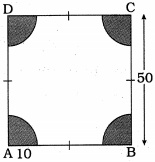
As shown in the adjoining diagram,the length of the side of the square plot $ABCD$ is $50 \, m$. At each vertex of the plot,a flower bed in the shape of a sector with radius $10 \, m$ is prepared. Find the area of the plot excluding the flower beds. $(\pi = 3.14)$ (in $m^2$)
A
$2784$
B
$2635$
C
$2186$
D
$2745$
Solution
(C) The side length of the square plot $ABCD$ is $l = 50 \, m$.
Area of the square plot $ABCD = l^2 = 50 \times 50 = 2500 \, m^2$.
For the flower beds formed at each vertex,the radius is $r = 10 \, m$ and the angle of the sector is $\theta = 90^\circ$ (since it is a square).
Area of one flower bed (sector) $= \frac{\theta}{360^\circ} \times \pi r^2 = \frac{90^\circ}{360^\circ} \times 3.14 \times 10^2 = \frac{1}{4} \times 3.14 \times 100 = 78.5 \, m^2$.
Total area of $4$ flower beds $= 4 \times 78.5 = 314 \, m^2$.
Area of the plot excluding the flower beds $=$ Area of the square plot $-$ Total area of the flower beds.
$= 2500 - 314 = 2186 \, m^2$.
Thus,the area of the plot excluding the flower beds is $2186 \, m^2$.
Area of the square plot $ABCD = l^2 = 50 \times 50 = 2500 \, m^2$.
For the flower beds formed at each vertex,the radius is $r = 10 \, m$ and the angle of the sector is $\theta = 90^\circ$ (since it is a square).
Area of one flower bed (sector) $= \frac{\theta}{360^\circ} \times \pi r^2 = \frac{90^\circ}{360^\circ} \times 3.14 \times 10^2 = \frac{1}{4} \times 3.14 \times 100 = 78.5 \, m^2$.
Total area of $4$ flower beds $= 4 \times 78.5 = 314 \, m^2$.
Area of the plot excluding the flower beds $=$ Area of the square plot $-$ Total area of the flower beds.
$= 2500 - 314 = 2186 \, m^2$.
Thus,the area of the plot excluding the flower beds is $2186 \, m^2$.
0 likes
View Solution148
MediumMCQ
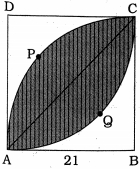
As shown in the diagram,the side length of square $ABCD$ is $21 \ cm$. $\widehat{APC}$ is an arc of $\odot(B, BA)$ and $\widehat{AQC}$ is an arc of $\odot(D, DA)$. Find the area of the shaded portion. (in $cm^2$)
A
$265$
B
$186$
C
$248$
D
$252$
Solution
(D) The shaded portion is the union of two congruent segments formed by the arcs $\widehat{APC}$ and $\widehat{AQC}$ within the square $ABCD$.
Area of segment $\widehat{APC}$ (with respect to sector $BAPC$):
Area $= \text{Area of sector } BAPC - \text{Area of } \Delta ABC$
$= \frac{90^\circ}{360^\circ} \times \pi \times (21)^2 - \frac{1}{2} \times 21 \times 21$
$= \frac{1}{4} \times \frac{22}{7} \times 441 - 220.5$
$= 346.5 - 220.5 = 126 \ cm^2$.
Since the two segments are congruent,the total shaded area is:
Area $= 2 \times 126 = 252 \ cm^2$.
Area of segment $\widehat{APC}$ (with respect to sector $BAPC$):
Area $= \text{Area of sector } BAPC - \text{Area of } \Delta ABC$
$= \frac{90^\circ}{360^\circ} \times \pi \times (21)^2 - \frac{1}{2} \times 21 \times 21$
$= \frac{1}{4} \times \frac{22}{7} \times 441 - 220.5$
$= 346.5 - 220.5 = 126 \ cm^2$.
Since the two segments are congruent,the total shaded area is:
Area $= 2 \times 126 = 252 \ cm^2$.
0 likes
View Solution149
DifficultMCQ
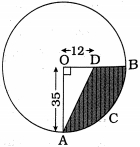
As shown in the diagram,$\overline{OA}$ and $\overline{OB}$ are two radii of $\odot(O, 35 \text{ cm})$ perpendicular to each other. If $OD = 12 \text{ cm}$,find the area of the shaded region. (in $\text{cm}^2$)
A
$752.5$
B
$746.3$
C
$846.5$
D
$776.6$
Solution
(A) For the sector $OACB$,the radius $r = 35 \text{ cm}$ and the measure of the angle $\theta = 90^{\circ}$ (since $\overline{OA} \perp \overline{OB}$).
Area of sector $OACB = \frac{\pi r^2 \theta}{360^{\circ}}$
$= \frac{22}{7} \times \frac{35 \times 35 \times 90^{\circ}}{360^{\circ}}$
$= 962.5 \text{ cm}^2$
In $\Delta ODA$,$\angle O = 90^{\circ}$.
Area of $\Delta ODA = \frac{1}{2} \times OD \times OA$
$= \frac{1}{2} \times 12 \times 35$
$= 210 \text{ cm}^2$
Area of the shaded region = Area of sector $OACB - \text{Area of } \Delta ODA$
$= 962.5 - 210$
$= 752.5 \text{ cm}^2$
Thus,the area of the shaded region is $752.5 \text{ cm}^2$.
Area of sector $OACB = \frac{\pi r^2 \theta}{360^{\circ}}$
$= \frac{22}{7} \times \frac{35 \times 35 \times 90^{\circ}}{360^{\circ}}$
$= 962.5 \text{ cm}^2$
In $\Delta ODA$,$\angle O = 90^{\circ}$.
Area of $\Delta ODA = \frac{1}{2} \times OD \times OA$
$= \frac{1}{2} \times 12 \times 35$
$= 210 \text{ cm}^2$
Area of the shaded region = Area of sector $OACB - \text{Area of } \Delta ODA$
$= 962.5 - 210$
$= 752.5 \text{ cm}^2$
Thus,the area of the shaded region is $752.5 \text{ cm}^2$.
0 likes
View Solution150
EasyMCQ
The length of a minor arc of a circle is given by the formula $\ldots \ldots \ldots \ldots$
A
$l=\pi r$
B
$l=\frac{\pi r \theta}{360}$
C
$l=\frac{\pi r \theta}{180}$
D
$l=\frac{\pi r^{2} \theta}{360}$
Solution
(C) The circumference of a circle is $2\pi r$,which corresponds to an angle of $360^{\circ}$ at the center.
Using the unitary method,the length of an arc $l$ subtending an angle $\theta$ at the center is given by the ratio of the angle to the total angle multiplied by the total circumference.
$l = \frac{\theta}{360^{\circ}} \times 2\pi r$
$l = \frac{\theta \times 2\pi r}{360^{\circ}}$
$l = \frac{\pi r \theta}{180^{\circ}}$
Therefore,the correct formula is $l = \frac{\pi r \theta}{180^{\circ}}$.
Using the unitary method,the length of an arc $l$ subtending an angle $\theta$ at the center is given by the ratio of the angle to the total angle multiplied by the total circumference.
$l = \frac{\theta}{360^{\circ}} \times 2\pi r$
$l = \frac{\theta \times 2\pi r}{360^{\circ}}$
$l = \frac{\pi r \theta}{180^{\circ}}$
Therefore,the correct formula is $l = \frac{\pi r \theta}{180^{\circ}}$.
0 likes
View SolutionAreas Related to Circles — Mix Examples - Areas Related to Circles · Frequently Asked Questions
1Are these Areas Related to Circles questions useful for JEE and NEET?
Yes. All questions in this section are mapped to JEE Main and NEET exam patterns. Previous year questions from JEE Main, NEET, GUJCET and state-level exams are included with full solutions.
2Can I switch to Hindi or Gujarati for these questions?
Yes. Use the language tabs in the hero section or the sidebar to view the same questions and solutions in English, Hindi or Gujarati.
3How do I generate a question paper from this subtopic?
Use the Vedclass Exam Paper Generator — select the chapter and subtopic, set difficulty, and generate Sets A, B, C, D automatically. First 3 chapters of every subject are free.
Vedclass Products
For Students
Vedclass Test Series
Mock tests in real JEE/NEET style with performance analysis. 5-day free trial.
Start Free TrialFor Teachers
Exam Paper Generator
Generate Set A/B/C/D papers from this chapter in 2 minutes. 3 chapters free.
Try FreeFor Institutes
Online Exam Module
Live online exams with unlimited students, 360° analytics & white-label branding.
See DemoFor Teachers & Institutes
Generate a Areas Related to Circles Exam Paper in 2 Minutes
Select subtopic & difficulty — Sets A, B, C, D auto-generated with No Repeat logic.
First 3 chapters of every subject are free — no payment required.