
As shown in the figure,a point charge $q_{1} = +1 \times 10^{-8} \ C$ is placed at the origin in the $x-y$ plane and another point charge $q_{2} = +3 \times 10^{-6} \ C$ is placed at the coordinate $(10, 0)$. In that case,which of the following graph$(s)$ shows most correctly the electric field vector $E_{x}$ in the $x$-direction?
- A
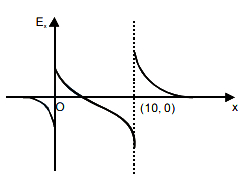
- B
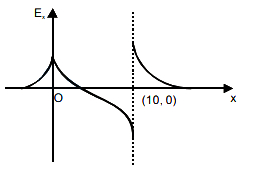
- C
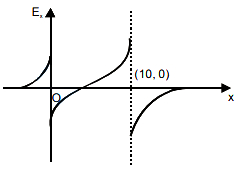
- D
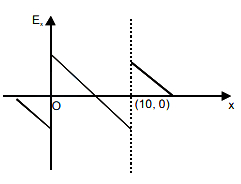
Explore More
Similar Questions
Two identical particles of mass $m$ carry a charge $Q$ each. Initially, one is at rest on a smooth horizontal plane and the other is projected along the plane directly towards the first particle from a large distance with speed $v$. The closest distance of approach is:
Column $II$ corresponds to the graph of magnitude of electric field versus distance from the centre of the charge distribution in Column $I$. Match the items in Column $I$ with the corresponding graphs in Column $II$.
Column-$I$ Column-$II$ $(A)$ Ring along its axis $(P)$ Graph with a peak at a distance $r > 0$ $(B)$ Uniformly charged solid sphere $(Q)$ Graph increasing linearly for $r < R$ and decreasing as $1/r^2$ for $r > R$ $(C)$ Uniformly charged spherical shell $(R)$ Graph with zero field for $r < R$ and decreasing as $1/r^2$ for $r > R$ $(D)$ Combination of charge $+Q$ and $-Q$ at the perpendicular bisector $(S)$ Graph with a maximum at the center and decreasing as $r$ increases
| Column-$I$ | Column-$II$ |
|---|---|
| $(A)$ Ring along its axis | $(P)$ Graph with a peak at a distance $r > 0$ |
| $(B)$ Uniformly charged solid sphere | $(Q)$ Graph increasing linearly for $r < R$ and decreasing as $1/r^2$ for $r > R$ |
| $(C)$ Uniformly charged spherical shell | $(R)$ Graph with zero field for $r < R$ and decreasing as $1/r^2$ for $r > R$ |
| $(D)$ Combination of charge $+Q$ and $-Q$ at the perpendicular bisector | $(S)$ Graph with a maximum at the center and decreasing as $r$ increases |
Medium
View Solution$A$ thin spherical insulating shell of radius $R$ carries a uniformly distributed charge such that the potential at its surface is $V_0$. $A$ hole with a small area $\alpha 4 \pi R^2$ (where $\alpha \ll 1$) is made on the shell without affecting the rest of the shell. Which one of the following statements is correct?
An infinitely long thin wire,having a uniform charge density per unit length of $5 \text{ nC/m}$,is passing through a spherical shell of radius $1 \text{ m}$,as shown in the figure. $A$ $10 \text{ nC}$ charge is distributed uniformly over the spherical shell. If the configuration of the charges remains static,the magnitude of the potential difference between points $P$ and $R$,in Volt,is. . . .
[Given: In $SI$ units $\frac{1}{4 \pi \epsilon_0}=9 \times 10^9, \ln 2=0.7$. Ignore the area pierced by the wire.]
[Given: In $SI$ units $\frac{1}{4 \pi \epsilon_0}=9 \times 10^9, \ln 2=0.7$. Ignore the area pierced by the wire.]
MediumIIT 2024
View SolutionAn uncharged metal sphere is placed between two charged parallel plates. The pattern of the electric field lines will be:
Medium
View SolutionVedclass Products
For Students
Vedclass Test Series
Mock tests in real JEE/NEET style with performance analysis. 5-day free trial.
Start Free TrialFor Teachers
Exam Paper Generator
Generate Set A/B/C/D exam papers from 7.5L+ questions in 2 minutes. 3 chapters free.
Try FreeFor Institutes
Online Exam Module
Live online exams with unlimited students, 360° analytics & white-label branding.
See Demo