
ChemistryQ51–150 of 264 questions
Page 2 of 3 · English
51
ChemistryEasyMCQTS EAMCET · 2022
The most suitable solvent for $Wurtz$ reaction is
A
Dry acetonitrile
B
Dry dichloromethane
C
Dry ethanol
D
Dry ether
Solution
(D) In the $Wurtz$ reaction,alkanes are prepared by the reaction of alkyl halides with sodium metal $(Na)$.
Since sodium metal is highly reactive,the solvent used must be inert towards it.
An aprotic solvent is required as the reaction medium to prevent side reactions.
Dry ether is a commonly used,suitable aprotic solvent for this reaction.
Since sodium metal is highly reactive,the solvent used must be inert towards it.
An aprotic solvent is required as the reaction medium to prevent side reactions.
Dry ether is a commonly used,suitable aprotic solvent for this reaction.
0 likesView Solution
52
ChemistryEasyMCQTS EAMCET · 2022
The major products $P$ and $Q$ in the following reactions,respectively,are:
$H_3C-C \equiv C-CH_2CH_3 \xrightarrow{H_2, \text{Lindlar's Catalyst}} P$
$H_3C-C \equiv C-CH_2CH_3 \xrightarrow{Na/\text{liquid } NH_3} Q$
$H_3C-C \equiv C-CH_2CH_3 \xrightarrow{H_2, \text{Lindlar's Catalyst}} P$
$H_3C-C \equiv C-CH_2CH_3 \xrightarrow{Na/\text{liquid } NH_3} Q$
A
Alkene (cis) Alkene (cis)
B
Alkane Alkene (trans)
C
Alkene (cis) Alkene (trans)
D
Alkene (trans) Alkene (trans)
Solution
(C) $1$. The reaction of an alkyne with $H_2$ in the presence of Lindlar's catalyst (poisoned $Pd/CaCO_3$) is a syn-addition,which yields a (cis)-alkene as the major product $P$.
$2$. The reaction of an alkyne with $Na$ in liquid $NH_3$ (Birch reduction) is an anti-addition,which yields a (trans)-alkene as the major product $Q$.
$3$. Therefore,$P$ is (cis)-alkene and $Q$ is (trans)-alkene.
$2$. The reaction of an alkyne with $Na$ in liquid $NH_3$ (Birch reduction) is an anti-addition,which yields a (trans)-alkene as the major product $Q$.
$3$. Therefore,$P$ is (cis)-alkene and $Q$ is (trans)-alkene.
0 likesView Solution
53
ChemistryDifficultMCQTS EAMCET · 2022
The correct order of rates of addition of $Br_2/\text{water}$ to the following alkenes is:
[$A$] $CH_2=CH_2$
[$B$] $CH_2=CH-NO_2$
[$C$] $CH_3-CH_2-CH=CH_2$
[$D$] $CH_3-CH=CH_2$
[$A$] $CH_2=CH_2$
[$B$] $CH_2=CH-NO_2$
[$C$] $CH_3-CH_2-CH=CH_2$
[$D$] $CH_3-CH=CH_2$
A
$C > D > A > B$
B
$D > C > A > B$
C
$A > B > C > D$
D
$B > A > D > C$
Solution
(A) The addition of $Br_2/\text{water}$ to an alkene is an electrophilic addition reaction. The rate-determining step involves the formation of a carbocation intermediate.
Electron-donating groups (like alkyl groups) increase the electron density of the double bond and stabilize the carbocation intermediate,thereby increasing the rate of reaction.
Electron-withdrawing groups (like $-NO_2$) decrease the electron density of the double bond and destabilize the carbocation intermediate,thereby decreasing the rate of reaction.
Comparing the substituents:
$1$. $CH_3-CH=CH_2$ $(D)$: Has one methyl group (+$I$ effect),stabilizing the carbocation.
$2$. $CH_3-CH_2-CH=CH_2$ $(C)$: Has an ethyl group (+$I$ effect),which is slightly more effective than methyl at stabilizing,but steric factors and hyperconjugation make $D$ and $C$ very reactive.
$3$. $CH_2=CH_2$ $(A)$: No substituents.
$4$. $CH_2=CH-NO_2$ $(B)$: The $-NO_2$ group is a strong electron-withdrawing group (-$I$ and -$M$ effect),making it the least reactive.
Thus,the correct order of reactivity is $C > D > A > B$.
Electron-donating groups (like alkyl groups) increase the electron density of the double bond and stabilize the carbocation intermediate,thereby increasing the rate of reaction.
Electron-withdrawing groups (like $-NO_2$) decrease the electron density of the double bond and destabilize the carbocation intermediate,thereby decreasing the rate of reaction.
Comparing the substituents:
$1$. $CH_3-CH=CH_2$ $(D)$: Has one methyl group (+$I$ effect),stabilizing the carbocation.
$2$. $CH_3-CH_2-CH=CH_2$ $(C)$: Has an ethyl group (+$I$ effect),which is slightly more effective than methyl at stabilizing,but steric factors and hyperconjugation make $D$ and $C$ very reactive.
$3$. $CH_2=CH_2$ $(A)$: No substituents.
$4$. $CH_2=CH-NO_2$ $(B)$: The $-NO_2$ group is a strong electron-withdrawing group (-$I$ and -$M$ effect),making it the least reactive.
Thus,the correct order of reactivity is $C > D > A > B$.
0 likesView Solution
54
ChemistryEasyMCQTS EAMCET · 2022
The organic compound $5-$allylcyclohex$-3-$ene$-1-$ol is reacted with cold,dilute,aqueous solution of $KMnO_4$. The total number of hydroxyl group$(s)$ $(-OH)$ present in the product is
A
$1$
B
$2$
C
$3$
D
$5$
Solution
(D) The reaction of an alkene with cold,dilute,aqueous $KMnO_4$ (Bayer's reagent) results in syn-dihydroxylation,where a double bond is converted into a vicinal diol (two $-OH$ groups are added across the double bond).
In the given compound,$5-$allylcyclohex$-3-$ene$-1-$ol,there are two double bonds: one in the cyclohexene ring and one in the allyl side chain.
$1$. The double bond in the cyclohexene ring undergoes dihydroxylation,adding two $-OH$ groups.
$2$. The double bond in the allyl side chain also undergoes dihydroxylation,adding two more $-OH$ groups.
$3$. The original molecule already contains one $-OH$ group at the $1-$position of the ring.
Total $-OH$ groups = $1$ (original) $+ 2$ (from ring double bond) $+ 2$ (from side chain double bond) = $5$ hydroxyl groups.
In the given compound,$5-$allylcyclohex$-3-$ene$-1-$ol,there are two double bonds: one in the cyclohexene ring and one in the allyl side chain.
$1$. The double bond in the cyclohexene ring undergoes dihydroxylation,adding two $-OH$ groups.
$2$. The double bond in the allyl side chain also undergoes dihydroxylation,adding two more $-OH$ groups.
$3$. The original molecule already contains one $-OH$ group at the $1-$position of the ring.
Total $-OH$ groups = $1$ (original) $+ 2$ (from ring double bond) $+ 2$ (from side chain double bond) = $5$ hydroxyl groups.
0 likesView Solution
55
ChemistryDifficultMCQTS EAMCET · 2022
The major products $P$ and $Q$ formed in the following reaction schemes are:
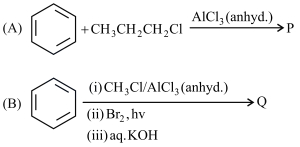
A
$P$ = Isopropylbenzene,$Q$ = Benzyl alcohol
B
$P$ = Propylbenzene,$Q$ = Benzophenone
C
$P$ = Dipropylbenzene,$Q$ = Diphenylmethanol
D
$P$ = $2-$Chloropropylbenzene,$Q$ = Benzoic acid
Solution
(A) In reaction $(A)$,Friedel-Crafts alkylation of benzene with $n$-propyl chloride in the presence of $AlCl_3$ leads to the formation of a carbocation intermediate. The primary propyl carbocation rearranges to a more stable secondary isopropyl carbocation,which then attacks the benzene ring to form isopropylbenzene as the major product $P$.
In reaction $(B)$:
$(i)$ Friedel-Crafts alkylation of benzene with $CH_3Cl$ in the presence of $AlCl_3$ gives toluene.
$(ii)$ Free radical halogenation of toluene with $Br_2$ in the presence of $hv$ (light) gives benzyl bromide $(C_6H_5CH_2Br)$.
$(iii)$ Nucleophilic substitution of benzyl bromide with aqueous $KOH$ gives benzyl alcohol $(C_6H_5CH_2OH)$ as the major product $Q$.
In reaction $(B)$:
$(i)$ Friedel-Crafts alkylation of benzene with $CH_3Cl$ in the presence of $AlCl_3$ gives toluene.
$(ii)$ Free radical halogenation of toluene with $Br_2$ in the presence of $hv$ (light) gives benzyl bromide $(C_6H_5CH_2Br)$.
$(iii)$ Nucleophilic substitution of benzyl bromide with aqueous $KOH$ gives benzyl alcohol $(C_6H_5CH_2OH)$ as the major product $Q$.
0 likesView Solution
56
ChemistryDifficultMCQTS EAMCET · 2022
The major product formed in the following reaction sequence is:
$C_6H_5-CHBr-CH_2Br$ $\xrightarrow[(ii) NaNH_2]{(i) alc. KOH}$ $\xrightarrow[(iii) \text{Red hot iron tube}, 873 K]{}$
$C_6H_5-CHBr-CH_2Br$ $\xrightarrow[(ii) NaNH_2]{(i) alc. KOH}$ $\xrightarrow[(iii) \text{Red hot iron tube}, 873 K]{}$
A
$1,2-$diphenylbenzene
B
$1,2,4-$triphenylbenzene
C
$1,3,5-$triphenylbenzene
D
$1,2,3-$triphenylbenzene
Solution
(C) Step $1$: Dehydrohalogenation of $C_6H_5-CHBr-CH_2Br$ with $alc. KOH$ followed by $NaNH_2$ leads to the formation of phenylacetylene $(C_6H_5-C \equiv CH)$.
Step $2$: The cyclic trimerization of phenylacetylene occurs when passed through a red hot iron tube at $873 \ K$.
Step $3$: The trimerization of $C_6H_5-C \equiv CH$ yields $1,3,5-triphenylbenzene$ as the major product due to steric hindrance,which favors the meta-substituted product.
Step $2$: The cyclic trimerization of phenylacetylene occurs when passed through a red hot iron tube at $873 \ K$.
Step $3$: The trimerization of $C_6H_5-C \equiv CH$ yields $1,3,5-triphenylbenzene$ as the major product due to steric hindrance,which favors the meta-substituted product.
0 likesView Solution
57
ChemistryEasyMCQTS EAMCET · 2022
The molecular formula of the product formed when benzene is reacted with excess of chlorine molecules under ultra-violet light is
A
$C_6Cl_6$
B
$C_6H_3Cl_3$
C
$C_6H_2Cl_4$
D
$C_6H_6Cl_6$
Solution
(D) When benzene $(C_6H_6)$ reacts with excess chlorine $(Cl_2)$ in the presence of ultraviolet light,an addition reaction occurs.
This results in the formation of benzene hexachloride $(C_6H_6Cl_6)$,also known as $BHC$ or Gammaxene.
The reaction is: $C_6H_6 + 3Cl_2 \xrightarrow{uv/hv} C_6H_6Cl_6$.
This results in the formation of benzene hexachloride $(C_6H_6Cl_6)$,also known as $BHC$ or Gammaxene.
The reaction is: $C_6H_6 + 3Cl_2 \xrightarrow{uv/hv} C_6H_6Cl_6$.
0 likesView Solution
58
ChemistryEasyMCQTS EAMCET · 2022
The most effective water softening method is
A
Lime-soda process
B
Permutit process
C
Ion-exchange process
D
Boiling followed by filtration
Solution
(C) Boiling removes only temporary hardness of water.
During boiling,the soluble $Mg(HCO_3)_2$ is converted into insoluble magnesium hydroxide and $Ca(HCO_3)_2$ is changed to insoluble calcium carbonate.
In the permutit process,hydrated sodium aluminium silicate is used. For simplicity,sodium aluminium silicate $(NaAlSiO_4)$ can be written as $NaZ$. When this is added to hard water,exchange reactions take place:
$2 NaZ_{(s)} + M^{2+}_{(aq)} \rightarrow MZ_{2(s)} + 2 Na^{+}_{(aq)}$ (where $M = Mg, Ca$).
In the permutit process,only cations causing hardness are removed.
In the ion-exchange process,both the cations and anions causing permanent hardness of water can be removed by using cation and anion exchange resins. Demineralized water is obtained after this process.
Hence,the most effective method for the removal of hardness of water is the ion-exchange process.
During boiling,the soluble $Mg(HCO_3)_2$ is converted into insoluble magnesium hydroxide and $Ca(HCO_3)_2$ is changed to insoluble calcium carbonate.
In the permutit process,hydrated sodium aluminium silicate is used. For simplicity,sodium aluminium silicate $(NaAlSiO_4)$ can be written as $NaZ$. When this is added to hard water,exchange reactions take place:
$2 NaZ_{(s)} + M^{2+}_{(aq)} \rightarrow MZ_{2(s)} + 2 Na^{+}_{(aq)}$ (where $M = Mg, Ca$).
In the permutit process,only cations causing hardness are removed.
In the ion-exchange process,both the cations and anions causing permanent hardness of water can be removed by using cation and anion exchange resins. Demineralized water is obtained after this process.
Hence,the most effective method for the removal of hardness of water is the ion-exchange process.
0 likesView Solution
59
ChemistryDifficultMCQTS EAMCET · 2022
An unknown inorganic compound '$A$' is used for water softening. '$A$' reacts with $Na_2CO_3$ to generate an alkaline compound '$B$' whose $pH=14$. '$A$' on reaction with $CO_2$ gives a cloudy precipitate. '$B$' + $CaO$ reacts with an unknown organic compound '$C$' to give $C_6H_6$. '$A$','$B$' and '$C$',respectively,are:
A
$Ca(OH)_2, Na_2CO_3, C_6H_5COOH$
B
$Ca(OH)_2, NaOH, C_6H_5CH_2COOH$
C
$Ca(OH)_2, NaOH, C_6H_5COOH$
D
$Ca, NaOH, C_6H_5COOH$
Solution
(C) $1$. Compound '$A$' is $Ca(OH)_2$ (slaked lime),which is used for water softening.
$2$. $Ca(OH)_2$ reacts with $Na_2CO_3$ to form $NaOH$ (compound '$B$') and $CaCO_3$ (precipitate). $NaOH$ is a strong base with $pH=14$.
$Ca(OH)_2 + Na_2CO_3 \rightarrow CaCO_3 + 2NaOH$
$3$. $Ca(OH)_2$ reacts with $CO_2$ to form $CaCO_3$,which appears as a cloudy precipitate.
$Ca(OH)_2 + CO_2 \rightarrow CaCO_3 + H_2O$
$4$. The mixture of $NaOH$ and $CaO$ is known as soda lime. It performs decarboxylation on organic acids. When $C_6H_5COOH$ (benzoic acid,compound '$C$') reacts with soda lime,it produces benzene $(C_6H_6)$.
$C_6H_5COOH + NaOH + CaO \xrightarrow{\Delta} C_6H_6 + Na_2CO_3$
Therefore,'$A$' is $Ca(OH)_2$,'$B$' is $NaOH$,and '$C$' is $C_6H_5COOH$.
$2$. $Ca(OH)_2$ reacts with $Na_2CO_3$ to form $NaOH$ (compound '$B$') and $CaCO_3$ (precipitate). $NaOH$ is a strong base with $pH=14$.
$Ca(OH)_2 + Na_2CO_3 \rightarrow CaCO_3 + 2NaOH$
$3$. $Ca(OH)_2$ reacts with $CO_2$ to form $CaCO_3$,which appears as a cloudy precipitate.
$Ca(OH)_2 + CO_2 \rightarrow CaCO_3 + H_2O$
$4$. The mixture of $NaOH$ and $CaO$ is known as soda lime. It performs decarboxylation on organic acids. When $C_6H_5COOH$ (benzoic acid,compound '$C$') reacts with soda lime,it produces benzene $(C_6H_6)$.
$C_6H_5COOH + NaOH + CaO \xrightarrow{\Delta} C_6H_6 + Na_2CO_3$
Therefore,'$A$' is $Ca(OH)_2$,'$B$' is $NaOH$,and '$C$' is $C_6H_5COOH$.
0 likesView Solution
60
ChemistryMediumMCQTS EAMCET · 2022
Deionized water is obtained by passing hard water through
A
Zeolite
B
Cationic exchanger only
C
Anionic exchanger only
D
Both cationic and anionic exchanger one after the other
Solution
(D) Deionized water is obtained by passing hard water through a series of ion exchange resins. First,it passes through a cation exchange resin (which removes $Ca^{2+}$,$Mg^{2+}$,etc.) and then through an anion exchange resin (which removes $Cl^-$,$SO_4^{2-}$,etc.). Thus,both cationic and anionic exchangers are used one after the other.
0 likesView Solution
61
ChemistryDifficultMCQTS EAMCET · 2022
The freezing point of heavy water at $1 \ atm$ pressure is: (in $^{\circ}C$)
A
$0$
B
$3.8$
C
$4.8$
D
$1$
Solution
(B) Heavy water,denoted as $D_2O$,has physical properties slightly different from ordinary water $(H_2O)$.
At $1 \ atm$ pressure,the freezing point of heavy water is $3.8 \ ^{\circ}C$.
At $1 \ atm$ pressure,the freezing point of heavy water is $3.8 \ ^{\circ}C$.
0 likesView Solution
62
ChemistryEasyMCQTS EAMCET · 2022
$CaC_2 + 2D_2O \longrightarrow$ "$P$" $+ Ca(OD)_2$
In the above reaction,the product "$P$" is:
In the above reaction,the product "$P$" is:
A
$C_2H_2$
B
$C_2H_4$
C
$CD_4$
D
$C_2D_2$
Solution
(D) The reaction of calcium carbide $(CaC_2)$ with heavy water $(D_2O)$ is an acid-base type reaction where the carbide ion $(C_2^{2-})$ reacts with $D^+$ ions from $D_2O$.
$CaC_2 + 2D_2O \rightarrow Ca(OD)_2 + C_2D_2$
Thus,the product "$P$" is $C_2D_2$ (deuteroacetylene).
$CaC_2 + 2D_2O \rightarrow Ca(OD)_2 + C_2D_2$
Thus,the product "$P$" is $C_2D_2$ (deuteroacetylene).
0 likesView Solution
63
ChemistryEasyMCQTS EAMCET · 2022
Ammonia is a Lewis base because it is
A
Electron pair donor
B
Electron pair acceptor
C
Proton donor
D
Proton acceptor
Solution
(A) According to the Lewis concept,a base is a substance that can donate an electron pair to form a coordinate covalent bond.
In the $NH_3$ molecule,the nitrogen atom has one lone pair of electrons.
Because $NH_3$ can donate this lone pair of electrons to an electron-deficient species,it acts as a Lewis base.
In the $NH_3$ molecule,the nitrogen atom has one lone pair of electrons.
Because $NH_3$ can donate this lone pair of electrons to an electron-deficient species,it acts as a Lewis base.
0 likesView Solution
64
ChemistryMediumMCQTS EAMCET · 2022
The $pH$ of pure water at $80^{\circ} C$ is
A
$7.0$
B
$\infty$
C
$> 7.0$
D
$< 7.0$
Solution
(D) At $25^{\circ} C$,the ionic product of water $(K_w)$ is $1.0 \times 10^{-14}$.
For pure water,$[H^{ }] = [OH^{-}] = \sqrt{K_w} = 10^{-7} \ M$,which gives $pH = 7$.
The auto-ionization of water is an endothermic process $(\Delta H > 0)$.
According to Le Chatelier's principle,an increase in temperature shifts the equilibrium to the right,increasing the value of $K_w$.
At $80^{\circ} C$,$K_w > 10^{-14}$,which implies $[H^{ }] > 10^{-7} \ M$.
Since $pH = -\log[H^{ }]$,an increase in $[H^{ }]$ results in a decrease in $pH$.
Therefore,at $80^{\circ} C$,the $pH$ of pure water is $< 7.0$.
For pure water,$[H^{ }] = [OH^{-}] = \sqrt{K_w} = 10^{-7} \ M$,which gives $pH = 7$.
The auto-ionization of water is an endothermic process $(\Delta H > 0)$.
According to Le Chatelier's principle,an increase in temperature shifts the equilibrium to the right,increasing the value of $K_w$.
At $80^{\circ} C$,$K_w > 10^{-14}$,which implies $[H^{ }] > 10^{-7} \ M$.
Since $pH = -\log[H^{ }]$,an increase in $[H^{ }]$ results in a decrease in $pH$.
Therefore,at $80^{\circ} C$,the $pH$ of pure water is $< 7.0$.
0 likesView Solution
65
ChemistryDifficultMCQTS EAMCET · 2022
Match the following:
The correct match is:
| List-$I$ | List-$II$ |
| $A$. $Aq.$ solution of $AlCl_3$ | $I$. Basic |
| $B$. $Aq.$ solution of $CH_3COONa$ | $II$. Acidic |
| $C$. $Aq.$ solution of $KCl$ | $III$. Highly conductive |
| $D$. $Al_2O_3$ | $IV$. Strongly basic |
| $V$. Amphoteric |
The correct match is:
A
$A-II, B-I, C-III, D-V$
B
$A-I, B-III, C-IV, D-V$
C
$A-III, B-II, C-I, D-V$
D
$A-IV, B-V, C-II, D-I$
Solution
(A) $AlCl_3$ is a salt of a weak base and a strong acid; it undergoes cationic hydrolysis:
$Al^{3+} + 3H_2O \rightarrow Al(OH)_3 + 3H^+$
$H^+$ ions are released into the solution,making the aqueous solution of $AlCl_3$ acidic $(A-II)$.
$CH_3COONa$ is a salt of a weak acid and a strong base; it undergoes anionic hydrolysis:
$CH_3COO^- + H_2O \rightarrow CH_3COOH + OH^-$
$OH^-$ ions are released,making the solution basic $(B-I)$.
$KCl$ is a strong electrolyte and an ionic compound,making its aqueous solution highly conductive $(C-III)$.
$Al_2O_3$ is an amphoteric oxide as it reacts with both acids and bases $(D-V)$.
Therefore,the correct match is $A-II, B-I, C-III, D-V$.
$Al^{3+} + 3H_2O \rightarrow Al(OH)_3 + 3H^+$
$H^+$ ions are released into the solution,making the aqueous solution of $AlCl_3$ acidic $(A-II)$.
$CH_3COONa$ is a salt of a weak acid and a strong base; it undergoes anionic hydrolysis:
$CH_3COO^- + H_2O \rightarrow CH_3COOH + OH^-$
$OH^-$ ions are released,making the solution basic $(B-I)$.
$KCl$ is a strong electrolyte and an ionic compound,making its aqueous solution highly conductive $(C-III)$.
$Al_2O_3$ is an amphoteric oxide as it reacts with both acids and bases $(D-V)$.
Therefore,the correct match is $A-II, B-I, C-III, D-V$.
0 likesView Solution
66
ChemistryMediumMCQTS EAMCET · 2022
Match the following metal sulfides with their respective solubility product $(K_{sp})$ values:
| Metal sulfide | Solubility product |
|---|---|
| $A$. $PbS$ | $I$. $4.0 \times 10^{-53}$ |
| $B$. $HgS$ | $II$. $8.0 \times 10^{-28}$ |
| $C$. $MnS$ | $III$. $1.6 \times 10^{-24}$ |
| $D$. $ZnS$ | $IV$. $2.5 \times 10^{-13}$ |
A
$A-I, B-II, C-III, D-IV$
B
$A-II, B-I, C-IV, D-III$
C
$A-II, B-III, C-IV, D-I$
D
$A-III, B-IV, C-I, D-II$
Solution
(B) The solubility product $(K_{sp})$ values for the given metal sulfides are:
$A$. $PbS$: $8.0 \times 10^{-28}$ $(II)$
$B$. $HgS$: $4.0 \times 10^{-53}$ $(I)$
$C$. $MnS$: $2.5 \times 10^{-13}$ $(IV)$
$D$. $ZnS$: $1.6 \times 10^{-24}$ $(III)$
Therefore,the correct matching sequence is $A-II, B-I, C-IV, D-III$.
$A$. $PbS$: $8.0 \times 10^{-28}$ $(II)$
$B$. $HgS$: $4.0 \times 10^{-53}$ $(I)$
$C$. $MnS$: $2.5 \times 10^{-13}$ $(IV)$
$D$. $ZnS$: $1.6 \times 10^{-24}$ $(III)$
Therefore,the correct matching sequence is $A-II, B-I, C-IV, D-III$.
0 likesView Solution
67
ChemistryMCQTS EAMCET · 2022
$\int \sqrt{4 \cos ^2 x - 5 \sin ^2 x} \cos x \, dx =$
A
$\frac{1}{2} \sin x \sqrt{4 - 9 \sin ^2 x} + \frac{2}{3} \sin ^{-1}\left(\frac{3 \sin x}{2}\right) + c$
B
$\frac{1}{2} \cos x \sqrt{4 - 9 \cos ^2 x} + \frac{2}{3} \sin ^{-1}\left(\frac{3 \cos x}{2}\right) + c$
C
$\frac{1}{2} \sin x \sqrt{4 - 9 \sin ^2 x} + \frac{2}{3} \cos ^{-1}\left(\frac{3 \cos x}{2}\right) + c$
D
$\frac{1}{2} \cos x \sqrt{4 - 9 \sin ^2 x} + \frac{2}{3} \sin ^{-1}\left(\frac{3 \sin x}{2}\right) + c$
Solution
(A) Let $I = \int \sqrt{4 \cos ^2 x - 5 \sin ^2 x} \cos x \, dx$.
Using the identity $\cos ^2 x = 1 - \sin ^2 x$,we get:
$I = \int \sqrt{4(1 - \sin ^2 x) - 5 \sin ^2 x} \cos x \, dx = \int \sqrt{4 - 9 \sin ^2 x} \cos x \, dx$.
Let $3 \sin x = t$. Then $3 \cos x \, dx = dt$,which implies $\cos x \, dx = \frac{1}{3} dt$.
Substituting these into the integral:
$I = \int \sqrt{4 - t^2} \cdot \frac{1}{3} dt = \frac{1}{3} \int \sqrt{2^2 - t^2} dt$.
Using the standard formula $\int \sqrt{a^2 - x^2} dx = \frac{x}{2} \sqrt{a^2 - x^2} + \frac{a^2}{2} \sin ^{-1}\left(\frac{x}{a}\right) + c$:
$I = \frac{1}{3} \left[ \frac{t}{2} \sqrt{4 - t^2} + \frac{4}{2} \sin ^{-1}\left(\frac{t}{2}\right) \right] + c$.
Substituting $t = 3 \sin x$ back:
$I = \frac{1}{3} \left[ \frac{3 \sin x}{2} \sqrt{4 - 9 \sin ^2 x} + 2 \sin ^{-1}\left(\frac{3 \sin x}{2}\right) \right] + c = \frac{1}{2} \sin x \sqrt{4 - 9 \sin ^2 x} + \frac{2}{3} \sin ^{-1}\left(\frac{3 \sin x}{2}\right) + c$.
Using the identity $\cos ^2 x = 1 - \sin ^2 x$,we get:
$I = \int \sqrt{4(1 - \sin ^2 x) - 5 \sin ^2 x} \cos x \, dx = \int \sqrt{4 - 9 \sin ^2 x} \cos x \, dx$.
Let $3 \sin x = t$. Then $3 \cos x \, dx = dt$,which implies $\cos x \, dx = \frac{1}{3} dt$.
Substituting these into the integral:
$I = \int \sqrt{4 - t^2} \cdot \frac{1}{3} dt = \frac{1}{3} \int \sqrt{2^2 - t^2} dt$.
Using the standard formula $\int \sqrt{a^2 - x^2} dx = \frac{x}{2} \sqrt{a^2 - x^2} + \frac{a^2}{2} \sin ^{-1}\left(\frac{x}{a}\right) + c$:
$I = \frac{1}{3} \left[ \frac{t}{2} \sqrt{4 - t^2} + \frac{4}{2} \sin ^{-1}\left(\frac{t}{2}\right) \right] + c$.
Substituting $t = 3 \sin x$ back:
$I = \frac{1}{3} \left[ \frac{3 \sin x}{2} \sqrt{4 - 9 \sin ^2 x} + 2 \sin ^{-1}\left(\frac{3 \sin x}{2}\right) \right] + c = \frac{1}{2} \sin x \sqrt{4 - 9 \sin ^2 x} + \frac{2}{3} \sin ^{-1}\left(\frac{3 \sin x}{2}\right) + c$.
0 likesView Solution
68
ChemistryEasyMCQTS EAMCET · 2022
The correct order of Lewis acidic character of boron trihalides is
A
$BF_3 > BCl_3 > BI_3 > BBr_3$
B
$BI_3 > BBr_3 > BF_3 > BCl_3$
C
$BI_3 > BBr_3 > BCl_3 > BF_3$
D
$BF_3 > BCl_3 > BBr_3 > BI_3$
Solution
(C) The Lewis acidity of boron trihalides depends on the extent of $p\pi-p\pi$ back-bonding between the halogen atom and the boron atom.
In $BF_3$,the small size of the $F$ atom allows for effective $2p-2p$ back-bonding,which reduces the electron deficiency of the boron atom.
As we move from $F$ to $I$,the size of the halogen atom increases,making the $p\pi-p\pi$ back-bonding less effective.
Therefore,the electron deficiency of the boron atom increases,leading to an increase in Lewis acidic character.
The correct order is $BI_3 > BBr_3 > BCl_3 > BF_3$.
In $BF_3$,the small size of the $F$ atom allows for effective $2p-2p$ back-bonding,which reduces the electron deficiency of the boron atom.
As we move from $F$ to $I$,the size of the halogen atom increases,making the $p\pi-p\pi$ back-bonding less effective.
Therefore,the electron deficiency of the boron atom increases,leading to an increase in Lewis acidic character.
The correct order is $BI_3 > BBr_3 > BCl_3 > BF_3$.
0 likesView Solution
69
ChemistryEasyMCQTS EAMCET · 2022
Assertion $(A)$: $[B(OH_2)_6]^{3+}$ and $[B(OH)_4]^{-}$ form octahedral and tetrahedral structures.
Reason $(R)$: Being electron deficient,boron readily reacts with Lewis bases like $H_2O$ and $OH^{-}$.
The correct option among the following is
Reason $(R)$: Being electron deficient,boron readily reacts with Lewis bases like $H_2O$ and $OH^{-}$.
The correct option among the following is
A
$A$ is true,$R$ is true and $R$ is the correct explanation for $A$
B
$A$ is true,$R$ is true but $R$ is not the correct explanation for $A$
C
$A$ is true but $R$ is false
D
$A$ is false but $R$ is true
Solution
(D) The assertion is false because boron has a small atomic size and lacks $d$-orbitals in its valence shell,which prevents it from expanding its coordination number beyond $4$. Therefore,the formation of an octahedral $[B(OH_2)_6]^{3+}$ complex is impossible.
However,the reason is true because boron is electron-deficient ($sextet$ of electrons) and acts as a Lewis acid,reacting with Lewis bases like $OH^{-}$ to form the stable tetrahedral $[B(OH)_4]^{-}$ ion.
Thus,$A$ is false but $R$ is true.
However,the reason is true because boron is electron-deficient ($sextet$ of electrons) and acts as a Lewis acid,reacting with Lewis bases like $OH^{-}$ to form the stable tetrahedral $[B(OH)_4]^{-}$ ion.
Thus,$A$ is false but $R$ is true.
0 likesView Solution
70
ChemistryMediumMCQTS EAMCET · 2022
$A$ black coloured element with $ns^2 np^1$ outer electronic configuration cannot react with air in its crystalline form. However,in amorphous form,it gives an oxide in air which is acidic in nature. Identify the element.
A
Boron
B
Aluminium
C
Gallium
D
Indium
Solution
(A) The element with $ns^2 np^1$ configuration is a member of Group $13$.
Boron $(B)$ is a black-coloured non-metal that exists in crystalline and amorphous forms.
Crystalline boron is very hard and unreactive towards air at room temperature.
Amorphous boron reacts with oxygen in the air to form boron trioxide $(B_2O_3)$,which is acidic in nature:
$4B(s) + 3O_2(g) \rightarrow 2B_2O_3(s)$
$B_2O_3$ further reacts with water to form boric acid:
$B_2O_3(s) + 3H_2O(l) \rightarrow 2B(OH)_3(aq)$
Boron $(B)$ is a black-coloured non-metal that exists in crystalline and amorphous forms.
Crystalline boron is very hard and unreactive towards air at room temperature.
Amorphous boron reacts with oxygen in the air to form boron trioxide $(B_2O_3)$,which is acidic in nature:
$4B(s) + 3O_2(g) \rightarrow 2B_2O_3(s)$
$B_2O_3$ further reacts with water to form boric acid:
$B_2O_3(s) + 3H_2O(l) \rightarrow 2B(OH)_3(aq)$
0 likesView Solution
71
ChemistryMediumMCQTS EAMCET · 2022
What is the product of the reaction between aluminium and aqueous $NaOH$?
A
$H_2$
B
$O_2$
C
$D_2$
D
$O_3$
Solution
(A) Aluminium metal reacts with aqueous sodium hydroxide to produce sodium aluminate and hydrogen gas.
The balanced chemical equation is:
$2 Al_{(s)} + 2 NaOH_{(aq)} + 6 H_2O_{(l)} \rightarrow 2 Na[Al(OH)_4]_{(aq)} + 3 H_{2(g)}$
The evolution of hydrogen gas can be tested by bringing a burning candle near the reaction,which produces a characteristic pop sound.
The balanced chemical equation is:
$2 Al_{(s)} + 2 NaOH_{(aq)} + 6 H_2O_{(l)} \rightarrow 2 Na[Al(OH)_4]_{(aq)} + 3 H_{2(g)}$
The evolution of hydrogen gas can be tested by bringing a burning candle near the reaction,which produces a characteristic pop sound.
0 likesView Solution
72
ChemistryEasyMCQTS EAMCET · 2022
$Al +$ aq. $NaOH$ (excess) $\longrightarrow P + Q$. $P$ and $Q$ are
A
$Al(OH)_3 ; H_2O$
B
$Al(OH)_3 ; Na_2O_2$
C
$Na^{+} [Al(OH)_4]^- ; H_2$
D
$Al(OH)_3 ; Na_2O$
Solution
(C) The reaction of aluminum $(Al)$ with an excess of aqueous sodium hydroxide $(NaOH)$ is a characteristic reaction where aluminum acts as an amphoteric metal.
The balanced chemical equation for this reaction is:
$2Al(s) + 2NaOH(aq) + 6H_2O(l) \longrightarrow 2Na^{+}[Al(OH)_4]^-(aq) + 3H_2(g)$
In this reaction,$P$ is the complex ion sodium tetrahydroxoaluminate$(III)$,$Na^{+}[Al(OH)_4]^-$,and $Q$ is hydrogen gas,$H_2$.
Therefore,the correct option is $C$.
The balanced chemical equation for this reaction is:
$2Al(s) + 2NaOH(aq) + 6H_2O(l) \longrightarrow 2Na^{+}[Al(OH)_4]^-(aq) + 3H_2(g)$
In this reaction,$P$ is the complex ion sodium tetrahydroxoaluminate$(III)$,$Na^{+}[Al(OH)_4]^-$,and $Q$ is hydrogen gas,$H_2$.
Therefore,the correct option is $C$.
0 likesView Solution
73
ChemistryEasyMCQTS EAMCET · 2022
Among the following elements,$X$ exhibits maximum catenation and $Y$ is the least abundant on earth. $X$ and $Y$ elements are
A
$C, Ge$
B
$Si, Ge$
C
$C, Pb$
D
$Ge, C$
Solution
(A) Carbon $(C)$ has the smallest atomic size and high bond dissociation energy,which allows it to form stable $C-C$ bonds,leading to the property of maximum catenation.
Germanium $(Ge)$ is the least abundant element among the group $14$ elements on the earth's crust.
Therefore,$X = C$ and $Y = Ge$.
Germanium $(Ge)$ is the least abundant element among the group $14$ elements on the earth's crust.
Therefore,$X = C$ and $Y = Ge$.
0 likesView Solution
74
ChemistryEasyMCQTS EAMCET · 2022
The correct order of $\Delta_{f} H^{\circ}$ values of Diamond $(I)$,Graphite $(II)$,and Fullerene $(III)$ is:
A
$I > II > III$
B
$II > I > III$
C
$III > I > II$
D
$III > II > I$
Solution
(C) The standard enthalpy of formation $\Delta_{f} H^{\circ}$ for the most stable allotrope of an element is defined as $0 \ kJ/mol$.
Graphite $(II)$ is the most stable allotrope of carbon,so its $\Delta_{f} H^{\circ} = 0 \ kJ/mol$.
Diamond $(I)$ is less stable than graphite,with $\Delta_{f} H^{\circ} \approx 1.90 \ kJ/mol$.
Fullerene $(III)$ is the least stable among these,with $\Delta_{f} H^{\circ} \approx 38.1 \ kJ/mol$.
Therefore,the correct order of $\Delta_{f} H^{\circ}$ values is $III > I > II$.
Graphite $(II)$ is the most stable allotrope of carbon,so its $\Delta_{f} H^{\circ} = 0 \ kJ/mol$.
Diamond $(I)$ is less stable than graphite,with $\Delta_{f} H^{\circ} \approx 1.90 \ kJ/mol$.
Fullerene $(III)$ is the least stable among these,with $\Delta_{f} H^{\circ} \approx 38.1 \ kJ/mol$.
Therefore,the correct order of $\Delta_{f} H^{\circ}$ values is $III > I > II$.
0 likesView Solution
75
ChemistryEasyMCQTS EAMCET · 2022
The acidic oxide from the following is
A
$SnO_2$
B
$SiO_2$
C
$PbO_2$
D
$SnO$
Solution
(B) In Group $14$,the acidic character of oxides decreases as we move down the group from $Si$ to $Pb$.
$SiO_2$ is a well-known acidic oxide.
$SnO_2$ and $PbO_2$ are amphoteric in nature.
$SnO$ is also amphoteric.
Therefore,$SiO_2$ is the correct acidic oxide.
$SiO_2$ is a well-known acidic oxide.
$SnO_2$ and $PbO_2$ are amphoteric in nature.
$SnO$ is also amphoteric.
Therefore,$SiO_2$ is the correct acidic oxide.
0 likesView Solution
76
ChemistryEasyMCQTS EAMCET · 2022
The element that does not show catenation is
A
$C$
B
$Ge$
C
$Sn$
D
$Pb$
Solution
(D) Catenation is the ability of an element to form stable bonds with other atoms of the same element to form long chains or rings.
This property decreases down the group in Group $14$ because the bond energy of $M-M$ bonds decreases as the atomic size increases.
$C$ shows the highest catenation.
$Pb$ (Lead) is a metal and does not exhibit catenation due to its large atomic size and weak $Pb-Pb$ bond energy.
This property decreases down the group in Group $14$ because the bond energy of $M-M$ bonds decreases as the atomic size increases.
$C$ shows the highest catenation.
$Pb$ (Lead) is a metal and does not exhibit catenation due to its large atomic size and weak $Pb-Pb$ bond energy.
0 likesView Solution
77
ChemistryMediumMCQTS EAMCET · 2022
The correct order of boiling points of $H_2O, H_2S, H_2Se$ and $H_2Te$ respectively is
A
$H_2O > H_2S = H_2Se = H_2Te$
B
$H_2O < H_2S < H_2Se < H_2Te$
C
$H_2O > H_2S > H_2Se > H_2Te$
D
$H_2O > H_2Te > H_2Se > H_2S$
Solution
(D) All the elements of Group $16$ form hydrides of the type $H_2E$ (where $E = O, S, Se, Te, Po$).
Boiling point depends on the molecular mass and intermolecular forces.
As the size of the central atom increases,the van der Waals forces increase,which generally leads to an increase in boiling point from $H_2S$ to $H_2Te$.
However,$H_2O$ exhibits exceptionally high boiling point due to the presence of strong intermolecular hydrogen bonding.
Therefore,the correct order of boiling points is $H_2O > H_2Te > H_2Se > H_2S$.
Boiling point depends on the molecular mass and intermolecular forces.
As the size of the central atom increases,the van der Waals forces increase,which generally leads to an increase in boiling point from $H_2S$ to $H_2Te$.
However,$H_2O$ exhibits exceptionally high boiling point due to the presence of strong intermolecular hydrogen bonding.
Therefore,the correct order of boiling points is $H_2O > H_2Te > H_2Se > H_2S$.
0 likesView Solution
78
ChemistryDifficultMCQTS EAMCET · 2022
Identify the pair of reactions undergoing disproportionation from the following.
A
$2 H_2O_2 \rightarrow 2 H_2O + O_2$ and $Cl_2 + 2 NaOH \rightarrow NaCl + NaOCl + H_2O$
B
$P_4 + 3 NaOH + 3 H_2O \rightarrow PH_3 + 3 NaH_2PO_2$ and $Cl_2 + 2 NO \rightarrow 2 NOCl$
C
$Cl_2 + 2 KBr \rightarrow 2 KCl + Br_2$ and $5 Cl_2 + I_2 + 6 H_2O \rightarrow 2 IO_3^{-} + 10 Cl^{-} + 12 H^{+}$
D
$Pb_3O_4 + 8 HCl \rightarrow 3 PbCl_2 + Cl_2 + 4 H_2O$ and $P_4 + 3 NaOH + 3 H_2O \rightarrow PH_3 + 3 NaH_2PO_2$
Solution
(A) disproportionation reaction is a redox reaction in which the same element is simultaneously oxidized and reduced.
$1. 2 H_2\stackrel{-1}{O_2} \rightarrow 2 H_2\stackrel{-2}{O} + \stackrel{0}{O_2}$
Here,the oxidation state of oxygen changes from $-1$ to $-2$ (reduction) and from $-1$ to $0$ (oxidation).
$2. \stackrel{0}{Cl_2} + 2 OH^{-} \rightarrow \stackrel{-1}{Cl^{-}} + \stackrel{+1}{ClO^{-}} + H_2O$
Here,the oxidation state of chlorine changes from $0$ to $-1$ (reduction) and from $0$ to $+1$ (oxidation).
Both reactions involve the same element undergoing both oxidation and reduction,hence they are disproportionation reactions.
$1. 2 H_2\stackrel{-1}{O_2} \rightarrow 2 H_2\stackrel{-2}{O} + \stackrel{0}{O_2}$
Here,the oxidation state of oxygen changes from $-1$ to $-2$ (reduction) and from $-1$ to $0$ (oxidation).
$2. \stackrel{0}{Cl_2} + 2 OH^{-} \rightarrow \stackrel{-1}{Cl^{-}} + \stackrel{+1}{ClO^{-}} + H_2O$
Here,the oxidation state of chlorine changes from $0$ to $-1$ (reduction) and from $0$ to $+1$ (oxidation).
Both reactions involve the same element undergoing both oxidation and reduction,hence they are disproportionation reactions.
0 likesView Solution
79
ChemistryEasyMCQTS EAMCET · 2022
The main products $P$ and $Q$ of the following unbalanced disproportionation reaction are:
$Se_2Cl_2 \rightarrow P + Q$
$Se_2Cl_2 \rightarrow P + Q$
A
$P = SeCl_2, Q = SeCl_3$
B
$P = SeCl_4, Q = SeCl_2$
C
$P = SeCl_4, Q = Se$
D
$P = SeCl_4, Q = Se_2$
Solution
(C) In the disproportionation reaction of $Se_2Cl_2$,selenium in the $+1$ oxidation state is converted to $+4$ and $0$ oxidation states.
The balanced chemical equation is:
$2Se_2Cl_2 \rightarrow SeCl_4 + 3Se$
Thus,$P$ is $SeCl_4$ and $Q$ is $Se$.
The balanced chemical equation is:
$2Se_2Cl_2 \rightarrow SeCl_4 + 3Se$
Thus,$P$ is $SeCl_4$ and $Q$ is $Se$.
0 likesView Solution
80
ChemistryMediumMCQTS EAMCET · 2022
Which of the following are disproportionation reactions?
$(A)$ $Cl_2 + 2 NaOH \rightarrow NaCl + NaOCl + H_2O$
$(B)$ $2 H_2O_2 \rightarrow 2 H_2O + O_2$
$(C)$ $2 KMnO_4 \rightarrow K_2MnO_4 + MnO_2 + O_2$
$(D)$ $3 MnO_4^{2-} + 4 H^+ \rightarrow 2 MnO_4^- + MnO_2 + 2 H_2O$
$(A)$ $Cl_2 + 2 NaOH \rightarrow NaCl + NaOCl + H_2O$
$(B)$ $2 H_2O_2 \rightarrow 2 H_2O + O_2$
$(C)$ $2 KMnO_4 \rightarrow K_2MnO_4 + MnO_2 + O_2$
$(D)$ $3 MnO_4^{2-} + 4 H^+ \rightarrow 2 MnO_4^- + MnO_2 + 2 H_2O$
A
$A, B, D$ only
B
$A, B, C$ only
C
$A, C$ only
D
$A, B, C, D$
Solution
(A) disproportionation reaction is a redox reaction in which the same element is simultaneously oxidized and reduced.
$(A)$ $Cl_2 + 2 NaOH \rightarrow NaCl + NaOCl + H_2O$: The oxidation state of $Cl$ changes from $0$ to $-1$ (reduction) and from $0$ to $+1$ (oxidation). This is a disproportionation reaction.
$(B)$ $2 H_2O_2 \rightarrow 2 H_2O + O_2$: The oxidation state of $O$ in $H_2O_2$ is $-1$. It changes to $-2$ in $H_2O$ (reduction) and to $0$ in $O_2$ (oxidation). This is a disproportionation reaction.
$(C)$ $2 KMnO_4 \rightarrow K_2MnO_4 + MnO_2 + O_2$: The oxidation state of $Mn$ changes from $+7$ to $+6$ and $+4$ (both reduction). This is not a disproportionation reaction.
$(D)$ $3 MnO_4^{2-} + 4 H^+ \rightarrow 2 MnO_4^- + MnO_2 + 2 H_2O$: The oxidation state of $Mn$ changes from $+6$ to $+7$ (oxidation) and from $+6$ to $+4$ (reduction). This is a disproportionation reaction.
Thus,reactions $(A)$,$(B)$,and $(D)$ are disproportionation reactions.
$(A)$ $Cl_2 + 2 NaOH \rightarrow NaCl + NaOCl + H_2O$: The oxidation state of $Cl$ changes from $0$ to $-1$ (reduction) and from $0$ to $+1$ (oxidation). This is a disproportionation reaction.
$(B)$ $2 H_2O_2 \rightarrow 2 H_2O + O_2$: The oxidation state of $O$ in $H_2O_2$ is $-1$. It changes to $-2$ in $H_2O$ (reduction) and to $0$ in $O_2$ (oxidation). This is a disproportionation reaction.
$(C)$ $2 KMnO_4 \rightarrow K_2MnO_4 + MnO_2 + O_2$: The oxidation state of $Mn$ changes from $+7$ to $+6$ and $+4$ (both reduction). This is not a disproportionation reaction.
$(D)$ $3 MnO_4^{2-} + 4 H^+ \rightarrow 2 MnO_4^- + MnO_2 + 2 H_2O$: The oxidation state of $Mn$ changes from $+6$ to $+7$ (oxidation) and from $+6$ to $+4$ (reduction). This is a disproportionation reaction.
Thus,reactions $(A)$,$(B)$,and $(D)$ are disproportionation reactions.
0 likesView Solution
81
ChemistryDifficultMCQTS EAMCET · 2022
Identify the values of $A$,$B$,$C$,$D$ and $E$ for the following unbalanced reaction: $aKNO_3 + 5C_{12}H_{22}O_{11} \rightarrow bN_2 + cCO_2 + dH_2O + eK_2CO_3$
A
| $A=10, B=12, C=18, D=55, E=12$ |
B
| $A=6, B=8, C=6, D=11, E=12$ |
C
| $A=48, B=36, C=6, D=8, E=12$ |
D
| $A=48, B=24, C=36, D=55, E=24$ |
Solution
(D) The given unbalanced reaction is: $aKNO_3 + 5C_{12}H_{22}O_{11} \rightarrow bN_2 + cCO_2 + dH_2O + eK_2CO_3$.
To balance the equation,we equate the number of atoms of each element on both sides:
For $K$: $a = 2e$
For $N$: $a = 2b$
For $C$: $5 \times 12 = c + e \Rightarrow 60 = c + e$
For $H$: $5 \times 22 = 2d$ $\Rightarrow 110 = 2d$ $\Rightarrow d = 55$
For $O$: $3a + 5 \times 11 = 2c + d + 3e$ $\Rightarrow 3a + 55 = 2c + 55 + 3e$ $\Rightarrow 3a = 2c + 3e$
Setting $e = 24$,we get $a = 48$.
Since $a = 2b$,$b = 24$.
Since $c + e = 60$,$c = 60 - 24 = 36$.
Thus,the balanced equation is: $48KNO_3 + 5C_{12}H_{22}O_{11} \rightarrow 24N_2 + 36CO_2 + 55H_2O + 24K_2CO_3$.
The values are $A=48, B=24, C=36, D=55, E=24$.
To balance the equation,we equate the number of atoms of each element on both sides:
For $K$: $a = 2e$
For $N$: $a = 2b$
For $C$: $5 \times 12 = c + e \Rightarrow 60 = c + e$
For $H$: $5 \times 22 = 2d$ $\Rightarrow 110 = 2d$ $\Rightarrow d = 55$
For $O$: $3a + 5 \times 11 = 2c + d + 3e$ $\Rightarrow 3a + 55 = 2c + 55 + 3e$ $\Rightarrow 3a = 2c + 3e$
Setting $e = 24$,we get $a = 48$.
Since $a = 2b$,$b = 24$.
Since $c + e = 60$,$c = 60 - 24 = 36$.
Thus,the balanced equation is: $48KNO_3 + 5C_{12}H_{22}O_{11} \rightarrow 24N_2 + 36CO_2 + 55H_2O + 24K_2CO_3$.
The values are $A=48, B=24, C=36, D=55, E=24$.
0 likesView Solution
82
ChemistryMediumMCQTS EAMCET · 2022
How many of the following are diprotic acids? Citric acid,Chromic acid,Oxalic acid,Pyrosulfuric acid,Sulfurous acid
A
$2$
B
$5$
C
$4$
D
$3$
Solution
(C) diprotic acid is an acid that can donate two protons ($H^+$ ions) per molecule.
$1$. Citric acid $(C_6H_8O_7)$ is a triprotic acid.
$2$. Chromic acid $(H_2CrO_4)$ is a diprotic acid.
$3$. Oxalic acid $(H_2C_2O_4)$ is a diprotic acid.
$4$. Pyrosulfuric acid $(H_2S_2O_7)$ is a diprotic acid.
$5$. Sulfurous acid $(H_2SO_3)$ is a diprotic acid.
Thus,there are $4$ diprotic acids in the given list.
$1$. Citric acid $(C_6H_8O_7)$ is a triprotic acid.
$2$. Chromic acid $(H_2CrO_4)$ is a diprotic acid.
$3$. Oxalic acid $(H_2C_2O_4)$ is a diprotic acid.
$4$. Pyrosulfuric acid $(H_2S_2O_7)$ is a diprotic acid.
$5$. Sulfurous acid $(H_2SO_3)$ is a diprotic acid.
Thus,there are $4$ diprotic acids in the given list.
0 likesView Solution
83
ChemistryMediumMCQTS EAMCET · 2022
The number of moles of ferrous oxalate oxidized by one mole of $KMnO_4$ in acidic medium is
A
$\frac{5}{2}$
B
$\frac{2}{5}$
C
$\frac{3}{5}$
D
$\frac{5}{3}$
Solution
(D) The balanced redox reaction between potassium permanganate $(KMnO_4)$ and ferrous oxalate $(FeC_2O_4)$ in an acidic medium is:
$3MnO_4^- + 5FeC_2O_4 + 24H^+ \rightarrow 3Mn^{2+} + 5Fe^{3+} + 10CO_2 + 12H_2O$
From the stoichiometry of the balanced equation,$3$ moles of $MnO_4^-$ react with $5$ moles of $FeC_2O_4$.
Therefore,$1$ mole of $MnO_4^-$ will react with $\frac{5}{3}$ moles of $FeC_2O_4$.
$3MnO_4^- + 5FeC_2O_4 + 24H^+ \rightarrow 3Mn^{2+} + 5Fe^{3+} + 10CO_2 + 12H_2O$
From the stoichiometry of the balanced equation,$3$ moles of $MnO_4^-$ react with $5$ moles of $FeC_2O_4$.
Therefore,$1$ mole of $MnO_4^-$ will react with $\frac{5}{3}$ moles of $FeC_2O_4$.
0 likesView Solution
84
ChemistryMediumMCQTS EAMCET · 2022
Lithium nitrate on heating gives
A
$Li_2O + NO_2$
B
$Li_2O + NO_2 + O_2$
C
$LiNO_2 + O_2$
D
$Li_2O_2 + NO_2 + O_2$
Solution
(B) Lithium nitrate $(LiNO_3)$ decomposes on heating to form lithium oxide $(Li_2O)$,nitrogen dioxide $(NO_2)$,and oxygen gas $(O_2)$.
The balanced chemical equation is:
$4LiNO_3(s) \xrightarrow{\Delta} 2Li_2O(s) + 4NO_2(g) + O_2(g)$
The balanced chemical equation is:
$4LiNO_3(s) \xrightarrow{\Delta} 2Li_2O(s) + 4NO_2(g) + O_2(g)$
0 likesView Solution
85
ChemistryMediumMCQTS EAMCET · 2022
The correct order of melting points of the following salts is $LiF$ $(I)$,$LiCl$ $(II)$,$LiI$ $(III)$.
A
$I > II > III$
B
$II > I > III$
C
$III > II > I$
D
$II > III > I$
Solution
(A) The melting point of ionic compounds depends on the lattice energy of the crystal lattice.
Lattice energy is inversely proportional to the interionic distance.
As the size of the anion increases from $F^{-}$ to $Cl^{-}$ to $I^{-}$,the interionic distance increases,leading to a decrease in lattice energy.
Therefore,the melting point decreases in the order $LiF > LiCl > LiI$.
This corresponds to the order $I > II > III$.
Lattice energy is inversely proportional to the interionic distance.
As the size of the anion increases from $F^{-}$ to $Cl^{-}$ to $I^{-}$,the interionic distance increases,leading to a decrease in lattice energy.
Therefore,the melting point decreases in the order $LiF > LiCl > LiI$.
This corresponds to the order $I > II > III$.
0 likesView Solution
86
ChemistryEasyMCQTS EAMCET · 2022
Assertion : The ionic radii of the alkaline earth metals are smaller than those of alkali metals in the same period.
Reason : Alkali metals have higher nuclear charge than that of the alkaline earth metals.
Reason : Alkali metals have higher nuclear charge than that of the alkaline earth metals.
A
$A$. $(A)$ is true,$(R)$ is true and $(R)$ is the correct explanation for $(A)$
B
$B$. $(A)$ is true,$(R)$ is true but $(R)$ is not the correct explanation for $(A)$
C
$C$. $(A)$ is true but $(R)$ is false
D
$D$. $(A)$ is false but $(R)$ is true
Solution
(C) In the same period,alkaline earth metals $(Group \ 2)$ have a higher nuclear charge than alkali metals $(Group \ 1)$.
Due to the higher nuclear charge,the electrons in alkaline earth metals are pulled more strongly towards the nucleus,resulting in smaller ionic radii compared to alkali metals.
Therefore,the Assertion is true.
However,the Reason states that alkali metals have a higher nuclear charge than alkaline earth metals,which is incorrect; alkali metals have a lower nuclear charge.
Thus,$(A)$ is true but $(R)$ is false.
Due to the higher nuclear charge,the electrons in alkaline earth metals are pulled more strongly towards the nucleus,resulting in smaller ionic radii compared to alkali metals.
Therefore,the Assertion is true.
However,the Reason states that alkali metals have a higher nuclear charge than alkaline earth metals,which is incorrect; alkali metals have a lower nuclear charge.
Thus,$(A)$ is true but $(R)$ is false.
0 likesView Solution
87
ChemistryMediumMCQTS EAMCET · 2022
Potassium superoxide on hydrolysis gives
A
$K^{+} + OH^{-} + O_{2}$
B
$K^{+} + K_{2}O + O_{2} + OH^{-}$
C
$K^{+} + H_{2}O_{2} + O_{2} + OH^{-}$
D
$K^{+} + H_{2}O_{2} + OH^{-}$
Solution
(C) Potassium superoxide $(KO_{2})$ reacts with water to give potassium hydroxide,hydrogen peroxide,and oxygen gas.
The balanced chemical equation for the hydrolysis is:
$2KO_{2} + 2H_{2}O \rightarrow 2K^{+} + 2OH^{-} + H_{2}O_{2} + O_{2}$
The balanced chemical equation for the hydrolysis is:
$2KO_{2} + 2H_{2}O \rightarrow 2K^{+} + 2OH^{-} + H_{2}O_{2} + O_{2}$
0 likesView Solution
88
ChemistryEasyMCQTS EAMCET · 2022
The correct statements among the following are:
$(A)$ $BeH_2$ and $MgH_2$ are polymeric in nature.
$(B)$ $LiH$ is unreactive to oxygen at moderate temperatures.
$(C)$ $BeH_2$ and $MgH_2$ possess significant covalent character.
$(D)$ The stability of alkali metal hydrides follows the order $LiH < NaH < KH < RbH < CsH$.
$(A)$ $BeH_2$ and $MgH_2$ are polymeric in nature.
$(B)$ $LiH$ is unreactive to oxygen at moderate temperatures.
$(C)$ $BeH_2$ and $MgH_2$ possess significant covalent character.
$(D)$ The stability of alkali metal hydrides follows the order $LiH < NaH < KH < RbH < CsH$.
A
$A, B, C, D$
B
$A, C$ only
C
$A, C, D$ only
D
$A, B, C$ only
Solution
(D) $BeH_2$ and $MgH_2$ are electron-deficient compounds and exist as polymeric structures in the solid state. This statement is correct.
$(B)$ $LiH$ is unreactive to oxygen at moderate temperatures,whereas it reacts at higher temperatures. This statement is correct.
$(C)$ Due to the small size and high polarizing power of $Be^{2+}$ and $Mg^{2+}$ ions,$BeH_2$ and $MgH_2$ possess significant covalent character. This statement is correct.
$(D)$ The stability of alkali metal hydrides decreases as the size of the alkali metal cation increases down the group. Therefore,the correct order is $LiH > NaH > KH > RbH > CsH$. This statement is incorrect.
Thus,the correct statements are $(A)$,$(B)$,and $(C)$.
$(B)$ $LiH$ is unreactive to oxygen at moderate temperatures,whereas it reacts at higher temperatures. This statement is correct.
$(C)$ Due to the small size and high polarizing power of $Be^{2+}$ and $Mg^{2+}$ ions,$BeH_2$ and $MgH_2$ possess significant covalent character. This statement is correct.
$(D)$ The stability of alkali metal hydrides decreases as the size of the alkali metal cation increases down the group. Therefore,the correct order is $LiH > NaH > KH > RbH > CsH$. This statement is incorrect.
Thus,the correct statements are $(A)$,$(B)$,and $(C)$.
0 likesView Solution
89
ChemistryMCQTS EAMCET · 2022
Identify the logic operation performed by the following circuit.
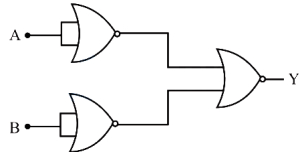
A
$OR$
B
$AND$
C
$NOT$
D
$NAND$
Solution
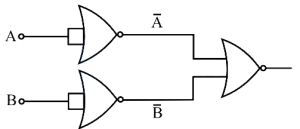
(B) The circuit consists of two $NOT$ gates (formed by $NOR$ gates with shorted inputs) followed by a $NOR$ gate.
$1$. The input $A$ passes through a $NOR$ gate with shorted inputs,which acts as a $NOT$ gate,producing output $\bar{A}$.
$2$. Similarly,the input $B$ passes through a $NOR$ gate with shorted inputs,producing output $\bar{B}$.
$3$. These two outputs $\bar{A}$ and $\bar{B}$ are then fed as inputs to a final $NOR$ gate.
$4$. The output $Y$ of the final $NOR$ gate is given by $Y = \overline{\bar{A} + \bar{B}}$.
$5$. Using De Morgan's theorem,$\overline{\bar{A} + \bar{B}} = \overline{\bar{A}} \cdot \overline{\bar{B}} = A \cdot B$.
$6$. Thus,$Y = A \cdot B$,which is the Boolean expression for an $AND$ gate.
$1$. The input $A$ passes through a $NOR$ gate with shorted inputs,which acts as a $NOT$ gate,producing output $\bar{A}$.
$2$. Similarly,the input $B$ passes through a $NOR$ gate with shorted inputs,producing output $\bar{B}$.
$3$. These two outputs $\bar{A}$ and $\bar{B}$ are then fed as inputs to a final $NOR$ gate.
$4$. The output $Y$ of the final $NOR$ gate is given by $Y = \overline{\bar{A} + \bar{B}}$.
$5$. Using De Morgan's theorem,$\overline{\bar{A} + \bar{B}} = \overline{\bar{A}} \cdot \overline{\bar{B}} = A \cdot B$.
$6$. Thus,$Y = A \cdot B$,which is the Boolean expression for an $AND$ gate.
0 likesView Solution
90
ChemistryMediumMCQTS EAMCET · 2022
Calculate the number of moles of $NaOH$ required to completely neutralize $100 \ g$ of $118\%$ oleum.
A
$2.4$
B
$1.2$
C
$4.8$
D
$8.4$
Solution
(A) The percent labeling of oleum is defined as $100 + x$,where $x$ is the mass of water required to convert all $SO_3$ in $100 \ g$ of oleum into $H_2SO_4$.
For $118\%$ oleum,$x = 18 \ g$ of $H_2O$.
The reaction is $SO_3 + H_2O \rightarrow H_2SO_4$.
Since $18 \ g$ of $H_2O$ is $1 \ mole$,it reacts with $1 \ mole$ of $SO_3$ $(80 \ g)$.
Thus,in $100 \ g$ of oleum,there is $80 \ g$ of $SO_3$ and $20 \ g$ of $H_2SO_4$.
Moles of $SO_3 = \frac{80 \ g}{80 \ g/mol} = 1 \ mol$.
Moles of $H_2SO_4 = \frac{20 \ g}{98 \ g/mol} \approx 0.204 \ mol$.
Neutralization reactions are:
$SO_3 + 2NaOH \rightarrow Na_2SO_4 + H_2O$ (requires $2 \ mol$ $NaOH$ per $mol$ $SO_3$)
$H_2SO_4 + 2NaOH \rightarrow Na_2SO_4 + 2H_2O$ (requires $2 \ mol$ $NaOH$ per $mol$ $H_2SO_4$)
Total $NaOH$ moles $= 2(1) + 2(0.204) = 2 + 0.408 = 2.408 \ mol \approx 2.4 \ mol$.
For $118\%$ oleum,$x = 18 \ g$ of $H_2O$.
The reaction is $SO_3 + H_2O \rightarrow H_2SO_4$.
Since $18 \ g$ of $H_2O$ is $1 \ mole$,it reacts with $1 \ mole$ of $SO_3$ $(80 \ g)$.
Thus,in $100 \ g$ of oleum,there is $80 \ g$ of $SO_3$ and $20 \ g$ of $H_2SO_4$.
Moles of $SO_3 = \frac{80 \ g}{80 \ g/mol} = 1 \ mol$.
Moles of $H_2SO_4 = \frac{20 \ g}{98 \ g/mol} \approx 0.204 \ mol$.
Neutralization reactions are:
$SO_3 + 2NaOH \rightarrow Na_2SO_4 + H_2O$ (requires $2 \ mol$ $NaOH$ per $mol$ $SO_3$)
$H_2SO_4 + 2NaOH \rightarrow Na_2SO_4 + 2H_2O$ (requires $2 \ mol$ $NaOH$ per $mol$ $H_2SO_4$)
Total $NaOH$ moles $= 2(1) + 2(0.204) = 2 + 0.408 = 2.408 \ mol \approx 2.4 \ mol$.
0 likesView Solution
91
ChemistryMediumMCQTS EAMCET · 2022
Combustion of $10 \ mL$ of a gaseous hydrocarbon gives $40 \ mL$ of $CO_2$ and $50 \ mL$ of water vapour under the same conditions. The molecular formula of the hydrocarbon is
A
$C_4H_6$
B
$C_4H_8$
C
$C_3H_4$
D
$C_4H_{10}$
Solution
(D) According to Avogadro's Law,the volume ratio of gases is equal to the mole ratio under the same conditions of temperature and pressure.
Let the hydrocarbon be $C_xH_y$.
The combustion reaction is: $C_xH_y + (x + y/4) O_2 \rightarrow x CO_2 + (y/2) H_2O$.
Given volume ratio: $V(C_xH_y) : V(CO_2) : V(H_2O) = 10 : 40 : 50 = 1 : 4 : 5$.
From the stoichiometry,$x = 4$ (moles of $CO_2$ per mole of hydrocarbon).
Also,$y/2 = 5$,which implies $y = 10$.
Therefore,the molecular formula is $C_4H_{10}$.
Let the hydrocarbon be $C_xH_y$.
The combustion reaction is: $C_xH_y + (x + y/4) O_2 \rightarrow x CO_2 + (y/2) H_2O$.
Given volume ratio: $V(C_xH_y) : V(CO_2) : V(H_2O) = 10 : 40 : 50 = 1 : 4 : 5$.
From the stoichiometry,$x = 4$ (moles of $CO_2$ per mole of hydrocarbon).
Also,$y/2 = 5$,which implies $y = 10$.
Therefore,the molecular formula is $C_4H_{10}$.
0 likesView Solution
92
ChemistryMediumMCQTS EAMCET · 2022
Magnetite can be reduced with $CO$ to yield iron metal and carbon dioxide. Calculate the mass of magnetite (in $kg$) needed to obtain $4 \ kg$ of iron if the process is $80 \%$ efficient. [Atomic weight of $Fe$ and $O$ are $56 \ g$ and $16 \ g$,respectively]
A
$15.5$
B
$5.5$
C
$17$
D
$6.9$
Solution
(D) The balanced chemical equation for the reduction of magnetite $(Fe_3O_4)$ is:
$Fe_3O_4 + 4CO \rightarrow 3Fe + 4CO_2$
Molar mass of $Fe_3O_4 = (3 \times 56) + (4 \times 16) = 168 + 64 = 232 \ g/mol$.
From the stoichiometry,$232 \ g$ of $Fe_3O_4$ produces $3 \times 56 = 168 \ g$ of $Fe$ at $100 \%$ efficiency.
Given the process is $80 \%$ efficient,the actual yield of $Fe$ from $232 \ g$ of $Fe_3O_4$ is $168 \times 0.8 = 134.4 \ g$.
To obtain $4 \ kg$ $(4000 \ g)$ of $Fe$,the mass of $Fe_3O_4$ required is:
$\text{Mass} = \frac{232 \times 4000}{134.4} \approx 6904.76 \ g \approx 6.9 \ kg$.
$Fe_3O_4 + 4CO \rightarrow 3Fe + 4CO_2$
Molar mass of $Fe_3O_4 = (3 \times 56) + (4 \times 16) = 168 + 64 = 232 \ g/mol$.
From the stoichiometry,$232 \ g$ of $Fe_3O_4$ produces $3 \times 56 = 168 \ g$ of $Fe$ at $100 \%$ efficiency.
Given the process is $80 \%$ efficient,the actual yield of $Fe$ from $232 \ g$ of $Fe_3O_4$ is $168 \times 0.8 = 134.4 \ g$.
To obtain $4 \ kg$ $(4000 \ g)$ of $Fe$,the mass of $Fe_3O_4$ required is:
$\text{Mass} = \frac{232 \times 4000}{134.4} \approx 6904.76 \ g \approx 6.9 \ kg$.
0 likesView Solution
93
ChemistryMediumMCQTS EAMCET · 2022
The amount of $50\% \ (w/w)$ solution of hydrochloric acid required to react with $200 \ g$ of $CaCO_3$ would be (in $g$)
A
$73$
B
$292$
C
$146$
D
$100$
Solution
(B) The balanced chemical equation is:
$CaCO_3 + 2HCl \rightarrow CaCl_2 + CO_2 + H_2O$
Molar mass of $CaCO_3 = 40 + 12 + (3 \times 16) = 100 \ g/mol$.
Moles of $CaCO_3 = \frac{200 \ g}{100 \ g/mol} = 2 \ mol$.
According to the stoichiometry,$1 \ mol$ of $CaCO_3$ reacts with $2 \ mol$ of $HCl$.
Therefore,$2 \ mol$ of $CaCO_3$ requires $4 \ mol$ of $HCl$.
Molar mass of $HCl = 1 + 35.5 = 36.5 \ g/mol$.
Mass of pure $HCl$ required $= 4 \ mol \times 36.5 \ g/mol = 146 \ g$.
Given that the solution is $50\% \ (w/w)$,it means $50 \ g$ of $HCl$ is present in $100 \ g$ of solution.
Mass of solution $= \frac{146 \ g}{0.50} = 292 \ g$.
$CaCO_3 + 2HCl \rightarrow CaCl_2 + CO_2 + H_2O$
Molar mass of $CaCO_3 = 40 + 12 + (3 \times 16) = 100 \ g/mol$.
Moles of $CaCO_3 = \frac{200 \ g}{100 \ g/mol} = 2 \ mol$.
According to the stoichiometry,$1 \ mol$ of $CaCO_3$ reacts with $2 \ mol$ of $HCl$.
Therefore,$2 \ mol$ of $CaCO_3$ requires $4 \ mol$ of $HCl$.
Molar mass of $HCl = 1 + 35.5 = 36.5 \ g/mol$.
Mass of pure $HCl$ required $= 4 \ mol \times 36.5 \ g/mol = 146 \ g$.
Given that the solution is $50\% \ (w/w)$,it means $50 \ g$ of $HCl$ is present in $100 \ g$ of solution.
Mass of solution $= \frac{146 \ g}{0.50} = 292 \ g$.
0 likesView Solution
94
ChemistryEasyMCQTS EAMCET · 2022
The average molecular weight of the air which has $21 \%$ of $O_2$ and $79 \%$ of $N_2$,is
A
$44.8$
B
$100$
C
$14.4$
D
$28.8$
Solution
(D) The average molecular weight is calculated by taking the weighted average of the molar masses of the components based on their volume percentages.
Average molecular weight $= (\% \text{ of } O_2 \times \text{Molar mass of } O_2) + (\% \text{ of } N_2 \times \text{Molar mass of } N_2)$
Average molecular weight $= (\frac{21}{100} \times 32) + (\frac{79}{100} \times 28)$
Average molecular weight $= 6.72 + 22.12 = 28.8 \text{ g/mol}$
Average molecular weight $= (\% \text{ of } O_2 \times \text{Molar mass of } O_2) + (\% \text{ of } N_2 \times \text{Molar mass of } N_2)$
Average molecular weight $= (\frac{21}{100} \times 32) + (\frac{79}{100} \times 28)$
Average molecular weight $= 6.72 + 22.12 = 28.8 \text{ g/mol}$
0 likesView Solution
95
ChemistryEasyMCQTS EAMCET · 2022
The number of significant figures in $2.0400$ is
A
$3$
B
$2$
C
$4$
D
$5$
Solution
(D) According to the rules for significant figures:
$1$. All non-zero digits are significant.
$2$. Trailing zeros in a number containing a decimal point are significant.
In the number $2.0400$,the digits $2, 0, 4, 0, 0$ are all significant.
Therefore,the total number of significant figures is $5$.
$1$. All non-zero digits are significant.
$2$. Trailing zeros in a number containing a decimal point are significant.
In the number $2.0400$,the digits $2, 0, 4, 0, 0$ are all significant.
Therefore,the total number of significant figures is $5$.
0 likesView Solution
96
ChemistryEasyMCQTS EAMCET · 2022
Round the number $234555359$ to $3$ significant figures.
A
$234000000$
B
$234000$
C
$235000000$
D
$234500000$
Solution
(C) To round $234555359$ to $3$ significant figures,we look at the first three digits: $2, 3, 4$.
The next digit is $5$.
According to the rules of rounding,if the digit following the last significant figure is $5$ followed by non-zero digits,we round up.
Therefore,$234555359$ rounded to $3$ significant figures is $235000000$.
The next digit is $5$.
According to the rules of rounding,if the digit following the last significant figure is $5$ followed by non-zero digits,we round up.
Therefore,$234555359$ rounded to $3$ significant figures is $235000000$.
0 likesView Solution
97
ChemistryMediumMCQTS EAMCET · 2022
$1 \ L$ closed flask contains a mixture of $4 \ g$ of methane and $4.4 \ g$ of carbon dioxide. The pressure inside the flask at $27^{\circ} C$ is [Assume ideal behaviour of gases] (in $atm$)
A
$8.6$
B
$2.2$
C
$4.2$
D
$6.1$
Solution
(A) Step $1$: Calculate the number of moles of each gas.
$n_{CH_4} = \frac{4 \ g}{16 \ g/mol} = 0.25 \ mol$
$n_{CO_2} = \frac{4.4 \ g}{44 \ g/mol} = 0.1 \ mol$
Step $2$: Calculate the total number of moles $(n_T)$.
$n_T = 0.25 \ mol + 0.1 \ mol = 0.35 \ mol$
Step $3$: Use the ideal gas equation $PV = nRT$ to find the pressure.
Given: $V = 1 \ L$,$T = 27 + 273 = 300 \ K$,$R = 0.082 \ L \ atm \ K^{-1} \ mol^{-1}$.
$P = \frac{n_T RT}{V} = \frac{0.35 \times 0.082 \times 300}{1} = 8.61 \ atm \approx 8.6 \ atm$.
$n_{CH_4} = \frac{4 \ g}{16 \ g/mol} = 0.25 \ mol$
$n_{CO_2} = \frac{4.4 \ g}{44 \ g/mol} = 0.1 \ mol$
Step $2$: Calculate the total number of moles $(n_T)$.
$n_T = 0.25 \ mol + 0.1 \ mol = 0.35 \ mol$
Step $3$: Use the ideal gas equation $PV = nRT$ to find the pressure.
Given: $V = 1 \ L$,$T = 27 + 273 = 300 \ K$,$R = 0.082 \ L \ atm \ K^{-1} \ mol^{-1}$.
$P = \frac{n_T RT}{V} = \frac{0.35 \times 0.082 \times 300}{1} = 8.61 \ atm \approx 8.6 \ atm$.
0 likesView Solution
98
ChemistryDifficultMCQTS EAMCET · 2022
$A$ gaseous mixture of $2$ moles of $A$,$3$ moles of $B$,$5$ moles of $C$,and $10$ moles of $D$ is contained in a vessel. Assuming that gases are ideal and the partial pressure of $C$ is $1.5 \ atm$,what is the total pressure (in $atm$)?
A
$3$
B
$6$
C
$10$
D
$15$
Solution
(B) According to Dalton's Law of Partial Pressures,the partial pressure of a gas is given by the product of its mole fraction and the total pressure of the mixture.
$P_C = \chi_C \times P_{\text{total}}$
Where $\chi_C$ is the mole fraction of gas $C$.
Total moles of gas $= 2 + 3 + 5 + 10 = 20 \ \text{moles}$.
Moles of $C = 5 \ \text{moles}$.
Mole fraction of $C$ $(\chi_C)$ $= \frac{5}{20} = 0.25$.
Given $P_C = 1.5 \ atm$.
$1.5 = 0.25 \times P_{\text{total}}$.
$P_{\text{total}} = \frac{1.5}{0.25} = 6 \ atm$.
$P_C = \chi_C \times P_{\text{total}}$
Where $\chi_C$ is the mole fraction of gas $C$.
Total moles of gas $= 2 + 3 + 5 + 10 = 20 \ \text{moles}$.
Moles of $C = 5 \ \text{moles}$.
Mole fraction of $C$ $(\chi_C)$ $= \frac{5}{20} = 0.25$.
Given $P_C = 1.5 \ atm$.
$1.5 = 0.25 \times P_{\text{total}}$.
$P_{\text{total}} = \frac{1.5}{0.25} = 6 \ atm$.
0 likesView Solution
99
ChemistryMediumMCQTS EAMCET · 2022
The rate of diffusion of methane at $1.0 \ atm$ pressure is twice that of another gas '$X$' kept at $1.45 \ atm$. The molecular weight of the gas '$X$' is
[$T$ kept constant]
[$T$ kept constant]
A
$44$
B
$32$
C
$28$
D
$21$
Solution
(A) According to Graham's law of diffusion,the rate of diffusion $(r)$ is inversely proportional to the square root of the density $(\rho)$ of the gas: $r \propto \frac{1}{\sqrt{\rho}}$.
From the ideal gas equation,$PV = nRT = \frac{m}{MW} RT$,where $m$ is the mass and $MW$ is the molecular weight.
Rearranging gives $\frac{m}{V} = \rho = \frac{P \times MW}{RT}$.
Since $T$ is constant,$\rho \propto P \times MW$.
Therefore,the rate of diffusion is given by $r \propto \frac{1}{\sqrt{P \times MW}}$.
For two gases,$\frac{r_{CH_4}}{r_X} = \sqrt{\frac{P_X \times (MW)_X}{P_{CH_4} \times (MW)_{CH_4}}}$.
Given $r_{CH_4} = 2r_X$,$P_{CH_4} = 1.0 \ atm$,$P_X = 1.45 \ atm$,and $(MW)_{CH_4} = 16 \ g/mol$:
$2 = \sqrt{\frac{1.45 \times (MW)_X}{1.0 \times 16}}$.
Squaring both sides: $4 = \frac{1.45 \times (MW)_X}{16}$.
$(MW)_X = \frac{4 \times 16}{1.45} = \frac{64}{1.45} \approx 44.13 \approx 44$.
From the ideal gas equation,$PV = nRT = \frac{m}{MW} RT$,where $m$ is the mass and $MW$ is the molecular weight.
Rearranging gives $\frac{m}{V} = \rho = \frac{P \times MW}{RT}$.
Since $T$ is constant,$\rho \propto P \times MW$.
Therefore,the rate of diffusion is given by $r \propto \frac{1}{\sqrt{P \times MW}}$.
For two gases,$\frac{r_{CH_4}}{r_X} = \sqrt{\frac{P_X \times (MW)_X}{P_{CH_4} \times (MW)_{CH_4}}}$.
Given $r_{CH_4} = 2r_X$,$P_{CH_4} = 1.0 \ atm$,$P_X = 1.45 \ atm$,and $(MW)_{CH_4} = 16 \ g/mol$:
$2 = \sqrt{\frac{1.45 \times (MW)_X}{1.0 \times 16}}$.
Squaring both sides: $4 = \frac{1.45 \times (MW)_X}{16}$.
$(MW)_X = \frac{4 \times 16}{1.45} = \frac{64}{1.45} \approx 44.13 \approx 44$.
0 likesView Solution
100
ChemistryMediumMCQTS EAMCET · 2022
According to the kinetic molecular theory of gases,which of the following statements are correct?
$a$) The actual volume of the molecules is negligible in comparison to the empty space between them.
$b$) Collisions of gas molecules are inelastic.
$c$) At any particular time,different particles in the gas have the same speed and same kinetic energies.
$d$) Pressure is exerted by the gas as a result of the collision of the particles with the walls of the container.
$a$) The actual volume of the molecules is negligible in comparison to the empty space between them.
$b$) Collisions of gas molecules are inelastic.
$c$) At any particular time,different particles in the gas have the same speed and same kinetic energies.
$d$) Pressure is exerted by the gas as a result of the collision of the particles with the walls of the container.
A
$a$ and $b$ only
B
$a, b$ and $c$ only
C
$a$ and $d$ only
D
$a, b, c$ and $d$
Solution
(C) According to the kinetic molecular theory of gases:
$a$) The actual volume of the molecules is negligible in comparison to the empty space between them. This means the particle size is considered a point mass.
$b$) Collisions of gas molecules are perfectly elastic,not inelastic. Thus,statement $b$ is incorrect.
$c$) At any particular time,different particles in the gas have different speeds and different kinetic energies. Only the average kinetic energy is constant at a given temperature. Thus,statement $c$ is incorrect.
$d$) Pressure is exerted by the gas as a result of the collision of the particles with the walls of the container. This is a correct statement.
Therefore,statements $a$ and $d$ are correct.
$a$) The actual volume of the molecules is negligible in comparison to the empty space between them. This means the particle size is considered a point mass.
$b$) Collisions of gas molecules are perfectly elastic,not inelastic. Thus,statement $b$ is incorrect.
$c$) At any particular time,different particles in the gas have different speeds and different kinetic energies. Only the average kinetic energy is constant at a given temperature. Thus,statement $c$ is incorrect.
$d$) Pressure is exerted by the gas as a result of the collision of the particles with the walls of the container. This is a correct statement.
Therefore,statements $a$ and $d$ are correct.
0 likesView Solution
101
ChemistryMediumMCQTS EAMCET · 2022
The reaction $2A \rightarrow 2B + C$ has a rate constant of $1.2 \times 10^{-2} \ s^{-1}$. Which of the following is correct?
A
Plot of $[A]$ vs $\frac{1}{t}$ will be a straight line
B
Plot of $\frac{1}{[A]}$ vs $t^2$ will be a straight line
C
Plot of $\ln [A]$ vs $t$ will be a straight line
D
Plot of $[A]$ vs $t^2$ will be a straight line
Solution
(C) The unit of the rate constant $k$ is $s^{-1}$,which indicates that the reaction is a $1^{st}$ order reaction.
For a $1^{st}$ order reaction,the integrated rate equation is given by $\ln [A] = \ln [A]_0 - kt$.
Comparing this with the equation of a straight line $y = mx + c$,where $y = \ln [A]$,$x = t$,$m = -k$ (slope),and $c = \ln [A]_0$ (intercept).
Therefore,a plot of $\ln [A]$ versus $t$ will be a straight line with a negative slope equal to $-k$.
For a $1^{st}$ order reaction,the integrated rate equation is given by $\ln [A] = \ln [A]_0 - kt$.
Comparing this with the equation of a straight line $y = mx + c$,where $y = \ln [A]$,$x = t$,$m = -k$ (slope),and $c = \ln [A]_0$ (intercept).
Therefore,a plot of $\ln [A]$ versus $t$ will be a straight line with a negative slope equal to $-k$.
0 likesView Solution
102
ChemistryEasyMCQTS EAMCET · 2022
Which of the following is a zero order reaction?
A
$2 \ HI \rightarrow H_2 + I_2$
B
$H_2 + Br_2 \xrightarrow{\Delta} 2 \ HBr$
C
$2 \ N_2O_5 \rightarrow 4 \ NO_2 + O_2$
D
$H_2 + Cl_2 \xrightarrow{hv} 2 \ HCl$
Solution
(D) The reaction $H_2 + Cl_2 \xrightarrow{hv} 2 \ HCl$ is a photochemical reaction.
Photochemical reactions involving the absorption of light are typically zero order reactions because the rate depends on the intensity of light absorbed rather than the concentration of the reactants.
Photochemical reactions involving the absorption of light are typically zero order reactions because the rate depends on the intensity of light absorbed rather than the concentration of the reactants.
0 likesView Solution
103
ChemistryDifficultMCQTS EAMCET · 2022
If the definition of the temperature coefficient of the reaction holds good for a reaction between $27^{\circ} C$ and $37^{\circ} C$,the activation energy for the reaction in $kJ \cdot mol^{-1}$ is
A
$102$
B
$53.5$
C
$\infty$
D
$141.5$
Solution
(B) Given,$T_1 = 27 + 273 = 300 \ K$ and $T_2 = 37 + 273 = 310 \ K$.
The temperature coefficient of a reaction is defined as the ratio of rate constants at temperatures differing by $10 \ K$,which is typically $2$.
Let $K_1 = k$ and $K_2 = 2k$.
Using the Arrhenius equation: $\log \frac{K_2}{K_1} = \frac{E_a}{2.303 \ R} \left( \frac{T_2 - T_1}{T_1 \ T_2} \right)$.
Substituting the values: $\log 2 = \frac{E_a}{2.303 \times 8.314 \times 10^{-3}} \times \left( \frac{310 - 300}{310 \times 300} \right)$.
$0.3010 = \frac{E_a}{0.019147} \times \frac{10}{93000}$.
$E_a = \frac{0.3010 \times 0.019147 \times 93000}{10} \approx 53.5 \ kJ \cdot mol^{-1}$.
The temperature coefficient of a reaction is defined as the ratio of rate constants at temperatures differing by $10 \ K$,which is typically $2$.
Let $K_1 = k$ and $K_2 = 2k$.
Using the Arrhenius equation: $\log \frac{K_2}{K_1} = \frac{E_a}{2.303 \ R} \left( \frac{T_2 - T_1}{T_1 \ T_2} \right)$.
Substituting the values: $\log 2 = \frac{E_a}{2.303 \times 8.314 \times 10^{-3}} \times \left( \frac{310 - 300}{310 \times 300} \right)$.
$0.3010 = \frac{E_a}{0.019147} \times \frac{10}{93000}$.
$E_a = \frac{0.3010 \times 0.019147 \times 93000}{10} \approx 53.5 \ kJ \cdot mol^{-1}$.
0 likesView Solution
104
ChemistryDifficultMCQTS EAMCET · 2022
The rate constant of a reaction is increased $4$ times after the addition of a catalyst to the reaction mixture at the same temperature of $27^{\circ} C$. The change in the activation energy of this reaction is (Take $\ln(1/4) = -1.386, R = 8.314 \ J \ K^{-1} \ mol^{-1}$)
A
$-15 \ kJ / mol$
B
$-1.5 \ kJ / mol$
C
$-3.45 \ kJ / mol$
D
$-34.5 \ kJ / mol$
Solution
(C) According to the Arrhenius equation,$k = Ae^{-E_a / RT}$.
Let $E_{a_1}$ be the initial activation energy and $E_{a_2}$ be the activation energy after adding the catalyst.
$k_1 = Ae^{-E_{a_1} / RT} \dots (1)$
$k_2 = 4k_1 = Ae^{-E_{a_2} / RT} \dots (2)$
Dividing $(2)$ by $(1)$:
$4 = e^{(E_{a_1} - E_{a_2}) / RT}$
Taking natural logarithm on both sides:
$\ln 4 = \frac{E_{a_1} - E_{a_2}}{RT}$
$E_{a_2} - E_{a_1} = -RT \ln 4$
Given $T = 27 + 273 = 300 \ K$ and $\ln 4 = 1.386$.
$\Delta E_a = E_{a_2} - E_{a_1} = -(8.314 \ J \ K^{-1} \ mol^{-1} \times 300 \ K \times 1.386)$
$\Delta E_a = -3457.3 \ J / mol \approx -3.45 \ kJ / mol$.
Let $E_{a_1}$ be the initial activation energy and $E_{a_2}$ be the activation energy after adding the catalyst.
$k_1 = Ae^{-E_{a_1} / RT} \dots (1)$
$k_2 = 4k_1 = Ae^{-E_{a_2} / RT} \dots (2)$
Dividing $(2)$ by $(1)$:
$4 = e^{(E_{a_1} - E_{a_2}) / RT}$
Taking natural logarithm on both sides:
$\ln 4 = \frac{E_{a_1} - E_{a_2}}{RT}$
$E_{a_2} - E_{a_1} = -RT \ln 4$
Given $T = 27 + 273 = 300 \ K$ and $\ln 4 = 1.386$.
$\Delta E_a = E_{a_2} - E_{a_1} = -(8.314 \ J \ K^{-1} \ mol^{-1} \times 300 \ K \times 1.386)$
$\Delta E_a = -3457.3 \ J / mol \approx -3.45 \ kJ / mol$.
0 likesView Solution
105
ChemistryEasyMCQTS EAMCET · 2022
For a reaction,the threshold energy is $75 \ kJ/mol$. If the internal energy of the reactants is $20 \ kJ/mol$,the activation energy (in $kJ/mol$) is
A
$55$
B
$20$
C
$75$
D
$95$
Solution
(A) The relationship between threshold energy $(E_T)$,activation energy $(E_a)$,and the energy of reactants $(E_R)$ is given by the formula:
$E_T = E_a + E_R$
Given:
$E_T = 75 \ kJ/mol$
$E_R = 20 \ kJ/mol$
Substituting the values:
$75 = E_a + 20$
$E_a = 75 - 20 = 55 \ kJ/mol$
Therefore,the activation energy is $55 \ kJ/mol$.
$E_T = E_a + E_R$
Given:
$E_T = 75 \ kJ/mol$
$E_R = 20 \ kJ/mol$
Substituting the values:
$75 = E_a + 20$
$E_a = 75 - 20 = 55 \ kJ/mol$
Therefore,the activation energy is $55 \ kJ/mol$.
0 likesView Solution
106
ChemistryEasyMCQTS EAMCET · 2022
Group $16$ elements are also called:
A
Pnicogens
B
Picogens
C
Halogens
D
Chalcogens
Solution
(D) Group $16$ elements are known as chalcogens because they are ore-forming elements.
0 likesView Solution
107
ChemistryDifficultMCQTS EAMCET · 2022
Among the given complexes that possess $CO$ ligand bridges are:
$\underset{I}{[Co_2(CO)_8]} \quad \underset{II}{[Fe_3(CO)_{12}]} \quad \underset{III}{[Mn_2(CO)_{10}]} \quad \underset{IV}{[Fe_2(CO)_9]}$
$\underset{I}{[Co_2(CO)_8]} \quad \underset{II}{[Fe_3(CO)_{12}]} \quad \underset{III}{[Mn_2(CO)_{10}]} \quad \underset{IV}{[Fe_2(CO)_9]}$
A
$I, II \& III$
B
$II, III \& IV$
C
$I, II \& IV$
D
$I, III \& IV$
Solution
(C) The structures of the given metal carbonyls are as follows:
$I. [Co_2(CO)_8]$: It exists in a bridged form in the solid state,containing two $CO$ bridges.
$II. [Fe_3(CO)_{12}]$: It contains two $CO$ bridges in its structure.
$III. [Mn_2(CO)_{10}]$: It has a direct $Mn-Mn$ bond and no $CO$ bridges.
$IV. [Fe_2(CO)_9]$: It contains three $CO$ bridges.
Thus,the complexes with $CO$ bridges are $I, II,$ and $IV$.
$I. [Co_2(CO)_8]$: It exists in a bridged form in the solid state,containing two $CO$ bridges.
$II. [Fe_3(CO)_{12}]$: It contains two $CO$ bridges in its structure.
$III. [Mn_2(CO)_{10}]$: It has a direct $Mn-Mn$ bond and no $CO$ bridges.
$IV. [Fe_2(CO)_9]$: It contains three $CO$ bridges.
Thus,the complexes with $CO$ bridges are $I, II,$ and $IV$.
0 likesView Solution
108
ChemistryMediumMCQTS EAMCET · 2022
The pair in which both the species have the same magnetic moment (spin only) is
A
$[CoCl_4]^{2-}, [Fe(H_2O)_6]^{2+}$
B
$[Mn(H_2O)_6]^{2+}, [Cr(H_2O)_6]^{2+}$
C
$[Cr(H_2O)_6]^{2+}, [Fe(H_2O)_6]^{2+}$
D
$[Cr(H_2O)_6]^{2+}, [CoCl_4]^{2-}$
Solution
(C) The magnetic moment (spin only) is given by $\mu = \sqrt{n(n+2)} \text{ BM}$,where $n$ is the number of unpaired electrons.
$1. [CoCl_4]^{2-}: Co^{2+} (d^7)$ is a tetrahedral complex. The configuration is $e^4 t_2^3$,so $n = 3$.
$2. [Fe(H_2O)_6]^{2+}: Fe^{2+} (d^6)$ is an octahedral complex. The configuration is $t_{2g}^4 e_g^2$,so $n = 4$.
$3. [Mn(H_2O)_6]^{2+}: Mn^{2+} (d^5)$ is an octahedral complex. The configuration is $t_{2g}^3 e_g^2$,so $n = 5$.
$4. [Cr(H_2O)_6]^{2+}: Cr^{2+} (d^4)$ is an octahedral complex. The configuration is $t_{2g}^3 e_g^1$,so $n = 4$.
Comparing the number of unpaired electrons,both $[Fe(H_2O)_6]^{2+}$ and $[Cr(H_2O)_6]^{2+}$ have $n = 4$,thus they have the same magnetic moment.
$1. [CoCl_4]^{2-}: Co^{2+} (d^7)$ is a tetrahedral complex. The configuration is $e^4 t_2^3$,so $n = 3$.
$2. [Fe(H_2O)_6]^{2+}: Fe^{2+} (d^6)$ is an octahedral complex. The configuration is $t_{2g}^4 e_g^2$,so $n = 4$.
$3. [Mn(H_2O)_6]^{2+}: Mn^{2+} (d^5)$ is an octahedral complex. The configuration is $t_{2g}^3 e_g^2$,so $n = 5$.
$4. [Cr(H_2O)_6]^{2+}: Cr^{2+} (d^4)$ is an octahedral complex. The configuration is $t_{2g}^3 e_g^1$,so $n = 4$.
Comparing the number of unpaired electrons,both $[Fe(H_2O)_6]^{2+}$ and $[Cr(H_2O)_6]^{2+}$ have $n = 4$,thus they have the same magnetic moment.
0 likesView Solution
109
ChemistryEasyMCQTS EAMCET · 2022
The secondary valences (coordination numbers) of the following complexes based on their reactions with excess $AgNO_3$ are:
Find the secondary valences for $(I), (II),$ and $(III)$ respectively.
| Formula of the complexes | Moles of $AgCl$ precipitated per mole of complex |
|---|---|
| $(I) \ CoCl_3 \cdot 6 H_2O$ | $3$ |
| $(II) \ NiCl_3 \cdot 6 H_2O$ | $2$ |
| $(III) \ Co(SO_4)Br \cdot 5 NH_3$ | $1$ |
Find the secondary valences for $(I), (II),$ and $(III)$ respectively.
A
$4 \ 6 \ 6$
B
$6 \ 4 \ 4$
C
$6 \ 4 \ 6$
D
$6 \ 6 \ 6$
Solution
(D) The secondary valence of a metal complex is equal to its coordination number ($C$.$N$.),which is the total number of ligand donor atoms directly bonded to the central metal ion.
$1$. For $(I) \ CoCl_3 \cdot 6 H_2O$:
Since $3$ moles of $AgCl$ are precipitated,all $3$ $Cl^-$ ions are outside the coordination sphere. The formula is $[Co(H_2O)_6]Cl_3$. The coordination number is $6$ (six $H_2O$ ligands).
$2$. For $(II) \ NiCl_3 \cdot 6 H_2O$:
Since $2$ moles of $AgCl$ are precipitated,$2$ $Cl^-$ ions are outside the coordination sphere. The formula is $[Ni(H_2O)_5Cl]Cl_2 \cdot H_2O$. The coordination number is $6$ (five $H_2O$ and one $Cl^-$ ligand).
$3$. For $(III) \ Co(SO_4)Br \cdot 5 NH_3$:
Since $1$ mole of $AgBr$ is precipitated,the $Br^-$ ion is outside the coordination sphere. The formula is $[Co(NH_3)_5(SO_4)]Br$. The coordination number is $6$ (five $NH_3$ and one $SO_4^{2-}$ ligand).
Thus,the secondary valences for $(I), (II),$ and $(III)$ are $6, 6, 6$ respectively.
$1$. For $(I) \ CoCl_3 \cdot 6 H_2O$:
Since $3$ moles of $AgCl$ are precipitated,all $3$ $Cl^-$ ions are outside the coordination sphere. The formula is $[Co(H_2O)_6]Cl_3$. The coordination number is $6$ (six $H_2O$ ligands).
$2$. For $(II) \ NiCl_3 \cdot 6 H_2O$:
Since $2$ moles of $AgCl$ are precipitated,$2$ $Cl^-$ ions are outside the coordination sphere. The formula is $[Ni(H_2O)_5Cl]Cl_2 \cdot H_2O$. The coordination number is $6$ (five $H_2O$ and one $Cl^-$ ligand).
$3$. For $(III) \ Co(SO_4)Br \cdot 5 NH_3$:
Since $1$ mole of $AgBr$ is precipitated,the $Br^-$ ion is outside the coordination sphere. The formula is $[Co(NH_3)_5(SO_4)]Br$. The coordination number is $6$ (five $NH_3$ and one $SO_4^{2-}$ ligand).
Thus,the secondary valences for $(I), (II),$ and $(III)$ are $6, 6, 6$ respectively.
0 likesView Solution
110
ChemistryMediumMCQTS EAMCET · 2022
The correct order of decreasing field strength of the below given ligands is
| $I$. $NCS^{-}$ | $II$. $S^{2-}$ |
| $III$. $en$ | $IV$. $SCN^{-}$ |
A
$I > II > IV > III$
B
$III > II > IV > I$
C
$III > I > IV > II$
D
$III > IV > I > II$
Solution
(C) The crystal field splitting,$\Delta_0$,depends upon the field produced by the ligand and the charge on the metal ion. Ligands are arranged in a spectrochemical series based on their field strength. The order of increasing field strength is:
$I^{-} < Br^{-} < SCN^{-} < Cl^{-} < S^{2-} < F^{-} < OH^{-} < C_2O_4^{2-} < H_2O < NCS^{-} < edta^{4-} < NH_3 < en < CN^{-} < CO$
Comparing the given ligands:
$III$ $(en)$ is a strong field ligand.
$I$ $(NCS^{-})$ is stronger than $IV$ $(SCN^{-})$.
$II$ $(S^{2-})$ is a weak field ligand.
Thus,the decreasing order of field strength is $III > I > IV > II$.
$I^{-} < Br^{-} < SCN^{-} < Cl^{-} < S^{2-} < F^{-} < OH^{-} < C_2O_4^{2-} < H_2O < NCS^{-} < edta^{4-} < NH_3 < en < CN^{-} < CO$
Comparing the given ligands:
$III$ $(en)$ is a strong field ligand.
$I$ $(NCS^{-})$ is stronger than $IV$ $(SCN^{-})$.
$II$ $(S^{2-})$ is a weak field ligand.
Thus,the decreasing order of field strength is $III > I > IV > II$.
0 likesView Solution
111
ChemistryMediumMCQTS EAMCET · 2022
$A$ metal complex absorbed orange light. The colour in which it appears is
A
yellow
B
yellow-green
C
red
D
blue
Solution
(D) According to the colour wheel,the colour observed is the complementary colour of the light absorbed.
When a metal complex absorbs orange light,it appears in its complementary colour,which is blue.
When a metal complex absorbs orange light,it appears in its complementary colour,which is blue.
0 likesView Solution
112
ChemistryMediumMCQTS EAMCET · 2022
Assertion: In general,transition metals have high melting points.
Reason: More number of electrons from $(n-1)d$ and $ns$ are involved in interatomic metallic bonding.
The correct option among the following is
Reason: More number of electrons from $(n-1)d$ and $ns$ are involved in interatomic metallic bonding.
The correct option among the following is
A
Assertion is true,Reason is true and Reason is the correct explanation for Assertion
B
Assertion is true,Reason is true but Reason is not the correct explanation for Assertion
C
Assertion is true but Reason is false
D
Assertion is false but Reason is true
Solution
(A) The transition metals (with the exception of $Zn$,$Cd$,and $Hg$) are very hard and have low volatility.
Their melting and boiling points are high.
The high melting points of these metals are attributed to the involvement of a greater number of electrons from $(n-1)d$ orbitals in addition to the $ns$ electrons in the interatomic metallic bonding.
Since more electrons participate in metallic bonding,the strength of the metallic bond increases,leading to higher melting points.
Thus,the Assertion is true and the Reason is the correct explanation for the Assertion.
Their melting and boiling points are high.
The high melting points of these metals are attributed to the involvement of a greater number of electrons from $(n-1)d$ orbitals in addition to the $ns$ electrons in the interatomic metallic bonding.
Since more electrons participate in metallic bonding,the strength of the metallic bond increases,leading to higher melting points.
Thus,the Assertion is true and the Reason is the correct explanation for the Assertion.
0 likesView Solution
113
ChemistryEasyMCQTS EAMCET · 2022
The correct order of ionic radii of trivalent ions $Y^{3+}$,$La^{3+}$,$Eu^{3+}$,and $Lu^{3+}$ is $(Y=39, La=57, Eu=63, Lu=71)$.
A
$Lu^{3+} < Eu^{3+} < La^{3+} < Y^{3+}$
B
$La^{3+} < Eu^{3+} < Lu^{3+} < Y^{3+}$
C
$Y^{3+} < Lu^{3+} < Eu^{3+} < La^{3+}$
D
$Y^{3+} < La^{3+} < Eu^{3+} < Lu^{3+}$
Solution
(C) The ionic radii of trivalent lanthanide ions ($La^{3+}$ to $Lu^{3+}$) decrease due to lanthanide contraction.
$La^{3+}$ $(Z=57)$ has the largest radius,while $Lu^{3+}$ $(Z=71)$ has the smallest radius among the lanthanides.
$Y^{3+}$ $(Z=39)$ is a $4d$ transition metal ion and is significantly smaller than the $4f$ lanthanide ions.
Therefore,the order of ionic radii is $Y^{3+} < Lu^{3+} < Eu^{3+} < La^{3+}$.
$La^{3+}$ $(Z=57)$ has the largest radius,while $Lu^{3+}$ $(Z=71)$ has the smallest radius among the lanthanides.
$Y^{3+}$ $(Z=39)$ is a $4d$ transition metal ion and is significantly smaller than the $4f$ lanthanide ions.
Therefore,the order of ionic radii is $Y^{3+} < Lu^{3+} < Eu^{3+} < La^{3+}$.
0 likesView Solution
114
ChemistryEasyMCQTS EAMCET · 2022
The elements with full $d^{10}$ electronic configuration in their $+2$ oxidation state are
A
$Cu, Ni, Zn$
B
$Ni, Au, Cd$
C
$Au, Hg, Pd$
D
$Zn, Cd, Hg$
Solution
(D) The general electronic configuration of group $12$ elements is $(n-1)d^{10} ns^2$.
When these elements form $+2$ oxidation state ions,they lose two electrons from the $ns$ orbital.
Therefore,the electronic configuration of $Zn^{2+}$,$Cd^{2+}$,and $Hg^{2+}$ becomes $(n-1)d^{10} ns^0$,which represents a fully filled $d$-subshell.
When these elements form $+2$ oxidation state ions,they lose two electrons from the $ns$ orbital.
Therefore,the electronic configuration of $Zn^{2+}$,$Cd^{2+}$,and $Hg^{2+}$ becomes $(n-1)d^{10} ns^0$,which represents a fully filled $d$-subshell.
0 likesView Solution
115
ChemistryEasyMCQTS EAMCET · 2022
Choose the correct statement. $Fe^{3+}$ ion is more stable than $Fe^{2+}$ ion because
A
More the charge on the atom,more is its stability
B
Configuration of $Fe^{2+}$ is $3d^6$ while $Fe^{3+}$ is $3d^5$
C
$Fe^{2+}$ has a larger size than that of $Fe^{3+}$
D
$Fe^{3+}$ ions are coloured
Solution
(B) The electronic configuration of $Fe^{2+}$ is $[Ar] 3d^6$ and that of $Fe^{3+}$ is $[Ar] 3d^5$.
In $Fe^{3+}$,the $d$-orbital is exactly half-filled $(d^5)$.
According to Hund's rule,half-filled and fully-filled orbitals possess extra stability due to maximum exchange energy and symmetrical distribution of electrons.
Therefore,$Fe^{3+}$ is more stable than $Fe^{2+}$.
In $Fe^{3+}$,the $d$-orbital is exactly half-filled $(d^5)$.
According to Hund's rule,half-filled and fully-filled orbitals possess extra stability due to maximum exchange energy and symmetrical distribution of electrons.
Therefore,$Fe^{3+}$ is more stable than $Fe^{2+}$.
0 likesView Solution
116
ChemistryMediumMCQTS EAMCET · 2022
Match the following Column-$I$ (Reaction) with Column-$II$ (colour of the product or nature):
The correct answer for the sequence $(A, B)$ is:
| Column-$I$ (Reaction) | Column-$II$ (colour of the product or nature) |
| $(A)$ $FeCl_3(aq) + NH_3(aq) \rightarrow$ | $(I)$ Green ppt |
| $(B)$ $AgCl(aq) + NH_3(aq) \rightarrow$ | $(II)$ Deep blue |
| $(III)$ Brown ppt | |
| $(IV)$ Colourless solution |
The correct answer for the sequence $(A, B)$ is:
A
$I, II$
B
$I, III$
C
$III, IV$
D
$III, I$
Solution
(C) The reaction of $FeCl_3$ with $NH_3$ produces $Fe(OH)_3$ which is a brown precipitate. Thus,$(A)$ matches with $(III)$.
The reaction of $AgCl$ with $NH_3$ produces $[Ag(NH_3)_2]Cl$ which is a colourless solution. Thus,$(B)$ matches with $(IV)$.
Therefore,the correct sequence is $(A-III, B-IV)$.
The reaction of $AgCl$ with $NH_3$ produces $[Ag(NH_3)_2]Cl$ which is a colourless solution. Thus,$(B)$ matches with $(IV)$.
Therefore,the correct sequence is $(A-III, B-IV)$.
0 likesView Solution
117
ChemistryDifficultMCQTS EAMCET · 2022
When potassium permanganate $(KMnO_4)$ is heated at $513 \ K$,it decomposes to form two manganese-based products. The physical properties of the product in which manganese has a higher oxidation state than the other are:
A
Diamagnetic and colourless
B
Paramagnetic and colourless
C
Paramagnetic and green
D
Diamagnetic and green
Solution
(C) The thermal decomposition of potassium permanganate $(KMnO_4)$ at $513 \ K$ is given by the following reaction:
$2KMnO_4 \xrightarrow{\Delta} K_2MnO_4 + MnO_2 + O_2 \uparrow$
In the products,the oxidation states of manganese are:
$K_2MnO_4$: $Mn$ is in $+6$ oxidation state.
$MnO_2$: $Mn$ is in $+4$ oxidation state.
The product with the higher oxidation state is $K_2MnO_4$ $(Mn^{+6})$.
The electronic configuration of $Mn^{+6}$ is $[Ar] 3d^1 4s^0$.
Since it has one unpaired electron,it is paramagnetic.
$K_2MnO_4$ is known to have a characteristic green colour.
Therefore,the product with the higher oxidation state $(Mn^{+6})$ is paramagnetic and green.
$2KMnO_4 \xrightarrow{\Delta} K_2MnO_4 + MnO_2 + O_2 \uparrow$
In the products,the oxidation states of manganese are:
$K_2MnO_4$: $Mn$ is in $+6$ oxidation state.
$MnO_2$: $Mn$ is in $+4$ oxidation state.
The product with the higher oxidation state is $K_2MnO_4$ $(Mn^{+6})$.
The electronic configuration of $Mn^{+6}$ is $[Ar] 3d^1 4s^0$.
Since it has one unpaired electron,it is paramagnetic.
$K_2MnO_4$ is known to have a characteristic green colour.
Therefore,the product with the higher oxidation state $(Mn^{+6})$ is paramagnetic and green.
0 likesView Solution
118
ChemistryDifficultMCQTS EAMCET · 2022
Identify all the correct statements for Lanthanide contraction.
$(A)$ The covalent properties of the Lanthanide metal hydroxides increase from $La$ to $Lu$.
$(B)$ The chemical reactivity decreases from $La$ to $Lu$.
$(C)$ $La(OH)_3$ is more basic than $Lu(OH)_3$.
$(D)$ $Zr$ and $Hf$ have about the same radius.
$(E)$ Separation of Lanthanides from one another is easy.
$(A)$ The covalent properties of the Lanthanide metal hydroxides increase from $La$ to $Lu$.
$(B)$ The chemical reactivity decreases from $La$ to $Lu$.
$(C)$ $La(OH)_3$ is more basic than $Lu(OH)_3$.
$(D)$ $Zr$ and $Hf$ have about the same radius.
$(E)$ Separation of Lanthanides from one another is easy.
A
$A, B, C, E$ only
B
$A, B, C, D$ only
C
$A, B, C$ only
D
$B, C, D$ only
Solution
(B) Due to Lanthanide contraction,the ionic radii decrease from $La^{3+}$ to $Lu^{3+}$.
As the size decreases,the polarizing power of the metal ion increases,which increases the covalent character of the $M-OH$ bond. Consequently,the basic strength decreases from $La(OH)_3$ to $Lu(OH)_3$.
Chemical reactivity decreases from $La$ to $Lu$ due to the increase in ionization energy and decrease in size.
$Zr$ and $Hf$ exhibit similar atomic radii due to the Lanthanide contraction,which makes their chemical properties very similar.
Separation of Lanthanides is difficult because their chemical properties are very similar due to the small change in ionic radii.
Therefore,statements $A, B, C,$ and $D$ are correct.
As the size decreases,the polarizing power of the metal ion increases,which increases the covalent character of the $M-OH$ bond. Consequently,the basic strength decreases from $La(OH)_3$ to $Lu(OH)_3$.
Chemical reactivity decreases from $La$ to $Lu$ due to the increase in ionization energy and decrease in size.
$Zr$ and $Hf$ exhibit similar atomic radii due to the Lanthanide contraction,which makes their chemical properties very similar.
Separation of Lanthanides is difficult because their chemical properties are very similar due to the small change in ionic radii.
Therefore,statements $A, B, C,$ and $D$ are correct.
0 likesView Solution
119
ChemistryMediumMCQTS EAMCET · 2022
On passing a current of $1.2 \ A$ through a solution of salt of copper for $40 \ min$,$0.96 \ g$ of copper was deposited. The equivalent weight of copper in $g$ is
A
$21.2$
B
$31.75$
C
$63.5$
D
$15.9$
Solution
(B) According to Faraday's first law of electrolysis,the mass of the substance deposited $(W)$ is given by the formula: $W = \frac{E \times i \times t}{96500}$.
Here,$W = 0.96 \ g$,$i = 1.2 \ A$,and $t = 40 \ min = 40 \times 60 \ s = 2400 \ s$.
Substituting the values into the formula:
$0.96 = \frac{E \times 1.2 \times 2400}{96500}$.
$E = \frac{0.96 \times 96500}{1.2 \times 2400}$.
$E = \frac{92640}{2880} = 32.16 \ g$ (approximately $31.75 \ g$ based on standard atomic mass).
Thus,the equivalent weight of copper is $31.75 \ g$.
Here,$W = 0.96 \ g$,$i = 1.2 \ A$,and $t = 40 \ min = 40 \times 60 \ s = 2400 \ s$.
Substituting the values into the formula:
$0.96 = \frac{E \times 1.2 \times 2400}{96500}$.
$E = \frac{0.96 \times 96500}{1.2 \times 2400}$.
$E = \frac{92640}{2880} = 32.16 \ g$ (approximately $31.75 \ g$ based on standard atomic mass).
Thus,the equivalent weight of copper is $31.75 \ g$.
0 likesView Solution
120
ChemistryEasyMCQTS EAMCET · 2022
Given $E^{\circ} Mn^{7+} / Mn^{2+} = 1.51 \ V$ and $E^{\circ} Mn^{4+} / Mn^{2+} = 1.23 \ V$. Calculate $E^{\circ} Mn^{7+} / Mn^{4+}$. (in $V$)
A
$0.28$
B
$-0.28$
C
$1.70$
D
$0.48$
Solution
(C) The half-cell reactions are:
$(1)$ $Mn^{7+} + 5e^- \rightarrow Mn^{2+}$,$\Delta G^{\circ}_1 = -5FE^{\circ}_{Mn^{7+}/Mn^{2+}}$
$(2)$ $Mn^{4+} + 2e^- \rightarrow Mn^{2+}$,$\Delta G^{\circ}_2 = -2FE^{\circ}_{Mn^{4+}/Mn^{2+}}$
$(3)$ $Mn^{7+} + 3e^- \rightarrow Mn^{4+}$,$\Delta G^{\circ}_3 = -3FE^{\circ}_{Mn^{7+}/Mn^{4+}}$
Since reaction $(3)$ = $(1)$ - $(2)$,we have $\Delta G^{\circ}_3 = \Delta G^{\circ}_1 - \Delta G^{\circ}_2$.
Substituting the values: $-3FE^{\circ}_3 = -5F(1.51) - (-2F(1.23))$.
$3E^{\circ}_3 = 5(1.51) - 2(1.23) = 7.55 - 2.46 = 5.09$.
$E^{\circ}_3 = 5.09 / 3 = 1.696 \ V \approx 1.70 \ V$.
$(1)$ $Mn^{7+} + 5e^- \rightarrow Mn^{2+}$,$\Delta G^{\circ}_1 = -5FE^{\circ}_{Mn^{7+}/Mn^{2+}}$
$(2)$ $Mn^{4+} + 2e^- \rightarrow Mn^{2+}$,$\Delta G^{\circ}_2 = -2FE^{\circ}_{Mn^{4+}/Mn^{2+}}$
$(3)$ $Mn^{7+} + 3e^- \rightarrow Mn^{4+}$,$\Delta G^{\circ}_3 = -3FE^{\circ}_{Mn^{7+}/Mn^{4+}}$
Since reaction $(3)$ = $(1)$ - $(2)$,we have $\Delta G^{\circ}_3 = \Delta G^{\circ}_1 - \Delta G^{\circ}_2$.
Substituting the values: $-3FE^{\circ}_3 = -5F(1.51) - (-2F(1.23))$.
$3E^{\circ}_3 = 5(1.51) - 2(1.23) = 7.55 - 2.46 = 5.09$.
$E^{\circ}_3 = 5.09 / 3 = 1.696 \ V \approx 1.70 \ V$.
0 likesView Solution
121
ChemistryMediumMCQTS EAMCET · 2022
In two separate experiments,the same quantity of electricity was passed through silver and gold solutions. The amounts of $Ag$ and $Au$ deposited are $2.15 \ g$ and $1.31 \ g$,respectively. The valency of gold is [Atomic mass of $Ag = 107.9$; $Au = 197$].
A
$1$
B
$2$
C
$3$
D
$4$
Solution
(C) According to Faraday's second law of electrolysis,when the same quantity of electricity is passed through different electrolytes,the masses of substances deposited are proportional to their equivalent weights: $\frac{m_{Ag}}{m_{Au}} = \frac{E_{Ag}}{E_{Au}}$.
Given $m_{Ag} = 2.15 \ g$,$m_{Au} = 1.31 \ g$,and $E_{Ag} = \frac{107.9}{1} = 107.9$.
Substituting the values: $\frac{2.15}{1.31} = \frac{107.9}{E_{Au}}$.
$E_{Au} = \frac{107.9 \times 1.31}{2.15} \approx 65.7$.
Since $\text{Equivalent weight} = \frac{\text{Atomic mass}}{\text{Valency}}$,we have $\text{Valency} = \frac{197}{65.7} \approx 3$.
Given $m_{Ag} = 2.15 \ g$,$m_{Au} = 1.31 \ g$,and $E_{Ag} = \frac{107.9}{1} = 107.9$.
Substituting the values: $\frac{2.15}{1.31} = \frac{107.9}{E_{Au}}$.
$E_{Au} = \frac{107.9 \times 1.31}{2.15} \approx 65.7$.
Since $\text{Equivalent weight} = \frac{\text{Atomic mass}}{\text{Valency}}$,we have $\text{Valency} = \frac{197}{65.7} \approx 3$.
0 likesView Solution
122
ChemistryEasyMCQTS EAMCET · 2022
Electrolysis of aqueous $Na_2SO_4$ was carried out by passing a current of $3 \ A$ for $10 \ min$. The volume of the gas $(L)$ at $STP$ at the anode of the cell is approximately
A
$0.19$
B
$2.1$
C
$0.1$
D
$0.15$
Solution
(C) The chemical reaction at the anode is:
$2H_2O(l) \rightarrow O_2(g) + 4H^+(aq) + 4e^-$
Total charge passed $Q = I \times t = 3 \ A \times (10 \times 60 \ s) = 1800 \ C$.
According to the stoichiometry,$4 \ mol$ of electrons produce $1 \ mol$ of $O_2$ gas.
$4 \times 96500 \ C$ of charge produces $22.4 \ L$ of $O_2$ at $STP$.
Therefore,$1800 \ C$ of charge produces volume $V = \frac{22.4 \times 1800}{4 \times 96500} \approx 0.1045 \ L$.
The closest value is $0.1 \ L$.
$2H_2O(l) \rightarrow O_2(g) + 4H^+(aq) + 4e^-$
Total charge passed $Q = I \times t = 3 \ A \times (10 \times 60 \ s) = 1800 \ C$.
According to the stoichiometry,$4 \ mol$ of electrons produce $1 \ mol$ of $O_2$ gas.
$4 \times 96500 \ C$ of charge produces $22.4 \ L$ of $O_2$ at $STP$.
Therefore,$1800 \ C$ of charge produces volume $V = \frac{22.4 \times 1800}{4 \times 96500} \approx 0.1045 \ L$.
The closest value is $0.1 \ L$.
0 likesView Solution
123
ChemistryMediumMCQTS EAMCET · 2022
The $E^{\circ}$ of $Ce^{4+} / Ce^{3+} = 1.6 \ V$ and $Fe^{3+} / Fe^{2+} = 0.77 \ V$. The $E^{\circ}$ of the reaction where $Fe^{3+}$ oxidises $Ce^{3+}$ is:
A
$+0.83 \ V$
B
$-0.83 \ V$
C
$-2.37 \ V$
D
$+2.37 \ V$
Solution
(B) The reaction is: $Fe^{3+} + Ce^{3+} \rightarrow Fe^{2+} + Ce^{4+}$
Here,$Fe^{3+}$ is reduced to $Fe^{2+}$ (cathode) and $Ce^{3+}$ is oxidised to $Ce^{4+}$ (anode).
$E^{\circ}_{cell} = E^{\circ}_{cathode} - E^{\circ}_{anode}$
$E^{\circ}_{cell} = E^{\circ}_{Fe^{3+}/Fe^{2+}} - E^{\circ}_{Ce^{4+}/Ce^{3+}}$
$E^{\circ}_{cell} = 0.77 \ V - 1.6 \ V = -0.83 \ V$
Here,$Fe^{3+}$ is reduced to $Fe^{2+}$ (cathode) and $Ce^{3+}$ is oxidised to $Ce^{4+}$ (anode).
$E^{\circ}_{cell} = E^{\circ}_{cathode} - E^{\circ}_{anode}$
$E^{\circ}_{cell} = E^{\circ}_{Fe^{3+}/Fe^{2+}} - E^{\circ}_{Ce^{4+}/Ce^{3+}}$
$E^{\circ}_{cell} = 0.77 \ V - 1.6 \ V = -0.83 \ V$
0 likesView Solution
124
ChemistryDifficultMCQTS EAMCET · 2022
The electric charge for electrode deposition of one equivalent of a substance is equal to
A
$1 \ A/s$
B
$193000 \ C$
C
$\frac{96500}{\text{Atomic weight of the substance}}$
D
Charge on $1 \ mol$ of electrons
Solution
(D) The electric charge required for the deposition of $1$ equivalent of a substance is equal to $1 \ Faraday$.
According to Faraday's laws of electrolysis,$1 \ mol$ of electrons is required to deposit $1$ equivalent of any substance.
The charge carried by $1 \ mol$ of electrons is calculated as:
Charge $= N_A \times e^-$
Charge $= (6.022 \times 10^{23} \ mol^{-1}) \times (1.602 \times 10^{-19} \ C)$
Charge $\approx 96500 \ C \ mol^{-1} = 1 \ Faraday$.
Therefore,the charge is equal to the charge on $1 \ mol$ of electrons.
According to Faraday's laws of electrolysis,$1 \ mol$ of electrons is required to deposit $1$ equivalent of any substance.
The charge carried by $1 \ mol$ of electrons is calculated as:
Charge $= N_A \times e^-$
Charge $= (6.022 \times 10^{23} \ mol^{-1}) \times (1.602 \times 10^{-19} \ C)$
Charge $\approx 96500 \ C \ mol^{-1} = 1 \ Faraday$.
Therefore,the charge is equal to the charge on $1 \ mol$ of electrons.
0 likesView Solution
125
ChemistryMediumMCQTS EAMCET · 2022
The variation of $\lambda_{m}$ of acetic acid with concentration is correctly represented as:
A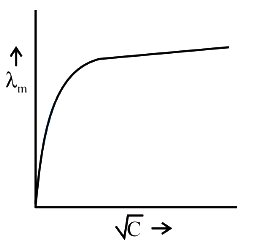
B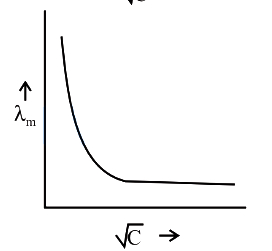
C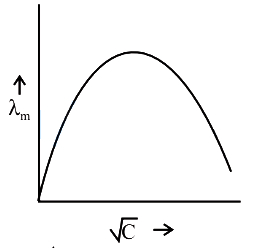
D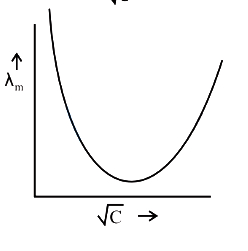
Solution
(B) Acetic acid $(CH_3COOH)$ is a weak electrolyte.
For weak electrolytes,the degree of dissociation increases with dilution (decrease in concentration).
As a result,the molar conductivity $(\lambda_{m})$ increases sharply as the concentration $(C)$ approaches zero.
The plot of $\lambda_{m}$ versus $\sqrt{C}$ for a weak electrolyte shows a steep increase as $\sqrt{C}$ decreases,and it does not intersect the y-axis at finite concentration.
Graph $B$ correctly represents this behavior,where $\lambda_{m}$ increases as $\sqrt{C}$ decreases.
For weak electrolytes,the degree of dissociation increases with dilution (decrease in concentration).
As a result,the molar conductivity $(\lambda_{m})$ increases sharply as the concentration $(C)$ approaches zero.
The plot of $\lambda_{m}$ versus $\sqrt{C}$ for a weak electrolyte shows a steep increase as $\sqrt{C}$ decreases,and it does not intersect the y-axis at finite concentration.
Graph $B$ correctly represents this behavior,where $\lambda_{m}$ increases as $\sqrt{C}$ decreases.
0 likesView Solution
126
ChemistryMediumMCQTS EAMCET · 2022
What is the $IUPAC$ name of the compound given below?
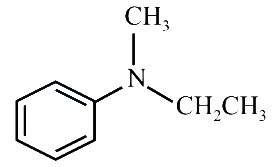
A
$N$-Methyl-$N$-ethylbenzenamine
B
$N$-Methyl-$N$-phenylethanamine
C
$N$-Ethyl-$N$-methylbenzenamine
D
$N$-Ethyl-$N$-phenylmethanamine
Solution
(C) The given compound is a tertiary amine where a nitrogen atom is attached to a benzene ring,a methyl group $(-CH_3)$,and an ethyl group $(-CH_2CH_3)$.
According to $IUPAC$ nomenclature rules for $N$-substituted amines,the parent chain is the benzene ring (benzenamine).
The substituents on the nitrogen atom are listed in alphabetical order.
Since 'ethyl' comes before 'methyl' alphabetically,the name is $N$-Ethyl-$N$-methylbenzenamine.
Therefore,the correct option is $C$.
According to $IUPAC$ nomenclature rules for $N$-substituted amines,the parent chain is the benzene ring (benzenamine).
The substituents on the nitrogen atom are listed in alphabetical order.
Since 'ethyl' comes before 'methyl' alphabetically,the name is $N$-Ethyl-$N$-methylbenzenamine.
Therefore,the correct option is $C$.
0 likesView Solution
127
ChemistryDifficultMCQTS EAMCET · 2022
Which of the following set of compounds react with $NaHCO_3$?
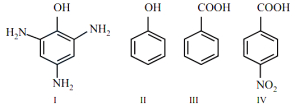
A
$I, II, III, IV$
B
$I, II, III$ only
C
$III, IV$ only
D
$I, III, IV$ only
Solution
(C) $NaHCO_3$ is a mild base and only compounds more acidic than carbonic acid $(H_2CO_3)$ can react with it to evolve $CO_2$ gas.
Carboxylic acids are significantly more acidic than phenols and amines.
Compound $(III)$ is benzoic acid and compound $(IV)$ is $p$-nitrobenzoic acid.
Both $(III)$ and $(IV)$ are carboxylic acids and are strong enough to react with $NaHCO_3$.
Compound $(I)$ is an amine-substituted phenol and compound $(II)$ is phenol; both are less acidic than $H_2CO_3$ and do not react with $NaHCO_3$.
Therefore,only $(III)$ and $(IV)$ react with $NaHCO_3$.
Carboxylic acids are significantly more acidic than phenols and amines.
Compound $(III)$ is benzoic acid and compound $(IV)$ is $p$-nitrobenzoic acid.
Both $(III)$ and $(IV)$ are carboxylic acids and are strong enough to react with $NaHCO_3$.
Compound $(I)$ is an amine-substituted phenol and compound $(II)$ is phenol; both are less acidic than $H_2CO_3$ and do not react with $NaHCO_3$.
Therefore,only $(III)$ and $(IV)$ react with $NaHCO_3$.
0 likesView Solution
128
ChemistryMediumMCQTS EAMCET · 2022
Arrange the following phenols in decreasing order of their $pK_{a}$ values:
$(A)$ Phenol
$(B)$ ortho-Nitrophenol
$(C)$ meta-Nitrophenol
$(D)$ para-Nitrophenol
$(A)$ Phenol
$(B)$ ortho-Nitrophenol
$(C)$ meta-Nitrophenol
$(D)$ para-Nitrophenol
A
$A > C > B > D$
B
$A > C > D > B$
C
$B > D > C > A$
D
$D > B > C > A$
Solution
(A) The acidity of phenols is inversely proportional to their $pK_{a}$ values $(Acidity \propto \frac{1}{pK_{a}})$.
Electron-withdrawing groups (like $-NO_{2}$) increase the acidity of phenol by stabilizing the phenoxide ion through $-I$ and $-M$ effects.
$1$. Phenol $(A)$ has no electron-withdrawing group,so it is the least acidic (highest $pK_{a}$).
$2$. meta-Nitrophenol $(C)$ exhibits only the $-I$ effect,making it more acidic than phenol but less acidic than ortho and para isomers.
$3$. ortho-Nitrophenol $(B)$ and para-Nitrophenol $(D)$ exhibit both $-I$ and $-M$ effects. para-Nitrophenol $(D)$ is the most acidic due to the strong $-M$ effect of the $-NO_{2}$ group at the para position.
ortho-Nitrophenol $(B)$ is less acidic than para-Nitrophenol $(D)$ due to intramolecular hydrogen bonding,which stabilizes the undissociated molecule.
Thus,the order of acidity is: $D > B > C > A$.
Since $pK_{a}$ is inversely proportional to acidity,the decreasing order of $pK_{a}$ is: $A > C > B > D$.
Electron-withdrawing groups (like $-NO_{2}$) increase the acidity of phenol by stabilizing the phenoxide ion through $-I$ and $-M$ effects.
$1$. Phenol $(A)$ has no electron-withdrawing group,so it is the least acidic (highest $pK_{a}$).
$2$. meta-Nitrophenol $(C)$ exhibits only the $-I$ effect,making it more acidic than phenol but less acidic than ortho and para isomers.
$3$. ortho-Nitrophenol $(B)$ and para-Nitrophenol $(D)$ exhibit both $-I$ and $-M$ effects. para-Nitrophenol $(D)$ is the most acidic due to the strong $-M$ effect of the $-NO_{2}$ group at the para position.
ortho-Nitrophenol $(B)$ is less acidic than para-Nitrophenol $(D)$ due to intramolecular hydrogen bonding,which stabilizes the undissociated molecule.
Thus,the order of acidity is: $D > B > C > A$.
Since $pK_{a}$ is inversely proportional to acidity,the decreasing order of $pK_{a}$ is: $A > C > B > D$.
0 likesView Solution
129
ChemistryEasyMCQTS EAMCET · 2022
The correct order of $pK_{a}$ of the following compounds is:
$I. CCl_3COOH$
$II. CF_3COOH$
$III. NO_2CH_2COOH$
$IV. NCCH_2COOH$
$I. CCl_3COOH$
$II. CF_3COOH$
$III. NO_2CH_2COOH$
$IV. NCCH_2COOH$
A
$(I) < (II) < (III) < (IV)$
B
$(III) < (II) < (I) < (IV)$
C
$(II) < (I) < (IV) < (III)$
D
$(II) < (I) < (III) < (IV)$
Solution
(D) The acidity of carboxylic acids is directly proportional to the stability of their conjugate bases,which is enhanced by electron-withdrawing groups ($-I$ effect).
$pK_a$ is inversely proportional to acidity.
Comparing the compounds:
$II. CF_3COOH$ (Strongest acid due to three highly electronegative $F$ atoms)
$I. CCl_3COOH$ (Strong acid,but $Cl$ is less electronegative than $F$)
$III. NO_2CH_2COOH$ (Stronger acid than $IV$ because $-NO_2$ is a stronger electron-withdrawing group than $-CN$)
$IV. NCCH_2COOH$
Acidity order: $II > I > III > IV$
Since $pK_a = -\log(K_a)$,the order of $pK_a$ is the reverse of the acidity order:
$pK_a$ order: $IV > III > I > II$
This corresponds to $(II) < (I) < (III) < (IV)$.
$pK_a$ is inversely proportional to acidity.
Comparing the compounds:
$II. CF_3COOH$ (Strongest acid due to three highly electronegative $F$ atoms)
$I. CCl_3COOH$ (Strong acid,but $Cl$ is less electronegative than $F$)
$III. NO_2CH_2COOH$ (Stronger acid than $IV$ because $-NO_2$ is a stronger electron-withdrawing group than $-CN$)
$IV. NCCH_2COOH$
Acidity order: $II > I > III > IV$
Since $pK_a = -\log(K_a)$,the order of $pK_a$ is the reverse of the acidity order:
$pK_a$ order: $IV > III > I > II$
This corresponds to $(II) < (I) < (III) < (IV)$.
0 likesView Solution
130
ChemistryMediumMCQTS EAMCET · 2022
The order of reactivity of the following compounds towards dilute aqueous $KOH$ in $SN_1$ reaction is
$I$. $CH_3CH_2CH_2CH_2Br$
$II$. $CH_3CH_2CHBrCH_3$
$III$. $(CH_3)_2CHCH_2Br$
$IV$. $(CH_3)_3CBr$
$I$. $CH_3CH_2CH_2CH_2Br$
$II$. $CH_3CH_2CHBrCH_3$
$III$. $(CH_3)_2CHCH_2Br$
$IV$. $(CH_3)_3CBr$
A
$I < IV < III < II$
B
$IV < II < III < I$
C
$III < II < I < IV$
D
$I < III < II < IV$
Solution
(D) The $SN_1$ reaction rate depends on the stability of the carbocation formed in the rate-determining step.
The carbocations formed are:
$I$. $CH_3CH_2CH_2CH_2^+$ (Primary)
$II$. $CH_3CH_2CH^+CH_3$ (Secondary)
$III$. $(CH_3)_2CHCH_2^+$ (Primary,but branched)
$IV$. $(CH_3)_3C^+$ (Tertiary)
Tertiary carbocations are more stable than secondary,which are more stable than primary carbocations.
Among the primary carbocations,$III$ is slightly more stable than $I$ due to the inductive effect of the methyl group.
Therefore,the stability order is $I < III < II < IV$.
Since the rate of $SN_1$ reaction follows the stability order of carbocations,the reactivity order is $I < III < II < IV$.
The carbocations formed are:
$I$. $CH_3CH_2CH_2CH_2^+$ (Primary)
$II$. $CH_3CH_2CH^+CH_3$ (Secondary)
$III$. $(CH_3)_2CHCH_2^+$ (Primary,but branched)
$IV$. $(CH_3)_3C^+$ (Tertiary)
Tertiary carbocations are more stable than secondary,which are more stable than primary carbocations.
Among the primary carbocations,$III$ is slightly more stable than $I$ due to the inductive effect of the methyl group.
Therefore,the stability order is $I < III < II < IV$.
Since the rate of $SN_1$ reaction follows the stability order of carbocations,the reactivity order is $I < III < II < IV$.
0 likesView Solution
131
ChemistryMediumMCQTS EAMCET · 2022
Sodium tertiary butoxide on reaction with methyl bromide produces the product $P$.
Sodium methoxide upon reaction with tertiary butyl bromide generates the product $Q$.
The products $P$ and $Q$ are
Sodium methoxide upon reaction with tertiary butyl bromide generates the product $Q$.
The products $P$ and $Q$ are
A
Both $P$ and $Q$ are $2-methylpropene$
B
$P$ is $t-butyl$ methyl ether and $Q$ is $2-methylpropene$
C
$P$ is $2-methylpropene$ and $Q$ is $t-butyl$ methyl ether
D
Both $P$ and $Q$ are $t-butyl$ methyl ether
Solution
(B) Reaction $1$: Sodium $t-butoxide$ $((CH_3)_3CONa)$ is a strong base and a bulky nucleophile. It reacts with methyl bromide $(CH_3Br)$ via an $S_N2$ mechanism to produce $t-butyl$ methyl ether $(CH_3-O-C(CH_3)_3)$ as the major product $(P)$.
Reaction $2$: Sodium methoxide $(CH_3ONa)$ is a strong base. When it reacts with a tertiary substrate like $t-butyl$ bromide $((CH_3)_3CBr)$,the steric hindrance prevents $S_N2$ substitution. Instead,an $E2$ elimination reaction occurs,producing $2-methylpropene$ $((CH_3)_2C=CH_2)$ as the major product $(Q)$.
Reaction $2$: Sodium methoxide $(CH_3ONa)$ is a strong base. When it reacts with a tertiary substrate like $t-butyl$ bromide $((CH_3)_3CBr)$,the steric hindrance prevents $S_N2$ substitution. Instead,an $E2$ elimination reaction occurs,producing $2-methylpropene$ $((CH_3)_2C=CH_2)$ as the major product $(Q)$.
0 likesView Solution
132
ChemistryDifficultMCQTS EAMCET · 2022
The major product in the following reaction is:
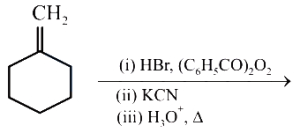
A
Cyclohexanecarboxylic acid with a methyl group at the alpha position.
B
$1-$methylcyclohexanecarboxylic acid.
C
Cyclohexylacetic acid.
D
$3-$cyclohexylpropanoic acid.
Solution
(C) The reaction proceeds as follows:
$1$. The first step is the anti-Markovnikov addition of $HBr$ to methylenecyclohexane in the presence of a peroxide,$(C_6H_5CO)_2O_2$. This yields (cyclohexylmethyl) bromide,$C_6H_{11}CH_2Br$.
$2$. The second step is a nucleophilic substitution reaction with $KCN$,where the bromide ion is replaced by a cyanide group,yielding cyclohexylacetonitrile,$C_6H_{11}CH_2CN$.
$3$. The third step is the acid-catalyzed hydrolysis of the nitrile group followed by heating,which converts the $-CN$ group into a carboxylic acid group,$-COOH$. The final product is cyclohexylacetic acid,$C_6H_{11}CH_2COOH$.
$1$. The first step is the anti-Markovnikov addition of $HBr$ to methylenecyclohexane in the presence of a peroxide,$(C_6H_5CO)_2O_2$. This yields (cyclohexylmethyl) bromide,$C_6H_{11}CH_2Br$.
$2$. The second step is a nucleophilic substitution reaction with $KCN$,where the bromide ion is replaced by a cyanide group,yielding cyclohexylacetonitrile,$C_6H_{11}CH_2CN$.
$3$. The third step is the acid-catalyzed hydrolysis of the nitrile group followed by heating,which converts the $-CN$ group into a carboxylic acid group,$-COOH$. The final product is cyclohexylacetic acid,$C_6H_{11}CH_2COOH$.
0 likesView Solution
133
ChemistryMediumMCQTS EAMCET · 2022
Match the following reactions with their mechanisms:
$(A)$ $CH_3CH_2CH_2I \xrightarrow{aq. KOH}$
$(B)$ $(CH_3)_3CCl \xrightarrow{H_2O}$
$(I)$ $S_N1$
$(II)$ $E_2$
$(III)$ $S_N2$
$(IV)$ $E_1$
$(A)$ $CH_3CH_2CH_2I \xrightarrow{aq. KOH}$
$(B)$ $(CH_3)_3CCl \xrightarrow{H_2O}$
$(I)$ $S_N1$
$(II)$ $E_2$
$(III)$ $S_N2$
$(IV)$ $E_1$
A
$A-III, B-I$
B
$A-I, B-III$
C
$A-II, B-IV$
D
$A-III, B-II$
Solution
(A) Reaction $(A)$: $CH_3CH_2CH_2I$ is a primary alkyl halide. In the presence of aqueous $KOH$ (a strong nucleophile),it undergoes a bimolecular nucleophilic substitution $(S_N2)$ reaction to form propan$-1-$ol.
Reaction $(B)$: $(CH_3)_3CCl$ is a tertiary alkyl halide. In the presence of water (a polar protic solvent),it undergoes a unimolecular nucleophilic substitution $(S_N1)$ reaction to form tert-butyl alcohol.
Therefore,the correct matching is $A-III$ and $B-I$.
Reaction $(B)$: $(CH_3)_3CCl$ is a tertiary alkyl halide. In the presence of water (a polar protic solvent),it undergoes a unimolecular nucleophilic substitution $(S_N1)$ reaction to form tert-butyl alcohol.
Therefore,the correct matching is $A-III$ and $B-I$.
0 likesView Solution
134
ChemistryMediumMCQTS EAMCET · 2022
$1-$chloro$-3-$methylbutane on reaction with zinc and dilute hydrochloric acid gives . . . . . . as the major product.
A
$2-$methylbutane
B
$2-$methylbutene
C
$n-$pentane
D
$n-$pentene
Solution
(A) The reaction of an alkyl halide with $Zn$ and dilute $HCl$ is a reduction reaction.
In this reaction,the halogen atom is replaced by a hydrogen atom to form the corresponding alkane.
The chemical equation is:
$(CH_3)_2CH-CH_2-CH_2Cl + [H] \xrightarrow{Zn/dil.HCl} (CH_3)_2CH-CH_2-CH_3 + HCl$
Here,$1-$chloro$-3-$methylbutane is reduced to $2-$methylbutane.
In this reaction,the halogen atom is replaced by a hydrogen atom to form the corresponding alkane.
The chemical equation is:
$(CH_3)_2CH-CH_2-CH_2Cl + [H] \xrightarrow{Zn/dil.HCl} (CH_3)_2CH-CH_2-CH_3 + HCl$
Here,$1-$chloro$-3-$methylbutane is reduced to $2-$methylbutane.
0 likesView Solution
135
ChemistryDifficultMCQTS EAMCET · 2022
The major product formed in the following reaction is:
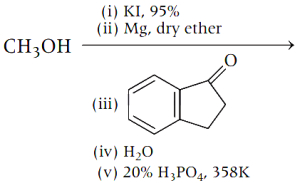
A
$1-$methyl-1H-indene
B
$1-$methylene$-2,3-$dihydro-1H-indene
C
$3-$methyl-1H-indene
D
$1-$methyl$-2,3-$dihydro-1H-inden$-1-$ol
Solution
(A) The reaction proceeds as follows:
$(i)$ $CH_3OH$ reacts with $KI$ to form $CH_3I$.
(ii) $CH_3I$ reacts with $Mg$ in dry ether to form the Grignard reagent $CH_3MgI$.
(iii) $CH_3MgI$ undergoes nucleophilic addition to the carbonyl group of $1-$indanone ($2$,$3$-dihydro-1H-inden$-1-$one).
(iv) Subsequent hydrolysis with $H_2O$ yields $1-$methyl$-2,3-$dihydro-1H-inden$-1-$ol.
$(v)$ Dehydration of the alcohol using $20\% H_3PO_4$ at $358 \ K$ results in the formation of the more stable conjugated alkene,$1$-methyl-1H-indene,as the major product.
$(i)$ $CH_3OH$ reacts with $KI$ to form $CH_3I$.
(ii) $CH_3I$ reacts with $Mg$ in dry ether to form the Grignard reagent $CH_3MgI$.
(iii) $CH_3MgI$ undergoes nucleophilic addition to the carbonyl group of $1-$indanone ($2$,$3$-dihydro-1H-inden$-1-$one).
(iv) Subsequent hydrolysis with $H_2O$ yields $1-$methyl$-2,3-$dihydro-1H-inden$-1-$ol.
$(v)$ Dehydration of the alcohol using $20\% H_3PO_4$ at $358 \ K$ results in the formation of the more stable conjugated alkene,$1$-methyl-1H-indene,as the major product.
0 likesView Solution
136
ChemistryDifficultMCQTS EAMCET · 2022
The major product in the following reaction sequence is:
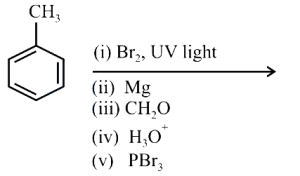
A
$1-$bromo$-1-$phenylethane
B
o-bromomethyltoluene
C
($2$-bromoethyl)benzene
D
p-bromomethyltoluene
Solution
(C) The reaction sequence is as follows:
$1$. Toluene reacts with $Br_2$ in the presence of $UV$ light to undergo free-radical substitution at the benzylic position,forming benzyl bromide $(C_6H_5CH_2Br)$.
$2$. Benzyl bromide reacts with $Mg$ in dry ether to form the Grignard reagent,benzylmagnesium bromide $(C_6H_5CH_2MgBr)$.
$3$. The Grignard reagent reacts with formaldehyde $(CH_2O)$ followed by acidic hydrolysis $(H_3O^+)$ to form $2-$phenylethanol $(C_6H_5CH_2CH_2OH)$.
$4$. Finally,$2$-phenylethanol reacts with $PBr_3$ to replace the hydroxyl group with a bromine atom,yielding ($2$-bromoethyl)benzene $(C_6H_5CH_2CH_2Br)$.
$1$. Toluene reacts with $Br_2$ in the presence of $UV$ light to undergo free-radical substitution at the benzylic position,forming benzyl bromide $(C_6H_5CH_2Br)$.
$2$. Benzyl bromide reacts with $Mg$ in dry ether to form the Grignard reagent,benzylmagnesium bromide $(C_6H_5CH_2MgBr)$.
$3$. The Grignard reagent reacts with formaldehyde $(CH_2O)$ followed by acidic hydrolysis $(H_3O^+)$ to form $2-$phenylethanol $(C_6H_5CH_2CH_2OH)$.
$4$. Finally,$2$-phenylethanol reacts with $PBr_3$ to replace the hydroxyl group with a bromine atom,yielding ($2$-bromoethyl)benzene $(C_6H_5CH_2CH_2Br)$.
0 likesView Solution
137
ChemistryDifficultMCQTS EAMCET · 2022
The major product in the following reaction is
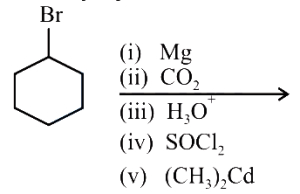
A
Cyclohexyl ethanol
B
Cyclohexyl methyl ketone
C
$1-$Cyclohexyl ethanol
D
$2-$Cyclohexyl propan$-2-$ol
Solution
(B) The reaction proceeds as follows:
$1$. Bromocyclohexane reacts with $Mg$ in dry ether to form cyclohexylmagnesium bromide (a Grignard reagent).
$2$. The Grignard reagent reacts with $CO_2$ followed by acidic workup $(H_3O^+)$ to form cyclohexanecarboxylic acid.
$3$. Cyclohexanecarboxylic acid reacts with $SOCl_2$ to form cyclohexanecarbonyl chloride.
$4$. Finally,the reaction of cyclohexanecarbonyl chloride with dimethylcadmium,$(CH_3)_2Cd$,yields cyclohexyl methyl ketone as the major product. This is a standard method for the preparation of ketones from acid chlorides.
$1$. Bromocyclohexane reacts with $Mg$ in dry ether to form cyclohexylmagnesium bromide (a Grignard reagent).
$2$. The Grignard reagent reacts with $CO_2$ followed by acidic workup $(H_3O^+)$ to form cyclohexanecarboxylic acid.
$3$. Cyclohexanecarboxylic acid reacts with $SOCl_2$ to form cyclohexanecarbonyl chloride.
$4$. Finally,the reaction of cyclohexanecarbonyl chloride with dimethylcadmium,$(CH_3)_2Cd$,yields cyclohexyl methyl ketone as the major product. This is a standard method for the preparation of ketones from acid chlorides.
0 likesView Solution
138
ChemistryDifficultMCQTS EAMCET · 2022
The major product of the following reaction is:
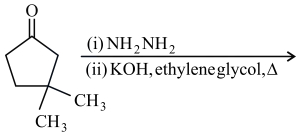
A
$3,3-$dimethylcyclopentane
B
$3,3-$dimethylcyclopentene
C
$3,3-$dimethylcyclopentanol
D
Pinacol-like dimer
Solution
(A) The given reaction is an example of the $Wolff-Kishner$ reduction.
This reaction involves the reduction of a carbonyl group $(C=O)$ to a methylene group $(CH_2)$.
First,the ketone reacts with hydrazine $(NH_2NH_2)$ to form a hydrazone intermediate.
Then,in the presence of a strong base like $KOH$ and a high-boiling solvent like ethylene glycol,the hydrazone undergoes base-catalyzed decomposition to release nitrogen gas $(N_2)$ and form the corresponding alkane.
In this specific case,$3,3-dimethylcyclopentanone$ is reduced to $3,3-dimethylcyclopentane$.
This reaction involves the reduction of a carbonyl group $(C=O)$ to a methylene group $(CH_2)$.
First,the ketone reacts with hydrazine $(NH_2NH_2)$ to form a hydrazone intermediate.
Then,in the presence of a strong base like $KOH$ and a high-boiling solvent like ethylene glycol,the hydrazone undergoes base-catalyzed decomposition to release nitrogen gas $(N_2)$ and form the corresponding alkane.
In this specific case,$3,3-dimethylcyclopentanone$ is reduced to $3,3-dimethylcyclopentane$.
0 likesView Solution
139
ChemistryDifficultMCQTS EAMCET · 2022
The major product formed in the following reaction sequence is $CH_3-CH=CH_2$ $\xrightarrow[\substack{(iii) \ CH_3-CH_2-CHO \\ (iv) \ CrO_3}]{\substack{(i) \ HBr, \text{ peroxide} \\ (ii) \ Mg}}$
A
$3-$Hexanone
B
$2-$Hexanone
C
$2-$Methyl$-3-$pentanone
D
Hexanal
Solution
(A) $1$. Propene undergoes anti-Markovnikov addition with $HBr$ in the presence of peroxide to form $1-$bromopropane: $CH_3-CH=CH_2 + HBr \xrightarrow{\text{peroxide}} CH_3-CH_2-CH_2Br$.
$2$. $1-$bromopropane reacts with $Mg$ in the presence of dry ether to form the Grignard reagent,propylmagnesium bromide: $CH_3-CH_2-CH_2Br + Mg \xrightarrow{\text{dry ether}} CH_3-CH_2-CH_2MgBr$.
$3$. Propanal $(CH_3-CH_2-CHO)$ undergoes nucleophilic addition with propylmagnesium bromide followed by hydrolysis to form hexan$-3-$ol: $CH_3-CH_2-CHO + CH_3-CH_2-CH_2MgBr \rightarrow CH_3-CH_2-CH(OH)-CH_2-CH_2-CH_3$.
$4$. Hexan$-3-$ol on oxidation with $CrO_3$ forms hexan$-3-$one: $CH_3-CH_2-CH(OH)-CH_2-CH_2-CH_3 \xrightarrow{CrO_3} CH_3-CH_2-CO-CH_2-CH_2-CH_3$.
$2$. $1-$bromopropane reacts with $Mg$ in the presence of dry ether to form the Grignard reagent,propylmagnesium bromide: $CH_3-CH_2-CH_2Br + Mg \xrightarrow{\text{dry ether}} CH_3-CH_2-CH_2MgBr$.
$3$. Propanal $(CH_3-CH_2-CHO)$ undergoes nucleophilic addition with propylmagnesium bromide followed by hydrolysis to form hexan$-3-$ol: $CH_3-CH_2-CHO + CH_3-CH_2-CH_2MgBr \rightarrow CH_3-CH_2-CH(OH)-CH_2-CH_2-CH_3$.
$4$. Hexan$-3-$ol on oxidation with $CrO_3$ forms hexan$-3-$one: $CH_3-CH_2-CH(OH)-CH_2-CH_2-CH_3 \xrightarrow{CrO_3} CH_3-CH_2-CO-CH_2-CH_2-CH_3$.
0 likesView Solution
140
ChemistryDifficultMCQTS EAMCET · 2022
The major product of the following reaction is:
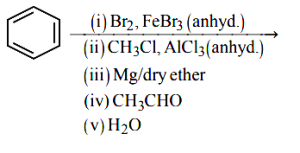
A
$1-$($4$-methylphenyl)propan$-2-$ol
B
$1-$($4$-methylphenyl)ethanol
C
$2-$($2$-methylphenyl)propan$-2-$ol
D
$1-$($2$-methylphenyl)ethanol
Solution
(B) Step $(i)$: Benzene reacts with $Br_2$ in the presence of anhydrous $FeBr_3$ to form bromobenzene via electrophilic aromatic substitution.
Step (ii): Bromobenzene undergoes Friedel-Crafts alkylation with $CH_3Cl$ and anhydrous $AlCl_3$. Since the $-Br$ group is ortho/para directing,the major product is $p$-bromotoluene.
Step (iii): $p$-Bromotoluene reacts with $Mg$ in dry ether to form the Grignard reagent,$p$-tolylmagnesium bromide $(CH_3-C_6H_4-MgBr)$.
Step (iv) and $(v)$: The Grignard reagent reacts with acetaldehyde $(CH_3CHO)$ followed by hydrolysis $(H_2O)$ to form a secondary alcohol. The nucleophilic carbon of the Grignard reagent attacks the carbonyl carbon of acetaldehyde,resulting in $1-(4-methylphenyl)ethanol$.
Step (ii): Bromobenzene undergoes Friedel-Crafts alkylation with $CH_3Cl$ and anhydrous $AlCl_3$. Since the $-Br$ group is ortho/para directing,the major product is $p$-bromotoluene.
Step (iii): $p$-Bromotoluene reacts with $Mg$ in dry ether to form the Grignard reagent,$p$-tolylmagnesium bromide $(CH_3-C_6H_4-MgBr)$.
Step (iv) and $(v)$: The Grignard reagent reacts with acetaldehyde $(CH_3CHO)$ followed by hydrolysis $(H_2O)$ to form a secondary alcohol. The nucleophilic carbon of the Grignard reagent attacks the carbonyl carbon of acetaldehyde,resulting in $1-(4-methylphenyl)ethanol$.
0 likesView Solution
141
ChemistryMediumMCQTS EAMCET · 2022
The major product of the following reaction is:
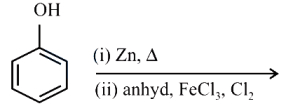
A
$4-$chlorophenol
B
$2-$chlorophenol
C
$2,4-$dichlorophenol
D
chlorobenzene
Solution
(D) Step $1$: Phenol reacts with zinc dust $(Zn)$ under heating $(\Delta)$ to undergo reduction,resulting in the formation of benzene.
$C_6H_5OH Zn \xrightarrow{\Delta} C_6H_6 ZnO$
Step $2$: Benzene then undergoes electrophilic aromatic substitution (chlorination) in the presence of anhydrous ferric chloride $(FeCl_3)$ and chlorine $(Cl_2)$ to form chlorobenzene.
$C_6H_6 Cl_2 \xrightarrow{\text{anhyd. } FeCl_3} C_6H_5Cl HCl$
Therefore,the major product is chlorobenzene.
$C_6H_5OH Zn \xrightarrow{\Delta} C_6H_6 ZnO$
Step $2$: Benzene then undergoes electrophilic aromatic substitution (chlorination) in the presence of anhydrous ferric chloride $(FeCl_3)$ and chlorine $(Cl_2)$ to form chlorobenzene.
$C_6H_6 Cl_2 \xrightarrow{\text{anhyd. } FeCl_3} C_6H_5Cl HCl$
Therefore,the major product is chlorobenzene.
0 likesView Solution
142
ChemistryDifficultMCQTS EAMCET · 2022
The major product in the following reaction sequence is:
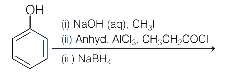
A
$1-$($4$-methoxyphenyl)propan$-1-$ol
B
$1-$($2$-methoxyphenyl)propan$-1-$ol
C
$1-$($4$-methoxyphenyl)propan$-2-$ol
D
$1-$($2$-methoxyphenyl)propan$-2-$ol
Solution
(A) The reaction proceeds as follows:
$(i)$ Phenol reacts with $NaOH$ and $CH_3I$ to form anisole (methoxybenzene) via Williamson ether synthesis.
(ii) Anisole undergoes Friedel-Crafts acylation with propionyl chloride $(CH_3CH_2COCl)$ in the presence of anhydrous $AlCl_3$. Since the $-OCH_3$ group is ortho/para-directing,and the para-position is sterically less hindered,the major product is $p$-methoxypropiophenone.
(iii) Reduction of the ketone group with $NaBH_4$ yields the corresponding secondary alcohol,$1$-($4$-methoxyphenyl)propan$-1-$ol.
Therefore,the correct option is $A$.
$(i)$ Phenol reacts with $NaOH$ and $CH_3I$ to form anisole (methoxybenzene) via Williamson ether synthesis.
(ii) Anisole undergoes Friedel-Crafts acylation with propionyl chloride $(CH_3CH_2COCl)$ in the presence of anhydrous $AlCl_3$. Since the $-OCH_3$ group is ortho/para-directing,and the para-position is sterically less hindered,the major product is $p$-methoxypropiophenone.
(iii) Reduction of the ketone group with $NaBH_4$ yields the corresponding secondary alcohol,$1$-($4$-methoxyphenyl)propan$-1-$ol.
Therefore,the correct option is $A$.
0 likesView Solution
143
ChemistryDifficultMCQTS EAMCET · 2022
The major product formed in the following reaction is:
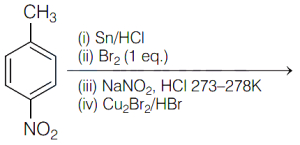
A
$1-$methyl$-3,5-$dibromobenzene
B
$1-$methyl$-2,6-$dibromobenzene
C
$1-$methyl$-3,4-$dibromobenzene
D
$1-$methyl$-2,4-$dibromobenzene
Solution
(C) The reaction proceeds as follows:
$(i)$ $Sn/HCl$ reduces the $-NO_2$ group to an $-NH_2$ group,forming $p$-toluidine.
(ii) $Br_2$ $(1 \ eq.)$ in the presence of the strongly activating $-NH_2$ group leads to ortho-bromination,yielding $2$-bromo-$4$-methylaniline.
(iii) $NaNO_2/HCl$ at $273-278 \ K$ converts the $-NH_2$ group into a diazonium salt,$-N_2^+Cl^-$.
(iv) $Cu_2Br_2/HBr$ (Sandmeyer reaction) replaces the diazonium group with a $-Br$ atom,resulting in $1,2$-dibromo-$4$-methylbenzene (also known as $3,4$-dibromotoluene).
$(i)$ $Sn/HCl$ reduces the $-NO_2$ group to an $-NH_2$ group,forming $p$-toluidine.
(ii) $Br_2$ $(1 \ eq.)$ in the presence of the strongly activating $-NH_2$ group leads to ortho-bromination,yielding $2$-bromo-$4$-methylaniline.
(iii) $NaNO_2/HCl$ at $273-278 \ K$ converts the $-NH_2$ group into a diazonium salt,$-N_2^+Cl^-$.
(iv) $Cu_2Br_2/HBr$ (Sandmeyer reaction) replaces the diazonium group with a $-Br$ atom,resulting in $1,2$-dibromo-$4$-methylbenzene (also known as $3,4$-dibromotoluene).
0 likesView Solution
144
ChemistryMediumMCQTS EAMCET · 2022
When aluminium chloride is dissolved in water,it gives
A
$[Al(OH)_6]^{3-} + 3HCl$
B
$Al_2O_3 + 6HCl$
C
$[Al(H_2O)_6]^{3+} + 3Cl^-$
D
$Al^{3+} + 3Cl^-$
Solution
(C) When aluminium chloride $(AlCl_3)$ is dissolved in water,it undergoes hydration to form the octahedral complex ion $[Al(H_2O)_6]^{3+}$ and releases chloride ions $(Cl^-)$.
The reaction is: $AlCl_3 + 6H_2O \rightarrow [Al(H_2O)_6]^{3+} + 3Cl^-$.
In this complex,the $Al^{3+}$ ion is coordinated to six water molecules,and the hybridization of $Al$ is $sp^3d^2$.
The reaction is: $AlCl_3 + 6H_2O \rightarrow [Al(H_2O)_6]^{3+} + 3Cl^-$.
In this complex,the $Al^{3+}$ ion is coordinated to six water molecules,and the hybridization of $Al$ is $sp^3d^2$.
0 likesView Solution
145
ChemistryEasyMCQTS EAMCET · 2022
The element that can even diffuse through silica glass is
A
$He$
B
$Ar$
C
$Kr$
D
$Xe$
Solution
(A) Noble gases are monoatomic and possess the largest atomic radius in their respective periods.
The atomic size of noble gases increases down the group from $He$ to $Rn$ due to the addition of new shells.
Among the noble gases,$He$ has the smallest atomic size.
Due to its extremely small size,$He$ atoms can easily diffuse through the pores of silica glass.
The atomic radius of noble gases is referred to as the van der Waals radius.
The atomic size of noble gases increases down the group from $He$ to $Rn$ due to the addition of new shells.
Among the noble gases,$He$ has the smallest atomic size.
Due to its extremely small size,$He$ atoms can easily diffuse through the pores of silica glass.
The atomic radius of noble gases is referred to as the van der Waals radius.
0 likesView Solution
146
ChemistryDifficultMCQTS EAMCET · 2022
In which of the following reactions is there no liberation of nitrogen gas?
A
$NO_2^-(aq) + NH_4^+(s) \xrightarrow{\Delta}$
B
$CO(NH_2)_{2(s)} + HNO_{2(l)} \longrightarrow$
C
$NH_{3(g)} + NaOCl_{(aq)} \xrightarrow{\text{gelatine}}$
D
$(NH_4)_2Cr_2O_{7(s)} \xrightarrow{\Delta}$
Solution
(C) $(A)\ NO_2^-(aq) + NH_4^+(s) \xrightarrow{\Delta} N_{2(g)} + 2H_2O$. This reaction liberates $N_2$ gas.
$(B)\ CO(NH_2)_{2(s)} + 2HNO_{2(l)} \longrightarrow 2N_{2(g)} + CO_2 + 3H_2O$. This reaction liberates $N_2$ gas.
$(C)\ 2NH_{3(g)} + 3NaOCl_{(aq)} \xrightarrow{\text{gelatine}} N_2H_4 + 3NaCl + H_2O$. This reaction produces hydrazine $(N_2H_4)$ and does not liberate $N_2$ gas.
$(D)\ (NH_4)_2Cr_2O_{7(s)} \xrightarrow{\Delta} Cr_2O_3 + N_{2(g)} + 4H_2O$. This reaction liberates $N_2$ gas.
$(B)\ CO(NH_2)_{2(s)} + 2HNO_{2(l)} \longrightarrow 2N_{2(g)} + CO_2 + 3H_2O$. This reaction liberates $N_2$ gas.
$(C)\ 2NH_{3(g)} + 3NaOCl_{(aq)} \xrightarrow{\text{gelatine}} N_2H_4 + 3NaCl + H_2O$. This reaction produces hydrazine $(N_2H_4)$ and does not liberate $N_2$ gas.
$(D)\ (NH_4)_2Cr_2O_{7(s)} \xrightarrow{\Delta} Cr_2O_3 + N_{2(g)} + 4H_2O$. This reaction liberates $N_2$ gas.
0 likesView Solution
147
ChemistryMediumMCQTS EAMCET · 2022
The total number of paramagnetic gaseous products formed in all the following reactions $[A + B + C ]$:
$(A)\ NH_4 NO_3 \xrightarrow{\Delta} \text{Products}$
$(B)\ 3 NaNO_2 + 3 H_2 SO_4 \longrightarrow \text{Products}$
$(C)\ Pb(NO_3)_2 \xrightarrow{673 \ K} \text{Products}$
$(A)\ NH_4 NO_3 \xrightarrow{\Delta} \text{Products}$
$(B)\ 3 NaNO_2 + 3 H_2 SO_4 \longrightarrow \text{Products}$
$(C)\ Pb(NO_3)_2 \xrightarrow{673 \ K} \text{Products}$
A
$0$
B
$1$
C
$2$
D
$3$
Solution
(D) Reaction $(A): NH_4 NO_3 \xrightarrow{\Delta} N_2 O + 2 H_2 O$. $N_2 O$ is diamagnetic.
Reaction $(B): 2 NaNO_2 + H_2 SO_4 \rightarrow Na_2 SO_4 + H_2 O + NO_2 + NO$. (Note: The reaction produces $NO$ and $NO_2$,both are paramagnetic).
Reaction $(C): 2 Pb(NO_3)_2 \xrightarrow{673 \ K} 2 PbO + 4 NO_2 + O_2$. $NO_2$ and $O_2$ are paramagnetic.
The paramagnetic gaseous products are $NO$ (from $B$),$NO_2$ (from $B$ and $C$),and $O_2$ (from $C$).
Total number of unique paramagnetic gaseous products is $3$.
Reaction $(B): 2 NaNO_2 + H_2 SO_4 \rightarrow Na_2 SO_4 + H_2 O + NO_2 + NO$. (Note: The reaction produces $NO$ and $NO_2$,both are paramagnetic).
Reaction $(C): 2 Pb(NO_3)_2 \xrightarrow{673 \ K} 2 PbO + 4 NO_2 + O_2$. $NO_2$ and $O_2$ are paramagnetic.
The paramagnetic gaseous products are $NO$ (from $B$),$NO_2$ (from $B$ and $C$),and $O_2$ (from $C$).
Total number of unique paramagnetic gaseous products is $3$.
0 likesView Solution
148
ChemistryEasyMCQTS EAMCET · 2022
$A$ nitrogen oxide that forms "in situ" when dilute $FeSO_4$ is treated with an aqueous solution of nitrate ion and then carefully adding conc. $H_2SO_4$ along the sides of the test tube,is
A
$NO_2$
B
$NO$
C
$N_2O$
D
$N_2O_3$
Solution
(B) The reaction described is the Brown Ring Test,which is used to detect the presence of nitrate ions $(NO_3^-)$ in a solution.
When dilute $FeSO_4$ is added to a solution containing nitrate ions,followed by the careful addition of concentrated $H_2SO_4$,the following reaction occurs:
$2NO_3^- + 3Fe^{2+} + 4H^+ \rightarrow 2NO + 3Fe^{3+} + 2H_2O$
The nitrogen oxide formed "in situ" is nitric oxide $(NO)$.
This $NO$ then reacts with the hydrated ferrous sulfate complex to form the brown-colored complex $[Fe(H_2O)_5(NO)]SO_4$.
When dilute $FeSO_4$ is added to a solution containing nitrate ions,followed by the careful addition of concentrated $H_2SO_4$,the following reaction occurs:
$2NO_3^- + 3Fe^{2+} + 4H^+ \rightarrow 2NO + 3Fe^{3+} + 2H_2O$
The nitrogen oxide formed "in situ" is nitric oxide $(NO)$.
This $NO$ then reacts with the hydrated ferrous sulfate complex to form the brown-colored complex $[Fe(H_2O)_5(NO)]SO_4$.
0 likesView Solution
149
ChemistryDifficultMCQTS EAMCET · 2022
The minimum temperature required for a non-catalytic reaction between $N_2$ and $O_2$ is (in $K$)
A
$3000$
B
$2000$
C
$1000$
D
$500$
Solution
(A) The reaction between $N_2$ and $O_2$ is highly endothermic and requires a very high temperature to proceed.
This reaction is part of the Birkeland-Eyde process,which uses an electric arc furnace to provide temperatures greater than $3000 \ K$ to facilitate the formation of $NO$ from $N_2$ and $O_2$.
This reaction is part of the Birkeland-Eyde process,which uses an electric arc furnace to provide temperatures greater than $3000 \ K$ to facilitate the formation of $NO$ from $N_2$ and $O_2$.
0 likesView Solution
150
ChemistryEasyMCQTS EAMCET · 2022
Phosphorous and phosphoric acids are,respectively, . . . . . . acids.
A
dibasic,tribasic
B
tribasic,tribasic
C
tribasic,dibasic
D
tetrabasic,tribasic
Solution
(A) Phosphorous acid $(H_3PO_3)$ has two $P-OH$ bonds,making it a dibasic acid.
Phosphoric acid $(H_3PO_4)$ has three $P-OH$ bonds,making it a tribasic acid.
Therefore,they are respectively dibasic and tribasic acids.
Phosphoric acid $(H_3PO_4)$ has three $P-OH$ bonds,making it a tribasic acid.
Therefore,they are respectively dibasic and tribasic acids.
0 likesView Solution
Vedclass Products
For Students
Vedclass Test Series
Mock tests in real TS EAMCET style covering Chemistry with performance analysis. 5-day free trial.
Start Free TrialFor Teachers
Exam Paper Generator
Generate Set A/B/C/D Chemistry papers from 7.5L+ questions in 2 minutes. 3 chapters free.
Try FreeFor Institutes
Online Exam Module
Run live TS EAMCET mock exams with unlimited students, 360° analytics & white-label branding.
See DemoFrequently Asked Questions
How many Chemistry questions are in TS EAMCET 2022?
There are 264 Chemistry questions from the TS EAMCET 2022 paper on Vedclass, each with a detailed step-by-step solution in English.
Are TS EAMCET 2022 Chemistry solutions available in English?
Yes. All solutions on this page are in English. You can also switch to English or Hindi using the language buttons above the questions.
Can I practice TS EAMCET 2022 Chemistry as a timed test?
Yes. Use the Vedclass Test Series to attempt a full TS EAMCET mock test covering Chemistry with time limits and instant score analysis.
Can teachers create Chemistry papers from TS EAMCET previous year questions?
Yes. The Vedclass Exam Paper Generator lets teachers mix TS EAMCET Chemistry questions and generate Set A/B/C/D papers in minutes.
For Teachers & Institutes
Build a Custom Chemistry Paper
Pick TS EAMCET 2022 Chemistry questions, set difficulty, and generate Set A/B/C/D in 2 minutes.