
ChemistryQ1–55 of 55 questions
Page 1 of 1 · English
1
ChemistryMCQKVPY · 2011
$A$ speaker emits a sound wave of frequency $f_0$. When it moves towards a stationary observer with speed $u$,the observer measures a frequency $f_1$. If the speaker is stationary,and the observer moves towards it with speed $u$,the measured frequency is $f_2$. Then:
A
$f_1 = f_2 < f_0$
B
$f_1 > f_2$
C
$f_1 < f_2$
D
$f_1 = f_2 > f_0$
Solution
(B) According to the Doppler effect,when the source moves towards a stationary observer with speed $u$,the observed frequency is $f_1 = \frac{C}{C - u} f_0$,where $C$ is the speed of sound.
When the observer moves towards a stationary source with speed $u$,the observed frequency is $f_2 = \frac{C + u}{C} f_0$.
Comparing the two expressions,we analyze the ratio $\frac{f_1}{f_2} = \frac{C}{C - u} \cdot \frac{C}{C + u} = \frac{C^2}{C^2 - u^2}$.
Since $C^2 > C^2 - u^2$,it follows that $\frac{C^2}{C^2 - u^2} > 1$.
Therefore,$f_1 > f_2$.
When the observer moves towards a stationary source with speed $u$,the observed frequency is $f_2 = \frac{C + u}{C} f_0$.
Comparing the two expressions,we analyze the ratio $\frac{f_1}{f_2} = \frac{C}{C - u} \cdot \frac{C}{C + u} = \frac{C^2}{C^2 - u^2}$.
Since $C^2 > C^2 - u^2$,it follows that $\frac{C^2}{C^2 - u^2} > 1$.
Therefore,$f_1 > f_2$.
0 likesView Solution
2
ChemistryMediumMCQKVPY · 2011
Two possible stereoisomers for the given compound are:
A
enantiomers
B
diastereomers
C
conformers
D
rotamers
Solution
(A) The correct option is $A$.
The compound contains a chiral center marked with an asterisk $(*)$.
Because the molecule is optically active due to the presence of this chiral center,it will have two non-superimposable mirror images.
These two mirror images are known as enantiomers ($d$ and $l$ forms).
The compound contains a chiral center marked with an asterisk $(*)$.
Because the molecule is optically active due to the presence of this chiral center,it will have two non-superimposable mirror images.
These two mirror images are known as enantiomers ($d$ and $l$ forms).
0 likesView Solution
3
ChemistryDifficultMCQKVPY · 2011
For a process to occur spontaneously,
A
only the entropy of the system must increase
B
only the entropy of the surroundings must increase
C
either the entropy of the system or that of the surroundings must increase
D
the total entropy of the system and the surroundings must increase
Solution
(D)
According to the second law of thermodynamics,whenever a spontaneous process takes place,it is always accompanied by an increase in the total entropy of the universe (system and surroundings).
Thus,the correct option is $(d)$.
According to the second law of thermodynamics,whenever a spontaneous process takes place,it is always accompanied by an increase in the total entropy of the universe (system and surroundings).
Thus,the correct option is $(d)$.
0 likesView Solution
4
ChemistryMCQKVPY · 2011
When the size of a spherical nanoparticle decreases from $30 \, nm$ to $10 \, nm$,the ratio of surface area to volume becomes:
A
$1 / 3$ of the original
B
$3$ times the original
C
$1 / 9$ of the original
D
$9$ times the original
Solution
(B) The surface area to volume ratio for a sphere is given by the formula: $\frac{SA}{V} = \frac{4 \pi r^2}{\frac{4}{3} \pi r^3} = \frac{3}{r} = \frac{6}{d}$,where $d$ is the diameter.
For the initial state,$d_1 = 30 \, nm$,so the ratio is $\frac{6}{30} = 0.2 \, nm^{-1}$.
For the final state,$d_2 = 10 \, nm$,so the ratio is $\frac{6}{10} = 0.6 \, nm^{-1}$.
The ratio of the new value to the original value is $\frac{0.6}{0.2} = 3$.
Thus,the surface area to volume ratio becomes $3$ times the original.
For the initial state,$d_1 = 30 \, nm$,so the ratio is $\frac{6}{30} = 0.2 \, nm^{-1}$.
For the final state,$d_2 = 10 \, nm$,so the ratio is $\frac{6}{10} = 0.6 \, nm^{-1}$.
The ratio of the new value to the original value is $\frac{0.6}{0.2} = 3$.
Thus,the surface area to volume ratio becomes $3$ times the original.
0 likesView Solution
5
ChemistryMCQKVPY · 2011
The major product of the following reaction is
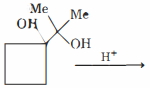
A
B
C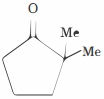
D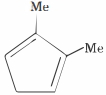
Solution
(C) The reaction is a Pinacol-pinacolone rearrangement,where a diol is converted into a carbonyl compound in the presence of an acid catalyst $(H^+)$.
$1$. Protonation of one of the hydroxyl groups occurs,followed by the loss of a water molecule to form a carbocation.
$2$. The initial carbocation is on a four-membered ring,which is highly strained.
$3$. To minimize ring strain,the ring undergoes expansion from a four-membered ring to a more stable five-membered ring.
$4$. The resulting carbocation is then stabilized by the lone pair of the remaining hydroxyl group,forming a resonance-stabilized oxonium ion.
$5$. Finally,deprotonation yields the stable ketone product,$2,2$-dimethylcyclopentanone.
$1$. Protonation of one of the hydroxyl groups occurs,followed by the loss of a water molecule to form a carbocation.
$2$. The initial carbocation is on a four-membered ring,which is highly strained.
$3$. To minimize ring strain,the ring undergoes expansion from a four-membered ring to a more stable five-membered ring.
$4$. The resulting carbocation is then stabilized by the lone pair of the remaining hydroxyl group,forming a resonance-stabilized oxonium ion.
$5$. Finally,deprotonation yields the stable ketone product,$2,2$-dimethylcyclopentanone.
0 likesView Solution
6
ChemistryMediumMCQKVPY · 2011
All the products formed in the oxidation of $NaBH_4$ by $I_2$ are
A
$B_2H_6$ and $NaI$
B
$B_2H_6, H_2$ and $NaI$
C
$BI_3$ and $NaH$
D
$NaBI_4$ and $HI$
Solution
(B) The reaction between $NaBH_4$ and $I_2$ is an oxidation-reduction reaction.
The balanced chemical equation is:
$2NaBH_4 + I_2 \longrightarrow 2NaI + B_2H_6 + H_2$
Thus,the products formed are $NaI$,$B_2H_6$,and $H_2$.
The balanced chemical equation is:
$2NaBH_4 + I_2 \longrightarrow 2NaI + B_2H_6 + H_2$
Thus,the products formed are $NaI$,$B_2H_6$,and $H_2$.
0 likesView Solution
7
ChemistryMCQKVPY · 2011
The adsorption isotherm for a gas is given by the relation $x = \frac{ap}{1 + bp}$,where $x$ is moles of gas adsorbed per gram of the adsorbent,$p$ is the pressure of the gas,and $a$ and $b$ are constants. Then $x$:
A
increases with $p$
B
remains unchanged with $p$
C
decreases with $p$
D
increases with $p$ at low pressures and then remains the same at high pressures
Solution
(D) The given relation is the Langmuir adsorption isotherm: $x = \frac{ap}{1 + bp}$.
Case $1$: At low pressure,$bp << 1$,so the denominator $1 + bp \approx 1$. Thus,$x \approx ap$,which means $x$ increases linearly with $p$.
Case $2$: At high pressure,$bp >> 1$,so the denominator $1 + bp \approx bp$. Thus,$x \approx \frac{ap}{bp} = \frac{a}{b}$,which is a constant value.
Therefore,$x$ increases with $p$ at low pressures and approaches a constant value at high pressures.
Case $1$: At low pressure,$bp << 1$,so the denominator $1 + bp \approx 1$. Thus,$x \approx ap$,which means $x$ increases linearly with $p$.
Case $2$: At high pressure,$bp >> 1$,so the denominator $1 + bp \approx bp$. Thus,$x \approx \frac{ap}{bp} = \frac{a}{b}$,which is a constant value.
Therefore,$x$ increases with $p$ at low pressures and approaches a constant value at high pressures.
0 likesView Solution
8
ChemistryMediumMCQKVPY · 2011
$MnO_4^{-}$ oxidises $(i)$ oxalate ion in acidic medium at $333 \ K$ and $(ii)$ $HCl$. For balanced chemical equations,the ratios $[MnO_4^{-} : C_2O_4^{2-}]$ in $(i)$ and $[MnO_4^{-} : HCl]$ in $(ii)$ respectively are
A
$1: 5$ and $2: 5$
B
$2: 5$ and $1: 8$
C
$2: 5$ and $1: 5$
D
$5: 2$ and $1: 8$
Solution
(B) The balanced chemical equation for the oxidation of oxalate ion by $MnO_4^{-}$ in acidic medium is:
$2 MnO_4^{-} + 5 C_2O_4^{2-} + 16 H^{+} \longrightarrow 2 Mn^{2+} + 10 CO_2 + 8 H_2O$
From the stoichiometry,$2$ moles of $MnO_4^{-}$ react with $5$ moles of $C_2O_4^{2-}$.
Thus,the ratio $[MnO_4^{-} : C_2O_4^{2-}] = 2 : 5$.
The balanced chemical equation for the oxidation of $HCl$ by $MnO_4^{-}$ is:
$2 MnO_4^{-} + 16 HCl \longrightarrow 2 MnCl_2 + 5 Cl_2 + 8 H_2O$
From the stoichiometry,$2$ moles of $MnO_4^{-}$ react with $16$ moles of $HCl$.
Thus,the ratio $[MnO_4^{-} : HCl] = 2 : 16 = 1 : 8$.
Therefore,the required ratios are $2:5$ and $1:8$.
$2 MnO_4^{-} + 5 C_2O_4^{2-} + 16 H^{+} \longrightarrow 2 Mn^{2+} + 10 CO_2 + 8 H_2O$
From the stoichiometry,$2$ moles of $MnO_4^{-}$ react with $5$ moles of $C_2O_4^{2-}$.
Thus,the ratio $[MnO_4^{-} : C_2O_4^{2-}] = 2 : 5$.
The balanced chemical equation for the oxidation of $HCl$ by $MnO_4^{-}$ is:
$2 MnO_4^{-} + 16 HCl \longrightarrow 2 MnCl_2 + 5 Cl_2 + 8 H_2O$
From the stoichiometry,$2$ moles of $MnO_4^{-}$ react with $16$ moles of $HCl$.
Thus,the ratio $[MnO_4^{-} : HCl] = 2 : 16 = 1 : 8$.
Therefore,the required ratios are $2:5$ and $1:8$.
0 likesView Solution
9
ChemistryDifficultMCQKVPY · 2011
The electron in a hydrogen atom is in the first Bohr orbit $(n=1)$. The ratio of transition energies,$E(n=1 \rightarrow n=3)$ to $E(n=1 \rightarrow n=2)$,is
A
$32 / 27$
B
$16 / 27$
C
$32 / 9$
D
$8 / 9$
Solution
(A) According to Bohr's energy formula,$\Delta E = 13.6 \left( \frac{1}{n_1^2} - \frac{1}{n_2^2} \right) \ \text{eV/atom}$.
For the transition from $n=1$ to $n=3$:
$\Delta E_{1}$ ${\rightarrow 3} = 13.6 \left[ \frac{1}{1^2} - \frac{1}{3^2} \right] = 13.6 \left[ 1 - \frac{1}{9} \right] = 13.6 \left[ \frac{8}{9} \right]$.
For the transition from $n=1$ to $n=2$:
$\Delta E_{1}$ ${\rightarrow 2} = 13.6 \left[ \frac{1}{1^2} - \frac{1}{2^2} \right] = 13.6 \left[ 1 - \frac{1}{4} \right] = 13.6 \left[ \frac{3}{4} \right]$.
Therefore,the ratio is:
$\frac{\Delta E_{1 \to 3}}{\Delta E_{1 \to 2}} = \frac{13.6 \left[ \frac{8}{9} \right]}{13.6 \left[ \frac{3}{4} \right]} = \frac{8}{9} \times \frac{4}{3} = \frac{32}{27}$
For the transition from $n=1$ to $n=3$:
$\Delta E_{1}$ ${\rightarrow 3} = 13.6 \left[ \frac{1}{1^2} - \frac{1}{3^2} \right] = 13.6 \left[ 1 - \frac{1}{9} \right] = 13.6 \left[ \frac{8}{9} \right]$.
For the transition from $n=1$ to $n=2$:
$\Delta E_{1}$ ${\rightarrow 2} = 13.6 \left[ \frac{1}{1^2} - \frac{1}{2^2} \right] = 13.6 \left[ 1 - \frac{1}{4} \right] = 13.6 \left[ \frac{3}{4} \right]$.
Therefore,the ratio is:
$\frac{\Delta E_{1 \to 3}}{\Delta E_{1 \to 2}} = \frac{13.6 \left[ \frac{8}{9} \right]}{13.6 \left[ \frac{3}{4} \right]} = \frac{8}{9} \times \frac{4}{3} = \frac{32}{27}$
0 likesView Solution
10
ChemistryMediumMCQKVPY · 2011
Optically active $(S)-2-$methoxypropanal on reaction with $MeMgX$ gives a mixture of alcohols. The major diastereomer $P$ on treatment with $MeI / K_2CO_3$ gives an optically inactive compound. $P$ is
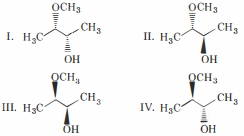
A
$I$
B
$II$
C
$III$
D
$IV$
Solution
(B) The starting material is $(S)-2-$methoxypropanal. Reaction with $MeMgX$ (Grignard reagent) follows the Felkin-Anh model to produce a mixture of diastereomeric alcohols.
The major product $P$ is the one where the bulky groups are arranged to minimize steric hindrance.
Upon treatment with $MeI / K_2CO_3$,the hydroxyl group $(-OH)$ is methylated to form an ether $(-OCH_3)$.
For the final product to be optically inactive,it must be a meso compound (possessing a plane of symmetry).
Structure $II$ represents the $(2S, 3S)$ or $(2S, 3R)$ configuration depending on the attack. The meso compound formed after methylation is the $(2S, 3R)-2,3-$dimethoxybutane,which has a plane of symmetry.
Thus,$P$ corresponds to structure $II$.
The major product $P$ is the one where the bulky groups are arranged to minimize steric hindrance.
Upon treatment with $MeI / K_2CO_3$,the hydroxyl group $(-OH)$ is methylated to form an ether $(-OCH_3)$.
For the final product to be optically inactive,it must be a meso compound (possessing a plane of symmetry).
Structure $II$ represents the $(2S, 3S)$ or $(2S, 3R)$ configuration depending on the attack. The meso compound formed after methylation is the $(2S, 3R)-2,3-$dimethoxybutane,which has a plane of symmetry.
Thus,$P$ corresponds to structure $II$.
0 likesView Solution
11
ChemistryMCQKVPY · 2011
Emulsification of $10 \, mL$ of oil in water produces $24 \times 10^{18}$ droplets. If the surface tension at the oil-water interface is $0.03 \, J \, m^{-2}$ and the area of each droplet is $12.5 \times 10^{-16} \, m^2$,the energy spent in the formation of oil droplets is $.... \, J$.
A
$90$
B
$30$
C
$900$
D
$10$
Solution
(C) The energy spent in the formation of droplets is given by the product of the total surface area created and the surface tension at the interface.
Given:
Surface tension $(\gamma) = 0.03 \, J \, m^{-2}$
Number of droplets $(n) = 24 \times 10^{18}$
Area of each droplet $(A_{single}) = 12.5 \times 10^{-16} \, m^2$
Total surface area $(A_{total}) = n \times A_{single}$
$A_{total} = (24 \times 10^{18}) \times (12.5 \times 10^{-16}) \, m^2$
$A_{total} = 24 \times 12.5 \times 10^2 \, m^2 = 300 \times 10^2 \, m^2 = 30000 \, m^2$
Energy spent $(W) = A_{total} \times \gamma$
$W = 30000 \, m^2 \times 0.03 \, J \, m^{-2} = 900 \, J$
Wait,re-calculating: $24 \times 12.5 = 300$. $300 \times 10^2 = 30000$. $30000 \times 0.03 = 900 \, J$. The correct answer is $900 \, J$.
Given:
Surface tension $(\gamma) = 0.03 \, J \, m^{-2}$
Number of droplets $(n) = 24 \times 10^{18}$
Area of each droplet $(A_{single}) = 12.5 \times 10^{-16} \, m^2$
Total surface area $(A_{total}) = n \times A_{single}$
$A_{total} = (24 \times 10^{18}) \times (12.5 \times 10^{-16}) \, m^2$
$A_{total} = 24 \times 12.5 \times 10^2 \, m^2 = 300 \times 10^2 \, m^2 = 30000 \, m^2$
Energy spent $(W) = A_{total} \times \gamma$
$W = 30000 \, m^2 \times 0.03 \, J \, m^{-2} = 900 \, J$
Wait,re-calculating: $24 \times 12.5 = 300$. $300 \times 10^2 = 30000$. $30000 \times 0.03 = 900 \, J$. The correct answer is $900 \, J$.
0 likesView Solution
12
ChemistryMediumMCQKVPY · 2011
Two balloons $A$ and $B$ containing $0.2 \ mol$ and $0.1 \ mol$ of helium at room temperature and $2.0 \ atm$,respectively,are connected. When equilibrium is established,the final pressure of $He$ in the system is $.... \ atm$.
A
$1.0$
B
$1.5$
C
$0.5$
D
$2.0$
Solution
(D) The initial pressure of helium in both balloons $A$ and $B$ is given as $2.0 \ atm$.
Since the temperature is constant and the pressure in both balloons is identical,connecting them will not result in any net flow of gas between the balloons.
Therefore,the final pressure of $He$ in the system remains $2.0 \ atm$.
Since the temperature is constant and the pressure in both balloons is identical,connecting them will not result in any net flow of gas between the balloons.
Therefore,the final pressure of $He$ in the system remains $2.0 \ atm$.
0 likesView Solution
13
ChemistryDifficultMCQKVPY · 2011
In the following set of aromatic compounds,the correct order of reactivity toward Friedel-Crafts alkylation is:
$(i)$ Nitrobenzene
(ii) Benzene
(iii) Methyl benzoate
(iv) Anisole
$(i)$ Nitrobenzene
(ii) Benzene
(iii) Methyl benzoate
(iv) Anisole
A
$i > ii > iii > iv$
B
$ii > iv > iii > i$
C
$iv > ii > iii > i$
D
$ii > i > iv > iii$
Solution
(C) The reactivity of aromatic compounds towards electrophilic aromatic substitution like Friedel-Crafts alkylation depends on the electron density of the benzene ring.
Electron-donating groups $(EDG)$ increase the electron density and thus increase reactivity,while electron-withdrawing groups $(EWG)$ decrease the electron density and decrease reactivity.
(iv) Anisole $(-OCH_3)$ has an $EDG$ which strongly activates the ring.
(ii) Benzene is the reference compound.
(iii) Methyl benzoate $(-COOCH_3)$ has an $EWG$ which deactivates the ring.
$(i)$ Nitrobenzene $(-NO_2)$ has a very strong $EWG$ which strongly deactivates the ring.
The order of reactivity is: $(iv) > (ii) > (iii) > (i)$.
Electron-donating groups $(EDG)$ increase the electron density and thus increase reactivity,while electron-withdrawing groups $(EWG)$ decrease the electron density and decrease reactivity.
(iv) Anisole $(-OCH_3)$ has an $EDG$ which strongly activates the ring.
(ii) Benzene is the reference compound.
(iii) Methyl benzoate $(-COOCH_3)$ has an $EWG$ which deactivates the ring.
$(i)$ Nitrobenzene $(-NO_2)$ has a very strong $EWG$ which strongly deactivates the ring.
The order of reactivity is: $(iv) > (ii) > (iii) > (i)$.
0 likesView Solution
14
ChemistryMediumMCQKVPY · 2011
The set of principal $(n)$,azimuthal $(l)$ and magnetic $(m_l)$ quantum numbers that is not allowed for the electron in $H$-atom is
A
$n=3, l=1, m_l=-1$
B
$n=3, l=0, m_l=0$
C
$n=2, l=1, m_l=0$
D
$n=2, l=2, m_l=-1$
Solution
(D) The correct answer is $(D)$.
For any set of principal $(n)$,azimuthal $(l)$,and magnetic $(m_l)$ quantum numbers,the following conditions must be satisfied:
$(i)$ The value of $l$ must range from $0$ to $n-1$.
$(ii)$ The value of $m_l$ must range from $-l$ to $+l$.
In option $(D)$,$n=2$ and $l=2$. Since $l$ must be less than $n$ $(l < n)$,the value $l=2$ is not allowed for $n=2$.
Therefore,the set $(n=2, l=2, m_l=-1)$ is not allowed.
For any set of principal $(n)$,azimuthal $(l)$,and magnetic $(m_l)$ quantum numbers,the following conditions must be satisfied:
$(i)$ The value of $l$ must range from $0$ to $n-1$.
$(ii)$ The value of $m_l$ must range from $-l$ to $+l$.
In option $(D)$,$n=2$ and $l=2$. Since $l$ must be less than $n$ $(l < n)$,the value $l=2$ is not allowed for $n=2$.
Therefore,the set $(n=2, l=2, m_l=-1)$ is not allowed.
0 likesView Solution
15
ChemistryMediumMCQKVPY · 2011
At $298 \, K$,assuming ideal behaviour,the average kinetic energy of a deuterium molecule is
A
two times that of a hydrogen molecule
B
four times that of a hydrogen molecule
C
half of that of a hydrogen molecule
D
same as that of a hydrogen molecule
Solution
(D) The correct option is $D$.
Average kinetic energy depends only upon the temperature and is independent of the mass or type of gas molecules.
For any ideal gas,the average kinetic energy per molecule is given by the formula $(K.E.)_{avg} = \frac{3}{2}kT$,where $k$ is the Boltzmann constant and $T$ is the absolute temperature.
Since both deuterium $(D_2)$ and hydrogen $(H_2)$ are at the same temperature $(298 \, K)$,their average kinetic energies are equal.
Average kinetic energy depends only upon the temperature and is independent of the mass or type of gas molecules.
For any ideal gas,the average kinetic energy per molecule is given by the formula $(K.E.)_{avg} = \frac{3}{2}kT$,where $k$ is the Boltzmann constant and $T$ is the absolute temperature.
Since both deuterium $(D_2)$ and hydrogen $(H_2)$ are at the same temperature $(298 \, K)$,their average kinetic energies are equal.
0 likesView Solution
16
ChemistryMediumMCQKVPY · 2011
An isolated box,equally partitioned,contains two ideal gases $A$ and $B$ as shown in the figure. When the partition is removed,the gases mix. The changes in enthalpy $(\Delta H)$ and entropy $(\Delta S)$ in the process,respectively,are
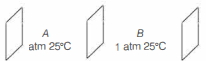
A
zero,positive
B
zero,negative
C
positive,zero
D
negative,zero
Solution
(A) For an ideal gas in an isolated system,the process of mixing is spontaneous and occurs at constant temperature (isothermal process).
Since the system is isolated,there is no exchange of heat with the surroundings $(q = 0)$ and no work is done $(w = 0)$,so $\Delta U = 0$.
For an ideal gas,enthalpy change is given by $\Delta H = \Delta U + \Delta(PV) = \Delta U + \Delta(nRT)$. Since $T$ is constant and $\Delta U = 0$,$\Delta H = 0$.
When the partition is removed,the gases mix,which increases the randomness of the system. Therefore,the entropy of the system increases,meaning $\Delta S > 0$ (positive).
Thus,the change in enthalpy is zero and the change in entropy is positive.
Since the system is isolated,there is no exchange of heat with the surroundings $(q = 0)$ and no work is done $(w = 0)$,so $\Delta U = 0$.
For an ideal gas,enthalpy change is given by $\Delta H = \Delta U + \Delta(PV) = \Delta U + \Delta(nRT)$. Since $T$ is constant and $\Delta U = 0$,$\Delta H = 0$.
When the partition is removed,the gases mix,which increases the randomness of the system. Therefore,the entropy of the system increases,meaning $\Delta S > 0$ (positive).
Thus,the change in enthalpy is zero and the change in entropy is positive.
0 likesView Solution
17
ChemistryMCQKVPY · 2011
In the conversion of a zinc ore to zinc metal,the process of roasting involves:
A
$ZnCO_3 \rightarrow ZnO$
B
$ZnO \rightarrow ZnSO_4$
C
$ZnS \rightarrow ZnO$
D
$ZnS \rightarrow ZnSO_4$
Solution
(C) In the process of roasting,a sulphide ore is heated in the presence of excess air to convert it into its corresponding metal oxide.
For zinc sulphide $(ZnS)$,the roasting reaction is: $2ZnS + 3O_2 \rightarrow 2ZnO + 2SO_2$.
Therefore,the conversion $ZnS \rightarrow ZnO$ represents the roasting process,making option $(c)$ correct.
For zinc sulphide $(ZnS)$,the roasting reaction is: $2ZnS + 3O_2 \rightarrow 2ZnO + 2SO_2$.
Therefore,the conversion $ZnS \rightarrow ZnO$ represents the roasting process,making option $(c)$ correct.
0 likesView Solution
18
ChemistryMediumMCQKVPY · 2011
The number of $P-H$ bond$(s)$ in $H_3PO_2, H_3PO_3$ and $H_3PO_4$,respectively,is
A
$2, 0, 1$
B
$1, 1, 1$
C
$2, 0, 0$
D
$2, 1, 0$
Solution
(D) The structures of the given oxoacids of phosphorus are as follows:
$H_3PO_2$ (Hypophosphorous acid): Contains $2$ $P-H$ bonds.
$H_3PO_3$ (Phosphorous acid): Contains $1$ $P-H$ bond.
$H_3PO_4$ (Orthophosphoric acid): Contains $0$ $P-H$ bonds.
Thus,the number of $P-H$ bonds in $H_3PO_2, H_3PO_3$ and $H_3PO_4$ are $2, 1$ and $0$ respectively.
Therefore,the correct option is $D$.
$H_3PO_2$ (Hypophosphorous acid): Contains $2$ $P-H$ bonds.
$H_3PO_3$ (Phosphorous acid): Contains $1$ $P-H$ bond.
$H_3PO_4$ (Orthophosphoric acid): Contains $0$ $P-H$ bonds.
Thus,the number of $P-H$ bonds in $H_3PO_2, H_3PO_3$ and $H_3PO_4$ are $2, 1$ and $0$ respectively.
Therefore,the correct option is $D$.
0 likesView Solution
19
ChemistryMediumMCQKVPY · 2011
When chlorine gas is passed through an aqueous solution of $KBr$,the solution turns orange brown due to the formation of
A
$KCl$
B
$HCl$
C
$HBr$
D
$Br_2$
Solution
(D)
When chlorine gas is passed through an aqueous solution of $KBr$,the solution turns orange brown due to the displacement of bromine. Chlorine is a stronger oxidizing agent than bromine,so it displaces bromine from its salt solution.
The balanced chemical equation is:
$Cl_2(g) + 2KBr(aq) \longrightarrow 2KCl(aq) + Br_2(aq/l)$
The formation of $Br_2$ imparts an orange-brown color to the solution.
When chlorine gas is passed through an aqueous solution of $KBr$,the solution turns orange brown due to the displacement of bromine. Chlorine is a stronger oxidizing agent than bromine,so it displaces bromine from its salt solution.
The balanced chemical equation is:
$Cl_2(g) + 2KBr(aq) \longrightarrow 2KCl(aq) + Br_2(aq/l)$
The formation of $Br_2$ imparts an orange-brown color to the solution.
0 likesView Solution
20
ChemistryMediumMCQKVPY · 2011
Among the given compounds,which one is not aromatic?
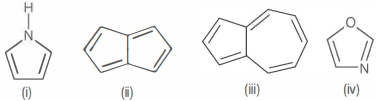
A
$(i)$
B
$(ii)$
C
$(iii)$
D
$(iv)$
Solution
(B) The conditions for a compound to be aromatic are:
$(i)$ The molecule should be planar.
$(ii)$ It should be cyclic with a continuous system of conjugated $\pi$ electrons.
$(iii)$ It should follow Huckel's rule,i.e.,it should have $(4n+2) \pi$ electrons,where $n = 0, 1, 2, \dots$
Let us analyze the given compounds:
$(i)$ Pyrrole: It has $6 \pi$ electrons ($4$ from double bonds + $2$ from the lone pair on $N$),which follows $(4n+2)$ rule $(n=1)$. It is aromatic.
$(ii)$ Pentalene: It has $8 \pi$ electrons. This follows the $4n$ rule $(n=2)$,making it anti-aromatic,not aromatic.
$(iii)$ Azulene: It has $10 \pi$ electrons,which follows $(4n+2)$ rule $(n=2)$. It is aromatic.
$(iv)$ Oxazole: It has $6 \pi$ electrons ($4$ from double bonds + $2$ from the lone pair on $O$),which follows $(4n+2)$ rule $(n=1)$. It is aromatic.
Thus,compound $(ii)$ is not aromatic.
$(i)$ The molecule should be planar.
$(ii)$ It should be cyclic with a continuous system of conjugated $\pi$ electrons.
$(iii)$ It should follow Huckel's rule,i.e.,it should have $(4n+2) \pi$ electrons,where $n = 0, 1, 2, \dots$
Let us analyze the given compounds:
$(i)$ Pyrrole: It has $6 \pi$ electrons ($4$ from double bonds + $2$ from the lone pair on $N$),which follows $(4n+2)$ rule $(n=1)$. It is aromatic.
$(ii)$ Pentalene: It has $8 \pi$ electrons. This follows the $4n$ rule $(n=2)$,making it anti-aromatic,not aromatic.
$(iii)$ Azulene: It has $10 \pi$ electrons,which follows $(4n+2)$ rule $(n=2)$. It is aromatic.
$(iv)$ Oxazole: It has $6 \pi$ electrons ($4$ from double bonds + $2$ from the lone pair on $O$),which follows $(4n+2)$ rule $(n=1)$. It is aromatic.
Thus,compound $(ii)$ is not aromatic.
0 likesView Solution
21
ChemistryMediumMCQKVPY · 2011
Among the following compounds,$2,3$-dimethylhexane is:
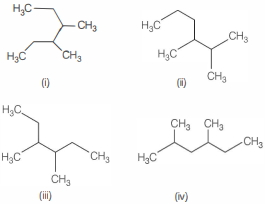
A
$(i)$
B
$(ii)$
C
$(iii)$
D
$(iv)$
Solution
(B) To identify $2,3$-dimethylhexane,we perform $IUPAC$ nomenclature on the given structures:
$(i)$ The longest chain has $6$ carbons. Numbering from the right gives substituents at positions $3$ and $4$. Thus,it is $3,4$-dimethylhexane.
$(ii)$ The longest chain has $6$ carbons. Numbering from the right gives substituents at positions $2$ and $3$. Thus,it is $2,3$-dimethylhexane.
$(iii)$ The longest chain has $6$ carbons. Numbering from the left gives substituents at positions $3$ and $4$. Thus,it is $3,4$-dimethylhexane.
$(iv)$ The longest chain has $6$ carbons. Numbering from the left gives substituents at positions $2$ and $4$. Thus,it is $2,4$-dimethylhexane.
Therefore,the correct structure for $2,3$-dimethylhexane is $(ii)$.
$(i)$ The longest chain has $6$ carbons. Numbering from the right gives substituents at positions $3$ and $4$. Thus,it is $3,4$-dimethylhexane.
$(ii)$ The longest chain has $6$ carbons. Numbering from the right gives substituents at positions $2$ and $3$. Thus,it is $2,3$-dimethylhexane.
$(iii)$ The longest chain has $6$ carbons. Numbering from the left gives substituents at positions $3$ and $4$. Thus,it is $3,4$-dimethylhexane.
$(iv)$ The longest chain has $6$ carbons. Numbering from the left gives substituents at positions $2$ and $4$. Thus,it is $2,4$-dimethylhexane.
Therefore,the correct structure for $2,3$-dimethylhexane is $(ii)$.
0 likesView Solution
22
ChemistryMediumMCQKVPY · 2011
An aqueous buffer is prepared by adding $100 \, mL$ of $0.1 \, mol \, L^{-1}$ acetic acid to $50 \, mL$ of $0.2 \, mol \, L^{-1}$ of sodium acetate. If $pK_a$ of acetic acid is $4.76$,the $pH$ of the buffer is
A
$4.26$
B
$5.76$
C
$3.76$
D
$4.76$
Solution
(D) The number of millimoles $(mmol)$ of acetic acid $(CH_3COOH)$ is $100 \, mL \times 0.1 \, mol \, L^{-1} = 10 \, mmol$.
The number of millimoles $(mmol)$ of sodium acetate $(CH_3COONa)$ is $50 \, mL \times 0.2 \, mol \, L^{-1} = 10 \, mmol$.
According to the Henderson-Hasselbalch equation for an acidic buffer:
$pH = pK_a + \log \frac{[Salt]}{[Acid]}$
Since the volume is the same for both components in the mixture,the ratio of concentrations is equal to the ratio of millimoles:
$pH = pK_a + \log \frac{mmol \, of \, CH_3COO^-}{mmol \, of \, CH_3COOH}$
Substituting the values:
$pH = 4.76 + \log \frac{10}{10}$
$pH = 4.76 + \log 1$
Since $\log 1 = 0$,we get:
$pH = 4.76$
The number of millimoles $(mmol)$ of sodium acetate $(CH_3COONa)$ is $50 \, mL \times 0.2 \, mol \, L^{-1} = 10 \, mmol$.
According to the Henderson-Hasselbalch equation for an acidic buffer:
$pH = pK_a + \log \frac{[Salt]}{[Acid]}$
Since the volume is the same for both components in the mixture,the ratio of concentrations is equal to the ratio of millimoles:
$pH = pK_a + \log \frac{mmol \, of \, CH_3COO^-}{mmol \, of \, CH_3COOH}$
Substituting the values:
$pH = 4.76 + \log \frac{10}{10}$
$pH = 4.76 + \log 1$
Since $\log 1 = 0$,we get:
$pH = 4.76$
0 likesView Solution
23
ChemistryMediumMCQKVPY · 2011
The maximum number of structural isomers possible for the hydrocarbon having the molecular formula $C_4H_6$ is:
A
$12$
B
$3$
C
$9$
D
$5$
Solution
(C) The degree of unsaturation for $C_4H_6$ is $4 - (6/2) + 1 = 2$. This indicates the presence of two double bonds,one triple bond,or two rings,or a combination of rings and double bonds.
There are $9$ possible structural isomers for $C_4H_6$:
$1$. $CH_3-CH_2-C\equiv CH$ (but$-1-$yne)
$2$. $CH_3-C\equiv C-CH_3$ (but$-2-$yne)
$3$. $CH_2=C=CH-CH_3$ (buta$-1,2-$diene)
$4$. $CH_2=CH-CH=CH_2$ (buta$-1,3-$diene)
$5$. $CH_2=C(CH_3)-CH=CH_2$ ($2$-methylpropa$-1,2-$diene)
$6$. Cyclobutene
$7$. $1-$Methylcyclopropene
$8$. $3-$Methylcyclopropene
$9$. Methylenecyclopropane
Thus,the total number of structural isomers is $9$.
There are $9$ possible structural isomers for $C_4H_6$:
$1$. $CH_3-CH_2-C\equiv CH$ (but$-1-$yne)
$2$. $CH_3-C\equiv C-CH_3$ (but$-2-$yne)
$3$. $CH_2=C=CH-CH_3$ (buta$-1,2-$diene)
$4$. $CH_2=CH-CH=CH_2$ (buta$-1,3-$diene)
$5$. $CH_2=C(CH_3)-CH=CH_2$ ($2$-methylpropa$-1,2-$diene)
$6$. Cyclobutene
$7$. $1-$Methylcyclopropene
$8$. $3-$Methylcyclopropene
$9$. Methylenecyclopropane
Thus,the total number of structural isomers is $9$.
0 likesView Solution
24
ChemistryMediumMCQKVPY · 2011
At $783 \, K$ in the reaction,$H_{2(g)} + I_{2(g)} \rightleftharpoons 2 HI_{(g)}$,the molar concentrations $(mol \, L^{-1})$ of $H_2, I_2$ and $HI$ at some instant of time are $0.1, 0.2$ and $0.4$,respectively. If the equilibrium constant is $46$ at the same temperature,then as the reaction proceeds:
A
the amount of $HI$ will increase
B
the amount of $HI$ will decrease
C
the amount of $H_2$ and $I_2$ will increase
D
the amount of $H_2$ and $I_2$ will not change
Solution
(A) For the reaction,$H_{2(g)} + I_{2(g)} \rightleftharpoons 2 HI_{(g)}$ with $K_C = 46$.
The reaction quotient $Q_C$ is calculated as:
$Q_C = \frac{[HI]^2}{[H_2][I_2]} = \frac{0.4 \times 0.4}{0.1 \times 0.2} = \frac{0.16}{0.02} = 8$.
Since $Q_C < K_C$ $(8 < 46)$,the reaction will proceed in the forward direction to reach equilibrium.
Therefore,the concentration of the product $HI$ will increase.
The reaction quotient $Q_C$ is calculated as:
$Q_C = \frac{[HI]^2}{[H_2][I_2]} = \frac{0.4 \times 0.4}{0.1 \times 0.2} = \frac{0.16}{0.02} = 8$.
Since $Q_C < K_C$ $(8 < 46)$,the reaction will proceed in the forward direction to reach equilibrium.
Therefore,the concentration of the product $HI$ will increase.
0 likesView Solution
25
ChemistryMCQKVPY · 2011
Let $a, b, x, y$ be real numbers such that $a^2+b^2=81$,$x^2+y^2=121$ and $ax+by=99$. Then,the set of all possible values of $ay-bx$ is
A
$(0, \frac{9}{11}]$
B
$(0, \frac{9}{11})$
C
$\{0\}$
D
$[\frac{9}{11}, \infty)$
Solution
(C) Given,$a^2+b^2=81$ and $x^2+y^2=121$.
Also,$ax+by=99$.
Consider the identity $(a^2+b^2)(x^2+y^2) = (ax+by)^2 + (ay-bx)^2$.
Substituting the given values:
$(81)(121) = (99)^2 + (ay-bx)^2$.
Since $81 \times 121 = 9801$ and $99^2 = 9801$,we have:
$9801 = 9801 + (ay-bx)^2$.
$(ay-bx)^2 = 9801 - 9801 = 0$.
Therefore,$ay-bx = 0$.
The set of all possible values is $\{0\}$.
Also,$ax+by=99$.
Consider the identity $(a^2+b^2)(x^2+y^2) = (ax+by)^2 + (ay-bx)^2$.
Substituting the given values:
$(81)(121) = (99)^2 + (ay-bx)^2$.
Since $81 \times 121 = 9801$ and $99^2 = 9801$,we have:
$9801 = 9801 + (ay-bx)^2$.
$(ay-bx)^2 = 9801 - 9801 = 0$.
Therefore,$ay-bx = 0$.
The set of all possible values is $\{0\}$.
0 likesView Solution
26
ChemistryMCQKVPY · 2011
$A$ man wants to reach a certain destination. One-sixth of the total distance is muddy while half the distance is tar road. For the remaining distance,he takes a boat. His speed of travelling in mud,in water,and on tar road is in the ratio $3:4:5$. The ratio of the durations he requires to cross the patch of mud,stream,and tar road is
A
$\frac{1}{2}: \frac{4}{3}: \frac{5}{2}$
B
$3:8:15$
C
$10:15:18$
D
$1:2:3$
Solution
(C) Let the total distance be $D$.
Distance covered in mud $= \frac{D}{6}$.
Distance covered on tar road $= \frac{D}{2}$.
Distance covered by boat (water) $= D - (\frac{D}{6} + \frac{D}{2}) = D - (\frac{D+3D}{6}) = D - \frac{4D}{6} = D - \frac{2D}{3} = \frac{D}{3}$.
Given the ratio of speeds in mud,water,and tar road is $3:4:5$. Let the speeds be $3v, 4v, 5v$ respectively.
Time taken for mud $= \frac{D/6}{3v} = \frac{D}{18v}$.
Time taken for water $= \frac{D/3}{4v} = \frac{D}{12v}$.
Time taken for tar road $= \frac{D/2}{5v} = \frac{D}{10v}$.
Ratio of times $= \frac{D}{18v} : \frac{D}{12v} : \frac{D}{10v} = \frac{1}{18} : \frac{1}{12} : \frac{1}{10}$.
To simplify,multiply by the $LCM$ of $18, 12, 10$,which is $180$.
Ratio $= (\frac{1}{18} \times 180) : (\frac{1}{12} \times 180) : (\frac{1}{10} \times 180) = 10 : 15 : 18$.
Distance covered in mud $= \frac{D}{6}$.
Distance covered on tar road $= \frac{D}{2}$.
Distance covered by boat (water) $= D - (\frac{D}{6} + \frac{D}{2}) = D - (\frac{D+3D}{6}) = D - \frac{4D}{6} = D - \frac{2D}{3} = \frac{D}{3}$.
Given the ratio of speeds in mud,water,and tar road is $3:4:5$. Let the speeds be $3v, 4v, 5v$ respectively.
Time taken for mud $= \frac{D/6}{3v} = \frac{D}{18v}$.
Time taken for water $= \frac{D/3}{4v} = \frac{D}{12v}$.
Time taken for tar road $= \frac{D/2}{5v} = \frac{D}{10v}$.
Ratio of times $= \frac{D}{18v} : \frac{D}{12v} : \frac{D}{10v} = \frac{1}{18} : \frac{1}{12} : \frac{1}{10}$.
To simplify,multiply by the $LCM$ of $18, 12, 10$,which is $180$.
Ratio $= (\frac{1}{18} \times 180) : (\frac{1}{12} \times 180) : (\frac{1}{10} \times 180) = 10 : 15 : 18$.
0 likesView Solution
27
ChemistryMCQKVPY · 2011
Two friends $A$ and $B$ are $30 \, km$ apart and they start simultaneously on motorcycles to meet each other. The speed of $A$ is $3$ times that of $B$. The distance between them decreases at the rate of $2 \, km$ per minute. Ten minutes after they start,$A$'s vehicle breaks down and $A$ stops and waits for $B$ to arrive. After how much time (in minutes) since $A$ started riding,does $B$ meet $A$?
A
$15$
B
$20$
C
$25$
D
$30$
Solution
(D) Let the speed of $B$ be $v_B = x \, km/min$ and the speed of $A$ be $v_A = 3x \, km/min$.
Since they move towards each other,the rate at which the distance between them decreases is $v_A + v_B = 3x + x = 4x \, km/min$.
Given that the distance decreases at $2 \, km/min$,we have $4x = 2$,so $x = 0.5 \, km/min$.
Thus,$v_B = 0.5 \, km/min$ and $v_A = 1.5 \, km/min$.
In the first $10 \, minutes$,the distance covered by both is $10 \times (v_A + v_B) = 10 \times 2 = 20 \, km$.
The remaining distance between them is $30 - 20 = 10 \, km$.
After $10 \, minutes$,$A$ stops,so $B$ must cover the remaining $10 \, km$ at his speed $v_B = 0.5 \, km/min$.
Time taken by $B$ to cover the remaining distance is $\frac{10}{0.5} = 20 \, minutes$.
The total time from the start until $B$ meets $A$ is $10 \, minutes$ (initial travel) $+ 20 \, minutes$ (time for $B$ to reach $A$) $= 30 \, minutes$.
Since they move towards each other,the rate at which the distance between them decreases is $v_A + v_B = 3x + x = 4x \, km/min$.
Given that the distance decreases at $2 \, km/min$,we have $4x = 2$,so $x = 0.5 \, km/min$.
Thus,$v_B = 0.5 \, km/min$ and $v_A = 1.5 \, km/min$.
In the first $10 \, minutes$,the distance covered by both is $10 \times (v_A + v_B) = 10 \times 2 = 20 \, km$.
The remaining distance between them is $30 - 20 = 10 \, km$.
After $10 \, minutes$,$A$ stops,so $B$ must cover the remaining $10 \, km$ at his speed $v_B = 0.5 \, km/min$.
Time taken by $B$ to cover the remaining distance is $\frac{10}{0.5} = 20 \, minutes$.
The total time from the start until $B$ meets $A$ is $10 \, minutes$ (initial travel) $+ 20 \, minutes$ (time for $B$ to reach $A$) $= 30 \, minutes$.
0 likesView Solution
28
ChemistryMCQKVPY · 2011
Three taps $A, B, C$ fill up a tank independently in $10 \, h$,$20 \, h$,and $30 \, h$,respectively. Initially,the tank is empty. Exactly one pair of taps is open during each hour,and every pair of taps is open for at least one hour. What is the minimum number of hours required to fill the tank?
A
$8$
B
$9$
C
$10$
D
$11$
Solution
(A) The rates of filling for taps $A, B, C$ are $\frac{1}{10}, \frac{1}{20}, \frac{1}{30}$ of the tank per hour,respectively.
Let the pairs be $(A, B), (B, C), (C, A)$. The combined rates are:
$(A+B) = \frac{1}{10} + \frac{1}{20} = \frac{3}{20} = 0.15$
$(B+C) = \frac{1}{20} + \frac{1}{30} = \frac{5}{60} = \frac{1}{12} \approx 0.0833$
$(C+A) = \frac{1}{30} + \frac{1}{10} = \frac{4}{30} = \frac{2}{15} \approx 0.1333$
To minimize time,we use the fastest pairs as much as possible. The rates in descending order are $(A+B) > (C+A) > (B+C)$.
In $3 \, h$,using each pair once,the tank filled is $\frac{3}{20} + \frac{2}{15} + \frac{1}{12} = \frac{9+8+5}{60} = \frac{22}{60} = \frac{11}{30}$.
Remaining part is $1 - \frac{11}{30} = \frac{19}{30}$.
To fill the remaining $\frac{19}{30}$ as fast as possible,we use the fastest pair $(A+B)$ with rate $\frac{3}{20}$.
Time required = $\frac{19/30}{3/20} = \frac{19}{30} \times \frac{20}{3} = \frac{38}{9} \approx 4.22 \, h$.
Total time = $3 + 4.22 = 7.22 \, h$. Since we must use each pair for at least one hour,and the question implies integer hours,we check the options. Given the options,$8 \, h$ is the smallest integer satisfying the condition.
Let the pairs be $(A, B), (B, C), (C, A)$. The combined rates are:
$(A+B) = \frac{1}{10} + \frac{1}{20} = \frac{3}{20} = 0.15$
$(B+C) = \frac{1}{20} + \frac{1}{30} = \frac{5}{60} = \frac{1}{12} \approx 0.0833$
$(C+A) = \frac{1}{30} + \frac{1}{10} = \frac{4}{30} = \frac{2}{15} \approx 0.1333$
To minimize time,we use the fastest pairs as much as possible. The rates in descending order are $(A+B) > (C+A) > (B+C)$.
In $3 \, h$,using each pair once,the tank filled is $\frac{3}{20} + \frac{2}{15} + \frac{1}{12} = \frac{9+8+5}{60} = \frac{22}{60} = \frac{11}{30}$.
Remaining part is $1 - \frac{11}{30} = \frac{19}{30}$.
To fill the remaining $\frac{19}{30}$ as fast as possible,we use the fastest pair $(A+B)$ with rate $\frac{3}{20}$.
Time required = $\frac{19/30}{3/20} = \frac{19}{30} \times \frac{20}{3} = \frac{38}{9} \approx 4.22 \, h$.
Total time = $3 + 4.22 = 7.22 \, h$. Since we must use each pair for at least one hour,and the question implies integer hours,we check the options. Given the options,$8 \, h$ is the smallest integer satisfying the condition.
0 likesView Solution
29
ChemistryMediumMCQKVPY · 2011
The hybridisations of $Ni(CO)_4$ and $[Cr(H_2O)_6]^{2+}$ respectively,are
A
$sp^3$ and $d^2sp^3$
B
$dsp^2$ and $d^2sp^3$
C
$sp^3$ and $sp^3d^2$
D
$dsp^2$ and $sp^3d^2$
Solution
(C) The oxidation state of $Ni$ in $Ni(CO)_4$ is $0$. Its electronic configuration is $[Ar] 3d^8 4s^2$. Since $CO$ is a strong field ligand,the $4s$ electrons pair up in the $3d$ orbitals,resulting in $sp^3$ hybridisation.
The oxidation state of $Cr$ in $[Cr(H_2O)_6]^{2+}$ is $+2$. Its electronic configuration is $[Ar] 3d^4$. Since $H_2O$ is a weak field ligand,it does not cause pairing of electrons. However,the complex $[Cr(H_2O)_6]^{2+}$ involves $sp^3d^2$ hybridisation (outer orbital complex).
The oxidation state of $Cr$ in $[Cr(H_2O)_6]^{2+}$ is $+2$. Its electronic configuration is $[Ar] 3d^4$. Since $H_2O$ is a weak field ligand,it does not cause pairing of electrons. However,the complex $[Cr(H_2O)_6]^{2+}$ involves $sp^3d^2$ hybridisation (outer orbital complex).
0 likesView Solution
30
ChemistryDifficultMCQKVPY · 2011
Extraction of silver is achieved by initial complexation of the ore (argentite) with $X$ followed by reduction with $Y$. $X$ and $Y$,respectively are
A
$CN^{-}$ and $Zn$
B
$CN^{-}$ and $Cu$
C
$Cl^{-}$ and $Zn$
D
$Br^{-}$ and $Zn$
Solution
(A) The correct option is $A$.
Extraction of silver is achieved by the initial complexation of the ore (argentite,$Ag_2S$) with cyanide ion $(CN^-)$ to form a soluble complex,followed by reduction with zinc $(Zn)$.
This process is known as the Mac-Arthur Forrest cyanide process.
The chemical reactions are:
$Ag_2S + 4CN^- \rightarrow 2[Ag(CN)_2]^- + S^{2-}$
$2[Ag(CN)_2]^- + Zn \rightarrow [Zn(CN)_4]^{2-} + 2Ag$
Here,$X = CN^-$ and $Y = Zn$.
Extraction of silver is achieved by the initial complexation of the ore (argentite,$Ag_2S$) with cyanide ion $(CN^-)$ to form a soluble complex,followed by reduction with zinc $(Zn)$.
This process is known as the Mac-Arthur Forrest cyanide process.
The chemical reactions are:
$Ag_2S + 4CN^- \rightarrow 2[Ag(CN)_2]^- + S^{2-}$
$2[Ag(CN)_2]^- + Zn \rightarrow [Zn(CN)_4]^{2-} + 2Ag$
Here,$X = CN^-$ and $Y = Zn$.
0 likesView Solution
31
ChemistryMediumMCQKVPY · 2011
Assuming ideal behaviour,the enthalpy and volume of mixing of two liquids respectively,are
A
$zero$ and $zero$
B
$+ve$ and $zero$
C
$-ve$ and $zero$
D
$-ve$ and $-ve$
Solution
(A) For an ideal solution,the interactions between the components are similar to the interactions within the pure components.
Therefore,the enthalpy of mixing,$\Delta H_{\text{mix}} = 0$.
Similarly,the volume of mixing,$\Delta V_{\text{mix}} = 0$.
This implies that no heat is absorbed or evolved,and the total volume of the solution is equal to the sum of the volumes of the individual components.
Therefore,the enthalpy of mixing,$\Delta H_{\text{mix}} = 0$.
Similarly,the volume of mixing,$\Delta V_{\text{mix}} = 0$.
This implies that no heat is absorbed or evolved,and the total volume of the solution is equal to the sum of the volumes of the individual components.
0 likesView Solution
32
ChemistryMediumMCQKVPY · 2011
At $298 \, K$,the ratio of osmotic pressures of two solutions of a substance with concentrations of $0.01 \, M$ and $0.001 \, M$ respectively,is
A
$1$
B
$100$
C
$10$
D
$1000$
Solution
(C) The osmotic pressure $(\pi)$ of a solution is given by the formula: $\pi = CRT$.
Since the temperature $(T)$ and the gas constant $(R)$ are constant,the osmotic pressure is directly proportional to the concentration $(C)$,i.e.,$\pi \propto C$.
Therefore,the ratio of the osmotic pressures of the two solutions is: $\frac{\pi_1}{\pi_2} = \frac{C_1}{C_2}$.
Given $C_1 = 0.01 \, M$ and $C_2 = 0.001 \, M$,the ratio is: $\frac{0.01}{0.001} = 10$.
Thus,the correct option is $C$.
Since the temperature $(T)$ and the gas constant $(R)$ are constant,the osmotic pressure is directly proportional to the concentration $(C)$,i.e.,$\pi \propto C$.
Therefore,the ratio of the osmotic pressures of the two solutions is: $\frac{\pi_1}{\pi_2} = \frac{C_1}{C_2}$.
Given $C_1 = 0.01 \, M$ and $C_2 = 0.001 \, M$,the ratio is: $\frac{0.01}{0.001} = 10$.
Thus,the correct option is $C$.
0 likesView Solution
33
ChemistryMediumMCQKVPY · 2011
The rate of gas phase chemical reactions generally increases rapidly with a rise in temperature. This is mainly because
A
the collision frequency increases with temperature
B
the fraction of molecules having energy in excess of the activation energy increases with temperature
C
the activation energy decreases with temperature
D
the average kinetic energy of molecules increases with temperature
Solution
(B) .
According to the Arrhenius equation,$K = A e^{-E_a / RT}$,the rate constant $K$ depends on temperature.
As temperature increases,the fraction of molecules having kinetic energy greater than the activation energy $(E_a)$ increases significantly.
This factor,represented by $e^{-E_a / RT}$,is the primary reason for the rapid increase in the reaction rate.
According to the Arrhenius equation,$K = A e^{-E_a / RT}$,the rate constant $K$ depends on temperature.
As temperature increases,the fraction of molecules having kinetic energy greater than the activation energy $(E_a)$ increases significantly.
This factor,represented by $e^{-E_a / RT}$,is the primary reason for the rapid increase in the reaction rate.
0 likesView Solution
34
ChemistryDifficultMCQKVPY · 2011
Among $(I)-(IV)$,the compound that does not undergo polymerisation under radical initiation is:
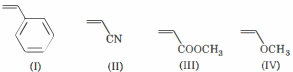
A
$I$
B
$II$
C
$III$
D
$IV$
Solution
(D) The correct answer is $(d)$.
In free radical polymerisation,the monomer must be capable of forming a stable radical intermediate. Compounds $(I)$ (styrene),$(II)$ (acrylonitrile),and $(III)$ (methyl acrylate) contain electron-withdrawing groups attached to the double bond,which stabilize the radical formed during the propagation step through resonance.
Compound $(IV)$,methyl vinyl ether $(CH_2=CH-OCH_3)$,has an electron-donating methoxy group. The oxygen atom donates electron density into the double bond,making it electron-rich. This destabilizes the formation of a radical intermediate in a free radical mechanism,as radical polymerization typically requires electron-deficient alkenes to stabilize the radical center.
In free radical polymerisation,the monomer must be capable of forming a stable radical intermediate. Compounds $(I)$ (styrene),$(II)$ (acrylonitrile),and $(III)$ (methyl acrylate) contain electron-withdrawing groups attached to the double bond,which stabilize the radical formed during the propagation step through resonance.
Compound $(IV)$,methyl vinyl ether $(CH_2=CH-OCH_3)$,has an electron-donating methoxy group. The oxygen atom donates electron density into the double bond,making it electron-rich. This destabilizes the formation of a radical intermediate in a free radical mechanism,as radical polymerization typically requires electron-deficient alkenes to stabilize the radical center.
0 likesView Solution
35
ChemistryMediumMCQKVPY · 2011
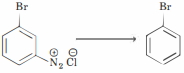
For the transformation shown below,the reagent used is:
A
$LiAlH_4$
B
$H_3PO_2$
C
$H_3O^{+}$
D
$H_2 / Pt$
Solution
(B) The correct option is $(B)$.
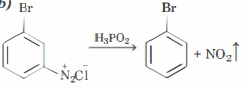
The reaction involves the removal of the diazonium group $(-N_2^+ Cl^-)$ from the benzene ring and its replacement with a hydrogen atom.
This transformation is achieved using hypophosphorous acid $(H_3PO_2)$ in the presence of water. The diazonium salt is reduced to the corresponding arene,while $H_3PO_2$ is oxidized to phosphorous acid $(H_3PO_3)$.
The reaction is represented as:
$Ar-N_2^+ Cl^- + H_3PO_2 + H_2O \rightarrow Ar-H + N_2 + H_3PO_3 + HCl$
This is a standard method for the deamination of aromatic amines via their diazonium salts.
The reaction involves the removal of the diazonium group $(-N_2^+ Cl^-)$ from the benzene ring and its replacement with a hydrogen atom.
This transformation is achieved using hypophosphorous acid $(H_3PO_2)$ in the presence of water. The diazonium salt is reduced to the corresponding arene,while $H_3PO_2$ is oxidized to phosphorous acid $(H_3PO_3)$.
The reaction is represented as:
$Ar-N_2^+ Cl^- + H_3PO_2 + H_2O \rightarrow Ar-H + N_2 + H_3PO_3 + HCl$
This is a standard method for the deamination of aromatic amines via their diazonium salts.
0 likesView Solution
36
ChemistryMediumMCQKVPY · 2011
The values of the limiting molar conductivity $(\lambda^0)$ for $NaCl$,$HCl$ and $NaOAc$ are $126.4$,$425.9$ and $91.0 \, S \, cm^2 \, mol^{-1}$,respectively. For $HOAc$,$\Lambda^0$ in $S \, cm^2 \, mol^{-1}$ is
A
$390.5$
B
$299.5$
C
$208.5$
D
$217.4$
Solution
(A) According to Kohlrausch's law of independent migration of ions,the limiting molar conductivity of a weak electrolyte can be calculated using the limiting molar conductivities of strong electrolytes.
For $HOAc$ (acetic acid),the expression is:
$\Lambda^0_{HOAc} = \Lambda^0_{HCl} + \Lambda^0_{NaOAc} - \Lambda^0_{NaCl}$
Given values:
$\Lambda^0_{NaCl} = 126.4 \, S \, cm^2 \, mol^{-1}$
$\Lambda^0_{HCl} = 425.9 \, S \, cm^2 \, mol^{-1}$
$\Lambda^0_{NaOAc} = 91.0 \, S \, cm^2 \, mol^{-1}$
Substituting these values:
$\Lambda^0_{HOAc} = 425.9 + 91.0 - 126.4 = 390.5 \, S \, cm^2 \, mol^{-1}$
For $HOAc$ (acetic acid),the expression is:
$\Lambda^0_{HOAc} = \Lambda^0_{HCl} + \Lambda^0_{NaOAc} - \Lambda^0_{NaCl}$
Given values:
$\Lambda^0_{NaCl} = 126.4 \, S \, cm^2 \, mol^{-1}$
$\Lambda^0_{HCl} = 425.9 \, S \, cm^2 \, mol^{-1}$
$\Lambda^0_{NaOAc} = 91.0 \, S \, cm^2 \, mol^{-1}$
Substituting these values:
$\Lambda^0_{HOAc} = 425.9 + 91.0 - 126.4 = 390.5 \, S \, cm^2 \, mol^{-1}$
0 likesView Solution
37
ChemistryMediumMCQKVPY · 2011
To obtain a diffraction peak for a crystalline solid with interplane distance equal to the wavelength of incident $X$-ray radiation,the angle of incidence should be $....\,^{\circ}$
A
$90$
B
$0$
C
$30$
D
$60$
Solution
(C) According to Bragg's equation,$n\lambda = 2d\sin\theta$.
Given that the interplane distance $d = \lambda$ and assuming the first-order diffraction $(n = 1)$.
Substituting these values into the equation: $1 \times \lambda = 2 \times \lambda \times \sin\theta$.
Dividing both sides by $\lambda$,we get $1 = 2\sin\theta$,which simplifies to $\sin\theta = \frac{1}{2}$.
Therefore,$\theta = \arcsin(0.5) = 30^{\circ}$.
Given that the interplane distance $d = \lambda$ and assuming the first-order diffraction $(n = 1)$.
Substituting these values into the equation: $1 \times \lambda = 2 \times \lambda \times \sin\theta$.
Dividing both sides by $\lambda$,we get $1 = 2\sin\theta$,which simplifies to $\sin\theta = \frac{1}{2}$.
Therefore,$\theta = \arcsin(0.5) = 30^{\circ}$.
0 likesView Solution
38
ChemistryMediumMCQKVPY · 2011
The standard Gibbs free energy change ($\Delta G^{\circ}$ in $kJ \, mol^{-1}$),in a $Daniell$ cell $(E^{\circ}_{cell} = 1.1 \, V)$,when $2 \, moles$ of $Zn_{(s)}$ is oxidised at $298 \, K$,is closest to
A
$-2123$
B
$-106.2$
C
$-424.6$
D
$-53.1$
Solution
(C) The reaction in a $Daniell$ cell is: $Zn_{(s)} + Cu^{2+}_{(aq)} \rightarrow Zn^{2+}_{(aq)} + Cu_{(s)}$.
For $1 \, mole$ of $Zn$ oxidation,$n = 2$ electrons are transferred.
For $2 \, moles$ of $Zn$ oxidation,the number of electrons transferred is $n = 2 \times 2 = 4$.
Given $E^{\circ}_{cell} = 1.1 \, V$ and $F = 96500 \, C \, mol^{-1}$.
The formula for standard Gibbs free energy change is $\Delta G^{\circ} = -n F E^{\circ}_{cell}$.
Substituting the values: $\Delta G^{\circ} = -4 \times 96500 \, C \, mol^{-1} \times 1.1 \, V$.
$\Delta G^{\circ} = -424600 \, J \, mol^{-1} = -424.6 \, kJ \, mol^{-1}$.
For $1 \, mole$ of $Zn$ oxidation,$n = 2$ electrons are transferred.
For $2 \, moles$ of $Zn$ oxidation,the number of electrons transferred is $n = 2 \times 2 = 4$.
Given $E^{\circ}_{cell} = 1.1 \, V$ and $F = 96500 \, C \, mol^{-1}$.
The formula for standard Gibbs free energy change is $\Delta G^{\circ} = -n F E^{\circ}_{cell}$.
Substituting the values: $\Delta G^{\circ} = -4 \times 96500 \, C \, mol^{-1} \times 1.1 \, V$.
$\Delta G^{\circ} = -424600 \, J \, mol^{-1} = -424.6 \, kJ \, mol^{-1}$.
0 likesView Solution
39
ChemistryMediumMCQKVPY · 2011
The spin-only magnetic moments of $[Mn(CN)_6]^{2-}$ and $[MnBr_4]^{2-}$ in Bohr magnetons,respectively are
A
$5.92$ and $5.92$
B
$4.89$ and $1.73$
C
$1.73$ and $5.92$
D
$1.73$ and $1.73$
Solution
(C) The oxidation state of $Mn$ in $[Mn(CN)_6]^{2-}$ is $+4$. The electronic configuration of $Mn^{4+}$ is $[Ar] 3d^3$.
Since $CN^-$ is a strong field ligand,the $3d$ electrons are arranged as follows: $t_{2g}^3 e_g^0$. The number of unpaired electrons $(n)$ is $1$.
The spin-only magnetic moment is $\mu = \sqrt{n(n+2)} = \sqrt{1(1+2)} = \sqrt{3} \approx 1.73 \ BM$.
The oxidation state of $Mn$ in $[MnBr_4]^{2-}$ is $+2$. The electronic configuration of $Mn^{2+}$ is $[Ar] 3d^5$.
Since $Br^-$ is a weak field ligand,no pairing occurs. The number of unpaired electrons $(n)$ is $5$.
The spin-only magnetic moment is $\mu = \sqrt{5(5+2)} = \sqrt{35} \approx 5.92 \ BM$.
Thus,the values are $1.73 \ BM$ and $5.92 \ BM$.
Since $CN^-$ is a strong field ligand,the $3d$ electrons are arranged as follows: $t_{2g}^3 e_g^0$. The number of unpaired electrons $(n)$ is $1$.
The spin-only magnetic moment is $\mu = \sqrt{n(n+2)} = \sqrt{1(1+2)} = \sqrt{3} \approx 1.73 \ BM$.
The oxidation state of $Mn$ in $[MnBr_4]^{2-}$ is $+2$. The electronic configuration of $Mn^{2+}$ is $[Ar] 3d^5$.
Since $Br^-$ is a weak field ligand,no pairing occurs. The number of unpaired electrons $(n)$ is $5$.
The spin-only magnetic moment is $\mu = \sqrt{5(5+2)} = \sqrt{35} \approx 5.92 \ BM$.
Thus,the values are $1.73 \ BM$ and $5.92 \ BM$.
0 likesView Solution
40
ChemistryDifficultMCQKVPY · 2011
In a zero-order reaction,if the initial concentration of the reactant is doubled,the time required for half the reactant to be consumed:
A
increases two-fold
B
increases four-fold
C
decreases by half
D
does not change
Solution
(A) The time required to reduce the concentration of the reactant to half of its initial value is known as the half-life $(t_{1/2})$.
For a zero-order reaction,the half-life is given by the formula:
$t_{1/2} = \frac{[A]_0}{2k}$
where $[A]_0$ is the initial concentration and $k$ is the rate constant.
If the initial concentration is doubled,i.e.,$[A]_0' = 2[A]_0$,then the new half-life becomes:
$t_{1/2}' = \frac{2[A]_0}{2k} = 2 \times t_{1/2}$
Therefore,the time required for half the reactant to be consumed increases two-fold.
For a zero-order reaction,the half-life is given by the formula:
$t_{1/2} = \frac{[A]_0}{2k}$
where $[A]_0$ is the initial concentration and $k$ is the rate constant.
If the initial concentration is doubled,i.e.,$[A]_0' = 2[A]_0$,then the new half-life becomes:
$t_{1/2}' = \frac{2[A]_0}{2k} = 2 \times t_{1/2}$
Therefore,the time required for half the reactant to be consumed increases two-fold.
0 likesView Solution
41
ChemistryMediumMCQKVPY · 2011
The reaction,
$C_6H_5OH + CHCl_3 \xrightarrow{NaOH/\Delta} \text{o-hydroxybenzaldehyde} + H^+$
is known as:
$C_6H_5OH + CHCl_3 \xrightarrow{NaOH/\Delta} \text{o-hydroxybenzaldehyde} + H^+$
is known as:
A
Perkin reaction
B
Sandmeyer reaction
C
Reimer-Tiemann reaction
D
Cannizzaro reaction
Solution
(C)
This reaction is known as the Reimer-Tiemann reaction.
In this reaction,phenol reacts with chloroform $(CHCl_3)$ in the presence of aqueous sodium hydroxide $(NaOH)$ to form salicylaldehyde (o-hydroxybenzaldehyde).
The mechanism involves the formation of dichlorocarbene $(:CCl_2)$ as an electrophilic intermediate,which attacks the phenoxide ion.
This reaction is known as the Reimer-Tiemann reaction.
In this reaction,phenol reacts with chloroform $(CHCl_3)$ in the presence of aqueous sodium hydroxide $(NaOH)$ to form salicylaldehyde (o-hydroxybenzaldehyde).
The mechanism involves the formation of dichlorocarbene $(:CCl_2)$ as an electrophilic intermediate,which attacks the phenoxide ion.
0 likesView Solution
42
ChemistryDifficultMCQKVPY · 2011
Among $I, II, III$ (Phenol,o-nitrophenol,and p-nitrophenol respectively),the boiling point follows the order:
A
$II < I < III$
B
$III < II < I$
C
$I < II < III$
D
$II < III < I$
Solution
(C) The boiling point of a compound depends upon the extent of intermolecular forces,specifically hydrogen bonding.
$(I)$ Phenol has intermolecular hydrogen bonding but lacks the strong electron-withdrawing group present in the others.
$(II)$ $o$-Nitrophenol exhibits intramolecular hydrogen bonding,which reduces the extent of intermolecular association,leading to a lower boiling point compared to the para isomer.
$(III)$ $p$-Nitrophenol exhibits strong intermolecular hydrogen bonding,which leads to molecular association and results in the highest boiling point.
Therefore,the correct order of boiling points is $I < II < III$.
$(I)$ Phenol has intermolecular hydrogen bonding but lacks the strong electron-withdrawing group present in the others.
$(II)$ $o$-Nitrophenol exhibits intramolecular hydrogen bonding,which reduces the extent of intermolecular association,leading to a lower boiling point compared to the para isomer.
$(III)$ $p$-Nitrophenol exhibits strong intermolecular hydrogen bonding,which leads to molecular association and results in the highest boiling point.
Therefore,the correct order of boiling points is $I < II < III$.
0 likesView Solution
43
ChemistryDifficultMCQKVPY · 2011
$XeF_6$ hydrolyses to give an oxide. The structures of $XeF_6$ and the oxide,respectively are
A
octahedral and tetrahedral
B
distorted octahedral and pyramidal
C
octahedral and pyramidal
D
distorted octahedral and tetrahedral
Solution
(B) $XeF_6$ hydrolyses to give $XeO_3$ and $HF$.
$XeF_6 + 3 H_2O \longrightarrow XeO_3 + 6 HF$
Structure of $XeF_6$:
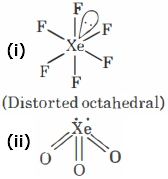
$Xe$ has $8$ valence electrons. $XeF_6$ has $6$ bond pairs and $1$ lone pair with $sp^3d^3$-hybridisation. Due to the presence of the lone pair,its structure is distorted octahedral.
Structure of $XeO_3$:
$XeO_3$ has $3$ bond pairs and $1$ lone pair with $sp^3$-hybridisation. Thus,its structure is pyramidal.
$XeF_6 + 3 H_2O \longrightarrow XeO_3 + 6 HF$
Structure of $XeF_6$:
$Xe$ has $8$ valence electrons. $XeF_6$ has $6$ bond pairs and $1$ lone pair with $sp^3d^3$-hybridisation. Due to the presence of the lone pair,its structure is distorted octahedral.
Structure of $XeO_3$:
$XeO_3$ has $3$ bond pairs and $1$ lone pair with $sp^3$-hybridisation. Thus,its structure is pyramidal.
0 likesView Solution
44
ChemistryEasyMCQKVPY · 2011
If $E^{\circ}_{Fe^{2+}/Fe} = -0.440 \ V$ and $E^{\circ}_{Fe^{3+}/Fe^{2+}} = 0.770 \ V$,then $E^{\circ}_{Fe^{3+}/Fe}$ is (in $V$)
A
$0.330$
B
$-0.037$
C
$-0.330$
D
$-1.210$
Solution
(B)
For the reactions:
$Fe^{2+} + 2e^{-} \rightarrow Fe ; E_1^{\circ} = -0.440 \ V \quad (I)$
$Fe^{3+} + e^{-} \rightarrow Fe^{2+} ; E_2^{\circ} = 0.770 \ V \quad (II)$
To obtain the reaction $Fe^{3+} + 3e^{-} \rightarrow Fe ; E_3^{\circ} = ?$,we add Eq. $(I)$ and $(II)$.
Since $\Delta G^{\circ} = -nFE^{\circ}$,we have:
$\Delta G_3^{\circ} = \Delta G_1^{\circ} + \Delta G_2^{\circ}$
$-n_3 F E_3^{\circ} = -n_1 F E_1^{\circ} - n_2 F E_2^{\circ}$
$E_3^{\circ} = \frac{n_1 E_1^{\circ} + n_2 E_2^{\circ}}{n_3}$
$E_3^{\circ} = \frac{2(-0.440) + 1(0.770)}{3}$
$E_3^{\circ} = \frac{-0.880 + 0.770}{3} = \frac{-0.110}{3} = -0.0366 \ V \approx -0.037 \ V$
For the reactions:
$Fe^{2+} + 2e^{-} \rightarrow Fe ; E_1^{\circ} = -0.440 \ V \quad (I)$
$Fe^{3+} + e^{-} \rightarrow Fe^{2+} ; E_2^{\circ} = 0.770 \ V \quad (II)$
To obtain the reaction $Fe^{3+} + 3e^{-} \rightarrow Fe ; E_3^{\circ} = ?$,we add Eq. $(I)$ and $(II)$.
Since $\Delta G^{\circ} = -nFE^{\circ}$,we have:
$\Delta G_3^{\circ} = \Delta G_1^{\circ} + \Delta G_2^{\circ}$
$-n_3 F E_3^{\circ} = -n_1 F E_1^{\circ} - n_2 F E_2^{\circ}$
$E_3^{\circ} = \frac{n_1 E_1^{\circ} + n_2 E_2^{\circ}}{n_3}$
$E_3^{\circ} = \frac{2(-0.440) + 1(0.770)}{3}$
$E_3^{\circ} = \frac{-0.880 + 0.770}{3} = \frac{-0.110}{3} = -0.0366 \ V \approx -0.037 \ V$
0 likesView Solution
45
ChemistryMediumMCQKVPY · 2011
In the following conversion,
$C_6H_5CN$ $\xrightarrow[(ii) H_3O^+]{(i) MeMgBr} X$ $\xrightarrow[H_3O^+]{NaOH/I_2} Y$
the major products $X$ and $Y$,respectively are
$C_6H_5CN$ $\xrightarrow[(ii) H_3O^+]{(i) MeMgBr} X$ $\xrightarrow[H_3O^+]{NaOH/I_2} Y$
the major products $X$ and $Y$,respectively are
A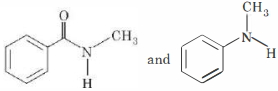
$I$
B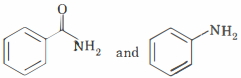
$II$
C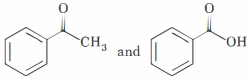
$III$
D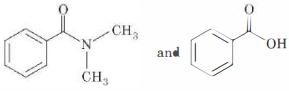
$IV$
Solution
(C) The reaction sequence is as follows:
$1$. Benzonitrile $(C_6H_5CN)$ reacts with methylmagnesium bromide $(MeMgBr)$ followed by acid hydrolysis $(H_3O^+)$ to form acetophenone $(C_6H_5COCH_3)$ as product $X$.
$2$. Acetophenone $(C_6H_5COCH_3)$ contains a methyl ketone group,which undergoes the iodoform reaction with $NaOH/I_2$ followed by acidification $(H_3O^+)$ to produce benzoic acid $(C_6H_5COOH)$ as product $Y$.
Thus,$X$ is acetophenone and $Y$ is benzoic acid,which corresponds to option $III$.
$1$. Benzonitrile $(C_6H_5CN)$ reacts with methylmagnesium bromide $(MeMgBr)$ followed by acid hydrolysis $(H_3O^+)$ to form acetophenone $(C_6H_5COCH_3)$ as product $X$.
$2$. Acetophenone $(C_6H_5COCH_3)$ contains a methyl ketone group,which undergoes the iodoform reaction with $NaOH/I_2$ followed by acidification $(H_3O^+)$ to produce benzoic acid $(C_6H_5COOH)$ as product $Y$.
Thus,$X$ is acetophenone and $Y$ is benzoic acid,which corresponds to option $III$.
0 likesView Solution
46
ChemistryMediumMCQKVPY · 2011
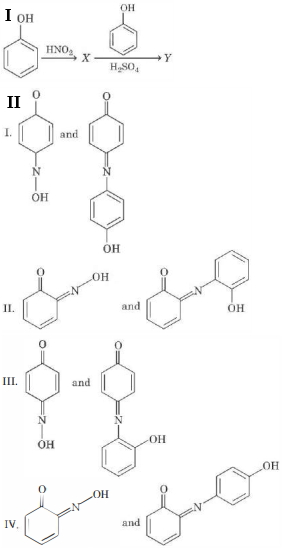
In the reaction sequence,phenol reacts with $HNO_2$ to form $X$,which then reacts with phenol in the presence of $H_2SO_4$ to form $Y$. Identify the major products $X$ and $Y$.
A
$I$
B
$II$
C
$III$
D
$IV$
Solution
(B) The reaction of phenol with $HNO_2$ (nitrous acid) leads to the formation of $p$-nitrosophenol,which exists in tautomeric equilibrium with $p$-benzoquinone monoxime $(X)$.
In the presence of $H_2SO_4$,the oxime group acts as an electrophile. The phenol molecule attacks the electrophilic carbon of the oxime group at the para-position to form the final product $Y$,which is an indophenol derivative. Looking at the structures provided in the options,option $II$ correctly represents the structure of $p$-benzoquinone monoxime $(X)$ and the corresponding indophenol product $(Y)$.
In the presence of $H_2SO_4$,the oxime group acts as an electrophile. The phenol molecule attacks the electrophilic carbon of the oxime group at the para-position to form the final product $Y$,which is an indophenol derivative. Looking at the structures provided in the options,option $II$ correctly represents the structure of $p$-benzoquinone monoxime $(X)$ and the corresponding indophenol product $(Y)$.
0 likesView Solution
47
ChemistryMediumMCQKVPY · 2011
At $300 \ K$,the vapour pressures of two pure liquids,$A$ and $B$ are $100 \ mm \ Hg$ and $500 \ mm \ Hg$,respectively. If in a mixture of $A$ and $B$,the total vapour pressure is $300 \ mm \ Hg$,the mole fractions of $A$ in the liquid and in the vapour phase,respectively,are:
A
$1 / 2$ and $1 / 10$
B
$1 / 4$ and $1 / 6$
C
$1 / 4$ and $1 / 10$
D
$1 / 2$ and $1 / 6$
Solution
(D) According to Raoult's law,the total vapour pressure $p_T$ is given by:
$p_T = x_A p_A^{\circ} + x_B p_B^{\circ}$
Since $x_B = 1 - x_A$,we have:
$p_T = x_A p_A^{\circ} + (1 - x_A) p_B^{\circ}$
Substituting the given values:
$300 = x_A(100) + (1 - x_A)(500)$
$300 = 100x_A + 500 - 500x_A$
$400x_A = 200$
$x_A = 1 / 2$
Thus,the mole fraction of $A$ in the liquid phase is $1 / 2$.
In the vapour phase,the mole fraction of $A$ $(y_A)$ is given by:
$y_A = \frac{p_A}{p_T} = \frac{x_A p_A^{\circ}}{p_T}$
$y_A = \frac{(1 / 2) \times 100}{300} = \frac{50}{300} = 1 / 6$
Therefore,the mole fractions of $A$ in the liquid and vapour phases are $1 / 2$ and $1 / 6$ respectively.
$p_T = x_A p_A^{\circ} + x_B p_B^{\circ}$
Since $x_B = 1 - x_A$,we have:
$p_T = x_A p_A^{\circ} + (1 - x_A) p_B^{\circ}$
Substituting the given values:
$300 = x_A(100) + (1 - x_A)(500)$
$300 = 100x_A + 500 - 500x_A$
$400x_A = 200$
$x_A = 1 / 2$
Thus,the mole fraction of $A$ in the liquid phase is $1 / 2$.
In the vapour phase,the mole fraction of $A$ $(y_A)$ is given by:
$y_A = \frac{p_A}{p_T} = \frac{x_A p_A^{\circ}}{p_T}$
$y_A = \frac{(1 / 2) \times 100}{300} = \frac{50}{300} = 1 / 6$
Therefore,the mole fractions of $A$ in the liquid and vapour phases are $1 / 2$ and $1 / 6$ respectively.
0 likesView Solution
48
ChemistryDifficultMCQKVPY · 2011
The Crystal Field Stabilisation Energies $(CFSE)$ of high spin and low spin $d^6$ metal complexes in terms of $\Delta_o$,respectively are
A
$-0.4$ and $-2.4$
B
$-2.4$ and $-0.4$
C
$-0.4$ and $0.0$
D
$-2.4$ and $0.0$
Solution
(A) The correct option is $A$.
For a high spin $d^6$ metal complex,the electron configuration is $t_{2g}^4 e_g^2$.
$CFSE = (-0.4 \times 4 + 0.6 \times 2) \Delta_o = (-1.6 + 1.2) \Delta_o = -0.4 \Delta_o$.
For a low spin $d^6$ metal complex,the electron configuration is $t_{2g}^6 e_g^0$.
$CFSE = (-0.4 \times 6 + 0.6 \times 0) \Delta_o = (-2.4 + 0) \Delta_o = -2.4 \Delta_o$.
For a high spin $d^6$ metal complex,the electron configuration is $t_{2g}^4 e_g^2$.
$CFSE = (-0.4 \times 4 + 0.6 \times 2) \Delta_o = (-1.6 + 1.2) \Delta_o = -0.4 \Delta_o$.
For a low spin $d^6$ metal complex,the electron configuration is $t_{2g}^6 e_g^0$.
$CFSE = (-0.4 \times 6 + 0.6 \times 0) \Delta_o = (-2.4 + 0) \Delta_o = -2.4 \Delta_o$.
0 likesView Solution
49
ChemistryMediumMCQKVPY · 2011
The gas produced from thermal decomposition of $(NH_4)_2Cr_2O_7$ is
A
oxygen
B
nitric oxide
C
ammonia
D
nitrogen
Solution
(D) .
The thermal decomposition of $(NH_4)_2Cr_2O_7$ yields chromium$(III)$ oxide $(Cr_2O_3)$,nitrogen gas $(N_2)$,and water vapor $(H_2O)$.
The balanced chemical equation is:
$(NH_4)_2Cr_2O_7 \stackrel{\Delta}{\longrightarrow} Cr_2O_3 + N_2 + 4H_2O$
The thermal decomposition of $(NH_4)_2Cr_2O_7$ yields chromium$(III)$ oxide $(Cr_2O_3)$,nitrogen gas $(N_2)$,and water vapor $(H_2O)$.
The balanced chemical equation is:
$(NH_4)_2Cr_2O_7 \stackrel{\Delta}{\longrightarrow} Cr_2O_3 + N_2 + 4H_2O$
0 likesView Solution
50
ChemistryMediumMCQKVPY · 2011
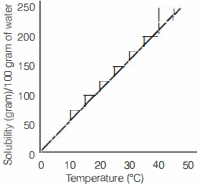
The solubility curve of $KNO_3$ in water is shown below. The amount of $KNO_3$ that dissolves in $50 \ g$ of water at $40^{\circ} C$ is closest to $.... \ g$
A
$100$
B
$150$
C
$200$
D
$50$
Solution
(A) From the graph,it can be seen that the solubility of $KNO_3$ in water at $40^{\circ} C$ is approximately $200 \ g$ per $100 \ g$ of water.
$\therefore$ The amount of $KNO_3$ that dissolves in $50 \ g$ of water will be:
$= \frac{200 \ g}{100 \ g} \times 50 \ g = 100 \ g$
Thus,the correct option is $(A)$.
$\therefore$ The amount of $KNO_3$ that dissolves in $50 \ g$ of water will be:
$= \frac{200 \ g}{100 \ g} \times 50 \ g = 100 \ g$
Thus,the correct option is $(A)$.
0 likesView Solution
51
ChemistryMediumMCQKVPY · 2011
$A$ compound that shows positive iodoform test is
A
$2$-pentanone
B
$3$-pentanone
C
$3$-pentanol
D
$1$-pentanol
Solution
(A)
Iodoform test with sodium hypoiodite is used for the detection of the $CH_3CO-$ group or the $CH_3CH(OH)-$ group,which produces the $CH_3CO-$ group upon oxidation.
Iodoform reaction with the given compounds is as follows:
$(A)$ $CH_3CH_2CH_2COCH_3 + 3I_2 + 4NaOH \longrightarrow CH_3CH_2CH_2COONa + CHI_3 + 3NaI + 3H_2O$. It gives a positive iodoform test due to the presence of the $CH_3CO-$ group.
$(B)$ $CH_3CH_2COCH_2CH_3$ does not contain a $CH_3CO-$ group,so it gives a negative iodoform test.
$(C)$ $CH_3CH_2CH(OH)CH_2CH_3$ does not contain a $CH_3CH(OH)-$ group,so it gives a negative iodoform test.
$(D)$ $CH_3CH_2CH_2CH_2CH_2OH$ is a primary alcohol that does not contain a $CH_3CH(OH)-$ group,so it gives a negative iodoform test.
Iodoform test with sodium hypoiodite is used for the detection of the $CH_3CO-$ group or the $CH_3CH(OH)-$ group,which produces the $CH_3CO-$ group upon oxidation.
Iodoform reaction with the given compounds is as follows:
$(A)$ $CH_3CH_2CH_2COCH_3 + 3I_2 + 4NaOH \longrightarrow CH_3CH_2CH_2COONa + CHI_3 + 3NaI + 3H_2O$. It gives a positive iodoform test due to the presence of the $CH_3CO-$ group.
$(B)$ $CH_3CH_2COCH_2CH_3$ does not contain a $CH_3CO-$ group,so it gives a negative iodoform test.
$(C)$ $CH_3CH_2CH(OH)CH_2CH_3$ does not contain a $CH_3CH(OH)-$ group,so it gives a negative iodoform test.
$(D)$ $CH_3CH_2CH_2CH_2CH_2OH$ is a primary alcohol that does not contain a $CH_3CH(OH)-$ group,so it gives a negative iodoform test.
0 likesView Solution
52
ChemistryDifficultMCQKVPY · 2011
After $2 \, \text{hours}$,the amount of a certain radioactive substance reduces to $1/16^{th}$ of the original amount (the decay process follows first-order kinetics). The half-life of the radioactive substance is $...... \, \text{min}$.
A
$15$
B
$30$
C
$45$
D
$60$
Solution
(B) For a first-order reaction,the amount remaining after $n$ half-lives is given by $N = N_0 \times (1/2)^n$.
Given that the substance reduces to $1/16$ of the original amount,we have $1/16 = (1/2)^n$.
Since $1/16 = (1/2)^4$,it follows that $n = 4$ half-lives.
The total time taken is $2 \, \text{hours} = 120 \, \text{min}$.
Therefore,$4 \times t_{1/2} = 120 \, \text{min}$.
$t_{1/2} = 120 / 4 = 30 \, \text{min}$.
Given that the substance reduces to $1/16$ of the original amount,we have $1/16 = (1/2)^n$.
Since $1/16 = (1/2)^4$,it follows that $n = 4$ half-lives.
The total time taken is $2 \, \text{hours} = 120 \, \text{min}$.
Therefore,$4 \times t_{1/2} = 120 \, \text{min}$.
$t_{1/2} = 120 / 4 = 30 \, \text{min}$.
0 likesView Solution
53
ChemistryDifficultMCQKVPY · 2011
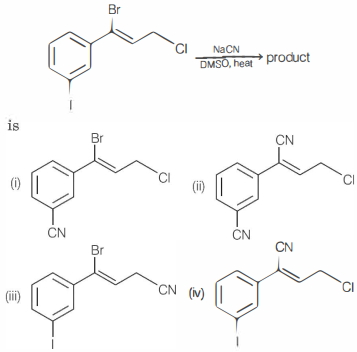
The major product formed in the reaction is:
A
$(i)$
B
$(ii)$
C
$(iii)$
D
$(iv)$
Solution
(C) The reaction involves an $S_{N}2$ mechanism. The nucleophile $CN^{-}$ attacks the primary alkyl chloride carbon,which is the most reactive site for $S_{N}2$ substitution in the given molecule. The $Cl^{-}$ ion acts as the leaving group. The $Br$ atom attached to the $sp^{2}$ carbon of the alkene is not easily substituted under these conditions. Therefore,the $CN$ group replaces the $Cl$ atom,resulting in product $(iii)$.
0 likesView Solution
54
ChemistryMediumMCQKVPY · 2011
In the following reaction sequence,$X$ and $Y$,respectively,are:
$CH_2=C(CH_3)_2$ $\xrightarrow{X} \text{Epoxide}$ $\xrightarrow{Y} (CH_3)_3C-OH$
$CH_2=C(CH_3)_2$ $\xrightarrow{X} \text{Epoxide}$ $\xrightarrow{Y} (CH_3)_3C-OH$
A
$H_2O_2$; $LiAlH_4$
B
$C_6H_5COOH$; $LiAlH_4$
C
$C_6H_5COOH$; $Zn/Hg \cdot HCl$
D
alk. $KMnO_4$; $LiAlH_4$
Solution
(B) The reaction sequence involves the conversion of an alkene to an epoxide followed by the reduction of the epoxide to an alcohol.
$1$. The conversion of an alkene to an epoxide (epoxidation) requires a peroxyacid. $C_6H_5COOH$ (perbenzoic acid) is a standard reagent for this transformation.
$2$. The reduction of an epoxide to an alcohol requires a strong reducing agent like $LiAlH_4$,which attacks the less hindered carbon of the epoxide ring to yield the corresponding alcohol.
Therefore,$X = C_6H_5COOH$ and $Y = LiAlH_4$.
$1$. The conversion of an alkene to an epoxide (epoxidation) requires a peroxyacid. $C_6H_5COOH$ (perbenzoic acid) is a standard reagent for this transformation.
$2$. The reduction of an epoxide to an alcohol requires a strong reducing agent like $LiAlH_4$,which attacks the less hindered carbon of the epoxide ring to yield the corresponding alcohol.
Therefore,$X = C_6H_5COOH$ and $Y = LiAlH_4$.
0 likesView Solution
55
ChemistryMediumMCQKVPY · 2011
Among $(i) [Co(NH_3)_6]Cl_3$,$(ii) [Ni(NH_3)_6]Cl_2$,$(iii) [Cr(H_2O)_6]Cl_3$,$(iv) [Fe(H_2O)_6]Cl_2$,the complex which is diamagnetic is $....$
A
$(i)$
B
$(ii)$
C
$(iii)$
D
$(iv)$
Solution
(A) $(i) [Co(NH_3)_6]Cl_3$: $Co^{3+}$ is $3d^6$. $NH_3$ is a strong field ligand,causing pairing of electrons. All $6$ electrons are paired,so it is diamagnetic.
$(ii) [Ni(NH_3)_6]Cl_2$: $Ni^{2+}$ is $3d^8$. It has $2$ unpaired electrons,so it is paramagnetic.
$(iii) [Cr(H_2O)_6]Cl_3$: $Cr^{3+}$ is $3d^3$. It has $3$ unpaired electrons,so it is paramagnetic.
$(iv) [Fe(H_2O)_6]Cl_2$: $Fe^{2+}$ is $3d^6$. $H_2O$ is a weak field ligand,so it has $4$ unpaired electrons,making it paramagnetic.
$(ii) [Ni(NH_3)_6]Cl_2$: $Ni^{2+}$ is $3d^8$. It has $2$ unpaired electrons,so it is paramagnetic.
$(iii) [Cr(H_2O)_6]Cl_3$: $Cr^{3+}$ is $3d^3$. It has $3$ unpaired electrons,so it is paramagnetic.
$(iv) [Fe(H_2O)_6]Cl_2$: $Fe^{2+}$ is $3d^6$. $H_2O$ is a weak field ligand,so it has $4$ unpaired electrons,making it paramagnetic.
0 likesView Solution
Vedclass Products
For Students
Vedclass Test Series
Mock tests in real KVPY style covering Chemistry with performance analysis. 5-day free trial.
Start Free TrialFor Teachers
Exam Paper Generator
Generate Set A/B/C/D Chemistry papers from 7.5L+ questions in 2 minutes. 3 chapters free.
Try FreeFor Institutes
Online Exam Module
Run live KVPY mock exams with unlimited students, 360° analytics & white-label branding.
See DemoFrequently Asked Questions
How many Chemistry questions are in KVPY 2011?
There are 55 Chemistry questions from the KVPY 2011 paper on Vedclass, each with a detailed step-by-step solution in English.
Are KVPY 2011 Chemistry solutions available in English?
Yes. All solutions on this page are in English. You can also switch to English or Hindi using the language buttons above the questions.
Can I practice KVPY 2011 Chemistry as a timed test?
Yes. Use the Vedclass Test Series to attempt a full KVPY mock test covering Chemistry with time limits and instant score analysis.
Can teachers create Chemistry papers from KVPY previous year questions?
Yes. The Vedclass Exam Paper Generator lets teachers mix KVPY Chemistry questions and generate Set A/B/C/D papers in minutes.
For Teachers & Institutes
Build a Custom Chemistry Paper
Pick KVPY 2011 Chemistry questions, set difficulty, and generate Set A/B/C/D in 2 minutes.