
PhysicsQ1–50 of 50 questions
Page 1 of 1 · English
1
PhysicsDifficultMCQKVPY · 2011
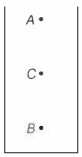
$A$ narrow but tall cabin is falling freely near the earth's surface. Inside the cabin,two small stones $A$ and $B$ are released from rest (relative to the cabin). Initially $A$ is much above the centre of mass and $B$ is much below the centre of mass of the cabin. $A$ close observation of the motion of $A$ and $B$ will reveal that
A
both $A$ and $B$ continue to be exactly at rest relative to the cabin
B
$A$ moves slowly upward and $B$ moves slowly downward relative to the cabin
C
both $A$ and $B$ fall to the bottom of the cabin with constant acceleration due to gravity
D
$A$ and $B$ move slightly towards each other vertically
Solution
(B) The acceleration due to gravity $g$ decreases as we move away from the earth's surface,given by $g(h) = g_0(1 - 2h/R_e)$.
Let $C$ be the centre of mass of the cabin. The acceleration of any object at a height $h$ is $a = g(h)$.
Since $A$ is above $C$ and $B$ is below $C$,their heights are $h_A > h_C > h_B$.
Consequently,the gravitational accelerations satisfy $a_B > a_C > a_A$.
When viewed from the frame of the cabin (which has acceleration $a_C$),the relative accelerations are:
$a_{A,rel} = a_A - a_C < 0$ (meaning $A$ accelerates upward relative to the cabin).
$a_{B,rel} = a_B - a_C > 0$ (meaning $B$ accelerates downward relative to the cabin).
Thus,$A$ moves slowly upward and $B$ moves slowly downward relative to the cabin. Therefore,option $(b)$ is correct.
Let $C$ be the centre of mass of the cabin. The acceleration of any object at a height $h$ is $a = g(h)$.
Since $A$ is above $C$ and $B$ is below $C$,their heights are $h_A > h_C > h_B$.
Consequently,the gravitational accelerations satisfy $a_B > a_C > a_A$.
When viewed from the frame of the cabin (which has acceleration $a_C$),the relative accelerations are:
$a_{A,rel} = a_A - a_C < 0$ (meaning $A$ accelerates upward relative to the cabin).
$a_{B,rel} = a_B - a_C > 0$ (meaning $B$ accelerates downward relative to the cabin).
Thus,$A$ moves slowly upward and $B$ moves slowly downward relative to the cabin. Therefore,option $(b)$ is correct.
0 likesView Solution
2
PhysicsAdvancedMCQKVPY · 2011
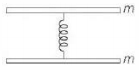
Two plates each of mass $m$ are connected by a massless spring as shown below. $A$ weight $W$ is placed on the upper plate which compresses the spring further. When $W$ is removed,the entire assembly jumps up. The minimum weight $W$ needed for the assembly to jump up when the weight is removed is just more than ...........$m$.
A
$1$
B
$2$
C
$3$
D
$4$
Solution
(B) For the lower plate of mass $m$ to lift off the ground,the upward spring force must be equal to its weight.
Let $k$ be the spring constant. The condition for the lower plate to lift is $kx = mg$,where $x$ is the extension of the spring from its natural length.
So,$x = \frac{mg}{k}$.
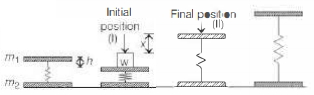
Now,consider the energy conservation between the initial compressed state (position $I$) and the final extended state (position $II$) where the lower plate just lifts off.
Let $h$ be the initial compression of the spring when weight $W$ is placed on the upper plate.
The total energy at position $I$ is the potential energy of the compressed spring: $U_I = \frac{1}{2}kh^2$.
The total energy at position $II$ is the potential energy of the extended spring plus the potential energy of the upper plate of mass $m$: $U_{II} = \frac{1}{2}kx^2 + mgh_{total}$,where $h_{total} = h + x$ is the total height change of the upper plate.
By energy conservation: $\frac{1}{2}kh^2 = mg(h+x) + \frac{1}{2}kx^2$.
Substituting $x = \frac{mg}{k}$:
$\frac{1}{2}kh^2 = mgh + \frac{m^2g^2}{k} + \frac{1}{2}k(\frac{mg}{k})^2 = mgh + \frac{m^2g^2}{k} + \frac{m^2g^2}{2k} = mgh + \frac{3m^2g^2}{2k}$.
Multiplying by $2/k$: $h^2 - \frac{2mgh}{k} - \frac{3m^2g^2}{k^2} = 0$.
Solving for $h$: $h = \frac{\frac{2mg}{k} + \sqrt{(\frac{2mg}{k})^2 + 4(\frac{3m^2g^2}{k^2})}}{2} = \frac{\frac{2mg}{k} + \sqrt{\frac{16m^2g^2}{k^2}}}{2} = \frac{\frac{2mg}{k} + \frac{4mg}{k}}{2} = \frac{3mg}{k}$.
At equilibrium in position $I$,the spring force balances the weight of the upper plate and the weight $W$: $kh = mg + W$.
Substituting $h = \frac{3mg}{k}$: $k(\frac{3mg}{k}) = mg + W \Rightarrow 3mg = mg + W \Rightarrow W = 2mg$.
Thus,the weight $W$ must be just more than $2mg$.
Let $k$ be the spring constant. The condition for the lower plate to lift is $kx = mg$,where $x$ is the extension of the spring from its natural length.
So,$x = \frac{mg}{k}$.
Now,consider the energy conservation between the initial compressed state (position $I$) and the final extended state (position $II$) where the lower plate just lifts off.
Let $h$ be the initial compression of the spring when weight $W$ is placed on the upper plate.
The total energy at position $I$ is the potential energy of the compressed spring: $U_I = \frac{1}{2}kh^2$.
The total energy at position $II$ is the potential energy of the extended spring plus the potential energy of the upper plate of mass $m$: $U_{II} = \frac{1}{2}kx^2 + mgh_{total}$,where $h_{total} = h + x$ is the total height change of the upper plate.
By energy conservation: $\frac{1}{2}kh^2 = mg(h+x) + \frac{1}{2}kx^2$.
Substituting $x = \frac{mg}{k}$:
$\frac{1}{2}kh^2 = mgh + \frac{m^2g^2}{k} + \frac{1}{2}k(\frac{mg}{k})^2 = mgh + \frac{m^2g^2}{k} + \frac{m^2g^2}{2k} = mgh + \frac{3m^2g^2}{2k}$.
Multiplying by $2/k$: $h^2 - \frac{2mgh}{k} - \frac{3m^2g^2}{k^2} = 0$.
Solving for $h$: $h = \frac{\frac{2mg}{k} + \sqrt{(\frac{2mg}{k})^2 + 4(\frac{3m^2g^2}{k^2})}}{2} = \frac{\frac{2mg}{k} + \sqrt{\frac{16m^2g^2}{k^2}}}{2} = \frac{\frac{2mg}{k} + \frac{4mg}{k}}{2} = \frac{3mg}{k}$.
At equilibrium in position $I$,the spring force balances the weight of the upper plate and the weight $W$: $kh = mg + W$.
Substituting $h = \frac{3mg}{k}$: $k(\frac{3mg}{k}) = mg + W \Rightarrow 3mg = mg + W \Rightarrow W = 2mg$.
Thus,the weight $W$ must be just more than $2mg$.
0 likesView Solution
3
PhysicsMediumMCQKVPY · 2011
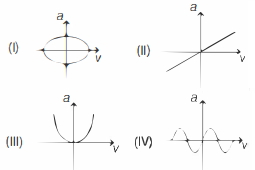
If the speed $v$ of the bob in a simple pendulum is plotted against the tangential acceleration $a$,the correct graph will be represented by
A
$I$
B
$II$
C
$III$
D
$IV$
Solution
(A) For a simple pendulum undergoing simple harmonic motion,the displacement $x$ is given by $x = A \sin(\omega t)$.
The velocity is $v = \frac{dx}{dt} = A\omega \cos(\omega t)$.
The tangential acceleration is $a = \frac{dv}{dt} = -A\omega^2 \sin(\omega t)$.
From these equations,we have:
$\frac{v}{A\omega} = \cos(\omega t)$ and $\frac{a}{-A\omega^2} = \sin(\omega t)$.
Using the identity $\sin^2(\theta) + \cos^2(\theta) = 1$,we get:
$\left(\frac{v}{A\omega}\right)^2 + \left(\frac{a}{-A\omega^2}\right)^2 = 1$
$\frac{v^2}{A^2\omega^2} + \frac{a^2}{A^2\omega^4} = 1$
This is the equation of an ellipse in the $v-a$ plane,where $v$ is on the horizontal axis and $a$ is on the vertical axis. Thus,the correct graph is $I$.
The velocity is $v = \frac{dx}{dt} = A\omega \cos(\omega t)$.
The tangential acceleration is $a = \frac{dv}{dt} = -A\omega^2 \sin(\omega t)$.
From these equations,we have:
$\frac{v}{A\omega} = \cos(\omega t)$ and $\frac{a}{-A\omega^2} = \sin(\omega t)$.
Using the identity $\sin^2(\theta) + \cos^2(\theta) = 1$,we get:
$\left(\frac{v}{A\omega}\right)^2 + \left(\frac{a}{-A\omega^2}\right)^2 = 1$
$\frac{v^2}{A^2\omega^2} + \frac{a^2}{A^2\omega^4} = 1$
This is the equation of an ellipse in the $v-a$ plane,where $v$ is on the horizontal axis and $a$ is on the vertical axis. Thus,the correct graph is $I$.
0 likesView Solution
4
PhysicsDifficultMCQKVPY · 2011
$A$ container with rigid walls is covered with perfectly insulating material. The container is divided into two parts by a partition. One part contains a gas while the other is fully evacuated (vacuum). The partition is suddenly removed. The gas rushes to fill the entire volume and comes to equilibrium after a little time. If the gas is not ideal,then
A
the initial internal energy of the gas equals its final internal energy
B
the initial temperature of the gas equals its final temperature
C
the initial pressure of the gas equals its final pressure
D
the initial entropy of the gas equals its final entropy
Solution
(A) The expansion occurs in a vacuum,so the work done by the expanding gas is $\Delta W = 0$.
The container is perfectly insulated,so the heat exchanged with the surroundings is $\Delta Q = 0$.
According to the first law of thermodynamics,$\Delta Q = \Delta U + \Delta W$.
Substituting the values,we get $0 = \Delta U + 0$,which implies $\Delta U = 0$.
Therefore,$U_i = U_f$,meaning the initial and final internal energies of the gas are equal.
Since the gas is not ideal,the expansion results in an increase in the intermolecular potential energy. Because the total internal energy remains constant,this increase in potential energy leads to a decrease in the kinetic energy of the molecules,which consequently causes the temperature of the gas to decrease.
The container is perfectly insulated,so the heat exchanged with the surroundings is $\Delta Q = 0$.
According to the first law of thermodynamics,$\Delta Q = \Delta U + \Delta W$.
Substituting the values,we get $0 = \Delta U + 0$,which implies $\Delta U = 0$.
Therefore,$U_i = U_f$,meaning the initial and final internal energies of the gas are equal.
Since the gas is not ideal,the expansion results in an increase in the intermolecular potential energy. Because the total internal energy remains constant,this increase in potential energy leads to a decrease in the kinetic energy of the molecules,which consequently causes the temperature of the gas to decrease.
0 likesView Solution
5
PhysicsDifficultMCQKVPY · 2011
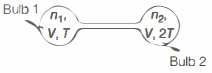
Two bulbs of identical volumes connected by a small capillary are initially filled with an ideal gas at temperature $T$. Bulb $2$ is heated to maintain a temperature $2 T$,while bulb $1$ remains at temperature $T$. Assume throughout that the heat conduction by the capillary is negligible. Then,the ratio of final mass of the gas in bulb $2$ to the initial mass of the gas in the same bulb is close to
A
$1 / 2$
B
$2 / 3$
C
$1 / 3$
D
$1$
Solution
(B) Let $n$ be the total number of moles of gas in both bulbs initially. Since the bulbs have identical volumes $V$ and are at the same temperature $T$,the number of moles in each bulb is $n_1 = n_2 = n / 2$.
When bulb $2$ is heated to $2 T$ and bulb $1$ is at $T$,the pressure $p$ in both bulbs must be equal for the system to be in equilibrium.
Using the ideal gas law $p V = n R T$,the number of moles in bulb $1$ $(n_1')$ and bulb $2$ $(n_2')$ are:
$n_1' = \frac{p V}{R T}$
$n_2' = \frac{p V}{R (2 T)} = \frac{p V}{2 R T}$
Since the total number of moles is conserved,$n_1' + n_2' = n = n_1 + n_2 = n / 2 + n / 2 = n$.
$\frac{p V}{R T} + \frac{p V}{2 R T} = n \Rightarrow \frac{3 p V}{2 R T} = n \Rightarrow \frac{p V}{R T} = \frac{2 n}{3}$.
Thus,the final number of moles in bulb $2$ is $n_2' = \frac{1}{2} \times \frac{p V}{R T} = \frac{1}{2} \times \frac{2 n}{3} = \frac{n}{3}$.
The ratio of the final mass (or final moles) in bulb $2$ to the initial mass (or initial moles) in bulb $2$ is:
Ratio $= \frac{n_2'}{n_2} = \frac{n / 3}{n / 2} = \frac{2}{3}$.
When bulb $2$ is heated to $2 T$ and bulb $1$ is at $T$,the pressure $p$ in both bulbs must be equal for the system to be in equilibrium.
Using the ideal gas law $p V = n R T$,the number of moles in bulb $1$ $(n_1')$ and bulb $2$ $(n_2')$ are:
$n_1' = \frac{p V}{R T}$
$n_2' = \frac{p V}{R (2 T)} = \frac{p V}{2 R T}$
Since the total number of moles is conserved,$n_1' + n_2' = n = n_1 + n_2 = n / 2 + n / 2 = n$.
$\frac{p V}{R T} + \frac{p V}{2 R T} = n \Rightarrow \frac{3 p V}{2 R T} = n \Rightarrow \frac{p V}{R T} = \frac{2 n}{3}$.
Thus,the final number of moles in bulb $2$ is $n_2' = \frac{1}{2} \times \frac{p V}{R T} = \frac{1}{2} \times \frac{2 n}{3} = \frac{n}{3}$.
The ratio of the final mass (or final moles) in bulb $2$ to the initial mass (or initial moles) in bulb $2$ is:
Ratio $= \frac{n_2'}{n_2} = \frac{n / 3}{n / 2} = \frac{2}{3}$.
0 likesView Solution
6
PhysicsMediumMCQKVPY · 2011
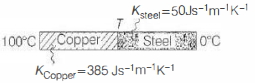
Two rods,one made of copper and the other of steel,having the same length and cross-sectional area,are joined together. The thermal conductivity of copper is $385 \, J s^{-1} m^{-1} K^{-1}$ and that of steel is $50 \, J s^{-1} m^{-1} K^{-1}$. If the copper end is held at $100^{\circ} C$ and the steel end is held at $0^{\circ} C$,the junction temperature is ........... $^{\circ} C$ (Assuming no other heat losses).
A
$12$
B
$50$
C
$73$
D
$88$
Solution
(D) Let the junction temperature be $T^{\circ} C$.
In the steady state,the rate of heat flow through the copper rod must be equal to the rate of heat flow through the steel rod,assuming no heat loss from the sides.
The rate of heat flow $H$ is given by $H = \frac{KA(T_1 - T_2)}{l}$.
Equating the heat flow for both rods:
$\frac{K_{\text{copper}} A (100 - T)}{l} = \frac{K_{\text{steel}} A (T - 0)}{l}$
Since the length $l$ and cross-sectional area $A$ are the same for both rods,they cancel out:
$K_{\text{copper}} (100 - T) = K_{\text{steel}} T$
Substituting the given values $K_{\text{copper}} = 385$ and $K_{\text{steel}} = 50$:
$385(100 - T) = 50T$
$38500 - 385T = 50T$
$38500 = 435T$
$T = \frac{38500}{435} \approx 88.5^{\circ} C$.
Rounding to the nearest integer,the junction temperature is $88^{\circ} C$.
In the steady state,the rate of heat flow through the copper rod must be equal to the rate of heat flow through the steel rod,assuming no heat loss from the sides.
The rate of heat flow $H$ is given by $H = \frac{KA(T_1 - T_2)}{l}$.
Equating the heat flow for both rods:
$\frac{K_{\text{copper}} A (100 - T)}{l} = \frac{K_{\text{steel}} A (T - 0)}{l}$
Since the length $l$ and cross-sectional area $A$ are the same for both rods,they cancel out:
$K_{\text{copper}} (100 - T) = K_{\text{steel}} T$
Substituting the given values $K_{\text{copper}} = 385$ and $K_{\text{steel}} = 50$:
$385(100 - T) = 50T$
$38500 - 385T = 50T$
$38500 = 435T$
$T = \frac{38500}{435} \approx 88.5^{\circ} C$.
Rounding to the nearest integer,the junction temperature is $88^{\circ} C$.
0 likesView Solution
7
PhysicsDifficultMCQKVPY · 2011
Jet aircrafts fly at altitudes above $30000 \,ft$, where the air is very cold at $-40^{\circ} C$ and the pressure is $0.28 \,atm$. The cabin is maintained at $1 \,atm$ pressure by means of a compressor which exchanges air from outside adiabatically. In order to have a comfortable cabin temperature of $25^{\circ} C$, we will require in addition
A
a heater to warm the air injected into the cabin
B
an air-conditioner to cool the air injected into the cabin
C
neither a heater nor an air-conditioner, the compressor is sufficient
D
alternatively heating and cooling in the two halves of the compressor cycle
Solution
(B) The compression of air in a compressor is an adiabatic process.
Using the adiabatic relation $P^{1-\gamma} T^{\gamma} = \text{constant}$, we have $P_{\text{in}}^{1-\gamma} T_{\text{in}}^{\gamma} = P_{\text{out}}^{1-\gamma} T_{\text{out}}^{\gamma}$.
Given $P_{\text{in}} = 0.28 \,atm$, $T_{\text{in}} = -40^{\circ} C = 233 \,K$, $P_{\text{out}} = 1 \,atm$, and $\gamma = 1.4 = 7/5$.
Substituting the values: $(0.28)^{1-1.4} (233)^{1.4} = (1)^{1-1.4} (T_{\text{out}})^{1.4}$.
$(0.28)^{-0.4} (233)^{1.4} = (T_{\text{out}})^{1.4}$.
$T_{\text{out}} = 233 \times (0.28)^{-0.4/1.4} = 233 \times (0.28)^{-2/7}$.
Calculating this, $T_{\text{out}} \approx 233 \times 1.48 \approx 345 \,K$.
Since $345 \,K$ is approximately $72^{\circ} C$, which is much higher than the required cabin temperature of $25^{\circ} C$, an air-conditioner is needed to cool the air.
Using the adiabatic relation $P^{1-\gamma} T^{\gamma} = \text{constant}$, we have $P_{\text{in}}^{1-\gamma} T_{\text{in}}^{\gamma} = P_{\text{out}}^{1-\gamma} T_{\text{out}}^{\gamma}$.
Given $P_{\text{in}} = 0.28 \,atm$, $T_{\text{in}} = -40^{\circ} C = 233 \,K$, $P_{\text{out}} = 1 \,atm$, and $\gamma = 1.4 = 7/5$.
Substituting the values: $(0.28)^{1-1.4} (233)^{1.4} = (1)^{1-1.4} (T_{\text{out}})^{1.4}$.
$(0.28)^{-0.4} (233)^{1.4} = (T_{\text{out}})^{1.4}$.
$T_{\text{out}} = 233 \times (0.28)^{-0.4/1.4} = 233 \times (0.28)^{-2/7}$.
Calculating this, $T_{\text{out}} \approx 233 \times 1.48 \approx 345 \,K$.
Since $345 \,K$ is approximately $72^{\circ} C$, which is much higher than the required cabin temperature of $25^{\circ} C$, an air-conditioner is needed to cool the air.
0 likesView Solution
8
PhysicsDifficultMCQKVPY · 2011
$A$ speaker emits a sound wave of frequency $f_0$. When it moves towards a stationary observer with speed $u$,the observer measures a frequency $f_1$. If the speaker is stationary and the observer moves towards it with speed $u$,the measured frequency is $f_2$. Then,
A
$f_1=f_2 < f_0$
B
$f_1 > f_2$
C
$f_1 < f_2$
D
$f_1=f_2 > f_0$
Solution
(B) When the observer is stationary and the source is moving towards the observer,the observed frequency is given by the Doppler effect formula:
$f_1 = f_0 \left( \frac{v}{v - u} \right)$
where $v$ is the speed of sound and $u$ is the speed of the source.
When the source is stationary and the observer is moving towards the source,the measured frequency is:
$f_2 = f_0 \left( \frac{v + u}{v} \right)$
To compare $f_1$ and $f_2$,we look at the ratio:
$f_1 = f_0 \left( 1 - \frac{u}{v} \right)^{-1} \approx f_0 \left( 1 + \frac{u}{v} + \frac{u^2}{v^2} + \dots \right)$
$f_2 = f_0 \left( 1 + \frac{u}{v} \right)$
Comparing the two,$f_1 = f_0 \left( \frac{v}{v-u} \right)$ and $f_2 = f_0 \left( \frac{v+u}{v} \right) = f_0 \left( 1 + \frac{u}{v} \right)$.
Since $\frac{v}{v-u} > 1 + \frac{u}{v}$ (because $\frac{v^2}{v(v-u)} > \frac{v^2-u^2}{v(v-u)}$),it follows that $f_1 > f_2$.
$f_1 = f_0 \left( \frac{v}{v - u} \right)$
where $v$ is the speed of sound and $u$ is the speed of the source.
When the source is stationary and the observer is moving towards the source,the measured frequency is:
$f_2 = f_0 \left( \frac{v + u}{v} \right)$
To compare $f_1$ and $f_2$,we look at the ratio:
$f_1 = f_0 \left( 1 - \frac{u}{v} \right)^{-1} \approx f_0 \left( 1 + \frac{u}{v} + \frac{u^2}{v^2} + \dots \right)$
$f_2 = f_0 \left( 1 + \frac{u}{v} \right)$
Comparing the two,$f_1 = f_0 \left( \frac{v}{v-u} \right)$ and $f_2 = f_0 \left( \frac{v+u}{v} \right) = f_0 \left( 1 + \frac{u}{v} \right)$.
Since $\frac{v}{v-u} > 1 + \frac{u}{v}$ (because $\frac{v^2}{v(v-u)} > \frac{v^2-u^2}{v(v-u)}$),it follows that $f_1 > f_2$.
0 likesView Solution
9
PhysicsDifficultMCQKVPY · 2011
At $23^{\circ} C$,a pipe open at both ends resonates at a frequency of $450 \,Hz$. At what frequency does the same pipe resonate on a hot day when the speed of sound is $4 \%$ higher than it would be at $23^{\circ} C$ (in $,Hz$)?
A
$446$
B
$454$
C
$468$
D
$459$
Solution
(C) For a pipe open at both ends,the fundamental frequency is given by $f = \frac{v}{2L}$,where $v$ is the speed of sound and $L$ is the length of the pipe.
Since the length $L$ of the pipe remains constant,the frequency $f$ is directly proportional to the speed of sound $v$ $(f \propto v)$.
Let $v_1$ and $f_1$ be the speed of sound and frequency at $23^{\circ} C$,and $v_2$ and $f_2$ be the speed of sound and frequency on a hot day.
Given $f_1 = 450 \,Hz$ and $v_2 = v_1 + 0.04 v_1 = 1.04 v_1$.
Using the proportionality $\frac{f_2}{f_1} = \frac{v_2}{v_1}$,we get:
$f_2 = f_1 \times \frac{v_2}{v_1} = 450 \times 1.04 = 468 \,Hz$.
Since the length $L$ of the pipe remains constant,the frequency $f$ is directly proportional to the speed of sound $v$ $(f \propto v)$.
Let $v_1$ and $f_1$ be the speed of sound and frequency at $23^{\circ} C$,and $v_2$ and $f_2$ be the speed of sound and frequency on a hot day.
Given $f_1 = 450 \,Hz$ and $v_2 = v_1 + 0.04 v_1 = 1.04 v_1$.
Using the proportionality $\frac{f_2}{f_1} = \frac{v_2}{v_1}$,we get:
$f_2 = f_1 \times \frac{v_2}{v_1} = 450 \times 1.04 = 468 \,Hz$.
0 likesView Solution
10
PhysicsAdvancedMCQKVPY · 2011
An electron collides with a free molecule initially in its ground state. The collision leaves the molecule in an excited state that is metastable and does not decay to the ground state by radiation. Let $K$ be the sum of the initial kinetic energies of the electron and the molecule,and $p$ be the sum of their initial momenta. Let $K^{\prime}$ and $p^{\prime}$ represent the same physical quantities after the collision. Then,
A
$K = K^{\prime}, p = p^{\prime}$
B
$K^{\prime} < K, p = p^{\prime}$
C
$K = K^{\prime}, p \neq p^{\prime}$
D
$K^{\prime} < K, p \neq p^{\prime}$
Solution
(B) In this collision,the electron transfers a portion of its kinetic energy to the molecule to excite it from the ground state to a metastable excited state.
Since some kinetic energy is converted into the internal potential energy of the molecule,the total kinetic energy of the system decreases. Therefore,the collision is inelastic,and $K^{\prime} < K$.
According to the law of conservation of linear momentum,the total momentum of an isolated system remains constant regardless of whether the collision is elastic or inelastic.
Thus,the total initial momentum $p$ must be equal to the total final momentum $p^{\prime}$,so $p = p^{\prime}$.
Combining these,we get $K^{\prime} < K$ and $p = p^{\prime}$.
Since some kinetic energy is converted into the internal potential energy of the molecule,the total kinetic energy of the system decreases. Therefore,the collision is inelastic,and $K^{\prime} < K$.
According to the law of conservation of linear momentum,the total momentum of an isolated system remains constant regardless of whether the collision is elastic or inelastic.
Thus,the total initial momentum $p$ must be equal to the total final momentum $p^{\prime}$,so $p = p^{\prime}$.
Combining these,we get $K^{\prime} < K$ and $p = p^{\prime}$.
0 likesView Solution
11
PhysicsMediumMCQKVPY · 2011
The total radiative power emitted by a spherical black body with radius $R$ and temperature $T$ is $P$. If the radius is doubled and the temperature is halved,then the radiative power will be
A
$P/4$
B
$P/2$
C
$2P$
D
$4P$
Solution
(A) The radiative power $P$ of a spherical black body is given by the Stefan-Boltzmann law:
$P = \sigma A T^4$
Since the surface area $A$ of a sphere is $4 \pi R^2$,we have:
$P = \sigma (4 \pi R^2) T^4$
This implies $P \propto R^2 T^4$.
Let the new radius be $R' = 2R$ and the new temperature be $T' = T/2$.
The new radiative power $P'$ is given by:
$P' \propto (R')^2 (T')^4$
$P' \propto (2R)^2 (T/2)^4$
$P' \propto (4 R^2) (T^4 / 16)$
$P' \propto \frac{4}{16} R^2 T^4$
$P' = \frac{1}{4} P$
Therefore,the radiative power becomes $P/4$.
$P = \sigma A T^4$
Since the surface area $A$ of a sphere is $4 \pi R^2$,we have:
$P = \sigma (4 \pi R^2) T^4$
This implies $P \propto R^2 T^4$.
Let the new radius be $R' = 2R$ and the new temperature be $T' = T/2$.
The new radiative power $P'$ is given by:
$P' \propto (R')^2 (T')^4$
$P' \propto (2R)^2 (T/2)^4$
$P' \propto (4 R^2) (T^4 / 16)$
$P' \propto \frac{4}{16} R^2 T^4$
$P' = \frac{1}{4} P$
Therefore,the radiative power becomes $P/4$.
0 likesView Solution
12
PhysicsDifficultMCQKVPY · 2011
The quantum Hall resistance $R_H$ is a fundamental constant with dimensions of resistance. If $h$ is Planck's constant and $e$ is the electron charge,then the dimension of $R_H$ is the same as
A
$\frac{e^2}{h}$
B
$\frac{h}{e^2}$
C
$\frac{h^2}{e}$
D
$\frac{e}{h^2}$
Solution
(B) The dimension of resistance $R$ is given by $[R] = [ML^2T^{-3}A^{-2}]$.
Planck's constant $h$ has dimensions $[h] = [ML^2T^{-1}]$.
Electric charge $e$ has dimensions $[e] = [AT]$.
Let the dimension of $R_H$ be proportional to $h^a e^b$.
$[ML^2T^{-3}A^{-2}] = [ML^2T^{-1}]^a [AT]^b = [M^a L^{2a} T^{-a+b} A^b]$.
Comparing the powers of $M, L, T,$ and $A$ on both sides:
For $M$: $a = 1$.
For $A$: $b = -2$.
Substituting these values,we get the dimension of $R_H$ as $[h^1 e^{-2}] = [h/e^2]$.
Thus,the dimension of $R_H$ is the same as $\frac{h}{e^2}$.
Planck's constant $h$ has dimensions $[h] = [ML^2T^{-1}]$.
Electric charge $e$ has dimensions $[e] = [AT]$.
Let the dimension of $R_H$ be proportional to $h^a e^b$.
$[ML^2T^{-3}A^{-2}] = [ML^2T^{-1}]^a [AT]^b = [M^a L^{2a} T^{-a+b} A^b]$.
Comparing the powers of $M, L, T,$ and $A$ on both sides:
For $M$: $a = 1$.
For $A$: $b = -2$.
Substituting these values,we get the dimension of $R_H$ as $[h^1 e^{-2}] = [h/e^2]$.
Thus,the dimension of $R_H$ is the same as $\frac{h}{e^2}$.
0 likesView Solution
13
PhysicsDifficultMCQKVPY · 2011
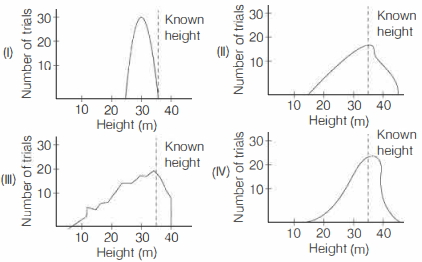
Four students measure the height of a tower. Each student uses a different method and each measures the height many different times. The data for each are plotted below. The measurement with the highest precision is
A
$I$
B
$II$
C
$III$
D
$IV$
Solution
(A) Precision refers to the closeness of various measurements for the same quantity. It is determined by the spread or dispersion of the data points.
$A$ smaller spread (narrower distribution curve) indicates higher precision,as the measurements are more consistent with each other.
Looking at the provided graphs,the distribution curve for case $I$ is the narrowest,meaning the measurements are clustered closely together.
Therefore,the measurement with the highest precision is $I$.
$A$ smaller spread (narrower distribution curve) indicates higher precision,as the measurements are more consistent with each other.
Looking at the provided graphs,the distribution curve for case $I$ is the narrowest,meaning the measurements are clustered closely together.
Therefore,the measurement with the highest precision is $I$.
0 likesView Solution
14
PhysicsAdvancedMCQKVPY · 2011
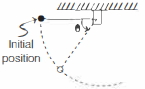
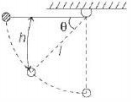
The figure below shows a small mass connected to a string,which is attached to a vertical post. If the ball is released when the string is horizontal as shown below,the magnitude of the total acceleration (including radial and tangential) of the mass as a function of the angle $\theta$ is
A
$g \sin \theta$
B
$g \sqrt{3 \cos^2 \theta + 1}$
C
$g \cos \theta$
D
$g \sqrt{3 \sin^2 \theta + 1}$
Solution
(D) As the ball falls through a vertical height $h = l \sin \theta$ and the string turns by an angle $\theta$ from the horizontal,the velocity $v$ of the ball is obtained by the conservation of mechanical energy:
$\frac{1}{2} m v^2 = m g h = m g l \sin \theta$
$\Rightarrow v^2 = 2 g l \sin \theta$
The radial acceleration $a_r$ is given by:
$a_r = \frac{v^2}{l} = \frac{2 g l \sin \theta}{l} = 2 g \sin \theta$
The tangential acceleration $a_t$ is produced by the component of the gravitational force acting along the tangent to the circular path. At an angle $\theta$ from the horizontal,the angle with the vertical is $(90^\circ - \theta)$. Thus,the component of weight along the tangent is $m g \cos \theta$:
$a_t = \frac{F_t}{m} = g \cos \theta$
The magnitude of the total acceleration $a$ is:
$a = \sqrt{a_r^2 + a_t^2}$
$a = \sqrt{(2 g \sin \theta)^2 + (g \cos \theta)^2}$
$a = \sqrt{4 g^2 \sin^2 \theta + g^2 \cos^2 \theta}$
$a = g \sqrt{4 \sin^2 \theta + (1 - \sin^2 \theta)}$
$a = g \sqrt{3 \sin^2 \theta + 1}$
$\frac{1}{2} m v^2 = m g h = m g l \sin \theta$
$\Rightarrow v^2 = 2 g l \sin \theta$
The radial acceleration $a_r$ is given by:
$a_r = \frac{v^2}{l} = \frac{2 g l \sin \theta}{l} = 2 g \sin \theta$
The tangential acceleration $a_t$ is produced by the component of the gravitational force acting along the tangent to the circular path. At an angle $\theta$ from the horizontal,the angle with the vertical is $(90^\circ - \theta)$. Thus,the component of weight along the tangent is $m g \cos \theta$:
$a_t = \frac{F_t}{m} = g \cos \theta$
The magnitude of the total acceleration $a$ is:
$a = \sqrt{a_r^2 + a_t^2}$
$a = \sqrt{(2 g \sin \theta)^2 + (g \cos \theta)^2}$
$a = \sqrt{4 g^2 \sin^2 \theta + g^2 \cos^2 \theta}$
$a = g \sqrt{4 \sin^2 \theta + (1 - \sin^2 \theta)}$
$a = g \sqrt{3 \sin^2 \theta + 1}$
0 likesView Solution
15
PhysicsAdvancedMCQKVPY · 2011
One mole of an ideal gas at initial temperature $T$ undergoes a quasi-static process during which the volume $V$ is doubled. During the process,the internal energy $U$ obeys the equation $U = a V^3$,where $a$ is a constant. The work done during this process is
A
$\frac{3 R T}{2}$
B
$\frac{5 R T}{2}$
C
$\frac{5 R T}{3}$
D
$\frac{7 R T}{3}$
Solution
(D) Given,internal energy $U = a V^3$.
For an ideal gas,$U = \frac{f}{2} n R T$. Since $n = 1$ and assuming a monatomic gas $(f = 3)$,we have $U = \frac{3}{2} R T$.
Equating the two expressions: $\frac{3}{2} R T = a V^3$.
Using the ideal gas law $P V = R T$,we substitute $R T = P V$:
$\frac{3}{2} P V = a V^3 \Rightarrow P = \frac{2 a}{3} V^2$.
The work done $W$ is given by $\int_{V_i}^{V_f} P dV$.
Here,$V_i = V$ and $V_f = 2V$.
$W = \int_{V}^{2V} \frac{2 a}{3} V^2 dV = \frac{2 a}{3} \left[ \frac{V^3}{3} \right]_{V}^{2V} = \frac{2 a}{9} (8V^3 - V^3) = \frac{2 a}{9} (7V^3) = \frac{14 a V^3}{9}$.
Since $a V^3 = \frac{3}{2} R T$ at the initial state,we substitute $a V^3 = \frac{3}{2} R T$:
$W = \frac{14}{9} \times \left( \frac{3}{2} R T \right) = \frac{7}{3} R T$.
For an ideal gas,$U = \frac{f}{2} n R T$. Since $n = 1$ and assuming a monatomic gas $(f = 3)$,we have $U = \frac{3}{2} R T$.
Equating the two expressions: $\frac{3}{2} R T = a V^3$.
Using the ideal gas law $P V = R T$,we substitute $R T = P V$:
$\frac{3}{2} P V = a V^3 \Rightarrow P = \frac{2 a}{3} V^2$.
The work done $W$ is given by $\int_{V_i}^{V_f} P dV$.
Here,$V_i = V$ and $V_f = 2V$.
$W = \int_{V}^{2V} \frac{2 a}{3} V^2 dV = \frac{2 a}{3} \left[ \frac{V^3}{3} \right]_{V}^{2V} = \frac{2 a}{9} (8V^3 - V^3) = \frac{2 a}{9} (7V^3) = \frac{14 a V^3}{9}$.
Since $a V^3 = \frac{3}{2} R T$ at the initial state,we substitute $a V^3 = \frac{3}{2} R T$:
$W = \frac{14}{9} \times \left( \frac{3}{2} R T \right) = \frac{7}{3} R T$.
0 likesView Solution
16
PhysicsDifficultMCQKVPY · 2011
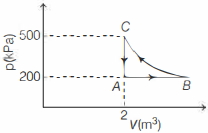
$A$ constant amount of an ideal gas undergoes the cyclic process $ABCA$ in the $p-V$ graph shown below. The path $BC$ is an isothermal process. The work done by the gas during one complete cycle,beginning and ending at $A$,is nearly .......... $kJ$.
A
$600$
B
$300$
C
$-300$
D
$-600$
Solution
(C) The work done in a cyclic process is equal to the area enclosed by the cycle on the $p-V$ diagram. The cycle is $ABCA$.
$1$. Work done in process $AB$ (isobaric expansion):
$W_{AB} = p_A(V_B - V_A) = 200 \times (V_B - 2)$.
Since $BC$ is isothermal,$p_B V_B = p_C V_C$.
$200 \times V_B = 500 \times 2 \Rightarrow V_B = 5 \, m^3$.
$W_{AB} = 200 \times (5 - 2) = 600 \, kJ$.
$2$. Work done in process $BC$ (isothermal compression):
$W_{BC} = \int_{V_B}^{V_C} p \, dV = \int_{5}^{2} \frac{p_B V_B}{V} \, dV = 1000 \ln(2/5) = 1000 \times (-0.916) \approx -916 \, kJ$.
$3$. Work done in process $CA$ (isochoric compression):
$W_{CA} = 0$ (since volume is constant).
Total work done $W = W_{AB} + W_{BC} + W_{CA} = 600 - 916 + 0 = -316 \, kJ$.
Rounding to the nearest option,the work done is approximately $-300 \, kJ$.
$1$. Work done in process $AB$ (isobaric expansion):
$W_{AB} = p_A(V_B - V_A) = 200 \times (V_B - 2)$.
Since $BC$ is isothermal,$p_B V_B = p_C V_C$.
$200 \times V_B = 500 \times 2 \Rightarrow V_B = 5 \, m^3$.
$W_{AB} = 200 \times (5 - 2) = 600 \, kJ$.
$2$. Work done in process $BC$ (isothermal compression):
$W_{BC} = \int_{V_B}^{V_C} p \, dV = \int_{5}^{2} \frac{p_B V_B}{V} \, dV = 1000 \ln(2/5) = 1000 \times (-0.916) \approx -916 \, kJ$.
$3$. Work done in process $CA$ (isochoric compression):
$W_{CA} = 0$ (since volume is constant).
Total work done $W = W_{AB} + W_{BC} + W_{CA} = 600 - 916 + 0 = -316 \, kJ$.
Rounding to the nearest option,the work done is approximately $-300 \, kJ$.
0 likesView Solution
17
PhysicsAdvancedMCQKVPY · 2011
$A$ particle moves in a plane along an elliptic path given by $\frac{x^2}{a^2} + \frac{y^2}{b^2} = 1$. At point $(0, b)$,the $x$-component of velocity is $u$. The $y$-component of acceleration at this point is
A
$-b u^2 / a^2$
B
$-u^2 / b$
C
$-a u^2 / b^2$
D
$-u^2 / a$
Solution
(A) The path of the particle is given by $\frac{x^2}{a^2} + \frac{y^2}{b^2} = 1$.
Differentiating with respect to time $t$,we get $\frac{2x}{a^2} \frac{dx}{dt} + \frac{2y}{b^2} \frac{dy}{dt} = 0$,which simplifies to $\frac{x}{a^2} v_x + \frac{y}{b^2} v_y = 0 \dots (i)$.
Differentiating again with respect to time $t$,we get $\frac{1}{a^2} (v_x^2 + x a_x) + \frac{1}{b^2} (v_y^2 + y a_y) = 0 \dots (ii)$.
At point $(0, b)$,we have $x = 0$ and $y = b$. Given $v_x = u$ at this point.
Substituting $x = 0$ into equation $(i)$,we get $\frac{0}{a^2} u + \frac{b}{b^2} v_y = 0$,which implies $v_y = 0$.
Now,substituting $x = 0, y = b, v_x = u, v_y = 0$ into equation $(ii)$,we get $\frac{1}{a^2} (u^2 + 0 \cdot a_x) + \frac{1}{b^2} (0^2 + b \cdot a_y) = 0$.
This simplifies to $\frac{u^2}{a^2} + \frac{b a_y}{b^2} = 0$,or $\frac{u^2}{a^2} + \frac{a_y}{b} = 0$.
Therefore,$a_y = -\frac{b u^2}{a^2}$.
Differentiating with respect to time $t$,we get $\frac{2x}{a^2} \frac{dx}{dt} + \frac{2y}{b^2} \frac{dy}{dt} = 0$,which simplifies to $\frac{x}{a^2} v_x + \frac{y}{b^2} v_y = 0 \dots (i)$.
Differentiating again with respect to time $t$,we get $\frac{1}{a^2} (v_x^2 + x a_x) + \frac{1}{b^2} (v_y^2 + y a_y) = 0 \dots (ii)$.
At point $(0, b)$,we have $x = 0$ and $y = b$. Given $v_x = u$ at this point.
Substituting $x = 0$ into equation $(i)$,we get $\frac{0}{a^2} u + \frac{b}{b^2} v_y = 0$,which implies $v_y = 0$.
Now,substituting $x = 0, y = b, v_x = u, v_y = 0$ into equation $(ii)$,we get $\frac{1}{a^2} (u^2 + 0 \cdot a_x) + \frac{1}{b^2} (0^2 + b \cdot a_y) = 0$.
This simplifies to $\frac{u^2}{a^2} + \frac{b a_y}{b^2} = 0$,or $\frac{u^2}{a^2} + \frac{a_y}{b} = 0$.
Therefore,$a_y = -\frac{b u^2}{a^2}$.
0 likesView Solution
18
PhysicsAdvancedMCQKVPY · 2011
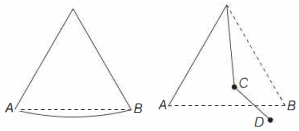
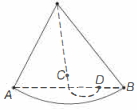
$A$ simple pendulum oscillates freely between points $A$ and $B$. We now put a peg (nail) at the point $C$ as shown in the figure. As the pendulum moves from $A$ to the right,the string will bend at $C$ and the pendulum will go to its extreme point $D$. Ignoring friction,the point $D$
A
will lie on the line $A B$
B
will lie above the line $A B$
C
will lie below the line $A B$
D
will coincide with $B$
Solution
(A) The correct option is $A$.
In a simple pendulum,the total mechanical energy is conserved in the absence of friction. The total energy of the pendulum at its extreme positions is purely potential energy,given by $U = mgh$,where $h$ is the vertical height of the bob from the lowest point of the oscillation.
Since the pendulum starts from point $A$ with zero initial velocity,its total energy is $E = mgh_A$. At the other extreme point $D$,the velocity is again zero,so its total energy is $E = mgh_D$.
By the law of conservation of energy,$mgh_A = mgh_D$,which implies $h_A = h_D$. Since $A$ and $B$ lie on the same horizontal line,$h_A = h_B$. Therefore,$h_D = h_B$,which means the extreme point $D$ must lie on the same horizontal line $A B$.
In a simple pendulum,the total mechanical energy is conserved in the absence of friction. The total energy of the pendulum at its extreme positions is purely potential energy,given by $U = mgh$,where $h$ is the vertical height of the bob from the lowest point of the oscillation.
Since the pendulum starts from point $A$ with zero initial velocity,its total energy is $E = mgh_A$. At the other extreme point $D$,the velocity is again zero,so its total energy is $E = mgh_D$.
By the law of conservation of energy,$mgh_A = mgh_D$,which implies $h_A = h_D$. Since $A$ and $B$ lie on the same horizontal line,$h_A = h_B$. Therefore,$h_D = h_B$,which means the extreme point $D$ must lie on the same horizontal line $A B$.
0 likesView Solution
19
PhysicsDifficultMCQKVPY · 2011
$A$ small child tries to move a large rubber toy placed on the ground. The toy does not move but gets deformed under her pushing force $F$,which is obliquely upward as shown in the figure. Then,
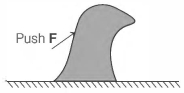
A
the resultant of the pushing force $F$,weight of the toy,normal force by the ground on the toy and the frictional force is zero
B
the normal force by the ground is equal and opposite to the weight of the toy
C
the pushing force $F$ of the child is balanced by the equal and opposite frictional force
D
the pushing force $F$ of the child is balanced by the total internal force in the toy generated due to deformation
Solution
(A) Since the toy is in equilibrium (it does not move),the net force acting on it must be zero.
The forces acting on the toy are:
$1$. The pushing force $F$ applied by the child.
$2$. The weight of the toy $(W = mg)$ acting downwards.
$3$. The normal force $(N)$ exerted by the ground acting upwards.
$4$. The frictional force $(f)$ exerted by the ground acting horizontally to oppose the motion.
According to Newton's first law,for an object in equilibrium,the vector sum of all external forces acting on it must be zero.
Therefore,$\vec{F} + \vec{W} + \vec{N} + \vec{f} = 0$.
This means the resultant of these four forces is zero.
Option $(a)$ is correct.
The forces acting on the toy are:
$1$. The pushing force $F$ applied by the child.
$2$. The weight of the toy $(W = mg)$ acting downwards.
$3$. The normal force $(N)$ exerted by the ground acting upwards.
$4$. The frictional force $(f)$ exerted by the ground acting horizontally to oppose the motion.
According to Newton's first law,for an object in equilibrium,the vector sum of all external forces acting on it must be zero.
Therefore,$\vec{F} + \vec{W} + \vec{N} + \vec{f} = 0$.
This means the resultant of these four forces is zero.
Option $(a)$ is correct.
0 likesView Solution
20
PhysicsAdvancedMCQKVPY · 2011
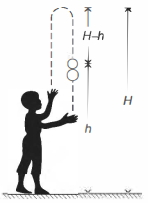
$A$ juggler tosses a ball up in the air with initial speed $u$. At the instant it reaches its maximum height $H$,he tosses up a second ball with the same initial speed. The two balls will collide at a height:
A
$\frac{H}{4}$
B
$\frac{H}{2}$
C
$\frac{3H}{4}$
D
$\sqrt{\frac{3}{4}} H$
Solution
(C) Let the first ball reach a maximum height $H = \frac{u^2}{2g}$.
At the instant the first ball reaches height $H$,it starts falling. Let the balls collide at a height $h$ from the ground after time $t$ from the moment the second ball is thrown.
The first ball falls a distance $(H - h)$ in time $t$. Using the equation of motion for the first ball:
$H - h = \frac{1}{2}gt^2 \quad \dots(i)$
The second ball rises to height $h$ in time $t$. Using the equation of motion for the second ball:
$h = ut - \frac{1}{2}gt^2 \quad \dots(ii)$
Adding equations $(i)$ and $(ii)$:
$(H - h) + h = \frac{1}{2}gt^2 + ut - \frac{1}{2}gt^2$
$H = ut \implies t = \frac{H}{u}$
Since $H = \frac{u^2}{2g}$,we have $u = \sqrt{2gH}$. Thus,$t = \frac{H}{\sqrt{2gH}} = \sqrt{\frac{H}{2g}}$.
Substituting $t$ into equation $(ii)$:
$h = u\left(\frac{H}{u}\right) - \frac{1}{2}g\left(\frac{H}{u}\right)^2 = H - \frac{1}{2}g\left(\frac{H^2}{u^2}\right)$
Since $u^2 = 2gH$,we get:
$h = H - \frac{1}{2}g\left(\frac{H^2}{2gH}\right) = H - \frac{H}{4} = \frac{3H}{4}$.
At the instant the first ball reaches height $H$,it starts falling. Let the balls collide at a height $h$ from the ground after time $t$ from the moment the second ball is thrown.
The first ball falls a distance $(H - h)$ in time $t$. Using the equation of motion for the first ball:
$H - h = \frac{1}{2}gt^2 \quad \dots(i)$
The second ball rises to height $h$ in time $t$. Using the equation of motion for the second ball:
$h = ut - \frac{1}{2}gt^2 \quad \dots(ii)$
Adding equations $(i)$ and $(ii)$:
$(H - h) + h = \frac{1}{2}gt^2 + ut - \frac{1}{2}gt^2$
$H = ut \implies t = \frac{H}{u}$
Since $H = \frac{u^2}{2g}$,we have $u = \sqrt{2gH}$. Thus,$t = \frac{H}{\sqrt{2gH}} = \sqrt{\frac{H}{2g}}$.
Substituting $t$ into equation $(ii)$:
$h = u\left(\frac{H}{u}\right) - \frac{1}{2}g\left(\frac{H}{u}\right)^2 = H - \frac{1}{2}g\left(\frac{H^2}{u^2}\right)$
Since $u^2 = 2gH$,we get:
$h = H - \frac{1}{2}g\left(\frac{H^2}{2gH}\right) = H - \frac{H}{4} = \frac{3H}{4}$.
0 likesView Solution
21
PhysicsDifficultMCQKVPY · 2011
On a horizontal frictionless frozen lake,a girl of mass $36 \,kg$ and a box of mass $9 \,kg$ are connected to each other by means of a rope. Initially,they are $20 \,m$ apart. The girl exerts a horizontal force on the box,pulling it towards her. How far has the girl travelled when she meets the box?
A
$10 \,m$
B
Since there is no friction,the girl will not move.
C
$16 \,m$
D
$4 \,m$
Solution
(D) Since there is no external horizontal force acting on the system,the position of the centre of mass of the system remains unchanged.
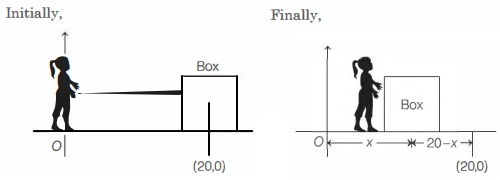
Let the initial position of the girl be at the origin $(x = 0)$ and the box be at $x = 20 \,m$.
The mass of the girl is $m_1 = 36 \,kg$ and the mass of the box is $m_2 = 9 \,kg$.
The initial position of the centre of mass $(X_{CM})$ is:
$X_{CM} = \frac{m_1 x_1 + m_2 x_2}{m_1 + m_2} = \frac{36 \times 0 + 9 \times 20}{36 + 9} = \frac{180}{45} = 4 \,m$.
Let the girl move a distance $x$ towards the box and the box move a distance $(20 - x)$ towards the girl. When they meet,they will both be at the position of the centre of mass,$X_{CM} = 4 \,m$.
Therefore,the girl has travelled $4 \,m$ from her initial position to reach the centre of mass,and the box has travelled $20 - 4 = 16 \,m$ to reach the same point.
Thus,the girl has travelled $4 \,m$.
Let the initial position of the girl be at the origin $(x = 0)$ and the box be at $x = 20 \,m$.
The mass of the girl is $m_1 = 36 \,kg$ and the mass of the box is $m_2 = 9 \,kg$.
The initial position of the centre of mass $(X_{CM})$ is:
$X_{CM} = \frac{m_1 x_1 + m_2 x_2}{m_1 + m_2} = \frac{36 \times 0 + 9 \times 20}{36 + 9} = \frac{180}{45} = 4 \,m$.
Let the girl move a distance $x$ towards the box and the box move a distance $(20 - x)$ towards the girl. When they meet,they will both be at the position of the centre of mass,$X_{CM} = 4 \,m$.
Therefore,the girl has travelled $4 \,m$ from her initial position to reach the centre of mass,and the box has travelled $20 - 4 = 16 \,m$ to reach the same point.
Thus,the girl has travelled $4 \,m$.
0 likesView Solution
22
PhysicsMediumMCQKVPY · 2011
The following three objects $(1)$ a metal tray,$(2)$ a block of wood,and $(3)$ a woolen cap are left in a closed room overnight. Next day,the temperature of each is recorded as $T_1, T_2$,and $T_3$,respectively. The likely situation is:
A
$T_1 = T_2 = T_3$
B
$T_3 > T_2 > T_1$
C
$T_3 = T_2 > T_1$
D
$T_3 > T_2 = T_1$
Solution
(A) When objects are left in a closed room for a long duration (overnight),they exchange heat with the surrounding air until they reach thermal equilibrium.
According to the Zeroth Law of Thermodynamics,if two systems are in thermal equilibrium with a third system,they are in thermal equilibrium with each other.
Since all three objects are in the same room,they will eventually reach the same temperature as the room's ambient temperature.
Therefore,$T_1 = T_2 = T_3$.
According to the Zeroth Law of Thermodynamics,if two systems are in thermal equilibrium with a third system,they are in thermal equilibrium with each other.
Since all three objects are in the same room,they will eventually reach the same temperature as the room's ambient temperature.
Therefore,$T_1 = T_2 = T_3$.
0 likesView Solution
23
PhysicsMediumMCQKVPY · 2011
We sit in a room with windows open. Then,
A
air pressure on the floor of the room equals the atmospheric pressure but the air pressure on the ceiling is negligible
B
air pressure is nearly the same on the floor,the walls,and the ceiling
C
air pressure on the floor equals the weight of the air column inside the room (from floor to ceiling) per unit area
D
air pressure on the walls is zero,since the weight of air acts downward
Solution
(B) The correct answer is $(B)$.
Gas molecules in a room are in constant,random thermal motion. Due to the high speed of these molecules and the relatively small height of a room,the effect of gravity on the density distribution of the air inside the room is negligible.
According to the kinetic theory of gases,pressure is exerted by the collisions of gas molecules with the walls of the container. Since the distribution of gas molecules is uniform throughout the room,the frequency and force of these collisions are essentially the same on the floor,the walls,and the ceiling.
Therefore,the air pressure is nearly the same on the floor,the walls,and the ceiling.
Gas molecules in a room are in constant,random thermal motion. Due to the high speed of these molecules and the relatively small height of a room,the effect of gravity on the density distribution of the air inside the room is negligible.
According to the kinetic theory of gases,pressure is exerted by the collisions of gas molecules with the walls of the container. Since the distribution of gas molecules is uniform throughout the room,the frequency and force of these collisions are essentially the same on the floor,the walls,and the ceiling.
Therefore,the air pressure is nearly the same on the floor,the walls,and the ceiling.
0 likesView Solution
24
PhysicsMediumMCQKVPY · 2011
$A$ $750 \,W$ motor drives a pump which lifts $300 \,L$ of water per minute to a height of $6 \,m$. The efficiency of the motor is nearly (Take,acceleration due to gravity to be $10 \,m/s^2$) (in $\%$)
A
$30$
B
$40$
C
$50$
D
$20$
Solution
(B) Given:
Input power $(P_{\text{in}})$ = $750 \,W$
Volume of water $(V)$ = $300 \,L$,so mass $(m)$ = $300 \,kg$ (since density of water is $1 \,kg/L$)
Height $(h)$ = $6 \,m$
Time $(t)$ = $1 \,minute = 60 \,s$
Acceleration due to gravity $(g)$ = $10 \,m/s^2$
The useful power output $(P_{\text{out}})$ is the rate of doing work against gravity:
$P_{\text{out}} = \frac{mgh}{t} = \frac{300 \times 10 \times 6}{60} = \frac{18000}{60} = 300 \,W$
The efficiency $(\eta)$ is defined as the ratio of useful power output to input power:
$\eta = \frac{P_{\text{out}}}{P_{\text{in}}} = \frac{300}{750} = 0.4$
Converting to percentage:
$\eta = 0.4 \times 100 = 40 \%$
Input power $(P_{\text{in}})$ = $750 \,W$
Volume of water $(V)$ = $300 \,L$,so mass $(m)$ = $300 \,kg$ (since density of water is $1 \,kg/L$)
Height $(h)$ = $6 \,m$
Time $(t)$ = $1 \,minute = 60 \,s$
Acceleration due to gravity $(g)$ = $10 \,m/s^2$
The useful power output $(P_{\text{out}})$ is the rate of doing work against gravity:
$P_{\text{out}} = \frac{mgh}{t} = \frac{300 \times 10 \times 6}{60} = \frac{18000}{60} = 300 \,W$
The efficiency $(\eta)$ is defined as the ratio of useful power output to input power:
$\eta = \frac{P_{\text{out}}}{P_{\text{in}}} = \frac{300}{750} = 0.4$
Converting to percentage:
$\eta = 0.4 \times 100 = 40 \%$
0 likesView Solution
25
PhysicsMediumMCQKVPY · 2011
The number of air molecules in a $(5 \,m \times 5 \,m \times 4 \,m)$ room at standard temperature and pressure is of the order of
A
$6 \times 10^{23}$
B
$3 \times 10^{24}$
C
$3 \times 10^{27}$
D
$6 \times 10^{30}$
Solution
(C) The volume of the room is $V = 5 \,m \times 5 \,m \times 4 \,m = 100 \,m^3$.
At standard temperature and pressure $(STP)$,the pressure $p = 1.013 \times 10^5 \,Pa \approx 10^5 \,Pa$ and temperature $T = 273 \,K$.
The Boltzmann constant $k_B = 1.38 \times 10^{-23} \,J/K$.
Using the ideal gas equation $pV = Nk_BT$,the number of molecules $N$ is given by $N = \frac{pV}{k_BT}$.
Substituting the values: $N = \frac{10^5 \times 100}{1.38 \times 10^{-23} \times 273} \approx \frac{10^7}{3.7674 \times 10^{-21}} \approx 2.65 \times 10^{27}$.
Rounding to the nearest order of magnitude,$N \approx 3 \times 10^{27}$ molecules.
At standard temperature and pressure $(STP)$,the pressure $p = 1.013 \times 10^5 \,Pa \approx 10^5 \,Pa$ and temperature $T = 273 \,K$.
The Boltzmann constant $k_B = 1.38 \times 10^{-23} \,J/K$.
Using the ideal gas equation $pV = Nk_BT$,the number of molecules $N$ is given by $N = \frac{pV}{k_BT}$.
Substituting the values: $N = \frac{10^5 \times 100}{1.38 \times 10^{-23} \times 273} \approx \frac{10^7}{3.7674 \times 10^{-21}} \approx 2.65 \times 10^{27}$.
Rounding to the nearest order of magnitude,$N \approx 3 \times 10^{27}$ molecules.
0 likesView Solution
26
PhysicsAdvancedMCQKVPY · 2011
An object with uniform density $\rho$ is attached to a spring that is known to stretch linearly with applied force. When the spring-object system is immersed in a liquid of density $\rho_1$,the spring stretches by an amount $x_1$ (where $\rho > \rho_1$). When the experiment is repeated in a liquid of density $\rho_2$ (where $\rho_2 < \rho_1$),the spring stretches by an amount $x_2$. Neglecting any buoyant force on the spring,the density of the object is:
A
$\rho=\frac{\rho_1 x_1-\rho_2 x_2}{x_1-x_2}$
B
$\rho=\frac{\rho_1 x_2-\rho_2 x_1}{x_2-x_1}$
C
$\rho=\frac{\rho_1 x_2+\rho_2 x_1}{x_1+x_2}$
D
$\rho=\frac{\rho_1 x_1+\rho_2 x_2}{x_1+x_2}$
Solution
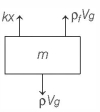
(B) For the equilibrium of the block hung from the spring,the sum of the spring force and the buoyant force must equal the weight of the block.
Let $V$ be the volume of the object and $k$ be the spring constant.
The weight of the object is $W = \rho V g$.
The buoyant force in a liquid of density $\rho_f$ is $F_B = \rho_f V g$.
The spring force is $F_s = kx$.
For equilibrium: $kx + \rho_f V g = \rho V g$.
In the first liquid (density $\rho_1$): $k x_1 + \rho_1 V g = \rho V g \quad \dots(i)$
In the second liquid (density $\rho_2$): $k x_2 + \rho_2 V g = \rho V g \quad \dots(ii)$
From $(i)$,$k = \frac{(\rho - \rho_1) V g}{x_1}$.
From $(ii)$,$k = \frac{(\rho - \rho_2) V g}{x_2}$.
Equating the two expressions for $k$:
$\frac{(\rho - \rho_1) V g}{x_1} = \frac{(\rho - \rho_2) V g}{x_2}$
$(\rho - \rho_1) x_2 = (\rho - \rho_2) x_1$
$\rho x_2 - \rho_1 x_2 = \rho x_1 - \rho_2 x_1$
$\rho (x_2 - x_1) = \rho_1 x_2 - \rho_2 x_1$
$\rho = \frac{\rho_1 x_2 - \rho_2 x_1}{x_2 - x_1}$
Let $V$ be the volume of the object and $k$ be the spring constant.
The weight of the object is $W = \rho V g$.
The buoyant force in a liquid of density $\rho_f$ is $F_B = \rho_f V g$.
The spring force is $F_s = kx$.
For equilibrium: $kx + \rho_f V g = \rho V g$.
In the first liquid (density $\rho_1$): $k x_1 + \rho_1 V g = \rho V g \quad \dots(i)$
In the second liquid (density $\rho_2$): $k x_2 + \rho_2 V g = \rho V g \quad \dots(ii)$
From $(i)$,$k = \frac{(\rho - \rho_1) V g}{x_1}$.
From $(ii)$,$k = \frac{(\rho - \rho_2) V g}{x_2}$.
Equating the two expressions for $k$:
$\frac{(\rho - \rho_1) V g}{x_1} = \frac{(\rho - \rho_2) V g}{x_2}$
$(\rho - \rho_1) x_2 = (\rho - \rho_2) x_1$
$\rho x_2 - \rho_1 x_2 = \rho x_1 - \rho_2 x_1$
$\rho (x_2 - x_1) = \rho_1 x_2 - \rho_2 x_1$
$\rho = \frac{\rho_1 x_2 - \rho_2 x_1}{x_2 - x_1}$
0 likesView Solution
27
PhysicsMediumMCQKVPY · 2011
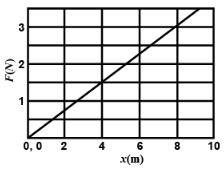
$A$ body of $0.5 \,kg$ moves along the positive $X$-axis under the influence of a varying force $F$ (in newton) as shown below. If the speed of the object at $x=4 \,m$ is $3.16 \,ms^{-1}$,then its speed at $x=8 \,m$ is ................. $\,ms^{-1}$.
A
$3.16$
B
$9.3$
C
$8$
D
$6.8$
Solution
(D) According to the work-kinetic energy theorem,the work done by the force is equal to the change in kinetic energy of the body.
$W = \Delta K = K_f - K_i = \frac{1}{2} m (v_f^2 - v_i^2)$
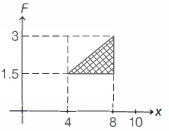
The work done is equal to the area under the force-displacement graph from $x=4 \,m$ to $x=8 \,m$. From the graph,at $x=4 \,m$,$F=1.5 \,N$ and at $x=8 \,m$,$F=3 \,N$.
The area is a trapezoid (or a rectangle plus a triangle) with height $h = (8-4) = 4 \,m$ and parallel sides $F_1 = 1.5 \,N$ and $F_2 = 3 \,N$.
$W = \text{Area} = \frac{1}{2} \times (F_1 + F_2) \times \Delta x = \frac{1}{2} \times (1.5 + 3) \times 4 = 2 \times 4.5 = 9 \,J$.
Given $m = 0.5 \,kg$ and $v_i = 3.16 \,ms^{-1}$.
$9 = \frac{1}{2} \times 0.5 \times (v_f^2 - (3.16)^2)$
$9 = 0.25 \times (v_f^2 - 9.9856)$
$36 = v_f^2 - 9.9856$
$v_f^2 = 45.9856$
$v_f \approx 6.78 \,ms^{-1} \approx 6.8 \,ms^{-1}$.
$W = \Delta K = K_f - K_i = \frac{1}{2} m (v_f^2 - v_i^2)$
The work done is equal to the area under the force-displacement graph from $x=4 \,m$ to $x=8 \,m$. From the graph,at $x=4 \,m$,$F=1.5 \,N$ and at $x=8 \,m$,$F=3 \,N$.
The area is a trapezoid (or a rectangle plus a triangle) with height $h = (8-4) = 4 \,m$ and parallel sides $F_1 = 1.5 \,N$ and $F_2 = 3 \,N$.
$W = \text{Area} = \frac{1}{2} \times (F_1 + F_2) \times \Delta x = \frac{1}{2} \times (1.5 + 3) \times 4 = 2 \times 4.5 = 9 \,J$.
Given $m = 0.5 \,kg$ and $v_i = 3.16 \,ms^{-1}$.
$9 = \frac{1}{2} \times 0.5 \times (v_f^2 - (3.16)^2)$
$9 = 0.25 \times (v_f^2 - 9.9856)$
$36 = v_f^2 - 9.9856$
$v_f^2 = 45.9856$
$v_f \approx 6.78 \,ms^{-1} \approx 6.8 \,ms^{-1}$.
0 likesView Solution
28
PhysicsDifficultMCQKVPY · 2011
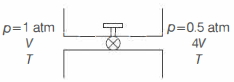
In a thermally isolated system,two boxes filled with an ideal gas are connected by a valve. When the valve is in the closed position,the states of box $1$ and $2$ respectively are $(1 \, atm, V, T)$ and $(0.5 \, atm, 4V, T)$. When the valve is opened,the final pressure of the system is approximately ............... $atm$.
A
$0.5$
B
$0.6$
C
$0.75$
D
$1.0$
Solution
(B) For a thermally isolated system,the total internal energy remains constant because $\Delta Q = 0$ and $\Delta W = 0$.
Since the initial temperatures of both boxes are the same $(T)$,the final equilibrium temperature $T_f$ will also be $T$.
Using the ideal gas law $PV = nRT$,we can find the number of moles in each box:
$n_1 = \frac{P_1 V_1}{RT} = \frac{1 \times V}{RT} = \frac{V}{RT}$
$n_2 = \frac{P_2 V_2}{RT} = \frac{0.5 \times 4V}{RT} = \frac{2V}{RT}$
When the valve is opened,the total number of moles $n_{total} = n_1 + n_2$ occupies the total volume $V_{total} = V_1 + V_2 = V + 4V = 5V$ at temperature $T$.
$n_{total} = \frac{V}{RT} + \frac{2V}{RT} = \frac{3V}{RT}$
Using the ideal gas law for the final state:
$P_f V_{total} = n_{total} R T$
$P_f (5V) = \left(\frac{3V}{RT}\right) RT$
$P_f (5V) = 3V$
$P_f = \frac{3}{5} \, atm = 0.6 \, atm$.
Since the initial temperatures of both boxes are the same $(T)$,the final equilibrium temperature $T_f$ will also be $T$.
Using the ideal gas law $PV = nRT$,we can find the number of moles in each box:
$n_1 = \frac{P_1 V_1}{RT} = \frac{1 \times V}{RT} = \frac{V}{RT}$
$n_2 = \frac{P_2 V_2}{RT} = \frac{0.5 \times 4V}{RT} = \frac{2V}{RT}$
When the valve is opened,the total number of moles $n_{total} = n_1 + n_2$ occupies the total volume $V_{total} = V_1 + V_2 = V + 4V = 5V$ at temperature $T$.
$n_{total} = \frac{V}{RT} + \frac{2V}{RT} = \frac{3V}{RT}$
Using the ideal gas law for the final state:
$P_f V_{total} = n_{total} R T$
$P_f (5V) = \left(\frac{3V}{RT}\right) RT$
$P_f (5V) = 3V$
$P_f = \frac{3}{5} \, atm = 0.6 \, atm$.
0 likesView Solution
29
PhysicsMediumMCQKVPY · 2011
$A$ plane polarised light passes through successive polarisers which are rotated by $30^{\circ}$ with respect to each other in the clockwise direction. Neglecting absorption by the polarisers and given that the first polariser's axis is parallel to the plane of polarisation of the incident light,the intensity of light at the exit of the fifth polariser is closest to
A
same as that of the incident light
B
$17.5 \%$ of the incident light
C
$30 \%$ of the incident light
D
zero
Solution
(C) Let the intensity of the incident light be $I_0$. According to Malus' law,the intensity of light after passing through a polariser is $I = I_{in} \cos^2 \theta$,where $\theta$ is the angle between the incident light's polarisation plane and the polariser's axis.
Since the first polariser's axis is parallel to the plane of polarisation of the incident light,the angle $\theta_1 = 0^{\circ}$. Thus,the intensity after the first polariser is $I_1 = I_0 \cos^2(0^{\circ}) = I_0$.
For the subsequent polarisers,each is rotated by $30^{\circ}$ relative to the previous one. Therefore,the angle between the light's polarisation plane and the next polariser is $30^{\circ}$.
Intensity after the second polariser: $I_2 = I_1 \cos^2(30^{\circ}) = I_0 (\frac{\sqrt{3}}{2})^2 = \frac{3}{4} I_0$.
Intensity after the third polariser: $I_3 = I_2 \cos^2(30^{\circ}) = (\frac{3}{4} I_0) \times \frac{3}{4} = (\frac{3}{4})^2 I_0$.
Intensity after the fourth polariser: $I_4 = I_3 \cos^2(30^{\circ}) = (\frac{3}{4})^2 I_0 \times \frac{3}{4} = (\frac{3}{4})^3 I_0$.
Intensity after the fifth polariser: $I_5 = I_4 \cos^2(30^{\circ}) = (\frac{3}{4})^3 I_0 \times \frac{3}{4} = (\frac{3}{4})^4 I_0$.
Calculating the value: $I_5 = (0.75)^4 I_0 = 0.3164 I_0 \approx 31.6 \% I_0$.
Comparing with the given options,the intensity is closest to $30 \%$ of the incident light.
Since the first polariser's axis is parallel to the plane of polarisation of the incident light,the angle $\theta_1 = 0^{\circ}$. Thus,the intensity after the first polariser is $I_1 = I_0 \cos^2(0^{\circ}) = I_0$.
For the subsequent polarisers,each is rotated by $30^{\circ}$ relative to the previous one. Therefore,the angle between the light's polarisation plane and the next polariser is $30^{\circ}$.
Intensity after the second polariser: $I_2 = I_1 \cos^2(30^{\circ}) = I_0 (\frac{\sqrt{3}}{2})^2 = \frac{3}{4} I_0$.
Intensity after the third polariser: $I_3 = I_2 \cos^2(30^{\circ}) = (\frac{3}{4} I_0) \times \frac{3}{4} = (\frac{3}{4})^2 I_0$.
Intensity after the fourth polariser: $I_4 = I_3 \cos^2(30^{\circ}) = (\frac{3}{4})^2 I_0 \times \frac{3}{4} = (\frac{3}{4})^3 I_0$.
Intensity after the fifth polariser: $I_5 = I_4 \cos^2(30^{\circ}) = (\frac{3}{4})^3 I_0 \times \frac{3}{4} = (\frac{3}{4})^4 I_0$.
Calculating the value: $I_5 = (0.75)^4 I_0 = 0.3164 I_0 \approx 31.6 \% I_0$.
Comparing with the given options,the intensity is closest to $30 \%$ of the incident light.
0 likesView Solution
30
PhysicsMediumMCQKVPY · 2011
In a Young's double slit experiment,light from a laser source falls on a pair of very narrow slits separated by $1.0 \,\mu m$ and bright fringes separated by $1.0 \,mm$ are observed on a distant screen. If the frequency of the laser light is doubled,the separation of the bright fringes is .......$\,mm$?
A
$0.25$
B
$0.5$
C
$1.0$
D
$2.0$
Solution
(B) In Young's double slit experiment,the fringe width (fringe separation) $\beta$ is given by the formula:
$\beta = \frac{\lambda D}{d}$
Since the wavelength $\lambda$ is related to the frequency $f$ by $\lambda = \frac{c}{f}$,where $c$ is the speed of light,we can substitute this into the formula:
$\beta = \frac{cD}{fd}$
Assuming the distance between the slits $d$ and the distance to the screen $D$ remain constant,the fringe width is inversely proportional to the frequency:
$\beta \propto \frac{1}{f}$
Given that the initial fringe separation $\beta_1 = 1.0 \,mm$ at frequency $f_1 = f$,when the frequency is doubled $(f_2 = 2f)$,the new fringe separation $\beta_2$ will be:
$\beta_2 = \beta_1 \times \frac{f_1}{f_2} = 1.0 \,mm \times \frac{f}{2f} = 0.5 \,mm$
Therefore,the new separation of the bright fringes is $0.5 \,mm$.
$\beta = \frac{\lambda D}{d}$
Since the wavelength $\lambda$ is related to the frequency $f$ by $\lambda = \frac{c}{f}$,where $c$ is the speed of light,we can substitute this into the formula:
$\beta = \frac{cD}{fd}$
Assuming the distance between the slits $d$ and the distance to the screen $D$ remain constant,the fringe width is inversely proportional to the frequency:
$\beta \propto \frac{1}{f}$
Given that the initial fringe separation $\beta_1 = 1.0 \,mm$ at frequency $f_1 = f$,when the frequency is doubled $(f_2 = 2f)$,the new fringe separation $\beta_2$ will be:
$\beta_2 = \beta_1 \times \frac{f_1}{f_2} = 1.0 \,mm \times \frac{f}{2f} = 0.5 \,mm$
Therefore,the new separation of the bright fringes is $0.5 \,mm$.
0 likesView Solution
31
PhysicsMediumMCQKVPY · 2011
For a domestic $AC$ supply of $220 \,V$ at $50 \,cps$,the potential difference between the terminals of a two-pin electric outlet in a room is (in volt) given by
A
$V(t)=220 \sqrt{2} \cos 100 \pi t$
B
$V(t)=220 \cos 50 t$
C
$V(t)=220 \cos 100 \pi t$
D
$V(t)=220 \sqrt{2} \cos 50 t$
Solution
(A) For a domestic $AC$ supply,the given voltage $220 \,V$ represents the root-mean-square $(V_{\text{rms}})$ value.
The peak voltage $(V_{\text{max}})$ is calculated as $V_{\text{max}} = V_{\text{rms}} \times \sqrt{2} = 220 \sqrt{2} \,V$.
The frequency $f$ is $50 \,cps$ (or $50 \,Hz$). The angular frequency $\omega$ is given by $\omega = 2 \pi f = 2 \pi \times 50 = 100 \pi \,rad/s$.
The instantaneous potential difference $V(t)$ is expressed as $V(t) = V_{\text{max}} \cos(\omega t)$.
Substituting the values,we get $V(t) = 220 \sqrt{2} \cos(100 \pi t) \,V$.
The peak voltage $(V_{\text{max}})$ is calculated as $V_{\text{max}} = V_{\text{rms}} \times \sqrt{2} = 220 \sqrt{2} \,V$.
The frequency $f$ is $50 \,cps$ (or $50 \,Hz$). The angular frequency $\omega$ is given by $\omega = 2 \pi f = 2 \pi \times 50 = 100 \pi \,rad/s$.
The instantaneous potential difference $V(t)$ is expressed as $V(t) = V_{\text{max}} \cos(\omega t)$.
Substituting the values,we get $V(t) = 220 \sqrt{2} \cos(100 \pi t) \,V$.
0 likesView Solution
32
PhysicsMediumMCQKVPY · 2011
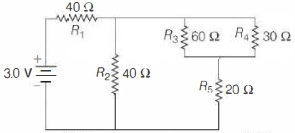
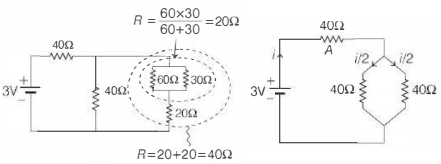
In the circuit shown below,the resistances are given (in $\Omega$) and the battery is assumed ideal with an electromotive force (emf) equal to $3.0 \, V$. The resistor that dissipates the most power is
A
$R_1$
B
$R_2$
C
$R_3$
D
$R_4$
Solution
(A) First,simplify the circuit. The resistors $R_3 = 60 \, \Omega$ and $R_4 = 30 \, \Omega$ are in parallel. Their equivalent resistance $R_p$ is given by:
$R_p = \frac{60 \times 30}{60 + 30} = \frac{1800}{90} = 20 \, \Omega$.
This combination is in series with $R_5 = 20 \, \Omega$,so the equivalent resistance of this branch is $R_{branch} = 20 + 20 = 40 \, \Omega$.
Now,this branch is in parallel with $R_2 = 40 \, \Omega$. The equivalent resistance of this parallel part is $R_{eq'} = \frac{40 \times 40}{40 + 40} = 20 \, \Omega$.
Finally,this is in series with $R_1 = 40 \, \Omega$. The total resistance of the circuit is $R_{total} = 40 + 20 = 60 \, \Omega$.
The total current from the battery is $I = \frac{V}{R_{total}} = \frac{3.0}{60} = 0.05 \, A$.
Power dissipated in $R_1$ is $P_1 = I^2 R_1 = (0.05)^2 \times 40 = 0.0025 \times 40 = 0.1 \, W$.
The current $I$ splits equally into the two parallel branches ($R_2$ and the branch containing $R_3, R_4, R_5$) because both have a resistance of $40 \, \Omega$. Thus,$I_2 = I_{branch} = 0.025 \, A$.
Power in $R_2$ is $P_2 = (0.025)^2 \times 40 = 0.000625 \times 40 = 0.025 \, W$.
In the branch with $R_3, R_4, R_5$,the current is $0.025 \, A$. Power in $R_5$ is $P_5 = (0.025)^2 \times 20 = 0.0125 \, W$.
The voltage across the parallel combination of $R_3$ and $R_4$ is $V_p = I_{branch} \times R_p = 0.025 \times 20 = 0.5 \, V$.
Power in $R_3$ is $P_3 = \frac{V_p^2}{R_3} = \frac{0.5^2}{60} = \frac{0.25}{60} \approx 0.0042 \, W$.
Power in $R_4$ is $P_4 = \frac{V_p^2}{R_4} = \frac{0.5^2}{30} = \frac{0.25}{30} \approx 0.0083 \, W$.
Comparing all powers,$P_1 = 0.1 \, W$ is the maximum. Therefore,$R_1$ dissipates the most power.
$R_p = \frac{60 \times 30}{60 + 30} = \frac{1800}{90} = 20 \, \Omega$.
This combination is in series with $R_5 = 20 \, \Omega$,so the equivalent resistance of this branch is $R_{branch} = 20 + 20 = 40 \, \Omega$.
Now,this branch is in parallel with $R_2 = 40 \, \Omega$. The equivalent resistance of this parallel part is $R_{eq'} = \frac{40 \times 40}{40 + 40} = 20 \, \Omega$.
Finally,this is in series with $R_1 = 40 \, \Omega$. The total resistance of the circuit is $R_{total} = 40 + 20 = 60 \, \Omega$.
The total current from the battery is $I = \frac{V}{R_{total}} = \frac{3.0}{60} = 0.05 \, A$.
Power dissipated in $R_1$ is $P_1 = I^2 R_1 = (0.05)^2 \times 40 = 0.0025 \times 40 = 0.1 \, W$.
The current $I$ splits equally into the two parallel branches ($R_2$ and the branch containing $R_3, R_4, R_5$) because both have a resistance of $40 \, \Omega$. Thus,$I_2 = I_{branch} = 0.025 \, A$.
Power in $R_2$ is $P_2 = (0.025)^2 \times 40 = 0.000625 \times 40 = 0.025 \, W$.
In the branch with $R_3, R_4, R_5$,the current is $0.025 \, A$. Power in $R_5$ is $P_5 = (0.025)^2 \times 20 = 0.0125 \, W$.
The voltage across the parallel combination of $R_3$ and $R_4$ is $V_p = I_{branch} \times R_p = 0.025 \times 20 = 0.5 \, V$.
Power in $R_3$ is $P_3 = \frac{V_p^2}{R_3} = \frac{0.5^2}{60} = \frac{0.25}{60} \approx 0.0042 \, W$.
Power in $R_4$ is $P_4 = \frac{V_p^2}{R_4} = \frac{0.5^2}{30} = \frac{0.25}{30} \approx 0.0083 \, W$.
Comparing all powers,$P_1 = 0.1 \, W$ is the maximum. Therefore,$R_1$ dissipates the most power.
0 likesView Solution
33
PhysicsDifficultMCQKVPY · 2011
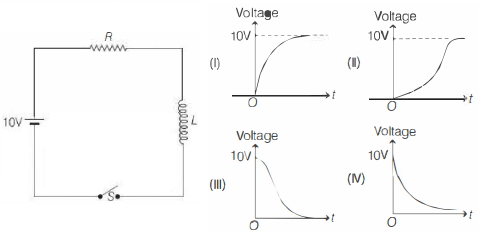
In the circuit shown below,the switch is closed at time $t=0$. Which of the graphs shown below best represents the voltage across the inductor,as seen on an oscilloscope?
A
$I$
B
$II$
C
$III$
D
$IV$
Solution
(D) The correct answer is $IV$.
At $t=0$,when the switch is closed,the current in the circuit is zero because the inductor opposes any instantaneous change in current. Therefore,the potential drop across the resistor $(V_R = iR)$ is zero.
By Kirchhoff's voltage law,the entire source voltage of $10 \, V$ appears across the inductor at $t=0$. Thus,the initial voltage across the inductor is $10 \, V$.
As time passes,the current $i$ in the circuit grows exponentially according to the equation $i(t) = \frac{V}{R} (1 - e^{-Rt/L})$.
The voltage across the inductor is given by $V_L = L \frac{di}{dt} = V e^{-Rt/L}$.
As $t$ increases,the current increases,and the potential drop across the resistor increases,while the potential drop across the inductor decreases exponentially from $10 \, V$ to $0 \, V$.
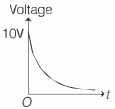
When the current reaches its maximum steady value,the rate of change of current becomes zero,and the potential drop across the inductor tends to zero. This exponential decay is best represented by graph $IV$.
At $t=0$,when the switch is closed,the current in the circuit is zero because the inductor opposes any instantaneous change in current. Therefore,the potential drop across the resistor $(V_R = iR)$ is zero.
By Kirchhoff's voltage law,the entire source voltage of $10 \, V$ appears across the inductor at $t=0$. Thus,the initial voltage across the inductor is $10 \, V$.
As time passes,the current $i$ in the circuit grows exponentially according to the equation $i(t) = \frac{V}{R} (1 - e^{-Rt/L})$.
The voltage across the inductor is given by $V_L = L \frac{di}{dt} = V e^{-Rt/L}$.
As $t$ increases,the current increases,and the potential drop across the resistor increases,while the potential drop across the inductor decreases exponentially from $10 \, V$ to $0 \, V$.
When the current reaches its maximum steady value,the rate of change of current becomes zero,and the potential drop across the inductor tends to zero. This exponential decay is best represented by graph $IV$.
0 likesView Solution
34
PhysicsAdvancedMCQKVPY · 2011
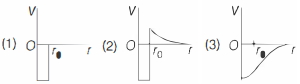
Given below are three schematic graphs of potential energy $V(r)$ versus distance $r$ for three atomic particles: electron $(e^{-})$,proton $(p^{+})$,and neutron $(n)$,in the presence of a nucleus at the origin $O$. The radius of the nucleus is $r_0$. The scale on the $V$-axis may not be the same for all figures. The correct pairing of each graph with the corresponding atomic particle is
A
$(1, n), (2, p^{+}), (3, e^{-})$
B
$(1, p^{+}), (2, e^{-}), (3, n)$
C
$(1, e^{-}), (2, p^{+}), (3, n)$
D
$(1, p^{+}), (2, n), (3, e^{-})$
Solution
(A) For an electron and nucleus pair,the potential energy is given by $V(r) = \frac{K(-e)(+Ze)}{r} = -\frac{KZe^2}{r}$.
Since the potential energy is negative and approaches zero as $r$ increases,graph $(3)$ represents the electron.
For a neutron,there is no electrostatic force outside the nucleus $(r > r_0)$. Thus,the potential energy is zero for $r > r_0$. Graph $(1)$ represents the neutron.
For a proton,the electrostatic force is repulsive for $r > r_0$ because both the nucleus and the proton are positively charged. Thus,the potential energy is positive and decreases as $r$ increases. Graph $(2)$ represents the proton.
Therefore,the correct pairing is $(1, n), (2, p^{+}), (3, e^{-})$,which corresponds to option $A$.
Since the potential energy is negative and approaches zero as $r$ increases,graph $(3)$ represents the electron.
For a neutron,there is no electrostatic force outside the nucleus $(r > r_0)$. Thus,the potential energy is zero for $r > r_0$. Graph $(1)$ represents the neutron.
For a proton,the electrostatic force is repulsive for $r > r_0$ because both the nucleus and the proton are positively charged. Thus,the potential energy is positive and decreases as $r$ increases. Graph $(2)$ represents the proton.
Therefore,the correct pairing is $(1, n), (2, p^{+}), (3, e^{-})$,which corresponds to option $A$.
0 likesView Solution
35
PhysicsMediumMCQKVPY · 2011
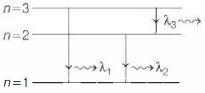
Due to transitions among its first three energy levels,a hydrogenic atom emits radiation at three discrete wavelengths $\lambda_1, \lambda_2$ and $\lambda_3$ (where $\lambda_1 < \lambda_2 < \lambda_3$). Then,
A
$\lambda_1 = \lambda_2 + \lambda_3$
B
$\lambda_1 + \lambda_2 = \lambda_3$
C
$\frac{1}{\lambda_1} + \frac{1}{\lambda_2} = \frac{1}{\lambda_3}$
D
$\frac{1}{\lambda_1} = \frac{1}{\lambda_2} + \frac{1}{\lambda_3}$
Solution
(D) The energy of a photon emitted during a transition is given by $E = \frac{hc}{\lambda}$,where $h$ is Planck's constant,$c$ is the speed of light,and $\lambda$ is the wavelength.
For the first three energy levels $(n=1, 2, 3)$,the possible transitions are:
$1$. $n=3 \rightarrow n=1$ (Energy $E_1$,wavelength $\lambda_1$)
$2$. $n=2 \rightarrow n=1$ (Energy $E_2$,wavelength $\lambda_2$)
$3$. $n=3 \rightarrow n=2$ (Energy $E_3$,wavelength $\lambda_3$)
Since energy is inversely proportional to wavelength $(E \propto \frac{1}{\lambda})$,the transition with the largest energy change corresponds to the shortest wavelength. Thus,$\lambda_1$ is the shortest wavelength $(n=3 \rightarrow n=1)$,and $\lambda_3$ is the longest wavelength $(n=3 \rightarrow n=2)$.
From the conservation of energy,the energy of the transition from $n=3$ to $n=1$ is equal to the sum of the energies of the transitions from $n=3$ to $n=2$ and $n=2$ to $n=1$:
$E_{3 \rightarrow 1} = E_{3 \rightarrow 2} + E_{2 \rightarrow 1}$
Substituting $E = \frac{hc}{\lambda}$:
$\frac{hc}{\lambda_1} = \frac{hc}{\lambda_3} + \frac{hc}{\lambda_2}$
Dividing by $hc$ on both sides,we get:
$\frac{1}{\lambda_1} = \frac{1}{\lambda_2} + \frac{1}{\lambda_3}$
For the first three energy levels $(n=1, 2, 3)$,the possible transitions are:
$1$. $n=3 \rightarrow n=1$ (Energy $E_1$,wavelength $\lambda_1$)
$2$. $n=2 \rightarrow n=1$ (Energy $E_2$,wavelength $\lambda_2$)
$3$. $n=3 \rightarrow n=2$ (Energy $E_3$,wavelength $\lambda_3$)
Since energy is inversely proportional to wavelength $(E \propto \frac{1}{\lambda})$,the transition with the largest energy change corresponds to the shortest wavelength. Thus,$\lambda_1$ is the shortest wavelength $(n=3 \rightarrow n=1)$,and $\lambda_3$ is the longest wavelength $(n=3 \rightarrow n=2)$.
From the conservation of energy,the energy of the transition from $n=3$ to $n=1$ is equal to the sum of the energies of the transitions from $n=3$ to $n=2$ and $n=2$ to $n=1$:
$E_{3 \rightarrow 1} = E_{3 \rightarrow 2} + E_{2 \rightarrow 1}$
Substituting $E = \frac{hc}{\lambda}$:
$\frac{hc}{\lambda_1} = \frac{hc}{\lambda_3} + \frac{hc}{\lambda_2}$
Dividing by $hc$ on both sides,we get:
$\frac{1}{\lambda_1} = \frac{1}{\lambda_2} + \frac{1}{\lambda_3}$
0 likesView Solution
36
PhysicsAdvancedMCQKVPY · 2011
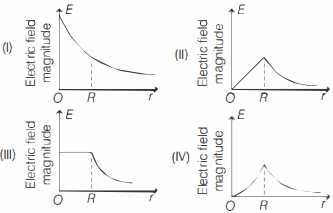
An isolated sphere of radius $R$ contains a uniform volume distribution of positive charge. Which of the curves shown below correctly illustrates the dependence of the magnitude of the electric field of the sphere as a function of the distance $r$ from its centre?
A
$I$
B
$II$
C
$III$
D
$IV$
Solution
(B) For a solid sphere of radius $R$ with a uniform volume charge density $\rho$,the electric field $E$ at a distance $r$ from the centre is given by:
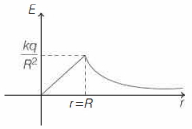
$1$. Inside the sphere $(r < R)$: Using Gauss's Law,$E \cdot 4\pi r^2 = \frac{q_{enclosed}}{\epsilon_0} = \frac{\rho \cdot \frac{4}{3}\pi r^3}{\epsilon_0}$. This simplifies to $E = \frac{\rho r}{3\epsilon_0}$,which means $E \propto r$. Thus,the graph is a straight line passing through the origin.
$2$. Outside the sphere $(r \geq R)$: The sphere behaves like a point charge at its centre. The electric field is $E = \frac{1}{4\pi\epsilon_0} \cdot \frac{q}{r^2}$,which means $E \propto \frac{1}{r^2}$. Thus,the graph is a hyperbola.
At the surface $(r = R)$,the electric field is maximum,with a value of $E_{max} = \frac{kq}{R^2}$.
Comparing these characteristics with the given options,curve $II$ correctly represents this variation.
$1$. Inside the sphere $(r < R)$: Using Gauss's Law,$E \cdot 4\pi r^2 = \frac{q_{enclosed}}{\epsilon_0} = \frac{\rho \cdot \frac{4}{3}\pi r^3}{\epsilon_0}$. This simplifies to $E = \frac{\rho r}{3\epsilon_0}$,which means $E \propto r$. Thus,the graph is a straight line passing through the origin.
$2$. Outside the sphere $(r \geq R)$: The sphere behaves like a point charge at its centre. The electric field is $E = \frac{1}{4\pi\epsilon_0} \cdot \frac{q}{r^2}$,which means $E \propto \frac{1}{r^2}$. Thus,the graph is a hyperbola.
At the surface $(r = R)$,the electric field is maximum,with a value of $E_{max} = \frac{kq}{R^2}$.
Comparing these characteristics with the given options,curve $II$ correctly represents this variation.
0 likesView Solution
37
PhysicsAdvancedMCQKVPY · 2011
The surface of a planet is found to be uniformly charged. When a particle of mass $m$ and no charge is thrown at an angle from the surface of the planet,it has a parabolic trajectory as in projectile motion with horizontal range $L$. $A$ particle of mass $m$ and charge $q$,with the same initial conditions,has a range $L/2$. The range of a particle of mass $m$ and charge $2q$,with the same initial conditions,is:
A
$L$
B
$L/2$
C
$L/3$
D
$L/4$
Solution
(C) For an uncharged particle in projectile motion,the range is $L = \frac{u^2 \sin 2\theta}{g} \quad \dots(i)$
For a charged particle,the effective acceleration becomes $g' = g + \frac{qE}{m}$.
Given that the range for a particle with charge $q$ is $L/2$,we have:
$\frac{L}{2} = \frac{u^2 \sin 2\theta}{g + \frac{qE}{m}}$
Substituting $u^2 \sin 2\theta = Lg$ from equation $(i)$:
$\frac{L}{2} = \frac{Lg}{g + \frac{qE}{m}}$
$\Rightarrow g + \frac{qE}{m} = 2g \Rightarrow \frac{qE}{m} = g \quad \dots(ii)$
Now,for a particle of mass $m$ and charge $2q$,the effective acceleration is $g'' = g + \frac{2qE}{m}$.
Using equation $(ii)$,$g'' = g + 2g = 3g$.
The new range $R$ is:
$R = \frac{u^2 \sin 2\theta}{3g} = \frac{1}{3} \left( \frac{u^2 \sin 2\theta}{g} \right) = \frac{L}{3}$.
For a charged particle,the effective acceleration becomes $g' = g + \frac{qE}{m}$.
Given that the range for a particle with charge $q$ is $L/2$,we have:
$\frac{L}{2} = \frac{u^2 \sin 2\theta}{g + \frac{qE}{m}}$
Substituting $u^2 \sin 2\theta = Lg$ from equation $(i)$:
$\frac{L}{2} = \frac{Lg}{g + \frac{qE}{m}}$
$\Rightarrow g + \frac{qE}{m} = 2g \Rightarrow \frac{qE}{m} = g \quad \dots(ii)$
Now,for a particle of mass $m$ and charge $2q$,the effective acceleration is $g'' = g + \frac{2qE}{m}$.
Using equation $(ii)$,$g'' = g + 2g = 3g$.
The new range $R$ is:
$R = \frac{u^2 \sin 2\theta}{3g} = \frac{1}{3} \left( \frac{u^2 \sin 2\theta}{g} \right) = \frac{L}{3}$.
0 likesView Solution
38
PhysicsAdvancedMCQKVPY · 2011
$A$ material is embedded between two glass plates. The refractive index $n$ of the material varies with thickness as shown in the figure. The maximum incident angle (in degrees) on the material for which the beam will pass through the material is
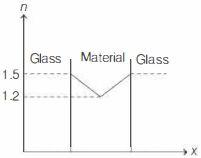
A
$60.0$
B
$53.1$
C
$43.5$
D
$32.3$
Solution
(B) For the light beam to pass through the material without undergoing total internal reflection at the interface,the condition for the critical angle must be satisfied at the boundary between the material and the glass.
From Snell's Law at the interface,$n_1 \sin i = n_2 \sin r$. For the limiting case of total internal reflection,the angle of refraction $r = 90^{\circ}$.
Here,the refractive index of glass is $n_1 = 1.5$ and the minimum refractive index of the material is $n_2 = 1.2$.
Thus,$\sin i_{\max} = \frac{n_2}{n_1} = \frac{1.2}{1.5} = 0.8$.
Therefore,$i_{\max} = \sin^{-1}(0.8) = 53.1^{\circ}$.
From Snell's Law at the interface,$n_1 \sin i = n_2 \sin r$. For the limiting case of total internal reflection,the angle of refraction $r = 90^{\circ}$.
Here,the refractive index of glass is $n_1 = 1.5$ and the minimum refractive index of the material is $n_2 = 1.2$.
Thus,$\sin i_{\max} = \frac{n_2}{n_1} = \frac{1.2}{1.5} = 0.8$.
Therefore,$i_{\max} = \sin^{-1}(0.8) = 53.1^{\circ}$.
0 likesView Solution
39
PhysicsAdvancedMCQKVPY · 2011
At a distance $l$ from a uniformly charged long wire, a charged particle is thrown radially outward with a velocity $u$ in the direction perpendicular to the wire. When the particle reaches a distance $2l$ from the wire, its speed is found to be $\sqrt{2}u$. The magnitude of the velocity, when it is a distance $4l$ away from the wire is (ignore gravity)
A
$\sqrt{3}u$
B
$2u$
C
$2\sqrt{2}u$
D
$4u$
Solution
(A) Let the linear charge density of the wire be $\lambda$. The potential difference between two points at distances $r_1$ and $r_2$ from a long charged wire is given by $V_1 - V_2 = \frac{\lambda}{2\pi\varepsilon_0} \ln\left(\frac{r_2}{r_1}\right)$.
Applying the principle of conservation of energy between point $A$ (at distance $l$) and point $B$ (at distance $2l$):
$qV_A + \frac{1}{2}mu^2 = qV_B + \frac{1}{2}m(\sqrt{2}u)^2$
$q(V_A - V_B) = \frac{1}{2}m(2u^2 - u^2) = \frac{1}{2}mu^2$
$q \frac{\lambda}{2\pi\varepsilon_0} \ln\left(\frac{2l}{l}\right) = \frac{1}{2}mu^2$
$q \frac{\lambda}{2\pi\varepsilon_0} \ln(2) = \frac{1}{2}mu^2 \quad \dots(i)$
Now, applying energy conservation between point $A$ (at distance $l$) and point $C$ (at distance $4l$):
$qV_A + \frac{1}{2}mu^2 = qV_C + \frac{1}{2}mv^2$
$\frac{1}{2}mv^2 = q(V_A - V_C) + \frac{1}{2}mu^2$
$\frac{1}{2}mv^2 = q \frac{\lambda}{2\pi\varepsilon_0} \ln\left(\frac{4l}{l}\right) + \frac{1}{2}mu^2$
$\frac{1}{2}mv^2 = q \frac{\lambda}{2\pi\varepsilon_0} \ln(4) + \frac{1}{2}mu^2$
Since $\ln(4) = 2\ln(2)$, we have:
$\frac{1}{2}mv^2 = 2 \left(q \frac{\lambda}{2\pi\varepsilon_0} \ln(2)\right) + \frac{1}{2}mu^2$
Substituting from equation $(i)$:
$\frac{1}{2}mv^2 = 2 \left(\frac{1}{2}mu^2\right) + \frac{1}{2}mu^2 = \frac{3}{2}mu^2$
$v^2 = 3u^2 \Rightarrow v = \sqrt{3}u$.
Applying the principle of conservation of energy between point $A$ (at distance $l$) and point $B$ (at distance $2l$):
$qV_A + \frac{1}{2}mu^2 = qV_B + \frac{1}{2}m(\sqrt{2}u)^2$
$q(V_A - V_B) = \frac{1}{2}m(2u^2 - u^2) = \frac{1}{2}mu^2$
$q \frac{\lambda}{2\pi\varepsilon_0} \ln\left(\frac{2l}{l}\right) = \frac{1}{2}mu^2$
$q \frac{\lambda}{2\pi\varepsilon_0} \ln(2) = \frac{1}{2}mu^2 \quad \dots(i)$
Now, applying energy conservation between point $A$ (at distance $l$) and point $C$ (at distance $4l$):
$qV_A + \frac{1}{2}mu^2 = qV_C + \frac{1}{2}mv^2$
$\frac{1}{2}mv^2 = q(V_A - V_C) + \frac{1}{2}mu^2$
$\frac{1}{2}mv^2 = q \frac{\lambda}{2\pi\varepsilon_0} \ln\left(\frac{4l}{l}\right) + \frac{1}{2}mu^2$
$\frac{1}{2}mv^2 = q \frac{\lambda}{2\pi\varepsilon_0} \ln(4) + \frac{1}{2}mu^2$
Since $\ln(4) = 2\ln(2)$, we have:
$\frac{1}{2}mv^2 = 2 \left(q \frac{\lambda}{2\pi\varepsilon_0} \ln(2)\right) + \frac{1}{2}mu^2$
Substituting from equation $(i)$:
$\frac{1}{2}mv^2 = 2 \left(\frac{1}{2}mu^2\right) + \frac{1}{2}mu^2 = \frac{3}{2}mu^2$
$v^2 = 3u^2 \Rightarrow v = \sqrt{3}u$.
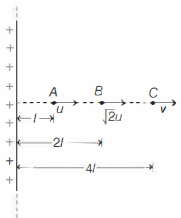
0 likesView Solution
40
PhysicsMediumMCQKVPY · 2011
$A$ rectangular loop of wire is coplanar with a long wire carrying current $I$. The loop is pulled to the right as indicated. What are the directions of the induced current in the loop and the magnetic forces on the left and the right sides of the loop?
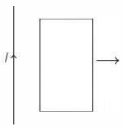
A
$a$. Counter clockwise,To the left,To the right
B
$b$. Clockwise,To the left,To the right
C
$c$. Counter clockwise,To the right,To the left
D
$d$. Clockwise,To the right,To the left
Solution
(B) The magnetic field $B$ produced by the long wire carrying current $I$ is directed into the page (inward) in the region of the loop. As the loop is pulled to the right,it moves into a region where the magnetic field strength decreases,thus the magnetic flux through the loop decreases.
According to Lenz's law,the induced current in the loop will flow in a direction to oppose this decrease in flux,which means it will create its own magnetic field directed into the page. By the right-hand rule,this corresponds to a clockwise induced current.
For the left side of the loop (closest to the wire),the current flows upward,which is in the same direction as the current $I$ in the long wire. Parallel currents attract,so the force on the left side is directed towards the long wire (to the left).
For the right side of the loop,the current flows downward,which is opposite to the current $I$ in the long wire. Anti-parallel currents repel,so the force on the right side is directed away from the long wire (to the right).
According to Lenz's law,the induced current in the loop will flow in a direction to oppose this decrease in flux,which means it will create its own magnetic field directed into the page. By the right-hand rule,this corresponds to a clockwise induced current.
For the left side of the loop (closest to the wire),the current flows upward,which is in the same direction as the current $I$ in the long wire. Parallel currents attract,so the force on the left side is directed towards the long wire (to the left).
For the right side of the loop,the current flows downward,which is opposite to the current $I$ in the long wire. Anti-parallel currents repel,so the force on the right side is directed away from the long wire (to the right).
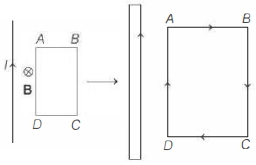
0 likesView Solution
41
PhysicsAdvancedMCQKVPY · 2011
Two batteries $V_1$ and $V_2$ are connected to three resistors as shown below. If $V_1=2 \,V$ and $V_2=0 \,V$,then the current $I=3 \,mA$. If $V_1=0 \,V$ and $V_2=4 \,V$,then the current $I=4 \,mA$. Now,if $V_1=10 \,V$ and $V_2=10 \,V$,then the current $I$ will be ............ $\,mA$.
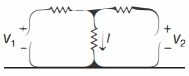
A
$7$
B
$15$
C
$20$
D
$25$
Solution
(D) Using nodal analysis at the junction point above resistor $R$,let the potential be $V_x$. The current $I$ flowing through $R$ is $I = V_x / R$.
Applying Kirchhoff's Current Law $(KCL)$ at the junction:
$(V_x - V_1) / R_1 + (V_x - V_2) / R_2 + V_x / R = 0$
$V_x (1/R_1 + 1/R_2 + 1/R) = V_1/R_1 + V_2/R_2$
$V_x = \frac{V_1/R_1 + V_2/R_2}{1/R_1 + 1/R_2 + 1/R} = \frac{V_1 R_2 + V_2 R_1}{R_1 R_2 / R_1 + R_1 R_2 / R_2 + R_1 R_2 / R} = \frac{V_1 R_2 + V_2 R_1}{R_2 + R_1 + R_1 R_2 / R}$
Since $I = V_x / R$,we have $I = \frac{V_1 R_2 + V_2 R_1}{R(R_1 + R_2) + R_1 R_2}$.
Case $1$: $V_1 = 2 \,V, V_2 = 0 \,V, I = 3 \,mA \Rightarrow 3 = \frac{2 R_2}{R(R_1 + R_2) + R_1 R_2} \quad \dots(1)$
Case $2$: $V_1 = 0 \,V, V_2 = 4 \,V, I = 4 \,mA \Rightarrow 4 = \frac{4 R_1}{R(R_1 + R_2) + R_1 R_2} \quad \dots(2)$
Dividing $(1)$ by $(2)$: $3/4 = (2 R_2) / (4 R_1) \Rightarrow 3/4 = R_2 / (2 R_1) \Rightarrow R_2 / R_1 = 3/2 \Rightarrow R_2 = 1.5 R_1$.
Substitute $R_2 = 1.5 R_1$ into $(1)$: $3 = \frac{2(1.5 R_1)}{R(R_1 + 1.5 R_1) + R_1(1.5 R_1)} = \frac{3 R_1}{2.5 R R_1 + 1.5 R_1^2} = \frac{3}{2.5 R + 1.5 R_1}$.
So,$2.5 R + 1.5 R_1 = 1$.
Case $3$: $V_1 = 10 \,V, V_2 = 10 \,V$. Then $I = \frac{10 R_2 + 10 R_1}{R(R_1 + R_2) + R_1 R_2} = \frac{10(R_1 + R_2)}{R(R_1 + R_2) + R_1 R_2}$.
Using $R_2 = 1.5 R_1$,$I = \frac{10(2.5 R_1)}{R(2.5 R_1) + 1.5 R_1^2} = \frac{25 R_1}{2.5 R R_1 + 1.5 R_1^2} = \frac{25}{2.5 R + 1.5 R_1}$.
Since $2.5 R + 1.5 R_1 = 1$,$I = 25 / 1 = 25 \,mA$.
Applying Kirchhoff's Current Law $(KCL)$ at the junction:
$(V_x - V_1) / R_1 + (V_x - V_2) / R_2 + V_x / R = 0$
$V_x (1/R_1 + 1/R_2 + 1/R) = V_1/R_1 + V_2/R_2$
$V_x = \frac{V_1/R_1 + V_2/R_2}{1/R_1 + 1/R_2 + 1/R} = \frac{V_1 R_2 + V_2 R_1}{R_1 R_2 / R_1 + R_1 R_2 / R_2 + R_1 R_2 / R} = \frac{V_1 R_2 + V_2 R_1}{R_2 + R_1 + R_1 R_2 / R}$
Since $I = V_x / R$,we have $I = \frac{V_1 R_2 + V_2 R_1}{R(R_1 + R_2) + R_1 R_2}$.
Case $1$: $V_1 = 2 \,V, V_2 = 0 \,V, I = 3 \,mA \Rightarrow 3 = \frac{2 R_2}{R(R_1 + R_2) + R_1 R_2} \quad \dots(1)$
Case $2$: $V_1 = 0 \,V, V_2 = 4 \,V, I = 4 \,mA \Rightarrow 4 = \frac{4 R_1}{R(R_1 + R_2) + R_1 R_2} \quad \dots(2)$
Dividing $(1)$ by $(2)$: $3/4 = (2 R_2) / (4 R_1) \Rightarrow 3/4 = R_2 / (2 R_1) \Rightarrow R_2 / R_1 = 3/2 \Rightarrow R_2 = 1.5 R_1$.
Substitute $R_2 = 1.5 R_1$ into $(1)$: $3 = \frac{2(1.5 R_1)}{R(R_1 + 1.5 R_1) + R_1(1.5 R_1)} = \frac{3 R_1}{2.5 R R_1 + 1.5 R_1^2} = \frac{3}{2.5 R + 1.5 R_1}$.
So,$2.5 R + 1.5 R_1 = 1$.
Case $3$: $V_1 = 10 \,V, V_2 = 10 \,V$. Then $I = \frac{10 R_2 + 10 R_1}{R(R_1 + R_2) + R_1 R_2} = \frac{10(R_1 + R_2)}{R(R_1 + R_2) + R_1 R_2}$.
Using $R_2 = 1.5 R_1$,$I = \frac{10(2.5 R_1)}{R(2.5 R_1) + 1.5 R_1^2} = \frac{25 R_1}{2.5 R R_1 + 1.5 R_1^2} = \frac{25}{2.5 R + 1.5 R_1}$.
Since $2.5 R + 1.5 R_1 = 1$,$I = 25 / 1 = 25 \,mA$.
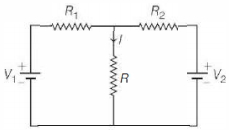
0 likesView Solution
42
PhysicsAdvancedMCQKVPY · 2011
$A$ girl standing at point $P$ on a beach wishes to reach a point $Q$ in the sea as quickly as possible. She can run at $6 \, kmh^{-1}$ on the beach and swim at $4 \, kmh^{-1}$ in the sea. She should take the path
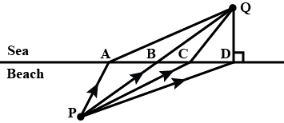
A
$P A Q$
B
$P B Q$
C
$P C Q$
D
$P D Q$
Solution
(C) To reach point $Q$ in the shortest time,the girl must follow a path that minimizes the total travel time. This is analogous to Fermat's principle in optics,which states that light follows the path that takes the least time.
Since the girl's speed on the beach $(v_1 = 6 \, kmh^{-1})$ is greater than her speed in the sea $(v_2 = 4 \, kmh^{-1})$,she should travel a longer distance on the beach and a shorter distance in the sea to minimize the total time. According to Snell's law,which is derived from Fermat's principle,the path should bend towards the normal when entering a medium with a lower speed.
Comparing the given paths,the path $P C Q$ represents the optimal refraction-like trajectory that minimizes the total time taken to reach $Q$.
Since the girl's speed on the beach $(v_1 = 6 \, kmh^{-1})$ is greater than her speed in the sea $(v_2 = 4 \, kmh^{-1})$,she should travel a longer distance on the beach and a shorter distance in the sea to minimize the total time. According to Snell's law,which is derived from Fermat's principle,the path should bend towards the normal when entering a medium with a lower speed.
Comparing the given paths,the path $P C Q$ represents the optimal refraction-like trajectory that minimizes the total time taken to reach $Q$.
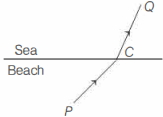
0 likesView Solution
43
PhysicsMediumMCQKVPY · 2011
Light enters an isosceles right triangular prism at normal incidence through face $AB$ and undergoes total internal reflection at face $BC$ as shown below. The minimum value of the refractive index of the prism is close to
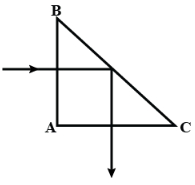
A
$1.10$
B
$1.55$
C
$1.42$
D
$1.72$
Solution
(C) For total internal reflection $(TIR)$ to occur at the face $BC$,the angle of incidence $i$ must be greater than or equal to the critical angle $C$.
From the geometry of the isosceles right-angled prism,the light ray enters face $AB$ normally and strikes face $BC$ at an angle of incidence $i = 45^{\circ}$.
For $TIR$ to occur,the condition is $i \geq C$,where $C$ is the critical angle.
Therefore,$45^{\circ} \geq C$.
Taking the sine on both sides,$\sin 45^{\circ} \geq \sin C$.
We know that $\sin C = \frac{1}{\mu}$,where $\mu$ is the refractive index of the prism.
So,$\sin 45^{\circ} \geq \frac{1}{\mu}$.
$\frac{1}{\sqrt{2}} \geq \frac{1}{\mu}$.
$\mu \geq \sqrt{2}$.
Since $\sqrt{2} \approx 1.414$,the minimum value of the refractive index $\mu$ is approximately $1.42$.
From the geometry of the isosceles right-angled prism,the light ray enters face $AB$ normally and strikes face $BC$ at an angle of incidence $i = 45^{\circ}$.
For $TIR$ to occur,the condition is $i \geq C$,where $C$ is the critical angle.
Therefore,$45^{\circ} \geq C$.
Taking the sine on both sides,$\sin 45^{\circ} \geq \sin C$.
We know that $\sin C = \frac{1}{\mu}$,where $\mu$ is the refractive index of the prism.
So,$\sin 45^{\circ} \geq \frac{1}{\mu}$.
$\frac{1}{\sqrt{2}} \geq \frac{1}{\mu}$.
$\mu \geq \sqrt{2}$.
Since $\sqrt{2} \approx 1.414$,the minimum value of the refractive index $\mu$ is approximately $1.42$.
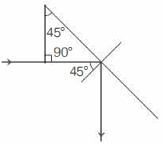
0 likesView Solution
44
PhysicsMediumMCQKVPY · 2011
$A$ convex lens is used to form an image of an object on a screen. If the upper half of the lens is blackened,so that it becomes opaque,then
A
only half of the image will be visible
B
the image position shifts towards the lens
C
the image position shifts away from the lens
D
the brightness of the image reduces
Solution
(D) When a lens is used to form an image,every point on the lens contributes to the formation of the entire image.
If the upper half of the lens is blackened,the light rays passing through that portion are blocked.
However,the remaining lower half of the lens still allows light rays from all parts of the object to pass through and converge at the same focal point.
Consequently,the complete image is still formed at the same position on the screen.
Since the amount of light reaching the screen is reduced (as half the aperture is blocked),the intensity or brightness of the image decreases.
If the upper half of the lens is blackened,the light rays passing through that portion are blocked.
However,the remaining lower half of the lens still allows light rays from all parts of the object to pass through and converge at the same focal point.
Consequently,the complete image is still formed at the same position on the screen.
Since the amount of light reaching the screen is reduced (as half the aperture is blocked),the intensity or brightness of the image decreases.
0 likesView Solution
45
PhysicsMediumMCQKVPY · 2011
$A$ cylindrical copper rod has length $L$ and resistance $R$. If it is melted and formed into another rod of length $2 L$,then the resistance will be ....... $R$.
A
$1$
B
$2$
C
$4$
D
$8$
Solution
(C) The material of the rod remains the same,so the resistivity $\rho$ is constant for both rods.
Since the volume of the material remains constant during melting and reshaping,we have:
$V_1 = V_2$
$A_1 L_1 = A_2 L_2$
Given $L_1 = L$ and $L_2 = 2L$,we get:
$A_1 L = A_2 (2L) \Rightarrow A_2 = \frac{A_1}{2}$
Now,using the resistance formula $R = \rho \frac{l}{A}$,the new resistance $R_2$ is:
$R_2 = \rho \frac{L_2}{A_2} = \rho \frac{2L}{A_1 / 2} = 4 \left( \frac{\rho L}{A_1} \right)$
Since $R = \rho \frac{L}{A_1}$,we find:
$R_2 = 4R$
Since the volume of the material remains constant during melting and reshaping,we have:
$V_1 = V_2$
$A_1 L_1 = A_2 L_2$
Given $L_1 = L$ and $L_2 = 2L$,we get:
$A_1 L = A_2 (2L) \Rightarrow A_2 = \frac{A_1}{2}$
Now,using the resistance formula $R = \rho \frac{l}{A}$,the new resistance $R_2$ is:
$R_2 = \rho \frac{L_2}{A_2} = \rho \frac{2L}{A_1 / 2} = 4 \left( \frac{\rho L}{A_1} \right)$
Since $R = \rho \frac{L}{A_1}$,we find:
$R_2 = 4R$
0 likesView Solution
46
PhysicsMediumMCQKVPY · 2011
Two charges $+Q$ and $-2 Q$ are located at points $A$ and $B$ on a horizontal line as shown below. The electric field is zero at a point which is located at a finite distance:
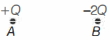
A
on the perpendicular bisector of $A B$
B
left of $A$ on the line
C
between $A$ and $B$ on the line
D
right of $B$ on the line
Solution
(B) Let the distance between charges $A$ and $B$ be $d$. Let the point where the electric field is zero be at a distance $x$ from charge $A$ on the line joining them.
For the electric field to be zero,the magnitudes of the electric fields due to both charges must be equal,and their directions must be opposite.
$1$. Between $A$ and $B$: The fields due to $+Q$ and $-2 Q$ are in the same direction,so the net field cannot be zero.
$2$. Right of $B$: The field due to $-2 Q$ is always stronger than the field due to $+Q$ because $-2 Q$ is larger in magnitude and closer to any point in this region. Thus,the net field cannot be zero.
$3$. Left of $A$: Let the point be at a distance $x$ from $A$. The electric field due to $+Q$ is $E_A = \frac{kQ}{x^2}$ (directed to the left) and the field due to $-2 Q$ is $E_B = \frac{k(2Q)}{(d+x)^2}$ (directed to the right).
Setting $E_A = E_B$,we get $\frac{kQ}{x^2} = \frac{2kQ}{(d+x)^2}$,which simplifies to $(d+x)^2 = 2x^2$,or $d+x = \sqrt{2}x$. This gives $x = \frac{d}{\sqrt{2}-1}$,which is a finite distance.
Therefore,the electric field is zero at a point to the left of $A$.
For the electric field to be zero,the magnitudes of the electric fields due to both charges must be equal,and their directions must be opposite.
$1$. Between $A$ and $B$: The fields due to $+Q$ and $-2 Q$ are in the same direction,so the net field cannot be zero.
$2$. Right of $B$: The field due to $-2 Q$ is always stronger than the field due to $+Q$ because $-2 Q$ is larger in magnitude and closer to any point in this region. Thus,the net field cannot be zero.
$3$. Left of $A$: Let the point be at a distance $x$ from $A$. The electric field due to $+Q$ is $E_A = \frac{kQ}{x^2}$ (directed to the left) and the field due to $-2 Q$ is $E_B = \frac{k(2Q)}{(d+x)^2}$ (directed to the right).
Setting $E_A = E_B$,we get $\frac{kQ}{x^2} = \frac{2kQ}{(d+x)^2}$,which simplifies to $(d+x)^2 = 2x^2$,or $d+x = \sqrt{2}x$. This gives $x = \frac{d}{\sqrt{2}-1}$,which is a finite distance.
Therefore,the electric field is zero at a point to the left of $A$.
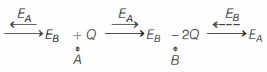
0 likesView Solution
47
PhysicsMediumMCQKVPY · 2011
The figure below shows a portion of an electric circuit with the currents in amperes and their directions. The magnitude and direction of the current in the portion $PQ$ is
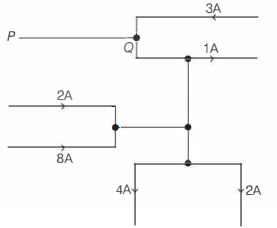
A
zero
B
$3 \, A$ from $P$ to $Q$
C
$4 \, A$ from $Q$ to $P$
D
$6 \, A$ from $Q$ to $P$
Solution
(D) To find the current in the portion $PQ$,we apply Kirchhoff's current law $(KCL)$ at the junctions.
$1$. At the junction where the $2 \, A$ and $8 \, A$ currents meet,the total incoming current is $2 \, A + 8 \, A = 10 \, A$. This $10 \, A$ current flows towards the next junction.
$2$. At the junction below $Q$,the total outgoing current is $4 \, A + 2 \, A = 6 \, A$. Since $10 \, A$ enters this junction and $6 \, A$ leaves downwards,the remaining $10 \, A - 6 \, A = 4 \, A$ must flow upwards towards $Q$.
$3$. At junction $Q$,the incoming currents are $3 \, A$ (from the top branch) and $4 \, A$ (from the lower branch). The outgoing current is $1 \, A$ (to the right). Let the current in $PQ$ be $I_{PQ}$ flowing from $Q$ to $P$.
$4$. Applying $KCL$ at junction $Q$: $I_{incoming} = I_{outgoing}$.
$3 \, A + 4 \, A = 1 \, A + I_{PQ}$
$7 \, A = 1 \, A + I_{PQ}$
$I_{PQ} = 6 \, A$.
Since the result is positive,the current $6 \, A$ flows in the assumed direction,i.e.,from $Q$ to $P$.
$1$. At the junction where the $2 \, A$ and $8 \, A$ currents meet,the total incoming current is $2 \, A + 8 \, A = 10 \, A$. This $10 \, A$ current flows towards the next junction.
$2$. At the junction below $Q$,the total outgoing current is $4 \, A + 2 \, A = 6 \, A$. Since $10 \, A$ enters this junction and $6 \, A$ leaves downwards,the remaining $10 \, A - 6 \, A = 4 \, A$ must flow upwards towards $Q$.
$3$. At junction $Q$,the incoming currents are $3 \, A$ (from the top branch) and $4 \, A$ (from the lower branch). The outgoing current is $1 \, A$ (to the right). Let the current in $PQ$ be $I_{PQ}$ flowing from $Q$ to $P$.
$4$. Applying $KCL$ at junction $Q$: $I_{incoming} = I_{outgoing}$.
$3 \, A + 4 \, A = 1 \, A + I_{PQ}$
$7 \, A = 1 \, A + I_{PQ}$
$I_{PQ} = 6 \, A$.
Since the result is positive,the current $6 \, A$ flows in the assumed direction,i.e.,from $Q$ to $P$.
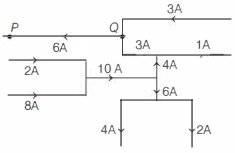
0 likesView Solution
48
PhysicsMediumMCQKVPY · 2011
$A$ nucleus of lead $Pb_{82}^{214}$ emits two electrons followed by an $\alpha$-particle. The resulting nucleus will have
A
$82$ protons and $128$ neutrons
B
$80$ protons and $130$ neutrons
C
$82$ protons and $130$ neutrons
D
$78$ protons and $134$ neutrons
Solution
(A) The decay process is as follows:
$1$. Initial nucleus: $Pb_{82}^{214}$.
$2$. Emission of two electrons ($\beta^-$-decay): Each $\beta^-$-decay increases the atomic number by $1$ and keeps the mass number constant.
$Pb_{82}^{214} \rightarrow A_{84}^{214} + 2_{-1}^{0}e$.
$3$. Emission of an $\alpha$-particle: An $\alpha$-particle $(He_{2}^{4})$ emission decreases the atomic number by $2$ and the mass number by $4$.
$A_{84}^{214} \rightarrow X_{82}^{210} + He_{2}^{4}$.
$4$. The resulting nucleus is $X_{82}^{210}$.
$5$. Number of protons $(Z)$ = $82$.
$6$. Number of neutrons $(N)$ = $A - Z = 210 - 82 = 128$.
Therefore,the resulting nucleus has $82$ protons and $128$ neutrons.
$1$. Initial nucleus: $Pb_{82}^{214}$.
$2$. Emission of two electrons ($\beta^-$-decay): Each $\beta^-$-decay increases the atomic number by $1$ and keeps the mass number constant.
$Pb_{82}^{214} \rightarrow A_{84}^{214} + 2_{-1}^{0}e$.
$3$. Emission of an $\alpha$-particle: An $\alpha$-particle $(He_{2}^{4})$ emission decreases the atomic number by $2$ and the mass number by $4$.
$A_{84}^{214} \rightarrow X_{82}^{210} + He_{2}^{4}$.
$4$. The resulting nucleus is $X_{82}^{210}$.
$5$. Number of protons $(Z)$ = $82$.
$6$. Number of neutrons $(N)$ = $A - Z = 210 - 82 = 128$.
Therefore,the resulting nucleus has $82$ protons and $128$ neutrons.
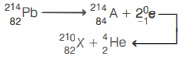
0 likesView Solution
49
PhysicsDifficultMCQKVPY · 2011
$A$ student sees the top edge and the bottom centre $C$ of a pool simultaneously from an angle $\theta$ above the horizontal as shown in the figure. The refractive index of water which fills up to the top edge of the pool is $\frac{4}{3}$. If $\frac{h}{x}=\frac{7}{4}$,then $\cos \theta$ is
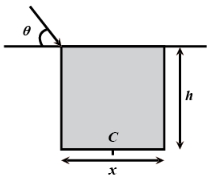
A
$\frac{2}{7}$
B
$\frac{8}{3 \sqrt{45}}$
C
$\frac{8}{3 \sqrt{53}}$
D
$\frac{8}{21}$
Solution
(C) The ray from the bottom centre $C$ travels to the top edge and then refracts into the air towards the observer.
Using Snell's law at the water-air interface: $n_1 \cdot \sin i = n_2 \cdot \sin r$.
Here,the angle of incidence $i$ in water is the angle the ray makes with the normal. Since the ray makes an angle $\theta$ with the horizontal,the angle with the vertical normal is $i = 90^{\circ} - \theta$.
The angle of refraction $r$ is the angle the ray makes with the normal in air. From the geometry,$\tan r = \frac{x/2}{h} = \frac{x}{2h}$.
Given $\frac{h}{x} = \frac{7}{4}$,we have $\tan r = \frac{1}{2(h/x)} = \frac{1}{2(7/4)} = \frac{1}{3.5} = \frac{2}{7}$.
Thus,$\sin r = \frac{2}{\sqrt{2^2 + 7^2}} = \frac{2}{\sqrt{4 + 49}} = \frac{2}{\sqrt{53}}$.
Applying Snell's law: $n_{water} \cdot \sin i = n_{air} \cdot \sin r$.
$\frac{4}{3} \cdot \sin(90^{\circ} - \theta) = 1 \cdot \sin r$.
$\frac{4}{3} \cdot \cos \theta = \frac{2}{\sqrt{53}}$.
$\cos \theta = \frac{2}{\sqrt{53}} \cdot \frac{3}{4} = \frac{6}{4\sqrt{53}} = \frac{3}{2\sqrt{53}}$.
Wait,re-evaluating the geometry: The ray from $C$ to the edge makes an angle $r$ with the vertical. $\tan r = \frac{x/2}{h} = \frac{x}{2h} = \frac{1}{2(7/4)} = \frac{2}{7}$. Correct.
Snell's law: $1 \cdot \sin(90^{\circ}-\theta) = \frac{4}{3} \sin r \Rightarrow \cos \theta = \frac{4}{3} \cdot \frac{2}{\sqrt{53}} = \frac{8}{3\sqrt{53}}$.
Using Snell's law at the water-air interface: $n_1 \cdot \sin i = n_2 \cdot \sin r$.
Here,the angle of incidence $i$ in water is the angle the ray makes with the normal. Since the ray makes an angle $\theta$ with the horizontal,the angle with the vertical normal is $i = 90^{\circ} - \theta$.
The angle of refraction $r$ is the angle the ray makes with the normal in air. From the geometry,$\tan r = \frac{x/2}{h} = \frac{x}{2h}$.
Given $\frac{h}{x} = \frac{7}{4}$,we have $\tan r = \frac{1}{2(h/x)} = \frac{1}{2(7/4)} = \frac{1}{3.5} = \frac{2}{7}$.
Thus,$\sin r = \frac{2}{\sqrt{2^2 + 7^2}} = \frac{2}{\sqrt{4 + 49}} = \frac{2}{\sqrt{53}}$.
Applying Snell's law: $n_{water} \cdot \sin i = n_{air} \cdot \sin r$.
$\frac{4}{3} \cdot \sin(90^{\circ} - \theta) = 1 \cdot \sin r$.
$\frac{4}{3} \cdot \cos \theta = \frac{2}{\sqrt{53}}$.
$\cos \theta = \frac{2}{\sqrt{53}} \cdot \frac{3}{4} = \frac{6}{4\sqrt{53}} = \frac{3}{2\sqrt{53}}$.
Wait,re-evaluating the geometry: The ray from $C$ to the edge makes an angle $r$ with the vertical. $\tan r = \frac{x/2}{h} = \frac{x}{2h} = \frac{1}{2(7/4)} = \frac{2}{7}$. Correct.
Snell's law: $1 \cdot \sin(90^{\circ}-\theta) = \frac{4}{3} \sin r \Rightarrow \cos \theta = \frac{4}{3} \cdot \frac{2}{\sqrt{53}} = \frac{8}{3\sqrt{53}}$.
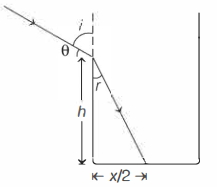
0 likesView Solution
50
PhysicsMediumMCQKVPY · 2011
In the following circuit,$1 \,\Omega$ resistor dissipates power $P$. If the resistor is replaced by $9 \,\Omega$,the power dissipated in it is
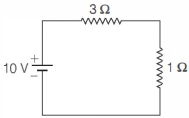
A
$P$
B
$3 P$
C
$9 P$
D
$\frac{P}{3}$
Solution
(A) In the given circuit,the $3 \,\Omega$ and $1 \,\Omega$ resistors are in series with a $10 \,V$ battery.
The equivalent resistance of the circuit is $R_{eq} = 3 \,\Omega + 1 \,\Omega = 4 \,\Omega$.
The current flowing through the circuit is $i = \frac{V}{R_{eq}} = \frac{10 \,V}{4 \,\Omega} = 2.5 \,A$.
The power dissipated in the $1 \,\Omega$ resistor is $P = i^2 R = (2.5)^2 \times 1 = 6.25 \,W$.
When the $1 \,\Omega$ resistor is replaced by a $9 \,\Omega$ resistor,the new equivalent resistance becomes $R'_{eq} = 3 \,\Omega + 9 \,\Omega = 12 \,\Omega$.
The new current in the circuit is $i' = \frac{10 \,V}{12 \,\Omega} = \frac{5}{6} \,A$.
The power dissipated in the $9 \,\Omega$ resistor is $P' = (i')^2 \times 9 = \left(\frac{5}{6}\right)^2 \times 9 = \frac{25}{36} \times 9 = \frac{25}{4} \,W = 6.25 \,W$.
Since $P = 6.25 \,W$ and $P' = 6.25 \,W$,we have $P' = P$.
The equivalent resistance of the circuit is $R_{eq} = 3 \,\Omega + 1 \,\Omega = 4 \,\Omega$.
The current flowing through the circuit is $i = \frac{V}{R_{eq}} = \frac{10 \,V}{4 \,\Omega} = 2.5 \,A$.
The power dissipated in the $1 \,\Omega$ resistor is $P = i^2 R = (2.5)^2 \times 1 = 6.25 \,W$.
When the $1 \,\Omega$ resistor is replaced by a $9 \,\Omega$ resistor,the new equivalent resistance becomes $R'_{eq} = 3 \,\Omega + 9 \,\Omega = 12 \,\Omega$.
The new current in the circuit is $i' = \frac{10 \,V}{12 \,\Omega} = \frac{5}{6} \,A$.
The power dissipated in the $9 \,\Omega$ resistor is $P' = (i')^2 \times 9 = \left(\frac{5}{6}\right)^2 \times 9 = \frac{25}{36} \times 9 = \frac{25}{4} \,W = 6.25 \,W$.
Since $P = 6.25 \,W$ and $P' = 6.25 \,W$,we have $P' = P$.
0 likesView Solution
Vedclass Products
For Students
Vedclass Test Series
Mock tests in real KVPY style covering Physics with performance analysis. 5-day free trial.
Start Free TrialFor Teachers
Exam Paper Generator
Generate Set A/B/C/D Physics papers from 7.5L+ questions in 2 minutes. 3 chapters free.
Try FreeFor Institutes
Online Exam Module
Run live KVPY mock exams with unlimited students, 360° analytics & white-label branding.
See DemoFrequently Asked Questions
How many Physics questions are in KVPY 2011?
There are 50 Physics questions from the KVPY 2011 paper on Vedclass, each with a detailed step-by-step solution in English.
Are KVPY 2011 Physics solutions available in English?
Yes. All solutions on this page are in English. You can also switch to English or Hindi using the language buttons above the questions.
Can I practice KVPY 2011 Physics as a timed test?
Yes. Use the Vedclass Test Series to attempt a full KVPY mock test covering Physics with time limits and instant score analysis.
Can teachers create Physics papers from KVPY previous year questions?
Yes. The Vedclass Exam Paper Generator lets teachers mix KVPY Physics questions and generate Set A/B/C/D papers in minutes.
For Teachers & Institutes
Build a Custom Physics Paper
Pick KVPY 2011 Physics questions, set difficulty, and generate Set A/B/C/D in 2 minutes.