
MathematicsQ1–46 of 46 questions
Page 1 of 1 · English
1
MathematicsDifficultMCQKVPY · 2011
Suppose $\log _a b + \log _b a = c$. The smallest possible integer value of $c$ for all $a, b > 1$ is
A
$4$
B
$3$
C
$2$
D
$1$
Solution
(C) Given $\log _a b + \log _b a = c$.
Since $a, b > 1$,both $\log _a b$ and $\log _b a$ are positive real numbers.
By the Arithmetic Mean-Geometric Mean $(AM-GM)$ inequality,for any two positive real numbers $x$ and $y$,$\frac{x+y}{2} \geq \sqrt{xy}$.
Let $x = \log _a b$ and $y = \log _b a$.
Then $\frac{\log _a b + \log _b a}{2} \geq \sqrt{\log _a b \cdot \log _b a}$.
Since $\log _a b = \frac{1}{\log _b a}$,we have $\log _a b \cdot \log _b a = 1$.
Thus,$\frac{c}{2} \geq \sqrt{1} = 1$.
This implies $c \geq 2$.
The smallest possible integer value of $c$ is $2$.
Since $a, b > 1$,both $\log _a b$ and $\log _b a$ are positive real numbers.
By the Arithmetic Mean-Geometric Mean $(AM-GM)$ inequality,for any two positive real numbers $x$ and $y$,$\frac{x+y}{2} \geq \sqrt{xy}$.
Let $x = \log _a b$ and $y = \log _b a$.
Then $\frac{\log _a b + \log _b a}{2} \geq \sqrt{\log _a b \cdot \log _b a}$.
Since $\log _a b = \frac{1}{\log _b a}$,we have $\log _a b \cdot \log _b a = 1$.
Thus,$\frac{c}{2} \geq \sqrt{1} = 1$.
This implies $c \geq 2$.
The smallest possible integer value of $c$ is $2$.
0 likesView Solution
2
MathematicsAdvancedMCQKVPY · 2011
Suppose $n$ is a natural number such that $|i + 2i^2 + 3i^3 + \ldots + ni^n| = 18\sqrt{2}$,where $i = \sqrt{-1}$. Then,$n$ is
A
$9$
B
$18$
C
$36$
D
$72$
Solution
(C) Let $S_n = i + 2i^2 + 3i^3 + \ldots + ni^n$ $(i)$
Multiplying by $i$,we get $iS_n = i^2 + 2i^3 + \ldots + (n-1)i^n + ni^{n+1}$ (ii)
Subtracting (ii) from $(i)$:
$S_n(1 - i) = i + i^2 + i^3 + \ldots + i^n - ni^{n+1}$
$S_n(1 - i) = \frac{i(1 - i^n)}{1 - i} - ni^{n+1}$
Since $(1 - i)^2 = 1 - 2i + i^2 = -2i$,we have:
$S_n = \frac{i(1 - i^n)}{(1 - i)^2} - \frac{ni^{n+1}}{1 - i} = \frac{i(1 - i^n)}{-2i} - \frac{ni^{n+1}(1 + i)}{2} = \frac{i^n - 1}{2} - \frac{ni^{n+1}(1 + i)}{2}$
For large $n$,the term involving $n$ dominates the magnitude. Given $|S_n| = 18\sqrt{2}$,we consider the magnitude of the dominant term:
$|S_n| \approx |\frac{ni^{n+1}(1 + i)}{2}| = \frac{n|i^{n+1}| |1 + i|}{2} = \frac{n \cdot 1 \cdot \sqrt{2}}{2} = \frac{n}{\sqrt{2}}$
Setting $\frac{n}{\sqrt{2}} = 18\sqrt{2}$,we get $n = 18 \times 2 = 36$.
Multiplying by $i$,we get $iS_n = i^2 + 2i^3 + \ldots + (n-1)i^n + ni^{n+1}$ (ii)
Subtracting (ii) from $(i)$:
$S_n(1 - i) = i + i^2 + i^3 + \ldots + i^n - ni^{n+1}$
$S_n(1 - i) = \frac{i(1 - i^n)}{1 - i} - ni^{n+1}$
Since $(1 - i)^2 = 1 - 2i + i^2 = -2i$,we have:
$S_n = \frac{i(1 - i^n)}{(1 - i)^2} - \frac{ni^{n+1}}{1 - i} = \frac{i(1 - i^n)}{-2i} - \frac{ni^{n+1}(1 + i)}{2} = \frac{i^n - 1}{2} - \frac{ni^{n+1}(1 + i)}{2}$
For large $n$,the term involving $n$ dominates the magnitude. Given $|S_n| = 18\sqrt{2}$,we consider the magnitude of the dominant term:
$|S_n| \approx |\frac{ni^{n+1}(1 + i)}{2}| = \frac{n|i^{n+1}| |1 + i|}{2} = \frac{n \cdot 1 \cdot \sqrt{2}}{2} = \frac{n}{\sqrt{2}}$
Setting $\frac{n}{\sqrt{2}} = 18\sqrt{2}$,we get $n = 18 \times 2 = 36$.
0 likesView Solution
3
MathematicsAdvancedMCQKVPY · 2011
Consider the cubic equation $x^3+ax^2+bx+c=0$ where $a, b, c$ are real numbers. Which of the following statements is correct?
A
If $a^2-2b < 0$,then the equation has one real and two imaginary roots.
B
If $a^2-2b \geq 0$,then the equation has all real roots.
C
If $a^2-2b > 0$,then the equation has all real and distinct roots.
D
If $4a^3-27b^2 > 0$,then the equation has real and distinct roots.
Solution
(A) Let $f(x) = x^3+ax^2+bx+c$.
Then $f'(x) = 3x^2+2ax+b$.
The discriminant of the quadratic $f'(x)$ is $D = (2a)^2 - 4(3)(b) = 4a^2 - 12b = 4(a^2-3b)$.
If $a^2-2b < 0$,then $a^2 < 2b$.
Since $b$ must be positive for $a^2 < 2b$ to hold with real $a$,we observe $a^2-3b < a^2-2b < 0$.
Thus,$D < 0$,which means $f'(x) > 0$ for all $x$.
Since $f'(x)$ is always positive,$f(x)$ is a strictly increasing function.
$A$ strictly increasing cubic polynomial has exactly one real root and two complex conjugate roots.
Therefore,the statement in option $A$ is correct.
Then $f'(x) = 3x^2+2ax+b$.
The discriminant of the quadratic $f'(x)$ is $D = (2a)^2 - 4(3)(b) = 4a^2 - 12b = 4(a^2-3b)$.
If $a^2-2b < 0$,then $a^2 < 2b$.
Since $b$ must be positive for $a^2 < 2b$ to hold with real $a$,we observe $a^2-3b < a^2-2b < 0$.
Thus,$D < 0$,which means $f'(x) > 0$ for all $x$.
Since $f'(x)$ is always positive,$f(x)$ is a strictly increasing function.
$A$ strictly increasing cubic polynomial has exactly one real root and two complex conjugate roots.
Therefore,the statement in option $A$ is correct.
0 likesView Solution
4
MathematicsDifficultMCQKVPY · 2011
All the points $(x, y)$ in the plane satisfying the equation $x^2+2x \sin(xy)+1=0$ lie on
A
a pair of straight lines
B
a family of hyperbolas
C
a parabola
D
an ellipse
Solution
(A) Given the equation: $x^2+2x \sin(xy)+1=0$
We can rewrite this as: $x^2+2x \sin(xy)+\sin^2(xy)+1-\sin^2(xy)=0$
This simplifies to: $(x+\sin(xy))^2+\cos^2(xy)=0$
Since the sum of two squares is zero,each term must be zero:
$(x+\sin(xy))^2=0 \Rightarrow x+\sin(xy)=0$
$\cos^2(xy)=0 \Rightarrow \cos(xy)=0$
From $\cos(xy)=0$,we have $xy = (2n+1)\frac{\pi}{2}$ for some integer $n$.
Substituting $\sin(xy) = \pm 1$ into $x+\sin(xy)=0$,we get $x = \mp 1$.
If $\sin(xy)=1$,then $x=-1$. Since $xy = (2n+1)\frac{\pi}{2}$,we get $y = -(2n+1)\frac{\pi}{2}$.
If $\sin(xy)=-1$,then $x=1$. Since $xy = (2n+1)\frac{\pi}{2}$,we get $y = (2n+1)\frac{\pi}{2}$.
These represent a set of parallel lines $x=1$ and $x=-1$,which are a pair of straight lines.
We can rewrite this as: $x^2+2x \sin(xy)+\sin^2(xy)+1-\sin^2(xy)=0$
This simplifies to: $(x+\sin(xy))^2+\cos^2(xy)=0$
Since the sum of two squares is zero,each term must be zero:
$(x+\sin(xy))^2=0 \Rightarrow x+\sin(xy)=0$
$\cos^2(xy)=0 \Rightarrow \cos(xy)=0$
From $\cos(xy)=0$,we have $xy = (2n+1)\frac{\pi}{2}$ for some integer $n$.
Substituting $\sin(xy) = \pm 1$ into $x+\sin(xy)=0$,we get $x = \mp 1$.
If $\sin(xy)=1$,then $x=-1$. Since $xy = (2n+1)\frac{\pi}{2}$,we get $y = -(2n+1)\frac{\pi}{2}$.
If $\sin(xy)=-1$,then $x=1$. Since $xy = (2n+1)\frac{\pi}{2}$,we get $y = (2n+1)\frac{\pi}{2}$.
These represent a set of parallel lines $x=1$ and $x=-1$,which are a pair of straight lines.
0 likesView Solution
5
MathematicsDifficultMCQKVPY · 2011
Let $A=(4,0)$ and $B=(0,12)$ be two points in the plane. The locus of a point $C(x, y)$ such that the area of $\triangle ABC$ is $18$ sq units is
A
$(y+3x+12)^2=81$
B
$(y+3x+81)^2=12$
C
$(y+3x-12)^2=81$
D
$(y+3x-81)^2=12$
Solution
(C) Given points are $A(4,0)$ and $B(0,12)$.
Let the point $C$ be $(x, y)$.
The area of $\triangle ABC$ is given by the formula:
$\text{Area} = \frac{1}{2} |x_1(y_2 - y_3) + x_2(y_3 - y_1) + x_3(y_1 - y_2)|$
Substituting the coordinates:
$18 = \frac{1}{2} |4(12 - y) + 0(y - 0) + x(0 - 12)|$
$18 = \frac{1}{2} |48 - 4y - 12x|$
$36 = |48 - 4y - 12x|$
Dividing by $4$ inside the absolute value:
$36 = 4 |12 - y - 3x|$
$9 = |-(3x + y - 12)|$
$9 = |3x + y - 12|$
Squaring both sides:
$(3x + y - 12)^2 = 81$
Thus,the locus is $(y + 3x - 12)^2 = 81$.
Let the point $C$ be $(x, y)$.
The area of $\triangle ABC$ is given by the formula:
$\text{Area} = \frac{1}{2} |x_1(y_2 - y_3) + x_2(y_3 - y_1) + x_3(y_1 - y_2)|$
Substituting the coordinates:
$18 = \frac{1}{2} |4(12 - y) + 0(y - 0) + x(0 - 12)|$
$18 = \frac{1}{2} |48 - 4y - 12x|$
$36 = |48 - 4y - 12x|$
Dividing by $4$ inside the absolute value:
$36 = 4 |12 - y - 3x|$
$9 = |-(3x + y - 12)|$
$9 = |3x + y - 12|$
Squaring both sides:
$(3x + y - 12)^2 = 81$
Thus,the locus is $(y + 3x - 12)^2 = 81$.
0 likesView Solution
6
MathematicsAdvancedMCQKVPY · 2011
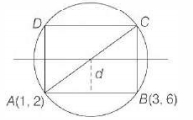
In a rectangle $ABCD$,the coordinates of $A$ and $B$ are $(1, 2)$ and $(3, 6)$ respectively,and some diameter of the circumscribing circle of $ABCD$ has the equation $2x - y + 4 = 0$. Then,the area of the rectangle is
A
$16$
B
$2 \sqrt{10}$
C
$2 \sqrt{5}$
D
$20$
Solution
(A) Given that $ABCD$ is a rectangle with vertices $A(1, 2)$ and $B(3, 6)$.
The equation of one of the diameters of the circumscribing circle is $2x - y + 4 = 0$.
The slope of this diameter is $m_1 = 2$.
The slope of the side $AB$ is $m_{AB} = \frac{6 - 2}{3 - 1} = \frac{4}{2} = 2$.
Since the slope of $AB$ is equal to the slope of the diameter,the side $AB$ is parallel to the diameter.
The distance $d$ between the parallel lines (the diameter and the line $AB$) is the perpendicular distance from any point on $AB$ (e.g.,$A(1, 2)$) to the line $2x - y + 4 = 0$:
$d = \frac{|2(1) - 1(2) + 4|}{\sqrt{2^2 + (-1)^2}} = \frac{|2 - 2 + 4|}{\sqrt{5}} = \frac{4}{\sqrt{5}}$.
In a rectangle,the center of the circumscribing circle is the intersection of the diagonals. The distance from the center to the side $AB$ is half the length of the side $BC$. Thus,$BC = 2d = 2 \times \frac{4}{\sqrt{5}} = \frac{8}{\sqrt{5}}$.
The length of side $AB$ is $\sqrt{(3 - 1)^2 + (6 - 2)^2} = \sqrt{2^2 + 4^2} = \sqrt{4 + 16} = \sqrt{20} = 2\sqrt{5}$.
The area of the rectangle is $AB \times BC = 2\sqrt{5} \times \frac{8}{\sqrt{5}} = 16$.
The equation of one of the diameters of the circumscribing circle is $2x - y + 4 = 0$.
The slope of this diameter is $m_1 = 2$.
The slope of the side $AB$ is $m_{AB} = \frac{6 - 2}{3 - 1} = \frac{4}{2} = 2$.
Since the slope of $AB$ is equal to the slope of the diameter,the side $AB$ is parallel to the diameter.
The distance $d$ between the parallel lines (the diameter and the line $AB$) is the perpendicular distance from any point on $AB$ (e.g.,$A(1, 2)$) to the line $2x - y + 4 = 0$:
$d = \frac{|2(1) - 1(2) + 4|}{\sqrt{2^2 + (-1)^2}} = \frac{|2 - 2 + 4|}{\sqrt{5}} = \frac{4}{\sqrt{5}}$.
In a rectangle,the center of the circumscribing circle is the intersection of the diagonals. The distance from the center to the side $AB$ is half the length of the side $BC$. Thus,$BC = 2d = 2 \times \frac{4}{\sqrt{5}} = \frac{8}{\sqrt{5}}$.
The length of side $AB$ is $\sqrt{(3 - 1)^2 + (6 - 2)^2} = \sqrt{2^2 + 4^2} = \sqrt{4 + 16} = \sqrt{20} = 2\sqrt{5}$.
The area of the rectangle is $AB \times BC = 2\sqrt{5} \times \frac{8}{\sqrt{5}} = 16$.
0 likesView Solution
7
MathematicsDifficultMCQKVPY · 2011
In the $XY$-plane,three distinct lines $l_1, l_2, l_3$ concur at a point $(\lambda, 0)$. Further,the lines $l_1, l_2, l_3$ are normals to the parabola $y^2=6x$ at the points $A=(x_1, y_1)$,$B=(x_2, y_2)$,and $C=(x_3, y_3)$ respectively. Then,we have:
A
$\lambda < -5$
B
$\lambda > 3$
C
$-5 < \lambda < -3$
D
$0 < \lambda < 3$
Solution
(B) The equation of the parabola is $y^2 = 6x$,so $4a = 6$,which gives $a = \frac{3}{2}$.
The equation of a normal to the parabola $y^2 = 4ax$ at a point with slope $m$ is $y = mx - 2am - am^3$.
Substituting $a = \frac{3}{2}$,the equation of the normal becomes $y = mx - 3m - \frac{3}{2}m^3$.
Since the normal passes through the point $(\lambda, 0)$,we substitute these coordinates into the equation:
$0 = m\lambda - 3m - \frac{3}{2}m^3$.
For $m \neq 0$ (as the normal is not the axis of the parabola),we can divide by $m$:
$0 = \lambda - 3 - \frac{3}{2}m^2$.
Rearranging for $m^2$,we get $\frac{3}{2}m^2 = \lambda - 3$,or $m^2 = \frac{2}{3}(\lambda - 3)$.
For three distinct normals to exist,there must be three distinct real values for $m$. Since $m^2 = \frac{2}{3}(\lambda - 3)$,for $m$ to have three distinct real roots (including $m=0$ for the axis),we require $\lambda - 3 > 0$,which implies $\lambda > 3$.
The equation of a normal to the parabola $y^2 = 4ax$ at a point with slope $m$ is $y = mx - 2am - am^3$.
Substituting $a = \frac{3}{2}$,the equation of the normal becomes $y = mx - 3m - \frac{3}{2}m^3$.
Since the normal passes through the point $(\lambda, 0)$,we substitute these coordinates into the equation:
$0 = m\lambda - 3m - \frac{3}{2}m^3$.
For $m \neq 0$ (as the normal is not the axis of the parabola),we can divide by $m$:
$0 = \lambda - 3 - \frac{3}{2}m^2$.
Rearranging for $m^2$,we get $\frac{3}{2}m^2 = \lambda - 3$,or $m^2 = \frac{2}{3}(\lambda - 3)$.
For three distinct normals to exist,there must be three distinct real values for $m$. Since $m^2 = \frac{2}{3}(\lambda - 3)$,for $m$ to have three distinct real roots (including $m=0$ for the axis),we require $\lambda - 3 > 0$,which implies $\lambda > 3$.
0 likesView Solution
8
MathematicsAdvancedMCQKVPY · 2011
Let $f(x) = \cos 5x + A \cos 4x + B \cos 3x + C \cos 2x + D \cos x + E$,and $T = f(0) - f\left(\frac{\pi}{5}\right) + f\left(\frac{2\pi}{5}\right) - f\left(\frac{3\pi}{5}\right) + \dots + f\left(\frac{8\pi}{5}\right) - f\left(\frac{9\pi}{5}\right)$. Then,$T$
A
depends on $A, B, C, D, E$
B
depends on $A, C, E$,but independent of $B$ and $D$
C
depends on $B, D$,but independent of $A, C, E$
D
is independent of $A, B, C, D, E$
Solution
(C) Given $f(x) = \cos 5x + A \cos 4x + B \cos 3x + C \cos 2x + D \cos x + E$.
Since $f(x) = f(2\pi - x)$,we have $f\left(\frac{\pi}{5}\right) = f\left(\frac{9\pi}{5}\right)$,$f\left(\frac{2\pi}{5}\right) = f\left(\frac{8\pi}{5}\right)$,$f\left(\frac{3\pi}{5}\right) = f\left(\frac{7\pi}{5}\right)$,and $f\left(\frac{4\pi}{5}\right) = f\left(\frac{6\pi}{5}\right)$.
The expression $T$ can be written as $T = f(0) - 2f\left(\frac{\pi}{5}\right) + 2f\left(\frac{2\pi}{5}\right) - 2f\left(\frac{3\pi}{5}\right) + 2f\left(\frac{4\pi}{5}\right) - f(\pi)$.
Substituting the values of $f(x)$ at these points,the terms involving $A, C, E$ cancel out due to the symmetry of the cosine function around $\pi$.
Specifically,$f(0) - f(\pi) = 2(1 + B + D)$.
The remaining terms also involve only $B$ and $D$ coefficients.
Thus,$T$ depends on $B$ and $D$ but is independent of $A, C, E$.
Since $f(x) = f(2\pi - x)$,we have $f\left(\frac{\pi}{5}\right) = f\left(\frac{9\pi}{5}\right)$,$f\left(\frac{2\pi}{5}\right) = f\left(\frac{8\pi}{5}\right)$,$f\left(\frac{3\pi}{5}\right) = f\left(\frac{7\pi}{5}\right)$,and $f\left(\frac{4\pi}{5}\right) = f\left(\frac{6\pi}{5}\right)$.
The expression $T$ can be written as $T = f(0) - 2f\left(\frac{\pi}{5}\right) + 2f\left(\frac{2\pi}{5}\right) - 2f\left(\frac{3\pi}{5}\right) + 2f\left(\frac{4\pi}{5}\right) - f(\pi)$.
Substituting the values of $f(x)$ at these points,the terms involving $A, C, E$ cancel out due to the symmetry of the cosine function around $\pi$.
Specifically,$f(0) - f(\pi) = 2(1 + B + D)$.
The remaining terms also involve only $B$ and $D$ coefficients.
Thus,$T$ depends on $B$ and $D$ but is independent of $A, C, E$.
0 likesView Solution
9
MathematicsDifficultMCQKVPY · 2011
In $\triangle ABC$,we are given that $3 \sin A + 4 \cos B = 6$ and $4 \sin B + 3 \cos A = 1$. Then,the measure of $\angle C$ is $....^{\circ}$
A
$30$
B
$150$
C
$60$
D
$75$
Solution
(A) Given equations are:
$3 \sin A + 4 \cos B = 6$ $(i)$
$4 \sin B + 3 \cos A = 1$ $(ii)$
Squaring and adding equations $(i)$ and $(ii)$:
$(3 \sin A + 4 \cos B)^2 + (4 \sin B + 3 \cos A)^2 = 6^2 + 1^2$
$9 \sin^2 A + 16 \cos^2 B + 24 \sin A \cos B + 16 \sin^2 B + 9 \cos^2 A + 24 \sin B \cos A = 37$
$9(\sin^2 A + \cos^2 A) + 16(\sin^2 B + \cos^2 B) + 24(\sin A \cos B + \cos A \sin B) = 37$
$9(1) + 16(1) + 24 \sin(A + B) = 37$
$25 + 24 \sin(A + B) = 37$
$24 \sin(A + B) = 12$
$\sin(A + B) = \frac{1}{2}$
Since $A + B + C = 180^{\circ}$,we have $A + B = 180^{\circ} - C$.
$\sin(180^{\circ} - C) = \frac{1}{2}$
$\sin C = \frac{1}{2}$
Thus,$C = 30^{\circ}$ or $C = 150^{\circ}$.
Checking the original equations with $C = 150^{\circ}$ leads to a contradiction,so $C = 30^{\circ}$.
$3 \sin A + 4 \cos B = 6$ $(i)$
$4 \sin B + 3 \cos A = 1$ $(ii)$
Squaring and adding equations $(i)$ and $(ii)$:
$(3 \sin A + 4 \cos B)^2 + (4 \sin B + 3 \cos A)^2 = 6^2 + 1^2$
$9 \sin^2 A + 16 \cos^2 B + 24 \sin A \cos B + 16 \sin^2 B + 9 \cos^2 A + 24 \sin B \cos A = 37$
$9(\sin^2 A + \cos^2 A) + 16(\sin^2 B + \cos^2 B) + 24(\sin A \cos B + \cos A \sin B) = 37$
$9(1) + 16(1) + 24 \sin(A + B) = 37$
$25 + 24 \sin(A + B) = 37$
$24 \sin(A + B) = 12$
$\sin(A + B) = \frac{1}{2}$
Since $A + B + C = 180^{\circ}$,we have $A + B = 180^{\circ} - C$.
$\sin(180^{\circ} - C) = \frac{1}{2}$
$\sin C = \frac{1}{2}$
Thus,$C = 30^{\circ}$ or $C = 150^{\circ}$.
Checking the original equations with $C = 150^{\circ}$ leads to a contradiction,so $C = 30^{\circ}$.
0 likesView Solution
10
MathematicsAdvancedMCQKVPY · 2011
If $f(x)=(2011+x)^n$,where $x$ is a real variable and $n$ is a positive integer,then the value of $f(0)+f^{\prime}(0)+\frac{f^{\prime \prime}(0)}{2 !}+\ldots+\frac{f^{(n-1)}(0)}{(n-1) !}$ is
A
$(2011)^n$
B
$(2012)^n$
C
$(2012)^n-1$
D
$n(2011)^n$
Solution
(C) Given $f(x) = (2011+x)^n$.
By Taylor's expansion of $f(x)$ about $x=0$,we have:
$f(x) = f(0) + f^{\prime}(0)x + \frac{f^{\prime \prime}(0)}{2!}x^2 + \ldots + \frac{f^{(n)}(0)}{n!}x^n$.
Since $f(x) = (2011+x)^n$,the binomial expansion is:
$f(x) = \sum_{k=0}^{n} \binom{n}{k} (2011)^{n-k} x^k = (2011)^n + \binom{n}{1}(2011)^{n-1}x + \binom{n}{2}(2011)^{n-2}x^2 + \ldots + x^n$.
Comparing the coefficients of $x^k$ in both expansions,we get $\frac{f^{(k)}(0)}{k!} = \binom{n}{k}(2011)^{n-k}$.
The given expression is $S = f(0) + f^{\prime}(0) + \frac{f^{\prime \prime}(0)}{2!} + \ldots + \frac{f^{(n-1)}(0)}{(n-1)!}$.
This is the sum of the first $n$ terms of the binomial expansion of $(2011+1)^n$ excluding the last term ($x^n$ term where $k=n$).
$S = \sum_{k=0}^{n-1} \binom{n}{k} (2011)^{n-k} (1)^k$.
We know that $(2011+1)^n = \sum_{k=0}^{n} \binom{n}{k} (2011)^{n-k} (1)^k = S + \binom{n}{n}(2011)^0(1)^n$.
Therefore,$S = (2012)^n - 1$.
By Taylor's expansion of $f(x)$ about $x=0$,we have:
$f(x) = f(0) + f^{\prime}(0)x + \frac{f^{\prime \prime}(0)}{2!}x^2 + \ldots + \frac{f^{(n)}(0)}{n!}x^n$.
Since $f(x) = (2011+x)^n$,the binomial expansion is:
$f(x) = \sum_{k=0}^{n} \binom{n}{k} (2011)^{n-k} x^k = (2011)^n + \binom{n}{1}(2011)^{n-1}x + \binom{n}{2}(2011)^{n-2}x^2 + \ldots + x^n$.
Comparing the coefficients of $x^k$ in both expansions,we get $\frac{f^{(k)}(0)}{k!} = \binom{n}{k}(2011)^{n-k}$.
The given expression is $S = f(0) + f^{\prime}(0) + \frac{f^{\prime \prime}(0)}{2!} + \ldots + \frac{f^{(n-1)}(0)}{(n-1)!}$.
This is the sum of the first $n$ terms of the binomial expansion of $(2011+1)^n$ excluding the last term ($x^n$ term where $k=n$).
$S = \sum_{k=0}^{n-1} \binom{n}{k} (2011)^{n-k} (1)^k$.
We know that $(2011+1)^n = \sum_{k=0}^{n} \binom{n}{k} (2011)^{n-k} (1)^k = S + \binom{n}{n}(2011)^0(1)^n$.
Therefore,$S = (2012)^n - 1$.
0 likesView Solution
11
MathematicsAdvancedMCQKVPY · 2011
Two players play the following game: $A$ writes $3, 5, 6$ on three different cards; $B$ writes $8, 9, 10$ on three different cards. Both draw randomly two cards from their collections. Then,$A$ computes the product of the two numbers he/she has drawn,and $B$ computes the sum of the two numbers he/she has drawn. The player getting the larger number wins. What is the probability that $A$ wins?
A
$\frac{1}{3}$
B
$\frac{5}{9}$
C
$\frac{4}{9}$
D
$\frac{1}{9}$
Solution
(C) Player $A$ has cards $\{3, 5, 6\}$. The possible products of two cards are:
$(3 \times 5) = 15$,$(3 \times 6) = 18$,$(5 \times 6) = 30$.
Each product occurs with probability $\frac{1}{3}$.
Player $B$ has cards $\{8, 9, 10\}$. The possible sums of two cards are:
$(8 + 9) = 17$,$(8 + 10) = 18$,$(9 + 10) = 19$.
Each sum occurs with probability $\frac{1}{3}$.
$A$ wins if the product is greater than the sum.
Let $P_A$ be the product and $S_B$ be the sum.
If $P_A = 15$ (prob $\frac{1}{3}$): $A$ wins if $S_B < 15$. No outcomes satisfy this.
If $P_A = 18$ (prob $\frac{1}{3}$): $A$ wins if $S_B < 18$. Only $S_B = 17$ works (prob $\frac{1}{3}$). Probability = $\frac{1}{3} \times \frac{1}{3} = \frac{1}{9}$.
If $P_A = 30$ (prob $\frac{1}{3}$): $A$ wins if $S_B < 30$. All $S_B$ values $(17, 18, 19)$ satisfy this (prob $1$). Probability = $\frac{1}{3} \times 1 = \frac{1}{3}$.
Total probability = $\frac{1}{9} + \frac{1}{3} = \frac{1+3}{9} = \frac{4}{9}$.
$(3 \times 5) = 15$,$(3 \times 6) = 18$,$(5 \times 6) = 30$.
Each product occurs with probability $\frac{1}{3}$.
Player $B$ has cards $\{8, 9, 10\}$. The possible sums of two cards are:
$(8 + 9) = 17$,$(8 + 10) = 18$,$(9 + 10) = 19$.
Each sum occurs with probability $\frac{1}{3}$.
$A$ wins if the product is greater than the sum.
Let $P_A$ be the product and $S_B$ be the sum.
If $P_A = 15$ (prob $\frac{1}{3}$): $A$ wins if $S_B < 15$. No outcomes satisfy this.
If $P_A = 18$ (prob $\frac{1}{3}$): $A$ wins if $S_B < 18$. Only $S_B = 17$ works (prob $\frac{1}{3}$). Probability = $\frac{1}{3} \times \frac{1}{3} = \frac{1}{9}$.
If $P_A = 30$ (prob $\frac{1}{3}$): $A$ wins if $S_B < 30$. All $S_B$ values $(17, 18, 19)$ satisfy this (prob $1$). Probability = $\frac{1}{3} \times 1 = \frac{1}{3}$.
Total probability = $\frac{1}{9} + \frac{1}{3} = \frac{1+3}{9} = \frac{4}{9}$.
0 likesView Solution
12
MathematicsAdvancedMCQKVPY · 2011
The sum of $(1^2-1+1)(1!) + (2^2-2+1)(2!) + \ldots + (n^2-n+1)(n!)$ is
A
$(n+2)!$
B
$(n-1)((n+1)!) + 1$
C
$(n+2)! - 1$
D
$n((n+1)!) - 1$
Solution
(B) Let the general term be $T_r = (r^2 - r + 1)(r!)$.
We can rewrite $T_r$ as:
$T_r = (r^2 + r - 2r + 1)(r!) = (r(r+1) - 2r + 1)(r!)$
Alternatively,observe that $r^2 - r + 1 = r(r-1) + 1$.
$T_r = (r(r-1) + 1)r! = r(r-1)r! + r! = r(r!) (r-1) + r! = r!(r^2 - r + 1)$.
Let us use the method of differences:
$T_r = (r^2 + r - 2r + 1)r! = (r(r+1) - 2r + 1)r! = r(r+1)! - 2r(r!) + r! = r(r+1)! - (2r-1)r!$.
Actually,a simpler approach is:
$T_r = (r^2 + r - 2r + 1)r! = (r+1)!r - (r-1)r!$ is not quite right.
Let $T_r = (r^2 - r + 1)r! = (r^2 + r - 2r + 1)r! = (r(r+1) - 2r + 1)r! = r(r+1)! - 2r(r!) + r! = r(r+1)! - (2r-1)r!$.
Correct approach: $T_r = (r^2 - r + 1)r! = (r^2 + r - 2r + 1)r! = (r(r+1) - 2r + 1)r! = r(r+1)! - 2r(r!) + r! = r(r+1)! - (2r-1)r!$.
Wait,let $T_r = (r^2 + r - 2r + 1)r! = r(r+1)! - 2r(r!) + r! = r(r+1)! - (2r-1)r!$.
Let's test $r=1$: $T_1 = (1-1+1)1! = 1$. Formula: $1(2!) - (1)1! = 2-1 = 1$. Correct.
Let $r=2$: $T_2 = (4-2+1)2! = 3 \times 2 = 6$. Formula: $2(3!) - (3)2! = 12 - 6 = 6$. Correct.
Sum $S_n = \sum_{r=1}^n [r(r+1)! - (2r-1)r!]$.
This is a telescoping sum. $S_n = n(n+1)! - \sum_{r=1}^n (2r-1)r! = n(n+1)! - [1(1!) + 3(2!) + 5(3!) + \ldots + (2n-1)n!]$.
Note that $(2r-1)r! = (2r+2-3)r! = 2(r+1)! - 3(r!)$.
Sum $= 2((n+1)! - 1!) - 3(n! - 1!) = 2(n+1)! - 3(n!) + 1$.
$S_n = n(n+1)! - [2(n+1)! - 3(n!) + 1] = (n-2)(n+1)! + 3(n!) - 1$.
Actually,the standard result for this series is $(n-1)(n+1)! + 1$.
We can rewrite $T_r$ as:
$T_r = (r^2 + r - 2r + 1)(r!) = (r(r+1) - 2r + 1)(r!)$
Alternatively,observe that $r^2 - r + 1 = r(r-1) + 1$.
$T_r = (r(r-1) + 1)r! = r(r-1)r! + r! = r(r!) (r-1) + r! = r!(r^2 - r + 1)$.
Let us use the method of differences:
$T_r = (r^2 + r - 2r + 1)r! = (r(r+1) - 2r + 1)r! = r(r+1)! - 2r(r!) + r! = r(r+1)! - (2r-1)r!$.
Actually,a simpler approach is:
$T_r = (r^2 + r - 2r + 1)r! = (r+1)!r - (r-1)r!$ is not quite right.
Let $T_r = (r^2 - r + 1)r! = (r^2 + r - 2r + 1)r! = (r(r+1) - 2r + 1)r! = r(r+1)! - 2r(r!) + r! = r(r+1)! - (2r-1)r!$.
Correct approach: $T_r = (r^2 - r + 1)r! = (r^2 + r - 2r + 1)r! = (r(r+1) - 2r + 1)r! = r(r+1)! - 2r(r!) + r! = r(r+1)! - (2r-1)r!$.
Wait,let $T_r = (r^2 + r - 2r + 1)r! = r(r+1)! - 2r(r!) + r! = r(r+1)! - (2r-1)r!$.
Let's test $r=1$: $T_1 = (1-1+1)1! = 1$. Formula: $1(2!) - (1)1! = 2-1 = 1$. Correct.
Let $r=2$: $T_2 = (4-2+1)2! = 3 \times 2 = 6$. Formula: $2(3!) - (3)2! = 12 - 6 = 6$. Correct.
Sum $S_n = \sum_{r=1}^n [r(r+1)! - (2r-1)r!]$.
This is a telescoping sum. $S_n = n(n+1)! - \sum_{r=1}^n (2r-1)r! = n(n+1)! - [1(1!) + 3(2!) + 5(3!) + \ldots + (2n-1)n!]$.
Note that $(2r-1)r! = (2r+2-3)r! = 2(r+1)! - 3(r!)$.
Sum $= 2((n+1)! - 1!) - 3(n! - 1!) = 2(n+1)! - 3(n!) + 1$.
$S_n = n(n+1)! - [2(n+1)! - 3(n!) + 1] = (n-2)(n+1)! + 3(n!) - 1$.
Actually,the standard result for this series is $(n-1)(n+1)! + 1$.
0 likesView Solution
13
MathematicsAdvancedMCQKVPY · 2011
Let $X$ be a non-empty set and let $P(X)$ denote the collection of all subsets of $X$. Define $f: X \times P(X) \rightarrow R$ by $f(x, A) = \begin{cases} 1, & \text{if } x \in A \\ 0, & \text{if } x \notin A \end{cases}$. Then,$f(x, A \cup B)$ equals
A
$f(x, A) + f(x, B)$
B
$f(x, A) + f(x, B) - f(x, A)f(x, B)$
C
$f(x, A) + f(x, B) - 1$
D
$f(x, A) + |f(x, A) - f(x, B)|$
Solution
(B) The function $f(x, A)$ is the indicator function of the set $A$,denoted as $\chi_A(x)$.
By definition,$f(x, A \cup B) = 1$ if $x \in A \cup B$,and $0$ otherwise.
We know that $x \in A \cup B$ if and only if $x \in A$ or $x \in B$.
Using the properties of indicator functions:
$f(x, A \cup B) = \max(f(x, A), f(x, B))$.
Alternatively,using the inclusion-exclusion principle for indicator functions:
$f(x, A \cup B) = f(x, A) + f(x, B) - f(x, A \cap B)$.
Since $f(x, A \cap B) = f(x, A) \cdot f(x, B)$,we have $f(x, A \cup B) = f(x, A) + f(x, B) - f(x, A)f(x, B)$.
Comparing this with the given options,if we evaluate the truth table for all cases of $x \in A$ and $x \in B$,we find that the expression $f(x, A) + f(x, B) - f(x, A)f(x, B)$ correctly represents the union.
By definition,$f(x, A \cup B) = 1$ if $x \in A \cup B$,and $0$ otherwise.
We know that $x \in A \cup B$ if and only if $x \in A$ or $x \in B$.
Using the properties of indicator functions:
$f(x, A \cup B) = \max(f(x, A), f(x, B))$.
Alternatively,using the inclusion-exclusion principle for indicator functions:
$f(x, A \cup B) = f(x, A) + f(x, B) - f(x, A \cap B)$.
Since $f(x, A \cap B) = f(x, A) \cdot f(x, B)$,we have $f(x, A \cup B) = f(x, A) + f(x, B) - f(x, A)f(x, B)$.
Comparing this with the given options,if we evaluate the truth table for all cases of $x \in A$ and $x \in B$,we find that the expression $f(x, A) + f(x, B) - f(x, A)f(x, B)$ correctly represents the union.
0 likesView Solution
14
MathematicsAdvancedMCQKVPY · 2011
The minimum value of $n$ for which $\frac{2^2+4^2+6^2+\ldots+(2n)^2}{1^2+3^2+5^2+\ldots+(2n-1)^2} < 1.01$ is
A
$101$
B
$121$
C
$151$
D
does not exist
Solution
(C) Let $S = \frac{2^2+4^2+6^2+\ldots+(2n)^2}{1^2+3^2+5^2+\ldots+(2n-1)^2}$.
The numerator is $\sum_{k=1}^{n} (2k)^2 = 4 \sum_{k=1}^{n} k^2 = 4 \frac{n(n+1)(2n+1)}{6} = \frac{2n(n+1)(2n+1)}{3}$.
The denominator is $\sum_{k=1}^{n} (2k-1)^2 = \sum_{k=1}^{n} (4k^2 - 4k + 1) = 4 \frac{n(n+1)(2n+1)}{6} - 4 \frac{n(n+1)}{2} + n = \frac{n(2n+1)(2n-1)}{3}$.
Thus,$S = \frac{2n(n+1)(2n+1)/3}{n(2n+1)(2n-1)/3} = \frac{2(n+1)}{2n-1}$.
We are given $S < 1.01$,so $\frac{2n+2}{2n-1} < \frac{101}{100}$.
$100(2n+2) < 101(2n-1) \Rightarrow 200n + 200 < 202n - 101$.
$301 < 2n \Rightarrow n > 150.5$.
Since $n$ must be an integer,the minimum value is $n = 151$.
The numerator is $\sum_{k=1}^{n} (2k)^2 = 4 \sum_{k=1}^{n} k^2 = 4 \frac{n(n+1)(2n+1)}{6} = \frac{2n(n+1)(2n+1)}{3}$.
The denominator is $\sum_{k=1}^{n} (2k-1)^2 = \sum_{k=1}^{n} (4k^2 - 4k + 1) = 4 \frac{n(n+1)(2n+1)}{6} - 4 \frac{n(n+1)}{2} + n = \frac{n(2n+1)(2n-1)}{3}$.
Thus,$S = \frac{2n(n+1)(2n+1)/3}{n(2n+1)(2n-1)/3} = \frac{2(n+1)}{2n-1}$.
We are given $S < 1.01$,so $\frac{2n+2}{2n-1} < \frac{101}{100}$.
$100(2n+2) < 101(2n-1) \Rightarrow 200n + 200 < 202n - 101$.
$301 < 2n \Rightarrow n > 150.5$.
Since $n$ must be an integer,the minimum value is $n = 151$.
0 likesView Solution
15
MathematicsDifficultMCQKVPY · 2011
The locus of the point $P=(a, b)$ where $a, b$ are real numbers such that the roots of $x^3+a x^2+b x+a=0$ are in arithmetic progression is
A
an ellipse
B
a circle
C
a parabola whose vertex is on the $Y$-axis
D
a parabola whose vertex is on the $X$-axis
Solution
(C) Let the roots of the equation $x^3+a x^2+b x+a=0$ be $\alpha - d, \alpha, \alpha + d$.
From the properties of roots,the sum of roots is $(\alpha - d) + \alpha + (\alpha + d) = 3\alpha = -a$,so $\alpha = -a/3$.
Since $\alpha$ is a root,it must satisfy the equation: $(-a/3)^3 + a(-a/3)^2 + b(-a/3) + a = 0$.
$-a^3/27 + a^3/9 - ab/3 + a = 0$.
Multiplying by $27$,we get $-a^3 + 3a^3 - 9ab + 27a = 0$,which simplifies to $2a^3 - 9ab + 27a = 0$.
Since $a \neq 0$ (if $a=0$,the equation becomes $x^3+bx=0$,roots are $0, \pm \sqrt{-b}$,which are in $AP$ only if $b=0$,but $a=0, b=0$ is a point),we divide by $a$: $2a^2 - 9b + 27 = 0$.
Thus,$2a^2 = 9b - 27$,or $b = \frac{2}{9}a^2 + 3$.
Replacing $(a, b)$ with $(x, y)$,the locus is $y = \frac{2}{9}x^2 + 3$,which is a parabola with its vertex on the $Y$-axis at $(0, 3)$.
From the properties of roots,the sum of roots is $(\alpha - d) + \alpha + (\alpha + d) = 3\alpha = -a$,so $\alpha = -a/3$.
Since $\alpha$ is a root,it must satisfy the equation: $(-a/3)^3 + a(-a/3)^2 + b(-a/3) + a = 0$.
$-a^3/27 + a^3/9 - ab/3 + a = 0$.
Multiplying by $27$,we get $-a^3 + 3a^3 - 9ab + 27a = 0$,which simplifies to $2a^3 - 9ab + 27a = 0$.
Since $a \neq 0$ (if $a=0$,the equation becomes $x^3+bx=0$,roots are $0, \pm \sqrt{-b}$,which are in $AP$ only if $b=0$,but $a=0, b=0$ is a point),we divide by $a$: $2a^2 - 9b + 27 = 0$.
Thus,$2a^2 = 9b - 27$,or $b = \frac{2}{9}a^2 + 3$.
Replacing $(a, b)$ with $(x, y)$,the locus is $y = \frac{2}{9}x^2 + 3$,which is a parabola with its vertex on the $Y$-axis at $(0, 3)$.
0 likesView Solution
16
MathematicsAdvancedMCQKVPY · 2011
The smallest possible positive slope of a line whose $y$-intercept is $5$ and which has a common point with the ellipse $9x^2 + 16y^2 = 144$ is
A
$\frac{3}{4}$
B
$1$
C
$\frac{4}{3}$
D
$\frac{9}{16}$
Solution
(B) The equation of the ellipse is $9x^2 + 16y^2 = 144$,which can be written as $\frac{x^2}{16} + \frac{y^2}{9} = 1$.
Here,$a^2 = 16$ and $b^2 = 9$.
The equation of a line with slope $m$ and $y$-intercept $c$ is $y = mx + c$. Given $c = 5$,the line is $y = mx + 5$.
For this line to have a common point with the ellipse,it must be either a secant or a tangent. The condition for the line $y = mx + c$ to be tangent to the ellipse $\frac{x^2}{a^2} + \frac{y^2}{b^2} = 1$ is $c^2 = a^2m^2 + b^2$.
Substituting the values,we get $5^2 = 16m^2 + 9$.
$25 = 16m^2 + 9$ $\Rightarrow 16m^2 = 16$ $\Rightarrow m^2 = 1$.
Thus,$m = \pm 1$.
The positive slope is $m = 1$. For any slope $m > 1$,the line $y = mx + 5$ will intersect the ellipse at two points,and for $m < 1$,it will not intersect the ellipse. Therefore,the smallest positive slope for which the line has a common point with the ellipse is $1$.
Here,$a^2 = 16$ and $b^2 = 9$.
The equation of a line with slope $m$ and $y$-intercept $c$ is $y = mx + c$. Given $c = 5$,the line is $y = mx + 5$.
For this line to have a common point with the ellipse,it must be either a secant or a tangent. The condition for the line $y = mx + c$ to be tangent to the ellipse $\frac{x^2}{a^2} + \frac{y^2}{b^2} = 1$ is $c^2 = a^2m^2 + b^2$.
Substituting the values,we get $5^2 = 16m^2 + 9$.
$25 = 16m^2 + 9$ $\Rightarrow 16m^2 = 16$ $\Rightarrow m^2 = 1$.
Thus,$m = \pm 1$.
The positive slope is $m = 1$. For any slope $m > 1$,the line $y = mx + 5$ will intersect the ellipse at two points,and for $m < 1$,it will not intersect the ellipse. Therefore,the smallest positive slope for which the line has a common point with the ellipse is $1$.
0 likesView Solution
17
MathematicsAdvancedMCQKVPY · 2011
Let $A = \{\theta \in R \mid \cos^2(\sin \theta) + \sin^2(\cos \theta) = 1\}$ and $B = \{\theta \in R \mid \cos(\sin \theta) \sin(\cos \theta) = 0\}$. Then,$A \cap B$ is:
A
the empty set
B
has exactly one element
C
has more than one but finitely many elements
D
has infinitely many elements
Solution
(A) For set $A$,we have $\cos^2(\sin \theta) + \sin^2(\cos \theta) = 1$.
Using the identity $\sin^2 x + \cos^2 x = 1$,this equation holds if and only if $\sin^2 \theta = \cos^2 \theta$,which implies $\tan^2 \theta = 1$,so $\tan \theta = \pm 1$.
Thus,$\theta = n\pi \pm \frac{\pi}{4}$.
For set $B$,we have $\cos(\sin \theta) \sin(\cos \theta) = 0$.
This implies $\cos(\sin \theta) = 0$ or $\sin(\cos \theta) = 0$.
Since $-1 \le \sin \theta \le 1$,$\cos(\sin \theta)$ can never be $0$ because $\cos x = 0$ at $x = \pm \frac{\pi}{2} \approx \pm 1.57$,which is outside the range $[-1, 1]$.
Similarly,$\sin(\cos \theta) = 0$ implies $\cos \theta = n\pi$. Since $-1 \le \cos \theta \le 1$,the only possible value is $\cos \theta = 0$.
Thus,$\theta = (2n+1)\frac{\pi}{2}$.
Comparing the sets,$A = \{n\pi \pm \frac{\pi}{4}\}$ and $B = \{(2n+1)\frac{\pi}{2}\}$,we see that there is no common value.
Therefore,$A \cap B = \emptyset$.
Using the identity $\sin^2 x + \cos^2 x = 1$,this equation holds if and only if $\sin^2 \theta = \cos^2 \theta$,which implies $\tan^2 \theta = 1$,so $\tan \theta = \pm 1$.
Thus,$\theta = n\pi \pm \frac{\pi}{4}$.
For set $B$,we have $\cos(\sin \theta) \sin(\cos \theta) = 0$.
This implies $\cos(\sin \theta) = 0$ or $\sin(\cos \theta) = 0$.
Since $-1 \le \sin \theta \le 1$,$\cos(\sin \theta)$ can never be $0$ because $\cos x = 0$ at $x = \pm \frac{\pi}{2} \approx \pm 1.57$,which is outside the range $[-1, 1]$.
Similarly,$\sin(\cos \theta) = 0$ implies $\cos \theta = n\pi$. Since $-1 \le \cos \theta \le 1$,the only possible value is $\cos \theta = 0$.
Thus,$\theta = (2n+1)\frac{\pi}{2}$.
Comparing the sets,$A = \{n\pi \pm \frac{\pi}{4}\}$ and $B = \{(2n+1)\frac{\pi}{2}\}$,we see that there is no common value.
Therefore,$A \cap B = \emptyset$.
0 likesView Solution
18
MathematicsDifficultMCQKVPY · 2011
The maximum possible value of $x^2+y^2-4x-6y$,where $x, y$ are real,subject to the condition $|x+y|+|x-y|=4$ is
A
$12$
B
$28$
C
$72$
D
does not exist
Solution
(B) The given condition $|x+y|+|x-y|=4$ represents a square in the $xy$-plane with vertices at $(2, 2), (-2, 2), (-2, -2), (2, -2)$ is incorrect; let us re-evaluate.
The condition $|x+y|+|x-y|=4$ is equivalent to $\max(|x|, |y|) = 2$,which represents a square with vertices at $(2, 2), (-2, 2), (-2, -2), (2, -2)$.
We want to maximize $f(x, y) = x^2+y^2-4x-6y = (x-2)^2 + (y-3)^2 - 13$.
This expression represents the square of the distance from the point $(2, 3)$ to any point $(x, y)$ on the square,minus $13$.
To maximize this,we look for the point on the square boundary furthest from $(2, 3)$.
The vertices of the square are $V_1(2, 2), V_2(-2, 2), V_3(-2, -2), V_4(2, -2)$.
Calculating the squared distances $d^2$ from $(2, 3)$ to each vertex:
$d_1^2 = (2-2)^2 + (2-3)^2 = 1$
$d_2^2 = (-2-2)^2 + (2-3)^2 = 16 + 1 = 17$
$d_3^2 = (-2-2)^2 + (-2-3)^2 = 16 + 25 = 41$
$d_4^2 = (2-2)^2 + (-2-3)^2 = 25$
The maximum squared distance is $41$ at vertex $(-2, -2)$.
Thus,the maximum value of $f(x, y) = 41 - 13 = 28$.
The condition $|x+y|+|x-y|=4$ is equivalent to $\max(|x|, |y|) = 2$,which represents a square with vertices at $(2, 2), (-2, 2), (-2, -2), (2, -2)$.
We want to maximize $f(x, y) = x^2+y^2-4x-6y = (x-2)^2 + (y-3)^2 - 13$.
This expression represents the square of the distance from the point $(2, 3)$ to any point $(x, y)$ on the square,minus $13$.
To maximize this,we look for the point on the square boundary furthest from $(2, 3)$.
The vertices of the square are $V_1(2, 2), V_2(-2, 2), V_3(-2, -2), V_4(2, -2)$.
Calculating the squared distances $d^2$ from $(2, 3)$ to each vertex:
$d_1^2 = (2-2)^2 + (2-3)^2 = 1$
$d_2^2 = (-2-2)^2 + (2-3)^2 = 16 + 1 = 17$
$d_3^2 = (-2-2)^2 + (-2-3)^2 = 16 + 25 = 41$
$d_4^2 = (2-2)^2 + (-2-3)^2 = 25$
The maximum squared distance is $41$ at vertex $(-2, -2)$.
Thus,the maximum value of $f(x, y) = 41 - 13 = 28$.
0 likesView Solution
19
MathematicsAdvancedMCQKVPY · 2011
The arithmetic mean and the geometric mean of two distinct $2$-digit numbers $x$ and $y$ are two integers,one of which can be obtained by reversing the digits of the other (in base $10$ representation). Then,$x+y$ equals
A
$82$
B
$116$
C
$130$
D
$148$
Solution
(C) Let the two integers be $A = 10a+b$ and $G = 10b+a$,where $A$ is the arithmetic mean and $G$ is the geometric mean.
Given,$\frac{x+y}{2} = 10a+b$ and $\sqrt{xy} = 10b+a$.
Thus,$x+y = 2(10a+b)$ and $xy = (10b+a)^2$.
We know that $(x-y)^2 = (x+y)^2 - 4xy$.
Substituting the values,$(x-y)^2 = 4(10a+b)^2 - 4(10b+a)^2$.
$(x-y)^2 = 4[(10a+b)^2 - (10b+a)^2] = 4(10a+b-10b-a)(10a+b+10b+a)$.
$(x-y)^2 = 4(9a-9b)(11a+11b) = 4 \times 9 \times 11(a-b)(a+b) = 396(a-b)(a+b)$.
For $(x-y)^2$ to be a perfect square,$(a-b)(a+b)$ must be of the form $11 \times k^2$.
Since $a$ and $b$ are digits,$a+b \leq 18$ and $a-b < 10$. The only possibility is $a+b=11$ and $a-b=1$.
Solving $a+b=11$ and $a-b=1$ gives $2a=12 \Rightarrow a=6$ and $b=5$.
Thus,$x+y = 2(10(6)+5) = 2(65) = 130$.
Given,$\frac{x+y}{2} = 10a+b$ and $\sqrt{xy} = 10b+a$.
Thus,$x+y = 2(10a+b)$ and $xy = (10b+a)^2$.
We know that $(x-y)^2 = (x+y)^2 - 4xy$.
Substituting the values,$(x-y)^2 = 4(10a+b)^2 - 4(10b+a)^2$.
$(x-y)^2 = 4[(10a+b)^2 - (10b+a)^2] = 4(10a+b-10b-a)(10a+b+10b+a)$.
$(x-y)^2 = 4(9a-9b)(11a+11b) = 4 \times 9 \times 11(a-b)(a+b) = 396(a-b)(a+b)$.
For $(x-y)^2$ to be a perfect square,$(a-b)(a+b)$ must be of the form $11 \times k^2$.
Since $a$ and $b$ are digits,$a+b \leq 18$ and $a-b < 10$. The only possibility is $a+b=11$ and $a-b=1$.
Solving $a+b=11$ and $a-b=1$ gives $2a=12 \Rightarrow a=6$ and $b=5$.
Thus,$x+y = 2(10(6)+5) = 2(65) = 130$.
0 likesView Solution
20
MathematicsAdvancedMCQKVPY · 2011
Suppose $a, b, c$ are three distinct real numbers. Let $P(x) = \frac{(x-b)(x-c)}{(a-b)(a-c)} + \frac{(x-c)(x-a)}{(b-c)(b-a)} + \frac{(x-a)(x-b)}{(c-a)(c-b)}$. When simplified,$P(x)$ becomes:
A
$1$
B
$x$
C
$\frac{x^2+(a+b+c)(ab+bc+ca)}{(a-b)(b-c)(c-a)}$
D
$0$
Solution
(A) Given the expression $P(x) = \frac{(x-b)(x-c)}{(a-b)(a-c)} + \frac{(x-c)(x-a)}{(b-c)(b-a)} + \frac{(x-a)(x-b)}{(c-a)(c-b)}$.
Evaluate $P(x)$ at $x=a$:
$P(a) = \frac{(a-b)(a-c)}{(a-b)(a-c)} + 0 + 0 = 1$.
Evaluate $P(x)$ at $x=b$:
$P(b) = 0 + \frac{(b-c)(b-a)}{(b-c)(b-a)} + 0 = 1$.
Evaluate $P(x)$ at $x=c$:
$P(c) = 0 + 0 + \frac{(c-a)(c-b)}{(c-a)(c-b)} = 1$.
Since $P(x)$ is a polynomial of degree at most $2$ and it takes the value $1$ for three distinct values $x = a, b, c$,it must be the constant polynomial $P(x) = 1$ for all real $x$.
Therefore,the simplified value is $1$.
Evaluate $P(x)$ at $x=a$:
$P(a) = \frac{(a-b)(a-c)}{(a-b)(a-c)} + 0 + 0 = 1$.
Evaluate $P(x)$ at $x=b$:
$P(b) = 0 + \frac{(b-c)(b-a)}{(b-c)(b-a)} + 0 = 1$.
Evaluate $P(x)$ at $x=c$:
$P(c) = 0 + 0 + \frac{(c-a)(c-b)}{(c-a)(c-b)} = 1$.
Since $P(x)$ is a polynomial of degree at most $2$ and it takes the value $1$ for three distinct values $x = a, b, c$,it must be the constant polynomial $P(x) = 1$ for all real $x$.
Therefore,the simplified value is $1$.
0 likesView Solution
21
MathematicsDifficultMCQKVPY · 2011
If $x+\frac{1}{x}=a$ and $x^2+\frac{1}{x^3}=b$,then $x^3+\frac{1}{x^2}$ is
A
$a^3+a^2-3a-2-b$
B
$a^3-a^2-3a+4-b$
C
$a^3-a^2+3a-6-b$
D
$a^3+a^2+3a-16-b$
Solution
(A) Given,$x+\frac{1}{x}=a$ and $x^2+\frac{1}{x^3}=b$.
Squaring $x+\frac{1}{x}=a$,we get:
$x^2+\frac{1}{x^2}+2=a^2 \Rightarrow x^2+\frac{1}{x^2}=a^2-2$.
Cubing $x+\frac{1}{x}=a$,we get:
$x^3+\frac{1}{x^3}+3(x+\frac{1}{x})=a^3 \Rightarrow x^3+\frac{1}{x^3}=a^3-3a$.
Now,consider the sum:
$(x^2+\frac{1}{x^2}) + (x^3+\frac{1}{x^3}) = (a^2-2) + (a^3-3a)$.
Rearranging the terms:
$(x^2+\frac{1}{x^3}) + (x^3+\frac{1}{x^2}) = a^3+a^2-3a-2$.
Substituting $x^2+\frac{1}{x^3}=b$:
$b + (x^3+\frac{1}{x^2}) = a^3+a^2-3a-2$.
Therefore,$x^3+\frac{1}{x^2} = a^3+a^2-3a-2-b$.
Squaring $x+\frac{1}{x}=a$,we get:
$x^2+\frac{1}{x^2}+2=a^2 \Rightarrow x^2+\frac{1}{x^2}=a^2-2$.
Cubing $x+\frac{1}{x}=a$,we get:
$x^3+\frac{1}{x^3}+3(x+\frac{1}{x})=a^3 \Rightarrow x^3+\frac{1}{x^3}=a^3-3a$.
Now,consider the sum:
$(x^2+\frac{1}{x^2}) + (x^3+\frac{1}{x^3}) = (a^2-2) + (a^3-3a)$.
Rearranging the terms:
$(x^2+\frac{1}{x^3}) + (x^3+\frac{1}{x^2}) = a^3+a^2-3a-2$.
Substituting $x^2+\frac{1}{x^3}=b$:
$b + (x^3+\frac{1}{x^2}) = a^3+a^2-3a-2$.
Therefore,$x^3+\frac{1}{x^2} = a^3+a^2-3a-2-b$.
0 likesView Solution
22
MathematicsDifficultMCQKVPY · 2011
Let $a, b, c, d$ be real numbers such that $|a-b|=2$,$|b-c|=3$,and $|c-d|=4$. Then,the sum of all possible values of $|a-d|$ is
A
$9$
B
$18$
C
$24$
D
$30$
Solution
(B) Given,$|a-b|=2$,$|b-c|=3$,and $|c-d|=4$.
We can write $a-d = (a-b) + (b-c) + (c-d)$.
Since $|a-b|=2$,$|b-c|=3$,and $|c-d|=4$,the possible values for $(a-b)$,$(b-c)$,and $(c-d)$ are $\pm 2$,$\pm 3$,and $\pm 4$ respectively.
The possible values for $a-d$ are obtained by summing these combinations:
$2+3+4 = 9$
$2+3-4 = 1$
$2-3+4 = 3$
$2-3-4 = -5$
$-2+3+4 = 5$
$-2+3-4 = -3$
$-2-3+4 = -1$
$-2-3-4 = -9$
Thus,the possible values for $|a-d|$ are $|9|, |1|, |3|, |-5|, |5|, |-3|, |-1|, |-9|$,which simplifies to the set $\{9, 5, 3, 1\}$.
The sum of all possible values of $|a-d|$ is $9 + 5 + 3 + 1 = 18$.
We can write $a-d = (a-b) + (b-c) + (c-d)$.
Since $|a-b|=2$,$|b-c|=3$,and $|c-d|=4$,the possible values for $(a-b)$,$(b-c)$,and $(c-d)$ are $\pm 2$,$\pm 3$,and $\pm 4$ respectively.
The possible values for $a-d$ are obtained by summing these combinations:
$2+3+4 = 9$
$2+3-4 = 1$
$2-3+4 = 3$
$2-3-4 = -5$
$-2+3+4 = 5$
$-2+3-4 = -3$
$-2-3+4 = -1$
$-2-3-4 = -9$
Thus,the possible values for $|a-d|$ are $|9|, |1|, |3|, |-5|, |5|, |-3|, |-1|, |-9|$,which simplifies to the set $\{9, 5, 3, 1\}$.
The sum of all possible values of $|a-d|$ is $9 + 5 + 3 + 1 = 18$.
0 likesView Solution
23
MathematicsAdvancedMCQKVPY · 2011
Below are four equations in $x$. Assume that $0 < r < 4$. Which of the following equations has the largest solution for $x$?
A
$5\left(1+\frac{r}{\pi}\right)^x=9$
B
$5\left(1+\frac{r}{17}\right)^x=9$
C
$5(1+2r)^x=9$
D
$5\left(1+\frac{1}{r}\right)^x=9$
Solution
(B) Given the equations are of the form $a^x = \frac{9}{5}$,where $a$ is the base.
Taking the logarithm on both sides,$x \ln(a) = \ln(1.8)$,which implies $x = \frac{\ln(1.8)}{\ln(a)}$.
Since $\ln(1.8) > 0$,$x$ is largest when $\ln(a)$ is smallest and positive,which occurs when the base $a$ is closest to $1$ (but greater than $1$).
Let the bases be $a_1 = 1 + \frac{r}{\pi}$,$a_2 = 1 + \frac{r}{17}$,$a_3 = 1 + 2r$,and $a_4 = 1 + \frac{1}{r}$.
Given $0 < r < 4$,we compare the values:
$a_2 = 1 + \frac{r}{17}$ is the smallest value because $\frac{r}{17}$ is the smallest increment among the options for $r \in (0, 4)$.
Since $a_2$ is the smallest base greater than $1$,the exponent $x$ required to reach the value $\frac{9}{5}$ must be the largest.
Therefore,option $B$ is correct.
Taking the logarithm on both sides,$x \ln(a) = \ln(1.8)$,which implies $x = \frac{\ln(1.8)}{\ln(a)}$.
Since $\ln(1.8) > 0$,$x$ is largest when $\ln(a)$ is smallest and positive,which occurs when the base $a$ is closest to $1$ (but greater than $1$).
Let the bases be $a_1 = 1 + \frac{r}{\pi}$,$a_2 = 1 + \frac{r}{17}$,$a_3 = 1 + 2r$,and $a_4 = 1 + \frac{1}{r}$.
Given $0 < r < 4$,we compare the values:
$a_2 = 1 + \frac{r}{17}$ is the smallest value because $\frac{r}{17}$ is the smallest increment among the options for $r \in (0, 4)$.
Since $a_2$ is the smallest base greater than $1$,the exponent $x$ required to reach the value $\frac{9}{5}$ must be the largest.
Therefore,option $B$ is correct.
0 likesView Solution
24
MathematicsDifficultMCQKVPY · 2011
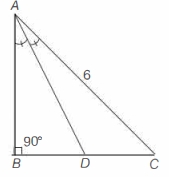
Let $ABC$ be a triangle with $\angle B = 90^{\circ}$. Let $AD$ be the bisector of $\angle A$ with $D$ on $BC$. Suppose $AC = 6 \text{ cm}$ and the area of the $\triangle ADC$ is $10 \text{ cm}^2$. Then,the length of $BD$ in $\text{cm}$ is equal to
A
$\frac{3}{5}$
B
$\frac{3}{10}$
C
$\frac{5}{3}$
D
$\frac{10}{3}$
Solution
(D) In $\triangle ABC$,$\angle B = 90^{\circ}$. $AD$ is the angle bisector of $\angle A$.
Draw a perpendicular from $D$ to $AC$,let it be $DE$. Since $AD$ is the angle bisector,$DE = DB$ (distance from bisector to sides).
Area of $\triangle ADC = \frac{1}{2} \times \text{base} \times \text{height} = \frac{1}{2} \times AC \times DE = 10$.
Given $AC = 6 \text{ cm}$,we have $\frac{1}{2} \times 6 \times DE = 10$.
$3 \times DE = 10 \implies DE = \frac{10}{3} \text{ cm}$.
Since $DB = DE$,the length of $BD$ is $\frac{10}{3} \text{ cm}$.
Draw a perpendicular from $D$ to $AC$,let it be $DE$. Since $AD$ is the angle bisector,$DE = DB$ (distance from bisector to sides).
Area of $\triangle ADC = \frac{1}{2} \times \text{base} \times \text{height} = \frac{1}{2} \times AC \times DE = 10$.
Given $AC = 6 \text{ cm}$,we have $\frac{1}{2} \times 6 \times DE = 10$.
$3 \times DE = 10 \implies DE = \frac{10}{3} \text{ cm}$.
Since $DB = DE$,the length of $BD$ is $\frac{10}{3} \text{ cm}$.
0 likesView Solution
25
MathematicsDifficultMCQKVPY · 2011
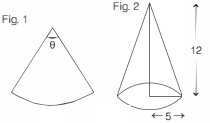
$A$ piece of paper in the shape of a sector of a circle (see $Fig. 1$) is rolled up to form a right-circular cone (see $Fig. 2$). The value of the angle $\theta$ is
A
$\frac{10 \pi}{13}$
B
$\frac{9 \pi}{13}$
C
$\frac{5 \pi}{13}$
D
$\frac{6 \pi}{13}$
Solution
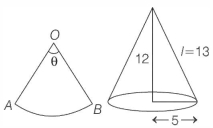
(A) The slant height $l$ of the cone is equal to the radius of the sector,which is $l = \sqrt{12^2 + 5^2} = \sqrt{144 + 25} = \sqrt{169} = 13$.
The circumference of the base of the cone is equal to the arc length of the sector.
Base circumference of the cone $= 2 \pi r = 2 \pi (5) = 10 \pi$.
Arc length of the sector $= l \theta = 13 \theta$.
Equating the two,we get $13 \theta = 10 \pi$.
Therefore,$\theta = \frac{10 \pi}{13}$.
The circumference of the base of the cone is equal to the arc length of the sector.
Base circumference of the cone $= 2 \pi r = 2 \pi (5) = 10 \pi$.
Arc length of the sector $= l \theta = 13 \theta$.
Equating the two,we get $13 \theta = 10 \pi$.
Therefore,$\theta = \frac{10 \pi}{13}$.
0 likesView Solution
26
MathematicsDifficultMCQKVPY · 2011
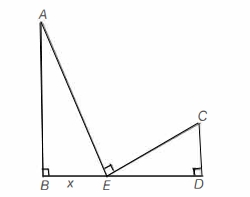
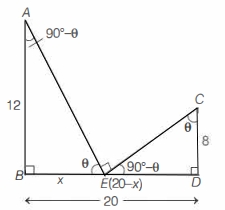
In the given figure,$AB = 12 \, cm$,$CD = 8 \, cm$,$BD = 20 \, cm$,and $\angle ABD = \angle AEC = \angle EDC = 90^{\circ}$. If $BE = x$,then:
A
$x$ has two possible values whose difference is $4$.
B
$x$ has two possible values whose sum is $28$.
C
$x$ has only one value and $x \geq 12$.
D
$x$ cannot be determined with the given information.
Solution
(A) Let $\angle BAE = \theta$. Since $\triangle ABE$ is a right-angled triangle at $B$,$\angle AEB = 90^{\circ} - \theta$.
Given $\angle AEC = 90^{\circ}$,we have $\angle CED = 180^{\circ} - (90^{\circ} - \theta) - 90^{\circ} = \theta$.
In $\triangle CDE$,$\angle CED = \theta$ and $\angle CDE = 90^{\circ}$,so $\angle ECD = 90^{\circ} - \theta$.
Thus,$\triangle ABE \sim \triangle ECD$ by $AA$ similarity.
Therefore,$\frac{AB}{BE} = \frac{ED}{CD}$.
Given $AB = 12$,$CD = 8$,$BD = 20$,and $BE = x$,we have $ED = 20 - x$.
Substituting these values: $\frac{12}{x} = \frac{20 - x}{8}$.
$96 = 20x - x^2$.
$x^2 - 20x + 96 = 0$.
$(x - 12)(x - 8) = 0$.
So,$x = 8$ or $x = 12$.
The difference between the two values is $|12 - 8| = 4$.
Given $\angle AEC = 90^{\circ}$,we have $\angle CED = 180^{\circ} - (90^{\circ} - \theta) - 90^{\circ} = \theta$.
In $\triangle CDE$,$\angle CED = \theta$ and $\angle CDE = 90^{\circ}$,so $\angle ECD = 90^{\circ} - \theta$.
Thus,$\triangle ABE \sim \triangle ECD$ by $AA$ similarity.
Therefore,$\frac{AB}{BE} = \frac{ED}{CD}$.
Given $AB = 12$,$CD = 8$,$BD = 20$,and $BE = x$,we have $ED = 20 - x$.
Substituting these values: $\frac{12}{x} = \frac{20 - x}{8}$.
$96 = 20x - x^2$.
$x^2 - 20x + 96 = 0$.
$(x - 12)(x - 8) = 0$.
So,$x = 8$ or $x = 12$.
The difference between the two values is $|12 - 8| = 4$.
0 likesView Solution
27
MathematicsAdvancedMCQKVPY · 2011
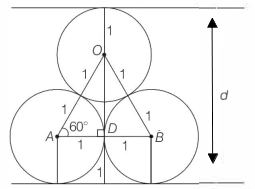
Three circles,each of radius $1$,touch one another externally and lie between two parallel lines. The minimum possible distance between the lines is:
A
$2+\sqrt{3}$
B
$3+\sqrt{3}$
C
$4$
D
$2+\frac{1}{\sqrt{3}}$
Solution
(A) Let the centers of the three circles be $O$,$A$,and $B$. Since each circle has a radius of $1$ and they touch each other externally,the distance between any two centers is $1+1=2$. Thus,$\triangle OAB$ is an equilateral triangle with side length $2$.
The height of this triangle from vertex $O$ to the base $AB$ is $h = \sqrt{2^2 - 1^2} = \sqrt{3}$.
The distance $d$ between the two parallel lines is the sum of the radius of the top circle,the height of the triangle $OAB$,and the radius of the bottom circles.
$d = r + h + r = 1 + \sqrt{3} + 1 = 2 + \sqrt{3}$.
The height of this triangle from vertex $O$ to the base $AB$ is $h = \sqrt{2^2 - 1^2} = \sqrt{3}$.
The distance $d$ between the two parallel lines is the sum of the radius of the top circle,the height of the triangle $OAB$,and the radius of the bottom circles.
$d = r + h + r = 1 + \sqrt{3} + 1 = 2 + \sqrt{3}$.
0 likesView Solution
28
MathematicsAdvancedMCQKVPY · 2011
The number of distinct prime divisors of the number $(512)^3 - (253)^3 - (259)^3$ is
A
$4$
B
$5$
C
$6$
D
$7$
Solution
(C) Let $a = 512$,$b = -253$,and $c = -259$.
Then $a + b + c = 512 - 253 - 259 = 0$.
We know that if $a + b + c = 0$,then $a^3 + b^3 + c^3 = 3abc$.
Therefore,$(512)^3 + (-253)^3 + (-259)^3 = 3(512)(-253)(-259) = 3 \times 512 \times 253 \times 259$.
Now,factorize each term:
$3 = 3^1$
$512 = 2^9$
$253 = 11 \times 23$
$259 = 7 \times 37$
So,the expression is $3^1 \times 2^9 \times 11^1 \times 23^1 \times 7^1 \times 37^1$.
The distinct prime divisors are $2, 3, 7, 11, 23, 37$.
Thus,there are $6$ distinct prime divisors.
Then $a + b + c = 512 - 253 - 259 = 0$.
We know that if $a + b + c = 0$,then $a^3 + b^3 + c^3 = 3abc$.
Therefore,$(512)^3 + (-253)^3 + (-259)^3 = 3(512)(-253)(-259) = 3 \times 512 \times 253 \times 259$.
Now,factorize each term:
$3 = 3^1$
$512 = 2^9$
$253 = 11 \times 23$
$259 = 7 \times 37$
So,the expression is $3^1 \times 2^9 \times 11^1 \times 23^1 \times 7^1 \times 37^1$.
The distinct prime divisors are $2, 3, 7, 11, 23, 37$.
Thus,there are $6$ distinct prime divisors.
0 likesView Solution
29
MathematicsAdvancedMCQKVPY · 2011
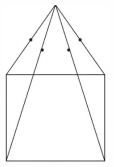
Consider an incomplete pyramid of balls on a square base having $18$ layers,and having $13$ balls on each side of the top layer. Then,the total number $N$ of balls in that pyramid satisfies
A
$9000 < N < 10000$
B
$8000 < N < 9000$
C
$7000 < N < 8000$
D
$10000 < N < 12000$
Solution
(B) The pyramid has $18$ layers,with the top layer having $13$ balls on each side. Since it is a square-based pyramid,the number of balls in the $k$-th layer from the top is $k^2$ if we consider the top as the $13$-th layer of a full pyramid.
Alternatively,the layers are $13^2, 14^2, 15^2, \dots, (13 + 18 - 1)^2 = 30^2$.
The total number of balls $N$ is given by the sum of squares:
$N = \sum_{k=13}^{30} k^2 = \sum_{k=1}^{30} k^2 - \sum_{k=1}^{12} k^2$.
Using the formula $\sum_{k=1}^{n} k^2 = \frac{n(n+1)(2n+1)}{6}$:
$\sum_{k=1}^{30} k^2 = \frac{30(31)(61)}{6} = 5 \times 31 \times 61 = 9455$.
$\sum_{k=1}^{12} k^2 = \frac{12(13)(25)}{6} = 2 \times 13 \times 25 = 650$.
Therefore,$N = 9455 - 650 = 8805$.
Since $8000 < 8805 < 9000$,the correct option is $B$.
Alternatively,the layers are $13^2, 14^2, 15^2, \dots, (13 + 18 - 1)^2 = 30^2$.
The total number of balls $N$ is given by the sum of squares:
$N = \sum_{k=13}^{30} k^2 = \sum_{k=1}^{30} k^2 - \sum_{k=1}^{12} k^2$.
Using the formula $\sum_{k=1}^{n} k^2 = \frac{n(n+1)(2n+1)}{6}$:
$\sum_{k=1}^{30} k^2 = \frac{30(31)(61)}{6} = 5 \times 31 \times 61 = 9455$.
$\sum_{k=1}^{12} k^2 = \frac{12(13)(25)}{6} = 2 \times 13 \times 25 = 650$.
Therefore,$N = 9455 - 650 = 8805$.
Since $8000 < 8805 < 9000$,the correct option is $B$.
0 likesView Solution
30
MathematicsAdvancedMCQKVPY · 2011
$A$ frog is presently located at the origin $(0,0)$ in the $XY$-plane. It always jumps from a point with integer coordinates to a point with integer coordinates,moving a distance of $5$ units in each jump. What is the minimum number of jumps required for the frog to go from $(0,0)$ to $(0,1)$?
A
$2$
B
$3$
C
$4$
D
$9$
Solution
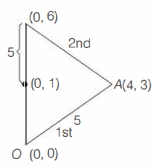
(B) The frog starts at $(0,0)$ and needs to reach $(0,1)$ with each jump covering a distance of $5$ units.
Let the jump be represented by a vector $(x, y)$ such that $x^2 + y^2 = 5^2 = 25$,where $x, y \in \mathbb{Z}$.
Possible integer pairs $(x, y)$ are $(\pm 3, \pm 4)$ or $(\pm 4, \pm 3)$ or $(\pm 5, 0)$ or $(0, \pm 5)$.
To reach $(0,1)$ in the minimum number of jumps:
$1$. Jump $1$: From $(0,0)$ to $(4,3)$ (distance $5$).
$2$. Jump $2$: From $(4,3)$ to $(0,6)$ (distance $\sqrt{(0-4)^2 + (6-3)^2} = \sqrt{16+9} = 5$).
$3$. Jump $3$: From $(0,6)$ to $(0,1)$ (distance $5$).
Thus,the minimum number of jumps required is $3$.
Let the jump be represented by a vector $(x, y)$ such that $x^2 + y^2 = 5^2 = 25$,where $x, y \in \mathbb{Z}$.
Possible integer pairs $(x, y)$ are $(\pm 3, \pm 4)$ or $(\pm 4, \pm 3)$ or $(\pm 5, 0)$ or $(0, \pm 5)$.
To reach $(0,1)$ in the minimum number of jumps:
$1$. Jump $1$: From $(0,0)$ to $(4,3)$ (distance $5$).
$2$. Jump $2$: From $(4,3)$ to $(0,6)$ (distance $\sqrt{(0-4)^2 + (6-3)^2} = \sqrt{16+9} = 5$).
$3$. Jump $3$: From $(0,6)$ to $(0,1)$ (distance $5$).
Thus,the minimum number of jumps required is $3$.
0 likesView Solution
31
MathematicsAdvancedMCQKVPY · 2011
$A$ certain $12$-hour digital clock displays the hour and the minute of a day. Due to a defect in the clock,whenever the digit $1$ is supposed to be displayed,it displays $7$. What fraction of the day will the clock show the correct time?
A
$\frac{1}{2}$
B
$\frac{5}{8}$
C
$\frac{3}{4}$
D
$\frac{5}{6}$
Solution
(A) $12$-hour clock cycles through $12$ hours and $60$ minutes. $A$ full day consists of $24$ hours,or $1440$ minutes.
First,identify the minutes in an hour where the digit $1$ appears: $01, 10, 11, 12, 13, 14, 15, 16, 17, 18, 19, 21, 31, 41, 51$. There are $15$ such minutes.
In each hour,the clock shows the incorrect time for these $15$ minutes. Additionally,in hours $01, 10, 11, 12$,the clock shows the incorrect time for all $60$ minutes.
Total incorrect minutes in a $12$-hour cycle:
For the $8$ hours where $1$ does not appear in the hour digit $(02, 03, 04, 05, 06, 07, 08, 09)$,the clock is incorrect for $15$ minutes per hour: $8 \times 15 = 120$ minutes.
For the $4$ hours where $1$ does appear $(01, 10, 11, 12)$,the clock is incorrect for all $60$ minutes: $4 \times 60 = 240$ minutes.
Total incorrect minutes in $12$ hours = $120 + 240 = 360$ minutes.
Since a day has two $12$-hour cycles,total incorrect minutes in a day = $360 \times 2 = 720$ minutes.
Total minutes in a day = $24 \times 60 = 1440$ minutes.
Correct minutes = $1440 - 720 = 720$ minutes.
Fraction of the day showing correct time = $\frac{720}{1440} = \frac{1}{2}$.
First,identify the minutes in an hour where the digit $1$ appears: $01, 10, 11, 12, 13, 14, 15, 16, 17, 18, 19, 21, 31, 41, 51$. There are $15$ such minutes.
In each hour,the clock shows the incorrect time for these $15$ minutes. Additionally,in hours $01, 10, 11, 12$,the clock shows the incorrect time for all $60$ minutes.
Total incorrect minutes in a $12$-hour cycle:
For the $8$ hours where $1$ does not appear in the hour digit $(02, 03, 04, 05, 06, 07, 08, 09)$,the clock is incorrect for $15$ minutes per hour: $8 \times 15 = 120$ minutes.
For the $4$ hours where $1$ does appear $(01, 10, 11, 12)$,the clock is incorrect for all $60$ minutes: $4 \times 60 = 240$ minutes.
Total incorrect minutes in $12$ hours = $120 + 240 = 360$ minutes.
Since a day has two $12$-hour cycles,total incorrect minutes in a day = $360 \times 2 = 720$ minutes.
Total minutes in a day = $24 \times 60 = 1440$ minutes.
Correct minutes = $1440 - 720 = 720$ minutes.
Fraction of the day showing correct time = $\frac{720}{1440} = \frac{1}{2}$.
0 likesView Solution
32
MathematicsDifficultMCQKVPY · 2011
There are $30$ questions in a multiple-choice test. $A$ student gets $1$ mark for each unattempted question,$0$ mark for each wrong answer,and $4$ marks for each correct answer. If a student answered $x$ questions correctly and scored $60$,then the number of possible values of $x$ is:
A
$15$
B
$10$
C
$6$
D
$5$
Solution
(C) Let $x$ be the number of correct answers,$y$ be the number of wrong answers,and $z$ be the number of unattempted questions.
Given that the total number of questions is $30$,we have $x + y + z = 30$.
The total score is given by $4x + 0y + 1z = 60$,which simplifies to $4x + z = 60$.
From the second equation,$z = 60 - 4x$.
Since $z \ge 0$,we have $60 - 4x \ge 0$,which implies $x \le 15$.
Also,since $x + y + z = 30$,we substitute $z = 60 - 4x$ to get $x + y + (60 - 4x) = 30$,which simplifies to $y = 3x - 30$.
Since $y \ge 0$,we have $3x - 30 \ge 0$,which implies $x \ge 10$.
Thus,$10 \le x \le 15$.
The possible integer values for $x$ are $10, 11, 12, 13, 14, 15$.
Counting these,there are $6$ possible values for $x$.
Given that the total number of questions is $30$,we have $x + y + z = 30$.
The total score is given by $4x + 0y + 1z = 60$,which simplifies to $4x + z = 60$.
From the second equation,$z = 60 - 4x$.
Since $z \ge 0$,we have $60 - 4x \ge 0$,which implies $x \le 15$.
Also,since $x + y + z = 30$,we substitute $z = 60 - 4x$ to get $x + y + (60 - 4x) = 30$,which simplifies to $y = 3x - 30$.
Since $y \ge 0$,we have $3x - 30 \ge 0$,which implies $x \ge 10$.
Thus,$10 \le x \le 15$.
The possible integer values for $x$ are $10, 11, 12, 13, 14, 15$.
Counting these,there are $6$ possible values for $x$.
0 likesView Solution
33
MathematicsAdvancedMCQKVPY · 2011
Let $f(x) = ax^2 + bx + c$,where $a, b, c$ are integers. Suppose $f(1) = 0$,$40 < f(6) < 50$,$60 < f(7) < 70$,and $1000t < f(50) < 1000(t+1)$ for some integer $t$. Then,the value of $t$ is
A
$2$
B
$3$
C
$4$
D
$5$ or more
Solution
(C) Given $f(x) = ax^2 + bx + c$ with $a, b, c \in \mathbb{Z}$.
Since $f(1) = 0$,we have $a + b + c = 0$,which implies $c = -a - b$.
Substituting $c$ into $f(x)$,we get $f(x) = ax^2 + bx - a - b = a(x^2 - 1) + b(x - 1) = (x - 1)(ax + a + b)$.
Given $40 < f(6) < 50 \implies 40 < 5(6a + a + b) < 50 \implies 8 < 7a + b < 10$.
Since $a, b$ are integers,$7a + b = 9$.
Given $60 < f(7) < 70 \implies 60 < 6(7a + a + b) < 70 \implies 10 < 8a + b < 11.66$.
Since $a, b$ are integers,$8a + b = 11$.
Subtracting the two equations: $(8a + b) - (7a + b) = 11 - 9 \implies a = 2$.
Substituting $a = 2$ into $7a + b = 9$,we get $14 + b = 9 \implies b = -5$.
Then $c = -a - b = -2 - (-5) = 3$.
Thus,$f(x) = 2x^2 - 5x + 3$.
Calculating $f(50) = 2(50)^2 - 5(50) + 3 = 5000 - 250 + 3 = 4753$.
Given $1000t < 4753 < 1000(t + 1)$,we find $t = 4$.
Since $f(1) = 0$,we have $a + b + c = 0$,which implies $c = -a - b$.
Substituting $c$ into $f(x)$,we get $f(x) = ax^2 + bx - a - b = a(x^2 - 1) + b(x - 1) = (x - 1)(ax + a + b)$.
Given $40 < f(6) < 50 \implies 40 < 5(6a + a + b) < 50 \implies 8 < 7a + b < 10$.
Since $a, b$ are integers,$7a + b = 9$.
Given $60 < f(7) < 70 \implies 60 < 6(7a + a + b) < 70 \implies 10 < 8a + b < 11.66$.
Since $a, b$ are integers,$8a + b = 11$.
Subtracting the two equations: $(8a + b) - (7a + b) = 11 - 9 \implies a = 2$.
Substituting $a = 2$ into $7a + b = 9$,we get $14 + b = 9 \implies b = -5$.
Then $c = -a - b = -2 - (-5) = 3$.
Thus,$f(x) = 2x^2 - 5x + 3$.
Calculating $f(50) = 2(50)^2 - 5(50) + 3 = 5000 - 250 + 3 = 4753$.
Given $1000t < 4753 < 1000(t + 1)$,we find $t = 4$.
0 likesView Solution
34
MathematicsAdvancedMCQKVPY · 2011
The expression $\frac{2^2+1}{2^2-1}+\frac{3^2+1}{3^2-1}+\frac{4^2+1}{4^2-1}+\ldots+\frac{(2011)^2+1}{(2011)^2-1}$ lies in the interval
A
$\left(2010, 2010 \frac{1}{2}\right)$
B
$\left(2011-\frac{1}{2011}, 2011-\frac{1}{2012}\right)$
C
$\left(2011, 2011 \frac{1}{2}\right)$
D
$\left(2012, 2012 \frac{1}{2}\right)$
Solution
(C) Let $S = \sum_{r=2}^{2011} \frac{r^2+1}{r^2-1}$.
We can rewrite the general term $T_r$ as:
$T_r = \frac{r^2-1+2}{r^2-1} = 1 + \frac{2}{(r-1)(r+1)}$.
Using partial fractions:
$T_r = 1 + \left(\frac{1}{r-1} - \frac{1}{r+1}\right)$.
Summing from $r=2$ to $2011$:
$S = \sum_{r=2}^{2011} 1 + \sum_{r=2}^{2011} \left(\frac{1}{r-1} - \frac{1}{r+1}\right)$.
The first part is $\sum_{r=2}^{2011} 1 = 2010$.
The second part is a telescoping sum:
$\left(\frac{1}{1} - \frac{1}{3}\right) + \left(\frac{1}{2} - \frac{1}{4}\right) + \left(\frac{1}{3} - \frac{1}{5}\right) + \ldots + \left(\frac{1}{2009} - \frac{1}{2011}\right) + \left(\frac{1}{2010} - \frac{1}{2012}\right)$.
After cancellation,we get:
$1 + \frac{1}{2} - \frac{1}{2011} - \frac{1}{2012} = \frac{3}{2} - \left(\frac{1}{2011} + \frac{1}{2012}\right)$.
Thus,$S = 2010 + 1.5 - \left(\frac{1}{2011} + \frac{1}{2012}\right) = 2011.5 - \left(\frac{1}{2011} + \frac{1}{2012}\right)$.
Since $0 < \left(\frac{1}{2011} + \frac{1}{2012}\right) < 1$,the value of $S$ lies in the interval $\left(2011, 2011 \frac{1}{2}\right)$.
We can rewrite the general term $T_r$ as:
$T_r = \frac{r^2-1+2}{r^2-1} = 1 + \frac{2}{(r-1)(r+1)}$.
Using partial fractions:
$T_r = 1 + \left(\frac{1}{r-1} - \frac{1}{r+1}\right)$.
Summing from $r=2$ to $2011$:
$S = \sum_{r=2}^{2011} 1 + \sum_{r=2}^{2011} \left(\frac{1}{r-1} - \frac{1}{r+1}\right)$.
The first part is $\sum_{r=2}^{2011} 1 = 2010$.
The second part is a telescoping sum:
$\left(\frac{1}{1} - \frac{1}{3}\right) + \left(\frac{1}{2} - \frac{1}{4}\right) + \left(\frac{1}{3} - \frac{1}{5}\right) + \ldots + \left(\frac{1}{2009} - \frac{1}{2011}\right) + \left(\frac{1}{2010} - \frac{1}{2012}\right)$.
After cancellation,we get:
$1 + \frac{1}{2} - \frac{1}{2011} - \frac{1}{2012} = \frac{3}{2} - \left(\frac{1}{2011} + \frac{1}{2012}\right)$.
Thus,$S = 2010 + 1.5 - \left(\frac{1}{2011} + \frac{1}{2012}\right) = 2011.5 - \left(\frac{1}{2011} + \frac{1}{2012}\right)$.
Since $0 < \left(\frac{1}{2011} + \frac{1}{2012}\right) < 1$,the value of $S$ lies in the interval $\left(2011, 2011 \frac{1}{2}\right)$.
0 likesView Solution
35
MathematicsAdvancedMCQKVPY · 2011
Let $P$ be an $m \times m$ matrix such that $P^2=P$. Then,$(I+P)^n$ equals
A
$I+P$
B
$I+nP$
C
$I+2^n P$
D
$I+(2^n-1)P$
Solution
(D) Given that $P^2 = P$. This is an idempotent matrix.
We use the binomial expansion for $(I+P)^n$:
$(I+P)^n = \sum_{k=0}^{n} \binom{n}{k} I^{n-k} P^k$
Since $I^m = I$ for any $m \ge 1$ and $P^k = P$ for all $k \ge 1$ (because $P^2=P, P^3=P^2P=PP=P$,etc.),we have:
$(I+P)^n = I + \sum_{k=1}^{n} \binom{n}{k} P$
$(I+P)^n = I + P \left( \sum_{k=1}^{n} \binom{n}{k} \right)$
We know that $\sum_{k=0}^{n} \binom{n}{k} = 2^n$,so $\sum_{k=1}^{n} \binom{n}{k} = 2^n - \binom{n}{0} = 2^n - 1$.
Therefore,$(I+P)^n = I + (2^n - 1)P$.
We use the binomial expansion for $(I+P)^n$:
$(I+P)^n = \sum_{k=0}^{n} \binom{n}{k} I^{n-k} P^k$
Since $I^m = I$ for any $m \ge 1$ and $P^k = P$ for all $k \ge 1$ (because $P^2=P, P^3=P^2P=PP=P$,etc.),we have:
$(I+P)^n = I + \sum_{k=1}^{n} \binom{n}{k} P$
$(I+P)^n = I + P \left( \sum_{k=1}^{n} \binom{n}{k} \right)$
We know that $\sum_{k=0}^{n} \binom{n}{k} = 2^n$,so $\sum_{k=1}^{n} \binom{n}{k} = 2^n - \binom{n}{0} = 2^n - 1$.
Therefore,$(I+P)^n = I + (2^n - 1)P$.
0 likesView Solution
36
MathematicsAdvancedMCQKVPY · 2011
Which of the following intervals is a possible domain of the function $f(x) = \log_{\{x\}}[x] + \log_{[x]}\{x\}$,where $[x]$ is the greatest integer not exceeding $x$ and $\{x\} = x - [x]$?
A
$(0, 1)$
B
$(1, 2)$
C
$(2, 3)$
D
$(3, 5)$
Solution
(C) The function $f(x) = \log_{\{x\}}[x] + \log_{[x]}\{x\}$ is defined under the following conditions:
$1$. For $\log_{\{x\}}[x]$ to be defined:
Base $\{x\} > 0$ and $\{x\} \neq 1$. Since $\{x\} = x - [x]$,$\{x\} \in [0, 1)$. Thus,$\{x\} \in (0, 1)$.
Argument $[x] > 0$,which implies $x \geq 1$. Since $\{x\} \neq 0$,$x$ cannot be an integer.
$2$. For $\log_{[x]}\{x\}$ to be defined:
Base $[x] > 0$ and $[x] \neq 1$. This implies $[x] \geq 2$,so $x \geq 2$.
Argument $\{x\} > 0$,which implies $x$ is not an integer.
Combining these conditions,we require $x \geq 2$ and $x \notin \mathbb{Z}$.
Among the given options,the interval $(2, 3)$ satisfies $x > 2$ and $x$ is not an integer.
Therefore,the correct option is $(c)$.
$1$. For $\log_{\{x\}}[x]$ to be defined:
Base $\{x\} > 0$ and $\{x\} \neq 1$. Since $\{x\} = x - [x]$,$\{x\} \in [0, 1)$. Thus,$\{x\} \in (0, 1)$.
Argument $[x] > 0$,which implies $x \geq 1$. Since $\{x\} \neq 0$,$x$ cannot be an integer.
$2$. For $\log_{[x]}\{x\}$ to be defined:
Base $[x] > 0$ and $[x] \neq 1$. This implies $[x] \geq 2$,so $x \geq 2$.
Argument $\{x\} > 0$,which implies $x$ is not an integer.
Combining these conditions,we require $x \geq 2$ and $x \notin \mathbb{Z}$.
Among the given options,the interval $(2, 3)$ satisfies $x > 2$ and $x$ is not an integer.
Therefore,the correct option is $(c)$.
0 likesView Solution
37
MathematicsAdvancedMCQKVPY · 2011
The minimum distance between a point on the curve $y=e^x$ and a point on the curve $y=\log_e x$ is
A
$\frac{1}{\sqrt{2}}$
B
$\sqrt{2}$
C
$\sqrt{3}$
D
$2\sqrt{2}$
Solution
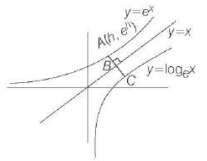
(B) The curves $y=e^x$ and $y=\log_e x$ are inverse functions of each other,meaning they are symmetric about the line $y=x$.
Let $A$ be a point on $y=e^x$ with coordinates $(h, e^h)$. The distance from point $A$ to the line $y=x$ (or $x-y=0$) is given by $AB = \frac{|h-e^h|}{\sqrt{1^2+(-1)^2}} = \frac{|h-e^h|}{\sqrt{2}}$.
Since the curves are symmetric about $y=x$,the minimum distance between the two curves is $AC = 2AB$,where $B$ is the projection of $A$ onto the line $y=x$.
To minimize $AB$,we minimize $f(h) = e^h - h$ (since $e^h > h$ for all $h$).
$f'(h) = e^h - 1$. Setting $f'(h) = 0$ gives $e^h = 1$,so $h=0$.
At $h=0$,the minimum distance $AB = \frac{|0-e^0|}{\sqrt{2}} = \frac{1}{\sqrt{2}}$.
Therefore,the minimum distance between the curves is $AC = 2 \times \frac{1}{\sqrt{2}} = \sqrt{2}$.
Let $A$ be a point on $y=e^x$ with coordinates $(h, e^h)$. The distance from point $A$ to the line $y=x$ (or $x-y=0$) is given by $AB = \frac{|h-e^h|}{\sqrt{1^2+(-1)^2}} = \frac{|h-e^h|}{\sqrt{2}}$.
Since the curves are symmetric about $y=x$,the minimum distance between the two curves is $AC = 2AB$,where $B$ is the projection of $A$ onto the line $y=x$.
To minimize $AB$,we minimize $f(h) = e^h - h$ (since $e^h > h$ for all $h$).
$f'(h) = e^h - 1$. Setting $f'(h) = 0$ gives $e^h = 1$,so $h=0$.
At $h=0$,the minimum distance $AB = \frac{|0-e^0|}{\sqrt{2}} = \frac{1}{\sqrt{2}}$.
Therefore,the minimum distance between the curves is $AC = 2 \times \frac{1}{\sqrt{2}} = \sqrt{2}$.
0 likesView Solution
38
MathematicsAdvancedMCQKVPY · 2011
Let $f:(2, \infty) \rightarrow \mathbb{N}$ be defined by $f(x) =$ the largest prime factor of $[x]$. Then,$\int_{2}^{8} f(x) \, dx$ is equal to
A
$17$
B
$22$
C
$23$
D
$25$
Solution
(B) Given $f(x) = \text{largest prime factor of } [x]$.
We need to evaluate $I = \int_{2}^{8} f(x) \, dx$.
Since $[x]$ is constant on intervals $[n, n+1)$,we split the integral:
$I = \int_{2}^{3} f(x) \, dx + \int_{3}^{4} f(x) \, dx + \int_{4}^{5} f(x) \, dx + \int_{5}^{6} f(x) \, dx + \int_{6}^{7} f(x) \, dx + \int_{7}^{8} f(x) \, dx$.
For $x \in [2, 3)$,$[x] = 2$,largest prime factor is $2$.
For $x \in [3, 4)$,$[x] = 3$,largest prime factor is $3$.
For $x \in [4, 5)$,$[x] = 4$,largest prime factor is $2$.
For $x \in [5, 6)$,$[x] = 5$,largest prime factor is $5$.
For $x \in [6, 7)$,$[x] = 6$,largest prime factor is $3$.
For $x \in [7, 8)$,$[x] = 7$,largest prime factor is $7$.
Thus,$I = \int_{2}^{3} 2 \, dx + \int_{3}^{4} 3 \, dx + \int_{4}^{5} 2 \, dx + \int_{5}^{6} 5 \, dx + \int_{6}^{7} 3 \, dx + \int_{7}^{8} 7 \, dx$.
$I = 2(1) + 3(1) + 2(1) + 5(1) + 3(1) + 7(1) = 2 + 3 + 2 + 5 + 3 + 7 = 22$.
We need to evaluate $I = \int_{2}^{8} f(x) \, dx$.
Since $[x]$ is constant on intervals $[n, n+1)$,we split the integral:
$I = \int_{2}^{3} f(x) \, dx + \int_{3}^{4} f(x) \, dx + \int_{4}^{5} f(x) \, dx + \int_{5}^{6} f(x) \, dx + \int_{6}^{7} f(x) \, dx + \int_{7}^{8} f(x) \, dx$.
For $x \in [2, 3)$,$[x] = 2$,largest prime factor is $2$.
For $x \in [3, 4)$,$[x] = 3$,largest prime factor is $3$.
For $x \in [4, 5)$,$[x] = 4$,largest prime factor is $2$.
For $x \in [5, 6)$,$[x] = 5$,largest prime factor is $5$.
For $x \in [6, 7)$,$[x] = 6$,largest prime factor is $3$.
For $x \in [7, 8)$,$[x] = 7$,largest prime factor is $7$.
Thus,$I = \int_{2}^{3} 2 \, dx + \int_{3}^{4} 3 \, dx + \int_{4}^{5} 2 \, dx + \int_{5}^{6} 5 \, dx + \int_{6}^{7} 3 \, dx + \int_{7}^{8} 7 \, dx$.
$I = 2(1) + 3(1) + 2(1) + 5(1) + 3(1) + 7(1) = 2 + 3 + 2 + 5 + 3 + 7 = 22$.
0 likesView Solution
39
MathematicsDifficultMCQKVPY · 2011
Let $[x]$ denote the largest integer not exceeding $x$ and $\{x\}=x-[x]$. Then,$\int \limits_0^{2012} \frac{e^{\cos (\pi\{x\})}}{e^{\cos (\pi\{x\})}+e^{-\cos (\pi\{x\})}} d x$ is equal to
A
$0$
B
$1006$
C
$2012$
D
$2012\,\pi$
Solution
(B) Let $I = \int \limits_0^{2012} \frac{e^{\cos (\pi\{x\})}}{e^{\cos (\pi\{x\})}+e^{-\cos (\pi\{x\})}} d x$.
Since the function $f(x) = \frac{e^{\cos (\pi\{x\})}}{e^{\cos (\pi\{x\})}+e^{-\cos (\pi\{x\})}}$ is periodic with period $1$,we can write:
$I = 2012 \int \limits_0^1 \frac{e^{\cos (\pi x)}}{e^{\cos (\pi x)}+e^{-\cos (\pi x)}} d x$.
Using the property $\int_0^a f(x) dx = \int_0^a f(a-x) dx$,we have:
$I = 2012 \int \limits_0^1 \frac{e^{\cos (\pi(1-x))}}{e^{\cos (\pi(1-x))}+e^{-\cos (\pi(1-x))}} d x$.
Since $\cos(\pi - \pi x) = -\cos(\pi x)$,the integral becomes:
$I = 2012 \int \limits_0^1 \frac{e^{-\cos (\pi x)}}{e^{-\cos (\pi x)}+e^{\cos (\pi x)}} d x$.
Adding the two expressions for $I$:
$2I = 2012 \int \limits_0^1 \frac{e^{\cos (\pi x)} + e^{-\cos (\pi x)}}{e^{\cos (\pi x)} + e^{-\cos (\pi x)}} d x = 2012 \int \limits_0^1 1 d x = 2012$.
Therefore,$I = 1006$.
Since the function $f(x) = \frac{e^{\cos (\pi\{x\})}}{e^{\cos (\pi\{x\})}+e^{-\cos (\pi\{x\})}}$ is periodic with period $1$,we can write:
$I = 2012 \int \limits_0^1 \frac{e^{\cos (\pi x)}}{e^{\cos (\pi x)}+e^{-\cos (\pi x)}} d x$.
Using the property $\int_0^a f(x) dx = \int_0^a f(a-x) dx$,we have:
$I = 2012 \int \limits_0^1 \frac{e^{\cos (\pi(1-x))}}{e^{\cos (\pi(1-x))}+e^{-\cos (\pi(1-x))}} d x$.
Since $\cos(\pi - \pi x) = -\cos(\pi x)$,the integral becomes:
$I = 2012 \int \limits_0^1 \frac{e^{-\cos (\pi x)}}{e^{-\cos (\pi x)}+e^{\cos (\pi x)}} d x$.
Adding the two expressions for $I$:
$2I = 2012 \int \limits_0^1 \frac{e^{\cos (\pi x)} + e^{-\cos (\pi x)}}{e^{\cos (\pi x)} + e^{-\cos (\pi x)}} d x = 2012 \int \limits_0^1 1 d x = 2012$.
Therefore,$I = 1006$.
0 likesView Solution
40
MathematicsAdvancedMCQKVPY · 2011
The value of $\lim _{n \rightarrow \infty} \left( \frac{1}{\sqrt{4n^2-1}} + \frac{1}{\sqrt{4n^2-4}} + \dots + \frac{1}{\sqrt{4n^2-n^2}} \right)$ is
A
$\frac{1}{4}$
B
$\frac{\pi}{12}$
C
$\frac{\pi}{4}$
D
$\frac{\pi}{6}$
Solution
(D) Let $I = \lim _{n \rightarrow \infty} \sum_{r=1}^n \frac{1}{\sqrt{4n^2-r^2}}$.
We can rewrite the expression as:
$I = \lim _{n \rightarrow \infty} \frac{1}{n} \sum_{r=1}^n \frac{1}{\sqrt{4 - (\frac{r}{n})^2}}$.
This is a Riemann sum for the definite integral:
$I = \int_{0}^{1} \frac{1}{\sqrt{4 - x^2}} dx$.
Using the standard integral formula $\int \frac{1}{\sqrt{a^2 - x^2}} dx = \sin^{-1}(\frac{x}{a}) + C$:
$I = \left[ \sin^{-1}(\frac{x}{2}) \right]_{0}^{1}$.
$I = \sin^{-1}(\frac{1}{2}) - \sin^{-1}(0) = \frac{\pi}{6} - 0 = \frac{\pi}{6}$.
We can rewrite the expression as:
$I = \lim _{n \rightarrow \infty} \frac{1}{n} \sum_{r=1}^n \frac{1}{\sqrt{4 - (\frac{r}{n})^2}}$.
This is a Riemann sum for the definite integral:
$I = \int_{0}^{1} \frac{1}{\sqrt{4 - x^2}} dx$.
Using the standard integral formula $\int \frac{1}{\sqrt{a^2 - x^2}} dx = \sin^{-1}(\frac{x}{a}) + C$:
$I = \left[ \sin^{-1}(\frac{x}{2}) \right]_{0}^{1}$.
$I = \sin^{-1}(\frac{1}{2}) - \sin^{-1}(0) = \frac{\pi}{6} - 0 = \frac{\pi}{6}$.
0 likesView Solution
41
MathematicsDifficultMCQKVPY · 2011
Let $\vec{a}, \vec{b}, \vec{c}$ be three vectors in the $xyz$-space such that $\vec{a} \times \vec{b} = \vec{b} \times \vec{c} = \vec{c} \times \vec{a} \neq 0$. If $A, B, C$ are points with position vectors $\vec{a}, \vec{b}, \vec{c}$ respectively,then the number of possible positions of the centroid of $\triangle ABC$ is
A
$1$
B
$2$
C
$3$
D
$6$
Solution
(A) Given $\vec{a} \times \vec{b} = \vec{b} \times \vec{c} = \vec{c} \times \vec{a} = \vec{v} \neq 0$.
From $\vec{a} \times \vec{b} = \vec{b} \times \vec{c}$,we have $(\vec{a} - \vec{c}) \times \vec{b} = 0$,which implies $\vec{a} - \vec{c} = k_1 \vec{b}$ for some scalar $k_1$.
Similarly,from $\vec{b} \times \vec{c} = \vec{c} \times \vec{a}$,we have $(\vec{b} - \vec{a}) \times \vec{c} = 0$,which implies $\vec{b} - \vec{a} = k_2 \vec{c}$ for some scalar $k_2$.
Adding these equations: $\vec{a} \times \vec{b} = \vec{b} \times \vec{c} = \vec{c} \times \vec{a}$ implies $\vec{a} + \vec{b} + \vec{c} = \vec{0}$ is not necessarily true,but rather $\vec{a} + \vec{b} + \vec{c}$ must be a vector such that the cross products are equal.
Actually,$\vec{a} \times \vec{b} = \vec{b} \times \vec{c} = \vec{c} \times \vec{a}$ implies $\vec{a} + \vec{b} + \vec{c} = \vec{k}$ where $\vec{k}$ is a constant vector.
However,the condition $\vec{a} \times \vec{b} = \vec{b} \times \vec{c} = \vec{c} \times \vec{a}$ implies $\vec{a} + \vec{b} + \vec{c} = 0$ is not required; instead,it implies that $\vec{a}, \vec{b}, \vec{c}$ are coplanar or satisfy specific relations.
Given the symmetry,the only solution for the centroid $\vec{G} = \frac{\vec{a} + \vec{b} + \vec{c}}{3}$ under the constraint $\vec{a} \times \vec{b} = \vec{b} \times \vec{c} = \vec{c} \times \vec{a} \neq 0$ is that there is only $1$ possible position for the centroid,which is the origin $\vec{0}$.
From $\vec{a} \times \vec{b} = \vec{b} \times \vec{c}$,we have $(\vec{a} - \vec{c}) \times \vec{b} = 0$,which implies $\vec{a} - \vec{c} = k_1 \vec{b}$ for some scalar $k_1$.
Similarly,from $\vec{b} \times \vec{c} = \vec{c} \times \vec{a}$,we have $(\vec{b} - \vec{a}) \times \vec{c} = 0$,which implies $\vec{b} - \vec{a} = k_2 \vec{c}$ for some scalar $k_2$.
Adding these equations: $\vec{a} \times \vec{b} = \vec{b} \times \vec{c} = \vec{c} \times \vec{a}$ implies $\vec{a} + \vec{b} + \vec{c} = \vec{0}$ is not necessarily true,but rather $\vec{a} + \vec{b} + \vec{c}$ must be a vector such that the cross products are equal.
Actually,$\vec{a} \times \vec{b} = \vec{b} \times \vec{c} = \vec{c} \times \vec{a}$ implies $\vec{a} + \vec{b} + \vec{c} = \vec{k}$ where $\vec{k}$ is a constant vector.
However,the condition $\vec{a} \times \vec{b} = \vec{b} \times \vec{c} = \vec{c} \times \vec{a}$ implies $\vec{a} + \vec{b} + \vec{c} = 0$ is not required; instead,it implies that $\vec{a}, \vec{b}, \vec{c}$ are coplanar or satisfy specific relations.
Given the symmetry,the only solution for the centroid $\vec{G} = \frac{\vec{a} + \vec{b} + \vec{c}}{3}$ under the constraint $\vec{a} \times \vec{b} = \vec{b} \times \vec{c} = \vec{c} \times \vec{a} \neq 0$ is that there is only $1$ possible position for the centroid,which is the origin $\vec{0}$.
0 likesView Solution
42
MathematicsAdvancedMCQKVPY · 2011
Let $A$ and $B$ be any two $n \times n$ matrices such that the following conditions hold: $A B=B A$ and there exist positive integers $k$ and $l$ such that $A^k=I$ (the identity matrix) and $B^l=0$ (the zero matrix). Then,
A
$A+B=I$
B
$\operatorname{det}(A B)=0$
C
$\operatorname{det}(A+B) \neq 0$
D
$(A+B)^m=0$ for some integer $m$
Solution
(B) Given that $A B = B A$,$A^k = I$,and $B^l = 0$ for some positive integers $k$ and $l$.
Since $B^l = 0$,taking the determinant on both sides,we get $\operatorname{det}(B^l) = \operatorname{det}(0) = 0$.
Using the property $\operatorname{det}(B^l) = (\operatorname{det}(B))^l$,we have $(\operatorname{det}(B))^l = 0$,which implies $\operatorname{det}(B) = 0$.
Now,consider the determinant of the product $A B$:
$\operatorname{det}(A B) = \operatorname{det}(A) \times \operatorname{det}(B)$.
Since $\operatorname{det}(B) = 0$,it follows that $\operatorname{det}(A B) = \operatorname{det}(A) \times 0 = 0$.
Thus,the correct option is $(b)$.
Since $B^l = 0$,taking the determinant on both sides,we get $\operatorname{det}(B^l) = \operatorname{det}(0) = 0$.
Using the property $\operatorname{det}(B^l) = (\operatorname{det}(B))^l$,we have $(\operatorname{det}(B))^l = 0$,which implies $\operatorname{det}(B) = 0$.
Now,consider the determinant of the product $A B$:
$\operatorname{det}(A B) = \operatorname{det}(A) \times \operatorname{det}(B)$.
Since $\operatorname{det}(B) = 0$,it follows that $\operatorname{det}(A B) = \operatorname{det}(A) \times 0 = 0$.
Thus,the correct option is $(b)$.
0 likesView Solution
43
MathematicsAdvancedMCQKVPY · 2011
Let $f(x) = x^3 + ax^2 + bx + c$ where $a, b, c$ are real numbers. If $f(x)$ has a local minimum at $x = 1$ and a local maximum at $x = -\frac{1}{3}$ and $f(2) = 0$,then $\int_{-1}^1 f(x) dx$ equals
A
$\frac{14}{3}$
B
$\frac{-14}{3}$
C
$\frac{7}{3}$
D
$\frac{-7}{3}$
Solution
(B) Given $f(x) = x^3 + ax^2 + bx + c$.
Since $f(2) = 0$,we have $8 + 4a + 2b + c = 0$ ... $(i)$.
The derivative is $f'(x) = 3x^2 + 2ax + b$.
Since $f(x)$ has critical points at $x = 1$ and $x = -\frac{1}{3}$,$f'(1) = 0$ and $f'(-\frac{1}{3}) = 0$.
$f'(1) = 3 + 2a + b = 0$ ... (ii).
$f'(-\frac{1}{3}) = 3(-\frac{1}{3})^2 + 2a(-\frac{1}{3}) + b = \frac{1}{3} - \frac{2a}{3} + b = 0$,which implies $1 - 2a + 3b = 0$ ... (iii).
Solving (ii) and (iii): $b = -2a - 3$. Substituting into (iii): $1 - 2a + 3(-2a - 3) = 0 \Rightarrow 1 - 2a - 6a - 9 = 0 \Rightarrow -8a = 8 \Rightarrow a = -1$.
Then $b = -2(-1) - 3 = -1$.
From $(i)$,$8 + 4(-1) + 2(-1) + c = 0 \Rightarrow 8 - 4 - 2 + c = 0 \Rightarrow c = -2$.
Thus,$f(x) = x^3 - x^2 - x - 2$.
We need to evaluate $\int_{-1}^1 (x^3 - x^2 - x - 2) dx$.
Since $x^3$ and $-x$ are odd functions,their integral over $[-1, 1]$ is $0$.
So,$\int_{-1}^1 f(x) dx = \int_{-1}^1 (-x^2 - 2) dx = -2 \int_0^1 (x^2 + 2) dx$.
$= -2 [\frac{x^3}{3} + 2x]_0^1 = -2 (\frac{1}{3} + 2) = -2 (\frac{7}{3}) = -\frac{14}{3}$.
Since $f(2) = 0$,we have $8 + 4a + 2b + c = 0$ ... $(i)$.
The derivative is $f'(x) = 3x^2 + 2ax + b$.
Since $f(x)$ has critical points at $x = 1$ and $x = -\frac{1}{3}$,$f'(1) = 0$ and $f'(-\frac{1}{3}) = 0$.
$f'(1) = 3 + 2a + b = 0$ ... (ii).
$f'(-\frac{1}{3}) = 3(-\frac{1}{3})^2 + 2a(-\frac{1}{3}) + b = \frac{1}{3} - \frac{2a}{3} + b = 0$,which implies $1 - 2a + 3b = 0$ ... (iii).
Solving (ii) and (iii): $b = -2a - 3$. Substituting into (iii): $1 - 2a + 3(-2a - 3) = 0 \Rightarrow 1 - 2a - 6a - 9 = 0 \Rightarrow -8a = 8 \Rightarrow a = -1$.
Then $b = -2(-1) - 3 = -1$.
From $(i)$,$8 + 4(-1) + 2(-1) + c = 0 \Rightarrow 8 - 4 - 2 + c = 0 \Rightarrow c = -2$.
Thus,$f(x) = x^3 - x^2 - x - 2$.
We need to evaluate $\int_{-1}^1 (x^3 - x^2 - x - 2) dx$.
Since $x^3$ and $-x$ are odd functions,their integral over $[-1, 1]$ is $0$.
So,$\int_{-1}^1 f(x) dx = \int_{-1}^1 (-x^2 - 2) dx = -2 \int_0^1 (x^2 + 2) dx$.
$= -2 [\frac{x^3}{3} + 2x]_0^1 = -2 (\frac{1}{3} + 2) = -2 (\frac{7}{3}) = -\frac{14}{3}$.
0 likesView Solution
44
MathematicsDifficultMCQKVPY · 2011
Let $f(x) = x^{12} - x^9 + x^4 - x + 1$. Which of the following is true?
A
$f$ is one-one
B
$f$ has a real root
C
$f^{\prime}$ never vanishes
D
$f$ takes only positive values
Solution
(D) Given $f(x) = x^{12} - x^9 + x^4 - x + 1$.
First,check if $f$ is one-one: $f(0) = 1$ and $f(1) = 1 - 1 + 1 - 1 + 1 = 1$. Since $f(0) = f(1)$,$f$ is not one-one.
Next,check if $f$ takes only positive values:
Case $1$: If $x \leq 0$,then $f(x) = x^{12} - x^9 + x^4 - x + 1$. Since $x^{12} \geq 0$,$-x^9 \geq 0$,$x^4 \geq 0$,and $-x \geq 0$,we have $f(x) \geq 1 > 0$.
Case $2$: If $x > 1$,then $f(x) = x^9(x^3 - 1) + x(x^3 - 1) + 1$. Since $x > 1$,$x^3 - 1 > 0$,so $f(x) > 1 > 0$.
Case $3$: If $0 < x < 1$,then $f(x) = (1 - x) + x^4(1 - x^5) + x^{12}$. Since $0 < x < 1$,$1 - x > 0$,$1 - x^5 > 0$,and $x^{12} > 0$,so $f(x) > 0$.
Since $f(x) > 0$ for all $x \in \mathbb{R}$,$f$ has no real roots. Thus,option $(d)$ is correct.
First,check if $f$ is one-one: $f(0) = 1$ and $f(1) = 1 - 1 + 1 - 1 + 1 = 1$. Since $f(0) = f(1)$,$f$ is not one-one.
Next,check if $f$ takes only positive values:
Case $1$: If $x \leq 0$,then $f(x) = x^{12} - x^9 + x^4 - x + 1$. Since $x^{12} \geq 0$,$-x^9 \geq 0$,$x^4 \geq 0$,and $-x \geq 0$,we have $f(x) \geq 1 > 0$.
Case $2$: If $x > 1$,then $f(x) = x^9(x^3 - 1) + x(x^3 - 1) + 1$. Since $x > 1$,$x^3 - 1 > 0$,so $f(x) > 1 > 0$.
Case $3$: If $0 < x < 1$,then $f(x) = (1 - x) + x^4(1 - x^5) + x^{12}$. Since $0 < x < 1$,$1 - x > 0$,$1 - x^5 > 0$,and $x^{12} > 0$,so $f(x) > 0$.
Since $f(x) > 0$ for all $x \in \mathbb{R}$,$f$ has no real roots. Thus,option $(d)$ is correct.
0 likesView Solution
45
MathematicsAdvancedMCQKVPY · 2011
For each positive integer $n$,define $f_n(x) = \min\left(\frac{x^n}{n!}, \frac{(1-x)^n}{n!}\right)$ for $0 \leq x \leq 1$. Let $I_n = \int_{0}^{1} f_n(x) dx$ for $n \geq 1$. Then,$\sum_{n=1}^{\infty} I_n$ is equal to
A
$2\sqrt{e} - 3$
B
$2\sqrt{e} - 2$
C
$2\sqrt{e} - 1$
D
$2\sqrt{e}$
Solution
(A) Given $f_n(x) = \min\left(\frac{x^n}{n!}, \frac{(1-x)^n}{n!}\right)$ for $x \in [0, 1]$.
Since $\frac{x^n}{n!} \leq \frac{(1-x)^n}{n!}$ for $0 \leq x \leq \frac{1}{2}$ and $\frac{(1-x)^n}{n!} \leq \frac{x^n}{n!}$ for $\frac{1}{2} \leq x \leq 1$,we have:
$I_n = \int_{0}^{1/2} \frac{x^n}{n!} dx + \int_{1/2}^{1} \frac{(1-x)^n}{n!} dx$.
By symmetry,$I_n = 2 \int_{0}^{1/2} \frac{x^n}{n!} dx = 2 \left[ \frac{x^{n+1}}{(n+1)n!} \right]_{0}^{1/2} = 2 \frac{(1/2)^{n+1}}{(n+1)!} = \frac{2}{(n+1)! 2^{n+1}} = \frac{1}{(n+1)! 2^n}$.
Now,$\sum_{n=1}^{\infty} I_n = \sum_{n=1}^{\infty} \frac{1}{(n+1)! 2^n}$.
Let $k = n+1$,then $\sum_{k=2}^{\infty} \frac{(1/2)^{k-1}}{k!} = 2 \sum_{k=2}^{\infty} \frac{(1/2)^k}{k!}$.
Since $e^x = \sum_{k=0}^{\infty} \frac{x^k}{k!}$,we have $\sum_{k=2}^{\infty} \frac{(1/2)^k}{k!} = e^{1/2} - (1 + 1/2) = \sqrt{e} - \frac{3}{2}$.
Thus,$\sum_{n=1}^{\infty} I_n = 2(\sqrt{e} - \frac{3}{2}) = 2\sqrt{e} - 3$.
Since $\frac{x^n}{n!} \leq \frac{(1-x)^n}{n!}$ for $0 \leq x \leq \frac{1}{2}$ and $\frac{(1-x)^n}{n!} \leq \frac{x^n}{n!}$ for $\frac{1}{2} \leq x \leq 1$,we have:
$I_n = \int_{0}^{1/2} \frac{x^n}{n!} dx + \int_{1/2}^{1} \frac{(1-x)^n}{n!} dx$.
By symmetry,$I_n = 2 \int_{0}^{1/2} \frac{x^n}{n!} dx = 2 \left[ \frac{x^{n+1}}{(n+1)n!} \right]_{0}^{1/2} = 2 \frac{(1/2)^{n+1}}{(n+1)!} = \frac{2}{(n+1)! 2^{n+1}} = \frac{1}{(n+1)! 2^n}$.
Now,$\sum_{n=1}^{\infty} I_n = \sum_{n=1}^{\infty} \frac{1}{(n+1)! 2^n}$.
Let $k = n+1$,then $\sum_{k=2}^{\infty} \frac{(1/2)^{k-1}}{k!} = 2 \sum_{k=2}^{\infty} \frac{(1/2)^k}{k!}$.
Since $e^x = \sum_{k=0}^{\infty} \frac{x^k}{k!}$,we have $\sum_{k=2}^{\infty} \frac{(1/2)^k}{k!} = e^{1/2} - (1 + 1/2) = \sqrt{e} - \frac{3}{2}$.
Thus,$\sum_{n=1}^{\infty} I_n = 2(\sqrt{e} - \frac{3}{2}) = 2\sqrt{e} - 3$.
0 likesView Solution
46
MathematicsAdvancedMCQKVPY · 2011
The diameter of one of the bases of a truncated cone is $100 \, mm$. If the diameter of this base is increased by $21 \%$ such that it still remains a truncated cone with the height and the other base unchanged,the volume also increases by $21 \%$. The radius of the other base (in $mm$) is
A
$65$
B
$55$
C
$45$
D
$35$
Solution
(B) Let the radius of the first base be $R_1 = 50 \, mm$ and the radius of the second base be $R_2 = r \, mm$. The height is $h$. The volume of a truncated cone is given by $V = \frac{\pi h}{3} (R_1^2 + R_1 R_2 + R_2^2)$.
Given $R_1 = 50 \, mm$. The new radius $R_1' = R_1 + 0.21 R_1 = 1.21 R_1 = 1.21 \times 50 = 60.5 \, mm$.
The new volume $V' = 1.21 V$. Substituting the values:
$1.21 \times \frac{\pi h}{3} (50^2 + 50r + r^2) = \frac{\pi h}{3} (60.5^2 + 60.5r + r^2)$.
Dividing both sides by $\frac{\pi h}{3}$:
$1.21 (2500 + 50r + r^2) = 3660.25 + 60.5r + r^2$.
$3025 + 60.5r + 1.21r^2 = 3660.25 + 60.5r + r^2$.
Subtracting $60.5r$ from both sides:
$3025 + 1.21r^2 = 3660.25 + r^2$.
$0.21r^2 = 635.25$.
$r^2 = \frac{635.25}{0.21} = 3025$.
$r = \sqrt{3025} = 55 \, mm$.
Given $R_1 = 50 \, mm$. The new radius $R_1' = R_1 + 0.21 R_1 = 1.21 R_1 = 1.21 \times 50 = 60.5 \, mm$.
The new volume $V' = 1.21 V$. Substituting the values:
$1.21 \times \frac{\pi h}{3} (50^2 + 50r + r^2) = \frac{\pi h}{3} (60.5^2 + 60.5r + r^2)$.
Dividing both sides by $\frac{\pi h}{3}$:
$1.21 (2500 + 50r + r^2) = 3660.25 + 60.5r + r^2$.
$3025 + 60.5r + 1.21r^2 = 3660.25 + 60.5r + r^2$.
Subtracting $60.5r$ from both sides:
$3025 + 1.21r^2 = 3660.25 + r^2$.
$0.21r^2 = 635.25$.
$r^2 = \frac{635.25}{0.21} = 3025$.
$r = \sqrt{3025} = 55 \, mm$.
0 likesView Solution
Vedclass Products
For Students
Vedclass Test Series
Mock tests in real KVPY style covering Mathematics with performance analysis. 5-day free trial.
Start Free TrialFor Teachers
Exam Paper Generator
Generate Set A/B/C/D Mathematics papers from 7.5L+ questions in 2 minutes. 3 chapters free.
Try FreeFor Institutes
Online Exam Module
Run live KVPY mock exams with unlimited students, 360° analytics & white-label branding.
See DemoFrequently Asked Questions
How many Mathematics questions are in KVPY 2011?
There are 46 Mathematics questions from the KVPY 2011 paper on Vedclass, each with a detailed step-by-step solution in English.
Are KVPY 2011 Mathematics solutions available in English?
Yes. All solutions on this page are in English. You can also switch to English or Hindi using the language buttons above the questions.
Can I practice KVPY 2011 Mathematics as a timed test?
Yes. Use the Vedclass Test Series to attempt a full KVPY mock test covering Mathematics with time limits and instant score analysis.
Can teachers create Mathematics papers from KVPY previous year questions?
Yes. The Vedclass Exam Paper Generator lets teachers mix KVPY Mathematics questions and generate Set A/B/C/D papers in minutes.
For Teachers & Institutes
Build a Custom Mathematics Paper
Pick KVPY 2011 Mathematics questions, set difficulty, and generate Set A/B/C/D in 2 minutes.