
ChemistryQ1–50 of 50 questions
Page 1 of 1 · English
1
ChemistryDifficultMCQKVPY · 2020
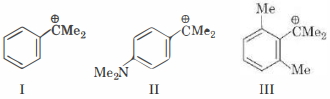
The stability of the following carbocations follows the order:
A
$I > II > III$
B
$II > I > III$
C
$II > III > I$
D
$III > II > I$
Solution
(B)
The correct stability order of the given carbocations is $II > I > III$.
In structure $II$,the presence of the electron-releasing $-NMe_2$ group significantly stabilizes the carbocation through the $+M$ effect.
In structure $I$,the carbocation is stabilized by resonance with the benzene ring.
In structure $III$,due to $SIR$ (Steric Inhibition of Resonance),the $-C(Me)_2^+$ group is forced out of the plane of the benzene ring by the two ortho-methyl groups. This loss of conjugation significantly decreases its stability compared to $I$ and $II$.
The correct stability order of the given carbocations is $II > I > III$.
In structure $II$,the presence of the electron-releasing $-NMe_2$ group significantly stabilizes the carbocation through the $+M$ effect.
In structure $I$,the carbocation is stabilized by resonance with the benzene ring.
In structure $III$,due to $SIR$ (Steric Inhibition of Resonance),the $-C(Me)_2^+$ group is forced out of the plane of the benzene ring by the two ortho-methyl groups. This loss of conjugation significantly decreases its stability compared to $I$ and $II$.
0 likesView Solution
2
ChemistryDifficultMCQKVPY · 2020
$A$ weak acid is titrated with a weak base. Consider the following statements regarding the $pH$ of the solution at the equivalence point.
$(i)$ $pH$ depends on the concentration of acid and base
$(ii)$ $pH$ is independent of the concentration of acid and base
$(iii)$ $pH$ depends on the $pK_{a}$ of acid and $pK_{b}$ of base
$(iv)$ $pH$ is independent of the $pK_{a}$ of acid and $pK_{b}$ of base
The correct statements are
$(i)$ $pH$ depends on the concentration of acid and base
$(ii)$ $pH$ is independent of the concentration of acid and base
$(iii)$ $pH$ depends on the $pK_{a}$ of acid and $pK_{b}$ of base
$(iv)$ $pH$ is independent of the $pK_{a}$ of acid and $pK_{b}$ of base
The correct statements are
A
only $(i)$ and $(iii)$
B
only $(i)$ and $(iv)$
C
only $(ii)$ and $(iii)$
D
only $(ii)$ and $(iv)$
Solution
(C) The $pH$ at the equivalence point for the titration of a weak acid with a weak base is given by the formula:
$pH = \frac{1}{2}(pK_{w} + pK_{a} - pK_{b})$
From this expression,it is clear that the $pH$ is independent of the concentration of the acid and the base (statement $ii$ is correct,$i$ is incorrect).
The expression also shows that the $pH$ depends on the $pK_{a}$ of the acid and the $pK_{b}$ of the base (statement $iii$ is correct,$iv$ is incorrect).
Therefore,the correct statements are $(ii)$ and $(iii)$.
$pH = \frac{1}{2}(pK_{w} + pK_{a} - pK_{b})$
From this expression,it is clear that the $pH$ is independent of the concentration of the acid and the base (statement $ii$ is correct,$i$ is incorrect).
The expression also shows that the $pH$ depends on the $pK_{a}$ of the acid and the $pK_{b}$ of the base (statement $iii$ is correct,$iv$ is incorrect).
Therefore,the correct statements are $(ii)$ and $(iii)$.
0 likesView Solution
3
ChemistryDifficultMCQKVPY · 2020
Products are favoured in a chemical reaction taking place at a constant temperature and pressure. Consider the following statements: $(i)$ The change in Gibbs energy for the reaction is negative. $(ii)$ The total change in Gibbs energy for the reaction and the surroundings is negative. $(iii)$ The change in entropy for the reaction is positive. $(iv)$ The total change in entropy for the reaction and the surroundings is positive. The statements which are always true are:
A
only $(i)$ and $(iii)$
B
only $(i)$ and $(iv)$
C
only $(ii)$ and $(iv)$
D
only $(ii)$ and $(iii)$
Solution
(B) For a chemical reaction to be spontaneous at constant temperature and pressure,the change in Gibbs energy of the system must be negative,i.e.,$\Delta G_{\text{sys}} < 0$. This corresponds to statement $(i)$.
According to the second law of thermodynamics,for any spontaneous process,the total entropy change of the universe (system + surroundings) must be positive,i.e.,$\Delta S_{\text{total}} = \Delta S_{\text{sys}} + \Delta S_{\text{surr}} > 0$. This corresponds to statement $(iv)$.
Statement $(ii)$ is incorrect because the total Gibbs energy change for the universe is not a standard criterion for spontaneity.
Statement $(iii)$ is not necessarily true because a reaction can be spontaneous even if the entropy change of the system is negative,provided the enthalpy change is sufficiently negative to make $\Delta G$ negative.
Therefore,statements $(i)$ and $(iv)$ are always true.
According to the second law of thermodynamics,for any spontaneous process,the total entropy change of the universe (system + surroundings) must be positive,i.e.,$\Delta S_{\text{total}} = \Delta S_{\text{sys}} + \Delta S_{\text{surr}} > 0$. This corresponds to statement $(iv)$.
Statement $(ii)$ is incorrect because the total Gibbs energy change for the universe is not a standard criterion for spontaneity.
Statement $(iii)$ is not necessarily true because a reaction can be spontaneous even if the entropy change of the system is negative,provided the enthalpy change is sufficiently negative to make $\Delta G$ negative.
Therefore,statements $(i)$ and $(iv)$ are always true.
0 likesView Solution
4
ChemistryMediumMCQKVPY · 2020
Treatment of alkaline $KMnO_{4}$ solution with $KI$ solution oxidises iodide to:
A
$I_{2}$
B
$IO_{4}^{-}$
C
$IO_{3}^{-}$
D
$IO_{2}^{-}$
Solution
(C) The treatment of alkaline $KMnO_{4}$ solution with $KI$ solution oxidizes iodide $(I^{-})$ to iodate $(IO_{3}^{-})$.
The balanced chemical equation is as follows:
$2MnO_{4}^{-} + I^{-} + H_{2}O \longrightarrow 2MnO_{2} + IO_{3}^{-} + 2OH^{-}$
The balanced chemical equation is as follows:
$2MnO_{4}^{-} + I^{-} + H_{2}O \longrightarrow 2MnO_{2} + IO_{3}^{-} + 2OH^{-}$
0 likesView Solution
5
ChemistryMediumMCQKVPY · 2020
If an extra electron is added to the hypothetical molecule $C_{2}$,this extra electron will occupy the molecular orbital.
A
$\pi_{2p}^{*}$
B
$\pi_{2p}$
C
$\sigma_{2p}^{*}$
D
$\sigma_{2p}$
Solution
(D) The electronic configuration of the $C_{2}$ molecule is $\sigma 1s^{2}, \sigma^{*} 1s^{2}, \sigma 2s^{2}, \sigma^{*} 2s^{2}, \pi 2p_{y}^{2} = \pi 2p_{x}^{2}$.
According to the molecular orbital theory for $C_{2}$,the next available molecular orbital after the $\pi 2p$ orbitals is the $\sigma 2p_{z}$ orbital.
Therefore,if an extra electron is added to the $C_{2}$ molecule,it will occupy the $\sigma 2p_{z}$ molecular orbital.
Thus,the correct option is $D$.
According to the molecular orbital theory for $C_{2}$,the next available molecular orbital after the $\pi 2p$ orbitals is the $\sigma 2p_{z}$ orbital.
Therefore,if an extra electron is added to the $C_{2}$ molecule,it will occupy the $\sigma 2p_{z}$ molecular orbital.
Thus,the correct option is $D$.
0 likesView Solution
6
ChemistryMediumMCQKVPY · 2020
If the velocity of the revolving electron of $He^{+}$ in the first orbit $(n=1)$ is $v$,what is the velocity of the electron in the second orbit $(n=2)$?
A
$v$
B
$0.5v$
C
$2v$
D
$0.25v$
Solution
(B) According to Bohr's model,the velocity of an electron in a hydrogen-like species is given by the formula: $v_n = v_0 \times \frac{Z}{n}$,where $Z$ is the atomic number and $n$ is the orbit number.
For $He^{+}$,the atomic number $Z = 2$.
In the first orbit $(n=1)$,the velocity is $v = v_0 \times \frac{2}{1} = 2v_0$. Thus,$v_0 = \frac{v}{2}$.
In the second orbit $(n=2)$,the velocity $v^{\prime}$ is given by: $v^{\prime} = v_0 \times \frac{2}{2} = v_0$.
Substituting the value of $v_0$ from the first step: $v^{\prime} = \frac{v}{2} = 0.5v$.
For $He^{+}$,the atomic number $Z = 2$.
In the first orbit $(n=1)$,the velocity is $v = v_0 \times \frac{2}{1} = 2v_0$. Thus,$v_0 = \frac{v}{2}$.
In the second orbit $(n=2)$,the velocity $v^{\prime}$ is given by: $v^{\prime} = v_0 \times \frac{2}{2} = v_0$.
Substituting the value of $v_0$ from the first step: $v^{\prime} = \frac{v}{2} = 0.5v$.
0 likesView Solution
7
ChemistryDifficultMCQKVPY · 2020
An organic compound $X$ with molecular formula $C_{11}H_{14}$ gives an optically active compound on hydrogenation. Upon ozonolysis,$X$ produces a mixture of compounds $P$ and $Q$. Compound $P$ gives a yellow precipitate when treated with $I_{2}$ and $NaOH$ but does not reduce Tollen's reagent. Compound $Q$ does not give any yellow precipitate with $I_{2}$ and $NaOH$ but gives Fehling's test. The compound $X$ is:
A
$Ph-C(CH_3)=CH-CH_2-CH_3$
B
$Ph-CH=C(CH_3)-CH_2-CH_3$
C
$Ph-CH=CH-CH_2-CH_2-CH_3$
D
$Ph-C(CH_3)=C(CH_3)_2$
Solution
(A) $1$. The molecular formula of $X$ is $C_{11}H_{14}$.
$2$. Ozonolysis of $X$ gives $P$ and $Q$. $P$ gives a positive iodoform test $(I_2/NaOH)$ and does not reduce Tollen's reagent,identifying $P$ as a methyl ketone (specifically acetophenone,$Ph-CO-CH_3$).
$3$. $Q$ gives a positive Fehling's test but no iodoform test,identifying $Q$ as an aliphatic aldehyde (specifically propanal,$CH_3CH_2CHO$).
$4$. Combining these fragments ($Ph-CO-CH_3$ and $CH_3CH_2CHO$) via ozonolysis reversal,the structure of $X$ is $Ph-C(CH_3)=CH-CH_2-CH_3$.
$5$. Hydrogenation of $X$ $(Ph-C(CH_3)=CH-CH_2-CH_3 + H_2 \rightarrow Ph-CH(CH_3)-CH_2-CH_2-CH_3)$ produces a chiral center at the carbon attached to the phenyl group,making the product optically active.
$2$. Ozonolysis of $X$ gives $P$ and $Q$. $P$ gives a positive iodoform test $(I_2/NaOH)$ and does not reduce Tollen's reagent,identifying $P$ as a methyl ketone (specifically acetophenone,$Ph-CO-CH_3$).
$3$. $Q$ gives a positive Fehling's test but no iodoform test,identifying $Q$ as an aliphatic aldehyde (specifically propanal,$CH_3CH_2CHO$).
$4$. Combining these fragments ($Ph-CO-CH_3$ and $CH_3CH_2CHO$) via ozonolysis reversal,the structure of $X$ is $Ph-C(CH_3)=CH-CH_2-CH_3$.
$5$. Hydrogenation of $X$ $(Ph-C(CH_3)=CH-CH_2-CH_3 + H_2 \rightarrow Ph-CH(CH_3)-CH_2-CH_2-CH_3)$ produces a chiral center at the carbon attached to the phenyl group,making the product optically active.
0 likesView Solution
8
ChemistryAdvancedMCQKVPY · 2020
Consider a reaction that is first order in both directions: $A \underset{K_b}{\stackrel{K_f}{\rightleftharpoons}} B$. Initially only $A$ is present,and its concentration is $A_{0}$. Assume $A_{t}$ and $A_{\text{eq}}$ are the concentrations of $A$ at time $t$ and at equilibrium,respectively. The time $t$ at which $A_{t} = (A_{0} + A_{\text{eq}})/2$ is $....$
A
$t = \frac{\ln (3/2)}{(K_{f} + K_{b})}$
B
$t = \frac{\ln (3/2)}{(K_{f} - K_{b})}$
C
$t = \frac{\ln 2}{(K_{f} + K_{b})}$
D
$t = \frac{\ln 2}{(K_{f} - K_{b})}$
Solution
(C) For a reversible first-order reaction $A \underset{K_b}{\stackrel{K_f}{\rightleftharpoons}} B$,the rate law is given by: $-\frac{d[A]}{dt} = K_f[A] - K_b[B]$.
At equilibrium,$-\frac{d[A]}{dt} = 0$,so $K_f[A_{\text{eq}}] = K_b[B_{\text{eq}}]$. Since $[B_{\text{eq}}] = A_0 - A_{\text{eq}}$,we have $K_b = \frac{K_f A_{\text{eq}}}{A_0 - A_{\text{eq}}}$.
The integrated rate equation for this system is $(K_f + K_b)t = \ln \left( \frac{A_0 - A_{\text{eq}}}{A_t - A_{\text{eq}}} \right)$.
Given $A_t = \frac{A_0 + A_{\text{eq}}}{2}$,we substitute this into the expression:
$A_t - A_{\text{eq}} = \frac{A_0 + A_{\text{eq}}}{2} - A_{\text{eq}} = \frac{A_0 - A_{\text{eq}}}{2}$.
Substituting this into the integrated rate equation:
$(K_f + K_b)t = \ln \left( \frac{A_0 - A_{\text{eq}}}{(A_0 - A_{\text{eq}})/2} \right) = \ln(2)$.
Therefore,$t = \frac{\ln 2}{K_f + K_b}$.
At equilibrium,$-\frac{d[A]}{dt} = 0$,so $K_f[A_{\text{eq}}] = K_b[B_{\text{eq}}]$. Since $[B_{\text{eq}}] = A_0 - A_{\text{eq}}$,we have $K_b = \frac{K_f A_{\text{eq}}}{A_0 - A_{\text{eq}}}$.
The integrated rate equation for this system is $(K_f + K_b)t = \ln \left( \frac{A_0 - A_{\text{eq}}}{A_t - A_{\text{eq}}} \right)$.
Given $A_t = \frac{A_0 + A_{\text{eq}}}{2}$,we substitute this into the expression:
$A_t - A_{\text{eq}} = \frac{A_0 + A_{\text{eq}}}{2} - A_{\text{eq}} = \frac{A_0 - A_{\text{eq}}}{2}$.
Substituting this into the integrated rate equation:
$(K_f + K_b)t = \ln \left( \frac{A_0 - A_{\text{eq}}}{(A_0 - A_{\text{eq}})/2} \right) = \ln(2)$.
Therefore,$t = \frac{\ln 2}{K_f + K_b}$.
0 likesView Solution
9
ChemistryDifficultMCQKVPY · 2020
The reaction,$CaCO_{3(s)} \rightleftharpoons CaO_{(s)} + CO_{2(g)}$ is in equilibrium in a closed vessel at $298 \, K$. The partial pressure (in $atm$) of $CO_{2(g)}$ in the reaction vessel is closest to $....$ [Given : The change in Gibbs energies of formation at $298 \, K$ and $1 \, bar$ for $CaO_{(s)} = -603.501 \, kJ \, mol^{-1}$,$CO_{2(g)} = -394.389 \, kJ \, mol^{-1}$,$CaCO_{3(s)} = -1128.79 \, kJ \, mol^{-1}$,Gas constant,$R = 8.314 \, J \, K^{-1} \, mol^{-1}$]
A
$1.13 \times 10^{-23}$
B
$0.95$
C
$1.05$
D
$8.79 \times 10^{23}$
Solution
(A) The standard Gibbs free energy change for the reaction is calculated as: $\Delta G^{\circ} = \Delta G_{f}^{\circ}(CaO) + \Delta G_{f}^{\circ}(CO_{2}) - \Delta G_{f}^{\circ}(CaCO_{3})$.
Substituting the given values: $\Delta G^{\circ} = (-603.501) + (-394.389) - (-1128.79) = +130.9 \, kJ \, mol^{-1} = 130900 \, J \, mol^{-1}$.
Using the relation $\Delta G^{\circ} = -RT \ln K_{p}$,we have $\ln K_{p} = -\frac{\Delta G^{\circ}}{RT}$.
$\ln K_{p} = -\frac{130900}{8.314 \times 298} \approx -52.834$.
Converting to base $10$ logarithm: $\log_{10} K_{p} = \frac{-52.834}{2.303} \approx -22.941$.
Thus,$K_{p} = 10^{-22.941} \approx 1.13 \times 10^{-23}$.
Since $K_{p} = P_{CO_{2}}$,the partial pressure of $CO_{2(g)}$ is $1.13 \times 10^{-23} \, atm$.
Substituting the given values: $\Delta G^{\circ} = (-603.501) + (-394.389) - (-1128.79) = +130.9 \, kJ \, mol^{-1} = 130900 \, J \, mol^{-1}$.
Using the relation $\Delta G^{\circ} = -RT \ln K_{p}$,we have $\ln K_{p} = -\frac{\Delta G^{\circ}}{RT}$.
$\ln K_{p} = -\frac{130900}{8.314 \times 298} \approx -52.834$.
Converting to base $10$ logarithm: $\log_{10} K_{p} = \frac{-52.834}{2.303} \approx -22.941$.
Thus,$K_{p} = 10^{-22.941} \approx 1.13 \times 10^{-23}$.
Since $K_{p} = P_{CO_{2}}$,the partial pressure of $CO_{2(g)}$ is $1.13 \times 10^{-23} \, atm$.
0 likesView Solution
10
ChemistryDifficultMCQKVPY · 2020
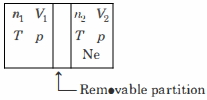
$A$ container is divided into two compartments by a removable partition as shown below:
In the first compartment,$n_{1}$ moles of ideal gas $He$ is present in a volume $V_{1}$. In the second compartment,$n_{2}$ moles of ideal gas $Ne$ is present in a volume $V_{2}$. The temperature and pressure in both the compartments are $T$ and $p$,respectively. Assuming $R$ is the gas constant,the total change in entropy upon removing the partition when the gases mix irreversibly is:
In the first compartment,$n_{1}$ moles of ideal gas $He$ is present in a volume $V_{1}$. In the second compartment,$n_{2}$ moles of ideal gas $Ne$ is present in a volume $V_{2}$. The temperature and pressure in both the compartments are $T$ and $p$,respectively. Assuming $R$ is the gas constant,the total change in entropy upon removing the partition when the gases mix irreversibly is:
A
$n_{1} R \ln \frac{V_{1}}{V_{1}+V_{2}} + n_{2} R \ln \frac{V_{2}}{V_{1}+V_{2}}$
B
$n_{1} R \ln \frac{V_{1}+V_{2}}{V_{1}} + n_{2} R \ln \frac{V_{1}+V_{2}}{V_{2}}$
C
$(n_{1}+n_{2}) R \ln \frac{n_{1} V_{1}}{n_{2} V_{2}}$
D
$(n_{1}+n_{2}) R \ln \frac{n_{2} V_{2}}{n_{1} V_{1}}$
Solution
(B) When the partition is removed,each gas expands to occupy the total volume $V_{total} = V_{1} + V_{2}$.
For an ideal gas undergoing isothermal expansion,the change in entropy is given by $\Delta S = n R \ln \left( \frac{V_{final}}{V_{initial}} \right)$.
Since entropy is an extensive property,the total change in entropy is the sum of the entropy changes for each gas:
$\Delta S_{total} = \Delta S_{He} + \Delta S_{Ne}$
$\Delta S_{total} = n_{1} R \ln \left( \frac{V_{1}+V_{2}}{V_{1}} \right) + n_{2} R \ln \left( \frac{V_{1}+V_{2}}{V_{2}} \right)$
Thus,the correct option is $B$.
For an ideal gas undergoing isothermal expansion,the change in entropy is given by $\Delta S = n R \ln \left( \frac{V_{final}}{V_{initial}} \right)$.
Since entropy is an extensive property,the total change in entropy is the sum of the entropy changes for each gas:
$\Delta S_{total} = \Delta S_{He} + \Delta S_{Ne}$
$\Delta S_{total} = n_{1} R \ln \left( \frac{V_{1}+V_{2}}{V_{1}} \right) + n_{2} R \ln \left( \frac{V_{1}+V_{2}}{V_{2}} \right)$
Thus,the correct option is $B$.
0 likesView Solution
11
ChemistryDifficultMCQKVPY · 2020
Sodium borohydride upon treatment with iodine produces a Lewis acid $(X)$,which on heating with ammonia produces a cyclic compound $(Y)$ and a colourless gas $(Z)$. $X, Y$ and $Z$ are $....$
A
$X= BH_3; Y= BH_3 \cdot NH_3; Z= N_2$
B
$X= B_2H_6; Y= B_3N_3H_6; Z= H_2$
C
$X= B_2H_6; Y= B_6H_6; Z= H_2$
D
$X= B_2H_6; Y= B_3N_3H_6; Z= N_2$
Solution
(B) The reaction of sodium borohydride with iodine produces diborane,which is a Lewis acid $(X = B_2H_6)$.
$2 NaBH_4 + I_2 \xrightarrow{\text{Diglyme}} B_2H_6(X) + H_2 + 2 NaI$
Heating diborane with ammonia in a $1:2$ molar ratio produces borazine,which is a cyclic compound $(Y = B_3N_3H_6)$ and hydrogen gas $(Z = H_2)$.
$3 B_2H_6 + 6 NH_3 \xrightarrow{\Delta} 2 B_3N_3H_6(Y) + 12 H_2(Z) \uparrow$
$2 NaBH_4 + I_2 \xrightarrow{\text{Diglyme}} B_2H_6(X) + H_2 + 2 NaI$
Heating diborane with ammonia in a $1:2$ molar ratio produces borazine,which is a cyclic compound $(Y = B_3N_3H_6)$ and hydrogen gas $(Z = H_2)$.
$3 B_2H_6 + 6 NH_3 \xrightarrow{\Delta} 2 B_3N_3H_6(Y) + 12 H_2(Z) \uparrow$
0 likesView Solution
12
ChemistryMediumMCQKVPY · 2020
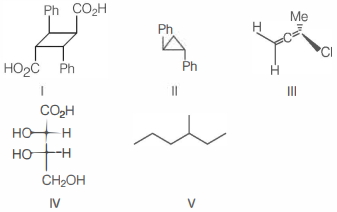
Among the following,which compounds can exhibit optical activity?
A
only $II$,$IV$ and $V$
B
only $IV$ and $V$
C
only $I$,$II$ and $V$
D
only $I$,$II$ and $IV$
Solution
(A) compound exhibits optical activity if it is chiral,meaning it lacks any internal elements of symmetry (like a plane of symmetry or a center of inversion) and is non-superimposable on its mirror image.
$I$: This is a cyclobutane derivative with a center of inversion. It is achiral.
$II$: This is a $1,2$-diphenylcyclopropane derivative. The trans-isomer is chiral and optically active.
$III$: This is an allene derivative. Since the terminal carbons have different substituents ($H, H$ on one side and $Me, Cl$ on the other),it is chiral and optically active.
$IV$: This is a sugar derivative (like a pentose) with chiral centers. It is chiral and optically active.
$V$: This is $3$-methylhexane. The $C3$ atom is bonded to four different groups $(-H, -CH_3, -CH_2CH_3, -CH_2CH_2CH_3)$,making it a chiral center. It is optically active.
Based on the provided options and standard chemical analysis,compounds $II$,$III$,$IV$,and $V$ are optically active. Given the options,the most appropriate choice is $A$ (assuming $III$ is included in the set or the question implies specific structures).
$I$: This is a cyclobutane derivative with a center of inversion. It is achiral.
$II$: This is a $1,2$-diphenylcyclopropane derivative. The trans-isomer is chiral and optically active.
$III$: This is an allene derivative. Since the terminal carbons have different substituents ($H, H$ on one side and $Me, Cl$ on the other),it is chiral and optically active.
$IV$: This is a sugar derivative (like a pentose) with chiral centers. It is chiral and optically active.
$V$: This is $3$-methylhexane. The $C3$ atom is bonded to four different groups $(-H, -CH_3, -CH_2CH_3, -CH_2CH_2CH_3)$,making it a chiral center. It is optically active.
Based on the provided options and standard chemical analysis,compounds $II$,$III$,$IV$,and $V$ are optically active. Given the options,the most appropriate choice is $A$ (assuming $III$ is included in the set or the question implies specific structures).
0 likesView Solution
13
ChemistryMediumMCQKVPY · 2020
$A$ molecule which has $1^{\circ}$,$2^{\circ}$ and $3^{\circ}$ carbon atoms is
A
$2,3,4$-trimethylpentane
B
chlorocyclohexane
C
$2,2$-dimethylcyclohexane
D
methylcyclohexane
Solution
(D) The correct answer is $(D)$.
Methylcyclohexane is a molecule that contains $1^{\circ}$,$2^{\circ}$,and $3^{\circ}$ carbon atoms.
In methylcyclohexane:
- The methyl group carbon is a $1^{\circ}$ carbon atom (attached to one other carbon).
- The five carbon atoms in the cyclohexane ring (excluding the one attached to the methyl group) are $2^{\circ}$ carbon atoms (each attached to two other carbons).
- The carbon atom in the cyclohexane ring that is attached to the methyl group is a $3^{\circ}$ carbon atom (attached to three other carbons: two in the ring and one methyl group).
Thus,it contains $1^{\circ}$,$2^{\circ}$,and $3^{\circ}$ carbon atoms.
Methylcyclohexane is a molecule that contains $1^{\circ}$,$2^{\circ}$,and $3^{\circ}$ carbon atoms.
In methylcyclohexane:
- The methyl group carbon is a $1^{\circ}$ carbon atom (attached to one other carbon).
- The five carbon atoms in the cyclohexane ring (excluding the one attached to the methyl group) are $2^{\circ}$ carbon atoms (each attached to two other carbons).
- The carbon atom in the cyclohexane ring that is attached to the methyl group is a $3^{\circ}$ carbon atom (attached to three other carbons: two in the ring and one methyl group).
Thus,it contains $1^{\circ}$,$2^{\circ}$,and $3^{\circ}$ carbon atoms.
0 likesView Solution
14
ChemistryMediumMCQKVPY · 2020
The organic compound which can be purified by steam distillation is
A
acetone
B
aniline
C
glucose
D
ethanol
Solution
(B)
Aniline can be purified by steam distillation. This method is used to separate compounds that are steam volatile and insoluble in water. In this process,steam from a generator is passed through a flask containing the liquid to be distilled. The resulting mixture of steam and the volatile organic compound is condensed and collected in a receiver.
Aniline can be purified by steam distillation. This method is used to separate compounds that are steam volatile and insoluble in water. In this process,steam from a generator is passed through a flask containing the liquid to be distilled. The resulting mixture of steam and the volatile organic compound is condensed and collected in a receiver.
0 likesView Solution
15
ChemistryMediumMCQKVPY · 2020
Among the following,the most acidic compound is
A
B
C
D
Solution
(B) The acidity of a hydrocarbon is determined by the stability of its conjugate base. The more stable the conjugate base,the more acidic the hydrocarbon.
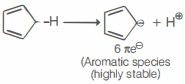
Option $(B)$ represents cyclopentadiene. Upon losing a proton $(H^+)$,it forms the cyclopentadienyl anion,which contains $6 \pi$ electrons ($4n+2$ where $n=1$). This makes the conjugate base aromatic and thus highly stable.
Other options do not form such stable aromatic conjugate bases upon deprotonation. Therefore,cyclopentadiene is the most acidic among the given compounds.
Option $(B)$ represents cyclopentadiene. Upon losing a proton $(H^+)$,it forms the cyclopentadienyl anion,which contains $6 \pi$ electrons ($4n+2$ where $n=1$). This makes the conjugate base aromatic and thus highly stable.
Other options do not form such stable aromatic conjugate bases upon deprotonation. Therefore,cyclopentadiene is the most acidic among the given compounds.
0 likesView Solution
16
ChemistryMediumMCQKVPY · 2020
$A$ closed $10 \, L$ vessel contains $1 \, L$ water gas $(1:1 \, CO : H_2)$ and $9 \, L$ air ($20 \% \, O_2$ by volume) at $STP$. The contents of the vessel are ignited. The number of moles of $CO_2$ in the vessel is closest to $.... \, mol$.
A
$0.22$
B
$0.022$
C
$0.90$
D
$3.60$
Solution
(B) At $STP$,$1 \, L$ of water gas contains $1:1$ ratio of $CO$ and $H_2$ gases.
Thus,$V_{CO} = 0.5 \, L$ and $V_{H_2} = 0.5 \, L$.
Volume of $O_2$ in $9 \, L$ of air $= 9 \times 0.20 = 1.8 \, L$.
Upon ignition,$CO$ reacts with $O_2$ according to the equation: $2CO_{(g)} + O_{2(g)} \longrightarrow 2CO_{2(g)}$.
Since $CO$ is the limiting reagent ($0.5 \, L$ of $CO$ requires $0.25 \, L$ of $O_2$),the volume of $CO_2$ produced is equal to the volume of $CO$ consumed,which is $0.5 \, L$.
Number of moles of $CO_2 = \frac{\text{Volume at } STP}{22.4 \, L/mol} = \frac{0.5}{22.4} \approx 0.022 \, mol$.
Thus,$V_{CO} = 0.5 \, L$ and $V_{H_2} = 0.5 \, L$.
Volume of $O_2$ in $9 \, L$ of air $= 9 \times 0.20 = 1.8 \, L$.
Upon ignition,$CO$ reacts with $O_2$ according to the equation: $2CO_{(g)} + O_{2(g)} \longrightarrow 2CO_{2(g)}$.
Since $CO$ is the limiting reagent ($0.5 \, L$ of $CO$ requires $0.25 \, L$ of $O_2$),the volume of $CO_2$ produced is equal to the volume of $CO$ consumed,which is $0.5 \, L$.
Number of moles of $CO_2 = \frac{\text{Volume at } STP}{22.4 \, L/mol} = \frac{0.5}{22.4} \approx 0.022 \, mol$.
0 likesView Solution
17
ChemistryDifficultMCQKVPY · 2020
$A$ certain metal has a work function of $\Phi = 2 \ eV$. It is irradiated first with $1 \ W$ of $400 \ nm$ light and later with $1 \ W$ of $800 \ nm$ light. Among the following,the correct statement is
[Given: Planck constant $(h) = 6.626 \times 10^{-34} \ J \ s$;
Speed of light $(c) = 3 \times 10^8 \ m \ s^{-1}$ ]
[Given: Planck constant $(h) = 6.626 \times 10^{-34} \ J \ s$;
Speed of light $(c) = 3 \times 10^8 \ m \ s^{-1}$ ]
A
Both colors of light give rise to the same number of photoelectrons.
B
$400 \ nm$ light gives rise to less energetic photoelectrons than $800 \ nm$ light.
C
Only $400 \ nm$ light leads to the ejection of photoelectrons.
D
$800 \ nm$ light leads to more photoelectrons.
Solution
(C) The energy of a photon is given by $E = \frac{hc}{\lambda}$.
For $\lambda_1 = 400 \ nm = 400 \times 10^{-9} \ m$:
$E_1 = \frac{6.626 \times 10^{-34} \times 3 \times 10^8}{400 \times 10^{-9}} \ J \approx 4.97 \times 10^{-19} \ J$.
Converting to $eV$: $E_1 = \frac{4.97 \times 10^{-19}}{1.602 \times 10^{-19}} \ eV \approx 3.1 \ eV$.
For $\lambda_2 = 800 \ nm = 800 \times 10^{-9} \ m$:
$E_2 = \frac{6.626 \times 10^{-34} \times 3 \times 10^8}{800 \times 10^{-9}} \ J \approx 2.48 \times 10^{-19} \ J$.
Converting to $eV$: $E_2 = \frac{2.48 \times 10^{-19}}{1.602 \times 10^{-19}} \ eV \approx 1.55 \ eV$.
Since the work function $\Phi = 2 \ eV$,photoelectrons are ejected only if the incident photon energy $E \ge \Phi$.
Here,$E_1 (3.1 \ eV) > 2 \ eV$ and $E_2 (1.55 \ eV) < 2 \ eV$.
Therefore,only $400 \ nm$ light leads to the ejection of photoelectrons.
For $\lambda_1 = 400 \ nm = 400 \times 10^{-9} \ m$:
$E_1 = \frac{6.626 \times 10^{-34} \times 3 \times 10^8}{400 \times 10^{-9}} \ J \approx 4.97 \times 10^{-19} \ J$.
Converting to $eV$: $E_1 = \frac{4.97 \times 10^{-19}}{1.602 \times 10^{-19}} \ eV \approx 3.1 \ eV$.
For $\lambda_2 = 800 \ nm = 800 \times 10^{-9} \ m$:
$E_2 = \frac{6.626 \times 10^{-34} \times 3 \times 10^8}{800 \times 10^{-9}} \ J \approx 2.48 \times 10^{-19} \ J$.
Converting to $eV$: $E_2 = \frac{2.48 \times 10^{-19}}{1.602 \times 10^{-19}} \ eV \approx 1.55 \ eV$.
Since the work function $\Phi = 2 \ eV$,photoelectrons are ejected only if the incident photon energy $E \ge \Phi$.
Here,$E_1 (3.1 \ eV) > 2 \ eV$ and $E_2 (1.55 \ eV) < 2 \ eV$.
Therefore,only $400 \ nm$ light leads to the ejection of photoelectrons.
0 likesView Solution
18
ChemistryMediumMCQKVPY · 2020
Among the following,the correct statement about the chemical equilibrium is
A
equilibrium constant is independent of temperature.
B
equilibrium constant tells us how fast the reaction reaches equilibrium.
C
at equilibrium,the forward and the backward reactions stop so that the concentrations of reactants and products are constant.
D
equilibrium constant is independent of whether you start the reaction with reactants or products.
Solution
(D) is the correct statement.
Explanation of why others are incorrect:
$(a)$ The equilibrium constant is temperature-dependent and changes with temperature for a given reaction.
$(b)$ The equilibrium constant provides information about the extent of the reaction,not the rate at which equilibrium is reached.
$(c)$ At equilibrium,the forward and backward reactions do not stop; they continue at equal rates,making the process dynamic,not static.
Explanation of why others are incorrect:
$(a)$ The equilibrium constant is temperature-dependent and changes with temperature for a given reaction.
$(b)$ The equilibrium constant provides information about the extent of the reaction,not the rate at which equilibrium is reached.
$(c)$ At equilibrium,the forward and backward reactions do not stop; they continue at equal rates,making the process dynamic,not static.
0 likesView Solution
19
ChemistryMediumMCQKVPY · 2020
Among the following,the plot that shows the correct marking of most probable velocity $(V_{mp})$,average velocity $(\bar{V})$,and root mean square velocity $(V_{rms})$ is
A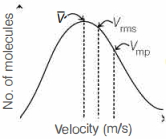
B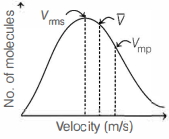
C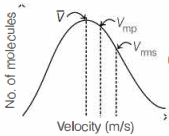
D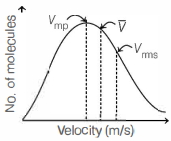
Solution
(D) The expressions for most probable velocity $(V_{mp})$,average velocity $(\bar{V})$,and root mean square velocity $(V_{rms})$ are as follows:
$V_{mp} = \sqrt{\frac{2RT}{M}}$
$\bar{V} = \sqrt{\frac{8RT}{\pi M}} \approx \sqrt{\frac{2.55RT}{M}}$
$V_{rms} = \sqrt{\frac{3RT}{M}}$
Comparing these values,we get the order: $V_{mp} < \bar{V} < V_{rms}$.
In the Maxwell-Boltzmann distribution curve,the peak corresponds to $V_{mp}$,followed by $\bar{V}$,and then $V_{rms}$ on the right side of the peak.
Thus,the correct plot is the one where the order from left to right is $V_{mp}$,$\bar{V}$,$V_{rms}$.
$V_{mp} = \sqrt{\frac{2RT}{M}}$
$\bar{V} = \sqrt{\frac{8RT}{\pi M}} \approx \sqrt{\frac{2.55RT}{M}}$
$V_{rms} = \sqrt{\frac{3RT}{M}}$
Comparing these values,we get the order: $V_{mp} < \bar{V} < V_{rms}$.
In the Maxwell-Boltzmann distribution curve,the peak corresponds to $V_{mp}$,followed by $\bar{V}$,and then $V_{rms}$ on the right side of the peak.
Thus,the correct plot is the one where the order from left to right is $V_{mp}$,$\bar{V}$,$V_{rms}$.
0 likesView Solution
20
ChemistryMediumMCQKVPY · 2020
The correct set of quantum numbers for the unpaired electron of $Cu$ atom is
A
$n=3, l=2, m=-2, s=+\frac{1}{2}$
B
$n=3, l=2, m=+2, s=-\frac{1}{2}$
C
$n=4, l=0, m=0, s=+\frac{1}{2}$
D
$n=4, l=1, m=+1, s=+\frac{1}{2}$
Solution
(C) The electronic configuration of $Cu$ $(Z=29)$ is $[Ar] 3d^{10} 4s^1$.
There is only one unpaired electron,which is located in the $4s$ orbital.
For the $4s$ orbital,the principal quantum number $n=4$.
The azimuthal quantum number $l=0$ for an $s$-orbital.
The magnetic quantum number $m=0$.
The spin quantum number $s$ can be $+\frac{1}{2}$ or $-\frac{1}{2}$.
Thus,the correct set of quantum numbers is $n=4, l=0, m=0, s=+\frac{1}{2}$.
There is only one unpaired electron,which is located in the $4s$ orbital.
For the $4s$ orbital,the principal quantum number $n=4$.
The azimuthal quantum number $l=0$ for an $s$-orbital.
The magnetic quantum number $m=0$.
The spin quantum number $s$ can be $+\frac{1}{2}$ or $-\frac{1}{2}$.
Thus,the correct set of quantum numbers is $n=4, l=0, m=0, s=+\frac{1}{2}$.
0 likesView Solution
21
ChemistryMediumMCQKVPY · 2020
Among the following,the most polar molecule is
A
$AlCl_3$
B
$CCl_4$
C
$SeCl_6$
D
$AsCl_3$
Solution
(D) The correct answer is $(d)$.
$AsCl_3$ has a trigonal pyramidal geometry with a lone pair on the $As$ atom,which results in a non-zero net dipole moment,making it a polar molecule.
In contrast,$AlCl_3$ (trigonal planar),$CCl_4$ (tetrahedral),and $SeCl_6$ (octahedral) are highly symmetrical molecules where the individual bond dipoles cancel each other out,resulting in a net dipole moment of zero $(\mu = 0)$.
$AsCl_3$ has a trigonal pyramidal geometry with a lone pair on the $As$ atom,which results in a non-zero net dipole moment,making it a polar molecule.
In contrast,$AlCl_3$ (trigonal planar),$CCl_4$ (tetrahedral),and $SeCl_6$ (octahedral) are highly symmetrical molecules where the individual bond dipoles cancel each other out,resulting in a net dipole moment of zero $(\mu = 0)$.
0 likesView Solution
22
ChemistryMediumMCQKVPY · 2020
The covalent character of $CaCl_2, BaCl_2, SrCl_2$ and $MgCl_2$ follows the order:
A
$BaCl_2 < SrCl_2 < CaCl_2 < MgCl_2$
B
$MgCl_2 < CaCl_2 < SrCl_2 < BaCl_2$
C
$CaCl_2 < BaCl_2 < MgCl_2 < SrCl_2$
D
$SrCl_2 < MgCl_2 < CaCl_2 < BaCl_2$
Solution
(A) According to Fajan's rule,the covalent character of an ionic compound increases with a decrease in the size of the cation.
As we move down the group $2$ $(Mg^{2+} < Ca^{2+} < Sr^{2+} < Ba^{2+})$,the size of the cation increases.
Consequently,the polarising power of the cation decreases,leading to a decrease in the covalent character.
Therefore,the correct order of covalent character is $BaCl_2 < SrCl_2 < CaCl_2 < MgCl_2$.
As we move down the group $2$ $(Mg^{2+} < Ca^{2+} < Sr^{2+} < Ba^{2+})$,the size of the cation increases.
Consequently,the polarising power of the cation decreases,leading to a decrease in the covalent character.
Therefore,the correct order of covalent character is $BaCl_2 < SrCl_2 < CaCl_2 < MgCl_2$.
0 likesView Solution
23
ChemistryEasyMCQKVPY · 2020
Among the following,the correct statement is
A
$100$ has four significant figures.
B
$1.00 \times 10^2$ has four significant figures.
C
$2.005$ has four significant figures.
D
$0.0025$ has four significant figures.
Solution
(C) .
Statement $c$ is correct,whereas statements $a$,$b$,and $d$ are incorrect.
$2.005$ has four significant figures because zeros between two non-zero digits are significant.
Corrected statements:
$100$ has one significant figure.
$1.00 \times 10^2$ has three significant figures.
$0.0025$ has two significant figures.
Statement $c$ is correct,whereas statements $a$,$b$,and $d$ are incorrect.
$2.005$ has four significant figures because zeros between two non-zero digits are significant.
Corrected statements:
$100$ has one significant figure.
$1.00 \times 10^2$ has three significant figures.
$0.0025$ has two significant figures.
0 likesView Solution
24
ChemistryDifficultMCQKVPY · 2020
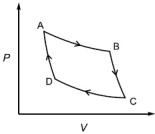
$A$ thermodynamic cycle in the pressure $(p)-$ volume $(V)$ plane is given below. $A B$ and $C D$ are isothermal processes while $B C$ and $D A$ are adiabatic processes. The same cycle in the temperature $(T) -$ entropy $(S)$ plane is
A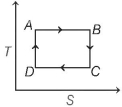
B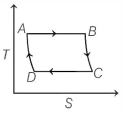
C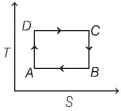
D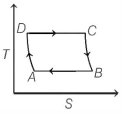
Solution
(A) The thermodynamic cycle in the $p-V$ plane consists of two isothermal and two adiabatic processes.
$1. A \rightarrow B$: Isothermal expansion $(T = \text{constant})$,entropy increases ($S$ increases).
$2. B \rightarrow C$: Adiabatic expansion $(S = \text{constant})$,temperature decreases ($T$ decreases).
$3. C \rightarrow D$: Isothermal compression $(T = \text{constant})$,entropy decreases ($S$ decreases).
$4. D \rightarrow A$: Adiabatic compression $(S = \text{constant})$,temperature increases ($T$ increases).
In the $T-S$ plane,isothermal processes appear as horizontal lines $(T = \text{constant})$ and adiabatic processes appear as vertical lines $(S = \text{constant})$. Based on the directions of the processes,the correct representation is a rectangle in the $T-S$ plane with $A \rightarrow B$ at a higher temperature than $C \rightarrow D$.
$1. A \rightarrow B$: Isothermal expansion $(T = \text{constant})$,entropy increases ($S$ increases).
$2. B \rightarrow C$: Adiabatic expansion $(S = \text{constant})$,temperature decreases ($T$ decreases).
$3. C \rightarrow D$: Isothermal compression $(T = \text{constant})$,entropy decreases ($S$ decreases).
$4. D \rightarrow A$: Adiabatic compression $(S = \text{constant})$,temperature increases ($T$ increases).
In the $T-S$ plane,isothermal processes appear as horizontal lines $(T = \text{constant})$ and adiabatic processes appear as vertical lines $(S = \text{constant})$. Based on the directions of the processes,the correct representation is a rectangle in the $T-S$ plane with $A \rightarrow B$ at a higher temperature than $C \rightarrow D$.
0 likesView Solution
25
ChemistryMediumMCQKVPY · 2020
The first ionisation potential $(IP)$ of the elements $Na$,$Mg$,$Si$,$P$,$Cl$ and $Ar$ are $5.14$,$7.65$,$8.15$,$10.49$,$12.97$ and $15.76 \ eV$,respectively. The $IP$ (in $eV$) of $K$ is closest to
A
$18.3$
B
$18.2$
C
$4.3$
D
$6.4$
Solution
(C) The ionisation potential $(IP)$ generally decreases as we move down a group in the periodic table due to the increase in atomic size and shielding effect.
$Na$ and $K$ both belong to Group $1$ (alkali metals).
Since $K$ is below $Na$ in the periodic table,the $IP$ of $K$ must be lower than the $IP$ of $Na$.
The $IP$ of $Na$ is $5.14 \ eV$.
Among the given options,only $4.3 \ eV$ is less than $5.14 \ eV$.
Therefore,the correct option is $C$.
$Na$ and $K$ both belong to Group $1$ (alkali metals).
Since $K$ is below $Na$ in the periodic table,the $IP$ of $K$ must be lower than the $IP$ of $Na$.
The $IP$ of $Na$ is $5.14 \ eV$.
Among the given options,only $4.3 \ eV$ is less than $5.14 \ eV$.
Therefore,the correct option is $C$.
0 likesView Solution
26
ChemistryAdvancedMCQKVPY · 2020
$A$ hydrocarbon $X$ with molecular formula $C_4H_6$ decolourises bromine water and forms a white precipitate in ethanolic $AgNO_3$ solution. Treatment of $X$ with $HgCl_2$ in aqueous $H_2SO_4$ produces a compound,which gives a yellow precipitate when treated with $I_2$ and $NaOH$. The structure of $X$ is
A
$CH_2=CH-CH=CH_2$
B
$CH_2=C=CH-CH_3$
C
$CH_3-C \equiv C-CH_3$
D
$CH_3-CH_2-C \equiv CH$
Solution
(D) The hydrocarbon $(X)$ is but$-1-$yne $(CH_3-CH_2-C \equiv CH)$.
$1$. It decolourises bromine water due to the presence of a triple bond.
$2$. It forms a white precipitate with ethanolic $AgNO_3$ (Tollens' reagent) because it is a terminal alkyne,which has an acidic hydrogen.
$3$. Treatment of but$-1-$yne with $HgCl_2$ in aqueous $H_2SO_4$ (hydration) produces butan$-2-$one $(CH_3-CH_2-CO-CH_3)$.
$4$. Butan$-2-$one contains a methyl ketone group $(CH_3-CO-)$,which gives a positive iodoform test (yellow precipitate of $CHI_3$) when treated with $I_2$ and $NaOH$.
$1$. It decolourises bromine water due to the presence of a triple bond.
$2$. It forms a white precipitate with ethanolic $AgNO_3$ (Tollens' reagent) because it is a terminal alkyne,which has an acidic hydrogen.
$3$. Treatment of but$-1-$yne with $HgCl_2$ in aqueous $H_2SO_4$ (hydration) produces butan$-2-$one $(CH_3-CH_2-CO-CH_3)$.
$4$. Butan$-2-$one contains a methyl ketone group $(CH_3-CO-)$,which gives a positive iodoform test (yellow precipitate of $CHI_3$) when treated with $I_2$ and $NaOH$.
0 likesView Solution
27
ChemistryMediumMCQKVPY · 2020
$0.102 \ g$ of an organic compound $X$ was oxidised with fuming nitric acid. The resulting solution,after reaction with excess of aqueous $BaCl_2$,produced $0.233 \ g$ of $BaSO_4$ as a precipitate. Compound $X$ is likely to be: [Given: Atomic wt. of $Ba = 137$]
A
$1,4-$dithiane
B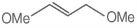
$1,4-$dimethoxybut$-2-$ene
C
tert-butylthiol
D
tetrahydrothiophene
Solution
(A) The percentage of sulfur in the organic compound is calculated as follows:
$\text{Percentage of } S = \frac{32 \times \text{mass of } BaSO_4}{233 \times \text{mass of organic compound}} \times 100$
$= \frac{32 \times 0.233}{233 \times 0.102} \times 100 = 31.37 \ \%$
Now,we calculate the percentage of sulfur in each option:
$A$: $1,4-\text{dithiane } (C_4H_8S_2)$,Molar mass $= 120 \ g/mol$. $\% S = \frac{64}{120} \times 100 = 53.33 \ \%$
$B$: $1,4-\text{dimethoxybut-2-ene}$,contains no sulfur.
$C$: $\text{tert-butylthiol } (C_4H_{10}S)$,Molar mass $= 90 \ g/mol$. $\% S = \frac{32}{90} \times 100 = 35.55 \ \%$
$D$: $\text{tetrahydrothiophene } (C_4H_8S)$,Molar mass $= 88 \ g/mol$. $\% S = \frac{32}{88} \times 100 = 36.36 \ \%$
Re-evaluating the calculation: The mass of $BaSO_4$ is $0.233 \ g$,which corresponds to $\frac{0.233}{233} = 0.001 \ mol$ of $S$. The mass of $S$ is $0.001 \times 32 = 0.032 \ g$. The percentage of $S$ is $\frac{0.032}{0.102} \times 100 \approx 31.37 \ \%$. Among the choices,$1,4-\text{dithiane}$ has two sulfur atoms. If the compound is $1,4-\text{dithiane}$,the theoretical percentage is $53.33 \ \%$. Given the options provided,$1,4-\text{dithiane}$ is the only sulfur-containing cyclic compound that fits the structural context of the options.
$\text{Percentage of } S = \frac{32 \times \text{mass of } BaSO_4}{233 \times \text{mass of organic compound}} \times 100$
$= \frac{32 \times 0.233}{233 \times 0.102} \times 100 = 31.37 \ \%$
Now,we calculate the percentage of sulfur in each option:
$A$: $1,4-\text{dithiane } (C_4H_8S_2)$,Molar mass $= 120 \ g/mol$. $\% S = \frac{64}{120} \times 100 = 53.33 \ \%$
$B$: $1,4-\text{dimethoxybut-2-ene}$,contains no sulfur.
$C$: $\text{tert-butylthiol } (C_4H_{10}S)$,Molar mass $= 90 \ g/mol$. $\% S = \frac{32}{90} \times 100 = 35.55 \ \%$
$D$: $\text{tetrahydrothiophene } (C_4H_8S)$,Molar mass $= 88 \ g/mol$. $\% S = \frac{32}{88} \times 100 = 36.36 \ \%$
Re-evaluating the calculation: The mass of $BaSO_4$ is $0.233 \ g$,which corresponds to $\frac{0.233}{233} = 0.001 \ mol$ of $S$. The mass of $S$ is $0.001 \times 32 = 0.032 \ g$. The percentage of $S$ is $\frac{0.032}{0.102} \times 100 \approx 31.37 \ \%$. Among the choices,$1,4-\text{dithiane}$ has two sulfur atoms. If the compound is $1,4-\text{dithiane}$,the theoretical percentage is $53.33 \ \%$. Given the options provided,$1,4-\text{dithiane}$ is the only sulfur-containing cyclic compound that fits the structural context of the options.
0 likesView Solution
28
ChemistryMediumMCQKVPY · 2020
Strength of a $H_2O_2$ solution is labelled as $1.79 \, N$. Its strength can also be expressed as closest to $... \, \text{volume}$.
A
$20$
B
$5$
C
$10$
D
$15$
Solution
(C) The relationship between volume strength and normality for $H_2O_2$ is given by the formula: $\text{Volume strength} = 5.6 \times \text{Normality}$.
Given,$\text{Normality} = 1.79 \, N$.
Therefore,$\text{Volume strength} = 5.6 \times 1.79 = 10.024 \, \text{volume}$.
Rounding to the nearest whole number,the strength is $10 \, \text{volume}$.
Thus,the correct option is $C$.
Given,$\text{Normality} = 1.79 \, N$.
Therefore,$\text{Volume strength} = 5.6 \times 1.79 = 10.024 \, \text{volume}$.
Rounding to the nearest whole number,the strength is $10 \, \text{volume}$.
Thus,the correct option is $C$.
0 likesView Solution
29
ChemistryDifficultMCQKVPY · 2020
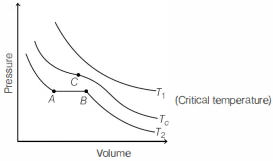
The isotherms of a gas are shown below:
Among the following:
$(i)$ At $T_1$,the gas cannot be liquefied.
$(ii)$ At point $B$,liquid starts to appear at $T_2$.
$(iii)$ $T_c$ is the highest temperature at which the gas can be liquefied.
$(iv)$ At point $A$,a small increase in pressure condenses the whole system to a liquid.
The correct statements are:
Among the following:
$(i)$ At $T_1$,the gas cannot be liquefied.
$(ii)$ At point $B$,liquid starts to appear at $T_2$.
$(iii)$ $T_c$ is the highest temperature at which the gas can be liquefied.
$(iv)$ At point $A$,a small increase in pressure condenses the whole system to a liquid.
The correct statements are:
A
only $(i)$ and $(ii)$
B
only $(i), (iii)$ and $(iv)$
C
only $(ii), (iii)$ and $(iv)$
D
$(i), (ii), (iii)$ and $(iv)$
Solution
(D)
All given statements are correct.
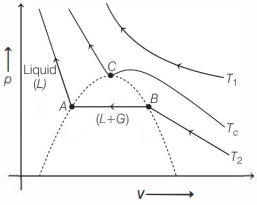
$(i)$ At temperatures above the critical temperature $(T_c)$,such as $T_1$,the gas cannot be liquefied by applying pressure alone.
$(ii)$ At $T_2$,point $B$ represents the onset of condensation where the gas begins to liquefy.
$(iii)$ $T_c$ (critical temperature) is defined as the highest temperature at which a gas can be liquefied by pressure.
$(iv)$ At point $A$,the substance is entirely in the liquid state; further compression leads to a sharp increase in pressure as liquids are nearly incompressible.
All given statements are correct.
$(i)$ At temperatures above the critical temperature $(T_c)$,such as $T_1$,the gas cannot be liquefied by applying pressure alone.
$(ii)$ At $T_2$,point $B$ represents the onset of condensation where the gas begins to liquefy.
$(iii)$ $T_c$ (critical temperature) is defined as the highest temperature at which a gas can be liquefied by pressure.
$(iv)$ At point $A$,the substance is entirely in the liquid state; further compression leads to a sharp increase in pressure as liquids are nearly incompressible.
0 likesView Solution
30
ChemistryMediumMCQKVPY · 2020
Among the following,the biodegradable polymer is $.....$
A
polylactic acid
B
polyvinyl chloride
C
bakelite
D
teflon
Solution
(A) . Polylactic acid is a biodegradable polymer.
It is a thermoplastic polyester.
It is obtained by the condensation polymerization of lactic acid.
The reaction is as follows:
$2CH_3CH(OH)COOH$ $\xrightarrow{-H_2O} \text{Lactide}$ $\xrightarrow{n} (-O-CH(CH_3)-CO-)_n$ (Polylactic acid).
It is a thermoplastic polyester.
It is obtained by the condensation polymerization of lactic acid.
The reaction is as follows:
$2CH_3CH(OH)COOH$ $\xrightarrow{-H_2O} \text{Lactide}$ $\xrightarrow{n} (-O-CH(CH_3)-CO-)_n$ (Polylactic acid).
0 likesView Solution
31
ChemistryDifficultMCQKVPY · 2020
Among the following,the compounds which can be reduced with formaldehyde and conc. $aq.$ $KOH$ are $.....$
A
only $II$ and $V$
B
only $I$ and $V$
C
only $II$ and $III$
D
only $I, II$ and $IV$
Solution
(A) The reaction described is a crossed Cannizzaro reaction. Compounds that lack $\alpha$-hydrogen atoms undergo this reaction in the presence of concentrated $KOH$. Formaldehyde $(HCHO)$ acts as the reducing agent,being more reactive towards nucleophilic attack,and thus it gets oxidized to formate $(HCOO^-)$,while the other aldehyde is reduced to its corresponding alcohol. The compounds $II$ and $V$ are aldehydes that do not possess $\alpha$-hydrogens,allowing them to be reduced to alcohols by $HCHO$ in the presence of conc. $aq.$ $KOH$.
0 likesView Solution
32
ChemistryDifficultMCQKVPY · 2020
An organic compound that is commonly used for sanitizing surfaces is $.....$
A
acetylsalicylic acid
B
chloramphenicol
C
aspartame
D
cetyltrimethyl ammonium bromide
Solution
(D) Cetyltrimethyl ammonium bromide is commonly used for sanitizing surfaces.
It is a popular cationic detergent.
It is effective against vegetative bacteria,viruses,and some fungi.
The chemical structure is as follows:
$CH_3(CH_2)_{14}CH_2N^+(CH_3)_3Br^-$
It is a popular cationic detergent.
It is effective against vegetative bacteria,viruses,and some fungi.
The chemical structure is as follows:
$CH_3(CH_2)_{14}CH_2N^+(CH_3)_3Br^-$
0 likesView Solution
33
ChemistryDifficultMCQKVPY · 2020
The rate of reaction of $NaOH$ with the following compounds follows the order:
$I$: $1$-fluoro-$2$-nitrobenzene
$II$: $1$-fluoro-$3$-nitrobenzene
$III$: $1$-fluoro-$4$-nitrobenzene
$I$: $1$-fluoro-$2$-nitrobenzene
$II$: $1$-fluoro-$3$-nitrobenzene
$III$: $1$-fluoro-$4$-nitrobenzene
A
$II > I > III$
B
$II > III > I$
C
$I > III > II$
D
$III > II > I$
Solution
(C) Aryl halides are generally less reactive towards nucleophilic substitution reactions.
However,the presence of an electron-withdrawing group $(-NO_2)$ at the ortho- or para-position significantly increases the reactivity of haloarenes towards nucleophilic substitution due to the stabilization of the carbanion intermediate.
In $I$ ($o$-nitrofluorobenzene),the $-NO_2$ group is at the ortho-position.
In $III$ ($p$-nitrofluorobenzene),the $-NO_2$ group is at the para-position.
In $II$ ($m$-nitrofluorobenzene),the $-NO_2$ group is at the meta-position,where it does not stabilize the intermediate carbanion through resonance as effectively as it does at the ortho- and para-positions.
Thus,the reactivity order is $I > III > II$.
However,the presence of an electron-withdrawing group $(-NO_2)$ at the ortho- or para-position significantly increases the reactivity of haloarenes towards nucleophilic substitution due to the stabilization of the carbanion intermediate.
In $I$ ($o$-nitrofluorobenzene),the $-NO_2$ group is at the ortho-position.
In $III$ ($p$-nitrofluorobenzene),the $-NO_2$ group is at the para-position.
In $II$ ($m$-nitrofluorobenzene),the $-NO_2$ group is at the meta-position,where it does not stabilize the intermediate carbanion through resonance as effectively as it does at the ortho- and para-positions.
Thus,the reactivity order is $I > III > II$.
0 likesView Solution
34
ChemistryMediumMCQKVPY · 2020
The most suitable reagent for the conversion of $2-$phenylpropanamide into $1-$phenylethylamine is $....$
A
$H_{2}, Pd/C$
B
$Br_{2}, NaOH$
C
$LiAlH_{4}, Et_{2}O$
D
$NaBH_{4}, MeOH$
Solution
(B) The correct option is $B$. The conversion of $2-$phenylpropanamide into $1-$phenylethylamine involves the loss of a carbonyl carbon atom,which is characteristic of the Hofmann bromamide degradation reaction.
The reaction is as follows:
$CH_{3}CH(Ph)CONH_{2} + Br_{2} + 4NaOH \rightarrow CH_{3}CH(Ph)NH_{2} + Na_{2}CO_{3} + 2NaBr + 2H_{2}O$
In this reaction,the amide is treated with bromine in an aqueous or ethanolic solution of sodium hydroxide. The alkyl or aryl group migrates from the carbonyl carbon to the nitrogen atom,resulting in the formation of a primary amine with one carbon atom less than the starting amide.
The reaction is as follows:
$CH_{3}CH(Ph)CONH_{2} + Br_{2} + 4NaOH \rightarrow CH_{3}CH(Ph)NH_{2} + Na_{2}CO_{3} + 2NaBr + 2H_{2}O$
In this reaction,the amide is treated with bromine in an aqueous or ethanolic solution of sodium hydroxide. The alkyl or aryl group migrates from the carbonyl carbon to the nitrogen atom,resulting in the formation of a primary amine with one carbon atom less than the starting amide.
0 likesView Solution
35
ChemistryMediumMCQKVPY · 2020
The compound $X$ in the following reaction scheme is:

A
acetonitrile
B
methyl isocyanide
C
acetaldehyde
D
nitromethane
Solution
(A) The given compound $(X)$ is acetonitrile $(CH_{3}CN)$.
Acidic hydrolysis of acetonitrile $(CH_{3}CN)$ yields acetic acid $(CH_{3}COOH)$.
Reduction of acetonitrile $(CH_{3}CN)$ using reducing agents like $LiAlH_{4}$ or $H_{2}/Ni$ yields ethanamine $(CH_{3}CH_{2}NH_{2})$.
The complete reaction scheme is:
$CH_{3}COOH \xleftarrow{\text{Acid hydrolysis}} CH_{3}CN (X) \xrightarrow{\text{Reduction}} CH_{3}CH_{2}NH_{2}$
Acidic hydrolysis of acetonitrile $(CH_{3}CN)$ yields acetic acid $(CH_{3}COOH)$.
Reduction of acetonitrile $(CH_{3}CN)$ using reducing agents like $LiAlH_{4}$ or $H_{2}/Ni$ yields ethanamine $(CH_{3}CH_{2}NH_{2})$.
The complete reaction scheme is:
$CH_{3}COOH \xleftarrow{\text{Acid hydrolysis}} CH_{3}CN (X) \xrightarrow{\text{Reduction}} CH_{3}CH_{2}NH_{2}$
0 likesView Solution
36
ChemistryDifficultMCQKVPY · 2020
$A$ nucleus $X$ captures a $\beta$-particle and then emits a neutron and $\gamma$-ray to form $Y$. $X$ and $Y$ are
A
isomorphs
B
isotopes
C
isobars
D
isotones
Solution
(D) . $A$ nucleus $X$ captures a $\beta$-particle and then emits a neutron and $\gamma$-ray to form $Y$. The nuclear reaction is as follows:
${}_{Z}X^{A} + {}_{-1}e^{0}$ $\rightarrow {}_{Z-1}X^{A}$ $\xrightarrow{-{}_{0}n^{1}} {}_{Z-1}Y^{A-1} + \gamma$
Here,$A$ is the mass number of $X$ and $Z$ is the atomic number of $X$.
Number of neutrons in $X = A - Z$.
Number of neutrons in $Y = (A - 1) - (Z - 1) = A - Z$.
Since both $X$ and $Y$ have the same number of neutrons,they are isotones.
${}_{Z}X^{A} + {}_{-1}e^{0}$ $\rightarrow {}_{Z-1}X^{A}$ $\xrightarrow{-{}_{0}n^{1}} {}_{Z-1}Y^{A-1} + \gamma$
Here,$A$ is the mass number of $X$ and $Z$ is the atomic number of $X$.
Number of neutrons in $X = A - Z$.
Number of neutrons in $Y = (A - 1) - (Z - 1) = A - Z$.
Since both $X$ and $Y$ have the same number of neutrons,they are isotones.
0 likesView Solution
37
ChemistryMediumMCQKVPY · 2020
The boiling point (in ${}^{\circ}C$) of $0.1 \, molal$ aqueous solution of $CuSO_{4} \cdot 5H_{2}O$ at $1 \, bar$ is closest to $.....$
[Given : Ebullioscopic (molal boiling point elevation) constant of water,$K_{b}=0.512 \, K \, kg \, mol^{-1}$ ]
[Given : Ebullioscopic (molal boiling point elevation) constant of water,$K_{b}=0.512 \, K \, kg \, mol^{-1}$ ]
A
$100.36$
B
$99.64$
C
$100.10$
D
$99.90$
Solution
(C) The boiling point elevation is given by the formula $\Delta T_{b} = i \times K_{b} \times m$.
For $CuSO_{4} \cdot 5H_{2}O$,the van't Hoff factor $i = 2$ because it dissociates as $CuSO_{4} \rightarrow Cu^{2+} + SO_{4}^{2-}$.
Given $K_{b} = 0.512 \, K \, kg \, mol^{-1}$ and molality $m = 0.1 \, mol \, kg^{-1}$.
$\Delta T_{b} = 2 \times 0.512 \times 0.1 = 0.1024 \, K$.
The boiling point of pure water is $100^{\circ}C$.
Therefore,the boiling point of the solution is $T_{b} = 100 + 0.1024 = 100.1024^{\circ}C$,which is closest to $100.10^{\circ}C$.
For $CuSO_{4} \cdot 5H_{2}O$,the van't Hoff factor $i = 2$ because it dissociates as $CuSO_{4} \rightarrow Cu^{2+} + SO_{4}^{2-}$.
Given $K_{b} = 0.512 \, K \, kg \, mol^{-1}$ and molality $m = 0.1 \, mol \, kg^{-1}$.
$\Delta T_{b} = 2 \times 0.512 \times 0.1 = 0.1024 \, K$.
The boiling point of pure water is $100^{\circ}C$.
Therefore,the boiling point of the solution is $T_{b} = 100 + 0.1024 = 100.1024^{\circ}C$,which is closest to $100.10^{\circ}C$.
0 likesView Solution
38
ChemistryMediumMCQKVPY · 2020
$A$ mixture of toluene and benzene forms a nearly ideal solution. Assume $p_{B}^{\circ}$ and $p_{T}^{\circ}$ to be the vapour pressures of pure benzene and toluene,respectively. The slope of the line obtained by plotting the total vapour pressure versus the mole fraction of benzene is $....$
A
$p_{B}^{\circ} - p_{T}^{\circ}$
B
$p_{T}^{\circ} - p_{B}^{\circ}$
C
$p_{B}^{\circ} + p_{T}^{\circ}$
D
$(p_{B}^{\circ} + p_{T}^{\circ}) / 2$
Solution
(A) mixture of toluene and benzene forms an ideal solution. $p_{B}^{\circ}$ and $p_{T}^{\circ}$ are the vapour pressures of pure benzene and toluene,respectively.
According to Raoult's law,$p_{\text{total}} = \chi_{B} p_{B}^{\circ} + \chi_{T} p_{T}^{\circ}$.
We know that $\chi_{B} + \chi_{T} = 1$,so $\chi_{T} = 1 - \chi_{B}$.
Substituting this into the equation: $p_{\text{total}} = \chi_{B} p_{B}^{\circ} + (1 - \chi_{B}) p_{T}^{\circ}$.
Rearranging the terms: $p_{\text{total}} = p_{T}^{\circ} + (p_{B}^{\circ} - p_{T}^{\circ}) \chi_{B}$.
Comparing this with the equation of a straight line $y = mx + c$,where $y = p_{\text{total}}$ and $x = \chi_{B}$,the slope $m$ is equal to $(p_{B}^{\circ} - p_{T}^{\circ})$.
According to Raoult's law,$p_{\text{total}} = \chi_{B} p_{B}^{\circ} + \chi_{T} p_{T}^{\circ}$.
We know that $\chi_{B} + \chi_{T} = 1$,so $\chi_{T} = 1 - \chi_{B}$.
Substituting this into the equation: $p_{\text{total}} = \chi_{B} p_{B}^{\circ} + (1 - \chi_{B}) p_{T}^{\circ}$.
Rearranging the terms: $p_{\text{total}} = p_{T}^{\circ} + (p_{B}^{\circ} - p_{T}^{\circ}) \chi_{B}$.
Comparing this with the equation of a straight line $y = mx + c$,where $y = p_{\text{total}}$ and $x = \chi_{B}$,the slope $m$ is equal to $(p_{B}^{\circ} - p_{T}^{\circ})$.
0 likesView Solution
39
ChemistryMediumMCQKVPY · 2020
Upon dipping a copper rod into an aqueous solution of the salt,the solution that turns blue is
A
$Ca(NO_{3})_{2}$
B
$Mg(NO_{3})_{2}$
C
$Zn(NO_{3})_{2}$
D
$AgNO_{3}$
Solution
(D) The correct option is $D$. When a copper rod is dipped into an aqueous solution of $AgNO_{3}$,a displacement reaction occurs because copper is more reactive than silver.
$Cu_{(s)} + 2AgNO_{3(aq)} \longrightarrow Cu(NO_{3})_{2(aq)} + 2Ag_{(s)}$
In this reaction,$Cu$ is oxidized to $Cu^{2+}$ ions,which impart a blue color to the solution.
The half-cell reactions are:
$Cu_{(s)} \longrightarrow Cu^{2+}_{(aq)} + 2e^{-}; E^{\circ} = -0.34 \, V$
$Ag^{+}_{(aq)} + e^{-} \longrightarrow Ag_{(s)}; E^{\circ} = 0.80 \, V$
The overall cell potential is positive,indicating the reaction is spontaneous.
$Cu_{(s)} + 2AgNO_{3(aq)} \longrightarrow Cu(NO_{3})_{2(aq)} + 2Ag_{(s)}$
In this reaction,$Cu$ is oxidized to $Cu^{2+}$ ions,which impart a blue color to the solution.
The half-cell reactions are:
$Cu_{(s)} \longrightarrow Cu^{2+}_{(aq)} + 2e^{-}; E^{\circ} = -0.34 \, V$
$Ag^{+}_{(aq)} + e^{-} \longrightarrow Ag_{(s)}; E^{\circ} = 0.80 \, V$
The overall cell potential is positive,indicating the reaction is spontaneous.
0 likesView Solution
40
ChemistryDifficultMCQKVPY · 2020
Among the following,the square planar geometry is exhibited by:
A
$CdCl_{4}^{2-}$
B
$Zn(CN)_{4}^{2-}$
C
$PdCl_{4}^{2-}$
D
$Cu(CN)_{4}^{3-}$
Solution
(C) The correct option is $(C)$. Among the given options,$PdCl_{4}^{2-}$ exhibits square planar geometry.
The $Pd^{2+}$ ion has a $4d^{8}$ configuration. In the presence of $Cl^{-}$ ligands,it undergoes $dsp^{2}$ hybridisation,which results in a square planar geometry.
| Complex | Hybridisation |
| $CdCl_{4}^{2-}$ | $sp^{3}$ |
| $Zn(CN)_{4}^{2-}$ | $sp^{3}$ |
| $PdCl_{4}^{2-}$ | $dsp^{2}$ |
| $Cu(CN)_{4}^{3-}$ | $sp^{3}$ |
The $Pd^{2+}$ ion has a $4d^{8}$ configuration. In the presence of $Cl^{-}$ ligands,it undergoes $dsp^{2}$ hybridisation,which results in a square planar geometry.
0 likesView Solution
41
ChemistryDifficultMCQKVPY · 2020
The correct pair of orbitals involved in $\pi$-bonding between metal and $CO$ in metal carbonyl complexes is
A
metal $d_{xy}$ and carbonyl $\pi^{*}$
B
metal $d_{xy}$ and carbonyl $\pi$
C
metal $d_{x^{2}-y^{2}}$ and carbonyl $\pi^{*}$
D
metal $d_{x^{2}-y^{2}}$ and carbonyl $\pi$
Solution
(A) In metal carbonyl complexes,the $M-C$ $\sigma$-bond is formed by the donation of a lone pair of electrons from the carbonyl carbon into a vacant orbital of the metal.
The $M-C$ $\pi$-bond (back-bonding) is formed by the donation of a pair of electrons from a filled $d$-orbital of the metal (such as $d_{xy}$,$d_{yz}$,or $d_{zx}$) into the vacant antibonding $\pi^{*}$-orbital of carbon monoxide.
Therefore,the correct pair of orbitals involved in $\pi$-bonding is a metal $d$-orbital (like $d_{xy}$) and the carbonyl $\pi^{*}$-orbital.
The $M-C$ $\pi$-bond (back-bonding) is formed by the donation of a pair of electrons from a filled $d$-orbital of the metal (such as $d_{xy}$,$d_{yz}$,or $d_{zx}$) into the vacant antibonding $\pi^{*}$-orbital of carbon monoxide.
Therefore,the correct pair of orbitals involved in $\pi$-bonding is a metal $d$-orbital (like $d_{xy}$) and the carbonyl $\pi^{*}$-orbital.
0 likesView Solution
42
ChemistryDifficultMCQKVPY · 2020
The magnetic moment (in $\mu_{B}$) of $[Ni(dimethylglyoximate)_{2}]$ complex is closest to $......$
A
$5.37$
B
$0.00$
C
$1.73$
D
$2.25$
Solution
(B) The complex $[Ni(dimethylglyoximate)_{2}]$ involves the $Ni^{2+}$ ion.
Dimethylglyoximate $(DMG^-)$ is a strong field chelating ligand.
In this square planar complex,the $Ni^{2+}$ ion ($d^8$ configuration) undergoes $dsp^2$ hybridization.
Due to the strong field nature of the ligand,all electrons are paired in the $d$-orbitals.
Since the number of unpaired electrons $(n)$ is $0$,the magnetic moment $(\mu)$ is calculated as $\mu = \sqrt{n(n+2)} = \sqrt{0(0+2)} = 0.00 \ \mu_{B}$.
Dimethylglyoximate $(DMG^-)$ is a strong field chelating ligand.
In this square planar complex,the $Ni^{2+}$ ion ($d^8$ configuration) undergoes $dsp^2$ hybridization.
Due to the strong field nature of the ligand,all electrons are paired in the $d$-orbitals.
Since the number of unpaired electrons $(n)$ is $0$,the magnetic moment $(\mu)$ is calculated as $\mu = \sqrt{n(n+2)} = \sqrt{0(0+2)} = 0.00 \ \mu_{B}$.
0 likesView Solution
43
ChemistryAdvancedMCQKVPY · 2020
$A$ compound is formed by two elements $M$ and $N$. Element $N$ forms a hexagonal closed pack $(HCP)$ array with $2/3$ of the octahedral holes occupied by $M$. The formula of the compound is $....$
A
$M_4 N_3$
B
$M_2 N_3$
C
$M_3 N_2$
D
$M_3 N_4$
Solution
(B) In a hexagonal closed pack $(HCP)$ structure,the number of atoms per unit cell is $6$.
Since the number of octahedral voids is equal to the number of atoms in the close-packed structure,the number of octahedral voids is $6$.
Given that $M$ occupies $2/3$ of the octahedral voids,the number of $M$ atoms per unit cell is $\frac{2}{3} \times 6 = 4$.
The ratio of $M$ atoms to $N$ atoms is $4:6$,which simplifies to $2:3$.
Therefore,the formula of the compound is $M_2 N_3$.
Since the number of octahedral voids is equal to the number of atoms in the close-packed structure,the number of octahedral voids is $6$.
Given that $M$ occupies $2/3$ of the octahedral voids,the number of $M$ atoms per unit cell is $\frac{2}{3} \times 6 = 4$.
The ratio of $M$ atoms to $N$ atoms is $4:6$,which simplifies to $2:3$.
Therefore,the formula of the compound is $M_2 N_3$.
0 likesView Solution
44
ChemistryAdvancedMCQKVPY · 2020
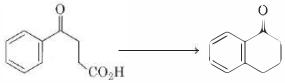
The following transformation can be carried out in three steps. The reagents required for these three steps in their correct order are:
A
$i$. $NaBH_4$; $ii$. $PCl_5$; $iii$. anhyd. $AlCl_3$
B
$i$. $SOCl_2$; $ii$. anhyd. $AlCl_3$; $iii$. $Zn(Hg)/HCl$
C
$i$. $Zn(Hg)/HCl$; $ii$. $SOCl_2$; $iii$. anhyd. $AlCl_3$
D
$i$. conc. $H_2SO_4$; $ii$. $H_2N-NH_2 \cdot H_2O$; $iii$. $KOH$,ethylene glycol,$\Delta$
Solution
(C) The correct option is $C$. The transformation involves the conversion of $4$-oxo-$4$-phenylbutanoic acid to $\alpha$-tetralone. The steps are as follows:
$i$. $Zn(Hg)/HCl$ (Clemmensen reduction): Reduces the ketone group to a methylene group $(-CH_2-)$.
$ii$. $SOCl_2$: Converts the carboxylic acid group $(-COOH)$ to an acid chloride $(-COCl)$.
$iii$. Anhydrous $AlCl_3$ (Friedel-Crafts acylation): Facilitates intramolecular cyclization to form the cyclic ketone ($\alpha$-tetralone).
$i$. $Zn(Hg)/HCl$ (Clemmensen reduction): Reduces the ketone group to a methylene group $(-CH_2-)$.
$ii$. $SOCl_2$: Converts the carboxylic acid group $(-COOH)$ to an acid chloride $(-COCl)$.
$iii$. Anhydrous $AlCl_3$ (Friedel-Crafts acylation): Facilitates intramolecular cyclization to form the cyclic ketone ($\alpha$-tetralone).
0 likesView Solution
45
ChemistryAdvancedMCQKVPY · 2020
In the following reaction,
$X \xrightarrow[(ii) \text{ aq. acid}]{(i) \text{ O}_2, \text{ catalyst, heat}} \text{Phenol} + Y (C_6H_{10}O)$
$X$ and $Y$ respectively,are $......$
$X \xrightarrow[(ii) \text{ aq. acid}]{(i) \text{ O}_2, \text{ catalyst, heat}} \text{Phenol} + Y (C_6H_{10}O)$
$X$ and $Y$ respectively,are $......$
A
Cyclohexylbenzene and hex$-4-$enal
B
Cyclohexylbenzene and diallyl ether
C
Cyclohex$-1-$enylbenzene and cyclohexanone
D
Cyclohexylbenzene and cyclohexanone
Solution
(D) The reaction shown is the industrial preparation of phenol from cumene-like hydroperoxidation. The starting material $X$ is cyclohexylbenzene. Upon oxidation with $O_2$ in the presence of a catalyst and heat,it forms a hydroperoxide intermediate. Subsequent treatment with aqueous acid leads to the cleavage of the hydroperoxide into phenol and cyclohexanone $(Y)$.
Thus,$X$ is cyclohexylbenzene and $Y$ is cyclohexanone.
Thus,$X$ is cyclohexylbenzene and $Y$ is cyclohexanone.
0 likesView Solution
46
ChemistryDifficultMCQKVPY · 2020
$A$ two-dimensional solid is made by alternating circles with radius $a$ and $b$ such that the sides of the circles touch. The packing fraction is defined as the ratio of the area under the circles to the area under the rectangle with sides of length $x$ and $y$. The ratio $r=b/a$ for which the packing fraction is minimised is closest to $.....$
A
$0.41$
B
$1.0$
C
$0.50$
D
$0.32$
Solution
(A) The packing fraction $(PF)$ is defined as the ratio of the area of the circles to the area of the rectangle.
$PF = \frac{\pi a^{2} + \pi b^{2}}{(2a + 2b)(2a)} = \frac{\pi(a^{2} + b^{2})}{4a(a + b)}$
Dividing by $a^{2}$,we get $PF = \frac{\pi(1 + r^{2})}{4(1 + r)}$,where $r = \frac{b}{a}$.
To minimize the packing fraction,we differentiate $PF$ with respect to $r$ and set it to zero:
$\frac{d(PF)}{dr} = \frac{\pi}{4} \left[ \frac{(1+r)(2r) - (1+r^{2})(1)}{(1+r)^{2}} \right] = 0$
$2r + 2r^{2} - 1 - r^{2} = 0$
$r^{2} + 2r - 1 = 0$
Using the quadratic formula $r = \frac{-B \pm \sqrt{B^{2} - 4AC}}{2A}$:
$r = \frac{-2 \pm \sqrt{4 - 4(1)(-1)}}{2} = \frac{-2 \pm \sqrt{8}}{2} = -1 \pm \sqrt{2}$
Since $r$ must be positive,$r = \sqrt{2} - 1 \approx 1.414 - 1 = 0.414$.
Thus,the value is closest to $0.41$.
$PF = \frac{\pi a^{2} + \pi b^{2}}{(2a + 2b)(2a)} = \frac{\pi(a^{2} + b^{2})}{4a(a + b)}$
Dividing by $a^{2}$,we get $PF = \frac{\pi(1 + r^{2})}{4(1 + r)}$,where $r = \frac{b}{a}$.
To minimize the packing fraction,we differentiate $PF$ with respect to $r$ and set it to zero:
$\frac{d(PF)}{dr} = \frac{\pi}{4} \left[ \frac{(1+r)(2r) - (1+r^{2})(1)}{(1+r)^{2}} \right] = 0$
$2r + 2r^{2} - 1 - r^{2} = 0$
$r^{2} + 2r - 1 = 0$
Using the quadratic formula $r = \frac{-B \pm \sqrt{B^{2} - 4AC}}{2A}$:
$r = \frac{-2 \pm \sqrt{4 - 4(1)(-1)}}{2} = \frac{-2 \pm \sqrt{8}}{2} = -1 \pm \sqrt{2}$
Since $r$ must be positive,$r = \sqrt{2} - 1 \approx 1.414 - 1 = 0.414$.
Thus,the value is closest to $0.41$.
0 likesView Solution
47
ChemistryDifficultMCQKVPY · 2020
Number of stereoisomers possible for the octahedral complexes $[Co(NH_3)_3Cl_3]$ and $[Ni(en)_2Cl_2]$,respectively,are (where $en = 1,2-$ethylenediamine):
A
$2$ and $4$
B
$4$ and $3$
C
$3$ and $2$
D
$2$ and $3$
Solution
(D) For the complex $[Co(NH_3)_3Cl_3]$,it exists in two geometric isomeric forms: $fac$ (facial) and $mer$ (meridional). Both are optically inactive,so there are $2$ stereoisomers.
For the complex $[Ni(en)_2Cl_2]$,it exists in $trans$ and $cis$ forms. The $trans$ form is achiral,while the $cis$ form exists as a pair of enantiomers. Thus,there are $3$ stereoisomers in total ($1$ trans + $2$ cis enantiomers).
For the complex $[Ni(en)_2Cl_2]$,it exists in $trans$ and $cis$ forms. The $trans$ form is achiral,while the $cis$ form exists as a pair of enantiomers. Thus,there are $3$ stereoisomers in total ($1$ trans + $2$ cis enantiomers).
0 likesView Solution
48
ChemistryAdvancedMCQKVPY · 2020
When a mixture of $NaCl$,$K_{2}Cr_{2}O_{7}$ and conc. $H_{2}SO_{4}$ is heated in a dry test tube,a red vapour $(X)$ is evolved. This vapour $(X)$ turns an aqueous solution of $NaOH$ yellow due to the formation of $Y$. $X$ and $Y$,respectively,are
A
$CrCl_{3}$ and $Na_{2}Cr_{2}O_{7}$
B
$CrCl_{3}$ and $Na_{2}CrO_{4}$
C
$CrO_{2}Cl_{2}$ and $Na_{2}CrO_{4}$
D
$Cr_{2}(SO_{4})_{3}$ and $Na_{2}Cr_{2}O_{7}$
Solution
(C) $X$ is $CrO_{2}Cl_{2}$ and $Y$ is $Na_{2}CrO_{4}$.
When a mixture of $NaCl$,$K_{2}Cr_{2}O_{7}$ and conc. $H_{2}SO_{4}$ is heated in a dry test tube,a red vapour $(X)$,$CrO_{2}Cl_{2}$ (chromyl chloride),is evolved.
This vapour $CrO_{2}Cl_{2}$ reacts with an aqueous solution of $NaOH$ to form $Na_{2}CrO_{4}$ (sodium chromate),which is yellow in color.
The chemical reactions are as follows:
$4Cl^{-} + Cr_{2}O_{7}^{2-} + 6H^{+} \longrightarrow 2CrO_{2}Cl_{2} (X) + 3H_{2}O$
$CrO_{2}Cl_{2} + 4OH^{-} \longrightarrow CrO_{4}^{2-} + 2Cl^{-} + 2H_{2}O$
The resulting $CrO_{4}^{2-}$ ions in the presence of $Na^{+}$ ions form $Na_{2}CrO_{4} (Y)$.
When a mixture of $NaCl$,$K_{2}Cr_{2}O_{7}$ and conc. $H_{2}SO_{4}$ is heated in a dry test tube,a red vapour $(X)$,$CrO_{2}Cl_{2}$ (chromyl chloride),is evolved.
This vapour $CrO_{2}Cl_{2}$ reacts with an aqueous solution of $NaOH$ to form $Na_{2}CrO_{4}$ (sodium chromate),which is yellow in color.
The chemical reactions are as follows:
$4Cl^{-} + Cr_{2}O_{7}^{2-} + 6H^{+} \longrightarrow 2CrO_{2}Cl_{2} (X) + 3H_{2}O$
$CrO_{2}Cl_{2} + 4OH^{-} \longrightarrow CrO_{4}^{2-} + 2Cl^{-} + 2H_{2}O$
The resulting $CrO_{4}^{2-}$ ions in the presence of $Na^{+}$ ions form $Na_{2}CrO_{4} (Y)$.
0 likesView Solution
49
ChemistryMediumMCQKVPY · 2020
The acidity of the following compounds follows the order:
$I$: Phenol
$II$: $p$-Methoxyphenol
$III$: $p$-Nitrophenol
$IV$: $m$-Nitrophenol
$I$: Phenol
$II$: $p$-Methoxyphenol
$III$: $p$-Nitrophenol
$IV$: $m$-Nitrophenol
A
$I > II > III > IV$
B
$IV > III > II > I$
C
$III > IV > I > II$
D
$III > II > IV > I$
Solution
(C) The correct acidity order is $III > IV > I > II$.
In substituted phenols,electron-withdrawing groups $(EWG)$ like the nitro $(-NO_2)$ group increase acidity by stabilizing the phenoxide ion through delocalization of the negative charge.
$p$-Nitrophenol $(III)$ is more acidic than $m$-nitrophenol $(IV)$ because the $-NO_2$ group at the para position exerts both $-I$ and $-R$ effects,whereas at the meta position,it only exerts the $-I$ effect.
Phenol $(I)$ is less acidic than nitrophenols but more acidic than $p$-methoxyphenol $(II)$.
$p$-Methoxyphenol $(II)$ contains a methoxy $(-OCH_3)$ group,which is an electron-donating group $(EDG)$ due to the $+R$ effect,destabilizing the phenoxide ion and decreasing the acidity.
In substituted phenols,electron-withdrawing groups $(EWG)$ like the nitro $(-NO_2)$ group increase acidity by stabilizing the phenoxide ion through delocalization of the negative charge.
$p$-Nitrophenol $(III)$ is more acidic than $m$-nitrophenol $(IV)$ because the $-NO_2$ group at the para position exerts both $-I$ and $-R$ effects,whereas at the meta position,it only exerts the $-I$ effect.
Phenol $(I)$ is less acidic than nitrophenols but more acidic than $p$-methoxyphenol $(II)$.
$p$-Methoxyphenol $(II)$ contains a methoxy $(-OCH_3)$ group,which is an electron-donating group $(EDG)$ due to the $+R$ effect,destabilizing the phenoxide ion and decreasing the acidity.
0 likesView Solution
50
ChemistryDifficultMCQKVPY · 2020
The specific heat of a certain substance is $0.86 \,J \,g^{-1} \,K^{-1}$. Assuming ideal solution behaviour,the energy required (in $J$) to heat $10 \,g$ of $1 \,molal$ of its aqueous solution from $300 \,K$ to $310 \,K$ is closest to $.... \,J$
[Given: Molar mass of the substance $= 58 \,g \,mol^{-1}$; specific heat of water $= 4.2 \,J \,g^{-1} \,K^{-1}$]
[Given: Molar mass of the substance $= 58 \,g \,mol^{-1}$; specific heat of water $= 4.2 \,J \,g^{-1} \,K^{-1}$]
A
$401.7$
B
$424.7$
C
$420.0$
D
$86.0$
Solution
(A) Given,specific heat of substance $= 0.86 \,J \,g^{-1} \,K^{-1}$.
$1 \,molal$ solution means $1 \,mole$ of solute in $1000 \,g$ of solvent (water).
Mass of solute $= 1 \,mole \times 58 \,g \,mol^{-1} = 58 \,g$.
Total mass of solution $= 1000 \,g + 58 \,g = 1058 \,g$.
In $1058 \,g$ solution,mass of solute $= 58 \,g$ and mass of water $= 1000 \,g$.
For $10 \,g$ of solution:
Mass of solute $= (58 / 1058) \times 10 \approx 0.548 \,g$.
Mass of water $= (1000 / 1058) \times 10 \approx 9.452 \,g$.
Energy required $q = (m_{solute} \times c_{solute} \times \Delta T) + (m_{water} \times c_{water} \times \Delta T)$.
$q = (0.548 \times 0.86 \times 10) + (9.452 \times 4.2 \times 10)$.
$q = 4.7128 + 396.984 = 401.6968 \,J \approx 401.7 \,J$.
$1 \,molal$ solution means $1 \,mole$ of solute in $1000 \,g$ of solvent (water).
Mass of solute $= 1 \,mole \times 58 \,g \,mol^{-1} = 58 \,g$.
Total mass of solution $= 1000 \,g + 58 \,g = 1058 \,g$.
In $1058 \,g$ solution,mass of solute $= 58 \,g$ and mass of water $= 1000 \,g$.
For $10 \,g$ of solution:
Mass of solute $= (58 / 1058) \times 10 \approx 0.548 \,g$.
Mass of water $= (1000 / 1058) \times 10 \approx 9.452 \,g$.
Energy required $q = (m_{solute} \times c_{solute} \times \Delta T) + (m_{water} \times c_{water} \times \Delta T)$.
$q = (0.548 \times 0.86 \times 10) + (9.452 \times 4.2 \times 10)$.
$q = 4.7128 + 396.984 = 401.6968 \,J \approx 401.7 \,J$.
0 likesView Solution
Vedclass Products
For Students
Vedclass Test Series
Mock tests in real KVPY style covering Chemistry with performance analysis. 5-day free trial.
Start Free TrialFor Teachers
Exam Paper Generator
Generate Set A/B/C/D Chemistry papers from 7.5L+ questions in 2 minutes. 3 chapters free.
Try FreeFor Institutes
Online Exam Module
Run live KVPY mock exams with unlimited students, 360° analytics & white-label branding.
See DemoFrequently Asked Questions
How many Chemistry questions are in KVPY 2020?
There are 50 Chemistry questions from the KVPY 2020 paper on Vedclass, each with a detailed step-by-step solution in English.
Are KVPY 2020 Chemistry solutions available in English?
Yes. All solutions on this page are in English. You can also switch to English or Hindi using the language buttons above the questions.
Can I practice KVPY 2020 Chemistry as a timed test?
Yes. Use the Vedclass Test Series to attempt a full KVPY mock test covering Chemistry with time limits and instant score analysis.
Can teachers create Chemistry papers from KVPY previous year questions?
Yes. The Vedclass Exam Paper Generator lets teachers mix KVPY Chemistry questions and generate Set A/B/C/D papers in minutes.
For Teachers & Institutes
Build a Custom Chemistry Paper
Pick KVPY 2020 Chemistry questions, set difficulty, and generate Set A/B/C/D in 2 minutes.