
ChemistryQ1–52 of 52 questions
Page 1 of 1 · English
1
ChemistryMCQKVPY · 2015
Stokes' law states that the viscous drag force $F$ experienced by a sphere of radius $a$,moving with a speed $v$ through a fluid with coefficient of viscosity $\eta$,is given by $F=6 \pi \eta a v$. If this fluid is flowing through a cylindrical pipe of radius $r$,length $l$ and a pressure difference of $p$ across its two ends,then the volume of water $V$ which flows through the pipe in time $t$ can be written as $\frac{V}{t}=k\left(\frac{p}{l}\right)^a \eta^b r^c$,where $k$ is a dimensionless constant. The correct values of $a, b$ and $c$ are
A
$a=1, b=-1, c=4$
B
$a=-1, b=1, c=4$
C
$a=2, b=-1, c=3$
D
$a=1, b=-2, c=-4$
Solution
(A) By Stokes' law,$F=6 \pi \eta a v$.
We have,$\eta = \frac{F}{6 \pi a v}$.
Dimensions of viscosity $\eta$ are $[\eta] = [ML^{-1}T^{-1}]$.
The given relation for volume flow rate is $\frac{V}{t} = k \left(\frac{p}{l}\right)^a \eta^b r^c$.
Substituting dimensions: $[L^3 T^{-1}] = [ML^{-2}T^{-2}]^a [ML^{-1}T^{-1}]^b [L]^c$.
$[M^0 L^3 T^{-1}] = [M^{a+b} L^{-2a-b+c} T^{-2a-b}]$.
Equating powers:
$a+b = 0$ $(i)$
$-2a-b+c = 3$ (ii)
$-2a-b = -1$ (iii)
From (iii),$2a+b = 1$. Subtracting $(i)$ from this,$a = 1$.
Substituting $a=1$ in $(i)$,$b = -1$.
Substituting $a=1, b=-1$ in (ii),$-2(1) - (-1) + c = 3 \Rightarrow -2 + 1 + c = 3 \Rightarrow c = 4$.
Thus,$a=1, b=-1, c=4$.
We have,$\eta = \frac{F}{6 \pi a v}$.
Dimensions of viscosity $\eta$ are $[\eta] = [ML^{-1}T^{-1}]$.
The given relation for volume flow rate is $\frac{V}{t} = k \left(\frac{p}{l}\right)^a \eta^b r^c$.
Substituting dimensions: $[L^3 T^{-1}] = [ML^{-2}T^{-2}]^a [ML^{-1}T^{-1}]^b [L]^c$.
$[M^0 L^3 T^{-1}] = [M^{a+b} L^{-2a-b+c} T^{-2a-b}]$.
Equating powers:
$a+b = 0$ $(i)$
$-2a-b+c = 3$ (ii)
$-2a-b = -1$ (iii)
From (iii),$2a+b = 1$. Subtracting $(i)$ from this,$a = 1$.
Substituting $a=1$ in $(i)$,$b = -1$.
Substituting $a=1, b=-1$ in (ii),$-2(1) - (-1) + c = 3 \Rightarrow -2 + 1 + c = 3 \Rightarrow c = 4$.
Thus,$a=1, b=-1, c=4$.
0 likesView Solution
2
ChemistryMediumMCQKVPY · 2015
The Lewis acid strength of $BBr_3$,$BCl_3$,and $BF_3$ is in the order:
A
$BBr_3 < BCl_3 < BF_3$
B
$BCl_3 < BF_3 < BBr_3$
C
$BF_3 < BCl_3 < BBr_3$
D
$BBr_3 < BF_3 < BCl_3$
Solution
(C) The given boron trihalides are electron-deficient molecules that act as Lewis acids by accepting an electron pair.
The Lewis acid strength is determined by the extent of $ppi-ppi$ back-bonding between the halogen atom and the boron atom.
In $BF_3$,the $2p-2p$ back-bonding is most effective due to the similar size of the orbitals,which reduces the electron deficiency of the boron atom significantly.
As the size of the halogen increases from $F$ to $Cl$ to $Br$,the effectiveness of back-bonding decreases $(2p-2p > 2p-3p > 2p-4p)$.
Therefore,the electron deficiency on boron increases in the order $BF_3 < BCl_3 < BBr_3$,making $BBr_3$ the strongest Lewis acid.
The Lewis acid strength is determined by the extent of $ppi-ppi$ back-bonding between the halogen atom and the boron atom.
In $BF_3$,the $2p-2p$ back-bonding is most effective due to the similar size of the orbitals,which reduces the electron deficiency of the boron atom significantly.
As the size of the halogen increases from $F$ to $Cl$ to $Br$,the effectiveness of back-bonding decreases $(2p-2p > 2p-3p > 2p-4p)$.
Therefore,the electron deficiency on boron increases in the order $BF_3 < BCl_3 < BBr_3$,making $BBr_3$ the strongest Lewis acid.
0 likesView Solution
3
ChemistryEasyMCQKVPY · 2015
$O^{2-}$ is isoelectronic with
A
$Zn^{2+}$
B
$Mg^{2+}$
C
$K^{+}$
D
$Ni^{2+}$
Solution
(B) Isoelectronic species are those species which have the same number of electrons.
Total number of electrons in $O^{2-} = 8 + 2 = 10$.
Total number of electrons in $Zn^{2+} = 30 - 2 = 28$.
Total number of electrons in $Mg^{2+} = 12 - 2 = 10$.
Total number of electrons in $K^{+} = 19 - 1 = 18$.
Total number of electrons in $Ni^{2+} = 28 - 2 = 26$.
Thus,$O^{2-}$ is isoelectronic with $Mg^{2+}$.
Total number of electrons in $O^{2-} = 8 + 2 = 10$.
Total number of electrons in $Zn^{2+} = 30 - 2 = 28$.
Total number of electrons in $Mg^{2+} = 12 - 2 = 10$.
Total number of electrons in $K^{+} = 19 - 1 = 18$.
Total number of electrons in $Ni^{2+} = 28 - 2 = 26$.
Thus,$O^{2-}$ is isoelectronic with $Mg^{2+}$.
0 likesView Solution
4
ChemistryDifficultMCQKVPY · 2015
The $H-C-H$,$H-N-H$,and $H-O-H$ bond angles (in $degrees$) in methane,ammonia,and water are respectively,closest to
A
$109.5, 104.5, 107.1$
B
$109.5, 107.1, 104.5$
C
$104.5, 107.1, 109.5$
D
$107.1, 104.5, 109.5$
Solution
(B) The bond angle in a molecule is affected by the number of lone pairs and the electronegativity of the central atom.
In $CH_4$ (methane),the central carbon atom has $4$ bonding pairs and $0$ lone pairs,resulting in a tetrahedral geometry with a bond angle of $109.5^{\circ}$.
In $NH_3$ (ammonia),the central nitrogen atom has $3$ bonding pairs and $1$ lone pair. The lone pair-bond pair repulsion reduces the bond angle to $107.1^{\circ}$.
In $H_2O$ (water),the central oxygen atom has $2$ bonding pairs and $2$ lone pairs. The greater lone pair-lone pair repulsion further reduces the bond angle to $104.5^{\circ}$.
Therefore,the bond angles are $109.5^{\circ}, 107.1^{\circ}, 104.5^{\circ}$ respectively.
In $CH_4$ (methane),the central carbon atom has $4$ bonding pairs and $0$ lone pairs,resulting in a tetrahedral geometry with a bond angle of $109.5^{\circ}$.
In $NH_3$ (ammonia),the central nitrogen atom has $3$ bonding pairs and $1$ lone pair. The lone pair-bond pair repulsion reduces the bond angle to $107.1^{\circ}$.
In $H_2O$ (water),the central oxygen atom has $2$ bonding pairs and $2$ lone pairs. The greater lone pair-lone pair repulsion further reduces the bond angle to $104.5^{\circ}$.
Therefore,the bond angles are $109.5^{\circ}, 107.1^{\circ}, 104.5^{\circ}$ respectively.
0 likesView Solution
5
ChemistryMediumMCQKVPY · 2015
In alkaline medium,the reaction of hydrogen peroxide with potassium permanganate produces a compound in which the oxidation state of $Mn$ is $....$
A
$0$
B
$+2$
C
$+3$
D
$+4$
Solution
(D) The reaction of hydrogen peroxide $(H_2O_2)$ with potassium permanganate $(KMnO_4)$ in an alkaline medium is given by the equation:
$2KMnO_4 + 3H_2O_2 \rightarrow 2MnO_2 + 2KOH + 2H_2O + 3O_2$
In this reaction,the product containing manganese is manganese dioxide $(MnO_2)$.
To find the oxidation state of $Mn$ in $MnO_2$,let it be $x$.
Since the oxidation state of oxygen is $-2$,we have:
$x + 2(-2) = 0$
$x - 4 = 0$
$x = +4$
Therefore,the oxidation state of $Mn$ is $+4$.
$2KMnO_4 + 3H_2O_2 \rightarrow 2MnO_2 + 2KOH + 2H_2O + 3O_2$
In this reaction,the product containing manganese is manganese dioxide $(MnO_2)$.
To find the oxidation state of $Mn$ in $MnO_2$,let it be $x$.
Since the oxidation state of oxygen is $-2$,we have:
$x + 2(-2) = 0$
$x - 4 = 0$
$x = +4$
Therefore,the oxidation state of $Mn$ is $+4$.
0 likesView Solution
6
ChemistryEasyMCQKVPY · 2015
Which of the following molecules can exhibit optical activity?
A
$1-$bromopropane
B
$2-$bromobutane
C
$3-$bromopentane
D
bromocyclohexane
Solution
(B) Optical activity is exhibited by molecules that possess at least one chiral center (a carbon atom bonded to four different groups).
$(a)$ $CH_3-CH_2-CH_2-Br$ ($1-$bromopropane): No chiral center is present,so it is optically inactive.
$(b)$ $CH_3-CH(Br)-CH_2-CH_3$ ($2-$bromobutane): The carbon at position $2$ is bonded to four different groups $(-H, -CH_3, -CH_2CH_3, -Br)$,making it a chiral center. Thus,it exhibits optical activity.
$(c)$ $CH_3-CH_2-CH(Br)-CH_2-CH_3$ ($3-$bromopentane): The central carbon is bonded to two identical ethyl groups,so it is achiral and optically inactive.
$(d)$ Bromocyclohexane: The molecule has a plane of symmetry passing through the $C-Br$ bond,making it achiral and optically inactive.
$(a)$ $CH_3-CH_2-CH_2-Br$ ($1-$bromopropane): No chiral center is present,so it is optically inactive.
$(b)$ $CH_3-CH(Br)-CH_2-CH_3$ ($2-$bromobutane): The carbon at position $2$ is bonded to four different groups $(-H, -CH_3, -CH_2CH_3, -Br)$,making it a chiral center. Thus,it exhibits optical activity.
$(c)$ $CH_3-CH_2-CH(Br)-CH_2-CH_3$ ($3-$bromopentane): The central carbon is bonded to two identical ethyl groups,so it is achiral and optically inactive.
$(d)$ Bromocyclohexane: The molecule has a plane of symmetry passing through the $C-Br$ bond,making it achiral and optically inactive.
0 likesView Solution
7
ChemistryDifficultMCQKVPY · 2015
The electronic configuration of an element with the largest difference between the $1^{st}$ and $2^{nd}$ ionisation energies is
A
$1s^{2} 2s^{2} 2p^{6}$
B
$1s^{2} 2s^{2} 2p^{6} 3s^{1}$
C
$1s^{2} 2s^{2} 2p^{6} 3s^{2}$
D
$1s^{2} 2s^{2} 2p^{1}$
Solution
(A) The difference between the $1^{st}$ and $2^{nd}$ ionisation energies is largest when the removal of the second electron requires breaking a stable,fully-filled shell or subshell configuration.
For $1s^{2} 2s^{2} 2p^{6}$ (Neon),the $1^{st}$ ionisation energy is very high due to its stable noble gas configuration. However,the $2^{nd}$ ionisation energy is significantly higher because it involves removing an electron from a stable $2p^{6}$ shell,which is extremely difficult. Thus,the jump between $IE_1$ and $IE_2$ is largest for this configuration.
| Electronic configuration | Element/Group |
| $1s^{2} 2s^{2} 2p^{6}$ | Neon (Group $18$) |
| $1s^{2} 2s^{2} 2p^{6} 3s^{1}$ | Sodium (Group $1$) |
| $1s^{2} 2s^{2} 2p^{6} 3s^{2}$ | Magnesium (Group $2$) |
| $1s^{2} 2s^{2} 2p^{1}$ | Boron (Group $13$) |
For $1s^{2} 2s^{2} 2p^{6}$ (Neon),the $1^{st}$ ionisation energy is very high due to its stable noble gas configuration. However,the $2^{nd}$ ionisation energy is significantly higher because it involves removing an electron from a stable $2p^{6}$ shell,which is extremely difficult. Thus,the jump between $IE_1$ and $IE_2$ is largest for this configuration.
0 likesView Solution
8
ChemistryEasyMCQKVPY · 2015
The order of electronegativity of carbon in $sp$,$sp^{2}$ and $sp^{3}$ hybridised states follows:
A
$sp > sp^{2} > sp^{3}$
B
$sp^{3} > sp^{2} > sp$
C
$sp > sp^{3} > sp^{2}$
D
$sp^{2} > sp > sp^{3}$
Solution
(A) The electronegativity of a carbon atom is directly proportional to the $s$-character in its hybridised state.
Greater $s$-character leads to higher electronegativity because the electrons are held closer to the nucleus.
The $s$-character in different hybridisations is as follows:
$sp$: $50\% \ s$-character
$sp^{2}$: $33.3\% \ s$-character
$sp^{3}$: $25\% \ s$-character
Therefore,the order of electronegativity is $sp > sp^{2} > sp^{3}$.
Greater $s$-character leads to higher electronegativity because the electrons are held closer to the nucleus.
The $s$-character in different hybridisations is as follows:
$sp$: $50\% \ s$-character
$sp^{2}$: $33.3\% \ s$-character
$sp^{3}$: $25\% \ s$-character
Therefore,the order of electronegativity is $sp > sp^{2} > sp^{3}$.
0 likesView Solution
9
ChemistryMediumMCQKVPY · 2015
The $pH$ of $1\, N$ aqueous solutions of $HCl$,$CH_{3}COOH$ and $HCOOH$ follows the order
A
$HCl < HCOOH < CH_{3}COOH$
B
$HCl = HCOOH < CH_{3}COOH$
C
$CH_{3}COOH > HCOOH > HCl$
D
$CH_{3}COOH = HCOOH > HCl$
Solution
(C) The acidic strength of an acid depends on the stability of its conjugate base. Stronger acids have more stable conjugate bases.
The dissociation reactions are:
$HCl \rightleftharpoons H^{+} + Cl^{-}$
$HCOOH \rightleftharpoons H^{+} + HCOO^{-}$
$CH_{3}COOH \rightleftharpoons H^{+} + CH_{3}COO^{-}$
The stability of the conjugate bases follows the order: $Cl^{-} > HCOO^{-} > CH_{3}COO^{-}$.
Therefore,the acidic strength follows the order: $HCl > HCOOH > CH_{3}COOH$.
Since $pH = -\log[H^{+}]$,a higher concentration of $H^{+}$ ions results in a lower $pH$ value.
Thus,the order of $pH$ for $1\, N$ aqueous solutions is: $CH_{3}COOH > HCOOH > HCl$.
The dissociation reactions are:
$HCl \rightleftharpoons H^{+} + Cl^{-}$
$HCOOH \rightleftharpoons H^{+} + HCOO^{-}$
$CH_{3}COOH \rightleftharpoons H^{+} + CH_{3}COO^{-}$
The stability of the conjugate bases follows the order: $Cl^{-} > HCOO^{-} > CH_{3}COO^{-}$.
Therefore,the acidic strength follows the order: $HCl > HCOOH > CH_{3}COOH$.
Since $pH = -\log[H^{+}]$,a higher concentration of $H^{+}$ ions results in a lower $pH$ value.
Thus,the order of $pH$ for $1\, N$ aqueous solutions is: $CH_{3}COOH > HCOOH > HCl$.
0 likesView Solution
10
ChemistryMediumMCQKVPY · 2015
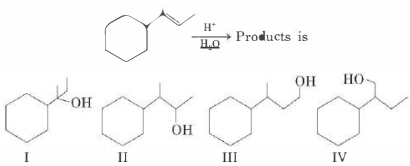
What is the major product of the following reaction?
A
$I$
B
$II$
C
$III$
D
$IV$
Solution
(A) The reaction is an acid-catalyzed hydration of an alkene.
$1$. The proton $(H^+)$ attacks the double bond to form the most stable carbocation intermediate.
$2$. The protonation of the alkene leads to a tertiary carbocation at the carbon attached to the cyclohexyl group.
$3$. Water $(H_2O)$ then acts as a nucleophile and attacks this tertiary carbocation.
$4$. Subsequent deprotonation yields the tertiary alcohol as the major product,which corresponds to structure $I$.
$1$. The proton $(H^+)$ attacks the double bond to form the most stable carbocation intermediate.
$2$. The protonation of the alkene leads to a tertiary carbocation at the carbon attached to the cyclohexyl group.
$3$. Water $(H_2O)$ then acts as a nucleophile and attacks this tertiary carbocation.
$4$. Subsequent deprotonation yields the tertiary alcohol as the major product,which corresponds to structure $I$.
0 likesView Solution
11
ChemistryMediumMCQKVPY · 2015
For the reaction $N_2 + 3 X_2 \longrightarrow 2 NX_3$,where $X = F, Cl$ (the average bond energies are $F-F = 155 \ kJ \ mol^{-1}$,$N-F = 272 \ kJ \ mol^{-1}$,$Cl-Cl = 242 \ kJ \ mol^{-1}$,$N-Cl = 200 \ kJ \ mol^{-1}$ and $N \equiv N = 941 \ kJ \ mol^{-1}$),the heats of formation of $NF_3$ and $NCl_3$ in $kJ \ mol^{-1}$,respectively,are closest to
A
$-226$ and $+467$
B
$+226$ and $-467$
C
$-151$ and $+311$
D
$+151$ and $-311$
Solution
(A) The heat of reaction $\Delta H$ is calculated using the formula: $\Delta H = \Sigma BE_{\text{reactants}} - \Sigma BE_{\text{products}}$.
For the formation of $2 \ mol$ of $NF_3$: $N_2 + 3 F_2 \longrightarrow 2 NF_3$.
$\Delta H = [BE_{N \equiv N} + 3 \times BE_{F-F}] - [6 \times BE_{N-F}] = [941 + 3(155)] - [6(272)] = 1406 - 1632 = -226 \ kJ \ mol^{-1}$.
Since this is for $2 \ mol$ of $NF_3$,the heat of formation per mole is $\Delta H_f(NF_3) = -226 / 2 = -113 \ kJ \ mol^{-1}$. However,the question asks for the heat of reaction for the given stoichiometry.
For the formation of $2 \ mol$ of $NCl_3$: $N_2 + 3 Cl_2 \longrightarrow 2 NCl_3$.
$\Delta H = [BE_{N \equiv N} + 3 \times BE_{Cl-Cl}] - [6 \times BE_{N-Cl}] = [941 + 3(242)] - [6(200)] = 1667 - 1200 = +467 \ kJ \ mol^{-1}$.
The values for the reactions are $-226 \ kJ \ mol^{-1}$ and $+467 \ kJ \ mol^{-1}$ respectively.
For the formation of $2 \ mol$ of $NF_3$: $N_2 + 3 F_2 \longrightarrow 2 NF_3$.
$\Delta H = [BE_{N \equiv N} + 3 \times BE_{F-F}] - [6 \times BE_{N-F}] = [941 + 3(155)] - [6(272)] = 1406 - 1632 = -226 \ kJ \ mol^{-1}$.
Since this is for $2 \ mol$ of $NF_3$,the heat of formation per mole is $\Delta H_f(NF_3) = -226 / 2 = -113 \ kJ \ mol^{-1}$. However,the question asks for the heat of reaction for the given stoichiometry.
For the formation of $2 \ mol$ of $NCl_3$: $N_2 + 3 Cl_2 \longrightarrow 2 NCl_3$.
$\Delta H = [BE_{N \equiv N} + 3 \times BE_{Cl-Cl}] - [6 \times BE_{N-Cl}] = [941 + 3(242)] - [6(200)] = 1667 - 1200 = +467 \ kJ \ mol^{-1}$.
The values for the reactions are $-226 \ kJ \ mol^{-1}$ and $+467 \ kJ \ mol^{-1}$ respectively.
0 likesView Solution
12
ChemistryMediumMCQKVPY · 2015
The equilibrium constants for the reactions $X \rightleftharpoons 2Y$ and $Z \rightleftharpoons P + Q$ are $K_{1}$ and $K_{2}$,respectively. If the initial concentrations and the degree of dissociation of $X$ and $Z$ are the same,the ratio $K_{1} / K_{2}$ is
A
$4$
B
$1$
C
$0.5$
D
$2$
Solution
(A) Let the initial concentration of $X$ and $Z$ be $C$ and $\alpha$ be the degree of dissociation.
For reaction $X \rightleftharpoons 2Y$:
Initial concentration: $C$ $0$
Equilibrium concentration: $C(1-\alpha)$ $2C\alpha$
$K_{1} = \frac{[2C\alpha]^2}{C(1-\alpha)} = \frac{4C^2\alpha^2}{C(1-\alpha)} = \frac{4C\alpha^2}{1-\alpha}$
For reaction $Z \rightleftharpoons P + Q$:
Initial concentration: $C$ $0$ $0$
Equilibrium concentration: $C(1-\alpha)$ $C\alpha$ $C\alpha$
$K_{2} = \frac{[C\alpha][C\alpha]}{C(1-\alpha)} = \frac{C^2\alpha^2}{C(1-\alpha)} = \frac{C\alpha^2}{1-\alpha}$
Therefore,the ratio $\frac{K_{1}}{K_{2}} = \frac{4C\alpha^2 / (1-\alpha)}{C\alpha^2 / (1-\alpha)} = 4$.
For reaction $X \rightleftharpoons 2Y$:
Initial concentration: $C$ $0$
Equilibrium concentration: $C(1-\alpha)$ $2C\alpha$
$K_{1} = \frac{[2C\alpha]^2}{C(1-\alpha)} = \frac{4C^2\alpha^2}{C(1-\alpha)} = \frac{4C\alpha^2}{1-\alpha}$
For reaction $Z \rightleftharpoons P + Q$:
Initial concentration: $C$ $0$ $0$
Equilibrium concentration: $C(1-\alpha)$ $C\alpha$ $C\alpha$
$K_{2} = \frac{[C\alpha][C\alpha]}{C(1-\alpha)} = \frac{C^2\alpha^2}{C(1-\alpha)} = \frac{C\alpha^2}{1-\alpha}$
Therefore,the ratio $\frac{K_{1}}{K_{2}} = \frac{4C\alpha^2 / (1-\alpha)}{C\alpha^2 / (1-\alpha)} = 4$.
0 likesView Solution
13
ChemistryEasyMCQKVPY · 2015
The maximum number of cyclic isomers (positional and optical) of a compound having molecular formula $C_3H_2Cl_2$ is
A
$2$
B
$3$
C
$4$
D
$5$
Solution
(C) The molecular formula $C_3H_2Cl_2$ corresponds to a degree of unsaturation of $2$ $(3 - 2/2 + 2/2 = 2)$.
For cyclic isomers,we consider cyclopropene derivatives:
$1$. $3,3$-dichlorocyclopropene
$2$. $1,3$-dichlorocyclopropene (This molecule has a chiral center at the $C_1$ position,so it exists as a pair of enantiomers).
$3$. $1,2$-dichlorocyclopropene
Thus,the total number of cyclic isomers is $4$ ($3,3$-dichlorocyclopropene,$1,3$-dichlorocyclopropene (enantiomer $I$),$1,3$-dichlorocyclopropene (enantiomer $II$),and $1,2$-dichlorocyclopropene).
However,based on the provided options and standard interpretation of such problems,the count of distinct structural isomers is $3$,but including optical isomers,the total is $4$.
For cyclic isomers,we consider cyclopropene derivatives:
$1$. $3,3$-dichlorocyclopropene
$2$. $1,3$-dichlorocyclopropene (This molecule has a chiral center at the $C_1$ position,so it exists as a pair of enantiomers).
$3$. $1,2$-dichlorocyclopropene
Thus,the total number of cyclic isomers is $4$ ($3,3$-dichlorocyclopropene,$1,3$-dichlorocyclopropene (enantiomer $I$),$1,3$-dichlorocyclopropene (enantiomer $II$),and $1,2$-dichlorocyclopropene).
However,based on the provided options and standard interpretation of such problems,the count of distinct structural isomers is $3$,but including optical isomers,the total is $4$.
0 likesView Solution
14
ChemistryDifficultMCQKVPY · 2015
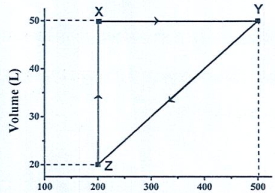
The volume versus temperature graph of $1 \ mole$ of an ideal gas is given below. The pressure of the gas (in $atm$) at $X, Y$ and $Z$,respectively,are
A
$0.328, 0.820, 0.820$
B
$3.28, 8.20, 3.28$
C
$0.238, 0.280, 0.280$
D
$32.8, 0.280, 82.0$
Solution
(A) According to the ideal gas equation,$pV = nRT$.
For $1 \ mole$ of gas,$n = 1$,so $pV = RT$ or $p = \frac{RT}{V}$.
Taking $R = 0.0821 \ L \ atm \ K^{-1} \ mol^{-1}$.
For point $X$: $V = 50 \ L, T = 200 \ K$.
$p_X = \frac{0.0821 \times 200}{50} = 0.3284 \ atm \approx 0.328 \ atm$.
For point $Y$: $V = 50 \ L, T = 500 \ K$.
$p_Y = \frac{0.0821 \times 500}{50} = 0.821 \ atm \approx 0.820 \ atm$.
For point $Z$: $V = 20 \ L, T = 200 \ K$.
$p_Z = \frac{0.0821 \times 200}{20} = 0.821 \ atm \approx 0.820 \ atm$.
Thus,the pressures at $X, Y, Z$ are $0.328 \ atm, 0.820 \ atm, 0.820 \ atm$ respectively.
For $1 \ mole$ of gas,$n = 1$,so $pV = RT$ or $p = \frac{RT}{V}$.
Taking $R = 0.0821 \ L \ atm \ K^{-1} \ mol^{-1}$.
For point $X$: $V = 50 \ L, T = 200 \ K$.
$p_X = \frac{0.0821 \times 200}{50} = 0.3284 \ atm \approx 0.328 \ atm$.
For point $Y$: $V = 50 \ L, T = 500 \ K$.
$p_Y = \frac{0.0821 \times 500}{50} = 0.821 \ atm \approx 0.820 \ atm$.
For point $Z$: $V = 20 \ L, T = 200 \ K$.
$p_Z = \frac{0.0821 \times 200}{20} = 0.821 \ atm \approx 0.820 \ atm$.
Thus,the pressures at $X, Y, Z$ are $0.328 \ atm, 0.820 \ atm, 0.820 \ atm$ respectively.
0 likesView Solution
15
ChemistryDifficultMCQKVPY · 2015
The percentage of nitrogen by mass in ammonium sulphate is closest to $.....$ $\%$ (atomic masses of $H = 1, N = 14, O = 16, S = 32$ ).
A
$21$
B
$24$
C
$36$
D
$16$
Solution
(A) The chemical formula of ammonium sulphate is $(NH_4)_2SO_4$.
The molar mass of $(NH_4)_2SO_4 = 2 \times (14 + 4 \times 1) + 32 + 4 \times 16 = 2 \times 18 + 32 + 64 = 36 + 96 = 132 \ g/mol$.
The mass of nitrogen in one mole of $(NH_4)_2SO_4$ is $2 \times 14 = 28 \ g$.
The percentage of nitrogen by mass $= (\frac{28}{132}) \times 100 \approx 21.2 \ \%$.
Thus,the value is closest to $21 \ \%$.
The molar mass of $(NH_4)_2SO_4 = 2 \times (14 + 4 \times 1) + 32 + 4 \times 16 = 2 \times 18 + 32 + 64 = 36 + 96 = 132 \ g/mol$.
The mass of nitrogen in one mole of $(NH_4)_2SO_4$ is $2 \times 14 = 28 \ g$.
The percentage of nitrogen by mass $= (\frac{28}{132}) \times 100 \approx 21.2 \ \%$.
Thus,the value is closest to $21 \ \%$.
0 likesView Solution
16
ChemistryMediumMCQKVPY · 2015
Mendeleev's periodic law states that the properties of elements are a periodic function of their
A
reactivity of elements
B
atomic size
C
atomic mass
D
electronic configuration
Solution
(C) The correct answer is $C$.
According to Mendeleev's periodic law,the physical and chemical properties of the elements are a periodic function of their atomic mass.
According to Mendeleev's periodic law,the physical and chemical properties of the elements are a periodic function of their atomic mass.
0 likesView Solution
17
ChemistryMediumMCQKVPY · 2015
Maximum number of electrons that can be accommodated in the subshell with azimuthal quantum number $l=4$ is
A
$10$
B
$8$
C
$16$
D
$18$
Solution
(D) . The maximum number of electrons that can be accommodated in a subshell is given by the formula $2(2l + 1)$.
For the given azimuthal quantum number $l = 4$,the calculation is:
Maximum number of electrons $= 2(2 \times 4 + 1) = 2(8 + 1) = 2 \times 9 = 18$.
For the given azimuthal quantum number $l = 4$,the calculation is:
Maximum number of electrons $= 2(2 \times 4 + 1) = 2(8 + 1) = 2 \times 9 = 18$.
0 likesView Solution
18
ChemistryDifficultMCQKVPY · 2015
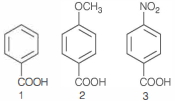
The correct order of acidity of the following compounds is
A
$1 > 2 > 3$
B
$1 > 3 > 2$
C
$3 > 1 > 2$
D
$3 > 2 > 1$
Solution
(C) The correct option is $C$.
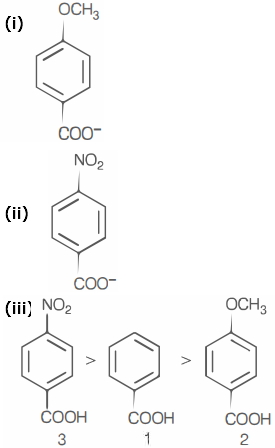
Electron-donating substituents tend to decrease the acidic strength,while electron-withdrawing substituents tend to increase the acidic strength of substituted benzoic acids relative to benzoic acid.
$OCH_3$ exerts a $+M$ effect,which destabilizes the conjugate base of compound $2$ and hence decreases the acidity.
$NO_2$ exerts a $-M$ effect,which stabilizes the conjugate base of compound $3$ and hence increases the acidity.
Therefore,the correct order of acidity of the given compounds is $3 > 1 > 2$.
Electron-donating substituents tend to decrease the acidic strength,while electron-withdrawing substituents tend to increase the acidic strength of substituted benzoic acids relative to benzoic acid.
$OCH_3$ exerts a $+M$ effect,which destabilizes the conjugate base of compound $2$ and hence decreases the acidity.
$NO_2$ exerts a $-M$ effect,which stabilizes the conjugate base of compound $3$ and hence increases the acidity.
Therefore,the correct order of acidity of the given compounds is $3 > 1 > 2$.
0 likesView Solution
19
ChemistryMediumMCQKVPY · 2015
Reaction of but$-2-$ene with acidic $KMnO_4$ gives:
A
$CH_3CHO$
B
$HCOOH$
C
$CH_3CH_2OH$
D
$CH_3COOH$
Solution
(D) The reaction of but$-2-$ene $(CH_3-CH=CH-CH_3)$ with acidic $KMnO_4$ is an oxidative cleavage reaction.
Acidic $KMnO_4$ is a strong oxidizing agent that breaks the carbon-carbon double bond.
Since but$-2-$ene is a symmetrical alkene,the oxidative cleavage of the double bond results in the formation of two molecules of acetic acid $(CH_3COOH)$.
The reaction is: $CH_3-CH=CH-CH_3 + [O] \xrightarrow{KMnO_4/H^+} 2CH_3COOH$.
Acidic $KMnO_4$ is a strong oxidizing agent that breaks the carbon-carbon double bond.
Since but$-2-$ene is a symmetrical alkene,the oxidative cleavage of the double bond results in the formation of two molecules of acetic acid $(CH_3COOH)$.
The reaction is: $CH_3-CH=CH-CH_3 + [O] \xrightarrow{KMnO_4/H^+} 2CH_3COOH$.
0 likesView Solution
20
ChemistryMediumMCQKVPY · 2015
The gas released when baking soda is mixed with vinegar is
A
$CO$
B
$CO_2$
C
$CH_4$
D
$O_2$
Solution
(B) The correct option is $(b)$.
When baking soda $(NaHCO_3)$ is mixed with vinegar (which contains acetic acid,$CH_3COOH$),a chemical reaction occurs that produces sodium acetate,water,and carbon dioxide gas.
The balanced chemical equation is:
$CH_3COOH_{(aq)} + NaHCO_{3(s)} \longrightarrow CH_3COONa_{(aq)} + H_2O_{(l)} + CO_{2(g)}$
Thus,the gas released is carbon dioxide $(CO_2)$.
When baking soda $(NaHCO_3)$ is mixed with vinegar (which contains acetic acid,$CH_3COOH$),a chemical reaction occurs that produces sodium acetate,water,and carbon dioxide gas.
The balanced chemical equation is:
$CH_3COOH_{(aq)} + NaHCO_{3(s)} \longrightarrow CH_3COONa_{(aq)} + H_2O_{(l)} + CO_{2(g)}$
Thus,the gas released is carbon dioxide $(CO_2)$.
0 likesView Solution
21
ChemistryMediumMCQKVPY · 2015
The element which readily forms an ionic bond has the electronic configuration
A
$1 s^2 2 s^2 2 p^3$
B
$1 s^2 2 s^2 2 p^1$
C
$1 s^2 2 s^2 2 p^2$
D
$1 s^2 2 s^2 2 p^6 3 s^1$
Solution
(D) . Alkali metals have the highest tendency to form ionic bonds because they possess low ionization energy.
The general electronic configuration of an alkali metal is $ns^1$.
Among the given configurations,$1 s^2 2 s^2 2 p^6 3 s^1$ corresponds to $Na$ (Sodium),which is an alkali metal and thus readily forms an ionic bond.
The general electronic configuration of an alkali metal is $ns^1$.
Among the given configurations,$1 s^2 2 s^2 2 p^6 3 s^1$ corresponds to $Na$ (Sodium),which is an alkali metal and thus readily forms an ionic bond.
0 likesView Solution
22
ChemistryMediumMCQKVPY · 2015
If Avogadro's number is $A_0$,the number of sulphur atoms present in $200 \, mL$ of $1 \, N \, H_2SO_4$ is
A
$\frac{A_0}{5}$
B
$\frac{A_0}{2}$
C
$\frac{A_0}{10}$
D
$A_0$
Solution
(C)
Given,
Normality of $H_2SO_4 = 1 \, N$
Avogadro's number $= A_0$
Volume of $H_2SO_4 = 200 \, mL = 0.2 \, L$
Normality $=$ Basicity $\times$ Molarity
For $H_2SO_4$,basicity $= 2$
$\therefore 1 = 2 \times M \implies M = 0.5 \, mol/L$
Number of moles of $H_2SO_4 = M \times V(L) = 0.5 \times 0.2 = 0.1 \, mol$
Since each molecule of $H_2SO_4$ contains $1$ atom of $S$,the number of moles of $S$ atoms $= 0.1 \, mol$
Number of $S$ atoms $= 0.1 \times A_0 = \frac{A_0}{10}$
Given,
Normality of $H_2SO_4 = 1 \, N$
Avogadro's number $= A_0$
Volume of $H_2SO_4 = 200 \, mL = 0.2 \, L$
Normality $=$ Basicity $\times$ Molarity
For $H_2SO_4$,basicity $= 2$
$\therefore 1 = 2 \times M \implies M = 0.5 \, mol/L$
Number of moles of $H_2SO_4 = M \times V(L) = 0.5 \times 0.2 = 0.1 \, mol$
Since each molecule of $H_2SO_4$ contains $1$ atom of $S$,the number of moles of $S$ atoms $= 0.1 \, mol$
Number of $S$ atoms $= 0.1 \times A_0 = \frac{A_0}{10}$
0 likesView Solution
23
ChemistryMediumMCQKVPY · 2015
The number of electrons required to reduce chromium completely in $Cr_2O_7^{2-}$ to $Cr^{3+}$ in acidic medium is:
A
$5$
B
$3$
C
$6$
D
$2$
Solution
(C) The reduction half-reaction for the dichromate ion in an acidic medium is given by:
$Cr_2O_7^{2-} + 14 H^+ + 6 e^- \rightarrow 2 Cr^{3+} + 7 H_2O$
In this reaction,the oxidation state of $Cr$ changes from $+6$ to $+3$.
Since there are two $Cr$ atoms in $Cr_2O_7^{2-}$,the total change in oxidation state is $2 \times (6 - 3) = 6$.
Therefore,$6$ electrons are required to reduce $Cr_2O_7^{2-}$ to $2 Cr^{3+}$.
$Cr_2O_7^{2-} + 14 H^+ + 6 e^- \rightarrow 2 Cr^{3+} + 7 H_2O$
In this reaction,the oxidation state of $Cr$ changes from $+6$ to $+3$.
Since there are two $Cr$ atoms in $Cr_2O_7^{2-}$,the total change in oxidation state is $2 \times (6 - 3) = 6$.
Therefore,$6$ electrons are required to reduce $Cr_2O_7^{2-}$ to $2 Cr^{3+}$.
0 likesView Solution
24
ChemistryMCQKVPY · 2015
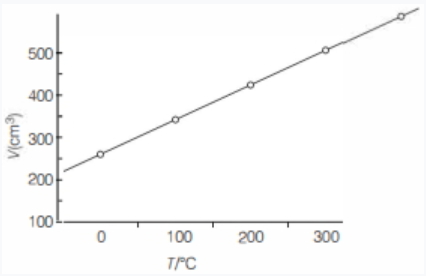
At constant pressure,the volume of a fixed mass of a gas varies as a function of temperature as shown in the graph. The volume of the gas at $300^{\circ}C$ is larger than that at $0^{\circ}C$ by a factor of:
A
$3$
B
$4$
C
$1$
D
$2$
Solution
(D) From the given graph:
Volume of gas at $0^{\circ}C$ is $V_1 = 250 \ cm^3$.
Volume of gas at $300^{\circ}C$ is $V_2 = 500 \ cm^3$.
Therefore,the ratio of the volumes is:
$\frac{V_2}{V_1} = \frac{500}{250} = 2$.
Thus,the volume of the gas at $300^{\circ}C$ is larger than that at $0^{\circ}C$ by a factor of $2$.
Volume of gas at $0^{\circ}C$ is $V_1 = 250 \ cm^3$.
Volume of gas at $300^{\circ}C$ is $V_2 = 500 \ cm^3$.
Therefore,the ratio of the volumes is:
$\frac{V_2}{V_1} = \frac{500}{250} = 2$.
Thus,the volume of the gas at $300^{\circ}C$ is larger than that at $0^{\circ}C$ by a factor of $2$.
0 likesView Solution
25
ChemistryDifficultMCQKVPY · 2015
When $262 \ g$ of xenon (atomic mass $= 131$) reacted completely with $152 \ g$ of fluorine (atomic mass $= 19$),a mixture of $XeF_2$ and $XeF_6$ was produced. The molar ratio $XeF_2 : XeF_6$ is
A
$1 : 2$
B
$1 : 4$
C
$1 : 1$
D
$1 : 3$
Solution
(C) The chemical reaction is: $2Xe + 4F_2 \longrightarrow XeF_2 + XeF_6$
Initial moles of $Xe = \frac{262}{131} = 2 \ mol$.
Initial moles of $F_2 = \frac{152}{38} = 4 \ mol$.
Let $x$ be the moles of $XeF_2$ and $y$ be the moles of $XeF_6$ formed.
According to the law of conservation of mass (atoms):
For $Xe$: $x + y = 2$
For $F$: $2x + 6y = 2 \times 4 = 8$
Solving the equations: $x + y = 2$ and $x + 3y = 4$.
Subtracting the first from the second: $2y = 2$,so $y = 1$.
Substituting $y = 1$ into $x + y = 2$,we get $x = 1$.
Thus,the molar ratio $XeF_2 : XeF_6$ is $1 : 1$.
Initial moles of $Xe = \frac{262}{131} = 2 \ mol$.
Initial moles of $F_2 = \frac{152}{38} = 4 \ mol$.
Let $x$ be the moles of $XeF_2$ and $y$ be the moles of $XeF_6$ formed.
According to the law of conservation of mass (atoms):
For $Xe$: $x + y = 2$
For $F$: $2x + 6y = 2 \times 4 = 8$
Solving the equations: $x + y = 2$ and $x + 3y = 4$.
Subtracting the first from the second: $2y = 2$,so $y = 1$.
Substituting $y = 1$ into $x + y = 2$,we get $x = 1$.
Thus,the molar ratio $XeF_2 : XeF_6$ is $1 : 1$.
0 likesView Solution
26
ChemistryMediumMCQKVPY · 2015
Reaction of ethanol with conc. sulphuric acid at $170^{\circ} C$ produces a gas which is then treated with bromine in carbon tetrachloride. The major product obtained in this reaction is
A
$1,2$-dibromoethane
B
ethylene glycol
C
bromoethane
D
ethyl sulphate
Solution
(A) Step $1$: Ethanol $(CH_3CH_2OH)$ undergoes dehydration in the presence of concentrated sulphuric acid $(H_2SO_4)$ at $170^{\circ} C$ to produce ethene $(CH_2=CH_2)$ gas.
$CH_3CH_2OH \xrightarrow{Conc. H_2SO_4, 170^{\circ} C} CH_2=CH_2 + H_2O$
Step $2$: The ethene gas is then treated with bromine $(Br_2)$ in carbon tetrachloride $(CCl_4)$,which is an electrophilic addition reaction,resulting in the formation of $1,2$-dibromoethane.
$CH_2=CH_2 + Br_2 \xrightarrow{CCl_4} CH_2Br-CH_2Br$
Therefore,the major product is $1,2$-dibromoethane.
$CH_3CH_2OH \xrightarrow{Conc. H_2SO_4, 170^{\circ} C} CH_2=CH_2 + H_2O$
Step $2$: The ethene gas is then treated with bromine $(Br_2)$ in carbon tetrachloride $(CCl_4)$,which is an electrophilic addition reaction,resulting in the formation of $1,2$-dibromoethane.
$CH_2=CH_2 + Br_2 \xrightarrow{CCl_4} CH_2Br-CH_2Br$
Therefore,the major product is $1,2$-dibromoethane.
0 likesView Solution
27
ChemistryMediumMCQKVPY · 2015
When $22.4 \, L$ of $C_4H_8$ at $STP$ is burnt completely,$89.6 \, L$ of $CO_2$ gas at $STP$ and $72 \, g$ of water are produced. The volume of the oxygen gas at $STP$ consumed in the reaction is closest to $.... \, L$
A
$89.6$
B
$112$
C
$134.4$
D
$22.4$
Solution
(C) The balanced chemical equation for the combustion of $C_4H_8$ is:
$C_4H_{8(g)} + 6O_{2(g)} \longrightarrow 4CO_{2(g)} + 4H_2O_{(l)}$
According to the stoichiometry of the reaction,$1 \, mole$ of $C_4H_8$ reacts with $6 \, moles$ of $O_2$.
At $STP$,$1 \, mole$ of any gas occupies $22.4 \, L$.
Given $22.4 \, L$ of $C_4H_8$ corresponds to $1 \, mole$.
Therefore,the volume of $O_2$ required is $6 \times 22.4 \, L = 134.4 \, L$.
$C_4H_{8(g)} + 6O_{2(g)} \longrightarrow 4CO_{2(g)} + 4H_2O_{(l)}$
According to the stoichiometry of the reaction,$1 \, mole$ of $C_4H_8$ reacts with $6 \, moles$ of $O_2$.
At $STP$,$1 \, mole$ of any gas occupies $22.4 \, L$.
Given $22.4 \, L$ of $C_4H_8$ corresponds to $1 \, mole$.
Therefore,the volume of $O_2$ required is $6 \times 22.4 \, L = 134.4 \, L$.
0 likesView Solution
28
ChemistryMediumMCQKVPY · 2015
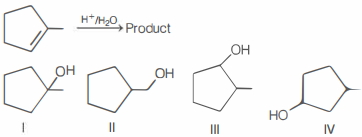
The major product of the reaction is:
A
$I$
B
$II$
C
$III$
D
$IV$
Solution
(A) The reaction involves the acid-catalyzed hydration of $1$-methylcyclopentene.
In the presence of an acid catalyst $(H^+)$,water adds across the double bond of the alkene.
This reaction proceeds via an electrophilic addition mechanism,where the proton $(H^+)$ first adds to the less substituted carbon of the double bond to form the more stable carbocation intermediate.
For $1$-methylcyclopentene,the proton adds to the $CH$ group,resulting in a tertiary carbocation at the carbon atom already bearing the methyl group.
Subsequently,a water molecule attacks this tertiary carbocation,followed by deprotonation to yield $1$-methylcyclopentan-$1$-ol.
This follows the Markownikoff rule,which states that the nucleophile $(-OH)$ attaches to the more substituted carbon atom.
Therefore,the major product is structure $I$.
In the presence of an acid catalyst $(H^+)$,water adds across the double bond of the alkene.
This reaction proceeds via an electrophilic addition mechanism,where the proton $(H^+)$ first adds to the less substituted carbon of the double bond to form the more stable carbocation intermediate.
For $1$-methylcyclopentene,the proton adds to the $CH$ group,resulting in a tertiary carbocation at the carbon atom already bearing the methyl group.
Subsequently,a water molecule attacks this tertiary carbocation,followed by deprotonation to yield $1$-methylcyclopentan-$1$-ol.
This follows the Markownikoff rule,which states that the nucleophile $(-OH)$ attaches to the more substituted carbon atom.
Therefore,the major product is structure $I$.
0 likesView Solution
29
ChemistryMCQKVPY · 2015
Which of the following are characteristics or examples associated with Eubacteria (True Bacteria)?
$(1)$ Methanogens $(2)$ Anabaena $(3)$ $N_2$ fixation $(4)$ Thermoacidophiles $(5)$ Eukaryotes $(6)$ Diatoms $(7)$ Gelatinous sheath $(8)$ Heterocyst
$(1)$ Methanogens $(2)$ Anabaena $(3)$ $N_2$ fixation $(4)$ Thermoacidophiles $(5)$ Eukaryotes $(6)$ Diatoms $(7)$ Gelatinous sheath $(8)$ Heterocyst
A
$(A)$ $1, 4, 7$
B
$(B)$ $2, 3, 7, 8$
C
$(C)$ $4, 5, 6, 7$
D
$(D)$ $1, 3, 6, 7$
Solution
(B) Eubacteria,also known as 'true bacteria',are characterized by a rigid cell wall and,if motile,a flagellum.
$(2)$ $Anabaena$ is a cyanobacterium,which is a type of eubacteria.
$(3)$ Many cyanobacteria (eubacteria) perform $N_2$ fixation.
$(7)$ Cyanobacteria often possess a gelatinous sheath surrounding their colonies.
$(8)$ $Heterocyst$ is a specialized cell found in some filamentous cyanobacteria (eubacteria) for nitrogen fixation.
Methanogens $(1)$ and Thermoacidophiles $(4)$ are Archaebacteria.
Diatoms $(6)$ are Protists (Eukaryotes).
Therefore,the correct set associated with Eubacteria is $(2, 3, 7, 8)$.
$(2)$ $Anabaena$ is a cyanobacterium,which is a type of eubacteria.
$(3)$ Many cyanobacteria (eubacteria) perform $N_2$ fixation.
$(7)$ Cyanobacteria often possess a gelatinous sheath surrounding their colonies.
$(8)$ $Heterocyst$ is a specialized cell found in some filamentous cyanobacteria (eubacteria) for nitrogen fixation.
Methanogens $(1)$ and Thermoacidophiles $(4)$ are Archaebacteria.
Diatoms $(6)$ are Protists (Eukaryotes).
Therefore,the correct set associated with Eubacteria is $(2, 3, 7, 8)$.
0 likesView Solution
30
ChemistryMediumMCQKVPY · 2015
The rate constant of a chemical reaction at a very high temperature will approach:
A
Arrhenius frequency factor divided by the ideal gas constant
B
Activation energy
C
Arrhenius frequency factor
D
Activation energy divided by the ideal gas constant
Solution
(C) The temperature dependence of the rate of a chemical reaction is expressed by the Arrhenius equation: $k = A e^{-E_{a} / (RT)}$.
When $T$ is very high,the factor $E_{a} / (RT)$ approaches $0$.
Therefore,$k = A e^{0} = A \times 1 = A$.
Thus,the rate constant of a chemical reaction at a very high temperature will approach the Arrhenius frequency factor $(A)$.
When $T$ is very high,the factor $E_{a} / (RT)$ approaches $0$.
Therefore,$k = A e^{0} = A \times 1 = A$.
Thus,the rate constant of a chemical reaction at a very high temperature will approach the Arrhenius frequency factor $(A)$.
0 likesView Solution
31
ChemistryMediumMCQKVPY · 2015
The standard reduction potentials (in $V$) of a few metal ion/metal electrodes are given below: $Cr^{3+}/Cr = -0.74$; $Cu^{2+}/Cu = +0.34$; $Pb^{2+}/Pb = -0.13$; $Ag^{+}/Ag = +0.8$. The reducing strength of the metals follows the order:
A
$Ag > Cu > Pb > Cr$
B
$Cr > Pb > Cu > Ag$
C
$Pb > Cr > Ag > Cu$
D
$Cr > Ag > Cu > Pb$
Solution
(B) The reducing strength of a metal is inversely proportional to its standard reduction potential. $A$ more negative standard reduction potential indicates a stronger reducing agent.
Comparing the given values:
$Cr^{3+}/Cr = -0.74 \ V$
$Pb^{2+}/Pb = -0.13 \ V$
$Cu^{2+}/Cu = +0.34 \ V$
$Ag^{+}/Ag = +0.80 \ V$
The order of increasing standard reduction potential is $Cr < Pb < Cu < Ag$. Therefore,the order of decreasing reducing strength is $Cr > Pb > Cu > Ag$.
Comparing the given values:
$Cr^{3+}/Cr = -0.74 \ V$
$Pb^{2+}/Pb = -0.13 \ V$
$Cu^{2+}/Cu = +0.34 \ V$
$Ag^{+}/Ag = +0.80 \ V$
The order of increasing standard reduction potential is $Cr < Pb < Cu < Ag$. Therefore,the order of decreasing reducing strength is $Cr > Pb > Cu > Ag$.
0 likesView Solution
32
ChemistryMediumMCQKVPY · 2015
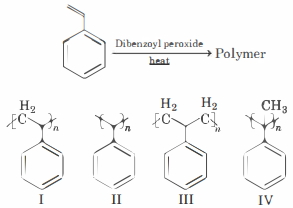
The structure of the polymer obtained by the following reaction is
A
$I$
B
$II$
C
$III$
D
$IV$
Solution
(A) The reaction involves the free radical polymerization of styrene $(C_6H_5CH=CH_2)$ in the presence of dibenzoyl peroxide as an initiator.
During polymerization,the double bond of the vinyl group breaks,and the monomer units link together to form a long chain.
The structure of the repeating unit in polystyrene is $[-CH_2-CH(C_6H_5)-]_n$.
Comparing this with the given options,structure $I$ represents the correct polymer structure.
During polymerization,the double bond of the vinyl group breaks,and the monomer units link together to form a long chain.
The structure of the repeating unit in polystyrene is $[-CH_2-CH(C_6H_5)-]_n$.
Comparing this with the given options,structure $I$ represents the correct polymer structure.
0 likesView Solution
33
ChemistryDifficultMCQKVPY · 2015
The major product of the reaction between $CH_{3}CH_{2}ONa$ and $(CH_{3})_{3}CCl$ in ethanol is
A
$CH_{3}CH_{2}OC(CH_{3})_{3}$
B
$CH_{2}=C(CH_{3})_{2}$
C
$CH_{3}CH_{2}C(CH_{3})_{3}$
D
$CH_{3}CH=CHCH_{3}$
Solution
(B) The reaction between a tertiary alkyl halide,$(CH_{3})_{3}CCl$,and a strong base,$CH_{3}CH_{2}ONa$,in ethanol primarily undergoes an $E2$ elimination reaction.
Since $(CH_{3})_{3}CCl$ is a tertiary halide,steric hindrance makes substitution difficult.
The strong base $CH_{3}CH_{2}O^-$ abstracts a proton from the $\beta$-carbon,leading to the formation of an alkene.
The reaction is: $(CH_{3})_{3}CCl + CH_{3}CH_{2}ONa \rightarrow CH_{2}=C(CH_{3})_{2} + CH_{3}CH_{2}OH + NaCl$.
The major product is $2$-methylpropene,which corresponds to option $B$.
Since $(CH_{3})_{3}CCl$ is a tertiary halide,steric hindrance makes substitution difficult.
The strong base $CH_{3}CH_{2}O^-$ abstracts a proton from the $\beta$-carbon,leading to the formation of an alkene.
The reaction is: $(CH_{3})_{3}CCl + CH_{3}CH_{2}ONa \rightarrow CH_{2}=C(CH_{3})_{2} + CH_{3}CH_{2}OH + NaCl$.
The major product is $2$-methylpropene,which corresponds to option $B$.
0 likesView Solution
34
ChemistryMediumMCQKVPY · 2015
When $H_2S$ gas is passed through a hot acidic aqueous solution containing $Al^{3+}$,$Cu^{2+}$,$Pb^{2+}$ and $Ni^{2+}$,a precipitate is formed,which consists of
A
$CuS$ and $Al_2S_3$
B
$PbS$ and $NiS$
C
$CuS$ and $NiS$
D
$PbS$ and $CuS$
Solution
(D) The correct answer is $D$.
When $H_2S$ gas is passed through an acidic solution,only group $II$ cations precipitate as their sulfides because the low concentration of $S^{2-}$ ions (due to the common ion effect of $H^+$) is sufficient to exceed the solubility product $(K_{sp})$ of group $II$ sulfides.
Among the given ions,$Cu^{2+}$ and $Pb^{2+}$ belong to group $II$.
$Al^{3+}$ belongs to group $III$ and $Ni^{2+}$ belongs to group $IV$,which do not precipitate in acidic medium.
The reactions are:
$Cu^{2+} + H_2S \longrightarrow CuS(s) + 2H^+$
$Pb^{2+} + H_2S \longrightarrow PbS(s) + 2H^+$
When $H_2S$ gas is passed through an acidic solution,only group $II$ cations precipitate as their sulfides because the low concentration of $S^{2-}$ ions (due to the common ion effect of $H^+$) is sufficient to exceed the solubility product $(K_{sp})$ of group $II$ sulfides.
Among the given ions,$Cu^{2+}$ and $Pb^{2+}$ belong to group $II$.
$Al^{3+}$ belongs to group $III$ and $Ni^{2+}$ belongs to group $IV$,which do not precipitate in acidic medium.
The reactions are:
$Cu^{2+} + H_2S \longrightarrow CuS(s) + 2H^+$
$Pb^{2+} + H_2S \longrightarrow PbS(s) + 2H^+$
0 likesView Solution
35
ChemistryMediumMCQKVPY · 2015
The most abundant transition metal in the human body is
A
copper
B
iron
C
zinc
D
manganese
Solution
(B) The most abundant transition metal in the human body is iron $(Fe)$.
Iron is a crucial component of haemoglobin.
It is the iron-containing oxygen transport metalloprotein found in red blood cells.
Haemoglobin in the blood carries oxygen from the lungs to the rest of the body.
Iron is a crucial component of haemoglobin.
It is the iron-containing oxygen transport metalloprotein found in red blood cells.
Haemoglobin in the blood carries oxygen from the lungs to the rest of the body.
0 likesView Solution
36
ChemistryDifficultMCQKVPY · 2015
The molar conductivities of $HCl$,$NaCl$,$CH_{3}COOH$,and $CH_{3}COONa$ at infinite dilution follow the order:
A
$HCl > NaCl > CH_{3}COONa > CH_{3}COOH$
B
$CH_{3}COONa > HCl > NaCl > CH_{3}COOH$
C
$HCl > NaCl > CH_{3}COOH > CH_{3}COONa$
D
$CH_{3}COOH > CH_{3}COONa > HCl > NaCl$
Solution
(A) Molar conductivity at infinite dilution $(\Lambda_{m}^{\circ})$ depends on the mobility of ions in the solution.
$HCl$ is a strong acid and dissociates completely into $H^{ }$ and $Cl^{-}$ ions. $H^{ }$ ions have the highest ionic mobility.
$NaCl$ is a strong electrolyte,dissociating into $Na^{ }$ and $Cl^{-}$ ions.
$CH_{3}COONa$ is a strong electrolyte,dissociating into $CH_{3}COO^{-}$ and $Na^{ }$ ions.
$CH_{3}COOH$ is a weak acid and dissociates only partially,resulting in fewer ions in the solution compared to strong electrolytes.
Since $HCl$ provides the highly mobile $H^{ }$ ion,it has the highest molar conductivity.
$NaCl$ has higher conductivity than $CH_{3}COONa$ because the $Cl^{-}$ ion has higher mobility than the $CH_{3}COO^{-}$ ion.
$CH_{3}COOH$ has the lowest molar conductivity due to its weak dissociation.
Thus,the correct order is $HCl > NaCl > CH_{3}COONa > CH_{3}COOH$.
$HCl$ is a strong acid and dissociates completely into $H^{ }$ and $Cl^{-}$ ions. $H^{ }$ ions have the highest ionic mobility.
$NaCl$ is a strong electrolyte,dissociating into $Na^{ }$ and $Cl^{-}$ ions.
$CH_{3}COONa$ is a strong electrolyte,dissociating into $CH_{3}COO^{-}$ and $Na^{ }$ ions.
$CH_{3}COOH$ is a weak acid and dissociates only partially,resulting in fewer ions in the solution compared to strong electrolytes.
Since $HCl$ provides the highly mobile $H^{ }$ ion,it has the highest molar conductivity.
$NaCl$ has higher conductivity than $CH_{3}COONa$ because the $Cl^{-}$ ion has higher mobility than the $CH_{3}COO^{-}$ ion.
$CH_{3}COOH$ has the lowest molar conductivity due to its weak dissociation.
Thus,the correct order is $HCl > NaCl > CH_{3}COONa > CH_{3}COOH$.
0 likesView Solution
37
ChemistryMediumMCQKVPY · 2015
The spin-only magnetic moment of $[ZCl_{4}]^{2-}$ is $3.87 \, BM,$ where $Z$ is $.....$
A
$Mn$
B
$Ni$
C
$Co$
D
$Cu$
Solution
(C) The spin-only magnetic moment of a complex is calculated using the formula: $\mu = \sqrt{n(n+2)} \, BM$,where $n$ is the number of unpaired electrons.
The oxidation state of $Z$ in $[ZCl_{4}]^{2-}$ is $+2$.
The spin-only magnetic moments for the given metals in the $+2$ oxidation state are:
$(a)$ $Mn^{2+}$: Electronic configuration is $3d^{5}$,$n=5$,$\mu = \sqrt{5(5+2)} = \sqrt{35} \approx 5.92 \, BM$.
$(b)$ $Ni^{2+}$: Electronic configuration is $3d^{8}$,$n=2$,$\mu = \sqrt{2(2+2)} = \sqrt{8} \approx 2.83 \, BM$.
$(c)$ $Co^{2+}$: Electronic configuration is $3d^{7}$,$n=3$,$\mu = \sqrt{3(3+2)} = \sqrt{15} \approx 3.87 \, BM$.
$(d)$ $Cu^{2+}$: Electronic configuration is $3d^{9}$,$n=1$,$\mu = \sqrt{1(1+2)} = \sqrt{3} \approx 1.73 \, BM$.
Since the given magnetic moment is $3.87 \, BM$,$Z$ must be $Co$.
The oxidation state of $Z$ in $[ZCl_{4}]^{2-}$ is $+2$.
The spin-only magnetic moments for the given metals in the $+2$ oxidation state are:
$(a)$ $Mn^{2+}$: Electronic configuration is $3d^{5}$,$n=5$,$\mu = \sqrt{5(5+2)} = \sqrt{35} \approx 5.92 \, BM$.
$(b)$ $Ni^{2+}$: Electronic configuration is $3d^{8}$,$n=2$,$\mu = \sqrt{2(2+2)} = \sqrt{8} \approx 2.83 \, BM$.
$(c)$ $Co^{2+}$: Electronic configuration is $3d^{7}$,$n=3$,$\mu = \sqrt{3(3+2)} = \sqrt{15} \approx 3.87 \, BM$.
$(d)$ $Cu^{2+}$: Electronic configuration is $3d^{9}$,$n=1$,$\mu = \sqrt{1(1+2)} = \sqrt{3} \approx 1.73 \, BM$.
Since the given magnetic moment is $3.87 \, BM$,$Z$ must be $Co$.
0 likesView Solution
38
ChemistryDifficultMCQKVPY · 2015
If $\alpha-D-(+)$-glucose is dissolved in water and kept for a few hours,the major constituent$(s)$ present in the solution is (are)
A
$\alpha-D-(+)$-glucose
B
mixture of $\beta-D-(+)$-glucose and open chain $D-(+)$-glucose
C
open chain $D-(+)$-glucose
D
mixture of $\alpha-D-(+)$-glucose and $\beta-D-(+)$-glucose
Solution
(D) When $\alpha-D-(+)$-glucose is dissolved in water,it undergoes mutarotation.
This process involves the conversion of $\alpha-D-(+)$-glucose into an open-chain structure,which then cyclizes to form $\beta-D-(+)$-glucose.
At equilibrium,the solution contains a mixture of both $\alpha-D-(+)$-glucose (approx. $36\%$) and $\beta-D-(+)$-glucose (approx. $64\%$),with only a negligible amount of the open-chain form.
Therefore,the major constituents present in the solution are $\alpha-D-(+)$-glucose and $\beta-D-(+)$-glucose.
This process involves the conversion of $\alpha-D-(+)$-glucose into an open-chain structure,which then cyclizes to form $\beta-D-(+)$-glucose.
At equilibrium,the solution contains a mixture of both $\alpha-D-(+)$-glucose (approx. $36\%$) and $\beta-D-(+)$-glucose (approx. $64\%$),with only a negligible amount of the open-chain form.
Therefore,the major constituents present in the solution are $\alpha-D-(+)$-glucose and $\beta-D-(+)$-glucose.
0 likesView Solution
39
ChemistryMediumMCQKVPY · 2015
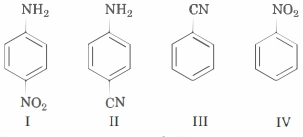
Reaction of aniline with $NaNO_{2} +$ dil. $HCl$ at $0^{\circ} C$ followed by reaction with $CuCN$ yields:
A
$I$
B
$II$
C
$III$
D
$IV$
Solution
(C) The correct answer is $C$ $(III)$.
Step $1$: Aniline reacts with $NaNO_{2} +$ dil. $HCl$ at $0-5^{\circ} C$ to form benzene diazonium chloride $(C_{6}H_{5}N_{2}^{+}Cl^{-})$.
Step $2$: The benzene diazonium chloride then reacts with $CuCN$ (Sandmeyer reaction) to replace the diazonium group with a cyano group $(-CN)$,yielding cyanobenzene (benzonitrile) and releasing $N_{2}$ gas.
Structure $III$ represents cyanobenzene.
Step $1$: Aniline reacts with $NaNO_{2} +$ dil. $HCl$ at $0-5^{\circ} C$ to form benzene diazonium chloride $(C_{6}H_{5}N_{2}^{+}Cl^{-})$.
Step $2$: The benzene diazonium chloride then reacts with $CuCN$ (Sandmeyer reaction) to replace the diazonium group with a cyano group $(-CN)$,yielding cyanobenzene (benzonitrile) and releasing $N_{2}$ gas.
Structure $III$ represents cyanobenzene.
0 likesView Solution
40
ChemistryEasyMCQKVPY · 2015
Schottky defect in a crystal arises due to
A
creation of equal number of cation and anion vacancies
B
creation of unequal number of cation and anion vacancies
C
migration of cations to interstitial voids
D
migration of anions to interstitial voids
Solution
(A) Schottky defect is a type of vacancy defect in ionic solids,where an equal number of cations and anions are missing from their lattice sites to maintain electrical neutrality.This defect leads to a decrease in the density of the crystal.It is typically observed in ionic compounds where the cations and anions have similar sizes,such as $NaCl$ and $AgBr$.
0 likesView Solution
41
ChemistryMediumMCQKVPY · 2015
The geometry and the number of unpaired electron$(s)$ of $[MnBr_4]^{2-}$,respectively,are
A
tetrahedral and $1$
B
square planar and $1$
C
tetrahedral and $5$
D
square planar and $5$
Solution
(C) The oxidation state of $Mn$ in $[MnBr_4]^{2-}$ is $+2$.
The electronic configuration of $Mn^{2+}$ is $[Ar] 3d^{5} 4s^{0}$.
Since $Br^{-}$ is a weak field ligand,pairing of electrons will not occur.
As the hybridisation of $Mn$ in $[MnBr_4]^{2-}$ is $sp^{3}$,its geometry is tetrahedral and it contains $5$ unpaired electrons.
$Mn^{2+}$ (Ground state): $3d$ $(1|1|1|1|1)$ $4s$ ( ) $4p$ ( ) ( )
$[MnBr_4]^{2-}$: $3d$ $(1|1|1|1|1)$ $4s$ ( ) $4p$ ( ) ( ) ( ) $\rightarrow sp^{3}$ hybridisation
The electronic configuration of $Mn^{2+}$ is $[Ar] 3d^{5} 4s^{0}$.
Since $Br^{-}$ is a weak field ligand,pairing of electrons will not occur.
As the hybridisation of $Mn$ in $[MnBr_4]^{2-}$ is $sp^{3}$,its geometry is tetrahedral and it contains $5$ unpaired electrons.
$Mn^{2+}$ (Ground state): $3d$ $(1|1|1|1|1)$ $4s$ ( ) $4p$ ( ) ( )
$[MnBr_4]^{2-}$: $3d$ $(1|1|1|1|1)$ $4s$ ( ) $4p$ ( ) ( ) ( ) $\rightarrow sp^{3}$ hybridisation
0 likesView Solution
42
ChemistryMediumMCQKVPY · 2015
The standard cell potential for $Zn \mid Zn^{2+} \parallel Cu^{2+} \mid Cu$ is $1.10 \ V$. When the cell is completely discharged,$\log ([Zn^{2+}] / [Cu^{2+}])$ is closest to $.....$
A
$37.3$
B
$0.026$
C
$18.7$
D
$0.052$
Solution
(A) The cell reaction is: $Zn_{(s)} + Cu^{2+}_{(aq)} \longrightarrow Zn^{2+}_{(aq)} + Cu_{(s)}$
According to the Nernst equation:
$E_{cell} = E^{\circ}_{cell} - \frac{0.0591}{n} \log \frac{[Zn^{2+}]}{[Cu^{2+}]}$
When the cell is completely discharged,$E_{cell} = 0$ and $n = 2$.
Substituting the values:
$0 = 1.10 - \frac{0.0591}{2} \log \frac{[Zn^{2+}]}{[Cu^{2+}]}$
$1.10 = \frac{0.0591}{2} \log \frac{[Zn^{2+}]}{[Cu^{2+}]}$
$\log \frac{[Zn^{2+}]}{[Cu^{2+}]} = \frac{1.10 \times 2}{0.0591} = \frac{2.20}{0.0591} \approx 37.225$
Thus,the value is closest to $37.3$.
According to the Nernst equation:
$E_{cell} = E^{\circ}_{cell} - \frac{0.0591}{n} \log \frac{[Zn^{2+}]}{[Cu^{2+}]}$
When the cell is completely discharged,$E_{cell} = 0$ and $n = 2$.
Substituting the values:
$0 = 1.10 - \frac{0.0591}{2} \log \frac{[Zn^{2+}]}{[Cu^{2+}]}$
$1.10 = \frac{0.0591}{2} \log \frac{[Zn^{2+}]}{[Cu^{2+}]}$
$\log \frac{[Zn^{2+}]}{[Cu^{2+}]} = \frac{1.10 \times 2}{0.0591} = \frac{2.20}{0.0591} \approx 37.225$
Thus,the value is closest to $37.3$.
0 likesView Solution
43
ChemistryMediumMCQKVPY · 2015
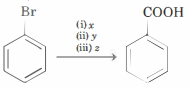
In the reaction,$x$,$y$ and $z$ are
A
$x = Mg$,dry ether; $y = CH_{3}Cl$; $z = H_{2}O$
B
$x = Mg$,dry methanol; $y = CO_{2}$; $z = \text{dil. } HCl$
C
$x = Mg$,dry ether; $y = CO_{2}$; $z = \text{dil. } HCl$
D
$x = Mg$,dry methanol; $y = CH_{3}Cl$; $z = H_{2}O$
Solution
(C) The correct option is $C$.
Bromobenzene reacts with $Mg$ in the presence of dry ether to form a Grignard reagent (phenylmagnesium bromide).
This Grignard reagent then reacts with $CO_{2}$ to form an intermediate,which upon hydrolysis with $\text{dil. } HCl$ gives benzoic acid.
Bromobenzene reacts with $Mg$ in the presence of dry ether to form a Grignard reagent (phenylmagnesium bromide).
This Grignard reagent then reacts with $CO_{2}$ to form an intermediate,which upon hydrolysis with $\text{dil. } HCl$ gives benzoic acid.
0 likesView Solution
44
ChemistryMediumMCQKVPY · 2015
An organic compound having molecular formula $C_2H_6O$ undergoes oxidation with $K_2Cr_2O_7 / H_2SO_4$ to produce $X$ which contains $40\,\%$ carbon,$6.7\,\%$ hydrogen and $53.3\,\%$ oxygen. The molecular formula of the compound $X$ is
A
$CH_2O$
B
$C_2H_4O_2$
C
$C_2H_4O$
D
$C_2H_6O_2$
Solution
(B) The organic compound with molecular formula $C_2H_6O$ is ethanol $(CH_3CH_2OH)$,as it undergoes oxidation to form a carboxylic acid.
$CH_3CH_2OH \xrightarrow{K_2Cr_2O_7 / H_2SO_4} CH_3COOH$ $(X)$
To determine the molecular formula of $X$,we calculate its empirical formula based on the given percentage composition:
The empirical formula is $CH_2O$. The empirical formula mass is $12 + (2 \times 1) + 16 = 30$.
The molar mass of acetic acid $(CH_3COOH)$ is $60$.
$n = \frac{\text{Molecular Mass}}{\text{Empirical Formula Mass}} = \frac{60}{30} = 2$.
Therefore,the molecular formula is $(CH_2O)_2 = C_2H_4O_2$.
$CH_3CH_2OH \xrightarrow{K_2Cr_2O_7 / H_2SO_4} CH_3COOH$ $(X)$
To determine the molecular formula of $X$,we calculate its empirical formula based on the given percentage composition:
| Element | Percentage | Moles $(Percentage / Atomic Mass)$ | Simplest Ratio |
| $C$ | $40\%$ | $40 / 12 = 3.33$ | $3.33 / 3.33 = 1$ |
| $H$ | $6.7\%$ | $6.7 / 1 = 6.7$ | $6.7 / 3.33 = 2$ |
| $O$ | $53.3\%$ | $53.3 / 16 = 3.33$ | $3.33 / 3.33 = 1$ |
The empirical formula is $CH_2O$. The empirical formula mass is $12 + (2 \times 1) + 16 = 30$.
The molar mass of acetic acid $(CH_3COOH)$ is $60$.
$n = \frac{\text{Molecular Mass}}{\text{Empirical Formula Mass}} = \frac{60}{30} = 2$.
Therefore,the molecular formula is $(CH_2O)_2 = C_2H_4O_2$.
0 likesView Solution
45
ChemistryMediumMCQKVPY · 2015
$MnO_2$ when fused with $KOH$ and oxidised in air gives a dark green compound $X$. In acidic solution,$X$ undergoes disproportionation to give an intense purple compound $Y$ and $MnO_2$. The compounds $X$ and $Y$,respectively,are
A
$K_2MnO_4$ and $KMnO_4$
B
$Mn_2O_7$ and $KMnO_4$
C
$K_2MnO_4$ and $Mn_2O_7$
D
$KMnO_4$ and $K_2MnO_4$
Solution
(A) $MnO_2$,when fused with $KOH$ and oxidised in air,gives a dark green compound $X$,which is potassium manganate $(K_2MnO_4)$.
In acidic solution,$K_2MnO_4$ undergoes disproportionation to give an intense purple solution of potassium permanganate $Y$ $(KMnO_4)$ and $MnO_2$.
The chemical reactions are:
$2MnO_2 + 4KOH + O_2 \longrightarrow 2K_2MnO_4 + 2H_2O$
$3K_2MnO_4 + 4H^{+} \longrightarrow 2KMnO_4 + MnO_2 + 2H_2O + 4K^{+}$
Thus,$X$ is $K_2MnO_4$ and $Y$ is $KMnO_4$.
In acidic solution,$K_2MnO_4$ undergoes disproportionation to give an intense purple solution of potassium permanganate $Y$ $(KMnO_4)$ and $MnO_2$.
The chemical reactions are:
$2MnO_2 + 4KOH + O_2 \longrightarrow 2K_2MnO_4 + 2H_2O$
$3K_2MnO_4 + 4H^{+} \longrightarrow 2KMnO_4 + MnO_2 + 2H_2O + 4K^{+}$
Thus,$X$ is $K_2MnO_4$ and $Y$ is $KMnO_4$.
0 likesView Solution
46
ChemistryMediumMCQKVPY · 2015
$A$ metal $(X)$ dissolves in both dilute $HCl$ and dilute $NaOH$ to liberate $H_2$ gas. Addition of $NH_4Cl$ and excess $NH_4OH$ to an $HCl$ solution of $(X)$ produces $(Y)$ as a precipitate. $(Y)$ is also produced by adding $NH_4Cl$ to the $NaOH$ solution of $(X)$. The species $(X)$ and $(Y)$,respectively,are:
A
$Zn$ and $Zn(OH)_2$
B
$Al$ and $Al(OH)_3$
C
$Zn$ and $Na_2ZnO_2$
D
$Al$ and $NaAlO_2$
Solution
(B) $Al$ $(X)$ is an amphoteric metal that dissolves in both dilute $HCl$ and dilute $NaOH$ to liberate $H_2$ gas.
$2Al + 6HCl \longrightarrow 2AlCl_3 + 3H_2$
$2Al + 2NaOH + 2H_2O \longrightarrow 2NaAlO_2 + 3H_2$
When $NH_4Cl$ and excess $NH_4OH$ are added to the $AlCl_3$ solution,$Al(OH)_3$ $(Y)$ is precipitated.
$AlCl_3 + 3NH_4OH \longrightarrow Al(OH)_3 \downarrow + 3NH_4Cl$
Similarly,adding $NH_4Cl$ to the $NaAlO_2$ solution (formed by $Al$ in $NaOH$) also precipitates $Al(OH)_3$ $(Y)$ due to the common ion effect and hydrolysis of the aluminate ion.
$NaAlO_2 + NH_4Cl + H_2O \longrightarrow Al(OH)_3 \downarrow + NaCl + NH_3$
Thus,$(X)$ is $Al$ and $(Y)$ is $Al(OH)_3$.
$2Al + 6HCl \longrightarrow 2AlCl_3 + 3H_2$
$2Al + 2NaOH + 2H_2O \longrightarrow 2NaAlO_2 + 3H_2$
When $NH_4Cl$ and excess $NH_4OH$ are added to the $AlCl_3$ solution,$Al(OH)_3$ $(Y)$ is precipitated.
$AlCl_3 + 3NH_4OH \longrightarrow Al(OH)_3 \downarrow + 3NH_4Cl$
Similarly,adding $NH_4Cl$ to the $NaAlO_2$ solution (formed by $Al$ in $NaOH$) also precipitates $Al(OH)_3$ $(Y)$ due to the common ion effect and hydrolysis of the aluminate ion.
$NaAlO_2 + NH_4Cl + H_2O \longrightarrow Al(OH)_3 \downarrow + NaCl + NH_3$
Thus,$(X)$ is $Al$ and $(Y)$ is $Al(OH)_3$.
0 likesView Solution
47
ChemistryMediumMCQKVPY · 2015
The major products of the following reaction,$2ZnS_{(s)} + 3O_{2(g)} \xrightarrow{\text{Heat}} \dots$ are
A
$ZnO$ and $SO_2$
B
$ZnSO_4$ and $SO_3$
C
$ZnSO_4$ and $SO_2$
D
$Zn$ and $SO_2$
Solution
(A) The correct option is $A$.
The reaction is $2ZnS_{(s)} + 3O_{2(g)} \xrightarrow{\Delta} 2ZnO_{(s)} + 2SO_{2(g)}$.
This process is known as roasting,where the sulphide ore is heated in a regular supply of air to convert it into its oxide form at a temperature below the melting point of the metal.
The reaction is $2ZnS_{(s)} + 3O_{2(g)} \xrightarrow{\Delta} 2ZnO_{(s)} + 2SO_{2(g)}$.
This process is known as roasting,where the sulphide ore is heated in a regular supply of air to convert it into its oxide form at a temperature below the melting point of the metal.
0 likesView Solution
48
ChemistryMediumMCQKVPY · 2015
The functional group present in a molecule having the formula $C_{12}O_9$ is
A
carboxylic acid
B
anhydride
C
aldehyde
D
alcohol
Solution
(B) The molecule with the formula $C_{12}O_9$ is known as mellitic anhydride.
Its structure consists of a benzene ring fused with three cyclic anhydride groups.
Therefore,the functional group present in the molecule is an anhydride group.
Its structure consists of a benzene ring fused with three cyclic anhydride groups.
Therefore,the functional group present in the molecule is an anhydride group.
0 likesView Solution
49
ChemistryMediumMCQKVPY · 2015
$A$ sweet-smelling compound formed by reacting acetic acid with ethanol in the presence of hydrochloric acid is
A
$CH_3COOC_2H_5$
B
$C_2H_5COOH$
C
$C_2H_5COOCH_3$
D
$CH_3OH$
Solution
(A) The correct option is $A$.
When acetic acid $(CH_3COOH)$ reacts with ethanol $(C_2H_5OH)$ in the presence of an acid catalyst like hydrochloric acid $(HCl)$,an esterification reaction occurs.
This reaction produces ethyl acetate $(CH_3COOC_2H_5)$,which is a sweet-smelling compound,along with water $(H_2O)$.
The chemical equation is: $CH_3COOH + C_2H_5OH \xrightarrow{HCl} CH_3COOC_2H_5 + H_2O$.
When acetic acid $(CH_3COOH)$ reacts with ethanol $(C_2H_5OH)$ in the presence of an acid catalyst like hydrochloric acid $(HCl)$,an esterification reaction occurs.
This reaction produces ethyl acetate $(CH_3COOC_2H_5)$,which is a sweet-smelling compound,along with water $(H_2O)$.
The chemical equation is: $CH_3COOH + C_2H_5OH \xrightarrow{HCl} CH_3COOC_2H_5 + H_2O$.
0 likesView Solution
50
ChemistryMediumMCQKVPY · 2015
Among $Mg$,$Cu$,$Fe$,and $Zn$,the metal that does not produce hydrogen gas in reaction with hydrochloric acid is:
A
$Cu$
B
$Zn$
C
$Mg$
D
$Fe$
Solution
(A) .
Metals that are placed below hydrogen in the electrochemical reactivity series cannot displace hydrogen from dilute acids.
Among the given metals,$Cu$ (copper) is less reactive than hydrogen $(H)$,meaning its standard reduction potential is higher than that of hydrogen.
Therefore,$Cu$ does not react with $HCl$ to produce $H_2$ gas.
Metals that are placed below hydrogen in the electrochemical reactivity series cannot displace hydrogen from dilute acids.
Among the given metals,$Cu$ (copper) is less reactive than hydrogen $(H)$,meaning its standard reduction potential is higher than that of hydrogen.
Therefore,$Cu$ does not react with $HCl$ to produce $H_2$ gas.
0 likesView Solution
51
ChemistryMediumMCQKVPY · 2015
The maximum number of isomeric ethers with the molecular formula $C_4H_{10}O$ is
A
$2$
B
$3$
C
$4$
D
$5$
Solution
(B)
The isomeric ethers with the molecular formula $C_4H_{10}O$ are:
$1. CH_3-O-CH_2-CH_2-CH_3$ ($1$-methoxypropane)
$2. CH_3-CH_2-O-CH_2-CH_3$ (ethoxyethane)
$3. CH_3-O-CH(CH_3)_2$ ($2$-methoxypropane)
Thus,there are $3$ isomeric ethers with the molecular formula $C_4H_{10}O$.
The isomeric ethers with the molecular formula $C_4H_{10}O$ are:
$1. CH_3-O-CH_2-CH_2-CH_3$ ($1$-methoxypropane)
$2. CH_3-CH_2-O-CH_2-CH_3$ (ethoxyethane)
$3. CH_3-O-CH(CH_3)_2$ ($2$-methoxypropane)
Thus,there are $3$ isomeric ethers with the molecular formula $C_4H_{10}O$.
0 likesView Solution
52
ChemistryMediumMCQKVPY · 2015
The amount of $Ag$ (atomic mass $= 108$) deposited at the cathode when a current of $0.5 \, A$ is passed through a solution of $AgNO_3$ for $1 \, h$ is closest to $... \, g$.
A
$2$
B
$5$
C
$108$
D
$11$
Solution
(A) The reaction at the cathode is: $Ag^+ + e^- \rightarrow Ag(s)$.
According to Faraday's law of electrolysis,the mass $W$ deposited is given by: $W = \frac{M \times I \times t}{n \times F}$.
Given: $M = 108 \, g/mol$,$I = 0.5 \, A$,$t = 1 \, h = 3600 \, s$,$n = 1$ (for $Ag^+$),and $F \approx 96500 \, C/mol$.
Substituting the values: $W = \frac{108 \times 0.5 \times 3600}{1 \times 96500}$.
$W = \frac{194400}{96500} \approx 2.014 \, g$.
Thus,the amount is closest to $2 \, g$.
According to Faraday's law of electrolysis,the mass $W$ deposited is given by: $W = \frac{M \times I \times t}{n \times F}$.
Given: $M = 108 \, g/mol$,$I = 0.5 \, A$,$t = 1 \, h = 3600 \, s$,$n = 1$ (for $Ag^+$),and $F \approx 96500 \, C/mol$.
Substituting the values: $W = \frac{108 \times 0.5 \times 3600}{1 \times 96500}$.
$W = \frac{194400}{96500} \approx 2.014 \, g$.
Thus,the amount is closest to $2 \, g$.
0 likesView Solution
Vedclass Products
For Students
Vedclass Test Series
Mock tests in real KVPY style covering Chemistry with performance analysis. 5-day free trial.
Start Free TrialFor Teachers
Exam Paper Generator
Generate Set A/B/C/D Chemistry papers from 7.5L+ questions in 2 minutes. 3 chapters free.
Try FreeFor Institutes
Online Exam Module
Run live KVPY mock exams with unlimited students, 360° analytics & white-label branding.
See DemoFrequently Asked Questions
How many Chemistry questions are in KVPY 2015?
There are 52 Chemistry questions from the KVPY 2015 paper on Vedclass, each with a detailed step-by-step solution in English.
Are KVPY 2015 Chemistry solutions available in English?
Yes. All solutions on this page are in English. You can also switch to English or Hindi using the language buttons above the questions.
Can I practice KVPY 2015 Chemistry as a timed test?
Yes. Use the Vedclass Test Series to attempt a full KVPY mock test covering Chemistry with time limits and instant score analysis.
Can teachers create Chemistry papers from KVPY previous year questions?
Yes. The Vedclass Exam Paper Generator lets teachers mix KVPY Chemistry questions and generate Set A/B/C/D papers in minutes.
For Teachers & Institutes
Build a Custom Chemistry Paper
Pick KVPY 2015 Chemistry questions, set difficulty, and generate Set A/B/C/D in 2 minutes.