
ChemistryQ1–50 of 50 questions
Page 1 of 1 · English
1
ChemistryMediumMCQKVPY · 2016
The shape of $SCl_4$ is best described as a
A
square
B
tetrahedron
C
square pyramid
D
see-saw
Solution
(D) $S$ has $6$ valence electrons.
It forms $4$ bond pairs with $Cl$ atoms and has $1$ lone pair remaining.
According to $VSEPR$ theory,a molecule with $4$ bond pairs and $1$ lone pair ($AX_4E$ type) adopts a see-saw geometry.
It forms $4$ bond pairs with $Cl$ atoms and has $1$ lone pair remaining.
According to $VSEPR$ theory,a molecule with $4$ bond pairs and $1$ lone pair ($AX_4E$ type) adopts a see-saw geometry.
0 likesView Solution
2
ChemistryDifficultMCQKVPY · 2016
Among the following atomic orbital overlaps,the non-bonding overlap is
A
B
C
D
Solution
(A) When orbitals of two atoms come close to form a bond,their overlap may be positive,negative,or zero depending upon the sign and the direction of orientation of the amplitude of the orbital wave function in space.
In the case of non-bonding overlap,there is no effective overlap because the positive and negative regions cancel each other out,resulting in a net overlap of zero.
This occurs when the symmetry of the orbitals is such that they cannot interact effectively,such as the overlap between a $p_x$ orbital and a $p_z$ orbital,where the positive lobe of one overlaps with both the positive and negative lobes of the other equally,leading to zero net overlap as shown in option $(A)$.
In the case of non-bonding overlap,there is no effective overlap because the positive and negative regions cancel each other out,resulting in a net overlap of zero.
This occurs when the symmetry of the orbitals is such that they cannot interact effectively,such as the overlap between a $p_x$ orbital and a $p_z$ orbital,where the positive lobe of one overlaps with both the positive and negative lobes of the other equally,leading to zero net overlap as shown in option $(A)$.
0 likesView Solution
3
ChemistryMediumMCQKVPY · 2016
The ratio of root mean square velocity of hydrogen at $50 \, K$ to that of nitrogen at $500 \, K$ is closest to
A
$1.18$
B
$0.85$
C
$0.59$
D
$1.40$
Solution
(A) The root mean square velocity $(v_{rms})$ of a gas is given by the formula: $v_{rms} = \sqrt{\frac{3RT}{M}}$
where $R$ is the gas constant,$T$ is the temperature,and $M$ is the molar mass of the gas.
For hydrogen gas $(H_2)$: $M = 2 \, g/mol$,$T = 50 \, K$.
$(v_{rms})_{H_2} = \sqrt{\frac{3 \times R \times 50}{2}} = \sqrt{75R}$.
For nitrogen gas $(N_2)$: $M = 28 \, g/mol$,$T = 500 \, K$.
$(v_{rms})_{N_2} = \sqrt{\frac{3 \times R \times 500}{28}} = \sqrt{\frac{1500R}{28}} = \sqrt{53.57R}$.
The ratio is $\frac{(v_{rms})_{H_2}}{(v_{rms})_{N_2}} = \sqrt{\frac{75R}{53.57R}} = \sqrt{1.4} \approx 1.18$.
where $R$ is the gas constant,$T$ is the temperature,and $M$ is the molar mass of the gas.
For hydrogen gas $(H_2)$: $M = 2 \, g/mol$,$T = 50 \, K$.
$(v_{rms})_{H_2} = \sqrt{\frac{3 \times R \times 50}{2}} = \sqrt{75R}$.
For nitrogen gas $(N_2)$: $M = 28 \, g/mol$,$T = 500 \, K$.
$(v_{rms})_{N_2} = \sqrt{\frac{3 \times R \times 500}{28}} = \sqrt{\frac{1500R}{28}} = \sqrt{53.57R}$.
The ratio is $\frac{(v_{rms})_{H_2}}{(v_{rms})_{N_2}} = \sqrt{\frac{75R}{53.57R}} = \sqrt{1.4} \approx 1.18$.
0 likesView Solution
4
ChemistryMediumMCQKVPY · 2016
The molecule with the highest dipole moment among the following is
A
$NH_{3}$
B
$NF_{3}$
C
$CO$
D
$HF$
Solution
(D) The dipole moment of a molecule depends upon the electronegativity difference between the bonded atoms and the molecular geometry.
$NH_{3}$ has a dipole moment of $1.47 \ D$.
$NF_{3}$ has a dipole moment of $0.23 \ D$.
$CO$ has a dipole moment of $0.122 \ D$.
$HF$ has a dipole moment of $1.78 \ D$.
Comparing these values,$HF$ has the highest dipole moment due to the large electronegativity difference between $H$ and $F$ atoms.
Therefore,the correct option is $(D)$.
$NH_{3}$ has a dipole moment of $1.47 \ D$.
$NF_{3}$ has a dipole moment of $0.23 \ D$.
$CO$ has a dipole moment of $0.122 \ D$.
$HF$ has a dipole moment of $1.78 \ D$.
Comparing these values,$HF$ has the highest dipole moment due to the large electronegativity difference between $H$ and $F$ atoms.
Therefore,the correct option is $(D)$.
0 likesView Solution
5
ChemistryMediumMCQKVPY · 2016
The most stable Lewis acid-base adduct among the following is
A
$H_{2}O \rightarrow BCl_{3}$
B
$H_{2}S \rightarrow BCl_{3}$
C
$H_{3}N \rightarrow BCl_{3}$
D
$H_{3}P \rightarrow BCl_{3}$
Solution
(C) complex formed by the dative bond between a Lewis acid and a Lewis base is called a Lewis acid-base adduct.
In all the given cases,the Lewis acid,$BCl_{3}$,is the same.
Therefore,the stability depends on the strength of the Lewis base.
Among the given options,$H_{3}N \rightarrow BCl_{3}$ forms the most stable adduct because the $N$ atom in $NH_{3}$ has a lone pair and is less electronegative compared to $O$ in $H_{2}O$.
This allows $NH_{3}$ to effectively donate its lone pair into the empty $p$-orbital of $B$ in $BCl_{3}$,forming a strong $p\pi - p\pi$ dative bond.
In option $(A)$,$O$ is highly electronegative,which reduces its donor ability.
In options $(B)$ and $(D)$,the $d\pi - p\pi$ interaction (involving $S$ or $P$) is less effective than the $p\pi - p\pi$ interaction in $NH_{3} \rightarrow BCl_{3}$.
In all the given cases,the Lewis acid,$BCl_{3}$,is the same.
Therefore,the stability depends on the strength of the Lewis base.
Among the given options,$H_{3}N \rightarrow BCl_{3}$ forms the most stable adduct because the $N$ atom in $NH_{3}$ has a lone pair and is less electronegative compared to $O$ in $H_{2}O$.
This allows $NH_{3}$ to effectively donate its lone pair into the empty $p$-orbital of $B$ in $BCl_{3}$,forming a strong $p\pi - p\pi$ dative bond.
In option $(A)$,$O$ is highly electronegative,which reduces its donor ability.
In options $(B)$ and $(D)$,the $d\pi - p\pi$ interaction (involving $S$ or $P$) is less effective than the $p\pi - p\pi$ interaction in $NH_{3} \rightarrow BCl_{3}$.
0 likesView Solution
6
ChemistryMediumMCQKVPY · 2016
The major product obtained in the reaction of toluene with $1-$bromo$-2-$methylpropane in the presence of anhydrous $AlCl_3$ is
A
$1-$methyl$-4-$($2$-methylpropyl)benzene
B
$1-$methyl$-2-$($2$-methylpropyl)benzene
C
$1-$methyl$-4-$($1$,$1$-dimethylethyl)benzene
D
$1-$methyl$-3-$($1$,$1$-dimethylethyl)benzene
Solution
(C) The reaction is a Friedel-Crafts alkylation. The alkyl halide $CH_3-CH(CH_3)-CH_2Br$ reacts with $AlCl_3$ to form a primary carbocation,which undergoes a $1,2-$hydride shift to form a more stable tertiary carbocation,$(CH_3)_3C^+$. This tertiary carbocation acts as the electrophile and attacks the toluene ring. Since the $-CH_3$ group is ortho/para directing and the tert-butyl group is bulky,the para-substituted product is the major product due to less steric hindrance. The major product is $1-$methyl$-4-(1,1-$dimethylethyl$)$benzene.
0 likesView Solution
7
ChemistryMediumMCQKVPY · 2016
The compounds containing $sp$-hybridised carbon atom are:
$(I)$ $H_3C-N(CH_3)-CHO$
$(II)$ Pyridine
$(III)$ $H_3C-CN$
$(IV)$ $H_2C=C=CH-CH_3$
$(I)$ $H_3C-N(CH_3)-CHO$
$(II)$ Pyridine
$(III)$ $H_3C-CN$
$(IV)$ $H_2C=C=CH-CH_3$
A
$I$ and $II$
B
$III$ and $IV$
C
$II$ and $III$
D
$I$ and $IV$
Solution
(B) To determine the hybridisation of carbon atoms,we count the number of sigma bonds and lone pairs (if any) around the carbon atom.
$(I)$ $N,N$-Dimethylformamide: All carbon atoms are $sp^3$ or $sp^2$ hybridised.
$(II)$ Pyridine: All carbon atoms are $sp^2$ hybridised.
$(III)$ Acetonitrile $(CH_3CN)$: The carbon atom in the cyano group $(-CN)$ is bonded to nitrogen by a triple bond. It has two sigma bonds and no lone pairs,so it is $sp$ hybridised.
$(IV)$ Buta$-1,2-$diene $(H_2C=C=CH-CH_3)$: The central carbon atom is bonded to two other carbon atoms by double bonds. It has two sigma bonds and no lone pairs,so it is $sp$ hybridised.
Thus,compounds $(III)$ and $(IV)$ contain $sp$-hybridised carbon atoms.
$(I)$ $N,N$-Dimethylformamide: All carbon atoms are $sp^3$ or $sp^2$ hybridised.
$(II)$ Pyridine: All carbon atoms are $sp^2$ hybridised.
$(III)$ Acetonitrile $(CH_3CN)$: The carbon atom in the cyano group $(-CN)$ is bonded to nitrogen by a triple bond. It has two sigma bonds and no lone pairs,so it is $sp$ hybridised.
$(IV)$ Buta$-1,2-$diene $(H_2C=C=CH-CH_3)$: The central carbon atom is bonded to two other carbon atoms by double bonds. It has two sigma bonds and no lone pairs,so it is $sp$ hybridised.
Thus,compounds $(III)$ and $(IV)$ contain $sp$-hybridised carbon atoms.
0 likesView Solution
8
ChemistryMediumMCQKVPY · 2016
Upon heating with acidic $KMnO_4$,an organic compound produces hexan$-1,6-$dioic acid as the major product. The starting compound is
A
benzene
B
cyclohexene
C
$1-$methylcyclohexene
D
$2-$methylcyclohexene
Solution
(B) The reaction of cyclic alkenes with strong oxidizing agents like acidic $KMnO_4$ leads to the oxidative cleavage of the double bond.
For cyclohexene,the oxidative cleavage of the $C=C$ double bond results in the formation of a dicarboxylic acid.
The reaction proceeds as follows:
Cyclohexene $\xrightarrow{Acidic \ KMnO_4, \Delta}$ Hexan$-1,6-$dioic acid (Adipic acid).
Thus,the starting compound is cyclohexene.
For cyclohexene,the oxidative cleavage of the $C=C$ double bond results in the formation of a dicarboxylic acid.
The reaction proceeds as follows:
Cyclohexene $\xrightarrow{Acidic \ KMnO_4, \Delta}$ Hexan$-1,6-$dioic acid (Adipic acid).
Thus,the starting compound is cyclohexene.
0 likesView Solution
9
ChemistryDifficultMCQKVPY · 2016
The number of stereoisomers possible for the following compound is $CH_3-CH=CH-CH(Br)-CH_2-CH_3$
A
$2$
B
$3$
C
$4$
D
$8$
Solution
(C) The given compound is $CH_3-CH=CH-CH(Br)-CH_2-CH_3$.
This molecule contains one chiral carbon atom (indicated by the asterisk in the structure) and one carbon-carbon double bond.
For a molecule with $n$ chiral centers and $m$ double bonds that can exhibit geometrical isomerism,where the molecule is unsymmetrical,the total number of stereoisomers is given by $2^n \times 2^m$ if the double bond is not part of the chiral center system.
Here,$n=1$ (one chiral center) and $m=1$ (one double bond capable of $cis-trans$ isomerism).
Total stereoisomers $= 2^1 \times 2^1 = 2 \times 2 = 4$.
The four stereoisomers are: $(cis, R)$,$(cis, S)$,$(trans, R)$,and $(trans, S)$.
This molecule contains one chiral carbon atom (indicated by the asterisk in the structure) and one carbon-carbon double bond.
For a molecule with $n$ chiral centers and $m$ double bonds that can exhibit geometrical isomerism,where the molecule is unsymmetrical,the total number of stereoisomers is given by $2^n \times 2^m$ if the double bond is not part of the chiral center system.
Here,$n=1$ (one chiral center) and $m=1$ (one double bond capable of $cis-trans$ isomerism).
Total stereoisomers $= 2^1 \times 2^1 = 2 \times 2 = 4$.
The four stereoisomers are: $(cis, R)$,$(cis, S)$,$(trans, R)$,and $(trans, S)$.
0 likesView Solution
10
ChemistryMediumMCQKVPY · 2016
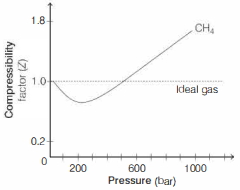
In the following compressibility factor $(Z)$ versus pressure graph at $300 \, K$,the compressibility of $CH_{4}$ at pressure $< 200 \, bar$ deviates from ideal behaviour because
A
the molar volume of $CH_{4}$ is less than its molar volume in the ideal state
B
the molar volume of $CH_{4}$ is same as that in its ideal state
C
intermolecular interactions between $CH_{4}$ molecules decrease
D
the molar volume of $CH_{4}$ is more than its molar volume in the ideal state
Solution
(A) The compressibility factor is defined as $Z = \frac{p V}{n R T}$.
For an ideal gas,$Z = 1$ at all temperatures and pressures.
For a real gas,$Z = \frac{p V_{real}}{n R T} \quad (i)$.
If the gas shows ideal behaviour,then $V_{ideal} = \frac{n R T}{p}$,which implies $\frac{p}{n R T} = \frac{1}{V_{ideal}} \quad (ii)$.
Substituting $(ii)$ into $(i)$,we get $Z = \frac{V_{real}}{V_{ideal}}$.
Considering molar volume,$Z = \frac{(V_{m})_{real}}{(V_{m})_{ideal}}$.
From the given graph,$Z < 1$ at pressure $< 200 \, bar$.
Therefore,$\frac{(V_{m})_{real}}{(V_{m})_{ideal}} < 1$,which implies $(V_{m})_{CH_{4}, real} < (V_{m})_{CH_{4}, ideal}$.
For an ideal gas,$Z = 1$ at all temperatures and pressures.
For a real gas,$Z = \frac{p V_{real}}{n R T} \quad (i)$.
If the gas shows ideal behaviour,then $V_{ideal} = \frac{n R T}{p}$,which implies $\frac{p}{n R T} = \frac{1}{V_{ideal}} \quad (ii)$.
Substituting $(ii)$ into $(i)$,we get $Z = \frac{V_{real}}{V_{ideal}}$.
Considering molar volume,$Z = \frac{(V_{m})_{real}}{(V_{m})_{ideal}}$.
From the given graph,$Z < 1$ at pressure $< 200 \, bar$.
Therefore,$\frac{(V_{m})_{real}}{(V_{m})_{ideal}} < 1$,which implies $(V_{m})_{CH_{4}, real} < (V_{m})_{CH_{4}, ideal}$.
0 likesView Solution
11
ChemistryMediumMCQKVPY · 2016
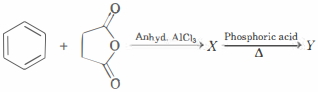
In the following reactions,$X$ and $Y$,respectively,are
A
$4-$oxo$-4-$phenylbutanoic acid and $1-$naphthol
B
$4-$oxo$-4-$phenylbutanoic acid and $1,4-$naphthoquinone
C
$4-$oxo$-4-$phenylbutanoic acid and $1-$tetralone
D
$4-$oxo$-4-$phenylbutanoic acid and $1,2,3,4-$tetrahydronaphthalene$-1,4-$dione
Solution
(C) The reaction of benzene with succinic anhydride in the presence of anhydrous $AlCl_3$ is a Friedel-Crafts acylation reaction. This produces $X$,which is $4$-oxo-$4$-phenylbutanoic acid (also known as $\beta$-benzoylpropionic acid).
In the second step,$X$ undergoes intramolecular cyclization (Friedel-Crafts acylation) in the presence of phosphoric acid $(H_3PO_4)$ and heat $(\Delta)$. This results in the formation of $Y$,which is $1$-tetralone ($3,4$-dihydro-$1(2H)$-naphthalenone).
Therefore,$X$ is $4$-oxo-$4$-phenylbutanoic acid and $Y$ is $1$-tetralone.
In the second step,$X$ undergoes intramolecular cyclization (Friedel-Crafts acylation) in the presence of phosphoric acid $(H_3PO_4)$ and heat $(\Delta)$. This results in the formation of $Y$,which is $1$-tetralone ($3,4$-dihydro-$1(2H)$-naphthalenone).
Therefore,$X$ is $4$-oxo-$4$-phenylbutanoic acid and $Y$ is $1$-tetralone.
0 likesView Solution
12
ChemistryMediumMCQKVPY · 2016
The hybridisation of the central atom and the shape of $[IO_2F_5]^{2-}$ ion,respectively are
A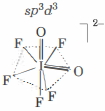
B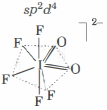
C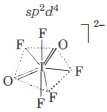
D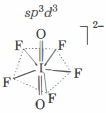
Solution
(D) The hybridisation of the central atom in a compound can be calculated as $H = \frac{1}{2}[V + MA \pm \text{anion/cation}]$.
Where,$H = \text{Hybridisation}$,$V = \text{Valency of central atom}$,$MA = \text{Monovalent atom}$.
In $[IO_2F_5]^{2-}$,the central atom is $I$ $(V=7)$. The oxygen atoms are divalent,so they do not contribute to the $MA$ count. The fluorine atoms are monovalent $(MA=5)$. The charge is $-2$ (add $2$).
$H = \frac{1}{2}[7 + 5 + 2] = \frac{14}{2} = 7$.
$A$ steric number of $7$ corresponds to $sp^3d^3$ hybridisation.
The shape corresponding to $sp^3d^3$ hybridisation is pentagonal bipyramidal. In $[IO_2F_5]^{2-}$,the two oxygen atoms occupy the axial positions to minimize repulsion,while the five fluorine atoms occupy the equatorial positions.
Where,$H = \text{Hybridisation}$,$V = \text{Valency of central atom}$,$MA = \text{Monovalent atom}$.
In $[IO_2F_5]^{2-}$,the central atom is $I$ $(V=7)$. The oxygen atoms are divalent,so they do not contribute to the $MA$ count. The fluorine atoms are monovalent $(MA=5)$. The charge is $-2$ (add $2$).
$H = \frac{1}{2}[7 + 5 + 2] = \frac{14}{2} = 7$.
$A$ steric number of $7$ corresponds to $sp^3d^3$ hybridisation.
The shape corresponding to $sp^3d^3$ hybridisation is pentagonal bipyramidal. In $[IO_2F_5]^{2-}$,the two oxygen atoms occupy the axial positions to minimize repulsion,while the five fluorine atoms occupy the equatorial positions.
0 likesView Solution
13
ChemistryMediumMCQKVPY · 2016
One mole of one of the sodium salts listed below,having carbon content close to $14.3 \%$,produces $1 \ mole$ of carbon dioxide upon heating (atomic mass of $Na = 23, H = 1, C = 12, O = 16$). The salt is:
A
$C_2H_5COONa$
B
$NaHCO_3$
C
$HCOONa$
D
$CH_3COONa$
Solution
(B) The correct option is $B$.
$NaHCO_3$ (sodium bicarbonate) produces $CO_2$ gas upon heating according to the reaction:
$2NaHCO_3 \xrightarrow{\Delta} Na_2CO_3 + H_2O + CO_2$
From the stoichiometry,$2 \ moles$ of $NaHCO_3$ produce $1 \ mole$ of $CO_2$. However,the question asks for the salt that produces $CO_2$ and has a carbon content of approximately $14.3 \%$.
Molecular mass of $NaHCO_3 = 23 + 1 + 12 + (16 \times 3) = 84 \ g/mol$.
Percentage of carbon in $NaHCO_3 = \frac{12}{84} \times 100 \approx 14.28 \%$,which is close to $14.3 \%$.
Other salts like $CH_3COONa$ or $HCOONa$ do not produce $CO_2$ upon simple heating in the same manner.
$NaHCO_3$ (sodium bicarbonate) produces $CO_2$ gas upon heating according to the reaction:
$2NaHCO_3 \xrightarrow{\Delta} Na_2CO_3 + H_2O + CO_2$
From the stoichiometry,$2 \ moles$ of $NaHCO_3$ produce $1 \ mole$ of $CO_2$. However,the question asks for the salt that produces $CO_2$ and has a carbon content of approximately $14.3 \%$.
Molecular mass of $NaHCO_3 = 23 + 1 + 12 + (16 \times 3) = 84 \ g/mol$.
Percentage of carbon in $NaHCO_3 = \frac{12}{84} \times 100 \approx 14.28 \%$,which is close to $14.3 \%$.
Other salts like $CH_3COONa$ or $HCOONa$ do not produce $CO_2$ upon simple heating in the same manner.
0 likesView Solution
14
ChemistryMCQKVPY · 2016
According to Graham's law,the rate of diffusion of $CO$,$O_2$,$N_2$,and $CO_2$ follows the order:
A
$CO = N_2 > O_2 > CO_2$
B
$CO = N_2 > CO_2 > O_2$
C
$O_2 > CO = N_2 > CO_2$
D
$CO_2 > O_2 > CO = N_2$
Solution
(A) According to Graham's law,the rate of diffusion $(r)$ is inversely proportional to the square root of the molar mass $(M)$:
$r \propto \frac{1}{\sqrt{M}}$
Calculate the molar masses of the given gases:
$CO: 12 + 16 = 28 \, g/mol$
$N_2: 14 \times 2 = 28 \, g/mol$
$O_2: 16 \times 2 = 32 \, g/mol$
$CO_2: 12 + (16 \times 2) = 44 \, g/mol$
Since the rate of diffusion decreases as the molar mass increases,the order of the rate of diffusion is:
$CO = N_2 (28 \, g/mol) > O_2 (32 \, g/mol) > CO_2 (44 \, g/mol)$
$r \propto \frac{1}{\sqrt{M}}$
Calculate the molar masses of the given gases:
$CO: 12 + 16 = 28 \, g/mol$
$N_2: 14 \times 2 = 28 \, g/mol$
$O_2: 16 \times 2 = 32 \, g/mol$
$CO_2: 12 + (16 \times 2) = 44 \, g/mol$
Since the rate of diffusion decreases as the molar mass increases,the order of the rate of diffusion is:
$CO = N_2 (28 \, g/mol) > O_2 (32 \, g/mol) > CO_2 (44 \, g/mol)$
0 likesView Solution
15
ChemistryMediumMCQKVPY · 2016
The major product formed when $but-2-ene$ is reacted with $O_3$ followed by treatment with $Zn / H_2O$ is:
A
$CH_3COOH$
B
$CH_3CHO$
C
$CH_3CH_2OH$
D
$CH_2=CH_2$
Solution
(B) The reaction of $but-2-ene$ $(CH_3-CH=CH-CH_3)$ with $O_3$ followed by reductive workup with $Zn / H_2O$ is known as reductive ozonolysis.
In this reaction,the double bond is cleaved to form two molecules of acetaldehyde $(CH_3CHO)$.
The reaction mechanism is as follows:
$CH_3-CH=CH-CH_3 + O_3 \rightarrow \text{Ozonide intermediate}$
$\text{Ozonide} + Zn / H_2O \rightarrow 2CH_3CHO + ZnO + H_2O$
Therefore,the major product is acetaldehyde $(CH_3CHO)$.
In this reaction,the double bond is cleaved to form two molecules of acetaldehyde $(CH_3CHO)$.
The reaction mechanism is as follows:
$CH_3-CH=CH-CH_3 + O_3 \rightarrow \text{Ozonide intermediate}$
$\text{Ozonide} + Zn / H_2O \rightarrow 2CH_3CHO + ZnO + H_2O$
Therefore,the major product is acetaldehyde $(CH_3CHO)$.
0 likesView Solution
16
ChemistryMediumMCQKVPY · 2016
The $IUPAC$ name for the following compound is $CH_3CH_2CH_2CH_2-C(=CH_2)-CH_2CH_2CH_3$.
A
$2$-propylhex$-1$-ene
B
$2$-butylpent$-1$-ene
C
$2$-propyl$-2$-butylethene
D
Propyl$-1$-butylethene
Solution
(A) To determine the $IUPAC$ name of the given compound $CH_3CH_2CH_2CH_2-C(=CH_2)-CH_2CH_2CH_3$:
$1$. Identify the longest carbon chain containing the double bond. The longest chain has $6$ carbon atoms,making it a hexene derivative.
$2$. Number the chain starting from the end that gives the double bond the lowest possible locant. Here,the double bond is at position $1$.
$3$. At position $2$,there is a propyl group $(-CH_2CH_2CH_3)$.
$4$. Combining these,the name is $2$-propylhex$-1$-ene.
$1$. Identify the longest carbon chain containing the double bond. The longest chain has $6$ carbon atoms,making it a hexene derivative.
$2$. Number the chain starting from the end that gives the double bond the lowest possible locant. Here,the double bond is at position $1$.
$3$. At position $2$,there is a propyl group $(-CH_2CH_2CH_3)$.
$4$. Combining these,the name is $2$-propylhex$-1$-ene.
0 likesView Solution
17
ChemistryMediumMCQKVPY · 2016
$LiOH$ reacts with $CO_2$ to form $Li_2CO_3$ (atomic mass of $Li = 7$). The amount of $CO_2$ (in $g$) consumed by $1\, g$ of $LiOH$ is closest to $....\, g$
A
$0.916$
B
$1.832$
C
$0.544$
D
$1.088$
Solution
(A) The balanced chemical equation is: $2LiOH + CO_2 \longrightarrow Li_2CO_3 + H_2O$
Molar mass of $LiOH = 7 + 16 + 1 = 24\, g/mol$.
Number of moles of $LiOH = \frac{\text{mass}}{\text{molar mass}} = \frac{1\, g}{24\, g/mol} = \frac{1}{24}\, mol$.
According to the stoichiometry,$2\, mol$ of $LiOH$ reacts with $1\, mol$ of $CO_2$.
Therefore,moles of $CO_2$ required $= \frac{1}{2} \times \text{moles of } LiOH = \frac{1}{2} \times \frac{1}{24} = \frac{1}{48}\, mol$.
Molar mass of $CO_2 = 12 + (2 \times 16) = 44\, g/mol$.
Mass of $CO_2 = \text{moles} \times \text{molar mass} = \frac{1}{48} \times 44 = 0.9166...\, g \approx 0.916\, g$.
Molar mass of $LiOH = 7 + 16 + 1 = 24\, g/mol$.
Number of moles of $LiOH = \frac{\text{mass}}{\text{molar mass}} = \frac{1\, g}{24\, g/mol} = \frac{1}{24}\, mol$.
According to the stoichiometry,$2\, mol$ of $LiOH$ reacts with $1\, mol$ of $CO_2$.
Therefore,moles of $CO_2$ required $= \frac{1}{2} \times \text{moles of } LiOH = \frac{1}{2} \times \frac{1}{24} = \frac{1}{48}\, mol$.
Molar mass of $CO_2 = 12 + (2 \times 16) = 44\, g/mol$.
Mass of $CO_2 = \text{moles} \times \text{molar mass} = \frac{1}{48} \times 44 = 0.9166...\, g \approx 0.916\, g$.
0 likesView Solution
18
ChemistryMediumMCQKVPY · 2016
The oxidation number of sulphur is $-4$ in
A
$H_2S$
B
$CS_2$
C
$Na_2SO_4$
D
None of the above
Solution
(D) The correct option is $D$.
Let us calculate the oxidation number of $S$ in the given compounds:
$(i)$ In $H_2S$:
Let the oxidation state of $S$ be $x$.
$2(+1) + x = 0$
$x = -2$
$(ii)$ In $CS_2$:
Let the oxidation state of $S$ be $x$.
$C$ is $+4$ (as $C$ is more electronegative than $S$ is not true,but $C$ is $+4$ in $CS_2$ based on standard rules).
$+4 + 2(x) = 0$
$2x = -4$
$x = -2$
$(iii)$ In $Na_2SO_4$:
$2(+1) + x + 4(-2) = 0$
$2 + x - 8 = 0$
$x = +6$
Since none of the compounds have an oxidation state of $-4$ for sulphur,the correct option is $D$.
Let us calculate the oxidation number of $S$ in the given compounds:
$(i)$ In $H_2S$:
Let the oxidation state of $S$ be $x$.
$2(+1) + x = 0$
$x = -2$
$(ii)$ In $CS_2$:
Let the oxidation state of $S$ be $x$.
$C$ is $+4$ (as $C$ is more electronegative than $S$ is not true,but $C$ is $+4$ in $CS_2$ based on standard rules).
$+4 + 2(x) = 0$
$2x = -4$
$x = -2$
$(iii)$ In $Na_2SO_4$:
$2(+1) + x + 4(-2) = 0$
$2 + x - 8 = 0$
$x = +6$
Since none of the compounds have an oxidation state of $-4$ for sulphur,the correct option is $D$.
0 likesView Solution
19
ChemistryMediumMCQKVPY · 2016
$Al_2O_3$ reacts with
A
only water
B
only acids
C
only alkalis
D
both acids and alkalis
Solution
(D)
$Al_2O_3$ is an amphoteric oxide (those oxides which show both the properties of acids and bases),so it can react both with acids and alkalis,e.g.
$Al_2O_3 + 6HCl \longrightarrow 2AlCl_3 + 3H_2O$
$Al_2O_3 + 2NaOH + 3H_2O \longrightarrow 2Na[Al(OH)_4]$
$Al_2O_3$ is an amphoteric oxide (those oxides which show both the properties of acids and bases),so it can react both with acids and alkalis,e.g.
$Al_2O_3 + 6HCl \longrightarrow 2AlCl_3 + 3H_2O$
$Al_2O_3 + 2NaOH + 3H_2O \longrightarrow 2Na[Al(OH)_4]$
0 likesView Solution
20
ChemistryMediumMCQKVPY · 2016
The major product formed in the oxidation of acetylene by alkaline $KMnO_4$ is:
A
ethanol
B
acetic acid
C
formic acid
D
oxalic acid
Solution
(D) The oxidation of acetylene $(HC \equiv CH)$ with alkaline $KMnO_4$ proceeds through the formation of glyoxal $(CHO-CHO)$ as an intermediate.
Further oxidation of glyoxal leads to the formation of oxalic acid $(HOOC-COOH)$ as the major product.
The reaction is:
$HC \equiv CH + 2[O]$ $\xrightarrow{Alk. KMnO_4} CHO-CHO$ $\xrightarrow{2[O]} HOOC-COOH$
Therefore,the correct option is $(D)$.
Further oxidation of glyoxal leads to the formation of oxalic acid $(HOOC-COOH)$ as the major product.
The reaction is:
$HC \equiv CH + 2[O]$ $\xrightarrow{Alk. KMnO_4} CHO-CHO$ $\xrightarrow{2[O]} HOOC-COOH$
Therefore,the correct option is $(D)$.
0 likesView Solution
21
ChemistryMediumMCQKVPY · 2016
In a closed vessel,an ideal gas at $1 \, atm$ is heated from $27^{\circ} C$ to $327^{\circ} C$. The final pressure of the gas will approximately be $..... \, atm$
A
$3$
B
$0.5$
C
$2$
D
$12$
Solution
(C) According to the ideal gas equation,$pV = nRT$.
Since the vessel is closed,the volume $(V)$ and the number of moles $(n)$ remain constant.
Therefore,$p \propto T$,which implies $\frac{p_1}{T_1} = \frac{p_2}{T_2}$.
Given: $p_1 = 1 \, atm$,$T_1 = 27^{\circ} C = 27 + 273 = 300 \, K$,and $T_2 = 327^{\circ} C = 327 + 273 = 600 \, K$.
Substituting the values: $\frac{1}{300} = \frac{p_2}{600}$.
$p_2 = \frac{600}{300} = 2 \, atm$.
Since the vessel is closed,the volume $(V)$ and the number of moles $(n)$ remain constant.
Therefore,$p \propto T$,which implies $\frac{p_1}{T_1} = \frac{p_2}{T_2}$.
Given: $p_1 = 1 \, atm$,$T_1 = 27^{\circ} C = 27 + 273 = 300 \, K$,and $T_2 = 327^{\circ} C = 327 + 273 = 600 \, K$.
Substituting the values: $\frac{1}{300} = \frac{p_2}{600}$.
$p_2 = \frac{600}{300} = 2 \, atm$.
0 likesView Solution
22
ChemistryMediumMCQKVPY · 2016
Among the elements $Li$,$N$,$C$ and $Be$,the one with the largest atomic radius is
A
$Li$
B
$N$
C
$C$
D
$Be$
Solution
(A)
As the given elements $Li$,$Be$,$C$,and $N$ belong to the same period,i.e.,the $2^{nd}$ period,the atomic radius decreases on moving from left to right across the period.
This decrease occurs because the effective nuclear charge increases while the number of shells remains constant.
Therefore,$Li$ (Lithium),being the leftmost element in the $2^{nd}$ period,has the largest atomic radius among them.
As the given elements $Li$,$Be$,$C$,and $N$ belong to the same period,i.e.,the $2^{nd}$ period,the atomic radius decreases on moving from left to right across the period.
This decrease occurs because the effective nuclear charge increases while the number of shells remains constant.
Therefore,$Li$ (Lithium),being the leftmost element in the $2^{nd}$ period,has the largest atomic radius among them.
0 likesView Solution
23
ChemistryDifficultMCQKVPY · 2016
Which of the following is a redox reaction?
$(i) \, CdCl_2 + 2 KOH \longrightarrow Cd(OH)_2 + 2 KCl$
$(ii) \, BaCl_2 + K_2SO_4 \longrightarrow BaSO_4 + 2 KCl$
$(iii) \, CaCO_3 \longrightarrow CaO + CO_2$
$(iv) \, 2 Ca + O_2 \longrightarrow 2 CaO$
$(i) \, CdCl_2 + 2 KOH \longrightarrow Cd(OH)_2 + 2 KCl$
$(ii) \, BaCl_2 + K_2SO_4 \longrightarrow BaSO_4 + 2 KCl$
$(iii) \, CaCO_3 \longrightarrow CaO + CO_2$
$(iv) \, 2 Ca + O_2 \longrightarrow 2 CaO$
A
$(i)$
B
$(ii)$
C
$(iii)$
D
$(iv)$
Solution
(D) The correct answer is $(iv)$.
$A$ redox reaction is one in which oxidation and reduction occur simultaneously.
$(i) \, CdCl_2 + 2 KOH \longrightarrow Cd(OH)_2 + 2 KCl$: This is a double displacement reaction where no change in oxidation state occurs.
$(ii) \, BaCl_2 + K_2SO_4 \longrightarrow BaSO_4 + 2 KCl$: This is also a double displacement reaction.
$(iii) \, CaCO_3 \longrightarrow CaO + CO_2$: This is a thermal decomposition reaction.
$(iv) \, 2 Ca + O_2 \longrightarrow 2 CaO$: Here,the oxidation state of $Ca$ increases from $0$ to $+2$ (oxidation) and the oxidation state of $O$ decreases from $0$ to $-2$ (reduction). Since both processes occur simultaneously,it is a redox reaction.
$A$ redox reaction is one in which oxidation and reduction occur simultaneously.
$(i) \, CdCl_2 + 2 KOH \longrightarrow Cd(OH)_2 + 2 KCl$: This is a double displacement reaction where no change in oxidation state occurs.
$(ii) \, BaCl_2 + K_2SO_4 \longrightarrow BaSO_4 + 2 KCl$: This is also a double displacement reaction.
$(iii) \, CaCO_3 \longrightarrow CaO + CO_2$: This is a thermal decomposition reaction.
$(iv) \, 2 Ca + O_2 \longrightarrow 2 CaO$: Here,the oxidation state of $Ca$ increases from $0$ to $+2$ (oxidation) and the oxidation state of $O$ decreases from $0$ to $-2$ (reduction). Since both processes occur simultaneously,it is a redox reaction.
0 likesView Solution
24
ChemistryMediumMCQKVPY · 2016
The electronic configuration,which obeys Hund's rule for the ground state of carbon atom is
A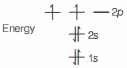
B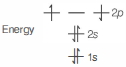
C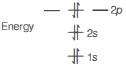
D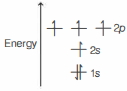
Solution
(A) The atomic number of carbon $(C)$ is $6$. Its electronic configuration is $1s^2 2s^2 2p^2$.
According to Hund's rule of maximum multiplicity,pairing of electrons in the orbitals belonging to the same subshell does not take place until each orbital belonging to that subshell has got one electron each (i.e.,it is singly occupied).
For the $2p$ subshell of carbon,there are $2$ electrons. According to Hund's rule,these $2$ electrons will occupy separate $2p$ orbitals with parallel spins to minimize inter-electronic repulsion.
Looking at the options:
Option $(A)$ shows $2p$ orbitals with $2$ electrons in separate orbitals.
Option $(B)$ shows $2p$ orbitals with $2$ electrons in separate orbitals,but the spins are opposite (not parallel).
Option $(C)$ shows $2p$ orbitals with $2$ electrons paired in a single orbital.
Option $(D)$ shows $2s$ orbital with only $1$ electron,which is incorrect for the ground state.
Therefore,the correct configuration is represented by option $(A)$.
According to Hund's rule of maximum multiplicity,pairing of electrons in the orbitals belonging to the same subshell does not take place until each orbital belonging to that subshell has got one electron each (i.e.,it is singly occupied).
For the $2p$ subshell of carbon,there are $2$ electrons. According to Hund's rule,these $2$ electrons will occupy separate $2p$ orbitals with parallel spins to minimize inter-electronic repulsion.
Looking at the options:
Option $(A)$ shows $2p$ orbitals with $2$ electrons in separate orbitals.
Option $(B)$ shows $2p$ orbitals with $2$ electrons in separate orbitals,but the spins are opposite (not parallel).
Option $(C)$ shows $2p$ orbitals with $2$ electrons paired in a single orbital.
Option $(D)$ shows $2s$ orbital with only $1$ electron,which is incorrect for the ground state.
Therefore,the correct configuration is represented by option $(A)$.
0 likesView Solution
25
ChemistryMediumMCQKVPY · 2016
The graph that depicts Einstein's photoelectric effect for a monochromatic source of frequency above the threshold frequency is
A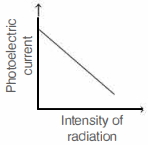
B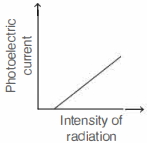
C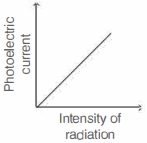
D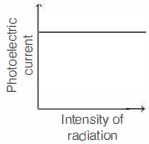
Solution
(C) According to the photoelectric effect,the number of photoelectrons ejected per unit time is directly proportional to the intensity of the incident radiation,provided the frequency of the radiation is above the threshold frequency.
Mathematically,this is expressed as:
$I_{photoelectric} \propto \text{Intensity of radiation}$
This linear relationship implies that as the intensity of the incident light increases,the photoelectric current increases linearly.
Therefore,the graph representing this relationship is a straight line passing through the origin,which corresponds to option $C$.
Mathematically,this is expressed as:
$I_{photoelectric} \propto \text{Intensity of radiation}$
This linear relationship implies that as the intensity of the incident light increases,the photoelectric current increases linearly.
Therefore,the graph representing this relationship is a straight line passing through the origin,which corresponds to option $C$.
0 likesView Solution
26
ChemistryMediumMCQKVPY · 2016
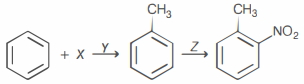
In the following reaction,$X, Y$ and $Z$ are
A
$X = CH_3Cl$; $Y = \text{Anhydrous } AlCl_3$; $Z = HNO_3 + H_2SO_4$
B
$X = CH_3COCl$; $Y = \text{Anhydrous } AlCl_3$; $Z = HNO_3 + H_2SO_4$
C
$X = CH_3Cl$; $Y = \text{Conc. } H_2SO_4$; $Z = HNO_3 + H_2SO_4$
D
$X = CH_3Cl$; $Y = \text{Dil. } H_2SO_4$; $Z = HNO_3$
Solution
(A) The reaction sequence is as follows:
$1$. Benzene reacts with $CH_3Cl$ in the presence of anhydrous $AlCl_3$ (a Lewis acid catalyst) to form toluene. This is a Friedel-Crafts alkylation reaction.
$2$. Toluene then undergoes nitration using a nitrating mixture of concentrated $HNO_3$ and concentrated $H_2SO_4$ to form $2$-nitrotoluene (ortho-isomer) and $4$-nitrotoluene (para-isomer).
Therefore,$X = CH_3Cl$,$Y = \text{Anhydrous } AlCl_3$,and $Z = HNO_3 + H_2SO_4$.
$1$. Benzene reacts with $CH_3Cl$ in the presence of anhydrous $AlCl_3$ (a Lewis acid catalyst) to form toluene. This is a Friedel-Crafts alkylation reaction.
$2$. Toluene then undergoes nitration using a nitrating mixture of concentrated $HNO_3$ and concentrated $H_2SO_4$ to form $2$-nitrotoluene (ortho-isomer) and $4$-nitrotoluene (para-isomer).
Therefore,$X = CH_3Cl$,$Y = \text{Anhydrous } AlCl_3$,and $Z = HNO_3 + H_2SO_4$.
0 likesView Solution
27
ChemistryDifficultMCQKVPY · 2016
$2,3$-dibromobutane can be converted to $2$-butyne in a two-step reaction using:
A
$(i) \ HCl$ and $(ii) \ NaH$
B
$(i) \ \text{alc. } KOH$ and $(ii) \ NaNH_2$
C
$(i) \ Na$ and $(ii) \ NaOH$
D
$(i) \ Br_2$ and $(ii) \ NaH$
Solution
(B)
For the conversion of $2,3$-dibromobutane to $2$-butyne,the following steps are used:
Step $1$: Dehydrohalogenation of $2,3$-dibromobutane using alcoholic $KOH$ yields $2$-bromobut-$2$-ene.
$CH_3-CH(Br)-CH(Br)-CH_3 \xrightarrow{\text{alc. } KOH} CH_3-C(Br)=CH-CH_3 + HBr$
Step $2$: Further dehydrohalogenation of $2$-bromobut-$2$-ene using a strong base like $NaNH_2$ yields $2$-butyne.
$CH_3-C(Br)=CH-CH_3 \xrightarrow{NaNH_2} CH_3-C \equiv C-CH_3 + NaBr + NH_3$
For the conversion of $2,3$-dibromobutane to $2$-butyne,the following steps are used:
Step $1$: Dehydrohalogenation of $2,3$-dibromobutane using alcoholic $KOH$ yields $2$-bromobut-$2$-ene.
$CH_3-CH(Br)-CH(Br)-CH_3 \xrightarrow{\text{alc. } KOH} CH_3-C(Br)=CH-CH_3 + HBr$
Step $2$: Further dehydrohalogenation of $2$-bromobut-$2$-ene using a strong base like $NaNH_2$ yields $2$-butyne.
$CH_3-C(Br)=CH-CH_3 \xrightarrow{NaNH_2} CH_3-C \equiv C-CH_3 + NaBr + NH_3$
0 likesView Solution
28
ChemistryMediumMCQKVPY · 2016
Given,
$NO_{(g)} + O_{3(g)} \longrightarrow NO_{2(g)} + O_{2(g)}; \Delta H = -198.9 \, kJ/mol$
$O_{3(g)} \longrightarrow 3/2 O_{2(g)}; \Delta H = -142.3 \, kJ/mol$
$O_{2(g)} \longrightarrow 2O_{(g)}; \Delta H = +495.0 \, kJ/mol$
The enthalpy change $(\Delta H)$ for the following reaction is $..... \, kJ/mol$
$NO_{(g)} + O_{(g)} \longrightarrow NO_{2(g)}$
$NO_{(g)} + O_{3(g)} \longrightarrow NO_{2(g)} + O_{2(g)}; \Delta H = -198.9 \, kJ/mol$
$O_{3(g)} \longrightarrow 3/2 O_{2(g)}; \Delta H = -142.3 \, kJ/mol$
$O_{2(g)} \longrightarrow 2O_{(g)}; \Delta H = +495.0 \, kJ/mol$
The enthalpy change $(\Delta H)$ for the following reaction is $..... \, kJ/mol$
$NO_{(g)} + O_{(g)} \longrightarrow NO_{2(g)}$
A
$-304.1$
B
$+304.1$
C
$-403.1$
D
$+403.1$
Solution
(A) Given equations:
$(1) \ NO_{(g)} + O_{3(g)} \longrightarrow NO_{2(g)} + O_{2(g)}; \Delta H_1 = -198.9 \, kJ/mol$
$(2) \ O_{3(g)} \longrightarrow 3/2 O_{2(g)}; \Delta H_2 = -142.3 \, kJ/mol$
$(3) \ O_{2(g)} \longrightarrow 2O_{(g)}; \Delta H_3 = +495.0 \, kJ/mol$
We need to find $\Delta H$ for: $NO_{(g)} + O_{(g)} \longrightarrow NO_{2(g)}$
Applying Hess's Law:
$\Delta H = \Delta H_1 - \Delta H_2 - 1/2 \Delta H_3$
$\Delta H = -198.9 - (-142.3) - 1/2 \times (495.0)$
$\Delta H = -198.9 + 142.3 - 247.5$
$\Delta H = -304.1 \, kJ/mol$
$(1) \ NO_{(g)} + O_{3(g)} \longrightarrow NO_{2(g)} + O_{2(g)}; \Delta H_1 = -198.9 \, kJ/mol$
$(2) \ O_{3(g)} \longrightarrow 3/2 O_{2(g)}; \Delta H_2 = -142.3 \, kJ/mol$
$(3) \ O_{2(g)} \longrightarrow 2O_{(g)}; \Delta H_3 = +495.0 \, kJ/mol$
We need to find $\Delta H$ for: $NO_{(g)} + O_{(g)} \longrightarrow NO_{2(g)}$
Applying Hess's Law:
$\Delta H = \Delta H_1 - \Delta H_2 - 1/2 \Delta H_3$
$\Delta H = -198.9 - (-142.3) - 1/2 \times (495.0)$
$\Delta H = -198.9 + 142.3 - 247.5$
$\Delta H = -304.1 \, kJ/mol$
0 likesView Solution
29
ChemistryMediumMCQKVPY · 2016
$A$ $1.85 \ g$ sample of an arsenic containing pesticide was chemically converted to $AsO_4^{3-}$ (atomic mass of $As = 74.9$) and titrated with $Pb^{2+}$ to form $Pb_3(AsO_4)_2$. If $20 \ mL$ of $0.1 \ M \ Pb^{2+}$ is required to reach the equivalence point,the mass percentage of arsenic in the pesticide sample is closest to
A
$8.1$
B
$2.3$
C
$5.4$
D
$3.6$
Solution
(C) The balanced chemical equation for the reaction is: $3 Pb^{2+} + 2 AsO_4^{3-} \longrightarrow Pb_3(AsO_4)_2$.
From the stoichiometry,$3 \ mol$ of $Pb^{2+}$ reacts with $2 \ mol$ of $AsO_4^{3-}$.
Therefore,$1 \ mol$ of $Pb^{2+}$ reacts with $\frac{2}{3} \ mol$ of $AsO_4^{3-}$.
Number of moles of $Pb^{2+}$ used: $n_{Pb^{2+}} = Molarity \times Volume (L) = 0.1 \times 0.020 = 2 \times 10^{-3} \ mol$.
Number of moles of $As$ present: $n_{As} = \frac{2}{3} \times 2 \times 10^{-3} = 0.001333 \ mol$.
Mass of $As$ in the sample: $W_{As} = n_{As} \times \text{atomic mass of } As = 0.001333 \times 74.9 = 0.0998 \ g$.
Mass percentage of $As$: $\% \text{ of } As = \frac{0.0998}{1.85} \times 100 \approx 5.395 \%$.
Rounding to the nearest value,we get $5.4 \%$.
From the stoichiometry,$3 \ mol$ of $Pb^{2+}$ reacts with $2 \ mol$ of $AsO_4^{3-}$.
Therefore,$1 \ mol$ of $Pb^{2+}$ reacts with $\frac{2}{3} \ mol$ of $AsO_4^{3-}$.
Number of moles of $Pb^{2+}$ used: $n_{Pb^{2+}} = Molarity \times Volume (L) = 0.1 \times 0.020 = 2 \times 10^{-3} \ mol$.
Number of moles of $As$ present: $n_{As} = \frac{2}{3} \times 2 \times 10^{-3} = 0.001333 \ mol$.
Mass of $As$ in the sample: $W_{As} = n_{As} \times \text{atomic mass of } As = 0.001333 \times 74.9 = 0.0998 \ g$.
Mass percentage of $As$: $\% \text{ of } As = \frac{0.0998}{1.85} \times 100 \approx 5.395 \%$.
Rounding to the nearest value,we get $5.4 \%$.
0 likesView Solution
30
ChemistryMediumMCQKVPY · 2016
Among the following complexes,the one that can exhibit optical activity is
A
$[CoCl_6]^{3-}$
B
$[Co(en)Cl_4]^{-}$
C
$cis-[Co(en)_2Cl_2]^{+}$
D
$trans-[Co(en)_2Cl_2]^{+}$
Solution
(C) . Optical activity is exhibited by complexes that possess optical isomers. Optical isomers are non-superimposable mirror images of each other.
Complexes of the type $[M(AA)_2B_2]$ exhibit optical isomerism only in their $cis$-form,as the $trans$-form possesses a plane of symmetry.
Therefore,$cis-[Co(en)_2Cl_2]^{+}$ exhibits optical activity.
Complexes of the type $[M(AA)_2B_2]$ exhibit optical isomerism only in their $cis$-form,as the $trans$-form possesses a plane of symmetry.
| Complex | Type |
| $[CoCl_6]^{3-}$ | $[MA_6]$ |
| $[Co(en)Cl_4]^{-}$ | $[M(AA)B_4]$ |
| $cis-[Co(en)_2Cl_2]^{+}$ | $cis-[M(AA)_2B_2]$ |
| $trans-[Co(en)_2Cl_2]^{+}$ | $trans-[M(AA)_2B_2]$ |
Therefore,$cis-[Co(en)_2Cl_2]^{+}$ exhibits optical activity.
0 likesView Solution
31
ChemistryMediumMCQKVPY · 2016
The $pK_a$ of oxoacids of chlorine in water follows the order
A
$HClO < HClO_3 < HClO_2 < HClO_4$
B
$HClO_4 < HClO_3 < HClO_2 < HClO$
C
$HClO_4 < HClO_2 < HClO_3 < HClO$
D
$HClO_2 < HClO < HClO_3 < HClO_4$
Solution
(B) $pK_a$ value of an acid is inversely proportional to its acidic strength,i.e.,the stronger the acid,the lower its $pK_a$ value.
Acidic strength increases with an increase in the oxidation number of the central chlorine atom.
The oxidation numbers of the central atom in the given acids are:
The acidic strength follows the order: $HClO < HClO_2 < HClO_3 < HClO_4$.
Therefore,the $pK_a$ order is the inverse of the acidic strength order: $HClO_4 < HClO_3 < HClO_2 < HClO$.
Acidic strength increases with an increase in the oxidation number of the central chlorine atom.
The oxidation numbers of the central atom in the given acids are:
| Acid | Oxidation Number of $Cl$ |
| $HClO$ | $+1$ |
| $HClO_2$ | $+3$ |
| $HClO_3$ | $+5$ |
| $HClO_4$ | $+7$ |
The acidic strength follows the order: $HClO < HClO_2 < HClO_3 < HClO_4$.
Therefore,the $pK_a$ order is the inverse of the acidic strength order: $HClO_4 < HClO_3 < HClO_2 < HClO$.
0 likesView Solution
32
ChemistryMediumMCQKVPY · 2016
The packing efficiency of the face-centered cubic $(fcc)$,body-centered cubic $(bcc)$,and simple/primitive cubic $(pc)$ lattices follows the order:
A
$fcc > bcc > pc$
B
$bcc > fcc > pc$
C
$pc > bcc > fcc$
D
$bcc > pc > fcc$
Solution
(A) The packing efficiency of a cubic lattice is calculated by the formula:
$PE = \frac{\text{Volume occupied by spheres in lattice} \times 100}{\text{Total volume of the unit cell}}$
$1$. Packing efficiency of $fcc = 74\ \%$
$2$. Packing efficiency of $bcc = 68\ \%$
$3$. Packing efficiency of $pc = 52.4\ \%$
Thus,the packing efficiency follows the order: $fcc > bcc > pc$.
$PE = \frac{\text{Volume occupied by spheres in lattice} \times 100}{\text{Total volume of the unit cell}}$
$1$. Packing efficiency of $fcc = 74\ \%$
$2$. Packing efficiency of $bcc = 68\ \%$
$3$. Packing efficiency of $pc = 52.4\ \%$
Thus,the packing efficiency follows the order: $fcc > bcc > pc$.
0 likesView Solution
33
ChemistryMediumMCQKVPY · 2016
The reaction of $D$-glucose with ammoniacal $AgNO_3$ produces:
A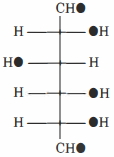
B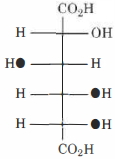
C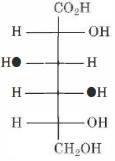
D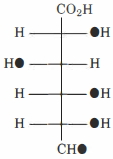
Solution
(C) The reaction of $D$-glucose with ammoniacal $AgNO_3$ (Tollen's reagent) is an oxidation reaction.
The aldehydic group $(-CHO)$ at the $C_1$ position of $D$-glucose is oxidized to a carboxylic acid group $(-COOH)$,forming $D$-gluconic acid.
This reaction confirms the presence of a free aldehydic group in glucose,making it a reducing sugar.
The correct structure corresponds to option $C$.
The aldehydic group $(-CHO)$ at the $C_1$ position of $D$-glucose is oxidized to a carboxylic acid group $(-COOH)$,forming $D$-gluconic acid.
This reaction confirms the presence of a free aldehydic group in glucose,making it a reducing sugar.
The correct structure corresponds to option $C$.
0 likesView Solution
34
ChemistryMediumMCQKVPY · 2016
The reagent$(s)$ used for the conversion of benzene diazonium hydrogensulphate to benzene is/are:
A
$H_{2}O$
B
$H_{3}PO_{2} + H_{2}O$
C
$H_{2}SO_{4} + H_{2}O$
D
$CuCl / HCl$
Solution
(B) The correct option is $(b)$.
The conversion of benzene diazonium hydrogensulphate to benzene is a reduction reaction.
$C_{6}H_{5}N_{2}^{+}HSO_{4}^{-} + H_{3}PO_{2} + H_{2}O \rightarrow C_{6}H_{6} + N_{2} + H_{3}PO_{3} + H_{2}SO_{4}$
Phosphinic acid $(H_{3}PO_{2})$ acts as a reducing agent in the presence of water to reduce the diazonium group to a hydrogen atom,yielding benzene.
The conversion of benzene diazonium hydrogensulphate to benzene is a reduction reaction.
$C_{6}H_{5}N_{2}^{+}HSO_{4}^{-} + H_{3}PO_{2} + H_{2}O \rightarrow C_{6}H_{6} + N_{2} + H_{3}PO_{3} + H_{2}SO_{4}$
Phosphinic acid $(H_{3}PO_{2})$ acts as a reducing agent in the presence of water to reduce the diazonium group to a hydrogen atom,yielding benzene.
0 likesView Solution
35
ChemistryDifficultMCQKVPY · 2016
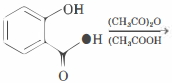
The major product in the following reaction is:
A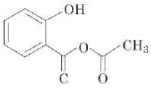
B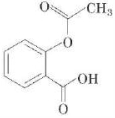
C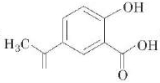
D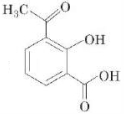
Solution
(B) The reactant in the given reaction is salicylic acid.
When salicylic acid reacts with acetic anhydride $(CH_3CO)_2O$ in the presence of acetic acid $(CH_3COOH)$,the phenolic $-OH$ group undergoes acetylation.
This reaction produces acetylsalicylic acid,which is commonly known as aspirin.
The structure of aspirin corresponds to option $B$.
When salicylic acid reacts with acetic anhydride $(CH_3CO)_2O$ in the presence of acetic acid $(CH_3COOH)$,the phenolic $-OH$ group undergoes acetylation.
This reaction produces acetylsalicylic acid,which is commonly known as aspirin.
The structure of aspirin corresponds to option $B$.
0 likesView Solution
36
ChemistryMediumMCQKVPY · 2016
It takes $1 \, h$ for a first order reaction to go to $50 \, \%$ completion. The total time required for the same reaction to reach $87.5 \, \%$ completion will be $..... \, h$.
A
$1.75$
B
$6.00$
C
$3.50$
D
$3.00$
Solution
(D) For a $1^{st}$ order reaction,the half-life $t_{1/2}$ is given as $1 \, h$. This means $50 \, \%$ of the reaction is completed in $1 \, h$.
For $87.5 \, \%$ completion,the amount remaining is $100 \, \% - 87.5 \, \% = 12.5 \, \%$.
We can relate the number of half-lives $(n)$ to the fraction remaining: $\frac{[A]_t}{[A]_0} = (\frac{1}{2})^n$.
Here,$\frac{12.5}{100} = \frac{1}{8} = (\frac{1}{2})^3$.
Thus,$n = 3$ half-lives are required.
Total time $t = n \times t_{1/2} = 3 \times 1 \, h = 3 \, h$.
For $87.5 \, \%$ completion,the amount remaining is $100 \, \% - 87.5 \, \% = 12.5 \, \%$.
We can relate the number of half-lives $(n)$ to the fraction remaining: $\frac{[A]_t}{[A]_0} = (\frac{1}{2})^n$.
Here,$\frac{12.5}{100} = \frac{1}{8} = (\frac{1}{2})^3$.
Thus,$n = 3$ half-lives are required.
Total time $t = n \times t_{1/2} = 3 \times 1 \, h = 3 \, h$.
0 likesView Solution
37
ChemistryMediumMCQKVPY · 2016
$A$ unit cell of calcium fluoride has four calcium ions. The number of fluoride ions in the unit cell is
A
$2$
B
$4$
C
$6$
D
$8$
Solution
(D) The chemical formula of calcium fluoride is $CaF_2$.
In the $CaF_2$ crystal structure (fluorite structure),$Ca^{2+}$ ions form a face-centered cubic $(fcc)$ lattice.
The number of $Ca^{2+}$ ions per unit cell is $4$ (since $8$ corners $\times 1/8 + 6$ faces $\times 1/2 = 4$).
Since the stoichiometry is $1:2$,for every $Ca^{2+}$ ion,there are $2$ $F^{-}$ ions.
Therefore,the number of $F^{-}$ ions per unit cell is $4 \times 2 = 8$.
In the $CaF_2$ crystal structure (fluorite structure),$Ca^{2+}$ ions form a face-centered cubic $(fcc)$ lattice.
The number of $Ca^{2+}$ ions per unit cell is $4$ (since $8$ corners $\times 1/8 + 6$ faces $\times 1/2 = 4$).
Since the stoichiometry is $1:2$,for every $Ca^{2+}$ ion,there are $2$ $F^{-}$ ions.
Therefore,the number of $F^{-}$ ions per unit cell is $4 \times 2 = 8$.
0 likesView Solution
38
ChemistryMediumMCQKVPY · 2016
The equilibrium constant of a $2$ electron redox reaction at $298 \, K$ is $3.8 \times 10^{-3}$. The cell potential $E^{\circ}$ (in $V$) and the free energy change $\Delta G^{\circ}$ (in $kJ \, mol^{-1}$) for this equilibrium,respectively are
A
$-0.071, -13.8$
B
$-0.071, 13.8$
C
$0.71, -13.8$
D
$0.071, -138$
Solution
(B) Given,$K_{eq} = 3.8 \times 10^{-3}$,$n = 2$,$T = 298 \, K$.
The standard Gibbs free energy change is given by $\Delta G^{\circ} = -RT \ln K_{eq} = -2.303 RT \log K_{eq}$.
$\Delta G^{\circ} = -2.303 \times 8.314 \times 298 \times \log(3.8 \times 10^{-3}) \approx 13809.39 \, J \, mol^{-1} \approx 13.8 \, kJ \, mol^{-1}$.
The relation between standard cell potential and Gibbs free energy is $\Delta G^{\circ} = -nFE^{\circ}$.
$13809.39 = -2 \times 96500 \times E^{\circ}$.
$E^{\circ} = -\frac{13809.39}{193000} \approx -0.071 \, V$.
Thus,the values are $E^{\circ} = -0.071 \, V$ and $\Delta G^{\circ} = 13.8 \, kJ \, mol^{-1}$.
The standard Gibbs free energy change is given by $\Delta G^{\circ} = -RT \ln K_{eq} = -2.303 RT \log K_{eq}$.
$\Delta G^{\circ} = -2.303 \times 8.314 \times 298 \times \log(3.8 \times 10^{-3}) \approx 13809.39 \, J \, mol^{-1} \approx 13.8 \, kJ \, mol^{-1}$.
The relation between standard cell potential and Gibbs free energy is $\Delta G^{\circ} = -nFE^{\circ}$.
$13809.39 = -2 \times 96500 \times E^{\circ}$.
$E^{\circ} = -\frac{13809.39}{193000} \approx -0.071 \, V$.
Thus,the values are $E^{\circ} = -0.071 \, V$ and $\Delta G^{\circ} = 13.8 \, kJ \, mol^{-1}$.
0 likesView Solution
39
ChemistryDifficultMCQKVPY · 2016
In the radioactive disintegration series ${}_{90}^{232}Th \rightarrow {}_{82}^{208}Pb$ involving $\alpha$ and $\beta$ decay,the total number of $\alpha$ and $\beta$ particles emitted are:
A
$6 \alpha$ and $6 \beta$
B
$6 \alpha$ and $4 \beta$
C
$6 \alpha$ and $5 \beta$
D
$5 \alpha$ and $6 \beta$
Solution
(B) An $\alpha$-particle corresponds to a helium nucleus $({}_{2}^{4}He)$. It reduces the mass number by $4$ and the atomic number by $2$.
In $\beta$-decay,the atomic number increases by $1$ while the mass number remains unchanged.
For the reaction: ${}_{90}^{232}Th \rightarrow {}_{82}^{208}Pb + x({}_{2}^{4}He) + y({}_{-1}^{0}e)$.
Equating the mass numbers: $232 = 208 + 4x$,which gives $4x = 24$,so $x = 6$.
Equating the atomic numbers: $90 = 82 + 2x - y$.
Substituting $x = 6$: $90 = 82 + 12 - y$,which gives $90 = 94 - y$,so $y = 4$.
Thus,$6 \alpha$ and $4 \beta$ particles are emitted.
In $\beta$-decay,the atomic number increases by $1$ while the mass number remains unchanged.
For the reaction: ${}_{90}^{232}Th \rightarrow {}_{82}^{208}Pb + x({}_{2}^{4}He) + y({}_{-1}^{0}e)$.
Equating the mass numbers: $232 = 208 + 4x$,which gives $4x = 24$,so $x = 6$.
Equating the atomic numbers: $90 = 82 + 2x - y$.
Substituting $x = 6$: $90 = 82 + 12 - y$,which gives $90 = 94 - y$,so $y = 4$.
Thus,$6 \alpha$ and $4 \beta$ particles are emitted.
0 likesView Solution
40
ChemistryMediumMCQKVPY · 2016
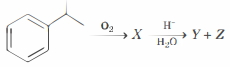
$X, Y$ and $Z$ in the following reaction sequence are
A
$X = \text{Cumene hydroperoxide}, Y = \text{Cyclohexadiene}, Z = \text{Isopropanol}$
B
$X = \text{Cumene hydroperoxide}, Y = \text{Phenol}, Z = \text{Propene}$
C
$X = \text{Cumene alcohol}, Y = \text{Phenol}, Z = \text{Acetone}$
D
$X = \text{Cumene hydroperoxide}, Y = \text{Phenol}, Z = \text{Acetone}$
Solution
(D) The reaction sequence represents the industrial preparation of phenol from cumene (isopropylbenzene).
$1$. Cumene is oxidized in the presence of air $(O_2)$ to form cumene hydroperoxide $(X)$.
$2$. Cumene hydroperoxide is then treated with dilute acid $(H^+, H_2O)$ to undergo rearrangement,yielding phenol $(Y)$ and acetone $(Z)$.
$1$. Cumene is oxidized in the presence of air $(O_2)$ to form cumene hydroperoxide $(X)$.
$2$. Cumene hydroperoxide is then treated with dilute acid $(H^+, H_2O)$ to undergo rearrangement,yielding phenol $(Y)$ and acetone $(Z)$.
0 likesView Solution
41
ChemistryDifficultMCQKVPY · 2016
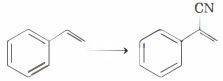
The reagents required for the following two-step transformation are:
A
$(i) \ HBr, \text{benzoyl peroxide}; (ii) \ CH_3CN$
B
$(i) \ HBr; (ii) \ NaCN$
C
$(i) \ Br_2; (ii) \ NaCN$
D
$(i) \ NaBr; (ii) \ NaCN$
Solution
(B) The transformation involves the conversion of styrene to $(1-\text{bromoethyl})\text{benzene}$ followed by nucleophilic substitution to form $(1-\text{cyanoethyl})\text{benzene}$.
Step $1$: Styrene reacts with $HBr$ via electrophilic addition following Markownikoff's rule to yield $(1-\text{bromoethyl})\text{benzene}$.
Step $2$: The resulting alkyl bromide undergoes nucleophilic substitution ($S_N2$ or $S_N1$ depending on conditions,typically $S_N2$ with $NaCN$) to replace the bromine atom with a cyano group $(-CN)$,yielding the final product.
Step $1$: Styrene reacts with $HBr$ via electrophilic addition following Markownikoff's rule to yield $(1-\text{bromoethyl})\text{benzene}$.
Step $2$: The resulting alkyl bromide undergoes nucleophilic substitution ($S_N2$ or $S_N1$ depending on conditions,typically $S_N2$ with $NaCN$) to replace the bromine atom with a cyano group $(-CN)$,yielding the final product.
0 likesView Solution
42
ChemistryDifficultMCQKVPY · 2016
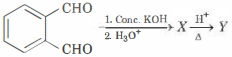
In the reaction sequence,
the major products $X$ and $Y$ respectively are
the major products $X$ and $Y$ respectively are
A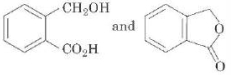
B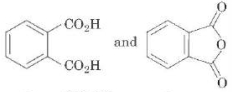
C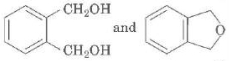
D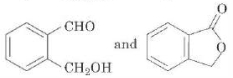
Solution
(A) The starting compound,phthalaldehyde,does not contain $\alpha$-hydrogen atoms. Therefore,in the presence of a strong base like $KOH$,it undergoes an intramolecular Cannizzaro reaction.
In this reaction,one aldehyde group is reduced to a primary alcohol $(-CH_2OH)$ while the other aldehyde group is oxidized to a carboxylic acid salt $(-COO^-)$. Upon acidification with $H_3O^+$,the salt is converted into the carboxylic acid group $(-COOH)$,yielding $X$ ($o$-hydroxymethylbenzoic acid).
When $X$ is heated in the presence of an acid catalyst $(H^+)$,it undergoes intramolecular esterification (loss of $H_2O$) to form a cyclic ester known as a lactone,which is $Y$ (phthalide).
In this reaction,one aldehyde group is reduced to a primary alcohol $(-CH_2OH)$ while the other aldehyde group is oxidized to a carboxylic acid salt $(-COO^-)$. Upon acidification with $H_3O^+$,the salt is converted into the carboxylic acid group $(-COOH)$,yielding $X$ ($o$-hydroxymethylbenzoic acid).
When $X$ is heated in the presence of an acid catalyst $(H^+)$,it undergoes intramolecular esterification (loss of $H_2O$) to form a cyclic ester known as a lactone,which is $Y$ (phthalide).
0 likesView Solution
43
ChemistryMediumMCQKVPY · 2016
Copper (atomic mass $= 63.5$) crystallises in a $fcc$ lattice and has density $8.93 \, g \, cm^{-3}$. The radius of copper atom is closest to $.... \, pm$.
A
$361.6$
B
$511.4$
C
$127.8$
D
$102.8$
Solution
(C) Given,density of copper lattice $\rho = 8.93 \, g \, cm^{-3}$.
Number of atoms in $fcc$ lattice,$Z = 4$.
Using the formula,$\rho = \frac{M \times Z}{N_{A} \times a^{3}}$
$a^{3} = \frac{M \times Z}{\rho \times N_{A}} = \frac{63.5 \times 4}{8.93 \times 6.022 \times 10^{23}} \approx 47.2 \times 10^{-24} \, cm^{3}$.
$a = (47.2 \times 10^{-24})^{1/3} \approx 3.61 \times 10^{-8} \, cm = 361 \, pm$.
In $fcc$ lattice,the relation between edge length $a$ and radius $r$ is $a = 2\sqrt{2}r$.
$r = \frac{a}{2\sqrt{2}} = \frac{361}{2 \times 1.414} \approx 127.8 \, pm$.
Number of atoms in $fcc$ lattice,$Z = 4$.
Using the formula,$\rho = \frac{M \times Z}{N_{A} \times a^{3}}$
$a^{3} = \frac{M \times Z}{\rho \times N_{A}} = \frac{63.5 \times 4}{8.93 \times 6.022 \times 10^{23}} \approx 47.2 \times 10^{-24} \, cm^{3}$.
$a = (47.2 \times 10^{-24})^{1/3} \approx 3.61 \times 10^{-8} \, cm = 361 \, pm$.
In $fcc$ lattice,the relation between edge length $a$ and radius $r$ is $a = 2\sqrt{2}r$.
$r = \frac{a}{2\sqrt{2}} = \frac{361}{2 \times 1.414} \approx 127.8 \, pm$.
0 likesView Solution
44
ChemistryMediumMCQKVPY · 2016
Given,the standard potentials $E_{(Cu^{2+}/Cu)}^{\circ}$ and $E_{(Cu^{+}/Cu)}^{\circ}$ as $0.340 \ V$ and $0.522 \ V$ respectively,the value of $E_{(Cu^{2+}/Cu^{+})}^{\circ}$ is $.... \ V$
A
$0.364$
B
$0.158$
C
$-0.182$
D
$-0.316$
Solution
(B) Given:
$E_{Cu^{2+}/Cu}^{\circ} = 0.340 \ V$
$E_{Cu^{+}/Cu}^{\circ} = 0.522 \ V$
Step $1$: Write the half-cell reactions:
$(i) \ Cu^{2+} + 2e^{-} \longrightarrow Cu, \ E_{1}^{\circ} = 0.340 \ V, \ \Delta G_{1}^{\circ} = -2FE_{1}^{\circ}$
$(ii) \ Cu^{+} + e^{-} \longrightarrow Cu, \ E_{2}^{\circ} = 0.522 \ V, \ \Delta G_{2}^{\circ} = -1FE_{2}^{\circ}$
Step $2$: We need the reaction for $Cu^{2+} + e^{-} \longrightarrow Cu^{+}$:
This is obtained by $(i) - (ii)$:
$Cu^{2+} + e^{-} \longrightarrow Cu^{+}, \ E_{3}^{\circ} = ?, \ \Delta G_{3}^{\circ} = -1FE_{3}^{\circ}$
Step $3$: Use the relation $\Delta G_{3}^{\circ} = \Delta G_{1}^{\circ} - \Delta G_{2}^{\circ}$:
$-1FE_{3}^{\circ} = -2FE_{1}^{\circ} - (-1FE_{2}^{\circ})$
$E_{3}^{\circ} = 2E_{1}^{\circ} - E_{2}^{\circ}$
$E_{3}^{\circ} = 2(0.340) - 0.522$
$E_{3}^{\circ} = 0.680 - 0.522 = 0.158 \ V$
$E_{Cu^{2+}/Cu}^{\circ} = 0.340 \ V$
$E_{Cu^{+}/Cu}^{\circ} = 0.522 \ V$
Step $1$: Write the half-cell reactions:
$(i) \ Cu^{2+} + 2e^{-} \longrightarrow Cu, \ E_{1}^{\circ} = 0.340 \ V, \ \Delta G_{1}^{\circ} = -2FE_{1}^{\circ}$
$(ii) \ Cu^{+} + e^{-} \longrightarrow Cu, \ E_{2}^{\circ} = 0.522 \ V, \ \Delta G_{2}^{\circ} = -1FE_{2}^{\circ}$
Step $2$: We need the reaction for $Cu^{2+} + e^{-} \longrightarrow Cu^{+}$:
This is obtained by $(i) - (ii)$:
$Cu^{2+} + e^{-} \longrightarrow Cu^{+}, \ E_{3}^{\circ} = ?, \ \Delta G_{3}^{\circ} = -1FE_{3}^{\circ}$
Step $3$: Use the relation $\Delta G_{3}^{\circ} = \Delta G_{1}^{\circ} - \Delta G_{2}^{\circ}$:
$-1FE_{3}^{\circ} = -2FE_{1}^{\circ} - (-1FE_{2}^{\circ})$
$E_{3}^{\circ} = 2E_{1}^{\circ} - E_{2}^{\circ}$
$E_{3}^{\circ} = 2(0.340) - 0.522$
$E_{3}^{\circ} = 0.680 - 0.522 = 0.158 \ V$
0 likesView Solution
45
ChemistryMediumMCQKVPY · 2016
For electroplating,$1.5 \ A$ current is passed for $250 \ s$ through $250 \ mL$ of $0.15 \ M$ solution of $MSO_4$. Only $85 \ \%$ of the current was utilised for electrolysis. The molarity of $MSO_4$ solution after electrolysis is closest to $.......$ [Assume that the volume of the solution remained constant] (in $M$)
A
$0.14$
B
$0.014$
C
$0.07$
D
$0.035$
Solution
(A) Given: Current $I = 1.5 \ A$,Time $t = 250 \ s$,Volume $V = 250 \ mL = 0.25 \ L$,Initial Molarity $M_i = 0.15 \ M$.
Initial moles of $MSO_4 = M_i \times V = 0.15 \times 0.25 = 0.0375 \ mol$.
Charge passed $Q = I \times t = 1.5 \times 250 = 375 \ C$.
Effective charge used for electrolysis $Q_{eff} = 375 \times 0.85 = 318.75 \ C$.
For $MSO_4 \rightarrow M^{2+} + SO_4^{2-}$,the reaction is $M^{2+} + 2e^- \rightarrow M(s)$. Thus,$n = 2$.
Moles of $M^{2+}$ deposited $= \frac{Q_{eff}}{n \times F} = \frac{318.75}{2 \times 96500} \approx 0.00165 \ mol$.
Moles of $MSO_4$ remaining $= 0.0375 - 0.00165 = 0.03585 \ mol$.
Final Molarity $= \frac{0.03585 \ mol}{0.25 \ L} = 0.1434 \ M$.
The value is closest to $0.14 \ M$.
Initial moles of $MSO_4 = M_i \times V = 0.15 \times 0.25 = 0.0375 \ mol$.
Charge passed $Q = I \times t = 1.5 \times 250 = 375 \ C$.
Effective charge used for electrolysis $Q_{eff} = 375 \times 0.85 = 318.75 \ C$.
For $MSO_4 \rightarrow M^{2+} + SO_4^{2-}$,the reaction is $M^{2+} + 2e^- \rightarrow M(s)$. Thus,$n = 2$.
Moles of $M^{2+}$ deposited $= \frac{Q_{eff}}{n \times F} = \frac{318.75}{2 \times 96500} \approx 0.00165 \ mol$.
Moles of $MSO_4$ remaining $= 0.0375 - 0.00165 = 0.03585 \ mol$.
Final Molarity $= \frac{0.03585 \ mol}{0.25 \ L} = 0.1434 \ M$.
The value is closest to $0.14 \ M$.
0 likesView Solution
46
ChemistryDifficultMCQKVPY · 2016
$2.33 \ g$ of compound $X$ (empirical formula $= CoH_{12}N_{4}Cl_{3}$) upon treatment with excess $AgNO_{3}$ solution produces $1.435 \ g$ of a white precipitate. The primary and secondary valences of cobalt in compound $X$,respectively are.
[Given,atomic mass : $Co = 59, Cl = 35.5, Ag = 108$]
[Given,atomic mass : $Co = 59, Cl = 35.5, Ag = 108$]
A
$3, 6$
B
$3, 4$
C
$2, 4$
D
$4, 3$
Solution
(A) The reaction is: $CoH_{12}N_{4}Cl_{3} + AgNO_{3} \rightarrow AgCl$ (white ppt).
Molar mass of $CoH_{12}N_{4}Cl_{3} = 59 + 12(1) + 4(14) + 3(35.5) = 59 + 12 + 56 + 106.5 = 233.5 \ g/mol$.
Moles of $X = \frac{2.33 \ g}{233.5 \ g/mol} = 0.01 \ mol$.
Moles of $AgCl = \frac{1.435 \ g}{143.5 \ g/mol} = 0.01 \ mol$.
Since $0.01 \ mol$ of $X$ produces $0.01 \ mol$ of $AgCl$,there is $1 \ Cl^-$ ion outside the coordination sphere.
The complex is $[Co(NH_{3})_{4}Cl_{2}]Cl$.
Primary valency (oxidation state of $Co$): $x + 4(0) + 2(-1) = +1 \Rightarrow x = +3$.
Secondary valency (coordination number of $Co$): $4(NH_{3}) + 2(Cl) = 6$.
Molar mass of $CoH_{12}N_{4}Cl_{3} = 59 + 12(1) + 4(14) + 3(35.5) = 59 + 12 + 56 + 106.5 = 233.5 \ g/mol$.
Moles of $X = \frac{2.33 \ g}{233.5 \ g/mol} = 0.01 \ mol$.
Moles of $AgCl = \frac{1.435 \ g}{143.5 \ g/mol} = 0.01 \ mol$.
Since $0.01 \ mol$ of $X$ produces $0.01 \ mol$ of $AgCl$,there is $1 \ Cl^-$ ion outside the coordination sphere.
The complex is $[Co(NH_{3})_{4}Cl_{2}]Cl$.
Primary valency (oxidation state of $Co$): $x + 4(0) + 2(-1) = +1 \Rightarrow x = +3$.
Secondary valency (coordination number of $Co$): $4(NH_{3}) + 2(Cl) = 6$.
0 likesView Solution
47
ChemistryDifficultMCQKVPY · 2016
The specific conductance $(\kappa)$ of $0.02 \ M$ aqueous acetic acid solution at $298 \ K$ is $1.65 \times 10^{-4} \ S \ cm^{-1}$. The degree of dissociation of acetic acid is [Given equivalent conductance at infinite dilution of $H^{+} = 349.1 \ S \ cm^{2} \ mol^{-1}$ and $CH_{3}COO^{-} = 40.9 \ S \ cm^{2} \ mol^{-1}$]
A
$0.021$
B
$0.21$
C
$0.012$
D
$0.12$
Solution
(A) Given,specific conductance $(\kappa) = 1.65 \times 10^{-4} \ S \ cm^{-1}$ and molarity $(M) = 0.02 \ M$.
Molar conductance $(\lambda_{m})$ is calculated as:
$\lambda_{m} = \frac{1000 \times \kappa}{M} = \frac{1000 \times 1.65 \times 10^{-4}}{0.02} = 8.25 \ S \ cm^{2} \ mol^{-1}$.
Molar conductance at infinite dilution $(\lambda_{m}^{\infty})$ is:
$\lambda_{m}^{\infty} = \lambda_{m(H^{+})}^{\infty} + \lambda_{m(CH_{3}COO^{-})}^{\infty} = 349.1 + 40.9 = 390 \ S \ cm^{2} \ mol^{-1}$.
The degree of dissociation $(\alpha)$ is given by:
$\alpha = \frac{\lambda_{m}}{\lambda_{m}^{\infty}} = \frac{8.25}{390} \approx 0.0211$.
Molar conductance $(\lambda_{m})$ is calculated as:
$\lambda_{m} = \frac{1000 \times \kappa}{M} = \frac{1000 \times 1.65 \times 10^{-4}}{0.02} = 8.25 \ S \ cm^{2} \ mol^{-1}$.
Molar conductance at infinite dilution $(\lambda_{m}^{\infty})$ is:
$\lambda_{m}^{\infty} = \lambda_{m(H^{+})}^{\infty} + \lambda_{m(CH_{3}COO^{-})}^{\infty} = 349.1 + 40.9 = 390 \ S \ cm^{2} \ mol^{-1}$.
The degree of dissociation $(\alpha)$ is given by:
$\alpha = \frac{\lambda_{m}}{\lambda_{m}^{\infty}} = \frac{8.25}{390} \approx 0.0211$.
0 likesView Solution
48
ChemistryMediumMCQKVPY · 2016
Among formic acid,acetic acid,propanoic acid and phenol,the strongest acid in water is
A
formic acid
B
acetic acid
C
propanoic acid
D
phenol
Solution
(A) The correct answer is $A$.
- Carboxylic acids are stronger acids than phenol because the carboxylate ion is more resonance-stabilized. In the carboxylate ion,the negative charge is delocalized over two highly electronegative oxygen atoms,whereas in the phenoxide ion,the negative charge is delocalized over the less electronegative carbon atoms of the benzene ring.
- Among the given carboxylic acids,the acidity depends on the $+I$ effect of the alkyl group attached to the carboxyl group. The $+I$ effect increases the electron density on the carboxylate ion,destabilizing it and thereby decreasing the acidity of the parent acid.
- The order of $+I$ effect is $H- < CH_3- < CH_3CH_2-$. Therefore,the stability of the corresponding carboxylate ions decreases in the order: $HCOO^- > CH_3COO^- > CH_3CH_2COO^-$.
- Consequently,the acid strength decreases in the order: $HCOOH > CH_3COOH > CH_3CH_2COOH > C_6H_5OH$.
Thus,formic acid is the strongest acid among the given options.
- Carboxylic acids are stronger acids than phenol because the carboxylate ion is more resonance-stabilized. In the carboxylate ion,the negative charge is delocalized over two highly electronegative oxygen atoms,whereas in the phenoxide ion,the negative charge is delocalized over the less electronegative carbon atoms of the benzene ring.
- Among the given carboxylic acids,the acidity depends on the $+I$ effect of the alkyl group attached to the carboxyl group. The $+I$ effect increases the electron density on the carboxylate ion,destabilizing it and thereby decreasing the acidity of the parent acid.
- The order of $+I$ effect is $H- < CH_3- < CH_3CH_2-$. Therefore,the stability of the corresponding carboxylate ions decreases in the order: $HCOO^- > CH_3COO^- > CH_3CH_2COO^-$.
- Consequently,the acid strength decreases in the order: $HCOOH > CH_3COOH > CH_3CH_2COOH > C_6H_5OH$.
Thus,formic acid is the strongest acid among the given options.
0 likesView Solution
49
ChemistryMediumMCQKVPY · 2016
The major products obtained in the reaction of oxalic acid with conc. $H_2SO_4$ upon heating are
A
$CO, CO_2, H_2O$
B
$CO, SO_2, H_2O$
C
$H_2S, CO, H_2O$
D
$HCOOH, H_2S, CO$
Solution
(A) The correct answer is $A$.
Oxalic acid $(COOH)_2$ undergoes dehydration when heated with concentrated sulfuric acid $(H_2SO_4)$.
The chemical reaction is as follows:
$(COOH)_2 \xrightarrow[H_2SO_4]{\Delta} CO + CO_2 + H_2O$
Here,concentrated $H_2SO_4$ acts as a dehydrating agent,removing a molecule of water from the oxalic acid,resulting in the formation of carbon monoxide $(CO)$,carbon dioxide $(CO_2)$,and water $(H_2O)$.
Oxalic acid $(COOH)_2$ undergoes dehydration when heated with concentrated sulfuric acid $(H_2SO_4)$.
The chemical reaction is as follows:
$(COOH)_2 \xrightarrow[H_2SO_4]{\Delta} CO + CO_2 + H_2O$
Here,concentrated $H_2SO_4$ acts as a dehydrating agent,removing a molecule of water from the oxalic acid,resulting in the formation of carbon monoxide $(CO)$,carbon dioxide $(CO_2)$,and water $(H_2O)$.
0 likesView Solution
50
ChemistryMediumMCQKVPY · 2016
When treated with conc. $HCl$,$MnO_2$ yields a gas $(X)$ which further reacts with $Ca(OH)_2$ to generate a white solid $(Y)$. The solid $Y$ reacts with dil. $HCl$ to produce the same gas $X$. The solid $Y$ is
A
$CaO$
B
$CaCl_2$
C
$Ca(OCl)Cl$
D
$CaCO_3$
Solution
(C) The correct option is $C$.
When $MnO_2$ is treated with conc. $HCl$,it produces chlorine gas $(X)$ as follows:
$MnO_2 + 4HCl \rightarrow MnCl_2 + Cl_2(g) + 2H_2O$
Here,$X = Cl_2$.
Chlorine gas reacts with dry slaked lime $Ca(OH)_2$ to form bleaching powder,which is calcium oxychloride $Ca(OCl)Cl$ $(Y)$:
$Ca(OH)_2 + Cl_2 \rightarrow Ca(OCl)Cl + H_2O$
Here,$Y = Ca(OCl)Cl$.
Bleaching powder $(Y)$ reacts with dilute $HCl$ to regenerate chlorine gas $(X)$:
$Ca(OCl)Cl + 2HCl \rightarrow CaCl_2 + H_2O + Cl_2(g)$
When $MnO_2$ is treated with conc. $HCl$,it produces chlorine gas $(X)$ as follows:
$MnO_2 + 4HCl \rightarrow MnCl_2 + Cl_2(g) + 2H_2O$
Here,$X = Cl_2$.
Chlorine gas reacts with dry slaked lime $Ca(OH)_2$ to form bleaching powder,which is calcium oxychloride $Ca(OCl)Cl$ $(Y)$:
$Ca(OH)_2 + Cl_2 \rightarrow Ca(OCl)Cl + H_2O$
Here,$Y = Ca(OCl)Cl$.
Bleaching powder $(Y)$ reacts with dilute $HCl$ to regenerate chlorine gas $(X)$:
$Ca(OCl)Cl + 2HCl \rightarrow CaCl_2 + H_2O + Cl_2(g)$
0 likesView Solution
Vedclass Products
For Students
Vedclass Test Series
Mock tests in real KVPY style covering Chemistry with performance analysis. 5-day free trial.
Start Free TrialFor Teachers
Exam Paper Generator
Generate Set A/B/C/D Chemistry papers from 7.5L+ questions in 2 minutes. 3 chapters free.
Try FreeFor Institutes
Online Exam Module
Run live KVPY mock exams with unlimited students, 360° analytics & white-label branding.
See DemoFrequently Asked Questions
How many Chemistry questions are in KVPY 2016?
There are 50 Chemistry questions from the KVPY 2016 paper on Vedclass, each with a detailed step-by-step solution in English.
Are KVPY 2016 Chemistry solutions available in English?
Yes. All solutions on this page are in English. You can also switch to English or Hindi using the language buttons above the questions.
Can I practice KVPY 2016 Chemistry as a timed test?
Yes. Use the Vedclass Test Series to attempt a full KVPY mock test covering Chemistry with time limits and instant score analysis.
Can teachers create Chemistry papers from KVPY previous year questions?
Yes. The Vedclass Exam Paper Generator lets teachers mix KVPY Chemistry questions and generate Set A/B/C/D papers in minutes.
For Teachers & Institutes
Build a Custom Chemistry Paper
Pick KVPY 2016 Chemistry questions, set difficulty, and generate Set A/B/C/D in 2 minutes.