
ChemistryQ1–51 of 51 questions
Page 1 of 1 · English
1
ChemistryMCQKVPY · 2021
The cumulative number of ill patients $N( t )$ during an epidemic in a country is given by the following equation $N(t)=\frac{N_0 \exp (t / \tau)}{1+N_0(\exp (t / \tau)-1) / N_s}$ where $N _0$ is the initial population of ill patients, $\tau$ a positive constant and $N _5\left( > > N _0\right)$ is a large number. Then, which of the following statements is true ?
A
At large time $N ( t )$ will approach zero.
B
The polulation curve will have an inflection point when $N ( t )$ is $N _{ s } / 2$.
C
$N ( t )$ will decrease monotonically.
D
$N( t )$ will exhibit a maximum.
Solution
(b)
$N=\frac{N_0 e^{\frac{t}{\tau}}}{1+\frac{N_0}{N_s}\left[e^{\frac{t}{\tau}}-1\right]}$
at $t =0, N = N _0$
$t \rightarrow \infty, N = N _{ S }$
and since $N_S > > N_0 \therefore$ it is an increasing
If we find $\frac{d N}{d t}=0$, no ' $t$ ' exist. since $A , C , D$ are wrong
$\therefore B$ is correct.
0 likesView Solution
2
ChemistryMediumMCQKVPY · 2021
When copper is added to concentrated $H_2SO_4$,$CuSO_4$ is produced along with another sulphur-containing compound $X$. The compound $X$ is
A
$H_2S$
B
$SO_2$
C
$SO_3$
D
$H_2S_2O_3$
Solution
(B) The reaction between copper and concentrated sulfuric acid is a redox reaction where copper is oxidized and sulfuric acid is reduced.
The balanced chemical equation is:
$Cu_{(s)} + 2H_2SO_{4(conc.)} \rightarrow CuSO_{4(aq)} + SO_{2(g)} + 2H_2O_{(l)}$
In this reaction,$SO_2$ is the sulphur-containing compound $X$ produced.
Therefore,the correct option is $B$.
The balanced chemical equation is:
$Cu_{(s)} + 2H_2SO_{4(conc.)} \rightarrow CuSO_{4(aq)} + SO_{2(g)} + 2H_2O_{(l)}$
In this reaction,$SO_2$ is the sulphur-containing compound $X$ produced.
Therefore,the correct option is $B$.
0 likesView Solution
3
ChemistryMediumMCQKVPY · 2021
Zeolite is hydrated sodium aluminium silicate. When treated with hard water,the sodium ions in zeolite are exchanged with
A
$Zn^{2+}$
B
$Mg^{2+}$
C
$Ni^{2+}$
D
$Cu^{2+}$
Solution
(B) .
Zeolite is used in the Permutit process for water softening.
It is represented as $Na_2Al_2Si_2O_8 \cdot xH_2O$.
When hard water containing $Ca^{2+}$ or $Mg^{2+}$ ions is passed through it,the $Na^+$ ions in the zeolite are exchanged with these hardness-causing ions ($Ca^{2+}$ or $Mg^{2+}$),thereby softening the water.
Zeolite is used in the Permutit process for water softening.
It is represented as $Na_2Al_2Si_2O_8 \cdot xH_2O$.
When hard water containing $Ca^{2+}$ or $Mg^{2+}$ ions is passed through it,the $Na^+$ ions in the zeolite are exchanged with these hardness-causing ions ($Ca^{2+}$ or $Mg^{2+}$),thereby softening the water.
0 likesView Solution
4
ChemistryMediumMCQKVPY · 2021
Among the molecules $O_2$,$KO_2$,$H_2O_2$,$F_2O_2$ and $BaO_2$,the pair that has the most similar oxygen-oxygen bond length is:
A
$O_2$ and $H_2O_2$
B
$KO_2$ and $H_2O_2$
C
$O_2$ and $BaO_2$
D
$KO_2$ and $F_2O_2$
Solution
(D) The oxygen-oxygen bond lengths are determined by the bond order and the electronic environment.
$1$. $O_2$: Bond order is $2.0$,bond length $\approx 121 \text{ pm}$.
$2$. $KO_2$: Contains superoxide ion $O_2^-$,bond order is $1.5$,bond length $\approx 128 \text{ pm}$.
$3$. $H_2O_2$: Contains peroxide ion $O_2^{2-}$,bond order is $1.0$,bond length $\approx 148 \text{ pm}$.
$4$. $F_2O_2$: Bond order is $1.0$,but due to the high electronegativity of $F$,the $O-O$ bond length is $\approx 122 \text{ pm}$.
$5$. $BaO_2$: Contains peroxide ion $O_2^{2-}$,bond order is $1.0$,bond length $\approx 149 \text{ pm}$.
Comparing the values,$KO_2$ $(128 \text{ pm})$ and $F_2O_2$ $(122 \text{ pm})$ have the most similar bond lengths among the given choices.
$1$. $O_2$: Bond order is $2.0$,bond length $\approx 121 \text{ pm}$.
$2$. $KO_2$: Contains superoxide ion $O_2^-$,bond order is $1.5$,bond length $\approx 128 \text{ pm}$.
$3$. $H_2O_2$: Contains peroxide ion $O_2^{2-}$,bond order is $1.0$,bond length $\approx 148 \text{ pm}$.
$4$. $F_2O_2$: Bond order is $1.0$,but due to the high electronegativity of $F$,the $O-O$ bond length is $\approx 122 \text{ pm}$.
$5$. $BaO_2$: Contains peroxide ion $O_2^{2-}$,bond order is $1.0$,bond length $\approx 149 \text{ pm}$.
Comparing the values,$KO_2$ $(128 \text{ pm})$ and $F_2O_2$ $(122 \text{ pm})$ have the most similar bond lengths among the given choices.
0 likesView Solution
5
ChemistryDifficultMCQKVPY · 2021
The energy of combustion per mole of $H_2$,$LPG$,and octane follows the order:
A
octane $>$ $LPG$ $>$ $H_2$
B
$H_2$ $>$ $LPG$ $>$ octane
C
$LPG$ $>$ octane $>$ $H_2$
D
$H_2$ $>$ octane $>$ $LPG$
Solution
(A) The energy of combustion per mole depends on the number of carbon and hydrogen atoms in the molecule.
Octane $(C_8H_{18})$ has a high molecular weight and many bonds to break and form,releasing the most energy per mole.
$LPG$ (Liquefied Petroleum Gas) is primarily a mixture of propane $(C_3H_8)$ and butane $(C_4H_{10})$,which has a lower energy of combustion per mole than octane.
$H_2$ has the lowest molar mass and releases the least energy per mole among the three.
Therefore,the order is: octane $>$ $LPG$ $>$ $H_2$.
Octane $(C_8H_{18})$ has a high molecular weight and many bonds to break and form,releasing the most energy per mole.
$LPG$ (Liquefied Petroleum Gas) is primarily a mixture of propane $(C_3H_8)$ and butane $(C_4H_{10})$,which has a lower energy of combustion per mole than octane.
$H_2$ has the lowest molar mass and releases the least energy per mole among the three.
Therefore,the order is: octane $>$ $LPG$ $>$ $H_2$.
0 likesView Solution
6
ChemistryMCQKVPY · 2021
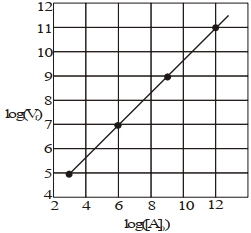
For the reaction $A + B \rightarrow C$,experiments were performed in the presence of a large amount of $B$ to measure the initial reaction rate $(V_f)$ as a function of the initial concentration of $A ([A]_0)$. The data from the experiments are plotted as shown below. The order of the reaction with respect to $A$ is $.....$
A
$\frac{2}{3}$
B
$3$
C
$1$
D
$\frac{3}{2}$
Solution
(A) The rate law for the reaction is given by $V_f = k[A]_0^x$,where $x$ is the order of the reaction with respect to $A$.
Taking the logarithm on both sides,we get $\log V_f = \log k + x \log [A]_0$.
This is in the form of a straight-line equation $y = mx + c$,where the slope $m = x$.
From the graph,we can calculate the slope using two points: $(6, 7)$ and $(12, 11)$.
Slope $x = \frac{y_2 - y_1}{x_2 - x_1} = \frac{11 - 7}{12 - 6} = \frac{4}{6} = \frac{2}{3}$.
Therefore,the order of the reaction with respect to $A$ is $\frac{2}{3}$.
Taking the logarithm on both sides,we get $\log V_f = \log k + x \log [A]_0$.
This is in the form of a straight-line equation $y = mx + c$,where the slope $m = x$.
From the graph,we can calculate the slope using two points: $(6, 7)$ and $(12, 11)$.
Slope $x = \frac{y_2 - y_1}{x_2 - x_1} = \frac{11 - 7}{12 - 6} = \frac{4}{6} = \frac{2}{3}$.
Therefore,the order of the reaction with respect to $A$ is $\frac{2}{3}$.
0 likesView Solution
7
ChemistryMCQKVPY · 2021
$DNA$ fingerprinting involves:
A
carrying out $DNA$ analysis from different parts of a fingerprint
B
identifying sequences of $DNA$ that are unique to an individual
C
carrying out $RT-PCR$ from a sample obtained from a fingerprint
D
finding out the ratio of purine and pyrimidine bases from the $DNA$
Solution
(B)
$DNA$ fingerprinting is a technique used to identify individuals by analyzing specific sequences of $DNA$ that are unique to each person,often referred to as variable number tandem repeats $(VNTRs)$.
$DNA$ fingerprinting is a technique used to identify individuals by analyzing specific sequences of $DNA$ that are unique to each person,often referred to as variable number tandem repeats $(VNTRs)$.
0 likesView Solution
8
ChemistryMediumMCQKVPY · 2021
The radius (in $\mathring{A}$) of the $3^{rd}$ Bohr orbit in $Li^{2+}$ ion is closest to $......$ [Given: Atomic number of $Li = 3$]
A
$0.520$
B
$1.018$
C
$1.587$
D
$1.881$
Solution
(C) The formula for the radius of the $n^{th}$ Bohr orbit is given by: $r = 0.529 \times \frac{n^2}{Z} \ \mathring{A}$.
For the $3^{rd}$ orbit of $Li^{2+}$ ion,the principal quantum number $n = 3$ and the atomic number $Z = 3$.
Substituting these values into the formula:
$r = 0.529 \times \frac{3^2}{3} \ \mathring{A}$
$r = 0.529 \times 3 \ \mathring{A}$
$r = 1.587 \ \mathring{A}$.
For the $3^{rd}$ orbit of $Li^{2+}$ ion,the principal quantum number $n = 3$ and the atomic number $Z = 3$.
Substituting these values into the formula:
$r = 0.529 \times \frac{3^2}{3} \ \mathring{A}$
$r = 0.529 \times 3 \ \mathring{A}$
$r = 1.587 \ \mathring{A}$.
0 likesView Solution
9
ChemistryMediumMCQKVPY · 2021
The reaction $2 NO_{2(g)} \rightleftharpoons N_2O_{4(g)}$ is at equilibrium in a closed $15 \ L$ vessel at $300 \ K$. The total weight of the mixture of $NO_2$ and $N_2O_4$ in the vessel is $64.4 \ g$. The equilibrium constant for the reaction is $K_p = 6.67$. Assuming ideal gas behavior,the total pressure in the vessel (in $atm$) is: [Given: Gas constant $R = 0.082 \ atm \ L \ K^{-1} \ mol^{-1}$]
A
$0.78$
B
$1.34$
C
$1.96$
D
$2.25$
Solution
(B) The reaction is $2 NO_{2(g)} \rightleftharpoons N_2O_{4(g)}$.
Let the initial moles of $NO_2$ be $n_0$. At equilibrium,let $x$ moles of $N_2O_4$ be formed.
Moles at equilibrium: $n_{NO_2} = n_0 - 2x$,$n_{N_2O_4} = x$.
Total mass: $46(n_0 - 2x) + 92x = 64.4 \implies 46n_0 = 64.4 \implies n_0 = 1.4 \ mol$.
Total moles $n_T = (1.4 - 2x) + x = 1.4 - x$.
$P_{NO_2} = \frac{1.4-2x}{1.4-x} P_T$ and $P_{N_2O_4} = \frac{x}{1.4-x} P_T$.
$K_p = \frac{P_{N_2O_4}}{(P_{NO_2})^2} = \frac{x(1.4-x)}{(1.4-2x)^2 P_T} = 6.67$.
Using $P_T V = n_T RT \implies P_T = \frac{(1.4-x) \times 0.082 \times 300}{15} = 1.64(1.4-x)$.
Substituting $P_T$ into $K_p$ expression and solving for $x$ gives $x \approx 0.58 \ mol$.
Then $n_T = 1.4 - 0.58 = 0.82 \ mol$.
$P_T = \frac{0.82 \times 0.082 \times 300}{15} = 1.34 \ atm$.
Let the initial moles of $NO_2$ be $n_0$. At equilibrium,let $x$ moles of $N_2O_4$ be formed.
Moles at equilibrium: $n_{NO_2} = n_0 - 2x$,$n_{N_2O_4} = x$.
Total mass: $46(n_0 - 2x) + 92x = 64.4 \implies 46n_0 = 64.4 \implies n_0 = 1.4 \ mol$.
Total moles $n_T = (1.4 - 2x) + x = 1.4 - x$.
$P_{NO_2} = \frac{1.4-2x}{1.4-x} P_T$ and $P_{N_2O_4} = \frac{x}{1.4-x} P_T$.
$K_p = \frac{P_{N_2O_4}}{(P_{NO_2})^2} = \frac{x(1.4-x)}{(1.4-2x)^2 P_T} = 6.67$.
Using $P_T V = n_T RT \implies P_T = \frac{(1.4-x) \times 0.082 \times 300}{15} = 1.64(1.4-x)$.
Substituting $P_T$ into $K_p$ expression and solving for $x$ gives $x \approx 0.58 \ mol$.
Then $n_T = 1.4 - 0.58 = 0.82 \ mol$.
$P_T = \frac{0.82 \times 0.082 \times 300}{15} = 1.34 \ atm$.
0 likesView Solution
10
ChemistryDifficultMCQKVPY · 2021
For the ideal gas reaction,$X + Y \rightleftharpoons Z$,a mixture with $n_{X} = 1 \, mol$,$n_{Y} = 3 \, mol$ and $n_{Z} = 2 \, mol$ is at equilibrium at $300 \, K$ and $1 \, bar$. If the pressure is isothermally increased to $2 \, bar$,the number of moles of $X$ in the new equilibrium is closest to $......$
A
$2.367$
B
$0.633$
C
$1.358$
D
$0.727$
Solution
(B) For the reaction $X + Y \rightleftharpoons Z$ at $P_{T} = 1 \, bar$:
Initial moles at equilibrium: $n_{X} = 1, n_{Y} = 3, n_{Z} = 2$. Total moles $n_{T} = 6$.
Mole fractions: $x_{X} = 1/6, x_{Y} = 3/6, x_{Z} = 2/6$.
Partial pressures: $P_{X} = 1/6 \, bar, P_{Y} = 3/6 \, bar, P_{Z} = 2/6 \, bar$.
$K_{p} = \frac{P_{Z}}{P_{X} \times P_{Y}} = \frac{2/6}{(1/6) \times (3/6)} = \frac{2/6}{3/36} = \frac{2}{6} \times \frac{36}{3} = 4$.
When pressure is increased to $P_{T} = 2 \, bar$,the reaction shifts forward to maintain $K_{p} = 4$.
Let $x$ be the moles of $X$ reacted. New moles: $n_{X} = 1 - x, n_{Y} = 3 - x, n_{Z} = 2 + x$. Total moles $n_{T} = 6 - x$.
$K_{p} = \frac{P_{Z}}{P_{X} \times P_{Y}} = \frac{(n_{Z}/n_{T}) \times P_{T}}{(n_{X}/n_{T}) \times (n_{Y}/n_{T}) \times P_{T}^2} = \frac{n_{Z} \times n_{T}}{n_{X} \times n_{Y} \times P_{T}} = 4$.
$\frac{(2 + x)(6 - x)}{(1 - x)(3 - x) \times 2} = 4 \Rightarrow \frac{(2 + x)(6 - x)}{(1 - x)(3 - x)} = 8$.
$12 + 4x - x^2 = 8(3 - 4x + x^2) = 24 - 32x + 8x^2$.
$9x^2 - 36x + 12 = 0 \Rightarrow 3x^2 - 12x + 4 = 0$.
Using quadratic formula $x = \frac{12 \pm \sqrt{144 - 48}}{6} = \frac{12 \pm \sqrt{96}}{6} = 2 \pm \frac{9.798}{6} = 2 \pm 1.633$.
Since $x < 1$,$x = 2 - 1.633 = 0.367$.
$n_{X} = 1 - 0.367 = 0.633 \, mol$.
Initial moles at equilibrium: $n_{X} = 1, n_{Y} = 3, n_{Z} = 2$. Total moles $n_{T} = 6$.
Mole fractions: $x_{X} = 1/6, x_{Y} = 3/6, x_{Z} = 2/6$.
Partial pressures: $P_{X} = 1/6 \, bar, P_{Y} = 3/6 \, bar, P_{Z} = 2/6 \, bar$.
$K_{p} = \frac{P_{Z}}{P_{X} \times P_{Y}} = \frac{2/6}{(1/6) \times (3/6)} = \frac{2/6}{3/36} = \frac{2}{6} \times \frac{36}{3} = 4$.
When pressure is increased to $P_{T} = 2 \, bar$,the reaction shifts forward to maintain $K_{p} = 4$.
Let $x$ be the moles of $X$ reacted. New moles: $n_{X} = 1 - x, n_{Y} = 3 - x, n_{Z} = 2 + x$. Total moles $n_{T} = 6 - x$.
$K_{p} = \frac{P_{Z}}{P_{X} \times P_{Y}} = \frac{(n_{Z}/n_{T}) \times P_{T}}{(n_{X}/n_{T}) \times (n_{Y}/n_{T}) \times P_{T}^2} = \frac{n_{Z} \times n_{T}}{n_{X} \times n_{Y} \times P_{T}} = 4$.
$\frac{(2 + x)(6 - x)}{(1 - x)(3 - x) \times 2} = 4 \Rightarrow \frac{(2 + x)(6 - x)}{(1 - x)(3 - x)} = 8$.
$12 + 4x - x^2 = 8(3 - 4x + x^2) = 24 - 32x + 8x^2$.
$9x^2 - 36x + 12 = 0 \Rightarrow 3x^2 - 12x + 4 = 0$.
Using quadratic formula $x = \frac{12 \pm \sqrt{144 - 48}}{6} = \frac{12 \pm \sqrt{96}}{6} = 2 \pm \frac{9.798}{6} = 2 \pm 1.633$.
Since $x < 1$,$x = 2 - 1.633 = 0.367$.
$n_{X} = 1 - 0.367 = 0.633 \, mol$.
0 likesView Solution
11
ChemistryMediumMCQKVPY · 2021
When $SO_2$ is bubbled into an acidic $KMnO_4$ solution,decolorization of the purple solution takes place along with the formation of a manganese compound $X$. Under neutral conditions,compound $X$ reacts with $KMnO_4$ in the presence of zinc oxide to give another manganese compound $Y$. The oxidation states of manganese in compounds $X$ and $Y$,respectively,are
A
$+7$ and $+2$
B
$+2$ and $+4$
C
$+4$ and $+7$
D
$+2$ and $+2$
Solution
(B) The reaction of $SO_2$ with acidic $KMnO_4$ is: $2KMnO_4 + 5SO_2 + 2H_2O \rightarrow K_2SO_4 + 2MnSO_4 + 2H_2SO_4$. Here,$X$ is $MnSO_4$,where the oxidation state of $Mn$ is $+2$.
Under neutral conditions,$MnSO_4$ reacts with $KMnO_4$ in the presence of $ZnO$ (which acts as a buffer): $3MnSO_4 + 2KMnO_4 + 2H_2O \rightarrow 5MnO_2 + K_2SO_4 + 2H_2SO_4$. Here,$Y$ is $MnO_2$,where the oxidation state of $Mn$ is $+4$.
Thus,the oxidation states of $Mn$ in $X$ and $Y$ are $+2$ and $+4$ respectively.
Under neutral conditions,$MnSO_4$ reacts with $KMnO_4$ in the presence of $ZnO$ (which acts as a buffer): $3MnSO_4 + 2KMnO_4 + 2H_2O \rightarrow 5MnO_2 + K_2SO_4 + 2H_2SO_4$. Here,$Y$ is $MnO_2$,where the oxidation state of $Mn$ is $+4$.
Thus,the oxidation states of $Mn$ in $X$ and $Y$ are $+2$ and $+4$ respectively.
0 likesView Solution
12
ChemistryMediumMCQKVPY · 2021
The molecule having $sp^3d^2$ hybridisation is
A
$SF_4$
B
$XeOF_4$
C
$PF_5$
D
$BrF_3$
Solution
(B) is the correct answer.
To determine the hybridization,we use the formula: $\text{Steric Number} = \frac{1}{2} [V + M - C + A]$,where $V$ is the number of valence electrons of the central atom,$M$ is the number of monovalent atoms,$C$ is the cationic charge,and $A$ is the anionic charge.
$1. SF_4$: $\text{Steric Number} = \frac{1}{2} [6 + 4] = 5$ ($sp^3d$ hybridization).
$2. XeOF_4$: $\text{Steric Number} = \frac{1}{2} [8 + 4] = 6$ ($sp^3d^2$ hybridization).
$3. PF_5$: $\text{Steric Number} = \frac{1}{2} [5 + 5] = 5$ ($sp^3d$ hybridization).
$4. BrF_3$: $\text{Steric Number} = \frac{1}{2} [7 + 3] = 5$ ($sp^3d$ hybridization).
To determine the hybridization,we use the formula: $\text{Steric Number} = \frac{1}{2} [V + M - C + A]$,where $V$ is the number of valence electrons of the central atom,$M$ is the number of monovalent atoms,$C$ is the cationic charge,and $A$ is the anionic charge.
$1. SF_4$: $\text{Steric Number} = \frac{1}{2} [6 + 4] = 5$ ($sp^3d$ hybridization).
$2. XeOF_4$: $\text{Steric Number} = \frac{1}{2} [8 + 4] = 6$ ($sp^3d^2$ hybridization).
$3. PF_5$: $\text{Steric Number} = \frac{1}{2} [5 + 5] = 5$ ($sp^3d$ hybridization).
$4. BrF_3$: $\text{Steric Number} = \frac{1}{2} [7 + 3] = 5$ ($sp^3d$ hybridization).
0 likesView Solution
13
ChemistryMediumMCQKVPY · 2021
The number of possible chiral dichloro products that can be formed when $(R)-2-$chlorohexane reacts with $Cl_2$ in the presence of $UV$ irradiation is:
$\underset{\text{(optically pure)}}{CH_3-CH(Cl)-CH_2-CH_2-CH_2-CH_3} \,\xrightarrow[UV \ light]{Cl_2}$
$\underset{\text{(optically pure)}}{CH_3-CH(Cl)-CH_2-CH_2-CH_2-CH_3} \,\xrightarrow[UV \ light]{Cl_2}$
A
$10$
B
$9$
C
$7$
D
$6$
Solution
(C) The starting material is $(R)-2-$chlorohexane. Free radical chlorination of $(R)-2-$chlorohexane introduces a second chlorine atom at various positions $(C-1, C-2, C-3, C-4, C-5, C-6)$.
We need to identify the products that are chiral.
$1$. Substitution at $C-1$: $CH_2Cl-CH(Cl)-CH_2-CH_2-CH_2-CH_3$ (Chiral)
$2$. Substitution at $C-2$: $CH_3-CCl_2-CH_2-CH_2-CH_2-CH_3$ (Achiral)
$3$. Substitution at $C-3$: $CH_3-CH(Cl)-CHCl-CH_2-CH_2-CH_3$ (Two chiral centers,diastereomers formed: $(2R, 3R), (2R, 3S)$ - both chiral)
$4$. Substitution at $C-4$: $CH_3-CH(Cl)-CH_2-CHCl-CH_2-CH_3$ (Two chiral centers,diastereomers formed: $(2R, 4R), (2R, 4S)$ - both chiral)
$5$. Substitution at $C-5$: $CH_3-CH(Cl)-CH_2-CH_2-CHCl-CH_3$ (Two chiral centers,diastereomers formed: $(2R, 5R), (2R, 5S)$ - both chiral)
$6$. Substitution at $C-6$: $CH_3-CH(Cl)-CH_2-CH_2-CH_2-CH_2Cl$ (Chiral)
Counting the chiral products: $C-1$ $(1)$,$C-3$ $(2)$,$C-4$ $(2)$,$C-5$ $(2)$,$C-6$ $(1)$. Total = $1+2+2+2+1 = 8$. However,based on the provided solution image analysis,the specific stereoisomers identified as chiral products result in $7$ distinct chiral dichloro isomers.
We need to identify the products that are chiral.
$1$. Substitution at $C-1$: $CH_2Cl-CH(Cl)-CH_2-CH_2-CH_2-CH_3$ (Chiral)
$2$. Substitution at $C-2$: $CH_3-CCl_2-CH_2-CH_2-CH_2-CH_3$ (Achiral)
$3$. Substitution at $C-3$: $CH_3-CH(Cl)-CHCl-CH_2-CH_2-CH_3$ (Two chiral centers,diastereomers formed: $(2R, 3R), (2R, 3S)$ - both chiral)
$4$. Substitution at $C-4$: $CH_3-CH(Cl)-CH_2-CHCl-CH_2-CH_3$ (Two chiral centers,diastereomers formed: $(2R, 4R), (2R, 4S)$ - both chiral)
$5$. Substitution at $C-5$: $CH_3-CH(Cl)-CH_2-CH_2-CHCl-CH_3$ (Two chiral centers,diastereomers formed: $(2R, 5R), (2R, 5S)$ - both chiral)
$6$. Substitution at $C-6$: $CH_3-CH(Cl)-CH_2-CH_2-CH_2-CH_2Cl$ (Chiral)
Counting the chiral products: $C-1$ $(1)$,$C-3$ $(2)$,$C-4$ $(2)$,$C-5$ $(2)$,$C-6$ $(1)$. Total = $1+2+2+2+1 = 8$. However,based on the provided solution image analysis,the specific stereoisomers identified as chiral products result in $7$ distinct chiral dichloro isomers.
0 likesView Solution
14
ChemistryDifficultMCQKVPY · 2021
Consider the reaction,$P(aq) \rightleftharpoons Q(aq)$ with an equilibrium constant $K=1.5$. The reaction is started in a vessel with a concentration of $[P]$ of $2 \ M$ and concentration of $[Q]=0$. When the equilibrium is established,half the amount of $P$ is removed,and the reaction is allowed to re-equilibrate. The concentration of $Q$ in the vessel (in $M$) is closest to
A
$0.64$
B
$0.96$
C
$0.24$
D
$1.20$
Solution
(B) Initial equilibrium state:
$P(aq) \rightleftharpoons Q(aq)$
Initial: $[P] = 2 \ M, [Q] = 0 \ M$
At equilibrium: $[P] = 2 - x, [Q] = x$
$K = \frac{[Q]}{[P]} = \frac{x}{2 - x} = 1.5$
$x = 1.5(2 - x)$ $\Rightarrow x = 3 - 1.5x$ $\Rightarrow 2.5x = 3$ $\Rightarrow x = 1.2 \ M$
So,at initial equilibrium: $[P] = 0.8 \ M, [Q] = 1.2 \ M$.
After removing half of $P$:
New $[P] = 0.8 / 2 = 0.4 \ M$,$[Q] = 1.2 \ M$.
Reaction quotient $Q_c = \frac{[Q]}{[P]} = \frac{1.2}{0.4} = 3$.
Since $Q_c > K$ $(3 > 1.5)$,the reaction shifts backward.
Let $y$ be the amount of $Q$ converted to $P$:
New equilibrium: $[P] = 0.4 + y, [Q] = 1.2 - y$.
$K = \frac{1.2 - y}{0.4 + y} = 1.5$
$1.2 - y = 1.5(0.4 + y) \Rightarrow 1.2 - y = 0.6 + 1.5y$
$0.6 = 2.5y \Rightarrow y = 0.24 \ M$
Final concentration of $Q = 1.2 - 0.24 = 0.96 \ M$.
$P(aq) \rightleftharpoons Q(aq)$
Initial: $[P] = 2 \ M, [Q] = 0 \ M$
At equilibrium: $[P] = 2 - x, [Q] = x$
$K = \frac{[Q]}{[P]} = \frac{x}{2 - x} = 1.5$
$x = 1.5(2 - x)$ $\Rightarrow x = 3 - 1.5x$ $\Rightarrow 2.5x = 3$ $\Rightarrow x = 1.2 \ M$
So,at initial equilibrium: $[P] = 0.8 \ M, [Q] = 1.2 \ M$.
After removing half of $P$:
New $[P] = 0.8 / 2 = 0.4 \ M$,$[Q] = 1.2 \ M$.
Reaction quotient $Q_c = \frac{[Q]}{[P]} = \frac{1.2}{0.4} = 3$.
Since $Q_c > K$ $(3 > 1.5)$,the reaction shifts backward.
Let $y$ be the amount of $Q$ converted to $P$:
New equilibrium: $[P] = 0.4 + y, [Q] = 1.2 - y$.
$K = \frac{1.2 - y}{0.4 + y} = 1.5$
$1.2 - y = 1.5(0.4 + y) \Rightarrow 1.2 - y = 0.6 + 1.5y$
$0.6 = 2.5y \Rightarrow y = 0.24 \ M$
Final concentration of $Q = 1.2 - 0.24 = 0.96 \ M$.
0 likesView Solution
15
ChemistryMediumMCQKVPY · 2021
$A$ gas is reversibly expanded from the same initial state to the same final volume using isobaric,isothermal,and adiabatic processes. The correct order of the work done by the system on the surroundings in the three different methods is
A
isobaric $>$ isothermal $>$ adiabatic
B
isobaric $>$ adiabatic $>$ isothermal
C
adiabatic $>$ isothermal $>$ isobaric
D
isothermal $>$ isobaric $>$ adiabatic
Solution
(A) The work done $(W)$ by the system during a reversible expansion is equal to the area under the $P-V$ curve.
Comparing the areas under the curves for the three processes from the same initial state $(V_i)$ to the same final volume $(V_f)$:
$1$. The isobaric process follows a horizontal line at constant pressure,resulting in the largest area under the curve.
$2$. The isothermal process follows a curve that lies below the isobaric line but above the adiabatic curve.
$3$. The adiabatic process follows a steeper curve,resulting in the smallest area under the curve.
Therefore,the order of work done is: $W_{\text{isobaric}} > W_{\text{isothermal}} > W_{\text{adiabatic}}$.
Comparing the areas under the curves for the three processes from the same initial state $(V_i)$ to the same final volume $(V_f)$:
$1$. The isobaric process follows a horizontal line at constant pressure,resulting in the largest area under the curve.
$2$. The isothermal process follows a curve that lies below the isobaric line but above the adiabatic curve.
$3$. The adiabatic process follows a steeper curve,resulting in the smallest area under the curve.
Therefore,the order of work done is: $W_{\text{isobaric}} > W_{\text{isothermal}} > W_{\text{adiabatic}}$.
0 likesView Solution
16
ChemistryMediumMCQKVPY · 2021
When $22.4 \ L$ of $H_{2(g)}$ is mixed with $5.6 \ L$ of $Cl_{2(g)}$,each at $S.T.P.$,the moles of $HCl_{(g)}$ formed after completion of the reaction is closest to $.... \ mol$.
A
$1.0$
B
$0.75$
C
$0.5$
D
$0.25$
Solution
(C) The balanced chemical equation is: $H_{2(g)} + Cl_{2(g)} \rightarrow 2HCl_{(g)}$
At $S.T.P.$,$1 \ mol$ of any gas occupies $22.4 \ L$.
Moles of $H_{2(g)} = \frac{22.4 \ L}{22.4 \ L/mol} = 1 \ mol$.
Moles of $Cl_{2(g)} = \frac{5.6 \ L}{22.4 \ L/mol} = 0.25 \ mol$.
Since $Cl_{2(g)}$ is the limiting reagent,it will be completely consumed.
According to the stoichiometry,$1 \ mol$ of $Cl_{2(g)}$ produces $2 \ mol$ of $HCl_{(g)}$.
Therefore,$0.25 \ mol$ of $Cl_{2(g)}$ will produce $0.25 \times 2 = 0.5 \ mol$ of $HCl_{(g)}$.
At $S.T.P.$,$1 \ mol$ of any gas occupies $22.4 \ L$.
Moles of $H_{2(g)} = \frac{22.4 \ L}{22.4 \ L/mol} = 1 \ mol$.
Moles of $Cl_{2(g)} = \frac{5.6 \ L}{22.4 \ L/mol} = 0.25 \ mol$.
Since $Cl_{2(g)}$ is the limiting reagent,it will be completely consumed.
According to the stoichiometry,$1 \ mol$ of $Cl_{2(g)}$ produces $2 \ mol$ of $HCl_{(g)}$.
Therefore,$0.25 \ mol$ of $Cl_{2(g)}$ will produce $0.25 \times 2 = 0.5 \ mol$ of $HCl_{(g)}$.
0 likesView Solution
17
ChemistryMediumMCQKVPY · 2021
$A$ bulb emits monochromatic yellow light of the wavelength $0.57 \ \mu m$. If the rate of emission of quanta per second of the bulb is $14.33 \times 10^{19}$, the power of the bulb (in $Watt$) is $.....$
A
$25$
B
$50$
C
$75$
D
$100$
Solution
(B) $(B)$
$\lambda = 0.57 \times 10^{-6} \ m$
$E_{\text{photon}} = \frac{hc}{\lambda}$
$\text{Power} = \frac{\text{Total Energy}}{\text{Time}} = \frac{n \times hc}{\lambda \times t}$
$\text{Power} = \frac{14.33 \times 10^{19} \times 6.626 \times 10^{-34} \times 3 \times 10^8}{0.57 \times 10^{-6}}$
$\text{Power} = \frac{28.49 \times 10^{-7}}{0.57 \times 10^{-6}} \approx 50 \ W$
$\lambda = 0.57 \times 10^{-6} \ m$
$E_{\text{photon}} = \frac{hc}{\lambda}$
$\text{Power} = \frac{\text{Total Energy}}{\text{Time}} = \frac{n \times hc}{\lambda \times t}$
$\text{Power} = \frac{14.33 \times 10^{19} \times 6.626 \times 10^{-34} \times 3 \times 10^8}{0.57 \times 10^{-6}}$
$\text{Power} = \frac{28.49 \times 10^{-7}}{0.57 \times 10^{-6}} \approx 50 \ W$
0 likesView Solution
18
ChemistryMediumMCQKVPY · 2021
An isolated chamber is divided into two halves by a partition,with an ideal gas in one half. By making a hole in the partition,the gas is allowed to expand to the full chamber. Among the following,the parameter which changes in the process is
A
internal energy
B
heat
C
temperature
D
pressure
Solution
(D) The process described is free expansion of an ideal gas in an isolated chamber.
For an ideal gas,internal energy $(U)$ is a function of temperature $(T)$ only. Since the chamber is isolated,no heat $(q = 0)$ is exchanged with the surroundings,and since it is free expansion,no work is done $(w = 0)$.
According to the first law of thermodynamics,$\Delta U = q + w = 0 + 0 = 0$.
Since $\Delta U = 0$,the temperature $(T)$ remains constant.
However,the volume $(V)$ of the gas increases from $V$ to $2V$.
Using the ideal gas equation $PV = nRT$,since $n$,$R$,and $T$ are constant,$P$ is inversely proportional to $V$.
As the volume doubles,the pressure $(P)$ must decrease to half of its initial value $(P_f = P/2)$.
Therefore,the parameter that changes is pressure.
For an ideal gas,internal energy $(U)$ is a function of temperature $(T)$ only. Since the chamber is isolated,no heat $(q = 0)$ is exchanged with the surroundings,and since it is free expansion,no work is done $(w = 0)$.
According to the first law of thermodynamics,$\Delta U = q + w = 0 + 0 = 0$.
Since $\Delta U = 0$,the temperature $(T)$ remains constant.
However,the volume $(V)$ of the gas increases from $V$ to $2V$.
Using the ideal gas equation $PV = nRT$,since $n$,$R$,and $T$ are constant,$P$ is inversely proportional to $V$.
As the volume doubles,the pressure $(P)$ must decrease to half of its initial value $(P_f = P/2)$.
Therefore,the parameter that changes is pressure.
0 likesView Solution
19
ChemistryMediumMCQKVPY · 2021
Iodination of a hydrocarbon $(C-H \rightarrow C-I)$ with molecular iodine is a slow and reversible reaction. However,it can be carried out in the presence of an oxidizing agent such as
A
$H_3BO_3$
B
$HIO_3$
C
$H_3PO_4$
D
$CH_3CO_2H$
Solution
(B) The correct option is $B$.
Iodination of a hydrocarbon is a reversible reaction because the $HI$ produced as a byproduct acts as a reducing agent and reduces the alkyl iodide back to the hydrocarbon.
To drive the reaction in the forward direction,an oxidizing agent like $HIO_3$ or $HNO_3$ is added to consume $HI$.
The reaction is: $5 HI + HIO_3 \rightarrow 3 I_2 + 3 H_2O$.
Iodination of a hydrocarbon is a reversible reaction because the $HI$ produced as a byproduct acts as a reducing agent and reduces the alkyl iodide back to the hydrocarbon.
To drive the reaction in the forward direction,an oxidizing agent like $HIO_3$ or $HNO_3$ is added to consume $HI$.
The reaction is: $5 HI + HIO_3 \rightarrow 3 I_2 + 3 H_2O$.
0 likesView Solution
20
ChemistryMediumMCQKVPY · 2021
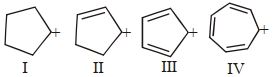
The stability of the carbocations follows the order:
A
$I > II > III > IV$
B
$III > II > IV > I$
C
$IV > II > I > III$
D
$IV > I > III > II$
Solution
(C) The stability of carbocations is determined by factors like aromaticity,resonance,and hyperconjugation.
$IV$ is a tropylium cation $(C_7H_7^+)$,which is aromatic ($6\pi$ electrons) and thus the most stable.
$II$ is stabilized by both resonance and hyperconjugation.
$I$ is a secondary carbocation stabilized by hyperconjugation.
$III$ is an anti-aromatic species ($4\pi$ electrons) and is the least stable.
Therefore,the correct order of stability is $IV > II > I > III$.
$IV$ is a tropylium cation $(C_7H_7^+)$,which is aromatic ($6\pi$ electrons) and thus the most stable.
$II$ is stabilized by both resonance and hyperconjugation.
$I$ is a secondary carbocation stabilized by hyperconjugation.
$III$ is an anti-aromatic species ($4\pi$ electrons) and is the least stable.
Therefore,the correct order of stability is $IV > II > I > III$.
0 likesView Solution
21
ChemistryDifficultMCQKVPY · 2021
Among the following,the structure which does $NOT$ represent $2-$methyl butane is:
A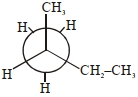
B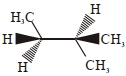
C
D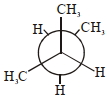
Solution
(C) The molecular formula of $2-$methyl butane is $C_5H_{12}$.
$A$: This Newman projection represents $2-$methyl butane (isopentane) viewed along the $C_1-C_2$ bond.
$B$: This sawhorse projection represents $2-$methyl butane viewed along the $C_2-C_3$ bond.
$C$: This Newman projection shows a structure with $4$ carbon atoms in the main chain,which corresponds to $2,3-$dimethyl butane (or similar depending on connectivity),but it does not represent $2-$methyl butane.
$D$: This Newman projection represents $2-$methyl butane viewed along the $C_2-C_3$ bond.
Therefore,the structure that does $NOT$ represent $2-$methyl butane is $(C)$.
$A$: This Newman projection represents $2-$methyl butane (isopentane) viewed along the $C_1-C_2$ bond.
$B$: This sawhorse projection represents $2-$methyl butane viewed along the $C_2-C_3$ bond.
$C$: This Newman projection shows a structure with $4$ carbon atoms in the main chain,which corresponds to $2,3-$dimethyl butane (or similar depending on connectivity),but it does not represent $2-$methyl butane.
$D$: This Newman projection represents $2-$methyl butane viewed along the $C_2-C_3$ bond.
Therefore,the structure that does $NOT$ represent $2-$methyl butane is $(C)$.
0 likesView Solution
22
ChemistryMediumMCQKVPY · 2021
The reaction of $1-$ethylcyclopentene with $BH_3 / THF$ followed by treatment with $H_2O_2 / NaOH$ produces:
A
B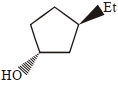
C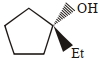
D
Solution
(D) The reaction of $1-$ethylcyclopentene with $BH_3 / THF$ followed by $H_2O_2 / NaOH$ is a hydroboration-oxidation reaction.
This reaction proceeds via the syn-addition of $H$ and $OH$ across the double bond.
Since the addition is syn,the $H$ atom and the $OH$ group add to the same face of the double bond.
This results in the formation of a mixture of enantiomers where the $OH$ group and the ethyl group are in a cis-relationship.
Specifically,the product is $2-$ethylcyclopentan-$1-$ol,where the $OH$ and ethyl groups are cis to each other.
Looking at the options,the structure representing the cis-isomer is the correct product.
This reaction proceeds via the syn-addition of $H$ and $OH$ across the double bond.
Since the addition is syn,the $H$ atom and the $OH$ group add to the same face of the double bond.
This results in the formation of a mixture of enantiomers where the $OH$ group and the ethyl group are in a cis-relationship.
Specifically,the product is $2-$ethylcyclopentan-$1-$ol,where the $OH$ and ethyl groups are cis to each other.
Looking at the options,the structure representing the cis-isomer is the correct product.
0 likesView Solution
23
ChemistryMediumMCQKVPY · 2021
The similar chemical properties of lithium and magnesium arise due to their similar
A
electron affinities
B
ionic sizes
C
ionization potential
D
hydration enthalpy
Solution
(B) .
The similarity between lithium and magnesium arises because of their similar ionic sizes,which is a classic example of the diagonal relationship in the periodic table.
The similarity between lithium and magnesium arises because of their similar ionic sizes,which is a classic example of the diagonal relationship in the periodic table.
0 likesView Solution
24
ChemistryMCQKVPY · 2021
The $INCORRECT$ statement about the dissolution of an alkali metal in liquid ammonia is
A
It produces a blue coloration of the solution
B
The blue coloration occurs due to ammoniated electrons that absorb in the visible region of light
C
On standing,the blue solution liberates hydrogen gas
D
The blue solution is diamagnetic
Solution
(D) The correct answer is $D$.
When an alkali metal dissolves in liquid ammonia,it forms a solution that is deep blue in color due to the presence of ammoniated electrons which absorb energy in the visible region of light.
These solutions are paramagnetic because of the presence of unpaired electrons.
On standing,the solution slowly decomposes to form metal amide and liberates hydrogen gas $(2M + 2NH_3 \rightarrow 2MNH_2 + H_2)$.
When an alkali metal dissolves in liquid ammonia,it forms a solution that is deep blue in color due to the presence of ammoniated electrons which absorb energy in the visible region of light.
These solutions are paramagnetic because of the presence of unpaired electrons.
On standing,the solution slowly decomposes to form metal amide and liberates hydrogen gas $(2M + 2NH_3 \rightarrow 2MNH_2 + H_2)$.
0 likesView Solution
25
ChemistryAdvancedMCQKVPY · 2021
Among the following,the correct statement for thionyl tetrafluoride $(SOF_4)$ is:
A
The geometry of thionyl tetrafluoride is trigonal bipyramidal having the sulphur-oxygen bond on the trigonal plane.
B
The geometry of thionyl tetrafluoride is trigonal bipyramidal having the sulphur-oxygen bond perpendicular to the trigonal plane.
C
The geometry of thionyl tetrafluoride is square pyramidal having the sulphur-oxygen bond on the square plane.
D
The geometry of thionyl tetrafluoride is square pyramidal having the sulphur-oxygen bond perpendicular to the square plane.
Solution
(A) The central atom in $SOF_4$ is sulphur $(S)$. The valence shell configuration of $S$ is $3s^2 3p^4$. It forms four $S-F$ bonds and one $S=O$ double bond. The total number of electron pairs around the central atom is $5$ (four single bonds and one double bond),which corresponds to $sp^3d$ hybridization. According to the $VSEPR$ theory,the geometry is trigonal bipyramidal. To minimize repulsion,the double-bonded oxygen atom occupies the equatorial position in the trigonal plane,while the fluorine atoms occupy the two axial and two equatorial positions.
0 likesView Solution
26
ChemistryMediumMCQKVPY · 2021
The number of acidic protons present in $H_3PO_2$,$H_3PO_3$ and $H_3PO_4$ respectively,are .....
A
$1$,$2$ and $3$
B
$2$,$3$ and $3$
C
$1$,$2$ and $2$
D
$3$,$3$ and $3$
Solution
(A) The acidity of oxoacids of phosphorus depends on the number of $OH$ groups directly attached to the phosphorus atom. Protons attached directly to the phosphorus atom are not acidic.
$1$. In $H_3PO_2$ (hypophosphorous acid),there is one $P-OH$ group,so it is monobasic (number of acidic protons = $1$).
$2$. In $H_3PO_3$ (phosphorous acid),there are two $P-OH$ groups,so it is dibasic (number of acidic protons = $2$).
$3$. In $H_3PO_4$ (phosphoric acid),there are three $P-OH$ groups,so it is tribasic (number of acidic protons = $3$).
Therefore,the number of acidic protons are $1$,$2$ and $3$ respectively. The correct option is $A$.
$1$. In $H_3PO_2$ (hypophosphorous acid),there is one $P-OH$ group,so it is monobasic (number of acidic protons = $1$).
$2$. In $H_3PO_3$ (phosphorous acid),there are two $P-OH$ groups,so it is dibasic (number of acidic protons = $2$).
$3$. In $H_3PO_4$ (phosphoric acid),there are three $P-OH$ groups,so it is tribasic (number of acidic protons = $3$).
Therefore,the number of acidic protons are $1$,$2$ and $3$ respectively. The correct option is $A$.
0 likesView Solution
27
ChemistryMediumMCQKVPY · 2021
$A$ hydrocarbon having molecular formula $C_5H_{10}$ produced a tertiary alcohol upon treatment with a few drops of conc. sulphuric acid and water. The same hydrocarbon when reacted with acidic potassium permanganate produced a ketone and a carboxylic acid. The hydrocarbon is $....$
A
cyclopentane
B
$1$-pentene
C
$2$-methyl$-2$-butene
D
$2$-pentene
Solution
(C) The hydrocarbon with molecular formula $C_5H_{10}$ is an alkene.
Acid-catalyzed hydration of $2$-methyl$-2$-butene $(CH_3-C(CH_3)=CH-CH_3)$ follows Markovnikov's rule to form $2$-methyl$-2$-butanol,which is a tertiary $(3^{\circ})$ alcohol.
Oxidative cleavage of $2$-methyl$-2$-butene with acidic $KMnO_4$ breaks the double bond to produce acetone $(CH_3COCH_3)$ and acetic acid $(CH_3COOH)$,which are a ketone and a carboxylic acid respectively.
Therefore,the correct hydrocarbon is $2$-methyl$-2$-butene.
Acid-catalyzed hydration of $2$-methyl$-2$-butene $(CH_3-C(CH_3)=CH-CH_3)$ follows Markovnikov's rule to form $2$-methyl$-2$-butanol,which is a tertiary $(3^{\circ})$ alcohol.
Oxidative cleavage of $2$-methyl$-2$-butene with acidic $KMnO_4$ breaks the double bond to produce acetone $(CH_3COCH_3)$ and acetic acid $(CH_3COOH)$,which are a ketone and a carboxylic acid respectively.
Therefore,the correct hydrocarbon is $2$-methyl$-2$-butene.
0 likesView Solution
28
ChemistryMediumMCQKVPY · 2021
Nitrogen present in an unknown organic compound was estimated by the Dumas method to be $17.7 \%$ by weight. The compound is very likely to be ....
A
nitrobenzene
B
pyridine
C
nitromethane
D
aniline
Solution
(B) To find the correct compound,we calculate the percentage of nitrogen in each option using the formula: $\text{Percentage of } N = \frac{\text{Atomic mass of } N}{\text{Molar mass of compound}} \times 100$.
$A$. Nitrobenzene $(C_6H_5NO_2)$: Molar mass = $123 \ g/mol$. $\%N = \frac{14}{123} \times 100 = 11.38 \%$.
$B$. Pyridine $(C_5H_5N)$: Molar mass = $79 \ g/mol$. $\%N = \frac{14}{79} \times 100 = 17.72 \%$.
$C$. Nitromethane $(CH_3NO_2)$: Molar mass = $61 \ g/mol$. $\%N = \frac{14}{61} \times 100 = 22.95 \%$.
$D$. Aniline $(C_6H_7N)$: Molar mass = $93 \ g/mol$. $\%N = \frac{14}{93} \times 100 = 15.05 \%$.
Comparing these values with the given $17.7 \%$,the compound is pyridine.
$A$. Nitrobenzene $(C_6H_5NO_2)$: Molar mass = $123 \ g/mol$. $\%N = \frac{14}{123} \times 100 = 11.38 \%$.
$B$. Pyridine $(C_5H_5N)$: Molar mass = $79 \ g/mol$. $\%N = \frac{14}{79} \times 100 = 17.72 \%$.
$C$. Nitromethane $(CH_3NO_2)$: Molar mass = $61 \ g/mol$. $\%N = \frac{14}{61} \times 100 = 22.95 \%$.
$D$. Aniline $(C_6H_7N)$: Molar mass = $93 \ g/mol$. $\%N = \frac{14}{93} \times 100 = 15.05 \%$.
Comparing these values with the given $17.7 \%$,the compound is pyridine.
0 likesView Solution
29
ChemistryDifficultMCQKVPY · 2021
$50 \ mL$ of $0.1 \ M$ of a weak acid $HA$ is titrated with $0.1 \ M$ of $NaOH$. The ionization constant of $HA$ $(K_a)$ is $1.8 \times 10^{-5}$. Using the given information and from the options shown below,the best indicator for the titration of $HA$ with $NaOH$ is $....$
A
Methyl orange (changes colour from red to yellow as the $pH$ changes from $3.2$ to $4.4$)
B
Methyl red (changes colour from red to yellow as the $pH$ changes from $4$ to $6.3$)
C
Phenolphthalein (changes from colourless to pink as the $pH$ changes from $8.3$ to $11$)
D
Sodium salt of Alizarin yellow (changes colour from yellow to red as the $pH$ changes from $10$ to $12$)
Solution
(C) The titration involves a weak acid $(HA)$ and a strong base $(NaOH)$.
At the equivalence point,the salt $NaA$ undergoes hydrolysis: $A^- + H_2O \rightleftharpoons HA + OH^-$.
The $pH$ at the equivalence point is greater than $7$ (basic).
For a weak acid-strong base titration,the $pH$ range at the equivalence point typically falls between $8$ and $10$.
Phenolphthalein has a $pH$ range of $8.3$ to $11$,which covers the equivalence point $pH$ of this titration.
Therefore,Phenolphthalein is the most suitable indicator.
At the equivalence point,the salt $NaA$ undergoes hydrolysis: $A^- + H_2O \rightleftharpoons HA + OH^-$.
The $pH$ at the equivalence point is greater than $7$ (basic).
For a weak acid-strong base titration,the $pH$ range at the equivalence point typically falls between $8$ and $10$.
Phenolphthalein has a $pH$ range of $8.3$ to $11$,which covers the equivalence point $pH$ of this titration.
Therefore,Phenolphthalein is the most suitable indicator.
0 likesView Solution
30
ChemistryDifficultMCQKVPY · 2021
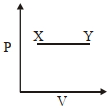
Consider the $P-V$ (pressure-volume) diagram given below,where an ideal gas is reversibly converted from state $X$ to state $Y$. Among the following,which is the correct $T-S$ (temperature-entropy) diagram corresponding to this process?
A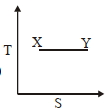
B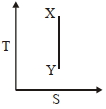
C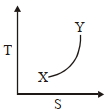
D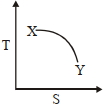
Solution
(C) The given $P-V$ diagram shows a horizontal line from $X$ to $Y$,which represents an isobaric process (pressure $P$ is constant).
For an ideal gas in an isobaric process,according to Charles's Law,$V \propto T$. Since the volume $V$ increases from $X$ to $Y$,the temperature $T$ must also increase.
For an isobaric process,the change in entropy is given by $\Delta S = nC_p \ln(T_f/T_i)$. Since $T_f > T_i$,the entropy $S$ also increases.
The relationship between $T$ and $S$ for an isobaric process is $T = T_0 e^{\Delta S / nC_p}$,which represents an exponential growth curve.
Thus,the $T-S$ diagram must show both $T$ and $S$ increasing along a curve,which corresponds to option $C$.
For an ideal gas in an isobaric process,according to Charles's Law,$V \propto T$. Since the volume $V$ increases from $X$ to $Y$,the temperature $T$ must also increase.
For an isobaric process,the change in entropy is given by $\Delta S = nC_p \ln(T_f/T_i)$. Since $T_f > T_i$,the entropy $S$ also increases.
The relationship between $T$ and $S$ for an isobaric process is $T = T_0 e^{\Delta S / nC_p}$,which represents an exponential growth curve.
Thus,the $T-S$ diagram must show both $T$ and $S$ increasing along a curve,which corresponds to option $C$.
0 likesView Solution
31
ChemistryMediumMCQKVPY · 2021
$A$ metal ion $M^{n+}$ having $d^6$ valence electronic configuration combines with three bidentate ligands to form a complex. Assuming crystal field splitting $(\Delta_0) >$ pairing energy,the $d$-orbital electronic configuration would be
A
$t_{2g}^6 e_g^0$
B
$t_{2g}^4 e_g^2$
C
$t_{2g}^3 e_g^3$
D
$t_{2g}^5 e_g^1$
Solution
(A) For an octahedral complex,when the crystal field splitting energy $(\Delta_0)$ is greater than the pairing energy $(P)$,the complex is a low-spin complex.
In a low-spin $d^6$ configuration,the electrons will first fill the lower energy $t_{2g}$ orbitals completely before occupying the higher energy $e_g$ orbitals.
Therefore,all $6$ electrons will occupy the $t_{2g}$ orbitals,resulting in the configuration $t_{2g}^6 e_g^0$.
In a low-spin $d^6$ configuration,the electrons will first fill the lower energy $t_{2g}$ orbitals completely before occupying the higher energy $e_g$ orbitals.
Therefore,all $6$ electrons will occupy the $t_{2g}$ orbitals,resulting in the configuration $t_{2g}^6 e_g^0$.
0 likesView Solution
32
ChemistryMediumMCQKVPY · 2021
Hybridizations of the central atom in $[Fe(H_2O)_6]^{3+}$ and $[Co(NH_3)_6]^{3+}$,respectively,are
A
$sp^3d^2$ and $sp^3d^2$
B
$sp^3d^2$ and $d^2sp^3$
C
$d^2sp^3$ and $d^2sp^3$
D
$d^2sp^3$ and $sp^3d^2$
Solution
(B) For $[Fe(H_2O)_6]^{3+}$:
$Fe$ is in $+3$ oxidation state,$Fe^{3+} = [Ar] 3d^5$.
$H_2O$ is a weak field ligand $(WFL)$,so it does not cause pairing of electrons.
Thus,the hybridization is $sp^3d^2$ (outer orbital complex).
For $[Co(NH_3)_6]^{3+}$:
$Co$ is in $+3$ oxidation state,$Co^{3+} = [Ar] 3d^6$.
$NH_3$ is a strong field ligand $(SFL)$,which causes pairing of electrons in the $3d$ orbitals.
Thus,the hybridization is $d^2sp^3$ (inner orbital complex).
Therefore,the hybridizations are $sp^3d^2$ and $d^2sp^3$ respectively.
$Fe$ is in $+3$ oxidation state,$Fe^{3+} = [Ar] 3d^5$.
$H_2O$ is a weak field ligand $(WFL)$,so it does not cause pairing of electrons.
Thus,the hybridization is $sp^3d^2$ (outer orbital complex).
For $[Co(NH_3)_6]^{3+}$:
$Co$ is in $+3$ oxidation state,$Co^{3+} = [Ar] 3d^6$.
$NH_3$ is a strong field ligand $(SFL)$,which causes pairing of electrons in the $3d$ orbitals.
Thus,the hybridization is $d^2sp^3$ (inner orbital complex).
Therefore,the hybridizations are $sp^3d^2$ and $d^2sp^3$ respectively.
0 likesView Solution
33
ChemistryMediumMCQKVPY · 2021
The $INCORRECT$ statement about the conductivity of electrolytic (ionic) solution is
A
It is independent of the solvent viscosity
B
It depends on the size of the ions and their solvation
C
It increases with the increase in electrolyte concentration
D
It increases with the increase in temperature
Solution
(A) The correct answer is $A$.
Conductivity of an electrolytic solution depends on the nature of the electrolyte,the size of the ions produced,their solvation,the nature of the solvent,and its viscosity.
Option $A$ is incorrect because conductivity is inversely proportional to the viscosity of the solvent.
Option $C$ is also technically incorrect as molar conductivity decreases with an increase in concentration,but specific conductivity increases; however,in the context of general electrolytic conductivity,$A$ is the most fundamentally incorrect statement regarding the physical properties of the solution.
Conductivity of an electrolytic solution depends on the nature of the electrolyte,the size of the ions produced,their solvation,the nature of the solvent,and its viscosity.
Option $A$ is incorrect because conductivity is inversely proportional to the viscosity of the solvent.
Option $C$ is also technically incorrect as molar conductivity decreases with an increase in concentration,but specific conductivity increases; however,in the context of general electrolytic conductivity,$A$ is the most fundamentally incorrect statement regarding the physical properties of the solution.
0 likesView Solution
34
ChemistryMediumMCQKVPY · 2021
Among the following,the $INCORRECT$ statement regarding the collision theory of chemical reaction is:
A
The reactant molecules are assumed to be hard spheres.
B
Collision frequency between reactants is one of the factors that determines the rate of the reaction.
C
The steric factor takes into account the relative orientation of the reactant molecules during collisions.
D
The theory takes into account the structural aspects of the molecules during collision.
Solution
(D)
Collision theory does not take into account the structural aspects of molecules during collision.
It assumes that reactant molecules are hard spheres and only considers their kinetic energy and orientation,not their internal structure.
Collision theory does not take into account the structural aspects of molecules during collision.
It assumes that reactant molecules are hard spheres and only considers their kinetic energy and orientation,not their internal structure.
0 likesView Solution
35
ChemistryDifficultMCQKVPY · 2021
Among the following,the crystal system which includes end-centered is
A
$a=b=c$ and $\alpha=\beta=\gamma=90^{\circ}$
B
$a=b \neq c$ and $\alpha=\beta=\gamma=90^{\circ}$
C
$a \neq b \neq c$ and $\alpha=\beta=\gamma=90^{\circ}$
D
$a=b=c$ and $\alpha=\beta=\gamma \neq 90^{\circ}$
Solution
(C) The end-centered unit cell is found in the Orthorhombic and Monoclinic crystal systems.
For the Orthorhombic system,the parameters are $a \neq b \neq c$ and $\alpha=\beta=\gamma=90^{\circ}$.
Comparing this with the given options,option $C$ represents the Orthorhombic system.
For the Orthorhombic system,the parameters are $a \neq b \neq c$ and $\alpha=\beta=\gamma=90^{\circ}$.
Comparing this with the given options,option $C$ represents the Orthorhombic system.
0 likesView Solution
36
ChemistryMediumMCQKVPY · 2021
In crystalline silicon,$Si$ atoms occupy all the $ccp$ sites and every alternate tetrahedral void. The value of packing efficiency is closest to $....\%$
A
$40$
B
$28$
C
$54$
D
$34$
Solution
(D) The correct option is $D$.
In a $ccp$ lattice,there are $4$ atoms per unit cell.
Silicon atoms occupy all $ccp$ sites ($4$ atoms) and every alternate tetrahedral void ($4$ atoms).
Total number of atoms per unit cell,$Z = 4 + 4 = 8$.
The distance between a corner $Si$ atom and a $Si$ atom at the tetrahedral void is $\frac{\sqrt{3}a}{4}$,which is equal to $2r$.
Thus,$2r = \frac{\sqrt{3}a}{4} \implies r = \frac{\sqrt{3}a}{8}$.
Packing Efficiency $(PE)$ = $\frac{Z \times \frac{4}{3} \pi r^3}{a^3} \times 100$.
Substituting the values: $PE = \frac{8 \times \frac{4}{3} \pi (\frac{\sqrt{3}a}{8})^3}{a^3} \times 100$.
$PE = \frac{8 \times \frac{4}{3} \pi \times \frac{3\sqrt{3}a^3}{512}}{a^3} \times 100 = \frac{\pi \sqrt{3}}{16} \times 100 \approx 34\%$.
In a $ccp$ lattice,there are $4$ atoms per unit cell.
Silicon atoms occupy all $ccp$ sites ($4$ atoms) and every alternate tetrahedral void ($4$ atoms).
Total number of atoms per unit cell,$Z = 4 + 4 = 8$.
The distance between a corner $Si$ atom and a $Si$ atom at the tetrahedral void is $\frac{\sqrt{3}a}{4}$,which is equal to $2r$.
Thus,$2r = \frac{\sqrt{3}a}{4} \implies r = \frac{\sqrt{3}a}{8}$.
Packing Efficiency $(PE)$ = $\frac{Z \times \frac{4}{3} \pi r^3}{a^3} \times 100$.
Substituting the values: $PE = \frac{8 \times \frac{4}{3} \pi (\frac{\sqrt{3}a}{8})^3}{a^3} \times 100$.
$PE = \frac{8 \times \frac{4}{3} \pi \times \frac{3\sqrt{3}a^3}{512}}{a^3} \times 100 = \frac{\pi \sqrt{3}}{16} \times 100 \approx 34\%$.
0 likesView Solution
37
ChemistryMediumMCQKVPY · 2021
Among the following methods:
$(i)$ Addition of an electrolyte
$(ii)$ Electrophoresis
$(iii)$ Addition of a protective colloid
$(iv)$ Addition of an oppositely charged sol
the coagulation of a lyophobic sol can be carried out by:
$(i)$ Addition of an electrolyte
$(ii)$ Electrophoresis
$(iii)$ Addition of a protective colloid
$(iv)$ Addition of an oppositely charged sol
the coagulation of a lyophobic sol can be carried out by:
A
$(i)$ and $(iv)$ only
B
$(ii), (iii)$ and $(iv)$ only
C
$(iii)$ and $(iv)$ only
D
$(i), (ii)$ and $(iv)$ only
Solution
(D) The coagulation of a lyophobic sol involves the neutralization of the charge on the colloidal particles.
$(i)$ Addition of an electrolyte provides ions that neutralize the charge.
$(ii)$ Electrophoresis involves moving particles to an oppositely charged electrode,leading to discharge and coagulation.
$(iv)$ Addition of an oppositely charged sol leads to mutual coagulation.
$(iii)$ Addition of a protective colloid is used to stabilize lyophobic sols,not to coagulate them.
Therefore,the correct methods are $(i), (ii)$ and $(iv)$.
$(i)$ Addition of an electrolyte provides ions that neutralize the charge.
$(ii)$ Electrophoresis involves moving particles to an oppositely charged electrode,leading to discharge and coagulation.
$(iv)$ Addition of an oppositely charged sol leads to mutual coagulation.
$(iii)$ Addition of a protective colloid is used to stabilize lyophobic sols,not to coagulate them.
Therefore,the correct methods are $(i), (ii)$ and $(iv)$.
0 likesView Solution
38
ChemistryMediumMCQKVPY · 2021
Phenylmagnesium bromide,upon reaction with a compound $X$ followed by treatment with acid,gives benzyl alcohol. The compound $X$ is
A
carbon dioxide
B
ethylene
C
formaldehyde
D
methanol
Solution
(C) The reaction of a Grignard reagent $(PhMgBr)$ with formaldehyde $(HCHO)$ followed by acid hydrolysis $(H_3O^+)$ yields a primary alcohol.
Specifically,the nucleophilic phenyl group $(Ph^-)$ attacks the electrophilic carbonyl carbon of formaldehyde $(HCHO)$,forming an intermediate alkoxide $(Ph-CH_2-O^-)$.
Subsequent protonation by acid results in the formation of benzyl alcohol $(Ph-CH_2OH)$.
Therefore,the compound $X$ is formaldehyde.
Specifically,the nucleophilic phenyl group $(Ph^-)$ attacks the electrophilic carbonyl carbon of formaldehyde $(HCHO)$,forming an intermediate alkoxide $(Ph-CH_2-O^-)$.
Subsequent protonation by acid results in the formation of benzyl alcohol $(Ph-CH_2OH)$.
Therefore,the compound $X$ is formaldehyde.
0 likesView Solution
39
ChemistryMediumMCQKVPY · 2021
Among the following,the compound which undergoes the fastest solvolysis is
A
$Ph-CH_2-CH_2-CH(Br)-CH_3$
B
$Me-CH_2-CH(Br)-CH_2-Ph$
C
$Me-CH(Br)-CH(CH_3)-Ph$
D
$Ph-CH(Br)-CH_2-CH_2-Br$
Solution
(C) The rate of solvolysis is directly proportional to the stability of the carbocation intermediate formed after the departure of the leaving group $(Br^-)$.
In option $C$,the compound is $Me-CH(Br)-CH(CH_3)-Ph$. Upon the loss of $Br^-$,it forms a secondary carbocation adjacent to a phenyl group and a methyl group.
This carbocation is stabilized by the resonance effect of the phenyl group and the inductive effect $(+I)$ of the methyl group,making it the most stable among the given options.
Therefore,the compound in option $C$ undergoes the fastest solvolysis.
In option $C$,the compound is $Me-CH(Br)-CH(CH_3)-Ph$. Upon the loss of $Br^-$,it forms a secondary carbocation adjacent to a phenyl group and a methyl group.
This carbocation is stabilized by the resonance effect of the phenyl group and the inductive effect $(+I)$ of the methyl group,making it the most stable among the given options.
Therefore,the compound in option $C$ undergoes the fastest solvolysis.
0 likesView Solution
40
ChemistryMediumMCQKVPY · 2021
$A$ compound $X$ on heating with alcoholic $AgNO_3$ gives a white precipitate. Oxidation of $X$ gives an acid with the formula $C_8H_6O_4$,which easily forms a cyclic anhydride on heating. The compound $X$ is
A
B
C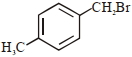
D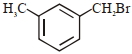
Solution
(A) The compound $X$ reacts with alcoholic $AgNO_3$ to give a white precipitate,indicating the presence of a reactive halogen atom (like a benzylic bromide).
Upon oxidation,$X$ yields an acid with the formula $C_8H_6O_4$. This acid is phthalic acid $(benzene-1,2-dicarboxylic \ acid)$,which is known to form a cyclic anhydride (phthalic anhydride) upon heating.
For $X$ to produce phthalic acid upon oxidation,it must be an ortho-substituted benzene derivative with two side chains that can be oxidized to $-COOH$ groups. The structure corresponding to this is $o-xylene$ derivative,specifically $1-(bromomethyl)-2-methylbenzene$.
Thus,the compound $X$ is $o-methylbenzyl \ bromide$ (or $1-(bromomethyl)-2-methylbenzene$).
Upon oxidation,$X$ yields an acid with the formula $C_8H_6O_4$. This acid is phthalic acid $(benzene-1,2-dicarboxylic \ acid)$,which is known to form a cyclic anhydride (phthalic anhydride) upon heating.
For $X$ to produce phthalic acid upon oxidation,it must be an ortho-substituted benzene derivative with two side chains that can be oxidized to $-COOH$ groups. The structure corresponding to this is $o-xylene$ derivative,specifically $1-(bromomethyl)-2-methylbenzene$.
Thus,the compound $X$ is $o-methylbenzyl \ bromide$ (or $1-(bromomethyl)-2-methylbenzene$).
0 likesView Solution
41
ChemistryMediumMCQKVPY · 2021
Among the following,the method which can be used for distinguishing aniline from ethylamine is
A
Treatment with $CHCl_3$ and $KOH$
B
Reaction with $NaNO_2 / HCl$ followed by treatment of $2-$naphthol
C
Reaction with benzene sulfonyl chloride
D
Reaction with benzaldehyde
Solution
(B) Aniline $(C_6H_5NH_2)$ is an aromatic primary amine,while ethylamine $(C_2H_5NH_2)$ is an aliphatic primary amine.
When treated with $NaNO_2 / HCl$ at $0-5 \ ^\circ C$,aniline forms benzene diazonium chloride,which is stable at low temperatures and undergoes a coupling reaction with $2-$naphthol to form an azo dye (red color).
In contrast,ethylamine forms an unstable aliphatic diazonium salt that immediately decomposes to evolve $N_2$ gas and forms ethanol,thus it does not give the azo dye coupling reaction.
Therefore,the reaction with $NaNO_2 / HCl$ followed by treatment with $2-$naphthol can distinguish between them.
When treated with $NaNO_2 / HCl$ at $0-5 \ ^\circ C$,aniline forms benzene diazonium chloride,which is stable at low temperatures and undergoes a coupling reaction with $2-$naphthol to form an azo dye (red color).
In contrast,ethylamine forms an unstable aliphatic diazonium salt that immediately decomposes to evolve $N_2$ gas and forms ethanol,thus it does not give the azo dye coupling reaction.
Therefore,the reaction with $NaNO_2 / HCl$ followed by treatment with $2-$naphthol can distinguish between them.
0 likesView Solution
42
ChemistryMediumMCQKVPY · 2021
The expected reactivity of the monomers shown below towards cationic polymerization follows the order:
$I: CH_2=CH-CO_2CH_3$
$II: CH_2=CH-Cl$
$III: CH_2=CH-CH_3$
$IV: CH_2=CH-Ph$
$I: CH_2=CH-CO_2CH_3$
$II: CH_2=CH-Cl$
$III: CH_2=CH-CH_3$
$IV: CH_2=CH-Ph$
A
$I < II < III < IV$
B
$IV < III < II < I$
C
$III < IV < II < I$
D
$IV < III < I < II$
Solution
(A) Cationic polymerization proceeds via the formation of a carbocation intermediate. The rate of polymerization is directly proportional to the stability of the carbocation formed.
The stability of the resulting carbocations is as follows:
$I: CH_3O_2C-CH_2-CH_2^+$ (destabilized by $-I$ and $-M$ effects of the ester group)
$II: Cl-CH_2-CH_2^+$ (destabilized by $-I$ effect of $Cl$)
$III: CH_3-CH_2-CH_2^+$ (stabilized by $+I$ effect of the methyl group)
$IV: Ph-CH_2-CH_2^+$ (highly stabilized by resonance with the phenyl ring)
Thus,the stability order is $I < II < III < IV$. Consequently,the reactivity order for cationic polymerization is $I < II < III < IV$.
The stability of the resulting carbocations is as follows:
$I: CH_3O_2C-CH_2-CH_2^+$ (destabilized by $-I$ and $-M$ effects of the ester group)
$II: Cl-CH_2-CH_2^+$ (destabilized by $-I$ effect of $Cl$)
$III: CH_3-CH_2-CH_2^+$ (stabilized by $+I$ effect of the methyl group)
$IV: Ph-CH_2-CH_2^+$ (highly stabilized by resonance with the phenyl ring)
Thus,the stability order is $I < II < III < IV$. Consequently,the reactivity order for cationic polymerization is $I < II < III < IV$.
0 likesView Solution
43
ChemistryDifficultMCQKVPY · 2021
The following transformation can be best carried out using:
A
$LiAlH_4$ in $THF$
B
$BH_3$ in $THF$
C
$NaBH_4$ in $EtOH$
D
$DIBAL-H$ in hexane
Solution
(C) $NaBH_4$ in $EtOH$ is a mild reducing agent.
It selectively reduces the aldehyde group $(-CHO)$ to a primary alcohol $(-CH_2OH)$ without affecting other functional groups like esters,carboxylic acids,or nitriles present in the molecule.
It selectively reduces the aldehyde group $(-CHO)$ to a primary alcohol $(-CH_2OH)$ without affecting other functional groups like esters,carboxylic acids,or nitriles present in the molecule.
0 likesView Solution
44
ChemistryMediumMCQKVPY · 2021
The correct match of the complexes with their structure and magnetic property is:
| Complex | Structure and magnetic property |
|---|---|
| $i$. $NiCl_4^{2-}$ | $p$. tetrahedral and diamagnetic |
| $ii$. $Ni(CO)_4$ | $q$. tetrahedral and paramagnetic |
| $iii$. $PtCl_4^{2-}$ | $r$. square planar and diamagnetic |
| $iv$. $Ni(CN)_4^{2-}$ | $s$. square planar and paramagnetic |
A
$i$ $\rightarrow q, ii$ $\rightarrow p, iii$ $\rightarrow r, iv$ $\rightarrow r$
B
$i$ $\rightarrow q, ii$ $\rightarrow p, iii$ $\rightarrow r, iv$ $\rightarrow r$
C
$i$ $\rightarrow q, ii$ $\rightarrow p, iii$ $\rightarrow r, iv$ $\rightarrow r$
D
$i$ $\rightarrow q, ii$ $\rightarrow p, iii$ $\rightarrow r, iv$ $\rightarrow r$
Solution
(A) The correct match is:
$i$. $NiCl_4^{2-}$: $Ni^{2+}$ is $d^8$. $Cl^-$ is a weak field ligand,so it forms a tetrahedral complex which is paramagnetic due to two unpaired electrons. Match: $i \rightarrow q$.
$ii$. $Ni(CO)_4$: $Ni$ is $d^{10}$. $CO$ is a strong field ligand,forming a tetrahedral complex which is diamagnetic. Match: $ii \rightarrow p$.
$iii$. $PtCl_4^{2-}$: $Pt^{2+}$ is $5d^8$. $Cl^-$ is a weak field ligand,but for $5d$ series elements,the crystal field splitting energy is high,resulting in a square planar diamagnetic complex. Match: $iii \rightarrow r$.
$iv$. $Ni(CN)_4^{2-}$: $Ni^{2+}$ is $d^8$. $CN^-$ is a strong field ligand,forcing pairing,resulting in a square planar diamagnetic complex. Match: $iv \rightarrow r$.
Thus,the correct sequence is $i$ $\rightarrow q, ii$ $\rightarrow p, iii$ $\rightarrow r, iv$ $\rightarrow r$.
$i$. $NiCl_4^{2-}$: $Ni^{2+}$ is $d^8$. $Cl^-$ is a weak field ligand,so it forms a tetrahedral complex which is paramagnetic due to two unpaired electrons. Match: $i \rightarrow q$.
$ii$. $Ni(CO)_4$: $Ni$ is $d^{10}$. $CO$ is a strong field ligand,forming a tetrahedral complex which is diamagnetic. Match: $ii \rightarrow p$.
$iii$. $PtCl_4^{2-}$: $Pt^{2+}$ is $5d^8$. $Cl^-$ is a weak field ligand,but for $5d$ series elements,the crystal field splitting energy is high,resulting in a square planar diamagnetic complex. Match: $iii \rightarrow r$.
$iv$. $Ni(CN)_4^{2-}$: $Ni^{2+}$ is $d^8$. $CN^-$ is a strong field ligand,forcing pairing,resulting in a square planar diamagnetic complex. Match: $iv \rightarrow r$.
Thus,the correct sequence is $i$ $\rightarrow q, ii$ $\rightarrow p, iii$ $\rightarrow r, iv$ $\rightarrow r$.
0 likesView Solution
45
ChemistryMediumMCQKVPY · 2021
$651 \ g$ of ethylene glycol $(HOCH_2CH_2OH)$ is dissolved in $1.5 \ kg$ of water at $363 \ K$. The vapour pressure of pure water at $363 \ K$ is $0.7 \ atm$. Assuming ideal solution behaviour,the vapour pressure of water over the solution (in $atm$) is closest to $...$
A
$0.57$
B
$0.62$
C
$0.65$
D
$0.68$
Solution
(B) The molar mass of ethylene glycol $(HOCH_2CH_2OH)$ is $62 \ g/mol$.
Number of moles of ethylene glycol $(n_{solute}) = \frac{651 \ g}{62 \ g/mol} = 10.5 \ mol$.
Number of moles of water $(n_{solvent}) = \frac{1500 \ g}{18 \ g/mol} \approx 83.33 \ mol$.
Using Raoult's law for a non-volatile solute: $\frac{P^{\circ} - P}{P^{\circ}} = \frac{n_{solute}}{n_{solute} + n_{solvent}}$.
$\frac{0.7 - P}{0.7} = \frac{10.5}{10.5 + 83.33} = \frac{10.5}{93.83} \approx 0.1119$.
$0.7 - P = 0.7 \times 0.1119 \approx 0.0783$.
$P = 0.7 - 0.0783 = 0.6217 \ atm$.
Thus,the vapour pressure is closest to $0.62 \ atm$.
Number of moles of ethylene glycol $(n_{solute}) = \frac{651 \ g}{62 \ g/mol} = 10.5 \ mol$.
Number of moles of water $(n_{solvent}) = \frac{1500 \ g}{18 \ g/mol} \approx 83.33 \ mol$.
Using Raoult's law for a non-volatile solute: $\frac{P^{\circ} - P}{P^{\circ}} = \frac{n_{solute}}{n_{solute} + n_{solvent}}$.
$\frac{0.7 - P}{0.7} = \frac{10.5}{10.5 + 83.33} = \frac{10.5}{93.83} \approx 0.1119$.
$0.7 - P = 0.7 \times 0.1119 \approx 0.0783$.
$P = 0.7 - 0.0783 = 0.6217 \ atm$.
Thus,the vapour pressure is closest to $0.62 \ atm$.
0 likesView Solution
46
ChemistryMediumMCQKVPY · 2021
The major product formed in the following transformation is most likely to be
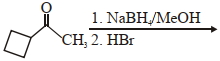
A
$1-$bromo$-1-$cyclobutyl-ethane
B
$1-$bromo$-1-$methylcyclopentane
C
$1-$bromo$-3-$cyclobutylpropane
D
$1-$bromo$-1-$cyclopentylmethane
Solution
(B) The reaction proceeds in two steps:
$1$. Reduction of cyclobutyl methyl ketone with $NaBH_4/MeOH$ yields $1-cyclobutyl-1-ethanol$.
$2$. Treatment with $HBr$ leads to the protonation of the alcohol,followed by the loss of water to form a secondary carbocation.
$3$. This secondary carbocation undergoes ring expansion to form a more stable cyclopentyl carbocation.
$4$. $A$ $1,2-hydride$ shift occurs to form a more stable tertiary carbocation.
$5$. Finally,the nucleophilic attack by $Br^-$ yields $1-bromo-1-methylcyclopentane$ as the major product.
$1$. Reduction of cyclobutyl methyl ketone with $NaBH_4/MeOH$ yields $1-cyclobutyl-1-ethanol$.
$2$. Treatment with $HBr$ leads to the protonation of the alcohol,followed by the loss of water to form a secondary carbocation.
$3$. This secondary carbocation undergoes ring expansion to form a more stable cyclopentyl carbocation.
$4$. $A$ $1,2-hydride$ shift occurs to form a more stable tertiary carbocation.
$5$. Finally,the nucleophilic attack by $Br^-$ yields $1-bromo-1-methylcyclopentane$ as the major product.
0 likesView Solution
47
ChemistryMediumMCQKVPY · 2021
$A$ compound $X$ with formula $C_4H_{11}N$ reacts with $HNO_2$ to liberate nitrogen and produce compound $Y$. The compound $Y$ on treatment with $I_2 / NaOH$ produces a sodium salt of a carboxylic acid. The compound $X$ is
A
$CH_3-CH_2-CH_2-CH_2-NH_2$
B
$CH_3-CH(CH_3)-CH_2-NH_2$
C
$CH_3-CH(NH_2)-CH_2-CH_3$
D
$(CH_3)_3C-NH_2$
Solution
(C) $1$. The reaction of an aliphatic primary amine with $HNO_2$ gives an alcohol with the evolution of $N_2$ gas.
$2$. The compound $Y$ reacts with $I_2 / NaOH$ (iodoform test) to give a sodium salt of a carboxylic acid,which indicates that $Y$ must be a secondary alcohol containing the $CH_3-CH(OH)-$ group.
$3$. Among the given options,$CH_3-CH(NH_2)-CH_2-CH_3$ (butan$-2-$amine) reacts with $HNO_2$ to form butan$-2-$ol $(CH_3-CH(OH)-CH_2-CH_3)$.
$4$. Butan$-2-$ol contains the $CH_3-CH(OH)-$ group,which gives a positive iodoform test with $I_2 / NaOH$ to produce sodium propionate and iodoform $(CHI_3)$.
$2$. The compound $Y$ reacts with $I_2 / NaOH$ (iodoform test) to give a sodium salt of a carboxylic acid,which indicates that $Y$ must be a secondary alcohol containing the $CH_3-CH(OH)-$ group.
$3$. Among the given options,$CH_3-CH(NH_2)-CH_2-CH_3$ (butan$-2-$amine) reacts with $HNO_2$ to form butan$-2-$ol $(CH_3-CH(OH)-CH_2-CH_3)$.
$4$. Butan$-2-$ol contains the $CH_3-CH(OH)-$ group,which gives a positive iodoform test with $I_2 / NaOH$ to produce sodium propionate and iodoform $(CHI_3)$.
0 likesView Solution
48
ChemistryDifficultMCQKVPY · 2021
Phenol reacts with $CO_2$ in the presence of sodium hydroxide followed by acidification to give a steam volatile compound $X$. The compound $X$ on treatment with acetic anhydride in the presence of a catalytic amount of $H_2SO_4$ produces $Y$. Among the following:
$(i)$ antipyretic
$(ii)$ anti-inflammatory
$(iii)$ narcotic analgesic
$(iv)$ antiplatelet
the properties shown by compound $Y$ are
$(i)$ antipyretic
$(ii)$ anti-inflammatory
$(iii)$ narcotic analgesic
$(iv)$ antiplatelet
the properties shown by compound $Y$ are
A
$i, ii, iii$ and $iv$
B
$i, ii$ and $iii$ only
C
$ii, iii$ and $iv$ only
D
$i, ii$ and $iv$ only
Solution
(D) The reaction of phenol with $CO_2$ in the presence of $NaOH$ followed by acidification is the Kolbe-Schmitt reaction,which yields salicylic acid as compound $X$.
Treatment of salicylic acid $(X)$ with acetic anhydride in the presence of $H_2SO_4$ (acetylation) yields acetylsalicylic acid,commonly known as Aspirin,as compound $Y$.
Aspirin is a non-narcotic analgesic. It exhibits the following properties:
$(i)$ Antipyretic (reduces fever)
$(ii)$ Anti-inflammatory (reduces inflammation)
$(iv)$ Antiplatelet (prevents blood clotting)
It is not a narcotic analgesic.
Therefore,the correct properties are $(i), (ii)$ and $(iv)$.
Treatment of salicylic acid $(X)$ with acetic anhydride in the presence of $H_2SO_4$ (acetylation) yields acetylsalicylic acid,commonly known as Aspirin,as compound $Y$.
Aspirin is a non-narcotic analgesic. It exhibits the following properties:
$(i)$ Antipyretic (reduces fever)
$(ii)$ Anti-inflammatory (reduces inflammation)
$(iv)$ Antiplatelet (prevents blood clotting)
It is not a narcotic analgesic.
Therefore,the correct properties are $(i), (ii)$ and $(iv)$.
0 likesView Solution
49
ChemistryDifficultMCQKVPY · 2021
$A$ mixture of $1 \, mol$ of benzene and $1 \, mol$ of nitrobenzene is reacted with $1 \, mol$ of acetyl chloride in the presence of $AlCl_3$. The major product$(s)$ is/are
A
acetophenone
B
$3$-nitroacetophenone
C
$1:1$ mixture of acetophenone and $3$-nitroacetophenone
D
$1,3$-diacetyl benzene
Solution
(A) The correct answer is $A$.
In nitrobenzene,the $-NO_2$ group is a powerful electron-withdrawing group,which significantly reduces the electron density of the benzene ring.
Friedel-Crafts acylation is an electrophilic aromatic substitution reaction that requires an electron-rich aromatic ring to react with the acylium ion $(CH_3CO^+)$.
Due to the strong deactivating effect of the $-NO_2$ group,nitrobenzene fails to undergo Friedel-Crafts acylation.
Therefore,only benzene reacts with acetyl chloride in the presence of $AlCl_3$ to form acetophenone.
In nitrobenzene,the $-NO_2$ group is a powerful electron-withdrawing group,which significantly reduces the electron density of the benzene ring.
Friedel-Crafts acylation is an electrophilic aromatic substitution reaction that requires an electron-rich aromatic ring to react with the acylium ion $(CH_3CO^+)$.
Due to the strong deactivating effect of the $-NO_2$ group,nitrobenzene fails to undergo Friedel-Crafts acylation.
Therefore,only benzene reacts with acetyl chloride in the presence of $AlCl_3$ to form acetophenone.
0 likesView Solution
50
ChemistryMediumMCQKVPY · 2021
The thermal stability of the hydrides of group-$16$ elements follows the order:
A
$H_2Te < H_2Se < H_2S < H_2O$
B
$H_2O < H_2Se < H_2S < H_2Te$
C
$H_2Te < H_2Se < H_2O < H_2S$
D
$H_2S < H_2Se < H_2Te < H_2O$
Solution
(A) The thermal stability of hydrides depends on the bond dissociation enthalpy.
As we move down the group-$16$ from $O$ to $Te$,the atomic size of the central atom increases.
This leads to an increase in the bond length of the $E-H$ bond (where $E = O, S, Se, Te$).
As the bond length increases,the bond dissociation enthalpy decreases,making the bond weaker.
Therefore,the thermal stability decreases down the group.
The correct order of thermal stability is $H_2O > H_2S > H_2Se > H_2Te$ or $H_2Te < H_2Se < H_2S < H_2O$.
As we move down the group-$16$ from $O$ to $Te$,the atomic size of the central atom increases.
This leads to an increase in the bond length of the $E-H$ bond (where $E = O, S, Se, Te$).
As the bond length increases,the bond dissociation enthalpy decreases,making the bond weaker.
Therefore,the thermal stability decreases down the group.
The correct order of thermal stability is $H_2O > H_2S > H_2Se > H_2Te$ or $H_2Te < H_2Se < H_2S < H_2O$.
0 likesView Solution
51
ChemistryMediumMCQKVPY · 2021
$A$ pink coloured aqueous solution of $Co(NO_3)_2$ turns blue on the addition of $HCl$ gradually. This colour change happens due to the formation of
A
$[CoCl_4]^{2-}$
B
$[CoCl_6]^{4-}$
C
$[Co(H_2O)_4Cl_2]$
D
$[Co(H_2O)_2Cl_4]^{2-}$
Solution
(A) The pink colour of the aqueous solution is due to the presence of the octahedral complex $[Co(H_2O)_6]^{2+}$.
Upon the addition of $HCl$,the chloride ions $(Cl^-)$ act as ligands and displace the water molecules to form the tetrahedral complex $[CoCl_4]^{2-}$,which is blue in colour.
The reaction is: $[Co(H_2O)_6]^{2+} (\text{pink}) + 4Cl^- \rightarrow [CoCl_4]^{2-} (\text{blue}) + 6H_2O$.
Upon the addition of $HCl$,the chloride ions $(Cl^-)$ act as ligands and displace the water molecules to form the tetrahedral complex $[CoCl_4]^{2-}$,which is blue in colour.
The reaction is: $[Co(H_2O)_6]^{2+} (\text{pink}) + 4Cl^- \rightarrow [CoCl_4]^{2-} (\text{blue}) + 6H_2O$.
0 likesView Solution
Vedclass Products
For Students
Vedclass Test Series
Mock tests in real KVPY style covering Chemistry with performance analysis. 5-day free trial.
Start Free TrialFor Teachers
Exam Paper Generator
Generate Set A/B/C/D Chemistry papers from 7.5L+ questions in 2 minutes. 3 chapters free.
Try FreeFor Institutes
Online Exam Module
Run live KVPY mock exams with unlimited students, 360° analytics & white-label branding.
See DemoFrequently Asked Questions
How many Chemistry questions are in KVPY 2021?
There are 51 Chemistry questions from the KVPY 2021 paper on Vedclass, each with a detailed step-by-step solution in English.
Are KVPY 2021 Chemistry solutions available in English?
Yes. All solutions on this page are in English. You can also switch to English or Hindi using the language buttons above the questions.
Can I practice KVPY 2021 Chemistry as a timed test?
Yes. Use the Vedclass Test Series to attempt a full KVPY mock test covering Chemistry with time limits and instant score analysis.
Can teachers create Chemistry papers from KVPY previous year questions?
Yes. The Vedclass Exam Paper Generator lets teachers mix KVPY Chemistry questions and generate Set A/B/C/D papers in minutes.
For Teachers & Institutes
Build a Custom Chemistry Paper
Pick KVPY 2021 Chemistry questions, set difficulty, and generate Set A/B/C/D in 2 minutes.