
ChemistryQ1–50 of 50 questions
Page 1 of 1 · English
1
ChemistryMediumMCQKVPY · 2014
When $1.88 \ g$ of $AgBr_{(s)}$ is added to a $10^{-3} \ M$ aqueous solution of $KBr$,the concentration of $Ag^{+}$ is $5 \times 10^{-10} \ M$. If the same amount of $AgBr_{(s)}$ is added to a $10^{-2} \ M$ aqueous solution of $AgNO_3$,the concentration of $Br^{-}$ is
A
$9.4 \times 10^{-9} \ M$
B
$5 \times 10^{-10} \ M$
C
$1 \times 10^{-11} \ M$
D
$5 \times 10^{-11} \ M$
Solution
(D) The solubility equilibrium for $AgBr$ is: $AgBr_{(s)} \rightleftharpoons Ag^{+}_{(aq)} + Br^{-}_{(aq)}$.
First,calculate the solubility product constant $(K_{sp})$ using the given concentrations in $KBr$ solution:
$K_{sp} = [Ag^{+}][Br^{-}] = (5 \times 10^{-10} \ M) \times (10^{-3} \ M) = 5 \times 10^{-13}$.
When $AgBr_{(s)}$ is added to $10^{-2} \ M$ $AgNO_3$ solution,the common ion effect occurs,and the concentration of $Ag^{+}$ becomes $10^{-2} \ M$.
Using the $K_{sp}$ value:
$K_{sp} = [Ag^{+}][Br^{-}]$
$5 \times 10^{-13} = (10^{-2} \ M) \times [Br^{-}]$
$[Br^{-}] = \frac{5 \times 10^{-13}}{10^{-2}} = 5 \times 10^{-11} \ M$.
First,calculate the solubility product constant $(K_{sp})$ using the given concentrations in $KBr$ solution:
$K_{sp} = [Ag^{+}][Br^{-}] = (5 \times 10^{-10} \ M) \times (10^{-3} \ M) = 5 \times 10^{-13}$.
When $AgBr_{(s)}$ is added to $10^{-2} \ M$ $AgNO_3$ solution,the common ion effect occurs,and the concentration of $Ag^{+}$ becomes $10^{-2} \ M$.
Using the $K_{sp}$ value:
$K_{sp} = [Ag^{+}][Br^{-}]$
$5 \times 10^{-13} = (10^{-2} \ M) \times [Br^{-}]$
$[Br^{-}] = \frac{5 \times 10^{-13}}{10^{-2}} = 5 \times 10^{-11} \ M$.
0 likesView Solution
2
ChemistryMediumMCQKVPY · 2014
The element that combines with oxygen to give an amphoteric oxide is
A
$N$
B
$P$
C
$Al$
D
$Na$
Solution
(C) $Al$ is the correct answer.
Amphoteric oxides are those oxides that exhibit both acidic and basic properties.
Among the given elements,$Al$ reacts with oxygen to form $Al_2O_3$,which is amphoteric.
$N_2(g) + O_2(g) \longrightarrow 2NO_2(g)$ (Acidic oxide)
$P_4(s) + 5O_2(g) \longrightarrow P_4O_{10}(s)$ (Acidic oxide)
$4Al(s) + 3O_2(g) \longrightarrow 2Al_2O_3(s)$ (Amphoteric oxide)
$2Na(s) + O_2(g) \longrightarrow Na_2O_2(s)$ (Basic oxide)
Amphoteric oxides are those oxides that exhibit both acidic and basic properties.
Among the given elements,$Al$ reacts with oxygen to form $Al_2O_3$,which is amphoteric.
$N_2(g) + O_2(g) \longrightarrow 2NO_2(g)$ (Acidic oxide)
$P_4(s) + 5O_2(g) \longrightarrow P_4O_{10}(s)$ (Acidic oxide)
$4Al(s) + 3O_2(g) \longrightarrow 2Al_2O_3(s)$ (Amphoteric oxide)
$2Na(s) + O_2(g) \longrightarrow Na_2O_2(s)$ (Basic oxide)
0 likesView Solution
3
ChemistryMediumMCQKVPY · 2014
The equilibrium constant $K_C$ of the reaction,$2 A \rightleftharpoons B + C$ is $0.5$ at $25^{\circ} C$. The reaction will proceed in the backward direction,when concentrations $[A], [B]$ and $[C]$ are,respectively:
A
$[A] = 10^{-3} \, M, [B] = 10^{-2} \, M, [C] = 10^{-2} \, M$
B
$[A] = 10^{-1} \, M, [B] = 10^{2} \, M, [C] = 10^{2} \, M$
C
$[A] = 10^{-2} \, M, [B] = 10^{-2} \, M, [C] = 10^{-3} \, M$
D
$[A] = 10^{-2} \, M, [B] = 10^{-3} \, M, [C] = 10^{-3} \, M$
Solution
(A) For the reaction,$2 A \rightleftharpoons B + C$,the reaction quotient is given by $Q_C = \frac{[B][C]}{[A]^2}$.
Given,$K_C = 0.5$.
The reaction proceeds in the backward direction if $Q_C > K_C$.
Let us calculate $Q_C$ for each option:
$(A)$ $Q_C = \frac{(10^{-2})(10^{-2})}{(10^{-3})^2} = \frac{10^{-4}}{10^{-6}} = 100$. Since $100 > 0.5$,the reaction proceeds in the backward direction.
$(B)$ $Q_C = \frac{(10^2)(10^2)}{(10^{-1})^2} = \frac{10^4}{10^{-2}} = 10^6$. Since $10^6 > 0.5$,the reaction proceeds in the backward direction. (Note: Option $A$ is the standard intended answer for this problem type).
$(C)$ $Q_C = \frac{(10^{-2})(10^{-3})}{(10^{-2})^2} = \frac{10^{-5}}{10^{-4}} = 0.1$. Since $0.1 < 0.5$,the reaction proceeds in the forward direction.
$(D)$ $Q_C = \frac{(10^{-3})(10^{-3})}{(10^{-2})^2} = \frac{10^{-6}}{10^{-4}} = 0.01$. Since $0.01 < 0.5$,the reaction proceeds in the forward direction.
Thus,option $A$ is the correct choice.
Given,$K_C = 0.5$.
The reaction proceeds in the backward direction if $Q_C > K_C$.
Let us calculate $Q_C$ for each option:
$(A)$ $Q_C = \frac{(10^{-2})(10^{-2})}{(10^{-3})^2} = \frac{10^{-4}}{10^{-6}} = 100$. Since $100 > 0.5$,the reaction proceeds in the backward direction.
$(B)$ $Q_C = \frac{(10^2)(10^2)}{(10^{-1})^2} = \frac{10^4}{10^{-2}} = 10^6$. Since $10^6 > 0.5$,the reaction proceeds in the backward direction. (Note: Option $A$ is the standard intended answer for this problem type).
$(C)$ $Q_C = \frac{(10^{-2})(10^{-3})}{(10^{-2})^2} = \frac{10^{-5}}{10^{-4}} = 0.1$. Since $0.1 < 0.5$,the reaction proceeds in the forward direction.
$(D)$ $Q_C = \frac{(10^{-3})(10^{-3})}{(10^{-2})^2} = \frac{10^{-6}}{10^{-4}} = 0.01$. Since $0.01 < 0.5$,the reaction proceeds in the forward direction.
Thus,option $A$ is the correct choice.
0 likesView Solution
4
ChemistryMediumMCQKVPY · 2014
Two elements,$X$ and $Y$,have atomic numbers $33$ and $17$,respectively. The molecular formula of a stable compound formed between them is
A
$XY$
B
$XY_2$
C
$XY_3$
D
$XY_4$
Solution
(C) $X$ with atomic number $33$ has the electronic configuration $[Ar] 3d^{10} 4s^2 4p^3$. It belongs to group $15$ and has a valency of $3$.
$Y$ with atomic number $17$ has the electronic configuration $[Ne] 3s^2 3p^5$. It belongs to group $17$ and has a valency of $1$.
To form a stable compound,the valencies are crossed:
$X^{3} Y^{1} \rightarrow XY_3$
Therefore,the molecular formula of the stable compound formed between $X$ and $Y$ is $XY_3$. For example,if $X$ is $As$ $(Z=33)$ and $Y$ is $Cl$ $(Z=17)$,the compound is $AsCl_3$.
$Y$ with atomic number $17$ has the electronic configuration $[Ne] 3s^2 3p^5$. It belongs to group $17$ and has a valency of $1$.
To form a stable compound,the valencies are crossed:
$X^{3} Y^{1} \rightarrow XY_3$
Therefore,the molecular formula of the stable compound formed between $X$ and $Y$ is $XY_3$. For example,if $X$ is $As$ $(Z=33)$ and $Y$ is $Cl$ $(Z=17)$,the compound is $AsCl_3$.
0 likesView Solution
5
ChemistryMediumMCQKVPY · 2014
The number of moles of $KMnO_4$ required to oxidize one equivalent of $KI$ in the presence of sulphuric acid is
A
$5$
B
$2$
C
$1/2$
D
$1/5$
Solution
(D) The balanced redox reaction in acidic medium is: $2KMnO_4 + 10KI + 8H_2SO_4 \longrightarrow 2MnSO_4 + 5I_2 + 6K_2SO_4 + 8H_2O$.
In this reaction,$KMnO_4$ acts as an oxidizing agent where the oxidation state of $Mn$ changes from $+7$ to $+2$,so the $n$-factor for $KMnO_4$ is $5$.
For $KI$,the oxidation state of $I$ changes from $-1$ to $0$,so the $n$-factor for $KI$ is $1$.
According to the law of equivalence,the number of equivalents of $KMnO_4$ must be equal to the number of equivalents of $KI$.
$\text{Equivalents of } KMnO_4 = \text{Equivalents of } KI$.
$n_{KMnO_4} \times n\text{-factor}_{KMnO_4} = \text{Equivalents of } KI$.
$n_{KMnO_4} \times 5 = 1$.
$n_{KMnO_4} = 1/5$.
In this reaction,$KMnO_4$ acts as an oxidizing agent where the oxidation state of $Mn$ changes from $+7$ to $+2$,so the $n$-factor for $KMnO_4$ is $5$.
For $KI$,the oxidation state of $I$ changes from $-1$ to $0$,so the $n$-factor for $KI$ is $1$.
According to the law of equivalence,the number of equivalents of $KMnO_4$ must be equal to the number of equivalents of $KI$.
$\text{Equivalents of } KMnO_4 = \text{Equivalents of } KI$.
$n_{KMnO_4} \times n\text{-factor}_{KMnO_4} = \text{Equivalents of } KI$.
$n_{KMnO_4} \times 5 = 1$.
$n_{KMnO_4} = 1/5$.
0 likesView Solution
6
ChemistryMediumMCQKVPY · 2014
Three successive measurements in an experiment gave the values $10.9$,$11.4042$,and $11.42$. The correct way of reporting the average value is
A
$11.2080$
B
$11.21$
C
$11.2$
D
$11$
Solution
(C) The average value is calculated as: $\text{Average} = \frac{10.9 + 11.4042 + 11.42}{3} = \frac{33.7242}{3} = 11.2414$.
According to the rules of significant figures in addition/subtraction,the result should be reported to the same number of decimal places as the measurement with the fewest decimal places.
The values are $10.9$ ($1$ decimal place),$11.4042$ ($4$ decimal places),and $11.42$ ($2$ decimal places).
The measurement with the fewest decimal places is $10.9$ (which has $1$ decimal place).
Therefore,the average value must be rounded to $1$ decimal place,which is $11.2$.
According to the rules of significant figures in addition/subtraction,the result should be reported to the same number of decimal places as the measurement with the fewest decimal places.
The values are $10.9$ ($1$ decimal place),$11.4042$ ($4$ decimal places),and $11.42$ ($2$ decimal places).
The measurement with the fewest decimal places is $10.9$ (which has $1$ decimal place).
Therefore,the average value must be rounded to $1$ decimal place,which is $11.2$.
0 likesView Solution
7
ChemistryMediumMCQKVPY · 2014
The latent heat of melting of ice at $0^{\circ} C$ is $6 \, kJ \, mol^{-1}$. The entropy change during the melting in $J \, K^{-1} \, mol^{-1}$ is closest to
A
$22$
B
$11$
C
$-11$
D
$-22$
Solution
(A) The entropy change $\Delta S$ for a phase transition is given by the formula $\Delta S = \frac{\Delta H}{T}$.
Given,latent heat of fusion $\Delta H = 6 \, kJ \, mol^{-1} = 6000 \, J \, mol^{-1}$.
The temperature of melting of ice at $1 \, atm$ is $T = 0^{\circ} C = 273 \, K$.
Substituting the values: $\Delta S = \frac{6000 \, J \, mol^{-1}}{273 \, K} \approx 21.97 \, J \, K^{-1} \, mol^{-1}$.
Rounding to the nearest integer,we get $22 \, J \, K^{-1} \, mol^{-1}$.
Thus,the correct option is $A$.
Given,latent heat of fusion $\Delta H = 6 \, kJ \, mol^{-1} = 6000 \, J \, mol^{-1}$.
The temperature of melting of ice at $1 \, atm$ is $T = 0^{\circ} C = 273 \, K$.
Substituting the values: $\Delta S = \frac{6000 \, J \, mol^{-1}}{273 \, K} \approx 21.97 \, J \, K^{-1} \, mol^{-1}$.
Rounding to the nearest integer,we get $22 \, J \, K^{-1} \, mol^{-1}$.
Thus,the correct option is $A$.
0 likesView Solution
8
ChemistryMediumMCQKVPY · 2014
The density of acetic acid vapor at $300 \ K$ and $1 \ atm$ is $5 \ mg \ cm^{-3}$. The number of acetic acid molecules in the cluster that is formed in the gas phase is closest to
A
$5$
B
$2$
C
$3$
D
$4$
Solution
(B) The density of the gas is $\rho = 5 \ mg \ cm^{-3} = 5 \ g \ L^{-1}$.
Using the ideal gas equation $pV = nRT$,where $n = \frac{w}{M}$,we have $p = \frac{wRT}{MV} = \frac{\rho RT}{M}$.
Rearranging for the molar mass $M$ of the vapor cluster: $M = \frac{\rho RT}{p}$.
Given $\rho = 5 \ g \ L^{-1}$,$R = 0.0821 \ L \ atm \ K^{-1} \ mol^{-1}$,$T = 300 \ K$,and $p = 1 \ atm$:
$M = \frac{5 \times 0.0821 \times 300}{1} = 123.15 \ g \ mol^{-1}$.
The molar mass of a single acetic acid molecule $(CH_3COOH)$ is $60 \ g \ mol^{-1}$.
The number of molecules in the cluster is $n = \frac{M_{cluster}}{M_{monomer}} = \frac{123.15}{60} \approx 2.05$.
Thus,the number of molecules is closest to $2$.
Using the ideal gas equation $pV = nRT$,where $n = \frac{w}{M}$,we have $p = \frac{wRT}{MV} = \frac{\rho RT}{M}$.
Rearranging for the molar mass $M$ of the vapor cluster: $M = \frac{\rho RT}{p}$.
Given $\rho = 5 \ g \ L^{-1}$,$R = 0.0821 \ L \ atm \ K^{-1} \ mol^{-1}$,$T = 300 \ K$,and $p = 1 \ atm$:
$M = \frac{5 \times 0.0821 \times 300}{1} = 123.15 \ g \ mol^{-1}$.
The molar mass of a single acetic acid molecule $(CH_3COOH)$ is $60 \ g \ mol^{-1}$.
The number of molecules in the cluster is $n = \frac{M_{cluster}}{M_{monomer}} = \frac{123.15}{60} \approx 2.05$.
Thus,the number of molecules is closest to $2$.
0 likesView Solution
9
ChemistryDifficultMCQKVPY · 2014
The molar enthalpy change for $H_2O_{(l)} \rightleftharpoons H_2O_{(g)}$ at $373 \ K$ and $1 \ atm$ is $41 \ kJ \ mol^{-1}$. Assuming ideal behavior,the internal energy change for vaporization of $1 \ mol$ of water at $373 \ K$ and $1 \ atm$ in $kJ \ mol^{-1}$ is:
A
$30.2$
B
$41.0$
C
$48.1$
D
$37.9$
Solution
(D) The vaporization reaction is: $H_2O_{(l)} \rightleftharpoons H_2O_{(g)}$.
Given: $\Delta H = 41 \ kJ \ mol^{-1}$,$T = 373 \ K$,$R = 8.314 \times 10^{-3} \ kJ \ K^{-1} \ mol^{-1}$.
The relationship between enthalpy change and internal energy change is $\Delta H = \Delta U + \Delta n_g RT$.
Here,$\Delta n_g = n_g(\text{products}) - n_g(\text{reactants}) = 1 - 0 = 1$.
Substituting the values: $41 = \Delta U + (1 \times 8.314 \times 10^{-3} \times 373)$.
$41 = \Delta U + 3.101$.
$\Delta U = 41 - 3.101 = 37.899 \approx 37.9 \ kJ \ mol^{-1}$.
Given: $\Delta H = 41 \ kJ \ mol^{-1}$,$T = 373 \ K$,$R = 8.314 \times 10^{-3} \ kJ \ K^{-1} \ mol^{-1}$.
The relationship between enthalpy change and internal energy change is $\Delta H = \Delta U + \Delta n_g RT$.
Here,$\Delta n_g = n_g(\text{products}) - n_g(\text{reactants}) = 1 - 0 = 1$.
Substituting the values: $41 = \Delta U + (1 \times 8.314 \times 10^{-3} \times 373)$.
$41 = \Delta U + 3.101$.
$\Delta U = 41 - 3.101 = 37.899 \approx 37.9 \ kJ \ mol^{-1}$.
0 likesView Solution
10
ChemistryMediumMCQKVPY · 2014
The equilibrium constants $(K_C)$ of two reactions $H_2 + I_2 \rightleftharpoons 2 HI$ and $N_2 + 3 H_2 \rightleftharpoons 2 NH_3$ are $50$ and $1000$,respectively. The equilibrium constant of the reaction $N_2 + 6 HI \rightleftharpoons 2 NH_3 + 3 I_2$ is closest to
A
$50000$
B
$20$
C
$0.008$
D
$0.005$
Solution
(C) For the reactions:
$1) \ H_2 + I_2 \rightleftharpoons 2 HI, K_{C_1} = 50$
$2) \ N_2 + 3 H_2 \rightleftharpoons 2 NH_3, K_{C_2} = 1000$
We need the equilibrium constant for the reaction:
$N_2 + 6 HI \rightleftharpoons 2 NH_3 + 3 I_2$
This reaction can be obtained by taking the second reaction and subtracting three times the first reaction:
$(N_2 + 3 H_2 \rightleftharpoons 2 NH_3) - 3 \times (H_2 + I_2 \rightleftharpoons 2 HI)$
$= N_2 + 3 H_2 - 3 H_2 - 3 I_2 \rightleftharpoons 2 NH_3 - 6 HI$
Rearranging gives: $N_2 + 6 HI \rightleftharpoons 2 NH_3 + 3 I_2$
The equilibrium constant $K_{C_3}$ is given by:
$K_{C_3} = \frac{K_{C_2}}{(K_{C_1})^3}$
$K_{C_3} = \frac{1000}{(50)^3} = \frac{1000}{125000} = \frac{1}{125} = 0.008$
$1) \ H_2 + I_2 \rightleftharpoons 2 HI, K_{C_1} = 50$
$2) \ N_2 + 3 H_2 \rightleftharpoons 2 NH_3, K_{C_2} = 1000$
We need the equilibrium constant for the reaction:
$N_2 + 6 HI \rightleftharpoons 2 NH_3 + 3 I_2$
This reaction can be obtained by taking the second reaction and subtracting three times the first reaction:
$(N_2 + 3 H_2 \rightleftharpoons 2 NH_3) - 3 \times (H_2 + I_2 \rightleftharpoons 2 HI)$
$= N_2 + 3 H_2 - 3 H_2 - 3 I_2 \rightleftharpoons 2 NH_3 - 6 HI$
Rearranging gives: $N_2 + 6 HI \rightleftharpoons 2 NH_3 + 3 I_2$
The equilibrium constant $K_{C_3}$ is given by:
$K_{C_3} = \frac{K_{C_2}}{(K_{C_1})^3}$
$K_{C_3} = \frac{1000}{(50)^3} = \frac{1000}{125000} = \frac{1}{125} = 0.008$
0 likesView Solution
11
ChemistryMediumMCQKVPY · 2014
Given that the bond energies of $N \equiv N$ is $946 \ kJ \ mol^{-1}$,$H-H$ is $435 \ kJ \ mol^{-1}$,$N-N$ is $159 \ kJ \ mol^{-1}$,and $N-H$ is $389 \ kJ \ mol^{-1}$,calculate the enthalpy of formation for the gas phase reaction $N_2 + 2H_2 \rightarrow N_2H_4$ in $kJ \ mol^{-1}$.
A
$833$
B
$101$
C
$334$
D
$1268$
Solution
(B) The reaction is $N \equiv N + 2(H-H) \rightarrow H_2N-NH_2$.
$\Delta H_f = \Sigma BE_{\text{reactants}} - \Sigma BE_{\text{products}}$
$\Delta H_f = [1 \times BE_{N \equiv N} + 2 \times BE_{H-H}] - [1 \times BE_{N-N} + 4 \times BE_{N-H}]$
$\Delta H_f = [946 + 2(435)] - [159 + 4(389)]$
$\Delta H_f = [946 + 870] - [159 + 1556]$
$\Delta H_f = 1816 - 1715 = 101 \ kJ \ mol^{-1}$.
$\Delta H_f = \Sigma BE_{\text{reactants}} - \Sigma BE_{\text{products}}$
$\Delta H_f = [1 \times BE_{N \equiv N} + 2 \times BE_{H-H}] - [1 \times BE_{N-N} + 4 \times BE_{N-H}]$
$\Delta H_f = [946 + 2(435)] - [159 + 4(389)]$
$\Delta H_f = [946 + 870] - [159 + 1556]$
$\Delta H_f = 1816 - 1715 = 101 \ kJ \ mol^{-1}$.
0 likesView Solution
12
ChemistryDifficultMCQKVPY · 2014
The reaction,$K_2Cr_2O_7 + m \, FeSO_4 + n \, H_2SO_4 \longrightarrow Cr_2(SO_4)_3 + p \, Fe_2(SO_4)_3 + K_2SO_4 + q \, H_2O$ when balanced,$m, n, p$ and $q$ are,respectively:
A
$6, 14, 3, 14$
B
$6, 7, 3, 7$
C
$3, 7, 2, 7$
D
$4, 14, 2, 14$
Solution
(B) The given unbalanced equation is: $K_2Cr_2O_7 + m \, FeSO_4 + n \, H_2SO_4 \longrightarrow Cr_2(SO_4)_3 + p \, Fe_2(SO_4)_3 + K_2SO_4 + q \, H_2O$
Using the oxidation number method or ion-electron method to balance the redox reaction:
$1$. Oxidation half-reaction: $Fe^{2+} \longrightarrow Fe^{3+} + e^-$
$2$. Reduction half-reaction: $Cr_2O_7^{2-} + 14H^+ + 6e^- \longrightarrow 2Cr^{3+} + 7H_2O$
Multiplying the oxidation half-reaction by $6$ to balance the electrons:
$6Fe^{2+} \longrightarrow 6Fe^{3+} + 6e^-$
Adding the two half-reactions:
$K_2Cr_2O_7 + 6FeSO_4 + 7H_2SO_4 \longrightarrow Cr_2(SO_4)_3 + 3Fe_2(SO_4)_3 + K_2SO_4 + 7H_2O$
Comparing the coefficients,we get $m = 6, n = 7, p = 3, q = 7$.
Thus,the correct option is $B$.
Using the oxidation number method or ion-electron method to balance the redox reaction:
$1$. Oxidation half-reaction: $Fe^{2+} \longrightarrow Fe^{3+} + e^-$
$2$. Reduction half-reaction: $Cr_2O_7^{2-} + 14H^+ + 6e^- \longrightarrow 2Cr^{3+} + 7H_2O$
Multiplying the oxidation half-reaction by $6$ to balance the electrons:
$6Fe^{2+} \longrightarrow 6Fe^{3+} + 6e^-$
Adding the two half-reactions:
$K_2Cr_2O_7 + 6FeSO_4 + 7H_2SO_4 \longrightarrow Cr_2(SO_4)_3 + 3Fe_2(SO_4)_3 + K_2SO_4 + 7H_2O$
Comparing the coefficients,we get $m = 6, n = 7, p = 3, q = 7$.
Thus,the correct option is $B$.
0 likesView Solution
13
ChemistryMediumMCQKVPY · 2014
The isoelectronic pair is
A
$CO, N_2$
B
$O_2, NO$
C
$CO, N_2$ and $F_2, HCl$
D
$F_2, HCl$
Solution
(C) Isoelectronic species are those that have the same number of electrons.
Let us calculate the total number of electrons for each pair:
$(A) \ CO, N_2$: $CO = 6 + 8 = 14$; $N_2 = 7 + 7 = 14$. (Isoelectronic)
$(B) \ O_2, NO$: $O_2 = 8 + 8 = 16$; $NO = 7 + 8 = 15$. (Not isoelectronic)
$(D) \ F_2, HCl$: $F_2 = 9 + 9 = 18$; $HCl = 1 + 17 = 18$. (Isoelectronic)
Since both $(A)$ and $(D)$ represent isoelectronic pairs,the correct choice is $(C)$.
Let us calculate the total number of electrons for each pair:
$(A) \ CO, N_2$: $CO = 6 + 8 = 14$; $N_2 = 7 + 7 = 14$. (Isoelectronic)
$(B) \ O_2, NO$: $O_2 = 8 + 8 = 16$; $NO = 7 + 8 = 15$. (Not isoelectronic)
$(D) \ F_2, HCl$: $F_2 = 9 + 9 = 18$; $HCl = 1 + 17 = 18$. (Isoelectronic)
Since both $(A)$ and $(D)$ represent isoelectronic pairs,the correct choice is $(C)$.
0 likesView Solution
14
ChemistryMediumMCQKVPY · 2014
The numbers of lone pairs and bond pairs in hydrazine are,respectively
A
$2$ and $4$
B
$2$ and $6$
C
$2$ and $5$
D
$1$ and $5$
Solution
(C) The molecular formula of hydrazine is $NH_2-NH_2$.
In the structure of hydrazine,each nitrogen atom has one lone pair,so there are $2$ lone pairs in total.
The bond pairs consist of $4$ $N-H$ bonds and $1$ $N-N$ bond,totaling $5$ bond pairs.
Therefore,the number of lone pairs is $2$ and the number of bond pairs is $5$.
In the structure of hydrazine,each nitrogen atom has one lone pair,so there are $2$ lone pairs in total.
The bond pairs consist of $4$ $N-H$ bonds and $1$ $N-N$ bond,totaling $5$ bond pairs.
Therefore,the number of lone pairs is $2$ and the number of bond pairs is $5$.
0 likesView Solution
15
ChemistryMediumMCQKVPY · 2014
The volume of oxygen at $STP$ required to burn $2.4 \,g$ of carbon completely is $.... \,L$
A
$1.12$
B
$8.96$
C
$2.24$
D
$4.48$
Solution
(D)
The combustion reaction of carbon is:
$C_{(s)} + O_{2(g)} \longrightarrow CO_{2(g)}$
From the stoichiometry,$1 \,mole$ of carbon $(12 \,g)$ reacts with $1 \,mole$ of oxygen ($22.4 \,L$ at $STP$).
Therefore,$2.4 \,g$ of carbon reacts with:
$\text{Moles of } C = \frac{2.4 \,g}{12 \,g/mol} = 0.2 \,mol$
Since $1 \,mol$ of $C$ requires $1 \,mol$ of $O_2$,$0.2 \,mol$ of $C$ requires $0.2 \,mol$ of $O_2$.
Volume of $O_2$ at $STP = 0.2 \,mol \times 22.4 \,L/mol = 4.48 \,L$.
The combustion reaction of carbon is:
$C_{(s)} + O_{2(g)} \longrightarrow CO_{2(g)}$
From the stoichiometry,$1 \,mole$ of carbon $(12 \,g)$ reacts with $1 \,mole$ of oxygen ($22.4 \,L$ at $STP$).
Therefore,$2.4 \,g$ of carbon reacts with:
$\text{Moles of } C = \frac{2.4 \,g}{12 \,g/mol} = 0.2 \,mol$
Since $1 \,mol$ of $C$ requires $1 \,mol$ of $O_2$,$0.2 \,mol$ of $C$ requires $0.2 \,mol$ of $O_2$.
Volume of $O_2$ at $STP = 0.2 \,mol \times 22.4 \,L/mol = 4.48 \,L$.
0 likesView Solution
16
ChemistryMediumMCQKVPY · 2014
The species that exhibits the highest $R_f$ value in a thin layer chromatogram using a non-polar solvent on a silica gel plate is
A
Propylbenzene
B
Pyridine
C
$N$-methylpyridinium ion
D
Phenol
Solution
(A) In thin layer chromatography $(TLC)$,the stationary phase (silica gel) is polar in nature.
The $R_f$ value is inversely proportional to the polarity of the compound.
Non-polar compounds interact less with the polar stationary phase and move faster with the non-polar solvent,resulting in a higher $R_f$ value.
Comparing the polarities:
$1$. $N$-methylpyridinium ion is an ionic species,making it the most polar.
$2$. Phenol has an $-OH$ group,allowing for hydrogen bonding,making it polar.
$3$. Pyridine is polar due to the lone pair on nitrogen.
$4$. Propylbenzene is a hydrocarbon and is the least polar among the given options.
Therefore,propylbenzene will have the highest $R_f$ value.
The $R_f$ value is inversely proportional to the polarity of the compound.
Non-polar compounds interact less with the polar stationary phase and move faster with the non-polar solvent,resulting in a higher $R_f$ value.
Comparing the polarities:
$1$. $N$-methylpyridinium ion is an ionic species,making it the most polar.
$2$. Phenol has an $-OH$ group,allowing for hydrogen bonding,making it polar.
$3$. Pyridine is polar due to the lone pair on nitrogen.
$4$. Propylbenzene is a hydrocarbon and is the least polar among the given options.
Therefore,propylbenzene will have the highest $R_f$ value.
0 likesView Solution
17
ChemistryMediumMCQKVPY · 2014
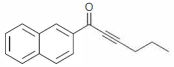
The number of $C-C$ sigma bonds in the compound is:
A
$16$
B
$17$
C
$18$
D
$11$
Solution
(B) To find the number of $C-C$ sigma bonds,we analyze the structure of the given compound (a naphthalene derivative with a ketone and an alkyne chain).
By counting the $C-C$ single bonds in the naphthalene ring and the side chain,we identify the total number of $C-C$ sigma bonds.
As shown in the labeled structure,there are $17$ $C-C$ sigma bonds in total.
Therefore,the correct option is $(b)$.
By counting the $C-C$ single bonds in the naphthalene ring and the side chain,we identify the total number of $C-C$ sigma bonds.
As shown in the labeled structure,there are $17$ $C-C$ sigma bonds in total.
Therefore,the correct option is $(b)$.
0 likesView Solution
18
ChemistryMediumMCQKVPY · 2014
If the radius of the hydrogen atom is $53 \, pm$, the radius of the $He^{+}$ ion is closest to $...... \, pm$.
A
$108$
B
$81$
C
$27$
D
$13$
Solution
(C) The radius of an orbit in a hydrogen-like species is given by the formula: $r_n = 52.9 \times \frac{n^2}{Z} \, pm$.
For a hydrogen atom $(H)$, $n = 1$ and $Z = 1$, so $r_H = 52.9 \, pm \approx 53 \, pm$.
For the $He^{+}$ ion, $n = 1$ and $Z = 2$.
Substituting these values: $r_{He^{+}} = 52.9 \times \frac{1^2}{2} = 26.45 \, pm$.
Rounding this value, we get $27 \, pm$.
Therefore, the correct option is $C$.
For a hydrogen atom $(H)$, $n = 1$ and $Z = 1$, so $r_H = 52.9 \, pm \approx 53 \, pm$.
For the $He^{+}$ ion, $n = 1$ and $Z = 2$.
Substituting these values: $r_{He^{+}} = 52.9 \times \frac{1^2}{2} = 26.45 \, pm$.
Rounding this value, we get $27 \, pm$.
Therefore, the correct option is $C$.
0 likesView Solution
19
ChemistryMediumMCQKVPY · 2014
The diamagnetic species is
A
$NO$
B
$NO_2$
C
$O_2$
D
$CO_2$
Solution
(D)
Diamagnetic species are those which have all electrons paired in their molecular orbitals.
$(i)$ $NO$: Total electrons $= 7+8=15$. It has an unpaired electron in the $\pi^* 2p_x$ orbital,so it is paramagnetic.
$(ii)$ $NO_2$: Total electrons $= 7+8+8=23$. It has an odd number of electrons,so it is paramagnetic.
$(iii)$ $O_2$: Total electrons $= 16$. According to Molecular Orbital Theory,it has two unpaired electrons in the $\pi^* 2p_x$ and $\pi^* 2p_y$ orbitals,so it is paramagnetic.
$(iv)$ $CO_2$: Total electrons $= 6+8+8=22$. The structure is $O=C=O$. All electrons are paired in bonding and lone pair orbitals,making it diamagnetic.
Diamagnetic species are those which have all electrons paired in their molecular orbitals.
$(i)$ $NO$: Total electrons $= 7+8=15$. It has an unpaired electron in the $\pi^* 2p_x$ orbital,so it is paramagnetic.
$(ii)$ $NO_2$: Total electrons $= 7+8+8=23$. It has an odd number of electrons,so it is paramagnetic.
$(iii)$ $O_2$: Total electrons $= 16$. According to Molecular Orbital Theory,it has two unpaired electrons in the $\pi^* 2p_x$ and $\pi^* 2p_y$ orbitals,so it is paramagnetic.
$(iv)$ $CO_2$: Total electrons $= 6+8+8=22$. The structure is $O=C=O$. All electrons are paired in bonding and lone pair orbitals,making it diamagnetic.
0 likesView Solution
20
ChemistryMediumMCQKVPY · 2014
The $pH$ of $0.1 \, M$ aqueous solutions of $NaCl$,$CH_3COONa$ and $NH_4Cl$ will follow the order:
A
$NaCl < CH_3COONa < NH_4Cl$
B
$NH_4Cl < NaCl < CH_3COONa$
C
$NH_4Cl < CH_3COONa < NaCl$
D
$NaCl < NH_4Cl < CH_3COONa$
Solution
(B) $NaCl$ is a salt of a strong acid $(HCl)$ and a strong base $(NaOH)$,so it is neutral $(pH = 7)$.
$NH_4Cl$ is a salt of a strong acid $(HCl)$ and a weak base $(NH_4OH)$,so it is acidic $(pH < 7)$.
$CH_3COONa$ is a salt of a weak acid $(CH_3COOH)$ and a strong base $(NaOH)$,so it is basic $(pH > 7)$.
Therefore,the increasing order of $pH$ for $0.1 \, M$ aqueous solutions is $NH_4Cl < NaCl < CH_3COONa$.
$NH_4Cl$ is a salt of a strong acid $(HCl)$ and a weak base $(NH_4OH)$,so it is acidic $(pH < 7)$.
$CH_3COONa$ is a salt of a weak acid $(CH_3COOH)$ and a strong base $(NaOH)$,so it is basic $(pH > 7)$.
Therefore,the increasing order of $pH$ for $0.1 \, M$ aqueous solutions is $NH_4Cl < NaCl < CH_3COONa$.
0 likesView Solution
21
ChemistryMediumMCQKVPY · 2014
At room temperature,the average speed of helium is higher than that of oxygen by a factor of
A
$2 \sqrt{2}$
B
$6 \sqrt{2}$
C
$8$
D
$6$
Solution
(A) The average speed $(V_{avg})$ of a gas is given by the formula: $V_{avg} = \sqrt{\frac{8RT}{\pi M}}$.
Since $R$,$T$,and $\pi$ are constant at a given temperature,the average speed is inversely proportional to the square root of the molar mass $(M)$: $V_{avg} \propto \frac{1}{\sqrt{M}}$.
For helium $(He)$ and oxygen $(O_2)$: $M_{He} = 4 \ g/mol$ and $M_{O_2} = 32 \ g/mol$.
The ratio of their average speeds is: $\frac{V_{He}}{V_{O_2}} = \sqrt{\frac{M_{O_2}}{M_{He}}} = \sqrt{\frac{32}{4}} = \sqrt{8} = 2 \sqrt{2}$.
Thus,the average speed of helium is higher than that of oxygen by a factor of $2 \sqrt{2}$.
Since $R$,$T$,and $\pi$ are constant at a given temperature,the average speed is inversely proportional to the square root of the molar mass $(M)$: $V_{avg} \propto \frac{1}{\sqrt{M}}$.
For helium $(He)$ and oxygen $(O_2)$: $M_{He} = 4 \ g/mol$ and $M_{O_2} = 32 \ g/mol$.
The ratio of their average speeds is: $\frac{V_{He}}{V_{O_2}} = \sqrt{\frac{M_{O_2}}{M_{He}}} = \sqrt{\frac{32}{4}} = \sqrt{8} = 2 \sqrt{2}$.
Thus,the average speed of helium is higher than that of oxygen by a factor of $2 \sqrt{2}$.
0 likesView Solution
22
ChemistryMediumMCQKVPY · 2014
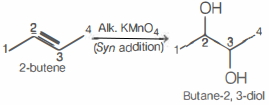
The major product of the reaction of $2$-butene with alkaline $KMnO_4$ solution is
A
B
C
D
Solution
(D) The reaction of $2$-butene $(CH_3-CH=CH-CH_3)$ with cold,dilute alkaline $KMnO_4$ (Baeyer's reagent) is a syn-hydroxylation reaction.
This reaction adds two hydroxyl $(-OH)$ groups across the double bond to form a vicinal glycol.
The product formed is butane-$2,3$-diol.
This reaction adds two hydroxyl $(-OH)$ groups across the double bond to form a vicinal glycol.
The product formed is butane-$2,3$-diol.
0 likesView Solution
23
ChemistryDifficultMCQKVPY · 2014
Of the following reactions:
$(i) \, A \rightleftharpoons B, \Delta G^{\circ} = 250 \, kJ \, mol^{-1}$
$(ii) \, D \rightleftharpoons E, \Delta G^{\circ} = -100 \, kJ \, mol^{-1}$
$(iii) \, F \rightleftharpoons G, \Delta G^{\circ} = -150 \, kJ \, mol^{-1}$
$(iv) \, M \rightleftharpoons N, \Delta G^{\circ} = 150 \, kJ \, mol^{-1}$
The reaction with the largest equilibrium constant is:
$(i) \, A \rightleftharpoons B, \Delta G^{\circ} = 250 \, kJ \, mol^{-1}$
$(ii) \, D \rightleftharpoons E, \Delta G^{\circ} = -100 \, kJ \, mol^{-1}$
$(iii) \, F \rightleftharpoons G, \Delta G^{\circ} = -150 \, kJ \, mol^{-1}$
$(iv) \, M \rightleftharpoons N, \Delta G^{\circ} = 150 \, kJ \, mol^{-1}$
The reaction with the largest equilibrium constant is:
A
$(i)$
B
$(ii)$
C
$(iii)$
D
$(iv)$
Solution
(C) The relationship between standard Gibbs free energy change $(\Delta G^{\circ})$ and the equilibrium constant $(K_{eq})$ is given by the equation:
$\Delta G^{\circ} = -RT \ln K_{eq}$ or $\log K_{eq} = -\Delta G^{\circ} / (2.303 \, RT)$
From this relation,it is clear that $\log K_{eq}$ is inversely proportional to $\Delta G^{\circ}$.
Therefore,the reaction with the most negative value of $\Delta G^{\circ}$ will have the largest positive value for $\log K_{eq}$,and consequently,the largest equilibrium constant $(K_{eq})$.
Comparing the given values:
$(i) \, 250 \, kJ \, mol^{-1}$
$(ii) \, -100 \, kJ \, mol^{-1}$
$(iii) \, -150 \, kJ \, mol^{-1}$
$(iv) \, 150 \, kJ \, mol^{-1}$
The most negative value is $-150 \, kJ \, mol^{-1}$,which corresponds to reaction $(iii)$.
$\Delta G^{\circ} = -RT \ln K_{eq}$ or $\log K_{eq} = -\Delta G^{\circ} / (2.303 \, RT)$
From this relation,it is clear that $\log K_{eq}$ is inversely proportional to $\Delta G^{\circ}$.
Therefore,the reaction with the most negative value of $\Delta G^{\circ}$ will have the largest positive value for $\log K_{eq}$,and consequently,the largest equilibrium constant $(K_{eq})$.
Comparing the given values:
$(i) \, 250 \, kJ \, mol^{-1}$
$(ii) \, -100 \, kJ \, mol^{-1}$
$(iii) \, -150 \, kJ \, mol^{-1}$
$(iv) \, 150 \, kJ \, mol^{-1}$
The most negative value is $-150 \, kJ \, mol^{-1}$,which corresponds to reaction $(iii)$.
0 likesView Solution
24
ChemistryMediumMCQKVPY · 2014
The first ionisation enthalpies for three elements are $1314$,$1680$ and $2080 \, kJ \, mol^{-1}$,respectively. The correct sequence of the elements is
A
$O, F$ and $Ne$
B
$F, O$ and $Ne$
C
$Ne, F$ and $O$
D
$F, Ne$ and $O$
Solution
(A) The elements $O$,$F$,and $Ne$ belong to the same period,i.e.,the $2nd$ period of the periodic table.
As we move from left to right across a period,the atomic radius decreases and the effective nuclear charge increases,which leads to an increase in the first ionisation enthalpy.
The order of increasing ionisation enthalpy for these elements is $O < F < Ne$.
Given values are $1314 \, kJ \, mol^{-1}$ for $O$,$1680 \, kJ \, mol^{-1}$ for $F$,and $2080 \, kJ \, mol^{-1}$ for $Ne$.
Therefore,the correct sequence is $O, F$ and $Ne$.
As we move from left to right across a period,the atomic radius decreases and the effective nuclear charge increases,which leads to an increase in the first ionisation enthalpy.
The order of increasing ionisation enthalpy for these elements is $O < F < Ne$.
Given values are $1314 \, kJ \, mol^{-1}$ for $O$,$1680 \, kJ \, mol^{-1}$ for $F$,and $2080 \, kJ \, mol^{-1}$ for $Ne$.
Therefore,the correct sequence is $O, F$ and $Ne$.
0 likesView Solution
25
ChemistryDifficultMCQKVPY · 2014
$10 \ mol$ of a mixture of hydrogen and oxygen gases at a pressure of $1 \ atm$ at constant volume and temperature,react to form $3.6 \ g$ of liquid water. The pressure of the resulting mixture will be closest to $..... \ atm$
A
$1.07$
B
$0.97$
C
$1.02$
D
$0.92$
Solution
(B) $2H_{2(g)} + O_{2(g)} \longrightarrow 2H_2O_{(l)}$
$18 \ g$ of $H_2O = 1 \ mol$,so $3.6 \ g$ of $H_2O = \frac{3.6}{18} = 0.2 \ mol$.
According to the stoichiometry,$0.2 \ mol$ of $H_2O$ is produced from $0.2 \ mol$ of $H_2$ and $0.1 \ mol$ of $O_2$.
Total moles of gases consumed $= 0.2 + 0.1 = 0.3 \ mol$.
Initial moles of gas mixture $= 10 \ mol$.
Remaining moles of gas mixture $= 10 - 0.3 = 9.7 \ mol$.
Since $V$ and $T$ are constant,$P \propto n$.
$\frac{P_1}{n_1} = \frac{P_2}{n_2} \Rightarrow \frac{1 \ atm}{10 \ mol} = \frac{P_2}{9.7 \ mol}$.
$P_2 = \frac{9.7}{10} = 0.97 \ atm$.
$18 \ g$ of $H_2O = 1 \ mol$,so $3.6 \ g$ of $H_2O = \frac{3.6}{18} = 0.2 \ mol$.
According to the stoichiometry,$0.2 \ mol$ of $H_2O$ is produced from $0.2 \ mol$ of $H_2$ and $0.1 \ mol$ of $O_2$.
Total moles of gases consumed $= 0.2 + 0.1 = 0.3 \ mol$.
Initial moles of gas mixture $= 10 \ mol$.
Remaining moles of gas mixture $= 10 - 0.3 = 9.7 \ mol$.
Since $V$ and $T$ are constant,$P \propto n$.
$\frac{P_1}{n_1} = \frac{P_2}{n_2} \Rightarrow \frac{1 \ atm}{10 \ mol} = \frac{P_2}{9.7 \ mol}$.
$P_2 = \frac{9.7}{10} = 0.97 \ atm$.
0 likesView Solution
26
ChemistryMediumMCQKVPY · 2014
Complete reaction of $2.0 \, g$ of calcium (at. wt. $= 40$) with excess $HCl$ produces $1.125 \, L$ of $H_2$ gas. Complete reaction of the same quantity of another metal $M$ with excess $HCl$ produces $1.85 \, L$ of $H_2$ gas under identical conditions. The equivalent weight of $M$ is closest to
A
$23$
B
$9$
C
$7$
D
$12$
Solution
(D) .
Let the equivalent weight of metal $M = x$.
According to the law of equivalence,the number of equivalents of metal reacted is equal to the number of equivalents of $H_2$ gas produced.
$(eq)_{Ca} = (eq)_{H_2} \text{ (from Ca)} = \frac{2.0}{20} = 0.1$
$(eq)_{M} = (eq)_{H_2} \text{ (from M)} = \frac{2.0}{x}$
Since the volume of gas produced is directly proportional to the number of equivalents under identical conditions:
$\frac{(eq)_{Ca}}{(eq)_{M}} = \frac{V_{H_2} \text{ (from Ca)}}{V_{H_2} \text{ (from M)}}$
$\frac{0.1}{2.0/x} = \frac{1.125}{1.85}$
$\frac{0.1x}{2.0} = \frac{1.125}{1.85}$
$x = \frac{1.125 \times 2.0}{1.85 \times 0.1} = \frac{2.25}{0.185} \approx 12.16$
Thus,the equivalent weight of $M$ is approximately $12$.
Let the equivalent weight of metal $M = x$.
According to the law of equivalence,the number of equivalents of metal reacted is equal to the number of equivalents of $H_2$ gas produced.
$(eq)_{Ca} = (eq)_{H_2} \text{ (from Ca)} = \frac{2.0}{20} = 0.1$
$(eq)_{M} = (eq)_{H_2} \text{ (from M)} = \frac{2.0}{x}$
Since the volume of gas produced is directly proportional to the number of equivalents under identical conditions:
$\frac{(eq)_{Ca}}{(eq)_{M}} = \frac{V_{H_2} \text{ (from Ca)}}{V_{H_2} \text{ (from M)}}$
$\frac{0.1}{2.0/x} = \frac{1.125}{1.85}$
$\frac{0.1x}{2.0} = \frac{1.125}{1.85}$
$x = \frac{1.125 \times 2.0}{1.85 \times 0.1} = \frac{2.25}{0.185} \approx 12.16$
Thus,the equivalent weight of $M$ is approximately $12$.
0 likesView Solution
27
ChemistryMediumMCQKVPY · 2014
$A$ compound $X$ formed after heating coke with lime reacts with water to give $Y$,which on passing over red-hot iron at $873 \ K$ produces $Z$. The compound $Z$ is
A
Benzene
B
Hexane
C
Cyclohexane
D
Hexene
Solution
(A) The reaction sequence is as follows:
$1$. Heating coke $(C)$ with lime $(CaO)$ gives calcium carbide $(CaC_2)$,which is compound $X$.
$CaO + 3C \xrightarrow{\Delta} CaC_2 + CO$
$2$. Calcium carbide reacts with water to form acetylene $(C_2H_2)$,which is compound $Y$.
$CaC_2 + 2H_2O \rightarrow C_2H_2 + Ca(OH)_2$
$3$. Passing acetylene over red-hot iron at $873 \ K$ leads to cyclic trimerization to produce benzene $(C_6H_6)$,which is compound $Z$.
$3C_2H_2 \xrightarrow{\text{Fe, } 873 \ K} C_6H_6$ (Benzene)
Thus,the correct option is $A$.
$1$. Heating coke $(C)$ with lime $(CaO)$ gives calcium carbide $(CaC_2)$,which is compound $X$.
$CaO + 3C \xrightarrow{\Delta} CaC_2 + CO$
$2$. Calcium carbide reacts with water to form acetylene $(C_2H_2)$,which is compound $Y$.
$CaC_2 + 2H_2O \rightarrow C_2H_2 + Ca(OH)_2$
$3$. Passing acetylene over red-hot iron at $873 \ K$ leads to cyclic trimerization to produce benzene $(C_6H_6)$,which is compound $Z$.
$3C_2H_2 \xrightarrow{\text{Fe, } 873 \ K} C_6H_6$ (Benzene)
Thus,the correct option is $A$.
0 likesView Solution
28
ChemistryMediumMCQKVPY · 2014
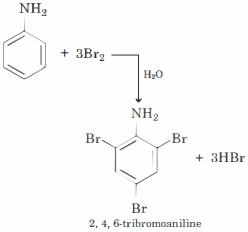
Aniline reacts with excess $Br_2 / H_2O$ to give the major product.
A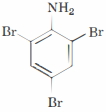
B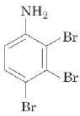
C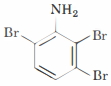
D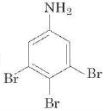
Solution
(A) When aniline reacts with excess bromine water $(Br_2 / H_2O)$,the $-NH_2$ group strongly activates the benzene ring towards electrophilic substitution.
This results in the substitution of bromine atoms at all available ortho and para positions,yielding $2,4,6-$tribromoaniline as the major white precipitate product.
This results in the substitution of bromine atoms at all available ortho and para positions,yielding $2,4,6-$tribromoaniline as the major white precipitate product.
0 likesView Solution
29
ChemistryMediumMCQKVPY · 2014
The metal with the highest oxidation state present in $K_2CrO_4$,$NbCl_5$,and $MnO_2$ is
A
$Nb$
B
$Mn$
C
$K$
D
$Cr$
Solution
(D) The correct option is $D$.
We calculate the oxidation state $(x)$ for the metal in each compound:
$(i)$ In $K_2CrO_4$: $2(+1) + x + 4(-2) = 0 \implies 2 + x - 8 = 0 \implies x = +6$.
The oxidation state of $Cr$ is $+6$.
$(ii)$ In $NbCl_5$: $x + 5(-1) = 0 \implies x - 5 = 0 \implies x = +5$.
The oxidation state of $Nb$ is $+5$.
$(iii)$ In $MnO_2$: $x + 2(-2) = 0 \implies x - 4 = 0 \implies x = +4$.
The oxidation state of $Mn$ is $+4$.
Comparing the values $(+6, +5, +4)$,$Cr$ has the highest oxidation state.
We calculate the oxidation state $(x)$ for the metal in each compound:
$(i)$ In $K_2CrO_4$: $2(+1) + x + 4(-2) = 0 \implies 2 + x - 8 = 0 \implies x = +6$.
The oxidation state of $Cr$ is $+6$.
$(ii)$ In $NbCl_5$: $x + 5(-1) = 0 \implies x - 5 = 0 \implies x = +5$.
The oxidation state of $Nb$ is $+5$.
$(iii)$ In $MnO_2$: $x + 2(-2) = 0 \implies x - 4 = 0 \implies x = +4$.
The oxidation state of $Mn$ is $+4$.
Comparing the values $(+6, +5, +4)$,$Cr$ has the highest oxidation state.
0 likesView Solution
30
ChemistryMediumMCQKVPY · 2014
The number of geometrical isomers of $[CrCl_2(en)(NH_3)_2]$,where $en = \text{ethylenediamine}$,is
A
$2$
B
$3$
C
$4$
D
$1$
Solution
(B) The complex $[CrCl_2(en)(NH_3)_2]$ is of the type $M(AA)X_2Y_2$,where $M = Cr$,$AA = en$,$X = Cl$,and $Y = NH_3$.
This complex exhibits $3$ geometrical isomers:
$1$. One $cis$ isomer where the two $Cl$ atoms are adjacent.
$2$. Two $trans$ isomers where the two $Cl$ atoms are opposite to each other,but the relative positions of $NH_3$ and $en$ differ.
Thus,the total number of geometrical isomers is $3$.
This complex exhibits $3$ geometrical isomers:
$1$. One $cis$ isomer where the two $Cl$ atoms are adjacent.
$2$. Two $trans$ isomers where the two $Cl$ atoms are opposite to each other,but the relative positions of $NH_3$ and $en$ differ.
Thus,the total number of geometrical isomers is $3$.
0 likesView Solution
31
ChemistryMediumMCQKVPY · 2014
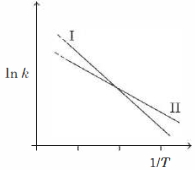
The Arrhenius plots of two reactions,$I$ and $II$ are shown graphically. The graph suggests that
A
$E_I > E_{II}$ and $A_I > A_{II}$
B
$E_{II} > E_I$ and $A_{II} > A_I$
C
$E_I > E_{II}$ and $A_{II} > A_I$
D
$E_{II} > E_I$ and $A_I > A_{II}$
Solution
(A) The Arrhenius equation is given by $k = A e^{-E_a / R T}$.
Taking the natural logarithm on both sides,we get $\ln k = \ln A - \frac{E_a}{R} \left( \frac{1}{T} \right)$.
Comparing this with the equation of a straight line $y = mx + c$,where $y = \ln k$ and $x = 1/T$:
The slope $m = -E_a / R$ and the intercept $c = \ln A$.
From the graph,the line for reaction $I$ is steeper than the line for reaction $II$. Since the slope is negative,a steeper line indicates a larger magnitude of slope,meaning $E_I > E_{II}$.
Also,the intercept on the $y$-axis (at $1/T = 0$) for line $I$ is higher than for line $II$. Since the intercept is $\ln A$,this implies $\ln A_I > \ln A_{II}$,which means $A_I > A_{II}$.
Therefore,the correct option is $A$.
Taking the natural logarithm on both sides,we get $\ln k = \ln A - \frac{E_a}{R} \left( \frac{1}{T} \right)$.
Comparing this with the equation of a straight line $y = mx + c$,where $y = \ln k$ and $x = 1/T$:
The slope $m = -E_a / R$ and the intercept $c = \ln A$.
From the graph,the line for reaction $I$ is steeper than the line for reaction $II$. Since the slope is negative,a steeper line indicates a larger magnitude of slope,meaning $E_I > E_{II}$.
Also,the intercept on the $y$-axis (at $1/T = 0$) for line $I$ is higher than for line $II$. Since the intercept is $\ln A$,this implies $\ln A_I > \ln A_{II}$,which means $A_I > A_{II}$.
Therefore,the correct option is $A$.
0 likesView Solution
32
ChemistryMediumMCQKVPY · 2014
$Ni(CO)_4$ is
A
tetrahedral and paramagnetic
B
square planar and diamagnetic
C
tetrahedral and diamagnetic
D
square planar and paramagnetic
Solution
(C) The oxidation state of $Ni$ in $Ni(CO)_4$ is $0$.
Thus,the electronic configuration of $Ni(0)$ is $[Ar] 3d^8 4s^2$.
In the presence of the strong field ligand $CO$,the $4s$ electrons pair up with the $3d$ electrons.
This results in a fully filled $3d$ subshell and the use of one $4s$ and three $4p$ orbitals for $sp^3$ hybridisation.
$Ni(CO)_4$ has tetrahedral geometry ($sp^3$ hybridisation) and is diamagnetic due to the absence of unpaired electrons.
Thus,the electronic configuration of $Ni(0)$ is $[Ar] 3d^8 4s^2$.
In the presence of the strong field ligand $CO$,the $4s$ electrons pair up with the $3d$ electrons.
This results in a fully filled $3d$ subshell and the use of one $4s$ and three $4p$ orbitals for $sp^3$ hybridisation.
$Ni(CO)_4$ has tetrahedral geometry ($sp^3$ hybridisation) and is diamagnetic due to the absence of unpaired electrons.
0 likesView Solution
33
ChemistryMediumMCQKVPY · 2014
In the following reaction,the major product $X$ is
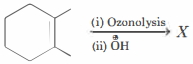
A
$3-$methylcyclohex$-2-$en$-1-$one
B
$2-$methylcyclopent$-1-$enecarbaldehyde
C
heptane$-2,6-$dione
D
$2-$methylcyclohex$-2-$en$-1-$one
Solution
(A) The reaction proceeds in two steps:
Step $1$: Ozonolysis of $1,2$-dimethylcyclopentene followed by reductive workup $(Zn/H_2O)$ leads to the formation of heptane-$2,6$-dione.
Step $2$: The resulting heptane-$2,6$-dione undergoes an intramolecular aldol condensation in the presence of base $(OH^-)$. The enolate formed at the $\alpha$-carbon attacks the other carbonyl group to form a $\beta$-hydroxy ketone intermediate. This intermediate subsequently undergoes dehydration (loss of $H_2O$) to form the stable $\alpha,\beta$-unsaturated carbonyl compound,which is $3$-methylcyclohex-$2$-en-$1$-one.
Step $1$: Ozonolysis of $1,2$-dimethylcyclopentene followed by reductive workup $(Zn/H_2O)$ leads to the formation of heptane-$2,6$-dione.
Step $2$: The resulting heptane-$2,6$-dione undergoes an intramolecular aldol condensation in the presence of base $(OH^-)$. The enolate formed at the $\alpha$-carbon attacks the other carbonyl group to form a $\beta$-hydroxy ketone intermediate. This intermediate subsequently undergoes dehydration (loss of $H_2O$) to form the stable $\alpha,\beta$-unsaturated carbonyl compound,which is $3$-methylcyclohex-$2$-en-$1$-one.
0 likesView Solution
34
ChemistryMediumMCQKVPY · 2014
Given the structure of $D-(+)$-glucose as shown below,identify the structure of $L-(-)$-glucose.
A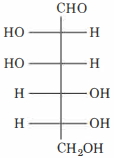
B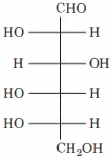
C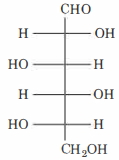
D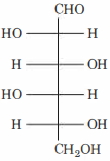
Solution
(B) and $L$ before the name of any compound commonly indicate the relative configuration. For assigning the configuration of monosaccharides,it is the lowest asymmetric carbon atom (chiral center) that is compared to glyceraldehyde. For glucose,if the $-OH$ group on the lowest asymmetric carbon $(C-5)$ is on the right side,it is assigned $D$-configuration. If the $-OH$ group is on the left side,it is assigned $L$-configuration. Both $D$ and $L$ configurations are non-superimposable mirror images of each other. Therefore,the structure of $L-(-)$-glucose is the mirror image of $D-(+)$-glucose.
0 likesView Solution
35
ChemistryMediumMCQKVPY · 2014
In a cubic close packed structure,the fractional contributions of an atom at the corner and at the face in the unit cell are,respectively:
A
$1/8$ and $1/2$
B
$1/2$ and $1/4$
C
$1/4$ and $1/2$
D
$1/4$ and $1/8$
Solution
(A) In a cubic unit cell,there are $8$ corners and $6$ faces.
Each atom at the corner is shared by $8$ adjacent unit cells,so its fractional contribution is $\frac{1}{8}$.
Each atom at the face center is shared by $2$ adjacent unit cells,so its fractional contribution is $\frac{1}{2}$.
Therefore,the fractional contributions are $\frac{1}{8}$ and $\frac{1}{2}$ respectively.
Each atom at the corner is shared by $8$ adjacent unit cells,so its fractional contribution is $\frac{1}{8}$.
Each atom at the face center is shared by $2$ adjacent unit cells,so its fractional contribution is $\frac{1}{2}$.
Therefore,the fractional contributions are $\frac{1}{8}$ and $\frac{1}{2}$ respectively.
0 likesView Solution
36
ChemistryMediumMCQKVPY · 2014
The major products formed in the reaction of $t$-butyl methyl ether with $HI$ are
A
$CH_3I$ and $(CH_3)_3COH$
B
$(CH_3)_2C=CH_2$ and $CH_3OH$
C
$(CH_3)_3CI$ and $CH_3OH$
D
$(CH_3)_2CHCH_2I$ and $CH_3OH$
Solution
(C) The reaction of $t$-butyl methyl ether with $HI$ proceeds via an $S_N1$ mechanism.
$1$. The oxygen atom of the ether is protonated by $HI$ to form an oxonium ion.
$2$. The $C-O$ bond between the $t$-butyl group and the oxygen atom breaks to form a stable $t$-butyl carbocation $(CH_3)_3C^+$ and methanol $(CH_3OH)$.
$3$. The iodide ion $(I^-)$ then attacks the $t$-butyl carbocation to form $t$-butyl iodide $(CH_3)_3CI$.
Thus,the major products are $t$-butyl iodide and methanol.
$1$. The oxygen atom of the ether is protonated by $HI$ to form an oxonium ion.
$2$. The $C-O$ bond between the $t$-butyl group and the oxygen atom breaks to form a stable $t$-butyl carbocation $(CH_3)_3C^+$ and methanol $(CH_3OH)$.
$3$. The iodide ion $(I^-)$ then attacks the $t$-butyl carbocation to form $t$-butyl iodide $(CH_3)_3CI$.
Thus,the major products are $t$-butyl iodide and methanol.
0 likesView Solution
37
ChemistryMediumMCQKVPY · 2014
If the molar conductivities (in $S \ cm^2 \ mol^{-1}$) of $NaCl$,$KCl$,and $NaOH$ at infinite dilution are $126$,$150$,and $250$,respectively,the molar conductivity of $KOH$ (in $S \ cm^2 \ mol^{-1}$) is
A
$526$
B
$226$
C
$26$
D
$274$
Solution
(D) According to Kohlrausch's law of independent migration of ions,the molar conductivity at infinite dilution for $KOH$ can be expressed as:
$\lambda^{\infty}_{KOH} = \lambda^{\infty}_{K^+} + \lambda^{\infty}_{OH^-}$
Given values:
$\lambda^{\infty}_{NaCl} = \lambda^{\infty}_{Na^+} + \lambda^{\infty}_{Cl^-} = 126 \ S \ cm^2 \ mol^{-1}$
$\lambda^{\infty}_{KCl} = \lambda^{\infty}_{K^+} + \lambda^{\infty}_{Cl^-} = 150 \ S \ cm^2 \ mol^{-1}$
$\lambda^{\infty}_{NaOH} = \lambda^{\infty}_{Na^+} + \lambda^{\infty}_{OH^-} = 250 \ S \ cm^2 \ mol^{-1}$
To obtain $\lambda^{\infty}_{KOH}$,we perform the operation:
$\lambda^{\infty}_{KOH} = \lambda^{\infty}_{KCl} + \lambda^{\infty}_{NaOH} - \lambda^{\infty}_{NaCl}$
$\lambda^{\infty}_{KOH} = 150 + 250 - 126$
$\lambda^{\infty}_{KOH} = 400 - 126 = 274 \ S \ cm^2 \ mol^{-1}$
Therefore,the correct option is $D$.
$\lambda^{\infty}_{KOH} = \lambda^{\infty}_{K^+} + \lambda^{\infty}_{OH^-}$
Given values:
$\lambda^{\infty}_{NaCl} = \lambda^{\infty}_{Na^+} + \lambda^{\infty}_{Cl^-} = 126 \ S \ cm^2 \ mol^{-1}$
$\lambda^{\infty}_{KCl} = \lambda^{\infty}_{K^+} + \lambda^{\infty}_{Cl^-} = 150 \ S \ cm^2 \ mol^{-1}$
$\lambda^{\infty}_{NaOH} = \lambda^{\infty}_{Na^+} + \lambda^{\infty}_{OH^-} = 250 \ S \ cm^2 \ mol^{-1}$
To obtain $\lambda^{\infty}_{KOH}$,we perform the operation:
$\lambda^{\infty}_{KOH} = \lambda^{\infty}_{KCl} + \lambda^{\infty}_{NaOH} - \lambda^{\infty}_{NaCl}$
$\lambda^{\infty}_{KOH} = 150 + 250 - 126$
$\lambda^{\infty}_{KOH} = 400 - 126 = 274 \ S \ cm^2 \ mol^{-1}$
Therefore,the correct option is $D$.
0 likesView Solution
38
ChemistryMediumMCQKVPY · 2014
$4$-formylbenzoic acid on treatment with one equivalent of hydrazine followed by heating with alc. $KOH$ gives the major product:
A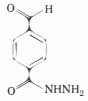
B
C
D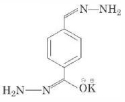
Solution
(B) $4$-formylbenzoic acid contains both an aldehyde group $(-CHO)$ and a carboxylic acid group $(-COOH)$.
When treated with one equivalent of hydrazine $(NH_2NH_2)$,the more reactive aldehyde group forms a hydrazone.
Subsequent heating with alcoholic $KOH$ triggers the Wolff-Kishner reduction of the hydrazone to a methyl group $(-CH_3)$.
Meanwhile,the carboxylic acid group reacts with the base $(KOH)$ to form a potassium carboxylate salt $(-COO^-K^+)$.
Therefore,the major product is $4$-methylbenzoate potassium salt.
When treated with one equivalent of hydrazine $(NH_2NH_2)$,the more reactive aldehyde group forms a hydrazone.
Subsequent heating with alcoholic $KOH$ triggers the Wolff-Kishner reduction of the hydrazone to a methyl group $(-CH_3)$.
Meanwhile,the carboxylic acid group reacts with the base $(KOH)$ to form a potassium carboxylate salt $(-COO^-K^+)$.
Therefore,the major product is $4$-methylbenzoate potassium salt.
0 likesView Solution
39
ChemistryMediumMCQKVPY · 2014
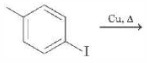
The major product of the following reaction is:
A
$4$,$4$'-dimethylbiphenyl
B
$1,2-$di($4$-iodophenyl)ethane
C
$1,2-$di($4$-iodophenyl)ethene
D
$4-$iodo-$4$'-methylbiphenyl
Solution
(A) The given reaction is the $Ullmann$ reaction.
In this reaction,two molecules of an aryl halide (in this case,$4$-iodotoluene) react with copper $(Cu)$ powder upon heating to form a biaryl compound.
The reaction is:
$2 \text{ } CH_3-C_6H_4-I + Cu \xrightarrow{\Delta} CH_3-C_6H_4-C_6H_4-CH_3 + CuI_2$
Thus,the major product is $4,4'$-dimethylbiphenyl.
In this reaction,two molecules of an aryl halide (in this case,$4$-iodotoluene) react with copper $(Cu)$ powder upon heating to form a biaryl compound.
The reaction is:
$2 \text{ } CH_3-C_6H_4-I + Cu \xrightarrow{\Delta} CH_3-C_6H_4-C_6H_4-CH_3 + CuI_2$
Thus,the major product is $4,4'$-dimethylbiphenyl.
0 likesView Solution
40
ChemistryMediumMCQKVPY · 2014
The energies of $d_{xy}$ and $d_{z^2}$-orbitals in octahedral and tetrahedral transition metal complexes are such that
A
$E(d_{xy}) > E(d_{z^2})$ in both tetrahedral and octahedral complexes
B
$E(d_{xy}) < E(d_{z^2})$ in both tetrahedral and octahedral complexes
C
$E(d_{xy}) > E(d_{z^2})$ in tetrahedral but $E(d_{xy}) < E(d_{z^2})$ in octahedral complexes
D
$E(d_{xy}) < E(d_{z^2})$ in tetrahedral but $E(d_{xy}) > E(d_{z^2})$ in octahedral complexes
Solution
(C) In an octahedral complex,the ligands approach along the axes. The $d_{x^2-y^2}$ and $d_{z^2}$ orbitals (axial orbitals) point directly towards the ligands and experience greater repulsion,thus having higher energy. The $d_{xy}$,$d_{yz}$,and $d_{zx}$ orbitals (non-axial) point between the axes and have lower energy. Thus,in octahedral complexes,$E(d_{xy}) < E(d_{z^2})$.
In a tetrahedral complex,the ligands approach from the corners of a tetrahedron,which is between the axes. The $d_{xy}$,$d_{yz}$,and $d_{zx}$ orbitals point closer to the ligands and experience greater repulsion,thus having higher energy than the $d_{x^2-y^2}$ and $d_{z^2}$ orbitals. Thus,in tetrahedral complexes,$E(d_{xy}) > E(d_{z^2})$.
In a tetrahedral complex,the ligands approach from the corners of a tetrahedron,which is between the axes. The $d_{xy}$,$d_{yz}$,and $d_{zx}$ orbitals point closer to the ligands and experience greater repulsion,thus having higher energy than the $d_{x^2-y^2}$ and $d_{z^2}$ orbitals. Thus,in tetrahedral complexes,$E(d_{xy}) > E(d_{z^2})$.
0 likesView Solution
41
ChemistryMediumMCQKVPY · 2014
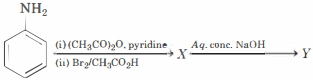
In the reaction sequence,
$X$ and $Y$ are,respectively
$X$ and $Y$ are,respectively
A
$p$-bromoacetanilide and $p$-bromoaniline
B
$2,4,6$-tribromoacetanilide and $2,4,6$-tribromoaniline
C
$o$-bromoacetanilide and $o$-bromoaniline
D
$2,6$-dibromoacetanilide and $2,6$-dibromoaniline
Solution
(A) Aniline is a highly reactive species towards electrophilic substitution due to the strong activating effect of the $-NH_2$ group. To control the reaction and obtain a monobrominated product,the $-NH_2$ group is first protected by acetylation using $(CH_3CO)_2O$ in the presence of pyridine to form acetanilide.
Acetanilide then undergoes electrophilic bromination with $Br_2/CH_3CO_2H$ to yield $p$-bromoacetanilide as the major product $(X)$.
Finally,the acetyl protecting group is removed by hydrolysis using aqueous concentrated $NaOH$ to yield $p$-bromoaniline $(Y)$.
Acetanilide then undergoes electrophilic bromination with $Br_2/CH_3CO_2H$ to yield $p$-bromoacetanilide as the major product $(X)$.
Finally,the acetyl protecting group is removed by hydrolysis using aqueous concentrated $NaOH$ to yield $p$-bromoaniline $(Y)$.
0 likesView Solution
42
ChemistryMediumMCQKVPY · 2014
The radius of $K^{+}$ is $133 \ pm$ and that of $Cl^{-}$ is $181 \ pm$. The volume of the unit cell of $KCl$ expressed in $10^{-22} \ cm^{3}$ is
A
$0.31$
B
$1.21$
C
$2.48$
D
$6.28$
Solution
(C) $KCl$ crystallizes in a face-centered cubic $(FCC)$ structure,where the edge length $a$ is related to the ionic radii by the formula: $a = 2(r_{K^{+}} + r_{Cl^{-}})$.
Given,$r_{K^{+}} = 133 \ pm$ and $r_{Cl^{-}} = 181 \ pm$.
$a = 2(133 + 181) = 2(314) = 628 \ pm$.
Converting edge length to centimeters: $a = 628 \times 10^{-10} \ cm = 6.28 \times 10^{-8} \ cm$.
The volume of the unit cell is $V = a^{3}$.
$V = (6.28 \times 10^{-8} \ cm)^{3} = 247.97 \times 10^{-24} \ cm^{3} \approx 2.48 \times 10^{-22} \ cm^{3}$.
Given,$r_{K^{+}} = 133 \ pm$ and $r_{Cl^{-}} = 181 \ pm$.
$a = 2(133 + 181) = 2(314) = 628 \ pm$.
Converting edge length to centimeters: $a = 628 \times 10^{-10} \ cm = 6.28 \times 10^{-8} \ cm$.
The volume of the unit cell is $V = a^{3}$.
$V = (6.28 \times 10^{-8} \ cm)^{3} = 247.97 \times 10^{-24} \ cm^{3} \approx 2.48 \times 10^{-22} \ cm^{3}$.
0 likesView Solution
43
ChemistryDifficultMCQKVPY · 2014
The standard free energy change $($ in $J)$ for the reaction $3 Fe^{2+}_{(aq)} + 2 Cr_{(s)} \rightleftharpoons 2 Cr^{3+}_{(aq)} + 3 Fe_{(s)}$ given $E_{Fe^{2+}/Fe}^{\circ} = -0.44 \, V$ and $E_{Cr^{3+}/Cr}^{\circ} = -0.74 \, V$ is $(F = 96500 \, C)$.
A
$57,900$
B
$-57,900$
C
$-173,700$
D
$173,700$
Solution
(C) The cell reaction is $3 Fe^{2+}_{(aq)} + 2 Cr_{(s)} \rightleftharpoons 2 Cr^{3+}_{(aq)} + 3 Fe_{(s)}$.
Here,$Cr$ is oxidized to $Cr^{3+}$ (anode) and $Fe^{2+}$ is reduced to $Fe$ (cathode).
The standard cell potential is $E_{cell}^{\circ} = E_{cathode}^{\circ} - E_{anode}^{\circ} = E_{Fe^{2+}/Fe}^{\circ} - E_{Cr^{3+}/Cr}^{\circ}$.
$E_{cell}^{\circ} = -0.44 \, V - (-0.74 \, V) = 0.30 \, V$.
The number of electrons transferred $(n)$ is $6$.
The standard free energy change is given by $\Delta G^{\circ} = -n F E_{cell}^{\circ}$.
$\Delta G^{\circ} = -6 \times 96500 \, C \times 0.30 \, V = -173,700 \, J$.
Here,$Cr$ is oxidized to $Cr^{3+}$ (anode) and $Fe^{2+}$ is reduced to $Fe$ (cathode).
The standard cell potential is $E_{cell}^{\circ} = E_{cathode}^{\circ} - E_{anode}^{\circ} = E_{Fe^{2+}/Fe}^{\circ} - E_{Cr^{3+}/Cr}^{\circ}$.
$E_{cell}^{\circ} = -0.44 \, V - (-0.74 \, V) = 0.30 \, V$.
The number of electrons transferred $(n)$ is $6$.
The standard free energy change is given by $\Delta G^{\circ} = -n F E_{cell}^{\circ}$.
$\Delta G^{\circ} = -6 \times 96500 \, C \times 0.30 \, V = -173,700 \, J$.
0 likesView Solution
44
ChemistryAdvancedMCQKVPY · 2014
Calcium butanoate on heating followed by treatment with $1,2-$ethanediol in the presence of a catalytic amount of an acid,produces a major product which is
A
B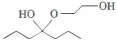
C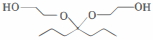
D
Solution
(A) $1$. Heating calcium butanoate,$(CH_3CH_2CH_2COO)_2Ca$,results in the formation of heptan$-4-$one $(CH_3CH_2CH_2COCH_2CH_2CH_3)$ and calcium carbonate $(CaCO_3)$.
$2$. Heptan$-4-$one reacts with $1,2-$ethanediol $(HOCH_2CH_2OH)$ in the presence of an acid catalyst to form a cyclic ketal.
$3$. The reaction involves the nucleophilic attack of the diol on the carbonyl carbon,followed by the elimination of water to form the cyclic structure shown in option $A$.
$2$. Heptan$-4-$one reacts with $1,2-$ethanediol $(HOCH_2CH_2OH)$ in the presence of an acid catalyst to form a cyclic ketal.
$3$. The reaction involves the nucleophilic attack of the diol on the carbonyl carbon,followed by the elimination of water to form the cyclic structure shown in option $A$.
0 likesView Solution
45
ChemistryMediumMCQKVPY · 2014
$XeF_6$ on complete hydrolysis yields $'X'$. The molecular formula of $X$ and its geometry,respectively are
A
$XeO_2$ and linear
B
$XeO_3$ and trigonal planar
C
$XeO_3$ and pyramidal
D
$XeO_4$ and tetrahedral
Solution
(C) The correct option is $C$.
$XeF_6$ on complete hydrolysis yields $XeO_3$ $(X)$.
The balanced chemical equation is: $XeF_6 + 3H_2O \rightarrow XeO_3 + 6HF$.
$Xe$ has $8$ valence electrons. In $XeO_3$,it forms $3$ double bonds with oxygen atoms ($3$ bond pairs) and has $1$ lone pair.
According to $VSEPR$ theory,the presence of $3$ bond pairs and $1$ lone pair results in a pyramidal geometry.
$XeF_6$ on complete hydrolysis yields $XeO_3$ $(X)$.
The balanced chemical equation is: $XeF_6 + 3H_2O \rightarrow XeO_3 + 6HF$.
$Xe$ has $8$ valence electrons. In $XeO_3$,it forms $3$ double bonds with oxygen atoms ($3$ bond pairs) and has $1$ lone pair.
According to $VSEPR$ theory,the presence of $3$ bond pairs and $1$ lone pair results in a pyramidal geometry.
0 likesView Solution
46
ChemistryMediumMCQKVPY · 2014
Ammonia is not produced in the reaction of
A
$NH_4Cl$ with $KOH$
B
$AlN$ with $H_2O$
C
$NH_4Cl$ with $NaNO_2$
D
$NH_4Cl$ with $Ca(OH)_2$
Solution
(C) .
The products formed in each reaction given in the options are as follows:
$(i) \ NH_4Cl + KOH \longrightarrow KCl + NH_3 + H_2O$
$(ii) \ AlN + 3H_2O \longrightarrow Al(OH)_3 + NH_3$
$(iii) \ NH_4Cl + NaNO_2 \longrightarrow NaCl + N_2 + 2H_2O$
$(iv) \ 2NH_4Cl + Ca(OH)_2 \longrightarrow CaCl_2 + 2NH_3 + 2H_2O$
Thus,ammonia is not produced in the reaction given in option $(C)$.
The products formed in each reaction given in the options are as follows:
$(i) \ NH_4Cl + KOH \longrightarrow KCl + NH_3 + H_2O$
$(ii) \ AlN + 3H_2O \longrightarrow Al(OH)_3 + NH_3$
$(iii) \ NH_4Cl + NaNO_2 \longrightarrow NaCl + N_2 + 2H_2O$
$(iv) \ 2NH_4Cl + Ca(OH)_2 \longrightarrow CaCl_2 + 2NH_3 + 2H_2O$
Thus,ammonia is not produced in the reaction given in option $(C)$.
0 likesView Solution
47
ChemistryMediumMCQKVPY · 2014
The number of isomers which are ethers and having the molecular formula $C_4H_{10}O$ is
A
$2$
B
$3$
C
$4$
D
$5$
Solution
(B) The molecular formula $C_4H_{10}O$ corresponds to saturated ethers or alcohols.
To find the ethers,we look for the functional group $R-O-R'$.
The possible ether isomers for $C_4H_{10}O$ are:
$1$. $CH_3-O-CH_2-CH_2-CH_3$ (Methoxypropane)
$2$. $CH_3-CH_2-O-CH_2-CH_3$ (Ethoxyethane)
$3$. $CH_3-O-CH(CH_3)_2$ ($2$-Methoxypropane)
Thus,there are $3$ isomers that are ethers.
To find the ethers,we look for the functional group $R-O-R'$.
The possible ether isomers for $C_4H_{10}O$ are:
$1$. $CH_3-O-CH_2-CH_2-CH_3$ (Methoxypropane)
$2$. $CH_3-CH_2-O-CH_2-CH_3$ (Ethoxyethane)
$3$. $CH_3-O-CH(CH_3)_2$ ($2$-Methoxypropane)
Thus,there are $3$ isomers that are ethers.
0 likesView Solution
48
ChemistryMediumMCQKVPY · 2014
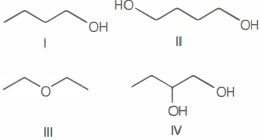
Among the compounds $I-IV$,the compound having the lowest boiling point is:
A
$I$
B
$II$
C
$III$
D
$IV$
Solution
(C) The boiling point of a compound depends upon the extent of intermolecular $H$-bonding present in it.
Compounds $I$ (butanol),$II$ (butane$-1,4-$diol),and $IV$ (butane$-1,2-$diol) are alcohols,which can form strong intermolecular $H$-bonds,leading to higher boiling points.
Compound $III$ (diethyl ether) is an ether and cannot form intermolecular $H$-bonds among its own molecules.
Therefore,compound $III$ has the lowest boiling point.
Compounds $I$ (butanol),$II$ (butane$-1,4-$diol),and $IV$ (butane$-1,2-$diol) are alcohols,which can form strong intermolecular $H$-bonds,leading to higher boiling points.
Compound $III$ (diethyl ether) is an ether and cannot form intermolecular $H$-bonds among its own molecules.
Therefore,compound $III$ has the lowest boiling point.
0 likesView Solution
49
ChemistryMediumMCQKVPY · 2014
The ammonia evolved from $2 \ g$ of a compound in Kjeldahl's estimation of nitrogen neutralises $10 \ mL$ of $2 \ M \ H_2SO_4$ solution. The weight percentage of nitrogen in the compound is
A
$28$
B
$14$
C
$56$
D
$7$
Solution
(A) The correct option is $A$.
The chemical reaction is: $2NH_3 + H_2SO_4 \longrightarrow (NH_4)_2SO_4$.
Equivalents of $H_2SO_4$ used = $Molarity \times Volume \times n-factor = 2 \times 10 \times 10^{-3} \times 2 = 0.04 \ eq$.
Since $1 \ mole$ of $H_2SO_4$ reacts with $2 \ moles$ of $NH_3$,the moles of $NH_3$ evolved = $2 \times (Molarity \times Volume) = 2 \times (2 \times 10 \times 10^{-3}) = 0.04 \ moles$.
Mass of nitrogen $(N)$ in $NH_3$ = $0.04 \times 14 \ g = 0.56 \ g$.
Weight percentage of nitrogen = $\frac{\text{Mass of } N}{\text{Mass of compound}} \times 100 = \frac{0.56}{2} \times 100 = 28 \ \%$.
The chemical reaction is: $2NH_3 + H_2SO_4 \longrightarrow (NH_4)_2SO_4$.
Equivalents of $H_2SO_4$ used = $Molarity \times Volume \times n-factor = 2 \times 10 \times 10^{-3} \times 2 = 0.04 \ eq$.
Since $1 \ mole$ of $H_2SO_4$ reacts with $2 \ moles$ of $NH_3$,the moles of $NH_3$ evolved = $2 \times (Molarity \times Volume) = 2 \times (2 \times 10 \times 10^{-3}) = 0.04 \ moles$.
Mass of nitrogen $(N)$ in $NH_3$ = $0.04 \times 14 \ g = 0.56 \ g$.
Weight percentage of nitrogen = $\frac{\text{Mass of } N}{\text{Mass of compound}} \times 100 = \frac{0.56}{2} \times 100 = 28 \ \%$.
0 likesView Solution
50
ChemistryMediumMCQKVPY · 2014
In the following reaction sequence,
$Br-CH_2-CH(Br)-Ph$ $\xrightarrow[2. NaNH_2]{1. Alc. KOH} X$ $\xrightarrow[4. Conc. HNO_3/H_2SO_4]{3. HgSO_4/dil. H_2SO_4, Heat} Y$
$X$ and $Y$ respectively are,
$Br-CH_2-CH(Br)-Ph$ $\xrightarrow[2. NaNH_2]{1. Alc. KOH} X$ $\xrightarrow[4. Conc. HNO_3/H_2SO_4]{3. HgSO_4/dil. H_2SO_4, Heat} Y$
$X$ and $Y$ respectively are,
A
$Ph-C \equiv C-H$ and $m-NO_2-C_6H_4-CO-CH_3$
B
$Ph-CH(OH)-CH_2-NH_2$ and $m-NO_2-C_6H_4-CO-CH_2-NH_2$
C
$Ph-CH(NH_2)-CH_2-OH$ and $p-NO_2-C_6H_4-CH(NH_2)-CHO$
D
$Ph-CH(OH)-CH_2-NH_2$ and $p-NO_2-C_6H_4-CHO$
Solution
(A) $1$. The starting material $Br-CH_2-CH(Br)-Ph$ undergoes dehydrohalogenation with $Alc. KOH$ followed by $NaNH_2$ to form the alkyne $X$,which is phenylacetylene $(Ph-C \equiv C-H)$.
$2$. The alkyne $X$ $(Ph-C \equiv C-H)$ undergoes acid-catalyzed hydration $(HgSO_4/dil. H_2SO_4, \Delta)$ to form an enol intermediate,which tautomerizes to acetophenone $(Ph-CO-CH_3)$.
$3$. Acetophenone is then subjected to nitration using $Conc. HNO_3/H_2SO_4$. Since the acetyl group $(-CO-CH_3)$ is a meta-directing group,the nitro group $(-NO_2)$ is introduced at the meta-position,yielding $m-nitroacetophenone$ $(Y)$.
$2$. The alkyne $X$ $(Ph-C \equiv C-H)$ undergoes acid-catalyzed hydration $(HgSO_4/dil. H_2SO_4, \Delta)$ to form an enol intermediate,which tautomerizes to acetophenone $(Ph-CO-CH_3)$.
$3$. Acetophenone is then subjected to nitration using $Conc. HNO_3/H_2SO_4$. Since the acetyl group $(-CO-CH_3)$ is a meta-directing group,the nitro group $(-NO_2)$ is introduced at the meta-position,yielding $m-nitroacetophenone$ $(Y)$.
0 likesView Solution
Vedclass Products
For Students
Vedclass Test Series
Mock tests in real KVPY style covering Chemistry with performance analysis. 5-day free trial.
Start Free TrialFor Teachers
Exam Paper Generator
Generate Set A/B/C/D Chemistry papers from 7.5L+ questions in 2 minutes. 3 chapters free.
Try FreeFor Institutes
Online Exam Module
Run live KVPY mock exams with unlimited students, 360° analytics & white-label branding.
See DemoFrequently Asked Questions
How many Chemistry questions are in KVPY 2014?
There are 50 Chemistry questions from the KVPY 2014 paper on Vedclass, each with a detailed step-by-step solution in English.
Are KVPY 2014 Chemistry solutions available in English?
Yes. All solutions on this page are in English. You can also switch to English or Hindi using the language buttons above the questions.
Can I practice KVPY 2014 Chemistry as a timed test?
Yes. Use the Vedclass Test Series to attempt a full KVPY mock test covering Chemistry with time limits and instant score analysis.
Can teachers create Chemistry papers from KVPY previous year questions?
Yes. The Vedclass Exam Paper Generator lets teachers mix KVPY Chemistry questions and generate Set A/B/C/D papers in minutes.
For Teachers & Institutes
Build a Custom Chemistry Paper
Pick KVPY 2014 Chemistry questions, set difficulty, and generate Set A/B/C/D in 2 minutes.