
ChemistryQ1–66 of 66 questions
Page 1 of 1 · English
1
ChemistryMCQKCET · 2016
Most suitable method of introducing alien $DNA$ into a plant cell is
A
Biolistics
B
Micro-injection
C
Lipofection
D
Heat shock method
Solution
(A) The most suitable method for introducing alien $DNA$ into a plant cell is $Biolistics$ (also known as the gene gun method).
In this technique,cells are bombarded with high-velocity micro-particles of gold or tungsten coated with $DNA$.
This method is specifically designed for plant cells because they possess a rigid cell wall that makes other methods like micro-injection or lipofection difficult or ineffective.
Micro-injection is typically used for animal cells,while heat shock is commonly used for bacterial transformation.
In this technique,cells are bombarded with high-velocity micro-particles of gold or tungsten coated with $DNA$.
This method is specifically designed for plant cells because they possess a rigid cell wall that makes other methods like micro-injection or lipofection difficult or ineffective.
Micro-injection is typically used for animal cells,while heat shock is commonly used for bacterial transformation.
0 likesView Solution
2
ChemistryMCQKCET · 2016
The slope of the tangent to the curve $x=t^{2}+3t-8, y=2t^{2}-2t-5$ at the point $(2,-1)$ is
A
$\frac{22}{7}$
B
$\frac{7}{6}$
C
$\frac{-6}{7}$
D
$\frac{6}{7}$
Solution
(D) The given curve is defined by $x=t^{2}+3t-8$ and $y=2t^{2}-2t-5$.
First,we find the derivatives with respect to $t$:
$\frac{dx}{dt} = 2t+3$ and $\frac{dy}{dt} = 4t-2$.
The slope of the tangent is given by $\frac{dy}{dx} = \frac{dy/dt}{dx/dt} = \frac{4t-2}{2t+3}$.
To find the value of $t$ at the point $(2, -1)$,we set $x=2$ and $y=-1$:
For $x=2$: $t^{2}+3t-8=2 \Rightarrow t^{2}+3t-10=0 \Rightarrow (t-2)(t+5)=0$,so $t=2$ or $t=-5$.
For $y=-1$: $2t^{2}-2t-5=-1 \Rightarrow 2t^{2}-2t-4=0 \Rightarrow 2(t^{2}-t-2)=0 \Rightarrow 2(t-2)(t+1)=0$,so $t=2$ or $t=-1$.
The common value of $t$ is $t=2$.
Substituting $t=2$ into the expression for the slope:
$\left. \frac{dy}{dx} \right|_{t=2} = \frac{4(2)-2}{2(2)+3} = \frac{8-2}{4+3} = \frac{6}{7}$.
Thus,the slope of the tangent is $\frac{6}{7}$.
First,we find the derivatives with respect to $t$:
$\frac{dx}{dt} = 2t+3$ and $\frac{dy}{dt} = 4t-2$.
The slope of the tangent is given by $\frac{dy}{dx} = \frac{dy/dt}{dx/dt} = \frac{4t-2}{2t+3}$.
To find the value of $t$ at the point $(2, -1)$,we set $x=2$ and $y=-1$:
For $x=2$: $t^{2}+3t-8=2 \Rightarrow t^{2}+3t-10=0 \Rightarrow (t-2)(t+5)=0$,so $t=2$ or $t=-5$.
For $y=-1$: $2t^{2}-2t-5=-1 \Rightarrow 2t^{2}-2t-4=0 \Rightarrow 2(t^{2}-t-2)=0 \Rightarrow 2(t-2)(t+1)=0$,so $t=2$ or $t=-1$.
The common value of $t$ is $t=2$.
Substituting $t=2$ into the expression for the slope:
$\left. \frac{dy}{dx} \right|_{t=2} = \frac{4(2)-2}{2(2)+3} = \frac{8-2}{4+3} = \frac{6}{7}$.
Thus,the slope of the tangent is $\frac{6}{7}$.
0 likesView Solution
3
ChemistryEasyMCQKCET · 2016
The hybridisation of $C$ in diamond,graphite and ethyne is in the order
A
$sp^3, sp, sp^2$
B
$sp^3, sp^2, sp$
C
$sp, sp^2, sp^3$
D
$sp^2, sp^3, sp$
Solution
(B) The hybridization of carbon in the given compounds is determined by the number of sigma bonds and lone pairs attached to the carbon atom.
$1$. In diamond,each carbon atom is bonded to four other carbon atoms via single bonds,resulting in $sp^3$ hybridization.
$2$. In graphite,each carbon atom is bonded to three other carbon atoms in a planar hexagonal structure,resulting in $sp^2$ hybridization.
$3$. In ethyne $(C_2H_2)$,each carbon atom is bonded to one hydrogen atom and one other carbon atom via a triple bond,resulting in $sp$ hybridization.
Therefore,the order is $sp^3, sp^2, sp$.
$1$. In diamond,each carbon atom is bonded to four other carbon atoms via single bonds,resulting in $sp^3$ hybridization.
$2$. In graphite,each carbon atom is bonded to three other carbon atoms in a planar hexagonal structure,resulting in $sp^2$ hybridization.
$3$. In ethyne $(C_2H_2)$,each carbon atom is bonded to one hydrogen atom and one other carbon atom via a triple bond,resulting in $sp$ hybridization.
Therefore,the order is $sp^3, sp^2, sp$.
0 likesView Solution
4
ChemistryEasyMCQKCET · 2016
The increasing order of bond order of $O_2, O_2^+, O_2^-$,and $O_2^{2-}$ is:
A
$O_2^+, O_2, O_2^-, O_2^{2-}$
B
$O_2^{2-}, O_2^-, O_2^+, O_2$
C
$O_2, O_2^+, O_2^-, O_2^{2-}$
D
$O_2^{2-}, O_2^-, O_2, O_2^+$
Solution
(D) According to Molecular Orbital Theory $(MOT)$,the bond order is calculated as $BO = \frac{1}{2}(N_b - N_a)$.
For $O_2$ $(16 \ e^-)$: $BO = \frac{10-6}{2} = 2$.
For $O_2^+$ $(15 \ e^-)$: $BO = \frac{10-5}{2} = 2.5$.
For $O_2^-$ $(17 \ e^-)$: $BO = \frac{10-7}{2} = 1.5$.
For $O_2^{2-}$ $(18 \ e^-)$: $BO = \frac{10-8}{2} = 1$.
Thus,the increasing order of bond order is $O_2^{2-} < O_2^- < O_2 < O_2^+$.
For $O_2$ $(16 \ e^-)$: $BO = \frac{10-6}{2} = 2$.
For $O_2^+$ $(15 \ e^-)$: $BO = \frac{10-5}{2} = 2.5$.
For $O_2^-$ $(17 \ e^-)$: $BO = \frac{10-7}{2} = 1.5$.
For $O_2^{2-}$ $(18 \ e^-)$: $BO = \frac{10-8}{2} = 1$.
Thus,the increasing order of bond order is $O_2^{2-} < O_2^- < O_2 < O_2^+$.
0 likesView Solution
5
ChemistryEasyMCQKCET · 2016
The main axis of a diatomic molecule is $Z$. The orbitals $p_{x}$ and $p_{y}$ overlap to form:
A
$\pi$-molecular orbital
B
$\sigma$-molecular orbital
C
$\delta$-molecular orbital
D
No bond is formed
Solution
(A) If the $z$-axis is defined as the internuclear axis (molecular axis),then the $p_{z}$ orbitals overlap head-on to form a $\sigma$-bond.
Since $p_{x}$ and $p_{y}$ orbitals are perpendicular to the $z$-axis,they undergo lateral (sideways) overlap.
This lateral overlap of $p_{x}$ and $p_{y}$ orbitals results in the formation of $\pi$-molecular orbitals.
Since $p_{x}$ and $p_{y}$ orbitals are perpendicular to the $z$-axis,they undergo lateral (sideways) overlap.
This lateral overlap of $p_{x}$ and $p_{y}$ orbitals results in the formation of $\pi$-molecular orbitals.
0 likesView Solution
6
ChemistryMediumMCQKCET · 2016
$HCl$ gas is covalent and $NaCl$ is an ionic compound. This is because
A
Sodium is highly electropositive
B
Hydrogen is a non-metal.
C
$HCl$ is a gas.
D
Electronegativity difference between $H$ and $Cl$ is less than $2.1$.
Solution
(D) The electronegativity difference between $H$ and $Cl$ is approximately $0.9$,which is significantly less than $2.1$.
According to the Pauling scale,if the electronegativity difference between two atoms is less than $1.7$ (or $2.1$ in some conventions),the bond formed is predominantly covalent.
In $NaCl$,the electronegativity difference between $Na$ $(0.9)$ and $Cl$ $(3.0)$ is $2.1$,resulting in an ionic bond.
According to the Pauling scale,if the electronegativity difference between two atoms is less than $1.7$ (or $2.1$ in some conventions),the bond formed is predominantly covalent.
In $NaCl$,the electronegativity difference between $Na$ $(0.9)$ and $Cl$ $(3.0)$ is $2.1$,resulting in an ionic bond.
0 likesView Solution
7
ChemistryMediumMCQKCET · 2016
In the reaction $Fe(OH)_{3(s)} \rightleftharpoons Fe^{3+}_{(aq)} + 3OH^{-}_{(aq)}$, if the concentration of $OH^{-}$ ions is decreased by $\frac{1}{4}$ times, then the equilibrium concentration of $Fe^{3+}$ will increase by: (in $times$)
A
$8$
B
$16$
C
$64$
D
$4$
Solution
(C) For the equilibrium: $Fe(OH)_{3(s)} \rightleftharpoons Fe^{3+}_{(aq)} + 3OH^{-}_{(aq)}$
The solubility product expression is: $K_{sp} = [Fe^{3+}][OH^{-}]^3$
Let the initial concentrations be $[Fe^{3+}]_1$ and $[OH^{-}]_1$.
$K_{sp} = [Fe^{3+}]_1 [OH^{-}]_1^3$ ... $(i)$
If the new concentration $[OH^{-}]_2 = \frac{1}{4} [OH^{-}]_1$, then:
$K_{sp} = [Fe^{3+}]_2 [OH^{-}]_2^3 = [Fe^{3+}]_2 (\frac{1}{4} [OH^{-}]_1)^3$
$K_{sp} = [Fe^{3+}]_2 \times \frac{1}{64} [OH^{-}]_1^3$ ... $(ii)$
From $(i)$ and $(ii)$:
$[Fe^{3+}]_1 [OH^{-}]_1^3 = [Fe^{3+}]_2 \times \frac{1}{64} [OH^{-}]_1^3$
$[Fe^{3+}]_2 = 64 \times [Fe^{3+}]_1$
Therefore, the concentration of $Fe^{3+}$ increases by $64$ times.
The solubility product expression is: $K_{sp} = [Fe^{3+}][OH^{-}]^3$
Let the initial concentrations be $[Fe^{3+}]_1$ and $[OH^{-}]_1$.
$K_{sp} = [Fe^{3+}]_1 [OH^{-}]_1^3$ ... $(i)$
If the new concentration $[OH^{-}]_2 = \frac{1}{4} [OH^{-}]_1$, then:
$K_{sp} = [Fe^{3+}]_2 [OH^{-}]_2^3 = [Fe^{3+}]_2 (\frac{1}{4} [OH^{-}]_1)^3$
$K_{sp} = [Fe^{3+}]_2 \times \frac{1}{64} [OH^{-}]_1^3$ ... $(ii)$
From $(i)$ and $(ii)$:
$[Fe^{3+}]_1 [OH^{-}]_1^3 = [Fe^{3+}]_2 \times \frac{1}{64} [OH^{-}]_1^3$
$[Fe^{3+}]_2 = 64 \times [Fe^{3+}]_1$
Therefore, the concentration of $Fe^{3+}$ increases by $64$ times.
0 likesView Solution
8
ChemistryMediumMCQKCET · 2016
Equilibrium constants $K_1$ and $K_2$ for the following equilibria:
$(a)$ $NO_{(g)} + \frac{1}{2}O_{2(g)} \rightleftharpoons NO_{2(g)}$
$(b)$ $2NO_{2(g)} \rightleftharpoons 2NO_{(g)} + O_{2(g)}$
are related as:
$(a)$ $NO_{(g)} + \frac{1}{2}O_{2(g)} \rightleftharpoons NO_{2(g)}$
$(b)$ $2NO_{2(g)} \rightleftharpoons 2NO_{(g)} + O_{2(g)}$
are related as:
A
$K_1 = \sqrt{K_2}$
B
$K_2 = \frac{1}{K_1}$
C
$K_1 = 2K_2$
D
$K_2 = \frac{1}{K_1^2}$
Solution
(D) For reaction $(a)$: $K_1 = \frac{[NO_2]}{[NO][O_2]^{1/2}}$
For reaction $(b)$: $K_2 = \frac{[NO]^2[O_2]}{[NO_2]^2}$
From $(a)$,we can write: $\frac{1}{K_1} = \frac{[NO][O_2]^{1/2}}{[NO_2]}$
Squaring both sides: $\left(\frac{1}{K_1}\right)^2 = \frac{[NO]^2[O_2]}{[NO_2]^2}$
Since the right side is equal to $K_2$,we have $\frac{1}{K_1^2} = K_2$
Therefore,$K_2 = \frac{1}{K_1^2}$.
For reaction $(b)$: $K_2 = \frac{[NO]^2[O_2]}{[NO_2]^2}$
From $(a)$,we can write: $\frac{1}{K_1} = \frac{[NO][O_2]^{1/2}}{[NO_2]}$
Squaring both sides: $\left(\frac{1}{K_1}\right)^2 = \frac{[NO]^2[O_2]}{[NO_2]^2}$
Since the right side is equal to $K_2$,we have $\frac{1}{K_1^2} = K_2$
Therefore,$K_2 = \frac{1}{K_1^2}$.
0 likesView Solution
9
ChemistryMCQKCET · 2016
The maximum value of $\left(\frac{1}{x}\right)^{x}$ is
A
$e$
B
$e^{e}$
C
$e^{1/e}$
D
$\left(\frac{1}{e}\right)^{1/e}$
Solution
(C) Let $f(x) = \left(\frac{1}{x}\right)^{x} = x^{-x}$.
Taking the natural logarithm on both sides,we get $\ln f(x) = -x \ln x$.
Differentiating with respect to $x$,we have $\frac{1}{f(x)} f'(x) = -(\ln x + x \cdot \frac{1}{x}) = -(1 + \ln x)$.
Thus,$f'(x) = -f(x)(1 + \ln x)$.
For critical points,set $f'(x) = 0$,which implies $1 + \ln x = 0$,so $\ln x = -1$,which gives $x = e^{-1} = \frac{1}{e}$.
To check for maximum,we observe the sign of $f'(x)$. For $x < \frac{1}{e}$,$f'(x) > 0$,and for $x > \frac{1}{e}$,$f'(x) < 0$. Thus,$x = \frac{1}{e}$ is a point of local maxima.
The maximum value is $f\left(\frac{1}{e}\right) = \left(\frac{1}{1/e}\right)^{1/e} = e^{1/e}$.
Taking the natural logarithm on both sides,we get $\ln f(x) = -x \ln x$.
Differentiating with respect to $x$,we have $\frac{1}{f(x)} f'(x) = -(\ln x + x \cdot \frac{1}{x}) = -(1 + \ln x)$.
Thus,$f'(x) = -f(x)(1 + \ln x)$.
For critical points,set $f'(x) = 0$,which implies $1 + \ln x = 0$,so $\ln x = -1$,which gives $x = e^{-1} = \frac{1}{e}$.
To check for maximum,we observe the sign of $f'(x)$. For $x < \frac{1}{e}$,$f'(x) > 0$,and for $x > \frac{1}{e}$,$f'(x) < 0$. Thus,$x = \frac{1}{e}$ is a point of local maxima.
The maximum value is $f\left(\frac{1}{e}\right) = \left(\frac{1}{1/e}\right)^{1/e} = e^{1/e}$.
0 likesView Solution
10
ChemistryMCQKCET · 2016
The maximum value of $ \left(\frac{1}{x}\right)^{x} $ is
A
$ e $
B
$ e^{e} $
C
$ e^{1/e} $
D
$ (1/e)^{e} $
Solution
(C) Let $ y = \left(\frac{1}{x}\right)^{x} $. Taking the natural logarithm on both sides,we get $ \ln y = x \ln \left(\frac{1}{x}\right) = -x \ln x $.
Differentiating with respect to $ x $,we have $ \frac{1}{y} \frac{dy}{dx} = - (1 \cdot \ln x + x \cdot \frac{1}{x}) = -(1 + \ln x) $.
Thus,$ \frac{dy}{dx} = -y(1 + \ln x) $.
Setting $ \frac{dy}{dx} = 0 $,we get $ 1 + \ln x = 0 $,which implies $ \ln x = -1 $,so $ x = e^{-1} = \frac{1}{e} $.
To check for the maximum,we find the second derivative $ \frac{d^2y}{dx^2} = -\frac{dy}{dx}(1 + \ln x) - y(\frac{1}{x}) $.
At $ x = \frac{1}{e} $,$ \ln x = -1 $,so $ \frac{d^2y}{dx^2} = 0 - y(e) = -y e < 0 $. Since the second derivative is negative,the function has a maximum at $ x = \frac{1}{e} $.
The maximum value is $ y = \left(\frac{1}{1/e}\right)^{1/e} = e^{1/e} $.
Differentiating with respect to $ x $,we have $ \frac{1}{y} \frac{dy}{dx} = - (1 \cdot \ln x + x \cdot \frac{1}{x}) = -(1 + \ln x) $.
Thus,$ \frac{dy}{dx} = -y(1 + \ln x) $.
Setting $ \frac{dy}{dx} = 0 $,we get $ 1 + \ln x = 0 $,which implies $ \ln x = -1 $,so $ x = e^{-1} = \frac{1}{e} $.
To check for the maximum,we find the second derivative $ \frac{d^2y}{dx^2} = -\frac{dy}{dx}(1 + \ln x) - y(\frac{1}{x}) $.
At $ x = \frac{1}{e} $,$ \ln x = -1 $,so $ \frac{d^2y}{dx^2} = 0 - y(e) = -y e < 0 $. Since the second derivative is negative,the function has a maximum at $ x = \frac{1}{e} $.
The maximum value is $ y = \left(\frac{1}{1/e}\right)^{1/e} = e^{1/e} $.
0 likesView Solution
11
ChemistryMCQKCET · 2016
Two dice are thrown simultaneously,the probability of obtaining a total score of $5$ is
A
$ \frac{1}{18} $
B
$ \frac{1}{12} $
C
$ \frac{1}{9} $
D
$ \frac{1}{6} $
Solution
(C) When two dice are thrown simultaneously,the total number of possible outcomes is $6 \times 6 = 36$.
We are looking for the outcomes where the sum of the numbers on the two dice is $5$.
The favorable outcomes are $(1, 4), (4, 1), (2, 3), (3, 2)$.
There are $4$ such favorable outcomes.
Therefore,the probability of obtaining a total score of $5$ is $P = \frac{\text{Number of favorable outcomes}}{\text{Total number of outcomes}} = \frac{4}{36} = \frac{1}{9}$.
We are looking for the outcomes where the sum of the numbers on the two dice is $5$.
The favorable outcomes are $(1, 4), (4, 1), (2, 3), (3, 2)$.
There are $4$ such favorable outcomes.
Therefore,the probability of obtaining a total score of $5$ is $P = \frac{\text{Number of favorable outcomes}}{\text{Total number of outcomes}} = \frac{4}{36} = \frac{1}{9}$.
0 likesView Solution
12
ChemistryEasyMCQKCET · 2016
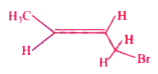
What is the $IUPAC$ name of the compound shown below?
A
$1-$Bromobut$-2-$ene
B
Bromobutene
C
$2-$Bromo$-2-$butene
D
$1-$Bromobut$-3-$ene
Solution
(A) The given structure is $CH_3-CH=CH-CH_2-Br$.
According to $IUPAC$ nomenclature rules,the principal functional group or the multiple bond should get the lowest possible number.
Here,the double bond is present,so we number the chain starting from the end that gives the double bond the lowest locant.
Numbering from the right side: $CH_3(4)-CH(3)=CH(2)-CH_2(1)-Br$.
The double bond starts at position $2$ and the bromine atom is at position $1$.
Therefore,the $IUPAC$ name is $1-$bromobut$-2-$ene.
According to $IUPAC$ nomenclature rules,the principal functional group or the multiple bond should get the lowest possible number.
Here,the double bond is present,so we number the chain starting from the end that gives the double bond the lowest locant.
Numbering from the right side: $CH_3(4)-CH(3)=CH(2)-CH_2(1)-Br$.
The double bond starts at position $2$ and the bromine atom is at position $1$.
Therefore,the $IUPAC$ name is $1-$bromobut$-2-$ene.
0 likesView Solution
13
ChemistryEasyMCQKCET · 2016
$A$ miscible mixture of $C_6H_6 + CHCl_3$ can be separated by
A
Sublimation
B
Distillation
C
Filtration
D
Crystallisation
Solution
(B) miscible mixture of $C_6H_6 + CHCl_3$ can be separated by distillation.
The boiling point of benzene $(C_6H_6)$ is $80^{\circ} C$ and that of chloroform $(CHCl_3)$ is $61.2^{\circ} C$.
Since there is a significant difference in their boiling points,the mixture can be separated by distillation,where the component with the lower boiling point $(CHCl_3)$ evaporates first and is collected separately.
The boiling point of benzene $(C_6H_6)$ is $80^{\circ} C$ and that of chloroform $(CHCl_3)$ is $61.2^{\circ} C$.
Since there is a significant difference in their boiling points,the mixture can be separated by distillation,where the component with the lower boiling point $(CHCl_3)$ evaporates first and is collected separately.
0 likesView Solution
14
ChemistryMediumMCQKCET · 2016
The electrophile that participates in the nitration of benzene is:
A
$NO^{+}$
B
$NO_2^{+}$
C
$NO$
D
$NO_3$
Solution
(B) The nitration of benzene involves the generation of the nitronium ion $(NO_2^{+})$ as the active electrophile.
Step $1$: Sulfuric acid $(H_2SO_4)$ acts as a proton donor and nitric acid $(HNO_3)$ acts as a base. The reaction is: $HNO_3 + H_2SO_4 \rightleftharpoons H_2NO_3^{+} + HSO_4^{-}$.
Step $2$: The protonated nitric acid $(H_2NO_3^{+})$ loses a water molecule to form the nitronium ion: $H_2NO_3^{+} \rightarrow NO_2^{+} + H_2O$.
This nitronium ion $(NO_2^{+})$ then attacks the benzene ring to form nitrobenzene.
Step $1$: Sulfuric acid $(H_2SO_4)$ acts as a proton donor and nitric acid $(HNO_3)$ acts as a base. The reaction is: $HNO_3 + H_2SO_4 \rightleftharpoons H_2NO_3^{+} + HSO_4^{-}$.
Step $2$: The protonated nitric acid $(H_2NO_3^{+})$ loses a water molecule to form the nitronium ion: $H_2NO_3^{+} \rightarrow NO_2^{+} + H_2O$.
This nitronium ion $(NO_2^{+})$ then attacks the benzene ring to form nitrobenzene.
0 likesView Solution
15
ChemistryMCQKCET · 2016
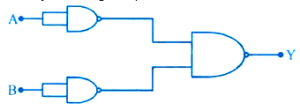
Identify the logic operation carried out by the following circuit.
A
$AND$
B
$NAND$
C
$NOR$
D
$OR$
Solution
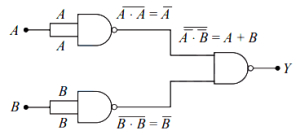
(D) The given circuit consists of two $NAND$ gates acting as $NOT$ gates,followed by a $NAND$ gate.
Let the inputs be $A$ and $B$.
The output of the first $NAND$ gate is $\overline{A \cdot A} = \bar{A}$.
The output of the second $NAND$ gate is $\overline{B \cdot B} = \bar{B}$.
These outputs are fed into the final $NAND$ gate.
The final output $Y$ is given by:
$Y = \overline{\bar{A} \cdot \bar{B}}$
Using De Morgan's law,$\overline{\bar{A} \cdot \bar{B}} = \overline{\bar{A}} + \overline{\bar{B}} = A + B$.
Thus,$Y = A + B$,which represents the $OR$ operation.
Therefore,the correct option is $D$.
Let the inputs be $A$ and $B$.
The output of the first $NAND$ gate is $\overline{A \cdot A} = \bar{A}$.
The output of the second $NAND$ gate is $\overline{B \cdot B} = \bar{B}$.
These outputs are fed into the final $NAND$ gate.
The final output $Y$ is given by:
$Y = \overline{\bar{A} \cdot \bar{B}}$
Using De Morgan's law,$\overline{\bar{A} \cdot \bar{B}} = \overline{\bar{A}} + \overline{\bar{B}} = A + B$.
Thus,$Y = A + B$,which represents the $OR$ operation.
Therefore,the correct option is $D$.
0 likesView Solution
16
ChemistryMediumMCQKCET · 2016
The number of oxygen atoms in $4.4 \ g$ of $CO_2$ is,
A
$1.2 \times 10^{23}$
B
$6 \times 10^{22}$
C
$6 \times 10^{23}$
D
$12 \times 10^{23}$
Solution
(A) Molar mass of $CO_2 = 12 + (2 \times 16) = 44 \ g/mol$.
Number of moles of $CO_2 = \frac{\text{Given mass}}{\text{Molar mass}} = \frac{4.4 \ g}{44 \ g/mol} = 0.1 \ mol$.
$1$ molecule of $CO_2$ contains $2$ oxygen atoms.
Therefore,$1$ mole of $CO_2$ contains $2 \times 6.022 \times 10^{23}$ oxygen atoms.
Number of oxygen atoms in $0.1 \ mol$ of $CO_2 = 0.1 \times 2 \times 6.022 \times 10^{23} = 1.2044 \times 10^{23}$ oxygen atoms.
Thus,the number of oxygen atoms is approximately $1.2 \times 10^{23}$.
Number of moles of $CO_2 = \frac{\text{Given mass}}{\text{Molar mass}} = \frac{4.4 \ g}{44 \ g/mol} = 0.1 \ mol$.
$1$ molecule of $CO_2$ contains $2$ oxygen atoms.
Therefore,$1$ mole of $CO_2$ contains $2 \times 6.022 \times 10^{23}$ oxygen atoms.
Number of oxygen atoms in $0.1 \ mol$ of $CO_2 = 0.1 \times 2 \times 6.022 \times 10^{23} = 1.2044 \times 10^{23}$ oxygen atoms.
Thus,the number of oxygen atoms is approximately $1.2 \times 10^{23}$.
0 likesView Solution
17
ChemistryDifficultMCQKCET · 2016
An organic compound contains $C = 40\%$,$H = 13.33\%$,and $N = 46.67\%$. Its empirical formula is:
A
$C_{2}H_{2}N$
B
$C_{3}H_{7}N$
C
$CH_{4}N$
D
$CHN$
Solution
(C) To find the empirical formula,we calculate the relative number of moles of each element:
The empirical formula is $CH_{4}N$.
| Element | Percentage (%) / Atomic Mass | Relative Moles | Simplest Ratio |
| $C$ | $40 / 12$ | $3.33$ | $3.33 / 3.33 = 1$ |
| $H$ | $13.33 / 1$ | $13.33$ | $13.33 / 3.33 \approx 4$ |
| $N$ | $46.67 / 14$ | $3.33$ | $3.33 / 3.33 = 1$ |
The empirical formula is $CH_{4}N$.
0 likesView Solution
18
ChemistryEasyMCQKCET · 2016
$A$ liquid can exist only,
A
Between triple point and critical point.
B
At any temperature above melting point.
C
Between melting point and critical point.
D
Between boiling and melting points.
Solution
(A) Based on the phase diagram,the liquid phase is bounded by the triple point at the lower temperature limit and the critical point at the upper temperature limit. Below the triple point,the substance exists as a solid or vapor. Above the critical temperature $(T_c)$,the substance exists as a supercritical fluid,where the distinction between liquid and gas disappears. Therefore,a liquid can exist only between the triple point and the critical point.
0 likesView Solution
19
ChemistryEasyMCQKCET · 2016
The energy of an electron in the $n^{\text{th}}$ Bohr orbit of an $H$-atom is given by:
A
$\frac{-13.6}{n^2} \text{ eV}$
B
$\frac{-13.6}{n} \text{ eV}$
C
$\frac{-13.6}{n^4} \text{ eV}$
D
$\frac{-13.6}{n^3} \text{ eV}$
Solution
(A) The energy of an electron in the $n^{\text{th}}$ Bohr orbit of a hydrogen atom is given by the formula:
$E_n = -\frac{13.6 \times Z^2}{n^2} \text{ eV}$
For a hydrogen atom,the atomic number $Z = 1$.
Substituting $Z = 1$ into the formula,we get:
$E_n = -\frac{13.6 \times (1)^2}{n^2} \text{ eV} = -\frac{13.6}{n^2} \text{ eV}$.
$E_n = -\frac{13.6 \times Z^2}{n^2} \text{ eV}$
For a hydrogen atom,the atomic number $Z = 1$.
Substituting $Z = 1$ into the formula,we get:
$E_n = -\frac{13.6 \times (1)^2}{n^2} \text{ eV} = -\frac{13.6}{n^2} \text{ eV}$.
0 likesView Solution
20
ChemistryEasyMCQKCET · 2016
Consider the following sets of quantum numbers. Which of the below settings is not a permissible arrangement of electrons in an atom?
A
$n = 4, l = 0, m = 0, s = +1/2$
B
$n = 5, l = 3, m = 0, s = -1/2$
C
$n = 3, l = 2, m = -2, s = +1/2$
D
$n = 3, l = 2, m = -3, s = +1/2$
Solution
(D) The rules for quantum numbers are as follows:
$1$. The principal quantum number $n$ can be any positive integer.
$2$. The azimuthal quantum number $l$ can have values from $0$ to $n-1$.
$3$. The magnetic quantum number $m_l$ can have values from $-l$ to $+l$.
$4$. The spin quantum number $s$ can only be $+1/2$ or $-1/2$.
Evaluating the options:
- In option $D$,for $n = 3$,the maximum value of $l$ is $2$. If $l = 2$,the possible values for $m_l$ are $-2, -1, 0, +1, +2$.
- Therefore,$m_l = -3$ is not permissible for $l = 2$.
- Additionally,the spin quantum number $s$ must be $\pm 1/2$. The original options provided $s = \pm 2$,which is physically impossible.
$1$. The principal quantum number $n$ can be any positive integer.
$2$. The azimuthal quantum number $l$ can have values from $0$ to $n-1$.
$3$. The magnetic quantum number $m_l$ can have values from $-l$ to $+l$.
$4$. The spin quantum number $s$ can only be $+1/2$ or $-1/2$.
Evaluating the options:
- In option $D$,for $n = 3$,the maximum value of $l$ is $2$. If $l = 2$,the possible values for $m_l$ are $-2, -1, 0, +1, +2$.
- Therefore,$m_l = -3$ is not permissible for $l = 2$.
- Additionally,the spin quantum number $s$ must be $\pm 1/2$. The original options provided $s = \pm 2$,which is physically impossible.
0 likesView Solution
21
ChemistryDifficultMCQKCET · 2016
If the bond energies of $H-H$,$Br-Br$ and $H-Br$ are $433$,$192$ and $364 \ kJ \ mol^{-1}$ respectively,then $\Delta H^{\circ}$ for the reaction: $H_{2(g)} + Br_{2(g)} \rightarrow 2HBr_{(g)}$ is:
A
$-261 \ kJ$
B
$+103 \ kJ$
C
$+261 \ kJ$
D
$-103 \ kJ$
Solution
(D) For the reaction: $H_{2(g)} + Br_{2(g)} \rightarrow 2HBr_{(g)}$
$\Delta H^{\circ}_{reaction} = \Sigma \Delta H_{\text{bonds broken}} - \Sigma \Delta H_{\text{bonds formed}}$
$\Delta H^{\circ}_{reaction} = [BE(H-H) + BE(Br-Br)] - [2 \times BE(H-Br)]$
$\Delta H^{\circ}_{reaction} = (433 + 192) - (2 \times 364) \ kJ \ mol^{-1}$
$\Delta H^{\circ}_{reaction} = 625 - 728 \ kJ \ mol^{-1}$
$\Delta H^{\circ}_{reaction} = -103 \ kJ \ mol^{-1}$
$\Delta H^{\circ}_{reaction} = \Sigma \Delta H_{\text{bonds broken}} - \Sigma \Delta H_{\text{bonds formed}}$
$\Delta H^{\circ}_{reaction} = [BE(H-H) + BE(Br-Br)] - [2 \times BE(H-Br)]$
$\Delta H^{\circ}_{reaction} = (433 + 192) - (2 \times 364) \ kJ \ mol^{-1}$
$\Delta H^{\circ}_{reaction} = 625 - 728 \ kJ \ mol^{-1}$
$\Delta H^{\circ}_{reaction} = -103 \ kJ \ mol^{-1}$
0 likesView Solution
22
ChemistryEasyMCQKCET · 2016
The correct statement regarding entropy is,
A
At absolute zero temperature,entropy of a perfectly crystalline solid is zero.
B
At absolute zero temperature,the entropy of a perfectly crystalline substance is $ +V e $.
C
At absolute zero temperature,the entropy of all crystalline substances is zero.
D
At $ 0^{\circ} C $,the entropy of a perfect crystalline solid is zero.
Solution
(A) The $3^{rd}$ law of thermodynamics states that at absolute zero temperature (i.e.,$0 \ K$),the entropy of a perfectly crystalline solid is zero. This is because there is no thermal motion and perfect order in the crystal lattice.
0 likesView Solution
23
ChemistryMediumMCQKCET · 2016
Which of the following compounds is the most acidic?
A
$Cl-CH_2-CH_2-OH$
B
Phenol
C
$o$-Nitrophenol
D
$o$-Cresol
Solution
(C) The acidity of a compound depends on the stability of its conjugate base.
$o$-Nitrophenol is the most acidic among the given options because the $-NO_2$ group is a strong electron-withdrawing group ($-I$ and $-M$ effect).
This group stabilizes the phenoxide ion formed after the loss of a proton $(H^+)$ by dispersing the negative charge through resonance.
In contrast,$-CH_3$ (in $o$-cresol) is an electron-donating group ($+I$ and hyperconjugation),which destabilizes the phenoxide ion,making it less acidic than phenol.
$Cl-CH_2-CH_2-OH$ is an aliphatic alcohol,which is significantly less acidic than phenolic compounds.
$o$-Nitrophenol is the most acidic among the given options because the $-NO_2$ group is a strong electron-withdrawing group ($-I$ and $-M$ effect).
This group stabilizes the phenoxide ion formed after the loss of a proton $(H^+)$ by dispersing the negative charge through resonance.
In contrast,$-CH_3$ (in $o$-cresol) is an electron-donating group ($+I$ and hyperconjugation),which destabilizes the phenoxide ion,making it less acidic than phenol.
$Cl-CH_2-CH_2-OH$ is an aliphatic alcohol,which is significantly less acidic than phenolic compounds.
0 likesView Solution
24
ChemistryDifficultMCQKCET · 2016
Replacement of $Cl$ of chlorobenzene to give phenol requires drastic conditions,but $Cl$ of $2,4$-dinitrochlorobenzene is readily replaced. This is because,
A
$-NO_2$ group makes the ring electron rich at $o$- and $p$- positions.
B
$-NO_2$ group withdraws electrons from $m$-position.
C
$-NO_2$ donates electrons at $m$-position.
D
$-NO_2$ withdraws electrons from $o$- and $p$-positions.
Solution
(D) The reaction for chlorobenzene to phenol is: $C_6H_5Cl \xrightarrow[(ii) dil. HCl]{(i) 6-8\% NaOH, 623 K, 300 atm} C_6H_5OH$.
The presence of the $-NO_2$ group at $o$- and $p$- positions withdraws electron density from the benzene ring due to its strong $-I$ and $-M$ effects.
This reduction in electron density facilitates the nucleophilic attack of $OH^-$ on the haloarene.
Furthermore,the intermediate carbanion formed is stabilized through resonance by the $-NO_2$ group at the $o$- and $p$- positions,which delocalizes the negative charge.
The presence of the $-NO_2$ group at $o$- and $p$- positions withdraws electron density from the benzene ring due to its strong $-I$ and $-M$ effects.
This reduction in electron density facilitates the nucleophilic attack of $OH^-$ on the haloarene.
Furthermore,the intermediate carbanion formed is stabilized through resonance by the $-NO_2$ group at the $o$- and $p$- positions,which delocalizes the negative charge.
0 likesView Solution
25
ChemistryEasyMCQKCET · 2016
The reaction which involves dichlorocarbene as an electrophile is,
A
Reimer-Tiemann reaction
B
Kolbe's reaction
C
Friedel-Craft's acylation
D
Fittig's reaction
Solution
(A) The Reimer-Tiemann reaction involves the treatment of phenol with $CHCl_3$ in the presence of aqueous $NaOH$.
In this reaction,$CHCl_3$ reacts with $OH^-$ to generate the electrophile,dichlorocarbene $(:CCl_2)$.
The dichlorocarbene then attacks the phenoxide ion to form an intermediate,which upon hydrolysis yields salicylaldehyde.
In this reaction,$CHCl_3$ reacts with $OH^-$ to generate the electrophile,dichlorocarbene $(:CCl_2)$.
The dichlorocarbene then attacks the phenoxide ion to form an intermediate,which upon hydrolysis yields salicylaldehyde.
0 likesView Solution
26
ChemistryMediumMCQKCET · 2016
Ethanol is converted into ethoxyethane by:
A
heating an excess of ethanol with conc. $H_2SO_4$ at $140^{\circ}C$ $(413\ K)$.
B
heating ethanol with an excess of conc. $H_2SO_4$ at $443\ K$.
C
treating with conc. $H_2SO_4$ at room temperature.
D
treating with conc. $H_2SO_4$ at $273\ K$.
Solution
(A) The dehydration of ethanol to form ethoxyethane (diethyl ether) is an intermolecular dehydration reaction.
When an excess of ethanol is heated with concentrated $H_2SO_4$ at $413\ K$ $(140^{\circ}C)$,two molecules of ethanol undergo condensation to form ethoxyethane and water.
The reaction is: $2CH_3CH_2OH \xrightarrow{conc. H_2SO_4, 413\ K} CH_3CH_2-O-CH_2CH_3 + H_2O$.
Heating at $443\ K$ leads to intramolecular dehydration,forming ethene $(CH_2=CH_2)$.
When an excess of ethanol is heated with concentrated $H_2SO_4$ at $413\ K$ $(140^{\circ}C)$,two molecules of ethanol undergo condensation to form ethoxyethane and water.
The reaction is: $2CH_3CH_2OH \xrightarrow{conc. H_2SO_4, 413\ K} CH_3CH_2-O-CH_2CH_3 + H_2O$.
Heating at $443\ K$ leads to intramolecular dehydration,forming ethene $(CH_2=CH_2)$.
0 likesView Solution
27
ChemistryDifficultMCQKCET · 2016
Benzene carbaldehyde (benzaldehyde) is reacted with concentrated $NaOH$ solution to give the products $A$ and $B$. The product $A$ can be used as a food preservative and the product $B$ is an aromatic hydroxy compound where the $OH$ group is linked to an $sp^3$ hybridized carbon atom next to the benzene ring. The products $A$ and $B$ are respectively,
A
Sodium benzoate and phenol
B
Sodium benzoate and phenyl methanol
C
Sodium benzoate and cresol
D
Sodium benzoate and picric acid
Solution
(B) This reaction is an example of the Cannizzaro reaction,which occurs in aldehydes lacking $\alpha$-hydrogen atoms.
$2 C_6H_5CHO + NaOH (conc.) \rightarrow C_6H_5COONa (A) + C_6H_5CH_2OH (B)$
Product $A$ is Sodium benzoate,which is commonly used as a food preservative.
Product $B$ is Phenyl methanol (also known as Benzyl alcohol),which is an aromatic hydroxy compound where the $OH$ group is attached to an $sp^3$ hybridized carbon atom $(-CH_2-)$ adjacent to the benzene ring.
Therefore,the products $A$ and $B$ are Sodium benzoate and Phenyl methanol.
$2 C_6H_5CHO + NaOH (conc.) \rightarrow C_6H_5COONa (A) + C_6H_5CH_2OH (B)$
Product $A$ is Sodium benzoate,which is commonly used as a food preservative.
Product $B$ is Phenyl methanol (also known as Benzyl alcohol),which is an aromatic hydroxy compound where the $OH$ group is attached to an $sp^3$ hybridized carbon atom $(-CH_2-)$ adjacent to the benzene ring.
Therefore,the products $A$ and $B$ are Sodium benzoate and Phenyl methanol.
0 likesView Solution
28
ChemistryMediumMCQKCET · 2016
An organic compound $X$ is oxidised by using acidified $K_2Cr_2O_7$ solution. The product obtained reacts with phenyl hydrazine but does not give the silver mirror test. The compound $X$ is,
A
$2-$propanol
B
Ethanal
C
Ethanol
D
$CH_3CH_2CH_3$
Solution
(A) $1$. The oxidation product of the organic compound $(X)$ reacts with phenyl hydrazine,which indicates that the product is a carbonyl compound (aldehyde or ketone).
$2$. The product does not give the silver mirror test (Tollens' test),which confirms that it is a ketone,not an aldehyde.
$3$. Secondary alcohols are oxidized by acidified $K_2Cr_2O_7$ to form ketones.
$4$. Among the given options,$2-$propanol is a secondary alcohol. Its oxidation gives acetone (propanone),which is a ketone.
$5$. Acetone reacts with phenyl hydrazine to form acetone phenylhydrazone but does not give the silver mirror test.
$6$. Therefore,the compound $X$ is $2-$propanol.
$2$. The product does not give the silver mirror test (Tollens' test),which confirms that it is a ketone,not an aldehyde.
$3$. Secondary alcohols are oxidized by acidified $K_2Cr_2O_7$ to form ketones.
$4$. Among the given options,$2-$propanol is a secondary alcohol. Its oxidation gives acetone (propanone),which is a ketone.
$5$. Acetone reacts with phenyl hydrazine to form acetone phenylhydrazone but does not give the silver mirror test.
$6$. Therefore,the compound $X$ is $2-$propanol.
0 likesView Solution
29
ChemistryEasyMCQKCET · 2016
In the following sequence of reactions,the compound $A$ is:
$A$ $\xrightarrow{\text{Reduction}} B$ $\xrightarrow{HNO_2} CH_3CH_2OH$
$A$ $\xrightarrow{\text{Reduction}} B$ $\xrightarrow{HNO_2} CH_3CH_2OH$
A
Propane nitrile
B
Ethane nitrile
C
$CH_3NO_2$
D
$CH_3NC$
Solution
(B) The given reaction sequence is:
$CH_3CN$ $\xrightarrow{\text{Reduction}} CH_3CH_2NH_2$ $\xrightarrow{HNO_2} CH_3CH_2OH$
Here,$A$ is $CH_3CN$ (ethane nitrile),$B$ is $CH_3CH_2NH_2$ (ethylamine),and the final product is ethanol.
Therefore,the compound $A$ is ethane nitrile.
$CH_3CN$ $\xrightarrow{\text{Reduction}} CH_3CH_2NH_2$ $\xrightarrow{HNO_2} CH_3CH_2OH$
Here,$A$ is $CH_3CN$ (ethane nitrile),$B$ is $CH_3CH_2NH_2$ (ethylamine),and the final product is ethanol.
Therefore,the compound $A$ is ethane nitrile.
0 likesView Solution
30
ChemistryDifficultMCQKCET · 2016
An organic compound $A$ on reduction gives compound $B$,which on reaction with trichloromethane and caustic potash forms $C$. The compound $C$ on catalytic reduction gives $N$-methylbenzenamine. The compound $A$ is,
A
Nitrobenzene
B
Nitromethane
C
Methanamine
D
Benzenamine
Solution
(A) The reaction sequence is as follows:
$1$. $A$ is Nitrobenzene $(C_6H_5NO_2)$.
$2$. Reduction of $A$ gives $B$,which is Aniline $(C_6H_5NH_2)$.
$3$. Aniline reacts with trichloromethane $(CHCl_3)$ and caustic potash $(KOH)$ to form Phenyl isocyanide $(C_6H_5NC)$ as compound $C$ (Carbylamine reaction).
$4$. Catalytic reduction of $C$ $(C_6H_5NC)$ gives $N$-methylbenzenamine $(C_6H_5NHCH_3)$.
Thus,compound $A$ is Nitrobenzene.
$1$. $A$ is Nitrobenzene $(C_6H_5NO_2)$.
$2$. Reduction of $A$ gives $B$,which is Aniline $(C_6H_5NH_2)$.
$3$. Aniline reacts with trichloromethane $(CHCl_3)$ and caustic potash $(KOH)$ to form Phenyl isocyanide $(C_6H_5NC)$ as compound $C$ (Carbylamine reaction).
$4$. Catalytic reduction of $C$ $(C_6H_5NC)$ gives $N$-methylbenzenamine $(C_6H_5NHCH_3)$.
Thus,compound $A$ is Nitrobenzene.
0 likesView Solution
31
ChemistryEasyMCQKCET · 2016
Which of the following gives a positive Fehling's solution test?
A
Sucrose
B
Glucose
C
Fats
D
Protein
Solution
(B) Glucose gives a positive Fehling's solution test.
This is because glucose is a reducing sugar,as it contains a free aldehyde group $(-CHO)$ in its open-chain structure,which can reduce $Cu^{2+}$ ions to $Cu^+$ ions.
This is because glucose is a reducing sugar,as it contains a free aldehyde group $(-CHO)$ in its open-chain structure,which can reduce $Cu^{2+}$ ions to $Cu^+$ ions.
0 likesView Solution
32
ChemistryEasyMCQKCET · 2016
Which of the following is correct about $H$-bonding in $DNA$?
A
$A-T, G-C$
B
$A-G, T-C$
C
$G-T, A-C$
D
$A-A, T-T$
Solution
(A) In $DNA$,the nitrogenous bases pair specifically through hydrogen bonding.
Adenine $(A)$ always pairs with thymine $(T)$ via two hydrogen bonds.
Guanine $(G)$ always pairs with cytosine $(C)$ via three hydrogen bonds.
Therefore,the correct base pairing is $A-T$ and $G-C$.
Adenine $(A)$ always pairs with thymine $(T)$ via two hydrogen bonds.
Guanine $(G)$ always pairs with cytosine $(C)$ via three hydrogen bonds.
Therefore,the correct base pairing is $A-T$ and $G-C$.
0 likesView Solution
33
ChemistryDifficultMCQKCET · 2016
Predict the product $C$ in the following series of reactions:

A
$CH_3CH(OH)C_6H_5$
B
$CH_3CH(OH)C_6H_5$
C
$CH_3CH(OH)C_2H_5$
D
$(CH_3)_2C(OH)C_6H_5$
Solution
(D) The reaction sequence is as follows:
$1$. $CH_3COOH + PCl_5 \rightarrow CH_3COCl$ (Product $A$ is acetyl chloride).
$2$. $CH_3COCl + C_6H_6 \xrightarrow{Anhyd. AlCl_3} CH_3COC_6H_5$ (Product $B$ is acetophenone,a Friedel-Crafts acylation reaction).
$3$. $CH_3COC_6H_5 + CH_3MgBr \rightarrow (CH_3)_2C(OH)C_6H_5$ (Product $C$ is $2-$phenylpropan$-2-$ol,formed by the nucleophilic addition of the Grignard reagent to the ketone).
$1$. $CH_3COOH + PCl_5 \rightarrow CH_3COCl$ (Product $A$ is acetyl chloride).
$2$. $CH_3COCl + C_6H_6 \xrightarrow{Anhyd. AlCl_3} CH_3COC_6H_5$ (Product $B$ is acetophenone,a Friedel-Crafts acylation reaction).
$3$. $CH_3COC_6H_5 + CH_3MgBr \rightarrow (CH_3)_2C(OH)C_6H_5$ (Product $C$ is $2-$phenylpropan$-2-$ol,formed by the nucleophilic addition of the Grignard reagent to the ketone).
0 likesView Solution
34
ChemistryEasyMCQKCET · 2016
For the reaction $3 \,A \rightarrow 2 \,B$, the rate of reaction $+\frac{d[B]}{d t}$ is equal to:
A
$-\frac{3}{2} \frac{d[A]}{d t}$
B
$-\frac{2}{3} \frac{d[A]}{d t}$
C
$+2 \frac{d[A]}{d t}$
D
$-\frac{1}{3} \frac{d[A]}{d t}$
Solution
(B) For the given reaction, $3 \,A \rightarrow 2 \,B$.
According to the rate law expression, the rate of reaction is defined as:
Rate $= -\frac{1}{3} \frac{d[A]}{d t} = +\frac{1}{2} \frac{d[B]}{d t}$.
To find the rate of appearance of $B$, which is $+\frac{d[B]}{d t}$, we multiply both sides by $2$:
$+\frac{d[B]}{d t} = -\frac{2}{3} \frac{d[A]}{d t}$.
According to the rate law expression, the rate of reaction is defined as:
Rate $= -\frac{1}{3} \frac{d[A]}{d t} = +\frac{1}{2} \frac{d[B]}{d t}$.
To find the rate of appearance of $B$, which is $+\frac{d[B]}{d t}$, we multiply both sides by $2$:
$+\frac{d[B]}{d t} = -\frac{2}{3} \frac{d[A]}{d t}$.
0 likesView Solution
35
ChemistryMediumMCQKCET · 2016
For a chemical reaction,$m A \rightarrow x B$,the rate law is $r = k[A]^{2}$. If the concentration of $A$ is doubled,the reaction rate will be,
A
Doubled
B
Quadrupled
C
Increases by $8$ times
D
Unchanged
Solution
(B) For the reaction $m A \rightarrow x B$,the rate law is given by $r = k[A]^{2}$.
If the concentration of $A$ is doubled,the new concentration becomes $[A]' = 2[A]$.
The new rate $r'$ is given by $r' = k[A]'{}^{2} = k(2[A])^{2}$.
$r' = 4k[A]^{2}$.
Since $r = k[A]^{2}$,we have $r' = 4r$.
Therefore,the reaction rate will be quadrupled.
If the concentration of $A$ is doubled,the new concentration becomes $[A]' = 2[A]$.
The new rate $r'$ is given by $r' = k[A]'{}^{2} = k(2[A])^{2}$.
$r' = 4k[A]^{2}$.
Since $r = k[A]^{2}$,we have $r' = 4r$.
Therefore,the reaction rate will be quadrupled.
0 likesView Solution
36
ChemistryDifficultMCQKCET · 2016
The half-life period of a $1^{st}$ order reaction is $60 \ minutes$. What percentage will be left over after $240 \ minutes$ (in $\%$)?
A
$6.25$
B
$1.25$
C
$5$
D
$6$
Solution
(A) For a $1^{st}$ order reaction,the amount remaining after $n$ half-lives is given by the formula: $[A] = [A]_0 \times (1/2)^n$.
Number of half-lives $n = \frac{\text{Total time}}{\text{Half-life}} = \frac{240 \ minutes}{60 \ minutes} = 4$.
Percentage remaining $= (1/2)^n \times 100 = (1/2)^4 \times 100$.
Percentage remaining $= \frac{1}{16} \times 100 = 6.25 \%$.
Number of half-lives $n = \frac{\text{Total time}}{\text{Half-life}} = \frac{240 \ minutes}{60 \ minutes} = 4$.
Percentage remaining $= (1/2)^n \times 100 = (1/2)^4 \times 100$.
Percentage remaining $= \frac{1}{16} \times 100 = 6.25 \%$.
0 likesView Solution
37
ChemistryMediumMCQKCET · 2016
The activation energy of a chemical reaction can be determined by:
A
evaluating rate constants at two different temperatures.
B
changing the concentration of reactants.
C
evaluating the concentration of reactants at two different temperatures.
D
evaluating rate constant at standard temperature.
Solution
(A) According to the Arrhenius equation,$\ln \frac{k_2}{k_1} = \frac{E_a}{R} \left( \frac{1}{T_1} - \frac{1}{T_2} \right)$.
By measuring the rate constants $k_1$ and $k_2$ at two different temperatures $T_1$ and $T_2$,the activation energy $E_a$ can be calculated.
By measuring the rate constants $k_1$ and $k_2$ at two different temperatures $T_1$ and $T_2$,the activation energy $E_a$ can be calculated.
0 likesView Solution
38
ChemistryEasyMCQKCET · 2016
Which of the following is employed as a tranquilizer?
A
Equanil
B
Naproxen
C
Tetracyclin
D
Dettol
Solution
(A) Equanil is a well-known tranquilizer used to treat stress,depression,and hypertension.
0 likesView Solution
39
ChemistryMediumMCQKCET · 2016
As per $IUPAC$ norms,the name of the complex $[Co(en)_{2}(ONO)Cl]Cl$ is:
A
Chloridobis(ethane-$1,2$-diamine)nitro-$O$-cobalt$(III)$ chloride.
B
Chloro bis(ethylene diamine) nitro-$O$-cobalt$(III)$ chloride.
C
Chlorido di(ethylene diamine) nitro cobalt$(III)$ chloride.
D
Chloro ethylene diamine nitro-$O$-cobalt$(III)$ chloride.
Solution
(A) $1$. Identify the ligands: $en$ is ethane-$1,2$-diamine,$Cl^-$ is chlorido,and $ONO^-$ is nitro-$O$.
$2$. Determine the oxidation state of the central metal atom $(Co)$: Let the oxidation state be $x$. The complex is $[Co(en)_{2}(ONO)Cl]Cl$. The charge on $en$ is $0$,$ONO$ is $-1$,$Cl$ is $-1$,and the outer $Cl$ is $-1$. Thus,$x + 2(0) + (-1) + (-1) = +1$,so $x = +3$.
$3$. Arrange ligands alphabetically: Chlorido comes before ethane-$1,2$-diamine,which comes before nitro-$O$.
$4$. Combine the parts: Chloridobis(ethane-$1,2$-diamine)nitro-$O$-cobalt$(III)$ chloride.
$2$. Determine the oxidation state of the central metal atom $(Co)$: Let the oxidation state be $x$. The complex is $[Co(en)_{2}(ONO)Cl]Cl$. The charge on $en$ is $0$,$ONO$ is $-1$,$Cl$ is $-1$,and the outer $Cl$ is $-1$. Thus,$x + 2(0) + (-1) + (-1) = +1$,so $x = +3$.
$3$. Arrange ligands alphabetically: Chlorido comes before ethane-$1,2$-diamine,which comes before nitro-$O$.
$4$. Combine the parts: Chloridobis(ethane-$1,2$-diamine)nitro-$O$-cobalt$(III)$ chloride.
0 likesView Solution
40
ChemistryMediumMCQKCET · 2016
The number of isomers possible for the octahedral complex $[CoCl_{2}(en)(NH_{3})_{2}]^{+}$ is,
A
Two
B
Three
C
No isomer
D
Four isomers
Solution
(B) The complex $[CoCl_{2}(en)(NH_{3})_{2}]^{+}$ has the general formula $[M(AA)a_{2}b_{2}]$,where $M = Co$,$AA = en$,$a = Cl$,and $b = NH_{3}$.
For this type of complex,there are $3$ geometrical isomers possible:
$1$. Trans-isomer: Both $Cl$ atoms are trans to each other,and both $NH_{3}$ molecules are trans to each other.
$2$. Cis-isomer $(I)$: $Cl$ atoms are cis to each other,and $NH_{3}$ molecules are cis to each other.
$3$. Cis-isomer $(II)$: $Cl$ atoms are cis to each other,and $NH_{3}$ molecules are trans to each other.
Thus,a total of $3$ geometrical isomers are possible.
For this type of complex,there are $3$ geometrical isomers possible:
$1$. Trans-isomer: Both $Cl$ atoms are trans to each other,and both $NH_{3}$ molecules are trans to each other.
$2$. Cis-isomer $(I)$: $Cl$ atoms are cis to each other,and $NH_{3}$ molecules are cis to each other.
$3$. Cis-isomer $(II)$: $Cl$ atoms are cis to each other,and $NH_{3}$ molecules are trans to each other.
Thus,a total of $3$ geometrical isomers are possible.
0 likesView Solution
41
ChemistryEasyMCQKCET · 2016
Which of the following sequences is correct regarding the field strength of ligands as per the spectrochemical series?
A
$SCN^{-} < F^{-} < CN^{-} < CO$
B
$F^{-} < SCN^{-} < CN^{-} < CO$
C
$CN^{-} < F^{-} < CO < SCN^{-}$
D
$SCN^{-} < CO < F^{-} < CN^{-}$
Solution
(A) The crystal field splitting energy $(\Delta)$ depends on the nature of the ligands.
According to the spectrochemical series,the field strength of ligands increases in the order: $I^{-} < Br^{-} < SCN^{-} < Cl^{-} < S^{2-} < F^{-} < OH^{-} < C_2O_4^{2-} < H_2O < NCS^{-} < EDTA^{4-} < NH_3 < en < CN^{-} < CO$.
Comparing the given options with this series,the correct sequence is $SCN^{-} < F^{-} < CN^{-} < CO$.
According to the spectrochemical series,the field strength of ligands increases in the order: $I^{-} < Br^{-} < SCN^{-} < Cl^{-} < S^{2-} < F^{-} < OH^{-} < C_2O_4^{2-} < H_2O < NCS^{-} < EDTA^{4-} < NH_3 < en < CN^{-} < CO$.
Comparing the given options with this series,the correct sequence is $SCN^{-} < F^{-} < CN^{-} < CO$.
0 likesView Solution
42
ChemistryEasyMCQKCET · 2016
$CO$ is a stronger ligand than $Cl^{-}$ because:
A
$CO$ is a neutral molecule.
B
$CO$ has $\pi$-bonds.
C
$CO$ is poisonous.
D
$CO$ is more reactive.
Solution
(B) $CO$ is a stronger ligand than $Cl^{-}$ because $CO$ acts as a $\pi$-acid (or $\pi$-acceptor) ligand.
It possesses vacant antibonding molecular orbitals that can accept electron density from the metal $d$-orbitals,forming a synergistic bond (back-bonding),which stabilizes the metal-ligand complex.
It possesses vacant antibonding molecular orbitals that can accept electron density from the metal $d$-orbitals,forming a synergistic bond (back-bonding),which stabilizes the metal-ligand complex.
0 likesView Solution
43
ChemistryEasyMCQKCET · 2016
The metal ion having maximum paramagnetic behaviour among the first transition series elements is,
A
$Mn^{2+}$
B
$Cu^{2+}$
C
$Sc^{2+}$
D
$Cu^{+}$
Solution
(A) The magnetic moment of the metal ions is determined by the number of unpaired electrons $(n)$ using the formula $\mu_{spin} = \sqrt{n(n+2)} \ BM$.
$1$. For $Mn^{2+}$ $(3d^5)$: $n = 5$,$\mu = \sqrt{5(5+2)} = \sqrt{35} \ BM \approx 5.92 \ BM$.
$2$. For $Cu^{2+}$ $(3d^9)$: $n = 1$,$\mu = \sqrt{1(1+2)} = \sqrt{3} \ BM \approx 1.73 \ BM$.
$3$. For $Sc^{2+}$ $(3d^1)$: $n = 1$,$\mu = \sqrt{1(1+2)} = \sqrt{3} \ BM \approx 1.73 \ BM$.
$4$. For $Cu^{+}$ $(3d^{10})$: $n = 0$,$\mu = 0 \ BM$.
Since $Mn^{2+}$ has the highest number of unpaired electrons $(n=5)$,it exhibits the maximum paramagnetic behaviour.
$1$. For $Mn^{2+}$ $(3d^5)$: $n = 5$,$\mu = \sqrt{5(5+2)} = \sqrt{35} \ BM \approx 5.92 \ BM$.
$2$. For $Cu^{2+}$ $(3d^9)$: $n = 1$,$\mu = \sqrt{1(1+2)} = \sqrt{3} \ BM \approx 1.73 \ BM$.
$3$. For $Sc^{2+}$ $(3d^1)$: $n = 1$,$\mu = \sqrt{1(1+2)} = \sqrt{3} \ BM \approx 1.73 \ BM$.
$4$. For $Cu^{+}$ $(3d^{10})$: $n = 0$,$\mu = 0 \ BM$.
Since $Mn^{2+}$ has the highest number of unpaired electrons $(n=5)$,it exhibits the maximum paramagnetic behaviour.
0 likesView Solution
44
ChemistryEasyMCQKCET · 2016
$Mn^{2+}$ compounds are more stable than $Fe^{2+}$ compounds towards oxidation to their $+3$ state,because
A
$Mn^{2+}$ is more stable with high $3rd$ ionization energy.
B
$Mn^{2+}$ is bigger in size.
C
$Mn^{2+}$ has completely filled $d$-orbitals.
D
$Mn^{2+}$ does not exist.
Solution
(A) The electronic configuration of $Mn^{2+}$ is $[Ar] 3d^5$. This configuration is half-filled,which provides extra stability.
The electronic configuration of $Fe^{2+}$ is $[Ar] 3d^6$.
Oxidation to the $+3$ state involves the removal of an electron from the $d$-subshell. For $Mn^{2+}$,removing an electron disrupts the stable half-filled $d^5$ configuration,requiring a very high third ionization energy.
For $Fe^{2+}$,removing an electron from the $3d^6$ configuration results in a stable $3d^5$ configuration,which requires less energy.
Therefore,$Mn^{2+}$ is more resistant to oxidation to the $+3$ state compared to $Fe^{2+}$.
The electronic configuration of $Fe^{2+}$ is $[Ar] 3d^6$.
Oxidation to the $+3$ state involves the removal of an electron from the $d$-subshell. For $Mn^{2+}$,removing an electron disrupts the stable half-filled $d^5$ configuration,requiring a very high third ionization energy.
For $Fe^{2+}$,removing an electron from the $3d^6$ configuration results in a stable $3d^5$ configuration,which requires less energy.
Therefore,$Mn^{2+}$ is more resistant to oxidation to the $+3$ state compared to $Fe^{2+}$.
0 likesView Solution
45
ChemistryDifficultMCQKCET · 2016
When a brown compound of manganese $(A)$ is treated with $HCl$,it gives a gas $(B)$. The gas $(B)$ taken in excess reacts with $NH_3$ to give an explosive compound $(C)$. The compounds $A$,$B$ and $C$ are:
A
$A=MnO_2, B=Cl_2, C=NCl_3$
B
$A=MnO, B=Cl_2, C=NH_4Cl$
C
$A=Mn_3O_4, B=Cl_2, C=NCl_3$
D
$A=MnO_3, B=Cl_2, C=NCl_2$
Solution
(A) The brown compound of manganese is $MnO_2$ $(A)$. When $MnO_2$ reacts with $HCl$,it produces chlorine gas $(B)$:
$MnO_2 (A) + 4 HCl \rightarrow MnCl_2 + 2 H_2O + Cl_2 (B)$
When excess chlorine gas $(B)$ reacts with ammonia $(NH_3)$,it forms nitrogen trichloride $(C)$,which is an explosive compound:
$3 Cl_2 (B) + NH_3 \rightarrow NCl_3 (C) + 3 HCl$
Thus,the compounds $A$,$B$,and $C$ are $MnO_2$,$Cl_2$,and $NCl_3$ respectively.
$MnO_2 (A) + 4 HCl \rightarrow MnCl_2 + 2 H_2O + Cl_2 (B)$
When excess chlorine gas $(B)$ reacts with ammonia $(NH_3)$,it forms nitrogen trichloride $(C)$,which is an explosive compound:
$3 Cl_2 (B) + NH_3 \rightarrow NCl_3 (C) + 3 HCl$
Thus,the compounds $A$,$B$,and $C$ are $MnO_2$,$Cl_2$,and $NCl_3$ respectively.
0 likesView Solution
46
ChemistryMediumMCQKCET · 2016
Which of the following is incorrect in a galvanic cell?
A
Oxidation occurs at anode.
B
Reduction occurs at cathode.
C
The electrode at which electrons are gained is called cathode.
D
The electrode at which electrons are lost is called cathode.
Solution
(D) In a galvanic cell,oxidation occurs at the anode,where electrons are lost. Reduction occurs at the cathode,where electrons are gained. Therefore,the statement that the electrode at which electrons are lost is called the cathode is incorrect; it is actually called the anode.
0 likesView Solution
47
ChemistryEasyMCQKCET · 2016
$A$ secondary cell is one that:
A
can be recharged.
B
can be recharged by passing current through it in the same direction.
C
can be recharged by passing current through it in the opposite direction.
D
cannot be recharged.
Solution
(C) In secondary cells,electrode reactions can be reversed by an external electric energy source.
Therefore,these cells can be recharged by passing electric current and used again and again.
The current is passed in the direction opposite to that of the flow of current generated by the cell during discharge.
Therefore,these cells can be recharged by passing electric current and used again and again.
The current is passed in the direction opposite to that of the flow of current generated by the cell during discharge.
0 likesView Solution
48
ChemistryDifficultMCQKCET · 2016
The amount of current in Faraday required for the reduction of $1 \ mol$ of $Cr_{2}O_{7}^{2-}$ ions to $Cr^{3+}$ is, (in $F$)
A
$1$
B
$2$
C
$6$
D
$4$
Solution
(C) The balanced chemical equation for the reduction of dichromate ions is:
$Cr_{2}O_{7}^{2-} + 14 H^{+} + 6 e^{-} \rightarrow 2 Cr^{3+} + 7 H_{2}O$
From the stoichiometry of the balanced equation,$1 \ mol$ of $Cr_{2}O_{7}^{2-}$ ions requires $6 \ mol$ of electrons for reduction to $Cr^{3+}$ ions.
Since $1 \ mol$ of electrons carries a charge of $1 \ F$,the total charge required is $6 \ F$.
$Cr_{2}O_{7}^{2-} + 14 H^{+} + 6 e^{-} \rightarrow 2 Cr^{3+} + 7 H_{2}O$
From the stoichiometry of the balanced equation,$1 \ mol$ of $Cr_{2}O_{7}^{2-}$ ions requires $6 \ mol$ of electrons for reduction to $Cr^{3+}$ ions.
Since $1 \ mol$ of electrons carries a charge of $1 \ F$,the total charge required is $6 \ F$.
0 likesView Solution
49
ChemistryEasyMCQKCET · 2016
The Van-Arkel method of refining $Zr$ involves,
A
removing all oxygen and nitrogen impurities
B
removing $CO$ impurity
C
removing Hydrogen impurity
D
removing silica impurity
Solution
(A) The Van-Arkel method is a technique used for refining metals like $Zr$ and $Ti$.
In this process,the crude metal is heated in an evacuated vessel with iodine to form a volatile metal iodide,such as $ZrI_4$.
This volatile compound is then decomposed on a tungsten filament at a high temperature $(1800 \ K)$ to obtain the pure metal.
This method is specifically effective for removing all oxygen and nitrogen impurities present in the metal.
In this process,the crude metal is heated in an evacuated vessel with iodine to form a volatile metal iodide,such as $ZrI_4$.
This volatile compound is then decomposed on a tungsten filament at a high temperature $(1800 \ K)$ to obtain the pure metal.
This method is specifically effective for removing all oxygen and nitrogen impurities present in the metal.
0 likesView Solution
50
ChemistryEasyMCQKCET · 2016
The composition of 'copper matte' is,
A
$Cu_{2}S + FeS$
B
$Cu_{2}S + Cu_{2}O$
C
$Cu_{2}S + FeO$
D
$Cu_{2}O + FeS$
Solution
(A) Copper matte is obtained during the extraction of copper from copper pyrites $(CuFeS_{2})$.
It is a molten mixture consisting mainly of copper$(I)$ sulphide $(Cu_{2}S)$ and iron$(II)$ sulphide $(FeS)$.
It is a molten mixture consisting mainly of copper$(I)$ sulphide $(Cu_{2}S)$ and iron$(II)$ sulphide $(FeS)$.
0 likesView Solution
51
ChemistryEasyMCQKCET · 2016
The complex formed when $Al_2O_3$ is leached from Bauxite using concentrated $NaOH$ solution is,
A
$Na[Al(OH)_4]$
B
$NaAl_2O_4$
C
$Na_2[Al(OH)_3]$
D
$Na_2AlO_2$
Solution
(A) When $Al_2O_3$ is leached from bauxite using concentrated $NaOH$ solution,the complex formed is $Na[Al(OH)_4]$.
The chemical reaction involved in the leaching process of bauxite ore is:
$Al_2O_3 \cdot 2H_2O + 2NaOH + 3H_2O \xrightarrow{473-523 \ K} 2Na[Al(OH)_4]$
The chemical reaction involved in the leaching process of bauxite ore is:
$Al_2O_3 \cdot 2H_2O + 2NaOH + 3H_2O \xrightarrow{473-523 \ K} 2Na[Al(OH)_4]$
0 likesView Solution
52
ChemistryMediumMCQKCET · 2016
The order of reactivity of alkyl halides for dehydrohalogenation is:
A
$R-F > R-Cl > R-Br > R-I$
B
$R-I > R-Br > R-Cl > R-F$
C
$R-I > R-Cl > R-Br > R-F$
D
$R-F > R-I > R-Br > R-Cl$
Solution
(B) Dehydrohalogenation is a $\beta$-elimination reaction where an alkyl halide reacts with a strong base to form an alkene.
The rate of this reaction depends on the strength of the $C-X$ bond.
The bond dissociation energy follows the order $C-F > C-Cl > C-Br > C-I$.
Since the $C-I$ bond is the weakest,it is the easiest to break,making the alkyl iodide the most reactive.
Therefore,the order of reactivity is $R-I > R-Br > R-Cl > R-F$.
The rate of this reaction depends on the strength of the $C-X$ bond.
The bond dissociation energy follows the order $C-F > C-Cl > C-Br > C-I$.
Since the $C-I$ bond is the weakest,it is the easiest to break,making the alkyl iodide the most reactive.
Therefore,the order of reactivity is $R-I > R-Br > R-Cl > R-F$.
0 likesView Solution
53
ChemistryDifficultMCQKCET · 2016
In the reaction sequence:
$\text{Ethanol}$ $\xrightarrow{PCl_5} X$ $\xrightarrow{\text{alc. } KOH} Y$ $\xrightarrow[H_2O, \Delta]{H_2SO_4, \text{room temp.}} Z$
The product $Z$ is:
$\text{Ethanol}$ $\xrightarrow{PCl_5} X$ $\xrightarrow{\text{alc. } KOH} Y$ $\xrightarrow[H_2O, \Delta]{H_2SO_4, \text{room temp.}} Z$
The product $Z$ is:
A
$O C_2 H_4$
B
$CH_3 CH_2 OCH_2 CH_3$
C
$CH_3 CH_2 OSO_3 H$
D
$CH_3 CH_2 OH$
Solution
(D) The reaction sequence is as follows:
$1$. $\text{Ethanol} (CH_3 CH_2 OH)$ reacts with $PCl_5$ to form $X$,which is chloroethane $(CH_3 CH_2 Cl)$.
$2$. Chloroethane $(CH_3 CH_2 Cl)$ reacts with alcoholic $KOH$ (dehydrohalogenation) to form $Y$,which is ethene $(CH_2 = CH_2)$.
$3$. Ethene $(CH_2 = CH_2)$ reacts with $H_2SO_4$ at room temperature followed by hydrolysis $(H_2O, \Delta)$ to form $Z$,which is ethanol $(CH_3 CH_2 OH)$.
Therefore,the product $Z$ is $CH_3 CH_2 OH$.
$1$. $\text{Ethanol} (CH_3 CH_2 OH)$ reacts with $PCl_5$ to form $X$,which is chloroethane $(CH_3 CH_2 Cl)$.
$2$. Chloroethane $(CH_3 CH_2 Cl)$ reacts with alcoholic $KOH$ (dehydrohalogenation) to form $Y$,which is ethene $(CH_2 = CH_2)$.
$3$. Ethene $(CH_2 = CH_2)$ reacts with $H_2SO_4$ at room temperature followed by hydrolysis $(H_2O, \Delta)$ to form $Z$,which is ethanol $(CH_3 CH_2 OH)$.
Therefore,the product $Z$ is $CH_3 CH_2 OH$.
0 likesView Solution
54
ChemistryEasyMCQKCET · 2016
Which of the following statements is true regarding nitrogen?
A
It is less electronegative.
B
It has low ionization enthalpy.
C
$d$-orbitals are available.
D
Ability to form $p\pi-p\pi$ bonds with itself.
Solution
(D) The electronic configuration of $N$ $(Z=7)$ is $1s^{2} 2s^{2} 2p^{3}$.
Since the principal quantum number $n=2$,it does not have $d$-orbitals available.
Due to the stable half-filled $2p$ subshell,its ionization enthalpy is very high.
Nitrogen is the third most electronegative element in the periodic table.
Due to its small size,nitrogen has a unique ability to form $p\pi-p\pi$ multiple bonds with itself (forming $N \equiv N$).
Since the principal quantum number $n=2$,it does not have $d$-orbitals available.
Due to the stable half-filled $2p$ subshell,its ionization enthalpy is very high.
Nitrogen is the third most electronegative element in the periodic table.
Due to its small size,nitrogen has a unique ability to form $p\pi-p\pi$ multiple bonds with itself (forming $N \equiv N$).
0 likesView Solution
55
ChemistryEasyMCQKCET · 2016
Sulphur sol contains
A
Discrete $S$ atoms
B
Discrete $S$ molecules
C
Large aggregates of $S$ molecules
D
Water dispersed in solid sulphur
Solution
(C) sol is a colloidal system where solid particles are dispersed in a liquid medium. Sulphur sol is a lyophobic colloid formed by the aggregation of a large number of $S_8$ molecules. Therefore,it contains large aggregates of $S$ molecules.
0 likesView Solution
56
ChemistryEasyMCQKCET · 2016
The property which is not true about Fluorine is,
A
Most of its reactions are exothermic.
B
It forms only one oxo acid.
C
Highest electronegativity.
D
High $F-F$ bond dissociation enthalpy.
Solution
(D) Fluorine is the most electronegative element in the periodic table,which makes most of its reactions highly exothermic.
It forms only one oxoacid,which is $HOF$ (hypofluorous acid).
Due to the small size of the fluorine atom,the lone pairs on the two fluorine atoms in $F_2$ experience strong inter-electronic repulsion,resulting in a very low $F-F$ bond dissociation enthalpy.
Therefore,the statement that fluorine has a high $F-F$ bond dissociation enthalpy is incorrect.
It forms only one oxoacid,which is $HOF$ (hypofluorous acid).
Due to the small size of the fluorine atom,the lone pairs on the two fluorine atoms in $F_2$ experience strong inter-electronic repulsion,resulting in a very low $F-F$ bond dissociation enthalpy.
Therefore,the statement that fluorine has a high $F-F$ bond dissociation enthalpy is incorrect.
0 likesView Solution
57
ChemistryEasyMCQKCET · 2016
The shape of $XeF_6$ is,
A
Square planar
B
Distorted octahedral
C
Square pyramidal
D
Pyramidal
Solution
(B) The molecule $XeF_6$ has $7$ electron pairs around the central $Xe$ atom ($6$ bond pairs and $1$ lone pair),which corresponds to $sp^3d^3$ hybridization.
According to $VSEPR$ theory,the presence of one lone pair on the $Xe$ atom causes distortion in the regular octahedral geometry.
Therefore,the shape of $XeF_6$ is described as distorted octahedral.
According to $VSEPR$ theory,the presence of one lone pair on the $Xe$ atom causes distortion in the regular octahedral geometry.
Therefore,the shape of $XeF_6$ is described as distorted octahedral.
0 likesView Solution
58
ChemistryEasyMCQKCET · 2016
Which of the following is not true?
A
In vulcanisation,the rubber becomes harder and stronger.
B
Natural rubber has 'cis' configuration at every double bond.
C
Buna-$S$ is a co-polymer of $1,3$-butadiene and styrene.
D
Natural rubber is a $1,4$-polymer of isoprene.
Solution
(B) The statement in option $B$ is incorrect because natural rubber (cis$-1,4-$polyisoprene) has a 'cis' configuration at every double bond,not a 'trans' configuration. Gutta-percha is the 'trans' isomer of natural rubber.
Buna-$S$ is a co-polymer of $1,3$-butadiene and styrene,which is correct.
Vulcanisation makes rubber harder and stronger by forming cross-links between polymer chains.
Natural rubber is indeed a $1,4$-polymer of isoprene ($2$-methyl-$1,3$-butadiene).
Buna-$S$ is a co-polymer of $1,3$-butadiene and styrene,which is correct.
Vulcanisation makes rubber harder and stronger by forming cross-links between polymer chains.
Natural rubber is indeed a $1,4$-polymer of isoprene ($2$-methyl-$1,3$-butadiene).
0 likesView Solution
59
ChemistryEasyMCQKCET · 2016
Which of the following is a polyamide?
A
$Nylon-6,6$
B
Terylene
C
Polythene
D
Buna-$S$
Solution
(A) $Nylon-6,6$ is a polymer containing amide linkages,therefore,it is a polyamide.
It is formed by the condensation polymerization of hexamethylene diamine and adipic acid:
$n NH_2(CH_2)_6NH_2 + n HOOC(CH_2)_4COOH \xrightarrow{\text{Polymerization}} [NH-(CH_2)_6-NH-CO-(CH_2)_4-CO]_n + 2n H_2O$
It is formed by the condensation polymerization of hexamethylene diamine and adipic acid:
$n NH_2(CH_2)_6NH_2 + n HOOC(CH_2)_4COOH \xrightarrow{\text{Polymerization}} [NH-(CH_2)_6-NH-CO-(CH_2)_4-CO]_n + 2n H_2O$
0 likesView Solution
60
ChemistryMediumMCQKCET · 2016
The contribution of a particle at the edge center to a particular unit cell is:
A
$1/2$
B
$1/4$
C
$1$
D
$1/8$
Solution
(B) In a crystal lattice,an atom located at the edge center is shared by $4$ adjacent unit cells.
Therefore,the contribution of a particle at the edge center to a single unit cell is $1/4$.
Therefore,the contribution of a particle at the edge center to a single unit cell is $1/4$.
0 likesView Solution
61
ChemistryEasyMCQKCET · 2016
Schottky defect in a crystal is observed when,
A
Unequal number of cations and anions are missing from the lattice.
B
Equal number of cations and anions are missing from the lattice.
C
An ion leaves its normal site and occupies an interstitial site.
D
No ion is missing from its lattice site.
Solution
(B) Schottky defect arises when an equal number of cations and anions are missing from their normal lattice sites to maintain electrical neutrality. This defect leads to a decrease in the density of the crystal.
0 likesView Solution
62
ChemistryEasyMCQKCET · 2016
Which of the following is not a colligative property?
A
Osmotic pressure
B
Optical activity
C
Depression in freezing point
D
Elevation in boiling point
Solution
(B) Colligative properties are properties of solutions that depend only on the number of solute particles present in a given amount of solvent,not on their identity.
Common colligative properties include:
$1$. Relative lowering of vapour pressure
$2$. Elevation in boiling point
$3$. Depression in freezing point
$4$. Osmotic pressure
Optical activity is a property related to the interaction of a substance with plane-polarized light and is not dependent on the number of solute particles.
Therefore,optical activity is not a colligative property.
Common colligative properties include:
$1$. Relative lowering of vapour pressure
$2$. Elevation in boiling point
$3$. Depression in freezing point
$4$. Osmotic pressure
Optical activity is a property related to the interaction of a substance with plane-polarized light and is not dependent on the number of solute particles.
Therefore,optical activity is not a colligative property.
0 likesView Solution
63
ChemistryEasyMCQKCET · 2016
When an electrolyte is dissociated in solution,the van't Hoff's factor $(i)$ is,
A
$> 1$
B
$< 1$
C
$= 0$
D
$= 1$
Solution
(A) When an electrolyte undergoes dissociation in a solution,it splits into multiple ions or particles.
This increase in the total number of solute particles in the solution leads to an increase in the observed colligative properties compared to the calculated values.
Since the van't Hoff factor $(i)$ is defined as the ratio of observed colligative property to the calculated colligative property,for dissociation,$i > 1$.
This increase in the total number of solute particles in the solution leads to an increase in the observed colligative properties compared to the calculated values.
Since the van't Hoff factor $(i)$ is defined as the ratio of observed colligative property to the calculated colligative property,for dissociation,$i > 1$.
0 likesView Solution
64
ChemistryEasyMCQKCET · 2016
Osmotic pressure of the solution can be increased by,
A
increasing the temperature of the solution.
B
decreasing the temperature of the solution.
C
increasing the volume of the vessel.
D
diluting the solution.
Solution
(A) The osmotic pressure of a solution is given by the equation $\Pi = CRT$,where $\Pi$ is the osmotic pressure,$C$ is the molar concentration,$R$ is the gas constant,and $T$ is the absolute temperature.
Since $\Pi$ is directly proportional to the temperature $T$ $(\Pi \propto T)$,increasing the temperature of the solution will result in an increase in the osmotic pressure.
Since $\Pi$ is directly proportional to the temperature $T$ $(\Pi \propto T)$,increasing the temperature of the solution will result in an increase in the osmotic pressure.
0 likesView Solution
65
ChemistryEasyMCQKCET · 2016
Which of the following statements is incorrect w.r.t. $ \text{Physisorption} $?
A
The forces involved are $ \text{van der Waal's} $ forces.
B
More easily liquifiable gases are adsorbed easily.
C
Under high pressure it results into $ \text{Multi-molecular} $ layer on adsorbent surface.
D
$ \Delta H_{\text{adsorption}} $ is low and $ +Ve $.
Solution
(D) $ \text{Physisorption} $ is an exothermic process,meaning the enthalpy of adsorption $( \Delta H_{\text{adsorption}} )$ is negative $( -Ve )$.
It involves weak $ \text{van der Waals} $ forces,resulting in a low enthalpy change,typically in the range of $ 20-40 \ kJ \ mol^{-1} $.
Since it is an exothermic process,the correct statement is that $ \Delta H_{\text{adsorption}} $ is low and negative $( -Ve )$,making option $ D $ the incorrect statement.
It involves weak $ \text{van der Waals} $ forces,resulting in a low enthalpy change,typically in the range of $ 20-40 \ kJ \ mol^{-1} $.
Since it is an exothermic process,the correct statement is that $ \Delta H_{\text{adsorption}} $ is low and negative $( -Ve )$,making option $ D $ the incorrect statement.
0 likesView Solution
66
ChemistryEasyMCQKCET · 2016
Reactions in $Zeolite$ catalysts depend on,
A
Pores
B
Apertures
C
Size of cavity
D
All of these
Solution
(D) Reactions in $Zeolite$ catalysts are shape-selective in nature.
These reactions depend on the pore structure of the catalyst,the size of the apertures,and the size of the cavities within the $Zeolite$ framework.
These reactions depend on the pore structure of the catalyst,the size of the apertures,and the size of the cavities within the $Zeolite$ framework.
0 likesView Solution
Vedclass Products
For Students
Vedclass Test Series
Mock tests in real KCET style covering Chemistry with performance analysis. 5-day free trial.
Start Free TrialFor Teachers
Exam Paper Generator
Generate Set A/B/C/D Chemistry papers from 7.5L+ questions in 2 minutes. 3 chapters free.
Try FreeFor Institutes
Online Exam Module
Run live KCET mock exams with unlimited students, 360° analytics & white-label branding.
See DemoFrequently Asked Questions
How many Chemistry questions are in KCET 2016?
There are 66 Chemistry questions from the KCET 2016 paper on Vedclass, each with a detailed step-by-step solution in English.
Are KCET 2016 Chemistry solutions available in English?
Yes. All solutions on this page are in English. You can also switch to English or Hindi using the language buttons above the questions.
Can I practice KCET 2016 Chemistry as a timed test?
Yes. Use the Vedclass Test Series to attempt a full KCET mock test covering Chemistry with time limits and instant score analysis.
Can teachers create Chemistry papers from KCET previous year questions?
Yes. The Vedclass Exam Paper Generator lets teachers mix KCET Chemistry questions and generate Set A/B/C/D papers in minutes.
For Teachers & Institutes
Build a Custom Chemistry Paper
Pick KCET 2016 Chemistry questions, set difficulty, and generate Set A/B/C/D in 2 minutes.