
BiologyQ1–46 of 46 questions
Page 1 of 1 · English
1
BiologyEasyMCQKCET · 2016
In a taxonomic hierarchy,the number of common characters will increase as we go from
A
Species to Kingdom
B
Kingdom to Species
C
Class to Order
D
Genus to Species
Solution
(B) The correct answer is $B$.
In a taxonomic hierarchy,the categories are arranged from higher to lower ranks as Kingdom,Phylum,Class,Order,Family,Genus,and Species.
As we move from the higher category (Kingdom) to the lower category (Species),the organisms within the group share more common characteristics.
Therefore,the number of common characters increases as we go from Kingdom to Species.
In a taxonomic hierarchy,the categories are arranged from higher to lower ranks as Kingdom,Phylum,Class,Order,Family,Genus,and Species.
As we move from the higher category (Kingdom) to the lower category (Species),the organisms within the group share more common characteristics.
Therefore,the number of common characters increases as we go from Kingdom to Species.
0 likesView Solution
2
BiologyEasyMCQKCET · 2016
What is the function of the enzyme 'recombinase' during meiosis?
A
Formation of synaptonemal complex
B
Crossing over between non-sister chromatids
C
Condensation of chromosomes
D
Alignment of bivalent chromosomes on equatorial plate
Solution
(B) The correct answer is $B$.
During the pachytene stage of prophase-$I$ of meiosis,the process of crossing over occurs.
Crossing over involves the exchange of genetic material between non-sister chromatids of homologous chromosomes.
This process is mediated by the enzyme 'recombinase',which facilitates the breakage and reunion of $DNA$ strands.
During the pachytene stage of prophase-$I$ of meiosis,the process of crossing over occurs.
Crossing over involves the exchange of genetic material between non-sister chromatids of homologous chromosomes.
This process is mediated by the enzyme 'recombinase',which facilitates the breakage and reunion of $DNA$ strands.
0 likesView Solution
3
BiologyEasyMCQKCET · 2016
$A$ plant is provided with ideal conditions for photosynthesis and supplied with isotope $^{14}CO_2$. When the products of the process are analysed carefully,what would be the nature of products?
A
Both glucose and oxygen are labelled
B
Only glucose and oxygen are normal
C
Both glucose and oxygen are normal
D
Only glucose is labelled and oxygen is normal
Solution
(D) The correct answer is $D$.
In the process of photosynthesis,the carbon source is $CO_2$,which is incorporated into the glucose molecule during the Calvin cycle.
Since the plant is supplied with the radioactive isotope $^{14}CO_2$,the carbon atoms in the resulting glucose molecule will be radioactive (labelled).
Oxygen released during photosynthesis is derived from the photolysis of water $(H_2O)$,not from $CO_2$.
Therefore,the oxygen released will be normal $(^{16}O)$ and not labelled.
In the process of photosynthesis,the carbon source is $CO_2$,which is incorporated into the glucose molecule during the Calvin cycle.
Since the plant is supplied with the radioactive isotope $^{14}CO_2$,the carbon atoms in the resulting glucose molecule will be radioactive (labelled).
Oxygen released during photosynthesis is derived from the photolysis of water $(H_2O)$,not from $CO_2$.
Therefore,the oxygen released will be normal $(^{16}O)$ and not labelled.
0 likesView Solution
4
BiologyEasyMCQKCET · 2016
The phenomenon called 'Apical dominance' in plants is due to a phytohormone:
A
Auxins
B
Gibberellins
C
Cytokinin
D
$ABA$
Solution
(A) The correct answer is $A$.
Apical dominance is the phenomenon where the growing apical bud suppresses the growth of lateral or axillary buds.
This process is primarily regulated by the phytohormone $Auxin$,which is synthesized at the shoot apex and transported downwards,inhibiting the development of axillary buds.
Apical dominance is the phenomenon where the growing apical bud suppresses the growth of lateral or axillary buds.
This process is primarily regulated by the phytohormone $Auxin$,which is synthesized at the shoot apex and transported downwards,inhibiting the development of axillary buds.
0 likesView Solution
5
BiologyEasyMCQKCET · 2016
Facultative absorption of water from primary urine is influenced by the hormone
A
androgens
B
epinephrine
C
vasopressin
D
thyroxine
Solution
(C) vasopressin.
Antidiuretic hormone $(ADH)$,also known as vasopressin,is released by the neurohypophysis (posterior pituitary gland).
It acts on the distal convoluted tubules $(DCT)$ and collecting ducts of the nephron to increase the permeability of water.
This process is known as facultative water reabsorption,which helps in the concentration of urine and prevents water loss from the body.
Antidiuretic hormone $(ADH)$,also known as vasopressin,is released by the neurohypophysis (posterior pituitary gland).
It acts on the distal convoluted tubules $(DCT)$ and collecting ducts of the nephron to increase the permeability of water.
This process is known as facultative water reabsorption,which helps in the concentration of urine and prevents water loss from the body.
0 likesView Solution
6
BiologyEasyMCQKCET · 2016
Sarcomere is the functional unit of contraction in a muscle fibre. Identify the portion of myofibril that constitutes a sarcomere.
A
The portion of myofibril between two successive '$Z$' lines.
B
The portion of myofibril between two successive '$T$' bands.
C
The portion of myofibril between two successive '$A$' bands.
D
The portion of myofibril between two successive '$M$' lines.
Solution
(A) The correct answer is $A$.
$A$ sarcomere is defined as the functional unit of muscle contraction.
Structurally,it is the segment of a myofibril located between two successive '$Z$' lines (also known as '$Z$' discs).
These '$Z$' lines are elastic fibres that bisect the '$I$' bands and serve as the anchor points for actin filaments.
$A$ sarcomere is defined as the functional unit of muscle contraction.
Structurally,it is the segment of a myofibril located between two successive '$Z$' lines (also known as '$Z$' discs).
These '$Z$' lines are elastic fibres that bisect the '$I$' bands and serve as the anchor points for actin filaments.
0 likesView Solution
7
BiologyEasyMCQKCET · 2016
The hormone 'melatonin' is secreted by which gland?
A
thyroid
B
adrenal
C
pineal
D
pituitary
Solution
(C) - pineal.
The pineal gland secretes a hormone called melatonin,which is an amine hormone.
Melatonin plays a very important role in the regulation of the $24$-hour (diurnal) rhythm of our body,such as the sleep-wake cycle and body temperature.
The pineal gland secretes a hormone called melatonin,which is an amine hormone.
Melatonin plays a very important role in the regulation of the $24$-hour (diurnal) rhythm of our body,such as the sleep-wake cycle and body temperature.
0 likesView Solution
8
BiologyEasyMCQKCET · 2016
Match the plant structures given in Column-$I$ with their plants given in Column-$II$.
| Column-$I$ | Column-$II$ |
|---|---|
| $(A)$ Prothallus | $(q)$ Pteridophytes |
| $(B)$ Microsporophyll | $(s)$ Gymnosperms |
| $(C)$ Protonema | $(p)$ Bryophytes |
| $(D)$ $PEN$ | $(r)$ Angiosperms |
A
$A-r; B-p; C-s; D-q$
B
$A-s; B-r; C-p; D-q$
C
$A-q; B-s; C-r; D-p$
D
$A-q; B-s; C-p; D-r$
Solution
(D) The correct matches are as follows:
$1$. $(A)$ Prothallus: It is the free-living,photosynthetic,thalloid gametophyte stage found in Pteridophytes $(q)$.
$2$. $(B)$ Microsporophyll: These are leaf-like structures that bear microsporangia,characteristic of Gymnosperms $(s)$.
$3$. $(C)$ Protonema: It is the creeping,green,branched,and filamentous stage in the life cycle of mosses,which are Bryophytes $(p)$.
$4$. $(D)$ $PEN$ (Primary Endosperm Nucleus): It is formed by triple fusion during double fertilization,which is a unique feature of Angiosperms $(r)$.
Therefore,the correct matching is $A-q, B-s, C-p, D-r$.
$1$. $(A)$ Prothallus: It is the free-living,photosynthetic,thalloid gametophyte stage found in Pteridophytes $(q)$.
$2$. $(B)$ Microsporophyll: These are leaf-like structures that bear microsporangia,characteristic of Gymnosperms $(s)$.
$3$. $(C)$ Protonema: It is the creeping,green,branched,and filamentous stage in the life cycle of mosses,which are Bryophytes $(p)$.
$4$. $(D)$ $PEN$ (Primary Endosperm Nucleus): It is formed by triple fusion during double fertilization,which is a unique feature of Angiosperms $(r)$.
Therefore,the correct matching is $A-q, B-s, C-p, D-r$.
0 likesView Solution
9
BiologyEasyMCQKCET · 2016
The edible part of the fruit of apple is
A
thalamus
B
pericarp
C
endocarp
D
involucre
Solution
(A) The correct answer is $A$.
In apple,the fruit is a false fruit $(pseudocarp)$.
In false fruits,the thalamus contributes to fruit formation along with the ovary.
The fleshy,edible part of the apple is the modified thalamus.
In apple,the fruit is a false fruit $(pseudocarp)$.
In false fruits,the thalamus contributes to fruit formation along with the ovary.
The fleshy,edible part of the apple is the modified thalamus.
0 likesView Solution
10
BiologyEasyMCQKCET · 2016
In plants,lateral roots arise from
A
epidermis
B
hypodermis
C
endodermis
D
pericycle
Solution
(D) The correct answer is $D$.
In plants,lateral roots are endogenous in origin,meaning they arise from internal tissues.
Specifically,they originate from the pericycle,which is a layer of cells located just inside the endodermis in the root.
The pericycle cells undergo division to form the root primordium,which eventually pushes through the cortex and epidermis to emerge as a lateral root.
In plants,lateral roots are endogenous in origin,meaning they arise from internal tissues.
Specifically,they originate from the pericycle,which is a layer of cells located just inside the endodermis in the root.
The pericycle cells undergo division to form the root primordium,which eventually pushes through the cortex and epidermis to emerge as a lateral root.
0 likesView Solution
11
BiologyEasyMCQKCET · 2016
In a polysaccharide,the number of monosaccharides are linked by:
A
peptide bond
B
phosphoester bond
C
glycosidic bond
D
hydrogen bond
Solution
(C) The correct answer is $C$.
In a polysaccharide,individual monosaccharide units are linked together by a glycosidic bond.
This bond is formed through a dehydration synthesis reaction between the hydroxyl group of one monosaccharide and the carbon atom of an adjacent monosaccharide.
In a polysaccharide,individual monosaccharide units are linked together by a glycosidic bond.
This bond is formed through a dehydration synthesis reaction between the hydroxyl group of one monosaccharide and the carbon atom of an adjacent monosaccharide.
0 likesView Solution
12
BiologyEasyMCQKCET · 2016
What is the role of a competitive inhibitor during enzyme action?
A
It enhances enzyme action.
B
It declines the enzyme action.
C
It alters the active site of the enzyme and prevents the binding of substrate.
D
It inhibits the breaking of chemical bonds of the substrate.
Solution
(B) It declines the enzyme action.
When the inhibitor closely resembles the substrate in its molecular structure and inhibits the activity of the enzyme,it is known as a competitive inhibitor.
Because the inhibitor competes with the substrate for the active site,the substrate cannot bind effectively.
As a result,the overall rate of enzyme action declines.
An example is the inhibition of succinic dehydrogenase by malonate,which closely resembles the substrate succinate in structure.
When the inhibitor closely resembles the substrate in its molecular structure and inhibits the activity of the enzyme,it is known as a competitive inhibitor.
Because the inhibitor competes with the substrate for the active site,the substrate cannot bind effectively.
As a result,the overall rate of enzyme action declines.
An example is the inhibition of succinic dehydrogenase by malonate,which closely resembles the substrate succinate in structure.
0 likesView Solution
13
BiologyEasyMCQKCET · 2016
Which one of the following statements is correct?
A
Chasmogamous flowers always exhibit geitonogamy.
B
Cleistogamous flowers always exhibit autogamy.
C
Chasmogamous flowers never exhibit autogamy.
D
Cleistogamous flowers exhibit both autogamy and geitonogamy.
Solution
(B) The correct statement is that $Cleistogamous$ flowers always exhibit autogamy.
In $Cleistogamous$ flowers,the flowers do not open at all.
Because the anthers and stigmas lie very close to each other within the closed flower,pollination occurs within the same flower,which is known as autogamy.
This ensures seed set even in the absence of pollinators.
In $Cleistogamous$ flowers,the flowers do not open at all.
Because the anthers and stigmas lie very close to each other within the closed flower,pollination occurs within the same flower,which is known as autogamy.
This ensures seed set even in the absence of pollinators.
0 likesView Solution
14
BiologyEasyMCQKCET · 2016
In a dithecous anther,each pollen sac contains $1000$ $MMC$. What is the total number of pollen grains produced by the anther?
A
$4000$
B
$8000$
C
$16000$
D
$32000$
Solution
(C) dithecous anther consists of $4$ pollen sacs (microsporangia).
Each $MMC$ (Microspore Mother Cell) undergoes meiosis to produce $4$ haploid microspores (pollen grains).
Number of $MMC$ per pollen sac = $1000$.
Number of pollen grains per pollen sac = $1000 \times 4 = 4000$.
Since there are $4$ pollen sacs in a dithecous anther,the total number of pollen grains = $4 \times 4000 = 16000$.
Each $MMC$ (Microspore Mother Cell) undergoes meiosis to produce $4$ haploid microspores (pollen grains).
Number of $MMC$ per pollen sac = $1000$.
Number of pollen grains per pollen sac = $1000 \times 4 = 4000$.
Since there are $4$ pollen sacs in a dithecous anther,the total number of pollen grains = $4 \times 4000 = 16000$.
0 likesView Solution
15
BiologyEasyMCQKCET · 2016
Plants obtained through tissue culture are genetically identical and they are obtained from somatic cells. What are they called?
A
Somaclones
B
Monoclones
C
Somatic hybrids
D
Cross hybrids
Solution
(A) Plants produced through tissue culture are genetically identical to the original plant because they are derived from somatic cells through asexual reproduction (mitosis).
These genetically identical individuals are collectively referred to as $Somaclones$.
Therefore,the correct option is $A$.
These genetically identical individuals are collectively referred to as $Somaclones$.
Therefore,the correct option is $A$.
0 likesView Solution
16
BiologyEasyMCQKCET · 2016
Desired genes have been introduced into transgenic animals to obtain large-scale production of useful biological products encoded by these genes. This approach is generally referred to as
A
hybridoma technology
B
molecular farming
C
gene therapy
D
downstream processing
Solution
(B) molecular farming.
Molecular farming refers to the production of recombinant proteins using genetic engineering from live animals and plants. In this process,transgenic animals or plants are used as bioreactors to produce pharmaceutical proteins,enzymes,or other valuable biological products on a large scale.
Molecular farming refers to the production of recombinant proteins using genetic engineering from live animals and plants. In this process,transgenic animals or plants are used as bioreactors to produce pharmaceutical proteins,enzymes,or other valuable biological products on a large scale.
0 likesView Solution
17
BiologyEasyMCQKCET · 2016
All the following interactions are mutualism,except
A
association of algae and fungi in lichens
B
association of fungi and roots of higher plants in mycorrhiza
C
plant and animal relation for pollination
D
association of cattle egret and grazing cattle
Solution
(D) $Mutualism$ is a biological interaction where both interacting species benefit from the relationship.
In $Lichens$,algae and fungi live in a mutually beneficial association.
In $Mycorrhiza$,fungi and roots of higher plants show a mutualistic relationship.
Pollination involves a mutualistic interaction between plants and animals,where plants get pollinated and animals get food (nectar/pollen).
However,the association between cattle egrets and grazing cattle is an example of $Commensalism$,not $Mutualism$. In this interaction,the egret benefits by finding insects disturbed by the cattle,while the cattle are neither benefited nor harmed.
In $Lichens$,algae and fungi live in a mutually beneficial association.
In $Mycorrhiza$,fungi and roots of higher plants show a mutualistic relationship.
Pollination involves a mutualistic interaction between plants and animals,where plants get pollinated and animals get food (nectar/pollen).
However,the association between cattle egrets and grazing cattle is an example of $Commensalism$,not $Mutualism$. In this interaction,the egret benefits by finding insects disturbed by the cattle,while the cattle are neither benefited nor harmed.
0 likesView Solution
18
BiologyEasyMCQKCET · 2016
$A$ population is correctly defined as having which of the following characteristics?
$(A)$ Inhabiting the same geographical area
$(B)$ Individuals belonging to the same species
$(C)$ Possessing a constant and uniform density and dispersion
$(A)$ Inhabiting the same geographical area
$(B)$ Individuals belonging to the same species
$(C)$ Possessing a constant and uniform density and dispersion
A
$A$ and $B$ only
B
$B$ and $C$ only
C
$A$ and $C$ only
D
$B$ only
Solution
(A) The correct answer is $A$ and $B$ only.
$A$ population is defined as a group of individuals of the same species that occupy a specific geographical area at a given time.
These individuals are capable of interbreeding and sharing or exchanging genetic information.
Option $(C)$ is incorrect because population density and dispersion are dynamic characteristics that change over time and space,rather than being constant or uniform.
$A$ population is defined as a group of individuals of the same species that occupy a specific geographical area at a given time.
These individuals are capable of interbreeding and sharing or exchanging genetic information.
Option $(C)$ is incorrect because population density and dispersion are dynamic characteristics that change over time and space,rather than being constant or uniform.
0 likesView Solution
19
BiologyEasyMCQKCET · 2016
In which type of interactions do both the interacting organisms not necessarily live close together?
A
Predation
B
Parasitism
C
Mutualism
D
Competition
Solution
(D) Competition.
In competitive interactions,members of the species strive to obtain the same limited resources,that is,they compete for resources.
In this type of interaction,both the interacting organisms do not necessarily need to live in close proximity to each other,as they may be competing for resources that are available in the same environment or habitat.
In competitive interactions,members of the species strive to obtain the same limited resources,that is,they compete for resources.
In this type of interaction,both the interacting organisms do not necessarily need to live in close proximity to each other,as they may be competing for resources that are available in the same environment or habitat.
0 likesView Solution
20
BiologyEasyMCQKCET · 2016
Connell's field experiment on the rocky sea coast of Scotland,where the larger barnacle $Balanus$ dominates the intertidal area and removes the smaller barnacle $Chthamalus$. This happened due to:
A
Predation
B
Competition
C
Parasitism
D
Mutualism
Solution
(B) . Competition.
It was observed that in the deeper zones,$Balanus$ barnacles could always outcompete $Chthamalus$ barnacles.
$Balanus$ barnacles used the resources of the deeper zone more efficiently than $Chthamalus$ organisms,even though $Chthamalus$ barnacles are able to survive there in the absence of their competitor.
It was observed that in the deeper zones,$Balanus$ barnacles could always outcompete $Chthamalus$ barnacles.
$Balanus$ barnacles used the resources of the deeper zone more efficiently than $Chthamalus$ organisms,even though $Chthamalus$ barnacles are able to survive there in the absence of their competitor.
0 likesView Solution
21
BiologyEasyMCQKCET · 2016
The rate of formation of new organic matter by deer in a forest ecosystem is called
A
primary productivity
B
secondary productivity
C
standing crop
D
bare rock
Solution
(B) The correct answer is $B$ (secondary productivity).
Net primary productivity is the biomass available for consumers (herbivores and decomposers) for consumption.
These organisms (heterotrophs) also produce new organic matter,and this process is called secondary production because it depends on the production of autotrophic organisms.
The rate of production of organic compounds by heterotrophs is known as secondary productivity.
Since deer are herbivores (heterotrophs),the rate at which they form new organic matter is termed secondary productivity.
Net primary productivity is the biomass available for consumers (herbivores and decomposers) for consumption.
These organisms (heterotrophs) also produce new organic matter,and this process is called secondary production because it depends on the production of autotrophic organisms.
The rate of production of organic compounds by heterotrophs is known as secondary productivity.
Since deer are herbivores (heterotrophs),the rate at which they form new organic matter is termed secondary productivity.
0 likesView Solution
22
BiologyEasyMCQKCET · 2016
Choose the correct sequence of events occurring in human reproduction.
A
Gametogenesis $\rightarrow$ Gestation $\rightarrow$ Insemination $\rightarrow$ Fertilisation $\rightarrow$ Implantation $\rightarrow$ Parturition
B
Gametogenesis $\rightarrow$ Insemination $\rightarrow$ Gestation $\rightarrow$ Implantation $\rightarrow$ Fertilisation $\rightarrow$ Parturition
C
Gametogenesis $\rightarrow$ Insemination $\rightarrow$ Fertilisation $\rightarrow$ Implantation $\rightarrow$ Gestation $\rightarrow$ Parturition
D
Gestation $\rightarrow$ Gametogenesis $\rightarrow$ Insemination $\rightarrow$ Implantation $\rightarrow$ Fertilisation $\rightarrow$ Parturition
Solution
(C) The correct sequence of events in human reproduction is as follows:
$1$. Gametogenesis: Formation of gametes (sperm and ovum).
$2$. Insemination: Transfer of sperm into the female genital tract.
$3$. Fertilisation: Fusion of male and female gametes to form a zygote.
$4$. Implantation: Attachment of the blastocyst to the uterine wall.
$5$. Gestation: Embryonic development inside the uterus.
$6$. Parturition: Delivery of the baby.
Therefore,the correct sequence is Gametogenesis $\rightarrow$ Insemination $\rightarrow$ Fertilisation $\rightarrow$ Implantation $\rightarrow$ Gestation $\rightarrow$ Parturition.
$1$. Gametogenesis: Formation of gametes (sperm and ovum).
$2$. Insemination: Transfer of sperm into the female genital tract.
$3$. Fertilisation: Fusion of male and female gametes to form a zygote.
$4$. Implantation: Attachment of the blastocyst to the uterine wall.
$5$. Gestation: Embryonic development inside the uterus.
$6$. Parturition: Delivery of the baby.
Therefore,the correct sequence is Gametogenesis $\rightarrow$ Insemination $\rightarrow$ Fertilisation $\rightarrow$ Implantation $\rightarrow$ Gestation $\rightarrow$ Parturition.
0 likesView Solution
23
BiologyEasyMCQKCET · 2016
Pick the hormone which is not secreted by the human placenta.
A
hCG
B
hPL
C
Prolactin
D
Estrogen
Solution
(C) - Prolactin.
The placenta acts as an endocrine tissue and produces several hormones essential for maintaining pregnancy,including human chorionic gonadotropin $(hCG)$,human placental lactogen $(hPL)$,estrogens,and progestogens.
Prolactin is a hormone secreted by the anterior pituitary gland,not the placenta. Its primary function is to stimulate the mammary glands to produce milk.
The placenta acts as an endocrine tissue and produces several hormones essential for maintaining pregnancy,including human chorionic gonadotropin $(hCG)$,human placental lactogen $(hPL)$,estrogens,and progestogens.
Prolactin is a hormone secreted by the anterior pituitary gland,not the placenta. Its primary function is to stimulate the mammary glands to produce milk.
0 likesView Solution
24
BiologyEasyMCQKCET · 2016
Which one of these is not an accessory gland in the male reproductive system?
A
Prostate gland
B
Seminal vesicle
C
Cowper's gland
D
Bartholin's gland
Solution
(D) Bartholin's gland.
Bartholin's gland is an accessory gland found in the female reproductive system,not the male reproductive system.
The male accessory glands include the prostate gland,seminal vesicles,and Cowper's (bulbourethral) glands.
Bartholin's gland is an accessory gland found in the female reproductive system,not the male reproductive system.
The male accessory glands include the prostate gland,seminal vesicles,and Cowper's (bulbourethral) glands.
0 likesView Solution
25
BiologyEasyMCQKCET · 2016
Amniocentesis is one of the methods
A
adapted for $MTP$
B
of birth control
C
for fetal sex determination
D
used for safe parturition
Solution
(C) Amniocentesis is a prenatal diagnostic technique based on the chromosomal pattern in the amniotic fluid surrounding the developing fetus.
It is primarily used to determine the sex of the fetus and to detect any chromosomal abnormalities or genetic disorders.
Due to the misuse of this technique for female foeticide,it is legally banned in many countries,including India,for the purpose of sex determination.
It is primarily used to determine the sex of the fetus and to detect any chromosomal abnormalities or genetic disorders.
Due to the misuse of this technique for female foeticide,it is legally banned in many countries,including India,for the purpose of sex determination.
0 likesView Solution
26
BiologyEasyMCQKCET · 2016
What is the primary effect of lactational amenorrhea?
A
Prevents secretion of milk from the breast
B
Prevents conception
C
Prevents secretion of prolactin
D
Prevents spermatogenesis
Solution
(B) is the correct answer.
Lactational amenorrhea refers to the absence of menstruation during the period of intense lactation following parturition.
As long as the mother breastfeeds the infant fully,the high levels of prolactin inhibit the release of gonadotropins ($LH$ and $FSH$) from the pituitary gland.
This inhibition prevents ovulation,thereby preventing conception.
This method is effective for up to $6$ months following parturition.
Lactational amenorrhea refers to the absence of menstruation during the period of intense lactation following parturition.
As long as the mother breastfeeds the infant fully,the high levels of prolactin inhibit the release of gonadotropins ($LH$ and $FSH$) from the pituitary gland.
This inhibition prevents ovulation,thereby preventing conception.
This method is effective for up to $6$ months following parturition.
0 likesView Solution
27
BiologyEasyMCQKCET · 2016
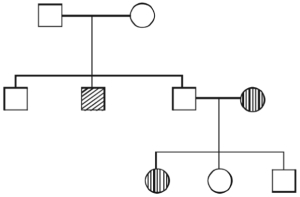
From the following pedigree chart of a family,one can make an analysis that:
A
It is an autosomal dominant trait
B
It is an autosomal recessive trait
C
It is an allosomal dominant trait
D
It is an allosomal recessive trait
Solution
(B) The correct answer is $B$.
$1$. In the pedigree,unaffected parents produce an affected offspring (the second child in the first generation). This indicates that the trait is recessive,as it skips a generation and appears in the offspring of phenotypically normal parents.
$2$. Since the trait appears in both males and females and does not show a sex-linked pattern (e.g.,it is not exclusively passed from father to daughter or mother to son),it is classified as an autosomal recessive trait.
$1$. In the pedigree,unaffected parents produce an affected offspring (the second child in the first generation). This indicates that the trait is recessive,as it skips a generation and appears in the offspring of phenotypically normal parents.
$2$. Since the trait appears in both males and females and does not show a sex-linked pattern (e.g.,it is not exclusively passed from father to daughter or mother to son),it is classified as an autosomal recessive trait.
0 likesView Solution
28
BiologyDifficultMCQKCET · 2016
$A$ human male is heterozygous for autosomal genes '$A$' and '$B$'. He is also hemizygous for the haemophilic gene '$h$'. What percentage of sperms will carry the '$abh$' genotype (in $\%$) (in $\%$)?
A
$12.5$
B
$25$
C
$50$
D
$6.25$
Solution
(A) The genotype of the human male is $AaBbX^{h}Y$.
Since the genes are on different chromosomes (autosomal and sex-linked),they assort independently.
The possible gametes are formed by the combination of alleles: $(A, a) \times (B, b) \times (X^{h}, Y)$.
This results in $2 \times 2 \times 2 = 8$ types of gametes: $ABX^{h}, ABY, aBX^{h}, aBY, AbX^{h}, AbY, abX^{h}, abY$.
Among these $8$ types,the genotype '$abh$' corresponds to the gamete $abX^{h}$.
Therefore,the probability of producing a sperm with the '$abh$' genotype is $1/8$,which is $12.5 \%$.
Since the genes are on different chromosomes (autosomal and sex-linked),they assort independently.
The possible gametes are formed by the combination of alleles: $(A, a) \times (B, b) \times (X^{h}, Y)$.
This results in $2 \times 2 \times 2 = 8$ types of gametes: $ABX^{h}, ABY, aBX^{h}, aBY, AbX^{h}, AbY, abX^{h}, abY$.
Among these $8$ types,the genotype '$abh$' corresponds to the gamete $abX^{h}$.
Therefore,the probability of producing a sperm with the '$abh$' genotype is $1/8$,which is $12.5 \%$.
0 likesView Solution
29
BiologyEasyMCQKCET · 2016
The gene for haemophilia is located on the $X$ chromosome. Hence,it is normally impossible for a:
A
haemophilic father to pass the gene to his daughter
B
carrier mother to pass the gene to her daughter
C
carrier mother to pass the gene to her son
D
haemophilic father to pass the gene to his son
Solution
(D) The correct answer is $D$.
Haemophilia is an $X$-linked recessive disorder.
In males,there is only one $X$ chromosome. If a male is haemophilic,his genotype is $X^hY$.
During reproduction,a father passes his $Y$ chromosome to his son and his $X$ chromosome to his daughter.
Therefore,a haemophilic father $(X^hY)$ will always pass his $Y$ chromosome to his son,meaning he cannot pass the haemophilia gene to his son.
Haemophilia is an $X$-linked recessive disorder.
In males,there is only one $X$ chromosome. If a male is haemophilic,his genotype is $X^hY$.
During reproduction,a father passes his $Y$ chromosome to his son and his $X$ chromosome to his daughter.
Therefore,a haemophilic father $(X^hY)$ will always pass his $Y$ chromosome to his son,meaning he cannot pass the haemophilia gene to his son.
0 likesView Solution
30
BiologyEasyMCQKCET · 2016
The gene disorder phenylketonuria is an example of
A
Polygenic inheritance
B
Pleiotropy
C
Multiple allelism
D
Multiple factor
Solution
(B) Pleiotropy.
Phenylketonuria is a classic example of pleiotropy,where a single gene mutation affects multiple phenotypic traits,such as mental retardation,reduction in hair pigmentation,and skin pigmentation.
Phenylketonuria is a classic example of pleiotropy,where a single gene mutation affects multiple phenotypic traits,such as mental retardation,reduction in hair pigmentation,and skin pigmentation.
0 likesView Solution
31
BiologyEasyMCQKCET · 2016
The codons $UUU$ and $UUC$ code for phenylalanine only. This feature of the genetic code is called:
A
comma-less
B
non-overlapping
C
degenerate
D
non-ambiguous
Solution
(C) The correct answer is $C$.
The genetic code is said to be degenerate because some amino acids are coded by more than one codon.
In this case,both $UUU$ and $UUC$ code for the same amino acid,phenylalanine.
Note: The term 'non-ambiguous' means that one codon codes for only one amino acid,which is also a property of the genetic code,but the specific phenomenon of multiple codons coding for a single amino acid is defined as degeneracy.
The genetic code is said to be degenerate because some amino acids are coded by more than one codon.
In this case,both $UUU$ and $UUC$ code for the same amino acid,phenylalanine.
Note: The term 'non-ambiguous' means that one codon codes for only one amino acid,which is also a property of the genetic code,but the specific phenomenon of multiple codons coding for a single amino acid is defined as degeneracy.
0 likesView Solution
32
BiologyEasyMCQKCET · 2016
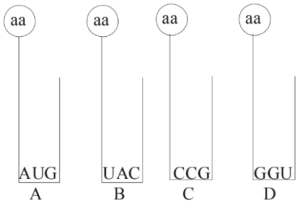
Find the sequence of binding of the following aminoacyl tRNA complexes during translation to mRNA transcribed by a $DNA$ segment having the base sequence $3$' $TACATGGGTCCG$ $5$'. Choose the answer showing the correct order of alphabets.
A
$A$,$B$,$D$,$C$
B
$B$,$A$,$D$,$C$
C
$C$,$D$,$B$,$A$
D
$D$,$C$,$A$,$B$
Solution
(B) The given $DNA$ template strand sequence is: $3$' $TAC$ $ATG$ $GGT$ $CCG$ $5$'.
During transcription,the mRNA is synthesized complementary to the $DNA$ template strand in the $5$' to $3$' direction.
The mRNA sequence will be: $5$' $AUG$ $UAC$ $CCA$ $GGC$ $3$'.
The codons on the mRNA are $AUG$,$UAC$,$CCA$,and $GGC$.
The anticodons on the tRNA molecules that bind to these codons are $UAC$ (for $AUG$),$AUG$ (for $UAC$),$GGU$ (for $CCA$),and $CCG$ (for $GGC$).
Comparing the given tRNA complexes:
- $A$: $AUG$ (Anticodon for $UAC$)
- $B$: $UAC$ (Anticodon for $AUG$)
- $C$: $CCG$ (Anticodon for $GGC$)
- $D$: $GGU$ (Anticodon for $CCA$)
The sequence of binding to the mRNA codons ($AUG$,$UAC$,$CCA$,$GGC$) is $B$,$A$,$D$,$C$.
During transcription,the mRNA is synthesized complementary to the $DNA$ template strand in the $5$' to $3$' direction.
The mRNA sequence will be: $5$' $AUG$ $UAC$ $CCA$ $GGC$ $3$'.
The codons on the mRNA are $AUG$,$UAC$,$CCA$,and $GGC$.
The anticodons on the tRNA molecules that bind to these codons are $UAC$ (for $AUG$),$AUG$ (for $UAC$),$GGU$ (for $CCA$),and $CCG$ (for $GGC$).
Comparing the given tRNA complexes:
- $A$: $AUG$ (Anticodon for $UAC$)
- $B$: $UAC$ (Anticodon for $AUG$)
- $C$: $CCG$ (Anticodon for $GGC$)
- $D$: $GGU$ (Anticodon for $CCA$)
The sequence of binding to the mRNA codons ($AUG$,$UAC$,$CCA$,$GGC$) is $B$,$A$,$D$,$C$.
0 likesView Solution
33
BiologyEasyMCQKCET · 2016
$E. coli$ bacteria grown in ${}^{15}NH_4Cl$ medium for several generations are allowed to grow in ${}^{14}NH_4Cl$ medium. After $2$ generations,the density gradient of the isolated $DNA$ is:
A
only hybrid $DNA$
B
both hybrid and heavy $DNA$
C
both heavy and light $DNA$
D
both hybrid and light $DNA$
Solution
(D) The correct answer is $D$.
According to the Meselson and Stahl experiment,$E. coli$ cells grown in a medium containing $^{15}N$ (heavy isotope) incorporate it into their $DNA$.
When these cells are transferred to a medium containing $^{14}N$ (light isotope),the $DNA$ replication follows a semi-conservative model.
After the $1^{st}$ generation ($20$ minutes),all $DNA$ molecules are hybrid $(^{15}N^{14}N)$.
After the $2^{nd}$ generation ($40$ minutes),the hybrid $DNA$ molecules replicate to produce one hybrid $DNA$ molecule and one light $DNA$ molecule $(^{14}N^{14}N)$.
Therefore,the resulting population contains both hybrid and light $DNA$ in equal proportions.
According to the Meselson and Stahl experiment,$E. coli$ cells grown in a medium containing $^{15}N$ (heavy isotope) incorporate it into their $DNA$.
When these cells are transferred to a medium containing $^{14}N$ (light isotope),the $DNA$ replication follows a semi-conservative model.
After the $1^{st}$ generation ($20$ minutes),all $DNA$ molecules are hybrid $(^{15}N^{14}N)$.
After the $2^{nd}$ generation ($40$ minutes),the hybrid $DNA$ molecules replicate to produce one hybrid $DNA$ molecule and one light $DNA$ molecule $(^{14}N^{14}N)$.
Therefore,the resulting population contains both hybrid and light $DNA$ in equal proportions.
0 likesView Solution
34
BiologyEasyMCQKCET · 2016
Read the following statements carefully and choose the correct statements.
$(A)$ In a transcription unit,the promoter is located at the $5'$ end of the coding strand.
$(B)$ The single strand $DNA$ having the polarity $5' \rightarrow 3'$ is the template strand.
$(C)$ $RNA$ polymerase binds to the operator during transcription.
$(D)$ Single base $DNA$ differences occurring in humans are called Single Nucleotide Polymorphisms $(SNPs)$.
$(A)$ In a transcription unit,the promoter is located at the $5'$ end of the coding strand.
$(B)$ The single strand $DNA$ having the polarity $5' \rightarrow 3'$ is the template strand.
$(C)$ $RNA$ polymerase binds to the operator during transcription.
$(D)$ Single base $DNA$ differences occurring in humans are called Single Nucleotide Polymorphisms $(SNPs)$.
A
Statements $(A)$ and $(B)$
B
Statements $(B)$ and $(C)$
C
Statements $(B)$ and $(D)$
D
Statements $(A)$ and $(D)$
Solution
(D) Statement $(A)$ is correct: In a transcription unit,the promoter is located at the $5'$ end of the coding strand (upstream).
Statement $(B)$ is incorrect: The template strand has a polarity of $3' \rightarrow 5'$,which allows $RNA$ polymerase to synthesize $RNA$ in the $5' \rightarrow 3'$ direction.
Statement $(C)$ is incorrect: $RNA$ polymerase binds to the promoter,not the operator,to initiate transcription.
Statement $(D)$ is correct: Single base $DNA$ differences occurring in humans are known as Single Nucleotide Polymorphisms $(SNPs)$.
Therefore,statements $(A)$ and $(D)$ are correct.
Statement $(B)$ is incorrect: The template strand has a polarity of $3' \rightarrow 5'$,which allows $RNA$ polymerase to synthesize $RNA$ in the $5' \rightarrow 3'$ direction.
Statement $(C)$ is incorrect: $RNA$ polymerase binds to the promoter,not the operator,to initiate transcription.
Statement $(D)$ is correct: Single base $DNA$ differences occurring in humans are known as Single Nucleotide Polymorphisms $(SNPs)$.
Therefore,statements $(A)$ and $(D)$ are correct.
0 likesView Solution
35
BiologyEasyMCQKCET · 2016
Find the mismatch from the following pairs.
A
Divergent evolution - Thorn of Bougainvillea and tendril of Cucurbita
B
Adaptive radiation - Australian marsupials
C
Natural selection - Industrial melanism
D
Genetic drift frequency - Constant gene
Solution
(D) is the mismatch: Genetic drift - Constant gene.
Genetic drift refers to the random fluctuation in the frequencies of alleles in the gene pool of a finite population due to chance events.
It occurs over a few generations.
If the change in allele frequencies is very drastic,it can lead to the formation of new species.
Therefore,genetic drift does not maintain a constant gene frequency; rather,it causes unpredictable changes in it.
Genetic drift refers to the random fluctuation in the frequencies of alleles in the gene pool of a finite population due to chance events.
It occurs over a few generations.
If the change in allele frequencies is very drastic,it can lead to the formation of new species.
Therefore,genetic drift does not maintain a constant gene frequency; rather,it causes unpredictable changes in it.
0 likesView Solution
36
BiologyEasyMCQKCET · 2016
Identify the correct equation for the Hardy-Weinberg law.
A
$p + q = 1$
B
$p - q = 1$
C
$(p + q)^2 = 1$
D
$(p - q)^2 = 1$
Solution
(C) The Hardy-Weinberg principle states that the sum of all allele frequencies in a population is $1$,represented as $p + q = 1$.
When considering the genotype frequencies in a population at equilibrium,the equation is the binomial expansion of $(p + q)^2$,which is $p^2 + 2pq + q^2 = 1$.
Therefore,the correct representation of the Hardy-Weinberg law in terms of the binomial expansion is $(p + q)^2 = 1$.
When considering the genotype frequencies in a population at equilibrium,the equation is the binomial expansion of $(p + q)^2$,which is $p^2 + 2pq + q^2 = 1$.
Therefore,the correct representation of the Hardy-Weinberg law in terms of the binomial expansion is $(p + q)^2 = 1$.
0 likesView Solution
37
BiologyEasyMCQKCET · 2016
Some of the events that occur during the life cycle of $Plasmodium$ are given below. Identify the correct statement.
A
The sporozoites reproduce sexually in liver cells.
B
The gametocytes develop in $RBC$.
C
Female mosquito bites a man,Gametocytes are injected.
D
When mosquito bites a man,gametocytes are injected.
Solution
(B) The correct statement is: The gametocytes develop in $RBC$.
$1$. The infective stage of $Plasmodium$ is the sporozoite,which is present in the salivary glands of the female $Anopheles$ mosquito.
$2$. When the mosquito bites a human,sporozoites enter the human blood along with the mosquito's saliva.
$3$. Inside the human body,the parasite undergoes asexual reproduction in liver cells and then in red blood cells $(RBCs)$.
$4$. In the $RBCs$,the parasite eventually develops into gametocytes (male and female gametocytes),which are then taken up by the mosquito during a blood meal.
$1$. The infective stage of $Plasmodium$ is the sporozoite,which is present in the salivary glands of the female $Anopheles$ mosquito.
$2$. When the mosquito bites a human,sporozoites enter the human blood along with the mosquito's saliva.
$3$. Inside the human body,the parasite undergoes asexual reproduction in liver cells and then in red blood cells $(RBCs)$.
$4$. In the $RBCs$,the parasite eventually develops into gametocytes (male and female gametocytes),which are then taken up by the mosquito during a blood meal.
0 likesView Solution
38
BiologyEasyMCQKCET · 2016
$A$ doctor identifies symptoms of nasal congestion,headache,sore throat,hoarseness,and cough in a patient. The conclusion is that the patient is infected by which pathogen?
A
Adenovirus
B
Rhinovirus
C
Plasmodium
D
Salmonella
Solution
(B) Rhinovirus.
The common cold,also known as rhinitis,is caused mainly by rhinoviruses.
These viruses infect the upper respiratory tract but do not affect the lungs.
The characteristic symptoms include nasal congestion,cough,headache,hoarseness,and sore throat.
The common cold,also known as rhinitis,is caused mainly by rhinoviruses.
These viruses infect the upper respiratory tract but do not affect the lungs.
The characteristic symptoms include nasal congestion,cough,headache,hoarseness,and sore throat.
0 likesView Solution
39
BiologyEasyMCQKCET · 2016
$A$ person who has an allergy,the type of antibody produced in his body is
A
IgA
B
IgG
C
IgE
D
IgM
Solution
(C) The correct answer is $C$.
An allergy is an exaggerated or inappropriate immune response to certain antigens present in the environment,such as dust,pollen,or dander.
When an individual is exposed to these allergens,the body's immune system produces specific antibodies of the $IgE$ type.
These $IgE$ antibodies bind to mast cells and basophils,triggering the release of chemicals like histamine,which leads to the symptoms of an allergic reaction.
An allergy is an exaggerated or inappropriate immune response to certain antigens present in the environment,such as dust,pollen,or dander.
When an individual is exposed to these allergens,the body's immune system produces specific antibodies of the $IgE$ type.
These $IgE$ antibodies bind to mast cells and basophils,triggering the release of chemicals like histamine,which leads to the symptoms of an allergic reaction.
0 likesView Solution
40
BiologyEasyMCQKCET · 2016
Identify the incorrect statement from the following.
A
$B$-cells produce antibody.
B
Interferons kill viruses.
C
Response of $T$-cells is called cell-mediated immunity.
D
Macrophages are the phagocytic cells.
Solution
(B) The incorrect statement is: $B$. Interferons kill viruses.
Interferons are glycoproteins produced by virus-infected cells. They do not kill viruses directly; instead,they protect non-infected cells from further viral infection by inhibiting viral replication.
Interferons are glycoproteins produced by virus-infected cells. They do not kill viruses directly; instead,they protect non-infected cells from further viral infection by inhibiting viral replication.
0 likesView Solution
41
BiologyEasyMCQKCET · 2016
$A$ person is admitted to the hospital because they had a myocardial infarction. $A$ cardiologist injects them with 'streptokinase'. Why?
A
It reduces hypertension.
B
It reduces the level of blood cholesterol.
C
It stimulates the heartbeat.
D
It acts as a clot buster.
Solution
(D) It acts as a clot buster.
Streptokinase is produced by the bacterium $Streptococcus$ and is modified by genetic engineering to be used as a 'clot buster' for removing clots from the blood vessels of patients who have undergone myocardial infarction (heart attack). It has a fibrinolytic effect,which helps in dissolving blood clots.
Streptokinase is produced by the bacterium $Streptococcus$ and is modified by genetic engineering to be used as a 'clot buster' for removing clots from the blood vessels of patients who have undergone myocardial infarction (heart attack). It has a fibrinolytic effect,which helps in dissolving blood clots.
0 likesView Solution
42
BiologyEasyMCQKCET · 2016
The puffed-up appearance of dough is due to fermentation by bacteria. Identify the gas liberated during the process.
A
Methane
B
Carbon dioxide
C
Hydrogen sulphide
D
Ammonia
Solution
(B) Carbon dioxide.
The dough becomes puffy due to the presence of $CO_2$ gas liberated by bacteria during the process of fermentation.
In this metabolic process,bacteria break down carbohydrates into ethanol and $CO_2$ gas,which gets trapped in the dough,causing it to rise.
The dough becomes puffy due to the presence of $CO_2$ gas liberated by bacteria during the process of fermentation.
In this metabolic process,bacteria break down carbohydrates into ethanol and $CO_2$ gas,which gets trapped in the dough,causing it to rise.
0 likesView Solution
43
BiologyEasyMCQKCET · 2016
Elution means
A
separation of $DNA$ fragments on agarose gel
B
cutting and extraction of $DNA$ bands from the agarose gel
C
making the $DNA$ bands visible under $UV$ radiation
D
isolating alien $DNA$ from the choice organism.
Solution
(B) The correct answer is $B$.
Elution is a process in biotechnology used during gel electrophoresis.
After the $DNA$ fragments have been separated on an agarose gel based on their size,the specific $DNA$ bands are cut out from the gel.
These cut $DNA$ fragments are then extracted from the gel piece.
This entire process of cutting and extracting the $DNA$ bands from the agarose gel is known as elution.
Elution is a process in biotechnology used during gel electrophoresis.
After the $DNA$ fragments have been separated on an agarose gel based on their size,the specific $DNA$ bands are cut out from the gel.
These cut $DNA$ fragments are then extracted from the gel piece.
This entire process of cutting and extracting the $DNA$ bands from the agarose gel is known as elution.
0 likesView Solution
44
BiologyEasyMCQKCET · 2016
Which one of the following statements is not correct about a plasmid?
A
It is a circular $DNA$.
B
It has antibiotic resistance genes.
C
It has the ability of autonomous replication.
D
Its $DNA$ is as long as chromosomal $DNA$.
Solution
(D) The correct answer is $D$.
Plasmids are small,circular,double-stranded $DNA$ molecules that are distinct from a cell's chromosomal $DNA$.
They are found primarily in bacteria and are much smaller in size compared to the chromosomal $DNA$ of the host cell.
Therefore,the statement that plasmid $DNA$ is as long as chromosomal $DNA$ is incorrect.
Plasmids are small,circular,double-stranded $DNA$ molecules that are distinct from a cell's chromosomal $DNA$.
They are found primarily in bacteria and are much smaller in size compared to the chromosomal $DNA$ of the host cell.
Therefore,the statement that plasmid $DNA$ is as long as chromosomal $DNA$ is incorrect.
0 likesView Solution
45
BiologyEasyMCQKCET · 2016
Which one of the following statements is wrong with respect to separation of $DNA$ fragments on gel electrophoresis?
A
The $DNA$ fragments move towards anode under electric field through the matrix.
B
The commonly used matrix is agarose gel.
C
The $DNA$ fragments resolve according to their size.
D
The smaller $DNA$ fragments separate first.
Solution
(D) The correct answer is $D$. The statement 'The smaller $DNA$ fragments separate first' is technically incorrect in the context of the final separation pattern,as they migrate the fastest and reach the farthest point,but they do not 'separate first' in a chronological sense; rather,they are the ones that travel the furthest distance through the gel matrix.
Gel electrophoresis is a technique that uses an electric field to separate $DNA$ molecules based on their size.
Since $DNA$ molecules are negatively charged due to the phosphate backbone,they migrate towards the positive electrode (anode).
The rate of migration is inversely proportional to the size of the $DNA$ fragment.
Smaller $DNA$ fragments encounter less resistance from the agarose matrix and thus migrate faster and travel further than larger fragments.
Therefore,the band located farthest from the loading well represents the smallest $DNA$ fragment.
Gel electrophoresis is a technique that uses an electric field to separate $DNA$ molecules based on their size.
Since $DNA$ molecules are negatively charged due to the phosphate backbone,they migrate towards the positive electrode (anode).
The rate of migration is inversely proportional to the size of the $DNA$ fragment.
Smaller $DNA$ fragments encounter less resistance from the agarose matrix and thus migrate faster and travel further than larger fragments.
Therefore,the band located farthest from the loading well represents the smallest $DNA$ fragment.
0 likesView Solution
46
BiologyEasyMCQKCET · 2016
Most suitable method of introducing alien $DNA$ into a plant cell is
A
biolistics
B
microinjection
C
lipofection
D
heat shock method
Solution
(A) The correct answer is $A$.
Biolistics,also known as the gene gun method,is the most suitable technique for introducing foreign $DNA$ into plant cells.
In this method,cells are bombarded with high-velocity micro-particles of gold or tungsten coated with $DNA$.
Microinjection is typically used for animal cells,lipofection is used for animal cells,and the heat shock method is primarily used for bacterial transformation.
Biolistics,also known as the gene gun method,is the most suitable technique for introducing foreign $DNA$ into plant cells.
In this method,cells are bombarded with high-velocity micro-particles of gold or tungsten coated with $DNA$.
Microinjection is typically used for animal cells,lipofection is used for animal cells,and the heat shock method is primarily used for bacterial transformation.
0 likesView Solution
Vedclass Products
For Students
Vedclass Test Series
Mock tests in real KCET style covering Biology with performance analysis. 5-day free trial.
Start Free TrialFor Teachers
Exam Paper Generator
Generate Set A/B/C/D Biology papers from 7.5L+ questions in 2 minutes. 3 chapters free.
Try FreeFor Institutes
Online Exam Module
Run live KCET mock exams with unlimited students, 360° analytics & white-label branding.
See DemoFrequently Asked Questions
How many Biology questions are in KCET 2016?
There are 46 Biology questions from the KCET 2016 paper on Vedclass, each with a detailed step-by-step solution in English.
Are KCET 2016 Biology solutions available in English?
Yes. All solutions on this page are in English. You can also switch to English or Hindi using the language buttons above the questions.
Can I practice KCET 2016 Biology as a timed test?
Yes. Use the Vedclass Test Series to attempt a full KCET mock test covering Biology with time limits and instant score analysis.
Can teachers create Biology papers from KCET previous year questions?
Yes. The Vedclass Exam Paper Generator lets teachers mix KCET Biology questions and generate Set A/B/C/D papers in minutes.
For Teachers & Institutes
Build a Custom Biology Paper
Pick KCET 2016 Biology questions, set difficulty, and generate Set A/B/C/D in 2 minutes.