
PhysicsQ51–150 of 599 questions
Page 2 of 7 · English
51
PhysicsDifficultMCQJEE Main · 2024
$A$ particle is moving in a straight line. The variation of position $x$ as a function of time $t$ is given as $x = (t^3 - 6t^2 + 20t + 15) \ m$. The velocity of the body when its acceleration becomes zero is ........... $m/s$.
A
$4$
B
$8$
C
$10$
D
$6$
Solution
(B) Given position: $x = t^3 - 6t^2 + 20t + 15 \ m$.
Velocity $v$ is the first derivative of position with respect to time: $v = \frac{dx}{dt} = 3t^2 - 12t + 20 \ m/s$.
Acceleration $a$ is the derivative of velocity with respect to time: $a = \frac{dv}{dt} = 6t - 12 \ m/s^2$.
Set acceleration to zero to find the time: $6t - 12 = 0 \implies t = 2 \ s$.
Substitute $t = 2 \ s$ into the velocity equation: $v = 3(2)^2 - 12(2) + 20 = 12 - 24 + 20 = 8 \ m/s$.
Velocity $v$ is the first derivative of position with respect to time: $v = \frac{dx}{dt} = 3t^2 - 12t + 20 \ m/s$.
Acceleration $a$ is the derivative of velocity with respect to time: $a = \frac{dv}{dt} = 6t - 12 \ m/s^2$.
Set acceleration to zero to find the time: $6t - 12 = 0 \implies t = 2 \ s$.
Substitute $t = 2 \ s$ into the velocity equation: $v = 3(2)^2 - 12(2) + 20 = 12 - 24 + 20 = 8 \ m/s$.
0 likesView Solution
52
PhysicsDifficultMCQJEE Main · 2024
$N$ moles of a polyatomic gas $(f=6)$ must be mixed with two moles of a monoatomic gas so that the mixture behaves as a diatomic gas. The value of $N$ is:
A
$6$
B
$3$
C
$4$
D
$2$
Solution
(C) The equivalent degree of freedom $f_{eq}$ for a mixture of gases is given by the formula:
$f_{eq} = \frac{n_1 f_1 + n_2 f_2}{n_1 + n_2}$
For a diatomic gas,the degree of freedom is $f_{eq} = 5$.
Given:
$n_1 = N$,$f_1 = 6$ (polyatomic gas)
$n_2 = 2$,$f_2 = 3$ (monoatomic gas)
Substituting these values into the formula:
$5 = \frac{(N)(6) + (2)(3)}{N + 2}$
Multiplying both sides by $(N + 2)$:
$5(N + 2) = 6N + 6$
$5N + 10 = 6N + 6$
Rearranging the terms to solve for $N$:
$10 - 6 = 6N - 5N$
$N = 4$
$f_{eq} = \frac{n_1 f_1 + n_2 f_2}{n_1 + n_2}$
For a diatomic gas,the degree of freedom is $f_{eq} = 5$.
Given:
$n_1 = N$,$f_1 = 6$ (polyatomic gas)
$n_2 = 2$,$f_2 = 3$ (monoatomic gas)
Substituting these values into the formula:
$5 = \frac{(N)(6) + (2)(3)}{N + 2}$
Multiplying both sides by $(N + 2)$:
$5(N + 2) = 6N + 6$
$5N + 10 = 6N + 6$
Rearranging the terms to solve for $N$:
$10 - 6 = 6N - 5N$
$N = 4$
1 likesView Solution
53
PhysicsDifficultMCQJEE Main · 2024
Two metallic wires $P$ and $Q$ have the same volume and are made up of the same material. If their areas of cross-section are in the ratio $4:1$ and a force $F_1$ is applied to $P$,an extension of $\Delta l$ is produced. The force required to produce the same extension in $Q$ is $F_2$. The value of $\frac{F_1}{F_2}$ is . . . . . . .
A
$16$
B
$14$
C
$20$
D
$50$
Solution
(A) The Young's modulus $Y$ is given by $Y = \frac{\text{Stress}}{\text{Strain}} = \frac{F/A}{\Delta l/l} = \frac{Fl}{A\Delta l}$.
Rearranging for extension,we get $\Delta l = \frac{Fl}{AY}$.
Since volume $V = A \times l$,we can write $l = \frac{V}{A}$.
Substituting $l$ into the extension formula: $\Delta l = \frac{F(V/A)}{AY} = \frac{FV}{A^2Y}$.
Since $Y$ and $V$ are the same for both wires,$\Delta l \propto \frac{F}{A^2}$.
Given $\Delta l_1 = \Delta l_2$,we have $\frac{F_1}{A_1^2} = \frac{F_2}{A_2^2}$.
Therefore,$\frac{F_1}{F_2} = \frac{A_1^2}{A_2^2} = \left(\frac{A_1}{A_2}\right)^2$.
Given the ratio of areas $\frac{A_1}{A_2} = \frac{4}{1}$,we get $\frac{F_1}{F_2} = (4)^2 = 16$.
Rearranging for extension,we get $\Delta l = \frac{Fl}{AY}$.
Since volume $V = A \times l$,we can write $l = \frac{V}{A}$.
Substituting $l$ into the extension formula: $\Delta l = \frac{F(V/A)}{AY} = \frac{FV}{A^2Y}$.
Since $Y$ and $V$ are the same for both wires,$\Delta l \propto \frac{F}{A^2}$.
Given $\Delta l_1 = \Delta l_2$,we have $\frac{F_1}{A_1^2} = \frac{F_2}{A_2^2}$.
Therefore,$\frac{F_1}{F_2} = \frac{A_1^2}{A_2^2} = \left(\frac{A_1}{A_2}\right)^2$.
Given the ratio of areas $\frac{A_1}{A_2} = \frac{4}{1}$,we get $\frac{F_1}{F_2} = (4)^2 = 16$.
0 likesView Solution
54
PhysicsDifficultMCQJEE Main · 2024
$A$ simple harmonic oscillator has an amplitude $A$ and time period $6 \pi \text{ s}$. Assuming the oscillation starts from its mean position,the time required by it to travel from $x=A$ to $x=\frac{\sqrt{3}}{2} A$ will be $\frac{\pi}{x} \text{ s}$,where $x=$ . . . . . . .
A
$2$
B
$12$
C
$4$
D
$9$
Solution
(A) The equation for displacement starting from the mean position is $x(t) = A \sin(\omega t)$.
Given $T = 6 \pi \text{ s}$,the angular frequency is $\omega = \frac{2 \pi}{T} = \frac{2 \pi}{6 \pi} = \frac{1}{3} \text{ rad/s}$.
At $x = A$,the particle is at the extreme position. The time taken to reach the mean position $(x=0)$ from $x=A$ is $T/4 = (6 \pi)/4 = 1.5 \pi \text{ s}$.
However,the question asks for the time to travel from $x=A$ to $x=\frac{\sqrt{3}}{2} A$.
Using the phasor diagram,the position $x = A \sin(\theta)$ corresponds to the projection on the vertical axis.
At $x = A$,the phase angle $\theta_1 = \frac{\pi}{2}$.
At $x = \frac{\sqrt{3}}{2} A$,$\sin(\theta_2) = \frac{\sqrt{3}}{2}$,so $\theta_2 = \frac{\pi}{3}$.
The change in phase is $\Delta \theta = \theta_1 - \theta_2 = \frac{\pi}{2} - \frac{\pi}{3} = \frac{\pi}{6}$.
Since $\Delta \theta = \omega \Delta t$,we have $\frac{\pi}{6} = \frac{1}{3} \Delta t$.
Therefore,$\Delta t = \frac{3 \pi}{6} = \frac{\pi}{2} \text{ s}$.
Comparing this with $\frac{\pi}{x} \text{ s}$,we get $x = 2$.
Given $T = 6 \pi \text{ s}$,the angular frequency is $\omega = \frac{2 \pi}{T} = \frac{2 \pi}{6 \pi} = \frac{1}{3} \text{ rad/s}$.
At $x = A$,the particle is at the extreme position. The time taken to reach the mean position $(x=0)$ from $x=A$ is $T/4 = (6 \pi)/4 = 1.5 \pi \text{ s}$.
However,the question asks for the time to travel from $x=A$ to $x=\frac{\sqrt{3}}{2} A$.
Using the phasor diagram,the position $x = A \sin(\theta)$ corresponds to the projection on the vertical axis.
At $x = A$,the phase angle $\theta_1 = \frac{\pi}{2}$.
At $x = \frac{\sqrt{3}}{2} A$,$\sin(\theta_2) = \frac{\sqrt{3}}{2}$,so $\theta_2 = \frac{\pi}{3}$.
The change in phase is $\Delta \theta = \theta_1 - \theta_2 = \frac{\pi}{2} - \frac{\pi}{3} = \frac{\pi}{6}$.
Since $\Delta \theta = \omega \Delta t$,we have $\frac{\pi}{6} = \frac{1}{3} \Delta t$.
Therefore,$\Delta t = \frac{3 \pi}{6} = \frac{\pi}{2} \text{ s}$.
Comparing this with $\frac{\pi}{x} \text{ s}$,we get $x = 2$.
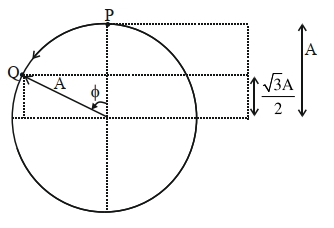
0 likesView Solution
55
PhysicsDifficultMCQJEE Main · 2024
$A$ particle is moving in a circle of radius $50 \ cm$ in such a way that at any instant the normal and tangential components of its acceleration are equal. If its speed at $t=0$ is $4 \ m/s$,the time taken to complete the first revolution will be $\frac{1}{\alpha}[1-e^{-2 \pi}] \ s$,where $\alpha=$ . . . . . . .
A
$8$
B
$5$
C
$98$
D
$45$
Solution
(A) Given that the normal acceleration $a_c = \frac{v^2}{r}$ and tangential acceleration $a_t = \frac{dv}{dt}$ are equal:
$\frac{v^2}{r} = \frac{dv}{dt}$
Integrating with respect to time from $t=0$ $(v=4 \ m/s)$ to $t$:
$\int_{4}^{v} \frac{dv}{v^2} = \int_{0}^{t} \frac{dt}{r}$
$\left[ -\frac{1}{v} \right]_{4}^{v} = \frac{t}{r}$
$-\frac{1}{v} + \frac{1}{4} = \frac{t}{0.5} = 2t$
$\frac{1}{v} = \frac{1}{4} - 2t = \frac{1-8t}{4} \implies v = \frac{4}{1-8t}$
Since $v = \frac{ds}{dt}$,we integrate to find the distance $s$ for one revolution $(s = 2\pi r = 2\pi(0.5) = \pi \ m)$:
$\int_{0}^{\pi} ds = \int_{0}^{t} \frac{4}{1-8t} dt$
$\pi = 4 \left[ \frac{\ln(1-8t)}{-8} \right]_{0}^{t}$
$\pi = -\frac{1}{2} \ln(1-8t)$
$-2\pi = \ln(1-8t)$
$e^{-2\pi} = 1-8t$
$8t = 1 - e^{-2\pi}$
$t = \frac{1}{8} [1 - e^{-2\pi}] \ s$
Comparing with the given form,$\alpha = 8$.
$\frac{v^2}{r} = \frac{dv}{dt}$
Integrating with respect to time from $t=0$ $(v=4 \ m/s)$ to $t$:
$\int_{4}^{v} \frac{dv}{v^2} = \int_{0}^{t} \frac{dt}{r}$
$\left[ -\frac{1}{v} \right]_{4}^{v} = \frac{t}{r}$
$-\frac{1}{v} + \frac{1}{4} = \frac{t}{0.5} = 2t$
$\frac{1}{v} = \frac{1}{4} - 2t = \frac{1-8t}{4} \implies v = \frac{4}{1-8t}$
Since $v = \frac{ds}{dt}$,we integrate to find the distance $s$ for one revolution $(s = 2\pi r = 2\pi(0.5) = \pi \ m)$:
$\int_{0}^{\pi} ds = \int_{0}^{t} \frac{4}{1-8t} dt$
$\pi = 4 \left[ \frac{\ln(1-8t)}{-8} \right]_{0}^{t}$
$\pi = -\frac{1}{2} \ln(1-8t)$
$-2\pi = \ln(1-8t)$
$e^{-2\pi} = 1-8t$
$8t = 1 - e^{-2\pi}$
$t = \frac{1}{8} [1 - e^{-2\pi}] \ s$
Comparing with the given form,$\alpha = 8$.
0 likesView Solution
56
PhysicsDifficultMCQJEE Main · 2024
$A$ body of mass $5 \,kg$ moving with a uniform speed $3 \sqrt{2} \,m/s$ in the $X-Y$ plane along the line $y=x+4$. The angular momentum of the particle about the origin will be . . . . . . $kg \,m^2/s$.
A
$45$
B
$60$
C
$75$
D
$12$
Solution
(B) The equation of the line is $x - y + 4 = 0$.
The angular momentum $L$ of a particle about the origin is given by $L = mvd$,where $m$ is the mass,$v$ is the speed,and $d$ is the perpendicular distance from the origin to the line of motion.
The perpendicular distance $d$ from the origin $(0,0)$ to the line $Ax + By + C = 0$ is $d = \frac{|C|}{\sqrt{A^2 + B^2}}$.
Here,$A = 1$,$B = -1$,and $C = 4$. So,$d = \frac{|4|}{\sqrt{1^2 + (-1)^2}} = \frac{4}{\sqrt{2}} = 2\sqrt{2} \,m$.
Given mass $m = 5 \,kg$ and speed $v = 3\sqrt{2} \,m/s$.
Therefore,$L = 5 \times (3\sqrt{2}) \times (2\sqrt{2}) = 5 \times 3 \times 2 \times 2 = 60 \,kg \,m^2/s$.
The angular momentum $L$ of a particle about the origin is given by $L = mvd$,where $m$ is the mass,$v$ is the speed,and $d$ is the perpendicular distance from the origin to the line of motion.
The perpendicular distance $d$ from the origin $(0,0)$ to the line $Ax + By + C = 0$ is $d = \frac{|C|}{\sqrt{A^2 + B^2}}$.
Here,$A = 1$,$B = -1$,and $C = 4$. So,$d = \frac{|4|}{\sqrt{1^2 + (-1)^2}} = \frac{4}{\sqrt{2}} = 2\sqrt{2} \,m$.
Given mass $m = 5 \,kg$ and speed $v = 3\sqrt{2} \,m/s$.
Therefore,$L = 5 \times (3\sqrt{2}) \times (2\sqrt{2}) = 5 \times 3 \times 2 \times 2 = 60 \,kg \,m^2/s$.
0 likesView Solution
57
PhysicsDifficultMCQJEE Main · 2024
Match List-$I$ with List-$II$:
| List-$I$ | List-$II$ |
| $A$. Coefficient of Viscosity | $I$. $[M L^2 T^{-2}]$ |
| $B$. Surface Tension | $II$. $[M L^2 T^{-1}]$ |
| $C$. Angular momentum | $III$. $[M L^{-1} T^{-1}]$ |
| $D$. Rotational Kinetic energy | $IV$. $[M L^0 T^{-2}]$ |
A
$A-II, B-I, C-IV, D-III$
B
$A-I, B-II, C-III, D-IV$
C
$A-III, B-IV, C-II, D-I$
D
$A-IV, B-III, C-II, D-I$
Solution
(C) $1$. Coefficient of Viscosity $(\eta)$: From $F = \eta A \frac{dv}{dy}$,we have $\eta = \frac{F}{A(dv/dy)}$. Dimensions: $\frac{[M L T^{-2}]}{[L^2][T^{-1}]} = [M L^{-1} T^{-1}]$. (Matches $III$)
$2$. Surface Tension $(S)$: $S = \frac{F}{l}$. Dimensions: $\frac{[M L T^{-2}]}{[L]} = [M L^0 T^{-2}]$. (Matches $IV$)
$3$. Angular momentum $(L)$: $L = mvr$. Dimensions: $[M][L T^{-1}][L] = [M L^2 T^{-1}]$. (Matches $II$)
$4$. Rotational Kinetic energy $(K)$: $K = \frac{1}{2} I \omega^2$. Dimensions: $[M L^2][T^{-1}]^2 = [M L^2 T^{-2}]$. (Matches $I$)
Thus,the correct matching is $A-III, B-IV, C-II, D-I$.
$2$. Surface Tension $(S)$: $S = \frac{F}{l}$. Dimensions: $\frac{[M L T^{-2}]}{[L]} = [M L^0 T^{-2}]$. (Matches $IV$)
$3$. Angular momentum $(L)$: $L = mvr$. Dimensions: $[M][L T^{-1}][L] = [M L^2 T^{-1}]$. (Matches $II$)
$4$. Rotational Kinetic energy $(K)$: $K = \frac{1}{2} I \omega^2$. Dimensions: $[M L^2][T^{-1}]^2 = [M L^2 T^{-2}]$. (Matches $I$)
Thus,the correct matching is $A-III, B-IV, C-II, D-I$.
0 likesView Solution
58
PhysicsDifficultMCQJEE Main · 2024
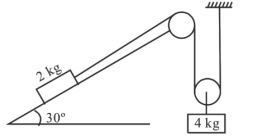
All surfaces shown in the figure are assumed to be frictionless, and the pulleys and the string are light. The acceleration of the block of mass $2 \,kg$ is:
A
$\frac{g}{4}$
B
$\frac{g}{3}$
C
$\frac{g}{2}$
D
$g$
Solution
(B) Let the acceleration of the $4 \,kg$ block be $a$ downwards. Due to the constraint, the acceleration of the $2 \,kg$ block up the incline will be $2a$.
For the $4 \,kg$ block: $4g - 2T = 4a \Rightarrow 2g - T = 2a$ (Equation $1$)
For the $2 \,kg$ block: $T - m_2g \sin(30^{\circ}) = m_2(2a) \Rightarrow T - 2g(0.5) = 2(2a) \Rightarrow T - g = 4a$ (Equation $2$)
Adding Equation $1$ and Equation $2$: $(2g - T) + (T - g) = 2a + 4a \Rightarrow g = 6a \Rightarrow a = \frac{g}{6}$.
The acceleration of the $2 \,kg$ block is $2a = 2(\frac{g}{6}) = \frac{g}{3}$.
For the $4 \,kg$ block: $4g - 2T = 4a \Rightarrow 2g - T = 2a$ (Equation $1$)
For the $2 \,kg$ block: $T - m_2g \sin(30^{\circ}) = m_2(2a) \Rightarrow T - 2g(0.5) = 2(2a) \Rightarrow T - g = 4a$ (Equation $2$)
Adding Equation $1$ and Equation $2$: $(2g - T) + (T - g) = 2a + 4a \Rightarrow g = 6a \Rightarrow a = \frac{g}{6}$.
The acceleration of the $2 \,kg$ block is $2a = 2(\frac{g}{6}) = \frac{g}{3}$.
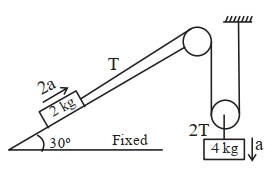
1 likesView Solution
59
PhysicsDifficultMCQJEE Main · 2024
Young's modulus of the material of a wire of length $L$ and cross-sectional area $A$ is $Y$. If the length of the wire is doubled and the cross-sectional area is halved,then the Young's modulus will be:
A
$Y/4$
B
$4Y$
C
$Y$
D
$2Y$
Solution
(C) Young's modulus is an intrinsic property of the material of the wire.
It depends only on the nature of the material and the temperature,not on the dimensions of the wire such as its length $L$ or cross-sectional area $A$.
Therefore,even if the length is doubled and the cross-sectional area is halved,the Young's modulus $Y$ remains unchanged.
It depends only on the nature of the material and the temperature,not on the dimensions of the wire such as its length $L$ or cross-sectional area $A$.
Therefore,even if the length is doubled and the cross-sectional area is halved,the Young's modulus $Y$ remains unchanged.
0 likesView Solution
60
PhysicsDifficultMCQJEE Main · 2024
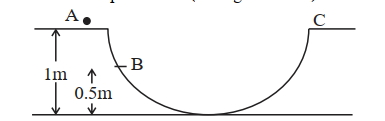
$A$ particle is placed at the point $A$ of a frictionless track $ABC$ as shown in the figure. It is gently pushed toward the right. The speed of the particle when it reaches the point $B$ is: (Take $g = 10 \ m/s^2$).
A
$20 \ m/s$
B
$\sqrt{10} \ m/s$
C
$2\sqrt{10} \ m/s$
D
$10 \ m/s$
Solution
(B) Since the track is frictionless,the total mechanical energy of the particle is conserved.
Applying the Law of Conservation of Mechanical Energy between points $A$ and $B$:
$KE_A + PE_A = KE_B + PE_B$
Here,$KE_A = 0$ (as it is gently pushed,initial velocity is negligible),$PE_A = mgh_A$,$KE_B = \frac{1}{2}mv^2$,and $PE_B = mgh_B$.
Given: $h_A = 1 \ m$,$h_B = 0.5 \ m$,and $g = 10 \ m/s^2$.
Substituting the values:
$0 + mg(1) = \frac{1}{2}mv^2 + mg(0.5)$
$mg(1 - 0.5) = \frac{1}{2}mv^2$
$mg(0.5) = \frac{1}{2}mv^2$
$g = v^2$
$v = \sqrt{g} = \sqrt{10} \ m/s$.
Applying the Law of Conservation of Mechanical Energy between points $A$ and $B$:
$KE_A + PE_A = KE_B + PE_B$
Here,$KE_A = 0$ (as it is gently pushed,initial velocity is negligible),$PE_A = mgh_A$,$KE_B = \frac{1}{2}mv^2$,and $PE_B = mgh_B$.
Given: $h_A = 1 \ m$,$h_B = 0.5 \ m$,and $g = 10 \ m/s^2$.
Substituting the values:
$0 + mg(1) = \frac{1}{2}mv^2 + mg(0.5)$
$mg(1 - 0.5) = \frac{1}{2}mv^2$
$mg(0.5) = \frac{1}{2}mv^2$
$g = v^2$
$v = \sqrt{g} = \sqrt{10} \ m/s$.
0 likesView Solution
61
PhysicsDifficultMCQJEE Main · 2024
The gravitational potential at a point above the surface of the Earth is $-5.12 \times 10^7 \,J/kg$ and the acceleration due to gravity at that point is $6.4 \,m/s^2$. Assume that the mean radius of the Earth is $6400 \,km$. The height of this point above the Earth's surface is: (in $\,km$)
A
$1600$
B
$540$
C
$1200$
D
$1000$
Solution
(A) Let $R_E$ be the radius of the Earth and $h$ be the height of the point above the surface. The distance from the center of the Earth is $r = R_E + h$.
Gravitational potential $V = -\frac{G M_E}{r} = -5.12 \times 10^7 \,J/kg$ ... $(i)$
Acceleration due to gravity $g' = \frac{G M_E}{r^2} = 6.4 \,m/s^2$ ... $(ii)$
Dividing equation $(i)$ by equation $(ii)$:
$\frac{V}{g'} = \frac{-G M_E / r}{G M_E / r^2} = -r$
$r = -\frac{V}{g'} = -\frac{-5.12 \times 10^7}{6.4} = 0.8 \times 10^7 \,m = 8000 \,km$
Since $r = R_E + h$, we have $h = r - R_E = 8000 \,km - 6400 \,km = 1600 \,km$.
Gravitational potential $V = -\frac{G M_E}{r} = -5.12 \times 10^7 \,J/kg$ ... $(i)$
Acceleration due to gravity $g' = \frac{G M_E}{r^2} = 6.4 \,m/s^2$ ... $(ii)$
Dividing equation $(i)$ by equation $(ii)$:
$\frac{V}{g'} = \frac{-G M_E / r}{G M_E / r^2} = -r$
$r = -\frac{V}{g'} = -\frac{-5.12 \times 10^7}{6.4} = 0.8 \times 10^7 \,m = 8000 \,km$
Since $r = R_E + h$, we have $h = r - R_E = 8000 \,km - 6400 \,km = 1600 \,km$.
0 likesView Solution
62
PhysicsDifficultMCQJEE Main · 2024
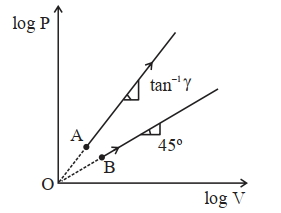
Two thermodynamic processes are shown in the figure. The molar heat capacities for processes $A$ and $B$ are $C_A$ and $C_B$. The molar heat capacities at constant pressure and constant volume are represented by $C_P$ and $C_V$,respectively. Choose the correct statement.
A
$C_A = 0, C_B = \infty$
B
$C_A = \infty, C_B = 0$
C
$C_P > C_B > C_A > C_V$
D
$C_A > C_P > C_V > C_B$
Solution
(C) The equation of a polytropic process is $PV^x = \text{constant}$,which can be written as $\log P + x \log V = \text{constant}$,or $\log P = -x \log V + \text{constant}$.
Comparing this with the equation of a line $y = mx + c$,the slope $m = -x$.
For process $A$,the slope is $\tan(\theta_A) = \gamma$. Thus,$-x_A = \gamma$,so $x_A = -\gamma$.
The molar heat capacity for a polytropic process is $C = C_V + \frac{R}{1-x}$.
For process $A$,$C_A = C_V + \frac{R}{1 - (-\gamma)} = C_V + \frac{R}{1+\gamma}$. Since $\gamma > 1$,$C_A$ is a finite positive value.
For process $B$,the slope is $\tan(45^\circ) = 1$. Thus,$-x_B = 1$,so $x_B = -1$.
For process $B$,$C_B = C_V + \frac{R}{1 - (-1)} = C_V + \frac{R}{2}$.
Comparing the values:
$C_P = C_V + R$
$C_B = C_V + 0.5R$
$C_A = C_V + \frac{R}{1+\gamma}$ (where $1 < \gamma < 1.67$,so $0.37R < \frac{R}{1+\gamma} < 0.5R$)
Thus,$C_P > C_B > C_A > C_V$.
Comparing this with the equation of a line $y = mx + c$,the slope $m = -x$.
For process $A$,the slope is $\tan(\theta_A) = \gamma$. Thus,$-x_A = \gamma$,so $x_A = -\gamma$.
The molar heat capacity for a polytropic process is $C = C_V + \frac{R}{1-x}$.
For process $A$,$C_A = C_V + \frac{R}{1 - (-\gamma)} = C_V + \frac{R}{1+\gamma}$. Since $\gamma > 1$,$C_A$ is a finite positive value.
For process $B$,the slope is $\tan(45^\circ) = 1$. Thus,$-x_B = 1$,so $x_B = -1$.
For process $B$,$C_B = C_V + \frac{R}{1 - (-1)} = C_V + \frac{R}{2}$.
Comparing the values:
$C_P = C_V + R$
$C_B = C_V + 0.5R$
$C_A = C_V + \frac{R}{1+\gamma}$ (where $1 < \gamma < 1.67$,so $0.37R < \frac{R}{1+\gamma} < 0.5R$)
Thus,$C_P > C_B > C_A > C_V$.
0 likesView Solution
63
PhysicsDifficultMCQJEE Main · 2024
$A$ spherical body of mass $100 \,g$ is dropped from a height of $10 \,m$ from the ground. After hitting the ground, the body rebounds to a height of $5 \,m$. The impulse of force imparted by the ground to the body is given by: (given $g = 9.8 \,m/s^2$)
A
$4.32 \,kg \,m/s$
B
$43.2 \,kg \,m/s$
C
$23.9 \,kg \,m/s$
D
$2.39 \,kg \,m/s$
Solution
(D) The impulse $\vec{I}$ is equal to the change in momentum $\Delta \vec{P} = \vec{P}_f - \vec{P}_i$.
Mass $m = 100 \,g = 0.1 \,kg$.
Velocity just before hitting the ground: $v_i = -\sqrt{2gh_1} = -\sqrt{2 \times 9.8 \times 10} = -\sqrt{196} = -14 \,m/s$.
Velocity just after rebounding: $v_f = \sqrt{2gh_2} = \sqrt{2 \times 9.8 \times 5} = \sqrt{98} = 7\sqrt{2} \approx 9.9 \,m/s$.
Impulse $I = m(v_f - v_i) = 0.1 \times (9.9 - (-14)) = 0.1 \times (23.9) = 2.39 \,kg \,m/s$.
Mass $m = 100 \,g = 0.1 \,kg$.
Velocity just before hitting the ground: $v_i = -\sqrt{2gh_1} = -\sqrt{2 \times 9.8 \times 10} = -\sqrt{196} = -14 \,m/s$.
Velocity just after rebounding: $v_f = \sqrt{2gh_2} = \sqrt{2 \times 9.8 \times 5} = \sqrt{98} = 7\sqrt{2} \approx 9.9 \,m/s$.
Impulse $I = m(v_f - v_i) = 0.1 \times (9.9 - (-14)) = 0.1 \times (23.9) = 2.39 \,kg \,m/s$.
0 likesView Solution
64
PhysicsDifficultMCQJEE Main · 2024
$A$ particle of mass $m$ is projected with a velocity $u$ making an angle of $30^{\circ}$ with the horizontal. The magnitude of the angular momentum of the projectile about the point of projection when the particle is at its maximum height $h$ is:
A
$\frac{\sqrt{3}}{16} \frac{mu^3}{g}$
B
$\frac{\sqrt{3}}{2} \frac{mu^2}{g}$
C
$\frac{mu^3}{\sqrt{2}g}$
D
zero
Solution
(A) The angular momentum $L$ of a particle about the point of projection is given by $L = \vec{r} \times \vec{p} = m(\vec{r} \times \vec{v})$.
At the maximum height, the vertical component of velocity is zero, so the velocity is purely horizontal: $v_x = u \cos \theta$.
The horizontal distance (range) at maximum height is $x = \frac{R}{2} = \frac{u^2 \sin \theta \cos \theta}{g}$.
The maximum height is $h = \frac{u^2 \sin^2 \theta}{2g}$.
The angular momentum is $L = m v_x h = m (u \cos \theta) \left( \frac{u^2 \sin^2 \theta}{2g} \right)$.
Substituting $\theta = 30^{\circ}$, $\cos 30^{\circ} = \frac{\sqrt{3}}{2}$, and $\sin 30^{\circ} = \frac{1}{2}$:
$L = m u \left( \frac{\sqrt{3}}{2} \right) \frac{u^2 (1/2)^2}{2g} = m u \left( \frac{\sqrt{3}}{2} \right) \frac{u^2}{8g} = \frac{\sqrt{3} m u^3}{16g}$.
At the maximum height, the vertical component of velocity is zero, so the velocity is purely horizontal: $v_x = u \cos \theta$.
The horizontal distance (range) at maximum height is $x = \frac{R}{2} = \frac{u^2 \sin \theta \cos \theta}{g}$.
The maximum height is $h = \frac{u^2 \sin^2 \theta}{2g}$.
The angular momentum is $L = m v_x h = m (u \cos \theta) \left( \frac{u^2 \sin^2 \theta}{2g} \right)$.
Substituting $\theta = 30^{\circ}$, $\cos 30^{\circ} = \frac{\sqrt{3}}{2}$, and $\sin 30^{\circ} = \frac{1}{2}$:
$L = m u \left( \frac{\sqrt{3}}{2} \right) \frac{u^2 (1/2)^2}{2g} = m u \left( \frac{\sqrt{3}}{2} \right) \frac{u^2}{8g} = \frac{\sqrt{3} m u^3}{16g}$.
0 likesView Solution
65
PhysicsDifficultMCQJEE Main · 2024
At which temperature is the r.m.s. velocity of a hydrogen molecule equal to that of an oxygen molecule at $47^{\circ} C$ (in $\,K$)?
A
$80$
B
$-73$
C
$4$
D
$20$
Solution
(D) The root mean square (r.m.s.) velocity of a gas molecule is given by the formula $v_{rms} = \sqrt{\frac{3RT}{M}}$, where $R$ is the universal gas constant, $T$ is the absolute temperature in Kelvin, and $M$ is the molar mass of the gas.
Given, the r.m.s. velocity of hydrogen $(H_2)$ at temperature $T_H$ is equal to the r.m.s. velocity of oxygen $(O_2)$ at temperature $T_O = 47^{\circ} C = 47 + 273 = 320 \,K$.
The molar mass of hydrogen $M_H = 2 \,g/mol$ and the molar mass of oxygen $M_O = 32 \,g/mol$.
Equating the velocities: $\sqrt{\frac{3RT_H}{M_H}} = \sqrt{\frac{3RT_O}{M_O}}$.
Squaring both sides: $\frac{T_H}{M_H} = \frac{T_O}{M_O}$.
Substituting the values: $\frac{T_H}{2} = \frac{320}{32}$.
$T_H = 2 \times 10 = 20 \,K$.
Given, the r.m.s. velocity of hydrogen $(H_2)$ at temperature $T_H$ is equal to the r.m.s. velocity of oxygen $(O_2)$ at temperature $T_O = 47^{\circ} C = 47 + 273 = 320 \,K$.
The molar mass of hydrogen $M_H = 2 \,g/mol$ and the molar mass of oxygen $M_O = 32 \,g/mol$.
Equating the velocities: $\sqrt{\frac{3RT_H}{M_H}} = \sqrt{\frac{3RT_O}{M_O}}$.
Squaring both sides: $\frac{T_H}{M_H} = \frac{T_O}{M_O}$.
Substituting the values: $\frac{T_H}{2} = \frac{320}{32}$.
$T_H = 2 \times 10 = 20 \,K$.
0 likesView Solution
66
PhysicsDifficultMCQJEE Main · 2024
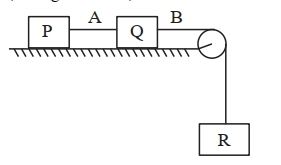
Each of three blocks $P$,$Q$ and $R$ shown in the figure has a mass of $3 \,kg$. Each of the wires $A$ and $B$ has a cross-sectional area of $0.005 \,cm^2$ and a Young's modulus of $2 \times 10^{11} \,N \,m^{-2}$. Neglecting friction,the longitudinal strain on wire $B$ is . . . . . . $\times 10^{-4}$. (Take $g=10 \,m/s^2$)
A
$7$
B
$5$
C
$4$
D
$2$
Solution
(D) Let the mass of each block be $m = 3 \,kg$. The total mass of the system is $3m = 9 \,kg$.
The driving force is the weight of block $R$,which is $F = mg = 3 \times 10 = 30 \,N$.
The acceleration of the system is $a = \frac{F}{\text{total mass}} = \frac{30}{3m} = \frac{30}{9} = \frac{10}{3} \,m/s^2$.
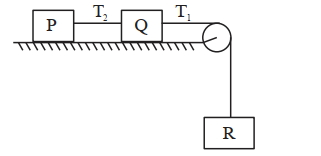
Wire $B$ connects block $R$ to block $Q$. The tension $T_1$ in wire $B$ can be found by considering the motion of block $R$:
$mg - T_1 = ma$
$30 - T_1 = 3 \times \frac{10}{3} = 10$
$T_1 = 30 - 10 = 20 \,N$.
The stress in wire $B$ is $\sigma = \frac{T_1}{A}$,where $A = 0.005 \,cm^2 = 0.005 \times 10^{-4} \,m^2 = 5 \times 10^{-7} \,m^2$.
$\sigma = \frac{20}{5 \times 10^{-7}} = 4 \times 10^7 \,N/m^2$.
The longitudinal strain is $\epsilon = \frac{\sigma}{Y} = \frac{4 \times 10^7}{2 \times 10^{11}} = 2 \times 10^{-4}$.
Thus,the strain is $2 \times 10^{-4}$.
The driving force is the weight of block $R$,which is $F = mg = 3 \times 10 = 30 \,N$.
The acceleration of the system is $a = \frac{F}{\text{total mass}} = \frac{30}{3m} = \frac{30}{9} = \frac{10}{3} \,m/s^2$.
Wire $B$ connects block $R$ to block $Q$. The tension $T_1$ in wire $B$ can be found by considering the motion of block $R$:
$mg - T_1 = ma$
$30 - T_1 = 3 \times \frac{10}{3} = 10$
$T_1 = 30 - 10 = 20 \,N$.
The stress in wire $B$ is $\sigma = \frac{T_1}{A}$,where $A = 0.005 \,cm^2 = 0.005 \times 10^{-4} \,m^2 = 5 \times 10^{-7} \,m^2$.
$\sigma = \frac{20}{5 \times 10^{-7}} = 4 \times 10^7 \,N/m^2$.
The longitudinal strain is $\epsilon = \frac{\sigma}{Y} = \frac{4 \times 10^7}{2 \times 10^{11}} = 2 \times 10^{-4}$.
Thus,the strain is $2 \times 10^{-4}$.
0 likesView Solution
67
PhysicsDifficultMCQJEE Main · 2024
The displacement and the increase in the velocity of a moving particle in the time interval of $t$ to $(t+1) s$ are $125 \ m$ and $50 \ m/s$,respectively. The distance travelled by the particle in $(t+2)^{th} s$ is . . . . . . $m$.
A
$24$
B
$175$
C
$458$
D
$157$
Solution
(B) Let the initial velocity at time $t$ be $u$ and acceleration be $a$.
Given that the increase in velocity in $1 \ s$ is $50 \ m/s$,we have $v = u + a(1) = u + 50$.
Thus,$a = 50 \ m/s^2$.
The displacement in the interval $t$ to $t+1$ is given by $s = ut + \frac{1}{2}at^2$. For the interval of $1 \ s$ starting at $t$,the displacement is $s = u(1) + \frac{1}{2}a(1)^2 = 125$.
Substituting $a = 50$,we get $u + 25 = 125$,which implies $u = 100 \ m/s$.
The distance travelled in the $(t+2)^{th}$ second is given by $S_n = u + \frac{a}{2}(2n - 1)$,where $n = t+2$.
However,the question asks for the distance in the $(t+2)^{th}$ second relative to the start of the motion. Since $u$ is the velocity at time $t$,the distance in the next second (the $(t+1)^{th}$ second) is $125 \ m$. The distance in the $(t+2)^{th}$ second is $S = (u+a) + \frac{a}{2} = 100 + 50 + 25 = 175 \ m$.
Given that the increase in velocity in $1 \ s$ is $50 \ m/s$,we have $v = u + a(1) = u + 50$.
Thus,$a = 50 \ m/s^2$.
The displacement in the interval $t$ to $t+1$ is given by $s = ut + \frac{1}{2}at^2$. For the interval of $1 \ s$ starting at $t$,the displacement is $s = u(1) + \frac{1}{2}a(1)^2 = 125$.
Substituting $a = 50$,we get $u + 25 = 125$,which implies $u = 100 \ m/s$.
The distance travelled in the $(t+2)^{th}$ second is given by $S_n = u + \frac{a}{2}(2n - 1)$,where $n = t+2$.
However,the question asks for the distance in the $(t+2)^{th}$ second relative to the start of the motion. Since $u$ is the velocity at time $t$,the distance in the next second (the $(t+1)^{th}$ second) is $125 \ m$. The distance in the $(t+2)^{th}$ second is $S = (u+a) + \frac{a}{2} = 100 + 50 + 25 = 175 \ m$.
0 likesView Solution
68
PhysicsDifficultMCQJEE Main · 2024
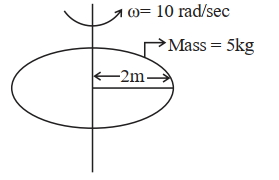
Consider a disc of mass $5 \,kg$ and radius $2 \,m$, rotating with an angular velocity of $10 \,rad/s$ about an axis perpendicular to the plane of rotation and passing through its center. An identical disc is placed gently over the rotating disc along the same axis. The energy dissipated so that both the discs continue to rotate together without slipping is . . . . . . $J$.
A
$349$
B
$248$
C
$78$
D
$250$
Solution
(D) The moment of inertia of the disc is $I = \frac{1}{2} M R^2 = \frac{1}{2} \times 5 \times (2)^2 = 10 \,kg \cdot m^2$.
The initial angular momentum is $L_i = I \omega_i = 10 \times 10 = 100 \,kg \cdot m^2/s$.
The initial kinetic energy is $E_i = \frac{1}{2} I \omega_i^2 = \frac{1}{2} \times 10 \times (10)^2 = 500 \,J$.
When an identical disc is placed on top, the final moment of inertia becomes $I_f = I + I = 2I = 20 \,kg \cdot m^2$.
By the conservation of angular momentum, $L_i = L_f$, so $100 = I_f \omega_f = 20 \omega_f$.
Thus, the final angular velocity is $\omega_f = \frac{100}{20} = 5 \,rad/s$.
The final kinetic energy is $E_f = \frac{1}{2} I_f \omega_f^2 = \frac{1}{2} \times 20 \times (5)^2 = 10 \times 25 = 250 \,J$.
The energy dissipated is $\Delta E = E_i - E_f = 500 \,J - 250 \,J = 250 \,J$.
The initial angular momentum is $L_i = I \omega_i = 10 \times 10 = 100 \,kg \cdot m^2/s$.
The initial kinetic energy is $E_i = \frac{1}{2} I \omega_i^2 = \frac{1}{2} \times 10 \times (10)^2 = 500 \,J$.
When an identical disc is placed on top, the final moment of inertia becomes $I_f = I + I = 2I = 20 \,kg \cdot m^2$.
By the conservation of angular momentum, $L_i = L_f$, so $100 = I_f \omega_f = 20 \omega_f$.
Thus, the final angular velocity is $\omega_f = \frac{100}{20} = 5 \,rad/s$.
The final kinetic energy is $E_f = \frac{1}{2} I_f \omega_f^2 = \frac{1}{2} \times 20 \times (5)^2 = 10 \times 25 = 250 \,J$.
The energy dissipated is $\Delta E = E_i - E_f = 500 \,J - 250 \,J = 250 \,J$.
0 likesView Solution
69
PhysicsDifficultMCQJEE Main · 2024
In a closed organ pipe,the frequency of the fundamental note is $30 \,Hz$. $A$ certain amount of water is now poured into the organ pipe so that the fundamental frequency increases to $110 \,Hz$. If the organ pipe has a cross-sectional area of $2 \,cm^2$,the amount of water poured into the organ tube is . . . . . . $g$. (Take the speed of sound in air as $330 \,m/s$)
A
$400$
B
$200$
C
$600$
D
$800$
Solution
(A) For a closed organ pipe,the fundamental frequency is given by $f = \frac{v}{4L}$.
Initially,$f_1 = 30 \,Hz$ and $v = 330 \,m/s$,so $L_1 = \frac{330}{4 \times 30} = \frac{330}{120} = 2.75 \,m$.
After pouring water,the new length of the air column is $L_2$. The new frequency is $f_2 = 110 \,Hz$.
$L_2 = \frac{330}{4 \times 110} = \frac{330}{440} = 0.75 \,m$.
The change in the length of the air column is $\Delta L = L_1 - L_2 = 2.75 - 0.75 = 2.0 \,m = 200 \,cm$.
The volume of water poured is $V = A \times \Delta L = 2 \,cm^2 \times 200 \,cm = 400 \,cm^3$.
Since the density of water is $1 \,g/cm^3$,the mass of water is $400 \,g$.
Initially,$f_1 = 30 \,Hz$ and $v = 330 \,m/s$,so $L_1 = \frac{330}{4 \times 30} = \frac{330}{120} = 2.75 \,m$.
After pouring water,the new length of the air column is $L_2$. The new frequency is $f_2 = 110 \,Hz$.
$L_2 = \frac{330}{4 \times 110} = \frac{330}{440} = 0.75 \,m$.
The change in the length of the air column is $\Delta L = L_1 - L_2 = 2.75 - 0.75 = 2.0 \,m = 200 \,cm$.
The volume of water poured is $V = A \times \Delta L = 2 \,cm^2 \times 200 \,cm = 400 \,cm^3$.
Since the density of water is $1 \,g/cm^3$,the mass of water is $400 \,g$.
0 likesView Solution
70
PhysicsMediumMCQJEE Main · 2024
If $50$ Vernier divisions are equal to $49$ main scale divisions of a travelling microscope and one smallest reading of main scale is $0.5 \,mm$, the Vernier constant of travelling microscope is:
A
$0.1 \,mm$
B
$0.1 \,cm$
C
$0.01 \,cm$
D
$0.01 \,mm$
Solution
(D) The Vernier constant $(VC)$ is defined as the difference between one main scale division $(MSD)$ and one Vernier scale division $(VSD)$.
Given: $50 \,VSD = 49 \,MSD$.
Therefore, $1 \,VSD = \frac{49}{50} \,MSD$.
The smallest reading of the main scale $(MSD)$ is $0.5 \,mm$.
$VC = 1 \,MSD - 1 \,VSD = 1 \,MSD - \frac{49}{50} \,MSD = \frac{1}{50} \,MSD$.
Substituting the value of $MSD = 0.5 \,mm$:
$VC = \frac{0.5 \,mm}{50} = \frac{0.5}{50} \,mm = 0.01 \,mm$.
Given: $50 \,VSD = 49 \,MSD$.
Therefore, $1 \,VSD = \frac{49}{50} \,MSD$.
The smallest reading of the main scale $(MSD)$ is $0.5 \,mm$.
$VC = 1 \,MSD - 1 \,VSD = 1 \,MSD - \frac{49}{50} \,MSD = \frac{1}{50} \,MSD$.
Substituting the value of $MSD = 0.5 \,mm$:
$VC = \frac{0.5 \,mm}{50} = \frac{0.5}{50} \,mm = 0.01 \,mm$.
1 likesView Solution
71
PhysicsDifficultMCQJEE Main · 2024
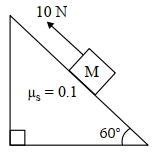
$A$ block of mass $1 \ kg$ is pushed up a surface inclined to the horizontal at an angle of $60^{\circ}$ by a force of $10 \ N$ parallel to the inclined surface as shown in the figure. When the block is pushed up by $10 \ m$ along the inclined surface,the work done against the frictional force is: $\left[g=10 \ m/s^2, \mu_s = 0.1\right]$
A
$5 \sqrt{3} \ J$
B
$5 \ J$
C
$5 \times 10^3 \ J$
D
$10 \ J$
Solution
(B) The normal force $N$ acting on the block is given by $N = mg \cos \theta$.
Given: $m = 1 \ kg$,$g = 10 \ m/s^2$,$\theta = 60^{\circ}$,and $\mu_s = 0.1$.
$N = 1 \times 10 \times \cos(60^{\circ}) = 10 \times 0.5 = 5 \ N$.
The frictional force $f$ is given by $f = \mu_s N$.
$f = 0.1 \times 5 = 0.5 \ N$.
The work done against the frictional force over a distance $d = 10 \ m$ is:
$W = f \times d = 0.5 \times 10 = 5 \ J$.
Given: $m = 1 \ kg$,$g = 10 \ m/s^2$,$\theta = 60^{\circ}$,and $\mu_s = 0.1$.
$N = 1 \times 10 \times \cos(60^{\circ}) = 10 \times 0.5 = 5 \ N$.
The frictional force $f$ is given by $f = \mu_s N$.
$f = 0.1 \times 5 = 0.5 \ N$.
The work done against the frictional force over a distance $d = 10 \ m$ is:
$W = f \times d = 0.5 \times 10 = 5 \ J$.
0 likesView Solution
72
PhysicsMediumMCQJEE Main · 2024
$A$ block of ice at $-10^{\circ} C$ is slowly heated and converted to steam at $100^{\circ} C$. Which of the following curves represent the phenomenon qualitatively:
A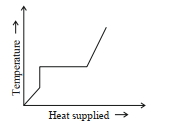
B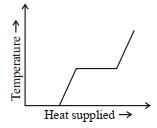
C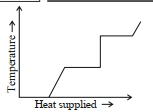
D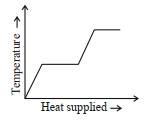
Solution
(C) The process of heating ice at $-10^{\circ} C$ to steam at $100^{\circ} C$ involves several stages:
$1$. Heating ice from $-10^{\circ} C$ to $0^{\circ} C$: Temperature increases linearly with heat supplied.
$2$. Melting ice at $0^{\circ} C$ to water at $0^{\circ} C$: Temperature remains constant (phase change,latent heat of fusion).
$3$. Heating water from $0^{\circ} C$ to $100^{\circ} C$: Temperature increases linearly with heat supplied.
$4$. Boiling water at $100^{\circ} C$ to steam at $100^{\circ} C$: Temperature remains constant (phase change,latent heat of vaporization).
Thus,the heating curve should show two distinct horizontal segments representing the phase changes at $0^{\circ} C$ and $100^{\circ} C$,separated by a rising segment for water heating,and followed by a rising segment for steam heating. Graph $C$ correctly depicts these two phase changes (horizontal lines) and the intermediate heating stages.
$1$. Heating ice from $-10^{\circ} C$ to $0^{\circ} C$: Temperature increases linearly with heat supplied.
$2$. Melting ice at $0^{\circ} C$ to water at $0^{\circ} C$: Temperature remains constant (phase change,latent heat of fusion).
$3$. Heating water from $0^{\circ} C$ to $100^{\circ} C$: Temperature increases linearly with heat supplied.
$4$. Boiling water at $100^{\circ} C$ to steam at $100^{\circ} C$: Temperature remains constant (phase change,latent heat of vaporization).
Thus,the heating curve should show two distinct horizontal segments representing the phase changes at $0^{\circ} C$ and $100^{\circ} C$,separated by a rising segment for water heating,and followed by a rising segment for steam heating. Graph $C$ correctly depicts these two phase changes (horizontal lines) and the intermediate heating stages.
0 likesView Solution
73
PhysicsDifficultMCQJEE Main · 2024
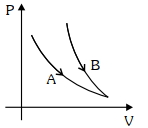
Choose the correct statement for processes $A$ and $B$ shown in the figure.
A
$PV^\gamma = k$ for process $B$ and $PV = k$ for process $A$.
B
$PV = k$ for process $B$ and $A$.
C
$\frac{P^{\gamma-1}}{T^\gamma} = k$ for process $B$ and $T = k$ for process $A$.
D
$\frac{T^\gamma}{P^{\gamma-1}} = k$ for process $A$ and $PV = k$ for process $B$.
Solution
(A) In a $P-V$ diagram,the slope of an adiabatic process is $\gamma$ times the slope of an isothermal process. Therefore,the steeper curve represents an adiabatic process.
$1$. Curve $B$ is steeper than curve $A$,so process $B$ is adiabatic. The equation for an adiabatic process is $PV^\gamma = k$.
$2$. Curve $A$ is less steep,so process $A$ is isothermal. The equation for an isothermal process is $PV = k$.
Comparing this with the given options,option $A$ correctly identifies process $B$ as adiabatic $(PV^\gamma = k)$ and process $A$ as isothermal $(PV = k)$.
$1$. Curve $B$ is steeper than curve $A$,so process $B$ is adiabatic. The equation for an adiabatic process is $PV^\gamma = k$.
$2$. Curve $A$ is less steep,so process $A$ is isothermal. The equation for an isothermal process is $PV = k$.
Comparing this with the given options,option $A$ correctly identifies process $B$ as adiabatic $(PV^\gamma = k)$ and process $A$ as isothermal $(PV = k)$.
0 likesView Solution
74
PhysicsDifficultMCQJEE Main · 2024
$A$ block of mass $m$ is placed on a surface having a vertical cross-section given by $y = x^2 / 4$. If the coefficient of friction is $0.5$,the maximum height above the ground at which the block can be placed without slipping is:
A
$1/4 \ m$
B
$1/2 \ m$
C
$1/6 \ m$
D
$1/3 \ m$
Solution
(A) The condition for a block to remain at rest on an inclined surface without slipping is that the angle of inclination $\theta$ must be less than or equal to the angle of repose $\phi$,where $\tan \phi = \mu$.
Given the surface equation $y = x^2 / 4$,the slope at any point $x$ is given by the derivative $\frac{dy}{dx} = \tan \theta$.
$\frac{dy}{dx} = \frac{d}{dx} (x^2 / 4) = \frac{2x}{4} = \frac{x}{2}$.
For the block to be at the maximum height without slipping,the slope must equal the coefficient of friction $\mu = 0.5$.
So,$\frac{x}{2} = 0.5$,which gives $x = 1$.
Substituting $x = 1$ into the equation of the surface $y = x^2 / 4$,we get the maximum height $y = (1)^2 / 4 = 1/4 \ m$.
Given the surface equation $y = x^2 / 4$,the slope at any point $x$ is given by the derivative $\frac{dy}{dx} = \tan \theta$.
$\frac{dy}{dx} = \frac{d}{dx} (x^2 / 4) = \frac{2x}{4} = \frac{x}{2}$.
For the block to be at the maximum height without slipping,the slope must equal the coefficient of friction $\mu = 0.5$.
So,$\frac{x}{2} = 0.5$,which gives $x = 1$.
Substituting $x = 1$ into the equation of the surface $y = x^2 / 4$,we get the maximum height $y = (1)^2 / 4 = 1/4 \ m$.
0 likesView Solution
75
PhysicsDifficultMCQJEE Main · 2024
The escape velocity of a body from the Earth is $11.2 \,km/s$. If the radius of a planet is one-third the radius of the Earth and its mass is one-sixth that of the Earth, the escape velocity from the planet is: (in $\,km/s$)
A
$11.2$
B
$8.4$
C
$4.2$
D
$7.9$
Solution
(D) The formula for escape velocity is $V_e = \sqrt{\frac{2GM}{R}}$.
Given for Earth: $V_E = 11.2 \,km/s$, $M_E$, and $R_E$.
For the planet: $M_P = \frac{M_E}{6}$ and $R_P = \frac{R_E}{3}$.
The escape velocity for the planet is $V_P = \sqrt{\frac{2GM_P}{R_P}}$.
Substituting the values: $V_P = \sqrt{\frac{2G(M_E/6)}{(R_E/3)}} = \sqrt{\frac{2GM_E}{R_E} \times \frac{3}{6}} = \sqrt{\frac{2GM_E}{R_E} \times \frac{1}{2}}$.
Since $V_E = \sqrt{\frac{2GM_E}{R_E}} = 11.2 \,km/s$, we have $V_P = \frac{V_E}{\sqrt{2}}$.
$V_P = \frac{11.2}{1.414} \approx 7.9 \,km/s$.
Given for Earth: $V_E = 11.2 \,km/s$, $M_E$, and $R_E$.
For the planet: $M_P = \frac{M_E}{6}$ and $R_P = \frac{R_E}{3}$.
The escape velocity for the planet is $V_P = \sqrt{\frac{2GM_P}{R_P}}$.
Substituting the values: $V_P = \sqrt{\frac{2G(M_E/6)}{(R_E/3)}} = \sqrt{\frac{2GM_E}{R_E} \times \frac{3}{6}} = \sqrt{\frac{2GM_E}{R_E} \times \frac{1}{2}}$.
Since $V_E = \sqrt{\frac{2GM_E}{R_E}} = 11.2 \,km/s$, we have $V_P = \frac{V_E}{\sqrt{2}}$.
$V_P = \frac{11.2}{1.414} \approx 7.9 \,km/s$.
0 likesView Solution
76
PhysicsDifficultMCQJEE Main · 2024
If mass is written as $m=kc^{p} G^{-1 / 2} \,h^{1 / 2}$ then the value of $P$ will be : (Constants have their usual meaning with $k$ a dimensionless constant)
A
$1 / 2$
B
$1 / 3$
C
$2$
D
$-1 / 3$
Solution
(A) Given the formula for mass: $m = k c^{P} G^{-1/2} h^{1/2}$.
We use the dimensional formulas for each constant:
$c$ (speed of light) $= [L T^{-1}]$
$G$ (gravitational constant) $= [M^{-1} L^3 T^{-2}]$
$h$ (Planck's constant) $= [M L^2 T^{-1}]$
Substituting these dimensions into the equation:
$[M^1 L^0 T^0] = [L T^{-1}]^{P} [M^{-1} L^3 T^{-2}]^{-1/2} [M L^2 T^{-1}]^{1/2}$
$[M^1 L^0 T^0] = [L^P T^{-P}] [M^{1/2} L^{-3/2} T^1] [M^{1/2} L^1 T^{-1/2}]$
Combining the powers of $M$,$L$,and $T$ on the right side:
$M: 1/2 + 1/2 = 1$
$L: P - 3/2 + 1 = P - 1/2$
$T: -P + 1 - 1/2 = -P + 1/2$
Comparing the powers of $L$ on both sides:
$P - 1/2 = 0 \implies P = 1/2$.
Thus,the value of $P$ is $1/2$.
We use the dimensional formulas for each constant:
$c$ (speed of light) $= [L T^{-1}]$
$G$ (gravitational constant) $= [M^{-1} L^3 T^{-2}]$
$h$ (Planck's constant) $= [M L^2 T^{-1}]$
Substituting these dimensions into the equation:
$[M^1 L^0 T^0] = [L T^{-1}]^{P} [M^{-1} L^3 T^{-2}]^{-1/2} [M L^2 T^{-1}]^{1/2}$
$[M^1 L^0 T^0] = [L^P T^{-P}] [M^{1/2} L^{-3/2} T^1] [M^{1/2} L^1 T^{-1/2}]$
Combining the powers of $M$,$L$,and $T$ on the right side:
$M: 1/2 + 1/2 = 1$
$L: P - 3/2 + 1 = P - 1/2$
$T: -P + 1 - 1/2 = -P + 1/2$
Comparing the powers of $L$ on both sides:
$P - 1/2 = 0 \implies P = 1/2$.
Thus,the value of $P$ is $1/2$.
0 likesView Solution
77
PhysicsDifficultMCQJEE Main · 2024
If three moles of monoatomic gas $\left(\gamma=\frac{5}{3}\right)$ is mixed with two moles of a diatomic gas $\left(\gamma=\frac{7}{5}\right)$,the value of adiabatic exponent $\gamma$ for the mixture is:
A
$1.75$
B
$1.40$
C
$1.52$
D
$1.35$
Solution
(C) For a monoatomic gas,the degrees of freedom $f_1 = 3$. For a diatomic gas,the degrees of freedom $f_2 = 5$.
Given $n_1 = 3$ moles and $n_2 = 2$ moles.
The degrees of freedom for the mixture is given by $f_{\text{mix}} = \frac{n_1 f_1 + n_2 f_2}{n_1 + n_2}$.
Substituting the values: $f_{\text{mix}} = \frac{3(3) + 2(5)}{3 + 2} = \frac{9 + 10}{5} = \frac{19}{5} = 3.8$.
The adiabatic exponent $\gamma$ is related to the degrees of freedom $f$ by the formula $\gamma = 1 + \frac{2}{f}$.
Therefore,$\gamma_{\text{mix}} = 1 + \frac{2}{f_{\text{mix}}} = 1 + \frac{2}{3.8} = 1 + \frac{20}{38} = 1 + \frac{10}{19} = \frac{29}{19} \approx 1.526$.
Rounding to two decimal places,we get $\gamma_{\text{mix}} = 1.52$.
Given $n_1 = 3$ moles and $n_2 = 2$ moles.
The degrees of freedom for the mixture is given by $f_{\text{mix}} = \frac{n_1 f_1 + n_2 f_2}{n_1 + n_2}$.
Substituting the values: $f_{\text{mix}} = \frac{3(3) + 2(5)}{3 + 2} = \frac{9 + 10}{5} = \frac{19}{5} = 3.8$.
The adiabatic exponent $\gamma$ is related to the degrees of freedom $f$ by the formula $\gamma = 1 + \frac{2}{f}$.
Therefore,$\gamma_{\text{mix}} = 1 + \frac{2}{f_{\text{mix}}} = 1 + \frac{2}{3.8} = 1 + \frac{20}{38} = 1 + \frac{10}{19} = \frac{29}{19} \approx 1.526$.
Rounding to two decimal places,we get $\gamma_{\text{mix}} = 1.52$.
0 likesView Solution
78
PhysicsDifficultMCQJEE Main · 2024
Three blocks $A$,$B$,and $C$ of masses $5 \text{ kg}$,$3 \text{ kg}$,and $2 \text{ kg}$ respectively are pulled on a horizontal smooth surface by a force of $80 \text{ N}$ as shown in the figure. The tensions $T_1$ and $T_2$ in the strings are respectively:

A
$40 \text{ N}, 64 \text{ N}$
B
$60 \text{ N}, 80 \text{ N}$
C
$88 \text{ N}, 96 \text{ N}$
D
$80 \text{ N}, 100 \text{ N}$
Solution
(A) The total mass of the system is $M = m_A + m_B + m_C = 5 \text{ kg} + 3 \text{ kg} + 2 \text{ kg} = 10 \text{ kg}$.
Since the surface is smooth,the acceleration $a$ of the system is given by $a = \frac{F}{M} = \frac{80 \text{ N}}{10 \text{ kg}} = 8 \text{ m/s}^2$.
For block $A$ $(5 \text{ kg})$,the only horizontal force acting is the tension $T_1$. Therefore,$T_1 = m_A \times a = 5 \text{ kg} \times 8 \text{ m/s}^2 = 40 \text{ N}$.
For block $B$ $(3 \text{ kg})$,the forces acting are $T_2$ (pulling forward) and $T_1$ (pulling backward). Therefore,$T_2 - T_1 = m_B \times a$.
Substituting the values,$T_2 - 40 \text{ N} = 3 \text{ kg} \times 8 \text{ m/s}^2 = 24 \text{ N}$.
Thus,$T_2 = 40 \text{ N} + 24 \text{ N} = 64 \text{ N}$.
Therefore,the tensions $T_1$ and $T_2$ are $40 \text{ N}$ and $64 \text{ N}$ respectively.
Since the surface is smooth,the acceleration $a$ of the system is given by $a = \frac{F}{M} = \frac{80 \text{ N}}{10 \text{ kg}} = 8 \text{ m/s}^2$.
For block $A$ $(5 \text{ kg})$,the only horizontal force acting is the tension $T_1$. Therefore,$T_1 = m_A \times a = 5 \text{ kg} \times 8 \text{ m/s}^2 = 40 \text{ N}$.
For block $B$ $(3 \text{ kg})$,the forces acting are $T_2$ (pulling forward) and $T_1$ (pulling backward). Therefore,$T_2 - T_1 = m_B \times a$.
Substituting the values,$T_2 - 40 \text{ N} = 3 \text{ kg} \times 8 \text{ m/s}^2 = 24 \text{ N}$.
Thus,$T_2 = 40 \text{ N} + 24 \text{ N} = 64 \text{ N}$.
Therefore,the tensions $T_1$ and $T_2$ are $40 \text{ N}$ and $64 \text{ N}$ respectively.
0 likesView Solution
79
PhysicsDifficultMCQJEE Main · 2024
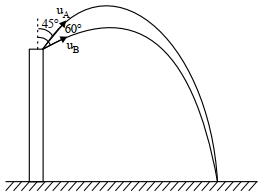
Projectiles $A$ and $B$ are thrown at angles of $45^{\circ}$ and $60^{\circ}$ with the vertical,respectively,from the top of a $400 \ m$ high tower. If their ranges and times of flight are the same,the ratio of their speeds of projection $v_A : v_B$ is:
A
$1 : \sqrt{3}$
B
$\sqrt{2} : 1$
C
$1 : 2$
D
$1 : \sqrt{2}$
Solution
(D) Let the angles with the horizontal be $\theta_A$ and $\theta_B$. Given angles with vertical are $45^{\circ}$ and $60^{\circ}$,so $\theta_A = 90^{\circ} - 45^{\circ} = 45^{\circ}$ and $\theta_B = 90^{\circ} - 60^{\circ} = 30^{\circ}$.
For a projectile thrown from height $h$,the time of flight $T$ is given by $h = -u \sin \theta T + \frac{1}{2} g T^2$. Since $T$ is the same for both,the vertical components of initial velocity must be equal: $v_A \sin \theta_A = v_B \sin \theta_B$.
$v_A \sin 45^{\circ} = v_B \sin 30^{\circ} \implies v_A (\frac{1}{\sqrt{2}}) = v_B (\frac{1}{2}) \implies \frac{v_A}{v_B} = \frac{\sqrt{2}}{2} = \frac{1}{\sqrt{2}}$.
Also,the range $R = (v \cos \theta) T$. Since $R$ and $T$ are same,$v_A \cos \theta_A = v_B \cos \theta_B$.
$v_A \cos 45^{\circ} = v_B \cos 30^{\circ} \implies v_A (\frac{1}{\sqrt{2}}) = v_B (\frac{\sqrt{3}}{2}) \implies \frac{v_A}{v_B} = \frac{\sqrt{6}}{2} = \sqrt{\frac{3}{2}}$.
Since the two conditions lead to different ratios,the problem statement is physically inconsistent. However,if we assume the vertical components are equal to satisfy the time of flight condition,the ratio is $1 : \sqrt{2}$.
For a projectile thrown from height $h$,the time of flight $T$ is given by $h = -u \sin \theta T + \frac{1}{2} g T^2$. Since $T$ is the same for both,the vertical components of initial velocity must be equal: $v_A \sin \theta_A = v_B \sin \theta_B$.
$v_A \sin 45^{\circ} = v_B \sin 30^{\circ} \implies v_A (\frac{1}{\sqrt{2}}) = v_B (\frac{1}{2}) \implies \frac{v_A}{v_B} = \frac{\sqrt{2}}{2} = \frac{1}{\sqrt{2}}$.
Also,the range $R = (v \cos \theta) T$. Since $R$ and $T$ are same,$v_A \cos \theta_A = v_B \cos \theta_B$.
$v_A \cos 45^{\circ} = v_B \cos 30^{\circ} \implies v_A (\frac{1}{\sqrt{2}}) = v_B (\frac{\sqrt{3}}{2}) \implies \frac{v_A}{v_B} = \frac{\sqrt{6}}{2} = \sqrt{\frac{3}{2}}$.
Since the two conditions lead to different ratios,the problem statement is physically inconsistent. However,if we assume the vertical components are equal to satisfy the time of flight condition,the ratio is $1 : \sqrt{2}$.
0 likesView Solution
80
PhysicsDifficultMCQJEE Main · 2024
$A$ big drop is formed by coalescing $1000$ small identical drops of water. If $E_1$ be the total surface energy of $1000$ small drops of water and $E_2$ be the surface energy of the single big drop of water,then the ratio $E_1 : E_2$ is $x : 1$,where $x = . . . . . . $.
A
$10$
B
$100$
C
$1000$
D
$1$
Solution
(A) Let $r$ be the radius of each small drop and $R$ be the radius of the big drop.
Since the volume remains conserved during the coalescence of $1000$ small drops into one big drop:
$1000 \times (\frac{4}{3} \pi r^3) = \frac{4}{3} \pi R^3$
$R^3 = 1000 r^3 \implies R = 10r$.
Surface energy $E$ is given by $E = S \times A$,where $S$ is surface tension and $A$ is the surface area.
Total surface energy of $1000$ small drops: $E_1 = 1000 \times (4 \pi r^2 \times S) = 4000 \pi r^2 S$.
Surface energy of the big drop: $E_2 = 4 \pi R^2 S = 4 \pi (10r)^2 S = 400 \pi r^2 S$.
The ratio $E_1 : E_2 = \frac{4000 \pi r^2 S}{400 \pi r^2 S} = \frac{10}{1}$.
Therefore,$x = 10$.
Since the volume remains conserved during the coalescence of $1000$ small drops into one big drop:
$1000 \times (\frac{4}{3} \pi r^3) = \frac{4}{3} \pi R^3$
$R^3 = 1000 r^3 \implies R = 10r$.
Surface energy $E$ is given by $E = S \times A$,where $S$ is surface tension and $A$ is the surface area.
Total surface energy of $1000$ small drops: $E_1 = 1000 \times (4 \pi r^2 \times S) = 4000 \pi r^2 S$.
Surface energy of the big drop: $E_2 = 4 \pi R^2 S = 4 \pi (10r)^2 S = 400 \pi r^2 S$.
The ratio $E_1 : E_2 = \frac{4000 \pi r^2 S}{400 \pi r^2 S} = \frac{10}{1}$.
Therefore,$x = 10$.
0 likesView Solution
81
PhysicsDifficultMCQJEE Main · 2024
Two discs of moment of inertia $I_1 = 4 \ kg \ m^2$ and $I_2 = 2 \ kg \ m^2$ about their central axes and normal to their planes,rotating with angular speeds $10 \ rad/s$ and $4 \ rad/s$ respectively,are brought into contact face to face with their axes of rotation coincident. The loss in kinetic energy of the system in the process is . . . . . . $J$.
A
$20$
B
$22$
C
$24$
D
$30$
Solution
(C) According to the Law of Conservation of Angular Momentum ($C$.$O$.$A$.$M$.),the total angular momentum before contact equals the total angular momentum after contact.
$I_1 \omega_1 + I_2 \omega_2 = (I_1 + I_2) \omega_0$
Substituting the given values: $(4 \times 10) + (2 \times 4) = (4 + 2) \omega_0$
$40 + 8 = 6 \omega_0 \implies 48 = 6 \omega_0 \implies \omega_0 = 8 \ rad/s$.
Initial kinetic energy $E_1 = \frac{1}{2} I_1 \omega_1^2 + \frac{1}{2} I_2 \omega_2^2 = \frac{1}{2}(4)(10)^2 + \frac{1}{2}(2)(4)^2 = 200 + 16 = 216 \ J$.
Final kinetic energy $E_2 = \frac{1}{2}(I_1 + I_2) \omega_0^2 = \frac{1}{2}(4 + 2)(8)^2 = \frac{1}{2}(6)(64) = 3 \times 64 = 192 \ J$.
The loss in kinetic energy $\Delta E = E_1 - E_2 = 216 \ J - 192 \ J = 24 \ J$.
$I_1 \omega_1 + I_2 \omega_2 = (I_1 + I_2) \omega_0$
Substituting the given values: $(4 \times 10) + (2 \times 4) = (4 + 2) \omega_0$
$40 + 8 = 6 \omega_0 \implies 48 = 6 \omega_0 \implies \omega_0 = 8 \ rad/s$.
Initial kinetic energy $E_1 = \frac{1}{2} I_1 \omega_1^2 + \frac{1}{2} I_2 \omega_2^2 = \frac{1}{2}(4)(10)^2 + \frac{1}{2}(2)(4)^2 = 200 + 16 = 216 \ J$.
Final kinetic energy $E_2 = \frac{1}{2}(I_1 + I_2) \omega_0^2 = \frac{1}{2}(4 + 2)(8)^2 = \frac{1}{2}(6)(64) = 3 \times 64 = 192 \ J$.
The loss in kinetic energy $\Delta E = E_1 - E_2 = 216 \ J - 192 \ J = 24 \ J$.
0 likesView Solution
82
PhysicsMediumMCQJEE Main · 2024
$A$ vector has a magnitude the same as that of $\overrightarrow{A} = 3 \hat{i} + 4 \hat{j}$ and is parallel to $\overrightarrow{B} = 4 \hat{i} + 3 \hat{j}$. The $x$ and $y$ components of this vector in the first quadrant are $X$ and $3$ respectively,where $X = $ . . . . . . .
A
$4$
B
$5$
C
$6$
D
$7$
Solution
(A) First,calculate the magnitude of vector $\overrightarrow{A} = 3 \hat{i} + 4 \hat{j}$.
$|\overrightarrow{A}| = \sqrt{3^2 + 4^2} = \sqrt{9 + 16} = \sqrt{25} = 5$.
Next,find the unit vector in the direction of $\overrightarrow{B} = 4 \hat{i} + 3 \hat{j}$.
$|\overrightarrow{B}| = \sqrt{4^2 + 3^2} = \sqrt{16 + 9} = 5$.
$\hat{B} = \frac{\overrightarrow{B}}{|\overrightarrow{B}|} = \frac{4 \hat{i} + 3 \hat{j}}{5}$.
The required vector $\overrightarrow{V}$ has magnitude $5$ and is parallel to $\overrightarrow{B}$,so $\overrightarrow{V} = |\overrightarrow{A}| \hat{B} = 5 \times \frac{4 \hat{i} + 3 \hat{j}}{5} = 4 \hat{i} + 3 \hat{j}$.
Comparing this with the given components $X \hat{i} + 3 \hat{j}$,we find $X = 4$.
$|\overrightarrow{A}| = \sqrt{3^2 + 4^2} = \sqrt{9 + 16} = \sqrt{25} = 5$.
Next,find the unit vector in the direction of $\overrightarrow{B} = 4 \hat{i} + 3 \hat{j}$.
$|\overrightarrow{B}| = \sqrt{4^2 + 3^2} = \sqrt{16 + 9} = 5$.
$\hat{B} = \frac{\overrightarrow{B}}{|\overrightarrow{B}|} = \frac{4 \hat{i} + 3 \hat{j}}{5}$.
The required vector $\overrightarrow{V}$ has magnitude $5$ and is parallel to $\overrightarrow{B}$,so $\overrightarrow{V} = |\overrightarrow{A}| \hat{B} = 5 \times \frac{4 \hat{i} + 3 \hat{j}}{5} = 4 \hat{i} + 3 \hat{j}$.
Comparing this with the given components $X \hat{i} + 3 \hat{j}$,we find $X = 4$.
0 likesView Solution
83
PhysicsDifficultMCQJEE Main · 2024
$A$ simple pendulum is placed at a place where its distance from the earth's surface is equal to the radius of the earth. If the length of the string is $4 \ m$,then the time period of small oscillations will be . . . . . . $s$. [Take $g = \pi^2 \ ms^{-2}$]
A
$5$
B
$6$
C
$7$
D
$8$
Solution
(D) The acceleration due to gravity at a height $h$ above the earth's surface is given by $g' = g \left( \frac{R}{R+h} \right)^2$.
Given $h = R$,the acceleration due to gravity becomes $g' = g \left( \frac{R}{R+R} \right)^2 = g \left( \frac{1}{2} \right)^2 = \frac{g}{4}$.
The time period of a simple pendulum is given by $T = 2\pi \sqrt{\frac{\ell}{g'}}$.
Substituting $\ell = 4 \ m$ and $g' = \frac{g}{4}$,we get $T = 2\pi \sqrt{\frac{4}{g/4}} = 2\pi \sqrt{\frac{16}{g}}$.
Given $g = \pi^2 \ ms^{-2}$,we substitute this into the equation:
$T = 2\pi \sqrt{\frac{16}{\pi^2}} = 2\pi \left( \frac{4}{\pi} \right) = 8 \ s$.
Given $h = R$,the acceleration due to gravity becomes $g' = g \left( \frac{R}{R+R} \right)^2 = g \left( \frac{1}{2} \right)^2 = \frac{g}{4}$.
The time period of a simple pendulum is given by $T = 2\pi \sqrt{\frac{\ell}{g'}}$.
Substituting $\ell = 4 \ m$ and $g' = \frac{g}{4}$,we get $T = 2\pi \sqrt{\frac{4}{g/4}} = 2\pi \sqrt{\frac{16}{g}}$.
Given $g = \pi^2 \ ms^{-2}$,we substitute this into the equation:
$T = 2\pi \sqrt{\frac{16}{\pi^2}} = 2\pi \left( \frac{4}{\pi} \right) = 8 \ s$.
0 likesView Solution
84
PhysicsDifficultMCQJEE Main · 2024
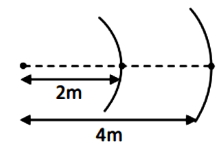
$A$ point source is emitting sound waves of intensity $16 \times 10^{-8} \text{ W m}^{-2}$ at a distance of $1 \text{ m}$ from the source. The difference in intensity (magnitude only) at two points located at distances of $2 \text{ m}$ and $4 \text{ m}$ from the source respectively will be . . . . . . $\times 10^{-8} \text{ W m}^{-2}$.
A
$3$
B
$2$
C
$1$
D
$5$
Solution
(A) For a point source,the intensity $I$ at a distance $r$ is given by the inverse square law: $I \propto \frac{1}{r^2}$.
Let $I_0$ be the intensity at $r_0 = 1 \text{ m}$,where $I_0 = 16 \times 10^{-8} \text{ W m}^{-2}$.
The intensity at distance $r$ is $I(r) = \frac{I_0 \cdot r_0^2}{r^2} = \frac{16 \times 10^{-8} \times (1)^2}{r^2} = \frac{16 \times 10^{-8}}{r^2} \text{ W m}^{-2}$.
At $r_1 = 2 \text{ m}$,the intensity is $I_1 = \frac{16 \times 10^{-8}}{2^2} = \frac{16 \times 10^{-8}}{4} = 4 \times 10^{-8} \text{ W m}^{-2}$.
At $r_2 = 4 \text{ m}$,the intensity is $I_2 = \frac{16 \times 10^{-8}}{4^2} = \frac{16 \times 10^{-8}}{16} = 1 \times 10^{-8} \text{ W m}^{-2}$.
The difference in intensity is $|I_1 - I_2| = |4 \times 10^{-8} - 1 \times 10^{-8}| = 3 \times 10^{-8} \text{ W m}^{-2}$.
Thus,the value is $3$.
Let $I_0$ be the intensity at $r_0 = 1 \text{ m}$,where $I_0 = 16 \times 10^{-8} \text{ W m}^{-2}$.
The intensity at distance $r$ is $I(r) = \frac{I_0 \cdot r_0^2}{r^2} = \frac{16 \times 10^{-8} \times (1)^2}{r^2} = \frac{16 \times 10^{-8}}{r^2} \text{ W m}^{-2}$.
At $r_1 = 2 \text{ m}$,the intensity is $I_1 = \frac{16 \times 10^{-8}}{2^2} = \frac{16 \times 10^{-8}}{4} = 4 \times 10^{-8} \text{ W m}^{-2}$.
At $r_2 = 4 \text{ m}$,the intensity is $I_2 = \frac{16 \times 10^{-8}}{4^2} = \frac{16 \times 10^{-8}}{16} = 1 \times 10^{-8} \text{ W m}^{-2}$.
The difference in intensity is $|I_1 - I_2| = |4 \times 10^{-8} - 1 \times 10^{-8}| = 3 \times 10^{-8} \text{ W m}^{-2}$.
Thus,the value is $3$.
0 likesView Solution
85
PhysicsDifficultMCQJEE Main · 2024
The parameter that remains the same for molecules of all gases at a given temperature is:
A
kinetic energy
B
momentum
C
mass
D
speed
Solution
(A) According to the Kinetic Theory of Gases,the average translational kinetic energy of a gas molecule is given by the formula: $KE_{avg} = \frac{3}{2} kT$,where $k$ is the Boltzmann constant and $T$ is the absolute temperature.
Since $k$ is a universal constant and $T$ is given as constant for all gases,the average kinetic energy depends only on the temperature.
Therefore,at a given temperature,the average kinetic energy of molecules of all gases remains the same,regardless of the nature of the gas.
Since $k$ is a universal constant and $T$ is given as constant for all gases,the average kinetic energy depends only on the temperature.
Therefore,at a given temperature,the average kinetic energy of molecules of all gases remains the same,regardless of the nature of the gas.
0 likesView Solution
86
PhysicsDifficultMCQJEE Main · 2024
The relation between time $t$ and distance $x$ is $t = \alpha x^2 + \beta x$,where $\alpha$ and $\beta$ are constants. The relation between acceleration $a$ and velocity $v$ is:
A
$a = -2 \alpha v^3$
B
$a = -5 \alpha v^5$
C
$a = -3 \alpha v^2$
D
$a = -4 \alpha v^4$
Solution
(A) Given the relation: $t = \alpha x^2 + \beta x$.
Differentiating with respect to $x$:
$\frac{dt}{dx} = 2 \alpha x + \beta$.
Since $v = \frac{dx}{dt}$,we have $\frac{dt}{dx} = \frac{1}{v}$.
Therefore,$\frac{1}{v} = 2 \alpha x + \beta$.
Differentiating both sides with respect to $t$:
$-\frac{1}{v^2} \frac{dv}{dt} = 2 \alpha \frac{dx}{dt}$.
Since $a = \frac{dv}{dt}$ and $v = \frac{dx}{dt}$,we substitute these:
$-\frac{1}{v^2} a = 2 \alpha v$.
Rearranging for $a$:
$a = -2 \alpha v^3$.
Differentiating with respect to $x$:
$\frac{dt}{dx} = 2 \alpha x + \beta$.
Since $v = \frac{dx}{dt}$,we have $\frac{dt}{dx} = \frac{1}{v}$.
Therefore,$\frac{1}{v} = 2 \alpha x + \beta$.
Differentiating both sides with respect to $t$:
$-\frac{1}{v^2} \frac{dv}{dt} = 2 \alpha \frac{dx}{dt}$.
Since $a = \frac{dv}{dt}$ and $v = \frac{dx}{dt}$,we substitute these:
$-\frac{1}{v^2} a = 2 \alpha v$.
Rearranging for $a$:
$a = -2 \alpha v^3$.
0 likesView Solution
87
PhysicsDifficultMCQJEE Main · 2024
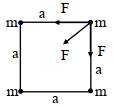
Four identical particles of mass $m$ are kept at the four corners of a square. If the gravitational force exerted on one of the masses by the other masses is $\left(\frac{2 \sqrt{2}+1}{32}\right) \frac{Gm^2}{L^2}$,the length of the sides of the square is
A
$\frac{L}{2}$
B
$4 L$
C
$3 L$
D
$2 L$
Solution
(B) Let the side length of the square be $a$. Consider one of the masses at a corner. It experiences gravitational forces from the other three masses.
Two masses are at a distance $a$ (adjacent corners),and one mass is at a distance $\sqrt{2}a$ (opposite corner).
The forces from the two adjacent masses are $F = \frac{Gm^2}{a^2}$ each,acting at an angle of $90^\circ$. Their resultant is $\sqrt{F^2 + F^2} = \sqrt{2}F = \sqrt{2} \frac{Gm^2}{a^2}$.
The force from the opposite mass is $F' = \frac{Gm^2}{(\sqrt{2}a)^2} = \frac{Gm^2}{2a^2}$.
Both these forces act along the diagonal of the square,so the net force is:
$F_{\text{net}} = \sqrt{2} \frac{Gm^2}{a^2} + \frac{Gm^2}{2a^2} = \frac{Gm^2}{a^2} \left( \sqrt{2} + \frac{1}{2} \right) = \frac{Gm^2}{a^2} \left( \frac{2\sqrt{2} + 1}{2} \right)$.
Given that $F_{\text{net}} = \left( \frac{2\sqrt{2} + 1}{32} \right) \frac{Gm^2}{L^2}$,we equate the two expressions:
$\frac{Gm^2}{a^2} \left( \frac{2\sqrt{2} + 1}{2} \right) = \left( \frac{2\sqrt{2} + 1}{32} \right) \frac{Gm^2}{L^2}$.
$\frac{1}{2a^2} = \frac{1}{32L^2} \implies a^2 = 16L^2 \implies a = 4L$.
Two masses are at a distance $a$ (adjacent corners),and one mass is at a distance $\sqrt{2}a$ (opposite corner).
The forces from the two adjacent masses are $F = \frac{Gm^2}{a^2}$ each,acting at an angle of $90^\circ$. Their resultant is $\sqrt{F^2 + F^2} = \sqrt{2}F = \sqrt{2} \frac{Gm^2}{a^2}$.
The force from the opposite mass is $F' = \frac{Gm^2}{(\sqrt{2}a)^2} = \frac{Gm^2}{2a^2}$.
Both these forces act along the diagonal of the square,so the net force is:
$F_{\text{net}} = \sqrt{2} \frac{Gm^2}{a^2} + \frac{Gm^2}{2a^2} = \frac{Gm^2}{a^2} \left( \sqrt{2} + \frac{1}{2} \right) = \frac{Gm^2}{a^2} \left( \frac{2\sqrt{2} + 1}{2} \right)$.
Given that $F_{\text{net}} = \left( \frac{2\sqrt{2} + 1}{32} \right) \frac{Gm^2}{L^2}$,we equate the two expressions:
$\frac{Gm^2}{a^2} \left( \frac{2\sqrt{2} + 1}{2} \right) = \left( \frac{2\sqrt{2} + 1}{32} \right) \frac{Gm^2}{L^2}$.
$\frac{1}{2a^2} = \frac{1}{32L^2} \implies a^2 = 16L^2 \implies a = 4L$.
0 likesView Solution
88
PhysicsDifficultMCQJEE Main · 2024
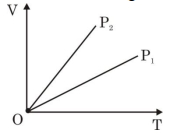
The given figure represents two isobaric processes for the same mass of an ideal gas. Then:
A
$P_2 \geq P_1$
B
$P_2 > P_1$
C
$P_1 = P_2$
D
$P_1 > P_2$
Solution
(D) For an ideal gas,the equation of state is $PV = nRT$.
Rearranging for $V$ as a function of $T$,we get $V = \left(\frac{nR}{P}\right)T$.
Comparing this with the equation of a straight line $y = mx$,where $y = V$ and $x = T$,the slope of the $V-T$ graph is given by $\text{Slope} = \frac{nR}{P}$.
Since $n$ and $R$ are constants,the slope is inversely proportional to the pressure,i.e.,$\text{Slope} \propto \frac{1}{P}$.
From the given figure,the slope of the line corresponding to $P_2$ is greater than the slope of the line corresponding to $P_1$,i.e.,$(\text{Slope})_2 > (\text{Slope})_1$.
Since $\text{Slope} \propto \frac{1}{P}$,a higher slope implies a lower pressure. Therefore,$P_2 < P_1$ or $P_1 > P_2$.
Rearranging for $V$ as a function of $T$,we get $V = \left(\frac{nR}{P}\right)T$.
Comparing this with the equation of a straight line $y = mx$,where $y = V$ and $x = T$,the slope of the $V-T$ graph is given by $\text{Slope} = \frac{nR}{P}$.
Since $n$ and $R$ are constants,the slope is inversely proportional to the pressure,i.e.,$\text{Slope} \propto \frac{1}{P}$.
From the given figure,the slope of the line corresponding to $P_2$ is greater than the slope of the line corresponding to $P_1$,i.e.,$(\text{Slope})_2 > (\text{Slope})_1$.
Since $\text{Slope} \propto \frac{1}{P}$,a higher slope implies a lower pressure. Therefore,$P_2 < P_1$ or $P_1 > P_2$.
0 likesView Solution
89
PhysicsDifficultMCQJEE Main · 2024
If the percentage errors in measuring the length and the diameter of a wire are $0.1 \%$ each,the percentage error in measuring its resistance will be: (in $\%$)
A
$0.2$
B
$0.3$
C
$0.1$
D
$0.144$
Solution
(B) The resistance $R$ of a wire is given by the formula $R = \rho \frac{L}{A}$,where $A = \pi \frac{d^2}{4}$.
Substituting $A$,we get $R = \frac{4 \rho L}{\pi d^2}$.
Taking the relative error,we have $\frac{\Delta R}{R} = \frac{\Delta L}{L} + 2 \frac{\Delta d}{d}$.
Given that $\frac{\Delta L}{L} = 0.1 \%$ and $\frac{\Delta d}{d} = 0.1 \%$.
Substituting these values,$\frac{\Delta R}{R} = 0.1 \% + 2(0.1 \%) = 0.1 \% + 0.2 \% = 0.3 \%$.
Substituting $A$,we get $R = \frac{4 \rho L}{\pi d^2}$.
Taking the relative error,we have $\frac{\Delta R}{R} = \frac{\Delta L}{L} + 2 \frac{\Delta d}{d}$.
Given that $\frac{\Delta L}{L} = 0.1 \%$ and $\frac{\Delta d}{d} = 0.1 \%$.
Substituting these values,$\frac{\Delta R}{R} = 0.1 \% + 2(0.1 \%) = 0.1 \% + 0.2 \% = 0.3 \%$.
2 likesView Solution
90
PhysicsDifficultMCQJEE Main · 2024
$A$ force is represented by $F = ax^2 + bt^{1/2}$,where $x$ is distance and $t$ is time. The dimensions of $b^2/a$ are:
A
$[ML^3 T^{-3}]$
B
$[MLT^{-2}]$
C
$[ML^{-1} T^{-1}]$
D
$[ML^2 T^{-3}]$
Solution
(A) According to the principle of homogeneity of dimensions,each term in the equation must have the same dimensions as force $F$.
$1$. For the term $ax^2$:
$[ax^2] = [F] = [MLT^{-2}]$
$[a] = [F] / [x^2] = [MLT^{-2}] / [L^2] = [ML^{-1}T^{-2}]$
$2$. For the term $bt^{1/2}$:
$[bt^{1/2}] = [F] = [MLT^{-2}]$
$[b] = [F] / [t^{1/2}] = [MLT^{-2}] / [T^{1/2}] = [MLT^{-5/2}]$
$3$. Calculating the dimensions of $b^2/a$:
$[b^2/a] = [b]^2 / [a] = ([MLT^{-5/2}])^2 / [ML^{-1}T^{-2}]$
$[b^2/a] = [M^2 L^2 T^{-5}] / [ML^{-1}T^{-2}] = [M^{2-1} L^{2-(-1)} T^{-5-(-2)}] = [ML^3 T^{-3}]$
$1$. For the term $ax^2$:
$[ax^2] = [F] = [MLT^{-2}]$
$[a] = [F] / [x^2] = [MLT^{-2}] / [L^2] = [ML^{-1}T^{-2}]$
$2$. For the term $bt^{1/2}$:
$[bt^{1/2}] = [F] = [MLT^{-2}]$
$[b] = [F] / [t^{1/2}] = [MLT^{-2}] / [T^{1/2}] = [MLT^{-5/2}]$
$3$. Calculating the dimensions of $b^2/a$:
$[b^2/a] = [b]^2 / [a] = ([MLT^{-5/2}])^2 / [ML^{-1}T^{-2}]$
$[b^2/a] = [M^2 L^2 T^{-5}] / [ML^{-1}T^{-2}] = [M^{2-1} L^{2-(-1)} T^{-5-(-2)}] = [ML^3 T^{-3}]$
0 likesView Solution
91
PhysicsDifficultMCQJEE Main · 2024
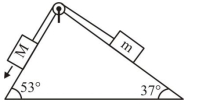
In the given arrangement of a doubly inclined plane,two blocks of masses $M$ and $m$ are placed. The blocks are connected by a light string passing over an ideal pulley as shown. The coefficient of friction between the surface of the plane and the blocks is $0.25$. The value of $m$,for which $M=10 \text{ kg}$ will move down with an acceleration of $2 \text{ m/s}^2$,is: (take $g=10 \text{ m/s}^2$ and $\tan 37^{\circ}=3/4$) (in $\text{ kg}$)
A
$9$
B
$4.5$
C
$6.5$
D
$2.25$
Solution
(B) For block $M$ $(M=10 \text{ kg})$:
$M g \sin 53^{\circ} - \mu M g \cos 53^{\circ} - T = M a$
$10 \times 10 \times 0.8 - 0.25 \times 10 \times 10 \times 0.6 - T = 10 \times 2$
$80 - 15 - T = 20$
$T = 80 - 15 - 20 = 45 \text{ N}$
For block $m$:
$T - m g \sin 37^{\circ} - \mu m g \cos 37^{\circ} = m a$
$45 - m \times 10 \times 0.6 - 0.25 \times m \times 10 \times 0.8 = m \times 2$
$45 - 6m - 2m = 2m$
$45 = 10m$
$m = 4.5 \text{ kg}$
$M g \sin 53^{\circ} - \mu M g \cos 53^{\circ} - T = M a$
$10 \times 10 \times 0.8 - 0.25 \times 10 \times 10 \times 0.6 - T = 10 \times 2$
$80 - 15 - T = 20$
$T = 80 - 15 - 20 = 45 \text{ N}$
For block $m$:
$T - m g \sin 37^{\circ} - \mu m g \cos 37^{\circ} = m a$
$45 - m \times 10 \times 0.6 - 0.25 \times m \times 10 \times 0.8 = m \times 2$
$45 - 6m - 2m = 2m$
$45 = 10m$
$m = 4.5 \text{ kg}$
0 likesView Solution
92
PhysicsDifficultMCQJEE Main · 2024
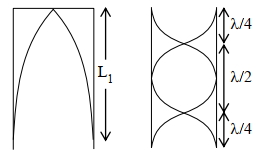
The fundamental frequency of a closed organ pipe is equal to the first overtone frequency of an open organ pipe. If the length of the open pipe is $60 \,cm$, the length of the closed pipe will be: (in $\,cm$)
A
$60$
B
$45$
C
$30$
D
$15$
Solution
(D) Let $L_1$ be the length of the closed organ pipe and $L_2$ be the length of the open organ pipe.
The fundamental frequency of a closed organ pipe is given by $f_c = \frac{v}{4L_1}$.
The frequencies of an open organ pipe are given by $f_n = \frac{nv}{2L_2}$, where $n = 1, 2, 3, ...$.
The first overtone of an open organ pipe corresponds to $n = 2$, so $f_{o1} = \frac{2v}{2L_2} = \frac{v}{L_2}$.
According to the problem, the fundamental frequency of the closed pipe is equal to the first overtone frequency of the open pipe:
$f_c = f_{o1}$
$\frac{v}{4L_1} = \frac{v}{L_2}$
$L_2 = 4L_1$
Given $L_2 = 60 \,cm$, we have:
$60 \,cm = 4L_1$
$L_1 = \frac{60}{4} \,cm = 15 \,cm$.
Therefore, the length of the closed pipe is $15 \,cm$.
The fundamental frequency of a closed organ pipe is given by $f_c = \frac{v}{4L_1}$.
The frequencies of an open organ pipe are given by $f_n = \frac{nv}{2L_2}$, where $n = 1, 2, 3, ...$.
The first overtone of an open organ pipe corresponds to $n = 2$, so $f_{o1} = \frac{2v}{2L_2} = \frac{v}{L_2}$.
According to the problem, the fundamental frequency of the closed pipe is equal to the first overtone frequency of the open pipe:
$f_c = f_{o1}$
$\frac{v}{4L_1} = \frac{v}{L_2}$
$L_2 = 4L_1$
Given $L_2 = 60 \,cm$, we have:
$60 \,cm = 4L_1$
$L_1 = \frac{60}{4} \,cm = 15 \,cm$.
Therefore, the length of the closed pipe is $15 \,cm$.
0 likesView Solution
93
PhysicsDifficultMCQJEE Main · 2024
$A$ small steel ball is dropped into a long cylinder containing glycerine. Which one of the following is the correct representation of the velocity-time graph for the transit of the ball?
A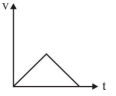
B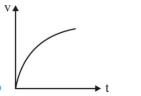
C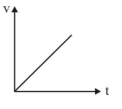
D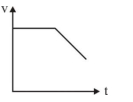
Solution
(B) When a steel ball is dropped in a viscous liquid like glycerine,it experiences three forces: gravitational force $(mg)$ downwards,buoyant force $(F_B)$ upwards,and viscous drag force $(F_v = 6 \pi \eta r v)$ upwards.
The equation of motion is: $mg - F_B - F_v = ma$
Substituting the expressions for forces: $(\rho \frac{4}{3} \pi r^3) g - (\rho_L \frac{4}{3} \pi r^3) g - 6 \pi \eta r v = m \frac{dv}{dt}$
Let $K_1 = \frac{4}{3} \pi r^3 g (\rho - \rho_L) / m$ and $K_2 = \frac{6 \pi \eta r}{m}$. Then the equation becomes: $\frac{dv}{dt} = K_1 - K_2 v$
Integrating this differential equation with initial conditions ($v=0$ at $t=0$): $\int_0^v \frac{dv}{K_1 - K_2 v} = \int_0^t dt$
This yields: $v = \frac{K_1}{K_2} (1 - e^{-K_2 t})$
As $t \to \infty$,the velocity approaches a constant terminal velocity $v_T = \frac{K_1}{K_2}$. The graph of $v$ versus $t$ is an exponential curve that starts from the origin and asymptotically approaches the terminal velocity,which corresponds to Graph $B$.
The equation of motion is: $mg - F_B - F_v = ma$
Substituting the expressions for forces: $(\rho \frac{4}{3} \pi r^3) g - (\rho_L \frac{4}{3} \pi r^3) g - 6 \pi \eta r v = m \frac{dv}{dt}$
Let $K_1 = \frac{4}{3} \pi r^3 g (\rho - \rho_L) / m$ and $K_2 = \frac{6 \pi \eta r}{m}$. Then the equation becomes: $\frac{dv}{dt} = K_1 - K_2 v$
Integrating this differential equation with initial conditions ($v=0$ at $t=0$): $\int_0^v \frac{dv}{K_1 - K_2 v} = \int_0^t dt$
This yields: $v = \frac{K_1}{K_2} (1 - e^{-K_2 t})$
As $t \to \infty$,the velocity approaches a constant terminal velocity $v_T = \frac{K_1}{K_2}$. The graph of $v$ versus $t$ is an exponential curve that starts from the origin and asymptotically approaches the terminal velocity,which corresponds to Graph $B$.
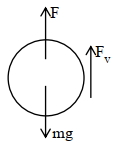
0 likesView Solution
94
PhysicsDifficultMCQJEE Main · 2024
$A$ coin is placed on a disc. The coefficient of friction between the coin and the disc is $\mu$. If the distance of the coin from the center of the disc is $r$,the maximum angular velocity which can be given to the disc,so that the coin does not slip away,is:
A
$\frac{\mu g}{r}$
B
$\sqrt{\frac{r}{\mu g}}$
C
$\sqrt{\frac{\mu g}{r}}$
D
$\frac{\mu}{\sqrt{rg}}$
Solution
(C) For the coin to remain on the disc without slipping,the centripetal force required for circular motion must be provided by the static frictional force.
The normal force acting on the coin is $N = mg$.
The maximum static frictional force available is $f_{max} = \mu N = \mu mg$.
The required centripetal force for the coin moving in a circle of radius $r$ with angular velocity $\omega$ is $F_c = m \omega^2 r$.
For the coin not to slip,the centripetal force must be less than or equal to the maximum static friction:
$m \omega^2 r \leq \mu mg$
Solving for $\omega$:
$\omega^2 \leq \frac{\mu g}{r}$
Therefore,the maximum angular velocity is $\omega_{max} = \sqrt{\frac{\mu g}{r}}$.
The normal force acting on the coin is $N = mg$.
The maximum static frictional force available is $f_{max} = \mu N = \mu mg$.
The required centripetal force for the coin moving in a circle of radius $r$ with angular velocity $\omega$ is $F_c = m \omega^2 r$.
For the coin not to slip,the centripetal force must be less than or equal to the maximum static friction:
$m \omega^2 r \leq \mu mg$
Solving for $\omega$:
$\omega^2 \leq \frac{\mu g}{r}$
Therefore,the maximum angular velocity is $\omega_{max} = \sqrt{\frac{\mu g}{r}}$.
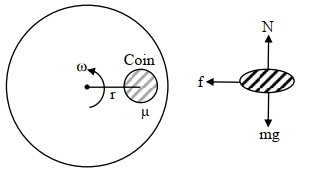
2 likesView Solution
95
PhysicsDifficultMCQJEE Main · 2024
An artillery piece of mass $M_1$ fires a shell of mass $M_2$ horizontally. Instantaneously after the firing,the ratio of kinetic energy of the artillery and that of the shell is:
A
$M_1 / (M_1 + M_2)$
B
$M_2 / M_1$
C
$M_2 / (M_1 + M_2)$
D
$M_1 / M_2$
Solution
(B) According to the law of conservation of linear momentum,the magnitude of the momentum of the artillery piece $(p_1)$ and the shell $(p_2)$ must be equal immediately after firing,as the initial momentum of the system was zero.
$|p_1| = |p_2| = p$
Kinetic energy $(KE)$ is related to momentum $(p)$ and mass $(m)$ by the formula $KE = \frac{p^2}{2m}$.
Since the momentum $p$ is the same for both,$KE \propto \frac{1}{m}$.
Therefore,the ratio of the kinetic energy of the artillery $(KE_1)$ to that of the shell $(KE_2)$ is:
$\frac{KE_1}{KE_2} = \frac{p^2 / 2M_1}{p^2 / 2M_2} = \frac{M_2}{M_1}$.
$|p_1| = |p_2| = p$
Kinetic energy $(KE)$ is related to momentum $(p)$ and mass $(m)$ by the formula $KE = \frac{p^2}{2m}$.
Since the momentum $p$ is the same for both,$KE \propto \frac{1}{m}$.
Therefore,the ratio of the kinetic energy of the artillery $(KE_1)$ to that of the shell $(KE_2)$ is:
$\frac{KE_1}{KE_2} = \frac{p^2 / 2M_1}{p^2 / 2M_2} = \frac{M_2}{M_1}$.
1 likesView Solution
96
PhysicsDifficultMCQJEE Main · 2024
$A$ solid circular disc of mass $50 \,kg$ rolls along a horizontal floor so that its center of mass has a speed of $0.4 \,m/s$. The absolute value of work done on the disc to stop it is . . . . . . $J$.
A
$3$
B
$4$
C
$5$
D
$6$
Solution
(D) According to the work-energy theorem, the work done $W$ is equal to the change in kinetic energy $\Delta KE$.
Since the disc is rolling, its total kinetic energy $KE$ is the sum of translational and rotational kinetic energy: $KE = \frac{1}{2}mv^2 + \frac{1}{2}I\omega^2$.
For a solid disc, the moment of inertia $I = \frac{1}{2}mR^2$ and for rolling without slipping, $\omega = \frac{v}{R}$.
Substituting these, $KE = \frac{1}{2}mv^2 + \frac{1}{2}(\frac{1}{2}mR^2)(\frac{v}{R})^2 = \frac{1}{2}mv^2 + \frac{1}{4}mv^2 = \frac{3}{4}mv^2$.
Given $m = 50 \,kg$ and $v = 0.4 \,m/s$, the initial kinetic energy is $KE_i = \frac{3}{4} \times 50 \times (0.4)^2 = \frac{3}{4} \times 50 \times 0.16 = 0.75 \times 8 = 6 \,J$.
To stop the disc, the final kinetic energy $KE_f = 0$.
Thus, $W = KE_f - KE_i = 0 - 6 = -6 \,J$.
The absolute value of the work done is $|W| = 6 \,J$.
Since the disc is rolling, its total kinetic energy $KE$ is the sum of translational and rotational kinetic energy: $KE = \frac{1}{2}mv^2 + \frac{1}{2}I\omega^2$.
For a solid disc, the moment of inertia $I = \frac{1}{2}mR^2$ and for rolling without slipping, $\omega = \frac{v}{R}$.
Substituting these, $KE = \frac{1}{2}mv^2 + \frac{1}{2}(\frac{1}{2}mR^2)(\frac{v}{R})^2 = \frac{1}{2}mv^2 + \frac{1}{4}mv^2 = \frac{3}{4}mv^2$.
Given $m = 50 \,kg$ and $v = 0.4 \,m/s$, the initial kinetic energy is $KE_i = \frac{3}{4} \times 50 \times (0.4)^2 = \frac{3}{4} \times 50 \times 0.16 = 0.75 \times 8 = 6 \,J$.
To stop the disc, the final kinetic energy $KE_f = 0$.
Thus, $W = KE_f - KE_i = 0 - 6 = -6 \,J$.
The absolute value of the work done is $|W| = 6 \,J$.
0 likesView Solution
97
PhysicsDifficultMCQJEE Main · 2024
$A$ body starts falling freely from height $H$ and hits an inclined plane in its path at height $h$ from the ground. As a result of this perfectly elastic impact,the direction of the velocity of the body becomes horizontal. The value of $\frac{H}{h}$ for which the body will take the maximum time to reach the ground is . . . . . . .
A
$2$
B
$3$
C
$4$
D
$5$
Solution
(A) Let the body fall from height $H$. It hits the inclined plane at a height $h$ from the ground,meaning it has fallen a distance of $(H-h)$.
The time taken to fall the distance $(H-h)$ is $t_1 = \sqrt{\frac{2(H-h)}{g}}$.
At this point,the impact is perfectly elastic and the velocity becomes horizontal. The body then falls from height $h$ with an initial vertical velocity of $0$. The time taken to fall this remaining distance $h$ is $t_2 = \sqrt{\frac{2h}{g}}$.
The total time of flight $T$ is $T = t_1 + t_2 = \sqrt{\frac{2(H-h)}{g}} + \sqrt{\frac{2h}{g}}$.
To find the value of $h$ for which $T$ is maximum,we differentiate $T$ with respect to $h$ and set it to $0$:
$\frac{dT}{dh} = \sqrt{\frac{2}{g}} \left( \frac{1}{2\sqrt{H-h}} \cdot (-1) + \frac{1}{2\sqrt{h}} \right) = 0$.
This implies $\frac{1}{\sqrt{h}} = \frac{1}{\sqrt{H-h}}$,which gives $h = H - h$,or $2h = H$.
Therefore,$\frac{H}{h} = 2$.
The time taken to fall the distance $(H-h)$ is $t_1 = \sqrt{\frac{2(H-h)}{g}}$.
At this point,the impact is perfectly elastic and the velocity becomes horizontal. The body then falls from height $h$ with an initial vertical velocity of $0$. The time taken to fall this remaining distance $h$ is $t_2 = \sqrt{\frac{2h}{g}}$.
The total time of flight $T$ is $T = t_1 + t_2 = \sqrt{\frac{2(H-h)}{g}} + \sqrt{\frac{2h}{g}}$.
To find the value of $h$ for which $T$ is maximum,we differentiate $T$ with respect to $h$ and set it to $0$:
$\frac{dT}{dh} = \sqrt{\frac{2}{g}} \left( \frac{1}{2\sqrt{H-h}} \cdot (-1) + \frac{1}{2\sqrt{h}} \right) = 0$.
This implies $\frac{1}{\sqrt{h}} = \frac{1}{\sqrt{H-h}}$,which gives $h = H - h$,or $2h = H$.
Therefore,$\frac{H}{h} = 2$.
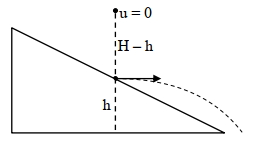
0 likesView Solution
98
PhysicsDifficultMCQJEE Main · 2024
The depth below the surface of the sea to which a rubber ball must be taken so as to decrease its volume by $0.02 \%$ is . . . . . . $m$.
(Take density of sea water $= 10^3 \ kg \ m^{-3}$,Bulk modulus of rubber $= 9 \times 10^8 \ N \ m^{-2}$,and $g = 10 \ m \ s^{-2}$)
(Take density of sea water $= 10^3 \ kg \ m^{-3}$,Bulk modulus of rubber $= 9 \times 10^8 \ N \ m^{-2}$,and $g = 10 \ m \ s^{-2}$)
A
$15$
B
$16$
C
$17$
D
$18$
Solution
(D) The bulk modulus $\beta$ is defined as $\beta = -\frac{\Delta P}{\Delta V / V}$.
Here,the change in pressure $\Delta P$ at a depth $h$ is given by $\Delta P = \rho gh$.
The fractional change in volume is $\frac{\Delta V}{V} = -0.02 \% = -\frac{0.02}{100} = -2 \times 10^{-4}$.
Substituting the values into the formula:
$\rho gh = -\beta \left( \frac{\Delta V}{V} \right)$
$10^3 \times 10 \times h = -(9 \times 10^8) \times (-2 \times 10^{-4})$
$10^4 \times h = 18 \times 10^4$
$h = 18 \ m$.
Here,the change in pressure $\Delta P$ at a depth $h$ is given by $\Delta P = \rho gh$.
The fractional change in volume is $\frac{\Delta V}{V} = -0.02 \% = -\frac{0.02}{100} = -2 \times 10^{-4}$.
Substituting the values into the formula:
$\rho gh = -\beta \left( \frac{\Delta V}{V} \right)$
$10^3 \times 10 \times h = -(9 \times 10^8) \times (-2 \times 10^{-4})$
$10^4 \times h = 18 \times 10^4$
$h = 18 \ m$.
0 likesView Solution
99
PhysicsDifficultMCQJEE Main · 2024
$A$ particle performs simple harmonic motion with amplitude $A$. Its speed is increased to three times at an instant when its displacement is $\frac{2A}{3}$. The new amplitude of motion is $\frac{nA}{3}$. The value of $n$ is . . . . . . .
A
$7$
B
$8$
C
$9$
D
$10$
Solution
(A) The velocity of a particle in simple harmonic motion is given by $v = \omega \sqrt{A^2 - x^2}$.
At displacement $x = \frac{2A}{3}$,the velocity is $v = \omega \sqrt{A^2 - (\frac{2A}{3})^2} = \omega \sqrt{A^2 - \frac{4A^2}{9}} = \omega \sqrt{\frac{5A^2}{9}} = \frac{\sqrt{5}A\omega}{3}$.
When the speed is increased to three times,the new velocity $v' = 3v = 3 \times \frac{\sqrt{5}A\omega}{3} = \sqrt{5}A\omega$.
Let the new amplitude be $A'$. The new velocity at the same position $x = \frac{2A}{3}$ is $v' = \omega \sqrt{(A')^2 - x^2}$.
Equating the expressions: $\sqrt{5}A\omega = \omega \sqrt{(A')^2 - (\frac{2A}{3})^2}$.
Squaring both sides: $5A^2 = (A')^2 - \frac{4A^2}{9}$.
$(A')^2 = 5A^2 + \frac{4A^2}{9} = \frac{45A^2 + 4A^2}{9} = \frac{49A^2}{9}$.
Taking the square root: $A' = \frac{7A}{3}$.
Comparing this with $\frac{nA}{3}$,we get $n = 7$.
At displacement $x = \frac{2A}{3}$,the velocity is $v = \omega \sqrt{A^2 - (\frac{2A}{3})^2} = \omega \sqrt{A^2 - \frac{4A^2}{9}} = \omega \sqrt{\frac{5A^2}{9}} = \frac{\sqrt{5}A\omega}{3}$.
When the speed is increased to three times,the new velocity $v' = 3v = 3 \times \frac{\sqrt{5}A\omega}{3} = \sqrt{5}A\omega$.
Let the new amplitude be $A'$. The new velocity at the same position $x = \frac{2A}{3}$ is $v' = \omega \sqrt{(A')^2 - x^2}$.
Equating the expressions: $\sqrt{5}A\omega = \omega \sqrt{(A')^2 - (\frac{2A}{3})^2}$.
Squaring both sides: $5A^2 = (A')^2 - \frac{4A^2}{9}$.
$(A')^2 = 5A^2 + \frac{4A^2}{9} = \frac{45A^2 + 4A^2}{9} = \frac{49A^2}{9}$.
Taking the square root: $A' = \frac{7A}{3}$.
Comparing this with $\frac{nA}{3}$,we get $n = 7$.
0 likesView Solution
100
PhysicsDifficultMCQJEE Main · 2024
$A$ light string passing over a smooth light fixed pulley connects two blocks of masses $m_1$ and $m_2$. If the acceleration of the system is $g / 8$,then the ratio of masses is
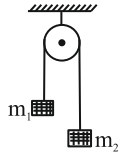
A
$\frac{9}{7}$
B
$\frac{8}{1}$
C
$\frac{4}{3}$
D
$\frac{5}{3}$
Solution
(A) For a system of two masses $m_1$ and $m_2$ connected by a light string over a smooth fixed pulley,the magnitude of acceleration $a$ is given by the formula:
$a = \frac{|m_1 - m_2| g}{m_1 + m_2}$
Given that the acceleration $a = g / 8$,we have:
$\frac{|m_1 - m_2| g}{m_1 + m_2} = \frac{g}{8}$
Assuming $m_1 > m_2$,we get:
$\frac{m_1 - m_2}{m_1 + m_2} = \frac{1}{8}$
Cross-multiplying gives:
$8(m_1 - m_2) = m_1 + m_2$
$8m_1 - 8m_2 = m_1 + m_2$
$7m_1 = 9m_2$
Therefore,the ratio of the masses is:
$\frac{m_1}{m_2} = \frac{9}{7}$
$a = \frac{|m_1 - m_2| g}{m_1 + m_2}$
Given that the acceleration $a = g / 8$,we have:
$\frac{|m_1 - m_2| g}{m_1 + m_2} = \frac{g}{8}$
Assuming $m_1 > m_2$,we get:
$\frac{m_1 - m_2}{m_1 + m_2} = \frac{1}{8}$
Cross-multiplying gives:
$8(m_1 - m_2) = m_1 + m_2$
$8m_1 - 8m_2 = m_1 + m_2$
$7m_1 = 9m_2$
Therefore,the ratio of the masses is:
$\frac{m_1}{m_2} = \frac{9}{7}$
0 likesView Solution
101
PhysicsDifficultMCQJEE Main · 2024
The truth table for this given circuit is:
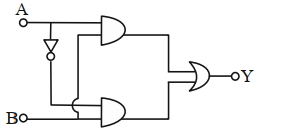
A
| $A$ | $B$ | $Y$ |
|---|---|---|
| $0$ | $0$ | $1$ |
| $0$ | $1$ | $1$ |
| $1$ | $0$ | $1$ |
| $1$ | $1$ | $0$ |
B
| $A$ | $B$ | $Y$ |
|---|---|---|
| $0$ | $0$ | $0$ |
| $0$ | $1$ | $1$ |
| $1$ | $0$ | $0$ |
| $1$ | $1$ | $1$ |
C
| $A$ | $B$ | $Y$ |
|---|---|---|
| $0$ | $0$ | $0$ |
| $0$ | $1$ | $0$ |
| $1$ | $0$ | $0$ |
| $1$ | $1$ | $1$ |
D
| $A$ | $B$ | $Y$ |
|---|---|---|
| $0$ | $0$ | $0$ |
| $0$ | $1$ | $1$ |
| $1$ | $0$ | $1$ |
| $1$ | $1$ | $0$ |
Solution
(B) The given circuit consists of two $AND$ gates and one $OR$ gate. The inputs to the first $AND$ gate are $A$ and $B$,so its output is $A \cdot B$.
The input $A$ passes through a $NOT$ gate,becoming $\overline{A}$. This $\overline{A}$ and input $B$ are fed into the second $AND$ gate,so its output is $\overline{A} \cdot B$.
These two outputs are then fed into an $OR$ gate,giving the final output $Y = (A \cdot B) + (\overline{A} \cdot B)$.
Using Boolean algebra: $Y = (A + \overline{A}) \cdot B$.
Since $A + \overline{A} = 1$,we get $Y = 1 \cdot B = B$.
Thus,the output $Y$ is equal to input $B$. Checking the truth table for $Y = B$:
If $A=0, B=0$,then $Y=0$.
If $A=0, B=1$,then $Y=1$.
If $A=1, B=0$,then $Y=0$.
If $A=1, B=1$,then $Y=1$.
This matches option $B$.
The input $A$ passes through a $NOT$ gate,becoming $\overline{A}$. This $\overline{A}$ and input $B$ are fed into the second $AND$ gate,so its output is $\overline{A} \cdot B$.
These two outputs are then fed into an $OR$ gate,giving the final output $Y = (A \cdot B) + (\overline{A} \cdot B)$.
Using Boolean algebra: $Y = (A + \overline{A}) \cdot B$.
Since $A + \overline{A} = 1$,we get $Y = 1 \cdot B = B$.
Thus,the output $Y$ is equal to input $B$. Checking the truth table for $Y = B$:
If $A=0, B=0$,then $Y=0$.
If $A=0, B=1$,then $Y=1$.
If $A=1, B=0$,then $Y=0$.
If $A=1, B=1$,then $Y=1$.
This matches option $B$.
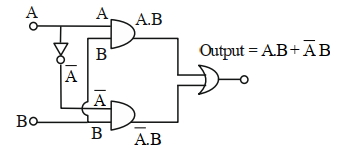
0 likesView Solution
102
PhysicsDifficultMCQJEE Main · 2024
In an $a.c.$ circuit,voltage and current are given by: $V=100 \sin (100 t) \ V$ and $I=100 \sin (100 t + \frac{\pi}{3}) \ mA$ respectively. The average power dissipated in one cycle is: (in $W$)
A
$5$
B
$10$
C
$2.5$
D
$25$
Solution
(C) The average power dissipated in an $a.c.$ circuit is given by the formula: $P_{\text{avg}} = V_{\text{rms}} I_{\text{rms}} \cos(\phi)$.
Given $V = 100 \sin(100t) \ V$,the peak voltage $V_0 = 100 \ V$.
Given $I = 100 \sin(100t + \frac{\pi}{3}) \ mA$,the peak current $I_0 = 100 \ mA = 100 \times 10^{-3} \ A = 0.1 \ A$.
The phase difference $\phi = \frac{\pi}{3}$.
$V_{\text{rms}} = \frac{V_0}{\sqrt{2}} = \frac{100}{\sqrt{2}} \ V$.
$I_{\text{rms}} = \frac{I_0}{\sqrt{2}} = \frac{0.1}{\sqrt{2}} \ A$.
$P_{\text{avg}} = \left(\frac{100}{\sqrt{2}}\right) \times \left(\frac{0.1}{\sqrt{2}}\right) \times \cos\left(\frac{\pi}{3}\right)$.
$P_{\text{avg}} = \frac{100 \times 0.1}{2} \times \frac{1}{2} = \frac{10}{4} = 2.5 \ W$.
Given $V = 100 \sin(100t) \ V$,the peak voltage $V_0 = 100 \ V$.
Given $I = 100 \sin(100t + \frac{\pi}{3}) \ mA$,the peak current $I_0 = 100 \ mA = 100 \times 10^{-3} \ A = 0.1 \ A$.
The phase difference $\phi = \frac{\pi}{3}$.
$V_{\text{rms}} = \frac{V_0}{\sqrt{2}} = \frac{100}{\sqrt{2}} \ V$.
$I_{\text{rms}} = \frac{I_0}{\sqrt{2}} = \frac{0.1}{\sqrt{2}} \ A$.
$P_{\text{avg}} = \left(\frac{100}{\sqrt{2}}\right) \times \left(\frac{0.1}{\sqrt{2}}\right) \times \cos\left(\frac{\pi}{3}\right)$.
$P_{\text{avg}} = \frac{100 \times 0.1}{2} \times \frac{1}{2} = \frac{10}{4} = 2.5 \ W$.
0 likesView Solution
103
PhysicsDifficultMCQJEE Main · 2024
If the distance between an object and its two times magnified virtual image produced by a curved mirror is $15 \,cm$, the focal length of the mirror must be:
A
$15 \,cm$
B
$-12 \,cm$
C
$-10 \,cm$
D
$10/3 \,cm$
Solution
(C) For a virtual image, magnification $m = +2$.
Using the magnification formula for a spherical mirror, $m = -v/u$.
Since the image is virtual, it is formed behind the mirror, so $v$ is positive. Let the object distance be $u$ (where $u$ is negative by sign convention).
The distance between the object and the image is $|v - u| = 15 \,cm$.
Since the object is in front of the mirror $(u < 0)$ and the virtual image is behind the mirror $(v > 0)$, the distance is $v - u = 15$.
Substituting $v = -mu = -2u$:
$-2u - u = 15
-3u = 15
u = -5 \,cm$.
Then, $v = -2(-5) = 10 \,cm$.
Using the mirror formula, $\frac{1}{f} = \frac{1}{v} + \frac{1}{u}$:
$\frac{1}{f} = \frac{1}{10} + \frac{1}{-5} = \frac{1 - 2}{10} = -\frac{1}{10}$.
Therefore, $f = -10 \,cm$.
Using the magnification formula for a spherical mirror, $m = -v/u$.
Since the image is virtual, it is formed behind the mirror, so $v$ is positive. Let the object distance be $u$ (where $u$ is negative by sign convention).
The distance between the object and the image is $|v - u| = 15 \,cm$.
Since the object is in front of the mirror $(u < 0)$ and the virtual image is behind the mirror $(v > 0)$, the distance is $v - u = 15$.
Substituting $v = -mu = -2u$:
$-2u - u = 15
-3u = 15
u = -5 \,cm$.
Then, $v = -2(-5) = 10 \,cm$.
Using the mirror formula, $\frac{1}{f} = \frac{1}{v} + \frac{1}{u}$:
$\frac{1}{f} = \frac{1}{10} + \frac{1}{-5} = \frac{1 - 2}{10} = -\frac{1}{10}$.
Therefore, $f = -10 \,cm$.
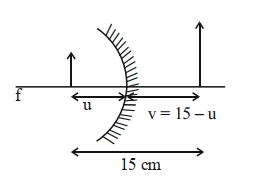
1 likesView Solution
104
PhysicsMediumMCQJEE Main · 2024
Two particles $X$ and $Y$ having equal charges are being accelerated through the same potential difference. Thereafter,they enter normally into a region of uniform magnetic field and describe circular paths of radii $R_1$ and $R_2$ respectively. The mass ratio of $X$ and $Y$ is:
A
$\left(\frac{R_2}{R_1}\right)^2$
B
$\left(\frac{R_1}{R_2}\right)^2$
C
$\frac{R_1}{R_2}$
D
$\frac{R_2}{R_1}$
Solution
(B) The radius of a circular path for a charged particle in a magnetic field is given by $R = \frac{mv}{qB}$.
Since the particle is accelerated through a potential difference $V$,its kinetic energy is $KE = qV = \frac{1}{2}mv^2$,which implies $v = \sqrt{\frac{2qV}{m}}$.
Substituting $v$ into the radius formula: $R = \frac{m}{qB} \sqrt{\frac{2qV}{m}} = \frac{\sqrt{2mqV}}{qB} = \frac{1}{B} \sqrt{\frac{2mV}{q}}$.
Since $q$,$V$,and $B$ are constant for both particles,we have $R \propto \sqrt{m}$,which implies $m \propto R^2$.
Therefore,the ratio of the masses is $\frac{m_X}{m_Y} = \left(\frac{R_1}{R_2}\right)^2$.
Since the particle is accelerated through a potential difference $V$,its kinetic energy is $KE = qV = \frac{1}{2}mv^2$,which implies $v = \sqrt{\frac{2qV}{m}}$.
Substituting $v$ into the radius formula: $R = \frac{m}{qB} \sqrt{\frac{2qV}{m}} = \frac{\sqrt{2mqV}}{qB} = \frac{1}{B} \sqrt{\frac{2mV}{q}}$.
Since $q$,$V$,and $B$ are constant for both particles,we have $R \propto \sqrt{m}$,which implies $m \propto R^2$.
Therefore,the ratio of the masses is $\frac{m_X}{m_Y} = \left(\frac{R_1}{R_2}\right)^2$.
0 likesView Solution
105
PhysicsDifficultMCQJEE Main · 2024
In Young's double slit experiment,light from two identical sources is superimposing on a screen. The path difference between the two light waves reaching a point on the screen is $\frac{7 \lambda}{4}$. The ratio of the intensity of the fringe at this point with respect to the maximum intensity of the fringe is:
A
$1 / 2$
B
$3 / 4$
C
$1 / 3$
D
$1 / 4$
Solution
(A) The path difference is given by $\Delta x = \frac{7 \lambda}{4}$.
The phase difference $\phi$ is related to the path difference by the formula $\phi = \frac{2 \pi}{\lambda} \Delta x$.
Substituting the value of $\Delta x$: $\phi = \frac{2 \pi}{\lambda} \times \frac{7 \lambda}{4} = \frac{7 \pi}{2}$.
The intensity $I$ at any point is given by $I = I_{\max} \cos^2\left(\frac{\phi}{2}\right)$.
Therefore,the ratio $\frac{I}{I_{\max}} = \cos^2\left(\frac{7 \pi}{2 \times 2}\right) = \cos^2\left(\frac{7 \pi}{4}\right)$.
Using the property $\cos(2 \pi - \theta) = \cos(\theta)$,we get $\cos^2\left(2 \pi - \frac{\pi}{4}\right) = \cos^2\left(\frac{\pi}{4}\right)$.
Since $\cos\left(\frac{\pi}{4}\right) = \frac{1}{\sqrt{2}}$,we have $\left(\frac{1}{\sqrt{2}}\right)^2 = \frac{1}{2}$.
The phase difference $\phi$ is related to the path difference by the formula $\phi = \frac{2 \pi}{\lambda} \Delta x$.
Substituting the value of $\Delta x$: $\phi = \frac{2 \pi}{\lambda} \times \frac{7 \lambda}{4} = \frac{7 \pi}{2}$.
The intensity $I$ at any point is given by $I = I_{\max} \cos^2\left(\frac{\phi}{2}\right)$.
Therefore,the ratio $\frac{I}{I_{\max}} = \cos^2\left(\frac{7 \pi}{2 \times 2}\right) = \cos^2\left(\frac{7 \pi}{4}\right)$.
Using the property $\cos(2 \pi - \theta) = \cos(\theta)$,we get $\cos^2\left(2 \pi - \frac{\pi}{4}\right) = \cos^2\left(\frac{\pi}{4}\right)$.
Since $\cos\left(\frac{\pi}{4}\right) = \frac{1}{\sqrt{2}}$,we have $\left(\frac{1}{\sqrt{2}}\right)^2 = \frac{1}{2}$.
0 likesView Solution
106
PhysicsDifficultMCQJEE Main · 2024
$A$ plane electromagnetic wave of frequency $35 \ MHz$ travels in free space along the $X$-direction. At a particular point (in space and time) $\overrightarrow{E} = 9.6 \ \hat{j} \ V/m$. The value of the magnetic field at this point is:
A
$3.2 \times 10^{-8} \ \hat{k} \ T$
B
$3.2 \times 10^{-8} \ \hat{i} \ T$
C
$9.6 \ \hat{j} \ T$
D
$9.6 \times 10^{-8} \ \hat{k} \ T$
Solution
(A) The relationship between the electric field $E$ and the magnetic field $B$ in an electromagnetic wave is given by $E/B = c$,where $c$ is the speed of light in free space $(c = 3 \times 10^8 \ m/s)$.
First,calculate the magnitude of the magnetic field:
$B = E/c = 9.6 / (3 \times 10^8) = 3.2 \times 10^{-8} \ T$.
Next,determine the direction of the magnetic field using the property that the direction of propagation $\hat{v}$ is given by $\hat{v} = \hat{E} \times \hat{B}$.
Rearranging this,the direction of the magnetic field is $\hat{B} = \hat{v} \times \hat{E}$.
Given the wave travels in the $X$-direction $(\hat{v} = \hat{i})$ and the electric field is in the $Y$-direction $(\hat{E} = \hat{j})$:
$\hat{B} = \hat{i} \times \hat{j} = \hat{k}$.
Therefore,the magnetic field vector is $\overrightarrow{B} = 3.2 \times 10^{-8} \ \hat{k} \ T$.
First,calculate the magnitude of the magnetic field:
$B = E/c = 9.6 / (3 \times 10^8) = 3.2 \times 10^{-8} \ T$.
Next,determine the direction of the magnetic field using the property that the direction of propagation $\hat{v}$ is given by $\hat{v} = \hat{E} \times \hat{B}$.
Rearranging this,the direction of the magnetic field is $\hat{B} = \hat{v} \times \hat{E}$.
Given the wave travels in the $X$-direction $(\hat{v} = \hat{i})$ and the electric field is in the $Y$-direction $(\hat{E} = \hat{j})$:
$\hat{B} = \hat{i} \times \hat{j} = \hat{k}$.
Therefore,the magnetic field vector is $\overrightarrow{B} = 3.2 \times 10^{-8} \ \hat{k} \ T$.
0 likesView Solution
107
PhysicsDifficultMCQJEE Main · 2024
In the given circuit, the current in resistance $R_3$ is: (in $\,A$)
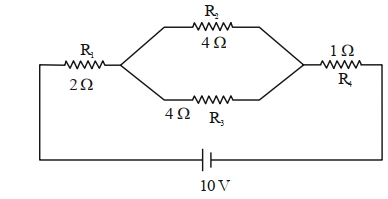
A
$1$
B
$1.5$
C
$2$
D
$2.5$
Solution
(A) First, calculate the equivalent resistance of the circuit. The resistors $R_2$ and $R_3$ are in parallel, so their equivalent resistance $R_p$ is given by:
$R_p = \frac{R_2 \times R_3}{R_2 + R_3} = \frac{4 \times 4}{4 + 4} = \frac{16}{8} = 2 \,\Omega$
Now, the total equivalent resistance $R_{eq}$ of the circuit is the sum of $R_1$, $R_p$, and $R_4$ in series:
$R_{eq} = R_1 + R_p + R_4 = 2 \,\Omega + 2 \,\Omega + 1 \,\Omega = 5 \,\Omega$
The total current $i$ flowing through the circuit is:
$i = \frac{V}{R_{eq}} = \frac{10 \,V}{5 \,\Omega} = 2 \,A$
This total current $i = 2 \,A$ flows through $R_1$, then splits into two parallel branches $R_2$ and $R_3$. Since $R_2 = R_3 = 4 \,\Omega$, the current divides equally between them:
$i_{R_3} = i \times \left( \frac{R_2}{R_2 + R_3} \right) = 2 \,A \times \left( \frac{4}{4 + 4} \right) = 2 \times \frac{4}{8} = 1 \,A$
$R_p = \frac{R_2 \times R_3}{R_2 + R_3} = \frac{4 \times 4}{4 + 4} = \frac{16}{8} = 2 \,\Omega$
Now, the total equivalent resistance $R_{eq}$ of the circuit is the sum of $R_1$, $R_p$, and $R_4$ in series:
$R_{eq} = R_1 + R_p + R_4 = 2 \,\Omega + 2 \,\Omega + 1 \,\Omega = 5 \,\Omega$
The total current $i$ flowing through the circuit is:
$i = \frac{V}{R_{eq}} = \frac{10 \,V}{5 \,\Omega} = 2 \,A$
This total current $i = 2 \,A$ flows through $R_1$, then splits into two parallel branches $R_2$ and $R_3$. Since $R_2 = R_3 = 4 \,\Omega$, the current divides equally between them:
$i_{R_3} = i \times \left( \frac{R_2}{R_2 + R_3} \right) = 2 \,A \times \left( \frac{4}{4 + 4} \right) = 2 \times \frac{4}{8} = 1 \,A$
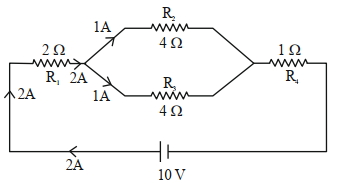
0 likesView Solution
108
PhysicsDifficultMCQJEE Main · 2024
Given below are two statements:
$Statement$ $I$: Most of the mass of the atom and all its positive charge are concentrated in a tiny nucleus and the electrons revolve around it,is Rutherford's model.
$Statement$ $II$: An atom is a spherical cloud of positive charges with electrons embedded in it,is a special case of Rutherford's model.
In the light of the above statements,choose the most appropriate from the options given below.
$Statement$ $I$: Most of the mass of the atom and all its positive charge are concentrated in a tiny nucleus and the electrons revolve around it,is Rutherford's model.
$Statement$ $II$: An atom is a spherical cloud of positive charges with electrons embedded in it,is a special case of Rutherford's model.
In the light of the above statements,choose the most appropriate from the options given below.
A
Both statement $I$ and statement $II$ are false.
B
Statement $I$ is false but statement $II$ is true.
C
Statement $I$ is true but statement $II$ is false.
D
Both statement $I$ and statement $II$ are true.
Solution
(C) According to Rutherford's atomic model,most of the mass of the atom and all its positive charge are concentrated in a tiny nucleus,and the electrons revolve around it. This confirms that $Statement$ $I$ is true.
According to Thomson's atomic model (often called the plum pudding model),an atom is a spherical cloud of positive charge with electrons embedded in it. This is not a special case of Rutherford's model; rather,it is a completely different model that was superseded by Rutherford's model. Therefore,$Statement$ $II$ is false.
Hence,$Statement$ $I$ is true but $Statement$ $II$ is false.
According to Thomson's atomic model (often called the plum pudding model),an atom is a spherical cloud of positive charge with electrons embedded in it. This is not a special case of Rutherford's model; rather,it is a completely different model that was superseded by Rutherford's model. Therefore,$Statement$ $II$ is false.
Hence,$Statement$ $I$ is true but $Statement$ $II$ is false.
0 likesView Solution
109
PhysicsDifficultMCQJEE Main · 2024
An electric field is given by $\vec{E} = (6 \hat{i} + 5 \hat{j} + 3 \hat{k}) \ N/C$. The electric flux through a surface area $\vec{A} = 30 \hat{i} \ m^2$ (in $SI$ units) is:
A
$90$
B
$150$
C
$180$
D
$60$
Solution
(C) The electric flux $\phi$ through a surface is given by the dot product of the electric field vector $\vec{E}$ and the area vector $\vec{A}$.
Given:
$\vec{E} = (6 \hat{i} + 5 \hat{j} + 3 \hat{k}) \ N/C$
$\vec{A} = 30 \hat{i} \ m^2$
Using the formula $\phi = \vec{E} \cdot \vec{A}$:
$\phi = (6 \hat{i} + 5 \hat{j} + 3 \hat{k}) \cdot (30 \hat{i})$
Since $\hat{i} \cdot \hat{i} = 1$,$\hat{i} \cdot \hat{j} = 0$,and $\hat{i} \cdot \hat{k} = 0$:
$\phi = 6 \times 30 = 180 \ N \cdot m^2/C$
Thus,the electric flux is $180 \ N \cdot m^2/C$.
Given:
$\vec{E} = (6 \hat{i} + 5 \hat{j} + 3 \hat{k}) \ N/C$
$\vec{A} = 30 \hat{i} \ m^2$
Using the formula $\phi = \vec{E} \cdot \vec{A}$:
$\phi = (6 \hat{i} + 5 \hat{j} + 3 \hat{k}) \cdot (30 \hat{i})$
Since $\hat{i} \cdot \hat{i} = 1$,$\hat{i} \cdot \hat{j} = 0$,and $\hat{i} \cdot \hat{k} = 0$:
$\phi = 6 \times 30 = 180 \ N \cdot m^2/C$
Thus,the electric flux is $180 \ N \cdot m^2/C$.
0 likesView Solution
110
PhysicsMediumMCQJEE Main · 2024
$A$ horizontal straight wire $5 \ m$ long extending from east to west is falling freely at a right angle to the horizontal component of the earth's magnetic field $0.60 \times 10^{-4} \ Wb \ m^{-2}$. The instantaneous value of the emf induced in the wire when its velocity is $10 \ m \ s^{-1}$ is . . . . . . $\times 10^{-3} \ V$.
A
$8$
B
$3$
C
$10$
D
$45$
Solution
(B) Given: Length of the wire $l = 5 \ m$.
Horizontal component of earth's magnetic field $B_H = 0.60 \times 10^{-4} \ Wb \ m^{-2}$.
Velocity of the wire $v = 10 \ m \ s^{-1}$.
The induced emf $(e)$ in a conductor moving in a magnetic field is given by the formula $e = B_H v l$.
Substituting the values:
$e = (0.60 \times 10^{-4}) \times 10 \times 5$
$e = 0.60 \times 10^{-3} \times 5$
$e = 3.0 \times 10^{-3} \ V$.
Thus,the instantaneous value of the induced emf is $3 \times 10^{-3} \ V$.
Horizontal component of earth's magnetic field $B_H = 0.60 \times 10^{-4} \ Wb \ m^{-2}$.
Velocity of the wire $v = 10 \ m \ s^{-1}$.
The induced emf $(e)$ in a conductor moving in a magnetic field is given by the formula $e = B_H v l$.
Substituting the values:
$e = (0.60 \times 10^{-4}) \times 10 \times 5$
$e = 0.60 \times 10^{-3} \times 5$
$e = 3.0 \times 10^{-3} \ V$.
Thus,the instantaneous value of the induced emf is $3 \times 10^{-3} \ V$.
0 likesView Solution
111
PhysicsDifficultMCQJEE Main · 2024
$A$ hydrogen atom is bombarded with electrons accelerated through a potential difference of $V$, which causes excitation of hydrogen atoms. If the experiment is performed at $T = 0 \,K$, the minimum potential difference needed to observe any Balmer series lines in the emission spectra will be $\frac{\alpha}{10} \,V$, where $\alpha = $ . . . . . . .
A
$456$
B
$158$
C
$121$
D
$498$
Solution
(C) To observe any line of the Balmer series, the hydrogen atom must be excited to at least the $n = 3$ energy level, as the first line of the Balmer series corresponds to the transition from $n = 3$ to $n = 2$.
The energy required to excite an electron from the ground state $(n = 1)$ to the $n = 3$ state is given by:
$\Delta E = E_3 - E_1 = 13.6 \left( 1 - \frac{1}{3^2} \right) \,eV$
$\Delta E = 13.6 \left( 1 - \frac{1}{9} \right) \,eV = 13.6 \times \frac{8}{9} \,eV$
$\Delta E = 12.088... \,eV \approx 12.09 \,eV$
Since the energy of the bombarding electron is $eV$, the potential difference $V$ required is $12.09 \,V$.
Given that the potential difference is $\frac{\alpha}{10} \,V$, we have:
$\frac{\alpha}{10} = 12.1$
$\alpha = 121$.
The energy required to excite an electron from the ground state $(n = 1)$ to the $n = 3$ state is given by:
$\Delta E = E_3 - E_1 = 13.6 \left( 1 - \frac{1}{3^2} \right) \,eV$
$\Delta E = 13.6 \left( 1 - \frac{1}{9} \right) \,eV = 13.6 \times \frac{8}{9} \,eV$
$\Delta E = 12.088... \,eV \approx 12.09 \,eV$
Since the energy of the bombarding electron is $eV$, the potential difference $V$ required is $12.09 \,V$.
Given that the potential difference is $\frac{\alpha}{10} \,V$, we have:
$\frac{\alpha}{10} = 12.1$
$\alpha = 121$.
0 likesView Solution
112
PhysicsDifficultMCQJEE Main · 2024
$A$ charge of $4.0 \mu C$ is moving with a velocity of $4.0 \times 10^6 \ m/s$ along the positive $y$-axis under a magnetic field $\vec{B}$ of strength $(2 \hat{k}) \ T$. The force acting on the charge is $x \hat{i} \ N$. The value of $x$ is . . . . . . .
A
$12$
B
$78$
C
$85$
D
$32$
Solution
(D) Given: Charge $q = 4.0 \mu C = 4.0 \times 10^{-6} \ C$.
Velocity $\vec{v} = 4.0 \times 10^6 \hat{j} \ m/s$.
Magnetic field $\vec{B} = 2 \hat{k} \ T$.
The magnetic force $\vec{F}$ on a moving charge is given by the Lorentz force formula: $\vec{F} = q(\vec{v} \times \vec{B})$.
Substituting the values: $\vec{F} = (4.0 \times 10^{-6} \ C) \times (4.0 \times 10^6 \hat{j} \ m/s \times 2 \hat{k} \ T)$.
Using the cross product rule $\hat{j} \times \hat{k} = \hat{i}$,we get: $\vec{F} = (4.0 \times 10^{-6}) \times (8.0 \times 10^6) \hat{i} \ N$.
$\vec{F} = 32 \hat{i} \ N$.
Comparing this with $\vec{F} = x \hat{i} \ N$,we find $x = 32$.
Velocity $\vec{v} = 4.0 \times 10^6 \hat{j} \ m/s$.
Magnetic field $\vec{B} = 2 \hat{k} \ T$.
The magnetic force $\vec{F}$ on a moving charge is given by the Lorentz force formula: $\vec{F} = q(\vec{v} \times \vec{B})$.
Substituting the values: $\vec{F} = (4.0 \times 10^{-6} \ C) \times (4.0 \times 10^6 \hat{j} \ m/s \times 2 \hat{k} \ T)$.
Using the cross product rule $\hat{j} \times \hat{k} = \hat{i}$,we get: $\vec{F} = (4.0 \times 10^{-6}) \times (8.0 \times 10^6) \hat{i} \ N$.
$\vec{F} = 32 \hat{i} \ N$.
Comparing this with $\vec{F} = x \hat{i} \ N$,we find $x = 32$.
0 likesView Solution
113
PhysicsDifficultMCQJEE Main · 2024
In the given figure,the charge stored in $6 \ \mu F$ capacitor,when points $A$ and $B$ are joined by a connecting wire is . . . . . . $\mu C$.
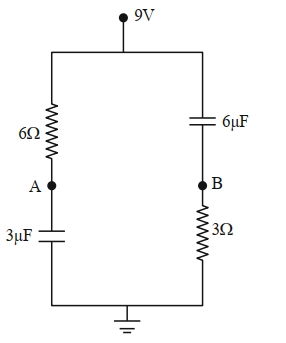
A
$58$
B
$36$
C
$45$
D
$32$
Solution
(B) At steady state,capacitors behave as open circuits. When points $A$ and $B$ are connected by a wire,the capacitors are bypassed in the $DC$ circuit path.
The circuit effectively consists of the $6 \ \Omega$ resistor and the $3 \ \Omega$ resistor in series connected to the $9 \ V$ source.
The equivalent resistance is $R_{\text{eq}} = 6 \ \Omega + 3 \ \Omega = 9 \ \Omega$.
The current flowing through the circuit is $i = \frac{V}{R_{\text{eq}}} = \frac{9 \ V}{9 \ \Omega} = 1 \ A$.
Since points $A$ and $B$ are connected,they are at the same potential. The potential at $A$ (and $B$) relative to the ground is the potential drop across the $3 \ \Omega$ resistor: $V_B = i \times 3 \ \Omega = 1 \ A \times 3 \ \Omega = 3 \ V$.
The potential at the top terminal is $9 \ V$. Thus,the potential difference across the $6 \ \mu F$ capacitor (connected between the $9 \ V$ terminal and point $B$) is $\Delta V = 9 \ V - 3 \ V = 6 \ V$.
The charge stored in the $6 \ \mu F$ capacitor is $Q = C \Delta V = 6 \ \mu F \times 6 \ V = 36 \ \mu C$.
The circuit effectively consists of the $6 \ \Omega$ resistor and the $3 \ \Omega$ resistor in series connected to the $9 \ V$ source.
The equivalent resistance is $R_{\text{eq}} = 6 \ \Omega + 3 \ \Omega = 9 \ \Omega$.
The current flowing through the circuit is $i = \frac{V}{R_{\text{eq}}} = \frac{9 \ V}{9 \ \Omega} = 1 \ A$.
Since points $A$ and $B$ are connected,they are at the same potential. The potential at $A$ (and $B$) relative to the ground is the potential drop across the $3 \ \Omega$ resistor: $V_B = i \times 3 \ \Omega = 1 \ A \times 3 \ \Omega = 3 \ V$.
The potential at the top terminal is $9 \ V$. Thus,the potential difference across the $6 \ \mu F$ capacitor (connected between the $9 \ V$ terminal and point $B$) is $\Delta V = 9 \ V - 3 \ V = 6 \ V$.
The charge stored in the $6 \ \mu F$ capacitor is $Q = C \Delta V = 6 \ \mu F \times 6 \ V = 36 \ \mu C$.
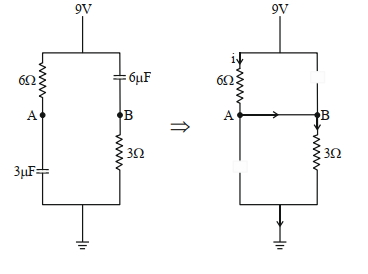
0 likesView Solution
114
PhysicsDifficultMCQJEE Main · 2024
In a single slit diffraction pattern,a light of wavelength $6000 \mathring A$ is used. The distance between the first and third minima in the diffraction pattern is found to be $3 \text{ mm}$ when the screen is placed $50 \text{ cm}$ away from the slit. The width of the slit is . . . . . . $\times 10^{-4} \text{ m}$.
A
$5$
B
$8$
C
$2$
D
$16$
Solution
(C) For the $n^{\text{th}}$ minima in a single slit diffraction pattern,the condition is given by:
$b \sin \theta = n \lambda$
Since $\lambda$ is very small,$\sin \theta \approx \tan \theta = \frac{y_n}{D}$.
Thus,the position of the $n^{\text{th}}$ minima is $y_n = \frac{n \lambda D}{b}$.
The position of the first minima $(n=1)$ is $y_1 = \frac{\lambda D}{b}$.
The position of the third minima $(n=3)$ is $y_3 = \frac{3 \lambda D}{b}$.
The distance between the first and third minima is $\Delta y = y_3 - y_1 = \frac{2 \lambda D}{b}$.
Given $\Delta y = 3 \text{ mm} = 3 \times 10^{-3} \text{ m}$,$\lambda = 6000 \mathring A = 6000 \times 10^{-10} \text{ m}$,and $D = 50 \text{ cm} = 0.5 \text{ m}$.
Substituting the values:
$3 \times 10^{-3} = \frac{2 \times 6000 \times 10^{-10} \times 0.5}{b}$
$b = \frac{2 \times 6000 \times 10^{-10} \times 0.5}{3 \times 10^{-3}}$
$b = \frac{6000 \times 10^{-10}}{3 \times 10^{-3}} = 2000 \times 10^{-7} = 2 \times 10^{-4} \text{ m}$.
Therefore,the width of the slit is $2 \times 10^{-4} \text{ m}$. The correct option is $C$.
$b \sin \theta = n \lambda$
Since $\lambda$ is very small,$\sin \theta \approx \tan \theta = \frac{y_n}{D}$.
Thus,the position of the $n^{\text{th}}$ minima is $y_n = \frac{n \lambda D}{b}$.
The position of the first minima $(n=1)$ is $y_1 = \frac{\lambda D}{b}$.
The position of the third minima $(n=3)$ is $y_3 = \frac{3 \lambda D}{b}$.
The distance between the first and third minima is $\Delta y = y_3 - y_1 = \frac{2 \lambda D}{b}$.
Given $\Delta y = 3 \text{ mm} = 3 \times 10^{-3} \text{ m}$,$\lambda = 6000 \mathring A = 6000 \times 10^{-10} \text{ m}$,and $D = 50 \text{ cm} = 0.5 \text{ m}$.
Substituting the values:
$3 \times 10^{-3} = \frac{2 \times 6000 \times 10^{-10} \times 0.5}{b}$
$b = \frac{2 \times 6000 \times 10^{-10} \times 0.5}{3 \times 10^{-3}}$
$b = \frac{6000 \times 10^{-10}}{3 \times 10^{-3}} = 2000 \times 10^{-7} = 2 \times 10^{-4} \text{ m}$.
Therefore,the width of the slit is $2 \times 10^{-4} \text{ m}$. The correct option is $C$.
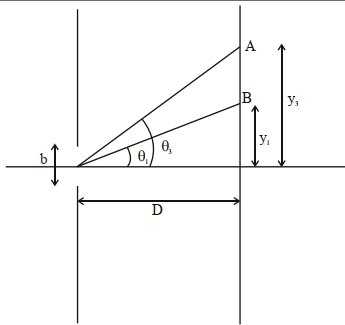
0 likesView Solution
115
PhysicsDifficultMCQJEE Main · 2024
In the given circuit,the current flowing through the resistance $20 \ \Omega$ is $0.3 \ A$,while the ammeter reads $0.9 \ A$. The value of $R_1$ is . . . . . . $\Omega$.
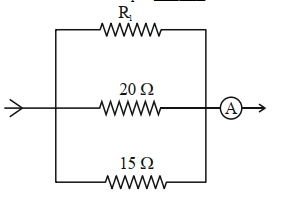
A
$12$
B
$78$
C
$45$
D
$30$
Solution
(D) Given,the current through the $20 \ \Omega$ resistor is $i_1 = 0.3 \ A$. The total current measured by the ammeter is $I = i_1 + i_2 + i_3 = 0.9 \ A$.
Since the resistors are connected in parallel,the potential difference $V_{AB}$ across them is the same.
$V_{AB} = i_1 \times 20 \ \Omega = 0.3 \ A \times 20 \ \Omega = 6 \ V$.
Now,calculate the current $i_2$ through the $15 \ \Omega$ resistor:
$i_2 = \frac{V_{AB}}{15 \ \Omega} = \frac{6 \ V}{15 \ \Omega} = 0.4 \ A$.
Using the total current equation:
$i_1 + i_2 + i_3 = 0.9 \ A$
$0.3 \ A + 0.4 \ A + i_3 = 0.9 \ A$
$0.7 \ A + i_3 = 0.9 \ A$
$i_3 = 0.2 \ A$.
Finally,calculate $R_1$ using the potential difference $V_{AB}$ and current $i_3$:
$R_1 = \frac{V_{AB}}{i_3} = \frac{6 \ V}{0.2 \ A} = 30 \ \Omega$.
Since the resistors are connected in parallel,the potential difference $V_{AB}$ across them is the same.
$V_{AB} = i_1 \times 20 \ \Omega = 0.3 \ A \times 20 \ \Omega = 6 \ V$.
Now,calculate the current $i_2$ through the $15 \ \Omega$ resistor:
$i_2 = \frac{V_{AB}}{15 \ \Omega} = \frac{6 \ V}{15 \ \Omega} = 0.4 \ A$.
Using the total current equation:
$i_1 + i_2 + i_3 = 0.9 \ A$
$0.3 \ A + 0.4 \ A + i_3 = 0.9 \ A$
$0.7 \ A + i_3 = 0.9 \ A$
$i_3 = 0.2 \ A$.
Finally,calculate $R_1$ using the potential difference $V_{AB}$ and current $i_3$:
$R_1 = \frac{V_{AB}}{i_3} = \frac{6 \ V}{0.2 \ A} = 30 \ \Omega$.
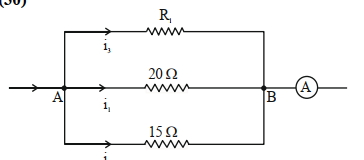
0 likesView Solution
116
PhysicsDifficultMCQJEE Main · 2024
$A$ potential divider circuit is shown in the figure. The output voltage $V_0$ is
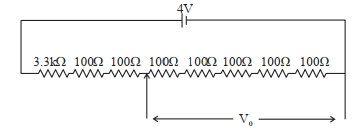
A
$4 \ V$
B
$2 \ mV$
C
$0.5 \ V$
D
$12 \ mV$
Solution
(C) The circuit consists of several resistors connected in series across a $4 \ V$ $DC$ source.
First,calculate the equivalent resistance $R_{eq}$ of the entire circuit:
$R_{eq} = 3.3 \ k\Omega + 100 \ \Omega + 100 \ \Omega + 100 \ \Omega + 100 \ \Omega + 100 \ \Omega + 100 \ \Omega + 100 \ \Omega$
$R_{eq} = 3300 \ \Omega + 700 \ \Omega = 4000 \ \Omega$
Next,calculate the total current $i$ flowing through the circuit using Ohm's law:
$i = \frac{V}{R_{eq}} = \frac{4 \ V}{4000 \ \Omega} = 10^{-3} \ A = 1 \ mA$
The output voltage $V_0$ is measured across the last five $100 \ \Omega$ resistors (as shown in the figure,the arrow points to the junction after the first three resistors,and $V_0$ is across the remaining five resistors).
Resistance across which $V_0$ is measured: $R_{out} = 5 \times 100 \ \Omega = 500 \ \Omega$
Therefore,$V_0 = i \times R_{out} = 1 \times 10^{-3} \ A \times 500 \ \Omega = 0.5 \ V$.
First,calculate the equivalent resistance $R_{eq}$ of the entire circuit:
$R_{eq} = 3.3 \ k\Omega + 100 \ \Omega + 100 \ \Omega + 100 \ \Omega + 100 \ \Omega + 100 \ \Omega + 100 \ \Omega + 100 \ \Omega$
$R_{eq} = 3300 \ \Omega + 700 \ \Omega = 4000 \ \Omega$
Next,calculate the total current $i$ flowing through the circuit using Ohm's law:
$i = \frac{V}{R_{eq}} = \frac{4 \ V}{4000 \ \Omega} = 10^{-3} \ A = 1 \ mA$
The output voltage $V_0$ is measured across the last five $100 \ \Omega$ resistors (as shown in the figure,the arrow points to the junction after the first three resistors,and $V_0$ is across the remaining five resistors).
Resistance across which $V_0$ is measured: $R_{out} = 5 \times 100 \ \Omega = 500 \ \Omega$
Therefore,$V_0 = i \times R_{out} = 1 \times 10^{-3} \ A \times 500 \ \Omega = 0.5 \ V$.
0 likesView Solution
117
PhysicsDifficultMCQJEE Main · 2024
The work function of a substance is $3.0 \ eV$. The longest wavelength of light that can cause the emission of photoelectrons from this substance is approximately: (in $nm$)
A
$215$
B
$414$
C
$400$
D
$200$
Solution
(B) For photoelectric emission $(P.E.E.)$,the condition is $\lambda \leq \frac{hc}{W_0}$.
Given the work function $W_0 = 3.0 \ eV$.
Using the relation $\lambda_{\max} = \frac{hc}{W_0}$,where $hc \approx 1240 \ eV \cdot nm$.
$\lambda_{\max} = \frac{1240 \ eV \cdot nm}{3.0 \ eV}$.
$\lambda_{\max} \approx 413.33 \ nm$.
Therefore,the longest wavelength is approximately $414 \ nm$.
Given the work function $W_0 = 3.0 \ eV$.
Using the relation $\lambda_{\max} = \frac{hc}{W_0}$,where $hc \approx 1240 \ eV \cdot nm$.
$\lambda_{\max} = \frac{1240 \ eV \cdot nm}{3.0 \ eV}$.
$\lambda_{\max} \approx 413.33 \ nm$.
Therefore,the longest wavelength is approximately $414 \ nm$.
0 likesView Solution
118
PhysicsDifficultMCQJEE Main · 2024
The ratio of the magnitude of the kinetic energy to the potential energy of an electron in the $5^{\text{th}}$ excited state of a hydrogen atom is:
A
$4$
B
$\frac{1}{4}$
C
$\frac{1}{2}$
D
$1$
Solution
(C) For an electron in a hydrogen atom,the kinetic energy $(KE)$ and potential energy $(PE)$ are related by the virial theorem.
$KE = -\frac{1}{2} PE$
Taking the magnitude of the potential energy,we have $|PE| = 2 KE$.
Therefore,the ratio of the magnitude of the kinetic energy to the potential energy is given by $\frac{KE}{|PE|} = \frac{1}{2}$.
This relationship holds true for any orbit $n$,including the $5^{\text{th}}$ excited state $(n = 6)$.
$KE = -\frac{1}{2} PE$
Taking the magnitude of the potential energy,we have $|PE| = 2 KE$.
Therefore,the ratio of the magnitude of the kinetic energy to the potential energy is given by $\frac{KE}{|PE|} = \frac{1}{2}$.
This relationship holds true for any orbit $n$,including the $5^{\text{th}}$ excited state $(n = 6)$.
0 likesView Solution
119
PhysicsDifficultMCQJEE Main · 2024
The electric field of an electromagnetic wave in free space is represented as $\vec{E} = E_0 \cos(\omega t - kz) \hat{i}$. The corresponding magnetic induction vector will be:
A
$\vec{B} = E_0 C \cos(\omega t - kz) \hat{j}$
B
$\vec{B} = \frac{E_0}{C} \cos(\omega t - kz) \hat{j}$
C
$\vec{B} = E_0 \cos(\omega t + kz) \hat{j}$
D
$\vec{B} = \frac{E_0}{C} \cos(\omega t + kz) \hat{j}$
Solution
(B) The electric field is given by $\vec{E} = E_0 \cos(\omega t - kz) \hat{i}$.
In an electromagnetic wave, the relationship between the electric field amplitude $E_0$ and the magnetic field amplitude $B_0$ is given by $B_0 = \frac{E_0}{C}$, where $C$ is the speed of light.
The direction of propagation of the wave is given by the direction of the vector $\vec{E} \times \vec{B}$.
Here, the wave propagates in the $+z$ direction $(\hat{k})$.
Given $\vec{E}$ is in the $\hat{i}$ direction, we have $\hat{i} \times \hat{B} = \hat{k}$.
This implies $\hat{B} = \hat{j}$.
Thus, the magnetic field vector is $\vec{B} = \frac{E_0}{C} \cos(\omega t - kz) \hat{j}$.
In an electromagnetic wave, the relationship between the electric field amplitude $E_0$ and the magnetic field amplitude $B_0$ is given by $B_0 = \frac{E_0}{C}$, where $C$ is the speed of light.
The direction of propagation of the wave is given by the direction of the vector $\vec{E} \times \vec{B}$.
Here, the wave propagates in the $+z$ direction $(\hat{k})$.
Given $\vec{E}$ is in the $\hat{i}$ direction, we have $\hat{i} \times \hat{B} = \hat{k}$.
This implies $\hat{B} = \hat{j}$.
Thus, the magnetic field vector is $\vec{B} = \frac{E_0}{C} \cos(\omega t - kz) \hat{j}$.
0 likesView Solution
120
PhysicsDifficultMCQJEE Main · 2024
Two insulated circular loops $A$ and $B$ of radius '$a$' carry a current of '$I$' in the directions as shown in the figure. The magnitude of the magnetic induction at the centre $O$ will be:
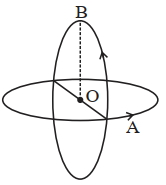
A
$\frac{\sqrt{2} \mu_0 I}{2 a}$
B
$\frac{\mu_0 I}{2 a}$
C
$\frac{\mu_0 I}{\sqrt{2} a}$
D
$\frac{2 \mu_0 I}{a}$
Solution
(C) The magnetic field at the centre of a circular loop of radius '$a$' carrying current '$I$' is given by $B = \frac{\mu_0 I}{2 a}$.
Since the two loops $A$ and $B$ are perpendicular to each other,the magnetic fields produced by them at the centre $O$ will also be perpendicular.
Let $B_A$ be the magnetic field due to loop $A$ and $B_B$ be the magnetic field due to loop $B$. Then $B_A = B_B = \frac{\mu_0 I}{2 a}$.
The net magnetic field $B_{net}$ at the centre is the vector sum of $B_A$ and $B_B$:
$B_{net} = \sqrt{B_A^2 + B_B^2} = \sqrt{\left(\frac{\mu_0 I}{2 a}\right)^2 + \left(\frac{\mu_0 I}{2 a}\right)^2}$
$B_{net} = \sqrt{2 \left(\frac{\mu_0 I}{2 a}\right)^2} = \sqrt{2} \cdot \frac{\mu_0 I}{2 a} = \frac{\mu_0 I}{\sqrt{2} a}$.
Since the two loops $A$ and $B$ are perpendicular to each other,the magnetic fields produced by them at the centre $O$ will also be perpendicular.
Let $B_A$ be the magnetic field due to loop $A$ and $B_B$ be the magnetic field due to loop $B$. Then $B_A = B_B = \frac{\mu_0 I}{2 a}$.
The net magnetic field $B_{net}$ at the centre is the vector sum of $B_A$ and $B_B$:
$B_{net} = \sqrt{B_A^2 + B_B^2} = \sqrt{\left(\frac{\mu_0 I}{2 a}\right)^2 + \left(\frac{\mu_0 I}{2 a}\right)^2}$
$B_{net} = \sqrt{2 \left(\frac{\mu_0 I}{2 a}\right)^2} = \sqrt{2} \cdot \frac{\mu_0 I}{2 a} = \frac{\mu_0 I}{\sqrt{2} a}$.
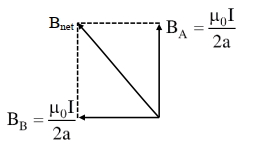
0 likesView Solution
121
PhysicsDifficultMCQJEE Main · 2024
The diffraction pattern of light of wavelength $400 \ nm$ diffracting from a slit of width $0.2 \ mm$ is focused on the focal plane of a convex lens of focal length $100 \ cm$. The width of the $1^{\text{st}}$ secondary maxima will be:
A
$2 \ mm$
B
$2 \ cm$
C
$0.02 \ mm$
D
$0.2 \ mm$
Solution
(A) The width of the $n^{\text{th}}$ secondary maxima in a single-slit diffraction pattern is given by $\beta = \frac{\lambda D}{a}$,where $\lambda$ is the wavelength,$D$ is the distance of the screen (focal length of the lens),and $a$ is the slit width.
Given:
$\lambda = 400 \ nm = 400 \times 10^{-9} \ m$
$a = 0.2 \ mm = 0.2 \times 10^{-3} \ m$
$D = 100 \ cm = 1 \ m$
Substituting the values:
$\text{Width} = \frac{400 \times 10^{-9} \ m \times 1 \ m}{0.2 \times 10^{-3} \ m}$
$= \frac{400}{0.2} \times 10^{-6} \ m$
$= 2000 \times 10^{-6} \ m$
$= 2 \times 10^{-3} \ m = 2 \ mm$.
Given:
$\lambda = 400 \ nm = 400 \times 10^{-9} \ m$
$a = 0.2 \ mm = 0.2 \times 10^{-3} \ m$
$D = 100 \ cm = 1 \ m$
Substituting the values:
$\text{Width} = \frac{400 \times 10^{-9} \ m \times 1 \ m}{0.2 \times 10^{-3} \ m}$
$= \frac{400}{0.2} \times 10^{-6} \ m$
$= 2000 \times 10^{-6} \ m$
$= 2 \times 10^{-3} \ m = 2 \ mm$.
0 likesView Solution
122
PhysicsDifficultMCQJEE Main · 2024
The primary coil of a transformer is connected to a $220 \,V$ $AC$ source. The number of turns in the primary and secondary coils are $100$ and $10$ respectively. The secondary coil is connected to two resistors in series as shown in the figure. The output voltage $\left(V_0\right)$ is: (in $\,V$)
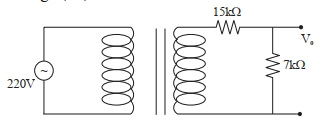
A
$7$
B
$15$
C
$44$
D
$22$
Solution
(A) For an ideal transformer, the ratio of voltages is equal to the ratio of the number of turns:
$\frac{V_p}{V_s} = \frac{N_p}{N_s}$
Given $V_p = 220 \,V$, $N_p = 100$, and $N_s = 10$, we have:
$\frac{220}{V_s} = \frac{100}{10} = 10$
$V_s = \frac{220}{10} = 22 \,V$
This secondary voltage $V_s = 22 \,V$ is applied across two resistors in series: $R_1 = 15 \,k\Omega$ and $R_2 = 7 \,k\Omega$.
The output voltage $V_0$ is the voltage across the $7 \,k\Omega$ resistor, which can be calculated using the voltage divider rule:
$V_0 = V_s \times \left( \frac{R_2}{R_1 + R_2} \right)$
$V_0 = 22 \times \left( \frac{7 \,k\Omega}{15 \,k\Omega + 7 \,k\Omega} \right)$
$V_0 = 22 \times \left( \frac{7}{22} \right) = 7 \,V$
$\frac{V_p}{V_s} = \frac{N_p}{N_s}$
Given $V_p = 220 \,V$, $N_p = 100$, and $N_s = 10$, we have:
$\frac{220}{V_s} = \frac{100}{10} = 10$
$V_s = \frac{220}{10} = 22 \,V$
This secondary voltage $V_s = 22 \,V$ is applied across two resistors in series: $R_1 = 15 \,k\Omega$ and $R_2 = 7 \,k\Omega$.
The output voltage $V_0$ is the voltage across the $7 \,k\Omega$ resistor, which can be calculated using the voltage divider rule:
$V_0 = V_s \times \left( \frac{R_2}{R_1 + R_2} \right)$
$V_0 = 22 \times \left( \frac{7 \,k\Omega}{15 \,k\Omega + 7 \,k\Omega} \right)$
$V_0 = 22 \times \left( \frac{7}{22} \right) = 7 \,V$
0 likesView Solution
123
PhysicsDifficultMCQJEE Main · 2024
An electric toaster has a resistance of $60 \ \Omega$ at room temperature $\left(27^{\circ} C\right)$. The toaster is connected to a $220 \ V$ supply. If the current flowing through it reaches $2.75 \ A$,the temperature attained by the toaster is around: (given $\alpha = 2 \times 10^{-4} /{ }^{\circ} C$) (in $^{\circ} C$)
A
$694$
B
$1235$
C
$1694$
D
$1667$
Solution
(C) Given: Resistance at room temperature $R_0 = 60 \ \Omega$ at $T_0 = 27^{\circ} C$.
Voltage $V = 220 \ V$ and current $I = 2.75 \ A$.
The resistance at the final temperature $T$ is given by $R_T = \frac{V}{I} = \frac{220}{2.75} = 80 \ \Omega$.
The temperature dependence of resistance is given by $R_T = R_0(1 + \alpha \Delta T)$,where $\Delta T = T - T_0$.
Substituting the values: $80 = 60[1 + 2 \times 10^{-4}(T - 27)]$.
$80/60 = 1 + 2 \times 10^{-4}(T - 27)$.
$1.333 - 1 = 2 \times 10^{-4}(T - 27)$.
$0.333 = 2 \times 10^{-4}(T - 27)$.
$T - 27 = \frac{0.333}{2 \times 10^{-4}} = 1665$.
$T = 1665 + 27 = 1692^{\circ} C$.
Rounding to the nearest option,the temperature is approximately $1694^{\circ} C$.
Voltage $V = 220 \ V$ and current $I = 2.75 \ A$.
The resistance at the final temperature $T$ is given by $R_T = \frac{V}{I} = \frac{220}{2.75} = 80 \ \Omega$.
The temperature dependence of resistance is given by $R_T = R_0(1 + \alpha \Delta T)$,where $\Delta T = T - T_0$.
Substituting the values: $80 = 60[1 + 2 \times 10^{-4}(T - 27)]$.
$80/60 = 1 + 2 \times 10^{-4}(T - 27)$.
$1.333 - 1 = 2 \times 10^{-4}(T - 27)$.
$0.333 = 2 \times 10^{-4}(T - 27)$.
$T - 27 = \frac{0.333}{2 \times 10^{-4}} = 1665$.
$T = 1665 + 27 = 1692^{\circ} C$.
Rounding to the nearest option,the temperature is approximately $1694^{\circ} C$.
0 likesView Solution
124
PhysicsDifficultMCQJEE Main · 2024
$A$ Zener diode of breakdown voltage $10 \, V$ is used as a voltage regulator as shown in the figure. The current through the Zener diode is (in $ \, mA$)
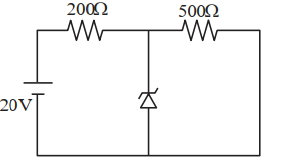
A
$50$
B
$0$
C
$30$
D
$20$
Solution
(C) The Zener diode is in the breakdown region, so the voltage across it is constant at $10 \, V$.
The current through the $500 \, \Omega$ load resistor $(I_L)$ is:
$I_L = \frac{V_Z}{R_L} = \frac{10 \, V}{500 \, \Omega} = 0.02 \, A = 20 \, mA$
The current through the series resistor $(I_S)$ is:
$I_S = \frac{V_{in} - V_Z}{R_S} = \frac{20 \, V - 10 \, V}{200 \, \Omega} = \frac{10 \, V}{200 \, \Omega} = 0.05 \, A = 50 \, mA$
Applying Kirchhoff's Current Law at the junction, the current through the Zener diode $(I_Z)$ is:
$I_Z = I_S - I_L = 50 \, mA - 20 \, mA = 30 \, mA$
The current through the $500 \, \Omega$ load resistor $(I_L)$ is:
$I_L = \frac{V_Z}{R_L} = \frac{10 \, V}{500 \, \Omega} = 0.02 \, A = 20 \, mA$
The current through the series resistor $(I_S)$ is:
$I_S = \frac{V_{in} - V_Z}{R_S} = \frac{20 \, V - 10 \, V}{200 \, \Omega} = \frac{10 \, V}{200 \, \Omega} = 0.05 \, A = 50 \, mA$
Applying Kirchhoff's Current Law at the junction, the current through the Zener diode $(I_Z)$ is:
$I_Z = I_S - I_L = 50 \, mA - 20 \, mA = 30 \, mA$
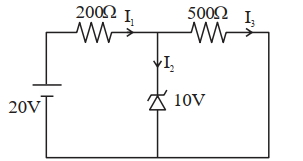
0 likesView Solution
125
PhysicsDifficultMCQJEE Main · 2024
The electrostatic potential due to an electric dipole at a distance '$r$' varies as:
A
$r$
B
$1/r^2$
C
$1/r^3$
D
$1/r$
Solution
(B) The electrostatic potential $V$ at a point due to an electric dipole is given by the formula:
$V = \frac{1}{4\pi\epsilon_0} \frac{p \cos \theta}{r^2}$
Where $p$ is the dipole moment,$\theta$ is the angle between the dipole moment vector and the position vector,and $r$ is the distance from the center of the dipole.
From this expression,it is clear that the potential $V$ is inversely proportional to the square of the distance $r$.
Therefore,$V \propto \frac{1}{r^2}$.
$V = \frac{1}{4\pi\epsilon_0} \frac{p \cos \theta}{r^2}$
Where $p$ is the dipole moment,$\theta$ is the angle between the dipole moment vector and the position vector,and $r$ is the distance from the center of the dipole.
From this expression,it is clear that the potential $V$ is inversely proportional to the square of the distance $r$.
Therefore,$V \propto \frac{1}{r^2}$.
0 likesView Solution
126
PhysicsDifficultMCQJEE Main · 2024
$A$ series $L, R$ circuit connected with an ac source $E = (25 \sin 1000 t) \ V$ has a power factor of $\frac{1}{\sqrt{2}}$. If the source of emf is changed to $E = (20 \sin 2000 t) \ V$,the new power factor of the circuit will be:
A
$\frac{1}{\sqrt{2}}$
B
$\frac{1}{\sqrt{3}}$
C
$\frac{1}{\sqrt{5}}$
D
$\frac{1}{\sqrt{7}}$
Solution
(C) For a series $L, R$ circuit,the power factor is given by $\cos \phi = \frac{R}{Z} = \frac{R}{\sqrt{R^2 + X_L^2}}$,where $X_L = \omega L$.
Given the initial angular frequency $\omega_1 = 1000 \ rad/s$ and power factor $\cos \phi_1 = \frac{1}{\sqrt{2}}$.
Since $\cos \phi_1 = \frac{1}{\sqrt{2}}$,the phase angle $\phi_1 = 45^{\circ}$.
Thus,$\tan \phi_1 = \frac{X_{L1}}{R} = \frac{\omega_1 L}{R} = \tan 45^{\circ} = 1$.
This implies $R = \omega_1 L = 1000 L$.
When the source is changed to $E = (20 \sin 2000 t) \ V$,the new angular frequency is $\omega_2 = 2000 \ rad/s$.
The new inductive reactance is $X_{L2} = \omega_2 L = 2000 L = 2(\omega_1 L) = 2R$.
The new power factor is $\cos \phi_2 = \frac{R}{\sqrt{R^2 + X_{L2}^2}} = \frac{R}{\sqrt{R^2 + (2R)^2}} = \frac{R}{\sqrt{R^2 + 4R^2}} = \frac{R}{\sqrt{5R^2}} = \frac{1}{\sqrt{5}}$.
Given the initial angular frequency $\omega_1 = 1000 \ rad/s$ and power factor $\cos \phi_1 = \frac{1}{\sqrt{2}}$.
Since $\cos \phi_1 = \frac{1}{\sqrt{2}}$,the phase angle $\phi_1 = 45^{\circ}$.
Thus,$\tan \phi_1 = \frac{X_{L1}}{R} = \frac{\omega_1 L}{R} = \tan 45^{\circ} = 1$.
This implies $R = \omega_1 L = 1000 L$.
When the source is changed to $E = (20 \sin 2000 t) \ V$,the new angular frequency is $\omega_2 = 2000 \ rad/s$.
The new inductive reactance is $X_{L2} = \omega_2 L = 2000 L = 2(\omega_1 L) = 2R$.
The new power factor is $\cos \phi_2 = \frac{R}{\sqrt{R^2 + X_{L2}^2}} = \frac{R}{\sqrt{R^2 + (2R)^2}} = \frac{R}{\sqrt{R^2 + 4R^2}} = \frac{R}{\sqrt{5R^2}} = \frac{1}{\sqrt{5}}$.
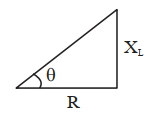
0 likesView Solution
127
PhysicsDifficultMCQJEE Main · 2024
The horizontal component of Earth's magnetic field at a place is $3.5 \times 10^{-5} \,T$. $A$ very long straight conductor carrying a current of $\sqrt{2} \,A$ in the direction from South-East to North-West is placed. The force per unit length experienced by the conductor is $..............$ $\times 10^{-6} \,N/m$.
A
$35$
B
$15$
C
$74$
D
$64$
Solution
(A) The horizontal component of the Earth's magnetic field is $B_H = 3.5 \times 10^{-5} \,T$.
The current in the conductor is $i = \sqrt{2} \,A$.
The conductor is placed from South-East to North-West,which makes an angle of $\theta = 45^\circ$ with the horizontal magnetic field (North-South direction).
The force per unit length on a current-carrying conductor is given by $\frac{F}{\ell} = i B_H \sin \theta$.
Substituting the values: $\frac{F}{\ell} = \sqrt{2} \times (3.5 \times 10^{-5}) \times \sin(45^\circ)$.
Since $\sin(45^\circ) = \frac{1}{\sqrt{2}}$,we get $\frac{F}{\ell} = \sqrt{2} \times 3.5 \times 10^{-5} \times \frac{1}{\sqrt{2}} = 3.5 \times 10^{-5} \,N/m$.
Converting to the required format: $3.5 \times 10^{-5} = 35 \times 10^{-6} \,N/m$.
Therefore,the value is $35$.
The current in the conductor is $i = \sqrt{2} \,A$.
The conductor is placed from South-East to North-West,which makes an angle of $\theta = 45^\circ$ with the horizontal magnetic field (North-South direction).
The force per unit length on a current-carrying conductor is given by $\frac{F}{\ell} = i B_H \sin \theta$.
Substituting the values: $\frac{F}{\ell} = \sqrt{2} \times (3.5 \times 10^{-5}) \times \sin(45^\circ)$.
Since $\sin(45^\circ) = \frac{1}{\sqrt{2}}$,we get $\frac{F}{\ell} = \sqrt{2} \times 3.5 \times 10^{-5} \times \frac{1}{\sqrt{2}} = 3.5 \times 10^{-5} \,N/m$.
Converting to the required format: $3.5 \times 10^{-5} = 35 \times 10^{-6} \,N/m$.
Therefore,the value is $35$.
0 likesView Solution
128
PhysicsDifficultMCQJEE Main · 2024
Two cells are connected in opposition as shown. Cell $E_1$ has an electromotive force (emf) of $8 \ V$ and an internal resistance of $2 \ \Omega$; cell $E_2$ has an emf of $2 \ V$ and an internal resistance of $4 \ \Omega$. The terminal potential difference of cell $E_2$ is: (in $V$)
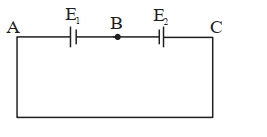
A
$10$
B
$6$
C
$7$
D
$4$
Solution
(B) The total electromotive force (emf) of the circuit is $E_{eq} = E_1 - E_2 = 8 \ V - 2 \ V = 6 \ V$.
The total resistance of the circuit is $R_{eq} = r_1 + r_2 = 2 \ \Omega + 4 \ \Omega = 6 \ \Omega$.
The current flowing in the circuit is $I = \frac{E_{eq}}{R_{eq}} = \frac{6 \ V}{6 \ \Omega} = 1 \ A$.
Since the cell $E_2$ is being charged (current enters its positive terminal),its terminal potential difference $V$ is given by $V = E_2 + Ir_2$.
Substituting the values,we get $V = 2 \ V + (1 \ A \times 4 \ \Omega) = 2 \ V + 4 \ V = 6 \ V$.
The total resistance of the circuit is $R_{eq} = r_1 + r_2 = 2 \ \Omega + 4 \ \Omega = 6 \ \Omega$.
The current flowing in the circuit is $I = \frac{E_{eq}}{R_{eq}} = \frac{6 \ V}{6 \ \Omega} = 1 \ A$.
Since the cell $E_2$ is being charged (current enters its positive terminal),its terminal potential difference $V$ is given by $V = E_2 + Ir_2$.
Substituting the values,we get $V = 2 \ V + (1 \ A \times 4 \ \Omega) = 2 \ V + 4 \ V = 6 \ V$.
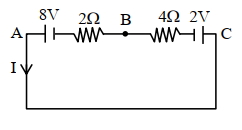
0 likesView Solution
129
PhysicsDifficultMCQJEE Main · 2024
An electron of a hydrogen atom in an excited state has an energy $E_n = -0.85 \ eV$. The maximum number of allowed transitions to lower energy levels is:
A
$5$
B
$7$
C
$6$
D
$12$
Solution
(C) The energy of an electron in the $n^{th}$ orbit of a hydrogen atom is given by $E_n = -\frac{13.6}{n^2} \ eV$.
Given $E_n = -0.85 \ eV$,we have:
$-\frac{13.6}{n^2} = -0.85$
$n^2 = \frac{13.6}{0.85} = 16$
$n = 4$.
The number of possible transitions from an excited state $n$ to lower energy levels is given by the formula $\frac{n(n-1)}{2}$.
Substituting $n = 4$:
Number of transitions $= \frac{4(4-1)}{2} = \frac{4 \times 3}{2} = 6$.
Given $E_n = -0.85 \ eV$,we have:
$-\frac{13.6}{n^2} = -0.85$
$n^2 = \frac{13.6}{0.85} = 16$
$n = 4$.
The number of possible transitions from an excited state $n$ to lower energy levels is given by the formula $\frac{n(n-1)}{2}$.
Substituting $n = 4$:
Number of transitions $= \frac{4(4-1)}{2} = \frac{4 \times 3}{2} = 6$.
0 likesView Solution
130
PhysicsDifficultMCQJEE Main · 2024
The distance between an object and its two times magnified real image produced by a convex lens is $45 \,cm$. The focal length of the lens used is . . . . . . $cm$.
A
$10$
B
$4$
C
$13$
D
$85$
Solution
(A) For a real image,magnification $m = -2$.
Since $m = \frac{v}{u}$,we have $\frac{v}{u} = -2$,which implies $v = -2u$.
Given the distance between the object and the image is $45 \,cm$,and for a real image formed by a convex lens,the object and image are on opposite sides,the distance is $|v| + |u| = 45$.
Substituting $v = -2u$ (where $u$ is negative),we get $|-2u| + |u| = 45$,so $3|u| = 45$,which gives $|u| = 15 \,cm$.
Thus,$u = -15 \,cm$ and $v = +30 \,cm$.
Using the lens formula $\frac{1}{f} = \frac{1}{v} - \frac{1}{u}$:
$\frac{1}{f} = \frac{1}{30} - \frac{1}{-15} = \frac{1}{30} + \frac{2}{30} = \frac{3}{30} = \frac{1}{10}$.
Therefore,$f = 10 \,cm$.
Since $m = \frac{v}{u}$,we have $\frac{v}{u} = -2$,which implies $v = -2u$.
Given the distance between the object and the image is $45 \,cm$,and for a real image formed by a convex lens,the object and image are on opposite sides,the distance is $|v| + |u| = 45$.
Substituting $v = -2u$ (where $u$ is negative),we get $|-2u| + |u| = 45$,so $3|u| = 45$,which gives $|u| = 15 \,cm$.
Thus,$u = -15 \,cm$ and $v = +30 \,cm$.
Using the lens formula $\frac{1}{f} = \frac{1}{v} - \frac{1}{u}$:
$\frac{1}{f} = \frac{1}{30} - \frac{1}{-15} = \frac{1}{30} + \frac{2}{30} = \frac{3}{30} = \frac{1}{10}$.
Therefore,$f = 10 \,cm$.
0 likesView Solution
131
PhysicsDifficultMCQJEE Main · 2024
$A$ capacitor of capacitance $C$ and potential $V$ has energy $E$. It is connected to another capacitor of capacitance $2C$ and potential $2V$. Then the loss of energy is $\frac{x}{3} E$,where $x$ is . . . . . . .
A
$45$
B
$8$
C
$2$
D
$19$
Solution
(C) Initial energy of the first capacitor: $E_1 = \frac{1}{2} C V^2 = E$.
Initial energy of the second capacitor: $E_2 = \frac{1}{2} (2C) (2V)^2 = \frac{1}{2} (2C) (4V^2) = 4 C V^2 = 8E$.
Total initial energy: $E_i = E_1 + E_2 = E + 8E = 9E$.
Total charge: $Q_{total} = Q_1 + Q_2 = CV + (2C)(2V) = CV + 4CV = 5CV$.
Total capacitance: $C_{eq} = C + 2C = 3C$.
Common potential: $V_{common} = \frac{Q_{total}}{C_{eq}} = \frac{5CV}{3C} = \frac{5}{3} V$.
Final energy: $E_f = \frac{1}{2} C_{eq} V_{common}^2 = \frac{1}{2} (3C) (\frac{5}{3} V)^2 = \frac{1}{2} (3C) (\frac{25}{9} V^2) = \frac{25}{6} C V^2 = \frac{25}{3} E$.
Loss of energy: $\Delta E = E_i - E_f = 9E - \frac{25}{3} E = \frac{27E - 25E}{3} = \frac{2}{3} E$.
Comparing with $\frac{x}{3} E$,we get $x = 2$.
Initial energy of the second capacitor: $E_2 = \frac{1}{2} (2C) (2V)^2 = \frac{1}{2} (2C) (4V^2) = 4 C V^2 = 8E$.
Total initial energy: $E_i = E_1 + E_2 = E + 8E = 9E$.
Total charge: $Q_{total} = Q_1 + Q_2 = CV + (2C)(2V) = CV + 4CV = 5CV$.
Total capacitance: $C_{eq} = C + 2C = 3C$.
Common potential: $V_{common} = \frac{Q_{total}}{C_{eq}} = \frac{5CV}{3C} = \frac{5}{3} V$.
Final energy: $E_f = \frac{1}{2} C_{eq} V_{common}^2 = \frac{1}{2} (3C) (\frac{5}{3} V)^2 = \frac{1}{2} (3C) (\frac{25}{9} V^2) = \frac{25}{6} C V^2 = \frac{25}{3} E$.
Loss of energy: $\Delta E = E_i - E_f = 9E - \frac{25}{3} E = \frac{27E - 25E}{3} = \frac{2}{3} E$.
Comparing with $\frac{x}{3} E$,we get $x = 2$.
0 likesView Solution
132
PhysicsDifficultMCQJEE Main · 2024
$A$ ceiling fan having $3$ blades of length $80 \ cm$ each is rotating with an angular velocity of $1200 \ rpm$. The magnetic field of Earth in that region is $0.5 \ G$ and the angle of dip is $30^{\circ}$. The $EMF$ induced across the blades is $N \pi \times 10^{-5} \ V$. The value of $N$ is:
A
$89$
B
$32$
C
$45$
D
$27$
Solution
(B) The vertical component of the Earth's magnetic field is given by $B_V = B \sin(\delta)$,where $B = 0.5 \ G = 0.5 \times 10^{-4} \ T$ and $\delta = 30^{\circ}$.
$B_V = 0.5 \times 10^{-4} \times \sin(30^{\circ}) = 0.5 \times 10^{-4} \times 0.5 = 0.25 \times 10^{-4} \ T = 0.25 \times 10^{-4} \ T = \frac{1}{4} \times 10^{-4} \ T$.
The angular velocity $\omega$ is given by $\omega = \frac{2 \pi n}{60}$,where $n = 1200 \ rpm$.
$\omega = \frac{2 \pi \times 1200}{60} = 40 \pi \ rad/s$.
The induced $EMF$ across a rotating rod is $\varepsilon = \frac{1}{2} B_V \omega \ell^2$,where $\ell = 80 \ cm = 0.8 \ m$.
$\varepsilon = \frac{1}{2} \times (0.25 \times 10^{-4}) \times (40 \pi) \times (0.8)^2$.
$\varepsilon = 0.5 \times 0.25 \times 10^{-4} \times 40 \pi \times 0.64$.
$\varepsilon = 0.125 \times 10^{-4} \times 40 \pi \times 0.64 = 5 \pi \times 10^{-4} \times 0.64 = 3.2 \pi \times 10^{-4} = 32 \pi \times 10^{-5} \ V$.
Comparing this with $N \pi \times 10^{-5} \ V$,we get $N = 32$.
$B_V = 0.5 \times 10^{-4} \times \sin(30^{\circ}) = 0.5 \times 10^{-4} \times 0.5 = 0.25 \times 10^{-4} \ T = 0.25 \times 10^{-4} \ T = \frac{1}{4} \times 10^{-4} \ T$.
The angular velocity $\omega$ is given by $\omega = \frac{2 \pi n}{60}$,where $n = 1200 \ rpm$.
$\omega = \frac{2 \pi \times 1200}{60} = 40 \pi \ rad/s$.
The induced $EMF$ across a rotating rod is $\varepsilon = \frac{1}{2} B_V \omega \ell^2$,where $\ell = 80 \ cm = 0.8 \ m$.
$\varepsilon = \frac{1}{2} \times (0.25 \times 10^{-4}) \times (40 \pi) \times (0.8)^2$.
$\varepsilon = 0.5 \times 0.25 \times 10^{-4} \times 40 \pi \times 0.64$.
$\varepsilon = 0.125 \times 10^{-4} \times 40 \pi \times 0.64 = 5 \pi \times 10^{-4} \times 0.64 = 3.2 \pi \times 10^{-4} = 32 \pi \times 10^{-5} \ V$.
Comparing this with $N \pi \times 10^{-5} \ V$,we get $N = 32$.
1 likesView Solution
133
PhysicsDifficultMCQJEE Main · 2024
For the photoelectric effect,the maximum kinetic energy $(E_{k})$ of the photoelectrons is plotted against the frequency $(\nu)$ of the incident photons as shown in the figure. The slope of the graph gives:
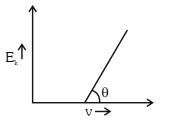
A
Ratio of Planck's constant to electric charge
B
Work function of the metal
C
Charge of electron
D
Planck's constant
Solution
(D) According to Einstein's photoelectric equation,the maximum kinetic energy $(E_{k})$ of the emitted photoelectrons is given by:
$E_{k} = h\nu - \phi$
where $h$ is Planck's constant,$\nu$ is the frequency of incident photons,and $\phi$ is the work function of the metal.
Comparing this equation with the equation of a straight line $y = mx + c$,where $y = E_{k}$,$x = \nu$,$m$ is the slope,and $c$ is the intercept:
The slope of the graph is $m = \tan \theta = h$.
Therefore,the slope of the graph gives Planck's constant.
$E_{k} = h\nu - \phi$
where $h$ is Planck's constant,$\nu$ is the frequency of incident photons,and $\phi$ is the work function of the metal.
Comparing this equation with the equation of a straight line $y = mx + c$,where $y = E_{k}$,$x = \nu$,$m$ is the slope,and $c$ is the intercept:
The slope of the graph is $m = \tan \theta = h$.
Therefore,the slope of the graph gives Planck's constant.
0 likesView Solution
134
PhysicsDifficultMCQJEE Main · 2024
In a nuclear fission reaction of an isotope of mass $M$,three similar daughter nuclei of the same mass are formed. The speed of a daughter nucleus in terms of mass defect $\Delta M$ will be:
A
$\sqrt{\frac{2 c \Delta M}{M}}$
B
$\frac{\Delta M c^2}{3}$
C
$c \sqrt{\frac{2 \Delta M}{M}}$
D
$c \sqrt{\frac{3 \Delta M}{M}}$
Solution
(C) The initial mass of the parent nucleus is $M$. It splits into three daughter nuclei,each of mass $m = M/3$.
The energy released in the fission reaction is given by Einstein's mass-energy equivalence: $E = \Delta M c^2$.
This energy is converted into the kinetic energy of the three daughter nuclei. Let $v$ be the speed of each daughter nucleus.
The total kinetic energy is $K.E. = 3 \times (\frac{1}{2} m v^2) = 3 \times (\frac{1}{2} \times \frac{M}{3} \times v^2) = \frac{1}{2} M v^2$.
Equating the energy released to the kinetic energy: $\Delta M c^2 = \frac{1}{2} M v^2$.
Solving for $v$: $v^2 = \frac{2 \Delta M c^2}{M}$.
Therefore,$v = c \sqrt{\frac{2 \Delta M}{M}}$.
The energy released in the fission reaction is given by Einstein's mass-energy equivalence: $E = \Delta M c^2$.
This energy is converted into the kinetic energy of the three daughter nuclei. Let $v$ be the speed of each daughter nucleus.
The total kinetic energy is $K.E. = 3 \times (\frac{1}{2} m v^2) = 3 \times (\frac{1}{2} \times \frac{M}{3} \times v^2) = \frac{1}{2} M v^2$.
Equating the energy released to the kinetic energy: $\Delta M c^2 = \frac{1}{2} M v^2$.
Solving for $v$: $v^2 = \frac{2 \Delta M c^2}{M}$.
Therefore,$v = c \sqrt{\frac{2 \Delta M}{M}}$.
0 likesView Solution
135
PhysicsDifficultMCQJEE Main · 2024
An electron revolving in the $n^{\text{th}}$ Bohr orbit has a magnetic moment $\mu_n$. If $\mu_n \propto n^x$,the value of $x$ is:
A
$2$
B
$1$
C
$3$
D
$0$
Solution
(B) The magnetic moment $\mu$ of an electron revolving in an orbit is given by $\mu = iA$,where $i$ is the current and $A$ is the area of the orbit.
$i = \frac{e}{T} = \frac{ev}{2\pi r}$,where $v$ is the velocity and $r$ is the radius.
$A = \pi r^2$.
Therefore,$\mu = \left(\frac{ev}{2\pi r}\right) \pi r^2 = \frac{evr}{2}$.
According to Bohr's theory,$r \propto n^2$ and $v \propto \frac{1}{n}$.
Substituting these relations: $\mu \propto \left(\frac{1}{n}\right) \cdot n^2 = n^1$.
Comparing $\mu \propto n^1$ with $\mu \propto n^x$,we get $x = 1$.
$i = \frac{e}{T} = \frac{ev}{2\pi r}$,where $v$ is the velocity and $r$ is the radius.
$A = \pi r^2$.
Therefore,$\mu = \left(\frac{ev}{2\pi r}\right) \pi r^2 = \frac{evr}{2}$.
According to Bohr's theory,$r \propto n^2$ and $v \propto \frac{1}{n}$.
Substituting these relations: $\mu \propto \left(\frac{1}{n}\right) \cdot n^2 = n^1$.
Comparing $\mu \propto n^1$ with $\mu \propto n^x$,we get $x = 1$.
0 likesView Solution
136
PhysicsDifficultMCQJEE Main · 2024
An alternating voltage $V(t) = 220 \sin(100 \pi t)$ volt is applied to a purely resistive load of $50 \ \Omega$. The time taken for the current to rise from half of the peak value to the peak value is: (in $ms$)
A
$5$
B
$3.3$
C
$7.2$
D
$2.2$
Solution
(B) The given voltage is $V(t) = 220 \sin(100 \pi t)$. Since the load is purely resistive,the current $I(t)$ is in phase with the voltage: $I(t) = I_0 \sin(100 \pi t)$,where $I_0 = V_0 / R = 220 / 50 = 4.4 \ A$.
We need the time taken for the current to rise from $I_0 / 2$ to $I_0$.
At $t_1$,$I(t_1) = I_0 \sin(100 \pi t_1) = I_0 / 2 \implies 100 \pi t_1 = \pi / 6 \implies t_1 = 1 / 600 \ s$.
At $t_2$,$I(t_2) = I_0 \sin(100 \pi t_2) = I_0 \implies 100 \pi t_2 = \pi / 2 \implies t_2 = 1 / 200 \ s$.
The time taken is $\Delta t = t_2 - t_1 = 1/200 - 1/600 = (3 - 1) / 600 = 2 / 600 = 1 / 300 \ s$.
$\Delta t = 0.00333 \ s = 3.33 \ ms$.
We need the time taken for the current to rise from $I_0 / 2$ to $I_0$.
At $t_1$,$I(t_1) = I_0 \sin(100 \pi t_1) = I_0 / 2 \implies 100 \pi t_1 = \pi / 6 \implies t_1 = 1 / 600 \ s$.
At $t_2$,$I(t_2) = I_0 \sin(100 \pi t_2) = I_0 \implies 100 \pi t_2 = \pi / 2 \implies t_2 = 1 / 200 \ s$.
The time taken is $\Delta t = t_2 - t_1 = 1/200 - 1/600 = (3 - 1) / 600 = 2 / 600 = 1 / 300 \ s$.
$\Delta t = 0.00333 \ s = 3.33 \ ms$.
0 likesView Solution
137
PhysicsDifficultMCQJEE Main · 2024
If the total energy transferred to a surface in time $t$ is $6.48 \times 10^5 \,J$, then the magnitude of the total momentum delivered to this surface for complete absorption will be:
A
$2.46 \times 10^{-3} \,kg \cdot m/s$
B
$2.16 \times 10^{-3} \,kg \cdot m/s$
C
$1.58 \times 10^{-3} \,kg \cdot m/s$
D
$4.32 \times 10^{-3} \,kg \cdot m/s$
Solution
(B) For complete absorption of radiation, the momentum $p$ delivered to a surface is related to the energy $E$ transferred by the relation $p = \frac{E}{c}$, where $c$ is the speed of light in vacuum $(c = 3 \times 10^8 \,m/s)$.
Given energy $E = 6.48 \times 10^5 \,J$.
Substituting the values:
$p = \frac{6.48 \times 10^5}{3 \times 10^8} \,kg \cdot m/s$
$p = 2.16 \times 10^{-3} \,kg \cdot m/s$.
Thus, the correct option is $B$.
Given energy $E = 6.48 \times 10^5 \,J$.
Substituting the values:
$p = \frac{6.48 \times 10^5}{3 \times 10^8} \,kg \cdot m/s$
$p = 2.16 \times 10^{-3} \,kg \cdot m/s$.
Thus, the correct option is $B$.
0 likesView Solution
138
PhysicsDifficultMCQJEE Main · 2024
$A$ beam of unpolarised light of intensity $I_0$ is passed through a polaroid $A$ and then through another polaroid $B$ which is oriented so that its principal plane makes an angle of $45^{\circ}$ relative to that of $A$. The intensity of emergent light is:
A
$I_0 / 4$
B
$I_0$
C
$I_0 / 2$
D
$I_0 / 8$
Solution
(A) $1$. When unpolarised light of intensity $I_0$ passes through the first polaroid $A$,the intensity of the transmitted light becomes $I_1 = I_0 / 2$.
$2$. According to Malus' Law,when this polarised light passes through a second polaroid $B$ whose transmission axis is at an angle $\theta = 45^{\circ}$ with respect to the first polaroid,the final intensity $I_2$ is given by $I_2 = I_1 \cos^2 \theta$.
$3$. Substituting the values: $I_2 = (I_0 / 2) \cos^2(45^{\circ})$.
$4$. Since $\cos(45^{\circ}) = 1 / \sqrt{2}$,then $\cos^2(45^{\circ}) = 1/2$.
$5$. Therefore,$I_2 = (I_0 / 2) \times (1 / 2) = I_0 / 4$.
$2$. According to Malus' Law,when this polarised light passes through a second polaroid $B$ whose transmission axis is at an angle $\theta = 45^{\circ}$ with respect to the first polaroid,the final intensity $I_2$ is given by $I_2 = I_1 \cos^2 \theta$.
$3$. Substituting the values: $I_2 = (I_0 / 2) \cos^2(45^{\circ})$.
$4$. Since $\cos(45^{\circ}) = 1 / \sqrt{2}$,then $\cos^2(45^{\circ}) = 1/2$.
$5$. Therefore,$I_2 = (I_0 / 2) \times (1 / 2) = I_0 / 4$.
0 likesView Solution
139
PhysicsDifficultMCQJEE Main · 2024
$A$ particle of charge $-q$ and mass $m$ moves in a circle of radius $r$ around an infinitely long line charge of linear density $+\lambda$. Then the time period will be given as (Consider $k$ as Coulomb's constant).
A
$T^2=\frac{4 \pi^2 m}{2 k \lambda q} r^3$
B
$T=2 \pi r \sqrt{\frac{m}{2 k \lambda q}}$
C
$T=\frac{1}{2 \pi r} \sqrt{\frac{m}{2 k \lambda q}}$
D
$T=\frac{1}{2 \pi} \sqrt{\frac{2 k \lambda q}{m}}$
Solution
(B) The electric field $E$ at a distance $r$ from an infinitely long line charge is given by $E = \frac{2 k \lambda}{r}$.
The electrostatic force providing the centripetal force is $F = qE = \frac{2 k \lambda q}{r}$.
Equating this to the centripetal force $m \omega^2 r$,we get $\frac{2 k \lambda q}{r} = m \omega^2 r$.
Solving for angular velocity $\omega$,we have $\omega^2 = \frac{2 k \lambda q}{m r^2}$,which implies $\omega = \frac{1}{r} \sqrt{\frac{2 k \lambda q}{m}}$.
Since the time period $T = \frac{2 \pi}{\omega}$,we substitute $\omega$ to get $T = 2 \pi r \sqrt{\frac{m}{2 k \lambda q}}$.
The electrostatic force providing the centripetal force is $F = qE = \frac{2 k \lambda q}{r}$.
Equating this to the centripetal force $m \omega^2 r$,we get $\frac{2 k \lambda q}{r} = m \omega^2 r$.
Solving for angular velocity $\omega$,we have $\omega^2 = \frac{2 k \lambda q}{m r^2}$,which implies $\omega = \frac{1}{r} \sqrt{\frac{2 k \lambda q}{m}}$.
Since the time period $T = \frac{2 \pi}{\omega}$,we substitute $\omega$ to get $T = 2 \pi r \sqrt{\frac{m}{2 k \lambda q}}$.
0 likesView Solution
140
PhysicsDifficultMCQJEE Main · 2024
In the given circuit, the voltage across load resistance $(R_L)$ is: (in $V$)
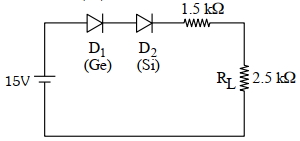
A
$8.75$
B
$9.00$
C
$8.50$
D
$14.00$
Solution
(A) The circuit contains a $15 \, V$ $DC$ source, a Germanium $(Ge)$ diode, a Silicon $(Si)$ diode, a $1.5 \, k\Omega$ resistor, and a load resistor $R_L = 2.5 \, k\Omega$ in series.
The barrier potential for a $Ge$ diode is $V_{Ge} = 0.3 \, V$ and for a $Si$ diode is $V_{Si} = 0.7 \, V$.
Applying Kirchhoff's Voltage Law $(KVL)$ in the loop:
$15 - V_{Ge} - V_{Si} - i(1.5 \, k\Omega) - i(2.5 \, k\Omega) = 0$
$15 - 0.3 - 0.7 = i(1.5 + 2.5) \, k\Omega$
$14 = i(4 \, k\Omega)$
$i = \frac{14}{4} \, mA = 3.5 \, mA$
The voltage across the load resistance $R_L$ is:
$V_L = i \times R_L = 3.5 \, mA \times 2.5 \, k\Omega = 8.75 \, V$
The barrier potential for a $Ge$ diode is $V_{Ge} = 0.3 \, V$ and for a $Si$ diode is $V_{Si} = 0.7 \, V$.
Applying Kirchhoff's Voltage Law $(KVL)$ in the loop:
$15 - V_{Ge} - V_{Si} - i(1.5 \, k\Omega) - i(2.5 \, k\Omega) = 0$
$15 - 0.3 - 0.7 = i(1.5 + 2.5) \, k\Omega$
$14 = i(4 \, k\Omega)$
$i = \frac{14}{4} \, mA = 3.5 \, mA$
The voltage across the load resistance $R_L$ is:
$V_L = i \times R_L = 3.5 \, mA \times 2.5 \, k\Omega = 8.75 \, V$
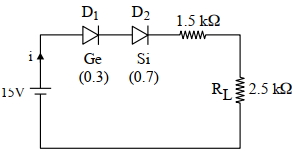
0 likesView Solution
141
PhysicsDifficultMCQJEE Main · 2024
When a potential difference $V$ is applied across a wire of resistance $R$,it dissipates energy at a rate $W$. If the wire is cut into two halves and these halves are connected in parallel across the same supply,the energy dissipation rate will become:
A
$1/4 W$
B
$1/2 W$
C
$2 W$
D
$4 W$
Solution
(D) The initial power dissipated is given by $W = \frac{V^2}{R} \quad ...(i)$
When the wire is cut into two equal halves,the resistance of each half becomes $R' = \frac{R}{2}$.
When these two halves are connected in parallel,the equivalent resistance $R_{eq}$ is given by:
$\frac{1}{R_{eq}} = \frac{1}{R'} + \frac{1}{R'} = \frac{2}{R} + \frac{2}{R} = \frac{4}{R}$
So,$R_{eq} = \frac{R}{4}$.
The new power dissipation $W'$ with the same potential difference $V$ is:
$W' = \frac{V^2}{R_{eq}} = \frac{V^2}{R/4} = 4 \left( \frac{V^2}{R} \right)$
Substituting equation $(i)$ into this expression,we get:
$W' = 4W$.
When the wire is cut into two equal halves,the resistance of each half becomes $R' = \frac{R}{2}$.
When these two halves are connected in parallel,the equivalent resistance $R_{eq}$ is given by:
$\frac{1}{R_{eq}} = \frac{1}{R'} + \frac{1}{R'} = \frac{2}{R} + \frac{2}{R} = \frac{4}{R}$
So,$R_{eq} = \frac{R}{4}$.
The new power dissipation $W'$ with the same potential difference $V$ is:
$W' = \frac{V^2}{R_{eq}} = \frac{V^2}{R/4} = 4 \left( \frac{V^2}{R} \right)$
Substituting equation $(i)$ into this expression,we get:
$W' = 4W$.
0 likesView Solution
142
PhysicsDifficultMCQJEE Main · 2024
Match List-$I$ with List-$II$ and choose the correct answer from the options given below:
| List-$I$ | List-$II$ |
| :--- | :--- |
| $A$. Gauss's law of magnetostatics | $I$. $\oint \vec{E} \cdot d\vec{a} = \frac{1}{\epsilon_0} \int \rho dV$ |
| $B$. Faraday's law of electromagnetic induction | $II$. $\oint \vec{B} \cdot d\vec{a} = 0$ |
| $C$. Ampere's law | $III$. $\oint \vec{E} \cdot d\vec{l} = -\frac{d}{dt} \int \vec{B} \cdot d\vec{a}$ |
| $D$. Gauss's law of electrostatics | $IV$. $\oint \vec{B} \cdot d\vec{l} = \mu_0 I$ |
| List-$I$ | List-$II$ |
| :--- | :--- |
| $A$. Gauss's law of magnetostatics | $I$. $\oint \vec{E} \cdot d\vec{a} = \frac{1}{\epsilon_0} \int \rho dV$ |
| $B$. Faraday's law of electromagnetic induction | $II$. $\oint \vec{B} \cdot d\vec{a} = 0$ |
| $C$. Ampere's law | $III$. $\oint \vec{E} \cdot d\vec{l} = -\frac{d}{dt} \int \vec{B} \cdot d\vec{a}$ |
| $D$. Gauss's law of electrostatics | $IV$. $\oint \vec{B} \cdot d\vec{l} = \mu_0 I$ |
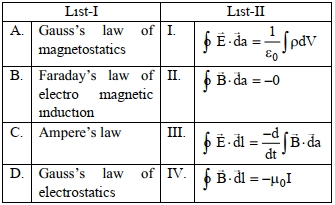
A
$A-I, B-III, C-IV, D-II$
B
$A-III, B-IV, C-I, D-II$
C
$A-IV, B-II, C-III, D-I$
D
$A-II, B-III, C-IV, D-I$
Solution
(D) The Maxwell's equations in integral form are as follows:
$A$. Gauss's law of magnetostatics states that the net magnetic flux through any closed surface is zero: $\oint \vec{B} \cdot d\vec{a} = 0$ $(A-II)$.
$B$. Faraday's law of electromagnetic induction states that the induced electromotive force in a closed loop is equal to the negative rate of change of magnetic flux through the loop: $\oint \vec{E} \cdot d\vec{l} = -\frac{d}{dt} \int \vec{B} \cdot d\vec{a}$ $(B-III)$.
$C$. Ampere's law (in its original form) relates the line integral of the magnetic field around a closed loop to the current passing through the surface enclosed by the loop: $\oint \vec{B} \cdot d\vec{l} = \mu_0 I$ $(C-IV)$.
$D$. Gauss's law of electrostatics states that the total electric flux through a closed surface is equal to the total charge enclosed divided by the permittivity of free space: $\oint \vec{E} \cdot d\vec{a} = \frac{1}{\epsilon_0} \int \rho dV$ $(D-I)$.
Thus,the correct matching is $A-II, B-III, C-IV, D-I$.
$A$. Gauss's law of magnetostatics states that the net magnetic flux through any closed surface is zero: $\oint \vec{B} \cdot d\vec{a} = 0$ $(A-II)$.
$B$. Faraday's law of electromagnetic induction states that the induced electromotive force in a closed loop is equal to the negative rate of change of magnetic flux through the loop: $\oint \vec{E} \cdot d\vec{l} = -\frac{d}{dt} \int \vec{B} \cdot d\vec{a}$ $(B-III)$.
$C$. Ampere's law (in its original form) relates the line integral of the magnetic field around a closed loop to the current passing through the surface enclosed by the loop: $\oint \vec{B} \cdot d\vec{l} = \mu_0 I$ $(C-IV)$.
$D$. Gauss's law of electrostatics states that the total electric flux through a closed surface is equal to the total charge enclosed divided by the permittivity of free space: $\oint \vec{E} \cdot d\vec{a} = \frac{1}{\epsilon_0} \int \rho dV$ $(D-I)$.
Thus,the correct matching is $A-II, B-III, C-IV, D-I$.
0 likesView Solution
143
PhysicsDifficultMCQJEE Main · 2024
$A$ power transmission line feeds input power at $2.3 \text{ kV}$ to a step-down transformer with its primary winding having $3000$ turns. The output power is delivered at $230 \text{ V}$ by the transformer. The current in the primary of the transformer is $5 \text{ A}$ and its efficiency is $90 \%$. The winding of the transformer is made of copper. The output current of the transformer is . . . . . . $A$.
A
$45$
B
$40$
C
$50$
D
$55$
Solution
(A) The input power $P_{\text{in}}$ is given by the product of primary voltage $V_p$ and primary current $I_p$.
$P_{\text{in}} = V_p \times I_p = 2300 \text{ V} \times 5 \text{ A} = 11500 \text{ W}$.
Efficiency $\eta$ is defined as the ratio of output power $P_{\text{out}}$ to input power $P_{\text{in}}$.
Given $\eta = 90\% = 0.9$,so $P_{\text{out}} = \eta \times P_{\text{in}} = 0.9 \times 11500 \text{ W} = 10350 \text{ W}$.
The output power is also given by $P_{\text{out}} = V_s \times I_s$,where $V_s = 230 \text{ V}$ is the output voltage.
$10350 \text{ W} = 230 \text{ V} \times I_s$.
$I_s = \frac{10350}{230} \text{ A} = 45 \text{ A}$.
$P_{\text{in}} = V_p \times I_p = 2300 \text{ V} \times 5 \text{ A} = 11500 \text{ W}$.
Efficiency $\eta$ is defined as the ratio of output power $P_{\text{out}}$ to input power $P_{\text{in}}$.
Given $\eta = 90\% = 0.9$,so $P_{\text{out}} = \eta \times P_{\text{in}} = 0.9 \times 11500 \text{ W} = 10350 \text{ W}$.
The output power is also given by $P_{\text{out}} = V_s \times I_s$,where $V_s = 230 \text{ V}$ is the output voltage.
$10350 \text{ W} = 230 \text{ V} \times I_s$.
$I_s = \frac{10350}{230} \text{ A} = 45 \text{ A}$.
0 likesView Solution
144
PhysicsDifficultMCQJEE Main · 2024
In an experiment to measure the focal length $(f)$ of a convex lens,the magnitude of object distance $(x)$ and the image distance $(y)$ are measured with reference to the focal point of the lens. The $y-x$ plot is shown in the figure. The focal length of the lens is . . . . . . $cm$.
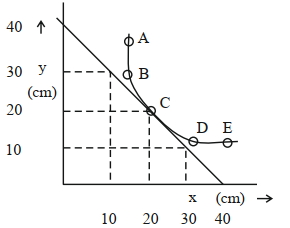
A
$50$
B
$40$
C
$30$
D
$20$
Solution
(D) According to Newton's form of the lens equation,when distances $x$ and $y$ are measured from the focal points,the relation is given by $xy = f^2$.
From the provided graph,we can observe a point on the curve where $x = 20 \ cm$ and $y = 20 \ cm$.
Substituting these values into the equation:
$20 \times 20 = f^2$
$f^2 = 400$
$f = 20 \ cm$.
Alternatively,the graph shows that at $x = 10 \ cm$,$y = 40 \ cm$ (from the intercept on the y-axis),and at $x = 40 \ cm$,$y = 10 \ cm$ (from the intercept on the x-axis).
Using $xy = f^2$,we get $10 \times 40 = f^2$,which implies $f^2 = 400$,so $f = 20 \ cm$.
From the provided graph,we can observe a point on the curve where $x = 20 \ cm$ and $y = 20 \ cm$.
Substituting these values into the equation:
$20 \times 20 = f^2$
$f^2 = 400$
$f = 20 \ cm$.
Alternatively,the graph shows that at $x = 10 \ cm$,$y = 40 \ cm$ (from the intercept on the y-axis),and at $x = 40 \ cm$,$y = 10 \ cm$ (from the intercept on the x-axis).
Using $xy = f^2$,we get $10 \times 40 = f^2$,which implies $f^2 = 400$,so $f = 20 \ cm$.
0 likesView Solution
145
PhysicsDifficultMCQJEE Main · 2024
The current of $5 \ A$ flows in a square loop of side $1 \ m$ placed in air. The magnetic field at the centre of the loop is $X \sqrt{2} \times 10^{-7} \ T$. The value of $X$ is . . . . . . .
A
$35$
B
$40$
C
$45$
D
$50$
Solution
(B) The magnetic field due to a straight wire of length $L$ at a perpendicular distance $d$ is given by $B = \frac{\mu_0 i}{4 \pi d} (\sin \theta_1 + \sin \theta_2)$.
For a square loop of side $a = 1 \ m$,the distance from the center to any side is $d = a/2 = 0.5 \ m$.
The angles at the center subtended by the corners are $\theta_1 = \theta_2 = 45^\circ$,so $\sin 45^\circ = 1/\sqrt{2}$.
The magnetic field due to one side is $B_1 = \frac{\mu_0 i}{4 \pi (a/2)} (\frac{1}{\sqrt{2}} + \frac{1}{\sqrt{2}}) = \frac{\mu_0 i}{2 \pi a} (\frac{2}{\sqrt{2}}) = \frac{\mu_0 i \sqrt{2}}{2 \pi a}$.
For a square loop,the total magnetic field $B = 4 \times B_1 = 4 \times \frac{\mu_0 i \sqrt{2}}{2 \pi a} = \frac{2 \mu_0 i \sqrt{2}}{\pi a}$.
Given $\mu_0 = 4 \pi \times 10^{-7} \ T \cdot m/A$,$i = 5 \ A$,and $a = 1 \ m$:
$B = \frac{2 \times (4 \pi \times 10^{-7}) \times 5 \times \sqrt{2}}{\pi \times 1} = 40 \sqrt{2} \times 10^{-7} \ T$.
Comparing this with $X \sqrt{2} \times 10^{-7} \ T$,we get $X = 40$.
For a square loop of side $a = 1 \ m$,the distance from the center to any side is $d = a/2 = 0.5 \ m$.
The angles at the center subtended by the corners are $\theta_1 = \theta_2 = 45^\circ$,so $\sin 45^\circ = 1/\sqrt{2}$.
The magnetic field due to one side is $B_1 = \frac{\mu_0 i}{4 \pi (a/2)} (\frac{1}{\sqrt{2}} + \frac{1}{\sqrt{2}}) = \frac{\mu_0 i}{2 \pi a} (\frac{2}{\sqrt{2}}) = \frac{\mu_0 i \sqrt{2}}{2 \pi a}$.
For a square loop,the total magnetic field $B = 4 \times B_1 = 4 \times \frac{\mu_0 i \sqrt{2}}{2 \pi a} = \frac{2 \mu_0 i \sqrt{2}}{\pi a}$.
Given $\mu_0 = 4 \pi \times 10^{-7} \ T \cdot m/A$,$i = 5 \ A$,and $a = 1 \ m$:
$B = \frac{2 \times (4 \pi \times 10^{-7}) \times 5 \times \sqrt{2}}{\pi \times 1} = 40 \sqrt{2} \times 10^{-7} \ T$.
Comparing this with $X \sqrt{2} \times 10^{-7} \ T$,we get $X = 40$.
0 likesView Solution
146
PhysicsDifficultMCQJEE Main · 2024
Two identical charged spheres are suspended by strings of equal lengths. The strings make an angle of $37^{\circ}$ with each other. When suspended in a liquid of density $0.7 \text{ g/cm}^3$,the angle remains the same. If the density of the material of the sphere is $1.4 \text{ g/cm}^3$,the dielectric constant of the liquid is . . . . . . $\left(\tan 37^{\circ} = \frac{3}{4}\right)$.
A
$1$
B
$3$
C
$2$
D
$10$
Solution
(C) Let $\theta$ be the angle each string makes with the vertical. Since the total angle between the strings is $37^{\circ}$,$\theta = 37^{\circ}/2 = 18.5^{\circ}$.
In air,the equilibrium condition is $\tan \theta = \frac{F_e}{mg} = \frac{F_e}{\rho_B V g}$,where $\rho_B$ is the density of the sphere and $V$ is its volume.
In the liquid,the effective weight is $mg' = V(\rho_B - \rho_L)g$ and the electrostatic force becomes $F_e' = \frac{F_e}{K}$,where $K$ is the dielectric constant.
The equilibrium condition in the liquid is $\tan \theta = \frac{F_e'}{mg'} = \frac{F_e}{K V(\rho_B - \rho_L)g}$.
Since $\theta$ remains the same,we equate the two expressions for $\tan \theta$:
$\frac{F_e}{\rho_B V g} = \frac{F_e}{K V(\rho_B - \rho_L)g}$
$\rho_B = K(\rho_B - \rho_L)$
$1.4 = K(1.4 - 0.7)$
$1.4 = K(0.7)$
$K = \frac{1.4}{0.7} = 2$.
In air,the equilibrium condition is $\tan \theta = \frac{F_e}{mg} = \frac{F_e}{\rho_B V g}$,where $\rho_B$ is the density of the sphere and $V$ is its volume.
In the liquid,the effective weight is $mg' = V(\rho_B - \rho_L)g$ and the electrostatic force becomes $F_e' = \frac{F_e}{K}$,where $K$ is the dielectric constant.
The equilibrium condition in the liquid is $\tan \theta = \frac{F_e'}{mg'} = \frac{F_e}{K V(\rho_B - \rho_L)g}$.
Since $\theta$ remains the same,we equate the two expressions for $\tan \theta$:
$\frac{F_e}{\rho_B V g} = \frac{F_e}{K V(\rho_B - \rho_L)g}$
$\rho_B = K(\rho_B - \rho_L)$
$1.4 = K(1.4 - 0.7)$
$1.4 = K(0.7)$
$K = \frac{1.4}{0.7} = 2$.
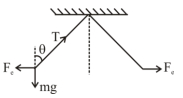
0 likesView Solution
147
PhysicsDifficultMCQJEE Main · 2024
Two resistors of $100 \ \Omega$ and $200 \ \Omega$ are connected in series with a battery of $4 \ V$ and negligible internal resistance. $A$ voltmeter is used to measure the voltage across the $100 \ \Omega$ resistor,which gives a reading of $1 \ V$. The resistance of the voltmeter must be . . . . . . $\Omega$.
A
$100$
B
$200$
C
$300$
D
$400$
Solution
(B) Let the resistance of the voltmeter be $R_V$. The voltmeter is connected in parallel with the $100 \ \Omega$ resistor. The equivalent resistance of this parallel combination is $R_p = \frac{100 \cdot R_V}{100 + R_V}$.
The circuit now consists of $R_p$ in series with the $200 \ \Omega$ resistor,connected to a $4 \ V$ battery.
According to the voltage divider rule,the voltage across the parallel combination $(R_p)$ is given by $V_p = V \cdot \frac{R_p}{R_p + 200}$.
Given $V_p = 1 \ V$ and $V = 4 \ V$,we have $1 = 4 \cdot \frac{R_p}{R_p + 200}$.
$R_p + 200 = 4 R_p \implies 3 R_p = 200 \implies R_p = \frac{200}{3} \ \Omega$.
Equating the two expressions for $R_p$: $\frac{100 R_V}{100 + R_V} = \frac{200}{3}$.
$300 R_V = 200(100 + R_V) \implies 300 R_V = 20000 + 200 R_V$.
$100 R_V = 20000 \implies R_V = 200 \ \Omega$.
The circuit now consists of $R_p$ in series with the $200 \ \Omega$ resistor,connected to a $4 \ V$ battery.
According to the voltage divider rule,the voltage across the parallel combination $(R_p)$ is given by $V_p = V \cdot \frac{R_p}{R_p + 200}$.
Given $V_p = 1 \ V$ and $V = 4 \ V$,we have $1 = 4 \cdot \frac{R_p}{R_p + 200}$.
$R_p + 200 = 4 R_p \implies 3 R_p = 200 \implies R_p = \frac{200}{3} \ \Omega$.
Equating the two expressions for $R_p$: $\frac{100 R_V}{100 + R_V} = \frac{200}{3}$.
$300 R_V = 200(100 + R_V) \implies 300 R_V = 20000 + 200 R_V$.
$100 R_V = 20000 \implies R_V = 200 \ \Omega$.
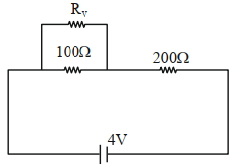
0 likesView Solution
148
PhysicsDifficultMCQJEE Main · 2024
Identify the logic operation performed by the given circuit.
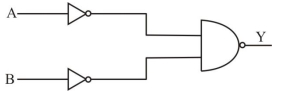
A
$NAND$
B
$NOR$
C
$OR$
D
$AND$
Solution
(C) The circuit consists of two $NOT$ gates connected to the inputs $A$ and $B$,followed by a $NAND$ gate.
$1$. The inputs to the $NAND$ gate are $\overline{A}$ and $\overline{B}$.
$2$. The output $Y$ of the $NAND$ gate is given by $Y = \overline{\overline{A} \cdot \overline{B}}$.
$3$. According to De Morgan's law,$\overline{X \cdot Y} = \overline{X} + \overline{Y}$.
$4$. Applying this to our expression: $Y = \overline{\overline{A}} + \overline{\overline{B}} = A + B$.
$5$. The expression $Y = A + B$ represents the $OR$ logic operation.
$1$. The inputs to the $NAND$ gate are $\overline{A}$ and $\overline{B}$.
$2$. The output $Y$ of the $NAND$ gate is given by $Y = \overline{\overline{A} \cdot \overline{B}}$.
$3$. According to De Morgan's law,$\overline{X \cdot Y} = \overline{X} + \overline{Y}$.
$4$. Applying this to our expression: $Y = \overline{\overline{A}} + \overline{\overline{B}} = A + B$.
$5$. The expression $Y = A + B$ represents the $OR$ logic operation.
0 likesView Solution
149
PhysicsDifficultMCQJEE Main · 2024
The refractive index of a prism with apex angle $A$ is $\cot(A/2)$. The angle of minimum deviation is:
A
$\delta_{m}=180^{\circ}-A$
B
$\delta_m=180^{\circ}-3A$
C
$\delta_m=180^{\circ}-4A$
D
$\delta_{m}=180^{\circ}-2A$
Solution
(D) The formula for the refractive index $\mu$ of a prism in terms of the apex angle $A$ and the angle of minimum deviation $\delta_m$ is given by:
$\mu = \frac{\sin((A + \delta_m)/2)}{\sin(A/2)}$
Given $\mu = \cot(A/2) = \frac{\cos(A/2)}{\sin(A/2)}$,we equate the two expressions:
$\frac{\cos(A/2)}{\sin(A/2)} = \frac{\sin((A + \delta_m)/2)}{\sin(A/2)}$
Canceling $\sin(A/2)$ from both sides,we get:
$\cos(A/2) = \sin((A + \delta_m)/2)$
Using the trigonometric identity $\cos(\theta) = \sin(90^{\circ} - \theta)$,we write:
$\sin(90^{\circ} - A/2) = \sin((A + \delta_m)/2)$
Equating the angles:
$90^{\circ} - A/2 = (A + \delta_m)/2$
$180^{\circ} - A = A + \delta_m$
$\delta_m = 180^{\circ} - 2A$
$\mu = \frac{\sin((A + \delta_m)/2)}{\sin(A/2)}$
Given $\mu = \cot(A/2) = \frac{\cos(A/2)}{\sin(A/2)}$,we equate the two expressions:
$\frac{\cos(A/2)}{\sin(A/2)} = \frac{\sin((A + \delta_m)/2)}{\sin(A/2)}$
Canceling $\sin(A/2)$ from both sides,we get:
$\cos(A/2) = \sin((A + \delta_m)/2)$
Using the trigonometric identity $\cos(\theta) = \sin(90^{\circ} - \theta)$,we write:
$\sin(90^{\circ} - A/2) = \sin((A + \delta_m)/2)$
Equating the angles:
$90^{\circ} - A/2 = (A + \delta_m)/2$
$180^{\circ} - A = A + \delta_m$
$\delta_m = 180^{\circ} - 2A$
0 likesView Solution
150
PhysicsDifficultMCQJEE Main · 2024
$A$ rigid wire consists of a semicircular portion of radius $R$ and two straight sections. The wire is partially immersed in a perpendicular magnetic field $B = B_0 \hat{k}$ as shown in the figure. The magnetic force on the wire if it carries a current $i$ is:
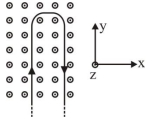
A
$-i B_0 (2R) \hat{i}$
B
$i B_0 (2R) \hat{i}$
C
$-i B_0 (2R) \hat{j}$
D
$i B_0 (2R) \hat{j}$
Solution
(C) The magnetic force on a current-carrying wire is given by $\vec{F} = i (\vec{L}_{eff} \times \vec{B})$.
Here,the effective length vector $\vec{L}_{eff}$ is the displacement vector from the starting point to the ending point of the wire within the magnetic field.
From the figure,the current enters at the bottom left and exits at the bottom right of the semicircular loop. The displacement vector $\vec{L}_{eff}$ for the semicircular part is $2R \hat{i}$.
The magnetic field is $\vec{B} = B_0 \hat{k}$.
Therefore,$\vec{F} = i (2R \hat{i} \times B_0 \hat{k})$.
Since $\hat{i} \times \hat{k} = -\hat{j}$,we get $\vec{F} = i (2R B_0) (-\hat{j}) = -2 i B_0 R \hat{j}$.
Here,the effective length vector $\vec{L}_{eff}$ is the displacement vector from the starting point to the ending point of the wire within the magnetic field.
From the figure,the current enters at the bottom left and exits at the bottom right of the semicircular loop. The displacement vector $\vec{L}_{eff}$ for the semicircular part is $2R \hat{i}$.
The magnetic field is $\vec{B} = B_0 \hat{k}$.
Therefore,$\vec{F} = i (2R \hat{i} \times B_0 \hat{k})$.
Since $\hat{i} \times \hat{k} = -\hat{j}$,we get $\vec{F} = i (2R B_0) (-\hat{j}) = -2 i B_0 R \hat{j}$.
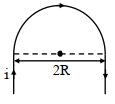
0 likesView Solution
Vedclass Products
For Students
Vedclass Test Series
Mock tests in real JEE Main style covering Physics with performance analysis. 5-day free trial.
Start Free TrialFor Teachers
Exam Paper Generator
Generate Set A/B/C/D Physics papers from 7.5L+ questions in 2 minutes. 3 chapters free.
Try FreeFor Institutes
Online Exam Module
Run live JEE Main mock exams with unlimited students, 360° analytics & white-label branding.
See DemoFrequently Asked Questions
How many Physics questions are in JEE Main 2024?
There are 599 Physics questions from the JEE Main 2024 paper on Vedclass, each with a detailed step-by-step solution in English.
Are JEE Main 2024 Physics solutions available in English?
Yes. All solutions on this page are in English. You can also switch to English or Hindi using the language buttons above the questions.
Can I practice JEE Main 2024 Physics as a timed test?
Yes. Use the Vedclass Test Series to attempt a full JEE Main mock test covering Physics with time limits and instant score analysis.
Can teachers create Physics papers from JEE Main previous year questions?
Yes. The Vedclass Exam Paper Generator lets teachers mix JEE Main Physics questions and generate Set A/B/C/D papers in minutes.
For Teachers & Institutes
Build a Custom Physics Paper
Pick JEE Main 2024 Physics questions, set difficulty, and generate Set A/B/C/D in 2 minutes.