
PhysicsQ301–318 of 599 questions
Page 7 of 7 · English
301
PhysicsDifficultMCQJEE Main · 2024
$A$ nucleus at rest disintegrates into two smaller nuclei with their masses in the ratio of $2:1$. After disintegration,they will move:
A
In opposite directions with speeds in the ratio of $1:2$ respectively.
B
In opposite directions with speeds in the ratio of $2:1$ respectively.
C
In the same direction with the same speed.
D
In opposite directions with the same speed.
Solution
(A) According to the law of conservation of linear momentum,since the initial nucleus is at rest,the initial momentum is $0$.
Let the masses of the two nuclei be $m_1$ and $m_2$ and their velocities be $v_1$ and $v_2$ respectively.
$p_i = p_f$
$0 = m_1 v_1 + m_2 v_2$
$m_1 v_1 = -m_2 v_2$
Taking the magnitude of the velocities,we have $m_1 |v_1| = m_2 |v_2|$,which implies $\frac{|v_1|}{|v_2|} = \frac{m_2}{m_1}$.
Given the ratio of masses is $\frac{m_1}{m_2} = \frac{2}{1}$,we substitute this into the ratio of speeds:
$\frac{|v_1|}{|v_2|} = \frac{1}{2}$.
The negative sign indicates that the nuclei move in opposite directions.
Therefore,they move in opposite directions with speeds in the ratio of $1:2$.
Let the masses of the two nuclei be $m_1$ and $m_2$ and their velocities be $v_1$ and $v_2$ respectively.
$p_i = p_f$
$0 = m_1 v_1 + m_2 v_2$
$m_1 v_1 = -m_2 v_2$
Taking the magnitude of the velocities,we have $m_1 |v_1| = m_2 |v_2|$,which implies $\frac{|v_1|}{|v_2|} = \frac{m_2}{m_1}$.
Given the ratio of masses is $\frac{m_1}{m_2} = \frac{2}{1}$,we substitute this into the ratio of speeds:
$\frac{|v_1|}{|v_2|} = \frac{1}{2}$.
The negative sign indicates that the nuclei move in opposite directions.
Therefore,they move in opposite directions with speeds in the ratio of $1:2$.
0 likesView Solution
302
PhysicsDifficultMCQJEE Main · 2024
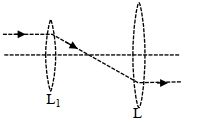
The following figure represents two biconvex lenses $L_1$ and $L_2$ having focal lengths $10 \,cm$ and $15 \,cm$ respectively. The distance between $L_1$ and $L_2$ is: (in $\,cm$)
A
$10$
B
$15$
C
$25$
D
$35$
Solution
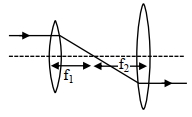
(C) For the rays to emerge parallel to the principal axis after passing through two convex lenses,the intermediate image formed by the first lens must coincide with the focal point of the second lens.
Since the incident rays are parallel to the principal axis,they converge at the focal point of the first lens $L_1$ at a distance $f_1 = 10 \,cm$ from it.
For these rays to emerge parallel from the second lens $L_2$,this focal point must also be the focal point of the second lens $L_2$. Therefore,the distance between the two lenses must be $d = f_1 + f_2$.
Given $f_1 = 10 \,cm$ and $f_2 = 15 \,cm$,the distance $d = 10 \,cm + 15 \,cm = 25 \,cm$.
Since the incident rays are parallel to the principal axis,they converge at the focal point of the first lens $L_1$ at a distance $f_1 = 10 \,cm$ from it.
For these rays to emerge parallel from the second lens $L_2$,this focal point must also be the focal point of the second lens $L_2$. Therefore,the distance between the two lenses must be $d = f_1 + f_2$.
Given $f_1 = 10 \,cm$ and $f_2 = 15 \,cm$,the distance $d = 10 \,cm + 15 \,cm = 25 \,cm$.
0 likesView Solution
303
PhysicsDifficultMCQJEE Main · 2024
$A$ hydrogen atom in the ground state is given an energy of $10.2 \ eV$. How many spectral lines will be emitted due to the transition of electrons?
A
$6$
B
$3$
C
$10$
D
$1$
Solution
(D) The energy of the ground state of a hydrogen atom is $E_1 = -13.6 \ eV$.
When an energy of $10.2 \ eV$ is provided,the new energy level $E_n$ is given by $E_n = E_1 + 10.2 \ eV = -13.6 \ eV + 10.2 \ eV = -3.4 \ eV$.
Since $E_n = -13.6/n^2 \ eV$,we have $-3.4 = -13.6/n^2$,which gives $n^2 = 4$,so $n = 2$.
The electron is excited to the first excited state $(n = 2)$.
The number of spectral lines emitted when an electron transitions from state $n$ to the ground state is given by the formula $N = n(n-1)/2$.
For $n = 2$,$N = 2(2-1)/2 = 1$.
Therefore,only $1$ spectral line will be emitted.
When an energy of $10.2 \ eV$ is provided,the new energy level $E_n$ is given by $E_n = E_1 + 10.2 \ eV = -13.6 \ eV + 10.2 \ eV = -3.4 \ eV$.
Since $E_n = -13.6/n^2 \ eV$,we have $-3.4 = -13.6/n^2$,which gives $n^2 = 4$,so $n = 2$.
The electron is excited to the first excited state $(n = 2)$.
The number of spectral lines emitted when an electron transitions from state $n$ to the ground state is given by the formula $N = n(n-1)/2$.
For $n = 2$,$N = 2(2-1)/2 = 1$.
Therefore,only $1$ spectral line will be emitted.
0 likesView Solution
304
PhysicsDifficultMCQJEE Main · 2024
The magnetic field in a plane electromagnetic wave is given by $B_y = (3.5 \times 10^{-7}) \sin (1.5 \times 10^3 x + 0.5 \times 10^{11} t) \ T$. The corresponding electric field will be:
A
$E_y = 1.17 \sin (1.5 \times 10^3 x + 0.5 \times 10^{11} t) \ Vm^{-1}$
B
$E_x = 105 \sin (1.5 \times 10^3 x + 0.5 \times 10^{11} t) \ Vm^{-1}$
C
$E_z = 1.17 \sin (1.5 \times 10^5 x + 0.5 \times 10^{11} t) \ Vm^{-1}$
D
$E_z = 105 \sin (1.5 \times 10^3 x + 0.5 \times 10^{11} t) \ Vm^{-1}$
Solution
(D) The relationship between the amplitude of the electric field $E_0$ and the magnetic field $B_0$ is given by $E_0 = B_0 c$,where $c$ is the speed of light in vacuum $(c \approx 3 \times 10^8 \ ms^{-1})$.
Given $B_0 = 3.5 \times 10^{-7} \ T$,we calculate $E_0 = (3.5 \times 10^{-7}) \times (3 \times 10^8) = 105 \ Vm^{-1}$.
The wave propagates in the negative $x$-direction (indicated by the $+kx$ term). The magnetic field is in the $y$-direction $(B_y)$. Since the electric field,magnetic field,and direction of propagation are mutually perpendicular,the electric field must be in the $z$-direction $(E_z)$.
Thus,the electric field is $E_z = 105 \sin (1.5 \times 10^3 x + 0.5 \times 10^{11} t) \ Vm^{-1}$.
Given $B_0 = 3.5 \times 10^{-7} \ T$,we calculate $E_0 = (3.5 \times 10^{-7}) \times (3 \times 10^8) = 105 \ Vm^{-1}$.
The wave propagates in the negative $x$-direction (indicated by the $+kx$ term). The magnetic field is in the $y$-direction $(B_y)$. Since the electric field,magnetic field,and direction of propagation are mutually perpendicular,the electric field must be in the $z$-direction $(E_z)$.
Thus,the electric field is $E_z = 105 \sin (1.5 \times 10^3 x + 0.5 \times 10^{11} t) \ Vm^{-1}$.
0 likesView Solution
305
PhysicsDifficultMCQJEE Main · 2024
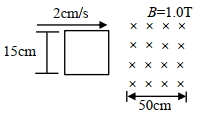
$A$ square loop of side $15 \ cm$ is being moved towards the right at a constant speed of $2 \ cm/s$ as shown in the figure. The front edge enters the $50 \ cm$ wide magnetic field region at $t=0$. The value of the induced emf in the loop at $t=10 \ s$ will be:
A
$0.3 \ mV$
B
$4.5 \ mV$
C
zero
D
$3 \ mV$
Solution
$(C)$ The side length of the square loop is $L = 15 \ cm = 0.15 \ m$.
The speed of the loop is $v = 2 \ cm/s = 0.02 \ m/s$.
The magnetic field width is $W = 50 \ cm = 0.5 \ m$.
At $t=0$, the front edge enters the magnetic field.
The time taken for the entire loop to enter the magnetic field is $t_{in} = \frac{L}{v} = \frac{15 \ cm}{2 \ cm/s} = 7.5 \ s$.
At $t = 7.5 \ s$, the entire loop is inside the magnetic field.
The loop will remain completely inside the magnetic field until the back edge reaches the boundary of the magnetic field.
The time taken for the back edge to reach the magnetic field is $t_{out} = \frac{W}{v} = \frac{50 \ cm}{2 \ cm/s} = 25 \ s$.
Since $t = 10 \ s$ lies between $7.5 \ s$ and $25 \ s$, the entire loop is inside the magnetic field region.
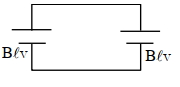
When the entire loop is inside a uniform magnetic field, the magnetic flux $\phi$ linked with the loop remains constant.
According to Faraday's law of electromagnetic induction, the induced emf $e = -\frac{d\phi}{dt}$.
Since $\phi$ is constant, $\frac{d\phi}{dt} = 0$, therefore $e = 0$.
The speed of the loop is $v = 2 \ cm/s = 0.02 \ m/s$.
The magnetic field width is $W = 50 \ cm = 0.5 \ m$.
At $t=0$, the front edge enters the magnetic field.
The time taken for the entire loop to enter the magnetic field is $t_{in} = \frac{L}{v} = \frac{15 \ cm}{2 \ cm/s} = 7.5 \ s$.
At $t = 7.5 \ s$, the entire loop is inside the magnetic field.
The loop will remain completely inside the magnetic field until the back edge reaches the boundary of the magnetic field.
The time taken for the back edge to reach the magnetic field is $t_{out} = \frac{W}{v} = \frac{50 \ cm}{2 \ cm/s} = 25 \ s$.
Since $t = 10 \ s$ lies between $7.5 \ s$ and $25 \ s$, the entire loop is inside the magnetic field region.
When the entire loop is inside a uniform magnetic field, the magnetic flux $\phi$ linked with the loop remains constant.
According to Faraday's law of electromagnetic induction, the induced emf $e = -\frac{d\phi}{dt}$.
Since $\phi$ is constant, $\frac{d\phi}{dt} = 0$, therefore $e = 0$.
0 likesView Solution
306
PhysicsDifficultMCQJEE Main · 2024
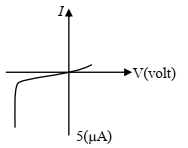
The $I-V$ characteristics of an electronic device are shown in the figure. The device is:
A
a solar cell
B
a transistor which can be used as an amplifier
C
a zener diode which can be used as a voltage regulator
D
a diode which can be used as a rectifier
Solution
(C) The given $I-V$ characteristic curve shows a sharp breakdown in the reverse bias region at a specific voltage.
This behavior is characteristic of a Zener diode.
$A$ Zener diode is specifically designed to operate in the reverse breakdown region without being damaged.
Due to this property,it is widely used as a voltage regulator to maintain a constant output voltage across a load despite variations in input voltage or load current.
This behavior is characteristic of a Zener diode.
$A$ Zener diode is specifically designed to operate in the reverse breakdown region without being damaged.
Due to this property,it is widely used as a voltage regulator to maintain a constant output voltage across a load despite variations in input voltage or load current.
0 likesView Solution
307
PhysicsDifficultMCQJEE Main · 2024
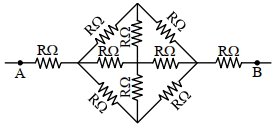
The effective resistance between $A$ and $B$, if the resistance of each resistor is $R$, will be
A
$\frac{2}{3} R$
B
$\frac{8}{3} R$
C
$\frac{5}{3} R$
D
$\frac{4}{3} R$
Solution
(B) Due to the symmetry of the circuit about the horizontal axis, the potential at the top and bottom nodes is the same. Thus, no current flows through the vertical resistors, and they can be removed.
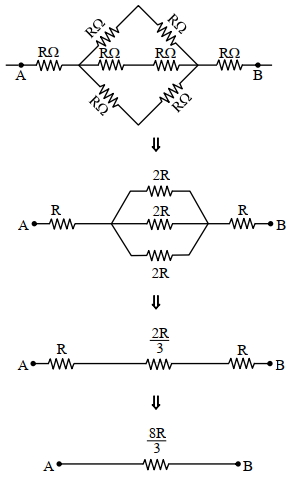
After removing the vertical resistors, the circuit simplifies to three parallel branches between the two central nodes, each having a resistance of $R + R = 2R$.
The equivalent resistance of these three parallel branches is given by $\frac{1}{R_{eq, parallel}} = \frac{1}{2R} + \frac{1}{2R} + \frac{1}{2R} = \frac{3}{2R}$, which gives $R_{eq, parallel} = \frac{2R}{3}$.
Finally, this equivalent resistance is in series with the two resistors connected to terminals $A$ and $B$. Therefore, the total effective resistance is $R_{total} = R + \frac{2R}{3} + R = 2R + \frac{2R}{3} = \frac{8R}{3}$.
After removing the vertical resistors, the circuit simplifies to three parallel branches between the two central nodes, each having a resistance of $R + R = 2R$.
The equivalent resistance of these three parallel branches is given by $\frac{1}{R_{eq, parallel}} = \frac{1}{2R} + \frac{1}{2R} + \frac{1}{2R} = \frac{3}{2R}$, which gives $R_{eq, parallel} = \frac{2R}{3}$.
Finally, this equivalent resistance is in series with the two resistors connected to terminals $A$ and $B$. Therefore, the total effective resistance is $R_{total} = R + \frac{2R}{3} + R = 2R + \frac{2R}{3} = \frac{8R}{3}$.
0 likesView Solution
308
PhysicsDifficultMCQJEE Main · 2024
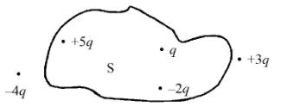
Five charges $+q, +5q, -2q, +3q$ and $-4q$ are situated as shown in the figure. The electric flux due to this configuration through the surface $S$ is
A
$\frac{5q}{\epsilon_0}$
B
$\frac{4q}{\epsilon_0}$
C
$\frac{3q}{\epsilon_0}$
D
$\frac{q}{\epsilon_0}$
Solution
(B) According to Gauss's law,the electric flux $\phi$ through a closed surface is given by $\phi = \frac{q_{\text{in}}}{\epsilon_0}$,where $q_{\text{in}}$ is the net charge enclosed by the surface.
From the figure,the charges enclosed by the surface $S$ are $+q, +5q,$ and $-2q$.
The charges $+3q$ and $-4q$ are outside the surface $S$,so they do not contribute to the electric flux through the surface.
Therefore,the net enclosed charge is $q_{\text{in}} = (+q) + (+5q) + (-2q) = 4q$.
Substituting this into Gauss's law,we get $\phi = \frac{4q}{\epsilon_0}$.
From the figure,the charges enclosed by the surface $S$ are $+q, +5q,$ and $-2q$.
The charges $+3q$ and $-4q$ are outside the surface $S$,so they do not contribute to the electric flux through the surface.
Therefore,the net enclosed charge is $q_{\text{in}} = (+q) + (+5q) + (-2q) = 4q$.
Substituting this into Gauss's law,we get $\phi = \frac{4q}{\epsilon_0}$.
0 likesView Solution
309
PhysicsDifficultMCQJEE Main · 2024
$A$ proton and a deuteron $(q=+e, m=2.0 \ u)$ having same kinetic energies enter a region of uniform magnetic field $\vec{B}$,moving perpendicular to $\vec{B}$. The ratio of the radius $r_d$ of the deuteron path to the radius $r_p$ of the proton path is:
A
$1: 1$
B
$1: \sqrt{2}$
C
$\sqrt{2}: 1$
D
$1: 2$
Solution
(C) In a uniform magnetic field,the radius $R$ of the circular path of a charged particle is given by:
$R = \frac{mv}{qB} = \frac{\sqrt{2m(K.E.)}}{qB}$
Since both particles have the same kinetic energy $(K.E.)$ and move in the same magnetic field $(B)$,we have:
$R \propto \frac{\sqrt{m}}{q}$
For a proton,$m_p = m$ and $q_p = e$. For a deuteron,$m_d = 2m$ and $q_d = e$.
The ratio of the radii is:
$\frac{r_d}{r_p} = \frac{\sqrt{m_d}/q_d}{\sqrt{m_p}/q_p} = \sqrt{\frac{m_d}{m_p}} \times \frac{q_p}{q_d}$
Substituting the values:
$\frac{r_d}{r_p} = \sqrt{\frac{2m}{m}} \times \frac{e}{e} = \sqrt{2} \times 1 = \sqrt{2}$
Therefore,the ratio $r_d : r_p$ is $\sqrt{2} : 1$.
$R = \frac{mv}{qB} = \frac{\sqrt{2m(K.E.)}}{qB}$
Since both particles have the same kinetic energy $(K.E.)$ and move in the same magnetic field $(B)$,we have:
$R \propto \frac{\sqrt{m}}{q}$
For a proton,$m_p = m$ and $q_p = e$. For a deuteron,$m_d = 2m$ and $q_d = e$.
The ratio of the radii is:
$\frac{r_d}{r_p} = \frac{\sqrt{m_d}/q_d}{\sqrt{m_p}/q_p} = \sqrt{\frac{m_d}{m_p}} \times \frac{q_p}{q_d}$
Substituting the values:
$\frac{r_d}{r_p} = \sqrt{\frac{2m}{m}} \times \frac{e}{e} = \sqrt{2} \times 1 = \sqrt{2}$
Therefore,the ratio $r_d : r_p$ is $\sqrt{2} : 1$.
0 likesView Solution
310
PhysicsDifficultMCQJEE Main · 2024
$UV$ light of $4.13 eV$ is incident on a photosensitive metal surface having work function $3.13 eV$. The maximum kinetic energy of ejected photoelectrons will be : (in $eV$)
A
$4.13$
B
$1$
C
$3.13$
D
$7.26$
Solution
(B) According to Einstein's photoelectric equation,the energy of the incident photon is equal to the sum of the work function of the metal and the maximum kinetic energy of the ejected photoelectrons.
$E_{\text{photon}} = \Phi + K.E_{\max}$
Given:
Energy of incident photon $(E_{\text{photon}})$ = $4.13 eV$
Work function $(\Phi)$ = $3.13 eV$
Substituting these values into the equation:
$4.13 eV = 3.13 eV + K.E_{\max}$
$K.E_{\max} = 4.13 eV - 3.13 eV$
$K.E_{\max} = 1 eV$
Therefore,the maximum kinetic energy of the ejected photoelectrons is $1 eV$.
$E_{\text{photon}} = \Phi + K.E_{\max}$
Given:
Energy of incident photon $(E_{\text{photon}})$ = $4.13 eV$
Work function $(\Phi)$ = $3.13 eV$
Substituting these values into the equation:
$4.13 eV = 3.13 eV + K.E_{\max}$
$K.E_{\max} = 4.13 eV - 3.13 eV$
$K.E_{\max} = 1 eV$
Therefore,the maximum kinetic energy of the ejected photoelectrons is $1 eV$.
0 likesView Solution
311
PhysicsDifficultMCQJEE Main · 2024
The energy released in the fusion of $2 \ kg$ of hydrogen deep in the sun is $E_{H}$ and the energy released in the fission of $2 \ kg$ of ${ }^{235} U$ is $E_U$. The ratio $\frac{E_H}{E_U}$ is approximately :
(Consider the fusion reaction as $4{ }_1^1 H + 2 e^{-} \rightarrow { }_2^4 He + 2 \nu + 6 \gamma + 26.7 \ MeV$,energy released in the fission reaction of ${ }^{235} U$ is $200 \ MeV$ per fission nucleus and $N_{A} = 6.023 \times 10^{23}$ )
(Consider the fusion reaction as $4{ }_1^1 H + 2 e^{-} \rightarrow { }_2^4 He + 2 \nu + 6 \gamma + 26.7 \ MeV$,energy released in the fission reaction of ${ }^{235} U$ is $200 \ MeV$ per fission nucleus and $N_{A} = 6.023 \times 10^{23}$ )
A
$9.13$
B
$15.04$
C
$7.62$
D
$25.6$
Solution
(C) In the fusion reaction,$4$ hydrogen nuclei release $26.7 \ MeV$ of energy.
Energy released per hydrogen nucleus $= \frac{26.7}{4} \ MeV$.
Number of hydrogen nuclei in $2 \ kg = \frac{2000 \ g}{1 \ g/mol} \times N_{A} = 2000 \ N_{A}$.
Total energy $E_{H} = 2000 \ N_{A} \times \frac{26.7}{4} \ MeV = 500 \times 26.7 \ N_{A} \ MeV = 13350 \ N_{A} \ MeV$.
In the fission reaction,$1$ nucleus of ${ }^{235} U$ releases $200 \ MeV$ of energy.
Number of uranium nuclei in $2 \ kg = \frac{2000 \ g}{235 \ g/mol} \times N_{A} = \frac{2000}{235} \ N_{A}$.
Total energy $E_{U} = \frac{2000}{235} \ N_{A} \times 200 \ MeV = \frac{400000}{235} \ N_{A} \ MeV \approx 1702.13 \ N_{A} \ MeV$.
The ratio $\frac{E_{H}}{E_{U}} = \frac{13350 \ N_{A}}{1702.13 \ N_{A}} \approx 7.84$.
Given the options,the closest value is $7.62$.
Energy released per hydrogen nucleus $= \frac{26.7}{4} \ MeV$.
Number of hydrogen nuclei in $2 \ kg = \frac{2000 \ g}{1 \ g/mol} \times N_{A} = 2000 \ N_{A}$.
Total energy $E_{H} = 2000 \ N_{A} \times \frac{26.7}{4} \ MeV = 500 \times 26.7 \ N_{A} \ MeV = 13350 \ N_{A} \ MeV$.
In the fission reaction,$1$ nucleus of ${ }^{235} U$ releases $200 \ MeV$ of energy.
Number of uranium nuclei in $2 \ kg = \frac{2000 \ g}{235 \ g/mol} \times N_{A} = \frac{2000}{235} \ N_{A}$.
Total energy $E_{U} = \frac{2000}{235} \ N_{A} \times 200 \ MeV = \frac{400000}{235} \ N_{A} \ MeV \approx 1702.13 \ N_{A} \ MeV$.
The ratio $\frac{E_{H}}{E_{U}} = \frac{13350 \ N_{A}}{1702.13 \ N_{A}} \approx 7.84$.
Given the options,the closest value is $7.62$.
0 likesView Solution
312
PhysicsDifficultMCQJEE Main · 2024
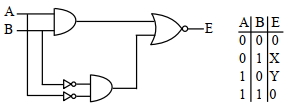
In the truth table of the given circuit,the values of $X$ and $Y$ are:
A
$1, 1$
B
$1, 0$
C
$0, 1$
D
$0, 0$
Solution
(A) The given circuit consists of an $AND$ gate,two $NOT$ gates,another $AND$ gate,and a $NOR$ gate.
Let the inputs be $A$ and $B$. The output of the first $AND$ gate is $A \cdot B$.
The inputs to the second $AND$ gate are $\bar{A}$ and $\bar{B}$,so its output is $\bar{A} \cdot \bar{B}$.
These two outputs are fed into a $NOR$ gate,so the final output $E$ is $\overline{(A \cdot B) + (\bar{A} \cdot \bar{B})}$.
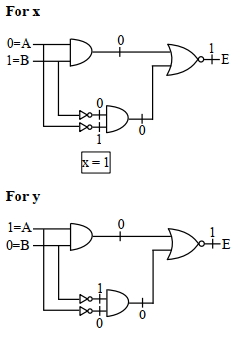
For $X$: $A = 0, B = 1$.
$E = \overline{(0 \cdot 1) + (\bar{0} \cdot \bar{1})} = \overline{0 + (1 \cdot 0)} = \overline{0 + 0} = \overline{0} = 1$. Thus,$X = 1$.
For $Y$: $A = 1, B = 0$.
$E = \overline{(1 \cdot 0) + (\bar{1} \cdot \bar{0})} = \overline{0 + (0 \cdot 1)} = \overline{0 + 0} = \overline{0} = 1$. Thus,$Y = 1$.
Therefore,the values of $X$ and $Y$ are $1, 1$.
Let the inputs be $A$ and $B$. The output of the first $AND$ gate is $A \cdot B$.
The inputs to the second $AND$ gate are $\bar{A}$ and $\bar{B}$,so its output is $\bar{A} \cdot \bar{B}$.
These two outputs are fed into a $NOR$ gate,so the final output $E$ is $\overline{(A \cdot B) + (\bar{A} \cdot \bar{B})}$.
For $X$: $A = 0, B = 1$.
$E = \overline{(0 \cdot 1) + (\bar{0} \cdot \bar{1})} = \overline{0 + (1 \cdot 0)} = \overline{0 + 0} = \overline{0} = 1$. Thus,$X = 1$.
For $Y$: $A = 1, B = 0$.
$E = \overline{(1 \cdot 0) + (\bar{1} \cdot \bar{0})} = \overline{0 + (0 \cdot 1)} = \overline{0 + 0} = \overline{0} = 1$. Thus,$Y = 1$.
Therefore,the values of $X$ and $Y$ are $1, 1$.
0 likesView Solution
313
PhysicsDifficultMCQJEE Main · 2024
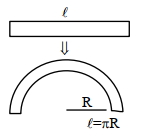
$A$ straight magnetic strip has a magnetic moment of $44 \text{ Am}^2$. If the strip is bent in a semicircular shape,its magnetic moment will be . . . . . . . $\text{Am}^2$ (Given $\pi = \frac{22}{7}$)
A
$28$
B
$27$
C
$26$
D
$25$
Solution
(A) Let the pole strength of the magnetic strip be $m$ and its length be $\ell$. The initial magnetic moment is $M_1 = m \ell = 44 \text{ Am}^2$.
When the strip is bent into a semicircle of radius $R$,the length of the strip becomes the arc length of the semicircle,so $\ell = \pi R$,which means $R = \frac{\ell}{\pi}$.
The new magnetic moment $M_2$ is the product of the pole strength and the straight-line distance between the poles (the diameter of the semicircle),which is $2R$.
$M_2 = m \times (2R) = m \times \left( \frac{2\ell}{\pi} \right) = \frac{2}{\pi} (m \ell)$.
Substituting the given values: $M_2 = \frac{2}{\pi} \times 44 = \frac{2}{(22/7)} \times 44 = \frac{2 \times 7}{22} \times 44 = \frac{14}{22} \times 44 = 14 \times 2 = 28 \text{ Am}^2$.
When the strip is bent into a semicircle of radius $R$,the length of the strip becomes the arc length of the semicircle,so $\ell = \pi R$,which means $R = \frac{\ell}{\pi}$.
The new magnetic moment $M_2$ is the product of the pole strength and the straight-line distance between the poles (the diameter of the semicircle),which is $2R$.
$M_2 = m \times (2R) = m \times \left( \frac{2\ell}{\pi} \right) = \frac{2}{\pi} (m \ell)$.
Substituting the given values: $M_2 = \frac{2}{\pi} \times 44 = \frac{2}{(22/7)} \times 44 = \frac{2 \times 7}{22} \times 44 = \frac{14}{22} \times 44 = 14 \times 2 = 28 \text{ Am}^2$.
0 likesView Solution
314
PhysicsDifficultMCQJEE Main · 2024
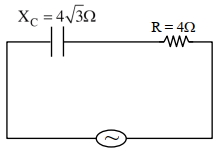
$A$ capacitor of reactance $4 \sqrt{3} \Omega$ and a resistor of resistance $4 \Omega$ are connected in series with an $AC$ source of peak value $8 \sqrt{2} \text{ V}$. The power dissipation in the circuit is . . . . . $\text{W}$.
A
$3$
B
$2$
C
$4$
D
$5$
Solution
(C) Given:
Reactance of capacitor $X_C = 4 \sqrt{3} \Omega$
Resistance $R = 4 \Omega$
Peak voltage $V_0 = 8 \sqrt{2} \text{ V}$
Step $1$: Calculate the impedance $Z$ of the $RC$ circuit.
$Z = \sqrt{R^2 + X_C^2}$
$Z = \sqrt{4^2 + (4 \sqrt{3})^2} = \sqrt{16 + 16 \times 3} = \sqrt{16 + 48} = \sqrt{64} = 8 \Omega$
Step $2$: Calculate the $RMS$ voltage $V_{\text{rms}}$.
$V_{\text{rms}} = \frac{V_0}{\sqrt{2}} = \frac{8 \sqrt{2}}{\sqrt{2}} = 8 \text{ V}$
Step $3$: Calculate the $RMS$ current $I_{\text{rms}}$.
$I_{\text{rms}} = \frac{V_{\text{rms}}}{Z} = \frac{8}{8} = 1 \text{ A}$
Step $4$: Calculate the power dissipation $P$.
Power is dissipated only in the resistor.
$P = I_{\text{rms}}^2 \times R = (1)^2 \times 4 = 4 \text{ W}$
Reactance of capacitor $X_C = 4 \sqrt{3} \Omega$
Resistance $R = 4 \Omega$
Peak voltage $V_0 = 8 \sqrt{2} \text{ V}$
Step $1$: Calculate the impedance $Z$ of the $RC$ circuit.
$Z = \sqrt{R^2 + X_C^2}$
$Z = \sqrt{4^2 + (4 \sqrt{3})^2} = \sqrt{16 + 16 \times 3} = \sqrt{16 + 48} = \sqrt{64} = 8 \Omega$
Step $2$: Calculate the $RMS$ voltage $V_{\text{rms}}$.
$V_{\text{rms}} = \frac{V_0}{\sqrt{2}} = \frac{8 \sqrt{2}}{\sqrt{2}} = 8 \text{ V}$
Step $3$: Calculate the $RMS$ current $I_{\text{rms}}$.
$I_{\text{rms}} = \frac{V_{\text{rms}}}{Z} = \frac{8}{8} = 1 \text{ A}$
Step $4$: Calculate the power dissipation $P$.
Power is dissipated only in the resistor.
$P = I_{\text{rms}}^2 \times R = (1)^2 \times 4 = 4 \text{ W}$
0 likesView Solution
315
PhysicsDifficultMCQJEE Main · 2024
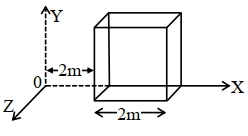
An electric field $\overrightarrow{E} = (2x\hat{i}) \text{ NC}^{-1}$ exists in space. $A$ cube of side $2 \text{ m}$ is placed in the space as per the figure given below. The electric flux through the cube is .................. $\text{Nm}^2 \text{C}^{-1}$.
A
$13$
B
$14$
C
$15$
D
$16$
Solution
(D) Given,electric field $\overrightarrow{E} = 2x\hat{i} \text{ NC}^{-1}$.
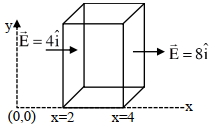
The cube is placed between $x = 2 \text{ m}$ and $x = 4 \text{ m}$. The side length of the cube is $a = 2 \text{ m}$,so the area of each face is $A = a^2 = (2)^2 = 4 \text{ m}^2$.
Electric flux is given by $\phi = \int \overrightarrow{E} \cdot d\overrightarrow{A}$.
For the left face at $x = 2 \text{ m}$,the area vector is $\overrightarrow{A}_1 = -4\hat{i} \text{ m}^2$ and $\overrightarrow{E}_1 = 2(2)\hat{i} = 4\hat{i} \text{ NC}^{-1}$.
$\phi_{\text{in}} = \overrightarrow{E}_1 \cdot \overrightarrow{A}_1 = (4\hat{i}) \cdot (-4\hat{i}) = -16 \text{ Nm}^2 \text{C}^{-1}$.
For the right face at $x = 4 \text{ m}$,the area vector is $\overrightarrow{A}_2 = 4\hat{i} \text{ m}^2$ and $\overrightarrow{E}_2 = 2(4)\hat{i} = 8\hat{i} \text{ NC}^{-1}$.
$\phi_{\text{out}} = \overrightarrow{E}_2 \cdot \overrightarrow{A}_2 = (8\hat{i}) \cdot (4\hat{i}) = 32 \text{ Nm}^2 \text{C}^{-1}$.
The net electric flux through the cube is $\phi_{\text{net}} = \phi_{\text{in}} + \phi_{\text{out}} = -16 + 32 = 16 \text{ Nm}^2 \text{C}^{-1}$.
The cube is placed between $x = 2 \text{ m}$ and $x = 4 \text{ m}$. The side length of the cube is $a = 2 \text{ m}$,so the area of each face is $A = a^2 = (2)^2 = 4 \text{ m}^2$.
Electric flux is given by $\phi = \int \overrightarrow{E} \cdot d\overrightarrow{A}$.
For the left face at $x = 2 \text{ m}$,the area vector is $\overrightarrow{A}_1 = -4\hat{i} \text{ m}^2$ and $\overrightarrow{E}_1 = 2(2)\hat{i} = 4\hat{i} \text{ NC}^{-1}$.
$\phi_{\text{in}} = \overrightarrow{E}_1 \cdot \overrightarrow{A}_1 = (4\hat{i}) \cdot (-4\hat{i}) = -16 \text{ Nm}^2 \text{C}^{-1}$.
For the right face at $x = 4 \text{ m}$,the area vector is $\overrightarrow{A}_2 = 4\hat{i} \text{ m}^2$ and $\overrightarrow{E}_2 = 2(4)\hat{i} = 8\hat{i} \text{ NC}^{-1}$.
$\phi_{\text{out}} = \overrightarrow{E}_2 \cdot \overrightarrow{A}_2 = (8\hat{i}) \cdot (4\hat{i}) = 32 \text{ Nm}^2 \text{C}^{-1}$.
The net electric flux through the cube is $\phi_{\text{net}} = \phi_{\text{in}} + \phi_{\text{out}} = -16 + 32 = 16 \text{ Nm}^2 \text{C}^{-1}$.
0 likesView Solution
316
PhysicsDifficultMCQJEE Main · 2024
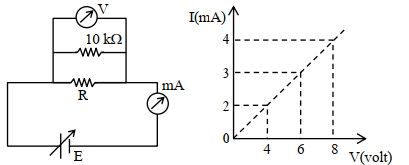
To determine the resistance $(R)$ of a wire,a circuit is designed as shown below. The $V-I$ characteristic curve for this circuit is plotted for the voltmeter and the ammeter readings as shown in the figure. The value of $R$ is . . . . . . . $\Omega$.
A
$2400$
B
$2500$
C
$2600$
D
$2700$
Solution
(B) From the circuit diagram,the voltmeter is connected in parallel with the $10 \text{ k}\Omega$ resistor and the resistor $R$. However,the voltmeter measures the voltage across the parallel combination of $R$ and $10 \text{ k}\Omega$. Let $R_p$ be the equivalent resistance of $R$ and $10 \text{ k}\Omega$ in parallel.
$R_p = \frac{R \times 10^4}{R + 10^4}$
From the $V-I$ graph,we can take any point,for example,$V = 4 \text{ V}$ and $I = 2 \text{ mA} = 2 \times 10^{-3} \text{ A}$.
Using Ohm's law,$V = I R_p$,so $R_p = \frac{V}{I} = \frac{4}{2 \times 10^{-3}} = 2000 \text{ } \Omega$.
Now,equate the two expressions for $R_p$:
$2000 = \frac{R \times 10^4}{R + 10^4}$
$2000(R + 10000) = 10000R$
$2000R + 2 \times 10^7 = 10000R$
$8000R = 2 \times 10^7$
$R = \frac{20000000}{8000} = 2500 \text{ } \Omega$.
$R_p = \frac{R \times 10^4}{R + 10^4}$
From the $V-I$ graph,we can take any point,for example,$V = 4 \text{ V}$ and $I = 2 \text{ mA} = 2 \times 10^{-3} \text{ A}$.
Using Ohm's law,$V = I R_p$,so $R_p = \frac{V}{I} = \frac{4}{2 \times 10^{-3}} = 2000 \text{ } \Omega$.
Now,equate the two expressions for $R_p$:
$2000 = \frac{R \times 10^4}{R + 10^4}$
$2000(R + 10000) = 10000R$
$2000R + 2 \times 10^7 = 10000R$
$8000R = 2 \times 10^7$
$R = \frac{20000000}{8000} = 2500 \text{ } \Omega$.
0 likesView Solution
317
PhysicsDifficultMCQJEE Main · 2024
Monochromatic light of wavelength $500 \, nm$ is used in Young's double slit experiment. An interference pattern is obtained on a screen. When one of the slits is covered with a very thin glass plate (refractive index $= 1.5$), the central maximum is shifted to a position previously occupied by the $4^{th}$ bright fringe. The thickness of the glass plate is ..................... $\mu m$.
A
$1$
B
$2$
C
$3$
D
$4$
Solution
(D) The shift in the central maximum due to the introduction of a glass plate of thickness $t$ and refractive index $\mu$ is given by the formula: $\Delta x = \frac{(\mu - 1) t D}{d}$.
Given that the central maximum shifts to the position of the $4^{th}$ bright fringe, the shift is equal to the path difference of the $4^{th}$ bright fringe, which is $4\lambda$.
Equating the path difference introduced by the glass plate to the shift: $(\mu - 1) t = n \lambda$.
Substituting the given values: $(1.5 - 1) t = 4 \times 500 \, nm$.
$0.5 \times t = 2000 \, nm$.
$t = 4000 \, nm$.
Since $1 \, \mu m = 1000 \, nm$, we have $t = 4 \, \mu m$.
Given that the central maximum shifts to the position of the $4^{th}$ bright fringe, the shift is equal to the path difference of the $4^{th}$ bright fringe, which is $4\lambda$.
Equating the path difference introduced by the glass plate to the shift: $(\mu - 1) t = n \lambda$.
Substituting the given values: $(1.5 - 1) t = 4 \times 500 \, nm$.
$0.5 \times t = 2000 \, nm$.
$t = 4000 \, nm$.
Since $1 \, \mu m = 1000 \, nm$, we have $t = 4 \, \mu m$.
0 likesView Solution
318
PhysicsDifficultMCQJEE Main · 2024
At room temperature $(27^{\circ} C)$,the resistance of a heating element is $50 \Omega$. The temperature coefficient of the material is $2.4 \times 10^{-4} { }^{\circ} C^{-1}$. The temperature of the element,when its resistance is $62 \Omega$,is $\qquad$ ${ }^{\circ} C$.
A
$1026$
B
$1027$
C
$1028$
D
$1029$
Solution
(B) The resistance of a conductor at a temperature $T$ is given by the formula: $R = R_0(1 + \alpha \Delta T)$.
Here,$R_0 = 50 \Omega$ at $T_0 = 27^{\circ} C$,$R = 62 \Omega$,and $\alpha = 2.4 \times 10^{-4} { }^{\circ} C^{-1}$.
Substituting the values into the equation:
$62 = 50(1 + 2.4 \times 10^{-4} \Delta T)$
$1.24 = 1 + 2.4 \times 10^{-4} \Delta T$
$0.24 = 2.4 \times 10^{-4} \Delta T$
$\Delta T = \frac{0.24}{2.4 \times 10^{-4}} = 1000^{\circ} C$.
Since $\Delta T = T - T_0$,we have $T = T_0 + \Delta T = 27^{\circ} C + 1000^{\circ} C = 1027^{\circ} C$.
Here,$R_0 = 50 \Omega$ at $T_0 = 27^{\circ} C$,$R = 62 \Omega$,and $\alpha = 2.4 \times 10^{-4} { }^{\circ} C^{-1}$.
Substituting the values into the equation:
$62 = 50(1 + 2.4 \times 10^{-4} \Delta T)$
$1.24 = 1 + 2.4 \times 10^{-4} \Delta T$
$0.24 = 2.4 \times 10^{-4} \Delta T$
$\Delta T = \frac{0.24}{2.4 \times 10^{-4}} = 1000^{\circ} C$.
Since $\Delta T = T - T_0$,we have $T = T_0 + \Delta T = 27^{\circ} C + 1000^{\circ} C = 1027^{\circ} C$.
0 likesView Solution
Vedclass Products
For Students
Vedclass Test Series
Mock tests in real JEE Main style covering Physics with performance analysis. 5-day free trial.
Start Free TrialFor Teachers
Exam Paper Generator
Generate Set A/B/C/D Physics papers from 7.5L+ questions in 2 minutes. 3 chapters free.
Try FreeFor Institutes
Online Exam Module
Run live JEE Main mock exams with unlimited students, 360° analytics & white-label branding.
See DemoFrequently Asked Questions
How many Physics questions are in JEE Main 2024?
There are 599 Physics questions from the JEE Main 2024 paper on Vedclass, each with a detailed step-by-step solution in English.
Are JEE Main 2024 Physics solutions available in English?
Yes. All solutions on this page are in English. You can also switch to English or Hindi using the language buttons above the questions.
Can I practice JEE Main 2024 Physics as a timed test?
Yes. Use the Vedclass Test Series to attempt a full JEE Main mock test covering Physics with time limits and instant score analysis.
Can teachers create Physics papers from JEE Main previous year questions?
Yes. The Vedclass Exam Paper Generator lets teachers mix JEE Main Physics questions and generate Set A/B/C/D papers in minutes.
For Teachers & Institutes
Build a Custom Physics Paper
Pick JEE Main 2024 Physics questions, set difficulty, and generate Set A/B/C/D in 2 minutes.