
PhysicsQ201–300 of 660 questions
Page 5 of 8 · English
201
PhysicsMediumMCQJEE Main · 2022
Two masses $M_{1}$ and $M_{2}$ are tied together at the two ends of a light inextensible string that passes over a frictionless pulley. When the mass $M_{2}$ is twice that of $M_{1}$,the acceleration of the system is $a_{1}$. When the mass $M_{2}$ is thrice that of $M_{1}$,the acceleration of the system is $a_{2}$. The ratio $\frac{a_{1}}{a_{2}}$ will be:
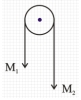
A
$\frac{1}{3}$
B
$\frac{2}{3}$
C
$\frac{3}{2}$
D
$\frac{1}{2}$
Solution
(B) The acceleration of a system of two masses $M_{1}$ and $M_{2}$ connected by a string over a frictionless pulley is given by the formula:
$a = \frac{|M_{2} - M_{1}|}{M_{1} + M_{2}} g$
Case $1$: Given $M_{2} = 2M_{1}$.
$a_{1} = \frac{|2M_{1} - M_{1}|}{M_{1} + 2M_{1}} g = \frac{M_{1}}{3M_{1}} g = \frac{g}{3}$
Case $2$: Given $M_{2} = 3M_{1}$.
$a_{2} = \frac{|3M_{1} - M_{1}|}{M_{1} + 3M_{1}} g = \frac{2M_{1}}{4M_{1}} g = \frac{g}{2}$
Now,calculating the ratio $\frac{a_{1}}{a_{2}}$:
$\frac{a_{1}}{a_{2}} = \frac{g/3}{g/2} = \frac{2}{3}$
Therefore,the correct option is $B$.
$a = \frac{|M_{2} - M_{1}|}{M_{1} + M_{2}} g$
Case $1$: Given $M_{2} = 2M_{1}$.
$a_{1} = \frac{|2M_{1} - M_{1}|}{M_{1} + 2M_{1}} g = \frac{M_{1}}{3M_{1}} g = \frac{g}{3}$
Case $2$: Given $M_{2} = 3M_{1}$.
$a_{2} = \frac{|3M_{1} - M_{1}|}{M_{1} + 3M_{1}} g = \frac{2M_{1}}{4M_{1}} g = \frac{g}{2}$
Now,calculating the ratio $\frac{a_{1}}{a_{2}}$:
$\frac{a_{1}}{a_{2}} = \frac{g/3}{g/2} = \frac{2}{3}$
Therefore,the correct option is $B$.
0 likesView Solution
202
PhysicsMediumMCQJEE Main · 2022
The area of cross-section of the rope used to lift a load by a crane is $2.5 \times 10^{-4} \, m^2$. The maximum lifting capacity of the crane is $10$ metric tons. To increase the lifting capacity of the crane to $25$ metric tons,the required area of cross-section of the rope should be $......... \times 10^{-4} \, m^2$ (take $g = 10 \, m/s^2$).
A
$6.25$
B
$10$
C
$1$
D
$1.67$
Solution
(A) The breaking stress of the material is constant,as it is an intrinsic property of the material.
Breaking stress = $\frac{\text{Maximum load}}{\text{Area of cross-section}}$.
Let $A_1 = 2.5 \times 10^{-4} \, m^2$ be the initial area for a load $L_1 = 10$ metric tons.
Let $A_2$ be the required area for a load $L_2 = 25$ metric tons.
Since the breaking stress is constant: $\frac{L_1}{A_1} = \frac{L_2}{A_2}$.
Substituting the values: $\frac{10}{2.5 \times 10^{-4}} = \frac{25}{A_2}$.
$A_2 = \frac{25 \times 2.5 \times 10^{-4}}{10}$.
$A_2 = 6.25 \times 10^{-4} \, m^2$.
Breaking stress = $\frac{\text{Maximum load}}{\text{Area of cross-section}}$.
Let $A_1 = 2.5 \times 10^{-4} \, m^2$ be the initial area for a load $L_1 = 10$ metric tons.
Let $A_2$ be the required area for a load $L_2 = 25$ metric tons.
Since the breaking stress is constant: $\frac{L_1}{A_1} = \frac{L_2}{A_2}$.
Substituting the values: $\frac{10}{2.5 \times 10^{-4}} = \frac{25}{A_2}$.
$A_2 = \frac{25 \times 2.5 \times 10^{-4}}{10}$.
$A_2 = 6.25 \times 10^{-4} \, m^2$.
0 likesView Solution
203
PhysicsMediumMCQJEE Main · 2022
If $\overrightarrow{A} = (2\hat{i} + 3\hat{j} - \hat{k}) \; m$ and $\overrightarrow{B} = (\hat{i} + 2\hat{j} + 2\hat{k}) \; m$,the magnitude of the component of vector $\overrightarrow{A}$ along vector $\overrightarrow{B}$ will be $...... \; m$.
A
$2$
B
$1$
C
$3$
D
$4$
Solution
(A) Given vectors are $\overrightarrow{A} = (2\hat{i} + 3\hat{j} - \hat{k}) \; m$ and $\overrightarrow{B} = (\hat{i} + 2\hat{j} + 2\hat{k}) \; m$.
The component of vector $\overrightarrow{A}$ along vector $\overrightarrow{B}$ is given by the projection formula: $\text{Component} = \overrightarrow{A} \cdot \hat{B} = \frac{\overrightarrow{A} \cdot \overrightarrow{B}}{|\overrightarrow{B}|}$.
First,calculate the dot product $\overrightarrow{A} \cdot \overrightarrow{B}$:
$\overrightarrow{A} \cdot \overrightarrow{B} = (2)(1) + (3)(2) + (-1)(2) = 2 + 6 - 2 = 6$.
Next,calculate the magnitude of vector $\overrightarrow{B}$:
$|\overrightarrow{B}| = \sqrt{1^2 + 2^2 + 2^2} = \sqrt{1 + 4 + 4} = \sqrt{9} = 3$.
Finally,calculate the component:
$\text{Component} = \frac{6}{3} = 2 \; m$.
The component of vector $\overrightarrow{A}$ along vector $\overrightarrow{B}$ is given by the projection formula: $\text{Component} = \overrightarrow{A} \cdot \hat{B} = \frac{\overrightarrow{A} \cdot \overrightarrow{B}}{|\overrightarrow{B}|}$.
First,calculate the dot product $\overrightarrow{A} \cdot \overrightarrow{B}$:
$\overrightarrow{A} \cdot \overrightarrow{B} = (2)(1) + (3)(2) + (-1)(2) = 2 + 6 - 2 = 6$.
Next,calculate the magnitude of vector $\overrightarrow{B}$:
$|\overrightarrow{B}| = \sqrt{1^2 + 2^2 + 2^2} = \sqrt{1 + 4 + 4} = \sqrt{9} = 3$.
Finally,calculate the component:
$\text{Component} = \frac{6}{3} = 2 \; m$.
0 likesView Solution
204
PhysicsMediumMCQJEE Main · 2022
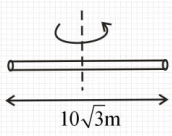
The radius of gyration of a cylindrical rod about an axis of rotation perpendicular to its length and passing through its center is $k$. Given that the length of the rod is $10 \sqrt{3} \ m$,find the value of $k$ in meters.
A
$5$
B
$4$
C
$8$
D
$18$
Solution
(A) The moment of inertia $I$ of a uniform rod of mass $m$ and length $\ell$ about an axis passing through its center and perpendicular to its length is given by $I = \frac{m \ell^{2}}{12}$.
By definition,the moment of inertia is also expressed as $I = mk^{2}$,where $k$ is the radius of gyration.
Equating the two expressions: $mk^{2} = \frac{m \ell^{2}}{12}$.
Solving for $k$: $k^{2} = \frac{\ell^{2}}{12} \Rightarrow k = \frac{\ell}{\sqrt{12}} = \frac{\ell}{2 \sqrt{3}}$.
Given $\ell = 10 \sqrt{3} \ m$,we substitute this value:
$k = \frac{10 \sqrt{3}}{2 \sqrt{3}} = 5 \ m$.
Thus,the radius of gyration is $5 \ m$.
By definition,the moment of inertia is also expressed as $I = mk^{2}$,where $k$ is the radius of gyration.
Equating the two expressions: $mk^{2} = \frac{m \ell^{2}}{12}$.
Solving for $k$: $k^{2} = \frac{\ell^{2}}{12} \Rightarrow k = \frac{\ell}{\sqrt{12}} = \frac{\ell}{2 \sqrt{3}}$.
Given $\ell = 10 \sqrt{3} \ m$,we substitute this value:
$k = \frac{10 \sqrt{3}}{2 \sqrt{3}} = 5 \ m$.
Thus,the radius of gyration is $5 \ m$.
0 likesView Solution
205
PhysicsDifficultMCQJEE Main · 2022
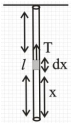
$A$ uniform heavy rod of mass $20\,kg$,cross-sectional area $0.4\,m^{2}$,and length $20\,m$ is hanging from a fixed support. Neglecting the lateral contraction,the elongation in the rod due to its own weight is $x \times 10^{-9}\,m$. The value of $x$ is (Given: Young's modulus $Y = 2 \times 10^{11}\,N/m^{2}$ and $g = 10\,m/s^{2}$)
A
$28$
B
$25$
C
$24$
D
$23$
Solution
(B) The elongation $\Delta \ell$ of a rod of length $\ell$,mass $m$,and cross-sectional area $A$ due to its own weight is given by the formula:
$\Delta \ell = \frac{mg\ell}{2AY}$
Given values:
$m = 20\,kg$
$A = 0.4\,m^{2}$
$\ell = 20\,m$
$Y = 2 \times 10^{11}\,N/m^{2}$
$g = 10\,m/s^{2}$
Substituting these values into the formula:
$\Delta \ell = \frac{20 \times 10 \times 20}{2 \times 0.4 \times 2 \times 10^{11}}$
$\Delta \ell = \frac{4000}{1.6 \times 10^{11}}$
$\Delta \ell = 2500 \times 10^{-11}\,m$
$\Delta \ell = 25 \times 10^{-9}\,m$
Comparing this with $x \times 10^{-9}\,m$,we get $x = 25$.
$\Delta \ell = \frac{mg\ell}{2AY}$
Given values:
$m = 20\,kg$
$A = 0.4\,m^{2}$
$\ell = 20\,m$
$Y = 2 \times 10^{11}\,N/m^{2}$
$g = 10\,m/s^{2}$
Substituting these values into the formula:
$\Delta \ell = \frac{20 \times 10 \times 20}{2 \times 0.4 \times 2 \times 10^{11}}$
$\Delta \ell = \frac{4000}{1.6 \times 10^{11}}$
$\Delta \ell = 2500 \times 10^{-11}\,m$
$\Delta \ell = 25 \times 10^{-9}\,m$
Comparing this with $x \times 10^{-9}\,m$,we get $x = 25$.
0 likesView Solution
206
PhysicsMediumMCQJEE Main · 2022
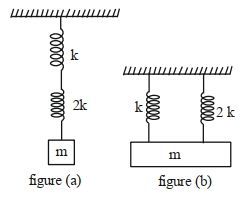
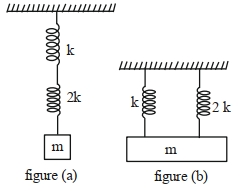
As per the given figures,two springs of spring constants $K$ and $2K$ are connected to a mass $m$. If the period of oscillation in figure $(a)$ is $3 \text{ s}$,then the period of oscillation in figure $(b)$ will be $\sqrt{x} \text{ s}$. The value of $x$ is $.........$
A
$20$
B
$1$
C
$22$
D
$2$
Solution
(D) For figure $(a)$,the springs are in series. The equivalent spring constant $K_{eq}$ is given by:
$K_{eq} = \frac{K \times 2K}{K + 2K} = \frac{2K}{3}$
The period of oscillation $T$ is:
$T = 2\pi \sqrt{\frac{m}{K_{eq}}} = 2\pi \sqrt{\frac{m}{2K/3}} = 2\pi \sqrt{\frac{3m}{2K}} = 3 \text{ s}$
For figure $(b)$,the springs are in parallel. The equivalent spring constant $K'_{eq}$ is:
$K'_{eq} = K + 2K = 3K$
The period of oscillation $T'$ is:
$T' = 2\pi \sqrt{\frac{m}{3K}}$
Dividing $T'$ by $T$:
$\frac{T'}{T} = \frac{2\pi \sqrt{\frac{m}{3K}}}{2\pi \sqrt{\frac{3m}{2K}}} = \sqrt{\frac{m}{3K} \times \frac{2K}{3m}} = \sqrt{\frac{2}{9}} = \frac{\sqrt{2}}{3}$
Given $T = 3 \text{ s}$,we have:
$T' = 3 \times \frac{\sqrt{2}}{3} = \sqrt{2} \text{ s}$
Comparing $T' = \sqrt{x} \text{ s}$ with $T' = \sqrt{2} \text{ s}$,we get $x = 2$.
$K_{eq} = \frac{K \times 2K}{K + 2K} = \frac{2K}{3}$
The period of oscillation $T$ is:
$T = 2\pi \sqrt{\frac{m}{K_{eq}}} = 2\pi \sqrt{\frac{m}{2K/3}} = 2\pi \sqrt{\frac{3m}{2K}} = 3 \text{ s}$
For figure $(b)$,the springs are in parallel. The equivalent spring constant $K'_{eq}$ is:
$K'_{eq} = K + 2K = 3K$
The period of oscillation $T'$ is:
$T' = 2\pi \sqrt{\frac{m}{3K}}$
Dividing $T'$ by $T$:
$\frac{T'}{T} = \frac{2\pi \sqrt{\frac{m}{3K}}}{2\pi \sqrt{\frac{3m}{2K}}} = \sqrt{\frac{m}{3K} \times \frac{2K}{3m}} = \sqrt{\frac{2}{9}} = \frac{\sqrt{2}}{3}$
Given $T = 3 \text{ s}$,we have:
$T' = 3 \times \frac{\sqrt{2}}{3} = \sqrt{2} \text{ s}$
Comparing $T' = \sqrt{x} \text{ s}$ with $T' = \sqrt{2} \text{ s}$,we get $x = 2$.
0 likesView Solution
207
PhysicsDifficultMCQJEE Main · 2022
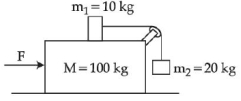
Three masses $M = 100 \, kg$,$m_{1} = 10 \, kg$,and $m_{2} = 20 \, kg$ are arranged in a system as shown in the figure. All the surfaces are frictionless and strings are inextensible and weightless. The pulleys are also weightless and frictionless. $A$ force $F$ is applied on the system so that the mass $m_{2}$ moves upward with an acceleration of $2 \, m/s^{2}$. The value of $F$ is $...... \, N$. (Take $g = 10 \, m/s^{2}$)
A
$3360$
B
$3380$
C
$3120$
D
$3240$
Solution
(C) Let the acceleration of the $100 \, kg$ block be $a_{1}$ towards the right.
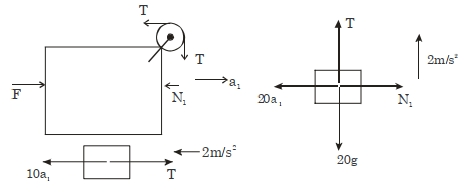
For the $m_{2} = 20 \, kg$ block,it is moving upward with acceleration $a_{y} = 2 \, m/s^{2}$ relative to the $100 \, kg$ block. The tension $T$ in the string acts upward,and gravity $20g$ acts downward. The pseudo force $20a_{1}$ acts horizontally to the left.
Applying Newton's second law in the vertical direction for $m_{2}$:
$T - m_{2}g = m_{2}a_{y}$
$T - 20(10) = 20(2)$
$T - 200 = 40 \Rightarrow T = 240 \, N$.
Now,consider the $m_{1} = 10 \, kg$ block on top of the $100 \, kg$ block. It is connected to the $20 \, kg$ block via the string. The horizontal acceleration of $m_{1}$ relative to the $100 \, kg$ block is $a_{x} = 2 \, m/s^{2}$ (since the string is inextensible,the horizontal acceleration of $m_{1}$ must match the vertical acceleration of $m_{2}$).
Applying Newton's second law for $m_{1}$ in the horizontal direction:
$T = m_{1}a_{1} \Rightarrow 240 = 10a_{1} \Rightarrow a_{1} = 24 \, m/s^{2}$.
Finally,consider the whole system $(M + m_{1} + m_{2})$ moving with acceleration $a_{1}$:
$F = (M + m_{1} + m_{2})a_{1}$
$F = (100 + 10 + 20) \times 24$
$F = 130 \times 24 = 3120 \, N$.
For the $m_{2} = 20 \, kg$ block,it is moving upward with acceleration $a_{y} = 2 \, m/s^{2}$ relative to the $100 \, kg$ block. The tension $T$ in the string acts upward,and gravity $20g$ acts downward. The pseudo force $20a_{1}$ acts horizontally to the left.
Applying Newton's second law in the vertical direction for $m_{2}$:
$T - m_{2}g = m_{2}a_{y}$
$T - 20(10) = 20(2)$
$T - 200 = 40 \Rightarrow T = 240 \, N$.
Now,consider the $m_{1} = 10 \, kg$ block on top of the $100 \, kg$ block. It is connected to the $20 \, kg$ block via the string. The horizontal acceleration of $m_{1}$ relative to the $100 \, kg$ block is $a_{x} = 2 \, m/s^{2}$ (since the string is inextensible,the horizontal acceleration of $m_{1}$ must match the vertical acceleration of $m_{2}$).
Applying Newton's second law for $m_{1}$ in the horizontal direction:
$T = m_{1}a_{1} \Rightarrow 240 = 10a_{1} \Rightarrow a_{1} = 24 \, m/s^{2}$.
Finally,consider the whole system $(M + m_{1} + m_{2})$ moving with acceleration $a_{1}$:
$F = (M + m_{1} + m_{2})a_{1}$
$F = (100 + 10 + 20) \times 24$
$F = 130 \times 24 = 3120 \, N$.
0 likesView Solution
208
PhysicsMediumMCQJEE Main · 2022
When a particle executes simple harmonic motion,the nature of the graph of velocity as a function of displacement will be:
A
Circular
B
Elliptical
C
Sinusoidal
D
Straight line
Solution
(B) For a particle in $SHM$,its velocity $v$ depends on displacement $x$ as:
$v = \omega \sqrt{A^{2} - x^{2}}$
Where $\omega$ is the angular frequency and $A$ is the amplitude.
Squaring both sides,we get:
$v^{2} = \omega^{2} (A^{2} - x^{2})$
$v^{2} = \omega^{2} A^{2} - \omega^{2} x^{2}$
Rearranging the terms:
$v^{2} + \omega^{2} x^{2} = \omega^{2} A^{2}$
Dividing by $\omega^{2} A^{2}$:
$\frac{v^{2}}{(\omega A)^{2}} + \frac{x^{2}}{A^{2}} = 1$
This equation is of the form $\frac{y^{2}}{b^{2}} + \frac{x^{2}}{a^{2}} = 1$,which represents an ellipse.
Therefore,the graph between velocity $v$ and displacement $x$ is elliptical.
$v = \omega \sqrt{A^{2} - x^{2}}$
Where $\omega$ is the angular frequency and $A$ is the amplitude.
Squaring both sides,we get:
$v^{2} = \omega^{2} (A^{2} - x^{2})$
$v^{2} = \omega^{2} A^{2} - \omega^{2} x^{2}$
Rearranging the terms:
$v^{2} + \omega^{2} x^{2} = \omega^{2} A^{2}$
Dividing by $\omega^{2} A^{2}$:
$\frac{v^{2}}{(\omega A)^{2}} + \frac{x^{2}}{A^{2}} = 1$
This equation is of the form $\frac{y^{2}}{b^{2}} + \frac{x^{2}}{a^{2}} = 1$,which represents an ellipse.
Therefore,the graph between velocity $v$ and displacement $x$ is elliptical.
0 likesView Solution
209
PhysicsMediumMCQJEE Main · 2022
$7$ mole of a certain monoatomic ideal gas undergoes a temperature increase of $40 K$ at constant pressure. The increase in the internal energy of the gas in this process is $.... J$ (Given $R = 8.3 J K^{-1} mol^{-1}$)
A
$5810$
B
$3486$
C
$11620$
D
$6972$
Solution
(B) For any ideal gas,the change in internal energy $\Delta U$ depends only on the change in temperature $\Delta T$ and is given by the formula:
$\Delta U = n C_V \Delta T$
For a monoatomic ideal gas,the molar heat capacity at constant volume is $C_V = \frac{3}{2} R$.
Given values are:
$n = 7 \text{ mol}$
$\Delta T = 40 K$
$R = 8.3 J K^{-1} mol^{-1}$
Substituting these values into the formula:
$\Delta U = 7 \times \left( \frac{3}{2} \times 8.3 \right) \times 40$
$\Delta U = 7 \times 3 \times 8.3 \times 20$
$\Delta U = 21 \times 166 = 3486 J$
Thus,the increase in internal energy is $3486 J$.
$\Delta U = n C_V \Delta T$
For a monoatomic ideal gas,the molar heat capacity at constant volume is $C_V = \frac{3}{2} R$.
Given values are:
$n = 7 \text{ mol}$
$\Delta T = 40 K$
$R = 8.3 J K^{-1} mol^{-1}$
Substituting these values into the formula:
$\Delta U = 7 \times \left( \frac{3}{2} \times 8.3 \right) \times 40$
$\Delta U = 7 \times 3 \times 8.3 \times 20$
$\Delta U = 21 \times 166 = 3486 J$
Thus,the increase in internal energy is $3486 J$.
1 likesView Solution
210
PhysicsDifficultMCQJEE Main · 2022
$A$ monoatomic gas at pressure $P$ and volume $V$ is suddenly compressed to one-eighth of its original volume. The final pressure at constant entropy will be $.....P$.
A
$1$
B
$8$
C
$32$
D
$64$
Solution
(C) process with constant entropy is an adiabatic process.
For an adiabatic process,the relation between pressure and volume is given by $PV^{\gamma} = \text{constant}$.
For a monoatomic gas,the adiabatic index $\gamma = \frac{5}{3}$.
Given,initial volume $V_1 = V$ and final volume $V_2 = \frac{V}{8}$.
Using the adiabatic equation: $P_1 V_1^{\gamma} = P_2 V_2^{\gamma}$.
Substituting the values: $P \cdot V^{5/3} = P_2 \cdot (\frac{V}{8})^{5/3}$.
$P_2 = P \cdot (\frac{V}{V/8})^{5/3} = P \cdot (8)^{5/3}$.
$P_2 = P \cdot (2^3)^{5/3} = P \cdot 2^5$.
$P_2 = 32P$.
For an adiabatic process,the relation between pressure and volume is given by $PV^{\gamma} = \text{constant}$.
For a monoatomic gas,the adiabatic index $\gamma = \frac{5}{3}$.
Given,initial volume $V_1 = V$ and final volume $V_2 = \frac{V}{8}$.
Using the adiabatic equation: $P_1 V_1^{\gamma} = P_2 V_2^{\gamma}$.
Substituting the values: $P \cdot V^{5/3} = P_2 \cdot (\frac{V}{8})^{5/3}$.
$P_2 = P \cdot (\frac{V}{V/8})^{5/3} = P \cdot (8)^{5/3}$.
$P_2 = P \cdot (2^3)^{5/3} = P \cdot 2^5$.
$P_2 = 32P$.
0 likesView Solution
211
PhysicsMediumMCQJEE Main · 2022
$A$ water drop of radius $1\,cm$ is broken into $729$ equal droplets. If the surface tension of water is $75\,dyne/cm$,then the gain in surface energy up to the first decimal place will be $...\times 10^{-4}\,J$.
A
$8.5$
B
$8.2$
C
$7.5$
D
$5.3$
Solution
(C) Initial radius $R = 1\,cm = 10^{-2}\,m$. Surface tension $T = 75\,dyne/cm = 75 \times 10^{-3}\,N/m$.
Initial surface area $A_i = 4\pi R^2 = 4\pi(10^{-2})^2 = 4\pi \times 10^{-4}\,m^2$.
Initial surface energy $U_i = T \times A_i = 75 \times 10^{-3} \times 4\pi \times 10^{-4} = 300\pi \times 10^{-7}\,J$.
Let $r$ be the radius of each small droplet. By volume conservation: $\frac{4}{3}\pi R^3 = 729 \times \frac{4}{3}\pi r^3$.
$r^3 = \frac{R^3}{729} \implies r = \frac{R}{9} = \frac{1}{9}\,cm = \frac{1}{9} \times 10^{-2}\,m$.
Final surface area $A_f = 729 \times 4\pi r^2 = 729 \times 4\pi \times (\frac{1}{9} \times 10^{-2})^2 = 729 \times 4\pi \times \frac{1}{81} \times 10^{-4} = 9 \times 4\pi \times 10^{-4} = 36\pi \times 10^{-4}\,m^2$.
Final surface energy $U_f = T \times A_f = 75 \times 10^{-3} \times 36\pi \times 10^{-4} = 2700\pi \times 10^{-7}\,J$.
Gain in surface energy $\Delta U = U_f - U_i = (2700\pi - 300\pi) \times 10^{-7} = 2400\pi \times 10^{-7}\,J$.
Using $\pi \approx 3.14$,$\Delta U = 2400 \times 3.14 \times 10^{-7} = 7536 \times 10^{-7} = 7.536 \times 10^{-4}\,J$.
Rounding to the first decimal place,the gain is $7.5 \times 10^{-4}\,J$.
Initial surface area $A_i = 4\pi R^2 = 4\pi(10^{-2})^2 = 4\pi \times 10^{-4}\,m^2$.
Initial surface energy $U_i = T \times A_i = 75 \times 10^{-3} \times 4\pi \times 10^{-4} = 300\pi \times 10^{-7}\,J$.
Let $r$ be the radius of each small droplet. By volume conservation: $\frac{4}{3}\pi R^3 = 729 \times \frac{4}{3}\pi r^3$.
$r^3 = \frac{R^3}{729} \implies r = \frac{R}{9} = \frac{1}{9}\,cm = \frac{1}{9} \times 10^{-2}\,m$.
Final surface area $A_f = 729 \times 4\pi r^2 = 729 \times 4\pi \times (\frac{1}{9} \times 10^{-2})^2 = 729 \times 4\pi \times \frac{1}{81} \times 10^{-4} = 9 \times 4\pi \times 10^{-4} = 36\pi \times 10^{-4}\,m^2$.
Final surface energy $U_f = T \times A_f = 75 \times 10^{-3} \times 36\pi \times 10^{-4} = 2700\pi \times 10^{-7}\,J$.
Gain in surface energy $\Delta U = U_f - U_i = (2700\pi - 300\pi) \times 10^{-7} = 2400\pi \times 10^{-7}\,J$.
Using $\pi \approx 3.14$,$\Delta U = 2400 \times 3.14 \times 10^{-7} = 7536 \times 10^{-7} = 7.536 \times 10^{-4}\,J$.
Rounding to the first decimal place,the gain is $7.5 \times 10^{-4}\,J$.
1 likesView Solution
212
PhysicsMediumMCQJEE Main · 2022
The percentage decrease in the weight of a rocket,when taken to a height of $32 \ km$ above the surface of the Earth,will be $.....\%$
(Radius of Earth $= 6400 \ km$)
(Radius of Earth $= 6400 \ km$)
A
$1$
B
$3$
C
$4$
D
$0.5$
Solution
(A) The acceleration due to gravity at a height $h$ above the surface of the Earth is given by $g' = g(1 - \frac{2h}{R})$,where $R$ is the radius of the Earth and $h << R$.
The change in acceleration due to gravity is $\Delta g = g - g' = g(\frac{2h}{R})$.
The fractional decrease in weight (which is proportional to the change in $g$) is given by $\frac{\Delta g}{g} = \frac{2h}{R}$.
To find the percentage decrease,we multiply by $100$:
$\text{Percentage decrease} = \frac{\Delta g}{g} \times 100 = \frac{2h}{R} \times 100$.
Substituting the given values $h = 32 \ km$ and $R = 6400 \ km$:
$\text{Percentage decrease} = 2 \times \frac{32}{6400} \times 100 = 2 \times \frac{1}{200} \times 100 = 1 \%$.
The change in acceleration due to gravity is $\Delta g = g - g' = g(\frac{2h}{R})$.
The fractional decrease in weight (which is proportional to the change in $g$) is given by $\frac{\Delta g}{g} = \frac{2h}{R}$.
To find the percentage decrease,we multiply by $100$:
$\text{Percentage decrease} = \frac{\Delta g}{g} \times 100 = \frac{2h}{R} \times 100$.
Substituting the given values $h = 32 \ km$ and $R = 6400 \ km$:
$\text{Percentage decrease} = 2 \times \frac{32}{6400} \times 100 = 2 \times \frac{1}{200} \times 100 = 1 \%$.
0 likesView Solution
213
PhysicsDifficultMCQJEE Main · 2022
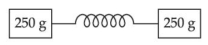
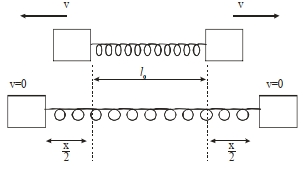
As per the given figure,two blocks each of mass $250\,g$ are connected to a spring of spring constant $2\,N/m$. If both are given velocity $V$ in opposite directions,then the maximum elongation of the spring is:
A
$V \sqrt{\frac{m}{k}}$
B
$V \sqrt{\frac{m}{2k}}$
C
$V \sqrt{\frac{2m}{k}}$
D
$V \sqrt{\frac{m}{4k}}$
Solution
(B) Let the mass of each block be $m = 250\,g = 0.25\,kg$ and the spring constant be $k = 2\,N/m$.
At the moment of maximum elongation $x$,both blocks momentarily come to rest in the center-of-mass frame.
By the law of conservation of energy,the initial kinetic energy of the system is converted into the elastic potential energy of the spring at maximum elongation.
The total initial kinetic energy is $K_i = \frac{1}{2}mv^2 + \frac{1}{2}mv^2 = mv^2$.
The potential energy stored in the spring at maximum elongation $x$ is $U_f = \frac{1}{2}kx^2$.
Equating the two: $mv^2 = \frac{1}{2}kx^2$.
Solving for $x$: $x^2 = \frac{2mv^2}{k} \implies x = v \sqrt{\frac{2m}{k}}$.
Substituting the given values $m = 0.25\,kg$ and $k = 2\,N/m$:
$x = V \sqrt{\frac{2 \times 0.25}{2}} = V \sqrt{0.25} = 0.5V = \frac{V}{2}$.
At the moment of maximum elongation $x$,both blocks momentarily come to rest in the center-of-mass frame.
By the law of conservation of energy,the initial kinetic energy of the system is converted into the elastic potential energy of the spring at maximum elongation.
The total initial kinetic energy is $K_i = \frac{1}{2}mv^2 + \frac{1}{2}mv^2 = mv^2$.
The potential energy stored in the spring at maximum elongation $x$ is $U_f = \frac{1}{2}kx^2$.
Equating the two: $mv^2 = \frac{1}{2}kx^2$.
Solving for $x$: $x^2 = \frac{2mv^2}{k} \implies x = v \sqrt{\frac{2m}{k}}$.
Substituting the given values $m = 0.25\,kg$ and $k = 2\,N/m$:
$x = V \sqrt{\frac{2 \times 0.25}{2}} = V \sqrt{0.25} = 0.5V = \frac{V}{2}$.
1 likesView Solution
214
PhysicsMediumMCQJEE Main · 2022
$A$ monkey of mass $50\,kg$ climbs on a rope which can withstand the tension $(T)$ of $350\,N$. If the monkey initially climbs down with an acceleration of $4\,m/s^2$ and then climbs up with an acceleration of $5\,m/s^2$,choose the correct option $(g = 10\,m/s^2)$.
A
$T = 700\,N$ while climbing upward.
B
$T = 350\,N$ while going downward.
C
Rope will break while climbing upward.
D
Rope will break while going downward.
Solution
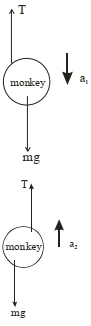
(C) Free Body Diagram ($F$.$B$.$D$) of the monkey while moving downward:
Using Newton's second law: $mg - T = ma_1$
$500 - T = 50 \times 4 \Rightarrow T = 300\,N$.
Free Body Diagram ($F$.$B$.$D$) of the monkey while moving upward:
Using Newton's second law of motion: $T - mg = ma_2$
$T - 500 = 50 \times 5 \Rightarrow T = 750\,N$.
Breaking strength of the string is $350\,N$.
Since $750\,N > 350\,N$,the string will break while the monkey is moving upward.
Using Newton's second law: $mg - T = ma_1$
$500 - T = 50 \times 4 \Rightarrow T = 300\,N$.
Free Body Diagram ($F$.$B$.$D$) of the monkey while moving upward:
Using Newton's second law of motion: $T - mg = ma_2$
$T - 500 = 50 \times 5 \Rightarrow T = 750\,N$.
Breaking strength of the string is $350\,N$.
Since $750\,N > 350\,N$,the string will break while the monkey is moving upward.
0 likesView Solution
215
PhysicsMediumMCQJEE Main · 2022
Two projectiles thrown at $30^{\circ}$ and $45^{\circ}$ with the horizontal respectively,reach the maximum height in the same time. The ratio of their initial velocities is
A
$1: \sqrt{2}$
B
$2: 1$
C
$\sqrt{2}: 1$
D
$1: 2$
Solution
(C) The time taken to reach the maximum height for a projectile is given by the formula:
$t = \frac{u \sin \theta}{g}$
Given that both projectiles reach the maximum height in the same time,we have:
$t_1 = t_2$
$\frac{u_1 \sin \theta_1}{g} = \frac{u_2 \sin \theta_2}{g}$
Substituting the given angles $\theta_1 = 30^{\circ}$ and $\theta_2 = 45^{\circ}$:
$u_1 \sin 30^{\circ} = u_2 \sin 45^{\circ}$
$u_1 \left( \frac{1}{2} \right) = u_2 \left( \frac{1}{\sqrt{2}} \right)$
Rearranging to find the ratio $\frac{u_1}{u_2}$:
$\frac{u_1}{u_2} = \frac{1/\sqrt{2}}{1/2} = \frac{2}{\sqrt{2}} = \sqrt{2}$
Therefore,the ratio of their initial velocities is $\sqrt{2}: 1$.
$t = \frac{u \sin \theta}{g}$
Given that both projectiles reach the maximum height in the same time,we have:
$t_1 = t_2$
$\frac{u_1 \sin \theta_1}{g} = \frac{u_2 \sin \theta_2}{g}$
Substituting the given angles $\theta_1 = 30^{\circ}$ and $\theta_2 = 45^{\circ}$:
$u_1 \sin 30^{\circ} = u_2 \sin 45^{\circ}$
$u_1 \left( \frac{1}{2} \right) = u_2 \left( \frac{1}{\sqrt{2}} \right)$
Rearranging to find the ratio $\frac{u_1}{u_2}$:
$\frac{u_1}{u_2} = \frac{1/\sqrt{2}}{1/2} = \frac{2}{\sqrt{2}} = \sqrt{2}$
Therefore,the ratio of their initial velocities is $\sqrt{2}: 1$.
0 likesView Solution
216
PhysicsDifficultMCQJEE Main · 2022
$A$ screw gauge of pitch $0.5\,mm$ is used to measure the diameter of a uniform wire of length $6.8\,cm$. The main scale reading is $1.5\,mm$ and the circular scale reading is $7$. The calculated curved surface area of the wire to appropriate significant figures is $......\,cm^2$. [Screw gauge has $50$ divisions on the circular scale]
A
$6.8$
B
$3.4$
C
$3.9$
D
$2.4$
Solution
(B) The least count $(L.C.)$ of the screw gauge is given by $L.C. = \frac{\text{Pitch}}{\text{Number of divisions}} = \frac{0.5\,mm}{50} = 0.01\,mm = 0.001\,cm$.
The diameter $(D)$ of the wire is calculated as: $D = \text{Main scale reading} + (\text{Circular scale reading} \times L.C.)$.
$D = 1.5\,mm + (7 \times 0.01\,mm) = 1.5\,mm + 0.07\,mm = 1.57\,mm = 0.157\,cm$.
The length $(l)$ of the wire is $6.8\,cm$.
The curved surface area $(A)$ of the wire is given by $A = \pi D l$.
$A = 3.14 \times 0.157\,cm \times 6.8\,cm \approx 3.353\,cm^2$.
Rounding to two significant figures (as the length $6.8$ has two significant figures),we get $A = 3.4\,cm^2$.
The diameter $(D)$ of the wire is calculated as: $D = \text{Main scale reading} + (\text{Circular scale reading} \times L.C.)$.
$D = 1.5\,mm + (7 \times 0.01\,mm) = 1.5\,mm + 0.07\,mm = 1.57\,mm = 0.157\,cm$.
The length $(l)$ of the wire is $6.8\,cm$.
The curved surface area $(A)$ of the wire is given by $A = \pi D l$.
$A = 3.14 \times 0.157\,cm \times 6.8\,cm \approx 3.353\,cm^2$.
Rounding to two significant figures (as the length $6.8$ has two significant figures),we get $A = 3.4\,cm^2$.
0 likesView Solution
217
PhysicsMediumMCQJEE Main · 2022
If the initial velocity in the horizontal direction of a projectile is the unit vector $\hat{i}$ and the equation of the trajectory is $y = 5x(1 - x)$,find the $y$-component vector of the initial velocity. (Take $g = 10\,m/s^2$) (in $,\hat{j}$)
A
$4$
B
$3$
C
$5$
D
$8$
Solution
(C) The initial horizontal velocity is given as $u_x = 1\,m/s$.
The equation of the trajectory is $y = 5x - 5x^2$.
Differentiating the equation with respect to time $t$,we get the vertical velocity component $v_y = \frac{dy}{dt} = \frac{dy}{dx} \cdot \frac{dx}{dt}$.
First,find $\frac{dy}{dx} = \frac{d}{dx}(5x - 5x^2) = 5 - 10x$.
Since $v_x = \frac{dx}{dt} = u_x = 1$ (assuming constant horizontal velocity),we have $v_y = (5 - 10x) \cdot 1$.
At the initial point,$x = 0$.
Therefore,the initial vertical velocity $u_y = (5 - 10(0)) = 5\,m/s$.
Thus,the $y$-component vector of the initial velocity is $5\,\hat{j}$.
The equation of the trajectory is $y = 5x - 5x^2$.
Differentiating the equation with respect to time $t$,we get the vertical velocity component $v_y = \frac{dy}{dt} = \frac{dy}{dx} \cdot \frac{dx}{dt}$.
First,find $\frac{dy}{dx} = \frac{d}{dx}(5x - 5x^2) = 5 - 10x$.
Since $v_x = \frac{dx}{dt} = u_x = 1$ (assuming constant horizontal velocity),we have $v_y = (5 - 10x) \cdot 1$.
At the initial point,$x = 0$.
Therefore,the initial vertical velocity $u_y = (5 - 10(0)) = 5\,m/s$.
Thus,the $y$-component vector of the initial velocity is $5\,\hat{j}$.
1 likesView Solution
218
PhysicsDifficultMCQJEE Main · 2022
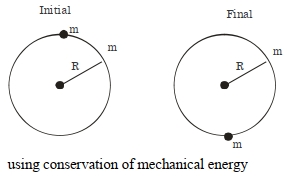
$A$ disc of mass $1\,kg$ and radius $R$ is free to rotate about a horizontal axis passing through its centre and perpendicular to the plane of the disc. $A$ body of the same mass as that of the disc is fixed at the highest point of the disc. Now the system is released. When the body comes to the lowest position,its angular speed will be $4 \sqrt{\frac{x}{3 R}} \text{ rad s}^{-1}$ where $x=$ (Given $g = 10 \text{ m s}^{-2}$)
A
$50$
B
$8$
C
$5$
D
$88$
Solution
(C) Let $m$ be the mass of the disc and the particle. The moment of inertia of the disc about the axis is $I_{\text{disc}} = \frac{1}{2} mR^2$. The moment of inertia of the particle at distance $R$ is $I_{\text{particle}} = mR^2$. The total moment of inertia is $I = I_{\text{disc}} + I_{\text{particle}} = \frac{1}{2} mR^2 + mR^2 = \frac{3}{2} mR^2$.
Using the law of conservation of mechanical energy,the loss in potential energy of the particle equals the gain in rotational kinetic energy of the system.
The particle moves from the highest point to the lowest point,a vertical distance of $2R$.
Loss in potential energy $= mg(2R) = 2mgR$.
Gain in rotational kinetic energy $= \frac{1}{2} I \omega^2 = \frac{1}{2} \left( \frac{3}{2} mR^2 \right) \omega^2 = \frac{3}{4} mR^2 \omega^2$.
Equating the two: $2mgR = \frac{3}{4} mR^2 \omega^2$.
Solving for $\omega^2$: $\omega^2 = \frac{8g}{3R}$.
Given $\omega = 4 \sqrt{\frac{x}{3R}}$,so $\omega^2 = 16 \left( \frac{x}{3R} \right) = \frac{16x}{3R}$.
Equating the expressions for $\omega^2$: $\frac{16x}{3R} = \frac{8g}{3R} \implies 16x = 8g$.
Substituting $g = 10 \text{ m s}^{-2}$: $16x = 8(10) = 80$.
$x = \frac{80}{16} = 5$.
Using the law of conservation of mechanical energy,the loss in potential energy of the particle equals the gain in rotational kinetic energy of the system.
The particle moves from the highest point to the lowest point,a vertical distance of $2R$.
Loss in potential energy $= mg(2R) = 2mgR$.
Gain in rotational kinetic energy $= \frac{1}{2} I \omega^2 = \frac{1}{2} \left( \frac{3}{2} mR^2 \right) \omega^2 = \frac{3}{4} mR^2 \omega^2$.
Equating the two: $2mgR = \frac{3}{4} mR^2 \omega^2$.
Solving for $\omega^2$: $\omega^2 = \frac{8g}{3R}$.
Given $\omega = 4 \sqrt{\frac{x}{3R}}$,so $\omega^2 = 16 \left( \frac{x}{3R} \right) = \frac{16x}{3R}$.
Equating the expressions for $\omega^2$: $\frac{16x}{3R} = \frac{8g}{3R} \implies 16x = 8g$.
Substituting $g = 10 \text{ m s}^{-2}$: $16x = 8(10) = 80$.
$x = \frac{80}{16} = 5$.
0 likesView Solution
219
PhysicsDifficultMCQJEE Main · 2022
In an experiment to determine the Young's modulus of a wire of length exactly $1\;m$,the extension in the length of the wire is measured as $0.4\;mm$ with an uncertainty of $\pm 0.02\;mm$ when a load of $1\;kg$ is applied. The diameter of the wire is measured as $0.4\;mm$ with an uncertainty of $\pm 0.01\;mm$. The error in the measurement of Young's modulus $(\Delta Y)$ is found to be $x \times 10^{10}\;N/m^2$. The value of $x$ is (Take $g = 10\;m/s^2$)
A
$25$
B
$20$
C
$2$
D
$8$
Solution
(C) Young's modulus is given by $Y = \frac{FL}{A\Delta L} = \frac{mgL}{(\pi d^2/4)\Delta L} = \frac{4mgL}{\pi d^2 \Delta L}$.
Given: $L = 1\;m$,$m = 1\;kg$,$g = 10\;m/s^2$,$\Delta L = 0.4 \times 10^{-3}\;m$,$d = 0.4 \times 10^{-3}\;m$.
$Y = \frac{4 \times 1 \times 10 \times 1}{\pi \times (0.4 \times 10^{-3})^2 \times 0.4 \times 10^{-3}} = \frac{40}{\pi \times 0.064 \times 10^{-9}} \approx \frac{40}{3.14 \times 0.064 \times 10^{-9}} \approx 1.99 \times 10^{11}\;N/m^2$.
The relative error in $Y$ is given by $\frac{\Delta Y}{Y} = \frac{\Delta m}{m} + \frac{\Delta L}{L} + 2\frac{\Delta d}{d} + \frac{\Delta(\Delta L)}{\Delta L}$.
Assuming $\Delta m = 0$ and $\Delta L = 0$ (as length is exact),$\frac{\Delta Y}{Y} = 2\frac{\Delta d}{d} + \frac{\Delta(\Delta L)}{\Delta L} = 2 \times \frac{0.01}{0.4} + \frac{0.02}{0.4} = 0.05 + 0.05 = 0.1$.
$\Delta Y = 0.1 \times Y = 0.1 \times 1.99 \times 10^{11} = 1.99 \times 10^{10}\;N/m^2$.
Comparing with $x \times 10^{10}$,we get $x \approx 2$.
Given: $L = 1\;m$,$m = 1\;kg$,$g = 10\;m/s^2$,$\Delta L = 0.4 \times 10^{-3}\;m$,$d = 0.4 \times 10^{-3}\;m$.
$Y = \frac{4 \times 1 \times 10 \times 1}{\pi \times (0.4 \times 10^{-3})^2 \times 0.4 \times 10^{-3}} = \frac{40}{\pi \times 0.064 \times 10^{-9}} \approx \frac{40}{3.14 \times 0.064 \times 10^{-9}} \approx 1.99 \times 10^{11}\;N/m^2$.
The relative error in $Y$ is given by $\frac{\Delta Y}{Y} = \frac{\Delta m}{m} + \frac{\Delta L}{L} + 2\frac{\Delta d}{d} + \frac{\Delta(\Delta L)}{\Delta L}$.
Assuming $\Delta m = 0$ and $\Delta L = 0$ (as length is exact),$\frac{\Delta Y}{Y} = 2\frac{\Delta d}{d} + \frac{\Delta(\Delta L)}{\Delta L} = 2 \times \frac{0.01}{0.4} + \frac{0.02}{0.4} = 0.05 + 0.05 = 0.1$.
$\Delta Y = 0.1 \times Y = 0.1 \times 1.99 \times 10^{11} = 1.99 \times 10^{10}\;N/m^2$.
Comparing with $x \times 10^{10}$,we get $x \approx 2$.
0 likesView Solution
220
PhysicsDifficultMCQJEE Main · 2022
When a car is approaching the observer,the frequency of the horn is $100 \, Hz$. After passing the observer,it is $50 \, Hz$. If the observer moves with the car,the frequency will be $\frac{x}{3} \, Hz$ where $x = .....$
A
$202$
B
$2000$
C
$20$
D
$200$
Solution
(D) Let $f_0$ be the actual frequency of the horn,$C$ be the speed of sound,and $V_s$ be the speed of the car.
When the car approaches the observer: $f_1 = f_0 \left( \frac{C}{C - V_s} \right) = 100 \, Hz$.
When the car moves away from the observer: $f_2 = f_0 \left( \frac{C}{C + V_s} \right) = 50 \, Hz$.
Dividing the two equations: $\frac{f_1}{f_2} = \frac{100}{50} = 2 = \frac{C + V_s}{C - V_s}$.
Solving for $V_s$: $2(C - V_s) = C + V_s \implies 2C - 2V_s = C + V_s \implies C = 3V_s \implies V_s = \frac{C}{3}$.
Substituting $V_s$ into the first equation: $100 = f_0 \left( \frac{C}{C - C/3} \right) = f_0 \left( \frac{C}{2C/3} \right) = f_0 \left( \frac{3}{2} \right)$.
Thus,$f_0 = 100 \times \frac{2}{3} = \frac{200}{3} \, Hz$.
If the observer moves with the car,the relative velocity between the source and the observer is zero,so the observed frequency is equal to the actual frequency $f_0$.
Therefore,$f = f_0 = \frac{200}{3} \, Hz$.
Comparing this with $\frac{x}{3} \, Hz$,we get $x = 200$.
When the car approaches the observer: $f_1 = f_0 \left( \frac{C}{C - V_s} \right) = 100 \, Hz$.
When the car moves away from the observer: $f_2 = f_0 \left( \frac{C}{C + V_s} \right) = 50 \, Hz$.
Dividing the two equations: $\frac{f_1}{f_2} = \frac{100}{50} = 2 = \frac{C + V_s}{C - V_s}$.
Solving for $V_s$: $2(C - V_s) = C + V_s \implies 2C - 2V_s = C + V_s \implies C = 3V_s \implies V_s = \frac{C}{3}$.
Substituting $V_s$ into the first equation: $100 = f_0 \left( \frac{C}{C - C/3} \right) = f_0 \left( \frac{C}{2C/3} \right) = f_0 \left( \frac{3}{2} \right)$.
Thus,$f_0 = 100 \times \frac{2}{3} = \frac{200}{3} \, Hz$.
If the observer moves with the car,the relative velocity between the source and the observer is zero,so the observed frequency is equal to the actual frequency $f_0$.
Therefore,$f = f_0 = \frac{200}{3} \, Hz$.
Comparing this with $\frac{x}{3} \, Hz$,we get $x = 200$.
0 likesView Solution
221
PhysicsDifficultMCQJEE Main · 2022
An expression of energy density is given by $u = \frac{\alpha}{\beta} \sin \left(\frac{\alpha x}{k t}\right)$,where $\alpha, \beta$ are constants,$x$ is displacement,$k$ is Boltzmann constant,and $t$ is the temperature. The dimensions of $\beta$ will be.
A
$[ML^{2}T^{-2}\theta^{-1}]$
B
$[M^{0}L^{2}T^{-2}]$
C
$[M^{0}L^{0}T^{0}]$
D
$[M^{0}L^{2}T^{0}]$
Solution
(D) The argument of the $\sin$ function must be dimensionless,so $[\frac{\alpha x}{kt}] = [M^{0}L^{0}T^{0}]$.
Given $x = [L]$,$k = [ML^{2}T^{-2}\theta^{-1}]$,and $t = [\theta]$.
Thus,$[\alpha] = [\frac{kt}{x}] = \frac{[ML^{2}T^{-2}\theta^{-1}][\theta]}{[L]} = [MLT^{-2}]$.
Energy density $u$ is energy per unit volume,so $[u] = [ML^{-1}T^{-2}]$.
From the expression $u = \frac{\alpha}{\beta}$,we have $[\beta] = \frac{[\alpha]}{[u]}$.
$[\beta] = \frac{[MLT^{-2}]}{[ML^{-1}T^{-2}]} = [L^{2}]$.
Therefore,the dimensions of $\beta$ are $[M^{0}L^{2}T^{0}]$.
Given $x = [L]$,$k = [ML^{2}T^{-2}\theta^{-1}]$,and $t = [\theta]$.
Thus,$[\alpha] = [\frac{kt}{x}] = \frac{[ML^{2}T^{-2}\theta^{-1}][\theta]}{[L]} = [MLT^{-2}]$.
Energy density $u$ is energy per unit volume,so $[u] = [ML^{-1}T^{-2}]$.
From the expression $u = \frac{\alpha}{\beta}$,we have $[\beta] = \frac{[\alpha]}{[u]}$.
$[\beta] = \frac{[MLT^{-2}]}{[ML^{-1}T^{-2}]} = [L^{2}]$.
Therefore,the dimensions of $\beta$ are $[M^{0}L^{2}T^{0}]$.
0 likesView Solution
222
PhysicsDifficultMCQJEE Main · 2022
$A$ body of mass $10 \ kg$ is projected at an angle of $45^{\circ}$ with the horizontal. The trajectory of the body is observed to pass through a point $(20, 10)$. If $T$ is the time of flight,then its momentum vector,at time $t = \frac{T}{\sqrt{2}}$,is. [Take $g = 10 \ m/s^2$]
A
$100 \hat{i} + (100\sqrt{2} - 200) \hat{j}$
B
$100\sqrt{2} \hat{i} + (100 - 200\sqrt{2}) \hat{j}$
C
$100 \hat{i} + (100 - 200\sqrt{2}) \hat{j}$
D
$100\sqrt{2} \hat{i} + (100\sqrt{2} - 200) \hat{j}$
Solution
(D) The equation of trajectory is $y = x \tan \theta - \frac{gx^2}{2u^2 \cos^2 \theta}$.
Given $\theta = 45^{\circ}$,$x = 20$,$y = 10$,and $g = 10 \ m/s^2$.
$10 = 20(1) - \frac{10(20)^2}{2u^2(1/2)} \Rightarrow 10 = 20 - \frac{4000}{u^2} \Rightarrow \frac{4000}{u^2} = 10 \Rightarrow u^2 = 400 \Rightarrow u = 20 \ m/s$.
The time of flight $T = \frac{2u \sin \theta}{g} = \frac{2(20)(1/\sqrt{2})}{10} = 2\sqrt{2} \ s$.
At time $t = \frac{T}{\sqrt{2}} = \frac{2\sqrt{2}}{\sqrt{2}} = 2 \ s$.
The velocity components are $v_x = u \cos \theta = 20(1/\sqrt{2}) = 10\sqrt{2} \ m/s$ and $v_y = u \sin \theta - gt = 20(1/\sqrt{2}) - 10(2) = 10\sqrt{2} - 20 \ m/s$.
The momentum vector $\vec{p} = m\vec{v} = 10(10\sqrt{2} \hat{i} + (10\sqrt{2} - 20) \hat{j}) = 100\sqrt{2} \hat{i} + (100\sqrt{2} - 200) \hat{j} \ kg \cdot m/s$.
Given $\theta = 45^{\circ}$,$x = 20$,$y = 10$,and $g = 10 \ m/s^2$.
$10 = 20(1) - \frac{10(20)^2}{2u^2(1/2)} \Rightarrow 10 = 20 - \frac{4000}{u^2} \Rightarrow \frac{4000}{u^2} = 10 \Rightarrow u^2 = 400 \Rightarrow u = 20 \ m/s$.
The time of flight $T = \frac{2u \sin \theta}{g} = \frac{2(20)(1/\sqrt{2})}{10} = 2\sqrt{2} \ s$.
At time $t = \frac{T}{\sqrt{2}} = \frac{2\sqrt{2}}{\sqrt{2}} = 2 \ s$.
The velocity components are $v_x = u \cos \theta = 20(1/\sqrt{2}) = 10\sqrt{2} \ m/s$ and $v_y = u \sin \theta - gt = 20(1/\sqrt{2}) - 10(2) = 10\sqrt{2} - 20 \ m/s$.
The momentum vector $\vec{p} = m\vec{v} = 10(10\sqrt{2} \hat{i} + (10\sqrt{2} - 20) \hat{j}) = 100\sqrt{2} \hat{i} + (100\sqrt{2} - 200) \hat{j} \ kg \cdot m/s$.
0 likesView Solution
223
PhysicsMediumMCQJEE Main · 2022
$A$ block of mass $M$ slides down a rough inclined plane with constant velocity. The angle made by the inclined plane with the horizontal is $\theta$. The magnitude of the contact force will be:
A
$Mg$
B
$Mg \cos \theta$
C
$\sqrt{Mg \sin \theta + Mg \cos \theta}$
D
$Mg \sin \theta \sqrt{1 + \mu}$
Solution
(A) Since the block slides down with constant velocity,the net force acting on it is zero.
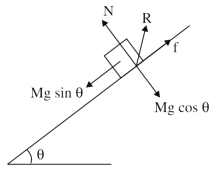
The forces acting on the block are the gravitational force $(Mg)$,the normal force $(N)$,and the kinetic friction force $(f)$.
Resolving the gravitational force into components,we have:
$N = Mg \cos \theta$ (perpendicular to the plane)
$f = Mg \sin \theta$ (parallel to the plane)
The contact force $(R)$ is the resultant of the normal force $(N)$ and the friction force $(f)$:
$R = \sqrt{N^2 + f^2}$
Substituting the values of $N$ and $f$:
$R = \sqrt{(Mg \cos \theta)^2 + (Mg \sin \theta)^2}$
$R = \sqrt{M^2g^2(\cos^2 \theta + \sin^2 \theta)}$
Since $\sin^2 \theta + \cos^2 \theta = 1$,we get:
$R = \sqrt{M^2g^2(1)}$
$R = Mg$
The forces acting on the block are the gravitational force $(Mg)$,the normal force $(N)$,and the kinetic friction force $(f)$.
Resolving the gravitational force into components,we have:
$N = Mg \cos \theta$ (perpendicular to the plane)
$f = Mg \sin \theta$ (parallel to the plane)
The contact force $(R)$ is the resultant of the normal force $(N)$ and the friction force $(f)$:
$R = \sqrt{N^2 + f^2}$
Substituting the values of $N$ and $f$:
$R = \sqrt{(Mg \cos \theta)^2 + (Mg \sin \theta)^2}$
$R = \sqrt{M^2g^2(\cos^2 \theta + \sin^2 \theta)}$
Since $\sin^2 \theta + \cos^2 \theta = 1$,we get:
$R = \sqrt{M^2g^2(1)}$
$R = Mg$
1 likesView Solution
224
PhysicsMediumMCQJEE Main · 2022
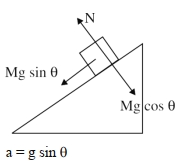
$A$ block '$A$' takes $2\,s$ to slide down a frictionless incline of $30^{\circ}$ and length '$l$',kept inside a lift going up with uniform velocity '$v$'. If the incline is changed to $45^{\circ}$,the time taken by the block to slide down the incline will be approximately $........\,s$.
A
$2.66$
B
$0.83$
C
$1.68$
D
$0.70$
Solution
(C) Since the lift is moving with uniform velocity,its acceleration is zero. Therefore,the effective acceleration due to gravity on the block remains '$g$'.
For a block sliding down a frictionless incline,the acceleration is $a = g \sin \theta$.
Using the equation of motion $s = ut + \frac{1}{2}at^2$,where $u = 0$ and $s = l$:
$l = \frac{1}{2} (g \sin 30^{\circ}) (2)^2 = \frac{1}{2} g (0.5) (4) = g$.
Now,for the incline of $45^{\circ}$,let the time taken be '$t$':
$l = \frac{1}{2} (g \sin 45^{\circ}) t^2$.
Since '$l$' is constant,we equate the two expressions:
$g = \frac{1}{2} g \left(\frac{1}{\sqrt{2}}\right) t^2$.
$1 = \frac{1}{2\sqrt{2}} t^2 \Rightarrow t^2 = 2\sqrt{2} \approx 2.828$.
$t = \sqrt{2.828} \approx 1.68\,s$.
For a block sliding down a frictionless incline,the acceleration is $a = g \sin \theta$.
Using the equation of motion $s = ut + \frac{1}{2}at^2$,where $u = 0$ and $s = l$:
$l = \frac{1}{2} (g \sin 30^{\circ}) (2)^2 = \frac{1}{2} g (0.5) (4) = g$.
Now,for the incline of $45^{\circ}$,let the time taken be '$t$':
$l = \frac{1}{2} (g \sin 45^{\circ}) t^2$.
Since '$l$' is constant,we equate the two expressions:
$g = \frac{1}{2} g \left(\frac{1}{\sqrt{2}}\right) t^2$.
$1 = \frac{1}{2\sqrt{2}} t^2 \Rightarrow t^2 = 2\sqrt{2} \approx 2.828$.
$t = \sqrt{2.828} \approx 1.68\,s$.
0 likesView Solution
225
PhysicsMediumMCQJEE Main · 2022
The velocity of the bullet becomes one-third after it penetrates $4 \ cm$ in a wooden block. Assuming that the bullet faces a constant resistance during its motion in the block,the bullet stops completely after traveling a total distance of $(4+x) \ cm$ inside the block. The value of $x$ is $.....$ (in $cm$)
A
$2$
B
$1$
C
$0.5$
D
$1.5$
Solution
(C) Let the initial velocity be $V$ and the constant retardation be $a$.
Using the equation of motion $v^2 = u^2 - 2as$:
For the first $4 \ cm$,the velocity becomes $V/3$:
$(V/3)^2 = V^2 - 2a(4) \Rightarrow V^2/9 = V^2 - 8a \Rightarrow 8a = 8V^2/9 \Rightarrow a = V^2/9$.
Now,for the bullet to stop completely,the final velocity is $0$ at a distance $s = 4+x$:
$0^2 = V^2 - 2a(4+x) \Rightarrow V^2 = 2(V^2/9)(4+x)$.
Dividing both sides by $V^2$:
$1 = (2/9)(4+x) \Rightarrow 9/2 = 4+x \Rightarrow 4.5 = 4+x \Rightarrow x = 0.5 \ cm$.
Using the equation of motion $v^2 = u^2 - 2as$:
For the first $4 \ cm$,the velocity becomes $V/3$:
$(V/3)^2 = V^2 - 2a(4) \Rightarrow V^2/9 = V^2 - 8a \Rightarrow 8a = 8V^2/9 \Rightarrow a = V^2/9$.
Now,for the bullet to stop completely,the final velocity is $0$ at a distance $s = 4+x$:
$0^2 = V^2 - 2a(4+x) \Rightarrow V^2 = 2(V^2/9)(4+x)$.
Dividing both sides by $V^2$:
$1 = (2/9)(4+x) \Rightarrow 9/2 = 4+x \Rightarrow 4.5 = 4+x \Rightarrow x = 0.5 \ cm$.
1 likesView Solution
226
PhysicsDifficultMCQJEE Main · 2022
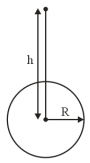
$A$ body of mass $m$ is projected with velocity $\lambda v_{e}$ in a vertically upward direction from the surface of the earth into space. It is given that $v_{e}$ is the escape velocity and $\lambda < 1$. If air resistance is considered to be negligible,then the maximum height from the center of the earth,to which the body can go,will be: ($R$: radius of earth)
A
$\frac{R}{1+\lambda^{2}}$
B
$\frac{R}{1-\lambda^{2}}$
C
$\frac{R}{1-\lambda}$
D
$\frac{\lambda^{2} R}{1-\lambda^{2}}$
Solution
(B) According to the law of conservation of energy,the total energy at the surface of the earth is equal to the total energy at the maximum height $h$ from the center of the earth.
Total energy at surface = Total energy at height $h$
$-\frac{GMm}{R} + \frac{1}{2}m(\lambda v_{e})^{2} = -\frac{GMm}{h} + 0$
Since the escape velocity $v_{e} = \sqrt{\frac{2GM}{R}}$,we have $v_{e}^{2} = \frac{2GM}{R}$.
Substituting this into the equation:
$-\frac{GMm}{R} + \frac{1}{2}m\lambda^{2}(\frac{2GM}{R}) = -\frac{GMm}{h}$
$-\frac{GMm}{R} + \frac{\lambda^{2}GMm}{R} = -\frac{GMm}{h}$
Dividing both sides by $-GMm$:
$\frac{1}{R} - \frac{\lambda^{2}}{R} = \frac{1}{h}$
$\frac{1-\lambda^{2}}{R} = \frac{1}{h}$
$h = \frac{R}{1-\lambda^{2}}$
Total energy at surface = Total energy at height $h$
$-\frac{GMm}{R} + \frac{1}{2}m(\lambda v_{e})^{2} = -\frac{GMm}{h} + 0$
Since the escape velocity $v_{e} = \sqrt{\frac{2GM}{R}}$,we have $v_{e}^{2} = \frac{2GM}{R}$.
Substituting this into the equation:
$-\frac{GMm}{R} + \frac{1}{2}m\lambda^{2}(\frac{2GM}{R}) = -\frac{GMm}{h}$
$-\frac{GMm}{R} + \frac{\lambda^{2}GMm}{R} = -\frac{GMm}{h}$
Dividing both sides by $-GMm$:
$\frac{1}{R} - \frac{\lambda^{2}}{R} = \frac{1}{h}$
$\frac{1-\lambda^{2}}{R} = \frac{1}{h}$
$h = \frac{R}{1-\lambda^{2}}$
0 likesView Solution
227
PhysicsMediumMCQJEE Main · 2022
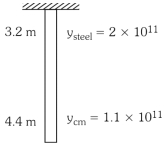
$A$ steel wire of length $3.2 \, m$ $(Y_{S} = 2.0 \times 10^{11} \, N/m^{2})$ and a copper wire of length $4.4 \, m$ $(Y_{C} = 1.1 \times 10^{11} \, N/m^{2})$,both of radius $1.4 \, mm$,are connected end to end. When stretched by a load,the net elongation is found to be $1.4 \, mm$. The load applied,in Newtons,is. (Given $\pi = \frac{22}{7}$)
A
$360$
B
$180$
C
$1080$
D
$154$
Solution
(D) The total elongation $\Delta \ell$ is the sum of the individual elongations of the steel wire $(\Delta \ell_{S})$ and the copper wire $(\Delta \ell_{C})$:
$\Delta \ell = \Delta \ell_{S} + \Delta \ell_{C}$
Using the formula for elongation $\Delta \ell = \frac{F \ell}{AY}$,we have:
$\Delta \ell = \frac{F \ell_{S}}{A Y_{S}} + \frac{F \ell_{C}}{A Y_{C}} = \frac{F}{A} \left( \frac{\ell_{S}}{Y_{S}} + \frac{\ell_{C}}{Y_{C}} \right)$
Given $r = 1.4 \, mm = 1.4 \times 10^{-3} \, m$,the cross-sectional area $A = \pi r^{2} = \frac{22}{7} \times (1.4 \times 10^{-3})^{2} = \frac{22}{7} \times 1.96 \times 10^{-6} = 6.16 \times 10^{-6} \, m^{2}$.
Substituting the values:
$1.4 \times 10^{-3} = \frac{F}{6.16 \times 10^{-6}} \left( \frac{3.2}{2.0 \times 10^{11}} + \frac{4.4}{1.1 \times 10^{11}} \right)$
$1.4 \times 10^{-3} = \frac{F}{6.16 \times 10^{-6}} \left( 1.6 \times 10^{-11} + 4.0 \times 10^{-11} \right)$
$1.4 \times 10^{-3} = \frac{F}{6.16 \times 10^{-6}} \times 5.6 \times 10^{-11}$
$F = \frac{1.4 \times 10^{-3} \times 6.16 \times 10^{-6}}{5.6 \times 10^{-11}} = \frac{8.624 \times 10^{-9}}{5.6 \times 10^{-11}} = 1.54 \times 10^{2} = 154 \, N$.
$\Delta \ell = \Delta \ell_{S} + \Delta \ell_{C}$
Using the formula for elongation $\Delta \ell = \frac{F \ell}{AY}$,we have:
$\Delta \ell = \frac{F \ell_{S}}{A Y_{S}} + \frac{F \ell_{C}}{A Y_{C}} = \frac{F}{A} \left( \frac{\ell_{S}}{Y_{S}} + \frac{\ell_{C}}{Y_{C}} \right)$
Given $r = 1.4 \, mm = 1.4 \times 10^{-3} \, m$,the cross-sectional area $A = \pi r^{2} = \frac{22}{7} \times (1.4 \times 10^{-3})^{2} = \frac{22}{7} \times 1.96 \times 10^{-6} = 6.16 \times 10^{-6} \, m^{2}$.
Substituting the values:
$1.4 \times 10^{-3} = \frac{F}{6.16 \times 10^{-6}} \left( \frac{3.2}{2.0 \times 10^{11}} + \frac{4.4}{1.1 \times 10^{11}} \right)$
$1.4 \times 10^{-3} = \frac{F}{6.16 \times 10^{-6}} \left( 1.6 \times 10^{-11} + 4.0 \times 10^{-11} \right)$
$1.4 \times 10^{-3} = \frac{F}{6.16 \times 10^{-6}} \times 5.6 \times 10^{-11}$
$F = \frac{1.4 \times 10^{-3} \times 6.16 \times 10^{-6}}{5.6 \times 10^{-11}} = \frac{8.624 \times 10^{-9}}{5.6 \times 10^{-11}} = 1.54 \times 10^{2} = 154 \, N$.
0 likesView Solution
228
PhysicsMediumMCQJEE Main · 2022
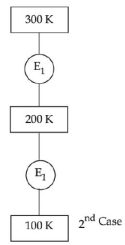
In the $1^{\text{st}}$ case,a Carnot engine operates between temperatures $300 \, K$ and $100 \, K$. In the $2^{\text{nd}}$ case,as shown in the figure,a combination of two engines is used. The efficiency of this combination (in the $2^{\text{nd}}$ case) will be:
A
same as the $1^{\text{st}}$ case
B
always greater than the $1^{\text{st}}$ case
C
always less than the $1^{\text{st}}$ case
D
may increase or decrease with respect to the $1^{\text{st}}$ case
Solution
(A) First case: The efficiency of a Carnot engine is given by $\eta = 1 - \frac{T_L}{T_H}$.
For the first case,$\eta = 1 - \frac{100}{300} = 1 - \frac{1}{3} = \frac{2}{3}$.
Second case: Two engines are connected in series. The net efficiency $\eta_{\text{net}}$ of two engines in series is given by $\eta_{\text{net}} = \eta_1 + \eta_2 - \eta_1 \eta_2$.
For the first engine $(E_1)$ operating between $300 \, K$ and $200 \, K$,$\eta_1 = 1 - \frac{200}{300} = 1 - \frac{2}{3} = \frac{1}{3}$.
For the second engine $(E_2)$ operating between $200 \, K$ and $100 \, K$,$\eta_2 = 1 - \frac{100}{200} = 1 - \frac{1}{2} = \frac{1}{2}$.
Now,calculating the net efficiency: $\eta_{\text{net}} = \frac{1}{3} + \frac{1}{2} - (\frac{1}{3} \times \frac{1}{2}) = \frac{1}{3} + \frac{1}{2} - \frac{1}{6} = \frac{2+3-1}{6} = \frac{4}{6} = \frac{2}{3}$.
Thus,the efficiency in the $2^{\text{nd}}$ case is the same as in the $1^{\text{st}}$ case.
For the first case,$\eta = 1 - \frac{100}{300} = 1 - \frac{1}{3} = \frac{2}{3}$.
Second case: Two engines are connected in series. The net efficiency $\eta_{\text{net}}$ of two engines in series is given by $\eta_{\text{net}} = \eta_1 + \eta_2 - \eta_1 \eta_2$.
For the first engine $(E_1)$ operating between $300 \, K$ and $200 \, K$,$\eta_1 = 1 - \frac{200}{300} = 1 - \frac{2}{3} = \frac{1}{3}$.
For the second engine $(E_2)$ operating between $200 \, K$ and $100 \, K$,$\eta_2 = 1 - \frac{100}{200} = 1 - \frac{1}{2} = \frac{1}{2}$.
Now,calculating the net efficiency: $\eta_{\text{net}} = \frac{1}{3} + \frac{1}{2} - (\frac{1}{3} \times \frac{1}{2}) = \frac{1}{3} + \frac{1}{2} - \frac{1}{6} = \frac{2+3-1}{6} = \frac{4}{6} = \frac{2}{3}$.
Thus,the efficiency in the $2^{\text{nd}}$ case is the same as in the $1^{\text{st}}$ case.
0 likesView Solution
229
PhysicsDifficultMCQJEE Main · 2022
Which statements are correct about degrees of freedom?
$A.$ $A$ molecule with $n$ degrees of freedom has $n^{2}$ different ways of storing energy.
$B.$ Each degree of freedom is associated with $\frac{1}{2} RT$ average energy per mole.
$C.$ $A$ monoatomic gas molecule has $1$ rotational degree of freedom whereas a diatomic molecule has $2$ rotational degrees of freedom.
$D.$ $CH_{4}$ has a total of $6$ degrees of freedom.
Choose the correct answer from the options given below:
$A.$ $A$ molecule with $n$ degrees of freedom has $n^{2}$ different ways of storing energy.
$B.$ Each degree of freedom is associated with $\frac{1}{2} RT$ average energy per mole.
$C.$ $A$ monoatomic gas molecule has $1$ rotational degree of freedom whereas a diatomic molecule has $2$ rotational degrees of freedom.
$D.$ $CH_{4}$ has a total of $6$ degrees of freedom.
Choose the correct answer from the options given below:
A
$B$ and $C$ only
B
$B$ and $D$ only
C
$A$ and $B$ only
D
$C$ and $D$ only
Solution
(B) Statement $A$ is incorrect because energy is stored in each degree of freedom independently,not as $n^2$.
Statement $B$ is correct according to the Law of Equipartition of Energy,which states that each degree of freedom contributes $\frac{1}{2} RT$ per mole to the internal energy.
Statement $C$ is incorrect because a monoatomic gas molecule has $0$ rotational degrees of freedom,while a diatomic molecule has $2$ rotational degrees of freedom.
Statement $D$ is correct. $CH_{4}$ is a non-linear polyatomic molecule. The total degrees of freedom $f$ for a non-linear molecule with $N$ atoms is $3N$. For $CH_{4}$,$N=5$,so $f = 3 \times 5 = 15$. However,if we consider rigid molecules at moderate temperatures,the degrees of freedom are $3$ (translational) $+ 3$ (rotational) $= 6$. Thus,$D$ is considered correct in the context of rigid body dynamics.
Therefore,$B$ and $D$ are the correct statements.
Statement $B$ is correct according to the Law of Equipartition of Energy,which states that each degree of freedom contributes $\frac{1}{2} RT$ per mole to the internal energy.
Statement $C$ is incorrect because a monoatomic gas molecule has $0$ rotational degrees of freedom,while a diatomic molecule has $2$ rotational degrees of freedom.
Statement $D$ is correct. $CH_{4}$ is a non-linear polyatomic molecule. The total degrees of freedom $f$ for a non-linear molecule with $N$ atoms is $3N$. For $CH_{4}$,$N=5$,so $f = 3 \times 5 = 15$. However,if we consider rigid molecules at moderate temperatures,the degrees of freedom are $3$ (translational) $+ 3$ (rotational) $= 6$. Thus,$D$ is considered correct in the context of rigid body dynamics.
Therefore,$B$ and $D$ are the correct statements.
0 likesView Solution
230
PhysicsMediumMCQJEE Main · 2022
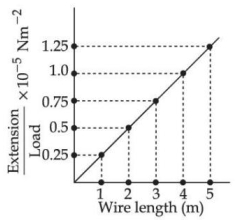
In an experiment to determine the Young's modulus,steel wires of five different lengths $(1, 2, 3, 4$ and $5\,m)$ but of same cross-section $(2\,mm^2)$ were taken and curves between extension and load were obtained. The slope $(\text{extension/load})$ of the curves were plotted with the wire length and the following graph is obtained. If the Young's modulus of given steel wires is $x \times 10^{11}\,N/m^2$,then the value of $x$ is
A
$20$
B
$2$
C
$23$
D
$21$
Solution
(B) The formula for Young's modulus $Y$ is given by $Y = \frac{F/A}{\Delta l/L} = \frac{F \cdot L}{A \cdot \Delta l}$.
Rearranging this,we get the ratio of extension to load as $\frac{\Delta l}{F} = \frac{L}{YA}$.
Here,the graph plots $\frac{\Delta l}{F}$ on the $y$-axis and $L$ on the $x$-axis.
The slope of this graph is $m = \frac{\Delta l/F}{L} = \frac{1}{YA}$.
From the graph,we can calculate the slope $m = \frac{0.25 \times 10^{-5}}{1} = 0.25 \times 10^{-5}\,m/N$.
Given cross-sectional area $A = 2\,mm^2 = 2 \times 10^{-6}\,m^2$.
Substituting these values into the slope equation: $0.25 \times 10^{-5} = \frac{1}{Y \times 2 \times 10^{-6}}$.
$Y = \frac{1}{0.25 \times 10^{-5} \times 2 \times 10^{-6}} = \frac{1}{0.5 \times 10^{-11}} = 2 \times 10^{11}\,N/m^2$.
Comparing this with $x \times 10^{11}\,N/m^2$,we get $x = 2$.
Rearranging this,we get the ratio of extension to load as $\frac{\Delta l}{F} = \frac{L}{YA}$.
Here,the graph plots $\frac{\Delta l}{F}$ on the $y$-axis and $L$ on the $x$-axis.
The slope of this graph is $m = \frac{\Delta l/F}{L} = \frac{1}{YA}$.
From the graph,we can calculate the slope $m = \frac{0.25 \times 10^{-5}}{1} = 0.25 \times 10^{-5}\,m/N$.
Given cross-sectional area $A = 2\,mm^2 = 2 \times 10^{-6}\,m^2$.
Substituting these values into the slope equation: $0.25 \times 10^{-5} = \frac{1}{Y \times 2 \times 10^{-6}}$.
$Y = \frac{1}{0.25 \times 10^{-5} \times 2 \times 10^{-6}} = \frac{1}{0.5 \times 10^{-11}} = 2 \times 10^{11}\,N/m^2$.
Comparing this with $x \times 10^{11}\,N/m^2$,we get $x = 2$.
0 likesView Solution
231
PhysicsMediumMCQJEE Main · 2022
$A$ wire of length $0.3\,m$,stretched between rigid supports,has its $n^{\text{th}}$ and $(n+1)^{\text{th}}$ harmonics at $400\,Hz$ and $450\,Hz$,respectively. If the tension in the string is $2700\,N$,its linear mass density is ......... $kg/m$.
A
$1.5$
B
$6$
C
$9$
D
$3$
Solution
(D) The frequency of the $n^{\text{th}}$ harmonic is given by $f_n = \frac{nv}{2L} = 400\,Hz$.
The frequency of the $(n+1)^{\text{th}}$ harmonic is $f_{n+1} = \frac{(n+1)v}{2L} = 450\,Hz$.
The difference between consecutive harmonics is $\Delta f = f_{n+1} - f_n = \frac{v}{2L} = 450 - 400 = 50\,Hz$.
Given length $L = 0.3\,m$,we have $\frac{v}{2(0.3)} = 50$,which implies $v = 50 \times 0.6 = 30\,m/s$.
The wave speed $v$ is related to tension $T$ and linear mass density $\mu$ by $v = \sqrt{\frac{T}{\mu}}$.
Substituting the values: $30 = \sqrt{\frac{2700}{\mu}}$.
Squaring both sides: $900 = \frac{2700}{\mu}$.
Therefore,$\mu = \frac{2700}{900} = 3\,kg/m$.
The frequency of the $(n+1)^{\text{th}}$ harmonic is $f_{n+1} = \frac{(n+1)v}{2L} = 450\,Hz$.
The difference between consecutive harmonics is $\Delta f = f_{n+1} - f_n = \frac{v}{2L} = 450 - 400 = 50\,Hz$.
Given length $L = 0.3\,m$,we have $\frac{v}{2(0.3)} = 50$,which implies $v = 50 \times 0.6 = 30\,m/s$.
The wave speed $v$ is related to tension $T$ and linear mass density $\mu$ by $v = \sqrt{\frac{T}{\mu}}$.
Substituting the values: $30 = \sqrt{\frac{2700}{\mu}}$.
Squaring both sides: $900 = \frac{2700}{\mu}$.
Therefore,$\mu = \frac{2700}{900} = 3\,kg/m$.
0 likesView Solution
232
PhysicsDifficultMCQJEE Main · 2022
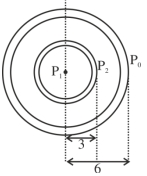
$A$ spherical soap bubble of radius $3\,cm$ is formed inside another spherical soap bubble of radius $6\,cm$. If the internal pressure of the smaller bubble of radius $3\,cm$ in the above system is equal to the internal pressure of another single soap bubble of radius $r\,cm$,then the value of $r$ is:
A
$4$
B
$6$
C
$8$
D
$2$
Solution
(D) Let $P_0$ be the atmospheric pressure,$P_2$ be the pressure in the region between the two bubbles,and $P_1$ be the pressure inside the smaller bubble.
For the outer bubble of radius $R_2 = 6\,cm$,the excess pressure is $P_2 - P_0 = \frac{4T}{R_2} = \frac{4T}{6}$.
For the inner bubble of radius $R_1 = 3\,cm$,the excess pressure is $P_1 - P_2 = \frac{4T}{R_1} = \frac{4T}{3}$.
Adding these two equations,we get the total excess pressure inside the smaller bubble relative to the atmosphere:
$P_1 - P_0 = (P_1 - P_2) + (P_2 - P_0) = \frac{4T}{3} + \frac{4T}{6} = \frac{8T + 4T}{6} = \frac{12T}{6} = 2T$.
For a single soap bubble of radius $r$,the excess pressure is $P_{excess} = \frac{4T}{r}$.
Equating the two,we have $\frac{4T}{r} = 2T$,which gives $r = \frac{4}{2} = 2\,cm$.
For the outer bubble of radius $R_2 = 6\,cm$,the excess pressure is $P_2 - P_0 = \frac{4T}{R_2} = \frac{4T}{6}$.
For the inner bubble of radius $R_1 = 3\,cm$,the excess pressure is $P_1 - P_2 = \frac{4T}{R_1} = \frac{4T}{3}$.
Adding these two equations,we get the total excess pressure inside the smaller bubble relative to the atmosphere:
$P_1 - P_0 = (P_1 - P_2) + (P_2 - P_0) = \frac{4T}{3} + \frac{4T}{6} = \frac{8T + 4T}{6} = \frac{12T}{6} = 2T$.
For a single soap bubble of radius $r$,the excess pressure is $P_{excess} = \frac{4T}{r}$.
Equating the two,we have $\frac{4T}{r} = 2T$,which gives $r = \frac{4}{2} = 2\,cm$.
0 likesView Solution
233
PhysicsDifficultMCQJEE Main · 2022
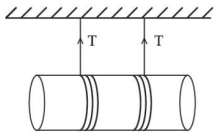
$A$ solid cylinder is suspended symmetrically by two massless strings,as shown in the figure. The distance the cylinder should fall by unbinding the strings to achieve a speed of $4\,ms^{-1}$ is $........cm$. (Take $g=10\,ms^{-2}$)
A
$60$
B
$30$
C
$120$
D
$150$
Solution
(C) By the principle of conservation of energy,the loss in potential energy equals the gain in kinetic energy (translational + rotational).
$mgh = \frac{1}{2}mv^2 + \frac{1}{2}I\omega^2$
For a solid cylinder,the moment of inertia $I = \frac{1}{2}mR^2$. Since the string unwinds without slipping,the condition $v = R\omega$ holds,which implies $\omega = \frac{v}{R}$.
Substituting these into the energy equation:
$mgh = \frac{1}{2}mv^2 + \frac{1}{2}(\frac{1}{2}mR^2)(\frac{v}{R})^2$
$mgh = \frac{1}{2}mv^2 + \frac{1}{4}mv^2$
$mgh = \frac{3}{4}mv^2$
$gh = \frac{3}{4}v^2$
Given $g = 10\,ms^{-2}$ and $v = 4\,ms^{-1}$:
$10h = \frac{3}{4}(4)^2$
$10h = \frac{3}{4} \times 16$
$10h = 12$
$h = 1.2\,m = 120\,cm$.
$mgh = \frac{1}{2}mv^2 + \frac{1}{2}I\omega^2$
For a solid cylinder,the moment of inertia $I = \frac{1}{2}mR^2$. Since the string unwinds without slipping,the condition $v = R\omega$ holds,which implies $\omega = \frac{v}{R}$.
Substituting these into the energy equation:
$mgh = \frac{1}{2}mv^2 + \frac{1}{2}(\frac{1}{2}mR^2)(\frac{v}{R})^2$
$mgh = \frac{1}{2}mv^2 + \frac{1}{4}mv^2$
$mgh = \frac{3}{4}mv^2$
$gh = \frac{3}{4}v^2$
Given $g = 10\,ms^{-2}$ and $v = 4\,ms^{-1}$:
$10h = \frac{3}{4}(4)^2$
$10h = \frac{3}{4} \times 16$
$10h = 12$
$h = 1.2\,m = 120\,cm$.
0 likesView Solution
234
PhysicsDifficultMCQJEE Main · 2022
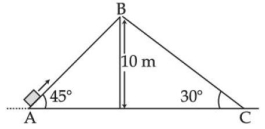
Two inclined planes are placed as shown in the figure. $A$ block is projected from point $A$ of the inclined plane $AB$ along its surface with a velocity just sufficient to carry it to the top point $B$ at a height of $10 \ m$. After reaching point $B$, the block slides down the inclined plane $BC$. The time it takes to reach point $C$ from point $A$ is $t(\sqrt{2}+1) \ s$. The value of $t$ is........ (use $g = 10 \ m/s^2$)
A
$8$
B
$4$
C
$2$
D
$6$
Solution
(C) $1$. Motion from $A$ to $B$: The block is projected with velocity $u$ such that it just reaches $B$ $(v=0)$. By conservation of energy, $\frac{1}{2}mu^2 = mgh$. Thus, $u = \sqrt{2gh} = \sqrt{2 \times 10 \times 10} = 10\sqrt{2} \ m/s$.
$2$. The acceleration along the incline $AB$ is $a_1 = -g \sin 45^{\circ} = -\frac{10}{\sqrt{2}} \ m/s^2$.
$3$. Using $v = u + a_1t_1$, we get $0 = 10\sqrt{2} - \frac{10}{\sqrt{2}}t_1$, which gives $t_1 = 2 \ s$.
$4$. Motion from $B$ to $C$: The block starts from rest $(u=0)$ and slides down incline $BC$. The length of $BC$ is $L = \frac{h}{\sin 30^{\circ}} = \frac{10}{0.5} = 20 \ m$.
$5$. The acceleration along $BC$ is $a_2 = g \sin 30^{\circ} = 10 \times 0.5 = 5 \ m/s^2$.
$6$. Using $s = ut_2 + \frac{1}{2}a_2t_2^2$, we get $20 = 0 + \frac{1}{2}(5)t_2^2$, so $t_2^2 = 8$, which means $t_2 = 2\sqrt{2} \ s$.
$7$. Total time $T = t_1 + t_2 = 2 + 2\sqrt{2} = 2(\sqrt{2} + 1) \ s$.
$8$. Comparing with $t(\sqrt{2}+1)$, we find $t = 2$.
$2$. The acceleration along the incline $AB$ is $a_1 = -g \sin 45^{\circ} = -\frac{10}{\sqrt{2}} \ m/s^2$.
$3$. Using $v = u + a_1t_1$, we get $0 = 10\sqrt{2} - \frac{10}{\sqrt{2}}t_1$, which gives $t_1 = 2 \ s$.
$4$. Motion from $B$ to $C$: The block starts from rest $(u=0)$ and slides down incline $BC$. The length of $BC$ is $L = \frac{h}{\sin 30^{\circ}} = \frac{10}{0.5} = 20 \ m$.
$5$. The acceleration along $BC$ is $a_2 = g \sin 30^{\circ} = 10 \times 0.5 = 5 \ m/s^2$.
$6$. Using $s = ut_2 + \frac{1}{2}a_2t_2^2$, we get $20 = 0 + \frac{1}{2}(5)t_2^2$, so $t_2^2 = 8$, which means $t_2 = 2\sqrt{2} \ s$.
$7$. Total time $T = t_1 + t_2 = 2 + 2\sqrt{2} = 2(\sqrt{2} + 1) \ s$.
$8$. Comparing with $t(\sqrt{2}+1)$, we find $t = 2$.
1 likesView Solution
235
PhysicsMediumMCQJEE Main · 2022
$A$ torque meter is calibrated to reference standards of mass,length,and time,each with $5 \%$ accuracy. After calibration,the measured torque with this torque meter will have a net accuracy of $............\%$.
A
$15$
B
$25$
C
$75$
D
$5$
Solution
(B) The dimensional formula for torque $(\tau)$ is given by $[\tau] = [M^1 L^2 T^{-2}]$.
According to the theory of propagation of errors,if a physical quantity $X$ is given by $X = M^a L^b T^c$,the relative error is $\frac{\Delta X}{X} = a \frac{\Delta M}{M} + b \frac{\Delta L}{L} + c \frac{\Delta T}{T}$.
Given that the percentage error in mass,length,and time is $5 \%$ each,i.e.,$\frac{\Delta M}{M} \times 100 = 5 \%$,$\frac{\Delta L}{L} \times 100 = 5 \%$,and $\frac{\Delta T}{T} \times 100 = 5 \%$.
The percentage error in torque is calculated as:
$\frac{\Delta \tau}{\tau} \times 100 = (1 \times \% M) + (2 \times \% L) + (2 \times \% T)$
Substituting the given values:
$\frac{\Delta \tau}{\tau} \times 100 = 1(5 \%) + 2(5 \%) + 2(5 \%)$
$\frac{\Delta \tau}{\tau} \times 100 = 5 \% + 10 \% + 10 \% = 25 \%$.
According to the theory of propagation of errors,if a physical quantity $X$ is given by $X = M^a L^b T^c$,the relative error is $\frac{\Delta X}{X} = a \frac{\Delta M}{M} + b \frac{\Delta L}{L} + c \frac{\Delta T}{T}$.
Given that the percentage error in mass,length,and time is $5 \%$ each,i.e.,$\frac{\Delta M}{M} \times 100 = 5 \%$,$\frac{\Delta L}{L} \times 100 = 5 \%$,and $\frac{\Delta T}{T} \times 100 = 5 \%$.
The percentage error in torque is calculated as:
$\frac{\Delta \tau}{\tau} \times 100 = (1 \times \% M) + (2 \times \% L) + (2 \times \% T)$
Substituting the given values:
$\frac{\Delta \tau}{\tau} \times 100 = 1(5 \%) + 2(5 \%) + 2(5 \%)$
$\frac{\Delta \tau}{\tau} \times 100 = 5 \% + 10 \% + 10 \% = 25 \%$.
0 likesView Solution
236
PhysicsDifficultMCQJEE Main · 2022
$A$ bullet is shot vertically downwards with an initial velocity of $100\,m/s$ from a certain height. Within $10\,s$,the bullet reaches the ground and instantaneously comes to rest due to a perfectly inelastic collision. The velocity-time curve for the total time $t = 20\,s$ will be: (Take $g = 10\,m/s^2$)
A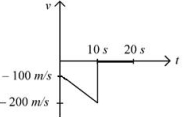
B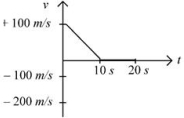
C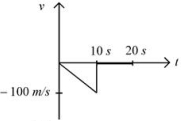
D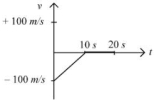
Solution
(A) The bullet is moving downwards. Let the downward direction be negative. The initial velocity is $u = -100\,m/s$.
The acceleration due to gravity is $g = 10\,m/s^2$ downwards,so $a = -10\,m/s^2$.
The velocity at any time $t$ (for $0 \le t \le 10\,s$) is given by $v = u + at = -100 - 10t$.
At $t = 0\,s$,$v = -100\,m/s$.
At $t = 10\,s$,$v = -100 - 10(10) = -200\,m/s$.
After $t = 10\,s$,the bullet hits the ground and comes to rest,so $v = 0$ for $10\,s < t \le 20\,s$.
The graph starts at $-100\,m/s$,decreases linearly to $-200\,m/s$ at $t = 10\,s$,and then stays at $0$ from $t = 10\,s$ to $t = 20\,s$. This corresponds to the graph in option $A$.
The acceleration due to gravity is $g = 10\,m/s^2$ downwards,so $a = -10\,m/s^2$.
The velocity at any time $t$ (for $0 \le t \le 10\,s$) is given by $v = u + at = -100 - 10t$.
At $t = 0\,s$,$v = -100\,m/s$.
At $t = 10\,s$,$v = -100 - 10(10) = -200\,m/s$.
After $t = 10\,s$,the bullet hits the ground and comes to rest,so $v = 0$ for $10\,s < t \le 20\,s$.
The graph starts at $-100\,m/s$,decreases linearly to $-200\,m/s$ at $t = 10\,s$,and then stays at $0$ from $t = 10\,s$ to $t = 20\,s$. This corresponds to the graph in option $A$.
0 likesView Solution
237
PhysicsMediumMCQJEE Main · 2022
Sand is being dropped from a stationary dropper at a rate of $0.5 \, kg s^{-1}$ on a conveyor belt moving with a velocity of $5 \, m s^{-1}$. The power needed to keep the belt moving with the same velocity will be: (in $, W$)
A
$1.25$
B
$2.5$
C
$6.25$
D
$12.5$
Solution
(D) Given: Rate of mass flow $\frac{dm}{dt} = 0.5 \, kg s^{-1}$,Velocity of belt $v = 5 \, m s^{-1}$.
When sand falls on the belt,the belt must exert a force to accelerate the sand to the velocity of the belt.
The force required to maintain the constant velocity is equal to the thrust force: $F = \frac{dm}{dt} \times v$.
$F = 0.5 \, kg s^{-1} \times 5 \, m s^{-1} = 2.5 \, N$.
The power required to keep the belt moving at a constant velocity is $P = F \times v$.
$P = 2.5 \, N \times 5 \, m s^{-1} = 12.5 \, W$.
When sand falls on the belt,the belt must exert a force to accelerate the sand to the velocity of the belt.
The force required to maintain the constant velocity is equal to the thrust force: $F = \frac{dm}{dt} \times v$.
$F = 0.5 \, kg s^{-1} \times 5 \, m s^{-1} = 2.5 \, N$.
The power required to keep the belt moving at a constant velocity is $P = F \times v$.
$P = 2.5 \, N \times 5 \, m s^{-1} = 12.5 \, W$.
0 likesView Solution
238
PhysicsMediumMCQJEE Main · 2022
$A$ bag is gently dropped on a conveyor belt moving at a speed of $2\,m/s$. The coefficient of friction between the conveyor belt and the bag is $0.4$. Initially,the bag slips on the belt before it stops slipping due to friction. The distance travelled by the bag on the belt during the slipping motion is $.....m$. [Take $g=10\,m/s^{-2}$]
A
$2$
B
$0.5$
C
$3.2$
D
$0.8$
Solution
(B) When the bag is dropped on the belt,it experiences a kinetic frictional force $f_k = \mu N = \mu mg$.
This force provides an acceleration $a = f_k / m = \mu g$ to the bag in the direction of the belt's motion.
Given $\mu = 0.4$ and $g = 10\,m/s^2$,the acceleration is $a = 0.4 \times 10 = 4\,m/s^2$.
In the frame of the belt,the initial velocity of the bag is $u = 2\,m/s$ (relative to the belt) and the final velocity is $v = 0$ (when it stops slipping).
Using the equation of motion $v^2 = u^2 - 2as$ (where $s$ is the distance relative to the belt):
$0^2 = 2^2 - 2(4)s$
$0 = 4 - 8s$
$8s = 4$
$s = 0.5\,m$.
This force provides an acceleration $a = f_k / m = \mu g$ to the bag in the direction of the belt's motion.
Given $\mu = 0.4$ and $g = 10\,m/s^2$,the acceleration is $a = 0.4 \times 10 = 4\,m/s^2$.
In the frame of the belt,the initial velocity of the bag is $u = 2\,m/s$ (relative to the belt) and the final velocity is $v = 0$ (when it stops slipping).
Using the equation of motion $v^2 = u^2 - 2as$ (where $s$ is the distance relative to the belt):
$0^2 = 2^2 - 2(4)s$
$0 = 4 - 8s$
$8s = 4$
$s = 0.5\,m$.
0 likesView Solution
239
PhysicsDifficultMCQJEE Main · 2022
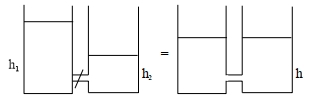
Two cylindrical vessels of equal cross-sectional area $16\,cm^{2}$ contain water up to heights $100\,cm$ and $150\,cm$ respectively. The vessels are interconnected so that the water levels in them become equal. The work done by the force of gravity during the process is $......J$. [Take density of water $= 10^{3}\,kg/m^{3}$ and $g = 10\,m/s^{2}$]
A
$0.25$
B
$1$
C
$8$
D
$12$
Solution
(B) The initial heights are $h_{1} = 1.0\,m$ and $h_{2} = 1.5\,m$. The cross-sectional area is $A = 16\,cm^{2} = 16 \times 10^{-4}\,m^{2}$.
When interconnected,the final height $h$ in both vessels will be the average of the initial heights: $h = \frac{h_{1} + h_{2}}{2} = \frac{1.0 + 1.5}{2} = 1.25\,m$.
The work done by gravity is equal to the decrease in potential energy: $W = U_{i} - U_{f}$.
Initial potential energy $U_{i} = (m_{1}g \frac{h_{1}}{2}) + (m_{2}g \frac{h_{2}}{2}) = \rho A h_{1} g \frac{h_{1}}{2} + \rho A h_{2} g \frac{h_{2}}{2} = \frac{\rho A g}{2} (h_{1}^{2} + h_{2}^{2})$.
Final potential energy $U_{f} = (m_{1}+m_{2})g \frac{h}{2} = (2 \rho A h) g \frac{h}{2} = \rho A g h^{2} = \rho A g (\frac{h_{1}+h_{2}}{2})^{2}$.
$W = \frac{\rho A g}{2} [h_{1}^{2} + h_{2}^{2} - 2(\frac{h_{1}+h_{2}}{2})^{2}] = \frac{\rho A g}{4} [2h_{1}^{2} + 2h_{2}^{2} - (h_{1}+h_{2})^{2}] = \frac{\rho A g}{4} (h_{1}-h_{2})^{2}$.
Substituting the values: $W = \frac{10^{3} \times 16 \times 10^{-4} \times 10}{4} (1.5 - 1.0)^{2} = \frac{16}{4} (0.5)^{2} = 4 \times 0.25 = 1\,J$.
When interconnected,the final height $h$ in both vessels will be the average of the initial heights: $h = \frac{h_{1} + h_{2}}{2} = \frac{1.0 + 1.5}{2} = 1.25\,m$.
The work done by gravity is equal to the decrease in potential energy: $W = U_{i} - U_{f}$.
Initial potential energy $U_{i} = (m_{1}g \frac{h_{1}}{2}) + (m_{2}g \frac{h_{2}}{2}) = \rho A h_{1} g \frac{h_{1}}{2} + \rho A h_{2} g \frac{h_{2}}{2} = \frac{\rho A g}{2} (h_{1}^{2} + h_{2}^{2})$.
Final potential energy $U_{f} = (m_{1}+m_{2})g \frac{h}{2} = (2 \rho A h) g \frac{h}{2} = \rho A g h^{2} = \rho A g (\frac{h_{1}+h_{2}}{2})^{2}$.
$W = \frac{\rho A g}{2} [h_{1}^{2} + h_{2}^{2} - 2(\frac{h_{1}+h_{2}}{2})^{2}] = \frac{\rho A g}{4} [2h_{1}^{2} + 2h_{2}^{2} - (h_{1}+h_{2})^{2}] = \frac{\rho A g}{4} (h_{1}-h_{2})^{2}$.
Substituting the values: $W = \frac{10^{3} \times 16 \times 10^{-4} \times 10}{4} (1.5 - 1.0)^{2} = \frac{16}{4} (0.5)^{2} = 4 \times 0.25 = 1\,J$.
0 likesView Solution
240
PhysicsMediumMCQJEE Main · 2022
Two satellites $A$ and $B$ having masses in the ratio $4: 3$ are revolving in circular orbits of radii $3r$ and $4r$ respectively around the earth. The ratio of total mechanical energy of $A$ to $B$ is.
A
$9: 16$
B
$16: 9$
C
$1: 1$
D
$4: 3$
Solution
(B) The total mechanical energy $E$ of a satellite of mass $m$ orbiting at a distance $r$ from the center of the Earth is given by $E = -\frac{GMm}{2r}$.
From this expression,we can see that $E \propto \frac{m}{r}$.
Given the mass ratio $\frac{m_A}{m_B} = \frac{4}{3}$ and the radius ratio $\frac{r_A}{r_B} = \frac{3r}{4r} = \frac{3}{4}$.
Therefore,the ratio of the total mechanical energy of $A$ to $B$ is $\frac{E_A}{E_B} = \frac{m_A}{m_B} \times \frac{r_B}{r_A}$.
Substituting the given values: $\frac{E_A}{E_B} = \frac{4}{3} \times \frac{4}{3} = \frac{16}{9}$.
From this expression,we can see that $E \propto \frac{m}{r}$.
Given the mass ratio $\frac{m_A}{m_B} = \frac{4}{3}$ and the radius ratio $\frac{r_A}{r_B} = \frac{3r}{4r} = \frac{3}{4}$.
Therefore,the ratio of the total mechanical energy of $A$ to $B$ is $\frac{E_A}{E_B} = \frac{m_A}{m_B} \times \frac{r_B}{r_A}$.
Substituting the given values: $\frac{E_A}{E_B} = \frac{4}{3} \times \frac{4}{3} = \frac{16}{9}$.
0 likesView Solution
241
PhysicsMediumMCQJEE Main · 2022
If $K_{1}$ and $K_{2}$ are the thermal conductivities,$L_{1}$ and $L_{2}$ are the lengths,and $A_{1}$ and $A_{2}$ are the cross-sectional areas of steel and copper rods respectively,such that $\frac{K_{2}}{K_{1}}=9$,$\frac{A_{1}}{A_{2}}=2$,and $\frac{L_{1}}{L_{2}}=2$. For the arrangement shown in the figure,the value of the temperature $T$ of the steel-copper junction in the steady state will be ........... $^{\circ}C$.
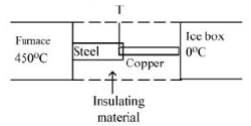
A
$18$
B
$14$
C
$45$
D
$150$
Solution
(C) In the steady state,the rate of heat flow through the steel rod must be equal to the rate of heat flow through the copper rod.
$\frac{dQ}{dt} = \frac{K_{1} A_{1} (T_{1} - T)}{L_{1}} = \frac{K_{2} A_{2} (T - T_{2})}{L_{2}}$
Given: $T_{1} = 450^{\circ}C$,$T_{2} = 0^{\circ}C$,$\frac{K_{2}}{K_{1}} = 9$,$\frac{A_{1}}{A_{2}} = 2$,$\frac{L_{1}}{L_{2}} = 2$.
Substituting these values into the equation:
$\frac{450 - T}{T - 0} = \frac{K_{2}}{K_{1}} \times \frac{A_{2}}{A_{1}} \times \frac{L_{1}}{L_{2}}$
$\frac{450 - T}{T} = 9 \times \frac{1}{2} \times 2 = 9$
$450 - T = 9T$
$10T = 450$
$T = 45^{\circ}C$
$\frac{dQ}{dt} = \frac{K_{1} A_{1} (T_{1} - T)}{L_{1}} = \frac{K_{2} A_{2} (T - T_{2})}{L_{2}}$
Given: $T_{1} = 450^{\circ}C$,$T_{2} = 0^{\circ}C$,$\frac{K_{2}}{K_{1}} = 9$,$\frac{A_{1}}{A_{2}} = 2$,$\frac{L_{1}}{L_{2}} = 2$.
Substituting these values into the equation:
$\frac{450 - T}{T - 0} = \frac{K_{2}}{K_{1}} \times \frac{A_{2}}{A_{1}} \times \frac{L_{1}}{L_{2}}$
$\frac{450 - T}{T} = 9 \times \frac{1}{2} \times 2 = 9$
$450 - T = 9T$
$10T = 450$
$T = 45^{\circ}C$
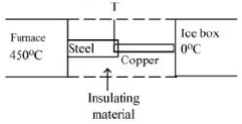
1 likesView Solution
242
PhysicsDifficultMCQJEE Main · 2022
Read the following statements:
$A.$ When the small temperature difference between a liquid and its surroundings is doubled,the rate of loss of heat of the liquid becomes twice.
$B.$ Two bodies $P$ and $Q$ having equal surface areas are maintained at temperatures $10^{\circ}C$ and $20^{\circ}C$. The thermal radiation emitted in a given time by $P$ and $Q$ are in the ratio $1:1.15$.
$C.$ $A$ Carnot engine working between $100 K$ and $400 K$ has an efficiency of $75\%$.
$D.$ When the small temperature difference between a liquid and its surroundings is quadrupled,the rate of loss of heat of the liquid becomes twice.
Choose the correct answer from the options given below:
$A.$ When the small temperature difference between a liquid and its surroundings is doubled,the rate of loss of heat of the liquid becomes twice.
$B.$ Two bodies $P$ and $Q$ having equal surface areas are maintained at temperatures $10^{\circ}C$ and $20^{\circ}C$. The thermal radiation emitted in a given time by $P$ and $Q$ are in the ratio $1:1.15$.
$C.$ $A$ Carnot engine working between $100 K$ and $400 K$ has an efficiency of $75\%$.
$D.$ When the small temperature difference between a liquid and its surroundings is quadrupled,the rate of loss of heat of the liquid becomes twice.
Choose the correct answer from the options given below:
A
$A, B, C$ only
B
$A, B$ only
C
$A, C$ only
D
$B, C, D$ only
Solution
(A) $A.$ According to Newton's law of cooling,the rate of loss of heat $\frac{dQ}{dt} \propto \Delta T$. If $\Delta T$ is doubled,the rate of loss of heat becomes twice. Thus,$A$ is correct.
$B.$ The power radiated by a body is $P = \sigma e A T^4$. The ratio of radiation emitted is $\frac{H_P}{H_Q} = \left(\frac{T_P}{T_Q}\right)^4$. Converting temperatures to Kelvin: $T_P = 10 + 273 = 283 K$ and $T_Q = 20 + 273 = 293 K$. Thus,$\frac{H_P}{H_Q} = \left(\frac{283}{293}\right)^4 \approx (0.9658)^4 \approx 0.87$. However,using the approximation $\frac{293}{283} \approx 1.035$,then $(1.035)^4 \approx 1.15$. Thus,$1:1.15$ is correct. $B$ is correct.
$C.$ Efficiency $\eta = 1 - \frac{T_L}{T_H} = 1 - \frac{100}{400} = 1 - 0.25 = 0.75$ or $75\%$. Thus,$C$ is correct.
$D.$ Since $\frac{dQ}{dt} \propto \Delta T$,if $\Delta T$ is quadrupled,the rate of loss of heat becomes four times,not twice. Thus,$D$ is incorrect.
Therefore,statements $A, B,$ and $C$ are correct.
$B.$ The power radiated by a body is $P = \sigma e A T^4$. The ratio of radiation emitted is $\frac{H_P}{H_Q} = \left(\frac{T_P}{T_Q}\right)^4$. Converting temperatures to Kelvin: $T_P = 10 + 273 = 283 K$ and $T_Q = 20 + 273 = 293 K$. Thus,$\frac{H_P}{H_Q} = \left(\frac{283}{293}\right)^4 \approx (0.9658)^4 \approx 0.87$. However,using the approximation $\frac{293}{283} \approx 1.035$,then $(1.035)^4 \approx 1.15$. Thus,$1:1.15$ is correct. $B$ is correct.
$C.$ Efficiency $\eta = 1 - \frac{T_L}{T_H} = 1 - \frac{100}{400} = 1 - 0.25 = 0.75$ or $75\%$. Thus,$C$ is correct.
$D.$ Since $\frac{dQ}{dt} \propto \Delta T$,if $\Delta T$ is quadrupled,the rate of loss of heat becomes four times,not twice. Thus,$D$ is incorrect.
Therefore,statements $A, B,$ and $C$ are correct.
0 likesView Solution
243
PhysicsMediumMCQJEE Main · 2022
The same gas is filled in two vessels of the same volume at the same temperature. If the ratio of the number of molecules is $1:4$,then:
$A.$ The $r.m.s.$ velocity of gas molecules in the two vessels will be the same.
$B.$ The ratio of pressure in these vessels will be $1:4$.
$C.$ The ratio of pressure will be $1:1$.
$D.$ The $r.m.s.$ velocity of gas molecules in the two vessels will be in the ratio of $1:4$.
$A.$ The $r.m.s.$ velocity of gas molecules in the two vessels will be the same.
$B.$ The ratio of pressure in these vessels will be $1:4$.
$C.$ The ratio of pressure will be $1:1$.
$D.$ The $r.m.s.$ velocity of gas molecules in the two vessels will be in the ratio of $1:4$.
A
$A$ and $C$ only
B
$B$ and $D$ only
C
$A$ and $B$ only
D
$C$ and $D$ only
Solution
(C) According to the Kinetic Theory of Gases $(KTG)$:
$1$. The $r.m.s.$ velocity of gas molecules is given by $V_{rms} = \sqrt{\frac{3RT}{M_m}}$. Since the temperature $T$ and the molar mass $M_m$ are the same for both vessels,the $r.m.s.$ velocity is the same. Thus,statement $A$ is correct.
$2$. From the ideal gas equation $PV = NkT$,where $N$ is the number of molecules and $k$ is the Boltzmann constant,we have $P = \frac{NkT}{V}$. Since $V$,$T$,and $k$ are constant,$P \propto N$. Therefore,the ratio of pressures is $\frac{P_1}{P_2} = \frac{N_1}{N_2} = 1:4$. Thus,statement $B$ is correct.
Since statements $A$ and $B$ are correct,the correct option is $C$.
$1$. The $r.m.s.$ velocity of gas molecules is given by $V_{rms} = \sqrt{\frac{3RT}{M_m}}$. Since the temperature $T$ and the molar mass $M_m$ are the same for both vessels,the $r.m.s.$ velocity is the same. Thus,statement $A$ is correct.
$2$. From the ideal gas equation $PV = NkT$,where $N$ is the number of molecules and $k$ is the Boltzmann constant,we have $P = \frac{NkT}{V}$. Since $V$,$T$,and $k$ are constant,$P \propto N$. Therefore,the ratio of pressures is $\frac{P_1}{P_2} = \frac{N_1}{N_2} = 1:4$. Thus,statement $B$ is correct.
Since statements $A$ and $B$ are correct,the correct option is $C$.
0 likesView Solution
244
PhysicsDifficultMCQJEE Main · 2022
The one division of main scale of vernier callipers reads $1\,mm$ and $10$ divisions of Vernier scale is equal to the $9$ divisions on main scale. When the two jaws of the instrument touch each other the $zero$ of the Vernier lies to the right of $zero$ of the main scale and its fourth division coincides with a main scale division. When a spherical bob is tightly placed between the two jaws,the $zero$ of the Vernier scale lies in between $4.1\,cm$ and $4.2\,cm$ and $6^{\text{th}}$ Vernier division coincides with a main scale division. The diameter of the bob will be $.............10^{-2}\,cm$
A
$413$
B
$411$
C
$141$
D
$412$
Solution
(D) Given: $1\,MSD = 1\,mm = 0.1\,cm$.
$10\,VSD = 9\,MSD$,so $1\,VSD = 0.9\,MSD = 0.9\,mm = 0.09\,cm$.
Least Count $(L.C.) = 1\,MSD - 1\,VSD = 1\,mm - 0.9\,mm = 0.1\,mm = 0.01\,cm$.
Positive Zero Error $= + (4 \times L.C.) = + (4 \times 0.01\,cm) = +0.04\,cm$.
Observed Reading $= \text{Main Scale Reading} + (\text{Vernier Coincidence} \times L.C.) = 4.1\,cm + (6 \times 0.01\,cm) = 4.16\,cm$.
Correct Diameter $= \text{Observed Reading} - \text{Zero Error} = 4.16\,cm - 0.04\,cm = 4.12\,cm$.
$4.12\,cm = 412 \times 10^{-2\,cm}$.
$10\,VSD = 9\,MSD$,so $1\,VSD = 0.9\,MSD = 0.9\,mm = 0.09\,cm$.
Least Count $(L.C.) = 1\,MSD - 1\,VSD = 1\,mm - 0.9\,mm = 0.1\,mm = 0.01\,cm$.
Positive Zero Error $= + (4 \times L.C.) = + (4 \times 0.01\,cm) = +0.04\,cm$.
Observed Reading $= \text{Main Scale Reading} + (\text{Vernier Coincidence} \times L.C.) = 4.1\,cm + (6 \times 0.01\,cm) = 4.16\,cm$.
Correct Diameter $= \text{Observed Reading} - \text{Zero Error} = 4.16\,cm - 0.04\,cm = 4.12\,cm$.
$4.12\,cm = 412 \times 10^{-2\,cm}$.
0 likesView Solution
245
PhysicsDifficultMCQJEE Main · 2022
$A$ mass $0.9 \, kg$,attached to a horizontal spring,executes $SHM$ with an amplitude $A_{1}$. When this mass passes through its mean position,a smaller mass of $124 \, g$ is placed over it and both masses move together with amplitude $A_{2}$. If the ratio $\frac{A_{1}}{A_{2}}$ is $\frac{\alpha}{\alpha-1}$,then the value of $\alpha$ will be $......$
A
$18$
B
$8$
C
$16$
D
$32$
Solution
(C) The total energy of the $SHM$ is given by $E = \frac{1}{2} k A^2$. At the mean position,the potential energy is zero,so the total energy is purely kinetic: $E = \frac{p^2}{2m}$,where $p$ is the momentum.
Since the mass is added at the mean position,the velocity $v$ changes,but the momentum $p$ is conserved during the instantaneous placement of the mass.
Initial mass $m_1 = 0.9 \, kg = 900 \, g$. Final mass $m_2 = 900 \, g + 124 \, g = 1024 \, g$.
Since $E = \frac{1}{2} k A^2 = \frac{p^2}{2m}$,we have $A \propto \frac{1}{\sqrt{m}}$ for a constant momentum $p$.
Therefore,$\frac{A_1}{A_2} = \sqrt{\frac{m_2}{m_1}} = \sqrt{\frac{1024}{900}} = \frac{32}{30} = \frac{16}{15}$.
Given $\frac{A_1}{A_2} = \frac{\alpha}{\alpha-1} = \frac{16}{16-1}$.
Comparing the terms,we get $\alpha = 16$.
Since the mass is added at the mean position,the velocity $v$ changes,but the momentum $p$ is conserved during the instantaneous placement of the mass.
Initial mass $m_1 = 0.9 \, kg = 900 \, g$. Final mass $m_2 = 900 \, g + 124 \, g = 1024 \, g$.
Since $E = \frac{1}{2} k A^2 = \frac{p^2}{2m}$,we have $A \propto \frac{1}{\sqrt{m}}$ for a constant momentum $p$.
Therefore,$\frac{A_1}{A_2} = \sqrt{\frac{m_2}{m_1}} = \sqrt{\frac{1024}{900}} = \frac{32}{30} = \frac{16}{15}$.
Given $\frac{A_1}{A_2} = \frac{\alpha}{\alpha-1} = \frac{16}{16-1}$.
Comparing the terms,we get $\alpha = 16$.
0 likesView Solution
246
PhysicsEasyMCQJEE Main · 2022
$A$ square aluminium (shear modulus is $25 \times 10^{9} \, N m^{-2}$) slab of side $60 \, cm$ and thickness $15 \, cm$ is subjected to a shearing force (on its narrow face) of $18.0 \times 10^{4} \, N$. The lower edge is riveted to the floor. The displacement of the upper edge is $....... \mu m$.
A
$24$
B
$12$
C
$48$
D
$96$
Solution
(C) The shear modulus $\eta$ is given by the formula: $\eta = \frac{F/A}{x/L}$,where $F$ is the shearing force,$A$ is the area of the face on which the force is applied,$x$ is the displacement,and $L$ is the side length of the slab.
Rearranging for displacement $x$: $x = \frac{F \cdot L}{A \cdot \eta}$.
Given: $F = 18.0 \times 10^{4} \, N$,$L = 60 \, cm = 0.6 \, m$,thickness $t = 15 \, cm = 0.15 \, m$,and $\eta = 25 \times 10^{9} \, N m^{-2}$.
The area $A$ of the narrow face is $L \times t = 0.6 \, m \times 0.15 \, m = 0.09 \, m^2$.
Substituting the values: $x = \frac{18.0 \times 10^{4} \times 0.6}{0.09 \times 25 \times 10^{9}}$.
$x = \frac{10.8 \times 10^{4}}{2.25 \times 10^{9}} = 4.8 \times 10^{-5} \, m = 48 \times 10^{-6} \, m = 48 \, \mu m$.
Rearranging for displacement $x$: $x = \frac{F \cdot L}{A \cdot \eta}$.
Given: $F = 18.0 \times 10^{4} \, N$,$L = 60 \, cm = 0.6 \, m$,thickness $t = 15 \, cm = 0.15 \, m$,and $\eta = 25 \times 10^{9} \, N m^{-2}$.
The area $A$ of the narrow face is $L \times t = 0.6 \, m \times 0.15 \, m = 0.09 \, m^2$.
Substituting the values: $x = \frac{18.0 \times 10^{4} \times 0.6}{0.09 \times 25 \times 10^{9}}$.
$x = \frac{10.8 \times 10^{4}}{2.25 \times 10^{9}} = 4.8 \times 10^{-5} \, m = 48 \times 10^{-6} \, m = 48 \, \mu m$.
0 likesView Solution
247
PhysicsDifficultMCQJEE Main · 2022
$A$ pulley of radius $1.5\,m$ is rotated about its axis by a force $F = (12t - 3t^2)\,N$ applied tangentially (where $t$ is measured in seconds). If the moment of inertia of the pulley about its axis of rotation is $4.5\,kg\cdot m^2$,the number of rotations made by the pulley before its direction of motion is reversed will be $\frac{K}{\pi}$. The value of $K$ is $.....$
A
$18$
B
$9$
C
$3$
D
$6$
Solution
(A) The torque applied is $\tau = F \cdot r = (12t - 3t^2) \cdot 1.5 = 18t - 4.5t^2$.
Using $\tau = I\alpha$,we have $18t - 4.5t^2 = 4.5\alpha$,which gives $\alpha = 4t - t^2$.
Since $\alpha = \frac{d\omega}{dt}$,we integrate to find angular velocity: $\omega = \int (4t - t^2) dt = 2t^2 - \frac{t^3}{3}$.
The motion reverses when $\omega = 0$,so $t^2(2 - \frac{t}{3}) = 0$,giving $t = 6\,s$.
The angular displacement $\theta$ is $\int_{0}^{6} (2t^2 - \frac{t^3}{3}) dt = [\frac{2t^3}{3} - \frac{t^4}{12}]_{0}^{6} = \frac{2(216)}{3} - \frac{1296}{12} = 144 - 108 = 36\,rad$.
The number of rotations is $N = \frac{\theta}{2\pi} = \frac{36}{2\pi} = \frac{18}{\pi}$.
Comparing with $\frac{K}{\pi}$,we get $K = 18$.
Using $\tau = I\alpha$,we have $18t - 4.5t^2 = 4.5\alpha$,which gives $\alpha = 4t - t^2$.
Since $\alpha = \frac{d\omega}{dt}$,we integrate to find angular velocity: $\omega = \int (4t - t^2) dt = 2t^2 - \frac{t^3}{3}$.
The motion reverses when $\omega = 0$,so $t^2(2 - \frac{t}{3}) = 0$,giving $t = 6\,s$.
The angular displacement $\theta$ is $\int_{0}^{6} (2t^2 - \frac{t^3}{3}) dt = [\frac{2t^3}{3} - \frac{t^4}{12}]_{0}^{6} = \frac{2(216)}{3} - \frac{1296}{12} = 144 - 108 = 36\,rad$.
The number of rotations is $N = \frac{\theta}{2\pi} = \frac{36}{2\pi} = \frac{18}{\pi}$.
Comparing with $\frac{K}{\pi}$,we get $K = 18$.
0 likesView Solution
248
PhysicsMediumMCQJEE Main · 2022
$A$ ball of mass $m$ is thrown vertically upward. Another ball of mass $2m$ is thrown at an angle $\theta$ with the vertical. Both the balls stay in the air for the same period of time. The ratio of the maximum heights attained by the two balls respectively is $\frac{1}{x}$. The value of $x$ is $.....$
A
$1$
B
$2$
C
$4$
D
$8$
Solution
(A) Let the initial velocity of the first ball be $u_1$ and the second ball be $u_2$.
For the first ball thrown vertically upward,the time of flight is $T_1 = \frac{2u_1}{g}$.
For the second ball thrown at an angle $\theta$ with the vertical,the vertical component of velocity is $u_{2y} = u_2 \cos \theta$. The time of flight is $T_2 = \frac{2u_2 \cos \theta}{g}$.
Given $T_1 = T_2$,we have $u_1 = u_2 \cos \theta$.
The maximum height attained by the first ball is $H_1 = \frac{u_1^2}{2g}$.
The maximum height attained by the second ball is $H_2 = \frac{(u_2 \cos \theta)^2}{2g} = \frac{u_2^2 \cos^2 \theta}{2g}$.
Since $u_1 = u_2 \cos \theta$,it follows that $H_1 = H_2$.
The ratio of the heights is $\frac{H_1}{H_2} = 1 = \frac{1}{x}$.
Therefore,$x = 1$.
For the first ball thrown vertically upward,the time of flight is $T_1 = \frac{2u_1}{g}$.
For the second ball thrown at an angle $\theta$ with the vertical,the vertical component of velocity is $u_{2y} = u_2 \cos \theta$. The time of flight is $T_2 = \frac{2u_2 \cos \theta}{g}$.
Given $T_1 = T_2$,we have $u_1 = u_2 \cos \theta$.
The maximum height attained by the first ball is $H_1 = \frac{u_1^2}{2g}$.
The maximum height attained by the second ball is $H_2 = \frac{(u_2 \cos \theta)^2}{2g} = \frac{u_2^2 \cos^2 \theta}{2g}$.
Since $u_1 = u_2 \cos \theta$,it follows that $H_1 = H_2$.
The ratio of the heights is $\frac{H_1}{H_2} = 1 = \frac{1}{x}$.
Therefore,$x = 1$.
0 likesView Solution
249
PhysicsDifficultMCQJEE Main · 2022
Consider the efficiency of Carnot's engine is given by $\eta = \frac{\alpha \beta}{\sin \theta} \log_{e} \frac{\beta x}{k T}$,where $\alpha$ and $\beta$ are constants. If $T$ is temperature,$k$ is Boltzmann constant,$\theta$ is angular displacement and $x$ has the dimensions of length. Then,choose the incorrect option.
A
Dimensions of $\beta$ is same as that of force.
B
Dimensions of $\alpha^{-1} x$ is same as that of energy.
C
Dimensions of $\eta^{-1} \sin \theta$ is same as that of $\alpha \beta$.
D
Dimensions of $\alpha$ is same as that of $\beta$.
Solution
(D) Efficiency $\eta$ is a dimensionless quantity. Therefore,$[\eta] = [M^0 L^0 T^0]$.
In the expression $\eta = \frac{\alpha \beta}{\sin \theta} \log_{e} \frac{\beta x}{k T}$,the argument of the logarithm must be dimensionless. Thus,$[\frac{\beta x}{k T}] = [M^0 L^0 T^0]$.
Since $[k T] = \text{Energy} = [M L^2 T^{-2}]$ and $[x] = [L]$,we have $[\beta] = \frac{[M L^2 T^{-2}]}{[L]} = [M L T^{-2}]$,which is the dimension of force.
Now,since $\eta$ is dimensionless and $\sin \theta$ is dimensionless,the term $\frac{\alpha \beta}{\sin \theta}$ must be dimensionless. Thus,$[\alpha \beta] = [M^0 L^0 T^0]$.
Since $[\beta] = [M L T^{-2}]$,then $[\alpha] = [M^{-1} L^{-1} T^2]$.
Checking the options:
$A$: $[\beta] = [M L T^{-2}]$ (Force),which is correct.
$B$: $[\alpha^{-1} x] = [M L T^{-2} \cdot L] = [M L^2 T^{-2}]$ (Energy),which is correct.
$C$: $[\eta^{-1} \sin \theta] = [1] = [\alpha \beta]$,which is correct.
$D$: $[\alpha] = [M^{-1} L^{-1} T^2]$ and $[\beta] = [M L T^{-2}]$. These are not the same. Thus,this is the incorrect option.
In the expression $\eta = \frac{\alpha \beta}{\sin \theta} \log_{e} \frac{\beta x}{k T}$,the argument of the logarithm must be dimensionless. Thus,$[\frac{\beta x}{k T}] = [M^0 L^0 T^0]$.
Since $[k T] = \text{Energy} = [M L^2 T^{-2}]$ and $[x] = [L]$,we have $[\beta] = \frac{[M L^2 T^{-2}]}{[L]} = [M L T^{-2}]$,which is the dimension of force.
Now,since $\eta$ is dimensionless and $\sin \theta$ is dimensionless,the term $\frac{\alpha \beta}{\sin \theta}$ must be dimensionless. Thus,$[\alpha \beta] = [M^0 L^0 T^0]$.
Since $[\beta] = [M L T^{-2}]$,then $[\alpha] = [M^{-1} L^{-1} T^2]$.
Checking the options:
$A$: $[\beta] = [M L T^{-2}]$ (Force),which is correct.
$B$: $[\alpha^{-1} x] = [M L T^{-2} \cdot L] = [M L^2 T^{-2}]$ (Energy),which is correct.
$C$: $[\eta^{-1} \sin \theta] = [1] = [\alpha \beta]$,which is correct.
$D$: $[\alpha] = [M^{-1} L^{-1} T^2]$ and $[\beta] = [M L T^{-2}]$. These are not the same. Thus,this is the incorrect option.
0 likesView Solution
250
PhysicsMediumMCQJEE Main · 2022
At time $t = 0$,a particle starts travelling from a height of $7 \, \text{cm}$ along the $z$-axis in a plane,keeping the $z$-coordinate constant. At any instant of time,its positions along the $x$ and $y$ directions are defined as $x = 3t$ and $y = 5t^3$ respectively. What will be the acceleration of the particle at $t = 1 \, \text{s}$?
A
$-30 \, \hat{j} \, \text{cm/s}^2$
B
$30 \, \hat{j} \, \text{cm/s}^2$
C
$3 \, \hat{i} + 15 \, \hat{j} \, \text{cm/s}^2$
D
$3 \, \hat{i} + 15 \, \hat{j} + 7 \, \hat{k} \, \text{cm/s}^2$
Solution
(B) The position vector of the particle at any time $t$ is given by $\vec{r}(t) = x(t) \hat{i} + y(t) \hat{j} + z(t) \hat{k}$.
Given $x = 3t$,$y = 5t^3$,and $z = 7$ (constant).
So,$\vec{r}(t) = 3t \hat{i} + 5t^3 \hat{j} + 7 \hat{k}$.
The velocity vector $\vec{v}$ is the first derivative of position with respect to time: $\vec{v} = \frac{d\vec{r}}{dt} = \frac{d}{dt}(3t) \hat{i} + \frac{d}{dt}(5t^3) \hat{j} + \frac{d}{dt}(7) \hat{k} = 3 \hat{i} + 15t^2 \hat{j}$.
The acceleration vector $\vec{a}$ is the derivative of velocity with respect to time: $\vec{a} = \frac{d\vec{v}}{dt} = \frac{d}{dt}(3) \hat{i} + \frac{d}{dt}(15t^2) \hat{j} = 0 \hat{i} + 30t \hat{j}$.
At $t = 1 \, \text{s}$,the acceleration is $\vec{a} = 30(1) \hat{j} = 30 \hat{j} \, \text{cm/s}^2$.
Given $x = 3t$,$y = 5t^3$,and $z = 7$ (constant).
So,$\vec{r}(t) = 3t \hat{i} + 5t^3 \hat{j} + 7 \hat{k}$.
The velocity vector $\vec{v}$ is the first derivative of position with respect to time: $\vec{v} = \frac{d\vec{r}}{dt} = \frac{d}{dt}(3t) \hat{i} + \frac{d}{dt}(5t^3) \hat{j} + \frac{d}{dt}(7) \hat{k} = 3 \hat{i} + 15t^2 \hat{j}$.
The acceleration vector $\vec{a}$ is the derivative of velocity with respect to time: $\vec{a} = \frac{d\vec{v}}{dt} = \frac{d}{dt}(3) \hat{i} + \frac{d}{dt}(15t^2) \hat{j} = 0 \hat{i} + 30t \hat{j}$.
At $t = 1 \, \text{s}$,the acceleration is $\vec{a} = 30(1) \hat{j} = 30 \hat{j} \, \text{cm/s}^2$.
0 likesView Solution
251
PhysicsMediumMCQJEE Main · 2022
The electric current in a circular coil of $2$ turns produces a magnetic induction $B_{1}$ at its centre. The coil is unwound and is rewound into a circular coil of $5$ turns and the same current produces a magnetic induction $B_{2}$ at its centre. The ratio of $\frac{B_{2}}{B_{1}}$ is:
A
$\frac{5}{2}$
B
$\frac{25}{4}$
C
$\frac{5}{4}$
D
$\frac{25}{2}$
Solution
(B) The magnetic field at the centre of a circular coil with $N$ turns and radius $R$ carrying current $i$ is given by $B = \frac{N \mu_{0} i}{2 R}$.
For the first coil: $B_{1} = \frac{N_{1} \mu_{0} i}{2 R_{1}}$,where $N_{1} = 2$.
When the wire is unwound and rewound,the total length of the wire $L = N_{1} (2 \pi R_{1}) = N_{2} (2 \pi R_{2})$ remains constant.
Thus,$R_{2} = R_{1} \frac{N_{1}}{N_{2}} = R_{1} \frac{2}{5}$.
For the second coil: $B_{2} = \frac{N_{2} \mu_{0} i}{2 R_{2}}$,where $N_{2} = 5$.
Taking the ratio: $\frac{B_{2}}{B_{1}} = \frac{N_{2}}{N_{1}} \times \frac{R_{1}}{R_{2}} = \frac{N_{2}}{N_{1}} \times \frac{N_{2}}{N_{1}} = \left( \frac{N_{2}}{N_{1}} \right)^{2}$.
Substituting the values: $\frac{B_{2}}{B_{1}} = \left( \frac{5}{2} \right)^{2} = \frac{25}{4}$.
For the first coil: $B_{1} = \frac{N_{1} \mu_{0} i}{2 R_{1}}$,where $N_{1} = 2$.
When the wire is unwound and rewound,the total length of the wire $L = N_{1} (2 \pi R_{1}) = N_{2} (2 \pi R_{2})$ remains constant.
Thus,$R_{2} = R_{1} \frac{N_{1}}{N_{2}} = R_{1} \frac{2}{5}$.
For the second coil: $B_{2} = \frac{N_{2} \mu_{0} i}{2 R_{2}}$,where $N_{2} = 5$.
Taking the ratio: $\frac{B_{2}}{B_{1}} = \frac{N_{2}}{N_{1}} \times \frac{R_{1}}{R_{2}} = \frac{N_{2}}{N_{1}} \times \frac{N_{2}}{N_{1}} = \left( \frac{N_{2}}{N_{1}} \right)^{2}$.
Substituting the values: $\frac{B_{2}}{B_{1}} = \left( \frac{5}{2} \right)^{2} = \frac{25}{4}$.
0 likesView Solution
252
PhysicsDifficultMCQJEE Main · 2022
Capacitance of an isolated conducting sphere of radius $R_{1}$ becomes $n$ times when it is enclosed by a concentric conducting sphere of radius $R_{2}$ connected to earth. The ratio of their radii $\left(\frac{R_{2}}{R_{1}}\right)$ is:
A
$\frac{n}{n-1}$
B
$\frac{2n}{2n+1}$
C
$\frac{n+1}{n}$
D
$\frac{2n+1}{n}$
Solution
(A) The capacitance of an isolated conducting sphere of radius $R_{1}$ is given by $C_{1} = 4 \pi \varepsilon_{0} R_{1}$.
When this sphere is enclosed by a concentric conducting sphere of radius $R_{2}$ which is connected to the earth,the system forms a spherical capacitor. The new capacitance is $C_{2} = \frac{4 \pi \varepsilon_{0} R_{1} R_{2}}{R_{2} - R_{1}}$.
According to the problem,the new capacitance is $n$ times the original capacitance: $C_{2} = n C_{1}$.
Substituting the expressions: $\frac{4 \pi \varepsilon_{0} R_{1} R_{2}}{R_{2} - R_{1}} = n (4 \pi \varepsilon_{0} R_{1})$.
Simplifying the equation: $\frac{R_{2}}{R_{2} - R_{1}} = n$.
Dividing the numerator and denominator of the left side by $R_{1}$: $\frac{R_{2}/R_{1}}{(R_{2}/R_{1}) - 1} = n$.
Let $x = \frac{R_{2}}{R_{1}}$. Then $\frac{x}{x - 1} = n$.
$x = n(x - 1) \Rightarrow x = nx - n \Rightarrow n = nx - x \Rightarrow n = x(n - 1)$.
Therefore,$x = \frac{R_{2}}{R_{1}} = \frac{n}{n - 1}$.
When this sphere is enclosed by a concentric conducting sphere of radius $R_{2}$ which is connected to the earth,the system forms a spherical capacitor. The new capacitance is $C_{2} = \frac{4 \pi \varepsilon_{0} R_{1} R_{2}}{R_{2} - R_{1}}$.
According to the problem,the new capacitance is $n$ times the original capacitance: $C_{2} = n C_{1}$.
Substituting the expressions: $\frac{4 \pi \varepsilon_{0} R_{1} R_{2}}{R_{2} - R_{1}} = n (4 \pi \varepsilon_{0} R_{1})$.
Simplifying the equation: $\frac{R_{2}}{R_{2} - R_{1}} = n$.
Dividing the numerator and denominator of the left side by $R_{1}$: $\frac{R_{2}/R_{1}}{(R_{2}/R_{1}) - 1} = n$.
Let $x = \frac{R_{2}}{R_{1}}$. Then $\frac{x}{x - 1} = n$.
$x = n(x - 1) \Rightarrow x = nx - n \Rightarrow n = nx - x \Rightarrow n = x(n - 1)$.
Therefore,$x = \frac{R_{2}}{R_{1}} = \frac{n}{n - 1}$.
0 likesView Solution
253
PhysicsMediumMCQJEE Main · 2022
The ratio of wavelengths of a proton and a deuteron accelerated by potentials $V_{p}$ and $V_{d}$ is $1 : \sqrt{2}$. Then,the ratio of $V_{p}$ to $V_{d}$ will be:
A
$1 : 1$
B
$\sqrt{2} : 1$
C
$2 : 1$
D
$4 : 1$
Solution
(D) The de Broglie wavelength $\lambda$ of a charged particle accelerated through a potential $V$ is given by $\lambda = \frac{h}{\sqrt{2mqV}}$.
Given the ratio of wavelengths $\frac{\lambda_{p}}{\lambda_{d}} = \frac{1}{\sqrt{2}}$.
Using the formula,we have $\frac{\lambda_{p}}{\lambda_{d}} = \sqrt{\frac{m_{d} q_{d} V_{d}}{m_{p} q_{p} V_{p}}}$.
For a proton,$m_{p} = m$ and $q_{p} = e$. For a deuteron,$m_{d} = 2m$ and $q_{d} = e$.
Substituting these values: $\frac{1}{\sqrt{2}} = \sqrt{\frac{(2m)(e)V_{d}}{(m)(e)V_{p}}} = \sqrt{\frac{2V_{d}}{V_{p}}}$.
Squaring both sides: $\frac{1}{2} = \frac{2V_{d}}{V_{p}}$.
Therefore,$\frac{V_{p}}{V_{d}} = 4$,which is $4 : 1$.
Given the ratio of wavelengths $\frac{\lambda_{p}}{\lambda_{d}} = \frac{1}{\sqrt{2}}$.
Using the formula,we have $\frac{\lambda_{p}}{\lambda_{d}} = \sqrt{\frac{m_{d} q_{d} V_{d}}{m_{p} q_{p} V_{p}}}$.
For a proton,$m_{p} = m$ and $q_{p} = e$. For a deuteron,$m_{d} = 2m$ and $q_{d} = e$.
Substituting these values: $\frac{1}{\sqrt{2}} = \sqrt{\frac{(2m)(e)V_{d}}{(m)(e)V_{p}}} = \sqrt{\frac{2V_{d}}{V_{p}}}$.
Squaring both sides: $\frac{1}{2} = \frac{2V_{d}}{V_{p}}$.
Therefore,$\frac{V_{p}}{V_{d}} = 4$,which is $4 : 1$.
0 likesView Solution
254
PhysicsDifficultMCQJEE Main · 2022
For an object placed at a distance $2.4\,m$ from a lens,a sharp focused image is observed on a screen placed at a distance $12\,cm$ from the lens. $A$ glass plate of refractive index $1.5$ and thickness $1\,cm$ is introduced between the lens and the screen such that the glass plate faces are parallel to the screen. By what distance should the object be shifted so that a sharp focused image is observed again on the screen (in $,m$)?
A
$0.8$
B
$3.2$
C
$1.2$
D
$5.6$
Solution
(B) $1$. Applying the lens formula for the initial state:
$\frac{1}{v} - \frac{1}{u} = \frac{1}{f}$
Given $v = 12\,cm = 0.12\,m$ and $u = -2.4\,m$:
$\frac{1}{0.12} - \frac{1}{-2.4} = \frac{1}{f} \Rightarrow \frac{100}{12} + \frac{1}{2.4} = \frac{1}{f} \Rightarrow \frac{25}{3} + \frac{1}{2.4} = \frac{20+1}{2.4} = \frac{21}{2.4} = \frac{1}{f} \Rightarrow f = \frac{2.4}{21} = \frac{0.8}{7}\,m$.
$2$. When a glass slab of thickness $t$ and refractive index $\mu$ is introduced,the image shifts by $\Delta x = t(1 - \frac{1}{\mu})$.
$\Delta x = 1\,cm \times (1 - \frac{1}{1.5}) = 1\,cm \times (1 - \frac{2}{3}) = \frac{1}{3}\,cm$.
$3$. The new image position $v'$ required to be on the screen is $v' = 12\,cm - \frac{1}{3}\,cm = \frac{35}{3}\,cm = \frac{35}{300}\,m = \frac{7}{60}\,m$.
$4$. Applying the lens formula again for the new object distance $u'$:
$\frac{1}{v'} - \frac{1}{u'} = \frac{1}{f}$
$\frac{60}{7} - \frac{1}{u'} = \frac{21}{2.4} = \frac{210}{24} = \frac{35}{4}$
$\frac{1}{u'} = \frac{60}{7} - \frac{35}{4} = \frac{240 - 245}{28} = -\frac{5}{28}$
$u' = -\frac{28}{5} = -5.6\,m$.
$5$. The shift in the object position is $|u' - u| = |-5.6 - (-2.4)| = |-3.2| = 3.2\,m$.
$\frac{1}{v} - \frac{1}{u} = \frac{1}{f}$
Given $v = 12\,cm = 0.12\,m$ and $u = -2.4\,m$:
$\frac{1}{0.12} - \frac{1}{-2.4} = \frac{1}{f} \Rightarrow \frac{100}{12} + \frac{1}{2.4} = \frac{1}{f} \Rightarrow \frac{25}{3} + \frac{1}{2.4} = \frac{20+1}{2.4} = \frac{21}{2.4} = \frac{1}{f} \Rightarrow f = \frac{2.4}{21} = \frac{0.8}{7}\,m$.
$2$. When a glass slab of thickness $t$ and refractive index $\mu$ is introduced,the image shifts by $\Delta x = t(1 - \frac{1}{\mu})$.
$\Delta x = 1\,cm \times (1 - \frac{1}{1.5}) = 1\,cm \times (1 - \frac{2}{3}) = \frac{1}{3}\,cm$.
$3$. The new image position $v'$ required to be on the screen is $v' = 12\,cm - \frac{1}{3}\,cm = \frac{35}{3}\,cm = \frac{35}{300}\,m = \frac{7}{60}\,m$.
$4$. Applying the lens formula again for the new object distance $u'$:
$\frac{1}{v'} - \frac{1}{u'} = \frac{1}{f}$
$\frac{60}{7} - \frac{1}{u'} = \frac{21}{2.4} = \frac{210}{24} = \frac{35}{4}$
$\frac{1}{u'} = \frac{60}{7} - \frac{35}{4} = \frac{240 - 245}{28} = -\frac{5}{28}$
$u' = -\frac{28}{5} = -5.6\,m$.
$5$. The shift in the object position is $|u' - u| = |-5.6 - (-2.4)| = |-3.2| = 3.2\,m$.
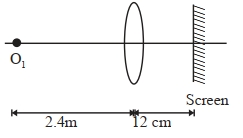
0 likesView Solution
255
PhysicsEasyMCQJEE Main · 2022
$A$ light wave traveling in air along the $x$-direction is given by $E_{y} = 540 \sin \pi \times 10^{4}(x - ct) \text{ Vm}^{-1}$. Then,the peak value of the magnetic field of the wave will be $\dots \times 10^{-7} \text{ T}$ (Given $c = 3 \times 10^{8} \text{ ms}^{-1}$)
A
$18$
B
$54$
C
$5.4$
D
$1.8$
Solution
(A) The given equation of the electric field is $E_{y} = 540 \sin \pi \times 10^{4}(x - ct) \text{ Vm}^{-1}$.
Comparing this with the standard wave equation $E = E_{0} \sin(kx - \omega t)$,we identify the peak value of the electric field as $E_{0} = 540 \text{ Vm}^{-1}$.
The relationship between the peak electric field $E_{0}$ and the peak magnetic field $B_{0}$ is given by $B_{0} = \frac{E_{0}}{c}$.
Substituting the given values,$B_{0} = \frac{540}{3 \times 10^{8}} \text{ T}$.
$B_{0} = 180 \times 10^{-8} \text{ T} = 18 \times 10^{-7} \text{ T}$.
Thus,the peak value of the magnetic field is $18 \times 10^{-7} \text{ T}$.
Comparing this with the standard wave equation $E = E_{0} \sin(kx - \omega t)$,we identify the peak value of the electric field as $E_{0} = 540 \text{ Vm}^{-1}$.
The relationship between the peak electric field $E_{0}$ and the peak magnetic field $B_{0}$ is given by $B_{0} = \frac{E_{0}}{c}$.
Substituting the given values,$B_{0} = \frac{540}{3 \times 10^{8}} \text{ T}$.
$B_{0} = 180 \times 10^{-8} \text{ T} = 18 \times 10^{-7} \text{ T}$.
Thus,the peak value of the magnetic field is $18 \times 10^{-7} \text{ T}$.
0 likesView Solution
256
PhysicsMediumMCQJEE Main · 2022
When you walk through a metal detector carrying a metal object in your pocket,it raises an alarm. This phenomenon works on
A
Electromagnetic induction
B
Resonance in $AC$ circuits
C
Mutual induction in $AC$ circuits
D
Interference of electromagnetic waves
Solution
(B) metal detector consists of an $LC$ circuit that is tuned to a specific resonant frequency. When a metal object enters the magnetic field produced by the coil,it changes the inductance of the circuit,thereby shifting the resonant frequency. This change is detected by the circuit,which triggers an alarm. Thus,the device operates on the principle of resonance in $AC$ circuits.
0 likesView Solution
257
PhysicsEasyMCQJEE Main · 2022
An electron with energy $0.1 \, keV$ moves at a right angle to the Earth's magnetic field of $1 \times 10^{-4} \, Wb/m^2$. The frequency of revolution of the electron will be. (Take mass of electron $= 9.0 \times 10^{-31} \, kg$)
A
$1.6 \times 10^5 \, Hz$
B
$5.6 \times 10^5 \, Hz$
C
$2.8 \times 10^6 \, Hz$
D
$1.8 \times 10^6 \, Hz$
Solution
(C) The frequency of revolution $f$ of a charged particle moving in a magnetic field is given by the formula:
$f = \frac{eB}{2 \pi m}$
Given values:
Charge of electron $e = 1.6 \times 10^{-19} \, C$
Magnetic field $B = 1 \times 10^{-4} \, Wb/m^2$
Mass of electron $m = 9.0 \times 10^{-31} \, kg$
Substituting these values into the formula:
$f = \frac{1.6 \times 10^{-19} \times 10^{-4}}{2 \times 3.14159 \times 9.0 \times 10^{-31}}$
$f = \frac{1.6 \times 10^{-23}}{56.548 \times 10^{-31}}$
$f \approx 0.2829 \times 10^8 \, Hz = 2.8 \times 10^6 \, Hz$
Thus,the frequency of revolution is $2.8 \times 10^6 \, Hz$.
$f = \frac{eB}{2 \pi m}$
Given values:
Charge of electron $e = 1.6 \times 10^{-19} \, C$
Magnetic field $B = 1 \times 10^{-4} \, Wb/m^2$
Mass of electron $m = 9.0 \times 10^{-31} \, kg$
Substituting these values into the formula:
$f = \frac{1.6 \times 10^{-19} \times 10^{-4}}{2 \times 3.14159 \times 9.0 \times 10^{-31}}$
$f = \frac{1.6 \times 10^{-23}}{56.548 \times 10^{-31}}$
$f \approx 0.2829 \times 10^8 \, Hz = 2.8 \times 10^6 \, Hz$
Thus,the frequency of revolution is $2.8 \times 10^6 \, Hz$.
0 likesView Solution
258
PhysicsMediumMCQJEE Main · 2022
$A$ current of $15\,mA$ flows in the circuit as shown in the figure. The value of the potential difference between the points $A$ and $B$ will be $...\,V$.
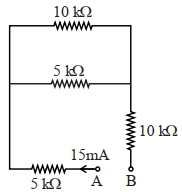
A
$50$
B
$75$
C
$150$
D
$275$
Solution
(D) The circuit consists of a $5\,k\Omega$ resistor in series with a parallel combination of a $10\,k\Omega$ resistor and a $5\,k\Omega$ resistor,followed by another $10\,k\Omega$ resistor in series.
First,calculate the equivalent resistance of the parallel part $(R_p)$:
$R_p = \frac{10\,k\Omega \times 5\,k\Omega}{10\,k\Omega + 5\,k\Omega} = \frac{50}{15}\,k\Omega = \frac{10}{3}\,k\Omega$.
The total current $I = 15\,mA$ flows through the $5\,k\Omega$ resistor,then splits into the parallel branches,and finally flows through the $10\,k\Omega$ resistor.
The potential difference $V_{AB}$ is the sum of the potential drops across each component in the path from $A$ to $B$:
$V_{AB} = I \times R_{5k} + I \times R_p + I \times R_{10k}$
$V_{AB} = (15\,mA \times 5\,k\Omega) + (15\,mA \times \frac{10}{3}\,k\Omega) + (15\,mA \times 10\,k\Omega)$
$V_{AB} = 75\,V + 50\,V + 150\,V = 275\,V$.
First,calculate the equivalent resistance of the parallel part $(R_p)$:
$R_p = \frac{10\,k\Omega \times 5\,k\Omega}{10\,k\Omega + 5\,k\Omega} = \frac{50}{15}\,k\Omega = \frac{10}{3}\,k\Omega$.
The total current $I = 15\,mA$ flows through the $5\,k\Omega$ resistor,then splits into the parallel branches,and finally flows through the $10\,k\Omega$ resistor.
The potential difference $V_{AB}$ is the sum of the potential drops across each component in the path from $A$ to $B$:
$V_{AB} = I \times R_{5k} + I \times R_p + I \times R_{10k}$
$V_{AB} = (15\,mA \times 5\,k\Omega) + (15\,mA \times \frac{10}{3}\,k\Omega) + (15\,mA \times 10\,k\Omega)$
$V_{AB} = 75\,V + 50\,V + 150\,V = 275\,V$.
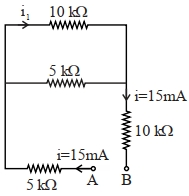
0 likesView Solution
259
PhysicsDifficultMCQJEE Main · 2022
$A$ hydrogen atom in an excited state transitions to the ground state by emitting a photon of wavelength $\lambda$. The value of the principal quantum number $n$ of the excited state is:
($R$: Rydberg constant)
($R$: Rydberg constant)
A
$\sqrt{\frac{\lambda R}{\lambda-1}}$
B
$\sqrt{\frac{\lambda R}{\lambda R-1}}$
C
$\sqrt{\frac{\lambda}{\lambda R-1}}$
D
$\sqrt{\frac{\lambda R^{2}}{\lambda R-1}}$
Solution
(B) The energy of an electron in the $n$-th orbit of a hydrogen atom is given by $E_n = -\frac{Rch}{n^2}$.
The energy of the emitted photon is the difference between the energy of the excited state $(E_n)$ and the ground state $(E_1)$:
$E_{\text{photon}} = E_n - E_1 = \frac{hc}{\lambda}$
Substituting the energy values:
$-\frac{Rch}{n^2} - (-\frac{Rch}{1^2}) = \frac{hc}{\lambda}$
Dividing both sides by $hc$:
$-\frac{R}{n^2} + R = \frac{1}{\lambda}$
Rearranging the terms:
$R - \frac{1}{\lambda} = \frac{R}{n^2}$
$\frac{\lambda R - 1}{\lambda} = \frac{R}{n^2}$
$n^2 = \frac{\lambda R}{\lambda R - 1}$
Therefore,$n = \sqrt{\frac{\lambda R}{\lambda R - 1}}$.
The energy of the emitted photon is the difference between the energy of the excited state $(E_n)$ and the ground state $(E_1)$:
$E_{\text{photon}} = E_n - E_1 = \frac{hc}{\lambda}$
Substituting the energy values:
$-\frac{Rch}{n^2} - (-\frac{Rch}{1^2}) = \frac{hc}{\lambda}$
Dividing both sides by $hc$:
$-\frac{R}{n^2} + R = \frac{1}{\lambda}$
Rearranging the terms:
$R - \frac{1}{\lambda} = \frac{R}{n^2}$
$\frac{\lambda R - 1}{\lambda} = \frac{R}{n^2}$
$n^2 = \frac{\lambda R}{\lambda R - 1}$
Therefore,$n = \sqrt{\frac{\lambda R}{\lambda R - 1}}$.
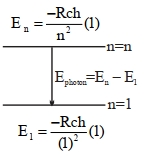
0 likesView Solution
260
PhysicsMediumMCQJEE Main · 2022
$\frac{x}{x+4}$ is the ratio of energies of photons produced due to the transition of an electron of a hydrogen atom from its $(i)$ third permitted energy level to the second level and $(ii)$ the highest permitted energy level to the second permitted level. The value of $x$ will be.
A
$6$
B
$5$
C
$4$
D
$3$
Solution
(B) The energy of a photon emitted during a transition from level $n_2$ to $n_1$ is given by $E = 13.6 \left( \frac{1}{n_1^2} - \frac{1}{n_2^2} \right) \text{ eV}$.
For transition $(i)$ from $n=3$ to $n=2$: $E_1 = 13.6 \left( \frac{1}{2^2} - \frac{1}{3^2} \right) = 13.6 \left( \frac{1}{4} - \frac{1}{9} \right) = 13.6 \left( \frac{5}{36} \right)$.
For transition $(ii)$ from $n=\infty$ to $n=2$: $E_2 = 13.6 \left( \frac{1}{2^2} - \frac{1}{\infty^2} \right) = 13.6 \left( \frac{1}{4} - 0 \right) = 13.6 \left( \frac{1}{4} \right)$.
The ratio is $\frac{E_1}{E_2} = \frac{13.6(5/36)}{13.6(1/4)} = \frac{5/36}{1/4} = \frac{5}{9}$.
Given the ratio is $\frac{x}{x+4}$,we have $\frac{x}{x+4} = \frac{5}{9}$.
Cross-multiplying gives $9x = 5x + 20$,which simplifies to $4x = 20$,so $x = 5$.
For transition $(i)$ from $n=3$ to $n=2$: $E_1 = 13.6 \left( \frac{1}{2^2} - \frac{1}{3^2} \right) = 13.6 \left( \frac{1}{4} - \frac{1}{9} \right) = 13.6 \left( \frac{5}{36} \right)$.
For transition $(ii)$ from $n=\infty$ to $n=2$: $E_2 = 13.6 \left( \frac{1}{2^2} - \frac{1}{\infty^2} \right) = 13.6 \left( \frac{1}{4} - 0 \right) = 13.6 \left( \frac{1}{4} \right)$.
The ratio is $\frac{E_1}{E_2} = \frac{13.6(5/36)}{13.6(1/4)} = \frac{5/36}{1/4} = \frac{5}{9}$.
Given the ratio is $\frac{x}{x+4}$,we have $\frac{x}{x+4} = \frac{5}{9}$.
Cross-multiplying gives $9x = 5x + 20$,which simplifies to $4x = 20$,so $x = 5$.
0 likesView Solution
261
PhysicsDifficultMCQJEE Main · 2022
In a potentiometer arrangement,a cell of emf $1.20\, V$ gives a balance point at $36\, cm$ length of wire. This cell is now replaced by another cell of emf $1.80\, V$. The difference in balancing length of potentiometer wire in above conditions will be $....cm$.
A
$17$
B
$18$
C
$16$
D
$12$
Solution
(B) Let the potential gradient of the potentiometer wire be $k$.
For the first cell,the balance point is at $l_1 = 36\, cm$ for emf $E_1 = 1.20\, V$.
$E_1 = k \cdot l_1 \implies 1.20 = k \times 36 \implies k = \frac{1.20}{36} = \frac{1}{30}\, V/cm$.
For the second cell,the balance point is at $l_2$ for emf $E_2 = 1.80\, V$.
$E_2 = k \cdot l_2 \implies 1.80 = \frac{1}{30} \times l_2$.
$l_2 = 1.80 \times 30 = 54\, cm$.
The difference in balancing lengths is $\Delta l = l_2 - l_1 = 54 - 36 = 18\, cm$.
For the first cell,the balance point is at $l_1 = 36\, cm$ for emf $E_1 = 1.20\, V$.
$E_1 = k \cdot l_1 \implies 1.20 = k \times 36 \implies k = \frac{1.20}{36} = \frac{1}{30}\, V/cm$.
For the second cell,the balance point is at $l_2$ for emf $E_2 = 1.80\, V$.
$E_2 = k \cdot l_2 \implies 1.80 = \frac{1}{30} \times l_2$.
$l_2 = 1.80 \times 30 = 54\, cm$.
The difference in balancing lengths is $\Delta l = l_2 - l_1 = 54 - 36 = 18\, cm$.
0 likesView Solution
262
PhysicsMediumMCQJEE Main · 2022
Two ideal diodes are connected in the network as shown in the figure. The equivalent resistance between $A$ and $B$ is $.......\Omega$.
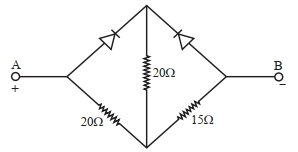
A
$24$
B
$25$
C
$23$
D
$35$
Solution
(D) When a potential difference is applied between $A$ and $B$ such that $A$ is at a higher potential $(+)$ and $B$ is at a lower potential $(-)$,the upper diode becomes forward-biased and acts as a short circuit (zero resistance).
The lower diode becomes reverse-biased and acts as an open circuit (infinite resistance).
In this state,the circuit simplifies to a series combination of the $20\,\Omega$ resistor and the $15\,\Omega$ resistor.
Therefore,the equivalent resistance $R_{eq} = 20\,\Omega + 15\,\Omega = 35\,\Omega$.
The lower diode becomes reverse-biased and acts as an open circuit (infinite resistance).
In this state,the circuit simplifies to a series combination of the $20\,\Omega$ resistor and the $15\,\Omega$ resistor.
Therefore,the equivalent resistance $R_{eq} = 20\,\Omega + 15\,\Omega = 35\,\Omega$.
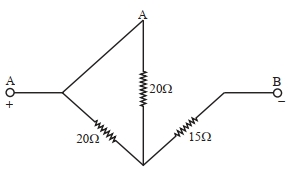
0 likesView Solution
263
PhysicsDifficultMCQJEE Main · 2022
Two parallel plate capacitors of capacity $C$ and $3C$ are connected in parallel and charged to a potential difference of $18V$. The battery is then disconnected,and the space between the plates of the capacitor of capacity $C$ is completely filled with a material of dielectric constant $K=9$. The final potential difference across the combination of capacitors will be $V^{\prime}$. Find $V^{\prime}$. (in $V$)
A
$5$
B
$4$
C
$6$
D
$1$
Solution
(C) $1$. Initial state: The capacitors $C$ and $3C$ are in parallel and connected to an $18V$ battery. The total charge $Q_{total}$ stored in the system is:
$Q_{total} = (C + 3C) \times 18V = 4C \times 18V = 72CV$.
$2$. After disconnecting the battery: The total charge $Q_{total} = 72CV$ remains constant because the system is isolated.
$3$. Dielectric insertion: $A$ dielectric of constant $K=9$ is inserted into the capacitor of capacity $C$. Its new capacitance becomes $C^{\prime} = K \times C = 9C$. The other capacitor remains $3C$.
$4$. Final state: The capacitors are still in parallel. Let the new common potential difference be $V^{\prime}$. The total capacitance of the combination is $C_{eq} = C^{\prime} + 3C = 9C + 3C = 12C$.
$5$. Conservation of charge: $Q_{total} = C_{eq} \times V^{\prime}$
$72CV = 12C \times V^{\prime}$
$V^{\prime} = \frac{72CV}{12C} = 6V$.
$Q_{total} = (C + 3C) \times 18V = 4C \times 18V = 72CV$.
$2$. After disconnecting the battery: The total charge $Q_{total} = 72CV$ remains constant because the system is isolated.
$3$. Dielectric insertion: $A$ dielectric of constant $K=9$ is inserted into the capacitor of capacity $C$. Its new capacitance becomes $C^{\prime} = K \times C = 9C$. The other capacitor remains $3C$.
$4$. Final state: The capacitors are still in parallel. Let the new common potential difference be $V^{\prime}$. The total capacitance of the combination is $C_{eq} = C^{\prime} + 3C = 9C + 3C = 12C$.
$5$. Conservation of charge: $Q_{total} = C_{eq} \times V^{\prime}$
$72CV = 12C \times V^{\prime}$
$V^{\prime} = \frac{72CV}{12C} = 6V$.
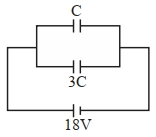
0 likesView Solution
264
PhysicsMediumMCQJEE Main · 2022
$A$ convex lens of focal length $20\,cm$ is placed in front of a convex mirror with their principal axes coinciding. The distance between the lens and the mirror is $10\,cm$. $A$ point object is placed on the principal axis at a distance of $60\,cm$ from the convex lens. The image formed by the combination coincides with the object itself. The focal length of the convex mirror is $...\,cm$.
A
$11$
B
$9$
C
$8$
D
$10$
Solution
(D) For the lens,using the lens formula: $\frac{1}{v} - \frac{1}{u} = \frac{1}{f}$.
Given $u = -60\,cm$ and $f = +20\,cm$,we have $\frac{1}{v} - \frac{1}{-60} = \frac{1}{20}$.
$\frac{1}{v} + \frac{1}{60} = \frac{1}{20} \Rightarrow \frac{1}{v} = \frac{1}{20} - \frac{1}{60} = \frac{3-1}{60} = \frac{2}{60} = \frac{1}{30}$.
So,$v = 30\,cm$. This image is formed $30\,cm$ behind the lens.
For the final image to coincide with the object,the rays must strike the mirror normally (perpendicularly). This happens if the rays are directed towards the center of curvature $(C)$ of the mirror.
The distance of the image from the mirror is $30\,cm - 10\,cm = 20\,cm$. Thus,the radius of curvature $R = 20\,cm$.
The focal length of the mirror is $f_m = \frac{R}{2} = \frac{20}{2} = 10\,cm$.
Given $u = -60\,cm$ and $f = +20\,cm$,we have $\frac{1}{v} - \frac{1}{-60} = \frac{1}{20}$.
$\frac{1}{v} + \frac{1}{60} = \frac{1}{20} \Rightarrow \frac{1}{v} = \frac{1}{20} - \frac{1}{60} = \frac{3-1}{60} = \frac{2}{60} = \frac{1}{30}$.
So,$v = 30\,cm$. This image is formed $30\,cm$ behind the lens.
For the final image to coincide with the object,the rays must strike the mirror normally (perpendicularly). This happens if the rays are directed towards the center of curvature $(C)$ of the mirror.
The distance of the image from the mirror is $30\,cm - 10\,cm = 20\,cm$. Thus,the radius of curvature $R = 20\,cm$.
The focal length of the mirror is $f_m = \frac{R}{2} = \frac{20}{2} = 10\,cm$.
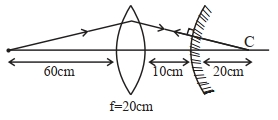
0 likesView Solution
265
PhysicsMediumMCQJEE Main · 2022
Magnetic flux (in weber) in a closed circuit of resistance $20\,\Omega$ varies with time $t(s)$ as $\phi = 8t^2 - 9t + 5$. The magnitude of the induced current at $t = 0.25\,s$ will be $...mA$.
A
$249$
B
$248$
C
$247$
D
$250$
Solution
(D) Given magnetic flux $\phi = 8t^2 - 9t + 5$.
According to Faraday's law of induction,the induced $emf$ is given by $\varepsilon = -\frac{d\phi}{dt}$.
$\varepsilon = -\frac{d}{dt}(8t^2 - 9t + 5) = -(16t - 9) = 9 - 16t$.
At $t = 0.25\,s$,the induced $emf$ is $\varepsilon = 9 - 16(0.25) = 9 - 4 = 5\,V$.
The magnitude of the induced current $I$ is given by $I = \frac{|\varepsilon|}{R}$.
Given resistance $R = 20\,\Omega$,so $I = \frac{5\,V}{20\,\Omega} = 0.25\,A$.
Converting to milliamperes $(mA)$,$I = 0.25 \times 1000\,mA = 250\,mA$.
According to Faraday's law of induction,the induced $emf$ is given by $\varepsilon = -\frac{d\phi}{dt}$.
$\varepsilon = -\frac{d}{dt}(8t^2 - 9t + 5) = -(16t - 9) = 9 - 16t$.
At $t = 0.25\,s$,the induced $emf$ is $\varepsilon = 9 - 16(0.25) = 9 - 4 = 5\,V$.
The magnitude of the induced current $I$ is given by $I = \frac{|\varepsilon|}{R}$.
Given resistance $R = 20\,\Omega$,so $I = \frac{5\,V}{20\,\Omega} = 0.25\,A$.
Converting to milliamperes $(mA)$,$I = 0.25 \times 1000\,mA = 250\,mA$.
0 likesView Solution
266
PhysicsDifficultMCQJEE Main · 2022
Which of the following physical quantities have the same dimensions?
A
Electric displacement $(\overrightarrow{D})$ and surface charge density
B
Displacement current and electric field
C
Current density and surface charge density
D
Electric potential and energy
Solution
(A) The electric displacement vector is defined as $\overrightarrow{D} = \epsilon_{0} \overrightarrow{E}$.
Dimensional analysis of electric displacement: $[D] = [\epsilon_{0}][E]$.
Since the electric field $E$ is related to surface charge density $\sigma$ by $E = \frac{\sigma}{\epsilon_{0}}$,we have $\epsilon_{0} E = \sigma$.
Therefore,the dimensions of electric displacement $[D]$ are equal to the dimensions of surface charge density $[\sigma]$.
Both have dimensions of $[Q L^{-2}]$,where $Q$ is charge and $L$ is length.
Dimensional analysis of electric displacement: $[D] = [\epsilon_{0}][E]$.
Since the electric field $E$ is related to surface charge density $\sigma$ by $E = \frac{\sigma}{\epsilon_{0}}$,we have $\epsilon_{0} E = \sigma$.
Therefore,the dimensions of electric displacement $[D]$ are equal to the dimensions of surface charge density $[\sigma]$.
Both have dimensions of $[Q L^{-2}]$,where $Q$ is charge and $L$ is length.
0 likesView Solution
267
PhysicsMediumMCQJEE Main · 2022
$A$ capacitor of $2\,\mu F$ capacitance is charged steadily from $0$ to $5\,C$. Which of the following graphs correctly represents the variation of potential difference $(V)$ across its plates with respect to the charge $(Q)$ on the capacitor?
A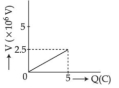
B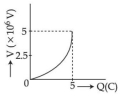
C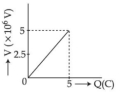
D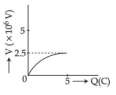
Solution
(A) The relationship between charge $(Q)$,capacitance $(C)$,and potential difference $(V)$ for a capacitor is given by the formula: $Q = CV$.
Rearranging this for potential difference,we get: $V = \frac{1}{C} Q$.
This equation represents a straight line passing through the origin,where the slope of the line is $\frac{1}{C}$.
Given $C = 2\,\mu F = 2 \times 10^{-6}\,F$ and the maximum charge $Q = 5\,C$,the maximum potential difference is:
$V = \frac{Q}{C} = \frac{5}{2 \times 10^{-6}} = 2.5 \times 10^{6}\,V$.
Thus,the graph should be a straight line starting from $(0,0)$ and ending at $(5, 2.5 \times 10^{6})$.
Comparing this with the given options,graph $A$ correctly represents this linear relationship.
Rearranging this for potential difference,we get: $V = \frac{1}{C} Q$.
This equation represents a straight line passing through the origin,where the slope of the line is $\frac{1}{C}$.
Given $C = 2\,\mu F = 2 \times 10^{-6}\,F$ and the maximum charge $Q = 5\,C$,the maximum potential difference is:
$V = \frac{Q}{C} = \frac{5}{2 \times 10^{-6}} = 2.5 \times 10^{6}\,V$.
Thus,the graph should be a straight line starting from $(0,0)$ and ending at $(5, 2.5 \times 10^{6})$.
Comparing this with the given options,graph $A$ correctly represents this linear relationship.
0 likesView Solution
268
PhysicsMediumMCQJEE Main · 2022
Two charged particles,having the same kinetic energy,are allowed to pass through a uniform magnetic field perpendicular to the direction of motion. If the ratio of the radii of their circular paths is $6:5$ and their respective masses ratio is $9:4$,then the ratio of their charges will be.
A
$8:5$
B
$5:4$
C
$5:3$
D
$8:7$
Solution
(B) The radius $R$ of a circular path for a charged particle moving in a magnetic field $B$ is given by $R = \frac{mv}{qB}$.
Since kinetic energy $K = \frac{1}{2}mv^2$,we have $mv = \sqrt{2mK}$.
Substituting this into the radius formula,we get $R = \frac{\sqrt{2mK}}{qB}$.
Rearranging for charge $q$,we get $q = \frac{\sqrt{2mK}}{RB}$.
Given that $K$ and $B$ are the same for both particles,the ratio of charges is $\frac{q_1}{q_2} = \sqrt{\frac{m_1}{m_2}} \times \frac{R_2}{R_1}$.
Given $\frac{R_1}{R_2} = \frac{6}{5}$ and $\frac{m_1}{m_2} = \frac{9}{4}$,we have $\frac{q_1}{q_2} = \sqrt{\frac{9}{4}} \times \frac{5}{6} = \frac{3}{2} \times \frac{5}{6} = \frac{15}{12} = \frac{5}{4}$.
Since kinetic energy $K = \frac{1}{2}mv^2$,we have $mv = \sqrt{2mK}$.
Substituting this into the radius formula,we get $R = \frac{\sqrt{2mK}}{qB}$.
Rearranging for charge $q$,we get $q = \frac{\sqrt{2mK}}{RB}$.
Given that $K$ and $B$ are the same for both particles,the ratio of charges is $\frac{q_1}{q_2} = \sqrt{\frac{m_1}{m_2}} \times \frac{R_2}{R_1}$.
Given $\frac{R_1}{R_2} = \frac{6}{5}$ and $\frac{m_1}{m_2} = \frac{9}{4}$,we have $\frac{q_1}{q_2} = \sqrt{\frac{9}{4}} \times \frac{5}{6} = \frac{3}{2} \times \frac{5}{6} = \frac{15}{12} = \frac{5}{4}$.
0 likesView Solution
269
PhysicsMediumMCQJEE Main · 2022
To increase the resonant frequency in a series $LCR$ circuit,
A
Source frequency should be increased
B
Another resistance should be added in series with the first resistance
C
Another capacitor should be added in series with the first capacitor
D
Another inductor should be added in series with the first inductor
Solution
(C) The resonant frequency $f_r$ of a series $LCR$ circuit is given by the formula:
$f_r = \frac{1}{2 \pi \sqrt{LC}}$
To increase the resonant frequency $f_r$,the product $LC$ must decrease.
When a capacitor is added in series with the existing capacitor,the equivalent capacitance $C_{eq}$ is given by $\frac{1}{C_{eq}} = \frac{1}{C_1} + \frac{1}{C_2}$. This results in a decrease in the total capacitance $(C_{eq} < C_1)$.
Since $f_r \propto \frac{1}{\sqrt{C}}$,a decrease in total capacitance leads to an increase in the resonant frequency.
$f_r = \frac{1}{2 \pi \sqrt{LC}}$
To increase the resonant frequency $f_r$,the product $LC$ must decrease.
When a capacitor is added in series with the existing capacitor,the equivalent capacitance $C_{eq}$ is given by $\frac{1}{C_{eq}} = \frac{1}{C_1} + \frac{1}{C_2}$. This results in a decrease in the total capacitance $(C_{eq} < C_1)$.
Since $f_r \propto \frac{1}{\sqrt{C}}$,a decrease in total capacitance leads to an increase in the resonant frequency.
0 likesView Solution
270
PhysicsDifficultMCQJEE Main · 2022
$A$ small square loop of wire of side $l$ is placed inside a large square loop of wire $L$ $(L \gg l)$. Both loops are coplanar and their centres coincide at point $O$ as shown in the figure. The mutual inductance of the system is:
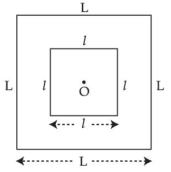
A
$\frac{2 \sqrt{2} \mu_{0} L ^{2}}{\pi \ell}$
B
$\frac{\mu_{0} \ell^{2}}{2 \sqrt{2 \pi L}}$
C
$\frac{2 \sqrt{2} \mu_{0} \ell^{2}}{\pi L}$
D
$\frac{\mu_{0} L ^{2}}{2 \sqrt{2} \pi \ell}$
Solution
(C) Let a current $I$ flow through the outer square loop of side $L$. The magnetic field $B$ produced by this loop at its centre $O$ is given by the sum of the fields due to its four sides:
$B = 4 \times \left( \frac{\mu_{0} I}{4 \pi (L/2)} \times (\sin 45^{\circ} + \sin 45^{\circ}) \right) = 4 \times \left( \frac{\mu_{0} I}{2 \pi L} \times 2 \times \frac{1}{\sqrt{2}} \right) = \frac{2 \sqrt{2} \mu_{0} I}{\pi L}$.
Since $L \gg l$,we can assume this magnetic field is uniform over the area of the small inner loop.
The magnetic flux $\phi$ linked with the inner loop of side $l$ is:
$\phi = B \times \text{Area} = \left( \frac{2 \sqrt{2} \mu_{0} I}{\pi L} \right) \times l^{2}$.
The mutual inductance $M$ is defined as $M = \frac{\phi}{I}$.
Therefore,$M = \frac{2 \sqrt{2} \mu_{0} l^{2}}{\pi L}$.
$B = 4 \times \left( \frac{\mu_{0} I}{4 \pi (L/2)} \times (\sin 45^{\circ} + \sin 45^{\circ}) \right) = 4 \times \left( \frac{\mu_{0} I}{2 \pi L} \times 2 \times \frac{1}{\sqrt{2}} \right) = \frac{2 \sqrt{2} \mu_{0} I}{\pi L}$.
Since $L \gg l$,we can assume this magnetic field is uniform over the area of the small inner loop.
The magnetic flux $\phi$ linked with the inner loop of side $l$ is:
$\phi = B \times \text{Area} = \left( \frac{2 \sqrt{2} \mu_{0} I}{\pi L} \right) \times l^{2}$.
The mutual inductance $M$ is defined as $M = \frac{\phi}{I}$.
Therefore,$M = \frac{2 \sqrt{2} \mu_{0} l^{2}}{\pi L}$.

0 likesView Solution
271
PhysicsMediumMCQJEE Main · 2022
The rms value of conduction current in a parallel plate capacitor is $6.9\,\mu A$. The capacity of this capacitor,if it is connected to a $230\,V$ $AC$ supply with an angular frequency of $600\,rad/s$,will be $....\,pF$.
A
$5$
B
$50$
C
$100$
D
$200$
Solution
(B) The current in a capacitor is given by the formula $I = \frac{V}{X_C}$,where $X_C = \frac{1}{\omega C}$ is the capacitive reactance.
Substituting $X_C$,we get $I = V \omega C$.
Rearranging for capacitance $C$,we have $C = \frac{I}{V \omega}$.
Given values are $I = 6.9 \times 10^{-6}\,A$,$V = 230\,V$,and $\omega = 600\,rad/s$.
Substituting these values: $C = \frac{6.9 \times 10^{-6}}{230 \times 600}$.
$C = \frac{6.9 \times 10^{-6}}{138000} = 0.05 \times 10^{-9}\,F$.
$C = 50 \times 10^{-12}\,F = 50\,pF$.
Substituting $X_C$,we get $I = V \omega C$.
Rearranging for capacitance $C$,we have $C = \frac{I}{V \omega}$.
Given values are $I = 6.9 \times 10^{-6}\,A$,$V = 230\,V$,and $\omega = 600\,rad/s$.
Substituting these values: $C = \frac{6.9 \times 10^{-6}}{230 \times 600}$.
$C = \frac{6.9 \times 10^{-6}}{138000} = 0.05 \times 10^{-9}\,F$.
$C = 50 \times 10^{-12}\,F = 50\,pF$.
0 likesView Solution
272
PhysicsMediumMCQJEE Main · 2022
Which of the following statements is correct?
A
In a primary rainbow,the observer sees red colour on the top and violet on the bottom.
B
In a primary rainbow,the observer sees violet colour on the top and red on the bottom.
C
In a primary rainbow,the light wave suffers total internal reflection twice before coming out of the water drops.
D
$A$ primary rainbow is less bright than a secondary rainbow.
Solution
(A) In a primary rainbow,the red colour is at the top and the violet colour is at the bottom because the deviation for red is minimum and for violet is maximum.
In a primary rainbow,light undergoes one total internal reflection,whereas in a secondary rainbow,it undergoes two total internal reflections.
Due to the two internal reflections in a secondary rainbow,more light is lost,making the secondary rainbow less bright than the primary rainbow. Therefore,the primary rainbow is brighter than the secondary rainbow.
In a primary rainbow,light undergoes one total internal reflection,whereas in a secondary rainbow,it undergoes two total internal reflections.
Due to the two internal reflections in a secondary rainbow,more light is lost,making the secondary rainbow less bright than the primary rainbow. Therefore,the primary rainbow is brighter than the secondary rainbow.
0 likesView Solution
273
PhysicsDifficultMCQJEE Main · 2022
Time taken by light to travel in two different materials $A$ and $B$ of refractive indices $\mu_{A}$ and $\mu_{B}$ of the same thickness is $t_{1}$ and $t_{2}$ respectively. If $t_{2}-t_{1}=5 \times 10^{-10} \text{ s}$ and the ratio of $\mu_{A}$ to $\mu_{B}$ is $1:2$. Then the thickness of the material,in meters,is: (Given $v_{A}$ and $v_{B}$ are velocities of light in $A$ and $B$ materials respectively).
A
$5 \times 10^{-10} v_{A} \text{ m}$
B
$5 \times 10^{-10} \text{ m}$
C
$1.5 \times 10^{10} \text{ m}$
D
$5 \times 10^{-10} v_{B} \text{ m}$
Solution
(A) The refractive index is given by $\mu = c/v$,where $c$ is the speed of light in vacuum and $v$ is the speed in the medium.
Given $\mu_{A}/\mu_{B} = 1/2$,we have $(c/v_{A}) / (c/v_{B}) = v_{B}/v_{A} = 1/2$,which implies $v_{A} = 2v_{B}$.
Let the thickness of both materials be $d$.
The time taken to travel through the material is $t = d/v$.
Given $t_{2} - t_{1} = 5 \times 10^{-10} \text{ s}$,where $t_{1} = d/v_{A}$ and $t_{2} = d/v_{B}$.
Substituting the values: $d/v_{B} - d/v_{A} = 5 \times 10^{-10}$.
$d(1/v_{B} - 1/v_{A}) = 5 \times 10^{-10}$.
$d((v_{A} - v_{B}) / (v_{A}v_{B})) = 5 \times 10^{-10}$.
Since $v_{A} = 2v_{B}$,we have $d((2v_{B} - v_{B}) / (2v_{B} \cdot v_{B})) = 5 \times 10^{-10}$.
$d(v_{B} / 2v_{B}^{2}) = 5 \times 10^{-10}$.
$d / (2v_{B}) = 5 \times 10^{-10}$.
$d = 10 \times 10^{-10} v_{B} = 10^{-9} v_{B} \text{ m}$.
Alternatively,using $v_{B} = v_{A}/2$,we get $d / (2(v_{A}/2)) = 5 \times 10^{-10} \Rightarrow d/v_{A} = 5 \times 10^{-10} \Rightarrow d = 5 \times 10^{-10} v_{A} \text{ m}$.
Given $\mu_{A}/\mu_{B} = 1/2$,we have $(c/v_{A}) / (c/v_{B}) = v_{B}/v_{A} = 1/2$,which implies $v_{A} = 2v_{B}$.
Let the thickness of both materials be $d$.
The time taken to travel through the material is $t = d/v$.
Given $t_{2} - t_{1} = 5 \times 10^{-10} \text{ s}$,where $t_{1} = d/v_{A}$ and $t_{2} = d/v_{B}$.
Substituting the values: $d/v_{B} - d/v_{A} = 5 \times 10^{-10}$.
$d(1/v_{B} - 1/v_{A}) = 5 \times 10^{-10}$.
$d((v_{A} - v_{B}) / (v_{A}v_{B})) = 5 \times 10^{-10}$.
Since $v_{A} = 2v_{B}$,we have $d((2v_{B} - v_{B}) / (2v_{B} \cdot v_{B})) = 5 \times 10^{-10}$.
$d(v_{B} / 2v_{B}^{2}) = 5 \times 10^{-10}$.
$d / (2v_{B}) = 5 \times 10^{-10}$.
$d = 10 \times 10^{-10} v_{B} = 10^{-9} v_{B} \text{ m}$.
Alternatively,using $v_{B} = v_{A}/2$,we get $d / (2(v_{A}/2)) = 5 \times 10^{-10} \Rightarrow d/v_{A} = 5 \times 10^{-10} \Rightarrow d = 5 \times 10^{-10} v_{A} \text{ m}$.
0 likesView Solution
274
PhysicsMediumMCQJEE Main · 2022
$A$ metal is exposed to light of wavelength $800 \, nm$ and emits photoelectrons with a certain kinetic energy. The maximum kinetic energy of the photoelectrons doubles when light of wavelength $500 \, nm$ is used. The work function of the metal is $... \, eV$ (Take $hc = 1230 \, eV \cdot nm$).
A
$1.537$
B
$2.46$
C
$0.615$
D
$1.23$
Solution
(C) According to Einstein's photoelectric equation,the maximum kinetic energy $K_{max}$ is given by $K_{max} = \frac{hc}{\lambda} - \phi$,where $\phi$ is the work function.
For $\lambda_1 = 800 \, nm$,$K_1 = \frac{1230}{800} - \phi = 1.5375 - \phi$ --- $(1)$
For $\lambda_2 = 500 \, nm$,$K_2 = \frac{1230}{500} - \phi = 2.46 - \phi$ --- $(2)$
Given that $K_2 = 2K_1$,we substitute the expressions:
$2.46 - \phi = 2(1.5375 - \phi)$
$2.46 - \phi = 3.075 - 2\phi$
$2\phi - \phi = 3.075 - 2.46$
$\phi = 0.615 \, eV$.
For $\lambda_1 = 800 \, nm$,$K_1 = \frac{1230}{800} - \phi = 1.5375 - \phi$ --- $(1)$
For $\lambda_2 = 500 \, nm$,$K_2 = \frac{1230}{500} - \phi = 2.46 - \phi$ --- $(2)$
Given that $K_2 = 2K_1$,we substitute the expressions:
$2.46 - \phi = 2(1.5375 - \phi)$
$2.46 - \phi = 3.075 - 2\phi$
$2\phi - \phi = 3.075 - 2.46$
$\phi = 0.615 \, eV$.
0 likesView Solution
275
PhysicsEasyMCQJEE Main · 2022
The momentum of an electron revolving in the $n^{\text{th}}$ orbit is given by: (Symbols have their usual meanings)
A
$\frac{nh}{2\pi r}$
B
$\frac{nh}{2r}$
C
$\frac{nh}{2\pi}$
D
$\frac{2\pi r}{nh}$
Solution
(A) According to Bohr's postulate,the angular momentum $L$ of an electron in the $n^{\text{th}}$ orbit is quantized as:
$L = mvr = \frac{nh}{2\pi}$
where $m$ is the mass of the electron,$v$ is its velocity,$r$ is the radius of the orbit,$h$ is Planck's constant,and $n$ is the principal quantum number.
To find the linear momentum $p = mv$,we rearrange the equation:
$mv = \frac{nh}{2\pi r}$
Therefore,the momentum of the electron is $\frac{nh}{2\pi r}$.
$L = mvr = \frac{nh}{2\pi}$
where $m$ is the mass of the electron,$v$ is its velocity,$r$ is the radius of the orbit,$h$ is Planck's constant,and $n$ is the principal quantum number.
To find the linear momentum $p = mv$,we rearrange the equation:
$mv = \frac{nh}{2\pi r}$
Therefore,the momentum of the electron is $\frac{nh}{2\pi r}$.
0 likesView Solution
276
PhysicsMediumMCQJEE Main · 2022
The magnetic moment of an electron $(e)$ revolving in an orbit around a nucleus with an orbital angular momentum $\vec{L}$ is given by:
A
$\vec{\mu}_{L} = \frac{e \vec{L}}{2m}$
B
$\vec{\mu}_{L} = -\frac{e \vec{L}}{2m}$
C
$\vec{\mu}_{L} = -\frac{e \vec{L}}{m}$
D
$\vec{\mu}_{L} = \frac{2e \vec{L}}{m}$
Solution
(B) The magnetic moment $\vec{\mu}$ of a current loop is given by $\vec{\mu} = I \vec{A}$.
For an electron of charge $-e$ revolving in an orbit of radius $r$ with speed $v$,the equivalent current is $I = \frac{-e}{T} = \frac{-ev}{2\pi r}$.
The area of the orbit is $A = \pi r^2$.
Thus,$\vec{\mu} = I \vec{A} = \left( \frac{-ev}{2\pi r} \right) (\pi r^2) = \frac{-evr}{2}$.
The orbital angular momentum is $\vec{L} = mvr$.
Substituting $vr = \frac{L}{m}$,we get $\vec{\mu} = -\frac{e}{2m} \vec{L}$.
For an electron of charge $-e$ revolving in an orbit of radius $r$ with speed $v$,the equivalent current is $I = \frac{-e}{T} = \frac{-ev}{2\pi r}$.
The area of the orbit is $A = \pi r^2$.
Thus,$\vec{\mu} = I \vec{A} = \left( \frac{-ev}{2\pi r} \right) (\pi r^2) = \frac{-evr}{2}$.
The orbital angular momentum is $\vec{L} = mvr$.
Substituting $vr = \frac{L}{m}$,we get $\vec{\mu} = -\frac{e}{2m} \vec{L}$.
0 likesView Solution
277
PhysicsDifficultMCQJEE Main · 2022
In the circuit,the logical value of $A = 1$ or $B = 1$ when the potential at $A$ or $B$ is $5 \, V$,and the logical value of $A = 0$ or $B = 0$ when the potential at $A$ or $B$ is $0 \, V$. The truth table of the given circuit will be:
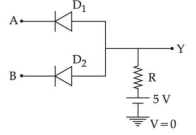
A
| $A$ | $B$ | $Y$ |
| $0$ | $0$ | $0$ |
| $1$ | $0$ | $0$ |
| $0$ | $1$ | $0$ |
| $1$ | $1$ | $1$ |
B
| $A$ | $B$ | $Y$ |
| $0$ | $0$ | $0$ |
| $1$ | $0$ | $1$ |
| $0$ | $1$ | $1$ |
| $1$ | $1$ | $1$ |
C
| $A$ | $B$ | $Y$ |
| $0$ | $0$ | $0$ |
| $1$ | $0$ | $0$ |
| $0$ | $1$ | $0$ |
| $1$ | $1$ | $0$ |
D
| $A$ | $B$ | $Y$ |
| $0$ | $0$ | $1$ |
| $1$ | $0$ | $1$ |
| $0$ | $1$ | $1$ |
| $1$ | $1$ | $0$ |
Solution
(A) In the given circuit,if either input $A$ or $B$ is at $0 \, V$ (logical $0$),the corresponding diode ($D_1$ or $D_2$) becomes forward-biased. This pulls the output potential $Y$ down to approximately $0 \, V$ (logical $0$).
If both inputs $A$ and $B$ are at $5 \, V$ (logical $1$),both diodes are reverse-biased. No current flows through the diodes,and the output $Y$ is pulled up to $5 \, V$ (logical $1$) through the resistor $R$.
This behavior corresponds to an $AND$ gate,where the output is $1$ only if both inputs are $1$. The truth table is:
If both inputs $A$ and $B$ are at $5 \, V$ (logical $1$),both diodes are reverse-biased. No current flows through the diodes,and the output $Y$ is pulled up to $5 \, V$ (logical $1$) through the resistor $R$.
This behavior corresponds to an $AND$ gate,where the output is $1$ only if both inputs are $1$. The truth table is:
| $A$ | $B$ | $Y$ |
| $0$ | $0$ | $0$ |
| $0$ | $1$ | $0$ |
| $1$ | $0$ | $0$ |
| $1$ | $1$ | $1$ |
0 likesView Solution
278
PhysicsMediumMCQJEE Main · 2022
The volume charge density of a sphere of radius $6 \, m$ is $2 \, \mu C \, m^{-3}$. The number of lines of force per unit surface area coming out from the surface of the sphere is $.... \times 10^{10} \, N C^{-1}$. [Given: Permittivity of vacuum $\epsilon_{0} = 8.85 \times 10^{-12} \, C^{2} N^{-1} m^{-2}$]
A
$44$
B
$43$
C
$45$
D
$42$
Solution
(C) The number of electric field lines per unit area is equivalent to the electric field intensity $E$ at that surface.
For a uniformly charged sphere of radius $R$ and volume charge density $\rho$,the electric field at the surface $(r = R)$ is given by Gauss's Law as $E = \frac{q}{4 \pi \epsilon_{0} R^{2}}$.
Since $q = \rho \times \text{Volume} = \rho \times \frac{4}{3} \pi R^{3}$,we substitute this into the expression for $E$:
$E = \frac{\rho \times \frac{4}{3} \pi R^{3}}{4 \pi \epsilon_{0} R^{2}} = \frac{\rho R}{3 \epsilon_{0}}$.
Given $\rho = 2 \, \mu C \, m^{-3} = 2 \times 10^{-6} \, C \, m^{-3}$,$R = 6 \, m$,and $\epsilon_{0} = 8.85 \times 10^{-12} \, C^{2} N^{-1} m^{-2}$.
$E = \frac{2 \times 10^{-6} \times 6}{3 \times 8.85 \times 10^{-12}} = \frac{12 \times 10^{-6}}{26.55 \times 10^{-12}} \approx 0.4519 \times 10^{6} \times 10^{6} = 0.4519 \times 10^{12} \, N C^{-1}$.
Rounding to the nearest integer as per the options,we get $45 \times 10^{10} \, N C^{-1}$.
For a uniformly charged sphere of radius $R$ and volume charge density $\rho$,the electric field at the surface $(r = R)$ is given by Gauss's Law as $E = \frac{q}{4 \pi \epsilon_{0} R^{2}}$.
Since $q = \rho \times \text{Volume} = \rho \times \frac{4}{3} \pi R^{3}$,we substitute this into the expression for $E$:
$E = \frac{\rho \times \frac{4}{3} \pi R^{3}}{4 \pi \epsilon_{0} R^{2}} = \frac{\rho R}{3 \epsilon_{0}}$.
Given $\rho = 2 \, \mu C \, m^{-3} = 2 \times 10^{-6} \, C \, m^{-3}$,$R = 6 \, m$,and $\epsilon_{0} = 8.85 \times 10^{-12} \, C^{2} N^{-1} m^{-2}$.
$E = \frac{2 \times 10^{-6} \times 6}{3 \times 8.85 \times 10^{-12}} = \frac{12 \times 10^{-6}}{26.55 \times 10^{-12}} \approx 0.4519 \times 10^{6} \times 10^{6} = 0.4519 \times 10^{12} \, N C^{-1}$.
Rounding to the nearest integer as per the options,we get $45 \times 10^{10} \, N C^{-1}$.
0 likesView Solution
279
PhysicsDifficultMCQJEE Main · 2022
In the given figure,the value of $V_{0}$ will be $.....V$.
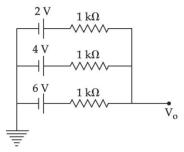
A
$3$
B
$4$
C
$40$
D
$8$
Solution
(B) To find the value of $V_{0}$,we apply Kirchhoff's Current Law $(KCL)$ at the node where $V_{0}$ is defined.
Let the node voltage be $V_{0}$. The currents leaving the node through the three parallel branches must sum to zero.
Using nodal analysis:
$\frac{V_{0}-2}{1 \text{ k}\Omega} + \frac{V_{0}-4}{1 \text{ k}\Omega} + \frac{V_{0}-6}{1 \text{ k}\Omega} = 0$
Since the resistances are equal,we can multiply the entire equation by $1 \text{ k}\Omega$:
$(V_{0}-2) + (V_{0}-4) + (V_{0}-6) = 0$
$3V_{0} - 12 = 0$
$3V_{0} = 12$
$V_{0} = 4 \text{ V}$
Let the node voltage be $V_{0}$. The currents leaving the node through the three parallel branches must sum to zero.
Using nodal analysis:
$\frac{V_{0}-2}{1 \text{ k}\Omega} + \frac{V_{0}-4}{1 \text{ k}\Omega} + \frac{V_{0}-6}{1 \text{ k}\Omega} = 0$
Since the resistances are equal,we can multiply the entire equation by $1 \text{ k}\Omega$:
$(V_{0}-2) + (V_{0}-4) + (V_{0}-6) = 0$
$3V_{0} - 12 = 0$
$3V_{0} = 12$
$V_{0} = 4 \text{ V}$
0 likesView Solution
280
PhysicsEasyMCQJEE Main · 2022
Eight copper wires of length $l$ and diameter $d$ are joined in parallel to form a single composite conductor of resistance $R$. If a single copper wire of length $2\,l$ has the same resistance $R$,then its diameter will be $.....d$.
A
$3$
B
$4$
C
$2$
D
$1$
Solution
(B) The resistance of a single wire of length $l$ and diameter $d$ is given by $r = \rho \frac{l}{A} = \rho \frac{l}{\pi (d/2)^2} = \rho \frac{4l}{\pi d^2}$.
When $8$ such wires are connected in parallel,the equivalent resistance $R$ is given by $R = \frac{r}{8} = \frac{1}{8} \left( \rho \frac{4l}{\pi d^2} \right) = \frac{\rho l}{2 \pi d^2}$.
For a single wire of length $2l$ and diameter $d_1$ to have the same resistance $R$,we have $R = \rho \frac{2l}{\pi (d_1/2)^2} = \rho \frac{8l}{\pi d_1^2}$.
Equating the two expressions for $R$: $\frac{\rho l}{2 \pi d^2} = \frac{8 \rho l}{\pi d_1^2}$.
Simplifying,we get $\frac{1}{2 d^2} = \frac{8}{d_1^2}$,which implies $d_1^2 = 16 d^2$.
Taking the square root,we find $d_1 = 4d$.
When $8$ such wires are connected in parallel,the equivalent resistance $R$ is given by $R = \frac{r}{8} = \frac{1}{8} \left( \rho \frac{4l}{\pi d^2} \right) = \frac{\rho l}{2 \pi d^2}$.
For a single wire of length $2l$ and diameter $d_1$ to have the same resistance $R$,we have $R = \rho \frac{2l}{\pi (d_1/2)^2} = \rho \frac{8l}{\pi d_1^2}$.
Equating the two expressions for $R$: $\frac{\rho l}{2 \pi d^2} = \frac{8 \rho l}{\pi d_1^2}$.
Simplifying,we get $\frac{1}{2 d^2} = \frac{8}{d_1^2}$,which implies $d_1^2 = 16 d^2$.
Taking the square root,we find $d_1 = 4d$.
0 likesView Solution
281
PhysicsEasyMCQJEE Main · 2022
The energy band gap of a semiconducting material required to produce a violet (wavelength $= 4000 \, \mathring{A}$) $LED$ is $....... \, \text{eV}$. (Round off to the nearest integer).
A
$3$
B
$2$
C
$4$
D
$5$
Solution
(A) The energy of a photon emitted by an $LED$ is given by the formula $E = \frac{hc}{\lambda}$.
Given,wavelength $\lambda = 4000 \, \mathring{A} = 400 \, \text{nm}$.
Using the relation $E \approx \frac{1240}{\lambda (\text{in nm})} \, \text{eV}$:
$E = \frac{1240}{400} \, \text{eV} = 3.1 \, \text{eV}$.
Rounding off to the nearest integer,we get $3 \, \text{eV}$.
Given,wavelength $\lambda = 4000 \, \mathring{A} = 400 \, \text{nm}$.
Using the relation $E \approx \frac{1240}{\lambda (\text{in nm})} \, \text{eV}$:
$E = \frac{1240}{400} \, \text{eV} = 3.1 \, \text{eV}$.
Rounding off to the nearest integer,we get $3 \, \text{eV}$.
0 likesView Solution
282
PhysicsMediumMCQJEE Main · 2022
The required height of a $TV$ tower which can cover the population of $6.03$ lakh is $h$. If the average population density is $100$ per square $km$ and the radius of the Earth is $6400 \, km$,then the value of $h$ will be $... \, m$.
A
$150$
B
$151$
C
$146$
D
$155$
Solution
(A) The coverage distance $d$ of a $TV$ tower of height $h$ is given by $d = \sqrt{2Rh}$.
Given the radius of the Earth $R = 6400 \, km$.
The area covered by the tower is $A = \pi d^2 = \pi (2Rh)$.
Given the population $P = 6.03 \times 10^5$ and population density $\rho = 100 \, \text{people/km}^2$.
The area $A$ is also given by $A = \frac{P}{\rho} = \frac{6.03 \times 10^5}{100} = 6030 \, \text{km}^2$.
Equating the two expressions for area: $6030 = \pi \times 2 \times 6400 \times h$ (where $h$ is in $km$).
$h = \frac{6030}{2 \times \pi \times 6400} \, km$.
$h = \frac{6030}{40212} \approx 0.150 \, km$.
Converting to meters: $h = 0.150 \times 1000 = 150 \, m$.
Given the radius of the Earth $R = 6400 \, km$.
The area covered by the tower is $A = \pi d^2 = \pi (2Rh)$.
Given the population $P = 6.03 \times 10^5$ and population density $\rho = 100 \, \text{people/km}^2$.
The area $A$ is also given by $A = \frac{P}{\rho} = \frac{6.03 \times 10^5}{100} = 6030 \, \text{km}^2$.
Equating the two expressions for area: $6030 = \pi \times 2 \times 6400 \times h$ (where $h$ is in $km$).
$h = \frac{6030}{2 \times \pi \times 6400} \, km$.
$h = \frac{6030}{40212} \approx 0.150 \, km$.
Converting to meters: $h = 0.150 \times 1000 = 150 \, m$.
0 likesView Solution
283
PhysicsMediumMCQJEE Main · 2022
Two uniformly charged spherical conductors $A$ and $B$ of radii $5 \ mm$ and $10 \ mm$ are separated by a distance of $2 \ cm$. If the spheres are connected by a conducting wire,then in equilibrium condition,the ratio of the magnitudes of the electric fields at the surface of the sphere $A$ and $B$ will be.
A
$1:2$
B
$2:1$
C
$1:1$
D
$1:4$
Solution
(B) When two conductors are connected by a conducting wire,charge flows until their potentials become equal,i.e.,$V_A = V_B$.
Since the potential of a spherical conductor is $V = \frac{KQ}{R}$,we have $\frac{KQ_A}{R_A} = \frac{KQ_B}{R_B}$.
This implies $\frac{Q_A}{Q_B} = \frac{R_A}{R_B} = \frac{5 \ mm}{10 \ mm} = \frac{1}{2}$.
The electric field at the surface of a sphere is given by $E = \frac{KQ}{R^2}$.
Therefore,the ratio of the electric fields is $\frac{E_A}{E_B} = \frac{KQ_A / R_A^2}{KQ_B / R_B^2} = \frac{Q_A}{Q_B} \times \left(\frac{R_B}{R_A}\right)^2$.
Substituting the ratio of charges: $\frac{E_A}{E_B} = \left(\frac{R_A}{R_B}\right) \times \left(\frac{R_B}{R_A}\right)^2 = \frac{R_B}{R_A}$.
Given $R_A = 5 \ mm$ and $R_B = 10 \ mm$,we get $\frac{E_A}{E_B} = \frac{10}{5} = \frac{2}{1}$.
Since the potential of a spherical conductor is $V = \frac{KQ}{R}$,we have $\frac{KQ_A}{R_A} = \frac{KQ_B}{R_B}$.
This implies $\frac{Q_A}{Q_B} = \frac{R_A}{R_B} = \frac{5 \ mm}{10 \ mm} = \frac{1}{2}$.
The electric field at the surface of a sphere is given by $E = \frac{KQ}{R^2}$.
Therefore,the ratio of the electric fields is $\frac{E_A}{E_B} = \frac{KQ_A / R_A^2}{KQ_B / R_B^2} = \frac{Q_A}{Q_B} \times \left(\frac{R_B}{R_A}\right)^2$.
Substituting the ratio of charges: $\frac{E_A}{E_B} = \left(\frac{R_A}{R_B}\right) \times \left(\frac{R_B}{R_A}\right)^2 = \frac{R_B}{R_A}$.
Given $R_A = 5 \ mm$ and $R_B = 10 \ mm$,we get $\frac{E_A}{E_B} = \frac{10}{5} = \frac{2}{1}$.
0 likesView Solution
284
PhysicsMediumMCQJEE Main · 2022
The oscillating magnetic field in a plane electromagnetic wave is given by $B_{y} = 5 \times 10^{-6} \sin(1000\pi(5x - 4 \times 10^{8}t)) \text{ T}$. The amplitude of the electric field will be:
A
$15 \times 10^{2} \text{ Vm}^{-1}$
B
$5 \times 10^{-6} \text{ Vm}^{-1}$
C
$16 \times 10^{12} \text{ Vm}^{-1}$
D
$4 \times 10^{2} \text{ Vm}^{-1}$
Solution
(A) The given equation for the magnetic field is $B_{y} = B_{0} \sin(kx - \omega t)$.
Comparing this with the given equation $B_{y} = 5 \times 10^{-6} \sin(5000\pi x - 4 \times 10^{11}\pi t)$,we identify the amplitude of the magnetic field as $B_{0} = 5 \times 10^{-6} \text{ T}$.
The speed of the electromagnetic wave $c$ is related to the electric field amplitude $E_{0}$ and magnetic field amplitude $B_{0}$ by the relation $E_{0} = c B_{0}$.
Using the speed of light $c = 3 \times 10^{8} \text{ m/s}$,we calculate:
$E_{0} = (3 \times 10^{8} \text{ m/s}) \times (5 \times 10^{-6} \text{ T})$
$E_{0} = 15 \times 10^{2} \text{ V/m} = 1500 \text{ V/m}$.
Comparing this with the given equation $B_{y} = 5 \times 10^{-6} \sin(5000\pi x - 4 \times 10^{11}\pi t)$,we identify the amplitude of the magnetic field as $B_{0} = 5 \times 10^{-6} \text{ T}$.
The speed of the electromagnetic wave $c$ is related to the electric field amplitude $E_{0}$ and magnetic field amplitude $B_{0}$ by the relation $E_{0} = c B_{0}$.
Using the speed of light $c = 3 \times 10^{8} \text{ m/s}$,we calculate:
$E_{0} = (3 \times 10^{8} \text{ m/s}) \times (5 \times 10^{-6} \text{ T})$
$E_{0} = 15 \times 10^{2} \text{ V/m} = 1500 \text{ V/m}$.
0 likesView Solution
285
PhysicsMediumMCQJEE Main · 2022
Light travels in two media $M_{1}$ and $M_{2}$ with speeds $1.5 \times 10^{8} \text{ m/s}$ and $2.0 \times 10^{8} \text{ m/s}$ respectively. The critical angle between them is.
A
$\tan^{-1}\left(\frac{3}{\sqrt{7}}\right)$
B
$\tan^{-1}\left(\frac{2}{3}\right)$
C
$\cos^{-1}\left(\frac{3}{4}\right)$
D
$\sin^{-1}\left(\frac{2}{3}\right)$
Solution
(A) The speed of light in a medium is given by $V = \frac{c}{n}$,where $c$ is the speed of light in vacuum and $n$ is the refractive index.
Since $n = \frac{c}{V}$,the refractive index is inversely proportional to the speed of light.
For total internal reflection to occur,light must travel from a denser medium $(M_{1})$ to a rarer medium $(M_{2})$.
The condition for the critical angle $i_{c}$ is $n_{1} \sin i_{c} = n_{2} \sin 90^{\circ}$.
Thus,$\sin i_{c} = \frac{n_{2}}{n_{1}} = \frac{V_{1}}{V_{2}}$.
Given $V_{1} = 1.5 \times 10^{8} \text{ m/s}$ and $V_{2} = 2.0 \times 10^{8} \text{ m/s}$.
$\sin i_{c} = \frac{1.5 \times 10^{8}}{2.0 \times 10^{8}} = \frac{1.5}{2.0} = \frac{3}{4}$.
If $\sin i_{c} = \frac{3}{4}$,then the opposite side is $3$ and the hypotenuse is $4$.
The adjacent side is $\sqrt{4^{2} - 3^{2}} = \sqrt{16 - 9} = \sqrt{7}$.
Therefore,$\tan i_{c} = \frac{\text{opposite}}{\text{adjacent}} = \frac{3}{\sqrt{7}}$.
Hence,$i_{c} = \tan^{-1}\left(\frac{3}{\sqrt{7}}\right)$.
Since $n = \frac{c}{V}$,the refractive index is inversely proportional to the speed of light.
For total internal reflection to occur,light must travel from a denser medium $(M_{1})$ to a rarer medium $(M_{2})$.
The condition for the critical angle $i_{c}$ is $n_{1} \sin i_{c} = n_{2} \sin 90^{\circ}$.
Thus,$\sin i_{c} = \frac{n_{2}}{n_{1}} = \frac{V_{1}}{V_{2}}$.
Given $V_{1} = 1.5 \times 10^{8} \text{ m/s}$ and $V_{2} = 2.0 \times 10^{8} \text{ m/s}$.
$\sin i_{c} = \frac{1.5 \times 10^{8}}{2.0 \times 10^{8}} = \frac{1.5}{2.0} = \frac{3}{4}$.
If $\sin i_{c} = \frac{3}{4}$,then the opposite side is $3$ and the hypotenuse is $4$.
The adjacent side is $\sqrt{4^{2} - 3^{2}} = \sqrt{16 - 9} = \sqrt{7}$.
Therefore,$\tan i_{c} = \frac{\text{opposite}}{\text{adjacent}} = \frac{3}{\sqrt{7}}$.
Hence,$i_{c} = \tan^{-1}\left(\frac{3}{\sqrt{7}}\right)$.
0 likesView Solution
286
PhysicsMediumMCQJEE Main · 2022
The maximum and minimum voltage of an amplitude modulated signal are $60\,V$ and $20\,V$ respectively. The percentage modulation index will be $....\%$
A
$0.5$
B
$50$
C
$2$
D
$30$
Solution
(B) Given:
$V_{\max} = 60\,V$
$V_{\min} = 20\,V$
The modulation index $\mu$ is given by the formula:
$\mu = \frac{V_{\max} - V_{\min}}{V_{\max} + V_{\min}}$
Substituting the values:
$\mu = \frac{60 - 20}{60 + 20} = \frac{40}{80} = 0.5$
The percentage modulation index is $\mu \times 100\% = 0.5 \times 100\% = 50\%$.
$V_{\max} = 60\,V$
$V_{\min} = 20\,V$
The modulation index $\mu$ is given by the formula:
$\mu = \frac{V_{\max} - V_{\min}}{V_{\max} + V_{\min}}$
Substituting the values:
$\mu = \frac{60 - 20}{60 + 20} = \frac{40}{80} = 0.5$
The percentage modulation index is $\mu \times 100\% = 0.5 \times 100\% = 50\%$.
0 likesView Solution
287
PhysicsEasyMCQJEE Main · 2022
$A$ nucleus of mass $M$ at rest splits into two parts having masses $\frac{M'}{3}$ and $\frac{2M'}{3}$ (where $M' < M$). The ratio of the de Broglie wavelengths of the two parts will be:
A
$1:2$
B
$2:1$
C
$1:1$
D
$2:3$
Solution
(C) According to the law of conservation of linear momentum,since the initial nucleus is at rest,the total initial momentum is zero.
Therefore,the magnitudes of the momenta of the two parts must be equal and opposite:
$|\vec{P}_1| = |\vec{P}_2| = P$
The de Broglie wavelength $\lambda$ is given by the relation:
$\lambda = \frac{h}{P}$
Since both parts have the same magnitude of momentum $P$,their de Broglie wavelengths will also be equal.
Therefore,the ratio of their de Broglie wavelengths is $\lambda_1 : \lambda_2 = 1 : 1$.
Therefore,the magnitudes of the momenta of the two parts must be equal and opposite:
$|\vec{P}_1| = |\vec{P}_2| = P$
The de Broglie wavelength $\lambda$ is given by the relation:
$\lambda = \frac{h}{P}$
Since both parts have the same magnitude of momentum $P$,their de Broglie wavelengths will also be equal.
Therefore,the ratio of their de Broglie wavelengths is $\lambda_1 : \lambda_2 = 1 : 1$.
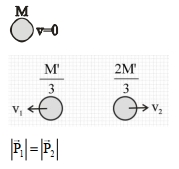
0 likesView Solution
288
PhysicsMediumMCQJEE Main · 2022
$A$ battery of $6\,V$ is connected to the circuit as shown below. The current $I$ drawn from the battery is:
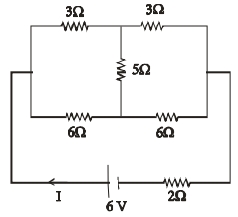
A
$1\,A$
B
$2\,A$
C
$\frac{6}{11}\,A$
D
$\frac{4}{3}\,A$
Solution
(A) The circuit contains a Wheatstone bridge structure. Let us check the ratio of the resistors in the arms: $\frac{3\,\Omega}{6\,\Omega} = \frac{1}{2}$ and $\frac{3\,\Omega}{6\,\Omega} = \frac{1}{2}$.
Since the ratios are equal,the bridge is balanced.
Therefore,no current flows through the central $5\,\Omega$ resistor,and it can be removed from the circuit.
Now,the upper branch has two $3\,\Omega$ resistors in series,giving $R_1 = 3 + 3 = 6\,\Omega$.
The lower branch has two $6\,\Omega$ resistors in series,giving $R_2 = 6 + 6 = 12\,\Omega$.
These two branches are in parallel,so the equivalent resistance of the bridge part is $R_p = \frac{R_1 \times R_2}{R_1 + R_2} = \frac{6 \times 12}{6 + 12} = \frac{72}{18} = 4\,\Omega$.
This equivalent resistance is in series with the $2\,\Omega$ resistor connected to the battery.
Total resistance $R_{eq} = 4 + 2 = 6\,\Omega$.
The current drawn from the battery is $I = \frac{V}{R_{eq}} = \frac{6\,V}{6\,\Omega} = 1\,A$.
Since the ratios are equal,the bridge is balanced.
Therefore,no current flows through the central $5\,\Omega$ resistor,and it can be removed from the circuit.
Now,the upper branch has two $3\,\Omega$ resistors in series,giving $R_1 = 3 + 3 = 6\,\Omega$.
The lower branch has two $6\,\Omega$ resistors in series,giving $R_2 = 6 + 6 = 12\,\Omega$.
These two branches are in parallel,so the equivalent resistance of the bridge part is $R_p = \frac{R_1 \times R_2}{R_1 + R_2} = \frac{6 \times 12}{6 + 12} = \frac{72}{18} = 4\,\Omega$.
This equivalent resistance is in series with the $2\,\Omega$ resistor connected to the battery.
Total resistance $R_{eq} = 4 + 2 = 6\,\Omega$.
The current drawn from the battery is $I = \frac{V}{R_{eq}} = \frac{6\,V}{6\,\Omega} = 1\,A$.
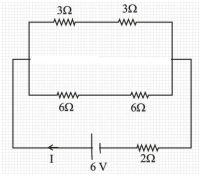
0 likesView Solution
289
PhysicsDifficultMCQJEE Main · 2022
$A$ source of potential difference $V$ is connected to the combination of two identical capacitors as shown in the figure. When key $K$ is closed,the total energy stored across the combination is $E_{1}$. Now key $K$ is opened and a dielectric of dielectric constant $K_{d} = 5$ is introduced between the plates of both capacitors. The total energy stored across the combination is now $E_{2}$. The ratio $E_{1} / E_{2}$ will be:
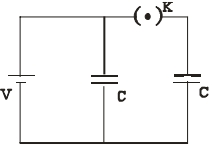
A
$\frac{1}{10}$
B
$\frac{2}{5}$
C
$\frac{5}{13}$
D
$\frac{5}{26}$
Solution
(C) Case $I$: Switch $K$ is closed.
Both capacitors are in parallel with the source $V$.
Equivalent capacitance $C_{eq} = C + C = 2C$.
Total energy $E_{1} = \frac{1}{2} C_{eq} V^{2} = \frac{1}{2} (2C) V^{2} = CV^{2}$.
Case $II$: Switch $K$ is opened.
The left capacitor remains connected to the source $V$,so its potential remains $V$ and its new capacitance is $C' = K_{d}C = 5C$. Its energy is $E_{L} = \frac{1}{2} (5C) V^{2} = \frac{5}{2} CV^{2}$.
The right capacitor is disconnected,so its charge $Q = CV$ remains constant. Its new capacitance is $C' = K_{d}C = 5C$. Its energy is $E_{R} = \frac{Q^{2}}{2C'} = \frac{(CV)^{2}}{2(5C)} = \frac{CV^{2}}{10}$.
Total energy $E_{2} = E_{L} + E_{R} = \frac{5}{2} CV^{2} + \frac{1}{10} CV^{2} = \frac{25+1}{10} CV^{2} = \frac{26}{10} CV^{2} = \frac{13}{5} CV^{2}$.
Ratio $\frac{E_{1}}{E_{2}} = \frac{CV^{2}}{\frac{13}{5} CV^{2}} = \frac{5}{13}$.
Both capacitors are in parallel with the source $V$.
Equivalent capacitance $C_{eq} = C + C = 2C$.
Total energy $E_{1} = \frac{1}{2} C_{eq} V^{2} = \frac{1}{2} (2C) V^{2} = CV^{2}$.
Case $II$: Switch $K$ is opened.
The left capacitor remains connected to the source $V$,so its potential remains $V$ and its new capacitance is $C' = K_{d}C = 5C$. Its energy is $E_{L} = \frac{1}{2} (5C) V^{2} = \frac{5}{2} CV^{2}$.
The right capacitor is disconnected,so its charge $Q = CV$ remains constant. Its new capacitance is $C' = K_{d}C = 5C$. Its energy is $E_{R} = \frac{Q^{2}}{2C'} = \frac{(CV)^{2}}{2(5C)} = \frac{CV^{2}}{10}$.
Total energy $E_{2} = E_{L} + E_{R} = \frac{5}{2} CV^{2} + \frac{1}{10} CV^{2} = \frac{25+1}{10} CV^{2} = \frac{26}{10} CV^{2} = \frac{13}{5} CV^{2}$.
Ratio $\frac{E_{1}}{E_{2}} = \frac{CV^{2}}{\frac{13}{5} CV^{2}} = \frac{5}{13}$.
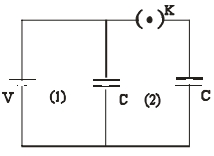
0 likesView Solution
290
PhysicsMediumMCQJEE Main · 2022
Two concentric circular loops of radii $r_{1} = 30 \, cm$ and $r_{2} = 50 \, cm$ are placed in the $X-Y$ plane as shown in the figure. $A$ current $I = 7 \, A$ flows through them in the directions shown. The net magnetic moment of this system of two circular loops is approximately:
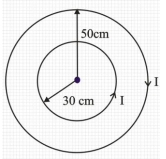
A
$\frac{7}{2} \hat{k} \, A \cdot m^{2}$
B
$-\frac{7}{2} \hat{k} \, A \cdot m^{2}$
C
$7 \hat{k} \, A \cdot m^{2}$
D
$-7 \hat{k} \, A \cdot m^{2}$
Solution
(B) The magnetic moment of a current loop is given by $\vec{M} = I \vec{A}$,where $\vec{A}$ is the area vector directed according to the right-hand rule.
For the inner loop (radius $r_{1} = 0.3 \, m$),the current flows counter-clockwise,so $\vec{M}_{1} = I \pi r_{1}^{2} \hat{k} = 7 \times \pi \times (0.3)^{2} \hat{k} = 0.63 \pi \hat{k} \, A \cdot m^{2}$.
For the outer loop (radius $r_{2} = 0.5 \, m$),the current flows clockwise,so $\vec{M}_{2} = -I \pi r_{2}^{2} \hat{k} = -7 \times \pi \times (0.5)^{2} \hat{k} = -1.75 \pi \hat{k} \, A \cdot m^{2}$.
The net magnetic moment is $\vec{M}_{net} = \vec{M}_{1} + \vec{M}_{2} = (0.63 \pi - 1.75 \pi) \hat{k} = -1.12 \pi \hat{k} \, A \cdot m^{2}$.
Using $\pi \approx \frac{22}{7}$,we get $\vec{M}_{net} = -1.12 \times \frac{22}{7} \hat{k} = -0.16 \times 22 \hat{k} = -3.52 \hat{k} \, A \cdot m^{2}$.
This is approximately $-\frac{7}{2} \hat{k} \, A \cdot m^{2}$.
For the inner loop (radius $r_{1} = 0.3 \, m$),the current flows counter-clockwise,so $\vec{M}_{1} = I \pi r_{1}^{2} \hat{k} = 7 \times \pi \times (0.3)^{2} \hat{k} = 0.63 \pi \hat{k} \, A \cdot m^{2}$.
For the outer loop (radius $r_{2} = 0.5 \, m$),the current flows clockwise,so $\vec{M}_{2} = -I \pi r_{2}^{2} \hat{k} = -7 \times \pi \times (0.5)^{2} \hat{k} = -1.75 \pi \hat{k} \, A \cdot m^{2}$.
The net magnetic moment is $\vec{M}_{net} = \vec{M}_{1} + \vec{M}_{2} = (0.63 \pi - 1.75 \pi) \hat{k} = -1.12 \pi \hat{k} \, A \cdot m^{2}$.
Using $\pi \approx \frac{22}{7}$,we get $\vec{M}_{net} = -1.12 \times \frac{22}{7} \hat{k} = -0.16 \times 22 \hat{k} = -3.52 \hat{k} \, A \cdot m^{2}$.
This is approximately $-\frac{7}{2} \hat{k} \, A \cdot m^{2}$.
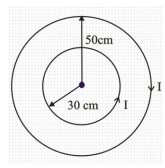
0 likesView Solution
291
PhysicsDifficultMCQJEE Main · 2022
$A$ velocity selector consists of an electric field $\overrightarrow{E} = E \hat{k}$ and a magnetic field $\overrightarrow{B} = B \hat{j}$ with $B = 12 \, mT$. The value of $E$ required for an electron of energy $728 \, eV$ moving along the positive $x$-axis to pass undeflected is: (Given: mass of electron $= 9.1 \times 10^{-31} \, kg$)
A
$192 \, kVm^{-1}$
B
$192 \, mVm^{-1}$
C
$9600 \, kVm^{-1}$
D
$16 \, kVm^{-1}$
Solution
(A) For a particle to pass undeflected in a velocity selector,the electric force must balance the magnetic force: $qE = qvB$,which implies $E = vB$.
First,calculate the velocity $v$ of the electron using its kinetic energy $K = 728 \, eV$:
$K = \frac{1}{2} mv^2$
$728 \times 1.6 \times 10^{-19} \, J = \frac{1}{2} \times 9.1 \times 10^{-31} \, kg \times v^2$
$v^2 = \frac{2 \times 728 \times 1.6 \times 10^{-19}}{9.1 \times 10^{-31}}$
$v^2 = 256 \times 10^{12} \, m^2/s^2$
$v = 16 \times 10^6 \, m/s$
Now,calculate the electric field $E$:
$E = vB = (16 \times 10^6 \, m/s) \times (12 \times 10^{-3} \, T)$
$E = 192 \times 10^3 \, V/m = 192 \, kV/m$.
First,calculate the velocity $v$ of the electron using its kinetic energy $K = 728 \, eV$:
$K = \frac{1}{2} mv^2$
$728 \times 1.6 \times 10^{-19} \, J = \frac{1}{2} \times 9.1 \times 10^{-31} \, kg \times v^2$
$v^2 = \frac{2 \times 728 \times 1.6 \times 10^{-19}}{9.1 \times 10^{-31}}$
$v^2 = 256 \times 10^{12} \, m^2/s^2$
$v = 16 \times 10^6 \, m/s$
Now,calculate the electric field $E$:
$E = vB = (16 \times 10^6 \, m/s) \times (12 \times 10^{-3} \, T)$
$E = 192 \times 10^3 \, V/m = 192 \, kV/m$.
0 likesView Solution
292
PhysicsMediumMCQJEE Main · 2022
Mass numbers of two nuclei are in the ratio of $4: 3$. Their nuclear densities will be in the ratio of
A
$4: 3$
B
$\left(\frac{3}{4}\right)^{\frac{1}{3}}$
C
$1: 1$
D
$\left(\frac{4}{3}\right)^{\frac{1}{3}}$
Solution
(C) The radius of a nucleus is given by $R = R_{0} A^{\frac{1}{3}}$,where $A$ is the mass number and $R_{0}$ is a constant.
The density of a nucleus $\rho$ is defined as the ratio of the mass of the nucleus to its volume.
$\rho = \frac{\text{Mass of nucleus}}{\text{Volume of nucleus}} = \frac{m \times A}{\frac{4}{3} \pi R^{3}}$,where $m$ is the average mass of a nucleon (proton or neutron).
Substituting the expression for $R$:
$\rho = \frac{m \times A}{\frac{4}{3} \pi (R_{0} A^{\frac{1}{3}})^{3}} = \frac{m \times A}{\frac{4}{3} \pi R_{0}^{3} A}$.
Simplifying the expression,the $A$ terms cancel out:
$\rho = \frac{m}{\frac{4}{3} \pi R_{0}^{3}}$.
Since $\rho$ is independent of the mass number $A$,the nuclear density is constant for all nuclei.
Therefore,the ratio of the nuclear densities of two nuclei is $1: 1$.
The density of a nucleus $\rho$ is defined as the ratio of the mass of the nucleus to its volume.
$\rho = \frac{\text{Mass of nucleus}}{\text{Volume of nucleus}} = \frac{m \times A}{\frac{4}{3} \pi R^{3}}$,where $m$ is the average mass of a nucleon (proton or neutron).
Substituting the expression for $R$:
$\rho = \frac{m \times A}{\frac{4}{3} \pi (R_{0} A^{\frac{1}{3}})^{3}} = \frac{m \times A}{\frac{4}{3} \pi R_{0}^{3} A}$.
Simplifying the expression,the $A$ terms cancel out:
$\rho = \frac{m}{\frac{4}{3} \pi R_{0}^{3}}$.
Since $\rho$ is independent of the mass number $A$,the nuclear density is constant for all nuclei.
Therefore,the ratio of the nuclear densities of two nuclei is $1: 1$.
0 likesView Solution
293
PhysicsMediumMCQJEE Main · 2022
In the given figure,the face $AC$ of the equilateral prism is immersed in a liquid of refractive index $n$. For an incident angle of $60^{\circ}$ at the side $AC$,the refracted light beam just grazes along the face $AC$. The refractive index of the liquid is $n = \frac{\sqrt{x}}{4}$. The value of $x$ is (Given refractive index of glass $= 1.5$)
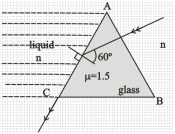
A
$27$
B
$270$
C
$22$
D
$30$
Solution
(A) According to Snell's law at the interface of the glass prism and the liquid at face $AC$:
$\mu_{glass} \sin(i) = n \sin(r)$
Given that the incident angle $i = 60^{\circ}$ and the refracted light grazes along the face $AC$,the angle of refraction $r = 90^{\circ}$.
Substituting the values:
$1.5 \times \sin(60^{\circ}) = n \times \sin(90^{\circ})$
$1.5 \times \frac{\sqrt{3}}{2} = n \times 1$
$n = \frac{1.5 \sqrt{3}}{2} = \frac{3 \sqrt{3}}{4}$
We are given $n = \frac{\sqrt{x}}{4}$.
Equating the two expressions for $n$:
$\frac{\sqrt{x}}{4} = \frac{3 \sqrt{3}}{4}$
$\sqrt{x} = 3 \sqrt{3} = \sqrt{9 \times 3} = \sqrt{27}$
Therefore,$x = 27$.
$\mu_{glass} \sin(i) = n \sin(r)$
Given that the incident angle $i = 60^{\circ}$ and the refracted light grazes along the face $AC$,the angle of refraction $r = 90^{\circ}$.
Substituting the values:
$1.5 \times \sin(60^{\circ}) = n \times \sin(90^{\circ})$
$1.5 \times \frac{\sqrt{3}}{2} = n \times 1$
$n = \frac{1.5 \sqrt{3}}{2} = \frac{3 \sqrt{3}}{4}$
We are given $n = \frac{\sqrt{x}}{4}$.
Equating the two expressions for $n$:
$\frac{\sqrt{x}}{4} = \frac{3 \sqrt{3}}{4}$
$\sqrt{x} = 3 \sqrt{3} = \sqrt{9 \times 3} = \sqrt{27}$
Therefore,$x = 27$.
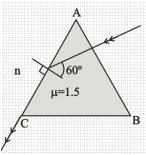
0 likesView Solution
294
PhysicsMediumMCQJEE Main · 2022
Two lighter nuclei combine to form a comparatively heavier nucleus by the relation given below:
${ }_{1}^{2} X +{ }_{1}^{2} X ={ }_{2}^{4} Y$
The binding energies per nucleon of ${ }_{1}^{2} X$ and ${ }_{2}^{4} Y$ are $1.1 \, MeV$ and $7.6 \, MeV$ respectively. The energy released in this process is in $MeV$.
${ }_{1}^{2} X +{ }_{1}^{2} X ={ }_{2}^{4} Y$
The binding energies per nucleon of ${ }_{1}^{2} X$ and ${ }_{2}^{4} Y$ are $1.1 \, MeV$ and $7.6 \, MeV$ respectively. The energy released in this process is in $MeV$.
A
$25$
B
$26$
C
$23$
D
$22$
Solution
(B) The energy released in a nuclear reaction is given by the difference between the total binding energy of the products and the total binding energy of the reactants.
Total binding energy of the product $({ }_{2}^{4} Y)$: $4 \times 7.6 \, MeV = 30.4 \, MeV$.
Total binding energy of the reactants $(2 \times { }_{1}^{2} X)$: $2 \times (2 \times 1.1 \, MeV) = 4.4 \, MeV$.
Energy released = (Total binding energy of products) - (Total binding energy of reactants)
Energy released = $30.4 \, MeV - 4.4 \, MeV = 26 \, MeV$.
Total binding energy of the product $({ }_{2}^{4} Y)$: $4 \times 7.6 \, MeV = 30.4 \, MeV$.
Total binding energy of the reactants $(2 \times { }_{1}^{2} X)$: $2 \times (2 \times 1.1 \, MeV) = 4.4 \, MeV$.
Energy released = (Total binding energy of products) - (Total binding energy of reactants)
Energy released = $30.4 \, MeV - 4.4 \, MeV = 26 \, MeV$.
0 likesView Solution
295
PhysicsDifficultMCQJEE Main · 2022
The typical transfer characteristic of a transistor in $CE$ configuration is shown in the figure. $A$ load resistor of $2\,k\Omega$ is connected in the collector branch of the circuit used. The input resistance of the transistor is $0.50\,k\Omega$. The voltage gain of the transistor is:
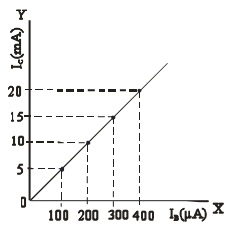
A
$100$
B
$200$
C
$20$
D
$2000$
Solution
(B) The current gain $\beta$ in $CE$ configuration is given by $\beta = \frac{\Delta I_C}{\Delta I_B}$.
From the graph,we can choose two points to calculate the change in collector current $\Delta I_C$ and base current $\Delta I_B$.
Let us take the points $(I_B = 100\,\mu A, I_C = 5\,mA)$ and $(I_B = 200\,\mu A, I_C = 10\,mA)$.
$\Delta I_C = (10 - 5)\,mA = 5\,mA = 5 \times 10^{-3}\,A$.
$\Delta I_B = (200 - 100)\,\mu A = 100\,\mu A = 100 \times 10^{-6}\,A$.
Therefore,$\beta = \frac{5 \times 10^{-3}}{100 \times 10^{-6}} = \frac{5000}{100} = 50$.
The voltage gain $A_V$ is given by $A_V = \beta \times \frac{R_C}{R_{in}}$.
Given $R_C = 2\,k\Omega$ and $R_{in} = 0.50\,k\Omega$.
$A_V = 50 \times \frac{2\,k\Omega}{0.50\,k\Omega} = 50 \times 4 = 200$.
From the graph,we can choose two points to calculate the change in collector current $\Delta I_C$ and base current $\Delta I_B$.
Let us take the points $(I_B = 100\,\mu A, I_C = 5\,mA)$ and $(I_B = 200\,\mu A, I_C = 10\,mA)$.
$\Delta I_C = (10 - 5)\,mA = 5\,mA = 5 \times 10^{-3}\,A$.
$\Delta I_B = (200 - 100)\,\mu A = 100\,\mu A = 100 \times 10^{-6}\,A$.
Therefore,$\beta = \frac{5 \times 10^{-3}}{100 \times 10^{-6}} = \frac{5000}{100} = 50$.
The voltage gain $A_V$ is given by $A_V = \beta \times \frac{R_C}{R_{in}}$.
Given $R_C = 2\,k\Omega$ and $R_{in} = 0.50\,k\Omega$.
$A_V = 50 \times \frac{2\,k\Omega}{0.50\,k\Omega} = 50 \times 4 = 200$.
0 likesView Solution
296
PhysicsMediumMCQJEE Main · 2022
Three point charges of magnitude $5 \mu C$,$0.16 \mu C$,and $0.3 \mu C$ are located at the vertices $A$,$B$,and $C$ of a right-angled triangle whose sides are $AB = 3 \, cm$,$BC = 3 \sqrt{2} \, cm$,and $CA = 3 \, cm$. Point $A$ is the right-angle corner. Calculate the magnitude of the net electrostatic force (in $N$) experienced by the charge at point $A$ due to the other two charges.
A
$177$
B
$12$
C
$17$
D
$29$
Solution
(C) Given charges: $q_A = 5 \, \mu C$,$q_B = 0.16 \, \mu C$,$q_C = 0.3 \, \mu C$.
Distances: $r_{AB} = 3 \, cm = 3 \times 10^{-2} \, m$,$r_{AC} = 3 \, cm = 3 \times 10^{-2} \, m$.
Coulomb's Law: $F = \frac{k q_1 q_2}{r^2}$,where $k = 9 \times 10^9 \, N \cdot m^2/C^2$.
Force on $A$ due to $C$ $(F_1)$: $F_1 = \frac{9 \times 10^9 \times (5 \times 10^{-6}) \times (0.3 \times 10^{-6})}{(3 \times 10^{-2})^2} = \frac{9 \times 10^9 \times 1.5 \times 10^{-12}}{9 \times 10^{-4}} = 1.5 \times 10 = 15 \, N$.
Force on $A$ due to $B$ $(F_2)$: $F_2 = \frac{9 \times 10^9 \times (5 \times 10^{-6}) \times (0.16 \times 10^{-6})}{(3 \times 10^{-2})^2} = \frac{9 \times 10^9 \times 0.8 \times 10^{-12}}{9 \times 10^{-4}} = 0.8 \times 10 = 8 \, N$.
Since $A$ is the right-angle corner,$F_1$ and $F_2$ are perpendicular.
Net force $F_{net} = \sqrt{F_1^2 + F_2^2} = \sqrt{15^2 + 8^2} = \sqrt{225 + 64} = \sqrt{289} = 17 \, N$.
Distances: $r_{AB} = 3 \, cm = 3 \times 10^{-2} \, m$,$r_{AC} = 3 \, cm = 3 \times 10^{-2} \, m$.
Coulomb's Law: $F = \frac{k q_1 q_2}{r^2}$,where $k = 9 \times 10^9 \, N \cdot m^2/C^2$.
Force on $A$ due to $C$ $(F_1)$: $F_1 = \frac{9 \times 10^9 \times (5 \times 10^{-6}) \times (0.3 \times 10^{-6})}{(3 \times 10^{-2})^2} = \frac{9 \times 10^9 \times 1.5 \times 10^{-12}}{9 \times 10^{-4}} = 1.5 \times 10 = 15 \, N$.
Force on $A$ due to $B$ $(F_2)$: $F_2 = \frac{9 \times 10^9 \times (5 \times 10^{-6}) \times (0.16 \times 10^{-6})}{(3 \times 10^{-2})^2} = \frac{9 \times 10^9 \times 0.8 \times 10^{-12}}{9 \times 10^{-4}} = 0.8 \times 10 = 8 \, N$.
Since $A$ is the right-angle corner,$F_1$ and $F_2$ are perpendicular.
Net force $F_{net} = \sqrt{F_1^2 + F_2^2} = \sqrt{15^2 + 8^2} = \sqrt{225 + 64} = \sqrt{289} = 17 \, N$.
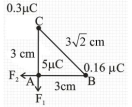
0 likesView Solution
297
PhysicsMediumMCQJEE Main · 2022
In a coil of resistance $8 \, \Omega$,the magnetic flux due to an external magnetic field varies with time as $\phi = \frac{2}{3}(9 - t^2)$. The value of total heat produced in the coil,till the flux becomes zero,will be $.... \, J$.
A
$6$
B
$5$
C
$2$
D
$3$
Solution
(C) Given,$\phi = \frac{2}{3}(9 - t^2)$.
The flux becomes zero when $\phi = 0$,so $\frac{2}{3}(9 - t^2) = 0$,which gives $t^2 = 9$,or $t = 3 \, \text{s}$.
The induced electromotive force $(EMF)$ is given by Faraday's law: $e = -\frac{d\phi}{dt}$.
$e = -\frac{d}{dt} [\frac{2}{3}(9 - t^2)] = -\frac{2}{3}(0 - 2t) = \frac{4t}{3}$.
The heat produced $H$ in the coil is given by $H = \int_{0}^{t} \frac{e^2}{R} dt$.
Substituting the values $e = \frac{4t}{3}$ and $R = 8 \, \Omega$:
$H = \int_{0}^{3} \frac{(\frac{4t}{3})^2}{8} dt = \int_{0}^{3} \frac{16t^2}{9 \times 8} dt = \int_{0}^{3} \frac{2t^2}{9} dt$.
$H = \frac{2}{9} [\frac{t^3}{3}]_{0}^{3} = \frac{2}{9} \times \frac{27}{3} = \frac{2}{9} \times 9 = 2 \, \text{J}$.
The flux becomes zero when $\phi = 0$,so $\frac{2}{3}(9 - t^2) = 0$,which gives $t^2 = 9$,or $t = 3 \, \text{s}$.
The induced electromotive force $(EMF)$ is given by Faraday's law: $e = -\frac{d\phi}{dt}$.
$e = -\frac{d}{dt} [\frac{2}{3}(9 - t^2)] = -\frac{2}{3}(0 - 2t) = \frac{4t}{3}$.
The heat produced $H$ in the coil is given by $H = \int_{0}^{t} \frac{e^2}{R} dt$.
Substituting the values $e = \frac{4t}{3}$ and $R = 8 \, \Omega$:
$H = \int_{0}^{3} \frac{(\frac{4t}{3})^2}{8} dt = \int_{0}^{3} \frac{16t^2}{9 \times 8} dt = \int_{0}^{3} \frac{2t^2}{9} dt$.
$H = \frac{2}{9} [\frac{t^3}{3}]_{0}^{3} = \frac{2}{9} \times \frac{27}{3} = \frac{2}{9} \times 9 = 2 \, \text{J}$.
0 likesView Solution
298
PhysicsDifficultMCQJEE Main · 2022
$A$ potentiometer wire of length $300\,cm$ is connected in series with a resistance $780\,\Omega$ and a standard cell of emf $4\,V$. $A$ constant current flows through the potentiometer wire. The length of the null point for a cell of emf $20\,mV$ is found to be $60\,cm$. The resistance of the potentiometer wire is ... $\Omega$.
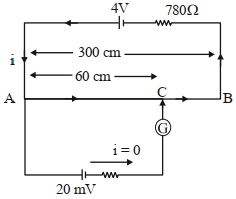
A
$78$
B
$200$
C
$2$
D
$20$
Solution
(D) Let the resistance of the potentiometer wire be $R$.
The current $i$ flowing through the potentiometer wire is given by $i = \frac{4}{R + 780}$.
The potential difference across the entire potentiometer wire $AB$ is $V_{AB} = iR = \frac{4R}{R + 780}$.
The potential gradient along the wire is $k = \frac{V_{AB}}{L} = \frac{4R}{(R + 780) \times 300}$.
The null point is obtained at a length $l = 60\,cm$ for a cell of emf $E = 20\,mV = 20 \times 10^{-3}\,V$.
At the null point,the potential difference across the length $l$ is equal to the emf of the cell:
$E = k \times l$
$20 \times 10^{-3} = \left( \frac{4R}{(R + 780) \times 300} \right) \times 60$
Simplifying the equation:
$20 \times 10^{-3} = \frac{4R \times 60}{(R + 780) \times 300}$
$0.02 = \frac{4R}{5(R + 780)}$
$0.1(R + 780) = 4R$
$0.1R + 78 = 4R$
$3.9R = 78$
$R = \frac{78}{3.9} = 20\,\Omega$.
The current $i$ flowing through the potentiometer wire is given by $i = \frac{4}{R + 780}$.
The potential difference across the entire potentiometer wire $AB$ is $V_{AB} = iR = \frac{4R}{R + 780}$.
The potential gradient along the wire is $k = \frac{V_{AB}}{L} = \frac{4R}{(R + 780) \times 300}$.
The null point is obtained at a length $l = 60\,cm$ for a cell of emf $E = 20\,mV = 20 \times 10^{-3}\,V$.
At the null point,the potential difference across the length $l$ is equal to the emf of the cell:
$E = k \times l$
$20 \times 10^{-3} = \left( \frac{4R}{(R + 780) \times 300} \right) \times 60$
Simplifying the equation:
$20 \times 10^{-3} = \frac{4R \times 60}{(R + 780) \times 300}$
$0.02 = \frac{4R}{5(R + 780)}$
$0.1(R + 780) = 4R$
$0.1R + 78 = 4R$
$3.9R = 78$
$R = \frac{78}{3.9} = 20\,\Omega$.
0 likesView Solution
299
PhysicsMediumMCQJEE Main · 2022
$A$ radio can tune to any station in the $6\,MHz$ to $10\,MHz$ band. The value of the corresponding wavelength bandwidth will be $....\,m$.
A
$4$
B
$20$
C
$30$
D
$50$
Solution
(B) Given: Frequency $f_{1} = 6\,MHz = 6 \times 10^{6}\,Hz$ and $f_{2} = 10\,MHz = 10 \times 10^{6}\,Hz$.
Speed of light $c = 3 \times 10^{8}\,m/s$.
The wavelength $\lambda$ is given by $\lambda = \frac{c}{f}$.
For $f_{1} = 6 \times 10^{6}\,Hz$,$\lambda_{1} = \frac{3 \times 10^{8}}{6 \times 10^{6}} = 50\,m$.
For $f_{2} = 10 \times 10^{6}\,Hz$,$\lambda_{2} = \frac{3 \times 10^{8}}{10 \times 10^{6}} = 30\,m$.
The wavelength bandwidth is the difference between the two wavelengths: $\Delta\lambda = \lambda_{1} - \lambda_{2} = 50\,m - 30\,m = 20\,m$.
Speed of light $c = 3 \times 10^{8}\,m/s$.
The wavelength $\lambda$ is given by $\lambda = \frac{c}{f}$.
For $f_{1} = 6 \times 10^{6}\,Hz$,$\lambda_{1} = \frac{3 \times 10^{8}}{6 \times 10^{6}} = 50\,m$.
For $f_{2} = 10 \times 10^{6}\,Hz$,$\lambda_{2} = \frac{3 \times 10^{8}}{10 \times 10^{6}} = 30\,m$.
The wavelength bandwidth is the difference between the two wavelengths: $\Delta\lambda = \lambda_{1} - \lambda_{2} = 50\,m - 30\,m = 20\,m$.
0 likesView Solution
300
PhysicsMediumMCQJEE Main · 2022
The disintegration rate of a certain radioactive sample at any instant is $4250$ disintegrations per minute. $10$ minutes later,the rate becomes $2250$ disintegrations per minute. The approximate decay constant is $......... \min^{-1}$.
A
$0.02$
B
$2.7$
C
$0.063$
D
$6.3$
Solution
(C) The disintegration rate $A$ follows the law $A = A_0 e^{-\lambda t}$.
At $t = 0$,$A_0 = 4250 \, \text{dpm}$.
At $t = 10 \, \text{min}$,$A = 2250 \, \text{dpm}$.
Substituting these values into the equation:
$2250 = 4250 e^{-\lambda (10)}$
$e^{-10\lambda} = \frac{2250}{4250} = \frac{45}{85} = \frac{9}{17}$
Taking the natural logarithm on both sides:
$-10\lambda = \ln\left(\frac{9}{17}\right)$
$10\lambda = \ln\left(\frac{17}{9}\right) \approx \ln(1.888)$
$10\lambda \approx 0.6356$
$\lambda \approx 0.06356 \, \min^{-1}$.
Thus,the approximate decay constant is $0.063 \, \min^{-1}$.
At $t = 0$,$A_0 = 4250 \, \text{dpm}$.
At $t = 10 \, \text{min}$,$A = 2250 \, \text{dpm}$.
Substituting these values into the equation:
$2250 = 4250 e^{-\lambda (10)}$
$e^{-10\lambda} = \frac{2250}{4250} = \frac{45}{85} = \frac{9}{17}$
Taking the natural logarithm on both sides:
$-10\lambda = \ln\left(\frac{9}{17}\right)$
$10\lambda = \ln\left(\frac{17}{9}\right) \approx \ln(1.888)$
$10\lambda \approx 0.6356$
$\lambda \approx 0.06356 \, \min^{-1}$.
Thus,the approximate decay constant is $0.063 \, \min^{-1}$.
0 likesView Solution
Vedclass Products
For Students
Vedclass Test Series
Mock tests in real JEE Main style covering Physics with performance analysis. 5-day free trial.
Start Free TrialFor Teachers
Exam Paper Generator
Generate Set A/B/C/D Physics papers from 7.5L+ questions in 2 minutes. 3 chapters free.
Try FreeFor Institutes
Online Exam Module
Run live JEE Main mock exams with unlimited students, 360° analytics & white-label branding.
See DemoFrequently Asked Questions
How many Physics questions are in JEE Main 2022?
There are 660 Physics questions from the JEE Main 2022 paper on Vedclass, each with a detailed step-by-step solution in English.
Are JEE Main 2022 Physics solutions available in English?
Yes. All solutions on this page are in English. You can also switch to English or Hindi using the language buttons above the questions.
Can I practice JEE Main 2022 Physics as a timed test?
Yes. Use the Vedclass Test Series to attempt a full JEE Main mock test covering Physics with time limits and instant score analysis.
Can teachers create Physics papers from JEE Main previous year questions?
Yes. The Vedclass Exam Paper Generator lets teachers mix JEE Main Physics questions and generate Set A/B/C/D papers in minutes.
For Teachers & Institutes
Build a Custom Physics Paper
Pick JEE Main 2022 Physics questions, set difficulty, and generate Set A/B/C/D in 2 minutes.