
PhysicsQ301–354 of 660 questions
Page 7 of 8 · English
301
PhysicsMediumMCQJEE Main · 2022
An object is projected in the air with initial velocity $u$ at an angle $\theta$. The projectile motion is such that the horizontal range $R$ is maximum. Another object is projected in the air with a horizontal range half of the range of the first object. The initial velocity remains the same in both cases. The value of the angle of projection,at which the second object is projected,will be $.......$ degrees.
A
$85$
B
$80$
C
$15$ or $75$
D
$70$
Solution
(C) The horizontal range $R$ is given by $R = \frac{u^2 \sin 2\theta}{g}$.
For maximum range,$\theta = 45^{\circ}$,so $R_{\max} = \frac{u^2}{g}$.
For the second object,the range is $R' = \frac{R_{\max}}{2} = \frac{u^2}{2g}$.
Equating the range formula for the second object: $\frac{u^2 \sin 2\theta'}{g} = \frac{u^2}{2g}$.
This simplifies to $\sin 2\theta' = \frac{1}{2}$.
Therefore,$2\theta' = 30^{\circ}$ or $2\theta' = 150^{\circ}$.
Solving for $\theta'$,we get $\theta' = 15^{\circ}$ or $\theta' = 75^{\circ}$.
For maximum range,$\theta = 45^{\circ}$,so $R_{\max} = \frac{u^2}{g}$.
For the second object,the range is $R' = \frac{R_{\max}}{2} = \frac{u^2}{2g}$.
Equating the range formula for the second object: $\frac{u^2 \sin 2\theta'}{g} = \frac{u^2}{2g}$.
This simplifies to $\sin 2\theta' = \frac{1}{2}$.
Therefore,$2\theta' = 30^{\circ}$ or $2\theta' = 150^{\circ}$.
Solving for $\theta'$,we get $\theta' = 15^{\circ}$ or $\theta' = 75^{\circ}$.
0 likesView Solution
302
PhysicsMediumMCQJEE Main · 2022
If the acceleration due to gravity experienced by a point mass at a height $h$ above the surface of the Earth is the same as the acceleration due to gravity at a depth $d = \alpha h$ $(h \ll R_{e})$ from the Earth's surface,then the value of $\alpha$ will be: (use $R_{e} = 6400 \ km$)
A
$5$
B
$3$
C
$2$
D
$0$
Solution
(C) The acceleration due to gravity at a height $h$ above the Earth's surface is given by $g_h = g(1 - \frac{2h}{R_e})$ for $h \ll R_e$.
The acceleration due to gravity at a depth $d$ below the Earth's surface is given by $g_d = g(1 - \frac{d}{R_e})$.
According to the problem,$g_h = g_d$,so:
$g(1 - \frac{2h}{R_e}) = g(1 - \frac{d}{R_e})$
Canceling $g$ from both sides and simplifying:
$1 - \frac{2h}{R_e} = 1 - \frac{d}{R_e}$
$\frac{2h}{R_e} = \frac{d}{R_e}$
$d = 2h$
Given that $d = \alpha h$,we compare the two expressions:
$\alpha h = 2h$
$\alpha = 2$.
The acceleration due to gravity at a depth $d$ below the Earth's surface is given by $g_d = g(1 - \frac{d}{R_e})$.
According to the problem,$g_h = g_d$,so:
$g(1 - \frac{2h}{R_e}) = g(1 - \frac{d}{R_e})$
Canceling $g$ from both sides and simplifying:
$1 - \frac{2h}{R_e} = 1 - \frac{d}{R_e}$
$\frac{2h}{R_e} = \frac{d}{R_e}$
$d = 2h$
Given that $d = \alpha h$,we compare the two expressions:
$\alpha h = 2h$
$\alpha = 2$.
0 likesView Solution
303
PhysicsMediumMCQJEE Main · 2022
The pressure $P_{1}$ and density $d_{1}$ of a diatomic gas $\left(\gamma = \frac{7}{5}\right)$ change suddenly to $P_{2} (> P_{1})$ and $d_{2}$ respectively during an adiabatic process. The temperature of the gas increases and becomes $......$ times its initial temperature. (Given $\frac{d_{2}}{d_{1}} = 32$)
A
$5$
B
$2$
C
$4$
D
$8$
Solution
(C) For an adiabatic process,the relation between pressure $P$ and density $d$ is given by $P \propto d^{\gamma}$.
Thus,$\frac{P_{2}}{P_{1}} = \left(\frac{d_{2}}{d_{1}}\right)^{\gamma}$.
Given $\frac{d_{2}}{d_{1}} = 32$ and $\gamma = \frac{7}{5}$,we have $\frac{P_{2}}{P_{1}} = (32)^{7/5} = (2^5)^{7/5} = 2^7 = 128$.
Using the ideal gas law $P = \frac{dRT}{M}$,we have $T \propto \frac{P}{d}$.
Therefore,$\frac{T_{2}}{T_{1}} = \frac{P_{2}}{P_{1}} \times \frac{d_{1}}{d_{2}}$.
Substituting the values,$\frac{T_{2}}{T_{1}} = 128 \times \frac{1}{32} = 4$.
So,the temperature becomes $4$ times its initial temperature.
Thus,$\frac{P_{2}}{P_{1}} = \left(\frac{d_{2}}{d_{1}}\right)^{\gamma}$.
Given $\frac{d_{2}}{d_{1}} = 32$ and $\gamma = \frac{7}{5}$,we have $\frac{P_{2}}{P_{1}} = (32)^{7/5} = (2^5)^{7/5} = 2^7 = 128$.
Using the ideal gas law $P = \frac{dRT}{M}$,we have $T \propto \frac{P}{d}$.
Therefore,$\frac{T_{2}}{T_{1}} = \frac{P_{2}}{P_{1}} \times \frac{d_{1}}{d_{2}}$.
Substituting the values,$\frac{T_{2}}{T_{1}} = 128 \times \frac{1}{32} = 4$.
So,the temperature becomes $4$ times its initial temperature.
0 likesView Solution
304
PhysicsMediumMCQJEE Main · 2022
One mole of a monoatomic gas is mixed with three moles of a diatomic gas. The molecular specific heat of the mixture at constant volume is $\frac{\alpha^{2}}{4} R \ J/mol \ K$; then the value of $\alpha$ will be $.......$ (Assume that the given diatomic gas has no vibrational mode.)
A
$2$
B
$5$
C
$8$
D
$3$
Solution
(D) The molar specific heat at constant volume for a mixture is given by the formula: $C_{V_{mix}} = \frac{n_1 C_{V_1} + n_2 C_{V_2}}{n_1 + n_2}$.
For a monoatomic gas,$C_{V_1} = \frac{3}{2} R$ and $n_1 = 1$.
For a diatomic gas without vibrational modes,$C_{V_2} = \frac{5}{2} R$ and $n_2 = 3$.
Substituting these values into the formula:
$C_{V_{mix}} = \frac{1 \cdot (\frac{3}{2} R) + 3 \cdot (\frac{5}{2} R)}{1 + 3} = \frac{\frac{3}{2} R + \frac{15}{2} R}{4} = \frac{\frac{18}{2} R}{4} = \frac{9 R}{4}$.
Given that $C_{V_{mix}} = \frac{\alpha^2}{4} R$,we equate the two expressions:
$\frac{9 R}{4} = \frac{\alpha^2}{4} R$.
This implies $\alpha^2 = 9$,so $\alpha = 3$ (taking the positive value).
For a monoatomic gas,$C_{V_1} = \frac{3}{2} R$ and $n_1 = 1$.
For a diatomic gas without vibrational modes,$C_{V_2} = \frac{5}{2} R$ and $n_2 = 3$.
Substituting these values into the formula:
$C_{V_{mix}} = \frac{1 \cdot (\frac{3}{2} R) + 3 \cdot (\frac{5}{2} R)}{1 + 3} = \frac{\frac{3}{2} R + \frac{15}{2} R}{4} = \frac{\frac{18}{2} R}{4} = \frac{9 R}{4}$.
Given that $C_{V_{mix}} = \frac{\alpha^2}{4} R$,we equate the two expressions:
$\frac{9 R}{4} = \frac{\alpha^2}{4} R$.
This implies $\alpha^2 = 9$,so $\alpha = 3$ (taking the positive value).
0 likesView Solution
305
PhysicsMediumMCQJEE Main · 2022
Sunlight falls normally on a surface of area $36 \, cm^{2}$ and exerts an average force of $7.2 \times 10^{-9} \, N$ within a time period of $20 \, minutes$. Considering a case of complete absorption,the energy flux of incident light is:
A
$25.92 \times 10^{2} \, W/cm^{2}$
B
$8.64 \times 10^{-6} \, W/cm^{2}$
C
$6.0 \, W/cm^{2}$
D
$0.06 \, W/cm^{2}$
Solution
(D) For complete absorption,the force $F$ exerted by light on a surface is given by $F = \frac{I \cdot A}{c}$,where $I$ is the intensity (energy flux),$A$ is the area,and $c$ is the speed of light $(3 \times 10^{8} \, m/s)$.
Given: $A = 36 \, cm^{2} = 36 \times 10^{-4} \, m^{2}$,$F = 7.2 \times 10^{-9} \, N$.
Rearranging for $I$: $I = \frac{F \cdot c}{A}$.
Substituting the values: $I = \frac{7.2 \times 10^{-9} \times 3 \times 10^{8}}{36 \times 10^{-4}}$.
$I = \frac{21.6 \times 10^{-1}}{36 \times 10^{-4}} = 0.6 \times 10^{3} \, W/m^{2} = 600 \, W/m^{2}$.
To convert to $W/cm^{2}$: $I = \frac{600 \, W}{10^{4} \, cm^{2}} = 0.06 \, W/cm^{2}$.
Given: $A = 36 \, cm^{2} = 36 \times 10^{-4} \, m^{2}$,$F = 7.2 \times 10^{-9} \, N$.
Rearranging for $I$: $I = \frac{F \cdot c}{A}$.
Substituting the values: $I = \frac{7.2 \times 10^{-9} \times 3 \times 10^{8}}{36 \times 10^{-4}}$.
$I = \frac{21.6 \times 10^{-1}}{36 \times 10^{-4}} = 0.6 \times 10^{3} \, W/m^{2} = 600 \, W/m^{2}$.
To convert to $W/cm^{2}$: $I = \frac{600 \, W}{10^{4} \, cm^{2}} = 0.06 \, W/cm^{2}$.
0 likesView Solution
306
PhysicsMediumMCQJEE Main · 2022
The power of a biconvex lens is $1.25\,m^{-1}$ in a particular medium. The refractive index of the lens is $1.5$ and the radii of curvature are $20\,cm$ and $40\,cm$ respectively. Find the refractive index of the surrounding medium.
A
$1.0$
B
$\frac{9}{7}$
C
$\frac{3}{2}$
D
$\frac{4}{3}$
Solution
(B) The lens maker's formula for power $P$ in a medium with refractive index $\mu_2$ is given by:
$P = \frac{1}{f} = \left( \frac{\mu_1}{\mu_2} - 1 \right) \left( \frac{1}{R_1} - \frac{1}{R_2} \right)$
Here,$\mu_1 = 1.5$ (refractive index of lens),$R_1 = 0.2\,m$,$R_2 = -0.4\,m$ (for a biconvex lens),and $P = 1.25\,m^{-1}$.
Substituting the values:
$1.25 = \left( \frac{1.5}{\mu_2} - 1 \right) \left( \frac{1}{0.2} - \frac{1}{-0.4} \right)$
$1.25 = \left( \frac{1.5 - \mu_2}{\mu_2} \right) \left( 5 + 2.5 \right)$
$1.25 = \left( \frac{1.5 - \mu_2}{\mu_2} \right) (7.5)$
$\frac{1.25}{7.5} = \frac{1.5 - \mu_2}{\mu_2}$
$\frac{1}{6} = \frac{1.5 - \mu_2}{\mu_2}$
$\mu_2 = 9 - 6\mu_2$
$7\mu_2 = 9$
$\mu_2 = \frac{9}{7}$
$P = \frac{1}{f} = \left( \frac{\mu_1}{\mu_2} - 1 \right) \left( \frac{1}{R_1} - \frac{1}{R_2} \right)$
Here,$\mu_1 = 1.5$ (refractive index of lens),$R_1 = 0.2\,m$,$R_2 = -0.4\,m$ (for a biconvex lens),and $P = 1.25\,m^{-1}$.
Substituting the values:
$1.25 = \left( \frac{1.5}{\mu_2} - 1 \right) \left( \frac{1}{0.2} - \frac{1}{-0.4} \right)$
$1.25 = \left( \frac{1.5 - \mu_2}{\mu_2} \right) \left( 5 + 2.5 \right)$
$1.25 = \left( \frac{1.5 - \mu_2}{\mu_2} \right) (7.5)$
$\frac{1.25}{7.5} = \frac{1.5 - \mu_2}{\mu_2}$
$\frac{1}{6} = \frac{1.5 - \mu_2}{\mu_2}$
$\mu_2 = 9 - 6\mu_2$
$7\mu_2 = 9$
$\mu_2 = \frac{9}{7}$
0 likesView Solution
307
PhysicsMediumMCQJEE Main · 2022
Two streams of photons,possessing energies equal to $5$ and $10$ times the work function of a metal,are incident on the metal surface successively. What is the ratio of the maximum velocities of the photoelectrons emitted in the two cases,respectively?
A
$1: 2$
B
$1: 3$
C
$2: 3$
D
$3: 2$
Solution
(C) According to Einstein's photoelectric equation,the maximum kinetic energy $K_{max}$ is given by $K_{max} = E - \phi$,where $E$ is the energy of the incident photon and $\phi$ is the work function.
For the first case,$E_1 = 5\phi$. Therefore,$K_{max,1} = 5\phi - \phi = 4\phi$.
Since $K_{max,1} = \frac{1}{2}mv_1^2$,we have $\frac{1}{2}mv_1^2 = 4\phi$.
For the second case,$E_2 = 10\phi$. Therefore,$K_{max,2} = 10\phi - \phi = 9\phi$.
Since $K_{max,2} = \frac{1}{2}mv_2^2$,we have $\frac{1}{2}mv_2^2 = 9\phi$.
Taking the ratio of the two equations:
$\frac{\frac{1}{2}mv_1^2}{\frac{1}{2}mv_2^2} = \frac{4\phi}{9\phi}$
$\frac{v_1^2}{v_2^2} = \frac{4}{9}$
Taking the square root on both sides,we get $\frac{v_1}{v_2} = \frac{2}{3}$.
Thus,the ratio of the maximum velocities is $2:3$.
For the first case,$E_1 = 5\phi$. Therefore,$K_{max,1} = 5\phi - \phi = 4\phi$.
Since $K_{max,1} = \frac{1}{2}mv_1^2$,we have $\frac{1}{2}mv_1^2 = 4\phi$.
For the second case,$E_2 = 10\phi$. Therefore,$K_{max,2} = 10\phi - \phi = 9\phi$.
Since $K_{max,2} = \frac{1}{2}mv_2^2$,we have $\frac{1}{2}mv_2^2 = 9\phi$.
Taking the ratio of the two equations:
$\frac{\frac{1}{2}mv_1^2}{\frac{1}{2}mv_2^2} = \frac{4\phi}{9\phi}$
$\frac{v_1^2}{v_2^2} = \frac{4}{9}$
Taking the square root on both sides,we get $\frac{v_1}{v_2} = \frac{2}{3}$.
Thus,the ratio of the maximum velocities is $2:3$.
0 likesView Solution
308
PhysicsMediumMCQJEE Main · 2022
$A$ radioactive sample decays $\frac{7}{8}$ times its original quantity in $15$ minutes. The half-life of the sample is $......$ minutes.
A
$5$
B
$7.5$
C
$15$
D
$30$
Solution
(A) Let the initial quantity be $N_0$.
Given that the sample decays by $\frac{7}{8}$ of its original quantity,the remaining quantity $N$ is:
$N = N_0 - \frac{7}{8}N_0 = \frac{1}{8}N_0$.
We know the radioactive decay law is $N = N_0 (\frac{1}{2})^n$,where $n$ is the number of half-lives.
$\frac{1}{8}N_0 = N_0 (\frac{1}{2})^n$
$(\frac{1}{2})^3 = (\frac{1}{2})^n$
Thus,$n = 3$.
Since $n = \frac{t}{T_{1/2}}$,where $t = 15$ minutes and $T_{1/2}$ is the half-life:
$3 = \frac{15}{T_{1/2}}$
$T_{1/2} = \frac{15}{3} = 5$ minutes.
Given that the sample decays by $\frac{7}{8}$ of its original quantity,the remaining quantity $N$ is:
$N = N_0 - \frac{7}{8}N_0 = \frac{1}{8}N_0$.
We know the radioactive decay law is $N = N_0 (\frac{1}{2})^n$,where $n$ is the number of half-lives.
$\frac{1}{8}N_0 = N_0 (\frac{1}{2})^n$
$(\frac{1}{2})^3 = (\frac{1}{2})^n$
Thus,$n = 3$.
Since $n = \frac{t}{T_{1/2}}$,where $t = 15$ minutes and $T_{1/2}$ is the half-life:
$3 = \frac{15}{T_{1/2}}$
$T_{1/2} = \frac{15}{3} = 5$ minutes.
0 likesView Solution
309
PhysicsMediumMCQJEE Main · 2022
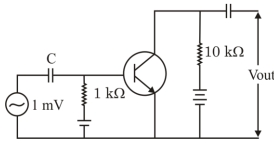
An $n-p-n$ transistor with current gain $\beta=100$ in common emitter configuration is shown in the figure. The output voltage of the amplifier will be $.....V$.
A
$0.1$
B
$1.0$
C
$10$
D
$100$
Solution
(B) The voltage gain $A_v$ of a common emitter amplifier is given by the formula:
$A_v = \frac{v_{\text{out}}}{v_{\text{in}}} = \beta \frac{R_{\text{out}}}{R_{\text{in}}}$
Given:
$\beta = 100$
$R_{\text{in}} = 1 \text{ k}\Omega = 10^3 \, \Omega$
$R_{\text{out}} = 10 \text{ k}\Omega = 10^4 \, \Omega$
$v_{\text{in}} = 1 \text{ mV} = 10^{-3} \, \text{V}$
Substituting the values:
$v_{\text{out}} = v_{\text{in}} \times \beta \times \frac{R_{\text{out}}}{R_{\text{in}}}$
$v_{\text{out}} = 10^{-3} \times 100 \times \frac{10 \times 10^3}{1 \times 10^3}$
$v_{\text{out}} = 10^{-3} \times 100 \times 10$
$v_{\text{out}} = 1 \, \text{V}$
$A_v = \frac{v_{\text{out}}}{v_{\text{in}}} = \beta \frac{R_{\text{out}}}{R_{\text{in}}}$
Given:
$\beta = 100$
$R_{\text{in}} = 1 \text{ k}\Omega = 10^3 \, \Omega$
$R_{\text{out}} = 10 \text{ k}\Omega = 10^4 \, \Omega$
$v_{\text{in}} = 1 \text{ mV} = 10^{-3} \, \text{V}$
Substituting the values:
$v_{\text{out}} = v_{\text{in}} \times \beta \times \frac{R_{\text{out}}}{R_{\text{in}}}$
$v_{\text{out}} = 10^{-3} \times 100 \times \frac{10 \times 10^3}{1 \times 10^3}$
$v_{\text{out}} = 10^{-3} \times 100 \times 10$
$v_{\text{out}} = 1 \, \text{V}$
0 likesView Solution
310
PhysicsMediumMCQJEE Main · 2022
An $FM$ broadcast transmitter,using a modulating signal of frequency $20\,kHz$,has a deviation ratio of $10$. The bandwidth required for transmission is $.......kHz$.
A
$220$
B
$180$
C
$360$
D
$440$
Solution
(D) Given:
Modulating frequency $f_m = 20\,kHz$.
Deviation ratio $\beta = 10$.
The deviation ratio is defined as $\beta = \frac{\Delta f}{f_m}$,where $\Delta f$ is the frequency deviation.
Therefore,$\Delta f = \beta \times f_m = 10 \times 20\,kHz = 200\,kHz$.
According to Carson's rule,the bandwidth $BW$ required for an $FM$ signal is given by:
$BW = 2(\Delta f + f_m)$
$BW = 2(200\,kHz + 20\,kHz)$
$BW = 2(220\,kHz) = 440\,kHz$.
Modulating frequency $f_m = 20\,kHz$.
Deviation ratio $\beta = 10$.
The deviation ratio is defined as $\beta = \frac{\Delta f}{f_m}$,where $\Delta f$ is the frequency deviation.
Therefore,$\Delta f = \beta \times f_m = 10 \times 20\,kHz = 200\,kHz$.
According to Carson's rule,the bandwidth $BW$ required for an $FM$ signal is given by:
$BW = 2(\Delta f + f_m)$
$BW = 2(200\,kHz + 20\,kHz)$
$BW = 2(220\,kHz) = 440\,kHz$.
0 likesView Solution
311
PhysicsMediumMCQJEE Main · 2022
An electrical bulb rated $220\,V, 100\,W$ is connected in series with another bulb rated $220\,V, 60\,W$. If the voltage across the combination is $220\,V$,the power consumed by the $100\,W$ bulb will be about $........... W$.
A
$14$
B
$13$
C
$12$
D
$11$
Solution
(A) First,calculate the resistance of each bulb using the formula $R = \frac{V^2}{P}$.
For the $100\,W$ bulb: $R_1 = \frac{220^2}{100} = 484\,\Omega$.
For the $60\,W$ bulb: $R_2 = \frac{220^2}{60} = \frac{4840}{6} = 806.67\,\Omega$.
When connected in series,the total resistance $R_{eq} = R_1 + R_2 = 484 + 806.67 = 1290.67\,\Omega$.
The current $I$ flowing through the series combination is $I = \frac{V_{total}}{R_{eq}} = \frac{220}{1290.67} \approx 0.17045\,A$.
The power consumed by the $100\,W$ bulb is $P_1 = I^2 R_1 = (0.17045)^2 \times 484 \approx 0.02905 \times 484 \approx 14.06\,W$.
Thus,the power consumed is approximately $14\,W$.
For the $100\,W$ bulb: $R_1 = \frac{220^2}{100} = 484\,\Omega$.
For the $60\,W$ bulb: $R_2 = \frac{220^2}{60} = \frac{4840}{6} = 806.67\,\Omega$.
When connected in series,the total resistance $R_{eq} = R_1 + R_2 = 484 + 806.67 = 1290.67\,\Omega$.
The current $I$ flowing through the series combination is $I = \frac{V_{total}}{R_{eq}} = \frac{220}{1290.67} \approx 0.17045\,A$.
The power consumed by the $100\,W$ bulb is $P_1 = I^2 R_1 = (0.17045)^2 \times 484 \approx 0.02905 \times 484 \approx 14.06\,W$.
Thus,the power consumed is approximately $14\,W$.
0 likesView Solution
312
PhysicsMediumMCQJEE Main · 2022
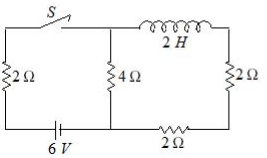
For the given circuit,the current through the battery of $6\,V$ just after closing the switch $S$ will be $.......A$.
A
$3$
B
$2$
C
$0$
D
$1$
Solution
(D) Just after closing the switch $S$ $(t = 0)$,the inductor opposes any change in current,so it behaves as an open circuit (infinite resistance).
Therefore,the branch containing the inductor carries no current.
The circuit simplifies to the $6\,V$ battery in series with the $2\,\Omega$ resistor and the $4\,\Omega$ resistor.
The total resistance of the circuit is $R_{eq} = 2\,\Omega + 4\,\Omega = 6\,\Omega$.
Using Ohm's law,the current through the battery is $I = \frac{V}{R_{eq}} = \frac{6\,V}{6\,\Omega} = 1\,A$.
Therefore,the branch containing the inductor carries no current.
The circuit simplifies to the $6\,V$ battery in series with the $2\,\Omega$ resistor and the $4\,\Omega$ resistor.
The total resistance of the circuit is $R_{eq} = 2\,\Omega + 4\,\Omega = 6\,\Omega$.
Using Ohm's law,the current through the battery is $I = \frac{V}{R_{eq}} = \frac{6\,V}{6\,\Omega} = 1\,A$.
0 likesView Solution
313
PhysicsDifficultMCQJEE Main · 2022
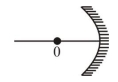
An object ' $O$ ' is placed at a distance of $100\,cm$ in front of a concave mirror of radius of curvature $200\,cm$ as shown in the figure. The object starts moving towards the mirror at a speed of $2\,cm/s$. The position of the image from the mirror after $10\,s$ will be at ...... $cm$.
A
$40$
B
$405$
C
$402$
D
$400$
Solution
(D) Given: Initial distance of object $u_0 = -100\,cm$. Radius of curvature $R = -200\,cm$. Focal length $f = R/2 = -100\,cm$.
Speed of object $v_{obj} = 2\,cm/s$ towards the mirror.
After time $t = 10\,s$,the distance moved by the object is $d = v_{obj} \times t = 2\,cm/s \times 10\,s = 20\,cm$.
The new position of the object from the mirror is $u = u_0 + d = -100\,cm + 20\,cm = -80\,cm$.
Using the mirror formula: $\frac{1}{v} + \frac{1}{u} = \frac{1}{f}$.
Substituting the values: $\frac{1}{v} + \frac{1}{-80} = \frac{1}{-100}$.
$\frac{1}{v} = \frac{1}{80} - \frac{1}{100} = \frac{5 - 4}{400} = \frac{1}{400}$.
Therefore,$v = 400\,cm$.
Speed of object $v_{obj} = 2\,cm/s$ towards the mirror.
After time $t = 10\,s$,the distance moved by the object is $d = v_{obj} \times t = 2\,cm/s \times 10\,s = 20\,cm$.
The new position of the object from the mirror is $u = u_0 + d = -100\,cm + 20\,cm = -80\,cm$.
Using the mirror formula: $\frac{1}{v} + \frac{1}{u} = \frac{1}{f}$.
Substituting the values: $\frac{1}{v} + \frac{1}{-80} = \frac{1}{-100}$.
$\frac{1}{v} = \frac{1}{80} - \frac{1}{100} = \frac{5 - 4}{400} = \frac{1}{400}$.
Therefore,$v = 400\,cm$.
0 likesView Solution
314
PhysicsMediumMCQJEE Main · 2022
In an experiment with a convex lens,the plot of the image distance $(v')$ against the object distance $(u')$ measured from the focus gives a curve $v' u' = 225$. If all the distances are measured in $cm$,the magnitude of the focal length of the lens is $cm$.
A
$14$
B
$15$
C
$18$
D
$19$
Solution
(B) According to Newton's lens formula,when distances are measured from the focus,the relationship between the image distance $(v')$ and the object distance $(u')$ is given by $v' u' = f^2$,where $f$ is the focal length of the lens.
Given the equation of the curve is $v' u' = 225$.
Comparing this with $v' u' = f^2$,we get $f^2 = 225$.
Taking the square root of both sides,$f = \sqrt{225} = 15 \, cm$.
Therefore,the magnitude of the focal length of the lens is $15 \, cm$.
Given the equation of the curve is $v' u' = 225$.
Comparing this with $v' u' = f^2$,we get $f^2 = 225$.
Taking the square root of both sides,$f = \sqrt{225} = 15 \, cm$.
Therefore,the magnitude of the focal length of the lens is $15 \, cm$.
0 likesView Solution
315
PhysicsMediumMCQJEE Main · 2022
The dimensions of $\left(\frac{B^{2}}{\mu_{0}}\right)$ will be. (where $\mu_{0}$ is the permeability of free space and $B$ is the magnetic field)
A
$[ML^{2}T^{-2}]$
B
$[MLT^{-2}]$
C
$[ML^{-1}T^{-2}]$
D
$[ML^{2}T^{-2}A^{-1}]$
Solution
(C) The energy density $u$ associated with a magnetic field $B$ is given by the formula $u = \frac{B^{2}}{2\mu_{0}}$.
Here,$u$ represents the energy per unit volume.
The dimensions of energy are $[ML^{2}T^{-2}]$ and the dimensions of volume are $[L^{3}]$.
Therefore,the dimensions of energy density $u$ are $\frac{[ML^{2}T^{-2}]}{[L^{3}]} = [ML^{-1}T^{-2}]$.
Since $\frac{B^{2}}{\mu_{0}} = 2u$,the dimensions of $\left(\frac{B^{2}}{\mu_{0}}\right)$ are the same as the dimensions of $u$,which is $[ML^{-1}T^{-2}]$.
Here,$u$ represents the energy per unit volume.
The dimensions of energy are $[ML^{2}T^{-2}]$ and the dimensions of volume are $[L^{3}]$.
Therefore,the dimensions of energy density $u$ are $\frac{[ML^{2}T^{-2}]}{[L^{3}]} = [ML^{-1}T^{-2}]$.
Since $\frac{B^{2}}{\mu_{0}} = 2u$,the dimensions of $\left(\frac{B^{2}}{\mu_{0}}\right)$ are the same as the dimensions of $u$,which is $[ML^{-1}T^{-2}]$.
0 likesView Solution
316
PhysicsMediumMCQJEE Main · 2022
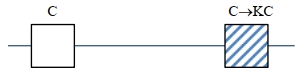
Two capacitors,each having capacitance $40\,\mu F$,are connected in series. The space between the plates of one of the capacitors is filled with a dielectric material of dielectric constant $K$ such that the equivalent capacitance of the system becomes $24\,\mu F$. The value of $K$ is:
A
$1.5$
B
$2.5$
C
$1.2$
D
$3$
Solution
(A) Let the initial capacitance of each capacitor be $C = 40\,\mu F$.
When a dielectric of constant $K$ is inserted into one capacitor,its new capacitance becomes $C' = KC$.
The two capacitors are connected in series,so the equivalent capacitance $C_{eq}$ is given by:
$C_{eq} = \frac{C \cdot C'}{C + C'} = \frac{C \cdot (KC)}{C + KC} = \frac{KC}{K + 1}$
Given $C_{eq} = 24\,\mu F$ and $C = 40\,\mu F$,we have:
$24 = \frac{K \cdot 40}{K + 1}$
$24(K + 1) = 40K$
$24K + 24 = 40K$
$16K = 24$
$K = \frac{24}{16} = 1.5$
When a dielectric of constant $K$ is inserted into one capacitor,its new capacitance becomes $C' = KC$.
The two capacitors are connected in series,so the equivalent capacitance $C_{eq}$ is given by:
$C_{eq} = \frac{C \cdot C'}{C + C'} = \frac{C \cdot (KC)}{C + KC} = \frac{KC}{K + 1}$
Given $C_{eq} = 24\,\mu F$ and $C = 40\,\mu F$,we have:
$24 = \frac{K \cdot 40}{K + 1}$
$24(K + 1) = 40K$
$24K + 24 = 40K$
$16K = 24$
$K = \frac{24}{16} = 1.5$
0 likesView Solution
317
PhysicsEasyMCQJEE Main · 2022
$A$ wire of resistance $R_{1}$ is drawn out so that its length is increased by twice of its original length. The ratio of the new resistance to the original resistance is:
A
$9: 1$
B
$1: 9$
C
$4: 1$
D
$3: 1$
Solution
(A) Let the original length be $L_{1}$ and the original area be $A_{1}$. The original resistance is $R_{1} = \rho \frac{L_{1}}{A_{1}}$.
When the length is increased by twice its original length,the new length $L_{2} = L_{1} + 2L_{1} = 3L_{1}$.
Since the volume of the wire remains constant,$A_{1}L_{1} = A_{2}L_{2}$.
Thus,$A_{2} = A_{1} \frac{L_{1}}{L_{2}} = A_{1} \frac{L_{1}}{3L_{1}} = \frac{A_{1}}{3}$.
The new resistance is $R_{2} = \rho \frac{L_{2}}{A_{2}} = \rho \frac{3L_{1}}{A_{1}/3} = 9 \rho \frac{L_{1}}{A_{1}}$.
Therefore,the ratio $\frac{R_{2}}{R_{1}} = \frac{9 \rho (L_{1}/A_{1})}{\rho (L_{1}/A_{1})} = 9:1$.
When the length is increased by twice its original length,the new length $L_{2} = L_{1} + 2L_{1} = 3L_{1}$.
Since the volume of the wire remains constant,$A_{1}L_{1} = A_{2}L_{2}$.
Thus,$A_{2} = A_{1} \frac{L_{1}}{L_{2}} = A_{1} \frac{L_{1}}{3L_{1}} = \frac{A_{1}}{3}$.
The new resistance is $R_{2} = \rho \frac{L_{2}}{A_{2}} = \rho \frac{3L_{1}}{A_{1}/3} = 9 \rho \frac{L_{1}}{A_{1}}$.
Therefore,the ratio $\frac{R_{2}}{R_{1}} = \frac{9 \rho (L_{1}/A_{1})}{\rho (L_{1}/A_{1})} = 9:1$.
0 likesView Solution
318
PhysicsMediumMCQJEE Main · 2022
The current sensitivity of a galvanometer can be increased by:
$(A)$ decreasing the number of turns
$(B)$ increasing the magnetic field
$(C)$ decreasing the area of the coil
$(D)$ decreasing the torsional constant of the spring
Choose the most appropriate answer from the options given below.
$(A)$ decreasing the number of turns
$(B)$ increasing the magnetic field
$(C)$ decreasing the area of the coil
$(D)$ decreasing the torsional constant of the spring
Choose the most appropriate answer from the options given below.
A
$(B)$ and $(C)$ only
B
$(C)$ and $(D)$ only
C
$(A)$ and $(C)$ only
D
$(B)$ and $(D)$ only
Solution
(D) The current sensitivity $(I_s)$ of a galvanometer is defined as the deflection produced per unit current,given by the formula:
$I_s = \frac{\theta}{i} = \frac{NAB}{K}$
where:
$N$ = number of turns in the coil
$A$ = area of the coil
$B$ = magnetic field strength
$K$ = torsional constant of the spring
From the formula,$I_s \propto N$,$I_s \propto A$,$I_s \propto B$,and $I_s \propto \frac{1}{K}$.
To increase the current sensitivity,we must:
$1$. Increase the number of turns $(N)$.
$2$. Increase the area of the coil $(A)$.
$3$. Increase the magnetic field $(B)$.
$4$. Decrease the torsional constant of the spring $(K)$.
Comparing these requirements with the given options,increasing the magnetic field $(B)$ and decreasing the torsional constant $(D)$ will increase the current sensitivity. Therefore,the correct option is $(B)$ and $(D)$ only.
$I_s = \frac{\theta}{i} = \frac{NAB}{K}$
where:
$N$ = number of turns in the coil
$A$ = area of the coil
$B$ = magnetic field strength
$K$ = torsional constant of the spring
From the formula,$I_s \propto N$,$I_s \propto A$,$I_s \propto B$,and $I_s \propto \frac{1}{K}$.
To increase the current sensitivity,we must:
$1$. Increase the number of turns $(N)$.
$2$. Increase the area of the coil $(A)$.
$3$. Increase the magnetic field $(B)$.
$4$. Decrease the torsional constant of the spring $(K)$.
Comparing these requirements with the given options,increasing the magnetic field $(B)$ and decreasing the torsional constant $(D)$ will increase the current sensitivity. Therefore,the correct option is $(B)$ and $(D)$ only.
0 likesView Solution
319
PhysicsMediumMCQJEE Main · 2022
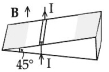
As shown in the figure, a metallic rod of linear density $0.45\,kg\,m^{-1}$ is lying horizontally on a smooth inclined plane which makes an angle of $45^{\circ}$ with the horizontal. The minimum current flowing in the rod required to keep it stationary, when a $0.15\,T$ magnetic field is acting on it in the vertical upward direction, will be $....A$ $\{$Use $g=10\,m/s^2\}$
A
$30$
B
$15$
C
$10$
D
$3$
Solution
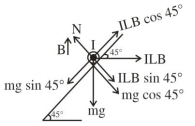
(A) The forces acting on the rod are its weight $(mg)$ acting vertically downwards, the normal force $(N)$ perpendicular to the inclined plane, and the magnetic force $(F_m = ILB)$ acting horizontally (since the magnetic field $B$ is vertical and the current $I$ is horizontal).
To keep the rod stationary, the component of the gravitational force along the inclined plane must be balanced by the component of the magnetic force along the inclined plane.
The component of the gravitational force along the incline is $mg \sin 45^{\circ}$.
The magnetic force $F_m = ILB$ acts horizontally. Its component along the inclined plane is $F_m \cos 45^{\circ} = ILB \cos 45^{\circ}$.
Equating these two components for equilibrium:
$mg \sin 45^{\circ} = ILB \cos 45^{\circ}$
Since $\sin 45^{\circ} = \cos 45^{\circ}$, we can simplify the equation:
$mg = ILB$
Given the linear density $\lambda = \frac{m}{L} = 0.45\,kg/m$, $g = 10\,m/s^2$, and $B = 0.15\,T$:
$I = \frac{mg}{LB} = \left(\frac{m}{L}\right) \frac{g}{B}$
Substituting the values:
$I = \frac{0.45 \times 10}{0.15} = \frac{4.5}{0.15} = 30\,A$
Therefore, the minimum current required is $30\,A$.
To keep the rod stationary, the component of the gravitational force along the inclined plane must be balanced by the component of the magnetic force along the inclined plane.
The component of the gravitational force along the incline is $mg \sin 45^{\circ}$.
The magnetic force $F_m = ILB$ acts horizontally. Its component along the inclined plane is $F_m \cos 45^{\circ} = ILB \cos 45^{\circ}$.
Equating these two components for equilibrium:
$mg \sin 45^{\circ} = ILB \cos 45^{\circ}$
Since $\sin 45^{\circ} = \cos 45^{\circ}$, we can simplify the equation:
$mg = ILB$
Given the linear density $\lambda = \frac{m}{L} = 0.45\,kg/m$, $g = 10\,m/s^2$, and $B = 0.15\,T$:
$I = \frac{mg}{LB} = \left(\frac{m}{L}\right) \frac{g}{B}$
Substituting the values:
$I = \frac{0.45 \times 10}{0.15} = \frac{4.5}{0.15} = 30\,A$
Therefore, the minimum current required is $30\,A$.
1 likesView Solution
320
PhysicsMediumMCQJEE Main · 2022
The equation of current in a purely inductive circuit is $i = 5 \sin (49 \pi t - 30^{\circ})$. If the inductance is $30 \, mH$,then the equation for the voltage across the inductor will be. (Let $\pi = \frac{22}{7}$)
A
$1.47 \sin (49 \pi t - 30^{\circ})$
B
$1.47 \sin (49 \pi t + 60^{\circ})$
C
$23.1 \sin (49 \pi t - 30^{\circ})$
D
$23.1 \sin (49 \pi t + 60^{\circ})$
Solution
(D) The given current equation is $i = i_0 \sin (\omega t - 30^{\circ})$,where $i_0 = 5 \, A$ and $\omega = 49 \pi \, rad/s$.
In a purely inductive circuit,the inductive reactance is $X_L = \omega L$.
Given $L = 30 \, mH = 30 \times 10^{-3} \, H$.
$X_L = (49 \times \frac{22}{7}) \times 30 \times 10^{-3} = (7 \times 22) \times 30 \times 10^{-3} = 154 \times 30 \times 10^{-3} = 4.62 \, \Omega$.
The peak voltage is $v_0 = i_0 X_L = 5 \times 4.62 = 23.1 \, V$.
In a purely inductive circuit,the voltage leads the current by $90^{\circ}$.
Therefore,the phase of the voltage is $(-30^{\circ} + 90^{\circ}) = +60^{\circ}$.
The voltage equation is $v = v_0 \sin (\omega t + 60^{\circ}) = 23.1 \sin (49 \pi t + 60^{\circ})$.
In a purely inductive circuit,the inductive reactance is $X_L = \omega L$.
Given $L = 30 \, mH = 30 \times 10^{-3} \, H$.
$X_L = (49 \times \frac{22}{7}) \times 30 \times 10^{-3} = (7 \times 22) \times 30 \times 10^{-3} = 154 \times 30 \times 10^{-3} = 4.62 \, \Omega$.
The peak voltage is $v_0 = i_0 X_L = 5 \times 4.62 = 23.1 \, V$.
In a purely inductive circuit,the voltage leads the current by $90^{\circ}$.
Therefore,the phase of the voltage is $(-30^{\circ} + 90^{\circ}) = +60^{\circ}$.
The voltage equation is $v = v_0 \sin (\omega t + 60^{\circ}) = 23.1 \sin (49 \pi t + 60^{\circ})$.
0 likesView Solution
321
PhysicsMediumMCQJEE Main · 2022
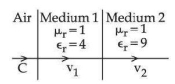
As shown in the figure,after passing through medium $1$,the speed of light $v_{2}$ in medium $2$ will be $..... \times 10^{8} \, ms^{-1}$. (Given $c = 3 \times 10^{8} \, ms^{-1}$)
A
$1.0$
B
$0.5$
C
$1.5$
D
$3.0$
Solution
(A) The refractive index of a medium is given by $n = \sqrt{\mu_{r} \varepsilon_{r}}$.
For medium $2$,the refractive index is $n_{2} = \sqrt{\mu_{r2} \varepsilon_{r2}} = \sqrt{1 \times 9} = 3$.
The speed of light in a medium is related to the speed of light in vacuum $c$ by the formula $v = \frac{c}{n}$.
Therefore,the speed of light in medium $2$ is $v_{2} = \frac{c}{n_{2}} = \frac{3 \times 10^{8} \, ms^{-1}}{3} = 1 \times 10^{8} \, ms^{-1}$.
Thus,the value is $1.0 \times 10^{8} \, ms^{-1}$.
For medium $2$,the refractive index is $n_{2} = \sqrt{\mu_{r2} \varepsilon_{r2}} = \sqrt{1 \times 9} = 3$.
The speed of light in a medium is related to the speed of light in vacuum $c$ by the formula $v = \frac{c}{n}$.
Therefore,the speed of light in medium $2$ is $v_{2} = \frac{c}{n_{2}} = \frac{3 \times 10^{8} \, ms^{-1}}{3} = 1 \times 10^{8} \, ms^{-1}$.
Thus,the value is $1.0 \times 10^{8} \, ms^{-1}$.
0 likesView Solution
322
PhysicsMediumMCQJEE Main · 2022
In normal adjustment,for a refracting telescope,the distance between the objective and the eyepiece is $30\,cm$. The focal length of the objective,when the angular magnification of the telescope is $2$,will be $.....\,cm$.
A
$20$
B
$30$
C
$10$
D
$15$
Solution
(A) In normal adjustment,the length of the telescope $L$ is given by $L = f_o + f_e$,where $f_o$ is the focal length of the objective and $f_e$ is the focal length of the eyepiece.
Given $L = 30\,cm$,so $f_o + f_e = 30$ (Equation $1$).
The angular magnification $m$ for a telescope in normal adjustment is given by $m = \frac{f_o}{f_e}$.
Given $m = 2$,so $\frac{f_o}{f_e} = 2$,which implies $f_o = 2f_e$ (Equation $2$).
Substituting Equation $2$ into Equation $1$:
$2f_e + f_e = 30$
$3f_e = 30$
$f_e = 10\,cm$.
Now,substituting $f_e$ back into Equation $2$:
$f_o = 2 \times 10 = 20\,cm$.
Thus,the focal length of the objective is $20\,cm$.
Given $L = 30\,cm$,so $f_o + f_e = 30$ (Equation $1$).
The angular magnification $m$ for a telescope in normal adjustment is given by $m = \frac{f_o}{f_e}$.
Given $m = 2$,so $\frac{f_o}{f_e} = 2$,which implies $f_o = 2f_e$ (Equation $2$).
Substituting Equation $2$ into Equation $1$:
$2f_e + f_e = 30$
$3f_e = 30$
$f_e = 10\,cm$.
Now,substituting $f_e$ back into Equation $2$:
$f_o = 2 \times 10 = 20\,cm$.
Thus,the focal length of the objective is $20\,cm$.
0 likesView Solution
323
PhysicsEasyMCQJEE Main · 2022
The equation $\lambda = \frac{1.227}{x} \text{ nm}$ can be used to find the de-Broglie wavelength of an electron. In this equation,$x$ stands for:
A
$\sqrt{mK}$
B
$\sqrt{P}$
C
$\sqrt{K}$
D
$\sqrt{V}$
Solution
(D) The de-Broglie wavelength is given by $\lambda = \frac{h}{p}$.
Since kinetic energy $K = \frac{p^2}{2m}$,we have $p = \sqrt{2mK}$.
For an electron accelerated through a potential $V$,the kinetic energy $K = eV$,where $e$ is the charge of the electron.
Thus,$\lambda = \frac{h}{\sqrt{2meV}}$.
Substituting the values of Planck's constant $h = 6.626 \times 10^{-34} \text{ J s}$,mass of electron $m = 9.11 \times 10^{-31} \text{ kg}$,and charge $e = 1.602 \times 10^{-19} \text{ C}$:
$\lambda = \frac{6.626 \times 10^{-34}}{\sqrt{2 \times 9.11 \times 10^{-31} \times 1.602 \times 10^{-19} \times V}} \text{ m}$.
Calculating this gives $\lambda \approx \frac{1.227 \times 10^{-9}}{\sqrt{V}} \text{ m} = \frac{1.227}{\sqrt{V}} \text{ nm}$.
Comparing this with $\lambda = \frac{1.227}{x} \text{ nm}$,we find $x = \sqrt{V}$.
Since kinetic energy $K = \frac{p^2}{2m}$,we have $p = \sqrt{2mK}$.
For an electron accelerated through a potential $V$,the kinetic energy $K = eV$,where $e$ is the charge of the electron.
Thus,$\lambda = \frac{h}{\sqrt{2meV}}$.
Substituting the values of Planck's constant $h = 6.626 \times 10^{-34} \text{ J s}$,mass of electron $m = 9.11 \times 10^{-31} \text{ kg}$,and charge $e = 1.602 \times 10^{-19} \text{ C}$:
$\lambda = \frac{6.626 \times 10^{-34}}{\sqrt{2 \times 9.11 \times 10^{-31} \times 1.602 \times 10^{-19} \times V}} \text{ m}$.
Calculating this gives $\lambda \approx \frac{1.227 \times 10^{-9}}{\sqrt{V}} \text{ m} = \frac{1.227}{\sqrt{V}} \text{ nm}$.
Comparing this with $\lambda = \frac{1.227}{x} \text{ nm}$,we find $x = \sqrt{V}$.
0 likesView Solution
324
PhysicsMediumMCQJEE Main · 2022
The half-life period of a radioactive substance is $60 \ days$. The time taken for $\frac{7}{8}$ of its original mass to disintegrate will be $...... \ days$.
A
$120$
B
$130$
C
$180$
D
$20$
Solution
(C) Given that the half-life $T_{1/2} = 60 \ days$.
If $\frac{7}{8}$ of the original mass disintegrates,the remaining mass $N$ is $N = N_0 - \frac{7}{8}N_0 = \frac{1}{8}N_0$.
The relation between remaining mass and initial mass is given by $N = N_0 \left(\frac{1}{2}\right)^n$,where $n$ is the number of half-lives.
Substituting the values: $\frac{1}{8}N_0 = N_0 \left(\frac{1}{2}\right)^n$.
This simplifies to $\left(\frac{1}{2}\right)^3 = \left(\frac{1}{2}\right)^n$,which gives $n = 3$.
The total time taken $t = n \times T_{1/2} = 3 \times 60 \ days = 180 \ days$.
If $\frac{7}{8}$ of the original mass disintegrates,the remaining mass $N$ is $N = N_0 - \frac{7}{8}N_0 = \frac{1}{8}N_0$.
The relation between remaining mass and initial mass is given by $N = N_0 \left(\frac{1}{2}\right)^n$,where $n$ is the number of half-lives.
Substituting the values: $\frac{1}{8}N_0 = N_0 \left(\frac{1}{2}\right)^n$.
This simplifies to $\left(\frac{1}{2}\right)^3 = \left(\frac{1}{2}\right)^n$,which gives $n = 3$.
The total time taken $t = n \times T_{1/2} = 3 \times 60 \ days = 180 \ days$.
0 likesView Solution
325
PhysicsMediumMCQJEE Main · 2022
Identify the solar cell characteristics from the following options.
A
B
C
D
Solution
(B) solar cell is a $p-n$ junction diode that converts light energy into electrical energy. It operates in the fourth quadrant of the $I-V$ characteristic curve. In this quadrant,the voltage is positive (forward bias) while the current is negative (as the device acts as a source,delivering power to an external circuit). Therefore,the characteristic curve of a solar cell is represented by the graph in the fourth quadrant.
0 likesView Solution
326
PhysicsMediumMCQJEE Main · 2022
In the case of amplitude modulation,to avoid distortion,the modulation index $(\mu)$ should be:
A
$\mu \leq 1$
B
$\mu \geq 1$
C
$\mu = 2$
D
$\mu = 0$
Solution
(A) The modulation index is defined as $\mu = \frac{A_m}{A_c}$,where $A_m$ is the amplitude of the message signal and $A_c$ is the amplitude of the carrier wave.
To avoid distortion in the amplitude modulated wave,the modulation index must satisfy the condition $\mu \leq 1$.
If $\mu > 1$,over-modulation occurs,which leads to the distortion of the signal and interference between the carrier frequency and the message frequency.
To avoid distortion in the amplitude modulated wave,the modulation index must satisfy the condition $\mu \leq 1$.
If $\mu > 1$,over-modulation occurs,which leads to the distortion of the signal and interference between the carrier frequency and the message frequency.
0 likesView Solution
327
PhysicsMediumMCQJEE Main · 2022
$A$ freshly prepared radioactive source of half-life $2$ hours $30$ minutes emits radiation which is $64$ times the permissible safe level. The minimum time,after which it would be possible to work safely with the source,will be in hours.
A
$14$
B
$18$
C
$15$
D
$75$
Solution
(C) The radioactive decay law is given by $A = A_0 \times (1/2)^{t/T}$,where $A$ is the activity at time $t$,$A_0$ is the initial activity,and $T$ is the half-life.
Given,$A_0 = 64 \times A_{safe}$ and we want to find the time $t$ when $A = A_{safe}$.
Substituting these values: $A_{safe} = 64 \times A_{safe} \times (1/2)^{t/T}$.
This simplifies to $1/64 = (1/2)^{t/T}$.
Since $64 = 2^6$,we have $(1/2)^6 = (1/2)^{t/T}$.
Therefore,$t/T = 6$,which means $t = 6 \times T$.
Given the half-life $T = 2$ hours $30$ minutes = $2.5$ hours.
Thus,$t = 6 \times 2.5 = 15$ hours.
Given,$A_0 = 64 \times A_{safe}$ and we want to find the time $t$ when $A = A_{safe}$.
Substituting these values: $A_{safe} = 64 \times A_{safe} \times (1/2)^{t/T}$.
This simplifies to $1/64 = (1/2)^{t/T}$.
Since $64 = 2^6$,we have $(1/2)^6 = (1/2)^{t/T}$.
Therefore,$t/T = 6$,which means $t = 6 \times T$.
Given the half-life $T = 2$ hours $30$ minutes = $2.5$ hours.
Thus,$t = 6 \times 2.5 = 15$ hours.
0 likesView Solution
328
PhysicsMediumMCQJEE Main · 2022
In a Young's double slit experiment,a laser light of $560\,nm$ produces an interference pattern with consecutive bright fringes' separation of $7.2\,mm$. Now another light is used to produce an interference pattern with consecutive bright fringes' separation of $8.1\,mm$. The wavelength of the second light is $......nm$.
A
$600$
B
$620$
C
$630$
D
$645$
Solution
(C) The fringe width $\beta$ in a Young's double slit experiment is given by $\beta = \frac{\lambda D}{d}$.
Since $D$ and $d$ are constant,we have $\beta \propto \lambda$.
Therefore,$\frac{\beta_2}{\beta_1} = \frac{\lambda_2}{\lambda_1}$.
Given $\beta_1 = 7.2\,mm$,$\lambda_1 = 560\,nm$,and $\beta_2 = 8.1\,mm$.
Substituting the values: $\frac{8.1}{7.2} = \frac{\lambda_2}{560}$.
$\lambda_2 = \frac{8.1}{7.2} \times 560 = \frac{9}{8} \times 560$.
$\lambda_2 = 9 \times 70 = 630\,nm$.
Since $D$ and $d$ are constant,we have $\beta \propto \lambda$.
Therefore,$\frac{\beta_2}{\beta_1} = \frac{\lambda_2}{\lambda_1}$.
Given $\beta_1 = 7.2\,mm$,$\lambda_1 = 560\,nm$,and $\beta_2 = 8.1\,mm$.
Substituting the values: $\frac{8.1}{7.2} = \frac{\lambda_2}{560}$.
$\lambda_2 = \frac{8.1}{7.2} \times 560 = \frac{9}{8} \times 560$.
$\lambda_2 = 9 \times 70 = 630\,nm$.
0 likesView Solution
329
PhysicsMediumMCQJEE Main · 2022
The frequencies at which the current amplitude in an $LCR$ series circuit becomes $\frac{1}{\sqrt{2}}$ times its maximum value are $212\,rad\,s^{-1}$ and $232\,rad\,s^{-1}$. The value of resistance in the circuit is $R = 5\,\Omega$. The self-inductance in the circuit is $.........\,mH$.
A
$250$
B
$2489$
C
$254$
D
$552$
Solution
(A) In an $LCR$ series circuit,the frequencies at which the current amplitude becomes $\frac{1}{\sqrt{2}}$ times its maximum value are known as half-power frequencies,denoted as $\omega_1$ and $\omega_2$.
The bandwidth of the circuit is given by $\Delta\omega = \omega_2 - \omega_1$.
Given $\omega_1 = 212\,rad\,s^{-1}$ and $\omega_2 = 232\,rad\,s^{-1}$,the bandwidth is $\Delta\omega = 232 - 212 = 20\,rad\,s^{-1}$.
The formula for bandwidth in an $LCR$ series circuit is $\Delta\omega = \frac{R}{L}$.
Substituting the given values: $20 = \frac{5}{L}$.
Solving for $L$: $L = \frac{5}{20} = 0.25\,H$.
Converting to millihenries $(mH)$: $L = 0.25 \times 1000 = 250\,mH$.
The bandwidth of the circuit is given by $\Delta\omega = \omega_2 - \omega_1$.
Given $\omega_1 = 212\,rad\,s^{-1}$ and $\omega_2 = 232\,rad\,s^{-1}$,the bandwidth is $\Delta\omega = 232 - 212 = 20\,rad\,s^{-1}$.
The formula for bandwidth in an $LCR$ series circuit is $\Delta\omega = \frac{R}{L}$.
Substituting the given values: $20 = \frac{5}{L}$.
Solving for $L$: $L = \frac{5}{20} = 0.25\,H$.
Converting to millihenries $(mH)$: $L = 0.25 \times 1000 = 250\,mH$.
0 likesView Solution
330
PhysicsMediumMCQJEE Main · 2022
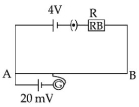
As shown in the figure,a potentiometer wire of resistance $20\,\Omega$ and length $300\,cm$ is connected with a resistance box ($R$.$B$.) and a standard cell of emf $4\,V$. For a resistance '$R$' of the resistance box introduced into the circuit,the null point for a cell of $20\,mV$ is found to be $60\,cm$. The value of '$R$' is $.....\Omega$
A
$780$
B
$78$
C
$870$
D
$654$
Solution
(A) The potential difference across the potentiometer wire $AB$ is given by $V_{AB} = I \times R_{AB}$,where $I$ is the current in the primary circuit.
The current $I$ is given by $I = \frac{E}{R + R_{AB}}$,where $E = 4\,V$ and $R_{AB} = 20\,\Omega$.
So,$V_{AB} = \left( \frac{4}{R + 20} \right) \times 20 = \frac{80}{R + 20}$.
The potential gradient along the wire is $k = \frac{V_{AB}}{L}$,where $L = 300\,cm$.
The emf of the secondary cell is $E' = 20\,mV = 20 \times 10^{-3}\,V$,and the null point length is $l = 60\,cm$.
At the null point,$E' = k \times l = \left( \frac{V_{AB}}{L} \right) \times l$.
Substituting the values: $20 \times 10^{-3} = \left( \frac{80}{R + 20} \right) \times \left( \frac{60}{300} \right)$.
$20 \times 10^{-3} = \left( \frac{80}{R + 20} \right) \times \left( \frac{1}{5} \right)$.
$20 \times 10^{-3} = \frac{16}{R + 20}$.
$R + 20 = \frac{16}{20 \times 10^{-3}} = \frac{16}{0.02} = 800$.
$R = 800 - 20 = 780\,\Omega$.
The current $I$ is given by $I = \frac{E}{R + R_{AB}}$,where $E = 4\,V$ and $R_{AB} = 20\,\Omega$.
So,$V_{AB} = \left( \frac{4}{R + 20} \right) \times 20 = \frac{80}{R + 20}$.
The potential gradient along the wire is $k = \frac{V_{AB}}{L}$,where $L = 300\,cm$.
The emf of the secondary cell is $E' = 20\,mV = 20 \times 10^{-3}\,V$,and the null point length is $l = 60\,cm$.
At the null point,$E' = k \times l = \left( \frac{V_{AB}}{L} \right) \times l$.
Substituting the values: $20 \times 10^{-3} = \left( \frac{80}{R + 20} \right) \times \left( \frac{60}{300} \right)$.
$20 \times 10^{-3} = \left( \frac{80}{R + 20} \right) \times \left( \frac{1}{5} \right)$.
$20 \times 10^{-3} = \frac{16}{R + 20}$.
$R + 20 = \frac{16}{20 \times 10^{-3}} = \frac{16}{0.02} = 800$.
$R = 800 - 20 = 780\,\Omega$.
0 likesView Solution
331
PhysicsMediumMCQJEE Main · 2022
Two electric dipoles of dipole moments $1.2 \times 10^{-30} \, C \cdot m$ and $2.4 \times 10^{-30} \, C \cdot m$ are placed in two different uniform electric fields of strengths $5 \times 10^{4} \, N \cdot C^{-1}$ and $15 \times 10^{4} \, N \cdot C^{-1}$ respectively. The ratio of maximum torque experienced by the electric dipoles will be $\frac{1}{x}$. The value of $x$ is $.....$
A
$6$
B
$9$
C
$61$
D
$3$
Solution
(A) The maximum torque experienced by an electric dipole in a uniform electric field is given by the formula $|\tau|_{\max} = PE$,where $P$ is the dipole moment and $E$ is the electric field strength.
For the first dipole: $P_1 = 1.2 \times 10^{-30} \, C \cdot m$ and $E_1 = 5 \times 10^{4} \, N \cdot C^{-1}$.
For the second dipole: $P_2 = 2.4 \times 10^{-30} \, C \cdot m$ and $E_2 = 15 \times 10^{4} \, N \cdot C^{-1}$.
The ratio of the maximum torques is given by:
$\frac{\tau_1}{\tau_2} = \frac{P_1 E_1}{P_2 E_2} = \frac{(1.2 \times 10^{-30}) \times (5 \times 10^{4})}{(2.4 \times 10^{-30}) \times (15 \times 10^{4})}$
Simplifying the expression:
$\frac{\tau_1}{\tau_2} = \left(\frac{1.2}{2.4}\right) \times \left(\frac{5}{15}\right) = \left(\frac{1}{2}\right) \times \left(\frac{1}{3}\right) = \frac{1}{6}$
Comparing this to $\frac{1}{x}$,we find that $x = 6$.
For the first dipole: $P_1 = 1.2 \times 10^{-30} \, C \cdot m$ and $E_1 = 5 \times 10^{4} \, N \cdot C^{-1}$.
For the second dipole: $P_2 = 2.4 \times 10^{-30} \, C \cdot m$ and $E_2 = 15 \times 10^{4} \, N \cdot C^{-1}$.
The ratio of the maximum torques is given by:
$\frac{\tau_1}{\tau_2} = \frac{P_1 E_1}{P_2 E_2} = \frac{(1.2 \times 10^{-30}) \times (5 \times 10^{4})}{(2.4 \times 10^{-30}) \times (15 \times 10^{4})}$
Simplifying the expression:
$\frac{\tau_1}{\tau_2} = \left(\frac{1.2}{2.4}\right) \times \left(\frac{5}{15}\right) = \left(\frac{1}{2}\right) \times \left(\frac{1}{3}\right) = \frac{1}{6}$
Comparing this to $\frac{1}{x}$,we find that $x = 6$.
0 likesView Solution
332
PhysicsMediumMCQJEE Main · 2022
Two identical metallic spheres $A$ and $B$ when placed at a certain distance in air repel each other with a force of $F$. Another identical uncharged sphere $C$ is first placed in contact with $A$ and then in contact with $B$ and finally placed at the midpoint between spheres $A$ and $B$. The force experienced by sphere $C$ will be:
A
$3F / 2$
B
$3F / 4$
C
$F$
D
$2F$
Solution
(B) Let the initial charges on spheres $A$ and $B$ be $q_A = q_B = q$. The initial force is $F = \frac{Kq^2}{r^2}$.
When sphere $C$ (initially uncharged) is placed in contact with $A$,the charge redistributes equally: $q_A' = q_C' = \frac{q}{2}$.
Now,sphere $C$ is placed in contact with $B$. The total charge is $q + \frac{q}{2} = \frac{3q}{2}$. Upon separation,each gets $q_B' = q_C'' = \frac{3q/2}{2} = \frac{3q}{4}$.
Now,$A$ has charge $\frac{q}{2}$ and $B$ has charge $\frac{3q}{4}$. Sphere $C$ is placed at the midpoint (distance $r/2$ from both).
The force on $C$ due to $A$ is $F_1 = \frac{K(q/2)(3q/4)}{(r/2)^2} = \frac{3Kq^2/8}{r^2/4} = \frac{3Kq^2}{2r^2} = \frac{3F}{2}$ (towards $A$).
The force on $C$ due to $B$ is $F_2 = \frac{K(3q/4)(3q/4)}{(r/2)^2} = \frac{9Kq^2/16}{r^2/4} = \frac{9Kq^2}{4r^2} = \frac{9F}{4}$ (towards $A$).
The net force on $C$ is $F_{net} = F_2 - F_1 = \frac{9F}{4} - \frac{3F}{2} = \frac{9F - 6F}{4} = \frac{3F}{4}$.
When sphere $C$ (initially uncharged) is placed in contact with $A$,the charge redistributes equally: $q_A' = q_C' = \frac{q}{2}$.
Now,sphere $C$ is placed in contact with $B$. The total charge is $q + \frac{q}{2} = \frac{3q}{2}$. Upon separation,each gets $q_B' = q_C'' = \frac{3q/2}{2} = \frac{3q}{4}$.
Now,$A$ has charge $\frac{q}{2}$ and $B$ has charge $\frac{3q}{4}$. Sphere $C$ is placed at the midpoint (distance $r/2$ from both).
The force on $C$ due to $A$ is $F_1 = \frac{K(q/2)(3q/4)}{(r/2)^2} = \frac{3Kq^2/8}{r^2/4} = \frac{3Kq^2}{2r^2} = \frac{3F}{2}$ (towards $A$).
The force on $C$ due to $B$ is $F_2 = \frac{K(3q/4)(3q/4)}{(r/2)^2} = \frac{9Kq^2/16}{r^2/4} = \frac{9Kq^2}{4r^2} = \frac{9F}{4}$ (towards $A$).
The net force on $C$ is $F_{net} = F_2 - F_1 = \frac{9F}{4} - \frac{3F}{2} = \frac{9F - 6F}{4} = \frac{3F}{4}$.
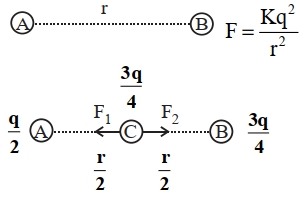
0 likesView Solution
333
PhysicsMediumMCQJEE Main · 2022
Two identical thin metal plates have charges $q_{1}$ and $q_{2}$ respectively,such that $q_{1} > q_{2}$. The plates are brought close to each other to form a parallel plate capacitor of capacitance $C$. The potential difference between them is:
A
$\frac{(q_{1}+q_{2})}{C}$
B
$\frac{(q_{1}-q_{2})}{C}$
C
$\frac{(q_{1}-q_{2})}{2C}$
D
$\frac{2(q_{1}-q_{2})}{C}$
Solution
(C) When two large conducting plates with charges $q_{1}$ and $q_{2}$ are placed parallel to each other,the charge on the inner surfaces is given by $q_{inner} = \frac{q_{1}-q_{2}}{2}$.
The electric field $E$ between the plates is due to these inner charges: $E = \frac{\sigma}{\varepsilon_{0}} = \frac{q_{inner}}{A\varepsilon_{0}} = \frac{q_{1}-q_{2}}{2A\varepsilon_{0}}$.
The potential difference $V$ between the plates is given by $V = E \cdot d$,where $d$ is the separation between the plates.
Since the capacitance of a parallel plate capacitor is $C = \frac{A\varepsilon_{0}}{d}$,we can write $V = \frac{q_{1}-q_{2}}{2A\varepsilon_{0}} \cdot d = \frac{q_{1}-q_{2}}{2(A\varepsilon_{0}/d)}$.
Substituting $C$,we get $V = \frac{q_{1}-q_{2}}{2C}$.
The electric field $E$ between the plates is due to these inner charges: $E = \frac{\sigma}{\varepsilon_{0}} = \frac{q_{inner}}{A\varepsilon_{0}} = \frac{q_{1}-q_{2}}{2A\varepsilon_{0}}$.
The potential difference $V$ between the plates is given by $V = E \cdot d$,where $d$ is the separation between the plates.
Since the capacitance of a parallel plate capacitor is $C = \frac{A\varepsilon_{0}}{d}$,we can write $V = \frac{q_{1}-q_{2}}{2A\varepsilon_{0}} \cdot d = \frac{q_{1}-q_{2}}{2(A\varepsilon_{0}/d)}$.
Substituting $C$,we get $V = \frac{q_{1}-q_{2}}{2C}$.
0 likesView Solution
334
PhysicsMediumMCQJEE Main · 2022
Given below are two statements: one is labelled as Assertion $A$ and the other is labelled as Reason $R$.
Assertion $A:$ Alloys such as constantan and manganin are used in making standard resistance coils.
Reason $R:$ Constantan and manganin have a very small value of temperature coefficient of resistance.
In the light of the above statements, choose the correct answer from the options given below.
Assertion $A:$ Alloys such as constantan and manganin are used in making standard resistance coils.
Reason $R:$ Constantan and manganin have a very small value of temperature coefficient of resistance.
In the light of the above statements, choose the correct answer from the options given below.
A
Both $A$ and $R$ are true and $R$ is the correct explanation of $A$.
B
Both $A$ and $R$ are true but $R$ is $NOT$ the correct explanation of $A$.
C
$A$ is true but $R$ is false.
D
$A$ is false but $R$ is true.
Solution
$(A)$ Standard resistance coils require a resistance value that remains stable despite changes in ambient temperature.
The temperature coefficient of resistance $(\alpha)$ determines how much the resistance changes with temperature according to the formula $R_t = R_0(1 + \alpha \Delta T)$.
Alloys like constantan and manganin are specifically chosen because they possess a very low temperature coefficient of resistance.
This property ensures that the resistance of the coils remains nearly constant even if the temperature fluctuates.
Therefore, Assertion $A$ is true, Reason $R$ is true, and $R$ is the correct explanation of $A$.
The temperature coefficient of resistance $(\alpha)$ determines how much the resistance changes with temperature according to the formula $R_t = R_0(1 + \alpha \Delta T)$.
Alloys like constantan and manganin are specifically chosen because they possess a very low temperature coefficient of resistance.
This property ensures that the resistance of the coils remains nearly constant even if the temperature fluctuates.
Therefore, Assertion $A$ is true, Reason $R$ is true, and $R$ is the correct explanation of $A$.
0 likesView Solution
335
PhysicsMediumMCQJEE Main · 2022
$A$ $1\,m$ long wire is broken into two unequal parts $X$ and $Y$. The $X$ part of the wire is stretched into another wire $W$. The length of $W$ is twice the length of $X$ and the resistance of $W$ is twice that of $Y$. Find the ratio of the length of $X$ to the length of $Y$.
A
$1: 4$
B
$1: 2$
C
$4: 1$
D
$2: 1$
Solution
(B) Let the total length of the wire be $L = 1\,m$. Let the length of part $X$ be $\ell_X$ and the length of part $Y$ be $\ell_Y$. Thus,$\ell_X + \ell_Y = 1$.
The resistance of a wire is given by $R = \rho \frac{\ell}{A}$.
For part $X$,$R_X = \rho \frac{\ell_X}{A_X}$. For part $Y$,$R_Y = \rho \frac{\ell_Y}{A_Y}$.
When wire $X$ is stretched to length $\ell_W = 2\ell_X$,its volume remains constant $(A_X \ell_X = A_W \ell_W)$.
Since $\ell_W = 2\ell_X$,we have $A_W = \frac{A_X}{2}$.
The resistance of wire $W$ is $R_W = \rho \frac{\ell_W}{A_W} = \rho \frac{2\ell_X}{A_X/2} = 4 \left( \rho \frac{\ell_X}{A_X} \right) = 4R_X$.
Given that $R_W = 2R_Y$,we substitute $R_W = 4R_X$ to get $4R_X = 2R_Y$,which implies $R_Y = 2R_X$.
Since both parts $X$ and $Y$ were cut from the same original wire,they have the same cross-sectional area $A$ and resistivity $\rho$. Thus,$R \propto \ell$.
Therefore,$\frac{R_X}{R_Y} = \frac{\ell_X}{\ell_Y}$.
Substituting $R_Y = 2R_X$,we get $\frac{R_X}{2R_X} = \frac{\ell_X}{\ell_Y} = \frac{1}{2}$.
The resistance of a wire is given by $R = \rho \frac{\ell}{A}$.
For part $X$,$R_X = \rho \frac{\ell_X}{A_X}$. For part $Y$,$R_Y = \rho \frac{\ell_Y}{A_Y}$.
When wire $X$ is stretched to length $\ell_W = 2\ell_X$,its volume remains constant $(A_X \ell_X = A_W \ell_W)$.
Since $\ell_W = 2\ell_X$,we have $A_W = \frac{A_X}{2}$.
The resistance of wire $W$ is $R_W = \rho \frac{\ell_W}{A_W} = \rho \frac{2\ell_X}{A_X/2} = 4 \left( \rho \frac{\ell_X}{A_X} \right) = 4R_X$.
Given that $R_W = 2R_Y$,we substitute $R_W = 4R_X$ to get $4R_X = 2R_Y$,which implies $R_Y = 2R_X$.
Since both parts $X$ and $Y$ were cut from the same original wire,they have the same cross-sectional area $A$ and resistivity $\rho$. Thus,$R \propto \ell$.
Therefore,$\frac{R_X}{R_Y} = \frac{\ell_X}{\ell_Y}$.
Substituting $R_Y = 2R_X$,we get $\frac{R_X}{2R_X} = \frac{\ell_X}{\ell_Y} = \frac{1}{2}$.
0 likesView Solution
336
PhysicsMediumMCQJEE Main · 2022
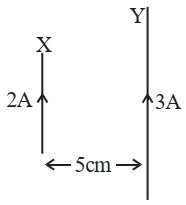
$A$ wire $X$ of length $50 \; cm$ carrying a current of $2 \; A$ is placed parallel to a long wire $Y$ of length $5 \; m$. The wire $Y$ carries a current of $3 \; A$. The distance between the two wires is $5 \; cm$ and the currents flow in the same direction. The force acting on the wire $X$ due to wire $Y$ is:
A
$1.2 \times 10^{-5} \; N$ directed towards wire $Y$.
B
$1.2 \times 10^{-4} \; N$ directed away from wire $Y$.
C
$1.2 \times 10^{-4} \; N$ directed towards wire $Y$.
D
$2.4 \times 10^{-5} \; N$ directed towards wire $Y$.
Solution
(A) The force per unit length between two parallel wires carrying currents $I_1$ and $I_2$ separated by a distance $r$ is given by $f = \frac{\mu_0 I_1 I_2}{2 \pi r}$.
Here,$I_1 = 2 \; A$,$I_2 = 3 \; A$,$r = 5 \; cm = 0.05 \; m$,and the length of wire $X$ is $\ell = 50 \; cm = 0.5 \; m$.
The total force on wire $X$ is $F = f \times \ell = \frac{\mu_0 I_1 I_2 \ell}{2 \pi r}$.
Substituting the values:
$F = \frac{(4 \pi \times 10^{-7} \; T \cdot m/A) \times (2 \; A) \times (3 \; A) \times (0.5 \; m)}{2 \pi \times (0.05 \; m)}$
$F = \frac{2 \times 10^{-7} \times 6 \times 0.5}{0.05} = \frac{6 \times 10^{-7}}{0.05} = 120 \times 10^{-7} = 1.2 \times 10^{-5} \; N$.
Since the currents are in the same direction,the force is attractive,meaning wire $X$ is pulled towards wire $Y$.
Here,$I_1 = 2 \; A$,$I_2 = 3 \; A$,$r = 5 \; cm = 0.05 \; m$,and the length of wire $X$ is $\ell = 50 \; cm = 0.5 \; m$.
The total force on wire $X$ is $F = f \times \ell = \frac{\mu_0 I_1 I_2 \ell}{2 \pi r}$.
Substituting the values:
$F = \frac{(4 \pi \times 10^{-7} \; T \cdot m/A) \times (2 \; A) \times (3 \; A) \times (0.5 \; m)}{2 \pi \times (0.05 \; m)}$
$F = \frac{2 \times 10^{-7} \times 6 \times 0.5}{0.05} = \frac{6 \times 10^{-7}}{0.05} = 120 \times 10^{-7} = 1.2 \times 10^{-5} \; N$.
Since the currents are in the same direction,the force is attractive,meaning wire $X$ is pulled towards wire $Y$.
0 likesView Solution
337
PhysicsMediumMCQJEE Main · 2022
$A$ circuit element $X$ when connected to an a.c. supply of peak voltage $100\,V$ gives a peak current of $5\,A$ which is in phase with the voltage. $A$ second element $Y$ when connected to the same a.c. supply also gives the same value of peak current which lags behind the voltage by $\frac{\pi}{2}$. If $X$ and $Y$ are connected in series to the same supply,what will be the rms value of the current in ampere?
A
$\frac{10}{\sqrt{2}}$
B
$\frac{5}{\sqrt{2}}$
C
$5 \sqrt{2}$
D
$\frac{5}{2}$
Solution
(D) For element $X$,the current is in phase with the voltage,so $X$ is a resistor.
The resistance $R = \frac{V_0}{I_0} = \frac{100}{5} = 20\,\Omega$.
For element $Y$,the current lags behind the voltage by $\frac{\pi}{2}$,so $Y$ is an inductor.
The inductive reactance $X_L = \frac{V_0}{I_0} = \frac{100}{5} = 20\,\Omega$.
When $X$ and $Y$ are connected in series,the total impedance $Z = \sqrt{R^2 + X_L^2} = \sqrt{20^2 + 20^2} = 20\sqrt{2}\,\Omega$.
The peak current in the series circuit is $I_0 = \frac{V_0}{Z} = \frac{100}{20\sqrt{2}} = \frac{5}{\sqrt{2}}\,A$.
The rms current is $I_{rms} = \frac{I_0}{\sqrt{2}} = \frac{5/\sqrt{2}}{\sqrt{2}} = \frac{5}{2}\,A$.
The resistance $R = \frac{V_0}{I_0} = \frac{100}{5} = 20\,\Omega$.
For element $Y$,the current lags behind the voltage by $\frac{\pi}{2}$,so $Y$ is an inductor.
The inductive reactance $X_L = \frac{V_0}{I_0} = \frac{100}{5} = 20\,\Omega$.
When $X$ and $Y$ are connected in series,the total impedance $Z = \sqrt{R^2 + X_L^2} = \sqrt{20^2 + 20^2} = 20\sqrt{2}\,\Omega$.
The peak current in the series circuit is $I_0 = \frac{V_0}{Z} = \frac{100}{20\sqrt{2}} = \frac{5}{\sqrt{2}}\,A$.
The rms current is $I_{rms} = \frac{I_0}{\sqrt{2}} = \frac{5/\sqrt{2}}{\sqrt{2}} = \frac{5}{2}\,A$.
0 likesView Solution
338
PhysicsMediumMCQJEE Main · 2022
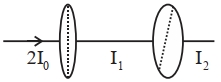
An unpolarised light beam of intensity $2 I_{0}$ is passed through a polaroid $P$ and then through another polaroid $Q$ which is oriented in such a way that its passing axis makes an angle of $30^{\circ}$ relative to that of $P$. The intensity of the emergent light is.
A
$\frac{I_{0}}{4}$
B
$\frac{I_{0}}{2}$
C
$\frac{3 I_{0}}{4}$
D
$\frac{3 I_{0}}{2}$
Solution
(C) When unpolarised light of intensity $I_{in}$ passes through a polaroid, the intensity of the emergent polarised light is $I_{1} = \frac{1}{2} I_{in}$.
Given $I_{in} = 2 I_{0}$, the intensity after passing through polaroid $P$ is $I_{1} = \frac{1}{2} (2 I_{0}) = I_{0}$.
According to Malus' Law, when polarised light of intensity $I_{1}$ passes through a second polaroid whose transmission axis makes an angle $\theta$ with the incident light's polarisation direction, the emergent intensity $I_{2}$ is given by $I_{2} = I_{1} \cos^{2} \theta$.
Here, $\theta = 30^{\circ}$, so $I_{2} = I_{0} \cos^{2} 30^{\circ}$.
Since $\cos 30^{\circ} = \frac{\sqrt{3}}{2}$, we have $\cos^{2} 30^{\circ} = \frac{3}{4}$.
Therefore, $I_{2} = I_{0} \cdot \frac{3}{4} = \frac{3 I_{0}}{4}$.
Given $I_{in} = 2 I_{0}$, the intensity after passing through polaroid $P$ is $I_{1} = \frac{1}{2} (2 I_{0}) = I_{0}$.
According to Malus' Law, when polarised light of intensity $I_{1}$ passes through a second polaroid whose transmission axis makes an angle $\theta$ with the incident light's polarisation direction, the emergent intensity $I_{2}$ is given by $I_{2} = I_{1} \cos^{2} \theta$.
Here, $\theta = 30^{\circ}$, so $I_{2} = I_{0} \cos^{2} 30^{\circ}$.
Since $\cos 30^{\circ} = \frac{\sqrt{3}}{2}$, we have $\cos^{2} 30^{\circ} = \frac{3}{4}$.
Therefore, $I_{2} = I_{0} \cdot \frac{3}{4} = \frac{3 I_{0}}{4}$.
0 likesView Solution
339
PhysicsMediumMCQJEE Main · 2022
An $\alpha$ particle and a proton are accelerated from rest through the same potential difference. The ratio of linear momenta acquired by the above two particles will be:
A
$1 : 2\sqrt{2}$
B
$2\sqrt{2} : 1$
C
$4\sqrt{2} : 1$
D
$8 : 1$
Solution
(B) The kinetic energy $K$ acquired by a particle of charge $q$ accelerated through a potential difference $V$ is given by $K = qV$.
The linear momentum $p$ is related to kinetic energy by the formula $p = \sqrt{2mK} = \sqrt{2mqV}$.
For an $\alpha$ particle,the mass $m_{\alpha} = 4m_p$ and the charge $q_{\alpha} = 2e$,where $m_p$ is the mass of a proton and $e$ is the elementary charge.
For a proton,the mass is $m_p$ and the charge is $q_p = e$.
The ratio of their momenta is $\frac{p_{\alpha}}{p_p} = \sqrt{\frac{m_{\alpha} q_{\alpha}}{m_p q_p}} = \sqrt{\frac{4m_p \cdot 2e}{m_p \cdot e}} = \sqrt{4 \cdot 2} = \sqrt{8} = 2\sqrt{2}$.
Thus,the ratio is $2\sqrt{2} : 1$.
The linear momentum $p$ is related to kinetic energy by the formula $p = \sqrt{2mK} = \sqrt{2mqV}$.
For an $\alpha$ particle,the mass $m_{\alpha} = 4m_p$ and the charge $q_{\alpha} = 2e$,where $m_p$ is the mass of a proton and $e$ is the elementary charge.
For a proton,the mass is $m_p$ and the charge is $q_p = e$.
The ratio of their momenta is $\frac{p_{\alpha}}{p_p} = \sqrt{\frac{m_{\alpha} q_{\alpha}}{m_p q_p}} = \sqrt{\frac{4m_p \cdot 2e}{m_p \cdot e}} = \sqrt{4 \cdot 2} = \sqrt{8} = 2\sqrt{2}$.
Thus,the ratio is $2\sqrt{2} : 1$.
0 likesView Solution
340
PhysicsMediumMCQJEE Main · 2022
Read the following statements:
$(A)$ Volume of the nucleus is directly proportional to the mass number.
$(B)$ Volume of the nucleus is independent of mass number.
$(C)$ Density of the nucleus is directly proportional to the mass number.
$(D)$ Density of the nucleus is directly proportional to the cube root of the mass number.
$(E)$ Density of the nucleus is independent of the mass number.
Choose the correct option from the following options.
$(A)$ Volume of the nucleus is directly proportional to the mass number.
$(B)$ Volume of the nucleus is independent of mass number.
$(C)$ Density of the nucleus is directly proportional to the mass number.
$(D)$ Density of the nucleus is directly proportional to the cube root of the mass number.
$(E)$ Density of the nucleus is independent of the mass number.
Choose the correct option from the following options.
A
$(A)$ and $(D)$ only.
B
$(A)$ and $(E)$ only.
C
$(B)$ and $(E)$ only.
D
$(A)$ and $(C)$ only.
Solution
(B) The radius of a nucleus is given by $R = R_0 A^{1/3}$,where $A$ is the mass number.
The volume $V$ of the nucleus is given by $V = \frac{4}{3} \pi R^3 = \frac{4}{3} \pi (R_0 A^{1/3})^3 = \frac{4}{3} \pi R_0^3 A$.
Since $\frac{4}{3} \pi R_0^3$ is a constant,the volume $V$ is directly proportional to the mass number $A$. Thus,statement $(A)$ is correct.
The density $\rho$ of the nucleus is given by $\rho = \frac{\text{Mass}}{\text{Volume}} = \frac{m A}{V}$,where $m$ is the average mass of a nucleon.
Substituting $V \propto A$,we get $\rho = \frac{m A}{k A} = \frac{m}{k}$,where $k$ is a constant.
Since $\rho$ is a constant,the density of the nucleus is independent of the mass number $A$. Thus,statement $(E)$ is correct.
Therefore,statements $(A)$ and $(E)$ are correct.
The volume $V$ of the nucleus is given by $V = \frac{4}{3} \pi R^3 = \frac{4}{3} \pi (R_0 A^{1/3})^3 = \frac{4}{3} \pi R_0^3 A$.
Since $\frac{4}{3} \pi R_0^3$ is a constant,the volume $V$ is directly proportional to the mass number $A$. Thus,statement $(A)$ is correct.
The density $\rho$ of the nucleus is given by $\rho = \frac{\text{Mass}}{\text{Volume}} = \frac{m A}{V}$,where $m$ is the average mass of a nucleon.
Substituting $V \propto A$,we get $\rho = \frac{m A}{k A} = \frac{m}{k}$,where $k$ is a constant.
Since $\rho$ is a constant,the density of the nucleus is independent of the mass number $A$. Thus,statement $(E)$ is correct.
Therefore,statements $(A)$ and $(E)$ are correct.
0 likesView Solution
341
PhysicsEasyMCQJEE Main · 2022
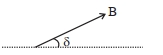
The vertical component of the earth's magnetic field is $6 \times 10^{-5} \text{ T}$ at a place where the angle of dip is $37^{\circ}$. The earth's resultant magnetic field at that place will be (Given $\tan 37^{\circ} = \frac{3}{4}$)
A
$8 \times 10^{-5} \text{ T}$
B
$6 \times 10^{-5} \text{ T}$
C
$5 \times 10^{-4} \text{ T}$
D
$1 \times 10^{-4} \text{ T}$
Solution
(D) The vertical component of the earth's magnetic field $(B_V)$ is related to the resultant magnetic field $(B)$ and the angle of dip $(\delta)$ by the formula:
$B_V = B \sin \delta$
Given that $B_V = 6 \times 10^{-5} \text{ T}$ and $\delta = 37^{\circ}$.
Since $\tan 37^{\circ} = \frac{3}{4}$,we can form a right-angled triangle with opposite side $3$ and adjacent side $4$. The hypotenuse is $\sqrt{3^2 + 4^2} = 5$.
Therefore,$\sin 37^{\circ} = \frac{3}{5}$.
Substituting the values into the formula:
$6 \times 10^{-5} = B \times \frac{3}{5}$
$B = \frac{6 \times 10^{-5} \times 5}{3}$
$B = 2 \times 10^{-5} \times 5$
$B = 10 \times 10^{-5} \text{ T} = 10^{-4} \text{ T}$
$B_V = B \sin \delta$
Given that $B_V = 6 \times 10^{-5} \text{ T}$ and $\delta = 37^{\circ}$.
Since $\tan 37^{\circ} = \frac{3}{4}$,we can form a right-angled triangle with opposite side $3$ and adjacent side $4$. The hypotenuse is $\sqrt{3^2 + 4^2} = 5$.
Therefore,$\sin 37^{\circ} = \frac{3}{5}$.
Substituting the values into the formula:
$6 \times 10^{-5} = B \times \frac{3}{5}$
$B = \frac{6 \times 10^{-5} \times 5}{3}$
$B = 2 \times 10^{-5} \times 5$
$B = 10 \times 10^{-5} \text{ T} = 10^{-4} \text{ T}$
0 likesView Solution
342
PhysicsMediumMCQJEE Main · 2022
$A$ modulating signal $2 \sin (6.28 \times 10^{6} t)$ is added to the carrier signal $4 \sin (12.56 \times 10^{9} t)$ for amplitude modulation. The combined signal is passed through a non-linear square law device. The output is then passed through a band pass filter. The bandwidth of the output signal of the band pass filter will be $MHz$.
A
$1$
B
$4$
C
$2$
D
$6$
Solution
(C) Given modulating signal frequency $\omega_{m} = 6.28 \times 10^{6} \text{ rad/s}$.
Frequency $f_{m} = \frac{\omega_{m}}{2\pi} = \frac{6.28 \times 10^{6}}{2 \times 3.14} = 1 \times 10^{6} \text{ Hz} = 1 \text{ MHz}$.
Carrier signal frequency $\omega_{c} = 12.56 \times 10^{9} \text{ rad/s}$.
Frequency $f_{c} = \frac{\omega_{c}}{2\pi} = \frac{12.56 \times 10^{9}}{2 \times 3.14} = 2 \times 10^{9} \text{ Hz} = 2000 \text{ MHz}$.
The square law device produces frequencies: $2f_{c}, f_{c}+f_{m}, f_{c}, f_{c}-f_{m}, 2f_{m}, f_{m}$.
The band pass filter centered at $f_{c}$ allows the frequencies $f_{c}-f_{m}, f_{c}, f_{c}+f_{m}$ to pass.
The bandwidth of the output signal is $(f_{c}+f_{m}) - (f_{c}-f_{m}) = 2f_{m}$.
Bandwidth $= 2 \times 1 \text{ MHz} = 2 \text{ MHz}$.
Frequency $f_{m} = \frac{\omega_{m}}{2\pi} = \frac{6.28 \times 10^{6}}{2 \times 3.14} = 1 \times 10^{6} \text{ Hz} = 1 \text{ MHz}$.
Carrier signal frequency $\omega_{c} = 12.56 \times 10^{9} \text{ rad/s}$.
Frequency $f_{c} = \frac{\omega_{c}}{2\pi} = \frac{12.56 \times 10^{9}}{2 \times 3.14} = 2 \times 10^{9} \text{ Hz} = 2000 \text{ MHz}$.
The square law device produces frequencies: $2f_{c}, f_{c}+f_{m}, f_{c}, f_{c}-f_{m}, 2f_{m}, f_{m}$.
The band pass filter centered at $f_{c}$ allows the frequencies $f_{c}-f_{m}, f_{c}, f_{c}+f_{m}$ to pass.
The bandwidth of the output signal is $(f_{c}+f_{m}) - (f_{c}-f_{m}) = 2f_{m}$.
Bandwidth $= 2 \times 1 \text{ MHz} = 2 \text{ MHz}$.
0 likesView Solution
343
PhysicsMediumMCQJEE Main · 2022
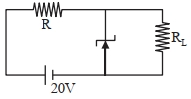
An $8\,V$ Zener diode along with a series resistance $R$ is connected across a $20\,V$ supply (as shown in the figure). If the maximum Zener current is $25\,mA$,then the minimum value of $R$ will be $\Omega$.
A
$480$
B
$441$
C
$420$
D
$460$
Solution
(A) The voltage across the series resistor $R$ is given by the difference between the supply voltage $V_{S}$ and the Zener breakdown voltage $V_{Z}$.
$V_{R} = V_{S} - V_{Z} = 20\,V - 8\,V = 12\,V$.
To find the minimum value of the series resistance $R$,we must use the maximum Zener current $I_{Z,max} = 25\,mA = 25 \times 10^{-3}\,A$.
Using Ohm's law,$V_{R} = I_{Z,max} \times R$.
$12\,V = (25 \times 10^{-3}\,A) \times R$.
$R = \frac{12}{25 \times 10^{-3}}\,\Omega = \frac{12000}{25}\,\Omega = 480\,\Omega$.
$V_{R} = V_{S} - V_{Z} = 20\,V - 8\,V = 12\,V$.
To find the minimum value of the series resistance $R$,we must use the maximum Zener current $I_{Z,max} = 25\,mA = 25 \times 10^{-3}\,A$.
Using Ohm's law,$V_{R} = I_{Z,max} \times R$.
$12\,V = (25 \times 10^{-3}\,A) \times R$.
$R = \frac{12}{25 \times 10^{-3}}\,\Omega = \frac{12000}{25}\,\Omega = 480\,\Omega$.
0 likesView Solution
344
PhysicsMediumMCQJEE Main · 2022
Two radioactive materials $A$ and $B$ have decay constants $25 \lambda$ and $16 \lambda$ respectively. If initially they have the same number of nuclei,then the ratio of the number of nuclei of $B$ to that of $A$ will be $e$ after a time $t = \frac{1}{a \lambda}$. The value of $a$ is $......$
A
$9$
B
$8$
C
$5$
D
$6$
Solution
(A) The number of nuclei remaining at time $t$ is given by $N(t) = N_0 e^{-\lambda t}$.
Given that initially both have the same number of nuclei,$N_{0A} = N_{0B} = N_0$.
The number of nuclei of $A$ at time $t$ is $N_A = N_0 e^{-25 \lambda t}$.
The number of nuclei of $B$ at time $t$ is $N_B = N_0 e^{-16 \lambda t}$.
We are given that the ratio $\frac{N_B}{N_A} = e$ at time $t = \frac{1}{a \lambda}$.
$\frac{N_B}{N_A} = \frac{N_0 e^{-16 \lambda t}}{N_0 e^{-25 \lambda t}} = e^{(-16 \lambda + 25 \lambda) t} = e^{9 \lambda t}$.
Setting this equal to $e^1$,we get $9 \lambda t = 1$,which implies $t = \frac{1}{9 \lambda}$.
Comparing this with $t = \frac{1}{a \lambda}$,we find $a = 9$.
Given that initially both have the same number of nuclei,$N_{0A} = N_{0B} = N_0$.
The number of nuclei of $A$ at time $t$ is $N_A = N_0 e^{-25 \lambda t}$.
The number of nuclei of $B$ at time $t$ is $N_B = N_0 e^{-16 \lambda t}$.
We are given that the ratio $\frac{N_B}{N_A} = e$ at time $t = \frac{1}{a \lambda}$.
$\frac{N_B}{N_A} = \frac{N_0 e^{-16 \lambda t}}{N_0 e^{-25 \lambda t}} = e^{(-16 \lambda + 25 \lambda) t} = e^{9 \lambda t}$.
Setting this equal to $e^1$,we get $9 \lambda t = 1$,which implies $t = \frac{1}{9 \lambda}$.
Comparing this with $t = \frac{1}{a \lambda}$,we find $a = 9$.
0 likesView Solution
345
PhysicsMediumMCQJEE Main · 2022
$A$ capacitor of capacitance $500\,\mu F$ is charged completely using a dc supply of $100\,V$. It is now connected to an inductor of inductance $50\,mH$ to form an $LC$ circuit. The maximum current in $LC$ circuit will be $.........A$.
A
$10$
B
$1$
C
$0$
D
$100$
Solution
(A) The energy stored in the capacitor is given by $U = \frac{1}{2} CV^2$.
Substituting the given values,$U = \frac{1}{2} \times (500 \times 10^{-6} \, F) \times (100 \, V)^2 = \frac{1}{2} \times 500 \times 10^{-6} \times 10^4 = 2.5 \, J$.
In an $LC$ circuit,the total energy is conserved. The maximum current $I_{max}$ occurs when the entire energy of the capacitor is transferred to the inductor.
Thus,$\frac{1}{2} LI_{max}^2 = U_{total}$.
$\frac{1}{2} \times (50 \times 10^{-3} \, H) \times I_{max}^2 = 2.5 \, J$.
$I_{max}^2 = \frac{2.5 \times 2}{50 \times 10^{-3}} = \frac{5}{0.05} = 100$.
$I_{max} = \sqrt{100} = 10 \, A$.
Substituting the given values,$U = \frac{1}{2} \times (500 \times 10^{-6} \, F) \times (100 \, V)^2 = \frac{1}{2} \times 500 \times 10^{-6} \times 10^4 = 2.5 \, J$.
In an $LC$ circuit,the total energy is conserved. The maximum current $I_{max}$ occurs when the entire energy of the capacitor is transferred to the inductor.
Thus,$\frac{1}{2} LI_{max}^2 = U_{total}$.
$\frac{1}{2} \times (50 \times 10^{-3} \, H) \times I_{max}^2 = 2.5 \, J$.
$I_{max}^2 = \frac{2.5 \times 2}{50 \times 10^{-3}} = \frac{5}{0.05} = 100$.
$I_{max} = \sqrt{100} = 10 \, A$.
0 likesView Solution
346
PhysicsDifficultMCQJEE Main · 2022
$A$ spherically symmetric charge distribution is considered with charge density varying as
$\rho(r)=\begin{cases} \rho_{0}\left(\frac{3}{4}-\frac{r}{R}\right) & \text{for } r \leq R \\ 0 & \text{for } r>R \end{cases}$
Where,$r (r < R)$ is the distance from the centre $O$ (as shown in figure). The electric field at point $P$ will be.
$\rho(r)=\begin{cases} \rho_{0}\left(\frac{3}{4}-\frac{r}{R}\right) & \text{for } r \leq R \\ 0 & \text{for } r>R \end{cases}$
Where,$r (r < R)$ is the distance from the centre $O$ (as shown in figure). The electric field at point $P$ will be.
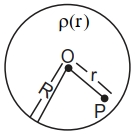
A
$\frac{\rho_{0} r}{4 \varepsilon_{0}}\left(\frac{3}{4}-\frac{r}{R}\right)$
B
$\frac{\rho_{0} r}{3 \varepsilon_{0}}\left(\frac{3}{4}-\frac{r}{R}\right)$
C
$\frac{\rho_{0} r}{4 \varepsilon_{0}}\left(1-\frac{r}{R}\right)$
D
$\frac{\rho_{0} r}{5 \varepsilon_{0}}\left(1-\frac{r}{R}\right)$
Solution
(C) According to Gauss's Law,the electric flux through a Gaussian surface is given by $\oint \vec{E} \cdot d\vec{s} = \frac{Q_{\text{in}}}{\varepsilon_{0}}$.
For a spherical Gaussian surface of radius $r$ $(r < R)$,the electric field $E$ is uniform and directed radially outward,so $\oint \vec{E} \cdot d\vec{s} = E(4\pi r^2)$.
The charge enclosed $Q_{\text{in}}$ is calculated by integrating the charge density $\rho(r)$ over the volume of the sphere of radius $r$:
$Q_{\text{in}} = \int_{0}^{r} \rho(r') 4\pi r'^2 dr' = \int_{0}^{r} \rho_{0} \left(\frac{3}{4} - \frac{r'}{R}\right) 4\pi r'^2 dr'$
$Q_{\text{in}} = 4\pi \rho_{0} \int_{0}^{r} \left(\frac{3}{4}r'^2 - \frac{r'^3}{R}\right) dr' = 4\pi \rho_{0} \left[ \frac{3}{4} \cdot \frac{r^3}{3} - \frac{r^4}{4R} \right] = 4\pi \rho_{0} \left( \frac{r^3}{4} - \frac{r^4}{4R} \right) = \pi \rho_{0} r^3 \left( 1 - \frac{r}{R} \right)$.
Applying Gauss's Law:
$E(4\pi r^2) = \frac{\pi \rho_{0} r^3}{\varepsilon_{0}} \left( 1 - \frac{r}{R} \right)$
$E = \frac{\rho_{0} r}{4\varepsilon_{0}} \left( 1 - \frac{r}{R} \right)$.
For a spherical Gaussian surface of radius $r$ $(r < R)$,the electric field $E$ is uniform and directed radially outward,so $\oint \vec{E} \cdot d\vec{s} = E(4\pi r^2)$.
The charge enclosed $Q_{\text{in}}$ is calculated by integrating the charge density $\rho(r)$ over the volume of the sphere of radius $r$:
$Q_{\text{in}} = \int_{0}^{r} \rho(r') 4\pi r'^2 dr' = \int_{0}^{r} \rho_{0} \left(\frac{3}{4} - \frac{r'}{R}\right) 4\pi r'^2 dr'$
$Q_{\text{in}} = 4\pi \rho_{0} \int_{0}^{r} \left(\frac{3}{4}r'^2 - \frac{r'^3}{R}\right) dr' = 4\pi \rho_{0} \left[ \frac{3}{4} \cdot \frac{r^3}{3} - \frac{r^4}{4R} \right] = 4\pi \rho_{0} \left( \frac{r^3}{4} - \frac{r^4}{4R} \right) = \pi \rho_{0} r^3 \left( 1 - \frac{r}{R} \right)$.
Applying Gauss's Law:
$E(4\pi r^2) = \frac{\pi \rho_{0} r^3}{\varepsilon_{0}} \left( 1 - \frac{r}{R} \right)$
$E = \frac{\rho_{0} r}{4\varepsilon_{0}} \left( 1 - \frac{r}{R} \right)$.
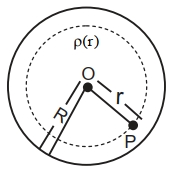
0 likesView Solution
347
PhysicsMediumMCQJEE Main · 2022
Given below are two statements.
Statement $I$ : Electric potential is constant within and at the surface of each conductor.
Statement $II$ : Electric field just outside a charged conductor is perpendicular to the surface of the conductor at every point.
In the light of the above statements,choose the most appropriate answer from the options given below.
Statement $I$ : Electric potential is constant within and at the surface of each conductor.
Statement $II$ : Electric field just outside a charged conductor is perpendicular to the surface of the conductor at every point.
In the light of the above statements,choose the most appropriate answer from the options given below.
A
Both statement $I$ and statement $II$ are correct.
B
Both statement $I$ and statement $II$ are incorrect.
C
Statement $I$ is correct but statement $II$ is incorrect.
D
Statement $I$ is incorrect but statement $II$ is correct.
Solution
(A) Statement $I$ is true: In electrostatic equilibrium,the interior of a conductor has no net electric field $(E = 0)$. Since $E = -dV/dr$,if $E = 0$,then the potential $V$ must be constant throughout the volume and on the surface of the conductor.
Statement $II$ is true: Since the conductor is an equipotential surface,any electric field component tangential to the surface would cause charges to move along the surface. To maintain equilibrium,the electric field must have no tangential component,meaning it must be strictly perpendicular to the surface at every point.
Statement $II$ is true: Since the conductor is an equipotential surface,any electric field component tangential to the surface would cause charges to move along the surface. To maintain equilibrium,the electric field must have no tangential component,meaning it must be strictly perpendicular to the surface at every point.
0 likesView Solution
348
PhysicsDifficultMCQJEE Main · 2022
An alternating $emf$ $E = 440 \sin(100 \pi t)$ is applied to a circuit containing an inductance of $\frac{\sqrt{2}}{\pi} \text{ H}$. If an $AC$ ammeter is connected in the circuit,its reading will be $....... \text{ A}$.
A
$4.4$
B
$1.55$
C
$2.2$
D
$3.1$
Solution
(C) Given: $E = 440 \sin(100 \pi t)$ and $L = \frac{\sqrt{2}}{\pi} \text{ H}$.
Comparing with $E = E_0 \sin(\omega t)$,we get $E_0 = 440 \text{ V}$ and $\omega = 100 \pi \text{ rad/s}$.
The inductive reactance $X_L$ is given by $X_L = \omega L = (100 \pi) \times \left( \frac{\sqrt{2}}{\pi} \right) = 100 \sqrt{2} \, \Omega$.
The peak current $I_0$ is $I_0 = \frac{E_0}{X_L} = \frac{440}{100 \sqrt{2}} = \frac{4.4}{\sqrt{2}} \text{ A}$.
An $AC$ ammeter measures the $RMS$ value of the current.
$I_{rms} = \frac{I_0}{\sqrt{2}} = \frac{4.4 / \sqrt{2}}{\sqrt{2}} = \frac{4.4}{2} = 2.2 \text{ A}$.
Thus,the reading of the ammeter is $2.2 \text{ A}$.
Comparing with $E = E_0 \sin(\omega t)$,we get $E_0 = 440 \text{ V}$ and $\omega = 100 \pi \text{ rad/s}$.
The inductive reactance $X_L$ is given by $X_L = \omega L = (100 \pi) \times \left( \frac{\sqrt{2}}{\pi} \right) = 100 \sqrt{2} \, \Omega$.
The peak current $I_0$ is $I_0 = \frac{E_0}{X_L} = \frac{440}{100 \sqrt{2}} = \frac{4.4}{\sqrt{2}} \text{ A}$.
An $AC$ ammeter measures the $RMS$ value of the current.
$I_{rms} = \frac{I_0}{\sqrt{2}} = \frac{4.4 / \sqrt{2}}{\sqrt{2}} = \frac{4.4}{2} = 2.2 \text{ A}$.
Thus,the reading of the ammeter is $2.2 \text{ A}$.
0 likesView Solution
349
PhysicsDifficultMCQJEE Main · 2022
$A$ coil of inductance $1\,H$ and resistance $100\,\Omega$ is connected to a battery of $6\,V$. Determine approximately:
$(a)$ The time elapsed before the current acquires half of its steady-state value.
$(b)$ The energy stored in the magnetic field associated with the coil at an instant $15\,ms$ after the circuit is switched on. (Given $\ln 2 = 0.693$,$e^{-3/2} = 0.25$)
$(a)$ The time elapsed before the current acquires half of its steady-state value.
$(b)$ The energy stored in the magnetic field associated with the coil at an instant $15\,ms$ after the circuit is switched on. (Given $\ln 2 = 0.693$,$e^{-3/2} = 0.25$)
A
$t = 10\,ms; U = 2\,mJ$
B
$t = 10\,ms; U = 1\,mJ$
C
$t = 7\,ms; U = 1\,mJ$
D
$t = 7\,ms; U = 2\,mJ$
Solution
(C) The current in an $LR$ circuit is given by $i = \frac{E}{R}(1 - e^{-t/\tau})$,where $\tau = \frac{L}{R} = \frac{1}{100} = 0.01\,s = 10\,ms$.
$(a)$ For the current to reach half its steady-state value $(i = \frac{E}{2R})$:
$\frac{E}{2R} = \frac{E}{R}(1 - e^{-t/\tau})$
$0.5 = 1 - e^{-t/\tau} \implies e^{-t/\tau} = 0.5$
$t = \tau \ln 2 = 10\,ms \times 0.693 = 6.93\,ms \approx 7\,ms$.
$(b)$ At $t = 15\,ms$,$t/\tau = 15/10 = 1.5$:
$i = \frac{6}{100}(1 - e^{-1.5}) = 0.06(1 - 0.25) = 0.06 \times 0.75 = 0.045\,A$.
The energy stored is $U = \frac{1}{2}Li^2 = \frac{1}{2} \times 1 \times (0.045)^2 = 0.5 \times 0.002025 \approx 0.001\,J = 1\,mJ$.
$(a)$ For the current to reach half its steady-state value $(i = \frac{E}{2R})$:
$\frac{E}{2R} = \frac{E}{R}(1 - e^{-t/\tau})$
$0.5 = 1 - e^{-t/\tau} \implies e^{-t/\tau} = 0.5$
$t = \tau \ln 2 = 10\,ms \times 0.693 = 6.93\,ms \approx 7\,ms$.
$(b)$ At $t = 15\,ms$,$t/\tau = 15/10 = 1.5$:
$i = \frac{6}{100}(1 - e^{-1.5}) = 0.06(1 - 0.25) = 0.06 \times 0.75 = 0.045\,A$.
The energy stored is $U = \frac{1}{2}Li^2 = \frac{1}{2} \times 1 \times (0.045)^2 = 0.5 \times 0.002025 \approx 0.001\,J = 1\,mJ$.
2 likesView Solution
350
PhysicsMediumMCQJEE Main · 2022
| List-$I$ | List-$II$ |
| $A$. $UV$ rays | $(i)$ Diagnostic tool in medicine |
| $B$. $X-$rays | $(ii)$ Water purification |
| $C$. Microwave | $(iii)$ Communication,Radar |
| $D$. Infrared wave | $(iv)$ Improving visibility in foggy days |
A
$A-(ii), B-(i), C-(iii), D-(iv)$
B
$A-(ii), B-(i), C-(iv), D-(iii)$
C
$A-(iii), B-(i), C-(ii), D-(iv)$
D
$A-(i), B-(ii), C-(iii), D-(iv)$
Solution
(A) $UV$ rays are used for water purification as they kill bacteria.
$X-$rays are used as a diagnostic tool in medicine to detect fractures.
Microwaves are used for communication and radar systems.
Infrared waves have longer wavelengths and show less scattering,therefore they are used for improving visibility in foggy conditions.
$X-$rays are used as a diagnostic tool in medicine to detect fractures.
Microwaves are used for communication and radar systems.
Infrared waves have longer wavelengths and show less scattering,therefore they are used for improving visibility in foggy conditions.
0 likesView Solution
351
PhysicsMediumMCQJEE Main · 2022
The kinetic energy of an emitted electron is $E$ when the light incident on the metal has wavelength $\lambda$. To double the kinetic energy,the incident light must have a wavelength of:
A
$\frac{ hc }{ E \lambda- hc }$
B
$\frac{ hc \lambda}{ E \lambda+ hc }$
C
$\frac{ h \lambda}{ E \lambda+ hc }$
D
$\frac{ hc \lambda}{ E \lambda- hc }$
Solution
(B) According to Einstein's photoelectric equation,the kinetic energy $E$ is given by:
$E = \frac{hc}{\lambda} - \phi$ --- $(i)$
When the kinetic energy is doubled to $2E$,let the new wavelength be $\lambda^{\prime}$:
$2E = \frac{hc}{\lambda^{\prime}} - \phi$ --- (ii)
Subtracting equation $(i)$ from equation (ii):
$(2E - E) = (\frac{hc}{\lambda^{\prime}} - \phi) - (\frac{hc}{\lambda} - \phi)$
$E = \frac{hc}{\lambda^{\prime}} - \frac{hc}{\lambda}$
Rearranging the terms to solve for $\lambda^{\prime}$:
$E + \frac{hc}{\lambda} = \frac{hc}{\lambda^{\prime}}$
$\frac{E\lambda + hc}{\lambda} = \frac{hc}{\lambda^{\prime}}$
$\lambda^{\prime} = \frac{hc\lambda}{E\lambda + hc}$
$E = \frac{hc}{\lambda} - \phi$ --- $(i)$
When the kinetic energy is doubled to $2E$,let the new wavelength be $\lambda^{\prime}$:
$2E = \frac{hc}{\lambda^{\prime}} - \phi$ --- (ii)
Subtracting equation $(i)$ from equation (ii):
$(2E - E) = (\frac{hc}{\lambda^{\prime}} - \phi) - (\frac{hc}{\lambda} - \phi)$
$E = \frac{hc}{\lambda^{\prime}} - \frac{hc}{\lambda}$
Rearranging the terms to solve for $\lambda^{\prime}$:
$E + \frac{hc}{\lambda} = \frac{hc}{\lambda^{\prime}}$
$\frac{E\lambda + hc}{\lambda} = \frac{hc}{\lambda^{\prime}}$
$\lambda^{\prime} = \frac{hc\lambda}{E\lambda + hc}$
0 likesView Solution
352
PhysicsMediumMCQJEE Main · 2022
Find the ratio of energies of photons produced due to the transition of an electron in a hydrogen atom from its $(i)$ second permitted energy level to the first level,and $(ii)$ the highest permitted energy level to the first permitted level.
A
$3: 4$
B
$4: 3$
C
$1: 4$
D
$4: 1$
Solution
(A) The energy of an electron in the $n^{th}$ orbit of a hydrogen atom is given by $E_n = -\frac{13.6}{n^2} \text{ eV}$.
For the transition from the second energy level $(n=2)$ to the first energy level $(n=1)$,the energy of the emitted photon is:
$\Delta E_1 = E_2 - E_1 = -\frac{13.6}{2^2} - (-\frac{13.6}{1^2}) = 13.6(1 - \frac{1}{4}) = 13.6 \times \frac{3}{4} \text{ eV}$.
For the transition from the highest permitted energy level $(n=\infty)$ to the first energy level $(n=1)$,the energy of the emitted photon is:
$\Delta E_2 = E_{\infty} - E_1 = 0 - (-\frac{13.6}{1^2}) = 13.6 \text{ eV}$.
The ratio of the energies is:
$\frac{\Delta E_1}{\Delta E_2} = \frac{13.6 \times \frac{3}{4}}{13.6} = \frac{3}{4}$.
For the transition from the second energy level $(n=2)$ to the first energy level $(n=1)$,the energy of the emitted photon is:
$\Delta E_1 = E_2 - E_1 = -\frac{13.6}{2^2} - (-\frac{13.6}{1^2}) = 13.6(1 - \frac{1}{4}) = 13.6 \times \frac{3}{4} \text{ eV}$.
For the transition from the highest permitted energy level $(n=\infty)$ to the first energy level $(n=1)$,the energy of the emitted photon is:
$\Delta E_2 = E_{\infty} - E_1 = 0 - (-\frac{13.6}{1^2}) = 13.6 \text{ eV}$.
The ratio of the energies is:
$\frac{\Delta E_1}{\Delta E_2} = \frac{13.6 \times \frac{3}{4}}{13.6} = \frac{3}{4}$.
0 likesView Solution
353
PhysicsMediumMCQJEE Main · 2022
Find the modulation index of an $AM$ wave having $8\,V$ variation where maximum amplitude of the $AM$ wave is $9\,V$.
A
$0.8$
B
$0.5$
C
$0.2$
D
$0.1$
Solution
(A) The modulation index $m$ is defined as $m = \frac{A_m}{A_c}$,where $A_m$ is the amplitude of the modulating signal and $A_c$ is the amplitude of the carrier wave.
Given the variation in amplitude is $2A_m = 8\,V$,we find $A_m = 4\,V$.
The maximum amplitude of the $AM$ wave is given by $A_{max} = A_c + A_m = 9\,V$.
Substituting $A_m = 4\,V$,we get $A_c + 4 = 9$,which implies $A_c = 5\,V$.
Therefore,the modulation index is $m = \frac{4}{5} = 0.8$.
Given the variation in amplitude is $2A_m = 8\,V$,we find $A_m = 4\,V$.
The maximum amplitude of the $AM$ wave is given by $A_{max} = A_c + A_m = 9\,V$.
Substituting $A_m = 4\,V$,we get $A_c + 4 = 9$,which implies $A_c = 5\,V$.
Therefore,the modulation index is $m = \frac{4}{5} = 0.8$.
0 likesView Solution
354
PhysicsMediumMCQJEE Main · 2022
The current $I$ flowing through the given circuit will be $.....A$.
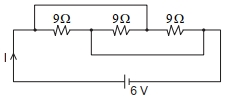
A
$8$
B
$5$
C
$4$
D
$2$
Solution
(D) By analyzing the circuit,we can see that all three resistors of $9\,\Omega$ are connected in parallel across the $6\,V$ battery.
Let the equivalent resistance be $R_{eq}$.
Since the resistors are in parallel,$\frac{1}{R_{eq}} = \frac{1}{9} + \frac{1}{9} + \frac{1}{9} = \frac{3}{9} = \frac{1}{3}$.
Therefore,$R_{eq} = 3\,\Omega$.
Using Ohm's law,$I = \frac{V}{R_{eq}} = \frac{6\,V}{3\,\Omega} = 2\,A$.
Thus,the current flowing through the circuit is $2\,A$.
Let the equivalent resistance be $R_{eq}$.
Since the resistors are in parallel,$\frac{1}{R_{eq}} = \frac{1}{9} + \frac{1}{9} + \frac{1}{9} = \frac{3}{9} = \frac{1}{3}$.
Therefore,$R_{eq} = 3\,\Omega$.
Using Ohm's law,$I = \frac{V}{R_{eq}} = \frac{6\,V}{3\,\Omega} = 2\,A$.
Thus,the current flowing through the circuit is $2\,A$.
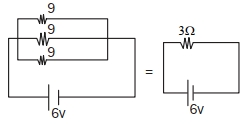
0 likesView Solution
Vedclass Products
For Students
Vedclass Test Series
Mock tests in real JEE Main style covering Physics with performance analysis. 5-day free trial.
Start Free TrialFor Teachers
Exam Paper Generator
Generate Set A/B/C/D Physics papers from 7.5L+ questions in 2 minutes. 3 chapters free.
Try FreeFor Institutes
Online Exam Module
Run live JEE Main mock exams with unlimited students, 360° analytics & white-label branding.
See DemoFrequently Asked Questions
How many Physics questions are in JEE Main 2022?
There are 660 Physics questions from the JEE Main 2022 paper on Vedclass, each with a detailed step-by-step solution in English.
Are JEE Main 2022 Physics solutions available in English?
Yes. All solutions on this page are in English. You can also switch to English or Hindi using the language buttons above the questions.
Can I practice JEE Main 2022 Physics as a timed test?
Yes. Use the Vedclass Test Series to attempt a full JEE Main mock test covering Physics with time limits and instant score analysis.
Can teachers create Physics papers from JEE Main previous year questions?
Yes. The Vedclass Exam Paper Generator lets teachers mix JEE Main Physics questions and generate Set A/B/C/D papers in minutes.
For Teachers & Institutes
Build a Custom Physics Paper
Pick JEE Main 2022 Physics questions, set difficulty, and generate Set A/B/C/D in 2 minutes.