
ChemistryQ1–97 of 107 questions
Page 1 of 2 · English
1
ChemistryMCQJEE Main · 2017
Let $a, b, c \in R$. If $f(x) = ax^2 + bx + c$ is such that $a + b + c = 3$ and $f(x + y) = f(x) + f(y) + xy$ for all $x, y \in R$,then $\sum_{n=1}^{10} f(n)$ is equal to:
A
$255$
B
$330$
C
$165$
D
$190$
Solution
(B) Given $f(x) = ax^2 + bx + c$.
Since $f(x+y) = f(x) + f(y) + xy$,putting $x=0, y=0$ gives $f(0) = f(0) + f(0) + 0$,so $f(0) = 0$. Thus,$c = 0$.
Given $a+b+c = 3$,and since $c=0$,we have $a+b = 3$.
Also,$f(x+y) = a(x+y)^2 + b(x+y) = a(x^2 + 2xy + y^2) + bx + by = (ax^2 + bx) + (ay^2 + by) + 2axy$.
Comparing this with $f(x+y) = f(x) + f(y) + xy$,we get $2axy = xy$,which implies $2a = 1$,so $a = 1/2$.
Since $a+b = 3$,$b = 3 - 1/2 = 5/2$.
Thus,$f(n) = \frac{1}{2}n^2 + \frac{5}{2}n = \frac{n^2 + 5n}{2}$.
Now,$\sum_{n=1}^{10} f(n) = \sum_{n=1}^{10} \frac{n^2 + 5n}{2} = \frac{1}{2} \left[ \sum_{n=1}^{10} n^2 + 5 \sum_{n=1}^{10} n \right]$.
Using the formulas $\sum n^2 = \frac{n(n+1)(2n+1)}{6}$ and $\sum n = \frac{n(n+1)}{2}$:
$\sum_{n=1}^{10} n^2 = \frac{10 \times 11 \times 21}{6} = 385$.
$\sum_{n=1}^{10} n = \frac{10 \times 11}{2} = 55$.
Therefore,$\sum_{n=1}^{10} f(n) = \frac{1}{2} [385 + 5(55)] = \frac{1}{2} [385 + 275] = \frac{660}{2} = 330$.
Since $f(x+y) = f(x) + f(y) + xy$,putting $x=0, y=0$ gives $f(0) = f(0) + f(0) + 0$,so $f(0) = 0$. Thus,$c = 0$.
Given $a+b+c = 3$,and since $c=0$,we have $a+b = 3$.
Also,$f(x+y) = a(x+y)^2 + b(x+y) = a(x^2 + 2xy + y^2) + bx + by = (ax^2 + bx) + (ay^2 + by) + 2axy$.
Comparing this with $f(x+y) = f(x) + f(y) + xy$,we get $2axy = xy$,which implies $2a = 1$,so $a = 1/2$.
Since $a+b = 3$,$b = 3 - 1/2 = 5/2$.
Thus,$f(n) = \frac{1}{2}n^2 + \frac{5}{2}n = \frac{n^2 + 5n}{2}$.
Now,$\sum_{n=1}^{10} f(n) = \sum_{n=1}^{10} \frac{n^2 + 5n}{2} = \frac{1}{2} \left[ \sum_{n=1}^{10} n^2 + 5 \sum_{n=1}^{10} n \right]$.
Using the formulas $\sum n^2 = \frac{n(n+1)(2n+1)}{6}$ and $\sum n = \frac{n(n+1)}{2}$:
$\sum_{n=1}^{10} n^2 = \frac{10 \times 11 \times 21}{6} = 385$.
$\sum_{n=1}^{10} n = \frac{10 \times 11}{2} = 55$.
Therefore,$\sum_{n=1}^{10} f(n) = \frac{1}{2} [385 + 5(55)] = \frac{1}{2} [385 + 275] = \frac{660}{2} = 330$.
0 likesView Solution
2
ChemistryMCQJEE Main · 2017
If for $x \in \left( 0, \frac{1}{4} \right)$,the derivative of $\tan^{-1} \left( \frac{6x\sqrt{x}}{1 - 9x^3} \right)$ is $\sqrt{x} \cdot g(x)$,then $g(x)$ equals:
A
$\frac{3}{1 + 9x^3}$
B
$\frac{9}{1 + 9x^3}$
C
$\frac{3x\sqrt{x}}{1 - 9x^3}$
D
$\frac{3}{1 - 9x^3}$
Solution
(B) Let $F(x) = \tan^{-1} \left( \frac{6x\sqrt{x}}{1 - 9x^3} \right)$.
We can rewrite the argument as $\frac{2(3x^{3/2})}{1 - (3x^{3/2})^2}$.
Using the identity $2\tan^{-1}(\theta) = \tan^{-1} \left( \frac{2\theta}{1 - \theta^2} \right)$,we get $F(x) = 2\tan^{-1}(3x^{3/2})$.
Now,differentiate $F(x)$ with respect to $x$:
$F'(x) = 2 \cdot \frac{1}{1 + (3x^{3/2})^2} \cdot \frac{d}{dx}(3x^{3/2})$.
$F'(x) = 2 \cdot \frac{1}{1 + 9x^3} \cdot (3 \cdot \frac{3}{2} x^{1/2})$.
$F'(x) = 2 \cdot \frac{1}{1 + 9x^3} \cdot \frac{9}{2} \sqrt{x} = \frac{9\sqrt{x}}{1 + 9x^3}$.
Given $F'(x) = \sqrt{x} \cdot g(x)$,we have $\sqrt{x} \cdot g(x) = \frac{9\sqrt{x}}{1 + 9x^3}$.
Therefore,$g(x) = \frac{9}{1 + 9x^3}$.
We can rewrite the argument as $\frac{2(3x^{3/2})}{1 - (3x^{3/2})^2}$.
Using the identity $2\tan^{-1}(\theta) = \tan^{-1} \left( \frac{2\theta}{1 - \theta^2} \right)$,we get $F(x) = 2\tan^{-1}(3x^{3/2})$.
Now,differentiate $F(x)$ with respect to $x$:
$F'(x) = 2 \cdot \frac{1}{1 + (3x^{3/2})^2} \cdot \frac{d}{dx}(3x^{3/2})$.
$F'(x) = 2 \cdot \frac{1}{1 + 9x^3} \cdot (3 \cdot \frac{3}{2} x^{1/2})$.
$F'(x) = 2 \cdot \frac{1}{1 + 9x^3} \cdot \frac{9}{2} \sqrt{x} = \frac{9\sqrt{x}}{1 + 9x^3}$.
Given $F'(x) = \sqrt{x} \cdot g(x)$,we have $\sqrt{x} \cdot g(x) = \frac{9\sqrt{x}}{1 + 9x^3}$.
Therefore,$g(x) = \frac{9}{1 + 9x^3}$.
0 likesView Solution
3
ChemistryMCQJEE Main · 2017
$A$ body of mass $m = 10^{-2} \; kg$ is moving in a medium and experiences a frictional force $F = -kv^2$. Its initial speed is $v_0 = 10 \; m/s$. If,after $10 \; s$,its energy is $\frac{1}{8} mv_0^2$,the value of $k$ will be:
A
$10^{-3} \; kg \cdot m^{-1}$
B
$10^{-3} \; kg \cdot s^{-1}$
C
$10^{-4} \; kg \cdot m^{-1}$
D
$10^{-1} \; kg \cdot m^{-1} \cdot s^{-1}$
Solution
(C) Let $v_f$ be the final speed of the body after $t = 10 \; s$.
Given that the final kinetic energy is $\frac{1}{8} mv_0^2$,we have:
$\frac{1}{2} m v_f^2 = \frac{1}{8} m v_0^2 \Rightarrow v_f^2 = \frac{1}{4} v_0^2 \Rightarrow v_f = \frac{v_0}{2} = 5 \; m/s$.
The equation of motion is $F = m \frac{dv}{dt} = -kv^2$.
Rearranging the terms,we get $\frac{dv}{v^2} = -\frac{k}{m} dt$.
Integrating both sides from $t = 0$ to $t = 10 \; s$ and $v = 10 \; m/s$ to $v = 5 \; m/s$:
$\int_{10}^{5} v^{-2} dv = -\frac{k}{10^{-2}} \int_{0}^{10} dt$.
$[-v^{-1}]_{10}^{5} = -100k [t]_{0}^{10}$.
$-(\frac{1}{5} - \frac{1}{10}) = -100k(10)$.
$-(\frac{1}{10}) = -1000k$.
$k = \frac{1}{10000} = 10^{-4} \; kg \cdot m^{-1}$.
Given that the final kinetic energy is $\frac{1}{8} mv_0^2$,we have:
$\frac{1}{2} m v_f^2 = \frac{1}{8} m v_0^2 \Rightarrow v_f^2 = \frac{1}{4} v_0^2 \Rightarrow v_f = \frac{v_0}{2} = 5 \; m/s$.
The equation of motion is $F = m \frac{dv}{dt} = -kv^2$.
Rearranging the terms,we get $\frac{dv}{v^2} = -\frac{k}{m} dt$.
Integrating both sides from $t = 0$ to $t = 10 \; s$ and $v = 10 \; m/s$ to $v = 5 \; m/s$:
$\int_{10}^{5} v^{-2} dv = -\frac{k}{10^{-2}} \int_{0}^{10} dt$.
$[-v^{-1}]_{10}^{5} = -100k [t]_{0}^{10}$.
$-(\frac{1}{5} - \frac{1}{10}) = -100k(10)$.
$-(\frac{1}{10}) = -1000k$.
$k = \frac{1}{10000} = 10^{-4} \; kg \cdot m^{-1}$.
0 likesView Solution
4
ChemistryMCQJEE Main · 2017
The following observations were taken for determining the surface tension $T$ of water by the capillary method:
Diameter of capillary,$D = 1.25 \times 10^{-2} \ m$
Rise of water,$h = 1.45 \times 10^{-2} \ m$
Using $g = 9.80 \ m/s^2$ and the simplified relation $T = \frac{rhg}{2} \times 10^3 \ N/m$,the possible error in surface tension is closest to ......... $\%$
Diameter of capillary,$D = 1.25 \times 10^{-2} \ m$
Rise of water,$h = 1.45 \times 10^{-2} \ m$
Using $g = 9.80 \ m/s^2$ and the simplified relation $T = \frac{rhg}{2} \times 10^3 \ N/m$,the possible error in surface tension is closest to ......... $\%$
A
$0.15$
B
$1.5$
C
$2.4$
D
$10$
Solution
(B) The formula for surface tension is $T = \frac{rhg}{2} \times 10^3$. Here,$r = D/2$,so $\frac{\Delta r}{r} = \frac{\Delta D}{D}$.
The relative error in $T$ is given by $\frac{\Delta T}{T} = \frac{\Delta r}{r} + \frac{\Delta h}{h}$.
Assuming the least count for both $D$ and $h$ is $0.01 \times 10^{-2} \ m$ (based on the precision of the given values):
$\frac{\Delta r}{r} = \frac{0.01 \times 10^{-2}}{1.25 \times 10^{-2}} = \frac{0.01}{1.25} = 0.008$.
$\frac{\Delta h}{h} = \frac{0.01 \times 10^{-2}}{1.45 \times 10^{-2}} = \frac{0.01}{1.45} \approx 0.00689$.
Percentage error $= \left( \frac{\Delta T}{T} \right) \times 100 = (0.008 + 0.00689) \times 100 = 0.01489 \times 100 = 1.489\%$.
Rounding to the nearest value,we get $1.5\%$.
The relative error in $T$ is given by $\frac{\Delta T}{T} = \frac{\Delta r}{r} + \frac{\Delta h}{h}$.
Assuming the least count for both $D$ and $h$ is $0.01 \times 10^{-2} \ m$ (based on the precision of the given values):
$\frac{\Delta r}{r} = \frac{0.01 \times 10^{-2}}{1.25 \times 10^{-2}} = \frac{0.01}{1.25} = 0.008$.
$\frac{\Delta h}{h} = \frac{0.01 \times 10^{-2}}{1.45 \times 10^{-2}} = \frac{0.01}{1.45} \approx 0.00689$.
Percentage error $= \left( \frac{\Delta T}{T} \right) \times 100 = (0.008 + 0.00689) \times 100 = 0.01489 \times 100 = 1.489\%$.
Rounding to the nearest value,we get $1.5\%$.
0 likesView Solution
5
ChemistryEasyMCQJEE Main · 2017
$\Delta U$ is equal to
A
Isochoric work
B
Isobaric work
C
Adiabatic work
D
Isothermal work
Solution
(C) According to the first law of thermodynamics,$\Delta U = Q + W$.
In an adiabatic process,there is no exchange of heat between the system and the surroundings,so $Q = 0$.
Therefore,$\Delta U = W_{\text{adiabatic}}$.
In an adiabatic process,there is no exchange of heat between the system and the surroundings,so $Q = 0$.
Therefore,$\Delta U = W_{\text{adiabatic}}$.
0 likesView Solution
6
ChemistryMediumMCQJEE Main · 2017
The radius of the second Bohr orbit for hydrogen atom is .......... $\mathring{A}$.
(Planck's constant $h = 6.626 \times 10^{-34} \, Js$; mass of electron $= 9.1091 \times 10^{-31} \, kg$; charge of electron $e = 1.60210 \times 10^{-19} \, C$; permittivity of vacuum $\epsilon_0 = 8.854185 \times 10^{-12} \, C^2 N^{-1} m^{-2}$)
(Planck's constant $h = 6.626 \times 10^{-34} \, Js$; mass of electron $= 9.1091 \times 10^{-31} \, kg$; charge of electron $e = 1.60210 \times 10^{-19} \, C$; permittivity of vacuum $\epsilon_0 = 8.854185 \times 10^{-12} \, C^2 N^{-1} m^{-2}$)
A
$1.65$
B
$4.76$
C
$0.529$
D
$2.12$
Solution
(D) According to Bohr's theory,the radius of the $n^{th}$ orbit is given by the formula:
$r_n = 0.529 \times \frac{n^2}{Z} \, \mathring{A}$
For the second Bohr orbit of the hydrogen atom,$n = 2$ and $Z = 1$.
Substituting these values:
$r_2 = 0.529 \times \frac{2^2}{1} \, \mathring{A}$
$r_2 = 0.529 \times 4 \, \mathring{A} = 2.116 \, \mathring{A}$
Rounding to two decimal places,we get $2.12 \, \mathring{A}$.
$r_n = 0.529 \times \frac{n^2}{Z} \, \mathring{A}$
For the second Bohr orbit of the hydrogen atom,$n = 2$ and $Z = 1$.
Substituting these values:
$r_2 = 0.529 \times \frac{2^2}{1} \, \mathring{A}$
$r_2 = 0.529 \times 4 \, \mathring{A} = 2.116 \, \mathring{A}$
Rounding to two decimal places,we get $2.12 \, \mathring{A}$.
0 likesView Solution
7
ChemistryMediumMCQJEE Main · 2017
The $pK_a$ of a weak acid $(HA)$ and $pK_b$ of a weak base $(BOH)$ are $3.2$ and $3.4,$ respectively. The $pH$ of their salt $(AB)$ solution is
A
$7.2$
B
$6.9$
C
$7.0$
D
$1.0$
Solution
(B) For the salt of a weak acid and a weak base,the $pH$ is calculated using the formula:
$pH = 7 + \frac{1}{2} pK_a - \frac{1}{2} pK_b$
Given values are $pK_a = 3.2$ and $pK_b = 3.4$.
Substituting these values into the formula:
$pH = 7 + \frac{1}{2}(3.2) - \frac{1}{2}(3.4)$
$pH = 7 + 1.6 - 1.7$
$pH = 6.9$
$pH = 7 + \frac{1}{2} pK_a - \frac{1}{2} pK_b$
Given values are $pK_a = 3.2$ and $pK_b = 3.4$.
Substituting these values into the formula:
$pH = 7 + \frac{1}{2}(3.2) - \frac{1}{2}(3.4)$
$pH = 7 + 1.6 - 1.7$
$pH = 6.9$
0 likesView Solution
8
ChemistryMediumMCQJEE Main · 2017
The most abundant elements by mass in the body of a healthy human adult are: Oxygen $(61.4\%);$ Carbon $(22.9\%),$ Hydrogen $(10.0\%);$ and Nitrogen $(2.6\%).$ The weight which a $75 \ kg$ person would gain if all $^1H$ atoms are replaced by $^2H$ atoms is ....... $kg$.
A
$15$
B
$37.5$
C
$7.5$
D
$10$
Solution
(C) The mass of hydrogen in a $75 \ kg$ human body is calculated as: $\text{Mass of } H = \frac{10}{100} \times 75 \ kg = 7.5 \ kg$.
When all $^1H$ atoms (atomic mass $\approx 1$) are replaced by $^2H$ atoms (atomic mass $\approx 2$),the mass of the hydrogen component doubles.
New mass of hydrogen $= 7.5 \ kg \times 2 = 15 \ kg$.
Therefore,the weight gain is $15 \ kg - 7.5 \ kg = 7.5 \ kg$.
When all $^1H$ atoms (atomic mass $\approx 1$) are replaced by $^2H$ atoms (atomic mass $\approx 2$),the mass of the hydrogen component doubles.
New mass of hydrogen $= 7.5 \ kg \times 2 = 15 \ kg$.
Therefore,the weight gain is $15 \ kg - 7.5 \ kg = 7.5 \ kg$.
0 likesView Solution
9
ChemistryEasyMCQJEE Main · 2017
In the following reactions,$ZnO$ is respectively acting as a/an:
A
base and acid
B
base and base
C
acid and acid
D
acid and base
Solution
(D) Zinc oxide $(ZnO)$ is an amphoteric oxide,meaning it can react with both acids and bases.
In reaction $(A)$,$ZnO + Na_2O \rightarrow Na_2ZnO_2$,$ZnO$ acts as an acid because it reacts with the base $Na_2O$.
In reaction $(B)$,$ZnO + CO_2 \rightarrow ZnCO_3$,$ZnO$ acts as a base because it reacts with the acidic oxide $CO_2$.
Therefore,$ZnO$ acts as an acid in $(A)$ and a base in $(B)$.
In reaction $(A)$,$ZnO + Na_2O \rightarrow Na_2ZnO_2$,$ZnO$ acts as an acid because it reacts with the base $Na_2O$.
In reaction $(B)$,$ZnO + CO_2 \rightarrow ZnCO_3$,$ZnO$ acts as a base because it reacts with the acidic oxide $CO_2$.
Therefore,$ZnO$ acts as an acid in $(A)$ and a base in $(B)$.
0 likesView Solution
10
ChemistryMediumMCQJEE Main · 2017
Both lithium and magnesium display several similar properties due to the diagonal relationship; however,the one which is incorrect is:
A
Both form basic carbonates
B
Both form soluble bicarbonates
C
Both form nitrides
D
Nitrates of both $Li$ and $Mg$ yield $NO_2$ and $O_2$ on heating
Solution
(A) Lithium $(Li)$ and Magnesium $(Mg)$ exhibit a diagonal relationship due to similar ionic sizes and charge-to-size ratios.
$1$. Both form nitrides ($Li_3N$ and $Mg_3N_2$) by direct combination with nitrogen.
$2$. Both form soluble bicarbonates in solution.
$3$. Both $LiNO_3$ and $Mg(NO_3)_2$ decompose on heating to give their respective oxides,$NO_2$,and $O_2$.
$4$. Magnesium forms a basic carbonate $(4MgCO_3 \cdot Mg(OH)_2 \cdot 5H_2O)$,whereas lithium does not form a basic carbonate; it only forms a normal carbonate $(Li_2CO_3)$.
Therefore,the statement that both form basic carbonates is incorrect.
$1$. Both form nitrides ($Li_3N$ and $Mg_3N_2$) by direct combination with nitrogen.
$2$. Both form soluble bicarbonates in solution.
$3$. Both $LiNO_3$ and $Mg(NO_3)_2$ decompose on heating to give their respective oxides,$NO_2$,and $O_2$.
$4$. Magnesium forms a basic carbonate $(4MgCO_3 \cdot Mg(OH)_2 \cdot 5H_2O)$,whereas lithium does not form a basic carbonate; it only forms a normal carbonate $(Li_2CO_3)$.
Therefore,the statement that both form basic carbonates is incorrect.
0 likesView Solution
11
ChemistryDifficultMCQJEE Main · 2017
$3-$Methylpent$-2-$ene on reaction with $HBr$ in the presence of peroxide forms an addition product. The number of possible stereoisomers for the product is:
A
$6$
B
$0$
C
$2$
D
$4$
Solution
(D) $3-$Methylpent$-2-$ene $(CH_3-CH=C(CH_3)-CH_2-CH_3)$ reacts with $HBr$ in the presence of peroxide via anti-Markovnikov addition to form $2-$bromo$-3-$methylpentane $(CH_3-CH(Br)-CH(CH_3)-CH_2-CH_3)$.
The product $CH_3-CH(Br)-CH(CH_3)-CH_2-CH_3$ contains two chiral centers at $C2$ and $C3$.
Since the molecule is unsymmetrical,the number of stereoisomers is given by the formula $2^n$,where $n$ is the number of chiral centers.
Here,$n = 2$,so the number of stereoisomers $= 2^2 = 4$.
The product $CH_3-CH(Br)-CH(CH_3)-CH_2-CH_3$ contains two chiral centers at $C2$ and $C3$.
Since the molecule is unsymmetrical,the number of stereoisomers is given by the formula $2^n$,where $n$ is the number of chiral centers.
Here,$n = 2$,so the number of stereoisomers $= 2^2 = 4$.
0 likesView Solution
12
ChemistryDifficultMCQJEE Main · 2017
Given
$C_{(graphite)} + O_{2(g)} \rightarrow CO_{2(g)};$
$\Delta_rH^o = -393.5 \, kJ \, mol^{-1}$
$H_{2(g)} + \frac{1}{2} O_{2(g)} \rightarrow H_2O_{(l)};$
$\Delta_rH^o = -285.8 \, kJ \, mol^{-1}$
$CO_{2(g)} + 2H_2O_{(l)} \rightarrow CH_{4(g)} + 2O_{2(g)};$
$\Delta_rH^o = + 890.3 \, kJ \, mol^{-1}$
Based on the above thermochemical equations,the value of $\Delta_rH^o$ at $298 \, K$ for the reaction
$C_{(graphite)} + 2H_{2(g)} \rightarrow CH_{4(g)}$ will be ........... $kJ \, mol^{-1}$.
$C_{(graphite)} + O_{2(g)} \rightarrow CO_{2(g)};$
$\Delta_rH^o = -393.5 \, kJ \, mol^{-1}$
$H_{2(g)} + \frac{1}{2} O_{2(g)} \rightarrow H_2O_{(l)};$
$\Delta_rH^o = -285.8 \, kJ \, mol^{-1}$
$CO_{2(g)} + 2H_2O_{(l)} \rightarrow CH_{4(g)} + 2O_{2(g)};$
$\Delta_rH^o = + 890.3 \, kJ \, mol^{-1}$
Based on the above thermochemical equations,the value of $\Delta_rH^o$ at $298 \, K$ for the reaction
$C_{(graphite)} + 2H_{2(g)} \rightarrow CH_{4(g)}$ will be ........... $kJ \, mol^{-1}$.
A
$+ 74.8$
B
$+ 144.0$
C
$- 74.8$
D
$- 144.0$
Solution
(C) We are given the following equations:
$(1) C_{(graphite)} + O_{2(g)} \rightarrow CO_{2(g)}; \Delta_rH^o = -393.5 \, kJ \, mol^{-1}$
$(2) H_{2(g)} + \frac{1}{2} O_{2(g)} \rightarrow H_2O_{(l)}; \Delta_rH^o = -285.8 \, kJ \, mol^{-1}$
$(3) CO_{2(g)} + 2H_2O_{(l)} \rightarrow CH_{4(g)} + 2O_{2(g)}; \Delta_rH^o = + 890.3 \, kJ \, mol^{-1}$
We need to find $\Delta_rH^o$ for the reaction:
$C_{(graphite)} + 2H_{2(g)} \rightarrow CH_{4(g)}$
To obtain this,we perform the operation: $(1) + 2 \times (2) + (3)$
$\Delta_rH^o = (-393.5) + 2 \times (-285.8) + 890.3$
$\Delta_rH^o = -393.5 - 571.6 + 890.3$
$\Delta_rH^o = -965.1 + 890.3 = -74.8 \, kJ \, mol^{-1}$
$(1) C_{(graphite)} + O_{2(g)} \rightarrow CO_{2(g)}; \Delta_rH^o = -393.5 \, kJ \, mol^{-1}$
$(2) H_{2(g)} + \frac{1}{2} O_{2(g)} \rightarrow H_2O_{(l)}; \Delta_rH^o = -285.8 \, kJ \, mol^{-1}$
$(3) CO_{2(g)} + 2H_2O_{(l)} \rightarrow CH_{4(g)} + 2O_{2(g)}; \Delta_rH^o = + 890.3 \, kJ \, mol^{-1}$
We need to find $\Delta_rH^o$ for the reaction:
$C_{(graphite)} + 2H_{2(g)} \rightarrow CH_{4(g)}$
To obtain this,we perform the operation: $(1) + 2 \times (2) + (3)$
$\Delta_rH^o = (-393.5) + 2 \times (-285.8) + 890.3$
$\Delta_rH^o = -393.5 - 571.6 + 890.3$
$\Delta_rH^o = -965.1 + 890.3 = -74.8 \, kJ \, mol^{-1}$
0 likesView Solution
13
ChemistryDifficultMCQJEE Main · 2017
The sodium salt of an organic acid $'X'$ produces effervescence with conc. $H_2SO_4$. $'X'$ reacts with an acidified aqueous $CaCl_2$ solution to give a white precipitate which decolourises an acidic solution of $KMnO_4$. $'X'$ is:
A
$C_6H_5COONa$
B
$HCOONa$
C
$CH_3COONa$
D
$Na_2C_2O_4$
Solution
(D) The sodium salt of oxalic acid,$Na_2C_2O_4$ $(X)$,reacts with conc. $H_2SO_4$ to produce $CO$ and $CO_2$ gases,causing effervescence.
$Na_2C_2O_4 + H_2SO_4 \to Na_2SO_4 + H_2C_2O_4$
$H_2C_2O_4 \xrightarrow{Conc. H_2SO_4} H_2O + CO \uparrow + CO_2 \uparrow$
$X$ reacts with $CaCl_2$ to form a white precipitate of calcium oxalate $(CaC_2O_4)$:
$Na_2C_2O_4 + CaCl_2 \to CaC_2O_4 \downarrow + 2NaCl$
Oxalate ions $(C_2O_4^{2-})$ decolourise acidic $KMnO_4$ solution due to the redox reaction:
$5C_2O_4^{2-} + 2MnO_4^{-} + 16H^{+} \to 10CO_2 \uparrow + 2Mn^{2+} + 8H_2O$
Thus,$'X'$ is $Na_2C_2O_4$.
$Na_2C_2O_4 + H_2SO_4 \to Na_2SO_4 + H_2C_2O_4$
$H_2C_2O_4 \xrightarrow{Conc. H_2SO_4} H_2O + CO \uparrow + CO_2 \uparrow$
$X$ reacts with $CaCl_2$ to form a white precipitate of calcium oxalate $(CaC_2O_4)$:
$Na_2C_2O_4 + CaCl_2 \to CaC_2O_4 \downarrow + 2NaCl$
Oxalate ions $(C_2O_4^{2-})$ decolourise acidic $KMnO_4$ solution due to the redox reaction:
$5C_2O_4^{2-} + 2MnO_4^{-} + 16H^{+} \to 10CO_2 \uparrow + 2Mn^{2+} + 8H_2O$
Thus,$'X'$ is $Na_2C_2O_4$.
0 likesView Solution
14
ChemistryDifficultMCQJEE Main · 2017
Which of the following species is not paramagnetic?
A
$NO$
B
$CO$
C
$O_2$
D
$B_2$
Solution
(B) Paramagnetism is due to the presence of unpaired electrons.
$1.$ $NO$: Total electrons = $15$. It has an odd number of electrons,so it must have at least one unpaired electron,making it paramagnetic.
$2.$ $CO$: Total electrons = $14$. All electrons are paired in its molecular orbitals,so it is diamagnetic (not paramagnetic).
$3.$ $O_2$: Total electrons = $16$. According to Molecular Orbital $(MO)$ theory,it has two unpaired electrons in its antibonding $\pi^* 2p_x$ and $\pi^* 2p_y$ orbitals,so it is paramagnetic.
$4.$ $B_2$: Total electrons = $10$. It has two unpaired electrons in its $\pi 2p_x$ and $\pi 2p_y$ orbitals,so it is paramagnetic.
$1.$ $NO$: Total electrons = $15$. It has an odd number of electrons,so it must have at least one unpaired electron,making it paramagnetic.
$2.$ $CO$: Total electrons = $14$. All electrons are paired in its molecular orbitals,so it is diamagnetic (not paramagnetic).
$3.$ $O_2$: Total electrons = $16$. According to Molecular Orbital $(MO)$ theory,it has two unpaired electrons in its antibonding $\pi^* 2p_x$ and $\pi^* 2p_y$ orbitals,so it is paramagnetic.
$4.$ $B_2$: Total electrons = $10$. It has two unpaired electrons in its $\pi 2p_x$ and $\pi 2p_y$ orbitals,so it is paramagnetic.
0 likesView Solution
15
ChemistryDifficultMCQJEE Main · 2017
Which of the following molecules shows the least resonance stabilization?
A
Benzene
B
Furan
C
Pyridine
D
$4,4-$dimethylcyclohexa$-2,5-$dien$-1-$one
Solution
(D) Aromatic compounds are highly stable due to the delocalization of $\pi$ electrons over the entire ring. For a molecule to be aromatic,it must follow $H$ückel's rule,having $(4n+2) \pi$ electrons in a planar,fully conjugated system.
$A)$ Benzene is aromatic ($6 \pi$ electrons).
$B)$ Furan is aromatic ($6 \pi$ electrons,including the lone pair on oxygen).
$C)$ Pyridine is aromatic ($6 \pi$ electrons).
$D)$ $4,4-$dimethylcyclohexa$-2,5-$dien$-1-$one has an $sp^3$ hybridized carbon at the $4$-position,which breaks the continuous conjugation of the ring. Therefore,it is non-aromatic and shows the least resonance stabilization compared to the other aromatic options.
$A)$ Benzene is aromatic ($6 \pi$ electrons).
$B)$ Furan is aromatic ($6 \pi$ electrons,including the lone pair on oxygen).
$C)$ Pyridine is aromatic ($6 \pi$ electrons).
$D)$ $4,4-$dimethylcyclohexa$-2,5-$dien$-1-$one has an $sp^3$ hybridized carbon at the $4$-position,which breaks the continuous conjugation of the ring. Therefore,it is non-aromatic and shows the least resonance stabilization compared to the other aromatic options.
0 likesView Solution
16
ChemistryMediumMCQJEE Main · 2017
$A$ water sample has $ppm$ level concentration of following anions:
$F^- = 10; \, SO_4^{2-} = 100; \, NO_3^- = 50$
The anion/anions that make/makes the water sample unsuitable for drinking is/are:
$F^- = 10; \, SO_4^{2-} = 100; \, NO_3^- = 50$
The anion/anions that make/makes the water sample unsuitable for drinking is/are:
A
only $NO_3^-$
B
both $SO_4^{2-}$ and $NO_3^-$
C
only $F^-$
D
only $SO_4^{2-}$
Solution
(C) According to the World Health Organization $(WHO)$ and Indian standards for drinking water,the maximum permissible concentration of fluoride $(F^-)$ is $1.0 \; ppm$. Concentrations above $2 \; ppm$ cause fluorosis (brown mottling of teeth).
The maximum permissible limit for nitrate $(NO_3^-)$ is $50 \; ppm$. Since the given concentration is $50 \; ppm$,it is at the threshold limit and generally considered acceptable.
The maximum permissible limit for sulphate $(SO_4^{2-})$ is $500 \; ppm$. Since the given concentration is $100 \; ppm$,it is well within the safe limit.
Therefore,only fluoride $(F^-)$ at $10 \; ppm$ makes the water unsuitable for drinking.
The maximum permissible limit for nitrate $(NO_3^-)$ is $50 \; ppm$. Since the given concentration is $50 \; ppm$,it is at the threshold limit and generally considered acceptable.
The maximum permissible limit for sulphate $(SO_4^{2-})$ is $500 \; ppm$. Since the given concentration is $100 \; ppm$,it is well within the safe limit.
Therefore,only fluoride $(F^-)$ at $10 \; ppm$ makes the water unsuitable for drinking.
0 likesView Solution
17
ChemistryDifficultMCQJEE Main · 2017
$1\, g$ of a carbonate $(M_{2}CO_{3})$ on treatment with excess $HCl$ produces $0.01186\, mol$ of $CO_{2}.$ The molar mass of $M_{2}CO_{3}$ in $g\, mol^{-1}$ is:
A
$1186$
B
$84.3$
C
$118.6$
D
$11.86$
Solution
(B) The balanced chemical equation for the reaction is:
$M_{2}CO_{3} + 2HCl \rightarrow 2MCl + H_{2}O + CO_{2}$
According to the stoichiometry of the reaction,$1\, mol$ of $M_{2}CO_{3}$ produces $1\, mol$ of $CO_{2}$.
Therefore,the moles of $M_{2}CO_{3}$ reacted is equal to the moles of $CO_{2}$ produced,which is $0.01186\, mol$.
Using the formula: $\text{Molar mass} = \frac{\text{Mass}}{\text{Moles}}$
$\text{Molar mass} = \frac{1\, g}{0.01186\, mol} \approx 84.3\, g\, mol^{-1}$.
$M_{2}CO_{3} + 2HCl \rightarrow 2MCl + H_{2}O + CO_{2}$
According to the stoichiometry of the reaction,$1\, mol$ of $M_{2}CO_{3}$ produces $1\, mol$ of $CO_{2}$.
Therefore,the moles of $M_{2}CO_{3}$ reacted is equal to the moles of $CO_{2}$ produced,which is $0.01186\, mol$.
Using the formula: $\text{Molar mass} = \frac{\text{Mass}}{\text{Moles}}$
$\text{Molar mass} = \frac{1\, g}{0.01186\, mol} \approx 84.3\, g\, mol^{-1}$.
0 likesView Solution
18
ChemistryMediumMCQJEE Main · 2017
The group having isoelectronic species is:
A
$O^{2-}, F^{-}, Na^{+}, Mg^{2+}$
B
$O^{-}, F^{-}, Na, Mg^{+}$
C
$O^{2-}, F^{-}, Na, Mg^{2+}$
D
$O^{-}, F^{-}, Na^{+}, Mg^{2+}$
Solution
(A) Isoelectronic species are atoms or ions that have the same number of electrons.
$O^{2-}: 8 + 2 = 10$ electrons
$F^{-}: 9 + 1 = 10$ electrons
$Na^{+}: 11 - 1 = 10$ electrons
$Mg^{2+}: 12 - 2 = 10$ electrons
Since all species in this group have $10$ electrons,they are isoelectronic.
$O^{2-}: 8 + 2 = 10$ electrons
$F^{-}: 9 + 1 = 10$ electrons
$Na^{+}: 11 - 1 = 10$ electrons
$Mg^{2+}: 12 - 2 = 10$ electrons
Since all species in this group have $10$ electrons,they are isoelectronic.
0 likesView Solution
19
ChemistryMCQJEE Main · 2017
The formation of which of the following polymers involves a hydrolysis reaction?
A
Nylon $6$
B
Bakelite
C
Nylon $6, 6$
D
Terylene
Solution
(A) The formation of Nylon-$6$ involves the hydrolysis of caprolactam.
Caprolactam is heated with water at high temperature,which leads to the hydrolysis of the amide bond to form $\epsilon$-amino caproic acid.
This amino acid then undergoes condensation polymerisation to form Nylon-$6$.
Caprolactam is heated with water at high temperature,which leads to the hydrolysis of the amide bond to form $\epsilon$-amino caproic acid.
This amino acid then undergoes condensation polymerisation to form Nylon-$6$.
0 likesView Solution
20
ChemistryMCQJEE Main · 2017
$A$ radioactive nucleus $A$ with a half-life $T$ decays into a nucleus $B$. At $t = 0$,there is no nucleus $B$. At some time $t$,the ratio of the number of $B$ nuclei to that of $A$ nuclei is $0.3$. Then,$t$ is given by:
A
$t = \frac{T}{\log(1.3)}$
B
$t = \frac{T}{2} \frac{\log 2}{\log 1.3}$
C
$t = T \frac{\log 1.3}{\log 2}$
D
$t = T \log(1.3)$
Solution
(C) Let $N_0$ be the initial number of nuclei of $A$ at $t = 0$.
At time $t$,the number of nuclei of $A$ remaining is $N_A = N_0 e^{-\lambda t}$.
The number of nuclei of $B$ formed is $N_B = N_0 - N_A = N_0(1 - e^{-\lambda t})$.
The ratio is given by $\frac{N_B}{N_A} = \frac{N_0(1 - e^{-\lambda t})}{N_0 e^{-\lambda t}} = e^{\lambda t} - 1$.
Given $\frac{N_B}{N_A} = 0.3$,we have $0.3 = e^{\lambda t} - 1$,which implies $e^{\lambda t} = 1.3$.
Taking the natural logarithm on both sides: $\lambda t = \ln(1.3)$.
Since the decay constant $\lambda = \frac{\ln 2}{T}$,we substitute this into the equation:
$\left(\frac{\ln 2}{T}\right) t = \ln(1.3)$.
Solving for $t$: $t = T \frac{\ln(1.3)}{\ln 2} = T \frac{\log(1.3)}{\log 2}$.
At time $t$,the number of nuclei of $A$ remaining is $N_A = N_0 e^{-\lambda t}$.
The number of nuclei of $B$ formed is $N_B = N_0 - N_A = N_0(1 - e^{-\lambda t})$.
The ratio is given by $\frac{N_B}{N_A} = \frac{N_0(1 - e^{-\lambda t})}{N_0 e^{-\lambda t}} = e^{\lambda t} - 1$.
Given $\frac{N_B}{N_A} = 0.3$,we have $0.3 = e^{\lambda t} - 1$,which implies $e^{\lambda t} = 1.3$.
Taking the natural logarithm on both sides: $\lambda t = \ln(1.3)$.
Since the decay constant $\lambda = \frac{\ln 2}{T}$,we substitute this into the equation:
$\left(\frac{\ln 2}{T}\right) t = \ln(1.3)$.
Solving for $t$: $t = T \frac{\ln(1.3)}{\ln 2} = T \frac{\log(1.3)}{\log 2}$.
0 likesView Solution
21
ChemistryMCQJEE Main · 2017
$A$ radioactive nucleus $A$ with a half-life $T$ decays into a nucleus $B$. At $t = 0$,there is no nucleus $B$. At some time $t$,the ratio of the number of $B$ to that of $A$ is $0.3$. Then,$t$ is given by:
A
$t = \frac{T}{\log(1.3)}$
B
$t = \frac{T \log 2}{2 \log 1.3}$
C
$t = T \frac{\log 1.3}{\log 2}$
D
$t = T \log(1.3)$
Solution
(C) Let $N_0$ be the initial number of nuclei of $A$ at $t = 0$.
At time $t$,the number of nuclei of $A$ remaining is $N_A = N_0 e^{-\lambda t}$.
The number of nuclei of $B$ formed is $N_B = N_0 - N_A = N_0(1 - e^{-\lambda t})$.
The ratio is given as $\frac{N_B}{N_A} = 0.3$.
Substituting the expressions: $\frac{N_0(1 - e^{-\lambda t})}{N_0 e^{-\lambda t}} = 0.3$.
This simplifies to $\frac{1}{e^{-\lambda t}} - 1 = 0.3$,which means $e^{\lambda t} - 1 = 0.3$.
So,$e^{\lambda t} = 1.3$.
Taking the natural logarithm on both sides: $\lambda t = \ln(1.3)$.
Since the decay constant $\lambda = \frac{\ln 2}{T}$,we have $\frac{\ln 2}{T} \cdot t = \ln(1.3)$.
Solving for $t$: $t = T \frac{\ln(1.3)}{\ln 2} = T \frac{\log(1.3)}{\log 2}$.
At time $t$,the number of nuclei of $A$ remaining is $N_A = N_0 e^{-\lambda t}$.
The number of nuclei of $B$ formed is $N_B = N_0 - N_A = N_0(1 - e^{-\lambda t})$.
The ratio is given as $\frac{N_B}{N_A} = 0.3$.
Substituting the expressions: $\frac{N_0(1 - e^{-\lambda t})}{N_0 e^{-\lambda t}} = 0.3$.
This simplifies to $\frac{1}{e^{-\lambda t}} - 1 = 0.3$,which means $e^{\lambda t} - 1 = 0.3$.
So,$e^{\lambda t} = 1.3$.
Taking the natural logarithm on both sides: $\lambda t = \ln(1.3)$.
Since the decay constant $\lambda = \frac{\ln 2}{T}$,we have $\frac{\ln 2}{T} \cdot t = \ln(1.3)$.
Solving for $t$: $t = T \frac{\ln(1.3)}{\ln 2} = T \frac{\log(1.3)}{\log 2}$.
0 likesView Solution
22
ChemistryMCQJEE Main · 2017
The curve satisfying the differential equation,$ydx - (x + 3y^2) dy = 0$ and passing through the point $(1, 1)$,also passes through the point
A
$\left( \frac{1}{4}, -\frac{1}{2} \right)$
B
$\left( -\frac{1}{3}, \frac{1}{3} \right)$
C
$\left( \frac{1}{3}, -\frac{1}{3} \right)$
D
$\left( \frac{1}{4}, \frac{1}{2} \right)$
Solution
(B) The given differential equation is $y dx - (x + 3y^2) dy = 0$.
Rearranging the terms,we get $y dx = (x + 3y^2) dy$.
Dividing by $y dy$,we get $\frac{dx}{dy} = \frac{x}{y} + 3y$.
This is a linear differential equation in $x$ of the form $\frac{dx}{dy} + P(y)x = Q(y)$,where $P(y) = -\frac{1}{y}$ and $Q(y) = 3y$.
The integrating factor is $IF = e^{\int P(y) dy} = e^{-\int \frac{1}{y} dy} = e^{-\ln y} = \frac{1}{y}$.
The solution is given by $x \cdot IF = \int Q(y) \cdot IF dy + C$.
Substituting the values,$x \cdot \frac{1}{y} = \int 3y \cdot \frac{1}{y} dy + C$.
$\frac{x}{y} = \int 3 dy + C = 3y + C$.
Thus,$x = 3y^2 + Cy$.
Since the curve passes through $(1, 1)$,we have $1 = 3(1)^2 + C(1)$,which gives $C = -2$.
The equation of the curve is $x = 3y^2 - 2y$.
Checking the options,for $y = \frac{1}{3}$,$x = 3(\frac{1}{9}) - 2(\frac{1}{3}) = \frac{1}{3} - \frac{2}{3} = -\frac{1}{3}$.
Thus,the curve passes through $\left( -\frac{1}{3}, \frac{1}{3} \right)$.
Rearranging the terms,we get $y dx = (x + 3y^2) dy$.
Dividing by $y dy$,we get $\frac{dx}{dy} = \frac{x}{y} + 3y$.
This is a linear differential equation in $x$ of the form $\frac{dx}{dy} + P(y)x = Q(y)$,where $P(y) = -\frac{1}{y}$ and $Q(y) = 3y$.
The integrating factor is $IF = e^{\int P(y) dy} = e^{-\int \frac{1}{y} dy} = e^{-\ln y} = \frac{1}{y}$.
The solution is given by $x \cdot IF = \int Q(y) \cdot IF dy + C$.
Substituting the values,$x \cdot \frac{1}{y} = \int 3y \cdot \frac{1}{y} dy + C$.
$\frac{x}{y} = \int 3 dy + C = 3y + C$.
Thus,$x = 3y^2 + Cy$.
Since the curve passes through $(1, 1)$,we have $1 = 3(1)^2 + C(1)$,which gives $C = -2$.
The equation of the curve is $x = 3y^2 - 2y$.
Checking the options,for $y = \frac{1}{3}$,$x = 3(\frac{1}{9}) - 2(\frac{1}{3}) = \frac{1}{3} - \frac{2}{3} = -\frac{1}{3}$.
Thus,the curve passes through $\left( -\frac{1}{3}, \frac{1}{3} \right)$.
0 likesView Solution
23
ChemistryMCQJEE Main · 2017
The proposition $(\sim p) \vee (p \wedge \sim q)$ is equivalent to:
A
$p \wedge (\sim q)$
B
$p \to \sim q$
C
$q \to p$
D
$p \vee (\sim q)$
Solution
(B) Using the distributive law: $(\sim p) \vee (p \wedge \sim q) \equiv ((\sim p) \vee p) \wedge ((\sim p) \vee (\sim q))$.
Since $((\sim p) \vee p) \equiv T$ (a tautology),the expression simplifies to $T \wedge ((\sim p) \vee (\sim q))$.
This is equivalent to $(\sim p) \vee (\sim q)$,which is $\sim (p \wedge q)$.
Alternatively,checking the truth table:
Comparing the columns,the proposition is equivalent to $p \to \sim q$.
Since $((\sim p) \vee p) \equiv T$ (a tautology),the expression simplifies to $T \wedge ((\sim p) \vee (\sim q))$.
This is equivalent to $(\sim p) \vee (\sim q)$,which is $\sim (p \wedge q)$.
Alternatively,checking the truth table:
| $p$ | $q$ | $(\sim p) \vee (p \wedge \sim q)$ | $p \to \sim q$ |
| $T$ | $T$ | $F$ | $F$ |
| $T$ | $F$ | $T$ | $T$ |
| $F$ | $T$ | $T$ | $T$ |
| $F$ | $F$ | $T$ | $T$ |
Comparing the columns,the proposition is equivalent to $p \to \sim q$.
0 likesView Solution
24
ChemistryDifficultMCQJEE Main · 2017
Excess of $NaOH\, (aq)$ was added to $100\, mL$ of $FeCl_3\, (aq)$ resulting in $2.14\, g$ of $Fe(OH)_3$. The molarity of $FeCl_3\, (aq)$ is (Given molar mass of $Fe=56\, g\, mol^{-1}$ and molar mass of $Cl=35.5\, g\, mol^{-1}$) (in $, M$)
A
$0.2$
B
$0.3$
C
$0.6$
D
$1.8$
Solution
(A) The balanced chemical equation is: $FeCl_3 (aq) + 3NaOH (aq) \to Fe(OH)_3 (s) + 3NaCl (aq)$.
Molar mass of $Fe(OH)_3 = 56 + 3 \times (16 + 1) = 56 + 51 = 107\, g\, mol^{-1}$.
Moles of $Fe(OH)_3 = \frac{\text{mass}}{\text{molar mass}} = \frac{2.14\, g}{107\, g\, mol^{-1}} = 0.02\, mol$.
From the stoichiometry of the reaction,$1\, mole$ of $FeCl_3$ produces $1\, mole$ of $Fe(OH)_3$.
Therefore,moles of $FeCl_3$ present = $0.02\, mol$.
Volume of $FeCl_3$ solution = $100\, mL = 0.1\, L$.
Molarity of $FeCl_3 = \frac{\text{moles of solute}}{\text{volume of solution in } L} = \frac{0.02\, mol}{0.1\, L} = 0.2\, M$.
Molar mass of $Fe(OH)_3 = 56 + 3 \times (16 + 1) = 56 + 51 = 107\, g\, mol^{-1}$.
Moles of $Fe(OH)_3 = \frac{\text{mass}}{\text{molar mass}} = \frac{2.14\, g}{107\, g\, mol^{-1}} = 0.02\, mol$.
From the stoichiometry of the reaction,$1\, mole$ of $FeCl_3$ produces $1\, mole$ of $Fe(OH)_3$.
Therefore,moles of $FeCl_3$ present = $0.02\, mol$.
Volume of $FeCl_3$ solution = $100\, mL = 0.1\, L$.
Molarity of $FeCl_3 = \frac{\text{moles of solute}}{\text{volume of solution in } L} = \frac{0.02\, mol}{0.1\, L} = 0.2\, M$.
0 likesView Solution
25
ChemistryMediumMCQJEE Main · 2017
Among the following,the incorrect statement is:
A
At low pressure,real gases show ideal behaviour
B
At very low temperature,real gases show ideal behaviour
C
At very large volume,real gases show ideal behaviour
D
At Boyle's temperature,real gases show ideal behaviour
Solution
(B) Real gases behave ideally under conditions of low pressure and high volume,as the intermolecular forces become negligible and the volume of gas molecules becomes insignificant compared to the total volume of the container.
At $Boyle's$ temperature,the effects of intermolecular forces and molecular volume cancel out,leading to ideal behavior.
However,at very low temperatures,the kinetic energy of gas molecules decreases,making intermolecular forces significant,which causes real gases to deviate from ideal behavior.
Therefore,the statement that real gases show ideal behavior at very low temperature is incorrect.
At $Boyle's$ temperature,the effects of intermolecular forces and molecular volume cancel out,leading to ideal behavior.
However,at very low temperatures,the kinetic energy of gas molecules decreases,making intermolecular forces significant,which causes real gases to deviate from ideal behavior.
Therefore,the statement that real gases show ideal behavior at very low temperature is incorrect.
0 likesView Solution
26
ChemistryDifficultMCQJEE Main · 2017
For a reaction,$A_{(g)} \to A_{(l)}$; $\Delta H = -3RT$. The correct statement for the reaction is
A
$\Delta H = \Delta U \neq 0$
B
$\Delta H = \Delta U = 0$
C
$|\Delta H| < |\Delta U|$
D
$|\Delta H| > |\Delta U|$
Solution
(D) The reaction is $A_{(g)} \to A_{(l)}$.
The relationship between enthalpy change and internal energy change is $\Delta H = \Delta U + \Delta n_g RT$.
Given $\Delta H = -3RT$.
Here,$\Delta n_g = n_{g, \text{products}} - n_{g, \text{reactants}} = 0 - 1 = -1$.
Substituting the values: $\Delta H = \Delta U - RT$.
$-3RT = \Delta U - RT$.
$\Delta U = -3RT + RT = -2RT$.
Comparing the magnitudes: $|\Delta H| = |-3RT| = 3RT$ and $|\Delta U| = |-2RT| = 2RT$.
Therefore,$|\Delta H| > |\Delta U|$.
The relationship between enthalpy change and internal energy change is $\Delta H = \Delta U + \Delta n_g RT$.
Given $\Delta H = -3RT$.
Here,$\Delta n_g = n_{g, \text{products}} - n_{g, \text{reactants}} = 0 - 1 = -1$.
Substituting the values: $\Delta H = \Delta U - RT$.
$-3RT = \Delta U - RT$.
$\Delta U = -3RT + RT = -2RT$.
Comparing the magnitudes: $|\Delta H| = |-3RT| = 3RT$ and $|\Delta U| = |-2RT| = 2RT$.
Therefore,$|\Delta H| > |\Delta U|$.
0 likesView Solution
27
ChemistryDifficultMCQJEE Main · 2017
If the shortest wavelength in the Lyman series of a hydrogen atom is $A$,then the longest wavelength in the Paschen series of $He^{+}$ is:
A
$\frac{5A}{9}$
B
$\frac{9A}{5}$
C
$\frac{36A}{5}$
D
$\frac{36A}{7}$
Solution
(D) For the Lyman series,the shortest wavelength occurs at $n_1 = 1$ and $n_2 = \infty$.
Using the Rydberg formula: $\frac{1}{\lambda} = R Z^2 \left( \frac{1}{n_1^2} - \frac{1}{n_2^2} \right)$.
For hydrogen $(Z=1)$: $\frac{1}{A} = R(1)^2 \left( \frac{1}{1^2} - \frac{1}{\infty^2} \right) = R$,so $R = \frac{1}{A}$.
For the Paschen series,the longest wavelength occurs at the first line,where $n_1 = 3$ and $n_2 = 4$.
For $He^{+}$ $(Z=2)$: $\frac{1}{\lambda} = R(2)^2 \left( \frac{1}{3^2} - \frac{1}{4^2} \right)$.
$\frac{1}{\lambda} = 4R \left( \frac{1}{9} - \frac{1}{16} \right) = 4R \left( \frac{16-9}{144} \right) = 4R \left( \frac{7}{144} \right) = \frac{7R}{36}$.
Substituting $R = \frac{1}{A}$: $\frac{1}{\lambda} = \frac{7}{36A}$.
Therefore,$\lambda = \frac{36A}{7}$.
Using the Rydberg formula: $\frac{1}{\lambda} = R Z^2 \left( \frac{1}{n_1^2} - \frac{1}{n_2^2} \right)$.
For hydrogen $(Z=1)$: $\frac{1}{A} = R(1)^2 \left( \frac{1}{1^2} - \frac{1}{\infty^2} \right) = R$,so $R = \frac{1}{A}$.
For the Paschen series,the longest wavelength occurs at the first line,where $n_1 = 3$ and $n_2 = 4$.
For $He^{+}$ $(Z=2)$: $\frac{1}{\lambda} = R(2)^2 \left( \frac{1}{3^2} - \frac{1}{4^2} \right)$.
$\frac{1}{\lambda} = 4R \left( \frac{1}{9} - \frac{1}{16} \right) = 4R \left( \frac{16-9}{144} \right) = 4R \left( \frac{7}{144} \right) = \frac{7R}{36}$.
Substituting $R = \frac{1}{A}$: $\frac{1}{\lambda} = \frac{7}{36A}$.
Therefore,$\lambda = \frac{36A}{7}$.
0 likesView Solution
28
ChemistryMediumMCQJEE Main · 2017
Addition of sodium hydroxide solution to a weak acid $(HA)$ results in a buffer of $pH \ 6$. If ionisation constant of $HA$ is $10^{-5}$,the ratio of salt to acid concentration in the buffer solution will be
A
$4: 5$
B
$1: 10$
C
$10: 1$
D
$5: 4$
Solution
(C) For an acidic buffer,the Henderson-Hasselbalch equation is given by:
$pH = pK_a + \log \frac{[Salt]}{[Acid]}$
Given $K_a = 10^{-5}$,so $pK_a = -\log(10^{-5}) = 5$.
Given $pH = 6$.
Substituting these values into the equation:
$6 = 5 + \log \frac{[Salt]}{[Acid]}$
$6 - 5 = \log \frac{[Salt]}{[Acid]}$
$1 = \log \frac{[Salt]}{[Acid]}$
Taking the antilog on both sides:
$\frac{[Salt]}{[Acid]} = 10^1 = 10$
Therefore,the ratio of salt to acid concentration is $10: 1$.
$pH = pK_a + \log \frac{[Salt]}{[Acid]}$
Given $K_a = 10^{-5}$,so $pK_a = -\log(10^{-5}) = 5$.
Given $pH = 6$.
Substituting these values into the equation:
$6 = 5 + \log \frac{[Salt]}{[Acid]}$
$6 - 5 = \log \frac{[Salt]}{[Acid]}$
$1 = \log \frac{[Salt]}{[Acid]}$
Taking the antilog on both sides:
$\frac{[Salt]}{[Acid]} = 10^1 = 10$
Therefore,the ratio of salt to acid concentration is $10: 1$.
0 likesView Solution
29
ChemistryDifficultMCQJEE Main · 2017
The enthalpy change on freezing of $1 \ mol$ of water at $5 \ ^\circ C$ to ice at $-5 \ ^\circ C$ is ..... $kJ \ mol^{-1}$.
(Given $\Delta _{fus}H = 6 \ kJ \ mol^{-1}$ at $0 \ ^\circ C$,
$C_p(H_2O, l) = 75.3 \ J \ mol^{-1} \ K^{-1}$,
$C_p(H_2O, s) = 36.8 \ J \ mol^{-1} \ K^{-1}$)
(Given $\Delta _{fus}H = 6 \ kJ \ mol^{-1}$ at $0 \ ^\circ C$,
$C_p(H_2O, l) = 75.3 \ J \ mol^{-1} \ K^{-1}$,
$C_p(H_2O, s) = 36.8 \ J \ mol^{-1} \ K^{-1}$)
A
$5.44$
B
$5.81$
C
$6.56$
D
$6.00$
Solution
(C) The process involves three steps:
$1$. Cooling $1 \ mol$ of liquid water from $5 \ ^\circ C$ to $0 \ ^\circ C$: $\Delta H_1 = C_p(l) \times \Delta T = 75.3 \ J \ mol^{-1} \ K^{-1} \times (0 - 5) \ K = -376.5 \ J \ mol^{-1} = -0.3765 \ kJ \ mol^{-1}$.
$2$. Freezing $1 \ mol$ of liquid water at $0 \ ^\circ C$ to ice at $0 \ ^\circ C$: $\Delta H_2 = -\Delta _{fus}H = -6 \ kJ \ mol^{-1}$.
$3$. Cooling $1 \ mol$ of ice from $0 \ ^\circ C$ to $-5 \ ^\circ C$: $\Delta H_3 = C_p(s) \times \Delta T = 36.8 \ J \ mol^{-1} \ K^{-1} \times (-5 - 0) \ K = -184 \ J \ mol^{-1} = -0.184 \ kJ \ mol^{-1}$.
Total enthalpy change $\Delta H = \Delta H_1 + \Delta H_2 + \Delta H_3 = -0.3765 - 6 - 0.184 = -6.5605 \ kJ \ mol^{-1}$.
The magnitude of the enthalpy change is $6.56 \ kJ \ mol^{-1}$.
$1$. Cooling $1 \ mol$ of liquid water from $5 \ ^\circ C$ to $0 \ ^\circ C$: $\Delta H_1 = C_p(l) \times \Delta T = 75.3 \ J \ mol^{-1} \ K^{-1} \times (0 - 5) \ K = -376.5 \ J \ mol^{-1} = -0.3765 \ kJ \ mol^{-1}$.
$2$. Freezing $1 \ mol$ of liquid water at $0 \ ^\circ C$ to ice at $0 \ ^\circ C$: $\Delta H_2 = -\Delta _{fus}H = -6 \ kJ \ mol^{-1}$.
$3$. Cooling $1 \ mol$ of ice from $0 \ ^\circ C$ to $-5 \ ^\circ C$: $\Delta H_3 = C_p(s) \times \Delta T = 36.8 \ J \ mol^{-1} \ K^{-1} \times (-5 - 0) \ K = -184 \ J \ mol^{-1} = -0.184 \ kJ \ mol^{-1}$.
Total enthalpy change $\Delta H = \Delta H_1 + \Delta H_2 + \Delta H_3 = -0.3765 - 6 - 0.184 = -6.5605 \ kJ \ mol^{-1}$.
The magnitude of the enthalpy change is $6.56 \ kJ \ mol^{-1}$.
0 likesView Solution
30
ChemistryDifficultMCQJEE Main · 2017
Which of the following is paramagnetic?
A
$NO^{+}$
B
$CO$
C
$O_2^{2-}$
D
$B_2$
Solution
(D) To determine the magnetic nature,we calculate the total number of electrons and fill the molecular orbitals:
$NO^{+} : 14 \text{ electrons} \Rightarrow KK, \sigma(2s)^2, \sigma^*(2s)^2, (\pi 2p_x)^2 = (\pi 2p_y)^2, (\sigma 2p_z)^2$ (All paired,diamagnetic)
$CO : 14 \text{ electrons} \Rightarrow KK, \sigma(2s)^2, \sigma^*(2s)^2, (\pi 2p_x)^2 = (\pi 2p_y)^2, (\sigma 2p_z)^2$ (All paired,diamagnetic)
$O_2^{2-} : 18 \text{ electrons}$ $\Rightarrow KK, \sigma(2s)^2, \sigma^*(2s)^2, \sigma(2p_z)^2, (\pi 2p_x)^2 = (\pi 2p_y)^2, \pi^*(2p_x)^2 = \pi^*(2p_y)^2$ (All paired,diamagnetic)
$B_2 : 10 \text{ electrons} \Rightarrow KK, \sigma(2s)^2, \sigma^*(2s)^2, \pi(2p_x)^1 = \pi(2p_y)^1$ (Contains unpaired electrons,paramagnetic)
Therefore,$B_2$ is paramagnetic.
$NO^{+} : 14 \text{ electrons} \Rightarrow KK, \sigma(2s)^2, \sigma^*(2s)^2, (\pi 2p_x)^2 = (\pi 2p_y)^2, (\sigma 2p_z)^2$ (All paired,diamagnetic)
$CO : 14 \text{ electrons} \Rightarrow KK, \sigma(2s)^2, \sigma^*(2s)^2, (\pi 2p_x)^2 = (\pi 2p_y)^2, (\sigma 2p_z)^2$ (All paired,diamagnetic)
$O_2^{2-} : 18 \text{ electrons}$ $\Rightarrow KK, \sigma(2s)^2, \sigma^*(2s)^2, \sigma(2p_z)^2, (\pi 2p_x)^2 = (\pi 2p_y)^2, \pi^*(2p_x)^2 = \pi^*(2p_y)^2$ (All paired,diamagnetic)
$B_2 : 10 \text{ electrons} \Rightarrow KK, \sigma(2s)^2, \sigma^*(2s)^2, \pi(2p_x)^1 = \pi(2p_y)^1$ (Contains unpaired electrons,paramagnetic)
Therefore,$B_2$ is paramagnetic.
0 likesView Solution
31
ChemistryDifficultMCQJEE Main · 2017
$sp^3d^2$ hybridization is not displayed by
A
$BrF_5$
B
$SF_6$
C
$[CrF_6]^{3-}$
D
$PF_5$
Solution
(D) To determine the hybridization,we calculate the steric number $(SN)$ for the central atom: $SN = \text{Number of sigma bonds} + \text{Number of lone pairs}$.
$(a)$ In $BrF_5$,$Br$ has $7$ valence electrons. It forms $5$ bonds with $F$ atoms and has $1$ lone pair. $SN = 5 + 1 = 6$,which corresponds to $sp^3d^2$ hybridization.
$(b)$ In $SF_6$,$S$ has $6$ valence electrons. It forms $6$ bonds with $F$ atoms and has $0$ lone pairs. $SN = 6 + 0 = 6$,which corresponds to $sp^3d^2$ hybridization.
$(c)$ In $[CrF_6]^{3-}$,$Cr^{3+}$ has $d^3$ configuration. It forms $6$ coordinate bonds with $F^-$ ligands. The hybridization is $d^2sp^3$ (inner orbital complex),which is equivalent to $sp^3d^2$ in terms of geometry (octahedral).
$(d)$ In $PF_5$,$P$ has $5$ valence electrons. It forms $5$ bonds with $F$ atoms and has $0$ lone pairs. $SN = 5 + 0 = 5$,which corresponds to $sp^3d$ hybridization.
Therefore,$PF_5$ does not display $sp^3d^2$ hybridization.
$(a)$ In $BrF_5$,$Br$ has $7$ valence electrons. It forms $5$ bonds with $F$ atoms and has $1$ lone pair. $SN = 5 + 1 = 6$,which corresponds to $sp^3d^2$ hybridization.
$(b)$ In $SF_6$,$S$ has $6$ valence electrons. It forms $6$ bonds with $F$ atoms and has $0$ lone pairs. $SN = 6 + 0 = 6$,which corresponds to $sp^3d^2$ hybridization.
$(c)$ In $[CrF_6]^{3-}$,$Cr^{3+}$ has $d^3$ configuration. It forms $6$ coordinate bonds with $F^-$ ligands. The hybridization is $d^2sp^3$ (inner orbital complex),which is equivalent to $sp^3d^2$ in terms of geometry (octahedral).
$(d)$ In $PF_5$,$P$ has $5$ valence electrons. It forms $5$ bonds with $F$ atoms and has $0$ lone pairs. $SN = 5 + 0 = 5$,which corresponds to $sp^3d$ hybridization.
Therefore,$PF_5$ does not display $sp^3d^2$ hybridization.
0 likesView Solution
32
ChemistryDifficultMCQJEE Main · 2017
Identify the pollutant gases largely responsible for the discoloured and lustreless nature of marble of the Taj Mahal.
A
$O_3$ and $CO_2$
B
$CO_2$ and $NO_2$
C
$SO_2$ and $NO_2$
D
$SO_2$ and $O_3$
Solution
(C) The marble of the Taj Mahal is primarily composed of calcium carbonate $(CaCO_3)$.
Pollutant gases like $SO_2$ and $NO_2$ react with moisture in the atmosphere to form sulfuric acid $(H_2SO_4)$ and nitric acid $(HNO_3)$,respectively.
These acids cause acid rain,which reacts with the marble to form soluble salts,leading to the discolouration and loss of lustre of the monument.
Pollutant gases like $SO_2$ and $NO_2$ react with moisture in the atmosphere to form sulfuric acid $(H_2SO_4)$ and nitric acid $(HNO_3)$,respectively.
These acids cause acid rain,which reacts with the marble to form soluble salts,leading to the discolouration and loss of lustre of the monument.
0 likesView Solution
33
ChemistryDifficultMCQJEE Main · 2017
In which of the following reactions,hydrogen peroxide acts as an oxidizing agent?
A
$HOCl + H_2O_2 \to H_3O^{+} + Cl^{-} + O_2$
B
$I_2 + H_2O_2 + 2OH^{-} \to 2I^{-} + 2H_2O + O_2$
C
$2MnO_4^- + 3H_2O_2 \to 2MnO_2 + 3O_2 + 2H_2O + 2OH^{-}$
D
$PbS + 4H_2O_2 \to PbSO_4 + 4H_2O$
Solution
(D) An oxidizing agent is a substance that gains electrons and gets reduced in a chemical reaction.
In the reaction $PbS + 4H_2O_2 \to PbSO_4 + 4H_2O$:
$1$. The oxidation state of sulfur $(S)$ in $PbS$ changes from $-2$ to $+6$ in $PbSO_4$. This is an oxidation process.
$2$. The oxidation state of oxygen in $H_2O_2$ changes from $-1$ to $-2$ in $H_2O$. This is a reduction process.
Since $H_2O_2$ is reduced,it acts as an oxidizing agent.
In options $A$,$B$,and $C$,$H_2O_2$ acts as a reducing agent because the oxygen in $H_2O_2$ is oxidized from $-1$ to $0$ (in $O_2$).
In the reaction $PbS + 4H_2O_2 \to PbSO_4 + 4H_2O$:
$1$. The oxidation state of sulfur $(S)$ in $PbS$ changes from $-2$ to $+6$ in $PbSO_4$. This is an oxidation process.
$2$. The oxidation state of oxygen in $H_2O_2$ changes from $-1$ to $-2$ in $H_2O$. This is a reduction process.
Since $H_2O_2$ is reduced,it acts as an oxidizing agent.
In options $A$,$B$,and $C$,$H_2O_2$ acts as a reducing agent because the oxygen in $H_2O_2$ is oxidized from $-1$ to $0$ (in $O_2$).
0 likesView Solution
34
ChemistryDifficultMCQJEE Main · 2017
Consider the following ionization enthalpies of two elements $A$ and $B$.
Which of the following statements is correct?
| Element | Ionization enthalpy $(kJ \ mol^{-1})$ $(1^{st}, 2^{nd}, 3^{rd})$ |
| $A$ | $899, 1757, 14847$ |
| $B$ | $737, 1450, 7731$ |
Which of the following statements is correct?
A
Both $A$ and $B$ belong to group $2$ where $B$ comes below $A$.
B
Both $A$ and $B$ belong to group $2$ where $A$ comes below $B$.
C
Both $A$ and $B$ belong to group $1$ where $B$ comes below $A$.
D
Both $A$ and $B$ belong to group $1$ where $A$ comes below $B$.
Solution
(A) The large jump between the $2^{nd}$ and $3^{rd}$ ionization enthalpies for both elements ($A: 1757$ to $14847$; $B: 1450$ to $7731$) indicates that both elements have $2$ valence electrons,placing them in group $2$ (alkaline earth metals).
Ionization enthalpy decreases down a group as the atomic size increases.
Since the ionization enthalpy values for element $B$ are lower than those for element $A$,element $B$ must be located below element $A$ in group $2$.
Ionization enthalpy decreases down a group as the atomic size increases.
Since the ionization enthalpy values for element $B$ are lower than those for element $A$,element $B$ must be located below element $A$ in group $2$.
0 likesView Solution
35
ChemistryMCQJEE Main · 2017
Consider the following standard electrode potentials ($E^o$ in volts) in aqueous solution:
Based on these data,which of the following statements is correct?
| Element | $M^{3+}/M$ | $M^{+}/M$ |
| $Al$ | $-1.66$ | $+0.55$ |
| $Tl$ | $+1.26$ | $-0.34$ |
Based on these data,which of the following statements is correct?
A
$Tl^{+}$ is more stable than $Al^{3+}$
B
$Al^{+}$ is more stable than $Al^{3+}$
C
$Tl^{+}$ is more stable than $Al^{+}$
D
$Tl^{3+}$ is more stable than $Al^{3+}$
Solution
(C) $(i)$ $\mathop {Al^{3+}}\limits_{\text{Most stable}}$ $\xrightarrow{E^o = -1.66} Al \xleftarrow{E^o = +0.55} \mathop {Al^{+}}\limits_{\text{Less stable}}$
$(ii)$ $\mathop {Tl^{3+}}\limits_{\text{Less stable}}$ $\xrightarrow{E^o = +1.26} Tl \xleftarrow{E^o = -0.34} \mathop {Tl^{+}}\limits_{\text{Most stable}}$
For $Al$,the reduction potential of $Al^{3+}/Al$ is $-1.66 \ V$,indicating $Al^{3+}$ is highly stable. For $Tl$,the reduction potential of $Tl^{+}/Tl$ is $-0.34 \ V$,while $Tl^{3+}/Tl$ is $+1.26 \ V$. $A$ more negative reduction potential for the $M^{+}/M$ couple indicates higher stability of the $M^{+}$ ion relative to the metal. Comparing the stability of $Tl^{+}$ and $Al^{+}$,$Tl^{+}$ is more stable due to the inert pair effect and its lower reduction potential compared to $Al^{+}$. Thus,$Tl^{+}$ is more stable than $Al^{+}$.
$(ii)$ $\mathop {Tl^{3+}}\limits_{\text{Less stable}}$ $\xrightarrow{E^o = +1.26} Tl \xleftarrow{E^o = -0.34} \mathop {Tl^{+}}\limits_{\text{Most stable}}$
For $Al$,the reduction potential of $Al^{3+}/Al$ is $-1.66 \ V$,indicating $Al^{3+}$ is highly stable. For $Tl$,the reduction potential of $Tl^{+}/Tl$ is $-0.34 \ V$,while $Tl^{3+}/Tl$ is $+1.26 \ V$. $A$ more negative reduction potential for the $M^{+}/M$ couple indicates higher stability of the $M^{+}$ ion relative to the metal. Comparing the stability of $Tl^{+}$ and $Al^{+}$,$Tl^{+}$ is more stable due to the inert pair effect and its lower reduction potential compared to $Al^{+}$. Thus,$Tl^{+}$ is more stable than $Al^{+}$.
0 likesView Solution
36
ChemistryDifficultMCQJEE Main · 2017
$A$ metal $M$ reacts with nitrogen gas to afford $M_3N$. $M_3N$ on heating at high temperature gives back $M$ and on reaction with water produces a gas $B$. Gas $B$ reacts with aqueous solution of $CuSO_4$ to form a deep blue compound. $M$ and $B$ respectively are
A
$Li$ and $NH_3$
B
$Ba$ and $N_2$
C
$Na$ and $NH_3$
D
$Al$ and $N_2$
Solution
(A) $6Li_{(s)} + N_{2(g)} \to 2Li_3N_{(s)}$
$Li_3N_{(s)} + 3H_2O_{(l)} \to 3LiOH_{(aq)} + NH_{3(g)}$
$CuSO_{4(aq)} + 4NH_{3(g)} \to [Cu(NH_3)_4]SO_{4(aq)}$ (deep blue complex)
Thus,$M$ is $Li$ and $B$ is $NH_3$.
$Li_3N_{(s)} + 3H_2O_{(l)} \to 3LiOH_{(aq)} + NH_{3(g)}$
$CuSO_{4(aq)} + 4NH_{3(g)} \to [Cu(NH_3)_4]SO_{4(aq)}$ (deep blue complex)
Thus,$M$ is $Li$ and $B$ is $NH_3$.
0 likesView Solution
37
ChemistryDifficultMCQJEE Main · 2017
Which of the following statements is not true about partition chromatography?
A
Mobile phase can be a gas
B
Stationary phase is a finely divided solid adsorbent
C
Separation depends upon equilibration of solute between a mobile and a stationary phase
D
Paper chromatography is an example of partition chromatography
Solution
(B) Partition chromatography is based on the continuous differential partitioning of components of a mixture between a stationary phase and a mobile phase.
In partition chromatography,the stationary phase is typically a liquid held on a solid support,whereas in adsorption chromatography,the stationary phase is a finely divided solid adsorbent.
Therefore,the statement that the stationary phase is a finely divided solid adsorbent is incorrect for partition chromatography.
In partition chromatography,the stationary phase is typically a liquid held on a solid support,whereas in adsorption chromatography,the stationary phase is a finely divided solid adsorbent.
Therefore,the statement that the stationary phase is a finely divided solid adsorbent is incorrect for partition chromatography.
0 likesView Solution
38
ChemistryDifficultMCQJEE Main · 2017
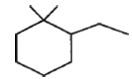
The $IUPAC$ name of the following compound is:
A
$1,1-$Dimethyl$-2-$ethylcyclohexane
B
$2-$Ethyl$-1,1-$dimethylcyclohexane
C
$1-$Ethyl$-2,2-$dimethylcyclohexane
D
$2,2-$Dimethyl$-1-$ethylcyclohexane
Solution
(B) $1$. Identify the parent chain: The parent chain is a cyclohexane ring.
$2$. Numbering: Number the ring to give the lowest possible locants to the substituents.
$3$. If we start numbering from the carbon with two methyl groups as $1$,the ethyl group gets position $2$. This gives the locant set $(1, 1, 2)$.
$4$. Alphabetical order: Ethyl comes before methyl.
$5$. Therefore,the name is $2-$ethyl$-1,1-$dimethylcyclohexane.
$2$. Numbering: Number the ring to give the lowest possible locants to the substituents.
$3$. If we start numbering from the carbon with two methyl groups as $1$,the ethyl group gets position $2$. This gives the locant set $(1, 1, 2)$.
$4$. Alphabetical order: Ethyl comes before methyl.
$5$. Therefore,the name is $2-$ethyl$-1,1-$dimethylcyclohexane.
0 likesView Solution
39
ChemistryMCQJEE Main · 2017
The value of $k$ for which the function $f(x) = \begin{cases} (\frac{4}{5})^{\frac{\tan 4x}{\tan 5x}}, & 0 < x < \frac{\pi}{2} \\ k + \frac{2}{5}, & x = \frac{\pi}{2} \end{cases}$ is continuous at $x = \frac{\pi}{2}$ is
A
$\frac{17}{20}$
B
$\frac{2}{5}$
C
$\frac{3}{5}$
D
$-\frac{2}{5}$
Solution
(C) For the function to be continuous at $x = \frac{\pi}{2}$,we must have $\lim_{x \to \frac{\pi}{2}} f(x) = f(\frac{\pi}{2})$.
First,calculate the limit: $\lim_{x \to \frac{\pi}{2}} (\frac{4}{5})^{\frac{\tan 4x}{\tan 5x}}$.
Let $x = \frac{\pi}{2} + h$,where $h \to 0$.
Then $\tan 4x = \tan(4(\frac{\pi}{2} + h)) = \tan(2\pi + 4h) = \tan 4h \approx 4h$.
And $\tan 5x = \tan(5(\frac{\pi}{2} + h)) = \tan(\frac{5\pi}{2} + 5h) = \cot 5h = \frac{1}{\tan 5h} \approx \frac{1}{5h}$.
Thus,$\frac{\tan 4x}{\tan 5x} = \frac{\tan 4h}{\cot 5h} = \tan 4h \cdot \tan 5h \to 0 \cdot \infty$ (indeterminate form).
Actually,$\frac{\tan 4x}{\tan 5x} = \frac{\tan(2\pi + 4h)}{\tan(\frac{5\pi}{2} + 5h)} = \frac{\tan 4h}{\cot 5h} = \tan 4h \cdot \tan 5h$. As $h \to 0$,this limit is $0 \cdot 0 = 0$.
So,$\lim_{x \to \frac{\pi}{2}} f(x) = (\frac{4}{5})^0 = 1$.
Equating to $f(\frac{\pi}{2}) = k + \frac{2}{5}$,we get $k + \frac{2}{5} = 1$.
Therefore,$k = 1 - \frac{2}{5} = \frac{3}{5}$.
First,calculate the limit: $\lim_{x \to \frac{\pi}{2}} (\frac{4}{5})^{\frac{\tan 4x}{\tan 5x}}$.
Let $x = \frac{\pi}{2} + h$,where $h \to 0$.
Then $\tan 4x = \tan(4(\frac{\pi}{2} + h)) = \tan(2\pi + 4h) = \tan 4h \approx 4h$.
And $\tan 5x = \tan(5(\frac{\pi}{2} + h)) = \tan(\frac{5\pi}{2} + 5h) = \cot 5h = \frac{1}{\tan 5h} \approx \frac{1}{5h}$.
Thus,$\frac{\tan 4x}{\tan 5x} = \frac{\tan 4h}{\cot 5h} = \tan 4h \cdot \tan 5h \to 0 \cdot \infty$ (indeterminate form).
Actually,$\frac{\tan 4x}{\tan 5x} = \frac{\tan(2\pi + 4h)}{\tan(\frac{5\pi}{2} + 5h)} = \frac{\tan 4h}{\cot 5h} = \tan 4h \cdot \tan 5h$. As $h \to 0$,this limit is $0 \cdot 0 = 0$.
So,$\lim_{x \to \frac{\pi}{2}} f(x) = (\frac{4}{5})^0 = 1$.
Equating to $f(\frac{\pi}{2}) = k + \frac{2}{5}$,we get $k + \frac{2}{5} = 1$.
Therefore,$k = 1 - \frac{2}{5} = \frac{3}{5}$.
0 likesView Solution
40
ChemistryMCQJEE Main · 2017
The contrapositive of the statement 'If two numbers are not equal,then their squares are not equal' is:
A
If the squares of two numbers are equal,then the numbers are equal.
B
If the squares of two numbers are equal,then the numbers are not equal.
C
If the squares of two numbers are not equal,then the numbers are not equal.
D
If the squares of two numbers are not equal,then the numbers are equal.
Solution
(A) For a conditional statement of the form $p \to q$,the contrapositive is defined as $\sim q \to \sim p$.
Here,$p$ is 'two numbers are not equal' and $q$ is 'their squares are not equal'.
Therefore,$\sim q$ is 'the squares of two numbers are equal' and $\sim p$ is 'the numbers are equal'.
Thus,the contrapositive is: 'If the squares of two numbers are equal,then the numbers are equal'.
Here,$p$ is 'two numbers are not equal' and $q$ is 'their squares are not equal'.
Therefore,$\sim q$ is 'the squares of two numbers are equal' and $\sim p$ is 'the numbers are equal'.
Thus,the contrapositive is: 'If the squares of two numbers are equal,then the numbers are equal'.
0 likesView Solution
41
ChemistryDifficultMCQJEE Main · 2017
An ideal gas undergoes isothermal expansion at constant pressure. During the process
A
enthalpy increases but entropy decreases
B
enthalpy remains constant but entropy increases
C
enthalpy decreases but entropy increases.
D
Both enthalpy and entropy remain constant.
Solution
(B) For an ideal gas,enthalpy $H$ is a function of temperature only,i.e.,$H = f(T)$.
Since the process is isothermal,the change in temperature $\Delta T = 0$,therefore $\Delta H = n C_p \Delta T = 0$,which means enthalpy remains constant.
For an expansion process,the final volume $V_f$ is greater than the initial volume $V_i$ $(V_f > V_i)$.
The change in entropy for an ideal gas is given by $\Delta S = n R \ln(V_f / V_i)$.
Since $V_f / V_i > 1$,$\ln(V_f / V_i) > 0$,therefore $\Delta S > 0$,which means entropy increases.
Since the process is isothermal,the change in temperature $\Delta T = 0$,therefore $\Delta H = n C_p \Delta T = 0$,which means enthalpy remains constant.
For an expansion process,the final volume $V_f$ is greater than the initial volume $V_i$ $(V_f > V_i)$.
The change in entropy for an ideal gas is given by $\Delta S = n R \ln(V_f / V_i)$.
Since $V_f / V_i > 1$,$\ln(V_f / V_i) > 0$,therefore $\Delta S > 0$,which means entropy increases.
0 likesView Solution
42
ChemistryAdvancedMCQJEE Main · 2017
$50 \, mL$ of $0.2 \, M$ ammonia solution is treated with $25 \, mL$ of $0.2 \, M$ $HCl$. If $pK_b$ of ammonia solution is $4.75$,the $pH$ of the mixture will be
A
$3.75$
B
$4.75$
C
$8.25$
D
$9.25$
Solution
(D) The reaction is: $NH_3 + HCl \to NH_4Cl$
Initial moles of $HCl = 0.2 \, M \times 0.025 \, L = 0.005 \, mol$
Initial moles of $NH_3 = 0.2 \, M \times 0.050 \, L = 0.010 \, mol$
Since $HCl$ is the limiting reagent,it reacts completely with $0.005 \, mol$ of $NH_3$ to form $0.005 \, mol$ of $NH_4Cl$.
Remaining moles of $NH_3 = 0.010 - 0.005 = 0.005 \, mol$
This forms a basic buffer solution containing $NH_3$ (base) and $NH_4Cl$ (salt).
Using the Henderson-Hasselbalch equation for a basic buffer:
$pOH = pK_b + \log \frac{[Salt]}{[Base]}$
Since the volume is the same for both,the ratio of concentrations is equal to the ratio of moles:
$pOH = 4.75 + \log \frac{0.005}{0.005} = 4.75 + \log(1) = 4.75$
$pH = 14 - pOH = 14 - 4.75 = 9.25$
Initial moles of $HCl = 0.2 \, M \times 0.025 \, L = 0.005 \, mol$
Initial moles of $NH_3 = 0.2 \, M \times 0.050 \, L = 0.010 \, mol$
Since $HCl$ is the limiting reagent,it reacts completely with $0.005 \, mol$ of $NH_3$ to form $0.005 \, mol$ of $NH_4Cl$.
Remaining moles of $NH_3 = 0.010 - 0.005 = 0.005 \, mol$
This forms a basic buffer solution containing $NH_3$ (base) and $NH_4Cl$ (salt).
Using the Henderson-Hasselbalch equation for a basic buffer:
$pOH = pK_b + \log \frac{[Salt]}{[Base]}$
Since the volume is the same for both,the ratio of concentrations is equal to the ratio of moles:
$pOH = 4.75 + \log \frac{0.005}{0.005} = 4.75 + \log(1) = 4.75$
$pH = 14 - pOH = 14 - 4.75 = 9.25$
0 likesView Solution
43
ChemistryMediumMCQJEE Main · 2017
The electron in the hydrogen atom undergoes a transition from higher orbitals to an orbital of radius $211.6 \text{ pm}$. This transition is associated with:
A
Lyman series
B
Balmer series
C
Paschen series
D
Brackett series
Solution
$(B)$ The radius of an orbit in a hydrogen-like atom is given by $r = 0.529 \times \frac{n^2}{Z} \mathring{A}$.
Given $r = 211.6 \text{ pm} = 2.116 \mathring{A}$ and for hydrogen $Z = 1$.
Substituting the values: $2.116 = 0.529 \times n^2$.
$n^2 = \frac{2.116}{0.529} = 4$.
$n = 2$.
Since the electron transitions from higher orbitals to the $n = 2$ orbit, this corresponds to the Balmer series.
Given $r = 211.6 \text{ pm} = 2.116 \mathring{A}$ and for hydrogen $Z = 1$.
Substituting the values: $2.116 = 0.529 \times n^2$.
$n^2 = \frac{2.116}{0.529} = 4$.
$n = 2$.
Since the electron transitions from higher orbitals to the $n = 2$ orbit, this corresponds to the Balmer series.
0 likesView Solution
44
ChemistryDifficultMCQJEE Main · 2017
At $300\, K$,the density of a certain gaseous molecule at $2\, bar$ is double that of dinitrogen $(N_2)$ at $4\, bar$. The molar mass of the gaseous molecule is ............... $g\, mol^{-1}$.
A
$28$
B
$56$
C
$112$
D
$224$
Solution
(C) The density $(\rho)$ of a gas is given by the formula $\rho = \frac{PM}{RT}$,where $P$ is pressure,$M$ is molar mass,$R$ is the gas constant,and $T$ is temperature.
Given that the temperature $T$ is constant for both gases.
For $N_2$ gas: $\rho_{N_2} = \frac{P_{N_2} \times M_{N_2}}{RT} = \frac{4 \times 28}{RT}$.
For the unknown gas: $\rho_{gas} = \frac{P_{gas} \times M_{gas}}{RT} = \frac{2 \times M_{gas}}{RT}$.
According to the problem,$\rho_{gas} = 2 \times \rho_{N_2}$.
Substituting the expressions: $\frac{2 \times M_{gas}}{RT} = 2 \times \left( \frac{4 \times 28}{RT} \right)$.
Canceling $RT$ from both sides: $2 \times M_{gas} = 8 \times 28$.
$M_{gas} = 4 \times 28 = 112\, g\, mol^{-1}$.
Given that the temperature $T$ is constant for both gases.
For $N_2$ gas: $\rho_{N_2} = \frac{P_{N_2} \times M_{N_2}}{RT} = \frac{4 \times 28}{RT}$.
For the unknown gas: $\rho_{gas} = \frac{P_{gas} \times M_{gas}}{RT} = \frac{2 \times M_{gas}}{RT}$.
According to the problem,$\rho_{gas} = 2 \times \rho_{N_2}$.
Substituting the expressions: $\frac{2 \times M_{gas}}{RT} = 2 \times \left( \frac{4 \times 28}{RT} \right)$.
Canceling $RT$ from both sides: $2 \times M_{gas} = 8 \times 28$.
$M_{gas} = 4 \times 28 = 112\, g\, mol^{-1}$.
0 likesView Solution
45
ChemistryDifficultMCQJEE Main · 2017
What quantity (in $mL$) of a $45\%$ acid solution of a mono-protic strong acid must be mixed with a $20\%$ solution of the same acid to produce $800 \ mL$ of a $29.875\%$ acid solution?
A
$320$
B
$325$
C
$316$
D
$330$
Solution
(C) Let the volume of the $45\%$ acid solution be $V \ mL$. Then the volume of the $20\%$ acid solution is $(800 - V) \ mL$.
Using the principle of conservation of mass for the acid:
$\frac{V \times 45}{100} + \frac{(800 - V) \times 20}{100} = \frac{800 \times 29.875}{100}$
$0.45V + 160 - 0.2V = 239$
$0.25V = 79$
$V = \frac{79}{0.25} = 316 \ mL$
Using the principle of conservation of mass for the acid:
$\frac{V \times 45}{100} + \frac{(800 - V) \times 20}{100} = \frac{800 \times 29.875}{100}$
$0.45V + 160 - 0.2V = 239$
$0.25V = 79$
$V = \frac{79}{0.25} = 316 \ mL$
1 likesView Solution
46
ChemistryDifficultMCQJEE Main · 2017
$A$ gas undergoes a change from state $A$ to state $B$. In this process,the heat absorbed and work done by the gas are $5\, J$ and $8\, J$,respectively. Now,the gas is brought back to $A$ by another process during which $3\, J$ of heat is evolved. In this reverse process of $B$ to $A$:
A
$10\, J$ of work will be done by the gas.
B
$6\, J$ of work will be done by the gas.
C
$10\, J$ of work will be done by the surrounding on the gas.
D
$6\, J$ of work will be done by the surrounding on the gas.
Solution
(D) For the process $A \rightarrow B$:
Heat absorbed,$q_{AB} = +5\, J$
Work done by the gas,$w_{AB} = -8\, J$ (since work is done by the gas,it is negative in the system's perspective for $\Delta U = q + w$)
Change in internal energy,$\Delta U_{AB} = q_{AB} + w_{AB} = 5 + (-8) = -3\, J$
For the reverse process $B \rightarrow A$:
Since internal energy is a state function,$\Delta U_{BA} = -\Delta U_{AB} = -(-3) = +3\, J$
Heat evolved,$q_{BA} = -3\, J$
Using the first law of thermodynamics: $\Delta U_{BA} = q_{BA} + w_{BA}$
$3 = -3 + w_{BA}$
$w_{BA} = +6\, J$
Since the work done $w_{BA}$ is positive,it means work is done by the surrounding on the gas.
Heat absorbed,$q_{AB} = +5\, J$
Work done by the gas,$w_{AB} = -8\, J$ (since work is done by the gas,it is negative in the system's perspective for $\Delta U = q + w$)
Change in internal energy,$\Delta U_{AB} = q_{AB} + w_{AB} = 5 + (-8) = -3\, J$
For the reverse process $B \rightarrow A$:
Since internal energy is a state function,$\Delta U_{BA} = -\Delta U_{AB} = -(-3) = +3\, J$
Heat evolved,$q_{BA} = -3\, J$
Using the first law of thermodynamics: $\Delta U_{BA} = q_{BA} + w_{BA}$
$3 = -3 + w_{BA}$
$w_{BA} = +6\, J$
Since the work done $w_{BA}$ is positive,it means work is done by the surrounding on the gas.
0 likesView Solution
47
ChemistryMediumMCQJEE Main · 2017
The electronic configuration with the highest ionization enthalpy is
A
$[Ne]\, 3s^2\, 3p^1$
B
$[Ne]\, 3s^2\, 3p^2$
C
$[Ne]\, 3s^2\, 3p^3$
D
$[Ar]\, 3d^{10}\, 4s^2\, 4p^3$
Solution
(C) Ionization enthalpy $(IE)$ depends on atomic size and electronic stability.
Smaller atomic size leads to higher $IE$ because the valence electrons are more strongly attracted by the nucleus.
Additionally,half-filled and fully-filled orbitals possess extra stability,requiring more energy to remove an electron.
Comparing the given configurations: $[Ne]\, 3s^2\, 3p^1$,$[Ne]\, 3s^2\, 3p^2$,and $[Ne]\, 3s^2\, 3p^3$ belong to the $3^{rd}$ period,while $[Ar]\, 3d^{10}\, 4s^2\, 4p^3$ belongs to the $4^{th}$ period.
Elements in the $3^{rd}$ period have smaller atomic radii than those in the $4^{th}$ period,resulting in higher $IE$ for $3^{rd}$ period elements.
Among the $3^{rd}$ period elements,$[Ne]\, 3s^2\, 3p^3$ has a half-filled $p$-orbital,which provides extra stability,making its ionization enthalpy the highest.
Smaller atomic size leads to higher $IE$ because the valence electrons are more strongly attracted by the nucleus.
Additionally,half-filled and fully-filled orbitals possess extra stability,requiring more energy to remove an electron.
Comparing the given configurations: $[Ne]\, 3s^2\, 3p^1$,$[Ne]\, 3s^2\, 3p^2$,and $[Ne]\, 3s^2\, 3p^3$ belong to the $3^{rd}$ period,while $[Ar]\, 3d^{10}\, 4s^2\, 4p^3$ belongs to the $4^{th}$ period.
Elements in the $3^{rd}$ period have smaller atomic radii than those in the $4^{th}$ period,resulting in higher $IE$ for $3^{rd}$ period elements.
Among the $3^{rd}$ period elements,$[Ne]\, 3s^2\, 3p^3$ has a half-filled $p$-orbital,which provides extra stability,making its ionization enthalpy the highest.
0 likesView Solution
48
ChemistryMCQJEE Main · 2017
The following reaction occurs in the Blast Furnace where iron ore is reduced to iron metal:
$Fe_2O_{3(s)} + 3CO_{(g)} \rightleftharpoons 2Fe_{(l)} + 3CO_{2(g)}$
Using the Le Chatelier's principle,predict which one of the following will not disturb the equilibrium?
$Fe_2O_{3(s)} + 3CO_{(g)} \rightleftharpoons 2Fe_{(l)} + 3CO_{2(g)}$
Using the Le Chatelier's principle,predict which one of the following will not disturb the equilibrium?
A
Removal of $CO$
B
Removal of $CO_2$
C
Addition of $CO_2$
D
Addition of $Fe_2O_3$
Solution
(D) According to Le Chatelier's principle,the equilibrium position is affected by changes in the concentration of gaseous or aqueous species. Solids and pure liquids have constant activity and their concentration does not change the equilibrium position.
Since $Fe_2O_3$ is a solid,its addition or removal does not affect the equilibrium position.
| Perturbation | Effect on Equilibrium |
|---|---|
| $A$. Removal of $CO$ | Shifts to the left |
| $B$. Removal of $CO_2$ | Shifts to the right |
| $C$. Addition of $CO_2$ | Shifts to the left |
| $D$. Addition of $Fe_2O_3$ | No change |
Since $Fe_2O_3$ is a solid,its addition or removal does not affect the equilibrium position.
0 likesView Solution
49
ChemistryDifficultMCQJEE Main · 2017
Which one of the following is an oxide?
A
$KO_2$
B
$BaO_2$
C
$SiO_2$
D
$CsO_2$
Solution
(C)
An oxide is a chemical compound that contains at least one oxygen atom and one other element in its chemical formula,where the oxygen is in the $-2$ oxidation state. $SiO_2$ (silicon dioxide) is a typical oxide,whereas $KO_2$ and $CsO_2$ are superoxides (containing the $O_2^-$ ion) and $BaO_2$ is a peroxide (containing the $O_2^{2-}$ ion).
| Compound | Nature |
|---|---|
| $KO_2$ | Superoxide |
| $BaO_2$ | Peroxide |
| $SiO_2$ | Oxide |
| $CsO_2$ | Superoxide |
An oxide is a chemical compound that contains at least one oxygen atom and one other element in its chemical formula,where the oxygen is in the $-2$ oxidation state. $SiO_2$ (silicon dioxide) is a typical oxide,whereas $KO_2$ and $CsO_2$ are superoxides (containing the $O_2^-$ ion) and $BaO_2$ is a peroxide (containing the $O_2^{2-}$ ion).
0 likesView Solution
50
ChemistryDifficultMCQJEE Main · 2017
Which of the following is a set of greenhouse gases?
A
$CH_4, O_3, N_2, SO_2$
B
$O_3, N_2, CO_2, NO_2$
C
$O_3, NO_2, SO_2, Cl_2$
D
$CO_2, CH_4, N_2O, O_3$
Solution
(D) Greenhouse gases are those gases that absorb and emit radiation within the thermal $IR$ range.
This process is the fundamental cause of the greenhouse effect.
The primary greenhouse gases include $CO_2, CH_4, N_2O,$ and $O_3$.
This process is the fundamental cause of the greenhouse effect.
The primary greenhouse gases include $CO_2, CH_4, N_2O,$ and $O_3$.
0 likesView Solution
51
ChemistryDifficultMCQJEE Main · 2017
Which of the following compounds will form a significant amount of meta-product during a mono-nitration reaction?
A
Phenol
B
Phenyl acetate
C
Aniline
D
Acetanilide
Solution
(C) . Nitration reactions are carried out in the presence of concentrated $HNO_3$ and concentrated $H_2SO_4$.
$(b)$. Aniline acts as a base. In the presence of $H_2SO_4$,it undergoes protonation to form the anilinium ion $(-NH_3^+)$.
$(c)$. The anilinium ion is a strongly deactivating group and is meta-directing in nature due to the positive charge on the nitrogen atom,which exerts a strong $-I$ effect.
$(d)$. Consequently,during the nitration of aniline in an acidic medium,a significant amount of the meta-nitro product is formed.
$(b)$. Aniline acts as a base. In the presence of $H_2SO_4$,it undergoes protonation to form the anilinium ion $(-NH_3^+)$.
$(c)$. The anilinium ion is a strongly deactivating group and is meta-directing in nature due to the positive charge on the nitrogen atom,which exerts a strong $-I$ effect.
$(d)$. Consequently,during the nitration of aniline in an acidic medium,a significant amount of the meta-nitro product is formed.
0 likesView Solution
52
ChemistryDifficultMCQJEE Main · 2017
The increasing order of the reactivity of the following halides for the $S_N1$ reaction is:
$(I)$ $CH_3-CHCl-CH_2-CH_3$
$(II)$ $CH_3-CH_2-CH_2-Cl$
$(III)$ $p-CH_3O-C_6H_4-CH_2Cl$
$(I)$ $CH_3-CHCl-CH_2-CH_3$
$(II)$ $CH_3-CH_2-CH_2-Cl$
$(III)$ $p-CH_3O-C_6H_4-CH_2Cl$
A
$(III) < (II) < (I)$
B
$(II) < (I) < (III)$
C
$(I) < (III) < (II)$
D
$(II) < (III) < (I)$
Solution
(B) The reactivity of halides in $S_N1$ reaction depends on the stability of the carbocation formed as the rate-determining step.
The carbocations formed are:
$(I)$ $CH_3-CH^+-CH_2-CH_3$ ($2^\circ$ carbocation)
$(II)$ $CH_3-CH_2-CH_2^+$ ($1^\circ$ carbocation)
$(III)$ $p-CH_3O-C_6H_4-CH_2^+$ (Resonance stabilized benzylic carbocation with strong $+M$ effect of $-OCH_3$ group).
The stability order of these carbocations is $(II) < (I) < (III)$.
Therefore,the increasing order of reactivity for the $S_N1$ reaction is $(II) < (I) < (III)$.
The carbocations formed are:
$(I)$ $CH_3-CH^+-CH_2-CH_3$ ($2^\circ$ carbocation)
$(II)$ $CH_3-CH_2-CH_2^+$ ($1^\circ$ carbocation)
$(III)$ $p-CH_3O-C_6H_4-CH_2^+$ (Resonance stabilized benzylic carbocation with strong $+M$ effect of $-OCH_3$ group).
The stability order of these carbocations is $(II) < (I) < (III)$.
Therefore,the increasing order of reactivity for the $S_N1$ reaction is $(II) < (I) < (III)$.
0 likesView Solution
53
ChemistryDifficultMCQJEE Main · 2017
The formation of which of the following polymers involves a hydrolysis reaction?
A
Nylon $6$
B
Bakelite
C
Nylon $6, 6$
D
Terylene
Solution
(A) Nylon-$6$ is prepared by heating $\varepsilon$-caprolactam with water at a high temperature $(533-543 \ K)$.
In this process,the cyclic amide ring of $\varepsilon$-caprolactam undergoes a hydrolysis reaction to form an amino acid,which then undergoes polymerization to form Nylon-$6$.
In this process,the cyclic amide ring of $\varepsilon$-caprolactam undergoes a hydrolysis reaction to form an amino acid,which then undergoes polymerization to form Nylon-$6$.
0 likesView Solution
54
ChemistryDifficultMCQJEE Main · 2017
Which of the following,upon treatment with $tert-BuONa$ followed by addition of bromine water,fails to decolourize the colour of bromine?
A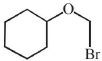
B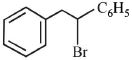
C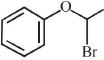
D
Solution
(A) Bromine water is decolourized by compounds containing carbon-carbon double or triple bonds (unsaturation) due to electrophilic addition.
Treatment with $tert-BuONa$ (a strong base) typically induces elimination reactions $(E2)$ in alkyl halides to form alkenes.
Option $A$ is cyclohexyl bromomethyl ether. Treatment with $tert-BuONa$ leads to substitution (Williamson ether synthesis) rather than elimination because the $\beta$-carbon lacks hydrogens,resulting in a saturated ether that does not react with bromine water.
Options $B$,$C$,and $D$ contain $\beta$-hydrogens and undergo elimination to form alkenes,which will decolourize bromine water.
Treatment with $tert-BuONa$ (a strong base) typically induces elimination reactions $(E2)$ in alkyl halides to form alkenes.
Option $A$ is cyclohexyl bromomethyl ether. Treatment with $tert-BuONa$ leads to substitution (Williamson ether synthesis) rather than elimination because the $\beta$-carbon lacks hydrogens,resulting in a saturated ether that does not react with bromine water.
Options $B$,$C$,and $D$ contain $\beta$-hydrogens and undergo elimination to form alkenes,which will decolourize bromine water.

0 likesView Solution
55
ChemistryAdvancedMCQJEE Main · 2017
$A$ metal crystallises in a face-centred cubic $(fcc)$ structure. If the edge length of its unit cell is $a$,the closest approach between two atoms in the metallic crystal will be:
A
$2a$
B
$2 \sqrt{2} a$
C
$\sqrt{2} a$
D
$\frac{a}{\sqrt{2}}$
Solution
(D) In a face-centred cubic $(fcc)$ unit cell,the atoms touch each other along the face diagonal.
Let the radius of the atoms be $r$ and the edge length of the unit cell be $a$.
The face diagonal of the cube is given by $\sqrt{a^2 + a^2} = \sqrt{2} a$.
Since the atoms touch along the face diagonal,the length of the face diagonal is equal to $4r$.
Therefore,$4r = \sqrt{2} a$,which gives $r = \frac{\sqrt{2} a}{4} = \frac{a}{2\sqrt{2}}$.
The closest approach between two atoms is the distance between their centers,which is $2r$.
Thus,$2r = 2 \times \frac{a}{2\sqrt{2}} = \frac{a}{\sqrt{2}}$.
Let the radius of the atoms be $r$ and the edge length of the unit cell be $a$.
The face diagonal of the cube is given by $\sqrt{a^2 + a^2} = \sqrt{2} a$.
Since the atoms touch along the face diagonal,the length of the face diagonal is equal to $4r$.
Therefore,$4r = \sqrt{2} a$,which gives $r = \frac{\sqrt{2} a}{4} = \frac{a}{2\sqrt{2}}$.
The closest approach between two atoms is the distance between their centers,which is $2r$.
Thus,$2r = 2 \times \frac{a}{2\sqrt{2}} = \frac{a}{\sqrt{2}}$.
0 likesView Solution
56
ChemistryDifficultMCQJEE Main · 2017
Two reactions $R_1$ and $R_2$ have identical pre-exponential factors. Activation energy of $R_1$ exceeds that of $R_2$ by $10 \, kJ \, mol^{-1}.$ If $k_1$ and $k_2$ are rate constants for reactions $R_1$ and $R_2$ respectively at $300 \, K,$ then $\ln (k_2/k_1)$ is equal to :
$(R=8.314 \, J \, mol^{-1} \, K^{-1})$
$(R=8.314 \, J \, mol^{-1} \, K^{-1})$
A
$8$
B
$12$
C
$6$
D
$4$
Solution
(D) According to the Arrhenius equation,$k = A e^{-E_a / RT}$.
For reactions $R_1$ and $R_2$ with identical pre-exponential factors $A$:
$k_1 = A e^{-E_{a1} / RT}$
$k_2 = A e^{-E_{a2} / RT}$
Dividing $k_2$ by $k_1$:
$\frac{k_2}{k_1} = \frac{A e^{-E_{a2} / RT}}{A e^{-E_{a1} / RT}} = e^{(E_{a1} - E_{a2}) / RT}$
Taking the natural logarithm on both sides:
$\ln(k_2/k_1) = \frac{E_{a1} - E_{a2}}{RT}$
Given $E_{a1} - E_{a2} = 10 \, kJ \, mol^{-1} = 10,000 \, J \, mol^{-1}$,$R = 8.314 \, J \, mol^{-1} \, K^{-1}$,and $T = 300 \, K$:
$\ln(k_2/k_1) = \frac{10,000}{8.314 \times 300} \approx \frac{10,000}{2494.2} \approx 4.009 \approx 4$.
For reactions $R_1$ and $R_2$ with identical pre-exponential factors $A$:
$k_1 = A e^{-E_{a1} / RT}$
$k_2 = A e^{-E_{a2} / RT}$
Dividing $k_2$ by $k_1$:
$\frac{k_2}{k_1} = \frac{A e^{-E_{a2} / RT}}{A e^{-E_{a1} / RT}} = e^{(E_{a1} - E_{a2}) / RT}$
Taking the natural logarithm on both sides:
$\ln(k_2/k_1) = \frac{E_{a1} - E_{a2}}{RT}$
Given $E_{a1} - E_{a2} = 10 \, kJ \, mol^{-1} = 10,000 \, J \, mol^{-1}$,$R = 8.314 \, J \, mol^{-1} \, K^{-1}$,and $T = 300 \, K$:
$\ln(k_2/k_1) = \frac{10,000}{8.314 \times 300} \approx \frac{10,000}{2494.2} \approx 4.009 \approx 4$.
0 likesView Solution
57
ChemistryDifficultMCQJEE Main · 2017
The correct sequence of reagents for the following conversion will be:
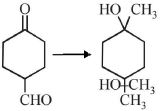
A
$[Ag(NH_3)_2]^+ OH^-, H^+/CH_3OH, CH_3MgBr$
B
$CH_3MgBr, H^+/CH_3OH, [Ag(NH_3)_2]^+ OH^-$
C
$CH_3MgBr, [Ag(NH_3)_2]^+ OH^-, H^+/CH_3OH$
D
$[Ag(NH_3)_2]^+ OH^-, CH_3MgBr, H^+/CH_3OH$
Solution
(A) The conversion involves the selective transformation of an aldehyde group to a tertiary alcohol while preserving the ketone group or transforming it appropriately.
$1$. First,the aldehyde group is oxidized to a carboxylic acid using Tollens' reagent,$[Ag(NH_3)_2]^+ OH^-$.
$2$. Next,the carboxylic acid is esterified to a methyl ester using $H^+/CH_3OH$.
$3$. Finally,the reaction with excess $CH_3MgBr$ (Grignard reagent) attacks both the ketone and the ester groups to form the final diol product.
$1$. First,the aldehyde group is oxidized to a carboxylic acid using Tollens' reagent,$[Ag(NH_3)_2]^+ OH^-$.
$2$. Next,the carboxylic acid is esterified to a methyl ester using $H^+/CH_3OH$.
$3$. Finally,the reaction with excess $CH_3MgBr$ (Grignard reagent) attacks both the ketone and the ester groups to form the final diol product.
0 likesView Solution
58
ChemistryMediumMCQJEE Main · 2017
The Tyndall effect is observed only when the following conditions are satisfied $:$
$1$. The diameter of the dispersed particles is much smaller than the wavelength of the light used.
$2$. The diameter of the dispersed particle is not much smaller than the wavelength of the light used.
$3$. The refractive indices of the dispersed phase and dispersion medium are almost similar in magnitude.
$4$. The refractive indices of the dispersed phase and dispersion medium differ greatly in magnitude.
$1$. The diameter of the dispersed particles is much smaller than the wavelength of the light used.
$2$. The diameter of the dispersed particle is not much smaller than the wavelength of the light used.
$3$. The refractive indices of the dispersed phase and dispersion medium are almost similar in magnitude.
$4$. The refractive indices of the dispersed phase and dispersion medium differ greatly in magnitude.
A
$1$ and $4$
B
$2$ and $4$
C
$1$ and $3$
D
$2$ and $3$
Solution
(B) The Tyndall effect is an optical phenomenon observed in colloidal systems.
The two essential conditions for the observation of the Tyndall effect are:
$1$. The diameter of the dispersed particles is not much smaller than the wavelength of the light used.
$2$. The refractive indices of the dispersed phase and the dispersion medium differ greatly in magnitude.
Thus,conditions $2$ and $4$ are correct.
The two essential conditions for the observation of the Tyndall effect are:
$1$. The diameter of the dispersed particles is not much smaller than the wavelength of the light used.
$2$. The refractive indices of the dispersed phase and the dispersion medium differ greatly in magnitude.
Thus,conditions $2$ and $4$ are correct.
0 likesView Solution
59
ChemistryDifficultMCQJEE Main · 2017
Which of the following compounds will behave as a reducing sugar in an aqueous $KOH$ solution?
A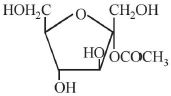
B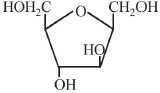
C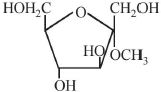
D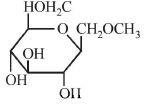
Solution
(A) reducing sugar is a carbohydrate that possesses a free aldehyde or ketone group,or a hemiacetal group that can open to form such a group in solution.
In an aqueous $KOH$ solution,esters of sugars (like the one shown in option $A$) undergo base-catalyzed hydrolysis.
The hydrolysis of the ester group at the anomeric carbon releases a free hydroxyl group,regenerating the hemiacetal structure.
This hemiacetal structure exists in equilibrium with its open-chain form containing a free aldehyde or ketone group,thus exhibiting reducing properties.
Therefore,the compound in option $A$ acts as a reducing sugar after hydrolysis in aqueous $KOH$.
In an aqueous $KOH$ solution,esters of sugars (like the one shown in option $A$) undergo base-catalyzed hydrolysis.
The hydrolysis of the ester group at the anomeric carbon releases a free hydroxyl group,regenerating the hemiacetal structure.
This hemiacetal structure exists in equilibrium with its open-chain form containing a free aldehyde or ketone group,thus exhibiting reducing properties.
Therefore,the compound in option $A$ acts as a reducing sugar after hydrolysis in aqueous $KOH$.
0 likesView Solution
60
ChemistryDifficultMCQJEE Main · 2017
Which of the following reactions is an example of a redox reaction?
A
$XeF_4 + O_2F_2 \rightarrow XeF_6 + O_2$
B
$XeF_2 + PF_5 \rightarrow [XeF]^+ PF_6^-$
C
$XeF_6 + H_2O \rightarrow XeOF_4 + 2HF$
D
$XeF_6 + 2H_2O \rightarrow XeO_2F_2 + 4HF$
Solution
(A) In the reaction $XeF_4 + O_2F_2 \rightarrow XeF_6 + O_2$,the oxidation state of $Xe$ changes from $+4$ to $+6$ (oxidation) and the oxidation state of $O$ changes from $+1$ to $0$ (reduction).
Since both oxidation and reduction occur,this is a redox reaction.
$\stackrel{+4}{Xe}F_4 + \stackrel{+1}{O_2}F_2 \rightarrow \stackrel{+6}{Xe}F_6 + \stackrel{0}{O_2}$
Since both oxidation and reduction occur,this is a redox reaction.
$\stackrel{+4}{Xe}F_4 + \stackrel{+1}{O_2}F_2 \rightarrow \stackrel{+6}{Xe}F_6 + \stackrel{0}{O_2}$
0 likesView Solution
61
ChemistryMediumMCQJEE Main · 2017
The products obtained when chlorine gas reacts with cold and dilute aqueous $NaOH$ are:
A
$ClO^{-}$ and $ClO_3^{-}$
B
$ClO_2^{-}$ and $ClO_3^{-}$
C
$Cl^{-}$ and $ClO^{-}$
D
$Cl^{-}$ and $ClO_2^{-}$
Solution
(C) When chlorine gas reacts with cold and dilute aqueous $NaOH$,it undergoes a disproportionation reaction.
The chemical equation is:
$Cl_{2} + 2NaOH \text{ (cold/dilute)} \rightarrow NaCl + NaOCl + H_{2}O$
In this reaction,$Cl_{2}$ is reduced to $Cl^{-}$ (in $NaCl$) and oxidized to $ClO^{-}$ (in $NaOCl$).
Therefore,the products are $Cl^{-}$ and $ClO^{-}$.
The chemical equation is:
$Cl_{2} + 2NaOH \text{ (cold/dilute)} \rightarrow NaCl + NaOCl + H_{2}O$
In this reaction,$Cl_{2}$ is reduced to $Cl^{-}$ (in $NaCl$) and oxidized to $ClO^{-}$ (in $NaOCl$).
Therefore,the products are $Cl^{-}$ and $ClO^{-}$.
0 likesView Solution
62
ChemistryMediumMCQJEE Main · 2017
The major product obtained in the following reaction is $:$
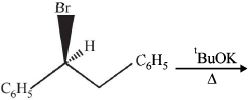
A
$(\pm ) C_6H_5CH(O^tBu)CH_2C_6H_5$
B
$C_6H_5CH=CHC_6H_5$
C
$(+) C_6H_5CH(O^tBu)CH_2C_6H_5$
D
$(-) C_6H_5CH(O^tBu)CH_2C_6H_5$
Solution
(B) The reaction of $1,2-diphenyl-1-bromoethane$ with a strong base like potassium tert-butoxide $(t-BuOK)$ in the presence of heat $(\Delta)$ undergoes a dehydrohalogenation reaction.
This is an $E_2$ elimination reaction where the base abstracts a proton from the $\beta$-carbon,leading to the formation of a double bond between the $\alpha$ and $\beta$ carbons.
The product formed is $1,2-diphenylethene$ $(C_6H_5CH=CHC_6H_5)$,which is a stable conjugated alkene.
The reaction is:
$C_6H_5CH(Br)CH_2C_6H_5 + t-BuOK \xrightarrow{\Delta} C_6H_5CH=CHC_6H_5 + t-BuOH + KBr$
This is an $E_2$ elimination reaction where the base abstracts a proton from the $\beta$-carbon,leading to the formation of a double bond between the $\alpha$ and $\beta$ carbons.
The product formed is $1,2-diphenylethene$ $(C_6H_5CH=CHC_6H_5)$,which is a stable conjugated alkene.
The reaction is:
$C_6H_5CH(Br)CH_2C_6H_5 + t-BuOK \xrightarrow{\Delta} C_6H_5CH=CHC_6H_5 + t-BuOH + KBr$

0 likesView Solution
63
ChemistryDifficultMCQJEE Main · 2017
The freezing point of benzene decreases by $0.45 ^\circ C$ when $0.2 \ g$ of acetic acid is added to $20 \ g$ of benzene. If acetic acid associates to form a dimer in benzene,the percentage association of acetic acid in benzene will be .......... $\%$
$(K_f \text{ for benzene} = 5.12 \ K \ kg \ mol^{-1})$
$(K_f \text{ for benzene} = 5.12 \ K \ kg \ mol^{-1})$
A
$64.6$
B
$80.4$
C
$74.6$
D
$94.6$
Solution
(D) The association reaction is: $2 \ CH_{3}COOH \rightleftharpoons (CH_{3}COOH)_{2}$
Initial moles: $1 \quad 0$
At equilibrium: $1 - \alpha \quad \alpha / 2$
Total moles at equilibrium: $1 - \alpha + \alpha / 2 = 1 - \alpha / 2$
Van't Hoff factor $i = 1 - \alpha / 2$
Using the formula: $\Delta T_{f} = i \times K_{f} \times m$
Molality $m = \frac{0.2 / 60}{20 / 1000} = \frac{0.2 \times 1000}{60 \times 20} = \frac{200}{1200} = 0.1667 \ m$
$0.45 = (1 - \alpha / 2) \times 5.12 \times 0.1667$
$0.45 = (1 - \alpha / 2) \times 0.8535$
$1 - \alpha / 2 = 0.5272$
$\alpha / 2 = 0.4728$
$\alpha = 0.9456$
Percentage association $= 94.56 \% \approx 94.6 \%$
Initial moles: $1 \quad 0$
At equilibrium: $1 - \alpha \quad \alpha / 2$
Total moles at equilibrium: $1 - \alpha + \alpha / 2 = 1 - \alpha / 2$
Van't Hoff factor $i = 1 - \alpha / 2$
Using the formula: $\Delta T_{f} = i \times K_{f} \times m$
Molality $m = \frac{0.2 / 60}{20 / 1000} = \frac{0.2 \times 1000}{60 \times 20} = \frac{200}{1200} = 0.1667 \ m$
$0.45 = (1 - \alpha / 2) \times 5.12 \times 0.1667$
$0.45 = (1 - \alpha / 2) \times 0.8535$
$1 - \alpha / 2 = 0.5272$
$\alpha / 2 = 0.4728$
$\alpha = 0.9456$
Percentage association $= 94.56 \% \approx 94.6 \%$
0 likesView Solution
64
ChemistryDifficultMCQJEE Main · 2017
On treatment of $100 \ mL$ of $0.1 \ M$ solution of $CoCl_3 \cdot 6H_2O$ with excess $AgNO_3$,$1.2 \times 10^{22}$ ions are precipitated. The complex is:
A
$[Co(H_2O)_4 Cl_2]Cl \cdot 2H_2O$
B
$[Co(H_2O)_3 Cl_3] \cdot 3H_2O$
C
$[Co(H_2O)_6]Cl_3$
D
$[Co(H_2O)_5 Cl]Cl_2 \cdot H_2O$
Solution
(D) The number of moles of $CoCl_3 \cdot 6H_2O$ is $0.1 \ M \times 0.1 \ L = 0.01 \ mol$.
The number of moles of $AgCl$ precipitated is $\frac{1.2 \times 10^{22}}{6.022 \times 10^{23}} \approx 0.02 \ mol$.
Since $0.01 \ mol$ of complex produces $0.02 \ mol$ of $AgCl$,$1 \ mol$ of complex produces $2 \ mol$ of $AgCl$.
This indicates that there are $2$ chloride ions outside the coordination sphere.
Therefore,the complex is $[Co(H_2O)_5 Cl]Cl_2 \cdot H_2O$.
The number of moles of $AgCl$ precipitated is $\frac{1.2 \times 10^{22}}{6.022 \times 10^{23}} \approx 0.02 \ mol$.
Since $0.01 \ mol$ of complex produces $0.02 \ mol$ of $AgCl$,$1 \ mol$ of complex produces $2 \ mol$ of $AgCl$.
This indicates that there are $2$ chloride ions outside the coordination sphere.
Therefore,the complex is $[Co(H_2O)_5 Cl]Cl_2 \cdot H_2O$.
0 likesView Solution
65
ChemistryDifficultMCQJEE Main · 2017
The major product obtained in the following reaction is:
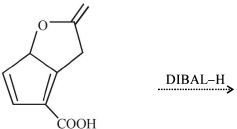
A
B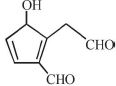
C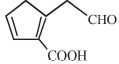
D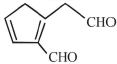
Solution
(A) $DIBAL-H$ (Diisobutylaluminium hydride) is a selective reducing agent. It is commonly used to reduce esters or lactones (cyclic esters) to aldehydes. In the given reaction,the lactone ring is opened and reduced to an aldehyde group,while the hydroxyl group is formed at the position where the oxygen was attached to the ring. The carboxylic acid group $(-COOH)$ remains unaffected under these specific reaction conditions.
0 likesView Solution
66
ChemistryMediumMCQJEE Main · 2017
Given
$E^o_{Cl_2/Cl^-} = 1.36 \ V,$
$E^o_{Cr^{3+}/Cr} = -0.74 \ V,$
$E^o_{Cr_2O_7^{2-}/Cr^{3+}} = 1.33 \ V,$
$E^o_{MnO_4^-/Mn^{2+}} = 1.51 \ V$
Among the following,the strongest reducing agent is:
$E^o_{Cl_2/Cl^-} = 1.36 \ V,$
$E^o_{Cr^{3+}/Cr} = -0.74 \ V,$
$E^o_{Cr_2O_7^{2-}/Cr^{3+}} = 1.33 \ V,$
$E^o_{MnO_4^-/Mn^{2+}} = 1.51 \ V$
Among the following,the strongest reducing agent is:
A
$Cr$
B
$Mn^{2+}$
C
$Cr^{3+}$
D
$Cl^-$
Solution
(A) The reducing strength of a species is inversely proportional to its standard reduction potential. $A$ lower (more negative) standard reduction potential indicates a higher tendency to undergo oxidation,making it a stronger reducing agent.
Comparing the given values:
$E^o_{Cl_2/Cl^-} = 1.36 \ V$
$E^o_{Cr^{3+}/Cr} = -0.74 \ V$
$E^o_{Cr_2O_7^{2-}/Cr^{3+}} = 1.33 \ V$
$E^o_{MnO_4^-/Mn^{2+}} = 1.51 \ V$
Among the species listed,$Cr$ has the lowest reduction potential $(-0.74 \ V)$.
Therefore,$Cr$ is the strongest reducing agent.
Comparing the given values:
$E^o_{Cl_2/Cl^-} = 1.36 \ V$
$E^o_{Cr^{3+}/Cr} = -0.74 \ V$
$E^o_{Cr_2O_7^{2-}/Cr^{3+}} = 1.33 \ V$
$E^o_{MnO_4^-/Mn^{2+}} = 1.51 \ V$
Among the species listed,$Cr$ has the lowest reduction potential $(-0.74 \ V)$.
Therefore,$Cr$ is the strongest reducing agent.
0 likesView Solution
67
ChemistryMediumMCQJEE Main · 2017
Among the following,the correct statement is:
A
Brownian movement is more pronounced for smaller particles than for bigger particles.
B
Sols of metal sulphides are lyophilic.
C
Hardy-Schulze law states that bigger the size of the ions,the greater is its coagulating power.
D
One would expect charcoal to adsorb chlorine more than hydrogen sulphide.
Solution
(A) Brownian movement is the random motion of particles suspended in a fluid (a liquid or gas) resulting from their collision with the fast-moving atoms or molecules in the fluid.
Since smaller particles have less mass,they are more easily affected by these collisions,making the Brownian movement more pronounced for smaller particles compared to bigger particles.
Therefore,option $A$ is the correct statement.
Metal sulphides are lyophobic (not lyophilic).
Hardy-Schulze law states that the coagulating power of an ion depends on its valency,not its size.
Charcoal adsorbs gases that are more easily liquefiable; $H_2S$ is more easily liquefiable than $Cl_2$ (due to higher boiling point),so $H_2S$ is adsorbed more.
Since smaller particles have less mass,they are more easily affected by these collisions,making the Brownian movement more pronounced for smaller particles compared to bigger particles.
Therefore,option $A$ is the correct statement.
Metal sulphides are lyophobic (not lyophilic).
Hardy-Schulze law states that the coagulating power of an ion depends on its valency,not its size.
Charcoal adsorbs gases that are more easily liquefiable; $H_2S$ is more easily liquefiable than $Cl_2$ (due to higher boiling point),so $H_2S$ is adsorbed more.
0 likesView Solution
68
ChemistryDifficultMCQJEE Main · 2017
What is the standard reduction potential $(E^o)$ for $Fe^{3+} \to Fe$ ? ............... $V$
Given that :
$Fe^{2+} + 2e^- \to Fe;$ $E^o_{Fe^{2+}/Fe} = -0.47 \ V$
$Fe^{3+} + e^- \to Fe^{2+};$ $E^o_{Fe^{3+}/Fe^{2+}} = +0.77 \ V$
Given that :
$Fe^{2+} + 2e^- \to Fe;$ $E^o_{Fe^{2+}/Fe} = -0.47 \ V$
$Fe^{3+} + e^- \to Fe^{2+};$ $E^o_{Fe^{3+}/Fe^{2+}} = +0.77 \ V$
A
$-0.057$
B
$+0.057$
C
$+0.30$
D
$-0.30$
Solution
(A) The standard Gibbs free energy change is given by $\Delta G^o = -nFE^o$.
For reaction $(i)$: $Fe^{2+} + 2e^- \to Fe$,$E^o = -0.47 \ V$,so $\Delta G^o_1 = -2 \times F \times (-0.47) = 0.94 \ F$.
For reaction $(ii)$: $Fe^{3+} + e^- \to Fe^{2+}$,$E^o = +0.77 \ V$,so $\Delta G^o_2 = -1 \times F \times (+0.77) = -0.77 \ F$.
For the overall reaction $(iii)$: $Fe^{3+} + 3e^- \to Fe$,the sum of the reactions is $(i) + (ii)$.
Therefore,$\Delta G^o_3 = \Delta G^o_1 + \Delta G^o_2 = 0.94 \ F - 0.77 \ F = 0.17 \ F$.
Using $\Delta G^o_3 = -nFE^o_{Fe^{3+}/Fe}$,where $n = 3$:
$0.17 \ F = -3 \times F \times E^o_{Fe^{3+}/Fe}$
$E^o_{Fe^{3+}/Fe} = \frac{0.17 \ F}{-3 \ F} = -0.057 \ V$.
For reaction $(i)$: $Fe^{2+} + 2e^- \to Fe$,$E^o = -0.47 \ V$,so $\Delta G^o_1 = -2 \times F \times (-0.47) = 0.94 \ F$.
For reaction $(ii)$: $Fe^{3+} + e^- \to Fe^{2+}$,$E^o = +0.77 \ V$,so $\Delta G^o_2 = -1 \times F \times (+0.77) = -0.77 \ F$.
For the overall reaction $(iii)$: $Fe^{3+} + 3e^- \to Fe$,the sum of the reactions is $(i) + (ii)$.
Therefore,$\Delta G^o_3 = \Delta G^o_1 + \Delta G^o_2 = 0.94 \ F - 0.77 \ F = 0.17 \ F$.
Using $\Delta G^o_3 = -nFE^o_{Fe^{3+}/Fe}$,where $n = 3$:
$0.17 \ F = -3 \times F \times E^o_{Fe^{3+}/Fe}$
$E^o_{Fe^{3+}/Fe} = \frac{0.17 \ F}{-3 \ F} = -0.057 \ V$.
0 likesView Solution
69
ChemistryAdvancedMCQJEE Main · 2017
$5 \ g$ of $Na_2SO_4$ was dissolved in $x \ g$ of $H_2O$. The change in freezing point was found to be $3.82 \ ^oC$. If $Na_2SO_4$ is $81.5 \%$ ionised,the value of $x$ ($K_f$ for water $= 1.86 \ ^oC \ kg \ mol^{-1}$) is approximately .............. $g$ (molar mass of $S = 32 \ g \ mol^{-1}$ and that of $Na = 23 \ g \ mol^{-1}$)
A
$15$
B
$25$
C
$45$
D
$65$
Solution
(C) Molar mass of $Na_2SO_4 = (2 \times 23) + 32 + (4 \times 16) = 142 \ g \ mol^{-1}$.
Van't Hoff factor $(i)$ for $Na_2SO_4 \to 2Na^+ + SO_4^{2-}$ is $i = 1 + (n-1)\alpha$,where $n=3$ and $\alpha = 0.815$.
$i = 1 + (3-1) \times 0.815 = 1 + 2 \times 0.815 = 2.63$.
Freezing point depression formula: $\Delta T_f = i \times K_f \times m$.
$3.82 = 2.63 \times 1.86 \times \left( \frac{5 / 142}{x / 1000} \right)$.
$3.82 = 2.63 \times 1.86 \times \frac{5000}{142 \times x}$.
$x = \frac{2.63 \times 1.86 \times 5000}{142 \times 3.82} \approx 45.07 \ g$.
Van't Hoff factor $(i)$ for $Na_2SO_4 \to 2Na^+ + SO_4^{2-}$ is $i = 1 + (n-1)\alpha$,where $n=3$ and $\alpha = 0.815$.
$i = 1 + (3-1) \times 0.815 = 1 + 2 \times 0.815 = 2.63$.
Freezing point depression formula: $\Delta T_f = i \times K_f \times m$.
$3.82 = 2.63 \times 1.86 \times \left( \frac{5 / 142}{x / 1000} \right)$.
$3.82 = 2.63 \times 1.86 \times \frac{5000}{142 \times x}$.
$x = \frac{2.63 \times 1.86 \times 5000}{142 \times 3.82} \approx 45.07 \ g$.
0 likesView Solution
70
ChemistryAdvancedMCQJEE Main · 2017
The rate of a reaction $A$ doubles on increasing the temperature from $300 \, K$ to $310 \, K$. By how much should the temperature of reaction $B$ be increased from $300 \, K$ so that its rate doubles,if the activation energy of reaction $B$ is twice that of reaction $A$ (in $, K$)?
A
$9.84$
B
$4.92$
C
$2.45$
D
$19.67$
Solution
(B) Using the Arrhenius equation: $\ln(\frac{k_2}{k_1}) = \frac{E_a}{R} [\frac{T_2 - T_1}{T_1 T_2}]$.
For reaction $A$: $\ln(2) = \frac{E_{a,A}}{R} [\frac{310 - 300}{300 \times 310}] = \frac{E_{a,A}}{R} [\frac{10}{93000}]$.
For reaction $B$: $\ln(2) = \frac{E_{a,B}}{R} [\frac{\Delta T}{300(300 + \Delta T)}]$.
Given $E_{a,B} = 2 E_{a,A}$,we substitute $\ln(2)$ from reaction $A$ into reaction $B$:
$\frac{E_{a,A}}{R} [\frac{10}{93000}] = \frac{2 E_{a,A}}{R} [\frac{\Delta T}{300(300 + \Delta T)}]$.
$\frac{10}{93000} = \frac{2 \Delta T}{300(300 + \Delta T)}$.
$\frac{1}{9300} = \frac{\Delta T}{150(300 + \Delta T)}$.
$150(300 + \Delta T) = 9300 \Delta T$.
$45000 + 150 \Delta T = 9300 \Delta T$.
$9150 \Delta T = 45000$.
$\Delta T = \frac{45000}{9150} \approx 4.92 \, K$.
For reaction $A$: $\ln(2) = \frac{E_{a,A}}{R} [\frac{310 - 300}{300 \times 310}] = \frac{E_{a,A}}{R} [\frac{10}{93000}]$.
For reaction $B$: $\ln(2) = \frac{E_{a,B}}{R} [\frac{\Delta T}{300(300 + \Delta T)}]$.
Given $E_{a,B} = 2 E_{a,A}$,we substitute $\ln(2)$ from reaction $A$ into reaction $B$:
$\frac{E_{a,A}}{R} [\frac{10}{93000}] = \frac{2 E_{a,A}}{R} [\frac{\Delta T}{300(300 + \Delta T)}]$.
$\frac{10}{93000} = \frac{2 \Delta T}{300(300 + \Delta T)}$.
$\frac{1}{9300} = \frac{\Delta T}{150(300 + \Delta T)}$.
$150(300 + \Delta T) = 9300 \Delta T$.
$45000 + 150 \Delta T = 9300 \Delta T$.
$9150 \Delta T = 45000$.
$\Delta T = \frac{45000}{9150} \approx 4.92 \, K$.
0 likesView Solution
71
ChemistryDifficultMCQJEE Main · 2017
The pair of compounds having metals in their highest oxidation state is
A
$MnO_4^-$ and $CrO_2Cl_2$
B
$[NiCl_4]^{2-}$ and $[CoCl_4]^{2-}$
C
$[Fe(CN)_6]^{3-}$ and $[Cu(CN)_4]^{2-}$
D
$[FeCl_4]^-$ and $Co_2O_3$
Solution
(A) To determine the highest oxidation state,we calculate the oxidation number for each metal:
$1$. $MnO_4^-$: Let $x$ be the oxidation state of $Mn$. $x + 4(-2) = -1 \implies x = +7$. $CrO_2Cl_2$: Let $y$ be the oxidation state of $Cr$. $y + 2(-2) + 2(-1) = 0 \implies y = +6$. Both $Mn$ $(+7)$ and $Cr$ $(+6)$ are in their highest possible oxidation states.
$2$. $[NiCl_4]^{2-}$: $Ni$ is $+2$; $[CoCl_4]^{2-}$: $Co$ is $+2$.
$3$. $[Fe(CN)_6]^{3-}$: $Fe$ is $+3$; $[Cu(CN)_4]^{2-}$: $Cu$ is $+2$.
$4$. $[FeCl_4]^-$: $Fe$ is $+3$; $Co_2O_3$: $Co$ is $+3$.
Thus,the pair $MnO_4^-$ and $CrO_2Cl_2$ contains metals in their highest oxidation states.
$1$. $MnO_4^-$: Let $x$ be the oxidation state of $Mn$. $x + 4(-2) = -1 \implies x = +7$. $CrO_2Cl_2$: Let $y$ be the oxidation state of $Cr$. $y + 2(-2) + 2(-1) = 0 \implies y = +6$. Both $Mn$ $(+7)$ and $Cr$ $(+6)$ are in their highest possible oxidation states.
$2$. $[NiCl_4]^{2-}$: $Ni$ is $+2$; $[CoCl_4]^{2-}$: $Co$ is $+2$.
$3$. $[Fe(CN)_6]^{3-}$: $Fe$ is $+3$; $[Cu(CN)_4]^{2-}$: $Cu$ is $+2$.
$4$. $[FeCl_4]^-$: $Fe$ is $+3$; $Co_2O_3$: $Co$ is $+3$.
Thus,the pair $MnO_4^-$ and $CrO_2Cl_2$ contains metals in their highest oxidation states.
0 likesView Solution
72
ChemistryDifficultMCQJEE Main · 2017
The number of $S=O$ and $S-OH$ bonds present in peroxodisulphuric acid $(H_2S_2O_8)$ and pyrosulphuric acid $(H_2S_2O_7)$ respectively are:
A
($2$ and $2$) and ($2$ and $2$)
B
($2$ and $4$) and ($2$ and $4$)
C
($4$ and $2$) and ($2$ and $4$)
D
($4$ and $2$) and ($4$ and $2$)
Solution
(D) For peroxodisulphuric acid $(H_2S_2O_8)$: The structure contains $4$ $S=O$ bonds and $2$ $S-OH$ bonds.
For pyrosulphuric acid $(H_2S_2O_7)$: The structure contains $4$ $S=O$ bonds and $2$ $S-OH$ bonds.
Therefore,the number of $S=O$ and $S-OH$ bonds in $H_2S_2O_8$ are $4$ and $2$ respectively,and in $H_2S_2O_7$ are $4$ and $2$ respectively.
For pyrosulphuric acid $(H_2S_2O_7)$: The structure contains $4$ $S=O$ bonds and $2$ $S-OH$ bonds.
Therefore,the number of $S=O$ and $S-OH$ bonds in $H_2S_2O_8$ are $4$ and $2$ respectively,and in $H_2S_2O_7$ are $4$ and $2$ respectively.
0 likesView Solution
73
ChemistryAdvancedMCQJEE Main · 2017
$A$ solution containing a group $IV$ cation gives a precipitate on passing $H_2S$ gas. $A$ solution of this precipitate in dilute $HCl$ produces a white precipitate with $NaOH$ solution and a bluish-white precipitate with basic potassium ferrocyanide. The cation is:
A
$Co^{2+}$
B
$Ni^{2+}$
C
$Mn^{2+}$
D
$Zn^{2+}$
Solution
(D) Group $IV$ cations include $Co^{2+}, Ni^{2+}, Mn^{2+},$ and $Zn^{2+}$.
When $H_2S$ is passed through a basic solution of $Zn^{2+}$,a white precipitate of $ZnS$ is formed.
This precipitate dissolves in dilute $HCl$ to form $ZnCl_2$: $ZnS + 2HCl \rightarrow ZnCl_2 + H_2S$.
$ZnCl_2$ reacts with $NaOH$ to form a white precipitate of $Zn(OH)_2$: $Zn^{2+} + 2OH^{-} \rightarrow Zn(OH)_2 \downarrow$ (White).
With potassium ferrocyanide $(K_4[Fe(CN)_6])$,$Zn^{2+}$ ions form a bluish-white precipitate of $K_2Zn_3[Fe(CN)_6]_2$: $3Zn^{2+} + 2K^{+} + 2[Fe(CN)_6]^{4-} \rightarrow K_2Zn_3[Fe(CN)_6]_2 \downarrow$ (Bluish-white).
When $H_2S$ is passed through a basic solution of $Zn^{2+}$,a white precipitate of $ZnS$ is formed.
This precipitate dissolves in dilute $HCl$ to form $ZnCl_2$: $ZnS + 2HCl \rightarrow ZnCl_2 + H_2S$.
$ZnCl_2$ reacts with $NaOH$ to form a white precipitate of $Zn(OH)_2$: $Zn^{2+} + 2OH^{-} \rightarrow Zn(OH)_2 \downarrow$ (White).
With potassium ferrocyanide $(K_4[Fe(CN)_6])$,$Zn^{2+}$ ions form a bluish-white precipitate of $K_2Zn_3[Fe(CN)_6]_2$: $3Zn^{2+} + 2K^{+} + 2[Fe(CN)_6]^{4-} \rightarrow K_2Zn_3[Fe(CN)_6]_2 \downarrow$ (Bluish-white).
0 likesView Solution
74
ChemistryAdvancedMCQJEE Main · 2017
$A$ mixture containing the following four compounds is extracted with $1 \, M \, HCl$. The compound that goes to the aqueous layer is:
$(I)$ Cyclohexyl methyl sulfide
$(II)$ $N$-methylcyclohexylamine
$(III)$ Methoxycyclohexane
$(IV)$ Cyclohexyl methyl ketone
$(I)$ Cyclohexyl methyl sulfide
$(II)$ $N$-methylcyclohexylamine
$(III)$ Methoxycyclohexane
$(IV)$ Cyclohexyl methyl ketone
A
$(I)$
B
$(II)$
C
$(III)$
D
$(IV)$
Solution
(B) When the given mixture is shaken with $1 \, M \, HCl$,the amine gets protonated to form a salt,which is a cation $\left( RNH_2CH_3^{\oplus} \right)$.
This salt is ionic and therefore dissolves in the aqueous layer $(H_2O)$ rather than the organic solvent.
Among the given compounds,$(II)$ is an amine ($N$-methylcyclohexylamine),which reacts with $HCl$ to form a water-soluble salt.
The other compounds (sulfide,ether,and ketone) do not react with $1 \, M \, HCl$ to form ionic species and remain in the organic layer.
Therefore,the correct option is $(II)$.
This salt is ionic and therefore dissolves in the aqueous layer $(H_2O)$ rather than the organic solvent.
Among the given compounds,$(II)$ is an amine ($N$-methylcyclohexylamine),which reacts with $HCl$ to form a water-soluble salt.
The other compounds (sulfide,ether,and ketone) do not react with $1 \, M \, HCl$ to form ionic species and remain in the organic layer.
Therefore,the correct option is $(II)$.
0 likesView Solution
75
ChemistryDifficultMCQJEE Main · 2017
The reason for "drug induced poisoning" is
A
Binding reversibly at the active site of the enzyme
B
Bringing conformational change in the binding site of enzyme
C
Binding irreversibly to the active site of the enzyme
D
Binding at the allosteric sites of the enzyme
Solution
(C) Enzyme inhibition can be either reversible or irreversible.
In case of irreversible inhibition,the inhibitor dissociates very slowly from its target enzyme because it has become tightly bound to the enzyme,either covalently or non-covalently.
Some irreversible inhibitors are important drugs like $Penicillin$ and $Aspirin$.
Thus,"drug induced poisoning" occurs when a drug binds irreversibly to the active site of the enzyme,permanently blocking its function.
In case of irreversible inhibition,the inhibitor dissociates very slowly from its target enzyme because it has become tightly bound to the enzyme,either covalently or non-covalently.
Some irreversible inhibitors are important drugs like $Penicillin$ and $Aspirin$.
Thus,"drug induced poisoning" occurs when a drug binds irreversibly to the active site of the enzyme,permanently blocking its function.
0 likesView Solution
76
ChemistryDifficultMCQJEE Main · 2017
Which of the following compounds will not undergo Friedel-Crafts reaction with benzene?
A
$CH_2=CH-COCl$ (Acryloyl chloride)
B
$CH_2=CH-Cl$ (Vinyl chloride)
C
$CH_2=CH-CH_2Cl$ (Allyl chloride)
D
$CH_2=C(CH_3)COCl$ (Methacryloyl chloride)
Solution
(B) Friedel-Crafts reaction requires the formation of a stable carbocation or an acylium ion intermediate.
In the case of vinyl chloride $(CH_2=CH-Cl)$,the chlorine atom is directly attached to an $sp^2$ hybridized carbon atom.
The lone pair of electrons on the chlorine atom participates in resonance with the double bond,giving the $C-Cl$ bond partial double bond character.
This makes the cleavage of the $C-Cl$ bond very difficult,and the resulting vinyl carbocation $(CH_2=CH^+)$ is highly unstable due to the $sp$ hybridization of the positively charged carbon.
Therefore,vinyl chloride does not undergo Friedel-Crafts reaction.
In the case of vinyl chloride $(CH_2=CH-Cl)$,the chlorine atom is directly attached to an $sp^2$ hybridized carbon atom.
The lone pair of electrons on the chlorine atom participates in resonance with the double bond,giving the $C-Cl$ bond partial double bond character.
This makes the cleavage of the $C-Cl$ bond very difficult,and the resulting vinyl carbocation $(CH_2=CH^+)$ is highly unstable due to the $sp$ hybridization of the positively charged carbon.
Therefore,vinyl chloride does not undergo Friedel-Crafts reaction.
0 likesView Solution
77
ChemistryEasyMCQJEE Main · 2017
Among the following,the essential amino acid is
A
Alanine
B
Valine
C
Aspartic acid
D
Serine
Solution
(B) Essential amino acids are those that cannot be synthesized by the human body and must be obtained through the diet. $Valine$ is an essential amino acid. Other examples include $Histidine$,$Isoleucine$,$Leucine$,$Lysine$,$Methionine$,$Phenylalanine$,$Threonine$,and $Tryptophan$.
0 likesView Solution
78
ChemistryAdvancedMCQJEE Main · 2017
The major product expected from the following reaction is:
$2-(\text{carbamoyl})-3-(\text{hydroxymethyl})-6-(\text{hydroxy})\text{benzoic acid} \xrightarrow{HCl_{(g)} / CCl_4} ?$
$2-(\text{carbamoyl})-3-(\text{hydroxymethyl})-6-(\text{hydroxy})\text{benzoic acid} \xrightarrow{HCl_{(g)} / CCl_4} ?$
A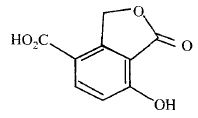
B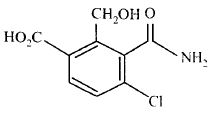
C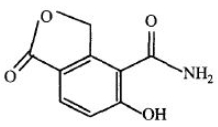
D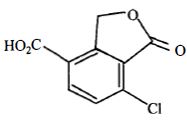
Solution
(D) The reaction involves an intramolecular esterification (lactonization) between the carboxylic acid group $(-COOH)$ and the hydroxymethyl group $(-CH_2OH)$ in the presence of an acid catalyst $(HCl_{(g)})$.
$1$. The carboxylic acid group is protonated by $HCl$,making the carbonyl carbon more electrophilic.
$2$. The oxygen atom of the $-CH_2OH$ group acts as a nucleophile and attacks the activated carbonyl carbon.
$3$. This leads to the formation of a cyclic ester (lactone).
$4$. Water is eliminated in the process to form the final lactone product.
The structure shown in option $D$ represents the correct cyclic lactone formed by the reaction of the carboxylic acid and the hydroxymethyl group.
$1$. The carboxylic acid group is protonated by $HCl$,making the carbonyl carbon more electrophilic.
$2$. The oxygen atom of the $-CH_2OH$ group acts as a nucleophile and attacks the activated carbonyl carbon.
$3$. This leads to the formation of a cyclic ester (lactone).
$4$. Water is eliminated in the process to form the final lactone product.
The structure shown in option $D$ represents the correct cyclic lactone formed by the reaction of the carboxylic acid and the hydroxymethyl group.
0 likesView Solution
79
ChemistryDifficultMCQJEE Main · 2017
The major product of the following reaction is: $CH_3-CH(Br)-CH_2-CH(Br)-CH_2-CH_3 \xrightarrow[heat]{KOH, CH_3OH}$
A
$CH_2=CH-CH_2-CH=CH-CH_3$
B
$CH_2=CH-CH=CH-CH_2-CH_3$
C
$CH_3-CH=C=CH-CH_2-CH_3$
D
$CH_3-CH=CH-CH=CH-CH_3$
Solution
(D) The reaction is a dehydrohalogenation reaction involving the elimination of two molecules of $HBr$ from $2,4$-dibromohexane using alcoholic $KOH$ and heat.
According to $Saytzeff's$ rule,the most stable alkene is formed as the major product.
In this case,the formation of $2,4$-hexadiene $(CH_3-CH=CH-CH=CH-CH_3)$ is favored because it is a conjugated diene,which provides extra stability due to resonance compared to isolated or cumulated dienes.
According to $Saytzeff's$ rule,the most stable alkene is formed as the major product.
In this case,the formation of $2,4$-hexadiene $(CH_3-CH=CH-CH=CH-CH_3)$ is favored because it is a conjugated diene,which provides extra stability due to resonance compared to isolated or cumulated dienes.
0 likesView Solution
80
ChemistryDifficultMCQJEE Main · 2017
The major product of the following reaction is:
$C_6H_5-CH_2-C(Br)(CH_3)-CH_2-CH_3 \xrightarrow[C_2H_5OH]{C_2H_5ONa}$
$C_6H_5-CH_2-C(Br)(CH_3)-CH_2-CH_3 \xrightarrow[C_2H_5OH]{C_2H_5ONa}$
A
$C_6H_5-CH_2-C(CH_3)(OC_2H_5)-CH_2-CH_3$
B
$C_6H_5-CH=C(CH_3)-CH_2-CH_3$
C
$C_6H_5-CH_2-C(CH_3)=CH-CH_3$
D
$C_6H_5-CH_2-C(CH_2-CH_3)=CH_2$
Solution
(B) The reaction is an $E2$ elimination reaction.
The ethoxide ion $(C_2H_5O^-)$ acts as a strong base and abstracts a $\beta$-hydrogen.
The hydrogen on the carbon adjacent to the benzene ring is more acidic due to the electron-withdrawing effect of the phenyl group.
Removal of this hydrogen leads to the formation of $C_6H_5-CH=C(CH_3)-CH_2-CH_3$.
This product is the major product because the double bond is in conjugation with the benzene ring,which provides significant resonance stabilization.
The ethoxide ion $(C_2H_5O^-)$ acts as a strong base and abstracts a $\beta$-hydrogen.
The hydrogen on the carbon adjacent to the benzene ring is more acidic due to the electron-withdrawing effect of the phenyl group.
Removal of this hydrogen leads to the formation of $C_6H_5-CH=C(CH_3)-CH_2-CH_3$.
This product is the major product because the double bond is in conjugation with the benzene ring,which provides significant resonance stabilization.
0 likesView Solution
81
ChemistryDifficultMCQJEE Main · 2017
The major product of the following reaction is
$2-(2-hydroxyethyl)phenol$ $\xrightarrow[2. \, CH_3I \, (1. \, eq.)]{1. \, K_2CO_3}$
$2-(2-hydroxyethyl)phenol$ $\xrightarrow[2. \, CH_3I \, (1. \, eq.)]{1. \, K_2CO_3}$
A
$2-$($2$-methoxyethyl)phenol
B
$1-$($2$-hydroxyethyl)$-2-$methoxybenzene
C
$2,3-$dihydrobenzofuran
D
$2-$vinyl$-1-$methoxybenzene
Solution
(B) The starting material is $2-(2-hydroxyethyl)phenol$,which contains both a phenolic $-OH$ group and an aliphatic $-OH$ group.
$K_2CO_3$ is a mild base that selectively deprotonates the more acidic phenolic $-OH$ group $(pK_a \approx 10)$ compared to the aliphatic $-OH$ group $(pK_a \approx 16)$.
The resulting phenoxide ion is resonance-stabilized by the benzene ring,making it the preferred site for nucleophilic substitution.
Upon addition of $CH_3I$ $(1. \, eq.)$,the phenoxide ion acts as a nucleophile and attacks the methyl iodide via an $S_N2$ mechanism to form the methyl ether at the phenolic position.
Therefore,the major product is $1-(2-hydroxyethyl)-2-methoxybenzene$.
$K_2CO_3$ is a mild base that selectively deprotonates the more acidic phenolic $-OH$ group $(pK_a \approx 10)$ compared to the aliphatic $-OH$ group $(pK_a \approx 16)$.
The resulting phenoxide ion is resonance-stabilized by the benzene ring,making it the preferred site for nucleophilic substitution.
Upon addition of $CH_3I$ $(1. \, eq.)$,the phenoxide ion acts as a nucleophile and attacks the methyl iodide via an $S_N2$ mechanism to form the methyl ether at the phenolic position.
Therefore,the major product is $1-(2-hydroxyethyl)-2-methoxybenzene$.
0 likesView Solution
82
ChemistryDifficultMCQJEE Main · 2017
To find the standard potential of $M^{3+}/M$ electrode,the following cell is constituted:
$Pt | M | M^{3+} (0.001 \ mol \ L^{-1}) || Ag^{+} (0.01 \ mol \ L^{-1}) | Ag$
The $emf$ of the cell is found to be $0.421 \ V$ at $298 \ K$. The standard potential of the half-reaction $M^{3+} + 3e^{-} \to M$ at $298 \ K$ will be .............. $V$.
(Given $E^{o}_{Ag^{+}/Ag}$ at $298 \ K = 0.80 \ V$)
$Pt | M | M^{3+} (0.001 \ mol \ L^{-1}) || Ag^{+} (0.01 \ mol \ L^{-1}) | Ag$
The $emf$ of the cell is found to be $0.421 \ V$ at $298 \ K$. The standard potential of the half-reaction $M^{3+} + 3e^{-} \to M$ at $298 \ K$ will be .............. $V$.
(Given $E^{o}_{Ag^{+}/Ag}$ at $298 \ K = 0.80 \ V$)
A
$0.38$
B
$0.32$
C
$1.28$
D
$0.66$
Solution
(B) The cell reaction is: $M(s) + 3Ag^{+}(aq) \to M^{3+}(aq) + 3Ag(s)$.
The number of electrons transferred is $n = 3$.
Using the Nernst equation: $E_{cell} = E^{o}_{cell} - \frac{0.0591}{n} \log \frac{[M^{3+}]}{[Ag^{+}]^{3}}$.
Substituting the given values: $0.421 = E^{o}_{cell} - \frac{0.0591}{3} \log \frac{0.001}{(0.01)^{3}}$.
$0.421 = E^{o}_{cell} - 0.0197 \log \frac{10^{-3}}{10^{-6}} = E^{o}_{cell} - 0.0197 \log(10^{3})$.
$0.421 = E^{o}_{cell} - 0.0197 \times 3 = E^{o}_{cell} - 0.0591$.
$E^{o}_{cell} = 0.421 + 0.0591 = 0.4801 \ V \approx 0.48 \ V$.
Since $E^{o}_{cell} = E^{o}_{cathode} - E^{o}_{anode} = E^{o}_{Ag^{+}/Ag} - E^{o}_{M^{3+}/M}$.
$0.48 = 0.80 - E^{o}_{M^{3+}/M}$.
$E^{o}_{M^{3+}/M} = 0.80 - 0.48 = 0.32 \ V$.
The number of electrons transferred is $n = 3$.
Using the Nernst equation: $E_{cell} = E^{o}_{cell} - \frac{0.0591}{n} \log \frac{[M^{3+}]}{[Ag^{+}]^{3}}$.
Substituting the given values: $0.421 = E^{o}_{cell} - \frac{0.0591}{3} \log \frac{0.001}{(0.01)^{3}}$.
$0.421 = E^{o}_{cell} - 0.0197 \log \frac{10^{-3}}{10^{-6}} = E^{o}_{cell} - 0.0197 \log(10^{3})$.
$0.421 = E^{o}_{cell} - 0.0197 \times 3 = E^{o}_{cell} - 0.0591$.
$E^{o}_{cell} = 0.421 + 0.0591 = 0.4801 \ V \approx 0.48 \ V$.
Since $E^{o}_{cell} = E^{o}_{cathode} - E^{o}_{anode} = E^{o}_{Ag^{+}/Ag} - E^{o}_{M^{3+}/M}$.
$0.48 = 0.80 - E^{o}_{M^{3+}/M}$.
$E^{o}_{M^{3+}/M} = 0.80 - 0.48 = 0.32 \ V$.
0 likesView Solution
83
ChemistryDifficultMCQJEE Main · 2017
Adsorption of a gas on a surface follows the Freundlich adsorption isotherm. The plot of $\log \frac{x}{m}$ versus $\log P$ gives a straight line with a slope equal to $0.5$. Then,(where $\frac{x}{m}$ is the mass of the gas adsorbed per gram of adsorbent):
A
Adsorption is independent of pressure.
B
Adsorption is proportional to the pressure.
C
Adsorption is proportional to the square root of pressure.
D
Adsorption is proportional to the square of pressure.
Solution
(C) According to the Freundlich adsorption isotherm:
$\log \frac{x}{m} = \log k + \frac{1}{n} \log P$
Comparing this with the equation of a straight line $y = mx + c$,the slope is $\frac{1}{n}$.
Given that the slope is $0.5$,we have $\frac{1}{n} = 0.5 = \frac{1}{2}$.
Substituting this into the adsorption equation $\frac{x}{m} = k \cdot P^{1/n}$,we get:
$\frac{x}{m} = k \cdot P^{1/2}$
This implies that the adsorption is proportional to the square root of pressure $(P^{1/2})$.
$\log \frac{x}{m} = \log k + \frac{1}{n} \log P$
Comparing this with the equation of a straight line $y = mx + c$,the slope is $\frac{1}{n}$.
Given that the slope is $0.5$,we have $\frac{1}{n} = 0.5 = \frac{1}{2}$.
Substituting this into the adsorption equation $\frac{x}{m} = k \cdot P^{1/n}$,we get:
$\frac{x}{m} = k \cdot P^{1/2}$
This implies that the adsorption is proportional to the square root of pressure $(P^{1/2})$.
0 likesView Solution
84
ChemistryDifficultMCQJEE Main · 2017
The rate of a reaction quadruples when the temperature changes from $300 \, K$ to $310 \, K$. The activation energy of this reaction is ........... $kJ \, mol^{-1}$ (Assume activation energy and pre-exponential factor are independent of temperature; $\ln 2 = 0.693$; $R = 8.314 \, J \, mol^{-1} \, K^{-1}$)
A
$107.2$
B
$53.6$
C
$26.8$
D
$214.4$
Solution
(A) Using the Arrhenius equation: $\ln \frac{k_2}{k_1} = \frac{E_a}{R} \left( \frac{1}{T_1} - \frac{1}{T_2} \right)$
Given: $\frac{k_2}{k_1} = 4$,$T_1 = 300 \, K$,$T_2 = 310 \, K$,$R = 8.314 \, J \, mol^{-1} \, K^{-1}$,$\ln 2 = 0.693$.
$\ln 4 = \frac{E_a}{8.314} \left( \frac{310 - 300}{310 \times 300} \right)$
$2 \ln 2 = \frac{E_a}{8.314} \left( \frac{10}{93000} \right)$
$2 \times 0.693 = \frac{E_a}{8.314} \times \frac{1}{9300}$
$E_a = 1.386 \times 8.314 \times 9300 \, J \, mol^{-1} \approx 107200 \, J \, mol^{-1} = 107.2 \, kJ \, mol^{-1}$.
Given: $\frac{k_2}{k_1} = 4$,$T_1 = 300 \, K$,$T_2 = 310 \, K$,$R = 8.314 \, J \, mol^{-1} \, K^{-1}$,$\ln 2 = 0.693$.
$\ln 4 = \frac{E_a}{8.314} \left( \frac{310 - 300}{310 \times 300} \right)$
$2 \ln 2 = \frac{E_a}{8.314} \left( \frac{10}{93000} \right)$
$2 \times 0.693 = \frac{E_a}{8.314} \times \frac{1}{9300}$
$E_a = 1.386 \times 8.314 \times 9300 \, J \, mol^{-1} \approx 107200 \, J \, mol^{-1} = 107.2 \, kJ \, mol^{-1}$.
0 likesView Solution
85
ChemistryAdvancedMCQJEE Main · 2017
$A$ solution is prepared by mixing $8.5 \ g$ of $CH_2Cl_2$ and $11.95 \ g$ of $CHCl_3$. If the vapour pressures of pure $CH_2Cl_2$ and $CHCl_3$ at $298 \ K$ are $415 \ mm \ Hg$ and $200 \ mm \ Hg$ respectively,the mole fraction of $CHCl_3$ in the vapour phase is: (Molar mass of $Cl = 35.5 \ g \ mol^{-1}$)
A
$0.162$
B
$0.675$
C
$0.325$
D
$0.486$
Solution
(C) Molar mass of $CHCl_3 = 12 + 1 + 3(35.5) = 119.5 \ g \ mol^{-1}$.
Molar mass of $CH_2Cl_2 = 12 + 2 + 2(35.5) = 85 \ g \ mol^{-1}$.
Moles of $CHCl_3 = \frac{11.95 \ g}{119.5 \ g \ mol^{-1}} = 0.1 \ mol$.
Moles of $CH_2Cl_2 = \frac{8.5 \ g}{85 \ g \ mol^{-1}} = 0.1 \ mol$.
Total moles $= 0.1 + 0.1 = 0.2 \ mol$.
Mole fraction of $CHCl_3$ $(x_{CHCl_3}) = \frac{0.1}{0.2} = 0.5$.
Mole fraction of $CH_2Cl_2$ $(x_{CH_2Cl_2}) = \frac{0.1}{0.2} = 0.5$.
Partial pressure of $CHCl_3$ $(P_{CHCl_3}) = x_{CHCl_3} \times P^{\circ}_{CHCl_3} = 0.5 \times 200 = 100 \ mm \ Hg$.
Partial pressure of $CH_2Cl_2$ $(P_{CH_2Cl_2}) = x_{CH_2Cl_2} \times P^{\circ}_{CH_2Cl_2} = 0.5 \times 415 = 207.5 \ mm \ Hg$.
Total pressure $(P_{total}) = P_{CHCl_3} + P_{CH_2Cl_2} = 100 + 207.5 = 307.5 \ mm \ Hg$.
Mole fraction of $CHCl_3$ in vapour phase $(y_{CHCl_3}) = \frac{P_{CHCl_3}}{P_{total}} = \frac{100}{307.5} \approx 0.325$.
Molar mass of $CH_2Cl_2 = 12 + 2 + 2(35.5) = 85 \ g \ mol^{-1}$.
Moles of $CHCl_3 = \frac{11.95 \ g}{119.5 \ g \ mol^{-1}} = 0.1 \ mol$.
Moles of $CH_2Cl_2 = \frac{8.5 \ g}{85 \ g \ mol^{-1}} = 0.1 \ mol$.
Total moles $= 0.1 + 0.1 = 0.2 \ mol$.
Mole fraction of $CHCl_3$ $(x_{CHCl_3}) = \frac{0.1}{0.2} = 0.5$.
Mole fraction of $CH_2Cl_2$ $(x_{CH_2Cl_2}) = \frac{0.1}{0.2} = 0.5$.
Partial pressure of $CHCl_3$ $(P_{CHCl_3}) = x_{CHCl_3} \times P^{\circ}_{CHCl_3} = 0.5 \times 200 = 100 \ mm \ Hg$.
Partial pressure of $CH_2Cl_2$ $(P_{CH_2Cl_2}) = x_{CH_2Cl_2} \times P^{\circ}_{CH_2Cl_2} = 0.5 \times 415 = 207.5 \ mm \ Hg$.
Total pressure $(P_{total}) = P_{CHCl_3} + P_{CH_2Cl_2} = 100 + 207.5 = 307.5 \ mm \ Hg$.
Mole fraction of $CHCl_3$ in vapour phase $(y_{CHCl_3}) = \frac{P_{CHCl_3}}{P_{total}} = \frac{100}{307.5} \approx 0.325$.
0 likesView Solution
86
ChemistryDifficultMCQJEE Main · 2017
$XeF_6$ on partial hydrolysis with water produces a compound '$X$'. The same compound '$X$' is formed when $XeF_6$ reacts with silica. The compound '$X$' is
A
$XeF_2$
B
$XeF_4$
C
$XeOF_4$
D
$XeO_3$
Solution
(C) The partial hydrolysis of $XeF_6$ is given by the reaction: $XeF_6 + H_2O \to XeOF_4 + 2HF$.
Similarly,$XeF_6$ reacts with silica $(SiO_2)$ to form $XeOF_4$ and $SiF_4$: $2XeF_6 + SiO_2 \to 2XeOF_4 + SiF_4$.
Thus,the compound '$X$' is $XeOF_4$ (Xenon oxytetrafluoride).
Similarly,$XeF_6$ reacts with silica $(SiO_2)$ to form $XeOF_4$ and $SiF_4$: $2XeF_6 + SiO_2 \to 2XeOF_4 + SiF_4$.
Thus,the compound '$X$' is $XeOF_4$ (Xenon oxytetrafluoride).
0 likesView Solution
87
ChemistryDifficultMCQJEE Main · 2017
The number of $P-OH$ bonds and the oxidation state of the phosphorus atom in pyrophosphoric acid $(H_4P_2O_7)$ respectively are
A
four and four
B
five and four
C
five and five
D
four and five
Solution
(D) The structure of pyrophosphoric acid $(H_4P_2O_7)$ consists of two $PO_4$ tetrahedra linked by an oxygen atom $(P-O-P)$.
Each phosphorus atom is bonded to two $OH$ groups,one terminal oxygen atom via a double bond,and one bridging oxygen atom.
Therefore,the total number of $P-OH$ bonds is $4$ (two per phosphorus atom).
To calculate the oxidation state of $P$ in $H_4P_2O_7$:
Let the oxidation state of $P$ be $x$.
$4(+1) + 2(x) + 7(-2) = 0$
$4 + 2x - 14 = 0$
$2x = 10$
$x = +5$
Thus,the number of $P-OH$ bonds is $4$ and the oxidation state of phosphorus is $+5$.
Each phosphorus atom is bonded to two $OH$ groups,one terminal oxygen atom via a double bond,and one bridging oxygen atom.
Therefore,the total number of $P-OH$ bonds is $4$ (two per phosphorus atom).
To calculate the oxidation state of $P$ in $H_4P_2O_7$:
Let the oxidation state of $P$ be $x$.
$4(+1) + 2(x) + 7(-2) = 0$
$4 + 2x - 14 = 0$
$2x = 10$
$x = +5$
Thus,the number of $P-OH$ bonds is $4$ and the oxidation state of phosphorus is $+5$.
0 likesView Solution
88
ChemistryDifficultMCQJEE Main · 2017
Which of the following ions does not liberate hydrogen gas on reaction with dilute acids?
A
$Ti^{2+}$
B
$V^{2+}$
C
$Cr^{2+}$
D
$Mn^{2+}$
Solution
(D)
The liberation of hydrogen gas from dilute acids by metal ions depends on the reduction potential of the $M^{3+}/M^{2+}$ couple.
If the $E^o$ value is negative,the $M^{2+}$ ion can be oxidized to $M^{3+}$ while reducing $H^+$ to $H_2$ gas.
Among the given ions,$Mn^{2+}$ has a highly positive $E^o$ value $(+1.57 \ V)$,which means it is very stable and does not easily lose an electron to reduce $H^+$ ions.
Therefore,$Mn^{2+}$ does not liberate hydrogen gas.
| Ion | $E^o \ (M^{3+}/M^{2+}) \ (V)$ |
| $Ti^{2+}$ | $-0.37$ |
| $V^{2+}$ | $-0.26$ |
| $Cr^{2+}$ | $-0.41$ |
| $Mn^{2+}$ | $+1.57$ |
The liberation of hydrogen gas from dilute acids by metal ions depends on the reduction potential of the $M^{3+}/M^{2+}$ couple.
If the $E^o$ value is negative,the $M^{2+}$ ion can be oxidized to $M^{3+}$ while reducing $H^+$ to $H_2$ gas.
Among the given ions,$Mn^{2+}$ has a highly positive $E^o$ value $(+1.57 \ V)$,which means it is very stable and does not easily lose an electron to reduce $H^+$ ions.
Therefore,$Mn^{2+}$ does not liberate hydrogen gas.
0 likesView Solution
89
ChemistryDifficultMCQJEE Main · 2017
The correct sequence of decreasing number of $\pi$-bonds in the structures of $H_2SO_3$,$H_2SO_4$,and $H_2S_2O_7$ is:
A
$H_2SO_3 > H_2SO_4 > H_2S_2O_7$
B
$H_2SO_4 > H_2S_2O_7 > H_2SO_3$
C
$H_2S_2O_7 > H_2SO_4 > H_2SO_3$
D
$H_2S_2O_7 > H_2SO_3 > H_2SO_4$
Solution
(C) The number of $\pi$-bonds in the structures are as follows:
$1.$ $H_2SO_3$ (Sulfurous acid): It has one $S=O$ double bond,so it contains $1$ $\pi$-bond.
$2.$ $H_2SO_4$ (Sulfuric acid): It has two $S=O$ double bonds,so it contains $2$ $\pi$-bonds.
$3.$ $H_2S_2O_7$ (Pyrosulfuric acid): It has four $S=O$ double bonds (two on each sulfur atom),so it contains $4$ $\pi$-bonds.
Therefore,the correct decreasing sequence of the number of $\pi$-bonds is $H_2S_2O_7 (4) > H_2SO_4 (2) > H_2SO_3 (1)$.
$1.$ $H_2SO_3$ (Sulfurous acid): It has one $S=O$ double bond,so it contains $1$ $\pi$-bond.
$2.$ $H_2SO_4$ (Sulfuric acid): It has two $S=O$ double bonds,so it contains $2$ $\pi$-bonds.
$3.$ $H_2S_2O_7$ (Pyrosulfuric acid): It has four $S=O$ double bonds (two on each sulfur atom),so it contains $4$ $\pi$-bonds.
Therefore,the correct decreasing sequence of the number of $\pi$-bonds is $H_2S_2O_7 (4) > H_2SO_4 (2) > H_2SO_3 (1)$.
0 likesView Solution
90
ChemistryDifficultMCQJEE Main · 2017
$[Co_2(CO)_8]$ displays
A
one $Co-Co$ bond,six terminal $CO$ and two bridging $CO$
B
one $Co-Co$ bond,four terminal $CO$ and four bridging $CO$
C
no $Co-Co$ bond,six terminal $CO$ and two bridging $CO$
D
no $Co-Co$ bond,four terminal $CO$ and four bridging $CO$
Solution
(A) The structure of the metal carbonyl complex $[Co_2(CO)_8]$ in the solid state consists of two $Co(CO)_4$ units linked by a metal-metal bond.
It contains one $Co-Co$ bond.
There are six terminal $CO$ ligands (three on each $Co$ atom) and two bridging $CO$ ligands.
Therefore,the correct option is $A$.
It contains one $Co-Co$ bond.
There are six terminal $CO$ ligands (three on each $Co$ atom) and two bridging $CO$ ligands.
Therefore,the correct option is $A$.
0 likesView Solution
91
ChemistryDifficultMCQJEE Main · 2017
$A$ compound of molecular formula $C_8H_8O_2$ reacts with acetophenone to form a single cross-aldol product in the presence of base. The same compound on reaction with conc. $NaOH$ forms benzyl alcohol as one of the products. The structure of the compound is
A
$4-$methoxybenzaldehyde
B
$4-$hydroxyacetophenone
C
methyl benzoate
D
$4-$methylbenzoic acid
Solution
(A) The molecular formula $C_8H_8O_2$ corresponds to $p$-methoxybenzaldehyde $(CH_3OC_6H_4CHO)$.
$1$. It contains an aldehyde group without $\alpha$-hydrogens,which allows it to undergo the Cannizzaro reaction with conc. $NaOH$ to form $p$-methoxybenzyl alcohol and sodium $p$-methoxybenzoate.
$2$. It reacts with acetophenone $(C_6H_5COCH_3)$ in the presence of a base to undergo a cross-aldol condensation,forming a single product because the aldehyde lacks $\alpha$-hydrogens,ensuring it acts only as the electrophile.
$1$. It contains an aldehyde group without $\alpha$-hydrogens,which allows it to undergo the Cannizzaro reaction with conc. $NaOH$ to form $p$-methoxybenzyl alcohol and sodium $p$-methoxybenzoate.
$2$. It reacts with acetophenone $(C_6H_5COCH_3)$ in the presence of a base to undergo a cross-aldol condensation,forming a single product because the aldehyde lacks $\alpha$-hydrogens,ensuring it acts only as the electrophile.
0 likesView Solution
92
ChemistryMediumMCQJEE Main · 2017
The incorrect statement among the following is:
A
$\alpha-D$-glucose and $\beta-D$-glucose are anomers.
B
$\alpha-D$-glucose and $\beta-D$-glucose are enantiomers.
C
Cellulose is a straight chain polysaccharide made up of only $\beta-D$-glucose units.
D
The pentaacetate of glucose does not react with hydroxylamine.
Solution
(B) $1$. $\alpha-D$-glucose and $\beta-D$-glucose differ only in the configuration at the $C-1$ carbon (anomeric carbon),so they are anomers. Statement $A$ is correct.
$2$. Enantiomers are non-superimposable mirror images of each other. $\alpha-D$-glucose and $\beta-D$-glucose are diastereomers,not enantiomers. Statement $B$ is incorrect.
$3$. Cellulose is a linear polymer of $\beta-D$-glucose units joined by $\beta-1,4$-glycosidic linkages. Statement $C$ is correct.
$4$. The pentaacetate of glucose does not contain a free $-OH$ group at the $C-1$ position,meaning it cannot form an open-chain aldehyde structure to react with hydroxylamine $(NH_2OH)$. Statement $D$ is correct.
Therefore,the incorrect statement is $B$.
$2$. Enantiomers are non-superimposable mirror images of each other. $\alpha-D$-glucose and $\beta-D$-glucose are diastereomers,not enantiomers. Statement $B$ is incorrect.
$3$. Cellulose is a linear polymer of $\beta-D$-glucose units joined by $\beta-1,4$-glycosidic linkages. Statement $C$ is correct.
$4$. The pentaacetate of glucose does not contain a free $-OH$ group at the $C-1$ position,meaning it cannot form an open-chain aldehyde structure to react with hydroxylamine $(NH_2OH)$. Statement $D$ is correct.
Therefore,the incorrect statement is $B$.
0 likesView Solution
93
ChemistryMediumMCQJEE Main · 2017
Which of the following is a biodegradable polymer?
A
$[-NH-(CH_2)_5-CO-NH-CH_2-CO-]_n$
B
$[-NH-(CH_2)_5-CO-]_n$
C
$[-NH-(CH_2)_6-NH-CO-(CH_2)_4-CO-]_n$
D
$[-CO-C_6H_4-COO-(CH_2)_2-O-]_n$
Solution
(A) biodegradable polymer is one that can be broken down by microorganisms.
$Nylon-2-nylon-6$ is a biodegradable polyamide copolymer of glycine $(H_2N-CH_2-COOH)$ and aminocaproic acid $(H_2N-(CH_2)_5-COOH)$.
The structure is:
$[-NH-CH_2-CO-NH-(CH_2)_5-CO-]_n$
This corresponds to the structure given in option $A$.
$Nylon-2-nylon-6$ is a biodegradable polyamide copolymer of glycine $(H_2N-CH_2-COOH)$ and aminocaproic acid $(H_2N-(CH_2)_5-COOH)$.
The structure is:
$[-NH-CH_2-CO-NH-(CH_2)_5-CO-]_n$
This corresponds to the structure given in option $A$.
0 likesView Solution
94
ChemistryDifficultMCQJEE Main · 2017
The increasing order of the boiling points for the following compounds is
$C_2H_5OH$ $(I)$,$C_2H_5Cl$ $(II)$,$C_2H_5CH_3$ $(III)$,$C_2H_5OCH_3$ $(IV)$
$C_2H_5OH$ $(I)$,$C_2H_5Cl$ $(II)$,$C_2H_5CH_3$ $(III)$,$C_2H_5OCH_3$ $(IV)$
A
$(III) < (IV) < (II) < (I)$
B
$(IV) < (III) < (I) < (II)$
C
$(II) < (III) < (IV) < (I)$
D
$(III) < (II) < (I) < (IV)$
Solution
(A) $I$. $C_2H_5OH$: Exhibits strong intermolecular hydrogen bonding,which leads to the highest boiling point.
$II$. $C_2H_5Cl$: Exhibits dipole-dipole interactions. It is more polar than the ether $(IV)$,resulting in a higher boiling point.
$III$. $C_2H_5CH_3$ (Propane): Only weak London dispersion forces exist,leading to the lowest boiling point.
$IV$. $C_2H_5OCH_3$ (Methoxyethane): Exhibits weaker dipole-dipole interactions compared to $C_2H_5Cl$.
Therefore,the increasing order of boiling points is: $(III) < (IV) < (II) < (I)$.
$II$. $C_2H_5Cl$: Exhibits dipole-dipole interactions. It is more polar than the ether $(IV)$,resulting in a higher boiling point.
$III$. $C_2H_5CH_3$ (Propane): Only weak London dispersion forces exist,leading to the lowest boiling point.
$IV$. $C_2H_5OCH_3$ (Methoxyethane): Exhibits weaker dipole-dipole interactions compared to $C_2H_5Cl$.
Therefore,the increasing order of boiling points is: $(III) < (IV) < (II) < (I)$.
0 likesView Solution
95
ChemistryAdvancedMCQJEE Main · 2017
In the following reaction sequence,the compound $I$ is:
$I (C_3H_6Cl_2)$ $\xrightarrow{KOH_{(aq)}} II$ $\xrightarrow{(i) CH_3MgBr, (ii) H_2O/H^{+}} III$ $\xrightarrow{Anhy. ZnCl_2 + Conc. HCl}$ gives turbidity immediately.
$I (C_3H_6Cl_2)$ $\xrightarrow{KOH_{(aq)}} II$ $\xrightarrow{(i) CH_3MgBr, (ii) H_2O/H^{+}} III$ $\xrightarrow{Anhy. ZnCl_2 + Conc. HCl}$ gives turbidity immediately.
A
$Cl-CH_2-CH(Cl)-CH_3$
B
$Cl-CH_2-CH_2-CH_2-Cl$
C
$CH_3-CH_2-CHCl_2$
D
$CH_3-C(Cl)_2-CH_3$
Solution
(D) $III$ gives immediate turbidity with Lucas reagent $(Anhy. ZnCl_2 + Conc. HCl)$,which indicates that $III$ is a tertiary $(3^\circ)$ alcohol.
$A$ $3^\circ$ alcohol is formed when a ketone reacts with a Grignard reagent $(CH_3MgBr)$. Therefore,$II$ must be a ketone.
Since $II$ is formed from $I (C_3H_6Cl_2)$ by reaction with aqueous $KOH$,$I$ must be a geminal dihalide. Thus,$I$ is $2,2$-dichloropropane $(CH_3-C(Cl)_2-CH_3)$.
The reaction sequence is:
$CH_3-C(Cl)_2-CH_3 (I)$ $\xrightarrow{KOH_{(aq)}} [CH_3-C(OH)_2-CH_3]$ $\xrightarrow{-H_2O} CH_3-CO-CH_3 (II)$
$CH_3-CO-CH_3 (II) \xrightarrow{(i) CH_3MgBr, (ii) H_2O/H^{+}} (CH_3)_3C-OH (III)$
$(CH_3)_3C-OH (III) \xrightarrow{Lucas\,Reagent} \text{Immediate turbidity}$.
$A$ $3^\circ$ alcohol is formed when a ketone reacts with a Grignard reagent $(CH_3MgBr)$. Therefore,$II$ must be a ketone.
Since $II$ is formed from $I (C_3H_6Cl_2)$ by reaction with aqueous $KOH$,$I$ must be a geminal dihalide. Thus,$I$ is $2,2$-dichloropropane $(CH_3-C(Cl)_2-CH_3)$.
The reaction sequence is:
$CH_3-C(Cl)_2-CH_3 (I)$ $\xrightarrow{KOH_{(aq)}} [CH_3-C(OH)_2-CH_3]$ $\xrightarrow{-H_2O} CH_3-CO-CH_3 (II)$
$CH_3-CO-CH_3 (II) \xrightarrow{(i) CH_3MgBr, (ii) H_2O/H^{+}} (CH_3)_3C-OH (III)$
$(CH_3)_3C-OH (III) \xrightarrow{Lucas\,Reagent} \text{Immediate turbidity}$.
0 likesView Solution
96
ChemistryDifficultMCQJEE Main · 2017
Among the following compounds,the increasing order of their basic strength is
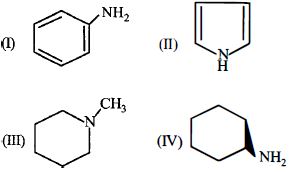
A
$II < I < IV < III$
B
$I < II < III < IV$
C
$II < I < III < IV$
D
$I < II < IV < III$
Solution
(A) The basic strength of amines depends on the availability of the lone pair of electrons on the nitrogen atom for protonation.
$(II)$ Pyrrole: The lone pair on nitrogen is involved in the aromatic sextet,making it non-basic.
$(I)$ Aniline: The lone pair on nitrogen is delocalized into the benzene ring due to resonance,reducing its availability for protonation.
$(IV)$ Cyclohexylamine: This is a primary aliphatic amine. The lone pair is localized on the nitrogen atom,making it more basic than aniline.
$(III)$ $N$-Methylpiperidine: This is a tertiary aliphatic amine. It is more basic than primary aliphatic amines due to the electron-donating inductive effect $(+I)$ of the alkyl groups,which increases the electron density on the nitrogen atom.
Therefore,the increasing order of basic strength is: $II < I < IV < III$.
$(II)$ Pyrrole: The lone pair on nitrogen is involved in the aromatic sextet,making it non-basic.
$(I)$ Aniline: The lone pair on nitrogen is delocalized into the benzene ring due to resonance,reducing its availability for protonation.
$(IV)$ Cyclohexylamine: This is a primary aliphatic amine. The lone pair is localized on the nitrogen atom,making it more basic than aniline.
$(III)$ $N$-Methylpiperidine: This is a tertiary aliphatic amine. It is more basic than primary aliphatic amines due to the electron-donating inductive effect $(+I)$ of the alkyl groups,which increases the electron density on the nitrogen atom.
Therefore,the increasing order of basic strength is: $II < I < IV < III$.
0 likesView Solution
97
ChemistryMediumMCQJEE Main · 2017
Consider the following standard electrode potentials ($E^0$ in volts) in aqueous solution. Based on this data,which of the following statements is correct?
| Element | $M^{3+}/M$ | $M^{+}/M$ |
|---|---|---|
| $Al$ | $-1.66$ | $+0.55$ |
| $Tl$ | $+1.26$ | $-0.34$ |
A
$Tl^{3+}$ is more stable than $Al^{3+}$
B
$Tl^{+}$ is more stable than $Al^{3+}$
C
$Al^{+}$ is more stable than $Al^{3+}$
D
$Tl^{+}$ is more stable than $Al^{+}$
Solution
(D) The stability of an oxidation state can be inferred from the standard electrode potential $(E^0)$. $A$ more negative $E^0$ value for the reduction half-reaction $(M^n+ + ne^- \rightarrow M)$ indicates that the metal is more easily oxidized,meaning the higher oxidation state is more stable relative to the metal.
For $Al$: $E^0(Al^{3+}/Al) = -1.66 \ V$ and $E^0(Al^{+}/Al) = +0.55 \ V$. Since $E^0(Al^{3+}/Al) < E^0(Al^{+}/Al)$,$Al^{3+}$ is much more stable than $Al^{+}$.
For $Tl$: $E^0(Tl^{3+}/Tl) = +1.26 \ V$ and $E^0(Tl^{+}/Tl) = -0.34 \ V$. Since $E^0(Tl^{+}/Tl) < E^0(Tl^{3+}/Tl)$,$Tl^{+}$ is more stable than $Tl^{3+}$.
Comparing $Tl^{+}$ and $Al^{+}$: $Tl^{+}$ has a negative reduction potential $(-0.34 \ V)$,making it relatively stable,whereas $Al^{+}$ has a positive reduction potential $(+0.55 \ V)$,making it highly unstable and a strong oxidizing agent.
Therefore,$Tl^{+}$ is more stable than $Al^{+}$.
For $Al$: $E^0(Al^{3+}/Al) = -1.66 \ V$ and $E^0(Al^{+}/Al) = +0.55 \ V$. Since $E^0(Al^{3+}/Al) < E^0(Al^{+}/Al)$,$Al^{3+}$ is much more stable than $Al^{+}$.
For $Tl$: $E^0(Tl^{3+}/Tl) = +1.26 \ V$ and $E^0(Tl^{+}/Tl) = -0.34 \ V$. Since $E^0(Tl^{+}/Tl) < E^0(Tl^{3+}/Tl)$,$Tl^{+}$ is more stable than $Tl^{3+}$.
Comparing $Tl^{+}$ and $Al^{+}$: $Tl^{+}$ has a negative reduction potential $(-0.34 \ V)$,making it relatively stable,whereas $Al^{+}$ has a positive reduction potential $(+0.55 \ V)$,making it highly unstable and a strong oxidizing agent.
Therefore,$Tl^{+}$ is more stable than $Al^{+}$.
0 likesView Solution
Vedclass Products
For Students
Vedclass Test Series
Mock tests in real JEE Main style covering Chemistry with performance analysis. 5-day free trial.
Start Free TrialFor Teachers
Exam Paper Generator
Generate Set A/B/C/D Chemistry papers from 7.5L+ questions in 2 minutes. 3 chapters free.
Try FreeFor Institutes
Online Exam Module
Run live JEE Main mock exams with unlimited students, 360° analytics & white-label branding.
See DemoFrequently Asked Questions
How many Chemistry questions are in JEE Main 2017?
There are 107 Chemistry questions from the JEE Main 2017 paper on Vedclass, each with a detailed step-by-step solution in English.
Are JEE Main 2017 Chemistry solutions available in English?
Yes. All solutions on this page are in English. You can also switch to English or Hindi using the language buttons above the questions.
Can I practice JEE Main 2017 Chemistry as a timed test?
Yes. Use the Vedclass Test Series to attempt a full JEE Main mock test covering Chemistry with time limits and instant score analysis.
Can teachers create Chemistry papers from JEE Main previous year questions?
Yes. The Vedclass Exam Paper Generator lets teachers mix JEE Main Chemistry questions and generate Set A/B/C/D papers in minutes.
For Teachers & Institutes
Build a Custom Chemistry Paper
Pick JEE Main 2017 Chemistry questions, set difficulty, and generate Set A/B/C/D in 2 minutes.