
ChemistryQ51–60 of 107 questions
Page 2 of 2 · English
51
ChemistryDifficultMCQJEE Main · 2017
The group having triangular planar structures is
A
$BF_3, NF_3, CO_3^{2-}$
B
$CO_3^{2-}, NO_3^-, SO_3$
C
$NH_3, SO_3, CO_3^{2-}$
D
$NCl_3, BCl_3, SO_3$
Solution
(B) To determine the shape of a molecule,we calculate the hybridization of the central atom using the formula: $H = \frac{1}{2}(V + M - C + A)$,where $V$ is the number of valence electrons,$M$ is the number of monovalent atoms,$C$ is the cationic charge,and $A$ is the anionic charge.
$1$. For $CO_3^{2-}$: $H = \frac{1}{2}(4 + 0 - 0 + 2) = 3$ ($sp^2$ hybridization,triangular planar).
$2$. For $NO_3^-$: $H = \frac{1}{2}(5 + 0 - 0 + 1) = 3$ ($sp^2$ hybridization,triangular planar).
$3$. For $SO_3$: $H = \frac{1}{2}(6 + 0 - 0 + 0) = 3$ ($sp^2$ hybridization,triangular planar).
All species in option $B$ have $sp^2$ hybridization with no lone pairs on the central atom,resulting in a triangular planar geometry.
$1$. For $CO_3^{2-}$: $H = \frac{1}{2}(4 + 0 - 0 + 2) = 3$ ($sp^2$ hybridization,triangular planar).
$2$. For $NO_3^-$: $H = \frac{1}{2}(5 + 0 - 0 + 1) = 3$ ($sp^2$ hybridization,triangular planar).
$3$. For $SO_3$: $H = \frac{1}{2}(6 + 0 - 0 + 0) = 3$ ($sp^2$ hybridization,triangular planar).
All species in option $B$ have $sp^2$ hybridization with no lone pairs on the central atom,resulting in a triangular planar geometry.
0 likesView Solution
52
ChemistryDifficultMCQJEE Main · 2017
Which of the following compounds is most reactive to an aqueous solution of sodium carbonate $?$ (The structures correspond to cyclic hydrocarbons with varying degrees of unsaturation).
A
Cyclopropene
B
Cyclobutene
C
$1,3-$Cyclohexadiene
D
$1,3-$Cyclopentadiene
Solution
(D) The reactivity of a compound toward an aqueous solution of sodium carbonate $(Na_2CO_3)$ depends on its acidity. Compounds that are sufficiently acidic to donate a proton to the carbonate ion $(CO_3^{2-})$ or bicarbonate ion $(HCO_3^-)$ will react.
In this case,we evaluate the acidity of the hydrocarbons by looking at the stability of their conjugate bases (the corresponding carbanions formed after deprotonation).
$(a)$ Cyclopropene: Forms an antiaromatic $(4\pi e^-)$ carbanion,which is highly unstable.
$(b)$ Cyclobutene: Forms an antiaromatic $(4\pi e^-)$ carbanion,which is highly unstable.
$(c)$ $1,3-$Cyclohexadiene: Forms a homoaromatic carbanion,which is unstable due to the lack of continuous delocalization.
$(d)$ $1,3-$Cyclopentadiene: Upon losing a proton,it forms the cyclopentadienyl anion,which is aromatic $(6\pi e^-)$ and highly stable.
Because the conjugate base of $1,3-$cyclopentadiene is aromatic and exceptionally stable,$1$,$3$-cyclopentadiene is the most acidic among the given options and thus the most reactive toward an aqueous solution of sodium carbonate.
In this case,we evaluate the acidity of the hydrocarbons by looking at the stability of their conjugate bases (the corresponding carbanions formed after deprotonation).
$(a)$ Cyclopropene: Forms an antiaromatic $(4\pi e^-)$ carbanion,which is highly unstable.
$(b)$ Cyclobutene: Forms an antiaromatic $(4\pi e^-)$ carbanion,which is highly unstable.
$(c)$ $1,3-$Cyclohexadiene: Forms a homoaromatic carbanion,which is unstable due to the lack of continuous delocalization.
$(d)$ $1,3-$Cyclopentadiene: Upon losing a proton,it forms the cyclopentadienyl anion,which is aromatic $(6\pi e^-)$ and highly stable.
Because the conjugate base of $1,3-$cyclopentadiene is aromatic and exceptionally stable,$1$,$3$-cyclopentadiene is the most acidic among the given options and thus the most reactive toward an aqueous solution of sodium carbonate.
0 likesView Solution
53
ChemistryMCQJEE Main · 2017
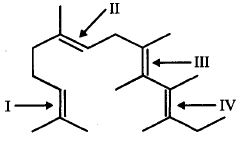
In the following structure,the double bonds are marked as $I, II, III$ and $IV$. Geometrical isomerism is not possible at site$(s)$:
A
$III$
B
$I$
C
$I$ and $III$
D
$III$ and $IV$
Solution
(B) For geometrical isomerism to occur,each carbon atom of the double bond must be attached to two different groups.
At site $I$,the carbon atom is attached to two identical methyl groups,so it cannot show geometrical isomerism.
At site $II$,the carbon is attached to a hydrogen and a carbon chain,and the other carbon is attached to a methyl and a carbon chain; thus,it shows geometrical isomerism.
At site $III$,the carbon is attached to a methyl and a carbon chain,and the other carbon is attached to a methyl and a carbon chain; thus,it shows geometrical isomerism.
At site $IV$,the carbon is attached to a methyl and an ethyl group,and the other carbon is attached to a methyl and a hydrogen; thus,it shows geometrical isomerism.
Therefore,geometrical isomerism is not possible only at site $I$.
At site $I$,the carbon atom is attached to two identical methyl groups,so it cannot show geometrical isomerism.
At site $II$,the carbon is attached to a hydrogen and a carbon chain,and the other carbon is attached to a methyl and a carbon chain; thus,it shows geometrical isomerism.
At site $III$,the carbon is attached to a methyl and a carbon chain,and the other carbon is attached to a methyl and a carbon chain; thus,it shows geometrical isomerism.
At site $IV$,the carbon is attached to a methyl and an ethyl group,and the other carbon is attached to a methyl and a hydrogen; thus,it shows geometrical isomerism.
Therefore,geometrical isomerism is not possible only at site $I$.
0 likesView Solution
54
ChemistryDifficultMCQJEE Main · 2017
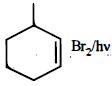
The major product of the following reaction is
A
$3-$bromocyclohex$-1-$ene derivative
B
$1-$bromo$-1-$methylcyclohex$-2-$ene
C
$3-$bromomethylcyclohex$-1-$ene
D
$1,2-$dibromo$-1-$methylcyclohexane
Solution
(B) The reaction of $1$-methylcyclohex-$1$-ene with $Br_2$ in the presence of light $(h\nu)$ is a free radical substitution reaction (allylic bromination).
In this reaction,the bromine radical $(Br^\bullet)$ abstracts a hydrogen atom from the allylic position.
The most stable free radical formed is the tertiary $(3^\circ)$ allylic radical at the $C-1$ position.
This radical then reacts with $Br_2$ to form $1$-bromo-$1$-methylcyclohex-$2$-ene as the major product.
In this reaction,the bromine radical $(Br^\bullet)$ abstracts a hydrogen atom from the allylic position.
The most stable free radical formed is the tertiary $(3^\circ)$ allylic radical at the $C-1$ position.
This radical then reacts with $Br_2$ to form $1$-bromo-$1$-methylcyclohex-$2$-ene as the major product.
0 likesView Solution
55
ChemistryDifficultMCQJEE Main · 2017
Which of the following compounds will show the highest dipole moment?

A
$I$
B
$II$
C
$III$
D
$IV$
Solution
(A) The dipole moment of a molecule is directly related to the polarity of its bonds and the contribution of its resonance structures.
For compound $I$ (cyclopropenone),the resonance structure involves the transfer of electrons from the $C=O$ bond to the oxygen atom,resulting in a positive charge on the three-membered ring.
This resonance structure is aromatic because the ring contains $2 \pi$ electrons ($H$ückel's rule,$4n+2$ where $n=0$),which provides significant stability.
Due to this aromatic character,the dipolar resonance structure makes a major contribution to the overall electronic structure,leading to a very high dipole moment compared to the other compounds where such aromatic stabilization of the dipolar form is not present.
For compound $I$ (cyclopropenone),the resonance structure involves the transfer of electrons from the $C=O$ bond to the oxygen atom,resulting in a positive charge on the three-membered ring.
This resonance structure is aromatic because the ring contains $2 \pi$ electrons ($H$ückel's rule,$4n+2$ where $n=0$),which provides significant stability.
Due to this aromatic character,the dipolar resonance structure makes a major contribution to the overall electronic structure,leading to a very high dipole moment compared to the other compounds where such aromatic stabilization of the dipolar form is not present.
0 likesView Solution
56
ChemistryMCQJEE Main · 2017
The contrapositive of the statement "If two numbers are not equal,then their squares are not equal" is
A
If the squares of two numbers are not equal,then the numbers are equal.
B
If the squares of two numbers are equal,then the numbers are not equal.
C
If the squares of two numbers are equal,then the numbers are equal.
D
If the squares of two numbers are not equal,then the numbers are not equal.
Solution
(C) Let $p$ be the statement "Two numbers are not equal" and $q$ be the statement "Their squares are not equal".
The given statement is in the form $p \to q$.
The contrapositive of $p \to q$ is defined as $\sim q \to \sim p$.
Here,$\sim q$ is "The squares of two numbers are equal" and $\sim p$ is "The numbers are equal".
Therefore,the contrapositive is "If the squares of two numbers are equal,then the numbers are equal".
The given statement is in the form $p \to q$.
The contrapositive of $p \to q$ is defined as $\sim q \to \sim p$.
Here,$\sim q$ is "The squares of two numbers are equal" and $\sim p$ is "The numbers are equal".
Therefore,the contrapositive is "If the squares of two numbers are equal,then the numbers are equal".
0 likesView Solution
57
ChemistryMCQJEE Main · 2017
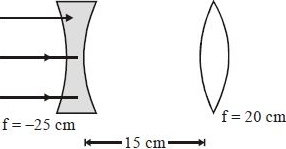
$A$ diverging lens with a focal length of magnitude $25 \, cm$ is placed at a distance of $15 \, cm$ from a converging lens with a focal length of magnitude $20 \, cm$. $A$ beam of parallel light falls on the diverging lens. The final image formed is:
A
real and at a distance of $40 \, cm$ from the diverging lens
B
real and at a distance of $6 \, cm$ from the converging lens
C
real and at a distance of $40 \, cm$ from the converging lens
D
virtual and at a distance of $40 \, cm$ from the converging lens
Solution
(C) For the diverging lens,the incident light is parallel,so the image is formed at its focus. Since it is a diverging lens,$f_1 = -25 \, cm$. The image is virtual and formed at $v_1 = -25 \, cm$ from the diverging lens.
This image acts as an object for the converging lens. The distance between the lenses is $d = 15 \, cm$. The object distance for the converging lens is $u_2 = -(25 + 15) \, cm = -40 \, cm$.
For the converging lens,$f_2 = +20 \, cm$. Using the lens formula $\frac{1}{v_2} - \frac{1}{u_2} = \frac{1}{f_2}$:
$\frac{1}{v_2} - \frac{1}{-40} = \frac{1}{20}$
$\frac{1}{v_2} = \frac{1}{20} - \frac{1}{40} = \frac{2-1}{40} = \frac{1}{40}$
$v_2 = +40 \, cm$.
Since $v_2$ is positive,the final image is real and formed at a distance of $40 \, cm$ from the converging lens.
This image acts as an object for the converging lens. The distance between the lenses is $d = 15 \, cm$. The object distance for the converging lens is $u_2 = -(25 + 15) \, cm = -40 \, cm$.
For the converging lens,$f_2 = +20 \, cm$. Using the lens formula $\frac{1}{v_2} - \frac{1}{u_2} = \frac{1}{f_2}$:
$\frac{1}{v_2} - \frac{1}{-40} = \frac{1}{20}$
$\frac{1}{v_2} = \frac{1}{20} - \frac{1}{40} = \frac{2-1}{40} = \frac{1}{40}$
$v_2 = +40 \, cm$.
Since $v_2$ is positive,the final image is real and formed at a distance of $40 \, cm$ from the converging lens.
0 likesView Solution
58
ChemistryMCQJEE Main · 2017
$A$ particle $A$ of mass $m$ and initial velocity $v$ collides with a particle $B$ of mass $\frac{m}{2}$ which is at rest. The collision is head-on and elastic. The ratio of de-Broglie wavelengths $\lambda_{A}$ to $\lambda_{B}$ after the collision is
A
$\frac{\lambda_{A}}{\lambda_{B}}=\frac{2}{3}$
B
$\frac{\lambda_{A}}{\lambda_{B}}=\frac{1}{2}$
C
$\frac{\lambda_{A}}{\lambda_{B}}=2$
D
$\frac{\lambda_{A}}{\lambda_{B}}=\frac{1}{3}$
Solution
(C) Let the velocity of particle $A$ after the collision be $v_{1}$ and the velocity of particle $B$ be $v_{2}$.
Using the law of conservation of linear momentum:
$m v = m v_{1} + (m/2) v_{2}$
$2v = 2v_{1} + v_{2} \quad \dots (i)$
For an elastic head-on collision,the coefficient of restitution $e = 1$:
$e = \frac{v_{2} - v_{1}}{v - 0} = 1$
$v = v_{2} - v_{1} \implies v_{2} = v + v_{1} \quad \dots (ii)$
Substituting $(ii)$ into $(i)$:
$2v = 2v_{1} + (v + v_{1})$
$v = 3v_{1} \implies v_{1} = \frac{v}{3}$
$v_{2} = v + \frac{v}{3} = \frac{4v}{3}$
The de-Broglie wavelength is $\lambda = \frac{h}{p} = \frac{h}{mv}$.
Ratio of wavelengths: $\frac{\lambda_{A}}{\lambda_{B}} = \frac{p_{B}}{p_{A}} = \frac{(m/2) v_{2}}{m v_{1}}$
$\frac{\lambda_{A}}{\lambda_{B}} = \frac{(m/2) \times (4v/3)}{m \times (v/3)} = \frac{2mv/3}{mv/3} = 2$.
Using the law of conservation of linear momentum:
$m v = m v_{1} + (m/2) v_{2}$
$2v = 2v_{1} + v_{2} \quad \dots (i)$
For an elastic head-on collision,the coefficient of restitution $e = 1$:
$e = \frac{v_{2} - v_{1}}{v - 0} = 1$
$v = v_{2} - v_{1} \implies v_{2} = v + v_{1} \quad \dots (ii)$
Substituting $(ii)$ into $(i)$:
$2v = 2v_{1} + (v + v_{1})$
$v = 3v_{1} \implies v_{1} = \frac{v}{3}$
$v_{2} = v + \frac{v}{3} = \frac{4v}{3}$
The de-Broglie wavelength is $\lambda = \frac{h}{p} = \frac{h}{mv}$.
Ratio of wavelengths: $\frac{\lambda_{A}}{\lambda_{B}} = \frac{p_{B}}{p_{A}} = \frac{(m/2) v_{2}}{m v_{1}}$
$\frac{\lambda_{A}}{\lambda_{B}} = \frac{(m/2) \times (4v/3)}{m \times (v/3)} = \frac{2mv/3}{mv/3} = 2$.
0 likesView Solution
59
ChemistryMediumMCQJEE Main · 2017
In the following structure,the double bonds are marked as $I$,$II$,$III$ and $IV$. Geometrical isomerism is not possible at site$(s)$:

A
$III$
B
$I$
C
$I$ and $III$
D
$III$ and $IV$
Solution
(C) For geometrical isomerism to occur at a double bond,each carbon atom of the double bond must be attached to two different groups.
$I$: The carbon atom is attached to two identical methyl groups $(a, a)$,so geometrical isomerism is not possible.
$II$: Both carbons are attached to different groups,so it shows geometrical isomerism.
$III$: The carbon atom is attached to two identical methyl groups,so geometrical isomerism is not possible.
$IV$: Both carbons are attached to different groups,so it shows geometrical isomerism.
Therefore,geometrical isomerism is not possible at sites $I$ and $III$.
$I$: The carbon atom is attached to two identical methyl groups $(a, a)$,so geometrical isomerism is not possible.
$II$: Both carbons are attached to different groups,so it shows geometrical isomerism.
$III$: The carbon atom is attached to two identical methyl groups,so geometrical isomerism is not possible.
$IV$: Both carbons are attached to different groups,so it shows geometrical isomerism.
Therefore,geometrical isomerism is not possible at sites $I$ and $III$.
0 likesView Solution
60
ChemistryMediumMCQJEE Main · 2017
The following reaction occurs in the blast furnace where iron ore is reduced to iron metal:
$Fe_2O_{3(s)} + 3CO_{(g)} \rightleftharpoons 2Fe_{(l)} + 3CO_{2(g)}$
Using Le Chatelier's principle,predict which one of the following will not disturb the equilibrium.
$Fe_2O_{3(s)} + 3CO_{(g)} \rightleftharpoons 2Fe_{(l)} + 3CO_{2(g)}$
Using Le Chatelier's principle,predict which one of the following will not disturb the equilibrium.
A
Addition of $Fe_2O_3$
B
Addition of $CO_2$
C
Removal of $CO$
D
Removal of $CO_2$
Solution
(A) According to Le Chatelier's principle,the equilibrium position is affected by changes in the concentration of gaseous or aqueous species.
In the given reaction,$Fe_2O_{3(s)}$ is a solid.
The active mass of a pure solid or pure liquid is taken as unity $(1)$ and remains constant regardless of the amount present.
Therefore,the addition or removal of $Fe_2O_{3(s)}$ does not change the concentration of the reactants or products involved in the equilibrium expression,and thus it will not disturb the equilibrium.
In the given reaction,$Fe_2O_{3(s)}$ is a solid.
The active mass of a pure solid or pure liquid is taken as unity $(1)$ and remains constant regardless of the amount present.
Therefore,the addition or removal of $Fe_2O_{3(s)}$ does not change the concentration of the reactants or products involved in the equilibrium expression,and thus it will not disturb the equilibrium.
0 likesView Solution
Vedclass Products
For Students
Vedclass Test Series
Mock tests in real JEE Main style covering Chemistry with performance analysis. 5-day free trial.
Start Free TrialFor Teachers
Exam Paper Generator
Generate Set A/B/C/D Chemistry papers from 7.5L+ questions in 2 minutes. 3 chapters free.
Try FreeFor Institutes
Online Exam Module
Run live JEE Main mock exams with unlimited students, 360° analytics & white-label branding.
See DemoFrequently Asked Questions
How many Chemistry questions are in JEE Main 2017?
There are 107 Chemistry questions from the JEE Main 2017 paper on Vedclass, each with a detailed step-by-step solution in English.
Are JEE Main 2017 Chemistry solutions available in English?
Yes. All solutions on this page are in English. You can also switch to English or Hindi using the language buttons above the questions.
Can I practice JEE Main 2017 Chemistry as a timed test?
Yes. Use the Vedclass Test Series to attempt a full JEE Main mock test covering Chemistry with time limits and instant score analysis.
Can teachers create Chemistry papers from JEE Main previous year questions?
Yes. The Vedclass Exam Paper Generator lets teachers mix JEE Main Chemistry questions and generate Set A/B/C/D papers in minutes.
For Teachers & Institutes
Build a Custom Chemistry Paper
Pick JEE Main 2017 Chemistry questions, set difficulty, and generate Set A/B/C/D in 2 minutes.