
MathematicsQ1–28 of 28 questions
Page 1 of 1 · English
1
MathematicsMediumMCQIIT JEE · 2003
If $|z| = 1$ and $\omega = \frac{z - 1}{z + 1}$ (where $z \neq -1$),then $\text{Re}(\omega)$ is
A
$0$
B
$-\frac{1}{|z + 1|^2}$
C
$\left| \frac{z}{z + 1} \right| \cdot \frac{1}{|z + 1|^2}$
D
$\frac{\sqrt{2}}{|z + 1|^2}$
Solution
(A) Given $|z| = 1$,let $z = x + iy$,so $x^2 + y^2 = 1$.
$\omega = \frac{z - 1}{z + 1} = \frac{(x - 1) + iy}{(x + 1) + iy}$.
To find the real part,multiply the numerator and denominator by the conjugate of the denominator $(x + 1) - iy$:
$\omega = \frac{((x - 1) + iy)((x + 1) - iy)}{(x + 1)^2 + y^2} = \frac{(x^2 - 1) + i(y(x + 1) - y(x - 1)) + y^2}{(x + 1)^2 + y^2}$.
$\omega = \frac{(x^2 + y^2 - 1) + i(xy + y - xy + y)}{(x + 1)^2 + y^2} = \frac{(1 - 1) + 2iy}{(x + 1)^2 + y^2} = \frac{2iy}{(x + 1)^2 + y^2}$.
Since the real part is $0$,$\text{Re}(\omega) = 0$.
$\omega = \frac{z - 1}{z + 1} = \frac{(x - 1) + iy}{(x + 1) + iy}$.
To find the real part,multiply the numerator and denominator by the conjugate of the denominator $(x + 1) - iy$:
$\omega = \frac{((x - 1) + iy)((x + 1) - iy)}{(x + 1)^2 + y^2} = \frac{(x^2 - 1) + i(y(x + 1) - y(x - 1)) + y^2}{(x + 1)^2 + y^2}$.
$\omega = \frac{(x^2 + y^2 - 1) + i(xy + y - xy + y)}{(x + 1)^2 + y^2} = \frac{(1 - 1) + 2iy}{(x + 1)^2 + y^2} = \frac{2iy}{(x + 1)^2 + y^2}$.
Since the real part is $0$,$\text{Re}(\omega) = 0$.
0 likesView Solution
2
MathematicsDifficultMCQIIT JEE · 2003
If $a, b, c$ are in $A.P.$ and $a^2, b^2, c^2$ are in $H.P.$,then
A
$a = b = c$
B
$2b = 3a + c$
C
$b^2 = \sqrt{ac/8}$
D
None of these
Solution
(A) Given that $a, b, c$ are in $A.P.$
$2b = a + c$ ......$(i)$
Given that $a^2, b^2, c^2$ are in $H.P.$
$b^2 = \frac{2a^2c^2}{a^2 + c^2}$
$b^2(a^2 + c^2) = 2a^2c^2$
$b^2((a+c)^2 - 2ac) = 2a^2c^2$
Substituting $a+c = 2b$ from $(i)$:
$b^2(4b^2 - 2ac) = 2a^2c^2$
$4b^4 - 2acb^2 - 2a^2c^2 = 0$
$2b^4 - acb^2 - a^2c^2 = 0$
$(2b^2 + ac)(b^2 - ac) = 0$
Since $a, b, c$ are real,$2b^2 + ac = 0$ implies $a, b, c$ are $0$ or complex,so we consider $b^2 = ac$.
If $b^2 = ac$,then $a, b, c$ are in $G.P.$
Since $a, b, c$ are in both $A.P.$ and $G.P.$,we must have $a = b = c$.
$2b = a + c$ ......$(i)$
Given that $a^2, b^2, c^2$ are in $H.P.$
$b^2 = \frac{2a^2c^2}{a^2 + c^2}$
$b^2(a^2 + c^2) = 2a^2c^2$
$b^2((a+c)^2 - 2ac) = 2a^2c^2$
Substituting $a+c = 2b$ from $(i)$:
$b^2(4b^2 - 2ac) = 2a^2c^2$
$4b^4 - 2acb^2 - 2a^2c^2 = 0$
$2b^4 - acb^2 - a^2c^2 = 0$
$(2b^2 + ac)(b^2 - ac) = 0$
Since $a, b, c$ are real,$2b^2 + ac = 0$ implies $a, b, c$ are $0$ or complex,so we consider $b^2 = ac$.
If $b^2 = ac$,then $a, b, c$ are in $G.P.$
Since $a, b, c$ are in both $A.P.$ and $G.P.$,we must have $a = b = c$.
0 likesView Solution
3
MathematicsDifficultMCQIIT JEE · 2003
The coefficient of $t^{24}$ in the expansion of $(1 + t^2)^{12}(1 + t^{12})(1 + t^{24})$ is
A
$^{12}C_6 + 2$
B
$^{12}C_5$
C
$^{12}C_6$
D
$^{12}C_7$
Solution
(A) The expression is $(1 + t^2)^{12}(1 + t^{12})(1 + t^{24})$.
Expanding $(1 + t^2)^{12}$ using the binomial theorem,we get $\sum_{k=0}^{12} {^{12}C_k} (t^2)^k = \sum_{k=0}^{12} {^{12}C_k} t^{2k}$.
We want the coefficient of $t^{24}$ in the product $(\sum_{k=0}^{12} {^{12}C_k} t^{2k})(1 + t^{12} + t^{24})$.
Distributing the terms:
$1$. From $1 \times (\dots)$,we need the coefficient of $t^{24}$ in $(1 + t^2)^{12}$,which is $^{12}C_{12} = 1$.
$2$. From $t^{12} \times (\dots)$,we need the coefficient of $t^{12}$ in $(1 + t^2)^{12}$,which is $^{12}C_6 = 924$.
$3$. From $t^{24} \times (\dots)$,we need the coefficient of $t^0$ in $(1 + t^2)^{12}$,which is $^{12}C_0 = 1$.
Summing these coefficients: $1 + ^{12}C_6 + 1 = ^{12}C_6 + 2$.
Expanding $(1 + t^2)^{12}$ using the binomial theorem,we get $\sum_{k=0}^{12} {^{12}C_k} (t^2)^k = \sum_{k=0}^{12} {^{12}C_k} t^{2k}$.
We want the coefficient of $t^{24}$ in the product $(\sum_{k=0}^{12} {^{12}C_k} t^{2k})(1 + t^{12} + t^{24})$.
Distributing the terms:
$1$. From $1 \times (\dots)$,we need the coefficient of $t^{24}$ in $(1 + t^2)^{12}$,which is $^{12}C_{12} = 1$.
$2$. From $t^{12} \times (\dots)$,we need the coefficient of $t^{12}$ in $(1 + t^2)^{12}$,which is $^{12}C_6 = 924$.
$3$. From $t^{24} \times (\dots)$,we need the coefficient of $t^0$ in $(1 + t^2)^{12}$,which is $^{12}C_0 = 1$.
Summing these coefficients: $1 + ^{12}C_6 + 1 = ^{12}C_6 + 2$.
0 likesView Solution
4
MathematicsMediumMCQIIT JEE · 2003
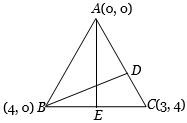
The orthocentre of the triangle with vertices $(0, 0)$,$(3, 4)$,and $(4, 0)$ is
A
$\left( 3, \frac{5}{4} \right)$
B
$(3, 12)$
C
$\left( 3, \frac{3}{4} \right)$
D
$(3, 9)$
Solution
(C) Let the vertices be $A(0, 0)$,$B(4, 0)$,and $C(3, 4)$.
To find the orthocentre,we find the intersection of the altitudes.
$1$. Altitude from $A$ to $BC$: The slope of $BC$ is $\frac{4-0}{3-4} = -4$. The altitude is perpendicular to $BC$,so its slope is $\frac{1}{4}$. Since it passes through $A(0, 0)$,its equation is $y = \frac{1}{4}x$,or $x - 4y = 0$.
$2$. Altitude from $C$ to $AB$: The side $AB$ lies on the $x$-axis $(y=0)$,so the altitude from $C(3, 4)$ is a vertical line $x = 3$.
$3$. Intersection: Substituting $x = 3$ into $x - 4y = 0$,we get $3 - 4y = 0$,which gives $y = \frac{3}{4}$.
Thus,the orthocentre is $\left( 3, \frac{3}{4} \right)$.
To find the orthocentre,we find the intersection of the altitudes.
$1$. Altitude from $A$ to $BC$: The slope of $BC$ is $\frac{4-0}{3-4} = -4$. The altitude is perpendicular to $BC$,so its slope is $\frac{1}{4}$. Since it passes through $A(0, 0)$,its equation is $y = \frac{1}{4}x$,or $x - 4y = 0$.
$2$. Altitude from $C$ to $AB$: The side $AB$ lies on the $x$-axis $(y=0)$,so the altitude from $C(3, 4)$ is a vertical line $x = 3$.
$3$. Intersection: Substituting $x = 3$ into $x - 4y = 0$,we get $3 - 4y = 0$,which gives $y = \frac{3}{4}$.
Thus,the orthocentre is $\left( 3, \frac{3}{4} \right)$.
0 likesView Solution
5
MathematicsMediumMCQIIT JEE · 2003
The centre of the circle inscribed in the square formed by the lines $x^2 - 8x + 12 = 0$ and $y^2 - 14y + 45 = 0$ is
A
$(4, 7)$
B
$(7, 4)$
C
$(9, 4)$
D
$(4, 9)$
Solution
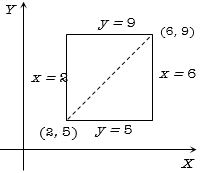
(A) The given equations are $x^2 - 8x + 12 = 0$ and $y^2 - 14y + 45 = 0$.
Solving $x^2 - 8x + 12 = 0$,we get $(x - 2)(x - 6) = 0$,so $x = 2$ and $x = 6$.
Solving $y^2 - 14y + 45 = 0$,we get $(y - 5)(y - 9) = 0$,so $y = 5$ and $y = 9$.
The lines forming the square are $x = 2, x = 6, y = 5,$ and $y = 9$.
The centre of the inscribed circle is the midpoint of the square,which is the intersection of the diagonals.
The centre is given by $(\frac{2 + 6}{2}, \frac{5 + 9}{2}) = (\frac{8}{2}, \frac{14}{2}) = (4, 7)$.
Solving $x^2 - 8x + 12 = 0$,we get $(x - 2)(x - 6) = 0$,so $x = 2$ and $x = 6$.
Solving $y^2 - 14y + 45 = 0$,we get $(y - 5)(y - 9) = 0$,so $y = 5$ and $y = 9$.
The lines forming the square are $x = 2, x = 6, y = 5,$ and $y = 9$.
The centre of the inscribed circle is the midpoint of the square,which is the intersection of the diagonals.
The centre is given by $(\frac{2 + 6}{2}, \frac{5 + 9}{2}) = (\frac{8}{2}, \frac{14}{2}) = (4, 7)$.
0 likesView Solution
6
MathematicsDifficultMCQIIT JEE · 2003
The focal chord to $y^2 = 16x$ is tangent to $(x - 6)^2 + y^2 = 2$. Then,the possible values of the slope of this chord are:
A
$\{-1, 1\}$
B
$\{-2, 2\}$
C
$\{-2, 1/2\}$
D
$\{2, -1/2\}$
Solution
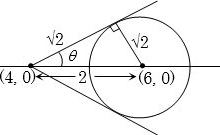
(A) The parabola is $y^2 = 16x$,so $4a = 16$,which gives $a = 4$. The focus is $(a, 0) = (4, 0)$.
Any focal chord passing through $(4, 0)$ with slope $m$ has the equation $y - 0 = m(x - 4)$,or $mx - y - 4m = 0$.
This line is tangent to the circle $(x - 6)^2 + y^2 = 2$,which has center $(6, 0)$ and radius $r = \sqrt{2}$.
The perpendicular distance from the center $(6, 0)$ to the line $mx - y - 4m = 0$ must be equal to the radius $\sqrt{2}$.
Using the distance formula: $\frac{|m(6) - 0 - 4m|}{\sqrt{m^2 + (-1)^2}} = \sqrt{2}$.
$\frac{|2m|}{\sqrt{m^2 + 1}} = \sqrt{2}$.
Squaring both sides: $\frac{4m^2}{m^2 + 1} = 2$.
$4m^2 = 2m^2 + 2$.
$2m^2 = 2$,so $m^2 = 1$,which gives $m = \pm 1$.
Thus,the possible values of the slope are $\{-1, 1\}$.
Any focal chord passing through $(4, 0)$ with slope $m$ has the equation $y - 0 = m(x - 4)$,or $mx - y - 4m = 0$.
This line is tangent to the circle $(x - 6)^2 + y^2 = 2$,which has center $(6, 0)$ and radius $r = \sqrt{2}$.
The perpendicular distance from the center $(6, 0)$ to the line $mx - y - 4m = 0$ must be equal to the radius $\sqrt{2}$.
Using the distance formula: $\frac{|m(6) - 0 - 4m|}{\sqrt{m^2 + (-1)^2}} = \sqrt{2}$.
$\frac{|2m|}{\sqrt{m^2 + 1}} = \sqrt{2}$.
Squaring both sides: $\frac{4m^2}{m^2 + 1} = 2$.
$4m^2 = 2m^2 + 2$.
$2m^2 = 2$,so $m^2 = 1$,which gives $m = \pm 1$.
Thus,the possible values of the slope are $\{-1, 1\}$.
0 likesView Solution
7
MathematicsDifficultMCQIIT JEE · 2003
The area of the quadrilateral formed by the tangents at the end points of the latus rectum to the ellipse $\frac{x^2}{9} + \frac{y^2}{5} = 1$ is .............. $sq. \text{ units}$.
A
$27/4$
B
$9$
C
$27/2$
D
$27$
Solution
(D) For the ellipse $\frac{x^2}{9} + \frac{y^2}{5} = 1$,we have $a^2 = 9$ and $b^2 = 5$.
The eccentricity $e$ is given by $e = \sqrt{1 - \frac{b^2}{a^2}} = \sqrt{1 - \frac{5}{9}} = \sqrt{\frac{4}{9}} = \frac{2}{3}$.
The coordinates of the end points of the latus rectum are $(\pm ae, \pm \frac{b^2}{a}) = (\pm 2, \pm \frac{5}{3})$.
The tangent at the point $(2, \frac{5}{3})$ is $\frac{2x}{9} + \frac{5y/3}{5} = 1$,which simplifies to $\frac{2x}{9} + \frac{y}{3} = 1$,or $\frac{x}{9/2} + \frac{y}{3} = 1$.
This tangent forms a triangle with the coordinate axes in the first quadrant with intercepts $x_0 = 9/2$ and $y_0 = 3$.
The area of this triangle is $\frac{1}{2} \times \frac{9}{2} \times 3 = \frac{27}{4}$.
Since there are four such symmetric triangles formed by the tangents at the four ends of the latus recta,the total area of the quadrilateral is $4 \times \frac{27}{4} = 27$ $sq. \text{ units}$.
The eccentricity $e$ is given by $e = \sqrt{1 - \frac{b^2}{a^2}} = \sqrt{1 - \frac{5}{9}} = \sqrt{\frac{4}{9}} = \frac{2}{3}$.
The coordinates of the end points of the latus rectum are $(\pm ae, \pm \frac{b^2}{a}) = (\pm 2, \pm \frac{5}{3})$.
The tangent at the point $(2, \frac{5}{3})$ is $\frac{2x}{9} + \frac{5y/3}{5} = 1$,which simplifies to $\frac{2x}{9} + \frac{y}{3} = 1$,or $\frac{x}{9/2} + \frac{y}{3} = 1$.
This tangent forms a triangle with the coordinate axes in the first quadrant with intercepts $x_0 = 9/2$ and $y_0 = 3$.
The area of this triangle is $\frac{1}{2} \times \frac{9}{2} \times 3 = \frac{27}{4}$.
Since there are four such symmetric triangles formed by the tangents at the four ends of the latus recta,the total area of the quadrilateral is $4 \times \frac{27}{4} = 27$ $sq. \text{ units}$.
0 likesView Solution
8
MathematicsDifficultMCQIIT JEE · 2003
$A$ tangent is drawn to the ellipse $\frac{x^2}{27} + y^2 = 1$ at the point $(3\sqrt{3} \cos \theta, \sin \theta)$ where $\theta \in (0, \pi/2)$. The value of $\theta$ for which the sum of the intercepts on the axes made by this tangent is minimum,is:
A
$\pi/3$
B
$\pi/6$
C
$\pi/8$
D
$\pi/4$
Solution
(B) The equation of the tangent to the ellipse $\frac{x^2}{a^2} + \frac{y^2}{b^2} = 1$ at $(a \cos \theta, b \sin \theta)$ is $\frac{x \cos \theta}{a} + \frac{y \sin \theta}{b} = 1$.
Here $a^2 = 27 \implies a = 3\sqrt{3}$ and $b^2 = 1 \implies b = 1$.
So,the tangent equation is $\frac{x \cos \theta}{3\sqrt{3}} + y \sin \theta = 1$.
The $x$-intercept is $a_x = \frac{3\sqrt{3}}{\cos \theta} = 3\sqrt{3} \sec \theta$ and the $y$-intercept is $a_y = \frac{1}{\sin \theta} = \csc \theta$.
The sum of intercepts is $f(\theta) = 3\sqrt{3} \sec \theta + \csc \theta$.
To find the minimum,set $f'(\theta) = 3\sqrt{3} \sec \theta \tan \theta - \csc \theta \cot \theta = 0$.
$3\sqrt{3} \frac{\sin \theta}{\cos^2 \theta} = \frac{\cos \theta}{\sin^2 \theta} \implies \tan^3 \theta = \frac{1}{3\sqrt{3}} = \left(\frac{1}{\sqrt{3}}\right)^3$.
Thus,$\tan \theta = \frac{1}{\sqrt{3}}$,which gives $\theta = \pi/6$.
Here $a^2 = 27 \implies a = 3\sqrt{3}$ and $b^2 = 1 \implies b = 1$.
So,the tangent equation is $\frac{x \cos \theta}{3\sqrt{3}} + y \sin \theta = 1$.
The $x$-intercept is $a_x = \frac{3\sqrt{3}}{\cos \theta} = 3\sqrt{3} \sec \theta$ and the $y$-intercept is $a_y = \frac{1}{\sin \theta} = \csc \theta$.
The sum of intercepts is $f(\theta) = 3\sqrt{3} \sec \theta + \csc \theta$.
To find the minimum,set $f'(\theta) = 3\sqrt{3} \sec \theta \tan \theta - \csc \theta \cot \theta = 0$.
$3\sqrt{3} \frac{\sin \theta}{\cos^2 \theta} = \frac{\cos \theta}{\sin^2 \theta} \implies \tan^3 \theta = \frac{1}{3\sqrt{3}} = \left(\frac{1}{\sqrt{3}}\right)^3$.
Thus,$\tan \theta = \frac{1}{\sqrt{3}}$,which gives $\theta = \pi/6$.
0 likesView Solution
9
MathematicsMediumMCQIIT JEE · 2003
If $\mathop {\lim }\limits_{x \to 0} \frac{{[(a - n)nx - \tan x]\sin nx}}{{{x^2}}} = 0,$ where $n$ is a non-zero real number,then $a$ is equal to
A
$0$
B
$\frac{n + 1}{n}$
C
$n$
D
$n + \frac{1}{n}$
Solution
(D) Given the limit: $\mathop {\lim }\limits_{x \to 0} \frac{[(a - n)nx - \tan x]\sin nx}{x^2} = 0$
We can rewrite the expression as: $\mathop {\lim }\limits_{x \to 0} \left( \frac{(a - n)nx - \tan x}{x} \cdot \frac{\sin nx}{x} \right) = 0$
Multiplying and dividing by $n$ in the second term: $\mathop {\lim }\limits_{x \to 0} \left( ((a - n)n - \frac{\tan x}{x}) \cdot n \cdot \frac{\sin nx}{nx} \right) = 0$
Since $\mathop {\lim }\limits_{x \to 0} \frac{\tan x}{x} = 1$ and $\mathop {\lim }\limits_{x \to 0} \frac{\sin nx}{nx} = 1$,the equation becomes:
$n((a - n)n - 1) = 0$
Since $n \neq 0$,we have $(a - n)n - 1 = 0$
$(a - n)n = 1$
$a - n = \frac{1}{n}$
$a = n + \frac{1}{n}$
We can rewrite the expression as: $\mathop {\lim }\limits_{x \to 0} \left( \frac{(a - n)nx - \tan x}{x} \cdot \frac{\sin nx}{x} \right) = 0$
Multiplying and dividing by $n$ in the second term: $\mathop {\lim }\limits_{x \to 0} \left( ((a - n)n - \frac{\tan x}{x}) \cdot n \cdot \frac{\sin nx}{nx} \right) = 0$
Since $\mathop {\lim }\limits_{x \to 0} \frac{\tan x}{x} = 1$ and $\mathop {\lim }\limits_{x \to 0} \frac{\sin nx}{nx} = 1$,the equation becomes:
$n((a - n)n - 1) = 0$
Since $n \neq 0$,we have $(a - n)n - 1 = 0$
$(a - n)n = 1$
$a - n = \frac{1}{n}$
$a = n + \frac{1}{n}$
0 likesView Solution
10
MathematicsMediumMCQIIT JEE · 2003
Given that $f'(2) = 6$ and $f'(1) = 4$,then $\mathop {\lim }\limits_{h \to 0} \frac{{f(2h + 2 + {h^2}) - f(2)}}{{f(h - {h^2} + 1) - f(1)}} = $
A
Does not exist
B
$-3/2$
C
$3/2$
D
$3$
Solution
(D) Using $L$'Hopital's rule,we differentiate the numerator and denominator with respect to $h$:
$\mathop {\lim }\limits_{h \to 0} \frac{{f(2h + 2 + {h^2}) - f(2)}}{{f(h - {h^2} + 1) - f(1)}} = \mathop {\lim }\limits_{h \to 0} \frac{{f'(2h + 2 + {h^2}) \cdot (2 + 2h)}}{{f'(h - {h^2} + 1) \cdot (1 - 2h)}}$
As $h \to 0$,the expression becomes:
$\frac{{f'(2) \cdot 2}}{{f'(1) \cdot 1}} = \frac{{6 \times 2}}{{4 \times 1}} = \frac{{12}}{{4}} = 3$.
$\mathop {\lim }\limits_{h \to 0} \frac{{f(2h + 2 + {h^2}) - f(2)}}{{f(h - {h^2} + 1) - f(1)}} = \mathop {\lim }\limits_{h \to 0} \frac{{f'(2h + 2 + {h^2}) \cdot (2 + 2h)}}{{f'(h - {h^2} + 1) \cdot (1 - 2h)}}$
As $h \to 0$,the expression becomes:
$\frac{{f'(2) \cdot 2}}{{f'(1) \cdot 1}} = \frac{{6 \times 2}}{{4 \times 1}} = \frac{{12}}{{4}} = 3$.
0 likesView Solution
11
MathematicsDifficultMCQIIT JEE · 2003
If $f(x) = x^2 + 2bx + 2c^2$ and $g(x) = -x^2 - 2cx + b^2$ such that $\min f(x) > \max g(x)$,then the relation between $b$ and $c$ is
A
No real value of $b$ and $c$
B
$0 < c < b\sqrt{2}$
C
$|c| < |b|\sqrt{2}$
D
$|c| > |b|\sqrt{2}$
Solution
(D) Given $f(x) = x^2 + 2bx + 2c^2$. Completing the square,we get $f(x) = (x + b)^2 + 2c^2 - b^2$. The minimum value of $f(x)$ is $2c^2 - b^2$.
Given $g(x) = -x^2 - 2cx + b^2$. Completing the square,we get $g(x) = b^2 + c^2 - (x + c)^2$. The maximum value of $g(x)$ is $b^2 + c^2$.
According to the condition $\min f(x) > \max g(x)$,we have $2c^2 - b^2 > b^2 + c^2$.
Simplifying the inequality,we get $c^2 > 2b^2$.
Taking the square root on both sides,we get $|c| > |b|\sqrt{2}$.
Given $g(x) = -x^2 - 2cx + b^2$. Completing the square,we get $g(x) = b^2 + c^2 - (x + c)^2$. The maximum value of $g(x)$ is $b^2 + c^2$.
According to the condition $\min f(x) > \max g(x)$,we have $2c^2 - b^2 > b^2 + c^2$.
Simplifying the inequality,we get $c^2 > 2b^2$.
Taking the square root on both sides,we get $|c| > |b|\sqrt{2}$.
0 likesView Solution
12
MathematicsEasyMCQIIT JEE · 2003
Two numbers are selected randomly from the set $S = \{ 1, 2, 3, 4, 5, 6 \}$ without replacement one by one. The probability that the minimum of the two numbers is less than $4$ is
A
$\frac{1}{15}$
B
$\frac{14}{15}$
C
$\frac{1}{5}$
D
$\frac{4}{5}$
Solution
(D) The total number of ways to select $2$ numbers from $6$ numbers without replacement is $P(6, 2) = 6 \times 5 = 30$.
Let the two numbers be $x$ and $y$. We want the probability that $\min(x, y) < 4$.
It is easier to calculate the complement: the probability that $\min(x, y) \geq 4$.
This means both numbers must be chosen from the set $\{4, 5, 6\}$.
The number of ways to choose $2$ numbers from $\{4, 5, 6\}$ is $P(3, 2) = 3 \times 2 = 6$.
The probability that $\min(x, y) \geq 4$ is $\frac{6}{30} = \frac{1}{5}$.
Therefore,the probability that $\min(x, y) < 4$ is $1 - \frac{1}{5} = \frac{4}{5}$.
Let the two numbers be $x$ and $y$. We want the probability that $\min(x, y) < 4$.
It is easier to calculate the complement: the probability that $\min(x, y) \geq 4$.
This means both numbers must be chosen from the set $\{4, 5, 6\}$.
The number of ways to choose $2$ numbers from $\{4, 5, 6\}$ is $P(3, 2) = 3 \times 2 = 6$.
The probability that $\min(x, y) \geq 4$ is $\frac{6}{30} = \frac{1}{5}$.
Therefore,the probability that $\min(x, y) < 4$ is $1 - \frac{1}{5} = \frac{4}{5}$.
0 likesView Solution
13
MathematicsMediumMCQIIT JEE · 2003
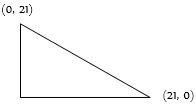
The number of integral points (integral point means both the coordinates should be integers) exactly in the interior of the triangle with vertices $(0, 0)$,$(0, 21)$,and $(21, 0)$ is:
A
$133$
B
$190$
C
$233$
D
$105$
Solution
(B) The vertices of the triangle are $(0, 0)$,$(0, 21)$,and $(21, 0)$.
The interior points $(x, y)$ must satisfy $x > 0$,$y > 0$,and $x + y < 21$.
For a fixed $x$,$y$ can take integer values from $1$ to $21 - x - 1 = 20 - x$.
Since $y > 0$,we must have $20 - x \geq 1$,so $x$ can range from $1$ to $19$.
For each $x \in \{1, 2, \dots, 19\}$,the number of possible values for $y$ is $20 - x$.
The total number of integral points is $\sum_{x=1}^{19} (20 - x) = 19 + 18 + \dots + 1$.
Using the sum formula $\frac{n(n+1)}{2}$ with $n = 19$,we get $\frac{19 \times 20}{2} = 190$.
The interior points $(x, y)$ must satisfy $x > 0$,$y > 0$,and $x + y < 21$.
For a fixed $x$,$y$ can take integer values from $1$ to $21 - x - 1 = 20 - x$.
Since $y > 0$,we must have $20 - x \geq 1$,so $x$ can range from $1$ to $19$.
For each $x \in \{1, 2, \dots, 19\}$,the number of possible values for $y$ is $20 - x$.
The total number of integral points is $\sum_{x=1}^{19} (20 - x) = 19 + 18 + \dots + 1$.
Using the sum formula $\frac{n(n+1)}{2}$ with $n = 19$,we get $\frac{19 \times 20}{2} = 190$.
0 likesView Solution
14
MathematicsDifficultMCQIIT JEE · 2003
If the equation of the locus of a point equidistant from the points $(a_1, b_1)$ and $(a_2, b_2)$ is $(a_1 - a_2)x + (b_1 - b_2)y + c = 0$,then the value of $c$ is
A
$\frac{1}{2}(a_2^2 + b_2^2 - a_1^2 - b_1^2)$
B
$a_1^2 - a_2^2 + b_1^2 - b_2^2$
C
$\frac{1}{2}(a_1^2 + a_2^2 + b_1^2 + b_2^2)$
D
$\sqrt{a_1^2 + b_1^2 - a_2^2 - b_2^2}$
Solution
(A) Let the point be $(x, y)$. Since the point is equidistant from $(a_1, b_1)$ and $(a_2, b_2)$,we have:
$(x - a_1)^2 + (y - b_1)^2 = (x - a_2)^2 + (y - b_2)^2$
Expanding both sides:
$x^2 - 2a_1x + a_1^2 + y^2 - 2b_1y + b_1^2 = x^2 - 2a_2x + a_2^2 + y^2 - 2b_2y + b_2^2$
Canceling $x^2$ and $y^2$ from both sides:
$-2a_1x - 2b_1y + a_1^2 + b_1^2 = -2a_2x - 2b_2y + a_2^2 + b_2^2$
Rearranging the terms to the form $(a_1 - a_2)x + (b_1 - b_2)y + c = 0$:
$2(a_2 - a_1)x + 2(b_2 - b_1)y + (a_1^2 + b_1^2 - a_2^2 - b_2^2) = 0$
Multiplying by $-1$ to match the given form $(a_1 - a_2)x + (b_1 - b_2)y + c = 0$:
$2(a_1 - a_2)x + 2(b_1 - b_2)y + (a_2^2 + b_2^2 - a_1^2 - b_1^2) = 0$
Dividing by $2$:
$(a_1 - a_2)x + (b_1 - b_2)y + \frac{1}{2}(a_2^2 + b_2^2 - a_1^2 - b_1^2) = 0$
Comparing this with the given equation,we get $c = \frac{1}{2}(a_2^2 + b_2^2 - a_1^2 - b_1^2)$.
$(x - a_1)^2 + (y - b_1)^2 = (x - a_2)^2 + (y - b_2)^2$
Expanding both sides:
$x^2 - 2a_1x + a_1^2 + y^2 - 2b_1y + b_1^2 = x^2 - 2a_2x + a_2^2 + y^2 - 2b_2y + b_2^2$
Canceling $x^2$ and $y^2$ from both sides:
$-2a_1x - 2b_1y + a_1^2 + b_1^2 = -2a_2x - 2b_2y + a_2^2 + b_2^2$
Rearranging the terms to the form $(a_1 - a_2)x + (b_1 - b_2)y + c = 0$:
$2(a_2 - a_1)x + 2(b_2 - b_1)y + (a_1^2 + b_1^2 - a_2^2 - b_2^2) = 0$
Multiplying by $-1$ to match the given form $(a_1 - a_2)x + (b_1 - b_2)y + c = 0$:
$2(a_1 - a_2)x + 2(b_1 - b_2)y + (a_2^2 + b_2^2 - a_1^2 - b_1^2) = 0$
Dividing by $2$:
$(a_1 - a_2)x + (b_1 - b_2)y + \frac{1}{2}(a_2^2 + b_2^2 - a_1^2 - b_1^2) = 0$
Comparing this with the given equation,we get $c = \frac{1}{2}(a_2^2 + b_2^2 - a_1^2 - b_1^2)$.
0 likesView Solution
15
MathematicsMediumMCQIIT JEE · 2003
For the hyperbola $\frac{x^2}{\cos^2 \alpha} - \frac{y^2}{\sin^2 \alpha} = 1$,which of the following remains constant with a change in $\alpha$?
A
Abscissae of vertices
B
Abscissae of foci
C
Eccentricity
D
Directrix
Solution
(B) The equation of the hyperbola is $\frac{x^2}{a^2} - \frac{y^2}{b^2} = 1$,where $a^2 = \cos^2 \alpha$ and $b^2 = \sin^2 \alpha$.
For a hyperbola,the foci are located at $(\pm ae, 0)$,where $e$ is the eccentricity.
The eccentricity $e$ is given by $e = \sqrt{1 + \frac{b^2}{a^2}} = \sqrt{1 + \frac{\sin^2 \alpha}{\cos^2 \alpha}} = \sqrt{1 + \tan^2 \alpha} = \sec \alpha$.
The abscissa of the foci is $\pm ae = \pm \sqrt{\cos^2 \alpha} \cdot \sec \alpha = \pm \cos \alpha \cdot \frac{1}{\cos \alpha} = \pm 1$.
Since the value $\pm 1$ is independent of $\alpha$,the abscissae of the foci remain constant.
For a hyperbola,the foci are located at $(\pm ae, 0)$,where $e$ is the eccentricity.
The eccentricity $e$ is given by $e = \sqrt{1 + \frac{b^2}{a^2}} = \sqrt{1 + \frac{\sin^2 \alpha}{\cos^2 \alpha}} = \sqrt{1 + \tan^2 \alpha} = \sec \alpha$.
The abscissa of the foci is $\pm ae = \pm \sqrt{\cos^2 \alpha} \cdot \sec \alpha = \pm \cos \alpha \cdot \frac{1}{\cos \alpha} = \pm 1$.
Since the value $\pm 1$ is independent of $\alpha$,the abscissae of the foci remain constant.
0 likesView Solution
16
MathematicsEasyMCQIIT JEE · 2003
If the angles of a triangle are in the ratio $4:1:1$,then the ratio of the longest side to its perimeter is
A
$\sqrt{3}:(2+\sqrt{3})$
B
$2:(1+\sqrt{3})$
C
$1:(2+\sqrt{3})$
D
$2:3$
Solution
(A) Let the angles of the triangle be $4x, x$,and $x$.
Since the sum of angles in a triangle is $180^{\circ}$,we have $4x + x + x = 180^{\circ}$,which implies $6x = 180^{\circ}$,so $x = 30^{\circ}$.
The angles are $120^{\circ}, 30^{\circ}$,and $30^{\circ}$.
Using the Sine Rule,$\frac{a}{\sin A} = \frac{b}{\sin B} = \frac{c}{\sin C} = k$,where $a$ is the longest side opposite to $120^{\circ}$.
Then $a = k \sin 120^{\circ}$,$b = k \sin 30^{\circ}$,and $c = k \sin 30^{\circ}$.
The ratio of the longest side to the perimeter is $\frac{a}{a+b+c} = \frac{\sin 120^{\circ}}{\sin 120^{\circ} + \sin 30^{\circ} + \sin 30^{\circ}}$.
Substituting the values: $\frac{\frac{\sqrt{3}}{2}}{\frac{\sqrt{3}}{2} + \frac{1}{2} + \frac{1}{2}} = \frac{\frac{\sqrt{3}}{2}}{\frac{\sqrt{3}+2}{2}} = \frac{\sqrt{3}}{2+\sqrt{3}}$.
Since the sum of angles in a triangle is $180^{\circ}$,we have $4x + x + x = 180^{\circ}$,which implies $6x = 180^{\circ}$,so $x = 30^{\circ}$.
The angles are $120^{\circ}, 30^{\circ}$,and $30^{\circ}$.
Using the Sine Rule,$\frac{a}{\sin A} = \frac{b}{\sin B} = \frac{c}{\sin C} = k$,where $a$ is the longest side opposite to $120^{\circ}$.
Then $a = k \sin 120^{\circ}$,$b = k \sin 30^{\circ}$,and $c = k \sin 30^{\circ}$.
The ratio of the longest side to the perimeter is $\frac{a}{a+b+c} = \frac{\sin 120^{\circ}}{\sin 120^{\circ} + \sin 30^{\circ} + \sin 30^{\circ}}$.
Substituting the values: $\frac{\frac{\sqrt{3}}{2}}{\frac{\sqrt{3}}{2} + \frac{1}{2} + \frac{1}{2}} = \frac{\frac{\sqrt{3}}{2}}{\frac{\sqrt{3}+2}{2}} = \frac{\sqrt{3}}{2+\sqrt{3}}$.
0 likesView Solution
17
MathematicsEasyMCQIIT JEE · 2003
If the system of equations $x + ay = 0,$ $az + y = 0$ and $ax + z = 0$ has infinite solutions,then the value of $a$ is
A
$-1$
B
$1$
C
$0$
D
No real values
Solution
(A) The given system of equations is homogeneous:
$x + ay + 0z = 0$
$0x + y + az = 0$
$ax + 0y + z = 0$
For a homogeneous system to have infinite solutions (non-trivial solutions),the determinant of the coefficient matrix must be zero:
$\begin{vmatrix} 1 & a & 0 \\ 0 & 1 & a \\ a & 0 & 1 \end{vmatrix} = 0$
Expanding the determinant along the first row:
$1(1 \times 1 - a \times 0) - a(0 \times 1 - a \times a) + 0(0 \times 0 - 1 \times a) = 0$
$1(1) - a(-a^2) + 0 = 0$
$1 + a^3 = 0$
$a^3 = -1$
Taking the cube root on both sides,we get $a = -1$.
$x + ay + 0z = 0$
$0x + y + az = 0$
$ax + 0y + z = 0$
For a homogeneous system to have infinite solutions (non-trivial solutions),the determinant of the coefficient matrix must be zero:
$\begin{vmatrix} 1 & a & 0 \\ 0 & 1 & a \\ a & 0 & 1 \end{vmatrix} = 0$
Expanding the determinant along the first row:
$1(1 \times 1 - a \times 0) - a(0 \times 1 - a \times a) + 0(0 \times 0 - 1 \times a) = 0$
$1(1) - a(-a^2) + 0 = 0$
$1 + a^3 = 0$
$a^3 = -1$
Taking the cube root on both sides,we get $a = -1$.
0 likesView Solution
18
MathematicsEasyMCQIIT JEE · 2003
If $A = \begin{bmatrix} \alpha & 0 \\ 1 & 1 \end{bmatrix}$ and $B = \begin{bmatrix} 1 & 0 \\ 5 & 1 \end{bmatrix}$,then the value of $\alpha$ for which $A^2 = B$ is:
A
$1$
B
$-1$
C
$4$
D
No real values
Solution
(D) Given $A = \begin{bmatrix} \alpha & 0 \\ 1 & 1 \end{bmatrix}$ and $B = \begin{bmatrix} 1 & 0 \\ 5 & 1 \end{bmatrix}$.
We calculate $A^2$ as follows:
$A^2 = A \times A = \begin{bmatrix} \alpha & 0 \\ 1 & 1 \end{bmatrix} \begin{bmatrix} \alpha & 0 \\ 1 & 1 \end{bmatrix} = \begin{bmatrix} \alpha^2 + 0 & 0 + 0 \\ \alpha + 1 & 0 + 1 \end{bmatrix} = \begin{bmatrix} \alpha^2 & 0 \\ \alpha + 1 & 1 \end{bmatrix}$.
We are given that $A^2 = B$,so:
$\begin{bmatrix} \alpha^2 & 0 \\ \alpha + 1 & 1 \end{bmatrix} = \begin{bmatrix} 1 & 0 \\ 5 & 1 \end{bmatrix}$.
Comparing the corresponding elements,we get:
$1$) $\alpha^2 = 1 \implies \alpha = \pm 1$
$2$) $\alpha + 1 = 5 \implies \alpha = 4$
Since there is no value of $\alpha$ that satisfies both equations simultaneously,there are no real values of $\alpha$ for which $A^2 = B$.
We calculate $A^2$ as follows:
$A^2 = A \times A = \begin{bmatrix} \alpha & 0 \\ 1 & 1 \end{bmatrix} \begin{bmatrix} \alpha & 0 \\ 1 & 1 \end{bmatrix} = \begin{bmatrix} \alpha^2 + 0 & 0 + 0 \\ \alpha + 1 & 0 + 1 \end{bmatrix} = \begin{bmatrix} \alpha^2 & 0 \\ \alpha + 1 & 1 \end{bmatrix}$.
We are given that $A^2 = B$,so:
$\begin{bmatrix} \alpha^2 & 0 \\ \alpha + 1 & 1 \end{bmatrix} = \begin{bmatrix} 1 & 0 \\ 5 & 1 \end{bmatrix}$.
Comparing the corresponding elements,we get:
$1$) $\alpha^2 = 1 \implies \alpha = \pm 1$
$2$) $\alpha + 1 = 5 \implies \alpha = 4$
Since there is no value of $\alpha$ that satisfies both equations simultaneously,there are no real values of $\alpha$ for which $A^2 = B$.
0 likesView Solution
19
MathematicsDifficultMCQIIT JEE · 2003
The value of $a$ such that the volume of the parallelepiped formed by the vectors $i + aj + k$,$j + ak$,and $ai + k$ is minimum is:
A
$-3$
B
$3$
C
$\frac{1}{\sqrt{3}}$
D
$\sqrt{3}$
Solution
(C) The volume $V$ of the parallelepiped formed by vectors $\vec{u} = i + aj + k$,$\vec{v} = j + ak$,and $\vec{w} = ai + k$ is given by the absolute value of the scalar triple product $[\vec{u}, \vec{v}, \vec{w}]$.
$V = |\vec{u} \cdot (\vec{v} \times \vec{w})| = \left| \det \begin{bmatrix} 1 & a & 1 \\ 0 & 1 & a \\ a & 0 & 1 \end{bmatrix} \right|$
Expanding the determinant: $1(1 - 0) - a(0 - a^2) + 1(0 - a) = 1 + a^3 - a$.
Let $f(a) = a^3 - a + 1$. To find the minimum,we find the derivative $f'(a) = 3a^2 - 1$.
Setting $f'(a) = 0$,we get $3a^2 = 1$,so $a^2 = \frac{1}{3}$,which gives $a = \pm \frac{1}{\sqrt{3}}$.
Since we are looking for the volume (which must be non-negative),we evaluate the function at these points. For $a = \frac{1}{\sqrt{3}}$,$V = |(\frac{1}{\sqrt{3}})^3 - \frac{1}{\sqrt{3}} + 1| = |\frac{1}{3\sqrt{3}} - \frac{1}{\sqrt{3}} + 1| = |1 - \frac{2}{3\sqrt{3}}|$,which is positive.
Thus,the value of $a$ that minimizes the volume is $\frac{1}{\sqrt{3}}$.
$V = |\vec{u} \cdot (\vec{v} \times \vec{w})| = \left| \det \begin{bmatrix} 1 & a & 1 \\ 0 & 1 & a \\ a & 0 & 1 \end{bmatrix} \right|$
Expanding the determinant: $1(1 - 0) - a(0 - a^2) + 1(0 - a) = 1 + a^3 - a$.
Let $f(a) = a^3 - a + 1$. To find the minimum,we find the derivative $f'(a) = 3a^2 - 1$.
Setting $f'(a) = 0$,we get $3a^2 = 1$,so $a^2 = \frac{1}{3}$,which gives $a = \pm \frac{1}{\sqrt{3}}$.
Since we are looking for the volume (which must be non-negative),we evaluate the function at these points. For $a = \frac{1}{\sqrt{3}}$,$V = |(\frac{1}{\sqrt{3}})^3 - \frac{1}{\sqrt{3}} + 1| = |\frac{1}{3\sqrt{3}} - \frac{1}{\sqrt{3}} + 1| = |1 - \frac{2}{3\sqrt{3}}|$,which is positive.
Thus,the value of $a$ that minimizes the volume is $\frac{1}{\sqrt{3}}$.
0 likesView Solution
20
MathematicsEasyMCQIIT JEE · 2003
If $f:[0, \infty) \to [0, \infty)$ and $f(x) = \frac{x}{1+x}$,then $f$ is
A
One-one and onto
B
One-one but not onto
C
Onto but not one-one
D
Neither one-one nor onto
Solution
(B) Given $f(x) = \frac{x}{1+x}$ for $x \in [0, \infty)$.
To check for one-one: Let $f(x_1) = f(x_2)$,then $\frac{x_1}{1+x_1} = \frac{x_2}{1+x_2}$.
$x_1(1+x_2) = x_2(1+x_1) \implies x_1 + x_1x_2 = x_2 + x_1x_2 \implies x_1 = x_2$.
Thus,$f$ is one-one.
To check for onto: The range of $f(x) = \frac{x}{1+x} = \frac{1+x-1}{1+x} = 1 - \frac{1}{1+x}$.
As $x$ ranges from $0$ to $\infty$,$1+x$ ranges from $1$ to $\infty$,so $\frac{1}{1+x}$ ranges from $1$ to $0$.
Therefore,$f(x)$ ranges from $1-1=0$ to $1-0=1$,i.e.,$[0, 1)$.
Since the codomain is $[0, \infty)$ and the range is $[0, 1)$,the range $\neq$ codomain.
Thus,$f$ is not onto.
Therefore,$f$ is one-one but not onto.
To check for one-one: Let $f(x_1) = f(x_2)$,then $\frac{x_1}{1+x_1} = \frac{x_2}{1+x_2}$.
$x_1(1+x_2) = x_2(1+x_1) \implies x_1 + x_1x_2 = x_2 + x_1x_2 \implies x_1 = x_2$.
Thus,$f$ is one-one.
To check for onto: The range of $f(x) = \frac{x}{1+x} = \frac{1+x-1}{1+x} = 1 - \frac{1}{1+x}$.
As $x$ ranges from $0$ to $\infty$,$1+x$ ranges from $1$ to $\infty$,so $\frac{1}{1+x}$ ranges from $1$ to $0$.
Therefore,$f(x)$ ranges from $1-1=0$ to $1-0=1$,i.e.,$[0, 1)$.
Since the codomain is $[0, \infty)$ and the range is $[0, 1)$,the range $\neq$ codomain.
Thus,$f$ is not onto.
Therefore,$f$ is one-one but not onto.
0 likesView Solution
21
MathematicsDifficultMCQIIT JEE · 2003
Range of the function $f(x) = \frac{x^2 + x + 2}{x^2 + x + 1}; x \in R$ is
A
$(1, \infty)$
B
$(1, 11/7]$
C
$(1, 7/3]$
D
$(1, 7/5]$
Solution
(C) Let $y = \frac{x^2 + x + 2}{x^2 + x + 1}$.
We can rewrite the function as $y = \frac{(x^2 + x + 1) + 1}{x^2 + x + 1} = 1 + \frac{1}{x^2 + x + 1}$.
Let $g(x) = x^2 + x + 1$. The minimum value of $g(x)$ occurs at $x = -1/2$,which is $g(-1/2) = (-1/2)^2 - 1/2 + 1 = 1/4 - 1/2 + 1 = 3/4$.
Since $x^2 + x + 1$ is a parabola opening upwards,its range is $[3/4, \infty)$.
Therefore,the range of $\frac{1}{x^2 + x + 1}$ is $(0, 1 / (3/4)] = (0, 4/3]$.
Adding $1$ to this range,we get the range of $f(x)$ as $(1 + 0, 1 + 4/3] = (1, 7/3]$.
We can rewrite the function as $y = \frac{(x^2 + x + 1) + 1}{x^2 + x + 1} = 1 + \frac{1}{x^2 + x + 1}$.
Let $g(x) = x^2 + x + 1$. The minimum value of $g(x)$ occurs at $x = -1/2$,which is $g(-1/2) = (-1/2)^2 - 1/2 + 1 = 1/4 - 1/2 + 1 = 3/4$.
Since $x^2 + x + 1$ is a parabola opening upwards,its range is $[3/4, \infty)$.
Therefore,the range of $\frac{1}{x^2 + x + 1}$ is $(0, 1 / (3/4)] = (0, 4/3]$.
Adding $1$ to this range,we get the range of $f(x)$ as $(1 + 0, 1 + 4/3] = (1, 7/3]$.
0 likesView Solution
22
MathematicsMediumMCQIIT JEE · 2003
In the interval $[0, 1]$,Lagrange's Mean Value Theorem is $NOT$ applicable to which of the following functions?
A
$f(x) = \begin{cases} \frac{1}{2} - x, & x < \frac{1}{2} \\ (\frac{1}{2} - x)^2, & x \ge \frac{1}{2} \end{cases}$
B
$f(x) = \begin{cases} \frac{\sin x}{x}, & x \neq 0 \\ 1, & x = 0 \end{cases}$
C
$f(x) = x|x|$
D
$f(x) = |x|$
Solution
(D) Lagrange's Mean Value Theorem $(LMVT)$ states that for a function $f(x)$ to be applicable on $[a, b]$,it must be continuous on $[a, b]$ and differentiable on $(a, b)$.
Checking option $(d)$: $f(x) = |x|$.
This function is continuous on $[0, 1]$,but it is not differentiable at $x = 0$,which lies within the interval $[0, 1]$.
Therefore,$LMVT$ is not applicable to $f(x) = |x|$ on $[0, 1]$.
Checking option $(d)$: $f(x) = |x|$.
This function is continuous on $[0, 1]$,but it is not differentiable at $x = 0$,which lies within the interval $[0, 1]$.
Therefore,$LMVT$ is not applicable to $f(x) = |x|$ on $[0, 1]$.
0 likesView Solution
23
MathematicsDifficultMCQIIT JEE · 2003
If $f(x) = \int_{x^2}^{x^2 + 1} e^{-t^2} dt$,then $f(x)$ increases in
A
$(2, 2)$
B
No value of $x$
C
$(0, \infty)$
D
$(-\infty, 0)$
Solution
(D) To find where $f(x)$ increases,we calculate the derivative $f'(x)$ using Leibniz's rule:
$f'(x) = \frac{d}{dx} \int_{x^2}^{x^2 + 1} e^{-t^2} dt = e^{-(x^2+1)^2} \cdot \frac{d}{dx}(x^2+1) - e^{-(x^2)^2} \cdot \frac{d}{dx}(x^2)$
$f'(x) = e^{-(x^4 + 2x^2 + 1)} \cdot (2x) - e^{-x^4} \cdot (2x)$
$f'(x) = 2x e^{-x^4} \left( e^{-(2x^2 + 1)} - 1 \right)$
Since $e^{-(2x^2 + 1)} < 1$ for all real $x$,the term $(e^{-(2x^2 + 1)} - 1)$ is always negative.
For $f'(x) > 0$,we need $2x$ to be negative,which implies $x < 0$.
Thus,$f(x)$ increases in $(-\infty, 0)$.
$f'(x) = \frac{d}{dx} \int_{x^2}^{x^2 + 1} e^{-t^2} dt = e^{-(x^2+1)^2} \cdot \frac{d}{dx}(x^2+1) - e^{-(x^2)^2} \cdot \frac{d}{dx}(x^2)$
$f'(x) = e^{-(x^4 + 2x^2 + 1)} \cdot (2x) - e^{-x^4} \cdot (2x)$
$f'(x) = 2x e^{-x^4} \left( e^{-(2x^2 + 1)} - 1 \right)$
Since $e^{-(2x^2 + 1)} < 1$ for all real $x$,the term $(e^{-(2x^2 + 1)} - 1)$ is always negative.
For $f'(x) > 0$,we need $2x$ to be negative,which implies $x < 0$.
Thus,$f(x)$ increases in $(-\infty, 0)$.
0 likesView Solution
24
MathematicsDifficultMCQIIT JEE · 2003
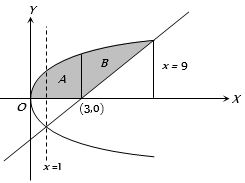
The area bounded by the curves $y = \sqrt{x}$,$2y + 3 = x$ and the $x$-axis in the $1^{st}$ quadrant is
A
$9$
B
$\frac{27}{4}$
C
$36$
D
$18$
Solution
(A) Given curves are $y = \sqrt{x}$ (or $x = y^2$) and $2y + 3 = x$ (or $y = \frac{x-3}{2}$).
To find the intersection points,set $y^2 = 2y + 3$,which gives $y^2 - 2y - 3 = 0$.
$(y - 3)(y + 1) = 0$,so $y = 3$ or $y = -1$.
Since we are in the $1^{st}$ quadrant,$y = 3$,which implies $x = 9$.
The line $2y + 3 = x$ intersects the $x$-axis at $y = 0$,so $x = 3$.
The area is bounded by $y = \sqrt{x}$ from $x = 0$ to $x = 3$,and by the difference of the curves from $x = 3$ to $x = 9$.
Area $= \int_0^3 \sqrt{x} \, dx + \int_3^9 \left( \sqrt{x} - \frac{x-3}{2} \right) \, dx$
$= \left[ \frac{2}{3} x^{3/2} \right]_0^3 + \left[ \frac{2}{3} x^{3/2} - \frac{1}{2} \left( \frac{x^2}{2} - 3x \right) \right]_3^9$
$= \frac{2}{3}(3\sqrt{3}) + \left( \left[ \frac{2}{3}(27) - \frac{1}{2} \left( \frac{81}{2} - 27 \right) \right] - \left[ \frac{2}{3}(3\sqrt{3}) - \frac{1}{2} \left( \frac{9}{2} - 9 \right) \right] \right)$
$= 2\sqrt{3} + 18 - \frac{1}{2} \left( \frac{27}{2} \right) - 2\sqrt{3} + \frac{1}{2} \left( -\frac{9}{2} \right)$
$= 18 - \frac{27}{4} - \frac{9}{4} = 18 - \frac{36}{4} = 18 - 9 = 9 \text{ sq. units.}$
To find the intersection points,set $y^2 = 2y + 3$,which gives $y^2 - 2y - 3 = 0$.
$(y - 3)(y + 1) = 0$,so $y = 3$ or $y = -1$.
Since we are in the $1^{st}$ quadrant,$y = 3$,which implies $x = 9$.
The line $2y + 3 = x$ intersects the $x$-axis at $y = 0$,so $x = 3$.
The area is bounded by $y = \sqrt{x}$ from $x = 0$ to $x = 3$,and by the difference of the curves from $x = 3$ to $x = 9$.
Area $= \int_0^3 \sqrt{x} \, dx + \int_3^9 \left( \sqrt{x} - \frac{x-3}{2} \right) \, dx$
$= \left[ \frac{2}{3} x^{3/2} \right]_0^3 + \left[ \frac{2}{3} x^{3/2} - \frac{1}{2} \left( \frac{x^2}{2} - 3x \right) \right]_3^9$
$= \frac{2}{3}(3\sqrt{3}) + \left( \left[ \frac{2}{3}(27) - \frac{1}{2} \left( \frac{81}{2} - 27 \right) \right] - \left[ \frac{2}{3}(3\sqrt{3}) - \frac{1}{2} \left( \frac{9}{2} - 9 \right) \right] \right)$
$= 2\sqrt{3} + 18 - \frac{1}{2} \left( \frac{27}{2} \right) - 2\sqrt{3} + \frac{1}{2} \left( -\frac{9}{2} \right)$
$= 18 - \frac{27}{4} - \frac{9}{4} = 18 - \frac{36}{4} = 18 - 9 = 9 \text{ sq. units.}$
0 likesView Solution
25
MathematicsDifficultMCQIIT JEE · 2003
If $I(m, n) = \int_0^1 t^m (1 + t)^n dt$,then the expression for $I(m, n)$ in terms of $I(m + 1, n - 1)$ is
A
$\frac{2^n}{m + 1} - \frac{n}{m + 1} I(m + 1, n - 1)$
B
$\frac{n}{m + 1} I(m + 1, n - 1)$
C
$\frac{2^n}{m + 1} + \frac{n}{m + 1} I(m + 1, n - 1)$
D
$\frac{m}{n + 1} I(m + 1, n - 1)$
Solution
(A) We are given $I(m, n) = \int_0^1 t^m (1 + t)^n dt$.
Using integration by parts,let $u = (1 + t)^n$ and $dv = t^m dt$.
Then $du = n(1 + t)^{n-1} dt$ and $v = \frac{t^{m+1}}{m+1}$.
Applying the formula $\int u dv = uv - \int v du$:
$I(m, n) = \left[ \frac{t^{m+1}(1 + t)^n}{m+1} \right]_0^1 - \int_0^1 \frac{t^{m+1}}{m+1} \cdot n(1 + t)^{n-1} dt$.
Evaluating the boundary terms:
At $t=1$,we get $\frac{1^{m+1}(1+1)^n}{m+1} = \frac{2^n}{m+1}$.
At $t=0$,the term is $0$.
So,$I(m, n) = \frac{2^n}{m+1} - \frac{n}{m+1} \int_0^1 t^{m+1}(1 + t)^{n-1} dt$.
Since $I(m+1, n-1) = \int_0^1 t^{m+1}(1 + t)^{n-1} dt$,we have:
$I(m, n) = \frac{2^n}{m+1} - \frac{n}{m+1} I(m+1, n-1)$.
Using integration by parts,let $u = (1 + t)^n$ and $dv = t^m dt$.
Then $du = n(1 + t)^{n-1} dt$ and $v = \frac{t^{m+1}}{m+1}$.
Applying the formula $\int u dv = uv - \int v du$:
$I(m, n) = \left[ \frac{t^{m+1}(1 + t)^n}{m+1} \right]_0^1 - \int_0^1 \frac{t^{m+1}}{m+1} \cdot n(1 + t)^{n-1} dt$.
Evaluating the boundary terms:
At $t=1$,we get $\frac{1^{m+1}(1+1)^n}{m+1} = \frac{2^n}{m+1}$.
At $t=0$,the term is $0$.
So,$I(m, n) = \frac{2^n}{m+1} - \frac{n}{m+1} \int_0^1 t^{m+1}(1 + t)^{n-1} dt$.
Since $I(m+1, n-1) = \int_0^1 t^{m+1}(1 + t)^{n-1} dt$,we have:
$I(m, n) = \frac{2^n}{m+1} - \frac{n}{m+1} I(m+1, n-1)$.
0 likesView Solution
26
MathematicsMediumMCQIIT JEE · 2003
If $y(t)$ is a solution of $(1 + t)\frac{dy}{dt} - ty = 1$ and $y(0) = -1$,then $y(1)$ is equal to
A
$-\frac{1}{2}$
B
$e + \frac{1}{2}$
C
$e - \frac{1}{2}$
D
$\frac{1}{2}$
Solution
(A) The given differential equation is $(1 + t)\frac{dy}{dt} - ty = 1$.
Dividing by $(1 + t)$,we get $\frac{dy}{dt} - \frac{t}{1 + t}y = \frac{1}{1 + t}$.
This is a linear differential equation of the form $\frac{dy}{dt} + P(t)y = Q(t)$,where $P(t) = -\frac{t}{1 + t}$ and $Q(t) = \frac{1}{1 + t}$.
The integrating factor ($I$.$F$.) is $e^{\int P(t) dt} = e^{\int -\frac{t}{1 + t} dt} = e^{\int (-1 + \frac{1}{1 + t}) dt} = e^{-t + \ln(1 + t)} = (1 + t)e^{-t}$.
The general solution is $y \cdot (I.F.) = \int Q(t) \cdot (I.F.) dt + C$.
$y(1 + t)e^{-t} = \int \frac{1}{1 + t} \cdot (1 + t)e^{-t} dt + C = \int e^{-t} dt + C = -e^{-t} + C$.
Given $y(0) = -1$,we substitute $t = 0$: $-1(1 + 0)e^{0} = -e^{0} + C \Rightarrow -1 = -1 + C \Rightarrow C = 0$.
Thus,$y(1 + t)e^{-t} = -e^{-t}$,which simplifies to $y = -\frac{1}{1 + t}$.
For $t = 1$,$y(1) = -\frac{1}{1 + 1} = -\frac{1}{2}$.
Dividing by $(1 + t)$,we get $\frac{dy}{dt} - \frac{t}{1 + t}y = \frac{1}{1 + t}$.
This is a linear differential equation of the form $\frac{dy}{dt} + P(t)y = Q(t)$,where $P(t) = -\frac{t}{1 + t}$ and $Q(t) = \frac{1}{1 + t}$.
The integrating factor ($I$.$F$.) is $e^{\int P(t) dt} = e^{\int -\frac{t}{1 + t} dt} = e^{\int (-1 + \frac{1}{1 + t}) dt} = e^{-t + \ln(1 + t)} = (1 + t)e^{-t}$.
The general solution is $y \cdot (I.F.) = \int Q(t) \cdot (I.F.) dt + C$.
$y(1 + t)e^{-t} = \int \frac{1}{1 + t} \cdot (1 + t)e^{-t} dt + C = \int e^{-t} dt + C = -e^{-t} + C$.
Given $y(0) = -1$,we substitute $t = 0$: $-1(1 + 0)e^{0} = -e^{0} + C \Rightarrow -1 = -1 + C \Rightarrow C = 0$.
Thus,$y(1 + t)e^{-t} = -e^{-t}$,which simplifies to $y = -\frac{1}{1 + t}$.
For $t = 1$,$y(1) = -\frac{1}{1 + 1} = -\frac{1}{2}$.
0 likesView Solution
27
MathematicsMediumMCQIIT JEE · 2003
If $P(B) = \frac{3}{4}$,$P(A \cap B \cap \bar{C}) = \frac{1}{3}$ and $P(\bar{A} \cap B \cap \bar{C}) = \frac{1}{3}$,then $P(B \cap C)$ is
A
$\frac{1}{12}$
B
$\frac{1}{6}$
C
$\frac{1}{15}$
D
$\frac{1}{9}$
Solution
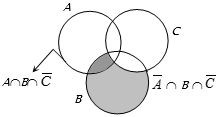
(A) The set $B$ can be partitioned into four disjoint regions:
$B = (A \cap B \cap C) \cup (A \cap B \cap \bar{C}) \cup (\bar{A} \cap B \cap C) \cup (\bar{A} \cap B \cap \bar{C})$
Note that $(A \cap B \cap C) \cup (\bar{A} \cap B \cap C) = B \cap C$.
Thus,$P(B) = P(A \cap B \cap \bar{C}) + P(\bar{A} \cap B \cap \bar{C}) + P(B \cap C)$.
Substituting the given values:
$\frac{3}{4} = \frac{1}{3} + \frac{1}{3} + P(B \cap C)$
$\frac{3}{4} = \frac{2}{3} + P(B \cap C)$
$P(B \cap C) = \frac{3}{4} - \frac{2}{3} = \frac{9-8}{12} = \frac{1}{12}$.
$B = (A \cap B \cap C) \cup (A \cap B \cap \bar{C}) \cup (\bar{A} \cap B \cap C) \cup (\bar{A} \cap B \cap \bar{C})$
Note that $(A \cap B \cap C) \cup (\bar{A} \cap B \cap C) = B \cap C$.
Thus,$P(B) = P(A \cap B \cap \bar{C}) + P(\bar{A} \cap B \cap \bar{C}) + P(B \cap C)$.
Substituting the given values:
$\frac{3}{4} = \frac{1}{3} + \frac{1}{3} + P(B \cap C)$
$\frac{3}{4} = \frac{2}{3} + P(B \cap C)$
$P(B \cap C) = \frac{3}{4} - \frac{2}{3} = \frac{9-8}{12} = \frac{1}{12}$.
0 likesView Solution
28
MathematicsEasyMCQIIT JEE · 2003
The value of $k$ such that the line $\frac{x-4}{1}=\frac{y-2}{1}=\frac{z-k}{2}$ lies in the plane $2x-4y+z=7$ is:
A
No real value
B
$4$
C
$7$
D
-$7$
Solution
(C) The line is given by $\frac{x-4}{1}=\frac{y-2}{1}=\frac{z-k}{2}$. The direction vector of the line is $\vec{b} = (1, 1, 2)$ and the normal to the plane $2x-4y+z=7$ is $\vec{n} = (2, -4, 1)$.
First,check if the line is parallel to the plane by calculating the dot product $\vec{b} \cdot \vec{n} = (1)(2) + (1)(-4) + (2)(1) = 2 - 4 + 2 = 0$. Since the dot product is $0$,the line is parallel to the plane.
For the line to lie in the plane,any point on the line must satisfy the plane equation. Let the point on the line be $(4, 2, k)$.
Substituting this point into the plane equation $2x-4y+z=7$:
$2(4) - 4(2) + k = 7$
$8 - 8 + k = 7$
$k = 7$.
First,check if the line is parallel to the plane by calculating the dot product $\vec{b} \cdot \vec{n} = (1)(2) + (1)(-4) + (2)(1) = 2 - 4 + 2 = 0$. Since the dot product is $0$,the line is parallel to the plane.
For the line to lie in the plane,any point on the line must satisfy the plane equation. Let the point on the line be $(4, 2, k)$.
Substituting this point into the plane equation $2x-4y+z=7$:
$2(4) - 4(2) + k = 7$
$8 - 8 + k = 7$
$k = 7$.
0 likesView Solution
Vedclass Products
For Students
Vedclass Test Series
Mock tests in real IIT JEE style covering Mathematics with performance analysis. 5-day free trial.
Start Free TrialFor Teachers
Exam Paper Generator
Generate Set A/B/C/D Mathematics papers from 7.5L+ questions in 2 minutes. 3 chapters free.
Try FreeFor Institutes
Online Exam Module
Run live IIT JEE mock exams with unlimited students, 360° analytics & white-label branding.
See DemoFrequently Asked Questions
How many Mathematics questions are in IIT JEE 2003?
There are 28 Mathematics questions from the IIT JEE 2003 paper on Vedclass, each with a detailed step-by-step solution in English.
Are IIT JEE 2003 Mathematics solutions available in English?
Yes. All solutions on this page are in English. You can also switch to English or Hindi using the language buttons above the questions.
Can I practice IIT JEE 2003 Mathematics as a timed test?
Yes. Use the Vedclass Test Series to attempt a full IIT JEE mock test covering Mathematics with time limits and instant score analysis.
Can teachers create Mathematics papers from IIT JEE previous year questions?
Yes. The Vedclass Exam Paper Generator lets teachers mix IIT JEE Mathematics questions and generate Set A/B/C/D papers in minutes.
For Teachers & Institutes
Build a Custom Mathematics Paper
Pick IIT JEE 2003 Mathematics questions, set difficulty, and generate Set A/B/C/D in 2 minutes.