
PhysicsQ1–27 of 27 questions
Page 1 of 1 · English
1
PhysicsDifficultMCQIIT JEE · 2003
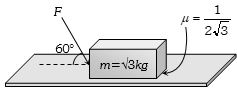
What is the maximum value of the force $F$ such that the block shown in the arrangement does not move (in $N$)? (Given $m = \sqrt{3} \ kg$,$\mu = \frac{1}{2\sqrt{3}}$,$g = 10 \ m/s^2$)
A
$20$
B
$10$
C
$12$
D
$15$
Solution
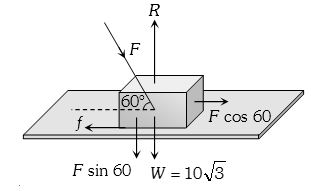
(A) The forces acting on the block are the applied force $F$ at an angle of $60^\circ$ with the horizontal,the weight $W = mg$,the normal reaction $R$,and the frictional force $f$.
Resolving the force $F$ into components:
Horizontal component: $F_x = F \cos 60^\circ$
Vertical component: $F_y = F \sin 60^\circ$
For vertical equilibrium:
$R = W + F \sin 60^\circ$
Given $m = \sqrt{3} \ kg$ and $g = 10 \ m/s^2$,$W = mg = 10\sqrt{3} \ N$.
So,$R = 10\sqrt{3} + F \sin 60^\circ = 10\sqrt{3} + F \frac{\sqrt{3}}{2}$.
For the block not to move,the horizontal component of the applied force must be less than or equal to the limiting friction:
$F \cos 60^\circ \leq \mu R$
$F \cos 60^\circ \leq \mu (W + F \sin 60^\circ)$
Substituting the values $\mu = \frac{1}{2\sqrt{3}}$,$\cos 60^\circ = \frac{1}{2}$,and $\sin 60^\circ = \frac{\sqrt{3}}{2}$:
$F \cdot \frac{1}{2} = \frac{1}{2\sqrt{3}} (10\sqrt{3} + F \cdot \frac{\sqrt{3}}{2})$
$F \cdot \frac{1}{2} = \frac{10\sqrt{3}}{2\sqrt{3}} + \frac{F \sqrt{3}}{4\sqrt{3}}$
$F \cdot \frac{1}{2} = 5 + \frac{F}{4}$
$F \cdot \frac{1}{2} - \frac{F}{4} = 5$
$\frac{F}{4} = 5$
$F = 20 \ N$.
Resolving the force $F$ into components:
Horizontal component: $F_x = F \cos 60^\circ$
Vertical component: $F_y = F \sin 60^\circ$
For vertical equilibrium:
$R = W + F \sin 60^\circ$
Given $m = \sqrt{3} \ kg$ and $g = 10 \ m/s^2$,$W = mg = 10\sqrt{3} \ N$.
So,$R = 10\sqrt{3} + F \sin 60^\circ = 10\sqrt{3} + F \frac{\sqrt{3}}{2}$.
For the block not to move,the horizontal component of the applied force must be less than or equal to the limiting friction:
$F \cos 60^\circ \leq \mu R$
$F \cos 60^\circ \leq \mu (W + F \sin 60^\circ)$
Substituting the values $\mu = \frac{1}{2\sqrt{3}}$,$\cos 60^\circ = \frac{1}{2}$,and $\sin 60^\circ = \frac{\sqrt{3}}{2}$:
$F \cdot \frac{1}{2} = \frac{1}{2\sqrt{3}} (10\sqrt{3} + F \cdot \frac{\sqrt{3}}{2})$
$F \cdot \frac{1}{2} = \frac{10\sqrt{3}}{2\sqrt{3}} + \frac{F \sqrt{3}}{4\sqrt{3}}$
$F \cdot \frac{1}{2} = 5 + \frac{F}{4}$
$F \cdot \frac{1}{2} - \frac{F}{4} = 5$
$\frac{F}{4} = 5$
$F = 20 \ N$.
0 likesView Solution
2
PhysicsEasyMCQIIT JEE · 2003
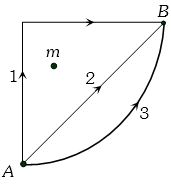
If $W_1, W_2$ and $W_3$ represent the work done in moving a particle from $A$ to $B$ along three different paths $1, 2$ and $3$ respectively (as shown) in the gravitational field of a point mass $m$,find the correct relation between $W_1, W_2$ and $W_3$.
A
$W_1 > W_2 > W_3$
B
$W_1 = W_2 = W_3$
C
$W_1 < W_2 < W_3$
D
$W_2 > W_1 > W_3$
Solution
(B) The gravitational force is a conservative force.
By definition,the work done by or against a conservative force in moving a particle between two points depends only on the initial and final positions of the particle,not on the path taken.
Since all three paths $1, 2$ and $3$ start at point $A$ and end at point $B$,the work done along each path must be equal.
Therefore,$W_1 = W_2 = W_3$.
By definition,the work done by or against a conservative force in moving a particle between two points depends only on the initial and final positions of the particle,not on the path taken.
Since all three paths $1, 2$ and $3$ start at point $A$ and end at point $B$,the work done along each path must be equal.
Therefore,$W_1 = W_2 = W_3$.
0 likesView Solution
3
PhysicsMediumMCQIIT JEE · 2003
Two rods,one of aluminum and the other made of steel,having initial lengths $l_1$ and $l_2$ are connected together to form a single rod of length $l_1 + l_2$. The coefficients of linear expansion for aluminum and steel are $\alpha_a$ and $\alpha_s$ respectively. If the length of each rod increases by the same amount when their temperature is raised by $t ^\circ C$,then find the ratio $\frac{l_1}{l_1 + l_2}$.
A
$\frac{\alpha_s}{\alpha_a}$
B
$\frac{\alpha_a}{\alpha_s}$
C
$\frac{\alpha_s}{\alpha_a + \alpha_s}$
D
$\frac{\alpha_a}{\alpha_a + \alpha_s}$
Solution
(C) The change in length of a rod due to thermal expansion is given by $\Delta l = l \alpha \Delta T$.
Given that the change in length for both rods is the same,we have $\Delta l_1 = \Delta l_2$.
Substituting the formula,we get $l_1 \alpha_a t = l_2 \alpha_s t$.
Canceling $t$ from both sides,we get $l_1 \alpha_a = l_2 \alpha_s$,which implies $\frac{l_1}{l_2} = \frac{\alpha_s}{\alpha_a}$.
To find the ratio $\frac{l_1}{l_1 + l_2}$,we use the property of ratios: if $\frac{a}{b} = \frac{c}{d}$,then $\frac{a}{a+b} = \frac{c}{c+d}$.
Applying this to our equation,we get $\frac{l_1}{l_1 + l_2} = \frac{\alpha_s}{\alpha_a + \alpha_s}$.
Given that the change in length for both rods is the same,we have $\Delta l_1 = \Delta l_2$.
Substituting the formula,we get $l_1 \alpha_a t = l_2 \alpha_s t$.
Canceling $t$ from both sides,we get $l_1 \alpha_a = l_2 \alpha_s$,which implies $\frac{l_1}{l_2} = \frac{\alpha_s}{\alpha_a}$.
To find the ratio $\frac{l_1}{l_1 + l_2}$,we use the property of ratios: if $\frac{a}{b} = \frac{c}{d}$,then $\frac{a}{a+b} = \frac{c}{c+d}$.
Applying this to our equation,we get $\frac{l_1}{l_1 + l_2} = \frac{\alpha_s}{\alpha_a + \alpha_s}$.
0 likesView Solution
4
PhysicsDifficultMCQIIT JEE · 2003
$2\, kg$ of ice at $-20^{\circ}C$ is mixed with $5\, kg$ of water at $20^{\circ}C$ in an insulating vessel having a negligible heat capacity. Calculate the final mass of water remaining in the container. It is given that the specific heats of water and ice are $1\, kcal/kg/^{\circ}C$ and $0.5\, kcal/kg/^{\circ}C$ respectively,while the latent heat of fusion of ice is $80\, kcal/kg$.
A
$7$
B
$6$
C
$4$
D
$2$
Solution
(B) Step $1$: Heat required by $2\, kg$ of ice to reach $0^{\circ}C$ is $Q_1 = m_i \cdot c_{ice} \cdot \Delta T = 2\, kg \cdot 0.5\, kcal/kg/^{\circ}C \cdot 20^{\circ}C = 20\, kcal$.
Step $2$: Heat available from $5\, kg$ of water cooling from $20^{\circ}C$ to $0^{\circ}C$ is $Q_2 = m_w \cdot c_w \cdot \Delta T = 5\, kg \cdot 1\, kcal/kg/^{\circ}C \cdot 20^{\circ}C = 100\, kcal$.
Step $3$: Remaining heat available for melting ice is $Q_{rem} = Q_2 - Q_1 = 100\, kcal - 20\, kcal = 80\, kcal$.
Step $4$: Mass of ice that melts is $m_{melt} = Q_{rem} / L_f = 80\, kcal / 80\, kcal/kg = 1\, kg$.
Step $5$: Final mass of water = Initial mass of water + Mass of melted ice = $5\, kg + 1\, kg = 6\, kg$.
Step $2$: Heat available from $5\, kg$ of water cooling from $20^{\circ}C$ to $0^{\circ}C$ is $Q_2 = m_w \cdot c_w \cdot \Delta T = 5\, kg \cdot 1\, kcal/kg/^{\circ}C \cdot 20^{\circ}C = 100\, kcal$.
Step $3$: Remaining heat available for melting ice is $Q_{rem} = Q_2 - Q_1 = 100\, kcal - 20\, kcal = 80\, kcal$.
Step $4$: Mass of ice that melts is $m_{melt} = Q_{rem} / L_f = 80\, kcal / 80\, kcal/kg = 1\, kg$.
Step $5$: Final mass of water = Initial mass of water + Mass of melted ice = $5\, kg + 1\, kg = 6\, kg$.
0 likesView Solution
5
PhysicsMediumMCQIIT JEE · 2003
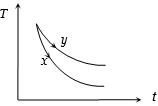
The graph shown in the adjacent diagram represents the variation of temperature $(T)$ of two bodies,$x$ and $y$,having the same surface area,with time $(t)$ due to the emission of radiation. Find the correct relation between their emissivities $(e)$ and absorptive powers $(a)$.
A
$e_x > e_y$ and $a_x > a_y$
B
$e_x < e_y$ and $a_x < a_y$
C
$e_x > e_y$ and $a_x < a_y$
D
$e_x < e_y$ and $a_x > a_y$
Solution
(A) According to Stefan-Boltzmann law,the rate of heat loss is given by $\frac{dQ}{dt} = e \sigma A (T^4 - T_0^4)$.
Since $\frac{dQ}{dt} = -ms \frac{dT}{dt}$,we have $-ms \frac{dT}{dt} = e \sigma A (T^4 - T_0^4)$.
Thus,the rate of cooling $\left( -\frac{dT}{dt} \right) = \frac{e \sigma A}{ms} (T^4 - T_0^4)$.
For bodies of the same surface area and mass,the rate of cooling is directly proportional to the emissivity $(e)$,i.e.,$\left( -\frac{dT}{dt} \right) \propto e$.
From the graph,the slope of the curve for body $x$ is steeper than that for body $y$ at any given temperature,which means $\left( -\frac{dT}{dt} \right)_x > \left( -\frac{dT}{dt} \right)_y$.
Therefore,$e_x > e_y$.
According to Kirchhoff's law of radiation,for any body,the emissivity $(e)$ is equal to its absorptive power $(a)$ at a given wavelength and temperature,i.e.,$e = a$.
Thus,$e_x > e_y$ implies $a_x > a_y$.
Since $\frac{dQ}{dt} = -ms \frac{dT}{dt}$,we have $-ms \frac{dT}{dt} = e \sigma A (T^4 - T_0^4)$.
Thus,the rate of cooling $\left( -\frac{dT}{dt} \right) = \frac{e \sigma A}{ms} (T^4 - T_0^4)$.
For bodies of the same surface area and mass,the rate of cooling is directly proportional to the emissivity $(e)$,i.e.,$\left( -\frac{dT}{dt} \right) \propto e$.
From the graph,the slope of the curve for body $x$ is steeper than that for body $y$ at any given temperature,which means $\left( -\frac{dT}{dt} \right)_x > \left( -\frac{dT}{dt} \right)_y$.
Therefore,$e_x > e_y$.
According to Kirchhoff's law of radiation,for any body,the emissivity $(e)$ is equal to its absorptive power $(a)$ at a given wavelength and temperature,i.e.,$e = a$.
Thus,$e_x > e_y$ implies $a_x > a_y$.
0 likesView Solution
6
PhysicsMediumMCQIIT JEE · 2003
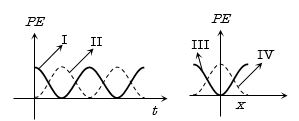
For a particle executing $S.H.M.$,the displacement $x$ is given by $x = A \cos \omega t$. Identify the graphs which represent the variation of potential energy $(P.E.)$ as a function of time $t$ and displacement $x$.
A
$I, III$
B
$II, IV$
C
$II, III$
D
$I, IV$
Solution
(A) The potential energy $(P.E.)$ of a particle in $S.H.M.$ is given by $U = \frac{1}{2} k x^2$.
Substituting $x = A \cos \omega t$,we get $U = \frac{1}{2} k A^2 \cos^2 \omega t = \frac{1}{2} k A^2 \left( \frac{1 + \cos 2 \omega t}{2} \right)$.
At $t = 0$,$x = A$,so $U$ is maximum. Graph $I$ shows $P.E.$ vs $t$ starting from a maximum value at $t = 0$,which matches the equation $U \propto \cos^2 \omega t$.
As a function of displacement $x$,$U = \frac{1}{2} k x^2$,which is a parabola opening upwards with its minimum at $x = 0$. Graph $III$ represents this parabolic variation of $P.E.$ with respect to $x$.
Thus,graphs $I$ and $III$ are correct.
Substituting $x = A \cos \omega t$,we get $U = \frac{1}{2} k A^2 \cos^2 \omega t = \frac{1}{2} k A^2 \left( \frac{1 + \cos 2 \omega t}{2} \right)$.
At $t = 0$,$x = A$,so $U$ is maximum. Graph $I$ shows $P.E.$ vs $t$ starting from a maximum value at $t = 0$,which matches the equation $U \propto \cos^2 \omega t$.
As a function of displacement $x$,$U = \frac{1}{2} k x^2$,which is a parabola opening upwards with its minimum at $x = 0$. Graph $III$ represents this parabolic variation of $P.E.$ with respect to $x$.
Thus,graphs $I$ and $III$ are correct.
0 likesView Solution
7
PhysicsMediumMCQIIT JEE · 2003
In the experiment for the determination of the speed of sound in air using the resonance column method,the length of the air column that resonates in the fundamental mode with a tuning fork is $0.1 \ m$. When this length is changed to $0.35 \ m$,the same tuning fork resonates with the first overtone. Calculate the end correction in $m$.
A
$0.012$
B
$0.025$
C
$0.05$
D
$0.024$
Solution
(B) Let $x$ be the end correction.
For the fundamental mode (first resonance),the length of the air column is $l_1 = 0.1 \ m$. The resonance condition is given by $f = \frac{v}{4(l_1 + x)}$.
For the first overtone (second resonance),the length of the air column is $l_2 = 0.35 \ m$. The resonance condition is given by $f = \frac{3v}{4(l_2 + x)}$.
Since the same tuning fork is used,the frequency $f$ remains constant. Therefore,$\frac{v}{4(l_1 + x)} = \frac{3v}{4(l_2 + x)}$.
Simplifying the equation: $l_2 + x = 3(l_1 + x)$.
Substituting the values: $0.35 + x = 3(0.1 + x)$.
$0.35 + x = 0.3 + 3x$.
$0.05 = 2x$.
$x = 0.025 \ m$.
For the fundamental mode (first resonance),the length of the air column is $l_1 = 0.1 \ m$. The resonance condition is given by $f = \frac{v}{4(l_1 + x)}$.
For the first overtone (second resonance),the length of the air column is $l_2 = 0.35 \ m$. The resonance condition is given by $f = \frac{3v}{4(l_2 + x)}$.
Since the same tuning fork is used,the frequency $f$ remains constant. Therefore,$\frac{v}{4(l_1 + x)} = \frac{3v}{4(l_2 + x)}$.
Simplifying the equation: $l_2 + x = 3(l_1 + x)$.
Substituting the values: $0.35 + x = 3(0.1 + x)$.
$0.35 + x = 0.3 + 3x$.
$0.05 = 2x$.
$x = 0.025 \ m$.
0 likesView Solution
8
PhysicsDifficultMCQIIT JEE · 2003
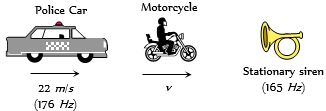
$A$ police car moving at $22 \ m/s$ chases a motorcyclist. The policeman sounds his horn at $176 \ Hz$,while both of them move towards a stationary siren of frequency $165 \ Hz$. Calculate the speed of the motorcycle,if it is given that he does not observe any beats. (in $m/s$)
A
$33$
B
$22$
C
$0$
D
$11$
Solution
(B) Let $v$ be the speed of the motorcyclist and $v_s = 330 \ m/s$ be the speed of sound.
$1$. The frequency $n_1$ of the police car horn heard by the motorcyclist (who is moving away from the source) is given by the Doppler effect formula:
$n_1 = n_0 \left( \frac{v_s - v}{v_s - v_{police}} \right) = 176 \left( \frac{330 - v}{330 - 22} \right) = 176 \left( \frac{330 - v}{308} \right)$
$2$. The frequency $n_2$ of the stationary siren heard by the motorcyclist (who is moving towards the source) is:
$n_2 = n_s \left( \frac{v_s + v}{v_s} \right) = 165 \left( \frac{330 + v}{330} \right)$
$3$. Since the motorcyclist observes no beats,the frequencies must be equal $(n_1 = n_2)$:
$176 \left( \frac{330 - v}{308} \right) = 165 \left( \frac{330 + v}{330} \right)$
$4$. Simplifying the equation:
$\frac{176}{308} (330 - v) = \frac{165}{330} (330 + v)$
$\frac{4}{7} (330 - v) = \frac{1}{2} (330 + v)$
$8(330 - v) = 7(330 + v)$
$2640 - 8v = 2310 + 7v$
$15v = 330$
$v = 22 \ m/s$.
$1$. The frequency $n_1$ of the police car horn heard by the motorcyclist (who is moving away from the source) is given by the Doppler effect formula:
$n_1 = n_0 \left( \frac{v_s - v}{v_s - v_{police}} \right) = 176 \left( \frac{330 - v}{330 - 22} \right) = 176 \left( \frac{330 - v}{308} \right)$
$2$. The frequency $n_2$ of the stationary siren heard by the motorcyclist (who is moving towards the source) is:
$n_2 = n_s \left( \frac{v_s + v}{v_s} \right) = 165 \left( \frac{330 + v}{330} \right)$
$3$. Since the motorcyclist observes no beats,the frequencies must be equal $(n_1 = n_2)$:
$176 \left( \frac{330 - v}{308} \right) = 165 \left( \frac{330 + v}{330} \right)$
$4$. Simplifying the equation:
$\frac{176}{308} (330 - v) = \frac{165}{330} (330 + v)$
$\frac{4}{7} (330 - v) = \frac{1}{2} (330 + v)$
$8(330 - v) = 7(330 + v)$
$2640 - 8v = 2310 + 7v$
$15v = 330$
$v = 22 \ m/s$.
0 likesView Solution
9
PhysicsEasyMCQIIT JEE · 2003
$A$ particle undergoes uniform circular motion. About which point on the plane of the circle will the angular momentum of the particle remain conserved?
A
Centre of the circle
B
On the circumference of the circle
C
Inside the circle
D
Outside the circle
Solution
(A) In uniform circular motion,the net force acting on the particle is the centripetal force,which is always directed towards the centre of the circle.
The torque $\vec{\tau}$ about any point is given by $\vec{\tau} = \vec{r} \times \vec{F}$.
Since the centripetal force $\vec{F}$ always passes through the centre of the circle,the position vector $\vec{r}$ relative to the centre is collinear with the force vector $\vec{F}$.
Therefore,the torque about the centre is $\vec{\tau} = 0$.
According to the principle of conservation of angular momentum,if the net external torque about a point is zero,the angular momentum about that point remains conserved.
Thus,the angular momentum of the particle is conserved about the centre of the circle.
The torque $\vec{\tau}$ about any point is given by $\vec{\tau} = \vec{r} \times \vec{F}$.
Since the centripetal force $\vec{F}$ always passes through the centre of the circle,the position vector $\vec{r}$ relative to the centre is collinear with the force vector $\vec{F}$.
Therefore,the torque about the centre is $\vec{\tau} = 0$.
According to the principle of conservation of angular momentum,if the net external torque about a point is zero,the angular momentum about that point remains conserved.
Thus,the angular momentum of the particle is conserved about the centre of the circle.
0 likesView Solution
10
PhysicsEasyMCQIIT JEE · 2003
$A$ cube has a side of length $1.2 \times 10^{-2} \; m$. Calculate its volume.
A
$1.7 \times 10^{-6} \; m^3$
B
$1.73 \times 10^{-6} \; m^3$
C
$1.70 \times 10^{-6} \; m^3$
D
$1.732 \times 10^{-6} \; m^3$
Solution
(A) The side length of the cube is $l = 1.2 \times 10^{-2} \; m$.
The volume of a cube is given by $V = l^3$.
Substituting the value: $V = (1.2 \times 10^{-2} \; m)^3 = (1.2)^3 \times (10^{-2})^3 \; m^3 = 1.728 \times 10^{-6} \; m^3$.
According to the rules of significant figures,the side length $1.2$ has two significant figures. Therefore,the result should be rounded to two significant figures.
Rounding $1.728$ to two significant figures gives $1.7$.
Thus,the volume is $V = 1.7 \times 10^{-6} \; m^3$.
The volume of a cube is given by $V = l^3$.
Substituting the value: $V = (1.2 \times 10^{-2} \; m)^3 = (1.2)^3 \times (10^{-2})^3 \; m^3 = 1.728 \times 10^{-6} \; m^3$.
According to the rules of significant figures,the side length $1.2$ has two significant figures. Therefore,the result should be rounded to two significant figures.
Rounding $1.728$ to two significant figures gives $1.7$.
Thus,the volume is $V = 1.7 \times 10^{-6} \; m^3$.
0 likesView Solution
11
PhysicsMediumMCQIIT JEE · 2003
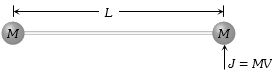
Consider a body,shown in the figure,consisting of two identical balls,each of mass $M$,connected by a light rigid rod of length $L$. If an impulse $J = Mv$ is imparted to the body at one of its ends,what would be its angular velocity?
A
$v/L$
B
$2v/L$
C
$v/3L$
D
$v/4L$
Solution
(A) The impulse $J = Mv$ is applied at one end of the rod. This impulse provides an angular momentum about the center of mass $(CM)$ of the system.
The center of mass of the two-ball system is at the midpoint of the rod.
The angular momentum $L_{CM}$ imparted by the impulse $J$ about the center of mass is given by $L_{CM} = J \times r$,where $r = L/2$ is the distance from the center of mass to the point of application of the impulse.
$L_{CM} = (Mv) \times (L/2) = \frac{MvL}{2}$.
The moment of inertia $I$ of the system about an axis passing through the center of mass and perpendicular to the rod is $I = M(L/2)^2 + M(L/2)^2 = 2M(L^2/4) = \frac{ML^2}{2}$.
Using the relation $L_{CM} = I\omega$,we have:
$\frac{MvL}{2} = \left( \frac{ML^2}{2} \right) \omega$.
Solving for $\omega$:
$\omega = \frac{MvL/2}{ML^2/2} = \frac{v}{L}$.
The center of mass of the two-ball system is at the midpoint of the rod.
The angular momentum $L_{CM}$ imparted by the impulse $J$ about the center of mass is given by $L_{CM} = J \times r$,where $r = L/2$ is the distance from the center of mass to the point of application of the impulse.
$L_{CM} = (Mv) \times (L/2) = \frac{MvL}{2}$.
The moment of inertia $I$ of the system about an axis passing through the center of mass and perpendicular to the rod is $I = M(L/2)^2 + M(L/2)^2 = 2M(L^2/4) = \frac{ML^2}{2}$.
Using the relation $L_{CM} = I\omega$,we have:
$\frac{MvL}{2} = \left( \frac{ML^2}{2} \right) \omega$.
Solving for $\omega$:
$\omega = \frac{MvL/2}{ML^2/2} = \frac{v}{L}$.
0 likesView Solution
12
PhysicsMediumMCQIIT JEE · 2003
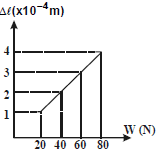
The adjacent graph shows the extension $(\Delta l)$ of a wire of length $1\, m$ suspended from the top of a roof at one end and with a load $W$ connected to the other end. If the cross-sectional area of the wire is $10^{-6}\, m^2$,calculate the Young's modulus of the material of the wire.
A
$2 \times 10^{11} \, N/m^2$
B
$2 \times 10^{-11} \, N/m^2$
C
$3 \times 10^{-12} \, N/m^2$
D
$2 \times 10^{-13} \, N/m^2$
Solution
(A) From the graph,we observe that for a change in load $\Delta W = (40 - 20) \, N = 20 \, N$,the change in extension is $\Delta(\Delta l) = (2 - 1) \times 10^{-4} \, m = 10^{-4} \, m$.
Young's modulus $Y$ is given by the formula $Y = \frac{\text{Stress}}{\text{Strain}} = \frac{F/A}{\Delta l/l} = \frac{F \cdot l}{A \cdot \Delta l}$.
Using the slope of the graph,$\frac{\Delta l}{F} = \frac{10^{-4} \, m}{20 \, N} = 0.05 \times 10^{-4} \, m/N = 5 \times 10^{-6} \, m/N$.
Given $l = 1 \, m$ and $A = 10^{-6} \, m^2$,we have:
$Y = \frac{l}{A} \cdot \frac{F}{\Delta l} = \frac{1}{10^{-6}} \cdot \frac{1}{5 \times 10^{-6}} = \frac{10^6}{5 \times 10^{-6}} = 0.2 \times 10^{12} \, N/m^2 = 2 \times 10^{11} \, N/m^2$.
Young's modulus $Y$ is given by the formula $Y = \frac{\text{Stress}}{\text{Strain}} = \frac{F/A}{\Delta l/l} = \frac{F \cdot l}{A \cdot \Delta l}$.
Using the slope of the graph,$\frac{\Delta l}{F} = \frac{10^{-4} \, m}{20 \, N} = 0.05 \times 10^{-4} \, m/N = 5 \times 10^{-6} \, m/N$.
Given $l = 1 \, m$ and $A = 10^{-6} \, m^2$,we have:
$Y = \frac{l}{A} \cdot \frac{F}{\Delta l} = \frac{1}{10^{-6}} \cdot \frac{1}{5 \times 10^{-6}} = \frac{10^6}{5 \times 10^{-6}} = 0.2 \times 10^{12} \, N/m^2 = 2 \times 10^{11} \, N/m^2$.
0 likesView Solution
13
PhysicsEasyMCQIIT JEE · 2003
$A$ metallic shell has a point charge '$q$' kept inside its cavity. Which one of the following diagrams correctly represents the electric lines of force?
A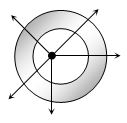
B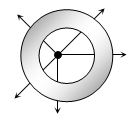
C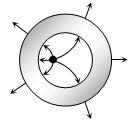
D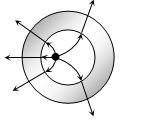
Solution
(B) The electric field lines originate from the positive point charge '$q$' inside the cavity and terminate on the inner surface of the metallic shell,such that they are perpendicular to the inner surface.
Since the shell is metallic,the electric field inside the material of the shell is zero.
However,the charge '$q$' induces an equal and opposite charge '$-q$' on the inner surface of the shell and an equal charge '$+q$' on the outer surface.
The electric field lines outside the shell originate from the outer surface and extend to infinity,also perpendicular to the outer surface.
Diagram $(b)$ correctly shows the lines originating from the point charge and terminating perpendicularly on the inner surface,and then originating from the outer surface.
Since the shell is metallic,the electric field inside the material of the shell is zero.
However,the charge '$q$' induces an equal and opposite charge '$-q$' on the inner surface of the shell and an equal charge '$+q$' on the outer surface.
The electric field lines outside the shell originate from the outer surface and extend to infinity,also perpendicular to the outer surface.
Diagram $(b)$ correctly shows the lines originating from the point charge and terminating perpendicularly on the inner surface,and then originating from the outer surface.
0 likesView Solution
14
PhysicsEasyMCQIIT JEE · 2003
Which of the following circuit setups can be used to verify Ohm's law?
A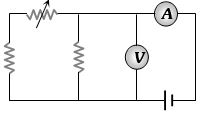
B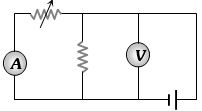
C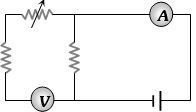
D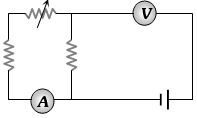
Solution
(B) To verify Ohm's law,we need to measure the current flowing through a resistor and the potential difference across it.
$1$. An ammeter is used to measure current and must be connected in series with the component.
$2$. $A$ voltmeter is used to measure potential difference and must be connected in parallel across the component.
$3$. In the provided options,the correct setup is the one where the ammeter is in series with the resistor and the voltmeter is connected in parallel across the resistor to measure the voltage drop across it.
$4$. Based on standard circuit diagrams for Ohm's law verification,the setup where the ammeter is in series and the voltmeter is in parallel is the correct configuration.
$1$. An ammeter is used to measure current and must be connected in series with the component.
$2$. $A$ voltmeter is used to measure potential difference and must be connected in parallel across the component.
$3$. In the provided options,the correct setup is the one where the ammeter is in series with the resistor and the voltmeter is connected in parallel across the resistor to measure the voltage drop across it.
$4$. Based on standard circuit diagrams for Ohm's law verification,the setup where the ammeter is in series and the voltmeter is in parallel is the correct configuration.
0 likesView Solution
15
PhysicsMediumMCQIIT JEE · 2003
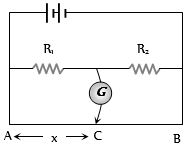
In the shown arrangement of the meter bridge experiment,if the length $AC$ corresponding to the null deflection of the galvanometer is $x$,what would be its value if the radius of the wire $AB$ is doubled?
A
$x$
B
$x/4$
C
$4x$
D
$2x$
Solution
(A) In a meter bridge,the balancing condition is given by the ratio of resistances: $\frac{R_1}{R_2} = \frac{R_{AC}}{R_{CB}}$.
Here,$R_{AC}$ is the resistance of the wire segment $AC$ and $R_{CB}$ is the resistance of the wire segment $CB$.
The resistance of a wire is given by $R = \rho \frac{L}{A}$,where $\rho$ is the resistivity,$L$ is the length,and $A$ is the cross-sectional area.
Substituting this into the balancing condition: $\frac{R_1}{R_2} = \frac{\rho (x) / A}{\rho (100-x) / A} = \frac{x}{100-x}$.
Since the cross-sectional area $A$ cancels out from the numerator and the denominator,the balancing length $x$ depends only on the ratio of the resistors $R_1$ and $R_2$.
Therefore,changing the radius of the wire $AB$ does not affect the balancing length $x$.
Here,$R_{AC}$ is the resistance of the wire segment $AC$ and $R_{CB}$ is the resistance of the wire segment $CB$.
The resistance of a wire is given by $R = \rho \frac{L}{A}$,where $\rho$ is the resistivity,$L$ is the length,and $A$ is the cross-sectional area.
Substituting this into the balancing condition: $\frac{R_1}{R_2} = \frac{\rho (x) / A}{\rho (100-x) / A} = \frac{x}{100-x}$.
Since the cross-sectional area $A$ cancels out from the numerator and the denominator,the balancing length $x$ depends only on the ratio of the resistors $R_1$ and $R_2$.
Therefore,changing the radius of the wire $AB$ does not affect the balancing length $x$.
0 likesView Solution
16
PhysicsMediumMCQIIT JEE · 2003
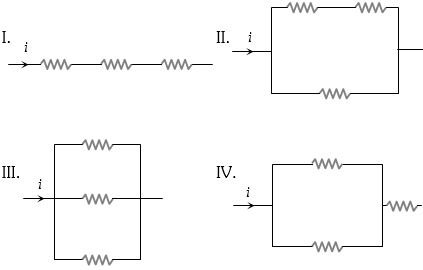
Three resistors of equal value $R$ are arranged in the different combinations shown below. Arrange them in increasing order of power dissipation.
A
$III < II < IV < I$
B
$II < III < IV < I$
C
$I < IV < III < II$
D
$I < III < II < IV$
Solution
(A) Let the value of each resistor be $R$. The power dissipated in a circuit with a constant current $i$ is given by $P = i^2 R_{eq}$,where $R_{eq}$ is the equivalent resistance.
For configuration $I$ (series): $R_{eq, I} = R + R + R = 3R$.
For configuration $II$ (two in series,one in parallel): $R_{eq, II} = \frac{(2R)(R)}{2R + R} = \frac{2R^2}{3R} = \frac{2}{3}R \approx 0.67R$.
For configuration $III$ (all three in parallel): $R_{eq, III} = \frac{R}{3} \approx 0.33R$.
For configuration $IV$ (two in parallel,one in series): $R_{eq, IV} = \frac{R}{2} + R = 1.5R$.
Comparing the equivalent resistances: $R_{eq, III} (0.33R) < R_{eq, II} (0.67R) < R_{eq, IV} (1.5R) < R_{eq, I} (3R)$.
Since $P \propto R_{eq}$,the power dissipation follows the same order: $III < II < IV < I$.
For configuration $I$ (series): $R_{eq, I} = R + R + R = 3R$.
For configuration $II$ (two in series,one in parallel): $R_{eq, II} = \frac{(2R)(R)}{2R + R} = \frac{2R^2}{3R} = \frac{2}{3}R \approx 0.67R$.
For configuration $III$ (all three in parallel): $R_{eq, III} = \frac{R}{3} \approx 0.33R$.
For configuration $IV$ (two in parallel,one in series): $R_{eq, IV} = \frac{R}{2} + R = 1.5R$.
Comparing the equivalent resistances: $R_{eq, III} (0.33R) < R_{eq, II} (0.67R) < R_{eq, IV} (1.5R) < R_{eq, I} (3R)$.
Since $P \propto R_{eq}$,the power dissipation follows the same order: $III < II < IV < I$.
0 likesView Solution
17
PhysicsDifficultMCQIIT JEE · 2003
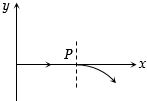
For a positively charged particle moving in a $x-y$ plane initially along the $x$-axis,there is a sudden change in its path due to the presence of electric and/or magnetic fields beyond $P$. The curved path is shown in the $x-y$ plane and is found to be non-circular. Which one of the following combinations is possible?
A
$\overrightarrow E = 0; \overrightarrow B = b\hat i + c\hat k$
B
$\overrightarrow E = a\hat i; \overrightarrow B = c\hat k + a\hat i$
C
$\overrightarrow E = 0; \overrightarrow B = c\hat j + b\hat k$
D
$\overrightarrow E = a\hat i; \overrightarrow B = c\hat k + b\hat j$
Solution
(B) The particle moves in the $x-y$ plane. For the motion to remain in the $x-y$ plane,the net force $\overrightarrow F_{net} = q(\overrightarrow E + \overrightarrow v \times \overrightarrow B)$ must have no component along the $z$-axis.
Initial velocity is $\overrightarrow v = v\hat i$.
In option $(d)$,$\overrightarrow F_{net} = q(a\hat i) + q(v\hat i \times (c\hat k + b\hat j)) = qa\hat i - qvc\hat j + qvb\hat k$. The presence of a $z$-component $(qvb\hat k)$ forces the particle out of the $x-y$ plane,so $(d)$ is incorrect.
In option $(b)$,$\overrightarrow F_{net} = q(a\hat i) + q(v\hat i \times (c\hat k + a\hat i)) = qa\hat i - qvc\hat j$. Here,the force has only $x$ and $y$ components,keeping the particle in the $x-y$ plane. The path is non-circular because the electric field changes the speed of the particle. Thus,option $(b)$ is the correct combination.
Initial velocity is $\overrightarrow v = v\hat i$.
In option $(d)$,$\overrightarrow F_{net} = q(a\hat i) + q(v\hat i \times (c\hat k + b\hat j)) = qa\hat i - qvc\hat j + qvb\hat k$. The presence of a $z$-component $(qvb\hat k)$ forces the particle out of the $x-y$ plane,so $(d)$ is incorrect.
In option $(b)$,$\overrightarrow F_{net} = q(a\hat i) + q(v\hat i \times (c\hat k + a\hat i)) = qa\hat i - qvc\hat j$. Here,the force has only $x$ and $y$ components,keeping the particle in the $x-y$ plane. The path is non-circular because the electric field changes the speed of the particle. Thus,option $(b)$ is the correct combination.
0 likesView Solution
18
PhysicsDifficultMCQIIT JEE · 2003
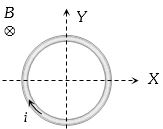
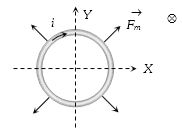
$A$ conducting loop carrying a current $I$ is placed in a uniform magnetic field pointing into the plane of the paper as shown. The loop will have a tendency to
A
Contract
B
Expand
C
Move towards $+ve$ $x$-axis
D
Move towards $-ve$ $x$-axis
Solution
(B) The net magnetic force on a current-carrying closed loop placed in a uniform magnetic field is zero. Therefore,the loop cannot undergo translational motion. This eliminates options $(c)$ and $(d)$.
According to Fleming's left-hand rule,the magnetic force $\overrightarrow{F_m} = I(\overrightarrow{dl} \times \overrightarrow{B})$ acts on each small element of the loop. Given that the magnetic field $\overrightarrow{B}$ is directed into the plane of the paper and the current $I$ flows in a counter-clockwise direction (as shown in the figure),the force on each element is directed radially outwards. Consequently,the loop will have a tendency to expand.
According to Fleming's left-hand rule,the magnetic force $\overrightarrow{F_m} = I(\overrightarrow{dl} \times \overrightarrow{B})$ acts on each small element of the loop. Given that the magnetic field $\overrightarrow{B}$ is directed into the plane of the paper and the current $I$ flows in a counter-clockwise direction (as shown in the figure),the force on each element is directed radially outwards. Consequently,the loop will have a tendency to expand.
0 likesView Solution
19
PhysicsMediumMCQIIT JEE · 2003
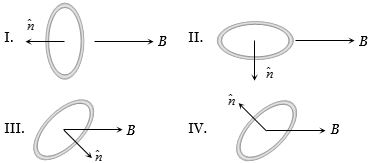
$A$ current-carrying loop is placed in a uniform magnetic field in four different orientations,$I$,$II$,$III$,and $IV$. Arrange them in the decreasing order of potential energy.
A
$I > III > II > IV$
B
$I > II > III > IV$
C
$I > IV > II > III$
D
$III > IV > I > II$
Solution
(C) The potential energy $U$ of a magnetic dipole in a magnetic field $B$ is given by $U = -M \cdot B = -MB \cos \theta$,where $\theta$ is the angle between the magnetic moment vector $M$ (which is along the normal $\hat{n}$) and the magnetic field $B$.
From the given images:
For $I$: $\theta = 180^\circ$,so $U_I = -MB \cos(180^\circ) = +MB$.
For $II$: $\theta = 90^\circ$,so $U_{II} = -MB \cos(90^\circ) = 0$.
For $III$: $\theta = 45^\circ$ (approx),so $U_{III} = -MB \cos(45^\circ) = -0.707MB$.
For $IV$: $\theta = 135^\circ$ (approx),so $U_{IV} = -MB \cos(135^\circ) = +0.707MB$.
Comparing the values: $U_I (+MB) > U_{IV} (+0.707MB) > U_{II} (0) > U_{III} (-0.707MB)$.
Thus,the decreasing order is $I > IV > II > III$.
From the given images:
For $I$: $\theta = 180^\circ$,so $U_I = -MB \cos(180^\circ) = +MB$.
For $II$: $\theta = 90^\circ$,so $U_{II} = -MB \cos(90^\circ) = 0$.
For $III$: $\theta = 45^\circ$ (approx),so $U_{III} = -MB \cos(45^\circ) = -0.707MB$.
For $IV$: $\theta = 135^\circ$ (approx),so $U_{IV} = -MB \cos(135^\circ) = +0.707MB$.
Comparing the values: $U_I (+MB) > U_{IV} (+0.707MB) > U_{II} (0) > U_{III} (-0.707MB)$.
Thus,the decreasing order is $I > IV > II > III$.
0 likesView Solution
20
PhysicsMediumMCQIIT JEE · 2003
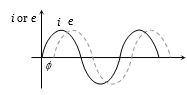
When an $AC$ source of $e.m.f.$ $e = E_0 \sin(100t)$ is connected across a circuit,the phase difference between the $e.m.f.$ $e$ and the current $i$ in the circuit is observed to be $\pi/4$,as shown in the diagram. If the circuit consists possibly only of $RC$ or $LC$ in series,find the relationship between the two elements.
A
$R = 1 \text{ k}\Omega, C = 10 \mu\text{F}$
B
$R = 1 \text{ k}\Omega, C = 1 \mu\text{F}$
C
$R = 1 \text{ k}\Omega, L = 10 \text{ H}$
D
$R = 1 \text{ k}\Omega, L = 1 \text{ H}$
Solution
(A) From the given diagram,the current $i$ leads the voltage $e$ by a phase angle $\phi = \pi/4$. This indicates that the circuit is an $RC$ series circuit.
For an $RC$ circuit,the phase angle $\phi$ is given by $\tan \phi = \frac{X_C}{R} = \frac{1}{\omega CR}$.
Given $\phi = \pi/4$,we have $\tan(\pi/4) = 1$,so $1 = \frac{1}{\omega CR}$,which implies $\omega CR = 1$.
Given $\omega = 100 \text{ rad/s}$,we have $100 \times C \times R = 1$,or $CR = 1/100 = 0.01 \text{ s}$.
Checking option $(A)$: $R = 1000 \, \Omega$ and $C = 10 \times 10^{-6} \text{ F} = 10^{-5} \text{ F}$.
Then $CR = 1000 \times 10^{-5} = 10^{-2} = 0.01 \text{ s}$.
This matches the condition,so option $(A)$ is correct.
For an $RC$ circuit,the phase angle $\phi$ is given by $\tan \phi = \frac{X_C}{R} = \frac{1}{\omega CR}$.
Given $\phi = \pi/4$,we have $\tan(\pi/4) = 1$,so $1 = \frac{1}{\omega CR}$,which implies $\omega CR = 1$.
Given $\omega = 100 \text{ rad/s}$,we have $100 \times C \times R = 1$,or $CR = 1/100 = 0.01 \text{ s}$.
Checking option $(A)$: $R = 1000 \, \Omega$ and $C = 10 \times 10^{-6} \text{ F} = 10^{-5} \text{ F}$.
Then $CR = 1000 \times 10^{-5} = 10^{-2} = 0.01 \text{ s}$.
This matches the condition,so option $(A)$ is correct.
0 likesView Solution
21
PhysicsDifficultMCQIIT JEE · 2003
The electric potential between a proton and an electron is given by $V = V_0 \ln(r/r_0)$,where $r_0$ is a constant. Assuming Bohr's model to be applicable,find the variation of $r_n$ with $n$,where $n$ is the principal quantum number.
A
$r_n \propto n$
B
$r_n \propto 1/n$
C
$r_n \propto n^2$
D
$r_n \propto 1/n^2$
Solution
(A) The potential energy $U$ is given by $U = eV = eV_0 \ln(r/r_0)$.
The force $F$ is given by $F = -dU/dr = -d/dr(eV_0 \ln(r/r_0)) = -eV_0/r$. The magnitude of the force is $F = eV_0/r$.
This force provides the necessary centripetal force for circular motion: $mv^2/r = eV_0/r$.
Simplifying this,we get $mv^2 = eV_0$,which implies $v = \sqrt{eV_0/m}$. Note that $v$ is independent of $r$ and $n$.
According to Bohr's quantization condition,the angular momentum is $mvr = nh/(2\pi)$.
Substituting $v = \sqrt{eV_0/m}$ into the quantization condition,we get $m(\sqrt{eV_0/m})r_n = nh/(2\pi)$.
Solving for $r_n$,we get $r_n = (nh / (2\pi)) \cdot \sqrt{1/(meV_0)}$.
Since $h, m, e, V_0$ are constants,we conclude that $r_n \propto n$.
The force $F$ is given by $F = -dU/dr = -d/dr(eV_0 \ln(r/r_0)) = -eV_0/r$. The magnitude of the force is $F = eV_0/r$.
This force provides the necessary centripetal force for circular motion: $mv^2/r = eV_0/r$.
Simplifying this,we get $mv^2 = eV_0$,which implies $v = \sqrt{eV_0/m}$. Note that $v$ is independent of $r$ and $n$.
According to Bohr's quantization condition,the angular momentum is $mvr = nh/(2\pi)$.
Substituting $v = \sqrt{eV_0/m}$ into the quantization condition,we get $m(\sqrt{eV_0/m})r_n = nh/(2\pi)$.
Solving for $r_n$,we get $r_n = (nh / (2\pi)) \cdot \sqrt{1/(meV_0)}$.
Since $h, m, e, V_0$ are constants,we conclude that $r_n \propto n$.
0 likesView Solution
22
PhysicsMediumMCQIIT JEE · 2003
If the atom $_{100}Fm^{257}$ follows the Bohr model and the radius of the outermost shell of $_{100}Fm^{257}$ is $n$ times the Bohr radius,then find $n$.
A
$100$
B
$200$
C
$4$
D
$0.25$
Solution
(D) The radius of an orbit in the Bohr model is given by $r_n = n^2 \frac{a_0}{Z}$,where $a_0$ is the Bohr radius $(0.529 \ \mathring{A})$,$n$ is the principal quantum number,and $Z$ is the atomic number.
Given the atom is $_{100}Fm^{257}$,the atomic number $Z = 100$.
The outermost shell for Fermium $(Z=100)$ is the $5f$ shell,so the principal quantum number $n_{shell} = 5$.
The radius of the outermost shell is $r = (5)^2 \frac{a_0}{100} = \frac{25}{100} a_0 = 0.25 a_0$.
Thus,the radius is $0.25$ times the Bohr radius,so $n = 0.25$.
Given the atom is $_{100}Fm^{257}$,the atomic number $Z = 100$.
The outermost shell for Fermium $(Z=100)$ is the $5f$ shell,so the principal quantum number $n_{shell} = 5$.
The radius of the outermost shell is $r = (5)^2 \frac{a_0}{100} = \frac{25}{100} a_0 = 0.25 a_0$.
Thus,the radius is $0.25$ times the Bohr radius,so $n = 0.25$.
0 likesView Solution
23
PhysicsEasyMCQIIT JEE · 2003
For a uranium nucleus, how does its mass vary with volume?
A
$m \propto V$
B
$m \propto 1/V$
C
$m \propto \sqrt{V}$
D
$m \propto V^2$
Solution
(A) The density of a nucleus $(\rho)$ is defined as the ratio of its mass $(m)$ to its volume $(V)$, given by $\rho = m/V$.
Experimental observations show that the nuclear density is approximately constant for all nuclei, regardless of their mass number.
Since $\rho = \text{constant}$, we have $m/V = \text{constant}$.
Therefore, the mass of the nucleus is directly proportional to its volume, which can be expressed as $m \propto V$.
Experimental observations show that the nuclear density is approximately constant for all nuclei, regardless of their mass number.
Since $\rho = \text{constant}$, we have $m/V = \text{constant}$.
Therefore, the mass of the nucleus is directly proportional to its volume, which can be expressed as $m \propto V$.
0 likesView Solution
24
PhysicsDifficultMCQIIT JEE · 2003
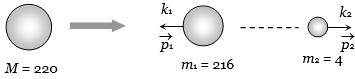
$A$ nucleus with mass number $220$ initially at rest emits an $\alpha$-particle. If the $Q$ value of the reaction is $5.5\, MeV$,calculate the kinetic energy of the $\alpha$-particle in $MeV$.
A
$4.4$
B
$5.4$
C
$5.6$
D
$6.5$
Solution
(B) The $Q$-value of the reaction is the total kinetic energy released,so $K_{\alpha} + K_{D} = Q = 5.5\, MeV$,where $K_{\alpha}$ is the kinetic energy of the $\alpha$-particle and $K_{D}$ is the kinetic energy of the daughter nucleus.
By the law of conservation of linear momentum,the magnitudes of the momenta of the $\alpha$-particle and the daughter nucleus must be equal: $p_{\alpha} = p_{D}$.
Using the relation $K = \frac{p^2}{2m}$,we have $p = \sqrt{2mK}$.
Thus,$\sqrt{2 m_{\alpha} K_{\alpha}} = \sqrt{2 m_{D} K_{D}}$.
Squaring both sides: $m_{\alpha} K_{\alpha} = m_{D} K_{D}$.
Given $m_{\alpha} = 4$ and $m_{D} = 220 - 4 = 216$,we get $4 K_{\alpha} = 216 K_{D}$,which simplifies to $K_{D} = \frac{4}{216} K_{\alpha} = \frac{1}{54} K_{\alpha}$.
Substituting this into the energy equation: $K_{\alpha} + \frac{1}{54} K_{\alpha} = 5.5\, MeV$.
$\frac{55}{54} K_{\alpha} = 5.5\, MeV$.
$K_{\alpha} = 5.5 \times \frac{54}{55} = 0.1 \times 54 = 5.4\, MeV$.
By the law of conservation of linear momentum,the magnitudes of the momenta of the $\alpha$-particle and the daughter nucleus must be equal: $p_{\alpha} = p_{D}$.
Using the relation $K = \frac{p^2}{2m}$,we have $p = \sqrt{2mK}$.
Thus,$\sqrt{2 m_{\alpha} K_{\alpha}} = \sqrt{2 m_{D} K_{D}}$.
Squaring both sides: $m_{\alpha} K_{\alpha} = m_{D} K_{D}$.
Given $m_{\alpha} = 4$ and $m_{D} = 220 - 4 = 216$,we get $4 K_{\alpha} = 216 K_{D}$,which simplifies to $K_{D} = \frac{4}{216} K_{\alpha} = \frac{1}{54} K_{\alpha}$.
Substituting this into the energy equation: $K_{\alpha} + \frac{1}{54} K_{\alpha} = 5.5\, MeV$.
$\frac{55}{54} K_{\alpha} = 5.5\, MeV$.
$K_{\alpha} = 5.5 \times \frac{54}{55} = 0.1 \times 54 = 5.4\, MeV$.
0 likesView Solution
25
PhysicsDifficultMCQIIT JEE · 2003
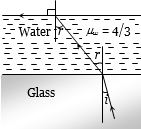
$A$ ray of light is incident at the glass-water interface at an angle $i$. It emerges finally parallel to the surface of water. The value of ${\mu _g}$ is (given refractive index of water ${\mu _w} = 4/3$):
A
$(4/3) \sin i$
B
$1/\sin i$
C
$4/3$
D
$1$
Solution
(B) Let the refractive index of glass be ${\mu _g}$ and water be ${\mu _w} = 4/3$. The refractive index of air is ${\mu _a} = 1$.
Applying Snell's Law at the glass-water interface:
${\mu _g} \sin i = {\mu _w} \sin r$ ---$(1)$
Applying Snell's Law at the water-air interface:
${\mu _w} \sin r = {\mu _a} \sin 90^\circ$ ---$(2)$
Since the ray emerges parallel to the water surface,the angle of refraction at the water-air interface is $90^\circ$.
From equations $(1)$ and $(2)$,we get:
${\mu _g} \sin i = {\mu _a} \sin 90^\circ$
${\mu _g} \sin i = 1 \times 1$
${\mu _g} = \frac{1}{\sin i}$
Applying Snell's Law at the glass-water interface:
${\mu _g} \sin i = {\mu _w} \sin r$ ---$(1)$
Applying Snell's Law at the water-air interface:
${\mu _w} \sin r = {\mu _a} \sin 90^\circ$ ---$(2)$
Since the ray emerges parallel to the water surface,the angle of refraction at the water-air interface is $90^\circ$.
From equations $(1)$ and $(2)$,we get:
${\mu _g} \sin i = {\mu _a} \sin 90^\circ$
${\mu _g} \sin i = 1 \times 1$
${\mu _g} = \frac{1}{\sin i}$
0 likesView Solution
26
PhysicsMediumMCQIIT JEE · 2003
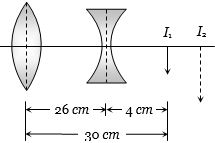
The size of the image of an object, which is at infinity, as formed by a convex lens of focal length $30\,cm$ is $2\,cm$. If a concave lens of focal length $20\,cm$ is placed between the convex lens and the image at a distance of $26\,cm$ from the convex lens, calculate the new size of the image. (in $cm$)
A
$1.25$
B
$2.5$
C
$1.05$
D
$2$
Solution
(B) $1$. The convex lens forms an image $I_1$ at its focal point. Since the object is at infinity, the image $I_1$ is formed at $f = 30\,cm$ from the convex lens.
$2$. The size of this image $I_1$ is $2\,cm$.
$3$. A concave lens of focal length $f_2 = -20\,cm$ is placed at $26\,cm$ from the convex lens. The image $I_1$ acts as a virtual object for the concave lens.
$4$. The distance of the virtual object from the concave lens is $u = 30\,cm - 26\,cm = 4\,cm$. Since it is on the right side, we take $u = +4\,cm$.
$5$. Using the lens formula $\frac{1}{v} - \frac{1}{u} = \frac{1}{f}$:
$\frac{1}{v} - \frac{1}{4} = \frac{1}{-20}$
$\frac{1}{v} = \frac{1}{4} - \frac{1}{20} = \frac{5-1}{20} = \frac{4}{20} = \frac{1}{5}$
$v = 5\,cm$.
$6$. The magnification $m$ for the concave lens is $m = \frac{v}{u} = \frac{5}{4} = 1.25$.
$7$. The new size of the image $I_2$ is $m \times (\text{size of } I_1) = 1.25 \times 2\,cm = 2.5\,cm$.
$2$. The size of this image $I_1$ is $2\,cm$.
$3$. A concave lens of focal length $f_2 = -20\,cm$ is placed at $26\,cm$ from the convex lens. The image $I_1$ acts as a virtual object for the concave lens.
$4$. The distance of the virtual object from the concave lens is $u = 30\,cm - 26\,cm = 4\,cm$. Since it is on the right side, we take $u = +4\,cm$.
$5$. Using the lens formula $\frac{1}{v} - \frac{1}{u} = \frac{1}{f}$:
$\frac{1}{v} - \frac{1}{4} = \frac{1}{-20}$
$\frac{1}{v} = \frac{1}{4} - \frac{1}{20} = \frac{5-1}{20} = \frac{4}{20} = \frac{1}{5}$
$v = 5\,cm$.
$6$. The magnification $m$ for the concave lens is $m = \frac{v}{u} = \frac{5}{4} = 1.25$.
$7$. The new size of the image $I_2$ is $m \times (\text{size of } I_1) = 1.25 \times 2\,cm = 2.5\,cm$.
0 likesView Solution
27
PhysicsDifficultMCQIIT JEE · 2003
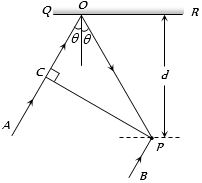
In the adjacent diagram,$CP$ represents a wavefront and $AO$ & $BP$ are the corresponding two rays. Find the condition on $\theta$ for constructive interference at $P$ between the ray $BP$ and the reflected ray $OP$.
A
$cos \theta = 3 \lambda / 2d$
B
$cos \theta = \lambda / 4d$
C
$sec \theta - cos \theta = \lambda / d$
D
$sec \theta - cos \theta = 4 \lambda / d$
Solution
(B) From the geometry,the distance from $O$ to the line containing $P$ is $d$. Thus,$PO = d \sec \theta$.
Since $CP$ is a wavefront,the optical path length from $C$ to $P$ is equal to the path length from $O$ to $P$ along the ray $AO$. The path difference between the ray $BP$ and the reflected ray $OP$ is $\Delta = CO + OP$.
In $\triangle COP$,$CO = PO \cos 2\theta = d \sec \theta \cos 2\theta$.
Thus,$\Delta = d \sec \theta + d \sec \theta \cos 2\theta = d \sec \theta (1 + \cos 2\theta) = d \sec \theta (2 \cos^2 \theta) = 2d \cos \theta$.
Since the ray $OP$ undergoes reflection at the surface $QR$,there is an additional phase shift of $\pi$,which corresponds to a path difference of $\lambda / 2$.
For constructive interference,the total path difference must be an odd multiple of $\lambda / 2$ (due to the $\pi$ phase shift): $\Delta = \lambda / 2$.
$2d \cos \theta = \lambda / 2 \implies \cos \theta = \lambda / 4d$.
Since $CP$ is a wavefront,the optical path length from $C$ to $P$ is equal to the path length from $O$ to $P$ along the ray $AO$. The path difference between the ray $BP$ and the reflected ray $OP$ is $\Delta = CO + OP$.
In $\triangle COP$,$CO = PO \cos 2\theta = d \sec \theta \cos 2\theta$.
Thus,$\Delta = d \sec \theta + d \sec \theta \cos 2\theta = d \sec \theta (1 + \cos 2\theta) = d \sec \theta (2 \cos^2 \theta) = 2d \cos \theta$.
Since the ray $OP$ undergoes reflection at the surface $QR$,there is an additional phase shift of $\pi$,which corresponds to a path difference of $\lambda / 2$.
For constructive interference,the total path difference must be an odd multiple of $\lambda / 2$ (due to the $\pi$ phase shift): $\Delta = \lambda / 2$.
$2d \cos \theta = \lambda / 2 \implies \cos \theta = \lambda / 4d$.
0 likesView Solution
Vedclass Products
For Students
Vedclass Test Series
Mock tests in real IIT JEE style covering Physics with performance analysis. 5-day free trial.
Start Free TrialFor Teachers
Exam Paper Generator
Generate Set A/B/C/D Physics papers from 7.5L+ questions in 2 minutes. 3 chapters free.
Try FreeFor Institutes
Online Exam Module
Run live IIT JEE mock exams with unlimited students, 360° analytics & white-label branding.
See DemoFrequently Asked Questions
How many Physics questions are in IIT JEE 2003?
There are 27 Physics questions from the IIT JEE 2003 paper on Vedclass, each with a detailed step-by-step solution in English.
Are IIT JEE 2003 Physics solutions available in English?
Yes. All solutions on this page are in English. You can also switch to English or Hindi using the language buttons above the questions.
Can I practice IIT JEE 2003 Physics as a timed test?
Yes. Use the Vedclass Test Series to attempt a full IIT JEE mock test covering Physics with time limits and instant score analysis.
Can teachers create Physics papers from IIT JEE previous year questions?
Yes. The Vedclass Exam Paper Generator lets teachers mix IIT JEE Physics questions and generate Set A/B/C/D papers in minutes.
For Teachers & Institutes
Build a Custom Physics Paper
Pick IIT JEE 2003 Physics questions, set difficulty, and generate Set A/B/C/D in 2 minutes.