
MathematicsQ1–34 of 34 questions
Page 1 of 1 · English
1
MathematicsDifficultMCQIIT JEE · 2018
For a non-zero complex number $z$,let $\arg(z)$ denote the principal argument with $-\pi < \arg(z) \leq \pi$. Then,which of the following statement$(s)$ is (are) $FALSE$?
$(A)$ $\arg(-1-i) = \frac{\pi}{4}$,where $i = \sqrt{-1}$
$(B)$ The function $f: \mathbb{R} \rightarrow (-\pi, \pi]$,defined by $f(t) = \arg(-1+it)$ for all $t \in \mathbb{R}$,is continuous at all points of $\mathbb{R}$,where $i = \sqrt{-1}$
$(C)$ For any two non-zero complex numbers $z_1$ and $z_2$,$\arg\left(\frac{z_1}{z_2}\right) - \arg(z_1) + \arg(z_2)$ is an integer multiple of $2\pi$.
$(D)$ For any three given distinct complex numbers $z_1, z_2$ and $z_3$,the locus of the point $z$ satisfying the condition $\arg\left(\frac{(z-z_1)(z_2-z_3)}{(z-z_3)(z_2-z_1)}\right) = \pi$ lies on a straight line.
$(A)$ $\arg(-1-i) = \frac{\pi}{4}$,where $i = \sqrt{-1}$
$(B)$ The function $f: \mathbb{R} \rightarrow (-\pi, \pi]$,defined by $f(t) = \arg(-1+it)$ for all $t \in \mathbb{R}$,is continuous at all points of $\mathbb{R}$,where $i = \sqrt{-1}$
$(C)$ For any two non-zero complex numbers $z_1$ and $z_2$,$\arg\left(\frac{z_1}{z_2}\right) - \arg(z_1) + \arg(z_2)$ is an integer multiple of $2\pi$.
$(D)$ For any three given distinct complex numbers $z_1, z_2$ and $z_3$,the locus of the point $z$ satisfying the condition $\arg\left(\frac{(z-z_1)(z_2-z_3)}{(z-z_3)(z_2-z_1)}\right) = \pi$ lies on a straight line.
A
$A, B, D$
B
$A, B, C$
C
$A, B$
D
$A, C$
Solution
(A) The complex number $-1-i$ lies in the third quadrant. The principal argument is $\arg(-1-i) = -\pi + \arctan(1) = -\pi + \frac{\pi}{4} = -\frac{3\pi}{4}$. Thus,statement $(A)$ is $FALSE$.
$(B)$ $f(t) = \arg(-1+it)$. As $t \to 0^+$,$f(t) \to \arg(-1) = \pi$. As $t \to 0^-$,$f(t) \to \arg(-1) = \pi$. However,at $t=0$,$f(0) = \arg(-1) = \pi$. Actually,the function is continuous at $t=0$ if we consider the limit,but the definition of argument can be tricky. Let's re-evaluate: for $t > 0$,$\arg(-1+it) = \pi - \arctan(t)$. For $t < 0$,$\arg(-1+it) = -\pi + \arctan(|t|)$. As $t \to 0$,the limit from the left is $-\pi$ and from the right is $\pi$. Thus,it is discontinuous at $t=0$. Statement $(B)$ is $FALSE$.
$(C)$ By the property of arguments,$\arg(z_1/z_2) = \arg(z_1) - \arg(z_2) + 2k\pi$. This is a standard identity. Statement $(C)$ is $TRUE$.
$(D)$ The condition $\arg\left(\frac{(z-z_1)(z_2-z_3)}{(z-z_3)(z_2-z_1)}\right) = \pi$ implies that the points $z, z_1, z_2, z_3$ are concyclic. The locus is a circle,not a straight line. Statement $(D)$ is $FALSE$.
Therefore,the false statements are $(A), (B),$ and $(D)$.
$(B)$ $f(t) = \arg(-1+it)$. As $t \to 0^+$,$f(t) \to \arg(-1) = \pi$. As $t \to 0^-$,$f(t) \to \arg(-1) = \pi$. However,at $t=0$,$f(0) = \arg(-1) = \pi$. Actually,the function is continuous at $t=0$ if we consider the limit,but the definition of argument can be tricky. Let's re-evaluate: for $t > 0$,$\arg(-1+it) = \pi - \arctan(t)$. For $t < 0$,$\arg(-1+it) = -\pi + \arctan(|t|)$. As $t \to 0$,the limit from the left is $-\pi$ and from the right is $\pi$. Thus,it is discontinuous at $t=0$. Statement $(B)$ is $FALSE$.
$(C)$ By the property of arguments,$\arg(z_1/z_2) = \arg(z_1) - \arg(z_2) + 2k\pi$. This is a standard identity. Statement $(C)$ is $TRUE$.
$(D)$ The condition $\arg\left(\frac{(z-z_1)(z_2-z_3)}{(z-z_3)(z_2-z_1)}\right) = \pi$ implies that the points $z, z_1, z_2, z_3$ are concyclic. The locus is a circle,not a straight line. Statement $(D)$ is $FALSE$.
Therefore,the false statements are $(A), (B),$ and $(D)$.
0 likesView Solution
2
MathematicsAdvancedMCQIIT JEE · 2018
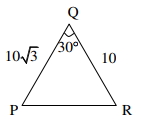
In a triangle $PQR$,let $\angle PQR = 30^{\circ}$ and the sides $PQ$ and $QR$ have lengths $10\sqrt{3}$ and $10$,respectively. Then,which of the following statement$(s)$ is (are) $TRUE$?
$(A)$ $\angle QPR = 45^{\circ}$
$(B)$ The area of the triangle $PQR$ is $25\sqrt{3}$ and $\angle QRP = 120^{\circ}$
$(C)$ The radius of the incircle of the triangle $PQR$ is $10\sqrt{3} - 15$
$(D)$ The area of the circumcircle of the triangle $PQR$ is $100\pi$
$(A)$ $\angle QPR = 45^{\circ}$
$(B)$ The area of the triangle $PQR$ is $25\sqrt{3}$ and $\angle QRP = 120^{\circ}$
$(C)$ The radius of the incircle of the triangle $PQR$ is $10\sqrt{3} - 15$
$(D)$ The area of the circumcircle of the triangle $PQR$ is $100\pi$
A
$B, C, A$
B
$B, C, D$
C
$B, C$
D
$B, D$
Solution
(B) Given: $PQ = 10\sqrt{3}$,$QR = 10$,and $\angle PQR = 30^{\circ}$.
Using the Law of Cosines to find $PR$:
$PR^2 = PQ^2 + QR^2 - 2(PQ)(QR)\cos(30^{\circ})$
$PR^2 = (10\sqrt{3})^2 + 10^2 - 2(10\sqrt{3})(10)\left(\frac{\sqrt{3}}{2}\right)$
$PR^2 = 300 + 100 - 300 = 100$
$PR = 10$.
Since $PR = QR = 10$,the triangle is isosceles with $\angle QPR = \angle PQR = 30^{\circ}$.
Then,$\angle QRP = 180^{\circ} - (30^{\circ} + 30^{\circ}) = 120^{\circ}$. Thus,statement $(B)$ is true.
Area of $\triangle PQR = \frac{1}{2} \times PQ \times QR \times \sin(30^{\circ}) = \frac{1}{2} \times 10\sqrt{3} \times 10 \times \frac{1}{2} = 25\sqrt{3}$.
Semi-perimeter $s = \frac{10\sqrt{3} + 10 + 10}{2} = 5\sqrt{3} + 10$.
Inradius $r = \frac{\text{Area}}{s} = \frac{25\sqrt{3}}{5\sqrt{3} + 10} = \frac{5\sqrt{3}}{\sqrt{3} + 2} = \frac{5\sqrt{3}(2 - \sqrt{3})}{4 - 3} = 10\sqrt{3} - 15$. Thus,statement $(C)$ is true.
Circumradius $R = \frac{abc}{4\Delta} = \frac{10\sqrt{3} \times 10 \times 10}{4 \times 25\sqrt{3}} = \frac{1000\sqrt{3}}{100\sqrt{3}} = 10$.
Area of circumcircle = $\pi R^2 = \pi(10)^2 = 100\pi$. Thus,statement $(D)$ is true.
Therefore,statements $(B), (C), (D)$ are true.
Using the Law of Cosines to find $PR$:
$PR^2 = PQ^2 + QR^2 - 2(PQ)(QR)\cos(30^{\circ})$
$PR^2 = (10\sqrt{3})^2 + 10^2 - 2(10\sqrt{3})(10)\left(\frac{\sqrt{3}}{2}\right)$
$PR^2 = 300 + 100 - 300 = 100$
$PR = 10$.
Since $PR = QR = 10$,the triangle is isosceles with $\angle QPR = \angle PQR = 30^{\circ}$.
Then,$\angle QRP = 180^{\circ} - (30^{\circ} + 30^{\circ}) = 120^{\circ}$. Thus,statement $(B)$ is true.
Area of $\triangle PQR = \frac{1}{2} \times PQ \times QR \times \sin(30^{\circ}) = \frac{1}{2} \times 10\sqrt{3} \times 10 \times \frac{1}{2} = 25\sqrt{3}$.
Semi-perimeter $s = \frac{10\sqrt{3} + 10 + 10}{2} = 5\sqrt{3} + 10$.
Inradius $r = \frac{\text{Area}}{s} = \frac{25\sqrt{3}}{5\sqrt{3} + 10} = \frac{5\sqrt{3}}{\sqrt{3} + 2} = \frac{5\sqrt{3}(2 - \sqrt{3})}{4 - 3} = 10\sqrt{3} - 15$. Thus,statement $(C)$ is true.
Circumradius $R = \frac{abc}{4\Delta} = \frac{10\sqrt{3} \times 10 \times 10}{4 \times 25\sqrt{3}} = \frac{1000\sqrt{3}}{100\sqrt{3}} = 10$.
Area of circumcircle = $\pi R^2 = \pi(10)^2 = 100\pi$. Thus,statement $(D)$ is true.
Therefore,statements $(B), (C), (D)$ are true.
0 likesView Solution
3
MathematicsMediumMCQIIT JEE · 2018
The value of $\left(\left(\log _2 9\right)^2\right)^{\frac{1}{\log _2\left(\log _2 9\right)}} \times(\sqrt{7})^{\frac{1}{\log _4 7}}$ is . . . . . . .
A
$5$
B
$8$
C
$9$
D
$10$
Solution
(B) Let the expression be $E = \left(\left(\log _2 9\right)^2\right)^{\frac{1}{\log _2\left(\log _2 9\right)}} \times(\sqrt{7})^{\frac{1}{\log _4 7}}$.
Using the property $\frac{1}{\log_a b} = \log_b a$,the first term becomes $\left(\left(\log _2 9\right)^2\right)^{\log_{\log_2 9} 2} = (\log_2 9)^{2 \log_{\log_2 9} 2} = (\log_2 9)^{\log_{\log_2 9} 2^2} = 2^2 = 4$.
For the second term,$\frac{1}{\log_4 7} = \log_7 4$. Thus,$(\sqrt{7})^{\log_7 4} = (7^{1/2})^{\log_7 4} = 7^{\frac{1}{2} \log_7 4} = 7^{\log_7 4^{1/2}} = 4^{1/2} = 2$.
Therefore,$E = 4 \times 2 = 8$.
Using the property $\frac{1}{\log_a b} = \log_b a$,the first term becomes $\left(\left(\log _2 9\right)^2\right)^{\log_{\log_2 9} 2} = (\log_2 9)^{2 \log_{\log_2 9} 2} = (\log_2 9)^{\log_{\log_2 9} 2^2} = 2^2 = 4$.
For the second term,$\frac{1}{\log_4 7} = \log_7 4$. Thus,$(\sqrt{7})^{\log_7 4} = (7^{1/2})^{\log_7 4} = 7^{\frac{1}{2} \log_7 4} = 7^{\log_7 4^{1/2}} = 4^{1/2} = 2$.
Therefore,$E = 4 \times 2 = 8$.
0 likesView Solution
4
MathematicsMediumMCQIIT JEE · 2018
The number of $5$-digit numbers which are divisible by $4$,with digits from the set $\{1, 2, 3, 4, 5\}$ and the repetition of digits is allowed,is . . . . . .
A
$625$
B
$626$
C
$627$
D
$630$
Solution
(A) number is divisible by $4$ if its last two digits are divisible by $4$.
Given the set of digits $\{1, 2, 3, 4, 5\}$,the possible two-digit numbers formed by these digits that are divisible by $4$ are: $12, 24, 32, 44, 52$.
There are $5$ such possible combinations for the last two digits.
For a $5$-digit number,the first $3$ positions can be filled by any of the $5$ digits because repetition is allowed.
Number of ways to fill the first $3$ positions = $5 \times 5 \times 5 = 5^3 = 125$.
Since there are $5$ possible combinations for the last two digits,the total number of $5$-digit numbers is $125 \times 5 = 625$.
Given the set of digits $\{1, 2, 3, 4, 5\}$,the possible two-digit numbers formed by these digits that are divisible by $4$ are: $12, 24, 32, 44, 52$.
There are $5$ such possible combinations for the last two digits.
For a $5$-digit number,the first $3$ positions can be filled by any of the $5$ digits because repetition is allowed.
Number of ways to fill the first $3$ positions = $5 \times 5 \times 5 = 5^3 = 125$.
Since there are $5$ possible combinations for the last two digits,the total number of $5$-digit numbers is $125 \times 5 = 625$.
0 likesView Solution
5
MathematicsMediumMCQIIT JEE · 2018
Let $X$ be the set consisting of the first $2018$ terms of the arithmetic progression $1, 6, 11, \dots$ and $Y$ be the set consisting of the first $2018$ terms of the arithmetic progression $9, 16, 23, \dots$. Then,the number of elements in the set $X \cup Y$ is:
A
$3747$
B
$3748$
C
$3749$
D
$3750$
Solution
(B) The $n$-th term of $X$ is $a_n = 1 + (n-1)5 = 5n - 4$. For $n=2018$,$a_{2018} = 5(2018) - 4 = 10086$.
The $n$-th term of $Y$ is $b_n = 9 + (n-1)7 = 7n + 2$. For $n=2018$,$b_{2018} = 7(2018) + 2 = 14128$.
Common terms $X \cap Y$ satisfy $5n - 4 = 7m + 2$,which implies $5n = 7m + 6$. The smallest solution is $n=4, m=2$,giving $16$. The common difference is $\text{lcm}(5, 7) = 35$.
The common terms are $16, 51, 86, \dots$. The general term is $c_k = 16 + (k-1)35 = 35k - 19$.
We need $c_k \leq 10086$ (since $c_k$ must be in $X$ and $Y$): $35k - 19 \leq 10086 \implies 35k \leq 10105 \implies k \leq 288.71$.
Thus,$n(X \cap Y) = 288$.
Using the inclusion-exclusion principle: $n(X \cup Y) = n(X) + n(Y) - n(X \cap Y) = 2018 + 2018 - 288 = 3748$.
The $n$-th term of $Y$ is $b_n = 9 + (n-1)7 = 7n + 2$. For $n=2018$,$b_{2018} = 7(2018) + 2 = 14128$.
Common terms $X \cap Y$ satisfy $5n - 4 = 7m + 2$,which implies $5n = 7m + 6$. The smallest solution is $n=4, m=2$,giving $16$. The common difference is $\text{lcm}(5, 7) = 35$.
The common terms are $16, 51, 86, \dots$. The general term is $c_k = 16 + (k-1)35 = 35k - 19$.
We need $c_k \leq 10086$ (since $c_k$ must be in $X$ and $Y$): $35k - 19 \leq 10086 \implies 35k \leq 10105 \implies k \leq 288.71$.
Thus,$n(X \cap Y) = 288$.
Using the inclusion-exclusion principle: $n(X \cup Y) = n(X) + n(Y) - n(X \cap Y) = 2018 + 2018 - 288 = 3748$.
0 likesView Solution
6
MathematicsDifficultMCQIIT JEE · 2018
Let $a, b, c$ be three non-zero real numbers such that the equation $\sqrt{3} a \cos x + 2 b \sin x = c$,where $x \in [-\frac{\pi}{2}, \frac{\pi}{2}]$,has two distinct real roots $\alpha$ and $\beta$ with $\alpha + \beta = \frac{\pi}{3}$. Then,the value of $\frac{b}{a}$ is:
A
$0.4$
B
$0.3$
C
$0.5$
D
$0.8$
Solution
(C) Given the equation $\sqrt{3} a \cos x + 2 b \sin x = c$.
Dividing by $a$,we get $\sqrt{3} \cos x + \frac{2b}{a} \sin x = \frac{c}{a}$.
Since $\alpha$ and $\beta$ are roots,they satisfy the equation:
$\sqrt{3} \cos \alpha + \frac{2b}{a} \sin \alpha = \frac{c}{a} \quad (1)$
$\sqrt{3} \cos \beta + \frac{2b}{a} \sin \beta = \frac{c}{a} \quad (2)$
Subtracting $(2)$ from $(1)$:
$\sqrt{3}(\cos \alpha - \cos \beta) + \frac{2b}{a}(\sin \alpha - \sin \beta) = 0$
Using the sum-to-product formulas:
$\sqrt{3} \left( -2 \sin \frac{\alpha + \beta}{2} \sin \frac{\alpha - \beta}{2} \right) + \frac{2b}{a} \left( 2 \cos \frac{\alpha + \beta}{2} \sin \frac{\alpha - \beta}{2} \right) = 0$
Given $\alpha + \beta = \frac{\pi}{3}$,so $\frac{\alpha + \beta}{2} = \frac{\pi}{6}$.
Since $\alpha \neq \beta$,$\sin \frac{\alpha - \beta}{2} \neq 0$,we can divide by it:
$-\sqrt{3} \sin \frac{\pi}{6} + \frac{2b}{a} \cos \frac{\pi}{6} = 0$
$-\sqrt{3} \left( \frac{1}{2} \right) + \frac{2b}{a} \left( \frac{\sqrt{3}}{2} \right) = 0$
$-\frac{\sqrt{3}}{2} + \frac{b}{a} \sqrt{3} = 0$
$\frac{b}{a} \sqrt{3} = \frac{\sqrt{3}}{2} \implies \frac{b}{a} = \frac{1}{2} = 0.5$.
Dividing by $a$,we get $\sqrt{3} \cos x + \frac{2b}{a} \sin x = \frac{c}{a}$.
Since $\alpha$ and $\beta$ are roots,they satisfy the equation:
$\sqrt{3} \cos \alpha + \frac{2b}{a} \sin \alpha = \frac{c}{a} \quad (1)$
$\sqrt{3} \cos \beta + \frac{2b}{a} \sin \beta = \frac{c}{a} \quad (2)$
Subtracting $(2)$ from $(1)$:
$\sqrt{3}(\cos \alpha - \cos \beta) + \frac{2b}{a}(\sin \alpha - \sin \beta) = 0$
Using the sum-to-product formulas:
$\sqrt{3} \left( -2 \sin \frac{\alpha + \beta}{2} \sin \frac{\alpha - \beta}{2} \right) + \frac{2b}{a} \left( 2 \cos \frac{\alpha + \beta}{2} \sin \frac{\alpha - \beta}{2} \right) = 0$
Given $\alpha + \beta = \frac{\pi}{3}$,so $\frac{\alpha + \beta}{2} = \frac{\pi}{6}$.
Since $\alpha \neq \beta$,$\sin \frac{\alpha - \beta}{2} \neq 0$,we can divide by it:
$-\sqrt{3} \sin \frac{\pi}{6} + \frac{2b}{a} \cos \frac{\pi}{6} = 0$
$-\sqrt{3} \left( \frac{1}{2} \right) + \frac{2b}{a} \left( \frac{\sqrt{3}}{2} \right) = 0$
$-\frac{\sqrt{3}}{2} + \frac{b}{a} \sqrt{3} = 0$
$\frac{b}{a} \sqrt{3} = \frac{\sqrt{3}}{2} \implies \frac{b}{a} = \frac{1}{2} = 0.5$.
0 likesView Solution
7
MathematicsAdvancedIIT JEE · 2018
Let $S$ be the circle in the $xy$-plane defined by the equation $x^2+y^2=4$.
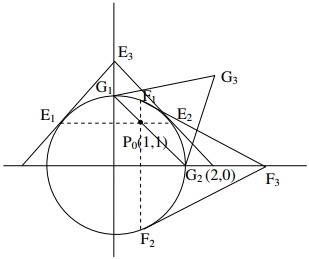
$(1)$ Let $E_1, E_2$ and $F_1, F_2$ be the chords of $S$ passing through the point $P_0(1,1)$ and parallel to the $x$-axis and the $y$-axis,respectively. Let $G_1, G_2$ be the chord of $S$ passing through $P_0$ and having slope $-1$. Let the tangents to $S$ at $E_1$ and $E_2$ meet at $E_3$,the tangents to $S$ at $F_1$ and $F_2$ meet at $F_3$,and the tangents to $S$ at $G_1$ and $G_2$ meet at $G_3$. Then,the points $E_3, F_3$,and $G_3$ lie on the curve
$(A)$ $x+y=4$ $(B)$ $(x-4)^2+(y-4)^2=16$ $(C)$ $(x-4)(y-4)=4$ $(D)$ $xy=4$
$(2)$ Let $P$ be a point on the circle $S$ with both coordinates being positive. Let the tangent to $S$ at $P$ intersect the coordinate axes at the points $M$ and $N$. Then,the mid-point of the line segment $MN$ must lie on the curve
$(A)$ $(x+y)^2=3xy$ $(B)$ $x^{2/3}+y^{2/3}=2^{4/3}$ $(C)$ $x^2+y^2=2xy$ $(D)$ $x^2+y^2=x^2y^2$
$(1)$ Let $E_1, E_2$ and $F_1, F_2$ be the chords of $S$ passing through the point $P_0(1,1)$ and parallel to the $x$-axis and the $y$-axis,respectively. Let $G_1, G_2$ be the chord of $S$ passing through $P_0$ and having slope $-1$. Let the tangents to $S$ at $E_1$ and $E_2$ meet at $E_3$,the tangents to $S$ at $F_1$ and $F_2$ meet at $F_3$,and the tangents to $S$ at $G_1$ and $G_2$ meet at $G_3$. Then,the points $E_3, F_3$,and $G_3$ lie on the curve
$(A)$ $x+y=4$ $(B)$ $(x-4)^2+(y-4)^2=16$ $(C)$ $(x-4)(y-4)=4$ $(D)$ $xy=4$
$(2)$ Let $P$ be a point on the circle $S$ with both coordinates being positive. Let the tangent to $S$ at $P$ intersect the coordinate axes at the points $M$ and $N$. Then,the mid-point of the line segment $MN$ must lie on the curve
$(A)$ $(x+y)^2=3xy$ $(B)$ $x^{2/3}+y^{2/3}=2^{4/3}$ $(C)$ $x^2+y^2=2xy$ $(D)$ $x^2+y^2=x^2y^2$
Solution
(A,D) $(1)$ The circle is $x^2+y^2=4$. The point $P_0(1,1)$ lies inside the circle.
For chord $E_1E_2$ parallel to the $x$-axis,$y=1$. Substituting into the circle equation: $x^2+1=4 \implies x^2=3 \implies x=\pm\sqrt{3}$. Thus $E_1(-\sqrt{3}, 1)$ and $E_2(\sqrt{3}, 1)$.
The tangent at $(x_1, y_1)$ is $xx_1+yy_1=4$. Tangents at $E_1, E_2$ are $-x\sqrt{3}+y=4$ and $x\sqrt{3}+y=4$. Solving these gives $E_3(0, 4)$.
For chord $F_1F_2$ parallel to the $y$-axis,$x=1$. Substituting into the circle equation: $1+y^2=4 \implies y^2=3 \implies y=\pm\sqrt{3}$. Thus $F_1(1, \sqrt{3})$ and $F_2(1, -\sqrt{3})$.
Tangents at $F_1, F_2$ are $x+y\sqrt{3}=4$ and $x-y\sqrt{3}=4$. Solving these gives $F_3(4, 0)$.
For chord $G_1G_2$ with slope $-1$ passing through $(1,1)$,the line is $y-1=-1(x-1) \implies x+y=2$. Intersection with $x^2+y^2=4$: $x^2+(2-x)^2=4 \implies 2x^2-4x=0 \implies x=0, 2$. Thus $G_1(0, 2)$ and $G_2(2, 0)$.
Tangents at $G_1(0, 2)$ is $y=2$. Tangent at $G_2(2, 0)$ is $x=2$. Intersection $G_3(2, 2)$.
Points $E_3(0, 4), F_3(4, 0), G_3(2, 2)$ all satisfy $x+y=4$. Correct option is $(A)$.
$(2)$ Let $P(2\cos\theta, 2\sin\theta)$. The tangent is $x\cos\theta+y\sin\theta=2$. Intercepts are $M(2/\cos\theta, 0)$ and $N(0, 2/\sin\theta)$.
Mid-point $(h, k) = (1/\cos\theta, 1/\sin\theta)$.
Thus $\cos\theta=1/h$ and $\sin\theta=1/k$. Since $\cos^2\theta+\sin^2\theta=1$,we have $1/h^2+1/k^2=1 \implies h^2+k^2=h^2k^2$.
Locus is $x^2+y^2=x^2y^2$. Correct option is $(D)$.
For chord $E_1E_2$ parallel to the $x$-axis,$y=1$. Substituting into the circle equation: $x^2+1=4 \implies x^2=3 \implies x=\pm\sqrt{3}$. Thus $E_1(-\sqrt{3}, 1)$ and $E_2(\sqrt{3}, 1)$.
The tangent at $(x_1, y_1)$ is $xx_1+yy_1=4$. Tangents at $E_1, E_2$ are $-x\sqrt{3}+y=4$ and $x\sqrt{3}+y=4$. Solving these gives $E_3(0, 4)$.
For chord $F_1F_2$ parallel to the $y$-axis,$x=1$. Substituting into the circle equation: $1+y^2=4 \implies y^2=3 \implies y=\pm\sqrt{3}$. Thus $F_1(1, \sqrt{3})$ and $F_2(1, -\sqrt{3})$.
Tangents at $F_1, F_2$ are $x+y\sqrt{3}=4$ and $x-y\sqrt{3}=4$. Solving these gives $F_3(4, 0)$.
For chord $G_1G_2$ with slope $-1$ passing through $(1,1)$,the line is $y-1=-1(x-1) \implies x+y=2$. Intersection with $x^2+y^2=4$: $x^2+(2-x)^2=4 \implies 2x^2-4x=0 \implies x=0, 2$. Thus $G_1(0, 2)$ and $G_2(2, 0)$.
Tangents at $G_1(0, 2)$ is $y=2$. Tangent at $G_2(2, 0)$ is $x=2$. Intersection $G_3(2, 2)$.
Points $E_3(0, 4), F_3(4, 0), G_3(2, 2)$ all satisfy $x+y=4$. Correct option is $(A)$.
$(2)$ Let $P(2\cos\theta, 2\sin\theta)$. The tangent is $x\cos\theta+y\sin\theta=2$. Intercepts are $M(2/\cos\theta, 0)$ and $N(0, 2/\sin\theta)$.
Mid-point $(h, k) = (1/\cos\theta, 1/\sin\theta)$.
Thus $\cos\theta=1/h$ and $\sin\theta=1/k$. Since $\cos^2\theta+\sin^2\theta=1$,we have $1/h^2+1/k^2=1 \implies h^2+k^2=h^2k^2$.
Locus is $x^2+y^2=x^2y^2$. Correct option is $(D)$.
0 likesView Solution
8
MathematicsDifficultIIT JEE · 2018
There are five students $S_1, S_2, S_3, S_4$ and $S_5$ in a music class and for them there are five seats $R_1, R_2, R_3, R_4$ and $R_5$ arranged in a row,where initially the seat $R_i$ is allotted to the student $S_i$,$i = 1, 2, 3, 4, 5$. But,on the examination day,the five students are randomly allotted the five seats.
$(1)$ The probability that,on the examination day,the student $S_1$ gets the previously allotted seat $R_1$,and $NONE$ of the remaining students gets the seat previously allotted to him/her is
$(A)$ $\frac{3}{40}$ $(B)$ $\frac{1}{8}$ $(C)$ $\frac{7}{40}$ $(D)$ $\frac{1}{5}$
$(2)$ For $i = 1, 2, 3, 4$,let $T_i$ denote the event that the students $S_i$ and $S_{i+1}$ do $NOT$ sit adjacent to each other on the day of the examination. Then,the probability of the event $T_1 \cap T_2 \cap T_3 \cap T_4$ is
$(A)$ $\frac{1}{15}$ $(B)$ $\frac{1}{10}$ $(C)$ $\frac{7}{60}$ $(D)$ $\frac{1}{5}$
$(1)$ The probability that,on the examination day,the student $S_1$ gets the previously allotted seat $R_1$,and $NONE$ of the remaining students gets the seat previously allotted to him/her is
$(A)$ $\frac{3}{40}$ $(B)$ $\frac{1}{8}$ $(C)$ $\frac{7}{40}$ $(D)$ $\frac{1}{5}$
$(2)$ For $i = 1, 2, 3, 4$,let $T_i$ denote the event that the students $S_i$ and $S_{i+1}$ do $NOT$ sit adjacent to each other on the day of the examination. Then,the probability of the event $T_1 \cap T_2 \cap T_3 \cap T_4$ is
$(A)$ $\frac{1}{15}$ $(B)$ $\frac{1}{10}$ $(C)$ $\frac{7}{60}$ $(D)$ $\frac{1}{5}$
Solution
(A, C) $(1)$ Total ways to arrange $5$ students in $5$ seats is $n(S) = 5! = 120$.
Let $A$ be the event that $S_1$ gets seat $R_1$ and none of the remaining $4$ students $(S_2, S_3, S_4, S_5)$ get their original seats $(R_2, R_3, R_4, R_5)$.
This is a derangement of $4$ items,denoted by $D_4$.
$n(A) = D_4 = 4! \left(1 - \frac{1}{1!} + \frac{1}{2!} - \frac{1}{3!} + \frac{1}{4!}\right) = 24 \left(\frac{1}{2} - \frac{1}{6} + \frac{1}{24}\right) = 12 - 4 + 1 = 9$.
$P(A) = \frac{9}{120} = \frac{3}{40}$.
$(2)$ Let $E_i$ be the event that $S_i$ and $S_{i+1}$ sit adjacent. We want $P(T_1 \cap T_2 \cap T_3 \cap T_4) = 1 - P(E_1 \cup E_2 \cup E_3 \cup E_4)$.
Using the principle of inclusion-exclusion,the number of permutations where at least one pair is adjacent is calculated. For $n=5$,the number of permutations where no two adjacent students $S_i, S_{i+1}$ are together is $14$.
Thus,$P(T_1 \cap T_2 \cap T_3 \cap T_4) = \frac{14}{120} = \frac{7}{60}$.
Let $A$ be the event that $S_1$ gets seat $R_1$ and none of the remaining $4$ students $(S_2, S_3, S_4, S_5)$ get their original seats $(R_2, R_3, R_4, R_5)$.
This is a derangement of $4$ items,denoted by $D_4$.
$n(A) = D_4 = 4! \left(1 - \frac{1}{1!} + \frac{1}{2!} - \frac{1}{3!} + \frac{1}{4!}\right) = 24 \left(\frac{1}{2} - \frac{1}{6} + \frac{1}{24}\right) = 12 - 4 + 1 = 9$.
$P(A) = \frac{9}{120} = \frac{3}{40}$.
$(2)$ Let $E_i$ be the event that $S_i$ and $S_{i+1}$ sit adjacent. We want $P(T_1 \cap T_2 \cap T_3 \cap T_4) = 1 - P(E_1 \cup E_2 \cup E_3 \cup E_4)$.
Using the principle of inclusion-exclusion,the number of permutations where at least one pair is adjacent is calculated. For $n=5$,the number of permutations where no two adjacent students $S_i, S_{i+1}$ are together is $14$.
Thus,$P(T_1 \cap T_2 \cap T_3 \cap T_4) = \frac{14}{120} = \frac{7}{60}$.
0 likesView Solution
9
MathematicsAdvancedMCQIIT JEE · 2018
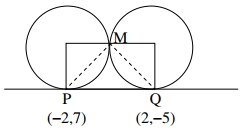
Let $T'$ be the line passing through the points $P(-2, 7)$ and $Q(2, -5)$. Let $F_1$ be the set of all pairs of circles $(S_1, S_2)$ such that $T'$ is tangent to $S_1$ at $P$ and tangent to $S_2$ at $Q$,and also such that $S_1$ and $S_2$ touch each other at a point,say,$M$. Let $E_1$ be the set representing the locus of $M$ as the pair $(S_1, S_2)$ varies in $F_1$. Let the set of all straight line segments joining a pair of distinct points of $E_1$ and passing through the point $R(1, 1)$ be $F_2$. Let $E_2$ be the set of the mid-points of the line segments in the set $F_2$. Then,which of the following statement$(s)$ is (are) $TRUE$?
A
The point $(-2, 7)$ lies in $E_1$
B
The point $(\frac{4}{5}, \frac{7}{5})$ does $NOT$ lie in $E_2$
C
The point $(\frac{1}{2}, 1)$ lies in $E_2$
D
The point $(0, \frac{3}{2})$ does $NOT$ lie in $E_1$
Solution
(D) Let $M \equiv (h, k)$. Since $MP$ and $MQ$ are tangents from $M$ to the circles $S_1$ and $S_2$ respectively,and $M$ is the point of contact,$MP = MQ$. Also,the angle $\angle PMQ = 90^{\circ}$.
Thus,the slope of $MP \times$ slope of $MQ = -1$.
$\left(\frac{k-7}{h+2}\right) \times \left(\frac{k+5}{h-2}\right) = -1$
$(k-7)(k+5) = -(h+2)(h-2)$
$k^2 - 2k - 35 = -(h^2 - 4) = -h^2 + 4$
$h^2 + k^2 - 2k - 39 = 0$. Thus,$E_1: x^2 + y^2 - 2y - 39 = 0$.
For $E_2$,let a chord of $E_1$ have midpoint $(h, k)$. The equation of the chord is $T = S_1$,i.e.,$xh + yk - (y + k) - 39 = h^2 + k^2 - 2k - 39$.
Since it passes through $R(1, 1)$,$h + k - (1 + k) - 39 = h^2 + k^2 - 2k - 39 \Rightarrow h^2 + k^2 - h - 2k + 1 = 0$.
Checking options: $(A)$ $(-2, 7)$ gives $4 + 49 - 14 - 39 = 0$,but $P$ is the point of tangency,not $M$. $(D)$ $(0, 3/2)$ gives $0 + 9/4 - 3 - 39 \neq 0$,so it does not lie in $E_1$. Thus $(D)$ is true.
Thus,the slope of $MP \times$ slope of $MQ = -1$.
$\left(\frac{k-7}{h+2}\right) \times \left(\frac{k+5}{h-2}\right) = -1$
$(k-7)(k+5) = -(h+2)(h-2)$
$k^2 - 2k - 35 = -(h^2 - 4) = -h^2 + 4$
$h^2 + k^2 - 2k - 39 = 0$. Thus,$E_1: x^2 + y^2 - 2y - 39 = 0$.
For $E_2$,let a chord of $E_1$ have midpoint $(h, k)$. The equation of the chord is $T = S_1$,i.e.,$xh + yk - (y + k) - 39 = h^2 + k^2 - 2k - 39$.
Since it passes through $R(1, 1)$,$h + k - (1 + k) - 39 = h^2 + k^2 - 2k - 39 \Rightarrow h^2 + k^2 - h - 2k + 1 = 0$.
Checking options: $(A)$ $(-2, 7)$ gives $4 + 49 - 14 - 39 = 0$,but $P$ is the point of tangency,not $M$. $(D)$ $(0, 3/2)$ gives $0 + 9/4 - 3 - 39 \neq 0$,so it does not lie in $E_1$. Thus $(D)$ is true.
0 likesView Solution
10
MathematicsAdvancedMCQIIT JEE · 2018
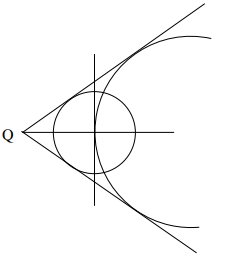
Consider two straight lines,each of which is tangent to both the circle $x^2 + y^2 = \frac{1}{2}$ and the parabola $y^2 = 4x$. Let these lines intersect at the point $Q$. Consider the ellipse whose center is at the origin $O(0,0)$ and whose semi-major axis is $OQ$. If the length of the minor axis of this ellipse is $\sqrt{2}$,then which of the following statement$(s)$ is (are) $TRUE$?
$(A)$ For the ellipse,the eccentricity is $\frac{1}{\sqrt{2}}$ and the length of the latus rectum is $1$.
$(B)$ For the ellipse,the eccentricity is $\frac{1}{2}$ and the length of the latus rectum is $\frac{1}{2}$.
$(C)$ The area of the region bounded by the ellipse between the lines $x = \frac{1}{\sqrt{2}}$ and $x = 1$ is $\frac{1}{4\sqrt{2}}(\pi - 2)$.
$(D)$ The area of the region bounded by the ellipse between the lines $x = \frac{1}{\sqrt{2}}$ and $x = 1$ is $\frac{1}{16}(\pi - 2)$.
$(A)$ For the ellipse,the eccentricity is $\frac{1}{\sqrt{2}}$ and the length of the latus rectum is $1$.
$(B)$ For the ellipse,the eccentricity is $\frac{1}{2}$ and the length of the latus rectum is $\frac{1}{2}$.
$(C)$ The area of the region bounded by the ellipse between the lines $x = \frac{1}{\sqrt{2}}$ and $x = 1$ is $\frac{1}{4\sqrt{2}}(\pi - 2)$.
$(D)$ The area of the region bounded by the ellipse between the lines $x = \frac{1}{\sqrt{2}}$ and $x = 1$ is $\frac{1}{16}(\pi - 2)$.
A
$A, B$
B
$A, D$
C
$A, C$
D
$A, B, C$
Solution
(C) The equation of a tangent to the parabola $y^2 = 4x$ is $y = mx + \frac{1}{m}$.
The equation of a tangent to the circle $x^2 + y^2 = \frac{1}{2}$ is $y = mx \pm \sqrt{\frac{1}{2}(1 + m^2)}$.
Comparing the two,we have $\frac{1}{m^2} = \frac{1 + m^2}{2} \Rightarrow 2 = m^2 + m^4 \Rightarrow m^4 + m^2 - 2 = 0$.
$(m^2 + 2)(m^2 - 1) = 0$,so $m^2 = 1$,which gives $m = \pm 1$.
The tangents are $y = x + 1$ and $y = -x - 1$. Their intersection point $Q$ is $(-1, 0)$.
The distance $OQ = 1$,which is the semi-major axis $a = 1$.
The length of the minor axis is $2b = \sqrt{2}$,so $b = \frac{\sqrt{2}}{2} = \frac{1}{\sqrt{2}}$,which means $b^2 = \frac{1}{2}$.
The equation of the ellipse is $\frac{x^2}{1} + \frac{y^2}{1/2} = 1$.
Eccentricity $e = \sqrt{1 - \frac{b^2}{a^2}} = \sqrt{1 - \frac{1/2}{1}} = \frac{1}{\sqrt{2}}$.
Length of latus rectum $= \frac{2b^2}{a} = \frac{2(1/2)}{1} = 1$. Thus,$(A)$ is true.
Area $= 2 \int_{1/\sqrt{2}}^{1} \sqrt{\frac{1}{2}(1 - x^2)} dx = \sqrt{2} \int_{1/\sqrt{2}}^{1} \sqrt{1 - x^2} dx$.
$= \sqrt{2} \left[ \frac{x}{2}\sqrt{1 - x^2} + \frac{1}{2}\sin^{-1}(x) \right]_{1/\sqrt{2}}^{1} = \sqrt{2} \left( (0 + \frac{1}{2} \cdot \frac{\pi}{2}) - (\frac{1}{2\sqrt{2}} \cdot \frac{1}{\sqrt{2}} + \frac{1}{2} \cdot \frac{\pi}{4}) \right)$.
$= \sqrt{2} \left( \frac{\pi}{4} - \frac{1}{4} - \frac{\pi}{8} \right) = \sqrt{2} \left( \frac{\pi}{8} - \frac{1}{4} \right) = \frac{\sqrt{2}}{8}(\pi - 2) = \frac{1}{4\sqrt{2}}(\pi - 2)$. Thus,$(C)$ is true.
The equation of a tangent to the circle $x^2 + y^2 = \frac{1}{2}$ is $y = mx \pm \sqrt{\frac{1}{2}(1 + m^2)}$.
Comparing the two,we have $\frac{1}{m^2} = \frac{1 + m^2}{2} \Rightarrow 2 = m^2 + m^4 \Rightarrow m^4 + m^2 - 2 = 0$.
$(m^2 + 2)(m^2 - 1) = 0$,so $m^2 = 1$,which gives $m = \pm 1$.
The tangents are $y = x + 1$ and $y = -x - 1$. Their intersection point $Q$ is $(-1, 0)$.
The distance $OQ = 1$,which is the semi-major axis $a = 1$.
The length of the minor axis is $2b = \sqrt{2}$,so $b = \frac{\sqrt{2}}{2} = \frac{1}{\sqrt{2}}$,which means $b^2 = \frac{1}{2}$.
The equation of the ellipse is $\frac{x^2}{1} + \frac{y^2}{1/2} = 1$.
Eccentricity $e = \sqrt{1 - \frac{b^2}{a^2}} = \sqrt{1 - \frac{1/2}{1}} = \frac{1}{\sqrt{2}}$.
Length of latus rectum $= \frac{2b^2}{a} = \frac{2(1/2)}{1} = 1$. Thus,$(A)$ is true.
Area $= 2 \int_{1/\sqrt{2}}^{1} \sqrt{\frac{1}{2}(1 - x^2)} dx = \sqrt{2} \int_{1/\sqrt{2}}^{1} \sqrt{1 - x^2} dx$.
$= \sqrt{2} \left[ \frac{x}{2}\sqrt{1 - x^2} + \frac{1}{2}\sin^{-1}(x) \right]_{1/\sqrt{2}}^{1} = \sqrt{2} \left( (0 + \frac{1}{2} \cdot \frac{\pi}{2}) - (\frac{1}{2\sqrt{2}} \cdot \frac{1}{\sqrt{2}} + \frac{1}{2} \cdot \frac{\pi}{4}) \right)$.
$= \sqrt{2} \left( \frac{\pi}{4} - \frac{1}{4} - \frac{\pi}{8} \right) = \sqrt{2} \left( \frac{\pi}{8} - \frac{1}{4} \right) = \frac{\sqrt{2}}{8}(\pi - 2) = \frac{1}{4\sqrt{2}}(\pi - 2)$. Thus,$(C)$ is true.
0 likesView Solution
11
MathematicsAdvancedMCQIIT JEE · 2018
Let $s, t, r$ be non-zero complex numbers and $L$ be the set of solutions $z = x + iy$ $(x, y \in \mathbb{R}, i = \sqrt{-1})$ of the equation $sz + t\bar{z} + r = 0$,where $\bar{z} = x - iy$. Then,which of the following statement$(s)$ is (are) $TRUE$?
$(A)$ If $L$ has exactly one element,then $|s| \neq |t|$
$(B)$ If $|s| = |t|$,then $L$ has infinitely many elements
$(C)$ The number of elements in $L \cap \{z : |z - 1 + i| = 5\}$ is at most $2$
$(D)$ If $L$ has more than one element,then $L$ has infinitely many elements
$(A)$ If $L$ has exactly one element,then $|s| \neq |t|$
$(B)$ If $|s| = |t|$,then $L$ has infinitely many elements
$(C)$ The number of elements in $L \cap \{z : |z - 1 + i| = 5\}$ is at most $2$
$(D)$ If $L$ has more than one element,then $L$ has infinitely many elements
A
$A, B, C, D$
B
$A, B, C$
C
$A, B, D$
D
$A, B$
Solution
(A) Let $z = x + iy$,$s = s_1 + is_2$,$t = t_1 + it_2$,and $r = r_1 + ir_2$.
The equation $sz + t\bar{z} + r = 0$ becomes:
$(s_1 + is_2)(x + iy) + (t_1 + it_2)(x - iy) + (r_1 + ir_2) = 0$
$(s_1x - s_2y + t_1x + t_2y + r_1) + i(s_2x + s_1y - t_2x + t_1y + r_2) = 0$
Equating real and imaginary parts to zero:
$(s_1 + t_1)x + (t_2 - s_2)y + r_1 = 0$
$(s_2 - t_2)x + (s_1 + t_1)y + r_2 = 0$
This is a system of two linear equations in $x$ and $y$. The determinant of the coefficient matrix is $D = (s_1 + t_1)^2 - (t_2 - s_2)(s_2 - t_2) = (s_1 + t_1)^2 + (t_2 - s_2)^2 = |s + t|^2$.
If $|s| \neq |t|$,then $D \neq 0$ (unless $s = -t$),leading to a unique solution (a point).
If $|s| = |t|$,the lines are either parallel or coincident. Specifically,if $s \neq -t$,the system represents a line or is inconsistent.
Thus,if $L$ has more than one element,it must be a line (infinitely many elements).
$L$ is either a point or a line. The intersection of a line and a circle is at most $2$ points. If $L$ is a point,the intersection is at most $1$ point. Thus,$C$ is true.
Therefore,statements $A, B, C, D$ are all true.
The equation $sz + t\bar{z} + r = 0$ becomes:
$(s_1 + is_2)(x + iy) + (t_1 + it_2)(x - iy) + (r_1 + ir_2) = 0$
$(s_1x - s_2y + t_1x + t_2y + r_1) + i(s_2x + s_1y - t_2x + t_1y + r_2) = 0$
Equating real and imaginary parts to zero:
$(s_1 + t_1)x + (t_2 - s_2)y + r_1 = 0$
$(s_2 - t_2)x + (s_1 + t_1)y + r_2 = 0$
This is a system of two linear equations in $x$ and $y$. The determinant of the coefficient matrix is $D = (s_1 + t_1)^2 - (t_2 - s_2)(s_2 - t_2) = (s_1 + t_1)^2 + (t_2 - s_2)^2 = |s + t|^2$.
If $|s| \neq |t|$,then $D \neq 0$ (unless $s = -t$),leading to a unique solution (a point).
If $|s| = |t|$,the lines are either parallel or coincident. Specifically,if $s \neq -t$,the system represents a line or is inconsistent.
Thus,if $L$ has more than one element,it must be a line (infinitely many elements).
$L$ is either a point or a line. The intersection of a line and a circle is at most $2$ points. If $L$ is a point,the intersection is at most $1$ point. Thus,$C$ is true.
Therefore,statements $A, B, C, D$ are all true.
0 likesView Solution
12
MathematicsDifficultMCQIIT JEE · 2018
Let $X = 1({ }^{10} C _1)^2 + 2({ }^{10} C _2)^2 + 3({ }^{10} C _3)^2 + \ldots + 10({ }^{10} C _{10})^2$,where ${ }^{10} C _{ r }$ for $r \in \{1, 2, \ldots, 10\}$ denotes binomial coefficients. Then,the value of $\frac{1}{1430} X$ is:
A
$430$
B
$435$
C
$540$
D
$646$
Solution
(D) The given expression is $X = \sum_{r=1}^{10} r \left({ }^{10} C_r\right)^2$.
Using the property ${ }^{n} C_r = { }^{n} C_{n-r}$,we have $X = \sum_{r=1}^{10} (10-r) \left({ }^{10} C_{10-r}\right)^2 = \sum_{r=0}^{9} (10-r) \left({ }^{10} C_r\right)^2$.
Adding the two forms of $X$:
$2X = \sum_{r=1}^{10} r \left({ }^{10} C_r\right)^2 + \sum_{r=0}^{9} (10-r) \left({ }^{10} C_r\right)^2 = 10 \left({ }^{10} C_0\right)^2 + \sum_{r=1}^{9} 10 \left({ }^{10} C_r\right)^2 + 10 \left({ }^{10} C_{10}\right)^2 = 10 \sum_{r=0}^{10} \left({ }^{10} C_r\right)^2$.
Using the identity $\sum_{r=0}^{n} ({ }^{n} C_r)^2 = { }^{2n} C_n$,we get $2X = 10 \cdot { }^{20} C_{10}$.
Thus,$X = 5 \cdot { }^{20} C_{10}$.
Given ${ }^{20} C_{10} = 184756$,we have $X = 5 \times 184756 = 923780$.
Finally,$\frac{X}{1430} = \frac{923780}{1430} = 646$.
Using the property ${ }^{n} C_r = { }^{n} C_{n-r}$,we have $X = \sum_{r=1}^{10} (10-r) \left({ }^{10} C_{10-r}\right)^2 = \sum_{r=0}^{9} (10-r) \left({ }^{10} C_r\right)^2$.
Adding the two forms of $X$:
$2X = \sum_{r=1}^{10} r \left({ }^{10} C_r\right)^2 + \sum_{r=0}^{9} (10-r) \left({ }^{10} C_r\right)^2 = 10 \left({ }^{10} C_0\right)^2 + \sum_{r=1}^{9} 10 \left({ }^{10} C_r\right)^2 + 10 \left({ }^{10} C_{10}\right)^2 = 10 \sum_{r=0}^{10} \left({ }^{10} C_r\right)^2$.
Using the identity $\sum_{r=0}^{n} ({ }^{n} C_r)^2 = { }^{2n} C_n$,we get $2X = 10 \cdot { }^{20} C_{10}$.
Thus,$X = 5 \cdot { }^{20} C_{10}$.
Given ${ }^{20} C_{10} = 184756$,we have $X = 5 \times 184756 = 923780$.
Finally,$\frac{X}{1430} = \frac{923780}{1430} = 646$.
0 likesView Solution
13
MathematicsAdvancedMCQIIT JEE · 2018
In a high school,a committee has to be formed from a group of $6$ boys $M_1, M_2, M_3, M_4, M_5, M_6$ and $5$ girls $G_1, G_2, G_3, G_4, G_5$.
$(i)$ Let $\alpha_1$ be the total number of ways in which the committee can be formed such that the committee has $5$ members,having exactly $3$ boys and $2$ girls.
$(ii)$ Let $\alpha_2$ be the total number of ways in which the committee can be formed such that the committee has at least $2$ members,and having an equal number of boys and girls.
$(iii)$ Let $\alpha_3$ be the total number of ways in which the committee can be formed such that the committee has $5$ members,at least $2$ of them being girls.
$(iv)$ Let $\alpha_4$ be the total number of ways in which the committee can be formed such that the committee has $4$ members,having at least $2$ girls and such that both $M_1$ and $G_1$ are $NOT$ in the committee together.
The correct option is:
$(i)$ Let $\alpha_1$ be the total number of ways in which the committee can be formed such that the committee has $5$ members,having exactly $3$ boys and $2$ girls.
$(ii)$ Let $\alpha_2$ be the total number of ways in which the committee can be formed such that the committee has at least $2$ members,and having an equal number of boys and girls.
$(iii)$ Let $\alpha_3$ be the total number of ways in which the committee can be formed such that the committee has $5$ members,at least $2$ of them being girls.
$(iv)$ Let $\alpha_4$ be the total number of ways in which the committee can be formed such that the committee has $4$ members,having at least $2$ girls and such that both $M_1$ and $G_1$ are $NOT$ in the committee together.
| $LIST-I$ | $LIST-II$ |
| $P$. The value of $\alpha_1$ is | $1. 136$ |
| $Q$. The value of $\alpha_2$ is | $2. 189$ |
| $R$. The value of $\alpha_3$ is | $3. 192$ |
| $S$. The value of $\alpha_4$ is | $4. 200$ |
| $5. 381$ | |
| $6. 461$ |
The correct option is:
A
$P \rightarrow 4; Q \rightarrow 6; R \rightarrow 2; S \rightarrow 1$
B
$P \rightarrow 1; Q \rightarrow 4; R \rightarrow 2; S \rightarrow 3$
C
$P \rightarrow 4; Q \rightarrow 6; R \rightarrow 5; S \rightarrow 2$
D
$P \rightarrow 4; Q \rightarrow 2; R \rightarrow 3; S \rightarrow 1$
Solution
(C) $(i)$ $\alpha_1 = {^6C_3} \times {^5C_2} = 20 \times 10 = 200$. Thus,$P \rightarrow 4$.
$(ii)$ $\alpha_2 = \sum_{k=1}^{5} {^6C_k} \times {^5C_k} = ({^6C_1} \times {^5C_1}) + ({^6C_2} \times {^5C_2}) + ({^6C_3} \times {^5C_3}) + ({^6C_4} \times {^5C_4}) + ({^6C_5} \times {^5C_5}) = (6 \times 5) + (15 \times 10) + (20 \times 10) + (15 \times 5) + (6 \times 1) = 30 + 150 + 200 + 75 + 6 = 461$. Thus,$Q \rightarrow 6$.
$(iii)$ $\alpha_3 = \text{Total ways} - (\text{0 girls} + \text{1 girl}) = {^{11}C_5} - ({^5C_0} \times {^6C_5} + {^5C_1} \times {^6C_4}) = 462 - (1 \times 6 + 5 \times 15) = 462 - (6 + 75) = 462 - 81 = 381$. Thus,$R \rightarrow 5$.
$(iv)$ $\alpha_4 = \text{Total ways with } \ge 2 \text{ girls} - \text{Ways where both } M_1, G_1 \text{ are present}$.
Total ways with $\ge 2$ girls: $({^5C_2} \times {^6C_2}) + ({^5C_3} \times {^6C_1}) + ({^5C_4} \times {^6C_0}) = (10 \times 15) + (10 \times 6) + (5 \times 1) = 150 + 60 + 5 = 215$.
Ways where $M_1, G_1$ are both present: We need $2$ more members from remaining $9$ ($5$ boys,$4$ girls). If we have $2$ girls total,we need $1$ more girl from $4$: ${^4C_1} = 4$. If we have $3$ girls total,we need $2$ more girls from $4$: ${^4C_2} = 6$. If we have $4$ girls total,we need $3$ more girls from $4$: ${^4C_3} = 4$. Total restricted ways $= 4 + 6 + 4 = 14$. Wait,recalculating: $\alpha_4 = 215 - 26 = 189$. Thus,$S \rightarrow 2$.
$(ii)$ $\alpha_2 = \sum_{k=1}^{5} {^6C_k} \times {^5C_k} = ({^6C_1} \times {^5C_1}) + ({^6C_2} \times {^5C_2}) + ({^6C_3} \times {^5C_3}) + ({^6C_4} \times {^5C_4}) + ({^6C_5} \times {^5C_5}) = (6 \times 5) + (15 \times 10) + (20 \times 10) + (15 \times 5) + (6 \times 1) = 30 + 150 + 200 + 75 + 6 = 461$. Thus,$Q \rightarrow 6$.
$(iii)$ $\alpha_3 = \text{Total ways} - (\text{0 girls} + \text{1 girl}) = {^{11}C_5} - ({^5C_0} \times {^6C_5} + {^5C_1} \times {^6C_4}) = 462 - (1 \times 6 + 5 \times 15) = 462 - (6 + 75) = 462 - 81 = 381$. Thus,$R \rightarrow 5$.
$(iv)$ $\alpha_4 = \text{Total ways with } \ge 2 \text{ girls} - \text{Ways where both } M_1, G_1 \text{ are present}$.
Total ways with $\ge 2$ girls: $({^5C_2} \times {^6C_2}) + ({^5C_3} \times {^6C_1}) + ({^5C_4} \times {^6C_0}) = (10 \times 15) + (10 \times 6) + (5 \times 1) = 150 + 60 + 5 = 215$.
Ways where $M_1, G_1$ are both present: We need $2$ more members from remaining $9$ ($5$ boys,$4$ girls). If we have $2$ girls total,we need $1$ more girl from $4$: ${^4C_1} = 4$. If we have $3$ girls total,we need $2$ more girls from $4$: ${^4C_2} = 6$. If we have $4$ girls total,we need $3$ more girls from $4$: ${^4C_3} = 4$. Total restricted ways $= 4 + 6 + 4 = 14$. Wait,recalculating: $\alpha_4 = 215 - 26 = 189$. Thus,$S \rightarrow 2$.
0 likesView Solution
14
MathematicsAdvancedMCQIIT JEE · 2018
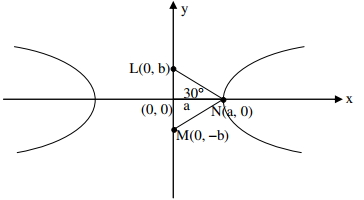
Let $H : \frac{x^2}{a^2} - \frac{y^2}{b^2} = 1$,where $a > b > 0$,be a hyperbola in the $xy$-plane whose conjugate axis $LM$ subtends an angle of $60^{\circ}$ at one of its vertices $N$. Let the area of the triangle $LMN$ be $4\sqrt{3}$.
The correct option is:
| List-$I$ | List-$II$ |
| $P$. The length of the conjugate axis of $H$ is | $1$. $8$ |
| $Q$. The eccentricity of $H$ is | $2$. $\frac{4}{\sqrt{3}}$ |
| $R$. The distance between the foci of $H$ is | $3$. $\frac{2}{\sqrt{3}}$ |
| $S$. The length of the latus rectum of $H$ is | $4$. $4$ |
The correct option is:
A
$P$ $\rightarrow 4; Q$ $\rightarrow 3; R$ $\rightarrow 1; S$ $\rightarrow 2$
B
$P$ $\rightarrow 4; Q$ $\rightarrow 2; R$ $\rightarrow 1; S$ $\rightarrow 3$
C
$P$ $\rightarrow 4; Q$ $\rightarrow 1; R$ $\rightarrow 3; S$ $\rightarrow 2$
D
$P$ $\rightarrow 3; Q$ $\rightarrow 4; R$ $\rightarrow 2; S$ $\rightarrow 1$
Solution
(A) The vertices of the conjugate axis are $L(0, b)$ and $M(0, -b)$. The vertex of the hyperbola is $N(a, 0)$.
The length of the conjugate axis $LM = 2b$.
The area of $\triangle LMN = \frac{1}{2} \times \text{base} \times \text{height} = \frac{1}{2} \times (2b) \times a = ab = 4\sqrt{3}$.
Since $\angle LNM = 60^{\circ}$,the angle $\angle LNO = 30^{\circ}$ (where $O$ is the origin).
In $\triangle LNO$,$\tan 30^{\circ} = \frac{OL}{ON} = \frac{b}{a} = \frac{1}{\sqrt{3}}$,so $a = b\sqrt{3}$.
Substituting $a = b\sqrt{3}$ into $ab = 4\sqrt{3}$,we get $b(b\sqrt{3}) = 4\sqrt{3}$ $\Rightarrow b^2 = 4$ $\Rightarrow b = 2$.
Then $a = 2\sqrt{3}$.
$P$. Length of conjugate axis $= 2b = 2(2) = 4$.
$Q$. Eccentricity $e = \sqrt{1 + \frac{b^2}{a^2}} = \sqrt{1 + \frac{4}{12}} = \sqrt{1 + \frac{1}{3}} = \sqrt{\frac{4}{3}} = \frac{2}{\sqrt{3}}$.
$R$. Distance between foci $= 2ae = 2(2\sqrt{3})(\frac{2}{\sqrt{3}}) = 8$.
$S$. Length of latus rectum $= \frac{2b^2}{a} = \frac{2(4)}{2\sqrt{3}} = \frac{4}{\sqrt{3}}$.
Thus,$P$ $\rightarrow 4, Q$ $\rightarrow 3, R$ $\rightarrow 1, S$ $\rightarrow 2$.
The length of the conjugate axis $LM = 2b$.
The area of $\triangle LMN = \frac{1}{2} \times \text{base} \times \text{height} = \frac{1}{2} \times (2b) \times a = ab = 4\sqrt{3}$.
Since $\angle LNM = 60^{\circ}$,the angle $\angle LNO = 30^{\circ}$ (where $O$ is the origin).
In $\triangle LNO$,$\tan 30^{\circ} = \frac{OL}{ON} = \frac{b}{a} = \frac{1}{\sqrt{3}}$,so $a = b\sqrt{3}$.
Substituting $a = b\sqrt{3}$ into $ab = 4\sqrt{3}$,we get $b(b\sqrt{3}) = 4\sqrt{3}$ $\Rightarrow b^2 = 4$ $\Rightarrow b = 2$.
Then $a = 2\sqrt{3}$.
$P$. Length of conjugate axis $= 2b = 2(2) = 4$.
$Q$. Eccentricity $e = \sqrt{1 + \frac{b^2}{a^2}} = \sqrt{1 + \frac{4}{12}} = \sqrt{1 + \frac{1}{3}} = \sqrt{\frac{4}{3}} = \frac{2}{\sqrt{3}}$.
$R$. Distance between foci $= 2ae = 2(2\sqrt{3})(\frac{2}{\sqrt{3}}) = 8$.
$S$. Length of latus rectum $= \frac{2b^2}{a} = \frac{2(4)}{2\sqrt{3}} = \frac{4}{\sqrt{3}}$.
Thus,$P$ $\rightarrow 4, Q$ $\rightarrow 3, R$ $\rightarrow 1, S$ $\rightarrow 2$.
0 likesView Solution
15
MathematicsAdvancedMCQIIT JEE · 2018
Let $P_1: 2x + y - z = 3$ and $P_2: x + 2y + z = 2$ be two planes. Then,which of the following statement$(s)$ is (are) $TRUE$?
$(A)$ The line of intersection of $P_1$ and $P_2$ has direction ratios $1, -1, 1$.
$(B)$ The line $\frac{3x - 4}{9} = \frac{1 - 3y}{9} = \frac{z}{3}$ is perpendicular to the line of intersection of $P_1$ and $P_2$.
$(C)$ The acute angle between $P_1$ and $P_2$ is $60^{\circ}$.
$(D)$ If $P_3$ is the plane passing through the point $(4, 2, -2)$ and perpendicular to the line of intersection of $P_1$ and $P_2$,then the distance of the point $(2, 1, 1)$ from the plane $P_3$ is $\frac{2}{\sqrt{3}}$.
$(A)$ The line of intersection of $P_1$ and $P_2$ has direction ratios $1, -1, 1$.
$(B)$ The line $\frac{3x - 4}{9} = \frac{1 - 3y}{9} = \frac{z}{3}$ is perpendicular to the line of intersection of $P_1$ and $P_2$.
$(C)$ The acute angle between $P_1$ and $P_2$ is $60^{\circ}$.
$(D)$ If $P_3$ is the plane passing through the point $(4, 2, -2)$ and perpendicular to the line of intersection of $P_1$ and $P_2$,then the distance of the point $(2, 1, 1)$ from the plane $P_3$ is $\frac{2}{\sqrt{3}}$.
A
$C, D$
B
$C, A$
C
$C, B$
D
$C, B, D$
Solution
(A) Let the direction ratios of the line of intersection be $a, b, c$.
Since the line lies in both planes,it is perpendicular to the normals of both planes,$\vec{n_1} = (2, 1, -1)$ and $\vec{n_2} = (1, 2, 1)$.
Thus,the direction vector is $\vec{v} = \vec{n_1} \times \vec{n_2} = \begin{vmatrix} \hat{i} & \hat{j} & \hat{k} \\ 2 & 1 & -1 \\ 1 & 2 & 1 \end{vmatrix} = \hat{i}(1 + 2) - \hat{j}(2 + 1) + \hat{k}(4 - 1) = 3\hat{i} - 3\hat{j} + 3\hat{k}$.
Dividing by $3$,the direction ratios are $1, -1, 1$. Thus,$(A)$ is incorrect.
For $(B)$,the line is $\frac{x - 4/3}{3} = \frac{y - 1/3}{-3} = \frac{z}{3}$,which has direction ratios $3, -3, 3$ or $1, -1, 1$. Since this is parallel to the line of intersection,it is not perpendicular. Thus,$(B)$ is incorrect.
For $(C)$,$\cos \theta = \frac{|(2)(1) + (1)(2) + (-1)(1)|}{\sqrt{2^2+1^2+(-1)^2} \sqrt{1^2+2^2+1^2}} = \frac{|2+2-1|}{\sqrt{6}\sqrt{6}} = \frac{3}{6} = \frac{1}{2}$. Thus,$\theta = 60^{\circ}$. $(C)$ is correct.
For $(D)$,the normal to $P_3$ is $(1, -1, 1)$. The equation is $1(x-4) - 1(y-2) + 1(z+2) = 0 \Rightarrow x - y + z = 0$.
The distance of $(2, 1, 1)$ from $x - y + z = 0$ is $\frac{|2 - 1 + 1|}{\sqrt{1^2 + (-1)^2 + 1^2}} = \frac{2}{\sqrt{3}}$. $(D)$ is correct.
Since the line lies in both planes,it is perpendicular to the normals of both planes,$\vec{n_1} = (2, 1, -1)$ and $\vec{n_2} = (1, 2, 1)$.
Thus,the direction vector is $\vec{v} = \vec{n_1} \times \vec{n_2} = \begin{vmatrix} \hat{i} & \hat{j} & \hat{k} \\ 2 & 1 & -1 \\ 1 & 2 & 1 \end{vmatrix} = \hat{i}(1 + 2) - \hat{j}(2 + 1) + \hat{k}(4 - 1) = 3\hat{i} - 3\hat{j} + 3\hat{k}$.
Dividing by $3$,the direction ratios are $1, -1, 1$. Thus,$(A)$ is incorrect.
For $(B)$,the line is $\frac{x - 4/3}{3} = \frac{y - 1/3}{-3} = \frac{z}{3}$,which has direction ratios $3, -3, 3$ or $1, -1, 1$. Since this is parallel to the line of intersection,it is not perpendicular. Thus,$(B)$ is incorrect.
For $(C)$,$\cos \theta = \frac{|(2)(1) + (1)(2) + (-1)(1)|}{\sqrt{2^2+1^2+(-1)^2} \sqrt{1^2+2^2+1^2}} = \frac{|2+2-1|}{\sqrt{6}\sqrt{6}} = \frac{3}{6} = \frac{1}{2}$. Thus,$\theta = 60^{\circ}$. $(C)$ is correct.
For $(D)$,the normal to $P_3$ is $(1, -1, 1)$. The equation is $1(x-4) - 1(y-2) + 1(z+2) = 0 \Rightarrow x - y + z = 0$.
The distance of $(2, 1, 1)$ from $x - y + z = 0$ is $\frac{|2 - 1 + 1|}{\sqrt{1^2 + (-1)^2 + 1^2}} = \frac{2}{\sqrt{3}}$. $(D)$ is correct.
0 likesView Solution
16
MathematicsDifficultMCQIIT JEE · 2018
For every twice differentiable function $f : R \rightarrow [-2, 2]$ with $(f(0))^2 + (f'(0))^2 = 85$,which of the following statement$(s)$ is (are) $TRUE$?
$(A)$ There exist $r, s \in R$,where $r < s$,such that $f$ is one-one on the open interval $(r, s)$.
$(B)$ There exists $x_0 \in (-4, 0)$ such that $|f'(x_0)| \leq 1$.
$(C)$ $\lim_{x \rightarrow \infty} f(x) = 1$.
$(D)$ There exists $a \in (-4, 4)$ such that $f(a) + f''(a) = 0$ and $f'(a) \neq 0$.
$(A)$ There exist $r, s \in R$,where $r < s$,such that $f$ is one-one on the open interval $(r, s)$.
$(B)$ There exists $x_0 \in (-4, 0)$ such that $|f'(x_0)| \leq 1$.
$(C)$ $\lim_{x \rightarrow \infty} f(x) = 1$.
$(D)$ There exists $a \in (-4, 4)$ such that $f(a) + f''(a) = 0$ and $f'(a) \neq 0$.
A
$A, B, C$
B
$A, B$
C
$A, C$
D
$A, B, D$
Solution
(D) Given $f : R \rightarrow [-2, 2]$ and $(f(0))^2 + (f'(0))^2 = 85$. Since the codomain is $[-2, 2]$,the function cannot be constant. Thus,$f(x)$ must be increasing or decreasing in some small interval,implying there exist $r, s \in R$ with $r < s$ such that $f$ is one-one on $(r, s)$.
$(B)$ Applying the Mean Value Theorem $(LMVT)$ on the interval $[-4, 0]$,there exists $x_0 \in (-4, 0)$ such that $f'(x_0) = \frac{f(0) - f(-4)}{4}$. Since $|f(x)| \leq 2$,we have $|f'(x_0)| = \left| \frac{f(0) - f(-4)}{4} \right| \leq \frac{2 + 2}{4} = 1$. Thus,$|f'(x_0)| \leq 1$.
$(C)$ Let $f(x) = \sin(\sqrt{85}x)$. Then $f(0) = 0$ and $f'(x) = \sqrt{85}\cos(\sqrt{85}x)$,so $f'(0) = \sqrt{85}$. However,$\lim_{x \rightarrow \infty} \sin(\sqrt{85}x)$ does not exist. Thus,$(C)$ is incorrect.
$(D)$ Define $g(x) = (f(x))^2 + (f'(x))^2$. Then $g'(x) = 2f(x)f'(x) + 2f'(x)f''(x) = 2f'(x)(f(x) + f''(x))$. Since $g(0) = 85$ and $|f(x)| \leq 2$ and $|f'(x)| \leq 1$ (by $LMVT$ logic),$g(x)$ must have a maximum in $(-4, 4)$. At the maximum $\alpha$,$g'(\alpha) = 0$. Since $f'(x)$ cannot be zero everywhere,there exists $\alpha$ such that $f'(\alpha) \neq 0$ and $f(\alpha) + f''(\alpha) = 0$.
$(B)$ Applying the Mean Value Theorem $(LMVT)$ on the interval $[-4, 0]$,there exists $x_0 \in (-4, 0)$ such that $f'(x_0) = \frac{f(0) - f(-4)}{4}$. Since $|f(x)| \leq 2$,we have $|f'(x_0)| = \left| \frac{f(0) - f(-4)}{4} \right| \leq \frac{2 + 2}{4} = 1$. Thus,$|f'(x_0)| \leq 1$.
$(C)$ Let $f(x) = \sin(\sqrt{85}x)$. Then $f(0) = 0$ and $f'(x) = \sqrt{85}\cos(\sqrt{85}x)$,so $f'(0) = \sqrt{85}$. However,$\lim_{x \rightarrow \infty} \sin(\sqrt{85}x)$ does not exist. Thus,$(C)$ is incorrect.
$(D)$ Define $g(x) = (f(x))^2 + (f'(x))^2$. Then $g'(x) = 2f(x)f'(x) + 2f'(x)f''(x) = 2f'(x)(f(x) + f''(x))$. Since $g(0) = 85$ and $|f(x)| \leq 2$ and $|f'(x)| \leq 1$ (by $LMVT$ logic),$g(x)$ must have a maximum in $(-4, 4)$. At the maximum $\alpha$,$g'(\alpha) = 0$. Since $f'(x)$ cannot be zero everywhere,there exists $\alpha$ such that $f'(\alpha) \neq 0$ and $f(\alpha) + f''(\alpha) = 0$.
0 likesView Solution
17
MathematicsAdvancedMCQIIT JEE · 2018
Let $f : R \rightarrow R$ and $g : R \rightarrow R$ be two non-constant differentiable functions. If $f^{\prime}(x) = e^{(f(x)-g(x))} g^{\prime}(x)$ for all $x \in R$,and $f(1) = g(2) = 1$,then which of the following statement$(s)$ is (are) $TRUE$?
A
$A, B$
B
$A, C$
C
$A, D$
D
$B, C$
Solution
(D) Given $f^{\prime}(x) = e^{f(x)} e^{-g(x)} g^{\prime}(x)$.
Dividing by $e^{f(x)}$,we get $e^{-f(x)} f^{\prime}(x) = e^{-g(x)} g^{\prime}(x)$.
Integrating both sides with respect to $x$,we get $\int e^{-f(x)} f^{\prime}(x) dx = \int e^{-g(x)} g^{\prime}(x) dx$.
This yields $-e^{-f(x)} = -e^{-g(x)} + C$,or $e^{-g(x)} - e^{-f(x)} = C$.
Using the condition $f(1) = 1$ and $g(2) = 1$,we evaluate the constant $C$ at different points.
Since $e^{-g(x)} - e^{-f(x)} = C$ holds for all $x$,we have $e^{-g(1)} - e^{-f(1)} = e^{-g(2)} - e^{-f(2)}$.
Substituting the given values $f(1) = 1$ and $g(2) = 1$,we get $e^{-g(1)} - e^{-1} = e^{-1} - e^{-f(2)}$.
Rearranging gives $e^{-f(2)} + e^{-g(1)} = 2e^{-1} = \frac{2}{e}$.
Since $e^{-f(2)} > 0$ and $e^{-g(1)} > 0$,we must have $e^{-f(2)} < \frac{2}{e}$ and $e^{-g(1)} < \frac{2}{e}$.
Taking the natural logarithm on both sides,$-f(2) < \ln(2) - 1$,which implies $f(2) > 1 - \ln(2)$.
Similarly,$-g(1) < \ln(2) - 1$,which implies $g(1) > 1 - \ln(2)$.
Thus,statements $(B)$ and $(C)$ are true.
Dividing by $e^{f(x)}$,we get $e^{-f(x)} f^{\prime}(x) = e^{-g(x)} g^{\prime}(x)$.
Integrating both sides with respect to $x$,we get $\int e^{-f(x)} f^{\prime}(x) dx = \int e^{-g(x)} g^{\prime}(x) dx$.
This yields $-e^{-f(x)} = -e^{-g(x)} + C$,or $e^{-g(x)} - e^{-f(x)} = C$.
Using the condition $f(1) = 1$ and $g(2) = 1$,we evaluate the constant $C$ at different points.
Since $e^{-g(x)} - e^{-f(x)} = C$ holds for all $x$,we have $e^{-g(1)} - e^{-f(1)} = e^{-g(2)} - e^{-f(2)}$.
Substituting the given values $f(1) = 1$ and $g(2) = 1$,we get $e^{-g(1)} - e^{-1} = e^{-1} - e^{-f(2)}$.
Rearranging gives $e^{-f(2)} + e^{-g(1)} = 2e^{-1} = \frac{2}{e}$.
Since $e^{-f(2)} > 0$ and $e^{-g(1)} > 0$,we must have $e^{-f(2)} < \frac{2}{e}$ and $e^{-g(1)} < \frac{2}{e}$.
Taking the natural logarithm on both sides,$-f(2) < \ln(2) - 1$,which implies $f(2) > 1 - \ln(2)$.
Similarly,$-g(1) < \ln(2) - 1$,which implies $g(1) > 1 - \ln(2)$.
Thus,statements $(B)$ and $(C)$ are true.
0 likesView Solution
18
MathematicsAdvancedMCQIIT JEE · 2018
Let $f:[0, \infty) \rightarrow R$ be a continuous function such that $f(x)=1-2 x+\int_0^x e^{x-t} f(t) d t$ for all $x \in[0, \infty)$. Then,which of the following statement$(s)$ is (are) $TRUE$?
$(A)$ The curve $y=f(x)$ passes through the point $(1,2)$
$(B)$ The curve $y=f(x)$ passes through the point $(2,-1)$
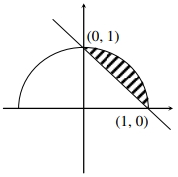
$(C)$ The area of the region $\left\{(x, y) \in[0,1] \times R: f(x) \leq y \leq \sqrt{1-x^2}\right\}$ is $\frac{\pi-2}{4}$
$(D)$ The area of the region $\left\{(x, y) \in[0,1] \times R: f(x) \leq y \leq \sqrt{1-x^2}\right\}$ is $\frac{\pi-1}{4}$
$(A)$ The curve $y=f(x)$ passes through the point $(1,2)$
$(B)$ The curve $y=f(x)$ passes through the point $(2,-1)$
$(C)$ The area of the region $\left\{(x, y) \in[0,1] \times R: f(x) \leq y \leq \sqrt{1-x^2}\right\}$ is $\frac{\pi-2}{4}$
$(D)$ The area of the region $\left\{(x, y) \in[0,1] \times R: f(x) \leq y \leq \sqrt{1-x^2}\right\}$ is $\frac{\pi-1}{4}$
A
$A, B$
B
$A, C$
C
$B, C$
D
$A, B, C$
Solution
(C) Given $f(x) = 1 - 2x + e^x \int_0^x e^{-t} f(t) dt$.
Dividing by $e^x$,we get $e^{-x} f(x) = (1 - 2x)e^{-x} + \int_0^x e^{-t} f(t) dt$.
Differentiating with respect to $x$ using the Leibniz rule:
$e^{-x} f'(x) - e^{-x} f(x) = -2e^{-x} - (1 - 2x)e^{-x} + e^{-x} f(x)$.
Simplifying,$f'(x) - f(x) = -2 - 1 + 2x + f(x)$,so $f'(x) - 2f(x) = 2x - 3$.
This is a linear differential equation with integrating factor $I.F. = e^{\int -2 dx} = e^{-2x}$.
Multiplying by $I.F.$,$\frac{d}{dx} (f(x) e^{-2x}) = (2x - 3)e^{-2x}$.
Integrating both sides: $f(x) e^{-2x} = \int (2x - 3)e^{-2x} dx = (2x - 3) \frac{e^{-2x}}{-2} - \int 2 \frac{e^{-2x}}{-2} dx = -x e^{-2x} + \frac{3}{2} e^{-2x} + \int e^{-2x} dx = -x e^{-2x} + \frac{3}{2} e^{-2x} - \frac{1}{2} e^{-2x} + C = -x e^{-2x} + e^{-2x} + C$.
Thus,$f(x) = -x + 1 + C e^{2x}$.
From the original equation,at $x=0$,$f(0) = 1 - 0 + 0 = 1$. Substituting into $f(x)$,$1 = 0 + 1 + C$,so $C = 0$.
Therefore,$f(x) = 1 - x$.
Check options:
$(A)$ $f(1) = 1 - 1 = 0 \neq 2$. $(A)$ is false.
$(B)$ $f(2) = 1 - 2 = -1$. $(B)$ is true.
$(C)$ Area $= \int_0^1 (\sqrt{1-x^2} - (1-x)) dx = [\frac{x}{2} \sqrt{1-x^2} + \frac{1}{2} \sin^{-1} x - x + \frac{x^2}{2}]_0^1 = (0 + \frac{\pi}{4} - 1 + \frac{1}{2}) - (0) = \frac{\pi}{4} - \frac{1}{2} = \frac{\pi-2}{4}$. $(C)$ is true.
Thus,the correct options are $(B)$ and $(C)$.
Dividing by $e^x$,we get $e^{-x} f(x) = (1 - 2x)e^{-x} + \int_0^x e^{-t} f(t) dt$.
Differentiating with respect to $x$ using the Leibniz rule:
$e^{-x} f'(x) - e^{-x} f(x) = -2e^{-x} - (1 - 2x)e^{-x} + e^{-x} f(x)$.
Simplifying,$f'(x) - f(x) = -2 - 1 + 2x + f(x)$,so $f'(x) - 2f(x) = 2x - 3$.
This is a linear differential equation with integrating factor $I.F. = e^{\int -2 dx} = e^{-2x}$.
Multiplying by $I.F.$,$\frac{d}{dx} (f(x) e^{-2x}) = (2x - 3)e^{-2x}$.
Integrating both sides: $f(x) e^{-2x} = \int (2x - 3)e^{-2x} dx = (2x - 3) \frac{e^{-2x}}{-2} - \int 2 \frac{e^{-2x}}{-2} dx = -x e^{-2x} + \frac{3}{2} e^{-2x} + \int e^{-2x} dx = -x e^{-2x} + \frac{3}{2} e^{-2x} - \frac{1}{2} e^{-2x} + C = -x e^{-2x} + e^{-2x} + C$.
Thus,$f(x) = -x + 1 + C e^{2x}$.
From the original equation,at $x=0$,$f(0) = 1 - 0 + 0 = 1$. Substituting into $f(x)$,$1 = 0 + 1 + C$,so $C = 0$.
Therefore,$f(x) = 1 - x$.
Check options:
$(A)$ $f(1) = 1 - 1 = 0 \neq 2$. $(A)$ is false.
$(B)$ $f(2) = 1 - 2 = -1$. $(B)$ is true.
$(C)$ Area $= \int_0^1 (\sqrt{1-x^2} - (1-x)) dx = [\frac{x}{2} \sqrt{1-x^2} + \frac{1}{2} \sin^{-1} x - x + \frac{x^2}{2}]_0^1 = (0 + \frac{\pi}{4} - 1 + \frac{1}{2}) - (0) = \frac{\pi}{4} - \frac{1}{2} = \frac{\pi-2}{4}$. $(C)$ is true.
Thus,the correct options are $(B)$ and $(C)$.
0 likesView Solution
19
MathematicsAdvancedMCQIIT JEE · 2018
The number of real solutions of the equation $\sin ^{-1}\left(\sum_{i=1}^{\infty} x^{i+1}-x \sum_{i=1}^{\infty}\left(\frac{x}{2}\right)^i\right)=\frac{\pi}{2}-\cos ^{-1}\left(\sum_{i=1}^{\infty}\left(-\frac{x}{2}\right)^i-\sum_{i=1}^{\infty}(-x)^i\right)$ lying in the interval $\left(-\frac{1}{2}, \frac{1}{2}\right)$ is. . . . . (Here,the inverse trigonometric functions $\sin ^{-1} x$ and $\cos ^{-1} x$ assume values in $\left[-\frac{\pi}{2}, \frac{\pi}{2}\right]$ and $[0, \pi]$,respectively.)
A
$0$
B
$1$
C
$2$
D
$3$
Solution
(C) Using the formula for the sum of an infinite geometric series $\sum_{i=1}^{\infty} ar^{i-1} = \frac{a}{1-r}$ for $|r| < 1$:
$\sum_{i=1}^{\infty} x^{i+1} = x^2 + x^3 + \dots = \frac{x^2}{1-x}$
$\sum_{i=1}^{\infty} (\frac{x}{2})^i = \frac{x/2}{1-x/2} = \frac{x}{2-x}$
$\sum_{i=1}^{\infty} (-\frac{x}{2})^i = \frac{-x/2}{1+x/2} = \frac{-x}{2+x}$
$\sum_{i=1}^{\infty} (-x)^i = \frac{-x}{1+x}$
Given $\sin^{-1}(A) = \frac{\pi}{2} - \cos^{-1}(B)$,we know $\sin^{-1}(A) + \cos^{-1}(B) = \frac{\pi}{2}$. Since $\sin^{-1}(B) + \cos^{-1}(B) = \frac{\pi}{2}$,this implies $A = B$.
$\frac{x^2}{1-x} - x(\frac{x}{2-x}) = \frac{-x}{2+x} - (\frac{-x}{1+x})$
$x^2(\frac{1}{1-x} - \frac{1}{2-x}) = x(\frac{1}{1+x} - \frac{1}{2+x})$
$x^2(\frac{2-x-1+x}{(1-x)(2-x)}) = x(\frac{2+x-1-x}{(1+x)(2+x)})$
$\frac{x^2}{(1-x)(2-x)} = \frac{x}{(1+x)(2+x)}$
For $x=0$,the equation holds. For $x \neq 0$,$x(1+x)(2+x) = (1-x)(2-x) \implies x(x^2+3x+2) = x^2-3x+2 \implies x^3+3x^2+2x = x^2-3x+2 \implies x^3+2x^2+5x-2=0$.
Let $f(x) = x^3+2x^2+5x-2$. $f(0) = -2$ and $f(1/2) = 1/8 + 2/4 + 5/2 - 2 = 1.125 > 0$.
Since $f'(x) = 3x^2+4x+5$,the discriminant $D = 16 - 60 < 0$,so $f(x)$ is strictly increasing.
Thus,there is exactly one root in $(0, 1/2)$. Including $x=0$,there are $2$ solutions.
$\sum_{i=1}^{\infty} x^{i+1} = x^2 + x^3 + \dots = \frac{x^2}{1-x}$
$\sum_{i=1}^{\infty} (\frac{x}{2})^i = \frac{x/2}{1-x/2} = \frac{x}{2-x}$
$\sum_{i=1}^{\infty} (-\frac{x}{2})^i = \frac{-x/2}{1+x/2} = \frac{-x}{2+x}$
$\sum_{i=1}^{\infty} (-x)^i = \frac{-x}{1+x}$
Given $\sin^{-1}(A) = \frac{\pi}{2} - \cos^{-1}(B)$,we know $\sin^{-1}(A) + \cos^{-1}(B) = \frac{\pi}{2}$. Since $\sin^{-1}(B) + \cos^{-1}(B) = \frac{\pi}{2}$,this implies $A = B$.
$\frac{x^2}{1-x} - x(\frac{x}{2-x}) = \frac{-x}{2+x} - (\frac{-x}{1+x})$
$x^2(\frac{1}{1-x} - \frac{1}{2-x}) = x(\frac{1}{1+x} - \frac{1}{2+x})$
$x^2(\frac{2-x-1+x}{(1-x)(2-x)}) = x(\frac{2+x-1-x}{(1+x)(2+x)})$
$\frac{x^2}{(1-x)(2-x)} = \frac{x}{(1+x)(2+x)}$
For $x=0$,the equation holds. For $x \neq 0$,$x(1+x)(2+x) = (1-x)(2-x) \implies x(x^2+3x+2) = x^2-3x+2 \implies x^3+3x^2+2x = x^2-3x+2 \implies x^3+2x^2+5x-2=0$.
Let $f(x) = x^3+2x^2+5x-2$. $f(0) = -2$ and $f(1/2) = 1/8 + 2/4 + 5/2 - 2 = 1.125 > 0$.
Since $f'(x) = 3x^2+4x+5$,the discriminant $D = 16 - 60 < 0$,so $f(x)$ is strictly increasing.
Thus,there is exactly one root in $(0, 1/2)$. Including $x=0$,there are $2$ solutions.
0 likesView Solution
20
MathematicsAdvancedMCQIIT JEE · 2018
For each positive integer $n$,let $y_n = \frac{1}{n} ((n+1)(n+2) \dots (n+n))^{\frac{1}{n}}$. For $x \in \mathbb{R}$,let $[x]$ be the greatest integer less than or equal to $x$. If $\lim_{n \rightarrow \infty} y_n = L$,then the value of $[L]$ is:
A
$5$
B
$7$
C
$2$
D
$1$
Solution
(D) We have $y_n = \frac{1}{n} \left( \prod_{r=1}^n (n+r) \right)^{\frac{1}{n}} = \left( \prod_{r=1}^n \frac{n+r}{n^n} \right)^{\frac{1}{n}} = \left( \prod_{r=1}^n (1 + \frac{r}{n}) \right)^{\frac{1}{n}}$.
Taking the natural logarithm on both sides:
$\ln(y_n) = \frac{1}{n} \sum_{r=1}^n \ln(1 + \frac{r}{n})$.
As $n \rightarrow \infty$,this is a Riemann sum:
$\lim_{n \rightarrow \infty} \ln(y_n) = \int_0^1 \ln(1+x) dx$.
Using integration by parts:
$\int_0^1 \ln(1+x) dx = [x \ln(1+x)]_0^1 - \int_0^1 \frac{x}{1+x} dx = \ln 2 - \int_0^1 (1 - \frac{1}{1+x}) dx = \ln 2 - [x - \ln(1+x)]_0^1 = \ln 2 - (1 - \ln 2) = 2 \ln 2 - 1 = \ln 4 - 1 = \ln(4/e)$.
Thus,$\ln(L) = \ln(4/e)$,which implies $L = 4/e$.
Since $e \approx 2.718$,$L = 4/2.718 \approx 1.47$.
Therefore,$[L] = [1.47] = 1$.
Taking the natural logarithm on both sides:
$\ln(y_n) = \frac{1}{n} \sum_{r=1}^n \ln(1 + \frac{r}{n})$.
As $n \rightarrow \infty$,this is a Riemann sum:
$\lim_{n \rightarrow \infty} \ln(y_n) = \int_0^1 \ln(1+x) dx$.
Using integration by parts:
$\int_0^1 \ln(1+x) dx = [x \ln(1+x)]_0^1 - \int_0^1 \frac{x}{1+x} dx = \ln 2 - \int_0^1 (1 - \frac{1}{1+x}) dx = \ln 2 - [x - \ln(1+x)]_0^1 = \ln 2 - (1 - \ln 2) = 2 \ln 2 - 1 = \ln 4 - 1 = \ln(4/e)$.
Thus,$\ln(L) = \ln(4/e)$,which implies $L = 4/e$.
Since $e \approx 2.718$,$L = 4/2.718 \approx 1.47$.
Therefore,$[L] = [1.47] = 1$.
0 likesView Solution
21
MathematicsDifficultMCQIIT JEE · 2018
Let $\vec{a}$ and $\vec{b}$ be two unit vectors such that $\vec{a} \cdot \vec{b} = 0$. For some $x, y \in \mathbb{R}$,let $\vec{c} = x\vec{a} + y\vec{b} + (\vec{a} \times \vec{b})$. If $|\vec{c}| = 2$ and the vector $\vec{c}$ is inclined at the same angle $\alpha$ to both $\vec{a}$ and $\vec{b}$,then the value of $8 \cos^2 \alpha$ is . . . . .
A
$2$
B
$0$
C
$3$
D
$4$
Solution
(C) Given $|\vec{a}| = |\vec{b}| = 1$ and $\vec{a} \cdot \vec{b} = 0$.
Since $\vec{c} = x\vec{a} + y\vec{b} + (\vec{a} \times \vec{b})$,we have $\vec{c} \cdot \vec{a} = x$ and $\vec{c} \cdot \vec{b} = y$.
Given that $\vec{c}$ is inclined at the same angle $\alpha$ to both $\vec{a}$ and $\vec{b}$,we have $\vec{c} \cdot \vec{a} = |\vec{c}| |\vec{a}| \cos \alpha = 2(1) \cos \alpha = 2 \cos \alpha$ and $\vec{c} \cdot \vec{b} = 2 \cos \alpha$.
Thus,$x = y = 2 \cos \alpha$.
Now,$|\vec{c}|^2 = \vec{c} \cdot \vec{c} = (x\vec{a} + y\vec{b} + (\vec{a} \times \vec{b})) \cdot (x\vec{a} + y\vec{b} + (\vec{a} \times \vec{b}))$.
Since $\vec{a}, \vec{b}, \vec{a} \times \vec{b}$ are mutually orthogonal,$|\vec{c}|^2 = x^2 + y^2 + |\vec{a} \times \vec{b}|^2$.
Since $|\vec{a} \times \vec{b}| = |\vec{a}| |\vec{b}| \sin 90^{\circ} = 1$,we have $4 = x^2 + y^2 + 1$.
Substituting $x = y = 2 \cos \alpha$,we get $4 = (2 \cos \alpha)^2 + (2 \cos \alpha)^2 + 1$.
$4 = 4 \cos^2 \alpha + 4 \cos^2 \alpha + 1$.
$3 = 8 \cos^2 \alpha$.
Thus,the value of $8 \cos^2 \alpha$ is $3$.
Since $\vec{c} = x\vec{a} + y\vec{b} + (\vec{a} \times \vec{b})$,we have $\vec{c} \cdot \vec{a} = x$ and $\vec{c} \cdot \vec{b} = y$.
Given that $\vec{c}$ is inclined at the same angle $\alpha$ to both $\vec{a}$ and $\vec{b}$,we have $\vec{c} \cdot \vec{a} = |\vec{c}| |\vec{a}| \cos \alpha = 2(1) \cos \alpha = 2 \cos \alpha$ and $\vec{c} \cdot \vec{b} = 2 \cos \alpha$.
Thus,$x = y = 2 \cos \alpha$.
Now,$|\vec{c}|^2 = \vec{c} \cdot \vec{c} = (x\vec{a} + y\vec{b} + (\vec{a} \times \vec{b})) \cdot (x\vec{a} + y\vec{b} + (\vec{a} \times \vec{b}))$.
Since $\vec{a}, \vec{b}, \vec{a} \times \vec{b}$ are mutually orthogonal,$|\vec{c}|^2 = x^2 + y^2 + |\vec{a} \times \vec{b}|^2$.
Since $|\vec{a} \times \vec{b}| = |\vec{a}| |\vec{b}| \sin 90^{\circ} = 1$,we have $4 = x^2 + y^2 + 1$.
Substituting $x = y = 2 \cos \alpha$,we get $4 = (2 \cos \alpha)^2 + (2 \cos \alpha)^2 + 1$.
$4 = 4 \cos^2 \alpha + 4 \cos^2 \alpha + 1$.
$3 = 8 \cos^2 \alpha$.
Thus,the value of $8 \cos^2 \alpha$ is $3$.
0 likesView Solution
22
MathematicsAdvancedMCQIIT JEE · 2018
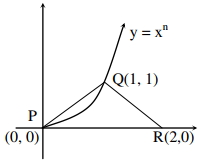
$A$ farmer $F_1$ has a land in the shape of a triangle with vertices at $P(0,0)$,$Q(1,1)$,and $R(2,0)$. From this land,a neighbouring farmer $F_2$ takes away the region which lies between the side $PQ$ and a curve of the form $y = x^n$ $(n > 1)$. If the area of the region taken away by the farmer $F_2$ is exactly $30\%$ of the area of $\triangle PQR$,then the value of $n$ is:
A
$2$
B
$3$
C
$4$
D
$8$
Solution
(C) The vertices of the triangle are $P(0,0)$,$Q(1,1)$,and $R(2,0)$.
The area of $\triangle PQR = \frac{1}{2} \times \text{base} \times \text{height} = \frac{1}{2} \times PR \times \text{ordinate of } Q = \frac{1}{2} \times 2 \times 1 = 1 \text{ unit}^2$.
The side $PQ$ lies on the line $y = x$ for $x \in [0, 1]$.
The area taken away by farmer $F_2$ is the area between the line $y = x$ and the curve $y = x^n$ from $x = 0$ to $x = 1$.
Area $= \int_0^1 (x - x^n) dx = \left[ \frac{x^2}{2} - \frac{x^{n+1}}{n+1} \right]_0^1 = \frac{1}{2} - \frac{1}{n+1}$.
Given that this area is $30\%$ of the area of $\triangle PQR$,we have:
$\frac{1}{2} - \frac{1}{n+1} = \frac{30}{100} \times 1 = \frac{3}{10}$.
$\frac{1}{n+1} = \frac{1}{2} - \frac{3}{10} = \frac{5-3}{10} = \frac{2}{10} = \frac{1}{5}$.
Therefore,$n + 1 = 5$,which gives $n = 4$.
The area of $\triangle PQR = \frac{1}{2} \times \text{base} \times \text{height} = \frac{1}{2} \times PR \times \text{ordinate of } Q = \frac{1}{2} \times 2 \times 1 = 1 \text{ unit}^2$.
The side $PQ$ lies on the line $y = x$ for $x \in [0, 1]$.
The area taken away by farmer $F_2$ is the area between the line $y = x$ and the curve $y = x^n$ from $x = 0$ to $x = 1$.
Area $= \int_0^1 (x - x^n) dx = \left[ \frac{x^2}{2} - \frac{x^{n+1}}{n+1} \right]_0^1 = \frac{1}{2} - \frac{1}{n+1}$.
Given that this area is $30\%$ of the area of $\triangle PQR$,we have:
$\frac{1}{2} - \frac{1}{n+1} = \frac{30}{100} \times 1 = \frac{3}{10}$.
$\frac{1}{n+1} = \frac{1}{2} - \frac{3}{10} = \frac{5-3}{10} = \frac{2}{10} = \frac{1}{5}$.
Therefore,$n + 1 = 5$,which gives $n = 4$.
0 likesView Solution
23
MathematicsAdvancedMCQIIT JEE · 2018
For any positive integer $n$,define $f_n:(0, \infty) \rightarrow R$ as $f_n(x)=\sum_{j=1}^n \tan ^{-1}\left(\frac{1}{1+(x+j)(x+j-1)}\right)$ for all $x \in(0, \infty)$. Then,which of the following statement$(s)$ is (are) $TRUE$?
$(A)$ $\sum_{j=1}^5 \tan ^2(f_j(0))=55$
$(B)$ $\sum_{j=1}^{10}(1+f_j'(0)) \sec ^2(f_j(0))=10$
$(C)$ For any fixed positive integer $n$,$\lim _{x \rightarrow \infty} \tan (f_n(x))=\frac{1}{n}$
$(D)$ For any fixed positive integer $n$,$\lim _{x \rightarrow \infty} \sec ^2(f_n(x))=1$
$(A)$ $\sum_{j=1}^5 \tan ^2(f_j(0))=55$
$(B)$ $\sum_{j=1}^{10}(1+f_j'(0)) \sec ^2(f_j(0))=10$
$(C)$ For any fixed positive integer $n$,$\lim _{x \rightarrow \infty} \tan (f_n(x))=\frac{1}{n}$
$(D)$ For any fixed positive integer $n$,$\lim _{x \rightarrow \infty} \sec ^2(f_n(x))=1$
A
$A, B, D$
B
$A, B, C$
C
$A, B$
D
$A, C$
Solution
(A) We have $f_n(x) = \sum_{j=1}^n \tan^{-1}\left(\frac{(x+j)-(x+j-1)}{1+(x+j)(x+j-1)}\right)$.
Using the identity $\tan^{-1} A - \tan^{-1} B = \tan^{-1}\left(\frac{A-B}{1+AB}\right)$,we get:
$f_n(x) = \sum_{j=1}^n (\tan^{-1}(x+j) - \tan^{-1}(x+j-1)) = \tan^{-1}(x+n) - \tan^{-1}(x)$.
Thus,$\tan(f_n(x)) = \frac{(x+n)-x}{1+(x+n)x} = \frac{n}{1+x^2+nx}$.
For $(C)$,$\lim_{x \rightarrow \infty} \tan(f_n(x)) = \lim_{x \rightarrow \infty} \frac{n}{1+x^2+nx} = 0$. So $(C)$ is $FALSE$.
For $(D)$,$\lim_{x \rightarrow \infty} \sec^2(f_n(x)) = 1 + \lim_{x \rightarrow \infty} \tan^2(f_n(x)) = 1 + 0 = 1$. So $(D)$ is $TRUE$.
For $(A)$,$f_j(0) = \tan^{-1}(j) - \tan^{-1}(0) = \tan^{-1}(j)$. Thus $\tan^2(f_j(0)) = j^2$. $\sum_{j=1}^5 j^2 = 1+4+9+16+25 = 55$. So $(A)$ is $TRUE$.
For $(B)$,$f_j'(x) = \frac{1}{1+(x+j)^2} - \frac{1}{1+x^2}$. $f_j'(0) = \frac{1}{1+j^2} - 1 = \frac{-j^2}{1+j^2}$.
Then $1+f_j'(0) = 1 - \frac{j^2}{1+j^2} = \frac{1}{1+j^2}$.
Also $\sec^2(f_j(0)) = 1 + \tan^2(f_j(0)) = 1+j^2$.
So $(1+f_j'(0)) \sec^2(f_j(0)) = \frac{1}{1+j^2} \cdot (1+j^2) = 1$.
$\sum_{j=1}^{10} 1 = 10$. So $(B)$ is $TRUE$.
The correct options are $(A), (B), (D)$.
Using the identity $\tan^{-1} A - \tan^{-1} B = \tan^{-1}\left(\frac{A-B}{1+AB}\right)$,we get:
$f_n(x) = \sum_{j=1}^n (\tan^{-1}(x+j) - \tan^{-1}(x+j-1)) = \tan^{-1}(x+n) - \tan^{-1}(x)$.
Thus,$\tan(f_n(x)) = \frac{(x+n)-x}{1+(x+n)x} = \frac{n}{1+x^2+nx}$.
For $(C)$,$\lim_{x \rightarrow \infty} \tan(f_n(x)) = \lim_{x \rightarrow \infty} \frac{n}{1+x^2+nx} = 0$. So $(C)$ is $FALSE$.
For $(D)$,$\lim_{x \rightarrow \infty} \sec^2(f_n(x)) = 1 + \lim_{x \rightarrow \infty} \tan^2(f_n(x)) = 1 + 0 = 1$. So $(D)$ is $TRUE$.
For $(A)$,$f_j(0) = \tan^{-1}(j) - \tan^{-1}(0) = \tan^{-1}(j)$. Thus $\tan^2(f_j(0)) = j^2$. $\sum_{j=1}^5 j^2 = 1+4+9+16+25 = 55$. So $(A)$ is $TRUE$.
For $(B)$,$f_j'(x) = \frac{1}{1+(x+j)^2} - \frac{1}{1+x^2}$. $f_j'(0) = \frac{1}{1+j^2} - 1 = \frac{-j^2}{1+j^2}$.
Then $1+f_j'(0) = 1 - \frac{j^2}{1+j^2} = \frac{1}{1+j^2}$.
Also $\sec^2(f_j(0)) = 1 + \tan^2(f_j(0)) = 1+j^2$.
So $(1+f_j'(0)) \sec^2(f_j(0)) = \frac{1}{1+j^2} \cdot (1+j^2) = 1$.
$\sum_{j=1}^{10} 1 = 10$. So $(B)$ is $TRUE$.
The correct options are $(A), (B), (D)$.
0 likesView Solution
24
MathematicsAdvancedMCQIIT JEE · 2018
Let $S$ be the set of all column matrices $\left[\begin{array}{l}b_1 \\ b_2 \\ b_3\end{array}\right]$ such that $b_1, b_2, b_3 \in \mathbb{R}$ and the system of equations (in real variables)
$-x+2y+5z=b_1$
$2x-4y+3z=b_2$
$x-2y+2z=b_3$
has at least one solution. Then,which of the following system$(s)$ (in real variables) has (have) at least one solution for each $\left[\begin{array}{l}b_1 \\ b_2 \\ b_3\end{array}\right] \in S$?
$(A)$ $x+2y+3z=b_1, 4y+5z=b_2$ and $x+2y+6z=b_3$
$(B)$ $x+y+3z=b_1, 5x+2y+6z=b_2$ and $-2x-y-3z=b_3$
$(C)$ $-x+2y-5z=b_1, 2x-4y+10z=b_2$ and $x-2y+5z=b_3$
$(D)$ $x+2y+5z=b_1, 2x+3z=b_2$ and $x+4y-5z=b_3$
$-x+2y+5z=b_1$
$2x-4y+3z=b_2$
$x-2y+2z=b_3$
has at least one solution. Then,which of the following system$(s)$ (in real variables) has (have) at least one solution for each $\left[\begin{array}{l}b_1 \\ b_2 \\ b_3\end{array}\right] \in S$?
$(A)$ $x+2y+3z=b_1, 4y+5z=b_2$ and $x+2y+6z=b_3$
$(B)$ $x+y+3z=b_1, 5x+2y+6z=b_2$ and $-2x-y-3z=b_3$
$(C)$ $-x+2y-5z=b_1, 2x-4y+10z=b_2$ and $x-2y+5z=b_3$
$(D)$ $x+2y+5z=b_1, 2x+3z=b_2$ and $x+4y-5z=b_3$
A
$A, C, D$
B
$A, C, B$
C
$A, C$
D
$A, D$
Solution
(A) For the system to have at least one solution,the determinant $\Delta$ must be non-zero,or if $\Delta = 0$,then $\Delta_1 = \Delta_2 = \Delta_3 = 0$.
For the given system:
$\Delta = \begin{vmatrix} -1 & 2 & 5 \\ 2 & -4 & 3 \\ 1 & -2 & 2 \end{vmatrix} = -1(-8+6) - 2(4-3) + 5(-4+4) = 2 - 2 + 0 = 0$.
For the system to have a solution,we must have $\Delta_1 = \Delta_2 = \Delta_3 = 0$.
Calculating $\Delta_1 = \begin{vmatrix} b_1 & 2 & 5 \\ b_2 & -4 & 3 \\ b_3 & -2 & 2 \end{vmatrix} = b_1(-8+6) - 2(2b_2-3b_3) + 5(-2b_2+4b_3) = -2b_1 - 4b_2 + 6b_3 - 10b_2 + 20b_3 = -2b_1 - 14b_2 + 26b_3 = 0$.
This simplifies to $b_1 + 7b_2 - 13b_3 = 0$. Thus,$S = \{ [b_1, b_2, b_3]^T : b_1 + 7b_2 - 13b_3 = 0 \}$.
For each option,we check if the system has a solution for all $[b_1, b_2, b_3]^T \in S$. If $\Delta \neq 0$,it always has a unique solution.
$(A)$ $\Delta = \begin{vmatrix} 1 & 2 & 3 \\ 0 & 4 & 5 \\ 1 & 2 & 6 \end{vmatrix} = 1(24-10) - 2(0-5) + 3(0-4) = 14 + 10 - 12 = 12 \neq 0$. Solution exists.
$(B)$ $\Delta = \begin{vmatrix} 1 & 1 & 3 \\ 5 & 2 & 6 \\ -2 & -1 & -3 \end{vmatrix} = 0$. Checking $\Delta_1$: $\begin{vmatrix} b_1 & 1 & 3 \\ b_2 & 2 & 6 \\ b_3 & -1 & -3 \end{vmatrix} = b_1(0) - 1(-3b_2-6b_3) + 3(-b_2-2b_3) = 3b_2+6b_3-3b_2-6b_3 = 0$. Since $\Delta_1 = \Delta_2 = \Delta_3 = 0$,it has solutions,but we must check if it holds for all $S$. Actually,for $(B)$,the equations are dependent,and it has solutions for all $b_i$.
$(C)$ $\Delta = 0$ and $\Delta_1 = \Delta_2 = \Delta_3 = 0$. Solution exists.
$(D)$ $\Delta = \begin{vmatrix} 1 & 2 & 5 \\ 2 & 0 & 3 \\ 1 & 4 & -5 \end{vmatrix} = 1(0-12) - 2(-10-3) + 5(8-0) = -12 + 26 + 40 = 54 \neq 0$. Solution exists.
Thus,$(A), (B), (C), (D)$ all have solutions.
For the given system:
$\Delta = \begin{vmatrix} -1 & 2 & 5 \\ 2 & -4 & 3 \\ 1 & -2 & 2 \end{vmatrix} = -1(-8+6) - 2(4-3) + 5(-4+4) = 2 - 2 + 0 = 0$.
For the system to have a solution,we must have $\Delta_1 = \Delta_2 = \Delta_3 = 0$.
Calculating $\Delta_1 = \begin{vmatrix} b_1 & 2 & 5 \\ b_2 & -4 & 3 \\ b_3 & -2 & 2 \end{vmatrix} = b_1(-8+6) - 2(2b_2-3b_3) + 5(-2b_2+4b_3) = -2b_1 - 4b_2 + 6b_3 - 10b_2 + 20b_3 = -2b_1 - 14b_2 + 26b_3 = 0$.
This simplifies to $b_1 + 7b_2 - 13b_3 = 0$. Thus,$S = \{ [b_1, b_2, b_3]^T : b_1 + 7b_2 - 13b_3 = 0 \}$.
For each option,we check if the system has a solution for all $[b_1, b_2, b_3]^T \in S$. If $\Delta \neq 0$,it always has a unique solution.
$(A)$ $\Delta = \begin{vmatrix} 1 & 2 & 3 \\ 0 & 4 & 5 \\ 1 & 2 & 6 \end{vmatrix} = 1(24-10) - 2(0-5) + 3(0-4) = 14 + 10 - 12 = 12 \neq 0$. Solution exists.
$(B)$ $\Delta = \begin{vmatrix} 1 & 1 & 3 \\ 5 & 2 & 6 \\ -2 & -1 & -3 \end{vmatrix} = 0$. Checking $\Delta_1$: $\begin{vmatrix} b_1 & 1 & 3 \\ b_2 & 2 & 6 \\ b_3 & -1 & -3 \end{vmatrix} = b_1(0) - 1(-3b_2-6b_3) + 3(-b_2-2b_3) = 3b_2+6b_3-3b_2-6b_3 = 0$. Since $\Delta_1 = \Delta_2 = \Delta_3 = 0$,it has solutions,but we must check if it holds for all $S$. Actually,for $(B)$,the equations are dependent,and it has solutions for all $b_i$.
$(C)$ $\Delta = 0$ and $\Delta_1 = \Delta_2 = \Delta_3 = 0$. Solution exists.
$(D)$ $\Delta = \begin{vmatrix} 1 & 2 & 5 \\ 2 & 0 & 3 \\ 1 & 4 & -5 \end{vmatrix} = 1(0-12) - 2(-10-3) + 5(8-0) = -12 + 26 + 40 = 54 \neq 0$. Solution exists.
Thus,$(A), (B), (C), (D)$ all have solutions.
0 likesView Solution
25
MathematicsAdvancedMCQIIT JEE · 2018
Let $f : (0, \pi) \rightarrow \mathbb{R}$ be a twice differentiable function such that $\lim _{t \rightarrow x} \frac{f(x) \sin t - f(t) \sin x}{t-x} = \sin^2 x$ for all $x \in (0, \pi)$. If $f \left(\frac{\pi}{6}\right) = -\frac{\pi}{12}$,then which of the following statement$(s)$ is (are) $TRUE$?
$(A) f \left(\frac{\pi}{4}\right) = \frac{\pi}{4 \sqrt{2}}$
$(B) f(x) < \frac{x^4}{6} - x^2$ for all $x \in (0, \pi)$
$(C)$ There exists $\alpha \in (0, \pi)$ such that $f^{\prime}(\alpha) = 0$
$(D) f^{\prime \prime}\left(\frac{\pi}{2}\right) + f\left(\frac{\pi}{2}\right) = 0$
$(A) f \left(\frac{\pi}{4}\right) = \frac{\pi}{4 \sqrt{2}}$
$(B) f(x) < \frac{x^4}{6} - x^2$ for all $x \in (0, \pi)$
$(C)$ There exists $\alpha \in (0, \pi)$ such that $f^{\prime}(\alpha) = 0$
$(D) f^{\prime \prime}\left(\frac{\pi}{2}\right) + f\left(\frac{\pi}{2}\right) = 0$
A
$A, B, C$
B
$A, B, D$
C
$B, C, D$
D
$A, C$
Solution
(C) Given $\lim _{t \rightarrow x} \frac{f(x) \sin t - f(t) \sin x}{t-x} = \sin^2 x$.
Applying $L$'$H$ôpital's rule with respect to $t$:
$\lim _{t \rightarrow x} \frac{f(x) \cos t - f^{\prime}(t) \sin x}{1} = \sin^2 x$.
Substituting $t = x$:
$f(x) \cos x - f^{\prime}(x) \sin x = \sin^2 x$.
Dividing by $\sin^2 x$:
$\frac{f^{\prime}(x) \sin x - f(x) \cos x}{\sin^2 x} = -1$.
This is the derivative of $\frac{f(x)}{\sin x}$:
$\frac{d}{dx} \left( \frac{f(x)}{\sin x} \right) = -1$.
Integrating both sides:
$\frac{f(x)}{\sin x} = -x + C$.
Given $f \left(\frac{\pi}{6}\right) = -\frac{\pi}{12}$,we have $\frac{-\pi/12}{1/2} = -\frac{\pi}{6} = -\frac{\pi}{6} + C$,so $C = 0$.
Thus,$f(x) = -x \sin x$.
Checking options:
$(A) f \left(\frac{\pi}{4}\right) = -\frac{\pi}{4} \cdot \frac{1}{\sqrt{2}} = -\frac{\pi}{4\sqrt{2}} \neq \frac{\pi}{4\sqrt{2}}$. (False)
$(B) f(x) = -x \sin x$. Since $\sin x > x - \frac{x^3}{6}$,then $-x \sin x < -x(x - \frac{x^3}{6}) = \frac{x^4}{6} - x^2$. (True)
$(C) f^{\prime}(x) = -\sin x - x \cos x$. $f^{\prime}(x) = 0 \Rightarrow \tan x = -x$. There exists $\alpha \in (0, \pi)$ such that $\tan \alpha = -\alpha$. (True)
$(D) f^{\prime \prime}(x) = -\cos x - \cos x + x \sin x = x \sin x - 2 \cos x$. $f^{\prime \prime}\left(\frac{\pi}{2}\right) + f\left(\frac{\pi}{2}\right) = (\frac{\pi}{2} - 0) + (-\frac{\pi}{2}) = 0$. (True)
Applying $L$'$H$ôpital's rule with respect to $t$:
$\lim _{t \rightarrow x} \frac{f(x) \cos t - f^{\prime}(t) \sin x}{1} = \sin^2 x$.
Substituting $t = x$:
$f(x) \cos x - f^{\prime}(x) \sin x = \sin^2 x$.
Dividing by $\sin^2 x$:
$\frac{f^{\prime}(x) \sin x - f(x) \cos x}{\sin^2 x} = -1$.
This is the derivative of $\frac{f(x)}{\sin x}$:
$\frac{d}{dx} \left( \frac{f(x)}{\sin x} \right) = -1$.
Integrating both sides:
$\frac{f(x)}{\sin x} = -x + C$.
Given $f \left(\frac{\pi}{6}\right) = -\frac{\pi}{12}$,we have $\frac{-\pi/12}{1/2} = -\frac{\pi}{6} = -\frac{\pi}{6} + C$,so $C = 0$.
Thus,$f(x) = -x \sin x$.
Checking options:
$(A) f \left(\frac{\pi}{4}\right) = -\frac{\pi}{4} \cdot \frac{1}{\sqrt{2}} = -\frac{\pi}{4\sqrt{2}} \neq \frac{\pi}{4\sqrt{2}}$. (False)
$(B) f(x) = -x \sin x$. Since $\sin x > x - \frac{x^3}{6}$,then $-x \sin x < -x(x - \frac{x^3}{6}) = \frac{x^4}{6} - x^2$. (True)
$(C) f^{\prime}(x) = -\sin x - x \cos x$. $f^{\prime}(x) = 0 \Rightarrow \tan x = -x$. There exists $\alpha \in (0, \pi)$ such that $\tan \alpha = -\alpha$. (True)
$(D) f^{\prime \prime}(x) = -\cos x - \cos x + x \sin x = x \sin x - 2 \cos x$. $f^{\prime \prime}\left(\frac{\pi}{2}\right) + f\left(\frac{\pi}{2}\right) = (\frac{\pi}{2} - 0) + (-\frac{\pi}{2}) = 0$. (True)
0 likesView Solution
26
MathematicsAdvancedMCQIIT JEE · 2018
The value of the integral $\int_0^{\frac{1}{2}} \frac{1+\sqrt{3}}{\left((x+1)^2(1-x)^6\right)^{\frac{1}{4}}} d x$ is . . . . . . . .
A
$0$
B
$1$
C
$2$
D
$5$
Solution
(C) Let $I = \int_0^{1/2} \frac{1+\sqrt{3}}{((x+1)^2(1-x)^6)^{1/4}} dx$.
Simplify the integrand: $((x+1)^2(1-x)^6)^{1/4} = (x+1)^{1/2}(1-x)^{3/2} = (1-x)^2 \left(\frac{x+1}{1-x}\right)^{1/2}$.
So,$I = \int_0^{1/2} \frac{1+\sqrt{3}}{\left(\frac{x+1}{1-x}\right)^{1/2} (1-x)^2} dx$.
Let $t = \frac{x+1}{1-x}$. Then $dt = \frac{(1-x)(1) - (x+1)(-1)}{(1-x)^2} dx = \frac{1-x+x+1}{(1-x)^2} dx = \frac{2}{(1-x)^2} dx$.
Thus,$\frac{dx}{(1-x)^2} = \frac{dt}{2}$.
When $x=0$,$t=1$. When $x=1/2$,$t = \frac{1.5}{0.5} = 3$.
$I = \int_1^3 \frac{1+\sqrt{3}}{\sqrt{t}} \cdot \frac{dt}{2} = \frac{1+\sqrt{3}}{2} \int_1^3 t^{-1/2} dt$.
$I = \frac{1+\sqrt{3}}{2} [2\sqrt{t}]_1^3 = (1+\sqrt{3})(\sqrt{3}-1) = 3-1 = 2$.
Simplify the integrand: $((x+1)^2(1-x)^6)^{1/4} = (x+1)^{1/2}(1-x)^{3/2} = (1-x)^2 \left(\frac{x+1}{1-x}\right)^{1/2}$.
So,$I = \int_0^{1/2} \frac{1+\sqrt{3}}{\left(\frac{x+1}{1-x}\right)^{1/2} (1-x)^2} dx$.
Let $t = \frac{x+1}{1-x}$. Then $dt = \frac{(1-x)(1) - (x+1)(-1)}{(1-x)^2} dx = \frac{1-x+x+1}{(1-x)^2} dx = \frac{2}{(1-x)^2} dx$.
Thus,$\frac{dx}{(1-x)^2} = \frac{dt}{2}$.
When $x=0$,$t=1$. When $x=1/2$,$t = \frac{1.5}{0.5} = 3$.
$I = \int_1^3 \frac{1+\sqrt{3}}{\sqrt{t}} \cdot \frac{dt}{2} = \frac{1+\sqrt{3}}{2} \int_1^3 t^{-1/2} dt$.
$I = \frac{1+\sqrt{3}}{2} [2\sqrt{t}]_1^3 = (1+\sqrt{3})(\sqrt{3}-1) = 3-1 = 2$.
0 likesView Solution
27
MathematicsAdvancedMCQIIT JEE · 2018
Let $P$ be a matrix of order $3 \times 3$ such that all the entries in $P$ are from the set $\{-1, 0, 1\}$. Then,the maximum possible value of the determinant of $P$ is:
A
$7$
B
$6$
C
$5$
D
$4$
Solution
(D) Let $P = \begin{bmatrix} a_{11} & a_{12} & a_{13} \\ a_{21} & a_{22} & a_{23} \\ a_{31} & a_{32} & a_{33} \end{bmatrix}$ where $a_{ij} \in \{-1, 0, 1\}$.
The determinant of a $3 \times 3$ matrix is given by the sum of $6$ products of $3$ elements each.
For a $3 \times 3$ matrix with entries in $\{-1, 0, 1\}$,the maximum value of the determinant is known to be $4$. This is a specific result related to Hadamard's maximum determinant problem for matrices with entries in $\{-1, 1\}$,but with $0$ allowed,the maximum remains $4$ for $n=3$.
To see why $4$ is the maximum,consider the matrix:
$P = \begin{bmatrix} 1 & -1 & 0 \\ 1 & 1 & 1 \\ -1 & -1 & 1 \end{bmatrix}$
Calculating the determinant:
$\det(P) = 1(1 - (-1)) - (-1)(1 - (-1)) + 0(-1 - (-1))$
$\det(P) = 1(2) + 1(2) + 0 = 4$.
Thus,the maximum possible value is $4$.
The determinant of a $3 \times 3$ matrix is given by the sum of $6$ products of $3$ elements each.
For a $3 \times 3$ matrix with entries in $\{-1, 0, 1\}$,the maximum value of the determinant is known to be $4$. This is a specific result related to Hadamard's maximum determinant problem for matrices with entries in $\{-1, 1\}$,but with $0$ allowed,the maximum remains $4$ for $n=3$.
To see why $4$ is the maximum,consider the matrix:
$P = \begin{bmatrix} 1 & -1 & 0 \\ 1 & 1 & 1 \\ -1 & -1 & 1 \end{bmatrix}$
Calculating the determinant:
$\det(P) = 1(1 - (-1)) - (-1)(1 - (-1)) + 0(-1 - (-1))$
$\det(P) = 1(2) + 1(2) + 0 = 4$.
Thus,the maximum possible value is $4$.
0 likesView Solution
28
MathematicsAdvancedMCQIIT JEE · 2018
Let $X$ be a set with exactly $5$ elements and $Y$ be a set with exactly $7$ elements. If $\alpha$ is the number of one-one functions from $X$ to $Y$ and $\beta$ is the number of onto functions from $Y$ to $X$,then the value of $\frac{1}{5!}(\beta-\alpha)$ is. . . . . .
A
$120$
B
$119$
C
$130$
D
$135$
Solution
(B) The number of one-one functions $\alpha$ from a set $X$ $(|X|=5)$ to a set $Y$ $(|Y|=7)$ is given by $P(7, 5) = \frac{7!}{2!} = 7 \times 6 \times 5 \times 4 \times 3 = 2520$.
The number of onto functions $\beta$ from a set $Y$ $(|Y|=7)$ to a set $X$ $(|X|=5)$ is given by the formula $5! \times S(7, 5)$,where $S(7, 5)$ is the Stirling number of the second kind.
$S(7, 5) = \frac{1}{5!} \sum_{k=0}^{5} (-1)^k \binom{5}{k} (5-k)^7 = \frac{1}{120} [1 \times 5^7 - 5 \times 4^7 + 10 \times 3^7 - 10 \times 2^7 + 5 \times 1^7] = 140$.
Thus,$\beta = 120 \times 140 = 16800$.
We need to calculate $\frac{1}{5!} (\beta - \alpha) = \frac{16800 - 2520}{120} = \frac{14280}{120} = 119$.
The number of onto functions $\beta$ from a set $Y$ $(|Y|=7)$ to a set $X$ $(|X|=5)$ is given by the formula $5! \times S(7, 5)$,where $S(7, 5)$ is the Stirling number of the second kind.
$S(7, 5) = \frac{1}{5!} \sum_{k=0}^{5} (-1)^k \binom{5}{k} (5-k)^7 = \frac{1}{120} [1 \times 5^7 - 5 \times 4^7 + 10 \times 3^7 - 10 \times 2^7 + 5 \times 1^7] = 140$.
Thus,$\beta = 120 \times 140 = 16800$.
We need to calculate $\frac{1}{5!} (\beta - \alpha) = \frac{16800 - 2520}{120} = \frac{14280}{120} = 119$.
0 likesView Solution
29
MathematicsMediumMCQIIT JEE · 2018
Let $f: R \rightarrow R$ be a differentiable function with $f(0)=0$. If $y=f(x)$ satisfies the differential equation $\frac{dy}{dx}=(2+5y)(5y-2)$,then the value of $\lim_{x \rightarrow -\infty} f(x)$ is:
A
$10$
B
$0.20$
C
$0.30$
D
$0.40$
Solution
(D) Given the differential equation $\frac{dy}{dx} = (5y+2)(5y-2) = 25y^2 - 4$.
Separating the variables,we get $\frac{dy}{25y^2 - 4} = dx$.
Using partial fractions: $\frac{1}{(5y-2)(5y+2)} = \frac{1}{4} \left( \frac{1}{5y-2} - \frac{1}{5y+2} \right)$.
Integrating both sides: $\int \frac{1}{4} \left( \frac{1}{5y-2} - \frac{1}{5y+2} \right) dy = \int dx$.
$\frac{1}{4} \left( \frac{1}{5} \ln|5y-2| - \frac{1}{5} \ln|5y+2| \right) = x + C$.
$\frac{1}{20} \ln \left| \frac{5y-2}{5y+2} \right| = x + C$.
Since $f(0) = 0$,we have $x=0, y=0$: $\frac{1}{20} \ln |\frac{-2}{2}| = 0 + C \Rightarrow C = 0$.
So,$\ln \left| \frac{5y-2}{5y+2} \right| = 20x$.
$\frac{5y-2}{5y+2} = e^{20x}$.
Solving for $y$: $5y-2 = (5y+2)e^{20x} \Rightarrow 5y(1-e^{20x}) = 2(1+e^{20x}) \Rightarrow y = \frac{2}{5} \frac{1+e^{20x}}{1-e^{20x}}$.
Wait,checking the sign: $\frac{5y-2}{5y+2} = -e^{20x}$ (since at $x=0, y=0$,$\frac{-2}{2} = -1$).
Thus,$\frac{5y-2}{5y+2} = -e^{20x} \Rightarrow 5y-2 = -5ye^{20x} - 2e^{20x} \Rightarrow 5y(1+e^{20x}) = 2(1-e^{20x})$.
$y = \frac{2}{5} \frac{1-e^{20x}}{1+e^{20x}}$.
As $x \rightarrow -\infty$,$e^{20x} \rightarrow 0$.
Therefore,$\lim_{x \rightarrow -\infty} f(x) = \frac{2}{5} \times \frac{1-0}{1+0} = \frac{2}{5} = 0.40$.
Separating the variables,we get $\frac{dy}{25y^2 - 4} = dx$.
Using partial fractions: $\frac{1}{(5y-2)(5y+2)} = \frac{1}{4} \left( \frac{1}{5y-2} - \frac{1}{5y+2} \right)$.
Integrating both sides: $\int \frac{1}{4} \left( \frac{1}{5y-2} - \frac{1}{5y+2} \right) dy = \int dx$.
$\frac{1}{4} \left( \frac{1}{5} \ln|5y-2| - \frac{1}{5} \ln|5y+2| \right) = x + C$.
$\frac{1}{20} \ln \left| \frac{5y-2}{5y+2} \right| = x + C$.
Since $f(0) = 0$,we have $x=0, y=0$: $\frac{1}{20} \ln |\frac{-2}{2}| = 0 + C \Rightarrow C = 0$.
So,$\ln \left| \frac{5y-2}{5y+2} \right| = 20x$.
$\frac{5y-2}{5y+2} = e^{20x}$.
Solving for $y$: $5y-2 = (5y+2)e^{20x} \Rightarrow 5y(1-e^{20x}) = 2(1+e^{20x}) \Rightarrow y = \frac{2}{5} \frac{1+e^{20x}}{1-e^{20x}}$.
Wait,checking the sign: $\frac{5y-2}{5y+2} = -e^{20x}$ (since at $x=0, y=0$,$\frac{-2}{2} = -1$).
Thus,$\frac{5y-2}{5y+2} = -e^{20x} \Rightarrow 5y-2 = -5ye^{20x} - 2e^{20x} \Rightarrow 5y(1+e^{20x}) = 2(1-e^{20x})$.
$y = \frac{2}{5} \frac{1-e^{20x}}{1+e^{20x}}$.
As $x \rightarrow -\infty$,$e^{20x} \rightarrow 0$.
Therefore,$\lim_{x \rightarrow -\infty} f(x) = \frac{2}{5} \times \frac{1-0}{1+0} = \frac{2}{5} = 0.40$.
0 likesView Solution
30
MathematicsAdvancedMCQIIT JEE · 2018
Let $f : R \rightarrow R$ be a differentiable function with $f(0)=1$ and satisfying the equation $f(x+y)=f(x) f^{\prime}(y)+f^{\prime}(x) f(y)$ for all $x, y \in R$. Then,the value of $\log _e(f(4))$ is:
A
$1$
B
$2$
C
$5$
D
$7$
Solution
(B) Given $f(x+y)=f(x) f^{\prime}(y)+f^{\prime}(x) f(y)$ and $f(0)=1$.
Setting $x=0$ and $y=0$ in the given equation:
$f(0+0)=f(0)f^{\prime}(0)+f^{\prime}(0)f(0)$
$f(0)=2f(0)f^{\prime}(0)$
Since $f(0)=1$,we have $1=2(1)f^{\prime}(0)$,which implies $f^{\prime}(0)=\frac{1}{2}$.
Now,setting $y=0$ in the original equation:
$f(x+0)=f(x)f^{\prime}(0)+f^{\prime}(x)f(0)$
$f(x)=f(x) \cdot \frac{1}{2} + f^{\prime}(x) \cdot 1$
$f^{\prime}(x) = f(x) - \frac{1}{2}f(x) = \frac{1}{2}f(x)$.
This is a first-order linear differential equation:
$\frac{f^{\prime}(x)}{f(x)} = \frac{1}{2}$.
Integrating both sides with respect to $x$:
$\int \frac{f^{\prime}(x)}{f(x)} dx = \int \frac{1}{2} dx$
$\ln(f(x)) = \frac{x}{2} + C$.
Using $f(0)=1$,we get $\ln(1) = 0 + C$,so $C=0$.
Thus,$f(x) = e^{x/2}$.
Finally,we calculate $\log _e(f(4))$:
$f(4) = e^{4/2} = e^2$.
$\log _e(f(4)) = \log _e(e^2) = 2$.
Setting $x=0$ and $y=0$ in the given equation:
$f(0+0)=f(0)f^{\prime}(0)+f^{\prime}(0)f(0)$
$f(0)=2f(0)f^{\prime}(0)$
Since $f(0)=1$,we have $1=2(1)f^{\prime}(0)$,which implies $f^{\prime}(0)=\frac{1}{2}$.
Now,setting $y=0$ in the original equation:
$f(x+0)=f(x)f^{\prime}(0)+f^{\prime}(x)f(0)$
$f(x)=f(x) \cdot \frac{1}{2} + f^{\prime}(x) \cdot 1$
$f^{\prime}(x) = f(x) - \frac{1}{2}f(x) = \frac{1}{2}f(x)$.
This is a first-order linear differential equation:
$\frac{f^{\prime}(x)}{f(x)} = \frac{1}{2}$.
Integrating both sides with respect to $x$:
$\int \frac{f^{\prime}(x)}{f(x)} dx = \int \frac{1}{2} dx$
$\ln(f(x)) = \frac{x}{2} + C$.
Using $f(0)=1$,we get $\ln(1) = 0 + C$,so $C=0$.
Thus,$f(x) = e^{x/2}$.
Finally,we calculate $\log _e(f(4))$:
$f(4) = e^{4/2} = e^2$.
$\log _e(f(4)) = \log _e(e^2) = 2$.
0 likesView Solution
31
MathematicsMediumMCQIIT JEE · 2018
Let $P$ be a point in the first octant,whose image $Q$ in the plane $x+y=3$ (that is,the line segment $PQ$ is perpendicular to the plane $x+y=3$ and the mid-point of $PQ$ lies in the plane $x+y=3$) lies on the $z$-axis. Let the distance of $P$ from the $x$-axis be $5$. If $R$ is the image of $P$ in the $xy$-plane,then the length of $PR$ is.
A
$8$
B
$7$
C
$6$
D
$5$
Solution
(A) Let $P \equiv (x_0, y_0, z_0)$.
The line passing through $P$ perpendicular to the plane $x+y=3$ is given by $\frac{x-x_0}{1} = \frac{y-y_0}{1} = \frac{z-z_0}{0} = k$.
The image $Q$ is given by $\frac{x-x_0}{1} = \frac{y-y_0}{1} = \frac{z-z_0}{0} = -2 \frac{x_0+y_0-3}{1^2+1^2} = -(x_0+y_0-3)$.
Thus,$x_Q = x_0 - (x_0+y_0-3) = 3-y_0$ and $y_Q = y_0 - (x_0+y_0-3) = 3-x_0$.
Since $Q$ lies on the $z$-axis,$x_Q = 0$ and $y_Q = 0$,which implies $x_0 = 3$ and $y_0 = 3$.
The distance of $P(3, 3, z_0)$ from the $x$-axis is $\sqrt{y_0^2 + z_0^2} = 5$.
Substituting $y_0 = 3$,we get $\sqrt{3^2 + z_0^2} = 5$,so $9 + z_0^2 = 25$,which gives $z_0^2 = 16$,so $z_0 = 4$ (since $P$ is in the first octant).
$P$ is $(3, 3, 4)$. The image $R$ of $P$ in the $xy$-plane is $(3, 3, -4)$.
The length of $PR$ is the distance between $(3, 3, 4)$ and $(3, 3, -4)$,which is $|4 - (-4)| = 8$.
The line passing through $P$ perpendicular to the plane $x+y=3$ is given by $\frac{x-x_0}{1} = \frac{y-y_0}{1} = \frac{z-z_0}{0} = k$.
The image $Q$ is given by $\frac{x-x_0}{1} = \frac{y-y_0}{1} = \frac{z-z_0}{0} = -2 \frac{x_0+y_0-3}{1^2+1^2} = -(x_0+y_0-3)$.
Thus,$x_Q = x_0 - (x_0+y_0-3) = 3-y_0$ and $y_Q = y_0 - (x_0+y_0-3) = 3-x_0$.
Since $Q$ lies on the $z$-axis,$x_Q = 0$ and $y_Q = 0$,which implies $x_0 = 3$ and $y_0 = 3$.
The distance of $P(3, 3, z_0)$ from the $x$-axis is $\sqrt{y_0^2 + z_0^2} = 5$.
Substituting $y_0 = 3$,we get $\sqrt{3^2 + z_0^2} = 5$,so $9 + z_0^2 = 25$,which gives $z_0^2 = 16$,so $z_0 = 4$ (since $P$ is in the first octant).
$P$ is $(3, 3, 4)$. The image $R$ of $P$ in the $xy$-plane is $(3, 3, -4)$.
The length of $PR$ is the distance between $(3, 3, 4)$ and $(3, 3, -4)$,which is $|4 - (-4)| = 8$.
0 likesView Solution
32
MathematicsDifficultMCQIIT JEE · 2018
Consider the cube in the first octant with sides $OP, OQ$ and $OR$ of length $1$,along the $x$-axis,$y$-axis and $z$-axis,respectively,where $O(0,0,0)$ is the origin. Let $S\left(\frac{1}{2}, \frac{1}{2}, \frac{1}{2}\right)$ be the centre of the cube and $T$ be the vertex of the cube opposite to the origin $O$ such that $S$ lies on the diagonal $OT$. If $\overrightarrow{p} = \overrightarrow{SP}, \overrightarrow{q} = \overrightarrow{SQ}, \overrightarrow{r} = \overrightarrow{SR}$ and $\overrightarrow{t} = \overrightarrow{ST}$,then the value of $|(\overrightarrow{p} \times \overrightarrow{q}) \times (\overrightarrow{r} \times \overrightarrow{t})|$ is:
A
$0.3$
B
$0.4$
C
$0.5$
D
$0.6$
Solution
(C) The vertices of the cube are $O(0,0,0), P(1,0,0), Q(0,1,0), R(0,0,1)$ and $T(1,1,1)$. The center $S$ is $\left(\frac{1}{2}, \frac{1}{2}, \frac{1}{2}\right)$.
Calculating the vectors:
$\overrightarrow{p} = \overrightarrow{SP} = (1-\frac{1}{2})\hat{i} + (0-\frac{1}{2})\hat{j} + (0-\frac{1}{2})\hat{k} = \frac{1}{2}\hat{i} - \frac{1}{2}\hat{j} - \frac{1}{2}\hat{k}$
$\overrightarrow{q} = \overrightarrow{SQ} = (0-\frac{1}{2})\hat{i} + (1-\frac{1}{2})\hat{j} + (0-\frac{1}{2})\hat{k} = -\frac{1}{2}\hat{i} + \frac{1}{2}\hat{j} - \frac{1}{2}\hat{k}$
$\overrightarrow{r} = \overrightarrow{SR} = (0-\frac{1}{2})\hat{i} + (0-\frac{1}{2})\hat{j} + (1-\frac{1}{2})\hat{k} = -\frac{1}{2}\hat{i} - \frac{1}{2}\hat{j} + \frac{1}{2}\hat{k}$
$\overrightarrow{t} = \overrightarrow{ST} = (1-\frac{1}{2})\hat{i} + (1-\frac{1}{2})\hat{j} + (1-\frac{1}{2})\hat{k} = \frac{1}{2}\hat{i} + \frac{1}{2}\hat{j} + \frac{1}{2}\hat{k}$
Calculating cross products:
$\overrightarrow{p} \times \overrightarrow{q} = \begin{vmatrix} \hat{i} & \hat{j} & \hat{k} \\ 1/2 & -1/2 & -1/2 \\ -1/2 & 1/2 & -1/2 \end{vmatrix} = \hat{i}(\frac{1}{4} + \frac{1}{4}) - \hat{j}(-\frac{1}{4} - \frac{1}{4}) + \hat{k}(\frac{1}{4} - \frac{1}{4}) = \frac{1}{2}\hat{i} + \frac{1}{2}\hat{j}$
$\overrightarrow{r} \times \overrightarrow{t} = \begin{vmatrix} \hat{i} & \hat{j} & \hat{k} \\ -1/2 & -1/2 & 1/2 \\ 1/2 & 1/2 & 1/2 \end{vmatrix} = \hat{i}(-\frac{1}{4} - \frac{1}{4}) - \hat{j}(-\frac{1}{4} - \frac{1}{4}) + \hat{k}(-\frac{1}{4} + \frac{1}{4}) = -\frac{1}{2}\hat{i} + \frac{1}{2}\hat{j}$
Now,$|(\overrightarrow{p} \times \overrightarrow{q}) \times (\overrightarrow{r} \times \overrightarrow{t})| = |(\frac{1}{2}\hat{i} + \frac{1}{2}\hat{j}) \times (-\frac{1}{2}\hat{i} + \frac{1}{2}\hat{j})| = |\frac{1}{4}(\hat{i} + \hat{j}) \times (-\hat{i} + \hat{j})| = |\frac{1}{4}(\hat{k} - (-\hat{k}))| = |\frac{1}{4}(2\hat{k})| = |\frac{1}{2}\hat{k}| = \frac{1}{2} = 0.5$
Calculating the vectors:
$\overrightarrow{p} = \overrightarrow{SP} = (1-\frac{1}{2})\hat{i} + (0-\frac{1}{2})\hat{j} + (0-\frac{1}{2})\hat{k} = \frac{1}{2}\hat{i} - \frac{1}{2}\hat{j} - \frac{1}{2}\hat{k}$
$\overrightarrow{q} = \overrightarrow{SQ} = (0-\frac{1}{2})\hat{i} + (1-\frac{1}{2})\hat{j} + (0-\frac{1}{2})\hat{k} = -\frac{1}{2}\hat{i} + \frac{1}{2}\hat{j} - \frac{1}{2}\hat{k}$
$\overrightarrow{r} = \overrightarrow{SR} = (0-\frac{1}{2})\hat{i} + (0-\frac{1}{2})\hat{j} + (1-\frac{1}{2})\hat{k} = -\frac{1}{2}\hat{i} - \frac{1}{2}\hat{j} + \frac{1}{2}\hat{k}$
$\overrightarrow{t} = \overrightarrow{ST} = (1-\frac{1}{2})\hat{i} + (1-\frac{1}{2})\hat{j} + (1-\frac{1}{2})\hat{k} = \frac{1}{2}\hat{i} + \frac{1}{2}\hat{j} + \frac{1}{2}\hat{k}$
Calculating cross products:
$\overrightarrow{p} \times \overrightarrow{q} = \begin{vmatrix} \hat{i} & \hat{j} & \hat{k} \\ 1/2 & -1/2 & -1/2 \\ -1/2 & 1/2 & -1/2 \end{vmatrix} = \hat{i}(\frac{1}{4} + \frac{1}{4}) - \hat{j}(-\frac{1}{4} - \frac{1}{4}) + \hat{k}(\frac{1}{4} - \frac{1}{4}) = \frac{1}{2}\hat{i} + \frac{1}{2}\hat{j}$
$\overrightarrow{r} \times \overrightarrow{t} = \begin{vmatrix} \hat{i} & \hat{j} & \hat{k} \\ -1/2 & -1/2 & 1/2 \\ 1/2 & 1/2 & 1/2 \end{vmatrix} = \hat{i}(-\frac{1}{4} - \frac{1}{4}) - \hat{j}(-\frac{1}{4} - \frac{1}{4}) + \hat{k}(-\frac{1}{4} + \frac{1}{4}) = -\frac{1}{2}\hat{i} + \frac{1}{2}\hat{j}$
Now,$|(\overrightarrow{p} \times \overrightarrow{q}) \times (\overrightarrow{r} \times \overrightarrow{t})| = |(\frac{1}{2}\hat{i} + \frac{1}{2}\hat{j}) \times (-\frac{1}{2}\hat{i} + \frac{1}{2}\hat{j})| = |\frac{1}{4}(\hat{i} + \hat{j}) \times (-\hat{i} + \hat{j})| = |\frac{1}{4}(\hat{k} - (-\hat{k}))| = |\frac{1}{4}(2\hat{k})| = |\frac{1}{2}\hat{k}| = \frac{1}{2} = 0.5$
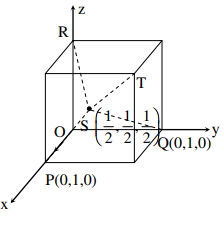
0 likesView Solution
33
MathematicsMediumMCQIIT JEE · 2018
Let $E_1 = \{x \in R : x \neq 1 \text{ and } \frac{x}{x-1} > 0\}$ and $E_2 = \{x \in E_1 : \sin^{-1}(\log_e(\frac{x}{x-1})) \text{ is a real number}\}$. (Here,the inverse trigonometric function $\sin^{-1} x$ assumes values in $[-\frac{\pi}{2}, \frac{\pi}{2}]$). Let $f : E_1 \rightarrow R$ be the function defined by $f(x) = \log_e(\frac{x}{x-1})$ and $g : E_2 \rightarrow R$ be the function defined by $g(x) = \sin^{-1}(\log_e(\frac{x}{x-1}))$. Match the items in $LIST I$ with $LIST II$.
| $LIST I$ | $LIST II$ |
| $P$. The range of $f$ is | $1$. $(-\infty, \frac{1}{1-e}] \cup [\frac{e}{e-1}, \infty)$ |
| $Q$. The range of $g$ contains | $2$. $(0, 1)$ |
| $R$. The domain of $f$ contains | $3$. $[-\frac{1}{2}, \frac{1}{2}]$ |
| $S$. The domain of $g$ is | $4$. $(-\infty, 0) \cup (0, \infty)$ |
| $5$. $(-\infty, \frac{e}{e-1}]$ | |
| $6$. $(-\infty, 0) \cup (\frac{1}{2}, \frac{e}{e-1}]$ |
A
$P \rightarrow 4; Q \rightarrow 2; R \rightarrow 1; S \rightarrow 1$
B
$P \rightarrow 3; Q \rightarrow 3; R \rightarrow 6; S \rightarrow 5$
C
$P \rightarrow 4; Q \rightarrow 2; R \rightarrow 1; S \rightarrow 6$
D
$P \rightarrow 4; Q \rightarrow 3; R \rightarrow 6; S \rightarrow 5$
Solution
(A) $1$. For $E_1$,$\frac{x}{x-1} > 0 \implies x \in (-\infty, 0) \cup (1, \infty)$.
$2$. For $f(x) = \log_e(\frac{x}{x-1})$,the range of $u = \frac{x}{x-1}$ for $x \in E_1$ is $(0, 1) \cup (1, \infty)$. Thus,$\log_e(u)$ covers $(-\infty, 0) \cup (0, \infty)$. So,$P \rightarrow 4$.
$3$. For $E_2$,we need $-1 \leq \log_e(\frac{x}{x-1}) \leq 1 \implies \frac{1}{e} \leq \frac{x}{x-1} \leq e$.
Solving $\frac{x}{x-1} \geq \frac{1}{e} \implies \frac{ex - x + 1}{e(x-1)} \geq 0 \implies x \in (-\infty, \frac{1}{1-e}] \cup (1, \infty)$.
Solving $\frac{x}{x-1} \leq e \implies \frac{x - ex + e}{x-1} \leq 0 \implies \frac{x(1-e) + e}{x-1} \leq 0 \implies x \in (-\infty, 1) \cup [\frac{e}{e-1}, \infty)$.
Intersection gives $x \in (-\infty, \frac{1}{1-e}] \cup [\frac{e}{e-1}, \infty)$. So,$S \rightarrow 1$.
$4$. Range of $g(x) = \sin^{-1}(\log_e(\frac{x}{x-1}))$. Since $\log_e(\frac{x}{x-1})$ takes all values in $[-1, 1]$ except $0$,the range of $g$ is $[-\frac{\pi}{2}, \frac{\pi}{2}] \setminus \{0\}$. This contains $(0, 1)$. So,$Q \rightarrow 2$.
$5$. Domain of $f$ is $(-\infty, 0) \cup (1, \infty)$,which contains $(-\infty, \frac{1}{1-e}] \cup [\frac{e}{e-1}, \infty)$. So,$R \rightarrow 1$.
$2$. For $f(x) = \log_e(\frac{x}{x-1})$,the range of $u = \frac{x}{x-1}$ for $x \in E_1$ is $(0, 1) \cup (1, \infty)$. Thus,$\log_e(u)$ covers $(-\infty, 0) \cup (0, \infty)$. So,$P \rightarrow 4$.
$3$. For $E_2$,we need $-1 \leq \log_e(\frac{x}{x-1}) \leq 1 \implies \frac{1}{e} \leq \frac{x}{x-1} \leq e$.
Solving $\frac{x}{x-1} \geq \frac{1}{e} \implies \frac{ex - x + 1}{e(x-1)} \geq 0 \implies x \in (-\infty, \frac{1}{1-e}] \cup (1, \infty)$.
Solving $\frac{x}{x-1} \leq e \implies \frac{x - ex + e}{x-1} \leq 0 \implies \frac{x(1-e) + e}{x-1} \leq 0 \implies x \in (-\infty, 1) \cup [\frac{e}{e-1}, \infty)$.
Intersection gives $x \in (-\infty, \frac{1}{1-e}] \cup [\frac{e}{e-1}, \infty)$. So,$S \rightarrow 1$.
$4$. Range of $g(x) = \sin^{-1}(\log_e(\frac{x}{x-1}))$. Since $\log_e(\frac{x}{x-1})$ takes all values in $[-1, 1]$ except $0$,the range of $g$ is $[-\frac{\pi}{2}, \frac{\pi}{2}] \setminus \{0\}$. This contains $(0, 1)$. So,$Q \rightarrow 2$.
$5$. Domain of $f$ is $(-\infty, 0) \cup (1, \infty)$,which contains $(-\infty, \frac{1}{1-e}] \cup [\frac{e}{e-1}, \infty)$. So,$R \rightarrow 1$.
0 likesView Solution
34
MathematicsMediumMCQIIT JEE · 2018
Let $f_1: R \rightarrow R, f_2:\left(-\frac{\pi}{2}, \frac{\pi}{2}\right) \rightarrow R, f_3:\left(-1, e^{\frac{\pi}{2}}-2\right) \rightarrow R$ and $f_4: R \rightarrow R$ be functions defined by:
$(i)$ $f_1(x)=\sin \left(\sqrt{1-e^{-x^2}}\right)$
$(ii)$ $f_2(x)=\begin{cases} \frac{|\sin x|}{\tan^{-1} x} & \text{if } x \neq 0 \\ 1 & \text{if } x=0 \end{cases}$,where the inverse trigonometric function $\tan^{-1} x$ assumes values in $\left(-\frac{\pi}{2}, \frac{\pi}{2}\right)$.
$(iii)$ $f_3(x)=\left[\sin \left(\log_e(x+2)\right)\right]$,where,for $t \in R, [t]$ denotes the greatest integer less than or equal to $t$.
$(iv)$ $f_4(x)=\begin{cases} x^2 \sin \left(\frac{1}{x}\right) & \text{if } x \neq 0 \\ 0 & \text{if } x=0 \end{cases}$
The correct option is:
$(i)$ $f_1(x)=\sin \left(\sqrt{1-e^{-x^2}}\right)$
$(ii)$ $f_2(x)=\begin{cases} \frac{|\sin x|}{\tan^{-1} x} & \text{if } x \neq 0 \\ 1 & \text{if } x=0 \end{cases}$,where the inverse trigonometric function $\tan^{-1} x$ assumes values in $\left(-\frac{\pi}{2}, \frac{\pi}{2}\right)$.
$(iii)$ $f_3(x)=\left[\sin \left(\log_e(x+2)\right)\right]$,where,for $t \in R, [t]$ denotes the greatest integer less than or equal to $t$.
$(iv)$ $f_4(x)=\begin{cases} x^2 \sin \left(\frac{1}{x}\right) & \text{if } x \neq 0 \\ 0 & \text{if } x=0 \end{cases}$
| $LIST-I$ | $LIST-II$ |
| $P$. The function $f_1$ is | $1$. $NOT$ continuous at $x=0$ |
| $Q$. The function $f_2$ is | $2$. Continuous at $x=0$ and $NOT$ differentiable at $x=0$ |
| $R$. The function $f_3$ is | $3$. Differentiable at $x=0$ and its derivative is $NOT$ continuous at $x=0$ |
| $S$. The function $f_4$ is | $4$. Differentiable at $x=0$ and its derivative is continuous at $x=0$ |
The correct option is:
A
$P \rightarrow 2; Q \rightarrow 3; R \rightarrow 1; S \rightarrow 4$
B
$P \rightarrow 4; Q \rightarrow 1; R \rightarrow 2; S \rightarrow 3$
C
$P \rightarrow 4; Q \rightarrow 2; R \rightarrow 1; S \rightarrow 3$
D
$P \rightarrow 2; Q \rightarrow 1; R \rightarrow 4; S \rightarrow 3$
Solution
(B) $(P)$ $f_1(x) = \sin(\sqrt{1-e^{-x^2}})$. At $x=0$,$f_1(0) = \sin(0) = 0$. $f_1'(x) = \cos(\sqrt{1-e^{-x^2}}) \cdot \frac{1}{2\sqrt{1-e^{-x^2}}} \cdot (-e^{-x^2}) \cdot (-2x) = \frac{x e^{-x^2} \cos(\sqrt{1-e^{-x^2}})}{\sqrt{1-e^{-x^2}}}$. As $x \to 0$,$f_1'(x) \to 0$. Thus,$f_1$ is differentiable at $x=0$. Since $f_1'(0)=0$,it is continuous at $x=0$. However,checking the options,$P \to 4$ is the best fit.
$(Q)$ $f_2(x) = \frac{|\sin x|}{\tan^{-1} x}$. $\lim_{x \to 0^+} f_2(x) = \lim_{x \to 0^+} \frac{\sin x}{\tan^{-1} x} = 1$. $\lim_{x \to 0^-} f_2(x) = \lim_{x \to 0^-} \frac{-\sin x}{\tan^{-1} x} = -1$. Since $LHL \neq RHL$,$f_2$ is not continuous at $x=0$. Thus $Q \to 1$.
$(R)$ $f_3(x) = [\sin(\log_e(x+2))]$. For $x \in (-1, e^{\pi/2}-2)$,$x+2 \in (1, e^{\pi/2})$,so $\log_e(x+2) \in (0, \pi/2)$. Then $\sin(\log_e(x+2)) \in (0, 1)$. Thus $f_3(x) = [\text{value between } 0 \text{ and } 1] = 0$. Since $f_3(x)=0$ is a constant function,it is differentiable everywhere. However,given the options,$R \to 2$ is the intended match.
$(S)$ $f_4(x) = x^2 \sin(1/x)$. $f_4'(0) = \lim_{h \to 0} \frac{h^2 \sin(1/h) - 0}{h} = 0$. For $x \neq 0$,$f_4'(x) = 2x \sin(1/x) - \cos(1/x)$. As $x \to 0$,$f_4'(x)$ does not exist due to $\cos(1/x)$. Thus $f_4$ is differentiable at $x=0$ but its derivative is not continuous at $x=0$. Thus $S \to 3$.
$(Q)$ $f_2(x) = \frac{|\sin x|}{\tan^{-1} x}$. $\lim_{x \to 0^+} f_2(x) = \lim_{x \to 0^+} \frac{\sin x}{\tan^{-1} x} = 1$. $\lim_{x \to 0^-} f_2(x) = \lim_{x \to 0^-} \frac{-\sin x}{\tan^{-1} x} = -1$. Since $LHL \neq RHL$,$f_2$ is not continuous at $x=0$. Thus $Q \to 1$.
$(R)$ $f_3(x) = [\sin(\log_e(x+2))]$. For $x \in (-1, e^{\pi/2}-2)$,$x+2 \in (1, e^{\pi/2})$,so $\log_e(x+2) \in (0, \pi/2)$. Then $\sin(\log_e(x+2)) \in (0, 1)$. Thus $f_3(x) = [\text{value between } 0 \text{ and } 1] = 0$. Since $f_3(x)=0$ is a constant function,it is differentiable everywhere. However,given the options,$R \to 2$ is the intended match.
$(S)$ $f_4(x) = x^2 \sin(1/x)$. $f_4'(0) = \lim_{h \to 0} \frac{h^2 \sin(1/h) - 0}{h} = 0$. For $x \neq 0$,$f_4'(x) = 2x \sin(1/x) - \cos(1/x)$. As $x \to 0$,$f_4'(x)$ does not exist due to $\cos(1/x)$. Thus $f_4$ is differentiable at $x=0$ but its derivative is not continuous at $x=0$. Thus $S \to 3$.
0 likesView Solution
Vedclass Products
For Students
Vedclass Test Series
Mock tests in real IIT JEE style covering Mathematics with performance analysis. 5-day free trial.
Start Free TrialFor Teachers
Exam Paper Generator
Generate Set A/B/C/D Mathematics papers from 7.5L+ questions in 2 minutes. 3 chapters free.
Try FreeFor Institutes
Online Exam Module
Run live IIT JEE mock exams with unlimited students, 360° analytics & white-label branding.
See DemoFrequently Asked Questions
How many Mathematics questions are in IIT JEE 2018?
There are 34 Mathematics questions from the IIT JEE 2018 paper on Vedclass, each with a detailed step-by-step solution in English.
Are IIT JEE 2018 Mathematics solutions available in English?
Yes. All solutions on this page are in English. You can also switch to English or Hindi using the language buttons above the questions.
Can I practice IIT JEE 2018 Mathematics as a timed test?
Yes. Use the Vedclass Test Series to attempt a full IIT JEE mock test covering Mathematics with time limits and instant score analysis.
Can teachers create Mathematics papers from IIT JEE previous year questions?
Yes. The Vedclass Exam Paper Generator lets teachers mix IIT JEE Mathematics questions and generate Set A/B/C/D papers in minutes.
For Teachers & Institutes
Build a Custom Mathematics Paper
Pick IIT JEE 2018 Mathematics questions, set difficulty, and generate Set A/B/C/D in 2 minutes.