
ChemistryQ1–48 of 48 questions
Page 1 of 1 · English
1
ChemistryMCQIIT JEE · 2003
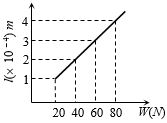
The adjacent graph shows the extension $(\Delta l)$ of a wire of length $1 \ m$ suspended from the top of a roof at one end with a load $W$ connected to the other end. If the cross-sectional area of the wire is $10^{-6} \ m^2$,calculate the Young's modulus of the material of the wire.
A
$2 \times 10^{11} \ N/m^2$
B
$2 \times 10^{-11} \ N/m^2$
C
$3 \times 10^{-12} \ N/m^2$
D
$2 \times 10^{-13} \ N/m^2$
Solution
(A) From the graph,we can select a point where the load $W = 20 \ N$ and the corresponding extension $\Delta l = 1 \times 10^{-4} \ m$.
Given:
Length of the wire,$L = 1 \ m$
Cross-sectional area,$A = 10^{-6} \ m^2$
Young's modulus $Y$ is given by the formula:
$Y = \frac{F \cdot L}{A \cdot \Delta l}$
Substituting the values:
$Y = \frac{20 \times 1}{10^{-6} \times 1 \times 10^{-4}}$
$Y = \frac{20}{10^{-10}}$
$Y = 20 \times 10^{10} = 2 \times 10^{11} \ N/m^2$
Therefore,the correct option is $A$.
Given:
Length of the wire,$L = 1 \ m$
Cross-sectional area,$A = 10^{-6} \ m^2$
Young's modulus $Y$ is given by the formula:
$Y = \frac{F \cdot L}{A \cdot \Delta l}$
Substituting the values:
$Y = \frac{20 \times 1}{10^{-6} \times 1 \times 10^{-4}}$
$Y = \frac{20}{10^{-10}}$
$Y = 20 \times 10^{10} = 2 \times 10^{11} \ N/m^2$
Therefore,the correct option is $A$.
0 likesView Solution
2
ChemistryMediumMCQIIT JEE · 2003
Which of the following pairs are isoelectronic and isostructural: $NO_3^-,$ $CO_3^{2-},$ $ClO_3^-,$ $SO_3$?
A
$NO_3^-,$ $CO_3^{2-}$
B
$SO_3,$ $NO_3^-$
C
$ClO_3^-,$ $CO_3^{2-}$
D
$CO_3^{2-},$ $SO_3$
Solution
(A) To be isoelectronic,species must have the same number of electrons.
For $NO_3^-$: $7 + (3 \times 8) + 1 = 32$ electrons.
For $CO_3^{2-}$: $6 + (3 \times 8) + 2 = 32$ electrons.
Both $NO_3^-$ and $CO_3^{2-}$ have $32$ electrons,so they are isoelectronic.
Both species have a central atom bonded to $3$ oxygen atoms with no lone pairs on the central atom,resulting in a trigonal planar geometry. Thus,they are isostructural.
Therefore,the correct pair is $NO_3^-$ and $CO_3^{2-}$.
For $NO_3^-$: $7 + (3 \times 8) + 1 = 32$ electrons.
For $CO_3^{2-}$: $6 + (3 \times 8) + 2 = 32$ electrons.
Both $NO_3^-$ and $CO_3^{2-}$ have $32$ electrons,so they are isoelectronic.
Both species have a central atom bonded to $3$ oxygen atoms with no lone pairs on the central atom,resulting in a trigonal planar geometry. Thus,they are isostructural.
Therefore,the correct pair is $NO_3^-$ and $CO_3^{2-}$.
0 likesView Solution
3
ChemistryMCQIIT JEE · 2003
$H_3BO_3$ is
A
Monobasic and weak Lewis acid
B
Monobasic and weak Bronsted acid
C
Monobasic and strong Lewis acid
D
Tribasic and weak Bronsted acid
Solution
(A) $H_3BO_3$ (orthoboric acid) is a weak monobasic Lewis acid.
It does not dissociate to provide $H^+$ ions in water.
Instead,it accepts a lone pair of electrons from $OH^-$ ions of water molecules to form $[B(OH)_4]^-$,thereby releasing $H^+$ ions:
$H_3BO_3 + 2H_2O \rightleftharpoons [B(OH)_4]^- + H_3O^+$.
Thus,it acts as a Lewis acid.
It does not dissociate to provide $H^+$ ions in water.
Instead,it accepts a lone pair of electrons from $OH^-$ ions of water molecules to form $[B(OH)_4]^-$,thereby releasing $H^+$ ions:
$H_3BO_3 + 2H_2O \rightleftharpoons [B(OH)_4]^- + H_3O^+$.
Thus,it acts as a Lewis acid.
0 likesView Solution
4
ChemistryMediumMCQIIT JEE · 2003
$A$ solution which is $10^{-3} \ M$ each in $Mn^{2+}, Fe^{2+}, Zn^{2+},$ and $Hg^{2+}$ is treated with $10^{-16} \ M$ sulphide ion. If $K_{sp}$ of $MnS, FeS, ZnS,$ and $HgS$ are $10^{-15}, 10^{-23}, 10^{-20},$ and $10^{-54}$ respectively,which one will precipitate first?
A
$FeS$
B
$MnS$
C
$HgS$
D
$ZnS$
Solution
(C) The ionic product for each metal sulphide is calculated as: $Q = [M^{2+}][S^{2-}] = 10^{-3} \times 10^{-16} = 10^{-19}$.
Precipitation occurs when the ionic product exceeds the solubility product $(K_{sp})$.
Comparing the $K_{sp}$ values: $MnS (10^{-15}), FeS (10^{-23}), ZnS (10^{-20}), HgS (10^{-54})$.
Since $HgS$ has the lowest $K_{sp}$ $(10^{-54})$,it will be the first to satisfy the condition $Q > K_{sp}$ as the sulphide ion concentration increases,and it will precipitate first.
Precipitation occurs when the ionic product exceeds the solubility product $(K_{sp})$.
Comparing the $K_{sp}$ values: $MnS (10^{-15}), FeS (10^{-23}), ZnS (10^{-20}), HgS (10^{-54})$.
Since $HgS$ has the lowest $K_{sp}$ $(10^{-54})$,it will be the first to satisfy the condition $Q > K_{sp}$ as the sulphide ion concentration increases,and it will precipitate first.
0 likesView Solution
5
ChemistryMediumMCQIIT JEE · 2003
Which of the following reactions defines $\Delta H_f^o$?
A
$C_{(diamond)} + O_{2(g)} \to CO_{2(g)}$
B
$\frac{1}{2} H_{2(g)} + \frac{1}{2} F_{2(g)} \to HF_{(g)}$
C
$N_{2(g)} + 3 H_{2(g)} \to 2 NH_{3(g)}$
D
$CO_{(g)} + \frac{1}{2} O_{2(g)} \to CO_{2(g)}$
Solution
(B) The standard enthalpy of formation $(\Delta H_f^o)$ is defined as the enthalpy change when $1 \ mol$ of a substance is formed from its constituent elements in their most stable standard states.
In option $(B)$,$1 \ mol$ of $HF_{(g)}$ is formed from $H_{2(g)}$ and $F_{2(g)}$,which are the standard states of hydrogen and fluorine.
Option $(A)$ is incorrect because diamond is not the most stable standard state of carbon (graphite is).
Option $(C)$ is incorrect because it forms $2 \ mol$ of $NH_3$.
Option $(D)$ is incorrect because $CO$ is a compound,not an element.
Thus,$(B)$ is the correct answer.
In option $(B)$,$1 \ mol$ of $HF_{(g)}$ is formed from $H_{2(g)}$ and $F_{2(g)}$,which are the standard states of hydrogen and fluorine.
Option $(A)$ is incorrect because diamond is not the most stable standard state of carbon (graphite is).
Option $(C)$ is incorrect because it forms $2 \ mol$ of $NH_3$.
Option $(D)$ is incorrect because $CO$ is a compound,not an element.
Thus,$(B)$ is the correct answer.
0 likesView Solution
6
ChemistryDifficultMCQIIT JEE · 2003
An enantiomerically pure acid is treated with a racemic mixture of an alcohol having one chiral carbon. The ester formed will be
A
$A$ racemic mixture
B
$A$ pure enantiomer
C
$A$ meso compound
D
$A$ mixture of diastereomers
Solution
(D) An enantiomerically pure acid (let it be $R-COOH$) reacts with a racemic mixture of an alcohol (let it be $R'-OH$ and $S'-OH$).
The reaction produces two esters: $R-COOR'$ and $R-COOS'$.
Since $R'$ and $S'$ are enantiomers,the resulting esters $R-COOR'$ and $R-COOS'$ are diastereomers.
Therefore,the product is a mixture of diastereomers.
The reaction produces two esters: $R-COOR'$ and $R-COOS'$.
Since $R'$ and $S'$ are enantiomers,the resulting esters $R-COOR'$ and $R-COOS'$ are diastereomers.
Therefore,the product is a mixture of diastereomers.
0 likesView Solution
7
ChemistryMediumMCQIIT JEE · 2003
Which of the following represents the given mode of hybridization $sp^2 - sp^2 - sp - sp$ from left to right?
A
$H_2C = CH - C \equiv CH$
B
$HC \equiv C - C \equiv CH$
C
$H_2C = C = C = CH_2$
D
$CH_2 = CH - CH = CH_2$
Solution
(A) In the molecule $H_2C = CH - C \equiv CH$:
$1$. The first carbon atom $(CH_2)$ is bonded to one double bond,so it is $sp^2$ hybridized.
$2$. The second carbon atom $(CH)$ is bonded to one double bond and one single bond,so it is $sp^2$ hybridized.
$3$. The third carbon atom $(C)$ is bonded to one single bond and one triple bond,so it is $sp$ hybridized.
$4$. The fourth carbon atom $(CH)$ is bonded to one triple bond,so it is $sp$ hybridized.
Thus,the hybridization sequence is $sp^2 - sp^2 - sp - sp$.
$1$. The first carbon atom $(CH_2)$ is bonded to one double bond,so it is $sp^2$ hybridized.
$2$. The second carbon atom $(CH)$ is bonded to one double bond and one single bond,so it is $sp^2$ hybridized.
$3$. The third carbon atom $(C)$ is bonded to one single bond and one triple bond,so it is $sp$ hybridized.
$4$. The fourth carbon atom $(CH)$ is bonded to one triple bond,so it is $sp$ hybridized.
Thus,the hybridization sequence is $sp^2 - sp^2 - sp - sp$.
0 likesView Solution
8
ChemistryMediumMCQIIT JEE · 2003
On hydrolysis,$(Me)_2SiCl_2$ will produce:
A
$(Me)_2Si(OH)_2$
B
$(Me)_2Si = O$
C
$-[-O-Si(Me)_2-O-]_n-$
D
$Me_2SiCl(OH)$
Solution
(C) The hydrolysis of dimethyldichlorosilane,$(Me)_2SiCl_2$,proceeds as follows:
$1$. First,the chlorine atoms are replaced by hydroxyl groups to form the unstable intermediate $(Me)_2Si(OH)_2$.
$2$. This intermediate undergoes rapid condensation polymerization by eliminating water molecules to form a linear silicone polymer.
$3$. The reaction is represented as: $n(Me)_2SiCl_2 + 2nH_2O \rightarrow [-O-Si(Me)_2-O-]_n + 2nHCl$.
$4$. Thus,the final product is a linear silicone polymer,represented by option $(C)$.
$1$. First,the chlorine atoms are replaced by hydroxyl groups to form the unstable intermediate $(Me)_2Si(OH)_2$.
$2$. This intermediate undergoes rapid condensation polymerization by eliminating water molecules to form a linear silicone polymer.
$3$. The reaction is represented as: $n(Me)_2SiCl_2 + 2nH_2O \rightarrow [-O-Si(Me)_2-O-]_n + 2nHCl$.
$4$. Thus,the final product is a linear silicone polymer,represented by option $(C)$.
0 likesView Solution
9
ChemistryMediumMCQIIT JEE · 2003
Among the following,the molecule with the highest dipole moment is
A
$CH_3Cl$
B
$CH_2Cl_2$
C
$CHCl_3$
D
$CCl_4$
Solution
(A) The dipole moment of a molecule depends on the vector sum of individual bond dipoles and the molecular geometry.
$CCl_4$ is a tetrahedral molecule with a symmetric structure,resulting in a net dipole moment of $0 \ D$.
In $CH_3Cl$,$CH_2Cl_2$,and $CHCl_3$,the $C-Cl$ bond is polar due to the high electronegativity of chlorine.
$CH_3Cl$ has the highest dipole moment $(1.86 \ D)$ because the bond dipoles of the $C-H$ bonds and the $C-Cl$ bond reinforce each other in the same direction.
As more $Cl$ atoms are substituted,the vector sum of the bond dipoles decreases due to the opposing directions of the $C-Cl$ bond moments.
Therefore,the correct order of dipole moment is $CH_3Cl > CH_2Cl_2 > CHCl_3 > CCl_4$.
$CCl_4$ is a tetrahedral molecule with a symmetric structure,resulting in a net dipole moment of $0 \ D$.
In $CH_3Cl$,$CH_2Cl_2$,and $CHCl_3$,the $C-Cl$ bond is polar due to the high electronegativity of chlorine.
$CH_3Cl$ has the highest dipole moment $(1.86 \ D)$ because the bond dipoles of the $C-H$ bonds and the $C-Cl$ bond reinforce each other in the same direction.
As more $Cl$ atoms are substituted,the vector sum of the bond dipoles decreases due to the opposing directions of the $C-Cl$ bond moments.
Therefore,the correct order of dipole moment is $CH_3Cl > CH_2Cl_2 > CHCl_3 > CCl_4$.
0 likesView Solution
10
ChemistryMCQIIT JEE · 2003
If the angles of a triangle are in the ratio $4:1:1,$ then the ratio of the longest side to the perimeter is
A
$\sqrt{3} : (2 + \sqrt{3})$
B
$1 : 6$
C
$1 : (2 + \sqrt{3})$
D
$2 : 3$
Solution
(A) Let the angles be $4x, x,$ and $x.$
Since the sum of angles in a triangle is $180^\circ,$ we have $4x + x + x = 180^\circ.$
$6x = 180^\circ \Rightarrow x = 30^\circ.$
The angles are $120^\circ, 30^\circ,$ and $30^\circ.$
Using the Sine Rule,$\frac{a}{\sin A} = \frac{b}{\sin B} = \frac{c}{\sin C} = k.$
Thus,$a = k \sin 120^\circ, b = k \sin 30^\circ, c = k \sin 30^\circ.$
The longest side is $a$ (opposite to $120^\circ$).
The ratio of the longest side to the perimeter is $\frac{a}{a+b+c} = \frac{\sin 120^\circ}{\sin 120^\circ + \sin 30^\circ + \sin 30^\circ}.$
$= \frac{\frac{\sqrt{3}}{2}}{\frac{\sqrt{3}}{2} + \frac{1}{2} + \frac{1}{2}} = \frac{\frac{\sqrt{3}}{2}}{\frac{\sqrt{3} + 2}{2}} = \frac{\sqrt{3}}{2 + \sqrt{3}}.$
Since the sum of angles in a triangle is $180^\circ,$ we have $4x + x + x = 180^\circ.$
$6x = 180^\circ \Rightarrow x = 30^\circ.$
The angles are $120^\circ, 30^\circ,$ and $30^\circ.$
Using the Sine Rule,$\frac{a}{\sin A} = \frac{b}{\sin B} = \frac{c}{\sin C} = k.$
Thus,$a = k \sin 120^\circ, b = k \sin 30^\circ, c = k \sin 30^\circ.$
The longest side is $a$ (opposite to $120^\circ$).
The ratio of the longest side to the perimeter is $\frac{a}{a+b+c} = \frac{\sin 120^\circ}{\sin 120^\circ + \sin 30^\circ + \sin 30^\circ}.$
$= \frac{\frac{\sqrt{3}}{2}}{\frac{\sqrt{3}}{2} + \frac{1}{2} + \frac{1}{2}} = \frac{\frac{\sqrt{3}}{2}}{\frac{\sqrt{3} + 2}{2}} = \frac{\sqrt{3}}{2 + \sqrt{3}}.$
0 likesView Solution
11
ChemistryMCQIIT JEE · 2003
If the equation of the locus of a point equidistant from the points $(a_1, b_1)$ and $(a_2, b_2)$ is $(a_1 - a_2)x + (b_1 - b_2)y + c = 0$,then the value of $c$ is
A
$a_1^2 - a_2^2 + b_1^2 - b_2^2$
B
$\sqrt{a_1^2 + b_1^2 - a_2^2 - b_2^2}$
C
$\frac{1}{2}(a_1^2 + a_2^2 + b_1^2 + b_2^2)$
D
$\frac{1}{2}(a_2^2 + b_2^2 - a_1^2 - b_1^2)$
Solution
(D) Let $(h, k)$ be a point on the locus. By the given condition,the distance from $(h, k)$ to $(a_1, b_1)$ is equal to the distance from $(h, k)$ to $(a_2, b_2)$.
$(h - a_1)^2 + (k - b_1)^2 = (h - a_2)^2 + (k - b_2)^2$
Expanding both sides:
$h^2 - 2ha_1 + a_1^2 + k^2 - 2kb_1 + b_1^2 = h^2 - 2ha_2 + a_2^2 + k^2 - 2kb_2 + b_2^2$
Simplifying the equation:
$-2ha_1 + a_1^2 - 2kb_1 + b_1^2 = -2ha_2 + a_2^2 - 2kb_2 + b_2^2$
$2h(a_2 - a_1) + 2k(b_2 - b_1) + a_1^2 + b_1^2 - a_2^2 - b_2^2 = 0$
Multiplying by $-1$ to match the form $(a_1 - a_2)x + (b_1 - b_2)y + c = 0$:
$2h(a_1 - a_2) + 2k(b_1 - b_2) + a_2^2 + b_2^2 - a_1^2 - b_1^2 = 0$
Dividing by $2$:
$(a_1 - a_2)h + (b_1 - b_2)k + \frac{1}{2}(a_2^2 + b_2^2 - a_1^2 - b_1^2) = 0$
Comparing this with the given equation $(a_1 - a_2)x + (b_1 - b_2)y + c = 0$,we get:
$c = \frac{1}{2}(a_2^2 + b_2^2 - a_1^2 - b_1^2)$.
$(h - a_1)^2 + (k - b_1)^2 = (h - a_2)^2 + (k - b_2)^2$
Expanding both sides:
$h^2 - 2ha_1 + a_1^2 + k^2 - 2kb_1 + b_1^2 = h^2 - 2ha_2 + a_2^2 + k^2 - 2kb_2 + b_2^2$
Simplifying the equation:
$-2ha_1 + a_1^2 - 2kb_1 + b_1^2 = -2ha_2 + a_2^2 - 2kb_2 + b_2^2$
$2h(a_2 - a_1) + 2k(b_2 - b_1) + a_1^2 + b_1^2 - a_2^2 - b_2^2 = 0$
Multiplying by $-1$ to match the form $(a_1 - a_2)x + (b_1 - b_2)y + c = 0$:
$2h(a_1 - a_2) + 2k(b_1 - b_2) + a_2^2 + b_2^2 - a_1^2 - b_1^2 = 0$
Dividing by $2$:
$(a_1 - a_2)h + (b_1 - b_2)k + \frac{1}{2}(a_2^2 + b_2^2 - a_1^2 - b_1^2) = 0$
Comparing this with the given equation $(a_1 - a_2)x + (b_1 - b_2)y + c = 0$,we get:
$c = \frac{1}{2}(a_2^2 + b_2^2 - a_1^2 - b_1^2)$.
0 likesView Solution
12
ChemistryMCQIIT JEE · 2003
The value of $k$ such that the line $\frac{x - 4}{1} = \frac{y - 2}{1} = \frac{z - k}{2}$ lies in the plane $2x - 4y + z = 7$ is:
A
$7$
B
$-7$
C
No real value
D
$4$
Solution
(A) For the line to lie in the plane,every point on the line must satisfy the equation of the plane.
The line passes through the point $(4, 2, k)$ and has a direction vector $\vec{v} = (1, 1, 2)$.
First,the point $(4, 2, k)$ must lie on the plane $2x - 4y + z = 7$:
$2(4) - 4(2) + k = 7$
$8 - 8 + k = 7$
$k = 7$
Second,the direction vector of the line $\vec{v} = (1, 1, 2)$ must be perpendicular to the normal vector of the plane $\vec{n} = (2, -4, 1)$:
$\vec{v} \cdot \vec{n} = (1)(2) + (1)(-4) + (2)(1) = 2 - 4 + 2 = 0$
Since the dot product is $0$,the line is parallel to the plane. Since the point $(4, 2, 7)$ lies on the plane,the entire line lies in the plane.
Thus,the value of $k$ is $7$.
The line passes through the point $(4, 2, k)$ and has a direction vector $\vec{v} = (1, 1, 2)$.
First,the point $(4, 2, k)$ must lie on the plane $2x - 4y + z = 7$:
$2(4) - 4(2) + k = 7$
$8 - 8 + k = 7$
$k = 7$
Second,the direction vector of the line $\vec{v} = (1, 1, 2)$ must be perpendicular to the normal vector of the plane $\vec{n} = (2, -4, 1)$:
$\vec{v} \cdot \vec{n} = (1)(2) + (1)(-4) + (2)(1) = 2 - 4 + 2 = 0$
Since the dot product is $0$,the line is parallel to the plane. Since the point $(4, 2, 7)$ lies on the plane,the entire line lies in the plane.
Thus,the value of $k$ is $7$.
0 likesView Solution
13
ChemistryMCQIIT JEE · 2003
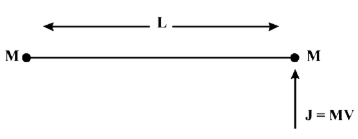
Consider a body,shown in the figure,consisting of two identical balls,each of mass $M$,connected by a light rigid rod of length $L$. If an impulse $J = Mv$ is imparted to the body at one of its ends,what would be its angular velocity?
A
$v/L$
B
$2v/L$
C
$v/3L$
D
$v/4L$
Solution
(A) The impulse $J = Mv$ is applied at one end of the rod. This impulse imparts a linear momentum $p = Mv$ to the system at that point.
Let the center of mass of the system be at point $O$,which is the midpoint of the rod. The distance of each ball from the center of mass is $L/2$.
The initial angular momentum $L_i$ of the system about the center of mass $O$ is given by the impulse multiplied by the perpendicular distance from the axis of rotation:
$L_i = J \times (L/2) = (Mv) \times (L/2) = \frac{MvL}{2}$.
The moment of inertia $I$ of the system about the center of mass $O$ is:
$I = M(L/2)^2 + M(L/2)^2 = 2M(L^2/4) = \frac{ML^2}{2}$.
The final angular momentum $L_f$ of the system is $I\omega$,where $\omega$ is the angular velocity.
By the law of conservation of angular momentum about the center of mass:
$L_i = L_f$
$\frac{MvL}{2} = I\omega$
$\frac{MvL}{2} = \left( \frac{ML^2}{2} \right) \omega$
Solving for $\omega$:
$\omega = \frac{MvL/2}{ML^2/2} = \frac{v}{L}$.
Let the center of mass of the system be at point $O$,which is the midpoint of the rod. The distance of each ball from the center of mass is $L/2$.
The initial angular momentum $L_i$ of the system about the center of mass $O$ is given by the impulse multiplied by the perpendicular distance from the axis of rotation:
$L_i = J \times (L/2) = (Mv) \times (L/2) = \frac{MvL}{2}$.
The moment of inertia $I$ of the system about the center of mass $O$ is:
$I = M(L/2)^2 + M(L/2)^2 = 2M(L^2/4) = \frac{ML^2}{2}$.
The final angular momentum $L_f$ of the system is $I\omega$,where $\omega$ is the angular velocity.
By the law of conservation of angular momentum about the center of mass:
$L_i = L_f$
$\frac{MvL}{2} = I\omega$
$\frac{MvL}{2} = \left( \frac{ML^2}{2} \right) \omega$
Solving for $\omega$:
$\omega = \frac{MvL/2}{ML^2/2} = \frac{v}{L}$.
0 likesView Solution
14
ChemistryEasyMCQIIT JEE · 2003
Which of the following pairs are isoelectronic and isostructural: $NO_3^-$,$CO_3^{2-}$,$ClO_3^-$,$SO_3$?
A
$NO_3^-$ and $CO_3^{2-}$
B
$SO_3$ and $NO_3^-$
C
$ClO_3^-$ and $CO_3^{2-}$
D
$CO_3^{2-}$ and $SO_3$
Solution
(A) $1$. Isoelectronic species have the same number of electrons.
$2$. For $NO_3^-$: $7 + (3 \times 8) + 1 = 32$ electrons.
$3$. For $CO_3^{2-}$: $6 + (3 \times 8) + 2 = 32$ electrons.
$4$. Both $NO_3^-$ and $CO_3^{2-}$ have $32$ electrons and possess a trigonal planar geometry ($sp^2$ hybridization),making them isostructural.
$5$. Therefore,$NO_3^-$ and $CO_3^{2-}$ are both isoelectronic and isostructural.
$2$. For $NO_3^-$: $7 + (3 \times 8) + 1 = 32$ electrons.
$3$. For $CO_3^{2-}$: $6 + (3 \times 8) + 2 = 32$ electrons.
$4$. Both $NO_3^-$ and $CO_3^{2-}$ have $32$ electrons and possess a trigonal planar geometry ($sp^2$ hybridization),making them isostructural.
$5$. Therefore,$NO_3^-$ and $CO_3^{2-}$ are both isoelectronic and isostructural.
0 likesView Solution
15
ChemistryMCQIIT JEE · 2003
Identify the major product of the following reaction:

A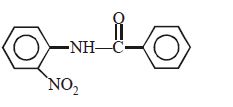
B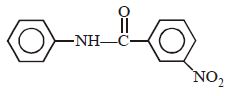
C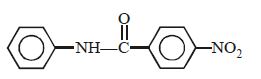
D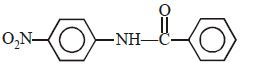
Solution
(C) The reactant is $N$-phenylbenzamide (benzanilide). The $-NH-CO-C_6H_5$ group is an ortho/para-directing group because the nitrogen atom has a lone pair of electrons that can participate in resonance with the benzene ring attached to it.
In electrophilic aromatic substitution (nitration using $conc. H_2SO_4 + conc. HNO_3$),the para-isomer is generally the major product due to less steric hindrance compared to the ortho-isomer.
Therefore,the major product is $N-(4-nitrophenyl)benzamide$.
In electrophilic aromatic substitution (nitration using $conc. H_2SO_4 + conc. HNO_3$),the para-isomer is generally the major product due to less steric hindrance compared to the ortho-isomer.
Therefore,the major product is $N-(4-nitrophenyl)benzamide$.
0 likesView Solution
16
ChemistryMCQIIT JEE · 2003
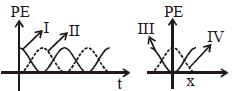
For a particle executing $S.H.M.$,the displacement $x$ is given by $x = A \cos \omega t$. Identify the graphs which represent the variation of potential energy $(P.E.)$ as a function of time $t$ and displacement $x$.
A
$I, III$
B
$II, IV$
C
$II, III$
D
$I, IV$
Solution
(A) The displacement of the particle is given by $x = A \cos \omega t$.
Potential energy $(P.E.)$ is given by $U = \frac{1}{2} k x^2$.
Substituting $x$,we get $U = \frac{1}{2} k A^2 \cos^2 \omega t = \frac{1}{2} k A^2 \left( \frac{1 + \cos 2 \omega t}{2} \right)$.
At $t = 0$,$x = A$,so $P.E. = \frac{1}{2} k A^2$ (maximum).
Graph $I$ shows $P.E.$ vs $t$ starting from a maximum value at $t = 0$,which matches the equation.
As a function of displacement $x$,$U = \frac{1}{2} k x^2$,which is a parabola opening upwards symmetric about the $P.E.$ axis.
Graph $III$ shows $P.E.$ vs $x$ as a parabola symmetric about the $P.E.$ axis,which matches the equation.
Thus,graphs $I$ and $III$ represent the variation of $P.E.$ with $t$ and $x$ respectively.
Potential energy $(P.E.)$ is given by $U = \frac{1}{2} k x^2$.
Substituting $x$,we get $U = \frac{1}{2} k A^2 \cos^2 \omega t = \frac{1}{2} k A^2 \left( \frac{1 + \cos 2 \omega t}{2} \right)$.
At $t = 0$,$x = A$,so $P.E. = \frac{1}{2} k A^2$ (maximum).
Graph $I$ shows $P.E.$ vs $t$ starting from a maximum value at $t = 0$,which matches the equation.
As a function of displacement $x$,$U = \frac{1}{2} k x^2$,which is a parabola opening upwards symmetric about the $P.E.$ axis.
Graph $III$ shows $P.E.$ vs $x$ as a parabola symmetric about the $P.E.$ axis,which matches the equation.
Thus,graphs $I$ and $III$ represent the variation of $P.E.$ with $t$ and $x$ respectively.
0 likesView Solution
17
ChemistryMCQIIT JEE · 2003
$A$ tangent is drawn to the ellipse $\frac{x^2}{27} + y^2 = 1$ at the point $(3\sqrt{3} \cos \theta, \sin \theta)$,where $\theta \in (0, \pi/2)$. The value of $\theta$ for which the sum of the intercepts on the axes made by this tangent is minimum,is:
A
$\pi/3$
B
$\pi/6$
C
$\pi/8$
D
$\pi/4$
Solution
(B) The equation of the tangent to the ellipse $\frac{x^2}{a^2} + \frac{y^2}{b^2} = 1$ at $(a \cos \theta, b \sin \theta)$ is $\frac{x \cos \theta}{a} + \frac{y \sin \theta}{b} = 1$.
Here,$a^2 = 27 \implies a = 3\sqrt{3}$ and $b^2 = 1 \implies b = 1$.
So,the tangent equation is $\frac{x \cos \theta}{3\sqrt{3}} + y \sin \theta = 1$.
The $x$-intercept is $X = \frac{3\sqrt{3}}{\cos \theta} = 3\sqrt{3} \sec \theta$ and the $y$-intercept is $Y = \frac{1}{\sin \theta} = \csc \theta$.
Let the sum of intercepts be $f(\theta) = 3\sqrt{3} \sec \theta + \csc \theta$.
To find the minimum,we set $f'(\theta) = 0$:
$f'(\theta) = 3\sqrt{3} \sec \theta \tan \theta - \csc \theta \cot \theta = 0$.
$3\sqrt{3} \frac{\sin \theta}{\cos^2 \theta} = \frac{\cos \theta}{\sin^2 \theta}$.
$\tan^3 \theta = \frac{1}{3\sqrt{3}} = \left(\frac{1}{\sqrt{3}}\right)^3$.
$\tan \theta = \frac{1}{\sqrt{3}} \implies \theta = \frac{\pi}{6}$.
Here,$a^2 = 27 \implies a = 3\sqrt{3}$ and $b^2 = 1 \implies b = 1$.
So,the tangent equation is $\frac{x \cos \theta}{3\sqrt{3}} + y \sin \theta = 1$.
The $x$-intercept is $X = \frac{3\sqrt{3}}{\cos \theta} = 3\sqrt{3} \sec \theta$ and the $y$-intercept is $Y = \frac{1}{\sin \theta} = \csc \theta$.
Let the sum of intercepts be $f(\theta) = 3\sqrt{3} \sec \theta + \csc \theta$.
To find the minimum,we set $f'(\theta) = 0$:
$f'(\theta) = 3\sqrt{3} \sec \theta \tan \theta - \csc \theta \cot \theta = 0$.
$3\sqrt{3} \frac{\sin \theta}{\cos^2 \theta} = \frac{\cos \theta}{\sin^2 \theta}$.
$\tan^3 \theta = \frac{1}{3\sqrt{3}} = \left(\frac{1}{\sqrt{3}}\right)^3$.
$\tan \theta = \frac{1}{\sqrt{3}} \implies \theta = \frac{\pi}{6}$.
0 likesView Solution
18
ChemistryMCQIIT JEE · 2003
If the angles of a triangle are in the ratio $4:1:1$,then the ratio of the longest side to the perimeter is
A
$\sqrt{3} : (2+\sqrt{3})$
B
$1:6$
C
$1:(2+\sqrt{3})$
D
$2:3$
Solution
(A) Let the angles of the triangle be $4x, x, x$.
Since the sum of angles in a triangle is $180^{\circ}$,we have $4x + x + x = 180^{\circ}$ $\Rightarrow 6x = 180^{\circ}$ $\Rightarrow x = 30^{\circ}$.
The angles are $120^{\circ}, 30^{\circ}, 30^{\circ}$.
Using the sine rule,$\frac{a}{\sin A} = \frac{b}{\sin B} = \frac{c}{\sin C} = k$.
Thus,$a = k \sin 120^{\circ}$,$b = k \sin 30^{\circ}$,$c = k \sin 30^{\circ}$.
The ratio of the longest side $a$ to the perimeter $(a+b+c)$ is:
$\frac{a}{a+b+c} = \frac{\sin 120^{\circ}}{\sin 120^{\circ} + \sin 30^{\circ} + \sin 30^{\circ}} = \frac{\frac{\sqrt{3}}{2}}{\frac{\sqrt{3}}{2} + \frac{1}{2} + \frac{1}{2}} = \frac{\frac{\sqrt{3}}{2}}{\frac{\sqrt{3}+2}{2}} = \frac{\sqrt{3}}{\sqrt{3}+2}$.
Therefore,the ratio is $\sqrt{3} : (2+\sqrt{3})$.
Since the sum of angles in a triangle is $180^{\circ}$,we have $4x + x + x = 180^{\circ}$ $\Rightarrow 6x = 180^{\circ}$ $\Rightarrow x = 30^{\circ}$.
The angles are $120^{\circ}, 30^{\circ}, 30^{\circ}$.
Using the sine rule,$\frac{a}{\sin A} = \frac{b}{\sin B} = \frac{c}{\sin C} = k$.
Thus,$a = k \sin 120^{\circ}$,$b = k \sin 30^{\circ}$,$c = k \sin 30^{\circ}$.
The ratio of the longest side $a$ to the perimeter $(a+b+c)$ is:
$\frac{a}{a+b+c} = \frac{\sin 120^{\circ}}{\sin 120^{\circ} + \sin 30^{\circ} + \sin 30^{\circ}} = \frac{\frac{\sqrt{3}}{2}}{\frac{\sqrt{3}}{2} + \frac{1}{2} + \frac{1}{2}} = \frac{\frac{\sqrt{3}}{2}}{\frac{\sqrt{3}+2}{2}} = \frac{\sqrt{3}}{\sqrt{3}+2}$.
Therefore,the ratio is $\sqrt{3} : (2+\sqrt{3})$.
0 likesView Solution
19
ChemistryMCQIIT JEE · 2003
Which of the following reactions defines $\Delta H_f^o$?
A
$H_{(g)} + F_{(g)} \to HF_{(l)}$
B
$N_{2(g)} + 3H_{2(g)} \to 2NH_{3(g)}$
C
$C_{(diamond)} + O_{2(g)} \to CO_{2(g)}$
D
$\frac{1}{2} H_{2(g)} + \frac{1}{2} F_{2(g)} \to HF_{(g)}$
Solution
(D) The standard enthalpy of formation,$\Delta H_f^o$,is defined as the enthalpy change when $1 \ mol$ of a substance is formed from its constituent elements in their most stable standard states.
In option $D$,$1 \ mol$ of $HF_{(g)}$ is formed from its elements $H_{2(g)}$ and $F_{2(g)}$ in their standard states.
Option $A$ is incorrect because $H$ and $F$ are not in their standard states.
Option $B$ is incorrect because $2 \ mol$ of $NH_3$ are formed.
Option $C$ is incorrect because diamond is not the most stable standard state of carbon (graphite is).
Therefore,the correct option is $D$.
In option $D$,$1 \ mol$ of $HF_{(g)}$ is formed from its elements $H_{2(g)}$ and $F_{2(g)}$ in their standard states.
Option $A$ is incorrect because $H$ and $F$ are not in their standard states.
Option $B$ is incorrect because $2 \ mol$ of $NH_3$ are formed.
Option $C$ is incorrect because diamond is not the most stable standard state of carbon (graphite is).
Therefore,the correct option is $D$.
0 likesView Solution
20
ChemistryMCQIIT JEE · 2003
If $f(x) = x^2 + 2bx + 2c^2$ and $g(x) = -x^2 - 2cx + b^2$ such that $\min f(x) > \max g(x)$,then the relation between $b$ and $c$ is:
A
No real value of $b$ and $c$
B
$0 < c < b \sqrt{2}$
C
$|c| < |b| \sqrt{2}$
D
$|c| > |b| \sqrt{2}$
Solution
(D) Given $f(x) = x^2 + 2bx + 2c^2$. Completing the square,we get $f(x) = (x + b)^2 + 2c^2 - b^2$.
Since the coefficient of $x^2$ is positive,the minimum value of $f(x)$ is $2c^2 - b^2$.
Given $g(x) = -x^2 - 2cx + b^2$. Completing the square,we get $g(x) = -(x^2 + 2cx) + b^2 = -(x + c)^2 + c^2 + b^2$.
Since the coefficient of $x^2$ is negative,the maximum value of $g(x)$ is $c^2 + b^2$.
According to the problem,$\min f(x) > \max g(x)$.
Substituting the values,we get $2c^2 - b^2 > c^2 + b^2$.
Rearranging the terms,we get $c^2 > 2b^2$.
Taking the square root on both sides,we get $|c| > |b| \sqrt{2}$.
Since the coefficient of $x^2$ is positive,the minimum value of $f(x)$ is $2c^2 - b^2$.
Given $g(x) = -x^2 - 2cx + b^2$. Completing the square,we get $g(x) = -(x^2 + 2cx) + b^2 = -(x + c)^2 + c^2 + b^2$.
Since the coefficient of $x^2$ is negative,the maximum value of $g(x)$ is $c^2 + b^2$.
According to the problem,$\min f(x) > \max g(x)$.
Substituting the values,we get $2c^2 - b^2 > c^2 + b^2$.
Rearranging the terms,we get $c^2 > 2b^2$.
Taking the square root on both sides,we get $|c| > |b| \sqrt{2}$.
0 likesView Solution
21
ChemistryMCQIIT JEE · 2003
$H_3BO_3$ is
A
Monobasic and weak Lewis acid
B
Monobasic and weak Bronsted acid
C
Monobasic and strong Lewis acid
D
Tribasic and weak Bronsted acid
Solution
(A) The central boron atom in $H_3BO_3$ is electron-deficient,meaning it has an incomplete octet.
It accepts a lone pair of electrons from water to complete its octet,which characterizes it as a Lewis acid.
Since it accepts only one pair of electrons,it acts as a monobasic acid in aqueous solution.
It is a weak acid because it does not dissociate completely in water.
The reaction is: $B(OH)_3 + H_2O \longrightarrow [B(OH)_4]^- + H^+$.
It accepts a lone pair of electrons from water to complete its octet,which characterizes it as a Lewis acid.
Since it accepts only one pair of electrons,it acts as a monobasic acid in aqueous solution.
It is a weak acid because it does not dissociate completely in water.
The reaction is: $B(OH)_3 + H_2O \longrightarrow [B(OH)_4]^- + H^+$.
0 likesView Solution
22
ChemistryMCQIIT JEE · 2003
For the hyperbola $\frac{x^2}{\cos^2 \alpha} - \frac{y^2}{\sin^2 \alpha} = 1$,which of the following remains constant if $\alpha$ varies?
A
Eccentricity
B
Directrix
C
Abscissae of vertices
D
Abscissae of foci
Solution
(D) Given the hyperbola equation $\frac{x^2}{\cos^2 \alpha} - \frac{y^2}{\sin^2 \alpha} = 1$.
Here,$a^2 = \cos^2 \alpha$ and $b^2 = \sin^2 \alpha$.
The eccentricity $e$ is given by $e = \sqrt{1 + \frac{b^2}{a^2}} = \sqrt{1 + \frac{\sin^2 \alpha}{\cos^2 \alpha}} = \sqrt{1 + \tan^2 \alpha} = \sec \alpha$.
The coordinates of the foci are $(\pm ae, 0)$.
Calculating the abscissa of the foci: $ae = \sqrt{\cos^2 \alpha} \times \sec \alpha = \cos \alpha \times \frac{1}{\cos \alpha} = 1$.
Since the abscissa of the foci is $1$,which is independent of $\alpha$,it remains constant.
Here,$a^2 = \cos^2 \alpha$ and $b^2 = \sin^2 \alpha$.
The eccentricity $e$ is given by $e = \sqrt{1 + \frac{b^2}{a^2}} = \sqrt{1 + \frac{\sin^2 \alpha}{\cos^2 \alpha}} = \sqrt{1 + \tan^2 \alpha} = \sec \alpha$.
The coordinates of the foci are $(\pm ae, 0)$.
Calculating the abscissa of the foci: $ae = \sqrt{\cos^2 \alpha} \times \sec \alpha = \cos \alpha \times \frac{1}{\cos \alpha} = 1$.
Since the abscissa of the foci is $1$,which is independent of $\alpha$,it remains constant.
0 likesView Solution
23
ChemistryMCQIIT JEE · 2003
If $A = \begin{bmatrix} \alpha & 0 \\ 1 & 1 \end{bmatrix}$ and $B = \begin{bmatrix} 1 & 0 \\ 5 & 1 \end{bmatrix}$,then the value of $\alpha$ for which $A^2 = B$ is
A
$1$
B
$-1$
C
$4$
D
No real values
Solution
(D) Given $A = \begin{bmatrix} \alpha & 0 \\ 1 & 1 \end{bmatrix}$ and $B = \begin{bmatrix} 1 & 0 \\ 5 & 1 \end{bmatrix}$.
Calculate $A^2$:
$A^2 = \begin{bmatrix} \alpha & 0 \\ 1 & 1 \end{bmatrix} \begin{bmatrix} \alpha & 0 \\ 1 & 1 \end{bmatrix} = \begin{bmatrix} \alpha^2 + 0 & 0 \\ \alpha + 1 & 1 \end{bmatrix} = \begin{bmatrix} \alpha^2 & 0 \\ \alpha + 1 & 1 \end{bmatrix}$.
Since $A^2 = B$,we equate the corresponding elements:
$1$) $\alpha^2 = 1 \Rightarrow \alpha = \pm 1$
$2$) $\alpha + 1 = 5 \Rightarrow \alpha = 4$
There is no common value of $\alpha$ that satisfies both equations simultaneously.
Therefore,there are no real values of $\alpha$ for which $A^2 = B$.
Calculate $A^2$:
$A^2 = \begin{bmatrix} \alpha & 0 \\ 1 & 1 \end{bmatrix} \begin{bmatrix} \alpha & 0 \\ 1 & 1 \end{bmatrix} = \begin{bmatrix} \alpha^2 + 0 & 0 \\ \alpha + 1 & 1 \end{bmatrix} = \begin{bmatrix} \alpha^2 & 0 \\ \alpha + 1 & 1 \end{bmatrix}$.
Since $A^2 = B$,we equate the corresponding elements:
$1$) $\alpha^2 = 1 \Rightarrow \alpha = \pm 1$
$2$) $\alpha + 1 = 5 \Rightarrow \alpha = 4$
There is no common value of $\alpha$ that satisfies both equations simultaneously.
Therefore,there are no real values of $\alpha$ for which $A^2 = B$.
0 likesView Solution
24
ChemistryMCQIIT JEE · 2003
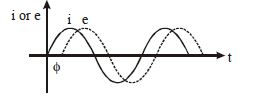
When an $AC$ source of $e.m.f. \ e = E_0 \sin(100t)$ is connected across a circuit,the phase difference between the $e.m.f. \ e$ and the current $i$ in the circuit is observed to be $\frac{\pi}{4}$ as shown in the diagram. If the circuit consists possibly only of $RC$,$RL$,or $LC$ in series,find the relationship between the two elements.
A
$R = 1 \text{ k}\Omega, C = 10 \mu\text{F}$
B
$R = 1 \text{ k}\Omega, C = 1 \mu\text{F}$
C
$R = 1 \text{ k}\Omega, L = 10 \text{ H}$
D
$R = 1 \text{ k}\Omega, L = 1 \text{ H}$
Solution
(A) The diagram shows that the current $i$ leads the $e.m.f. \ e$ by a phase angle $\phi = \frac{\pi}{4}$.
In an $AC$ circuit,the current leads the voltage only in an $RC$ circuit.
For an $RC$ series circuit,the phase angle $\phi$ is given by $\tan \phi = \frac{X_C}{R} = \frac{1}{\omega C R}$.
Given $\phi = \frac{\pi}{4}$,we have $\tan(\frac{\pi}{4}) = 1$,so $\frac{1}{\omega C R} = 1$,which implies $CR = \frac{1}{\omega}$.
From the given equation $e = E_0 \sin(100t)$,the angular frequency is $\omega = 100 \text{ rad/s}$.
Thus,$CR = \frac{1}{100} = 0.01 \text{ s}$.
Given $R = 1 \text{ k}\Omega = 10^3 \ \Omega$,we find $C = \frac{1}{\omega R} = \frac{1}{100 \times 10^3} = \frac{1}{10^5} = 10^{-5} \text{ F} = 10 \mu\text{F}$.
Therefore,the correct values are $R = 1 \text{ k}\Omega$ and $C = 10 \mu\text{F}$.
In an $AC$ circuit,the current leads the voltage only in an $RC$ circuit.
For an $RC$ series circuit,the phase angle $\phi$ is given by $\tan \phi = \frac{X_C}{R} = \frac{1}{\omega C R}$.
Given $\phi = \frac{\pi}{4}$,we have $\tan(\frac{\pi}{4}) = 1$,so $\frac{1}{\omega C R} = 1$,which implies $CR = \frac{1}{\omega}$.
From the given equation $e = E_0 \sin(100t)$,the angular frequency is $\omega = 100 \text{ rad/s}$.
Thus,$CR = \frac{1}{100} = 0.01 \text{ s}$.
Given $R = 1 \text{ k}\Omega = 10^3 \ \Omega$,we find $C = \frac{1}{\omega R} = \frac{1}{100 \times 10^3} = \frac{1}{10^5} = 10^{-5} \text{ F} = 10 \mu\text{F}$.
Therefore,the correct values are $R = 1 \text{ k}\Omega$ and $C = 10 \mu\text{F}$.
0 likesView Solution
25
ChemistryMCQIIT JEE · 2003
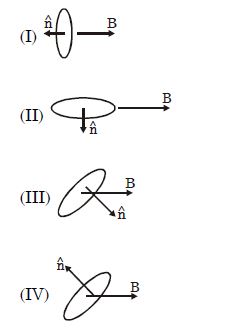
$A$ current-carrying loop is placed in a uniform magnetic field in four different orientations; $I, II, III,$ and $IV.$ Arrange them in the decreasing order of potential energy.
A
$I > III > IV > II$
B
$I > II > III > IV$
C
$I > IV > II > III$
D
$III > IV > I > II$
Solution
(C) The potential energy $U$ of a magnetic dipole in a magnetic field is given by $U = -\vec{M} \cdot \vec{B} = -MB \cos \theta,$ where $\theta$ is the angle between the magnetic moment $\vec{M}$ (along $\hat{n}$) and the magnetic field $\vec{B}.$
For orientation $I$: $\theta = 180^\circ,$ so $U_I = -MB \cos(180^\circ) = +MB.$
For orientation $II$: $\theta = 90^\circ,$ so $U_{II} = -MB \cos(90^\circ) = 0.$
For orientation $III$: $\theta$ is between $0^\circ$ and $90^\circ$ (acute angle),so $\cos \theta > 0,$ making $U_{III} < 0.$
For orientation $IV$: $\theta$ is between $90^\circ$ and $180^\circ$ (obtuse angle),so $\cos \theta < 0,$ making $U_{IV} > 0.$
Comparing the angles: $\theta_I = 180^\circ,$ $\theta_{IV} > 90^\circ,$ $\theta_{II} = 90^\circ,$ $\theta_{III} < 90^\circ.$
Since $U = -MB \cos \theta,$ the potential energy decreases as $\theta$ decreases from $180^\circ$ to $0^\circ.$
Thus,the order of potential energy is $U_I > U_{IV} > U_{II} > U_{III}.$
For orientation $I$: $\theta = 180^\circ,$ so $U_I = -MB \cos(180^\circ) = +MB.$
For orientation $II$: $\theta = 90^\circ,$ so $U_{II} = -MB \cos(90^\circ) = 0.$
For orientation $III$: $\theta$ is between $0^\circ$ and $90^\circ$ (acute angle),so $\cos \theta > 0,$ making $U_{III} < 0.$
For orientation $IV$: $\theta$ is between $90^\circ$ and $180^\circ$ (obtuse angle),so $\cos \theta < 0,$ making $U_{IV} > 0.$
Comparing the angles: $\theta_I = 180^\circ,$ $\theta_{IV} > 90^\circ,$ $\theta_{II} = 90^\circ,$ $\theta_{III} < 90^\circ.$
Since $U = -MB \cos \theta,$ the potential energy decreases as $\theta$ decreases from $180^\circ$ to $0^\circ.$
Thus,the order of potential energy is $U_I > U_{IV} > U_{II} > U_{III}.$
0 likesView Solution
26
ChemistryMCQIIT JEE · 2003
$A$ particle undergoes uniform circular motion. About which point on the plane of the circle will the angular momentum of the particle remain conserved?
A
Centre of the circle
B
On the circumference of the circle
C
Inside the circle
D
Outside the circle
Solution
(A) The net force acting on a particle undergoing uniform circular motion is the centripetal force,which always acts towards the centre of the circle.
Torque $\tau$ is defined as $\vec{\tau} = \vec{r} \times \vec{F}$.
Since the centripetal force $\vec{F}$ always passes through the centre of the circle,the position vector $\vec{r}$ relative to the centre is parallel to the force vector $\vec{F}$.
Therefore,the torque about the centre is $\vec{\tau} = 0$.
According to the principle of conservation of angular momentum,if the net external torque acting on a particle is zero,its angular momentum $L$ remains conserved.
Thus,the angular momentum of the particle is conserved about the centre of the circle.
Torque $\tau$ is defined as $\vec{\tau} = \vec{r} \times \vec{F}$.
Since the centripetal force $\vec{F}$ always passes through the centre of the circle,the position vector $\vec{r}$ relative to the centre is parallel to the force vector $\vec{F}$.
Therefore,the torque about the centre is $\vec{\tau} = 0$.
According to the principle of conservation of angular momentum,if the net external torque acting on a particle is zero,its angular momentum $L$ remains conserved.
Thus,the angular momentum of the particle is conserved about the centre of the circle.
0 likesView Solution
27
ChemistryMCQIIT JEE · 2003
Which of the following reactions defines $\Delta H_f^o$?
A
$\frac{1}{2} H_{2(g)} + \frac{1}{2} F_{2(g)} \to HF_{(g)}$
B
$CO_{(g)} + \frac{1}{2} O_{2(g)} \to CO_{2(g)}$
C
$C_{\text{diamond}} + O_{2(g)} \to CO_{2(g)}$
D
$N_{2(g)} + 3 H_{2(g)} \to 2 NH_{3(g)}$
Solution
(A) The standard enthalpy of formation,denoted as $\Delta H_f^o$,is defined as the enthalpy change that occurs when $1 \ mole$ of a substance is formed from its constituent elements in their most stable standard states.
In option $(A)$,$1 \ mole$ of $HF_{(g)}$ is formed from its elements $H_{2(g)}$ and $F_{2(g)}$ in their standard states,which fits the definition.
In option $(B)$,$CO$ is a compound,not an element.
In option $(C)$,carbon is in the diamond state,which is not the standard state (graphite is).
In option $(D)$,$2 \ moles$ of $NH_3$ are formed,not $1 \ mole$.
In option $(A)$,$1 \ mole$ of $HF_{(g)}$ is formed from its elements $H_{2(g)}$ and $F_{2(g)}$ in their standard states,which fits the definition.
In option $(B)$,$CO$ is a compound,not an element.
In option $(C)$,carbon is in the diamond state,which is not the standard state (graphite is).
In option $(D)$,$2 \ moles$ of $NH_3$ are formed,not $1 \ mole$.
0 likesView Solution
28
ChemistryMCQIIT JEE · 2003
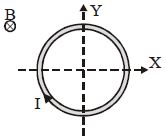
$A$ conducting loop carrying a current $I$ is placed in a uniform magnetic field pointing into the plane of the paper as shown. The loop will have a tendency to
A
Contract
B
Expand
C
Move towards $+ve\, x-$ axis
D
Move towards $-ve\, x-$ axis
Solution
(B) The net magnetic force on a current-carrying loop placed in a uniform magnetic field is zero. Therefore,the loop cannot undergo translational motion. This eliminates options $(C)$ and $(D)$.
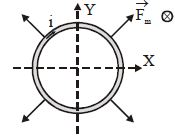
Using Fleming's left-hand rule,we can determine the direction of the magnetic force $\vec{F}_m$ on each small element of the loop. Given that the magnetic field is directed perpendicularly into the plane of the paper and the current flows in a clockwise direction,the magnetic force on every element of the loop acts radially outwards. Consequently,the loop will have a tendency to expand.
Using Fleming's left-hand rule,we can determine the direction of the magnetic force $\vec{F}_m$ on each small element of the loop. Given that the magnetic field is directed perpendicularly into the plane of the paper and the current flows in a clockwise direction,the magnetic force on every element of the loop acts radially outwards. Consequently,the loop will have a tendency to expand.
0 likesView Solution
29
ChemistryMCQIIT JEE · 2003
During the depression of freezing point in a solution,which of the following are in equilibrium?
A
Liquid solvent,Solid solvent
B
Liquid solvent,Solid solute
C
Liquid solute,Solid solute
D
Liquid solute,Solid solvent
Solution
(A) During the freezing of a solution,only the solvent freezes out. Therefore,the equilibrium exists between the solid form of the solvent and the liquid form of the solvent.
0 likesView Solution
30
ChemistryMCQIIT JEE · 2003
Which of the following pairs are isoelectronic and isostructural? $NO_3^-, CO_3^{2-}, ClO_3^-, SO_3$
A
$NO_3^-, CO_3^{2-}$
B
$SO_3, NO_3^-$
C
$ClO_3^-, CO_3^{2-}$
D
$CO_3^{2-}, ClO_3^-$
Solution
(A) Isoelectronic species have the same number of electrons,and isostructural species have the same shape and hybridization.
$1$. For $NO_3^-$: Total electrons = $7 + (3 \times 8) + 1 = 32$. Hybridization is $sp^2$,and the shape is trigonal planar.
$2$. For $CO_3^{2-}$: Total electrons = $6 + (3 \times 8) + 2 = 32$. Hybridization is $sp^2$,and the shape is trigonal planar.
Since both $NO_3^-$ and $CO_3^{2-}$ have $32$ electrons and a trigonal planar structure,they are isoelectronic and isostructural.
$1$. For $NO_3^-$: Total electrons = $7 + (3 \times 8) + 1 = 32$. Hybridization is $sp^2$,and the shape is trigonal planar.
$2$. For $CO_3^{2-}$: Total electrons = $6 + (3 \times 8) + 2 = 32$. Hybridization is $sp^2$,and the shape is trigonal planar.
Since both $NO_3^-$ and $CO_3^{2-}$ have $32$ electrons and a trigonal planar structure,they are isoelectronic and isostructural.
0 likesView Solution
31
ChemistryMCQIIT JEE · 2003
Among the following,the molecule with the highest dipole moment is:
A
$CH_3Cl$
B
$CH_2Cl_2$
C
$CHCl_3$
D
$CCl_4$
Solution
(A) The dipole moment depends on the vector sum of individual bond dipoles.
- In $CCl_4$ (tetrahedral),the four $C-Cl$ bond dipoles cancel each other out,resulting in a net dipole moment of $0 \ D$.
- In $CHCl_3$,the three $C-Cl$ bond dipoles partially cancel the $C-H$ bond dipole,resulting in a dipole moment of $1.01 \ D$.
- In $CH_2Cl_2$,the two $C-Cl$ bond dipoles add up,resulting in a dipole moment of $1.60 \ D$.
- In $CH_3Cl$,the three $C-H$ bond dipoles and the $C-Cl$ bond dipole reinforce each other,resulting in the highest dipole moment of $1.86 \ D$.
Therefore,$CH_3Cl$ has the highest dipole moment.
- In $CCl_4$ (tetrahedral),the four $C-Cl$ bond dipoles cancel each other out,resulting in a net dipole moment of $0 \ D$.
- In $CHCl_3$,the three $C-Cl$ bond dipoles partially cancel the $C-H$ bond dipole,resulting in a dipole moment of $1.01 \ D$.
- In $CH_2Cl_2$,the two $C-Cl$ bond dipoles add up,resulting in a dipole moment of $1.60 \ D$.
- In $CH_3Cl$,the three $C-H$ bond dipoles and the $C-Cl$ bond dipole reinforce each other,resulting in the highest dipole moment of $1.86 \ D$.
Therefore,$CH_3Cl$ has the highest dipole moment.
0 likesView Solution
32
ChemistryMCQIIT JEE · 2003
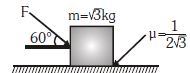
What is the maximum value of the force $F$ such that the block shown in the arrangement does not move (in $N$)? (Given: $m = \sqrt{3} \ kg$,$\mu = \frac{1}{2\sqrt{3}}$,$\theta = 60^\circ$)
A
$20$
B
$10$
C
$12$
D
$15$
Solution
(A) For the block not to move,the horizontal component of the applied force $F$ must be less than or equal to the limiting friction force $f_L$.
The horizontal component of the force is $F \cos \theta$.
The normal reaction $N$ on the block is $N = mg + F \sin \theta$.
The limiting friction force is $f_L = \mu N = \mu(mg + F \sin \theta)$.
Equating the horizontal force to the limiting friction for the maximum value of $F$:
$F \cos \theta = \mu(mg + F \sin \theta)$
$F \cos \theta = \mu mg + \mu F \sin \theta$
$F(\cos \theta - \mu \sin \theta) = \mu mg$
$F = \frac{\mu mg}{\cos \theta - \mu \sin \theta}$
Given values: $m = \sqrt{3} \ kg$,$\mu = \frac{1}{2\sqrt{3}}$,$\theta = 60^\circ$,$g = 10 \ m/s^2$.
$F = \frac{(\frac{1}{2\sqrt{3}}) \times \sqrt{3} \times 10}{\cos 60^\circ - (\frac{1}{2\sqrt{3}}) \sin 60^\circ}$
$F = \frac{5}{\frac{1}{2} - (\frac{1}{2\sqrt{3}}) \times \frac{\sqrt{3}}{2}}$
$F = \frac{5}{\frac{1}{2} - \frac{1}{4}} = \frac{5}{\frac{1}{4}} = 20 \ N$.
The horizontal component of the force is $F \cos \theta$.
The normal reaction $N$ on the block is $N = mg + F \sin \theta$.
The limiting friction force is $f_L = \mu N = \mu(mg + F \sin \theta)$.
Equating the horizontal force to the limiting friction for the maximum value of $F$:
$F \cos \theta = \mu(mg + F \sin \theta)$
$F \cos \theta = \mu mg + \mu F \sin \theta$
$F(\cos \theta - \mu \sin \theta) = \mu mg$
$F = \frac{\mu mg}{\cos \theta - \mu \sin \theta}$
Given values: $m = \sqrt{3} \ kg$,$\mu = \frac{1}{2\sqrt{3}}$,$\theta = 60^\circ$,$g = 10 \ m/s^2$.
$F = \frac{(\frac{1}{2\sqrt{3}}) \times \sqrt{3} \times 10}{\cos 60^\circ - (\frac{1}{2\sqrt{3}}) \sin 60^\circ}$
$F = \frac{5}{\frac{1}{2} - (\frac{1}{2\sqrt{3}}) \times \frac{\sqrt{3}}{2}}$
$F = \frac{5}{\frac{1}{2} - \frac{1}{4}} = \frac{5}{\frac{1}{4}} = 20 \ N$.
0 likesView Solution
33
ChemistryMCQIIT JEE · 2003
$A$ particle undergoes uniform circular motion. About which point in the plane of the circle will the angular momentum of the particle remain conserved?
A
Centre of the circle
B
On the circumference of the circle
C
Inside the circle other than the centre
D
Outside the circle
Solution
(A) The angular momentum $\vec{L}$ of a particle about a point is given by $\vec{L} = \vec{r} \times \vec{p}$.
For a particle in uniform circular motion,the force acting on it is the centripetal force,which is always directed towards the centre of the circle.
The torque $\vec{\tau}$ about the centre of the circle is given by $\vec{\tau} = \vec{r} \times \vec{F}$.
Since the force $\vec{F}$ is directed towards the centre,the position vector $\vec{r}$ and the force vector $\vec{F}$ are collinear (angle between them is $180^{\circ}$ or $0^{\circ}$).
Therefore,the torque $\vec{\tau} = 0$ about the centre.
Since the external torque about the centre is zero,the angular momentum of the particle about the centre remains conserved.
For a particle in uniform circular motion,the force acting on it is the centripetal force,which is always directed towards the centre of the circle.
The torque $\vec{\tau}$ about the centre of the circle is given by $\vec{\tau} = \vec{r} \times \vec{F}$.
Since the force $\vec{F}$ is directed towards the centre,the position vector $\vec{r}$ and the force vector $\vec{F}$ are collinear (angle between them is $180^{\circ}$ or $0^{\circ}$).
Therefore,the torque $\vec{\tau} = 0$ about the centre.
Since the external torque about the centre is zero,the angular momentum of the particle about the centre remains conserved.
0 likesView Solution
34
ChemistryMCQIIT JEE · 2003
If the angles of a triangle are in the ratio $4:1:1$,then the ratio of the longest side to the perimeter is
A
$1:6$
B
$\sqrt{3}:(2+\sqrt{3})$
C
$1:(2+\sqrt{3})$
D
$2:3$
Solution
(B) Let the angles of the triangle be $4x, x$,and $x$.
Since the sum of angles in a triangle is $180^{\circ}$,we have $4x + x + x = 180^{\circ}$,which implies $6x = 180^{\circ}$,so $x = 30^{\circ}$.
The angles are $120^{\circ}, 30^{\circ}$,and $30^{\circ}$.
Using the Sine Rule,$\frac{a}{\sin A} = \frac{b}{\sin B} = \frac{c}{\sin C} = k$.
Thus,$a = k \sin 120^{\circ}$,$b = k \sin 30^{\circ}$,and $c = k \sin 30^{\circ}$.
The longest side is $a$ (opposite to $120^{\circ}$).
The ratio of the longest side to the perimeter is $\frac{a}{a+b+c} = \frac{\sin 120^{\circ}}{\sin 120^{\circ} + \sin 30^{\circ} + \sin 30^{\circ}}$.
Substituting the values: $\frac{\frac{\sqrt{3}}{2}}{\frac{\sqrt{3}}{2} + \frac{1}{2} + \frac{1}{2}} = \frac{\frac{\sqrt{3}}{2}}{\frac{\sqrt{3}+2}{2}} = \frac{\sqrt{3}}{2+\sqrt{3}}$.
Since the sum of angles in a triangle is $180^{\circ}$,we have $4x + x + x = 180^{\circ}$,which implies $6x = 180^{\circ}$,so $x = 30^{\circ}$.
The angles are $120^{\circ}, 30^{\circ}$,and $30^{\circ}$.
Using the Sine Rule,$\frac{a}{\sin A} = \frac{b}{\sin B} = \frac{c}{\sin C} = k$.
Thus,$a = k \sin 120^{\circ}$,$b = k \sin 30^{\circ}$,and $c = k \sin 30^{\circ}$.
The longest side is $a$ (opposite to $120^{\circ}$).
The ratio of the longest side to the perimeter is $\frac{a}{a+b+c} = \frac{\sin 120^{\circ}}{\sin 120^{\circ} + \sin 30^{\circ} + \sin 30^{\circ}}$.
Substituting the values: $\frac{\frac{\sqrt{3}}{2}}{\frac{\sqrt{3}}{2} + \frac{1}{2} + \frac{1}{2}} = \frac{\frac{\sqrt{3}}{2}}{\frac{\sqrt{3}+2}{2}} = \frac{\sqrt{3}}{2+\sqrt{3}}$.
0 likesView Solution
35
ChemistryEasyMCQIIT JEE · 2003
$H_3BO_3$ is
A
Monobasic and weak Lewis acid
B
Monobasic and weak Bronsted acid
C
Monobasic and strong Lewis acid
D
Tribasic and weak Bronsted acid
Solution
(A) $H_3BO_3$ (boric acid) is a weak monobasic Lewis acid.
It does not dissociate to give $H^+$ ions directly.
Instead,it accepts an $OH^-$ ion from water to form $[B(OH)_4]^-$ and releases $H^+$ (as $H_3O^+$),as shown in the reaction:
$B(OH)_3 + 2H_2O \rightleftharpoons [B(OH)_4]^- + H_3O^+$
It does not dissociate to give $H^+$ ions directly.
Instead,it accepts an $OH^-$ ion from water to form $[B(OH)_4]^-$ and releases $H^+$ (as $H_3O^+$),as shown in the reaction:
$B(OH)_3 + 2H_2O \rightleftharpoons [B(OH)_4]^- + H_3O^+$
0 likesView Solution
36
ChemistryMediumMCQIIT JEE · 2003
For $H_3PO_3$ and $H_3PO_4$,the correct choice is:
A
$H_3PO_3$ is dibasic and reducing.
B
$H_3PO_3$ is dibasic and non-reducing.
C
$H_3PO_4$ is tribasic and reducing.
D
$H_3PO_3$ is tribasic and non-reducing.
Solution
(A) $H_3PO_3$ has the structure $(HO)_2P(O)H$. It contains two $P-OH$ bonds,making it dibasic.
It also contains one $P-H$ bond,which makes it a reducing agent.
In contrast,$H_3PO_4$ has the structure $(HO)_3P(O)$,which is tribasic and non-reducing because it lacks $P-H$ bonds.
It also contains one $P-H$ bond,which makes it a reducing agent.
In contrast,$H_3PO_4$ has the structure $(HO)_3P(O)$,which is tribasic and non-reducing because it lacks $P-H$ bonds.
0 likesView Solution
37
ChemistryMediumMCQIIT JEE · 2003
When $MnO_2$ is fused with $KOH$,a coloured compound is formed. The product and its colour are:
A
$K_2MnO_4$,purple green
B
$KMnO_4$,purple
C
$Mn_2O_3$,brown
D
$Mn_3O_4$,black
Solution
(A) When $MnO_2$ is fused with $KOH$ in the presence of air (or an oxidizing agent like $KNO_3$),it forms potassium manganate $(K_2MnO_4)$.
The balanced chemical equation is: $2MnO_2 + 4KOH + O_2 \xrightarrow{\Delta} 2K_2MnO_4 + 2H_2O$.
The compound $K_2MnO_4$ is dark green or purple-green in colour.
The balanced chemical equation is: $2MnO_2 + 4KOH + O_2 \xrightarrow{\Delta} 2K_2MnO_4 + 2H_2O$.
The compound $K_2MnO_4$ is dark green or purple-green in colour.
0 likesView Solution
38
ChemistryDifficultMCQIIT JEE · 2003
$[X] + H_2SO_4 \to [Y]$ (a colourless gas with irritating smell).
$[Y] + K_2Cr_2O_7 + H_2SO_4 \to$ green solution.
$[X]$ and $[Y]$ are:
$[Y] + K_2Cr_2O_7 + H_2SO_4 \to$ green solution.
$[X]$ and $[Y]$ are:
A
$SO_3^{2-}, SO_2$
B
$Cl^{-}, HCl$
C
$S^{2-}, H_2S$
D
$CO_3^{2-}, CO_2$
Solution
(A) The reaction of a salt $[X]$ containing sulfite ion $(SO_3^{2-})$ with dilute $H_2SO_4$ produces sulfur dioxide gas $(SO_2)$,which is a colourless gas with a pungent,irritating smell.
$SO_3^{2-} + 2H^+ \to H_2O + SO_2 \uparrow$.
Sulfur dioxide $(SO_2)$ acts as a reducing agent and turns acidified potassium dichromate $(K_2Cr_2O_7)$ solution green due to the formation of chromium$(III)$ sulfate.
$K_2Cr_2O_7 + H_2SO_4 + 3SO_2 \to K_2SO_4 + Cr_2(SO_4)_3 + H_2O$.
Thus,$[X]$ is $SO_3^{2-}$ and $[Y]$ is $SO_2$.
$SO_3^{2-} + 2H^+ \to H_2O + SO_2 \uparrow$.
Sulfur dioxide $(SO_2)$ acts as a reducing agent and turns acidified potassium dichromate $(K_2Cr_2O_7)$ solution green due to the formation of chromium$(III)$ sulfate.
$K_2Cr_2O_7 + H_2SO_4 + 3SO_2 \to K_2SO_4 + Cr_2(SO_4)_3 + H_2O$.
Thus,$[X]$ is $SO_3^{2-}$ and $[Y]$ is $SO_2$.
0 likesView Solution
39
ChemistryMediumMCQIIT JEE · 2003
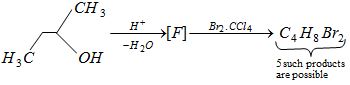
The dehydration of $butan-2-ol$ in the presence of $H^{+}$ yields $[F]$. How many structural isomers of $[F]$ are possible?
A
$2$
B
$1$
C
$6$
D
$3$
Solution
(A) The dehydration of $butan-2-ol$ $(CH_3CH_2CH(OH)CH_3)$ in the presence of $H^{+}$ involves the elimination of a water molecule to form an alkene $[F]$.
The possible alkenes formed are:
$1$. $But-1-ene$ $(CH_3CH_2CH=CH_2)$
$2$. $But-2-ene$ $(CH_3CH=CHCH_3)$
Both $But-1-ene$ and $But-2-ene$ are structural isomers of each other.
Therefore,there are $2$ possible structural isomers for $[F]$.
The possible alkenes formed are:
$1$. $But-1-ene$ $(CH_3CH_2CH=CH_2)$
$2$. $But-2-ene$ $(CH_3CH=CHCH_3)$
Both $But-1-ene$ and $But-2-ene$ are structural isomers of each other.
Therefore,there are $2$ possible structural isomers for $[F]$.
0 likesView Solution
40
ChemistryMediumMCQIIT JEE · 2003
During the depression of freezing point in a solution,which of the following are in equilibrium?
A
Liquid solvent,solid solvent
B
Liquid solvent,solid solute
C
Liquid solute,solid solute
D
Liquid solute,solid solvent
Solution
(A) During the depression of freezing point in a solution,the liquid solvent and the solid solvent are in equilibrium.
During the freezing process of a solution,only the solvent molecules transition into the solid phase.
At the freezing point,the vapour pressure of the solid solvent and the liquid solvent must be equal.
If the vapour pressures were not equal,the system would not be at equilibrium.
The presence of a solute lowers the vapour pressure of the liquid solvent,which consequently lowers the temperature at which the liquid and solid forms of the solvent reach equilibrium.
During the freezing process of a solution,only the solvent molecules transition into the solid phase.
At the freezing point,the vapour pressure of the solid solvent and the liquid solvent must be equal.
If the vapour pressures were not equal,the system would not be at equilibrium.
The presence of a solute lowers the vapour pressure of the liquid solvent,which consequently lowers the temperature at which the liquid and solid forms of the solvent reach equilibrium.
0 likesView Solution
41
ChemistryDifficultMCQIIT JEE · 2003
$_{11}^{23}Na$ is the more stable isotope of $Na$. Find out the process by which $_{11}^{24}Na$ can undergo radioactive decay.
A
$\beta ^ -$ emission
B
$\alpha$ emission
C
$\beta ^ +$ emission
D
$K$ electron capture
Solution
(A) For $_{11}^{23}Na$,the neutron-to-proton ratio is $\frac{n}{p} = \frac{12}{11} \approx 1.09$.
For $_{11}^{24}Na$,the neutron-to-proton ratio is $\frac{n}{p} = \frac{13}{11} \approx 1.18$.
Since $_{11}^{24}Na$ has a higher $\frac{n}{p}$ ratio than the stable isotope,it undergoes radioactive decay to decrease this ratio.
This is achieved by the emission of a $\beta^-$-particle,where a neutron converts into a proton: $n \to p + e^- + \bar{\nu}$ ($\beta^-$ emission).
For $_{11}^{24}Na$,the neutron-to-proton ratio is $\frac{n}{p} = \frac{13}{11} \approx 1.18$.
Since $_{11}^{24}Na$ has a higher $\frac{n}{p}$ ratio than the stable isotope,it undergoes radioactive decay to decrease this ratio.
This is achieved by the emission of a $\beta^-$-particle,where a neutron converts into a proton: $n \to p + e^- + \bar{\nu}$ ($\beta^-$ emission).
0 likesView Solution
42
ChemistryMediumMCQIIT JEE · 2003
In a first order reaction,the concentration of reactant decreases from $800 \ mol/dm^3$ to $50 \ mol/dm^3$ in $2 \times 10^2 \ s$. The rate constant of the reaction in $s^{-1}$ is:
A
$2 \times 10^4$
B
$3.45 \times 10^{-5}$
C
$1.386 \times 10^{-2}$
D
$2 \times 10^{-4}$
Solution
(C) For a first order reaction,the rate constant $k$ is given by the formula: $k = \frac{2.303}{t} \log_{10} \frac{[A]_0}{[A]_t}$.
Given: $t = 2 \times 10^2 \ s$,$[A]_0 = 800 \ mol/dm^3$,$[A]_t = 50 \ mol/dm^3$.
Substituting the values: $k = \frac{2.303}{2 \times 10^2} \log_{10} \frac{800}{50}$.
$k = \frac{2.303}{200} \log_{10} 16$.
Since $\log_{10} 16 = \log_{10} 2^4 = 4 \times 0.3010 = 1.204$.
$k = \frac{2.303 \times 1.204}{200} = \frac{2.7728}{200} = 1.3864 \times 10^{-2} \ s^{-1}$.
Given: $t = 2 \times 10^2 \ s$,$[A]_0 = 800 \ mol/dm^3$,$[A]_t = 50 \ mol/dm^3$.
Substituting the values: $k = \frac{2.303}{2 \times 10^2} \log_{10} \frac{800}{50}$.
$k = \frac{2.303}{200} \log_{10} 16$.
Since $\log_{10} 16 = \log_{10} 2^4 = 4 \times 0.3010 = 1.204$.
$k = \frac{2.303 \times 1.204}{200} = \frac{2.7728}{200} = 1.3864 \times 10^{-2} \ s^{-1}$.
0 likesView Solution
43
ChemistryMediumMCQIIT JEE · 2003
In an electrolytic cell,the flow of electrons is from:
A
Cathode to anode in solution
B
Cathode to anode through external supply
C
Cathode to anode through internal supply
D
Anode to cathode through external supply
Solution
(D) In an electrolytic cell,an external power source (like a battery) is used to drive a non-spontaneous reaction.
Electrons are pumped by the external source into the cathode,where reduction occurs.
Electrons are removed from the anode,where oxidation occurs.
Therefore,the flow of electrons in the external circuit is from the anode to the cathode.
Electrons are pumped by the external source into the cathode,where reduction occurs.
Electrons are removed from the anode,where oxidation occurs.
Therefore,the flow of electrons in the external circuit is from the anode to the cathode.
0 likesView Solution
44
ChemistryDifficultMCQIIT JEE · 2003
$A$ mixture $X$ containing $0.02 \ mol$ of $[Co(NH_3)_5SO_4]Br$ and $0.02 \ mol$ of $[Co(NH_3)_5Br]SO_4$ was prepared in $2 \ L$ of solution.
$1 \ L$ of mixture $X +$ excess $AgNO_3 \to Y$.
$1 \ L$ of mixture $X +$ excess $BaCl_2 \to Z$.
The number of moles of $Y$ and $Z$ are:
$1 \ L$ of mixture $X +$ excess $AgNO_3 \to Y$.
$1 \ L$ of mixture $X +$ excess $BaCl_2 \to Z$.
The number of moles of $Y$ and $Z$ are:
A
$0.01, 0.01$
B
$0.02, 0.01$
C
$0.01, 0.02$
D
$0.02, 0.02$
Solution
(A) The mixture $X$ has $0.02 \ mol$ of each complex in $2 \ L$,so $1 \ L$ contains $0.01 \ mol$ of each complex.
Reaction with $AgNO_3$: Only $[Co(NH_3)_5SO_4]Br$ reacts with $AgNO_3$ to form $AgBr$ precipitate.
$[Co(NH_3)_5SO_4]Br + AgNO_3 \to [Co(NH_3)_5SO_4]NO_3 + AgBr(s)$
Since $0.01 \ mol$ of $[Co(NH_3)_5SO_4]Br$ is present in $1 \ L$,moles of $Y (AgBr) = 0.01 \ mol$.
Reaction with $BaCl_2$: Only $[Co(NH_3)_5Br]SO_4$ reacts with $BaCl_2$ to form $BaSO_4$ precipitate.
$[Co(NH_3)_5Br]SO_4 + BaCl_2 \to [Co(NH_3)_5Br]Cl_2 + BaSO_4(s)$
Since $0.01 \ mol$ of $[Co(NH_3)_5Br]SO_4$ is present in $1 \ L$,moles of $Z (BaSO_4) = 0.01 \ mol$.
Therefore,the number of moles of $Y$ and $Z$ are $0.01$ and $0.01$ respectively.
Reaction with $AgNO_3$: Only $[Co(NH_3)_5SO_4]Br$ reacts with $AgNO_3$ to form $AgBr$ precipitate.
$[Co(NH_3)_5SO_4]Br + AgNO_3 \to [Co(NH_3)_5SO_4]NO_3 + AgBr(s)$
Since $0.01 \ mol$ of $[Co(NH_3)_5SO_4]Br$ is present in $1 \ L$,moles of $Y (AgBr) = 0.01 \ mol$.
Reaction with $BaCl_2$: Only $[Co(NH_3)_5Br]SO_4$ reacts with $BaCl_2$ to form $BaSO_4$ precipitate.
$[Co(NH_3)_5Br]SO_4 + BaCl_2 \to [Co(NH_3)_5Br]Cl_2 + BaSO_4(s)$
Since $0.01 \ mol$ of $[Co(NH_3)_5Br]SO_4$ is present in $1 \ L$,moles of $Z (BaSO_4) = 0.01 \ mol$.
Therefore,the number of moles of $Y$ and $Z$ are $0.01$ and $0.01$ respectively.
0 likesView Solution
45
ChemistryMediumMCQIIT JEE · 2003
In the process of extraction of gold,roasted gold ore reacts as follows. Identify the complexes $[X]$ and $[Y]$:
$\text{Roasted gold ore} + CN^{-} + H_2O \xrightarrow{O_2} [X] + OH^{-}$
$[X] + Zn \to [Y] + Au$
$\text{Roasted gold ore} + CN^{-} + H_2O \xrightarrow{O_2} [X] + OH^{-}$
$[X] + Zn \to [Y] + Au$
A
$X = [Au(CN)_2]^-, Y = [Zn(CN)_4]^{2-}$
B
$X = [Au(CN)_4]^{3-}, Y = [Zn(CN)_4]^{2-}$
C
$X = [Au(CN)_2]^-, Y = [Zn(CN)_6]^{4-}$
D
$X = [Au(CN)_4]^-, Y = [Zn(CN)_4]^{2-}$
Solution
(A) The extraction of gold involves the leaching of gold ore with a dilute solution of $NaCN$ or $KCN$ in the presence of air $(O_2)$,which acts as an oxidizing agent.
The reaction is: $4Au(s) + 8CN^{-}(aq) + 2H_2O(aq) + O_2(g) \to 4[Au(CN)_2]^{-}(aq) + 4OH^{-}(aq)$.
Thus,$[X] = [Au(CN)_2]^{-}$.
Gold is then recovered from the complex by displacement using zinc $(Zn)$:
$2[Au(CN)_2]^{-}(aq) + Zn(s) \to [Zn(CN)_4]^{2-}(aq) + 2Au(s)$.
Thus,$[Y] = [Zn(CN)_4]^{2-}$.
The reaction is: $4Au(s) + 8CN^{-}(aq) + 2H_2O(aq) + O_2(g) \to 4[Au(CN)_2]^{-}(aq) + 4OH^{-}(aq)$.
Thus,$[X] = [Au(CN)_2]^{-}$.
Gold is then recovered from the complex by displacement using zinc $(Zn)$:
$2[Au(CN)_2]^{-}(aq) + Zn(s) \to [Zn(CN)_4]^{2-}(aq) + 2Au(s)$.
Thus,$[Y] = [Zn(CN)_4]^{2-}$.
0 likesView Solution
46
ChemistryMediumMCQIIT JEE · 2003
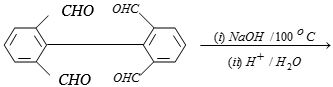
Identify the major product of the following reaction:
A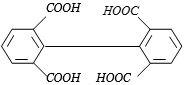
B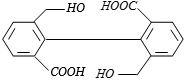
C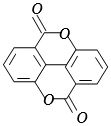
D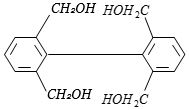
Solution
(C) The given reactant is $2,2',6,6'$-tetrabenzenedicarbaldehyde.
When treated with $NaOH$ at $100 \ ^\circ C$,it undergoes an intramolecular Cannizzaro reaction.
In this reaction,one $-CHO$ group is oxidized to a $-COO^-$ group,and the adjacent $-CHO$ group is reduced to a $-CH_2OH$ group.
This occurs on both benzene rings.
Upon subsequent acidification with $H^+ / H_2O$,the carboxylate ions are protonated to form carboxylic acid groups.
The final product is $2,2'$-bis(hydroxymethyl)-[$1$,$1$'-biphenyl]-$6$,$6$'-dicarboxylic acid.
When treated with $NaOH$ at $100 \ ^\circ C$,it undergoes an intramolecular Cannizzaro reaction.
In this reaction,one $-CHO$ group is oxidized to a $-COO^-$ group,and the adjacent $-CHO$ group is reduced to a $-CH_2OH$ group.
This occurs on both benzene rings.
Upon subsequent acidification with $H^+ / H_2O$,the carboxylate ions are protonated to form carboxylic acid groups.
The final product is $2,2'$-bis(hydroxymethyl)-[$1$,$1$'-biphenyl]-$6$,$6$'-dicarboxylic acid.
0 likesView Solution
47
ChemistryMediumMCQIIT JEE · 2003
The products of acid hydrolysis of $P$ and $Q$ can be distinguished by:
$P = H_2C=C(CH_3)(OCOCH_3)$
$Q = H_3C-CH=CH(OCOCH_3)$
$P = H_2C=C(CH_3)(OCOCH_3)$
$Q = H_3C-CH=CH(OCOCH_3)$
A
Lucas Reagent
B
$2,4-DNP$
C
Fehling’s Solution
D
$NaHSO_3$
Solution
(C) Acid hydrolysis of $P$ $(H_2C=C(CH_3)(OCOCH_3))$ yields an enol which tautomerizes to acetone $(CH_3COCH_3)$,a ketone.
Acid hydrolysis of $Q$ $(H_3C-CH=CH(OCOCH_3))$ yields an enol which tautomerizes to propanal $(CH_3CH_2CHO)$,an aldehyde.
Aldehydes and ketones can be distinguished using Fehling’s solution,as aldehydes give a positive test (red precipitate of $Cu_2O$) while ketones do not.
Acid hydrolysis of $Q$ $(H_3C-CH=CH(OCOCH_3))$ yields an enol which tautomerizes to propanal $(CH_3CH_2CHO)$,an aldehyde.
Aldehydes and ketones can be distinguished using Fehling’s solution,as aldehydes give a positive test (red precipitate of $Cu_2O$) while ketones do not.
0 likesView Solution
48
ChemistryDifficultMCQIIT JEE · 2003
Ethyl ester $\xrightarrow{CH_3MgBr \text{ (excess)}} P$. The product $P$ will be
A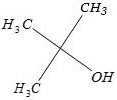
B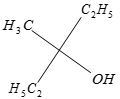
C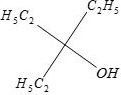
D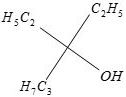
Solution
(A) The reaction of an ethyl ester $(R-COOC_2H_5)$ with excess Grignard reagent $(CH_3MgBr)$ proceeds as follows:
$1$. The first equivalent of $CH_3MgBr$ attacks the carbonyl carbon of the ester to form a tetrahedral intermediate,which then eliminates the ethoxide ion $(C_2H_5O^-)$ to form a ketone $(R-COCH_3)$.
$2$. The second equivalent of $CH_3MgBr$ immediately attacks the newly formed ketone to produce an alkoxide intermediate.
$3$. Upon acidic workup $(H_3O^+)$,the alkoxide is protonated to yield a tertiary alcohol of the structure $R-C(OH)(CH_3)_2$.
Thus,the product $P$ is a tertiary alcohol containing two methyl groups attached to the carbon atom that also bears the hydroxyl group.
$1$. The first equivalent of $CH_3MgBr$ attacks the carbonyl carbon of the ester to form a tetrahedral intermediate,which then eliminates the ethoxide ion $(C_2H_5O^-)$ to form a ketone $(R-COCH_3)$.
$2$. The second equivalent of $CH_3MgBr$ immediately attacks the newly formed ketone to produce an alkoxide intermediate.
$3$. Upon acidic workup $(H_3O^+)$,the alkoxide is protonated to yield a tertiary alcohol of the structure $R-C(OH)(CH_3)_2$.
Thus,the product $P$ is a tertiary alcohol containing two methyl groups attached to the carbon atom that also bears the hydroxyl group.
0 likesView Solution
Vedclass Products
For Students
Vedclass Test Series
Mock tests in real IIT JEE style covering Chemistry with performance analysis. 5-day free trial.
Start Free TrialFor Teachers
Exam Paper Generator
Generate Set A/B/C/D Chemistry papers from 7.5L+ questions in 2 minutes. 3 chapters free.
Try FreeFor Institutes
Online Exam Module
Run live IIT JEE mock exams with unlimited students, 360° analytics & white-label branding.
See DemoFrequently Asked Questions
How many Chemistry questions are in IIT JEE 2003?
There are 48 Chemistry questions from the IIT JEE 2003 paper on Vedclass, each with a detailed step-by-step solution in English.
Are IIT JEE 2003 Chemistry solutions available in English?
Yes. All solutions on this page are in English. You can also switch to English or Hindi using the language buttons above the questions.
Can I practice IIT JEE 2003 Chemistry as a timed test?
Yes. Use the Vedclass Test Series to attempt a full IIT JEE mock test covering Chemistry with time limits and instant score analysis.
Can teachers create Chemistry papers from IIT JEE previous year questions?
Yes. The Vedclass Exam Paper Generator lets teachers mix IIT JEE Chemistry questions and generate Set A/B/C/D papers in minutes.
For Teachers & Institutes
Build a Custom Chemistry Paper
Pick IIT JEE 2003 Chemistry questions, set difficulty, and generate Set A/B/C/D in 2 minutes.