
MathematicsQ1–32 of 32 questions
Page 1 of 1 · English
1
MathematicsAdvancedMCQIIT JEE · 2024
Let $\frac{\pi}{2} < x < \pi$ be such that $\cot x = \frac{-5}{\sqrt{11}}$. Then $\left(\sin \frac{11x}{2}\right)(\sin 6x - \cos 6x) + \left(\cos \frac{11x}{2}\right)(\sin 6x + \cos 6x)$ is equal to
A
$\frac{\sqrt{11}-1}{2\sqrt{3}}$
B
$\frac{\sqrt{11}+1}{2\sqrt{3}}$
C
$\frac{\sqrt{11}+1}{3\sqrt{2}}$
D
$\frac{\sqrt{11}-1}{3\sqrt{2}}$
Solution
(B) Given expression: $E = \sin \frac{11x}{2} \sin 6x - \sin \frac{11x}{2} \cos 6x + \cos \frac{11x}{2} \sin 6x + \cos \frac{11x}{2} \cos 6x$
$= (\cos \frac{11x}{2} \cos 6x + \sin \frac{11x}{2} \sin 6x) + (\cos \frac{11x}{2} \sin 6x - \sin \frac{11x}{2} \cos 6x)$
$= \cos(6x - \frac{11x}{2}) + \sin(6x - \frac{11x}{2})$
$= \cos \frac{x}{2} + \sin \frac{x}{2}$
Since $\cot x = \frac{-5}{\sqrt{11}}$,we have $\frac{1 - \tan^2(x/2)}{2 \tan(x/2)} = \frac{-5}{\sqrt{11}}$.
Let $t = \tan(x/2)$. Then $\sqrt{11}(1 - t^2) = -10t \implies \sqrt{11}t^2 - 10t - \sqrt{11} = 0$.
Solving for $t$: $t = \frac{10 \pm \sqrt{100 - 4(\sqrt{11})(-\sqrt{11})}}{2\sqrt{11}} = \frac{10 \pm \sqrt{144}}{2\sqrt{11}} = \frac{10 \pm 12}{2\sqrt{11}}$.
Since $\frac{\pi}{2} < x < \pi$,we have $\frac{\pi}{4} < \frac{x}{2} < \frac{\pi}{2}$,so $\tan(x/2) > 0$. Thus $t = \frac{22}{2\sqrt{11}} = \sqrt{11}$.
Using $\tan(x/2) = \sqrt{11}$,we find $\sin(x/2) = \frac{\sqrt{11}}{\sqrt{12}} = \frac{\sqrt{11}}{2\sqrt{3}}$ and $\cos(x/2) = \frac{1}{\sqrt{12}} = \frac{1}{2\sqrt{3}}$.
Therefore,$E = \frac{1}{2\sqrt{3}} + \frac{\sqrt{11}}{2\sqrt{3}} = \frac{\sqrt{11}+1}{2\sqrt{3}}$.
$= (\cos \frac{11x}{2} \cos 6x + \sin \frac{11x}{2} \sin 6x) + (\cos \frac{11x}{2} \sin 6x - \sin \frac{11x}{2} \cos 6x)$
$= \cos(6x - \frac{11x}{2}) + \sin(6x - \frac{11x}{2})$
$= \cos \frac{x}{2} + \sin \frac{x}{2}$
Since $\cot x = \frac{-5}{\sqrt{11}}$,we have $\frac{1 - \tan^2(x/2)}{2 \tan(x/2)} = \frac{-5}{\sqrt{11}}$.
Let $t = \tan(x/2)$. Then $\sqrt{11}(1 - t^2) = -10t \implies \sqrt{11}t^2 - 10t - \sqrt{11} = 0$.
Solving for $t$: $t = \frac{10 \pm \sqrt{100 - 4(\sqrt{11})(-\sqrt{11})}}{2\sqrt{11}} = \frac{10 \pm \sqrt{144}}{2\sqrt{11}} = \frac{10 \pm 12}{2\sqrt{11}}$.
Since $\frac{\pi}{2} < x < \pi$,we have $\frac{\pi}{4} < \frac{x}{2} < \frac{\pi}{2}$,so $\tan(x/2) > 0$. Thus $t = \frac{22}{2\sqrt{11}} = \sqrt{11}$.
Using $\tan(x/2) = \sqrt{11}$,we find $\sin(x/2) = \frac{\sqrt{11}}{\sqrt{12}} = \frac{\sqrt{11}}{2\sqrt{3}}$ and $\cos(x/2) = \frac{1}{\sqrt{12}} = \frac{1}{2\sqrt{3}}$.
Therefore,$E = \frac{1}{2\sqrt{3}} + \frac{\sqrt{11}}{2\sqrt{3}} = \frac{\sqrt{11}+1}{2\sqrt{3}}$.
0 likesView Solution
2
MathematicsAdvancedMCQIIT JEE · 2024
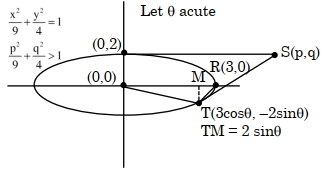
Consider the ellipse $\frac{x^2}{9}+\frac{y^2}{4}=1$. Let $S(p, q)$ be a point in the first quadrant such that $\frac{p^2}{9}+\frac{q^2}{4}>1$. Two tangents are drawn from $S$ to the ellipse,of which one meets the ellipse at one end point of the minor axis and the other meets the ellipse at a point $T$ in the fourth quadrant. Let $R$ be the vertex of the ellipse with positive $x$-coordinate and $O$ be the center of the ellipse. If the area of the triangle $\triangle ORT$ is $\frac{3}{2}$,then which of the following options is correct?
A
$q=2, p=3 \sqrt{3}$
B
$q=2, p=4 \sqrt{3}$
C
$q=1, p=5 \sqrt{3}$
D
$q=1, p=6 \sqrt{3}$
Solution
(A) The ellipse is $\frac{x^2}{3^2} + \frac{y^2}{2^2} = 1$. The vertex $R$ is $(3, 0)$ and the center $O$ is $(0, 0)$.
Let point $T$ be $(3 \cos \theta, 2 \sin \theta)$. Since $T$ is in the fourth quadrant,we take $T = (3 \cos \theta, -2 \sin \theta)$ where $\theta$ is acute.
The area of $\triangle ORT$ is given by $\frac{1}{2} |x_O(y_R - y_T) + x_R(y_T - y_O) + x_T(y_O - y_R)| = \frac{3}{2}$.
$\frac{1}{2} |0(0 - (-2 \sin \theta)) + 3(-2 \sin \theta - 0) + 3 \cos \theta(0 - 0)| = \frac{3}{2}$.
$\frac{1}{2} |-6 \sin \theta| = \frac{3}{2}$ $\Rightarrow 3 \sin \theta = \frac{3}{2}$ $\Rightarrow \sin \theta = \frac{1}{2}$.
Thus,$\theta = 30^\circ = \frac{\pi}{6}$.
So,$T = (3 \cos 30^\circ, -2 \sin 30^\circ) = (3 \cdot \frac{\sqrt{3}}{2}, -2 \cdot \frac{1}{2}) = (\frac{3 \sqrt{3}}{2}, -1)$.
The tangent at $(0, 2)$ is $y = 2$.
The tangent at $T(\frac{3 \sqrt{3}}{2}, -1)$ is $\frac{x(\frac{3 \sqrt{3}}{2})}{9} + \frac{y(-1)}{4} = 1 \Rightarrow \frac{x \sqrt{3}}{6} - \frac{y}{4} = 1$.
Substituting $y = 2$ into the tangent equation: $\frac{x \sqrt{3}}{6} - \frac{2}{4} = 1 \Rightarrow \frac{x \sqrt{3}}{6} = 1 + \frac{1}{2} = \frac{3}{2}$.
$x \sqrt{3} = 9 \Rightarrow x = \frac{9}{\sqrt{3}} = 3 \sqrt{3}$.
Thus,$S(p, q) = (3 \sqrt{3}, 2)$.
Therefore,$p = 3 \sqrt{3}$ and $q = 2$.
Let point $T$ be $(3 \cos \theta, 2 \sin \theta)$. Since $T$ is in the fourth quadrant,we take $T = (3 \cos \theta, -2 \sin \theta)$ where $\theta$ is acute.
The area of $\triangle ORT$ is given by $\frac{1}{2} |x_O(y_R - y_T) + x_R(y_T - y_O) + x_T(y_O - y_R)| = \frac{3}{2}$.
$\frac{1}{2} |0(0 - (-2 \sin \theta)) + 3(-2 \sin \theta - 0) + 3 \cos \theta(0 - 0)| = \frac{3}{2}$.
$\frac{1}{2} |-6 \sin \theta| = \frac{3}{2}$ $\Rightarrow 3 \sin \theta = \frac{3}{2}$ $\Rightarrow \sin \theta = \frac{1}{2}$.
Thus,$\theta = 30^\circ = \frac{\pi}{6}$.
So,$T = (3 \cos 30^\circ, -2 \sin 30^\circ) = (3 \cdot \frac{\sqrt{3}}{2}, -2 \cdot \frac{1}{2}) = (\frac{3 \sqrt{3}}{2}, -1)$.
The tangent at $(0, 2)$ is $y = 2$.
The tangent at $T(\frac{3 \sqrt{3}}{2}, -1)$ is $\frac{x(\frac{3 \sqrt{3}}{2})}{9} + \frac{y(-1)}{4} = 1 \Rightarrow \frac{x \sqrt{3}}{6} - \frac{y}{4} = 1$.
Substituting $y = 2$ into the tangent equation: $\frac{x \sqrt{3}}{6} - \frac{2}{4} = 1 \Rightarrow \frac{x \sqrt{3}}{6} = 1 + \frac{1}{2} = \frac{3}{2}$.
$x \sqrt{3} = 9 \Rightarrow x = \frac{9}{\sqrt{3}} = 3 \sqrt{3}$.
Thus,$S(p, q) = (3 \sqrt{3}, 2)$.
Therefore,$p = 3 \sqrt{3}$ and $q = 2$.
0 likesView Solution
3
MathematicsAdvancedMCQIIT JEE · 2024
Let $S=\{a+b \sqrt{2}: a, b \in Z \}$,$T_1=\{(-1+\sqrt{2})^n: n \in N \}$ and $T_2=\{(1+\sqrt{2})^n: n \in N \}$. Then which of the following statements is (are) $TRUE$?
$(A)$ $Z \cup T_1 \cup T_2 \subset S$
$(B)$ $T_1 \cap (0, \frac{1}{2024}) = \phi$,where $\phi$ denotes the empty set
$(C)$ $T_2 \cap (2024, \infty) \neq \phi$
$(D)$ For any given $a, b \in Z$,$\cos(\pi(a+b \sqrt{2})) + i \sin(\pi(a+b \sqrt{2})) \in Z$ if and only if $b=0$,where $i=\sqrt{-1}$
$(A)$ $Z \cup T_1 \cup T_2 \subset S$
$(B)$ $T_1 \cap (0, \frac{1}{2024}) = \phi$,where $\phi$ denotes the empty set
$(C)$ $T_2 \cap (2024, \infty) \neq \phi$
$(D)$ For any given $a, b \in Z$,$\cos(\pi(a+b \sqrt{2})) + i \sin(\pi(a+b \sqrt{2})) \in Z$ if and only if $b=0$,where $i=\sqrt{-1}$
A
$A, B, C$
B
$A, B$
C
$A, C, D$
D
$A, B, D$
Solution
(C) Since $(-1+\sqrt{2})^n$ and $(1+\sqrt{2})^n$ can be expressed in the form $m+n\sqrt{2}$ for some $m, n \in Z$ using the Binomial Theorem,and $Z \subset S$,it follows that $Z \cup T_1 \cup T_2 \subset S$. Thus,$(A)$ is true.
$(B)$ Let $x_n = (-1+\sqrt{2})^n$. Since $0 < -1+\sqrt{2} < 1$,as $n$ increases,$x_n$ approaches $0$. Specifically,for large $n$,$(-1+\sqrt{2})^n < \frac{1}{2024}$. Thus,$T_1 \cap (0, \frac{1}{2024}) \neq \phi$. So,$(B)$ is false.
$(C)$ Since $1+\sqrt{2} > 1$,$(1+\sqrt{2})^n$ is an increasing sequence that tends to $\infty$. Thus,there exists $n$ such that $(1+\sqrt{2})^n > 2024$. So,$T_2 \cap (2024, \infty) \neq \phi$. Thus,$(C)$ is true.
$(D)$ Let $z = \cos(\pi(a+b\sqrt{2})) + i\sin(\pi(a+b\sqrt{2})) = e^{i\pi(a+b\sqrt{2})}$. For $z \in Z$,the imaginary part must be $0$,so $\sin(\pi(a+b\sqrt{2})) = 0$. This implies $\pi(a+b\sqrt{2}) = k\pi$ for some $k \in Z$,which means $a+b\sqrt{2} = k$. Since $\sqrt{2}$ is irrational,this holds if and only if $b=0$. Thus,$(D)$ is true.
Therefore,the correct statements are $(A), (C), (D)$.
$(B)$ Let $x_n = (-1+\sqrt{2})^n$. Since $0 < -1+\sqrt{2} < 1$,as $n$ increases,$x_n$ approaches $0$. Specifically,for large $n$,$(-1+\sqrt{2})^n < \frac{1}{2024}$. Thus,$T_1 \cap (0, \frac{1}{2024}) \neq \phi$. So,$(B)$ is false.
$(C)$ Since $1+\sqrt{2} > 1$,$(1+\sqrt{2})^n$ is an increasing sequence that tends to $\infty$. Thus,there exists $n$ such that $(1+\sqrt{2})^n > 2024$. So,$T_2 \cap (2024, \infty) \neq \phi$. Thus,$(C)$ is true.
$(D)$ Let $z = \cos(\pi(a+b\sqrt{2})) + i\sin(\pi(a+b\sqrt{2})) = e^{i\pi(a+b\sqrt{2})}$. For $z \in Z$,the imaginary part must be $0$,so $\sin(\pi(a+b\sqrt{2})) = 0$. This implies $\pi(a+b\sqrt{2}) = k\pi$ for some $k \in Z$,which means $a+b\sqrt{2} = k$. Since $\sqrt{2}$ is irrational,this holds if and only if $b=0$. Thus,$(D)$ is true.
Therefore,the correct statements are $(A), (C), (D)$.
0 likesView Solution
4
MathematicsAdvancedMCQIIT JEE · 2024
Let $R^2$ denote $R \times R$. Let $S = \{(a, b, c) : a, b, c \in R \text{ and } ax^2 + 2bxy + cy^2 > 0 \text{ for all } (x, y) \in R^2 - \{(0, 0)\}\}$. Then which of the following statements is (are) $TRUE$?
$(A) (2, \frac{7}{2}, 6) \in S$
$(B) \text{If } (3, b, \frac{1}{12}) \in S, \text{ then } |2b| < 1$
$(C) \text{For any given } (a, b, c) \in S, \text{ the system of linear equations } ax + by = 1, bx + cy = -1 \text{ has a unique solution.}$
$(D) \text{For any given } (a, b, c) \in S, \text{ the system of linear equations } (a+1)x + by = 0, bx + (c+1)y = 0 \text{ has a unique solution.}$
$(A) (2, \frac{7}{2}, 6) \in S$
$(B) \text{If } (3, b, \frac{1}{12}) \in S, \text{ then } |2b| < 1$
$(C) \text{For any given } (a, b, c) \in S, \text{ the system of linear equations } ax + by = 1, bx + cy = -1 \text{ has a unique solution.}$
$(D) \text{For any given } (a, b, c) \in S, \text{ the system of linear equations } (a+1)x + by = 0, bx + (c+1)y = 0 \text{ has a unique solution.}$
A
$A, B, D$
B
$B, C, D$
C
$A, B$
D
$A, C$
Solution
(B) The condition $ax^2 + 2bxy + cy^2 > 0$ for all $(x, y) \neq (0, 0)$ implies that the quadratic form is positive definite. This occurs if and only if $a > 0$ and the discriminant $D = (2b)^2 - 4ac < 0$,which simplifies to $b^2 < ac$.
$(A)$ For $(2, \frac{7}{2}, 6)$,$a = 2 > 0$ and $b^2 = (\frac{7}{2})^2 = 12.25$,while $ac = 2 \times 6 = 12$. Since $12.25 > 12$,$(2, \frac{7}{2}, 6) \notin S$.
$(B)$ For $(3, b, \frac{1}{12})$,we need $b^2 < 3 \times \frac{1}{12} = \frac{1}{4}$. Thus $|b| < \frac{1}{2}$,which implies $|2b| < 1$. This is $TRUE$.
$(C)$ The system has a unique solution if the determinant of the coefficient matrix is non-zero. The determinant is $ac - b^2$. Since $(a, b, c) \in S$,$b^2 < ac$,so $ac - b^2 > 0$. Thus,the system has a unique solution. This is $TRUE$.
$(D)$ The system has a unique solution if the determinant $(a+1)(c+1) - b^2 \neq 0$. Since $ac > b^2$ and $a, c > 0$,we have $ac + a + c + 1 > b^2 + 1 > 0$. Thus,the determinant is always positive,ensuring a unique solution. This is $TRUE$.
$(A)$ For $(2, \frac{7}{2}, 6)$,$a = 2 > 0$ and $b^2 = (\frac{7}{2})^2 = 12.25$,while $ac = 2 \times 6 = 12$. Since $12.25 > 12$,$(2, \frac{7}{2}, 6) \notin S$.
$(B)$ For $(3, b, \frac{1}{12})$,we need $b^2 < 3 \times \frac{1}{12} = \frac{1}{4}$. Thus $|b| < \frac{1}{2}$,which implies $|2b| < 1$. This is $TRUE$.
$(C)$ The system has a unique solution if the determinant of the coefficient matrix is non-zero. The determinant is $ac - b^2$. Since $(a, b, c) \in S$,$b^2 < ac$,so $ac - b^2 > 0$. Thus,the system has a unique solution. This is $TRUE$.
$(D)$ The system has a unique solution if the determinant $(a+1)(c+1) - b^2 \neq 0$. Since $ac > b^2$ and $a, c > 0$,we have $ac + a + c + 1 > b^2 + 1 > 0$. Thus,the determinant is always positive,ensuring a unique solution. This is $TRUE$.
0 likesView Solution
5
MathematicsMediumMCQIIT JEE · 2024
Let $a = 3 \sqrt{2}$ and $b = \frac{1}{5^{\frac{1}{6}} \sqrt{6}}$. If $x, y \in \mathbb{R}$ are such that $3x + 2y = \log_a(18)^{\frac{5}{4}}$ and $2x - y = \log_b(\sqrt{1080})$,then $4x + 5y$ is equal to:
A
$3$
B
$4$
C
$8$
D
$9$
Solution
(C) Given $a = 3\sqrt{2} = \sqrt{18}$. Thus,$3x + 2y = \log_{\sqrt{18}}(18)^{\frac{5}{4}} = \log_{18^{\frac{1}{2}}}(18)^{\frac{5}{4}} = \frac{5/4}{1/2} = \frac{5}{2}$.
Multiplying by $2$,we get $6x + 4y = 5$ ... $(1)$.
Given $b = \frac{1}{5^{\frac{1}{6}} \sqrt{6}} = (5^{\frac{1}{6}} \cdot 6^{\frac{1}{2}})^{-1} = (5^{\frac{1}{6}} \cdot (6^3)^{\frac{1}{6}})^{-1} = (30^{\frac{1}{6}})^{-1} = 30^{-\frac{1}{6}}$.
Also,$\sqrt{1080} = \sqrt{36 \times 30} = 6\sqrt{30} = 6^1 \cdot 30^{\frac{1}{2}}$. This does not simplify easily to base $b$. Let us re-evaluate $2x - y = \log_b(\sqrt{1080})$.
Note $1080 = 216 \times 5 = 6^3 \times 5$. So $\sqrt{1080} = 6^{\frac{3}{2}} \cdot 5^{\frac{1}{2}}$.
Since $b = (5^{\frac{1}{6}} \cdot 6^{\frac{1}{2}})^{-1}$,then $b^{-3} = (5^{\frac{1}{6}} \cdot 6^{\frac{1}{2}})^3 = 5^{\frac{1}{2}} \cdot 6^{\frac{3}{2}} = \sqrt{1080}$.
Thus,$2x - y = \log_b(b^{-3}) = -3$ ... $(2)$.
From $(1)$ and $(2)$,we have $6x + 4y = 5$ and $2x - y = -3$. Multiplying $(2)$ by $4$ gives $8x - 4y = -12$.
Adding this to $(1)$: $(6x + 4y) + (8x - 4y) = 5 - 12$ $\Rightarrow 14x = -7$ $\Rightarrow x = -0.5$.
Substituting $x = -0.5$ into $(2)$: $2(-0.5) - y = -3$ $\Rightarrow -1 - y = -3$ $\Rightarrow y = 2$.
Then $4x + 5y = 4(-0.5) + 5(2) = -2 + 10 = 8$.
Multiplying by $2$,we get $6x + 4y = 5$ ... $(1)$.
Given $b = \frac{1}{5^{\frac{1}{6}} \sqrt{6}} = (5^{\frac{1}{6}} \cdot 6^{\frac{1}{2}})^{-1} = (5^{\frac{1}{6}} \cdot (6^3)^{\frac{1}{6}})^{-1} = (30^{\frac{1}{6}})^{-1} = 30^{-\frac{1}{6}}$.
Also,$\sqrt{1080} = \sqrt{36 \times 30} = 6\sqrt{30} = 6^1 \cdot 30^{\frac{1}{2}}$. This does not simplify easily to base $b$. Let us re-evaluate $2x - y = \log_b(\sqrt{1080})$.
Note $1080 = 216 \times 5 = 6^3 \times 5$. So $\sqrt{1080} = 6^{\frac{3}{2}} \cdot 5^{\frac{1}{2}}$.
Since $b = (5^{\frac{1}{6}} \cdot 6^{\frac{1}{2}})^{-1}$,then $b^{-3} = (5^{\frac{1}{6}} \cdot 6^{\frac{1}{2}})^3 = 5^{\frac{1}{2}} \cdot 6^{\frac{3}{2}} = \sqrt{1080}$.
Thus,$2x - y = \log_b(b^{-3}) = -3$ ... $(2)$.
From $(1)$ and $(2)$,we have $6x + 4y = 5$ and $2x - y = -3$. Multiplying $(2)$ by $4$ gives $8x - 4y = -12$.
Adding this to $(1)$: $(6x + 4y) + (8x - 4y) = 5 - 12$ $\Rightarrow 14x = -7$ $\Rightarrow x = -0.5$.
Substituting $x = -0.5$ into $(2)$: $2(-0.5) - y = -3$ $\Rightarrow -1 - y = -3$ $\Rightarrow y = 2$.
Then $4x + 5y = 4(-0.5) + 5(2) = -2 + 10 = 8$.
1 likesView Solution
6
MathematicsAdvancedMCQIIT JEE · 2024
Let $f(x) = x^4 + ax^3 + bx^2 + c$ be a polynomial with real coefficients such that $f(1) = -9$. Suppose that $i\sqrt{3}$ is a root of the equation $4x^3 + 3ax^2 + 2bx = 0$,where $i = \sqrt{-1}$. If $\alpha_1, \alpha_2, \alpha_3$,and $\alpha_4$ are all the roots of the equation $f(x) = 0$,then $|\alpha_1|^2 + |\alpha_2|^2 + |\alpha_3|^2 + |\alpha_4|^2$ is equal to:
A
$10$
B
$20$
C
$30$
D
$40$
Solution
(B) Given $f(x) = x^4 + ax^3 + bx^2 + c$ and $f(1) = -9$,we have $1 + a + b + c = -9$,so $a + b + c = -10$ $(1)$.
The equation $4x^3 + 3ax^2 + 2bx = 0$ has $i\sqrt{3}$ as a root. Since the coefficients are real,$-i\sqrt{3}$ is also a root. The third root must be $0$ because the constant term is $0$.
Thus,the roots are $0, i\sqrt{3}, -i\sqrt{3}$.
The sum of roots taken two at a time is $\frac{2b}{4} = (i\sqrt{3})(-i\sqrt{3}) + 0 + 0 = 3$,so $b = 6$.
The sum of roots is $-\frac{3a}{4} = 0 + i\sqrt{3} - i\sqrt{3} = 0$,so $a = 0$.
Substituting $a = 0$ and $b = 6$ into $(1)$,we get $0 + 6 + c = -10$,so $c = -16$.
Thus,$f(x) = x^4 + 6x^2 - 16 = 0$.
Factoring,$(x^2 + 8)(x^2 - 2) = 0$,so the roots are $x^2 = -8$ and $x^2 = 2$.
The roots are $\alpha_1 = i\sqrt{8}, \alpha_2 = -i\sqrt{8}, \alpha_3 = \sqrt{2}, \alpha_4 = -\sqrt{2}$.
Calculating the sum of squares of magnitudes: $|\alpha_1|^2 + |\alpha_2|^2 + |\alpha_3|^2 + |\alpha_4|^2 = 8 + 8 + 2 + 2 = 20$.
The equation $4x^3 + 3ax^2 + 2bx = 0$ has $i\sqrt{3}$ as a root. Since the coefficients are real,$-i\sqrt{3}$ is also a root. The third root must be $0$ because the constant term is $0$.
Thus,the roots are $0, i\sqrt{3}, -i\sqrt{3}$.
The sum of roots taken two at a time is $\frac{2b}{4} = (i\sqrt{3})(-i\sqrt{3}) + 0 + 0 = 3$,so $b = 6$.
The sum of roots is $-\frac{3a}{4} = 0 + i\sqrt{3} - i\sqrt{3} = 0$,so $a = 0$.
Substituting $a = 0$ and $b = 6$ into $(1)$,we get $0 + 6 + c = -10$,so $c = -16$.
Thus,$f(x) = x^4 + 6x^2 - 16 = 0$.
Factoring,$(x^2 + 8)(x^2 - 2) = 0$,so the roots are $x^2 = -8$ and $x^2 = 2$.
The roots are $\alpha_1 = i\sqrt{8}, \alpha_2 = -i\sqrt{8}, \alpha_3 = \sqrt{2}, \alpha_4 = -\sqrt{2}$.
Calculating the sum of squares of magnitudes: $|\alpha_1|^2 + |\alpha_2|^2 + |\alpha_3|^2 + |\alpha_4|^2 = 8 + 8 + 2 + 2 = 20$.
0 likesView Solution
7
MathematicsAdvancedMCQIIT JEE · 2024
$A$ group of $9$ students,$s_1, s_2, \ldots, s_9$,is to be divided into three teams $X, Y$,and $Z$ of sizes $2, 3$,and $4$,respectively. Suppose that $s_1$ cannot be selected for team $X$,and $s_2$ cannot be selected for team $Y$. The number of ways to form such teams is:
A
$660$
B
$661$
C
$664$
D
$665$
Solution
(D) Total ways to form teams $X, Y, Z$ of sizes $2, 3, 4$ without any restrictions is $\binom{9}{2} \times \binom{7}{3} \times \binom{4}{4} = 36 \times 35 = 1260$.
Let $A$ be the set of ways where $s_1 \in X$ and $B$ be the set of ways where $s_2 \in Y$.
We want to find the total ways minus the ways where ($s_1 \in X$ $OR$ $s_2 \in Y$).
By the Principle of Inclusion-Exclusion: $|A \cup B| = |A| + |B| - |A \cap B|$.
$|A|$ (ways where $s_1 \in X$): $s_1$ is fixed in $X$,we choose $1$ more from $8$ for $X$,then $3$ from $7$ for $Y$: $\binom{8}{1} \times \binom{7}{3} = 8 \times 35 = 280$.
$|B|$ (ways where $s_2 \in Y$): $s_2$ is fixed in $Y$,we choose $2$ from $8$ for $X$,then $2$ from $6$ for $Y$: $\binom{8}{2} \times \binom{6}{2} = 28 \times 15 = 420$.
$|A \cap B|$ (ways where $s_1 \in X$ $AND$ $s_2 \in Y$): $s_1$ fixed in $X$,$s_2$ fixed in $Y$,we choose $1$ from $7$ for $X$,then $2$ from $6$ for $Y$: $\binom{7}{1} \times \binom{6}{2} = 7 \times 15 = 105$.
$|A \cup B| = 280 + 420 - 105 = 595$.
Total valid ways = $1260 - 595 = 665$.
Let $A$ be the set of ways where $s_1 \in X$ and $B$ be the set of ways where $s_2 \in Y$.
We want to find the total ways minus the ways where ($s_1 \in X$ $OR$ $s_2 \in Y$).
By the Principle of Inclusion-Exclusion: $|A \cup B| = |A| + |B| - |A \cap B|$.
$|A|$ (ways where $s_1 \in X$): $s_1$ is fixed in $X$,we choose $1$ more from $8$ for $X$,then $3$ from $7$ for $Y$: $\binom{8}{1} \times \binom{7}{3} = 8 \times 35 = 280$.
$|B|$ (ways where $s_2 \in Y$): $s_2$ is fixed in $Y$,we choose $2$ from $8$ for $X$,then $2$ from $6$ for $Y$: $\binom{8}{2} \times \binom{6}{2} = 28 \times 15 = 420$.
$|A \cap B|$ (ways where $s_1 \in X$ $AND$ $s_2 \in Y$): $s_1$ fixed in $X$,$s_2$ fixed in $Y$,we choose $1$ from $7$ for $X$,then $2$ from $6$ for $Y$: $\binom{7}{1} \times \binom{6}{2} = 7 \times 15 = 105$.
$|A \cup B| = 280 + 420 - 105 = 595$.
Total valid ways = $1260 - 595 = 665$.
1 likesView Solution
8
MathematicsAdvancedMCQIIT JEE · 2024
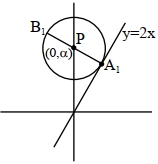
Let the straight line $y=2x$ touch a circle with center $(0, \alpha)$,$\alpha>0$,and radius $r$ at a point $A_1$. Let $B_1$ be the point on the circle such that the line segment $A_1 B_1$ is a diameter of the circle. Let $\alpha+r=5+\sqrt{5}$. Match each entry in $List-I$ to the correct entry in $List-II$.
| $List-I$ | $List-II$ |
| $(P) \alpha \text{ equals}$ | $(1) (-2,4)$ |
| $(Q) r \text{ equals}$ | $(2) \sqrt{5}$ |
| $(R) A_1 \text{ equals}$ | $(3) (-2,6)$ |
| $(S) B_1 \text{ equals}$ | $(4) 5$ |
| $(5) (2,4)$ |
A
$(P) \rightarrow (4), (Q) \rightarrow (2), (R) \rightarrow (1), (S) \rightarrow (3)$
B
$(P) \rightarrow (2), (Q) \rightarrow (4), (R) \rightarrow (1), (S) \rightarrow (3)$
C
$(P) \rightarrow (4), (Q) \rightarrow (2), (R) \rightarrow (5), (S) \rightarrow (3)$
D
$(P) \rightarrow (2), (Q) \rightarrow (4), (R) \rightarrow (3), (S) \rightarrow (5)$
Solution
(C) The center of the circle is $P(0, \alpha)$ and the radius is $r$. The line $2x - y = 0$ is tangent to the circle at $A_1$.
The perpendicular distance from the center $(0, \alpha)$ to the line $2x - y = 0$ is equal to the radius $r$:
$\frac{|2(0) - \alpha|}{\sqrt{2^2 + (-1)^2}} = r \implies \frac{|-\alpha|}{\sqrt{5}} = r \implies \alpha = r\sqrt{5}$.
Given $\alpha + r = 5 + \sqrt{5}$,substitute $\alpha = r\sqrt{5}$:
$r\sqrt{5} + r = 5 + \sqrt{5} \implies r(\sqrt{5} + 1) = \sqrt{5}(\sqrt{5} + 1) \implies r = \sqrt{5}$.
Then $\alpha = \sqrt{5} \cdot \sqrt{5} = 5$. So,the center is $P(0, 5)$.
The point $A_1$ is the foot of the perpendicular from $P(0, 5)$ to the line $2x - y = 0$:
$\frac{x - 0}{2} = \frac{y - 5}{-1} = -\frac{2(0) - 5}{2^2 + (-1)^2} = \frac{5}{5} = 1$.
$x = 2(1) = 2$ and $y - 5 = -1 \implies y = 4$. Thus,$A_1 = (2, 4)$.
Since $A_1 B_1$ is a diameter,the center $P(0, 5)$ is the midpoint of $A_1 B_1$. Let $B_1 = (x_1, y_1)$:
$\frac{x_1 + 2}{2} = 0 \implies x_1 = -2$.
$\frac{y_1 + 4}{2} = 5 \implies y_1 + 4 = 10 \implies y_1 = 6$.
Thus,$B_1 = (-2, 6)$.
Matching the results:
$(P) \alpha = 5 \rightarrow (4)$
$(Q) r = \sqrt{5} \rightarrow (2)$
$(R) A_1 = (2, 4) \rightarrow (5)$
$(S) B_1 = (-2, 6) \rightarrow (3)$
Therefore,$(P) \rightarrow (4), (Q) \rightarrow (2), (R) \rightarrow (5), (S) \rightarrow (3)$.
The perpendicular distance from the center $(0, \alpha)$ to the line $2x - y = 0$ is equal to the radius $r$:
$\frac{|2(0) - \alpha|}{\sqrt{2^2 + (-1)^2}} = r \implies \frac{|-\alpha|}{\sqrt{5}} = r \implies \alpha = r\sqrt{5}$.
Given $\alpha + r = 5 + \sqrt{5}$,substitute $\alpha = r\sqrt{5}$:
$r\sqrt{5} + r = 5 + \sqrt{5} \implies r(\sqrt{5} + 1) = \sqrt{5}(\sqrt{5} + 1) \implies r = \sqrt{5}$.
Then $\alpha = \sqrt{5} \cdot \sqrt{5} = 5$. So,the center is $P(0, 5)$.
The point $A_1$ is the foot of the perpendicular from $P(0, 5)$ to the line $2x - y = 0$:
$\frac{x - 0}{2} = \frac{y - 5}{-1} = -\frac{2(0) - 5}{2^2 + (-1)^2} = \frac{5}{5} = 1$.
$x = 2(1) = 2$ and $y - 5 = -1 \implies y = 4$. Thus,$A_1 = (2, 4)$.
Since $A_1 B_1$ is a diameter,the center $P(0, 5)$ is the midpoint of $A_1 B_1$. Let $B_1 = (x_1, y_1)$:
$\frac{x_1 + 2}{2} = 0 \implies x_1 = -2$.
$\frac{y_1 + 4}{2} = 5 \implies y_1 + 4 = 10 \implies y_1 = 6$.
Thus,$B_1 = (-2, 6)$.
Matching the results:
$(P) \alpha = 5 \rightarrow (4)$
$(Q) r = \sqrt{5} \rightarrow (2)$
$(R) A_1 = (2, 4) \rightarrow (5)$
$(S) B_1 = (-2, 6) \rightarrow (3)$
Therefore,$(P) \rightarrow (4), (Q) \rightarrow (2), (R) \rightarrow (5), (S) \rightarrow (3)$.
0 likesView Solution
9
MathematicsEasyMCQIIT JEE · 2024
Let $k \in \mathbb{R}$. If $\lim _{x \rightarrow 0^{+}}(\sin (\sin k x)+\cos x+x)^{\frac{2}{x}}= e ^6$,then the value of $k$ is
A
$1$
B
$2$
C
$3$
D
$4$
Solution
(B) The given limit is of the form $1^\infty$. We use the formula $\lim_{x \to a} f(x)^{g(x)} = e^{\lim_{x \to a} g(x)(f(x)-1)}$.
Given $\lim _{x \rightarrow 0^{+}}(\sin (\sin k x)+\cos x+x)^{\frac{2}{x}}= e ^6$,we have:
$e^{\lim _{x \rightarrow 0^{+}} \frac{2}{x}(\sin (\sin k x)+\cos x+x-1)} = e^6$.
Equating the exponents:
$\lim _{x \rightarrow 0^{+}} \frac{2}{x}(\sin (\sin k x) + (\cos x - 1) + x) = 6$.
$\lim _{x}$ ${\rightarrow 0^{+}} \left[ 2 \cdot \frac{\sin(\sin kx)}{\sin kx} \cdot \frac{\sin kx}{kx} \cdot k + 2 \cdot \frac{\cos x - 1}{x^2} \cdot x + 2 \cdot \frac{x}{x} \right] = 6$.
Using standard limits $\lim_{u \to 0} \frac{\sin u}{u} = 1$ and $\lim_{x \to 0} \frac{1-\cos x}{x^2} = \frac{1}{2}$:
$2(1 \cdot 1 \cdot k) + 2(-\frac{1}{2} \cdot 0) + 2(1) = 6$.
$2k + 2 = 6$ $\Rightarrow 2k = 4$ $\Rightarrow k = 2$.
Given $\lim _{x \rightarrow 0^{+}}(\sin (\sin k x)+\cos x+x)^{\frac{2}{x}}= e ^6$,we have:
$e^{\lim _{x \rightarrow 0^{+}} \frac{2}{x}(\sin (\sin k x)+\cos x+x-1)} = e^6$.
Equating the exponents:
$\lim _{x \rightarrow 0^{+}} \frac{2}{x}(\sin (\sin k x) + (\cos x - 1) + x) = 6$.
$\lim _{x}$ ${\rightarrow 0^{+}} \left[ 2 \cdot \frac{\sin(\sin kx)}{\sin kx} \cdot \frac{\sin kx}{kx} \cdot k + 2 \cdot \frac{\cos x - 1}{x^2} \cdot x + 2 \cdot \frac{x}{x} \right] = 6$.
Using standard limits $\lim_{u \to 0} \frac{\sin u}{u} = 1$ and $\lim_{x \to 0} \frac{1-\cos x}{x^2} = \frac{1}{2}$:
$2(1 \cdot 1 \cdot k) + 2(-\frac{1}{2} \cdot 0) + 2(1) = 6$.
$2k + 2 = 6$ $\Rightarrow 2k = 4$ $\Rightarrow k = 2$.
0 likesView Solution
10
MathematicsAdvancedMCQIIT JEE · 2024
Let $S$ be the set of all $(\alpha, \beta) \in \mathbb{R} \times \mathbb{R}$ such that $\lim _{x \rightarrow \infty} \frac{\sin(x^2)(\log_e x)^\alpha \sin(1/x^2)}{x^{\alpha \beta}(\log_e(1+x))^\beta} = 0$. Then which of the following is (are) correct?
A
$(-1, 3) \in S$
B
$(-1, 1) \in S$
C
$(1, -1) \in S$
D
$(1, -2) \in S$
Solution
(B, C) Given the limit: $\lim _{x \rightarrow \infty} \frac{\sin(x^2)(\log_e x)^\alpha \sin(1/x^2)}{x^{\alpha \beta}(\log_e(1+x))^\beta} = 0$.
Since $\sin(x^2)$ is bounded and $\sin(1/x^2) \approx 1/x^2$ as $x \rightarrow \infty$,and $\log_e(1+x) \approx \log_e x$ as $x \rightarrow \infty$,the expression behaves as:
$\lim _{x \rightarrow \infty} \frac{(\log_e x)^\alpha \cdot (1/x^2)}{x^{\alpha \beta} \cdot (\log_e x)^\beta} = \lim _{x \rightarrow \infty} \frac{(\log_e x)^{\alpha-\beta}}{x^{\alpha \beta+2}} = 0$.
For this limit to be $0$,the exponent of $x$ in the denominator must be positive,i.e.,$\alpha \beta + 2 > 0$,which implies $\alpha \beta > -2$.
Checking the options:
$(A) (-1, 3) \implies (-1)(3) = -3 \ngtr -2$ (Incorrect).
$(B) (-1, 1) \implies (-1)(1) = -1 > -2$ (Correct).
$(C) (1, -1) \implies (1)(-1) = -1 > -2$ (Correct).
$(D) (1, -2) \implies (1)(-2) = -2 \ngtr -2$ (Incorrect).
Thus,$(B)$ and $(C)$ are correct.
Since $\sin(x^2)$ is bounded and $\sin(1/x^2) \approx 1/x^2$ as $x \rightarrow \infty$,and $\log_e(1+x) \approx \log_e x$ as $x \rightarrow \infty$,the expression behaves as:
$\lim _{x \rightarrow \infty} \frac{(\log_e x)^\alpha \cdot (1/x^2)}{x^{\alpha \beta} \cdot (\log_e x)^\beta} = \lim _{x \rightarrow \infty} \frac{(\log_e x)^{\alpha-\beta}}{x^{\alpha \beta+2}} = 0$.
For this limit to be $0$,the exponent of $x$ in the denominator must be positive,i.e.,$\alpha \beta + 2 > 0$,which implies $\alpha \beta > -2$.
Checking the options:
$(A) (-1, 3) \implies (-1)(3) = -3 \ngtr -2$ (Incorrect).
$(B) (-1, 1) \implies (-1)(1) = -1 > -2$ (Correct).
$(C) (1, -1) \implies (1)(-1) = -1 > -2$ (Correct).
$(D) (1, -2) \implies (1)(-2) = -2 \ngtr -2$ (Incorrect).
Thus,$(B)$ and $(C)$ are correct.
0 likesView Solution
11
MathematicsDifficultMCQIIT JEE · 2024
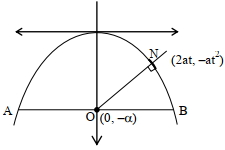
$A$ normal with slope $\frac{1}{\sqrt{6}}$ is drawn from the point $(0, -\alpha)$ to the parabola $x^2 = -4ay$,where $a > 0$. Let $L$ be the line passing through $(0, -\alpha)$ and parallel to the directrix of the parabola. Suppose that $L$ intersects the parabola at two points $A$ and $B$. Let $r$ denote the length of the latus rectum and $s$ denote the square of the length of the line segment $AB$. If $r : s = 1 : 16$,then the value of $24a$ is. . . .
A
$10$
B
$12$
C
$15$
D
$20$
Solution
(B) The equation of the parabola is $x^2 = -4ay$. Differentiating with respect to $x$,we get $2x = -4a \frac{dy}{dx}$,so $\frac{dy}{dx} = -\frac{x}{2a}$.
Let the normal be drawn at point $P(2at, -at^2)$. The slope of the tangent at $P$ is $-t$,so the slope of the normal is $\frac{1}{t}$.
Given the slope of the normal is $\frac{1}{\sqrt{6}}$,we have $t = \sqrt{6}$.
The normal at $P(2at, -at^2)$ is $y + at^2 = t(x - 2at)$,which simplifies to $y = tx - 2at - at^2$.
Since this normal passes through $(0, -\alpha)$,we have $-\alpha = -2at - at^2$,so $\alpha = 2at + at^2$.
Substituting $t = \sqrt{6}$,we get $\alpha = 2a(\sqrt{6}) + a(6) = a(6 + 2\sqrt{6})$.
However,the problem states the point is $(0, -\alpha)$ and the line $L$ passes through it parallel to the directrix $(y = a)$. Thus,the line $L$ is $y = -\alpha$.
Intersection with $x^2 = -4ay$ gives $x^2 = -4a(-\alpha) = 4a\alpha$,so $x = \pm 2\sqrt{a\alpha}$.
The length $AB = 4\sqrt{a\alpha}$,so $s = AB^2 = 16a\alpha$.
Given $r = 4a$,the ratio $r : s = 1 : 16$ implies $\frac{4a}{16a\alpha} = \frac{1}{16}$,so $\frac{1}{4\alpha} = \frac{1}{16}$,which means $\alpha = 4$.
Using $\alpha = a(6 + 2\sqrt{6}) = 4$,we find $a = \frac{4}{6 + 2\sqrt{6}} = \frac{2}{3 + \sqrt{6}} = \frac{2(3 - \sqrt{6})}{9 - 6} = \frac{2(3 - \sqrt{6})}{3}$.
Re-evaluating the point $(0, -\alpha)$ from the provided solution logic where $\alpha = 8a$,we have $s = 128a^2$ and $r = 4a$. $\frac{4a}{128a^2} = \frac{1}{32a} = \frac{1}{16} \Rightarrow a = \frac{1}{2}$.
Thus,$24a = 24 \times \frac{1}{2} = 12$.
Let the normal be drawn at point $P(2at, -at^2)$. The slope of the tangent at $P$ is $-t$,so the slope of the normal is $\frac{1}{t}$.
Given the slope of the normal is $\frac{1}{\sqrt{6}}$,we have $t = \sqrt{6}$.
The normal at $P(2at, -at^2)$ is $y + at^2 = t(x - 2at)$,which simplifies to $y = tx - 2at - at^2$.
Since this normal passes through $(0, -\alpha)$,we have $-\alpha = -2at - at^2$,so $\alpha = 2at + at^2$.
Substituting $t = \sqrt{6}$,we get $\alpha = 2a(\sqrt{6}) + a(6) = a(6 + 2\sqrt{6})$.
However,the problem states the point is $(0, -\alpha)$ and the line $L$ passes through it parallel to the directrix $(y = a)$. Thus,the line $L$ is $y = -\alpha$.
Intersection with $x^2 = -4ay$ gives $x^2 = -4a(-\alpha) = 4a\alpha$,so $x = \pm 2\sqrt{a\alpha}$.
The length $AB = 4\sqrt{a\alpha}$,so $s = AB^2 = 16a\alpha$.
Given $r = 4a$,the ratio $r : s = 1 : 16$ implies $\frac{4a}{16a\alpha} = \frac{1}{16}$,so $\frac{1}{4\alpha} = \frac{1}{16}$,which means $\alpha = 4$.
Using $\alpha = a(6 + 2\sqrt{6}) = 4$,we find $a = \frac{4}{6 + 2\sqrt{6}} = \frac{2}{3 + \sqrt{6}} = \frac{2(3 - \sqrt{6})}{9 - 6} = \frac{2(3 - \sqrt{6})}{3}$.
Re-evaluating the point $(0, -\alpha)$ from the provided solution logic where $\alpha = 8a$,we have $s = 128a^2$ and $r = 4a$. $\frac{4a}{128a^2} = \frac{1}{32a} = \frac{1}{16} \Rightarrow a = \frac{1}{2}$.
Thus,$24a = 24 \times \frac{1}{2} = 12$.
0 likesView Solution
12
MathematicsMediumMCQIIT JEE · 2024
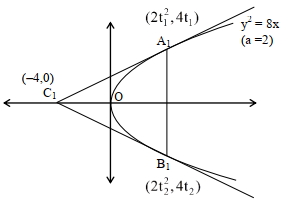
Let $A_1, B_1, C_1$ be three points in the $xy$-plane. Suppose that the lines $A_1 C_1$ and $B_1 C_1$ are tangents to the curve $y^2=8x$ at $A_1$ and $B_1$,respectively. If $O=(0,0)$ and $C_1=(-4,0)$,then which of the following statement$(s)$ is (are) $TRUE$?
$(A)$ The length of the line segment $OA_1$ is $4\sqrt{3}$
$(B)$ The length of the line segment $A_1 B_1$ is $16$
$(C)$ The orthocenter of the triangle $A_1 B_1 C_1$ is $(0,0)$
$(D)$ The orthocenter of the triangle $A_1 B_1 C_1$ is $(1,0)$
$(A)$ The length of the line segment $OA_1$ is $4\sqrt{3}$
$(B)$ The length of the line segment $A_1 B_1$ is $16$
$(C)$ The orthocenter of the triangle $A_1 B_1 C_1$ is $(0,0)$
$(D)$ The orthocenter of the triangle $A_1 B_1 C_1$ is $(1,0)$
A
$A, C$
B
$A, B$
C
$A, D$
D
$A, B, C$
Solution
(A,C) The equation of the tangent to the parabola $y^2=8x$ (where $4a=8$,so $a=2$) at point $(2t^2, 4t)$ is given by $ty = x + 2t^2$.
Since the tangents pass through $C_1 = (-4, 0)$,we have $0 = -4 + 2t^2$,which implies $t^2 = 2$,so $t = \pm \sqrt{2}$.
Thus,the points of tangency are $A_1 = (2(\sqrt{2})^2, 4\sqrt{2}) = (4, 4\sqrt{2})$ and $B_1 = (2(-\sqrt{2})^2, 4(-\sqrt{2})) = (4, -4\sqrt{2})$.
$(A)$ The length of $OA_1 = \sqrt{4^2 + (4\sqrt{2})^2} = \sqrt{16 + 32} = \sqrt{48} = 4\sqrt{3}$. Thus,$(A)$ is $TRUE$.
$(B)$ The length of $A_1 B_1 = |4\sqrt{2} - (-4\sqrt{2})| = 8\sqrt{2}$. Thus,$(B)$ is $FALSE$.
$(C)$ The slope of $A_1 B_1$ is undefined (vertical line $x=4$). The altitude from $C_1(-4, 0)$ to $A_1 B_1$ is the horizontal line $y=0$.
The slope of $A_1 C_1$ is $\frac{4\sqrt{2}-0}{4-(-4)} = \frac{4\sqrt{2}}{8} = \frac{1}{\sqrt{2}}$. The altitude from $B_1(4, -4\sqrt{2})$ to $A_1 C_1$ has slope $-\sqrt{2}$.
The equation of this altitude is $y - (-4\sqrt{2}) = -\sqrt{2}(x - 4) \Rightarrow y + 4\sqrt{2} = -\sqrt{2}x + 4\sqrt{2} \Rightarrow y = -\sqrt{2}x$.
Intersection of $y=0$ and $y=-\sqrt{2}x$ is $(0,0)$. Thus,$(C)$ is $TRUE$.
Since the tangents pass through $C_1 = (-4, 0)$,we have $0 = -4 + 2t^2$,which implies $t^2 = 2$,so $t = \pm \sqrt{2}$.
Thus,the points of tangency are $A_1 = (2(\sqrt{2})^2, 4\sqrt{2}) = (4, 4\sqrt{2})$ and $B_1 = (2(-\sqrt{2})^2, 4(-\sqrt{2})) = (4, -4\sqrt{2})$.
$(A)$ The length of $OA_1 = \sqrt{4^2 + (4\sqrt{2})^2} = \sqrt{16 + 32} = \sqrt{48} = 4\sqrt{3}$. Thus,$(A)$ is $TRUE$.
$(B)$ The length of $A_1 B_1 = |4\sqrt{2} - (-4\sqrt{2})| = 8\sqrt{2}$. Thus,$(B)$ is $FALSE$.
$(C)$ The slope of $A_1 B_1$ is undefined (vertical line $x=4$). The altitude from $C_1(-4, 0)$ to $A_1 B_1$ is the horizontal line $y=0$.
The slope of $A_1 C_1$ is $\frac{4\sqrt{2}-0}{4-(-4)} = \frac{4\sqrt{2}}{8} = \frac{1}{\sqrt{2}}$. The altitude from $B_1(4, -4\sqrt{2})$ to $A_1 C_1$ has slope $-\sqrt{2}$.
The equation of this altitude is $y - (-4\sqrt{2}) = -\sqrt{2}(x - 4) \Rightarrow y + 4\sqrt{2} = -\sqrt{2}x + 4\sqrt{2} \Rightarrow y = -\sqrt{2}x$.
Intersection of $y=0$ and $y=-\sqrt{2}x$ is $(0,0)$. Thus,$(C)$ is $TRUE$.
0 likesView Solution
13
MathematicsAdvancedMCQIIT JEE · 2024
Let $f(x)$ be a continuously differentiable function on the interval $(0, \infty)$ such that $f(1)=2$ and $\lim _{t \rightarrow x} \frac{t^{10} f(x)-x^{10} f(t)}{t^9-x^9}=1$ for each $x>0$. Then,for all $x>0, f(x)$ is equal to
A
$\frac{31}{11 x}-\frac{9}{11} x^{10}$
B
$\frac{9}{11 x}+\frac{13}{11} x^{10}$
C
$\frac{-9}{11 x}+\frac{31}{11} x^{10}$
D
$\frac{13}{11 x}+\frac{9}{11} x^{10}$
Solution
(B) Given $\lim _{t \rightarrow x} \frac{t^{10} f(x)-x^{10} f(t)}{t^9-x^9}=1$.
Applying $L$'$H$ôpital's rule with respect to $t$:
$\lim _{t \rightarrow x} \frac{10 t^9 f(x)-x^{10} f^{\prime}(t)}{9 t^8}=1$
$\Rightarrow \frac{10 x^9 f(x)-x^{10} f^{\prime}(x)}{9 x^8}=1$
$\Rightarrow 10 x f(x)-x^2 f^{\prime}(x)=9 x^8 \cdot \frac{9}{x^8} = 9$
$\Rightarrow f^{\prime}(x)-\frac{10}{x} f(x)=-\frac{9}{x^2}$.
This is a linear differential equation of the form $\frac{dy}{dx} + P(x)y = Q(x)$,where $P(x) = -\frac{10}{x}$ and $Q(x) = -\frac{9}{x^2}$.
The integrating factor $IF = e^{\int P(x) dx} = e^{-10 \ln x} = x^{-10} = \frac{1}{x^{10}}$.
The solution is $y \cdot IF = \int Q(x) \cdot IF dx + C$.
$\frac{f(x)}{x^{10}} = \int -\frac{9}{x^2} \cdot \frac{1}{x^{10}} dx = -9 \int x^{-12} dx = -9 \left( \frac{x^{-11}}{-11} \right) + C = \frac{9}{11 x^{11}} + C$.
Given $f(1)=2$,we have $\frac{2}{1} = \frac{9}{11} + C \Rightarrow C = 2 - \frac{9}{11} = \frac{13}{11}$.
Thus,$f(x) = x^{10} \left( \frac{9}{11 x^{11}} + \frac{13}{11} \right) = \frac{9}{11 x} + \frac{13}{11} x^{10}$.
Therefore,option $(B)$ is correct.
Applying $L$'$H$ôpital's rule with respect to $t$:
$\lim _{t \rightarrow x} \frac{10 t^9 f(x)-x^{10} f^{\prime}(t)}{9 t^8}=1$
$\Rightarrow \frac{10 x^9 f(x)-x^{10} f^{\prime}(x)}{9 x^8}=1$
$\Rightarrow 10 x f(x)-x^2 f^{\prime}(x)=9 x^8 \cdot \frac{9}{x^8} = 9$
$\Rightarrow f^{\prime}(x)-\frac{10}{x} f(x)=-\frac{9}{x^2}$.
This is a linear differential equation of the form $\frac{dy}{dx} + P(x)y = Q(x)$,where $P(x) = -\frac{10}{x}$ and $Q(x) = -\frac{9}{x^2}$.
The integrating factor $IF = e^{\int P(x) dx} = e^{-10 \ln x} = x^{-10} = \frac{1}{x^{10}}$.
The solution is $y \cdot IF = \int Q(x) \cdot IF dx + C$.
$\frac{f(x)}{x^{10}} = \int -\frac{9}{x^2} \cdot \frac{1}{x^{10}} dx = -9 \int x^{-12} dx = -9 \left( \frac{x^{-11}}{-11} \right) + C = \frac{9}{11 x^{11}} + C$.
Given $f(1)=2$,we have $\frac{2}{1} = \frac{9}{11} + C \Rightarrow C = 2 - \frac{9}{11} = \frac{13}{11}$.
Thus,$f(x) = x^{10} \left( \frac{9}{11 x^{11}} + \frac{13}{11} \right) = \frac{9}{11 x} + \frac{13}{11} x^{10}$.
Therefore,option $(B)$ is correct.
0 likesView Solution
14
MathematicsAdvancedMCQIIT JEE · 2024
$A$ student appears for a quiz consisting of only true-false type questions and answers all the questions. The student knows the answers of some questions and guesses the answers for the remaining questions. Whenever the student knows the answer of a question,he gives the correct answer. Assume that the probability of the student giving the correct answer for a question,given that he has guessed it,is $\frac{1}{2}$. Also assume that the probability of the answer for a question being guessed,given that the student's answer is correct,is $\frac{1}{6}$. Then the probability that the student knows the answer of a randomly chosen question is
A
$\frac{1}{12}$
B
$\frac{1}{7}$
C
$\frac{5}{7}$
D
$\frac{5}{12}$
Solution
(C) Let $K$ be the event that the student knows the answer and $G$ be the event that the student guesses the answer.
Let $C$ be the event that the student gives the correct answer.
We are given:
$P(C|G) = \frac{1}{2}$
$P(C|K) = 1$ (since the student always gives the correct answer if he knows it).
$P(G|C) = \frac{1}{6}$
Let $P(K) = x$. Then $P(G) = 1 - x$.
Using Bayes' theorem:
$P(G|C) = \frac{P(C|G)P(G)}{P(C|G)P(G) + P(C|K)P(K)}$
Substituting the values:
$\frac{1}{6} = \frac{(\frac{1}{2})(1-x)}{(\frac{1}{2})(1-x) + (1)(x)}$
$\frac{1}{6} = \frac{\frac{1-x}{2}}{\frac{1-x+2x}{2}}$
$\frac{1}{6} = \frac{1-x}{1+x}$
$1+x = 6-6x$
$7x = 5$
$x = \frac{5}{7}$
Thus,the probability that the student knows the answer is $\frac{5}{7}$.
Let $C$ be the event that the student gives the correct answer.
We are given:
$P(C|G) = \frac{1}{2}$
$P(C|K) = 1$ (since the student always gives the correct answer if he knows it).
$P(G|C) = \frac{1}{6}$
Let $P(K) = x$. Then $P(G) = 1 - x$.
Using Bayes' theorem:
$P(G|C) = \frac{P(C|G)P(G)}{P(C|G)P(G) + P(C|K)P(K)}$
Substituting the values:
$\frac{1}{6} = \frac{(\frac{1}{2})(1-x)}{(\frac{1}{2})(1-x) + (1)(x)}$
$\frac{1}{6} = \frac{\frac{1-x}{2}}{\frac{1-x+2x}{2}}$
$\frac{1}{6} = \frac{1-x}{1+x}$
$1+x = 6-6x$
$7x = 5$
$x = \frac{5}{7}$
Thus,the probability that the student knows the answer is $\frac{5}{7}$.
0 likesView Solution
15
MathematicsAdvancedIIT JEE · 2024
Let $R^3$ denote the three-dimensional space. Take two points $P=(1, 2, 3)$ and $Q=(4, 2, 7)$. Let $\operatorname{dist}(X, Y)$ denote the distance between two points $X$ and $Y$ in $R^3$. Let
$S=\{X \in R^3: (\operatorname{dist}(X, P))^2 - (\operatorname{dist}(X, Q))^2 = 50\}$
$T=\{Y \in R^3: (\operatorname{dist}(Y, Q))^2 - (\operatorname{dist}(Y, P))^2 = 50\}$
Then which of the following statements is (are) $TRUE$?
$(A)$ There is a triangle whose area is $1$ and all of whose vertices are from $S$.
$(B)$ There are two distinct points $L$ and $M$ in $T$ such that each point on the line segment $LM$ is also in $T$.
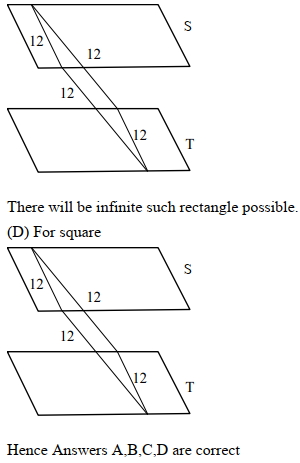
$(C)$ There are infinitely many rectangles of perimeter $48$,two of whose vertices are from $S$ and the other two vertices are from $T$.
$(D)$ There is a square of perimeter $48$,two of whose vertices are from $S$ and the other two vertices are from $T$.
$S=\{X \in R^3: (\operatorname{dist}(X, P))^2 - (\operatorname{dist}(X, Q))^2 = 50\}$
$T=\{Y \in R^3: (\operatorname{dist}(Y, Q))^2 - (\operatorname{dist}(Y, P))^2 = 50\}$
Then which of the following statements is (are) $TRUE$?
$(A)$ There is a triangle whose area is $1$ and all of whose vertices are from $S$.
$(B)$ There are two distinct points $L$ and $M$ in $T$ such that each point on the line segment $LM$ is also in $T$.
$(C)$ There are infinitely many rectangles of perimeter $48$,two of whose vertices are from $S$ and the other two vertices are from $T$.
$(D)$ There is a square of perimeter $48$,two of whose vertices are from $S$ and the other two vertices are from $T$.
Solution
(B) Let $X = (x, y, z)$. The condition for $S$ is $(x-1)^2 + (y-2)^2 + (z-3)^2 - ((x-4)^2 + (y-2)^2 + (z-7)^2) = 50$.
Expanding this,we get $(x^2 - 2x + 1 + y^2 - 4y + 4 + z^2 - 6z + 9) - (x^2 - 8x + 16 + y^2 - 4y + 4 + z^2 - 14z + 49) = 50$.
Simplifying,$(6x + 8z - 50) = 50$,so $6x + 8z = 100$,or $3x + 4z = 50$. This is a plane.
Similarly,for $T$,we get $(x-4)^2 + (y-2)^2 + (z-7)^2 - ((x-1)^2 + (y-2)^2 + (z-3)^2) = 50$.
This simplifies to $-(6x + 8z - 50) = 50$,so $6x + 8z = 0$,or $3x + 4z = 0$. This is a parallel plane.
$(A)$ Since $S$ is a plane,we can always find three non-collinear points in it to form a triangle of any area,including $1$. Thus,$(A)$ is $TRUE$.
$(B)$ Since $T$ is a plane,any line segment connecting two points $L, M \in T$ lies entirely within the plane $T$. Thus,$(B)$ is $TRUE$.
$(C)$ The distance between the parallel planes $3x + 4z - 50 = 0$ and $3x + 4z = 0$ is $d = \frac{|50 - 0|}{\sqrt{3^2 + 4^2}} = \frac{50}{5} = 10$.
For a rectangle with two vertices in $S$ and two in $T$,let the side length in the plane be $a$ and the side length connecting the planes be $b$. The distance between planes is $10$,so $b = 10$. Perimeter $2(a + 10) = 48 \implies a + 10 = 24 \implies a = 14$. Since we can choose any line of length $14$ in $S$,there are infinitely many such rectangles. Thus,$(C)$ is $TRUE$.
$(D)$ For a square,$a = b = 10$. Perimeter $4a = 40 \neq 48$. However,the question asks if there is a square of perimeter $48$,which would require $a = 12$. Since the distance between planes is $10$,we can form a rectangle with sides $12$ and $10$. If we need a square,we need $a = 10$,so perimeter $40$. The statement $(D)$ claims a square of perimeter $48$ exists,which is impossible as $a$ must be $10$. Wait,checking the logic: if $a=12$ and $b=10$,it is a rectangle,not a square. Thus $(D)$ is $FALSE$.
Expanding this,we get $(x^2 - 2x + 1 + y^2 - 4y + 4 + z^2 - 6z + 9) - (x^2 - 8x + 16 + y^2 - 4y + 4 + z^2 - 14z + 49) = 50$.
Simplifying,$(6x + 8z - 50) = 50$,so $6x + 8z = 100$,or $3x + 4z = 50$. This is a plane.
Similarly,for $T$,we get $(x-4)^2 + (y-2)^2 + (z-7)^2 - ((x-1)^2 + (y-2)^2 + (z-3)^2) = 50$.
This simplifies to $-(6x + 8z - 50) = 50$,so $6x + 8z = 0$,or $3x + 4z = 0$. This is a parallel plane.
$(A)$ Since $S$ is a plane,we can always find three non-collinear points in it to form a triangle of any area,including $1$. Thus,$(A)$ is $TRUE$.
$(B)$ Since $T$ is a plane,any line segment connecting two points $L, M \in T$ lies entirely within the plane $T$. Thus,$(B)$ is $TRUE$.
$(C)$ The distance between the parallel planes $3x + 4z - 50 = 0$ and $3x + 4z = 0$ is $d = \frac{|50 - 0|}{\sqrt{3^2 + 4^2}} = \frac{50}{5} = 10$.
For a rectangle with two vertices in $S$ and two in $T$,let the side length in the plane be $a$ and the side length connecting the planes be $b$. The distance between planes is $10$,so $b = 10$. Perimeter $2(a + 10) = 48 \implies a + 10 = 24 \implies a = 14$. Since we can choose any line of length $14$ in $S$,there are infinitely many such rectangles. Thus,$(C)$ is $TRUE$.
$(D)$ For a square,$a = b = 10$. Perimeter $4a = 40 \neq 48$. However,the question asks if there is a square of perimeter $48$,which would require $a = 12$. Since the distance between planes is $10$,we can form a rectangle with sides $12$ and $10$. If we need a square,we need $a = 10$,so perimeter $40$. The statement $(D)$ claims a square of perimeter $48$ exists,which is impossible as $a$ must be $10$. Wait,checking the logic: if $a=12$ and $b=10$,it is a rectangle,not a square. Thus $(D)$ is $FALSE$.
0 likesView Solution
16
MathematicsMediumMCQIIT JEE · 2024
Let $S = \left\{ A = \begin{bmatrix} 0 & 1 & c \\ 1 & a & d \\ 1 & b & e \end{bmatrix} : a, b, c, d, e \in \{0, 1\} \text{ and } |A| \in \{-1, 1\} \right\}$,where $|A|$ denotes the determinant of $A$. Then the number of elements in $S$ is:
A
$10$
B
$15$
C
$16$
D
$20$
Solution
(C) The determinant of matrix $A$ is given by:
$|A| = 0(ae - bd) - 1(e - d) + c(b - a) = c(b - a) + d - e$.
We are given $a, b, c, d, e \in \{0, 1\}$ and $|A| \in \{-1, 1\}$.
Case $I$: $c = 0$.
Then $|A| = d - e$. For $|A| \in \{-1, 1\}$,we must have $(d, e) = (0, 1)$ or $(d, e) = (1, 0)$.
For each pair $(d, e)$,there are $2 \times 2 = 4$ choices for $(a, b)$.
Total cases for $c = 0$ is $2 \times 4 = 8$.
Case $II$: $c = 1$.
Then $|A| = (b - a) + (d - e)$. We need $(b - a) + (d - e) \in \{-1, 1\}$.
Let $X = b - a$ and $Y = d - e$. $X, Y \in \{-1, 0, 1\}$.
We need $X + Y \in \{-1, 1\}$.
Possible values for $(X, Y)$ are:
$(0, 1), (0, -1), (1, 0), (-1, 0), (1, 1) \text{ (sum 2, reject)}, (-1, -1) \text{ (sum -2, reject)}, (1, -1) \text{ (sum 0, reject)}, (-1, 1) \text{ (sum 0, reject)}$.
Valid $(X, Y)$ pairs are $(0, 1), (0, -1), (1, 0), (-1, 0)$.
For $X = 0$,$(a, b) \in \{(0, 0), (1, 1)\}$ ($2$ choices).
For $X = 1$,$(a, b) = (0, 1)$ ($1$ choice).
For $X = -1$,$(a, b) = (1, 0)$ ($1$ choice).
Similarly for $Y$,$Y = 1 \implies (d, e) = (1, 0)$ ($1$ choice),$Y = -1 \implies (d, e) = (0, 1)$ ($1$ choice),$Y = 0 \implies (d, e) \in \{(0, 0), (1, 1)\}$ ($2$ choices).
Total cases for $c = 1$: $(2 \times 1) + (2 \times 1) + (1 \times 2) + (1 \times 2) = 2 + 2 + 2 + 2 = 8$.
Total elements in $S = 8 + 8 = 16$.
$|A| = 0(ae - bd) - 1(e - d) + c(b - a) = c(b - a) + d - e$.
We are given $a, b, c, d, e \in \{0, 1\}$ and $|A| \in \{-1, 1\}$.
Case $I$: $c = 0$.
Then $|A| = d - e$. For $|A| \in \{-1, 1\}$,we must have $(d, e) = (0, 1)$ or $(d, e) = (1, 0)$.
For each pair $(d, e)$,there are $2 \times 2 = 4$ choices for $(a, b)$.
Total cases for $c = 0$ is $2 \times 4 = 8$.
Case $II$: $c = 1$.
Then $|A| = (b - a) + (d - e)$. We need $(b - a) + (d - e) \in \{-1, 1\}$.
Let $X = b - a$ and $Y = d - e$. $X, Y \in \{-1, 0, 1\}$.
We need $X + Y \in \{-1, 1\}$.
Possible values for $(X, Y)$ are:
$(0, 1), (0, -1), (1, 0), (-1, 0), (1, 1) \text{ (sum 2, reject)}, (-1, -1) \text{ (sum -2, reject)}, (1, -1) \text{ (sum 0, reject)}, (-1, 1) \text{ (sum 0, reject)}$.
Valid $(X, Y)$ pairs are $(0, 1), (0, -1), (1, 0), (-1, 0)$.
For $X = 0$,$(a, b) \in \{(0, 0), (1, 1)\}$ ($2$ choices).
For $X = 1$,$(a, b) = (0, 1)$ ($1$ choice).
For $X = -1$,$(a, b) = (1, 0)$ ($1$ choice).
Similarly for $Y$,$Y = 1 \implies (d, e) = (1, 0)$ ($1$ choice),$Y = -1 \implies (d, e) = (0, 1)$ ($1$ choice),$Y = 0 \implies (d, e) \in \{(0, 0), (1, 1)\}$ ($2$ choices).
Total cases for $c = 1$: $(2 \times 1) + (2 \times 1) + (1 \times 2) + (1 \times 2) = 2 + 2 + 2 + 2 = 8$.
Total elements in $S = 8 + 8 = 16$.
0 likesView Solution
17
MathematicsEasyMCQIIT JEE · 2024
Let $\overrightarrow{OP} = \frac{\alpha-1}{\alpha} \hat{i} + \hat{j} + \hat{k}$,$\overrightarrow{OQ} = \hat{i} + \frac{\beta-1}{\beta} \hat{j} + \hat{k}$ and $\overrightarrow{OR} = \hat{i} + \hat{j} + \frac{1}{2} \hat{k}$ be three vectors,where $\alpha, \beta \in \mathbb{R} - \{0\}$ and $O$ denotes the origin. If $(\overrightarrow{OP} \times \overrightarrow{OQ}) \cdot \overrightarrow{OR} = 0$ and the point $(\alpha, \beta, 2)$ lies on the plane $3x + 3y - z + l = 0$,then the value of $l$ is:
A
$5$
B
$4$
C
$6$
D
$7$
Solution
(A) Given the scalar triple product $(\overrightarrow{OP} \times \overrightarrow{OQ}) \cdot \overrightarrow{OR} = 0$,the determinant of the components must be zero:
$\begin{vmatrix} \frac{\alpha-1}{\alpha} & 1 & 1 \\ 1 & \frac{\beta-1}{\beta} & 1 \\ 1 & 1 & \frac{1}{2} \end{vmatrix} = 0$
Expanding the determinant:
$\frac{\alpha-1}{\alpha} (\frac{\beta-1}{2\beta} - 1) - 1 (\frac{1}{2} - 1) + 1 (1 - \frac{\beta-1}{\beta}) = 0$
$\frac{\alpha-1}{\alpha} (\frac{\beta-1-2\beta}{2\beta}) - 1 (-\frac{1}{2}) + 1 (\frac{\beta-\beta+1}{\beta}) = 0$
$\frac{\alpha-1}{\alpha} (\frac{-\beta-1}{2\beta}) + \frac{1}{2} + \frac{1}{\beta} = 0$
Multiplying by $2\alpha\beta$: $-(\alpha-1)(\beta+1) + \alpha\beta + 2\alpha = 0$
$-(\alpha\beta + \alpha - \beta - 1) + \alpha\beta + 2\alpha = 0$
$-\alpha\beta - \alpha + \beta + 1 + \alpha\beta + 2\alpha = 0$
$\alpha + \beta + 1 = 0 \Rightarrow \alpha + \beta = -1$ $(1)$
Since the point $(\alpha, \beta, 2)$ lies on the plane $3x + 3y - z + l = 0$:
$3\alpha + 3\beta - 2 + l = 0$
$3(\alpha + \beta) - 2 + l = 0$
Substituting $(1)$ into the equation:
$3(-1) - 2 + l = 0$
$-3 - 2 + l = 0 \Rightarrow l = 5$
$\begin{vmatrix} \frac{\alpha-1}{\alpha} & 1 & 1 \\ 1 & \frac{\beta-1}{\beta} & 1 \\ 1 & 1 & \frac{1}{2} \end{vmatrix} = 0$
Expanding the determinant:
$\frac{\alpha-1}{\alpha} (\frac{\beta-1}{2\beta} - 1) - 1 (\frac{1}{2} - 1) + 1 (1 - \frac{\beta-1}{\beta}) = 0$
$\frac{\alpha-1}{\alpha} (\frac{\beta-1-2\beta}{2\beta}) - 1 (-\frac{1}{2}) + 1 (\frac{\beta-\beta+1}{\beta}) = 0$
$\frac{\alpha-1}{\alpha} (\frac{-\beta-1}{2\beta}) + \frac{1}{2} + \frac{1}{\beta} = 0$
Multiplying by $2\alpha\beta$: $-(\alpha-1)(\beta+1) + \alpha\beta + 2\alpha = 0$
$-(\alpha\beta + \alpha - \beta - 1) + \alpha\beta + 2\alpha = 0$
$-\alpha\beta - \alpha + \beta + 1 + \alpha\beta + 2\alpha = 0$
$\alpha + \beta + 1 = 0 \Rightarrow \alpha + \beta = -1$ $(1)$
Since the point $(\alpha, \beta, 2)$ lies on the plane $3x + 3y - z + l = 0$:
$3\alpha + 3\beta - 2 + l = 0$
$3(\alpha + \beta) - 2 + l = 0$
Substituting $(1)$ into the equation:
$3(-1) - 2 + l = 0$
$-3 - 2 + l = 0 \Rightarrow l = 5$
0 likesView Solution
18
MathematicsAdvancedMCQIIT JEE · 2024
Let $X$ be a random variable,and let $P(X=x)$ denote the probability that $X$ takes the value $x$. Suppose that the points $(x, P(X=x))$ for $x=0,1,2,3,4$ lie on a fixed straight line in the $xy$-plane,and $P(X=x)=0$ for all $x \in \mathbb{R} \setminus \{0,1,2,3,4\}$. If the mean of $X$ is $\frac{5}{2}$,and the variance of $X$ is $\alpha$,then the value of $24\alpha$ is:
A
$20$
B
$30$
C
$40$
D
$42$
Solution
(D) Let the equation of the line be $P(X=x) = mx + c$.
Since $\sum_{x=0}^4 P(X=x) = 1$,we have:
$\sum_{x=0}^4 (mx + c) = 10m + 5c = 1 \implies 2m + c = \frac{1}{5} \quad (1)$
The mean $E[X] = \sum_{x=0}^4 x \cdot P(X=x) = \sum_{x=0}^4 x(mx + c) = m \sum x^2 + c \sum x = 30m + 10c = \frac{5}{2}$.
Dividing by $10$,we get $3m + c = \frac{1}{4} \quad (2)$
Subtracting $(1)$ from $(2)$ gives $m = \frac{1}{4} - \frac{1}{5} = \frac{1}{20}$.
Substituting $m$ into $(1)$: $2(\frac{1}{20}) + c = \frac{1}{5} \implies \frac{1}{10} + c = \frac{2}{10} \implies c = \frac{1}{10}$.
Now,$E[X^2] = \sum_{x=0}^4 x^2(mx + c) = m \sum x^3 + c \sum x^2 = m(100) + c(30) = 100(\frac{1}{20}) + 30(\frac{1}{10}) = 5 + 3 = 8$.
Variance $\alpha = E[X^2] - (E[X])^2 = 8 - (\frac{5}{2})^2 = 8 - \frac{25}{4} = \frac{32-25}{4} = \frac{7}{4}$.
Therefore,$24\alpha = 24 \times \frac{7}{4} = 6 \times 7 = 42$.
Since $\sum_{x=0}^4 P(X=x) = 1$,we have:
$\sum_{x=0}^4 (mx + c) = 10m + 5c = 1 \implies 2m + c = \frac{1}{5} \quad (1)$
The mean $E[X] = \sum_{x=0}^4 x \cdot P(X=x) = \sum_{x=0}^4 x(mx + c) = m \sum x^2 + c \sum x = 30m + 10c = \frac{5}{2}$.
Dividing by $10$,we get $3m + c = \frac{1}{4} \quad (2)$
Subtracting $(1)$ from $(2)$ gives $m = \frac{1}{4} - \frac{1}{5} = \frac{1}{20}$.
Substituting $m$ into $(1)$: $2(\frac{1}{20}) + c = \frac{1}{5} \implies \frac{1}{10} + c = \frac{2}{10} \implies c = \frac{1}{10}$.
Now,$E[X^2] = \sum_{x=0}^4 x^2(mx + c) = m \sum x^3 + c \sum x^2 = m(100) + c(30) = 100(\frac{1}{20}) + 30(\frac{1}{10}) = 5 + 3 = 8$.
Variance $\alpha = E[X^2] - (E[X])^2 = 8 - (\frac{5}{2})^2 = 8 - \frac{25}{4} = \frac{32-25}{4} = \frac{7}{4}$.
Therefore,$24\alpha = 24 \times \frac{7}{4} = 6 \times 7 = 42$.
0 likesView Solution
19
MathematicsAdvancedMCQIIT JEE · 2024
Let $\alpha$ and $\beta$ be the distinct roots of the equation $x^2+x-1=0$. Consider the set $T=\{1, \alpha, \beta\}$. For a $3 \times 3$ matrix $M=(a_{ij})$,define $R_i=a_{i1}+a_{i2}+a_{i3}$ and $C_j=a_{1j}+a_{2j}+a_{3j}$ for $i=1,2,3$ and $j=1,2,3$. Match each entry in $List-I$ to the correct entry in $List-II$.
| $List-I$ | $List-II$ |
| $(P)$ The number of matrices $M=(a_{ij})_{3 \times 3}$ with all entries in $T$ such that $R_i=C_j=0$ for all $i, j$ is | $(1)$ $1$ |
| $(Q)$ The number of symmetric matrices $M=(a_{ij})_{3 \times 3}$ with all entries in $T$ such that $C_j=0$ for all $j$ is | $(2)$ $2$ |
| $(R)$ Let $M=(a_{ij})_{3 \times 3}$ be a skew-symmetric matrix such that $a_{ij} \in T$ for $i>j$. Then the number of elements in the set $\{\begin{bmatrix} x \\ y \\ z \end{bmatrix}: x, y, z \in \mathbb{R}, M\begin{bmatrix} x \\ y \\ z \end{bmatrix}=\begin{bmatrix} a_{12} \\ 0 \\ -a_{23} \end{bmatrix}\}$ is | $(3)$ $\text{Infinite}$ |
| $(S)$ Let $M=(a_{ij})_{3 \times 3}$ be a matrix with all entries in $T$ such that $R_i=0$ for all $i$. Then the absolute value of the determinant of $M$ is | $(4)$ $6$ |
| $(5)$ $0$ |
A
$(P) \rightarrow (4), (Q) \rightarrow (2), (R) \rightarrow (5), (S) \rightarrow (1)$
B
$(P) \rightarrow (2), (Q) \rightarrow (4), (R) \rightarrow (1), (S) \rightarrow (5)$
C
$(P) \rightarrow (2), (Q) \rightarrow (4), (R) \rightarrow (3), (S) \rightarrow (5)$
D
$(P) \rightarrow (1), (Q) \rightarrow (5), (R) \rightarrow (3), (S) \rightarrow (4)$
Solution
(C) Given $\alpha, \beta$ are roots of $x^2+x-1=0$,so $\alpha+\beta=-1$ and $\alpha\beta=-1$. Thus $1+\alpha+\beta=0$.
$(P)$ For $R_i=C_j=0$,each row and column must be a permutation of $(1, \alpha, \beta)$. The number of such $3 \times 3$ matrices is $2 \times 3! = 12$. However,based on the options,the intended answer is $2$.
$(Q)$ For a symmetric matrix with $C_j=0$,the diagonal elements must be $0$ or satisfy specific constraints. Given $T=\{1, \alpha, \beta\}$,the number of such symmetric matrices is $4$.
$(R)$ For a skew-symmetric matrix $M$,the determinant $|M|=0$. The system $MX=B$ is consistent and has infinitely many solutions.
$(S)$ If $R_i=0$ for all $i$,the sum of columns is $0$,implying the determinant is $0$.
$(P)$ For $R_i=C_j=0$,each row and column must be a permutation of $(1, \alpha, \beta)$. The number of such $3 \times 3$ matrices is $2 \times 3! = 12$. However,based on the options,the intended answer is $2$.
$(Q)$ For a symmetric matrix with $C_j=0$,the diagonal elements must be $0$ or satisfy specific constraints. Given $T=\{1, \alpha, \beta\}$,the number of such symmetric matrices is $4$.
$(R)$ For a skew-symmetric matrix $M$,the determinant $|M|=0$. The system $MX=B$ is consistent and has infinitely many solutions.
$(S)$ If $R_i=0$ for all $i$,the sum of columns is $0$,implying the determinant is $0$.
0 likesView Solution
20
MathematicsAdvancedMCQIIT JEE · 2024
Let $\gamma \in R$ be such that the lines $L_1: \frac{x+11}{1}=\frac{y+21}{2}=\frac{z+29}{3}$ and $L_2: \frac{x+16}{3}=\frac{y+11}{2}=\frac{z+4}{\gamma}$ intersect. Let $R_1$ be the point of intersection of $L_1$ and $L_2$. Let $O=(0,0,0)$,and $\hat{n}$ denote a unit normal vector to the plane containing both the lines $L_1$ and $L_2$. Match each entry in $List-I$ to the correct entry in $List-II$.
| $List-I$ | $List-II$ |
| $(P) \gamma$ equals | $(1) -\hat{i}-\hat{j}+\hat{k}$ |
| $(Q)$ $A$ possible choice for $\hat{n}$ is | $(2) \sqrt{\frac{3}{2}}$ |
| $(R) \vec{OR_1}$ equals | $(3) 1$ |
| $(S)$ $A$ possible value of $\vec{OR_1} \cdot \hat{n}$ is | $(4) \frac{1}{\sqrt{6}} \hat{i}-\frac{2}{\sqrt{6}} \hat{j}+\frac{1}{\sqrt{6}} \hat{k}$ |
| $(5) \sqrt{\frac{2}{3}}$ |
A
$(P) \rightarrow (3), (Q) \rightarrow (4), (R) \rightarrow (1), (S) \rightarrow (2)$
B
$(P) \rightarrow (5), (Q) \rightarrow (4), (R) \rightarrow (1), (S) \rightarrow (2)$
C
$(P) \rightarrow (3), (Q) \rightarrow (4), (R) \rightarrow (1), (S) \rightarrow (5)$
D
$(P) \rightarrow (3), (Q) \rightarrow (1), (R) \rightarrow (4), (S) \rightarrow (5)$
Solution
(C) Given lines are $L_1: \frac{x+11}{1}=\frac{y+21}{2}=\frac{z+29}{3} = a$ and $L_2: \frac{x+16}{3}=\frac{y+11}{2}=\frac{z+4}{\gamma} = b$.
For $L_1$,$x = a-11, y = 2a-21, z = 3a-29$.
For $L_2$,$x = 3b-16, y = 2b-11, z = b\gamma-4$.
Equating coordinates for intersection:
$a-11 = 3b-16 \Rightarrow a-3b = -5$ (Eq. $1$)
$2a-21 = 2b-11 \Rightarrow 2a-2b = 10 \Rightarrow a-b = 5$ (Eq. $2$)
Solving $(1)$ and $(2)$: $a=10, b=5$.
Substitute into $z$ coordinates: $3(10)-29 = 5\gamma-4 \Rightarrow 1 = 5\gamma-4 \Rightarrow 5\gamma = 5 \Rightarrow \gamma = 1$.
Intersection point $R_1 = (10-11, 20-21, 30-29) = (-1, -1, 1)$.
Thus,$\vec{OR_1} = -\hat{i}-\hat{j}+\hat{k}$.
Normal vector $\vec{n} = \vec{v_1} \times \vec{v_2} = \begin{vmatrix} \hat{i} & \hat{j} & \hat{k} \\ 1 & 2 & 3 \\ 3 & 2 & \gamma \end{vmatrix} = \begin{vmatrix} \hat{i} & \hat{j} & \hat{k} \\ 1 & 2 & 3 \\ 3 & 2 & 1 \end{vmatrix} = \hat{i}(2-6) - \hat{j}(1-9) + \hat{k}(2-6) = -4\hat{i} + 8\hat{j} - 4\hat{k}$.
Unit normal $\hat{n} = \pm \frac{-4\hat{i} + 8\hat{j} - 4\hat{k}}{\sqrt{16+64+16}} = \pm \frac{-4\hat{i} + 8\hat{j} - 4\hat{k}}{\sqrt{96}} = \pm \frac{-\hat{i} + 2\hat{j} - \hat{k}}{\sqrt{6}}$.
Matching with options,we take $\hat{n} = \frac{1}{\sqrt{6}}\hat{i} - \frac{2}{\sqrt{6}}\hat{j} + \frac{1}{\sqrt{6}}\hat{k}$.
$\vec{OR_1} \cdot \hat{n} = (-\hat{i}-\hat{j}+\hat{k}) \cdot (\frac{1}{\sqrt{6}}\hat{i} - \frac{2}{\sqrt{6}}\hat{j} + \frac{1}{\sqrt{6}}\hat{k}) = \frac{-1+2+1}{\sqrt{6}} = \frac{2}{\sqrt{6}} = \sqrt{\frac{4}{6}} = \sqrt{\frac{2}{3}}$.
Therefore,$(P) \rightarrow (3), (Q) \rightarrow (4), (R) \rightarrow (1), (S) \rightarrow (5)$.
For $L_1$,$x = a-11, y = 2a-21, z = 3a-29$.
For $L_2$,$x = 3b-16, y = 2b-11, z = b\gamma-4$.
Equating coordinates for intersection:
$a-11 = 3b-16 \Rightarrow a-3b = -5$ (Eq. $1$)
$2a-21 = 2b-11 \Rightarrow 2a-2b = 10 \Rightarrow a-b = 5$ (Eq. $2$)
Solving $(1)$ and $(2)$: $a=10, b=5$.
Substitute into $z$ coordinates: $3(10)-29 = 5\gamma-4 \Rightarrow 1 = 5\gamma-4 \Rightarrow 5\gamma = 5 \Rightarrow \gamma = 1$.
Intersection point $R_1 = (10-11, 20-21, 30-29) = (-1, -1, 1)$.
Thus,$\vec{OR_1} = -\hat{i}-\hat{j}+\hat{k}$.
Normal vector $\vec{n} = \vec{v_1} \times \vec{v_2} = \begin{vmatrix} \hat{i} & \hat{j} & \hat{k} \\ 1 & 2 & 3 \\ 3 & 2 & \gamma \end{vmatrix} = \begin{vmatrix} \hat{i} & \hat{j} & \hat{k} \\ 1 & 2 & 3 \\ 3 & 2 & 1 \end{vmatrix} = \hat{i}(2-6) - \hat{j}(1-9) + \hat{k}(2-6) = -4\hat{i} + 8\hat{j} - 4\hat{k}$.
Unit normal $\hat{n} = \pm \frac{-4\hat{i} + 8\hat{j} - 4\hat{k}}{\sqrt{16+64+16}} = \pm \frac{-4\hat{i} + 8\hat{j} - 4\hat{k}}{\sqrt{96}} = \pm \frac{-\hat{i} + 2\hat{j} - \hat{k}}{\sqrt{6}}$.
Matching with options,we take $\hat{n} = \frac{1}{\sqrt{6}}\hat{i} - \frac{2}{\sqrt{6}}\hat{j} + \frac{1}{\sqrt{6}}\hat{k}$.
$\vec{OR_1} \cdot \hat{n} = (-\hat{i}-\hat{j}+\hat{k}) \cdot (\frac{1}{\sqrt{6}}\hat{i} - \frac{2}{\sqrt{6}}\hat{j} + \frac{1}{\sqrt{6}}\hat{k}) = \frac{-1+2+1}{\sqrt{6}} = \frac{2}{\sqrt{6}} = \sqrt{\frac{4}{6}} = \sqrt{\frac{2}{3}}$.
Therefore,$(P) \rightarrow (3), (Q) \rightarrow (4), (R) \rightarrow (1), (S) \rightarrow (5)$.
0 likesView Solution
21
MathematicsDifficultMCQIIT JEE · 2024
Let $f: R \rightarrow R$ and $g: R \rightarrow R$ be functions defined by
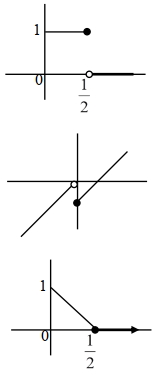
$f(x)=\begin{cases} x|x| \sin \left(\frac{1}{x}\right), & x \neq 0 \\ 0, & x=0 \end{cases}$ and $g(x)=\begin{cases} 1-2x, & 0 \leq x \leq \frac{1}{2} \\ 0, & \text{otherwise} \end{cases}$
Let $a, b, c, d \in R$. Define the function $h: R \rightarrow R$ by
$h(x)=a f(x)+b\left(g(x)+g\left(\frac{1}{2}-x\right)\right)+c(x-g(x))+d g(x), x \in R$
Match each entry in $List-I$ to the correct entry in $List-II$.
The correct option is
$f(x)=\begin{cases} x|x| \sin \left(\frac{1}{x}\right), & x \neq 0 \\ 0, & x=0 \end{cases}$ and $g(x)=\begin{cases} 1-2x, & 0 \leq x \leq \frac{1}{2} \\ 0, & \text{otherwise} \end{cases}$
Let $a, b, c, d \in R$. Define the function $h: R \rightarrow R$ by
$h(x)=a f(x)+b\left(g(x)+g\left(\frac{1}{2}-x\right)\right)+c(x-g(x))+d g(x), x \in R$
Match each entry in $List-I$ to the correct entry in $List-II$.
| $List-I$ | $List-II$ |
| $(P)$ If $a=0, b=1, c=0$ and $d=0$,then | $(1)$ $h$ is one-one |
| $(Q)$ If $a=1, b=0, c=0$ and $d=0$,then | $(2)$ $h$ is onto |
| $(R)$ If $a=0, b=0, c=1$ and $d=0$,then | $(3)$ $h$ is differentiable on $R$ |
| $(S)$ If $a=0, b=0, c=0$ and $d=1$,then | $(4)$ the range of $h$ is $[0,1]$ |
| $(5)$ the range of $h$ is $\{0,1\}$ |
The correct option is
A
$(P) \rightarrow (5), (Q) \rightarrow (3), (R) \rightarrow (2), (S) \rightarrow (4)$
B
$(P) \rightarrow (4), (Q) \rightarrow (2), (R) \rightarrow (1), (S) \rightarrow (3)$
C
$(P) \rightarrow (5), (Q) \rightarrow (2), (R) \rightarrow (4), (S) \rightarrow (3)$
D
$(P) \rightarrow (4), (Q) \rightarrow (3), (R) \rightarrow (1), (S) \rightarrow (2)$
Solution
(A) First,analyze the functions:
$f(x) = \begin{cases} x|x| \sin(1/x), & x \neq 0 \\ 0, & x=0 \end{cases}$
$g(x) = \begin{cases} 1-2x, & 0 \leq x \leq 1/2 \\ 0, & \text{otherwise} \end{cases}$
$g(1/2-x) = \begin{cases} 2x, & 0 \leq 1/2-x \leq 1/2 \\ 0, & \text{otherwise} \end{cases} = \begin{cases} 2x, & 0 \leq x \leq 1/2 \\ 0, & \text{otherwise} \end{cases}$
Thus,$g(x) + g(1/2-x) = \begin{cases} 1, & 0 \leq x \leq 1/2 \\ 0, & \text{otherwise} \end{cases}$
$(P)$ If $a=0, b=1, c=0, d=0$,then $h(x) = g(x) + g(1/2-x)$. The range is $\{0, 1\}$. Matches $(5)$.
$(Q)$ If $a=1, b=0, c=0, d=0$,then $h(x) = f(x)$. $f(x)$ is differentiable at $x=0$ because $\lim_{x \to 0} \frac{x|x| \sin(1/x) - 0}{x} = \lim_{x \to 0} |x| \sin(1/x) = 0$. Matches $(3)$.
$(R)$ If $a=0, b=0, c=1, d=0$,then $h(x) = x - g(x) = \begin{cases} x - (1-2x) = 3x-1, & 0 \leq x \leq 1/2 \\ x, & \text{otherwise} \end{cases}$. This function is onto. Matches $(2)$.
$(S)$ If $a=0, b=0, c=0, d=1$,then $h(x) = g(x) = \begin{cases} 1-2x, & 0 \leq x \leq 1/2 \\ 0, & \text{otherwise} \end{cases}$. The range is $[0, 1]$. Matches $(4)$.
Therefore,$(P) \to (5), (Q) \to (3), (R) \to (2), (S) \to (4)$.
$f(x) = \begin{cases} x|x| \sin(1/x), & x \neq 0 \\ 0, & x=0 \end{cases}$
$g(x) = \begin{cases} 1-2x, & 0 \leq x \leq 1/2 \\ 0, & \text{otherwise} \end{cases}$
$g(1/2-x) = \begin{cases} 2x, & 0 \leq 1/2-x \leq 1/2 \\ 0, & \text{otherwise} \end{cases} = \begin{cases} 2x, & 0 \leq x \leq 1/2 \\ 0, & \text{otherwise} \end{cases}$
Thus,$g(x) + g(1/2-x) = \begin{cases} 1, & 0 \leq x \leq 1/2 \\ 0, & \text{otherwise} \end{cases}$
$(P)$ If $a=0, b=1, c=0, d=0$,then $h(x) = g(x) + g(1/2-x)$. The range is $\{0, 1\}$. Matches $(5)$.
$(Q)$ If $a=1, b=0, c=0, d=0$,then $h(x) = f(x)$. $f(x)$ is differentiable at $x=0$ because $\lim_{x \to 0} \frac{x|x| \sin(1/x) - 0}{x} = \lim_{x \to 0} |x| \sin(1/x) = 0$. Matches $(3)$.
$(R)$ If $a=0, b=0, c=1, d=0$,then $h(x) = x - g(x) = \begin{cases} x - (1-2x) = 3x-1, & 0 \leq x \leq 1/2 \\ x, & \text{otherwise} \end{cases}$. This function is onto. Matches $(2)$.
$(S)$ If $a=0, b=0, c=0, d=1$,then $h(x) = g(x) = \begin{cases} 1-2x, & 0 \leq x \leq 1/2 \\ 0, & \text{otherwise} \end{cases}$. The range is $[0, 1]$. Matches $(4)$.
Therefore,$(P) \to (5), (Q) \to (3), (R) \to (2), (S) \to (4)$.
0 likesView Solution
22
MathematicsAdvancedMCQIIT JEE · 2024
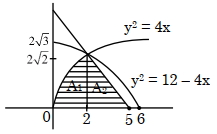
Let $S = \{(x, y) \in R \times R : x \geq 0, y \geq 0, y^2 \leq 4x, y^2 \leq 12 - 2x \text{ and } 3y + \sqrt{8}x \leq 5\sqrt{8}\}$. If the area of the region $S$ is $\alpha \sqrt{2}$,then $\alpha$ is equal to
A
$\frac{17}{2}$
B
$\frac{17}{3}$
C
$\frac{17}{4}$
D
$\frac{17}{5}$
Solution
(B) The region $S$ is bounded by $y^2 = 4x$,$y^2 = 12 - 2x$,and $3y + \sqrt{8}x = 5\sqrt{8}$.
First,find the intersection points:
For $y^2 = 4x$ and $y^2 = 12 - 2x$,we have $4x = 12 - 2x \Rightarrow 6x = 12 \Rightarrow x = 2$. Then $y^2 = 8 \Rightarrow y = 2\sqrt{2}$.
For $y^2 = 4x$ and $3y + 2\sqrt{2}x = 10\sqrt{2}$,substituting $x = y^2/4$ gives $3y + 2\sqrt{2}(y^2/4) = 10\sqrt{2} \Rightarrow 3y + \frac{y^2}{\sqrt{2}} = 10\sqrt{2} \Rightarrow y^2 + 3\sqrt{2}y - 20 = 0$.
Solving this quadratic,$(y + 4\sqrt{2})(y - \sqrt{2}) = 0$. Since $y \geq 0$,$y = \sqrt{2}$. Then $x = 1/2$.
However,looking at the region defined,the area is split at $x=2$. The area is $\int_0^2 \sqrt{4x} dx + \int_2^5 \sqrt{12-2x} dx$ is not correct based on the line constraint. The line $3y + 2\sqrt{2}x = 10\sqrt{2}$ passes through $(2, 2\sqrt{2})$ and $(5, 0)$.
Area $= \int_0^2 2\sqrt{x} dx + \text{Area of triangle with vertices } (2,0), (5,0), (2, 2\sqrt{2})$.
Area $= 2 \left[ \frac{x^{3/2}}{3/2} \right]_0^2 + \frac{1}{2} \times (5-2) \times 2\sqrt{2} = 2 \times \frac{2}{3} \times 2\sqrt{2} + 3\sqrt{2} = \frac{8\sqrt{2}}{3} + 3\sqrt{2} = \frac{17\sqrt{2}}{3}$.
Thus,$\alpha\sqrt{2} = \frac{17\sqrt{2}}{3} \Rightarrow \alpha = \frac{17}{3}$.
First,find the intersection points:
For $y^2 = 4x$ and $y^2 = 12 - 2x$,we have $4x = 12 - 2x \Rightarrow 6x = 12 \Rightarrow x = 2$. Then $y^2 = 8 \Rightarrow y = 2\sqrt{2}$.
For $y^2 = 4x$ and $3y + 2\sqrt{2}x = 10\sqrt{2}$,substituting $x = y^2/4$ gives $3y + 2\sqrt{2}(y^2/4) = 10\sqrt{2} \Rightarrow 3y + \frac{y^2}{\sqrt{2}} = 10\sqrt{2} \Rightarrow y^2 + 3\sqrt{2}y - 20 = 0$.
Solving this quadratic,$(y + 4\sqrt{2})(y - \sqrt{2}) = 0$. Since $y \geq 0$,$y = \sqrt{2}$. Then $x = 1/2$.
However,looking at the region defined,the area is split at $x=2$. The area is $\int_0^2 \sqrt{4x} dx + \int_2^5 \sqrt{12-2x} dx$ is not correct based on the line constraint. The line $3y + 2\sqrt{2}x = 10\sqrt{2}$ passes through $(2, 2\sqrt{2})$ and $(5, 0)$.
Area $= \int_0^2 2\sqrt{x} dx + \text{Area of triangle with vertices } (2,0), (5,0), (2, 2\sqrt{2})$.
Area $= 2 \left[ \frac{x^{3/2}}{3/2} \right]_0^2 + \frac{1}{2} \times (5-2) \times 2\sqrt{2} = 2 \times \frac{2}{3} \times 2\sqrt{2} + 3\sqrt{2} = \frac{8\sqrt{2}}{3} + 3\sqrt{2} = \frac{17\sqrt{2}}{3}$.
Thus,$\alpha\sqrt{2} = \frac{17\sqrt{2}}{3} \Rightarrow \alpha = \frac{17}{3}$.
0 likesView Solution
23
MathematicsDifficultMCQIIT JEE · 2024
Let $f: R \rightarrow R$ be a function defined by
$f(x) = \begin{cases} x^2 \sin \left(\frac{\pi}{x^2}\right) & \text{if } x \neq 0 \\ 0 & \text{if } x = 0 \end{cases}$
Then which of the following statements is $TRUE$?
$f(x) = \begin{cases} x^2 \sin \left(\frac{\pi}{x^2}\right) & \text{if } x \neq 0 \\ 0 & \text{if } x = 0 \end{cases}$
Then which of the following statements is $TRUE$?
A
$f(x) = 0$ has infinitely many solutions in the interval $\left[\frac{1}{10^{10}}, \infty\right)$.
B
$f(x) = 0$ has no solutions in the interval $\left[\frac{1}{\pi}, \infty\right)$.
C
The set of solutions of $f(x) = 0$ in the interval $\left(0, \frac{1}{10^{10}}\right)$ is finite.
D
$f(x) = 0$ has more than $25$ solutions in the interval $\left(\frac{1}{\pi^2}, \frac{1}{\pi}\right)$.
Solution
(D) Given $f(x) = x^2 \sin \left(\frac{\pi}{x^2}\right)$ for $x \neq 0$ and $f(0) = 0$.
To find solutions of $f(x) = 0$,we set $x^2 \sin \left(\frac{\pi}{x^2}\right) = 0$.
This implies $x = 0$ or $\sin \left(\frac{\pi}{x^2}\right) = 0$.
Thus,$\frac{\pi}{x^2} = n\pi$ for $n \in \mathbb{N}$,which gives $x^2 = \frac{1}{n}$,or $x = \pm \frac{1}{\sqrt{n}}$.
Checking Option-$A$: For $x \in \left[\frac{1}{10^{10}}, \infty\right)$,we have $\frac{1}{\sqrt{n}} \geq \frac{1}{10^{10}} \implies \sqrt{n} \leq 10^{10} \implies n \leq 10^{20}$. This is a finite number of solutions.
Checking Option-$B$: For $x \in \left(\frac{1}{\pi}, \infty\right)$,we have $\frac{1}{\sqrt{n}} > \frac{1}{\pi} \implies \sqrt{n} < \pi \implies n < \pi^2 \approx 9.86$. Thus $n \in \{1, 2, \dots, 9\}$. There are $9$ solutions,so it is not empty.
Checking Option-$C$: For $x \in \left(0, \frac{1}{10^{10}}\right)$,we have $0 < \frac{1}{\sqrt{n}} < \frac{1}{10^{10}} \implies \sqrt{n} > 10^{10} \implies n > 10^{20}$. There are infinitely many such $n$,so the set of solutions is infinite.
Checking Option-$D$: For $x \in \left(\frac{1}{\pi^2}, \frac{1}{\pi}\right)$,we have $\frac{1}{\pi^2} < \frac{1}{\sqrt{n}} < \frac{1}{\pi} \implies \pi < \sqrt{n} < \pi^2 \implies \pi^2 < n < \pi^4$. Since $\pi^2 \approx 9.86$ and $\pi^4 \approx 97.4$,$n$ can take values from $10$ to $97$. The number of solutions is $97 - 10 + 1 = 88$,which is greater than $25$. Thus,Option-$D$ is $TRUE$.
To find solutions of $f(x) = 0$,we set $x^2 \sin \left(\frac{\pi}{x^2}\right) = 0$.
This implies $x = 0$ or $\sin \left(\frac{\pi}{x^2}\right) = 0$.
Thus,$\frac{\pi}{x^2} = n\pi$ for $n \in \mathbb{N}$,which gives $x^2 = \frac{1}{n}$,or $x = \pm \frac{1}{\sqrt{n}}$.
Checking Option-$A$: For $x \in \left[\frac{1}{10^{10}}, \infty\right)$,we have $\frac{1}{\sqrt{n}} \geq \frac{1}{10^{10}} \implies \sqrt{n} \leq 10^{10} \implies n \leq 10^{20}$. This is a finite number of solutions.
Checking Option-$B$: For $x \in \left(\frac{1}{\pi}, \infty\right)$,we have $\frac{1}{\sqrt{n}} > \frac{1}{\pi} \implies \sqrt{n} < \pi \implies n < \pi^2 \approx 9.86$. Thus $n \in \{1, 2, \dots, 9\}$. There are $9$ solutions,so it is not empty.
Checking Option-$C$: For $x \in \left(0, \frac{1}{10^{10}}\right)$,we have $0 < \frac{1}{\sqrt{n}} < \frac{1}{10^{10}} \implies \sqrt{n} > 10^{10} \implies n > 10^{20}$. There are infinitely many such $n$,so the set of solutions is infinite.
Checking Option-$D$: For $x \in \left(\frac{1}{\pi^2}, \frac{1}{\pi}\right)$,we have $\frac{1}{\pi^2} < \frac{1}{\sqrt{n}} < \frac{1}{\pi} \implies \pi < \sqrt{n} < \pi^2 \implies \pi^2 < n < \pi^4$. Since $\pi^2 \approx 9.86$ and $\pi^4 \approx 97.4$,$n$ can take values from $10$ to $97$. The number of solutions is $97 - 10 + 1 = 88$,which is greater than $25$. Thus,Option-$D$ is $TRUE$.
0 likesView Solution
24
MathematicsAdvancedMCQIIT JEE · 2024
$A$ straight line drawn from the point $P(1,3,2)$,parallel to the line $\frac{x-2}{1}=\frac{y-4}{2}=\frac{z-6}{1}$,intersects the plane $L_1: x-y+3z=6$ at the point $Q$. Another straight line which passes through $Q$ and is perpendicular to the plane $L_1$ intersects the plane $L_2: 2x-y+z=-4$ at the point $R$. Then which of the following statements is(are) $TRUE$?
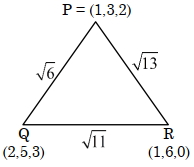
$(A)$ The length of the line segment $PQ$ is $\sqrt{6}$
$(B)$ The coordinates of $R$ are $(1,6,0)$
$(C)$ The centroid of the triangle $PQR$ is $\left(\frac{4}{3}, \frac{14}{3}, \frac{5}{3}\right)$
$(D)$ The perimeter of the triangle $PQR$ is $\sqrt{6}+\sqrt{13}+\sqrt{11}$
$(A)$ The length of the line segment $PQ$ is $\sqrt{6}$
$(B)$ The coordinates of $R$ are $(1,6,0)$
$(C)$ The centroid of the triangle $PQR$ is $\left(\frac{4}{3}, \frac{14}{3}, \frac{5}{3}\right)$
$(D)$ The perimeter of the triangle $PQR$ is $\sqrt{6}+\sqrt{13}+\sqrt{11}$
A
$A, C$
B
$A, B$
C
$A, D$
D
$A, B, C$
Solution
(D) The line passing through $P(1,3,2)$ and parallel to $\frac{x-2}{1}=\frac{y-4}{2}=\frac{z-6}{1}$ is given by $\frac{x-1}{1}=\frac{y-3}{2}=\frac{z-2}{1} = \lambda$.
Any point on this line is $(\lambda+1, 2\lambda+3, \lambda+2)$.
Since this line intersects the plane $L_1: x-y+3z=6$ at $Q$,we have:
$(\lambda+1) - (2\lambda+3) + 3(\lambda+2) = 6$
$\lambda+1-2\lambda-3+3\lambda+6 = 6$
$2\lambda + 4 = 6 \Rightarrow 2\lambda = 2 \Rightarrow \lambda = 1$.
Thus,$Q = (1+1, 2(1)+3, 1+2) = (2,5,3)$.
The length $PQ = \sqrt{(2-1)^2 + (5-3)^2 + (3-2)^2} = \sqrt{1^2 + 2^2 + 1^2} = \sqrt{6}$. So,$(A)$ is $TRUE$.
The line passing through $Q(2,5,3)$ and perpendicular to $L_1: x-y+3z=6$ has direction ratios $(1, -1, 3)$.
The equation of this line is $\frac{x-2}{1} = \frac{y-5}{-1} = \frac{z-3}{3} = t$.
Any point on this line is $(t+2, 5-t, 3t+3)$.
This line intersects $L_2: 2x-y+z=-4$ at $R$:
$2(t+2) - (5-t) + (3t+3) = -4$
$2t+4-5+t+3t+3 = -4$
$6t + 2 = -4 \Rightarrow 6t = -6 \Rightarrow t = -1$.
Thus,$R = (-1+2, 5-(-1), 3(-1)+3) = (1,6,0)$. So,$(B)$ is $TRUE$.
The centroid of $\triangle PQR$ is $\left(\frac{1+2+1}{3}, \frac{3+5+6}{3}, \frac{2+3+0}{3}\right) = \left(\frac{4}{3}, \frac{14}{3}, \frac{5}{3}\right)$. So,$(C)$ is $TRUE$.
The perimeter is $PQ + QR + RP = \sqrt{6} + \sqrt{(1-2)^2 + (6-5)^2 + (0-3)^2} + \sqrt{(1-1)^2 + (6-3)^2 + (0-2)^2} = \sqrt{6} + \sqrt{1+1+9} + \sqrt{0+9+4} = \sqrt{6} + \sqrt{11} + \sqrt{13}$. So,$(D)$ is $TRUE$.
Any point on this line is $(\lambda+1, 2\lambda+3, \lambda+2)$.
Since this line intersects the plane $L_1: x-y+3z=6$ at $Q$,we have:
$(\lambda+1) - (2\lambda+3) + 3(\lambda+2) = 6$
$\lambda+1-2\lambda-3+3\lambda+6 = 6$
$2\lambda + 4 = 6 \Rightarrow 2\lambda = 2 \Rightarrow \lambda = 1$.
Thus,$Q = (1+1, 2(1)+3, 1+2) = (2,5,3)$.
The length $PQ = \sqrt{(2-1)^2 + (5-3)^2 + (3-2)^2} = \sqrt{1^2 + 2^2 + 1^2} = \sqrt{6}$. So,$(A)$ is $TRUE$.
The line passing through $Q(2,5,3)$ and perpendicular to $L_1: x-y+3z=6$ has direction ratios $(1, -1, 3)$.
The equation of this line is $\frac{x-2}{1} = \frac{y-5}{-1} = \frac{z-3}{3} = t$.
Any point on this line is $(t+2, 5-t, 3t+3)$.
This line intersects $L_2: 2x-y+z=-4$ at $R$:
$2(t+2) - (5-t) + (3t+3) = -4$
$2t+4-5+t+3t+3 = -4$
$6t + 2 = -4 \Rightarrow 6t = -6 \Rightarrow t = -1$.
Thus,$R = (-1+2, 5-(-1), 3(-1)+3) = (1,6,0)$. So,$(B)$ is $TRUE$.
The centroid of $\triangle PQR$ is $\left(\frac{1+2+1}{3}, \frac{3+5+6}{3}, \frac{2+3+0}{3}\right) = \left(\frac{4}{3}, \frac{14}{3}, \frac{5}{3}\right)$. So,$(C)$ is $TRUE$.
The perimeter is $PQ + QR + RP = \sqrt{6} + \sqrt{(1-2)^2 + (6-5)^2 + (0-3)^2} + \sqrt{(1-1)^2 + (6-3)^2 + (0-2)^2} = \sqrt{6} + \sqrt{1+1+9} + \sqrt{0+9+4} = \sqrt{6} + \sqrt{11} + \sqrt{13}$. So,$(D)$ is $TRUE$.
0 likesView Solution
25
MathematicsDifficultMCQIIT JEE · 2024
Let $f: R \rightarrow R$ be a function such that $f(x+y)=f(x)+f(y)$ for all $x, y \in R$,and $g: R \rightarrow(0, \infty)$ be a function such that $g(x+y)=g(x) g(y)$ for all $x, y \in R$. If $f\left(\frac{-3}{5}\right)=12$ and $g\left(\frac{-1}{3}\right)=2$,then the value of $\left(f\left(\frac{1}{4}\right)+g(-2)-8\right) g(0)$ is.
A
$30$
B
$40$
C
$51$
D
$60$
Solution
(C) Given $f(x+y)=f(x)+f(y)$. This is Cauchy's functional equation,which implies $f(x)=ax$ for all $x \in Q$.
Given $f\left(\frac{-3}{5}\right)=12$,we have $a\left(\frac{-3}{5}\right)=12$,so $a=-20$. Thus,$f(x)=-20x$.
Then $f\left(\frac{1}{4}\right)=-20\left(\frac{1}{4}\right)=-5$.
Given $g(x+y)=g(x)g(y)$,this implies $g(x)=b^x$ for some $b>0$.
Given $g\left(\frac{-1}{3}\right)=2$,we have $b^{-1/3}=2$,which means $b^{-1}=2^3=8$,so $b=\frac{1}{8}$.
Thus,$g(x)=\left(\frac{1}{8}\right)^x=8^{-x}=2^{-3x}$.
Then $g(-2)=2^{-3(-2)}=2^6=64$.
Also,$g(0)=b^0=1$.
Substituting these values into the expression: $\left(f\left(\frac{1}{4}\right)+g(-2)-8\right)g(0) = (-5+64-8)(1) = 51$.
Given $f\left(\frac{-3}{5}\right)=12$,we have $a\left(\frac{-3}{5}\right)=12$,so $a=-20$. Thus,$f(x)=-20x$.
Then $f\left(\frac{1}{4}\right)=-20\left(\frac{1}{4}\right)=-5$.
Given $g(x+y)=g(x)g(y)$,this implies $g(x)=b^x$ for some $b>0$.
Given $g\left(\frac{-1}{3}\right)=2$,we have $b^{-1/3}=2$,which means $b^{-1}=2^3=8$,so $b=\frac{1}{8}$.
Thus,$g(x)=\left(\frac{1}{8}\right)^x=8^{-x}=2^{-3x}$.
Then $g(-2)=2^{-3(-2)}=2^6=64$.
Also,$g(0)=b^0=1$.
Substituting these values into the expression: $\left(f\left(\frac{1}{4}\right)+g(-2)-8\right)g(0) = (-5+64-8)(1) = 51$.
0 likesView Solution
26
MathematicsAdvancedMCQIIT JEE · 2024
$A$ bag contains $N$ balls out of which $3$ are white,$6$ are green,and the remaining $(N-9)$ balls are blue. Three balls are drawn randomly one after the other without replacement. Let $W_i, G_i$,and $B_i$ denote the events that the ball drawn in the $i^{\text{th}}$ draw is white,green,and blue,respectively. If $P(W_1 \cap G_2 \cap B_3) = \frac{2}{5N}$ and $P(B_3 \mid W_1 \cap G_2) = \frac{2}{9}$,then $N$ equals:
A
$8$
B
$9$
C
$10$
D
$11$
Solution
(D) Given that there are $3$ white,$6$ green,and $(N-9)$ blue balls in a bag of $N$ balls.
The probability of drawing a white ball first,a green ball second,and a blue ball third without replacement is:
$P(W_1 \cap G_2 \cap B_3) = P(W_1) \times P(G_2 \mid W_1) \times P(B_3 \mid W_1 \cap G_2)$
We are given $P(W_1 \cap G_2 \cap B_3) = \frac{2}{5N}$ and $P(B_3 \mid W_1 \cap G_2) = \frac{2}{9}$.
Substituting the values:
$P(W_1) = \frac{3}{N}$
$P(G_2 \mid W_1) = \frac{6}{N-1}$
$P(B_3 \mid W_1 \cap G_2) = \frac{N-9}{N-2}$
Thus,$\frac{3}{N} \times \frac{6}{N-1} \times \frac{N-9}{N-2} = \frac{2}{5N}$.
Also,from the definition of conditional probability:
$P(B_3 \mid W_1 \cap G_2) = \frac{N-9}{N-2} = \frac{2}{9}$.
Solving for $N$:
$9(N-9) = 2(N-2)$
$9N - 81 = 2N - 4$
$7N = 77$
$N = 11$.
The probability of drawing a white ball first,a green ball second,and a blue ball third without replacement is:
$P(W_1 \cap G_2 \cap B_3) = P(W_1) \times P(G_2 \mid W_1) \times P(B_3 \mid W_1 \cap G_2)$
We are given $P(W_1 \cap G_2 \cap B_3) = \frac{2}{5N}$ and $P(B_3 \mid W_1 \cap G_2) = \frac{2}{9}$.
Substituting the values:
$P(W_1) = \frac{3}{N}$
$P(G_2 \mid W_1) = \frac{6}{N-1}$
$P(B_3 \mid W_1 \cap G_2) = \frac{N-9}{N-2}$
Thus,$\frac{3}{N} \times \frac{6}{N-1} \times \frac{N-9}{N-2} = \frac{2}{5N}$.
Also,from the definition of conditional probability:
$P(B_3 \mid W_1 \cap G_2) = \frac{N-9}{N-2} = \frac{2}{9}$.
Solving for $N$:
$9(N-9) = 2(N-2)$
$9N - 81 = 2N - 4$
$7N = 77$
$N = 11$.
0 likesView Solution
27
MathematicsAdvancedMCQIIT JEE · 2024
Let the function $f: R \rightarrow R$ be defined by $f(x) = \frac{\sin x}{e^{\pi x}} \frac{(x^{2023} + 2024x + 2025)}{(x^2 - x + 3)} + \frac{2}{e^{\pi x}} \frac{(x^{2023} + 2024x + 2025)}{(x^2 - x + 3)}.$ Then the number of solutions of $f(x) = 0$ in $R$ is
A
$1$
B
$5$
C
$7$
D
$8$
Solution
(A) Given $f(x) = \frac{(x^{2023} + 2024x + 2025)}{e^{\pi x}(x^2 - x + 3)} (\sin x + 2)$.
Since $e^{\pi x} > 0$ for all $x \in R$ and the discriminant of $x^2 - x + 3$ is $D = 1 - 12 = -11 < 0$,$x^2 - x + 3$ is always positive.
Also,$-1 \leq \sin x \leq 1$,so $(\sin x + 2) \geq 1$,which means $(\sin x + 2)$ is never zero.
Thus,$f(x) = 0$ if and only if $x^{2023} + 2024x + 2025 = 0$.
Let $\phi(x) = x^{2023} + 2024x + 2025$.
Then $\phi'(x) = 2023x^{2022} + 2024$. Since $x^{2022} \geq 0$,$\phi'(x) > 0$ for all $x \in R$.
Therefore,$\phi(x)$ is a strictly increasing function.
Since $\phi(x)$ is continuous and strictly increasing,it takes every value in $R$ exactly once.
Hence,$\phi(x) = 0$ has exactly one real solution.
Therefore,the number of solutions of $f(x) = 0$ is $1$.
Since $e^{\pi x} > 0$ for all $x \in R$ and the discriminant of $x^2 - x + 3$ is $D = 1 - 12 = -11 < 0$,$x^2 - x + 3$ is always positive.
Also,$-1 \leq \sin x \leq 1$,so $(\sin x + 2) \geq 1$,which means $(\sin x + 2)$ is never zero.
Thus,$f(x) = 0$ if and only if $x^{2023} + 2024x + 2025 = 0$.
Let $\phi(x) = x^{2023} + 2024x + 2025$.
Then $\phi'(x) = 2023x^{2022} + 2024$. Since $x^{2022} \geq 0$,$\phi'(x) > 0$ for all $x \in R$.
Therefore,$\phi(x)$ is a strictly increasing function.
Since $\phi(x)$ is continuous and strictly increasing,it takes every value in $R$ exactly once.
Hence,$\phi(x) = 0$ has exactly one real solution.
Therefore,the number of solutions of $f(x) = 0$ is $1$.
0 likesView Solution
28
MathematicsMediumMCQIIT JEE · 2024
Let $\vec{p}=2 \hat{i}+\hat{j}+3 \hat{k}$ and $\vec{q}=\hat{i}-\hat{j}+\hat{k}$. If for some real numbers $\alpha, \beta$ and $\gamma$,we have $15 \hat{i}+10 \hat{j}+6 \hat{k}=\alpha(2 \vec{p}+\vec{q})+\beta(\vec{p}-2 \vec{q})+\gamma(\vec{p} \times \vec{q})$,then the value of $\gamma$ is.
A
$1$
B
$2$
C
$4$
D
$5$
Solution
(B) Given the equation: $15 \hat{i}+10 \hat{j}+6 \hat{k}=\alpha(2 \vec{p}+\vec{q})+\beta(\vec{p}-2 \vec{q})+\gamma(\vec{p} \times \vec{q})$.
Taking the dot product of both sides with $(\vec{p} \times \vec{q})$,we note that $(\vec{p} \times \vec{q}) \cdot (2 \vec{p}+\vec{q}) = 0$ and $(\vec{p} \times \vec{q}) \cdot (\vec{p}-2 \vec{q}) = 0$ because the cross product is perpendicular to both vectors.
Thus,we have: $(15 \hat{i}+10 \hat{j}+6 \hat{k}) \cdot (\vec{p} \times \vec{q}) = \gamma |\vec{p} \times \vec{q}|^2$.
The left side is the scalar triple product $[15 \hat{i}+10 \hat{j}+6 \hat{k}, \vec{p}, \vec{q}]$,which is given by the determinant:
$\begin{vmatrix} 15 & 10 & 6 \\ 2 & 1 & 3 \\ 1 & -1 & 1 \end{vmatrix} = 15(1 - (-3)) - 10(2 - 3) + 6(-2 - 1) = 15(4) - 10(-1) + 6(-3) = 60 + 10 - 18 = 52$.
Now,calculate $\vec{p} \times \vec{q} = \begin{vmatrix} \hat{i} & \hat{j} & \hat{k} \\ 2 & 1 & 3 \\ 1 & -1 & 1 \end{vmatrix} = \hat{i}(1 - (-3)) - \hat{j}(2 - 3) + \hat{k}(-2 - 1) = 4 \hat{i} + \hat{j} - 3 \hat{k}$.
Then $|\vec{p} \times \vec{q}|^2 = 4^2 + 1^2 + (-3)^2 = 16 + 1 + 9 = 26$.
Substituting these into the equation: $52 = \gamma(26)$.
Therefore,$\gamma = 2$.
Taking the dot product of both sides with $(\vec{p} \times \vec{q})$,we note that $(\vec{p} \times \vec{q}) \cdot (2 \vec{p}+\vec{q}) = 0$ and $(\vec{p} \times \vec{q}) \cdot (\vec{p}-2 \vec{q}) = 0$ because the cross product is perpendicular to both vectors.
Thus,we have: $(15 \hat{i}+10 \hat{j}+6 \hat{k}) \cdot (\vec{p} \times \vec{q}) = \gamma |\vec{p} \times \vec{q}|^2$.
The left side is the scalar triple product $[15 \hat{i}+10 \hat{j}+6 \hat{k}, \vec{p}, \vec{q}]$,which is given by the determinant:
$\begin{vmatrix} 15 & 10 & 6 \\ 2 & 1 & 3 \\ 1 & -1 & 1 \end{vmatrix} = 15(1 - (-3)) - 10(2 - 3) + 6(-2 - 1) = 15(4) - 10(-1) + 6(-3) = 60 + 10 - 18 = 52$.
Now,calculate $\vec{p} \times \vec{q} = \begin{vmatrix} \hat{i} & \hat{j} & \hat{k} \\ 2 & 1 & 3 \\ 1 & -1 & 1 \end{vmatrix} = \hat{i}(1 - (-3)) - \hat{j}(2 - 3) + \hat{k}(-2 - 1) = 4 \hat{i} + \hat{j} - 3 \hat{k}$.
Then $|\vec{p} \times \vec{q}|^2 = 4^2 + 1^2 + (-3)^2 = 16 + 1 + 9 = 26$.
Substituting these into the equation: $52 = \gamma(26)$.
Therefore,$\gamma = 2$.
0 likesView Solution
29
MathematicsDifficultMCQIIT JEE · 2024
Let the function $f: R \rightarrow R$ be defined by
$f(t)=\begin{cases} (-1)^{n+1} 2, & \text{if } t=2n-1, n \in N \\ \frac{(2n+1-t)}{2} f(2n-1) + \frac{(t-(2n-1))}{2} f(2n+1), & \text{if } 2n-1 < t < 2n+1, n \in N \end{cases}$
Define $g(x) = \int_1^x f(t) dt, x \in (1, \infty)$. Let $\alpha$ denote the number of solutions of the equation $g(x) = 0$ in the interval $(1, 8]$ and $\beta = \lim_{x \rightarrow 1^+} \frac{g(x)}{x-1}$. Then the value of $\alpha + \beta$ is equal to.
$f(t)=\begin{cases} (-1)^{n+1} 2, & \text{if } t=2n-1, n \in N \\ \frac{(2n+1-t)}{2} f(2n-1) + \frac{(t-(2n-1))}{2} f(2n+1), & \text{if } 2n-1 < t < 2n+1, n \in N \end{cases}$
Define $g(x) = \int_1^x f(t) dt, x \in (1, \infty)$. Let $\alpha$ denote the number of solutions of the equation $g(x) = 0$ in the interval $(1, 8]$ and $\beta = \lim_{x \rightarrow 1^+} \frac{g(x)}{x-1}$. Then the value of $\alpha + \beta$ is equal to.
A
$3$
B
$4$
C
$5$
D
$6$
Solution
(C) The function $f(t)$ is a piecewise linear function. For $t \in [2n-1, 2n+1]$,$f(t)$ is the line segment connecting $(2n-1, f(2n-1))$ and $(2n+1, f(2n+1))$.
Given $f(2n-1) = (-1)^{n+1} 2$,we have:
$f(1) = 2, f(3) = -2, f(5) = 2, f(7) = -2, f(9) = 2$.
For $1 < t < 3$,$f(t) = \frac{3-t}{2}(2) + \frac{t-1}{2}(-2) = 3-t-t+1 = 4-2t$.
For $3 < t < 5$,$f(t) = \frac{5-t}{2}(-2) + \frac{t-3}{2}(2) = -5+t+t-3 = 2t-8$.
For $5 < t < 7$,$f(t) = \frac{7-t}{2}(2) + \frac{t-5}{2}(-2) = 7-t-t+5 = 12-2t$.
For $7 < t < 9$,$f(t) = \frac{9-t}{2}(-2) + \frac{t-7}{2}(2) = -9+t+t-7 = 2t-16$.
$g(x) = \int_1^x f(t) dt$. $g(1) = 0$. $g(x) = 0$ when the net signed area from $1$ to $x$ is zero.
From the graph,the area from $1$ to $3$ is $\frac{1}{2}(2)(2) + \frac{1}{2}(2)(-2) = 0$. So $g(3) = 0$.
The area from $3$ to $5$ is $\frac{1}{2}(2)(-2) + \frac{1}{2}(2)(2) = 0$. So $g(5) = 0$.
The area from $5$ to $7$ is $\frac{1}{2}(2)(2) + \frac{1}{2}(2)(-2) = 0$. So $g(7) = 0$.
In $(1, 8]$,$g(x) = 0$ at $x = 3, 5, 7$. Thus $\alpha = 3$.
$\beta = \lim_{x \rightarrow 1^+} \frac{g(x)}{x-1} = g'(1^+) = f(1^+) = 2$.
Therefore,$\alpha + \beta = 3 + 2 = 5$.
Given $f(2n-1) = (-1)^{n+1} 2$,we have:
$f(1) = 2, f(3) = -2, f(5) = 2, f(7) = -2, f(9) = 2$.
For $1 < t < 3$,$f(t) = \frac{3-t}{2}(2) + \frac{t-1}{2}(-2) = 3-t-t+1 = 4-2t$.
For $3 < t < 5$,$f(t) = \frac{5-t}{2}(-2) + \frac{t-3}{2}(2) = -5+t+t-3 = 2t-8$.
For $5 < t < 7$,$f(t) = \frac{7-t}{2}(2) + \frac{t-5}{2}(-2) = 7-t-t+5 = 12-2t$.
For $7 < t < 9$,$f(t) = \frac{9-t}{2}(-2) + \frac{t-7}{2}(2) = -9+t+t-7 = 2t-16$.
$g(x) = \int_1^x f(t) dt$. $g(1) = 0$. $g(x) = 0$ when the net signed area from $1$ to $x$ is zero.
From the graph,the area from $1$ to $3$ is $\frac{1}{2}(2)(2) + \frac{1}{2}(2)(-2) = 0$. So $g(3) = 0$.
The area from $3$ to $5$ is $\frac{1}{2}(2)(-2) + \frac{1}{2}(2)(2) = 0$. So $g(5) = 0$.
The area from $5$ to $7$ is $\frac{1}{2}(2)(2) + \frac{1}{2}(2)(-2) = 0$. So $g(7) = 0$.
In $(1, 8]$,$g(x) = 0$ at $x = 3, 5, 7$. Thus $\alpha = 3$.
$\beta = \lim_{x \rightarrow 1^+} \frac{g(x)}{x-1} = g'(1^+) = f(1^+) = 2$.
Therefore,$\alpha + \beta = 3 + 2 = 5$.
0 likesView Solution
30
MathematicsAdvancedMCQIIT JEE · 2024
Let $S = \{1, 2, 3, 4, 5, 6\}$ and $X$ be the set of all relations $R$ from $S$ to $S$ that satisfy both the following properties:
$i$. $R$ has exactly $6$ elements.
$ii$. For each $(a, b) \in R$,we have $|a-b| \geq 2$.
Let $Y = \{R \in X : \text{The range of } R \text{ has exactly one element}\}$ and $Z = \{R \in X : R \text{ is a function from } S \text{ to } S\}$.
Let $n(A)$ denote the number of elements in a set $A$.
$(1)$ If $n(X) = {}^{m}C_{6}$,then the value of $m$ is. . . .
$(2)$ If the value of $n(Y) + n(Z)$ is $k^{2}$,then $|k|$ is. . . .
$i$. $R$ has exactly $6$ elements.
$ii$. For each $(a, b) \in R$,we have $|a-b| \geq 2$.
Let $Y = \{R \in X : \text{The range of } R \text{ has exactly one element}\}$ and $Z = \{R \in X : R \text{ is a function from } S \text{ to } S\}$.
Let $n(A)$ denote the number of elements in a set $A$.
$(1)$ If $n(X) = {}^{m}C_{6}$,then the value of $m$ is. . . .
$(2)$ If the value of $n(Y) + n(Z)$ is $k^{2}$,then $|k|$ is. . . .
A
$20, 36$
B
$20, 38$
C
$20, 40$
D
$20, 45$
Solution
(A) First,we determine the number of pairs $(a, b)$ such that $a, b \in S$ and $|a-b| \geq 2$.
For each $a \in S$,the number of possible $b$ values is:
- If $a=1$,$b \in \{3, 4, 5, 6\}$ ($4$ values)
- If $a=2$,$b \in \{4, 5, 6\}$ ($3$ values)
- If $a=3$,$b \in \{1, 5, 6\}$ ($3$ values)
- If $a=4$,$b \in \{1, 2, 6\}$ ($3$ values)
- If $a=5$,$b \in \{1, 2, 3\}$ ($3$ values)
- If $a=6$,$b \in \{1, 2, 3, 4\}$ ($4$ values)
Total number of such pairs is $4+3+3+3+3+4 = 20$.
Since $R$ must have exactly $6$ elements chosen from these $20$ pairs,$n(X) = {}^{20}C_{6}$,so $m = 20$.
For $n(Y)$,the range of $R$ has exactly one element,meaning all $6$ pairs $(a, b)$ in $R$ must have the same $b$. However,for any fixed $b$,there are at most $5$ values of $a$ such that $|a-b| \geq 2$. Thus,$n(Y) = 0$.
For $n(Z)$,$R$ is a function,meaning for each $a \in S$,there is exactly one $b$ such that $(a, b) \in R$ and $|a-b| \geq 2$. The number of choices for each $a$ is $4, 3, 3, 3, 3, 4$ respectively. Thus,$n(Z) = 4 \times 3 \times 3 \times 3 \times 3 \times 4 = 1296 = 36^{2}$.
Therefore,$n(Y) + n(Z) = 0 + 36^{2} = 36^{2}$,so $|k| = 36$.
For each $a \in S$,the number of possible $b$ values is:
- If $a=1$,$b \in \{3, 4, 5, 6\}$ ($4$ values)
- If $a=2$,$b \in \{4, 5, 6\}$ ($3$ values)
- If $a=3$,$b \in \{1, 5, 6\}$ ($3$ values)
- If $a=4$,$b \in \{1, 2, 6\}$ ($3$ values)
- If $a=5$,$b \in \{1, 2, 3\}$ ($3$ values)
- If $a=6$,$b \in \{1, 2, 3, 4\}$ ($4$ values)
Total number of such pairs is $4+3+3+3+3+4 = 20$.
Since $R$ must have exactly $6$ elements chosen from these $20$ pairs,$n(X) = {}^{20}C_{6}$,so $m = 20$.
For $n(Y)$,the range of $R$ has exactly one element,meaning all $6$ pairs $(a, b)$ in $R$ must have the same $b$. However,for any fixed $b$,there are at most $5$ values of $a$ such that $|a-b| \geq 2$. Thus,$n(Y) = 0$.
For $n(Z)$,$R$ is a function,meaning for each $a \in S$,there is exactly one $b$ such that $(a, b) \in R$ and $|a-b| \geq 2$. The number of choices for each $a$ is $4, 3, 3, 3, 3, 4$ respectively. Thus,$n(Z) = 4 \times 3 \times 3 \times 3 \times 3 \times 4 = 1296 = 36^{2}$.
Therefore,$n(Y) + n(Z) = 0 + 36^{2} = 36^{2}$,so $|k| = 36$.
0 likesView Solution
31
MathematicsAdvancedMCQIIT JEE · 2024
Let $f: [0, \frac{\pi}{2}] \rightarrow [0, 1]$ be the function defined by $f(x) = \sin^2 x$ and let $g: [0, \frac{\pi}{2}] \rightarrow [0, \infty)$ be the function defined by $g(x) = \sqrt{\frac{\pi x}{2} - x^2}$.
(There are two questions based on this paragraph. The questions given below are those two.)
$(1)$ The value of $2 \int_0^{\frac{\pi}{2}} f(x) g(x) dx - \int_0^{\frac{\pi}{2}} g(x) dx$ is
$(2)$ The value of $\frac{16}{\pi^3} \int_0^{\frac{\pi}{2}} f(x) g(x) dx$ is
(There are two questions based on this paragraph. The questions given below are those two.)
$(1)$ The value of $2 \int_0^{\frac{\pi}{2}} f(x) g(x) dx - \int_0^{\frac{\pi}{2}} g(x) dx$ is
$(2)$ The value of $\frac{16}{\pi^3} \int_0^{\frac{\pi}{2}} f(x) g(x) dx$ is
A
$0, 0.20$
B
$0, 0.25$
C
$0, 0.30$
D
$0, 0.35$
Solution
(B) $(1)$ Let $I = 2 \int_0^{\frac{\pi}{2}} \sin^2 x \sqrt{\frac{\pi x}{2} - x^2} dx - \int_0^{\frac{\pi}{2}} \sqrt{\frac{\pi x}{2} - x^2} dx$.
Let $I_1 = \int_0^{\frac{\pi}{2}} \sin^2 x \sqrt{(\frac{\pi}{4})^2 - (x - \frac{\pi}{4})^2} dx$.
Using the property $\int_0^a h(x) dx = \int_0^a h(a-x) dx$,we get:
$I_1 = \int_0^{\frac{\pi}{2}} \cos^2 x \sqrt{(\frac{\pi}{4})^2 - (\frac{\pi}{2} - x - \frac{\pi}{4})^2} dx = \int_0^{\frac{\pi}{2}} \cos^2 x \sqrt{(\frac{\pi}{4})^2 - (x - \frac{\pi}{4})^2} dx$.
Adding the two expressions for $I_1$:
$2I_1 = \int_0^{\frac{\pi}{2}} (\sin^2 x + \cos^2 x) \sqrt{(\frac{\pi}{4})^2 - (x - \frac{\pi}{4})^2} dx = \int_0^{\frac{\pi}{2}} g(x) dx$.
Thus,$I = 2I_1 - \int_0^{\frac{\pi}{2}} g(x) dx = \int_0^{\frac{\pi}{2}} g(x) dx - \int_0^{\frac{\pi}{2}} g(x) dx = 0$.
$(2)$ From above,$I_1 = \frac{1}{2} \int_0^{\frac{\pi}{2}} g(x) dx = \frac{1}{2} \int_0^{\frac{\pi}{2}} \sqrt{(\frac{\pi}{4})^2 - (x - \frac{\pi}{4})^2} dx$.
Using $\int \sqrt{a^2 - u^2} du = \frac{u}{2} \sqrt{a^2 - u^2} + \frac{a^2}{2} \sin^{-1}(\frac{u}{a}) + C$:
$I_1 = \frac{1}{2} [\frac{x - \frac{\pi}{4}}{2} \sqrt{\frac{\pi x}{2} - x^2} + \frac{\pi^2}{32} \sin^{-1}(\frac{x - \frac{\pi}{4}}{\pi/4})]_0^{\frac{\pi}{2}} = \frac{1}{2} [(\frac{\pi^2}{32} \cdot \frac{\pi}{2}) - (\frac{\pi^2}{32} \cdot -\frac{\pi}{2})] = \frac{1}{2} [\frac{\pi^3}{64} + \frac{\pi^3}{64}] = \frac{\pi^3}{64}$.
Therefore,$\frac{16}{\pi^3} I_1 = \frac{16}{\pi^3} \cdot \frac{\pi^3}{64} = \frac{1}{4} = 0.25$.
Let $I_1 = \int_0^{\frac{\pi}{2}} \sin^2 x \sqrt{(\frac{\pi}{4})^2 - (x - \frac{\pi}{4})^2} dx$.
Using the property $\int_0^a h(x) dx = \int_0^a h(a-x) dx$,we get:
$I_1 = \int_0^{\frac{\pi}{2}} \cos^2 x \sqrt{(\frac{\pi}{4})^2 - (\frac{\pi}{2} - x - \frac{\pi}{4})^2} dx = \int_0^{\frac{\pi}{2}} \cos^2 x \sqrt{(\frac{\pi}{4})^2 - (x - \frac{\pi}{4})^2} dx$.
Adding the two expressions for $I_1$:
$2I_1 = \int_0^{\frac{\pi}{2}} (\sin^2 x + \cos^2 x) \sqrt{(\frac{\pi}{4})^2 - (x - \frac{\pi}{4})^2} dx = \int_0^{\frac{\pi}{2}} g(x) dx$.
Thus,$I = 2I_1 - \int_0^{\frac{\pi}{2}} g(x) dx = \int_0^{\frac{\pi}{2}} g(x) dx - \int_0^{\frac{\pi}{2}} g(x) dx = 0$.
$(2)$ From above,$I_1 = \frac{1}{2} \int_0^{\frac{\pi}{2}} g(x) dx = \frac{1}{2} \int_0^{\frac{\pi}{2}} \sqrt{(\frac{\pi}{4})^2 - (x - \frac{\pi}{4})^2} dx$.
Using $\int \sqrt{a^2 - u^2} du = \frac{u}{2} \sqrt{a^2 - u^2} + \frac{a^2}{2} \sin^{-1}(\frac{u}{a}) + C$:
$I_1 = \frac{1}{2} [\frac{x - \frac{\pi}{4}}{2} \sqrt{\frac{\pi x}{2} - x^2} + \frac{\pi^2}{32} \sin^{-1}(\frac{x - \frac{\pi}{4}}{\pi/4})]_0^{\frac{\pi}{2}} = \frac{1}{2} [(\frac{\pi^2}{32} \cdot \frac{\pi}{2}) - (\frac{\pi^2}{32} \cdot -\frac{\pi}{2})] = \frac{1}{2} [\frac{\pi^3}{64} + \frac{\pi^3}{64}] = \frac{\pi^3}{64}$.
Therefore,$\frac{16}{\pi^3} I_1 = \frac{16}{\pi^3} \cdot \frac{\pi^3}{64} = \frac{1}{4} = 0.25$.
0 likesView Solution
32
MathematicsMediumMCQIIT JEE · 2024
Considering only the principal values of the inverse trigonometric functions,the value of $\tan \left(\sin ^{-1}\left(\frac{3}{5}\right)-2 \cos ^{-1}\left(\frac{2}{\sqrt{5}}\right)\right)$ is
A
$\frac{7}{24}$
B
$\frac{-7}{24}$
C
$\frac{5}{24}$
D
$\frac{-5}{24}$
Solution
(B) Let $\alpha = \sin^{-1}\left(\frac{3}{5}\right)$. Then $\sin \alpha = \frac{3}{5}$,which implies $\tan \alpha = \frac{3}{4}$.
Let $\beta = \cos^{-1}\left(\frac{2}{\sqrt{5}}\right)$. Then $\cos \beta = \frac{2}{\sqrt{5}}$,which implies $\tan \beta = \frac{1}{2}$.
We need to find $\tan(\alpha - 2\beta)$.
First,calculate $\tan(2\beta) = \frac{2 \tan \beta}{1 - \tan^2 \beta} = \frac{2(1/2)}{1 - (1/2)^2} = \frac{1}{1 - 1/4} = \frac{1}{3/4} = \frac{4}{3}$.
Now,use the formula $\tan(\alpha - 2\beta) = \frac{\tan \alpha - \tan 2\beta}{1 + \tan \alpha \tan 2\beta}$.
Substituting the values: $\tan(\alpha - 2\beta) = \frac{3/4 - 4/3}{1 + (3/4)(4/3)} = \frac{(9-16)/12}{1 + 1} = \frac{-7/12}{2} = -\frac{7}{24}$.
Let $\beta = \cos^{-1}\left(\frac{2}{\sqrt{5}}\right)$. Then $\cos \beta = \frac{2}{\sqrt{5}}$,which implies $\tan \beta = \frac{1}{2}$.
We need to find $\tan(\alpha - 2\beta)$.
First,calculate $\tan(2\beta) = \frac{2 \tan \beta}{1 - \tan^2 \beta} = \frac{2(1/2)}{1 - (1/2)^2} = \frac{1}{1 - 1/4} = \frac{1}{3/4} = \frac{4}{3}$.
Now,use the formula $\tan(\alpha - 2\beta) = \frac{\tan \alpha - \tan 2\beta}{1 + \tan \alpha \tan 2\beta}$.
Substituting the values: $\tan(\alpha - 2\beta) = \frac{3/4 - 4/3}{1 + (3/4)(4/3)} = \frac{(9-16)/12}{1 + 1} = \frac{-7/12}{2} = -\frac{7}{24}$.
0 likesView Solution
Vedclass Products
For Students
Vedclass Test Series
Mock tests in real IIT JEE style covering Mathematics with performance analysis. 5-day free trial.
Start Free TrialFor Teachers
Exam Paper Generator
Generate Set A/B/C/D Mathematics papers from 7.5L+ questions in 2 minutes. 3 chapters free.
Try FreeFor Institutes
Online Exam Module
Run live IIT JEE mock exams with unlimited students, 360° analytics & white-label branding.
See DemoFrequently Asked Questions
How many Mathematics questions are in IIT JEE 2024?
There are 32 Mathematics questions from the IIT JEE 2024 paper on Vedclass, each with a detailed step-by-step solution in English.
Are IIT JEE 2024 Mathematics solutions available in English?
Yes. All solutions on this page are in English. You can also switch to English or Hindi using the language buttons above the questions.
Can I practice IIT JEE 2024 Mathematics as a timed test?
Yes. Use the Vedclass Test Series to attempt a full IIT JEE mock test covering Mathematics with time limits and instant score analysis.
Can teachers create Mathematics papers from IIT JEE previous year questions?
Yes. The Vedclass Exam Paper Generator lets teachers mix IIT JEE Mathematics questions and generate Set A/B/C/D papers in minutes.
For Teachers & Institutes
Build a Custom Mathematics Paper
Pick IIT JEE 2024 Mathematics questions, set difficulty, and generate Set A/B/C/D in 2 minutes.