
MathematicsQ1–37 of 37 questions
Page 1 of 1 · English
1
MathematicsAdvancedMCQIIT JEE · 2020
Suppose $a, b$ denote the distinct real roots of the quadratic polynomial $x^2+20x-2020$ and suppose $c, d$ denote the distinct complex roots of the quadratic polynomial $x^2-20x+2020$. Then the value of $ac(a-c)+ad(a-d)+bc(b-c)+bd(b-d)$ is
A
$0$
B
$8000$
C
$8080$
D
$16000$
Solution
(D) Given $x^2+20x-2020=0$ has roots $a, b$. By Vieta's formulas,$a+b = -20$ and $ab = -2020$.
Given $x^2-20x+2020=0$ has roots $c, d$. By Vieta's formulas,$c+d = 20$ and $cd = 2020$.
We need to evaluate $E = ac(a-c)+ad(a-d)+bc(b-c)+bd(b-d)$.
Expanding the expression: $E = a^2c - ac^2 + a^2d - ad^2 + b^2c - bc^2 + b^2d - bd^2$.
Grouping terms: $E = a^2(c+d) + b^2(c+d) - c^2(a+b) - d^2(a+b)$.
$E = (c+d)(a^2+b^2) - (a+b)(c^2+d^2)$.
Using $a^2+b^2 = (a+b)^2 - 2ab$ and $c^2+d^2 = (c+d)^2 - 2cd$:
$a^2+b^2 = (-20)^2 - 2(-2020) = 400 + 4040 = 4440$.
$c^2+d^2 = (20)^2 - 2(2020) = 400 - 4040 = -3640$.
Substituting these values: $E = (20)(4440) - (-20)(-3640)$.
$E = 88800 - 72800 = 16000$.
Given $x^2-20x+2020=0$ has roots $c, d$. By Vieta's formulas,$c+d = 20$ and $cd = 2020$.
We need to evaluate $E = ac(a-c)+ad(a-d)+bc(b-c)+bd(b-d)$.
Expanding the expression: $E = a^2c - ac^2 + a^2d - ad^2 + b^2c - bc^2 + b^2d - bd^2$.
Grouping terms: $E = a^2(c+d) + b^2(c+d) - c^2(a+b) - d^2(a+b)$.
$E = (c+d)(a^2+b^2) - (a+b)(c^2+d^2)$.
Using $a^2+b^2 = (a+b)^2 - 2ab$ and $c^2+d^2 = (c+d)^2 - 2cd$:
$a^2+b^2 = (-20)^2 - 2(-2020) = 400 + 4040 = 4440$.
$c^2+d^2 = (20)^2 - 2(2020) = 400 - 4040 = -3640$.
Substituting these values: $E = (20)(4440) - (-20)(-3640)$.
$E = 88800 - 72800 = 16000$.
0 likesView Solution
2
MathematicsDifficultMCQIIT JEE · 2020
Let $a, b$ and $\lambda$ be positive real numbers. Suppose $P$ is an end point of the latus rectum of the parabola $y^2 = 4 \lambda x$,and suppose the ellipse $\frac{x^2}{a^2} + \frac{y^2}{b^2} = 1$ passes through the point $P$. If the tangents to the parabola and the ellipse at the point $P$ are perpendicular to each other,then the eccentricity of the ellipse is
A
$\frac{1}{\sqrt{2}}$
B
$\frac{1}{2}$
C
$\frac{1}{3}$
D
$\frac{2}{5}$
Solution
(A) The parabola is $y^2 = 4 \lambda x$. The end point of the latus rectum is $P(\lambda, 2 \lambda)$.
The slope of the tangent to the parabola at $P$ is given by differentiating $y^2 = 4 \lambda x$ with respect to $x$: $2y \frac{dy}{dx} = 4 \lambda \Rightarrow \frac{dy}{dx} = \frac{2 \lambda}{y}$.
At $P(\lambda, 2 \lambda)$,the slope $m_1 = \frac{2 \lambda}{2 \lambda} = 1$.
The slope of the tangent to the ellipse $\frac{x^2}{a^2} + \frac{y^2}{b^2} = 1$ at $P$ is found by differentiating: $\frac{2x}{a^2} + \frac{2y}{b^2} \frac{dy}{dx} = 0 \Rightarrow \frac{dy}{dx} = -\frac{b^2 x}{a^2 y}$.
At $P(\lambda, 2 \lambda)$,the slope $m_2 = -\frac{b^2 \lambda}{a^2 (2 \lambda)} = -\frac{b^2}{2a^2}$.
Since the tangents are perpendicular,$m_1 \times m_2 = -1$.
$1 \times (-\frac{b^2}{2a^2}) = -1$ $\Rightarrow \frac{b^2}{2a^2} = 1$ $\Rightarrow \frac{b^2}{a^2} = 2$.
Since the ellipse passes through $P(\lambda, 2 \lambda)$,we have $\frac{\lambda^2}{a^2} + \frac{4 \lambda^2}{b^2} = 1$.
Substituting $b^2 = 2a^2$: $\frac{\lambda^2}{a^2} + \frac{4 \lambda^2}{2a^2} = 1$ $\Rightarrow \frac{\lambda^2}{a^2} + \frac{2 \lambda^2}{a^2} = 1$ $\Rightarrow \frac{3 \lambda^2}{a^2} = 1$ $\Rightarrow a^2 = 3 \lambda^2$.
Then $b^2 = 2a^2 = 6 \lambda^2$.
The eccentricity $e$ is given by $e^2 = 1 - \frac{b^2}{a^2}$ (if $a < b$) or $e^2 = 1 - \frac{a^2}{b^2}$ (if $a > b$).
Here $\frac{b^2}{a^2} = 2$,so $a^2 < b^2$. Thus $e^2 = 1 - \frac{a^2}{b^2} = 1 - \frac{1}{2} = \frac{1}{2}$.
Therefore,$e = \frac{1}{\sqrt{2}}$.
The slope of the tangent to the parabola at $P$ is given by differentiating $y^2 = 4 \lambda x$ with respect to $x$: $2y \frac{dy}{dx} = 4 \lambda \Rightarrow \frac{dy}{dx} = \frac{2 \lambda}{y}$.
At $P(\lambda, 2 \lambda)$,the slope $m_1 = \frac{2 \lambda}{2 \lambda} = 1$.
The slope of the tangent to the ellipse $\frac{x^2}{a^2} + \frac{y^2}{b^2} = 1$ at $P$ is found by differentiating: $\frac{2x}{a^2} + \frac{2y}{b^2} \frac{dy}{dx} = 0 \Rightarrow \frac{dy}{dx} = -\frac{b^2 x}{a^2 y}$.
At $P(\lambda, 2 \lambda)$,the slope $m_2 = -\frac{b^2 \lambda}{a^2 (2 \lambda)} = -\frac{b^2}{2a^2}$.
Since the tangents are perpendicular,$m_1 \times m_2 = -1$.
$1 \times (-\frac{b^2}{2a^2}) = -1$ $\Rightarrow \frac{b^2}{2a^2} = 1$ $\Rightarrow \frac{b^2}{a^2} = 2$.
Since the ellipse passes through $P(\lambda, 2 \lambda)$,we have $\frac{\lambda^2}{a^2} + \frac{4 \lambda^2}{b^2} = 1$.
Substituting $b^2 = 2a^2$: $\frac{\lambda^2}{a^2} + \frac{4 \lambda^2}{2a^2} = 1$ $\Rightarrow \frac{\lambda^2}{a^2} + \frac{2 \lambda^2}{a^2} = 1$ $\Rightarrow \frac{3 \lambda^2}{a^2} = 1$ $\Rightarrow a^2 = 3 \lambda^2$.
Then $b^2 = 2a^2 = 6 \lambda^2$.
The eccentricity $e$ is given by $e^2 = 1 - \frac{b^2}{a^2}$ (if $a < b$) or $e^2 = 1 - \frac{a^2}{b^2}$ (if $a > b$).
Here $\frac{b^2}{a^2} = 2$,so $a^2 < b^2$. Thus $e^2 = 1 - \frac{a^2}{b^2} = 1 - \frac{1}{2} = \frac{1}{2}$.
Therefore,$e = \frac{1}{\sqrt{2}}$.
0 likesView Solution
3
MathematicsAdvancedMCQIIT JEE · 2020
Let $S$ be the set of all complex numbers $z$ satisfying $|z^2+z+1|=1$. Then which of the following statements is/are $TRUE$?
$(A) |z+\frac{1}{2}| \leq \frac{1}{2}$ for all $z \in S$
$(B) |z| \leq 2$ for all $z \in S$
$(C) |z+\frac{1}{2}| \geq \frac{1}{2}$ for all $z \in S$
$(D)$ The set $S$ has exactly four elements
$(A) |z+\frac{1}{2}| \leq \frac{1}{2}$ for all $z \in S$
$(B) |z| \leq 2$ for all $z \in S$
$(C) |z+\frac{1}{2}| \geq \frac{1}{2}$ for all $z \in S$
$(D)$ The set $S$ has exactly four elements
A
$A, C$
B
$B, C$
C
$B, D$
D
$A, D$
Solution
(B) Given $|z^2+z+1|=1$.
We can write this as $|(z+\frac{1}{2})^2 + \frac{3}{4}| = 1$.
Using the triangle inequality $|a+b| \leq |a| + |b|$,we have $1 = |(z+\frac{1}{2})^2 + \frac{3}{4}| \leq |z+\frac{1}{2}|^2 + \frac{3}{4}$,which implies $|z+\frac{1}{2}|^2 \geq \frac{1}{4}$,so $|z+\frac{1}{2}| \geq \frac{1}{2}$. Thus,$(C)$ is true.
Also,$|z^2+z| = |(z^2+z+1)-1| \leq |z^2+z+1| + |-1| = 1+1 = 2$.
Since $|z^2+z| = |z||z+1| \leq 2$,for large $|z|$,$|z|^2 \approx |z^2+z| \leq 2$,so $|z| \leq 2$. Thus,$(B)$ is true.
Since the equation $|z^2+z+1|=1$ represents a curve in the complex plane,the set $S$ is infinite,so $(D)$ is false.
Therefore,the correct statements are $(B)$ and $(C)$.
We can write this as $|(z+\frac{1}{2})^2 + \frac{3}{4}| = 1$.
Using the triangle inequality $|a+b| \leq |a| + |b|$,we have $1 = |(z+\frac{1}{2})^2 + \frac{3}{4}| \leq |z+\frac{1}{2}|^2 + \frac{3}{4}$,which implies $|z+\frac{1}{2}|^2 \geq \frac{1}{4}$,so $|z+\frac{1}{2}| \geq \frac{1}{2}$. Thus,$(C)$ is true.
Also,$|z^2+z| = |(z^2+z+1)-1| \leq |z^2+z+1| + |-1| = 1+1 = 2$.
Since $|z^2+z| = |z||z+1| \leq 2$,for large $|z|$,$|z|^2 \approx |z^2+z| \leq 2$,so $|z| \leq 2$. Thus,$(B)$ is true.
Since the equation $|z^2+z+1|=1$ represents a curve in the complex plane,the set $S$ is infinite,so $(D)$ is false.
Therefore,the correct statements are $(B)$ and $(C)$.
0 likesView Solution
4
MathematicsAdvancedMCQIIT JEE · 2020
Let $x, y$ and $z$ be positive real numbers. Suppose $x, y$ and $z$ are lengths of the sides of a triangle opposite to its angles $X, Y$ and $Z$,respectively. If $\tan \frac{X}{2} + \tan \frac{Z}{2} = \frac{2y}{x+y+z}$,then which of the following statements is/are $TRUE$?
$(A) 2Y = X + Z$
$(B) Y = X + Z$
$(C) \tan \frac{X}{2} = \frac{x}{y+z}$
$(D) x^2 + z^2 - y^2 = xz$
$(A) 2Y = X + Z$
$(B) Y = X + Z$
$(C) \tan \frac{X}{2} = \frac{x}{y+z}$
$(D) x^2 + z^2 - y^2 = xz$
A
$A, C$
B
$B, C$
C
$A, D$
D
$A, B$
Solution
(B) Given $\tan \frac{X}{2} + \tan \frac{Z}{2} = \frac{2y}{x+y+z}$.
Using the formula $\tan \frac{X}{2} = \frac{\Delta}{S(S-x)}$ where $S = \frac{x+y+z}{2}$ and $\Delta$ is the area of the triangle,we have:
$\frac{\Delta}{S(S-x)} + \frac{\Delta}{S(S-z)} = \frac{2y}{2S} = \frac{y}{S}$
$\frac{\Delta}{S} \left( \frac{S-z + S-x}{(S-x)(S-z)} \right) = \frac{y}{S}$
$\Delta \left( \frac{2S - (x+z)}{(S-x)(S-z)} \right) = y$
Since $2S = x+y+z$,$2S - (x+z) = y$.
$\Delta \left( \frac{y}{(S-x)(S-z)} \right) = y \implies \Delta = (S-x)(S-z)$
Squaring both sides: $\Delta^2 = (S-x)^2(S-z)^2$
$S(S-x)(S-y)(S-z) = (S-x)^2(S-z)^2$
$S(S-y) = (S-x)(S-z)$
Substituting $S = \frac{x+y+z}{2}$,we get $y^2 = x^2 + z^2$.
This implies $\angle Y = 90^\circ$.
Since $X+Y+Z = 180^\circ$,$X+Z = 90^\circ$,so $Y = X+Z$. Thus $(B)$ is true.
Also,for a right-angled triangle at $Y$,$\tan \frac{X}{2} = \sqrt{\frac{(S-y)(S-z)}{S(S-x)}} = \frac{x}{y+z}$. Thus $(C)$ is true.
Therefore,$(B)$ and $(C)$ are true.
Using the formula $\tan \frac{X}{2} = \frac{\Delta}{S(S-x)}$ where $S = \frac{x+y+z}{2}$ and $\Delta$ is the area of the triangle,we have:
$\frac{\Delta}{S(S-x)} + \frac{\Delta}{S(S-z)} = \frac{2y}{2S} = \frac{y}{S}$
$\frac{\Delta}{S} \left( \frac{S-z + S-x}{(S-x)(S-z)} \right) = \frac{y}{S}$
$\Delta \left( \frac{2S - (x+z)}{(S-x)(S-z)} \right) = y$
Since $2S = x+y+z$,$2S - (x+z) = y$.
$\Delta \left( \frac{y}{(S-x)(S-z)} \right) = y \implies \Delta = (S-x)(S-z)$
Squaring both sides: $\Delta^2 = (S-x)^2(S-z)^2$
$S(S-x)(S-y)(S-z) = (S-x)^2(S-z)^2$
$S(S-y) = (S-x)(S-z)$
Substituting $S = \frac{x+y+z}{2}$,we get $y^2 = x^2 + z^2$.
This implies $\angle Y = 90^\circ$.
Since $X+Y+Z = 180^\circ$,$X+Z = 90^\circ$,so $Y = X+Z$. Thus $(B)$ is true.
Also,for a right-angled triangle at $Y$,$\tan \frac{X}{2} = \sqrt{\frac{(S-y)(S-z)}{S(S-x)}} = \frac{x}{y+z}$. Thus $(C)$ is true.
Therefore,$(B)$ and $(C)$ are true.
0 likesView Solution
5
MathematicsAdvancedMCQIIT JEE · 2020
Let $m$ be the minimum possible value of $\log _3(3^{y_1}+3^{y_2}+3^{y_3})$,where $y_1, y_2, y_3$ are real numbers for which $y_1+y_2+y_3=9$. Let $M$ be the maximum possible value of $(\log _3 x_1+\log _3 x_2+\log _3 x_3)$,where $x_1, x_2, x_3$ are positive real numbers for which $x_1+x_2+x_3=9$. Then the value of $\log _2(m^3)+\log _3(M^2)$ is:
A
$5$
B
$8$
C
$9$
D
$10$
Solution
(B) By the $AM$-$GM$ inequality,$\frac{3^{y_1}+3^{y_2}+3^{y_3}}{3} \geq \sqrt[3]{3^{y_1} \cdot 3^{y_2} \cdot 3^{y_3}} = \sqrt[3]{3^{y_1+y_2+y_3}}$.
Given $y_1+y_2+y_3=9$,we have $\frac{3^{y_1}+3^{y_2}+3^{y_3}}{3} \geq \sqrt[3]{3^9} = 3^3 = 27$.
So,$3^{y_1}+3^{y_2}+3^{y_3} \geq 81 = 3^4$.
Taking $\log_3$ on both sides,$\log_3(3^{y_1}+3^{y_2}+3^{y_3}) \geq 4$,so $m=4$.
For $M$,by the $AM$-$GM$ inequality,$\frac{x_1+x_2+x_3}{3} \geq \sqrt[3]{x_1 x_2 x_3}$.
Given $x_1+x_2+x_3=9$,we have $3 \geq \sqrt[3]{x_1 x_2 x_3}$,so $x_1 x_2 x_3 \leq 27$.
Then $\log_3(x_1 x_2 x_3) = \log_3 x_1 + \log_3 x_2 + \log_3 x_3 \leq \log_3(27) = 3$,so $M=3$.
Finally,$\log_2(m^3) + \log_3(M^2) = \log_2(4^3) + \log_3(3^2) = \log_2(64) + 2 = 6 + 2 = 8$.
Given $y_1+y_2+y_3=9$,we have $\frac{3^{y_1}+3^{y_2}+3^{y_3}}{3} \geq \sqrt[3]{3^9} = 3^3 = 27$.
So,$3^{y_1}+3^{y_2}+3^{y_3} \geq 81 = 3^4$.
Taking $\log_3$ on both sides,$\log_3(3^{y_1}+3^{y_2}+3^{y_3}) \geq 4$,so $m=4$.
For $M$,by the $AM$-$GM$ inequality,$\frac{x_1+x_2+x_3}{3} \geq \sqrt[3]{x_1 x_2 x_3}$.
Given $x_1+x_2+x_3=9$,we have $3 \geq \sqrt[3]{x_1 x_2 x_3}$,so $x_1 x_2 x_3 \leq 27$.
Then $\log_3(x_1 x_2 x_3) = \log_3 x_1 + \log_3 x_2 + \log_3 x_3 \leq \log_3(27) = 3$,so $M=3$.
Finally,$\log_2(m^3) + \log_3(M^2) = \log_2(4^3) + \log_3(3^2) = \log_2(64) + 2 = 6 + 2 = 8$.
0 likesView Solution
6
MathematicsDifficultMCQIIT JEE · 2020
Let $a_1, a_2, a_3, \ldots$ be a sequence of positive integers in arithmetic progression with common difference $2$. Also,let $b_1, b_2, b_3, \ldots$ be a sequence of positive integers in geometric progression with common ratio $2$. If $a_1 = b_1 = c$,then the number of all possible values of $c$,for which the equality $2(a_1 + a_2 + \ldots + a_n) = b_1 + b_2 + \ldots + b_n$ holds for some positive integer $n$,is:
A
$1$
B
$5$
C
$8$
D
$7$
Solution
(A) The sum of the arithmetic progression is $S_n = \frac{n}{2}(2a_1 + (n-1)d) = \frac{n}{2}(2c + (n-1)2) = n(c + n - 1)$.
Given $2(S_n) = b_1 + b_2 + \ldots + b_n$,where $b_n$ is a geometric progression with $b_1 = c$ and $r = 2$.
The sum of the geometric progression is $T_n = c(2^n - 1) / (2 - 1) = c(2^n - 1)$.
Substituting these into the given equation: $2n(c + n - 1) = c(2^n - 1)$.
$2nc + 2n^2 - 2n = c(2^n - 1)$.
$2n^2 - 2n = c(2^n - 1 - 2n)$.
$c = \frac{2n^2 - 2n}{2^n - 2n - 1}$.
For $c$ to be a positive integer,$2n^2 - 2n > 0$ and $2^n - 2n - 1 > 0$.
For $n=1$,$c = 0 / (2-2-1) = 0$ (not a positive integer).
For $n=2$,$c = (8-4) / (4-4-1) = -4$ (not positive).
For $n=3$,$c = (18-6) / (8-6-1) = 12 / 1 = 12$.
For $n=4$,$c = (32-8) / (16-8-1) = 24 / 7$ (not an integer).
For $n=5$,$c = (50-10) / (32-10-1) = 40 / 21$ (not an integer).
For $n=6$,$c = (72-12) / (64-12-1) = 60 / 51$ (not an integer).
For $n \geq 7$,$2^n - 2n - 1 > 2n^2 - 2n$,so $c < 1$.
Thus,the only positive integer value for $c$ is $12$,which corresponds to $n=3$.
Therefore,the number of possible values of $c$ is $1$.
Given $2(S_n) = b_1 + b_2 + \ldots + b_n$,where $b_n$ is a geometric progression with $b_1 = c$ and $r = 2$.
The sum of the geometric progression is $T_n = c(2^n - 1) / (2 - 1) = c(2^n - 1)$.
Substituting these into the given equation: $2n(c + n - 1) = c(2^n - 1)$.
$2nc + 2n^2 - 2n = c(2^n - 1)$.
$2n^2 - 2n = c(2^n - 1 - 2n)$.
$c = \frac{2n^2 - 2n}{2^n - 2n - 1}$.
For $c$ to be a positive integer,$2n^2 - 2n > 0$ and $2^n - 2n - 1 > 0$.
For $n=1$,$c = 0 / (2-2-1) = 0$ (not a positive integer).
For $n=2$,$c = (8-4) / (4-4-1) = -4$ (not positive).
For $n=3$,$c = (18-6) / (8-6-1) = 12 / 1 = 12$.
For $n=4$,$c = (32-8) / (16-8-1) = 24 / 7$ (not an integer).
For $n=5$,$c = (50-10) / (32-10-1) = 40 / 21$ (not an integer).
For $n=6$,$c = (72-12) / (64-12-1) = 60 / 51$ (not an integer).
For $n \geq 7$,$2^n - 2n - 1 > 2n^2 - 2n$,so $c < 1$.
Thus,the only positive integer value for $c$ is $12$,which corresponds to $n=3$.
Therefore,the number of possible values of $c$ is $1$.
0 likesView Solution
7
MathematicsMediumMCQIIT JEE · 2020
Let $e$ denote the base of the natural logarithm. The value of the real number $a$ for which the right-hand limit $\lim_{x \rightarrow 0^{+}} \frac{(1-x)^{\frac{1}{x}}-e^{-1}}{x^a}$ is equal to a nonzero real number is:
A
$0$
B
$1$
C
$5$
D
$6$
Solution
(B) Let $L = \lim_{x \rightarrow 0^{+}} \frac{(1-x)^{\frac{1}{x}}-e^{-1}}{x^a}$.
We know that $(1-x)^{\frac{1}{x}} = e^{\frac{1}{x} \ln(1-x)}$.
Using the Taylor series expansion for $\ln(1-x) = -x - \frac{x^2}{2} - \frac{x^3}{3} - \dots$,we have:
$\frac{1}{x} \ln(1-x) = -1 - \frac{x}{2} - \frac{x^2}{3} - \dots$
Thus,$(1-x)^{\frac{1}{x}} = e^{-1 - \frac{x}{2} - \frac{x^2}{3} - \dots} = e^{-1} \cdot e^{-\frac{x}{2} - \frac{x^2}{3} - \dots}$.
Using $e^u = 1 + u + \frac{u^2}{2!} + \dots$,we get:
$(1-x)^{\frac{1}{x}} = e^{-1} \left( 1 + (-\frac{x}{2} - \frac{x^2}{3} - \dots) + \frac{(-\frac{x}{2} - \dots)^2}{2} + \dots \right) = e^{-1} \left( 1 - \frac{x}{2} - \frac{x^2}{3} + \frac{x^2}{8} + \dots \right) = e^{-1} \left( 1 - \frac{x}{2} - \frac{5x^2}{24} + \dots \right)$.
Substituting this into the limit:
$L = \lim_{x \rightarrow 0^{+}} \frac{e^{-1} (1 - \frac{x}{2} - \frac{5x^2}{24} + \dots) - e^{-1}}{x^a} = e^{-1} \lim_{x \rightarrow 0^{+}} \frac{-\frac{x}{2} - \frac{5x^2}{24} - \dots}{x^a}$.
For the limit to be a nonzero real number,the power of $x$ in the numerator must match the denominator $x^a$. Thus,$a = 1$.
We know that $(1-x)^{\frac{1}{x}} = e^{\frac{1}{x} \ln(1-x)}$.
Using the Taylor series expansion for $\ln(1-x) = -x - \frac{x^2}{2} - \frac{x^3}{3} - \dots$,we have:
$\frac{1}{x} \ln(1-x) = -1 - \frac{x}{2} - \frac{x^2}{3} - \dots$
Thus,$(1-x)^{\frac{1}{x}} = e^{-1 - \frac{x}{2} - \frac{x^2}{3} - \dots} = e^{-1} \cdot e^{-\frac{x}{2} - \frac{x^2}{3} - \dots}$.
Using $e^u = 1 + u + \frac{u^2}{2!} + \dots$,we get:
$(1-x)^{\frac{1}{x}} = e^{-1} \left( 1 + (-\frac{x}{2} - \frac{x^2}{3} - \dots) + \frac{(-\frac{x}{2} - \dots)^2}{2} + \dots \right) = e^{-1} \left( 1 - \frac{x}{2} - \frac{x^2}{3} + \frac{x^2}{8} + \dots \right) = e^{-1} \left( 1 - \frac{x}{2} - \frac{5x^2}{24} + \dots \right)$.
Substituting this into the limit:
$L = \lim_{x \rightarrow 0^{+}} \frac{e^{-1} (1 - \frac{x}{2} - \frac{5x^2}{24} + \dots) - e^{-1}}{x^a} = e^{-1} \lim_{x \rightarrow 0^{+}} \frac{-\frac{x}{2} - \frac{5x^2}{24} - \dots}{x^a}$.
For the limit to be a nonzero real number,the power of $x$ in the numerator must match the denominator $x^a$. Thus,$a = 1$.
0 likesView Solution
8
MathematicsAdvancedMCQIIT JEE · 2020
For a complex number $z$, let $\operatorname{Re}(z)$ denote the real part of $z$. Let $S$ be the set of all complex numbers $z$ satisfying $z^4 - |z|^4 = 4iz^2$, where $i = \sqrt{-1}$. Then the minimum possible value of $|z_1 - z_2|^2$, where $z_1, z_2 \in S$ with $\operatorname{Re}(z_1) > 0$ and $\operatorname{Re}(z_2) < 0$, is:
A
$4$
B
$6$
C
$7$
D
$8$
Solution
(D) Let $z = x + iy$. The given equation is $z^4 - |z|^4 = 4iz^2$.
Since $|z|^2 = z\bar{z}$, we have $|z|^4 = (z\bar{z})^2 = z^2\bar{z}^2$.
Substituting this into the equation: $z^4 - z^2\bar{z}^2 = 4iz^2$.
This implies $z^2(z^2 - \bar{z}^2) = 4iz^2$.
Case $1$: $z^2 = 0 \Rightarrow z = 0$. However, $z = 0$ does not satisfy the condition $\operatorname{Re}(z_1) > 0$ or $\operatorname{Re}(z_2) < 0$.
Case $2$: $z^2 - \bar{z}^2 = 4i$.
Since $z = x + iy$, $z^2 = x^2 - y^2 + 2ixy$ and $\bar{z}^2 = x^2 - y^2 - 2ixy$.
Thus, $z^2 - \bar{z}^2 = (x^2 - y^2 + 2ixy) - (x^2 - y^2 - 2ixy) = 4ixy$.
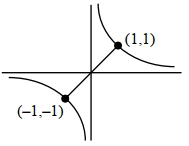
Equating to $4i$, we get $4ixy = 4i$, which simplifies to $xy = 1$.
We need to minimize $|z_1 - z_2|^2$ where $z_1 = x_1 + iy_1$ with $x_1 > 0$ and $z_2 = x_2 + iy_2$ with $x_2 < 0$.
Since $xy = 1$, $y = 1/x$. Thus $z = x + i/x$.
$|z_1 - z_2|^2 = |(x_1 - x_2) + i(1/x_1 - 1/x_2)|^2 = (x_1 - x_2)^2 + (\frac{x_2 - x_1}{x_1x_2})^2 = (x_1 - x_2)^2 (1 + \frac{1}{x_1^2x_2^2})$.
Let $x_1 = a > 0$ and $x_2 = -b$ where $b > 0$. Then $x_1x_2 = -ab$.
$|z_1 - z_2|^2 = (a + b)^2 (1 + \frac{1}{a^2b^2})$.
By $AM-GM$ inequality, $(a + b)^2 \ge 4ab$. Also $1 + \frac{1}{a^2b^2} \ge 2\sqrt{1 \cdot \frac{1}{a^2b^2}} = \frac{2}{ab}$.
So $|z_1 - z_2|^2 \ge 4ab \cdot \frac{2}{ab} = 8$.
Since $|z|^2 = z\bar{z}$, we have $|z|^4 = (z\bar{z})^2 = z^2\bar{z}^2$.
Substituting this into the equation: $z^4 - z^2\bar{z}^2 = 4iz^2$.
This implies $z^2(z^2 - \bar{z}^2) = 4iz^2$.
Case $1$: $z^2 = 0 \Rightarrow z = 0$. However, $z = 0$ does not satisfy the condition $\operatorname{Re}(z_1) > 0$ or $\operatorname{Re}(z_2) < 0$.
Case $2$: $z^2 - \bar{z}^2 = 4i$.
Since $z = x + iy$, $z^2 = x^2 - y^2 + 2ixy$ and $\bar{z}^2 = x^2 - y^2 - 2ixy$.
Thus, $z^2 - \bar{z}^2 = (x^2 - y^2 + 2ixy) - (x^2 - y^2 - 2ixy) = 4ixy$.
Equating to $4i$, we get $4ixy = 4i$, which simplifies to $xy = 1$.
We need to minimize $|z_1 - z_2|^2$ where $z_1 = x_1 + iy_1$ with $x_1 > 0$ and $z_2 = x_2 + iy_2$ with $x_2 < 0$.
Since $xy = 1$, $y = 1/x$. Thus $z = x + i/x$.
$|z_1 - z_2|^2 = |(x_1 - x_2) + i(1/x_1 - 1/x_2)|^2 = (x_1 - x_2)^2 + (\frac{x_2 - x_1}{x_1x_2})^2 = (x_1 - x_2)^2 (1 + \frac{1}{x_1^2x_2^2})$.
Let $x_1 = a > 0$ and $x_2 = -b$ where $b > 0$. Then $x_1x_2 = -ab$.
$|z_1 - z_2|^2 = (a + b)^2 (1 + \frac{1}{a^2b^2})$.
By $AM-GM$ inequality, $(a + b)^2 \ge 4ab$. Also $1 + \frac{1}{a^2b^2} \ge 2\sqrt{1 \cdot \frac{1}{a^2b^2}} = \frac{2}{ab}$.
So $|z_1 - z_2|^2 \ge 4ab \cdot \frac{2}{ab} = 8$.
0 likesView Solution
9
MathematicsDifficultMCQIIT JEE · 2020
Let $O$ be the centre of the circle $x^2 + y^2 = r^2$,where $r > \frac{\sqrt{5}}{2}$. Suppose $PQ$ is a chord of this circle and the equation of the line passing through $P$ and $Q$ is $2x + 4y = 5$. If the centre of the circumcircle of the triangle $OPQ$ lies on the line $x + 2y = 4$,then the value of $r$ is:
A
$1$
B
$2$
C
$3$
D
$4$
Solution
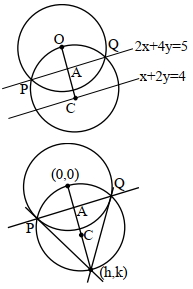
(B) Let the centre of the circumcircle of $\triangle OPQ$ be $C(h, k)$.
Since $O(0, 0)$ is a vertex of the triangle,the circumcircle passes through the origin.
The equation of the chord $PQ$ is $2x + 4y = 5$.
The equation of the chord of the circle $x^2 + y^2 = r^2$ with midpoint $(h, k)$ is $hx + ky = h^2 + k^2$.
Comparing $2x + 4y = 5$ with $hx + ky = r^2$ (since the chord $PQ$ is the polar of the centre $C$ with respect to the circle $x^2 + y^2 = r^2$ is not directly applicable,we use the property that the line $OC$ is perpendicular to $PQ$ and the midpoint of $PQ$ lies on $OC$):
The slope of $PQ$ is $m = -\frac{2}{4} = -\frac{1}{2}$.
Since $OC \perp PQ$,the slope of $OC$ is $2$.
The line $OC$ passes through $(0, 0)$,so its equation is $y = 2x$.
The centre $C(h, k)$ lies on $y = 2x$,so $k = 2h$.
Also,$C(h, k)$ lies on the given line $x + 2y = 4$.
Substituting $k = 2h$ into $x + 2y = 4$,we get $h + 2(2h) = 4 \Rightarrow 5h = 4 \Rightarrow h = \frac{4}{5}$.
Thus,$k = 2(\frac{4}{5}) = \frac{8}{5}$,so $C = (\frac{4}{5}, \frac{8}{5})$.
Since $C$ is the circumcentre of $\triangle OPQ$,$CO = CP = CQ = r_{circum}$.
$CO^2 = (\frac{4}{5})^2 + (\frac{8}{5})^2 = \frac{16+64}{25} = \frac{80}{25} = \frac{16}{5}$.
The distance from $C(\frac{4}{5}, \frac{8}{5})$ to the line $2x + 4y - 5 = 0$ is $d = \frac{|2(\frac{4}{5}) + 4(\frac{8}{5}) - 5|}{\sqrt{2^2 + 4^2}} = \frac{|\frac{8+32-25}{5}|}{\sqrt{20}} = \frac{15/5}{\sqrt{20}} = \frac{3}{\sqrt{20}}$.
In $\triangle CPQ$,$CP^2 = d^2 + (PQ/2)^2$. Let $M$ be the midpoint of $PQ$. $CM = d = \frac{3}{\sqrt{20}}$.
$PM^2 = r^2 - OM^2$. $OM$ is the distance from origin to $2x+4y=5$,$OM = \frac{|-5|}{\sqrt{20}} = \frac{5}{\sqrt{20}}$.
$PM^2 = r^2 - \frac{25}{20} = r^2 - \frac{5}{4}$.
$CP^2 = CM^2 + PM^2 \Rightarrow \frac{16}{5} = \frac{9}{20} + r^2 - \frac{5}{4} = r^2 + \frac{9-25}{20} = r^2 - \frac{16}{20} = r^2 - \frac{4}{5}$.
$r^2 = \frac{16}{5} + \frac{4}{5} = \frac{20}{5} = 4 \Rightarrow r = 2$.
Since $O(0, 0)$ is a vertex of the triangle,the circumcircle passes through the origin.
The equation of the chord $PQ$ is $2x + 4y = 5$.
The equation of the chord of the circle $x^2 + y^2 = r^2$ with midpoint $(h, k)$ is $hx + ky = h^2 + k^2$.
Comparing $2x + 4y = 5$ with $hx + ky = r^2$ (since the chord $PQ$ is the polar of the centre $C$ with respect to the circle $x^2 + y^2 = r^2$ is not directly applicable,we use the property that the line $OC$ is perpendicular to $PQ$ and the midpoint of $PQ$ lies on $OC$):
The slope of $PQ$ is $m = -\frac{2}{4} = -\frac{1}{2}$.
Since $OC \perp PQ$,the slope of $OC$ is $2$.
The line $OC$ passes through $(0, 0)$,so its equation is $y = 2x$.
The centre $C(h, k)$ lies on $y = 2x$,so $k = 2h$.
Also,$C(h, k)$ lies on the given line $x + 2y = 4$.
Substituting $k = 2h$ into $x + 2y = 4$,we get $h + 2(2h) = 4 \Rightarrow 5h = 4 \Rightarrow h = \frac{4}{5}$.
Thus,$k = 2(\frac{4}{5}) = \frac{8}{5}$,so $C = (\frac{4}{5}, \frac{8}{5})$.
Since $C$ is the circumcentre of $\triangle OPQ$,$CO = CP = CQ = r_{circum}$.
$CO^2 = (\frac{4}{5})^2 + (\frac{8}{5})^2 = \frac{16+64}{25} = \frac{80}{25} = \frac{16}{5}$.
The distance from $C(\frac{4}{5}, \frac{8}{5})$ to the line $2x + 4y - 5 = 0$ is $d = \frac{|2(\frac{4}{5}) + 4(\frac{8}{5}) - 5|}{\sqrt{2^2 + 4^2}} = \frac{|\frac{8+32-25}{5}|}{\sqrt{20}} = \frac{15/5}{\sqrt{20}} = \frac{3}{\sqrt{20}}$.
In $\triangle CPQ$,$CP^2 = d^2 + (PQ/2)^2$. Let $M$ be the midpoint of $PQ$. $CM = d = \frac{3}{\sqrt{20}}$.
$PM^2 = r^2 - OM^2$. $OM$ is the distance from origin to $2x+4y=5$,$OM = \frac{|-5|}{\sqrt{20}} = \frac{5}{\sqrt{20}}$.
$PM^2 = r^2 - \frac{25}{20} = r^2 - \frac{5}{4}$.
$CP^2 = CM^2 + PM^2 \Rightarrow \frac{16}{5} = \frac{9}{20} + r^2 - \frac{5}{4} = r^2 + \frac{9-25}{20} = r^2 - \frac{16}{20} = r^2 - \frac{4}{5}$.
$r^2 = \frac{16}{5} + \frac{4}{5} = \frac{20}{5} = 4 \Rightarrow r = 2$.
0 likesView Solution
10
MathematicsDifficultMCQIIT JEE · 2020
The value of the limit $\lim_{x \rightarrow \frac{\pi}{2}} \frac{4 \sqrt{2}(\sin 3x + \sin x)}{\left(2 \sin 2x \sin \frac{3x}{2} + \cos \frac{5x}{2}\right) - \left(\sqrt{2} + \sqrt{2} \cos 2x + \cos \frac{3x}{2}\right)}$ is
A
$4$
B
$6$
C
$8$
D
$7$
Solution
(C) Let the given limit be $L = \lim_{x \rightarrow \frac{\pi}{2}} \frac{4 \sqrt{2}(\sin 3x + \sin x)}{\left(2 \sin 2x \sin \frac{3x}{2} + \cos \frac{5x}{2}\right) - \left(\sqrt{2} + \sqrt{2} \cos 2x + \cos \frac{3x}{2}\right)}$.
Using the identity $\sin 3x + \sin x = 2 \sin 2x \cos x$,the numerator becomes $8 \sqrt{2} \sin 2x \cos x = 16 \sqrt{2} \sin x \cos^2 x$.
For the denominator,we use $\cos \frac{5x}{2} - \cos \frac{3x}{2} = -2 \sin 2x \sin \frac{x}{2}$ and $\sqrt{2} + \sqrt{2} \cos 2x = \sqrt{2}(1 + \cos 2x) = 2 \sqrt{2} \cos^2 x$.
The denominator simplifies to $2 \sin 2x \sin \frac{3x}{2} - 2 \sin 2x \sin \frac{x}{2} - 2 \sqrt{2} \cos^2 x = 2 \sin 2x (\sin \frac{3x}{2} - \sin \frac{x}{2}) - 2 \sqrt{2} \cos^2 x$.
Using $\sin \frac{3x}{2} - \sin \frac{x}{2} = 2 \cos x \sin \frac{x}{2}$,the denominator becomes $4 \sin x \cos x (2 \cos x \sin \frac{x}{2}) - 2 \sqrt{2} \cos^2 x = 2 \cos^2 x (4 \sin x \sin \frac{x}{2} - \sqrt{2})$.
Thus,$L = \lim_{x \rightarrow \frac{\pi}{2}} \frac{16 \sqrt{2} \sin x \cos^2 x}{2 \cos^2 x (4 \sin x \sin \frac{x}{2} - \sqrt{2})} = \lim_{x \rightarrow \frac{\pi}{2}} \frac{8 \sqrt{2} \sin x}{4 \sin x \sin \frac{x}{2} - \sqrt{2}}$.
Substituting $x = \frac{\pi}{2}$,we get $L = \frac{8 \sqrt{2} (1)}{4 (1) \sin \frac{\pi}{4} - \sqrt{2}} = \frac{8 \sqrt{2}}{4 \cdot \frac{1}{\sqrt{2}} - \sqrt{2}} = \frac{8 \sqrt{2}}{2 \sqrt{2} - \sqrt{2}} = \frac{8 \sqrt{2}}{\sqrt{2}} = 8$.
Using the identity $\sin 3x + \sin x = 2 \sin 2x \cos x$,the numerator becomes $8 \sqrt{2} \sin 2x \cos x = 16 \sqrt{2} \sin x \cos^2 x$.
For the denominator,we use $\cos \frac{5x}{2} - \cos \frac{3x}{2} = -2 \sin 2x \sin \frac{x}{2}$ and $\sqrt{2} + \sqrt{2} \cos 2x = \sqrt{2}(1 + \cos 2x) = 2 \sqrt{2} \cos^2 x$.
The denominator simplifies to $2 \sin 2x \sin \frac{3x}{2} - 2 \sin 2x \sin \frac{x}{2} - 2 \sqrt{2} \cos^2 x = 2 \sin 2x (\sin \frac{3x}{2} - \sin \frac{x}{2}) - 2 \sqrt{2} \cos^2 x$.
Using $\sin \frac{3x}{2} - \sin \frac{x}{2} = 2 \cos x \sin \frac{x}{2}$,the denominator becomes $4 \sin x \cos x (2 \cos x \sin \frac{x}{2}) - 2 \sqrt{2} \cos^2 x = 2 \cos^2 x (4 \sin x \sin \frac{x}{2} - \sqrt{2})$.
Thus,$L = \lim_{x \rightarrow \frac{\pi}{2}} \frac{16 \sqrt{2} \sin x \cos^2 x}{2 \cos^2 x (4 \sin x \sin \frac{x}{2} - \sqrt{2})} = \lim_{x \rightarrow \frac{\pi}{2}} \frac{8 \sqrt{2} \sin x}{4 \sin x \sin \frac{x}{2} - \sqrt{2}}$.
Substituting $x = \frac{\pi}{2}$,we get $L = \frac{8 \sqrt{2} (1)}{4 (1) \sin \frac{\pi}{4} - \sqrt{2}} = \frac{8 \sqrt{2}}{4 \cdot \frac{1}{\sqrt{2}} - \sqrt{2}} = \frac{8 \sqrt{2}}{2 \sqrt{2} - \sqrt{2}} = \frac{8 \sqrt{2}}{\sqrt{2}} = 8$.
0 likesView Solution
11
MathematicsAdvancedMCQIIT JEE · 2020
Let $a$ and $b$ be positive real numbers such that $a > 1$ and $b < a$. Let $P$ be a point in the first quadrant that lies on the hyperbola $\frac{x^2}{a^2} - \frac{y^2}{b^2} = 1$. Suppose the tangent to the hyperbola at $P$ passes through the point $(1, 0)$,and suppose the normal to the hyperbola at $P$ cuts off equal intercepts on the coordinate axes. Let $\Delta$ denote the area of the triangle formed by the tangent at $P$,the normal at $P$,and the $x$-axis. If $e$ denotes the eccentricity of the hyperbola,then which of the following statements is/are $TRUE$?
$(A)$ $1 < e < \sqrt{2}$
$(B)$ $\sqrt{2} < e < 2$
$(C)$ $\Delta = a^4$
$(D)$ $\Delta = b^4$
$(A)$ $1 < e < \sqrt{2}$
$(B)$ $\sqrt{2} < e < 2$
$(C)$ $\Delta = a^4$
$(D)$ $\Delta = b^4$
A
$A, D$
B
$A, B$
C
$A, C$
D
$B, D$
Solution
(A, D) The normal at $P$ makes equal intercepts on the coordinate axes,so its slope is $-1$. Thus,the slope of the tangent at $P$ is $1$.
The tangent passes through $(1, 0)$ with slope $1$,so its equation is $y - 0 = 1(x - 1)$,or $x - y = 1$.
The equation of the tangent at $P(x_1, y_1)$ is $\frac{xx_1}{a^2} - \frac{yy_1}{b^2} = 1$. Comparing this with $x - y = 1$,we get $\frac{x_1}{a^2} = 1$ and $\frac{y_1}{b^2} = 1$,so $x_1 = a^2$ and $y_1 = b^2$.
Since $P(a^2, b^2)$ lies on the hyperbola,$\frac{(a^2)^2}{a^2} - \frac{(b^2)^2}{b^2} = 1$,which simplifies to $a^2 - b^2 = 1$.
The normal at $P(a^2, b^2)$ has slope $-1$,so its equation is $y - b^2 = -1(x - a^2)$,or $x + y = a^2 + b^2$.
The $x$-intercept of the normal is $x = a^2 + b^2$. The tangent $x - y = 1$ has $x$-intercept $x = 1$.
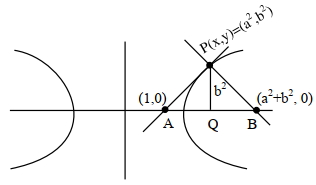
The triangle is formed by the tangent,the normal,and the $x$-axis. The base is the distance between the $x$-intercepts: $(a^2 + b^2) - 1 = (a^2 - 1) + b^2 = b^2 + b^2 = 2b^2$. The height is the $y$-coordinate of $P$,which is $b^2$.
Thus,$\Delta = \frac{1}{2} \times \text{base} \times \text{height} = \frac{1}{2} \times (2b^2) \times b^2 = b^4$. So $(D)$ is true.
For eccentricity $e$,$e^2 = 1 + \frac{b^2}{a^2} = 1 + \frac{a^2 - 1}{a^2} = 2 - \frac{1}{a^2}$.
Since $a > 1$,$0 < \frac{1}{a^2} < 1$,so $1 < 2 - \frac{1}{a^2} < 2$,which means $1 < e^2 < 2$,so $1 < e < \sqrt{2}$. Thus $(A)$ is true.
The tangent passes through $(1, 0)$ with slope $1$,so its equation is $y - 0 = 1(x - 1)$,or $x - y = 1$.
The equation of the tangent at $P(x_1, y_1)$ is $\frac{xx_1}{a^2} - \frac{yy_1}{b^2} = 1$. Comparing this with $x - y = 1$,we get $\frac{x_1}{a^2} = 1$ and $\frac{y_1}{b^2} = 1$,so $x_1 = a^2$ and $y_1 = b^2$.
Since $P(a^2, b^2)$ lies on the hyperbola,$\frac{(a^2)^2}{a^2} - \frac{(b^2)^2}{b^2} = 1$,which simplifies to $a^2 - b^2 = 1$.
The normal at $P(a^2, b^2)$ has slope $-1$,so its equation is $y - b^2 = -1(x - a^2)$,or $x + y = a^2 + b^2$.
The $x$-intercept of the normal is $x = a^2 + b^2$. The tangent $x - y = 1$ has $x$-intercept $x = 1$.
The triangle is formed by the tangent,the normal,and the $x$-axis. The base is the distance between the $x$-intercepts: $(a^2 + b^2) - 1 = (a^2 - 1) + b^2 = b^2 + b^2 = 2b^2$. The height is the $y$-coordinate of $P$,which is $b^2$.
Thus,$\Delta = \frac{1}{2} \times \text{base} \times \text{height} = \frac{1}{2} \times (2b^2) \times b^2 = b^4$. So $(D)$ is true.
For eccentricity $e$,$e^2 = 1 + \frac{b^2}{a^2} = 1 + \frac{a^2 - 1}{a^2} = 2 - \frac{1}{a^2}$.
Since $a > 1$,$0 < \frac{1}{a^2} < 1$,so $1 < 2 - \frac{1}{a^2} < 2$,which means $1 < e^2 < 2$,so $1 < e < \sqrt{2}$. Thus $(A)$ is true.
0 likesView Solution
12
MathematicsAdvancedMCQIIT JEE · 2020
For non-negative integers $s$ and $r$,let $\binom{s}{r} = \begin{cases} \frac{s!}{r!(s-r)!} & \text{if } r \leq s \\ 0 & \text{if } r > s \end{cases}$. For positive integers $m$ and $n$,let $g(m, n) = \sum_{p=0}^{m+n} \frac{f(m, n, p)}{\binom{n+p}{p}}$,where for any non-negative integer $p$,$f(m, n, p) = \sum_{i=0}^{p} \binom{m}{i} \binom{n+i}{p} \binom{p+n}{p-i}$. Then which of the following statements is/are $TRUE$?
$(A)$ $g(m, n) = g(n, m)$ for all positive integers $m, n$
$(B)$ $g(m, n+1) = g(m+1, n)$ for all positive integers $m, n$
$(C)$ $g(2m, 2n) = 2g(m, n)$ for all positive integers $m, n$
$(D)$ $g(2m, 2n) = (g(m, n))^2$ for all positive integers $m, n$
$(A)$ $g(m, n) = g(n, m)$ for all positive integers $m, n$
$(B)$ $g(m, n+1) = g(m+1, n)$ for all positive integers $m, n$
$(C)$ $g(2m, 2n) = 2g(m, n)$ for all positive integers $m, n$
$(D)$ $g(2m, 2n) = (g(m, n))^2$ for all positive integers $m, n$
A
$A, B, D$
B
$A, B, C$
C
$A, B$
D
$A, D$
Solution
(A) Given $f(m, n, p) = \sum_{i=0}^{p} \binom{m}{i} \binom{n+i}{p} \binom{p+n}{p-i}$.
Using the identity $\binom{n+i}{p} \binom{p+n}{p-i} = \binom{n+p}{p} \binom{n+i}{i}$,we have:
$f(m, n, p) = \sum_{i=0}^{p} \binom{m}{i} \binom{n+p}{p} \binom{n+i}{i} = \binom{n+p}{p} \sum_{i=0}^{p} \binom{m}{i} \binom{n+i}{i}$.
Using Vandermonde's Identity or combinatorial simplification,$\sum_{i=0}^{p} \binom{m}{i} \binom{n+i}{i} = \binom{m+n+1}{p}$ is not directly applicable,but rather $\sum_{i=0}^{p} \binom{m}{i} \binom{n+i}{p-i}$ simplifies to $\binom{m+n+p}{p}$.
Actually,$f(m, n, p) = \binom{n+p}{p} \binom{m+n}{p}$.
Thus,$\frac{f(m, n, p)}{\binom{n+p}{p}} = \binom{m+n}{p}$.
Then $g(m, n) = \sum_{p=0}^{m+n} \binom{m+n}{p} = 2^{m+n}$.
Checking the options:
$(A)$ $g(m, n) = 2^{m+n}$ and $g(n, m) = 2^{n+m}$,so $g(m, n) = g(n, m)$ is $TRUE$.
$(B)$ $g(m, n+1) = 2^{m+n+1}$ and $g(m+1, n) = 2^{m+1+n}$,so $g(m, n+1) = g(m+1, n)$ is $TRUE$.
$(C)$ $g(2m, 2n) = 2^{2m+2n}$ and $2g(m, n) = 2 \cdot 2^{m+n} = 2^{m+n+1}$,so $g(2m, 2n) \neq 2g(m, n)$.
$(D)$ $g(2m, 2n) = 2^{2m+2n} = (2^{m+n})^2 = (g(m, n))^2$,so $g(2m, 2n) = (g(m, n))^2$ is $TRUE$.
Therefore,the correct statements are $A, B, D$.
Using the identity $\binom{n+i}{p} \binom{p+n}{p-i} = \binom{n+p}{p} \binom{n+i}{i}$,we have:
$f(m, n, p) = \sum_{i=0}^{p} \binom{m}{i} \binom{n+p}{p} \binom{n+i}{i} = \binom{n+p}{p} \sum_{i=0}^{p} \binom{m}{i} \binom{n+i}{i}$.
Using Vandermonde's Identity or combinatorial simplification,$\sum_{i=0}^{p} \binom{m}{i} \binom{n+i}{i} = \binom{m+n+1}{p}$ is not directly applicable,but rather $\sum_{i=0}^{p} \binom{m}{i} \binom{n+i}{p-i}$ simplifies to $\binom{m+n+p}{p}$.
Actually,$f(m, n, p) = \binom{n+p}{p} \binom{m+n}{p}$.
Thus,$\frac{f(m, n, p)}{\binom{n+p}{p}} = \binom{m+n}{p}$.
Then $g(m, n) = \sum_{p=0}^{m+n} \binom{m+n}{p} = 2^{m+n}$.
Checking the options:
$(A)$ $g(m, n) = 2^{m+n}$ and $g(n, m) = 2^{n+m}$,so $g(m, n) = g(n, m)$ is $TRUE$.
$(B)$ $g(m, n+1) = 2^{m+n+1}$ and $g(m+1, n) = 2^{m+1+n}$,so $g(m, n+1) = g(m+1, n)$ is $TRUE$.
$(C)$ $g(2m, 2n) = 2^{2m+2n}$ and $2g(m, n) = 2 \cdot 2^{m+n} = 2^{m+n+1}$,so $g(2m, 2n) \neq 2g(m, n)$.
$(D)$ $g(2m, 2n) = 2^{2m+2n} = (2^{m+n})^2 = (g(m, n))^2$,so $g(2m, 2n) = (g(m, n))^2$ is $TRUE$.
Therefore,the correct statements are $A, B, D$.
0 likesView Solution
13
MathematicsMediumMCQIIT JEE · 2020
An engineer is required to visit a factory for exactly $4$ days during the first $15$ days of every month,and it is mandatory that no two visits take place on consecutive days. The number of all possible ways in which such visits to the factory can be made by the engineer during $1-15$ June $2021$ is:
A
$494$
B
$495$
C
$496$
D
$497$
Solution
(B) To select $r$ items from $n$ items such that no two are consecutive,the formula is given by $^{n-r+1}C_r$.
Here,$n = 15$ and $r = 4$.
Number of ways $= ^{15-4+1}C_4 = ^{12}C_4$.
Calculating the value:
$^{12}C_4 = \frac{12 \times 11 \times 10 \times 9}{4 \times 3 \times 2 \times 1} = 495$.
Here,$n = 15$ and $r = 4$.
Number of ways $= ^{15-4+1}C_4 = ^{12}C_4$.
Calculating the value:
$^{12}C_4 = \frac{12 \times 11 \times 10 \times 9}{4 \times 3 \times 2 \times 1} = 495$.
0 likesView Solution
14
MathematicsEasyMCQIIT JEE · 2020
In a hotel,four rooms are available. Six persons are to be accommodated in these four rooms in such a way that each of these rooms contains at least one person and at most two persons. Then the number of all possible ways in which this can be done is . . . . . . . .
A
$1060$
B
$1070$
C
$1080$
D
$1090$
Solution
(C) Let the number of persons in the four rooms be $n_1, n_2, n_3, n_4$. Since each room has at least $1$ and at most $2$ persons,and the total number of persons is $6$,we have $n_1 + n_2 + n_3 + n_4 = 6$ where $1 \le n_i \le 2$.
This implies two rooms must have $2$ persons and two rooms must have $1$ person (since $2+2+1+1 = 6$).
The number of ways to distribute $6$ distinct persons into these groups is given by the multinomial coefficient $\frac{6!}{2!2!1!1!}$.
Since the rooms are distinct,we must multiply by the number of ways to assign these group sizes to the $4$ rooms,which is $\frac{4!}{2!2!} = 6$.
Thus,the total number of ways is $\frac{6!}{2!2!1!1!} \times 6 = \frac{720}{4} \times 6 = 180 \times 6 = 1080$.
This implies two rooms must have $2$ persons and two rooms must have $1$ person (since $2+2+1+1 = 6$).
The number of ways to distribute $6$ distinct persons into these groups is given by the multinomial coefficient $\frac{6!}{2!2!1!1!}$.
Since the rooms are distinct,we must multiply by the number of ways to assign these group sizes to the $4$ rooms,which is $\frac{4!}{2!2!} = 6$.
Thus,the total number of ways is $\frac{6!}{2!2!1!1!} \times 6 = \frac{720}{4} \times 6 = 180 \times 6 = 1080$.
0 likesView Solution
15
MathematicsAdvancedMCQIIT JEE · 2020
Starting at time $t=0$ from the origin with speed $1 \text{ m/s}$,a particle follows a two-dimensional trajectory in the $x-y$ plane so that its coordinates are related by the equation $y=\frac{x^2}{2}$. The $x$ and $y$ components of its acceleration are denoted by $a_x$ and $a_y$,respectively. Then:
$(A)$ $a_x=1 \text{ m/s}^2$ implies that when the particle is at the origin,$a_y=1 \text{ m/s}^2$
$(B)$ $a_x=0$ implies $a_y=1 \text{ m/s}^2$ at all times
$(C)$ at $t=0$,the particle's velocity points in the $x$-direction
$(D)$ $a_x=0$ implies that at $t=1 \text{ s}$,the angle between the particle's velocity and the $x$-axis is $45^{\circ}$
$(A)$ $a_x=1 \text{ m/s}^2$ implies that when the particle is at the origin,$a_y=1 \text{ m/s}^2$
$(B)$ $a_x=0$ implies $a_y=1 \text{ m/s}^2$ at all times
$(C)$ at $t=0$,the particle's velocity points in the $x$-direction
$(D)$ $a_x=0$ implies that at $t=1 \text{ s}$,the angle between the particle's velocity and the $x$-axis is $45^{\circ}$
A
$A, B, C$
B
$A, B, C, D$
C
$A, B, D$
D
$A, B$
Solution
(B) Given the trajectory $y = \frac{x^2}{2}$.
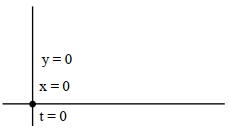
At $t=0$,the particle is at $(0, 0)$ with speed $v = 1 \text{ m/s}$.
Differentiating $y = \frac{x^2}{2}$ with respect to $t$,we get $\frac{dy}{dt} = x \frac{dx}{dt}$,which means $v_y = x v_x$.
Differentiating again with respect to $t$,we get $a_y = v_x^2 + x a_x$.
$(A)$ If $a_x = 1 \text{ m/s}^2$ and the particle is at the origin $(x=0)$,then $a_y = v_x^2 + (0)(1) = v_x^2$. Since the speed is $1 \text{ m/s}$ and at the origin $v_y = x v_x = 0$,we have $v_x = 1 \text{ m/s}$. Thus,$a_y = 1^2 = 1 \text{ m/s}^2$. This is correct.
$(B)$ If $a_x = 0$,then $v_x$ is constant. Since $v_x(0) = 1 \text{ m/s}$,$v_x = 1 \text{ m/s}$ for all $t$. Then $a_y = v_x^2 + x a_x = 1^2 + x(0) = 1 \text{ m/s}^2$ for all $t$. This is correct.
$(C)$ At $t=0$,$x=0$. Since $v_y = x v_x$,we have $v_y = 0 \cdot v_x = 0$. Thus,the velocity vector is $\vec{v} = v_x \hat{i} + 0 \hat{j}$,which points in the $x$-direction. This is correct.
$(D)$ If $a_x = 0$,then $v_x = 1 \text{ m/s}$ and $a_x = 0$. From $a_y = v_x^2 + x a_x$,we get $a_y = 1^2 + 0 = 1 \text{ m/s}^2$. Since $a_y$ is constant,$v_y = a_y t = 1 \cdot t = t$. At $t=1 \text{ s}$,$v_y = 1 \text{ m/s}$. The angle $\theta$ with the $x$-axis is given by $\tan \theta = \frac{v_y}{v_x} = \frac{1}{1} = 1$,so $\theta = 45^{\circ}$. This is correct.
Therefore,all statements $(A), (B), (C), (D)$ are correct.
At $t=0$,the particle is at $(0, 0)$ with speed $v = 1 \text{ m/s}$.
Differentiating $y = \frac{x^2}{2}$ with respect to $t$,we get $\frac{dy}{dt} = x \frac{dx}{dt}$,which means $v_y = x v_x$.
Differentiating again with respect to $t$,we get $a_y = v_x^2 + x a_x$.
$(A)$ If $a_x = 1 \text{ m/s}^2$ and the particle is at the origin $(x=0)$,then $a_y = v_x^2 + (0)(1) = v_x^2$. Since the speed is $1 \text{ m/s}$ and at the origin $v_y = x v_x = 0$,we have $v_x = 1 \text{ m/s}$. Thus,$a_y = 1^2 = 1 \text{ m/s}^2$. This is correct.
$(B)$ If $a_x = 0$,then $v_x$ is constant. Since $v_x(0) = 1 \text{ m/s}$,$v_x = 1 \text{ m/s}$ for all $t$. Then $a_y = v_x^2 + x a_x = 1^2 + x(0) = 1 \text{ m/s}^2$ for all $t$. This is correct.
$(C)$ At $t=0$,$x=0$. Since $v_y = x v_x$,we have $v_y = 0 \cdot v_x = 0$. Thus,the velocity vector is $\vec{v} = v_x \hat{i} + 0 \hat{j}$,which points in the $x$-direction. This is correct.
$(D)$ If $a_x = 0$,then $v_x = 1 \text{ m/s}$ and $a_x = 0$. From $a_y = v_x^2 + x a_x$,we get $a_y = 1^2 + 0 = 1 \text{ m/s}^2$. Since $a_y$ is constant,$v_y = a_y t = 1 \cdot t = t$. At $t=1 \text{ s}$,$v_y = 1 \text{ m/s}$. The angle $\theta$ with the $x$-axis is given by $\tan \theta = \frac{v_y}{v_x} = \frac{1}{1} = 1$,so $\theta = 45^{\circ}$. This is correct.
Therefore,all statements $(A), (B), (C), (D)$ are correct.
0 likesView Solution
16
MathematicsAdvancedMCQIIT JEE · 2020
If the function $f: R \rightarrow R$ is defined by $f(x) = |x|(x - \sin x)$,then which of the following statements is $TRUE$?
A
$f$ is one-one,but $NOT$ onto
B
$f$ is onto,but $NOT$ one-one
C
$f$ is $BOTH$ one-one and onto
D
$f$ is $NEITHER$ one-one $NOR$ onto
Solution
(C) Given $f(x) = |x|(x - \sin x)$.
Since $f(-x) = |-x|(-x - \sin(-x)) = |x|(-x + \sin x) = -|x|(x - \sin x) = -f(x)$,the function is an odd function.
For $x \geq 0$,$f(x) = x^2 - x \sin x$. For $x < 0$,$f(x) = -x^2 + x \sin x$.
As $x \rightarrow \infty$,$f(x) = x^2(1 - \frac{\sin x}{x}) \rightarrow \infty$. As $x \rightarrow -\infty$,$f(x) \rightarrow -\infty$. Since $f$ is continuous,the range is $R$,so $f$ is onto.
For $x > 0$,$f'(x) = 2x - \sin x - x \cos x = x(1 - \cos x) + (x - \sin x)$. Since $x > \sin x$ and $1 - \cos x \geq 0$ for $x > 0$,$f'(x) > 0$.
For $x < 0$,$f'(x) = -2x + \sin x + x \cos x = -[2x - \sin x - x \cos x] > 0$ (by symmetry of the odd function).
Since $f'(x) > 0$ for all $x \neq 0$ and $f$ is continuous,$f$ is strictly increasing on $R$.
Thus,$f$ is one-one.
Therefore,$f$ is both one-one and onto.
Since $f(-x) = |-x|(-x - \sin(-x)) = |x|(-x + \sin x) = -|x|(x - \sin x) = -f(x)$,the function is an odd function.
For $x \geq 0$,$f(x) = x^2 - x \sin x$. For $x < 0$,$f(x) = -x^2 + x \sin x$.
As $x \rightarrow \infty$,$f(x) = x^2(1 - \frac{\sin x}{x}) \rightarrow \infty$. As $x \rightarrow -\infty$,$f(x) \rightarrow -\infty$. Since $f$ is continuous,the range is $R$,so $f$ is onto.
For $x > 0$,$f'(x) = 2x - \sin x - x \cos x = x(1 - \cos x) + (x - \sin x)$. Since $x > \sin x$ and $1 - \cos x \geq 0$ for $x > 0$,$f'(x) > 0$.
For $x < 0$,$f'(x) = -2x + \sin x + x \cos x = -[2x - \sin x - x \cos x] > 0$ (by symmetry of the odd function).
Since $f'(x) > 0$ for all $x \neq 0$ and $f$ is continuous,$f$ is strictly increasing on $R$.
Thus,$f$ is one-one.
Therefore,$f$ is both one-one and onto.
0 likesView Solution
17
MathematicsAdvancedMCQIIT JEE · 2020
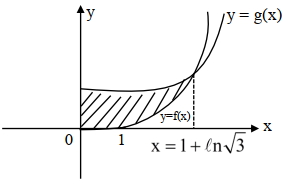
Let the functions $f: R \rightarrow R$ and $g: R \rightarrow R$ be defined by $f(x)=e^{x-1}-e^{-|x-1|}$ and $g(x)=\frac{1}{2}\left(e^{x-1}+e^{1-x}\right)$. Then the area of the region in the first quadrant bounded by the curves $y=f(x)$,$y=g(x)$ and $x=0$ is
A
$(2-\sqrt{3})+\frac{1}{2}\left(e-e^{-1}\right)$
B
$(2+\sqrt{3})+\frac{1}{2}\left(e-e^{-1}\right)$
C
$(2-\sqrt{3})+\frac{1}{2}\left(e+e^{-1}\right)$
D
$(2+\sqrt{3})+\frac{1}{2}\left(e+e^{-1}\right)$
Solution
(A) Given $f(x) = e^{x-1} - e^{-|x-1|}$ and $g(x) = \frac{1}{2}(e^{x-1} + e^{1-x})$.
For $x \leq 1$,$|x-1| = 1-x$,so $f(x) = e^{x-1} - e^{x-1} = 0$.
For $x \geq 1$,$|x-1| = x-1$,so $f(x) = e^{x-1} - e^{1-x}$.
To find the intersection point of $f(x)$ and $g(x)$ for $x \geq 1$:
$e^{x-1} - e^{1-x} = \frac{1}{2}(e^{x-1} + e^{1-x})$
$2e^{x-1} - 2e^{1-x} = e^{x-1} + e^{1-x}$
$e^{x-1} = 3e^{1-x} \Rightarrow e^{2(x-1)} = 3 \Rightarrow 2(x-1) = \ln 3 \Rightarrow x = 1 + \frac{1}{2}\ln 3 = 1 + \ln \sqrt{3}$.
The area $A$ in the first quadrant bounded by $y=f(x)$,$y=g(x)$,and $x=0$ is:
$A = \int_0^1 (g(x) - 0) dx + \int_1^{1+\ln \sqrt{3}} (g(x) - f(x)) dx$
$A = \int_0^1 \frac{1}{2}(e^{x-1} + e^{1-x}) dx + \int_1^{1+\ln \sqrt{3}} (\frac{1}{2}(e^{x-1} + e^{1-x}) - (e^{x-1} - e^{1-x})) dx$
$A = \frac{1}{2}[e^{x-1} - e^{1-x}]_0^1 + \int_1^{1+\ln \sqrt{3}} (\frac{3}{2}e^{1-x} - \frac{1}{2}e^{x-1}) dx$
$A = \frac{1}{2}[(e^0 - e^0) - (e^{-1} - e^1)] + [-\frac{3}{2}e^{1-x} - \frac{1}{2}e^{x-1}]_1^{1+\ln \sqrt{3}}$
$A = \frac{1}{2}(e - e^{-1}) + [(-\frac{3}{2}e^{-\ln \sqrt{3}} - \frac{1}{2}e^{\ln \sqrt{3}}) - (-\frac{3}{2} - \frac{1}{2})]$
$A = \frac{1}{2}(e - e^{-1}) + [-\frac{3}{2}(\frac{1}{\sqrt{3}}) - \frac{1}{2}(\sqrt{3}) + 2]$
$A = \frac{1}{2}(e - e^{-1}) + [-\frac{\sqrt{3}}{2} - \frac{\sqrt{3}}{2} + 2] = 2 - \sqrt{3} + \frac{1}{2}(e - e^{-1})$.
For $x \leq 1$,$|x-1| = 1-x$,so $f(x) = e^{x-1} - e^{x-1} = 0$.
For $x \geq 1$,$|x-1| = x-1$,so $f(x) = e^{x-1} - e^{1-x}$.
To find the intersection point of $f(x)$ and $g(x)$ for $x \geq 1$:
$e^{x-1} - e^{1-x} = \frac{1}{2}(e^{x-1} + e^{1-x})$
$2e^{x-1} - 2e^{1-x} = e^{x-1} + e^{1-x}$
$e^{x-1} = 3e^{1-x} \Rightarrow e^{2(x-1)} = 3 \Rightarrow 2(x-1) = \ln 3 \Rightarrow x = 1 + \frac{1}{2}\ln 3 = 1 + \ln \sqrt{3}$.
The area $A$ in the first quadrant bounded by $y=f(x)$,$y=g(x)$,and $x=0$ is:
$A = \int_0^1 (g(x) - 0) dx + \int_1^{1+\ln \sqrt{3}} (g(x) - f(x)) dx$
$A = \int_0^1 \frac{1}{2}(e^{x-1} + e^{1-x}) dx + \int_1^{1+\ln \sqrt{3}} (\frac{1}{2}(e^{x-1} + e^{1-x}) - (e^{x-1} - e^{1-x})) dx$
$A = \frac{1}{2}[e^{x-1} - e^{1-x}]_0^1 + \int_1^{1+\ln \sqrt{3}} (\frac{3}{2}e^{1-x} - \frac{1}{2}e^{x-1}) dx$
$A = \frac{1}{2}[(e^0 - e^0) - (e^{-1} - e^1)] + [-\frac{3}{2}e^{1-x} - \frac{1}{2}e^{x-1}]_1^{1+\ln \sqrt{3}}$
$A = \frac{1}{2}(e - e^{-1}) + [(-\frac{3}{2}e^{-\ln \sqrt{3}} - \frac{1}{2}e^{\ln \sqrt{3}}) - (-\frac{3}{2} - \frac{1}{2})]$
$A = \frac{1}{2}(e - e^{-1}) + [-\frac{3}{2}(\frac{1}{\sqrt{3}}) - \frac{1}{2}(\sqrt{3}) + 2]$
$A = \frac{1}{2}(e - e^{-1}) + [-\frac{\sqrt{3}}{2} - \frac{\sqrt{3}}{2} + 2] = 2 - \sqrt{3} + \frac{1}{2}(e - e^{-1})$.
0 likesView Solution
18
MathematicsAdvancedMCQIIT JEE · 2020
Let $C_1$ and $C_2$ be two biased coins such that the probabilities of getting a head in a single toss are $\frac{2}{3}$ and $\frac{1}{3}$,respectively. Suppose $\alpha$ is the number of heads that appear when $C_1$ is tossed twice,independently,and $\beta$ is the number of heads that appear when $C_2$ is tossed twice,independently. Then,the probability that the roots of the quadratic polynomial $x^2 - \alpha x + \beta$ are real and equal is:
A
$\frac{40}{81}$
B
$\frac{20}{81}$
C
$\frac{1}{2}$
D
$\frac{1}{4}$
Solution
(B) For $C_1$,$P(H) = \frac{2}{3}$. The number of heads $\alpha$ follows a binomial distribution $B(2, \frac{2}{3})$.
$P(\alpha = 0) = (\frac{1}{3})^2 = \frac{1}{9}$
$P(\alpha = 1) = 2 \times \frac{2}{3} \times \frac{1}{3} = \frac{4}{9}$
$P(\alpha = 2) = (\frac{2}{3})^2 = \frac{4}{9}$
For $C_2$,$P(H) = \frac{1}{3}$. The number of heads $\beta$ follows a binomial distribution $B(2, \frac{1}{3})$.
$P(\beta = 0) = (\frac{2}{3})^2 = \frac{4}{9}$
$P(\beta = 1) = 2 \times \frac{1}{3} \times \frac{2}{3} = \frac{4}{9}$
$P(\beta = 2) = (\frac{1}{3})^2 = \frac{1}{9}$
The roots of $x^2 - \alpha x + \beta = 0$ are real and equal if the discriminant $D = \alpha^2 - 4\beta = 0$,i.e.,$\alpha^2 = 4\beta$.
Possible pairs $(\alpha, \beta)$ satisfying this are $(0, 0)$ and $(2, 1)$.
Probability $= P(\alpha=0)P(\beta=0) + P(\alpha=2)P(\beta=1)$
$= (\frac{1}{9} \times \frac{4}{9}) + (\frac{4}{9} \times \frac{4}{9}) = \frac{4}{81} + \frac{16}{81} = \frac{20}{81}$.
$P(\alpha = 0) = (\frac{1}{3})^2 = \frac{1}{9}$
$P(\alpha = 1) = 2 \times \frac{2}{3} \times \frac{1}{3} = \frac{4}{9}$
$P(\alpha = 2) = (\frac{2}{3})^2 = \frac{4}{9}$
For $C_2$,$P(H) = \frac{1}{3}$. The number of heads $\beta$ follows a binomial distribution $B(2, \frac{1}{3})$.
$P(\beta = 0) = (\frac{2}{3})^2 = \frac{4}{9}$
$P(\beta = 1) = 2 \times \frac{1}{3} \times \frac{2}{3} = \frac{4}{9}$
$P(\beta = 2) = (\frac{1}{3})^2 = \frac{1}{9}$
The roots of $x^2 - \alpha x + \beta = 0$ are real and equal if the discriminant $D = \alpha^2 - 4\beta = 0$,i.e.,$\alpha^2 = 4\beta$.
Possible pairs $(\alpha, \beta)$ satisfying this are $(0, 0)$ and $(2, 1)$.
Probability $= P(\alpha=0)P(\beta=0) + P(\alpha=2)P(\beta=1)$
$= (\frac{1}{9} \times \frac{4}{9}) + (\frac{4}{9} \times \frac{4}{9}) = \frac{4}{81} + \frac{16}{81} = \frac{20}{81}$.
0 likesView Solution
19
MathematicsMediumMCQIIT JEE · 2020
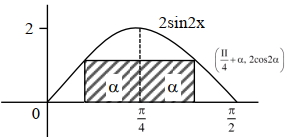
Consider all rectangles lying in the region $\left\{( x , y ) \in R \times R : 0 \leq x \leq \frac{\pi}{2} \text{ and } 0 \leq y \leq 2 \sin (2 x )\right\}$ and having one side on the $x$-axis. The area of the rectangle which has the maximum perimeter among all such rectangles is
A
$\frac{3 \pi}{2}$
B
$\pi$
C
$\frac{\pi}{2 \sqrt{3}}$
D
$\frac{\pi \sqrt{3}}{2}$
Solution
(C) Let the rectangle be symmetric about the line $x = \frac{\pi}{4}$. Let the width of the rectangle be $2\alpha$,where the $x$-coordinates of the vertical sides are $\frac{\pi}{4} - \alpha$ and $\frac{\pi}{4} + \alpha$.
The height of the rectangle is $y = 2 \sin(2(\frac{\pi}{4} + \alpha)) = 2 \sin(\frac{\pi}{2} + 2\alpha) = 2 \cos(2\alpha)$.
The perimeter $P$ of the rectangle is given by $P = 2(\text{width} + \text{height}) = 2(2\alpha + 2 \cos(2\alpha)) = 4(\alpha + \cos(2\alpha))$.
To find the maximum perimeter,we differentiate $P$ with respect to $\alpha$:
$\frac{dP}{d\alpha} = 4(1 - 2 \sin(2\alpha)) = 0$.
This gives $\sin(2\alpha) = \frac{1}{2}$,so $2\alpha = \frac{\pi}{6}$ (since $0 < 2\alpha < \frac{\pi}{2}$),which means $\alpha = \frac{\pi}{12}$.
Checking the second derivative: $\frac{d^2P}{d\alpha^2} = -8 \cos(2\alpha)$. At $\alpha = \frac{\pi}{12}$,$\frac{d^2P}{d\alpha^2} = -8 \cos(\frac{\pi}{6}) = -4\sqrt{3} < 0$,so the perimeter is maximum at $\alpha = \frac{\pi}{12}$.
The area of this rectangle is $\text{Area} = \text{width} \times \text{height} = (2\alpha) \times (2 \cos(2\alpha)) = 2(\frac{\pi}{12}) \times 2 \cos(\frac{\pi}{6}) = \frac{\pi}{6} \times 2 \times \frac{\sqrt{3}}{2} = \frac{\pi}{2\sqrt{3}}$.
The height of the rectangle is $y = 2 \sin(2(\frac{\pi}{4} + \alpha)) = 2 \sin(\frac{\pi}{2} + 2\alpha) = 2 \cos(2\alpha)$.
The perimeter $P$ of the rectangle is given by $P = 2(\text{width} + \text{height}) = 2(2\alpha + 2 \cos(2\alpha)) = 4(\alpha + \cos(2\alpha))$.
To find the maximum perimeter,we differentiate $P$ with respect to $\alpha$:
$\frac{dP}{d\alpha} = 4(1 - 2 \sin(2\alpha)) = 0$.
This gives $\sin(2\alpha) = \frac{1}{2}$,so $2\alpha = \frac{\pi}{6}$ (since $0 < 2\alpha < \frac{\pi}{2}$),which means $\alpha = \frac{\pi}{12}$.
Checking the second derivative: $\frac{d^2P}{d\alpha^2} = -8 \cos(2\alpha)$. At $\alpha = \frac{\pi}{12}$,$\frac{d^2P}{d\alpha^2} = -8 \cos(\frac{\pi}{6}) = -4\sqrt{3} < 0$,so the perimeter is maximum at $\alpha = \frac{\pi}{12}$.
The area of this rectangle is $\text{Area} = \text{width} \times \text{height} = (2\alpha) \times (2 \cos(2\alpha)) = 2(\frac{\pi}{12}) \times 2 \cos(\frac{\pi}{6}) = \frac{\pi}{6} \times 2 \times \frac{\sqrt{3}}{2} = \frac{\pi}{2\sqrt{3}}$.
0 likesView Solution
20
MathematicsMediumMCQIIT JEE · 2020
Let the function $f: R \rightarrow R$ be defined by $f(x)=x-x^2+(x-1) \sin x$ and let $g: R \rightarrow R$ be an arbitrary function. Let $f g: R \rightarrow R$ be the product function defined by $(f g)(x)=f(x) g(x)$. Then which of the following statements is/are $TRUE$?
$(A)$ If $g$ is continuous at $x=1$,then $f g$ is differentiable at $x=1$
$(B)$ If $fg$ is differentiable at $x=1$,then $g$ is continuous at $x=1$
$(C)$ If $g$ is differentiable at $x=1$,then $f g$ is differentiable at $x=1$
$(D)$ If $fg$ is differentiable at $x=1$,then $g$ is differentiable at $x=1$
$(A)$ If $g$ is continuous at $x=1$,then $f g$ is differentiable at $x=1$
$(B)$ If $fg$ is differentiable at $x=1$,then $g$ is continuous at $x=1$
$(C)$ If $g$ is differentiable at $x=1$,then $f g$ is differentiable at $x=1$
$(D)$ If $fg$ is differentiable at $x=1$,then $g$ is differentiable at $x=1$
A
$A, B$
B
$B, D$
C
$A, D$
D
$A, C$
Solution
(D) Given $f(x) = x - x^2 + (x - 1) \sin x = -(x - 1)^2 + (x - 1) \sin x = (x - 1) [-(x - 1) + \sin x]$.
Note that $f(1) = 0$.
Also,$f'(x) = 1 - 2x + \sin x + (x - 1) \cos x$. Thus,$f'(1) = 1 - 2 + \sin 1 + 0 = \sin 1 - 1$.
Let $h(x) = (fg)(x) = f(x)g(x)$.
For differentiability at $x=1$,we check $h'(1) = \lim_{k \to 0} \frac{f(1+k)g(1+k) - f(1)g(1)}{k} = \lim_{k \to 0} \frac{f(1+k)g(1+k)}{k}$.
Since $f(1+k) = k(-k + \sin(1+k))$,the limit becomes $\lim_{k \to 0} \frac{k(-k + \sin(1+k))g(1+k)}{k} = \lim_{k \to 0} (-k + \sin(1+k))g(1+k) = \sin(1) \cdot g(1)$.
If $g$ is continuous at $x=1$,$g(1+k) \to g(1)$,so the limit exists. Thus,$(A)$ is true.
If $g$ is differentiable at $x=1$,it is continuous,so $(C)$ is true.
If $fg$ is differentiable,it does not imply $g$ is continuous or differentiable (e.g.,if $f(x)=0$ at $x=1$,$fg$ could be differentiable even if $g$ is not). Thus,$(B)$ and $(D)$ are false.
Therefore,the correct statements are $(A)$ and $(C)$.
Note that $f(1) = 0$.
Also,$f'(x) = 1 - 2x + \sin x + (x - 1) \cos x$. Thus,$f'(1) = 1 - 2 + \sin 1 + 0 = \sin 1 - 1$.
Let $h(x) = (fg)(x) = f(x)g(x)$.
For differentiability at $x=1$,we check $h'(1) = \lim_{k \to 0} \frac{f(1+k)g(1+k) - f(1)g(1)}{k} = \lim_{k \to 0} \frac{f(1+k)g(1+k)}{k}$.
Since $f(1+k) = k(-k + \sin(1+k))$,the limit becomes $\lim_{k \to 0} \frac{k(-k + \sin(1+k))g(1+k)}{k} = \lim_{k \to 0} (-k + \sin(1+k))g(1+k) = \sin(1) \cdot g(1)$.
If $g$ is continuous at $x=1$,$g(1+k) \to g(1)$,so the limit exists. Thus,$(A)$ is true.
If $g$ is differentiable at $x=1$,it is continuous,so $(C)$ is true.
If $fg$ is differentiable,it does not imply $g$ is continuous or differentiable (e.g.,if $f(x)=0$ at $x=1$,$fg$ could be differentiable even if $g$ is not). Thus,$(B)$ and $(D)$ are false.
Therefore,the correct statements are $(A)$ and $(C)$.
0 likesView Solution
21
MathematicsMediumMCQIIT JEE · 2020
Let $M$ be a $3 \times 3$ invertible matrix with real entries and let $I$ denote the $3 \times 3$ identity matrix. If $M^{-1} = \operatorname{adj}(\operatorname{adj} M)$,then which of the following statement$(s)$ is/are $ALWAYS \text{ } TRUE$?
A
$B, C, D$
B
$A, B, D$
C
$A, B$
D
$A, C$
Solution
(A) Given $M^{-1} = \operatorname{adj}(\operatorname{adj} M)$.
We know that for a $3 \times 3$ matrix $M$,$\operatorname{adj}(\operatorname{adj} M) = (\operatorname{det} M)^{3-2} M = (\operatorname{det} M) M$.
Thus,$M^{-1} = (\operatorname{det} M) M$.
Multiplying both sides by $M$,we get $M^{-1} M = (\operatorname{det} M) M^2$,which implies $I = (\operatorname{det} M) M^2$.
Taking the determinant on both sides,$\operatorname{det}(I) = \operatorname{det}((\operatorname{det} M) M^2)$.
$1 = (\operatorname{det} M)^3 \cdot (\operatorname{det} M)^2 = (\operatorname{det} M)^5$.
Since $M$ has real entries,$\operatorname{det} M = 1$.
Substituting $\operatorname{det} M = 1$ into $I = (\operatorname{det} M) M^2$,we get $I = M^2$.
Since $M^2 = I$,then $(\operatorname{adj} M)^2 = \operatorname{adj}(M^2) = \operatorname{adj}(I) = I$.
Thus,statements $B, C,$ and $D$ are always true.
We know that for a $3 \times 3$ matrix $M$,$\operatorname{adj}(\operatorname{adj} M) = (\operatorname{det} M)^{3-2} M = (\operatorname{det} M) M$.
Thus,$M^{-1} = (\operatorname{det} M) M$.
Multiplying both sides by $M$,we get $M^{-1} M = (\operatorname{det} M) M^2$,which implies $I = (\operatorname{det} M) M^2$.
Taking the determinant on both sides,$\operatorname{det}(I) = \operatorname{det}((\operatorname{det} M) M^2)$.
$1 = (\operatorname{det} M)^3 \cdot (\operatorname{det} M)^2 = (\operatorname{det} M)^5$.
Since $M$ has real entries,$\operatorname{det} M = 1$.
Substituting $\operatorname{det} M = 1$ into $I = (\operatorname{det} M) M^2$,we get $I = M^2$.
Since $M^2 = I$,then $(\operatorname{adj} M)^2 = \operatorname{adj}(M^2) = \operatorname{adj}(I) = I$.
Thus,statements $B, C,$ and $D$ are always true.
0 likesView Solution
22
MathematicsAdvancedMCQIIT JEE · 2020
Let $L_1$ and $L_2$ be the following straight lines:
$L_1: \frac{x-1}{1} = \frac{y}{-1} = \frac{z-1}{3}$ and $L_2: \frac{x-1}{-3} = \frac{y}{-1} = \frac{z-1}{1}$.
Suppose the straight line $L: \frac{x-\alpha}{l} = \frac{y-1}{m} = \frac{z-\gamma}{-2}$ lies in the plane containing $L_1$ and $L_2$,and passes through the point of intersection of $L_1$ and $L_2$. If the line $L$ bisects the acute angle between the lines $L_1$ and $L_2$,then which of the following statements is/are $TRUE$?
$(A)$ $\alpha-\gamma=3$
$(B)$ $l+m=2$
$(C)$ $\alpha-\gamma=1$
$(D)$ $l+m=0$
$L_1: \frac{x-1}{1} = \frac{y}{-1} = \frac{z-1}{3}$ and $L_2: \frac{x-1}{-3} = \frac{y}{-1} = \frac{z-1}{1}$.
Suppose the straight line $L: \frac{x-\alpha}{l} = \frac{y-1}{m} = \frac{z-\gamma}{-2}$ lies in the plane containing $L_1$ and $L_2$,and passes through the point of intersection of $L_1$ and $L_2$. If the line $L$ bisects the acute angle between the lines $L_1$ and $L_2$,then which of the following statements is/are $TRUE$?
$(A)$ $\alpha-\gamma=3$
$(B)$ $l+m=2$
$(C)$ $\alpha-\gamma=1$
$(D)$ $l+m=0$
A
$B, C$
B
$B, D$
C
$B, A$
D
$A, B$
Solution
(D) The point of intersection of $L_1$ and $L_2$ is $(1, 0, 1)$.
Since line $L$ passes through $(1, 0, 1)$,we have $\frac{1-\alpha}{l} = \frac{0-1}{m} = \frac{1-\gamma}{-2}$,which implies $\frac{1-\alpha}{l} = -\frac{1}{m} = \frac{1-\gamma}{-2} = k$ (say). Thus,$1-\alpha = kl$,$m = 1/k$,and $1-\gamma = -2k$.
Direction vectors of $L_1$ and $L_2$ are $\vec{v_1} = \hat{i} - \hat{j} + 3\hat{k}$ and $\vec{v_2} = -3\hat{i} - \hat{j} + \hat{k}$.
The unit vectors are $\hat{u_1} = \frac{\vec{v_1}}{\sqrt{11}}$ and $\hat{u_2} = \frac{\vec{v_2}}{\sqrt{11}}$.
The direction of the angle bisector is $\vec{v} = \hat{u_1} + \hat{u_2} = \frac{1}{\sqrt{11}} ((\hat{i} - \hat{j} + 3\hat{k}) + (-3\hat{i} - \hat{j} + \hat{k})) = \frac{1}{\sqrt{11}} (-2\hat{i} - 2\hat{j} + 4\hat{k}) \propto \hat{i} + \hat{j} - 2\hat{k}$.
Comparing with the direction ratios $(l, m, -2)$ of $L$,we get $\frac{l}{1} = \frac{m}{1} = \frac{-2}{-2} = 1$. Thus,$l=1$ and $m=1$.
Then $l+m = 1+1 = 2$,so $(B)$ is true.
Using $k=1$ in the intersection equations: $1-\alpha = 1 \Rightarrow \alpha=0$ and $1-\gamma = -2 \Rightarrow \gamma=3$.
Then $\alpha-\gamma = 0-3 = -3$. Checking the options,we re-evaluate the bisector direction. The acute angle bisector direction is $\vec{v_1} - \vec{v_2} = 4\hat{i} + 2\hat{k} \propto 2\hat{i} + \hat{k}$ or $\vec{v_1} + \vec{v_2} = -2\hat{i} - 2\hat{j} + 4\hat{k} \propto \hat{i} + \hat{j} - 2\hat{k}$.
Given the denominator of $L$ is $-2$,we use $\vec{v} = \hat{i} + \hat{j} - 2\hat{k}$,so $l=1, m=1$. $\alpha=0, \gamma=3$. $\alpha-\gamma = -3$. Wait,if we use the other bisector,$l=-1, m=-1$,then $l+m=-2$. Re-checking the intersection: $1-\alpha = l/(-1) = -l$,$1-\gamma = -2/(-1) = 2$. $\alpha = 1+l, \gamma = -1$. $\alpha-\gamma = 2+l$. With $l=1, \alpha=2, \gamma=-1, \alpha-\gamma=3$. Thus $(A)$ and $(B)$ are true.
Since line $L$ passes through $(1, 0, 1)$,we have $\frac{1-\alpha}{l} = \frac{0-1}{m} = \frac{1-\gamma}{-2}$,which implies $\frac{1-\alpha}{l} = -\frac{1}{m} = \frac{1-\gamma}{-2} = k$ (say). Thus,$1-\alpha = kl$,$m = 1/k$,and $1-\gamma = -2k$.
Direction vectors of $L_1$ and $L_2$ are $\vec{v_1} = \hat{i} - \hat{j} + 3\hat{k}$ and $\vec{v_2} = -3\hat{i} - \hat{j} + \hat{k}$.
The unit vectors are $\hat{u_1} = \frac{\vec{v_1}}{\sqrt{11}}$ and $\hat{u_2} = \frac{\vec{v_2}}{\sqrt{11}}$.
The direction of the angle bisector is $\vec{v} = \hat{u_1} + \hat{u_2} = \frac{1}{\sqrt{11}} ((\hat{i} - \hat{j} + 3\hat{k}) + (-3\hat{i} - \hat{j} + \hat{k})) = \frac{1}{\sqrt{11}} (-2\hat{i} - 2\hat{j} + 4\hat{k}) \propto \hat{i} + \hat{j} - 2\hat{k}$.
Comparing with the direction ratios $(l, m, -2)$ of $L$,we get $\frac{l}{1} = \frac{m}{1} = \frac{-2}{-2} = 1$. Thus,$l=1$ and $m=1$.
Then $l+m = 1+1 = 2$,so $(B)$ is true.
Using $k=1$ in the intersection equations: $1-\alpha = 1 \Rightarrow \alpha=0$ and $1-\gamma = -2 \Rightarrow \gamma=3$.
Then $\alpha-\gamma = 0-3 = -3$. Checking the options,we re-evaluate the bisector direction. The acute angle bisector direction is $\vec{v_1} - \vec{v_2} = 4\hat{i} + 2\hat{k} \propto 2\hat{i} + \hat{k}$ or $\vec{v_1} + \vec{v_2} = -2\hat{i} - 2\hat{j} + 4\hat{k} \propto \hat{i} + \hat{j} - 2\hat{k}$.
Given the denominator of $L$ is $-2$,we use $\vec{v} = \hat{i} + \hat{j} - 2\hat{k}$,so $l=1, m=1$. $\alpha=0, \gamma=3$. $\alpha-\gamma = -3$. Wait,if we use the other bisector,$l=-1, m=-1$,then $l+m=-2$. Re-checking the intersection: $1-\alpha = l/(-1) = -l$,$1-\gamma = -2/(-1) = 2$. $\alpha = 1+l, \gamma = -1$. $\alpha-\gamma = 2+l$. With $l=1, \alpha=2, \gamma=-1, \alpha-\gamma=3$. Thus $(A)$ and $(B)$ are true.
0 likesView Solution
23
MathematicsDifficultMCQIIT JEE · 2020
Which of the following inequalities is/are $TRUE$?
$(A)$ $\int_0^1 x \cos x \, dx \geq \frac{3}{8}$
$(B)$ $\int_0^1 x \sin x \, dx \geq \frac{3}{10}$
$(C)$ $\int_0^1 x^2 \cos x \, dx \geq \frac{1}{2}$
$(D)$ $\int_0^1 x^2 \sin x \, dx \geq \frac{2}{9}$
$(A)$ $\int_0^1 x \cos x \, dx \geq \frac{3}{8}$
$(B)$ $\int_0^1 x \sin x \, dx \geq \frac{3}{10}$
$(C)$ $\int_0^1 x^2 \cos x \, dx \geq \frac{1}{2}$
$(D)$ $\int_0^1 x^2 \sin x \, dx \geq \frac{2}{9}$
A
$A, B, C$
B
$A, B$
C
$A, B, D$
D
$A, C$
Solution
(C) Using the Taylor series expansion,$\cos x \geq 1 - \frac{x^2}{2}$ for $x \in [0, 1]$.
$\int_0^1 x \cos x \, dx \geq \int_0^1 x(1 - \frac{x^2}{2}) \, dx = [\frac{x^2}{2} - \frac{x^4}{8}]_0^1 = \frac{1}{2} - \frac{1}{8} = \frac{3}{8}$. Thus,$(A)$ is $TRUE$.
$(B)$ Using $\sin x \geq x - \frac{x^3}{6}$,we have:
$\int_0^1 x \sin x \, dx \geq \int_0^1 x(x - \frac{x^3}{6}) \, dx = [\frac{x^3}{3} - \frac{x^5}{30}]_0^1 = \frac{1}{3} - \frac{1}{30} = \frac{9}{30} = \frac{3}{10}$. Thus,$(B)$ is $TRUE$.
$(C)$ Since $\cos x < 1$ for $x \in (0, 1]$,$\int_0^1 x^2 \cos x \, dx < \int_0^1 x^2 \, dx = \frac{1}{3}$. Since $\frac{1}{3} < \frac{1}{2}$,$(C)$ is $FALSE$.
$(D)$ Using $\sin x \geq x - \frac{x^3}{6}$,we have:
$\int_0^1 x^2 \sin x \, dx \geq \int_0^1 x^2(x - \frac{x^3}{6}) \, dx = [\frac{x^4}{4} - \frac{x^6}{36}]_0^1 = \frac{1}{4} - \frac{1}{36} = \frac{9-1}{36} = \frac{8}{36} = \frac{2}{9}$. Thus,$(D)$ is $TRUE$.
Therefore,the correct options are $(A), (B), (D)$.
$\int_0^1 x \cos x \, dx \geq \int_0^1 x(1 - \frac{x^2}{2}) \, dx = [\frac{x^2}{2} - \frac{x^4}{8}]_0^1 = \frac{1}{2} - \frac{1}{8} = \frac{3}{8}$. Thus,$(A)$ is $TRUE$.
$(B)$ Using $\sin x \geq x - \frac{x^3}{6}$,we have:
$\int_0^1 x \sin x \, dx \geq \int_0^1 x(x - \frac{x^3}{6}) \, dx = [\frac{x^3}{3} - \frac{x^5}{30}]_0^1 = \frac{1}{3} - \frac{1}{30} = \frac{9}{30} = \frac{3}{10}$. Thus,$(B)$ is $TRUE$.
$(C)$ Since $\cos x < 1$ for $x \in (0, 1]$,$\int_0^1 x^2 \cos x \, dx < \int_0^1 x^2 \, dx = \frac{1}{3}$. Since $\frac{1}{3} < \frac{1}{2}$,$(C)$ is $FALSE$.
$(D)$ Using $\sin x \geq x - \frac{x^3}{6}$,we have:
$\int_0^1 x^2 \sin x \, dx \geq \int_0^1 x^2(x - \frac{x^3}{6}) \, dx = [\frac{x^4}{4} - \frac{x^6}{36}]_0^1 = \frac{1}{4} - \frac{1}{36} = \frac{9-1}{36} = \frac{8}{36} = \frac{2}{9}$. Thus,$(D)$ is $TRUE$.
Therefore,the correct options are $(A), (B), (D)$.
0 likesView Solution
24
MathematicsAdvancedMCQIIT JEE · 2020
Let $f:[0,2] \rightarrow R$ be the function defined by $f(x)=(3-\sin(2\pi x)) \sin(\pi x-\frac{\pi}{4})-\sin(3\pi x+\frac{\pi}{4})$. If $\alpha, \beta \in[0,2]$ are such that $\{x \in[0,2]: f(x) \geq 0\}=[\alpha, \beta]$,then the value of $\beta-\alpha$ is:
A
$0$
B
$1$
C
$5$
D
$6$
Solution
(B) Let $\theta = \pi x - \frac{\pi}{4}$. Since $x \in [0, 2]$,$\theta \in [-\frac{\pi}{4}, \frac{7\pi}{4}]$.
Then $2\pi x = 2\theta + \frac{\pi}{2}$,so $\sin(2\pi x) = \cos(2\theta)$.
Also $3\pi x + \frac{\pi}{4} = 3(\theta + \frac{\pi}{4}) + \frac{\pi}{4} = 3\theta + \pi$,so $\sin(3\pi x + \frac{\pi}{4}) = \sin(3\theta + \pi) = -\sin(3\theta)$.
The inequality $f(x) \geq 0$ becomes $(3 - \cos(2\theta)) \sin \theta - (-\sin(3\theta)) \geq 0$.
$(3 - (1 - 2\sin^2 \theta)) \sin \theta + \sin(3\theta) \geq 0$.
$(2 + 2\sin^2 \theta) \sin \theta + (3\sin \theta - 4\sin^3 \theta) \geq 0$.
$2\sin \theta + 2\sin^3 \theta + 3\sin \theta - 4\sin^3 \theta \geq 0$.
$5\sin \theta - 2\sin^3 \theta \geq 0 \Rightarrow \sin \theta (5 - 2\sin^2 \theta) \geq 0$.
Since $5 - 2\sin^2 \theta > 0$ for all $\theta$,we must have $\sin \theta \geq 0$.
Thus,$\theta \in [0, \pi]$.
$0 \leq \pi x - \frac{\pi}{4} \leq \pi$ $\Rightarrow \frac{\pi}{4} \leq \pi x \leq \frac{5\pi}{4}$ $\Rightarrow x \in [\frac{1}{4}, \frac{5}{4}]$.
Therefore,$\alpha = \frac{1}{4}$ and $\beta = \frac{5}{4}$,so $\beta - \alpha = 1$.
Then $2\pi x = 2\theta + \frac{\pi}{2}$,so $\sin(2\pi x) = \cos(2\theta)$.
Also $3\pi x + \frac{\pi}{4} = 3(\theta + \frac{\pi}{4}) + \frac{\pi}{4} = 3\theta + \pi$,so $\sin(3\pi x + \frac{\pi}{4}) = \sin(3\theta + \pi) = -\sin(3\theta)$.
The inequality $f(x) \geq 0$ becomes $(3 - \cos(2\theta)) \sin \theta - (-\sin(3\theta)) \geq 0$.
$(3 - (1 - 2\sin^2 \theta)) \sin \theta + \sin(3\theta) \geq 0$.
$(2 + 2\sin^2 \theta) \sin \theta + (3\sin \theta - 4\sin^3 \theta) \geq 0$.
$2\sin \theta + 2\sin^3 \theta + 3\sin \theta - 4\sin^3 \theta \geq 0$.
$5\sin \theta - 2\sin^3 \theta \geq 0 \Rightarrow \sin \theta (5 - 2\sin^2 \theta) \geq 0$.
Since $5 - 2\sin^2 \theta > 0$ for all $\theta$,we must have $\sin \theta \geq 0$.
Thus,$\theta \in [0, \pi]$.
$0 \leq \pi x - \frac{\pi}{4} \leq \pi$ $\Rightarrow \frac{\pi}{4} \leq \pi x \leq \frac{5\pi}{4}$ $\Rightarrow x \in [\frac{1}{4}, \frac{5}{4}]$.
Therefore,$\alpha = \frac{1}{4}$ and $\beta = \frac{5}{4}$,so $\beta - \alpha = 1$.
0 likesView Solution
25
MathematicsDifficultMCQIIT JEE · 2020
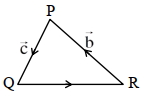
In a triangle $PQR$,let $\vec{a}=\vec{QR}, \vec{b}=\vec{RP}$ and $\vec{c}=\vec{PQ}$. If $|\vec{a}|=3, |\vec{b}|=4$ and $\frac{\vec{a} \cdot(\vec{c}-\vec{b})}{\vec{c} \cdot(\vec{a}-\vec{b})}=\frac{|\vec{a}|}{|\vec{a}|+|\vec{b}|}$,then the value of $|\vec{a} \times \vec{b}|^2$ is.
A
$100$
B
$105$
C
$108$
D
$110$
Solution
(C) In triangle $PQR$,we have $\vec{a} + \vec{b} + \vec{c} = \vec{0}$.
Since $\vec{a} = \vec{QR}$,$\vec{b} = \vec{RP}$,and $\vec{c} = \vec{PQ}$,we have $\vec{c} = -(\vec{a} + \vec{b})$.
Substituting $\vec{c}$ into the given expression:
$\frac{\vec{a} \cdot (-(\vec{a} + \vec{b}) - \vec{b})}{(-(\vec{a} + \vec{b})) \cdot (\vec{a} - \vec{b})} = \frac{|\vec{a}|}{|\vec{a}| + |\vec{b}|}$
$\frac{\vec{a} \cdot (-\vec{a} - 2\vec{b})}{-(\vec{a} + \vec{b}) \cdot (\vec{a} - \vec{b})} = \frac{3}{3 + 4}$
$\frac{-|\vec{a}|^2 - 2(\vec{a} \cdot \vec{b})}{-(\vec{a}^2 - \vec{b}^2)} = \frac{3}{7}$
Given $|\vec{a}| = 3$ and $|\vec{b}| = 4$,we have $|\vec{a}|^2 = 9$ and $|\vec{b}|^2 = 16$.
$\frac{-9 - 2(\vec{a} \cdot \vec{b})}{-(9 - 16)} = \frac{3}{7}$
$\frac{-9 - 2(\vec{a} \cdot \vec{b})}{7} = \frac{3}{7}$
$-9 - 2(\vec{a} \cdot \vec{b}) = 3$
$-2(\vec{a} \cdot \vec{b}) = 12$
$\vec{a} \cdot \vec{b} = -6$
Now,using the identity $|\vec{a} \times \vec{b}|^2 = |\vec{a}|^2 |\vec{b}|^2 - (\vec{a} \cdot \vec{b})^2$:
$|\vec{a} \times \vec{b}|^2 = (9)(16) - (-6)^2$
$|\vec{a} \times \vec{b}|^2 = 144 - 36 = 108$.
Since $\vec{a} = \vec{QR}$,$\vec{b} = \vec{RP}$,and $\vec{c} = \vec{PQ}$,we have $\vec{c} = -(\vec{a} + \vec{b})$.
Substituting $\vec{c}$ into the given expression:
$\frac{\vec{a} \cdot (-(\vec{a} + \vec{b}) - \vec{b})}{(-(\vec{a} + \vec{b})) \cdot (\vec{a} - \vec{b})} = \frac{|\vec{a}|}{|\vec{a}| + |\vec{b}|}$
$\frac{\vec{a} \cdot (-\vec{a} - 2\vec{b})}{-(\vec{a} + \vec{b}) \cdot (\vec{a} - \vec{b})} = \frac{3}{3 + 4}$
$\frac{-|\vec{a}|^2 - 2(\vec{a} \cdot \vec{b})}{-(\vec{a}^2 - \vec{b}^2)} = \frac{3}{7}$
Given $|\vec{a}| = 3$ and $|\vec{b}| = 4$,we have $|\vec{a}|^2 = 9$ and $|\vec{b}|^2 = 16$.
$\frac{-9 - 2(\vec{a} \cdot \vec{b})}{-(9 - 16)} = \frac{3}{7}$
$\frac{-9 - 2(\vec{a} \cdot \vec{b})}{7} = \frac{3}{7}$
$-9 - 2(\vec{a} \cdot \vec{b}) = 3$
$-2(\vec{a} \cdot \vec{b}) = 12$
$\vec{a} \cdot \vec{b} = -6$
Now,using the identity $|\vec{a} \times \vec{b}|^2 = |\vec{a}|^2 |\vec{b}|^2 - (\vec{a} \cdot \vec{b})^2$:
$|\vec{a} \times \vec{b}|^2 = (9)(16) - (-6)^2$
$|\vec{a} \times \vec{b}|^2 = 144 - 36 = 108$.
0 likesView Solution
26
MathematicsAdvancedMCQIIT JEE · 2020
For a polynomial $g(x)$ with real coefficients,let $m_g$ denote the number of distinct real roots of $g(x)$. Suppose $S$ is the set of polynomials with real coefficients defined by $S = \{(x^2-1)^2(a_0+a_1x+a_2x^2+a_3x^3) : a_0, a_1, a_2, a_3 \in \mathbb{R}\}$. For a polynomial $f$,let $f'$ and $f''$ denote its first and second order derivatives,respectively. Then the minimum possible value of $(m_f + m_{f'})$,where $f \in S$,is
A
$5$
B
$8$
C
$9$
D
$10$
Solution
(A) Let $f(x) = (x^2-1)^2 h(x)$,where $h(x) = a_0+a_1x+a_2x^2+a_3x^3$.
Since $(x^2-1)^2 = (x-1)^2(x+1)^2$,$f(x)$ has roots at $x=1$ and $x=-1$ with multiplicity at least $2$.
Thus,$f(1)=0, f(-1)=0$ and $f'(1)=0, f'(-1)=0$.
By Rolle's Theorem,there exists $\alpha \in (-1, 1)$ such that $f'(\alpha)=0$.
Since $f'(x)$ has roots at $-1, \alpha, 1$,we have $m_{f'} \ge 3$.
For $f(x) = (x^2-1)^2$,the roots are $1, -1$,so $m_f = 2$.
Then $m_f + m_{f'} = 2 + 3 = 5$.
Thus,the minimum value is $5$.
Since $(x^2-1)^2 = (x-1)^2(x+1)^2$,$f(x)$ has roots at $x=1$ and $x=-1$ with multiplicity at least $2$.
Thus,$f(1)=0, f(-1)=0$ and $f'(1)=0, f'(-1)=0$.
By Rolle's Theorem,there exists $\alpha \in (-1, 1)$ such that $f'(\alpha)=0$.
Since $f'(x)$ has roots at $-1, \alpha, 1$,we have $m_{f'} \ge 3$.
For $f(x) = (x^2-1)^2$,the roots are $1, -1$,so $m_f = 2$.
Then $m_f + m_{f'} = 2 + 3 = 5$.
Thus,the minimum value is $5$.
0 likesView Solution
27
MathematicsAdvancedMCQIIT JEE · 2020
The probability that a missile hits a target successfully is $0.75$. In order to destroy the target completely,at least three successful hits are required. Then the minimum number of missiles that have to be fired so that the probability of completely destroying the target is $NOT$ less than $0.95$,is. . . . .
A
$6$
B
$7$
C
$8$
D
$9$
Solution
(A) Let $X$ be the number of successful hits,where $X \sim B(n, p)$ with $p = 0.75 = \frac{3}{4}$ and $q = 1 - p = 0.25 = \frac{1}{4}$.
We require at least $3$ successful hits to destroy the target,so $P(X \geq 3) \geq 0.95$.
This is equivalent to $1 - P(X < 3) \geq 0.95$,or $P(X=0) + P(X=1) + P(X=2) \leq 0.05$.
The probability mass function is $P(X=r) = {}^{n}C_{r} (\frac{3}{4})^r (\frac{1}{4})^{n-r}$.
Substituting the values: ${}^{n}C_{0} (\frac{1}{4})^n + {}^{n}C_{1} (\frac{3}{4}) (\frac{1}{4})^{n-1} + {}^{n}C_{2} (\frac{3}{4})^2 (\frac{1}{4})^{n-2} \leq 0.05$.
$\frac{1}{4^n} [1 + 3n + \frac{9n(n-1)}{2}] \leq 0.05$.
$1 + 3n + 4.5n^2 - 4.5n \leq 0.05 \times 4^n$.
$4.5n^2 - 1.5n + 1 \leq 0.05 \times 4^n$.
For $n=5$: $4.5(25) - 1.5(5) + 1 = 112.5 - 7.5 + 1 = 106 \leq 0.05(1024) = 51.2$ (False).
For $n=6$: $4.5(36) - 1.5(6) + 1 = 162 - 9 + 1 = 154 \leq 0.05(4096) = 204.8$ (True).
Thus,the minimum number of missiles required is $6$.
We require at least $3$ successful hits to destroy the target,so $P(X \geq 3) \geq 0.95$.
This is equivalent to $1 - P(X < 3) \geq 0.95$,or $P(X=0) + P(X=1) + P(X=2) \leq 0.05$.
The probability mass function is $P(X=r) = {}^{n}C_{r} (\frac{3}{4})^r (\frac{1}{4})^{n-r}$.
Substituting the values: ${}^{n}C_{0} (\frac{1}{4})^n + {}^{n}C_{1} (\frac{3}{4}) (\frac{1}{4})^{n-1} + {}^{n}C_{2} (\frac{3}{4})^2 (\frac{1}{4})^{n-2} \leq 0.05$.
$\frac{1}{4^n} [1 + 3n + \frac{9n(n-1)}{2}] \leq 0.05$.
$1 + 3n + 4.5n^2 - 4.5n \leq 0.05 \times 4^n$.
$4.5n^2 - 1.5n + 1 \leq 0.05 \times 4^n$.
For $n=5$: $4.5(25) - 1.5(5) + 1 = 112.5 - 7.5 + 1 = 106 \leq 0.05(1024) = 51.2$ (False).
For $n=6$: $4.5(36) - 1.5(6) + 1 = 162 - 9 + 1 = 154 \leq 0.05(4096) = 204.8$ (True).
Thus,the minimum number of missiles required is $6$.
0 likesView Solution
28
MathematicsAdvancedMCQIIT JEE · 2020
The trace of a square matrix is defined as the sum of its diagonal entries. If $A$ is a $2 \times 2$ matrix such that the trace of $A$ is $3$ and the trace of $A^3$ is $-18$,then the value of the determinant of $A$ is:
A
$2$
B
$3$
C
$5$
D
$8$
Solution
(C) Let $A = \begin{bmatrix} a & b \\ c & d \end{bmatrix}$. The characteristic equation of $A$ is given by $\lambda^2 - \text{tr}(A)\lambda + \det(A) = 0$.
Given $\text{tr}(A) = a+d = 3$ and let $\Delta = \det(A) = ad-bc$.
So,the characteristic equation is $\lambda^2 - 3\lambda + \Delta = 0$.
By the Cayley-Hamilton theorem,$A^2 - 3A + \Delta I = 0$,which implies $A^2 = 3A - \Delta I$.
Multiplying by $A$,we get $A^3 = 3A^2 - \Delta A$.
Substituting $A^2 = 3A - \Delta I$ into the equation:
$A^3 = 3(3A - \Delta I) - \Delta A = 9A - 3\Delta I - \Delta A = (9 - \Delta)A - 3\Delta I$.
Taking the trace on both sides:
$\text{tr}(A^3) = (9 - \Delta)\text{tr}(A) - 3\Delta \text{tr}(I)$.
Since $\text{tr}(A^3) = -18$,$\text{tr}(A) = 3$,and $\text{tr}(I) = 2$ (for a $2 \times 2$ matrix):
$-18 = (9 - \Delta)(3) - 3\Delta(2)$.
$-18 = 27 - 3\Delta - 6\Delta$.
$-18 = 27 - 9\Delta$.
$9\Delta = 27 + 18 = 45$.
$\Delta = 5$.
Thus,the determinant of $A$ is $5$.
Given $\text{tr}(A) = a+d = 3$ and let $\Delta = \det(A) = ad-bc$.
So,the characteristic equation is $\lambda^2 - 3\lambda + \Delta = 0$.
By the Cayley-Hamilton theorem,$A^2 - 3A + \Delta I = 0$,which implies $A^2 = 3A - \Delta I$.
Multiplying by $A$,we get $A^3 = 3A^2 - \Delta A$.
Substituting $A^2 = 3A - \Delta I$ into the equation:
$A^3 = 3(3A - \Delta I) - \Delta A = 9A - 3\Delta I - \Delta A = (9 - \Delta)A - 3\Delta I$.
Taking the trace on both sides:
$\text{tr}(A^3) = (9 - \Delta)\text{tr}(A) - 3\Delta \text{tr}(I)$.
Since $\text{tr}(A^3) = -18$,$\text{tr}(A) = 3$,and $\text{tr}(I) = 2$ (for a $2 \times 2$ matrix):
$-18 = (9 - \Delta)(3) - 3\Delta(2)$.
$-18 = 27 - 3\Delta - 6\Delta$.
$-18 = 27 - 9\Delta$.
$9\Delta = 27 + 18 = 45$.
$\Delta = 5$.
Thus,the determinant of $A$ is $5$.
0 likesView Solution
29
MathematicsDifficultMCQIIT JEE · 2020
Let the functions $f:(-1,1) \rightarrow R$ and $g:(-1,1) \rightarrow(-1,1)$ be defined by $f(x)=|2 x-1|+|2 x+1|$ and $g(x)=x-[x]$,where $[x]$ denotes the greatest integer less than or equal to $x$. Let $f \circ g:(-1,1) \rightarrow R$ be the composite function defined by $(f \circ g)(x)=f(g(x))$. Suppose $c$ is the number of points in the interval $(-1,1)$ at which $f \circ g$ is $NOT$ continuous,and suppose $d$ is the number of points in the interval $(-1,1)$ at which $f \circ g$ is $NOT$ differentiable. Then the value of $c+d$ is.
A
$3$
B
$4$
C
$5$
D
$6$
Solution
(B) Given $f(x) = |2x-1| + |2x+1|$ and $g(x) = x - [x] = \{x\}$.
For $x \in (-1, 1)$,the fractional part function $g(x) = \{x\}$ is defined as:
$g(x) = x+1$ for $x \in (-1, 0)$ and $g(x) = x$ for $x \in [0, 1)$.
Thus,the composite function $h(x) = f(g(x)) = |2\{x\}-1| + |2\{x\}+1|$.
Since $\{x\} \in [0, 1)$,we have $2\{x\}+1 \geq 1$,so $|2\{x\}+1| = 2\{x\}+1$.
Then $h(x) = |2\{x\}-1| + 2\{x\} + 1$.
If $0 \leq \{x\} \leq 1/2$,then $h(x) = -(2\{x\}-1) + 2\{x\} + 1 = 2$.
If $1/2 < \{x\} < 1$,then $h(x) = (2\{x\}-1) + 2\{x\} + 1 = 4\{x\}$.
Analyzing the interval $(-1, 1)$:
For $x \in (-1, 0)$,$\{x\} = x+1$. So $h(x) = 2$ if $x+1 \leq 1/2$ (i.e.,$x \leq -1/2$) and $h(x) = 4(x+1)$ if $x > -1/2$.
For $x \in [0, 1)$,$\{x\} = x$. So $h(x) = 2$ if $x \leq 1/2$ and $h(x) = 4x$ if $x > 1/2$.
Discontinuity: The function $h(x)$ is discontinuous at $x=0$ because $\lim_{x \to 0^-} h(x) = 4(0+1) = 4$ and $h(0) = 2$. Thus,$c=1$.
Non-differentiability: The function is non-differentiable at $x = -1/2$ (corner point),$x = 0$ (discontinuity),and $x = 1/2$ (corner point). Thus,$d=3$.
Therefore,$c+d = 1+3 = 4$.
For $x \in (-1, 1)$,the fractional part function $g(x) = \{x\}$ is defined as:
$g(x) = x+1$ for $x \in (-1, 0)$ and $g(x) = x$ for $x \in [0, 1)$.
Thus,the composite function $h(x) = f(g(x)) = |2\{x\}-1| + |2\{x\}+1|$.
Since $\{x\} \in [0, 1)$,we have $2\{x\}+1 \geq 1$,so $|2\{x\}+1| = 2\{x\}+1$.
Then $h(x) = |2\{x\}-1| + 2\{x\} + 1$.
If $0 \leq \{x\} \leq 1/2$,then $h(x) = -(2\{x\}-1) + 2\{x\} + 1 = 2$.
If $1/2 < \{x\} < 1$,then $h(x) = (2\{x\}-1) + 2\{x\} + 1 = 4\{x\}$.
Analyzing the interval $(-1, 1)$:
For $x \in (-1, 0)$,$\{x\} = x+1$. So $h(x) = 2$ if $x+1 \leq 1/2$ (i.e.,$x \leq -1/2$) and $h(x) = 4(x+1)$ if $x > -1/2$.
For $x \in [0, 1)$,$\{x\} = x$. So $h(x) = 2$ if $x \leq 1/2$ and $h(x) = 4x$ if $x > 1/2$.
Discontinuity: The function $h(x)$ is discontinuous at $x=0$ because $\lim_{x \to 0^-} h(x) = 4(0+1) = 4$ and $h(0) = 2$. Thus,$c=1$.
Non-differentiability: The function is non-differentiable at $x = -1/2$ (corner point),$x = 0$ (discontinuity),and $x = 1/2$ (corner point). Thus,$d=3$.
Therefore,$c+d = 1+3 = 4$.
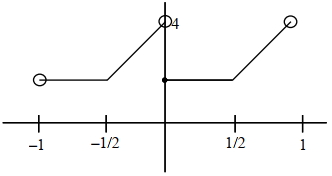
0 likesView Solution
30
MathematicsMediumMCQIIT JEE · 2020
Let $b$ be a nonzero real number. Suppose $f: R \rightarrow R$ is a differentiable function such that $f(0)=1$. If the derivative $f^{\prime}$ of $f$ satisfies the equation $f^{\prime}(x) = \frac{f(x)}{b^2+x^2}$ for all $x \in R$,then which of the following statements is/are $TRUE$?
$(A)$ If $b>0$,then $f$ is an increasing function
$(B)$ If $b < 0$,then $f$ is a decreasing function
$(C)$ $f(x)f(-x)=1$ for all $x \in R$
$(D)$ $f(x)-f(-x)=0$ for all $x \in R$
$(A)$ If $b>0$,then $f$ is an increasing function
$(B)$ If $b < 0$,then $f$ is a decreasing function
$(C)$ $f(x)f(-x)=1$ for all $x \in R$
$(D)$ $f(x)-f(-x)=0$ for all $x \in R$
A
$A, B$
B
$A, D$
C
$B, C$
D
$A, C$
Solution
(D) Given the differential equation $f^{\prime}(x) = \frac{f(x)}{b^2+x^2}$.
Separating variables,we get $\frac{f^{\prime}(x)}{f(x)} = \frac{1}{b^2+x^2}$.
Integrating both sides with respect to $x$,we have $\int \frac{f^{\prime}(x)}{f(x)} dx = \int \frac{1}{b^2+x^2} dx$.
This yields $\ln|f(x)| = \frac{1}{b} \tan^{-1}\left(\frac{x}{b}\right) + C$.
Using the initial condition $f(0)=1$,we get $\ln(1) = \frac{1}{b} \tan^{-1}(0) + C$,which implies $C=0$.
Thus,$f(x) = e^{\frac{1}{b} \tan^{-1}(\frac{x}{b})}$.
Now,consider $f(x)f(-x) = e^{\frac{1}{b} \tan^{-1}(\frac{x}{b})} \cdot e^{\frac{1}{b} \tan^{-1}(\frac{-x}{b})} = e^{\frac{1}{b} (\tan^{-1}(\frac{x}{b}) - \tan^{-1}(\frac{x}{b}))} = e^0 = 1$. So,$(C)$ is true.
For $b>0$,$f^{\prime}(x) = \frac{f(x)}{b^2+x^2} > 0$ since $f(x) = e^{\dots} > 0$ and $b^2+x^2 > 0$. Thus,$f$ is an increasing function. So,$(A)$ is true.
Therefore,the correct statements are $(A)$ and $(C)$.
Separating variables,we get $\frac{f^{\prime}(x)}{f(x)} = \frac{1}{b^2+x^2}$.
Integrating both sides with respect to $x$,we have $\int \frac{f^{\prime}(x)}{f(x)} dx = \int \frac{1}{b^2+x^2} dx$.
This yields $\ln|f(x)| = \frac{1}{b} \tan^{-1}\left(\frac{x}{b}\right) + C$.
Using the initial condition $f(0)=1$,we get $\ln(1) = \frac{1}{b} \tan^{-1}(0) + C$,which implies $C=0$.
Thus,$f(x) = e^{\frac{1}{b} \tan^{-1}(\frac{x}{b})}$.
Now,consider $f(x)f(-x) = e^{\frac{1}{b} \tan^{-1}(\frac{x}{b})} \cdot e^{\frac{1}{b} \tan^{-1}(\frac{-x}{b})} = e^{\frac{1}{b} (\tan^{-1}(\frac{x}{b}) - \tan^{-1}(\frac{x}{b}))} = e^0 = 1$. So,$(C)$ is true.
For $b>0$,$f^{\prime}(x) = \frac{f(x)}{b^2+x^2} > 0$ since $f(x) = e^{\dots} > 0$ and $b^2+x^2 > 0$. Thus,$f$ is an increasing function. So,$(A)$ is true.
Therefore,the correct statements are $(A)$ and $(C)$.
0 likesView Solution
31
MathematicsMediumMCQIIT JEE · 2020
Let $f : R \rightarrow R$ and $g : R \rightarrow R$ be functions satisfying $f(x+y)=f(x)+f(y)+f(x)f(y)$ and $f(x)=x g(x)$ for all $x, y \in R$. If $\lim _{x \rightarrow 0} g(x)=1$,then which of the following statements is/are $TRUE$?
$(A)$ $f$ is differentiable at every $x \in R$
$(B)$ If $g(0)=1$,then $g$ is differentiable at every $x \in R$
$(C)$ The derivative $f^{\prime}(1)$ is equal to $1$
$(D)$ The derivative $f^{\prime}(0)$ is equal to $1$
$(A)$ $f$ is differentiable at every $x \in R$
$(B)$ If $g(0)=1$,then $g$ is differentiable at every $x \in R$
$(C)$ The derivative $f^{\prime}(1)$ is equal to $1$
$(D)$ The derivative $f^{\prime}(0)$ is equal to $1$
A
$A, B, C$
B
$A, B, D$
C
$A, B$
D
$A, D$
Solution
(B) Given $f(x+y) = f(x) + f(y) + f(x)f(y)$. Adding $1$ to both sides gives $1 + f(x+y) = (1 + f(x))(1 + f(y))$.
Let $h(x) = 1 + f(x)$. Then $h(x+y) = h(x)h(y)$.
Since $f(x) = xg(x)$ and $\lim_{x \to 0} g(x) = 1$,we have $\lim_{x \to 0} f(x) = 0$,so $h(0) = 1 + f(0) = 1$.
For $h(x+y) = h(x)h(y)$,the solution is $h(x) = e^{cx}$.
Thus $1 + f(x) = e^{cx}$,or $f(x) = e^{cx} - 1$.
Given $f(x) = xg(x)$,we have $g(x) = \frac{e^{cx}-1}{x}$.
$\lim_{x \to 0} g(x) = \lim_{x \to 0} \frac{e^{cx}-1}{x} = c$.
Since $\lim_{x \to 0} g(x) = 1$,we have $c = 1$.
Therefore,$f(x) = e^x - 1$.
$f'(x) = e^x$,which is defined for all $x \in R$,so $(A)$ is $TRUE$.
$f'(0) = e^0 = 1$,so $(D)$ is $TRUE$.
$f'(1) = e^1 = e \neq 1$,so $(C)$ is $FALSE$.
For $g(x) = \frac{e^x-1}{x}$ for $x \neq 0$ and $g(0)=1$,$g$ is differentiable at all $x \neq 0$. At $x=0$,$g'(0) = \lim_{h \to 0} \frac{\frac{e^h-1}{h}-1}{h} = \lim_{h \to 0} \frac{e^h-1-h}{h^2} = \frac{1}{2}$. Thus $g$ is differentiable everywhere,so $(B)$ is $TRUE$.
Let $h(x) = 1 + f(x)$. Then $h(x+y) = h(x)h(y)$.
Since $f(x) = xg(x)$ and $\lim_{x \to 0} g(x) = 1$,we have $\lim_{x \to 0} f(x) = 0$,so $h(0) = 1 + f(0) = 1$.
For $h(x+y) = h(x)h(y)$,the solution is $h(x) = e^{cx}$.
Thus $1 + f(x) = e^{cx}$,or $f(x) = e^{cx} - 1$.
Given $f(x) = xg(x)$,we have $g(x) = \frac{e^{cx}-1}{x}$.
$\lim_{x \to 0} g(x) = \lim_{x \to 0} \frac{e^{cx}-1}{x} = c$.
Since $\lim_{x \to 0} g(x) = 1$,we have $c = 1$.
Therefore,$f(x) = e^x - 1$.
$f'(x) = e^x$,which is defined for all $x \in R$,so $(A)$ is $TRUE$.
$f'(0) = e^0 = 1$,so $(D)$ is $TRUE$.
$f'(1) = e^1 = e \neq 1$,so $(C)$ is $FALSE$.
For $g(x) = \frac{e^x-1}{x}$ for $x \neq 0$ and $g(0)=1$,$g$ is differentiable at all $x \neq 0$. At $x=0$,$g'(0) = \lim_{h \to 0} \frac{\frac{e^h-1}{h}-1}{h} = \lim_{h \to 0} \frac{e^h-1-h}{h^2} = \frac{1}{2}$. Thus $g$ is differentiable everywhere,so $(B)$ is $TRUE$.
0 likesView Solution
32
MathematicsAdvancedMCQIIT JEE · 2020
Let $\alpha, \beta, \gamma, \delta$ be real numbers such that $\alpha^2+\beta^2+\gamma^2 \neq 0$ and $\alpha+\gamma=1$. Suppose the point $(3,2,-1)$ is the mirror image of the point $(1,0,-1)$ with respect to the plane $\alpha x+\beta y+\gamma z=\delta$. Then which of the following statements is/are $TRUE$?
$(A)$ $\alpha+\beta=2$
$(B)$ $\delta-\gamma=3$
$(C)$ $\delta+\beta=4$
$(D)$ $\alpha+\beta+\gamma=\delta$
$(A)$ $\alpha+\beta=2$
$(B)$ $\delta-\gamma=3$
$(C)$ $\delta+\beta=4$
$(D)$ $\alpha+\beta+\gamma=\delta$
A
$A, B, D$
B
$A, B$
C
$A, B, C$
D
$A, D$
Solution
(C) Let the points be $P(1, 0, -1)$ and $Q(3, 2, -1)$. The mirror image of $P$ with respect to the plane is $Q$.
The midpoint $R$ of the line segment $PQ$ lies on the plane.
$R = \left( \frac{1+3}{2}, \frac{0+2}{2}, \frac{-1-1}{2} \right) = (2, 1, -1)$.
Since $R$ lies on the plane $\alpha x + \beta y + \gamma z = \delta$,we have:
$2\alpha + \beta - \gamma = \delta$ --- $(1)$
The normal vector to the plane is $\vec{n} = (\alpha, \beta, \gamma)$.
The vector $\vec{PQ} = (3-1, 2-0, -1-(-1)) = (2, 2, 0)$ is parallel to the normal vector $\vec{n}$.
Thus,$\frac{\alpha}{2} = \frac{\beta}{2} = \frac{\gamma}{0} = k$ (where $k \neq 0$).
This gives $\alpha = 2k$,$\beta = 2k$,and $\gamma = 0$.
Given $\alpha + \gamma = 1$,we have $2k + 0 = 1$,so $k = \frac{1}{2}$.
Therefore,$\alpha = 1$,$\beta = 1$,and $\gamma = 0$.
Substituting these into $(1)$:
$2(1) + 1(1) - 0 = \delta \implies \delta = 3$.
Now,check the options:
$(A)$ $\alpha + \beta = 1 + 1 = 2$ (True)
$(B)$ $\delta - \gamma = 3 - 0 = 3$ (True)
$(C)$ $\delta + \beta = 3 + 1 = 4$ (True)
$(D)$ $\alpha + \beta + \gamma = 1 + 1 + 0 = 2 \neq \delta$ (False)
Thus,statements $A, B, C$ are true.
The midpoint $R$ of the line segment $PQ$ lies on the plane.
$R = \left( \frac{1+3}{2}, \frac{0+2}{2}, \frac{-1-1}{2} \right) = (2, 1, -1)$.
Since $R$ lies on the plane $\alpha x + \beta y + \gamma z = \delta$,we have:
$2\alpha + \beta - \gamma = \delta$ --- $(1)$
The normal vector to the plane is $\vec{n} = (\alpha, \beta, \gamma)$.
The vector $\vec{PQ} = (3-1, 2-0, -1-(-1)) = (2, 2, 0)$ is parallel to the normal vector $\vec{n}$.
Thus,$\frac{\alpha}{2} = \frac{\beta}{2} = \frac{\gamma}{0} = k$ (where $k \neq 0$).
This gives $\alpha = 2k$,$\beta = 2k$,and $\gamma = 0$.
Given $\alpha + \gamma = 1$,we have $2k + 0 = 1$,so $k = \frac{1}{2}$.
Therefore,$\alpha = 1$,$\beta = 1$,and $\gamma = 0$.
Substituting these into $(1)$:
$2(1) + 1(1) - 0 = \delta \implies \delta = 3$.
Now,check the options:
$(A)$ $\alpha + \beta = 1 + 1 = 2$ (True)
$(B)$ $\delta - \gamma = 3 - 0 = 3$ (True)
$(C)$ $\delta + \beta = 3 + 1 = 4$ (True)
$(D)$ $\alpha + \beta + \gamma = 1 + 1 + 0 = 2 \neq \delta$ (False)
Thus,statements $A, B, C$ are true.
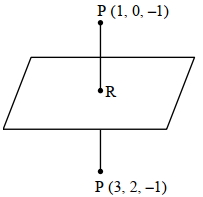
0 likesView Solution
33
MathematicsAdvancedMCQIIT JEE · 2020
Let $a$ and $b$ be positive real numbers. Suppose $\overrightarrow{PQ} = a \hat{i} + b \hat{j}$ and $\overrightarrow{PS} = a \hat{i} - b \hat{j}$ are adjacent sides of a parallelogram $PQRS$. Let $\overrightarrow{u}$ and $\overrightarrow{v}$ be the projection vectors of $\overrightarrow{w} = \hat{i} + \hat{j}$ along $\overrightarrow{PQ}$ and $\overrightarrow{PS}$,respectively. If $|\vec{u}| + |\vec{v}| = |\vec{w}|$ and if the area of the parallelogram $PQRS$ is $8$,then which of the following statements is/are $TRUE$?
$(A)$ $a + b = 4$
$(B)$ $a - b = 2$
$(C)$ The length of the diagonal $PR$ of the parallelogram $PQRS$ is $4$
$(D)$ $\overrightarrow{w}$ is an angle bisector of the vectors $\overrightarrow{PQ}$ and $\overrightarrow{PS}$
$(A)$ $a + b = 4$
$(B)$ $a - b = 2$
$(C)$ The length of the diagonal $PR$ of the parallelogram $PQRS$ is $4$
$(D)$ $\overrightarrow{w}$ is an angle bisector of the vectors $\overrightarrow{PQ}$ and $\overrightarrow{PS}$
A
$A, B$
B
$A, D$
C
$A, B, C$
D
$A, C$
Solution
(D) The projection vector of $\vec{w}$ along $\vec{PQ}$ is $\vec{u} = \left( \frac{\vec{w} \cdot \vec{PQ}}{|\vec{PQ}|^2} \right) \vec{PQ}$.
The magnitude is $|\vec{u}| = \frac{|\vec{w} \cdot \vec{PQ}|}{|\vec{PQ}|} = \frac{|(i+j) \cdot (ai+bj)|}{\sqrt{a^2+b^2}} = \frac{a+b}{\sqrt{a^2+b^2}}$.
Similarly,the magnitude of the projection vector $\vec{v}$ along $\vec{PS}$ is $|\vec{v}| = \frac{|\vec{w} \cdot \vec{PS}|}{|\vec{PS}|} = \frac{|(i+j) \cdot (ai-bj)|}{\sqrt{a^2+b^2}} = \frac{|a-b|}{\sqrt{a^2+b^2}}$.
Given $|\vec{u}| + |\vec{v}| = |\vec{w}| = \sqrt{1^2+1^2} = \sqrt{2}$,we have $\frac{a+b + |a-b|}{\sqrt{a^2+b^2}} = \sqrt{2}$.
If $a \ge b$,then $\frac{2a}{\sqrt{a^2+b^2}} = \sqrt{2} \implies 4a^2 = 2(a^2+b^2) \implies 2a^2 = 2b^2 \implies a=b$.
If $b > a$,then $\frac{2b}{\sqrt{a^2+b^2}} = \sqrt{2} \implies a=b$.
Thus,$a=b$. The area of the parallelogram is $|\vec{PQ} \times \vec{PS}| = |(ai+bj) \times (ai-bj)| = |(-abk - abk)| = |-2abk| = 2ab = 8$.
Since $a=b$,$2a^2 = 8 \implies a^2 = 4 \implies a=2$ (as $a>0$). Thus $a=2, b=2$.
$(A)$ $a+b = 2+2 = 4$ (True).
$(B)$ $a-b = 2-2 = 0 \neq 2$ (False).
$(C)$ The diagonal $\vec{PR} = \vec{PQ} + \vec{PS} = (ai+bj) + (ai-bj) = 2ai = 4i$. Length is $|4i| = 4$ (True).
$(D)$ $\vec{PQ} = 2i+2j$ and $\vec{PS} = 2i-2j$. The angle bisector direction is $\frac{\vec{PQ}}{|\vec{PQ}|} + \frac{\vec{PS}}{|\vec{PS}|} = \frac{2i+2j}{2\sqrt{2}} + \frac{2i-2j}{2\sqrt{2}} = \frac{4i}{2\sqrt{2}} = \sqrt{2}i$. This is along the $x$-axis,while $\vec{w} = i+j$ is at $45^\circ$. (False).
The magnitude is $|\vec{u}| = \frac{|\vec{w} \cdot \vec{PQ}|}{|\vec{PQ}|} = \frac{|(i+j) \cdot (ai+bj)|}{\sqrt{a^2+b^2}} = \frac{a+b}{\sqrt{a^2+b^2}}$.
Similarly,the magnitude of the projection vector $\vec{v}$ along $\vec{PS}$ is $|\vec{v}| = \frac{|\vec{w} \cdot \vec{PS}|}{|\vec{PS}|} = \frac{|(i+j) \cdot (ai-bj)|}{\sqrt{a^2+b^2}} = \frac{|a-b|}{\sqrt{a^2+b^2}}$.
Given $|\vec{u}| + |\vec{v}| = |\vec{w}| = \sqrt{1^2+1^2} = \sqrt{2}$,we have $\frac{a+b + |a-b|}{\sqrt{a^2+b^2}} = \sqrt{2}$.
If $a \ge b$,then $\frac{2a}{\sqrt{a^2+b^2}} = \sqrt{2} \implies 4a^2 = 2(a^2+b^2) \implies 2a^2 = 2b^2 \implies a=b$.
If $b > a$,then $\frac{2b}{\sqrt{a^2+b^2}} = \sqrt{2} \implies a=b$.
Thus,$a=b$. The area of the parallelogram is $|\vec{PQ} \times \vec{PS}| = |(ai+bj) \times (ai-bj)| = |(-abk - abk)| = |-2abk| = 2ab = 8$.
Since $a=b$,$2a^2 = 8 \implies a^2 = 4 \implies a=2$ (as $a>0$). Thus $a=2, b=2$.
$(A)$ $a+b = 2+2 = 4$ (True).
$(B)$ $a-b = 2-2 = 0 \neq 2$ (False).
$(C)$ The diagonal $\vec{PR} = \vec{PQ} + \vec{PS} = (ai+bj) + (ai-bj) = 2ai = 4i$. Length is $|4i| = 4$ (True).
$(D)$ $\vec{PQ} = 2i+2j$ and $\vec{PS} = 2i-2j$. The angle bisector direction is $\frac{\vec{PQ}}{|\vec{PQ}|} + \frac{\vec{PS}}{|\vec{PS}|} = \frac{2i+2j}{2\sqrt{2}} + \frac{2i-2j}{2\sqrt{2}} = \frac{4i}{2\sqrt{2}} = \sqrt{2}i$. This is along the $x$-axis,while $\vec{w} = i+j$ is at $45^\circ$. (False).
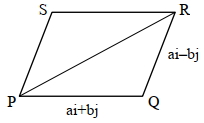
0 likesView Solution
34
MathematicsMediumMCQIIT JEE · 2020
Two fair dice,each with faces numbered $1, 2, 3, 4, 5$ and $6$,are rolled together and the sum of the numbers on the faces is observed. This process is repeated until the sum is either a prime number or a perfect square. Suppose the sum turns out to be a perfect square before it turns out to be a prime number. If $p$ is the probability that this perfect square is an odd number,then the value of $14p$ is . . . . .
A
$5$
B
$6$
C
$7$
D
$8$
Solution
(D) Let $S$ be the sum of the numbers on the two dice. The possible values of $S$ range from $2$ to $12$.
The set of prime sums is $P = \{2, 3, 5, 7, 11\}$. The number of outcomes for these sums are: $P(2)=1, P(3)=2, P(5)=4, P(7)=6, P(11)=2$. Total outcomes for prime = $1+2+4+6+2 = 15$. So,$P(\text{Prime}) = \frac{15}{36}$.
The set of perfect square sums is $Q = \{4, 9\}$. The number of outcomes for these sums are: $P(4)=3, P(9)=4$. Total outcomes for perfect square = $3+4 = 7$. So,$P(\text{Perfect Square}) = \frac{7}{36}$.
The probability of getting neither a prime nor a perfect square is $1 - (\frac{15}{36} + \frac{7}{36}) = 1 - \frac{22}{36} = \frac{14}{36}$.
Let $E$ be the event that a perfect square occurs before a prime. The probability $P(E) = \frac{7/36}{1 - 14/36} = \frac{7}{22}$.
We are given that a perfect square occurs before a prime. We want the probability that this perfect square is odd. The odd perfect square in our set is $9$,which has $4$ outcomes. The even perfect square is $4$,which has $3$ outcomes.
Given the condition,the probability that the perfect square is $9$ (odd) is $\frac{P(9)}{P(4) + P(9)} = \frac{4}{3+4} = \frac{4}{7}$.
Thus,$p = \frac{4}{7}$.
Therefore,$14p = 14 \times \frac{4}{7} = 8$.
The set of prime sums is $P = \{2, 3, 5, 7, 11\}$. The number of outcomes for these sums are: $P(2)=1, P(3)=2, P(5)=4, P(7)=6, P(11)=2$. Total outcomes for prime = $1+2+4+6+2 = 15$. So,$P(\text{Prime}) = \frac{15}{36}$.
The set of perfect square sums is $Q = \{4, 9\}$. The number of outcomes for these sums are: $P(4)=3, P(9)=4$. Total outcomes for perfect square = $3+4 = 7$. So,$P(\text{Perfect Square}) = \frac{7}{36}$.
The probability of getting neither a prime nor a perfect square is $1 - (\frac{15}{36} + \frac{7}{36}) = 1 - \frac{22}{36} = \frac{14}{36}$.
Let $E$ be the event that a perfect square occurs before a prime. The probability $P(E) = \frac{7/36}{1 - 14/36} = \frac{7}{22}$.
We are given that a perfect square occurs before a prime. We want the probability that this perfect square is odd. The odd perfect square in our set is $9$,which has $4$ outcomes. The even perfect square is $4$,which has $3$ outcomes.
Given the condition,the probability that the perfect square is $9$ (odd) is $\frac{P(9)}{P(4) + P(9)} = \frac{4}{3+4} = \frac{4}{7}$.
Thus,$p = \frac{4}{7}$.
Therefore,$14p = 14 \times \frac{4}{7} = 8$.
0 likesView Solution
35
MathematicsDifficultMCQIIT JEE · 2020
Let the function $f:[0,1] \rightarrow \mathbb{R}$ be defined by $f(x) = \frac{4^x}{4^x+2}$. Then the value of $f\left(\frac{1}{40}\right) + f\left(\frac{2}{40}\right) + f\left(\frac{3}{40}\right) + \dots + f\left(\frac{39}{40}\right) - f\left(\frac{1}{2}\right)$ is:
A
$19$
B
$20$
C
$25$
D
$30$
Solution
(A) Consider the property $f(x) + f(1-x) = \frac{4^x}{4^x+2} + \frac{4^{1-x}}{4^{1-x}+2}$.
$= \frac{4^x}{4^x+2} + \frac{4/4^x}{4/4^x + 2} = \frac{4^x}{4^x+2} + \frac{4}{4 + 2 \cdot 4^x} = \frac{4^x}{4^x+2} + \frac{2}{2 + 4^x} = \frac{4^x+2}{4^x+2} = 1$.
Let $S = f\left(\frac{1}{40}\right) + f\left(\frac{2}{40}\right) + \dots + f\left(\frac{39}{40}\right)$.
Pairing terms $f\left(\frac{k}{40}\right) + f\left(1 - \frac{k}{40}\right) = f\left(\frac{k}{40}\right) + f\left(\frac{40-k}{40}\right) = 1$.
There are $39$ terms in the sum. The middle term is $f\left(\frac{20}{40}\right) = f\left(\frac{1}{2}\right)$.
There are $19$ pairs that sum to $1$,plus the middle term $f\left(\frac{1}{2}\right)$.
So,$S = 19 + f\left(\frac{1}{2}\right)$.
Therefore,$S - f\left(\frac{1}{2}\right) = 19 + f\left(\frac{1}{2}\right) - f\left(\frac{1}{2}\right) = 19$.
$= \frac{4^x}{4^x+2} + \frac{4/4^x}{4/4^x + 2} = \frac{4^x}{4^x+2} + \frac{4}{4 + 2 \cdot 4^x} = \frac{4^x}{4^x+2} + \frac{2}{2 + 4^x} = \frac{4^x+2}{4^x+2} = 1$.
Let $S = f\left(\frac{1}{40}\right) + f\left(\frac{2}{40}\right) + \dots + f\left(\frac{39}{40}\right)$.
Pairing terms $f\left(\frac{k}{40}\right) + f\left(1 - \frac{k}{40}\right) = f\left(\frac{k}{40}\right) + f\left(\frac{40-k}{40}\right) = 1$.
There are $39$ terms in the sum. The middle term is $f\left(\frac{20}{40}\right) = f\left(\frac{1}{2}\right)$.
There are $19$ pairs that sum to $1$,plus the middle term $f\left(\frac{1}{2}\right)$.
So,$S = 19 + f\left(\frac{1}{2}\right)$.
Therefore,$S - f\left(\frac{1}{2}\right) = 19 + f\left(\frac{1}{2}\right) - f\left(\frac{1}{2}\right) = 19$.
0 likesView Solution
36
MathematicsAdvancedMCQIIT JEE · 2020
Let $f: R \rightarrow R$ be a differentiable function such that its derivative $f^{\prime}$ is continuous and $f(\pi)=-6$. If $F:[0, \pi] \rightarrow R$ is defined by $F(x)=\int_0^{ x } f( t ) dt$,and if $\int_0^\pi\left(f^{\prime}( x )+ F ( x )\right) \cos x dx =2$,then the value of $f(0)$ is.
A
$4$
B
$5$
C
$6$
D
$7$
Solution
(A) Given $F(x) = \int_0^x f(t) dt$,by the Fundamental Theorem of Calculus,$F'(x) = f(x)$ and $F(0) = 0$.
We are given the integral equation:
$\int_0^\pi (f'(x) + F(x)) \cos x dx = 2$
Split the integral into two parts:
$\int_0^\pi f'(x) \cos x dx + \int_0^\pi F(x) \cos x dx = 2$
Apply integration by parts to the first integral $I_1 = \int_0^\pi f'(x) \cos x dx$:
$I_1 = [f(x) \cos x]_0^\pi - \int_0^\pi f(x) (-\sin x) dx$
$I_1 = f(\pi) \cos(\pi) - f(0) \cos(0) + \int_0^\pi f(x) \sin x dx$
Since $f(\pi) = -6$,$\cos(\pi) = -1$,and $\cos(0) = 1$:
$I_1 = (-6)(-1) - f(0)(1) + \int_0^\pi f(x) \sin x dx = 6 - f(0) + \int_0^\pi f(x) \sin x dx$
Now,consider the second integral $I_2 = \int_0^\pi F(x) \cos x dx$. Apply integration by parts:
$I_2 = [F(x) \sin x]_0^\pi - \int_0^\pi F'(x) \sin x dx$
Since $F(0) = 0$ and $\sin(0) = \sin(\pi) = 0$,the boundary term is $0$.
$I_2 = - \int_0^\pi f(x) \sin x dx$
Substitute $I_1$ and $I_2$ back into the original equation:
$(6 - f(0) + \int_0^\pi f(x) \sin x dx) + (- \int_0^\pi f(x) \sin x dx) = 2$
$6 - f(0) = 2$
$f(0) = 4$.
We are given the integral equation:
$\int_0^\pi (f'(x) + F(x)) \cos x dx = 2$
Split the integral into two parts:
$\int_0^\pi f'(x) \cos x dx + \int_0^\pi F(x) \cos x dx = 2$
Apply integration by parts to the first integral $I_1 = \int_0^\pi f'(x) \cos x dx$:
$I_1 = [f(x) \cos x]_0^\pi - \int_0^\pi f(x) (-\sin x) dx$
$I_1 = f(\pi) \cos(\pi) - f(0) \cos(0) + \int_0^\pi f(x) \sin x dx$
Since $f(\pi) = -6$,$\cos(\pi) = -1$,and $\cos(0) = 1$:
$I_1 = (-6)(-1) - f(0)(1) + \int_0^\pi f(x) \sin x dx = 6 - f(0) + \int_0^\pi f(x) \sin x dx$
Now,consider the second integral $I_2 = \int_0^\pi F(x) \cos x dx$. Apply integration by parts:
$I_2 = [F(x) \sin x]_0^\pi - \int_0^\pi F'(x) \sin x dx$
Since $F(0) = 0$ and $\sin(0) = \sin(\pi) = 0$,the boundary term is $0$.
$I_2 = - \int_0^\pi f(x) \sin x dx$
Substitute $I_1$ and $I_2$ back into the original equation:
$(6 - f(0) + \int_0^\pi f(x) \sin x dx) + (- \int_0^\pi f(x) \sin x dx) = 2$
$6 - f(0) = 2$
$f(0) = 4$.
0 likesView Solution
37
MathematicsAdvancedMCQIIT JEE · 2020
Let the function $f: (0, \pi) \rightarrow R$ be defined by $f(\theta) = (\sin \theta + \cos \theta)^2 + (\sin \theta - \cos \theta)^4$. Suppose the function $f$ has a local minimum at $\theta$ precisely when $\theta \in \{\lambda_1 \pi, \dots, \lambda_r \pi\}$,where $0 < \lambda_1 < \dots < \lambda_r < 1$. Then the value of $\lambda_1 + \dots + \lambda_r$ is:
A
$0.40$
B
$0.50$
C
$0.60$
D
$0.70$
Solution
(B) Given $f(\theta) = (\sin \theta + \cos \theta)^2 + (\sin \theta - \cos \theta)^4$.
Using $(\sin \theta + \cos \theta)^2 = 1 + \sin 2\theta$ and $(\sin \theta - \cos \theta)^2 = 1 - \sin 2\theta$,we have:
$f(\theta) = (1 + \sin 2\theta) + (1 - \sin 2\theta)^2$
$f(\theta) = 1 + \sin 2\theta + 1 - 2\sin 2\theta + \sin^2 2\theta = \sin^2 2\theta - \sin 2\theta + 2$.
Let $x = \sin 2\theta$. Then $g(x) = x^2 - x + 2$. The derivative $g'(x) = 2x - 1$. Setting $g'(x) = 0$ gives $x = 1/2$.
Thus,$\sin 2\theta = 1/2$. For $\theta \in (0, \pi)$,$2\theta \in (0, 2\pi)$.
$2\theta = \pi/6$ or $2\theta = 5\pi/6$.
$\theta = \pi/12$ or $\theta = 5\pi/12$.
These are the points of local minima. Thus $\lambda_1 = 1/12$ and $\lambda_2 = 5/12$.
The sum $\lambda_1 + \lambda_2 = 1/12 + 5/12 = 6/12 = 0.50$.
Using $(\sin \theta + \cos \theta)^2 = 1 + \sin 2\theta$ and $(\sin \theta - \cos \theta)^2 = 1 - \sin 2\theta$,we have:
$f(\theta) = (1 + \sin 2\theta) + (1 - \sin 2\theta)^2$
$f(\theta) = 1 + \sin 2\theta + 1 - 2\sin 2\theta + \sin^2 2\theta = \sin^2 2\theta - \sin 2\theta + 2$.
Let $x = \sin 2\theta$. Then $g(x) = x^2 - x + 2$. The derivative $g'(x) = 2x - 1$. Setting $g'(x) = 0$ gives $x = 1/2$.
Thus,$\sin 2\theta = 1/2$. For $\theta \in (0, \pi)$,$2\theta \in (0, 2\pi)$.
$2\theta = \pi/6$ or $2\theta = 5\pi/6$.
$\theta = \pi/12$ or $\theta = 5\pi/12$.
These are the points of local minima. Thus $\lambda_1 = 1/12$ and $\lambda_2 = 5/12$.
The sum $\lambda_1 + \lambda_2 = 1/12 + 5/12 = 6/12 = 0.50$.
0 likesView Solution
Vedclass Products
For Students
Vedclass Test Series
Mock tests in real IIT JEE style covering Mathematics with performance analysis. 5-day free trial.
Start Free TrialFor Teachers
Exam Paper Generator
Generate Set A/B/C/D Mathematics papers from 7.5L+ questions in 2 minutes. 3 chapters free.
Try FreeFor Institutes
Online Exam Module
Run live IIT JEE mock exams with unlimited students, 360° analytics & white-label branding.
See DemoFrequently Asked Questions
How many Mathematics questions are in IIT JEE 2020?
There are 37 Mathematics questions from the IIT JEE 2020 paper on Vedclass, each with a detailed step-by-step solution in English.
Are IIT JEE 2020 Mathematics solutions available in English?
Yes. All solutions on this page are in English. You can also switch to English or Hindi using the language buttons above the questions.
Can I practice IIT JEE 2020 Mathematics as a timed test?
Yes. Use the Vedclass Test Series to attempt a full IIT JEE mock test covering Mathematics with time limits and instant score analysis.
Can teachers create Mathematics papers from IIT JEE previous year questions?
Yes. The Vedclass Exam Paper Generator lets teachers mix IIT JEE Mathematics questions and generate Set A/B/C/D papers in minutes.
For Teachers & Institutes
Build a Custom Mathematics Paper
Pick IIT JEE 2020 Mathematics questions, set difficulty, and generate Set A/B/C/D in 2 minutes.