
MathematicsQ1–37 of 37 questions
Page 1 of 1 · English
1
MathematicsEasyMCQIIT JEE · 2000
The value of $\log _{3}4 \cdot \log _{4}5 \cdot \log _{5}6 \cdot \log _{6}7 \cdot \log _{7}8 \cdot \log _{8}9$ is
A
$1$
B
$2$
C
$3$
D
$4$
Solution
(B) Using the change of base formula $\log _{a}b = \frac{\log b}{\log a}$:
$\log _{3}4 \cdot \log _{4}5 \cdot \log _{5}6 \cdot \log _{6}7 \cdot \log _{7}8 \cdot \log _{8}9$
$= \frac{\log 4}{\log 3} \cdot \frac{\log 5}{\log 4} \cdot \frac{\log 6}{\log 5} \cdot \frac{\log 7}{\log 6} \cdot \frac{\log 8}{\log 7} \cdot \frac{\log 9}{\log 8}$
$= \frac{\log 9}{\log 3}$
$= \log _{3}9 = \log _{3}(3^{2}) = 2 \cdot \log _{3}3 = 2 \cdot 1 = 2$.
$\log _{3}4 \cdot \log _{4}5 \cdot \log _{5}6 \cdot \log _{6}7 \cdot \log _{7}8 \cdot \log _{8}9$
$= \frac{\log 4}{\log 3} \cdot \frac{\log 5}{\log 4} \cdot \frac{\log 6}{\log 5} \cdot \frac{\log 7}{\log 6} \cdot \frac{\log 8}{\log 7} \cdot \frac{\log 9}{\log 8}$
$= \frac{\log 9}{\log 3}$
$= \log _{3}9 = \log _{3}(3^{2}) = 2 \cdot \log _{3}3 = 2 \cdot 1 = 2$.
0 likesView Solution
2
MathematicsMediumMCQIIT JEE · 2000
If ${z_1}, {z_2}, {z_3}$ are complex numbers such that $|{z_1}| = |{z_2}| = |{z_3}| = \left| \frac{1}{z_1} + \frac{1}{z_2} + \frac{1}{z_3} \right| = 1$,then $|{z_1} + {z_2} + {z_3}|$ is
A
Equal to $1$
B
Less than $1$
C
Greater than $3$
D
Equal to $3$
Solution
(A) Given that $|{z_1}| = |{z_2}| = |{z_3}| = 1$.
Since $|{z_i}| = 1$,we have $|{z_i}|^2 = {z_i} \overline{z_i} = 1$,which implies $\frac{1}{z_i} = \overline{z_i}$ for $i = 1, 2, 3$.
Given $\left| \frac{1}{z_1} + \frac{1}{z_2} + \frac{1}{z_3} \right| = 1$.
Substituting $\frac{1}{z_i} = \overline{z_i}$,we get $|\overline{z_1} + \overline{z_2} + \overline{z_3}| = 1$.
Using the property of conjugates $|\overline{z}| = |z|$,we have $|\overline{z_1 + z_2 + z_3}| = |z_1 + z_2 + z_3| = 1$.
Therefore,$|{z_1} + {z_2} + {z_3}| = 1$.
Since $|{z_i}| = 1$,we have $|{z_i}|^2 = {z_i} \overline{z_i} = 1$,which implies $\frac{1}{z_i} = \overline{z_i}$ for $i = 1, 2, 3$.
Given $\left| \frac{1}{z_1} + \frac{1}{z_2} + \frac{1}{z_3} \right| = 1$.
Substituting $\frac{1}{z_i} = \overline{z_i}$,we get $|\overline{z_1} + \overline{z_2} + \overline{z_3}| = 1$.
Using the property of conjugates $|\overline{z}| = |z|$,we have $|\overline{z_1 + z_2 + z_3}| = |z_1 + z_2 + z_3| = 1$.
Therefore,$|{z_1} + {z_2} + {z_3}| = 1$.
0 likesView Solution
3
MathematicsEasyMCQIIT JEE · 2000
Consider an infinite $G.P.$ with first term $a$ and common ratio $r$. Its sum is $4$ and the second term is $3/4$. Then:
A
$a = \frac{7}{4}, r = \frac{3}{7}$
B
$a = \frac{3}{2}, r = \frac{1}{2}$
C
$a = 2, r = \frac{3}{8}$
D
$a = 3, r = \frac{1}{4}$
Solution
(D) For an infinite $G.P.$,the sum $S = \frac{a}{1-r} = 4$ and the second term $ar = \frac{3}{4}$.
From the first equation,$a = 4(1-r)$.
Substituting $a$ into the second equation: $4(1-r)r = \frac{3}{4}$.
$r(1-r) = \frac{3}{16} \implies r - r^2 = \frac{3}{16} \implies 16r^2 - 16r + 3 = 0$.
Factoring the quadratic: $(4r - 3)(4r - 1) = 0$.
This gives $r = \frac{3}{4}$ or $r = \frac{1}{4}$.
If $r = \frac{1}{4}$,then $a = 4(1 - \frac{1}{4}) = 4(\frac{3}{4}) = 3$.
If $r = \frac{3}{4}$,then $a = 4(1 - \frac{3}{4}) = 4(\frac{1}{4}) = 1$.
The possible pairs $(a, r)$ are $(3, \frac{1}{4})$ and $(1, \frac{3}{4})$.
Comparing with the options,$(a, r) = (3, \frac{1}{4})$ is correct.
From the first equation,$a = 4(1-r)$.
Substituting $a$ into the second equation: $4(1-r)r = \frac{3}{4}$.
$r(1-r) = \frac{3}{16} \implies r - r^2 = \frac{3}{16} \implies 16r^2 - 16r + 3 = 0$.
Factoring the quadratic: $(4r - 3)(4r - 1) = 0$.
This gives $r = \frac{3}{4}$ or $r = \frac{1}{4}$.
If $r = \frac{1}{4}$,then $a = 4(1 - \frac{1}{4}) = 4(\frac{3}{4}) = 3$.
If $r = \frac{3}{4}$,then $a = 4(1 - \frac{3}{4}) = 4(\frac{1}{4}) = 1$.
The possible pairs $(a, r)$ are $(3, \frac{1}{4})$ and $(1, \frac{3}{4})$.
Comparing with the options,$(a, r) = (3, \frac{1}{4})$ is correct.
0 likesView Solution
4
MathematicsMediumMCQIIT JEE · 2000
If $a, b, c, d$ are positive real numbers such that $a + b + c + d = 2$,then $M = (a + b)(c + d)$ satisfies the relation:
A
$0 < M \le 1$
B
$1 \le M \le 2$
C
$2 \le M \le 3$
D
$3 \le M \le 4$
Solution
(A) Given $a + b + c + d = 2$. Let $x = a + b$ and $y = c + d$. Then $x + y = 2$ and $M = xy$.
By the Arithmetic Mean-Geometric Mean inequality $(AM \ge GM)$,we have $\frac{x + y}{2} \ge \sqrt{xy}$.
Substituting the values,$\frac{2}{2} \ge \sqrt{M}$,which implies $1 \ge \sqrt{M}$,or $M \le 1$.
Since $a, b, c, d$ are positive real numbers,$x > 0$ and $y > 0$,so $M = xy > 0$.
Thus,the relation is $0 < M \le 1$.
By the Arithmetic Mean-Geometric Mean inequality $(AM \ge GM)$,we have $\frac{x + y}{2} \ge \sqrt{xy}$.
Substituting the values,$\frac{2}{2} \ge \sqrt{M}$,which implies $1 \ge \sqrt{M}$,or $M \le 1$.
Since $a, b, c, d$ are positive real numbers,$x > 0$ and $y > 0$,so $M = xy > 0$.
Thus,the relation is $0 < M \le 1$.
0 likesView Solution
5
MathematicsMediumMCQIIT JEE · 2000
If $\alpha$ and $\beta$ $(\alpha < \beta)$ are the roots of the equation $x^2 + bx + c = 0,$ where $c < 0 < b,$ then
A
$0 < \alpha < \beta$
B
$\alpha < 0 < \beta < |\alpha|$
C
$\alpha < \beta < 0$
D
$\alpha < 0 < |\alpha| < \beta$
Solution
(B) Given the quadratic equation $x^2 + bx + c = 0$ with $c < 0 < b$.
First,calculate the discriminant $D = b^2 - 4c$. Since $b^2 > 0$ and $c < 0$,$-4c > 0$,so $D = b^2 - 4c > 0$. Thus,the roots are real and distinct.
From the relation between roots and coefficients:
Sum of roots: $\alpha + \beta = -b$. Since $b > 0$,$\alpha + \beta < 0$.
Product of roots: $\alpha \beta = c$. Since $c < 0$,$\alpha \beta < 0$.
Since the product $\alpha \beta < 0$,one root must be positive and the other negative.
Since the sum $\alpha + \beta < 0$,the negative root must have a larger absolute value than the positive root.
Given $\alpha < \beta$,$\alpha$ is the negative root and $\beta$ is the positive root.
Therefore,$|\alpha| > \beta$,which implies $\alpha < 0 < \beta < |\alpha|$.
First,calculate the discriminant $D = b^2 - 4c$. Since $b^2 > 0$ and $c < 0$,$-4c > 0$,so $D = b^2 - 4c > 0$. Thus,the roots are real and distinct.
From the relation between roots and coefficients:
Sum of roots: $\alpha + \beta = -b$. Since $b > 0$,$\alpha + \beta < 0$.
Product of roots: $\alpha \beta = c$. Since $c < 0$,$\alpha \beta < 0$.
Since the product $\alpha \beta < 0$,one root must be positive and the other negative.
Since the sum $\alpha + \beta < 0$,the negative root must have a larger absolute value than the positive root.
Given $\alpha < \beta$,$\alpha$ is the negative root and $\beta$ is the positive root.
Therefore,$|\alpha| > \beta$,which implies $\alpha < 0 < \beta < |\alpha|$.
0 likesView Solution
6
MathematicsMediumMCQIIT JEE · 2000
If $b > a$,then the equation $(x - a)(x - b) = 1$ has
A
Both roots in $[a, b]$
B
Both roots in $(-\infty, a)$
C
Both roots in $(b, +\infty)$
D
One root in $(-\infty, a)$ and the other in $(b, +\infty)$
Solution
(D) Let $f(x) = (x - a)(x - b) - 1 = 0$.
$f(a) = (a - a)(a - b) - 1 = -1 < 0$.
$f(b) = (b - a)(b - b) - 1 = -1 < 0$.
Since $f(x)$ is a parabola opening upwards,and $f(a) < 0$ and $f(b) < 0$,the vertex of the parabola lies between $a$ and $b$.
Because the parabola opens upwards and $f(a) < 0$ and $f(b) < 0$,the graph must cross the $x$-axis at one point less than $a$ and one point greater than $b$.
Thus,one root lies in $(-\infty, a)$ and the other root lies in $(b, +\infty)$.
$f(a) = (a - a)(a - b) - 1 = -1 < 0$.
$f(b) = (b - a)(b - b) - 1 = -1 < 0$.
Since $f(x)$ is a parabola opening upwards,and $f(a) < 0$ and $f(b) < 0$,the vertex of the parabola lies between $a$ and $b$.
Because the parabola opens upwards and $f(a) < 0$ and $f(b) < 0$,the graph must cross the $x$-axis at one point less than $a$ and one point greater than $b$.
Thus,one root lies in $(-\infty, a)$ and the other root lies in $(b, +\infty)$.
0 likesView Solution
7
MathematicsMediumMCQIIT JEE · 2000
For the equation $3x^2 + px + 3 = 0, p > 0$,if one of the roots is the square of the other,then $p$ is equal to:
A
$1/3$
B
$1$
C
$3$
D
$2/3$
Solution
(C) Let the roots be $\alpha$ and $\alpha^2$.
From the relation between roots and coefficients for $3x^2 + px + 3 = 0$:
Sum of roots: $\alpha + \alpha^2 = -p/3$
Product of roots: $\alpha \cdot \alpha^2 = \alpha^3 = 3/3 = 1$
Since $\alpha^3 = 1$,the possible values for $\alpha$ are $1, \omega, \omega^2$,where $\omega$ is a complex cube root of unity.
If $\alpha = 1$,then $\alpha + \alpha^2 = 1 + 1 = 2$,so $2 = -p/3 \implies p = -6$. But we are given $p > 0$,so this case is rejected.
If $\alpha = \omega$ or $\alpha = \omega^2$,then $\alpha + \alpha^2 = \omega + \omega^2 = -1$.
Substituting this into the sum of roots equation: $-1 = -p/3 \implies p = 3$.
Thus,$p = 3$.
From the relation between roots and coefficients for $3x^2 + px + 3 = 0$:
Sum of roots: $\alpha + \alpha^2 = -p/3$
Product of roots: $\alpha \cdot \alpha^2 = \alpha^3 = 3/3 = 1$
Since $\alpha^3 = 1$,the possible values for $\alpha$ are $1, \omega, \omega^2$,where $\omega$ is a complex cube root of unity.
If $\alpha = 1$,then $\alpha + \alpha^2 = 1 + 1 = 2$,so $2 = -p/3 \implies p = -6$. But we are given $p > 0$,so this case is rejected.
If $\alpha = \omega$ or $\alpha = \omega^2$,then $\alpha + \alpha^2 = \omega + \omega^2 = -1$.
Substituting this into the sum of roots equation: $-1 = -p/3 \implies p = 3$.
Thus,$p = 3$.
0 likesView Solution
8
MathematicsDifficultMCQIIT JEE · 2000
For $2 \le r \le n$,$\binom{n}{r} + 2\binom{n}{r-1} + \binom{n}{r-2}$ is equal to
A
$\binom{n+1}{r-1}$
B
$2\binom{n+1}{r+1}$
C
$2\binom{n+2}{r}$
D
$\binom{n+2}{r}$
Solution
(D) The given expression is $\binom{n}{r} + 2\binom{n}{r-1} + \binom{n}{r-2}$.
We can rewrite $2\binom{n}{r-1}$ as $\binom{n}{r-1} + \binom{n}{r-1}$.
So,the expression becomes $\binom{n}{r} + \binom{n}{r-1} + \binom{n}{r-1} + \binom{n}{r-2}$.
Using the Pascal's identity $\binom{n}{k} + \binom{n}{k-1} = \binom{n+1}{k}$,we get:
$(\binom{n}{r} + \binom{n}{r-1}) + (\binom{n}{r-1} + \binom{n}{r-2}) = \binom{n+1}{r} + \binom{n+1}{r-1}$.
Applying the identity again,$\binom{n+1}{r} + \binom{n+1}{r-1} = \binom{n+2}{r}$.
Thus,the correct option is $D$.
We can rewrite $2\binom{n}{r-1}$ as $\binom{n}{r-1} + \binom{n}{r-1}$.
So,the expression becomes $\binom{n}{r} + \binom{n}{r-1} + \binom{n}{r-1} + \binom{n}{r-2}$.
Using the Pascal's identity $\binom{n}{k} + \binom{n}{k-1} = \binom{n+1}{k}$,we get:
$(\binom{n}{r} + \binom{n}{r-1}) + (\binom{n}{r-1} + \binom{n}{r-2}) = \binom{n+1}{r} + \binom{n+1}{r-1}$.
Applying the identity again,$\binom{n+1}{r} + \binom{n+1}{r-1} = \binom{n+2}{r}$.
Thus,the correct option is $D$.
0 likesView Solution
9
MathematicsMediumMCQIIT JEE · 2000
How many different nine-digit numbers can be formed from the digits of the number $223355888$ by rearranging the digits such that the odd digits occupy even places?
A
$16$
B
$36$
C
$60$
D
$180$
Solution
(C) The given number is $223355888$. The digits are $2, 2, 3, 3, 5, 5, 8, 8, 8$.
There are $9$ digits in total. The positions are $1, 2, 3, 4, 5, 6, 7, 8, 9$.
The even positions are $2, 4, 6, 8$,which are $4$ in number.
The odd digits in the given number are $3, 3, 5, 5$.
These $4$ odd digits must occupy the $4$ even positions. The number of ways to arrange these is $\frac{4!}{2! \times 2!} = \frac{24}{4} = 6$.
The remaining $5$ digits are $2, 2, 8, 8, 8$,which must occupy the $5$ odd positions $(1, 3, 5, 7, 9)$.
The number of ways to arrange these is $\frac{5!}{2! \times 3!} = \frac{120}{2 \times 6} = 10$.
Therefore,the total number of ways is $6 \times 10 = 60$.
There are $9$ digits in total. The positions are $1, 2, 3, 4, 5, 6, 7, 8, 9$.
The even positions are $2, 4, 6, 8$,which are $4$ in number.
The odd digits in the given number are $3, 3, 5, 5$.
These $4$ odd digits must occupy the $4$ even positions. The number of ways to arrange these is $\frac{4!}{2! \times 2!} = \frac{24}{4} = 6$.
The remaining $5$ digits are $2, 2, 8, 8, 8$,which must occupy the $5$ odd positions $(1, 3, 5, 7, 9)$.
The number of ways to arrange these is $\frac{5!}{2! \times 3!} = \frac{120}{2 \times 6} = 10$.
Therefore,the total number of ways is $6 \times 10 = 60$.
0 likesView Solution
10
MathematicsMediumMCQIIT JEE · 2000
In a $\Delta ABC,$ $2ac \sin \left( \frac{A - B + C}{2} \right)$ is equal to
A
$a^2 + b^2 - c^2$
B
$c^2 + a^2 - b^2$
C
$b^2 - c^2 - a^2$
D
$c^2 - a^2 - b^2$
Solution
(B) We know that in a $\Delta ABC,$ $A + B + C = \pi,$ so $A + C = \pi - B.$
Substituting this into the expression: $\frac{A - B + C}{2} = \frac{(A + C) - B}{2} = \frac{(\pi - B) - B}{2} = \frac{\pi - 2B}{2} = \frac{\pi}{2} - B.$
Thus,$2ac \sin \left( \frac{\pi}{2} - B \right) = 2ac \cos B.$
Using the Law of Cosines,$\cos B = \frac{a^2 + c^2 - b^2}{2ac}.$
Therefore,$2ac \cos B = 2ac \left( \frac{a^2 + c^2 - b^2}{2ac} \right) = a^2 + c^2 - b^2.$
Substituting this into the expression: $\frac{A - B + C}{2} = \frac{(A + C) - B}{2} = \frac{(\pi - B) - B}{2} = \frac{\pi - 2B}{2} = \frac{\pi}{2} - B.$
Thus,$2ac \sin \left( \frac{\pi}{2} - B \right) = 2ac \cos B.$
Using the Law of Cosines,$\cos B = \frac{a^2 + c^2 - b^2}{2ac}.$
Therefore,$2ac \cos B = 2ac \left( \frac{a^2 + c^2 - b^2}{2ac} \right) = a^2 + c^2 - b^2.$
0 likesView Solution
11
MathematicsMediumMCQIIT JEE · 2000
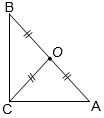
In a $\Delta ABC,$ let $\angle C = \frac{\pi}{2}.$ If $r$ and $R$ are the inradius and the circumradius respectively of the triangle,then $2(r + R)$ is equal to
A
$a + b$
B
$b + c$
C
$c + a$
D
$a + b + c$
Solution
(A) In a right-angled triangle $\Delta ABC$ with $\angle C = \frac{\pi}{2},$ the hypotenuse is $c = AB.$
The circumradius $R$ is half of the hypotenuse,so $R = \frac{c}{2}.$
The inradius $r$ is given by $r = \frac{\Delta}{s},$ where $\Delta = \frac{1}{2}ab$ and $s = \frac{a + b + c}{2}.$
Thus,$r = \frac{\frac{1}{2}ab}{\frac{1}{2}(a + b + c)} = \frac{ab}{a + b + c}.$
Now,$r + R = \frac{ab}{a + b + c} + \frac{c}{2} = \frac{2ab + c(a + b + c)}{2(a + b + c)}.$
Since $c^2 = a^2 + b^2,$ we have $2ab + c(a + b + c) = 2ab + ca + cb + c^2 = 2ab + ca + cb + a^2 + b^2 = (a + b)^2 + c(a + b) = (a + b)(a + b + c).$
Therefore,$r + R = \frac{(a + b)(a + b + c)}{2(a + b + c)} = \frac{a + b}{2}.$
Hence,$2(r + R) = a + b.$
The circumradius $R$ is half of the hypotenuse,so $R = \frac{c}{2}.$
The inradius $r$ is given by $r = \frac{\Delta}{s},$ where $\Delta = \frac{1}{2}ab$ and $s = \frac{a + b + c}{2}.$
Thus,$r = \frac{\frac{1}{2}ab}{\frac{1}{2}(a + b + c)} = \frac{ab}{a + b + c}.$
Now,$r + R = \frac{ab}{a + b + c} + \frac{c}{2} = \frac{2ab + c(a + b + c)}{2(a + b + c)}.$
Since $c^2 = a^2 + b^2,$ we have $2ab + c(a + b + c) = 2ab + ca + cb + c^2 = 2ab + ca + cb + a^2 + b^2 = (a + b)^2 + c(a + b) = (a + b)(a + b + c).$
Therefore,$r + R = \frac{(a + b)(a + b + c)}{2(a + b + c)} = \frac{a + b}{2}.$
Hence,$2(r + R) = a + b.$
0 likesView Solution
12
MathematicsMediumMCQIIT JEE · 2000
The triangle $PQR$ is inscribed in the circle $x^2 + y^2 = 25$. If $Q$ and $R$ have coordinates $(3, 4)$ and $(-4, 3)$ respectively,then $\angle QPR$ is equal to
A
$\frac{\pi}{2}$
B
$\frac{\pi}{3}$
C
$\frac{\pi}{4}$
D
$\frac{\pi}{6}$
Solution
(C) The circle is given by $x^2 + y^2 = 25$,which has its center at the origin $O(0, 0)$ and radius $r = 5$.
The coordinates of $Q$ are $(3, 4)$ and $R$ are $(-4, 3)$.
The slope of $OQ$ is $m_1 = \frac{4 - 0}{3 - 0} = \frac{4}{3}$.
The slope of $OR$ is $m_2 = \frac{3 - 0}{-4 - 0} = -\frac{3}{4}$.
Since $m_1 \times m_2 = \left(\frac{4}{3}\right) \times \left(-\frac{3}{4}\right) = -1$,the lines $OQ$ and $OR$ are perpendicular to each other.
Therefore,the central angle $\angle QOR = \frac{\pi}{2}$.
According to the circle theorem,the angle subtended by an arc at the center is double the angle subtended by it at any point on the remaining part of the circle.
Thus,$\angle QPR = \frac{1}{2} \angle QOR = \frac{1}{2} \times \frac{\pi}{2} = \frac{\pi}{4}$.
The coordinates of $Q$ are $(3, 4)$ and $R$ are $(-4, 3)$.
The slope of $OQ$ is $m_1 = \frac{4 - 0}{3 - 0} = \frac{4}{3}$.
The slope of $OR$ is $m_2 = \frac{3 - 0}{-4 - 0} = -\frac{3}{4}$.
Since $m_1 \times m_2 = \left(\frac{4}{3}\right) \times \left(-\frac{3}{4}\right) = -1$,the lines $OQ$ and $OR$ are perpendicular to each other.
Therefore,the central angle $\angle QOR = \frac{\pi}{2}$.
According to the circle theorem,the angle subtended by an arc at the center is double the angle subtended by it at any point on the remaining part of the circle.
Thus,$\angle QPR = \frac{1}{2} \angle QOR = \frac{1}{2} \times \frac{\pi}{2} = \frac{\pi}{4}$.
0 likesView Solution
13
MathematicsDifficultMCQIIT JEE · 2000
Let $PS$ be the median of the triangle with vertices $P(2, 2)$,$Q(6, -1)$,and $R(7, 3)$. The equation of the line passing through $(1, -1)$ and parallel to $PS$ is
A
$2x - 9y - 7 = 0$
B
$2x - 9y - 11 = 0$
C
$2x + 9y - 11 = 0$
D
$2x + 9y + 7 = 0$
Solution
(D) The median $PS$ connects vertex $P(2, 2)$ to the midpoint $S$ of side $QR$.
$S = \left( \frac{6 + 7}{2}, \frac{-1 + 3}{2} \right) = \left( \frac{13}{2}, 1 \right)$.
The slope $m$ of $PS$ is given by $m = \frac{1 - 2}{\frac{13}{2} - 2} = \frac{-1}{\frac{9}{2}} = -\frac{2}{9}$.
Since the required line is parallel to $PS$,its slope is also $-\frac{2}{9}$.
The equation of the line passing through $(1, -1)$ with slope $-\frac{2}{9}$ is:
$y - (-1) = -\frac{2}{9}(x - 1)$
$9(y + 1) = -2(x - 1)$
$9y + 9 = -2x + 2$
$2x + 9y + 7 = 0$.
$S = \left( \frac{6 + 7}{2}, \frac{-1 + 3}{2} \right) = \left( \frac{13}{2}, 1 \right)$.
The slope $m$ of $PS$ is given by $m = \frac{1 - 2}{\frac{13}{2} - 2} = \frac{-1}{\frac{9}{2}} = -\frac{2}{9}$.
Since the required line is parallel to $PS$,its slope is also $-\frac{2}{9}$.
The equation of the line passing through $(1, -1)$ with slope $-\frac{2}{9}$ is:
$y - (-1) = -\frac{2}{9}(x - 1)$
$9(y + 1) = -2(x - 1)$
$9y + 9 = -2x + 2$
$2x + 9y + 7 = 0$.
0 likesView Solution
14
MathematicsEasyMCQIIT JEE · 2000
If $x + y = k$ is a normal to the parabola ${y^2} = 12x$,then $k$ is
A
$3$
B
$9$
C
$-9$
D
$-3$
Solution
(B) The equation of the parabola is ${y^2} = 12x$,which is of the form ${y^2} = 4ax$,where $a = 3$.
The equation of a normal to the parabola ${y^2} = 4ax$ at point $t$ is given by $y + tx = 2at + at^3$.
Substituting $a = 3$,the normal equation becomes $y + tx = 6t + 3t^3$.
Comparing this with the given normal $x + y = k$,we have $tx + y = 6t + 3t^3$ and $x + y = k$.
Since these represent the same line,the coefficients must be proportional:
$\frac{t}{1} = \frac{1}{1} = \frac{6t + 3t^3}{k}$.
From $\frac{t}{1} = 1$,we get $t = 1$.
Substituting $t = 1$ into the ratio $\frac{1}{1} = \frac{6(1) + 3(1)^3}{k}$,we get $1 = \frac{6 + 3}{k}$,which implies $k = 9$.
The equation of a normal to the parabola ${y^2} = 4ax$ at point $t$ is given by $y + tx = 2at + at^3$.
Substituting $a = 3$,the normal equation becomes $y + tx = 6t + 3t^3$.
Comparing this with the given normal $x + y = k$,we have $tx + y = 6t + 3t^3$ and $x + y = k$.
Since these represent the same line,the coefficients must be proportional:
$\frac{t}{1} = \frac{1}{1} = \frac{6t + 3t^3}{k}$.
From $\frac{t}{1} = 1$,we get $t = 1$.
Substituting $t = 1$ into the ratio $\frac{1}{1} = \frac{6(1) + 3(1)^3}{k}$,we get $1 = \frac{6 + 3}{k}$,which implies $k = 9$.
0 likesView Solution
15
MathematicsDifficultMCQIIT JEE · 2000
The line $x - 1 = 0$ is the directrix of the parabola ${y^2} - kx + 8 = 0$. Then one of the values of $k$ is
A
$1/8$
B
$8$
C
$4$
D
$1/4$
Solution
(C) The given equation of the parabola is ${y^2} - kx + 8 = 0$,which can be rewritten as ${y^2} = k(x - 8/k)$.
This is in the form ${Y^2} = 4AX$,where $Y = y$,$X = x - 8/k$,and $4A = k$,so $A = k/4$.
The directrix of the parabola ${Y^2} = 4AX$ is $X + A = 0$.
Substituting the values of $X$ and $A$,we get $(x - 8/k) + k/4 = 0$,which simplifies to $x = 8/k - k/4$.
We are given that the directrix is $x - 1 = 0$,or $x = 1$.
Equating the two expressions for $x$,we have $8/k - k/4 = 1$.
Multiplying by $4k$,we get $32 - k^2 = 4k$,or ${k^2} + 4k - 32 = 0$.
Factoring the quadratic equation,we get $(k + 8)(k - 4) = 0$.
Thus,the values of $k$ are $k = -8$ or $k = 4$.
This is in the form ${Y^2} = 4AX$,where $Y = y$,$X = x - 8/k$,and $4A = k$,so $A = k/4$.
The directrix of the parabola ${Y^2} = 4AX$ is $X + A = 0$.
Substituting the values of $X$ and $A$,we get $(x - 8/k) + k/4 = 0$,which simplifies to $x = 8/k - k/4$.
We are given that the directrix is $x - 1 = 0$,or $x = 1$.
Equating the two expressions for $x$,we have $8/k - k/4 = 1$.
Multiplying by $4k$,we get $32 - k^2 = 4k$,or ${k^2} + 4k - 32 = 0$.
Factoring the quadratic equation,we get $(k + 8)(k - 4) = 0$.
Thus,the values of $k$ are $k = -8$ or $k = 4$.
0 likesView Solution
16
MathematicsMediumMCQIIT JEE · 2000
Let $f(\theta) = \sin \theta (\sin \theta + \sin 3\theta)$,then $f(\theta)$
A
$ \ge 0$ only when $\theta \ge 0$
B
$ \le 0$ for all real $\theta$
C
$ \ge 0$ for all real $\theta$
D
$ \le 0$ only when $\theta \le 0$
Solution
(C) Given $f(\theta) = \sin \theta (\sin \theta + \sin 3\theta)$.
Using the identity $\sin 3\theta = 3\sin \theta - 4\sin^3 \theta$,we have:
$f(\theta) = \sin \theta (\sin \theta + 3\sin \theta - 4\sin^3 \theta)$
$f(\theta) = \sin \theta (4\sin \theta - 4\sin^3 \theta)$
$f(\theta) = 4\sin^2 \theta (1 - \sin^2 \theta)$
Since $1 - \sin^2 \theta = \cos^2 \theta$,we get:
$f(\theta) = 4\sin^2 \theta \cos^2 \theta$
$f(\theta) = (2 \sin \theta \cos \theta)^2$
$f(\theta) = (\sin 2\theta)^2$
Since the square of any real number is always non-negative,$(\sin 2\theta)^2 \ge 0$ for all real $\theta$.
Therefore,$f(\theta) \ge 0$ for all real $\theta$.
Using the identity $\sin 3\theta = 3\sin \theta - 4\sin^3 \theta$,we have:
$f(\theta) = \sin \theta (\sin \theta + 3\sin \theta - 4\sin^3 \theta)$
$f(\theta) = \sin \theta (4\sin \theta - 4\sin^3 \theta)$
$f(\theta) = 4\sin^2 \theta (1 - \sin^2 \theta)$
Since $1 - \sin^2 \theta = \cos^2 \theta$,we get:
$f(\theta) = 4\sin^2 \theta \cos^2 \theta$
$f(\theta) = (2 \sin \theta \cos \theta)^2$
$f(\theta) = (\sin 2\theta)^2$
Since the square of any real number is always non-negative,$(\sin 2\theta)^2 \ge 0$ for all real $\theta$.
Therefore,$f(\theta) \ge 0$ for all real $\theta$.
0 likesView Solution
17
MathematicsMediumMCQIIT JEE · 2000
For $x \in R$,$\mathop {\lim }\limits_{x \to \infty } {\left( {\frac{{x - 3}}{{x + 2}}} \right)^x}$ is equal to
A
$e$
B
$e^{-1}$
C
$e^{-5}$
D
$e^5$
Solution
(C) We use the standard limit formula $\mathop {\lim }\limits_{x \to \infty } {(1 + \frac{a}{x})^x} = e^a$.
Given expression: $\mathop {\lim }\limits_{x \to \infty } {\left( {\frac{{x - 3}}{{x + 2}}} \right)^x} = \mathop {\lim }\limits_{x \to \infty } {\left( {\frac{{x + 2 - 5}}{{x + 2}}} \right)^x} = \mathop {\lim }\limits_{x \to \infty } {\left( {1 - \frac{5}{{x + 2}}} \right)^x}$.
Rewrite the expression as: $\mathop {\lim }\limits_{x \to \infty } {\left[ {{{\left( {1 - \frac{5}{{x + 2}}} \right)}^{\frac{{x + 2}}{{-5}}}}} \right]^{\frac{-5x}{x + 2}}}$.
Since $\mathop {\lim }\limits_{x \to \infty } {\left( {1 - \frac{5}{{x + 2}}} \right)^{\frac{x + 2}{-5}}} = e$ and $\mathop {\lim }\limits_{x \to \infty } \frac{-5x}{x + 2} = \mathop {\lim }\limits_{x \to \infty } \frac{-5}{1 + \frac{2}{x}} = -5$.
The limit is $e^{-5}$.
Given expression: $\mathop {\lim }\limits_{x \to \infty } {\left( {\frac{{x - 3}}{{x + 2}}} \right)^x} = \mathop {\lim }\limits_{x \to \infty } {\left( {\frac{{x + 2 - 5}}{{x + 2}}} \right)^x} = \mathop {\lim }\limits_{x \to \infty } {\left( {1 - \frac{5}{{x + 2}}} \right)^x}$.
Rewrite the expression as: $\mathop {\lim }\limits_{x \to \infty } {\left[ {{{\left( {1 - \frac{5}{{x + 2}}} \right)}^{\frac{{x + 2}}{{-5}}}}} \right]^{\frac{-5x}{x + 2}}}$.
Since $\mathop {\lim }\limits_{x \to \infty } {\left( {1 - \frac{5}{{x + 2}}} \right)^{\frac{x + 2}{-5}}} = e$ and $\mathop {\lim }\limits_{x \to \infty } \frac{-5x}{x + 2} = \mathop {\lim }\limits_{x \to \infty } \frac{-5}{1 + \frac{2}{x}} = -5$.
The limit is $e^{-5}$.
0 likesView Solution
18
MathematicsMediumMCQIIT JEE · 2000
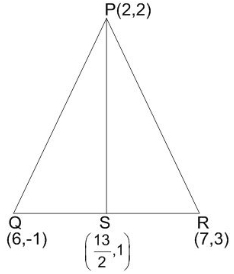
Let $PS$ be the median of the triangle with vertices $P(2,2)$,$Q(6,-1)$,and $R(7,3)$. The equation of the line passing through $(1,-1)$ and parallel to $PS$ is:
A
$4x + 7y + 3 = 0$
B
$2x - 9y - 11 = 0$
C
$4x - 7y - 11 = 0$
D
$2x + 9y + 7 = 0$
Solution
(D) The median $PS$ connects vertex $P(2,2)$ to the midpoint $S$ of side $QR$.
The coordinates of $S$ are $\left(\frac{6+7}{2}, \frac{-1+3}{2}\right) = \left(\frac{13}{2}, 1\right)$.
The slope of $PS$ is $m = \frac{1-2}{\frac{13}{2}-2} = \frac{-1}{\frac{9}{2}} = -\frac{2}{9}$.
Since the required line is parallel to $PS$,its slope is also $m = -\frac{2}{9}$.
The equation of the line passing through $(1,-1)$ with slope $m = -\frac{2}{9}$ is given by $y - y_1 = m(x - x_1)$.
$y - (-1) = -\frac{2}{9}(x - 1)$
$9(y + 1) = -2(x - 1)$
$9y + 9 = -2x + 2$
$2x + 9y + 7 = 0$.
The coordinates of $S$ are $\left(\frac{6+7}{2}, \frac{-1+3}{2}\right) = \left(\frac{13}{2}, 1\right)$.
The slope of $PS$ is $m = \frac{1-2}{\frac{13}{2}-2} = \frac{-1}{\frac{9}{2}} = -\frac{2}{9}$.
Since the required line is parallel to $PS$,its slope is also $m = -\frac{2}{9}$.
The equation of the line passing through $(1,-1)$ with slope $m = -\frac{2}{9}$ is given by $y - y_1 = m(x - x_1)$.
$y - (-1) = -\frac{2}{9}(x - 1)$
$9(y + 1) = -2(x - 1)$
$9y + 9 = -2x + 2$
$2x + 9y + 7 = 0$.
0 likesView Solution
19
MathematicsDifficultMCQIIT JEE · 2000
The complex numbers $z_1, z_2$ and $z_3$ satisfying $\frac{z_1 - z_3}{z_2 - z_3} = \frac{1 - i\sqrt{3}}{2}$ are the vertices of a triangle which is
A
Of area = $0$
B
Right angled isosceles
C
Equilateral
D
Obtuse angled isosceles
Solution
(C) Given $\frac{z_1 - z_3}{z_2 - z_3} = \frac{1}{2} - i\frac{\sqrt{3}}{2}$.
Taking the modulus on both sides,we get $\left| \frac{z_1 - z_3}{z_2 - z_3} \right| = \sqrt{\left( \frac{1}{2} \right)^2 + \left( -\frac{\sqrt{3}}{2} \right)^2} = \sqrt{\frac{1}{4} + \frac{3}{4}} = 1$.
This implies $|z_1 - z_3| = |z_2 - z_3|$,meaning two sides of the triangle are equal.
Now,the argument of the complex number is $\text{amp}\left( \frac{z_1 - z_3}{z_2 - z_3} \right) = \tan^{-1}\left( \frac{-\sqrt{3}/2}{1/2} \right) = \tan^{-1}(-\sqrt{3}) = -\frac{\pi}{3}$.
This means the angle between the sides $z_1 - z_3$ and $z_2 - z_3$ is $60^\circ$.
Since two sides are equal and the included angle is $60^\circ$,the triangle is equilateral.
Taking the modulus on both sides,we get $\left| \frac{z_1 - z_3}{z_2 - z_3} \right| = \sqrt{\left( \frac{1}{2} \right)^2 + \left( -\frac{\sqrt{3}}{2} \right)^2} = \sqrt{\frac{1}{4} + \frac{3}{4}} = 1$.
This implies $|z_1 - z_3| = |z_2 - z_3|$,meaning two sides of the triangle are equal.
Now,the argument of the complex number is $\text{amp}\left( \frac{z_1 - z_3}{z_2 - z_3} \right) = \tan^{-1}\left( \frac{-\sqrt{3}/2}{1/2} \right) = \tan^{-1}(-\sqrt{3}) = -\frac{\pi}{3}$.
This means the angle between the sides $z_1 - z_3$ and $z_2 - z_3$ is $60^\circ$.
Since two sides are equal and the included angle is $60^\circ$,the triangle is equilateral.
0 likesView Solution
20
MathematicsEasyMCQIIT JEE · 2000
$A$ pole stands vertically inside a triangular park $ABC$. If the angle of elevation of the top of the pole from each corner of the park is the same,then in the $\Delta ABC$,the foot of the pole is at the
A
Centroid
B
Circumcentre
C
Incentre
D
Orthocentre
Solution
(B) Let the height of the pole be $h$ and the foot of the pole be $P$. Let the corners of the park be $A, B,$ and $C$.
Given that the angle of elevation $\theta$ of the top of the pole from each corner is the same.
In the right-angled triangles formed by the pole and the distance from the foot $P$ to each corner,we have $\tan(\theta) = \frac{h}{PA} = \frac{h}{PB} = \frac{h}{PC}$.
Since $h$ and $\theta$ are constant,it follows that $PA = PB = PC$.
The point that is equidistant from all the vertices of a triangle is the circumcentre of the triangle.
Given that the angle of elevation $\theta$ of the top of the pole from each corner is the same.
In the right-angled triangles formed by the pole and the distance from the foot $P$ to each corner,we have $\tan(\theta) = \frac{h}{PA} = \frac{h}{PB} = \frac{h}{PC}$.
Since $h$ and $\theta$ are constant,it follows that $PA = PB = PC$.
The point that is equidistant from all the vertices of a triangle is the circumcentre of the triangle.
0 likesView Solution
21
MathematicsEasyMCQIIT JEE · 2000
If $arg(z) < 0$,then $arg(-z) - arg(z)$ equals
A
$\frac{\pi}{2}$
B
$-\frac{\pi}{2}$
C
$\pi$
D
$-\pi$
Solution
(C) We know that $arg(-z) = arg(-1 \times z)$.
Using the property $arg(z_1 z_2) = arg(z_1) + arg(z_2)$,we get $arg(-z) = arg(-1) + arg(z)$.
Since $arg(-1) = \pi$,we have $arg(-z) = \pi + arg(z)$.
Therefore,$arg(-z) - arg(z) = (\pi + arg(z)) - arg(z) = \pi$.
Using the property $arg(z_1 z_2) = arg(z_1) + arg(z_2)$,we get $arg(-z) = arg(-1) + arg(z)$.
Since $arg(-1) = \pi$,we have $arg(-z) = \pi + arg(z)$.
Therefore,$arg(-z) - arg(z) = (\pi + arg(z)) - arg(z) = \pi$.
0 likesView Solution
22
MathematicsEasyMCQIIT JEE · 2000
If the circles $x^{2}+y^{2}+2x+2ky+6=0$ and $x^{2}+y^{2}+2ky+k=0$ intersect orthogonally,then $k$ is equal to
A
$2$ or $-\frac{3}{2}$
B
$-2$ or $-\frac{3}{2}$
C
$2$ or $\frac{3}{2}$
D
$-2$ or $\frac{3}{2}$
Solution
(A) Two circles $x^{2}+y^{2}+2g_{1}x+2f_{1}y+c_{1}=0$ and $x^{2}+y^{2}+2g_{2}x+2f_{2}y+c_{2}=0$ intersect orthogonally if and only if $2(g_{1}g_{2}+f_{1}f_{2})=c_{1}+c_{2}$.
For the given circles:
Circle $1$: $g_{1}=1, f_{1}=k, c_{1}=6$
Circle $2$: $g_{2}=0, f_{2}=k, c_{2}=k$
Substituting these values into the condition:
$2((1)(0) + (k)(k)) = 6 + k$
$2k^{2} = 6 + k$
$2k^{2} - k - 6 = 0$
Factoring the quadratic equation:
$2k^{2} - 4k + 3k - 6 = 0$
$2k(k-2) + 3(k-2) = 0$
$(k-2)(2k+3) = 0$
Thus,$k = 2$ or $k = -\frac{3}{2}$.
For the given circles:
Circle $1$: $g_{1}=1, f_{1}=k, c_{1}=6$
Circle $2$: $g_{2}=0, f_{2}=k, c_{2}=k$
Substituting these values into the condition:
$2((1)(0) + (k)(k)) = 6 + k$
$2k^{2} = 6 + k$
$2k^{2} - k - 6 = 0$
Factoring the quadratic equation:
$2k^{2} - 4k + 3k - 6 = 0$
$2k(k-2) + 3(k-2) = 0$
$(k-2)(2k+3) = 0$
Thus,$k = 2$ or $k = -\frac{3}{2}$.
0 likesView Solution
23
MathematicsMediumMCQIIT JEE · 2000
If the system of equations $x - ky - z = 0$,$kx - y - z = 0$ and $x + y - z = 0$ has a non-zero solution,then the possible values of $k$ are:
A
$-1, 2$
B
$1, 2$
C
$0, 1$
D
$-1, 1$
Solution
(D) For a system of linear equations to have a non-zero (non-trivial) solution,the determinant of the coefficient matrix must be equal to zero,i.e.,$\Delta = 0$.
The system is given by:
$x - ky - z = 0$
$kx - y - z = 0$
$x + y - z = 0$
The determinant $\Delta$ is:
$\Delta = \begin{vmatrix} 1 & -k & -1 \\ k & -1 & -1 \\ 1 & 1 & -1 \end{vmatrix} = 0$
Expanding along the first row:
$1((-1)(-1) - (-1)(1)) - (-k)((k)(-1) - (-1)(1)) + (-1)((k)(1) - (-1)(1)) = 0$
$1(1 + 1) + k(-k + 1) - 1(k + 1) = 0$
$2 - k^2 + k - k - 1 = 0$
$1 - k^2 = 0$
$k^2 = 1$
$k = \pm 1$
Thus,the possible values of $k$ are $1$ and $-1$.
The system is given by:
$x - ky - z = 0$
$kx - y - z = 0$
$x + y - z = 0$
The determinant $\Delta$ is:
$\Delta = \begin{vmatrix} 1 & -k & -1 \\ k & -1 & -1 \\ 1 & 1 & -1 \end{vmatrix} = 0$
Expanding along the first row:
$1((-1)(-1) - (-1)(1)) - (-k)((k)(-1) - (-1)(1)) + (-1)((k)(1) - (-1)(1)) = 0$
$1(1 + 1) + k(-k + 1) - 1(k + 1) = 0$
$2 - k^2 + k - k - 1 = 0$
$1 - k^2 = 0$
$k^2 = 1$
$k = \pm 1$
Thus,the possible values of $k$ are $1$ and $-1$.
0 likesView Solution
24
MathematicsDifficultMCQIIT JEE · 2000
If the vectors $a, b$ and $c$ are represented by the sides $BC, CA$ and $AB$ respectively of the $\Delta ABC$,then
A
$a \cdot b + b \cdot c + c \cdot a = 0$
B
$a \times b = b \times c = c \times a$
C
$a \cdot b = b \cdot c = c \cdot a$
D
$a \times b = b \times c = c \times a = 0$
Solution
(B) In $\Delta ABC$,the vectors representing the sides are $BC = a$,$CA = b$,and $AB = c$.
By the triangle law of vector addition,the sum of vectors along the perimeter of a triangle in order is zero: $a + b + c = 0$.
Taking the cross product with $a$ on both sides: $a \times (a + b + c) = a \times 0 \implies a \times a + a \times b + a \times c = 0$.
Since $a \times a = 0$,we get $a \times b = c \times a$ (as $a \times c = -c \times a$).
Similarly,taking the cross product with $b$: $b \times (a + b + c) = b \times 0 \implies b \times a + b \times b + b \times c = 0$.
Since $b \times b = 0$,we get $b \times a + b \times c = 0 \implies b \times c = a \times b$.
Combining these,we have $a \times b = b \times c = c \times a$.
By the triangle law of vector addition,the sum of vectors along the perimeter of a triangle in order is zero: $a + b + c = 0$.
Taking the cross product with $a$ on both sides: $a \times (a + b + c) = a \times 0 \implies a \times a + a \times b + a \times c = 0$.
Since $a \times a = 0$,we get $a \times b = c \times a$ (as $a \times c = -c \times a$).
Similarly,taking the cross product with $b$: $b \times (a + b + c) = b \times 0 \implies b \times a + b \times b + b \times c = 0$.
Since $b \times b = 0$,we get $b \times a + b \times c = 0 \implies b \times c = a \times b$.
Combining these,we have $a \times b = b \times c = c \times a$.
0 likesView Solution
25
MathematicsMediumMCQIIT JEE · 2000
If $a, b,$ and $c$ are unit coplanar vectors,then the scalar triple product $[a, b, c]$ is equal to:
A
$0$
B
$1$
C
$-\sqrt{3}$
D
$\sqrt{3}$
Solution
(A) The scalar triple product of three vectors $a, b,$ and $c$ is defined as $[a, b, c] = a \cdot (b \times c)$.
If three vectors are coplanar,they lie in the same plane.
For any three coplanar vectors,the volume of the parallelepiped formed by them is zero.
Since the scalar triple product represents the volume of the parallelepiped,it follows that $[a, b, c] = 0$ for any set of coplanar vectors.
Therefore,if $a, b,$ and $c$ are unit coplanar vectors,their scalar triple product is $0$.
If three vectors are coplanar,they lie in the same plane.
For any three coplanar vectors,the volume of the parallelepiped formed by them is zero.
Since the scalar triple product represents the volume of the parallelepiped,it follows that $[a, b, c] = 0$ for any set of coplanar vectors.
Therefore,if $a, b,$ and $c$ are unit coplanar vectors,their scalar triple product is $0$.
0 likesView Solution
26
MathematicsMediumMCQIIT JEE · 2000
Let the vectors $a, b, c$ and $d$ be such that $(a \times b) \times (c \times d) = 0$. Let $P_1$ and $P_2$ be planes determined by the pairs of vectors $(a, b)$ and $(c, d)$ respectively. Then the angle between $P_1$ and $P_2$ is:
A
$0^o$
B
$\frac{\pi}{4}$
C
$\frac{\pi}{3}$
D
$\frac{\pi}{2}$
Solution
(A) vector perpendicular to the plane $P_1$ formed by vectors $a$ and $b$ is given by $n_1 = a \times b$.
$A$ vector perpendicular to the plane $P_2$ formed by vectors $c$ and $d$ is given by $n_2 = c \times d$.
Given the condition $(a \times b) \times (c \times d) = 0$,it implies that the vector $n_1$ is parallel to the vector $n_2$ (i.e.,$n_1 \parallel n_2$).
Since the normal vectors to the planes are parallel,the planes $P_1$ and $P_2$ are parallel to each other.
Therefore,the angle between the planes $P_1$ and $P_2$ is $0^o$.
$A$ vector perpendicular to the plane $P_2$ formed by vectors $c$ and $d$ is given by $n_2 = c \times d$.
Given the condition $(a \times b) \times (c \times d) = 0$,it implies that the vector $n_1$ is parallel to the vector $n_2$ (i.e.,$n_1 \parallel n_2$).
Since the normal vectors to the planes are parallel,the planes $P_1$ and $P_2$ are parallel to each other.
Therefore,the angle between the planes $P_1$ and $P_2$ is $0^o$.
0 likesView Solution
27
MathematicsEasyMCQIIT JEE · 2000
The domain of definition of the function $y(x)$ given by $2^x + 2^y = 2$ is
A
$(0, 1]$
B
$[0, 1]$
C
$( - \infty , 0]$
D
$( - \infty , 1)$
Solution
(D) Given the equation $2^x + 2^y = 2$.
We can rewrite this as $2^y = 2 - 2^x$.
For $y$ to be a real number,the value of $2^y$ must be strictly greater than $0$.
Therefore,$2 - 2^x > 0$.
This implies $2 > 2^x$.
Since the base $2 > 1$,the inequality holds when the exponents satisfy $1 > x$.
Thus,the domain of $x$ is $( - \infty , 1)$.
We can rewrite this as $2^y = 2 - 2^x$.
For $y$ to be a real number,the value of $2^y$ must be strictly greater than $0$.
Therefore,$2 - 2^x > 0$.
This implies $2 > 2^x$.
Since the base $2 > 1$,the inequality holds when the exponents satisfy $1 > x$.
Thus,the domain of $x$ is $( - \infty , 1)$.
0 likesView Solution
28
MathematicsEasyMCQIIT JEE · 2000
Consider the following statements $S$ and $R$:
$S$: Both $\sin x$ and $\cos x$ are decreasing functions in $\left( \frac{\pi}{2}, \pi \right)$.
$R$: If a differentiable function decreases in $(a, b)$,then its derivative also decreases in $(a, b)$.
Which of the following is true?
$S$: Both $\sin x$ and $\cos x$ are decreasing functions in $\left( \frac{\pi}{2}, \pi \right)$.
$R$: If a differentiable function decreases in $(a, b)$,then its derivative also decreases in $(a, b)$.
Which of the following is true?
A
Both $S$ and $R$ are wrong.
B
Both $S$ and $R$ are correct,but $R$ is not the correct explanation for $S$.
C
$S$ is correct and $R$ is the correct explanation for $S$.
D
$S$ is correct and $R$ is wrong.
Solution
(D) Statement $S$: In the interval $\left( \frac{\pi}{2}, \pi \right)$,$\sin x$ decreases from $1$ to $0$,and $\cos x$ decreases from $0$ to $-1$. Therefore,both functions are decreasing in this interval. Thus,statement $S$ is correct.
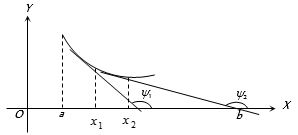
Statement $R$: If a function $f(x)$ is decreasing in $(a, b)$,it implies $f'(x) \le 0$. It does not necessarily imply that $f'(x)$ is a decreasing function. For example,consider $f(x) = -x^3$ on $(-1, 1)$. Here $f'(x) = -3x^2$,which is not a decreasing function on $(-1, 1)$. The provided graph also illustrates a case where a function is decreasing,but its slope (derivative) is increasing. Thus,statement $R$ is incorrect.
Conclusion: $S$ is correct and $R$ is wrong. The correct option is $D$.
Statement $R$: If a function $f(x)$ is decreasing in $(a, b)$,it implies $f'(x) \le 0$. It does not necessarily imply that $f'(x)$ is a decreasing function. For example,consider $f(x) = -x^3$ on $(-1, 1)$. Here $f'(x) = -3x^2$,which is not a decreasing function on $(-1, 1)$. The provided graph also illustrates a case where a function is decreasing,but its slope (derivative) is increasing. Thus,statement $R$ is incorrect.
Conclusion: $S$ is correct and $R$ is wrong. The correct option is $D$.
0 likesView Solution
29
MathematicsMediumMCQIIT JEE · 2000
For all $x \in (0, 1)$,which of the following inequalities is true?
A
$e^x < 1 + x$
B
$\log_e(1 + x) < x$
C
$\sin x > x$
D
$\log_e x > x$
Solution
(B) Consider the function $f(x) = x - \log_e(1 + x)$ for $x \in (0, 1)$.
Taking the derivative,we get $f'(x) = 1 - \frac{1}{1 + x} = \frac{1 + x - 1}{1 + x} = \frac{x}{1 + x}$.
Since $x > 0$,$f'(x) > 0$ for all $x \in (0, 1)$.
This implies that $f(x)$ is a strictly increasing function on $(0, 1)$.
Since $f(0) = 0 - \log_e(1) = 0$,and $f(x)$ is strictly increasing,$f(x) > f(0)$ for all $x > 0$.
Therefore,$x - \log_e(1 + x) > 0$,which means $\log_e(1 + x) < x$ for all $x \in (0, 1)$.
Thus,option $(b)$ is correct.
Taking the derivative,we get $f'(x) = 1 - \frac{1}{1 + x} = \frac{1 + x - 1}{1 + x} = \frac{x}{1 + x}$.
Since $x > 0$,$f'(x) > 0$ for all $x \in (0, 1)$.
This implies that $f(x)$ is a strictly increasing function on $(0, 1)$.
Since $f(0) = 0 - \log_e(1) = 0$,and $f(x)$ is strictly increasing,$f(x) > f(0)$ for all $x > 0$.
Therefore,$x - \log_e(1 + x) > 0$,which means $\log_e(1 + x) < x$ for all $x \in (0, 1)$.
Thus,option $(b)$ is correct.
0 likesView Solution
30
MathematicsDifficultMCQIIT JEE · 2000
The value of $\int_{e^{-1}}^{e^2} \left| \frac{\log_e x}{x} \right| dx$ is
A
$\frac{3}{2}$
B
$\frac{5}{2}$
C
$3$
D
$5$
Solution
(B) Let $I = \int_{e^{-1}}^{e^2} \left| \frac{\log_e x}{x} \right| dx$.
Since $\log_e x < 0$ for $x \in [e^{-1}, 1)$ and $\log_e x \ge 0$ for $x \in [1, e^2]$,we split the integral:
$I = \int_{e^{-1}}^{1} -\frac{\log_e x}{x} dx + \int_{1}^{e^2} \frac{\log_e x}{x} dx$.
Let $z = \log_e x$,then $dz = \frac{1}{x} dx$.
When $x = e^{-1}, z = -1$. When $x = 1, z = 0$. When $x = e^2, z = 2$.
$I = \int_{-1}^{0} -z dz + \int_{0}^{2} z dz$.
$I = \left[ -\frac{z^2}{2} \right]_{-1}^{0} + \left[ \frac{z^2}{2} \right]_{0}^{2}$.
$I = (0 - (-1/2)) + (4/2 - 0) = \frac{1}{2} + 2 = \frac{5}{2}$.
Since $\log_e x < 0$ for $x \in [e^{-1}, 1)$ and $\log_e x \ge 0$ for $x \in [1, e^2]$,we split the integral:
$I = \int_{e^{-1}}^{1} -\frac{\log_e x}{x} dx + \int_{1}^{e^2} \frac{\log_e x}{x} dx$.
Let $z = \log_e x$,then $dz = \frac{1}{x} dx$.
When $x = e^{-1}, z = -1$. When $x = 1, z = 0$. When $x = e^2, z = 2$.
$I = \int_{-1}^{0} -z dz + \int_{0}^{2} z dz$.
$I = \left[ -\frac{z^2}{2} \right]_{-1}^{0} + \left[ \frac{z^2}{2} \right]_{0}^{2}$.
$I = (0 - (-1/2)) + (4/2 - 0) = \frac{1}{2} + 2 = \frac{5}{2}$.
0 likesView Solution
31
MathematicsMediumMCQIIT JEE · 2000
If $f(x) = \begin{cases} e^{\cos x}\sin x, & |x| \le 2 \\ 2, & \text{otherwise} \end{cases}$,then $\int_{-2}^{3} f(x) dx$ is equal to
A
$0$
B
$1$
C
$2$
D
$3$
Solution
(C) We are given the function $f(x) = \begin{cases} e^{\cos x}\sin x, & |x| \le 2 \\ 2, & \text{otherwise} \end{cases}$.
We need to evaluate the integral $I = \int_{-2}^{3} f(x) dx$.
We can split the integral at $x = 2$ as follows:
$I = \int_{-2}^{2} f(x) dx + \int_{2}^{3} f(x) dx$.
For the interval $[-2, 2]$,$f(x) = e^{\cos x}\sin x$. Let $g(x) = e^{\cos x}\sin x$. Then $g(-x) = e^{\cos(-x)}\sin(-x) = e^{\cos x}(-\sin x) = -g(x)$. Thus,$g(x)$ is an odd function.
By the property of definite integrals,if $g(x)$ is an odd function,then $\int_{-a}^{a} g(x) dx = 0$. Therefore,$\int_{-2}^{2} e^{\cos x}\sin x dx = 0$.
For the interval $(2, 3]$,$f(x) = 2$. Thus,$\int_{2}^{3} 2 dx = [2x]_{2}^{3} = 2(3 - 2) = 2$.
Adding these results,$I = 0 + 2 = 2$.
We need to evaluate the integral $I = \int_{-2}^{3} f(x) dx$.
We can split the integral at $x = 2$ as follows:
$I = \int_{-2}^{2} f(x) dx + \int_{2}^{3} f(x) dx$.
For the interval $[-2, 2]$,$f(x) = e^{\cos x}\sin x$. Let $g(x) = e^{\cos x}\sin x$. Then $g(-x) = e^{\cos(-x)}\sin(-x) = e^{\cos x}(-\sin x) = -g(x)$. Thus,$g(x)$ is an odd function.
By the property of definite integrals,if $g(x)$ is an odd function,then $\int_{-a}^{a} g(x) dx = 0$. Therefore,$\int_{-2}^{2} e^{\cos x}\sin x dx = 0$.
For the interval $(2, 3]$,$f(x) = 2$. Thus,$\int_{2}^{3} 2 dx = [2x]_{2}^{3} = 2(3 - 2) = 2$.
Adding these results,$I = 0 + 2 = 2$.
0 likesView Solution
32
MathematicsDifficultMCQIIT JEE · 2000
Let $g(x) = \int_0^x f(t) \, dt$ where $\frac{1}{2} \le f(t) \le 1$ for $t \in [0, 1]$ and $0 \le f(t) \le \frac{1}{2}$ for $t \in (1, 2]$. Then which of the following is true for $g(2)$?
A
$-\frac{3}{2} \le g(2) < \frac{1}{2}$
B
$0 \le g(2) < 2$
C
$\frac{3}{2} < g(2) \le \frac{5}{2}$
D
$2 < g(2) < 4$
Solution
(B) Given $g(2) = \int_0^2 f(t) \, dt = \int_0^1 f(t) \, dt + \int_1^2 f(t) \, dt$.
For $t \in [0, 1]$,we have $\frac{1}{2} \le f(t) \le 1$. Integrating this over $[0, 1]$:
$\int_0^1 \frac{1}{2} \, dt \le \int_0^1 f(t) \, dt \le \int_0^1 1 \, dt$
$\frac{1}{2} \le \int_0^1 f(t) \, dt \le 1 \quad \dots (i)$
For $t \in (1, 2]$,we have $0 \le f(t) \le \frac{1}{2}$. Integrating this over $(1, 2]$:
$\int_1^2 0 \, dt \le \int_1^2 f(t) \, dt \le \int_1^2 \frac{1}{2} \, dt$
$0 \le \int_1^2 f(t) \, dt \le \frac{1}{2} \quad \dots (ii)$
Adding $(i)$ and $(ii)$:
$\frac{1}{2} + 0 \le \int_0^1 f(t) \, dt + \int_1^2 f(t) \, dt \le 1 + \frac{1}{2}$
$\frac{1}{2} \le g(2) \le \frac{3}{2}$.
Since $\frac{1}{2} \le g(2) \le \frac{3}{2}$,the value of $g(2)$ lies within the interval $[0, 2)$. Thus,$0 \le g(2) < 2$ is the correct inequality.
For $t \in [0, 1]$,we have $\frac{1}{2} \le f(t) \le 1$. Integrating this over $[0, 1]$:
$\int_0^1 \frac{1}{2} \, dt \le \int_0^1 f(t) \, dt \le \int_0^1 1 \, dt$
$\frac{1}{2} \le \int_0^1 f(t) \, dt \le 1 \quad \dots (i)$
For $t \in (1, 2]$,we have $0 \le f(t) \le \frac{1}{2}$. Integrating this over $(1, 2]$:
$\int_1^2 0 \, dt \le \int_1^2 f(t) \, dt \le \int_1^2 \frac{1}{2} \, dt$
$0 \le \int_1^2 f(t) \, dt \le \frac{1}{2} \quad \dots (ii)$
Adding $(i)$ and $(ii)$:
$\frac{1}{2} + 0 \le \int_0^1 f(t) \, dt + \int_1^2 f(t) \, dt \le 1 + \frac{1}{2}$
$\frac{1}{2} \le g(2) \le \frac{3}{2}$.
Since $\frac{1}{2} \le g(2) \le \frac{3}{2}$,the value of $g(2)$ lies within the interval $[0, 2)$. Thus,$0 \le g(2) < 2$ is the correct inequality.
0 likesView Solution
33
MathematicsMediumMCQIIT JEE · 2000
If ${x^2} + {y^2} = 1$,then find the relation between $y'$ and $y''$,where $y' = \frac{dy}{dx}$ and $y'' = \frac{d^2y}{dx^2}$.
A
$yy'' - 2(y')^2 + 1 = 0$
B
$yy'' + (y')^2 + 1 = 0$
C
$yy'' - (y')^2 - 1 = 0$
D
$yy'' + 2(y')^2 + 1 = 0$
Solution
(B) Given the equation: ${x^2} + {y^2} = 1$.
Differentiating both sides with respect to $x$:
$\frac{d}{dx}({x^2} + {y^2}) = \frac{d}{dx}(1)$
$2x + 2y \frac{dy}{dx} = 0$
$x + y y' = 0$
Differentiating again with respect to $x$ using the product rule on $y y'$:
$\frac{d}{dx}(x) + \frac{d}{dx}(y y') = 0$
$1 + (y \cdot y'' + y' \cdot y') = 0$
$1 + y y'' + (y')^2 = 0$
Thus,the relation is $yy'' + (y')^2 + 1 = 0$.
Differentiating both sides with respect to $x$:
$\frac{d}{dx}({x^2} + {y^2}) = \frac{d}{dx}(1)$
$2x + 2y \frac{dy}{dx} = 0$
$x + y y' = 0$
Differentiating again with respect to $x$ using the product rule on $y y'$:
$\frac{d}{dx}(x) + \frac{d}{dx}(y y') = 0$
$1 + (y \cdot y'' + y' \cdot y') = 0$
$1 + y y'' + (y')^2 = 0$
Thus,the relation is $yy'' + (y')^2 + 1 = 0$.
0 likesView Solution
34
MathematicsMediumMCQIIT JEE · 2000
Let $f: R \to R$ be a function. Define $g: R \to R$ by $g(x) = |f(x)|$ for all $x$. Then $g$ is
A
Onto if $f$ is onto
B
One-one if $f$ is one-one
C
Continuous if $f$ is continuous
D
Differentiable if $f$ is differentiable
Solution
(C) The correct option is $(c)$.
$1$. $g(x) = |f(x)| \ge 0$ for all $x \in R$. Since the range of $g$ is a subset of $[0, \infty)$,$g$ cannot be onto if the codomain is $R$.
$2$. If $f(x)$ is one-one,$g(x)$ is not necessarily one-one. For example,if $f(x) = x$,then $f$ is one-one,but $g(x) = |x|$ is not one-one because $g(1) = g(-1) = 1$.
$3$. If $f(x)$ is continuous,then $g(x) = |f(x)|$ is also continuous. This is a standard property of continuous functions: the composition of a continuous function $f(x)$ with the continuous function $h(u) = |u|$ is continuous.
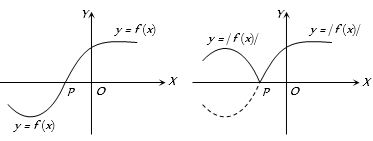
$4$. If $f(x)$ is differentiable,$g(x) = |f(x)|$ is not necessarily differentiable. As shown in the graph,if $f(x)$ crosses the $x$-axis at a point $P$ (where $f(P) = 0$),the function $g(x) = |f(x)|$ will have a sharp corner at $P$,making it non-differentiable at that point.
$1$. $g(x) = |f(x)| \ge 0$ for all $x \in R$. Since the range of $g$ is a subset of $[0, \infty)$,$g$ cannot be onto if the codomain is $R$.
$2$. If $f(x)$ is one-one,$g(x)$ is not necessarily one-one. For example,if $f(x) = x$,then $f$ is one-one,but $g(x) = |x|$ is not one-one because $g(1) = g(-1) = 1$.
$3$. If $f(x)$ is continuous,then $g(x) = |f(x)|$ is also continuous. This is a standard property of continuous functions: the composition of a continuous function $f(x)$ with the continuous function $h(u) = |u|$ is continuous.
$4$. If $f(x)$ is differentiable,$g(x) = |f(x)|$ is not necessarily differentiable. As shown in the graph,if $f(x)$ crosses the $x$-axis at a point $P$ (where $f(P) = 0$),the function $g(x) = |f(x)|$ will have a sharp corner at $P$,making it non-differentiable at that point.
0 likesView Solution
35
MathematicsMediumMCQIIT JEE · 2000
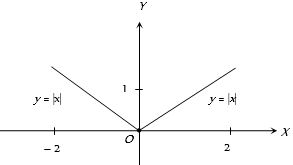
Let $f(x) = \begin{cases} |x|, & 0 < |x| \le 2 \\ 1, & x = 0 \end{cases}$,then at $x = 0$,$f$ has
A
$A$ local maximum
B
No local maximum
C
$A$ local minimum
D
No extremum
Solution
(A) The function is defined as $f(x) = |x|$ for $x \in [-2, 0) \cup (0, 2]$ and $f(0) = 1$.
For any small neighborhood $(0 - h, 0 + h)$ around $x = 0$ (where $h > 0$ is very small),we have:
$f(0) = 1$
For $x \neq 0$ in this neighborhood,$f(x) = |x|$. Since $x$ is very close to $0$,$|x| < 1$.
Thus,$f(x) < f(0)$ for all $x$ in the neighborhood of $0$.
By the definition of a local maximum,if $f(x) \le f(a)$ for all $x$ in some neighborhood of $a$,then $f$ has a local maximum at $x = a$.
Since $f(x) < f(0)$ for all $x \in (-h, h) \setminus \{0\}$,the function $f$ has a local maximum at $x = 0$.
For any small neighborhood $(0 - h, 0 + h)$ around $x = 0$ (where $h > 0$ is very small),we have:
$f(0) = 1$
For $x \neq 0$ in this neighborhood,$f(x) = |x|$. Since $x$ is very close to $0$,$|x| < 1$.
Thus,$f(x) < f(0)$ for all $x$ in the neighborhood of $0$.
By the definition of a local maximum,if $f(x) \le f(a)$ for all $x$ in some neighborhood of $a$,then $f$ has a local maximum at $x = a$.
Since $f(x) < f(0)$ for all $x \in (-h, h) \setminus \{0\}$,the function $f$ has a local maximum at $x = 0$.
0 likesView Solution
36
MathematicsMediumMCQIIT JEE · 2000
Let $f(x) = \int {e^x}(x - 1)(x - 2)dx$. Then $f$ decreases in the interval
A
$( - \infty , 1)$
B
$(1, 2)$
C
$(2, \infty )$
D
$( - \infty , 2)$
Solution
(B) Given $f(x) = \int {e^x}(x - 1)(x - 2)dx$.
By the Fundamental Theorem of Calculus,$f'(x) = \frac{d}{dx} \int {e^x}(x - 1)(x - 2)dx = {e^x}(x - 1)(x - 2)$.
For the function $f$ to be decreasing,we must have $f'(x) < 0$.
So,${e^x}(x - 1)(x - 2) < 0$.
Since ${e^x} > 0$ for all real $x$,the inequality simplifies to $(x - 1)(x - 2) < 0$.
Using the sign scheme for the quadratic expression $(x - 1)(x - 2)$,the product is negative between the roots $x = 1$ and $x = 2$.
Thus,$f$ decreases in the interval $(1, 2)$.
By the Fundamental Theorem of Calculus,$f'(x) = \frac{d}{dx} \int {e^x}(x - 1)(x - 2)dx = {e^x}(x - 1)(x - 2)$.
For the function $f$ to be decreasing,we must have $f'(x) < 0$.
So,${e^x}(x - 1)(x - 2) < 0$.
Since ${e^x} > 0$ for all real $x$,the inequality simplifies to $(x - 1)(x - 2) < 0$.
Using the sign scheme for the quadratic expression $(x - 1)(x - 2)$,the product is negative between the roots $x = 1$ and $x = 2$.
Thus,$f$ decreases in the interval $(1, 2)$.
0 likesView Solution
37
MathematicsMediumMCQIIT JEE · 2000
If the normal to the curve $y=f(x)$ at the point $(3,4)$ makes an angle $\left(\frac{3 \pi}{4}\right)^{C}$ with the positive $X$-axis,then $f^{\prime}(3)$ is equal to
A
$-1$
B
$1$
C
$\frac{4}{3}$
D
$-\frac{3}{4}$
Solution
(B) The slope of the normal to the curve $y=f(x)$ at a point is given by $m_n = \tan(\theta)$,where $\theta$ is the angle made with the positive $X$-axis.
Given $\theta = \frac{3 \pi}{4}$,the slope of the normal is $m_n = \tan\left(\frac{3 \pi}{4}\right) = -1$.
We know that the slope of the normal is also related to the derivative of the function by the formula $m_n = -\frac{1}{f^{\prime}(x)}$.
At the point $(3,4)$,we have $m_n = -\frac{1}{f^{\prime}(3)}$.
Equating the two expressions for the slope of the normal:
$-1 = -\frac{1}{f^{\prime}(3)}$
$f^{\prime}(3) = 1$.
Given $\theta = \frac{3 \pi}{4}$,the slope of the normal is $m_n = \tan\left(\frac{3 \pi}{4}\right) = -1$.
We know that the slope of the normal is also related to the derivative of the function by the formula $m_n = -\frac{1}{f^{\prime}(x)}$.
At the point $(3,4)$,we have $m_n = -\frac{1}{f^{\prime}(3)}$.
Equating the two expressions for the slope of the normal:
$-1 = -\frac{1}{f^{\prime}(3)}$
$f^{\prime}(3) = 1$.
0 likesView Solution
Vedclass Products
For Students
Vedclass Test Series
Mock tests in real IIT JEE style covering Mathematics with performance analysis. 5-day free trial.
Start Free TrialFor Teachers
Exam Paper Generator
Generate Set A/B/C/D Mathematics papers from 7.5L+ questions in 2 minutes. 3 chapters free.
Try FreeFor Institutes
Online Exam Module
Run live IIT JEE mock exams with unlimited students, 360° analytics & white-label branding.
See DemoFrequently Asked Questions
How many Mathematics questions are in IIT JEE 2000?
There are 37 Mathematics questions from the IIT JEE 2000 paper on Vedclass, each with a detailed step-by-step solution in English.
Are IIT JEE 2000 Mathematics solutions available in English?
Yes. All solutions on this page are in English. You can also switch to English or Hindi using the language buttons above the questions.
Can I practice IIT JEE 2000 Mathematics as a timed test?
Yes. Use the Vedclass Test Series to attempt a full IIT JEE mock test covering Mathematics with time limits and instant score analysis.
Can teachers create Mathematics papers from IIT JEE previous year questions?
Yes. The Vedclass Exam Paper Generator lets teachers mix IIT JEE Mathematics questions and generate Set A/B/C/D papers in minutes.
For Teachers & Institutes
Build a Custom Mathematics Paper
Pick IIT JEE 2000 Mathematics questions, set difficulty, and generate Set A/B/C/D in 2 minutes.