
PhysicsQ1–37 of 37 questions
Page 1 of 1 · English
1
PhysicsEasyMCQIIT JEE · 2000
Can the resultant of $2$ vectors be zero?
A
Yes,when the $2$ vectors are same in magnitude and direction.
B
No.
C
Yes,when the $2$ vectors are same in magnitude but opposite in sense.
D
Yes,when the $2$ vectors are same in magnitude making an angle of $\frac{2\pi}{3}$ with each other.
Solution
(C) The resultant of $2$ vectors $\vec{A}$ and $\vec{B}$ is given by $\vec{R} = \vec{A} + \vec{B}$.
For the resultant to be zero,$\vec{A} + \vec{B} = 0$,which implies $\vec{A} = -\vec{B}$.
This means the two vectors must have the same magnitude $(|A| = |B|)$ but must be directed in opposite directions (an angle of $180^{\circ}$ or $\pi$ radians between them).
Therefore,the correct condition is that the $2$ vectors are same in magnitude but opposite in sense.
For the resultant to be zero,$\vec{A} + \vec{B} = 0$,which implies $\vec{A} = -\vec{B}$.
This means the two vectors must have the same magnitude $(|A| = |B|)$ but must be directed in opposite directions (an angle of $180^{\circ}$ or $\pi$ radians between them).
Therefore,the correct condition is that the $2$ vectors are same in magnitude but opposite in sense.
0 likesView Solution
2
PhysicsDifficultMCQIIT JEE · 2000
$A$ ball is dropped vertically from a height $d$ above the ground. It hits the ground and bounces up vertically to a height $d/2$. Neglecting subsequent motion and air resistance,its velocity $v$ varies with the height $h$ above the ground as:
A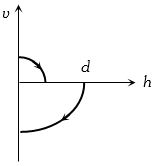
B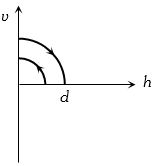
C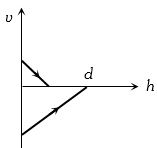
D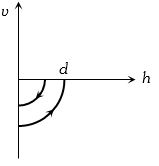
Solution
(A) For a ball dropped from height $d$,the velocity $v$ at any height $h$ is given by $v^2 = u^2 + 2a(s)$. Here,$u = 0$ and $a = -g$,so $v^2 = -2g(h - d) = 2g(d - h)$. This implies $v = \pm \sqrt{2g(d - h)}$.
$1$. During the downward motion from $h = d$ to $h = 0$,the velocity is negative (downward) and its magnitude increases as $h$ decreases. The relation $v = -\sqrt{2g(d - h)}$ represents a parabolic curve opening towards the positive $h$-axis.
$2$. At $h = 0$,the ball hits the ground. Just after the collision,it bounces up to a height $d/2$. The velocity becomes positive (upward) and its magnitude is determined by $v = \sqrt{2g(d/2 - h)}$.
$3$. As the ball moves upward from $h = 0$ to $h = d/2$,the velocity decreases from its maximum value to zero at $h = d/2$. This also follows a parabolic path.
Comparing these physical requirements with the given options,the graph that correctly represents the downward motion (negative velocity) and the subsequent upward motion (positive velocity) is option $(A)$.
$1$. During the downward motion from $h = d$ to $h = 0$,the velocity is negative (downward) and its magnitude increases as $h$ decreases. The relation $v = -\sqrt{2g(d - h)}$ represents a parabolic curve opening towards the positive $h$-axis.
$2$. At $h = 0$,the ball hits the ground. Just after the collision,it bounces up to a height $d/2$. The velocity becomes positive (upward) and its magnitude is determined by $v = \sqrt{2g(d/2 - h)}$.
$3$. As the ball moves upward from $h = 0$ to $h = d/2$,the velocity decreases from its maximum value to zero at $h = d/2$. This also follows a parabolic path.
Comparing these physical requirements with the given options,the graph that correctly represents the downward motion (negative velocity) and the subsequent upward motion (positive velocity) is option $(A)$.
0 likesView Solution
3
PhysicsDifficultMCQIIT JEE · 2000
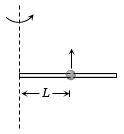
$A$ long horizontal rod has a bead which can slide along its length,and is initially placed at a distance $L$ from one end $A$ of the rod. The rod is set in angular motion about $A$ with constant angular acceleration $\alpha$. If the coefficient of friction between the rod and the bead is $\mu$,and gravity is neglected,then the time after which the bead starts slipping is
A
$\sqrt {\frac{\mu }{\alpha }} $
B
$\frac{\mu }{{\sqrt \alpha }}$
C
$\frac{1}{{\sqrt {\mu \alpha } }}$
D
Infinitesimal
Solution
(A) Let the bead start slipping after time $t$.
For the bead to slip,the net force acting on it must exceed the maximum static frictional force.
The forces acting on the bead in the rotating frame are the centrifugal force $F_c = m\omega^2 L$ (acting radially outward) and the tangential force $F_t = m a_t = m \alpha L$ (acting perpendicular to the rod).
The normal force $N$ is zero as gravity is neglected and there are no other vertical forces.
Wait,the friction force $f$ must balance the resultant of these forces. The maximum static friction is $f_{max} = \mu N$. Since there is no vertical force,$N$ is effectively provided by the constraint of the rod. However,in this specific problem context,the friction is assumed to be $\mu m a_t$ or similar. Re-evaluating: The bead slips when the resultant force $F_{net} = \sqrt{(m\omega^2 L)^2 + (m\alpha L)^2} = \mu N$. Assuming $N = m a_t = m \alpha L$ is not standard. Actually,the friction must oppose the tendency to move. The bead will slip when the net force required to keep it in circular motion exceeds the maximum available friction. The force required is $F = \sqrt{(m\omega^2 L)^2 + (m\alpha L)^2}$. Given the options,the intended logic is $m\omega^2 L = \mu m \alpha L$,which implies $\omega^2 = \mu \alpha$. Since $\omega = \alpha t$,we get $(\alpha t)^2 = \mu \alpha$,so $t^2 = \mu / \alpha$,or $t = \sqrt{\mu / \alpha}$.
For the bead to slip,the net force acting on it must exceed the maximum static frictional force.
The forces acting on the bead in the rotating frame are the centrifugal force $F_c = m\omega^2 L$ (acting radially outward) and the tangential force $F_t = m a_t = m \alpha L$ (acting perpendicular to the rod).
The normal force $N$ is zero as gravity is neglected and there are no other vertical forces.
Wait,the friction force $f$ must balance the resultant of these forces. The maximum static friction is $f_{max} = \mu N$. Since there is no vertical force,$N$ is effectively provided by the constraint of the rod. However,in this specific problem context,the friction is assumed to be $\mu m a_t$ or similar. Re-evaluating: The bead slips when the resultant force $F_{net} = \sqrt{(m\omega^2 L)^2 + (m\alpha L)^2} = \mu N$. Assuming $N = m a_t = m \alpha L$ is not standard. Actually,the friction must oppose the tendency to move. The bead will slip when the net force required to keep it in circular motion exceeds the maximum available friction. The force required is $F = \sqrt{(m\omega^2 L)^2 + (m\alpha L)^2}$. Given the options,the intended logic is $m\omega^2 L = \mu m \alpha L$,which implies $\omega^2 = \mu \alpha$. Since $\omega = \alpha t$,we get $(\alpha t)^2 = \mu \alpha$,so $t^2 = \mu / \alpha$,or $t = \sqrt{\mu / \alpha}$.
0 likesView Solution
4
PhysicsEasyMCQIIT JEE · 2000
$A$ block of ice at $-10^{\circ}C$ is slowly heated and converted to steam at $100^{\circ}C$. Which of the following curves represents the phenomenon qualitatively?
A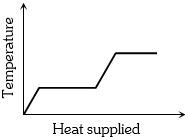
B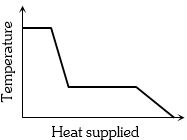
C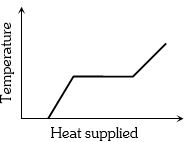
D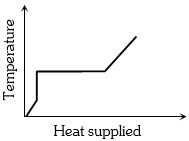
Solution
(A) The process of heating ice from $-10^{\circ}C$ to steam at $100^{\circ}C$ involves several stages:
$1$. Heating ice from $-10^{\circ}C$ to $0^{\circ}C$: The temperature rises linearly as heat is supplied.
$2$. Melting ice at $0^{\circ}C$: The temperature remains constant at $0^{\circ}C$ while the phase changes from solid to liquid (latent heat of fusion).
$3$. Heating water from $0^{\circ}C$ to $100^{\circ}C$: The temperature rises linearly as heat is supplied.
$4$. Boiling water at $100^{\circ}C$: The temperature remains constant at $100^{\circ}C$ while the phase changes from liquid to gas (latent heat of vaporization).
Therefore, the heating curve must show two linear rising segments separated by a horizontal segment (melting) and followed by another horizontal segment (boiling). Option $A$ correctly represents this sequence.
$1$. Heating ice from $-10^{\circ}C$ to $0^{\circ}C$: The temperature rises linearly as heat is supplied.
$2$. Melting ice at $0^{\circ}C$: The temperature remains constant at $0^{\circ}C$ while the phase changes from solid to liquid (latent heat of fusion).
$3$. Heating water from $0^{\circ}C$ to $100^{\circ}C$: The temperature rises linearly as heat is supplied.
$4$. Boiling water at $100^{\circ}C$: The temperature remains constant at $100^{\circ}C$ while the phase changes from liquid to gas (latent heat of vaporization).
Therefore, the heating curve must show two linear rising segments separated by a horizontal segment (melting) and followed by another horizontal segment (boiling). Option $A$ correctly represents this sequence.
1 likesView Solution
5
PhysicsDifficultMCQIIT JEE · 2000
An ideal gas is initially at temperature $T$ and volume $V.$ Its volume is increased by $\Delta V$ due to an increase in temperature $\Delta T,$ pressure remaining constant. The quantity $\delta = \Delta V / (V \Delta T)$ varies with temperature as
A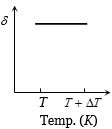
B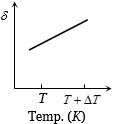
C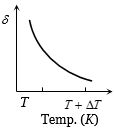
D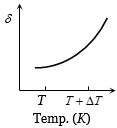
Solution
(C) For an ideal gas at constant pressure,Charles's Law states that $V / T = \text{constant}.$
When the temperature changes from $T$ to $T + \Delta T,$ the volume changes from $V$ to $V + \Delta V.$
Thus,we have:
$\frac{V + \Delta V}{T + \Delta T} = \frac{V}{T}$
Cross-multiplying gives:
$T(V + \Delta V) = V(T + \Delta T)$
$VT + T \Delta V = VT + V \Delta T$
Subtracting $VT$ from both sides:
$T \Delta V = V \Delta T$
Rearranging to find the expression for $\delta$:
$\delta = \frac{\Delta V}{V \Delta T} = \frac{1}{T}$
Since $\delta = 1/T,$ the quantity $\delta$ is inversely proportional to the temperature $T.$ This relationship is represented by a rectangular hyperbola,which corresponds to the graph shown in option $C.$
When the temperature changes from $T$ to $T + \Delta T,$ the volume changes from $V$ to $V + \Delta V.$
Thus,we have:
$\frac{V + \Delta V}{T + \Delta T} = \frac{V}{T}$
Cross-multiplying gives:
$T(V + \Delta V) = V(T + \Delta T)$
$VT + T \Delta V = VT + V \Delta T$
Subtracting $VT$ from both sides:
$T \Delta V = V \Delta T$
Rearranging to find the expression for $\delta$:
$\delta = \frac{\Delta V}{V \Delta T} = \frac{1}{T}$
Since $\delta = 1/T,$ the quantity $\delta$ is inversely proportional to the temperature $T.$ This relationship is represented by a rectangular hyperbola,which corresponds to the graph shown in option $C.$
0 likesView Solution
6
PhysicsDifficultMCQIIT JEE · 2000
$A$ monoatomic ideal gas,initially at temperature $T_1$,is enclosed in a cylinder fitted with a frictionless piston. The gas is allowed to expand adiabatically to a temperature $T_2$ by releasing the piston suddenly. If $L_1$ and $L_2$ are the lengths of the gas column before and after expansion respectively,then $T_1/T_2$ is given by
A
$(\frac{L_1}{L_2})^{2/3}$
B
$\frac{L_1}{L_2}$
C
$\frac{L_2}{L_1}$
D
$(\frac{L_2}{L_1})^{2/3}$
Solution
(D) For an adiabatic process,the relationship between temperature $T$ and volume $V$ is given by $T V^{\gamma - 1} = \text{constant}$.
Thus,$T_1 V_1^{\gamma - 1} = T_2 V_2^{\gamma - 1}$,which implies $\frac{T_1}{T_2} = (\frac{V_2}{V_1})^{\gamma - 1}$.
Since the gas is monoatomic,the adiabatic index $\gamma = 5/3$. Therefore,$\gamma - 1 = 5/3 - 1 = 2/3$.
The volume of the gas in a cylinder is $V = A \times L$,where $A$ is the cross-sectional area and $L$ is the length of the gas column.
Substituting $V_1 = A L_1$ and $V_2 = A L_2$,we get $\frac{V_2}{V_1} = \frac{A L_2}{A L_1} = \frac{L_2}{L_1}$.
Substituting these into the temperature ratio equation: $\frac{T_1}{T_2} = (\frac{L_2}{L_1})^{2/3}$.
Thus,$T_1 V_1^{\gamma - 1} = T_2 V_2^{\gamma - 1}$,which implies $\frac{T_1}{T_2} = (\frac{V_2}{V_1})^{\gamma - 1}$.
Since the gas is monoatomic,the adiabatic index $\gamma = 5/3$. Therefore,$\gamma - 1 = 5/3 - 1 = 2/3$.
The volume of the gas in a cylinder is $V = A \times L$,where $A$ is the cross-sectional area and $L$ is the length of the gas column.
Substituting $V_1 = A L_1$ and $V_2 = A L_2$,we get $\frac{V_2}{V_1} = \frac{A L_2}{A L_1} = \frac{L_2}{L_1}$.
Substituting these into the temperature ratio equation: $\frac{T_1}{T_2} = (\frac{L_2}{L_1})^{2/3}$.
0 likesView Solution
7
PhysicsMediumMCQIIT JEE · 2000
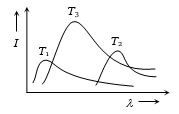
The plots of intensity $(I)$ versus wavelength $(\lambda)$ for three black bodies at temperatures $T_1, T_2$ and $T_3$ respectively are as shown. Their temperatures are such that:
A
$T_1 > T_2 > T_3$
B
$T_1 > T_3 > T_2$
C
$T_2 > T_3 > T_1$
D
$T_3 > T_2 > T_1$
Solution
(B) According to Wien's displacement law,the wavelength corresponding to maximum intensity $(\lambda_m)$ is inversely proportional to the absolute temperature $(T)$,i.e.,$\lambda_m \propto \frac{1}{T}$.
From the given graph,we can observe the values of $\lambda_m$ for the three temperatures:
$(\lambda_m)_1 < (\lambda_m)_3 < (\lambda_m)_2$.
Since $\lambda_m$ is inversely proportional to $T$,a smaller $\lambda_m$ corresponds to a higher temperature.
Therefore,the relationship between the temperatures is $T_1 > T_3 > T_2$.
From the given graph,we can observe the values of $\lambda_m$ for the three temperatures:
$(\lambda_m)_1 < (\lambda_m)_3 < (\lambda_m)_2$.
Since $\lambda_m$ is inversely proportional to $T$,a smaller $\lambda_m$ corresponds to a higher temperature.
Therefore,the relationship between the temperatures is $T_1 > T_3 > T_2$.
0 likesView Solution
8
PhysicsMediumMCQIIT JEE · 2000
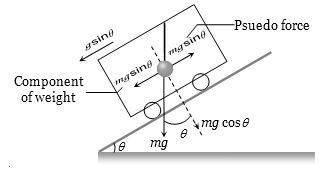
The period of oscillation of a simple pendulum of length $L$ suspended from the roof of a vehicle which moves without friction down an inclined plane of inclination $\alpha$,is given by
A
$2\pi \sqrt {\frac{L}{{g\cos \alpha }}} $
B
$2\pi \sqrt {\frac{L}{{g\sin \alpha }}} $
C
$2\pi \sqrt {\frac{L}{g}} $
D
$2\pi \sqrt {\frac{L}{{g\tan \alpha }}} $
Solution
(A) The vehicle moves down a frictionless inclined plane with an acceleration $a = g\sin \alpha$.
In the frame of the vehicle,a pseudo force $F_p = ma = mg\sin \alpha$ acts on the bob of the pendulum in the upward direction along the incline.
The effective acceleration $g_{eff}$ is the vector sum of the acceleration due to gravity $\vec{g}$ and the negative of the vehicle's acceleration $-\vec{a}$.
Resolving the components,the component of $g$ perpendicular to the incline is $g\cos \alpha$ and the component of $g$ parallel to the incline is $g\sin \alpha$. The pseudo force cancels the component $g\sin \alpha$.
Thus,the effective acceleration is $g_{eff} = g\cos \alpha$.
The time period of the simple pendulum is given by $T = 2\pi \sqrt{\frac{L}{g_{eff}}} = 2\pi \sqrt{\frac{L}{g\cos \alpha}}$.
In the frame of the vehicle,a pseudo force $F_p = ma = mg\sin \alpha$ acts on the bob of the pendulum in the upward direction along the incline.
The effective acceleration $g_{eff}$ is the vector sum of the acceleration due to gravity $\vec{g}$ and the negative of the vehicle's acceleration $-\vec{a}$.
Resolving the components,the component of $g$ perpendicular to the incline is $g\cos \alpha$ and the component of $g$ parallel to the incline is $g\sin \alpha$. The pseudo force cancels the component $g\sin \alpha$.
Thus,the effective acceleration is $g_{eff} = g\cos \alpha$.
The time period of the simple pendulum is given by $T = 2\pi \sqrt{\frac{L}{g_{eff}}} = 2\pi \sqrt{\frac{L}{g\cos \alpha}}$.
0 likesView Solution
9
PhysicsEasyMCQIIT JEE · 2000
Two monoatomic ideal gases $1$ and $2$ of molecular masses $m_1$ and $m_2$ respectively are enclosed in separate containers kept at the same temperature. The ratio of the speed of sound in gas $1$ to that in gas $2$ is given by
A
$\sqrt{\frac{m_1}{m_2}}$
B
$\sqrt{\frac{m_2}{m_1}}$
C
$\frac{m_1}{m_2}$
D
$\frac{m_2}{m_1}$
Solution
(B) The speed of sound $v$ in an ideal gas is given by the formula $v = \sqrt{\frac{\gamma RT}{M}}$,where $\gamma$ is the adiabatic index,$R$ is the universal gas constant,$T$ is the absolute temperature,and $M$ is the molar mass.
Since both gases are monoatomic,they have the same adiabatic index $\gamma = 5/3$.
Given that both gases are at the same temperature $T$,the speed of sound is inversely proportional to the square root of the molar mass: $v \propto \frac{1}{\sqrt{M}}$.
Therefore,the ratio of the speed of sound in gas $1$ $(v_1)$ to that in gas $2$ $(v_2)$ is $\frac{v_1}{v_2} = \sqrt{\frac{m_2}{m_1}}$.
Since both gases are monoatomic,they have the same adiabatic index $\gamma = 5/3$.
Given that both gases are at the same temperature $T$,the speed of sound is inversely proportional to the square root of the molar mass: $v \propto \frac{1}{\sqrt{M}}$.
Therefore,the ratio of the speed of sound in gas $1$ $(v_1)$ to that in gas $2$ $(v_2)$ is $\frac{v_1}{v_2} = \sqrt{\frac{m_2}{m_1}}$.
0 likesView Solution
10
PhysicsMediumMCQIIT JEE · 2000
Two vibrating strings of the same material but lengths $L$ and $2L$ have radii $2r$ and $r$ respectively. They are stretched under the same tension. Both the strings vibrate in their fundamental modes,the one of length $L$ with frequency $n_1$ and the other with frequency $n_2$. The ratio $n_1/n_2$ is given by
A
$2$
B
$4$
C
$8$
D
$1$
Solution
(D) The fundamental frequency $n$ of a vibrating string is given by the formula: $n = \frac{1}{2l} \sqrt{\frac{T}{\mu}}$,where $\mu$ is the mass per unit length.
Since $\mu = \pi r^2 \rho$ (where $\rho$ is the density of the material),the frequency is $n = \frac{1}{2lr} \sqrt{\frac{T}{\pi \rho}}$.
Given that the material is the same,$\rho$ is constant. Since the tension $T$ is also the same,we have $n \propto \frac{1}{lr}$.
Therefore,the ratio of the frequencies is $\frac{n_1}{n_2} = \frac{l_2 r_2}{l_1 r_1}$.
Substituting the given values: $l_1 = L$,$l_2 = 2L$,$r_1 = 2r$,and $r_2 = r$.
$\frac{n_1}{n_2} = \frac{2L \times r}{L \times 2r} = \frac{2Lr}{2Lr} = 1$.
Since $\mu = \pi r^2 \rho$ (where $\rho$ is the density of the material),the frequency is $n = \frac{1}{2lr} \sqrt{\frac{T}{\pi \rho}}$.
Given that the material is the same,$\rho$ is constant. Since the tension $T$ is also the same,we have $n \propto \frac{1}{lr}$.
Therefore,the ratio of the frequencies is $\frac{n_1}{n_2} = \frac{l_2 r_2}{l_1 r_1}$.
Substituting the given values: $l_1 = L$,$l_2 = 2L$,$r_1 = 2r$,and $r_2 = r$.
$\frac{n_1}{n_2} = \frac{2L \times r}{L \times 2r} = \frac{2Lr}{2Lr} = 1$.
0 likesView Solution
11
PhysicsMediumMCQIIT JEE · 2000
$A$ train moves towards a stationary observer with a speed of $34 \ m/s$. The train sounds a whistle and its frequency registered by the observer is $f_1$. If the train's speed is reduced to $17 \ m/s$,the frequency registered is $f_2$. If the speed of sound is $340 \ m/s$,then the ratio $f_1/f_2$ is:
A
$18/19$
B
$1/2$
C
$2$
D
$19/18$
Solution
(D) According to the Doppler effect,when a source moves towards a stationary observer,the observed frequency $f'$ is given by $f' = f \left( \frac{v}{v - v_s} \right)$,where $v$ is the speed of sound and $v_s$ is the speed of the source.
For the first case,$v_s = 34 \ m/s$:
$f_1 = f \left( \frac{340}{340 - 34} \right) = f \left( \frac{340}{306} \right)$
For the second case,$v_s = 17 \ m/s$:
$f_2 = f \left( \frac{340}{340 - 17} \right) = f \left( \frac{340}{323} \right)$
Now,calculating the ratio $f_1/f_2$:
$\frac{f_1}{f_2} = \frac{f \left( \frac{340}{306} \right)}{f \left( \frac{340}{323} \right)} = \frac{323}{306}$
Dividing both numerator and denominator by $17$:
$\frac{323 \div 17}{306 \div 17} = \frac{19}{18}$
Thus,the ratio $f_1/f_2$ is $19/18$.
For the first case,$v_s = 34 \ m/s$:
$f_1 = f \left( \frac{340}{340 - 34} \right) = f \left( \frac{340}{306} \right)$
For the second case,$v_s = 17 \ m/s$:
$f_2 = f \left( \frac{340}{340 - 17} \right) = f \left( \frac{340}{323} \right)$
Now,calculating the ratio $f_1/f_2$:
$\frac{f_1}{f_2} = \frac{f \left( \frac{340}{306} \right)}{f \left( \frac{340}{323} \right)} = \frac{323}{306}$
Dividing both numerator and denominator by $17$:
$\frac{323 \div 17}{306 \div 17} = \frac{19}{18}$
Thus,the ratio $f_1/f_2$ is $19/18$.
0 likesView Solution
12
PhysicsDifficultMCQIIT JEE · 2000
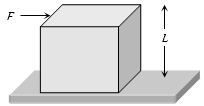
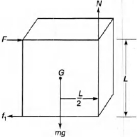
$A$ cubical block of side $L$ rests on a rough horizontal surface with coefficient of friction $\mu$. $A$ horizontal force $F$ is applied on the block as shown. If the coefficient of friction is sufficiently high so that the block does not slide before toppling,the minimum force required to topple the block is
A
$Infinitesimal$
B
$mg/4$
C
$mg/2$
D
$mg(1 - \mu)$
Solution
(C) To find the minimum force required to topple the block,we consider the torque about the edge of the block where it is about to rotate (the pivot point $P$).
At the critical condition for toppling,the normal reaction $N$ acts through the pivot point $P$.
The torque due to the gravitational force $mg$ about point $P$ is $\tau_{mg} = mg \times (L/2)$.
The torque due to the applied horizontal force $F$ about point $P$ is $\tau_{F} = F \times L$.
For the block to topple,the torque due to the applied force must be greater than the torque due to gravity:
$\tau_{F} > \tau_{mg}$
$F \times L > mg \times (L/2)$
$F > mg/2$
Thus,the minimum force required to topple the block is $F = mg/2$.
At the critical condition for toppling,the normal reaction $N$ acts through the pivot point $P$.
The torque due to the gravitational force $mg$ about point $P$ is $\tau_{mg} = mg \times (L/2)$.
The torque due to the applied horizontal force $F$ about point $P$ is $\tau_{F} = F \times L$.
For the block to topple,the torque due to the applied force must be greater than the torque due to gravity:
$\tau_{F} > \tau_{mg}$
$F \times L > mg \times (L/2)$
$F > mg/2$
Thus,the minimum force required to topple the block is $F = mg/2$.
0 likesView Solution
13
PhysicsMediumMCQIIT JEE · 2000
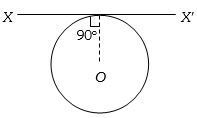
$A$ thin wire of length $L$ and uniform linear mass density $\rho$ is bent into a circular loop with centre at $O$ as shown. The moment of inertia of the loop about the axis $XX'$ is
A
$\frac{\rho L^3}{8\pi^2}$
B
$\frac{\rho L^3}{16\pi^2}$
C
$\frac{5\rho L^3}{16\pi^2}$
D
$\frac{3\rho L^3}{8\pi^2}$
Solution
(D) The total mass of the wire is $M = \rho L$. Since the circumference of the loop is $L = 2\pi R$,the radius of the loop is $R = \frac{L}{2\pi}$.
The moment of inertia of a circular loop about its diameter is $I_{diam} = \frac{1}{2}MR^2$.
Using the parallel axis theorem,the moment of inertia about the tangent $XX'$ is $I = I_{cm} + Md^2$,where $I_{cm} = I_{diam} = \frac{1}{2}MR^2$ and $d = R$.
Thus,$I = \frac{1}{2}MR^2 + MR^2 = \frac{3}{2}MR^2$.
Substituting $M = \rho L$ and $R = \frac{L}{2\pi}$:
$I = \frac{3}{2}(\rho L)\left(\frac{L}{2\pi}\right)^2 = \frac{3}{2}\rho L \left(\frac{L^2}{4\pi^2}\right) = \frac{3\rho L^3}{8\pi^2}$.
The moment of inertia of a circular loop about its diameter is $I_{diam} = \frac{1}{2}MR^2$.
Using the parallel axis theorem,the moment of inertia about the tangent $XX'$ is $I = I_{cm} + Md^2$,where $I_{cm} = I_{diam} = \frac{1}{2}MR^2$ and $d = R$.
Thus,$I = \frac{1}{2}MR^2 + MR^2 = \frac{3}{2}MR^2$.
Substituting $M = \rho L$ and $R = \frac{L}{2\pi}$:
$I = \frac{3}{2}(\rho L)\left(\frac{L}{2\pi}\right)^2 = \frac{3}{2}\rho L \left(\frac{L^2}{4\pi^2}\right) = \frac{3\rho L^3}{8\pi^2}$.
0 likesView Solution
14
PhysicsMediumMCQIIT JEE · 2000
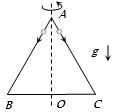
An equilateral triangle $ABC$ formed from a uniform wire has two small identical beads initially located at $A$. The triangle is set rotating about the vertical axis $AO$. Then the beads are released from rest simultaneously and allowed to slide down,one along $AB$ and the other along $AC$ as shown. Neglecting frictional effects,the quantities that are conserved as the beads slide down,are
A
Angular velocity and total energy (kinetic and potential)
B
Total angular momentum and total energy
C
Angular velocity and moment of inertia about the axis of rotation
D
Total angular momentum and moment of inertia about the axis of rotation
Solution
(B) $1$. The system consists of the triangle and the two beads. Since there is no external torque acting on the system about the vertical axis $AO$,the total angular momentum $L$ of the system remains conserved.
$2$. As the beads slide down,the gravitational potential energy of the beads is converted into kinetic energy (both translational and rotational). Since there is no friction,the total mechanical energy (kinetic + potential) of the system is conserved.
$3$. The moment of inertia $I$ of the system about the axis $AO$ increases as the beads move away from the axis. Since $L = I\omega$ is constant,the angular velocity $\omega$ must decrease.
$4$. Therefore,the quantities that are conserved are the total angular momentum and the total energy.
$2$. As the beads slide down,the gravitational potential energy of the beads is converted into kinetic energy (both translational and rotational). Since there is no friction,the total mechanical energy (kinetic + potential) of the system is conserved.
$3$. The moment of inertia $I$ of the system about the axis $AO$ increases as the beads move away from the axis. Since $L = I\omega$ is constant,the angular velocity $\omega$ must decrease.
$4$. Therefore,the quantities that are conserved are the total angular momentum and the total energy.
0 likesView Solution
15
PhysicsDifficultMCQIIT JEE · 2000
$A$ large open tank has two holes in the wall. One is a square hole of side $L$ at a depth $y$ from the top and the other is a circular hole of radius $R$ at a depth $4y$ from the top. When the tank is completely filled with water,the quantities of water flowing out per second from the two holes are the same. Then the value of $R$ is
A
$\frac{L}{\sqrt{2 \pi}}$
B
$2 \pi L$
C
$L \sqrt{\frac{2}{\pi}}$
D
$\frac{L}{2 \pi}$
Solution
(A) The volume flow rate (quantity of water per second) is given by $Q = A v$,where $A$ is the area of the hole and $v$ is the velocity of efflux.
According to Torricelli's law,the velocity of efflux at a depth $h$ is $v = \sqrt{2gh}$.
For the square hole: Area $A_1 = L^2$ and depth $h_1 = y$. So,$v_1 = \sqrt{2gy}$.
The flow rate $Q_1 = A_1 v_1 = L^2 \sqrt{2gy}$.
For the circular hole: Area $A_2 = \pi R^2$ and depth $h_2 = 4y$. So,$v_2 = \sqrt{2g(4y)} = 2\sqrt{2gy}$.
The flow rate $Q_2 = A_2 v_2 = \pi R^2 (2\sqrt{2gy})$.
Given that $Q_1 = Q_2$,we have:
$L^2 \sqrt{2gy} = 2\pi R^2 \sqrt{2gy}$.
Canceling $\sqrt{2gy}$ from both sides,we get $L^2 = 2\pi R^2$.
Therefore,$R^2 = \frac{L^2}{2\pi}$,which gives $R = \frac{L}{\sqrt{2\pi}}$.
According to Torricelli's law,the velocity of efflux at a depth $h$ is $v = \sqrt{2gh}$.
For the square hole: Area $A_1 = L^2$ and depth $h_1 = y$. So,$v_1 = \sqrt{2gy}$.
The flow rate $Q_1 = A_1 v_1 = L^2 \sqrt{2gy}$.
For the circular hole: Area $A_2 = \pi R^2$ and depth $h_2 = 4y$. So,$v_2 = \sqrt{2g(4y)} = 2\sqrt{2gy}$.
The flow rate $Q_2 = A_2 v_2 = \pi R^2 (2\sqrt{2gy})$.
Given that $Q_1 = Q_2$,we have:
$L^2 \sqrt{2gy} = 2\pi R^2 \sqrt{2gy}$.
Canceling $\sqrt{2gy}$ from both sides,we get $L^2 = 2\pi R^2$.
Therefore,$R^2 = \frac{L^2}{2\pi}$,which gives $R = \frac{L}{\sqrt{2\pi}}$.
0 likesView Solution
16
PhysicsDifficultMCQIIT JEE · 2000
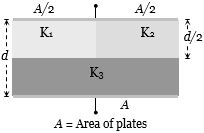
$A$ parallel plate capacitor of area $A$,plate separation $d$ and capacitance $C$ is filled with three different dielectric materials having dielectric constants $k_1, k_2$ and $k_3$ as shown in the figure. If a single dielectric material is to be used to have the same capacitance $C$ in this capacitor,then its dielectric constant $k$ is given by:
A
$\frac{1}{k} = \frac{1}{k_1} + \frac{1}{k_2} + \frac{1}{2k_3}$
B
$\frac{1}{k} = \frac{1}{k_1 + k_2} + \frac{1}{2k_3}$
C
$k = \frac{k_1 k_2}{k_1 + k_2} + 2k_3$
D
$k = k_1 + k_2 + 2k_3$
Solution
(B) The capacitor can be viewed as a combination of three capacitors. The top half consists of two capacitors in parallel with areas $A/2$ and separation $d/2$,having capacitances $C_1 = \frac{k_1 \epsilon_0 (A/2)}{d/2} = \frac{k_1 \epsilon_0 A}{d}$ and $C_2 = \frac{k_2 \epsilon_0 (A/2)}{d/2} = \frac{k_2 \epsilon_0 A}{d}$.
These two are in parallel,so their equivalent capacitance is $C_{12} = C_1 + C_2 = \frac{\epsilon_0 A}{d} (k_1 + k_2)$.
The bottom half is a capacitor with area $A$ and separation $d/2$,having capacitance $C_3 = \frac{k_3 \epsilon_0 A}{d/2} = \frac{2k_3 \epsilon_0 A}{d}$.
Since $C_{12}$ and $C_3$ are in series,the total capacitance $C$ is given by $\frac{1}{C} = \frac{1}{C_{12}} + \frac{1}{C_3}$.
Substituting the values: $\frac{1}{C} = \frac{d}{\epsilon_0 A (k_1 + k_2)} + \frac{d}{2k_3 \epsilon_0 A} = \frac{d}{\epsilon_0 A} \left( \frac{1}{k_1 + k_2} + \frac{1}{2k_3} \right)$.
For a single dielectric $k$,$C = \frac{k \epsilon_0 A}{d}$,so $\frac{1}{C} = \frac{d}{k \epsilon_0 A}$.
Comparing the two expressions,we get $\frac{1}{k} = \frac{1}{k_1 + k_2} + \frac{1}{2k_3}$.
These two are in parallel,so their equivalent capacitance is $C_{12} = C_1 + C_2 = \frac{\epsilon_0 A}{d} (k_1 + k_2)$.
The bottom half is a capacitor with area $A$ and separation $d/2$,having capacitance $C_3 = \frac{k_3 \epsilon_0 A}{d/2} = \frac{2k_3 \epsilon_0 A}{d}$.
Since $C_{12}$ and $C_3$ are in series,the total capacitance $C$ is given by $\frac{1}{C} = \frac{1}{C_{12}} + \frac{1}{C_3}$.
Substituting the values: $\frac{1}{C} = \frac{d}{\epsilon_0 A (k_1 + k_2)} + \frac{d}{2k_3 \epsilon_0 A} = \frac{d}{\epsilon_0 A} \left( \frac{1}{k_1 + k_2} + \frac{1}{2k_3} \right)$.
For a single dielectric $k$,$C = \frac{k \epsilon_0 A}{d}$,so $\frac{1}{C} = \frac{d}{k \epsilon_0 A}$.
Comparing the two expressions,we get $\frac{1}{k} = \frac{1}{k_1 + k_2} + \frac{1}{2k_3}$.
0 likesView Solution
17
PhysicsDifficultMCQIIT JEE · 2000
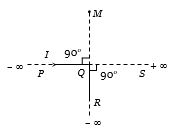
An infinitely long conductor $PQR$ is bent to form a right angle as shown. $A$ current $I$ flows through $PQR$. The magnetic field due to this current at the point $M$ is $H_1$. Now,another infinitely long straight conductor $QS$ is connected at $Q$ so that the current is $I/2$ in $QR$ as well as in $QS$,while the current in $PQ$ remains unchanged. The magnetic field at $M$ is now $H_2$. The ratio $H_1/H_2$ is given by
A
$0.5$
B
$1$
C
$0.67$
D
$2$
Solution
(C) The magnetic field at any point lying on the axis of a current-carrying straight conductor is zero.
Case $1$: The current $I$ flows through $PQ$ and $QR$. Point $M$ lies on the extension of $QR$. Therefore,the magnetic field at $M$ due to $QR$ is zero. The magnetic field $H_1$ at $M$ is only due to the segment $PQ$. Let $d$ be the perpendicular distance from $M$ to $PQ$. The magnetic field due to a semi-infinite wire is $H_1 = \frac{\mu_0 I}{4 \pi d}$.
Case $2$: The current in $PQ$ is $I$,in $QR$ is $I/2$,and in $QS$ is $I/2$. Point $M$ lies on the extension of $QR$,so the magnetic field due to $QR$ is still zero. The magnetic field at $M$ is now $H_2 = H_{PQ} + H_{QS}$.
Since the current in $PQ$ is unchanged,$H_{PQ} = H_1 = \frac{\mu_0 I}{4 \pi d}$.
The conductor $QS$ is perpendicular to $PQ$ and $M$ lies on the perpendicular bisector of the line passing through $QS$ if we consider the geometry. However,$M$ is at a distance $d$ from $Q$ along the line $QR$. The magnetic field at $M$ due to a semi-infinite wire $QS$ carrying current $I/2$ is $H_{QS} = \frac{\mu_0 (I/2)}{4 \pi d} = \frac{1}{2} H_1$.
Thus,$H_2 = H_1 + \frac{1}{2} H_1 = \frac{3}{2} H_1$.
The ratio $H_1/H_2 = H_1 / (\frac{3}{2} H_1) = 2/3 \approx 0.67$.
Case $1$: The current $I$ flows through $PQ$ and $QR$. Point $M$ lies on the extension of $QR$. Therefore,the magnetic field at $M$ due to $QR$ is zero. The magnetic field $H_1$ at $M$ is only due to the segment $PQ$. Let $d$ be the perpendicular distance from $M$ to $PQ$. The magnetic field due to a semi-infinite wire is $H_1 = \frac{\mu_0 I}{4 \pi d}$.
Case $2$: The current in $PQ$ is $I$,in $QR$ is $I/2$,and in $QS$ is $I/2$. Point $M$ lies on the extension of $QR$,so the magnetic field due to $QR$ is still zero. The magnetic field at $M$ is now $H_2 = H_{PQ} + H_{QS}$.
Since the current in $PQ$ is unchanged,$H_{PQ} = H_1 = \frac{\mu_0 I}{4 \pi d}$.
The conductor $QS$ is perpendicular to $PQ$ and $M$ lies on the perpendicular bisector of the line passing through $QS$ if we consider the geometry. However,$M$ is at a distance $d$ from $Q$ along the line $QR$. The magnetic field at $M$ due to a semi-infinite wire $QS$ carrying current $I/2$ is $H_{QS} = \frac{\mu_0 (I/2)}{4 \pi d} = \frac{1}{2} H_1$.
Thus,$H_2 = H_1 + \frac{1}{2} H_1 = \frac{3}{2} H_1$.
The ratio $H_1/H_2 = H_1 / (\frac{3}{2} H_1) = 2/3 \approx 0.67$.
0 likesView Solution
18
PhysicsMediumMCQIIT JEE · 2000
An ionized gas contains both positive and negative ions. If it is subjected simultaneously to an electric field along the $+x$ direction and a magnetic field along the $+z$ direction,then
A
Positive ions deflect towards $+y$ direction and negative ions towards $-y$ direction
B
All ions deflect towards $+y$ direction
C
All ions deflect towards $-y$ direction
D
Positive ions deflect towards $-y$ direction and negative ions towards $+y$ direction
Solution
(C) The electric field $\vec{E}$ is along the $+x$ direction. Positive ions experience an electric force $\vec{F}_e = q\vec{E}$ along the $+x$ direction,while negative ions experience an electric force along the $-x$ direction.
As a result,positive ions acquire a velocity $\vec{v}$ in the $+x$ direction,and negative ions acquire a velocity $\vec{v}$ in the $-x$ direction.
The magnetic field $\vec{B}$ is along the $+z$ direction.
The magnetic force on a charged particle is given by $\vec{F}_m = q(\vec{v} \times \vec{B})$.
For positive ions: $\vec{F}_m = (+q)(v\hat{i} \times B\hat{k}) = -qvB\hat{j}$,which is in the $-y$ direction.
For negative ions: $\vec{F}_m = (-q)(-v\hat{i} \times B\hat{k}) = (-q)(-vB(-\hat{j})) = -qvB\hat{j}$,which is also in the $-y$ direction.
Thus,both types of ions deflect towards the $-y$ direction.
As a result,positive ions acquire a velocity $\vec{v}$ in the $+x$ direction,and negative ions acquire a velocity $\vec{v}$ in the $-x$ direction.
The magnetic field $\vec{B}$ is along the $+z$ direction.
The magnetic force on a charged particle is given by $\vec{F}_m = q(\vec{v} \times \vec{B})$.
For positive ions: $\vec{F}_m = (+q)(v\hat{i} \times B\hat{k}) = -qvB\hat{j}$,which is in the $-y$ direction.
For negative ions: $\vec{F}_m = (-q)(-v\hat{i} \times B\hat{k}) = (-q)(-vB(-\hat{j})) = -qvB\hat{j}$,which is also in the $-y$ direction.
Thus,both types of ions deflect towards the $-y$ direction.
0 likesView Solution
19
PhysicsDifficultMCQIIT JEE · 2000
Two long parallel wires are at a distance $2d$ apart. They carry steady equal currents flowing out of the plane of the paper,as shown. The variation of the magnetic field $B$ along the line $XX'$ is given by
A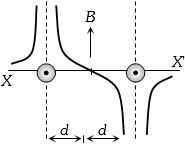
B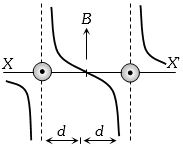
C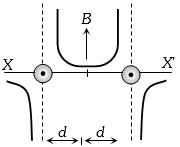
D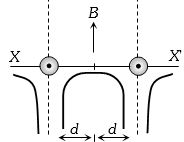
Solution
(B) If the current flows out of the paper,the magnetic field at points to the right of the wire will be upwards and to the left will be downward. Let the wires be at $A$ and $B$,and the midpoint be $C$. The magnetic field at $C$ is zero because the fields from $A$ and $B$ cancel each other out.
In the region to the right of $B$,the magnetic field is upwards $(+ve)$ because all points are to the right of both wires. Similarly,in the region to the left of $A$,the magnetic field is downwards $(-ve)$.
In the region $AC$,the points are closer to $A$ than to $B$,so the field due to $A$ dominates and is upwards $(+ve)$.
In the region $BC$,the points are closer to $B$ than to $A$,so the field due to $B$ dominates and is downwards $(-ve)$.
Graph $(b)$ correctly represents these variations in the magnetic field.
In the region to the right of $B$,the magnetic field is upwards $(+ve)$ because all points are to the right of both wires. Similarly,in the region to the left of $A$,the magnetic field is downwards $(-ve)$.
In the region $AC$,the points are closer to $A$ than to $B$,so the field due to $A$ dominates and is upwards $(+ve)$.
In the region $BC$,the points are closer to $B$ than to $A$,so the field due to $B$ dominates and is downwards $(-ve)$.
Graph $(b)$ correctly represents these variations in the magnetic field.
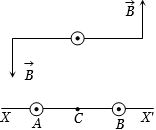
0 likesView Solution
20
PhysicsDifficultMCQIIT JEE · 2000
Two identical short bar magnets,each having magnetic moment $M$,are placed a distance of $2d$ apart with axes perpendicular to each other in a horizontal plane. The magnetic induction at a point midway between them is
A
$\frac{\mu_0}{4\pi}(\sqrt{2})\frac{M}{d^3}$
B
$\frac{\mu_0}{4\pi}(\sqrt{3})\frac{M}{d^3}$
C
$\left(\frac{2\mu_0}{\pi}\right)\frac{M}{d^3}$
D
$\frac{\mu_0}{4\pi}(\sqrt{5})\frac{M}{d^3}$
Solution
(D) Let the two magnets be placed such that point $P$ is at a distance $d$ from the center of each magnet.
For the first magnet,point $P$ lies on its axial line. The magnetic field due to this magnet at $P$ is $B_1 = \frac{\mu_0}{4\pi} \cdot \frac{2M}{d^3}$.
For the second magnet,point $P$ lies on its equatorial line. The magnetic field due to this magnet at $P$ is $B_2 = \frac{\mu_0}{4\pi} \cdot \frac{M}{d^3}$.
Since the axes are perpendicular,the fields $B_1$ and $B_2$ are perpendicular to each other.
The net magnetic field at $P$ is $B_{net} = \sqrt{B_1^2 + B_2^2}$.
Substituting the values: $B_{net} = \sqrt{\left(\frac{\mu_0}{4\pi} \cdot \frac{2M}{d^3}\right)^2 + \left(\frac{\mu_0}{4\pi} \cdot \frac{M}{d^3}\right)^2}$.
$B_{net} = \frac{\mu_0}{4\pi} \cdot \frac{M}{d^3} \sqrt{2^2 + 1^2} = \frac{\mu_0}{4\pi} \cdot \frac{\sqrt{5}M}{d^3}$.
For the first magnet,point $P$ lies on its axial line. The magnetic field due to this magnet at $P$ is $B_1 = \frac{\mu_0}{4\pi} \cdot \frac{2M}{d^3}$.
For the second magnet,point $P$ lies on its equatorial line. The magnetic field due to this magnet at $P$ is $B_2 = \frac{\mu_0}{4\pi} \cdot \frac{M}{d^3}$.
Since the axes are perpendicular,the fields $B_1$ and $B_2$ are perpendicular to each other.
The net magnetic field at $P$ is $B_{net} = \sqrt{B_1^2 + B_2^2}$.
Substituting the values: $B_{net} = \sqrt{\left(\frac{\mu_0}{4\pi} \cdot \frac{2M}{d^3}\right)^2 + \left(\frac{\mu_0}{4\pi} \cdot \frac{M}{d^3}\right)^2}$.
$B_{net} = \frac{\mu_0}{4\pi} \cdot \frac{M}{d^3} \sqrt{2^2 + 1^2} = \frac{\mu_0}{4\pi} \cdot \frac{\sqrt{5}M}{d^3}$.
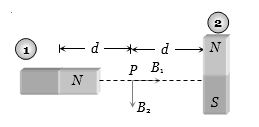
0 likesView Solution
21
PhysicsDifficultMCQIIT JEE · 2000
$A$ uniform but time-varying magnetic field $B(t)$ exists in a circular region of radius $a$ and is directed into the plane of the paper,as shown. The magnitude of the induced electric field at point $P$ at a distance $r$ $(r > a)$ from the centre of the circular region is:
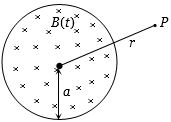
A
Is zero
B
Decreases as $\frac{1}{r}$
C
Increases as $r$
D
Decreases as $\frac{1}{r^2}$
Solution
(B) To find the induced electric field at a point $P$ outside the circular region $(r > a)$,we use Faraday's law of induction in integral form: $\oint \vec{E} \cdot d\vec{l} = -\frac{d\phi_B}{dt}$.
Consider a concentric circular path of radius $r$ passing through point $P$. Due to symmetry,the magnitude of the induced electric field $E$ is constant along this path,and $\vec{E}$ is tangential to the circle.
Thus,$\oint \vec{E} \cdot d\vec{l} = E(2\pi r)$.
The magnetic flux $\phi_B$ through this circular path is limited to the region of radius $a$ where the magnetic field exists: $\phi_B = B(t) \cdot (\pi a^2)$.
Applying Faraday's law:
$E(2\pi r) = \left| \frac{d}{dt} (B(t) \cdot \pi a^2) \right|$
$E(2\pi r) = \pi a^2 \left| \frac{dB}{dt} \right|$
$E = \frac{a^2}{2r} \left| \frac{dB}{dt} \right|$
Since $a$ and $\frac{dB}{dt}$ are constant,we have $E \propto \frac{1}{r}$.
Therefore,the magnitude of the induced electric field decreases as $\frac{1}{r}$.
Consider a concentric circular path of radius $r$ passing through point $P$. Due to symmetry,the magnitude of the induced electric field $E$ is constant along this path,and $\vec{E}$ is tangential to the circle.
Thus,$\oint \vec{E} \cdot d\vec{l} = E(2\pi r)$.
The magnetic flux $\phi_B$ through this circular path is limited to the region of radius $a$ where the magnetic field exists: $\phi_B = B(t) \cdot (\pi a^2)$.
Applying Faraday's law:
$E(2\pi r) = \left| \frac{d}{dt} (B(t) \cdot \pi a^2) \right|$
$E(2\pi r) = \pi a^2 \left| \frac{dB}{dt} \right|$
$E = \frac{a^2}{2r} \left| \frac{dB}{dt} \right|$
Since $a$ and $\frac{dB}{dt}$ are constant,we have $E \propto \frac{1}{r}$.
Therefore,the magnitude of the induced electric field decreases as $\frac{1}{r}$.
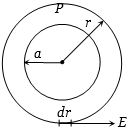
0 likesView Solution
22
PhysicsDifficultMCQIIT JEE · 2000
$A$ coil of wire having finite inductance and resistance has a conducting ring placed coaxially within it. The coil is connected to a battery at time $t = 0$,so that a time-dependent current $I_1(t)$ starts flowing through the coil. If $I_2(t)$ is the current induced in the ring and $B(t)$ is the magnetic field at the axis of the coil due to $I_1(t)$,then as a function of time $(t > 0)$,the product $I_2(t) B(t)$:
A
Increases with time
B
Decreases with time
C
Does not vary with time
D
Passes through a maximum
Solution
(D) Let $k_1, k_2, k_3, k_4, k_5$ be constants.
The current in the $RL$ circuit is given by $I_1(t) = k_1(1 - e^{-t/\tau})$.
The magnetic field $B(t)$ at the axis of the coil is proportional to the current $I_1(t)$,so $B(t) = k_2 I_1(t) = k_2 k_1(1 - e^{-t/\tau})$.
The induced current $I_2(t)$ in the ring is proportional to the rate of change of magnetic flux,which is proportional to $dB(t)/dt$. Thus,$I_2(t) = k_3 \frac{dB(t)}{dt} = k_4 e^{-t/\tau}$.
Therefore,the product $I_2(t) B(t) = k_5 (1 - e^{-t/\tau}) e^{-t/\tau} = k_5 (e^{-t/\tau} - e^{-2t/\tau})$.
At $t = 0$,$I_2(t) B(t) = 0$. As $t \to \infty$,$I_2(t) B(t) \to 0$. Since the product is positive for $t > 0$,it must pass through a maximum.
The current in the $RL$ circuit is given by $I_1(t) = k_1(1 - e^{-t/\tau})$.
The magnetic field $B(t)$ at the axis of the coil is proportional to the current $I_1(t)$,so $B(t) = k_2 I_1(t) = k_2 k_1(1 - e^{-t/\tau})$.
The induced current $I_2(t)$ in the ring is proportional to the rate of change of magnetic flux,which is proportional to $dB(t)/dt$. Thus,$I_2(t) = k_3 \frac{dB(t)}{dt} = k_4 e^{-t/\tau}$.
Therefore,the product $I_2(t) B(t) = k_5 (1 - e^{-t/\tau}) e^{-t/\tau} = k_5 (e^{-t/\tau} - e^{-2t/\tau})$.
At $t = 0$,$I_2(t) B(t) = 0$. As $t \to \infty$,$I_2(t) B(t) \to 0$. Since the product is positive for $t > 0$,it must pass through a maximum.
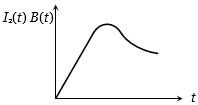
0 likesView Solution
23
PhysicsMediumMCQIIT JEE · 2000
Electrons with energy $80 \ keV$ are incident on the tungsten target of an $X$-ray tube. $K$-shell electrons of tungsten have an ionization energy of $72.5 \ keV$. The $X$-rays emitted by the tube contain only:
A
$A$ continuous $X$-ray spectrum (Bremsstrahlung) with a minimum wavelength of $\approx 0.155 \ \mathring{A}$
B
$A$ continuous $X$-ray spectrum (Bremsstrahlung) with all wavelengths
C
The characteristic $X$-ray spectrum of tungsten
D
$A$ continuous $X$-ray spectrum (Bremsstrahlung) with a minimum wavelength of $\approx 0.155 \ \mathring{A}$ and the characteristic $X$-ray spectrum of tungsten
Solution
(D) The minimum wavelength of the continuous $X$-ray spectrum is given by the formula $\lambda_{\min} = \frac{hc}{E}$.
Using $hc \approx 12400 \ eV \cdot \mathring{A}$ (or $12375 \ eV \cdot \mathring{A}$),we get $\lambda_{\min} = \frac{12375}{80 \times 10^3} \approx 0.155 \ \mathring{A}$.
Since the energy of the incident electrons $(80 \ keV)$ is greater than the ionization energy of the $K$-shell electrons $(72.5 \ keV)$,the incident electrons have sufficient energy to eject $K$-shell electrons from the tungsten atoms.
When an electron is ejected from the $K$-shell,electrons from higher energy levels transition to fill the vacancy,resulting in the emission of characteristic $X$-rays.
Therefore,the emitted $X$-rays consist of both a continuous spectrum (Bremsstrahlung) and the characteristic $X$-ray spectrum of tungsten.
Using $hc \approx 12400 \ eV \cdot \mathring{A}$ (or $12375 \ eV \cdot \mathring{A}$),we get $\lambda_{\min} = \frac{12375}{80 \times 10^3} \approx 0.155 \ \mathring{A}$.
Since the energy of the incident electrons $(80 \ keV)$ is greater than the ionization energy of the $K$-shell electrons $(72.5 \ keV)$,the incident electrons have sufficient energy to eject $K$-shell electrons from the tungsten atoms.
When an electron is ejected from the $K$-shell,electrons from higher energy levels transition to fill the vacancy,resulting in the emission of characteristic $X$-rays.
Therefore,the emitted $X$-rays consist of both a continuous spectrum (Bremsstrahlung) and the characteristic $X$-ray spectrum of tungsten.
0 likesView Solution
24
PhysicsMediumMCQIIT JEE · 2000
The electron in a hydrogen atom makes a transition from an excited state to the ground state. Which of the following statements is true?
A
Its kinetic energy increases and its potential and total energies decrease.
B
Its kinetic energy decreases,potential energy increases and its total energy remains the same.
C
Its kinetic and total energies decrease and its potential energy increases.
D
Its kinetic,potential and total energies decrease.
Solution
(A) For a hydrogen atom,the total energy $E_n$,potential energy $U_n$,and kinetic energy $K_n$ are given by:
$E_n = -13.6 \frac{Z^2}{n^2} \text{ eV}$
$U_n = 2E_n = -27.2 \frac{Z^2}{n^2} \text{ eV}$
$K_n = |E_n| = 13.6 \frac{Z^2}{n^2} \text{ eV}$
When an electron transitions from an excited state $(n > 1)$ to the ground state $(n = 1)$,the value of $n$ decreases.
As $n$ decreases,$K_n$ increases because it is proportional to $1/n^2$.
Since $E_n$ and $U_n$ are negative and their magnitudes decrease as $n$ decreases,their values become more negative,meaning they decrease.
Therefore,kinetic energy increases,while potential and total energies decrease.
$E_n = -13.6 \frac{Z^2}{n^2} \text{ eV}$
$U_n = 2E_n = -27.2 \frac{Z^2}{n^2} \text{ eV}$
$K_n = |E_n| = 13.6 \frac{Z^2}{n^2} \text{ eV}$
When an electron transitions from an excited state $(n > 1)$ to the ground state $(n = 1)$,the value of $n$ decreases.
As $n$ decreases,$K_n$ increases because it is proportional to $1/n^2$.
Since $E_n$ and $U_n$ are negative and their magnitudes decrease as $n$ decreases,their values become more negative,meaning they decrease.
Therefore,kinetic energy increases,while potential and total energies decrease.
0 likesView Solution
25
PhysicsDifficultMCQIIT JEE · 2000
Imagine an atom made up of a proton and a hypothetical particle of double the mass of the electron but having the same charge as the electron. Apply the Bohr model to this atom. The longest wavelength photon that will be emitted has wavelength $\lambda$ (given in terms of the Rydberg constant $R$ for the hydrogen atom) equal to:
A
$9/(5R)$
B
$36/(5R)$
C
$18/(5R)$
D
$4/R$
Solution
(C) In a hydrogen atom,the energy of the $n^{th}$ level is given by $E_n = -\frac{Rhc}{n^2}$.
Since the energy $E_n$ is directly proportional to the mass of the orbiting particle $(E_n \propto m)$,and the new particle has a mass $m' = 2m_e$,the energy levels for this hypothetical atom become $E'_n = -\frac{2Rhc}{n^2}$.
The longest wavelength photon corresponds to the minimum energy transition,which occurs between $n = 3$ and $n = 2$.
The energy difference is $\Delta E = E'_3 - E'_2 = -\frac{2Rhc}{3^2} - (-\frac{2Rhc}{2^2}) = 2Rhc \left( \frac{1}{4} - \frac{1}{9} \right)$.
Simplifying this,$\Delta E = 2Rhc \left( \frac{5}{36} \right) = \frac{5Rhc}{18}$.
Since $\Delta E = \frac{hc}{\lambda}$,we have $\frac{hc}{\lambda} = \frac{5Rhc}{18}$.
Therefore,$\lambda = \frac{18}{5R}$.
Since the energy $E_n$ is directly proportional to the mass of the orbiting particle $(E_n \propto m)$,and the new particle has a mass $m' = 2m_e$,the energy levels for this hypothetical atom become $E'_n = -\frac{2Rhc}{n^2}$.
The longest wavelength photon corresponds to the minimum energy transition,which occurs between $n = 3$ and $n = 2$.
The energy difference is $\Delta E = E'_3 - E'_2 = -\frac{2Rhc}{3^2} - (-\frac{2Rhc}{2^2}) = 2Rhc \left( \frac{1}{4} - \frac{1}{9} \right)$.
Simplifying this,$\Delta E = 2Rhc \left( \frac{5}{36} \right) = \frac{5Rhc}{18}$.
Since $\Delta E = \frac{hc}{\lambda}$,we have $\frac{hc}{\lambda} = \frac{5Rhc}{18}$.
Therefore,$\lambda = \frac{18}{5R}$.
0 likesView Solution
26
PhysicsMediumMCQIIT JEE · 2000
At any instant,two elements $X_1$ and $X_2$ have the same number of radioactive atoms. If the decay constants of $X_1$ and $X_2$ are $10\lambda$ and $\lambda$ respectively,then the time when the ratio of their atoms becomes $\frac{1}{e}$ will be:
A
$\frac{1}{5\lambda}$
B
$\frac{1}{11\lambda}$
C
$\frac{1}{6\lambda}$
D
$\frac{1}{9\lambda}$
Solution
(D) Let $N_0$ be the initial number of radioactive atoms for both elements at $t = 0$.
According to the law of radioactive decay,the number of atoms remaining at time $t$ is given by $N(t) = N_0 e^{-\lambda t}$.
For element $X_1$ with decay constant $\lambda_1 = 10\lambda$,the number of atoms is $N_1 = N_0 e^{-10\lambda t}$.
For element $X_2$ with decay constant $\lambda_2 = \lambda$,the number of atoms is $N_2 = N_0 e^{-\lambda t}$.
We are given that the ratio $\frac{N_1}{N_2} = \frac{1}{e} = e^{-1}$.
Substituting the expressions for $N_1$ and $N_2$:
$\frac{N_0 e^{-10\lambda t}}{N_0 e^{-\lambda t}} = e^{-1}$
$e^{-10\lambda t + \lambda t} = e^{-1}$
$e^{-9\lambda t} = e^{-1}$
Comparing the exponents:
$-9\lambda t = -1$
$t = \frac{1}{9\lambda}$.
According to the law of radioactive decay,the number of atoms remaining at time $t$ is given by $N(t) = N_0 e^{-\lambda t}$.
For element $X_1$ with decay constant $\lambda_1 = 10\lambda$,the number of atoms is $N_1 = N_0 e^{-10\lambda t}$.
For element $X_2$ with decay constant $\lambda_2 = \lambda$,the number of atoms is $N_2 = N_0 e^{-\lambda t}$.
We are given that the ratio $\frac{N_1}{N_2} = \frac{1}{e} = e^{-1}$.
Substituting the expressions for $N_1$ and $N_2$:
$\frac{N_0 e^{-10\lambda t}}{N_0 e^{-\lambda t}} = e^{-1}$
$e^{-10\lambda t + \lambda t} = e^{-1}$
$e^{-9\lambda t} = e^{-1}$
Comparing the exponents:
$-9\lambda t = -1$
$t = \frac{1}{9\lambda}$.
0 likesView Solution
27
PhysicsDifficultMCQIIT JEE · 2000
$A$ hydrogen-like atom of atomic number $Z$ is in an excited state of quantum number $2n$. It can emit a maximum energy photon of $204 \ eV$. If it makes a transition to quantum state $n$,a photon of energy $40.8 \ eV$ is emitted. The value of $n$ will be
A
$1$
B
$2$
C
$3$
D
$4$
Solution
(B) Let the ground state energy of the hydrogen-like atom be $E_0 = -13.6 Z^2 \ eV$. The energy of an electron in state $k$ is given by $E_k = \frac{E_0}{k^2}$.
Given that the atom is in state $2n$ and emits a maximum energy photon of $204 \ eV$ to reach the ground state $(k=1)$:
$E_{2n} - E_1 = 204 \ eV$
$\frac{E_0}{(2n)^2} - E_0 = 204 \ eV$
$E_0 \left( \frac{1}{4n^2} - 1 \right) = 204 \ eV$ --- $(i)$
Given that the atom makes a transition from state $2n$ to state $n$ emitting a photon of $40.8 \ eV$:
$E_{2n} - E_n = 40.8 \ eV$
$\frac{E_0}{4n^2} - \frac{E_0}{n^2} = 40.8 \ eV$
$E_0 \left( \frac{1 - 4}{4n^2} \right) = 40.8 \ eV$
$E_0 \left( -\frac{3}{4n^2} \right) = 40.8 \ eV$ --- $(ii)$
Dividing equation $(i)$ by equation $(ii)$:
$\frac{E_0 \left( \frac{1 - 4n^2}{4n^2} \right)}{E_0 \left( -\frac{3}{4n^2} \right)} = \frac{204}{40.8}$
$\frac{1 - 4n^2}{-3} = 5$
$1 - 4n^2 = -15$
$4n^2 = 16$
$n^2 = 4$
$n = 2$
Given that the atom is in state $2n$ and emits a maximum energy photon of $204 \ eV$ to reach the ground state $(k=1)$:
$E_{2n} - E_1 = 204 \ eV$
$\frac{E_0}{(2n)^2} - E_0 = 204 \ eV$
$E_0 \left( \frac{1}{4n^2} - 1 \right) = 204 \ eV$ --- $(i)$
Given that the atom makes a transition from state $2n$ to state $n$ emitting a photon of $40.8 \ eV$:
$E_{2n} - E_n = 40.8 \ eV$
$\frac{E_0}{4n^2} - \frac{E_0}{n^2} = 40.8 \ eV$
$E_0 \left( \frac{1 - 4}{4n^2} \right) = 40.8 \ eV$
$E_0 \left( -\frac{3}{4n^2} \right) = 40.8 \ eV$ --- $(ii)$
Dividing equation $(i)$ by equation $(ii)$:
$\frac{E_0 \left( \frac{1 - 4n^2}{4n^2} \right)}{E_0 \left( -\frac{3}{4n^2} \right)} = \frac{204}{40.8}$
$\frac{1 - 4n^2}{-3} = 5$
$1 - 4n^2 = -15$
$4n^2 = 16$
$n^2 = 4$
$n = 2$
0 likesView Solution
28
PhysicsEasyMCQIIT JEE · 2000
In a compound microscope,the intermediate image is
A
Virtual,erect and magnified
B
Real,erect and magnified
C
Real,inverted and magnified
D
Virtual,erect and reduced
Solution
(C) In a compound microscope,the objective lens forms an image of the object placed just beyond its focal point.
This image is known as the intermediate image.
Since the light rays actually converge to form this image,it is real.
Because the object is placed beyond the focal point of the objective lens,the image formed is inverted and magnified relative to the object.
Therefore,the intermediate image is real,inverted,and magnified.
This image is known as the intermediate image.
Since the light rays actually converge to form this image,it is real.
Because the object is placed beyond the focal point of the objective lens,the image formed is inverted and magnified relative to the object.
Therefore,the intermediate image is real,inverted,and magnified.
0 likesView Solution
29
PhysicsMediumMCQIIT JEE · 2000
Two plane mirrors $A$ and $B$ are aligned parallel to each other,as shown in the figure. $A$ light ray is incident at an angle of $30^\circ$ at a point just inside one end of $A$. The plane of incidence coincides with the plane of the figure. The maximum number of times the ray undergoes reflections (including the first one) before it emerges out is
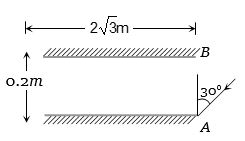
A
$28$
B
$30$
C
$32$
D
$34$
Solution
(B) Let the distance between the two mirrors be $h = 0.2 \ m$ and the length of the mirrors be $L = 2\sqrt{3} \ m$.
The angle of incidence is $i = 30^\circ$.
When the ray reflects between the two parallel mirrors,the horizontal distance $d$ covered by the ray between two consecutive reflections is given by:
$d = h \tan(i) = 0.2 \tan(30^\circ) = 0.2 \times \frac{1}{\sqrt{3}} \ m$.
The total horizontal distance covered by the ray before it emerges is $L = 2\sqrt{3} \ m$.
The number of reflections $n$ is given by the ratio of the total length to the horizontal distance per reflection:
$n = \frac{L}{d} = \frac{2\sqrt{3}}{0.2 / \sqrt{3}} = \frac{2 \times 3}{0.2} = \frac{6}{0.2} = 30$.
Thus,the maximum number of reflections is $30$.
The angle of incidence is $i = 30^\circ$.
When the ray reflects between the two parallel mirrors,the horizontal distance $d$ covered by the ray between two consecutive reflections is given by:
$d = h \tan(i) = 0.2 \tan(30^\circ) = 0.2 \times \frac{1}{\sqrt{3}} \ m$.
The total horizontal distance covered by the ray before it emerges is $L = 2\sqrt{3} \ m$.
The number of reflections $n$ is given by the ratio of the total length to the horizontal distance per reflection:
$n = \frac{L}{d} = \frac{2\sqrt{3}}{0.2 / \sqrt{3}} = \frac{2 \times 3}{0.2} = \frac{6}{0.2} = 30$.
Thus,the maximum number of reflections is $30$.
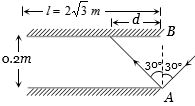
0 likesView Solution
30
PhysicsDifficultMCQIIT JEE · 2000
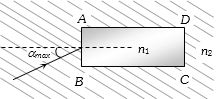
$A$ rectangular glass slab $ABCD$,of refractive index $n_1$,is immersed in water of refractive index $n_2$ $(n_1 > n_2)$. $A$ ray of light is incident at the surface $AB$ of the slab as shown. The maximum value of the angle of incidence $\alpha_{max}$,such that the ray comes out only from the other surface $CD$,is given by
A
$\sin^{-1} \left[ \frac{n_1}{n_2} \cos \left( \sin^{-1} \frac{n_2}{n_1} \right) \right]$
B
$\sin^{-1} \left[ n_1 \cos \left( \sin^{-1} \frac{1}{n_2} \right) \right]$
C
$\sin^{-1} \left( \frac{n_1}{n_2} \right)$
D
$\sin^{-1} \left( \frac{n_2}{n_1} \right)$
Solution
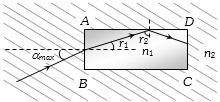
(A) For the ray to emerge only from the surface $CD$,it must undergo total internal reflection at the surface $AD$.
Applying Snell's law at the surface $AB$:
$n_2 \sin \alpha_{max} = n_1 \sin r_1 \implies \alpha_{max} = \sin^{-1} \left( \frac{n_1}{n_2} \sin r_1 \right) \dots (i)$
At the surface $AD$,the angle of incidence is $r_2$. For total internal reflection to occur,$r_2$ must be at least the critical angle $C$,where $\sin C = \frac{n_2}{n_1}$.
Since the surface $AD$ is perpendicular to $AB$,we have $r_1 + r_2 = 90^\circ$,so $r_1 = 90^\circ - r_2$.
To ensure the ray reaches $CD$,we set $r_2 = C = \sin^{-1} \left( \frac{n_2}{n_1} \right)$.
Thus,$r_1 = 90^\circ - \sin^{-1} \left( \frac{n_2}{n_1} \right)$.
Substituting this into equation $(i)$:
$\alpha_{max} = \sin^{-1} \left[ \frac{n_1}{n_2} \sin \left( 90^\circ - \sin^{-1} \frac{n_2}{n_1} \right) \right]$
Using the identity $\sin(90^\circ - \theta) = \cos \theta$:
$\alpha_{max} = \sin^{-1} \left[ \frac{n_1}{n_2} \cos \left( \sin^{-1} \frac{n_2}{n_1} \right) \right]$.
Applying Snell's law at the surface $AB$:
$n_2 \sin \alpha_{max} = n_1 \sin r_1 \implies \alpha_{max} = \sin^{-1} \left( \frac{n_1}{n_2} \sin r_1 \right) \dots (i)$
At the surface $AD$,the angle of incidence is $r_2$. For total internal reflection to occur,$r_2$ must be at least the critical angle $C$,where $\sin C = \frac{n_2}{n_1}$.
Since the surface $AD$ is perpendicular to $AB$,we have $r_1 + r_2 = 90^\circ$,so $r_1 = 90^\circ - r_2$.
To ensure the ray reaches $CD$,we set $r_2 = C = \sin^{-1} \left( \frac{n_2}{n_1} \right)$.
Thus,$r_1 = 90^\circ - \sin^{-1} \left( \frac{n_2}{n_1} \right)$.
Substituting this into equation $(i)$:
$\alpha_{max} = \sin^{-1} \left[ \frac{n_1}{n_2} \sin \left( 90^\circ - \sin^{-1} \frac{n_2}{n_1} \right) \right]$
Using the identity $\sin(90^\circ - \theta) = \cos \theta$:
$\alpha_{max} = \sin^{-1} \left[ \frac{n_1}{n_2} \cos \left( \sin^{-1} \frac{n_2}{n_1} \right) \right]$.
0 likesView Solution
31
PhysicsMediumMCQIIT JEE · 2000
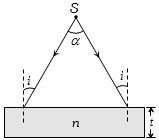
$A$ diverging beam of light from a point source $S$ having divergence angle $\alpha$,falls symmetrically on a glass slab as shown. The angles of incidence of the two extreme rays are equal. If the thickness of the glass slab is $t$ and the refractive index is $n$,then the divergence angle of the emergent beam is
A
$Zero$
B
$\alpha$
C
${\sin ^{ - 1}}(1/n)$
D
$2\,{\sin ^{ - 1}}(1/n)$
Solution
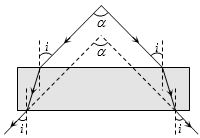
(B) When a light ray passes through a glass slab with parallel faces,the emergent ray is parallel to the incident ray.
This phenomenon is known as lateral displacement.
Since the incident rays are diverging at an angle $\alpha$,and each ray undergoes the same lateral displacement without changing its direction relative to the normal,the emergent rays will also diverge at the same angle $\alpha$.
Therefore,the divergence angle of the emergent beam remains $\alpha$.
This phenomenon is known as lateral displacement.
Since the incident rays are diverging at an angle $\alpha$,and each ray undergoes the same lateral displacement without changing its direction relative to the normal,the emergent rays will also diverge at the same angle $\alpha$.
Therefore,the divergence angle of the emergent beam remains $\alpha$.
0 likesView Solution
32
PhysicsMediumMCQIIT JEE · 2000
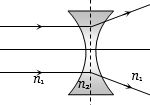
$A$ hollow double concave lens is made of very thin transparent material. It can be filled with air or either of two liquids $L_1$ and $L_2$ having refractive indices $n_1$ and $n_2$ respectively $(n_2 > n_1 > 1)$. The lens will diverge a parallel beam of light if it is filled with
A
Air and placed in air
B
Air and immersed in $L_1$
C
$L_1$ and immersed in $L_2$
D
$L_2$ and immersed in $L_1$
Solution
(D) The focal length $f$ of a lens is given by the Lens Maker's formula:
$\frac{1}{f} = \left( \frac{n_L}{n_m} - 1 \right) \left( \frac{1}{R_1} - \frac{1}{R_2} \right)$
where $n_L$ is the refractive index of the lens material and $n_m$ is the refractive index of the surrounding medium.
For a double concave lens,the term $\left( \frac{1}{R_1} - \frac{1}{R_2} \right)$ is negative.
For the lens to diverge light,it must act as a concave lens,meaning its focal length $f$ must be negative.
Since $\left( \frac{1}{R_1} - \frac{1}{R_2} \right) < 0$,the term $\left( \frac{n_L}{n_m} - 1 \right)$ must be positive for $f$ to be negative.
This implies $\frac{n_L}{n_m} > 1$,or $n_L > n_m$.
In option $(d)$,the lens is filled with liquid $L_2$ (refractive index $n_2$) and immersed in liquid $L_1$ (refractive index $n_1$). Since $n_2 > n_1$,the condition $n_L > n_m$ is satisfied,and the lens will diverge the light.
$\frac{1}{f} = \left( \frac{n_L}{n_m} - 1 \right) \left( \frac{1}{R_1} - \frac{1}{R_2} \right)$
where $n_L$ is the refractive index of the lens material and $n_m$ is the refractive index of the surrounding medium.
For a double concave lens,the term $\left( \frac{1}{R_1} - \frac{1}{R_2} \right)$ is negative.
For the lens to diverge light,it must act as a concave lens,meaning its focal length $f$ must be negative.
Since $\left( \frac{1}{R_1} - \frac{1}{R_2} \right) < 0$,the term $\left( \frac{n_L}{n_m} - 1 \right)$ must be positive for $f$ to be negative.
This implies $\frac{n_L}{n_m} > 1$,or $n_L > n_m$.
In option $(d)$,the lens is filled with liquid $L_2$ (refractive index $n_2$) and immersed in liquid $L_1$ (refractive index $n_1$). Since $n_2 > n_1$,the condition $n_L > n_m$ is satisfied,and the lens will diverge the light.
0 likesView Solution
33
PhysicsMediumMCQIIT JEE · 2000
In a double slit experiment, instead of taking slits of equal widths, one slit is made twice as wide as the other. Then in the interference pattern
A
The intensities of both the maxima and the minima increase
B
The intensity of maxima increases and the minima has zero intensity
C
The intensity of maxima decreases and that of the minima increases
D
The intensity of maxima decreases and the minima has zero intensity
Solution
(A) In a standard Young's Double Slit Experiment $(YDSE)$ with equal slit widths, the amplitudes of the waves from both slits are equal, say $a$. The maximum intensity is $I_{max} \propto (a + a)^2 = 4a^2$ and the minimum intensity is $I_{min} \propto (a - a)^2 = 0$.
When one slit is made twice as wide as the other, the intensity of the light passing through it increases. Since intensity $I \propto \text{width}$, if the width of the first slit is $w$, the width of the second is $2w$. The amplitudes are related by $A_2 = \sqrt{2} A_1$. Let $A_1 = a$, then $A_2 = a\sqrt{2}$.
The new maximum intensity is $I'_{max} \propto (a + a\sqrt{2})^2 = a^2(1 + \sqrt{2})^2 \approx 5.83a^2$, which is greater than $4a^2$.
The new minimum intensity is $I'_{min} \propto (a\sqrt{2} - a)^2 = a^2(\sqrt{2} - 1)^2 \approx 0.17a^2$, which is greater than $0$.
Thus, the intensities of both the maxima and the minima increase.
When one slit is made twice as wide as the other, the intensity of the light passing through it increases. Since intensity $I \propto \text{width}$, if the width of the first slit is $w$, the width of the second is $2w$. The amplitudes are related by $A_2 = \sqrt{2} A_1$. Let $A_1 = a$, then $A_2 = a\sqrt{2}$.
The new maximum intensity is $I'_{max} \propto (a + a\sqrt{2})^2 = a^2(1 + \sqrt{2})^2 \approx 5.83a^2$, which is greater than $4a^2$.
The new minimum intensity is $I'_{min} \propto (a\sqrt{2} - a)^2 = a^2(\sqrt{2} - 1)^2 \approx 0.17a^2$, which is greater than $0$.
Thus, the intensities of both the maxima and the minima increase.
0 likesView Solution
34
PhysicsMediumMCQIIT JEE · 2000
The dimension of $\frac{1}{2} \varepsilon_0 E^2$,where $\varepsilon_0$ is the permittivity of free space and $E$ is the electric field,is:
A
$M^1L^2T^{-2}$
B
$M^1L^{-1}T^{-2}$
C
$M^1L^2T^{-1}$
D
$MLT^{-1}$
Solution
(B) The expression $\frac{1}{2} \varepsilon_0 E^2$ represents the energy density of an electric field.
Energy density is defined as the energy per unit volume.
Dimensional formula of energy is $[M^1L^2T^{-2}]$.
Dimensional formula of volume is $[L^3]$.
Therefore,the dimensional formula of energy density is $\frac{[M^1L^2T^{-2}]}{[L^3]} = [M^1L^{-1}T^{-2}]$.
Thus,the dimension of $\frac{1}{2} \varepsilon_0 E^2$ is $[M^1L^{-1}T^{-2}]$.
Energy density is defined as the energy per unit volume.
Dimensional formula of energy is $[M^1L^2T^{-2}]$.
Dimensional formula of volume is $[L^3]$.
Therefore,the dimensional formula of energy density is $\frac{[M^1L^2T^{-2}]}{[L^3]} = [M^1L^{-1}T^{-2}]$.
Thus,the dimension of $\frac{1}{2} \varepsilon_0 E^2$ is $[M^1L^{-1}T^{-2}]$.
0 likesView Solution
35
PhysicsDifficultMCQIIT JEE · 2000
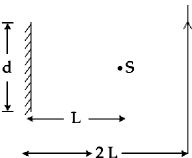
$A$ point source of light,$S$,is placed at a distance $L$ in front of the centre of a plane mirror of width $d$ which is hanging vertically on a wall. $A$ man walks in front of the mirror along a line parallel to the mirror,at a distance $2L$ as shown below. The distance over which the man can see the image of the light source in the mirror is:
A
$d$
B
$2d$
C
$3d$
D
$\frac{d}{2}$
Solution
(C) Let the mirror be placed along the $y$-axis from $y = -d/2$ to $y = d/2$. The source $S$ is at $(L, 0)$. The image $S'$ of the source $S$ is formed at $(-L, 0)$.
The man walks along the line $x = 2L$. The rays from the image $S'$ that reach the man must pass through the edges of the mirror.
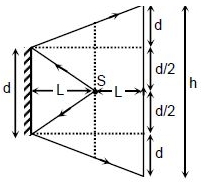
The rays from $S'$ passing through the top edge $(0, d/2)$ and bottom edge $(0, -d/2)$ of the mirror define the field of view.
Using similar triangles,the height $h$ of the field of view at a distance $x = 2L$ from the mirror is given by the ratio of distances.
The distance from the image $S'$ to the mirror is $L$,and the distance from the image $S'$ to the man is $L + 2L = 3L$.
By similar triangles,the width of the field of view $h$ is given by $\frac{h}{d} = \frac{3L}{L} = 3$.
Therefore,$h = 3d$.
The man walks along the line $x = 2L$. The rays from the image $S'$ that reach the man must pass through the edges of the mirror.
The rays from $S'$ passing through the top edge $(0, d/2)$ and bottom edge $(0, -d/2)$ of the mirror define the field of view.
Using similar triangles,the height $h$ of the field of view at a distance $x = 2L$ from the mirror is given by the ratio of distances.
The distance from the image $S'$ to the mirror is $L$,and the distance from the image $S'$ to the man is $L + 2L = 3L$.
By similar triangles,the width of the field of view $h$ is given by $\frac{h}{d} = \frac{3L}{L} = 3$.
Therefore,$h = 3d$.
0 likesView Solution
36
PhysicsEasyMCQIIT JEE · 2000
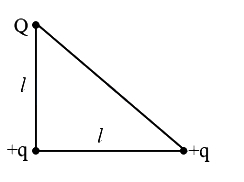
Three charges $Q$,$+q$,and $+q$ are placed at the vertices of a right-angled triangle as shown. The net electrostatic potential energy of the configuration is zero. The value of $Q$ is
A
$-2q$
B
$-\frac{q}{1+\sqrt{2}}$
C
$+q$
D
$\frac{-\sqrt{2}q}{\sqrt{2}+1}$
Solution
(D) The total electrostatic potential energy $U$ of a system of point charges is the sum of the potential energies of all distinct pairs of charges.
For the given configuration,the pairs are $(Q, +q)$,$(+q, +q)$,and $(Q, +q)$ with distances $l$,$l$,and $\sqrt{2}l$ respectively.
The total potential energy is given by:
$U = \frac{kQq}{l} + \frac{kq^2}{l} + \frac{kQq}{\sqrt{2}l} = 0$
Dividing by $k/l$ (assuming $k \neq 0$ and $l \neq 0$):
$Qq + q^2 + \frac{Qq}{\sqrt{2}} = 0$
$Qq(1 + \frac{1}{\sqrt{2}}) = -q^2$
$Qq(\frac{\sqrt{2}+1}{\sqrt{2}}) = -q^2$
$Q = -q^2 \cdot \frac{\sqrt{2}}{q(\sqrt{2}+1)}$
$Q = -\frac{\sqrt{2}q}{\sqrt{2}+1}$
For the given configuration,the pairs are $(Q, +q)$,$(+q, +q)$,and $(Q, +q)$ with distances $l$,$l$,and $\sqrt{2}l$ respectively.
The total potential energy is given by:
$U = \frac{kQq}{l} + \frac{kq^2}{l} + \frac{kQq}{\sqrt{2}l} = 0$
Dividing by $k/l$ (assuming $k \neq 0$ and $l \neq 0$):
$Qq + q^2 + \frac{Qq}{\sqrt{2}} = 0$
$Qq(1 + \frac{1}{\sqrt{2}}) = -q^2$
$Qq(\frac{\sqrt{2}+1}{\sqrt{2}}) = -q^2$
$Q = -q^2 \cdot \frac{\sqrt{2}}{q(\sqrt{2}+1)}$
$Q = -\frac{\sqrt{2}q}{\sqrt{2}+1}$
0 likesView Solution
37
PhysicsMediumMCQIIT JEE · 2000
$A$ particle of charge '$q$' and mass '$m$' moves in a circular orbit of radius '$r$' with angular speed '$\omega$'. The ratio of the magnitude of its magnetic moment to that of its angular momentum depends on
A
$\omega$ and $q$
B
$\omega, q$ and $m$
C
$q$ and $m$
D
$\omega$ and $m$
Solution
(C) The magnetic moment $M$ of a particle of charge $q$ moving in a circular orbit is given by $M = IA$,where $I$ is the current and $A$ is the area of the orbit.
The current $I = \frac{q}{T} = \frac{q\omega}{2\pi}$.
The area $A = \pi r^2$.
Thus,$M = \left(\frac{q\omega}{2\pi}\right)(\pi r^2) = \frac{q\omega r^2}{2}$.
The angular momentum $L$ of the particle is $L = mvr = m(\omega r)r = m\omega r^2$.
The ratio of the magnetic moment to the angular momentum is $\frac{M}{L} = \frac{q\omega r^2 / 2}{m\omega r^2} = \frac{q}{2m}$.
This ratio is known as the gyromagnetic ratio and depends only on the charge '$q$' and mass '$m$' of the particle.
The current $I = \frac{q}{T} = \frac{q\omega}{2\pi}$.
The area $A = \pi r^2$.
Thus,$M = \left(\frac{q\omega}{2\pi}\right)(\pi r^2) = \frac{q\omega r^2}{2}$.
The angular momentum $L$ of the particle is $L = mvr = m(\omega r)r = m\omega r^2$.
The ratio of the magnetic moment to the angular momentum is $\frac{M}{L} = \frac{q\omega r^2 / 2}{m\omega r^2} = \frac{q}{2m}$.
This ratio is known as the gyromagnetic ratio and depends only on the charge '$q$' and mass '$m$' of the particle.
0 likesView Solution
Vedclass Products
For Students
Vedclass Test Series
Mock tests in real IIT JEE style covering Physics with performance analysis. 5-day free trial.
Start Free TrialFor Teachers
Exam Paper Generator
Generate Set A/B/C/D Physics papers from 7.5L+ questions in 2 minutes. 3 chapters free.
Try FreeFor Institutes
Online Exam Module
Run live IIT JEE mock exams with unlimited students, 360° analytics & white-label branding.
See DemoFrequently Asked Questions
How many Physics questions are in IIT JEE 2000?
There are 37 Physics questions from the IIT JEE 2000 paper on Vedclass, each with a detailed step-by-step solution in English.
Are IIT JEE 2000 Physics solutions available in English?
Yes. All solutions on this page are in English. You can also switch to English or Hindi using the language buttons above the questions.
Can I practice IIT JEE 2000 Physics as a timed test?
Yes. Use the Vedclass Test Series to attempt a full IIT JEE mock test covering Physics with time limits and instant score analysis.
Can teachers create Physics papers from IIT JEE previous year questions?
Yes. The Vedclass Exam Paper Generator lets teachers mix IIT JEE Physics questions and generate Set A/B/C/D papers in minutes.
For Teachers & Institutes
Build a Custom Physics Paper
Pick IIT JEE 2000 Physics questions, set difficulty, and generate Set A/B/C/D in 2 minutes.