
ChemistryQ1–62 of 62 questions
Page 1 of 1 · English
1
ChemistryMCQIIT JEE · 2000
$A$ large open tank has two holes in the wall. One is a square hole of side $L$ at a depth $y$ from the top and the other is a circular hole of radius $R$ at a depth $4y$ from the top. When the tank is completely filled with water,the quantities of water flowing out per second from both the holes are the same. Then $R$ is equal to
A
$2\pi L$
B
$\frac{L}{\sqrt{2\pi}}$
C
$L$
D
$\frac{L}{2\pi}$
Solution
(B) The velocity of efflux for a hole at depth $h$ is given by Torricelli's law: $v = \sqrt{2gh}$.
The rate of flow of water (volume per second) is given by $Q = A \cdot v$,where $A$ is the area of the hole.
For the square hole at depth $y$:
Area $A_1 = L^2$
Velocity $v_1 = \sqrt{2gy}$
$Q_1 = L^2 \sqrt{2gy}$
For the circular hole at depth $4y$:
Area $A_2 = \pi R^2$
Velocity $v_2 = \sqrt{2g(4y)} = 2\sqrt{2gy}$
$Q_2 = \pi R^2 (2\sqrt{2gy})$
Given that $Q_1 = Q_2$:
$L^2 \sqrt{2gy} = \pi R^2 (2\sqrt{2gy})$
$L^2 = 2\pi R^2$
$R^2 = \frac{L^2}{2\pi}$
$R = \frac{L}{\sqrt{2\pi}}$
The rate of flow of water (volume per second) is given by $Q = A \cdot v$,where $A$ is the area of the hole.
For the square hole at depth $y$:
Area $A_1 = L^2$
Velocity $v_1 = \sqrt{2gy}$
$Q_1 = L^2 \sqrt{2gy}$
For the circular hole at depth $4y$:
Area $A_2 = \pi R^2$
Velocity $v_2 = \sqrt{2g(4y)} = 2\sqrt{2gy}$
$Q_2 = \pi R^2 (2\sqrt{2gy})$
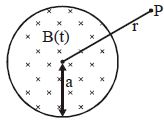
Given that $Q_1 = Q_2$:
$L^2 \sqrt{2gy} = \pi R^2 (2\sqrt{2gy})$
$L^2 = 2\pi R^2$
$R^2 = \frac{L^2}{2\pi}$
$R = \frac{L}{\sqrt{2\pi}}$
0 likesView Solution
2
ChemistryMCQIIT JEE · 2000
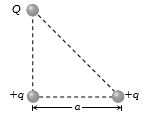
Three charges $Q$,$+q$,and $+q$ are placed at the vertices of a right-angled isosceles triangle as shown. The net electrostatic potential energy of the configuration is zero if $Q$ is equal to
A
$\frac{-q}{1 + \sqrt{2}}$
B
$\frac{-2q}{2 + \sqrt{2}}$
C
$-2q$
D
$+q$
Solution
(B) The total electrostatic potential energy $U$ of a system of charges is given by the sum of the potential energies of all pairs of charges.
For the given configuration,the distances between the charges are $a$,$a$,and $a\sqrt{2}$.
The potential energy $U$ is given by:
$U = \frac{k(Q)(q)}{a} + \frac{k(q)(q)}{a} + \frac{k(Q)(q)}{a\sqrt{2}} = 0$
Dividing by $\frac{kq}{a}$,we get:
$Q + q + \frac{Q}{\sqrt{2}} = 0$
$Q(1 + \frac{1}{\sqrt{2}}) = -q$
$Q(\frac{\sqrt{2} + 1}{\sqrt{2}}) = -q$
$Q = \frac{-q\sqrt{2}}{\sqrt{2} + 1}$
Multiplying the numerator and denominator by $\sqrt{2}$:
$Q = \frac{-2q}{2 + \sqrt{2}}$
Thus,the correct option is $B$.
For the given configuration,the distances between the charges are $a$,$a$,and $a\sqrt{2}$.
The potential energy $U$ is given by:
$U = \frac{k(Q)(q)}{a} + \frac{k(q)(q)}{a} + \frac{k(Q)(q)}{a\sqrt{2}} = 0$
Dividing by $\frac{kq}{a}$,we get:
$Q + q + \frac{Q}{\sqrt{2}} = 0$
$Q(1 + \frac{1}{\sqrt{2}}) = -q$
$Q(\frac{\sqrt{2} + 1}{\sqrt{2}}) = -q$
$Q = \frac{-q\sqrt{2}}{\sqrt{2} + 1}$
Multiplying the numerator and denominator by $\sqrt{2}$:
$Q = \frac{-2q}{2 + \sqrt{2}}$
Thus,the correct option is $B$.
0 likesView Solution
3
ChemistryMCQIIT JEE · 2000
$A$ particle of charge $q$ and mass $m$ moves in a circular orbit of radius $r$ with angular speed $\omega$. The ratio of the magnitude of its magnetic moment to that of its angular momentum depends on
A
$\omega \text{ and } q$
B
$\omega, q \text{ and } m$
C
$q \text{ and } m$
D
$\omega \text{ and } m$
Solution
(C) The effective current $i$ produced by a particle of charge $q$ moving with angular speed $\omega$ is given by $i = \frac{q}{T} = \frac{q\omega}{2\pi}$.
The area of the circular orbit is $A = \pi r^2$.
The magnetic moment $M$ is defined as $M = iA = \left(\frac{q\omega}{2\pi}\right)(\pi r^2) = \frac{1}{2}q\omega r^2$.
The angular momentum $L$ of the particle is $L = I\omega = (mr^2)\omega = m\omega r^2$.
Taking the ratio of the magnitude of the magnetic moment to the angular momentum:
$\frac{M}{L} = \frac{\frac{1}{2}q\omega r^2}{m\omega r^2} = \frac{q}{2m}$.
Thus,the ratio $\frac{M}{L}$ depends only on the charge $q$ and the mass $m$ of the particle.
The area of the circular orbit is $A = \pi r^2$.
The magnetic moment $M$ is defined as $M = iA = \left(\frac{q\omega}{2\pi}\right)(\pi r^2) = \frac{1}{2}q\omega r^2$.
The angular momentum $L$ of the particle is $L = I\omega = (mr^2)\omega = m\omega r^2$.
Taking the ratio of the magnitude of the magnetic moment to the angular momentum:
$\frac{M}{L} = \frac{\frac{1}{2}q\omega r^2}{m\omega r^2} = \frac{q}{2m}$.
Thus,the ratio $\frac{M}{L}$ depends only on the charge $q$ and the mass $m$ of the particle.
0 likesView Solution
4
ChemistryMediumMCQIIT JEE · 2000
In the standardization of $Na_2S_2O_3$ using $K_2Cr_2O_7$ by iodometry,the equivalent weight of $K_2Cr_2O_7$ is:
A
$MW/2$
B
$MW/3$
C
$MW/6$
D
$MW/1$
Solution
(C) In the reaction of $K_2Cr_2O_7$ with $KI$ in an acidic medium,the oxidation state of $Cr$ changes from $+6$ to $+3$.
$Cr_2O_7^{2-} + 14H^+ + 6e^- \rightarrow 2Cr^{3+} + 7H_2O$
Since $2$ atoms of $Cr$ are involved,the total change in oxidation number is $2 \times (6 - 3) = 6$.
Therefore,the $n$-factor for $K_2Cr_2O_7$ is $6$.
Equivalent weight = $\frac{\text{Molecular Weight (MW)}}{n\text{-factor}} = \frac{MW}{6}$.
$Cr_2O_7^{2-} + 14H^+ + 6e^- \rightarrow 2Cr^{3+} + 7H_2O$
Since $2$ atoms of $Cr$ are involved,the total change in oxidation number is $2 \times (6 - 3) = 6$.
Therefore,the $n$-factor for $K_2Cr_2O_7$ is $6$.
Equivalent weight = $\frac{\text{Molecular Weight (MW)}}{n\text{-factor}} = \frac{MW}{6}$.
0 likesView Solution
5
ChemistryEasyMCQIIT JEE · 2000
The electronic configuration of an element is $1s^2 2s^2 2p^6 3s^2 3p^6 3d^5 4s^1$. This represents its
A
Excited state
B
Ground state
C
Cationic form
D
Anionic form
Solution
(B) The given electronic configuration is $1s^2 2s^2 2p^6 3s^2 3p^6 3d^5 4s^1$.
This configuration corresponds to the element Chromium $(Cr)$,which has an atomic number of $24$.
According to the Aufbau principle,the expected configuration is $3d^4 4s^2$,but due to the extra stability of half-filled $d$-orbitals,one electron from the $4s$ orbital shifts to the $3d$ orbital.
Therefore,$3d^5 4s^1$ is the stable ground state configuration of $Cr$.
This configuration corresponds to the element Chromium $(Cr)$,which has an atomic number of $24$.
According to the Aufbau principle,the expected configuration is $3d^4 4s^2$,but due to the extra stability of half-filled $d$-orbitals,one electron from the $4s$ orbital shifts to the $3d$ orbital.
Therefore,$3d^5 4s^1$ is the stable ground state configuration of $Cr$.
0 likesView Solution
6
ChemistryMediumMCQIIT JEE · 2000
The number of nodal planes in a $p_x$ orbital is:
A
$1$
B
$2$
C
$3$
D
$0$
Solution
(A) The number of nodal planes in an orbital is given by the azimuthal quantum number,$l$.
For a $p$ orbital,the value of $l$ is $1$.
Therefore,the number of nodal planes in a $p_x$ orbital is $l = 1$.
The nodal plane for a $p_x$ orbital is the $yz$-plane.
For a $p$ orbital,the value of $l$ is $1$.
Therefore,the number of nodal planes in a $p_x$ orbital is $l = 1$.
The nodal plane for a $p_x$ orbital is the $yz$-plane.
0 likesView Solution
7
ChemistryDifficultMCQIIT JEE · 2000
Molecular shapes of $SF_4$,$CF_4$ and $XeF_4$ are
A
The same with $2, 0$ and $1$ lone pairs of electrons respectively
B
The same,with $1, 1$ and $1$ lone pairs of electrons respectively
C
Different,with $0, 1$ and $2$ lone pairs of electrons respectively
D
Different,with $1, 0$ and $2$ lone pairs of electrons respectively
Solution
(D) $SF_4$ has a see-saw shape due to $1$ lone pair on the $S$ atom.
$CF_4$ has a tetrahedral geometry with $0$ lone pairs on the $C$ atom.
$XeF_4$ has a square planar structure with $2$ lone pairs on the $Xe$ atom.
Therefore,the molecular shapes are different,with $1, 0$ and $2$ lone pairs of electrons respectively.
$CF_4$ has a tetrahedral geometry with $0$ lone pairs on the $C$ atom.
$XeF_4$ has a square planar structure with $2$ lone pairs on the $Xe$ atom.
Therefore,the molecular shapes are different,with $1, 0$ and $2$ lone pairs of electrons respectively.
0 likesView Solution
8
ChemistryMediumMCQIIT JEE · 2000
The compressibility factor $(Z)$ of a gas is less than unity at $STP$. Therefore:
A
$V_m > 22.4 \ L$
B
$V_m < 22.4 \ L$
C
$V_m = 22.4 \ L$
D
$V_m = 44.8 \ L$
Solution
(B) The compressibility factor is defined as $Z = \frac{PV_m}{RT}$.
Given that $Z < 1$ at $STP$,where $P = 1 \ atm$ and $T = 273 \ K$.
For an ideal gas,$V_{ideal} = \frac{RT}{P} = \frac{0.0821 \times 273}{1} \approx 22.4 \ L$.
Since $Z = \frac{V_{real}}{V_{ideal}} < 1$,it follows that $V_{real} < V_{ideal}$.
Therefore,$V_m < 22.4 \ L$.
Given that $Z < 1$ at $STP$,where $P = 1 \ atm$ and $T = 273 \ K$.
For an ideal gas,$V_{ideal} = \frac{RT}{P} = \frac{0.0821 \times 273}{1} \approx 22.4 \ L$.
Since $Z = \frac{V_{real}}{V_{ideal}} < 1$,it follows that $V_{real} < V_{ideal}$.
Therefore,$V_m < 22.4 \ L$.
0 likesView Solution
9
ChemistryMediumMCQIIT JEE · 2000
At ${100\,^o}C$ and $1\ L$,if the density of liquid water is $1.0\ g\ cm^{-3}$ and that of water vapour is $0.0006\ g\ cm^{-3}$,then the volume occupied by water molecules in $1\ L$ of steam at that temperature is .................. $cm^3$.
A
$6$
B
$60$
C
$0.6$
D
$0.06$
Solution
(C) Volume of steam = $1\ L = 10^3\ cm^3$.
Mass of $10^3\ cm^3$ steam = $\text{density} \times \text{Volume} = 0.0006\ g\ cm^{-3} \times 10^3\ cm^3 = 0.6\ g$.
The actual volume occupied by $H_2O$ molecules is equal to the volume of liquid water of the same mass.
Actual volume of $H_2O$ molecules = $\frac{\text{mass of steam}}{\text{density of liquid water}} = \frac{0.6\ g}{1.0\ g\ cm^{-3}} = 0.6\ cm^3$.
Mass of $10^3\ cm^3$ steam = $\text{density} \times \text{Volume} = 0.0006\ g\ cm^{-3} \times 10^3\ cm^3 = 0.6\ g$.
The actual volume occupied by $H_2O$ molecules is equal to the volume of liquid water of the same mass.
Actual volume of $H_2O$ molecules = $\frac{\text{mass of steam}}{\text{density of liquid water}} = \frac{0.6\ g}{1.0\ g\ cm^{-3}} = 0.6\ cm^3$.
0 likesView Solution
10
ChemistryMediumMCQIIT JEE · 2000
The root mean square velocity of an ideal gas at constant pressure varies with density $(d)$ as:
A
$d^2$
B
$d$
C
$\sqrt{d}$
D
$1/\sqrt{d}$
Solution
(D) The root mean square velocity $(U)$ is given by the formula $U = \sqrt{\frac{3RT}{M}}$.
Since $PV = nRT = \frac{m}{M}RT$,we have $P = \frac{m}{V} \cdot \frac{RT}{M} = d \cdot \frac{RT}{M}$,where $d$ is the density.
Thus,$\frac{RT}{M} = \frac{P}{d}$.
Substituting this into the velocity formula,we get $U = \sqrt{\frac{3P}{d}}$.
At constant pressure $(P)$,$U \propto \frac{1}{\sqrt{d}}$.
Since $PV = nRT = \frac{m}{M}RT$,we have $P = \frac{m}{V} \cdot \frac{RT}{M} = d \cdot \frac{RT}{M}$,where $d$ is the density.
Thus,$\frac{RT}{M} = \frac{P}{d}$.
Substituting this into the velocity formula,we get $U = \sqrt{\frac{3P}{d}}$.
At constant pressure $(P)$,$U \propto \frac{1}{\sqrt{d}}$.
0 likesView Solution
11
ChemistryMediumMCQIIT JEE · 2000
For the reversible reaction,$N_{2(g)} + 3H_{2(g)} \rightleftharpoons 2NH_{3(g)}$ at $500 \ ^oC$,the value of $K_P$ is $1.44 \times 10^{-5}$ when partial pressure is measured in atmospheres. The corresponding value of $K_c$ with concentration in $\text{mol L}^{-1}$ is:
A
$1.44 \times 10^{-5} / (0.082 \times 500)^{-2}$
B
$1.44 \times 10^{-5} / (8.314 \times 773)^{-2}$
C
$1.44 \times 10^{-5} / (0.082 \times 773)^2$
D
$1.44 \times 10^{-5} / (0.082 \times 773)^{-2}$
Solution
(D) The given reaction is $N_{2(g)} + 3H_{2(g)} \rightleftharpoons 2NH_{3(g)}$.
The change in the number of moles of gaseous products and reactants is $\Delta n = 2 - (1 + 3) = -2$.
The relationship between $K_p$ and $K_c$ is given by $K_p = K_c(RT)^{\Delta n}$.
Substituting the values,$K_p = K_c(RT)^{-2}$.
Therefore,$K_c = \frac{K_p}{(RT)^{-2}}$.
Given $T = 500 \ ^oC = 500 + 273 = 773 \ K$ and $R = 0.082 \ \text{L atm K}^{-1} \text{mol}^{-1}$.
Thus,$K_c = \frac{1.44 \times 10^{-5}}{(0.082 \times 773)^{-2}}$.
The change in the number of moles of gaseous products and reactants is $\Delta n = 2 - (1 + 3) = -2$.
The relationship between $K_p$ and $K_c$ is given by $K_p = K_c(RT)^{\Delta n}$.
Substituting the values,$K_p = K_c(RT)^{-2}$.
Therefore,$K_c = \frac{K_p}{(RT)^{-2}}$.
Given $T = 500 \ ^oC = 500 + 273 = 773 \ K$ and $R = 0.082 \ \text{L atm K}^{-1} \text{mol}^{-1}$.
Thus,$K_c = \frac{1.44 \times 10^{-5}}{(0.082 \times 773)^{-2}}$.
0 likesView Solution
12
ChemistryMCQIIT JEE · 2000
The $\Delta H_f^o$ for $CO_{2(g)}$,$CO_{(g)}$ and $H_2O_{(g)}$ are $-393.5$,$-110.5$ and $-241.8 \ kJ \ mol^{-1}$ respectively. The standard enthalpy change (in $kJ$) for the reaction $CO_{2(g)} + H_{2(g)} \to CO_{(g)} + H_2O_{(g)}$ is
A
$524.1$
B
$41.2$
C
$-262.5$
D
$-41.2$
Solution
(B) The standard enthalpy of reaction $\Delta_r H^o$ is calculated using the formula: $\Delta_r H^o = \sum \Delta H_f^o(\text{products}) - \sum \Delta H_f^o(\text{reactants})$.
For the reaction $CO_{2(g)} + H_{2(g)} \to CO_{(g)} + H_2O_{(g)}$:
$\Delta_r H^o = [\Delta H_f^o(CO_{(g)}) + \Delta H_f^o(H_2O_{(g)})] - [\Delta H_f^o(CO_{2(g)}) + \Delta H_f^o(H_{2(g)})]$.
Given $\Delta H_f^o(H_{2(g)}) = 0 \ kJ \ mol^{-1}$ (standard state of an element).
$\Delta_r H^o = [(-110.5) + (-241.8)] - [(-393.5) + 0]$.
$\Delta_r H^o = [-352.3] - [-393.5]$.
$\Delta_r H^o = -352.3 + 393.5 = +41.2 \ kJ$.
For the reaction $CO_{2(g)} + H_{2(g)} \to CO_{(g)} + H_2O_{(g)}$:
$\Delta_r H^o = [\Delta H_f^o(CO_{(g)}) + \Delta H_f^o(H_2O_{(g)})] - [\Delta H_f^o(CO_{2(g)}) + \Delta H_f^o(H_{2(g)})]$.
Given $\Delta H_f^o(H_{2(g)}) = 0 \ kJ \ mol^{-1}$ (standard state of an element).
$\Delta_r H^o = [(-110.5) + (-241.8)] - [(-393.5) + 0]$.
$\Delta_r H^o = [-352.3] - [-393.5]$.
$\Delta_r H^o = -352.3 + 393.5 = +41.2 \ kJ$.
0 likesView Solution
13
ChemistryMediumMCQIIT JEE · 2000
Amongst the following,identify the species with an atom in $+6$ oxidation state.
A
$MnO_4^-$
B
$Cr(CN)_6^{3-}$
C
$NiF_6^{2-}$
D
$CrO_2Cl_2$
Solution
(D) To find the oxidation state of the central atom,we assign oxidation numbers to the ligands:
In $MnO_4^-$,$Mn + 4(-2) = -1 \implies Mn = +7$.
In $Cr(CN)_6^{3-}$,$Cr + 6(-1) = -3 \implies Cr = +3$.
In $NiF_6^{2-}$,$Ni + 6(-1) = -2 \implies Ni = +4$.
In $CrO_2Cl_2$,let the oxidation state of $Cr$ be $x$. Since $O$ is $-2$ and $Cl$ is $-1$,we have $x + 2(-2) + 2(-1) = 0 \implies x - 4 - 2 = 0 \implies x = +6$.
Therefore,the species with an atom in $+6$ oxidation state is $CrO_2Cl_2$.
In $MnO_4^-$,$Mn + 4(-2) = -1 \implies Mn = +7$.
In $Cr(CN)_6^{3-}$,$Cr + 6(-1) = -3 \implies Cr = +3$.
In $NiF_6^{2-}$,$Ni + 6(-1) = -2 \implies Ni = +4$.
In $CrO_2Cl_2$,let the oxidation state of $Cr$ be $x$. Since $O$ is $-2$ and $Cl$ is $-1$,we have $x + 2(-2) + 2(-1) = 0 \implies x - 4 - 2 = 0 \implies x = +6$.
Therefore,the species with an atom in $+6$ oxidation state is $CrO_2Cl_2$.
0 likesView Solution
14
ChemistryMediumMCQIIT JEE · 2000
The correct order of radii is
A
$N < Be < B$
B
$F^{-} < O^{2-} < N^{3-}$
C
$Na < Li < K$
D
$Fe^{3+} < Fe^{2+} < Fe^{4+}$
Solution
(B) For isoelectronic species,the ionic radius increases as the nuclear charge (atomic number) decreases.
In the series $F^{-}$,$O^{2-}$,and $N^{3-}$,all have $10$ electrons.
The atomic numbers are $F (9)$,$O (8)$,and $N (7)$.
Since the nuclear charge decreases from $F$ to $N$,the attraction on the electrons decreases,and the ionic radius increases.
Therefore,the correct order is $F^{-} < O^{2-} < N^{3-}$.
In the series $F^{-}$,$O^{2-}$,and $N^{3-}$,all have $10$ electrons.
The atomic numbers are $F (9)$,$O (8)$,and $N (7)$.
Since the nuclear charge decreases from $F$ to $N$,the attraction on the electrons decreases,and the ionic radius increases.
Therefore,the correct order is $F^{-} < O^{2-} < N^{3-}$.
0 likesView Solution
15
ChemistryMediumMCQIIT JEE · 2000
Amongst $H_2O$,$H_2S$,$H_2Se$ and $H_2Te$,the one with the highest boiling point is:
A
$H_2O$ because of hydrogen bonding
B
$H_2Te$ because of higher molecular weight
C
$H_2S$ because of hydrogen bonding
D
$H_2Se$ because of lower molecular weight
Solution
(A) The boiling points of hydrides of group $16$ elements follow the order: $H_2O > H_2Te > H_2Se > H_2S$.
$H_2O$ has an anomalously high boiling point due to the presence of strong intermolecular hydrogen bonding,which is absent in the other hydrides of this group.
Therefore,the correct option is $A$.
$H_2O$ has an anomalously high boiling point due to the presence of strong intermolecular hydrogen bonding,which is absent in the other hydrides of this group.
Therefore,the correct option is $A$.
0 likesView Solution
16
ChemistryMCQIIT JEE · 2000
Which of the following compounds will exhibit geometrical isomerism?
A
$1-$phenyl$-2-$butene
B
$3-$phenyl$-1-$butene
C
$2-$phenyl$-1-$butene
D
$1, 1-$Diphenyl$-1-$propene
Solution
(A) Geometrical isomerism is exhibited by compounds that have restricted rotation around a double bond and where each carbon atom of the double bond is attached to two different groups.
In $1-$phenyl$-2-$butene $(C_6H_5-CH_2-CH=CH-CH_3)$,the double-bonded carbons are attached to different groups ($-H$ and $-CH_3$ on one side; $-H$ and $-CH_2C_6H_5$ on the other),allowing for cis-trans isomerism.
In the other options,at least one of the double-bonded carbons is attached to two identical groups (e.g.,two $-H$ atoms or two phenyl groups),which prevents the formation of geometrical isomers.
In $1-$phenyl$-2-$butene $(C_6H_5-CH_2-CH=CH-CH_3)$,the double-bonded carbons are attached to different groups ($-H$ and $-CH_3$ on one side; $-H$ and $-CH_2C_6H_5$ on the other),allowing for cis-trans isomerism.
In the other options,at least one of the double-bonded carbons is attached to two identical groups (e.g.,two $-H$ atoms or two phenyl groups),which prevents the formation of geometrical isomers.
0 likesView Solution
17
ChemistryMediumMCQIIT JEE · 2000
Which of the following has the highest nucleophilicity?
A
$F^-$
B
$OH^-$
C
$CH_3^-$
D
$NH_2^-$
Solution
(C) Nucleophilicity is the ability of a species to donate an electron pair to an electrophile.
In a period of the periodic table,nucleophilicity decreases as electronegativity increases.
The electronegativity order of the atoms bearing the negative charge is $C < N < O < F$.
Since $CH_3^-$ has the least electronegative atom $(C)$,it holds its lone pair the least tightly and is therefore the best nucleophile.
Thus,the order of nucleophilicity is $CH_3^- > NH_2^- > OH^- > F^-$.
In a period of the periodic table,nucleophilicity decreases as electronegativity increases.
The electronegativity order of the atoms bearing the negative charge is $C < N < O < F$.
Since $CH_3^-$ has the least electronegative atom $(C)$,it holds its lone pair the least tightly and is therefore the best nucleophile.
Thus,the order of nucleophilicity is $CH_3^- > NH_2^- > OH^- > F^-$.
0 likesView Solution
18
ChemistryMediumMCQIIT JEE · 2000
The reagent which is used to distinguish between propene and propyne is
A
Bromine
B
Alkaline $KMnO_4$
C
Ammoniacal $AgNO_3$
D
Ozone
Solution
(C) Propene and propyne can be distinguished by using the Ammoniacal silver nitrate test.
Propyne $(CH_3-C \equiv CH)$ contains a terminal acidic hydrogen atom.
Due to the $sp$ hybridization of the terminal carbon,the hydrogen is acidic and reacts with Ammoniacal $AgNO_3$ (Tollens' reagent) to form a white precipitate of silver propynide $(CH_3-C \equiv CAg)$.
Propene $(CH_3-CH=CH_2)$ does not contain an acidic hydrogen and therefore does not react with Ammoniacal $AgNO_3$ to form a precipitate.
Propyne $(CH_3-C \equiv CH)$ contains a terminal acidic hydrogen atom.
Due to the $sp$ hybridization of the terminal carbon,the hydrogen is acidic and reacts with Ammoniacal $AgNO_3$ (Tollens' reagent) to form a white precipitate of silver propynide $(CH_3-C \equiv CAg)$.
Propene $(CH_3-CH=CH_2)$ does not contain an acidic hydrogen and therefore does not react with Ammoniacal $AgNO_3$ to form a precipitate.
0 likesView Solution
19
ChemistryMCQIIT JEE · 2000
If $arg(z) < 0$,then $arg(-z) - arg(z)$ is equal to
A
$\pi$
B
$-\pi$
C
$-\frac{\pi}{2}$
D
$\frac{\pi}{2}$
Solution
(A) Let $arg(z) = -\theta$,where $\theta > 0$ and $0 < \theta < \pi$.
Since $z$ lies in the fourth quadrant,$-z$ lies in the second quadrant.
The argument of $-z$ is given by $arg(-z) = \pi - \theta$.
Now,$arg(-z) - arg(z) = (\pi - \theta) - (-\theta)$.
$= \pi - \theta + \theta = \pi$.
Since $z$ lies in the fourth quadrant,$-z$ lies in the second quadrant.
The argument of $-z$ is given by $arg(-z) = \pi - \theta$.
Now,$arg(-z) - arg(z) = (\pi - \theta) - (-\theta)$.
$= \pi - \theta + \theta = \pi$.
0 likesView Solution
20
ChemistryMCQIIT JEE · 2000
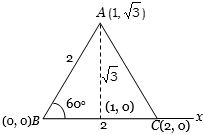
The incentre of the triangle with vertices $(1, \sqrt{3})$,$(0, 0)$ and $(2, 0)$ is
A
$\left( 1, \frac{\sqrt{3}}{2} \right)$
B
$\left( \frac{2}{3}, \frac{1}{\sqrt{3}} \right)$
C
$\left( \frac{2}{3}, \frac{\sqrt{3}}{2} \right)$
D
$\left( 1, \frac{1}{\sqrt{3}} \right)$
Solution
(D) Let the vertices of the triangle be $A(1, \sqrt{3})$,$B(0, 0)$,and $C(2, 0)$.
Calculate the lengths of the sides:
$AB = \sqrt{(1-0)^2 + (\sqrt{3}-0)^2} = \sqrt{1+3} = 2$
$BC = \sqrt{(2-0)^2 + (0-0)^2} = 2$
$AC = \sqrt{(2-1)^2 + (0-\sqrt{3})^2} = \sqrt{1+3} = 2$
Since all sides are equal,the triangle is equilateral.
For an equilateral triangle,the incentre is the same as the centroid.
The coordinates of the centroid are given by $\left( \frac{x_1+x_2+x_3}{3}, \frac{y_1+y_2+y_3}{3} \right)$.
Incentre $= \left( \frac{1+0+2}{3}, \frac{\sqrt{3}+0+0}{3} \right) = \left( \frac{3}{3}, \frac{\sqrt{3}}{3} \right) = \left( 1, \frac{1}{\sqrt{3}} \right)$.
Calculate the lengths of the sides:
$AB = \sqrt{(1-0)^2 + (\sqrt{3}-0)^2} = \sqrt{1+3} = 2$
$BC = \sqrt{(2-0)^2 + (0-0)^2} = 2$
$AC = \sqrt{(2-1)^2 + (0-\sqrt{3})^2} = \sqrt{1+3} = 2$
Since all sides are equal,the triangle is equilateral.
For an equilateral triangle,the incentre is the same as the centroid.
The coordinates of the centroid are given by $\left( \frac{x_1+x_2+x_3}{3}, \frac{y_1+y_2+y_3}{3} \right)$.
Incentre $= \left( \frac{1+0+2}{3}, \frac{\sqrt{3}+0+0}{3} \right) = \left( \frac{3}{3}, \frac{\sqrt{3}}{3} \right) = \left( 1, \frac{1}{\sqrt{3}} \right)$.
0 likesView Solution
21
ChemistryMCQIIT JEE · 2000
If the normal to the curve $y = f(x)$ at the point $(3, 4)$ makes an angle $\frac{3\pi}{4}$ with the positive $x$-axis,then $f'(3)$ is equal to
A
$ -1 $
B
$ -\frac{3}{4} $
C
$ \frac{4}{3} $
D
$ 1 $
Solution
(D) The slope of the normal to the curve $y = f(x)$ at a point is given by $m_n = \tan(\theta)$,where $\theta$ is the angle the normal makes with the positive $x$-axis.
Given $\theta = \frac{3\pi}{4}$,the slope of the normal is $m_n = \tan\left(\frac{3\pi}{4}\right) = -1$.
We know that the slope of the normal is related to the slope of the tangent $(f'(x))$ by the formula $m_n = -\frac{1}{f'(x)}$.
At the point $(3, 4)$,the slope of the tangent is $f'(3)$.
Therefore,$-1 = -\frac{1}{f'(3)}$.
Solving for $f'(3)$,we get $f'(3) = 1$.
Given $\theta = \frac{3\pi}{4}$,the slope of the normal is $m_n = \tan\left(\frac{3\pi}{4}\right) = -1$.
We know that the slope of the normal is related to the slope of the tangent $(f'(x))$ by the formula $m_n = -\frac{1}{f'(x)}$.
At the point $(3, 4)$,the slope of the tangent is $f'(3)$.
Therefore,$-1 = -\frac{1}{f'(3)}$.
Solving for $f'(3)$,we get $f'(3) = 1$.
0 likesView Solution
22
ChemistryMCQIIT JEE · 2000
For the reversible reaction $N_{2(g)} + 3H_{2(g)} \rightleftharpoons 2NH_{3(g)}$ at $500 \, ^\circ C$,the value of $K_p$ is $1.44 \times 10^{-5}$. When the partial pressure is measured in atmospheres,the value of $K_c$ in $\text{mol L}^{-1}$ is:
A
$1.44 \times 10^{-5} / (0.082 \times 773)^{-2}$
B
$1.44 \times 10^{-5} / (8.314 \times 773)^{-2}$
C
$1.44 \times 10^{-5} / (0.082 \times 773)^2$
D
$1.44 \times 10^{-5} / (0.082 \times 773)^{-2}$
Solution
(A) The relationship between $K_p$ and $K_c$ is given by the formula: $K_p = K_c(RT)^{\Delta n}$.
Rearranging for $K_c$: $K_c = K_p / (RT)^{\Delta n}$.
For the reaction $N_{2(g)} + 3H_{2(g)} \rightleftharpoons 2NH_{3(g)}$,the change in moles of gas is $\Delta n = 2 - (1 + 3) = -2$.
The temperature $T = 500 \, ^\circ C = 500 + 273 = 773 \, K$.
The gas constant $R = 0.082 \, \text{L atm K}^{-1} \text{mol}^{-1}$.
Substituting the values: $K_c = 1.44 \times 10^{-5} / (0.082 \times 773)^{-2}$.
Rearranging for $K_c$: $K_c = K_p / (RT)^{\Delta n}$.
For the reaction $N_{2(g)} + 3H_{2(g)} \rightleftharpoons 2NH_{3(g)}$,the change in moles of gas is $\Delta n = 2 - (1 + 3) = -2$.
The temperature $T = 500 \, ^\circ C = 500 + 273 = 773 \, K$.
The gas constant $R = 0.082 \, \text{L atm K}^{-1} \text{mol}^{-1}$.
Substituting the values: $K_c = 1.44 \times 10^{-5} / (0.082 \times 773)^{-2}$.
0 likesView Solution
23
ChemistryMCQIIT JEE · 2000
Let $PS$ be the median of the triangle with vertices $P(2, 2)$,$Q(6, -1)$,and $R(7, 3)$. The equation of the line passing through $(1, -1)$ and parallel to $PS$ is:
A
$2x - 9y - 7 = 0$
B
$2x - 9y - 11 = 0$
C
$2x + 9y - 11 = 0$
D
$2x + 9y + 7 = 0$
Solution
(D) The median $PS$ connects vertex $P$ to the midpoint $S$ of side $QR$.
Midpoint $S = \left( \frac{6+7}{2}, \frac{-1+3}{2} \right) = \left( \frac{13}{2}, 1 \right)$.
The slope of $PS$ is $m = \frac{1 - 2}{\frac{13}{2} - 2} = \frac{-1}{\frac{9}{2}} = -\frac{2}{9}$.
The line passing through $(1, -1)$ parallel to $PS$ has the same slope $m = -\frac{2}{9}$.
Using the point-slope form: $y - (-1) = -\frac{2}{9}(x - 1)$.
$9(y + 1) = -2(x - 1) \implies 9y + 9 = -2x + 2$.
$2x + 9y + 7 = 0$.
Midpoint $S = \left( \frac{6+7}{2}, \frac{-1+3}{2} \right) = \left( \frac{13}{2}, 1 \right)$.
The slope of $PS$ is $m = \frac{1 - 2}{\frac{13}{2} - 2} = \frac{-1}{\frac{9}{2}} = -\frac{2}{9}$.
The line passing through $(1, -1)$ parallel to $PS$ has the same slope $m = -\frac{2}{9}$.
Using the point-slope form: $y - (-1) = -\frac{2}{9}(x - 1)$.
$9(y + 1) = -2(x - 1) \implies 9y + 9 = -2x + 2$.
$2x + 9y + 7 = 0$.
0 likesView Solution
24
ChemistryMediumMCQIIT JEE · 2000
The hybridization of atomic orbitals of nitrogen in $NO_2^+$,$NO_3^-$,and $NH_4^+$ are:
A
$sp$,$sp^3$,and $sp^2$ respectively
B
$sp$,$sp^2$,and $sp^3$ respectively
C
$sp^2$,$sp$,and $sp^3$ respectively
D
$sp^2$,$sp^3$,and $sp$ respectively
Solution
(B) To determine the hybridization,we use the formula: $\text{Hybridization} = \frac{1}{2} [V + M - C + A]$,where $V$ is the number of valence electrons,$M$ is the number of monovalent atoms,$C$ is the cationic charge,and $A$ is the anionic charge.
$1$. For $NO_2^+$: $\text{Hybridization} = \frac{1}{2} [5 + 0 - 1 + 0] = 2$,which corresponds to $sp$ hybridization.
$2$. For $NO_3^-$: $\text{Hybridization} = \frac{1}{2} [5 + 0 - 0 + 1] = 3$,which corresponds to $sp^2$ hybridization.
$3$. For $NH_4^+$: $\text{Hybridization} = \frac{1}{2} [5 + 4 - 1 + 0] = 4$,which corresponds to $sp^3$ hybridization.
Thus,the correct order is $sp$,$sp^2$,and $sp^3$ respectively.
$1$. For $NO_2^+$: $\text{Hybridization} = \frac{1}{2} [5 + 0 - 1 + 0] = 2$,which corresponds to $sp$ hybridization.
$2$. For $NO_3^-$: $\text{Hybridization} = \frac{1}{2} [5 + 0 - 0 + 1] = 3$,which corresponds to $sp^2$ hybridization.
$3$. For $NH_4^+$: $\text{Hybridization} = \frac{1}{2} [5 + 4 - 1 + 0] = 4$,which corresponds to $sp^3$ hybridization.
Thus,the correct order is $sp$,$sp^2$,and $sp^3$ respectively.
0 likesView Solution
25
ChemistryMediumMCQIIT JEE · 2000
Which one of the following alkenes will react fastest with $H_2$ under catalytic hydrogenation condition?
A
B
C
D
Solution
(A) The rate of catalytic hydrogenation of an alkene is inversely proportional to its stability.
More substituted alkenes are more stable due to hyperconjugation and inductive effects,and therefore,they react more slowly with $H_2$.
The order of stability of alkenes is:
Tetrasubstituted > Trisubstituted > Disubstituted > Monosubstituted > Ethene.
Conversely,the order of reactivity towards catalytic hydrogenation is:
Monosubstituted > Disubstituted > Trisubstituted > Tetrasubstituted.
Among the given options,the alkene with the least number of substituents (monosubstituted or the least substituted one) will react fastest.
Based on the provided structures,the alkene with the fewest $R$ groups (most $H$ atoms) will be the most reactive.
More substituted alkenes are more stable due to hyperconjugation and inductive effects,and therefore,they react more slowly with $H_2$.
The order of stability of alkenes is:
Tetrasubstituted > Trisubstituted > Disubstituted > Monosubstituted > Ethene.
Conversely,the order of reactivity towards catalytic hydrogenation is:
Monosubstituted > Disubstituted > Trisubstituted > Tetrasubstituted.
Among the given options,the alkene with the least number of substituents (monosubstituted or the least substituted one) will react fastest.
Based on the provided structures,the alkene with the fewest $R$ groups (most $H$ atoms) will be the most reactive.
0 likesView Solution
26
ChemistryMCQIIT JEE · 2000
If the circles $x^2 + y^2 + 2x + 2ky + 6 = 0$ and $x^2 + y^2 + 2ky + k = 0$ intersect orthogonally,then $k$ is
A
$2$ or $-\frac{3}{2}$
B
$-2$ or $\frac{3}{2}$
C
$2$ or $\frac{3}{2}$
D
$-2$ or $-\frac{3}{2}$
Solution
(A) Two circles $x^2 + y^2 + 2g_1x + 2f_1y + c_1 = 0$ and $x^2 + y^2 + 2g_2x + 2f_2y + c_2 = 0$ intersect orthogonally if $2g_1g_2 + 2f_1f_2 = c_1 + c_2$.
For the given circles:
Circle $1$: $g_1 = 1, f_1 = k, c_1 = 6$
Circle $2$: $g_2 = 0, f_2 = k, c_2 = k$
Substituting these values into the condition:
$2(1)(0) + 2(k)(k) = 6 + k$
$2k^2 = 6 + k$
$2k^2 - k - 6 = 0$
Factoring the quadratic equation:
$2k^2 - 4k + 3k - 6 = 0$
$2k(k - 2) + 3(k - 2) = 0$
$(2k + 3)(k - 2) = 0$
Therefore,$k = 2$ or $k = -\frac{3}{2}$.
For the given circles:
Circle $1$: $g_1 = 1, f_1 = k, c_1 = 6$
Circle $2$: $g_2 = 0, f_2 = k, c_2 = k$
Substituting these values into the condition:
$2(1)(0) + 2(k)(k) = 6 + k$
$2k^2 = 6 + k$
$2k^2 - k - 6 = 0$
Factoring the quadratic equation:
$2k^2 - 4k + 3k - 6 = 0$
$2k(k - 2) + 3(k - 2) = 0$
$(2k + 3)(k - 2) = 0$
Therefore,$k = 2$ or $k = -\frac{3}{2}$.
0 likesView Solution
27
ChemistryMCQIIT JEE · 2000
The value of ${\log _3}4 \times {\log _4}5 \times {\log _5}6 \times {\log _6}7 \times {\log _7}8 \times {\log _8}9$ is:
A
$1$
B
$2$
C
$3$
D
$4$
Solution
(B) Using the change of base formula,${\log _a}b = \frac{{\log b}}{{\log a}}$.
Applying this to the expression:
${\log _3}4 \times {\log _4}5 \times {\log _5}6 \times {\log _6}7 \times {\log _7}8 \times {\log _8}9 = \frac{{\log 4}}{{\log 3}} \times \frac{{\log 5}}{{\log 4}} \times \frac{{\log 6}}{{\log 5}} \times \frac{{\log 7}}{{\log 6}} \times \frac{{\log 8}}{{\log 7}} \times \frac{{\log 9}}{{\log 8}}$
Canceling the common terms in the numerator and denominator:
$= \frac{{\log 9}}{{\log 3}}$
$= {\log _3}9$
$= {\log _3}({3^2})$
$= 2{\log _3}3$
$= 2(1) = 2$.
Applying this to the expression:
${\log _3}4 \times {\log _4}5 \times {\log _5}6 \times {\log _6}7 \times {\log _7}8 \times {\log _8}9 = \frac{{\log 4}}{{\log 3}} \times \frac{{\log 5}}{{\log 4}} \times \frac{{\log 6}}{{\log 5}} \times \frac{{\log 7}}{{\log 6}} \times \frac{{\log 8}}{{\log 7}} \times \frac{{\log 9}}{{\log 8}}$
Canceling the common terms in the numerator and denominator:
$= \frac{{\log 9}}{{\log 3}}$
$= {\log _3}9$
$= {\log _3}({3^2})$
$= 2{\log _3}3$
$= 2(1) = 2$.
0 likesView Solution
28
ChemistryMCQIIT JEE · 2000
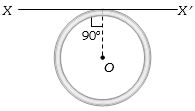
$A$ thin wire of length $L$ and uniform linear mass density $\rho$ is bent into a circular loop (as shown in the figure) with center $O$. The moment of inertia of the loop about the axis $XX'$ is:
A
$\frac{\rho L^3}{8\pi^2}$
B
$\frac{\rho L^3}{16\pi^2}$
C
$\frac{5\rho L^3}{16\pi^2}$
D
$\frac{3\rho L^3}{8\pi^2}$
Solution
(D) The linear mass density of the wire is $\rho$.
The total mass of the wire of length $L$ is $M = \rho L$.
Since the wire of length $L$ is bent into a circular loop,its circumference is $2\pi R = L$,which gives the radius $R = \frac{L}{2\pi}$.
The moment of inertia of a circular ring about its diameter is $I_{diam} = \frac{1}{2}MR^2$.
Using the parallel axis theorem,the moment of inertia about the axis $XX'$ (which is tangent to the loop and parallel to the diameter) is $I = I_{cm} + MR^2$,where $I_{cm} = I_{diam} = \frac{1}{2}MR^2$.
Thus,$I = \frac{1}{2}MR^2 + MR^2 = \frac{3}{2}MR^2$.
Substituting $M = \rho L$ and $R = \frac{L}{2\pi}$:
$I = \frac{3}{2}(\rho L)\left(\frac{L}{2\pi}\right)^2 = \frac{3}{2}\rho L \left(\frac{L^2}{4\pi^2}\right) = \frac{3\rho L^3}{8\pi^2}$.
The total mass of the wire of length $L$ is $M = \rho L$.
Since the wire of length $L$ is bent into a circular loop,its circumference is $2\pi R = L$,which gives the radius $R = \frac{L}{2\pi}$.
The moment of inertia of a circular ring about its diameter is $I_{diam} = \frac{1}{2}MR^2$.
Using the parallel axis theorem,the moment of inertia about the axis $XX'$ (which is tangent to the loop and parallel to the diameter) is $I = I_{cm} + MR^2$,where $I_{cm} = I_{diam} = \frac{1}{2}MR^2$.
Thus,$I = \frac{1}{2}MR^2 + MR^2 = \frac{3}{2}MR^2$.
Substituting $M = \rho L$ and $R = \frac{L}{2\pi}$:
$I = \frac{3}{2}(\rho L)\left(\frac{L}{2\pi}\right)^2 = \frac{3}{2}\rho L \left(\frac{L^2}{4\pi^2}\right) = \frac{3\rho L^3}{8\pi^2}$.
0 likesView Solution
29
ChemistryMCQIIT JEE · 2000
The electron in a hydrogen atom makes a transition from an excited state to the ground state. Which of the following statements is true?
A
Its kinetic energy increases and its potential and total energies decrease.
B
Its kinetic energy decreases,potential energy increases and its total energy remains the same.
C
Its kinetic and total energies decrease and its potential energy increases.
D
Its kinetic,potential and total energies decrease.
Solution
(A) For an electron in a hydrogen atom,the energy levels are given by $E_n = -\frac{13.6}{n^2} \text{ eV}$.
$1$. Kinetic Energy $(KE)$: $KE = -E_n = \frac{13.6}{n^2} \text{ eV}$. As the electron transitions from an excited state $(n > 1)$ to the ground state $(n = 1)$,$n$ decreases,so $KE$ increases.
$2$. Potential Energy $(U)$: $U = 2E_n = -\frac{27.2}{n^2} \text{ eV}$. As $n$ decreases,the magnitude $|U|$ increases,but since $U$ is negative,the value of $U$ becomes more negative,meaning it decreases.
$3$. Total Energy $(E)$: $E_n = -\frac{13.6}{n^2} \text{ eV}$. As $n$ decreases,the magnitude $|E_n|$ increases,but since $E_n$ is negative,the value of $E_n$ becomes more negative,meaning it decreases.
Therefore,kinetic energy increases,while potential and total energies decrease.
$1$. Kinetic Energy $(KE)$: $KE = -E_n = \frac{13.6}{n^2} \text{ eV}$. As the electron transitions from an excited state $(n > 1)$ to the ground state $(n = 1)$,$n$ decreases,so $KE$ increases.
$2$. Potential Energy $(U)$: $U = 2E_n = -\frac{27.2}{n^2} \text{ eV}$. As $n$ decreases,the magnitude $|U|$ increases,but since $U$ is negative,the value of $U$ becomes more negative,meaning it decreases.
$3$. Total Energy $(E)$: $E_n = -\frac{13.6}{n^2} \text{ eV}$. As $n$ decreases,the magnitude $|E_n|$ increases,but since $E_n$ is negative,the value of $E_n$ becomes more negative,meaning it decreases.
Therefore,kinetic energy increases,while potential and total energies decrease.
0 likesView Solution
30
ChemistryMediumMCQIIT JEE · 2000
Which of the following compounds will exhibit geometrical isomerism?
A
$2-$Phenyl$-1-$butene
B
$1,1-$Diphenyl$-1-$propene
C
$1-$Phenyl$-2-$butene
D
$3-$Phenyl$-1-$butene
Solution
(C) For a compound to exhibit geometrical isomerism,each carbon atom of the $C=C$ double bond must be attached to two different groups.
In $1-$Phenyl$-2-$butene $(C_6H_5-CH_2-CH=CH-CH_3)$,the carbon atoms of the double bond are attached to different groups ($H$ and $CH_3$ on one side; $H$ and $CH_2C_6H_5$ on the other).
Therefore,it can exist as $cis-$ and $trans-$ isomers.
In $1-$Phenyl$-2-$butene $(C_6H_5-CH_2-CH=CH-CH_3)$,the carbon atoms of the double bond are attached to different groups ($H$ and $CH_3$ on one side; $H$ and $CH_2C_6H_5$ on the other).
Therefore,it can exist as $cis-$ and $trans-$ isomers.
0 likesView Solution
31
ChemistryMCQIIT JEE · 2000
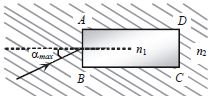
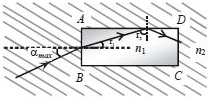
$A$ rectangular glass slab $ABCD,$ of refractive index $n_1,$ is immersed in water of refractive index $n_2$ $(n_1 > n_2)$. $A$ ray of light is incident at the surface $AB$ of the slab as shown. The maximum value of the angle of incidence $\alpha_{\max},$ such that the ray comes out only from the other surface $CD,$ is given by:
A
$\sin^{-1}\left[\frac{n_1}{n_2}\cos\left(\sin^{-1}\frac{n_2}{n_1}\right)\right]$
B
$\sin^{-1}\left[n_1\cos\left(\sin^{-1}\frac{1}{n_2}\right)\right]$
C
$\sin^{-1}\frac{n_1}{n_2}$
D
$\sin^{-1}\frac{n_2}{n_1}$
Solution
(A) For the ray to emerge from the surface $CD,$ it must not undergo total internal reflection at the surface $AD.$ The limiting condition is that the angle of incidence at surface $AD$ $(r_2)$ must be equal to the critical angle $C.$
Applying Snell's law at surface $AB$:
$n_2 \sin \alpha_{\max} = n_1 \sin r_1 \Rightarrow \sin \alpha_{\max} = \frac{n_1}{n_2} \sin r_1$ --- $(i)$
In the triangle formed inside the slab,$r_1 + r_2 = 90^{\circ}.$ For the ray to just emerge from $CD,$ $r_2$ must be the critical angle $C,$ where $\sin C = \frac{n_2}{n_1}.$
Thus,$r_1 = 90^{\circ} - C = 90^{\circ} - \sin^{-1}\left(\frac{n_2}{n_1}\right).$
Substituting $r_1$ into equation $(i)$:
$\alpha_{\max} = \sin^{-1}\left[\frac{n_1}{n_2} \sin\left(90^{\circ} - \sin^{-1}\frac{n_2}{n_1}\right)\right]$
Since $\sin(90^{\circ} - \theta) = \cos \theta,$
$\alpha_{\max} = \sin^{-1}\left[\frac{n_1}{n_2} \cos\left(\sin^{-1}\frac{n_2}{n_1}\right)\right].$
Applying Snell's law at surface $AB$:
$n_2 \sin \alpha_{\max} = n_1 \sin r_1 \Rightarrow \sin \alpha_{\max} = \frac{n_1}{n_2} \sin r_1$ --- $(i)$
In the triangle formed inside the slab,$r_1 + r_2 = 90^{\circ}.$ For the ray to just emerge from $CD,$ $r_2$ must be the critical angle $C,$ where $\sin C = \frac{n_2}{n_1}.$
Thus,$r_1 = 90^{\circ} - C = 90^{\circ} - \sin^{-1}\left(\frac{n_2}{n_1}\right).$
Substituting $r_1$ into equation $(i)$:
$\alpha_{\max} = \sin^{-1}\left[\frac{n_1}{n_2} \sin\left(90^{\circ} - \sin^{-1}\frac{n_2}{n_1}\right)\right]$
Since $\sin(90^{\circ} - \theta) = \cos \theta,$
$\alpha_{\max} = \sin^{-1}\left[\frac{n_1}{n_2} \cos\left(\sin^{-1}\frac{n_2}{n_1}\right)\right].$
0 likesView Solution
32
ChemistryMCQIIT JEE · 2000
The number of nodal planes in a $p_x$ orbital is
A
$1$
B
$2$
C
$3$
D
$0$
Solution
(A) nodal plane is an imaginary plane where the probability of finding an electron is zero.
The number of angular nodes (nodal planes) is given by the azimuthal quantum number $l$.
For a $p$-orbital,the value of $l$ is $1$. Therefore,it has $1$ nodal plane.
Specifically,for a $p_x$ orbital,the nodal plane is the $yz$-plane,where the electron density is zero.
The number of angular nodes (nodal planes) is given by the azimuthal quantum number $l$.
For a $p$-orbital,the value of $l$ is $1$. Therefore,it has $1$ nodal plane.
Specifically,for a $p_x$ orbital,the nodal plane is the $yz$-plane,where the electron density is zero.
0 likesView Solution
33
ChemistryMCQIIT JEE · 2000
The electronic configuration of an element is $1s^2 2s^2 2p^6 3s^2 3p^6 3d^5 4s^1$. This represents its
A
excited state
B
ground state
C
cationic form
D
anionic form
Solution
(B) The given electronic configuration is $1s^2 2s^2 2p^6 3s^2 3p^6 3d^5 4s^1$.
This configuration corresponds to the element Chromium ($Cr$,atomic number $24$).
According to the Aufbau principle,the expected configuration is $3d^4 4s^2$,but due to the extra stability of half-filled $d$-orbitals,one electron from the $4s$ orbital shifts to the $3d$ orbital.
Since this is the most stable arrangement for the neutral atom,it represents the ground state.
This configuration corresponds to the element Chromium ($Cr$,atomic number $24$).
According to the Aufbau principle,the expected configuration is $3d^4 4s^2$,but due to the extra stability of half-filled $d$-orbitals,one electron from the $4s$ orbital shifts to the $3d$ orbital.
Since this is the most stable arrangement for the neutral atom,it represents the ground state.
0 likesView Solution
34
ChemistryMCQIIT JEE · 2000
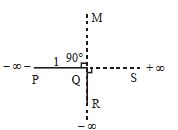
An infinitely long conductor $PQR$ is bent to form a right angle as shown. $A$ current $I$ flows through $PQR$. The magnetic field due to this current at the point $M$ is $H_1$. Now,another infinitely long straight conductor $QS$ is connected at $Q$ such that the current in $PQ$ remains unchanged. The magnetic field at $M$ is now $H_2$. The ratio $H_1/H_2$ is given by
A
$0.5$
B
$1$
C
$0.67$
D
$2$
Solution
(B) Let the distance from $Q$ to $M$ be $d$. The point $M$ lies on the line extending from $QR$. Therefore,the magnetic field at $M$ due to the segment $QR$ is zero.
For the first case,the magnetic field $H_1$ at $M$ is due only to the segment $PQ$. Using the Biot-Savart Law for a semi-infinite wire,the magnetic field at a perpendicular distance $d$ from the end of the wire is $H_1 = \frac{\mu_0 I}{4 \pi d}$.
In the second case,a conductor $QS$ is added. The current $I$ splits at $Q$. Since $PQ$ and $QS$ are collinear and $QR$ is perpendicular to them,the current $I$ splits into $I/2$ in $PQ$ and $I/2$ in $QS$ (assuming equal resistance per unit length). The segment $QR$ now carries no current.
The magnetic field $H_2$ at $M$ is the sum of the fields due to $PQ$ and $QS$:
$H_2 = H_{PQ} + H_{QS} + H_{QR}$
$H_{PQ} = \frac{\mu_0 (I/2)}{4 \pi d} = \frac{1}{2} H_1$
$H_{QS} = \frac{\mu_0 (I/2)}{4 \pi d} = \frac{1}{2} H_1$ (since $M$ is at distance $d$ from $Q$ along the line of $QS$)
$H_{QR} = 0$
Thus,$H_2 = \frac{1}{2} H_1 + \frac{1}{2} H_1 = H_1$.
Therefore,the ratio $H_1/H_2 = 1$.
For the first case,the magnetic field $H_1$ at $M$ is due only to the segment $PQ$. Using the Biot-Savart Law for a semi-infinite wire,the magnetic field at a perpendicular distance $d$ from the end of the wire is $H_1 = \frac{\mu_0 I}{4 \pi d}$.
In the second case,a conductor $QS$ is added. The current $I$ splits at $Q$. Since $PQ$ and $QS$ are collinear and $QR$ is perpendicular to them,the current $I$ splits into $I/2$ in $PQ$ and $I/2$ in $QS$ (assuming equal resistance per unit length). The segment $QR$ now carries no current.
The magnetic field $H_2$ at $M$ is the sum of the fields due to $PQ$ and $QS$:
$H_2 = H_{PQ} + H_{QS} + H_{QR}$
$H_{PQ} = \frac{\mu_0 (I/2)}{4 \pi d} = \frac{1}{2} H_1$
$H_{QS} = \frac{\mu_0 (I/2)}{4 \pi d} = \frac{1}{2} H_1$ (since $M$ is at distance $d$ from $Q$ along the line of $QS$)
$H_{QR} = 0$
Thus,$H_2 = \frac{1}{2} H_1 + \frac{1}{2} H_1 = H_1$.
Therefore,the ratio $H_1/H_2 = 1$.
0 likesView Solution
35
ChemistryMCQIIT JEE · 2000
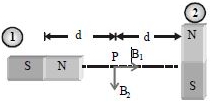
Two identical short bar magnets,each having magnetic moment $M$,are placed a distance of $2d$ apart with their axes perpendicular to each other in a horizontal plane. The magnetic induction at a point midway between them is:
A
$\frac{\mu_0}{4\pi} (\sqrt{2}) \frac{M}{d^3}$
B
$\frac{\mu_0}{4\pi} (\sqrt{3}) \frac{M}{d^3}$
C
$\left( \frac{2\mu_0}{\pi} \right) \frac{M}{d^3}$
D
$\frac{\mu_0}{4\pi} (\sqrt{5}) \frac{M}{d^3}$
Solution
(D) Let the two magnets be $1$ and $2$. The point $P$ is at a distance $d$ from the center of each magnet.
For magnet $1$,point $P$ lies on its axial line. The magnetic field $B_1$ due to magnet $1$ at $P$ is given by $B_1 = \frac{\mu_0}{4\pi} \cdot \frac{2M}{d^3}$.
For magnet $2$,point $P$ lies on its equatorial line. The magnetic field $B_2$ due to magnet $2$ at $P$ is given by $B_2 = \frac{\mu_0}{4\pi} \cdot \frac{M}{d^3}$.
Since the axes are perpendicular,the fields $B_1$ and $B_2$ are perpendicular to each other.
The net magnetic field $B_{net}$ at point $P$ is $B_{net} = \sqrt{B_1^2 + B_2^2}$.
Substituting the values: $B_{net} = \sqrt{\left( \frac{\mu_0}{4\pi} \cdot \frac{2M}{d^3} \right)^2 + \left( \frac{\mu_0}{4\pi} \cdot \frac{M}{d^3} \right)^2}$.
$B_{net} = \frac{\mu_0}{4\pi} \cdot \frac{M}{d^3} \sqrt{2^2 + 1^2} = \frac{\mu_0}{4\pi} \cdot \frac{\sqrt{5}M}{d^3}$.
For magnet $1$,point $P$ lies on its axial line. The magnetic field $B_1$ due to magnet $1$ at $P$ is given by $B_1 = \frac{\mu_0}{4\pi} \cdot \frac{2M}{d^3}$.
For magnet $2$,point $P$ lies on its equatorial line. The magnetic field $B_2$ due to magnet $2$ at $P$ is given by $B_2 = \frac{\mu_0}{4\pi} \cdot \frac{M}{d^3}$.
Since the axes are perpendicular,the fields $B_1$ and $B_2$ are perpendicular to each other.
The net magnetic field $B_{net}$ at point $P$ is $B_{net} = \sqrt{B_1^2 + B_2^2}$.
Substituting the values: $B_{net} = \sqrt{\left( \frac{\mu_0}{4\pi} \cdot \frac{2M}{d^3} \right)^2 + \left( \frac{\mu_0}{4\pi} \cdot \frac{M}{d^3} \right)^2}$.
$B_{net} = \frac{\mu_0}{4\pi} \cdot \frac{M}{d^3} \sqrt{2^2 + 1^2} = \frac{\mu_0}{4\pi} \cdot \frac{\sqrt{5}M}{d^3}$.
0 likesView Solution
36
ChemistryMCQIIT JEE · 2000
$A$ large open tank has two holes in the wall. One is a square hole of side $L$ at a depth $y$ from the top and the other is a circular hole of radius $R$ at a depth $4y$ from the top. When the tank is completely filled with water,the quantities of water flowing out per second from both holes are the same. Then,$R$ is equal to
A
$\frac{L}{2\sqrt{\pi}}$
B
$2\pi L$
C
$L$
D
$\frac{L}{\sqrt{2\pi}}$
Solution
(D) The rate of flow of water (volume per second) is given by the equation of continuity: $Q = A v$.
According to Torricelli's Law,the velocity of efflux at a depth $h$ is $v = \sqrt{2gh}$.
For the square hole: Area $A_1 = L^2$,depth $h_1 = y$. So,$v_1 = \sqrt{2gy}$.
The flow rate $Q_1 = A_1 v_1 = L^2 \sqrt{2gy}$.
For the circular hole: Area $A_2 = \pi R^2$,depth $h_2 = 4y$. So,$v_2 = \sqrt{2g(4y)} = 2\sqrt{2gy}$.
The flow rate $Q_2 = A_2 v_2 = \pi R^2 (2\sqrt{2gy})$.
Given that the flow rates are equal,$Q_1 = Q_2$:
$L^2 \sqrt{2gy} = 2\pi R^2 \sqrt{2gy}$.
Dividing both sides by $\sqrt{2gy}$,we get $L^2 = 2\pi R^2$.
Solving for $R$,we get $R^2 = \frac{L^2}{2\pi}$,which implies $R = \frac{L}{\sqrt{2\pi}}$.
According to Torricelli's Law,the velocity of efflux at a depth $h$ is $v = \sqrt{2gh}$.
For the square hole: Area $A_1 = L^2$,depth $h_1 = y$. So,$v_1 = \sqrt{2gy}$.
The flow rate $Q_1 = A_1 v_1 = L^2 \sqrt{2gy}$.
For the circular hole: Area $A_2 = \pi R^2$,depth $h_2 = 4y$. So,$v_2 = \sqrt{2g(4y)} = 2\sqrt{2gy}$.
The flow rate $Q_2 = A_2 v_2 = \pi R^2 (2\sqrt{2gy})$.
Given that the flow rates are equal,$Q_1 = Q_2$:
$L^2 \sqrt{2gy} = 2\pi R^2 \sqrt{2gy}$.
Dividing both sides by $\sqrt{2gy}$,we get $L^2 = 2\pi R^2$.
Solving for $R$,we get $R^2 = \frac{L^2}{2\pi}$,which implies $R = \frac{L}{\sqrt{2\pi}}$.
0 likesView Solution
37
ChemistryMCQIIT JEE · 2000
Two monoatomic ideal gases $1$ and $2$ of molecular masses $M_1$ and $M_2$ respectively are enclosed in separate containers kept at the same temperature. The ratio of the speed of sound in gas $1$ to that in gas $2$ is
A
$\sqrt{\frac{M_1}{M_2}}$
B
$\sqrt{\frac{M_2}{M_1}}$
C
$\frac{M_1}{M_2}$
D
$\frac{M_2}{M_1}$
Solution
(B) The speed of sound in an ideal gas is given by the formula $v_s = \sqrt{\frac{\gamma RT}{M}}$,where $\gamma$ is the adiabatic index,$R$ is the universal gas constant,$T$ is the absolute temperature,and $M$ is the molecular mass.
Since both gases are monoatomic,they have the same adiabatic index $\gamma = \frac{5}{3}$.
Given that the temperature $T$ is the same for both gases,we have $v_s \propto \sqrt{\frac{1}{M}}$.
Therefore,the ratio of the speed of sound in gas $1$ to that in gas $2$ is $\frac{v_1}{v_2} = \sqrt{\frac{M_2}{M_1}}$.
Since both gases are monoatomic,they have the same adiabatic index $\gamma = \frac{5}{3}$.
Given that the temperature $T$ is the same for both gases,we have $v_s \propto \sqrt{\frac{1}{M}}$.
Therefore,the ratio of the speed of sound in gas $1$ to that in gas $2$ is $\frac{v_1}{v_2} = \sqrt{\frac{M_2}{M_1}}$.
0 likesView Solution
38
ChemistryMCQIIT JEE · 2000
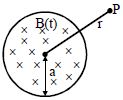
$A$ uniform but time-varying magnetic field $B(t)$ exists in a circular region of radius $a$ and is directed into the plane of the paper,as shown. The magnitude of the induced electric field at point $P$ at a distance $r > a$ from the centre of the circular region is:
A
Is zero
B
Decreases as $\frac{1}{r}$
C
Increases as $r$
D
Decreases as $\frac{1}{r^2}$
Solution
(B) According to Faraday's law of electromagnetic induction,the induced electric field $\vec{E}$ satisfies the relation $\oint \vec{E} \cdot d\vec{l} = -\frac{d\phi_B}{dt}$.
For a point $P$ at a distance $r > a$ from the center,we consider a circular path of radius $r$ centered at the origin.
The magnetic flux $\phi_B$ through this circular path is limited to the region of radius $a$ where the magnetic field exists: $\phi_B = B(t) \cdot \pi a^2$.
Applying the integral form of Faraday's law:
$E(2\pi r) = \left| \frac{d}{dt} (B(t) \cdot \pi a^2) \right| = \pi a^2 \frac{dB}{dt}$.
Solving for $E$,we get:
$E = \frac{a^2}{2r} \frac{dB}{dt}$.
Since $a$ and $\frac{dB}{dt}$ are constants,the magnitude of the induced electric field $E$ is proportional to $\frac{1}{r}$.
Therefore,the induced electric field decreases as $\frac{1}{r}$.
For a point $P$ at a distance $r > a$ from the center,we consider a circular path of radius $r$ centered at the origin.
The magnetic flux $\phi_B$ through this circular path is limited to the region of radius $a$ where the magnetic field exists: $\phi_B = B(t) \cdot \pi a^2$.
Applying the integral form of Faraday's law:
$E(2\pi r) = \left| \frac{d}{dt} (B(t) \cdot \pi a^2) \right| = \pi a^2 \frac{dB}{dt}$.
Solving for $E$,we get:
$E = \frac{a^2}{2r} \frac{dB}{dt}$.
Since $a$ and $\frac{dB}{dt}$ are constants,the magnitude of the induced electric field $E$ is proportional to $\frac{1}{r}$.
Therefore,the induced electric field decreases as $\frac{1}{r}$.
0 likesView Solution
39
ChemistryMCQIIT JEE · 2000
$A$ uniform but time-varying magnetic field $B(t)$ exists in a circular region of radius $a$ and is directed into the plane of the paper,as shown. The magnitude of the induced electric field at point $P$ at a distance $r$ $(r > a)$ from the centre of the circular region:
A
is zero
B
Decreases as $\frac{1}{r}$
C
Increases as $r$
D
Decreases as $\frac{1}{r^2}$
Solution
(B) According to Faraday's law of electromagnetic induction,the induced electric field $\vec{E}$ is related to the changing magnetic field by the equation:
$\oint \vec{E} \cdot d\vec{l} = -\frac{d\Phi_B}{dt}$
For a point $P$ at a distance $r > a$ from the center,we consider a circular path of radius $r$ centered at the origin.
By symmetry,the magnitude of the electric field $E$ is constant along this path,and $\vec{E}$ is tangential to the path.
Thus,$\oint \vec{E} \cdot d\vec{l} = E(2\pi r)$.
The magnetic flux $\Phi_B$ through the area enclosed by this path is limited to the region of radius $a$ where the magnetic field exists:
$\Phi_B = B(t) \cdot (\pi a^2)$
Therefore,$E(2\pi r) = \left| \frac{d}{dt} (B(t) \cdot \pi a^2) \right| = \pi a^2 \left| \frac{dB}{dt} \right|$.
Solving for $E$,we get $E = \frac{a^2}{2r} \left| \frac{dB}{dt} \right|$.
Since $a$ and $\frac{dB}{dt}$ are constants for a given time,we find that $E \propto \frac{1}{r}$.
Thus,the magnitude of the induced electric field decreases as $\frac{1}{r}$.
$\oint \vec{E} \cdot d\vec{l} = -\frac{d\Phi_B}{dt}$
For a point $P$ at a distance $r > a$ from the center,we consider a circular path of radius $r$ centered at the origin.
By symmetry,the magnitude of the electric field $E$ is constant along this path,and $\vec{E}$ is tangential to the path.
Thus,$\oint \vec{E} \cdot d\vec{l} = E(2\pi r)$.
The magnetic flux $\Phi_B$ through the area enclosed by this path is limited to the region of radius $a$ where the magnetic field exists:
$\Phi_B = B(t) \cdot (\pi a^2)$
Therefore,$E(2\pi r) = \left| \frac{d}{dt} (B(t) \cdot \pi a^2) \right| = \pi a^2 \left| \frac{dB}{dt} \right|$.
Solving for $E$,we get $E = \frac{a^2}{2r} \left| \frac{dB}{dt} \right|$.
Since $a$ and $\frac{dB}{dt}$ are constants for a given time,we find that $E \propto \frac{1}{r}$.
Thus,the magnitude of the induced electric field decreases as $\frac{1}{r}$.
0 likesView Solution
40
ChemistryMCQIIT JEE · 2000
Two long parallel wires are at a distance $2d$ apart. They carry steady equal currents flowing out of the plane of the paper,as shown. The variation of the magnetic field $B$ along the line $XX'$ is given by
A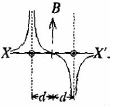
B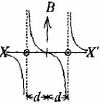
C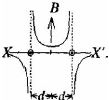
D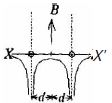
Solution
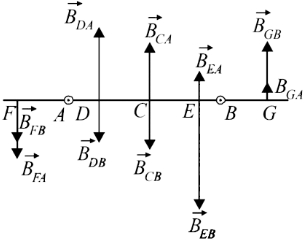
(B) Let the two wires be at positions $x = -d$ and $x = +d$ on the $XX'$ axis. Both carry current $I$ in the outward direction (perpendicular to the plane of the paper).
The magnetic field due to a single wire at a distance $r$ is $B = \frac{\mu_0 I}{2\pi r}$.
Using the right-hand rule,for a wire carrying current out of the plane,the magnetic field lines are counter-clockwise.
For the wire at $x = -d$,the field is $B_1 = \frac{\mu_0 I}{2\pi (x+d)}$ (directed upwards for $x > -d$).
For the wire at $x = +d$,the field is $B_2 = \frac{\mu_0 I}{2\pi (x-d)}$ (directed upwards for $x > d$,but downwards for $x < d$).
At the midpoint $(x=0)$,the fields are equal and opposite,so the net field is $0$.
To the left of $x = -d$,both fields point downwards. To the right of $x = +d$,both fields point upwards.
Between the wires,the fields oppose each other,resulting in a curve that passes through zero at the center and changes sign. The correct graphical representation is Option $B$.
The magnetic field due to a single wire at a distance $r$ is $B = \frac{\mu_0 I}{2\pi r}$.
Using the right-hand rule,for a wire carrying current out of the plane,the magnetic field lines are counter-clockwise.
For the wire at $x = -d$,the field is $B_1 = \frac{\mu_0 I}{2\pi (x+d)}$ (directed upwards for $x > -d$).
For the wire at $x = +d$,the field is $B_2 = \frac{\mu_0 I}{2\pi (x-d)}$ (directed upwards for $x > d$,but downwards for $x < d$).
At the midpoint $(x=0)$,the fields are equal and opposite,so the net field is $0$.
To the left of $x = -d$,both fields point downwards. To the right of $x = +d$,both fields point upwards.
Between the wires,the fields oppose each other,resulting in a curve that passes through zero at the center and changes sign. The correct graphical representation is Option $B$.
0 likesView Solution
41
ChemistryMCQIIT JEE · 2000
Among the following,the strongest base is
A
$C_6H_5NH_2$
B
$p-NO_2-C_6H_4NH_2$
C
$m-NO_2-C_6H_4NH_2$
D
$C_6H_5CH_2NH_2$
Solution
(D) In $C_6H_5CH_2NH_2$ (benzylamine),the lone pair of electrons on the nitrogen atom is localized because it is not in conjugation with the benzene ring.
In the other options,the lone pair on the nitrogen atom is delocalized due to resonance with the benzene ring,which decreases the basicity.
Furthermore,the $-NO_2$ group is an electron-withdrawing group that further decreases the basicity of aniline derivatives.
Therefore,$C_6H_5CH_2NH_2$ is the strongest base.
In the other options,the lone pair on the nitrogen atom is delocalized due to resonance with the benzene ring,which decreases the basicity.
Furthermore,the $-NO_2$ group is an electron-withdrawing group that further decreases the basicity of aniline derivatives.
Therefore,$C_6H_5CH_2NH_2$ is the strongest base.
0 likesView Solution
42
ChemistryMCQIIT JEE · 2000
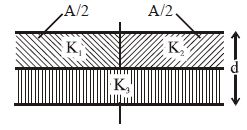
$A$ parallel plate capacitor of area $A$,plate separation $d$ and capacitance $C$ is filled with three different dielectric materials having dielectric constants $K_1, K_2$ and $K_3$ as shown in the figure. If a single dielectric material is to be used to have the same capacitance $C$ in this capacitor,then its dielectric constant $K$ is given by: ($A =$ Area of plates)
A
$\frac{1}{K} = \frac{1}{K_1} + \frac{1}{K_2} + \frac{1}{2K_3}$
B
$\frac{1}{K} = \frac{1}{K_1 + K_2} + \frac{1}{2K_3}$
C
$K = \frac{K_1 K_2}{K_1 + K_2} + 2K_3$
D
$K = K_1 + K_2 + 2K_3$
Solution
(B) The capacitor can be viewed as a combination of three capacitors. The region with $K_1$ and $K_2$ are in parallel with each other,and this combination is in series with the region having $K_3$.
Capacitance of the first part: $C_1 = \frac{\varepsilon_0 (A/2) K_1}{d/2} = \frac{\varepsilon_0 A K_1}{d}$
Capacitance of the second part: $C_2 = \frac{\varepsilon_0 (A/2) K_2}{d/2} = \frac{\varepsilon_0 A K_2}{d}$
Capacitance of the third part: $C_3 = \frac{\varepsilon_0 A K_3}{d/2} = \frac{2 \varepsilon_0 A K_3}{d}$
Since $C_1$ and $C_2$ are in parallel,their equivalent capacitance is $C_p = C_1 + C_2 = \frac{\varepsilon_0 A}{d} (K_1 + K_2)$.
Now,$C_p$ and $C_3$ are in series,so the equivalent capacitance $C$ is given by:
$\frac{1}{C} = \frac{1}{C_p} + \frac{1}{C_3} = \frac{d}{\varepsilon_0 A (K_1 + K_2)} + \frac{d}{2 \varepsilon_0 A K_3}$
If a single dielectric $K$ is used,$C = \frac{K \varepsilon_0 A}{d}$,so $\frac{1}{C} = \frac{d}{K \varepsilon_0 A}$.
Equating the two expressions for $\frac{1}{C}$:
$\frac{d}{K \varepsilon_0 A} = \frac{d}{\varepsilon_0 A} \left( \frac{1}{K_1 + K_2} + \frac{1}{2K_3} \right)$
Therefore,$\frac{1}{K} = \frac{1}{K_1 + K_2} + \frac{1}{2K_3}$.
Capacitance of the first part: $C_1 = \frac{\varepsilon_0 (A/2) K_1}{d/2} = \frac{\varepsilon_0 A K_1}{d}$
Capacitance of the second part: $C_2 = \frac{\varepsilon_0 (A/2) K_2}{d/2} = \frac{\varepsilon_0 A K_2}{d}$
Capacitance of the third part: $C_3 = \frac{\varepsilon_0 A K_3}{d/2} = \frac{2 \varepsilon_0 A K_3}{d}$
Since $C_1$ and $C_2$ are in parallel,their equivalent capacitance is $C_p = C_1 + C_2 = \frac{\varepsilon_0 A}{d} (K_1 + K_2)$.
Now,$C_p$ and $C_3$ are in series,so the equivalent capacitance $C$ is given by:
$\frac{1}{C} = \frac{1}{C_p} + \frac{1}{C_3} = \frac{d}{\varepsilon_0 A (K_1 + K_2)} + \frac{d}{2 \varepsilon_0 A K_3}$
If a single dielectric $K$ is used,$C = \frac{K \varepsilon_0 A}{d}$,so $\frac{1}{C} = \frac{d}{K \varepsilon_0 A}$.
Equating the two expressions for $\frac{1}{C}$:
$\frac{d}{K \varepsilon_0 A} = \frac{d}{\varepsilon_0 A} \left( \frac{1}{K_1 + K_2} + \frac{1}{2K_3} \right)$
Therefore,$\frac{1}{K} = \frac{1}{K_1 + K_2} + \frac{1}{2K_3}$.
0 likesView Solution
43
ChemistryMCQIIT JEE · 2000
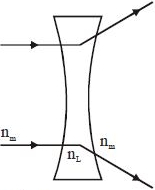
$A$ hollow double concave lens is made of very thin transparent material. It can be filled with air or either of two liquids $L_1$ or $L_2$ having refractive indices $n_1$ and $n_2$ respectively $(n_2 > n_1 > 1)$. The lens will diverge a parallel beam of light if it is filled with
A
air and placed in air
B
air and immersed in $L_1$
C
$L_1$ and immersed in $L_2$
D
$L_2$ and immersed in $L_1$
Solution
(D) The focal length of a lens is given by the Lens Maker's Formula: $\frac{1}{f} = (\frac{n_L}{n_m} - 1)(\frac{1}{R_1} - \frac{1}{R_2})$.
For a double concave lens,$R_1$ is negative and $R_2$ is positive,so $(\frac{1}{R_1} - \frac{1}{R_2}) < 0$.
For the lens to diverge light,it must act as a concave lens,meaning its focal length $f$ must be negative.
This requires $(\frac{n_L}{n_m} - 1) > 0$,which implies $n_L > n_m$.
Given $n_2 > n_1 > 1$,if the lens is filled with $L_2$ $(n_L = n_2)$ and immersed in $L_1$ $(n_m = n_1)$,then $n_L > n_m$ is satisfied.
Therefore,the lens will diverge a parallel beam of light.
For a double concave lens,$R_1$ is negative and $R_2$ is positive,so $(\frac{1}{R_1} - \frac{1}{R_2}) < 0$.
For the lens to diverge light,it must act as a concave lens,meaning its focal length $f$ must be negative.
This requires $(\frac{n_L}{n_m} - 1) > 0$,which implies $n_L > n_m$.
Given $n_2 > n_1 > 1$,if the lens is filled with $L_2$ $(n_L = n_2)$ and immersed in $L_1$ $(n_m = n_1)$,then $n_L > n_m$ is satisfied.
Therefore,the lens will diverge a parallel beam of light.
0 likesView Solution
44
ChemistryMediumMCQIIT JEE · 2000
The $\Delta H_f^o$ for $CO_{2(g)}$,$CO_{(g)}$ and $H_2O_{(g)}$ are $-393.5$,$-110.5$ and $-241.8 \ kJ \ mol^{-1}$ respectively. The standard enthalpy change (in $kJ$) for the reaction $CO_{2(g)} + H_{2(g)} \to CO_{(g)} + H_2O_{(g)}$ is
A
$524.1$
B
$41.2$
C
$-262.5$
D
$-41.2$
Solution
(B) The standard enthalpy change for the reaction is calculated using the formula: $\Delta H^o = \sum \Delta H_f^o(\text{products}) - \sum \Delta H_f^o(\text{reactants})$.
For the reaction $CO_{2(g)} + H_{2(g)} \to CO_{(g)} + H_2O_{(g)}$,the enthalpy change is:
$\Delta H^o = [\Delta H_f^o(CO_{(g)}) + \Delta H_f^o(H_2O_{(g)})] - [\Delta H_f^o(CO_{2(g)}) + \Delta H_f^o(H_{2(g)})]$.
Given $\Delta H_f^o(H_{2(g)}) = 0 \ kJ \ mol^{-1}$ (standard state of an element).
$\Delta H^o = [-110.5 + (-241.8)] - [-393.5 + 0]$.
$\Delta H^o = -352.3 - (-393.5) = 41.2 \ kJ$.
For the reaction $CO_{2(g)} + H_{2(g)} \to CO_{(g)} + H_2O_{(g)}$,the enthalpy change is:
$\Delta H^o = [\Delta H_f^o(CO_{(g)}) + \Delta H_f^o(H_2O_{(g)})] - [\Delta H_f^o(CO_{2(g)}) + \Delta H_f^o(H_{2(g)})]$.
Given $\Delta H_f^o(H_{2(g)}) = 0 \ kJ \ mol^{-1}$ (standard state of an element).
$\Delta H^o = [-110.5 + (-241.8)] - [-393.5 + 0]$.
$\Delta H^o = -352.3 - (-393.5) = 41.2 \ kJ$.
0 likesView Solution
45
ChemistryMCQIIT JEE · 2000
At any instant,two elements $X_1$ and $X_2$ have the same number of radioactive atoms. If the decay constants of $X_1$ and $X_2$ are $10 \lambda$ and $\lambda$ respectively,then the time when the ratio of their atoms becomes $\frac{1}{e}$ will be:
A
$\frac{1}{11 \lambda}$
B
$\frac{1}{9 \lambda}$
C
$\frac{1}{6 \lambda}$
D
$\frac{1}{5 \lambda}$
Solution
(B) Let the initial number of radioactive atoms for both elements be $N_0$.
The number of atoms remaining at time $t$ for element $X_1$ is $N_1(t) = N_0 e^{-10 \lambda t}$.
The number of atoms remaining at time $t$ for element $X_2$ is $N_2(t) = N_0 e^{-\lambda t}$.
The ratio of their atoms is given by $\frac{N_1}{N_2} = \frac{N_0 e^{-10 \lambda t}}{N_0 e^{-\lambda t}} = e^{-9 \lambda t}$.
We are given that this ratio becomes $\frac{1}{e} = e^{-1}$.
Equating the exponents: $-9 \lambda t = -1$.
Therefore,$t = \frac{1}{9 \lambda}$.
The number of atoms remaining at time $t$ for element $X_1$ is $N_1(t) = N_0 e^{-10 \lambda t}$.
The number of atoms remaining at time $t$ for element $X_2$ is $N_2(t) = N_0 e^{-\lambda t}$.
The ratio of their atoms is given by $\frac{N_1}{N_2} = \frac{N_0 e^{-10 \lambda t}}{N_0 e^{-\lambda t}} = e^{-9 \lambda t}$.
We are given that this ratio becomes $\frac{1}{e} = e^{-1}$.
Equating the exponents: $-9 \lambda t = -1$.
Therefore,$t = \frac{1}{9 \lambda}$.
0 likesView Solution
46
ChemistryMCQIIT JEE · 2000
If the normal to the curve $y=f(x)$ at the point $(3,4)$ makes an angle of $\frac{3 \pi}{4}$ with the positive $X$-axis,then the value of $f^{\prime}(3)$ is
A
-$1$
B
$-\frac{3}{4}$
C
$\frac{4}{3}$
D
$1$
Solution
(D) The slope of the normal to the curve $y=f(x)$ at a point is given by $\tan \theta$,where $\theta$ is the angle the normal makes with the positive $X$-axis.
Given $\theta = \frac{3 \pi}{4}$,the slope of the normal is $\tan \left(\frac{3 \pi}{4}\right) = -1$.
We know that the slope of the normal is related to the slope of the tangent $\left(\frac{dy}{dx}\right)$ by the formula: $\text{Slope of normal} = -\frac{1}{\frac{dy}{dx}}$.
Substituting the values,we get $-1 = -\frac{1}{f^{\prime}(3)}$.
Solving for $f^{\prime}(3)$,we get $f^{\prime}(3) = 1$.
Given $\theta = \frac{3 \pi}{4}$,the slope of the normal is $\tan \left(\frac{3 \pi}{4}\right) = -1$.
We know that the slope of the normal is related to the slope of the tangent $\left(\frac{dy}{dx}\right)$ by the formula: $\text{Slope of normal} = -\frac{1}{\frac{dy}{dx}}$.
Substituting the values,we get $-1 = -\frac{1}{f^{\prime}(3)}$.
Solving for $f^{\prime}(3)$,we get $f^{\prime}(3) = 1$.
0 likesView Solution
47
ChemistryMCQIIT JEE · 2000
$A$ particle of charge '$q$' and mass '$m$' moves in a circular orbit of radius '$r$' with angular speed '$\omega$'. The ratio of the magnitude of its magnetic moment to that of its angular momentum depends on
A
$\omega$ and $q$
B
$\omega$ and $m$
C
$q$ and $m$
D
$\omega, q$ and $m$
Solution
(C) The angular momentum $L$ of a particle of mass $m$ moving in a circular orbit of radius $r$ with angular speed $\omega$ is given by $L = I\omega = (mr^2)\omega$.
The magnetic moment $M$ associated with the circulating charge is given by $M = IA$,where $I$ is the equivalent current and $A$ is the area of the orbit.
The current $I = \frac{q}{T} = \frac{q}{2\pi/\omega} = \frac{q\omega}{2\pi}$.
The area $A = \pi r^2$.
Thus,$M = \left(\frac{q\omega}{2\pi}\right)(\pi r^2) = \frac{1}{2}q\omega r^2$.
The ratio of the magnetic moment to the angular momentum is $\frac{M}{L} = \frac{\frac{1}{2}q\omega r^2}{mr^2\omega} = \frac{q}{2m}$.
Therefore,the ratio depends only on the charge '$q$' and the mass '$m$' of the particle.
The magnetic moment $M$ associated with the circulating charge is given by $M = IA$,where $I$ is the equivalent current and $A$ is the area of the orbit.
The current $I = \frac{q}{T} = \frac{q}{2\pi/\omega} = \frac{q\omega}{2\pi}$.
The area $A = \pi r^2$.
Thus,$M = \left(\frac{q\omega}{2\pi}\right)(\pi r^2) = \frac{1}{2}q\omega r^2$.
The ratio of the magnetic moment to the angular momentum is $\frac{M}{L} = \frac{\frac{1}{2}q\omega r^2}{mr^2\omega} = \frac{q}{2m}$.
Therefore,the ratio depends only on the charge '$q$' and the mass '$m$' of the particle.
0 likesView Solution
48
ChemistryMCQIIT JEE · 2000
$A$ large open tank has two holes in the wall. One is a square hole of side $L$ at a depth $y$ from the top and the other is a circular hole of radius $R$ at a depth $4y$ from the top. When the tank is completely filled with water,the quantities of water flowing out per second from the two holes are the same. Then the value of $R$ is
A
$\frac{L}{\sqrt{2 \pi}}$
B
$2 \pi L$
C
$L \sqrt{\frac{2}{\pi}}$
D
$\frac{L}{2 \pi}$
Solution
(A) The volume flow rate (quantity of water per second) is given by $Q = A v$,where $A$ is the area of the hole and $v$ is the velocity of efflux.
According to Torricelli's law,the velocity of efflux at a depth $h$ is $v = \sqrt{2gh}$.
For the square hole: $A_1 = L^2$ and $v_1 = \sqrt{2gy}$.
Thus,$Q_1 = L^2 \sqrt{2gy}$.
For the circular hole: $A_2 = \pi R^2$ and $v_2 = \sqrt{2g(4y)} = 2\sqrt{2gy}$.
Thus,$Q_2 = \pi R^2 (2\sqrt{2gy})$.
Given that $Q_1 = Q_2$,we have:
$L^2 \sqrt{2gy} = \pi R^2 (2\sqrt{2gy})$
$L^2 = 2\pi R^2$
$R^2 = \frac{L^2}{2\pi}$
$R = \frac{L}{\sqrt{2\pi}}$.
According to Torricelli's law,the velocity of efflux at a depth $h$ is $v = \sqrt{2gh}$.
For the square hole: $A_1 = L^2$ and $v_1 = \sqrt{2gy}$.
Thus,$Q_1 = L^2 \sqrt{2gy}$.
For the circular hole: $A_2 = \pi R^2$ and $v_2 = \sqrt{2g(4y)} = 2\sqrt{2gy}$.
Thus,$Q_2 = \pi R^2 (2\sqrt{2gy})$.
Given that $Q_1 = Q_2$,we have:
$L^2 \sqrt{2gy} = \pi R^2 (2\sqrt{2gy})$
$L^2 = 2\pi R^2$
$R^2 = \frac{L^2}{2\pi}$
$R = \frac{L}{\sqrt{2\pi}}$.
0 likesView Solution
49
ChemistryMCQIIT JEE · 2000
If the normal to the curve $y=f(x)$ at the point $(3,4)$ makes an angle $3\pi/4$ with the positive $x$-axis,then $f'(3)$ is
A
$1$
B
$-1$
C
$-\frac{3}{4}$
D
$\frac{3}{4}$
Solution
(A) The slope of the normal to the curve $y=f(x)$ at a point $(x_0, y_0)$ is given by $m_n = \tan(\theta)$,where $\theta$ is the angle the normal makes with the positive $x$-axis.
Given $\theta = 3\pi/4$,the slope of the normal is $m_n = \tan(3\pi/4) = -1$.
We know that the slope of the normal is also related to the derivative of the function by the formula $m_n = -1/f'(x_0)$.
Substituting the given point $(3,4)$,we have $m_n = -1/f'(3)$.
Equating the two expressions for the slope of the normal: $-1/f'(3) = -1$.
Solving for $f'(3)$,we get $f'(3) = 1$.
Given $\theta = 3\pi/4$,the slope of the normal is $m_n = \tan(3\pi/4) = -1$.
We know that the slope of the normal is also related to the derivative of the function by the formula $m_n = -1/f'(x_0)$.
Substituting the given point $(3,4)$,we have $m_n = -1/f'(3)$.
Equating the two expressions for the slope of the normal: $-1/f'(3) = -1$.
Solving for $f'(3)$,we get $f'(3) = 1$.
0 likesView Solution
50
ChemistryEasyMCQIIT JEE · 2000
Electrolytic reduction of alumina to aluminium by the Hall-Heroult process is carried out in the presence of:
A
$NaCl$
B
Fluorite
C
Cryolite which forms a melt with lower melting temperature
D
Cryolite which forms a melt with higher melting temperature
Solution
(C) The Hall-Heroult process involves the electrolytic reduction of alumina $(Al_2O_3)$.
Pure alumina has a very high melting point and is a poor conductor of electricity.
To overcome this,alumina is dissolved in a fused mixture of cryolite $(Na_3AlF_6)$ and fluorspar $(CaF_2)$.
This mixture serves two main purposes:
$1$. It lowers the melting point of the mixture to approximately $1240 \ K$.
$2$. It increases the electrical conductivity of the melt.
Therefore,the correct option is $C$.
Pure alumina has a very high melting point and is a poor conductor of electricity.
To overcome this,alumina is dissolved in a fused mixture of cryolite $(Na_3AlF_6)$ and fluorspar $(CaF_2)$.
This mixture serves two main purposes:
$1$. It lowers the melting point of the mixture to approximately $1240 \ K$.
$2$. It increases the electrical conductivity of the melt.
Therefore,the correct option is $C$.
0 likesView Solution
51
ChemistryEasyMCQIIT JEE · 2000
Which of the following is the most suitable drying agent for ammonia gas?
A
Calcium oxide
B
Anhydrous calcium chloride
C
Phosphorus pentoxide
D
Conc. sulphuric acid
Solution
(A) Ammonia $(NH_3)$ is a basic gas.
To dry a basic gas,we must use a basic drying agent.
If an acidic drying agent is used,it will react with the ammonia to form a salt.
$CaCl_2$ forms an adduct with $NH_3$ $(CaCl_2 \cdot 8NH_3)$.
$P_2O_5$ and $H_2SO_4$ are acidic and will react with $NH_3$ to form ammonium salts.
Therefore,$CaO$ (quicklime) is the only suitable basic drying agent among the given options.
To dry a basic gas,we must use a basic drying agent.
If an acidic drying agent is used,it will react with the ammonia to form a salt.
$CaCl_2$ forms an adduct with $NH_3$ $(CaCl_2 \cdot 8NH_3)$.
$P_2O_5$ and $H_2SO_4$ are acidic and will react with $NH_3$ to form ammonium salts.
Therefore,$CaO$ (quicklime) is the only suitable basic drying agent among the given options.
0 likesView Solution
52
ChemistryMediumMCQIIT JEE · 2000
The number of $P-O-P$ bonds in cyclic metaphosphoric acid is
A
Zero
B
Two
C
Three
D
Four
Solution
(C) Cyclic metaphosphoric acid is represented by the formula $(HPO_3)_3$ or $H_3P_3O_9$.
In its cyclic structure,three $PO_4$ tetrahedra are linked together by sharing oxygen atoms.
This structure contains a six-membered ring consisting of alternating $P$ and $O$ atoms,resulting in $3$ $P-O-P$ bonds.
In its cyclic structure,three $PO_4$ tetrahedra are linked together by sharing oxygen atoms.
This structure contains a six-membered ring consisting of alternating $P$ and $O$ atoms,resulting in $3$ $P-O-P$ bonds.
0 likesView Solution
53
ChemistryMediumMCQIIT JEE · 2000
The rate constant for the reaction,$2N_2O_5 \to 4NO_2 + O_2$ is $3 \times 10^{-5} \, s^{-1}$. If the rate is $2.40 \times 10^{-5} \, mol \, L^{-1} \, s^{-1}$,then the concentration of $N_2O_5$ (in $mol \, L^{-1}$) is
A
$1.4$
B
$1.2$
C
$0.04$
D
$0.8$
Solution
(D) For the given reaction,the rate law expression is given by: $\text{Rate} = k [N_2O_5]$.
Given that the rate constant $k = 3 \times 10^{-5} \, s^{-1}$ and the rate of reaction is $2.40 \times 10^{-5} \, mol \, L^{-1} \, s^{-1}$.
Substituting these values into the rate law equation:
$2.40 \times 10^{-5} = (3 \times 10^{-5}) \times [N_2O_5]$
Solving for $[N_2O_5]$:
$[N_2O_5] = \frac{2.40 \times 10^{-5}}{3 \times 10^{-5}} = 0.8 \, mol \, L^{-1}$.
Given that the rate constant $k = 3 \times 10^{-5} \, s^{-1}$ and the rate of reaction is $2.40 \times 10^{-5} \, mol \, L^{-1} \, s^{-1}$.
Substituting these values into the rate law equation:
$2.40 \times 10^{-5} = (3 \times 10^{-5}) \times [N_2O_5]$
Solving for $[N_2O_5]$:
$[N_2O_5] = \frac{2.40 \times 10^{-5}}{3 \times 10^{-5}} = 0.8 \, mol \, L^{-1}$.
0 likesView Solution
54
ChemistryDifficultMCQIIT JEE · 2000
For the electrochemical cell,$M|M^{+}||X^{-}|X$,${E^{o}}(M^{+}/M) = 0.44 \ V$ and ${E^{o}}(X/X^{-}) = 0.33 \ V$. From this data,one can deduce that:
A
$M + X \to M^{+} + X^{-}$ is the spontaneous reaction
B
$M^{+} + X^{-} \to M + X$ is the spontaneous reaction
C
${E_{cell}} = 0.77 \ V$
D
${E_{cell}} = -0.77 \ V$
Solution
(B) The cell reaction for $M|M^{+}||X^{-}|X$ is:
Anode (Oxidation): $M \to M^{+} + e^{-}$,${E^{o}}_{ox} = -0.44 \ V$
Cathode (Reduction): $X + e^{-} \to X^{-}$,${E^{o}}_{red} = 0.33 \ V$
Cell reaction: $M + X \to M^{+} + X^{-}$
${E^{o}}_{cell} = {E^{o}}_{cathode} - {E^{o}}_{anode} = 0.33 \ V - 0.44 \ V = -0.11 \ V$
Since ${E^{o}}_{cell}$ is negative,the forward reaction is non-spontaneous.
Therefore,the reverse reaction,$M^{+} + X^{-} \to M + X$,is spontaneous.
Anode (Oxidation): $M \to M^{+} + e^{-}$,${E^{o}}_{ox} = -0.44 \ V$
Cathode (Reduction): $X + e^{-} \to X^{-}$,${E^{o}}_{red} = 0.33 \ V$
Cell reaction: $M + X \to M^{+} + X^{-}$
${E^{o}}_{cell} = {E^{o}}_{cathode} - {E^{o}}_{anode} = 0.33 \ V - 0.44 \ V = -0.11 \ V$
Since ${E^{o}}_{cell}$ is negative,the forward reaction is non-spontaneous.
Therefore,the reverse reaction,$M^{+} + X^{-} \to M + X$,is spontaneous.
0 likesView Solution
55
ChemistryEasyMCQIIT JEE · 2000
The chemical processes in the production of steel from haematite ore involve
A
Reduction
B
Oxidation
C
Reduction followed by oxidation
D
Oxidation followed by reduction
Solution
(D) . Firstly,carbon which is added along with crushed haematite ore is oxidised to $CO$ (and $CO_2$).
Secondly,the produced $CO$ acts as the chief reducing agent for the reduction of haematite $(Fe_2O_3)$ to iron,which is then processed into steel.
Secondly,the produced $CO$ acts as the chief reducing agent for the reduction of haematite $(Fe_2O_3)$ to iron,which is then processed into steel.
0 likesView Solution
56
ChemistryMediumMCQIIT JEE · 2000
The appropriate reagent for the transformation shown below is:
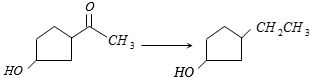
A
$Zn(Hg), HCl$
B
$NH_2NH_2, OH^-$
C
$H_2/Ni$
D
$NaBH_4$
Solution
(B) The reaction involves the reduction of a ketone group $(-COCH_3)$ to an alkyl group $(-CH_2CH_3)$ in the presence of a hydroxyl group $(-OH)$.
$1$. $Zn(Hg), HCl$ is the reagent for Clemmensen reduction,which is acidic. In acidic conditions,the $-OH$ group can undergo dehydration to form an alkene.
$2$. $NH_2NH_2, OH^-$ is the reagent for Wolff-Kishner reduction,which is basic. The $-OH$ group is stable under basic conditions.
Therefore,$NH_2NH_2, OH^-$ is the appropriate reagent for this transformation.
$1$. $Zn(Hg), HCl$ is the reagent for Clemmensen reduction,which is acidic. In acidic conditions,the $-OH$ group can undergo dehydration to form an alkene.
$2$. $NH_2NH_2, OH^-$ is the reagent for Wolff-Kishner reduction,which is basic. The $-OH$ group is stable under basic conditions.
Therefore,$NH_2NH_2, OH^-$ is the appropriate reagent for this transformation.
0 likesView Solution
57
ChemistryMediumMCQIIT JEE · 2000
Which of the following has the most acidic hydrogen?
A
$3-$hexanone
B
$2, 4-$hexanedione
C
$2, 5-$hexanedione
D
$2, 3-$hexanedione
Solution
(B) $2, 4-$hexanedione is a $1, 3-$diketone,which contains active methylene hydrogens located between two carbonyl groups.
These hydrogens are the most acidic because the resulting carbanion is stabilized by resonance with both carbonyl groups.
$\text{CH}_3-\text{C}(=\text{O})-\text{CH}_2-\text{C}(=\text{O})-\text{CH}_2\text{CH}_3$ $\xrightarrow{-\text{H}^+} \text{CH}_3-\text{C}(=\text{O})-\text{CH}^--\text{C}(=\text{O})-\text{CH}_2\text{CH}_3$.
The negative charge is delocalized over two oxygen atoms,providing significant stability compared to the other options.
These hydrogens are the most acidic because the resulting carbanion is stabilized by resonance with both carbonyl groups.
$\text{CH}_3-\text{C}(=\text{O})-\text{CH}_2-\text{C}(=\text{O})-\text{CH}_2\text{CH}_3$ $\xrightarrow{-\text{H}^+} \text{CH}_3-\text{C}(=\text{O})-\text{CH}^--\text{C}(=\text{O})-\text{CH}_2\text{CH}_3$.
The negative charge is delocalized over two oxygen atoms,providing significant stability compared to the other options.
0 likesView Solution
58
ChemistryMediumMCQIIT JEE · 2000
Which of the following will be most readily dehydrated in acidic conditions?
A
B
C
D
Solution
(A) Dehydration of alcohols in acidic conditions proceeds via the formation of a carbocation intermediate. The ease of dehydration depends on the stability of the carbocation formed and the ability to form a conjugated system. $\beta$-hydroxy carbonyl compounds (aldols) are particularly prone to dehydration because the resulting product is an $\alpha, \beta$-unsaturated carbonyl compound,which is stabilized by conjugation between the $C=C$ double bond and the $C=O$ carbonyl group. Among the given options,option $A$ represents a $\beta$-hydroxyketone (an aldol),which will undergo dehydration most readily to form a stable conjugated system.
0 likesView Solution
59
ChemistryMediumMCQIIT JEE · 2000
Benzoyl chloride is prepared from benzoic acid by:
A
$Cl_2, hv$
B
$SO_2Cl_2$
C
$SOCl_2$
D
$Cl_2, H_2O$
Solution
(C) Benzoic acid reacts with thionyl chloride $(SOCl_2)$ to form benzoyl chloride. The reaction is as follows:
$C_6H_5COOH + SOCl_2 \rightarrow C_6H_5COCl + SO_2 + HCl$
This method is preferred because the by-products ($SO_2$ and $HCl$) are gases,which escape,leaving the pure product behind.
$C_6H_5COOH + SOCl_2 \rightarrow C_6H_5COCl + SO_2 + HCl$
This method is preferred because the by-products ($SO_2$ and $HCl$) are gases,which escape,leaving the pure product behind.
0 likesView Solution
60
ChemistryMediumMCQIIT JEE · 2000
Among the following,the strongest base is
A
$C_6H_5NH_2$
B
$p-NO_2C_6H_4NH_2$
C
$m-NO_2-C_6H_4NH_2$
D
$C_6H_5CH_2NH_2$
Solution
(D) is an aliphatic amine; therefore,it is a stronger base than aromatic amines.
In aromatic amines,the lone pair of electrons on the nitrogen atom is involved in resonance with the benzene ring,which decreases its availability for protonation.
Furthermore,the electron-withdrawing group $(-NO_2)$ at the $o$,$p$,and $m$-positions further decreases the basic character due to the $-I$ and $-M$ effects.
Since $C_6H_5CH_2NH_2$ is an aliphatic amine where the nitrogen is not directly attached to the benzene ring,it is the most basic.
The basicity order is: $(D) > (A) > (C) > (B)$.
In aromatic amines,the lone pair of electrons on the nitrogen atom is involved in resonance with the benzene ring,which decreases its availability for protonation.
Furthermore,the electron-withdrawing group $(-NO_2)$ at the $o$,$p$,and $m$-positions further decreases the basic character due to the $-I$ and $-M$ effects.
Since $C_6H_5CH_2NH_2$ is an aliphatic amine where the nitrogen is not directly attached to the benzene ring,it is the most basic.
The basicity order is: $(D) > (A) > (C) > (B)$.
0 likesView Solution
61
ChemistryMediumMCQIIT JEE · 2000
The order of reactivities of the following alkyl halides for an $S_{N}2$ reaction is:
A
$RF > RCl > RBr > RI$
B
$RF > RBr > RCl > RI$
C
$RCl > RBr > RF > RI$
D
$RI > RBr > RCl > RF$
Solution
(D) In an $S_{N}2$ reaction,the rate of reaction depends on the ability of the leaving group to depart.
The leaving group ability is determined by the strength of the $C-X$ bond and the stability of the halide ion $(X^-)$.
The bond strength decreases as the size of the halogen increases $(C-F > C-Cl > C-Br > C-I)$.
Consequently,the iodide ion $(I^-)$ is the best leaving group because it is the weakest base,while the fluoride ion $(F^-)$ is the poorest leaving group.
Therefore,the order of reactivity for $S_{N}2$ reactions is $RI > RBr > RCl > RF$.
The leaving group ability is determined by the strength of the $C-X$ bond and the stability of the halide ion $(X^-)$.
The bond strength decreases as the size of the halogen increases $(C-F > C-Cl > C-Br > C-I)$.
Consequently,the iodide ion $(I^-)$ is the best leaving group because it is the weakest base,while the fluoride ion $(F^-)$ is the poorest leaving group.
Therefore,the order of reactivity for $S_{N}2$ reactions is $RI > RBr > RCl > RF$.
0 likesView Solution
62
ChemistryMediumMCQIIT JEE · 2000
Which one of the following will most readily be dehydrated in acidic condition?
A
$4-$hydroxy$-2-$pentanone
B
$2-$pentanol
C
$3-$hydroxy$-2-$pentanone
D
$5-$hydroxy$-2-$pentanone
Solution
(A) Aldols ($\beta$-hydroxy aldehydes or $\beta$-hydroxy ketones) readily undergo dehydration in acidic or basic conditions to form $\alpha,\beta$-unsaturated carbonyl compounds.
This is because the resulting double bond is conjugated with the carbonyl group,which provides significant stability to the product.
Among the given options,$4$-hydroxy-$2$-pentanone is a $\beta$-hydroxy ketone.
Upon protonation of the hydroxyl group followed by the loss of water,it forms a stable conjugated system.
Other options are either simple alcohols or $\gamma$-hydroxy ketones,which do not form conjugated systems as readily as $\beta$-hydroxy carbonyl compounds.
This is because the resulting double bond is conjugated with the carbonyl group,which provides significant stability to the product.
Among the given options,$4$-hydroxy-$2$-pentanone is a $\beta$-hydroxy ketone.
Upon protonation of the hydroxyl group followed by the loss of water,it forms a stable conjugated system.
Other options are either simple alcohols or $\gamma$-hydroxy ketones,which do not form conjugated systems as readily as $\beta$-hydroxy carbonyl compounds.
0 likesView Solution
Vedclass Products
For Students
Vedclass Test Series
Mock tests in real IIT JEE style covering Chemistry with performance analysis. 5-day free trial.
Start Free TrialFor Teachers
Exam Paper Generator
Generate Set A/B/C/D Chemistry papers from 7.5L+ questions in 2 minutes. 3 chapters free.
Try FreeFor Institutes
Online Exam Module
Run live IIT JEE mock exams with unlimited students, 360° analytics & white-label branding.
See DemoFrequently Asked Questions
How many Chemistry questions are in IIT JEE 2000?
There are 62 Chemistry questions from the IIT JEE 2000 paper on Vedclass, each with a detailed step-by-step solution in English.
Are IIT JEE 2000 Chemistry solutions available in English?
Yes. All solutions on this page are in English. You can also switch to English or Hindi using the language buttons above the questions.
Can I practice IIT JEE 2000 Chemistry as a timed test?
Yes. Use the Vedclass Test Series to attempt a full IIT JEE mock test covering Chemistry with time limits and instant score analysis.
Can teachers create Chemistry papers from IIT JEE previous year questions?
Yes. The Vedclass Exam Paper Generator lets teachers mix IIT JEE Chemistry questions and generate Set A/B/C/D papers in minutes.
For Teachers & Institutes
Build a Custom Chemistry Paper
Pick IIT JEE 2000 Chemistry questions, set difficulty, and generate Set A/B/C/D in 2 minutes.