
ChemistryQ1–34 of 34 questions
Page 1 of 1 · English
1
ChemistryEasyMCQGUJCET · 2024
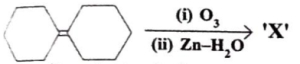
What is $X$ in this reaction?
A
Cyclohexanone + Cyclohexanol
B
Cyclohexanone + Cyclohexanone
C
Cyclohexanecarbaldehyde + Cyclohexanone
D
Cyclohexanol + Cyclohexanol
Solution
(B) The given reaction is the reductive ozonolysis of $1,1'$-bicyclohexylidene.
Ozonolysis of an alkene involves the cleavage of the $C=C$ double bond to form two carbonyl compounds.
When the alkene is $1,1'$-bicyclohexylidene,the double bond connects two cyclohexane rings.
Cleavage of this double bond results in the formation of two molecules of cyclohexanone $(C_6H_{10}O)$.
Therefore,the product $X$ is two molecules of cyclohexanone.
Ozonolysis of an alkene involves the cleavage of the $C=C$ double bond to form two carbonyl compounds.
When the alkene is $1,1'$-bicyclohexylidene,the double bond connects two cyclohexane rings.
Cleavage of this double bond results in the formation of two molecules of cyclohexanone $(C_6H_{10}O)$.
Therefore,the product $X$ is two molecules of cyclohexanone.
0 likesView Solution
2
ChemistryEasyMCQGUJCET · 2024
$KMnO_4$ acts as an oxidising agent in acidic medium. The number of moles of $KMnO_4$ that will be needed to react with one mole of sulphide ion $(S^{2-})$ in acidic solution is . . . . . . (in $/5$)?
A
$1$
B
$3$
C
$4$
D
$2$
Solution
(D) In acidic medium,$KMnO_4$ acts as an oxidising agent and gets reduced to $Mn^{2+}$. The half-reaction is: $MnO_4^- + 8H^+ + 5e^- \rightarrow Mn^{2+} + 4H_2O$.
Sulphide ion $(S^{2-})$ is oxidised to elemental sulphur $(S)$: $S^{2-} \rightarrow S + 2e^-$.
To balance the electrons,we multiply the reduction half-reaction by $2$ and the oxidation half-reaction by $5$:
$2MnO_4^- + 16H^+ + 10e^- \rightarrow 2Mn^{2+} + 8H_2O$
$5S^{2-} \rightarrow 5S + 10e^-$
Adding these,the balanced equation is: $2MnO_4^- + 5S^{2-} + 16H^+ \rightarrow 2Mn^{2+} + 5S + 8H_2O$.
From the stoichiometry,$5$ moles of $S^{2-}$ react with $2$ moles of $KMnO_4$.
Therefore,$1$ mole of $S^{2-}$ reacts with $2/5$ moles of $KMnO_4$.
Sulphide ion $(S^{2-})$ is oxidised to elemental sulphur $(S)$: $S^{2-} \rightarrow S + 2e^-$.
To balance the electrons,we multiply the reduction half-reaction by $2$ and the oxidation half-reaction by $5$:
$2MnO_4^- + 16H^+ + 10e^- \rightarrow 2Mn^{2+} + 8H_2O$
$5S^{2-} \rightarrow 5S + 10e^-$
Adding these,the balanced equation is: $2MnO_4^- + 5S^{2-} + 16H^+ \rightarrow 2Mn^{2+} + 5S + 8H_2O$.
From the stoichiometry,$5$ moles of $S^{2-}$ react with $2$ moles of $KMnO_4$.
Therefore,$1$ mole of $S^{2-}$ reacts with $2/5$ moles of $KMnO_4$.
0 likesView Solution
3
ChemistryEasyMCQGUJCET · 2024
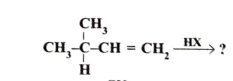
What is the major product in the following reaction?
A
$CH_3-C(CH_3)(X)-CH_2-CH_3$
B
$CH_3-CH(CH_3)-CH(X)-CH_3$
C
$CH_3-CH(CH_3)-CH_2-CH_2-X$
D
$X-CH_2-CH(CH_3)-CH_2-CH_3$
Solution
(A) The reaction is the electrophilic addition of $HX$ to an alkene,which follows Markovnikov's rule.
According to Markovnikov's rule,the negative part of the addendum $(X^-)$ attaches to the carbon atom of the double bond that has fewer hydrogen atoms.
The starting material is $3,3-\text{dimethylbut-1-ene}$ (or a similar branched alkene structure as shown).
Upon protonation of the double bond,a carbocation is formed. The proton $(H^+)$ adds to the terminal $CH_2$ group to form a more stable secondary or tertiary carbocation.
In this specific structure,the addition of $H^+$ to the terminal carbon creates a secondary carbocation at the $C-2$ position,which can undergo a hydride or methyl shift to form a more stable tertiary carbocation.
However,looking at the options provided,the product formed by direct Markovnikov addition to the double bond is $CH_3-C(CH_3)(X)-CH_2-CH_3$ (where $X$ is at the $C-2$ position).
Thus,the major product is $CH_3-C(CH_3)(X)-CH_2-CH_3$.
According to Markovnikov's rule,the negative part of the addendum $(X^-)$ attaches to the carbon atom of the double bond that has fewer hydrogen atoms.
The starting material is $3,3-\text{dimethylbut-1-ene}$ (or a similar branched alkene structure as shown).
Upon protonation of the double bond,a carbocation is formed. The proton $(H^+)$ adds to the terminal $CH_2$ group to form a more stable secondary or tertiary carbocation.
In this specific structure,the addition of $H^+$ to the terminal carbon creates a secondary carbocation at the $C-2$ position,which can undergo a hydride or methyl shift to form a more stable tertiary carbocation.
However,looking at the options provided,the product formed by direct Markovnikov addition to the double bond is $CH_3-C(CH_3)(X)-CH_2-CH_3$ (where $X$ is at the $C-2$ position).
Thus,the major product is $CH_3-C(CH_3)(X)-CH_2-CH_3$.
0 likesView Solution
4
ChemistryEasyMCQGUJCET · 2024
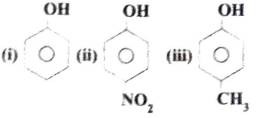
Arrange the following compounds in decreasing order of their acidic strength.
A
$(ii) > (i) > (iii)$
B
$(iii) > (i) > (ii)$
C
$(i) > (ii) > (iii)$
D
$(ii) > (iii) > (i)$
Solution
(A) The acidic strength of phenols depends on the nature of the substituent attached to the benzene ring.
Electron-withdrawing groups $(EWG)$ like $-NO_2$ increase the acidic strength by stabilizing the phenoxide ion through $-I$ and $-M$ effects.
Electron-donating groups $(EDG)$ like $-CH_3$ decrease the acidic strength by destabilizing the phenoxide ion through $+I$ and hyperconjugation effects.
Compound $(ii)$ has a $-NO_2$ group (strong $EWG$),which makes it the most acidic.
Compound $(i)$ is phenol (no substituent).
Compound $(iii)$ has a $-CH_3$ group $(EDG)$,which makes it the least acidic.
Therefore,the decreasing order of acidic strength is $(ii) > (i) > (iii)$.
Electron-withdrawing groups $(EWG)$ like $-NO_2$ increase the acidic strength by stabilizing the phenoxide ion through $-I$ and $-M$ effects.
Electron-donating groups $(EDG)$ like $-CH_3$ decrease the acidic strength by destabilizing the phenoxide ion through $+I$ and hyperconjugation effects.
Compound $(ii)$ has a $-NO_2$ group (strong $EWG$),which makes it the most acidic.
Compound $(i)$ is phenol (no substituent).
Compound $(iii)$ has a $-CH_3$ group $(EDG)$,which makes it the least acidic.
Therefore,the decreasing order of acidic strength is $(ii) > (i) > (iii)$.
0 likesView Solution
5
ChemistryEasyMCQGUJCET · 2024
Give the major product formed by heating $CH_3-CH_2-CH_2-O-C(CH_3)_2-CH_2-CH_3$ with $HI$.
A
$CH_3-CH_2-CH_2-OI + CH_3-CH_2-C(CH_3)_2-H$
B
$CH_3-CH_2-CH_2-I + CH_3-CH_2-C(CH_3)_2-OH$
C
$CH_3-CH_3 + I-CH_2-O-C(CH_3)_2-CH_2-CH_3$
D
$CH_3-CH_2-CH_2-OH + CH_3-CH_2-C(CH_3)_2-I$
Solution
(D) The reaction of an ether with $HI$ proceeds via an $S_N1$ or $S_N2$ mechanism depending on the nature of the alkyl groups attached to the oxygen atom.
In the given ether,$CH_3-CH_2-CH_2-O-C(CH_3)_2-CH_2-CH_3$,one alkyl group is a primary alkyl group ($n$-propyl) and the other is a tertiary alkyl group ($3$-methylpentan$-3-$yl group).
When an ether has a tertiary alkyl group,the reaction follows the $S_N1$ mechanism because the tertiary carbocation is highly stable.
The oxygen atom is protonated by $HI$ to form an oxonium ion,which then undergoes cleavage to form the most stable carbocation.
The tertiary carbocation,$CH_3-CH_2-C^+(CH_3)_2$,is formed,which then reacts with the iodide ion $(I^-)$ to form the tertiary alkyl iodide,$CH_3-CH_2-C(I)(CH_3)_2$.
The remaining part forms the primary alcohol,$CH_3-CH_2-CH_2-OH$.
Therefore,the major products are $CH_3-CH_2-CH_2-OH$ and $CH_3-CH_2-C(I)(CH_3)_2$.
In the given ether,$CH_3-CH_2-CH_2-O-C(CH_3)_2-CH_2-CH_3$,one alkyl group is a primary alkyl group ($n$-propyl) and the other is a tertiary alkyl group ($3$-methylpentan$-3-$yl group).
When an ether has a tertiary alkyl group,the reaction follows the $S_N1$ mechanism because the tertiary carbocation is highly stable.
The oxygen atom is protonated by $HI$ to form an oxonium ion,which then undergoes cleavage to form the most stable carbocation.
The tertiary carbocation,$CH_3-CH_2-C^+(CH_3)_2$,is formed,which then reacts with the iodide ion $(I^-)$ to form the tertiary alkyl iodide,$CH_3-CH_2-C(I)(CH_3)_2$.
The remaining part forms the primary alcohol,$CH_3-CH_2-CH_2-OH$.
Therefore,the major products are $CH_3-CH_2-CH_2-OH$ and $CH_3-CH_2-C(I)(CH_3)_2$.
0 likesView Solution
6
ChemistryEasyMCQGUJCET · 2024
Predict the major product of acid-catalyzed dehydration of butan-$1$-ol.
A
$CH_3-CH_2-CH=CH_2$
B
$CH_3-CH=CH-CH_3$
C
$CH_3-CH_2-CH_2-CH_3$
D
$CH_3-CH(OH)-CH_2-CH_3$
Solution
(B) The acid-catalyzed dehydration of butan-$1$-ol $(CH_3-CH_2-CH_2-CH_2OH)$ involves the formation of a primary carbocation,which undergoes a $1,2$-hydride shift to form a more stable secondary carbocation $(CH_3-CH^+-CH_2-CH_3)$.
Elimination of a proton from this secondary carbocation yields but-$2$-ene $(CH_3-CH=CH-CH_3)$ as the major product,following Zaitsev's rule,as it is more substituted and thus more stable than but-$1$-ene $(CH_3-CH_2-CH=CH_2)$.
Elimination of a proton from this secondary carbocation yields but-$2$-ene $(CH_3-CH=CH-CH_3)$ as the major product,following Zaitsev's rule,as it is more substituted and thus more stable than but-$1$-ene $(CH_3-CH_2-CH=CH_2)$.
0 likesView Solution
7
ChemistryEasyMCQGUJCET · 2024
Which of the following carboxylic acids has the least $pK_{a}$ value?
A
$NO_{2}CH_{2}COOH$
B
$CH_{3}COOH$
C
$HCOOH$
D
$C_{6}H_{5}COOH$
Solution
(A) The $pK_{a}$ value is inversely proportional to the acidity of the carboxylic acid. Stronger acids have lower $pK_{a}$ values.
Acidity is determined by the stability of the conjugate base (carboxylate ion).
Electron-withdrawing groups (EWGs) stabilize the carboxylate ion through the inductive effect ($-I$ effect),thereby increasing acidity.
Comparing the substituents:
$1$. $NO_{2}CH_{2}COOH$: The $-NO_{2}$ group is a strong electron-withdrawing group ($-I$ effect),which significantly stabilizes the carboxylate ion.
$2$. $CH_{3}COOH$: The $-CH_{3}$ group is an electron-donating group ($+I$ effect),which destabilizes the carboxylate ion.
$3$. $HCOOH$: Hydrogen has no inductive effect.
$4$. $C_{6}H_{5}COOH$: The phenyl group is electron-withdrawing by resonance but less effective than the $-NO_{2}$ group in this context.
Therefore,$NO_{2}CH_{2}COOH$ is the strongest acid among the given options and has the lowest $pK_{a}$ value.
Acidity is determined by the stability of the conjugate base (carboxylate ion).
Electron-withdrawing groups (EWGs) stabilize the carboxylate ion through the inductive effect ($-I$ effect),thereby increasing acidity.
Comparing the substituents:
$1$. $NO_{2}CH_{2}COOH$: The $-NO_{2}$ group is a strong electron-withdrawing group ($-I$ effect),which significantly stabilizes the carboxylate ion.
$2$. $CH_{3}COOH$: The $-CH_{3}$ group is an electron-donating group ($+I$ effect),which destabilizes the carboxylate ion.
$3$. $HCOOH$: Hydrogen has no inductive effect.
$4$. $C_{6}H_{5}COOH$: The phenyl group is electron-withdrawing by resonance but less effective than the $-NO_{2}$ group in this context.
Therefore,$NO_{2}CH_{2}COOH$ is the strongest acid among the given options and has the lowest $pK_{a}$ value.
0 likesView Solution
8
ChemistryEasyMCQGUJCET · 2024
$R + CH_3-CO-CH_3 \xrightarrow{H^{+}} \text{Schiff's base}$. What is $R$ in this reaction?
A
$C_6H_5-NH-NH_2$
B
$NH_2-NH_2$
C
$CH_3-NH_2$
D
$NH_2OH$
Solution
(C) $Schiff's \ base$ is formed by the reaction of a primary amine $(R-NH_2)$ with an aldehyde or a ketone.
In the given reaction,$CH_3-CO-CH_3$ (acetone) reacts with $R$ to form a $Schiff's \ base$.
Among the given options,$CH_3-NH_2$ is a primary amine.
The reaction is: $CH_3-CO-CH_3 + CH_3-NH_2 \xrightarrow{H^{+}} CH_3-C(CH_3)=N-CH_3 + H_2O$.
Therefore,$R$ is $CH_3-NH_2$.
In the given reaction,$CH_3-CO-CH_3$ (acetone) reacts with $R$ to form a $Schiff's \ base$.
Among the given options,$CH_3-NH_2$ is a primary amine.
The reaction is: $CH_3-CO-CH_3 + CH_3-NH_2 \xrightarrow{H^{+}} CH_3-C(CH_3)=N-CH_3 + H_2O$.
Therefore,$R$ is $CH_3-NH_2$.
0 likesView Solution
9
ChemistryEasyMCQGUJCET · 2024
Name the following reaction: $C_6H_5COCl + H_2 \xrightarrow{Pd-BaSO_4} C_6H_5CHO + HCl$
A
$Clemmensen$ reduction
B
$Stephen$ reaction
C
$Etard$ reaction
D
$Rosenmund$ reduction
Solution
(D) The given reaction is the hydrogenation of an acid chloride $(RCOCl)$ to an aldehyde $(RCHO)$ using a palladium catalyst poisoned with barium sulfate $(Pd-BaSO_4)$.
This specific reaction is known as the $Rosenmund$ reduction.
Therefore,the correct option is $D$.
This specific reaction is known as the $Rosenmund$ reduction.
Therefore,the correct option is $D$.
0 likesView Solution
10
ChemistryEasyMCQGUJCET · 2024
Lactose is made of . . . . . . .
A
$α-D$-glucose and $β-D$-fructose
B
$α-D$-glucose and $β-D$-galactose
C
$β-D$-galactose and $β-D$-glucose
D
$α-D$-glucose and $α-D$-glucose
Solution
(C) Lactose is a disaccharide composed of two monosaccharide units.
These units are $β-D$-galactose and $β-D$-glucose.
The glycosidic linkage present in lactose is $β(1 \rightarrow 4)$ linkage.
Therefore,the correct option is $C$.
These units are $β-D$-galactose and $β-D$-glucose.
The glycosidic linkage present in lactose is $β(1 \rightarrow 4)$ linkage.
Therefore,the correct option is $C$.
0 likesView Solution
11
ChemistryEasyMCQGUJCET · 2024
Which of the following statements is incorrect regarding the structure of nucleic acids?
A
Nucleotides are joined together by phosphodiester linkage.
B
In a $DNA$ molecule,the sugar moiety is $\beta-D-2-deoxyribose$.
C
$A$ unit formed by the attachment of a base to the $1'$ position of sugar is known as a nucleoside.
D
$RNA$ contains four bases: adenine,guanine,cytosine,and thymine.
Solution
(D) The correct answer is $D$. $RNA$ contains adenine,guanine,cytosine,and uracil,not thymine. Thymine is present in $DNA$.
0 likesView Solution
12
ChemistryEasyMCQGUJCET · 2024
Deficiency of which vitamin is responsible for $RBC$ deficient in haemoglobin?
A
Vitamin $B_6$
B
Vitamin $B_1$
C
Vitamin $B_2$
D
Vitamin $B_{12}$
Solution
(D) The deficiency of Vitamin $B_{12}$ (cyanocobalamin) leads to pernicious anaemia.
In this condition,the body produces $RBC$s that are deficient in haemoglobin and are larger than normal,which impairs their ability to transport oxygen effectively.
In this condition,the body produces $RBC$s that are deficient in haemoglobin and are larger than normal,which impairs their ability to transport oxygen effectively.
0 likesView Solution
13
ChemistryEasyMCQGUJCET · 2024
Which of the following gives Zwitter ion in its aqueous solution?
A
$HOOC-CH_2-COOH$
B
$NH_2-CH_2-COOH$
C
$NH_2-CH_2-CH_2-NH_2$
D
$CH_3CH_2NH_2$
Solution
(B) Zwitter ion is a dipolar ion that contains both a positive and a negative charge within the same molecule,resulting in a net charge of zero.
Amino acids,such as glycine $(NH_2-CH_2-COOH)$,contain both a basic amino group $(-NH_2)$ and an acidic carboxylic group $(-COOH)$.
In an aqueous solution,the proton from the $-COOH$ group is transferred to the $-NH_2$ group,forming the Zwitter ion: $^+NH_3-CH_2-COO^-$.
Therefore,the correct option is $B$.
Amino acids,such as glycine $(NH_2-CH_2-COOH)$,contain both a basic amino group $(-NH_2)$ and an acidic carboxylic group $(-COOH)$.
In an aqueous solution,the proton from the $-COOH$ group is transferred to the $-NH_2$ group,forming the Zwitter ion: $^+NH_3-CH_2-COO^-$.
Therefore,the correct option is $B$.
0 likesView Solution
14
ChemistryEasyMCQGUJCET · 2024
For the zero order reaction $2A \rightarrow B + 3C$,if the rate constant $K = 3.5 \times 10^{-4} \ mol \ L^{-1} \ s^{-1}$,what will be the rate of production of $C$?
A
$1.167 \times 10^{-4} \ mol \ L^{-1} \ s^{-1}$
B
$10.5 \times 10^{-4} \ mol \ L^{-1} \ s^{-1}$
C
$3.5 \times 10^{-4} \ mol \ L^{-1} \ s^{-1}$
D
$7.0 \times 10^{-4} \ mol \ L^{-1} \ s^{-1}$
Solution
(B) For a reaction $aA \rightarrow bB + cC$,the rate of reaction is given by:
$Rate = -\frac{1}{a} \frac{d[A]}{dt} = \frac{1}{b} \frac{d[B]}{dt} = \frac{1}{c} \frac{d[C]}{dt} = K$
Given the reaction $2A \rightarrow B + 3C$,the rate expression is:
$Rate = \frac{1}{3} \frac{d[C]}{dt} = K$
Therefore,the rate of production of $C$ is:
$\frac{d[C]}{dt} = 3 \times K$
$\frac{d[C]}{dt} = 3 \times (3.5 \times 10^{-4} \ mol \ L^{-1} \ s^{-1}) = 10.5 \times 10^{-4} \ mol \ L^{-1} \ s^{-1}$
Thus,the correct option is $B$.
$Rate = -\frac{1}{a} \frac{d[A]}{dt} = \frac{1}{b} \frac{d[B]}{dt} = \frac{1}{c} \frac{d[C]}{dt} = K$
Given the reaction $2A \rightarrow B + 3C$,the rate expression is:
$Rate = \frac{1}{3} \frac{d[C]}{dt} = K$
Therefore,the rate of production of $C$ is:
$\frac{d[C]}{dt} = 3 \times K$
$\frac{d[C]}{dt} = 3 \times (3.5 \times 10^{-4} \ mol \ L^{-1} \ s^{-1}) = 10.5 \times 10^{-4} \ mol \ L^{-1} \ s^{-1}$
Thus,the correct option is $B$.
0 likesView Solution
15
ChemistryEasyMCQGUJCET · 2024
Which of the following graphs is correct for a first order reaction $R \rightarrow P$?
A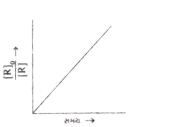
B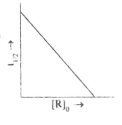
C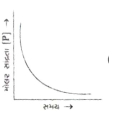
D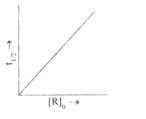
Solution
(A) For a first order reaction,the integrated rate equation is $\ln[R] = -kt + \ln[R]_0$,which can be rearranged as $\ln(\frac{[R]_0}{[R]}) = kt$.
This implies that $\ln(\frac{[R]_0}{[R]})$ versus time $(t)$ is a straight line passing through the origin.
However,the graph of $\frac{[R]_0}{[R]}$ versus time $(t)$ is an exponential curve,not a straight line.
For a first order reaction,the half-life $t_{1/2} = \frac{0.693}{k}$ is independent of the initial concentration $[R]_0$.
Therefore,the graph of $t_{1/2}$ versus $[R]_0$ is a horizontal straight line parallel to the $[R]_0$ axis.
None of the provided graphs correctly represent the standard linear relationships for a first order reaction.
If we consider the plot of $\ln(\frac{[R]_0}{[R]})$ versus time,it is linear.
Given the options,if the question intended to ask for a plot that is $NOT$ linear or if there is a typo in the axis labels,the standard textbook graphs for first order are:
$1$. $\ln[R]$ vs $t$ (linear with negative slope)
$2$. $[R]$ vs $t$ (exponential decay)
$3$. $t_{1/2}$ vs $[R]_0$ (horizontal line).
Since none of the provided images match these,and assuming the question implies a specific relationship,the most common correct graph for first order kinetics is the linear plot of $\ln(\frac{[R]_0}{[R]})$ vs $t$.
This implies that $\ln(\frac{[R]_0}{[R]})$ versus time $(t)$ is a straight line passing through the origin.
However,the graph of $\frac{[R]_0}{[R]}$ versus time $(t)$ is an exponential curve,not a straight line.
For a first order reaction,the half-life $t_{1/2} = \frac{0.693}{k}$ is independent of the initial concentration $[R]_0$.
Therefore,the graph of $t_{1/2}$ versus $[R]_0$ is a horizontal straight line parallel to the $[R]_0$ axis.
None of the provided graphs correctly represent the standard linear relationships for a first order reaction.
If we consider the plot of $\ln(\frac{[R]_0}{[R]})$ versus time,it is linear.
Given the options,if the question intended to ask for a plot that is $NOT$ linear or if there is a typo in the axis labels,the standard textbook graphs for first order are:
$1$. $\ln[R]$ vs $t$ (linear with negative slope)
$2$. $[R]$ vs $t$ (exponential decay)
$3$. $t_{1/2}$ vs $[R]_0$ (horizontal line).
Since none of the provided images match these,and assuming the question implies a specific relationship,the most common correct graph for first order kinetics is the linear plot of $\ln(\frac{[R]_0}{[R]})$ vs $t$.
0 likesView Solution
16
ChemistryEasyMCQGUJCET · 2024
Which of the following statements is incorrect for a reaction carried out in the presence of a catalyst?
A
Potential energy of reactants and products change.
B
Equilibrium constant of the reaction does not change.
C
There is no change in Gibbs energy of the reaction.
D
The activation energy of the reaction decreases.
Solution
(A) catalyst provides an alternative reaction pathway with lower activation energy.
It does not affect the potential energy of the reactants or products.
It does not change the equilibrium constant $(K_{eq})$ or the Gibbs free energy change $(\Delta G)$ of the reaction.
Therefore,the statement that the potential energy of reactants and products changes is incorrect.
It does not affect the potential energy of the reactants or products.
It does not change the equilibrium constant $(K_{eq})$ or the Gibbs free energy change $(\Delta G)$ of the reaction.
Therefore,the statement that the potential energy of reactants and products changes is incorrect.
0 likesView Solution
17
ChemistryEasyMCQGUJCET · 2024
For any reaction,the rate constant $K = 2.3 \times 10^{-5} \ mol^{-3/2} \ L^{3/2} \ S^{-1}$. The order of the reaction is . . . . . . .
A
$0.0$
B
$1.5$
C
$0.5$
D
$2.5$
Solution
(D) The unit of the rate constant $K$ for a reaction of order $n$ is given by the formula: $(mol \ L^{-1})^{1-n} \ S^{-1}$.
Given the unit is $mol^{-3/2} \ L^{3/2} \ S^{-1}$,we can equate the powers:
$(mol \ L^{-1})^{1-n} = mol^{-3/2} \ L^{3/2}$.
This implies $1 - n = -3/2$.
Solving for $n$: $n = 1 + 3/2 = 5/2 = 2.5$.
Therefore,the order of the reaction is $2.5$.
Given the unit is $mol^{-3/2} \ L^{3/2} \ S^{-1}$,we can equate the powers:
$(mol \ L^{-1})^{1-n} = mol^{-3/2} \ L^{3/2}$.
This implies $1 - n = -3/2$.
Solving for $n$: $n = 1 + 3/2 = 5/2 = 2.5$.
Therefore,the order of the reaction is $2.5$.
0 likesView Solution
18
ChemistryEasyMCQGUJCET · 2024
In the complex $K[Cr(H_2O)_2(C_2O_4)_2] \cdot 3H_2O$,the oxidation state and coordination number of the central metal ion are . . . . . . and . . . . . . respectively.
A
$+4, 4$
B
$+3, 4$
C
$+4, 6$
D
$+3, 6$
Solution
(D) $1$. The complex is $K[Cr(H_2O)_2(C_2O_4)_2] \cdot 3H_2O$.
$2$. Let the oxidation state of $Cr$ be $x$.
$3$. The charge on $K$ is $+1$,$H_2O$ is $0$,and $C_2O_4^{2-}$ is $-2$.
$4$. The equation is: $1 + x + 2(0) + 2(-2) = 0$.
$5$. $1 + x - 4 = 0$,which gives $x = +3$.
$6$. The coordination number is determined by the ligands attached to the central metal: $2(H_2O)$ are monodentate $(2 \times 1 = 2)$ and $2(C_2O_4^{2-})$ are bidentate $(2 \times 2 = 4)$.
$7$. Total coordination number = $2 + 4 = 6$.
$8$. Thus,the oxidation state is $+3$ and the coordination number is $6$.
$2$. Let the oxidation state of $Cr$ be $x$.
$3$. The charge on $K$ is $+1$,$H_2O$ is $0$,and $C_2O_4^{2-}$ is $-2$.
$4$. The equation is: $1 + x + 2(0) + 2(-2) = 0$.
$5$. $1 + x - 4 = 0$,which gives $x = +3$.
$6$. The coordination number is determined by the ligands attached to the central metal: $2(H_2O)$ are monodentate $(2 \times 1 = 2)$ and $2(C_2O_4^{2-})$ are bidentate $(2 \times 2 = 4)$.
$7$. Total coordination number = $2 + 4 = 6$.
$8$. Thus,the oxidation state is $+3$ and the coordination number is $6$.
0 likesView Solution
19
ChemistryEasyMCQGUJCET · 2024
Identify the optically active compound from the following.
A
$[Pt(NH_3)_2Cl_2]$
B
$[Co(NH_3)_6]Cl_2$
C
$[Co(en)_3]Cl_3$
D
$[Co(NH_3)_5Cl]Cl$
Solution
(C) An optically active compound must be chiral,meaning it lacks a plane of symmetry or a center of symmetry.
In the complex $[Co(en)_3]Cl_3$,the ligand $en$ (ethylenediamine) is a bidentate ligand.
The complex $[Co(en)_3]^{3+}$ forms a tris-chelated octahedral structure that does not possess a plane of symmetry or a center of symmetry.
Therefore,it exists as a pair of non-superimposable mirror images (enantiomers),making it optically active.
The other complexes listed are either square planar or octahedral with planes of symmetry,rendering them optically inactive.
In the complex $[Co(en)_3]Cl_3$,the ligand $en$ (ethylenediamine) is a bidentate ligand.
The complex $[Co(en)_3]^{3+}$ forms a tris-chelated octahedral structure that does not possess a plane of symmetry or a center of symmetry.
Therefore,it exists as a pair of non-superimposable mirror images (enantiomers),making it optically active.
The other complexes listed are either square planar or octahedral with planes of symmetry,rendering them optically inactive.
0 likesView Solution
20
ChemistryEasyMCQGUJCET · 2024
Hybridization in $[Ni(CO)_4]$ and $[Ni(CN)_4]^{2-}$ are respectively . . . . . . .
A
$sp^3$ and $dsp^2$
B
$sp^3$ and $sp^3$
C
$dsp^2$ and $sp^3$
D
$dsp^2$ and $dsp^2$
Solution
(A) In $[Ni(CO)_4]$,the oxidation state of $Ni$ is $0$. The electronic configuration of $Ni$ $(Z=28)$ is $[Ar] 3d^8 4s^2$. Since $CO$ is a strong field ligand,it causes pairing of electrons,resulting in $3d^{10} 4s^0 4p^0$. Thus,the hybridization is $sp^3$.
In $[Ni(CN)_4]^{2-}$,the oxidation state of $Ni$ is $+2$. The electronic configuration of $Ni^{2+}$ is $[Ar] 3d^8$. $CN^-$ is a strong field ligand,forcing the two unpaired electrons in the $3d$ orbitals to pair up,creating one empty $3d$ orbital. This leads to $dsp^2$ hybridization.
In $[Ni(CN)_4]^{2-}$,the oxidation state of $Ni$ is $+2$. The electronic configuration of $Ni^{2+}$ is $[Ar] 3d^8$. $CN^-$ is a strong field ligand,forcing the two unpaired electrons in the $3d$ orbitals to pair up,creating one empty $3d$ orbital. This leads to $dsp^2$ hybridization.
0 likesView Solution
21
ChemistryEasyMCQGUJCET · 2024
Which one is the correct formula for the coordination compound tris(ethane-$1,2$-diamine) cobalt$(III)$ sulphate?
A
$[Co(en)_3]_3(SO_4)_2$
B
$[Co(en)_3]_2(SO_4)_3$
C
$[Co(en)_3]_2(SO_4)_2$
D
$[Co(en)_3]SO_4$
Solution
(B) The central metal ion is cobalt in the $+3$ oxidation state,denoted as $Co(III)$.
Ethane-$1,2$-diamine $(en)$ is a neutral bidentate ligand.
Since there are three $en$ ligands,the coordination sphere is $[Co(en)_3]^{3+}$.
Sulphate ion is $SO_4^{2-}$.
To balance the charges,we use the criss-cross method: $2$ units of $[Co(en)_3]^{3+}$ and $3$ units of $SO_4^{2-}$ are required to make the compound neutral.
Thus,the formula is $[Co(en)_3]_2(SO_4)_3$.
Ethane-$1,2$-diamine $(en)$ is a neutral bidentate ligand.
Since there are three $en$ ligands,the coordination sphere is $[Co(en)_3]^{3+}$.
Sulphate ion is $SO_4^{2-}$.
To balance the charges,we use the criss-cross method: $2$ units of $[Co(en)_3]^{3+}$ and $3$ units of $SO_4^{2-}$ are required to make the compound neutral.
Thus,the formula is $[Co(en)_3]_2(SO_4)_3$.
0 likesView Solution
22
ChemistryEasyMCQGUJCET · 2024
Name the member of the lanthanoid series which is well known to exhibit $+4$ oxidation state.
A
Cerium
B
Thulium
C
Gadolinium
D
Samarium
Solution
(A) The lanthanoid series elements typically exhibit a $+3$ oxidation state.
However,$Ce$ (Cerium,atomic number $58$) is well known to exhibit a $+4$ oxidation state because it attains a stable noble gas configuration $([Xe]4f^0)$ upon losing four electrons.
Therefore,the correct option is $A$.
However,$Ce$ (Cerium,atomic number $58$) is well known to exhibit a $+4$ oxidation state because it attains a stable noble gas configuration $([Xe]4f^0)$ upon losing four electrons.
Therefore,the correct option is $A$.
0 likesView Solution
23
ChemistryEasyMCQGUJCET · 2024
Which of the following ions shows the highest spin-only magnetic moment value?
A
$Co^{2+}$
B
$Mn^{2+}$
C
$Ti^{2+}$
D
$Fe^{2+}$
Solution
(B) The spin-only magnetic moment $(\mu)$ is calculated using the formula $\mu = \sqrt{n(n+2)} \ BM$,where $n$ is the number of unpaired electrons.
$1$. For $Co^{2+}$ $(3d^7)$: $n = 3$,$\mu = \sqrt{3(3+2)} = \sqrt{15} \approx 3.87 \ BM$.
$2$. For $Mn^{2+}$ $(3d^5)$: $n = 5$,$\mu = \sqrt{5(5+2)} = \sqrt{35} \approx 5.92 \ BM$.
$3$. For $Ti^{2+}$ $(3d^2)$: $n = 2$,$\mu = \sqrt{2(2+2)} = \sqrt{8} \approx 2.83 \ BM$.
$4$. For $Fe^{2+}$ $(3d^6)$: $n = 4$,$\mu = \sqrt{4(4+2)} = \sqrt{24} \approx 4.90 \ BM$.
Comparing the values,$Mn^{2+}$ has the highest number of unpaired electrons $(n=5)$,hence it shows the highest magnetic moment.
$1$. For $Co^{2+}$ $(3d^7)$: $n = 3$,$\mu = \sqrt{3(3+2)} = \sqrt{15} \approx 3.87 \ BM$.
$2$. For $Mn^{2+}$ $(3d^5)$: $n = 5$,$\mu = \sqrt{5(5+2)} = \sqrt{35} \approx 5.92 \ BM$.
$3$. For $Ti^{2+}$ $(3d^2)$: $n = 2$,$\mu = \sqrt{2(2+2)} = \sqrt{8} \approx 2.83 \ BM$.
$4$. For $Fe^{2+}$ $(3d^6)$: $n = 4$,$\mu = \sqrt{4(4+2)} = \sqrt{24} \approx 4.90 \ BM$.
Comparing the values,$Mn^{2+}$ has the highest number of unpaired electrons $(n=5)$,hence it shows the highest magnetic moment.
0 likesView Solution
24
ChemistryEasyMCQGUJCET · 2024
Which one of the following is an amphoteric oxide?
A
$V_2O_3$
B
$CrO$
C
$Cr_2O_3$
D
$CrO_3$
Solution
(C) The oxidation state of chromium in $Cr_2O_3$ is $+3$.
$Cr_2O_3$ is an amphoteric oxide because it reacts with both acids and bases.
$CrO$ is basic,while $CrO_3$ is acidic in nature.
$Cr_2O_3$ is an amphoteric oxide because it reacts with both acids and bases.
$CrO$ is basic,while $CrO_3$ is acidic in nature.
0 likesView Solution
25
ChemistryEasyMCQGUJCET · 2024
How much Faraday of electricity is required to reduce $1.5 \ mole$ of $KMnO_4$ into $MnO_2$ in a basic medium (in $F$)?
A
$4.5$
B
$7.5$
C
$6.0$
D
$3.0$
Solution
(A) In a basic medium,the reduction of $KMnO_4$ to $MnO_2$ involves the following half-reaction:
$MnO_4^- + 2H_2O + 3e^- \rightarrow MnO_2 + 4OH^-$.
From the balanced equation,$1 \ mole$ of $KMnO_4$ requires $3 \ moles$ of electrons,which is equivalent to $3 \ F$ of electricity.
Therefore,for $1.5 \ moles$ of $KMnO_4$,the electricity required is $1.5 \times 3 \ F = 4.5 \ F$.
Thus,the correct option is $A$.
$MnO_4^- + 2H_2O + 3e^- \rightarrow MnO_2 + 4OH^-$.
From the balanced equation,$1 \ mole$ of $KMnO_4$ requires $3 \ moles$ of electrons,which is equivalent to $3 \ F$ of electricity.
Therefore,for $1.5 \ moles$ of $KMnO_4$,the electricity required is $1.5 \times 3 \ F = 4.5 \ F$.
Thus,the correct option is $A$.
0 likesView Solution
26
ChemistryEasyMCQGUJCET · 2024
During the electrolysis of higher concentration of $H_2SO_4$,the product obtained at anode is . . . . . . .
A
$O_{2_{(g)}}$
B
$H_2S_2O_{8_{(aq)}}$
C
$SO_{2_{(g)}}$
D
$SO_{3_{(aq)}}^{2-}$
Solution
(B) During the electrolysis of highly concentrated $H_2SO_4$ (approx. $50 \%$),the oxidation of $HSO_4^-$ ions occurs at the anode.
The reaction is: $2HSO_4^- \rightarrow H_2S_2O_8 + 2e^-$.
The product formed is peroxodisulphuric acid $(H_2S_2O_8)$,also known as Marshall's acid.
Therefore,the correct option is $B$.
The reaction is: $2HSO_4^- \rightarrow H_2S_2O_8 + 2e^-$.
The product formed is peroxodisulphuric acid $(H_2S_2O_8)$,also known as Marshall's acid.
Therefore,the correct option is $B$.
0 likesView Solution
27
ChemistryEasyMCQGUJCET · 2024
Which of the following statements regarding the solution of an electrolyte is not correct?
A
Conductivity of the solution depends on the concentration of the electrolyte.
B
Conductivity of the solution depends on the nature of the electrolyte.
C
Conductivity of the solution does not depend upon temperature.
D
Conductivity of the solution depends on the nature of the solvent and its viscosity.
Solution
(C) The conductivity of an electrolytic solution depends on the nature of the electrolyte,the concentration of the electrolyte,the nature of the solvent and its viscosity,and the temperature.
As the temperature increases,the kinetic energy of the ions increases and the viscosity of the solvent decreases,which leads to an increase in the conductivity of the solution.
Therefore,the statement that conductivity does not depend upon temperature is incorrect.
As the temperature increases,the kinetic energy of the ions increases and the viscosity of the solvent decreases,which leads to an increase in the conductivity of the solution.
Therefore,the statement that conductivity does not depend upon temperature is incorrect.
0 likesView Solution
28
ChemistryEasyMCQGUJCET · 2024
Calculate the potential of a hydrogen electrode in contact with a solution whose $pH = 10$.
A
$+0.059 \ V$
B
$-0.059 \ V$
C
$+0.59 \ V$
D
$-0.59 \ V$
Solution
(D) The half-cell reaction for a hydrogen electrode is: $2H^+ (aq) + 2e^- \rightarrow H_2 (g)$.
Using the Nernst equation at $298 \ K$: $E = E^0 - \frac{0.0591}{n} \log \frac{1}{[H^+]}$.
Since $E^0 = 0 \ V$ for the standard hydrogen electrode and $n = 1$ for the reduction of $H^+$,the equation becomes: $E = 0 - 0.0591 \times pH$.
Given $pH = 10$,we have: $E = -0.0591 \times 10 = -0.591 \ V$.
Rounding to two decimal places,the potential is $-0.59 \ V$.
Using the Nernst equation at $298 \ K$: $E = E^0 - \frac{0.0591}{n} \log \frac{1}{[H^+]}$.
Since $E^0 = 0 \ V$ for the standard hydrogen electrode and $n = 1$ for the reduction of $H^+$,the equation becomes: $E = 0 - 0.0591 \times pH$.
Given $pH = 10$,we have: $E = -0.0591 \times 10 = -0.591 \ V$.
Rounding to two decimal places,the potential is $-0.59 \ V$.
0 likesView Solution
29
ChemistryEasyMCQGUJCET · 2024
Match the reactions given in Column-$I$ with their names given in Column-$II$.
| Column-$I$ | Column-$II$ |
|---|---|
| $(i)$ $R-Cl + NaI \xrightarrow{\text{dry acetone}} R-I + NaCl$ | $(a)$ Swarts reaction |
| $(ii)$ $CH_3-Br + AgF \xrightarrow{\Delta} CH_3-F + AgBr$ | $(b)$ Wurtz reaction |
| $(iii)$ $R-X + Mg$ $\xrightarrow{\text{dry ether}} R-Mg-X$ $\xrightarrow{H_2O} RH + Mg(OH)X$ | $(c)$ Finkelstein reaction |
| $(d)$ Grignard reaction |
A
$i$ $\rightarrow c; ii$ $\rightarrow a; iii$ $\rightarrow d$
B
$i$ $\rightarrow d; ii$ $\rightarrow c; iii$ $\rightarrow b$
C
$i$ $\rightarrow a; ii$ $\rightarrow c; iii$ $\rightarrow d$
D
$i$ $\rightarrow b; ii$ $\rightarrow a; iii$ $\rightarrow d$
Solution
(A) The reactions are identified as follows:
$(i)$ $R-Cl + NaI \xrightarrow{\text{dry acetone}} R-I + NaCl$ is the Finkelstein reaction $(c)$.
$(ii)$ $CH_3-Br + AgF \xrightarrow{\Delta} CH_3-F + AgBr$ is the Swarts reaction $(a)$.
$(iii)$ $R-X + Mg$ $\xrightarrow{\text{dry ether}} R-Mg-X$ $\xrightarrow{H_2O} RH + Mg(OH)X$ involves the formation of a Grignard reagent $(d)$.
Therefore,the correct match is $i$ $\rightarrow c; ii$ $\rightarrow a; iii$ $\rightarrow d$.
$(i)$ $R-Cl + NaI \xrightarrow{\text{dry acetone}} R-I + NaCl$ is the Finkelstein reaction $(c)$.
$(ii)$ $CH_3-Br + AgF \xrightarrow{\Delta} CH_3-F + AgBr$ is the Swarts reaction $(a)$.
$(iii)$ $R-X + Mg$ $\xrightarrow{\text{dry ether}} R-Mg-X$ $\xrightarrow{H_2O} RH + Mg(OH)X$ involves the formation of a Grignard reagent $(d)$.
Therefore,the correct match is $i$ $\rightarrow c; ii$ $\rightarrow a; iii$ $\rightarrow d$.
0 likesView Solution
30
ChemistryEasyMCQGUJCET · 2024
Predict the order of reactivity of the following compounds in $S_N1$ reaction.
$(I)$ $C_6H_5-CH_2Br$
$(II)$ $C_6H_5-CH(C_6H_5)Br$
$(III)$ $C_6H_5-CH(CH_3)Br$
$(IV)$ $C_6H_5-C(CH_3)(C_6H_5)Br$
$(I)$ $C_6H_5-CH_2Br$
$(II)$ $C_6H_5-CH(C_6H_5)Br$
$(III)$ $C_6H_5-CH(CH_3)Br$
$(IV)$ $C_6H_5-C(CH_3)(C_6H_5)Br$
A
$(II)$ > $(III)$ > $(IV)$ > $(I)$
B
$(II)$ > $(IV)$ > $(III)$ > $(I)$
C
$(IV)$ > $(III)$ > $(II)$ > $(I)$
D
$(IV)$ > $(II)$ > $(III)$ > $(I)$
Solution
(D) The reactivity of compounds in an $S_N1$ reaction depends on the stability of the carbocation intermediate formed after the departure of the leaving group $(Br^-)$.
The stability order of the carbocations is as follows:
$(I)$ $C_6H_5-CH_2^+$ (Benzyl carbocation,stabilized by one phenyl ring).
$(II)$ $(C_6H_5)_2CH^+$ (Diphenylmethyl carbocation,stabilized by two phenyl rings).
$(III)$ $C_6H_5-CH^+(CH_3)$ ($1$-Phenylethyl carbocation,stabilized by one phenyl ring and one methyl group).
$(IV)$ $(C_6H_5)_2C^+(CH_3)$ ($1$,$1$-Diphenylethyl carbocation,stabilized by two phenyl rings and one methyl group).
Comparing the stability: $(IV) > (II) > (III) > (I)$.
Since the rate of $S_N1$ reaction is directly proportional to the stability of the carbocation,the order of reactivity is $(IV) > (II) > (III) > (I)$.
The stability order of the carbocations is as follows:
$(I)$ $C_6H_5-CH_2^+$ (Benzyl carbocation,stabilized by one phenyl ring).
$(II)$ $(C_6H_5)_2CH^+$ (Diphenylmethyl carbocation,stabilized by two phenyl rings).
$(III)$ $C_6H_5-CH^+(CH_3)$ ($1$-Phenylethyl carbocation,stabilized by one phenyl ring and one methyl group).
$(IV)$ $(C_6H_5)_2C^+(CH_3)$ ($1$,$1$-Diphenylethyl carbocation,stabilized by two phenyl rings and one methyl group).
Comparing the stability: $(IV) > (II) > (III) > (I)$.
Since the rate of $S_N1$ reaction is directly proportional to the stability of the carbocation,the order of reactivity is $(IV) > (II) > (III) > (I)$.
0 likesView Solution
31
ChemistryEasyMCQGUJCET · 2024
The van't Hoff factor in dilute aqueous solution of $K_4[Fe(CN)_6]$,$Fe_4[Fe(CN)_6]_3$ and $[CoCl_2(en)_2]Cl$ are respectively . . . . . . , . . . . . . and . . . . . . .
A
$5, 7, 3$
B
$5, 7, 2$
C
$4, 7, 3$
D
$7, 5, 3$
Solution
(B) The van't Hoff factor $(i)$ for a strong electrolyte is equal to the total number of ions produced upon complete dissociation in an aqueous solution.
$1$. For $K_4[Fe(CN)_6]$: It dissociates as $K_4[Fe(CN)_6] \rightarrow 4K^+ + [Fe(CN)_6]^{4-}$. Total ions = $4 + 1 = 5$. Thus,$i = 5$.
$2$. For $Fe_4[Fe(CN)_6]_3$: It dissociates as $Fe_4[Fe(CN)_6]_3 \rightarrow 4Fe^{3+} + 3[Fe(CN)_6]^{4-}$. Total ions = $4 + 3 = 7$. Thus,$i = 7$.
$3$. For $[CoCl_2(en)_2]Cl$: It dissociates as $[CoCl_2(en)_2]Cl \rightarrow [CoCl_2(en)_2]^+ + Cl^-$. Total ions = $1 + 1 = 2$. Thus,$i = 2$.
Therefore,the values are $5, 7, 2$.
$1$. For $K_4[Fe(CN)_6]$: It dissociates as $K_4[Fe(CN)_6] \rightarrow 4K^+ + [Fe(CN)_6]^{4-}$. Total ions = $4 + 1 = 5$. Thus,$i = 5$.
$2$. For $Fe_4[Fe(CN)_6]_3$: It dissociates as $Fe_4[Fe(CN)_6]_3 \rightarrow 4Fe^{3+} + 3[Fe(CN)_6]^{4-}$. Total ions = $4 + 3 = 7$. Thus,$i = 7$.
$3$. For $[CoCl_2(en)_2]Cl$: It dissociates as $[CoCl_2(en)_2]Cl \rightarrow [CoCl_2(en)_2]^+ + Cl^-$. Total ions = $1 + 1 = 2$. Thus,$i = 2$.
Therefore,the values are $5, 7, 2$.
0 likesView Solution
32
ChemistryEasyMCQGUJCET · 2024
The freezing point depression of $645 \ g$ of an aqueous solution of ethylene glycol $(C_2H_6O_2)$ is $2.25 \ K$. Find the weight of ethylene glycol in the solution. $[K_f = 1.86 \ K \ kg \ mol^{-1} ; H = 1, C = 12, O = 16 \ amu]$ (in $g$)
A
$45.0$
B
$42.50$
C
$48.375$
D
$50$
Solution
(A) $1$. Molar Mass Calculation:
The molecular formula of ethylene glycol is $C_2H_6O_2$.
Molar Mass $(M_2) = (2 \times 12) + (6 \times 1) + (2 \times 16) = 62 \ g \ mol^{-1}$.
$2$. Setup:
Let the mass of ethylene glycol (solute) be $w_2 \ g$.
Total mass of solution = $645 \ g$.
Mass of water (solvent),$w_1 = (645 - w_2) \ g$.
Given: $\Delta T_f = 2.25 \ K$ and $K_f = 1.86 \ K \ kg \ mol^{-1}$.
$3$. Calculation:
Using the freezing point depression formula: $\Delta T_f = \frac{K_f \times w_2 \times 1000}{M_2 \times w_1}$.
Substituting the values: $2.25 = \frac{1.86 \times w_2 \times 1000}{62 \times (645 - w_2)}$.
$2.25 = \frac{30 \times w_2}{645 - w_2}$.
$2.25(645 - w_2) = 30w_2$.
$1451.25 - 2.25w_2 = 30w_2$.
$1451.25 = 32.25w_2$.
$w_2 = \frac{1451.25}{32.25} = 45 \ g$.
The molecular formula of ethylene glycol is $C_2H_6O_2$.
Molar Mass $(M_2) = (2 \times 12) + (6 \times 1) + (2 \times 16) = 62 \ g \ mol^{-1}$.
$2$. Setup:
Let the mass of ethylene glycol (solute) be $w_2 \ g$.
Total mass of solution = $645 \ g$.
Mass of water (solvent),$w_1 = (645 - w_2) \ g$.
Given: $\Delta T_f = 2.25 \ K$ and $K_f = 1.86 \ K \ kg \ mol^{-1}$.
$3$. Calculation:
Using the freezing point depression formula: $\Delta T_f = \frac{K_f \times w_2 \times 1000}{M_2 \times w_1}$.
Substituting the values: $2.25 = \frac{1.86 \times w_2 \times 1000}{62 \times (645 - w_2)}$.
$2.25 = \frac{30 \times w_2}{645 - w_2}$.
$2.25(645 - w_2) = 30w_2$.
$1451.25 - 2.25w_2 = 30w_2$.
$1451.25 = 32.25w_2$.
$w_2 = \frac{1451.25}{32.25} = 45 \ g$.
0 likesView Solution
33
ChemistryEasyMCQGUJCET · 2024
The vapour pressure of pure liquids '$P$' and '$Q$' are $450 \ mm \ of \ Hg$ and $750 \ mm \ of \ Hg$ respectively at $350 \ K$. If the total vapour pressure is $600 \ mm \ of \ Hg$,the mole fractions of '$P$' and '$Q$' respectively will be . . . . . . and . . . . . . .
A
$0.7$ and $0.3$
B
$0.4$ and $0.6$
C
$0.6$ and $0.4$
D
$0.5$ and $0.5$
Solution
(D) According to Raoult's Law,the total vapour pressure $P_{total} = P_P^0 x_P + P_Q^0 x_Q$.
Given $P_P^0 = 450 \ mm \ Hg$,$P_Q^0 = 750 \ mm \ Hg$,and $P_{total} = 600 \ mm \ Hg$.
Since $x_P + x_Q = 1$,we can write $x_Q = 1 - x_P$.
Substituting these values: $600 = 450 x_P + 750(1 - x_P)$.
$600 = 450 x_P + 750 - 750 x_P$.
$600 - 750 = -300 x_P$.
$-150 = -300 x_P$.
$x_P = 0.5$.
Therefore,$x_Q = 1 - 0.5 = 0.5$.
The mole fractions are $0.5$ and $0.5$.
Given $P_P^0 = 450 \ mm \ Hg$,$P_Q^0 = 750 \ mm \ Hg$,and $P_{total} = 600 \ mm \ Hg$.
Since $x_P + x_Q = 1$,we can write $x_Q = 1 - x_P$.
Substituting these values: $600 = 450 x_P + 750(1 - x_P)$.
$600 = 450 x_P + 750 - 750 x_P$.
$600 - 750 = -300 x_P$.
$-150 = -300 x_P$.
$x_P = 0.5$.
Therefore,$x_Q = 1 - 0.5 = 0.5$.
The mole fractions are $0.5$ and $0.5$.
0 likesView Solution
34
ChemistryEasyMCQGUJCET · 2024
Calculate the mass of Glucose $(C_6H_{12}O_6)$ required in making $2.5 \ kg$ of $0.25 \ molal$ aqueous solution. [Atomic wt : $H=1, O=16, C=12 \ amu$] (in $g$)
A
$135.0$
B
$107.65$
C
$90.0$
D
$112.5$
Solution
(B) The molar mass of Glucose $(C_6H_{12}O_6)$ is $(6 \times 12) + (12 \times 1) + (6 \times 16) = 72 + 12 + 96 = 180 \ g/mol$.
Molality $(m)$ is defined as the number of moles of solute per kilogram of solvent.
Given $m = 0.25 \ mol/kg$.
Let the mass of the solvent (water) be $W \ kg$.
The mass of the solution is $W + \text{mass of glucose} = 2.5 \ kg$.
Mass of glucose $= \text{moles} \times \text{molar mass} = (0.25 \times W) \times 180 = 45W \ g = 0.045W \ kg$.
Substituting this into the solution mass equation: $W + 0.045W = 2.5 \ kg$.
$1.045W = 2.5 \implies W = 2.5 / 1.045 \approx 2.3923 \ kg$.
Mass of glucose $= 0.045 \times 2.3923 \ kg \approx 0.10765 \ kg = 107.65 \ g$.
Molality $(m)$ is defined as the number of moles of solute per kilogram of solvent.
Given $m = 0.25 \ mol/kg$.
Let the mass of the solvent (water) be $W \ kg$.
The mass of the solution is $W + \text{mass of glucose} = 2.5 \ kg$.
Mass of glucose $= \text{moles} \times \text{molar mass} = (0.25 \times W) \times 180 = 45W \ g = 0.045W \ kg$.
Substituting this into the solution mass equation: $W + 0.045W = 2.5 \ kg$.
$1.045W = 2.5 \implies W = 2.5 / 1.045 \approx 2.3923 \ kg$.
Mass of glucose $= 0.045 \times 2.3923 \ kg \approx 0.10765 \ kg = 107.65 \ g$.
0 likesView Solution
Vedclass Products
For Students
Vedclass Test Series
Mock tests in real GUJCET style covering Chemistry with performance analysis. 5-day free trial.
Start Free TrialFor Teachers
Exam Paper Generator
Generate Set A/B/C/D Chemistry papers from 7.5L+ questions in 2 minutes. 3 chapters free.
Try FreeFor Institutes
Online Exam Module
Run live GUJCET mock exams with unlimited students, 360° analytics & white-label branding.
See DemoFrequently Asked Questions
How many Chemistry questions are in GUJCET 2024?
There are 34 Chemistry questions from the GUJCET 2024 paper on Vedclass, each with a detailed step-by-step solution in English.
Are GUJCET 2024 Chemistry solutions available in English?
Yes. All solutions on this page are in English. You can also switch to English or Hindi using the language buttons above the questions.
Can I practice GUJCET 2024 Chemistry as a timed test?
Yes. Use the Vedclass Test Series to attempt a full GUJCET mock test covering Chemistry with time limits and instant score analysis.
Can teachers create Chemistry papers from GUJCET previous year questions?
Yes. The Vedclass Exam Paper Generator lets teachers mix GUJCET Chemistry questions and generate Set A/B/C/D papers in minutes.
For Teachers & Institutes
Build a Custom Chemistry Paper
Pick GUJCET 2024 Chemistry questions, set difficulty, and generate Set A/B/C/D in 2 minutes.