
BiologyQ1–39 of 39 questions
Page 1 of 1 · English
1
BiologyEasyMCQGUJCET · 2024
Choose the incorrect pair of extinct animal and their country from the following.
A
Dodo - Mauritius
B
Steller's Sea Cow - Russia
C
Quagga - Africa
D
Thylacine - Thailand
Solution
(D) The correct answer is $D$. The Thylacine (Tasmanian wolf) was an extinct carnivorous marsupial native to Australia,Tasmania,and New Guinea,not Thailand. The other pairs are correct: Dodo was from Mauritius,Steller's Sea Cow from Russia,and Quagga from Africa.
0 likesView Solution
2
BiologyEasyMCQGUJCET · 2024
In $2002$,in . . . . . . the World Summit on Sustainable Development was held.
A
Germany
B
Rio de Janeiro
C
Johannesburg
D
Canada
Solution
(C) The World Summit on Sustainable Development $(2002)$ was held in Johannesburg,South Africa. In this summit,$190$ countries pledged their commitment to achieve by $2010$ a significant reduction in the current rate of biodiversity loss at global,regional,and local levels.
0 likesView Solution
3
BiologyEasyMCQGUJCET · 2024
In which system does the specific $mRNA$ become silent after being complementary to a $dsRNA$ molecule?
A
$ELISA$
B
$PCR$
C
RNAi
D
DNAi
Solution
(C) $RNAi$ ($RNA$ interference) is a method of cellular defense in all eukaryotic organisms. In this process,a specific $mRNA$ is prevented from translation due to the formation of a complementary $dsRNA$ (double-stranded $RNA$) molecule. This $dsRNA$ binds to the $mRNA$ and silences it,thereby preventing the expression of the specific gene.
0 likesView Solution
4
BiologyEasyMCQGUJCET · 2024
$ELISA$ system is based on which of the following principles?
A
Antigen-Antibody interaction
B
Polymerase Chain Reaction
C
Autoradiography
D
Enzyme replacement therapy
Solution
(A) $ELISA$ stands for Enzyme-Linked Immunosorbent Assay.
It is a diagnostic technique used to detect the presence of specific antigens or antibodies in a sample.
The fundamental principle of $ELISA$ is the specific interaction between an antigen and an antibody.
In this process,an enzyme is linked to an antibody or antigen,and the reaction produces a detectable signal (usually a color change) when the target molecule is present.
It is a diagnostic technique used to detect the presence of specific antigens or antibodies in a sample.
The fundamental principle of $ELISA$ is the specific interaction between an antigen and an antibody.
In this process,an enzyme is linked to an antibody or antigen,and the reaction produces a detectable signal (usually a color change) when the target molecule is present.
0 likesView Solution
5
BiologyEasyMCQGUJCET · 2024
In the gel electrophoresis method . . . . . . .
A
Fragments of $DNA$ can be seen without being stained.
B
$A$ natural polymer extracted from seaweed is used as the medium (gel).
C
Glowing orange bands of $DNA$ can be seen upon exposure to visible light on an ethidium bromide-stained gel.
D
The larger the size of the $DNA$ fragment in the agarose medium,the farther it will move.
Solution
(B) In gel electrophoresis,agarose,which is a natural polymer extracted from seaweeds (like Gelidium and Gracilaria),is used as the matrix or gel medium.
Option $A$ is incorrect because $DNA$ fragments are invisible without staining.
Option $C$ is incorrect because $DNA$ bands stained with ethidium bromide only glow under $UV$ light,not visible light.
Option $D$ is incorrect because,in gel electrophoresis,smaller $DNA$ fragments move faster and farther through the agarose matrix than larger fragments due to the sieving effect.
Option $A$ is incorrect because $DNA$ fragments are invisible without staining.
Option $C$ is incorrect because $DNA$ bands stained with ethidium bromide only glow under $UV$ light,not visible light.
Option $D$ is incorrect because,in gel electrophoresis,smaller $DNA$ fragments move faster and farther through the agarose matrix than larger fragments due to the sieving effect.
0 likesView Solution
6
BiologyEasyMCQGUJCET · 2024
$DNA$ polymerase which is used in $PCR$ is isolated from which of the following bacteria?
A
Bacillus thuringiensis
B
Escherichia coli
C
Thermus aquaticus
D
Agrobacterium tumefaciens
Solution
(C) The $DNA$ polymerase used in the Polymerase Chain Reaction $(PCR)$ is known as $Taq$ polymerase.
This enzyme is isolated from a thermophilic bacterium called $Thermus$ $aquaticus$.
$Taq$ polymerase is heat-stable,meaning it can withstand the high temperatures required for the denaturation step of $PCR$ without being denatured itself.
Therefore,the correct option is $C$.
This enzyme is isolated from a thermophilic bacterium called $Thermus$ $aquaticus$.
$Taq$ polymerase is heat-stable,meaning it can withstand the high temperatures required for the denaturation step of $PCR$ without being denatured itself.
Therefore,the correct option is $C$.
0 likesView Solution
7
BiologyEasyMCQGUJCET · 2024
Which of the following statements is correct regarding the gel electrophoresis technique?
A
$DNA$ fragments can be visualized in visible light without staining.
B
The natural polymer used as a matrix is extracted from sea weeds.
C
Bright blue-coloured bands of $DNA$ are seen in an ethidium bromide-stained gel when exposed to visible light.
D
The larger the $DNA$ fragment size,the further it moves in the agarose matrix.
Solution
(B) In gel electrophoresis,$DNA$ fragments are separated based on their size. Agarose,a natural polymer extracted from sea weeds (red algae),is used as the matrix. $DNA$ fragments are negatively charged and move towards the anode. Smaller fragments move faster and further through the matrix than larger fragments. $DNA$ cannot be seen in visible light without staining; they must be stained with ethidium bromide and then exposed to $UV$ radiation to appear as bright orange-coloured bands.
0 likesView Solution
8
BiologyEasyMCQGUJCET · 2024
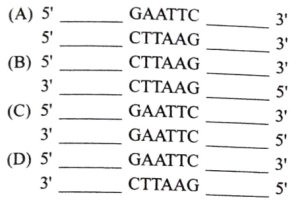
Identify the palindromic nucleotide sequence.
A
$5$'-$AGTCGA$-$3$'
B
$5$'-$TGCAGT$-$3$'
C
$5$'-$ACGTAG$-$3$'
D
$5$'-$GAATTC$-$3$'
Solution
(D) palindromic nucleotide sequence is a sequence of base pairs in $DNA$ that reads the same in the $5' \rightarrow 3'$ direction on one strand as it does in the $5' \rightarrow 3'$ direction on the complementary strand.
For option $D$,the sequence is $5'-GAATTC-3'$.
The complementary strand would be $3'-CTTAAG-5'$,which,when read from $5' \rightarrow 3'$,is $5'-GAATTC-3'$.
Since both strands read the same in the $5' \rightarrow 3'$ direction,this is a palindromic sequence.
For option $D$,the sequence is $5'-GAATTC-3'$.
The complementary strand would be $3'-CTTAAG-5'$,which,when read from $5' \rightarrow 3'$,is $5'-GAATTC-3'$.
Since both strands read the same in the $5' \rightarrow 3'$ direction,this is a palindromic sequence.
0 likesView Solution
9
BiologyEasyMCQGUJCET · 2024
Which of the following is responsible for the beginning of the detritus food chain?
A
Algae
B
Zooplankton
C
Phytoplankton
D
Fungi
Solution
(D) The detritus food chain $(DFC)$ begins with dead organic matter,known as detritus. Decomposers,such as fungi and bacteria,are responsible for breaking down this dead organic matter,thereby initiating the energy flow in the $DFC$.
0 likesView Solution
10
BiologyEasyMCQGUJCET · 2024
The pyramid of biomass in . . . . . . is generally inverted.
A
Grassland
B
Dense forest
C
Sea
D
Grassland and Dense forest both
Solution
(C) In an aquatic ecosystem,such as the $Sea$,the pyramid of biomass is generally inverted. This is because the biomass of phytoplankton (producers) is much lower than the biomass of zooplankton and small fish (primary consumers) and large fish (secondary consumers) that feed on them. The rapid turnover rate of phytoplankton allows a small standing crop to support a larger biomass of consumers.
0 likesView Solution
11
BiologyEasyMCQGUJCET · 2024
Which of the following does not affect the Hardy-Weinberg equilibrium?
A
Gene migration
B
Mutation
C
Genetic drift
D
Adaptive radiation
Solution
(D) The Hardy-Weinberg principle states that allele frequencies in a population are stable and remain constant from generation to generation in the absence of evolutionary forces.
The factors that disturb the Hardy-Weinberg equilibrium include:
$1$. Gene migration or gene flow: Movement of alleles into or out of a population.
$2$. Mutation: Sudden heritable changes in the $DNA$ sequence.
$3$. Genetic drift: Random changes in allele frequencies due to chance events.
$4$. Genetic recombination: Shuffling of genes during sexual reproduction.
$5$. Natural selection: Differential survival and reproduction of individuals.
Adaptive radiation is an evolutionary process where organisms diversify rapidly from an ancestral species into a multitude of new forms,particularly when a change in the environment makes new resources available. It is a result of evolution,not a factor that disrupts the equilibrium of a single population's gene pool.
The factors that disturb the Hardy-Weinberg equilibrium include:
$1$. Gene migration or gene flow: Movement of alleles into or out of a population.
$2$. Mutation: Sudden heritable changes in the $DNA$ sequence.
$3$. Genetic drift: Random changes in allele frequencies due to chance events.
$4$. Genetic recombination: Shuffling of genes during sexual reproduction.
$5$. Natural selection: Differential survival and reproduction of individuals.
Adaptive radiation is an evolutionary process where organisms diversify rapidly from an ancestral species into a multitude of new forms,particularly when a change in the environment makes new resources available. It is a result of evolution,not a factor that disrupts the equilibrium of a single population's gene pool.
0 likesView Solution
12
BiologyEasyMCQGUJCET · 2024
Which one of the following is an example of analogy?
A
Sweet potato and Radish
B
Sweet potato and potato
C
Potato and Ginger
D
Ginger and turmeric
Solution
(B) Analogy refers to structures that have different anatomical origins but perform similar functions due to convergent evolution.
$1$. Sweet potato is a modified root,while potato is a modified stem.
$2$. Both perform the function of food storage.
$3$. Since they have different origins (root vs stem) but the same function (storage),they are considered analogous organs.
$4$. Other options like Potato and Ginger (both stems) or Sweet potato and Radish (both roots) represent homology.
$1$. Sweet potato is a modified root,while potato is a modified stem.
$2$. Both perform the function of food storage.
$3$. Since they have different origins (root vs stem) but the same function (storage),they are considered analogous organs.
$4$. Other options like Potato and Ginger (both stems) or Sweet potato and Radish (both roots) represent homology.
0 likesView Solution
13
BiologyEasyMCQGUJCET · 2024
Who stated that an embryo never passes through the adult stage of other animals?
A
Ernst Haeckel
B
Oparin
C
Lamarck
D
Karl Ernst von Baer
Solution
(D) The statement 'an embryo never passes through the adult stage of other animals' was proposed by $Karl \ Ernst \ von \ Baer$.
He is known as the father of modern embryology.
He observed that embryos of different vertebrates share common features in early stages but do not resemble the adult forms of their ancestors,which contradicted the recapitulation theory proposed by $Ernst \ Haeckel$.
He is known as the father of modern embryology.
He observed that embryos of different vertebrates share common features in early stages but do not resemble the adult forms of their ancestors,which contradicted the recapitulation theory proposed by $Ernst \ Haeckel$.
0 likesView Solution
14
BiologyEasyMCQGUJCET · 2024
Cirrhosis . . . . . . .
A
is a liver disease caused by heavy consumption of alcohol
B
is a disease spread by using needles and syringes from one person to another
C
is a kidney disease caused by heavy consumption of drugs
D
is a brain disease caused by heavy consumption of narcotic analgesics
Solution
(A) Cirrhosis is a chronic liver disease characterized by the replacement of healthy liver tissue with scar tissue (fibrosis). One of the most common causes of cirrhosis is chronic,heavy alcohol consumption,which leads to inflammation and damage to liver cells over time. Therefore,option $A$ is the correct description.
0 likesView Solution
15
BiologyEasyMCQGUJCET · 2024
Which one of the following groups is associated with secondary lymphoid organs?
A
Thymus,spleen,lymph node
B
Appendix,tonsils,Peyer's patches of small intestine
C
Bone marrow,appendix,tonsils
D
Bone marrow,thymus,spleen
Solution
(B) Secondary lymphoid organs are the sites where lymphocytes interact with the antigen and then proliferate to become effector cells. These include the spleen,lymph nodes,tonsils,Peyer's patches of the small intestine,and the appendix. Bone marrow and the thymus are primary lymphoid organs where immature lymphocytes differentiate into antigen-sensitive lymphocytes. Therefore,the group consisting of the appendix,tonsils,and Peyer's patches of the small intestine represents secondary lymphoid organs.
0 likesView Solution
16
BiologyEasyMCQGUJCET · 2024
On the basis of which of the following symptoms does a doctor conclude that patient '$X$' is suffering from pneumonia?
A
Has chills and high fever recurring every $3$ to $4$ days.
B
Has lips and fingernails that turn grey to bluish in color.
C
Has sustained high fever ($39^{\circ}C$ to $40^{\circ}C$),weakness,stomach pain,and constipation.
D
Has skin,nails,and scalp with scaly lesions.
Solution
(B) Pneumonia is a respiratory disease caused by bacteria like $Streptococcus$ $pneumoniae$ and $Haemophilus$ $influenzae$.
In severe cases of pneumonia,the alveoli of the lungs get filled with fluid,leading to severe problems in respiration.
As a result of impaired gas exchange,the oxygen levels in the blood decrease,which causes the lips and fingernails of the patient to turn grey to bluish in color.
Option $A$ describes symptoms of malaria.
Option $C$ describes symptoms of typhoid.
Option $D$ describes symptoms of ringworm.
Therefore,the correct option is $B$.
In severe cases of pneumonia,the alveoli of the lungs get filled with fluid,leading to severe problems in respiration.
As a result of impaired gas exchange,the oxygen levels in the blood decrease,which causes the lips and fingernails of the patient to turn grey to bluish in color.
Option $A$ describes symptoms of malaria.
Option $C$ describes symptoms of typhoid.
Option $D$ describes symptoms of ringworm.
Therefore,the correct option is $B$.
0 likesView Solution
17
BiologyEasyMCQGUJCET · 2024
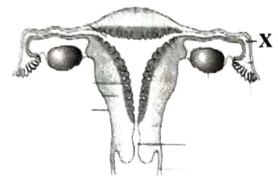
What does '$X$' represent in the given diagram of the human female reproductive system?
A
Ampulla
B
Isthmus
C
Infundibulum
D
Fimbriae
Solution
(B) In the human female reproductive system,the fallopian tube consists of three parts: infundibulum,ampulla,and isthmus.
$1$. The part closer to the ovary is the funnel-shaped infundibulum.
$2$. The wider part of the fallopian tube is the ampulla.
$3$. The last part of the fallopian tube,which has a narrow lumen and joins the uterus,is the isthmus.
In the provided diagram,'$X$' points to the narrow,distal part of the fallopian tube that connects to the uterus,which is the isthmus.
$1$. The part closer to the ovary is the funnel-shaped infundibulum.
$2$. The wider part of the fallopian tube is the ampulla.
$3$. The last part of the fallopian tube,which has a narrow lumen and joins the uterus,is the isthmus.
In the provided diagram,'$X$' points to the narrow,distal part of the fallopian tube that connects to the uterus,which is the isthmus.
0 likesView Solution
18
BiologyEasyMCQGUJCET · 2024
Which one of the following is released by the Graafian follicle at the time of ovulation?
A
Primary Oocyte
B
Ovum
C
First polar body
D
Secondary Oocyte
Solution
(D) During the process of ovulation,the Graafian follicle ruptures to release the female gamete. At this stage,the oocyte is arrested in the metaphase of meiosis-$II$ and is known as the secondary oocyte. The secondary oocyte is surrounded by the zona pellucida and corona radiata. Therefore,the correct answer is $D$.
0 likesView Solution
19
BiologyEasyMCQGUJCET · 2024
Where are the Leydig cells present?
A
In the wall of seminiferous tubules
B
In the epididymis
C
The region outside the seminiferous tubules
D
In the rete testis
Solution
(C) Leydig cells,also known as interstitial cells,are located in the interstitial spaces,which is the region outside the seminiferous tubules within the testes. These cells are responsible for the synthesis and secretion of testicular hormones called androgens,primarily testosterone.
0 likesView Solution
20
BiologyEasyMCQGUJCET · 2024
Which of the following statements is correct?
A
$Azospirillum$ and $Azotobacter$ live as symbionts,they fix atmospheric nitrogen and thus enrich the nitrogen content of the soil.
B
Many members of the genus $Monascus$ form mycorrhiza.
C
Heterotrophic cyanobacteria are used as biofertilizers in paddy fields.
D
Many members of the genus $Glomus$ form mycorrhiza.
Solution
(D) The correct statement is that many members of the genus $Glomus$ form mycorrhiza.
$1$. $Glomus$ is a fungal genus that forms a symbiotic association with plant roots known as mycorrhiza,which helps in the absorption of phosphorus from the soil.
$2$. $Azospirillum$ and $Azotobacter$ are free-living nitrogen-fixing bacteria,not symbiotic.
$3$. $Monascus$ $purpureus$ is a yeast used for the production of blood-cholesterol lowering statins,not for mycorrhiza.
$4$. Cyanobacteria like $Anabaena$ and $Nostoc$ are autotrophic,not heterotrophic,and are used as biofertilizers in paddy fields.
$1$. $Glomus$ is a fungal genus that forms a symbiotic association with plant roots known as mycorrhiza,which helps in the absorption of phosphorus from the soil.
$2$. $Azospirillum$ and $Azotobacter$ are free-living nitrogen-fixing bacteria,not symbiotic.
$3$. $Monascus$ $purpureus$ is a yeast used for the production of blood-cholesterol lowering statins,not for mycorrhiza.
$4$. Cyanobacteria like $Anabaena$ and $Nostoc$ are autotrophic,not heterotrophic,and are used as biofertilizers in paddy fields.
0 likesView Solution
21
BiologyEasyMCQGUJCET · 2024
Which one of the following statements is correct:
$(i)$ Baculoviruses are excellent candidates for species-specific,narrow-spectrum insecticidal applications.
(ii) Bacillus thuringiensis is used to control butterfly caterpillars.
(iii) Ladybird is useful to get rid of mosquitoes.
(iv) Trichoderma fungus is used as a biocontrol agent for animal pathogens.
$(i)$ Baculoviruses are excellent candidates for species-specific,narrow-spectrum insecticidal applications.
(ii) Bacillus thuringiensis is used to control butterfly caterpillars.
(iii) Ladybird is useful to get rid of mosquitoes.
(iv) Trichoderma fungus is used as a biocontrol agent for animal pathogens.
A
only $(i)$,(iii) and (iv)
B
only $(i)$ and (ii)
C
only (ii) and (iv)
D
only (iii) and (iv)
Solution
(B) $(i)$ Baculoviruses are pathogens that attack insects and other arthropods. They are excellent candidates for species-specific,narrow-spectrum insecticidal applications because they do not harm plants,mammals,birds,fish,or even non-target insects.
(ii) Bacillus thuringiensis $(Bt)$ is a bacterium whose spores are used to control butterfly caterpillars.
(iii) Ladybird beetles are useful to get rid of aphids,not mosquitoes.
(iv) Trichoderma species are free-living fungi that are very common in the root ecosystems and are effective biocontrol agents of several plant pathogens,not animal pathogens.
Therefore,only statements $(i)$ and (ii) are correct.
(ii) Bacillus thuringiensis $(Bt)$ is a bacterium whose spores are used to control butterfly caterpillars.
(iii) Ladybird beetles are useful to get rid of aphids,not mosquitoes.
(iv) Trichoderma species are free-living fungi that are very common in the root ecosystems and are effective biocontrol agents of several plant pathogens,not animal pathogens.
Therefore,only statements $(i)$ and (ii) are correct.
0 likesView Solution
22
BiologyEasyMCQGUJCET · 2024
Match the Column-$I$ and Column-$II$ by suitable manner.
| Column-$I$ | Column-$II$ |
| $1$. Pectinase | $(A)$ Removing clots from the blood vessels of patients |
| $2$. Statins | $(B)$ Clarified fruit juices packed in bottles |
| $3$. Cyclosporin-$A$ | $(C)$ Immunosuppressive agent in organ transplant |
| $4$. Streptokinase | $(D)$ Blood cholesterol lowering agent |
A
$(1-B), (2-D), (3-A), (4-C)$
B
$(1-A), (2-C), (3-B), (4-D)$
C
$(1-D), (2-B), (3-C), (4-A)$
D
$(1-B), (2-D), (3-C), (4-A)$
Solution
(D) The correct matches are as follows:
$1$. Pectinase: Used for clarifying fruit juices,so it matches with $(B)$.
$2$. Statins: Produced by Monascus purpureus,these act as blood cholesterol-lowering agents,so it matches with $(D)$.
$3$. Cyclosporin-$A$: Produced by Trichoderma polysporum,it acts as an immunosuppressive agent in organ transplant patients,so it matches with $(C)$.
$4$. Streptokinase: Produced by Streptococcus,it is used as a 'clot buster' for removing clots from the blood vessels of patients who have undergone myocardial infarction,so it matches with $(A)$.
Therefore,the correct sequence is $(1-B), (2-D), (3-C), (4-A)$.
$1$. Pectinase: Used for clarifying fruit juices,so it matches with $(B)$.
$2$. Statins: Produced by Monascus purpureus,these act as blood cholesterol-lowering agents,so it matches with $(D)$.
$3$. Cyclosporin-$A$: Produced by Trichoderma polysporum,it acts as an immunosuppressive agent in organ transplant patients,so it matches with $(C)$.
$4$. Streptokinase: Produced by Streptococcus,it is used as a 'clot buster' for removing clots from the blood vessels of patients who have undergone myocardial infarction,so it matches with $(A)$.
Therefore,the correct sequence is $(1-B), (2-D), (3-C), (4-A)$.
0 likesView Solution
23
BiologyEasyMCQGUJCET · 2024
How many types of anticodons are present in a cell?
A
$4$
B
$61$
C
$3$
D
$64$
Solution
(B) There are $64$ codons in the genetic code,out of which $61$ codons code for amino acids. The remaining $3$ codons $(UAA, UAG, UGA)$ are stop codons (nonsense codons) and do not code for any amino acid. Since stop codons do not have corresponding tRNAs with anticodons,there are only $61$ types of anticodons present in a cell to recognize the $61$ sense codons.
0 likesView Solution
24
BiologyEasyMCQGUJCET · 2024
How many amino acids are present in the polypeptide which is synthesised from the translation of the following $m-RNA$ sequence?
$5'-UUUUCUAUGCUGGUGGCUUGAUUUUCCCCU-3'$
$5'-UUUUCUAUGCUGGUGGCUUGAUUUUCCCCU-3'$
A
$4$
B
$8$
C
$10$
D
$7$
Solution
(A) To determine the number of amino acids,we must identify the Open Reading Frame $(ORF)$ starting from the initiation codon $(AUG)$ and ending at the termination codon ($UAA, UAG,$ or $UGA$).
The given $m-RNA$ sequence is: $5'-UUUUCUAUGCUGGUGGCUUGAUUUUCCCCU-3'$.
$1$. Locate the start codon $(AUG)$: The sequence contains $AUG$ starting at the $7^{th}$ position.
$2$. Identify the codons following $AUG$: $AUG$ (Met) - $CUG$ (Leu) - $GUG$ (Val) - $GCU$ (Ala) - $UGA$ (Stop).
$3$. The translation stops at the $UGA$ codon.
$4$. The codons are: $AUG, CUG, GUG, GCU$.
$5$. The $UGA$ codon is a stop codon and does not code for any amino acid.
$6$. Therefore,the polypeptide consists of $4$ amino acids (Methionine,Leucine,Valine,and Alanine).
Thus,the correct option is $A$.
The given $m-RNA$ sequence is: $5'-UUUUCUAUGCUGGUGGCUUGAUUUUCCCCU-3'$.
$1$. Locate the start codon $(AUG)$: The sequence contains $AUG$ starting at the $7^{th}$ position.
$2$. Identify the codons following $AUG$: $AUG$ (Met) - $CUG$ (Leu) - $GUG$ (Val) - $GCU$ (Ala) - $UGA$ (Stop).
$3$. The translation stops at the $UGA$ codon.
$4$. The codons are: $AUG, CUG, GUG, GCU$.
$5$. The $UGA$ codon is a stop codon and does not code for any amino acid.
$6$. Therefore,the polypeptide consists of $4$ amino acids (Methionine,Leucine,Valine,and Alanine).
Thus,the correct option is $A$.
0 likesView Solution
25
BiologyEasyMCQGUJCET · 2024
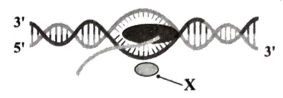
What does $X$ represent in the following diagram?
A
$RNA$ polymerase
B
$Rho$ factor
C
$Sigma$ factor
D
$DNA$ polymerase
Solution
(C) The diagram illustrates the process of transcription in prokaryotes.
In prokaryotic transcription, the $RNA$ polymerase enzyme requires a specific initiation factor to bind to the promoter region of the $DNA$ template.
This initiation factor is known as the $Sigma$ $(\sigma)$ factor.
Once the $Sigma$ factor binds to the $RNA$ polymerase, it facilitates the recognition of the promoter site and initiates the transcription process.
Therefore, $X$ represents the $Sigma$ factor.
In prokaryotic transcription, the $RNA$ polymerase enzyme requires a specific initiation factor to bind to the promoter region of the $DNA$ template.
This initiation factor is known as the $Sigma$ $(\sigma)$ factor.
Once the $Sigma$ factor binds to the $RNA$ polymerase, it facilitates the recognition of the promoter site and initiates the transcription process.
Therefore, $X$ represents the $Sigma$ factor.
0 likesView Solution
26
BiologyEasyMCQGUJCET · 2024
If a double-stranded $DNA$ has $30 \%$ adenine,what is the percentage of cytosine in the same $DNA$ (in $\%$)?
A
$30$
B
$20$
C
$40$
D
$70$
Solution
(B) According to Chargaff's rule for double-stranded $DNA$,the amount of adenine $(A)$ is equal to the amount of thymine $(T)$,and the amount of guanine $(G)$ is equal to the amount of cytosine $(C)$.
Given: $A = 30 \%$.
Since $A = T$,then $T = 30 \%$.
The sum of all bases is $A + T + G + C = 100 \%$.
Substituting the values: $30 \% + 30 \% + G + C = 100 \%$.
$60 \% + G + C = 100 \%$.
$G + C = 100 \% - 60 \% = 40 \%$.
Since $G = C$,we can write $2C = 40 \%$.
Therefore,$C = 20 \%$.
Thus,the percentage of cytosine is $20 \%$.
Given: $A = 30 \%$.
Since $A = T$,then $T = 30 \%$.
The sum of all bases is $A + T + G + C = 100 \%$.
Substituting the values: $30 \% + 30 \% + G + C = 100 \%$.
$60 \% + G + C = 100 \%$.
$G + C = 100 \% - 60 \% = 40 \%$.
Since $G = C$,we can write $2C = 40 \%$.
Therefore,$C = 20 \%$.
Thus,the percentage of cytosine is $20 \%$.
0 likesView Solution
27
BiologyEasyMCQGUJCET · 2024
Which type of interaction is seen between sea anemone and clown fish?
A
Predation
B
Mutualism
C
Population density
D
Commensalism
Solution
(D) The interaction between the sea anemone and the clown fish is an example of $Commensalism$. In this relationship,the clown fish gets protection from predators by living among the stinging tentacles of the sea anemone,while the sea anemone remains unaffected by the presence of the fish. Therefore,the correct option is $D$.
0 likesView Solution
28
BiologyEasyMCQGUJCET · 2024
For the Verhulst-Pearl Logistic Growth equation $dN/dt = rN \left(\frac{K-N}{K}\right)$,what does $K$ indicate?
A
Carrying capacity
B
Intrinsic rate of natural increase
C
Population density
D
Probability constant
Solution
(A) In the Verhulst-Pearl Logistic Growth equation,$dN/dt = rN \left(\frac{K-N}{K}\right)$:
$1$. $N$ represents the population density at time $t$.
$2$. $r$ represents the intrinsic rate of natural increase.
$3$. $K$ represents the carrying capacity,which is the maximum population size that an environment can sustain given the available resources.
Therefore,the correct option is $A$.
$1$. $N$ represents the population density at time $t$.
$2$. $r$ represents the intrinsic rate of natural increase.
$3$. $K$ represents the carrying capacity,which is the maximum population size that an environment can sustain given the available resources.
Therefore,the correct option is $A$.
0 likesView Solution
29
BiologyEasyMCQGUJCET · 2024
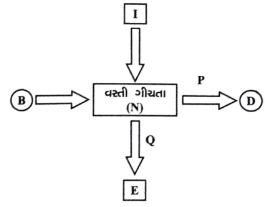
Choose the correct option for $P$ and $Q$ in the given diagram representing population density $(N)$:
A
$P - +$,$Q - +$
B
$P - +$,$Q - -$
C
$P - -$,$Q - -$
D
$P - -$,$Q - +$
Solution
(C) In the given diagram,the factors affecting population density $(N)$ are shown:
$I$ represents Immigration (adds to population,$+$).
$B$ represents Births/Natality (adds to population,$+$).
$D$ represents Deaths/Mortality (removes from population,$-$).
$E$ represents Emigration (removes from population,$-$).
Therefore,$P$ corresponds to Deaths $(D)$ and $Q$ corresponds to Emigration $(E)$.
Both $P$ and $Q$ represent factors that decrease the population density,so they are both marked with a negative sign $(-)$.
Thus,the correct option is $C$.
$I$ represents Immigration (adds to population,$+$).
$B$ represents Births/Natality (adds to population,$+$).
$D$ represents Deaths/Mortality (removes from population,$-$).
$E$ represents Emigration (removes from population,$-$).
Therefore,$P$ corresponds to Deaths $(D)$ and $Q$ corresponds to Emigration $(E)$.
Both $P$ and $Q$ represent factors that decrease the population density,so they are both marked with a negative sign $(-)$.
Thus,the correct option is $C$.
0 likesView Solution
30
BiologyEasyMCQGUJCET · 2024
On which chromosome of each parent is the gene controlling $\beta$-thalassemia located?
A
${11}^{\text{th}}$
B
${21}^{\text{st}}$
C
${16}^{\text{th}}$
D
${14}^{\text{th}}$
Solution
(A) $\beta$-thalassemia is a blood-related autosomal recessive genetic disorder.
It is caused by mutations in the $HBB$ gene.
The $HBB$ gene is located on chromosome ${11}$ in humans.
In contrast, $\alpha$-thalassemia is controlled by genes located on chromosome ${16}$.
Therefore, the correct option is $A$.
It is caused by mutations in the $HBB$ gene.
The $HBB$ gene is located on chromosome ${11}$ in humans.
In contrast, $\alpha$-thalassemia is controlled by genes located on chromosome ${16}$.
Therefore, the correct option is $A$.
0 likesView Solution
31
BiologyEasyMCQGUJCET · 2024
Match the following and choose the correct option:
| Column-$I$ | Column-$II$ |
| $(p)$ Mendel | $(i)$ Chromosomal theory of Inheritance |
| $(q)$ Morgan | $(ii)$ Recombination map |
| $(r)$ Alfred Sturtevant | $(iii)$ Linkage |
| $(s)$ Sutton | $(iv)$ Law of Segregation |
A
$(p-iv), (q-iii), (r-ii), (s-i)$
B
$(p-iii), (q-i), (r-iv), (s-ii)$
C
$(p-ii), (q-iii), (r-iv), (s-i)$
D
$(p-iv), (q-iii), (r-i), (s-ii)$
Solution
(A) The correct matching is as follows:
$(p)$ Mendel proposed the Law of Segregation,which corresponds to $(iv)$.
$(q)$ Thomas Hunt Morgan worked extensively on Drosophila and discovered the phenomenon of Linkage,which corresponds to $(iii)$.
$(r)$ Alfred Sturtevant,a student of Morgan,used the frequency of recombination between gene pairs on the same chromosome as a measure of the distance between genes to map their position,known as the Recombination map,which corresponds to $(ii)$.
$(s)$ Sutton,along with Boveri,proposed the Chromosomal theory of Inheritance,which corresponds to $(i)$.
Therefore,the correct sequence is $(p-iv), (q-iii), (r-ii), (s-i)$.
$(p)$ Mendel proposed the Law of Segregation,which corresponds to $(iv)$.
$(q)$ Thomas Hunt Morgan worked extensively on Drosophila and discovered the phenomenon of Linkage,which corresponds to $(iii)$.
$(r)$ Alfred Sturtevant,a student of Morgan,used the frequency of recombination between gene pairs on the same chromosome as a measure of the distance between genes to map their position,known as the Recombination map,which corresponds to $(ii)$.
$(s)$ Sutton,along with Boveri,proposed the Chromosomal theory of Inheritance,which corresponds to $(i)$.
Therefore,the correct sequence is $(p-iv), (q-iii), (r-ii), (s-i)$.
0 likesView Solution
32
BiologyEasyMCQGUJCET · 2024
Which autosome-linked disease is related to the following pedigree analysis?
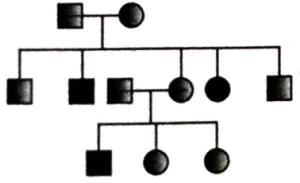
A
Myotonic dystrophy
B
Sickle-cell anaemia
C
Haemophilia
D
Colour blindness
Solution
(A) The provided pedigree shows an autosomal dominant trait because the disease appears in every generation, and affected individuals have affected parents.
$1$. $\text{Haemophilia}$ and $\text{Colour blindness}$ are $X$-linked recessive disorders.
$2$. $\text{Sickle-cell anaemia}$ is an autosomal recessive disorder.
$3$. $\text{Myotonic dystrophy}$ is an autosomal dominant disorder.
Therefore, the correct option is $A$.
$1$. $\text{Haemophilia}$ and $\text{Colour blindness}$ are $X$-linked recessive disorders.
$2$. $\text{Sickle-cell anaemia}$ is an autosomal recessive disorder.
$3$. $\text{Myotonic dystrophy}$ is an autosomal dominant disorder.
Therefore, the correct option is $A$.
0 likesView Solution
33
BiologyEasyMCQGUJCET · 2024
If the blood group of the mother is $A$ and the blood group of the father is $O$,what may be the blood group of the progeny?
A
$A, AB, B, O$
B
$A$ or $B$
C
$A$ or $O$
D
Only blood group $A$
Solution
(C) The blood group of the mother is $A$,which can have the genotype $I^A I^A$ or $I^A i$. The blood group of the father is $O$,which has the genotype $ii$.
If the mother is $I^A I^A$,the progeny will have genotypes $I^A i$ (Blood group $A$).
If the mother is $I^A i$,the progeny will have genotypes $I^A i$ (Blood group $A$) and $ii$ (Blood group $O$).
Therefore,the possible blood groups of the progeny are $A$ or $O$.
If the mother is $I^A I^A$,the progeny will have genotypes $I^A i$ (Blood group $A$).
If the mother is $I^A i$,the progeny will have genotypes $I^A i$ (Blood group $A$) and $ii$ (Blood group $O$).
Therefore,the possible blood groups of the progeny are $A$ or $O$.
0 likesView Solution
34
BiologyEasyMCQGUJCET · 2024
In the process of $in \, vitro$ fertilization, if an embryo with more than $8$ blastomeres is transferred into the uterus for further development, what is this method called?
A
$ZIFT$
B
Artificial insemination
C
$GIFT$
D
$IUT$
Solution
(D) The correct answer is $D$.
In $in \, vitro$ fertilization $(IVF)$, embryos are cultured in the laboratory.
If the embryo has up to $8$ blastomeres, it is transferred into the fallopian tube, a process known as Zygote Intra-Fallopian Transfer $(ZIFT)$.
If the embryo has more than $8$ blastomeres, it is transferred directly into the uterus for further development, a process known as Intra-Uterine Transfer $(IUT)$.
In $in \, vitro$ fertilization $(IVF)$, embryos are cultured in the laboratory.
If the embryo has up to $8$ blastomeres, it is transferred into the fallopian tube, a process known as Zygote Intra-Fallopian Transfer $(ZIFT)$.
If the embryo has more than $8$ blastomeres, it is transferred directly into the uterus for further development, a process known as Intra-Uterine Transfer $(IUT)$.
0 likesView Solution
35
BiologyEasyMCQGUJCET · 2024
Which one of the following sexually transmitted infections is transmitted by methods other than sexual intercourse?
A
Gonorrhoea
B
Chlamydiasis
C
Syphilis
D
Hepatitis $B$
Solution
(D) $Hepatitis B$ is a viral infection that can be transmitted not only through sexual contact but also through the sharing of infected needles,syringes,blood transfusions,and from an infected mother to her fetus. In contrast,$Gonorrhoea$,$Chlamydiasis$,and $Syphilis$ are primarily transmitted through sexual intercourse.
0 likesView Solution
36
BiologyEasyMCQGUJCET · 2024
The hormone-releasing Intra Uterine Device $(IUD)$ is . . . . . . .
A
Lippes loop
B
$CuT$
C
Multiload $375$
D
$LNG-20$
Solution
(D) The correct answer is $D$.
$LNG-20$ is a hormone-releasing $IUD$ that releases levonorgestrel,a synthetic progestogen.
Lippes loop is a non-medicated $IUD$.
$CuT$ and Multiload $375$ are copper-releasing $IUDs$.
$LNG-20$ is a hormone-releasing $IUD$ that releases levonorgestrel,a synthetic progestogen.
Lippes loop is a non-medicated $IUD$.
$CuT$ and Multiload $375$ are copper-releasing $IUDs$.
0 likesView Solution
37
BiologyEasyMCQGUJCET · 2024
In Cleistogamous flowers . . . . . . .
A
Anthers are exposed
B
Anthers and stigma are closed
C
Stigma is exposed
D
Flowers are exposed
Solution
(B) Cleistogamous flowers are those that do not open at all. In such flowers,the anthers and stigma lie close to each other. When anthers dehisce in the closed flower buds,pollen grains come in contact with the stigma to effect pollination. Thus,cleistogamous flowers are invariably autogamous as there is no chance of cross-pollination. Therefore,the correct option is $B$.
0 likesView Solution
38
BiologyEasyMCQGUJCET · 2024
The ovule is attached to the placenta by . . . . . . .
A
Hilum
B
Chalaza
C
Funicle
D
Micropyle
Solution
(C) The ovule is attached to the placenta by a stalk called the $Funicle$. The point of attachment of the body of the ovule with the $Funicle$ is known as the $Hilum$. Therefore,the $Funicle$ acts as the stalk connecting the ovule to the placenta.
0 likesView Solution
39
BiologyEasyMCQGUJCET · 2024
Which one of the following is not associated with pollen-pistil interaction?
A
Pollen deposition on the stigma
B
Pollen germination
C
Pollen tube enters the ovule
D
Embryo development
Solution
(D) Pollen-pistil interaction is a dynamic process involving pollen recognition followed by promotion or inhibition of the pollen.
$1$. Pollen deposition on the stigma is the first step of this interaction.
$2$. Pollen germination and the growth of the pollen tube through the style are key events of this interaction.
$3$. The entry of the pollen tube into the ovule is the final stage of the pollen-pistil interaction.
$4$. Embryo development occurs after fertilization (syngamy and triple fusion) and is not a part of the pollen-pistil interaction.
$1$. Pollen deposition on the stigma is the first step of this interaction.
$2$. Pollen germination and the growth of the pollen tube through the style are key events of this interaction.
$3$. The entry of the pollen tube into the ovule is the final stage of the pollen-pistil interaction.
$4$. Embryo development occurs after fertilization (syngamy and triple fusion) and is not a part of the pollen-pistil interaction.
0 likesView Solution
Vedclass Products
For Students
Vedclass Test Series
Mock tests in real GUJCET style covering Biology with performance analysis. 5-day free trial.
Start Free TrialFor Teachers
Exam Paper Generator
Generate Set A/B/C/D Biology papers from 7.5L+ questions in 2 minutes. 3 chapters free.
Try FreeFor Institutes
Online Exam Module
Run live GUJCET mock exams with unlimited students, 360° analytics & white-label branding.
See DemoFrequently Asked Questions
How many Biology questions are in GUJCET 2024?
There are 39 Biology questions from the GUJCET 2024 paper on Vedclass, each with a detailed step-by-step solution in English.
Are GUJCET 2024 Biology solutions available in English?
Yes. All solutions on this page are in English. You can also switch to English or Hindi using the language buttons above the questions.
Can I practice GUJCET 2024 Biology as a timed test?
Yes. Use the Vedclass Test Series to attempt a full GUJCET mock test covering Biology with time limits and instant score analysis.
Can teachers create Biology papers from GUJCET previous year questions?
Yes. The Vedclass Exam Paper Generator lets teachers mix GUJCET Biology questions and generate Set A/B/C/D papers in minutes.
For Teachers & Institutes
Build a Custom Biology Paper
Pick GUJCET 2024 Biology questions, set difficulty, and generate Set A/B/C/D in 2 minutes.