
ChemistryQ1–18 of 18 questions
Page 1 of 1 · English
1
ChemistryEasyMCQGUJCET · 2021
What is $A$ in the following reaction?
$C_6H_5-CH_2-CH=CH_2 + HCl \rightarrow A$
$C_6H_5-CH_2-CH=CH_2 + HCl \rightarrow A$
A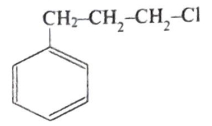
B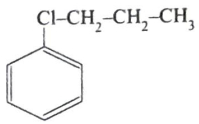
C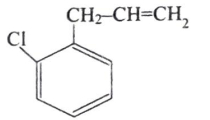
D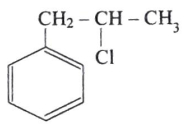
Solution
(D) The reaction is the electrophilic addition of $HCl$ to allylbenzene $(C_6H_5-CH_2-CH=CH_2)$.
According to Markovnikov's rule,the electrophile $(H^+)$ adds to the carbon atom of the double bond that has more hydrogen atoms.
In allylbenzene,the double bond is between $C_2$ and $C_3$ (where $C_1$ is attached to the phenyl ring: $C_6H_5-CH_2-CH=CH_2$).
$H^+$ adds to the terminal $CH_2$ group,forming a stable benzylic carbocation intermediate $(C_6H_5-CH_2-CH^+-CH_3)$.
Then,the nucleophile $(Cl^-)$ attacks this carbocation to form the final product: $C_6H_5-CH_2-CHCl-CH_3$ ($1$-phenyl$-2-$chloropropane).
Therefore,the correct option is $D$.
According to Markovnikov's rule,the electrophile $(H^+)$ adds to the carbon atom of the double bond that has more hydrogen atoms.
In allylbenzene,the double bond is between $C_2$ and $C_3$ (where $C_1$ is attached to the phenyl ring: $C_6H_5-CH_2-CH=CH_2$).
$H^+$ adds to the terminal $CH_2$ group,forming a stable benzylic carbocation intermediate $(C_6H_5-CH_2-CH^+-CH_3)$.
Then,the nucleophile $(Cl^-)$ attacks this carbocation to form the final product: $C_6H_5-CH_2-CHCl-CH_3$ ($1$-phenyl$-2-$chloropropane).
Therefore,the correct option is $D$.
0 likesView Solution
2
ChemistryEasyMCQGUJCET · 2021
Which compound has the maximum value of $pK_a$ among the following?
A
$p-O_2N-C_6H_4-OH$
B
$m-O_2N-C_6H_4-OH$
C
$o-O_2N-C_6H_4-OH$
D
$C_6H_5OH$
Solution
(D) The $pK_a$ value is inversely proportional to the acidity of the compound. Higher acidity corresponds to a lower $pK_a$ value.
Nitro groups $(-NO_2)$ are strong electron-withdrawing groups $(EWG)$ that increase the acidity of phenol by stabilizing the phenoxide ion through $-I$ and $-M$ effects.
In $p-O_2N-C_6H_4-OH$,$m-O_2N-C_6H_4-OH$,and $o-O_2N-C_6H_4-OH$,the $-NO_2$ group increases acidity compared to phenol $(C_6H_5OH)$.
Since $C_6H_5OH$ lacks any electron-withdrawing substituent,it is the least acidic among the given compounds.
Therefore,$C_6H_5OH$ has the maximum $pK_a$ value.
Nitro groups $(-NO_2)$ are strong electron-withdrawing groups $(EWG)$ that increase the acidity of phenol by stabilizing the phenoxide ion through $-I$ and $-M$ effects.
In $p-O_2N-C_6H_4-OH$,$m-O_2N-C_6H_4-OH$,and $o-O_2N-C_6H_4-OH$,the $-NO_2$ group increases acidity compared to phenol $(C_6H_5OH)$.
Since $C_6H_5OH$ lacks any electron-withdrawing substituent,it is the least acidic among the given compounds.
Therefore,$C_6H_5OH$ has the maximum $pK_a$ value.
0 likesView Solution
3
ChemistryEasyMCQGUJCET · 2021
Which Grignard reagent gives $2-$methylpropan$-1-$ol upon reaction with methanal followed by hydrolysis?
A
$CH_3-CH(CH_3)-MgX$
B
$CH_3-CH=CH-MgX$
C
$CH_3-CH_2-CH_2-MgX$
D
$CH_3-CH(CH_3)-CH_2-MgX$
Solution
(A) The reaction of a Grignard reagent $(R-MgX)$ with methanal $(HCHO)$ followed by hydrolysis yields a primary alcohol with one more carbon atom than the Grignard reagent.
To obtain $2-$methylpropan$-1-$ol $(CH_3-CH(CH_3)-CH_2-OH)$,the Grignard reagent must be isobutylmagnesium halide $(CH_3-CH(CH_3)-CH_2-MgX)$.
The reaction is:
$CH_3-CH(CH_3)-CH_2-MgX + HCHO \rightarrow CH_3-CH(CH_3)-CH_2-CH_2-OMgX$
$CH_3-CH(CH_3)-CH_2-CH_2-OMgX + H_2O \rightarrow CH_3-CH(CH_3)-CH_2-CH_2-OH + Mg(OH)X$
Wait,the target product is $2-$methylpropan$-1-$ol $(C_4H_{10}O)$. The reaction of $R-MgX + HCHO$ adds one carbon. Thus,$R$ must be an isopropyl group $(CH_3-CH(CH_3)-)$.
$CH_3-CH(CH_3)-MgX + HCHO$ $\rightarrow CH_3-CH(CH_3)-CH_2-OMgX$ $\xrightarrow{H_2O} CH_3-CH(CH_3)-CH_2-OH$.
Therefore,the correct Grignard reagent is isopropylmagnesium halide,which is option $A$.
To obtain $2-$methylpropan$-1-$ol $(CH_3-CH(CH_3)-CH_2-OH)$,the Grignard reagent must be isobutylmagnesium halide $(CH_3-CH(CH_3)-CH_2-MgX)$.
The reaction is:
$CH_3-CH(CH_3)-CH_2-MgX + HCHO \rightarrow CH_3-CH(CH_3)-CH_2-CH_2-OMgX$
$CH_3-CH(CH_3)-CH_2-CH_2-OMgX + H_2O \rightarrow CH_3-CH(CH_3)-CH_2-CH_2-OH + Mg(OH)X$
Wait,the target product is $2-$methylpropan$-1-$ol $(C_4H_{10}O)$. The reaction of $R-MgX + HCHO$ adds one carbon. Thus,$R$ must be an isopropyl group $(CH_3-CH(CH_3)-)$.
$CH_3-CH(CH_3)-MgX + HCHO$ $\rightarrow CH_3-CH(CH_3)-CH_2-OMgX$ $\xrightarrow{H_2O} CH_3-CH(CH_3)-CH_2-OH$.
Therefore,the correct Grignard reagent is isopropylmagnesium halide,which is option $A$.
0 likesView Solution
4
ChemistryEasyMCQGUJCET · 2021
Which of the following compounds has the maximum acidic strength?
A
$2-$Methoxybenzoic acid
B
Benzoic acid
C
$4-$Methoxybenzoic acid
D
$4-$Nitrobenzoic acid
Solution
(D) is the correct answer.
Acidic strength of benzoic acid derivatives is increased by electron-withdrawing groups $(EWG)$ and decreased by electron-donating groups $(EDG)$.
$4-$Nitrobenzoic acid contains a $-NO_2$ group,which is a strong electron-withdrawing group ($-I$ and $-M$ effect),thereby stabilizing the carboxylate anion and increasing acidity.
$2-$Methoxybenzoic acid and $4-$Methoxybenzoic acid contain a $-OCH_3$ group,which acts as an electron-donating group ($+M$ effect),decreasing the acidic strength compared to benzoic acid.
Therefore,$4-$Nitrobenzoic acid has the maximum acidic strength among the given options.
Acidic strength of benzoic acid derivatives is increased by electron-withdrawing groups $(EWG)$ and decreased by electron-donating groups $(EDG)$.
$4-$Nitrobenzoic acid contains a $-NO_2$ group,which is a strong electron-withdrawing group ($-I$ and $-M$ effect),thereby stabilizing the carboxylate anion and increasing acidity.
$2-$Methoxybenzoic acid and $4-$Methoxybenzoic acid contain a $-OCH_3$ group,which acts as an electron-donating group ($+M$ effect),decreasing the acidic strength compared to benzoic acid.
Therefore,$4-$Nitrobenzoic acid has the maximum acidic strength among the given options.
0 likesView Solution
5
ChemistryEasyMCQGUJCET · 2021
Which reaction proves that all the six carbon atoms are linked in a straight chain in glucose?
A
Reaction with $Br_2$
B
Reaction with $NH_2OH$
C
Heating with $HI$
D
Reaction with $HCN$
Solution
(C) When glucose is heated with prolonged $HI$,it forms $n$-hexane $(CH_3-(CH_2)_4-CH_3)$.
This reaction confirms that all six carbon atoms in glucose are linked in a straight chain.
This reaction confirms that all six carbon atoms in glucose are linked in a straight chain.
0 likesView Solution
6
ChemistryEasyMCQGUJCET · 2021
The rate constant for a first order reaction is $60 \text{ s}^{-1}$. How much time (in seconds) will it take to reduce the initial concentration of the reactant to its $1/16^{th}$ value?
A
$2.3 \times 10^{-2} \text{ s}$
B
$9.5 \times 10^{-2} \text{ s}$
C
$4.6 \times 10^{-2} \text{ s}$
D
$6.9 \times 10^{-2} \text{ s}$
Solution
(C) For a first order reaction,the rate equation is given by $k = \frac{2.303}{t} \log \frac{[R]_0}{[R]}$.
Given that the concentration reduces to $1/16^{th}$ of its initial value,$[R] = \frac{[R]_0}{16}$,so $\frac{[R]_0}{[R]} = 16$.
Substituting the values: $t = \frac{2.303}{k} \log(16)$.
$t = \frac{2.303}{60} \log(2^4) = \frac{2.303 \times 4 \times 0.3010}{60}$.
$t = \frac{2.303 \times 1.204}{60} \approx 0.0462 \text{ s}$.
Therefore,$t = 4.6 \times 10^{-2} \text{ s}$.
Given that the concentration reduces to $1/16^{th}$ of its initial value,$[R] = \frac{[R]_0}{16}$,so $\frac{[R]_0}{[R]} = 16$.
Substituting the values: $t = \frac{2.303}{k} \log(16)$.
$t = \frac{2.303}{60} \log(2^4) = \frac{2.303 \times 4 \times 0.3010}{60}$.
$t = \frac{2.303 \times 1.204}{60} \approx 0.0462 \text{ s}$.
Therefore,$t = 4.6 \times 10^{-2} \text{ s}$.
0 likesView Solution
7
ChemistryEasyMCQGUJCET · 2021
For a reaction,$K = 4.5 \times 10^{-4} \ L \ mol^{-1} \ s^{-1}$. What is the order of the reaction?
A
Zero
B
Second
C
First
D
Third
Solution
(B) The unit of the rate constant $K$ for a reaction of order $n$ is given by $(mol \ L^{-1})^{1-n} \ s^{-1}$.
For a second-order reaction $(n = 2)$,the unit is $(mol \ L^{-1})^{1-2} \ s^{-1} = (mol \ L^{-1})^{-1} \ s^{-1} = L \ mol^{-1} \ s^{-1}$.
Since the given unit is $L \ mol^{-1} \ s^{-1}$,the reaction is of the second order.
For a second-order reaction $(n = 2)$,the unit is $(mol \ L^{-1})^{1-2} \ s^{-1} = (mol \ L^{-1})^{-1} \ s^{-1} = L \ mol^{-1} \ s^{-1}$.
Since the given unit is $L \ mol^{-1} \ s^{-1}$,the reaction is of the second order.
0 likesView Solution
8
ChemistryEasyMCQGUJCET · 2021
Which type of isomerism is exhibited by the isomers $[Co(NH_3)_5(SO_4)]Br$ and $[Co(NH_3)_5Br]SO_4$?
A
Linkage
B
Ionisation
C
Coordination
D
Solvate
Solution
(B) The given isomers are $[Co(NH_3)_5(SO_4)]Br$ and $[Co(NH_3)_5Br]SO_4$.
These compounds produce different ions in an aqueous solution.
$[Co(NH_3)_5(SO_4)]Br$ gives $Br^-$ ions,while $[Co(NH_3)_5Br]SO_4$ gives $SO_4^{2-}$ ions.
This type of isomerism,where the counter ion in the coordination sphere is exchanged with a ligand,is known as $Ionisation$ isomerism.
These compounds produce different ions in an aqueous solution.
$[Co(NH_3)_5(SO_4)]Br$ gives $Br^-$ ions,while $[Co(NH_3)_5Br]SO_4$ gives $SO_4^{2-}$ ions.
This type of isomerism,where the counter ion in the coordination sphere is exchanged with a ligand,is known as $Ionisation$ isomerism.
0 likesView Solution
9
ChemistryEasyMCQGUJCET · 2021
Which is the correct formula for the pentaamminecarbonatocobalt$(III)$ chloride coordination compound?
A
$[Co(NH_3)_5(CO_3)]Cl$
B
$[Co(NH_3)_5(CO_2)]Cl$
C
$[Co(NH_3)_5(CO_3)]Cl_2$
D
$[Co(NH_2)_5(CO_3)]Cl$
Solution
(A) $1$. The central metal ion is Cobalt in the $+3$ oxidation state,denoted as $Co(III)$.
$2$. The ligand 'pentaammine' corresponds to $5$ ammonia molecules,$(NH_3)_5$.
$3$. The ligand 'carbonato' corresponds to the carbonate ion,$CO_3^{2-}$.
$4$. The coordination sphere is $[Co(NH_3)_5(CO_3)]$.
$5$. To balance the charge: $Co$ is $+3$,$CO_3$ is $-2$,and $NH_3$ is $0$. The total charge on the coordination sphere is $(+3) + (-2) = +1$.
$6$. To neutralize the $+1$ charge of the complex,one chloride ion $(Cl^-)$ is required outside the coordination sphere.
$7$. Therefore,the correct formula is $[Co(NH_3)_5(CO_3)]Cl$.
$2$. The ligand 'pentaammine' corresponds to $5$ ammonia molecules,$(NH_3)_5$.
$3$. The ligand 'carbonato' corresponds to the carbonate ion,$CO_3^{2-}$.
$4$. The coordination sphere is $[Co(NH_3)_5(CO_3)]$.
$5$. To balance the charge: $Co$ is $+3$,$CO_3$ is $-2$,and $NH_3$ is $0$. The total charge on the coordination sphere is $(+3) + (-2) = +1$.
$6$. To neutralize the $+1$ charge of the complex,one chloride ion $(Cl^-)$ is required outside the coordination sphere.
$7$. Therefore,the correct formula is $[Co(NH_3)_5(CO_3)]Cl$.
0 likesView Solution
10
ChemistryEasyMCQGUJCET · 2021
If the atomic number of an element is $26$, then the magnetic moment of its divalent aqueous ion is . . . . . . $BM$.
A
$1.73$
B
$3.87$
C
$2.83$
D
$4.90$
Solution
(D) The element with atomic number $26$ is Iron $(Fe)$.
Its electronic configuration is $[Ar] 3d^6 4s^2$.
The divalent ion $Fe^{2+}$ has the configuration $[Ar] 3d^6$.
In the $3d$ subshell, there are $4$ unpaired electrons.
The magnetic moment $(\mu)$ is calculated using the formula $\mu = \sqrt{n(n+2)} \ BM$, where $n$ is the number of unpaired electrons.
Substituting $n = 4$, we get $\mu = \sqrt{4(4+2)} = \sqrt{24} \approx 4.90 \ BM$.
Its electronic configuration is $[Ar] 3d^6 4s^2$.
The divalent ion $Fe^{2+}$ has the configuration $[Ar] 3d^6$.
In the $3d$ subshell, there are $4$ unpaired electrons.
The magnetic moment $(\mu)$ is calculated using the formula $\mu = \sqrt{n(n+2)} \ BM$, where $n$ is the number of unpaired electrons.
Substituting $n = 4$, we get $\mu = \sqrt{4(4+2)} = \sqrt{24} \approx 4.90 \ BM$.
0 likesView Solution
11
ChemistryEasyMCQGUJCET · 2021
Which is the correct symbolic representation for the following cell reaction?
$Mg_{(s)} + Cl_{2(g)} \rightarrow Mg^{2+}_{(aq)} + 2Cl^{-}_{(aq)}$
$Mg_{(s)} + Cl_{2(g)} \rightarrow Mg^{2+}_{(aq)} + 2Cl^{-}_{(aq)}$
A
$Mg_{(s)} \mid Mg^{2+}_{(aq)} \parallel Cl_{2(g)} \mid Cl^{-}_{(aq)} \mid Pt_{(s)}$
B
$Pt_{(s)} \mid Cl^{-}_{(aq)} \mid Cl_{2(g)} \parallel Mg^{2+}_{(aq)} \mid Mg_{(s)}$
C
$Mg_{(s)} \mid Mg^{2+}_{(aq)} \parallel Cl_{2(g)} \mid Cl^{-}_{(aq)} \mid Pt_{(s)}$
D
$Pt_{(s)} \mid Cl_{2(g)} \mid Cl^{-}_{(aq)} \parallel Mg^{2+}_{(aq)} \mid Mg_{(s)}$
Solution
(A) In a cell representation, the anode (oxidation) is written on the left and the cathode (reduction) on the right.
$1$. Oxidation half-reaction: $Mg_{(s)} \rightarrow Mg^{2+}_{(aq)} + 2e^-$. This occurs at the anode: $Mg_{(s)} \mid Mg^{2+}_{(aq)}$.
$2$. Reduction half-reaction: $Cl_{2(g)} + 2e^- \rightarrow 2Cl^-_{(aq)}$. This occurs at the cathode. Since $Cl_2$ is a gas, an inert electrode like $Pt$ is used: $Cl_{2(g)} \mid Cl^-_{(aq)} \mid Pt_{(s)}$.
$3$. Combining these with the salt bridge $(\parallel)$, the representation is $Mg_{(s)} \mid Mg^{2+}_{(aq)} \parallel Cl_{2(g)} \mid Cl^-_{(aq)} \mid Pt_{(s)}$.
$1$. Oxidation half-reaction: $Mg_{(s)} \rightarrow Mg^{2+}_{(aq)} + 2e^-$. This occurs at the anode: $Mg_{(s)} \mid Mg^{2+}_{(aq)}$.
$2$. Reduction half-reaction: $Cl_{2(g)} + 2e^- \rightarrow 2Cl^-_{(aq)}$. This occurs at the cathode. Since $Cl_2$ is a gas, an inert electrode like $Pt$ is used: $Cl_{2(g)} \mid Cl^-_{(aq)} \mid Pt_{(s)}$.
$3$. Combining these with the salt bridge $(\parallel)$, the representation is $Mg_{(s)} \mid Mg^{2+}_{(aq)} \parallel Cl_{2(g)} \mid Cl^-_{(aq)} \mid Pt_{(s)}$.
0 likesView Solution
12
ChemistryEasyMCQGUJCET · 2021
Using the data given below,find out the strongest reducing agent:
$E^0_{Cr_2O_7^{2-}/Cr^{3+}} = 1.33 \text{ V}$,$E^0_{Cl_2/Cl^{-}} = 1.36 \text{ V}$,$E^0_{MnO_4^-/Mn^{2+}} = 1.51 \text{ V}$,$E^0_{Cr^{3+}/Cr} = -0.74 \text{ V}$
$E^0_{Cr_2O_7^{2-}/Cr^{3+}} = 1.33 \text{ V}$,$E^0_{Cl_2/Cl^{-}} = 1.36 \text{ V}$,$E^0_{MnO_4^-/Mn^{2+}} = 1.51 \text{ V}$,$E^0_{Cr^{3+}/Cr} = -0.74 \text{ V}$
A
$Cl^{-}$
B
$Cr^{3+}$
C
$Cr$
D
$Mn^{2+}$
Solution
(C) The strength of a reducing agent is inversely proportional to its standard reduction potential $(E^0_{red})$. $A$ lower (more negative) $E^0_{red}$ value indicates a stronger reducing agent.
Comparing the given values:
$E^0_{MnO_4^-/Mn^{2+}} = 1.51 \text{ V}$
$E^0_{Cl_2/Cl^{-}} = 1.36 \text{ V}$
$E^0_{Cr_2O_7^{2-}/Cr^{3+}} = 1.33 \text{ V}$
$E^0_{Cr^{3+}/Cr} = -0.74 \text{ V}$
Since $E^0_{Cr^{3+}/Cr}$ has the lowest (most negative) value of $-0.74 \text{ V}$,the species $Cr$ acts as the strongest reducing agent.
Comparing the given values:
$E^0_{MnO_4^-/Mn^{2+}} = 1.51 \text{ V}$
$E^0_{Cl_2/Cl^{-}} = 1.36 \text{ V}$
$E^0_{Cr_2O_7^{2-}/Cr^{3+}} = 1.33 \text{ V}$
$E^0_{Cr^{3+}/Cr} = -0.74 \text{ V}$
Since $E^0_{Cr^{3+}/Cr}$ has the lowest (most negative) value of $-0.74 \text{ V}$,the species $Cr$ acts as the strongest reducing agent.
0 likesView Solution
13
ChemistryEasyMCQGUJCET · 2021
Which products are obtained during the electrolysis of an aqueous solution of sodium chloride?
A
$NaOH, O_2$ and $H_2$
B
$NaOH, Na$ and $H_2$
C
$NaOH, Cl_2$ and $H_2$
D
$Na, Cl_2$ and $H_2$
Solution
(C) During the electrolysis of an aqueous solution of sodium chloride ($NaCl$ (aq)),the following reactions occur:
At the cathode: $2H_2O(l) + 2e^- \rightarrow H_2(g) + 2OH^-(aq)$.
At the anode: $2Cl^-(aq) \rightarrow Cl_2(g) + 2e^-$.
The remaining ions in the solution are $Na^+$ and $OH^-$,which combine to form $NaOH(aq)$.
Therefore,the products obtained are $NaOH, Cl_2$ and $H_2$.
At the cathode: $2H_2O(l) + 2e^- \rightarrow H_2(g) + 2OH^-(aq)$.
At the anode: $2Cl^-(aq) \rightarrow Cl_2(g) + 2e^-$.
The remaining ions in the solution are $Na^+$ and $OH^-$,which combine to form $NaOH(aq)$.
Therefore,the products obtained are $NaOH, Cl_2$ and $H_2$.
0 likesView Solution
14
ChemistryEasyMCQGUJCET · 2021
Which of the following halides will give $S_N 1$ reaction fastest?
A
$2-$bromo-$3-$methylbutane
B
$2-$chloro-$3-$methylbutane
C
chloromethane
D
$2-$bromo-$2-$methylpropane
Solution
(D) The rate of $S_N 1$ reaction depends on the stability of the carbocation intermediate formed during the rate-determining step.
$S_N 1$ reactivity order is: $3^{\circ} > 2^{\circ} > 1^{\circ} > CH_3-X$.
$A$: $2-$bromo-$3-$methylbutane is a $2^{\circ}$ halide.
$B$: $2-$chloro-$3-$methylbutane is a $2^{\circ}$ halide.
$C$: Chloromethane is a $1^{\circ}$ halide.
$D$: $2-$bromo-$2-$methylpropane is a $3^{\circ}$ halide.
Since $3^{\circ}$ carbocations are the most stable,$2-$bromo-$2-$methylpropane will undergo $S_N 1$ reaction the fastest.
$S_N 1$ reactivity order is: $3^{\circ} > 2^{\circ} > 1^{\circ} > CH_3-X$.
$A$: $2-$bromo-$3-$methylbutane is a $2^{\circ}$ halide.
$B$: $2-$chloro-$3-$methylbutane is a $2^{\circ}$ halide.
$C$: Chloromethane is a $1^{\circ}$ halide.
$D$: $2-$bromo-$2-$methylpropane is a $3^{\circ}$ halide.
Since $3^{\circ}$ carbocations are the most stable,$2-$bromo-$2-$methylpropane will undergo $S_N 1$ reaction the fastest.
0 likesView Solution
15
ChemistryEasyMCQGUJCET · 2021
Based on the position of the $-Cl$ atom in $CH_3-CH=CH-C(Cl)(CH_3)_2$,what type of halide is it?
A
Secondary
B
Vinylic
C
Allylic
D
Aryl
Solution
(C) The given compound is $CH_3-CH=CH-C(Cl)(CH_3)_2$.
In this structure,the $-Cl$ atom is attached to a carbon atom that is directly bonded to a carbon-carbon double bond $(C=C)$.
Specifically,the carbon atom bearing the $-Cl$ is adjacent to the $sp^2$ hybridized carbon of the double bond.
Such a halide,where the halogen is attached to an $sp^3$ hybridized carbon atom next to a carbon-carbon double bond,is classified as an allylic halide.
In this structure,the $-Cl$ atom is attached to a carbon atom that is directly bonded to a carbon-carbon double bond $(C=C)$.
Specifically,the carbon atom bearing the $-Cl$ is adjacent to the $sp^2$ hybridized carbon of the double bond.
Such a halide,where the halogen is attached to an $sp^3$ hybridized carbon atom next to a carbon-carbon double bond,is classified as an allylic halide.
0 likesView Solution
16
ChemistryEasyMCQGUJCET · 2021
Which method is used to remove salt from sea water?
A
Hydraulic washing
B
Leaching
C
Reverse osmosis
D
Froth Floatation
Solution
(C) The process of removing salt from sea water to make it potable is known as desalination.
Reverse osmosis is the most common method used for this purpose.
In this process,a semi-permeable membrane is used to separate salt from water by applying pressure greater than the osmotic pressure.
Therefore,the correct option is $C$.
Reverse osmosis is the most common method used for this purpose.
In this process,a semi-permeable membrane is used to separate salt from water by applying pressure greater than the osmotic pressure.
Therefore,the correct option is $C$.
0 likesView Solution
17
ChemistryEasyMCQGUJCET · 2021
$3.0 \ g$ ethanoic acid in $50 \ g$ benzene has . . . . . . molality. (Atomic weights: $H=1, C=12, O=16$).
A
$0.1$
B
$1.0$
C
$0.6$
D
$0.06$
Solution
(B) The molar mass of ethanoic acid $(CH_3COOH)$ is $(2 \times 12) + (4 \times 1) + (2 \times 16) = 24 + 4 + 32 = 60 \ g/mol$.
Number of moles of ethanoic acid = $\frac{\text{mass}}{\text{molar mass}} = \frac{3.0 \ g}{60 \ g/mol} = 0.05 \ mol$.
Mass of solvent (benzene) = $50 \ g = 0.05 \ kg$.
Molality $(m)$ = $\frac{\text{moles of solute}}{\text{mass of solvent in kg}} = \frac{0.05 \ mol}{0.05 \ kg} = 1.0 \ mol/kg$.
Therefore,the correct option is $B$.
Number of moles of ethanoic acid = $\frac{\text{mass}}{\text{molar mass}} = \frac{3.0 \ g}{60 \ g/mol} = 0.05 \ mol$.
Mass of solvent (benzene) = $50 \ g = 0.05 \ kg$.
Molality $(m)$ = $\frac{\text{moles of solute}}{\text{mass of solvent in kg}} = \frac{0.05 \ mol}{0.05 \ kg} = 1.0 \ mol/kg$.
Therefore,the correct option is $B$.
0 likesView Solution
18
ChemistryEasyMCQGUJCET · 2021
Which of the following aqueous solutions should have the minimum boiling point?
A
$0.1 \ M$ Urea
B
$0.1 \ M \ K_2SO_4$
C
$0.1 \ M \ NaCl$
D
$0.1 \ M \ FeCl_3$
Solution
(A) The elevation in boiling point is a colligative property,which depends on the van't Hoff factor $(i)$ and the concentration of the solute particles. The formula is $\Delta T_b = i \times K_b \times m$.
Since the molality $(m)$ is the same for all solutions $(0.1 \ M)$,the solution with the minimum van't Hoff factor $(i)$ will have the minimum boiling point elevation,and thus the minimum boiling point.
For Urea (non-electrolyte),$i = 1$.
For $K_2SO_4$ $(2K^+ + SO_4^{2-})$,$i = 3$.
For $NaCl$ $(Na^+ + Cl^-)$,$i = 2$.
For $FeCl_3$ $(Fe^{3+} + 3Cl^-)$,$i = 4$.
Comparing the values,Urea has the lowest $i$ value $(1)$,therefore $0.1 \ M$ Urea has the minimum boiling point.
Since the molality $(m)$ is the same for all solutions $(0.1 \ M)$,the solution with the minimum van't Hoff factor $(i)$ will have the minimum boiling point elevation,and thus the minimum boiling point.
For Urea (non-electrolyte),$i = 1$.
For $K_2SO_4$ $(2K^+ + SO_4^{2-})$,$i = 3$.
For $NaCl$ $(Na^+ + Cl^-)$,$i = 2$.
For $FeCl_3$ $(Fe^{3+} + 3Cl^-)$,$i = 4$.
Comparing the values,Urea has the lowest $i$ value $(1)$,therefore $0.1 \ M$ Urea has the minimum boiling point.
0 likesView Solution
Vedclass Products
For Students
Vedclass Test Series
Mock tests in real GUJCET style covering Chemistry with performance analysis. 5-day free trial.
Start Free TrialFor Teachers
Exam Paper Generator
Generate Set A/B/C/D Chemistry papers from 7.5L+ questions in 2 minutes. 3 chapters free.
Try FreeFor Institutes
Online Exam Module
Run live GUJCET mock exams with unlimited students, 360° analytics & white-label branding.
See DemoFrequently Asked Questions
How many Chemistry questions are in GUJCET 2021?
There are 18 Chemistry questions from the GUJCET 2021 paper on Vedclass, each with a detailed step-by-step solution in English.
Are GUJCET 2021 Chemistry solutions available in English?
Yes. All solutions on this page are in English. You can also switch to English or Hindi using the language buttons above the questions.
Can I practice GUJCET 2021 Chemistry as a timed test?
Yes. Use the Vedclass Test Series to attempt a full GUJCET mock test covering Chemistry with time limits and instant score analysis.
Can teachers create Chemistry papers from GUJCET previous year questions?
Yes. The Vedclass Exam Paper Generator lets teachers mix GUJCET Chemistry questions and generate Set A/B/C/D papers in minutes.
For Teachers & Institutes
Build a Custom Chemistry Paper
Pick GUJCET 2021 Chemistry questions, set difficulty, and generate Set A/B/C/D in 2 minutes.