
BiologyQ1–31 of 31 questions
Page 1 of 1 · English
1
BiologyEasyMCQGUJCET · 2021
Statement $I$: In many cultures,tracts of forest were set aside,and all the trees and wildlife within were venerated and given total protection; these are referred to as sacred groves.
Statement $II$: In Meghalaya,the sacred groves are the last refuges for a large number of rare and threatened animals.
Statement $II$: In Meghalaya,the sacred groves are the last refuges for a large number of rare and threatened animals.
A
Statements $I$ and $II$ both are correct
B
Statement $I$ is incorrect,but statement $II$ is correct
C
Statement $I$ is correct,but statement $II$ is incorrect
D
Statements $I$ and $II$ both are incorrect
Solution
(A) Statement $I$ is correct. Sacred groves are forest patches that are culturally protected by local communities,where all trees and wildlife are given total protection.
Statement $II$ is also correct. In India,ecologically unique and biodiversity-rich regions are legally protected as biosphere reserves,national parks,and sanctuaries. However,in Meghalaya,the sacred groves are the last refuges for a large number of rare and threatened plants and animals. Since both statements are factually accurate,the correct option is $A$.
Statement $II$ is also correct. In India,ecologically unique and biodiversity-rich regions are legally protected as biosphere reserves,national parks,and sanctuaries. However,in Meghalaya,the sacred groves are the last refuges for a large number of rare and threatened plants and animals. Since both statements are factually accurate,the correct option is $A$.
0 likesView Solution
2
BiologyEasyMCQGUJCET · 2021
The Amazon rain forest is being cut and cleared for cultivating which plant?
A
Barley
B
Maize
C
Sugar cane
D
Soybean
Solution
(D) The Amazon rain forest,often referred to as the 'lungs of the planet',is being extensively cut and cleared for agricultural purposes.
Specifically,large areas are being converted into fields for the cultivation of $Soybean$ and for creating grasslands for cattle ranching.
This deforestation poses a significant threat to global biodiversity.
Specifically,large areas are being converted into fields for the cultivation of $Soybean$ and for creating grasslands for cattle ranching.
This deforestation poses a significant threat to global biodiversity.
0 likesView Solution
3
BiologyEasyMCQGUJCET · 2021
$RNA$ interference takes place in all eukaryotic organisms as a method of cellular defense. This method involves silencing of a specific $mRNA$ due to a . . . . . . .
A
Complementary $dsDNA$
B
Complementary $ssDNA$
C
Complementary $ssRNA$
D
Complementary $dsRNA$
Solution
(D) $RNA$ interference $(RNAi)$ is a biological process in which $RNA$ molecules inhibit gene expression or translation,by neutralizing targeted $mRNA$ molecules. This method involves the silencing of a specific $mRNA$ due to a complementary $dsRNA$ molecule. The $dsRNA$ is processed into small interfering $RNA$ $(siRNA)$ which binds to the target $mRNA$ and prevents its translation.
0 likesView Solution
4
BiologyEasyMCQGUJCET · 2021
Statement $I$: $ELISA$ works on the principle of antigen-antibody interaction.
Statement $II$: Infection by a pathogen can be detected by the presence of antigens or by detecting the antibodies synthesized against the pathogen.
Statement $II$: Infection by a pathogen can be detected by the presence of antigens or by detecting the antibodies synthesized against the pathogen.
A
Statement $I$ is true but statement $II$ is wrong
B
Statement $I$ and $II$ both are true
C
Statement $I$ is wrong but statement $II$ is true
D
Statement $I$ and $II$ both are wrong
Solution
(B) $ELISA$ stands for Enzyme-Linked Immunosorbent Assay.
It is a diagnostic technique based on the principle of antigen-antibody interaction.
Infections can be detected by identifying the presence of antigens (proteins,glycoproteins,etc.) or by detecting the antibodies produced against the pathogen in the host's body.
Therefore,both statements are correct.
It is a diagnostic technique based on the principle of antigen-antibody interaction.
Infections can be detected by identifying the presence of antigens (proteins,glycoproteins,etc.) or by detecting the antibodies produced against the pathogen in the host's body.
Therefore,both statements are correct.
0 likesView Solution
5
BiologyEasyMCQGUJCET · 2021
Identify the labels $X$,$Y$,and $Z$ in the given diagram representing the process of recombinant $DNA$ technology.
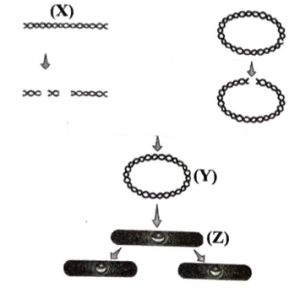
A
$X$ - foreign $DNA$,$Y$ - recombinant $DNA$,$Z$ - transduction
B
$X$ - $DNA$,$Y$ - recombinant $DNA$,$Z$ - transformation
C
$X$ - foreign $DNA$,$Y$ - recombinant $DNA$,$Z$ - transformation
D
$X$ - $DNA$,$Y$ - recombinant $DNA$,$Z$ - transduction
Solution
(C) In the provided diagram of recombinant $DNA$ technology:
$1$. $X$ represents the foreign $DNA$ (or gene of interest) which is being cut by restriction enzymes.
$2$. $Y$ represents the recombinant $DNA$ formed by ligating the foreign $DNA$ into the vector (plasmid).
$3$. $Z$ represents the process of transformation,where the recombinant $DNA$ is introduced into the host cell (bacterium) to express the desired trait.
Therefore,the correct labels are $X$ - foreign $DNA$,$Y$ - recombinant $DNA$,and $Z$ - transformation.
$1$. $X$ represents the foreign $DNA$ (or gene of interest) which is being cut by restriction enzymes.
$2$. $Y$ represents the recombinant $DNA$ formed by ligating the foreign $DNA$ into the vector (plasmid).
$3$. $Z$ represents the process of transformation,where the recombinant $DNA$ is introduced into the host cell (bacterium) to express the desired trait.
Therefore,the correct labels are $X$ - foreign $DNA$,$Y$ - recombinant $DNA$,and $Z$ - transformation.
0 likesView Solution
6
BiologyEasyMCQGUJCET · 2021
r-$DNA$ is inserted within the coding sequence of an enzyme,$\beta$-galactosidase. This results in the inactivation of the gene for the synthesis of this enzyme,which is referred to as . . . . . . .
A
Insertional inactivation
B
Recombinant inactivation
C
Insertional activation
D
Combined inactivation
Solution
(A) When a recombinant $DNA$ ($r$-$DNA$) molecule is inserted within the coding sequence of an enzyme,such as $\beta$-galactosidase,it disrupts the gene's sequence. This disruption leads to the loss of the gene's ability to produce a functional enzyme,a phenomenon known as insertional inactivation. This technique is widely used in blue-white screening to identify recombinant colonies.
0 likesView Solution
7
BiologyEasyMCQGUJCET · 2021
In which part of the $Anopheles$ female mosquito does the reproduction and development of $Plasmodium$ germ cells take place?
A
$RBC$
B
Salivary gland
C
Rectum
D
Gut
Solution
(D) The life cycle of $Plasmodium$ involves two hosts: humans and the female $Anopheles$ mosquito.
In the human host,$Plasmodium$ undergoes asexual reproduction in the liver and $RBCs$.
When a female $Anopheles$ mosquito bites an infected person,the gametocytes enter the mosquito's body.
Fertilization and development of $Plasmodium$ germ cells (gametes) occur in the gut (midgut) of the mosquito.
After fertilization,the zygote develops into an ookinete,which penetrates the gut wall to form oocysts,eventually releasing sporozoites that migrate to the salivary glands.
In the human host,$Plasmodium$ undergoes asexual reproduction in the liver and $RBCs$.
When a female $Anopheles$ mosquito bites an infected person,the gametocytes enter the mosquito's body.
Fertilization and development of $Plasmodium$ germ cells (gametes) occur in the gut (midgut) of the mosquito.
After fertilization,the zygote develops into an ookinete,which penetrates the gut wall to form oocysts,eventually releasing sporozoites that migrate to the salivary glands.
0 likesView Solution
8
BiologyEasyMCQGUJCET · 2021
Match the Column-$I$ with Column-$II$ and select the correct option.
| Column-$I$ | Column-$II$ |
| $1$. $Papaver \text{ } somniferum$ | $A$. Marijuana |
| $2$. $Cannabis \text{ } sativa$ | $B$. Cocaine |
| $3$. $Erythroxylum \text{ } coca$ | $C$. Hallucinogenic properties |
| $4$. $Dhatura$ | $D$. Opioids |
A
$(1-D), (2-A), (3-B), (4-C)$
B
$(1-B), (2-C), (3-D), (4-A)$
C
$(1-A), (2-B), (3-C), (4-D)$
D
$(1-C), (2-D), (3-A), (4-B)$
Solution
(A) The correct matching is as follows:
$1$. $Papaver \text{ } somniferum$ is the source of Opioids $(D)$.
$2$. $Cannabis \text{ } sativa$ is the source of Marijuana $(A)$.
$3$. $Erythroxylum \text{ } coca$ is the source of Cocaine $(B)$.
$4$. $Dhatura$ is known for its Hallucinogenic properties $(C)$.
Thus, the correct sequence is $(1-D), (2-A), (3-B), (4-C)$.
Therefore, the correct option is $A$.
$1$. $Papaver \text{ } somniferum$ is the source of Opioids $(D)$.
$2$. $Cannabis \text{ } sativa$ is the source of Marijuana $(A)$.
$3$. $Erythroxylum \text{ } coca$ is the source of Cocaine $(B)$.
$4$. $Dhatura$ is known for its Hallucinogenic properties $(C)$.
Thus, the correct sequence is $(1-D), (2-A), (3-B), (4-C)$.
Therefore, the correct option is $A$.
0 likesView Solution
9
BiologyEasyMCQGUJCET · 2021
Match the Column-$I$ with Column-$II$ and select the correct option.
| Column-$I$ | Column-$II$ |
| $1$. Cellular barrier | $A$. Saliva in the mouth |
| $2$. Physiological barrier | $B$. Interferons |
| $3$. Cytokine barrier | $C$. Natural killer (type of lymphocyte) |
| $4$. Physical barrier | $D$. Mucus coating of the respiratory tract |
A
$(1-C), (2-B), (3-D), (4-A)$
B
$(1-C), (2-A), (3-B), (4-D)$
C
$(1-A), (2-D), (3-C), (4-B)$
D
$(1-A), (2-B), (3-D), (4-C)$
Solution
(B) The correct matching is as follows:
$1$. Cellular barrier: These include cells like polymorphonuclear leukocytes ($PMNL$-neutrophils),monocytes,and natural killer (type of lymphocytes) in the blood. Thus,$1-C$.
$2$. Physiological barrier: These include acid in the stomach,saliva in the mouth,and tears from eyes,which prevent microbial growth. Thus,$2-A$.
$3$. Cytokine barrier: Virus-infected cells secrete proteins called interferons which protect non-infected cells from further viral infection. Thus,$3-B$.
$4$. Physical barrier: These include the skin and the mucus coating of the epithelium lining the respiratory,gastrointestinal,and urogenital tracts. Thus,$4-D$.
Therefore,the correct sequence is $(1-C), (2-A), (3-B), (4-D)$,which corresponds to option $B$.
$1$. Cellular barrier: These include cells like polymorphonuclear leukocytes ($PMNL$-neutrophils),monocytes,and natural killer (type of lymphocytes) in the blood. Thus,$1-C$.
$2$. Physiological barrier: These include acid in the stomach,saliva in the mouth,and tears from eyes,which prevent microbial growth. Thus,$2-A$.
$3$. Cytokine barrier: Virus-infected cells secrete proteins called interferons which protect non-infected cells from further viral infection. Thus,$3-B$.
$4$. Physical barrier: These include the skin and the mucus coating of the epithelium lining the respiratory,gastrointestinal,and urogenital tracts. Thus,$4-D$.
Therefore,the correct sequence is $(1-C), (2-A), (3-B), (4-D)$,which corresponds to option $B$.
0 likesView Solution
10
BiologyEasyMCQGUJCET · 2021
'Contact inhibition' is the property of which cells?
A
neoplastic cells
B
normal cells
C
the cells that possess oncogenes
D
benign tumor cells
Solution
(B) Contact inhibition is a regulatory mechanism that functions to keep the cells growing to a layer one cell thick (a monolayer).
Normal cells in the body exhibit this property,which prevents them from dividing uncontrollably when they come into contact with neighboring cells.
In contrast,cancer cells (neoplastic cells) lose this property,which allows them to continue dividing and piling up on top of each other,eventually forming a tumor.
Normal cells in the body exhibit this property,which prevents them from dividing uncontrollably when they come into contact with neighboring cells.
In contrast,cancer cells (neoplastic cells) lose this property,which allows them to continue dividing and piling up on top of each other,eventually forming a tumor.
0 likesView Solution
11
BiologyEasyMCQGUJCET · 2021
In case of snakebites,the injection given to patients contains preformed antibodies against the snake venom. This type of immunisation is called . . . . . . .
A
Active immunity
B
Both kinds of immunity
C
Passive immunity
D
Partial passive immunity
Solution
(C) When ready-made or preformed antibodies are directly injected into the body to provide a quick immune response,it is known as passive immunity.
In the case of snakebites,the patient needs immediate protection because the venom acts rapidly.
Since the body does not have enough time to produce its own antibodies (which would be active immunity),preformed antibodies are administered to neutralize the toxin immediately.
Therefore,the correct answer is $C$ (Passive immunity).
In the case of snakebites,the patient needs immediate protection because the venom acts rapidly.
Since the body does not have enough time to produce its own antibodies (which would be active immunity),preformed antibodies are administered to neutralize the toxin immediately.
Therefore,the correct answer is $C$ (Passive immunity).
0 likesView Solution
12
BiologyEasyMCQGUJCET · 2021
In which body part of the female $Anopheles$ mosquito do the gametes of the parasite $Plasmodium$ fertilize and develop?
A
Salivary gland
B
Rectum
C
$RBC$
D
In the gut
Solution
(D) The life cycle of $Plasmodium$ involves two hosts: humans and the female $Anopheles$ mosquito.
$1$. When the female $Anopheles$ mosquito bites an infected person,the gametocytes of $Plasmodium$ enter the mosquito's body along with the blood meal.
$2$. These gametocytes undergo fertilization and further development within the gut (midgut) of the mosquito.
$3$. After fertilization,the zygote is formed,which then develops into an ookinete,and subsequently into oocysts,which eventually release sporozoites that migrate to the salivary glands.
$4$. Therefore,the fertilization and development of gametes occur in the gut of the mosquito.
$1$. When the female $Anopheles$ mosquito bites an infected person,the gametocytes of $Plasmodium$ enter the mosquito's body along with the blood meal.
$2$. These gametocytes undergo fertilization and further development within the gut (midgut) of the mosquito.
$3$. After fertilization,the zygote is formed,which then develops into an ookinete,and subsequently into oocysts,which eventually release sporozoites that migrate to the salivary glands.
$4$. Therefore,the fertilization and development of gametes occur in the gut of the mosquito.
0 likesView Solution
13
BiologyEasyMCQGUJCET · 2021
For normal fertility in males,what percentage of sperms must have normal shape and size,and what percentage of sperms must show vigorous motility?
A
$X$ - at least $60\%$,$Y$ - at least $40\%$
B
$X$ - maximum $60\%$,$Y$ - minimum $40\%$
C
$X$ - at least $40\%$,$Y$ - at least $60\%$
D
$X$ - minimum $60\%$,$Y$ - maximum $40\%$
Solution
(A) For normal fertility,it is essential that at least $60\%$ of all sperms must have normal shape and size,and at least $40\%$ of them must show vigorous motility. This is a standard physiological requirement for successful fertilization in humans.
0 likesView Solution
14
BiologyEasyMCQGUJCET · 2021
Major features of embryonic development at various months of pregnancy are given below. Choose the correct option for the correct sequential events.
$(i)$ The first movements of the foetus
$(II)$ The foetus develops limbs and digits
$(III)$ The embryo's heart is formed
$(IV)$ The body is covered with fine hairs
$(i)$ The first movements of the foetus
$(II)$ The foetus develops limbs and digits
$(III)$ The embryo's heart is formed
$(IV)$ The body is covered with fine hairs
A
$(II)$,$(IV)$,$(I)$,$(III)$
B
$(IV)$,$(II)$,$(I)$,$(III)$
C
$(II)$,$(III)$,$(IV)$,$(i)$
D
$(III)$,$(II)$,$(I)$,$(IV)$
Solution
(D) The correct sequence of embryonic development is as follows:
$(III)$ The embryo's heart is formed: This is the first sign of organ development,usually observed by the end of the first month.
$(II)$ The foetus develops limbs and digits: This occurs by the end of the second month of pregnancy.
$(I)$ The first movements of the foetus: These are observed during the fifth month of pregnancy.
$(IV)$ The body is covered with fine hairs: This occurs by the end of the second trimester (around the sixth month).
Therefore,the correct sequence is $(III), (II), (I), (IV)$,which corresponds to option $D$.
$(III)$ The embryo's heart is formed: This is the first sign of organ development,usually observed by the end of the first month.
$(II)$ The foetus develops limbs and digits: This occurs by the end of the second month of pregnancy.
$(I)$ The first movements of the foetus: These are observed during the fifth month of pregnancy.
$(IV)$ The body is covered with fine hairs: This occurs by the end of the second trimester (around the sixth month).
Therefore,the correct sequence is $(III), (II), (I), (IV)$,which corresponds to option $D$.
0 likesView Solution
15
BiologyEasyMCQGUJCET · 2021
Which part of the oviduct joins the uterus?
A
Fimbriae
B
Isthmus
C
Ampulla
D
Infundibulum
Solution
(B) The human fallopian tube (oviduct) consists of three main parts: the infundibulum,the ampulla,and the isthmus.
$1$. The $Infundibulum$ is the funnel-shaped part closest to the ovary,possessing finger-like projections called fimbriae.
$2$. The $Ampulla$ is the wider,middle part of the oviduct where fertilization typically occurs.
$3$. The $Isthmus$ is the last and narrow part of the oviduct that connects directly to the uterus.
Therefore,the correct answer is $B$.
$1$. The $Infundibulum$ is the funnel-shaped part closest to the ovary,possessing finger-like projections called fimbriae.
$2$. The $Ampulla$ is the wider,middle part of the oviduct where fertilization typically occurs.
$3$. The $Isthmus$ is the last and narrow part of the oviduct that connects directly to the uterus.
Therefore,the correct answer is $B$.
0 likesView Solution
16
BiologyEasyMCQGUJCET · 2021
Biocontrol agent $Baculovirus$ causes diseases in which organisms?
A
Insects and other arthropods
B
Insects and fungi
C
Insects and wasps
D
Wasps and arthropods
Solution
(A) The biocontrol agents known as $Baculoviruses$ are pathogens that attack insects and other arthropods. These viruses are excellent candidates for species-specific,narrow-spectrum insecticidal applications. They are especially desirable when beneficial insects need to be conserved in an integrated pest management $(IPM)$ program.
0 likesView Solution
17
BiologyEasyMCQGUJCET · 2021
Choose the correct sequence for $\text{STP}$ (Sewage treatment plant).
A
Primary sludge $\rightarrow$ effluent $\rightarrow$ flocs $\rightarrow$ anaerobic sludge
B
Primary sludge $\rightarrow$ flocs $\rightarrow$ effluent $\rightarrow$ anaerobic sludge
C
Primary sludge $\rightarrow$ anaerobic sludge $\rightarrow$ flocs $\rightarrow$ effluent
D
Primary sludge $\rightarrow$ anaerobic sludge $\rightarrow$ effluent $\rightarrow$ flocs
Solution
(A) The correct sequence in a $\text{Sewage Treatment Plant}$ $(\text{STP})$ is as follows:
$1$. $\text{Primary sludge}$ is the solid waste settled during primary treatment.
$2$. The supernatant liquid is called the $\text{effluent}$,which is passed into aeration tanks.
$3$. In aeration tanks,aerobic microbes grow into masses called $\text{flocs}$.
$4$. Finally,the $\text{flocs}$ are digested by anaerobic bacteria in an $\text{anaerobic sludge digester}$,resulting in $\text{anaerobic sludge}$.
Therefore,the sequence is: $\text{Primary sludge} \rightarrow \text{effluent} \rightarrow \text{flocs} \rightarrow \text{anaerobic sludge}$.
$1$. $\text{Primary sludge}$ is the solid waste settled during primary treatment.
$2$. The supernatant liquid is called the $\text{effluent}$,which is passed into aeration tanks.
$3$. In aeration tanks,aerobic microbes grow into masses called $\text{flocs}$.
$4$. Finally,the $\text{flocs}$ are digested by anaerobic bacteria in an $\text{anaerobic sludge digester}$,resulting in $\text{anaerobic sludge}$.
Therefore,the sequence is: $\text{Primary sludge} \rightarrow \text{effluent} \rightarrow \text{flocs} \rightarrow \text{anaerobic sludge}$.
0 likesView Solution
18
BiologyEasyMCQGUJCET · 2021
Match the following.
| $I$ | $II$ | $III$ |
| $(P)$ Trichoderma polysporum | $(a)$ statins | $(i)$ clot buster |
| $(Q)$ Monascus purpureus | $(b)$ streptokinase | $(ii)$ organ transplant |
| $(R)$ Streptococcus | $(c)$ cyclosporin-$A$ | $(iii)$ cholesterol lowering agent |
A
$P-(c-iii), Q-(b-i), R-(a-ii)$
B
$P-(a-iii), Q-(c-i), R-(b-ii)$
C
$P-(b-ii), Q-(a-i), R-(c-iii)$
D
$P-(c-ii), Q-(a-iii), R-(b-i)$
Solution
(D) The correct matches are as follows:
$1$. $Trichoderma \text{ } polysporum$ produces cyclosporin-$A$, which is used as an immunosuppressive agent in organ transplant patients. Thus, $P-(c-ii)$.
$2$. $Monascus \text{ } purpureus$ produces statins, which act as blood cholesterol-lowering agents. Thus, $Q-(a-iii)$.
$3$. $Streptococcus$ produces streptokinase, which is used as a 'clot buster' for removing clots from the blood vessels of patients who have undergone myocardial infarction. Thus, $R-(b-i)$.
Therefore, the correct sequence is $P-(c-ii), Q-(a-iii), R-(b-i)$.
$1$. $Trichoderma \text{ } polysporum$ produces cyclosporin-$A$, which is used as an immunosuppressive agent in organ transplant patients. Thus, $P-(c-ii)$.
$2$. $Monascus \text{ } purpureus$ produces statins, which act as blood cholesterol-lowering agents. Thus, $Q-(a-iii)$.
$3$. $Streptococcus$ produces streptokinase, which is used as a 'clot buster' for removing clots from the blood vessels of patients who have undergone myocardial infarction. Thus, $R-(b-i)$.
Therefore, the correct sequence is $P-(c-ii), Q-(a-iii), R-(b-i)$.
0 likesView Solution
19
BiologyEasyMCQGUJCET · 2021
$A$ segment of $DNA$ coding for a polypeptide,the structural gene in a transcription unit is called . . . . . . .
A
Cistron
B
Octamer
C
Nucleosome
D
Chromatin
Solution
(A) In a transcription unit,the structural gene is the segment of $DNA$ that codes for a polypeptide or an $RNA$ molecule.
This functional unit of $DNA$ that specifies a single polypeptide chain is known as a $Cistron$.
$Octamer$ refers to the complex of histone proteins in a nucleosome.
$Nucleosome$ is the basic structural unit of $DNA$ packaging in eukaryotes.
$Chromatin$ is the complex of $DNA$ and proteins that forms chromosomes.
Therefore,the correct answer is $A$.
This functional unit of $DNA$ that specifies a single polypeptide chain is known as a $Cistron$.
$Octamer$ refers to the complex of histone proteins in a nucleosome.
$Nucleosome$ is the basic structural unit of $DNA$ packaging in eukaryotes.
$Chromatin$ is the complex of $DNA$ and proteins that forms chromosomes.
Therefore,the correct answer is $A$.
0 likesView Solution
20
BiologyEasyMCQGUJCET · 2021
Study the following statements:
$(I)$ Bacteriophage lambda has $48502$ base pairs $(bp)$
$(II)$ $E. \text{ coli}$ has $4.6 \times 10^6$ $bp$
$(III)$ Haploid content of human $DNA$ is $3.3 \times 10^9$ $bp$
Find the option for the incorrect statement.
$(I)$ Bacteriophage lambda has $48502$ base pairs $(bp)$
$(II)$ $E. \text{ coli}$ has $4.6 \times 10^6$ $bp$
$(III)$ Haploid content of human $DNA$ is $3.3 \times 10^9$ $bp$
Find the option for the incorrect statement.
A
Only statement $I$
B
Only statement $III$
C
Only statement $II$
D
Statements $I$ and $II$
Solution
(A) Statement $I$ is incorrect because Bacteriophage lambda has $48502$ base pairs $(bp)$.
Statement $\phi \times 174$ (phi $X$ $174$) bacteriophage has $5386$ nucleotides.
Statement $II$ is correct as $E. \text{ coli}$ contains $4.6 \times 10^6$ $bp$.
Statement $III$ is correct as the haploid content of human $DNA$ is $3.3 \times 10^9$ $bp$.
Therefore, only statement $I$ is incorrect.
Statement $\phi \times 174$ (phi $X$ $174$) bacteriophage has $5386$ nucleotides.
Statement $II$ is correct as $E. \text{ coli}$ contains $4.6 \times 10^6$ $bp$.
Statement $III$ is correct as the haploid content of human $DNA$ is $3.3 \times 10^9$ $bp$.
Therefore, only statement $I$ is incorrect.
0 likesView Solution
21
BiologyEasyMCQGUJCET · 2021
In humans,chromosome $1$ has the most genes $(2968)$ and the $Y$ chromosome has the fewest genes $(231)$,respectively.
A
$2698, 231$
B
$2968, 213$
C
$2968, 231$
D
$2698, 213$
Solution
(C) According to the Human Genome Project,the total number of genes in humans is estimated to be approximately $30,000$.
Chromosome $1$ is the largest human chromosome and contains the highest number of genes,which is $2968$.
The $Y$ chromosome is the smallest human chromosome and contains the lowest number of genes,which is $231$.
Therefore,the correct sequence is $2968$ and $231$.
Chromosome $1$ is the largest human chromosome and contains the highest number of genes,which is $2968$.
The $Y$ chromosome is the smallest human chromosome and contains the lowest number of genes,which is $231$.
Therefore,the correct sequence is $2968$ and $231$.
0 likesView Solution
22
BiologyEasyMCQGUJCET · 2021
Choose the correct option for the conclusion of the Hershey-Chase experiment.
A
Experiment - Bacteriophage,Radioactive $^{32}S$ labelled protein capsule; Conclusion - Radioactive $^{32}S$ detected in cells + No radioactivity detected in supernatant.
B
Experiment - Radioactive $^{32}P$ labelled $DNA$; Conclusion - No radioactivity detected in cells + Radioactive $^{32}P$ detected in supernatant.
C
Experiment - Bacteriophage,Radioactive $^{35}S$ labelled protein capsule; Conclusion - No radioactive $^{35}S$ detected in cells + Radioactive $^{35}S$ detected in supernatant.
D
Experiment - Radioactive $^{32}P$ labelled $DNA$; Conclusion - Radioactive $^{35}P$ detected in cells + No radioactivity detected in supernatant.
Solution
(C) The Hershey-Chase experiment $(1952)$ was designed to determine whether $DNA$ or protein is the genetic material.
$1$. They grew some bacteriophages on a medium containing radioactive phosphorus $(^{32}P)$ to label their $DNA$,and others on a medium containing radioactive sulfur $(^{35}S)$ to label their protein coats.
$2$. When the phages labelled with $^{35}S$ (protein) infected bacteria,the radioactivity remained in the supernatant after centrifugation,indicating that the protein did not enter the cell.
$3$. When the phages labelled with $^{32}P$ $(DNA)$ infected bacteria,the radioactivity was detected inside the bacterial cells,proving that $DNA$ is the genetic material.
$4$. Option $C$ correctly describes the result for the $^{35}S$ experiment: the radioactive protein coat remains outside the cell in the supernatant.
$1$. They grew some bacteriophages on a medium containing radioactive phosphorus $(^{32}P)$ to label their $DNA$,and others on a medium containing radioactive sulfur $(^{35}S)$ to label their protein coats.
$2$. When the phages labelled with $^{35}S$ (protein) infected bacteria,the radioactivity remained in the supernatant after centrifugation,indicating that the protein did not enter the cell.
$3$. When the phages labelled with $^{32}P$ $(DNA)$ infected bacteria,the radioactivity was detected inside the bacterial cells,proving that $DNA$ is the genetic material.
$4$. Option $C$ correctly describes the result for the $^{35}S$ experiment: the radioactive protein coat remains outside the cell in the supernatant.
0 likesView Solution
23
BiologyEasyMCQGUJCET · 2021
Which of the following is the formula for the logistic growth curve?
A
$\frac{dN}{dt} = rN \left( \frac{K-N}{K} \right)$
B
$\frac{dN}{dt} = rN$
C
$N_t = N_0 e^{rt}$
D
$\frac{dN}{dt} = N \left( \frac{K-N}{K} \right)$
Solution
(A) The logistic growth model describes population growth when resources are limited.
In this model,the population growth rate $\frac{dN}{dt}$ is proportional to the population size $N$ and the fraction of the carrying capacity $K$ that is still available,represented by $\left( \frac{K-N}{K} \right)$.
Therefore,the correct formula is $\frac{dN}{dt} = rN \left( \frac{K-N}{K} \right)$,where $r$ is the intrinsic rate of natural increase.
Option $A$ represents this correct mathematical expression.
In this model,the population growth rate $\frac{dN}{dt}$ is proportional to the population size $N$ and the fraction of the carrying capacity $K$ that is still available,represented by $\left( \frac{K-N}{K} \right)$.
Therefore,the correct formula is $\frac{dN}{dt} = rN \left( \frac{K-N}{K} \right)$,where $r$ is the intrinsic rate of natural increase.
Option $A$ represents this correct mathematical expression.
0 likesView Solution
24
BiologyEasyMCQGUJCET · 2021
Select the option showing the correct nomenclature for '$X$','$Y$' and '$Z$' in the given figure.
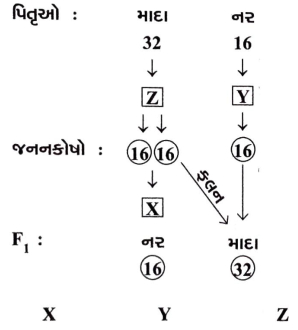
A
Asexual reproduction,Meiosis,Isosomal division
B
Asexual reproduction,Isosomal division,Meiosis
C
Isosomal division,Meiosis,Asexual reproduction
D
Meiosis,Isosomal division,Asexual reproduction
Solution
(B) The given figure represents the sex determination mechanism in honeybees (haplodiploidy).
$1$. In the female (diploid,$32$ chromosomes),the formation of gametes (haploid,$16$ chromosomes) occurs via 'Meiosis' $(Z)$.
$2$. In the male (haploid,$16$ chromosomes),the formation of gametes (haploid,$16$ chromosomes) occurs via 'Isosomal division' or 'Mitosis' $(Y)$.
$3$. The development of an unfertilized egg into a male (drone) is a form of 'Asexual reproduction' or 'Parthenogenesis' $(X)$.
Therefore,$X$ = Asexual reproduction,$Y$ = Isosomal division,$Z$ = Meiosis.
$1$. In the female (diploid,$32$ chromosomes),the formation of gametes (haploid,$16$ chromosomes) occurs via 'Meiosis' $(Z)$.
$2$. In the male (haploid,$16$ chromosomes),the formation of gametes (haploid,$16$ chromosomes) occurs via 'Isosomal division' or 'Mitosis' $(Y)$.
$3$. The development of an unfertilized egg into a male (drone) is a form of 'Asexual reproduction' or 'Parthenogenesis' $(X)$.
Therefore,$X$ = Asexual reproduction,$Y$ = Isosomal division,$Z$ = Meiosis.
0 likesView Solution
25
BiologyEasyGUJCET · 2021
For the given chart, choose the correct option for '$X$', '$Y$', and '$Z$'.
| $X$ | $Y$ | $Z$ |
| $(A)$ Parthenogenesis | Mitosis | Meiosis |
| $(B)$ Mitosis | Meiosis | Parthenogenesis |
| $(C)$ Parthenogenesis | Meiosis | Mitosis |
| $(D)$ Meiosis | Mitosis | Parthenogenesis |
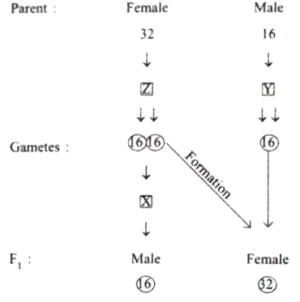
Solution
$(A)$ The provided chart illustrates the sex determination mechanism in honeybees $(Apis \text{ } mellifera)$.
$1$. In honeybees, the female is diploid $(2n = 32)$ and the male is haploid $(n = 16)$.
$2$. The female produces gametes (eggs) by meiosis. Thus, $Z$ represents Meiosis $(32 \rightarrow 16)$.
$3$. The male produces sperms by mitosis because it is already haploid. Thus, $Y$ represents Mitosis $(16 \rightarrow 16)$.
$4$. The union of an egg and a sperm forms a diploid zygote $(32)$, which develops into a female. An unfertilized egg develops into a male by parthenogenesis. Thus, $X$ represents Parthenogenesis.
Therefore, the correct sequence is $X = \text{Parthenogenesis}$, $Y = \text{Mitosis}$, $Z = \text{Meiosis}$.
$1$. In honeybees, the female is diploid $(2n = 32)$ and the male is haploid $(n = 16)$.
$2$. The female produces gametes (eggs) by meiosis. Thus, $Z$ represents Meiosis $(32 \rightarrow 16)$.
$3$. The male produces sperms by mitosis because it is already haploid. Thus, $Y$ represents Mitosis $(16 \rightarrow 16)$.
$4$. The union of an egg and a sperm forms a diploid zygote $(32)$, which develops into a female. An unfertilized egg develops into a male by parthenogenesis. Thus, $X$ represents Parthenogenesis.
Therefore, the correct sequence is $X = \text{Parthenogenesis}$, $Y = \text{Mitosis}$, $Z = \text{Meiosis}$.
0 likesView Solution
26
BiologyEasyMCQGUJCET · 2021
The phenotype of one parent for skin colour is $AABBCC$ and the other parent is $aabbcc$. What will be the skin colour and genotype for their progeny?
A
darkest skin colour,$AaBbCc$
B
lightest skin colour,$AaBbCC$
C
intermediate skin colour,$AaBbCc$
D
intermediate skin colour,$AaBBCc$
Solution
(C) Human skin colour is a classic example of polygenic inheritance,where the trait is controlled by three pairs of genes ($A, B,$ and $C$).
When a parent with genotype $AABBCC$ (darkest skin) is crossed with a parent with genotype $aabbcc$ (lightest skin),all progeny in the $F_1$ generation will have the genotype $AaBbCc$.
This genotype contains three dominant alleles and three recessive alleles,resulting in an intermediate skin colour phenotype.
When a parent with genotype $AABBCC$ (darkest skin) is crossed with a parent with genotype $aabbcc$ (lightest skin),all progeny in the $F_1$ generation will have the genotype $AaBbCc$.
This genotype contains three dominant alleles and three recessive alleles,resulting in an intermediate skin colour phenotype.
0 likesView Solution
27
BiologyEasyMCQGUJCET · 2021
Which characteristic feature of the Dog flower (Snapdragon) plant shows incomplete dominance?
A
Colour of the flower
B
Seed colour
C
Height of the plant
D
Seed shape
Solution
(A) Incomplete dominance is a phenomenon where the dominant allele does not completely mask the effects of the recessive allele, resulting in an intermediate phenotype in the heterozygote.
In the Dog flower plant $(Antirrhinum \text{ } majus)$, the cross between a red-flowered plant $(RR)$ and a white-flowered plant $(rr)$ results in pink-flowered offspring $(Rr)$ in the $F_1$ generation.
This intermediate pink colour demonstrates incomplete dominance, as neither the red nor the white trait is completely dominant over the other.
In the Dog flower plant $(Antirrhinum \text{ } majus)$, the cross between a red-flowered plant $(RR)$ and a white-flowered plant $(rr)$ results in pink-flowered offspring $(Rr)$ in the $F_1$ generation.
This intermediate pink colour demonstrates incomplete dominance, as neither the red nor the white trait is completely dominant over the other.
0 likesView Solution
28
BiologyEasyMCQGUJCET · 2021
Choose the correct option for non-medicated $IUDS$.
A
$LNG-20$
B
Lippes Loop
C
Multiload-$375$
D
$Cu-7$
Solution
(B) The correct option is $B$.
Non-medicated $IUDS$ are devices that do not release any hormones or metal ions.
Lippes Loop is a classic example of a non-medicated $IUD$ made of plastic.
$LNG-20$ is a hormone-releasing $IUD$.
Multiload-$375$ and $Cu-7$ are copper-releasing $IUDS$.
Non-medicated $IUDS$ are devices that do not release any hormones or metal ions.
Lippes Loop is a classic example of a non-medicated $IUD$ made of plastic.
$LNG-20$ is a hormone-releasing $IUD$.
Multiload-$375$ and $Cu-7$ are copper-releasing $IUDS$.
0 likesView Solution
29
BiologyEasyMCQGUJCET · 2021
The entry of oxygen and water into the seed during germination is facilitated by . . . . . . .
A
Integuments
B
Micropyle
C
Seed coat
D
Hilum
Solution
(B) During seed germination,the $Micropyle$ is a small pore present on the seed coat. It serves as the entry point for water and oxygen,which are essential for the metabolic activities of the embryo to resume growth. Therefore,the correct option is $B$.
0 likesView Solution
30
BiologyEasyMCQGUJCET · 2021
What will be the respective ploidy of the cells of the Nucellus,Megaspore Mother Cell,the functional Megaspore,and the female gametophyte?
A
$2n, n, n, n$
B
$2n, n, n, 2n$
C
$2n, 2n, n, n$
D
$n, 2n, n, 2n$
Solution
(C) The Nucellus is a mass of diploid $(2n)$ cells within the ovule.
The Megaspore Mother Cell $(MMC)$ is derived from the nucellus and is also diploid $(2n)$.
The functional Megaspore is formed after meiosis of the $MMC$ and is haploid $(n)$.
The female gametophyte (embryo sac) develops from the functional megaspore through mitosis and is also haploid $(n)$.
Therefore,the correct sequence of ploidy is $2n, 2n, n, n$.
The Megaspore Mother Cell $(MMC)$ is derived from the nucellus and is also diploid $(2n)$.
The functional Megaspore is formed after meiosis of the $MMC$ and is haploid $(n)$.
The female gametophyte (embryo sac) develops from the functional megaspore through mitosis and is also haploid $(n)$.
Therefore,the correct sequence of ploidy is $2n, 2n, n, n$.
0 likesView Solution
31
BiologyEasyMCQGUJCET · 2021
Study the following statements.
$I$. Pollen grains of many species cause severe allergies and bronchial afflictions in some people,often leading to chronic respiratory disorders.
$II$. Pollen grains are rich in nutrients.
$III$. Carrot grass came into India as a contaminant with imported wheat.
$I$. Pollen grains of many species cause severe allergies and bronchial afflictions in some people,often leading to chronic respiratory disorders.
$II$. Pollen grains are rich in nutrients.
$III$. Carrot grass came into India as a contaminant with imported wheat.
A
Statements $I$ and $III$ are correct,but statement $II$ is incorrect.
B
All statements are incorrect.
C
Statements $I$ and $II$ are correct,but statement $III$ is incorrect.
D
All given statements are correct.
Solution
(C) Statement $I$ is correct: Pollen grains of many species (e.g.,Parthenium) cause severe allergies and bronchial afflictions.
Statement $II$ is correct: Pollen grains are rich in nutrients and are used as pollen tablets/supplements.
Statement $III$ is incorrect: Carrot grass ($Parthenium$ $hysterophorus$) came into India as a contaminant with imported wheat,not rice. Therefore,statements $I$ and $II$ are correct,while statement $III$ is incorrect.
Statement $II$ is correct: Pollen grains are rich in nutrients and are used as pollen tablets/supplements.
Statement $III$ is incorrect: Carrot grass ($Parthenium$ $hysterophorus$) came into India as a contaminant with imported wheat,not rice. Therefore,statements $I$ and $II$ are correct,while statement $III$ is incorrect.
0 likesView Solution
Vedclass Products
For Students
Vedclass Test Series
Mock tests in real GUJCET style covering Biology with performance analysis. 5-day free trial.
Start Free TrialFor Teachers
Exam Paper Generator
Generate Set A/B/C/D Biology papers from 7.5L+ questions in 2 minutes. 3 chapters free.
Try FreeFor Institutes
Online Exam Module
Run live GUJCET mock exams with unlimited students, 360° analytics & white-label branding.
See DemoFrequently Asked Questions
How many Biology questions are in GUJCET 2021?
There are 31 Biology questions from the GUJCET 2021 paper on Vedclass, each with a detailed step-by-step solution in English.
Are GUJCET 2021 Biology solutions available in English?
Yes. All solutions on this page are in English. You can also switch to English or Hindi using the language buttons above the questions.
Can I practice GUJCET 2021 Biology as a timed test?
Yes. Use the Vedclass Test Series to attempt a full GUJCET mock test covering Biology with time limits and instant score analysis.
Can teachers create Biology papers from GUJCET previous year questions?
Yes. The Vedclass Exam Paper Generator lets teachers mix GUJCET Biology questions and generate Set A/B/C/D papers in minutes.
For Teachers & Institutes
Build a Custom Biology Paper
Pick GUJCET 2021 Biology questions, set difficulty, and generate Set A/B/C/D in 2 minutes.