
MathematicsQ51–63 of 109 questions
Page 2 of 2 · Gujarati
51
MathematicsDifficultMCQAP EAMCET · 2002
જો $e$ અને $e^{\prime}$ એ ઉપવલય $5x^2 + 9y^2 = 45$ અને અતિવલય $5x^2 - 4y^2 = 45$ ની ઉત્કેન્દ્રતા હોય,તો $ee^{\prime}$ ની કિંમત શોધો.
A
$1$
B
$4$
C
$5$
D
$9$
Solution
(A) ઉપવલયનું સમીકરણ $5x^2 + 9y^2 = 45$ છે. $45$ વડે ભાગતા,$\frac{x^2}{9} + \frac{y^2}{5} = 1$ મળે. અહીં,$a^2 = 9$ અને $b^2 = 5$. ઉત્કેન્દ્રતા $e = \sqrt{1 - \frac{b^2}{a^2}} = \sqrt{1 - \frac{5}{9}} = \sqrt{\frac{4}{9}} = \frac{2}{3}$.
અતિવલયનું સમીકરણ $5x^2 - 4y^2 = 45$ છે. $45$ વડે ભાગતા,$\frac{x^2}{9} - \frac{y^2}{45/4} = 1$ મળે. અહીં,$a^2 = 9$ અને $b^2 = \frac{45}{4}$. ઉત્કેન્દ્રતા $e^{\prime} = \sqrt{1 + \frac{b^2}{a^2}} = \sqrt{1 + \frac{45/4}{9}} = \sqrt{1 + \frac{5}{4}} = \sqrt{\frac{9}{4}} = \frac{3}{2}$.
તેથી,$ee^{\prime} = \frac{2}{3} \times \frac{3}{2} = 1$.
અતિવલયનું સમીકરણ $5x^2 - 4y^2 = 45$ છે. $45$ વડે ભાગતા,$\frac{x^2}{9} - \frac{y^2}{45/4} = 1$ મળે. અહીં,$a^2 = 9$ અને $b^2 = \frac{45}{4}$. ઉત્કેન્દ્રતા $e^{\prime} = \sqrt{1 + \frac{b^2}{a^2}} = \sqrt{1 + \frac{45/4}{9}} = \sqrt{1 + \frac{5}{4}} = \sqrt{\frac{9}{4}} = \frac{3}{2}$.
તેથી,$ee^{\prime} = \frac{2}{3} \times \frac{3}{2} = 1$.
0 likesView Solution
52
MathematicsDifficultMCQAP EAMCET · 2002
સમીકરણ $\frac{1}{r} = \frac{1}{8} + \frac{3}{8} \cos \theta$ શું દર્શાવે છે?
A
પરવલય
B
ઉપવલય
C
અતિવલય
D
લંબ અતિવલય
Solution
(C) આપેલ સમીકરણ $\frac{1}{r} = \frac{1}{8} + \frac{3}{8} \cos \theta$ છે.
$8r$ વડે ગુણતા:
$8 = r + 3r \cos \theta$
$x = r \cos \theta$ હોવાથી,$r = 8 - 3x$ મળે.
બંને બાજુ વર્ગ કરતા:
$r^2 = (8 - 3x)^2$
$x^2 + y^2 = 64 + 9x^2 - 48x$
$8x^2 - y^2 - 48x + 64 = 0$.
અહીં $A = 8$ અને $C = -1$ છે.
$A$ અને $C$ વિરુદ્ધ ચિહ્નો ધરાવતા હોવાથી $(AC < 0)$,આ સમીકરણ અતિવલય દર્શાવે છે.
$8r$ વડે ગુણતા:
$8 = r + 3r \cos \theta$
$x = r \cos \theta$ હોવાથી,$r = 8 - 3x$ મળે.
બંને બાજુ વર્ગ કરતા:
$r^2 = (8 - 3x)^2$
$x^2 + y^2 = 64 + 9x^2 - 48x$
$8x^2 - y^2 - 48x + 64 = 0$.
અહીં $A = 8$ અને $C = -1$ છે.
$A$ અને $C$ વિરુદ્ધ ચિહ્નો ધરાવતા હોવાથી $(AC < 0)$,આ સમીકરણ અતિવલય દર્શાવે છે.
0 likesView Solution
53
MathematicsDifficultMCQAP EAMCET · 2002
$\lim _{x \rightarrow 0} \frac{4^x-9^x}{x(4^x+9^x)}$ ની કિંમત શોધો.
A
$\log \frac{2}{3}$
B
$\log \frac{3}{2}$
C
$\frac{1}{2} \log \frac{2}{3}$
D
$\frac{1}{2} \log \frac{3}{2}$
Solution
(A) ધારો કે $L = \lim _{x \rightarrow 0} \frac{4^x-9^x}{x(4^x+9^x)}$.
અહીં લક્ષ $x \rightarrow 0$ માટે $\frac{0}{0}$ સ્વરૂપમાં છે,તેથી $L$-Hospital ના નિયમનો ઉપયોગ કરતા:
$L = \lim _{x \rightarrow 0} \frac{4^x \log 4 - 9^x \log 9}{(4^x+9^x) + x(4^x \log 4 + 9^x \log 9)}$
$x = 0$ મુકતા:
$L = \frac{\log 4 - \log 9}{2} = \frac{\log(4/9)}{2} = \frac{2 \log(2/3)}{2} = \log \frac{2}{3}$.
અહીં લક્ષ $x \rightarrow 0$ માટે $\frac{0}{0}$ સ્વરૂપમાં છે,તેથી $L$-Hospital ના નિયમનો ઉપયોગ કરતા:
$L = \lim _{x \rightarrow 0} \frac{4^x \log 4 - 9^x \log 9}{(4^x+9^x) + x(4^x \log 4 + 9^x \log 9)}$
$x = 0$ મુકતા:
$L = \frac{\log 4 - \log 9}{2} = \frac{\log(4/9)}{2} = \frac{2 \log(2/3)}{2} = \log \frac{2}{3}$.
0 likesView Solution
54
MathematicsDifficultMCQAP EAMCET · 2002
જો $\triangle ABC$ માં $A$ આગળ કાટખૂણો હોય,તો $r_2+r_3$ કોના બરાબર થાય?
A
$r_1-r$
B
$r_1+r$
C
$r-r_1$
D
$R$
Solution
(A) ત્રિકોણ $ABC$ માં,બહિઃત્રિજ્યાઓ $r_1 = s \tan(A/2)$,$r_2 = s \tan(B/2)$,અને $r_3 = s \tan(C/2)$ છે,અને અંતઃત્રિજ્યા $r = (s-a) \tan(A/2)$ છે.
આપેલ છે કે $\angle A = 90^{\circ}$,તેથી $A/2 = 45^{\circ}$.
આથી,$r_1 = s \tan(45^{\circ}) = s$.
તેમજ,$r = (s-a) \tan(45^{\circ}) = s-a$.
તેથી,$r_1 - r = s - (s-a) = a$.
કાટકોણ ત્રિકોણમાં,કર્ણ $a = 2R$,જ્યાં $R$ એ પરિત્રિજ્યા છે.
આમ,$r_2+r_3 = r_1-r$ થાય છે.
આપેલ છે કે $\angle A = 90^{\circ}$,તેથી $A/2 = 45^{\circ}$.
આથી,$r_1 = s \tan(45^{\circ}) = s$.
તેમજ,$r = (s-a) \tan(45^{\circ}) = s-a$.
તેથી,$r_1 - r = s - (s-a) = a$.
કાટકોણ ત્રિકોણમાં,કર્ણ $a = 2R$,જ્યાં $R$ એ પરિત્રિજ્યા છે.
આમ,$r_2+r_3 = r_1-r$ થાય છે.
0 likesView Solution
55
MathematicsDifficultMCQAP EAMCET · 2002
એક ત્રિકોણની પરિમિતિ $16 \text{ cm}$ છે,તેની એક બાજુની લંબાઈ $6 \text{ cm}$ છે. જો ત્રિકોણનું ક્ષેત્રફળ $12 \text{ cm}^2$ હોય,તો તે ત્રિકોણ કેવો છે?
A
કાટકોણ
B
સમદ્વિબાજુ
C
સમબાજુ
D
વિષમબાજુ
Solution
(B) આપેલ છે કે પરિમિતિ $2s = 16 \text{ cm}$,તેથી અર્ધ-પરિમિતિ $s = 8 \text{ cm}$.
ધારો કે બાજુઓ $a, b, c$ છે. $a = 6 \text{ cm}$ અને ક્ષેત્રફળ $\Delta = 12 \text{ cm}^2$ આપેલ છે.
હેરોનના સૂત્રનો ઉપયોગ કરતા: $\Delta^2 = s(s-a)(s-b)(s-c)$.
$144 = 8(8-6)(8-b)(8-c)$.
$144 = 16(8-b)(8-c) \Rightarrow 9 = (8-b)(8-c)$.
$a+b+c = 16$ અને $a=6$ હોવાથી,$b+c = 10$ અથવા $c = 10-b$.
કિંમત મૂકતા: $9 = (8-b)(8-(10-b)) = (8-b)(b-2)$.
$9 = 8b - 16 - b^2 + 2b \Rightarrow b^2 - 10b + 25 = 0$.
$(b-5)^2 = 0 \Rightarrow b = 5 \text{ cm}$.
તેથી $c = 10 - 5 = 5 \text{ cm}$.
બે બાજુઓ સમાન હોવાથી $(b=c=5 \text{ cm})$,ત્રિકોણ સમદ્વિબાજુ છે.
ધારો કે બાજુઓ $a, b, c$ છે. $a = 6 \text{ cm}$ અને ક્ષેત્રફળ $\Delta = 12 \text{ cm}^2$ આપેલ છે.
હેરોનના સૂત્રનો ઉપયોગ કરતા: $\Delta^2 = s(s-a)(s-b)(s-c)$.
$144 = 8(8-6)(8-b)(8-c)$.
$144 = 16(8-b)(8-c) \Rightarrow 9 = (8-b)(8-c)$.
$a+b+c = 16$ અને $a=6$ હોવાથી,$b+c = 10$ અથવા $c = 10-b$.
કિંમત મૂકતા: $9 = (8-b)(8-(10-b)) = (8-b)(b-2)$.
$9 = 8b - 16 - b^2 + 2b \Rightarrow b^2 - 10b + 25 = 0$.
$(b-5)^2 = 0 \Rightarrow b = 5 \text{ cm}$.
તેથી $c = 10 - 5 = 5 \text{ cm}$.
બે બાજુઓ સમાન હોવાથી $(b=c=5 \text{ cm})$,ત્રિકોણ સમદ્વિબાજુ છે.
0 likesView Solution
56
MathematicsMediumMCQAP EAMCET · 2002
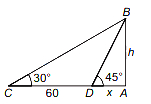
સપાટ જમીન પરના એક બિંદુથી,એક થાંભલાની ટોચનો ઉત્સેધકોણ $30^{\circ}$ છે. થાંભલા તરફ $20 \ m$ નજીક જતાં,ઉત્સેધકોણ $45^{\circ}$ થાય છે. તો થાંભલાની ઊંચાઈ (મીટરમાં) કેટલી હશે?
A
$10(\sqrt{3}-1)$
B
$10(\sqrt{3}+1)$
C
$15$
D
$20$
Solution
(B) ધારો કે થાંભલાની ઊંચાઈ $h$ છે અને બીજા બિંદુથી થાંભલાના પાયા સુધીનું અંતર $x$ છે.
$\triangle BDA$ માં,$\tan 45^{\circ} = \frac{h}{x}$ $\Rightarrow 1 = \frac{h}{x}$ $\Rightarrow h = x$.
$\triangle BCA$ માં,$\tan 30^{\circ} = \frac{h}{20+x}$.
સમીકરણમાં $x = h$ મૂકતા:
$\frac{1}{\sqrt{3}} = \frac{h}{20+h}$
$20+h = \sqrt{3}h$
$20 = h(\sqrt{3}-1)$
$h = \frac{20}{\sqrt{3}-1} \times \frac{\sqrt{3}+1}{\sqrt{3}+1}$
$h = \frac{20(\sqrt{3}+1)}{3-1} = \frac{20(\sqrt{3}+1)}{2} = 10(\sqrt{3}+1) \ m$.
$\triangle BDA$ માં,$\tan 45^{\circ} = \frac{h}{x}$ $\Rightarrow 1 = \frac{h}{x}$ $\Rightarrow h = x$.
$\triangle BCA$ માં,$\tan 30^{\circ} = \frac{h}{20+x}$.
સમીકરણમાં $x = h$ મૂકતા:
$\frac{1}{\sqrt{3}} = \frac{h}{20+h}$
$20+h = \sqrt{3}h$
$20 = h(\sqrt{3}-1)$
$h = \frac{20}{\sqrt{3}-1} \times \frac{\sqrt{3}+1}{\sqrt{3}+1}$
$h = \frac{20(\sqrt{3}+1)}{3-1} = \frac{20(\sqrt{3}+1)}{2} = 10(\sqrt{3}+1) \ m$.
0 likesView Solution
57
MathematicsMediumMCQAP EAMCET · 2002
$1+\frac{1+2}{2 !}+\frac{1+2+2^2}{3 !}+\ldots$ ની કિંમત શોધો.
A
$e^2+e$
B
$e^2$
C
$e^2-1$
D
$e^2-e$
Solution
(D) શ્રેણીનું સામાન્ય પદ $T_n = \frac{1+2+2^2+\ldots+2^{n-1}}{n !}$ છે,જ્યાં $n \geq 1$.
સમગુણોત્તર શ્રેણીના સરવાળાના સૂત્ર મુજબ,$T_n = \frac{2^n-1}{n !}$.
આને $T_n = \frac{2^n}{n !} - \frac{1}{n !}$ તરીકે લખી શકાય.
શ્રેણીનો સરવાળો $S = \sum_{n=1}^{\infty} T_n = \sum_{n=1}^{\infty} \frac{2^n}{n !} - \sum_{n=1}^{\infty} \frac{1}{n !}$ છે.
$e^x = \sum_{n=0}^{\infty} \frac{x^n}{n !} = 1 + \frac{x}{1!} + \frac{x^2}{2!} + \ldots$ વિસ્તરણનો ઉપયોગ કરતા,
$\sum_{n=1}^{\infty} \frac{2^n}{n !} = e^2 - 1$ અને $\sum_{n=1}^{\infty} \frac{1}{n !} = e - 1$ મળે.
આ કિંમતો મૂકતા,$S = (e^2 - 1) - (e - 1) = e^2 - e$.
સમગુણોત્તર શ્રેણીના સરવાળાના સૂત્ર મુજબ,$T_n = \frac{2^n-1}{n !}$.
આને $T_n = \frac{2^n}{n !} - \frac{1}{n !}$ તરીકે લખી શકાય.
શ્રેણીનો સરવાળો $S = \sum_{n=1}^{\infty} T_n = \sum_{n=1}^{\infty} \frac{2^n}{n !} - \sum_{n=1}^{\infty} \frac{1}{n !}$ છે.
$e^x = \sum_{n=0}^{\infty} \frac{x^n}{n !} = 1 + \frac{x}{1!} + \frac{x^2}{2!} + \ldots$ વિસ્તરણનો ઉપયોગ કરતા,
$\sum_{n=1}^{\infty} \frac{2^n}{n !} = e^2 - 1$ અને $\sum_{n=1}^{\infty} \frac{1}{n !} = e - 1$ મળે.
આ કિંમતો મૂકતા,$S = (e^2 - 1) - (e - 1) = e^2 - e$.
0 likesView Solution
58
MathematicsDifficultMCQAP EAMCET · 2002
$a>0, x \in R$ માટે પદાવલિ $\begin{aligned} & 1+x \log _e a+\frac{x^2}{2 !}\left(\log _e a\right)^2+\frac{x^3}{3 !}\left(\log _e a\right)^3+\ldots \end{aligned}$ કોના બરાબર છે?
A
$a$
B
$a^x$
C
$a^{\log _e x}$
D
$x$
Solution
(B) આપેલ શ્રેણી $1 + y + \frac{y^2}{2!} + \frac{y^3}{3!} + \ldots = e^y$ સ્વરૂપમાં છે,જ્યાં $y = x \log_e a$ છે.
$y = \log_e a^x$ મૂકતા,આપણને મળે છે:
$1 + \log_e a^x + \frac{(\log_e a^x)^2}{2!} + \frac{(\log_e a^x)^3}{3!} + \ldots = e^{\log_e a^x}$.
$e^{\log_e z} = z$ હોવાથી,$e^{\log_e a^x} = a^x$ થાય.
$y = \log_e a^x$ મૂકતા,આપણને મળે છે:
$1 + \log_e a^x + \frac{(\log_e a^x)^2}{2!} + \frac{(\log_e a^x)^3}{3!} + \ldots = e^{\log_e a^x}$.
$e^{\log_e z} = z$ હોવાથી,$e^{\log_e a^x} = a^x$ થાય.
0 likesView Solution
59
MathematicsEasyMCQAP EAMCET · 2002
જો $\log 2=a, \log 3=b, \log 7=c$ અને $6^x=7^{x+4}$ હોય,તો $x$ ની કિંમત શોધો:
A
$\frac{4b}{c+a-b}$
B
$\frac{4c}{a+b-c}$
C
$\frac{4c}{c-a-b}$
D
$\frac{4a}{a+b-c}$
Solution
(B) આપેલ સમીકરણ: $6^x = 7^{x+4}$
બંને બાજુ લઘુગણક લેતા: $x \log 6 = (x+4) \log 7$
$\log(mn) = \log m + \log n$ ગુણધર્મનો ઉપયોગ કરતા: $x(\log 2 + \log 3) = x \log 7 + 4 \log 7$
આપેલ કિંમતો $a, b, c$ મૂકતા: $x(a+b) = xc + 4c$
$x$ માટે પદો ગોઠવતા: $x(a+b-c) = 4c$
તેથી: $x = \frac{4c}{a+b-c}$
બંને બાજુ લઘુગણક લેતા: $x \log 6 = (x+4) \log 7$
$\log(mn) = \log m + \log n$ ગુણધર્મનો ઉપયોગ કરતા: $x(\log 2 + \log 3) = x \log 7 + 4 \log 7$
આપેલ કિંમતો $a, b, c$ મૂકતા: $x(a+b) = xc + 4c$
$x$ માટે પદો ગોઠવતા: $x(a+b-c) = 4c$
તેથી: $x = \frac{4c}{a+b-c}$
0 likesView Solution
60
MathematicsMediumMCQAP EAMCET · 2002
$\sqrt[3]{4}, \sqrt[4]{5}, \sqrt[4]{7}$ અને $\sqrt[3]{8}$ માં સૌથી નાની સંખ્યા કઈ છે?
A
$\sqrt[3]{8}$
B
$\sqrt[4]{7}$
C
$\sqrt[3]{4}$
D
$\sqrt[4]{5}$
Solution
(D) સંખ્યાઓની સરખામણી કરવા માટે,આપણે તેમના ઘાતાંકોના લઘુત્તમ સામાન્ય અવયવી $(LCM)$ નો ઉપયોગ કરીએ છીએ. $3$ અને $4$ નો $LCM$ $12$ છે.
સંખ્યાઓ આ મુજબ છે:
$4^{1/3} = (4^4)^{1/12} = 256^{1/12}$
$5^{1/4} = (5^3)^{1/12} = 125^{1/12}$
$7^{1/4} = (7^3)^{1/12} = 343^{1/12}$
$8^{1/3} = (8^4)^{1/12} = 4096^{1/12}$
પાયા $256, 125, 343, 4096$ ની સરખામણી કરતા,સૌથી નાની કિંમત $125$ છે.
તેથી,$125^{1/12} = \sqrt[4]{5}$ એ સૌથી નાની સંખ્યા છે.
સંખ્યાઓ આ મુજબ છે:
$4^{1/3} = (4^4)^{1/12} = 256^{1/12}$
$5^{1/4} = (5^3)^{1/12} = 125^{1/12}$
$7^{1/4} = (7^3)^{1/12} = 343^{1/12}$
$8^{1/3} = (8^4)^{1/12} = 4096^{1/12}$
પાયા $256, 125, 343, 4096$ ની સરખામણી કરતા,સૌથી નાની કિંમત $125$ છે.
તેથી,$125^{1/12} = \sqrt[4]{5}$ એ સૌથી નાની સંખ્યા છે.
0 likesView Solution
61
MathematicsMediumMCQAP EAMCET · 2002
એક થેલીમાં $5$ કાળા દડા,$4$ સફેદ દડા અને $3$ લાલ દડા છે. જો યાદચ્છિક રીતે એક દડો પસંદ કરવામાં આવે,તો તે કાળો અથવા લાલ દડો હોવાની સંભાવના કેટલી છે?
A
$\frac{1}{3}$
B
$\frac{1}{4}$
C
$\frac{5}{12}$
D
$\frac{2}{3}$
Solution
(D) દડાઓની કુલ સંખ્યા = $5 + 4 + 3 = 12$.
કાળા દડાની સંખ્યા = $5$.
લાલ દડાની સંખ્યા = $3$.
સાનુકૂળ પરિણામોની સંખ્યા (કાળો અથવા લાલ) = $5 + 3 = 8$.
જરૂરી સંભાવના = $\frac{\text{સાનુકૂળ પરિણામોની સંખ્યા}}{\text{કુલ પરિણામોની સંખ્યા}} = \frac{8}{12} = \frac{2}{3}$.
કાળા દડાની સંખ્યા = $5$.
લાલ દડાની સંખ્યા = $3$.
સાનુકૂળ પરિણામોની સંખ્યા (કાળો અથવા લાલ) = $5 + 3 = 8$.
જરૂરી સંભાવના = $\frac{\text{સાનુકૂળ પરિણામોની સંખ્યા}}{\text{કુલ પરિણામોની સંખ્યા}} = \frac{8}{12} = \frac{2}{3}$.
0 likesView Solution
62
MathematicsMediumMCQAP EAMCET · 2002
એક વિદ્યાર્થી માટે $IITJEE$ અને $EAMCET$ માં ક્વોલિફાય થવાની સંભાવના અનુક્રમે $\frac{1}{5}$ અને $\frac{3}{5}$ છે. વિદ્યાર્થી આમાંથી ઓછામાં ઓછી એક પરીક્ષામાં ક્વોલિફાય થાય તેની સંભાવના કેટલી?
A
$\frac{3}{25}$
B
$\frac{8}{25}$
C
$\frac{17}{25}$
D
$\frac{22}{25}$
Solution
(C) ધારો કે $A$ એ $IITJEE$ માં ક્વોલિફાય થવાની ઘટના છે અને $B$ એ $EAMCET$ માં ક્વોલિફાય થવાની ઘટના છે.
આપેલ છે: $P(A) = \frac{1}{5}$ અને $P(B) = \frac{3}{5}$.
ઘટનાઓ સ્વતંત્ર છે તેમ માનતા,ઓછામાં ઓછી એક પરીક્ષામાં ક્વોલિફાય થવાની સંભાવના $P(A \cup B) = P(A) + P(B) - P(A \cap B)$ દ્વારા મળે છે.
ઘટનાઓ સ્વતંત્ર હોવાથી,$P(A \cap B) = P(A) \times P(B) = \frac{1}{5} \times \frac{3}{5} = \frac{3}{25}$.
તેથી,$P(A \cup B) = \frac{1}{5} + \frac{3}{5} - \frac{3}{25}$.
$P(A \cup B) = \frac{5}{25} + \frac{15}{25} - \frac{3}{25} = \frac{17}{25}$.
આપેલ છે: $P(A) = \frac{1}{5}$ અને $P(B) = \frac{3}{5}$.
ઘટનાઓ સ્વતંત્ર છે તેમ માનતા,ઓછામાં ઓછી એક પરીક્ષામાં ક્વોલિફાય થવાની સંભાવના $P(A \cup B) = P(A) + P(B) - P(A \cap B)$ દ્વારા મળે છે.
ઘટનાઓ સ્વતંત્ર હોવાથી,$P(A \cap B) = P(A) \times P(B) = \frac{1}{5} \times \frac{3}{5} = \frac{3}{25}$.
તેથી,$P(A \cup B) = \frac{1}{5} + \frac{3}{5} - \frac{3}{25}$.
$P(A \cup B) = \frac{5}{25} + \frac{15}{25} - \frac{3}{25} = \frac{17}{25}$.
0 likesView Solution
63
MathematicsEasyMCQAP EAMCET · 2002
એક પાસો અને એક સિક્કો (બંને નિષ્પક્ષ) એકસાથે ઉછાળવામાં આવે છે. પાસા પર $5$ અને સિક્કા પર છાપ (tail) મળવાની સંભાવના કેટલી છે?
A
$\frac{1}{2}$
B
$\frac{1}{12}$
C
$\frac{1}{6}$
D
$\frac{1}{8}$
Solution
(B) પાસા પર $5$ મળવાની સંભાવના $P(A) = \frac{1}{6}$ છે.
સિક્કા પર છાપ (tail) મળવાની સંભાવના $P(B) = \frac{1}{2}$ છે.
ઘટનાઓ સ્વતંત્ર હોવાથી,જરૂરી સંભાવના $P(A \cap B) = P(A) \times P(B) = \frac{1}{6} \times \frac{1}{2} = \frac{1}{12}$ છે.
સિક્કા પર છાપ (tail) મળવાની સંભાવના $P(B) = \frac{1}{2}$ છે.
ઘટનાઓ સ્વતંત્ર હોવાથી,જરૂરી સંભાવના $P(A \cap B) = P(A) \times P(B) = \frac{1}{6} \times \frac{1}{2} = \frac{1}{12}$ છે.
0 likesView Solution
Vedclass Products
For Students
Vedclass Test Series
Mock tests in real AP EAMCET style covering Mathematics with performance analysis. 5-day free trial.
Start Free TrialFor Teachers
Exam Paper Generator
Generate Set A/B/C/D Mathematics papers from 7.5L+ questions in 2 minutes. 3 chapters free.
Try FreeFor Institutes
Online Exam Module
Run live AP EAMCET mock exams with unlimited students, 360° analytics & white-label branding.
See DemoFrequently Asked Questions
How many Mathematics questions are in AP EAMCET 2002?
There are 109 Mathematics questions from the AP EAMCET 2002 paper on Vedclass, each with a detailed step-by-step solution in Gujarati.
Are AP EAMCET 2002 Mathematics solutions available in Gujarati?
Yes. All solutions on this page are in Gujarati. You can also switch to English or Hindi using the language buttons above the questions.
Can I practice AP EAMCET 2002 Mathematics as a timed test?
Yes. Use the Vedclass Test Series to attempt a full AP EAMCET mock test covering Mathematics with time limits and instant score analysis.
Can teachers create Mathematics papers from AP EAMCET previous year questions?
Yes. The Vedclass Exam Paper Generator lets teachers mix AP EAMCET Mathematics questions and generate Set A/B/C/D papers in minutes.
For Teachers & Institutes
Build a Custom Mathematics Paper
Pick AP EAMCET 2002 Mathematics questions, set difficulty, and generate Set A/B/C/D in 2 minutes.