
ChemistryQ1–76 of 244 questions
Page 1 of 5 · English
1
ChemistryMCQAP EAMCET · 2002
The number of ways that $8$ beads of different colours can be strung as a necklace is
A
$2520$
B
$2880$
C
$5040$
D
$4320$
Solution
(A) The number of ways to arrange $n$ distinct objects in a circle is $(n - 1)!$.
For $8$ different beads,the circular arrangement is $(8 - 1)! = 7! = 5040$.
Since a necklace can be flipped over,the clockwise and anticlockwise arrangements are considered identical.
Therefore,the number of distinct necklaces is $\frac{(n - 1)!}{2} = \frac{7!}{2} = \frac{5040}{2} = 2520$.
For $8$ different beads,the circular arrangement is $(8 - 1)! = 7! = 5040$.
Since a necklace can be flipped over,the clockwise and anticlockwise arrangements are considered identical.
Therefore,the number of distinct necklaces is $\frac{(n - 1)!}{2} = \frac{7!}{2} = \frac{5040}{2} = 2520$.
0 likesView Solution
2
ChemistryMCQAP EAMCET · 2002
If the coefficient of $x$ in the expansion of $(x^2 + \frac{k}{x})^5$ is $270$,then $k =$
A
$1$
B
$2$
C
$3$
D
$4$
Solution
(C) The general term in the expansion of $(x^2 + \frac{k}{x})^5$ is given by $T_{r+1} = {}^5C_r (x^2)^{5-r} (\frac{k}{x})^r$.
Simplifying the expression,we get $T_{r+1} = {}^5C_r x^{10-2r} k^r x^{-r} = {}^5C_r k^r x^{10-3r}$.
For the coefficient of $x$,we set the exponent of $x$ equal to $1$:
$10 - 3r = 1$ $\Rightarrow 3r = 9$ $\Rightarrow r = 3$.
Substituting $r = 3$ into the coefficient expression:
Coefficient $= {}^5C_3 k^3 = 10 k^3$.
Given that the coefficient is $270$:
$10 k^3 = 270$ $\Rightarrow k^3 = 27$ $\Rightarrow k = 3$.
Simplifying the expression,we get $T_{r+1} = {}^5C_r x^{10-2r} k^r x^{-r} = {}^5C_r k^r x^{10-3r}$.
For the coefficient of $x$,we set the exponent of $x$ equal to $1$:
$10 - 3r = 1$ $\Rightarrow 3r = 9$ $\Rightarrow r = 3$.
Substituting $r = 3$ into the coefficient expression:
Coefficient $= {}^5C_3 k^3 = 10 k^3$.
Given that the coefficient is $270$:
$10 k^3 = 270$ $\Rightarrow k^3 = 27$ $\Rightarrow k = 3$.
0 likesView Solution
3
ChemistryMCQAP EAMCET · 2002
The pole of the straight line $x + 4y = 4$ with respect to the ellipse $x^2 + 4y^2 = 4$ is
A
$(1, 4)$
B
$(1, 1)$
C
$(4, 1)$
D
$(4, 4)$
Solution
(B) The equation of the ellipse is $x^2 + 4y^2 = 4$,which can be written as $\frac{x^2}{4} + \frac{y^2}{1} = 1$.
Here,$a^2 = 4$ and $b^2 = 1$.
Let the pole be $(h, k)$. The equation of the polar of the point $(h, k)$ with respect to the ellipse $\frac{x^2}{a^2} + \frac{y^2}{b^2} = 1$ is given by $\frac{hx}{a^2} + \frac{ky}{b^2} = 1$.
Substituting the values,we get $\frac{hx}{4} + \frac{ky}{1} = 1$,which simplifies to $hx + 4ky = 4$.
Comparing this with the given line $x + 4y = 4$,we get $h = 1$ and $k = 1$.
Therefore,the pole is $(1, 1)$.
Here,$a^2 = 4$ and $b^2 = 1$.
Let the pole be $(h, k)$. The equation of the polar of the point $(h, k)$ with respect to the ellipse $\frac{x^2}{a^2} + \frac{y^2}{b^2} = 1$ is given by $\frac{hx}{a^2} + \frac{ky}{b^2} = 1$.
Substituting the values,we get $\frac{hx}{4} + \frac{ky}{1} = 1$,which simplifies to $hx + 4ky = 4$.
Comparing this with the given line $x + 4y = 4$,we get $h = 1$ and $k = 1$.
Therefore,the pole is $(1, 1)$.
0 likesView Solution
4
ChemistryMCQAP EAMCET · 2002
If $z = \sec(y - ax) + \tan(y + ax)$,then $\frac{\partial^2 z}{\partial x^2} - a^2 \frac{\partial^2 z}{\partial y^2} = $
A
$z$
B
$2z$
C
$0$
D
$-z$
Solution
(C) Given $z = \sec(y - ax) + \tan(y + ax)$.
First,find the partial derivatives with respect to $x$:
$\frac{\partial z}{\partial x} = \sec(y - ax) \tan(y - ax) \cdot (-a) + \sec^2(y + ax) \cdot a = -a \sec(y - ax) \tan(y - ax) + a \sec^2(y + ax)$.
Now,find the second partial derivative with respect to $x$:
$\frac{\partial^2 z}{\partial x^2} = -a [\sec(y - ax) \sec^2(y - ax) \cdot (-a) + \tan(y - ax) \sec(y - ax) \tan(y - ax) \cdot (-a)] + a [2 \sec(y + ax) \cdot \sec(y + ax) \tan(y + ax) \cdot a]$
$= a^2 \sec^3(y - ax) + a^2 \sec(y - ax) \tan^2(y - ax) + 2a^2 \sec^2(y + ax) \tan(y + ax)$.
Next,find the partial derivatives with respect to $y$:
$\frac{\partial z}{\partial y} = \sec(y - ax) \tan(y - ax) + \sec^2(y + ax)$.
Now,find the second partial derivative with respect to $y$:
$\frac{\partial^2 z}{\partial y^2} = \sec(y - ax) \sec^2(y - ax) + \tan(y - ax) \sec(y - ax) \tan(y - ax) + 2 \sec(y + ax) \cdot \sec(y + ax) \tan(y + ax)$
$= \sec^3(y - ax) + \sec(y - ax) \tan^2(y - ax) + 2 \sec^2(y + ax) \tan(y + ax)$.
Finally,calculate $\frac{\partial^2 z}{\partial x^2} - a^2 \frac{\partial^2 z}{\partial y^2}$:
$= [a^2 \sec^3(y - ax) + a^2 \sec(y - ax) \tan^2(y - ax) + 2a^2 \sec^2(y + ax) \tan(y + ax)] - a^2 [\sec^3(y - ax) + \sec(y - ax) \tan^2(y - ax) + 2 \sec^2(y + ax) \tan(y + ax)] = 0$.
First,find the partial derivatives with respect to $x$:
$\frac{\partial z}{\partial x} = \sec(y - ax) \tan(y - ax) \cdot (-a) + \sec^2(y + ax) \cdot a = -a \sec(y - ax) \tan(y - ax) + a \sec^2(y + ax)$.
Now,find the second partial derivative with respect to $x$:
$\frac{\partial^2 z}{\partial x^2} = -a [\sec(y - ax) \sec^2(y - ax) \cdot (-a) + \tan(y - ax) \sec(y - ax) \tan(y - ax) \cdot (-a)] + a [2 \sec(y + ax) \cdot \sec(y + ax) \tan(y + ax) \cdot a]$
$= a^2 \sec^3(y - ax) + a^2 \sec(y - ax) \tan^2(y - ax) + 2a^2 \sec^2(y + ax) \tan(y + ax)$.
Next,find the partial derivatives with respect to $y$:
$\frac{\partial z}{\partial y} = \sec(y - ax) \tan(y - ax) + \sec^2(y + ax)$.
Now,find the second partial derivative with respect to $y$:
$\frac{\partial^2 z}{\partial y^2} = \sec(y - ax) \sec^2(y - ax) + \tan(y - ax) \sec(y - ax) \tan(y - ax) + 2 \sec(y + ax) \cdot \sec(y + ax) \tan(y + ax)$
$= \sec^3(y - ax) + \sec(y - ax) \tan^2(y - ax) + 2 \sec^2(y + ax) \tan(y + ax)$.
Finally,calculate $\frac{\partial^2 z}{\partial x^2} - a^2 \frac{\partial^2 z}{\partial y^2}$:
$= [a^2 \sec^3(y - ax) + a^2 \sec(y - ax) \tan^2(y - ax) + 2a^2 \sec^2(y + ax) \tan(y + ax)] - a^2 [\sec^3(y - ax) + \sec(y - ax) \tan^2(y - ax) + 2 \sec^2(y + ax) \tan(y + ax)] = 0$.
0 likesView Solution
5
ChemistryMCQAP EAMCET · 2002
The order of the differential equation of the family of all concentric circles centered at $(h, k)$ is
A
$1$
B
$2$
C
$3$
D
$4$
Solution
(A) The equation of a family of concentric circles centered at $(h, k)$ is given by:
$(x - h)^2 + (y - k)^2 = r^2$
Here,$h$ and $k$ are fixed constants (the center),and $r$ is the arbitrary constant representing the radius.
Since there is only one arbitrary constant $(r)$,the order of the differential equation is equal to the number of arbitrary constants.
Therefore,the order of the differential equation is $1$.
$(x - h)^2 + (y - k)^2 = r^2$
Here,$h$ and $k$ are fixed constants (the center),and $r$ is the arbitrary constant representing the radius.
Since there is only one arbitrary constant $(r)$,the order of the differential equation is equal to the number of arbitrary constants.
Therefore,the order of the differential equation is $1$.
0 likesView Solution
6
ChemistryMCQAP EAMCET · 2002
$A$ bag contains $5$ black balls,$4$ white balls,and $3$ red balls. If a ball is selected at random,the probability that it is a black or red ball is
A
$\frac{1}{3}$
B
$\frac{1}{4}$
C
$\frac{5}{12}$
D
$\frac{2}{3}$
Solution
(D) Total number of balls $= 5 + 4 + 3 = 12$.
Number of black balls $= 5$.
Number of red balls $= 3$.
Number of favorable outcomes (black or red) $= 5 + 3 = 8$.
Probability $= \frac{\text{Number of favorable outcomes}}{\text{Total number of outcomes}} = \frac{8}{12} = \frac{2}{3}$.
Number of black balls $= 5$.
Number of red balls $= 3$.
Number of favorable outcomes (black or red) $= 5 + 3 = 8$.
Probability $= \frac{\text{Number of favorable outcomes}}{\text{Total number of outcomes}} = \frac{8}{12} = \frac{2}{3}$.
0 likesView Solution
7
ChemistryMCQAP EAMCET · 2002
When bauxite powder is mixed with coke and heated with nitrogen at $2075 \ K$,carbon monoxide and $X$ are formed. Which of the following gases is produced when $X$ reacts with water?
A
$NH_3$
B
$N_2$
C
$N_2O$
D
$O_2$
Solution
(A) The reaction of bauxite $(Al_2O_3)$ with coke $(C)$ and nitrogen $(N_2)$ at $2075 \ K$ is given by:
$Al_2O_3 + 3C + N_2 \xrightarrow{2075 \ K} 2AlN + 3CO$.
Here,$X$ is aluminum nitride $(AlN)$.
When $AlN$ reacts with water,it produces ammonia gas $(NH_3)$:
$AlN + 3H_2O \rightarrow Al(OH)_3 + NH_3$.
Thus,the gas produced is $NH_3$.
$Al_2O_3 + 3C + N_2 \xrightarrow{2075 \ K} 2AlN + 3CO$.
Here,$X$ is aluminum nitride $(AlN)$.
When $AlN$ reacts with water,it produces ammonia gas $(NH_3)$:
$AlN + 3H_2O \rightarrow Al(OH)_3 + NH_3$.
Thus,the gas produced is $NH_3$.
0 likesView Solution
8
ChemistryMCQAP EAMCET · 2002
In the following reaction,$X$ and $Y$ respectively are:
$C_2H_5OH \xrightarrow{KMnO_4 / H^{+}} X$
$X \xrightarrow[H_2SO_4 / \Delta]{Y} CH_3COOC_2H_5$
$C_2H_5OH \xrightarrow{KMnO_4 / H^{+}} X$
$X \xrightarrow[H_2SO_4 / \Delta]{Y} CH_3COOC_2H_5$
A
$CH_3OH, C_2H_5OH$
B
$CH_3CHO, CH_3OH$
C
$CH_2=CH_2, CH_3COOH$
D
$CH_3COOH, C_2H_5OH$
Solution
(D) Step $1$: Oxidation of ethanol $(C_2H_5OH)$ with $KMnO_4 / H^{+}$ yields acetic acid $(CH_3COOH)$ as $X$.
$C_2H_5OH + [O] \xrightarrow{KMnO_4 / H^{+}} CH_3COOH (X) + H_2O$
Step $2$: Esterification of acetic acid $(X)$ with ethanol $(Y)$ in the presence of conc. $H_2SO_4$ yields ethyl acetate $(CH_3COOC_2H_5)$.
$CH_3COOH + C_2H_5OH (Y) \xrightarrow{H_2SO_4 / \Delta} CH_3COOC_2H_5 + H_2O$
$C_2H_5OH + [O] \xrightarrow{KMnO_4 / H^{+}} CH_3COOH (X) + H_2O$
Step $2$: Esterification of acetic acid $(X)$ with ethanol $(Y)$ in the presence of conc. $H_2SO_4$ yields ethyl acetate $(CH_3COOC_2H_5)$.
$CH_3COOH + C_2H_5OH (Y) \xrightarrow{H_2SO_4 / \Delta} CH_3COOC_2H_5 + H_2O$
0 likesView Solution
9
ChemistryMCQAP EAMCET · 2002
The products formed when diethyl ether is reacted with cold $HI$ are
A
$C_2H_5I + C_2H_5OH$
B
$2 C_2H_5I + H_2O$
C
$2 C_2H_5OH$
D
$C_2H_5-O-C_2H_5 + H_2O$
Solution
(A) When diethyl ether reacts with cold $HI$,the cleavage of the $C-O$ bond occurs.
Since the reaction is carried out with cold $HI$,only one molecule of $HI$ reacts,leading to the formation of ethyl alcohol and ethyl iodide.
The reaction is as follows:
$C_2H_5-O-C_2H_5 + HI \rightarrow C_2H_5OH + C_2H_5I$
Since the reaction is carried out with cold $HI$,only one molecule of $HI$ reacts,leading to the formation of ethyl alcohol and ethyl iodide.
The reaction is as follows:
$C_2H_5-O-C_2H_5 + HI \rightarrow C_2H_5OH + C_2H_5I$
0 likesView Solution
10
ChemistryMCQAP EAMCET · 2002
What is the gas liberated when alkaline formaldehyde solution is treated with $H_2O_2$?
A
$CO_2$
B
$O_2$
C
$CH$
D
$H_2$
Solution
(D) Alkaline formaldehyde solution reacts with $H_2O_2$ as follows:
$2HCHO + H_2O_2 \rightarrow 2HCOOH + H_2 \uparrow$
In this reaction,formaldehyde $(HCHO)$ is oxidized to formic acid $(HCOOH)$ and hydrogen gas $(H_2)$ is liberated.
$2HCHO + H_2O_2 \rightarrow 2HCOOH + H_2 \uparrow$
In this reaction,formaldehyde $(HCHO)$ is oxidized to formic acid $(HCOOH)$ and hydrogen gas $(H_2)$ is liberated.
0 likesView Solution
11
ChemistryMCQAP EAMCET · 2002
What is $X$ in the following reaction?
$2 CH_3COCH_3 \stackrel{Ba(OH)_2}{\longrightarrow} X$
$2 CH_3COCH_3 \stackrel{Ba(OH)_2}{\longrightarrow} X$
A
$CH_3-C(OH)(CH_3)-CH_2-CO-CH_3$
B
$CH_3-C(OH)(CH_3)-CH_2-CH_2-CHO$
C
$CH_3CH(CH_3)CH_2COCH_3$
D
$H_3C-CH(CH_3)-CH(OH)-CO-CH_3$
Solution
(A) The reaction of acetone $(CH_3COCH_3)$ in the presence of a base like $Ba(OH)_2$ is an aldol condensation reaction.
In this reaction,two molecules of acetone undergo condensation to form diacetone alcohol.
The mechanism involves the formation of an enolate ion from one molecule of acetone,which then attacks the carbonyl carbon of another acetone molecule.
The product $X$ is $4-hydroxy-4-methylpentan-2-one$,which has the structure $CH_3-C(OH)(CH_3)-CH_2-CO-CH_3$.
In this reaction,two molecules of acetone undergo condensation to form diacetone alcohol.
The mechanism involves the formation of an enolate ion from one molecule of acetone,which then attacks the carbonyl carbon of another acetone molecule.
The product $X$ is $4-hydroxy-4-methylpentan-2-one$,which has the structure $CH_3-C(OH)(CH_3)-CH_2-CO-CH_3$.
0 likesView Solution
12
ChemistryMCQAP EAMCET · 2002
What is the catalyst used in the conversion of acetaldehyde to acetic acid?
A
Manganese acetate
B
$LiAlH_4$
C
$H_2 / Ni$
D
$Na / NH_3$
Solution
(A) The oxidation of acetaldehyde $(CH_3CHO)$ to acetic acid $(CH_3COOH)$ is industrially carried out using manganese acetate as a catalyst in the presence of air or oxygen.
The reaction is: $2CH_3CHO + O_2 \xrightarrow{\text{Manganese acetate}} 2CH_3COOH$.
The reaction is: $2CH_3CHO + O_2 \xrightarrow{\text{Manganese acetate}} 2CH_3COOH$.
0 likesView Solution
13
ChemistryMCQAP EAMCET · 2002
The time in seconds required to produce a potential difference of $20 \ V$ across a capacitor of $1000 \ \mu F$ when it is charged at a steady rate of $200 \ \mu C/s$ is:
A
$50$
B
$100$
C
$150$
D
$200$
Solution
(B) The charge $Q$ on a capacitor is given by the formula $Q = C \times V$,where $C$ is the capacitance and $V$ is the potential difference.
Given $C = 1000 \ \mu F = 1000 \times 10^{-6} \ F$ and $V = 20 \ V$.
Total charge $Q = 1000 \times 10^{-6} \ F \times 20 \ V = 20,000 \ \mu C$.
The rate of charging is $I = 200 \ \mu C/s$.
The time $t$ required is given by $t = \frac{Q}{I}$.
$t = \frac{20,000 \ \mu C}{200 \ \mu C/s} = 100 \ s$.
Given $C = 1000 \ \mu F = 1000 \times 10^{-6} \ F$ and $V = 20 \ V$.
Total charge $Q = 1000 \times 10^{-6} \ F \times 20 \ V = 20,000 \ \mu C$.
The rate of charging is $I = 200 \ \mu C/s$.
The time $t$ required is given by $t = \frac{Q}{I}$.
$t = \frac{20,000 \ \mu C}{200 \ \mu C/s} = 100 \ s$.
0 likesView Solution
14
ChemistryMCQAP EAMCET · 2002
$A$ parallel plate capacitor of capacity $100 \mu F$ is charged by a battery of $50 \text{ V}$. The battery remains connected,and if the plates of the capacitor are separated so that the distance between them becomes double the original distance,the additional energy supplied by the battery to the capacitor in joules is:
A
$\frac{125}{2} \times 10^{-3}$
B
$125 \times 10^{-3}$
C
$1.25 \times 10^{-3}$
D
$0.0125 \times 10^{-3}$
Solution
(A) Initial capacitance $C = 100 \mu F = 100 \times 10^{-6} \text{ F}$ and voltage $V = 50 \text{ V}$.
Initial energy stored $E_1 = \frac{1}{2} C V^2 = \frac{1}{2} \times 100 \times 10^{-6} \times (50)^2 = 50 \times 10^{-6} \times 2500 = 0.125 \text{ J} = 125 \times 10^{-3} \text{ J}$.
When the distance $d$ is doubled,the new capacitance $C' = \frac{\epsilon_0 A}{2d} = \frac{C}{2} = 50 \mu F = 50 \times 10^{-6} \text{ F}$.
Since the battery remains connected,the voltage $V$ remains constant at $50 \text{ V}$.
Final energy stored $E_2 = \frac{1}{2} C' V^2 = \frac{1}{2} \times 50 \times 10^{-6} \times (50)^2 = 25 \times 10^{-6} \times 2500 = 0.0625 \text{ J} = 62.5 \times 10^{-3} \text{ J}$.
The charge on the capacitor changes from $Q_1 = CV$ to $Q_2 = C'V$. The change in charge is $\Delta Q = (C' - C)V = (50 - 100) \times 10^{-6} \times 50 = -50 \times 10^{-6} \times 50 = -2500 \times 10^{-6} \text{ C}$.
The work done by the battery is $W = \Delta Q \times V = (-2500 \times 10^{-6}) \times 50 = -125000 \times 10^{-6} = -0.125 \text{ J} = -125 \times 10^{-3} \text{ J}$.
The negative sign indicates that energy is returned to the battery. The magnitude of energy change supplied by the battery is $125 \times 10^{-3} \text{ J}$ (returned). However,the question asks for the additional energy supplied. Since the energy of the capacitor decreases,the battery absorbs energy. The change in energy of the capacitor is $E_2 - E_1 = 62.5 \times 10^{-3} - 125 \times 10^{-3} = -62.5 \times 10^{-3} \text{ J}$. The battery supplies $-62.5 \times 10^{-3} \text{ J}$,which is $\frac{125}{2} \times 10^{-3} \text{ J}$ removed.
Initial energy stored $E_1 = \frac{1}{2} C V^2 = \frac{1}{2} \times 100 \times 10^{-6} \times (50)^2 = 50 \times 10^{-6} \times 2500 = 0.125 \text{ J} = 125 \times 10^{-3} \text{ J}$.
When the distance $d$ is doubled,the new capacitance $C' = \frac{\epsilon_0 A}{2d} = \frac{C}{2} = 50 \mu F = 50 \times 10^{-6} \text{ F}$.
Since the battery remains connected,the voltage $V$ remains constant at $50 \text{ V}$.
Final energy stored $E_2 = \frac{1}{2} C' V^2 = \frac{1}{2} \times 50 \times 10^{-6} \times (50)^2 = 25 \times 10^{-6} \times 2500 = 0.0625 \text{ J} = 62.5 \times 10^{-3} \text{ J}$.
The charge on the capacitor changes from $Q_1 = CV$ to $Q_2 = C'V$. The change in charge is $\Delta Q = (C' - C)V = (50 - 100) \times 10^{-6} \times 50 = -50 \times 10^{-6} \times 50 = -2500 \times 10^{-6} \text{ C}$.
The work done by the battery is $W = \Delta Q \times V = (-2500 \times 10^{-6}) \times 50 = -125000 \times 10^{-6} = -0.125 \text{ J} = -125 \times 10^{-3} \text{ J}$.
The negative sign indicates that energy is returned to the battery. The magnitude of energy change supplied by the battery is $125 \times 10^{-3} \text{ J}$ (returned). However,the question asks for the additional energy supplied. Since the energy of the capacitor decreases,the battery absorbs energy. The change in energy of the capacitor is $E_2 - E_1 = 62.5 \times 10^{-3} - 125 \times 10^{-3} = -62.5 \times 10^{-3} \text{ J}$. The battery supplies $-62.5 \times 10^{-3} \text{ J}$,which is $\frac{125}{2} \times 10^{-3} \text{ J}$ removed.
0 likesView Solution
15
ChemistryMCQAP EAMCET · 2002
The reagent used for converting acetylene to oxalic acid is
A
$HgSO_4 / \text{aqueous } H_2SO_4$
B
$HgSO_4 / CH_3COOH$
C
$KMnO_4 / KOH, 25^{\circ}C$
D
$Cr_2O_3 / H_2SO_4$
Solution
(C) Acetylene $(HC \equiv CH)$ undergoes oxidation in the presence of alkaline potassium permanganate $(KMnO_4 / KOH)$ at $25^{\circ}C$ to form oxalic acid $(HOOC-COOH)$.
The chemical reaction is:
$HC \equiv CH + 4[O] \xrightarrow{KMnO_4 / KOH, 25^{\circ}C} HOOC-COOH$.
The chemical reaction is:
$HC \equiv CH + 4[O] \xrightarrow{KMnO_4 / KOH, 25^{\circ}C} HOOC-COOH$.
0 likesView Solution
16
ChemistryMCQAP EAMCET · 2002
Oxalic acid reacts with concentrated $H_2SO_4$ to give a mixture of two gases. When this mixture is passed through caustic potash,one of the gases is absorbed. What is the product formed by the absorbed gas with caustic potash?
A
$K_2SO_4$
B
$KHCO_3$
C
$K_2CO_3$
D
$KOH$
Solution
(C) When oxalic acid $(COOH)_2$ is heated with concentrated $H_2SO_4$,it undergoes dehydration to produce a mixture of carbon monoxide $(CO)$ and carbon dioxide $(CO_2)$ gases along with water:
$(COOH)_2 \xrightarrow{conc. H_2SO_4} CO + CO_2 + H_2O$
When this gaseous mixture is passed through caustic potash $(KOH)$,the acidic gas $CO_2$ is absorbed,while $CO$ (a neutral gas) passes through.
The reaction between $CO_2$ and $KOH$ is:
$CO_2 + 2KOH \rightarrow K_2CO_3 + H_2O$
Thus,the product formed is potassium carbonate $(K_2CO_3)$.
$(COOH)_2 \xrightarrow{conc. H_2SO_4} CO + CO_2 + H_2O$
When this gaseous mixture is passed through caustic potash $(KOH)$,the acidic gas $CO_2$ is absorbed,while $CO$ (a neutral gas) passes through.
The reaction between $CO_2$ and $KOH$ is:
$CO_2 + 2KOH \rightarrow K_2CO_3 + H_2O$
Thus,the product formed is potassium carbonate $(K_2CO_3)$.
0 likesView Solution
17
ChemistryMCQAP EAMCET · 2002
The reagent used in the preparation of aspirin from salicylic acid is
A
$SOCl_2 / \text{pyridine}$
B
$CH_3COOH / HCl$
C
$(CH_3CO)_2O / \text{Conc. } H_2SO_4$
D
$CH_3Cl / AlCl_3$
Solution
(C) Aspirin (acetylsalicylic acid) is prepared by the acetylation of the phenolic $-OH$ group of salicylic acid using acetic anhydride in the presence of an acid catalyst like concentrated $H_2SO_4$.
The reaction is:
$\text{Salicylic acid} + (CH_3CO)_2O \xrightarrow{\text{Conc. } H_2SO_4} \text{Acetylsalicylic acid (Aspirin)} + CH_3COOH$
Therefore,the correct reagent is $(CH_3CO)_2O / \text{Conc. } H_2SO_4$.
The reaction is:
$\text{Salicylic acid} + (CH_3CO)_2O \xrightarrow{\text{Conc. } H_2SO_4} \text{Acetylsalicylic acid (Aspirin)} + CH_3COOH$
Therefore,the correct reagent is $(CH_3CO)_2O / \text{Conc. } H_2SO_4$.
0 likesView Solution
18
ChemistryMCQAP EAMCET · 2002
In the following reaction,$X$ and $Y$ are respectively:
$CH_3COOH + NH_3$ $\longrightarrow X \stackrel{\Delta}{}$ ${\longrightarrow} Y + H_2O$
$CH_3COOH + NH_3$ $\longrightarrow X \stackrel{\Delta}{}$ ${\longrightarrow} Y + H_2O$
A
$CH_3CONH_2, CH_4$
B
$CH_3COONH_4, CH_3CONH_2$
C
$CH_3CONH_2, CH_3COOH$
D
$CH_3NH_2, CH_3CONH_2$
Solution
(B) The reaction of acetic acid $(CH_3COOH)$ with ammonia $(NH_3)$ forms ammonium acetate $(CH_3COONH_4)$ as an intermediate product $X$.
$CH_3COOH + NH_3 \longrightarrow CH_3COONH_4$ $(X)$
On heating,ammonium acetate undergoes dehydration to form acetamide $(CH_3CONH_2)$ as product $Y$ and water $(H_2O)$.
$CH_3COONH_4 \stackrel{\Delta}{\longrightarrow} CH_3CONH_2$ $(Y)$ $+ H_2O$
Thus,$X$ is $CH_3COONH_4$ and $Y$ is $CH_3CONH_2$.
$CH_3COOH + NH_3 \longrightarrow CH_3COONH_4$ $(X)$
On heating,ammonium acetate undergoes dehydration to form acetamide $(CH_3CONH_2)$ as product $Y$ and water $(H_2O)$.
$CH_3COONH_4 \stackrel{\Delta}{\longrightarrow} CH_3CONH_2$ $(Y)$ $+ H_2O$
Thus,$X$ is $CH_3COONH_4$ and $Y$ is $CH_3CONH_2$.
0 likesView Solution
19
ChemistryMCQAP EAMCET · 2002
What is the hybridization state of the central atom in the conjugate base of $NH_4^{+}$ ion?
A
$sp$
B
$sp^3$
C
$sp^2$
D
$dsp^2$
Solution
(B) The conjugate base of $NH_4^{+}$ is formed by the removal of a proton $(H^{+})$.
$NH_4^{+} \rightarrow NH_3 + H^{+}$.
In $NH_3$,the central nitrogen atom has $3$ bond pairs and $1$ lone pair.
According to $VSEPR$ theory,the steric number is $3 + 1 = 4$,which corresponds to $sp^3$ hybridization.
$NH_4^{+} \rightarrow NH_3 + H^{+}$.
In $NH_3$,the central nitrogen atom has $3$ bond pairs and $1$ lone pair.
According to $VSEPR$ theory,the steric number is $3 + 1 = 4$,which corresponds to $sp^3$ hybridization.
0 likesView Solution
20
ChemistryMCQAP EAMCET · 2002
Which one of the following is a correct pair with respect to the molecular formula of a xenon compound and the hybridization state of xenon in it?
A
$XeF_4, sp^3$
B
$XeF_2, sp$
C
$XeF_2, sp^3d$
D
$XeF_4, sp^2$
Solution
(C) To determine the hybridization of $Xe$ in its fluorides,we use the formula: $H = \frac{1}{2}(V + M - C + A)$,where $V$ is the number of valence electrons,$M$ is the number of monovalent atoms,$C$ is the cationic charge,and $A$ is the anionic charge.
For $XeF_2$: $H = \frac{1}{2}(8 + 2) = 5$,which corresponds to $sp^3d$ hybridization.
For $XeF_4$: $H = \frac{1}{2}(8 + 4) = 6$,which corresponds to $sp^3d^2$ hybridization.
Thus,the correct pair is $XeF_2, sp^3d$.
For $XeF_2$: $H = \frac{1}{2}(8 + 2) = 5$,which corresponds to $sp^3d$ hybridization.
For $XeF_4$: $H = \frac{1}{2}(8 + 4) = 6$,which corresponds to $sp^3d^2$ hybridization.
Thus,the correct pair is $XeF_2, sp^3d$.
0 likesView Solution
21
ChemistryMCQAP EAMCET · 2002
Which one of the following molecules contains both ionic and covalent bonds?
A
$CH_2Cl_2$
B
$K_2SO_4$
C
$BeCl_2$
D
$SO_2$
Solution
(B) An ionic bond is formed by the electrostatic attraction between oppositely charged ions,while a covalent bond is formed by the sharing of electrons between atoms.
In $K_2SO_4$,the potassium ions $(K^+)$ and the sulfate ion $(SO_4^{2-})$ are held together by ionic bonds.
Within the sulfate ion $(SO_4^{2-})$,the sulfur and oxygen atoms are held together by covalent bonds.
Therefore,$K_2SO_4$ contains both ionic and covalent bonds.
$CH_2Cl_2$,$BeCl_2$,and $SO_2$ contain only covalent bonds.
In $K_2SO_4$,the potassium ions $(K^+)$ and the sulfate ion $(SO_4^{2-})$ are held together by ionic bonds.
Within the sulfate ion $(SO_4^{2-})$,the sulfur and oxygen atoms are held together by covalent bonds.
Therefore,$K_2SO_4$ contains both ionic and covalent bonds.
$CH_2Cl_2$,$BeCl_2$,and $SO_2$ contain only covalent bonds.
0 likesView Solution
22
ChemistryMCQAP EAMCET · 2002
One mole of $A_{(g)}$ is heated to $200^{\circ} C$ in a one litre closed flask,till the following equilibrium is reached.
$A_{(g)} \rightleftharpoons B_{(g)}$
The rate of forward reaction at equilibrium is $0.02 \ mol \ L^{-1} \ min^{-1}$. What is the rate (in $mol \ L^{-1} \ min^{-1}$) of the backward reaction at equilibrium?
$A_{(g)} \rightleftharpoons B_{(g)}$
The rate of forward reaction at equilibrium is $0.02 \ mol \ L^{-1} \ min^{-1}$. What is the rate (in $mol \ L^{-1} \ min^{-1}$) of the backward reaction at equilibrium?
A
$0.04$
B
$0.01$
C
$0.02$
D
$1$
Solution
(C) At equilibrium,the rate of the forward reaction is equal to the rate of the backward reaction.
Given that the rate of the forward reaction at equilibrium is $0.02 \ mol \ L^{-1} \ min^{-1}$.
Therefore,the rate of the backward reaction at equilibrium is also $0.02 \ mol \ L^{-1} \ min^{-1}$.
Given that the rate of the forward reaction at equilibrium is $0.02 \ mol \ L^{-1} \ min^{-1}$.
Therefore,the rate of the backward reaction at equilibrium is also $0.02 \ mol \ L^{-1} \ min^{-1}$.
0 likesView Solution
23
ChemistryMCQAP EAMCET · 2002
Which one of the following represents the correct order of electronegativity?
A
$P > O > N$
B
$N > P > O$
C
$O > N > P$
D
$N > O > P$
Solution
(C) Electronegativity increases across a period from left to right and decreases down a group.
In the periodic table,$O$ (Oxygen) is in group $16$ and period $2$,$N$ (Nitrogen) is in group $15$ and period $2$,and $P$ (Phosphorus) is in group $15$ and period $3$.
Comparing these,$O$ has the highest electronegativity due to its position at the far right of period $2$.
$N$ has a higher electronegativity than $P$ because $N$ is in period $2$ while $P$ is in period $3$ (electronegativity decreases down a group).
Therefore,the correct order is $O > N > P$.
In the periodic table,$O$ (Oxygen) is in group $16$ and period $2$,$N$ (Nitrogen) is in group $15$ and period $2$,and $P$ (Phosphorus) is in group $15$ and period $3$.
Comparing these,$O$ has the highest electronegativity due to its position at the far right of period $2$.
$N$ has a higher electronegativity than $P$ because $N$ is in period $2$ while $P$ is in period $3$ (electronegativity decreases down a group).
Therefore,the correct order is $O > N > P$.
0 likesView Solution
24
ChemistryMCQAP EAMCET · 2002
$A$ uniform conductor of resistance $R$ is cut into $20$ equal pieces. Half of them are joined in series and the remaining half of them are connected in parallel. If the two combinations are joined in series,the effective resistance of all the pieces is
A
$R$
B
$\frac{R}{2}$
C
$\frac{101 R}{200}$
D
$\frac{201 R}{200}$
Solution
(C) Resistance of each piece $= \frac{R}{20} \Omega$.
Equivalent resistance of $10$ such pieces connected in series is $R_1 = 10 \times \frac{R}{20} = \frac{R}{2}$.
Similarly,equivalent resistance of $10$ such pieces connected in parallel is $\frac{1}{R_2} = \frac{1}{R/20} + \dots (10 \text{ times}) = \frac{10}{R/20} = \frac{200}{R}$,so $R_2 = \frac{R}{200}$.
Now,$R_1$ and $R_2$ are connected in series,so the total resistance is $R_{eq} = R_1 + R_2 = \frac{R}{2} + \frac{R}{200} = \frac{100R + R}{200} = \frac{101R}{200}$.
Equivalent resistance of $10$ such pieces connected in series is $R_1 = 10 \times \frac{R}{20} = \frac{R}{2}$.
Similarly,equivalent resistance of $10$ such pieces connected in parallel is $\frac{1}{R_2} = \frac{1}{R/20} + \dots (10 \text{ times}) = \frac{10}{R/20} = \frac{200}{R}$,so $R_2 = \frac{R}{200}$.
Now,$R_1$ and $R_2$ are connected in series,so the total resistance is $R_{eq} = R_1 + R_2 = \frac{R}{2} + \frac{R}{200} = \frac{100R + R}{200} = \frac{101R}{200}$.
0 likesView Solution
25
ChemistryMCQAP EAMCET · 2002
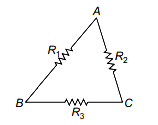
$A$ conductor of resistance $3 \Omega$ is stretched uniformly until its length is doubled. The wire is now bent in the form of an equilateral triangle. The effective resistance between the ends of any side of the triangle in ohms is
A
$\frac{9}{2}$
B
$\frac{8}{3}$
C
$2$
D
$1$
Solution
(B) When a wire is stretched,its volume remains constant. Resistance $R = \rho \frac{l}{A} = \rho \frac{l^2}{V}$. Since $\rho$ and $V$ are constant,$R \propto l^2$.
Given initial resistance $R_1 = 3 \Omega$ and length $l_1 = l$. After stretching,$l_2 = 2l$.
$\frac{R_2}{R_1} = \left(\frac{l_2}{l_1}\right)^2 = \left(\frac{2l}{l}\right)^2 = 4$.
So,$R_2 = 4 \times R_1 = 4 \times 3 = 12 \Omega$.
The wire of resistance $12 \Omega$ is bent into an equilateral triangle. Each side will have a resistance of $R_{side} = \frac{12 \Omega}{3} = 4 \Omega$.
Let the vertices be $A, B, C$. The sides are $AB, BC, CA$ each of $4 \Omega$.
To find the effective resistance between the ends of any side (e.g.,across $B$ and $C$),the side $BC$ $(4 \Omega)$ is in parallel with the series combination of $AB$ and $AC$ $(4 \Omega + 4 \Omega = 8 \Omega)$.
$R_{eq} = \frac{R_{BC} \times (R_{AB} + R_{AC})}{R_{BC} + (R_{AB} + R_{AC})} = \frac{4 \times 8}{4 + 8} = \frac{32}{12} = \frac{8}{3} \Omega$.
Given initial resistance $R_1 = 3 \Omega$ and length $l_1 = l$. After stretching,$l_2 = 2l$.
$\frac{R_2}{R_1} = \left(\frac{l_2}{l_1}\right)^2 = \left(\frac{2l}{l}\right)^2 = 4$.
So,$R_2 = 4 \times R_1 = 4 \times 3 = 12 \Omega$.
The wire of resistance $12 \Omega$ is bent into an equilateral triangle. Each side will have a resistance of $R_{side} = \frac{12 \Omega}{3} = 4 \Omega$.
Let the vertices be $A, B, C$. The sides are $AB, BC, CA$ each of $4 \Omega$.
To find the effective resistance between the ends of any side (e.g.,across $B$ and $C$),the side $BC$ $(4 \Omega)$ is in parallel with the series combination of $AB$ and $AC$ $(4 \Omega + 4 \Omega = 8 \Omega)$.
$R_{eq} = \frac{R_{BC} \times (R_{AB} + R_{AC})}{R_{BC} + (R_{AB} + R_{AC})} = \frac{4 \times 8}{4 + 8} = \frac{32}{12} = \frac{8}{3} \Omega$.
0 likesView Solution
26
ChemistryMCQAP EAMCET · 2002
$A$ moving coil galvanometer of resistance $100 \ \Omega$ shows full-scale deflection when a current of $100 \ \mu A$ passes through it. If it is intended to show full-scale deflection when a current of $1 \ mA$ passes through it,the value of shunt resistance in ohms to be connected to the galvanometer is:
A
$\frac{9}{4}$
B
$\frac{10}{3}$
C
$\frac{100}{9}$
D
$\frac{900}{7}$
Solution
(C) Given:
Resistance of the galvanometer,$G = 100 \ \Omega$
Full-scale deflection current,$I_g = 100 \ \mu A = 100 \times 10^{-6} \ A = 0.1 \times 10^{-3} \ A$
Required total current,$I = 1 \ mA = 1 \times 10^{-3} \ A$
To convert a galvanometer into an ammeter,a shunt resistance $S$ is connected in parallel with it.
The formula for shunt resistance is given by:
$S = \frac{I_g G}{I - I_g}$
Substituting the values:
$S = \frac{(0.1 \times 10^{-3}) \times 100}{1 \times 10^{-3} - 0.1 \times 10^{-3}}$
$S = \frac{0.1 \times 10^{-1}}{0.9 \times 10^{-3}}$
$S = \frac{0.01}{0.0009} = \frac{100}{9} \ \Omega$
Thus,the required shunt resistance is $\frac{100}{9} \ \Omega$.
Resistance of the galvanometer,$G = 100 \ \Omega$
Full-scale deflection current,$I_g = 100 \ \mu A = 100 \times 10^{-6} \ A = 0.1 \times 10^{-3} \ A$
Required total current,$I = 1 \ mA = 1 \times 10^{-3} \ A$
To convert a galvanometer into an ammeter,a shunt resistance $S$ is connected in parallel with it.
The formula for shunt resistance is given by:
$S = \frac{I_g G}{I - I_g}$
Substituting the values:
$S = \frac{(0.1 \times 10^{-3}) \times 100}{1 \times 10^{-3} - 0.1 \times 10^{-3}}$
$S = \frac{0.1 \times 10^{-1}}{0.9 \times 10^{-3}}$
$S = \frac{0.01}{0.0009} = \frac{100}{9} \ \Omega$
Thus,the required shunt resistance is $\frac{100}{9} \ \Omega$.
0 likesView Solution
27
ChemistryMCQAP EAMCET · 2002
The balancing length for a cell is $560 \, cm$ in a potentiometer experiment. When an external resistance of $10 \, \Omega$ is connected in parallel to the cell, the balancing length changes by $60 \, cm$. The internal resistance of the cell in ohms is:
A
$1.6$
B
$1.4$
C
$1.2$
D
$0.12$
Solution
(C) In a potentiometer experiment, the balancing length $l_1$ is proportional to the electromotive force $(E)$ of the cell: $E = k l_1$, where $k$ is the potential gradient.
When an external resistance $R$ is connected in parallel, the terminal potential difference $V$ is given by $V = k l_2$, where $l_2$ is the new balancing length.
Given $l_1 = 560 \, cm$ and the change in length is $60 \, cm$, the new balancing length $l_2 = 560 \, cm - 60 \, cm = 500 \, cm$.
The formula for internal resistance $r$ is $r = R \left( \frac{E}{V} - 1 \right) = R \left( \frac{l_1}{l_2} - 1 \right) = R \left( \frac{l_1 - l_2}{l_2} \right)$.
Substituting the values: $r = 10 \left( \frac{560 - 500}{500} \right) = 10 \left( \frac{60}{500} \right) = 10 \times 0.12 = 1.2 \, \Omega$.
When an external resistance $R$ is connected in parallel, the terminal potential difference $V$ is given by $V = k l_2$, where $l_2$ is the new balancing length.
Given $l_1 = 560 \, cm$ and the change in length is $60 \, cm$, the new balancing length $l_2 = 560 \, cm - 60 \, cm = 500 \, cm$.
The formula for internal resistance $r$ is $r = R \left( \frac{E}{V} - 1 \right) = R \left( \frac{l_1}{l_2} - 1 \right) = R \left( \frac{l_1 - l_2}{l_2} \right)$.
Substituting the values: $r = 10 \left( \frac{560 - 500}{500} \right) = 10 \left( \frac{60}{500} \right) = 10 \times 0.12 = 1.2 \, \Omega$.
0 likesView Solution
28
ChemistryMCQAP EAMCET · 2002
The calculated magnetic moment (in Bohr magnetons) of $Cu^{2+}$ ion is
A
$1.73$
B
zero
C
$2.6$
D
$3.14$
Solution
(A) The electronic configuration of $Cu$ is $[Ar] 3d^{10} 4s^1$.
For $Cu^{2+}$ ion,two electrons are removed (one from $4s$ and one from $3d$),resulting in $[Ar] 3d^9$.
In the $3d^9$ configuration,there is $1$ unpaired electron $(n = 1)$.
The magnetic moment is calculated using the formula $\mu = \sqrt{n(n+2)} \ BM$.
Substituting $n = 1$,we get $\mu = \sqrt{1(1+2)} = \sqrt{3} \approx 1.73 \ BM$.
For $Cu^{2+}$ ion,two electrons are removed (one from $4s$ and one from $3d$),resulting in $[Ar] 3d^9$.
In the $3d^9$ configuration,there is $1$ unpaired electron $(n = 1)$.
The magnetic moment is calculated using the formula $\mu = \sqrt{n(n+2)} \ BM$.
Substituting $n = 1$,we get $\mu = \sqrt{1(1+2)} = \sqrt{3} \approx 1.73 \ BM$.
0 likesView Solution
29
ChemistryMCQAP EAMCET · 2002
If $\lambda_0$ is the de-Broglie wavelength for a proton accelerated through a potential difference of $100 \ V$,the de-Broglie wavelength for an $\alpha$-particle accelerated through the same potential difference is
A
$2 \sqrt{2} \lambda_0$
B
$\frac{\lambda_0}{2}$
C
$\frac{\lambda_0}{2 \sqrt{2}}$
D
$\frac{\lambda_0}{\sqrt{2}}$
Solution
(C) The de-Broglie wavelength $\lambda$ of a particle of mass $m$ and charge $q$ accelerated through a potential difference $V$ is given by $\lambda = \frac{h}{\sqrt{2mqV}}$.
For a proton,$\lambda_0 = \frac{h}{\sqrt{2m_p q_p V}}$.
For an $\alpha$-particle,the mass $m_{\alpha} = 4m_p$ and the charge $q_{\alpha} = 2q_p$.
Substituting these into the formula for the $\alpha$-particle:
$\lambda_{\alpha} = \frac{h}{\sqrt{2(4m_p)(2q_p)V}} = \frac{h}{\sqrt{8(2m_p q_p V)}} = \frac{1}{\sqrt{8}} \left( \frac{h}{\sqrt{2m_p q_p V}} \right)$.
Since $\sqrt{8} = 2\sqrt{2}$,we get $\lambda_{\alpha} = \frac{\lambda_0}{2\sqrt{2}}$.
For a proton,$\lambda_0 = \frac{h}{\sqrt{2m_p q_p V}}$.
For an $\alpha$-particle,the mass $m_{\alpha} = 4m_p$ and the charge $q_{\alpha} = 2q_p$.
Substituting these into the formula for the $\alpha$-particle:
$\lambda_{\alpha} = \frac{h}{\sqrt{2(4m_p)(2q_p)V}} = \frac{h}{\sqrt{8(2m_p q_p V)}} = \frac{1}{\sqrt{8}} \left( \frac{h}{\sqrt{2m_p q_p V}} \right)$.
Since $\sqrt{8} = 2\sqrt{2}$,we get $\lambda_{\alpha} = \frac{\lambda_0}{2\sqrt{2}}$.
0 likesView Solution
30
ChemistryMCQAP EAMCET · 2002
Two photons of energies twice and thrice the work function of a metal are incident on the metal surface. Then,the ratio of maximum velocities of the photoelectrons emitted in the two cases respectively,is
A
$\sqrt{2}: 1$
B
$\sqrt{3}: 3$
C
$\sqrt{3}: \sqrt{2}$
D
$1: \sqrt{2}$
Solution
(D) Let the work function of the metal be $W$.
According to Einstein's photoelectric equation,the maximum kinetic energy $(KE)_{\max }$ is given by $(KE)_{\max } = E - W$,where $E$ is the energy of the incident photon.
For the first photon,$E_1 = 2W$. Thus,$(KE_1)_{\max } = 2W - W = W$.
For the second photon,$E_2 = 3W$. Thus,$(KE_2)_{\max } = 3W - W = 2W$.
Since $(KE)_{\max } = \frac{1}{2}mv^2$,we have the ratio of kinetic energies:
$\frac{(KE_1)_{\max }}{(KE_2)_{\max }} = \frac{W}{2W} = \frac{1}{2}$.
Substituting the velocity terms:
$\frac{\frac{1}{2}mv_1^2}{\frac{1}{2}mv_2^2} = \frac{1}{2} \implies \frac{v_1^2}{v_2^2} = \frac{1}{2}$.
Taking the square root on both sides:
$\frac{v_1}{v_2} = \frac{1}{\sqrt{2}}$.
Therefore,the ratio of maximum velocities is $1: \sqrt{2}$.
According to Einstein's photoelectric equation,the maximum kinetic energy $(KE)_{\max }$ is given by $(KE)_{\max } = E - W$,where $E$ is the energy of the incident photon.
For the first photon,$E_1 = 2W$. Thus,$(KE_1)_{\max } = 2W - W = W$.
For the second photon,$E_2 = 3W$. Thus,$(KE_2)_{\max } = 3W - W = 2W$.
Since $(KE)_{\max } = \frac{1}{2}mv^2$,we have the ratio of kinetic energies:
$\frac{(KE_1)_{\max }}{(KE_2)_{\max }} = \frac{W}{2W} = \frac{1}{2}$.
Substituting the velocity terms:
$\frac{\frac{1}{2}mv_1^2}{\frac{1}{2}mv_2^2} = \frac{1}{2} \implies \frac{v_1^2}{v_2^2} = \frac{1}{2}$.
Taking the square root on both sides:
$\frac{v_1}{v_2} = \frac{1}{\sqrt{2}}$.
Therefore,the ratio of maximum velocities is $1: \sqrt{2}$.
0 likesView Solution
31
ChemistryMCQAP EAMCET · 2002
$0.066 \ g$ of metal was deposited when a current of $2 \ A$ is passed through a metal ion solution for $100 \ s$. What is the electrochemical equivalent (in $g \ C^{-1}$) of the metal?
A
$3.3 \times 10^{-6}$
B
$3.3 \times 10^{-4}$
C
$0.033$
D
$3.3$
Solution
(B) The formula for the mass deposited is $w = z \cdot i \cdot t$,where $w$ is the mass,$z$ is the electrochemical equivalent,$i$ is the current,and $t$ is the time.
Rearranging for $z$,we get $z = \frac{w}{i \times t}$.
Substituting the given values: $z = \frac{0.066 \ g}{2 \ A \times 100 \ s} = \frac{0.066}{200} \ g \ C^{-1}$.
Thus,$z = 3.3 \times 10^{-4} \ g \ C^{-1}$.
Rearranging for $z$,we get $z = \frac{w}{i \times t}$.
Substituting the given values: $z = \frac{0.066 \ g}{2 \ A \times 100 \ s} = \frac{0.066}{200} \ g \ C^{-1}$.
Thus,$z = 3.3 \times 10^{-4} \ g \ C^{-1}$.
0 likesView Solution
32
ChemistryMCQAP EAMCET · 2002
What is the reaction occurring at the anode in Down's process for the extraction of sodium?
A
$4 OH^{-} \longrightarrow 2 H_2 O + O_2 + 4 e^{-}$
B
$Na^{+} + e^{-} \longrightarrow Na$
C
$2 Cl^{-} \longrightarrow Cl_2 + 2 e^{-}$
D
$NaOH \longrightarrow Na^{+} + OH^{-}$
Solution
(C) In Down's process,molten sodium chloride $(NaCl)$ is electrolyzed.
At the anode,oxidation of chloride ions $(Cl^{-})$ occurs to produce chlorine gas $(Cl_2)$.
The reaction is: $2 Cl^{-} \longrightarrow Cl_2 + 2 e^{-}$
At the anode,oxidation of chloride ions $(Cl^{-})$ occurs to produce chlorine gas $(Cl_2)$.
The reaction is: $2 Cl^{-} \longrightarrow Cl_2 + 2 e^{-}$
0 likesView Solution
33
ChemistryMCQAP EAMCET · 2002
What is the reduction electrode potential (in volts) of a copper electrode when $[Cu^{2+}] = 0.01 \ M$ is in a solution at $25^{\circ} C$? ($E^{\circ}$ of $Cu^{2+}/Cu$ electrode is $+0.34 \ V$)
A
$0.3991$
B
$0.2809$
C
$0.3105$
D
$0.3695$
Solution
(B) The reduction reaction for the copper electrode is: $Cu^{2+}(aq) + 2e^- \rightarrow Cu(s)$.
Using the Nernst equation at $25^{\circ} C$ $(298 \ K)$:
$E_{Cu^{2+}/Cu} = E^{\circ}_{Cu^{2+}/Cu} - \frac{0.0591}{n} \log \frac{1}{[Cu^{2+}]}$
$E_{Cu^{2+}/Cu} = E^{\circ}_{Cu^{2+}/Cu} + \frac{0.0591}{2} \log [Cu^{2+}]$
Substituting the given values:
$E_{Cu^{2+}/Cu} = 0.34 + \frac{0.0591}{2} \log (10^{-2})$
$E_{Cu^{2+}/Cu} = 0.34 + \frac{0.0591}{2} \times (-2)$
$E_{Cu^{2+}/Cu} = 0.34 - 0.0591$
$E_{Cu^{2+}/Cu} = 0.2809 \ V$
Using the Nernst equation at $25^{\circ} C$ $(298 \ K)$:
$E_{Cu^{2+}/Cu} = E^{\circ}_{Cu^{2+}/Cu} - \frac{0.0591}{n} \log \frac{1}{[Cu^{2+}]}$
$E_{Cu^{2+}/Cu} = E^{\circ}_{Cu^{2+}/Cu} + \frac{0.0591}{2} \log [Cu^{2+}]$
Substituting the given values:
$E_{Cu^{2+}/Cu} = 0.34 + \frac{0.0591}{2} \log (10^{-2})$
$E_{Cu^{2+}/Cu} = 0.34 + \frac{0.0591}{2} \times (-2)$
$E_{Cu^{2+}/Cu} = 0.34 - 0.0591$
$E_{Cu^{2+}/Cu} = 0.2809 \ V$
0 likesView Solution
34
ChemistryMCQAP EAMCET · 2002
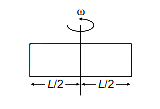
$A$ conducting rod of length $L$ rotates with angular speed $\omega$ in a uniform magnetic field of induction $B$ which is perpendicular to its motion. The induced emf developed between the two ends of the rod is
A
$\frac{B L^2 \omega}{4}$
B
$\frac{B L^2 \omega}{2}$
C
$B L^2 \omega$
D
$2 B L^2 \omega$
Solution
(A) Consider a small element of length $dr$ at a distance $r$ from the axis of rotation.
The induced emf $de$ across this small element is given by $de = B v dr$,where $v = r \omega$.
So,$de = B (r \omega) dr$.
To find the total induced emf $e$ between the center and one end of the rod (length $L/2$),we integrate from $r = 0$ to $r = L/2$:
$e = \int_{0}^{L/2} B \omega r dr = B \omega \left[ \frac{r^2}{2} \right]_{0}^{L/2} = B \omega \frac{(L/2)^2}{2} = \frac{B \omega L^2}{8}$.
Since the rod rotates about its center,the emf induced in each half of the rod is $\frac{B \omega L^2}{8}$.
Because the two halves are connected in parallel with respect to the center,the total emf between the two ends is the sum of the emf induced in each half: $e_{total} = \frac{B \omega L^2}{8} + \frac{B \omega L^2}{8} = \frac{B \omega L^2}{4}$.
The induced emf $de$ across this small element is given by $de = B v dr$,where $v = r \omega$.
So,$de = B (r \omega) dr$.
To find the total induced emf $e$ between the center and one end of the rod (length $L/2$),we integrate from $r = 0$ to $r = L/2$:
$e = \int_{0}^{L/2} B \omega r dr = B \omega \left[ \frac{r^2}{2} \right]_{0}^{L/2} = B \omega \frac{(L/2)^2}{2} = \frac{B \omega L^2}{8}$.
Since the rod rotates about its center,the emf induced in each half of the rod is $\frac{B \omega L^2}{8}$.
Because the two halves are connected in parallel with respect to the center,the total emf between the two ends is the sum of the emf induced in each half: $e_{total} = \frac{B \omega L^2}{8} + \frac{B \omega L^2}{8} = \frac{B \omega L^2}{4}$.
0 likesView Solution
35
ChemistryMCQAP EAMCET · 2002
In the Compton scattering process,the incident $X$-radiation is scattered at an angle of $60^{\circ}$. The wavelength of the scattered radiation is $0.22 \ \mathring{A}$. The wavelength of the incident $X$-radiation in $\mathring{A}$ units is:
A
$0.508$
B
$0.408$
C
$0.232$
D
$0.208$
Solution
(D) For the Compton effect,the shift in wavelength is given by the relation:
$\Delta \lambda = \lambda_2 - \lambda_1 = \frac{h}{m_0 c}(1 - \cos \theta)$
Here,$\lambda_1$ is the wavelength of incident radiation,$\lambda_2$ is the wavelength of scattered radiation,and $\frac{h}{m_0 c}$ is the Compton wavelength,which is approximately $0.024 \ \mathring{A}$.
Given: $\lambda_2 = 0.22 \ \mathring{A}$ and $\theta = 60^{\circ}$.
Substituting the values:
$0.22 - \lambda_1 = 0.024(1 - \cos 60^{\circ})$
$0.22 - \lambda_1 = 0.024(1 - 0.5)$
$0.22 - \lambda_1 = 0.024 \times 0.5$
$0.22 - \lambda_1 = 0.012$
$\lambda_1 = 0.22 - 0.012 = 0.208 \ \mathring{A}$.
$\Delta \lambda = \lambda_2 - \lambda_1 = \frac{h}{m_0 c}(1 - \cos \theta)$
Here,$\lambda_1$ is the wavelength of incident radiation,$\lambda_2$ is the wavelength of scattered radiation,and $\frac{h}{m_0 c}$ is the Compton wavelength,which is approximately $0.024 \ \mathring{A}$.
Given: $\lambda_2 = 0.22 \ \mathring{A}$ and $\theta = 60^{\circ}$.
Substituting the values:
$0.22 - \lambda_1 = 0.024(1 - \cos 60^{\circ})$
$0.22 - \lambda_1 = 0.024(1 - 0.5)$
$0.22 - \lambda_1 = 0.024 \times 0.5$
$0.22 - \lambda_1 = 0.012$
$\lambda_1 = 0.22 - 0.012 = 0.208 \ \mathring{A}$.
0 likesView Solution
36
ChemistryMCQAP EAMCET · 2002
$A$ body of mass $1 ~g$ and carrying a charge $10^{-8} ~C$ passes through two points $P$ and $Q$. $P$ and $Q$ are at electric potentials $600 ~V$ and $0 ~V$,respectively. The velocity of the body at $Q$ is $20 ~cm/s$. Its velocity in $m/s$ at $P$ is:
A
$\sqrt{0.028}$
B
$\sqrt{0.056}$
C
$\sqrt{0.56}$
D
$\sqrt{5.6}$
Solution
(A) Given:
Mass $m = 1 ~g = 10^{-3} ~kg$
Charge $q = 10^{-8} ~C$
Potential at $P$,$V_P = 600 ~V$
Potential at $Q$,$V_Q = 0 ~V$
Velocity at $Q$,$v_Q = 20 ~cm/s = 0.2 ~m/s$
According to the work-energy theorem,the work done by the electric field is equal to the change in kinetic energy:
$W = \Delta KE = KE_Q - KE_P$
$q(V_P - V_Q) = \frac{1}{2} m v_Q^2 - \frac{1}{2} m v_P^2$
Substituting the values:
$10^{-8} (600 - 0) = \frac{1}{2} (10^{-3}) (0.2)^2 - \frac{1}{2} (10^{-3}) v_P^2$
$600 \times 10^{-8} = 0.5 \times 10^{-3} \times 0.04 - 0.5 \times 10^{-3} v_P^2$
$6 \times 10^{-6} = 2 \times 10^{-5} - 0.5 \times 10^{-3} v_P^2$
$0.5 \times 10^{-3} v_P^2 = 20 \times 10^{-6} - 6 \times 10^{-6}$
$0.5 \times 10^{-3} v_P^2 = 14 \times 10^{-6}$
$v_P^2 = \frac{14 \times 10^{-6}}{0.5 \times 10^{-3}} = 28 \times 10^{-3} = 0.028$
$v_P = \sqrt{0.028} ~m/s$
Mass $m = 1 ~g = 10^{-3} ~kg$
Charge $q = 10^{-8} ~C$
Potential at $P$,$V_P = 600 ~V$
Potential at $Q$,$V_Q = 0 ~V$
Velocity at $Q$,$v_Q = 20 ~cm/s = 0.2 ~m/s$
According to the work-energy theorem,the work done by the electric field is equal to the change in kinetic energy:
$W = \Delta KE = KE_Q - KE_P$
$q(V_P - V_Q) = \frac{1}{2} m v_Q^2 - \frac{1}{2} m v_P^2$
Substituting the values:
$10^{-8} (600 - 0) = \frac{1}{2} (10^{-3}) (0.2)^2 - \frac{1}{2} (10^{-3}) v_P^2$
$600 \times 10^{-8} = 0.5 \times 10^{-3} \times 0.04 - 0.5 \times 10^{-3} v_P^2$
$6 \times 10^{-6} = 2 \times 10^{-5} - 0.5 \times 10^{-3} v_P^2$
$0.5 \times 10^{-3} v_P^2 = 20 \times 10^{-6} - 6 \times 10^{-6}$
$0.5 \times 10^{-3} v_P^2 = 14 \times 10^{-6}$
$v_P^2 = \frac{14 \times 10^{-6}}{0.5 \times 10^{-3}} = 28 \times 10^{-3} = 0.028$
$v_P = \sqrt{0.028} ~m/s$
0 likesView Solution
37
ChemistryMCQAP EAMCET · 2002
Fluorosis disease is caused due to the reaction of ...... with excess of fluoride in the body.
A
$Ca$
B
$Mg$
C
$Fe$
D
$K$
Solution
(A) Fluorosis is a condition caused by the excessive intake of fluoride. In the body,excess fluoride reacts with calcium $(Ca)$ present in bones and teeth to form calcium fluoride $(CaF_2)$,which leads to the hardening of bones and mottling of teeth.
The chemical reaction is: $Ca + F_2 \rightarrow CaF_2$ (Fluorosis disease).
The chemical reaction is: $Ca + F_2 \rightarrow CaF_2$ (Fluorosis disease).
0 likesView Solution
38
ChemistryMCQAP EAMCET · 2002
Which one of the following is a secondary alcohol?
A
$2-$methyl$-2-$propanol
B
$1-$propanol
C
$1-$butanol
D
$2-$pentanol
Solution
(D) secondary $(2^{\circ})$ alcohol is an alcohol where the hydroxyl group $(-OH)$ is attached to a carbon atom that is bonded to two other carbon atoms.
$1.$ $2-$methyl$-2-$propanol: The $-OH$ group is attached to a tertiary carbon. It is a tertiary alcohol.
$2.$ $1-$propanol: The $-OH$ group is attached to a primary carbon. It is a primary alcohol.
$3.$ $1-$butanol: The $-OH$ group is attached to a primary carbon. It is a primary alcohol.
$4.$ $2-$pentanol: The structure is $CH_3-CH(OH)-CH_2-CH_2-CH_3$. The $-OH$ group is attached to the $C2$ carbon,which is bonded to two other carbon atoms ($C1$ and $C3$). Thus,it is a secondary alcohol.
$1.$ $2-$methyl$-2-$propanol: The $-OH$ group is attached to a tertiary carbon. It is a tertiary alcohol.
$2.$ $1-$propanol: The $-OH$ group is attached to a primary carbon. It is a primary alcohol.
$3.$ $1-$butanol: The $-OH$ group is attached to a primary carbon. It is a primary alcohol.
$4.$ $2-$pentanol: The structure is $CH_3-CH(OH)-CH_2-CH_2-CH_3$. The $-OH$ group is attached to the $C2$ carbon,which is bonded to two other carbon atoms ($C1$ and $C3$). Thus,it is a secondary alcohol.
0 likesView Solution
39
ChemistryMCQAP EAMCET · 2002
Which one of the following is the molecular formula of a tertiary amine?
A
$C_2H_7N$
B
$C_3H_9N$
C
$CH_5N$
D
$CH_3N$
Solution
(B) tertiary amine ($3^{\circ}$ amine) has the general formula $R_3N$,where $R$ represents an alkyl group.
For a tertiary amine,the minimum number of carbon atoms required is $3$ (e.g.,trimethylamine,$(CH_3)_3N$).
Calculating the molecular formula for trimethylamine: $C_3H_9N$.
$C_2H_7N$ corresponds to ethylamine $(1^{\circ})$ or dimethylamine $(2^{\circ})$.
$CH_5N$ corresponds to methylamine $(1^{\circ})$.
$CH_3N$ is not a stable saturated amine.
Therefore,$C_3H_9N$ is the molecular formula of a tertiary amine.
For a tertiary amine,the minimum number of carbon atoms required is $3$ (e.g.,trimethylamine,$(CH_3)_3N$).
Calculating the molecular formula for trimethylamine: $C_3H_9N$.
$C_2H_7N$ corresponds to ethylamine $(1^{\circ})$ or dimethylamine $(2^{\circ})$.
$CH_5N$ corresponds to methylamine $(1^{\circ})$.
$CH_3N$ is not a stable saturated amine.
Therefore,$C_3H_9N$ is the molecular formula of a tertiary amine.
0 likesView Solution
40
ChemistryMCQAP EAMCET · 2002
If $A$ is the areal velocity of a planet of mass $M$,its angular momentum is
A
$\frac{M}{A}$
B
$2 M A$
C
$A^2 M$
D
$A M^2$
Solution
(B) According to Kepler's second law (law of areas),the areal velocity $(A)$ is defined as the rate at which the area is swept out by the position vector of the planet.
Mathematically,the areal velocity is given by the relation:
$A = \frac{dA}{dt} = \frac{L}{2M}$
where:
$L$ is the angular momentum of the planet,
$M$ is the mass of the planet.
Rearranging this formula to solve for the angular momentum $(L)$:
$L = 2 M A$
Therefore,the correct option is $B$.
Mathematically,the areal velocity is given by the relation:
$A = \frac{dA}{dt} = \frac{L}{2M}$
where:
$L$ is the angular momentum of the planet,
$M$ is the mass of the planet.
Rearranging this formula to solve for the angular momentum $(L)$:
$L = 2 M A$
Therefore,the correct option is $B$.
0 likesView Solution
41
ChemistryMCQAP EAMCET · 2002
What is the minimum quantity (in grams) of $methyl$ iodide required for preparing one mole of ethane by Wurtz reaction? (Atomic weight of iodine $= 127$)
A
$142$
B
$568$
C
$326$
D
$284$
Solution
(D) The Wurtz reaction for the preparation of ethane is given by the equation:
$2CH_3I + 2Na \xrightarrow{\text{dry ether}} C_2H_6 + 2NaI$
According to the stoichiometry of the reaction,$2$ moles of methyl iodide $(CH_3I)$ are required to produce $1$ mole of ethane $(C_2H_6)$.
The molar mass of $CH_3I$ is calculated as: $12 (C) + 3 (H) + 127 (I) = 142 \ g/mol$.
Therefore,the mass of $2$ moles of $CH_3I$ required is: $2 \times 142 \ g = 284 \ g$.
$2CH_3I + 2Na \xrightarrow{\text{dry ether}} C_2H_6 + 2NaI$
According to the stoichiometry of the reaction,$2$ moles of methyl iodide $(CH_3I)$ are required to produce $1$ mole of ethane $(C_2H_6)$.
The molar mass of $CH_3I$ is calculated as: $12 (C) + 3 (H) + 127 (I) = 142 \ g/mol$.
Therefore,the mass of $2$ moles of $CH_3I$ required is: $2 \times 142 \ g = 284 \ g$.
0 likesView Solution
42
ChemistryMCQAP EAMCET · 2002
In $chloroethane$,the carbon bearing halogen is bonded to $...$ hydrogen $(s)$. It is called $......$ alkyl halide.
A
$Two$,primary
B
$Three$,primary
C
$Two$,secondary
D
$One$,tertiary
Solution
(A) The chemical formula of $chloroethane$ is $CH_3CH_2Cl$.
In this molecule,the carbon atom attached to the chlorine atom (halogen) is bonded to two hydrogen atoms.
Since the carbon atom bearing the halogen is attached to only one other carbon atom,it is classified as a primary $(1^{\circ})$ alkyl halide.
In this molecule,the carbon atom attached to the chlorine atom (halogen) is bonded to two hydrogen atoms.
Since the carbon atom bearing the halogen is attached to only one other carbon atom,it is classified as a primary $(1^{\circ})$ alkyl halide.
0 likesView Solution
43
ChemistryMCQAP EAMCET · 2002
In the following reaction,$A$ and $B$ respectively are:
$A$ $\xrightarrow{HBr} C_2H_5Br$ $\xrightarrow{B} A$
$A$ $\xrightarrow{HBr} C_2H_5Br$ $\xrightarrow{B} A$
A
$C_2H_4$ and alcoholic $KOH / \Delta$
B
$C_2H_5Cl$ and aqueous $KOH / \Delta$
C
$C_2H_2$ and $PBr_3$
D
None of these
Solution
(A) The given reaction is $A$ $\xrightarrow{HBr} C_2H_5Br$ $\xrightarrow{B} A$.
If $A = C_2H_4$ (ethene) and $B = \text{alcoholic } KOH / \Delta$:
$1$. $C_2H_4 + HBr \rightarrow C_2H_5Br$ (Electrophilic addition reaction).
$2$. $C_2H_5Br + \text{alcoholic } KOH \xrightarrow{\Delta} C_2H_4 + KBr + H_2O$ (Dehydrohalogenation reaction).
Thus,$A$ is $C_2H_4$ and $B$ is alcoholic $KOH / \Delta$.
If $A = C_2H_4$ (ethene) and $B = \text{alcoholic } KOH / \Delta$:
$1$. $C_2H_4 + HBr \rightarrow C_2H_5Br$ (Electrophilic addition reaction).
$2$. $C_2H_5Br + \text{alcoholic } KOH \xrightarrow{\Delta} C_2H_4 + KBr + H_2O$ (Dehydrohalogenation reaction).
Thus,$A$ is $C_2H_4$ and $B$ is alcoholic $KOH / \Delta$.
0 likesView Solution
44
ChemistryMediumMCQAP EAMCET · 2002
The reaction conditions used for converting $1, 2-$dibromoethane to ethene are
A
$Zn$,alcohol,$\Delta$
B
$KOH$,alcohol,$\Delta$
C
$KOH$,water,$\Delta$
D
$Na$,alcohol,$\Delta$
Solution
(A) The conversion of $1, 2-$dibromoethane to ethene is a dehalogenation reaction.
This reaction involves the removal of two bromine atoms from adjacent carbon atoms using zinc dust in the presence of alcohol under heating $(\Delta)$.
The chemical equation is: $BrCH_2-CH_2Br + Zn \xrightarrow{\text{alcohol}, \Delta} CH_2=CH_2 + ZnBr_2$.
Thus,the correct reaction conditions are $Zn$,alcohol,$\Delta$.
This reaction involves the removal of two bromine atoms from adjacent carbon atoms using zinc dust in the presence of alcohol under heating $(\Delta)$.
The chemical equation is: $BrCH_2-CH_2Br + Zn \xrightarrow{\text{alcohol}, \Delta} CH_2=CH_2 + ZnBr_2$.
Thus,the correct reaction conditions are $Zn$,alcohol,$\Delta$.
0 likesView Solution
45
ChemistryMCQAP EAMCET · 2002
Which one of the following statements is correct with respect to basic character?
A
$PH_3 > P(CH_3)_3$
B
$PH_3 = NH_3$
C
$PH_3 > NH_3$
D
$P(CH_3)_3 > PH_3$
Solution
(D) The basic character of a molecule depends on the availability of the lone pair of electrons on the central atom for donation.
In $PH_3$,the lone pair is present in an orbital with high $s$-character,making it less available for donation.
In $P(CH_3)_3$,the three methyl groups are electron-donating groups ($+I$ effect),which increase the electron density on the phosphorus atom,making the lone pair more available for donation.
Therefore,$P(CH_3)_3$ is a stronger base than $PH_3$.
In $PH_3$,the lone pair is present in an orbital with high $s$-character,making it less available for donation.
In $P(CH_3)_3$,the three methyl groups are electron-donating groups ($+I$ effect),which increase the electron density on the phosphorus atom,making the lone pair more available for donation.
Therefore,$P(CH_3)_3$ is a stronger base than $PH_3$.
0 likesView Solution
46
ChemistryMCQAP EAMCET · 2002
The products formed when heavy water is reacted with magnesium nitride are:
A
$NH_3, Mg(OH)_2$
B
$NH_3, Mg(OD)_2$
C
$ND_3, Mg(OH)_2$
D
$ND_3, Mg(OD)_2$
Solution
(D) When heavy water $(D_2O)$ reacts with magnesium nitride $(Mg_3N_2)$,the deuterium atoms replace the hydrogen atoms in the reaction products.
The chemical reaction is:
$Mg_3N_2 + 6 D_2O \longrightarrow 3 Mg(OD)_2 + 2 ND_3$
Thus,the products formed are magnesium deuteroxide $(Mg(OD)_2)$ and deuteroammonia $(ND_3)$.
The chemical reaction is:
$Mg_3N_2 + 6 D_2O \longrightarrow 3 Mg(OD)_2 + 2 ND_3$
Thus,the products formed are magnesium deuteroxide $(Mg(OD)_2)$ and deuteroammonia $(ND_3)$.
0 likesView Solution
47
ChemistryMediumMCQAP EAMCET · 2002
Iron sulphide is heated in air to form $A$,an oxide of sulphur. $A$ is dissolved in water to give an acid. The basicity of this acid is
A
$2$
B
$3$
C
$1$
D
$0$
Solution
(A) The reaction of iron sulphide with oxygen is: $2FeS + 3O_2 \rightarrow 2FeO + 2SO_2$ $(A)$.
When $SO_2$ $(A)$ is dissolved in water,it forms sulphurous acid: $SO_2 + H_2O \rightarrow H_2SO_3$.
Sulphurous acid $(H_2SO_3)$ is a diprotic acid,meaning it has two replaceable hydrogen atoms.
Therefore,the basicity of $H_2SO_3$ is $2$.
When $SO_2$ $(A)$ is dissolved in water,it forms sulphurous acid: $SO_2 + H_2O \rightarrow H_2SO_3$.
Sulphurous acid $(H_2SO_3)$ is a diprotic acid,meaning it has two replaceable hydrogen atoms.
Therefore,the basicity of $H_2SO_3$ is $2$.
0 likesView Solution
48
ChemistryMediumMCQAP EAMCET · 2002
Which one of the following statements is correct?
A
Bronsted-Lowry theory could not explain the acidic nature of $BCl_3$.
B
The $pH$ of $0.01 \ M \ NaOH$ solution is $2$.
C
The ionic product of water at $25^{\circ} C$ is $10^{-14} \ mol^2 \ L^{-2}$.
D
The $pH$ of a solution can be calculated using the equation $pH = -\log [H^+]$.
Solution
(C) Option $A$ is correct because Bronsted-Lowry theory defines acids as proton donors,but $BCl_3$ is a Lewis acid that accepts electron pairs,not protons.
Option $B$ is incorrect because for $0.01 \ M \ NaOH$,$[OH^-] = 10^{-2} \ M$,so $pOH = 2$ and $pH = 14 - 2 = 12$.
Option $C$ is correct as the ionic product of water $(K_w)$ at $25^{\circ} C$ is $1.0 \times 10^{-14} \ mol^2 \ L^{-2}$.
Option $D$ is correct as the definition of $pH$ is $pH = -\log [H^+]$.
Note: In many contexts,multiple statements may be technically correct. However,$C$ and $D$ are fundamental definitions. Given the standard format,$C$ is a specific constant value.
Option $B$ is incorrect because for $0.01 \ M \ NaOH$,$[OH^-] = 10^{-2} \ M$,so $pOH = 2$ and $pH = 14 - 2 = 12$.
Option $C$ is correct as the ionic product of water $(K_w)$ at $25^{\circ} C$ is $1.0 \times 10^{-14} \ mol^2 \ L^{-2}$.
Option $D$ is correct as the definition of $pH$ is $pH = -\log [H^+]$.
Note: In many contexts,multiple statements may be technically correct. However,$C$ and $D$ are fundamental definitions. Given the standard format,$C$ is a specific constant value.
0 likesView Solution
49
ChemistryMCQAP EAMCET · 2002
$75 \ mL$ of $0.2 \ M \ HCl$ is mixed with $25 \ mL$ of $1 \ M \ HCl$. To this solution,$300 \ mL$ of distilled water is added. What is the $pH$ of the resultant solution?
A
$1$
B
$2$
C
$4$
D
$0.2$
Solution
(A) Step $1$: Calculate the total moles of $HCl$ in the mixture.
$n_1 = M_1 \times V_1 = 0.2 \ M \times 0.075 \ L = 0.015 \ mol$
$n_2 = M_2 \times V_2 = 1 \ M \times 0.025 \ L = 0.025 \ mol$
Total moles $n = n_1 + n_2 = 0.015 + 0.025 = 0.040 \ mol$
Step $2$: Calculate the total volume of the final solution.
$V_{total} = 75 \ mL + 25 \ mL + 300 \ mL = 400 \ mL = 0.4 \ L$
Step $3$: Calculate the final molarity of $HCl$.
$M_{final} = \frac{n}{V_{total}} = \frac{0.040 \ mol}{0.4 \ L} = 0.1 \ M$
Step $4$: Calculate the $pH$.
$[H^+] = 0.1 \ M = 10^{-1} \ M$
$pH = -\log_{10}[H^+] = -\log_{10}(10^{-1}) = 1$
$n_1 = M_1 \times V_1 = 0.2 \ M \times 0.075 \ L = 0.015 \ mol$
$n_2 = M_2 \times V_2 = 1 \ M \times 0.025 \ L = 0.025 \ mol$
Total moles $n = n_1 + n_2 = 0.015 + 0.025 = 0.040 \ mol$
Step $2$: Calculate the total volume of the final solution.
$V_{total} = 75 \ mL + 25 \ mL + 300 \ mL = 400 \ mL = 0.4 \ L$
Step $3$: Calculate the final molarity of $HCl$.
$M_{final} = \frac{n}{V_{total}} = \frac{0.040 \ mol}{0.4 \ L} = 0.1 \ M$
Step $4$: Calculate the $pH$.
$[H^+] = 0.1 \ M = 10^{-1} \ M$
$pH = -\log_{10}[H^+] = -\log_{10}(10^{-1}) = 1$
0 likesView Solution
50
ChemistryMCQAP EAMCET · 2002
$A$ body is sliding down a rough inclined plane. The coefficient of friction between the body and the plane is $0.5$. The ratio of the net force required for the body to slide down and the normal reaction on the body is $1:2$. Then the angle of the inclined plane is: (in $^{\circ}$)
A
$15$
B
$30$
C
$45$
D
$60$
Solution
(C) Given: Coefficient of friction $\mu = 0.5$. The ratio of net force $F$ to normal reaction $R$ is $\frac{F}{R} = \frac{1}{2}$.
The net force $F$ acting down the plane is given by $F = mg \sin \theta - f$,where $f$ is the frictional force.
The normal reaction $R$ is $mg \cos \theta$.
The frictional force $f$ is given by $f = \mu R = \mu mg \cos \theta$.
Substituting these into the ratio:
$\frac{mg \sin \theta - \mu mg \cos \theta}{mg \cos \theta} = \frac{1}{2}$
Dividing the numerator by the denominator:
$\tan \theta - \mu = \frac{1}{2}$
Given $\mu = 0.5$,we have:
$\tan \theta - 0.5 = 0.5$
$\tan \theta = 1$
Therefore,$\theta = 45^{\circ}$.
The net force $F$ acting down the plane is given by $F = mg \sin \theta - f$,where $f$ is the frictional force.
The normal reaction $R$ is $mg \cos \theta$.
The frictional force $f$ is given by $f = \mu R = \mu mg \cos \theta$.
Substituting these into the ratio:
$\frac{mg \sin \theta - \mu mg \cos \theta}{mg \cos \theta} = \frac{1}{2}$
Dividing the numerator by the denominator:
$\tan \theta - \mu = \frac{1}{2}$
Given $\mu = 0.5$,we have:
$\tan \theta - 0.5 = 0.5$
$\tan \theta = 1$
Therefore,$\theta = 45^{\circ}$.
0 likesView Solution
51
ChemistryEasyMCQAP EAMCET · 2002
Which one of the following is correct with respect to basic character?
A
$P(CH_3)_3 > PH_3$
B
$PH_3 > P(CH_3)_3$
C
$PH_3 > NH_3$
D
$PH_3 = NH_3$
Solution
(A) The basicity of phosphines depends on the availability of the lone pair on the phosphorus atom.
In $P(CH_3)_3$,the three methyl groups exert a $+I$ (inductive) effect,which increases the electron density on the phosphorus atom.
This makes the lone pair more available for donation compared to $PH_3$,where no such electron-donating groups are present.
Therefore,the correct order of basic character is $P(CH_3)_3 > PH_3$.
In $P(CH_3)_3$,the three methyl groups exert a $+I$ (inductive) effect,which increases the electron density on the phosphorus atom.
This makes the lone pair more available for donation compared to $PH_3$,where no such electron-donating groups are present.
Therefore,the correct order of basic character is $P(CH_3)_3 > PH_3$.
0 likesView Solution
52
ChemistryMediumMCQAP EAMCET · 2002
The chemicals used for preparing acetophenone are:
$(A)$ $C_6H_6$
$(B)$ $CH_3COCH_3$
$(C)$ $CH_3COCl$
$(D)$ Anhydrous $AlCl_3$
$(A)$ $C_6H_6$
$(B)$ $CH_3COCH_3$
$(C)$ $CH_3COCl$
$(D)$ Anhydrous $AlCl_3$
A
$A, B, C$
B
$B, C, D$
C
$A, C, D$
D
$A, B, D$
Solution
(C) Acetophenone is prepared by the Friedel-Crafts acylation of benzene.
In this reaction,benzene $(C_6H_6)$ reacts with acetyl chloride $(CH_3COCl)$ in the presence of an anhydrous Lewis acid catalyst,anhydrous $AlCl_3$.
The reaction is:
$C_6H_6 + CH_3COCl \xrightarrow{\text{anhydrous } AlCl_3} C_6H_5COCH_3 + HCl$
Thus,the chemicals required are $C_6H_6$ $(A)$,$CH_3COCl$ $(C)$,and anhydrous $AlCl_3$ $(D)$.
In this reaction,benzene $(C_6H_6)$ reacts with acetyl chloride $(CH_3COCl)$ in the presence of an anhydrous Lewis acid catalyst,anhydrous $AlCl_3$.
The reaction is:
$C_6H_6 + CH_3COCl \xrightarrow{\text{anhydrous } AlCl_3} C_6H_5COCH_3 + HCl$
Thus,the chemicals required are $C_6H_6$ $(A)$,$CH_3COCl$ $(C)$,and anhydrous $AlCl_3$ $(D)$.
0 likesView Solution
53
ChemistryEasyMCQAP EAMCET · 2002
The bond energies (in $kJ \ mol^{-1}$) of $N-H$,$P-H$,and $As-H$ are respectively:
A
$247, 318, 389$
B
$389, 318, 247$
C
$318, 389, 247$
D
$247, 389, 318$
Solution
(B) The bond energy depends on the bond length. As the size of the central atom increases down the group $(N < P < As)$,the bond length increases,and the bond energy decreases.
The order of bond energies is $N-H > P-H > As-H$.
The values are $389 \ kJ \ mol^{-1}$ for $N-H$,$318 \ kJ \ mol^{-1}$ for $P-H$,and $247 \ kJ \ mol^{-1}$ for $As-H$.
Therefore,the correct order is $389, 318, 247$.
The order of bond energies is $N-H > P-H > As-H$.
The values are $389 \ kJ \ mol^{-1}$ for $N-H$,$318 \ kJ \ mol^{-1}$ for $P-H$,and $247 \ kJ \ mol^{-1}$ for $As-H$.
Therefore,the correct order is $389, 318, 247$.
0 likesView Solution
54
ChemistryMediumMCQAP EAMCET · 2002
In the following reaction,$X$ and $Y$ respectively are:
$C_2H_5OH$ $\xrightarrow{KMnO_4 / H^+} X$ $\xrightarrow{C_2H_5OH / H_2SO_4, \Delta} CH_3COOC_2H_5$
$C_2H_5OH$ $\xrightarrow{KMnO_4 / H^+} X$ $\xrightarrow{C_2H_5OH / H_2SO_4, \Delta} CH_3COOC_2H_5$
A
$CH_3OH, C_2H_5OH$
B
$CH_3CHO, CH_3OH$
C
$CH_2=CH_2, CH_3COOH$
D
$CH_3COOH, C_2H_5OH$
Solution
(D) The reaction sequence is as follows:
$1$. Oxidation of ethanol $(C_2H_5OH)$ with $KMnO_4 / H^+$ yields acetic acid $(CH_3COOH)$ as the final product $X$.
$2$. The reaction of acetic acid $(CH_3COOH)$ with ethanol $(C_2H_5OH)$ in the presence of concentrated $H_2SO_4$ is an esterification reaction,which produces ethyl acetate $(CH_3COOC_2H_5)$.
$3$. Thus,$X = CH_3COOH$ and $Y = C_2H_5OH$.
$1$. Oxidation of ethanol $(C_2H_5OH)$ with $KMnO_4 / H^+$ yields acetic acid $(CH_3COOH)$ as the final product $X$.
$2$. The reaction of acetic acid $(CH_3COOH)$ with ethanol $(C_2H_5OH)$ in the presence of concentrated $H_2SO_4$ is an esterification reaction,which produces ethyl acetate $(CH_3COOC_2H_5)$.
$3$. Thus,$X = CH_3COOH$ and $Y = C_2H_5OH$.
0 likesView Solution
55
ChemistryMediumMCQAP EAMCET · 2002
The products formed when diethyl ether is reacted with cold $HI$ are
A
$C_2H_5I + C_2H_5OH$
B
$2C_2H_5I + H_2O$
C
$2C_2H_5OH$
D
$C_2H_5-O-C_2H_5 + H_2O$
Solution
(A) When diethyl ether reacts with cold $HI$,it undergoes cleavage to form ethyl alcohol and ethyl iodide as follows:
$C_2H_5-O-C_2H_5 + HI \rightarrow C_2H_5OH + C_2H_5I$
$C_2H_5-O-C_2H_5 + HI \rightarrow C_2H_5OH + C_2H_5I$
0 likesView Solution
56
ChemistryMediumMCQAP EAMCET · 2002
What is $X$ in the following reaction?
$2 CH_3COCH_3 \stackrel{Ba(OH)_2}{\longrightarrow} X$
$2 CH_3COCH_3 \stackrel{Ba(OH)_2}{\longrightarrow} X$
A
$CH_3-C(OH)(CH_3)-CH_2-CO-CH_3$
B
$CH_3-C(OH)(CH_3)-CH_2-CH_2-CHO$
C
$CH_3CH(CH_3)CH_2COCH_3$
D
$H_3C-CH(CH_3)-CH(OH)-CO-CH_3$
Solution
(A) The reaction $2 CH_3COCH_3 \stackrel{Ba(OH)_2}{\longrightarrow} X$ is an aldol condensation reaction of acetone.
In this reaction,two molecules of acetone undergo condensation in the presence of a base like $Ba(OH)_2$ to form $4-hydroxy-4-methylpentan-2-one$.
The reaction mechanism involves the formation of an enolate ion from one acetone molecule,which then attacks the carbonyl carbon of another acetone molecule.
The product $X$ is $CH_3-C(OH)(CH_3)-CH_2-CO-CH_3$.
In this reaction,two molecules of acetone undergo condensation in the presence of a base like $Ba(OH)_2$ to form $4-hydroxy-4-methylpentan-2-one$.
The reaction mechanism involves the formation of an enolate ion from one acetone molecule,which then attacks the carbonyl carbon of another acetone molecule.
The product $X$ is $CH_3-C(OH)(CH_3)-CH_2-CO-CH_3$.
0 likesView Solution
57
ChemistryEasyMCQAP EAMCET · 2002
What is the catalyst used in the conversion of acetaldehyde to acetic acid?
A
Manganese acetate
B
$LiAlH_4$
C
$H_2 / Ni$
D
$Na / NH_3$
Solution
(A) The oxidation of acetaldehyde $(CH_3CHO)$ to acetic acid $(CH_3COOH)$ is an industrial process.
This reaction is typically catalyzed by manganese acetate $(Mn(CH_3COO)_2)$ in the presence of air or oxygen.
The reaction is: $2CH_3CHO + O_2 \xrightarrow{Mn(CH_3COO)_2} 2CH_3COOH$.
This reaction is typically catalyzed by manganese acetate $(Mn(CH_3COO)_2)$ in the presence of air or oxygen.
The reaction is: $2CH_3CHO + O_2 \xrightarrow{Mn(CH_3COO)_2} 2CH_3COOH$.
0 likesView Solution
58
ChemistryMediumMCQAP EAMCET · 2002
Oxalic acid reacts with concentrated $H_2SO_4$ to give a mixture of two gases. When this mixture is passed through caustic potash,one of the gases is absorbed. What is the product formed by the absorbed gas with caustic potash?
A
$K_2SO_4$
B
$KHCO_3$
C
$K_2CO_3$
D
$KOH$
Solution
(C) The reaction of oxalic acid with concentrated $H_2SO_4$ is as follows:
$(COOH)_2 \xrightarrow{conc. H_2SO_4} CO + CO_2 + H_2O$
The gaseous mixture consists of $CO$ and $CO_2$.
When this mixture is passed through caustic potash $(KOH)$,$CO_2$ (an acidic gas) is absorbed,while $CO$ (a neutral gas) passes through.
The reaction of $CO_2$ with $KOH$ is:
$CO_2 + 2KOH \rightarrow K_2CO_3 + H_2O$
Thus,the product formed is potassium carbonate $(K_2CO_3)$.
$(COOH)_2 \xrightarrow{conc. H_2SO_4} CO + CO_2 + H_2O$
The gaseous mixture consists of $CO$ and $CO_2$.
When this mixture is passed through caustic potash $(KOH)$,$CO_2$ (an acidic gas) is absorbed,while $CO$ (a neutral gas) passes through.
The reaction of $CO_2$ with $KOH$ is:
$CO_2 + 2KOH \rightarrow K_2CO_3 + H_2O$
Thus,the product formed is potassium carbonate $(K_2CO_3)$.
0 likesView Solution
59
ChemistryMediumMCQAP EAMCET · 2002
The reagent used in the preparation of aspirin from salicylic acid is
A
$SOCl_2 / \text{pyridine}$
B
$CH_3COOH / HCl$
C
$(CH_3CO)_2O / \text{Conc. } H_2SO_4$
D
$CH_3Cl / AlCl_3$
Solution
(C) The preparation of aspirin (acetylsalicylic acid) from salicylic acid involves the acetylation of the phenolic $-OH$ group.
This reaction is carried out by reacting salicylic acid with acetic anhydride in the presence of an acid catalyst like concentrated $H_2SO_4$.
The reaction is: $\text{Salicylic acid} + (CH_3CO)_2O \xrightarrow{Conc. H_2SO_4} \text{Aspirin} + CH_3COOH$.
Therefore,the correct reagent is $(CH_3CO)_2O / \text{Conc. } H_2SO_4$.
This reaction is carried out by reacting salicylic acid with acetic anhydride in the presence of an acid catalyst like concentrated $H_2SO_4$.
The reaction is: $\text{Salicylic acid} + (CH_3CO)_2O \xrightarrow{Conc. H_2SO_4} \text{Aspirin} + CH_3COOH$.
Therefore,the correct reagent is $(CH_3CO)_2O / \text{Conc. } H_2SO_4$.
0 likesView Solution
60
ChemistryMediumMCQAP EAMCET · 2002
In the following reaction,$X$ and $Y$ are respectively
$CH_3 COOH + NH_3$ $\longrightarrow X \stackrel{\Delta}{}$ ${\longrightarrow} Y + H_2 O$
$CH_3 COOH + NH_3$ $\longrightarrow X \stackrel{\Delta}{}$ ${\longrightarrow} Y + H_2 O$
A
$CH_3 CONH_2, CH_4$
B
$CH_3 COONH_4, CH_3 CONH_2$
C
$CH_3 CONH_2, CH_3 COOH$
D
$CH_3 NH_2, CH_3 CONH_2$
Solution
(B) The reaction of acetic acid $(CH_3 COOH)$ with ammonia $(NH_3)$ forms ammonium acetate $(CH_3 COONH_4)$ as an intermediate $(X)$.
$CH_3 COOH + NH_3 \longrightarrow CH_3 COONH_4$ $(X)$
On heating,ammonium acetate undergoes dehydration to form acetamide $(CH_3 CONH_2)$ as the final product $(Y)$.
$CH_3 COONH_4 \stackrel{\Delta}{\longrightarrow} CH_3 CONH_2$ $(Y)$ $+ H_2 O$
Therefore,$X$ is $CH_3 COONH_4$ and $Y$ is $CH_3 CONH_2$.
$CH_3 COOH + NH_3 \longrightarrow CH_3 COONH_4$ $(X)$
On heating,ammonium acetate undergoes dehydration to form acetamide $(CH_3 CONH_2)$ as the final product $(Y)$.
$CH_3 COONH_4 \stackrel{\Delta}{\longrightarrow} CH_3 CONH_2$ $(Y)$ $+ H_2 O$
Therefore,$X$ is $CH_3 COONH_4$ and $Y$ is $CH_3 CONH_2$.
0 likesView Solution
61
ChemistryMediumMCQAP EAMCET · 2002
Which one of the following is a correct pair with respect to the molecular formula of a xenon compound and the hybridization state of xenon in it?
A
$XeF_4, sp^3$
B
$XeF_2, sp$
C
$XeF_2, sp^3d$
D
$XeF_4, sp^2$
Solution
(C) The hybridization of the central atom $Xe$ is determined by the formula: $H = \frac{1}{2}(V + M - C + A)$,where $V$ is the number of valence electrons,$M$ is the number of monovalent atoms,$C$ is the cationic charge,and $A$ is the anionic charge.
For $XeF_2$: $H = \frac{1}{2}(8 + 2) = 5$,which corresponds to $sp^3d$ hybridization.
For $XeF_4$: $H = \frac{1}{2}(8 + 4) = 6$,which corresponds to $sp^3d^2$ hybridization.
Therefore,the correct pair is $XeF_2, sp^3d$.
For $XeF_2$: $H = \frac{1}{2}(8 + 2) = 5$,which corresponds to $sp^3d$ hybridization.
For $XeF_4$: $H = \frac{1}{2}(8 + 4) = 6$,which corresponds to $sp^3d^2$ hybridization.
Therefore,the correct pair is $XeF_2, sp^3d$.
0 likesView Solution
62
ChemistryMediumMCQAP EAMCET · 2002
The calculated magnetic moment (in Bohr magnetons) of $Cu^{2+}$ ion is:
A
$1.73$
B
zero
C
$2.6$
D
$3.14$
Solution
(A) The atomic number of $Cu$ is $29$. The electronic configuration of $Cu$ is $[Ar] 3d^{10} 4s^1$.
For $Cu^{2+}$ ion,two electrons are removed (one from $4s$ and one from $3d$),resulting in the configuration $[Ar] 3d^9$.
In the $3d^9$ configuration,there is $1$ unpaired electron $(n = 1)$.
The magnetic moment $(\mu)$ is calculated using the formula $\mu = \sqrt{n(n+2)} \text{ BM}$.
$\mu = \sqrt{1(1+2)} = \sqrt{3} \approx 1.73 \text{ BM}$.
For $Cu^{2+}$ ion,two electrons are removed (one from $4s$ and one from $3d$),resulting in the configuration $[Ar] 3d^9$.
In the $3d^9$ configuration,there is $1$ unpaired electron $(n = 1)$.
The magnetic moment $(\mu)$ is calculated using the formula $\mu = \sqrt{n(n+2)} \text{ BM}$.
$\mu = \sqrt{1(1+2)} = \sqrt{3} \approx 1.73 \text{ BM}$.
0 likesView Solution
63
ChemistryMediumMCQAP EAMCET · 2002
$0.066 \ g$ of metal was deposited when a current of $2 \ A$ is passed through a metal ion solution for $100 \ s$. What is the electrochemical equivalent (in $g \ C^{-1}$) of the metal?
A
$3.3 \times 10^{-6}$
B
$3.3 \times 10^{-4}$
C
$0.033$
D
$3.3$
Solution
(B) The formula for the mass deposited is $w = z \cdot i \cdot t$,where $w$ is the mass,$z$ is the electrochemical equivalent,$i$ is the current,and $t$ is the time.
Given: $w = 0.066 \ g$,$i = 2 \ A$,$t = 100 \ s$.
Rearranging the formula to solve for $z$: $z = \frac{w}{i \times t}$.
Substituting the values: $z = \frac{0.066}{2 \times 100} = \frac{0.066}{200} = 0.00033 \ g \ C^{-1}$.
Therefore,$z = 3.3 \times 10^{-4} \ g \ C^{-1}$.
Given: $w = 0.066 \ g$,$i = 2 \ A$,$t = 100 \ s$.
Rearranging the formula to solve for $z$: $z = \frac{w}{i \times t}$.
Substituting the values: $z = \frac{0.066}{2 \times 100} = \frac{0.066}{200} = 0.00033 \ g \ C^{-1}$.
Therefore,$z = 3.3 \times 10^{-4} \ g \ C^{-1}$.
0 likesView Solution
64
ChemistryMediumMCQAP EAMCET · 2002
What is the reduction electrode potential (in volts) of a copper electrode when $[Cu^{2+}]=0.01 \ M$ is in a solution at $25^{\circ} C$? $(E^{\circ}$ of $Cu^{2+}/Cu$ electrode is $+0.34 \ V)$
A
$0.3991$
B
$0.2809$
C
$0.3105$
D
$0.3695$
Solution
(B) The reduction half-reaction for the copper electrode is: $Cu^{2+}(aq) + 2e^- \rightarrow Cu(s)$.
Using the Nernst equation at $25^{\circ} C$ $(298 \ K)$:
$E_{Cu^{2+}/Cu} = E^{\circ}_{Cu^{2+}/Cu} - \frac{0.0591}{n} \log \frac{1}{[Cu^{2+}]}$
Given $E^{\circ} = +0.34 \ V$,$n = 2$,and $[Cu^{2+}] = 0.01 \ M = 10^{-2} \ M$.
$E_{Cu^{2+}/Cu} = 0.34 - \frac{0.0591}{2} \log \frac{1}{10^{-2}}$
$E_{Cu^{2+}/Cu} = 0.34 - \frac{0.0591}{2} \log(10^2)$
$E_{Cu^{2+}/Cu} = 0.34 - \frac{0.0591}{2} \times 2$
$E_{Cu^{2+}/Cu} = 0.34 - 0.0591 = 0.2809 \ V$.
Using the Nernst equation at $25^{\circ} C$ $(298 \ K)$:
$E_{Cu^{2+}/Cu} = E^{\circ}_{Cu^{2+}/Cu} - \frac{0.0591}{n} \log \frac{1}{[Cu^{2+}]}$
Given $E^{\circ} = +0.34 \ V$,$n = 2$,and $[Cu^{2+}] = 0.01 \ M = 10^{-2} \ M$.
$E_{Cu^{2+}/Cu} = 0.34 - \frac{0.0591}{2} \log \frac{1}{10^{-2}}$
$E_{Cu^{2+}/Cu} = 0.34 - \frac{0.0591}{2} \log(10^2)$
$E_{Cu^{2+}/Cu} = 0.34 - \frac{0.0591}{2} \times 2$
$E_{Cu^{2+}/Cu} = 0.34 - 0.0591 = 0.2809 \ V$.
0 likesView Solution
65
ChemistryMediumMCQAP EAMCET · 2002
Which one of the following is a secondary alcohol?
A
$2$-methyl-$2$-propanol
B
$1$-propanol
C
$1$-butanol
D
$2$-pentanol
Solution
(D) secondary $(2^{\circ})$ alcohol is one in which the hydroxyl group $(-OH)$ is attached to a carbon atom that is bonded to two other carbon atoms.
$1$. $2$-methyl-$2$-propanol: $(CH_3)_3COH$ is a tertiary $(3^{\circ})$ alcohol.
$2$. $1$-propanol: $CH_3CH_2CH_2OH$ is a primary $(1^{\circ})$ alcohol.
$3$. $1$-butanol: $CH_3CH_2CH_2CH_2OH$ is a primary $(1^{\circ})$ alcohol.
$4$. $2$-pentanol: $CH_3CH(OH)CH_2CH_2CH_3$ is a secondary $(2^{\circ})$ alcohol,as the $-OH$ group is attached to the $C2$ atom,which is bonded to $C1$ and $C3$.
$1$. $2$-methyl-$2$-propanol: $(CH_3)_3COH$ is a tertiary $(3^{\circ})$ alcohol.
$2$. $1$-propanol: $CH_3CH_2CH_2OH$ is a primary $(1^{\circ})$ alcohol.
$3$. $1$-butanol: $CH_3CH_2CH_2CH_2OH$ is a primary $(1^{\circ})$ alcohol.
$4$. $2$-pentanol: $CH_3CH(OH)CH_2CH_2CH_3$ is a secondary $(2^{\circ})$ alcohol,as the $-OH$ group is attached to the $C2$ atom,which is bonded to $C1$ and $C3$.
0 likesView Solution
66
ChemistryMediumMCQAP EAMCET · 2002
Which one of the following is the molecular formula of a tertiary amine?
A
$C_2H_7N$
B
$C_3H_9N$
C
$CH_5N$
D
$CH_3N$
Solution
(B) tertiary amine has the general formula $R_3N$,where $R$ is an alkyl group.
For a tertiary amine,the minimum number of carbon atoms required is $3$ (e.g.,trimethylamine,$(CH_3)_3N$).
Calculating the molecular formula for $(CH_3)_3N$:
Total carbons = $3$,Total hydrogens = $3 \times 3 = 9$,Total nitrogens = $1$.
Thus,the molecular formula is $C_3H_9N$.
For a tertiary amine,the minimum number of carbon atoms required is $3$ (e.g.,trimethylamine,$(CH_3)_3N$).
Calculating the molecular formula for $(CH_3)_3N$:
Total carbons = $3$,Total hydrogens = $3 \times 3 = 9$,Total nitrogens = $1$.
Thus,the molecular formula is $C_3H_9N$.
0 likesView Solution
67
ChemistryMediumMCQAP EAMCET · 2002
In chloroethane,the carbon bearing halogen is bonded to ... hydrogen $(s)$. It is called ...... alkyl halide.
A
Two,primary
B
Three,primary
C
Two,secondary
D
One,tertiary
Solution
(A) The chemical formula of chloroethane is $CH_3CH_2Cl$.
In this molecule,the carbon atom attached to the chlorine atom (halogen) is bonded to two hydrogen atoms.
Since this carbon atom is attached to only one other carbon atom,it is a primary $(1^{\circ})$ carbon.
Therefore,chloroethane is a primary alkyl halide.
Thus,the correct answer is: Two,primary.
In this molecule,the carbon atom attached to the chlorine atom (halogen) is bonded to two hydrogen atoms.
Since this carbon atom is attached to only one other carbon atom,it is a primary $(1^{\circ})$ carbon.
Therefore,chloroethane is a primary alkyl halide.
Thus,the correct answer is: Two,primary.
0 likesView Solution
68
ChemistryMediumMCQAP EAMCET · 2002
The chemicals used for preparing acetophenone via Friedel-Crafts acylation are:
$(A)$ $C_6H_6$
$(B)$ $CH_3COCH_3$
$(C)$ $CH_3COCl$
$(D)$ Anhydrous $AlCl_3$
$(A)$ $C_6H_6$
$(B)$ $CH_3COCH_3$
$(C)$ $CH_3COCl$
$(D)$ Anhydrous $AlCl_3$
A
$A, B, C$
B
$B, C, D$
C
$A, B, D$
D
$A, C, D$
Solution
(D) Acetophenone $(C_6H_5COCH_3)$ is prepared by the Friedel-Crafts acylation of benzene.
In this reaction,benzene $(C_6H_6)$ reacts with acetyl chloride $(CH_3COCl)$ in the presence of an anhydrous Lewis acid catalyst,such as anhydrous $AlCl_3$.
The chemical equation is:
$C_6H_6 + CH_3COCl \xrightarrow{\text{anhydrous } AlCl_3} C_6H_5COCH_3 + HCl$
Therefore,the chemicals required are benzene $(A)$,acetyl chloride $(C)$,and anhydrous $AlCl_3$ $(D)$.
In this reaction,benzene $(C_6H_6)$ reacts with acetyl chloride $(CH_3COCl)$ in the presence of an anhydrous Lewis acid catalyst,such as anhydrous $AlCl_3$.
The chemical equation is:
$C_6H_6 + CH_3COCl \xrightarrow{\text{anhydrous } AlCl_3} C_6H_5COCH_3 + HCl$
Therefore,the chemicals required are benzene $(A)$,acetyl chloride $(C)$,and anhydrous $AlCl_3$ $(D)$.
0 likesView Solution
69
ChemistryMediumMCQAP EAMCET · 2002
Which one of the following statements is correct with respect to basic character?
A
$PH_3 > P(CH_3)_3$
B
$PH_3 = NH_3$
C
$PH_3 > NH_3$
D
$P(CH_3)_3 > PH_3$
Solution
(D) The basic character of a molecule depends on the availability of the lone pair of electrons on the central atom for donation.
In $PH_3$,the lone pair is present in an orbital with high $s$-character,making it less available for donation.
In $P(CH_3)_3$,the three methyl groups are electron-donating ($+I$ effect),which increases the electron density on the phosphorus atom,making the lone pair more available for donation.
Therefore,$P(CH_3)_3$ is a stronger base than $PH_3$.
In $PH_3$,the lone pair is present in an orbital with high $s$-character,making it less available for donation.
In $P(CH_3)_3$,the three methyl groups are electron-donating ($+I$ effect),which increases the electron density on the phosphorus atom,making the lone pair more available for donation.
Therefore,$P(CH_3)_3$ is a stronger base than $PH_3$.
0 likesView Solution
70
ChemistryMediumMCQAP EAMCET · 2002
Thermite is a mixture of $X$ parts of ferric oxide and $Y$ parts of aluminium powder. $X, Y$ respectively are
A
$3,1$
B
$3,2$
C
$1,1$
D
$2,3$
Solution
(A) The thermite reaction involves the reduction of ferric oxide $(Fe_2O_3)$ by aluminium $(Al)$ powder.
The balanced chemical equation is:
$Fe_2O_3 + 2Al \rightarrow 2Fe + Al_2O_3$
From the stoichiometry of the reaction,$1$ mole of $Fe_2O_3$ reacts with $2$ moles of $Al$.
However,the question refers to the mass ratio or parts by weight commonly used in the thermite process.
In the standard thermite mixture,$3$ parts of ferric oxide $(Fe_2O_3)$ are mixed with $1$ part of aluminium powder $(Al)$ by weight.
Therefore,$X = 3$ and $Y = 1$.
The balanced chemical equation is:
$Fe_2O_3 + 2Al \rightarrow 2Fe + Al_2O_3$
From the stoichiometry of the reaction,$1$ mole of $Fe_2O_3$ reacts with $2$ moles of $Al$.
However,the question refers to the mass ratio or parts by weight commonly used in the thermite process.
In the standard thermite mixture,$3$ parts of ferric oxide $(Fe_2O_3)$ are mixed with $1$ part of aluminium powder $(Al)$ by weight.
Therefore,$X = 3$ and $Y = 1$.
0 likesView Solution
71
ChemistryMediumMCQAP EAMCET · 2002
When bauxite powder is mixed with coke and reacted with nitrogen at $2075 \ K$,carbon monoxide and $X$ are formed. What is the gas formed when $X$ is reacted with water?
A
$NH_3$
B
$N_2$
C
$N_2O$
D
$O_2$
Solution
(A) Bauxite powder reacts with coke and nitrogen as follows:
$Al_2O_3 + 3C + N_2 \xrightarrow{2075 \ K} 2AlN (X) + 3CO$
When $AlN$ reacts with water,it undergoes hydrolysis:
$AlN + 3H_2O \longrightarrow Al(OH)_3 + NH_3 \uparrow$
Thus,the gas formed is ammonia $(NH_3)$.
$Al_2O_3 + 3C + N_2 \xrightarrow{2075 \ K} 2AlN (X) + 3CO$
When $AlN$ reacts with water,it undergoes hydrolysis:
$AlN + 3H_2O \longrightarrow Al(OH)_3 + NH_3 \uparrow$
Thus,the gas formed is ammonia $(NH_3)$.
0 likesView Solution
72
ChemistryMediumMCQAP EAMCET · 2002
What are the products formed when ammonia reacts with excess chlorine?
A
$N_2$ and $NCl_3$
B
$NCl_3$ and $HCl$
C
$N_2$ and $NH_4Cl$
D
$N_2$ and $HCl$
Solution
(B) When ammonia reacts with excess chlorine,the reaction is as follows:
$NH_3 + 3Cl_2 \longrightarrow NCl_3 + 3HCl$
In this reaction,$NCl_3$ (nitrogen trichloride) is formed as an explosive product along with $HCl$ (hydrogen chloride).
$NH_3 + 3Cl_2 \longrightarrow NCl_3 + 3HCl$
In this reaction,$NCl_3$ (nitrogen trichloride) is formed as an explosive product along with $HCl$ (hydrogen chloride).
0 likesView Solution
73
ChemistryMediumMCQAP EAMCET · 2002
What are the products obtained when ammonia is reacted with excess chlorine?
A
$N_2$ and $NCl_3$
B
$N_2$ and $HCl$
C
$N_2$ and $NH_4Cl$
D
$NCl_3$ and $HCl$
Solution
(D) When ammonia reacts with excess chlorine,the reaction is as follows:
$NH_3 + 3Cl_2 \longrightarrow NCl_3 + 3HCl$
In this reaction,nitrogen trichloride $(NCl_3)$ and hydrogen chloride $(HCl)$ are formed as the products.
$NH_3 + 3Cl_2 \longrightarrow NCl_3 + 3HCl$
In this reaction,nitrogen trichloride $(NCl_3)$ and hydrogen chloride $(HCl)$ are formed as the products.
0 likesView Solution
74
ChemistryMediumMCQAP EAMCET · 2002
Which one of the following statements is correct?
A
The radius $(R)$ of a nuclide of mass number $A$ is given by the equation $R=R_0(A)^{1/3}$ ($R_0$ = constant)
B
$_{7}N^{15}$ and $_{8}O^{16}$ are isobars
C
The end product nuclide in the thorium $(4n)$ series is $_{82}Pb^{208}$
D
$_{20}Ca^{40}$ has a magic number of protons and a magic number of neutrons
Solution
(D) $1$. The radius of a nucleus is given by $R = R_0 A^{1/3}$,where $A$ is the mass number. Option $A$ is incorrect because it states $A^{1/2}$.
$2$. Isobars are atoms with the same mass number but different atomic numbers. $_{7}N^{15}$ and $_{8}O^{16}$ have different mass numbers ($15$ and $16$),so they are not isobars. Option $B$ is incorrect.
$3$. The thorium series ($4n$ series) ends at the stable isotope $_{82}Pb^{208}$. Option $C$ is incorrect as it mentions $_{83}Bi^{209}$.
$4$. Magic numbers for nucleons are $2, 8, 20, 28, 50, 82, 126$. For $_{20}Ca^{40}$,the number of protons is $20$ and the number of neutrons is $40 - 20 = 20$. Since both $20$ and $20$ are magic numbers,option $D$ is correct.
$2$. Isobars are atoms with the same mass number but different atomic numbers. $_{7}N^{15}$ and $_{8}O^{16}$ have different mass numbers ($15$ and $16$),so they are not isobars. Option $B$ is incorrect.
$3$. The thorium series ($4n$ series) ends at the stable isotope $_{82}Pb^{208}$. Option $C$ is incorrect as it mentions $_{83}Bi^{209}$.
$4$. Magic numbers for nucleons are $2, 8, 20, 28, 50, 82, 126$. For $_{20}Ca^{40}$,the number of protons is $20$ and the number of neutrons is $40 - 20 = 20$. Since both $20$ and $20$ are magic numbers,option $D$ is correct.
0 likesView Solution
75
ChemistryMediumMCQAP EAMCET · 2002
Which one of the following statements is not correct?
A
Physical adsorption decreases with increase in the temperature
B
Physical adsorption is multilayered
C
Activation energy of physical adsorption is very high
D
Enthalpy change of physical adsorption is about $20 \ kJ \ mol^{-1}$
Solution
(C) Physical adsorption (physisorption) is characterized by weak van der Waals forces between the adsorbate and the adsorbent.
Because these forces are weak,the activation energy required for physical adsorption is very low,not high.
Therefore,the statement that 'Activation energy of physical adsorption is very high' is incorrect.
In contrast,chemical adsorption (chemisorption) typically requires a high activation energy due to the formation of chemical bonds.
Because these forces are weak,the activation energy required for physical adsorption is very low,not high.
Therefore,the statement that 'Activation energy of physical adsorption is very high' is incorrect.
In contrast,chemical adsorption (chemisorption) typically requires a high activation energy due to the formation of chemical bonds.
0 likesView Solution
76
ChemistryMediumMCQAP EAMCET · 2002
The bond energies (in $kJ \ mol^{-1}$) of $P-H$,$As-H$,and $N-H$ are respectively:
A
$247, 389, 318$
B
$389, 318, 247$
C
$318, 389, 247$
D
$318, 247, 389$
Solution
(D) The bond energy depends on the bond length. As the size of the central atom increases,the bond length increases,and the bond energy decreases.
The order of atomic size is $N < P < As$.
Therefore,the order of bond energy is $N-H > P-H > As-H$.
The bond energy values are $N-H = 389 \ kJ \ mol^{-1}$,$P-H = 318 \ kJ \ mol^{-1}$,and $As-H = 247 \ kJ \ mol^{-1}$.
Thus,the bond energies for $P-H$,$As-H$,and $N-H$ are $318, 247, 389$ respectively.
The order of atomic size is $N < P < As$.
Therefore,the order of bond energy is $N-H > P-H > As-H$.
The bond energy values are $N-H = 389 \ kJ \ mol^{-1}$,$P-H = 318 \ kJ \ mol^{-1}$,and $As-H = 247 \ kJ \ mol^{-1}$.
Thus,the bond energies for $P-H$,$As-H$,and $N-H$ are $318, 247, 389$ respectively.
0 likesView Solution
Vedclass Products
For Students
Vedclass Test Series
Mock tests in real AP EAMCET style covering Chemistry with performance analysis. 5-day free trial.
Start Free TrialFor Teachers
Exam Paper Generator
Generate Set A/B/C/D Chemistry papers from 7.5L+ questions in 2 minutes. 3 chapters free.
Try FreeFor Institutes
Online Exam Module
Run live AP EAMCET mock exams with unlimited students, 360° analytics & white-label branding.
See DemoFrequently Asked Questions
How many Chemistry questions are in AP EAMCET 2002?
There are 244 Chemistry questions from the AP EAMCET 2002 paper on Vedclass, each with a detailed step-by-step solution in English.
Are AP EAMCET 2002 Chemistry solutions available in English?
Yes. All solutions on this page are in English. You can also switch to English or Hindi using the language buttons above the questions.
Can I practice AP EAMCET 2002 Chemistry as a timed test?
Yes. Use the Vedclass Test Series to attempt a full AP EAMCET mock test covering Chemistry with time limits and instant score analysis.
Can teachers create Chemistry papers from AP EAMCET previous year questions?
Yes. The Vedclass Exam Paper Generator lets teachers mix AP EAMCET Chemistry questions and generate Set A/B/C/D papers in minutes.
For Teachers & Institutes
Build a Custom Chemistry Paper
Pick AP EAMCET 2002 Chemistry questions, set difficulty, and generate Set A/B/C/D in 2 minutes.