
ChemistryQ51–94 of 141 questions
Page 2 of 2 · English
51
ChemistryMCQAIPMT · 2012
The cyanobacteria are also referred to as
A
protists
B
golden algae
C
Slime moulds
D
blue green algae
Solution
(D) Cyanobacteria are photosynthetic prokaryotes that contain chlorophyll $a$,similar to green plants. Due to their photosynthetic nature and their characteristic blue-green pigmentation,they are commonly known as blue-green algae. They belong to the Kingdom $Monera$.
0 likesView Solution
52
ChemistryMCQAIPMT · 2012
Which statement is wrong for viruses?
A
All are parasites
B
All of them have helical symmetry
C
They have ability to synthesize nucleic acids and proteins
D
Antibiotics have no effect on them
Solution
(B) Viruses are obligate parasites that require a host cell to replicate.
They exhibit various forms of symmetry,including icosahedral and helical,not just helical symmetry.
While they use the host's machinery to synthesize their nucleic acids and proteins,they do not possess their own independent metabolic machinery for these processes.
Antibiotics target bacterial cell walls or metabolic pathways,which are absent in viruses,making them ineffective against viral infections.
Therefore,the statement that 'All of them have helical symmetry' is incorrect.
They exhibit various forms of symmetry,including icosahedral and helical,not just helical symmetry.
While they use the host's machinery to synthesize their nucleic acids and proteins,they do not possess their own independent metabolic machinery for these processes.
Antibiotics target bacterial cell walls or metabolic pathways,which are absent in viruses,making them ineffective against viral infections.
Therefore,the statement that 'All of them have helical symmetry' is incorrect.
0 likesView Solution
53
ChemistryMCQAIPMT · 2012
The most abundant prokaryotes helpful to humans in making curd from milk and in the production of antibiotics are the ones categorized as:
A
Cyanobacteria
B
Archaebacteria
C
Chemosynthetic autotrophs
D
Heterotrophic bacteria
Solution
(D) Heterotrophic bacteria are the most abundant bacteria in nature.
Many of these are helpful to humans in various ways,such as making curd from milk (e.g.,$Lactobacillus$) and the production of antibiotics (e.g.,$Streptomyces$).
They act as decomposers,help in nitrogen fixation in legumes,and are also involved in the production of various industrial products.
Therefore,the correct category is heterotrophic bacteria.
Many of these are helpful to humans in various ways,such as making curd from milk (e.g.,$Lactobacillus$) and the production of antibiotics (e.g.,$Streptomyces$).
They act as decomposers,help in nitrogen fixation in legumes,and are also involved in the production of various industrial products.
Therefore,the correct category is heterotrophic bacteria.
0 likesView Solution
54
ChemistryMCQAIPMT · 2012
Which one of the following is common to multicellular fungi,filamentous algae,and the protonema of mosses?
A
Diplontic life cycle
B
Members of kingdom Plantae
C
Mode of nutrition
D
Multiplication by fragmentation
Solution
(D) Multicellular fungi,filamentous algae,and the protonema of mosses all share the ability to reproduce or multiply through the process of fragmentation.
In fragmentation,the organism breaks into smaller pieces (fragments),and each fragment develops into a new individual.
Fungi (like molds),filamentous algae (like Spirogyra),and the protonema stage of mosses (which is a filamentous structure) all exhibit this mode of vegetative propagation.
In fragmentation,the organism breaks into smaller pieces (fragments),and each fragment develops into a new individual.
Fungi (like molds),filamentous algae (like Spirogyra),and the protonema stage of mosses (which is a filamentous structure) all exhibit this mode of vegetative propagation.
0 likesView Solution
55
ChemistryMCQAIPMT · 2012
Read the following five statements and answer the question.
$(a)$ In $Equisetum$ the female gametophyte is retained on the parent sporophyte.
$(b)$ In $Ginkgo$ male gametophyte is not independent.
$(c)$ The sporophyte in $Riccia$ is more developed than that in $Polytrichum$.
$(d)$ Sexual reproduction in $Volvox$ is isogamous.
$(e)$ The spores of slime molds lack cell walls.
How many of the above statements are correct?
$(a)$ In $Equisetum$ the female gametophyte is retained on the parent sporophyte.
$(b)$ In $Ginkgo$ male gametophyte is not independent.
$(c)$ The sporophyte in $Riccia$ is more developed than that in $Polytrichum$.
$(d)$ Sexual reproduction in $Volvox$ is isogamous.
$(e)$ The spores of slime molds lack cell walls.
How many of the above statements are correct?
A
Two
B
Three
C
Four
D
One
Solution
(A) Let us analyze each statement:
$(a)$ $Equisetum$ is a pteridophyte. In pteridophytes,the female gametophyte is retained on the parent sporophyte for variable periods. This statement is correct.
$(b)$ $Ginkgo$ is a gymnosperm. In gymnosperms,the male gametophyte is highly reduced and is not independent; it is confined within the pollen grain. This statement is correct.
$(c)$ $Riccia$ is a liverwort,while $Polytrichum$ is a moss. The sporophyte of $Riccia$ is the simplest (consisting only of a capsule),whereas the sporophyte of $Polytrichum$ is more complex (differentiated into foot,seta,and capsule). Thus,the sporophyte in $Riccia$ is less developed than in $Polytrichum$. This statement is incorrect.
$(d)$ Sexual reproduction in $Volvox$ is oogamous,not isogamous. This statement is incorrect.
$(e)$ The spores of slime molds possess true cell walls (made of cellulose),which makes them extremely resistant to adverse conditions. This statement is incorrect.
Therefore,only statements $(a)$ and $(b)$ are correct. The total number of correct statements is $2$.
$(a)$ $Equisetum$ is a pteridophyte. In pteridophytes,the female gametophyte is retained on the parent sporophyte for variable periods. This statement is correct.
$(b)$ $Ginkgo$ is a gymnosperm. In gymnosperms,the male gametophyte is highly reduced and is not independent; it is confined within the pollen grain. This statement is correct.
$(c)$ $Riccia$ is a liverwort,while $Polytrichum$ is a moss. The sporophyte of $Riccia$ is the simplest (consisting only of a capsule),whereas the sporophyte of $Polytrichum$ is more complex (differentiated into foot,seta,and capsule). Thus,the sporophyte in $Riccia$ is less developed than in $Polytrichum$. This statement is incorrect.
$(d)$ Sexual reproduction in $Volvox$ is oogamous,not isogamous. This statement is incorrect.
$(e)$ The spores of slime molds possess true cell walls (made of cellulose),which makes them extremely resistant to adverse conditions. This statement is incorrect.
Therefore,only statements $(a)$ and $(b)$ are correct. The total number of correct statements is $2$.
0 likesView Solution
56
ChemistryMCQAIPMT · 2012
The coconut water and the edible part of coconut are equivalent to:
A
Endocarp
B
Endosperm
C
Mesocarp
D
Embryo
Solution
(B) In coconut $(Cocos \, nucifera)$, the coconut water is free-nuclear endosperm, and the white kernel (edible part) is the cellular endosperm. Both represent the endosperm tissue, which provides nutrition to the developing embryo. Therefore, they are equivalent to the endosperm.
0 likesView Solution
57
ChemistryMCQAIPMT · 2012
Water-containing cavities in vascular bundles are found in:
A
Sunflower
B
Maize
C
Cycas
D
Pinus
Solution
(B) In the vascular bundles of monocot stems like $Maize$ ($Zea$ $mays$),the protoxylem elements disintegrate during growth to form a water-containing cavity known as the lysigenous cavity or protoxylem lacuna. This is a characteristic feature of monocot stems.
0 likesView Solution
58
ChemistryMCQAIPMT · 2012
Companion cells are closely associated with $..........$.
A
Sieve elements
B
Vessel elements
C
Trichomes
D
Guard cells
Solution
(A) Companion cells are specialized parenchymatous cells that are closely associated with sieve tube elements in the phloem of angiosperms.
They are connected to the sieve tube elements through pit fields present between their common longitudinal walls.
These cells maintain the pressure gradient in the sieve tube elements and assist in the translocation of food materials.
Therefore,the correct option is $A$.
They are connected to the sieve tube elements through pit fields present between their common longitudinal walls.
These cells maintain the pressure gradient in the sieve tube elements and assist in the translocation of food materials.
Therefore,the correct option is $A$.
0 likesView Solution
59
ChemistryMCQAIPMT · 2012
The common bottle cork is a product of .......... .
A
Dermatogen
B
Phellogen
C
Xylem
D
Vascular cambium
Solution
(B) The common bottle cork is derived from the cork cambium,which is scientifically known as the $Phellogen$.
$Phellogen$ is a meristematic tissue that develops in the cortex of stems and roots.
It produces cork $(Phellem)$ on the outer side and secondary cortex $(Phelloderm)$ on the inner side.
Therefore,the cork is a product of the $Phellogen$.
$Phellogen$ is a meristematic tissue that develops in the cortex of stems and roots.
It produces cork $(Phellem)$ on the outer side and secondary cortex $(Phelloderm)$ on the inner side.
Therefore,the cork is a product of the $Phellogen$.
0 likesView Solution
60
ChemistryMCQAIPMT · 2012
Which one of the following pairs of hormones can easily pass through the cell membrane of a target cell and bind to a receptor inside it (mostly in the nucleus)?
A
Insulin,Glucagon
B
Thyroxine,Insulin
C
Somatostatin,Oxytocin
D
Cortisol,Testosterone
Solution
(D) Hormones are classified based on their chemical nature into lipid-soluble and water-soluble hormones.
Lipid-soluble hormones (such as steroid hormones and thyroid hormones) can easily cross the lipid bilayer of the cell membrane due to their hydrophobic nature.
Once inside the cell,they bind to intracellular receptors,which are often located in the nucleus or cytoplasm,to form a hormone-receptor complex that regulates gene expression.
Cortisol is a steroid hormone,and Testosterone is also a steroid hormone.
Both are lipid-soluble and interact with intracellular receptors.
Insulin,Glucagon,Somatostatin,and Oxytocin are peptide hormones,which are water-soluble and bind to membrane-bound receptors on the cell surface.
Lipid-soluble hormones (such as steroid hormones and thyroid hormones) can easily cross the lipid bilayer of the cell membrane due to their hydrophobic nature.
Once inside the cell,they bind to intracellular receptors,which are often located in the nucleus or cytoplasm,to form a hormone-receptor complex that regulates gene expression.
Cortisol is a steroid hormone,and Testosterone is also a steroid hormone.
Both are lipid-soluble and interact with intracellular receptors.
Insulin,Glucagon,Somatostatin,and Oxytocin are peptide hormones,which are water-soluble and bind to membrane-bound receptors on the cell surface.
0 likesView Solution
61
ChemistryMCQAIPMT · 2012
$A$ $200\, W$ sodium street lamp emits yellow light of wavelength $0.6\, \mu m$. Assuming it to be $50\%$ efficient in converting electrical energy to light,the number of photons of yellow light it emits per second is:
A
$62 \times 10^{20}$
B
$3 \times 10^{20}$
C
$1.5 \times 10^{20}$
D
$6 \times 10^{18}$
Solution
(B) The power of the lamp is $P = 200\, W$. Since it is $50\%$ efficient,the power converted into light is $P_{\text{light}} = 0.50 \times 200\, W = 100\, W$.
The energy of a single photon is given by $E = \frac{hc}{\lambda}$,where $h = 6.63 \times 10^{-34}\, J\cdot s$,$c = 3 \times 10^8\, m/s$,and $\lambda = 0.6 \times 10^{-6}\, m$.
Let $n$ be the number of photons emitted per second. The total power is $P_{\text{light}} = nE = n \frac{hc}{\lambda}$.
Rearranging for $n$: $n = \frac{P_{\text{light}} \lambda}{hc} = \frac{100 \times 0.6 \times 10^{-6}}{6.63 \times 10^{-34} \times 3 \times 10^8}$.
Using the approximation $hc \approx 20 \times 10^{-26}\, J\cdot m$ (or $1.989 \times 10^{-25}\, J\cdot m$):
$n = \frac{60 \times 10^{-6}}{19.89 \times 10^{-26}} \approx 3.01 \times 10^{20}$.
Thus,the number of photons emitted per second is $3 \times 10^{20}$.
The energy of a single photon is given by $E = \frac{hc}{\lambda}$,where $h = 6.63 \times 10^{-34}\, J\cdot s$,$c = 3 \times 10^8\, m/s$,and $\lambda = 0.6 \times 10^{-6}\, m$.
Let $n$ be the number of photons emitted per second. The total power is $P_{\text{light}} = nE = n \frac{hc}{\lambda}$.
Rearranging for $n$: $n = \frac{P_{\text{light}} \lambda}{hc} = \frac{100 \times 0.6 \times 10^{-6}}{6.63 \times 10^{-34} \times 3 \times 10^8}$.
Using the approximation $hc \approx 20 \times 10^{-26}\, J\cdot m$ (or $1.989 \times 10^{-25}\, J\cdot m$):
$n = \frac{60 \times 10^{-6}}{19.89 \times 10^{-26}} \approx 3.01 \times 10^{20}$.
Thus,the number of photons emitted per second is $3 \times 10^{20}$.
0 likesView Solution
62
ChemistryMCQAIPMT · 2012
$A$ millivoltmeter of $25 \, mV$ range is to be converted into an ammeter of $25 \, A$ range. The value (in $\Omega$) of the necessary shunt will be:
A
$0.001$
B
$0.01$
C
$1$
D
$0.05$
Solution
(A) To convert a millivoltmeter into an ammeter,a shunt resistance $R_s$ is connected in parallel with the meter.
Let $V_m$ be the full-scale voltage of the millivoltmeter and $I$ be the desired full-scale current of the ammeter.
The voltage across the millivoltmeter is $V_m = 25 \times 10^{-3} \, V$.
The current through the shunt is approximately equal to the total current $I = 25 \, A$ because the resistance of the millivoltmeter is very high compared to the shunt.
The voltage across the shunt must equal the voltage across the millivoltmeter:
$V_m = I \times R_s$
$25 \times 10^{-3} = 25 \times R_s$
$R_s = \frac{25 \times 10^{-3}}{25} = 10^{-3} \, \Omega = 0.001 \, \Omega$.
Let $V_m$ be the full-scale voltage of the millivoltmeter and $I$ be the desired full-scale current of the ammeter.
The voltage across the millivoltmeter is $V_m = 25 \times 10^{-3} \, V$.
The current through the shunt is approximately equal to the total current $I = 25 \, A$ because the resistance of the millivoltmeter is very high compared to the shunt.
The voltage across the shunt must equal the voltage across the millivoltmeter:
$V_m = I \times R_s$
$25 \times 10^{-3} = 25 \times R_s$
$R_s = \frac{25 \times 10^{-3}}{25} = 10^{-3} \, \Omega = 0.001 \, \Omega$.
0 likesView Solution
63
ChemistryMCQAIPMT · 2012
During the change of $O_2$ to $O_2^-$ ion,the electron adds to which one of the following orbitals?
A
$\sigma^*$ orbital
B
$\sigma$ orbital
C
$\pi^*$ orbital
D
$\pi$ orbital
Solution
(C) The molecular orbital configuration of $O_2$ ($16$ electrons) is $\sigma 1s^2, \sigma^* 1s^2, \sigma 2s^2, \sigma^* 2s^2, \sigma 2p_z^2, (\pi 2p_x^2 = \pi 2p_y^2), (\pi^* 2p_x^1 = \pi^* 2p_y^1)$.
When $O_2$ changes to $O_2^-$ ($17$ electrons),the additional electron enters the $\pi^* 2p$ orbital.
When $O_2$ changes to $O_2^-$ ($17$ electrons),the additional electron enters the $\pi^* 2p$ orbital.
0 likesView Solution
64
ChemistryMCQAIPMT · 2012
In a $CE$ transistor amplifier,the audio signal voltage across the collector resistance of $2\, k\Omega$ is $2\, V$. If the base resistance is $1\, k\Omega$ and the current amplification factor $(\beta)$ of the transistor is $100$,the input signal voltage is:
A
$0.1\, V$
B
$1\, V$
C
$1\, mV$
D
$10\, mV$
Solution
(D) The output voltage $V_{out}$ in a $CE$ transistor amplifier is given by the product of the output current and the load resistance.
$V_{out} = I_c \times R_L$
Given $V_{out} = 2\, V$ and $R_L = 2\, k\Omega = 2000\, \Omega$,the collector current is:
$I_c = \frac{V_{out}}{R_L} = \frac{2}{2000} = 10^{-3}\, A = 1\, mA$.
We know the current amplification factor $\beta = \frac{I_c}{I_b}$. Thus,the base current is:
$I_b = \frac{I_c}{\beta} = \frac{1\, mA}{100} = 0.01\, mA = 10\, \mu A$.
The input signal voltage $V_{in}$ is related to the base current and base resistance $R_i$ by Ohm's law:
$V_{in} = I_b \times R_i$
Given $R_i = 1\, k\Omega = 1000\, \Omega$:
$V_{in} = (10 \times 10^{-6}\, A) \times (1000\, \Omega) = 0.01\, V = 10\, mV$.
$V_{out} = I_c \times R_L$
Given $V_{out} = 2\, V$ and $R_L = 2\, k\Omega = 2000\, \Omega$,the collector current is:
$I_c = \frac{V_{out}}{R_L} = \frac{2}{2000} = 10^{-3}\, A = 1\, mA$.
We know the current amplification factor $\beta = \frac{I_c}{I_b}$. Thus,the base current is:
$I_b = \frac{I_c}{\beta} = \frac{1\, mA}{100} = 0.01\, mA = 10\, \mu A$.
The input signal voltage $V_{in}$ is related to the base current and base resistance $R_i$ by Ohm's law:
$V_{in} = I_b \times R_i$
Given $R_i = 1\, k\Omega = 1000\, \Omega$:
$V_{in} = (10 \times 10^{-6}\, A) \times (1000\, \Omega) = 0.01\, V = 10\, mV$.
0 likesView Solution
65
ChemistryMCQAIPMT · 2012
Consider the following reaction:
$C_6H_5COCl \xrightarrow{H_2, Pd-BaSO_4} 'A'$
The product $'A'$ is:
$C_6H_5COCl \xrightarrow{H_2, Pd-BaSO_4} 'A'$
The product $'A'$ is:
A
$C_6H_5COCH_3$
B
$C_6H_5Cl$
C
$C_6H_5CHO$
D
$C_6H_5OH$
Solution
(C) The given reaction is the Rosenmund reduction.
In this reaction,acid chlorides $(RCOCl)$ are partially reduced to aldehydes $(RCHO)$ using hydrogen gas $(H_2)$ in the presence of a palladium catalyst supported on barium sulfate $(Pd-BaSO_4)$.
For the reactant benzoyl chloride $(C_6H_5COCl)$,the product $'A'$ is benzaldehyde $(C_6H_5CHO)$.
In this reaction,acid chlorides $(RCOCl)$ are partially reduced to aldehydes $(RCHO)$ using hydrogen gas $(H_2)$ in the presence of a palladium catalyst supported on barium sulfate $(Pd-BaSO_4)$.
For the reactant benzoyl chloride $(C_6H_5COCl)$,the product $'A'$ is benzaldehyde $(C_6H_5CHO)$.
0 likesView Solution
66
ChemistryMCQAIPMT · 2012
The motion of a particle along a straight line is described by the equation $x = 8 + 12t - t^3$,where $x$ is in $m$ and $t$ is in $s$. The retardation of the particle when its velocity becomes zero is ....... $m s^{-2}$.
A
$6$
B
$12$
C
$24$
D
$0$
Solution
(B) The position of the particle is given by $x = 8 + 12t - t^3$.
Velocity $v$ is the rate of change of position with respect to time: $v = \frac{dx}{dt} = \frac{d}{dt}(8 + 12t - t^3) = 12 - 3t^2$.
Set the velocity to zero to find the time: $12 - 3t^2 = 0 \implies 3t^2 = 12 \implies t^2 = 4 \implies t = 2 \ s$ (since $t > 0$).
Acceleration $a$ is the rate of change of velocity: $a = \frac{dv}{dt} = \frac{d}{dt}(12 - 3t^2) = -6t$.
At $t = 2 \ s$,the acceleration is $a = -6(2) = -12 \ m s^{-2}$.
Retardation is the magnitude of negative acceleration,which is $12 \ m s^{-2}$.
Velocity $v$ is the rate of change of position with respect to time: $v = \frac{dx}{dt} = \frac{d}{dt}(8 + 12t - t^3) = 12 - 3t^2$.
Set the velocity to zero to find the time: $12 - 3t^2 = 0 \implies 3t^2 = 12 \implies t^2 = 4 \implies t = 2 \ s$ (since $t > 0$).
Acceleration $a$ is the rate of change of velocity: $a = \frac{dv}{dt} = \frac{d}{dt}(12 - 3t^2) = -6t$.
At $t = 2 \ s$,the acceleration is $a = -6(2) = -12 \ m s^{-2}$.
Retardation is the magnitude of negative acceleration,which is $12 \ m s^{-2}$.
0 likesView Solution
67
ChemistryMCQAIPMT · 2012
Which one of the following sets of monosaccharides forms sucrose?
A
$\beta-D$-Glucopyranose and $\alpha-D$-fructofuranose
B
$\alpha-D$-Glucopyranose and $\beta-D$-fructopyranose
C
$\alpha-D$-Galactopyranose and $\alpha-D$-Glucopyranose
D
$\alpha-D$-Glucopyranose and $\beta-D$-fructofuranose
Solution
(D) Sucrose is a disaccharide formed by the condensation of two monosaccharides.
These two monosaccharides are $\alpha-D$-glucopyranose and $\beta-D$-fructofuranose.
They are held together by a glycosidic linkage between $C-1$ of $\alpha-D$-glucopyranose and $C-2$ of $\beta-D$-fructofuranose.
These two monosaccharides are $\alpha-D$-glucopyranose and $\beta-D$-fructofuranose.
They are held together by a glycosidic linkage between $C-1$ of $\alpha-D$-glucopyranose and $C-2$ of $\beta-D$-fructofuranose.
0 likesView Solution
68
ChemistryMCQAIPMT · 2012
Two sources of sound placed close to each other are emitting progressive waves given by $y_1 = 4 \sin(600\pi t)$ and $y_2 = 5 \sin(608\pi t)$. An observer located near these two sources of sound will hear:
A
$8$ beats per second with intensity ratio $81:1$ between waxing and waning.
B
$4$ beats per second with intensity ratio $81:1$ between waxing and waning.
C
$4$ beats per second with intensity ratio $25:16$ between waxing and waning.
D
$8$ beats per second with intensity ratio $25:16$ between waxing and waning.
Solution
(B) The given wave equations are $y_1 = 4 \sin(600\pi t)$ and $y_2 = 5 \sin(608\pi t)$.
Comparing these with the standard form $y = A \sin(2\pi f t)$,we get:
$2\pi f_1 = 600\pi \implies f_1 = 300 \text{ Hz}$.
$2\pi f_2 = 608\pi \implies f_2 = 304 \text{ Hz}$.
The beat frequency is $f_{beat} = |f_2 - f_1| = |304 - 300| = 4 \text{ beats per second}$.
The maximum amplitude is $A_{max} = A_1 + A_2 = 4 + 5 = 9$.
The minimum amplitude is $A_{min} = |A_2 - A_1| = |5 - 4| = 1$.
The intensity ratio is given by $\frac{I_{max}}{I_{min}} = \frac{A_{max}^2}{A_{min}^2} = \frac{9^2}{1^2} = \frac{81}{1}$.
Comparing these with the standard form $y = A \sin(2\pi f t)$,we get:
$2\pi f_1 = 600\pi \implies f_1 = 300 \text{ Hz}$.
$2\pi f_2 = 608\pi \implies f_2 = 304 \text{ Hz}$.
The beat frequency is $f_{beat} = |f_2 - f_1| = |304 - 300| = 4 \text{ beats per second}$.
The maximum amplitude is $A_{max} = A_1 + A_2 = 4 + 5 = 9$.
The minimum amplitude is $A_{min} = |A_2 - A_1| = |5 - 4| = 1$.
The intensity ratio is given by $\frac{I_{max}}{I_{min}} = \frac{A_{max}^2}{A_{min}^2} = \frac{9^2}{1^2} = \frac{81}{1}$.
0 likesView Solution
69
ChemistryMCQAIPMT · 2012
Which one of the following does not correctly represent the order of property indicated against it?
A
$Ti < V < Cr < Mn$ (Increasing melting point)
B
$Ti < V < Mn < Cr$ (Increasing $2^{nd}$ ionisation enthalpy)
C
$Ti < V < Cr < Mn$ (Increasing number of oxidation states)
D
$Ti^{3+} < V^{3+} < Cr^{3+} < Mn^{3+}$ (Increasing magnetic moment)
Solution
(A) The option $A$ does not correctly represent the order of the property indicated against it.
The correct order of the melting point for the $3d$ series elements is $Ti < V < Cr > Mn$.
Along the $3d$ series,the melting point increases up to $Cr$ and then decreases.
This is because the number of unpaired electrons increases up to $Cr$ $(3d^5 4s^1)$ and then decreases as pairing begins.
$Cr$ has the maximum number of unpaired electrons $(6)$,which leads to stronger metallic bonding and a higher melting point compared to $Mn$ $(3d^5 4s^2)$,which has a stable half-filled $d$-subshell and weaker metallic bonding.
The correct order of the melting point for the $3d$ series elements is $Ti < V < Cr > Mn$.
Along the $3d$ series,the melting point increases up to $Cr$ and then decreases.
This is because the number of unpaired electrons increases up to $Cr$ $(3d^5 4s^1)$ and then decreases as pairing begins.
$Cr$ has the maximum number of unpaired electrons $(6)$,which leads to stronger metallic bonding and a higher melting point compared to $Mn$ $(3d^5 4s^2)$,which has a stable half-filled $d$-subshell and weaker metallic bonding.
0 likesView Solution
70
ChemistryMCQAIPMT · 2012
During the change of $O_2$ to $O_2^-$ ion,the electron adds to which one of the following orbitals?
A
$\sigma ^*$ orbital
B
$\sigma$ orbital
C
$\pi ^*$ orbital
D
$\pi$ orbital
Solution
(C) The molecular orbital configuration of $O_2$ ($16$ electrons) is: $\sigma_{1s}^2, \sigma_{1s}^{*2}, \sigma_{2s}^2, \sigma_{2s}^{*2}, \sigma_{2pz}^2, \pi_{2px}^2 = \pi_{2py}^2, \pi_{2px}^{*1} = \pi_{2py}^{*1}$.
When $O_2$ changes to $O_2^-$ ($17$ electrons),the additional electron enters the next available orbital,which is the $\pi^*$ antibonding molecular orbital ($\pi_{2px}^*$ or $\pi_{2py}^*$).
When $O_2$ changes to $O_2^-$ ($17$ electrons),the additional electron enters the next available orbital,which is the $\pi^*$ antibonding molecular orbital ($\pi_{2px}^*$ or $\pi_{2py}^*$).
0 likesView Solution
71
ChemistryMCQAIPMT · 2012
Which of the following statements is not valid for oxoacids of phosphorus?
A
All oxoacids contain tetrahedral four-coordinated phosphorus.
B
All oxoacids contain at least one $P=O$ unit and one $P-OH$ group.
C
Orthophosphoric acid is used in the manufacture of triple superphosphate.
D
Hypophosphorous acid is a diprotic acid.
Solution
(D) The structure of hypophosphorous acid $(H_3PO_2)$ contains one $P=O$ bond,two $P-H$ bonds,and one $P-OH$ bond.
Since only one hydrogen atom is attached to the oxygen atom,it is a monobasic (monoprotic) acid.
Therefore,the statement that hypophosphorous acid is a diprotic acid is incorrect.
Since only one hydrogen atom is attached to the oxygen atom,it is a monobasic (monoprotic) acid.
Therefore,the statement that hypophosphorous acid is a diprotic acid is incorrect.
0 likesView Solution
72
ChemistryMCQAIPMT · 2012
Which one of the following does not correctly represent the order of the property indicated against it?
A
$Ti < V < Cr < Mn$ $-$ increasing melting point
B
$Ti < V < Mn < Cr$ $-$ increasing $2^{nd}$ ionisation enthalpy
C
$Ti < V < Cr < Mn$ $-$ increasing number of oxidation states
D
$Ti^{+3} < V^{+3} < Cr^{+3} < Mn^{+3}$ $-$ increasing magnetic moment
Solution
(A) The option $A$ does not correctly represent the order of the property indicated against it.
The correct order of the melting point for $3d$ series elements is $Ti < V < Cr > Mn$.
Along the $3d$ series,the melting point increases up to $Cr$ ($d^5$ configuration) due to the maximum number of unpaired electrons participating in metallic bonding and then decreases.
Therefore,$Mn$ has a lower melting point than $Cr$.
The correct order of the melting point for $3d$ series elements is $Ti < V < Cr > Mn$.
Along the $3d$ series,the melting point increases up to $Cr$ ($d^5$ configuration) due to the maximum number of unpaired electrons participating in metallic bonding and then decreases.
Therefore,$Mn$ has a lower melting point than $Cr$.
0 likesView Solution
73
ChemistryDifficultMCQAIPMT · 2012
Which one of the following acids does not exhibit optical isomerism?
A
Lactic acid
B
Tartaric acid
C
Maleic acid
D
$\alpha -$ amino acids
Solution
(C) Optical isomerism requires the presence of an asymmetric (chiral) carbon atom,which is a carbon atom bonded to four different groups.
$1$. Lactic acid $(CH_3CH(OH)COOH)$ has a chiral carbon.
$2$. Tartaric acid $(HOOC-CH(OH)-CH(OH)-COOH)$ has chiral carbons.
$3$. $\alpha -$ amino acids $(R-CH(NH_2)-COOH)$ have a chiral carbon (except glycine).
$4$. Maleic acid $(HOOC-CH=CH-COOH)$ is a geometric isomer (cis-isomer) and does not contain any chiral carbon atom.
Therefore,maleic acid does not exhibit optical isomerism.
$1$. Lactic acid $(CH_3CH(OH)COOH)$ has a chiral carbon.
$2$. Tartaric acid $(HOOC-CH(OH)-CH(OH)-COOH)$ has chiral carbons.
$3$. $\alpha -$ amino acids $(R-CH(NH_2)-COOH)$ have a chiral carbon (except glycine).
$4$. Maleic acid $(HOOC-CH=CH-COOH)$ is a geometric isomer (cis-isomer) and does not contain any chiral carbon atom.
Therefore,maleic acid does not exhibit optical isomerism.
0 likesView Solution
74
ChemistryMCQAIPMT · 2012
Which one of the following is an outer orbital complex and exhibits paramagnetic behavior?
A
$[Ni(NH_3)_6]^{2+}$
B
$[Zn(NH_3)_6]^{2+}$
C
$[Cr(NH_3)_6]^{3+}$
D
$[Co(NH_3)_6]^{3+}$
Solution
(A) To determine the nature of the complexes,we analyze their electronic configurations and hybridization:
$1$. $[Ni(NH_3)_6]^{2+}$: $Ni^{2+}$ is $3d^8$. It forms an outer orbital complex ($sp^3d^2$ hybridization) with $2$ unpaired electrons,making it paramagnetic.
$2$. $[Zn(NH_3)_6]^{2+}$: $Zn^{2+}$ is $3d^{10}$. It is diamagnetic as there are no unpaired electrons.
$3$. $[Cr(NH_3)_6]^{3+}$: $Cr^{3+}$ is $3d^3$. It forms an inner orbital complex ($d^2sp^3$ hybridization) and is paramagnetic,but it is not an outer orbital complex.
$4$. $[Co(NH_3)_6]^{3+}$: $Co^{3+}$ is $3d^6$. In the presence of strong field ligand $NH_3$,it forms an inner orbital complex ($d^2sp^3$ hybridization) and is diamagnetic.
Therefore,$[Ni(NH_3)_6]^{2+}$ is the correct answer.
$1$. $[Ni(NH_3)_6]^{2+}$: $Ni^{2+}$ is $3d^8$. It forms an outer orbital complex ($sp^3d^2$ hybridization) with $2$ unpaired electrons,making it paramagnetic.
$2$. $[Zn(NH_3)_6]^{2+}$: $Zn^{2+}$ is $3d^{10}$. It is diamagnetic as there are no unpaired electrons.
$3$. $[Cr(NH_3)_6]^{3+}$: $Cr^{3+}$ is $3d^3$. It forms an inner orbital complex ($d^2sp^3$ hybridization) and is paramagnetic,but it is not an outer orbital complex.
$4$. $[Co(NH_3)_6]^{3+}$: $Co^{3+}$ is $3d^6$. In the presence of strong field ligand $NH_3$,it forms an inner orbital complex ($d^2sp^3$ hybridization) and is diamagnetic.
Therefore,$[Ni(NH_3)_6]^{2+}$ is the correct answer.
0 likesView Solution
75
ChemistryMCQAIPMT · 2012
Which one of the following does not correctly represent the order of the property indicated against it?
A
$Ti < V < Cr < Mn$ - increasing melting point
B
$Ti < V < Mn < Cr$ - increasing $2^{nd}$ ionisation enthalpy
C
$Ti < V < Cr < Mn$ - increasing number of oxidation states
D
$Ti^{+3} < V^{+3} < Cr^{+3} < Mn^{+3}$ - increasing magnetic moment
Solution
(A) $1$. Melting point: The melting points of $3d$ transition elements do not follow a simple increasing trend. $Mn$ has an anomalously low melting point due to its stable $d^5$ configuration,which leads to weak metallic bonding. Thus,the order $Ti < V < Cr < Mn$ is incorrect.
$2$. $2^{nd}$ Ionization Enthalpy: The values generally increase across the period,but $Mn$ has a higher $2^{nd}$ ionization enthalpy than $Cr$ because $Cr^+$ has a $d^5$ configuration,making it relatively stable,while $Mn^+$ has a $d^5s^1$ configuration. The order $Ti < V < Mn < Cr$ is incorrect as $Cr$ should be higher than $Mn$.
$3$. Oxidation states: The number of oxidation states increases from $Ti$ to $Mn$ as the number of unpaired electrons increases. This is correct.
$4$. Magnetic moment: Magnetic moment is given by $\mu = \sqrt{n(n+2)} \ BM$. For $Ti^{+3} (d^1, n=1)$,$V^{+3} (d^2, n=2)$,$Cr^{+3} (d^3, n=3)$,and $Mn^{+3} (d^4, n=4)$,the magnetic moment increases as $n$ increases. This is correct.
Note: Both $A$ and $B$ are technically incorrect representations. However,in standard competitive chemistry contexts,the anomaly of $Mn$ in melting point is a primary focus.
$2$. $2^{nd}$ Ionization Enthalpy: The values generally increase across the period,but $Mn$ has a higher $2^{nd}$ ionization enthalpy than $Cr$ because $Cr^+$ has a $d^5$ configuration,making it relatively stable,while $Mn^+$ has a $d^5s^1$ configuration. The order $Ti < V < Mn < Cr$ is incorrect as $Cr$ should be higher than $Mn$.
$3$. Oxidation states: The number of oxidation states increases from $Ti$ to $Mn$ as the number of unpaired electrons increases. This is correct.
$4$. Magnetic moment: Magnetic moment is given by $\mu = \sqrt{n(n+2)} \ BM$. For $Ti^{+3} (d^1, n=1)$,$V^{+3} (d^2, n=2)$,$Cr^{+3} (d^3, n=3)$,and $Mn^{+3} (d^4, n=4)$,the magnetic moment increases as $n$ increases. This is correct.
Note: Both $A$ and $B$ are technically incorrect representations. However,in standard competitive chemistry contexts,the anomaly of $Mn$ in melting point is a primary focus.
0 likesView Solution
76
ChemistryMCQAIPMT · 2012
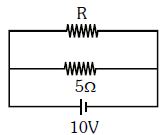
The power dissipated in the circuit shown in the figure is $30 \, W$. The value of $R$ is ............. $\Omega$.
A
$10$
B
$30$
C
$20$
D
$15$
Solution
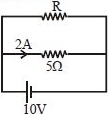
(A) The circuit consists of a $10 \, V$ voltage source connected in parallel to a resistor $R$ and a $5 \, \Omega$ resistor.
Since the resistors are in parallel,the voltage across each resistor is equal to the source voltage,$V = 10 \, V$.
The power dissipated in the $5 \, \Omega$ resistor is given by $P_1 = \frac{V^2}{R_1} = \frac{10^2}{5} = \frac{100}{5} = 20 \, W$.
The total power dissipated in the circuit is $P_{total} = 30 \, W$.
Therefore,the power dissipated in resistor $R$ is $P_R = P_{total} - P_1 = 30 - 20 = 10 \, W$.
Using the formula for power $P_R = \frac{V^2}{R}$,we have $10 = \frac{10^2}{R}$.
Solving for $R$,we get $R = \frac{100}{10} = 10 \, \Omega$.
Since the resistors are in parallel,the voltage across each resistor is equal to the source voltage,$V = 10 \, V$.
The power dissipated in the $5 \, \Omega$ resistor is given by $P_1 = \frac{V^2}{R_1} = \frac{10^2}{5} = \frac{100}{5} = 20 \, W$.
The total power dissipated in the circuit is $P_{total} = 30 \, W$.
Therefore,the power dissipated in resistor $R$ is $P_R = P_{total} - P_1 = 30 - 20 = 10 \, W$.
Using the formula for power $P_R = \frac{V^2}{R}$,we have $10 = \frac{10^2}{R}$.
Solving for $R$,we get $R = \frac{100}{10} = 10 \, \Omega$.
0 likesView Solution
77
ChemistryMCQAIPMT · 2012
The height at which the weight of a body becomes $1/16^{th}$ of its weight on the surface of the earth (radius $R$) is: (in $R$)
A
$3$
B
$4$
C
$5$
D
$15$
Solution
(A) The weight of a body at height $h$ is given by $W_h = m g_h$ and at the surface is $W = m g$.
Given that $W_h = \frac{1}{16} W$,it follows that $g_h = \frac{1}{16} g$.
The formula for acceleration due to gravity at height $h$ is $g_h = g \left( \frac{R}{R+h} \right)^2$.
Substituting the given values: $\frac{1}{16} g = g \left( \frac{R}{R+h} \right)^2$.
Taking the square root on both sides: $\frac{1}{4} = \frac{R}{R+h}$.
Cross-multiplying gives $R + h = 4R$.
Therefore,$h = 3R$.
Given that $W_h = \frac{1}{16} W$,it follows that $g_h = \frac{1}{16} g$.
The formula for acceleration due to gravity at height $h$ is $g_h = g \left( \frac{R}{R+h} \right)^2$.
Substituting the given values: $\frac{1}{16} g = g \left( \frac{R}{R+h} \right)^2$.
Taking the square root on both sides: $\frac{1}{4} = \frac{R}{R+h}$.
Cross-multiplying gives $R + h = 4R$.
Therefore,$h = 3R$.
0 likesView Solution
78
ChemistryMCQAIPMT · 2012
In a $CE$ transistor amplifier,the audio signal voltage across the collector resistance of $2\,k\Omega$ is $2\,V$. If the base resistance is $1\,k\Omega$ and the current amplification of the transistor is $100$,the input signal voltage is
A
$0.1\,V$
B
$1\,V$
C
$1\,mV$
D
$10\,mV$
Solution
(D) The voltage gain $A_v$ of a $CE$ transistor amplifier is given by the product of current gain $\beta$ and the resistance gain $\frac{R_L}{R_i}$.
$A_v = \beta \times \frac{R_L}{R_i}$
Given: $\beta = 100$,$R_L = 2\,k\Omega$,$R_i = 1\,k\Omega$,and $V_{out} = 2\,V$.
The relationship between input voltage $V_{in}$ and output voltage $V_{out}$ is $V_{out} = A_v \times V_{in}$.
Substituting the values: $2 = (100 \times \frac{2\,k\Omega}{1\,k\Omega}) \times V_{in}$.
$2 = 100 \times 2 \times V_{in}$.
$2 = 200 \times V_{in}$.
$V_{in} = \frac{2}{200} = 0.01\,V$.
Converting to millivolts: $V_{in} = 0.01 \times 1000\,mV = 10\,mV$.
$A_v = \beta \times \frac{R_L}{R_i}$
Given: $\beta = 100$,$R_L = 2\,k\Omega$,$R_i = 1\,k\Omega$,and $V_{out} = 2\,V$.
The relationship between input voltage $V_{in}$ and output voltage $V_{out}$ is $V_{out} = A_v \times V_{in}$.
Substituting the values: $2 = (100 \times \frac{2\,k\Omega}{1\,k\Omega}) \times V_{in}$.
$2 = 100 \times 2 \times V_{in}$.
$2 = 200 \times V_{in}$.
$V_{in} = \frac{2}{200} = 0.01\,V$.
Converting to millivolts: $V_{in} = 0.01 \times 1000\,mV = 10\,mV$.
0 likesView Solution
79
ChemistryMCQAIPMT · 2012
The electric field associated with an $e.m.$ wave in vacuum is given by $\vec E = \hat i\,40\,\cos \left( {kz - 6 \times {{10}^8}\,t} \right)$,where $E$,$z$,and $t$ are in $V/m$,$m$,and $s$ respectively. The value of the wave vector $k$ is ....... $m^{-1}$.
A
$6$
B
$3$
C
$2$
D
$0.5$
Solution
(C) The standard equation for a plane electromagnetic wave is $\vec E = E_0 \cos(kz - \omega t)$.
Comparing this with the given equation $\vec E = \hat i\,40\, \cos(kz - 6 \times 10^8 t)$,we identify the angular frequency $\omega = 6 \times 10^8 \, rad/s$.
In a vacuum,the speed of light $c$ is related to the angular frequency $\omega$ and wave vector $k$ by the relation $c = \frac{\omega}{k}$.
Given $c = 3 \times 10^8 \, m/s$,we can solve for $k$:
$k = \frac{\omega}{c} = \frac{6 \times 10^8}{3 \times 10^8} = 2 \, m^{-1}$.
Thus,the value of the wave vector $k$ is $2 \, m^{-1}$.
Comparing this with the given equation $\vec E = \hat i\,40\, \cos(kz - 6 \times 10^8 t)$,we identify the angular frequency $\omega = 6 \times 10^8 \, rad/s$.
In a vacuum,the speed of light $c$ is related to the angular frequency $\omega$ and wave vector $k$ by the relation $c = \frac{\omega}{k}$.
Given $c = 3 \times 10^8 \, m/s$,we can solve for $k$:
$k = \frac{\omega}{c} = \frac{6 \times 10^8}{3 \times 10^8} = 2 \, m^{-1}$.
Thus,the value of the wave vector $k$ is $2 \, m^{-1}$.
0 likesView Solution
80
ChemistryMCQAIPMT · 2012
The transition from the state $n = 3$ to $n = 1$ in a hydrogen-like atom results in ultraviolet radiation. Infrared radiation will be obtained in the transition from
A
$4 \to 2$
B
$4 \to 3$
C
$2 \to 1$
D
$3 \to 2$
Solution
(B) The spectral series of a hydrogen-like atom are categorized based on the final energy level $n_f$ of the electron transition.
$1$. The Lyman series $(n_f = 1)$ results in ultraviolet $(U.V.)$ radiation.
$2$. The Balmer series $(n_f = 2)$ results in visible radiation.
$3$. The Paschen series $(n_f = 3)$ results in infrared $(I.R.)$ radiation.
Since the transition $n = 4 \to n = 3$ ends at the third energy level $(n_f = 3)$,it belongs to the Paschen series,which produces infrared radiation.
Therefore,the correct option is $4 \to 3$.
$1$. The Lyman series $(n_f = 1)$ results in ultraviolet $(U.V.)$ radiation.
$2$. The Balmer series $(n_f = 2)$ results in visible radiation.
$3$. The Paschen series $(n_f = 3)$ results in infrared $(I.R.)$ radiation.
Since the transition $n = 4 \to n = 3$ ends at the third energy level $(n_f = 3)$,it belongs to the Paschen series,which produces infrared radiation.
Therefore,the correct option is $4 \to 3$.
0 likesView Solution
81
ChemistryMCQAIPMT · 2012
The half-life of a radioactive nucleus is $50 \ days$. The time interval $(t_2 - t_1)$ between the time $t_2$ when $\frac{2}{3}$ of it has decayed and the time $t_1$ when $\frac{1}{3}$ of it has decayed is ......... $days$.
A
$60$
B
$15$
C
$30$
D
$50$
Solution
(D) Let $N_0$ be the initial number of nuclei.
At time $t_1$,the amount decayed is $\frac{1}{3}N_0$,so the remaining amount is $N(t_1) = N_0 - \frac{1}{3}N_0 = \frac{2}{3}N_0$.
Using the decay law $N(t) = N_0 (\frac{1}{2})^{t/T_{1/2}}$,we have $\frac{2}{3}N_0 = N_0 (\frac{1}{2})^{t_1/50}$,which implies $(\frac{1}{2})^{t_1/50} = \frac{2}{3}$.
At time $t_2$,the amount decayed is $\frac{2}{3}N_0$,so the remaining amount is $N(t_2) = N_0 - \frac{2}{3}N_0 = \frac{1}{3}N_0$.
Using the decay law,$\frac{1}{3}N_0 = N_0 (\frac{1}{2})^{t_2/50}$,which implies $(\frac{1}{2})^{t_2/50} = \frac{1}{3}$.
Dividing the two equations: $\frac{(\frac{1}{2})^{t_1/50}}{(\frac{1}{2})^{t_2/50}} = \frac{2/3}{1/3} = 2$.
This simplifies to $(\frac{1}{2})^{(t_1-t_2)/50} = 2^1$,or $2^{(t_2-t_1)/50} = 2^1$.
Therefore,$\frac{t_2 - t_1}{50} = 1$,which gives $t_2 - t_1 = 50 \ days$.
At time $t_1$,the amount decayed is $\frac{1}{3}N_0$,so the remaining amount is $N(t_1) = N_0 - \frac{1}{3}N_0 = \frac{2}{3}N_0$.
Using the decay law $N(t) = N_0 (\frac{1}{2})^{t/T_{1/2}}$,we have $\frac{2}{3}N_0 = N_0 (\frac{1}{2})^{t_1/50}$,which implies $(\frac{1}{2})^{t_1/50} = \frac{2}{3}$.
At time $t_2$,the amount decayed is $\frac{2}{3}N_0$,so the remaining amount is $N(t_2) = N_0 - \frac{2}{3}N_0 = \frac{1}{3}N_0$.
Using the decay law,$\frac{1}{3}N_0 = N_0 (\frac{1}{2})^{t_2/50}$,which implies $(\frac{1}{2})^{t_2/50} = \frac{1}{3}$.
Dividing the two equations: $\frac{(\frac{1}{2})^{t_1/50}}{(\frac{1}{2})^{t_2/50}} = \frac{2/3}{1/3} = 2$.
This simplifies to $(\frac{1}{2})^{(t_1-t_2)/50} = 2^1$,or $2^{(t_2-t_1)/50} = 2^1$.
Therefore,$\frac{t_2 - t_1}{50} = 1$,which gives $t_2 - t_1 = 50 \ days$.
0 likesView Solution
82
ChemistryMCQAIPMT · 2012
$A$ train moving at a speed of $220\, ms^{-1}$ towards a stationary object,emits a sound of frequency $1000\, Hz$. Some of the sound reaching the object gets reflected back to the train as echo. The frequency of the echo as detected by the driver of the train is .... $Hz$ (speed of sound in air is $330\, ms^{-1}$)
A
$3500$
B
$4000$
C
$5000$
D
$3000$
Solution
(C) The frequency of the echo detected by the driver of the train is calculated using the Doppler effect formula for a moving source and a moving observer.
Here,the train acts as both the source and the observer.
Let $v = 330\, ms^{-1}$ be the speed of sound and $u = 220\, ms^{-1}$ be the speed of the train.
When the sound travels from the train to the stationary object,the object receives a frequency $f_1 = f \left( \frac{v}{v-u} \right)$.
This object then reflects the sound,acting as a stationary source,and the train (moving observer) receives the echo with frequency $f' = f_1 \left( \frac{v+u}{v} \right)$.
Substituting $f_1$ into the equation for $f'$,we get:
$f' = f \left( \frac{v}{v-u} \right) \left( \frac{v+u}{v} \right) = f \left( \frac{v+u}{v-u} \right)$.
Substituting the given values:
$f' = 1000 \left( \frac{330+220}{330-220} \right) = 1000 \left( \frac{550}{110} \right) = 1000 \times 5 = 5000\, Hz$.
Here,the train acts as both the source and the observer.
Let $v = 330\, ms^{-1}$ be the speed of sound and $u = 220\, ms^{-1}$ be the speed of the train.
When the sound travels from the train to the stationary object,the object receives a frequency $f_1 = f \left( \frac{v}{v-u} \right)$.
This object then reflects the sound,acting as a stationary source,and the train (moving observer) receives the echo with frequency $f' = f_1 \left( \frac{v+u}{v} \right)$.
Substituting $f_1$ into the equation for $f'$,we get:
$f' = f \left( \frac{v}{v-u} \right) \left( \frac{v+u}{v} \right) = f \left( \frac{v+u}{v-u} \right)$.
Substituting the given values:
$f' = 1000 \left( \frac{330+220}{330-220} \right) = 1000 \left( \frac{550}{110} \right) = 1000 \times 5 = 5000\, Hz$.
0 likesView Solution
83
ChemistryMCQAIPMT · 2012
The most abundant prokaryotes helpful to humans in making curd from milk and in production of antibiotics are categorised as
A
cyanobacteria
B
archaebacteria
C
chemosynthetic autotrophs
D
heterotrophic bacteria
Solution
(D) Heterotrophic bacteria are the most abundant bacteria in nature.
They play a significant role in human life,such as helping in the production of curd from milk (e.g.,$Lactobacillus$) and the production of antibiotics (e.g.,$Streptomyces$).
Therefore,the correct category is heterotrophic bacteria.
They play a significant role in human life,such as helping in the production of curd from milk (e.g.,$Lactobacillus$) and the production of antibiotics (e.g.,$Streptomyces$).
Therefore,the correct category is heterotrophic bacteria.
0 likesView Solution
84
ChemistryMCQAIPMT · 2012
The supportive skeletal structures in the human external ears and in the nose tip are examples of
A
ligament
B
areolar tissue
C
bone
D
cartilage
Solution
(D) Cartilage is a specialized type of connective tissue. It is flexible and provides structural support to various body parts. In humans,it is found in the external ears (pinna),the tip of the nose,the joints between adjacent bones of the vertebral column,and in the limbs and hands in adults.
0 likesView Solution
85
ChemistryMCQAIPMT · 2012
Which one of the following is correctly matched?
A
Ginger - Sucker
B
Chlamydomonas - Conidia
C
Yeast - Zoospores
D
Onion - Bulb
Solution
(D) In biological reproduction,different organisms use specific vegetative or asexual structures for propagation.
$1$. Ginger reproduces vegetatively through rhizomes,not suckers.
$2$. Chlamydomonas produces zoospores (motile spores) for asexual reproduction,not conidia.
$3$. Yeast reproduces primarily by budding,not zoospores.
$4$. Onion reproduces vegetatively through a bulb,which is a modified underground stem. Therefore,this is the correctly matched pair.
$1$. Ginger reproduces vegetatively through rhizomes,not suckers.
$2$. Chlamydomonas produces zoospores (motile spores) for asexual reproduction,not conidia.
$3$. Yeast reproduces primarily by budding,not zoospores.
$4$. Onion reproduces vegetatively through a bulb,which is a modified underground stem. Therefore,this is the correctly matched pair.
0 likesView Solution
86
ChemistryMCQAIPMT · 2012
The Test-tube Baby Programme employs which one of the following techniques?
A
Intra uterine insemination $(IUI)$
B
Gamete intra fallopian transfer $(GIFT)$
C
Zygote intra fallopian transfer $(ZIFT)$
D
Intra cytoplasmic sperm injection $(ICSI)$
Solution
(C) The Test-tube Baby Programme refers to the process of In Vitro Fertilization $(IVF)$,where fertilization occurs outside the body in a laboratory setting.
Following fertilization,the zygote or early embryo (up to $8$ blastomeres) is transferred into the fallopian tube,a technique known as Zygote Intra Fallopian Transfer $(ZIFT)$.
Therefore,the $ZIFT$ technique is specifically employed in the Test-tube Baby Programme to assist in conception.
Following fertilization,the zygote or early embryo (up to $8$ blastomeres) is transferred into the fallopian tube,a technique known as Zygote Intra Fallopian Transfer $(ZIFT)$.
Therefore,the $ZIFT$ technique is specifically employed in the Test-tube Baby Programme to assist in conception.
0 likesView Solution
87
ChemistryMCQAIPMT · 2012
Yeast is used in the production of
A
Citric acid and lactic acid
B
Lipase and pectinase
C
Bread and beer
D
Cheese and butter
Solution
(C) Bread is produced through the fermentation process by $Saccharomyces$ $cerevisiae$,commonly known as baker's yeast.
Similarly,$Saccharomyces$ $cerevisiae$ is also used in the production of alcoholic beverages like beer and wine,where it is referred to as brewer's yeast.
Therefore,yeast is essential for both bread and beer production.
Similarly,$Saccharomyces$ $cerevisiae$ is also used in the production of alcoholic beverages like beer and wine,where it is referred to as brewer's yeast.
Therefore,yeast is essential for both bread and beer production.
0 likesView Solution
88
ChemistryMCQAIPMT · 2012
Consumption of which one of the following foods can prevent the kind of blindness associated with vitamin-$A$ deficiency?
A
Flavr Savr tomato
B
Canola
C
Golden rice
D
Bt brinjal
Solution
(C) Golden rice,a variety of $Oryza$ $sativa$,is produced through the genetic engineering of the biosynthesis of beta-carotene,which is a precursor of provitamin-$A$ in the edible parts of the rice grain.
Research leading to the development of golden rice was conducted with the primary goal of helping children in developing countries who suffer from vitamin-$A$ deficiency and associated blindness.
Golden rice has been engineered to be nutritionally enhanced,providing a sustainable solution to combat vitamin-$A$ deficiency in populations dependent on rice as a staple food.
Research leading to the development of golden rice was conducted with the primary goal of helping children in developing countries who suffer from vitamin-$A$ deficiency and associated blindness.
Golden rice has been engineered to be nutritionally enhanced,providing a sustainable solution to combat vitamin-$A$ deficiency in populations dependent on rice as a staple food.
0 likesView Solution
89
ChemistryMCQAIPMT · 2012
Which one of the following is not a functional unit of an ecosystem?
A
Productivity
B
Stratification
C
Energy flow
D
Decomposition
Solution
(B) The functional units of an ecosystem include productivity,decomposition,energy flow,and nutrient cycling.
Vertical distribution of different species occupying different levels is called stratification.
For example,in a forest ecosystem,trees occupy the top vertical strata,shrubs occupy the second,and herbs/grasses occupy the bottom layer.
Therefore,stratification is a structural component of an ecosystem,not a functional unit.
Vertical distribution of different species occupying different levels is called stratification.
For example,in a forest ecosystem,trees occupy the top vertical strata,shrubs occupy the second,and herbs/grasses occupy the bottom layer.
Therefore,stratification is a structural component of an ecosystem,not a functional unit.
0 likesView Solution
90
ChemistryMCQAIPMT · 2012
The domestic sewage in large cities
A
Has a high $BOD$ as it contains both aerobic and anaerobic bacteria
B
Is processed by aerobic and then anaerobic bacteria in the secondary treatment in Sewage Treatment Plants $(STPs)$
C
When treated in $STPs$ does not really require the aeration step as the sewage contains adequate oxygen
D
Has very low amounts of suspended solids and dissolved salts
Solution
(B) The domestic sewage in large cities undergoes secondary treatment in Sewage Treatment Plants $(STPs)$.
In this process,the primary effluent is passed into large aeration tanks where it is constantly agitated mechanically and air is pumped into it.
This allows vigorous growth of useful aerobic microbes into flocs,which consume the major part of the organic matter in the effluent,significantly reducing the $BOD$.
Once the $BOD$ of sewage is reduced,the effluent is passed into a settling tank where the bacterial flocs are allowed to sediment.
This sediment is called activated sludge.
$A$ small part of the activated sludge is pumped back into the aeration tank to serve as the inoculum,while the remaining major part is pumped into large tanks called anaerobic sludge digesters.
In these digesters,other kinds of bacteria,which grow anaerobically,digest the bacteria and the fungi in the sludge,producing gases such as methane,hydrogen sulfide,and carbon dioxide.
In this process,the primary effluent is passed into large aeration tanks where it is constantly agitated mechanically and air is pumped into it.
This allows vigorous growth of useful aerobic microbes into flocs,which consume the major part of the organic matter in the effluent,significantly reducing the $BOD$.
Once the $BOD$ of sewage is reduced,the effluent is passed into a settling tank where the bacterial flocs are allowed to sediment.
This sediment is called activated sludge.
$A$ small part of the activated sludge is pumped back into the aeration tank to serve as the inoculum,while the remaining major part is pumped into large tanks called anaerobic sludge digesters.
In these digesters,other kinds of bacteria,which grow anaerobically,digest the bacteria and the fungi in the sludge,producing gases such as methane,hydrogen sulfide,and carbon dioxide.
0 likesView Solution
91
ChemistryMCQAIPMT · 2012
If the radius of a star is $R$ and it acts as a black body,what would be the temperature of the star,in which the rate of energy production is $Q$? ( $\sigma$ stands for Stefan's constant.)
A
$\left(\frac{4 \pi R^2 Q}{\sigma}\right)^{1 / 4}$
B
$\left(\frac{Q}{4 \pi R^2 \sigma}\right)^{1 / 4}$
C
$\frac{Q}{4 \pi R^2 \sigma}$
D
$\left(\frac{Q}{4 \pi R^2 \sigma}\right)^{-1 / 2}$
Solution
(B) According to the Stefan-Boltzmann law,the power radiated by a black body is given by $H = \sigma A T^4$,where $A$ is the surface area of the body.
For a star of radius $R$,the surface area is $A = 4 \pi R^2$.
Given that the rate of energy production is $Q$,we have $Q = \sigma (4 \pi R^2) T^4$.
Rearranging the equation to solve for the temperature $T$:
$T^4 = \frac{Q}{4 \pi R^2 \sigma}$.
Taking the fourth root on both sides:
$T = \left( \frac{Q}{4 \pi R^2 \sigma} \right)^{1/4}$.
For a star of radius $R$,the surface area is $A = 4 \pi R^2$.
Given that the rate of energy production is $Q$,we have $Q = \sigma (4 \pi R^2) T^4$.
Rearranging the equation to solve for the temperature $T$:
$T^4 = \frac{Q}{4 \pi R^2 \sigma}$.
Taking the fourth root on both sides:
$T = \left( \frac{Q}{4 \pi R^2 \sigma} \right)^{1/4}$.
0 likesView Solution
92
ChemistryMCQAIPMT · 2012
Which of the following statements is not true?
A
$K_2Cr_2O_7$ solution in acidic medium is orange
B
$K_2Cr_2O_7$ solution becomes yellow on increasing the $pH$ beyond $7$
C
On passing $H_2S$ through acidified $K_2Cr_2O_7$ solution,a milky colour is observed
D
$Na_2Cr_2O_7$ is preferred over $K_2Cr_2O_7$ in volumetric analysis
Solution
(D) $K_2Cr_2O_7$ is preferred over $Na_2Cr_2O_7$ in volumetric analysis because $Na_2Cr_2O_7$ is hygroscopic in nature,meaning it absorbs moisture from the atmosphere,which makes it difficult to prepare a standard solution of known concentration. Therefore,the statement that $Na_2Cr_2O_7$ is preferred is incorrect.
0 likesView Solution
93
ChemistryMCQAIPMT · 2012
The transition from the state $n=3$ to $n=1$ in a hydrogen-like atom results in ultraviolet radiation. Infrared radiation will be obtained in the transition from:
A
$4 \longrightarrow 2$
B
$4 \longrightarrow 3$
C
$2 \longrightarrow 1$
D
$3 \longrightarrow 2$
Solution
(B) The spectral series of a hydrogen-like atom are classified based on the final energy level $n_f$ of the electron transition.
$1$. Lyman series $(n_f = 1)$: Produces ultraviolet $(U.V.)$ radiation.
$2$. Balmer series $(n_f = 2)$: Produces visible radiation.
$3$. Paschen series $(n_f = 3)$: Produces infrared $(I.R.)$ radiation.
Since the transition $n=3$ to $n=1$ results in $U.V.$ radiation (Lyman series),we look for a transition that results in infrared radiation.
The Paschen series corresponds to transitions ending at $n_f = 3$. Therefore,the transition $4 \longrightarrow 3$ belongs to the Paschen series and results in infrared radiation.
$1$. Lyman series $(n_f = 1)$: Produces ultraviolet $(U.V.)$ radiation.
$2$. Balmer series $(n_f = 2)$: Produces visible radiation.
$3$. Paschen series $(n_f = 3)$: Produces infrared $(I.R.)$ radiation.
Since the transition $n=3$ to $n=1$ results in $U.V.$ radiation (Lyman series),we look for a transition that results in infrared radiation.
The Paschen series corresponds to transitions ending at $n_f = 3$. Therefore,the transition $4 \longrightarrow 3$ belongs to the Paschen series and results in infrared radiation.
0 likesView Solution
94
ChemistryMCQAIPMT · 2012
Monascus purpureus is a yeast used commercially in the production of :
A
Ethanol
B
Streptokinase for removing clots from the blood vessels
C
Citric acid
D
Blood cholesterol lowering statins
Solution
(D) $Monascus purpureus$ is a species of yeast that is commercially used in the production of statins.
Statins are bioactive molecules that act as competitive inhibitors of the enzyme responsible for the synthesis of cholesterol.
These are used as blood-cholesterol-lowering agents in patients.
Therefore, the correct option is $D$.
Statins are bioactive molecules that act as competitive inhibitors of the enzyme responsible for the synthesis of cholesterol.
These are used as blood-cholesterol-lowering agents in patients.
Therefore, the correct option is $D$.
0 likesView Solution
Vedclass Products
For Students
Vedclass Test Series
Mock tests in real AIPMT style covering Chemistry with performance analysis. 5-day free trial.
Start Free TrialFor Teachers
Exam Paper Generator
Generate Set A/B/C/D Chemistry papers from 7.5L+ questions in 2 minutes. 3 chapters free.
Try FreeFor Institutes
Online Exam Module
Run live AIPMT mock exams with unlimited students, 360° analytics & white-label branding.
See DemoFrequently Asked Questions
How many Chemistry questions are in AIPMT 2012?
There are 141 Chemistry questions from the AIPMT 2012 paper on Vedclass, each with a detailed step-by-step solution in English.
Are AIPMT 2012 Chemistry solutions available in English?
Yes. All solutions on this page are in English. You can also switch to English or Hindi using the language buttons above the questions.
Can I practice AIPMT 2012 Chemistry as a timed test?
Yes. Use the Vedclass Test Series to attempt a full AIPMT mock test covering Chemistry with time limits and instant score analysis.
Can teachers create Chemistry papers from AIPMT previous year questions?
Yes. The Vedclass Exam Paper Generator lets teachers mix AIPMT Chemistry questions and generate Set A/B/C/D papers in minutes.
For Teachers & Institutes
Build a Custom Chemistry Paper
Pick AIPMT 2012 Chemistry questions, set difficulty, and generate Set A/B/C/D in 2 minutes.