
PhysicsQ1–48 of 48 questions
Page 1 of 1 · English
1
PhysicsMediumMCQAIPMT · 2005
If a vector $2\hat i + 3\hat j + 8\hat k$ is perpendicular to the vector $4\hat j - 4\hat i + \alpha \hat k$,then the value of $\alpha$ is:
A
$-1$
B
$0.5$
C
$-0.5$
D
$1$
Solution
(C) Let the two vectors be $\overrightarrow{A} = 2\hat{i} + 3\hat{j} + 8\hat{k}$ and $\overrightarrow{B} = -4\hat{i} + 4\hat{j} + \alpha\hat{k}$.
Since the vectors are perpendicular,their dot product must be zero,i.e.,$\overrightarrow{A} \cdot \overrightarrow{B} = 0$.
Calculating the dot product:
$(2\hat{i} + 3\hat{j} + 8\hat{k}) \cdot (-4\hat{i} + 4\hat{j} + \alpha\hat{k}) = 0$
$(2)(-4) + (3)(4) + (8)(\alpha) = 0$
$-8 + 12 + 8\alpha = 0$
$4 + 8\alpha = 0$
$8\alpha = -4$
$\alpha = -4/8 = -0.5$.
Since the vectors are perpendicular,their dot product must be zero,i.e.,$\overrightarrow{A} \cdot \overrightarrow{B} = 0$.
Calculating the dot product:
$(2\hat{i} + 3\hat{j} + 8\hat{k}) \cdot (-4\hat{i} + 4\hat{j} + \alpha\hat{k}) = 0$
$(2)(-4) + (3)(4) + (8)(\alpha) = 0$
$-8 + 12 + 8\alpha = 0$
$4 + 8\alpha = 0$
$8\alpha = -4$
$\alpha = -4/8 = -0.5$.
0 likesView Solution
2
PhysicsMediumMCQAIPMT · 2005
The angle between the vectors $\overrightarrow{A}$ and $\overrightarrow{B}$ is $\theta$. The value of the triple product $\overrightarrow{A} \cdot (\overrightarrow{B} \times \overrightarrow{A})$ is
A
$A^2 B$
B
Zero
C
$A^2 B \sin \theta$
D
$A^2 B \cos \theta$
Solution
(B) The expression given is a scalar triple product of the form $\overrightarrow{A} \cdot (\overrightarrow{B} \times \overrightarrow{A})$.
By the properties of the cross product,the vector $\overrightarrow{C} = (\overrightarrow{B} \times \overrightarrow{A})$ is perpendicular to both $\overrightarrow{A}$ and $\overrightarrow{B}$.
Since $\overrightarrow{C}$ is perpendicular to $\overrightarrow{A}$,the dot product of $\overrightarrow{A}$ and $\overrightarrow{C}$ must be zero.
Mathematically,$\overrightarrow{A} \cdot (\overrightarrow{B} \times \overrightarrow{A}) = 0$ because the vector $(\overrightarrow{B} \times \overrightarrow{A})$ lies in a plane perpendicular to $\overrightarrow{A}$.
By the properties of the cross product,the vector $\overrightarrow{C} = (\overrightarrow{B} \times \overrightarrow{A})$ is perpendicular to both $\overrightarrow{A}$ and $\overrightarrow{B}$.
Since $\overrightarrow{C}$ is perpendicular to $\overrightarrow{A}$,the dot product of $\overrightarrow{A}$ and $\overrightarrow{C}$ must be zero.
Mathematically,$\overrightarrow{A} \cdot (\overrightarrow{B} \times \overrightarrow{A}) = 0$ because the vector $(\overrightarrow{B} \times \overrightarrow{A})$ lies in a plane perpendicular to $\overrightarrow{A}$.
0 likesView Solution
3
PhysicsMediumMCQAIPMT · 2005
The ratio of the dimension of Planck's constant and that of moment of inertia is the dimension of
A
Frequency
B
Velocity
C
Angular momentum
D
Time
Solution
(A) The dimension of Planck's constant $(h)$ is $[ML^2T^{-1}]$.
The dimension of moment of inertia $(I)$ is $[ML^2]$.
Taking the ratio of the two:
$\frac{[h]}{[I]} = \frac{[ML^2T^{-1}]}{[ML^2]} = [T^{-1}]$.
Since the dimension $[T^{-1}]$ corresponds to frequency,the correct option is $A$.
The dimension of moment of inertia $(I)$ is $[ML^2]$.
Taking the ratio of the two:
$\frac{[h]}{[I]} = \frac{[ML^2T^{-1}]}{[ML^2]} = [T^{-1}]$.
Since the dimension $[T^{-1}]$ corresponds to frequency,the correct option is $A$.
1 likesView Solution
4
PhysicsDifficultMCQAIPMT · 2005
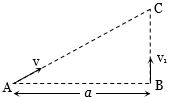
Two boys are standing at the ends $A$ and $B$ of a ground where $AB = a$. The boy at $B$ starts running in a direction perpendicular to $AB$ with velocity $v_1$. The boy at $A$ starts running simultaneously with velocity $v$ and catches the other boy in a time $t$,where $t$ is
A
$a/\sqrt{v^2 + v_1^2}$
B
$\sqrt{a^2 / (v^2 - v_1^2)}$
C
$a / (v - v_1)$
D
$a / (v + v_1)$
Solution
(B) Let the two boys meet at point $C$ after time $t$ from the start.
In time $t$,the boy from $B$ covers distance $BC = v_1 t$.
The boy from $A$ covers distance $AC = v t$.
Since the boy at $B$ runs perpendicular to $AB$,$\triangle ABC$ is a right-angled triangle with $\angle B = 90^{\circ}$.
Using the Pythagorean theorem: $(AC)^2 = (AB)^2 + (BC)^2$.
Substituting the values: $(vt)^2 = a^2 + (v_1 t)^2$.
$v^2 t^2 - v_1^2 t^2 = a^2$.
$t^2 (v^2 - v_1^2) = a^2$.
$t = \sqrt{\frac{a^2}{v^2 - v_1^2}}$.
In time $t$,the boy from $B$ covers distance $BC = v_1 t$.
The boy from $A$ covers distance $AC = v t$.
Since the boy at $B$ runs perpendicular to $AB$,$\triangle ABC$ is a right-angled triangle with $\angle B = 90^{\circ}$.
Using the Pythagorean theorem: $(AC)^2 = (AB)^2 + (BC)^2$.
Substituting the values: $(vt)^2 = a^2 + (v_1 t)^2$.
$v^2 t^2 - v_1^2 t^2 = a^2$.
$t^2 (v^2 - v_1^2) = a^2$.
$t = \sqrt{\frac{a^2}{v^2 - v_1^2}}$.
0 likesView Solution
5
PhysicsDifficultMCQAIPMT · 2005
The displacement $x$ of a particle varies with time $t$ as $x = a e^{-\alpha t} + b e^{\beta t}$,where $a, b, \alpha, \text{and } \beta$ are positive constants. The velocity of the particle will:
A
Go on decreasing with time
B
Be independent of $\alpha$ and $\beta$
C
Drop to zero when $\alpha = \beta$
D
Go on increasing with time
Solution
(D) Given displacement $x = a e^{-\alpha t} + b e^{\beta t}$.
Velocity $v$ is the rate of change of displacement with respect to time:
$v = \frac{dx}{dt} = \frac{d}{dt}(a e^{-\alpha t} + b e^{\beta t})$
$v = -a\alpha e^{-\alpha t} + b\beta e^{\beta t}$.
To determine how velocity changes with time,we find the acceleration $a_{acc}$:
$a_{acc} = \frac{dv}{dt} = \frac{d}{dt}(-a\alpha e^{-\alpha t} + b\beta e^{\beta t})$
$a_{acc} = a\alpha^2 e^{-\alpha t} + b\beta^2 e^{\beta t}$.
Since $a, b, \alpha, \beta$ are positive constants and the exponential functions $e^{-\alpha t}$ and $e^{\beta t}$ are always positive for any time $t$,the acceleration $a_{acc}$ is always positive.
Because the acceleration is positive,the velocity $v$ will go on increasing with time.
Velocity $v$ is the rate of change of displacement with respect to time:
$v = \frac{dx}{dt} = \frac{d}{dt}(a e^{-\alpha t} + b e^{\beta t})$
$v = -a\alpha e^{-\alpha t} + b\beta e^{\beta t}$.
To determine how velocity changes with time,we find the acceleration $a_{acc}$:
$a_{acc} = \frac{dv}{dt} = \frac{d}{dt}(-a\alpha e^{-\alpha t} + b\beta e^{\beta t})$
$a_{acc} = a\alpha^2 e^{-\alpha t} + b\beta^2 e^{\beta t}$.
Since $a, b, \alpha, \beta$ are positive constants and the exponential functions $e^{-\alpha t}$ and $e^{\beta t}$ are always positive for any time $t$,the acceleration $a_{acc}$ is always positive.
Because the acceleration is positive,the velocity $v$ will go on increasing with time.
0 likesView Solution
6
PhysicsMediumMCQAIPMT · 2005
$A$ ball is thrown vertically upward. It has a speed of $10 \; m/s$ when it has reached one-half of its maximum height. How high does the ball rise? (Take $g = 10 \; m/s^2$)
A
$5$
B
$10$
C
$15$
D
$20$
Solution
(B) Let the initial velocity be $u$ and the maximum height be $H$. The maximum height is given by $H = \frac{u^2}{2g}$.
At height $h = \frac{H}{2}$,the velocity $v = 10 \; m/s$.
Using the equation of motion $v^2 = u^2 - 2gh$:
$(10)^2 = u^2 - 2g \left( \frac{H}{2} \right)$
$100 = u^2 - gH$
Substitute $H = \frac{u^2}{2g}$ into the equation:
$100 = u^2 - g \left( \frac{u^2}{2g} \right)$
$100 = u^2 - \frac{u^2}{2} = \frac{u^2}{2}$
$u^2 = 200 \; m^2/s^2$.
Now,calculate the maximum height $H$:
$H = \frac{u^2}{2g} = \frac{200}{2 \times 10} = \frac{200}{20} = 10 \; m$.
At height $h = \frac{H}{2}$,the velocity $v = 10 \; m/s$.
Using the equation of motion $v^2 = u^2 - 2gh$:
$(10)^2 = u^2 - 2g \left( \frac{H}{2} \right)$
$100 = u^2 - gH$
Substitute $H = \frac{u^2}{2g}$ into the equation:
$100 = u^2 - g \left( \frac{u^2}{2g} \right)$
$100 = u^2 - \frac{u^2}{2} = \frac{u^2}{2}$
$u^2 = 200 \; m^2/s^2$.
Now,calculate the maximum height $H$:
$H = \frac{u^2}{2g} = \frac{200}{2 \times 10} = \frac{200}{20} = 10 \; m$.
1 likesView Solution
7
PhysicsMediumMCQAIPMT · 2005
$A$ stone tied to the end of a string $1\,m$ long is whirled in a horizontal circle with a constant speed. If the stone makes $22$ revolutions in $44$ seconds,what is the magnitude and direction of the acceleration of the stone?
A
$\frac{\pi^2}{4}\,m/s^2$ and direction along the radius towards the centre
B
$\pi^2\,m/s^2$ and direction along the radius away from the centre
C
$\pi^2\,m/s^2$ and direction along the radius towards the centre
D
$\pi^2\,m/s^2$ and direction along the tangent to the circle
Solution
(C) The length of the string is the radius of the circular path,$r = 1\,m$.
The frequency of revolution $n$ is given by $n = \frac{\text{number of revolutions}}{\text{time}} = \frac{22}{44} = 0.5\,Hz$.
The angular velocity $\omega$ is given by $\omega = 2\pi n = 2\pi(0.5) = \pi\,rad/s$.
The centripetal acceleration $a$ is given by $a = \omega^2 r$.
Substituting the values,$a = (\pi)^2 \times 1 = \pi^2\,m/s^2$.
In uniform circular motion,the acceleration is centripetal,meaning its direction is always along the radius and towards the centre.
The frequency of revolution $n$ is given by $n = \frac{\text{number of revolutions}}{\text{time}} = \frac{22}{44} = 0.5\,Hz$.
The angular velocity $\omega$ is given by $\omega = 2\pi n = 2\pi(0.5) = \pi\,rad/s$.
The centripetal acceleration $a$ is given by $a = \omega^2 r$.
Substituting the values,$a = (\pi)^2 \times 1 = \pi^2\,m/s^2$.
In uniform circular motion,the acceleration is centripetal,meaning its direction is always along the radius and towards the centre.
0 likesView Solution
8
PhysicsMediumMCQAIPMT · 2005
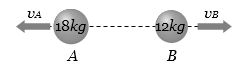
$A$ bomb of mass $30 \, kg$ at rest explodes into two pieces of masses $18 \, kg$ and $12 \, kg$. The velocity of the $18 \, kg$ mass is $6 \, m/s$. The kinetic energy of the other mass is ....... $J$.
A
$256$
B
$486$
C
$524$
D
$324$
Solution
(B) According to the law of conservation of linear momentum,the initial momentum of the bomb is zero.
Therefore,the final momentum of the two pieces must be equal in magnitude and opposite in direction.
Let $m_A = 18 \, kg$,$v_A = 6 \, m/s$ and $m_B = 12 \, kg$.
$m_A v_A = m_B v_B$
$18 \times 6 = 12 \times v_B$
$v_B = \frac{108}{12} = 9 \, m/s$
The kinetic energy of the $12 \, kg$ mass is given by:
$K.E. = \frac{1}{2} m_B v_B^2$
$K.E. = \frac{1}{2} \times 12 \times (9)^2$
$K.E. = 6 \times 81 = 486 \, J$
Therefore,the final momentum of the two pieces must be equal in magnitude and opposite in direction.
Let $m_A = 18 \, kg$,$v_A = 6 \, m/s$ and $m_B = 12 \, kg$.
$m_A v_A = m_B v_B$
$18 \times 6 = 12 \times v_B$
$v_B = \frac{108}{12} = 9 \, m/s$
The kinetic energy of the $12 \, kg$ mass is given by:
$K.E. = \frac{1}{2} m_B v_B^2$
$K.E. = \frac{1}{2} \times 12 \times (9)^2$
$K.E. = 6 \times 81 = 486 \, J$
0 likesView Solution
9
PhysicsMediumMCQAIPMT · 2005
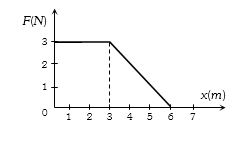
$A$ force $F$ acting on an object varies with distance $x$ as shown in the graph. The force is in newton $(N)$ and $x$ is in metre $(m)$. The work done by the force in moving the object from $x = 0$ to $x = 6\,m$ is......$J$.
A
$4.5$
B
$13.5$
C
$9$
D
$18$
Solution
(B) The work done by a variable force is equal to the area under the $F-x$ graph.
From the graph,the area is a trapezoid with parallel sides of length $3\,m$ (from $x=0$ to $x=3$) and $6\,m$ (from $x=0$ to $x=6$),and height $3\,N$.
Alternatively,the area can be calculated as the sum of a rectangle (from $x=0$ to $x=3$) and a triangle (from $x=3$ to $x=6$).
Area of rectangle = $3\,m \times 3\,N = 9\,J$.
Area of triangle = $\frac{1}{2} \times (6-3)\,m \times 3\,N = \frac{1}{2} \times 3 \times 3 = 4.5\,J$.
Total work done = $9\,J + 4.5\,J = 13.5\,J$.
From the graph,the area is a trapezoid with parallel sides of length $3\,m$ (from $x=0$ to $x=3$) and $6\,m$ (from $x=0$ to $x=6$),and height $3\,N$.
Alternatively,the area can be calculated as the sum of a rectangle (from $x=0$ to $x=3$) and a triangle (from $x=3$ to $x=6$).
Area of rectangle = $3\,m \times 3\,N = 9\,J$.
Area of triangle = $\frac{1}{2} \times (6-3)\,m \times 3\,N = \frac{1}{2} \times 3 \times 3 = 4.5\,J$.
Total work done = $9\,J + 4.5\,J = 13.5\,J$.
0 likesView Solution
10
PhysicsEasyMCQAIPMT · 2005
For a satellite moving in an orbit around the earth,the ratio of kinetic energy to potential energy is
A
$2$
B
$-1/2$
C
$1/\sqrt{2}$
D
$\sqrt{2}$
Solution
(B) The kinetic energy $(K)$ of a satellite of mass $m$ orbiting at a distance $r$ from the center of the Earth (mass $M$) is given by $K = \frac{GMm}{2r}$.
The potential energy $(U)$ of the satellite is given by $U = -\frac{GMm}{r}$.
The ratio of kinetic energy to potential energy is $\frac{K}{U} = \frac{GMm/2r}{-GMm/r} = -\frac{1}{2}$.
Note: The magnitude ratio is $1/2$,but considering the sign,the ratio is $-1/2$.
The potential energy $(U)$ of the satellite is given by $U = -\frac{GMm}{r}$.
The ratio of kinetic energy to potential energy is $\frac{K}{U} = \frac{GMm/2r}{-GMm/r} = -\frac{1}{2}$.
Note: The magnitude ratio is $1/2$,but considering the sign,the ratio is $-1/2$.
0 likesView Solution
11
PhysicsMediumMCQAIPMT · 2005
An ideal gas heat engine operates in a Carnot cycle between $227^{\circ}C$ and $127^{\circ}C$. It absorbs $6 \times 10^4 \text{ cal}$ of heat at the higher temperature. The amount of heat converted to work is ......... $\times 10^4 \text{ cal}$.
A
$2.4$
B
$6$
C
$1.2$
D
$4.8$
Solution
(C) The efficiency $\eta$ of a Carnot engine is given by $\eta = \frac{T_1 - T_2}{T_1} = \frac{W}{Q_1}$.
Here,$T_1 = 227^{\circ}C = 227 + 273 = 500 \text{ K}$ and $T_2 = 127^{\circ}C = 127 + 273 = 400 \text{ K}$.
The heat absorbed at the higher temperature is $Q_1 = 6 \times 10^4 \text{ cal}$.
Using the formula $W = Q_1 \left( \frac{T_1 - T_2}{T_1} \right)$:
$W = 6 \times 10^4 \times \left( \frac{500 - 400}{500} \right)$
$W = 6 \times 10^4 \times \left( \frac{100}{500} \right)$
$W = 6 \times 10^4 \times 0.2 = 1.2 \times 10^4 \text{ cal}$.
Thus,the amount of heat converted to work is $1.2 \times 10^4 \text{ cal}$.
Here,$T_1 = 227^{\circ}C = 227 + 273 = 500 \text{ K}$ and $T_2 = 127^{\circ}C = 127 + 273 = 400 \text{ K}$.
The heat absorbed at the higher temperature is $Q_1 = 6 \times 10^4 \text{ cal}$.
Using the formula $W = Q_1 \left( \frac{T_1 - T_2}{T_1} \right)$:
$W = 6 \times 10^4 \times \left( \frac{500 - 400}{500} \right)$
$W = 6 \times 10^4 \times \left( \frac{100}{500} \right)$
$W = 6 \times 10^4 \times 0.2 = 1.2 \times 10^4 \text{ cal}$.
Thus,the amount of heat converted to work is $1.2 \times 10^4 \text{ cal}$.
0 likesView Solution
12
PhysicsMediumMCQAIPMT · 2005
Which of the following processes is reversible?
A
Transfer of heat by radiation
B
Electrical heating of a nichrome wire
C
Transfer of heat by conduction
D
Isothermal compression
Solution
(D) process is reversible if it occurs infinitely slowly such that the system remains in thermodynamic equilibrium with its surroundings at every stage.
$(a)$ Heat transfer by radiation involves a temperature gradient and is irreversible.
$(b)$ Electrical heating (Joule heating) is irreversible due to the dissipation of energy as heat.
$(c)$ Heat transfer by conduction requires a temperature difference and is irreversible.
$(d)$ An isothermal compression of an ideal gas,if performed infinitely slowly,allows the system to remain in equilibrium,making it a reversible process.
$(a)$ Heat transfer by radiation involves a temperature gradient and is irreversible.
$(b)$ Electrical heating (Joule heating) is irreversible due to the dissipation of energy as heat.
$(c)$ Heat transfer by conduction requires a temperature difference and is irreversible.
$(d)$ An isothermal compression of an ideal gas,if performed infinitely slowly,allows the system to remain in equilibrium,making it a reversible process.
0 likesView Solution
13
PhysicsEasyMCQAIPMT · 2005
Which of the following circular rods (given radius $r$ and length $l$),each made of the same material and whose ends are maintained at the same temperature difference,will conduct the most heat?
A
$r = 2r_0; l = 2l_0$
B
$r = 2r_0; l = l_0$
C
$r = r_0; l = l_0$
D
$r = r_0; l = 2l_0$
Solution
(B) The rate of heat conduction $H$ through a rod is given by the formula $H = \frac{kA \Delta T}{l}$,where $k$ is the thermal conductivity,$A$ is the cross-sectional area,$\Delta T$ is the temperature difference,and $l$ is the length.
Since the material is the same,$k$ is constant. Since the temperature difference $\Delta T$ is the same,$H \propto \frac{A}{l}$.
For a circular rod,the cross-sectional area $A = \pi r^2$,so $H \propto \frac{r^2}{l}$.
Evaluating the ratio $\frac{r^2}{l}$ for each option:
$(a) \frac{(2r_0)^2}{2l_0} = \frac{4r_0^2}{2l_0} = 2 \frac{r_0^2}{l_0}$
$(b) \frac{(2r_0)^2}{l_0} = \frac{4r_0^2}{l_0} = 4 \frac{r_0^2}{l_0}$
$(c) \frac{r_0^2}{l_0} = 1 \frac{r_0^2}{l_0}$
$(d) \frac{r_0^2}{2l_0} = 0.5 \frac{r_0^2}{l_0}$
Comparing these values,option $(b)$ has the highest ratio,meaning it conducts the most heat.
Since the material is the same,$k$ is constant. Since the temperature difference $\Delta T$ is the same,$H \propto \frac{A}{l}$.
For a circular rod,the cross-sectional area $A = \pi r^2$,so $H \propto \frac{r^2}{l}$.
Evaluating the ratio $\frac{r^2}{l}$ for each option:
$(a) \frac{(2r_0)^2}{2l_0} = \frac{4r_0^2}{2l_0} = 2 \frac{r_0^2}{l_0}$
$(b) \frac{(2r_0)^2}{l_0} = \frac{4r_0^2}{l_0} = 4 \frac{r_0^2}{l_0}$
$(c) \frac{r_0^2}{l_0} = 1 \frac{r_0^2}{l_0}$
$(d) \frac{r_0^2}{2l_0} = 0.5 \frac{r_0^2}{l_0}$
Comparing these values,option $(b)$ has the highest ratio,meaning it conducts the most heat.
0 likesView Solution
14
PhysicsEasyMCQAIPMT · 2005
$A$ particle is moving in a circle with uniform speed. Its motion is
A
Periodic and simple harmonic
B
Periodic but not simple harmonic
C
Aperiodic
D
None of the above
Solution
(B) When a particle moves in a circle with uniform speed,it covers equal distances in equal intervals of time along the circumference.
Since it returns to the same position after a fixed time interval (the time period),the motion is periodic.
However,simple harmonic motion $(SHM)$ requires a restoring force proportional to the displacement from the mean position $(F = -kx)$,which is not the case for uniform circular motion.
Therefore,the motion is periodic but not simple harmonic.
Since it returns to the same position after a fixed time interval (the time period),the motion is periodic.
However,simple harmonic motion $(SHM)$ requires a restoring force proportional to the displacement from the mean position $(F = -kx)$,which is not the case for uniform circular motion.
Therefore,the motion is periodic but not simple harmonic.
0 likesView Solution
15
PhysicsEasyMCQAIPMT · 2005
$A$ particle executing simple harmonic motion of amplitude $5\, cm$ has a maximum speed of $31.4\, cm/s$. The frequency of its oscillation is ..... $Hz$.
A
$3$
B
$2$
C
$4$
D
$1$
Solution
(D) The maximum speed of a particle in simple harmonic motion is given by the formula $v_{\max} = a\omega$,where $a$ is the amplitude and $\omega$ is the angular frequency.
We know that $\omega = 2\pi n$,where $n$ is the frequency of oscillation.
Substituting the given values: $a = 5\, cm = 0.05\, m$ and $v_{\max} = 31.4\, cm/s = 0.314\, m/s$.
$v_{\max} = a \times 2\pi n$
$0.314 = 0.05 \times 2 \times 3.14 \times n$
$0.314 = 0.314 \times n$
$n = 1\, Hz$.
We know that $\omega = 2\pi n$,where $n$ is the frequency of oscillation.
Substituting the given values: $a = 5\, cm = 0.05\, m$ and $v_{\max} = 31.4\, cm/s = 0.314\, m/s$.
$v_{\max} = a \times 2\pi n$
$0.314 = 0.05 \times 2 \times 3.14 \times n$
$0.314 = 0.314 \times n$
$n = 1\, Hz$.
0 likesView Solution
16
PhysicsEasyMCQAIPMT · 2005
$A$ point source emits sound equally in all directions in a non-absorbing medium. Two points $P$ and $Q$ are at distances of $2 \ m$ and $3 \ m$ respectively from the source. The ratio of the intensities of the waves at $P$ and $Q$ is:
A
$9:4$
B
$2:3$
C
$3:2$
D
$4:9$
Solution
(A) The intensity $I$ of sound from a point source in a non-absorbing medium is inversely proportional to the square of the distance $r$ from the source,given by $I \propto \frac{1}{r^2}$.
Given distances are $r_P = 2 \ m$ and $r_Q = 3 \ m$.
The ratio of intensities at $P$ and $Q$ is $\frac{I_P}{I_Q} = \frac{r_Q^2}{r_P^2}$.
Substituting the values,we get $\frac{I_P}{I_Q} = \left( \frac{3}{2} \right)^2 = \frac{9}{4}$.
Thus,the ratio is $9:4$.
Given distances are $r_P = 2 \ m$ and $r_Q = 3 \ m$.
The ratio of intensities at $P$ and $Q$ is $\frac{I_P}{I_Q} = \frac{r_Q^2}{r_P^2}$.
Substituting the values,we get $\frac{I_P}{I_Q} = \left( \frac{3}{2} \right)^2 = \frac{9}{4}$.
Thus,the ratio is $9:4$.
0 likesView Solution
17
PhysicsMediumMCQAIPMT · 2005
Two vibrating tuning forks produce progressive waves given by $Y_1 = 4\sin(500\pi t)$ and $Y_2 = 2\sin(506\pi t)$. The number of beats produced per minute is:
A
$360$
B
$180$
C
$3$
D
$60$
Solution
(B) The given equations for the progressive waves are $Y_1 = 4\sin(500\pi t)$ and $Y_2 = 2\sin(506\pi t)$.
Comparing these with the standard equation $Y = A\sin(\omega t)$,we get angular frequencies $\omega_1 = 500\pi \text{ rad/s}$ and $\omega_2 = 506\pi \text{ rad/s}$.
The frequencies $n_1$ and $n_2$ are calculated using $\omega = 2\pi n$:
$n_1 = \frac{500\pi}{2\pi} = 250 \text{ Hz}$
$n_2 = \frac{506\pi}{2\pi} = 253 \text{ Hz}$
The beat frequency is the difference between the two frequencies: $f_b = n_2 - n_1 = 253 - 250 = 3 \text{ beats per second}$.
To find the number of beats per minute,we multiply the beats per second by $60$:
$\text{Beats per minute} = 3 \times 60 = 180$.
Comparing these with the standard equation $Y = A\sin(\omega t)$,we get angular frequencies $\omega_1 = 500\pi \text{ rad/s}$ and $\omega_2 = 506\pi \text{ rad/s}$.
The frequencies $n_1$ and $n_2$ are calculated using $\omega = 2\pi n$:
$n_1 = \frac{500\pi}{2\pi} = 250 \text{ Hz}$
$n_2 = \frac{506\pi}{2\pi} = 253 \text{ Hz}$
The beat frequency is the difference between the two frequencies: $f_b = n_2 - n_1 = 253 - 250 = 3 \text{ beats per second}$.
To find the number of beats per minute,we multiply the beats per second by $60$:
$\text{Beats per minute} = 3 \times 60 = 180$.
0 likesView Solution
18
PhysicsMediumMCQAIPMT · 2005
Two bodies have their moments of inertia $I$ and $2I$ respectively about their axis of rotation. If their kinetic energies of rotation are equal,their angular momentum will be in the ratio
A
$1:2$
B
$\sqrt{2}:1$
C
$2:1$
D
$1:\sqrt{2}$
Solution
(D) The rotational kinetic energy $(KE)$ is related to the angular momentum $(L)$ and moment of inertia $(I)$ by the formula: $KE = \frac{L^2}{2I}$.
Given that the rotational kinetic energies are equal $(KE_1 = KE_2)$,we have:
$\frac{L_1^2}{2I_1} = \frac{L_2^2}{2I_2}$
Substituting the given values $I_1 = I$ and $I_2 = 2I$:
$\frac{L_1^2}{2I} = \frac{L_2^2}{2(2I)}$
$\frac{L_1^2}{I} = \frac{L_2^2}{2I}$
$\frac{L_1^2}{L_2^2} = \frac{I}{2I} = \frac{1}{2}$
Taking the square root on both sides:
$\frac{L_1}{L_2} = \frac{1}{\sqrt{2}}$
Thus,the ratio of their angular momenta is $1:\sqrt{2}$.
Given that the rotational kinetic energies are equal $(KE_1 = KE_2)$,we have:
$\frac{L_1^2}{2I_1} = \frac{L_2^2}{2I_2}$
Substituting the given values $I_1 = I$ and $I_2 = 2I$:
$\frac{L_1^2}{2I} = \frac{L_2^2}{2(2I)}$
$\frac{L_1^2}{I} = \frac{L_2^2}{2I}$
$\frac{L_1^2}{L_2^2} = \frac{I}{2I} = \frac{1}{2}$
Taking the square root on both sides:
$\frac{L_1}{L_2} = \frac{1}{\sqrt{2}}$
Thus,the ratio of their angular momenta is $1:\sqrt{2}$.
0 likesView Solution
19
PhysicsEasyMCQAIPMT · 2005
$A$ drum of radius $R$ and mass $M$ rolls down without slipping along an inclined plane of angle $\theta$. The frictional force:
A
Decreases the rotational and translational motion
B
Dissipates energy as heat
C
Decreases the rotational motion
D
Converts translational energy to rotational energy
Solution
(D) When a body rolls down an inclined plane without slipping,the force of static friction acts up the incline.
This frictional force opposes the translational motion of the center of mass.
Simultaneously,this force provides a torque about the center of mass that causes the body to rotate.
Thus,the frictional force acts to convert some of the translational kinetic energy into rotational kinetic energy.
This frictional force opposes the translational motion of the center of mass.
Simultaneously,this force provides a torque about the center of mass that causes the body to rotate.
Thus,the frictional force acts to convert some of the translational kinetic energy into rotational kinetic energy.
0 likesView Solution
20
PhysicsMediumMCQAIPMT · 2005
The moment of inertia of a uniform circular disc of radius $R$ and mass $M$ about an axis passing through the edge of the disc and normal to the disc is
A
$\frac{3}{2}MR^2$
B
$MR^2$
C
$\frac{7}{2}MR^2$
D
$\frac{1}{2}MR^2$
Solution
(A) The moment of inertia of a uniform circular disc about an axis passing through its centre and perpendicular to its plane is $I_{G} = \frac{1}{2}MR^2$.
By the theorem of parallel axes,the moment of inertia about an axis passing through the edge and normal to the disc is given by $I = I_{G} + Md^2$,where $d = R$ is the distance between the parallel axes.
Substituting the values,we get $I = \frac{1}{2}MR^2 + M(R)^2 = \frac{3}{2}MR^2$.
By the theorem of parallel axes,the moment of inertia about an axis passing through the edge and normal to the disc is given by $I = I_{G} + Md^2$,where $d = R$ is the distance between the parallel axes.
Substituting the values,we get $I = \frac{1}{2}MR^2 + M(R)^2 = \frac{3}{2}MR^2$.
0 likesView Solution
21
PhysicsMediumMCQAIPMT · 2005
Imagine a new planet having the same density as that of Earth but it is $3$ times bigger than the Earth in size. If the acceleration due to gravity on the surface of Earth is $g$ and that on the surface of the new planet is $g^{\prime}$,then
A
$g^{\prime} = g/9$
B
$g^{\prime} = 27g$
C
$g^{\prime} = 9g$
D
$g^{\prime} = 3g$
Solution
(D) The acceleration due to gravity $g$ on the surface of a planet is given by $g = \frac{GM}{R^2}$.
Since $M = \text{density} (\rho) \times \text{volume} (V) = \rho \times \frac{4}{3} \pi R^3$,we can write $g = \frac{G}{R^2} \times \rho \times \frac{4}{3} \pi R^3 = \frac{4}{3} \pi \rho G R$.
This shows that $g \propto R$ when the density $\rho$ is constant.
Given that the new planet has the same density as Earth but is $3$ times bigger in size (radius),let $R^{\prime} = 3R$.
Therefore,$\frac{g^{\prime}}{g} = \frac{R^{\prime}}{R} = \frac{3R}{R} = 3$.
Thus,$g^{\prime} = 3g$.
Since $M = \text{density} (\rho) \times \text{volume} (V) = \rho \times \frac{4}{3} \pi R^3$,we can write $g = \frac{G}{R^2} \times \rho \times \frac{4}{3} \pi R^3 = \frac{4}{3} \pi \rho G R$.
This shows that $g \propto R$ when the density $\rho$ is constant.
Given that the new planet has the same density as Earth but is $3$ times bigger in size (radius),let $R^{\prime} = 3R$.
Therefore,$\frac{g^{\prime}}{g} = \frac{R^{\prime}}{R} = \frac{3R}{R} = 3$.
Thus,$g^{\prime} = 3g$.
0 likesView Solution
22
PhysicsEasyMCQAIPMT · 2005
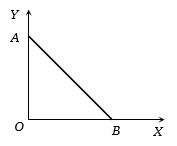
As per the diagram,a point charge $+q$ is placed at the origin $O$. The work done in taking another point charge $-Q$ from point $A$ [coordinates $(0, a)$] to point $B$ [coordinates $(a, 0)$] along the straight path $AB$ is:
A
$Zero$
B
$\left( \frac{-qQ}{4\pi \varepsilon_0} \cdot \frac{1}{a^2} \right) \sqrt{2}a$
C
$\left( \frac{qQ}{4\pi \varepsilon_0} \cdot \frac{1}{a^2} \right) \frac{a}{\sqrt{2}}$
D
$\left( \frac{qQ}{4\pi \varepsilon_0} \cdot \frac{1}{a^2} \right) \sqrt{2}a$
Solution
(A) The electric potential $V$ at a distance $r$ from a point charge $q$ is given by $V = \frac{1}{4\pi \varepsilon_0} \frac{q}{r}$.
Point $A$ is at coordinates $(0, a)$,so its distance from the origin $O$ is $r_A = \sqrt{0^2 + a^2} = a$.
Point $B$ is at coordinates $(a, 0)$,so its distance from the origin $O$ is $r_B = \sqrt{a^2 + 0^2} = a$.
The potential at $A$ is $V_A = \frac{1}{4\pi \varepsilon_0} \frac{q}{a}$.
The potential at $B$ is $V_B = \frac{1}{4\pi \varepsilon_0} \frac{q}{a}$.
Since $V_A = V_B$,the potential difference $\Delta V = V_B - V_A = 0$.
The work done $W$ in moving a charge $-Q$ from $A$ to $B$ is given by $W = (-Q) \cdot \Delta V$.
Substituting $\Delta V = 0$,we get $W = (-Q) \cdot 0 = 0$.
Point $A$ is at coordinates $(0, a)$,so its distance from the origin $O$ is $r_A = \sqrt{0^2 + a^2} = a$.
Point $B$ is at coordinates $(a, 0)$,so its distance from the origin $O$ is $r_B = \sqrt{a^2 + 0^2} = a$.
The potential at $A$ is $V_A = \frac{1}{4\pi \varepsilon_0} \frac{q}{a}$.
The potential at $B$ is $V_B = \frac{1}{4\pi \varepsilon_0} \frac{q}{a}$.
Since $V_A = V_B$,the potential difference $\Delta V = V_B - V_A = 0$.
The work done $W$ in moving a charge $-Q$ from $A$ to $B$ is given by $W = (-Q) \cdot \Delta V$.
Substituting $\Delta V = 0$,we get $W = (-Q) \cdot 0 = 0$.
0 likesView Solution
23
PhysicsMediumMCQAIPMT · 2005
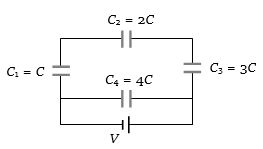
$A$ network of four capacitors with capacitances $C_1 = C$,$C_2 = 2C$,$C_3 = 3C$,and $C_4 = 4C$ is connected to a battery of potential $V$ as shown in the figure. The ratio of the charges on $C_2$ and $C_4$ is:
A
$\frac{22}{3}$
B
$\frac{3}{22}$
C
$\frac{7}{4}$
D
$\frac{4}{7}$
Solution
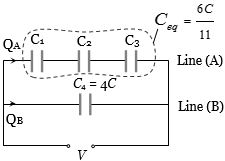
(B) The circuit consists of two parallel branches connected to a battery of potential $V$.
Branch $1$ contains capacitors $C_1, C_2,$ and $C_3$ in series. The equivalent capacitance $C_{eq1}$ of this branch is given by:
$\frac{1}{C_{eq1}} = \frac{1}{C_1} + \frac{1}{C_2} + \frac{1}{C_3} = \frac{1}{C} + \frac{1}{2C} + \frac{1}{3C} = \frac{6+3+2}{6C} = \frac{11}{6C}$
Thus,$C_{eq1} = \frac{6C}{11}$.
The charge $Q_1$ on each capacitor in this series branch is $Q_1 = C_{eq1} V = \frac{6CV}{11}$.
Since $C_1, C_2,$ and $C_3$ are in series,the charge on $C_2$ is $Q_{C2} = Q_1 = \frac{6CV}{11}$.
Branch $2$ contains only capacitor $C_4$ connected directly across the battery. The charge on $C_4$ is $Q_{C4} = C_4 V = 4CV$.
The ratio of the charges on $C_2$ and $C_4$ is:
$\frac{Q_{C2}}{Q_{C4}} = \frac{\frac{6CV}{11}}{4CV} = \frac{6}{11 \times 4} = \frac{6}{44} = \frac{3}{22}$.
Branch $1$ contains capacitors $C_1, C_2,$ and $C_3$ in series. The equivalent capacitance $C_{eq1}$ of this branch is given by:
$\frac{1}{C_{eq1}} = \frac{1}{C_1} + \frac{1}{C_2} + \frac{1}{C_3} = \frac{1}{C} + \frac{1}{2C} + \frac{1}{3C} = \frac{6+3+2}{6C} = \frac{11}{6C}$
Thus,$C_{eq1} = \frac{6C}{11}$.
The charge $Q_1$ on each capacitor in this series branch is $Q_1 = C_{eq1} V = \frac{6CV}{11}$.
Since $C_1, C_2,$ and $C_3$ are in series,the charge on $C_2$ is $Q_{C2} = Q_1 = \frac{6CV}{11}$.
Branch $2$ contains only capacitor $C_4$ connected directly across the battery. The charge on $C_4$ is $Q_{C4} = C_4 V = 4CV$.
The ratio of the charges on $C_2$ and $C_4$ is:
$\frac{Q_{C2}}{Q_{C4}} = \frac{\frac{6CV}{11}}{4CV} = \frac{6}{11 \times 4} = \frac{6}{44} = \frac{3}{22}$.
0 likesView Solution
24
PhysicsMediumMCQAIPMT · 2005
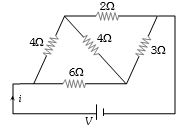
For the network shown in the figure,the value of the current $i$ is:
A
$\frac{9V}{35}$
B
$\frac{5V}{18}$
C
$\frac{5V}{9}$
D
$\frac{18V}{5}$
Solution
(B) The given circuit is a Wheatstone bridge. Let the nodes be $A, B, C, D$. The bridge is balanced if the ratio of resistances in opposite arms is equal. Here,the ratio of resistances is $\frac{4}{2} = 2$ and $\frac{6}{3} = 2$. Since the ratios are equal,the bridge is balanced.
In a balanced Wheatstone bridge,no current flows through the central $4\,\Omega$ resistor. Thus,it can be removed from the circuit.
Now,the circuit consists of two parallel branches: one with $(4\,\Omega + 2\,\Omega) = 6\,\Omega$ and the other with $(6\,\Omega + 3\,\Omega) = 9\,\Omega$.
The equivalent resistance $R_{eq}$ is given by $\frac{1}{R_{eq}} = \frac{1}{6} + \frac{1}{9} = \frac{3+2}{18} = \frac{5}{18}$.
Therefore,$R_{eq} = \frac{18}{5}\,\Omega$.
The total current $i$ from the battery is $i = \frac{V}{R_{eq}} = \frac{V}{18/5} = \frac{5V}{18}$.
In a balanced Wheatstone bridge,no current flows through the central $4\,\Omega$ resistor. Thus,it can be removed from the circuit.
Now,the circuit consists of two parallel branches: one with $(4\,\Omega + 2\,\Omega) = 6\,\Omega$ and the other with $(6\,\Omega + 3\,\Omega) = 9\,\Omega$.
The equivalent resistance $R_{eq}$ is given by $\frac{1}{R_{eq}} = \frac{1}{6} + \frac{1}{9} = \frac{3+2}{18} = \frac{5}{18}$.
Therefore,$R_{eq} = \frac{18}{5}\,\Omega$.
The total current $i$ from the battery is $i = \frac{V}{R_{eq}} = \frac{V}{18/5} = \frac{5V}{18}$.
0 likesView Solution
25
PhysicsEasyMCQAIPMT · 2005
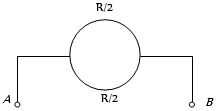
When a wire of uniform cross-section $a$,length $l$ and resistance $R$ is bent into a complete circle,what is the resistance between any two diametrically opposite points?
A
$\frac{R}{4}$
B
$\frac{R}{8}$
C
$4R$
D
$\frac{R}{2}$
Solution
(A) When a wire of resistance $R$ is bent into a circle,it is divided into two equal semicircular parts.
Each part has a resistance of $R' = \frac{R}{2}$.
These two semicircular parts are connected in parallel between the two diametrically opposite points.
The equivalent resistance $R_{eq}$ between these points is given by the parallel combination formula:
$\frac{1}{R_{eq}} = \frac{1}{R'} + \frac{1}{R'} = \frac{1}{R/2} + \frac{1}{R/2} = \frac{2}{R} + \frac{2}{R} = \frac{4}{R}$.
Therefore,$R_{eq} = \frac{R}{4}$.
Each part has a resistance of $R' = \frac{R}{2}$.
These two semicircular parts are connected in parallel between the two diametrically opposite points.
The equivalent resistance $R_{eq}$ between these points is given by the parallel combination formula:
$\frac{1}{R_{eq}} = \frac{1}{R'} + \frac{1}{R'} = \frac{1}{R/2} + \frac{1}{R/2} = \frac{2}{R} + \frac{2}{R} = \frac{4}{R}$.
Therefore,$R_{eq} = \frac{R}{4}$.
0 likesView Solution
26
PhysicsEasyMCQAIPMT · 2005
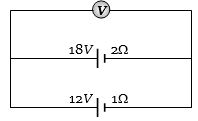
Two batteries,one of emf $18 \, V$ and internal resistance $2 \, \Omega$ and the other of emf $12 \, V$ and internal resistance $1 \, \Omega$,are connected in parallel as shown. The voltmeter $V$ will record a reading of ............. $V$.
A
$15$
B
$30$
C
$14$
D
$18$
Solution
(C) When two cells with emf $E_1, E_2$ and internal resistances $r_1, r_2$ are connected in parallel,the equivalent emf $E_{eq}$ is given by the formula:
$E_{eq} = \frac{E_1 r_2 + E_2 r_1}{r_1 + r_2}$
Given:
$E_1 = 18 \, V, r_1 = 2 \, \Omega$
$E_2 = 12 \, V, r_2 = 1 \, \Omega$
Substituting these values into the formula:
$E_{eq} = \frac{(18 \times 1) + (12 \times 2)}{2 + 1}$
$E_{eq} = \frac{18 + 24}{3}$
$E_{eq} = \frac{42}{3} = 14 \, V$
Since the voltmeter is connected across the parallel combination,it will measure the equivalent emf of the circuit.
Therefore,the reading of the voltmeter is $14 \, V$.
$E_{eq} = \frac{E_1 r_2 + E_2 r_1}{r_1 + r_2}$
Given:
$E_1 = 18 \, V, r_1 = 2 \, \Omega$
$E_2 = 12 \, V, r_2 = 1 \, \Omega$
Substituting these values into the formula:
$E_{eq} = \frac{(18 \times 1) + (12 \times 2)}{2 + 1}$
$E_{eq} = \frac{18 + 24}{3}$
$E_{eq} = \frac{42}{3} = 14 \, V$
Since the voltmeter is connected across the parallel combination,it will measure the equivalent emf of the circuit.
Therefore,the reading of the voltmeter is $14 \, V$.
0 likesView Solution
27
PhysicsEasyMCQAIPMT · 2005
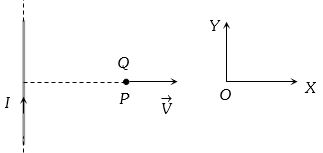
$A$ very long straight wire carries a current $I$. At the instant when a charge $+Q$ at point $P$ has velocity $\vec{V}$,as shown,the force on the charge is
A
Opposite to $OX$
B
Along $OX$
C
Opposite to $OY$
D
Along $OY$
Solution
(D) $1$. According to the right-hand thumb rule,the magnetic field $\vec{B}$ produced by the current-carrying wire at point $P$ is directed perpendicular to the plane of the paper and inwards (into the page).
$2$. The force $\vec{F}$ on a moving charge $+Q$ in a magnetic field is given by the Lorentz force formula: $\vec{F} = Q(\vec{V} \times \vec{B})$.
$3$. Here,the velocity $\vec{V}$ is along the positive $X$-axis (to the right) and the magnetic field $\vec{B}$ is directed inwards (into the page,represented by $-\hat{k}$ direction).
$4$. Using the right-hand rule for the cross product $\vec{V} \times \vec{B}$,where $\vec{V}$ is along $\hat{i}$ and $\vec{B}$ is along $-\hat{k}$,the direction of the force is $\hat{i} \times (-\hat{k}) = -(\hat{i} \times \hat{k}) = -(-\hat{j}) = \hat{j}$.
$5$. This corresponds to the positive $Y$-axis direction,which is along $OY$.
$2$. The force $\vec{F}$ on a moving charge $+Q$ in a magnetic field is given by the Lorentz force formula: $\vec{F} = Q(\vec{V} \times \vec{B})$.
$3$. Here,the velocity $\vec{V}$ is along the positive $X$-axis (to the right) and the magnetic field $\vec{B}$ is directed inwards (into the page,represented by $-\hat{k}$ direction).
$4$. Using the right-hand rule for the cross product $\vec{V} \times \vec{B}$,where $\vec{V}$ is along $\hat{i}$ and $\vec{B}$ is along $-\hat{k}$,the direction of the force is $\hat{i} \times (-\hat{k}) = -(\hat{i} \times \hat{k}) = -(-\hat{j}) = \hat{j}$.
$5$. This corresponds to the positive $Y$-axis direction,which is along $OY$.
0 likesView Solution
28
PhysicsMediumMCQAIPMT · 2005
An electron moves in a circular orbit with a uniform speed $v$. It produces a magnetic field $B$ at the centre of the circle. The radius of the circle is proportional to
A
$B/v$
B
$v/R$
C
$\sqrt{v/B}$
D
$\sqrt{B/v}$
Solution
(C) The electric current $i$ produced by an electron moving in a circular orbit of radius $r$ with speed $v$ is given by $i = \frac{ev}{2\pi r}$.
The magnetic field $B$ at the centre of the circular current loop is given by $B = \frac{\mu_0 i}{2r}$.
Substituting the value of $i$ into the expression for $B$,we get $B = \frac{\mu_0}{2r} \cdot \frac{ev}{2\pi r} = \frac{\mu_0 ev}{4\pi r^2}$.
Rearranging the formula to solve for $r^2$,we get $r^2 = \frac{\mu_0 ev}{4\pi B}$.
Taking the square root of both sides,we find $r = \sqrt{\frac{\mu_0 ev}{4\pi B}}$.
Since $\mu_0$,$e$,and $4\pi$ are constants,the radius $r$ is proportional to $\sqrt{v/B}$.
The magnetic field $B$ at the centre of the circular current loop is given by $B = \frac{\mu_0 i}{2r}$.
Substituting the value of $i$ into the expression for $B$,we get $B = \frac{\mu_0}{2r} \cdot \frac{ev}{2\pi r} = \frac{\mu_0 ev}{4\pi r^2}$.
Rearranging the formula to solve for $r^2$,we get $r^2 = \frac{\mu_0 ev}{4\pi B}$.
Taking the square root of both sides,we find $r = \sqrt{\frac{\mu_0 ev}{4\pi B}}$.
Since $\mu_0$,$e$,and $4\pi$ are constants,the radius $r$ is proportional to $\sqrt{v/B}$.
0 likesView Solution
29
PhysicsEasyMCQAIPMT · 2005
If the magnetic dipole moment of an atom of diamagnetic material,paramagnetic material,and ferromagnetic material are denoted by $\mu_d, \mu_p, \mu_f$ respectively,then:
A
$\mu_d \neq 0$ and $\mu_f \neq 0$
B
$\mu_p = 0$ and $\mu_f \neq 0$
C
$\mu_d = 0$ and $\mu_p \neq 0$
D
$\mu_d \neq 0$ and $\mu_p = 0$
Solution
(C) In diamagnetic materials,the orbital and spin magnetic moments of electrons in an atom cancel each other out,resulting in a net magnetic dipole moment of $\mu_d = 0$ for each atom.
In paramagnetic materials,each atom possesses a permanent magnetic dipole moment due to unpaired electrons,so $\mu_p \neq 0$.
In ferromagnetic materials,each atom also possesses a permanent magnetic dipole moment,so $\mu_f \neq 0$.
Comparing the options,the statement $\mu_d = 0$ and $\mu_p \neq 0$ is correct.
In paramagnetic materials,each atom possesses a permanent magnetic dipole moment due to unpaired electrons,so $\mu_p \neq 0$.
In ferromagnetic materials,each atom also possesses a permanent magnetic dipole moment,so $\mu_f \neq 0$.
Comparing the options,the statement $\mu_d = 0$ and $\mu_p \neq 0$ is correct.
0 likesView Solution
30
PhysicsMediumMCQAIPMT · 2005
In a circuit,$L, C$ and $R$ are connected in series with an alternating voltage source of frequency $f$. The current leads the voltage by $45^o$. The value of $C$ is
A
$\frac{1}{2\pi f(2\pi fL + R)}$
B
$\frac{1}{\pi f(2\pi fL + R)}$
C
$\frac{1}{2\pi f(2\pi fL - R)}$
D
$\frac{1}{\pi f(2\pi fL - R)}$
Solution
(A) The phase angle $\phi$ in an $LCR$ series circuit is given by $\tan \phi = \frac{X_C - X_L}{R}$.
Since the current leads the voltage,the circuit is capacitive,and the phase angle is $\phi = -45^o$ (or we use the magnitude of the lead as $\tan(45^o) = \frac{X_C - X_L}{R}$).
Substituting the values: $\tan 45^o = \frac{\frac{1}{2\pi fC} - 2\pi fL}{R}$.
Since $\tan 45^o = 1$,we have $1 = \frac{\frac{1}{2\pi fC} - 2\pi fL}{R}$.
$R = \frac{1}{2\pi fC} - 2\pi fL$.
$\frac{1}{2\pi fC} = 2\pi fL + R$.
Therefore,$C = \frac{1}{2\pi f(2\pi fL + R)}$.
Since the current leads the voltage,the circuit is capacitive,and the phase angle is $\phi = -45^o$ (or we use the magnitude of the lead as $\tan(45^o) = \frac{X_C - X_L}{R}$).
Substituting the values: $\tan 45^o = \frac{\frac{1}{2\pi fC} - 2\pi fL}{R}$.
Since $\tan 45^o = 1$,we have $1 = \frac{\frac{1}{2\pi fC} - 2\pi fL}{R}$.
$R = \frac{1}{2\pi fC} - 2\pi fL$.
$\frac{1}{2\pi fC} = 2\pi fL + R$.
Therefore,$C = \frac{1}{2\pi f(2\pi fL + R)}$.
0 likesView Solution
31
PhysicsEasyMCQAIPMT · 2005
The work functions for metals $A, B$ and $C$ are $1.92 eV, 2.0 eV$ and $5 eV$ respectively. According to Einstein's photoelectric equation,which of these metals will emit photoelectrons for an incident radiation of wavelength $4100 \mathring{A}$?
A
None of these
B
$A$ only
C
$A$ and $B$ only
D
All the three metals
Solution
(C) The energy $E$ of the incident photon is given by the formula $E = \frac{hc}{\lambda}$.
Using the approximation $hc \approx 12400 \text{ eV} \cdot \mathring{A}$,we calculate the energy as:
$E = \frac{12400}{4100} \approx 3.02 \text{ eV}$.
Photoelectric emission occurs if the energy of the incident photon is greater than the work function $(\Phi)$ of the metal.
For metal $A$: $\Phi_A = 1.92 \text{ eV} < 3.02 \text{ eV}$ (Emission occurs).
For metal $B$: $\Phi_B = 2.0 \text{ eV} < 3.02 \text{ eV}$ (Emission occurs).
For metal $C$: $\Phi_C = 5.0 \text{ eV} > 3.02 \text{ eV}$ (No emission).
Therefore,only metals $A$ and $B$ will emit photoelectrons.
Using the approximation $hc \approx 12400 \text{ eV} \cdot \mathring{A}$,we calculate the energy as:
$E = \frac{12400}{4100} \approx 3.02 \text{ eV}$.
Photoelectric emission occurs if the energy of the incident photon is greater than the work function $(\Phi)$ of the metal.
For metal $A$: $\Phi_A = 1.92 \text{ eV} < 3.02 \text{ eV}$ (Emission occurs).
For metal $B$: $\Phi_B = 2.0 \text{ eV} < 3.02 \text{ eV}$ (Emission occurs).
For metal $C$: $\Phi_C = 5.0 \text{ eV} > 3.02 \text{ eV}$ (No emission).
Therefore,only metals $A$ and $B$ will emit photoelectrons.
0 likesView Solution
32
PhysicsMediumMCQAIPMT · 2005
$A$ photosensitive metallic surface has a work function $h\nu_0$. If photons of energy $2h\nu_0$ fall on this surface,the electrons are emitted with a maximum velocity of $4 \times 10^6 \, m/s$. When the photon energy is increased to $5h\nu_0$,the maximum velocity of the photoelectrons will be:
A
$2 \times 10^6 \, m/s$
B
$2 \times 10^7 \, m/s$
C
$8 \times 10^5 \, m/s$
D
$8 \times 10^6 \, m/s$
Solution
(D) According to Einstein's photoelectric equation,the maximum kinetic energy is given by $K_{\max} = E - W_0$,where $E$ is the energy of the incident photon and $W_0$ is the work function.
For the first case: $E_1 = 2h\nu_0$ and $W_0 = h\nu_0$.
$\frac{1}{2}mv_1^2 = 2h\nu_0 - h\nu_0 = h\nu_0$ ... $(i)$
For the second case: $E_2 = 5h\nu_0$ and $W_0 = h\nu_0$.
$\frac{1}{2}mv_2^2 = 5h\nu_0 - h\nu_0 = 4h\nu_0$ ... $(ii)$
Dividing equation $(ii)$ by $(i)$:
$\frac{\frac{1}{2}mv_2^2}{\frac{1}{2}mv_1^2} = \frac{4h\nu_0}{h\nu_0}$
$\left(\frac{v_2}{v_1}\right)^2 = 4$
$\frac{v_2}{v_1} = 2$
Given $v_1 = 4 \times 10^6 \, m/s$,we find:
$v_2 = 2 \times v_1 = 2 \times (4 \times 10^6 \, m/s) = 8 \times 10^6 \, m/s$.
For the first case: $E_1 = 2h\nu_0$ and $W_0 = h\nu_0$.
$\frac{1}{2}mv_1^2 = 2h\nu_0 - h\nu_0 = h\nu_0$ ... $(i)$
For the second case: $E_2 = 5h\nu_0$ and $W_0 = h\nu_0$.
$\frac{1}{2}mv_2^2 = 5h\nu_0 - h\nu_0 = 4h\nu_0$ ... $(ii)$
Dividing equation $(ii)$ by $(i)$:
$\frac{\frac{1}{2}mv_2^2}{\frac{1}{2}mv_1^2} = \frac{4h\nu_0}{h\nu_0}$
$\left(\frac{v_2}{v_1}\right)^2 = 4$
$\frac{v_2}{v_1} = 2$
Given $v_1 = 4 \times 10^6 \, m/s$,we find:
$v_2 = 2 \times v_1 = 2 \times (4 \times 10^6 \, m/s) = 8 \times 10^6 \, m/s$.
0 likesView Solution
33
PhysicsMediumMCQAIPMT · 2005
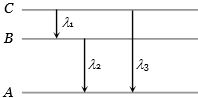
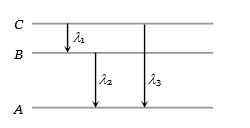
Energy levels $A, B, C$ of a certain atom correspond to increasing values of energy,i.e.,$E_A < E_B < E_C$. If $\lambda_1, \lambda_2, \lambda_3$ are the wavelengths of radiations corresponding to the transitions $C$ to $B$,$B$ to $A$,and $C$ to $A$ respectively,which of the following statements is correct?
A
$\lambda_3 = \lambda_1 + \lambda_2$
B
$\lambda_3 = \frac{\lambda_1 \lambda_2}{\lambda_1 + \lambda_2}$
C
$\lambda_1 + \lambda_2 + \lambda_3 = 0$
D
$\lambda_3^2 = \lambda_1^2 + \lambda_2^2$
Solution
(B) Let the energies of the states $A, B,$ and $C$ be $E_A, E_B,$ and $E_C$ respectively.
From the principle of conservation of energy,the energy of the transition from $C$ to $A$ is equal to the sum of the energies of the transitions from $C$ to $B$ and $B$ to $A$.
Thus,$(E_C - E_A) = (E_C - E_B) + (E_B - E_A)$.
Using the relation $E = \frac{hc}{\lambda}$,we can write:
$\frac{hc}{\lambda_3} = \frac{hc}{\lambda_1} + \frac{hc}{\lambda_2}$
Dividing both sides by $hc$,we get:
$\frac{1}{\lambda_3} = \frac{1}{\lambda_1} + \frac{1}{\lambda_2}$
$\frac{1}{\lambda_3} = \frac{\lambda_1 + \lambda_2}{\lambda_1 \lambda_2}$
Therefore,$\lambda_3 = \frac{\lambda_1 \lambda_2}{\lambda_1 + \lambda_2}$.
From the principle of conservation of energy,the energy of the transition from $C$ to $A$ is equal to the sum of the energies of the transitions from $C$ to $B$ and $B$ to $A$.
Thus,$(E_C - E_A) = (E_C - E_B) + (E_B - E_A)$.
Using the relation $E = \frac{hc}{\lambda}$,we can write:
$\frac{hc}{\lambda_3} = \frac{hc}{\lambda_1} + \frac{hc}{\lambda_2}$
Dividing both sides by $hc$,we get:
$\frac{1}{\lambda_3} = \frac{1}{\lambda_1} + \frac{1}{\lambda_2}$
$\frac{1}{\lambda_3} = \frac{\lambda_1 + \lambda_2}{\lambda_1 \lambda_2}$
Therefore,$\lambda_3 = \frac{\lambda_1 \lambda_2}{\lambda_1 + \lambda_2}$.
0 likesView Solution
34
PhysicsEasyMCQAIPMT · 2005
The energy of an electron in the first excited state of an $H$-atom is $-3.4 \ eV$. Its kinetic energy is ........ $eV$.
A
$-3.4$
B
$+3.4$
C
$-6.8$
D
$6.8$
Solution
(B) For an electron in a hydrogen atom,the total energy $(E)$,kinetic energy $(K)$,and potential energy $(U)$ are related as follows:
$E = -K$
$U = 2E = -2K$
Given that the total energy of the electron in the first excited state is $E = -3.4 \ eV$.
Therefore,the kinetic energy $K = -E = -(-3.4 \ eV) = +3.4 \ eV$.
Thus,the correct option is $B$.
$E = -K$
$U = 2E = -2K$
Given that the total energy of the electron in the first excited state is $E = -3.4 \ eV$.
Therefore,the kinetic energy $K = -E = -(-3.4 \ eV) = +3.4 \ eV$.
Thus,the correct option is $B$.
0 likesView Solution
35
PhysicsMediumMCQAIPMT · 2005
In the nuclear reaction $_1^2H + _1^3H \to _2^4He + _0^1n$, if the binding energies of $_1^2H$, $_1^3H$, and $_2^4He$ are respectively $a$, $b$, and $c$ (in $MeV$), then the energy (in $MeV$) released in this reaction is:
A
$c + a - b$
B
$c - a - b$
C
$a + b + c$
D
$a + b - c$
Solution
(B) The energy released in a nuclear reaction is given by the difference between the total binding energy of the products and the total binding energy of the reactants.
In the given reaction: $_1^2H + _1^3H \to _2^4He + _0^1n$.
The binding energy of the neutron $_0^1n$ is $0 \ MeV$.
The total binding energy of the reactants is $a + b$.
The total binding energy of the products is $c + 0 = c$.
Therefore, the energy released $Q = (\text{Total Binding Energy of Products}) - (\text{Total Binding Energy of Reactants})$.
$Q = c - (a + b) = c - a - b \ MeV$.
In the given reaction: $_1^2H + _1^3H \to _2^4He + _0^1n$.
The binding energy of the neutron $_0^1n$ is $0 \ MeV$.
The total binding energy of the reactants is $a + b$.
The total binding energy of the products is $c + 0 = c$.
Therefore, the energy released $Q = (\text{Total Binding Energy of Products}) - (\text{Total Binding Energy of Reactants})$.
$Q = c - (a + b) = c - a - b \ MeV$.
0 likesView Solution
36
PhysicsEasyMCQAIPMT · 2005
The nuclei of which one of the following pairs are isotones?
A
$_{34}Se^{74}, _{31}Ga^{71}$
B
$_{42}Mo^{92}, _{40}Zr^{92}$
C
$_{38}Sr^{81}, _{38}Sr^{86}$
D
$_{20}Ca^{40}, _{16}S^{32}$
Solution
(A) Isotones are nuclei that have the same number of neutrons $(N)$ but different atomic numbers $(Z)$.
Neutron number is calculated as $N = A - Z$,where $A$ is the mass number and $Z$ is the atomic number.
For option $A$: $_{34}Se^{74} \implies N = 74 - 34 = 40$ and $_{31}Ga^{71} \implies N = 71 - 31 = 40$.
Since both nuclei have $40$ neutrons,they are isotones.
For option $B$: $_{42}Mo^{92} \implies N = 92 - 42 = 50$ and $_{40}Zr^{92} \implies N = 92 - 40 = 52$. Not isotones.
For option $C$: These are isotopes (same $Z$,different $A$).
For option $D$: $_{20}Ca^{40} \implies N = 20$ and $_{16}S^{32} \implies N = 16$. Not isotones.
Therefore,the correct option is $A$.
Neutron number is calculated as $N = A - Z$,where $A$ is the mass number and $Z$ is the atomic number.
For option $A$: $_{34}Se^{74} \implies N = 74 - 34 = 40$ and $_{31}Ga^{71} \implies N = 71 - 31 = 40$.
Since both nuclei have $40$ neutrons,they are isotones.
For option $B$: $_{42}Mo^{92} \implies N = 92 - 42 = 50$ and $_{40}Zr^{92} \implies N = 92 - 40 = 52$. Not isotones.
For option $C$: These are isotopes (same $Z$,different $A$).
For option $D$: $_{20}Ca^{40} \implies N = 20$ and $_{16}S^{32} \implies N = 16$. Not isotones.
Therefore,the correct option is $A$.
0 likesView Solution
37
PhysicsEasyMCQAIPMT · 2005
In any fission process,the ratio $\frac{\text{mass of fission products}}{\text{mass of parent nucleus}}$ is
A
Less than $1$
B
Greater than $1$
C
Equal to $1$
D
Depends on the mass of the parent nucleus
Solution
(A) In a nuclear fission process,a heavy nucleus splits into two or more lighter nuclei.
According to Einstein's mass-energy equivalence principle,$E = mc^2$,the energy released during the process is derived from the mass defect.
Since energy is released,the total mass of the fission products must be less than the mass of the parent nucleus.
Therefore,the ratio $\frac{\text{mass of fission products}}{\text{mass of parent nucleus}} < 1$.
According to Einstein's mass-energy equivalence principle,$E = mc^2$,the energy released during the process is derived from the mass defect.
Since energy is released,the total mass of the fission products must be less than the mass of the parent nucleus.
Therefore,the ratio $\frac{\text{mass of fission products}}{\text{mass of parent nucleus}} < 1$.
0 likesView Solution
38
PhysicsEasyMCQAIPMT · 2005
Carbon, silicon, and germanium atoms have four valence electrons each. Their valence and conduction bands are separated by energy band gaps represented by $(E_g)_C$, $(E_g)_{Si}$, and $(E_g)_{Ge}$ respectively. Which one of the following relationships is true in their case?
A
$(E_g)_C > (E_g)_{Si}$
B
$(E_g)_C = (E_g)_{Si}$
C
$(E_g)_C < (E_g)_{Ge}$
D
$(E_g)_C < (E_g)_{Si}$
Solution
(A) The energy band gap $(E_g)$ is the energy difference between the valence band and the conduction band.
For carbon (diamond), the energy band gap is approximately $5.4 \text{ eV}$.
For silicon, the energy band gap is approximately $1.1 \text{ eV}$.
For germanium, the energy band gap is approximately $0.7 \text{ eV}$.
Comparing these values, we find that $(E_g)_C > (E_g)_{Si} > (E_g)_{Ge}$.
Therefore, the correct relationship is $(E_g)_C > (E_g)_{Si}$.
For carbon (diamond), the energy band gap is approximately $5.4 \text{ eV}$.
For silicon, the energy band gap is approximately $1.1 \text{ eV}$.
For germanium, the energy band gap is approximately $0.7 \text{ eV}$.
Comparing these values, we find that $(E_g)_C > (E_g)_{Si} > (E_g)_{Ge}$.
Therefore, the correct relationship is $(E_g)_C > (E_g)_{Si}$.
0 likesView Solution
39
PhysicsMediumMCQAIPMT · 2005
The angular resolution of a $10 \;cm$ diameter telescope at a wavelength of $5000 \;\mathring A$ is of the order of:
A
$10^6 \;rad$
B
$10^{-2} \;rad$
C
$10^{-4} \;rad$
D
$10^{-6} \;rad$
Solution
(D) The angular resolution of a telescope is given by the formula: $d\theta = \frac{1.22 \lambda}{D}$.
Here,the wavelength $\lambda = 5000 \;\mathring A = 5000 \times 10^{-10} \;m = 5 \times 10^{-7} \;m$.
The diameter of the telescope aperture $D = 10 \;cm = 0.1 \;m = 10^{-1} \;m$.
Substituting these values into the formula:
$d\theta = \frac{1.22 \times 5 \times 10^{-7}}{10^{-1}}$
$d\theta = 1.22 \times 5 \times 10^{-6}$
$d\theta = 6.1 \times 10^{-6} \;rad$.
This value is of the order of $10^{-6} \;rad$.
Here,the wavelength $\lambda = 5000 \;\mathring A = 5000 \times 10^{-10} \;m = 5 \times 10^{-7} \;m$.
The diameter of the telescope aperture $D = 10 \;cm = 0.1 \;m = 10^{-1} \;m$.
Substituting these values into the formula:
$d\theta = \frac{1.22 \times 5 \times 10^{-7}}{10^{-1}}$
$d\theta = 1.22 \times 5 \times 10^{-6}$
$d\theta = 6.1 \times 10^{-6} \;rad$.
This value is of the order of $10^{-6} \;rad$.
0 likesView Solution
40
PhysicsEasyMCQAIPMT · 2005
If ${\lambda _v}$,${\lambda _x}$,and ${\lambda _m}$ represent the wavelengths of visible light,$X$-rays,and microwaves respectively,then:
A
${\lambda _m} > {\lambda _x} > {\lambda _v}$
B
${\lambda _v} > {\lambda _m} > {\lambda _x}$
C
${\lambda _m} > {\lambda _v} > {\lambda _x}$
D
${\lambda _v} > {\lambda _x} > {\lambda _m}$
Solution
(C) The electromagnetic spectrum in increasing order of frequency (or decreasing order of wavelength) is: Gamma rays > $X$-rays > Ultraviolet > Visible light > Infrared > Microwaves > Radio waves.
Therefore,the order of wavelengths is: $\lambda_{\text{microwaves}} > \lambda_{\text{visible}} > \lambda_{X\text{-rays}}$.
Given the symbols,this corresponds to: ${\lambda _m} > {\lambda _v} > {\lambda _x}$.
Therefore,the order of wavelengths is: $\lambda_{\text{microwaves}} > \lambda_{\text{visible}} > \lambda_{X\text{-rays}}$.
Given the symbols,this corresponds to: ${\lambda _m} > {\lambda _v} > {\lambda _x}$.
0 likesView Solution
41
PhysicsMediumMCQAIPMT · 2005
Application of a forward bias to a $P-N$ junction
A
decreases the electric field in the depletion zone.
B
increases the potential difference across the depletion zone.
C
increases the number of donors on the $N$ side.
D
widens the depletion zone.
Solution
(A) When a $P-N$ junction is forward biased,the positive terminal of the external battery is connected to the $P$-side and the negative terminal to the $N$-side.
This setup opposes the internal electric field of the depletion region.
As a result,the potential barrier height decreases,and the width of the depletion zone decreases.
Since the electric field $E$ is related to the potential barrier $V_B$ and width $W$ by $E = V_B / W$,the reduction in the potential barrier and the narrowing of the depletion region lead to a decrease in the electric field within the depletion zone.
This setup opposes the internal electric field of the depletion region.
As a result,the potential barrier height decreases,and the width of the depletion zone decreases.
Since the electric field $E$ is related to the potential barrier $V_B$ and width $W$ by $E = V_B / W$,the reduction in the potential barrier and the narrowing of the depletion region lead to a decrease in the electric field within the depletion zone.
0 likesView Solution
42
PhysicsEasyMCQAIPMT · 2005
$A$ Zener diode is used for
A
rectification
B
stabilisation
C
amplification
D
producing oscillations in an oscillator
Solution
(B) Zener diode is specifically designed to operate in the reverse breakdown region. It is primarily used as a voltage regulator to maintain a constant output voltage across a load,which is known as voltage stabilisation. In contrast,a standard $p-n$ junction diode is typically used for rectification.
0 likesView Solution
43
PhysicsMediumMCQAIPMT · 2005
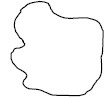
As a result of a change in the magnetic flux linked to the closed loop as shown in the figure,an $e.m.f.$ $V$ volt is induced in the loop. The work done (in joule) in taking a charge $Q$ coulomb once along the loop is
A
$QV$
B
$0$
C
$2QV$
D
$\frac{QV}{2}$
Solution
(A) The induced $e.m.f.$ $V$ in a closed loop is defined as the work done per unit charge by the induced electric field in moving a charge once around the loop.
By definition,$V = \frac{W}{Q}$,where $W$ is the work done and $Q$ is the charge.
Therefore,the work done in moving a charge $Q$ once along the loop is $W = QV$.
Since the induced electric field is non-conservative,the work done is non-zero and is equal to the product of the charge and the induced $e.m.f.$
By definition,$V = \frac{W}{Q}$,where $W$ is the work done and $Q$ is the charge.
Therefore,the work done in moving a charge $Q$ once along the loop is $W = QV$.
Since the induced electric field is non-conservative,the work done is non-zero and is equal to the product of the charge and the induced $e.m.f.$
0 likesView Solution
44
PhysicsMediumMCQAIPMT · 2005
$A$ coil in the shape of an equilateral triangle of side $l$ is suspended between the pole pieces of a permanent magnet such that $\vec{B}$ is in the plane of the coil. If due to a current $i$ in the triangle a torque $\tau$ acts on it,the side $l$ of the triangle is
A
$\frac{2}{\sqrt{3}}\left(\frac{\tau}{B i}\right)$
B
$2\left(\frac{\tau}{\sqrt{3} B i}\right)^{1 / 2}$
C
$\frac{2}{\sqrt{3}}\left(\frac{\tau}{B i}\right)^{1 / 2}$
D
$\frac{1}{\sqrt{3}} \frac{\tau}{B i}$
Solution
(B) The torque $\tau$ on a current-carrying coil in a magnetic field is given by $\tau = \vec{m} \times \vec{B}$,where $\vec{m} = i \vec{A}$ is the magnetic moment.
Since $\vec{B}$ is in the plane of the coil,the angle between the area vector $\vec{A}$ and the magnetic field $\vec{B}$ is $90^{\circ}$.
Thus,the magnitude of the torque is $\tau = i A B \sin 90^{\circ} = i A B$.
The area $A$ of an equilateral triangle with side $l$ is $A = \frac{\sqrt{3}}{4} l^2$.
Substituting this into the torque equation: $\tau = i \left( \frac{\sqrt{3}}{4} l^2 \right) B$.
Rearranging for $l^2$: $l^2 = \frac{4 \tau}{\sqrt{3} i B}$.
Taking the square root: $l = \sqrt{\frac{4 \tau}{\sqrt{3} i B}} = 2 \left( \frac{\tau}{\sqrt{3} i B} \right)^{1/2}$.
Since $\vec{B}$ is in the plane of the coil,the angle between the area vector $\vec{A}$ and the magnetic field $\vec{B}$ is $90^{\circ}$.
Thus,the magnitude of the torque is $\tau = i A B \sin 90^{\circ} = i A B$.
The area $A$ of an equilateral triangle with side $l$ is $A = \frac{\sqrt{3}}{4} l^2$.
Substituting this into the torque equation: $\tau = i \left( \frac{\sqrt{3}}{4} l^2 \right) B$.
Rearranging for $l^2$: $l^2 = \frac{4 \tau}{\sqrt{3} i B}$.
Taking the square root: $l = \sqrt{\frac{4 \tau}{\sqrt{3} i B}} = 2 \left( \frac{\tau}{\sqrt{3} i B} \right)^{1/2}$.
0 likesView Solution
45
PhysicsMediumMCQAIPMT · 2005
$A$ $5\;A$ fuse wire can withstand a maximum power of $1\;W$ in the circuit. The resistance of the fuse wire is
A
$0.2\;\Omega$
B
$5\;\Omega$
C
$0.04\;\Omega$
D
$0.4\;\Omega$
Solution
(C) The power dissipated in a resistor is given by the formula $P = I^2 R$,where $P$ is the power,$I$ is the current,and $R$ is the resistance.
Given:
$P = 1\;W$
$I = 5\;A$
Substituting these values into the formula:
$1 = (5)^2 \times R$
$1 = 25 \times R$
$R = \frac{1}{25}\;\Omega$
$R = 0.04\;\Omega$
Therefore,the resistance of the fuse wire is $0.04\;\Omega$.
Given:
$P = 1\;W$
$I = 5\;A$
Substituting these values into the formula:
$1 = (5)^2 \times R$
$1 = 25 \times R$
$R = \frac{1}{25}\;\Omega$
$R = 0.04\;\Omega$
Therefore,the resistance of the fuse wire is $0.04\;\Omega$.
0 likesView Solution
46
PhysicsEasyMCQAIPMT · 2005
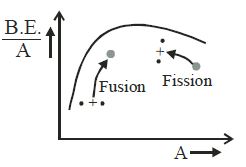
Fission of nuclei is possible because the binding energy per nucleon in them
A
Increases with mass number at high mass numbers
B
Decreases with mass number at high mass numbers
C
Increases with mass number at low mass numbers
D
Decreases with mass number at low mass numbers
Solution
(B) Nuclear fission is a process in which a heavy nucleus splits into two lighter nuclei.
According to the binding energy per nucleon curve,for heavy nuclei (high mass number $A$),the binding energy per nucleon decreases as the mass number increases.
This means that heavy nuclei are less stable compared to intermediate-mass nuclei.
When a heavy nucleus splits into two lighter nuclei,the binding energy per nucleon of the resulting products is higher than that of the parent nucleus.
This increase in binding energy per nucleon results in the release of energy,making the fission process possible.
Therefore,the correct reason is that the binding energy per nucleon decreases with mass number at high mass numbers.
According to the binding energy per nucleon curve,for heavy nuclei (high mass number $A$),the binding energy per nucleon decreases as the mass number increases.
This means that heavy nuclei are less stable compared to intermediate-mass nuclei.
When a heavy nucleus splits into two lighter nuclei,the binding energy per nucleon of the resulting products is higher than that of the parent nucleus.
This increase in binding energy per nucleon results in the release of energy,making the fission process possible.
Therefore,the correct reason is that the binding energy per nucleon decreases with mass number at high mass numbers.
0 likesView Solution
47
PhysicsMediumMCQAIPMT · 2005
Choose only the false statement from the following:
A
In conductors, the valence and conduction bands overlap.
B
Substances with an energy gap of the order of $10 \ eV$ are insulators.
C
The resistivity of a semiconductor increases with an increase in temperature.
D
The conductivity of a semiconductor increases with an increase in temperature.
Solution
(C) In semiconductors, as the temperature increases, more charge carriers (electrons and holes) are generated due to thermal excitation. This leads to an increase in conductivity. Since conductivity $(\sigma)$ is the reciprocal of resistivity $(\rho)$, an increase in conductivity implies a decrease in resistivity. Therefore, the statement that resistivity increases with temperature is false.
0 likesView Solution
48
PhysicsDifficultMCQAIPMT · 2005
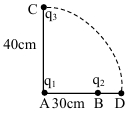
Two charges $q_1$ and $q_2$ are separated by a distance of $30\ cm$. $A$ third charge $q_3$,initially at $C$ as shown in the figure,is moved along the circular path of radius $40\ cm$ from $C$ to $D$. If the difference in potential energy due to the movement of $q_3$ from $C$ to $D$ is given by $\frac{q_3 K}{4 \pi \epsilon_0}$,find the value of $K$.
A
$8 q_2$
B
$6 q_2$
C
$8 q_1$
D
$6 q_1$
Solution
(A) The potential at point $C$ due to charges $q_1$ and $q_2$ is:
$V_C = \frac{1}{4 \pi \epsilon_0} \left( \frac{q_1}{AC} + \frac{q_2}{BC} \right)$
Given $AC = 40\ cm = 0.4\ m$. Since $AB = 30\ cm$ and $AC = 40\ cm$,by Pythagoras theorem,$BC = \sqrt{0.3^2 + 0.4^2} = 0.5\ m$.
So,$V_C = \frac{1}{4 \pi \epsilon_0} \left( \frac{q_1}{0.4} + \frac{q_2}{0.5} \right)$.
The potential at point $D$ due to charges $q_1$ and $q_2$ is:
$V_D = \frac{1}{4 \pi \epsilon_0} \left( \frac{q_1}{AD} + \frac{q_2}{BD} \right)$
Given $AD = 40\ cm = 0.4\ m$ (radius of the circular path) and $BD = AD - AB = 40\ cm - 30\ cm = 10\ cm = 0.1\ m$.
So,$V_D = \frac{1}{4 \pi \epsilon_0} \left( \frac{q_1}{0.4} + \frac{q_2}{0.1} \right)$.
The change in potential energy $\Delta U$ is given by:
$\Delta U = q_3 (V_D - V_C) = q_3 \left[ \frac{1}{4 \pi \epsilon_0} \left( \frac{q_1}{0.4} + \frac{q_2}{0.1} \right) - \frac{1}{4 \pi \epsilon_0} \left( \frac{q_1}{0.4} + \frac{q_2}{0.5} \right) \right]$
$\Delta U = \frac{q_3}{4 \pi \epsilon_0} \left( \frac{q_2}{0.1} - \frac{q_2}{0.5} \right) = \frac{q_3}{4 \pi \epsilon_0} (10 q_2 - 2 q_2) = \frac{8 q_2 q_3}{4 \pi \epsilon_0}$.
Comparing this with $\frac{q_3 K}{4 \pi \epsilon_0}$,we get $K = 8 q_2$.
$V_C = \frac{1}{4 \pi \epsilon_0} \left( \frac{q_1}{AC} + \frac{q_2}{BC} \right)$
Given $AC = 40\ cm = 0.4\ m$. Since $AB = 30\ cm$ and $AC = 40\ cm$,by Pythagoras theorem,$BC = \sqrt{0.3^2 + 0.4^2} = 0.5\ m$.
So,$V_C = \frac{1}{4 \pi \epsilon_0} \left( \frac{q_1}{0.4} + \frac{q_2}{0.5} \right)$.
The potential at point $D$ due to charges $q_1$ and $q_2$ is:
$V_D = \frac{1}{4 \pi \epsilon_0} \left( \frac{q_1}{AD} + \frac{q_2}{BD} \right)$
Given $AD = 40\ cm = 0.4\ m$ (radius of the circular path) and $BD = AD - AB = 40\ cm - 30\ cm = 10\ cm = 0.1\ m$.
So,$V_D = \frac{1}{4 \pi \epsilon_0} \left( \frac{q_1}{0.4} + \frac{q_2}{0.1} \right)$.
The change in potential energy $\Delta U$ is given by:
$\Delta U = q_3 (V_D - V_C) = q_3 \left[ \frac{1}{4 \pi \epsilon_0} \left( \frac{q_1}{0.4} + \frac{q_2}{0.1} \right) - \frac{1}{4 \pi \epsilon_0} \left( \frac{q_1}{0.4} + \frac{q_2}{0.5} \right) \right]$
$\Delta U = \frac{q_3}{4 \pi \epsilon_0} \left( \frac{q_2}{0.1} - \frac{q_2}{0.5} \right) = \frac{q_3}{4 \pi \epsilon_0} (10 q_2 - 2 q_2) = \frac{8 q_2 q_3}{4 \pi \epsilon_0}$.
Comparing this with $\frac{q_3 K}{4 \pi \epsilon_0}$,we get $K = 8 q_2$.
0 likesView Solution
Vedclass Products
For Students
Vedclass Test Series
Mock tests in real AIPMT style covering Physics with performance analysis. 5-day free trial.
Start Free TrialFor Teachers
Exam Paper Generator
Generate Set A/B/C/D Physics papers from 7.5L+ questions in 2 minutes. 3 chapters free.
Try FreeFor Institutes
Online Exam Module
Run live AIPMT mock exams with unlimited students, 360° analytics & white-label branding.
See DemoFrequently Asked Questions
How many Physics questions are in AIPMT 2005?
There are 48 Physics questions from the AIPMT 2005 paper on Vedclass, each with a detailed step-by-step solution in English.
Are AIPMT 2005 Physics solutions available in English?
Yes. All solutions on this page are in English. You can also switch to English or Hindi using the language buttons above the questions.
Can I practice AIPMT 2005 Physics as a timed test?
Yes. Use the Vedclass Test Series to attempt a full AIPMT mock test covering Physics with time limits and instant score analysis.
Can teachers create Physics papers from AIPMT previous year questions?
Yes. The Vedclass Exam Paper Generator lets teachers mix AIPMT Physics questions and generate Set A/B/C/D papers in minutes.
For Teachers & Institutes
Build a Custom Physics Paper
Pick AIPMT 2005 Physics questions, set difficulty, and generate Set A/B/C/D in 2 minutes.