
ChemistryQ1–78 of 111 questions
Page 1 of 2 · English
1
ChemistryMCQAIPMT · 2005
$A$ point source emits sound equally in all directions in a non-absorbing medium. Two points $P$ and $Q$ are at distances of $2 \ m$ and $3 \ m$ respectively from the source. The ratio of the intensities of the waves at $P$ and $Q$ is
A
$9:4$
B
$2:3$
C
$3:2$
D
$4:9$
Solution
(A) The intensity $I$ of sound from a point source in a non-absorbing medium is inversely proportional to the square of the distance $r$ from the source,given by $I \propto \frac{1}{r^2}$.
Let $I_P$ and $I_Q$ be the intensities at points $P$ and $Q$ respectively.
Given distances are $r_P = 2 \ m$ and $r_Q = 3 \ m$.
Therefore,the ratio of intensities is $\frac{I_P}{I_Q} = \frac{r_Q^2}{r_P^2} = \left( \frac{3}{2} \right)^2 = \frac{9}{4}$.
Thus,the ratio is $9:4$.
Let $I_P$ and $I_Q$ be the intensities at points $P$ and $Q$ respectively.
Given distances are $r_P = 2 \ m$ and $r_Q = 3 \ m$.
Therefore,the ratio of intensities is $\frac{I_P}{I_Q} = \frac{r_Q^2}{r_P^2} = \left( \frac{3}{2} \right)^2 = \frac{9}{4}$.
Thus,the ratio is $9:4$.
1 likesView Solution
2
ChemistryMCQAIPMT · 2005
Fission of nuclei is possible because the binding energy per nucleon in them
A
Increases with mass number at high mass numbers
B
Decreases with mass number at high mass numbers
C
Increases with mass number at low mass numbers
D
Decreases with mass number at low mass numbers
Solution
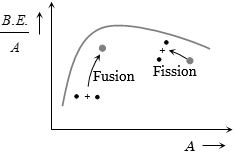
(B) The stability of a nucleus is determined by its binding energy per nucleon $(B.E./A)$.
According to the binding energy curve,for heavy nuclei (high mass number $A$),the binding energy per nucleon decreases as the mass number increases.
Nuclear fission occurs when a heavy nucleus splits into two lighter nuclei of intermediate mass,which have higher binding energy per nucleon than the original heavy nucleus.
This increase in binding energy per nucleon results in the release of energy,making the process energetically favorable.
Therefore,the correct option is $B$.
According to the binding energy curve,for heavy nuclei (high mass number $A$),the binding energy per nucleon decreases as the mass number increases.
Nuclear fission occurs when a heavy nucleus splits into two lighter nuclei of intermediate mass,which have higher binding energy per nucleon than the original heavy nucleus.
This increase in binding energy per nucleon results in the release of energy,making the process energetically favorable.
Therefore,the correct option is $B$.
0 likesView Solution
3
ChemistryMediumMCQAIPMT · 2005
The energy of the second Bohr orbit of the hydrogen atom is $-328 \ kJ \ mol^{-1}$. Hence,the energy of the fourth Bohr orbit would be .............. $kJ \ mol^{-1}$.
A
$-41$
B
$-1312$
C
$-164$
D
$-82$
Solution
(D) The energy of an orbit in a hydrogen atom is given by the formula $E_n = \frac{-1312}{n^2} \ kJ \ mol^{-1}$.
Given,for the second orbit $(n=2)$,$E_2 = -328 \ kJ \ mol^{-1}$.
For the fourth orbit $(n=4)$,the energy $E_4$ is related to $E_2$ by the ratio $\frac{E_4}{E_2} = \frac{n_2^2}{n_4^2} = \frac{2^2}{4^2} = \frac{4}{16} = \frac{1}{4}$.
Therefore,$E_4 = \frac{E_2}{4} = \frac{-328}{4} = -82 \ kJ \ mol^{-1}$.
Given,for the second orbit $(n=2)$,$E_2 = -328 \ kJ \ mol^{-1}$.
For the fourth orbit $(n=4)$,the energy $E_4$ is related to $E_2$ by the ratio $\frac{E_4}{E_2} = \frac{n_2^2}{n_4^2} = \frac{2^2}{4^2} = \frac{4}{16} = \frac{1}{4}$.
Therefore,$E_4 = \frac{E_2}{4} = \frac{-328}{4} = -82 \ kJ \ mol^{-1}$.
0 likesView Solution
4
ChemistryMCQAIPMT · 2005
The correct sequence of increasing covalent character is represented by
A
$LiCl < NaCl < BeCl_2$
B
$BeCl_2 < NaCl < LiCl$
C
$NaCl < LiCl < BeCl_2$
D
$BeCl_2 < LiCl < NaCl$
Solution
(C) According to Fajan's rule,the covalent character increases with an increase in the polarising power of the cation.
Polarising power is directly proportional to the charge density of the cation.
The charge-to-size ratio follows the order: $Be^{2+} > Li^{+} > Na^{+}$.
Therefore,the order of increasing covalent character is $NaCl < LiCl < BeCl_2$.
Polarising power is directly proportional to the charge density of the cation.
The charge-to-size ratio follows the order: $Be^{2+} > Li^{+} > Na^{+}$.
Therefore,the order of increasing covalent character is $NaCl < LiCl < BeCl_2$.
0 likesView Solution
5
ChemistryMediumMCQAIPMT · 2005
Which of the following would have a permanent dipole moment?
A
$BF_3$
B
$SiF_4$
C
$SF_4$
D
$XeF_4$
Solution
(C) The dipole moment of a molecule depends on its geometry and the polarity of its bonds.
$BF_3$ has a trigonal planar geometry,$SiF_4$ has a tetrahedral geometry,and $XeF_4$ has a square planar geometry. Due to their high symmetry,the bond dipoles in these molecules cancel each other out,resulting in a net dipole moment of zero.
$SF_4$ has a see-saw geometry due to the presence of one lone pair on the sulfur atom. This lack of symmetry prevents the bond dipoles from canceling out,resulting in a permanent dipole moment.
$BF_3$ has a trigonal planar geometry,$SiF_4$ has a tetrahedral geometry,and $XeF_4$ has a square planar geometry. Due to their high symmetry,the bond dipoles in these molecules cancel each other out,resulting in a net dipole moment of zero.
$SF_4$ has a see-saw geometry due to the presence of one lone pair on the sulfur atom. This lack of symmetry prevents the bond dipoles from canceling out,resulting in a permanent dipole moment.
0 likesView Solution
6
ChemistryMediumMCQAIPMT · 2005
Which of the following molecules has trigonal planar geometry?
A
$IF_3$
B
$PCl_3$
C
$NH_3$
D
$BF_3$
Solution
(D) To determine the geometry,we calculate the number of electron pairs around the central atom using the formula: $H = \frac{1}{2}(V + M - C + A)$,where $V$ is the number of valence electrons of the central atom,$M$ is the number of monovalent atoms,$C$ is the cationic charge,and $A$ is the anionic charge.
For $BF_3$:
Central atom $B$ has $3$ valence electrons.
Number of monovalent atoms $(F)$ = $3$.
$H = \frac{1}{2}(3 + 3) = 3$.
Since there are $3$ bond pairs and $0$ lone pairs,the hybridization is $sp^2$ and the geometry is trigonal planar.
For $IF_3$: $H = \frac{1}{2}(7 + 3) = 5$ ($sp^3d$,$T$-shaped).
For $PCl_3$: $H = \frac{1}{2}(5 + 3) = 4$ ($sp^3$,trigonal pyramidal).
For $NH_3$: $H = \frac{1}{2}(5 + 3) = 4$ ($sp^3$,trigonal pyramidal).
Therefore,the correct option is $D$.
For $BF_3$:
Central atom $B$ has $3$ valence electrons.
Number of monovalent atoms $(F)$ = $3$.
$H = \frac{1}{2}(3 + 3) = 3$.
Since there are $3$ bond pairs and $0$ lone pairs,the hybridization is $sp^2$ and the geometry is trigonal planar.
For $IF_3$: $H = \frac{1}{2}(7 + 3) = 5$ ($sp^3d$,$T$-shaped).
For $PCl_3$: $H = \frac{1}{2}(5 + 3) = 4$ ($sp^3$,trigonal pyramidal).
For $NH_3$: $H = \frac{1}{2}(5 + 3) = 4$ ($sp^3$,trigonal pyramidal).
Therefore,the correct option is $D$.
0 likesView Solution
7
ChemistryMediumMCQAIPMT · 2005
Which one of the following oxides is expected to exhibit paramagnetic behaviour?
A
$CO_2$
B
$SO_2$
C
$ClO_2$
D
$SiO_2$
Solution
(C) The paramagnetic behavior of a molecule is determined by the presence of unpaired electrons.
$CO_2$ has $16$ valence electrons and all are paired.
$SO_2$ has $18$ valence electrons and all are paired.
$SiO_2$ is a covalent network solid where all electrons are paired.
$ClO_2$ has $19$ valence electrons,meaning it contains an odd number of electrons,which results in at least one unpaired electron.
Therefore,$ClO_2$ exhibits paramagnetic behavior.
$CO_2$ has $16$ valence electrons and all are paired.
$SO_2$ has $18$ valence electrons and all are paired.
$SiO_2$ is a covalent network solid where all electrons are paired.
$ClO_2$ has $19$ valence electrons,meaning it contains an odd number of electrons,which results in at least one unpaired electron.
Therefore,$ClO_2$ exhibits paramagnetic behavior.
0 likesView Solution
8
ChemistryMediumMCQAIPMT · 2005
The correct order in which the $O-O$ bond length increases in the following is
A
$H_2O_2 < O_2 < O_3$
B
$O_2 < H_2O_2 < O_3$
C
$O_2 < O_3 < H_2O_2$
D
$O_3 < H_2O_2 < O_2$
Solution
(C) The bond lengths are as follows:
$1$. In $O_2$, the bond order is $2$, resulting in a bond length of approximately $121 \text{ pm}$.
$2$. In $O_3$, resonance results in a bond order of $1.5$, leading to a bond length of approximately $128 \text{ pm}$.
$3$. In $H_2O_2$, the $O-O$ bond is a single bond (bond order $1$), resulting in a bond length of approximately $148 \text{ pm}$.
Therefore, the increasing order of $O-O$ bond length is $O_2 < O_3 < H_2O_2$.
$1$. In $O_2$, the bond order is $2$, resulting in a bond length of approximately $121 \text{ pm}$.
$2$. In $O_3$, resonance results in a bond order of $1.5$, leading to a bond length of approximately $128 \text{ pm}$.
$3$. In $H_2O_2$, the $O-O$ bond is a single bond (bond order $1$), resulting in a bond length of approximately $148 \text{ pm}$.
Therefore, the increasing order of $O-O$ bond length is $O_2 < O_3 < H_2O_2$.
0 likesView Solution
9
ChemistryDifficultMCQAIPMT · 2005
Equilibrium constants $K_1$ and $K_2$ for the following equilibria are given:
$NO_{(g)} + 1/2 O_{2(g)} \rightleftharpoons NO_{2(g)}$
$2NO_{2(g)} \rightleftharpoons 2NO_{(g)} + O_{2(g)}$
What is the relationship between $K_1$ and $K_2$?
$NO_{(g)} + 1/2 O_{2(g)} \rightleftharpoons NO_{2(g)}$
$2NO_{2(g)} \rightleftharpoons 2NO_{(g)} + O_{2(g)}$
What is the relationship between $K_1$ and $K_2$?
A
$K_2 = 1 / K_1$
B
$K_2 = K_1^2$
C
$K_2 = K_1 / 2$
D
$K_2 = 1 / K_1^2$
Solution
(D) For the first equilibrium: $NO_{(g)} + 1/2 O_{2(g)} \rightleftharpoons NO_{2(g)}$,the equilibrium constant is $K_1 = \frac{[NO_2]}{[NO][O_2]^{1/2}}$.
For the second equilibrium: $2NO_{2(g)} \rightleftharpoons 2NO_{(g)} + O_{2(g)}$,the equilibrium constant is $K_2 = \frac{[NO]^2[O_2]}{[NO_2]^2}$.
Observe that the second reaction is the reverse of the first reaction multiplied by $2$.
If a reaction is reversed,the equilibrium constant becomes $1/K$. If a reaction is multiplied by a factor $n$,the equilibrium constant becomes $K^n$.
Here,the first reaction is reversed and multiplied by $2$,so $K_2 = (1/K_1)^2 = 1/K_1^2$.
For the second equilibrium: $2NO_{2(g)} \rightleftharpoons 2NO_{(g)} + O_{2(g)}$,the equilibrium constant is $K_2 = \frac{[NO]^2[O_2]}{[NO_2]^2}$.
Observe that the second reaction is the reverse of the first reaction multiplied by $2$.
If a reaction is reversed,the equilibrium constant becomes $1/K$. If a reaction is multiplied by a factor $n$,the equilibrium constant becomes $K^n$.
Here,the first reaction is reversed and multiplied by $2$,so $K_2 = (1/K_1)^2 = 1/K_1^2$.
0 likesView Solution
10
ChemistryMediumMCQAIPMT · 2005
The correct order of acid strength is
A
$HClO < HClO_2 < HClO_3 < HClO_4$
B
$HClO_4 < HClO < HClO_2 < HClO_3$
C
$HClO_2 < HClO_3 < HClO_4 < HClO$
D
$HClO_4 < HClO_3 < HClO_2 < HClO$
Solution
(A) The acidic strength of oxoacids of chlorine depends on the oxidation state of the central chlorine atom.
As the oxidation number of the central atom increases,the electron density on the oxygen atom decreases,which facilitates the release of the $H^+$ ion.
The oxidation states are: $HClO (+1)$,$HClO_2 (+3)$,$HClO_3 (+5)$,and $HClO_4 (+7)$.
Therefore,the correct order of acid strength is $HClO < HClO_2 < HClO_3 < HClO_4$.
As the oxidation number of the central atom increases,the electron density on the oxygen atom decreases,which facilitates the release of the $H^+$ ion.
The oxidation states are: $HClO (+1)$,$HClO_2 (+3)$,$HClO_3 (+5)$,and $HClO_4 (+7)$.
Therefore,the correct order of acid strength is $HClO < HClO_2 < HClO_3 < HClO_4$.
0 likesView Solution
11
ChemistryMediumMCQAIPMT · 2005
At $25 \, ^\circ C$,the dissociation constant of a base $BOH$ is $1.0 \times 10^{-12}$. The concentration of hydroxyl ions in $0.01 \, M$ aqueous solution of the base would be:
A
$2.0 \times 10^{-6} \, mol \, L^{-1}$
B
$1.0 \times 10^{-5} \, mol \, L^{-1}$
C
$1.0 \times 10^{-6} \, mol \, L^{-1}$
D
$1.0 \times 10^{-7} \, mol \, L^{-1}$
Solution
(D) For a weak base $BOH$,the dissociation is $BOH \rightleftharpoons B^+ + OH^-$.
$K_b = \frac{[B^+][OH^-]}{[BOH]} = \frac{C\alpha \cdot C\alpha}{C(1-\alpha)} \approx C\alpha^2$.
Given $K_b = 1.0 \times 10^{-12}$ and $C = 0.01 \, M = 10^{-2} \, M$.
$1.0 \times 10^{-12} = 10^{-2} \cdot \alpha^2$.
$\alpha^2 = 10^{-10} \implies \alpha = 10^{-5}$.
$[OH^-] = C\alpha = 10^{-2} \times 10^{-5} = 1.0 \times 10^{-7} \, mol \, L^{-1}$.
$K_b = \frac{[B^+][OH^-]}{[BOH]} = \frac{C\alpha \cdot C\alpha}{C(1-\alpha)} \approx C\alpha^2$.
Given $K_b = 1.0 \times 10^{-12}$ and $C = 0.01 \, M = 10^{-2} \, M$.
$1.0 \times 10^{-12} = 10^{-2} \cdot \alpha^2$.
$\alpha^2 = 10^{-10} \implies \alpha = 10^{-5}$.
$[OH^-] = C\alpha = 10^{-2} \times 10^{-5} = 1.0 \times 10^{-7} \, mol \, L^{-1}$.
0 likesView Solution
12
ChemistryMCQAIPMT · 2005
What is the correct relationship between the $pH$ values of isomolar solutions of sodium oxide $(pH_1)$,sodium sulphide $(pH_2)$,sodium selenide $(pH_3)$,and sodium telluride $(pH_4)$?
A
$pH_1 > pH_2 = pH_3 > pH_4$
B
$pH_1 < pH_2 < pH_3 < pH_4$
C
$pH_1 < pH_2 < pH_3 = pH_4$
D
$pH_1 > pH_2 > pH_3 > pH_4$
Solution
(D) The salts $Na_2O$,$Na_2S$,$Na_2Se$,and $Na_2Te$ undergo anionic hydrolysis in water to form $NaOH$ and the corresponding weak acid ($H_2O$,$H_2S$,$H_2Se$,$H_2Te$ respectively).
The $pH$ of these solutions depends on the strength of the conjugate acid formed. The weaker the conjugate acid,the stronger the conjugate base,and the higher the $pH$ of the solution.
The acidic strength order of the hydrides is $H_2O < H_2S < H_2Se < H_2Te$.
Therefore,the basic strength of the conjugate bases follows the order $OH^- > HS^- > HSe^- > HTe^-$.
Consequently,the $pH$ values of their isomolar solutions follow the order $pH_1 > pH_2 > pH_3 > pH_4$.
The $pH$ of these solutions depends on the strength of the conjugate acid formed. The weaker the conjugate acid,the stronger the conjugate base,and the higher the $pH$ of the solution.
The acidic strength order of the hydrides is $H_2O < H_2S < H_2Se < H_2Te$.
Therefore,the basic strength of the conjugate bases follows the order $OH^- > HS^- > HSe^- > HTe^-$.
Consequently,the $pH$ values of their isomolar solutions follow the order $pH_1 > pH_2 > pH_3 > pH_4$.
0 likesView Solution
13
ChemistryMediumMCQAIPMT · 2005
Which of the following pairs of a chemical reaction is certain to result in a spontaneous reaction?
A
Exothermic and decreasing disorder
B
Endothermic and increasing disorder
C
Exothermic and increasing disorder
D
Endothermic and decreasing disorder
Solution
(C) The spontaneity of a reaction is determined by the Gibbs free energy equation: $\Delta G = \Delta H - T\Delta S$.
For a process to be spontaneous,$\Delta G$ must be negative.
In option $(C)$,the reaction is exothermic $(\Delta H < 0)$ and there is an increase in disorder $(\Delta S > 0)$.
Substituting these into the equation: $\Delta G = (-ve) - T(+ve) = -ve$.
Since $\Delta G$ is always negative regardless of the temperature $T$,the reaction is certain to be spontaneous.
For a process to be spontaneous,$\Delta G$ must be negative.
In option $(C)$,the reaction is exothermic $(\Delta H < 0)$ and there is an increase in disorder $(\Delta S > 0)$.
Substituting these into the equation: $\Delta G = (-ve) - T(+ve) = -ve$.
Since $\Delta G$ is always negative regardless of the temperature $T$,the reaction is certain to be spontaneous.
0 likesView Solution
14
ChemistryEasyMCQAIPMT · 2005
The absolute enthalpy of neutralisation of the reaction $MgO_{(s)} + 2HCl_{(aq)} \to MgCl_{2(aq)} + H_2O_{(l)}$ will be
A
Less than $-57.33 \ kJ \ mol^{-1}$
B
$-57.33 \ kJ \ mol^{-1}$
C
Greater than $-57.33 \ kJ \ mol^{-1}$
D
$57.33 \ kJ \ mol^{-1}$
Solution
(A) The standard enthalpy of neutralisation for a strong acid and a strong base is $-57.33 \ kJ \ mol^{-1}$.
$MgO$ is a metal oxide that acts as a base,but it is not a strong soluble base like $NaOH$ or $KOH$.
When $MgO_{(s)}$ reacts with $HCl_{(aq)}$,energy is consumed to break the crystal lattice of $MgO$ and to convert it into ions.
Therefore,the net heat released is less than the standard value of $-57.33 \ kJ \ mol^{-1}$ (i.e.,it is less exothermic).
Thus,the enthalpy of neutralisation will be less than $-57.33 \ kJ \ mol^{-1}$.
$MgO$ is a metal oxide that acts as a base,but it is not a strong soluble base like $NaOH$ or $KOH$.
When $MgO_{(s)}$ reacts with $HCl_{(aq)}$,energy is consumed to break the crystal lattice of $MgO$ and to convert it into ions.
Therefore,the net heat released is less than the standard value of $-57.33 \ kJ \ mol^{-1}$ (i.e.,it is less exothermic).
Thus,the enthalpy of neutralisation will be less than $-57.33 \ kJ \ mol^{-1}$.
0 likesView Solution
15
ChemistryEasyMCQAIPMT · 2005
The number of moles of $KMnO_4$ reduced by one mole of $KI$ in alkaline medium is:
A
$0.2$
B
$5$
C
$1$
D
$2$
Solution
(D) In alkaline medium,the balanced chemical equation for the reaction between $KMnO_4$ and $KI$ is:
$2KMnO_4 + KI + H_2O \to 2MnO_2 + KIO_3 + 2KOH$
From the stoichiometry of the balanced equation,$2$ moles of $KMnO_4$ react with $1$ mole of $KI$.
Therefore,the number of moles of $KMnO_4$ reduced by $1$ mole of $KI$ is $2$.
$2KMnO_4 + KI + H_2O \to 2MnO_2 + KIO_3 + 2KOH$
From the stoichiometry of the balanced equation,$2$ moles of $KMnO_4$ react with $1$ mole of $KI$.
Therefore,the number of moles of $KMnO_4$ reduced by $1$ mole of $KI$ is $2$.
0 likesView Solution
16
ChemistryMediumMCQAIPMT · 2005
The correct sequence of increasing covalent character is represented by
A
$LiCl < NaCl < BeCl_2$
B
$BeCl_2 < NaCl < LiCl$
C
$NaCl < LiCl < BeCl_2$
D
$BeCl_2 < LiCl < NaCl$
Solution
(C) According to Fajan's rule,the covalent character of an ionic bond increases with the polarising power of the cation.
Polarising power is directly proportional to the charge density of the cation.
The charge and size of the cations are $Na^{+}$ ($+1$,large size),$Li^{+}$ ($+1$,smaller than $Na^{+}$),and $Be^{2+}$ ($+2$,smallest size).
The order of polarising power is $Be^{2+} > Li^{+} > Na^{+}$.
Therefore,the order of increasing covalent character is $NaCl < LiCl < BeCl_2$.
Polarising power is directly proportional to the charge density of the cation.
The charge and size of the cations are $Na^{+}$ ($+1$,large size),$Li^{+}$ ($+1$,smaller than $Na^{+}$),and $Be^{2+}$ ($+2$,smallest size).
The order of polarising power is $Be^{2+} > Li^{+} > Na^{+}$.
Therefore,the order of increasing covalent character is $NaCl < LiCl < BeCl_2$.
0 likesView Solution
17
ChemistryMCQAIPMT · 2005
Which one of the following arrangements represents the correct order of electron gain enthalpy (with negative sign) of the given atomic species?
A
$Cl < F < S < O$
B
$O < S < F < Cl$
C
$S < O < Cl < F$
D
$F < Cl < O < S$
Solution
(B) The electron gain enthalpy (with negative sign) represents the energy released when an electron is added to a neutral gaseous atom.
Generally,electron gain enthalpy becomes more negative across a period.
However,for $F$ and $Cl$,the electron gain enthalpy of $Cl$ is more negative than that of $F$ due to the small size of the $F$ atom,which leads to strong inter-electronic repulsions.
The values are: $Cl$ $(349 \ kJ/mol)$,$F$ $(333 \ kJ/mol)$,$S$ $(200 \ kJ/mol)$,and $O$ $(142 \ kJ/mol)$.
Thus,the correct order of increasing magnitude is $O < S < F < Cl$.
Generally,electron gain enthalpy becomes more negative across a period.
However,for $F$ and $Cl$,the electron gain enthalpy of $Cl$ is more negative than that of $F$ due to the small size of the $F$ atom,which leads to strong inter-electronic repulsions.
The values are: $Cl$ $(349 \ kJ/mol)$,$F$ $(333 \ kJ/mol)$,$S$ $(200 \ kJ/mol)$,and $O$ $(142 \ kJ/mol)$.
Thus,the correct order of increasing magnitude is $O < S < F < Cl$.
0 likesView Solution
18
ChemistryMediumMCQAIPMT · 2005
Which one of the following arrangements represents the correct order of electron gain enthalpy (with negative sign) of the given atomic species?
A
$Cl < F < S < O$
B
$O < S < F < Cl$
C
$S < O < Cl < F$
D
$F < Cl < O < S$
Solution
(B) The electron gain enthalpy (with negative sign) represents the energy released when an electron is added to a neutral gaseous atom.
Generally,electron gain enthalpy becomes more negative across a period.
However,for halogens,the electron gain enthalpy of $F$ is less negative than that of $Cl$ due to the small size of the $F$ atom,which leads to strong inter-electronic repulsions.
Similarly,for oxygen and sulfur,the electron gain enthalpy of $O$ is less negative than that of $S$ due to the small size of the $O$ atom.
The values are: $Cl$ $(349 \ kJ/mol)$,$F$ $(333 \ kJ/mol)$,$S$ $(200 \ kJ/mol)$,and $O$ $(142 \ kJ/mol)$.
Thus,the correct order of increasing electron gain enthalpy (magnitude) is $O < S < F < Cl$.
Generally,electron gain enthalpy becomes more negative across a period.
However,for halogens,the electron gain enthalpy of $F$ is less negative than that of $Cl$ due to the small size of the $F$ atom,which leads to strong inter-electronic repulsions.
Similarly,for oxygen and sulfur,the electron gain enthalpy of $O$ is less negative than that of $S$ due to the small size of the $O$ atom.
The values are: $Cl$ $(349 \ kJ/mol)$,$F$ $(333 \ kJ/mol)$,$S$ $(200 \ kJ/mol)$,and $O$ $(142 \ kJ/mol)$.
Thus,the correct order of increasing electron gain enthalpy (magnitude) is $O < S < F < Cl$.
0 likesView Solution
19
ChemistryMediumMCQAIPMT · 2005
Which of the following is an electron-deficient molecule?
A
$B_2H_6$
B
$C_2H_6$
C
$PH_3$
D
$SiH_4$
Solution
(A) An electron-deficient molecule is one in which the central atom has fewer than $8$ electrons in its valence shell,or it lacks sufficient electrons to form conventional covalent bonds.
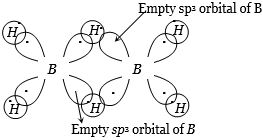
In $B_2H_6$ (diborane),each boron atom is bonded to four hydrogen atoms,but there are only $12$ valence electrons available for the entire molecule,which is insufficient to form standard two-center-two-electron $(2c-2e)$ bonds for all linkages.
It contains two $3$-center-$2$-electron $(3c-2e)$ bonds,also known as banana bonds,making it an electron-deficient molecule.
In contrast,$C_2H_6$,$PH_3$,and $SiH_4$ are electron-precise molecules where the octet rule is satisfied for the central atoms.
In $B_2H_6$ (diborane),each boron atom is bonded to four hydrogen atoms,but there are only $12$ valence electrons available for the entire molecule,which is insufficient to form standard two-center-two-electron $(2c-2e)$ bonds for all linkages.
It contains two $3$-center-$2$-electron $(3c-2e)$ bonds,also known as banana bonds,making it an electron-deficient molecule.
In contrast,$C_2H_6$,$PH_3$,and $SiH_4$ are electron-precise molecules where the octet rule is satisfied for the central atoms.
0 likesView Solution
20
ChemistryDifficultMCQAIPMT · 2005
What is the correct relationship between the $pH$s of isomolar solutions of sodium oxide $(pH_1)$,sodium sulphide $(pH_2)$,sodium selenide $(pH_3)$ and sodium telluride $(pH_4)$?
A
$pH_1 > pH_2 = pH_3 > pH_4$
B
$pH_1 < pH_2 < pH_3 < pH_4$
C
$pH_1 < pH_2 < pH_3 = pH_4$
D
$pH_1 > pH_2 > pH_3 > pH_4$
Solution
(D) The $pH$ of an aqueous solution of a salt of a strong base and a weak acid depends on the strength of the acid.
Stronger the acid,weaker is its conjugate base,and lower is the $pH$ of its salt solution.
The order of acidic strength of the corresponding hydrides is $H_2O < H_2S < H_2Se < H_2Te$.
Since the acidic strength increases down the group,the basic strength of the conjugate bases $(O^{2-}, S^{2-}, Se^{2-}, Te^{2-})$ decreases in the order $O^{2-} > S^{2-} > Se^{2-} > Te^{2-}$.
Therefore,the $pH$ of the isomolar solutions follows the order $pH_1 > pH_2 > pH_3 > pH_4$.
Stronger the acid,weaker is its conjugate base,and lower is the $pH$ of its salt solution.
The order of acidic strength of the corresponding hydrides is $H_2O < H_2S < H_2Se < H_2Te$.
Since the acidic strength increases down the group,the basic strength of the conjugate bases $(O^{2-}, S^{2-}, Se^{2-}, Te^{2-})$ decreases in the order $O^{2-} > S^{2-} > Se^{2-} > Te^{2-}$.
Therefore,the $pH$ of the isomolar solutions follows the order $pH_1 > pH_2 > pH_3 > pH_4$.
0 likesView Solution
21
ChemistryDifficultMCQAIPMT · 2005
$H_2S$ gas,when passed through a solution containing $HCl$,precipitates the cations of group $II$ of qualitative analysis but not those belonging to the fourth group. This is because:
A
Presence of $HCl$ decreases the sulphide ion concentration
B
Presence of $HCl$ increases the sulphide ion concentration
C
Solubility product of group $II$ sulphides is more than that of group $IV$ sulphides
D
Sulphides of group $IV$ cations are soluble in $HCl$
Solution
(A) $H_2S$ is a weak electrolyte and undergoes dissociation as: $H_2S \rightleftharpoons 2H^+ + S^{2-}$.
According to the common ion effect,the presence of $HCl$ (a strong electrolyte) provides a high concentration of $H^+$ ions.
This suppresses the ionization of $H_2S$,thereby significantly decreasing the concentration of $S^{2-}$ ions.
The solubility product $(K_{sp})$ of group $II$ sulphides is very low,so even a low concentration of $S^{2-}$ is sufficient to exceed the ionic product and cause precipitation.
However,the $K_{sp}$ of group $IV$ sulphides is relatively higher,and the suppressed $S^{2-}$ concentration is insufficient to cause their precipitation.
According to the common ion effect,the presence of $HCl$ (a strong electrolyte) provides a high concentration of $H^+$ ions.
This suppresses the ionization of $H_2S$,thereby significantly decreasing the concentration of $S^{2-}$ ions.
The solubility product $(K_{sp})$ of group $II$ sulphides is very low,so even a low concentration of $S^{2-}$ is sufficient to exceed the ionic product and cause precipitation.
However,the $K_{sp}$ of group $IV$ sulphides is relatively higher,and the suppressed $S^{2-}$ concentration is insufficient to cause their precipitation.
0 likesView Solution
22
ChemistryMediumMCQAIPMT · 2005
When $H_2S$ gas is passed through a solution containing $HCl$,it precipitates the cations of the second group of qualitative analysis but not those belonging to the fourth group. This is because:
A
Presence of $HCl$ decreases the sulphide ion concentration.
B
Presence of $HCl$ increases the sulphide ion concentration.
C
Solubility product of group $II$ sulphides is more than that of group $IV$ sulphides.
D
Sulphides of group $IV$ cations are soluble in $HCl$.
Solution
(A) In qualitative analysis,$H_2S$ is a weak acid that dissociates as: $H_2S \rightleftharpoons 2H^+ + S^{2-}$.
When $HCl$ is present,it provides a high concentration of $H^+$ ions due to the common ion effect.
This suppresses the dissociation of $H_2S$,significantly decreasing the concentration of $S^{2-}$ ions.
Group $II$ cations have very low solubility products $(K_{sp})$,so they precipitate even at low $S^{2-}$ concentrations.
Group $IV$ cations have higher $K_{sp}$ values and require a higher concentration of $S^{2-}$ to precipitate,which is not achieved in the presence of $HCl$.
When $HCl$ is present,it provides a high concentration of $H^+$ ions due to the common ion effect.
This suppresses the dissociation of $H_2S$,significantly decreasing the concentration of $S^{2-}$ ions.
Group $II$ cations have very low solubility products $(K_{sp})$,so they precipitate even at low $S^{2-}$ concentrations.
Group $IV$ cations have higher $K_{sp}$ values and require a higher concentration of $S^{2-}$ to precipitate,which is not achieved in the presence of $HCl$.
0 likesView Solution
23
ChemistryMediumMCQAIPMT · 2005
The best method for the separation of naphthalene and benzoic acid from their mixture is
A
Chromatography
B
Crystallisation
C
Distillation
D
Sublimation
Solution
(B) The correct answer is $(B)$.
Benzoic acid is soluble in hot water,whereas naphthalene is insoluble in water.
Therefore,when the mixture is dissolved in hot water and filtered,benzoic acid passes through the filter paper as a filtrate,while naphthalene remains as a residue.
Upon cooling the filtrate,benzoic acid crystallizes out.
Benzoic acid is soluble in hot water,whereas naphthalene is insoluble in water.
Therefore,when the mixture is dissolved in hot water and filtered,benzoic acid passes through the filter paper as a filtrate,while naphthalene remains as a residue.
Upon cooling the filtrate,benzoic acid crystallizes out.
0 likesView Solution
24
ChemistryMediumMCQAIPMT · 2005
Names of some compounds are given. Which one is not in $IUPAC$ system?
A
$CH_3-CH(OH)-CH(CH_3)_2$ $(3-\text{Methylbutan-}2-\text{ol})$
B
$CH_3-C\equiv C-CH(CH_3)_2$ $(4-\text{Methylpent-}2-\text{yne})$
C
$CH_3-CH_2-C(=CH_2)-CH(CH_3)-CH_2-CH_3$ $(2-\text{Ethyl-}3-\text{methylbut-}1-\text{ene})$
D
$CH_3-CH_2-CH_2-CH(C_2H_5)-CH(CH_3)-CH_2-CH_3$ $(3-\text{Methyl-}4-\text{ethylheptane})$
Solution
(D) In $IUPAC$ nomenclature,substituents are listed in alphabetical order.
For the compound $CH_3-CH_2-CH_2-CH(C_2H_5)-CH(CH_3)-CH_2-CH_3$,the parent chain is heptane.
The substituents are ethyl at position $4$ and methyl at position $3$.
Alphabetically,'ethyl' comes before 'methyl'.
Therefore,the correct name should be $4-\text{Ethyl-}3-\text{methylheptane}$.
Thus,the name $3-\text{Methyl-}4-\text{ethylheptane}$ is incorrect.
For the compound $CH_3-CH_2-CH_2-CH(C_2H_5)-CH(CH_3)-CH_2-CH_3$,the parent chain is heptane.
The substituents are ethyl at position $4$ and methyl at position $3$.
Alphabetically,'ethyl' comes before 'methyl'.
Therefore,the correct name should be $4-\text{Ethyl-}3-\text{methylheptane}$.
Thus,the name $3-\text{Methyl-}4-\text{ethylheptane}$ is incorrect.
0 likesView Solution
25
ChemistryMediumMCQAIPMT · 2005
Which amongst the following is the most stable carbocation?
A
$CH_3-CH^+(CH_3)$
B
$CH_3-C^+(CH_3)_2$
C
$CH_3^+$
D
$CH_3-CH_2^+$
Solution
(B) The correct answer is $(B)$ $CH_3-C^+(CH_3)_2$.
Carbocation stability is determined by the inductive effect $(+I)$ and hyperconjugation.
$CH_3-C^+(CH_3)_2$ is a $3^\circ$ carbocation,which is stabilized by the electron-donating effect of three methyl groups.
$CH_3-CH^+(CH_3)$ is a $2^\circ$ carbocation,$CH_3-CH_2^+$ is a $1^\circ$ carbocation,and $CH_3^+$ is a methyl carbocation.
Stability order: $3^\circ > 2^\circ > 1^\circ > \text{methyl}$.
Carbocation stability is determined by the inductive effect $(+I)$ and hyperconjugation.
$CH_3-C^+(CH_3)_2$ is a $3^\circ$ carbocation,which is stabilized by the electron-donating effect of three methyl groups.
$CH_3-CH^+(CH_3)$ is a $2^\circ$ carbocation,$CH_3-CH_2^+$ is a $1^\circ$ carbocation,and $CH_3^+$ is a methyl carbocation.
Stability order: $3^\circ > 2^\circ > 1^\circ > \text{methyl}$.
0 likesView Solution
26
ChemistryMediumMCQAIPMT · 2005
Determine the chirality of the given compound.

A
$R$
B
$S$
C
$Z$
D
$E$
Solution
(A) To determine the chirality ($R/S$ configuration) of the chiral center,we assign priorities to the groups attached to the central carbon atom based on the Cahn-Ingold-Prelog $(CIP)$ sequence rules based on atomic number:
$1$. $-Br$ (atomic number $35$) is priority $1$.
$2$. $-Cl$ (atomic number $17$) is priority $2$.
$3$. $-CH_3$ (atomic number $6$ for $C$) is priority $3$.
$4$. $-H$ (atomic number $1$) is priority $4$.
Since the lowest priority group $(-H)$ is on a dashed bond (pointing away from the viewer),we look at the sequence $1$ $\rightarrow 2$ $\rightarrow 3$.
The sequence $Br$ $\rightarrow Cl$ $\rightarrow CH_3$ follows a clockwise direction.
Therefore,the configuration is $R$.
$1$. $-Br$ (atomic number $35$) is priority $1$.
$2$. $-Cl$ (atomic number $17$) is priority $2$.
$3$. $-CH_3$ (atomic number $6$ for $C$) is priority $3$.
$4$. $-H$ (atomic number $1$) is priority $4$.
Since the lowest priority group $(-H)$ is on a dashed bond (pointing away from the viewer),we look at the sequence $1$ $\rightarrow 2$ $\rightarrow 3$.
The sequence $Br$ $\rightarrow Cl$ $\rightarrow CH_3$ follows a clockwise direction.
Therefore,the configuration is $R$.
0 likesView Solution
27
ChemistryMediumMCQAIPMT · 2005
Which one of the following pairs represents stereoisomerism?
A
Chain isomerism and rotational isomerism
B
Structural isomerism and geometric isomerism
C
Linkage isomerism and geometric isomerism
D
Optical isomerism and geometric isomerism
Solution
(D) Stereoisomerism occurs when isomers have the same structural formula but differ in the relative arrangement of atoms or groups in space within the molecule.
Stereoisomerism is primarily classified into three types:
$(i)$ Geometrical isomerism
$(ii)$ Optical isomerism
$(iii)$ Conformational isomerism.
Therefore,both optical isomerism and geometric isomerism are types of stereoisomerism.
Stereoisomerism is primarily classified into three types:
$(i)$ Geometrical isomerism
$(ii)$ Optical isomerism
$(iii)$ Conformational isomerism.
Therefore,both optical isomerism and geometric isomerism are types of stereoisomerism.
0 likesView Solution
28
ChemistryDifficultMCQAIPMT · 2005
The products of the following reaction $CH_3-C \equiv C-CH_2-CH_3 \xrightarrow[(2)\ H_2O]{(1)\ O_3}$ are:
A
$CH_3CHO + CH_3CH_2CHO$
B
$CH_3COOH + CH_3CH_2CHO$
C
$CH_3COOH + CH_3CH_2COOH$
D
$CH_3COOH + CO_2$
Solution
(C) Ozonolysis of an internal alkyne followed by hydrolysis yields diketones as intermediate products,which are further oxidized to carboxylic acids.
The reaction proceeds as follows:
$CH_3-C \equiv C-CH_2-CH_3$ $\xrightarrow{O_3} \text{ozonide intermediate}$ $\xrightarrow{H_2O} CH_3-CO-CO-CH_2-CH_3 + H_2O_2$
The diketone $CH_3-CO-CO-CH_2-CH_3$ is then cleaved to form carboxylic acids:
$CH_3-CO-CO-CH_2-CH_3 \rightarrow CH_3COOH + CH_3CH_2COOH$
Thus,the final products are acetic acid and propanoic acid.
The reaction proceeds as follows:
$CH_3-C \equiv C-CH_2-CH_3$ $\xrightarrow{O_3} \text{ozonide intermediate}$ $\xrightarrow{H_2O} CH_3-CO-CO-CH_2-CH_3 + H_2O_2$
The diketone $CH_3-CO-CO-CH_2-CH_3$ is then cleaved to form carboxylic acids:
$CH_3-CO-CO-CH_2-CH_3 \rightarrow CH_3COOH + CH_3CH_2COOH$
Thus,the final products are acetic acid and propanoic acid.
0 likesView Solution
29
ChemistryMCQAIPMT · 2005
$A$ solution of urea (molar mass $60 \ g \ mol^{-1}$) boils at $100.18 \ ^oC$ at atmospheric pressure. If $K_f$ and $K_b$ for water are $1.86$ and $0.512 \ K \ kg \ mol^{-1}$ respectively,the above solution will freeze at ......... $^oC$.
A
$-6.54$
B
$6.54$
C
$0.65$
D
$-0.65$
0 likesView Solution
30
ChemistryEasyMCQAIPMT · 2005
The surface tension of which of the following liquids is maximum?
A
$H_2O$
B
$C_6H_6$
C
$CH_3OH$
D
$C_2H_5OH$
Solution
(A) Surface tension is primarily determined by the strength of intermolecular forces,specifically hydrogen bonding.
Water $(H_2O)$ molecules exhibit strong hydrogen bonding due to their high polarity and the presence of two hydrogen atoms capable of forming bonds with oxygen atoms of adjacent molecules.
This extensive network of hydrogen bonds results in a higher cohesive force compared to organic solvents like benzene $(C_6H_6)$,methanol $(CH_3OH)$,or ethanol $(C_2H_5OH)$.
Therefore,water has the maximum surface tension among the given options.
Water $(H_2O)$ molecules exhibit strong hydrogen bonding due to their high polarity and the presence of two hydrogen atoms capable of forming bonds with oxygen atoms of adjacent molecules.
This extensive network of hydrogen bonds results in a higher cohesive force compared to organic solvents like benzene $(C_6H_6)$,methanol $(CH_3OH)$,or ethanol $(C_2H_5OH)$.
Therefore,water has the maximum surface tension among the given options.
0 likesView Solution
31
ChemistryMediumMCQAIPMT · 2005
The number of moles of $KMnO_4$ reduced by one mole of $KI$ in alkaline medium is
A
$1/5$
B
$5$
C
$1$
D
$2$
Solution
(D) In alkaline medium,the balanced chemical equation for the reaction between $KMnO_4$ and $KI$ is:
$2KMnO_4 + KI + H_2O \to 2MnO_2 + KIO_3 + 2KOH$
From the stoichiometry of the balanced equation,$2$ moles of $KMnO_4$ react with $1$ mole of $KI$.
Therefore,the number of moles of $KMnO_4$ reduced by $1$ mole of $KI$ is $2$.
$2KMnO_4 + KI + H_2O \to 2MnO_2 + KIO_3 + 2KOH$
From the stoichiometry of the balanced equation,$2$ moles of $KMnO_4$ react with $1$ mole of $KI$.
Therefore,the number of moles of $KMnO_4$ reduced by $1$ mole of $KI$ is $2$.
0 likesView Solution
32
ChemistryDifficultMCQAIPMT · 2005
The products of the following reaction $CH_3-C\equiv C-CH_2-CH_3 \xrightarrow[2. \text{Hydrolysis}]{1. O_3} ...$ are
A
$CH_3CHO + CH_3CH_2CHO$
B
$CH_3COOH + CH_3CH_2CHO$
C
$CH_3COOH + CH_3CH_2COOH$
D
$CH_3COOH + CO_2$
Solution
(C) The reaction of an alkyne with ozone followed by hydrolysis is an oxidative cleavage reaction.
For an internal alkyne $R-C\equiv C-R'$,the products are two carboxylic acids: $RCOOH$ and $R'COOH$.
In the given reaction,$CH_3-C\equiv C-CH_2-CH_3$ undergoes oxidative cleavage at the triple bond.
The $CH_3-C$ part is oxidized to acetic acid $(CH_3COOH)$.
The $-C-CH_2-CH_3$ part is oxidized to propanoic acid $(CH_3CH_2COOH)$.
Thus,the products are $CH_3COOH + CH_3CH_2COOH$.
For an internal alkyne $R-C\equiv C-R'$,the products are two carboxylic acids: $RCOOH$ and $R'COOH$.
In the given reaction,$CH_3-C\equiv C-CH_2-CH_3$ undergoes oxidative cleavage at the triple bond.
The $CH_3-C$ part is oxidized to acetic acid $(CH_3COOH)$.
The $-C-CH_2-CH_3$ part is oxidized to propanoic acid $(CH_3CH_2COOH)$.
Thus,the products are $CH_3COOH + CH_3CH_2COOH$.
0 likesView Solution
33
ChemistryMCQAIPMT · 2005
Auxospores and hormocysts are formed respectively by
A
Some cyanobacteria and many diatoms
B
Several cyanobacteria and several diatoms
C
Some diatoms and several cyanobacteria
D
Several diatoms and a few cyanobacteria
Solution
(C) $Auxospores$ are specialized cells formed by many diatoms to restore their normal size after repeated cell divisions.
$Hormocysts$ are thick-walled,resting structures formed by some cyanobacteria (like $Westiellopsis$) under unfavorable conditions to survive and propagate.
Therefore,$Auxospores$ are formed by diatoms and $Hormocysts$ are formed by cyanobacteria.
$Hormocysts$ are thick-walled,resting structures formed by some cyanobacteria (like $Westiellopsis$) under unfavorable conditions to survive and propagate.
Therefore,$Auxospores$ are formed by diatoms and $Hormocysts$ are formed by cyanobacteria.
0 likesView Solution
34
ChemistryMCQAIPMT · 2005
Ectophloic siphonostele is found in
A
Adiantum and Cucurbitaceae
B
Osmunda and Equisetum
C
Marsilea and Botrychium
D
Dicksonia and Maidenhair fern
Solution
(B) In an ectophloic siphonostele,the central pith is surrounded by a ring of xylem,which is further surrounded by a ring of phloem,pericycle,and endodermis.
In this type,the phloem is present only on the outer side of the xylem.
Examples of plants exhibiting this type of stele include $Osmunda$ and $Equisetum$.
In this type,the phloem is present only on the outer side of the xylem.
Examples of plants exhibiting this type of stele include $Osmunda$ and $Equisetum$.
0 likesView Solution
35
ChemistryMCQAIPMT · 2005
In contrast to annelids,the Platyhelminthes show:
A
Radial symmetry
B
Presence of pseudocoel
C
Bilateral symmetry
D
Absence of body cavity
Solution
(D) Annelids are coelomate animals,meaning they possess a true body cavity (coelom) lined by mesoderm.
In contrast,Platyhelminthes are acoelomate,meaning they lack a body cavity entirely.
Therefore,the absence of a body cavity is a characteristic feature of Platyhelminthes that distinguishes them from annelids.
In contrast,Platyhelminthes are acoelomate,meaning they lack a body cavity entirely.
Therefore,the absence of a body cavity is a characteristic feature of Platyhelminthes that distinguishes them from annelids.
0 likesView Solution
36
ChemistryMCQAIPMT · 2005
From the following statements,select the wrong one:
A
Millipedes have two pairs of appendages in each segment of the body.
B
Prawn has two pairs of antennae.
C
Animals belonging to phylum Porifera are exclusively marine.
D
Nematocysts are characteristic of the phylum Cnidaria.
Solution
(C) The correct answer is $C$.
Most members of the phylum $Porifera$ (sponges) are marine,but they are not exclusively marine.
Some sponges,such as $Spongilla$,are found in freshwater environments.
Therefore,the statement that animals belonging to phylum $Porifera$ are exclusively marine is incorrect.
Most members of the phylum $Porifera$ (sponges) are marine,but they are not exclusively marine.
Some sponges,such as $Spongilla$,are found in freshwater environments.
Therefore,the statement that animals belonging to phylum $Porifera$ are exclusively marine is incorrect.
0 likesView Solution
37
ChemistryMCQAIPMT · 2005
Which of the following substances,if introduced into the blood stream,causes coagulation of blood at the site of its introduction?
A
Fibrinogen
B
Prothrombin
C
Heparin
D
Thromboplastin
Solution
(D) The correct answer is $D$. Thromboplastin is a complex substance released by damaged tissues or platelets that initiates the extrinsic pathway of blood coagulation. When introduced into the bloodstream,it triggers the conversion of prothrombin into thrombin in the presence of calcium ions $(Ca^{2+})$. Thrombin then converts soluble fibrinogen into insoluble fibrin threads,leading to the formation of a blood clot at the site of introduction.
0 likesView Solution
38
ChemistryMCQAIPMT · 2005
During transcription,the holoenzyme $RNA$ polymerase binds to a $DNA$ sequence,and the $DNA$ assumes a saddle-like structure at that point. What is that sequence called?
A
$CAAT$ box
B
$GGTT$ box
C
$AAAT$ box
D
$TATA$ box
Solution
(D) The correct answer is $D$.
In eukaryotes,the transcription initiation complex involves the binding of $RNA$ polymerase to the promoter region.
The $TATA$ box (also known as the Goldberg-Hogness box) is a specific $DNA$ sequence found in the promoter region of genes.
When $RNA$ polymerase and transcription factors bind to the $TATA$ box,the $DNA$ double helix undergoes a conformational change,bending into a saddle-like structure to facilitate the initiation of transcription.
In eukaryotes,the transcription initiation complex involves the binding of $RNA$ polymerase to the promoter region.
The $TATA$ box (also known as the Goldberg-Hogness box) is a specific $DNA$ sequence found in the promoter region of genes.
When $RNA$ polymerase and transcription factors bind to the $TATA$ box,the $DNA$ double helix undergoes a conformational change,bending into a saddle-like structure to facilitate the initiation of transcription.
0 likesView Solution
39
ChemistryMCQAIPMT · 2005
Which of the following is generally used for induced mutagenesis in crop plants?
A
Alpha particles
B
$X$-rays
C
$UV$ $(260 \ nm)$
D
Gamma rays (from cobalt-$60$)
Solution
(D) Induced mutagenesis is a technique used in plant breeding to create genetic variability.
Gamma rays,emitted from radioactive isotopes like cobalt-$60$,are the most commonly used physical mutagens for inducing mutations in crop plants.
They have high penetrating power,which allows them to reach the meristematic tissues of seeds or plant parts effectively,leading to chromosomal changes and mutations.
Gamma rays,emitted from radioactive isotopes like cobalt-$60$,are the most commonly used physical mutagens for inducing mutations in crop plants.
They have high penetrating power,which allows them to reach the meristematic tissues of seeds or plant parts effectively,leading to chromosomal changes and mutations.
0 likesView Solution
40
ChemistryMCQAIPMT · 2005
Which of the following is the simplest amino acid?
A
Tyrosine
B
Asparagine
C
Glycine
D
Alanine
Solution
(C) The simplest amino acid is $Glycine$ $(NH_2-CH_2-COOH)$.
It is the simplest because its side chain ($R$-group) consists of only a single hydrogen atom $(H)$,making it the only amino acid without a chiral carbon atom.
It is the simplest because its side chain ($R$-group) consists of only a single hydrogen atom $(H)$,making it the only amino acid without a chiral carbon atom.
0 likesView Solution
41
ChemistryMCQAIPMT · 2005
Which one of the following pairs is mismatched?
A
Fossil fuel burning - release of $CO_2$
B
Nuclear power - radioactive wastes
C
Solar energy - Greenhouse effect
D
Biomass burning - release of $CO_2$
Solution
(C) The correct answer is $C$. Solar energy is a clean and renewable source of energy and is not responsible for the greenhouse effect. In contrast,the greenhouse effect is primarily caused by the accumulation of greenhouse gases like $CO_2$,$CH_4$,and $CFCs$ in the atmosphere,which trap heat. Fossil fuel burning and biomass burning both release significant amounts of $CO_2$,contributing to global warming. Nuclear power generation produces hazardous radioactive waste.
0 likesView Solution
42
ChemistryMCQAIPMT · 2005
Carbohydrates,the most abundant biomolecules on Earth,are produced by:
A
All bacteria,fungi,and algae
B
Fungi,algae,and green plant cells
C
Some bacteria,algae,and green plant cells
D
Viruses,fungi,and bacteria
Solution
(C) Carbohydrates are primarily synthesized through the process of photosynthesis.
Photosynthesis is performed by organisms that possess chlorophyll or similar pigments capable of capturing light energy.
These organisms include green plants,algae,and certain photosynthetic bacteria (such as cyanobacteria).
Fungi and viruses are heterotrophic or parasitic and do not perform photosynthesis; therefore,they do not produce carbohydrates via this pathway.
Photosynthesis is performed by organisms that possess chlorophyll or similar pigments capable of capturing light energy.
These organisms include green plants,algae,and certain photosynthetic bacteria (such as cyanobacteria).
Fungi and viruses are heterotrophic or parasitic and do not perform photosynthesis; therefore,they do not produce carbohydrates via this pathway.
0 likesView Solution
43
ChemistryMCQAIPMT · 2005
Which of the following uses $RNA$ as a template strand for $DNA$ synthesis?
A
$DNA$-dependent $RNA$ polymerase
B
$DNA$ polymerase
C
Reverse transcriptase
D
$RNA$ polymerase
Solution
(C) The enzyme $Reverse$ $transcriptase$ is an $RNA$-dependent $DNA$ polymerase. It catalyzes the synthesis of a $DNA$ molecule from an $RNA$ template. This process is known as reverse transcription and is commonly observed in retroviruses like $HIV$.
0 likesView Solution
44
ChemistryMCQAIPMT · 2005
Which of the following is the simplest amino acid?
A
Alanine
B
Aspartic acid
C
Glycine
D
Tyrosine
Solution
(C) The general structure of an amino acid is $R-CH(NH_2)-COOH$.
In this structure,$R$ represents the side chain or functional group.
For the simplest amino acid,the $R$ group must be the smallest possible substituent,which is a hydrogen atom $(H)$.
When $R = H$,the amino acid is $H-CH(NH_2)-COOH$,which is known as Glycine.
Therefore,Glycine is the simplest amino acid because it has the smallest side chain.
In this structure,$R$ represents the side chain or functional group.
For the simplest amino acid,the $R$ group must be the smallest possible substituent,which is a hydrogen atom $(H)$.
When $R = H$,the amino acid is $H-CH(NH_2)-COOH$,which is known as Glycine.
Therefore,Glycine is the simplest amino acid because it has the smallest side chain.
0 likesView Solution
45
ChemistryMCQAIPMT · 2005
To determine the different types of gametes produced by a pea plant with the genotype $AaBb$,it should be crossed with a plant of which genotype?
A
$AaBb$
B
$aabb$
C
$AABB$
D
$aaBB$
Solution
(B) To determine the genotype of an organism or to identify the types of gametes produced by an individual with a dominant phenotype,a test cross is performed.
In a test cross,the individual in question is crossed with a homozygous recessive individual.
For a dihybrid genotype $AaBb$,the homozygous recessive genotype is $aabb$.
By crossing $AaBb$ with $aabb$,the resulting offspring will reflect the types of gametes produced by the $AaBb$ parent,as the $aabb$ parent only contributes $ab$ gametes.
In a test cross,the individual in question is crossed with a homozygous recessive individual.
For a dihybrid genotype $AaBb$,the homozygous recessive genotype is $aabb$.
By crossing $AaBb$ with $aabb$,the resulting offspring will reflect the types of gametes produced by the $AaBb$ parent,as the $aabb$ parent only contributes $ab$ gametes.
0 likesView Solution
46
ChemistryMCQAIPMT · 2005
The Biodiversity Act of India was passed by the Parliament in the year:
A
$2002$
B
$1992$
C
$1996$
D
$2000$
Solution
(A) The Biodiversity Act of India was enacted by the Parliament of India in the year $2002$. This act aims to provide for the conservation of biological diversity,sustainable use of its components,and fair and equitable sharing of the benefits arising out of the use of biological resources and knowledge.
0 likesView Solution
47
ChemistryMCQAIPMT · 2005
More than $70\%$ of the world's freshwater is contained in:
A
Antarctica
B
Polar ice
C
Glaciers and mountains
D
Greenland
Solution
(A) More than $70\%$ of the world's freshwater is stored in the form of ice caps and glaciers. Specifically,the vast majority of this is located in Antarctica and Greenland. Among the given options,Antarctica represents the largest single reservoir of freshwater on Earth.
0 likesView Solution
48
ChemistryEasyMCQAIPMT · 2005
$A$ reaction occurs spontaneously if
A
$T\Delta S < \Delta H$ and both $\Delta H$ and $\Delta S$ are $+ve$
B
$T\Delta S > \Delta H$ and both $\Delta H$ and $\Delta S$ are $+ve$
C
$T\Delta S = \Delta H$ and both $\Delta H$ and $\Delta S$ are $+ve$
D
$T\Delta S > \Delta H$ and $\Delta H$ is $+ve$ and $\Delta S$ is $-ve$
Solution
(B) For a reaction to be spontaneous,the Gibbs free energy change $\Delta G$ must be negative.
$\Delta G = \Delta H - T\Delta S$.
Given that both $\Delta H$ and $\Delta S$ are positive $(+ve)$,
$\Delta G = (+ve) - T(+ve)$.
If $T\Delta S > \Delta H$,then the term $T\Delta S$ is larger than $\Delta H$,making $\Delta G$ negative.
Therefore,the reaction is spontaneous when $T\Delta S > \Delta H$.
$\Delta G = \Delta H - T\Delta S$.
Given that both $\Delta H$ and $\Delta S$ are positive $(+ve)$,
$\Delta G = (+ve) - T(+ve)$.
If $T\Delta S > \Delta H$,then the term $T\Delta S$ is larger than $\Delta H$,making $\Delta G$ negative.
Therefore,the reaction is spontaneous when $T\Delta S > \Delta H$.
0 likesView Solution
49
ChemistryMediumMCQAIPMT · 2005
Which one of the following alkenes will react fastest with $H_2$ under catalytic hydrogenation condition?
A
B
C
D
Solution
(A) The rate of catalytic hydrogenation of an alkene is inversely proportional to its stability.
More substituted alkenes are more stable due to hyperconjugation and inductive effects,and therefore,they react more slowly with $H_2$.
The order of stability of alkenes is:
Tetrasubstituted > Trisubstituted > Disubstituted > Monosubstituted > Ethene.
Conversely,the order of reactivity towards catalytic hydrogenation is:
Monosubstituted > Disubstituted > Trisubstituted > Tetrasubstituted.
Among the given options,the alkene with the least number of substituents (monosubstituted or the least substituted one) will react fastest.
Based on the provided structures,the alkene with the fewest $R$ groups (most $H$ atoms) will be the most reactive.
More substituted alkenes are more stable due to hyperconjugation and inductive effects,and therefore,they react more slowly with $H_2$.
The order of stability of alkenes is:
Tetrasubstituted > Trisubstituted > Disubstituted > Monosubstituted > Ethene.
Conversely,the order of reactivity towards catalytic hydrogenation is:
Monosubstituted > Disubstituted > Trisubstituted > Tetrasubstituted.
Among the given options,the alkene with the least number of substituents (monosubstituted or the least substituted one) will react fastest.
Based on the provided structures,the alkene with the fewest $R$ groups (most $H$ atoms) will be the most reactive.
0 likesView Solution
50
ChemistryDifficultMCQAIPMT · 2005
Which one of the following orders correctly represents the increasing acid strengths of the given acids?
A
$HOClO < HOCl < HOClO_3 < HOClO_2$
B
$HOClO_2 < HOClO_3 < HOClO < HOCl$
C
$HOClO_3 < HOClO_2 < HOClO < HOCl$
D
$HOCl < HOClO < HOClO_2 < HOClO_3$
Solution
(D) The acidic strength of oxyacids increases with an increase in the oxidation state of the central atom.
The oxidation states of chlorine in the given oxyacids are:
$HOCl$ $(+1)$,
$HOClO$ $(+3)$,
$HOClO_2$ $(+5)$,
$HOClO_3$ $(+7)$.
Since the oxidation state increases from $HOCl$ to $HOClO_3$,the acidic strength increases in the order: $HOCl < HOClO < HOClO_2 < HOClO_3$.
The oxidation states of chlorine in the given oxyacids are:
$HOCl$ $(+1)$,
$HOClO$ $(+3)$,
$HOClO_2$ $(+5)$,
$HOClO_3$ $(+7)$.
Since the oxidation state increases from $HOCl$ to $HOClO_3$,the acidic strength increases in the order: $HOCl < HOClO < HOClO_2 < HOClO_3$.
0 likesView Solution
51
ChemistryMediumMCQAIPMT · 2005
Acid strength of oxyacids of chlorine follows the order:
A
$HClO < HClO_2 < HClO_3 < HClO_4$
B
$HClO_4 < HClO_3 < HClO_2 < HClO$
C
$HClO_4 < HClO_3 < HClO < HClO_2$
D
None of these
Solution
(A) The acid strength of oxyacids increases with an increase in the oxidation state of the central atom.
The oxidation states of chlorine in $HClO$,$HClO_2$,$HClO_3$,and $HClO_4$ are $+1$,$+3$,$+5$,and $+7$ respectively.
As the oxidation state increases,the electron-withdrawing power of the chlorine atom increases,which stabilizes the conjugate base $(ClO_n^-)$ by dispersing the negative charge.
Therefore,the correct order of acid strength is $HClO < HClO_2 < HClO_3 < HClO_4$.
The oxidation states of chlorine in $HClO$,$HClO_2$,$HClO_3$,and $HClO_4$ are $+1$,$+3$,$+5$,and $+7$ respectively.
As the oxidation state increases,the electron-withdrawing power of the chlorine atom increases,which stabilizes the conjugate base $(ClO_n^-)$ by dispersing the negative charge.
Therefore,the correct order of acid strength is $HClO < HClO_2 < HClO_3 < HClO_4$.
0 likesView Solution
52
ChemistryEasyMCQAIPMT · 2005
Which one of the following oxides is expected to exhibit paramagnetic behaviour?
A
$CO_2$
B
$SO_2$
C
$ClO_2$
D
$SiO_2$
Solution
(C) Paramagnetism is observed in species that contain one or more unpaired electrons.
In $ClO_2$,the chlorine atom has an odd number of valence electrons,resulting in an unpaired electron in the molecule.
Therefore,$ClO_2$ is paramagnetic.
$CO_2$,$SO_2$,and $SiO_2$ have all their electrons paired,making them diamagnetic.
In $ClO_2$,the chlorine atom has an odd number of valence electrons,resulting in an unpaired electron in the molecule.
Therefore,$ClO_2$ is paramagnetic.
$CO_2$,$SO_2$,and $SiO_2$ have all their electrons paired,making them diamagnetic.
0 likesView Solution
53
ChemistryMediumMCQAIPMT · 2005
Which one of the following compounds is most acidic?
A
$Cl-CH_2-CH_2-OH$
B
o-Nitrophenol
C
Phenol
D
o-Cresol
Solution
(B) The acidity of a compound is determined by the stability of its conjugate base.
Electron-withdrawing groups $(EWG)$ stabilize the phenoxide ion by dispersing the negative charge through $-I$ (inductive) and $-R$ (resonance) effects,thereby increasing acidity.
$NO_2$ is a strong electron-withdrawing group.
In $o$-nitrophenol,the $-NO_2$ group is present at the ortho position,which exerts a strong $-I$ and $-R$ effect,making it the most acidic among the given options.
Therefore,$o$-nitrophenol is the most acidic compound.
Electron-withdrawing groups $(EWG)$ stabilize the phenoxide ion by dispersing the negative charge through $-I$ (inductive) and $-R$ (resonance) effects,thereby increasing acidity.
$NO_2$ is a strong electron-withdrawing group.
In $o$-nitrophenol,the $-NO_2$ group is present at the ortho position,which exerts a strong $-I$ and $-R$ effect,making it the most acidic among the given options.
Therefore,$o$-nitrophenol is the most acidic compound.
0 likesView Solution
54
ChemistryEasyMCQAIPMT · 2005
The mole fraction of the solute in a $1 \ m$ (molal) aqueous solution is:
A
$0.027$
B
$0.036$
C
$0.018$
D
$0.009$
Solution
(C) $1 \ m$ solution means $1 \ mole$ of solute is dissolved in $1000 \ g$ of solvent $(H_2O)$.
The number of moles of water $(N)$ is calculated as: $N = \frac{1000 \ g}{18 \ g/mol} = 55.55 \ mol$.
The mole fraction of the solute $(x_{solute})$ is given by the formula: $x_{solute} = \frac{n}{n + N}$.
Substituting the values: $x_{solute} = \frac{1}{1 + 55.55} = \frac{1}{56.55} \approx 0.0177 \approx 0.018$.
The number of moles of water $(N)$ is calculated as: $N = \frac{1000 \ g}{18 \ g/mol} = 55.55 \ mol$.
The mole fraction of the solute $(x_{solute})$ is given by the formula: $x_{solute} = \frac{n}{n + N}$.
Substituting the values: $x_{solute} = \frac{1}{1 + 55.55} = \frac{1}{56.55} \approx 0.0177 \approx 0.018$.
0 likesView Solution
55
ChemistryDifficultMCQAIPMT · 2005
$A$ solution has a $1:4$ mole ratio of pentane to hexane. The vapour pressure of the pure hydrocarbons at $20 \ ^oC$ are $440 \ mm \ Hg$ for pentane and $120 \ mm \ Hg$ for hexane. The mole fraction of pentane in the vapour phase would be
A
$0.549$
B
$0.2$
C
$0.786$
D
$0.478$
Solution
(D) Given mole ratio of pentane $(n_p)$ to hexane $(n_h)$ is $1:4$.
Mole fraction of pentane $(x_p)$ = $\frac{1}{1+4} = 0.2$.
Mole fraction of hexane $(x_h)$ = $\frac{4}{1+4} = 0.8$.
Total vapour pressure $(P_T)$ = $P_p^0 x_p + P_h^0 x_h$.
$P_T = (440 \times 0.2) + (120 \times 0.8) = 88 + 96 = 184 \ mm \ Hg$.
According to Dalton's law,the mole fraction of pentane in the vapour phase $(y_p)$ is given by $y_p = \frac{P_p^0 x_p}{P_T}$.
$y_p = \frac{88}{184} \approx 0.478$.
Mole fraction of pentane $(x_p)$ = $\frac{1}{1+4} = 0.2$.
Mole fraction of hexane $(x_h)$ = $\frac{4}{1+4} = 0.8$.
Total vapour pressure $(P_T)$ = $P_p^0 x_p + P_h^0 x_h$.
$P_T = (440 \times 0.2) + (120 \times 0.8) = 88 + 96 = 184 \ mm \ Hg$.
According to Dalton's law,the mole fraction of pentane in the vapour phase $(y_p)$ is given by $y_p = \frac{P_p^0 x_p}{P_T}$.
$y_p = \frac{88}{184} \approx 0.478$.
0 likesView Solution
56
ChemistryMediumMCQAIPMT · 2005
The vapour pressure of two liquids $P$ and $Q$ are $80$ and $60 \, torr$,respectively. The total vapour pressure of the solution obtained by mixing $3 \, mole$ of $P$ and $2 \, mole$ of $Q$ would be .......... $torr$.
A
$140$
B
$20$
C
$68$
D
$72$
Solution
(D) According to Raoult's law,the total vapour pressure $P_T$ of an ideal solution is given by:
$P_T = P_P^0 X_P + P_Q^0 X_Q$
Where $P_P^0 = 80 \, torr$ and $P_Q^0 = 60 \, torr$.
The mole fractions are:
$X_P = \frac{3}{3+2} = \frac{3}{5} = 0.6$
$X_Q = \frac{2}{3+2} = \frac{2}{5} = 0.4$
Substituting the values:
$P_T = (80 \times 0.6) + (60 \times 0.4)$
$P_T = 48 + 24 = 72 \, torr$.
$P_T = P_P^0 X_P + P_Q^0 X_Q$
Where $P_P^0 = 80 \, torr$ and $P_Q^0 = 60 \, torr$.
The mole fractions are:
$X_P = \frac{3}{3+2} = \frac{3}{5} = 0.6$
$X_Q = \frac{2}{3+2} = \frac{2}{5} = 0.4$
Substituting the values:
$P_T = (80 \times 0.6) + (60 \times 0.4)$
$P_T = 48 + 24 = 72 \, torr$.
0 likesView Solution
57
ChemistryMediumMCQAIPMT · 2005
In a face-centered cubic lattice,a unit cell is shared equally by how many unit cells?
A
$8$
B
$4$
C
$2$
D
$6$
Solution
(D) In a face-centered cubic $(F.C.C)$ lattice,each face of the unit cell is shared by $2$ adjacent unit cells.
Since there are $6$ faces in a cubic unit cell,each face is shared equally by $6$ other unit cells.
Since there are $6$ faces in a cubic unit cell,each face is shared equally by $6$ other unit cells.
0 likesView Solution
58
ChemistryMediumMCQAIPMT · 2005
$A$ nuclide of an alkaline earth metal undergoes radioactive decay by emission of two $\alpha$-particles in succession. The group of the periodic table to which the resulting daughter element would belong is $Group$ .......
A
$14$
B
$16$
C
$4$
D
$6$
Solution
(B) Alkaline earth metals belong to $Group$ $2$ of the periodic table.
When a radioactive element emits one $\alpha$-particle $(_{2}He^{4})$,its atomic number decreases by $2$,shifting its position in the periodic table by two groups to the left.
Starting from $Group$ $2$:
After the first $\alpha$-emission: $2 - 2 = 0$ (which corresponds to $Group$ $18$ in the periodic table).
After the second $\alpha$-emission: $18 - 2 = 16$.
Therefore,the resulting daughter element belongs to $Group$ $16$.
When a radioactive element emits one $\alpha$-particle $(_{2}He^{4})$,its atomic number decreases by $2$,shifting its position in the periodic table by two groups to the left.
Starting from $Group$ $2$:
After the first $\alpha$-emission: $2 - 2 = 0$ (which corresponds to $Group$ $18$ in the periodic table).
After the second $\alpha$-emission: $18 - 2 = 16$.
Therefore,the resulting daughter element belongs to $Group$ $16$.
0 likesView Solution
59
ChemistryEasyMCQAIPMT · 2005
For a first order reaction $A \to B$,the reaction rate at reactant concentration of $0.01 \ M$ is found to be $2.0 \times 10^{-5} \ mol \ L^{-1} \ s^{-1}$. The half-life period of the reaction is .......... $sec$.
A
$220$
B
$30$
C
$300$
D
$347$
Solution
(D) For a first-order reaction,the rate law is given by $Rate = K[A]$.
Given: $Rate = 2.0 \times 10^{-5} \ mol \ L^{-1} \ s^{-1}$ and $[A] = 0.01 \ M = 10^{-2} \ M$.
Substituting the values: $2.0 \times 10^{-5} = K \times 10^{-2}$.
Solving for the rate constant $K$: $K = \frac{2.0 \times 10^{-5}}{10^{-2}} = 2.0 \times 10^{-3} \ s^{-1}$.
The half-life period $t_{1/2}$ for a first-order reaction is calculated as $t_{1/2} = \frac{0.693}{K}$.
$t_{1/2} = \frac{0.693}{2.0 \times 10^{-3}} = \frac{693}{2} = 346.5 \ s \approx 347 \ s$.
Given: $Rate = 2.0 \times 10^{-5} \ mol \ L^{-1} \ s^{-1}$ and $[A] = 0.01 \ M = 10^{-2} \ M$.
Substituting the values: $2.0 \times 10^{-5} = K \times 10^{-2}$.
Solving for the rate constant $K$: $K = \frac{2.0 \times 10^{-5}}{10^{-2}} = 2.0 \times 10^{-3} \ s^{-1}$.
The half-life period $t_{1/2}$ for a first-order reaction is calculated as $t_{1/2} = \frac{0.693}{K}$.
$t_{1/2} = \frac{0.693}{2.0 \times 10^{-3}} = \frac{693}{2} = 346.5 \ s \approx 347 \ s$.
0 likesView Solution
60
ChemistryDifficultMCQAIPMT · 2005
The rate of reaction between two reactants $A$ and $B$ decreases by a factor of $4$ if the concentration of reactant $B$ is doubled. The order of this reaction with respect to reactant $B$ is
A
$-1$
B
$-2$
C
$1$
D
$2$
Solution
(B) The rate law for the reaction with respect to reactant $B$ is given by $R = k[B]^n$,where $n$ is the order of reaction with respect to $B$.
According to the problem,if the concentration of $B$ is doubled $([B]' = 2[B])$,the rate becomes one-fourth of the original rate $(R' = \frac{1}{4}R)$.
Substituting these into the rate law:
$\frac{1}{4}R = k(2[B])^n$
Dividing the new rate equation by the original rate equation:
$\frac{\frac{1}{4}R}{R} = \frac{k(2[B])^n}{k[B]^n}$
$\frac{1}{4} = 2^n$
$2^{-2} = 2^n$
Therefore,$n = -2$.
According to the problem,if the concentration of $B$ is doubled $([B]' = 2[B])$,the rate becomes one-fourth of the original rate $(R' = \frac{1}{4}R)$.
Substituting these into the rate law:
$\frac{1}{4}R = k(2[B])^n$
Dividing the new rate equation by the original rate equation:
$\frac{\frac{1}{4}R}{R} = \frac{k(2[B])^n}{k[B]^n}$
$\frac{1}{4} = 2^n$
$2^{-2} = 2^n$
Therefore,$n = -2$.
0 likesView Solution
61
ChemistryMediumMCQAIPMT · 2005
The mass of carbon anode consumed (giving only carbon dioxide) in the production of $270 \ kg$ of aluminium metal from bauxite by the Hall process is ............... $kg$.
A
$180$
B
$270$
C
$540$
D
$90$
Solution
(D) The chemical reaction at the anode is: $C(s) + 2O^{2-} \rightarrow CO_2(g) + 4e^-$.
The reaction for the production of aluminium is: $Al^{3+} + 3e^- \rightarrow Al(s)$.
According to Faraday's laws of electrolysis,the number of equivalents of $Al$ produced must equal the number of equivalents of $C$ consumed.
The equivalent weight of $Al$ is $E_{Al} = \frac{27}{3} = 9$.
The equivalent weight of $C$ is $E_C = \frac{12}{4} = 3$.
Using the relation $\frac{w_{Al}}{E_{Al}} = \frac{w_C}{E_C}$:
$\frac{270}{9} = \frac{w_C}{3}$.
$w_C = \frac{270 \times 3}{9} = 90 \ kg$.
The reaction for the production of aluminium is: $Al^{3+} + 3e^- \rightarrow Al(s)$.
According to Faraday's laws of electrolysis,the number of equivalents of $Al$ produced must equal the number of equivalents of $C$ consumed.
The equivalent weight of $Al$ is $E_{Al} = \frac{27}{3} = 9$.
The equivalent weight of $C$ is $E_C = \frac{12}{4} = 3$.
Using the relation $\frac{w_{Al}}{E_{Al}} = \frac{w_C}{E_C}$:
$\frac{270}{9} = \frac{w_C}{3}$.
$w_C = \frac{270 \times 3}{9} = 90 \ kg$.
0 likesView Solution
62
ChemistryDifficultMCQAIPMT · 2005
$4.5 \ g$ of aluminium (atomic mass $27 \ amu$) is deposited at the cathode from an $Al^{3+}$ solution by a certain quantity of electric charge. The volume of hydrogen produced at $STP$ from $H^{+}$ ions in the solution by the same quantity of electric charge will be .............. $L$.
A
$22.4$
B
$44.8$
C
$5.6$
D
$11.2$
Solution
(C) According to Faraday's law of electrolysis,the number of equivalents of substances deposited or produced by the same quantity of charge is equal.
Equivalents of $Al = \text{Equivalents of } H_2$
$\text{Equivalents of } Al = \frac{\text{mass}}{\text{equivalent mass}} = \frac{4.5}{27/3} = \frac{4.5}{9} = 0.5$
Since the number of equivalents of $H_2$ is also $0.5$,we use the relation: $\text{Equivalents of } H_2 = \text{moles of } H_2 \times n\text{-factor}$.
For the reaction $2H^+ + 2e^- \to H_2$,the $n$-factor is $2$.
$0.5 = n_{H_2} \times 2 \implies n_{H_2} = 0.25 \text{ moles}$.
At $STP$,the volume of $1 \text{ mole}$ of gas is $22.4 \ L$.
$V_{H_2} = 0.25 \times 22.4 = 5.6 \ L$.
Equivalents of $Al = \text{Equivalents of } H_2$
$\text{Equivalents of } Al = \frac{\text{mass}}{\text{equivalent mass}} = \frac{4.5}{27/3} = \frac{4.5}{9} = 0.5$
Since the number of equivalents of $H_2$ is also $0.5$,we use the relation: $\text{Equivalents of } H_2 = \text{moles of } H_2 \times n\text{-factor}$.
For the reaction $2H^+ + 2e^- \to H_2$,the $n$-factor is $2$.
$0.5 = n_{H_2} \times 2 \implies n_{H_2} = 0.25 \text{ moles}$.
At $STP$,the volume of $1 \text{ mole}$ of gas is $22.4 \ L$.
$V_{H_2} = 0.25 \times 22.4 = 5.6 \ L$.
0 likesView Solution
63
ChemistryDifficultMCQAIPMT · 2005
Which one of the following forms micelles in aqueous solution above a certain concentration?
A
Urea
B
Dodecyl trimethyl ammonium chloride
C
Pyridinium chloride
D
Glucose
Solution
(B) Micelles are formed by surfactants or detergents in an aqueous solution above a specific concentration known as the Critical Micelle Concentration $(CMC)$.
Among the given options,$Dodecyl trimethyl ammonium chloride$ is a cationic surfactant (detergent).
$Urea$,$Pyridinium chloride$,and $Glucose$ do not form micelles in aqueous solutions.
Therefore,the correct answer is $Dodecyl trimethyl ammonium chloride$.
Among the given options,$Dodecyl trimethyl ammonium chloride$ is a cationic surfactant (detergent).
$Urea$,$Pyridinium chloride$,and $Glucose$ do not form micelles in aqueous solutions.
Therefore,the correct answer is $Dodecyl trimethyl ammonium chloride$.
0 likesView Solution
64
ChemistryMediumMCQAIPMT · 2005
The main reason for the larger number of oxidation states exhibited by the actinoids compared to the corresponding lanthanoids is:
A
Lesser energy difference between $5f$ and $6d$ orbitals than between $4f$ and $5d$ orbitals
B
Larger atomic size of actinoids than the lanthanoids
C
More energy difference between $5f$ and $6d$ orbitals than between $4f$ and $5d$ orbitals
D
Greater reactive nature of the actinoids than the lanthanoids
Solution
(A) Unlike lanthanoids,actinoids exhibit a wider range of oxidation states (from $+3$ to $+7$) because the energy gap between the $5f$,$6d$,and $7s$ subshells is very small.
In contrast,the $4f$ orbitals in lanthanoids are more deeply buried and have a larger energy gap relative to the $5d$ and $6s$ orbitals,which limits their oxidation states primarily to $+3$.
In contrast,the $4f$ orbitals in lanthanoids are more deeply buried and have a larger energy gap relative to the $5d$ and $6s$ orbitals,which limits their oxidation states primarily to $+3$.
0 likesView Solution
65
ChemistryMediumMCQAIPMT · 2005
Four successive members of the first row transition elements are listed below with their atomic numbers. Which one of them is expected to have the highest third ionization enthalpy?
A
Vanadium $(Z = 23)$
B
Chromium $(Z = 24)$
C
Iron $(Z = 26)$
D
Manganese $(Z = 25)$
Solution
(D) The electronic configuration of Manganese $(Z = 25)$ is $[Ar] 3d^5 4s^2$.
After the removal of two electrons,the configuration of $Mn^{2+}$ becomes $[Ar] 3d^5$.
This $3d^5$ configuration is exceptionally stable due to the half-filled $d$-subshell.
Therefore,removing the third electron requires a significantly higher amount of energy,making the third ionization enthalpy of Manganese the highest among the given elements.
After the removal of two electrons,the configuration of $Mn^{2+}$ becomes $[Ar] 3d^5$.
This $3d^5$ configuration is exceptionally stable due to the half-filled $d$-subshell.
Therefore,removing the third electron requires a significantly higher amount of energy,making the third ionization enthalpy of Manganese the highest among the given elements.
0 likesView Solution
66
ChemistryMediumMCQAIPMT · 2005
The aqueous solution containing which one of the following ions will be colourless?
A
$Sc^{3+}$
B
$Fe^{2+}$
C
$Ti^{3+}$
D
$Mn^{2+}$ (Atomic number $Sc = 21, Fe = 26, Ti = 22, Mn = 25$)
Solution
(A) An ion is colourless if it does not have any unpaired electrons in its $d$-orbitals.
$1. _{21}Sc^{3+}: [Ar] 3d^0$. It has no unpaired electrons,so it is colourless.
$2. _{26}Fe^{2+}: [Ar] 3d^6$. It has $4$ unpaired electrons,so it is coloured.
$3. _{22}Ti^{3+}: [Ar] 3d^1$. It has $1$ unpaired electron,so it is coloured.
$4. _{25}Mn^{2+}: [Ar] 3d^5$. It has $5$ unpaired electrons,so it is coloured.
Therefore,the correct option is $A$.
$1. _{21}Sc^{3+}: [Ar] 3d^0$. It has no unpaired electrons,so it is colourless.
$2. _{26}Fe^{2+}: [Ar] 3d^6$. It has $4$ unpaired electrons,so it is coloured.
$3. _{22}Ti^{3+}: [Ar] 3d^1$. It has $1$ unpaired electron,so it is coloured.
$4. _{25}Mn^{2+}: [Ar] 3d^5$. It has $5$ unpaired electrons,so it is coloured.
Therefore,the correct option is $A$.
0 likesView Solution
67
ChemistryDifficultMCQAIPMT · 2005
Which of the following compounds shows optical isomerism?
A
$[Cu(NH_3)_4]^{2+}$
B
$[ZnCl_4]^{2-}$
C
$[Cr(C_2O_4)_3]^{3-}$
D
$[Co(CN)_6]^{3-}$
Solution
(C) Optical isomerism is shown by coordination compounds that lack a plane of symmetry and a center of symmetry.
$A$. $[Cu(NH_3)_4]^{2+}$ is a square planar complex,which is achiral.
$B$. $[ZnCl_4]^{2-}$ is a tetrahedral complex with identical ligands,which is achiral.
$C$. $[Cr(C_2O_4)_3]^{3-}$ is an octahedral complex with three bidentate oxalate ligands. It exists as a pair of non-superimposable mirror images (enantiomers),thus showing optical isomerism.
$D$. $[Co(CN)_6]^{3-}$ is an octahedral complex with identical ligands,which is achiral.
Therefore,the correct option is $C$.
$A$. $[Cu(NH_3)_4]^{2+}$ is a square planar complex,which is achiral.
$B$. $[ZnCl_4]^{2-}$ is a tetrahedral complex with identical ligands,which is achiral.
$C$. $[Cr(C_2O_4)_3]^{3-}$ is an octahedral complex with three bidentate oxalate ligands. It exists as a pair of non-superimposable mirror images (enantiomers),thus showing optical isomerism.
$D$. $[Co(CN)_6]^{3-}$ is an octahedral complex with identical ligands,which is achiral.
Therefore,the correct option is $C$.
0 likesView Solution
68
ChemistryMediumMCQAIPMT · 2005
Identify the major organic product formed from the following reaction sequence:
$CH_3-CH(CH_3)-CO-CH_3 \xrightarrow[(ii) LiAlH_4, (iii) H_2O]{(i) CH_3NH_2} \text{?}$
$CH_3-CH(CH_3)-CO-CH_3 \xrightarrow[(ii) LiAlH_4, (iii) H_2O]{(i) CH_3NH_2} \text{?}$
A
$3-$methylbutan$-2-$ol
B
$N$,$2$,$3$-trimethylbutan$-2-$amine
C
$N$,$3$-dimethylbutan$-2-$amine
D
$N$-methyl$-3-$methylbutan$-2-$amine
Solution
(B) The reaction proceeds in two main steps:
$1$. The ketone,$3$-methylbutan-$2$-one,reacts with methylamine $(CH_3NH_2)$ to form an imine intermediate $(CH_3-CH(CH_3)-C(CH_3)=NCH_3)$ via nucleophilic addition followed by the elimination of water.
$2$. The imine is then reduced by lithium aluminium hydride $(LiAlH_4)$ to the corresponding secondary amine.
$3$. The final product is $N,2,3$-trimethylbutan-$2$-amine.
$1$. The ketone,$3$-methylbutan-$2$-one,reacts with methylamine $(CH_3NH_2)$ to form an imine intermediate $(CH_3-CH(CH_3)-C(CH_3)=NCH_3)$ via nucleophilic addition followed by the elimination of water.
$2$. The imine is then reduced by lithium aluminium hydride $(LiAlH_4)$ to the corresponding secondary amine.
$3$. The final product is $N,2,3$-trimethylbutan-$2$-amine.
0 likesView Solution
69
ChemistryDifficultMCQAIPMT · 2005
In a set of reactions,an acid yielded a product $D$.
$CH_3COOH$ $\xrightarrow{SOCl_2} A$ $\xrightarrow[Anhyd. AlCl_3]{Benzene} B$ $\xrightarrow{HCN} C$ $\xrightarrow{H_3O^+} D$
Identify the product $D$.
$CH_3COOH$ $\xrightarrow{SOCl_2} A$ $\xrightarrow[Anhyd. AlCl_3]{Benzene} B$ $\xrightarrow{HCN} C$ $\xrightarrow{H_3O^+} D$
Identify the product $D$.
A
$2-$hydroxy$-2-$phenylpropanoic acid
B
$3-$hydroxy$-3-$phenylbutanoic acid
C
$2-$hydroxy$-2-$phenylbutanenitrile
D
$2-$hydroxy$-2-$phenylpropanenitrile
Solution
(A) The reaction sequence is as follows:
$1$. $CH_3COOH + SOCl_2 \rightarrow CH_3COCl$ ($A$ is acetyl chloride).
$2$. $CH_3COCl + C_6H_6 \xrightarrow{Anhyd. AlCl_3} C_6H_5COCH_3$ ($B$ is acetophenone,a Friedel-Crafts acylation reaction).
$3$. $C_6H_5COCH_3 + HCN \rightarrow C_6H_5C(OH)(CH_3)CN$ ($C$ is acetophenone cyanohydrin,a nucleophilic addition reaction).
$4$. $C_6H_5C(OH)(CH_3)CN + H_3O^+ \rightarrow C_6H_5C(OH)(CH_3)COOH$ ($D$ is $2-$hydroxy$-2-$phenylpropanoic acid,hydrolysis of the nitrile group).
Thus,the final product $D$ is $2-$hydroxy$-2-$phenylpropanoic acid.
$1$. $CH_3COOH + SOCl_2 \rightarrow CH_3COCl$ ($A$ is acetyl chloride).
$2$. $CH_3COCl + C_6H_6 \xrightarrow{Anhyd. AlCl_3} C_6H_5COCH_3$ ($B$ is acetophenone,a Friedel-Crafts acylation reaction).
$3$. $C_6H_5COCH_3 + HCN \rightarrow C_6H_5C(OH)(CH_3)CN$ ($C$ is acetophenone cyanohydrin,a nucleophilic addition reaction).
$4$. $C_6H_5C(OH)(CH_3)CN + H_3O^+ \rightarrow C_6H_5C(OH)(CH_3)COOH$ ($D$ is $2-$hydroxy$-2-$phenylpropanoic acid,hydrolysis of the nitrile group).
Thus,the final product $D$ is $2-$hydroxy$-2-$phenylpropanoic acid.
0 likesView Solution
70
ChemistryDifficultMCQAIPMT · 2005
Aniline in a set of reactions yielded a product $D$. The structure of product $D$ would be:
Aniline $\xrightarrow{NaNO_2/HCl} A$ $\xrightarrow{CuCN} B$ $\xrightarrow{H_2/Ni} C$ $\xrightarrow{HNO_2} D$
Aniline $\xrightarrow{NaNO_2/HCl} A$ $\xrightarrow{CuCN} B$ $\xrightarrow{H_2/Ni} C$ $\xrightarrow{HNO_2} D$
A
$C_6H_5CH_2NH_2$
B
$C_6H_5NHCH_2CH_3$
C
$C_6H_5NHOH$
D
$C_6H_5CH_2OH$
Solution
(D) The reaction sequence is as follows:
$1$. Aniline reacts with $NaNO_2/HCl$ at $0-5^{\circ}C$ to form benzene diazonium chloride $(A)$: $C_6H_5NH_2 \xrightarrow{NaNO_2/HCl} C_6H_5N_2^+Cl^-$.
$2$. Benzene diazonium chloride reacts with $CuCN$ to form benzonitrile $(B)$: $C_6H_5N_2^+Cl^- \xrightarrow{CuCN} C_6H_5CN$.
$3$. Benzonitrile is reduced by $H_2/Ni$ to form benzylamine $(C)$: $C_6H_5CN \xrightarrow{H_2/Ni} C_6H_5CH_2NH_2$.
$4$. Benzylamine reacts with nitrous acid $(HNO_2)$ to form benzyl alcohol $(D)$: $C_6H_5CH_2NH_2 \xrightarrow{HNO_2} C_6H_5CH_2OH$.
Thus,the final product $D$ is benzyl alcohol $(C_6H_5CH_2OH)$.
$1$. Aniline reacts with $NaNO_2/HCl$ at $0-5^{\circ}C$ to form benzene diazonium chloride $(A)$: $C_6H_5NH_2 \xrightarrow{NaNO_2/HCl} C_6H_5N_2^+Cl^-$.
$2$. Benzene diazonium chloride reacts with $CuCN$ to form benzonitrile $(B)$: $C_6H_5N_2^+Cl^- \xrightarrow{CuCN} C_6H_5CN$.
$3$. Benzonitrile is reduced by $H_2/Ni$ to form benzylamine $(C)$: $C_6H_5CN \xrightarrow{H_2/Ni} C_6H_5CH_2NH_2$.
$4$. Benzylamine reacts with nitrous acid $(HNO_2)$ to form benzyl alcohol $(D)$: $C_6H_5CH_2NH_2 \xrightarrow{HNO_2} C_6H_5CH_2OH$.
Thus,the final product $D$ is benzyl alcohol $(C_6H_5CH_2OH)$.
0 likesView Solution
71
ChemistryMediumMCQAIPMT · 2005
Electrolytic reduction of nitrobenzene in weakly acidic medium gives
A
Aniline
B
Nitrosobenzene
C
$N$-Phenylhydroxylamine
D
$p$-Hydroxyaniline
Solution
(C) The electrolytic reduction of nitrobenzene $(C_6H_5NO_2)$ in a weakly acidic medium leads to the formation of $N$-phenylhydroxylamine $(C_6H_5NHOH)$.
In a strongly acidic medium,it would rearrange to form $p$-hydroxyaniline,but in a weakly acidic medium,the reduction stops at $N$-phenylhydroxylamine.
In a strongly acidic medium,it would rearrange to form $p$-hydroxyaniline,but in a weakly acidic medium,the reduction stops at $N$-phenylhydroxylamine.
0 likesView Solution
72
ChemistryMediumMCQAIPMT · 2005
Identify the monomer of the polymer represented by the following structure:
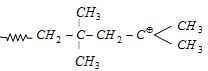
A
$CH_2=C(CH_3)_2$
B
$(CH_3)_2C=C(CH_3)_2$
C
$CH_3CH=CHCH_3$
D
$CH_3CH=CH_2$
Solution
(A) The given structure represents a segment of polyisobutylene (or polyisobutene).
By observing the repeating unit $-[CH_2-C(CH_3)_2]-$,we can identify the monomer by introducing a double bond between the carbon atoms to satisfy valency.
Thus,the monomer is isobutylene ($2$-methylpropene),which is $CH_2=C(CH_3)_2$.
Therefore,the correct option is $A$.
By observing the repeating unit $-[CH_2-C(CH_3)_2]-$,we can identify the monomer by introducing a double bond between the carbon atoms to satisfy valency.
Thus,the monomer is isobutylene ($2$-methylpropene),which is $CH_2=C(CH_3)_2$.
Therefore,the correct option is $A$.
0 likesView Solution
73
ChemistryEasyMCQAIPMT · 2005
The cell membranes are mainly composed of
A
Carbohydrates
B
Proteins
C
Phospholipids
D
Fats
Solution
(B) The correct answer is $B$. Cell membranes are primarily composed of proteins and lipids. The protein content in cell membranes typically varies from $46-76\%$,while the lipid content (including phospholipids) ranges from $20-53\%$,and carbohydrates constitute $1-8\%$. Although phospholipids are a major structural component,proteins are generally the most abundant component by mass in most cell membranes.
0 likesView Solution
74
ChemistryMediumMCQAIPMT · 2005
Which of the following undergoes nucleophilic substitution by $S_N1$ mechanism?
A
Benzyl chloride
B
Ethyl chloride
C
Chlorobenzene
D
Isopropyl chloride
Solution
(A) . Benzyl chloride undergoes $S_N1$ mechanism most readily because it forms a resonance-stabilized benzyl carbocation $(C_6H_5CH_2^+)$ as an intermediate.
Primary alkyl halides like ethyl chloride and secondary alkyl halides like isopropyl chloride prefer $S_N2$ or $E2$ mechanisms,while chlorobenzene is highly unreactive towards nucleophilic substitution due to partial double bond character.
Primary alkyl halides like ethyl chloride and secondary alkyl halides like isopropyl chloride prefer $S_N2$ or $E2$ mechanisms,while chlorobenzene is highly unreactive towards nucleophilic substitution due to partial double bond character.
0 likesView Solution
75
ChemistryDifficultMCQAIPMT · 2005
Which one of the following is an inner orbital complex as well as diamagnetic in behaviour? (Atomic number: $Zn = 30$,$Cr = 24$,$Co = 27$,$Ni = 28$)
A
$[Zn(NH_3)_6]^{2+}$
B
$[Cr(NH_3)_6]^{3+}$
C
$[Co(NH_3)_6]^{3+}$
D
$[Ni(NH_3)_6]^{2+}$
Solution
(C) The correct option is $C$.
$1$. For $[Co(NH_3)_6]^{3+}$,the oxidation state of $Co$ is $+3$. The electronic configuration of $Co^{3+}$ is $[Ar] 3d^6$.
$2$. $NH_3$ is a strong field ligand,which causes pairing of electrons in the $3d$ orbitals.
$3$. The configuration becomes $t_{2g}^6 e_g^0$,utilizing $d^2sp^3$ hybridization,which makes it an inner orbital complex.
$4$. Since all electrons are paired,the complex is diamagnetic.
$1$. For $[Co(NH_3)_6]^{3+}$,the oxidation state of $Co$ is $+3$. The electronic configuration of $Co^{3+}$ is $[Ar] 3d^6$.
$2$. $NH_3$ is a strong field ligand,which causes pairing of electrons in the $3d$ orbitals.
$3$. The configuration becomes $t_{2g}^6 e_g^0$,utilizing $d^2sp^3$ hybridization,which makes it an inner orbital complex.
$4$. Since all electrons are paired,the complex is diamagnetic.
0 likesView Solution
76
ChemistryMediumMCQAIPMT · 2005
Which functional group participates in disulphide bond formation in proteins?
A
Thiolactone
B
Thiol
C
Thioether
D
Thioester
Solution
(B) The thiol $(-SH)$ functional group present in the amino acid cysteine participates in the formation of disulphide bonds $(-S-S-)$ in proteins through an oxidation reaction.
0 likesView Solution
77
ChemistryMediumMCQAIPMT · 2005
More number of oxidation states are exhibited by the actinoids than by the lanthanoids. The main reason for this is
A
more active nature of the actinoids
B
more energy difference between $5f$ and $6d$ orbitals than that between $4f$ and $5d$ orbitals
C
lesser energy difference between $5f$ and $6d$ orbitals than that between $4f$ and $5d$ orbitals
D
greater metallic character of the lanthanoids than that of the corresponding actinoids.
Solution
(C) The actinoids exhibit a greater number of oxidation states compared to the lanthanoids.
This is primarily because the energy difference between the $5f$ and $6d$ orbitals in actinoids is smaller than the energy difference between the $4f$ and $5d$ orbitals in lanthanoids.
Consequently,the $5f$ electrons can participate in bonding more easily than the $4f$ electrons.
This is primarily because the energy difference between the $5f$ and $6d$ orbitals in actinoids is smaller than the energy difference between the $4f$ and $5d$ orbitals in lanthanoids.
Consequently,the $5f$ electrons can participate in bonding more easily than the $4f$ electrons.
0 likesView Solution
78
ChemistryDifficultMCQAIPMT · 2005
$A$ solution of urea (molar mass $60 \, g \, mol^{-1}$) boils at $100.18 \, ^oC$ at atmospheric pressure. If $K_f$ and $K_b$ for water are $1.86$ and $0.512 \, K \, kg \, mol^{-1}$ respectively,the above solution will freeze at ........... $^oC$.
A
$0.65$
B
$-0.65$
C
$6.54$
D
$-6.54$
Solution
(B) Given: Boiling point of solution = $100.18 \, ^oC$. Boiling point of pure water = $100 \, ^oC$.
Elevation in boiling point,$\Delta T_b = 100.18 - 100 = 0.18 \, ^oC$.
We know that $\Delta T_b = K_b \cdot m$ and $\Delta T_f = K_f \cdot m$.
Therefore,$\frac{\Delta T_f}{\Delta T_b} = \frac{K_f}{K_b}$.
$\Delta T_f = \Delta T_b \times \frac{K_f}{K_b} = 0.18 \times \frac{1.86}{0.512} \approx 0.654 \, ^oC$.
Since $\Delta T_f = T_f^{\circ} - T_f$,where $T_f^{\circ} = 0 \, ^oC$ for water:
$0.654 = 0 - T_f$.
$T_f = -0.654 \, ^oC$.
Rounding to two decimal places,the freezing point is $-0.65 \, ^oC$.
Elevation in boiling point,$\Delta T_b = 100.18 - 100 = 0.18 \, ^oC$.
We know that $\Delta T_b = K_b \cdot m$ and $\Delta T_f = K_f \cdot m$.
Therefore,$\frac{\Delta T_f}{\Delta T_b} = \frac{K_f}{K_b}$.
$\Delta T_f = \Delta T_b \times \frac{K_f}{K_b} = 0.18 \times \frac{1.86}{0.512} \approx 0.654 \, ^oC$.
Since $\Delta T_f = T_f^{\circ} - T_f$,where $T_f^{\circ} = 0 \, ^oC$ for water:
$0.654 = 0 - T_f$.
$T_f = -0.654 \, ^oC$.
Rounding to two decimal places,the freezing point is $-0.65 \, ^oC$.
0 likesView Solution
Vedclass Products
For Students
Vedclass Test Series
Mock tests in real AIPMT style covering Chemistry with performance analysis. 5-day free trial.
Start Free TrialFor Teachers
Exam Paper Generator
Generate Set A/B/C/D Chemistry papers from 7.5L+ questions in 2 minutes. 3 chapters free.
Try FreeFor Institutes
Online Exam Module
Run live AIPMT mock exams with unlimited students, 360° analytics & white-label branding.
See DemoFrequently Asked Questions
How many Chemistry questions are in AIPMT 2005?
There are 111 Chemistry questions from the AIPMT 2005 paper on Vedclass, each with a detailed step-by-step solution in English.
Are AIPMT 2005 Chemistry solutions available in English?
Yes. All solutions on this page are in English. You can also switch to English or Hindi using the language buttons above the questions.
Can I practice AIPMT 2005 Chemistry as a timed test?
Yes. Use the Vedclass Test Series to attempt a full AIPMT mock test covering Chemistry with time limits and instant score analysis.
Can teachers create Chemistry papers from AIPMT previous year questions?
Yes. The Vedclass Exam Paper Generator lets teachers mix AIPMT Chemistry questions and generate Set A/B/C/D papers in minutes.
For Teachers & Institutes
Build a Custom Chemistry Paper
Pick AIPMT 2005 Chemistry questions, set difficulty, and generate Set A/B/C/D in 2 minutes.