
ChemistryQ1–62 of 62 questions
Page 1 of 1 · English
1
ChemistryMCQAIIMS · 2002
If a ladder weighing $250 \ N$ is placed against a smooth vertical wall and the coefficient of friction between the ladder and the floor is $0.3$,what is the maximum force of friction available at the point of contact between the ladder and the floor?
A
$75$
B
$50$
C
$35$
D
$25$
Solution
(A) The ladder is placed against a smooth vertical wall,meaning there is no friction at the wall contact point.
The weight of the ladder acts vertically downwards,$W = 250 \ N$.
The normal reaction force $R$ exerted by the floor on the ladder must balance the weight of the ladder in the vertical direction.
Therefore,$R = W = 250 \ N$.
The maximum force of static friction $f_{max}$ available at the contact point between the ladder and the floor is given by the formula $f_{max} = \mu R$,where $\mu$ is the coefficient of friction.
Given $\mu = 0.3$ and $R = 250 \ N$,we have:
$f_{max} = 0.3 \times 250 \ N = 75 \ N$.
The weight of the ladder acts vertically downwards,$W = 250 \ N$.
The normal reaction force $R$ exerted by the floor on the ladder must balance the weight of the ladder in the vertical direction.
Therefore,$R = W = 250 \ N$.
The maximum force of static friction $f_{max}$ available at the contact point between the ladder and the floor is given by the formula $f_{max} = \mu R$,where $\mu$ is the coefficient of friction.
Given $\mu = 0.3$ and $R = 250 \ N$,we have:
$f_{max} = 0.3 \times 250 \ N = 75 \ N$.
0 likesView Solution
2
ChemistryMCQAIIMS · 2002
The speed of an electron having a wavelength of $10^{-10} \ m$ is ........... $\times 10^6 \ m/s$.
A
$7.25$
B
$6.26$
C
$5.25$
D
$4.24$
Solution
(A) The de Broglie wavelength $\lambda$ is given by the formula $\lambda = \frac{h}{p} = \frac{h}{mv}$.
Rearranging for velocity $v$,we get $v = \frac{h}{m\lambda}$.
Substituting the values: $h = 6.63 \times 10^{-34} \ J \cdot s$,$m = 9.11 \times 10^{-31} \ kg$,and $\lambda = 10^{-10} \ m$.
$v = \frac{6.63 \times 10^{-34}}{(9.11 \times 10^{-31}) \times (10^{-10})} = \frac{6.63}{9.11} \times 10^{7} \ m/s \approx 0.727 \times 10^{7} \ m/s = 7.27 \times 10^6 \ m/s$.
Rounding to the nearest provided option,the speed is $7.25 \times 10^6 \ m/s$.
Rearranging for velocity $v$,we get $v = \frac{h}{m\lambda}$.
Substituting the values: $h = 6.63 \times 10^{-34} \ J \cdot s$,$m = 9.11 \times 10^{-31} \ kg$,and $\lambda = 10^{-10} \ m$.
$v = \frac{6.63 \times 10^{-34}}{(9.11 \times 10^{-31}) \times (10^{-10})} = \frac{6.63}{9.11} \times 10^{7} \ m/s \approx 0.727 \times 10^{7} \ m/s = 7.27 \times 10^6 \ m/s$.
Rounding to the nearest provided option,the speed is $7.25 \times 10^6 \ m/s$.
0 likesView Solution
3
ChemistryMediumMCQAIIMS · 2002
$A$ compound possesses $8\%$ sulphur by mass. The least molecular mass is
A
$200$
B
$400$
C
$155$
D
$355$
Solution
(B) The atomic mass of sulphur is $32 \ g/mol$.
Given that the compound contains $8\%$ sulphur by mass,it means $8 \ g$ of sulphur is present in $100 \ g$ of the compound.
To find the least molecular mass,we assume there is at least one atom of sulphur in the molecule.
Therefore,$1 \ g$ of sulphur is present in $\frac{100}{8} \ g$ of the compound.
For $32 \ g$ of sulphur (one mole of atoms),the mass of the compound is $\frac{100}{8} \times 32 = 400 \ g/mol$.
Given that the compound contains $8\%$ sulphur by mass,it means $8 \ g$ of sulphur is present in $100 \ g$ of the compound.
To find the least molecular mass,we assume there is at least one atom of sulphur in the molecule.
Therefore,$1 \ g$ of sulphur is present in $\frac{100}{8} \ g$ of the compound.
For $32 \ g$ of sulphur (one mole of atoms),the mass of the compound is $\frac{100}{8} \times 32 = 400 \ g/mol$.
0 likesView Solution
4
ChemistryEasyMCQAIIMS · 2002
The azimuthal quantum number defines:
A
$e/m$ ratio of electron
B
Spin of electron
C
Angular momentum of electron
D
Magnetic momentum of electron
Solution
(C) The azimuthal quantum number $(l)$ determines the shape of the orbital and the angular momentum of the electron in a given orbital. The magnitude of angular momentum is given by the formula $\sqrt{l(l+1)} \frac{h}{2\pi}$.
0 likesView Solution
5
ChemistryEasyMCQAIIMS · 2002
Quantum numbers of an atom can be defined on the basis of
A
Hund's rule
B
Aufbau's principle
C
Pauli's exclusion principle
D
Heisenberg's uncertainty principle
Solution
(C) Quantum numbers are derived from the solution of the $Schr\ddot{o}dinger$ wave equation for the hydrogen atom. These numbers describe the size,shape,and orientation of orbitals,as well as the spin of electrons. While the principles listed in the options (Hund's rule,Aufbau's principle,Pauli's exclusion principle) govern the filling of electrons in orbitals,the quantum numbers themselves are fundamental mathematical solutions to the wave equation,which is consistent with the quantum mechanical model of the atom.
0 likesView Solution
6
ChemistryMediumMCQAIIMS · 2002
Which of the following electronic configurations has the maximum energy?
A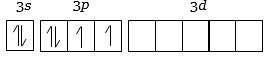
B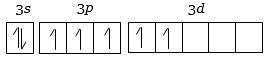
C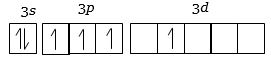
D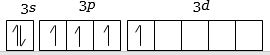
Solution
(B) The energy of an electronic configuration is determined by the sum of the energies of all the electrons present in the orbitals.
For a given principal quantum number $n=3$,the energy of the orbitals follows the order $3s < 3p < 3d$.
To find the configuration with the maximum energy,we compare the total number of electrons in the higher energy orbitals ($3p$ and $3d$).
Option $A$: $2$ electrons in $3s$,$2$ in $3p$,$0$ in $3d$. Total electrons in $3p+3d = 2$.
Option $B$: $2$ electrons in $3s$,$3$ in $3p$,$2$ in $3d$. Total electrons in $3p+3d = 5$.
Option $C$: $2$ electrons in $3s$,$3$ in $3p$,$1$ in $3d$. Total electrons in $3p+3d = 4$.
Option $D$: $2$ electrons in $3s$,$3$ in $3p$,$1$ in $3d$. Total electrons in $3p+3d = 4$.
Comparing the total number of electrons in the higher energy orbitals,Option $B$ has the highest number of electrons in the $3p$ and $3d$ orbitals,thus representing the state with the maximum energy.
For a given principal quantum number $n=3$,the energy of the orbitals follows the order $3s < 3p < 3d$.
To find the configuration with the maximum energy,we compare the total number of electrons in the higher energy orbitals ($3p$ and $3d$).
Option $A$: $2$ electrons in $3s$,$2$ in $3p$,$0$ in $3d$. Total electrons in $3p+3d = 2$.
Option $B$: $2$ electrons in $3s$,$3$ in $3p$,$2$ in $3d$. Total electrons in $3p+3d = 5$.
Option $C$: $2$ electrons in $3s$,$3$ in $3p$,$1$ in $3d$. Total electrons in $3p+3d = 4$.
Option $D$: $2$ electrons in $3s$,$3$ in $3p$,$1$ in $3d$. Total electrons in $3p+3d = 4$.
Comparing the total number of electrons in the higher energy orbitals,Option $B$ has the highest number of electrons in the $3p$ and $3d$ orbitals,thus representing the state with the maximum energy.
0 likesView Solution
7
ChemistryEasyMCQAIIMS · 2002
Which of the following molecules has the highest bond energy?
A
$F_2$
B
$C_2$
C
$N_2$
D
$O_2$
Solution
(C) The bond energy depends on the bond order.
$N_2$ has a triple bond $(N \equiv N)$ with a bond order of $3$.
$O_2$ has a double bond $(O=O)$ with a bond order of $2$.
$F_2$ has a single bond $(F-F)$ with a bond order of $1$.
$C_2$ has a bond order of $2$.
Since bond energy is directly proportional to bond order,$N_2$ has the highest bond energy.
$N_2$ has a triple bond $(N \equiv N)$ with a bond order of $3$.
$O_2$ has a double bond $(O=O)$ with a bond order of $2$.
$F_2$ has a single bond $(F-F)$ with a bond order of $1$.
$C_2$ has a bond order of $2$.
Since bond energy is directly proportional to bond order,$N_2$ has the highest bond energy.
0 likesView Solution
8
ChemistryMediumMCQAIIMS · 2002
Which of the following has the highest dipole moment?
A
$H_2C=O$
B
$CH_3-CH=CH-CH_3$ (trans)
C
$(CH_3)_2C=CH_2$
D
$CH_3-C(Cl)=C(Cl)-CH_3$ (trans)
Solution
(A) $H_2C=O$ (formaldehyde) has the highest dipole moment due to the presence of a highly polar $C=O$ bond.
Oxygen is significantly more electronegative than carbon,leading to a large bond dipole.
In trans-isomers like trans-but$-2-$ene and trans$-2,3-$dichloro$-2-$butene,the bond dipoles cancel each other out due to molecular symmetry,resulting in a net dipole moment of approximately zero.
$2$-Methylpropene has a small dipole moment,but it is much lower than that of formaldehyde.
Oxygen is significantly more electronegative than carbon,leading to a large bond dipole.
In trans-isomers like trans-but$-2-$ene and trans$-2,3-$dichloro$-2-$butene,the bond dipoles cancel each other out due to molecular symmetry,resulting in a net dipole moment of approximately zero.
$2$-Methylpropene has a small dipole moment,but it is much lower than that of formaldehyde.
0 likesView Solution
9
ChemistryMediumMCQAIIMS · 2002
Which of the following arrangements of molecules is correct on the basis of their dipole moments?
A
$BF_3 < NF_3 < NH_3$
B
$BF_3 < NH_3 < NF_3$
C
$NF_3 < BF_3 < NH_3$
D
$NH_3 < NF_3 < BF_3$
Solution
(A) $BF_3$ has a trigonal planar structure,making it non-polar with a dipole moment of $0 \ D$.
In $NH_3$,the orbital dipole due to the lone pair and the bond dipoles of $N-H$ bonds are in the same direction,resulting in a large net dipole moment of $1.47 \ D$.
In $NF_3$,the orbital dipole due to the lone pair and the bond dipoles of $N-F$ bonds are in opposite directions,resulting in a smaller net dipole moment of $0.24 \ D$.
Therefore,the correct order of increasing dipole moments is $BF_3 < NF_3 < NH_3$.
In $NH_3$,the orbital dipole due to the lone pair and the bond dipoles of $N-H$ bonds are in the same direction,resulting in a large net dipole moment of $1.47 \ D$.
In $NF_3$,the orbital dipole due to the lone pair and the bond dipoles of $N-F$ bonds are in opposite directions,resulting in a smaller net dipole moment of $0.24 \ D$.
Therefore,the correct order of increasing dipole moments is $BF_3 < NF_3 < NH_3$.
0 likesView Solution
10
ChemistryMediumMCQAIIMS · 2002
At $80\,^{\circ}C,$ distilled water has $[H_3O^{+}]$ concentration equal to $1 \times 10^{-6} \, mol/L.$ The value of $K_w$ at this temperature will be
A
$1 \times 10^{-6}$
B
$1 \times 10^{-9}$
C
$1 \times 10^{-12}$
D
$1 \times 10^{-15}$
Solution
(C) In distilled water,the auto-ionization reaction is $2H_2O(l) \rightleftharpoons H_3O^{+}(aq) + OH^{-}(aq).$
Since the water is neutral,the concentration of hydronium ions is equal to the concentration of hydroxide ions: $[H_3O^{+}] = [OH^{-}] = 1 \times 10^{-6} \, mol/L.$
The ionic product of water,$K_w,$ is defined as $K_w = [H_3O^{+}][OH^{-}].$
Substituting the given values: $K_w = (1 \times 10^{-6}) \times (1 \times 10^{-6}) = 1 \times 10^{-12}.$
Therefore,the correct option is $C.$
Since the water is neutral,the concentration of hydronium ions is equal to the concentration of hydroxide ions: $[H_3O^{+}] = [OH^{-}] = 1 \times 10^{-6} \, mol/L.$
The ionic product of water,$K_w,$ is defined as $K_w = [H_3O^{+}][OH^{-}].$
Substituting the given values: $K_w = (1 \times 10^{-6}) \times (1 \times 10^{-6}) = 1 \times 10^{-12}.$
Therefore,the correct option is $C.$
0 likesView Solution
11
ChemistryMediumMCQAIIMS · 2002
The solubility of $CuBr$ is $2 \times 10^{-4} \ mol/L$ at $25 \ ^\circ C$. The $K_{sp}$ value for $CuBr$ is
A
$4 \times 10^{-8} \ mol^2 \ L^{-2}$
B
$4 \times 10^{-11} \ mol^2 \ L^{-2}$
C
$4 \times 10^{-4} \ mol^2 \ L^{-2}$
D
$4 \times 10^{-15} \ mol^2 \ L^{-2}$
Solution
(A) The dissociation of $CuBr$ is given by: $CuBr(s) \rightleftharpoons Cu^{+}(aq) + Br^{-}(aq)$
Let $S$ be the solubility of $CuBr$ in $mol/L$.
Then,$[Cu^{+}] = S$ and $[Br^{-}] = S$.
The solubility product constant $K_{sp}$ is given by: $K_{sp} = [Cu^{+}][Br^{-}] = S \times S = S^2$.
Given $S = 2 \times 10^{-4} \ mol/L$,we have:
$K_{sp} = (2 \times 10^{-4})^2 = 4 \times 10^{-8} \ mol^2 \ L^{-2}$.
Let $S$ be the solubility of $CuBr$ in $mol/L$.
Then,$[Cu^{+}] = S$ and $[Br^{-}] = S$.
The solubility product constant $K_{sp}$ is given by: $K_{sp} = [Cu^{+}][Br^{-}] = S \times S = S^2$.
Given $S = 2 \times 10^{-4} \ mol/L$,we have:
$K_{sp} = (2 \times 10^{-4})^2 = 4 \times 10^{-8} \ mol^2 \ L^{-2}$.
0 likesView Solution
12
ChemistryMediumMCQAIIMS · 2002
The $pH$ of a solution at $25\,^oC$ containing $0.10\,M$ sodium acetate and $0.03\,M$ acetic acid is ($pK_a$ for $CH_3COOH = 4.57$)
A
$4.09$
B
$5.09$
C
$6.10$
D
$7.09$
Solution
(B) The solution is a buffer solution consisting of a weak acid $(CH_3COOH)$ and its salt with a strong base $(CH_3COONa)$.
We use the Henderson-Hasselbalch equation: $pH = pK_a + \log \frac{[salt]}{[acid]}$.
Given: $pK_a = 4.57$,$[salt] = 0.10\,M$,$[acid] = 0.03\,M$.
Substituting the values: $pH = 4.57 + \log \frac{0.10}{0.03} = 4.57 + \log(3.33)$.
Since $\log(3.33) \approx 0.52$,we get $pH = 4.57 + 0.52 = 5.09$.
We use the Henderson-Hasselbalch equation: $pH = pK_a + \log \frac{[salt]}{[acid]}$.
Given: $pK_a = 4.57$,$[salt] = 0.10\,M$,$[acid] = 0.03\,M$.
Substituting the values: $pH = 4.57 + \log \frac{0.10}{0.03} = 4.57 + \log(3.33)$.
Since $\log(3.33) \approx 0.52$,we get $pH = 4.57 + 0.52 = 5.09$.
0 likesView Solution
13
ChemistryMediumMCQAIIMS · 2002
The heat of neutralisation of a strong acid and a strong alkali is $57.0 \, kJ \, mol^{-1}$. The heat released when $0.5 \, mole$ of $HNO_3$ solution is mixed with $0.2 \, mole$ of $KOH$ is $...... \, kJ$.
A
$57$
B
$11.4$
C
$28.5$
D
$34.9$
Solution
(B) The reaction between a strong acid $(HNO_3)$ and a strong base $(KOH)$ is represented as: $H^+ + OH^- \rightarrow H_2O$,$\Delta H = -57.0 \, kJ \, mol^{-1}$.
Since $0.2 \, mole$ of $KOH$ is the limiting reagent,it will react with $0.2 \, mole$ of $HNO_3$ to produce $0.2 \, mole$ of $H_2O$.
The heat released is calculated as: $\text{Heat} = \Delta H \times \text{moles of water formed} = 57.0 \, kJ \, mol^{-1} \times 0.2 \, mol = 11.4 \, kJ$.
Since $0.2 \, mole$ of $KOH$ is the limiting reagent,it will react with $0.2 \, mole$ of $HNO_3$ to produce $0.2 \, mole$ of $H_2O$.
The heat released is calculated as: $\text{Heat} = \Delta H \times \text{moles of water formed} = 57.0 \, kJ \, mol^{-1} \times 0.2 \, mol = 11.4 \, kJ$.
0 likesView Solution
14
ChemistryEasyMCQAIIMS · 2002
The oxidation state of $Fe$ in $Fe_3O_4$ is:
A
$\frac{3}{2}$
B
$\frac{4}{5}$
C
$\frac{5}{4}$
D
$\frac{8}{3}$
Solution
(D) Let the average oxidation state of $Fe$ be $x$.
In $Fe_3O_4$,the oxidation state of oxygen is $-2$.
The sum of oxidation states of all atoms in a neutral molecule is $0$.
$3x + 4(-2) = 0$
$3x - 8 = 0$
$3x = 8$
$x = \frac{8}{3}$
In $Fe_3O_4$,the oxidation state of oxygen is $-2$.
The sum of oxidation states of all atoms in a neutral molecule is $0$.
$3x + 4(-2) = 0$
$3x - 8 = 0$
$3x = 8$
$x = \frac{8}{3}$
1 likesView Solution
15
ChemistryMediumMCQAIIMS · 2002
The spectrum of $Li^{2+}$ is similar to that of:
A
$H$
B
$He$
C
$Be$
D
$Ne$
Solution
(A) The electronic configuration of $Li$ is $1s^2 \, 2s^1$,so $Li^{2+}$ has the electronic configuration $1s^1$.
Bohr's model and the resulting spectra are applicable to hydrogen-like species,which contain only one electron.
Since $Li^{2+}$ has only one electron,its spectrum is similar to that of the hydrogen atom $(H)$,which also has the configuration $1s^1$.
Bohr's model and the resulting spectra are applicable to hydrogen-like species,which contain only one electron.
Since $Li^{2+}$ has only one electron,its spectrum is similar to that of the hydrogen atom $(H)$,which also has the configuration $1s^1$.
0 likesView Solution
16
ChemistryEasyMCQAIIMS · 2002
Which of the following reactions produces hydrogen?
A
$Mg + 2H_2O \to Mg(OH)_2 + H_2$
B
$BaO_2 + 2HCl \to BaCl_2 + H_2O_2$
C
$H_2S_2O_8 + 2H_2O \to 2H_2SO_4 + H_2O_2$
D
$Na_2O_2 + 2HCl \to 2NaCl + H_2O_2$
Solution
(A) The reaction of magnesium $(Mg)$ with water $(H_2O)$ produces magnesium hydroxide $(Mg(OH)_2)$ and hydrogen gas $(H_2)$:
$Mg + 2H_2O \to Mg(OH)_2 + H_2 \uparrow$
The other reactions listed produce hydrogen peroxide $(H_2O_2)$ instead of hydrogen gas.
$Mg + 2H_2O \to Mg(OH)_2 + H_2 \uparrow$
The other reactions listed produce hydrogen peroxide $(H_2O_2)$ instead of hydrogen gas.
0 likesView Solution
17
ChemistryMediumMCQAIIMS · 2002
What is the $IUPAC$ name of $CH_3-CH(CH_3)-CH_2-CH(CN)-CH_3$?
A
$2-$cyano$-4-$methylpentane
B
$4-$methyl$-2-$hexanenitrile
C
$2-$cyano$-4-$methylhexane
D
$3-$methyl$-5-$hexanenitrile
Solution
(B) $1$. Identify the longest carbon chain containing the functional group (nitrile group). The chain has $6$ carbons,so the parent alkane is hexane.
$2$. Number the chain starting from the nitrile carbon as $C-1$.
$3$. The nitrile group is at $C-1$,so the suffix is $nitrile$.
$4$. There is a methyl group at the $4^{th}$ carbon.
$5$. The correct $IUPAC$ name is $4-$methylhexanenitrile.
$2$. Number the chain starting from the nitrile carbon as $C-1$.
$3$. The nitrile group is at $C-1$,so the suffix is $nitrile$.
$4$. There is a methyl group at the $4^{th}$ carbon.
$5$. The correct $IUPAC$ name is $4-$methylhexanenitrile.
0 likesView Solution
18
ChemistryMediumMCQAIIMS · 2002
The number of $\sigma$ and $\pi$ bonds present in $pent-4-en-1-yne$ is
A
$10, 3$
B
$3, 10$
C
$4, 9$
D
$9, 4$
Solution
(A) The structure of $pent-4-en-1-yne$ is $HC \equiv C-CH_2-CH=CH_2$.
Number of $\sigma$ bonds = $4$ ($C-C$ bonds) + $6$ ($C-H$ bonds) = $10$.
Number of $\pi$ bonds = $2$ (from $C \equiv C$) + $1$ (from $C=C$) = $3$.
Number of $\sigma$ bonds = $4$ ($C-C$ bonds) + $6$ ($C-H$ bonds) = $10$.
Number of $\pi$ bonds = $2$ (from $C \equiv C$) + $1$ (from $C=C$) = $3$.
0 likesView Solution
19
ChemistryDifficultMCQAIIMS · 2002
Which of the following is a chiral compound?
A
Hexane
B
Methane
C
$n-$butane
D
$2,3,4-$trimethyl hexane
Solution
(D) chiral compound is one that contains at least one chiral carbon atom (a carbon atom bonded to four different groups).
In $2,3,4-$trimethyl hexane,the carbon atom at position $3$ is bonded to a hydrogen atom,a methyl group,an ethyl group,and a $sec-$butyl group.
Since all four groups attached to the $C-3$ atom are different,it is a chiral center.
Therefore,$2,3,4-$trimethyl hexane is a chiral compound.
In $2,3,4-$trimethyl hexane,the carbon atom at position $3$ is bonded to a hydrogen atom,a methyl group,an ethyl group,and a $sec-$butyl group.
Since all four groups attached to the $C-3$ atom are different,it is a chiral center.
Therefore,$2,3,4-$trimethyl hexane is a chiral compound.
0 likesView Solution
20
ChemistryDifficultMCQAIIMS · 2002
When acetylene is passed into dilute sulphuric acid containing $Hg^{2+}$ ions,the product formed is
A
Acetone
B
Acetic acid
C
Acetaldehyde
D
Formaldehyde
Solution
(C) The hydration of acetylene in the presence of dilute $H_2SO_4$ and $Hg^{2+}$ ions proceeds as follows:
$CH \equiv CH + H_2O \xrightarrow{H_2SO_4, Hg^{2+}} [CH_2 = CH - OH]$
This intermediate,vinyl alcohol,is unstable and undergoes tautomerization (rearrangement) to form a more stable carbonyl compound:
$[CH_2 = CH - OH] \rightarrow CH_3 - CHO$ (Acetaldehyde).
$CH \equiv CH + H_2O \xrightarrow{H_2SO_4, Hg^{2+}} [CH_2 = CH - OH]$
This intermediate,vinyl alcohol,is unstable and undergoes tautomerization (rearrangement) to form a more stable carbonyl compound:
$[CH_2 = CH - OH] \rightarrow CH_3 - CHO$ (Acetaldehyde).
0 likesView Solution
21
ChemistryMediumMCQAIIMS · 2002
Which of the following does not have valence electrons in the $3d-$subshell?
A
$Fe(III)$
B
$Mn(II)$
C
$Cr(I)$
D
$P(0)$
Solution
(D) $P(0)$: Phosphorus is a $p-$block element (Group $15$). Its valence shell is the $3rd$ shell $(3s^2 3p^3)$,and it does not have electrons in the $3d-$subshell.
$Fe(III)$: The electronic configuration is $[Ar] 3d^5$. It has valence electrons in the $3d-$subshell.
$Mn(II)$: The electronic configuration is $[Ar] 3d^5$. It has valence electrons in the $3d-$subshell.
$Cr(I)$: The electronic configuration is $[Ar] 3d^5$. It has valence electrons in the $3d-$subshell.
Therefore,$P(0)$ is the correct answer.
$Fe(III)$: The electronic configuration is $[Ar] 3d^5$. It has valence electrons in the $3d-$subshell.
$Mn(II)$: The electronic configuration is $[Ar] 3d^5$. It has valence electrons in the $3d-$subshell.
$Cr(I)$: The electronic configuration is $[Ar] 3d^5$. It has valence electrons in the $3d-$subshell.
Therefore,$P(0)$ is the correct answer.
0 likesView Solution
22
ChemistryMCQAIIMS · 2002
The abundance of a species population within its habitat is called
A
Niche density
B
Regional density
C
Relative density
D
Absolute density
Solution
(D) The total number of individuals of a species per unit area or volume in a given habitat is known as absolute density. It represents the actual count of the population size within a specific area.
0 likesView Solution
23
ChemistryMCQAIIMS · 2002
What is the path difference for destructive interference?
A
$n\lambda$
B
$n(\lambda + 1)$
C
$\frac{(n+1)\lambda}{2}$
D
$\frac{(2n+1)\lambda}{2}$
Solution
(D) For destructive interference to occur,the two waves must arrive at a point in opposite phases.
This happens when the path difference between the two waves is an odd multiple of half the wavelength.
The condition for destructive interference is given by the path difference $\Delta x = (2n + 1) \frac{\lambda}{2}$,where $n = 0, 1, 2, 3, \dots$.
This happens when the path difference between the two waves is an odd multiple of half the wavelength.
The condition for destructive interference is given by the path difference $\Delta x = (2n + 1) \frac{\lambda}{2}$,where $n = 0, 1, 2, 3, \dots$.
0 likesView Solution
24
ChemistryMCQAIIMS · 2002
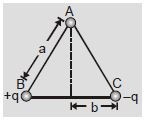
As shown in the figure,charges $+q$ and $-q$ are placed at the vertices $B$ and $C$ of an isosceles triangle. The potential at the vertex $A$ is
A
$\frac{1}{4\pi \epsilon_0} \cdot \frac{2q}{\sqrt{a^2 + b^2}}$
B
zero
C
$\frac{1}{4\pi \epsilon_0} \cdot \frac{q}{\sqrt{a^2 + b^2}}$
D
$\frac{1}{4\pi \epsilon_0} \cdot \frac{-q}{\sqrt{a^2 + b^2}}$
Solution
(B) The electric potential $V$ at a point due to a point charge $Q$ at a distance $r$ is given by $V = \frac{1}{4\pi \epsilon_0} \cdot \frac{Q}{r}$.
In the given isosceles triangle,the distance from vertex $A$ to vertex $B$ is $a$,and the distance from vertex $A$ to vertex $C$ is also $a$ (since it is an isosceles triangle with $AB = AC = a$).
The potential at vertex $A$ due to charge $+q$ at $B$ is $V_B = \frac{1}{4\pi \epsilon_0} \cdot \frac{+q}{a}$.
The potential at vertex $A$ due to charge $-q$ at $C$ is $V_C = \frac{1}{4\pi \epsilon_0} \cdot \frac{-q}{a}$.
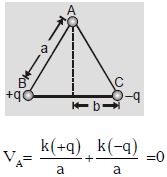
The total potential at vertex $A$ is the algebraic sum of the individual potentials: $V_A = V_B + V_C = \frac{1}{4\pi \epsilon_0} \cdot \frac{q}{a} + \frac{1}{4\pi \epsilon_0} \cdot \frac{-q}{a} = 0$.
In the given isosceles triangle,the distance from vertex $A$ to vertex $B$ is $a$,and the distance from vertex $A$ to vertex $C$ is also $a$ (since it is an isosceles triangle with $AB = AC = a$).
The potential at vertex $A$ due to charge $+q$ at $B$ is $V_B = \frac{1}{4\pi \epsilon_0} \cdot \frac{+q}{a}$.
The potential at vertex $A$ due to charge $-q$ at $C$ is $V_C = \frac{1}{4\pi \epsilon_0} \cdot \frac{-q}{a}$.
The total potential at vertex $A$ is the algebraic sum of the individual potentials: $V_A = V_B + V_C = \frac{1}{4\pi \epsilon_0} \cdot \frac{q}{a} + \frac{1}{4\pi \epsilon_0} \cdot \frac{-q}{a} = 0$.
0 likesView Solution
25
ChemistryMCQAIIMS · 2002
What is the coefficient of mutual inductance when the magnetic flux changes by $2 \times 10^{-2} \, Wb$ and the change in current is $0.01 \, A$?
A
$2$
B
$3$
C
$0.5$
D
$0$
Solution
(A) The formula for magnetic flux linkage in mutual induction is given by $\Delta \phi = M \Delta I$,where $\Delta \phi$ is the change in magnetic flux,$M$ is the coefficient of mutual inductance,and $\Delta I$ is the change in current.
Given:
$\Delta \phi = 2 \times 10^{-2} \, Wb$
$\Delta I = 0.01 \, A = 10^{-2} \, A$
Substituting the values into the formula:
$2 \times 10^{-2} = M \times 10^{-2}$
$M = \frac{2 \times 10^{-2}}{10^{-2}}$
$M = 2 \, H$
Therefore,the coefficient of mutual inductance is $2 \, H$.
Given:
$\Delta \phi = 2 \times 10^{-2} \, Wb$
$\Delta I = 0.01 \, A = 10^{-2} \, A$
Substituting the values into the formula:
$2 \times 10^{-2} = M \times 10^{-2}$
$M = \frac{2 \times 10^{-2}}{10^{-2}}$
$M = 2 \, H$
Therefore,the coefficient of mutual inductance is $2 \, H$.
0 likesView Solution
26
ChemistryMCQAIIMS · 2002
If a ladder weighing $250\,N$ is placed against a smooth vertical wall and the coefficient of friction between the ladder and the floor is $0.3$,what is the maximum force of friction available at the point of contact between the ladder and the floor?
A
$75$
B
$50$
C
$35$
D
$25$
Solution
(A) The maximum force of friction $(f_{max})$ is given by the formula $f_{max} = \mu N$,where $\mu$ is the coefficient of friction and $N$ is the normal reaction force.
Since the ladder is on a horizontal floor,the normal reaction force $N$ exerted by the floor on the ladder is equal to the weight of the ladder $(W = 250\,N)$.
Given $\mu = 0.3$ and $N = 250\,N$.
Therefore,$f_{max} = 0.3 \times 250 = 75\,N$.
Since the ladder is on a horizontal floor,the normal reaction force $N$ exerted by the floor on the ladder is equal to the weight of the ladder $(W = 250\,N)$.
Given $\mu = 0.3$ and $N = 250\,N$.
Therefore,$f_{max} = 0.3 \times 250 = 75\,N$.
0 likesView Solution
27
ChemistryMediumMCQAIIMS · 2002
Assertion : Atoms can neither be created nor destroyed.
Reason : Under similar conditions of temperature and pressure,equal volumes of gases do not contain equal numbers of atoms.
Reason : Under similar conditions of temperature and pressure,equal volumes of gases do not contain equal numbers of atoms.
A
If both Assertion and Reason are correct and the Reason is a correct explanation of the Assertion.
B
If both Assertion and Reason are correct but Reason is not a correct explanation of the Assertion.
C
If the Assertion is correct but Reason is incorrect.
D
If both the Assertion and Reason are incorrect.
Solution
(D) The Assertion is incorrect because,according to nuclear reactions,atoms can be created or destroyed (e.g.,in nuclear fission or fusion).
The Reason is also incorrect because,according to Avogadro's Law,equal volumes of all gases under the same conditions of temperature and pressure contain an equal number of molecules,and consequently,an equal number of atoms if the gases are monatomic.
The Reason is also incorrect because,according to Avogadro's Law,equal volumes of all gases under the same conditions of temperature and pressure contain an equal number of molecules,and consequently,an equal number of atoms if the gases are monatomic.
0 likesView Solution
28
ChemistryMediumMCQAIIMS · 2002
Assertion : For Balmer series of hydrogen spectrum,the value $n_1 = 2$ and $n_2 = 3, 4, 5...$
Reason : The value of $n$ for a line in Balmer series of hydrogen spectrum having the highest wavelength is $4$ and $6$.
Reason : The value of $n$ for a line in Balmer series of hydrogen spectrum having the highest wavelength is $4$ and $6$.
A
If both Assertion and Reason are correct and the Reason is a correct explanation of the Assertion.
B
If both Assertion and Reason are correct but Reason is not a correct explanation of the Assertion.
C
If the Assertion is correct but Reason is incorrect.
D
If both the Assertion and Reason are incorrect.
Solution
(C) The Balmer series corresponds to transitions where $n_1 = 2$ and $n_2 = 3, 4, 5, ...$. Thus,the Assertion is correct.
For the highest wavelength,the energy difference between the levels must be the minimum.
Since $\Delta E = 13.6 \times Z^2 \times (\frac{1}{n_1^2} - \frac{1}{n_2^2}) \text{ eV}$ and $\lambda = \frac{hc}{\Delta E}$,the minimum energy transition for the Balmer series is from $n_2 = 3$ to $n_1 = 2$.
Therefore,the Reason is incorrect because the highest wavelength corresponds to the transition $n_2 = 3$ to $n_1 = 2$,not $n = 4$ and $6$.
For the highest wavelength,the energy difference between the levels must be the minimum.
Since $\Delta E = 13.6 \times Z^2 \times (\frac{1}{n_1^2} - \frac{1}{n_2^2}) \text{ eV}$ and $\lambda = \frac{hc}{\Delta E}$,the minimum energy transition for the Balmer series is from $n_2 = 3$ to $n_1 = 2$.
Therefore,the Reason is incorrect because the highest wavelength corresponds to the transition $n_2 = 3$ to $n_1 = 2$,not $n = 4$ and $6$.
0 likesView Solution
29
ChemistryMediumMCQAIIMS · 2002
Assertion : Absorption spectrum consists of some bright lines separated by dark spaces.
Reason : Emission spectrum consists of dark lines.
Reason : Emission spectrum consists of dark lines.
A
If both Assertion and Reason are correct and the Reason is a correct explanation of the Assertion.
B
If both Assertion and Reason are correct but Reason is not a correct explanation of the Assertion.
C
If the Assertion is correct but Reason is incorrect.
D
If both the Assertion and Reason are incorrect.
Solution
(D) The Assertion is incorrect because an absorption spectrum consists of dark lines separated by bright spaces,which occur when specific wavelengths are absorbed by a substance.
The Reason is also incorrect because an emission spectrum consists of bright lines on a dark background,representing the light emitted by excited atoms or molecules.
Therefore,both the Assertion and the Reason are incorrect.
The Reason is also incorrect because an emission spectrum consists of bright lines on a dark background,representing the light emitted by excited atoms or molecules.
Therefore,both the Assertion and the Reason are incorrect.
0 likesView Solution
30
ChemistryMediumMCQAIIMS · 2002
Assertion : Sigma $(\sigma)$ is a strong bond,while pi $(\pi)$ is a weak bond.
Reason : Atoms rotate freely about pi $(\pi)$ bond.
Reason : Atoms rotate freely about pi $(\pi)$ bond.
A
If both Assertion and Reason are correct and the Reason is a correct explanation of the Assertion.
B
If both Assertion and Reason are correct but Reason is not a correct explanation of the Assertion.
C
If the Assertion is correct but Reason is incorrect.
D
If both the Assertion and Reason are incorrect.
Solution
(C) The Assertion is correct because a sigma $(\sigma)$ bond is formed by the axial overlap of atomic orbitals,which is more extensive than the lateral overlap that forms a pi $(\pi)$ bond. Therefore,the sigma $(\sigma)$ bond is stronger than the pi $(\pi)$ bond.
The Reason is incorrect because atoms cannot rotate freely around a pi $(\pi)$ bond. The presence of a pi $(\pi)$ bond restricts rotation,as rotation would require breaking the lateral overlap of the $p$-orbitals.
The Reason is incorrect because atoms cannot rotate freely around a pi $(\pi)$ bond. The presence of a pi $(\pi)$ bond restricts rotation,as rotation would require breaking the lateral overlap of the $p$-orbitals.
0 likesView Solution
31
ChemistryMediumMCQAIIMS · 2002
If $P$ is pressure and $\rho$ is density of a gas,then $P$ and $\rho$ are related as
A
$P \propto \rho$
B
$P \propto 1/\rho$
C
$P \propto \rho^2$
D
$P \propto 1/\rho^2$
Solution
(A) According to the ideal gas equation,$PV = nRT = (m/M)RT$,where $m$ is the mass and $M$ is the molar mass of the gas.
Rearranging the equation,we get $P = (m/V) \times (RT/M)$.
Since density $\rho = m/V$,we can substitute this into the equation: $P = \rho \times (RT/M)$.
At a constant temperature $T$,$R$ and $M$ are constants,so $P \propto \rho$.
Rearranging the equation,we get $P = (m/V) \times (RT/M)$.
Since density $\rho = m/V$,we can substitute this into the equation: $P = \rho \times (RT/M)$.
At a constant temperature $T$,$R$ and $M$ are constants,so $P \propto \rho$.
0 likesView Solution
32
ChemistryEasyMCQAIIMS · 2002
Assertion : During an adiabatic process,heat energy is not exchanged between the system and its surroundings.
Reason : The temperature of a gas increases when it undergoes an adiabatic expansion.
Reason : The temperature of a gas increases when it undergoes an adiabatic expansion.
A
If both Assertion and Reason are correct and the Reason is a correct explanation of the Assertion.
B
If both Assertion and Reason are correct but Reason is not a correct explanation of the Assertion.
C
If the Assertion is correct but Reason is incorrect.
D
If both the Assertion and Reason are incorrect.
Solution
(C) An adiabatic process is defined as a process where there is no exchange of heat between the system and the surroundings,i.e.,$q = 0$. Thus,the Assertion is correct.
During an adiabatic expansion,the system does work on the surroundings at the expense of its internal energy. Since $dU = dq + dw$ and $dq = 0$,$dU = dw$. For expansion,$dw < 0$,so $dU < 0$. Since internal energy is a function of temperature for an ideal gas,a decrease in internal energy leads to a decrease in temperature. Therefore,the Reason is incorrect.
During an adiabatic expansion,the system does work on the surroundings at the expense of its internal energy. Since $dU = dq + dw$ and $dq = 0$,$dU = dw$. For expansion,$dw < 0$,so $dU < 0$. Since internal energy is a function of temperature for an ideal gas,a decrease in internal energy leads to a decrease in temperature. Therefore,the Reason is incorrect.
0 likesView Solution
33
ChemistryDifficultMCQAIIMS · 2002
Assertion : Mass and volume are extensive properties.
Reason : Mass / volume is also an extensive parameter.
Reason : Mass / volume is also an extensive parameter.
A
If both Assertion and Reason are correct and the Reason is a correct explanation of the Assertion.
B
If both Assertion and Reason are correct but Reason is not a correct explanation of the Assertion.
C
If the Assertion is correct but Reason is incorrect.
D
If both the Assertion and Reason are incorrect.
Solution
(C) The properties of a system that depend upon the quantity of matter contained in it are called extensive properties,e.g.,mass,volume,heat capacity,etc.
However,$\text{Density} = \frac{\text{Mass}}{\text{Volume}}$.
Density is an intensive property because it is independent of the quantity of matter in a system.
Therefore,the Assertion is correct,but the Reason is incorrect.
However,$\text{Density} = \frac{\text{Mass}}{\text{Volume}}$.
Density is an intensive property because it is independent of the quantity of matter in a system.
Therefore,the Assertion is correct,but the Reason is incorrect.
0 likesView Solution
34
ChemistryMediumMCQAIIMS · 2002
Assertion : Absolute values of internal energy of substances cannot be determined.
Reason : It is impossible to determine exact values of constituent energies of the substances.
Reason : It is impossible to determine exact values of constituent energies of the substances.
A
If both Assertion and Reason are correct and the Reason is a correct explanation of the Assertion.
B
If both Assertion and Reason are correct but Reason is not a correct explanation of the Assertion.
C
If the Assertion is correct but Reason is incorrect.
D
If both the Assertion and Reason are incorrect.
Solution
(A) The internal energy of a substance is the sum of all forms of energy present in the system,such as electronic,nuclear,vibrational,and rotational energies.
Because it is impossible to determine the exact values of these constituent energies,the absolute value of the total internal energy of a substance cannot be determined.
Therefore,the Assertion is correct,and the Reason provides the correct explanation for it.
Because it is impossible to determine the exact values of these constituent energies,the absolute value of the total internal energy of a substance cannot be determined.
Therefore,the Assertion is correct,and the Reason provides the correct explanation for it.
0 likesView Solution
35
ChemistryDifficultMCQAIIMS · 2002
Assertion : Potassium and caesium are used in photoelectric cells.
Reason : Potassium and caesium emit electrons on exposure to light.
Reason : Potassium and caesium emit electrons on exposure to light.
A
If both Assertion and Reason are correct and the Reason is a correct explanation of the Assertion.
B
If both Assertion and Reason are correct but Reason is not a correct explanation of the Assertion.
C
If the Assertion is correct but Reason is incorrect.
D
If both the Assertion and Reason are incorrect.
Solution
(A) Potassium $(K)$ and caesium $(Cs)$ are alkali metals with very low ionisation enthalpy.
Due to this low ionisation enthalpy,they can easily emit electrons when exposed to light (photoelectric effect).
Because of this property,they are widely used in photoelectric cells.
Therefore,the Reason correctly explains the Assertion.
Due to this low ionisation enthalpy,they can easily emit electrons when exposed to light (photoelectric effect).
Because of this property,they are widely used in photoelectric cells.
Therefore,the Reason correctly explains the Assertion.
0 likesView Solution
36
ChemistryDifficultMCQAIIMS · 2002
Assertion : Stannous chloride gives grey precipitate with mercuric chloride,but stannic chloride does not do so.
Reason : Stannous chloride is a powerful oxidising agent which oxidises mercuric chloride to metallic mercury.
Reason : Stannous chloride is a powerful oxidising agent which oxidises mercuric chloride to metallic mercury.
A
If both Assertion and Reason are correct and the Reason is a correct explanation of the Assertion.
B
If both Assertion and Reason are correct but Reason is not a correct explanation of the Assertion.
C
If the Assertion is correct but Reason is incorrect.
D
If both the Assertion and Reason are incorrect.
Solution
(C) $Sn^{2+}$ is a strong reducing agent and it gets oxidized to $Sn^{4+}$.
The reaction with mercuric chloride $(HgCl_2)$ proceeds as follows:
$2HgCl_2 + SnCl_2 \to Hg_2Cl_2 + SnCl_4$ (white precipitate)
$Hg_2Cl_2 + SnCl_2 \to 2Hg + SnCl_4$ (grey precipitate of metallic mercury)
Thus,the Assertion is correct because $SnCl_2$ acts as a reducing agent,not an oxidizing agent. Therefore,the Reason is incorrect.
The reaction with mercuric chloride $(HgCl_2)$ proceeds as follows:
$2HgCl_2 + SnCl_2 \to Hg_2Cl_2 + SnCl_4$ (white precipitate)
$Hg_2Cl_2 + SnCl_2 \to 2Hg + SnCl_4$ (grey precipitate of metallic mercury)
Thus,the Assertion is correct because $SnCl_2$ acts as a reducing agent,not an oxidizing agent. Therefore,the Reason is incorrect.
0 likesView Solution
37
ChemistryEasyMCQAIIMS · 2002
Assertion: Diamond is a bad conductor.
Reason: Graphite is a good conductor.
Reason: Graphite is a good conductor.
A
If both Assertion and Reason are correct and the Reason is a correct explanation of the Assertion.
B
If both Assertion and Reason are correct but Reason is not a correct explanation of the Assertion.
C
If the Assertion is correct but Reason is incorrect.
D
If both the Assertion and Reason are incorrect.
Solution
(B) Diamond is a bad conductor because all $4$ valence electrons of carbon are involved in $sp^3$ covalent bonding,leaving no free electrons.
Graphite is a good conductor of electricity because each carbon atom is $sp^2$ hybridized,leaving one free electron per carbon atom in its lattice.
Both the Assertion and the Reason are correct statements,but the fact that graphite is a good conductor does not explain why diamond is a bad conductor. Therefore,the Reason is not the correct explanation of the Assertion.
Graphite is a good conductor of electricity because each carbon atom is $sp^2$ hybridized,leaving one free electron per carbon atom in its lattice.
Both the Assertion and the Reason are correct statements,but the fact that graphite is a good conductor does not explain why diamond is a bad conductor. Therefore,the Reason is not the correct explanation of the Assertion.
0 likesView Solution
38
ChemistryMCQAIIMS · 2002
Pure line breed refers to
A
Heterozygosity only
B
Heterozygosity and linkage
C
Homozygosity only
D
Homozygosity and self assortment
Solution
(C) pure line refers to a population of individuals that are genetically identical and homozygous for the traits of interest.
When closely related individuals are mated within the same breed for $4-6$ generations,the progeny obtained exhibit increased homozygosity.
This process,known as inbreeding,leads to the development of a pure line by eliminating recessive deleterious alleles and fixing desirable traits.
When closely related individuals are mated within the same breed for $4-6$ generations,the progeny obtained exhibit increased homozygosity.
This process,known as inbreeding,leads to the development of a pure line by eliminating recessive deleterious alleles and fixing desirable traits.
0 likesView Solution
39
ChemistryMCQAIIMS · 2002
The property utilized in the manufacture of lead shots is ...............
A
Specific gravity of liquid lead
B
Specific weight of liquid lead
C
Compressibility of liquid lead
D
Surface tension of liquid lead
Solution
(D) The correct answer is $(d)$.
In the manufacturing process of lead shots,molten lead is poured from a height through a sieve. As the liquid lead falls,it forms droplets. Due to the property of surface tension,the free surface of a liquid drop always tends to minimize its surface area for a given volume. Since a sphere has the minimum surface area for a given volume,the falling droplets naturally take on a spherical shape before solidifying,resulting in spherical lead shots.
In the manufacturing process of lead shots,molten lead is poured from a height through a sieve. As the liquid lead falls,it forms droplets. Due to the property of surface tension,the free surface of a liquid drop always tends to minimize its surface area for a given volume. Since a sphere has the minimum surface area for a given volume,the falling droplets naturally take on a spherical shape before solidifying,resulting in spherical lead shots.
0 likesView Solution
40
ChemistryMediumMCQAIIMS · 2002
Which of the following compounds is a tribasic acid?
A
$H_3PO_2$
B
$H_3PO_3$
C
$H_3PO_4$
D
$H_4P_2O_7$
Solution
(C) $H_3PO_4$ (orthophosphoric acid) is a tribasic acid because it contains three replaceable hydrogen atoms attached to oxygen atoms as $P-OH$ groups.
The structure is $O=P(OH)_3$.
The structure is $O=P(OH)_3$.
0 likesView Solution
41
ChemistryMediumMCQAIIMS · 2002
The correct order of solubility in water for $He, Ne, Ar, Kr, Xe$ is
A
$He > Ne > Ar > Kr > Xe$
B
$Ne > Ar > Kr > He > Xe$
C
$Xe > Kr > Ar > Ne > He$
D
$Ar > Ne > He > Kr > Xe$
Solution
(C) The solubility of noble gases in water increases with an increase in atomic size and polarizability.
As we move down the group from $He$ to $Xe$,the atomic size increases,leading to stronger van der Waals forces of attraction between the gas molecules and water molecules.
Therefore,the correct order of solubility is $Xe > Kr > Ar > Ne > He$.
As we move down the group from $He$ to $Xe$,the atomic size increases,leading to stronger van der Waals forces of attraction between the gas molecules and water molecules.
Therefore,the correct order of solubility is $Xe > Kr > Ar > Ne > He$.
0 likesView Solution
42
ChemistryMediumMCQAIIMS · 2002
An $AB_2$ type structure is found in
A
$NaCl$
B
$Al_2O_3$
C
$CaF_2$
D
$N_2O$
Solution
(C) The $AB_2$ type of structure is characteristic of the fluorite structure,which is exhibited by $CaF_2$.
In this structure,the cation $Ca^{2+}$ occupies the face-centered cubic lattice sites,while the anions $F^-$ occupy all the tetrahedral voids.
The dissociation can be represented as: $CaF_2 \rightleftharpoons Ca^{2+} + 2F^-$.
In this structure,the cation $Ca^{2+}$ occupies the face-centered cubic lattice sites,while the anions $F^-$ occupy all the tetrahedral voids.
The dissociation can be represented as: $CaF_2 \rightleftharpoons Ca^{2+} + 2F^-$.
0 likesView Solution
43
ChemistryMediumMCQAIIMS · 2002
Schottky defect defines imperfection in the lattice structure of a
A
Solid
B
Liquid
C
Gas
D
Plasma
Solution
(A) $Schottky$ defect is a type of point defect that occurs in the crystal lattice of a $solid$. It arises when oppositely charged ions leave their lattice sites,creating vacancies to maintain electrical neutrality.
0 likesView Solution
44
ChemistryMediumMCQAIIMS · 2002
An element (atomic mass $100 \ g/mol$) having $bcc$ structure has unit cell edge $400 \ pm$. Then density of the element is (in $g/cm^3$)
A
$10.376$
B
$5.188$
C
$7.289$
D
$2.144$
Solution
(B) For a $bcc$ structure, the number of atoms per unit cell $(n)$ is $2$.
Given: Atomic mass $(M)$ = $100 \ g/mol$, edge length $(a)$ = $400 \ pm = 400 \times 10^{-10} \ cm$, Avogadro's number $(N_A)$ = $6.022 \times 10^{23} \ mol^{-1}$.
The formula for density $(\rho)$ is $\rho = \frac{n \times M}{a^3 \times N_A}$.
Substituting the values: $\rho = \frac{2 \times 100}{(400 \times 10^{-10})^3 \times 6.022 \times 10^{23}}$.
$\rho = \frac{200}{64 \times 10^{-24} \times 6.022 \times 10^{23}} = \frac{200}{38.54} \approx 5.189 \ g/cm^3$.
Thus, the correct option is $(B)$.
Given: Atomic mass $(M)$ = $100 \ g/mol$, edge length $(a)$ = $400 \ pm = 400 \times 10^{-10} \ cm$, Avogadro's number $(N_A)$ = $6.022 \times 10^{23} \ mol^{-1}$.
The formula for density $(\rho)$ is $\rho = \frac{n \times M}{a^3 \times N_A}$.
Substituting the values: $\rho = \frac{2 \times 100}{(400 \times 10^{-10})^3 \times 6.022 \times 10^{23}}$.
$\rho = \frac{200}{64 \times 10^{-24} \times 6.022 \times 10^{23}} = \frac{200}{38.54} \approx 5.189 \ g/cm^3$.
Thus, the correct option is $(B)$.
0 likesView Solution
45
ChemistryMediumMCQAIIMS · 2002
For the reaction taking place in the presence of sunlight,the order of reaction is
$H_2 + Cl_2 \xrightarrow{\text{Sunlight}} 2HCl$
$H_2 + Cl_2 \xrightarrow{\text{Sunlight}} 2HCl$
A
$1$
B
$2$
C
$3$
D
$0$
Solution
(D) . The rate of this photochemical reaction is independent of the concentration of the reactants.
Therefore,it is a zero order reaction.
Therefore,it is a zero order reaction.
0 likesView Solution
46
ChemistryMediumMCQAIIMS · 2002
Enzymes with two sites are called
A
Apoenzyme
B
Holoenzyme
C
Allosteric enzyme
D
Conjugate enzyme
Solution
(C) Enzymes that possess two distinct sites are known as allosteric enzymes.
These two sites are the $active \ site$ and the $allosteric \ site$.
The $active \ site$ is where the substrate binds to undergo the catalytic reaction.
The $allosteric \ site$ is a specific region on the enzyme where an effector or modulator molecule can bind.
This binding is reversible and regulates the enzyme's activity by inducing a conformational change.
These two sites are the $active \ site$ and the $allosteric \ site$.
The $active \ site$ is where the substrate binds to undergo the catalytic reaction.
The $allosteric \ site$ is a specific region on the enzyme where an effector or modulator molecule can bind.
This binding is reversible and regulates the enzyme's activity by inducing a conformational change.
0 likesView Solution
47
ChemistryDifficultMCQAIIMS · 2002
The size of colloidal particles varies from:
A
$10^{-9} \ m$ to $10^{-7} \ m$
B
$10^{-9} \ m$ to $10^{-17} \ m$
C
$10^{-5} \ m$ to $10^{-7} \ m$
D
$10^{-4} \ m$ to $10^{-10} \ m$
Solution
(A) The size of colloidal particles is intermediate between true solutions and suspensions.
The range of particle size for colloids is typically $1 \ nm$ to $1000 \ nm$.
Converting this to meters: $1 \ nm = 10^{-9} \ m$ and $1000 \ nm = 10^{-6} \ m$.
Among the given options,the range $10^{-9} \ m$ to $10^{-7} \ m$ (which is $1 \ nm$ to $100 \ nm$) represents the standard colloidal range.
Therefore,the correct option is $A$.
The range of particle size for colloids is typically $1 \ nm$ to $1000 \ nm$.
Converting this to meters: $1 \ nm = 10^{-9} \ m$ and $1000 \ nm = 10^{-6} \ m$.
Among the given options,the range $10^{-9} \ m$ to $10^{-7} \ m$ (which is $1 \ nm$ to $100 \ nm$) represents the standard colloidal range.
Therefore,the correct option is $A$.
0 likesView Solution
48
ChemistryMediumMCQAIIMS · 2002
Which of the following ores does not represent an ore of iron?
A
Haematite
B
Magnetite
C
Cassiterite
D
Limonite
Solution
(C) The chemical formulas for the given ores are as follows:
$1$. Haematite: $Fe_2O_3$ (Ore of iron)
$2$. Magnetite: $Fe_3O_4$ (Ore of iron)
$3$. Cassiterite: $SnO_2$ (Ore of tin)
$4$. Limonite: $Fe_2O_3 \cdot 3H_2O$ (Ore of iron)
Therefore,Cassiterite is the ore that does not represent an ore of iron.
$1$. Haematite: $Fe_2O_3$ (Ore of iron)
$2$. Magnetite: $Fe_3O_4$ (Ore of iron)
$3$. Cassiterite: $SnO_2$ (Ore of tin)
$4$. Limonite: $Fe_2O_3 \cdot 3H_2O$ (Ore of iron)
Therefore,Cassiterite is the ore that does not represent an ore of iron.
0 likesView Solution
49
ChemistryDifficultMCQAIIMS · 2002
The following reaction is known as:
$C_2H_5OH + SOCl_2 \xrightarrow{\text{Pyridine}} C_2H_5Cl + SO_2 + HCl$
$C_2H_5OH + SOCl_2 \xrightarrow{\text{Pyridine}} C_2H_5Cl + SO_2 + HCl$
A
Kharasch effect
B
Darzen's procedure
C
Williamson's synthesis
D
Hunsdiecker synthesis reaction
Solution
(B) The reaction of an alcohol with thionyl chloride $(SOCl_2)$ in the presence of pyridine is a standard method for the preparation of alkyl chlorides.
This specific reaction is known as Darzen's procedure.
It is preferred because the by-products ($SO_2$ and $HCl$) are gases,which escape,leaving behind pure alkyl chloride.
This specific reaction is known as Darzen's procedure.
It is preferred because the by-products ($SO_2$ and $HCl$) are gases,which escape,leaving behind pure alkyl chloride.
0 likesView Solution
50
ChemistryEasyMCQAIIMS · 2002
Lucas test is used for:
A
Alcohols
B
Amines
C
Diethyl ether
D
Glacial acetic acid
Solution
(A) Lucas test is used to distinguish between primary,secondary,and tertiary alcohols based on the rate of reaction with Lucas reagent (a mixture of concentrated $HCl$ and anhydrous $ZnCl_2$).
0 likesView Solution
51
ChemistryDifficultMCQAIIMS · 2002
In the reaction $C_6H_5CHO + C_6H_5NH_2 \to C_6H_5N=CHC_6H_5 + H_2O$,the compound $C_6H_5N=CHC_6H_5$ is known as
A
Aldol
B
Schiff's reagent
C
Schiff's base
D
Benedict reagent
Solution
(C) The reaction between an aldehyde $(C_6H_5CHO)$ and a primary amine $(C_6H_5NH_2)$ results in the formation of an imine,which is commonly referred to as a Schiff's base.
In this specific reaction,benzaldehyde reacts with aniline to form $N$-benzylideneaniline,which is a Schiff's base.
In this specific reaction,benzaldehyde reacts with aniline to form $N$-benzylideneaniline,which is a Schiff's base.
0 likesView Solution
52
ChemistryEasyMCQAIIMS · 2002
Teflon is a polymer of which monomer,or how is Teflon obtained by the polymerisation of which compound?
A
Monofluoroethene
B
Difluoroethene
C
Trifluoroethene
D
Tetrafluoroethene
Solution
(D) Teflon is a polymer of $Tetrafluoroethene$.
It is obtained by the polymerisation of $Tetrafluoroethene$ $(CF_2 = CF_2)$ under high pressure in the presence of a peroxide or persulphate catalyst.
Therefore,the correct option is $(D)$.
It is obtained by the polymerisation of $Tetrafluoroethene$ $(CF_2 = CF_2)$ under high pressure in the presence of a peroxide or persulphate catalyst.
Therefore,the correct option is $(D)$.
0 likesView Solution
53
ChemistryMediumMCQAIIMS · 2002
Assertion : Boiling and melting points of amides are higher than corresponding acids.
Reason : It is due to strong intermolecular hydrogen bonding in their molecules.
Reason : It is due to strong intermolecular hydrogen bonding in their molecules.
A
If both Assertion and Reason are correct and the Reason is a correct explanation of the Assertion.
B
If both Assertion and Reason are correct but Reason is not a correct explanation of the Assertion.
C
If the Assertion is correct but Reason is incorrect.
D
If both the Assertion and Reason are incorrect.
Solution
(D) Amides generally exhibit high boiling and melting points compared to other compounds of similar molecular mass,but when compared to their corresponding carboxylic acids,they are generally lower or comparable depending on the specific structure.
However,the statement that amides have higher boiling and melting points than corresponding acids is scientifically incorrect,as carboxylic acids form stronger intermolecular hydrogen bonds (dimers) than amides.
Therefore,the Assertion is incorrect,and the Reason is correct regarding the presence of intermolecular hydrogen bonding in amides.
However,the statement that amides have higher boiling and melting points than corresponding acids is scientifically incorrect,as carboxylic acids form stronger intermolecular hydrogen bonds (dimers) than amides.
Therefore,the Assertion is incorrect,and the Reason is correct regarding the presence of intermolecular hydrogen bonding in amides.
0 likesView Solution
54
ChemistryMediumMCQAIIMS · 2002
Assertion : Sky appears blue.
Reason : Colloidal particles of dust scatter blue light.
Reason : Colloidal particles of dust scatter blue light.
A
If both Assertion and Reason are correct and the Reason is a correct explanation of the Assertion.
B
If both Assertion and Reason are correct but Reason is not a correct explanation of the Assertion.
C
If the Assertion is correct but Reason is incorrect.
D
If both the Assertion and Reason are incorrect.
Solution
(A) The sky appears blue due to the scattering of sunlight by colloidal particles (dust and air molecules) present in the atmosphere.
According to Rayleigh scattering,the intensity of scattered light is inversely proportional to the fourth power of the wavelength $(I \propto 1/\lambda^4)$.
Since blue light has a shorter wavelength compared to red light,it is scattered more effectively by these particles,making the sky appear blue.
According to Rayleigh scattering,the intensity of scattered light is inversely proportional to the fourth power of the wavelength $(I \propto 1/\lambda^4)$.
Since blue light has a shorter wavelength compared to red light,it is scattered more effectively by these particles,making the sky appear blue.
0 likesView Solution
55
ChemistryMediumMCQAIIMS · 2002
Assertion : Physical adsorption of molecules takes place on the surface only.
Reason : In this process,the bonds of the adsorbed molecules are broken.
Reason : In this process,the bonds of the adsorbed molecules are broken.
A
If both Assertion and Reason are correct and the Reason is a correct explanation of the Assertion.
B
If both Assertion and Reason are correct but Reason is not a correct explanation of the Assertion.
C
If the Assertion is correct but Reason is incorrect.
D
If both the Assertion and Reason are incorrect.
Solution
(D) The Assertion is incorrect because physical adsorption is a surface phenomenon,but the term used in the assertion is 'absorption',which is a bulk phenomenon.
Furthermore,the Reason is incorrect because physical adsorption involves weak van der Waals forces and does not involve the breaking of chemical bonds.
Therefore,both the Assertion and the Reason are incorrect.
Furthermore,the Reason is incorrect because physical adsorption involves weak van der Waals forces and does not involve the breaking of chemical bonds.
Therefore,both the Assertion and the Reason are incorrect.
0 likesView Solution
56
ChemistryDifficultMCQAIIMS · 2002
Assertion : The fluorine has lower reactivity.
Reason : $F-F$ bond has low bond dissociation energy.
Reason : $F-F$ bond has low bond dissociation energy.
A
If both Assertion and Reason are correct and the Reason is a correct explanation of the Assertion.
B
If both Assertion and Reason are correct but Reason is not a correct explanation of the Assertion.
C
If the Assertion is correct but Reason is incorrect.
D
If the Assertion is incorrect but the Reason is correct.
Solution
(D) Fluorine $(F_2)$ is the most reactive halogen due to its extremely low bond dissociation energy,which makes the $F-F$ bond very easy to break.
Therefore,the Assertion that fluorine has lower reactivity is incorrect,while the Reason that the $F-F$ bond has low bond dissociation energy is correct.
Therefore,the Assertion that fluorine has lower reactivity is incorrect,while the Reason that the $F-F$ bond has low bond dissociation energy is correct.
0 likesView Solution
57
ChemistryDifficultMCQAIIMS · 2002
Assertion : Dinegative anion of oxygen $(O^{2-})$ is quite common but dinegative anion of sulphur $(S^{2-})$ is less common.
Reason : Covalency of oxygen is two.
Reason : Covalency of oxygen is two.
A
If both Assertion and Reason are correct and the Reason is a correct explanation of the Assertion.
B
If both Assertion and Reason are correct but Reason is not a correct explanation of the Assertion.
C
If the Assertion is correct but Reason is incorrect.
D
If both the Assertion and Reason are incorrect.
Solution
(D) The Assertion is incorrect because the dinegative anion of sulphur $(S^{2-})$ is actually very common (e.g.,in metal sulphides like $ZnS$,$FeS$),whereas the formation of $O^{2-}$ is energetically demanding due to high electron-electron repulsion in the small oxygen atom.
The Reason is also incorrect because the covalency of oxygen is generally two,but this is not the reason for the stability or commonality of its anions.
Therefore,both the Assertion and the Reason are incorrect.
The Reason is also incorrect because the covalency of oxygen is generally two,but this is not the reason for the stability or commonality of its anions.
Therefore,both the Assertion and the Reason are incorrect.
0 likesView Solution
58
ChemistryDifficultMCQAIIMS · 2002
Assertion : The halogens absorb visible light.
Reason : All halogens are coloured.
Reason : All halogens are coloured.
A
If both Assertion and Reason are correct and the Reason is a correct explanation of the Assertion.
B
If both Assertion and Reason are correct but Reason is not a correct explanation of the Assertion.
C
If the Assertion is correct but Reason is incorrect.
D
If both the Assertion and Reason are incorrect.
Solution
(A) All halogens are coloured because they absorb light in the visible region of the electromagnetic spectrum.
This absorption of visible light causes the excitation of electrons to higher energy levels,which results in the characteristic colours of the halogens.
Therefore,the Assertion is correct,and the Reason is the correct explanation for the Assertion.
This absorption of visible light causes the excitation of electrons to higher energy levels,which results in the characteristic colours of the halogens.
Therefore,the Assertion is correct,and the Reason is the correct explanation for the Assertion.
0 likesView Solution
59
ChemistryEasyMCQAIIMS · 2002
Assertion: Cuprous ion $(Cu^{+})$ has unpaired electrons while cupric ion $(Cu^{2+})$ does not.
Reason: Cuprous ion $(Cu^{+})$ is colourless whereas cupric ion $(Cu^{2+})$ is blue in the aqueous solution.
Reason: Cuprous ion $(Cu^{+})$ is colourless whereas cupric ion $(Cu^{2+})$ is blue in the aqueous solution.
A
If both Assertion and Reason are correct and the Reason is a correct explanation of the Assertion.
B
If both Assertion and Reason are correct but Reason is not a correct explanation of the Assertion.
C
If the Assertion is correct but Reason is incorrect.
D
If the Assertion is incorrect but the Reason is correct.
Solution
(D) The electronic configuration of $Cu$ is $[Ar] 3d^{10} 4s^1$.
For $Cu^{+}$ (cuprous ion),the configuration is $[Ar] 3d^{10}$,which has no unpaired electrons.
For $Cu^{2+}$ (cupric ion),the configuration is $[Ar] 3d^9$,which has one unpaired electron.
Therefore,the Assertion is incorrect because it states the opposite.
$Cu^{+}$ is colourless due to the absence of unpaired electrons,while $Cu^{2+}$ is blue in aqueous solution due to $d-d$ transitions in the presence of water ligands. Thus,the Reason is correct.
The correct option is $D$.
For $Cu^{+}$ (cuprous ion),the configuration is $[Ar] 3d^{10}$,which has no unpaired electrons.
For $Cu^{2+}$ (cupric ion),the configuration is $[Ar] 3d^9$,which has one unpaired electron.
Therefore,the Assertion is incorrect because it states the opposite.
$Cu^{+}$ is colourless due to the absence of unpaired electrons,while $Cu^{2+}$ is blue in aqueous solution due to $d-d$ transitions in the presence of water ligands. Thus,the Reason is correct.
The correct option is $D$.
0 likesView Solution
60
ChemistryMediumMCQAIIMS · 2002
Assertion : Phenol is a stronger acid than ethanol.
Reason : Groups with $+M$ effect decrease acidity at $p-$position.
Reason : Groups with $+M$ effect decrease acidity at $p-$position.
A
If both Assertion and Reason are correct and the Reason is a correct explanation of the Assertion.
B
If both Assertion and Reason are correct but Reason is not a correct explanation of the Assertion.
C
If the Assertion is correct but Reason is incorrect.
D
If both the Assertion and Reason are incorrect.
Solution
(B) Phenol $(C_6H_5OH)$ is a stronger acid than ethanol $(C_2H_5OH)$ because the phenoxide ion $(C_6H_5O^-)$ formed after the loss of a proton is resonance-stabilized,whereas the ethoxide ion $(C_2H_5O^-)$ is not.
Groups with $+M$ effect (like $-OH$,$-OR$,$-NH_2$) increase electron density in the ring,which destabilizes the phenoxide ion and decreases the acidity of phenols when present at the $p-$position.
Both the Assertion and the Reason are scientifically correct statements,but the Reason does not explain why phenol is a stronger acid than ethanol.
Therefore,the correct option is $(b)$.
Groups with $+M$ effect (like $-OH$,$-OR$,$-NH_2$) increase electron density in the ring,which destabilizes the phenoxide ion and decreases the acidity of phenols when present at the $p-$position.
Both the Assertion and the Reason are scientifically correct statements,but the Reason does not explain why phenol is a stronger acid than ethanol.
Therefore,the correct option is $(b)$.
0 likesView Solution
61
ChemistryEasyMCQAIIMS · 2002
Assertion : Sucrose undergoes mutarotation.
Reason : Sucrose is a disaccharide.
Reason : Sucrose is a disaccharide.
A
If both Assertion and Reason are correct and the Reason is a correct explanation of the Assertion.
B
If both Assertion and Reason are correct but Reason is not a correct explanation of the Assertion.
C
If the Assertion is correct but Reason is incorrect.
D
If both the Assertion and Reason are incorrect.
Solution
(D) Sucrose is a non-reducing sugar because it does not contain a free hemiacetal or hemiketal group.
Mutarotation is a property of reducing sugars that possess a free hemiacetal or hemiketal group,allowing them to exist in equilibrium between their $\alpha$ and $\beta$ anomeric forms.
Since sucrose lacks this free group,it does not undergo mutarotation.
Therefore,the Assertion is incorrect,while the Reason is correct.
Mutarotation is a property of reducing sugars that possess a free hemiacetal or hemiketal group,allowing them to exist in equilibrium between their $\alpha$ and $\beta$ anomeric forms.
Since sucrose lacks this free group,it does not undergo mutarotation.
Therefore,the Assertion is incorrect,while the Reason is correct.
0 likesView Solution
62
ChemistryMediumMCQAIIMS · 2002
Assertion : $DNA$ as well as $RNA$ molecules are found in the nucleus of a cell.
Reason : On heating,the enzymes do not lose their specific activity.
Reason : On heating,the enzymes do not lose their specific activity.
A
If both Assertion and Reason are correct and the Reason is a correct explanation of the Assertion.
B
If both Assertion and Reason are correct but Reason is not a correct explanation of the Assertion.
C
If the Assertion is correct but Reason is incorrect.
D
If both the Assertion and Reason are incorrect.
Solution
(D) $DNA$ is found mainly in the nucleus of the cell,while $RNA$ is found mainly in the cytoplasm of the cell. Therefore,the assertion is incorrect.
Enzymes are biological catalysts that function within a specific temperature range. Upon heating,they undergo denaturation,which causes them to lose their specific biological activity. Therefore,the reason is also incorrect.
Enzymes are biological catalysts that function within a specific temperature range. Upon heating,they undergo denaturation,which causes them to lose their specific biological activity. Therefore,the reason is also incorrect.
0 likesView Solution
Vedclass Products
For Students
Vedclass Test Series
Mock tests in real AIIMS style covering Chemistry with performance analysis. 5-day free trial.
Start Free TrialFor Teachers
Exam Paper Generator
Generate Set A/B/C/D Chemistry papers from 7.5L+ questions in 2 minutes. 3 chapters free.
Try FreeFor Institutes
Online Exam Module
Run live AIIMS mock exams with unlimited students, 360° analytics & white-label branding.
See DemoFrequently Asked Questions
How many Chemistry questions are in AIIMS 2002?
There are 62 Chemistry questions from the AIIMS 2002 paper on Vedclass, each with a detailed step-by-step solution in English.
Are AIIMS 2002 Chemistry solutions available in English?
Yes. All solutions on this page are in English. You can also switch to English or Hindi using the language buttons above the questions.
Can I practice AIIMS 2002 Chemistry as a timed test?
Yes. Use the Vedclass Test Series to attempt a full AIIMS mock test covering Chemistry with time limits and instant score analysis.
Can teachers create Chemistry papers from AIIMS previous year questions?
Yes. The Vedclass Exam Paper Generator lets teachers mix AIIMS Chemistry questions and generate Set A/B/C/D papers in minutes.
For Teachers & Institutes
Build a Custom Chemistry Paper
Pick AIIMS 2002 Chemistry questions, set difficulty, and generate Set A/B/C/D in 2 minutes.