
PhysicsQ1–57 of 57 questions
Page 1 of 1 · English
1
PhysicsMediumMCQAIIMS · 2002
The vectors $\overrightarrow P = a\hat i + a\hat j + 3\hat k$ and $\overrightarrow Q = a\hat i - 2\hat j - \hat k$ are perpendicular to each other. The positive value of $a$ is
A
$3$
B
$4$
C
$9$
D
$13$
Solution
(A) Two vectors are perpendicular if their dot product is zero,i.e.,$\overrightarrow P \cdot \overrightarrow Q = 0$.
Given $\overrightarrow P = a\hat i + a\hat j + 3\hat k$ and $\overrightarrow Q = a\hat i - 2\hat j - \hat k$.
Calculating the dot product: $(a)(a) + (a)(-2) + (3)(-1) = 0$.
This simplifies to: $a^2 - 2a - 3 = 0$.
Factoring the quadratic equation: $(a - 3)(a + 1) = 0$.
This gives $a = 3$ or $a = -1$.
Since the question asks for the positive value of $a$,we have $a = 3$.
Given $\overrightarrow P = a\hat i + a\hat j + 3\hat k$ and $\overrightarrow Q = a\hat i - 2\hat j - \hat k$.
Calculating the dot product: $(a)(a) + (a)(-2) + (3)(-1) = 0$.
This simplifies to: $a^2 - 2a - 3 = 0$.
Factoring the quadratic equation: $(a - 3)(a + 1) = 0$.
This gives $a = 3$ or $a = -1$.
Since the question asks for the positive value of $a$,we have $a = 3$.
1 likesView Solution
2
PhysicsEasyMCQAIIMS · 2002
Length cannot be measured by
A
Fermi
B
Debye
C
Micron
D
Light year
Solution
(B) The units $Fermi$ $(10^{-15} \ m)$,$Micron$ $(10^{-6} \ m)$,and $Light \ year$ $(9.46 \times 10^{15} \ m)$ are all units used to measure length or distance.
$Debye$ is a unit used to express the electric dipole moment of molecules,not length.
Therefore,length cannot be measured by $Debye$.
$Debye$ is a unit used to express the electric dipole moment of molecules,not length.
Therefore,length cannot be measured by $Debye$.
0 likesView Solution
3
PhysicsEasyMCQAIIMS · 2002
Dimensional formula for torque is
A
$[M{L^2}{T^{ - 2}}]$
B
$[M{L^{ - 1}}{T^{ - 2}}]$
C
$[M{L^2}{T^{ - 3}}]$
D
$[ML{T^{ - 2}}]$
Solution
(A) Torque $( \tau)$ is defined as the product of force and the perpendicular distance from the axis of rotation.
Mathematically,$\tau = \text{Force} \times \text{Distance}$.
The dimensional formula for force is $[M L T^{-2}]$.
The dimensional formula for distance is $[L]$.
Therefore,the dimensional formula for torque is $[M L T^{-2}] \times [L] = [M L^2 T^{-2}]$.
Thus,the correct option is $A$.
Mathematically,$\tau = \text{Force} \times \text{Distance}$.
The dimensional formula for force is $[M L T^{-2}]$.
The dimensional formula for distance is $[L]$.
Therefore,the dimensional formula for torque is $[M L T^{-2}] \times [L] = [M L^2 T^{-2}]$.
Thus,the correct option is $A$.
0 likesView Solution
4
PhysicsDifficultMCQAIIMS · 2002
$A$ particle starts from rest,accelerates at $2 \, m/s^2$ for $10 \, s$,then moves at a constant speed for $30 \, s$,and finally decelerates at $4 \, m/s^2$ until it stops. What is the total distance travelled by it in $m$?
A
$750$
B
$800$
C
$700$
D
$850$
Solution
(A) $1$. Phase $1$: Acceleration from rest.
Initial velocity $u = 0 \, m/s$,acceleration $a = 2 \, m/s^2$,time $t = 10 \, s$.
Final velocity $v = u + at = 0 + 2 \times 10 = 20 \, m/s$.
Distance $S_1 = ut + \frac{1}{2}at^2 = 0 + \frac{1}{2} \times 2 \times (10)^2 = 100 \, m$.
$2$. Phase $2$: Constant speed.
Velocity $v = 20 \, m/s$,time $t = 30 \, s$.
Distance $S_2 = v \times t = 20 \times 30 = 600 \, m$.
$3$. Phase $3$: Deceleration to rest.
Initial velocity $u = 20 \, m/s$,final velocity $v = 0 \, m/s$,acceleration $a = -4 \, m/s^2$.
Using $v^2 - u^2 = 2aS_3$:
$0^2 - (20)^2 = 2 \times (-4) \times S_3$
$-400 = -8 \times S_3 \implies S_3 = 50 \, m$.
$4$. Total distance:
$S_{total} = S_1 + S_2 + S_3 = 100 + 600 + 50 = 750 \, m$.
Initial velocity $u = 0 \, m/s$,acceleration $a = 2 \, m/s^2$,time $t = 10 \, s$.
Final velocity $v = u + at = 0 + 2 \times 10 = 20 \, m/s$.
Distance $S_1 = ut + \frac{1}{2}at^2 = 0 + \frac{1}{2} \times 2 \times (10)^2 = 100 \, m$.
$2$. Phase $2$: Constant speed.
Velocity $v = 20 \, m/s$,time $t = 30 \, s$.
Distance $S_2 = v \times t = 20 \times 30 = 600 \, m$.
$3$. Phase $3$: Deceleration to rest.
Initial velocity $u = 20 \, m/s$,final velocity $v = 0 \, m/s$,acceleration $a = -4 \, m/s^2$.
Using $v^2 - u^2 = 2aS_3$:
$0^2 - (20)^2 = 2 \times (-4) \times S_3$
$-400 = -8 \times S_3 \implies S_3 = 50 \, m$.
$4$. Total distance:
$S_{total} = S_1 + S_2 + S_3 = 100 + 600 + 50 = 750 \, m$.
0 likesView Solution
5
PhysicsEasyMCQAIIMS · 2002
Three different objects of masses $m_1, m_2$ and $m_3$ are allowed to fall from rest and from the same point $O$ along three different frictionless paths. The speeds of the three objects,on reaching the ground,will be in the ratio of
A
$m_1 : m_2 : m_3$
B
$m_1 : 2m_2 : 3m_3$
C
$1 : 1 : 1$
D
$\frac{1}{m_1} : \frac{1}{m_2} : \frac{1}{m_3}$
Solution
(C) According to the law of conservation of energy,the potential energy at the top is converted into kinetic energy at the bottom.
$mgh = \frac{1}{2}mv^2$
Here,$m$ is the mass of the object,$g$ is the acceleration due to gravity,$h$ is the height,and $v$ is the final velocity.
Canceling $m$ from both sides,we get $gh = \frac{1}{2}v^2$,which simplifies to $v = \sqrt{2gh}$.
Since all three objects fall from the same height $h$ and are subject to the same acceleration due to gravity $g$,their final speeds will be independent of their masses.
Therefore,the ratio of their speeds is $v_1 : v_2 : v_3 = \sqrt{2gh} : \sqrt{2gh} : \sqrt{2gh} = 1 : 1 : 1$.
$mgh = \frac{1}{2}mv^2$
Here,$m$ is the mass of the object,$g$ is the acceleration due to gravity,$h$ is the height,and $v$ is the final velocity.
Canceling $m$ from both sides,we get $gh = \frac{1}{2}v^2$,which simplifies to $v = \sqrt{2gh}$.
Since all three objects fall from the same height $h$ and are subject to the same acceleration due to gravity $g$,their final speeds will be independent of their masses.
Therefore,the ratio of their speeds is $v_1 : v_2 : v_3 = \sqrt{2gh} : \sqrt{2gh} : \sqrt{2gh} = 1 : 1 : 1$.
0 likesView Solution
6
PhysicsEasyMCQAIIMS · 2002
If a ladder weighing $250\,N$ is placed against a smooth vertical wall and the coefficient of friction between the ladder and the floor is $0.3$,what is the maximum force of friction available at the point of contact between the ladder and the floor?
A
$75$
B
$50$
C
$35$
D
$25$
Solution
(A) The maximum force of friction (limiting friction) is given by the formula $f_{max} = \mu N$,where $\mu$ is the coefficient of friction and $N$ is the normal reaction force.
Given that the ladder is placed on the floor,the normal reaction $N$ exerted by the floor on the ladder is equal to the weight of the ladder,$W = 250\,N$.
Given $\mu = 0.3$ and $N = 250\,N$.
Therefore,$f_{max} = 0.3 \times 250\,N = 75\,N$.
Given that the ladder is placed on the floor,the normal reaction $N$ exerted by the floor on the ladder is equal to the weight of the ladder,$W = 250\,N$.
Given $\mu = 0.3$ and $N = 250\,N$.
Therefore,$f_{max} = 0.3 \times 250\,N = 75\,N$.
0 likesView Solution
7
PhysicsEasyMCQAIIMS · 2002
If the kinetic energy of a body becomes four times its initial value,then the new momentum will
A
Become twice its initial value
B
Become three times its initial value
C
Become four times its initial value
D
Remain constant
Solution
(A) The relationship between kinetic energy $E$ and momentum $P$ is given by the formula $P = \sqrt{2mE}$.
Since $m$ is constant,we have $P \propto \sqrt{E}$.
Let the initial kinetic energy be $E_1$ and initial momentum be $P_1$. Then $P_1 = \sqrt{2mE_1}$.
Let the new kinetic energy be $E_2 = 4E_1$ and the new momentum be $P_2$.
Then $P_2 = \sqrt{2mE_2} = \sqrt{2m(4E_1)} = 2\sqrt{2mE_1} = 2P_1$.
Therefore,the new momentum becomes twice its initial value.
Since $m$ is constant,we have $P \propto \sqrt{E}$.
Let the initial kinetic energy be $E_1$ and initial momentum be $P_1$. Then $P_1 = \sqrt{2mE_1}$.
Let the new kinetic energy be $E_2 = 4E_1$ and the new momentum be $P_2$.
Then $P_2 = \sqrt{2mE_2} = \sqrt{2m(4E_1)} = 2\sqrt{2mE_1} = 2P_1$.
Therefore,the new momentum becomes twice its initial value.
0 likesView Solution
8
PhysicsEasyMCQAIIMS · 2002
The force of gravitation is:
A
Repulsive
B
Electrostatic
C
Conservative
D
Non-conservative
Solution
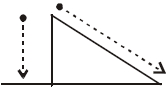
(C) The gravitational force is a conservative force.
By definition,a force is conservative if the work done by or against it in moving a particle between two points is independent of the path taken.
In the gravitational field,the work done to move an object from one point to another depends only on the initial and final positions,not on the path followed. This is illustrated by the fact that the potential energy change is solely a function of position.
By definition,a force is conservative if the work done by or against it in moving a particle between two points is independent of the path taken.
In the gravitational field,the work done to move an object from one point to another depends only on the initial and final positions,not on the path followed. This is illustrated by the fact that the potential energy change is solely a function of position.
0 likesView Solution
9
PhysicsEasyMCQAIIMS · 2002
If the value of $g$ (acceleration due to gravity) at the Earth's surface is $10 \ m/s^2$,what is its value in $m/s^2$ at the center of the Earth,assuming the Earth is a sphere of radius $R$ meters with uniform mass density?
A
$5$
B
$10/R$
C
$10/2R$
D
Zero
Solution
(D) The acceleration due to gravity $g'$ at a depth $d$ below the Earth's surface is given by the formula: $g' = g \left(1 - \frac{d}{R}\right)$,where $g$ is the acceleration due to gravity at the surface,$d$ is the depth,and $R$ is the radius of the Earth.
At the center of the Earth,the depth $d$ is equal to the radius $R$ (i.e.,$d = R$).
Substituting $d = R$ into the formula: $g' = g \left(1 - \frac{R}{R}\right) = g(1 - 1) = g(0) = 0$.
Therefore,the value of acceleration due to gravity at the center of the Earth is $0 \ m/s^2$.
At the center of the Earth,the depth $d$ is equal to the radius $R$ (i.e.,$d = R$).
Substituting $d = R$ into the formula: $g' = g \left(1 - \frac{R}{R}\right) = g(1 - 1) = g(0) = 0$.
Therefore,the value of acceleration due to gravity at the center of the Earth is $0 \ m/s^2$.
0 likesView Solution
10
PhysicsMediumMCQAIIMS · 2002
If ${v_e}$ and ${v_o}$ represent the escape velocity and orbital velocity of a satellite corresponding to a circular orbit of radius $R$,then
A
${v_e} = {v_o}$
B
$\sqrt{2} {v_o} = {v_e}$
C
${v_e} = \frac{{v_o}}{\sqrt{2}}$
D
${v_e}$ and ${v_o}$ are not related
Solution
(B) The escape velocity of a body from the surface of the Earth is given by the formula: ${v_e} = \sqrt{\frac{2GM}{R}} = \sqrt{2gR}$.
The orbital velocity of a satellite in a circular orbit of radius $R$ is given by the formula: ${v_o} = \sqrt{\frac{GM}{R}} = \sqrt{gR}$.
By comparing the two expressions,we can see that:
${v_e} = \sqrt{2} \times \sqrt{gR}$
${v_e} = \sqrt{2} {v_o}$.
Therefore,the correct relation is $\sqrt{2} {v_o} = {v_e}$.
The orbital velocity of a satellite in a circular orbit of radius $R$ is given by the formula: ${v_o} = \sqrt{\frac{GM}{R}} = \sqrt{gR}$.
By comparing the two expressions,we can see that:
${v_e} = \sqrt{2} \times \sqrt{gR}$
${v_e} = \sqrt{2} {v_o}$.
Therefore,the correct relation is $\sqrt{2} {v_o} = {v_e}$.
0 likesView Solution
11
PhysicsEasyMCQAIIMS · 2002
Kepler's second law regarding the constancy of areal velocity of a planet is a consequence of the law of conservation of
A
Energy
B
Angular momentum
C
Linear momentum
D
None of these
Solution
(B) Kepler's second law states that the areal velocity $(dA/dt)$ of a planet revolving around the Sun is constant.
Since the gravitational force exerted by the Sun on the planet is a central force,the torque $(\tau)$ acting on the planet about the Sun is zero.
According to the relation $\tau = dL/dt$,if $\tau = 0$,then the angular momentum $(L)$ of the planet remains constant.
The areal velocity is given by the expression $\frac{dA}{dt} = \frac{L}{2m}$,where $m$ is the mass of the planet.
Since $L$ and $m$ are constants,the areal velocity is constant.
Therefore,Kepler's second law is a direct consequence of the law of conservation of angular momentum.
Since the gravitational force exerted by the Sun on the planet is a central force,the torque $(\tau)$ acting on the planet about the Sun is zero.
According to the relation $\tau = dL/dt$,if $\tau = 0$,then the angular momentum $(L)$ of the planet remains constant.
The areal velocity is given by the expression $\frac{dA}{dt} = \frac{L}{2m}$,where $m$ is the mass of the planet.
Since $L$ and $m$ are constants,the areal velocity is constant.
Therefore,Kepler's second law is a direct consequence of the law of conservation of angular momentum.
0 likesView Solution
12
PhysicsEasyMCQAIIMS · 2002
The breaking stress of a wire depends upon
A
Length of the wire
B
Radius of the wire
C
Material of the wire
D
Shape of the cross section
Solution
(C) Breaking stress is a characteristic property of the material of the wire.
It represents the maximum stress a material can withstand before it breaks.
Since it is an intrinsic property,it does not depend on the dimensions of the wire such as length,radius,or the shape of the cross-section.
Therefore,the correct option is $C$.
It represents the maximum stress a material can withstand before it breaks.
Since it is an intrinsic property,it does not depend on the dimensions of the wire such as length,radius,or the shape of the cross-section.
Therefore,the correct option is $C$.
0 likesView Solution
13
PhysicsEasyMCQAIIMS · 2002
The property utilized in the manufacture of lead shots is
A
Specific weight of liquid lead
B
Specific gravity of liquid lead
C
Compressibility of liquid lead
D
Surface tension of liquid lead
Solution
(D) The property utilized in the manufacture of lead shots is the surface tension of liquid lead.
In this process,molten lead is poured through a sieve from a high tower and allowed to fall into water.
Due to surface tension,the liquid surface tends to minimize its area for a given volume,which results in the molten lead particles assuming a spherical shape while descending.
These droplets solidify in this spherical form before they reach the water,resulting in the production of spherical lead shots.
In this process,molten lead is poured through a sieve from a high tower and allowed to fall into water.
Due to surface tension,the liquid surface tends to minimize its area for a given volume,which results in the molten lead particles assuming a spherical shape while descending.
These droplets solidify in this spherical form before they reach the water,resulting in the production of spherical lead shots.
0 likesView Solution
14
PhysicsMediumMCQAIIMS · 2002
$A$ soap bubble in vacuum has a radius of $3 \, cm$ and another soap bubble in vacuum has a radius of $4 \, cm$. If the two bubbles coalesce under isothermal condition,then the radius of the new bubble is ....... $cm$.
A
$2.3$
B
$4.5$
C
$5$
D
$7$
Solution
(C) When two soap bubbles coalesce in a vacuum under isothermal conditions,the total number of moles of air remains constant. Since the temperature is constant,the product of pressure and volume $(PV)$ remains constant for the air inside the bubbles.
For a soap bubble,the excess pressure is given by $P_{ex} = \frac{4T}{r}$. Since the bubbles are in a vacuum,the internal pressure is $P = \frac{4T}{r}$.
The volume of a spherical bubble is $V = \frac{4}{3}\pi r^3$.
For the first bubble: $P_1 V_1 = \left(\frac{4T}{r_1}\right) \left(\frac{4}{3}\pi r_1^3\right) = \frac{16}{3}\pi T r_1^2$.
For the second bubble: $P_2 V_2 = \left(\frac{4T}{r_2}\right) \left(\frac{4}{3}\pi r_2^3\right) = \frac{16}{3}\pi T r_2^2$.
For the new bubble of radius $R$: $P V = \frac{16}{3}\pi T R^2$.
Since the total amount of air is conserved: $P_1 V_1 + P_2 V_2 = PV$.
$\frac{16}{3}\pi T r_1^2 + \frac{16}{3}\pi T r_2^2 = \frac{16}{3}\pi T R^2$.
$r_1^2 + r_2^2 = R^2$.
Given $r_1 = 3 \, cm$ and $r_2 = 4 \, cm$,we have $R = \sqrt{3^2 + 4^2} = \sqrt{9 + 16} = \sqrt{25} = 5 \, cm$.
For a soap bubble,the excess pressure is given by $P_{ex} = \frac{4T}{r}$. Since the bubbles are in a vacuum,the internal pressure is $P = \frac{4T}{r}$.
The volume of a spherical bubble is $V = \frac{4}{3}\pi r^3$.
For the first bubble: $P_1 V_1 = \left(\frac{4T}{r_1}\right) \left(\frac{4}{3}\pi r_1^3\right) = \frac{16}{3}\pi T r_1^2$.
For the second bubble: $P_2 V_2 = \left(\frac{4T}{r_2}\right) \left(\frac{4}{3}\pi r_2^3\right) = \frac{16}{3}\pi T r_2^2$.
For the new bubble of radius $R$: $P V = \frac{16}{3}\pi T R^2$.
Since the total amount of air is conserved: $P_1 V_1 + P_2 V_2 = PV$.
$\frac{16}{3}\pi T r_1^2 + \frac{16}{3}\pi T r_2^2 = \frac{16}{3}\pi T R^2$.
$r_1^2 + r_2^2 = R^2$.
Given $r_1 = 3 \, cm$ and $r_2 = 4 \, cm$,we have $R = \sqrt{3^2 + 4^2} = \sqrt{9 + 16} = \sqrt{25} = 5 \, cm$.
0 likesView Solution
15
PhysicsEasyMCQAIIMS · 2002
$A$ metallic ball and a highly stretched spring are made of the same material and have the same mass. They are heated so that they melt. The latent heat required:
A
Is the same for both
B
Is greater for the ball
C
Is greater for the spring
D
May or may not be the same depending upon the metal
Solution
(A) Latent heat is a property of the material that depends on the mass of the substance undergoing a phase change.
It is defined as $Q = mL$,where $m$ is the mass and $L$ is the specific latent heat of fusion.
Since both the metallic ball and the spring are made of the same material,their specific latent heat $L$ is identical.
Given that their masses $m$ are also the same,the total latent heat required $Q$ must be the same for both.
The energy spent in stretching the spring is stored as elastic potential energy,which is an ordered form of energy.
Latent heat,however,relates to the energy required to overcome intermolecular forces during a phase transition,which is independent of the initial configuration or the internal elastic energy of the object.
It is defined as $Q = mL$,where $m$ is the mass and $L$ is the specific latent heat of fusion.
Since both the metallic ball and the spring are made of the same material,their specific latent heat $L$ is identical.
Given that their masses $m$ are also the same,the total latent heat required $Q$ must be the same for both.
The energy spent in stretching the spring is stored as elastic potential energy,which is an ordered form of energy.
Latent heat,however,relates to the energy required to overcome intermolecular forces during a phase transition,which is independent of the initial configuration or the internal elastic energy of the object.
0 likesView Solution
16
PhysicsEasyMCQAIIMS · 2002
According to Wien's displacement law:
A
$\lambda_m T = \text{constant}$
B
$\frac{\lambda_m}{T} = \text{constant}$
C
$\frac{T}{\lambda_m} = \text{constant}$
D
$T + \lambda_m = \text{constant}$
Solution
(A) Wien's displacement law states that the wavelength corresponding to the maximum spectral emissive power $(\lambda_m)$ of a black body is inversely proportional to its absolute temperature $(T)$.
Mathematically,this is expressed as $\lambda_m \propto \frac{1}{T}$.
Rearranging this gives the relation $\lambda_m T = b$,where $b$ is Wien's constant.
Therefore,the correct option is $A$.
Mathematically,this is expressed as $\lambda_m \propto \frac{1}{T}$.
Rearranging this gives the relation $\lambda_m T = b$,where $b$ is Wien's constant.
Therefore,the correct option is $A$.
0 likesView Solution
17
PhysicsEasyMCQAIIMS · 2002
$A$ black body is at a temperature $300 K$. It emits energy at a rate,which is proportional to
A
$300$
B
$(300)^2$
C
$(300)^3$
D
$(300)^4$
Solution
(D) According to Stefan-Boltzmann law,the total energy $E$ radiated per unit surface area of a black body per unit time is directly proportional to the fourth power of its absolute temperature $T$.
Mathematically,$E \propto T^4$.
Given the temperature $T = 300 K$,the rate of energy emission is proportional to $(300)^4$.
Mathematically,$E \propto T^4$.
Given the temperature $T = 300 K$,the rate of energy emission is proportional to $(300)^4$.
0 likesView Solution
18
PhysicsMediumMCQAIIMS · 2002
$v_1$ and $v_2$ are the velocities of sound at the same temperature in two monoatomic gases of densities $\rho_1$ and $\rho_2$ respectively. If $\frac{\rho_1}{\rho_2} = \frac{1}{4}$,then the ratio of velocities $v_1$ and $v_2$ will be
A
$1:2$
B
$4:1$
C
$2:1$
D
$1:4$
Solution
(C) The velocity of sound in a gas is given by the formula $v = \sqrt{\frac{\gamma P}{\rho}}$.
Since the temperature is the same and the gases are monoatomic,the adiabatic index $\gamma$ is the same for both.
Assuming the pressure $P$ is the same,we have $v \propto \frac{1}{\sqrt{\rho}}$.
Therefore,the ratio of velocities is $\frac{v_1}{v_2} = \sqrt{\frac{\rho_2}{\rho_1}}$.
Given $\frac{\rho_1}{\rho_2} = \frac{1}{4}$,it follows that $\frac{\rho_2}{\rho_1} = 4$.
Substituting this value,we get $\frac{v_1}{v_2} = \sqrt{4} = 2$.
Thus,the ratio $v_1 : v_2$ is $2:1$.
Since the temperature is the same and the gases are monoatomic,the adiabatic index $\gamma$ is the same for both.
Assuming the pressure $P$ is the same,we have $v \propto \frac{1}{\sqrt{\rho}}$.
Therefore,the ratio of velocities is $\frac{v_1}{v_2} = \sqrt{\frac{\rho_2}{\rho_1}}$.
Given $\frac{\rho_1}{\rho_2} = \frac{1}{4}$,it follows that $\frac{\rho_2}{\rho_1} = 4$.
Substituting this value,we get $\frac{v_1}{v_2} = \sqrt{4} = 2$.
Thus,the ratio $v_1 : v_2$ is $2:1$.
0 likesView Solution
19
PhysicsMediumMCQAIIMS · 2002
The equation of a sound wave is $y = 0.0015 \sin (62.4x + 316t)$. The wavelength of this wave is ..... $unit$.
A
$0.2$
B
$0.1$
C
$0.3$
D
Cannot be calculated
Solution
(B) The standard equation of a traveling wave is given by $y = A \sin (kx + \omega t + \phi)$.
Comparing the given equation $y = 0.0015 \sin (62.4x + 316t)$ with the standard form,we identify the wave number $k$ as $62.4 \, \text{rad/unit}$.
The relationship between the wave number $k$ and the wavelength $\lambda$ is given by $k = \frac{2\pi}{\lambda}$.
Substituting the value of $k$,we get $62.4 = \frac{2 \times 3.14}{\lambda}$.
Solving for $\lambda$: $\lambda = \frac{6.28}{62.4} \approx 0.1 \, \text{unit}$.
Comparing the given equation $y = 0.0015 \sin (62.4x + 316t)$ with the standard form,we identify the wave number $k$ as $62.4 \, \text{rad/unit}$.
The relationship between the wave number $k$ and the wavelength $\lambda$ is given by $k = \frac{2\pi}{\lambda}$.
Substituting the value of $k$,we get $62.4 = \frac{2 \times 3.14}{\lambda}$.
Solving for $\lambda$: $\lambda = \frac{6.28}{62.4} \approx 0.1 \, \text{unit}$.
0 likesView Solution
20
PhysicsMediumMCQAIIMS · 2002
$A$ string in a musical instrument is $50 \ cm$ long and its fundamental frequency is $800 \ Hz$. If a frequency of $1000 \ Hz$ is to be produced,then the required length of the string is ..... $cm$.
A
$62.5$
B
$50$
C
$40$
D
$37.5$
Solution
(C) The fundamental frequency $f$ of a stretched string is given by $f = \frac{v}{2L}$,where $v$ is the wave speed and $L$ is the length of the string.
Since the tension and mass per unit length of the string remain constant,the wave speed $v$ is constant.
Therefore,$f \propto \frac{1}{L}$,which implies $f_1 L_1 = f_2 L_2$.
Given: $f_1 = 800 \ Hz$,$L_1 = 50 \ cm$,and $f_2 = 1000 \ Hz$.
Substituting the values: $800 \times 50 = 1000 \times L_2$.
$L_2 = \frac{800 \times 50}{1000} = 40 \ cm$.
Thus,the required length of the string is $40 \ cm$.
Since the tension and mass per unit length of the string remain constant,the wave speed $v$ is constant.
Therefore,$f \propto \frac{1}{L}$,which implies $f_1 L_1 = f_2 L_2$.
Given: $f_1 = 800 \ Hz$,$L_1 = 50 \ cm$,and $f_2 = 1000 \ Hz$.
Substituting the values: $800 \times 50 = 1000 \times L_2$.
$L_2 = \frac{800 \times 50}{1000} = 40 \ cm$.
Thus,the required length of the string is $40 \ cm$.
0 likesView Solution
21
PhysicsMediumMCQAIIMS · 2002
$A$ siren emitting sound of frequency $800 \; Hz$ is going away from a static listener with a speed of $30 \; m/s$. The frequency of the sound heard by the listener is... $Hz$ (take velocity of sound as $330 \; m/s$).
A
$733.3$
B
$644.8$
C
$481.2$
D
$286.5$
Solution
(A) According to the Doppler effect,when the source is moving away from a stationary observer,the observed frequency $n'$ is given by the formula:
$n' = n \left( \frac{v}{v + v_S} \right)$
Where:
$n = 800 \; Hz$ (source frequency)
$v = 330 \; m/s$ (velocity of sound)
$v_S = 30 \; m/s$ (velocity of source)
Substituting the values:
$n' = 800 \left( \frac{330}{330 + 30} \right)$
$n' = 800 \left( \frac{330}{360} \right)$
$n' = 800 \left( \frac{11}{12} \right)$
$n' = \frac{8800}{12} \approx 733.33 \; Hz$.
$n' = n \left( \frac{v}{v + v_S} \right)$
Where:
$n = 800 \; Hz$ (source frequency)
$v = 330 \; m/s$ (velocity of sound)
$v_S = 30 \; m/s$ (velocity of source)
Substituting the values:
$n' = 800 \left( \frac{330}{330 + 30} \right)$
$n' = 800 \left( \frac{330}{360} \right)$
$n' = 800 \left( \frac{11}{12} \right)$
$n' = \frac{8800}{12} \approx 733.33 \; Hz$.
0 likesView Solution
22
PhysicsMediumMCQAIIMS · 2002
The graph between wave number $(\bar \nu)$ and angular frequency $(\omega)$ is
A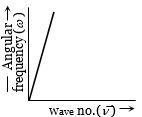
B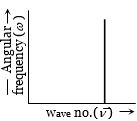
C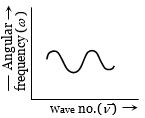
D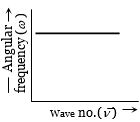
Solution
(A) The relationship between angular frequency $(\omega)$ and frequency $(\nu)$ is given by $\omega = 2\pi \nu$.
We know that frequency $(\nu)$ is related to wave number $(\bar \nu)$ by the equation $\nu = c \bar \nu$,where $c$ is the speed of light.
Substituting this into the first equation,we get $\omega = 2\pi c \bar \nu$.
Since $2\pi$ and $c$ are constants,this equation is of the form $y = mx$,which represents a straight line passing through the origin.
Therefore,the graph between angular frequency $(\omega)$ and wave number $(\bar \nu)$ is a straight line passing through the origin.
We know that frequency $(\nu)$ is related to wave number $(\bar \nu)$ by the equation $\nu = c \bar \nu$,where $c$ is the speed of light.
Substituting this into the first equation,we get $\omega = 2\pi c \bar \nu$.
Since $2\pi$ and $c$ are constants,this equation is of the form $y = mx$,which represents a straight line passing through the origin.
Therefore,the graph between angular frequency $(\omega)$ and wave number $(\bar \nu)$ is a straight line passing through the origin.
0 likesView Solution
23
PhysicsMediumMCQAIIMS · 2002
$A$ thin circular ring of mass $M$ and radius $r$ is rotating about its axis with a constant angular velocity $\omega$. Two objects,each of mass $m$,are attached gently to the opposite ends of a diameter of the ring. The ring will now rotate with an angular velocity:
A
$\frac{\omega (M - 2m)}{M + 2m}$
B
$\frac{\omega M}{M + 2m}$
C
$\frac{\omega M}{M + m}$
D
$\frac{\omega (M + 2m)}{M}$
Solution
(B) The initial moment of inertia of the ring about its axis is $I = Mr^2$.
The initial angular momentum is $L = I\omega = Mr^2\omega$.
When two objects of mass $m$ are attached to the opposite ends of a diameter,the new moment of inertia $I'$ becomes the sum of the ring's moment of inertia and the moment of inertia of the two point masses: $I' = Mr^2 + m(r)^2 + m(r)^2 = (M + 2m)r^2$.
According to the principle of conservation of angular momentum,the external torque is zero,so $L_{initial} = L_{final}$.
$Mr^2\omega = (M + 2m)r^2\omega'$
Solving for the new angular velocity $\omega'$:
$\omega' = \frac{Mr^2\omega}{(M + 2m)r^2} = \frac{M\omega}{M + 2m}$.
The initial angular momentum is $L = I\omega = Mr^2\omega$.
When two objects of mass $m$ are attached to the opposite ends of a diameter,the new moment of inertia $I'$ becomes the sum of the ring's moment of inertia and the moment of inertia of the two point masses: $I' = Mr^2 + m(r)^2 + m(r)^2 = (M + 2m)r^2$.
According to the principle of conservation of angular momentum,the external torque is zero,so $L_{initial} = L_{final}$.
$Mr^2\omega = (M + 2m)r^2\omega'$
Solving for the new angular velocity $\omega'$:
$\omega' = \frac{Mr^2\omega}{(M + 2m)r^2} = \frac{M\omega}{M + 2m}$.
1 likesView Solution
24
PhysicsEasyMCQAIIMS · 2002
The angular momentum of a system of particles is conserved:
A
If no external force acts on the system.
B
If no external torque acts on the system.
C
If no external impulse acts on the system.
D
If the axis of rotation remains the same.
Solution
(B) According to the principle of conservation of angular momentum,the angular momentum $\vec{L}$ of a system is conserved if the net external torque $\vec{\tau}_{ext}$ acting on the system is zero.
This is derived from the relation $\vec{\tau}_{ext} = \frac{d\vec{L}}{dt}$.
If $\vec{\tau}_{ext} = 0$,then $\frac{d\vec{L}}{dt} = 0$,which implies $\vec{L} = \text{constant}$.
Therefore,the correct condition is that no external torque acts on the system.
This is derived from the relation $\vec{\tau}_{ext} = \frac{d\vec{L}}{dt}$.
If $\vec{\tau}_{ext} = 0$,then $\frac{d\vec{L}}{dt} = 0$,which implies $\vec{L} = \text{constant}$.
Therefore,the correct condition is that no external torque acts on the system.
0 likesView Solution
25
PhysicsEasyMCQAIIMS · 2002
$Assertion$ : The dimensional formula for relative velocity is the same as that of the change in velocity.
$Reason$ : Relative velocity of $P$ with respect to $Q$ is the ratio of the velocity of $P$ and that of $Q$.
$Reason$ : Relative velocity of $P$ with respect to $Q$ is the ratio of the velocity of $P$ and that of $Q$.
A
If both Assertion and Reason are correct and the Reason is a correct explanation of the Assertion.
B
If both Assertion and Reason are correct but Reason is not a correct explanation of the Assertion.
C
If the Assertion is incorrect but the Reason is correct.
D
If the Assertion is correct but Reason is incorrect.
Solution
(D) $1$. The relative velocity of an object $P$ with respect to $Q$ is defined as $\vec{v}_{PQ} = \vec{v}_P - \vec{v}_Q$. Since this is a vector subtraction of two velocities,the result is also a velocity. Therefore,its dimensional formula is $[M^0 L^1 T^{-1}]$,which is the same as that of velocity and the change in velocity $(\Delta v)$. Thus,the Assertion is correct.
$2$. The Reason states that relative velocity is the ratio of velocities,which is physically incorrect. Relative velocity is defined as the difference between two velocities,not the ratio. Thus,the Reason is incorrect.
$2$. The Reason states that relative velocity is the ratio of velocities,which is physically incorrect. Relative velocity is defined as the difference between two velocities,not the ratio. Thus,the Reason is incorrect.
0 likesView Solution
26
PhysicsEasyMCQAIIMS · 2002
$Assertion$ : Retardation is directly opposite to the velocity.
$Reason$ : Retardation is equal to the time rate of decrease of speed.
$Reason$ : Retardation is equal to the time rate of decrease of speed.
A
If both $Assertion$ and $Reason$ are correct and the $Reason$ is a correct explanation of the $Assertion$.
B
If both $Assertion$ and $Reason$ are correct but $Reason$ is not a correct explanation of the $Assertion$.
C
If the $Assertion$ is correct but $Reason$ is incorrect.
D
If both the $Assertion$ and $Reason$ are incorrect.
Solution
(A) Retardation is defined as the negative acceleration,which means the acceleration vector is directed opposite to the velocity vector. This causes a decrease in the magnitude of velocity (speed) over time.
The $Assertion$ is correct because retardation,by definition,acts in the direction opposite to the velocity to reduce it.
The $Reason$ is also correct because retardation is indeed the time rate of decrease of speed.
Since the decrease in speed is caused by the acceleration acting opposite to the velocity,the $Reason$ correctly explains why retardation is defined as it is in the $Assertion$.
The $Assertion$ is correct because retardation,by definition,acts in the direction opposite to the velocity to reduce it.
The $Reason$ is also correct because retardation is indeed the time rate of decrease of speed.
Since the decrease in speed is caused by the acceleration acting opposite to the velocity,the $Reason$ correctly explains why retardation is defined as it is in the $Assertion$.
0 likesView Solution
27
PhysicsEasyMCQAIIMS · 2002
$Assertion$ : In an elastic collision of two billiard balls,the total kinetic energy is conserved during the short time of oscillation of the balls (i.e.,when they are in contact).
$Reason$ : Energy spent against friction does not follow the law of conservation of energy.
$Reason$ : Energy spent against friction does not follow the law of conservation of energy.
A
If both $Assertion$ and $Reason$ are correct and the $Reason$ is a correct explanation of the $Assertion$.
B
If both $Assertion$ and $Reason$ are correct but $Reason$ is not a correct explanation of the $Assertion$.
C
If the $Assertion$ is correct but $Reason$ is incorrect.
D
If both the $Assertion$ and $Reason$ are incorrect.
Solution
(D) In an elastic collision,the total kinetic energy is conserved throughout the process,including the time of contact. During the collision,kinetic energy is temporarily converted into elastic potential energy and then back into kinetic energy,so the total mechanical energy remains constant. Thus,the $Assertion$ is incorrect because kinetic energy is not conserved *during* the contact time (it is converted to potential energy).
The $Reason$ is also incorrect because the law of conservation of energy is a universal law; energy spent against friction is converted into heat or sound,and the total energy of the system (including heat/sound) remains conserved.
The $Reason$ is also incorrect because the law of conservation of energy is a universal law; energy spent against friction is converted into heat or sound,and the total energy of the system (including heat/sound) remains conserved.
1 likesView Solution
28
PhysicsEasyMCQAIIMS · 2002
$Assertion:$ Stress is the internal restoring force per unit area of a body.
$Reason:$ Rubber is more elastic than steel.
$Reason:$ Rubber is more elastic than steel.
A
If both Assertion and Reason are correct and the Reason is a correct explanation of the Assertion.
B
If the Assertion is correct but Reason is incorrect.
C
If both Assertion and Reason are correct but Reason is not a correct explanation of the Assertion.
D
If both the Assertion and Reason are incorrect.
Solution
(B) The Assertion is correct: Stress is defined as the internal restoring force per unit area of a body when it is deformed.
The Reason is incorrect: Elasticity is defined by the Young's modulus $(Y)$. Since steel requires a much larger force to produce the same strain compared to rubber,steel is more elastic than rubber. Therefore,rubber is less elastic than steel.
The Reason is incorrect: Elasticity is defined by the Young's modulus $(Y)$. Since steel requires a much larger force to produce the same strain compared to rubber,steel is more elastic than rubber. Therefore,rubber is less elastic than steel.
0 likesView Solution
29
PhysicsEasyMCQAIIMS · 2002
$A$ scent sprayer is based on
A
Bernoulli's theorem
B
Archimedes' principle
C
Charles's law
D
Boyle's law
Solution
(A) Bernoulli's theorem states that for an incompressible,non-viscous fluid in steady flow,an increase in the speed of the fluid occurs simultaneously with a decrease in pressure or a decrease in the fluid's potential energy.
In a scent sprayer,when air is pumped through the nozzle at high velocity,it creates a region of low pressure according to Bernoulli's principle.
Due to this pressure difference between the container and the nozzle,the liquid scent is pushed upward through the tube and sprayed out with the air stream.
In a scent sprayer,when air is pumped through the nozzle at high velocity,it creates a region of low pressure according to Bernoulli's principle.
Due to this pressure difference between the container and the nozzle,the liquid scent is pushed upward through the tube and sprayed out with the air stream.
0 likesView Solution
30
PhysicsEasyMCQAIIMS · 2002
$Assertion :$ Bodies radiate heat at all temperatures.
$Reason :$ Rate of radiation of heat is proportional to the fourth power of absolute temperature.
$Reason :$ Rate of radiation of heat is proportional to the fourth power of absolute temperature.
A
If both Assertion and Reason are correct and the Reason is a correct explanation of the Assertion.
B
If both Assertion and Reason are correct but Reason is not a correct explanation of the Assertion.
C
If the Assertion is correct but Reason is incorrect.
D
If both the Assertion and Reason are incorrect.
Solution
(A) According to the kinetic theory of matter,all bodies at temperatures above absolute zero $(0 \ K)$ possess thermal energy and emit electromagnetic radiation. Thus,the assertion is correct.
According to the Stefan-Boltzmann law,the total energy radiated per unit surface area of a black body per unit time is directly proportional to the fourth power of its absolute temperature,given by $E = \sigma T^4$. This law explains why the rate of radiation depends on the temperature of the body. Therefore,the reason is correct and provides a valid explanation for the assertion.
According to the Stefan-Boltzmann law,the total energy radiated per unit surface area of a black body per unit time is directly proportional to the fourth power of its absolute temperature,given by $E = \sigma T^4$. This law explains why the rate of radiation depends on the temperature of the body. Therefore,the reason is correct and provides a valid explanation for the assertion.
0 likesView Solution
31
PhysicsEasyMCQAIIMS · 2002
$Assertion :$ Woolen clothes keep the body warm in winter.
$Reason :$ Air is a bad conductor of heat.
$Reason :$ Air is a bad conductor of heat.
A
If both Assertion and Reason are correct and the Reason is a correct explanation of the Assertion.
B
If both Assertion and Reason are correct but Reason is not a correct explanation of the Assertion.
C
If the Assertion is correct but Reason is incorrect.
D
If both the Assertion and Reason are incorrect.
Solution
(A) Woolen clothes have a porous structure that traps air between the fibers.
Since air is a bad conductor of heat,it prevents the heat from the human body from escaping into the cold surroundings.
Therefore,the trapped air acts as an insulator,keeping the body warm in winter.
Both the Assertion and the Reason are correct,and the Reason is the correct explanation for the Assertion.
Since air is a bad conductor of heat,it prevents the heat from the human body from escaping into the cold surroundings.
Therefore,the trapped air acts as an insulator,keeping the body warm in winter.
Both the Assertion and the Reason are correct,and the Reason is the correct explanation for the Assertion.
0 likesView Solution
32
PhysicsMediumMCQAIIMS · 2002
$Assertion :$ In simple harmonic motion,the motion is to and fro and periodic.
$Reason :$ Velocity of the particle $(v) = \omega \sqrt {A^2 - x^2}$ (where $x$ is the displacement and $A$ is the amplitude).
$Reason :$ Velocity of the particle $(v) = \omega \sqrt {A^2 - x^2}$ (where $x$ is the displacement and $A$ is the amplitude).
A
If both Assertion and Reason are correct and the Reason is a correct explanation of the Assertion.
B
If both Assertion and Reason are correct but Reason is not a correct explanation of the Assertion.
C
If the Assertion is correct but Reason is incorrect.
D
If both the Assertion and Reason are incorrect.
Solution
(A) Simple Harmonic Motion $(SHM)$ is defined as a periodic motion in which the restoring force is directly proportional to the displacement and acts in the direction opposite to that of displacement. This results in to-and-fro motion about a mean position. The velocity of a particle in $SHM$ is given by the formula $v = \omega \sqrt{A^2 - x^2}$,where $A$ is the amplitude,$x$ is the displacement,and $\omega$ is the angular frequency. The original reason provided used $k$ instead of $A$,which is notationally incorrect for amplitude. However,the formula correctly describes the velocity variation in $SHM$,which confirms the periodic and to-and-fro nature of the motion. Thus,both statements are correct,and the velocity expression explains the nature of the motion.
0 likesView Solution
33
PhysicsEasyMCQAIIMS · 2002
$Assertion:$ The time period of a simple pendulum on a satellite orbiting the Earth is infinity.
$Reason:$ The time period of a simple pendulum is inversely proportional to $\sqrt{g}$.
$Reason:$ The time period of a simple pendulum is inversely proportional to $\sqrt{g}$.
A
If both Assertion and Reason are correct and the Reason is a correct explanation of the Assertion.
B
If both Assertion and Reason are correct but Reason is not a correct explanation of the Assertion.
C
If the Assertion is correct but Reason is incorrect.
D
If both the Assertion and Reason are incorrect.
Solution
(A) The time period of a simple pendulum is given by the formula $T = 2\pi \sqrt{\frac{l}{g_{eff}}}$,where $g_{eff}$ is the effective acceleration due to gravity.
Inside an orbiting satellite,the body is in a state of weightlessness,which means the effective acceleration due to gravity $g_{eff} = 0$.
Substituting $g_{eff} = 0$ into the formula,we get $T = 2\pi \sqrt{\frac{l}{0}} = \infty$.
Thus,the Assertion is correct.
The Reason states that the time period is inversely proportional to $\sqrt{g}$,which is mathematically correct based on the formula $T \propto \frac{1}{\sqrt{g}}$.
Since the infinite time period is a direct consequence of $g_{eff} = 0$ in the formula,the Reason correctly explains the Assertion.
Inside an orbiting satellite,the body is in a state of weightlessness,which means the effective acceleration due to gravity $g_{eff} = 0$.
Substituting $g_{eff} = 0$ into the formula,we get $T = 2\pi \sqrt{\frac{l}{0}} = \infty$.
Thus,the Assertion is correct.
The Reason states that the time period is inversely proportional to $\sqrt{g}$,which is mathematically correct based on the formula $T \propto \frac{1}{\sqrt{g}}$.
Since the infinite time period is a direct consequence of $g_{eff} = 0$ in the formula,the Reason correctly explains the Assertion.
0 likesView Solution
34
PhysicsMediumMCQAIIMS · 2002
$Assertion :$ Speed of wave $= \frac{\text{wavelength}}{\text{time period}}$
$Reason :$ Wavelength is the distance between two nearest particles in phase.
$Reason :$ Wavelength is the distance between two nearest particles in phase.
A
If both Assertion and Reason are correct and the Reason is a correct explanation of the Assertion.
B
If both Assertion and Reason are correct but Reason is not a correct explanation of the Assertion.
C
If the Assertion is correct but Reason is incorrect.
D
If both the Assertion and Reason are incorrect.
Solution
(A) The wavelength $(\lambda)$ is defined as the distance between two nearest particles in the same phase.
The time period $(T)$ is the time taken by the wave to travel a distance equal to one wavelength.
By definition,the speed of a wave $(v)$ is the distance traveled per unit time.
Therefore,$v = \frac{\lambda}{T}$,which is $\text{Speed of wave} = \frac{\text{wavelength}}{\text{time period}}$.
Since the reason correctly defines wavelength and provides the basis for the relationship in the assertion,the reason is the correct explanation of the assertion.
The time period $(T)$ is the time taken by the wave to travel a distance equal to one wavelength.
By definition,the speed of a wave $(v)$ is the distance traveled per unit time.
Therefore,$v = \frac{\lambda}{T}$,which is $\text{Speed of wave} = \frac{\text{wavelength}}{\text{time period}}$.
Since the reason correctly defines wavelength and provides the basis for the relationship in the assertion,the reason is the correct explanation of the assertion.
0 likesView Solution
35
PhysicsEasyMCQAIIMS · 2002
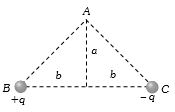
As shown in the figure,charges $+q$ and $-q$ are placed at the vertices $B$ and $C$ of an isosceles triangle. The potential at the vertex $A$ is
A
$\frac{1}{4\pi\varepsilon_0} \cdot \frac{2q}{\sqrt{a^2 + b^2}}$
B
Zero
C
$\frac{1}{4\pi\varepsilon_0} \cdot \frac{q}{\sqrt{a^2 + b^2}}$
D
$\frac{1}{4\pi\varepsilon_0} \cdot \frac{-q}{\sqrt{a^2 + b^2}}$
Solution
(B) The electric potential $V$ at a point due to a point charge $Q$ at a distance $r$ is given by $V = \frac{1}{4\pi\varepsilon_0} \cdot \frac{Q}{r}$.
In the given isosceles triangle,the distance from vertex $A$ to both vertices $B$ and $C$ is $r = \sqrt{a^2 + b^2}$ by the Pythagorean theorem.
The potential at vertex $A$ is the algebraic sum of the potentials due to charges at $B$ and $C$:
$V_A = V_B + V_C$
$V_A = \frac{1}{4\pi\varepsilon_0} \cdot \frac{q}{\sqrt{a^2 + b^2}} + \frac{1}{4\pi\varepsilon_0} \cdot \frac{-q}{\sqrt{a^2 + b^2}}$
$V_A = \frac{1}{4\pi\varepsilon_0} \cdot \frac{q - q}{\sqrt{a^2 + b^2}} = 0$.
In the given isosceles triangle,the distance from vertex $A$ to both vertices $B$ and $C$ is $r = \sqrt{a^2 + b^2}$ by the Pythagorean theorem.
The potential at vertex $A$ is the algebraic sum of the potentials due to charges at $B$ and $C$:
$V_A = V_B + V_C$
$V_A = \frac{1}{4\pi\varepsilon_0} \cdot \frac{q}{\sqrt{a^2 + b^2}} + \frac{1}{4\pi\varepsilon_0} \cdot \frac{-q}{\sqrt{a^2 + b^2}}$
$V_A = \frac{1}{4\pi\varepsilon_0} \cdot \frac{q - q}{\sqrt{a^2 + b^2}} = 0$.
0 likesView Solution
36
PhysicsEasyMCQAIIMS · 2002
An electron having charge '$e$' and mass '$m$' is moving in a uniform electric field $E$. Its acceleration will be
A
$\frac{e^2}{m}$
B
$\frac{E^2e}{m}$
C
$\frac{eE}{m}$
D
$\frac{mE}{e}$
Solution
(C) The force $F$ experienced by a charge $q$ in an electric field $E$ is given by $F = qE$.
For an electron,the charge is $q = e$,so the force is $F = eE$.
According to Newton's second law of motion,the force is also given by $F = ma$,where $m$ is the mass and $a$ is the acceleration.
Equating the two expressions for force: $ma = eE$.
Therefore,the acceleration $a$ is given by $a = \frac{eE}{m}$.
For an electron,the charge is $q = e$,so the force is $F = eE$.
According to Newton's second law of motion,the force is also given by $F = ma$,where $m$ is the mass and $a$ is the acceleration.
Equating the two expressions for force: $ma = eE$.
Therefore,the acceleration $a$ is given by $a = \frac{eE}{m}$.
0 likesView Solution
37
PhysicsEasyMCQAIIMS · 2002
Work done by an external agent in separating the plates of a parallel plate capacitor (disconnected from the battery) is:
A
$CV$
B
$\frac{1}{2}C^2V$
C
$\frac{1}{2}CV^2$
D
None of these
Solution
(C) When a capacitor is disconnected from the battery,the charge $Q$ on its plates remains constant.
The capacitance of a parallel plate capacitor is given by $C = \frac{\epsilon_0 A}{d}$.
As the plates are separated,the distance $d$ increases,so the capacitance $C$ decreases.
The energy stored in a capacitor is given by $U = \frac{Q^2}{2C}$.
Since $Q$ is constant and $C$ decreases,the energy $U$ increases.
The work done by the external agent is equal to the change in the potential energy of the capacitor: $W = \Delta U = U_f - U_i$.
If the capacitance changes from $C$ to $C'$,the work done is $W = \frac{Q^2}{2C'} - \frac{Q^2}{2C}$.
Given the options provided,the standard expression for energy stored in a capacitor is $\frac{1}{2}CV^2$.
The capacitance of a parallel plate capacitor is given by $C = \frac{\epsilon_0 A}{d}$.
As the plates are separated,the distance $d$ increases,so the capacitance $C$ decreases.
The energy stored in a capacitor is given by $U = \frac{Q^2}{2C}$.
Since $Q$ is constant and $C$ decreases,the energy $U$ increases.
The work done by the external agent is equal to the change in the potential energy of the capacitor: $W = \Delta U = U_f - U_i$.
If the capacitance changes from $C$ to $C'$,the work done is $W = \frac{Q^2}{2C'} - \frac{Q^2}{2C}$.
Given the options provided,the standard expression for energy stored in a capacitor is $\frac{1}{2}CV^2$.
0 likesView Solution
38
PhysicsMediumMCQAIIMS · 2002
$A$ conducting sphere of radius $10\, cm$ is charged with $10\,\mu C$. Another uncharged sphere of radius $20\, cm$ is allowed to touch it for some time. After the spheres are separated,the ratio of the surface charge densities on the spheres will be:
A
$1:4$
B
$1:3$
C
$2:1$
D
$1:1$
Solution
(C) When two conducting spheres are brought into contact,charge flows until their potentials become equal. Let the radii be $r_1 = 10\, cm$ and $r_2 = 20\, cm$. The potential of a sphere is given by $V = \frac{kQ}{r}$.
Since $V_1 = V_2$,we have $\frac{kQ'_1}{r_1} = \frac{kQ'_2}{r_2}$,which implies $\frac{Q'_1}{Q'_2} = \frac{r_1}{r_2} = \frac{10}{20} = \frac{1}{2}$.
The surface charge density is defined as $\sigma = \frac{Q}{4\pi r^2}$.
Therefore,the ratio of surface charge densities is $\frac{\sigma_1}{\sigma_2} = \frac{Q'_1}{4\pi r_1^2} \times \frac{4\pi r_2^2}{Q'_2} = \left( \frac{Q'_1}{Q'_2} \right) \times \left( \frac{r_2}{r_1} \right)^2$.
Substituting the values: $\frac{\sigma_1}{\sigma_2} = \left( \frac{1}{2} \right) \times \left( \frac{20}{10} \right)^2 = \frac{1}{2} \times 4 = \frac{2}{1}$.
Since $V_1 = V_2$,we have $\frac{kQ'_1}{r_1} = \frac{kQ'_2}{r_2}$,which implies $\frac{Q'_1}{Q'_2} = \frac{r_1}{r_2} = \frac{10}{20} = \frac{1}{2}$.
The surface charge density is defined as $\sigma = \frac{Q}{4\pi r^2}$.
Therefore,the ratio of surface charge densities is $\frac{\sigma_1}{\sigma_2} = \frac{Q'_1}{4\pi r_1^2} \times \frac{4\pi r_2^2}{Q'_2} = \left( \frac{Q'_1}{Q'_2} \right) \times \left( \frac{r_2}{r_1} \right)^2$.
Substituting the values: $\frac{\sigma_1}{\sigma_2} = \left( \frac{1}{2} \right) \times \left( \frac{20}{10} \right)^2 = \frac{1}{2} \times 4 = \frac{2}{1}$.
0 likesView Solution
39
PhysicsMediumMCQAIIMS · 2002
An electric bulb marked $40\, W$ and $200\, V$,is used in a circuit of supply voltage $100\, V$. Now its power is (in $, W$)
A
$100$
B
$40$
C
$20$
D
$10$
Solution
(D) The power rating of the bulb is $P_1 = 40\, W$ at a voltage $V_1 = 200\, V$.
Since the resistance $R$ of the bulb remains constant,we use the formula $P = \frac{V^2}{R}$.
Therefore,the ratio of the new power $P_2$ to the rated power $P_1$ is given by $\frac{P_2}{P_1} = \frac{V_2^2}{V_1^2}$.
Given $V_2 = 100\, V$,we have $\frac{P_2}{40} = \left( \frac{100}{200} \right)^2$.
$\frac{P_2}{40} = \left( \frac{1}{2} \right)^2 = \frac{1}{4}$.
$P_2 = \frac{40}{4} = 10\, W$.
Since the resistance $R$ of the bulb remains constant,we use the formula $P = \frac{V^2}{R}$.
Therefore,the ratio of the new power $P_2$ to the rated power $P_1$ is given by $\frac{P_2}{P_1} = \frac{V_2^2}{V_1^2}$.
Given $V_2 = 100\, V$,we have $\frac{P_2}{40} = \left( \frac{100}{200} \right)^2$.
$\frac{P_2}{40} = \left( \frac{1}{2} \right)^2 = \frac{1}{4}$.
$P_2 = \frac{40}{4} = 10\, W$.
0 likesView Solution
40
PhysicsEasyMCQAIIMS · 2002
What is the coefficient of mutual inductance when the magnetic flux changes by $2 \times 10^{-2} \, Wb$ and the change in current is $0.01 \, A$?
A
$2$
B
$3$
C
$0.5$
D
$0$
Solution
(A) The coefficient of mutual inductance $M$ is defined by the relationship between the change in magnetic flux $\Delta \phi$ and the change in current $\Delta I$ as $\Delta \phi = M \Delta I$.
Given:
$\Delta \phi = 2 \times 10^{-2} \, Wb$
$\Delta I = 0.01 \, A$
Using the formula $M = \frac{\Delta \phi}{\Delta I}$:
$M = \frac{2 \times 10^{-2}}{0.01} = \frac{0.02}{0.01} = 2 \, H$.
Therefore,the coefficient of mutual inductance is $2 \, H$.
Given:
$\Delta \phi = 2 \times 10^{-2} \, Wb$
$\Delta I = 0.01 \, A$
Using the formula $M = \frac{\Delta \phi}{\Delta I}$:
$M = \frac{2 \times 10^{-2}}{0.01} = \frac{0.02}{0.01} = 2 \, H$.
Therefore,the coefficient of mutual inductance is $2 \, H$.
0 likesView Solution
41
PhysicsMediumMCQAIIMS · 2002
The speed of an electron having a wavelength of $10^{-10} \ m$ is ................. $ \times 10^6 \ m/s$.
A
$7.25$
B
$6.26$
C
$5.25$
D
$4.24$
Solution
(A) The de Broglie wavelength of an electron is given by the formula $\lambda = \frac{h}{m_e v}$.
Rearranging the formula to solve for velocity $v$,we get $v = \frac{h}{m_e \lambda}$.
Substituting the known values: $h = 6.63 \times 10^{-34} \ J \cdot s$,$m_e = 9.11 \times 10^{-31} \ kg$,and $\lambda = 10^{-10} \ m$.
$v = \frac{6.63 \times 10^{-34}}{9.11 \times 10^{-31} \times 10^{-10}} \ m/s$.
$v = \frac{6.63}{9.11} \times 10^{-34 + 31 + 10} \ m/s$.
$v \approx 0.7277 \times 10^7 \ m/s = 7.277 \times 10^6 \ m/s$.
Rounding to the nearest provided option,the speed is $7.25 \times 10^6 \ m/s$.
Rearranging the formula to solve for velocity $v$,we get $v = \frac{h}{m_e \lambda}$.
Substituting the known values: $h = 6.63 \times 10^{-34} \ J \cdot s$,$m_e = 9.11 \times 10^{-31} \ kg$,and $\lambda = 10^{-10} \ m$.
$v = \frac{6.63 \times 10^{-34}}{9.11 \times 10^{-31} \times 10^{-10}} \ m/s$.
$v = \frac{6.63}{9.11} \times 10^{-34 + 31 + 10} \ m/s$.
$v \approx 0.7277 \times 10^7 \ m/s = 7.277 \times 10^6 \ m/s$.
Rounding to the nearest provided option,the speed is $7.25 \times 10^6 \ m/s$.
0 likesView Solution
42
PhysicsEasyMCQAIIMS · 2002
What is the difference between soft and hard $X-$rays?
A
Velocity
B
Intensity
C
Frequency
D
Polarization
Solution
(C) The primary difference between soft and hard $X-$rays lies in their energy and frequency. Hard $X-$rays have higher energy and higher frequency compared to soft $X-$rays. Soft $X-$rays have lower energy and lower frequency,making them less penetrating. Therefore,the correct option is $(c)$.
0 likesView Solution
43
PhysicsEasyMCQAIIMS · 2002
In a semiconductor,
A
There are no free electrons at any temperature.
B
The number of free electrons is more than that in a conductor.
C
There are no free electrons at $0 \ K$.
D
None of these.
Solution
(C) At $0 \ K$,the valence band is completely filled and the conduction band is completely empty in a semiconductor. Due to the large energy gap between the valence band and the conduction band,no electrons can jump to the conduction band at absolute zero temperature. Therefore,a semiconductor behaves as a perfect insulator at $0 \ K$.
0 likesView Solution
44
PhysicsEasyMCQAIIMS · 2002
The potential barrier in the depletion layer is due to
A
Ions
B
Holes
C
Electrons
D
Both $(b)$ and $(c)$
Solution
(A) In a $P-N$ junction,when $P$-type and $N$-type semiconductors are joined,electrons diffuse from the $N$-side to the $P$-side,and holes diffuse from the $P$-side to the $N$-side.
This diffusion leaves behind immobile ionized donor atoms on the $N$-side (positive ions) and immobile ionized acceptor atoms on the $P$-side (negative ions).
These immobile ions create an electric field across the junction,which acts as a potential barrier.
Therefore,the potential barrier in the depletion layer is due to the presence of these fixed ions.
This diffusion leaves behind immobile ionized donor atoms on the $N$-side (positive ions) and immobile ionized acceptor atoms on the $P$-side (negative ions).
These immobile ions create an electric field across the junction,which acts as a potential barrier.
Therefore,the potential barrier in the depletion layer is due to the presence of these fixed ions.
0 likesView Solution
45
PhysicsEasyMCQAIIMS · 2002
Brilliance of diamond is due to
A
Shape
B
Cutting
C
Reflection
D
Total internal reflection
Solution
(D) $ (d) $ Total internal reflection can occur only when a ray is incident on the surface of a medium whose refractive index is smaller than that of the medium in which the ray is travelling.
Since the refractive index of air is $ 1.00029 $ and that of diamond is $ 2.42, $ the critical angle for diamond-air interface is very small.
When light enters a diamond,it undergoes multiple total internal reflections due to its specific cut,which causes the brilliance of the diamond.
Since the refractive index of air is $ 1.00029 $ and that of diamond is $ 2.42, $ the critical angle for diamond-air interface is very small.
When light enters a diamond,it undergoes multiple total internal reflections due to its specific cut,which causes the brilliance of the diamond.
0 likesView Solution
46
PhysicsEasyMCQAIIMS · 2002
The Cauchy's dispersion formula is:
A
$n = A + B\lambda^{-2} + C\lambda^{-4}$
B
$n = A + B\lambda^{2} + C\lambda^{-4}$
C
$n = A + B\lambda^{-2} + C\lambda^{4}$
D
$n = A + B\lambda^{2} + C\lambda^{4}$
Solution
(A) Cauchy's dispersion formula describes the relationship between the refractive index $n$ of a transparent medium and the wavelength $\lambda$ of light passing through it.
It is empirically given by the expression: $n(\lambda) = A + \frac{B}{\lambda^2} + \frac{C}{\lambda^4} + \dots$
Where $A$,$B$,and $C$ are constants specific to the material.
Thus,the correct formula is $n = A + B\lambda^{-2} + C\lambda^{-4}$.
It is empirically given by the expression: $n(\lambda) = A + \frac{B}{\lambda^2} + \frac{C}{\lambda^4} + \dots$
Where $A$,$B$,and $C$ are constants specific to the material.
Thus,the correct formula is $n = A + B\lambda^{-2} + C\lambda^{-4}$.
0 likesView Solution
47
PhysicsEasyMCQAIIMS · 2002
What is the path difference for destructive interference?
A
$n \lambda$
B
$n(\lambda + 1)$
C
$\frac{(n + 1)\lambda}{2}$
D
$\frac{(2n + 1)\lambda}{2}$
Solution
(D) For destructive interference,the waves must arrive at the point out of phase by an odd multiple of $\pi$ radians.
This corresponds to a path difference that is an odd multiple of half the wavelength $(\frac{\lambda}{2})$.
Mathematically,the path difference $\Delta x$ is given by $\Delta x = (2n + 1) \frac{\lambda}{2}$,where $n = 0, 1, 2, 3, \dots$.
Therefore,the correct option is $(d)$.
This corresponds to a path difference that is an odd multiple of half the wavelength $(\frac{\lambda}{2})$.
Mathematically,the path difference $\Delta x$ is given by $\Delta x = (2n + 1) \frac{\lambda}{2}$,where $n = 0, 1, 2, 3, \dots$.
Therefore,the correct option is $(d)$.
1 likesView Solution
48
PhysicsEasyMCQAIIMS · 2002
Light is an electromagnetic wave. Its speed in vacuum is given by the expression
A
$\sqrt {{\mu _0}{\varepsilon _0}} $
B
$\sqrt {\frac{{{\mu _0}}}{{{\varepsilon _0}}}} $
C
$\sqrt {\frac{{{\varepsilon _0}}}{{{\mu _0}}}} $
D
$\frac{1}{{\sqrt {{\mu _0}{\varepsilon _0}} }}$
Solution
(D) The speed of an electromagnetic wave in vacuum is related to the permeability of free space $(\mu_0)$ and the permittivity of free space $(\varepsilon_0)$ by the Maxwell's relation:
The speed of light $c = \frac{1}{\sqrt{\mu_0 \varepsilon_0}}$.
Given values are $\mu_0 = 4\pi \times 10^{-7} \text{ T m/A}$ and $\varepsilon_0 \approx 8.85 \times 10^{-12} \text{ C}^2/(\text{N m}^2)$.
Substituting these values,we get $c \approx 3 \times 10^8 \text{ m/s}$.
The speed of light $c = \frac{1}{\sqrt{\mu_0 \varepsilon_0}}$.
Given values are $\mu_0 = 4\pi \times 10^{-7} \text{ T m/A}$ and $\varepsilon_0 \approx 8.85 \times 10^{-12} \text{ C}^2/(\text{N m}^2)$.
Substituting these values,we get $c \approx 3 \times 10^8 \text{ m/s}$.
0 likesView Solution
49
PhysicsEasyMCQAIIMS · 2002
Hubble's law is related to:
A
Comet
B
Speed of galaxy
C
Black hole
D
Planetary motion
Solution
(B) Hubble's law states that the recession velocity $(v)$ of a galaxy is directly proportional to its distance $(r)$ from the observer.
Mathematically,it is expressed as $v = H_0 r$,where $H_0$ is the Hubble constant.
Therefore,Hubble's law is related to the speed of galaxies.
Mathematically,it is expressed as $v = H_0 r$,where $H_0$ is the Hubble constant.
Therefore,Hubble's law is related to the speed of galaxies.
0 likesView Solution
50
PhysicsEasyMCQAIIMS · 2002
Assertion : Electric lines of force never cross each other.
Reason : Electric field at a point superimpose to give one resultant electric field.
Reason : Electric field at a point superimpose to give one resultant electric field.
A
If both Assertion and Reason are correct and the Reason is a correct explanation of the Assertion.
B
If both Assertion and Reason are correct but Reason is not a correct explanation of the Assertion.
C
If the Assertion is correct but Reason is incorrect.
D
If both the Assertion and Reason are incorrect.
Solution
(A) Electric lines of force represent the direction of the electric field at any point.
If two electric lines of force were to cross each other at a point,there would be two distinct tangents at that point,implying two different directions for the electric field at the same location.
However,the electric field at any point is a vector sum of all individual fields,resulting in a single unique resultant electric field vector.
Since the principle of superposition ensures that multiple fields combine to form one resultant field,it is physically impossible for two lines of force to intersect.
Therefore,both the Assertion and the Reason are correct,and the Reason provides the correct explanation for the Assertion.
If two electric lines of force were to cross each other at a point,there would be two distinct tangents at that point,implying two different directions for the electric field at the same location.
However,the electric field at any point is a vector sum of all individual fields,resulting in a single unique resultant electric field vector.
Since the principle of superposition ensures that multiple fields combine to form one resultant field,it is physically impossible for two lines of force to intersect.
Therefore,both the Assertion and the Reason are correct,and the Reason provides the correct explanation for the Assertion.
0 likesView Solution
51
PhysicsEasyMCQAIIMS · 2002
Assertion : If three capacitors of capacitances $C_1 < C_2 < C_3$ are connected in parallel,then their equivalent capacitance $C_P > C_S$,where $C_S$ is the equivalent capacitance in series.
Reason : $\frac{1}{C_P} = \frac{1}{C_1} + \frac{1}{C_2} + \frac{1}{C_3}$
Reason : $\frac{1}{C_P} = \frac{1}{C_1} + \frac{1}{C_2} + \frac{1}{C_3}$
A
If both Assertion and Reason are correct and the Reason is a correct explanation of the Assertion.
B
If both Assertion and Reason are correct but Reason is not a correct explanation of the Assertion.
C
If the Assertion is correct but Reason is incorrect.
D
If both the Assertion and Reason are incorrect.
Solution
(C) For capacitors connected in parallel,the equivalent capacitance is $C_P = C_1 + C_2 + C_3$.
Since $C_1, C_2, C_3 > 0$,it follows that $C_P > C_1$,$C_P > C_2$,and $C_P > C_3$.
For capacitors connected in series,the equivalent capacitance $C_S$ is given by $\frac{1}{C_S} = \frac{1}{C_1} + \frac{1}{C_2} + \frac{1}{C_3}$.
It is a known property that for any set of capacitors,$C_P > C_S$.
Thus,the Assertion is correct.
The Reason provided is $\frac{1}{C_P} = \frac{1}{C_1} + \frac{1}{C_2} + \frac{1}{C_3}$,which is the formula for series combination,not parallel. Therefore,the Reason is incorrect.
Since $C_1, C_2, C_3 > 0$,it follows that $C_P > C_1$,$C_P > C_2$,and $C_P > C_3$.
For capacitors connected in series,the equivalent capacitance $C_S$ is given by $\frac{1}{C_S} = \frac{1}{C_1} + \frac{1}{C_2} + \frac{1}{C_3}$.
It is a known property that for any set of capacitors,$C_P > C_S$.
Thus,the Assertion is correct.
The Reason provided is $\frac{1}{C_P} = \frac{1}{C_1} + \frac{1}{C_2} + \frac{1}{C_3}$,which is the formula for series combination,not parallel. Therefore,the Reason is incorrect.
0 likesView Solution
52
PhysicsEasyMCQAIIMS · 2002
Assertion: In a simple battery circuit,the point of the lowest potential is the positive terminal of the battery.
Reason: The current flows towards the point of the higher potential,as it does in such a circuit from the negative to the positive terminal.
Reason: The current flows towards the point of the higher potential,as it does in such a circuit from the negative to the positive terminal.
A
If both Assertion and Reason are correct and the Reason is a correct explanation of the Assertion.
B
If both Assertion and Reason are correct but Reason is not a correct explanation of the Assertion.
C
If the Assertion is correct but Reason is incorrect.
D
If both the Assertion and Reason are incorrect.
Solution
(D) The positive terminal of a battery is the point of the highest potential,not the lowest. Therefore,the Assertion is incorrect.
In an external circuit,current flows from the positive terminal (higher potential) to the negative terminal (lower potential). The Reason states that current flows towards the point of higher potential,which is also incorrect. Thus,both the Assertion and the Reason are incorrect.
In an external circuit,current flows from the positive terminal (higher potential) to the negative terminal (lower potential). The Reason states that current flows towards the point of higher potential,which is also incorrect. Thus,both the Assertion and the Reason are incorrect.
0 likesView Solution
53
PhysicsEasyMCQAIIMS · 2002
Assertion: We cannot think of a magnetic field configuration with three poles.
Reason: $A$ bar magnet does exert a torque on itself due to its own field.
Reason: $A$ bar magnet does exert a torque on itself due to its own field.
A
If both Assertion and Reason are correct and the Reason is a correct explanation of the Assertion.
B
If both Assertion and Reason are correct but Reason is not a correct explanation of the Assertion.
C
If the Assertion is correct but Reason is incorrect.
D
If both the Assertion and Reason are incorrect.
Solution
(D) The Assertion is incorrect because magnetic monopoles do not exist in isolation,and magnetic field configurations can indeed involve multiple poles (e.g.,a system of three poles is theoretically possible in complex arrangements,though isolated monopoles are not found).
The Reason is also incorrect because a bar magnet does not exert a net torque on itself due to its own magnetic field. The internal forces within the magnet cancel out,and the magnetic field produced by the magnet cannot rotate the magnet itself.
The Reason is also incorrect because a bar magnet does not exert a net torque on itself due to its own magnetic field. The internal forces within the magnet cancel out,and the magnetic field produced by the magnet cannot rotate the magnet itself.
0 likesView Solution
54
PhysicsEasyMCQAIIMS · 2002
Assertion : Faraday's laws are consequences of conservation of energy.
Reason : In a purely resistive $A.C.$ circuit,the current lags behind the $e.m.f.$ in phase.
Reason : In a purely resistive $A.C.$ circuit,the current lags behind the $e.m.f.$ in phase.
A
If both Assertion and Reason are correct and the Reason is a correct explanation of the Assertion.
B
If both Assertion and Reason are correct but Reason is not a correct explanation of the Assertion.
C
If the Assertion is correct but Reason is incorrect.
D
If both the Assertion and Reason are incorrect.
Solution
(C) Faraday's laws of electromagnetic induction are a direct consequence of the law of conservation of energy. If they were not,we could create energy out of nothing,which violates the fundamental laws of physics.
In a purely resistive $A.C.$ circuit,the current and the $e.m.f.$ (voltage) are in the same phase. The phase difference between them is $0$. The statement that current lags behind the $e.m.f.$ is incorrect,as this only happens in an inductive circuit.
Therefore,the Assertion is correct,but the Reason is incorrect.
In a purely resistive $A.C.$ circuit,the current and the $e.m.f.$ (voltage) are in the same phase. The phase difference between them is $0$. The statement that current lags behind the $e.m.f.$ is incorrect,as this only happens in an inductive circuit.
Therefore,the Assertion is correct,but the Reason is incorrect.
0 likesView Solution
55
PhysicsEasyMCQAIIMS · 2002
Assertion: The air bubble shines in water.
Reason: Air bubble in water shines due to refraction of light.
Reason: Air bubble in water shines due to refraction of light.
A
If both Assertion and Reason are correct and the Reason is a correct explanation of the Assertion.
B
If both Assertion and Reason are correct but Reason is not a correct explanation of the Assertion.
C
If the Assertion is correct but Reason is incorrect.
D
If both the Assertion and Reason are incorrect.
Solution
(C) An air bubble in water acts as a spherical lens-like boundary between a denser medium (water) and a rarer medium (air).
When light rays travel from water to the air bubble,they strike the interface at an angle greater than the critical angle for the water-air interface.
This leads to the phenomenon of total internal reflection,which causes the bubble to appear shiny or silvery.
Refraction is not the primary cause of this phenomenon; rather,it is total internal reflection.
Therefore,the Assertion is correct,but the Reason is incorrect.
When light rays travel from water to the air bubble,they strike the interface at an angle greater than the critical angle for the water-air interface.
This leads to the phenomenon of total internal reflection,which causes the bubble to appear shiny or silvery.
Refraction is not the primary cause of this phenomenon; rather,it is total internal reflection.
Therefore,the Assertion is correct,but the Reason is incorrect.
0 likesView Solution
56
PhysicsEasyMCQAIIMS · 2002
Assertion: $A$ coloured spectrum is seen when we look through a muslin cloth.
Reason: It is due to the diffraction of white light on passing through fine slits.
Reason: It is due to the diffraction of white light on passing through fine slits.
A
Both Assertion and Reason are correct and the Reason is a correct explanation of the Assertion.
B
Both Assertion and Reason are correct but Reason is not a correct explanation of the Assertion.
C
The Assertion is correct but Reason is incorrect.
D
Both the Assertion and Reason are incorrect.
Solution
(A) muslin cloth consists of a fine mesh of threads,creating a large number of tiny,closely spaced slits.
When white light passes through these fine slits,it undergoes diffraction.
Since the diffraction pattern depends on the wavelength of light,different colours are diffracted at different angles.
This separation of white light into its constituent colours results in the observation of a coloured spectrum.
Therefore,both the Assertion and the Reason are correct,and the Reason is the correct explanation of the Assertion.
When white light passes through these fine slits,it undergoes diffraction.
Since the diffraction pattern depends on the wavelength of light,different colours are diffracted at different angles.
This separation of white light into its constituent colours results in the observation of a coloured spectrum.
Therefore,both the Assertion and the Reason are correct,and the Reason is the correct explanation of the Assertion.
0 likesView Solution
57
PhysicsEasyMCQAIIMS · 2002
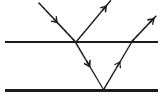
Assertion: Thin films such as a soap bubble or a thin layer of oil on water show beautiful colours when illuminated by white light.
Reason: It happens due to the interference of light reflected from the upper surface of the thin film.
Reason: It happens due to the interference of light reflected from the upper surface of the thin film.
A
If both Assertion and Reason are correct and the Reason is a correct explanation of the Assertion.
B
If both Assertion and Reason are correct but Reason is not a correct explanation of the Assertion.
C
If the Assertion is correct but Reason is incorrect.
D
If both the Assertion and Reason are incorrect.
Solution
(C) The Assertion is correct because thin films exhibit interference patterns when illuminated by white light,resulting in the observation of colours.
However,the Reason is incomplete and therefore incorrect. The phenomenon of interference in thin films occurs due to the superposition of light waves reflected from $BOTH$ the upper surface $AND$ the lower surface of the thin film,not just the upper surface. The path difference between these two reflected rays leads to constructive or destructive interference for different wavelengths,which creates the observed colours.
However,the Reason is incomplete and therefore incorrect. The phenomenon of interference in thin films occurs due to the superposition of light waves reflected from $BOTH$ the upper surface $AND$ the lower surface of the thin film,not just the upper surface. The path difference between these two reflected rays leads to constructive or destructive interference for different wavelengths,which creates the observed colours.
0 likesView Solution
Vedclass Products
For Students
Vedclass Test Series
Mock tests in real AIIMS style covering Physics with performance analysis. 5-day free trial.
Start Free TrialFor Teachers
Exam Paper Generator
Generate Set A/B/C/D Physics papers from 7.5L+ questions in 2 minutes. 3 chapters free.
Try FreeFor Institutes
Online Exam Module
Run live AIIMS mock exams with unlimited students, 360° analytics & white-label branding.
See DemoFrequently Asked Questions
How many Physics questions are in AIIMS 2002?
There are 57 Physics questions from the AIIMS 2002 paper on Vedclass, each with a detailed step-by-step solution in English.
Are AIIMS 2002 Physics solutions available in English?
Yes. All solutions on this page are in English. You can also switch to English or Hindi using the language buttons above the questions.
Can I practice AIIMS 2002 Physics as a timed test?
Yes. Use the Vedclass Test Series to attempt a full AIIMS mock test covering Physics with time limits and instant score analysis.
Can teachers create Physics papers from AIIMS previous year questions?
Yes. The Vedclass Exam Paper Generator lets teachers mix AIIMS Physics questions and generate Set A/B/C/D papers in minutes.
For Teachers & Institutes
Build a Custom Physics Paper
Pick AIIMS 2002 Physics questions, set difficulty, and generate Set A/B/C/D in 2 minutes.