
A English
Mix Examples - Polynomials Questions in English
Class 9 Mathematics · Polynomials · Mix Examples - Polynomials
412+
Questions
English
Language
100%
With Solutions
Showing 50 of 412 questions in English
201
Easy
Verify whether $2$ and $5$ are zeros of the polynomial $x^{2}-2x-15$ or not.
Solution
(D) Let the polynomial be $p(x) = x^{2} - 2x - 15$.
To verify if $2$ is a zero,we calculate $p(2)$:
$p(2) = (2)^{2} - 2(2) - 15 = 4 - 4 - 15 = -15$.
Since $p(2) \neq 0$,$2$ is not a zero of the polynomial.
To verify if $5$ is a zero,we calculate $p(5)$:
$p(5) = (5)^{2} - 2(5) - 15 = 25 - 10 - 15 = 0$.
Since $p(5) = 0$,$5$ is a zero of the polynomial.
To verify if $2$ is a zero,we calculate $p(2)$:
$p(2) = (2)^{2} - 2(2) - 15 = 4 - 4 - 15 = -15$.
Since $p(2) \neq 0$,$2$ is not a zero of the polynomial.
To verify if $5$ is a zero,we calculate $p(5)$:
$p(5) = (5)^{2} - 2(5) - 15 = 25 - 10 - 15 = 0$.
Since $p(5) = 0$,$5$ is a zero of the polynomial.
0 likes
View Solution202
EasyMCQ
Verify whether $3$ and $7$ are zeros of the polynomial $p(x) = x^{2} - 5x - 14$ or not.
A
Both $3$ and $7$ are zeros.
B
$3$ is a zero,but $7$ is not.
C
$7$ is a zero,but $3$ is not.
D
Neither $3$ nor $7$ are zeros.
Solution
(C) To verify if a value is a zero of the polynomial $p(x) = x^{2} - 5x - 14$,we substitute the value into the polynomial and check if the result is $0$.
For $x = 3$:
$p(3) = (3)^{2} - 5(3) - 14$
$p(3) = 9 - 15 - 14$
$p(3) = -20$
Since $p(3) \neq 0$,$3$ is not a zero of the polynomial.
For $x = 7$:
$p(7) = (7)^{2} - 5(7) - 14$
$p(7) = 49 - 35 - 14$
$p(7) = 49 - 49$
$p(7) = 0$
Since $p(7) = 0$,$7$ is a zero of the polynomial.
For $x = 3$:
$p(3) = (3)^{2} - 5(3) - 14$
$p(3) = 9 - 15 - 14$
$p(3) = -20$
Since $p(3) \neq 0$,$3$ is not a zero of the polynomial.
For $x = 7$:
$p(7) = (7)^{2} - 5(7) - 14$
$p(7) = 49 - 35 - 14$
$p(7) = 49 - 49$
$p(7) = 0$
Since $p(7) = 0$,$7$ is a zero of the polynomial.
0 likes
View Solution203
Easy
Find the zero of the polynomial in the following case:
$p(x) = 3x - 4$
$p(x) = 3x - 4$
Solution
(A) To find the zero of the polynomial $p(x) = 3x - 4$,we set $p(x) = 0$.
$3x - 4 = 0$
Adding $4$ to both sides,we get:
$3x = 4$
Dividing both sides by $3$,we get:
$x = \frac{4}{3}$
Therefore,the zero of the polynomial is $\frac{4}{3}$.
$3x - 4 = 0$
Adding $4$ to both sides,we get:
$3x = 4$
Dividing both sides by $3$,we get:
$x = \frac{4}{3}$
Therefore,the zero of the polynomial is $\frac{4}{3}$.
0 likes
View Solution204
EasyMCQ
Find the zero of the polynomial in the following case:
$p(t) = 7t - 21$
$p(t) = 7t - 21$
A
$15$
B
$11$
C
$6$
D
$3$
Solution
(D) To find the zero of the polynomial $p(t)$,we set $p(t) = 0$.
Given $p(t) = 7t - 21$.
Setting the polynomial equal to zero:
$7t - 21 = 0$
Add $21$ to both sides:
$7t = 21$
Divide both sides by $7$:
$t = \frac{21}{7}$
$t = 3$
Therefore,the zero of the polynomial is $3$.
Given $p(t) = 7t - 21$.
Setting the polynomial equal to zero:
$7t - 21 = 0$
Add $21$ to both sides:
$7t = 21$
Divide both sides by $7$:
$t = \frac{21}{7}$
$t = 3$
Therefore,the zero of the polynomial is $3$.
0 likes
View Solution205
Easy
Find the zero of the polynomial in the following case:
$q(y) = \pi y + 3.14$
$q(y) = \pi y + 3.14$
Solution
(N/A) To find the zero of the polynomial $q(y)$,we set $q(y) = 0$.
So,$\pi y + 3.14 = 0$.
Subtracting $3.14$ from both sides,we get $\pi y = -3.14$.
Dividing both sides by $\pi$,we get $y = -\frac{3.14}{\pi}$.
Thus,the zero of the polynomial is $-\frac{3.14}{\pi}$.
So,$\pi y + 3.14 = 0$.
Subtracting $3.14$ from both sides,we get $\pi y = -3.14$.
Dividing both sides by $\pi$,we get $y = -\frac{3.14}{\pi}$.
Thus,the zero of the polynomial is $-\frac{3.14}{\pi}$.
0 likes
View Solution206
Easy
Find the zero of the polynomial in the following case:
$p(x) = \frac{2}{3}x + \frac{5}{4}$
$p(x) = \frac{2}{3}x + \frac{5}{4}$
Solution
(D) To find the zero of the polynomial $p(x)$,we set $p(x) = 0$.
$\frac{2}{3}x + \frac{5}{4} = 0$
Subtract $\frac{5}{4}$ from both sides:
$\frac{2}{3}x = -\frac{5}{4}$
Multiply both sides by $\frac{3}{2}$ to solve for $x$:
$x = -\frac{5}{4} \times \frac{3}{2}$
$x = -\frac{15}{8}$
$\frac{2}{3}x + \frac{5}{4} = 0$
Subtract $\frac{5}{4}$ from both sides:
$\frac{2}{3}x = -\frac{5}{4}$
Multiply both sides by $\frac{3}{2}$ to solve for $x$:
$x = -\frac{5}{4} \times \frac{3}{2}$
$x = -\frac{15}{8}$
0 likes
View Solution207
EasyMCQ
Find the zero of the polynomial in the following case:
$q(m) = 0.3m - 0.15$
$q(m) = 0.3m - 0.15$
A
$2.4$
B
$2.6$
C
$0.5$
D
$0.8$
Solution
(C) To find the zero of the polynomial $q(m)$,we set $q(m) = 0$.
$0.3m - 0.15 = 0$
$0.3m = 0.15$
$m = \frac{0.15}{0.3}$
$m = \frac{15}{30}$
$m = 0.5$
Therefore,the zero of the polynomial is $0.5$.
$0.3m - 0.15 = 0$
$0.3m = 0.15$
$m = \frac{0.15}{0.3}$
$m = \frac{15}{30}$
$m = 0.5$
Therefore,the zero of the polynomial is $0.5$.
0 likes
View Solution208
EasyMCQ
If $p(x) = x^{2} - 4x + 3$,then find the value of $p(2) - p(-1) + p(1/2)$. (in $/4$)
A
$3$
B
$-31$
C
$7$
D
$-7$
Solution
(B) Given the polynomial $p(x) = x^{2} - 4x + 3$.
First,calculate $p(2)$:
$p(2) = (2)^{2} - 4(2) + 3 = 4 - 8 + 3 = -1$.
Next,calculate $p(-1)$:
$p(-1) = (-1)^{2} - 4(-1) + 3 = 1 + 4 + 3 = 8$.
Then,calculate $p(1/2)$:
$p(1/2) = (1/2)^{2} - 4(1/2) + 3 = 1/4 - 2 + 3 = 1/4 + 1 = 5/4$.
Finally,substitute these values into the expression $p(2) - p(-1) + p(1/2)$:
$-1 - 8 + 5/4 = -9 + 5/4 = (-36 + 5) / 4 = -31/4$.
First,calculate $p(2)$:
$p(2) = (2)^{2} - 4(2) + 3 = 4 - 8 + 3 = -1$.
Next,calculate $p(-1)$:
$p(-1) = (-1)^{2} - 4(-1) + 3 = 1 + 4 + 3 = 8$.
Then,calculate $p(1/2)$:
$p(1/2) = (1/2)^{2} - 4(1/2) + 3 = 1/4 - 2 + 3 = 1/4 + 1 = 5/4$.
Finally,substitute these values into the expression $p(2) - p(-1) + p(1/2)$:
$-1 - 8 + 5/4 = -9 + 5/4 = (-36 + 5) / 4 = -31/4$.
0 likes
View Solution209
Medium
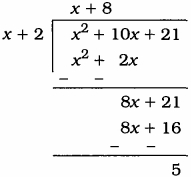
Divide $p(x)=21+10 x+x^{2}$ by $g(x)=2+x$ and find the quotient and the remainder.
Solution
(N/A) $p(x)=21+10 x+x^{2}$
$\therefore p(x)=x^{2}+10 x+21$ and $g(x)=2+x$
$\therefore g(x)=x+2$
$\therefore$ Quotient $=x+8$ and remainder $=5$
Steps of division process:
Step $1:$ We write the dividend $21+10 x+x^{2}$ and the divisor $2+x$ in the standard form,i.e.,after arranging the terms in the descending order of their degrees. So,the dividend is $x^{2}+10 x+21$ and the divisor is $x+2$.
Step $2:$ We divide the first term of the dividend by the first term of the divisor,i.e.,we divide $x^{2}$ by $x$ and get $x$. This gives us the first term of the quotient.
$\frac{x^{2}}{x}=x=$ first term of quotient.
Step $3:$ We multiply the divisor by the first term of the quotient and subtract this product from the dividend,i.e.,we multiply $x+2$ by $x$ and subtract the product $x^{2}+2 x$ from the dividend $x^{2}+10 x+21$. This gives us the remainder as $8 x+21$.
Step $4:$ We treat the remainder $8 x+21$ as the new dividend. The divisor remains the same. We repeat step $2$ to get the next term of the quotient,i.e.,we divide the first term $8 x$ of the (new) dividend by the first term $x$ of the divisor and obtain $8$.
Thus,$8$ is the second term in the quotient.
$\frac{8 x}{x}=8=$ second term of quotient.
New quotient $=x+8$
Step $5:$ We multiply the divisor by the second term of the quotient and subtract the product from the dividend. That is,we multiply $x+2$ by $8$ and subtract the product $8 x+16$ from the dividend $8 x+21$. This gives us $5$ as the remainder.
This process continues till the remainder is $0$ or the degree of the new dividend is less than the degree of the divisor. At this stage,this new dividend becomes the remainder and the sum of the quotients gives us the whole quotient.
Step $6:$ Thus,the quotient in full is $x+8$ and the remainder is $5.$
$\therefore p(x)=x^{2}+10 x+21$ and $g(x)=2+x$
$\therefore g(x)=x+2$
$\therefore$ Quotient $=x+8$ and remainder $=5$
Steps of division process:
Step $1:$ We write the dividend $21+10 x+x^{2}$ and the divisor $2+x$ in the standard form,i.e.,after arranging the terms in the descending order of their degrees. So,the dividend is $x^{2}+10 x+21$ and the divisor is $x+2$.
Step $2:$ We divide the first term of the dividend by the first term of the divisor,i.e.,we divide $x^{2}$ by $x$ and get $x$. This gives us the first term of the quotient.
$\frac{x^{2}}{x}=x=$ first term of quotient.
Step $3:$ We multiply the divisor by the first term of the quotient and subtract this product from the dividend,i.e.,we multiply $x+2$ by $x$ and subtract the product $x^{2}+2 x$ from the dividend $x^{2}+10 x+21$. This gives us the remainder as $8 x+21$.
Step $4:$ We treat the remainder $8 x+21$ as the new dividend. The divisor remains the same. We repeat step $2$ to get the next term of the quotient,i.e.,we divide the first term $8 x$ of the (new) dividend by the first term $x$ of the divisor and obtain $8$.
Thus,$8$ is the second term in the quotient.
$\frac{8 x}{x}=8=$ second term of quotient.
New quotient $=x+8$
Step $5:$ We multiply the divisor by the second term of the quotient and subtract the product from the dividend. That is,we multiply $x+2$ by $8$ and subtract the product $8 x+16$ from the dividend $8 x+21$. This gives us $5$ as the remainder.
This process continues till the remainder is $0$ or the degree of the new dividend is less than the degree of the divisor. At this stage,this new dividend becomes the remainder and the sum of the quotients gives us the whole quotient.
Step $6:$ Thus,the quotient in full is $x+8$ and the remainder is $5.$
0 likes
View Solution210
Medium
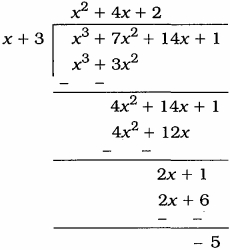
Divide $p(x) = x^{3} + 7x^{2} + 14x + 1$ by $x + 3$ and find the quotient and the remainder.
Solution
(N/A) To divide $p(x) = x^{3} + 7x^{2} + 14x + 1$ by $x + 3$,we use polynomial long division:
$1$. Divide the first term of the dividend $(x^{3})$ by the first term of the divisor $(x)$ to get $x^{2}$.
$2$. Multiply $x^{2}$ by $(x + 3)$ to get $x^{3} + 3x^{2}$. Subtract this from the dividend to get $4x^{2} + 14x + 1$.
$3$. Divide $4x^{2}$ by $x$ to get $4x$. Multiply $4x$ by $(x + 3)$ to get $4x^{2} + 12x$. Subtract this to get $2x + 1$.
$4$. Divide $2x$ by $x$ to get $2$. Multiply $2$ by $(x + 3)$ to get $2x + 6$. Subtract this to get $-5$.
Thus,the quotient is $x^{2} + 4x + 2$ and the remainder is $-5$.
$1$. Divide the first term of the dividend $(x^{3})$ by the first term of the divisor $(x)$ to get $x^{2}$.
$2$. Multiply $x^{2}$ by $(x + 3)$ to get $x^{3} + 3x^{2}$. Subtract this from the dividend to get $4x^{2} + 14x + 1$.
$3$. Divide $4x^{2}$ by $x$ to get $4x$. Multiply $4x$ by $(x + 3)$ to get $4x^{2} + 12x$. Subtract this to get $2x + 1$.
$4$. Divide $2x$ by $x$ to get $2$. Multiply $2$ by $(x + 3)$ to get $2x + 6$. Subtract this to get $-5$.
Thus,the quotient is $x^{2} + 4x + 2$ and the remainder is $-5$.
0 likes
View Solution211
MediumMCQ
With the help of the remainder theorem,find the remainder when the polynomial $x^{3}+7x^{2}+17x+25$ is divided by $x+4$.
A
$3$
B
$4$
C
$5$
D
$6$
Solution
(C) Let the polynomial be $p(x) = x^{3} + 7x^{2} + 17x + 25$.
According to the remainder theorem,when $p(x)$ is divided by $(x - a)$,the remainder is $p(a)$.
Here,the divisor is $x + 4$,which can be written as $x - (-4)$.
Therefore,we set $x + 4 = 0$,which gives $x = -4$.
Now,we calculate $p(-4)$:
$p(-4) = (-4)^{3} + 7(-4)^{2} + 17(-4) + 25$
$p(-4) = -64 + 7(16) - 68 + 25$
$p(-4) = -64 + 112 - 68 + 25$
$p(-4) = 137 - 132$
$p(-4) = 5$
Thus,the remainder is $5$.
According to the remainder theorem,when $p(x)$ is divided by $(x - a)$,the remainder is $p(a)$.
Here,the divisor is $x + 4$,which can be written as $x - (-4)$.
Therefore,we set $x + 4 = 0$,which gives $x = -4$.
Now,we calculate $p(-4)$:
$p(-4) = (-4)^{3} + 7(-4)^{2} + 17(-4) + 25$
$p(-4) = -64 + 7(16) - 68 + 25$
$p(-4) = -64 + 112 - 68 + 25$
$p(-4) = 137 - 132$
$p(-4) = 5$
Thus,the remainder is $5$.
0 likes
View Solution212
Medium
With the help of the remainder theorem,examine whether $x+2$ is a factor of the polynomial $x^{3}+9x^{2}+26x+24$ or not.
Solution
(A) Let $p(x) = x^{3} + 9x^{2} + 26x + 24$ be the given polynomial.
To check if $(x+2)$ is a factor,we find the zero of the linear polynomial $x+2$ by setting $x+2 = 0$,which gives $x = -2$.
According to the factor theorem,if $p(-2) = 0$,then $(x+2)$ is a factor of $p(x)$.
Now,substitute $x = -2$ into $p(x)$:
$p(-2) = (-2)^{3} + 9(-2)^{2} + 26(-2) + 24$
$p(-2) = -8 + 9(4) - 52 + 24$
$p(-2) = -8 + 36 - 52 + 24$
$p(-2) = 60 - 60 = 0$
Since $p(-2) = 0$,by the factor theorem,$(x+2)$ is a factor of $x^{3} + 9x^{2} + 26x + 24$.
To check if $(x+2)$ is a factor,we find the zero of the linear polynomial $x+2$ by setting $x+2 = 0$,which gives $x = -2$.
According to the factor theorem,if $p(-2) = 0$,then $(x+2)$ is a factor of $p(x)$.
Now,substitute $x = -2$ into $p(x)$:
$p(-2) = (-2)^{3} + 9(-2)^{2} + 26(-2) + 24$
$p(-2) = -8 + 9(4) - 52 + 24$
$p(-2) = -8 + 36 - 52 + 24$
$p(-2) = 60 - 60 = 0$
Since $p(-2) = 0$,by the factor theorem,$(x+2)$ is a factor of $x^{3} + 9x^{2} + 26x + 24$.
0 likes
View Solution213
MediumMCQ
Check whether the polynomial $p(x) = x^{3} + 9x^{2} + 26x + 24$ is a multiple of $x + 2$ or not.
A
Yes,it is a multiple.
B
No,it is not a multiple.
C
Cannot be determined.
D
None of these.
Solution
(A) The polynomial $p(x)$ will be a multiple of $x + 2$ if and only if $x + 2$ divides $p(x)$ leaving a remainder of $0$.
According to the Factor Theorem,if $p(a) = 0$,then $(x - a)$ is a factor of $p(x)$.
Setting $x + 2 = 0$,we get $x = -2$.
Now,we evaluate $p(-2)$:
$p(-2) = (-2)^{3} + 9(-2)^{2} + 26(-2) + 24$
$p(-2) = -8 + 9(4) - 52 + 24$
$p(-2) = -8 + 36 - 52 + 24$
$p(-2) = (-8 - 52) + (36 + 24)$
$p(-2) = -60 + 60$
$p(-2) = 0$
Since the remainder is $0$,$(x + 2)$ is a factor of $p(x)$.
Therefore,$p(x)$ is a multiple of $x + 2$.
According to the Factor Theorem,if $p(a) = 0$,then $(x - a)$ is a factor of $p(x)$.
Setting $x + 2 = 0$,we get $x = -2$.
Now,we evaluate $p(-2)$:
$p(-2) = (-2)^{3} + 9(-2)^{2} + 26(-2) + 24$
$p(-2) = -8 + 9(4) - 52 + 24$
$p(-2) = -8 + 36 - 52 + 24$
$p(-2) = (-8 - 52) + (36 + 24)$
$p(-2) = -60 + 60$
$p(-2) = 0$
Since the remainder is $0$,$(x + 2)$ is a factor of $p(x)$.
Therefore,$p(x)$ is a multiple of $x + 2$.
0 likes
View Solution214
Easy
Find the quotient and the remainder when $2x^2 - 7x - 15$ is divided by $x + 1$.
Solution
(N/A) To find the quotient and remainder,we perform polynomial long division of $2x^2 - 7x - 15$ by $x + 1$.
$1$. Divide the first term of the dividend $(2x^2)$ by the first term of the divisor $(x)$: $2x^2 / x = 2x$. This is the first term of the quotient.
$2$. Multiply the divisor $(x + 1)$ by $2x$: $2x(x + 1) = 2x^2 + 2x$.
$3$. Subtract this from the dividend: $(2x^2 - 7x - 15) - (2x^2 + 2x) = -9x - 15$.
$4$. Divide the first term of the new expression $(-9x)$ by the first term of the divisor $(x)$: $-9x / x = -9$. This is the second term of the quotient.
$5$. Multiply the divisor $(x + 1)$ by $-9$: $-9(x + 1) = -9x - 9$.
$6$. Subtract this from the current expression: $(-9x - 15) - (-9x - 9) = -9x - 15 + 9x + 9 = -6$.
Thus,the quotient is $2x - 9$ and the remainder is $-6$.
$1$. Divide the first term of the dividend $(2x^2)$ by the first term of the divisor $(x)$: $2x^2 / x = 2x$. This is the first term of the quotient.
$2$. Multiply the divisor $(x + 1)$ by $2x$: $2x(x + 1) = 2x^2 + 2x$.
$3$. Subtract this from the dividend: $(2x^2 - 7x - 15) - (2x^2 + 2x) = -9x - 15$.
$4$. Divide the first term of the new expression $(-9x)$ by the first term of the divisor $(x)$: $-9x / x = -9$. This is the second term of the quotient.
$5$. Multiply the divisor $(x + 1)$ by $-9$: $-9(x + 1) = -9x - 9$.
$6$. Subtract this from the current expression: $(-9x - 15) - (-9x - 9) = -9x - 15 + 9x + 9 = -6$.
Thus,the quotient is $2x - 9$ and the remainder is $-6$.
0 likes
View Solution215
Medium
Find the quotient and the remainder when $2x^{2}-7x-15$ is divided by $2x+1$.
Solution
(N/A) To find the quotient and remainder,we perform polynomial long division:
$1$. Divide the first term of the dividend $(2x^2)$ by the first term of the divisor $(2x)$: $2x^2 / 2x = x$. This is the first term of the quotient.
$2$. Multiply the divisor $(2x+1)$ by $x$: $x(2x+1) = 2x^2 + x$.
$3$. Subtract this from the dividend: $(2x^2 - 7x - 15) - (2x^2 + x) = -8x - 15$.
$4$. Divide the first term of the new expression $(-8x)$ by the first term of the divisor $(2x)$: $-8x / 2x = -4$. This is the second term of the quotient.
$5$. Multiply the divisor $(2x+1)$ by $-4$: $-4(2x+1) = -8x - 4$.
$6$. Subtract this from the current expression: $(-8x - 15) - (-8x - 4) = -8x - 15 + 8x + 4 = -11$.
Therefore,the Quotient is $x-4$ and the Remainder is $-11$.
$1$. Divide the first term of the dividend $(2x^2)$ by the first term of the divisor $(2x)$: $2x^2 / 2x = x$. This is the first term of the quotient.
$2$. Multiply the divisor $(2x+1)$ by $x$: $x(2x+1) = 2x^2 + x$.
$3$. Subtract this from the dividend: $(2x^2 - 7x - 15) - (2x^2 + x) = -8x - 15$.
$4$. Divide the first term of the new expression $(-8x)$ by the first term of the divisor $(2x)$: $-8x / 2x = -4$. This is the second term of the quotient.
$5$. Multiply the divisor $(2x+1)$ by $-4$: $-4(2x+1) = -8x - 4$.
$6$. Subtract this from the current expression: $(-8x - 15) - (-8x - 4) = -8x - 15 + 8x + 4 = -11$.
Therefore,the Quotient is $x-4$ and the Remainder is $-11$.
0 likes
View Solution216
Medium
Find the quotient and the remainder when $2x^2 - 7x - 15$ is divided by $2x + 3$.
Solution
(N/A) To divide $2x^2 - 7x - 15$ by $2x + 3$,we use polynomial long division:
$1$. Divide the first term of the dividend $(2x^2)$ by the first term of the divisor $(2x)$: $2x^2 / 2x = x$. This is the first term of the quotient.
$2$. Multiply the divisor $(2x + 3)$ by $x$: $x(2x + 3) = 2x^2 + 3x$.
$3$. Subtract this from the dividend: $(2x^2 - 7x - 15) - (2x^2 + 3x) = -10x - 15$.
$4$. Divide the first term of the new expression $(-10x)$ by the first term of the divisor $(2x)$: $-10x / 2x = -5$. This is the second term of the quotient.
$5$. Multiply the divisor $(2x + 3)$ by $-5$: $-5(2x + 3) = -10x - 15$.
$6$. Subtract this from the current expression: $(-10x - 15) - (-10x - 15) = 0$.
Therefore,the quotient is $x - 5$ and the remainder is $0$.
$1$. Divide the first term of the dividend $(2x^2)$ by the first term of the divisor $(2x)$: $2x^2 / 2x = x$. This is the first term of the quotient.
$2$. Multiply the divisor $(2x + 3)$ by $x$: $x(2x + 3) = 2x^2 + 3x$.
$3$. Subtract this from the dividend: $(2x^2 - 7x - 15) - (2x^2 + 3x) = -10x - 15$.
$4$. Divide the first term of the new expression $(-10x)$ by the first term of the divisor $(2x)$: $-10x / 2x = -5$. This is the second term of the quotient.
$5$. Multiply the divisor $(2x + 3)$ by $-5$: $-5(2x + 3) = -10x - 15$.
$6$. Subtract this from the current expression: $(-10x - 15) - (-10x - 15) = 0$.
Therefore,the quotient is $x - 5$ and the remainder is $0$.
0 likes
View Solution217
MediumMCQ
Find the quotient and the remainder when $2x^2 - 7x - 15$ is divided by $2x - 3$.
A
Quotient $= x - 2$,Remainder $= -21$
B
Quotient $= x + 2$,Remainder $= -21$
C
Quotient $= x - 2$,Remainder $= 21$
D
Quotient $= x + 2$,Remainder $= 21$
Solution
(A) To divide $2x^2 - 7x - 15$ by $2x - 3$,we use long division:
$1$. Divide the first term of the dividend $(2x^2)$ by the first term of the divisor $(2x)$: $2x^2 / 2x = x$. This is the first term of the quotient.
$2$. Multiply the divisor $(2x - 3)$ by $x$: $x(2x - 3) = 2x^2 - 3x$.
$3$. Subtract this from the dividend: $(2x^2 - 7x - 15) - (2x^2 - 3x) = -4x - 15$.
$4$. Divide the first term of the new expression $(-4x)$ by the first term of the divisor $(2x)$: $-4x / 2x = -2$. This is the second term of the quotient.
$5$. Multiply the divisor $(2x - 3)$ by $-2$: $-2(2x - 3) = -4x + 6$.
$6$. Subtract this from the current expression: $(-4x - 15) - (-4x + 6) = -4x - 15 + 4x - 6 = -21$.
Thus,the quotient is $x - 2$ and the remainder is $-21$.
$1$. Divide the first term of the dividend $(2x^2)$ by the first term of the divisor $(2x)$: $2x^2 / 2x = x$. This is the first term of the quotient.
$2$. Multiply the divisor $(2x - 3)$ by $x$: $x(2x - 3) = 2x^2 - 3x$.
$3$. Subtract this from the dividend: $(2x^2 - 7x - 15) - (2x^2 - 3x) = -4x - 15$.
$4$. Divide the first term of the new expression $(-4x)$ by the first term of the divisor $(2x)$: $-4x / 2x = -2$. This is the second term of the quotient.
$5$. Multiply the divisor $(2x - 3)$ by $-2$: $-2(2x - 3) = -4x + 6$.
$6$. Subtract this from the current expression: $(-4x - 15) - (-4x + 6) = -4x - 15 + 4x - 6 = -21$.
Thus,the quotient is $x - 2$ and the remainder is $-21$.
0 likes
View Solution218
Medium
Find the quotient and the remainder when $2x^2 - 7x - 15$ is divided by $x - 2$.
Solution
(N/A) To find the quotient and remainder,we perform polynomial long division of $2x^2 - 7x - 15$ by $x - 2$.
Step $1$: Divide the first term of the dividend $(2x^2)$ by the first term of the divisor $(x)$ to get $2x$.
Step $2$: Multiply $2x$ by $(x - 2)$ to get $2x^2 - 4x$.
Step $3$: Subtract $(2x^2 - 4x)$ from $(2x^2 - 7x)$ to get $-3x$.
Step $4$: Bring down the next term $-15$ to get $-3x - 15$.
Step $5$: Divide the first term of the new expression $(-3x)$ by the first term of the divisor $(x)$ to get $-3$.
Step $6$: Multiply $-3$ by $(x - 2)$ to get $-3x + 6$.
Step $7$: Subtract $(-3x + 6)$ from $(-3x - 15)$ to get $-15 - 6 = -21$.
Thus,the Quotient $= 2x - 3$ and the Remainder $= -21$.
Step $1$: Divide the first term of the dividend $(2x^2)$ by the first term of the divisor $(x)$ to get $2x$.
Step $2$: Multiply $2x$ by $(x - 2)$ to get $2x^2 - 4x$.
Step $3$: Subtract $(2x^2 - 4x)$ from $(2x^2 - 7x)$ to get $-3x$.
Step $4$: Bring down the next term $-15$ to get $-3x - 15$.
Step $5$: Divide the first term of the new expression $(-3x)$ by the first term of the divisor $(x)$ to get $-3$.
Step $6$: Multiply $-3$ by $(x - 2)$ to get $-3x + 6$.
Step $7$: Subtract $(-3x + 6)$ from $(-3x - 15)$ to get $-15 - 6 = -21$.
Thus,the Quotient $= 2x - 3$ and the Remainder $= -21$.
0 likes
View Solution219
MediumMCQ
Find the quotient and the remainder when $x^{3}+x^{2}-10x+8$ is divided by $x-1$.
A
Quotient $= x^{2}+2x-8$,Remainder $= 0$
B
Quotient $= x^{2}-2x+8$,Remainder $= 0$
C
Quotient $= x^{2}+2x+8$,Remainder $= 1$
D
Quotient $= x^{2}-2x-8$,Remainder $= 0$
Solution
(A) To find the quotient and remainder,we perform polynomial long division of $(x^{3}+x^{2}-10x+8)$ by $(x-1)$.
Step $1$: Divide the first term of the dividend $x^3$ by the first term of the divisor $x$ to get $x^2$.
Step $2$: Multiply $x^2$ by $(x-1)$ to get $(x^3-x^2)$. Subtract this from the dividend: $(x^3+x^2-10x+8) - (x^3-x^2) = 2x^2-10x+8$.
Step $3$: Divide the first term of the new polynomial $2x^2$ by $x$ to get $2x$.
Step $4$: Multiply $2x$ by $(x-1)$ to get $(2x^2-2x)$. Subtract this: $(2x^2-10x+8) - (2x^2-2x) = -8x+8$.
Step $5$: Divide the first term $-8x$ by $x$ to get $-8$.
Step $6$: Multiply $-8$ by $(x-1)$ to get $(-8x+8)$. Subtract this: $(-8x+8) - (-8x+8) = 0$.
Thus,the Quotient is $x^{2}+2x-8$ and the Remainder is $0$.
Step $1$: Divide the first term of the dividend $x^3$ by the first term of the divisor $x$ to get $x^2$.
Step $2$: Multiply $x^2$ by $(x-1)$ to get $(x^3-x^2)$. Subtract this from the dividend: $(x^3+x^2-10x+8) - (x^3-x^2) = 2x^2-10x+8$.
Step $3$: Divide the first term of the new polynomial $2x^2$ by $x$ to get $2x$.
Step $4$: Multiply $2x$ by $(x-1)$ to get $(2x^2-2x)$. Subtract this: $(2x^2-10x+8) - (2x^2-2x) = -8x+8$.
Step $5$: Divide the first term $-8x$ by $x$ to get $-8$.
Step $6$: Multiply $-8$ by $(x-1)$ to get $(-8x+8)$. Subtract this: $(-8x+8) - (-8x+8) = 0$.
Thus,the Quotient is $x^{2}+2x-8$ and the Remainder is $0$.
0 likes
View Solution220
Medium
Find the quotient and the remainder when $x^{3}+x^{2}-10x+8$ is divided by $x-2$.
Solution
(A) To find the quotient and remainder,we perform polynomial long division of $(x^{3}+x^{2}-10x+8)$ by $(x-2)$:
$1$. Divide the first term of the dividend $(x^{3})$ by the first term of the divisor $(x)$ to get $x^{2}$.
$2$. Multiply $x^{2}$ by $(x-2)$ to get $x^{3}-2x^{2}$.
$3$. Subtract $(x^{3}-2x^{2})$ from $(x^{3}+x^{2}-10x+8)$ to get $3x^{2}-10x+8$.
$4$. Divide $3x^{2}$ by $x$ to get $3x$. Multiply $3x$ by $(x-2)$ to get $3x^{2}-6x$.
$5$. Subtract $(3x^{2}-6x)$ from $(3x^{2}-10x+8)$ to get $-4x+8$.
$6$. Divide $-4x$ by $x$ to get $-4$. Multiply $-4$ by $(x-2)$ to get $-4x+8$.
$7$. Subtract $(-4x+8)$ from $(-4x+8)$ to get $0$.
Thus,the Quotient $= x^{2}+3x-4$ and the Remainder $= 0$.
$1$. Divide the first term of the dividend $(x^{3})$ by the first term of the divisor $(x)$ to get $x^{2}$.
$2$. Multiply $x^{2}$ by $(x-2)$ to get $x^{3}-2x^{2}$.
$3$. Subtract $(x^{3}-2x^{2})$ from $(x^{3}+x^{2}-10x+8)$ to get $3x^{2}-10x+8$.
$4$. Divide $3x^{2}$ by $x$ to get $3x$. Multiply $3x$ by $(x-2)$ to get $3x^{2}-6x$.
$5$. Subtract $(3x^{2}-6x)$ from $(3x^{2}-10x+8)$ to get $-4x+8$.
$6$. Divide $-4x$ by $x$ to get $-4$. Multiply $-4$ by $(x-2)$ to get $-4x+8$.
$7$. Subtract $(-4x+8)$ from $(-4x+8)$ to get $0$.
Thus,the Quotient $= x^{2}+3x-4$ and the Remainder $= 0$.
0 likes
View Solution221
Medium
Find the quotient and the remainder when $x^{3}+x^{2}-10x+8$ is divided by $x+3$.
Solution
(N/A) To find the quotient and remainder,we perform polynomial long division of $(x^{3}+x^{2}-10x+8)$ by $(x+3)$:
$1$. Divide the first term of the dividend $(x^3)$ by the first term of the divisor $(x)$ to get $x^2$.
$2$. Multiply $x^2$ by $(x+3)$ to get $x^3+3x^2$. Subtract this from the dividend: $(x^3+x^2-10x+8) - (x^3+3x^2) = -2x^2-10x+8$.
$3$. Divide the new first term $(-2x^2)$ by $x$ to get $-2x$.
$4$. Multiply $-2x$ by $(x+3)$ to get $-2x^2-6x$. Subtract this: $(-2x^2-10x+8) - (-2x^2-6x) = -4x+8$.
$5$. Divide the new first term $(-4x)$ by $x$ to get $-4$.
$6$. Multiply $-4$ by $(x+3)$ to get $-4x-12$. Subtract this: $(-4x+8) - (-4x-12) = 20$.
Thus,the Quotient $= x^{2}-2x-4$ and the Remainder $= 20$.
$1$. Divide the first term of the dividend $(x^3)$ by the first term of the divisor $(x)$ to get $x^2$.
$2$. Multiply $x^2$ by $(x+3)$ to get $x^3+3x^2$. Subtract this from the dividend: $(x^3+x^2-10x+8) - (x^3+3x^2) = -2x^2-10x+8$.
$3$. Divide the new first term $(-2x^2)$ by $x$ to get $-2x$.
$4$. Multiply $-2x$ by $(x+3)$ to get $-2x^2-6x$. Subtract this: $(-2x^2-10x+8) - (-2x^2-6x) = -4x+8$.
$5$. Divide the new first term $(-4x)$ by $x$ to get $-4$.
$6$. Multiply $-4$ by $(x+3)$ to get $-4x-12$. Subtract this: $(-4x+8) - (-4x-12) = 20$.
Thus,the Quotient $= x^{2}-2x-4$ and the Remainder $= 20$.
0 likes
View Solution222
Difficult
Find the quotient and the remainder when $x^{3}+x^{2}-10x+8$ is divided by $x+4$.
Solution
(A) To find the quotient and remainder,we perform polynomial long division of $(x^{3}+x^{2}-10x+8)$ by $(x+4)$:
$1$. Divide the first term of the dividend $(x^3)$ by the first term of the divisor $(x)$ to get $x^2$.
$2$. Multiply $x^2$ by $(x+4)$ to get $x^3+4x^2$. Subtract this from the dividend: $(x^3+x^2-10x+8) - (x^3+4x^2) = -3x^2-10x+8$.
$3$. Divide the new first term $(-3x^2)$ by $x$ to get $-3x$.
$4$. Multiply $-3x$ by $(x+4)$ to get $-3x^2-12x$. Subtract this from the current remainder: $(-3x^2-10x+8) - (-3x^2-12x) = 2x+8$.
$5$. Divide the new first term $(2x)$ by $x$ to get $2$.
$6$. Multiply $2$ by $(x+4)$ to get $2x+8$. Subtract this: $(2x+8) - (2x+8) = 0$.
Thus,the Quotient $= x^{2}-3x+2$ and the Remainder $= 0$.
$1$. Divide the first term of the dividend $(x^3)$ by the first term of the divisor $(x)$ to get $x^2$.
$2$. Multiply $x^2$ by $(x+4)$ to get $x^3+4x^2$. Subtract this from the dividend: $(x^3+x^2-10x+8) - (x^3+4x^2) = -3x^2-10x+8$.
$3$. Divide the new first term $(-3x^2)$ by $x$ to get $-3x$.
$4$. Multiply $-3x$ by $(x+4)$ to get $-3x^2-12x$. Subtract this from the current remainder: $(-3x^2-10x+8) - (-3x^2-12x) = 2x+8$.
$5$. Divide the new first term $(2x)$ by $x$ to get $2$.
$6$. Multiply $2$ by $(x+4)$ to get $2x+8$. Subtract this: $(2x+8) - (2x+8) = 0$.
Thus,the Quotient $= x^{2}-3x+2$ and the Remainder $= 0$.
0 likes
View Solution223
MediumMCQ
Using the remainder theorem,find the remainder when the polynomial $p(x) = x^3 + x^2 - 26x + 24$ is divided by the divisor $x + 1$.
A
$45$
B
$60$
C
$50$
D
$20$
Solution
(C) According to the remainder theorem,if a polynomial $p(x)$ is divided by $(x - a)$,the remainder is $p(a)$.
Here,the divisor is $x + 1$,which can be written as $x - (-1)$.
Therefore,we need to find $p(-1)$.
Given $p(x) = x^3 + x^2 - 26x + 24$.
Substitute $x = -1$ into the polynomial:
$p(-1) = (-1)^3 + (-1)^2 - 26(-1) + 24$
$p(-1) = -1 + 1 + 26 + 24$
$p(-1) = 0 + 50$
$p(-1) = 50$.
Thus,the remainder is $50$.
Here,the divisor is $x + 1$,which can be written as $x - (-1)$.
Therefore,we need to find $p(-1)$.
Given $p(x) = x^3 + x^2 - 26x + 24$.
Substitute $x = -1$ into the polynomial:
$p(-1) = (-1)^3 + (-1)^2 - 26(-1) + 24$
$p(-1) = -1 + 1 + 26 + 24$
$p(-1) = 0 + 50$
$p(-1) = 50$.
Thus,the remainder is $50$.
0 likes
View Solution224
MediumMCQ
With the help of the remainder theorem,find the remainder when the polynomial $p(x) = x^{3} + x^{2} - 26x + 24$ is divided by the divisor $x - 1$.
A
$3$
B
$2$
C
$4$
D
$0$
Solution
(D) According to the remainder theorem,if a polynomial $p(x)$ is divided by $(x - a)$,the remainder is $p(a)$.
Here,$p(x) = x^{3} + x^{2} - 26x + 24$ and the divisor is $(x - 1)$,so $a = 1$.
To find the remainder,we calculate $p(1)$:
$p(1) = (1)^{3} + (1)^{2} - 26(1) + 24$
$p(1) = 1 + 1 - 26 + 24$
$p(1) = 2 - 26 + 24$
$p(1) = -24 + 24 = 0$.
Therefore,the remainder is $0$.
Here,$p(x) = x^{3} + x^{2} - 26x + 24$ and the divisor is $(x - 1)$,so $a = 1$.
To find the remainder,we calculate $p(1)$:
$p(1) = (1)^{3} + (1)^{2} - 26(1) + 24$
$p(1) = 1 + 1 - 26 + 24$
$p(1) = 2 - 26 + 24$
$p(1) = -24 + 24 = 0$.
Therefore,the remainder is $0$.
0 likes
View Solution225
EasyMCQ
Using the remainder theorem,find the remainder when the polynomial $p(x) = x^3 + x^2 - 26x + 24$ is divided by the divisor $x + 4$.
A
$80$
B
$71$
C
$52$
D
$65$
Solution
(A) According to the remainder theorem,if a polynomial $p(x)$ is divided by $(x - a)$,the remainder is $p(a)$.
Here,the divisor is $x + 4$,which can be written as $x - (-4)$.
Therefore,$a = -4$.
Now,substitute $x = -4$ into the polynomial $p(x) = x^3 + x^2 - 26x + 24$:
$p(-4) = (-4)^3 + (-4)^2 - 26(-4) + 24$
$p(-4) = -64 + 16 + 104 + 24$
$p(-4) = -64 + 144$
$p(-4) = 80$.
Thus,the remainder is $80$.
Here,the divisor is $x + 4$,which can be written as $x - (-4)$.
Therefore,$a = -4$.
Now,substitute $x = -4$ into the polynomial $p(x) = x^3 + x^2 - 26x + 24$:
$p(-4) = (-4)^3 + (-4)^2 - 26(-4) + 24$
$p(-4) = -64 + 16 + 104 + 24$
$p(-4) = -64 + 144$
$p(-4) = 80$.
Thus,the remainder is $80$.
0 likes
View Solution226
EasyMCQ
With the help of the remainder theorem,find the remainder when the polynomial $p(x) = x^{3} + x^{2} - 26x + 24$ is divided by the divisor $x - 4$.
A
$6$
B
$0$
C
$2$
D
$9$
Solution
(B) According to the Remainder Theorem,if a polynomial $p(x)$ is divided by $(x - a)$,the remainder is $p(a)$.
Here,$p(x) = x^{3} + x^{2} - 26x + 24$ and the divisor is $x - 4$,so $a = 4$.
To find the remainder,we calculate $p(4)$:
$p(4) = (4)^{3} + (4)^{2} - 26(4) + 24$
$p(4) = 64 + 16 - 104 + 24$
$p(4) = 80 - 104 + 24$
$p(4) = -24 + 24 = 0$.
Therefore,the remainder is $0$.
Here,$p(x) = x^{3} + x^{2} - 26x + 24$ and the divisor is $x - 4$,so $a = 4$.
To find the remainder,we calculate $p(4)$:
$p(4) = (4)^{3} + (4)^{2} - 26(4) + 24$
$p(4) = 64 + 16 - 104 + 24$
$p(4) = 80 - 104 + 24$
$p(4) = -24 + 24 = 0$.
Therefore,the remainder is $0$.
0 likes
View Solution227
EasyMCQ
With the help of the remainder theorem,find the remainder when the polynomial $p(x) = x^{3} + x^{2} - 26x + 24$ is divided by the divisor $x + 6$.
A
$12$
B
$8$
C
$0$
D
$3$
Solution
(C) According to the remainder theorem,if a polynomial $p(x)$ is divided by $(x - a)$,the remainder is $p(a)$.
Here,the divisor is $x + 6$,which can be written as $x - (-6)$.
Therefore,we need to find $p(-6)$.
Given $p(x) = x^{3} + x^{2} - 26x + 24$.
Substituting $x = -6$ into the polynomial:
$p(-6) = (-6)^{3} + (-6)^{2} - 26(-6) + 24$
$p(-6) = -216 + 36 + 156 + 24$
$p(-6) = -216 + 216$
$p(-6) = 0$.
Thus,the remainder is $0$.
Here,the divisor is $x + 6$,which can be written as $x - (-6)$.
Therefore,we need to find $p(-6)$.
Given $p(x) = x^{3} + x^{2} - 26x + 24$.
Substituting $x = -6$ into the polynomial:
$p(-6) = (-6)^{3} + (-6)^{2} - 26(-6) + 24$
$p(-6) = -216 + 36 + 156 + 24$
$p(-6) = -216 + 216$
$p(-6) = 0$.
Thus,the remainder is $0$.
0 likes
View Solution228
EasyMCQ
Using the remainder theorem,find the remainder when the polynomial $p(x) = x^{3} + x^{2} - 26x + 24$ is divided by the divisor $x - 6$.
A
$140$
B
$110$
C
$95$
D
$120$
Solution
(D) According to the remainder theorem,if a polynomial $p(x)$ is divided by $(x - a)$,the remainder is $p(a)$.
Here,$p(x) = x^{3} + x^{2} - 26x + 24$ and the divisor is $x - 6$,so $a = 6$.
Now,substitute $x = 6$ into the polynomial:
$p(6) = (6)^{3} + (6)^{2} - 26(6) + 24$
$p(6) = 216 + 36 - 156 + 24$
$p(6) = 252 - 156 + 24$
$p(6) = 96 + 24$
$p(6) = 120$
Therefore,the remainder is $120$.
Here,$p(x) = x^{3} + x^{2} - 26x + 24$ and the divisor is $x - 6$,so $a = 6$.
Now,substitute $x = 6$ into the polynomial:
$p(6) = (6)^{3} + (6)^{2} - 26(6) + 24$
$p(6) = 216 + 36 - 156 + 24$
$p(6) = 252 - 156 + 24$
$p(6) = 96 + 24$
$p(6) = 120$
Therefore,the remainder is $120$.
0 likes
View Solution229
MediumMCQ
If $x+5$ is a factor of $x^{3}+13x^{2}+ax+35$,find the value of $a$.
A
$a = 47$
B
$a = 45$
C
$a = 49$
D
$a = 51$
Solution
(A) Let $p(x) = x^{3} + 13x^{2} + ax + 35$.
Since $x+5$ is a factor of $p(x)$,by the Factor Theorem,$p(-5) = 0$.
Substituting $x = -5$ into the polynomial:
$(-5)^{3} + 13(-5)^{2} + a(-5) + 35 = 0$
$-125 + 13(25) - 5a + 35 = 0$
$-125 + 325 - 5a + 35 = 0$
$235 - 5a = 0$
$5a = 235$
$a = 47$.
Since $x+5$ is a factor of $p(x)$,by the Factor Theorem,$p(-5) = 0$.
Substituting $x = -5$ into the polynomial:
$(-5)^{3} + 13(-5)^{2} + a(-5) + 35 = 0$
$-125 + 13(25) - 5a + 35 = 0$
$-125 + 325 - 5a + 35 = 0$
$235 - 5a = 0$
$5a = 235$
$a = 47$.
0 likes
View Solution230
DifficultMCQ
If $x+2$ is a factor of $x^{3}+ax^{2}-x+30$,find the value of $a$.
A
$a = -6$
B
$a = 6$
C
$a = -8$
D
$a = 8$
Solution
(A) Let the polynomial be $p(x) = x^{3} + ax^{2} - x + 30$.
Since $(x+2)$ is a factor of $p(x)$,by the Factor Theorem,$p(-2) = 0$.
Substituting $x = -2$ into the polynomial:
$p(-2) = (-2)^{3} + a(-2)^{2} - (-2) + 30 = 0$
$-8 + 4a + 2 + 30 = 0$
$4a + 24 = 0$
$4a = -24$
$a = -6$.
Since $(x+2)$ is a factor of $p(x)$,by the Factor Theorem,$p(-2) = 0$.
Substituting $x = -2$ into the polynomial:
$p(-2) = (-2)^{3} + a(-2)^{2} - (-2) + 30 = 0$
$-8 + 4a + 2 + 30 = 0$
$4a + 24 = 0$
$4a = -24$
$a = -6$.
0 likes
View Solution231
DifficultMCQ
On dividing $x^{3} + ax^{2} + 19x + 20$ by $(x + 3)$,if the remainder is $a$,then find the value of $a$.
A
$7$
B
$8$
C
$9$
D
$10$
Solution
(B) Let $p(x) = x^{3} + ax^{2} + 19x + 20$.
According to the Remainder Theorem,when $p(x)$ is divided by $(x + 3)$,the remainder is $p(-3)$.
Given that the remainder is $a$,we have $p(-3) = a$.
Substituting $x = -3$ into the polynomial:
$(-3)^{3} + a(-3)^{2} + 19(-3) + 20 = a$
$-27 + 9a - 57 + 20 = a$
$9a - 64 = a$
$8a = 64$
$a = 8$.
According to the Remainder Theorem,when $p(x)$ is divided by $(x + 3)$,the remainder is $p(-3)$.
Given that the remainder is $a$,we have $p(-3) = a$.
Substituting $x = -3$ into the polynomial:
$(-3)^{3} + a(-3)^{2} + 19(-3) + 20 = a$
$-27 + 9a - 57 + 20 = a$
$9a - 64 = a$
$8a = 64$
$a = 8$.
0 likes
View Solution232
Difficult
On dividing $p(x) = 2x^3 - 3x^2 + ax - 3a + 9$ by $(x + 1)$,if the remainder is $16$,then find the value of $a$. Then,find the remainder on dividing $p(x)$ by $(x + 2)$.
Solution
(A) According to the Remainder Theorem,if $p(x)$ is divided by $(x + 1)$,the remainder is $p(-1)$.
Given $p(-1) = 16$,we have:
$2(-1)^3 - 3(-1)^2 + a(-1) - 3a + 9 = 16$
$-2 - 3 - a - 3a + 9 = 16$
$4 - 4a = 16$
$-4a = 12$
$a = -3$.
Now,substitute $a = -3$ into $p(x)$:
$p(x) = 2x^3 - 3x^2 - 3x - 3(-3) + 9 = 2x^3 - 3x^2 - 3x + 18$.
To find the remainder when $p(x)$ is divided by $(x + 2)$,we calculate $p(-2)$:
$p(-2) = 2(-2)^3 - 3(-2)^2 - 3(-2) + 18$
$p(-2) = 2(-8) - 3(4) + 6 + 18$
$p(-2) = -16 - 12 + 6 + 18 = -4$.
Thus,$a = -3$ and the remainder is $-4$.
Given $p(-1) = 16$,we have:
$2(-1)^3 - 3(-1)^2 + a(-1) - 3a + 9 = 16$
$-2 - 3 - a - 3a + 9 = 16$
$4 - 4a = 16$
$-4a = 12$
$a = -3$.
Now,substitute $a = -3$ into $p(x)$:
$p(x) = 2x^3 - 3x^2 - 3x - 3(-3) + 9 = 2x^3 - 3x^2 - 3x + 18$.
To find the remainder when $p(x)$ is divided by $(x + 2)$,we calculate $p(-2)$:
$p(-2) = 2(-2)^3 - 3(-2)^2 - 3(-2) + 18$
$p(-2) = 2(-8) - 3(4) + 6 + 18$
$p(-2) = -16 - 12 + 6 + 18 = -4$.
Thus,$a = -3$ and the remainder is $-4$.
0 likes
View Solution233
Difficult
On dividing $p(x) = x^{3} + 2x^{2} - 5ax - 7$ by $(x + 1)$,the remainder is $R_{1}$ and on dividing $q(x) = x^{3} + ax^{2} - 12x + 6$ by $(x - 2)$,the remainder is $R_{2}$. If $2R_{1} + R_{2} = 6$,then find the value of $a$.
Solution
(A) According to the Remainder Theorem,if a polynomial $f(x)$ is divided by $(x - c)$,the remainder is $f(c)$.
For $p(x) = x^{3} + 2x^{2} - 5ax - 7$ divided by $(x + 1)$,$R_{1} = p(-1) = (-1)^{3} + 2(-1)^{2} - 5a(-1) - 7 = -1 + 2 + 5a - 7 = 5a - 6$.
For $q(x) = x^{3} + ax^{2} - 12x + 6$ divided by $(x - 2)$,$R_{2} = q(2) = (2)^{3} + a(2)^{2} - 12(2) + 6 = 8 + 4a - 24 + 6 = 4a - 10$.
Given $2R_{1} + R_{2} = 6$,substitute the expressions for $R_{1}$ and $R_{2}$:
$2(5a - 6) + (4a - 10) = 6$
$10a - 12 + 4a - 10 = 6$
$14a - 22 = 6$
$14a = 28$
$a = 2$.
For $p(x) = x^{3} + 2x^{2} - 5ax - 7$ divided by $(x + 1)$,$R_{1} = p(-1) = (-1)^{3} + 2(-1)^{2} - 5a(-1) - 7 = -1 + 2 + 5a - 7 = 5a - 6$.
For $q(x) = x^{3} + ax^{2} - 12x + 6$ divided by $(x - 2)$,$R_{2} = q(2) = (2)^{3} + a(2)^{2} - 12(2) + 6 = 8 + 4a - 24 + 6 = 4a - 10$.
Given $2R_{1} + R_{2} = 6$,substitute the expressions for $R_{1}$ and $R_{2}$:
$2(5a - 6) + (4a - 10) = 6$
$10a - 12 + 4a - 10 = 6$
$14a - 22 = 6$
$14a = 28$
$a = 2$.
0 likes
View Solution234
DifficultMCQ
Examine whether $2x + 3$ is a factor of $2x^3 + 21x^2 + 67x + 60$ or not.
A
Yes
B
No
C
Cannot be determined
D
None of these
Solution
(A) Let $p(x) = 2x^3 + 21x^2 + 67x + 60$.
To check if $2x + 3$ is a factor,we find its zero by setting $2x + 3 = 0$,which gives $x = -\frac{3}{2}$.
According to the factor theorem,if $p(-\frac{3}{2}) = 0$,then $2x + 3$ is a factor.
$p(-\frac{3}{2}) = 2(-\frac{3}{2})^3 + 21(-\frac{3}{2})^2 + 67(-\frac{3}{2}) + 60$
$= 2(-\frac{27}{8}) + 21(\frac{9}{4}) - \frac{201}{2} + 60$
$= -\frac{27}{4} + \frac{189}{4} - \frac{402}{4} + \frac{240}{4}$
$= \frac{-27 + 189 - 402 + 240}{4}$
$= \frac{429 - 429}{4} = 0$.
Since $p(-\frac{3}{2}) = 0$,$2x + 3$ is a factor of the given polynomial.
To check if $2x + 3$ is a factor,we find its zero by setting $2x + 3 = 0$,which gives $x = -\frac{3}{2}$.
According to the factor theorem,if $p(-\frac{3}{2}) = 0$,then $2x + 3$ is a factor.
$p(-\frac{3}{2}) = 2(-\frac{3}{2})^3 + 21(-\frac{3}{2})^2 + 67(-\frac{3}{2}) + 60$
$= 2(-\frac{27}{8}) + 21(\frac{9}{4}) - \frac{201}{2} + 60$
$= -\frac{27}{4} + \frac{189}{4} - \frac{402}{4} + \frac{240}{4}$
$= \frac{-27 + 189 - 402 + 240}{4}$
$= \frac{429 - 429}{4} = 0$.
Since $p(-\frac{3}{2}) = 0$,$2x + 3$ is a factor of the given polynomial.
0 likes
View Solution235
Medium
Factorise $x^{2}-7x+12$ by using the factor theorem.
Solution
(N/A) Let $p(x) = x^{2}-7x+12$.
According to the factor theorem,if $(x-a)$ is a factor of $p(x)$,then $p(a) = 0$.
We look for factors of the constant term $12$. The possible factors are $\pm 1, \pm 2, \pm 3, \pm 4, \pm 6, \pm 12$.
Testing $x = 3$:
$p(3) = (3)^{2} - 7(3) + 12 = 9 - 21 + 12 = 0$.
Since $p(3) = 0$,$(x-3)$ is a factor of $p(x)$.
Testing $x = 4$:
$p(4) = (4)^{2} - 7(4) + 12 = 16 - 28 + 12 = 0$.
Since $p(4) = 0$,$(x-4)$ is a factor of $p(x)$.
Therefore,the factors of $x^{2}-7x+12$ are $(x-3)(x-4)$.
According to the factor theorem,if $(x-a)$ is a factor of $p(x)$,then $p(a) = 0$.
We look for factors of the constant term $12$. The possible factors are $\pm 1, \pm 2, \pm 3, \pm 4, \pm 6, \pm 12$.
Testing $x = 3$:
$p(3) = (3)^{2} - 7(3) + 12 = 9 - 21 + 12 = 0$.
Since $p(3) = 0$,$(x-3)$ is a factor of $p(x)$.
Testing $x = 4$:
$p(4) = (4)^{2} - 7(4) + 12 = 16 - 28 + 12 = 0$.
Since $p(4) = 0$,$(x-4)$ is a factor of $p(x)$.
Therefore,the factors of $x^{2}-7x+12$ are $(x-3)(x-4)$.
0 likes
View Solution236
EasyMCQ
Factorise $10 x^{2}-x-24$ by splitting the middle term.
A
$(2 x+3)(5 x-8)$
B
$(2 x-3)(5 x+8)$
C
$(2 x+3)(5 x+8)$
D
$(2 x-3)(5 x-8)$
Solution
(A) To factorise $10 x^{2}-x-24$ by splitting the middle term,we need to find two numbers $p$ and $q$ such that $p+q = -1$ (the coefficient of $x$) and $p \times q = 10 \times (-24) = -240$ (the product of the coefficient of $x^{2}$ and the constant term).
We look for factors of $-240$ that add up to $-1$. These numbers are $15$ and $-16$,because $15 + (-16) = -1$ and $15 \times (-16) = -240$.
Now,rewrite the middle term $-x$ as $15x - 16x$:
$10 x^{2} - x - 24 = 10 x^{2} + 15 x - 16 x - 24$
Group the terms to factor out common factors:
$= (10 x^{2} + 15 x) - (16 x + 24)$
$= 5 x(2 x + 3) - 8(2 x + 3)$
Finally,factor out the common binomial $(2 x + 3)$:
$= (2 x + 3)(5 x - 8)$
We look for factors of $-240$ that add up to $-1$. These numbers are $15$ and $-16$,because $15 + (-16) = -1$ and $15 \times (-16) = -240$.
Now,rewrite the middle term $-x$ as $15x - 16x$:
$10 x^{2} - x - 24 = 10 x^{2} + 15 x - 16 x - 24$
Group the terms to factor out common factors:
$= (10 x^{2} + 15 x) - (16 x + 24)$
$= 5 x(2 x + 3) - 8(2 x + 3)$
Finally,factor out the common binomial $(2 x + 3)$:
$= (2 x + 3)(5 x - 8)$
0 likes
View Solution237
MediumMCQ
Factorise $: x^{3}+x^{2}-26 x+24$
A
(x-$1$)(x+$6$)(x-$4$)
B
(x+$1$)(x-$6$)(x+$4$)
C
(x-$1$)(x-$6$)(x+$4$)
D
(x+$1$)(x+$6$)(x-$4$)
Solution
(A) Let $p(x) = x^{3}+x^{2}-26 x+24$.
Sum of all the coefficients of the polynomial is $1+1-26+24 = 0$.
Since the sum of coefficients is $0$,$(x-1)$ is a factor of $p(x)$.
Now,we rewrite the polynomial to factorize it:
$x^{3}+x^{2}-26 x+24 = x^{3}-x^{2}+2x^{2}-2x-24x+24$
$= x^{2}(x-1)+2x(x-1)-24(x-1)$
$= (x-1)(x^{2}+2x-24)$
Now,factorize the quadratic expression $(x^{2}+2x-24)$ by splitting the middle term:
$x^{2}+6x-4x-24 = x(x+6)-4(x+6) = (x-4)(x+6)$
Therefore,the factors are $(x-1)(x-4)(x+6)$.
Sum of all the coefficients of the polynomial is $1+1-26+24 = 0$.
Since the sum of coefficients is $0$,$(x-1)$ is a factor of $p(x)$.
Now,we rewrite the polynomial to factorize it:
$x^{3}+x^{2}-26 x+24 = x^{3}-x^{2}+2x^{2}-2x-24x+24$
$= x^{2}(x-1)+2x(x-1)-24(x-1)$
$= (x-1)(x^{2}+2x-24)$
Now,factorize the quadratic expression $(x^{2}+2x-24)$ by splitting the middle term:
$x^{2}+6x-4x-24 = x(x+6)-4(x+6) = (x-4)(x+6)$
Therefore,the factors are $(x-1)(x-4)(x+6)$.
0 likes
View Solution238
Medium
Factorise $: x^{3}-x^{2}-17 x-15$
Solution
(D) Let $p(x) = x^{3}-x^{2}-17 x-15$.
To find a factor,we test values using the Factor Theorem. Let us check $x = -1$:
$p(-1) = (-1)^{3} - (-1)^{2} - 17(-1) - 15 = -1 - 1 + 17 - 15 = 0$.
Since $p(-1) = 0$,$(x+1)$ is a factor of $p(x)$.
Now,we divide $p(x)$ by $(x+1)$ or split the terms:
$x^{3}-x^{2}-17 x-15 = x^{3}+x^{2}-2x^{2}-2x-15x-15$
$= x^{2}(x+1) - 2x(x+1) - 15(x+1)$
$= (x+1)(x^{2}-2x-15)$
Now,factorize the quadratic expression $(x^{2}-2x-15)$ by splitting the middle term:
$x^{2}-5x+3x-15 = x(x-5)+3(x-5) = (x-5)(x+3)$.
Thus,the factors are $(x+1)(x-5)(x+3)$.
To find a factor,we test values using the Factor Theorem. Let us check $x = -1$:
$p(-1) = (-1)^{3} - (-1)^{2} - 17(-1) - 15 = -1 - 1 + 17 - 15 = 0$.
Since $p(-1) = 0$,$(x+1)$ is a factor of $p(x)$.
Now,we divide $p(x)$ by $(x+1)$ or split the terms:
$x^{3}-x^{2}-17 x-15 = x^{3}+x^{2}-2x^{2}-2x-15x-15$
$= x^{2}(x+1) - 2x(x+1) - 15(x+1)$
$= (x+1)(x^{2}-2x-15)$
Now,factorize the quadratic expression $(x^{2}-2x-15)$ by splitting the middle term:
$x^{2}-5x+3x-15 = x(x-5)+3(x-5) = (x-5)(x+3)$.
Thus,the factors are $(x+1)(x-5)(x+3)$.
0 likes
View Solution239
MediumMCQ
Check whether $(x-1)$ is a factor of the polynomial $p(x) = x^{3}-7x^{2}+14x-8$.
A
Yes
B
No
C
Cannot be determined
D
None of these
Solution
(A) According to the Factor Theorem,$(x-1)$ is a factor of $p(x)$ if $p(1) = 0$.
Substitute $x = 1$ into the polynomial:
$p(1) = (1)^{3} - 7(1)^{2} + 14(1) - 8$
$p(1) = 1 - 7 + 14 - 8$
$p(1) = 15 - 15 = 0$
Since $p(1) = 0$,$(x-1)$ is a factor of the given polynomial.
Substitute $x = 1$ into the polynomial:
$p(1) = (1)^{3} - 7(1)^{2} + 14(1) - 8$
$p(1) = 1 - 7 + 14 - 8$
$p(1) = 15 - 15 = 0$
Since $p(1) = 0$,$(x-1)$ is a factor of the given polynomial.
0 likes
View Solution240
Medium
From the following polynomials,find out which of them has $(x-1)$ as a factor:
$x^{3}+4x^{2}+x-6$
$x^{3}+4x^{2}+x-6$
Solution
(A) To determine if $(x-1)$ is a factor of the polynomial $p(x) = x^{3}+4x^{2}+x-6$,we use the Factor Theorem.
According to the Factor Theorem,$(x-a)$ is a factor of $p(x)$ if $p(a) = 0$.
Here,$a = 1$.
Substitute $x = 1$ into the polynomial:
$p(1) = (1)^{3} + 4(1)^{2} + (1) - 6$
$p(1) = 1 + 4(1) + 1 - 6$
$p(1) = 1 + 4 + 1 - 6$
$p(1) = 6 - 6 = 0$
Since $p(1) = 0$,$(x-1)$ is a factor of the given polynomial.
According to the Factor Theorem,$(x-a)$ is a factor of $p(x)$ if $p(a) = 0$.
Here,$a = 1$.
Substitute $x = 1$ into the polynomial:
$p(1) = (1)^{3} + 4(1)^{2} + (1) - 6$
$p(1) = 1 + 4(1) + 1 - 6$
$p(1) = 1 + 4 + 1 - 6$
$p(1) = 6 - 6 = 0$
Since $p(1) = 0$,$(x-1)$ is a factor of the given polynomial.
0 likes
View Solution241
MediumMCQ
From the following polynomials,find out which of them has $(x-1)$ as a factor:
$x^{3}+6x^{2}-9x-14$
$x^{3}+6x^{2}-9x-14$
A
Yes
B
No
Solution
(B) To determine if $(x-1)$ is a factor of the polynomial $p(x) = x^{3}+6x^{2}-9x-14$,we use the Factor Theorem.
According to the Factor Theorem,$(x-c)$ is a factor of $p(x)$ if $p(c) = 0$.
Here,$c = 1$.
Substitute $x = 1$ into the polynomial:
$p(1) = (1)^{3} + 6(1)^{2} - 9(1) - 14$
$p(1) = 1 + 6 - 9 - 14$
$p(1) = 7 - 23$
$p(1) = -16$
Since $p(1) \neq 0$,$(x-1)$ is not a factor of the given polynomial.
According to the Factor Theorem,$(x-c)$ is a factor of $p(x)$ if $p(c) = 0$.
Here,$c = 1$.
Substitute $x = 1$ into the polynomial:
$p(1) = (1)^{3} + 6(1)^{2} - 9(1) - 14$
$p(1) = 1 + 6 - 9 - 14$
$p(1) = 7 - 23$
$p(1) = -16$
Since $p(1) \neq 0$,$(x-1)$ is not a factor of the given polynomial.
0 likes
View Solution242
MediumMCQ
From the following polynomials,find out which of them has $(x-1)$ as a factor:
$p(x) = 2x^3 + 5x^2 - x - 6$
$p(x) = 2x^3 + 5x^2 - x - 6$
A
Yes,it is a factor.
B
No,it is not a factor.
Solution
(A) To determine if $(x-1)$ is a factor of the polynomial $p(x) = 2x^3 + 5x^2 - x - 6$,we use the Factor Theorem.
According to the Factor Theorem,$(x-a)$ is a factor of $p(x)$ if $p(a) = 0$.
Here,$a = 1$.
Substitute $x = 1$ into the polynomial:
$p(1) = 2(1)^3 + 5(1)^2 - (1) - 6$
$p(1) = 2(1) + 5(1) - 1 - 6$
$p(1) = 2 + 5 - 1 - 6$
$p(1) = 7 - 7 = 0$.
Since $p(1) = 0$,$(x-1)$ is a factor of the given polynomial.
According to the Factor Theorem,$(x-a)$ is a factor of $p(x)$ if $p(a) = 0$.
Here,$a = 1$.
Substitute $x = 1$ into the polynomial:
$p(1) = 2(1)^3 + 5(1)^2 - (1) - 6$
$p(1) = 2(1) + 5(1) - 1 - 6$
$p(1) = 2 + 5 - 1 - 6$
$p(1) = 7 - 7 = 0$.
Since $p(1) = 0$,$(x-1)$ is a factor of the given polynomial.
0 likes
View Solution243
MediumMCQ
From the following polynomials,find out which of them has $(x+1)$ as a factor:
$x^{3} + 10x^{2} + 23x + 14$
$x^{3} + 10x^{2} + 23x + 14$
A
Yes
B
No
Solution
(A) To determine if $(x+1)$ is a factor of the polynomial $p(x) = x^{3} + 10x^{2} + 23x + 14$,we use the Factor Theorem.
According to the Factor Theorem,$(x+1)$ is a factor of $p(x)$ if $p(-1) = 0$.
Substitute $x = -1$ into the polynomial:
$p(-1) = (-1)^{3} + 10(-1)^{2} + 23(-1) + 14$
$p(-1) = -1 + 10(1) - 23 + 14$
$p(-1) = -1 + 10 - 23 + 14$
$p(-1) = 9 - 23 + 14$
$p(-1) = -14 + 14 = 0$
Since $p(-1) = 0$,$(x+1)$ is indeed a factor of the given polynomial.
According to the Factor Theorem,$(x+1)$ is a factor of $p(x)$ if $p(-1) = 0$.
Substitute $x = -1$ into the polynomial:
$p(-1) = (-1)^{3} + 10(-1)^{2} + 23(-1) + 14$
$p(-1) = -1 + 10(1) - 23 + 14$
$p(-1) = -1 + 10 - 23 + 14$
$p(-1) = 9 - 23 + 14$
$p(-1) = -14 + 14 = 0$
Since $p(-1) = 0$,$(x+1)$ is indeed a factor of the given polynomial.
0 likes
View Solution244
Medium
From the following polynomials,find out which of them has $(x+1)$ as a factor:
$p(x) = x^{3} - 5x^{2} + 2x + 8$
$p(x) = x^{3} - 5x^{2} + 2x + 8$
Solution
(A) To check if $(x+1)$ is a factor of $p(x) = x^{3} - 5x^{2} + 2x + 8$,we use the Factor Theorem.
According to the Factor Theorem,$(x+1)$ is a factor of $p(x)$ if $p(-1) = 0$.
Substitute $x = -1$ into the polynomial:
$p(-1) = (-1)^{3} - 5(-1)^{2} + 2(-1) + 8$
$p(-1) = -1 - 5(1) - 2 + 8$
$p(-1) = -1 - 5 - 2 + 8$
$p(-1) = -8 + 8 = 0$
Since $p(-1) = 0$,$(x+1)$ is a factor of the given polynomial.
According to the Factor Theorem,$(x+1)$ is a factor of $p(x)$ if $p(-1) = 0$.
Substitute $x = -1$ into the polynomial:
$p(-1) = (-1)^{3} - 5(-1)^{2} + 2(-1) + 8$
$p(-1) = -1 - 5(1) - 2 + 8$
$p(-1) = -1 - 5 - 2 + 8$
$p(-1) = -8 + 8 = 0$
Since $p(-1) = 0$,$(x+1)$ is a factor of the given polynomial.
0 likes
View Solution245
MediumMCQ
Determine whether $(x+1)$ is a factor of the polynomial $p(x) = x^{3} - 2x^{2} - 5x + 6$.
A
Yes
B
No
C
Cannot be determined
D
None of these
Solution
(B) To check if $(x+1)$ is a factor of $p(x) = x^{3} - 2x^{2} - 5x + 6$,we use the Factor Theorem.
According to the Factor Theorem,$(x+1)$ is a factor if $p(-1) = 0$.
Substitute $x = -1$ into the polynomial:
$p(-1) = (-1)^{3} - 2(-1)^{2} - 5(-1) + 6$
$p(-1) = -1 - 2(1) + 5 + 6$
$p(-1) = -1 - 2 + 5 + 6$
$p(-1) = 8$
Since $p(-1) \neq 0$,$(x+1)$ is not a factor of the given polynomial.
According to the Factor Theorem,$(x+1)$ is a factor if $p(-1) = 0$.
Substitute $x = -1$ into the polynomial:
$p(-1) = (-1)^{3} - 2(-1)^{2} - 5(-1) + 6$
$p(-1) = -1 - 2(1) + 5 + 6$
$p(-1) = -1 - 2 + 5 + 6$
$p(-1) = 8$
Since $p(-1) \neq 0$,$(x+1)$ is not a factor of the given polynomial.
0 likes
View Solution246
MediumMCQ
From the following polynomials,find out which of them has $(x+1)$ as a factor:
$P(x) = 6x^3 + 11x^2 - 5x - 12$
$P(x) = 6x^3 + 11x^2 - 5x - 12$
A
$6x^3 + 11x^2 - 5x - 12$
Solution
(A) To determine if $(x+1)$ is a factor of $P(x) = 6x^3 + 11x^2 - 5x - 12$,we use the Factor Theorem.
According to the Factor Theorem,$(x+1)$ is a factor of $P(x)$ if and only if $P(-1) = 0$.
Substitute $x = -1$ into the polynomial:
$P(-1) = 6(-1)^3 + 11(-1)^2 - 5(-1) - 12$
$P(-1) = 6(-1) + 11(1) + 5 - 12$
$P(-1) = -6 + 11 + 5 - 12$
$P(-1) = 5 + 5 - 12$
$P(-1) = 10 - 12$
$P(-1) = -2$
Since $P(-1) \neq 0$,$(x+1)$ is not a factor of the given polynomial.
According to the Factor Theorem,$(x+1)$ is a factor of $P(x)$ if and only if $P(-1) = 0$.
Substitute $x = -1$ into the polynomial:
$P(-1) = 6(-1)^3 + 11(-1)^2 - 5(-1) - 12$
$P(-1) = 6(-1) + 11(1) + 5 - 12$
$P(-1) = -6 + 11 + 5 - 12$
$P(-1) = 5 + 5 - 12$
$P(-1) = 10 - 12$
$P(-1) = -2$
Since $P(-1) \neq 0$,$(x+1)$ is not a factor of the given polynomial.
0 likes
View Solution247
Easy
Factorise the following quadratic polynomial by splitting the middle term:
$x^{2}+10x+16$
$x^{2}+10x+16$
Solution
(A) To factorise the quadratic polynomial $x^{2}+10x+16$ by splitting the middle term,we need to find two numbers whose sum is $10$ (the coefficient of $x$) and whose product is $16$ (the constant term).
$1$. Identify the factors of $16$: $(1, 16), (2, 8), (4, 4)$.
$2$. Among these,the pair $(2, 8)$ adds up to $10$.
$3$. Rewrite the middle term $10x$ as $2x + 8x$:
$x^{2} + 2x + 8x + 16$
$4$. Group the terms and factor out the common elements:
$x(x + 2) + 8(x + 2)$
$5$. Factor out the common binomial $(x + 2)$:
$(x + 2)(x + 8)$
$1$. Identify the factors of $16$: $(1, 16), (2, 8), (4, 4)$.
$2$. Among these,the pair $(2, 8)$ adds up to $10$.
$3$. Rewrite the middle term $10x$ as $2x + 8x$:
$x^{2} + 2x + 8x + 16$
$4$. Group the terms and factor out the common elements:
$x(x + 2) + 8(x + 2)$
$5$. Factor out the common binomial $(x + 2)$:
$(x + 2)(x + 8)$
0 likes
View Solution248
Easy
Factorise the following quadratic polynomial by splitting the middle term:
$x^{2}-12x+20$
$x^{2}-12x+20$
Solution
(A) To factorise the quadratic polynomial $x^{2}-12x+20$,we need to find two numbers whose product is $20$ and whose sum is $-12$.
These two numbers are $-2$ and $-10$,since $(-2) \times (-10) = 20$ and $(-2) + (-10) = -12$.
Now,split the middle term $-12x$ as $-2x - 10x$:
$x^{2} - 2x - 10x + 20$
Group the terms:
$(x^{2} - 2x) - (10x - 20)$
Factor out the common terms from each group:
$x(x - 2) - 10(x - 2)$
Finally,factor out the common binomial $(x - 2)$:
$(x - 2)(x - 10)$
These two numbers are $-2$ and $-10$,since $(-2) \times (-10) = 20$ and $(-2) + (-10) = -12$.
Now,split the middle term $-12x$ as $-2x - 10x$:
$x^{2} - 2x - 10x + 20$
Group the terms:
$(x^{2} - 2x) - (10x - 20)$
Factor out the common terms from each group:
$x(x - 2) - 10(x - 2)$
Finally,factor out the common binomial $(x - 2)$:
$(x - 2)(x - 10)$
0 likes
View Solution249
MediumMCQ
Factorise the following quadratic polynomial by splitting the middle term:
$6x^2 + 19x + 10$
$6x^2 + 19x + 10$
A
$ (2x + 5)(3x + 2) $
B
$ (3x + 5)(2x + 2) $
C
$ (6x + 5)(x + 2) $
D
$ (2x + 1)(3x + 10) $
Solution
(A) To factorise $6x^2 + 19x + 10$ by splitting the middle term,we need to find two numbers whose product is $6 \times 10 = 60$ and whose sum is $19$.
These two numbers are $15$ and $4$,since $15 \times 4 = 60$ and $15 + 4 = 19$.
Now,rewrite the middle term $19x$ as $15x + 4x$:
$6x^2 + 15x + 4x + 10$
Group the terms to factor out common factors:
$(6x^2 + 15x) + (4x + 10)$
$3x(2x + 5) + 2(2x + 5)$
Finally,factor out the common binomial $(2x + 5)$:
$(2x + 5)(3x + 2)$
These two numbers are $15$ and $4$,since $15 \times 4 = 60$ and $15 + 4 = 19$.
Now,rewrite the middle term $19x$ as $15x + 4x$:
$6x^2 + 15x + 4x + 10$
Group the terms to factor out common factors:
$(6x^2 + 15x) + (4x + 10)$
$3x(2x + 5) + 2(2x + 5)$
Finally,factor out the common binomial $(2x + 5)$:
$(2x + 5)(3x + 2)$
0 likes
View Solution250
Medium
Factorise the following quadratic polynomial by splitting the middle term:
$x^{2}+14x+33$
$x^{2}+14x+33$
Solution
(N/A) To factorise the quadratic polynomial $x^{2}+14x+33$ by splitting the middle term,we need to find two numbers whose sum is $14$ and whose product is $33$.
$1$. Identify the coefficients: $a=1, b=14, c=33$.
$2$. Find two numbers $p$ and $q$ such that $p+q=14$ and $p \times q=33$.
$3$. The factors of $33$ are $(1, 33)$ and $(3, 11)$.
$4$. Since $3+11=14$,the numbers are $3$ and $11$.
$5$. Rewrite the middle term: $x^{2}+3x+11x+33$.
$6$. Factor by grouping: $x(x+3)+11(x+3)$.
$7$. Final factored form: $(x+3)(x+11)$.
$1$. Identify the coefficients: $a=1, b=14, c=33$.
$2$. Find two numbers $p$ and $q$ such that $p+q=14$ and $p \times q=33$.
$3$. The factors of $33$ are $(1, 33)$ and $(3, 11)$.
$4$. Since $3+11=14$,the numbers are $3$ and $11$.
$5$. Rewrite the middle term: $x^{2}+3x+11x+33$.
$6$. Factor by grouping: $x(x+3)+11(x+3)$.
$7$. Final factored form: $(x+3)(x+11)$.
0 likes
View SolutionPolynomials — Mix Examples - Polynomials · Frequently Asked Questions
1Are these Polynomials questions useful for JEE and NEET?
Yes. All questions in this section are mapped to JEE Main and NEET exam patterns. Previous year questions from JEE Main, NEET, GUJCET and state-level exams are included with full solutions.
2Can I switch to Hindi or Gujarati for these questions?
Yes. Use the language tabs in the hero section or the sidebar to view the same questions and solutions in English, Hindi or Gujarati.
3How do I generate a question paper from this subtopic?
Use the Vedclass Exam Paper Generator — select the chapter and subtopic, set difficulty, and generate Sets A, B, C, D automatically. First 3 chapters of every subject are free.
Vedclass Products
For Students
Vedclass Test Series
Mock tests in real JEE/NEET style with performance analysis. 5-day free trial.
Start Free TrialFor Teachers
Exam Paper Generator
Generate Set A/B/C/D papers from this chapter in 2 minutes. 3 chapters free.
Try FreeFor Institutes
Online Exam Module
Live online exams with unlimited students, 360° analytics & white-label branding.
See DemoFor Teachers & Institutes
Generate a Polynomials Exam Paper in 2 Minutes
Select subtopic & difficulty — Sets A, B, C, D auto-generated with No Repeat logic.
First 3 chapters of every subject are free — no payment required.