
A English
Valve Electronics Questions in English
Class 12 Physics · Semiconductor Electronics · Valve Electronics
84+
Questions
English
Language
100%
With Solutions
Showing 34 of 84 questions in English
51
DifficultMCQ
The plate current $i_p$ in a triode valve is given by $i_p = K(V_p + \mu V_g)^{3/2}$,where $i_p$ is in $mA$ and $V_p$ and $V_g$ are in $V$. If $r_p = 10^4 \, \Omega$ and $g_m = 5 \times 10^{-3} \, \text{mho}$,then for $i_p = 8 \, mA$ and $V_p = 300 \, V$,what are the values of $K$ and the grid cut-off voltage?
A
$-6 \, V, (30)^{3/2}$
B
$-6 \, V, (1/30)^{3/2}$
C
$+6 \, V, (30)^{3/2}$
D
$+6 \, V, (1/30)^{3/2}$
Solution
(B) Given: $i_p = K(V_p + \mu V_g)^{3/2}$,$r_p = 10^4 \, \Omega$,$g_m = 5 \times 10^{-3} \, \text{mho}$.
First,calculate the amplification factor $\mu = r_p \times g_m = 10^4 \times 5 \times 10^{-3} = 50$.
For the grid cut-off voltage,$i_p = 0$,so $V_p + \mu V_g = 0$. Thus,$V_g = -V_p / \mu = -300 / 50 = -6 \, V$.
Now,differentiate $i_p$ with respect to $V_g$ to find $g_m$: $g_m = \frac{\partial i_p}{\partial V_g} = K \cdot \frac{3}{2} (V_p + \mu V_g)^{1/2} \cdot \mu$.
At the given operating point,$i_p = 8 \, mA$,so $8 = K(V_p + \mu V_g)^{3/2} \implies (V_p + \mu V_g)^{1/2} = (8/K)^{1/3}$.
Substituting this into the $g_m$ equation: $5 \times 10^{-3} = \frac{3}{2} K \mu (8/K)^{1/3} = \frac{3}{2} \times 50 \times K^{2/3} \times 2 = 150 K^{2/3}$.
Note: Since $i_p$ is in $mA$,$g_m$ is in $mA/V$. $5 \times 10^{-3} \, \text{mho} = 5 \, mA/V$.
$5 = 150 K^{2/3} \implies K^{2/3} = 5/150 = 1/30 \implies K = (1/30)^{3/2}$.
First,calculate the amplification factor $\mu = r_p \times g_m = 10^4 \times 5 \times 10^{-3} = 50$.
For the grid cut-off voltage,$i_p = 0$,so $V_p + \mu V_g = 0$. Thus,$V_g = -V_p / \mu = -300 / 50 = -6 \, V$.
Now,differentiate $i_p$ with respect to $V_g$ to find $g_m$: $g_m = \frac{\partial i_p}{\partial V_g} = K \cdot \frac{3}{2} (V_p + \mu V_g)^{1/2} \cdot \mu$.
At the given operating point,$i_p = 8 \, mA$,so $8 = K(V_p + \mu V_g)^{3/2} \implies (V_p + \mu V_g)^{1/2} = (8/K)^{1/3}$.
Substituting this into the $g_m$ equation: $5 \times 10^{-3} = \frac{3}{2} K \mu (8/K)^{1/3} = \frac{3}{2} \times 50 \times K^{2/3} \times 2 = 150 K^{2/3}$.
Note: Since $i_p$ is in $mA$,$g_m$ is in $mA/V$. $5 \times 10^{-3} \, \text{mho} = 5 \, mA/V$.
$5 = 150 K^{2/3} \implies K^{2/3} = 5/150 = 1/30 \implies K = (1/30)^{3/2}$.
0 likes
View Solution52
DifficultMCQ
The linear portions of the characteristic curves of a triode valve give the following readings. The plate resistance is ....... $\Omega$.
| $V_g$ (volt) | $0$ | $-2$ | $-4$ | $-6$ |
| $I_p$ (mA) for $V_p = 150$ $V$ | $15$ | $12.5$ | $10$ | $7.5$ |
| $I_p$ (mA) for $V_p = 120$ $V$ | $10$ | $7.5$ | $5$ | $2.5$ |
A
$2000$
B
$4000$
C
$8000$
D
$6000$
Solution
(D) The plate resistance $r_p$ is defined as $r_p = \left( \frac{\Delta V_p}{\Delta I_p} \right)_{V_g = \text{constant}}$.
Taking $V_g = 0$ $V$, we have $\Delta V_p = 150 - 120 = 30$ $V$ and $\Delta I_p = (15 - 10) \text{ mA} = 5 \times 10^{-3}$ $A$.
Thus, $r_p = \frac{30}{5 \times 10^{-3}} = 6 \times 10^3 \Omega = 6000 \Omega$.
Alternatively, using $\mu = \left( \frac{\Delta V_p}{\Delta V_g} \right)_{I_p = \text{constant}}$ and $g_m = \left( \frac{\Delta I_p}{\Delta V_g} \right)_{V_p = \text{constant}}$:
For $I_p = 10$ mA, $\mu = \frac{150 - 120}{0 - (-4)} = \frac{30}{4} = 7.5$.
For $V_p = 150$ $V$, $g_m = \frac{(15 - 10) \times 10^{-3}}{0 - (-4)} = \frac{5 \times 10^{-3}}{4} = 1.25 \times 10^{-3} \text{ S}$.
Then $r_p = \frac{\mu}{g_m} = \frac{7.5}{1.25 \times 10^{-3}} = 6000 \Omega$.
Taking $V_g = 0$ $V$, we have $\Delta V_p = 150 - 120 = 30$ $V$ and $\Delta I_p = (15 - 10) \text{ mA} = 5 \times 10^{-3}$ $A$.
Thus, $r_p = \frac{30}{5 \times 10^{-3}} = 6 \times 10^3 \Omega = 6000 \Omega$.
Alternatively, using $\mu = \left( \frac{\Delta V_p}{\Delta V_g} \right)_{I_p = \text{constant}}$ and $g_m = \left( \frac{\Delta I_p}{\Delta V_g} \right)_{V_p = \text{constant}}$:
For $I_p = 10$ mA, $\mu = \frac{150 - 120}{0 - (-4)} = \frac{30}{4} = 7.5$.
For $V_p = 150$ $V$, $g_m = \frac{(15 - 10) \times 10^{-3}}{0 - (-4)} = \frac{5 \times 10^{-3}}{4} = 1.25 \times 10^{-3} \text{ S}$.
Then $r_p = \frac{\mu}{g_m} = \frac{7.5}{1.25 \times 10^{-3}} = 6000 \Omega$.
0 likes
View Solution53
DifficultMCQ
The relation between dynamic plate resistance $(r_p)$ of a vacuum diode and plate current $(I_p)$ in the space charge limited region is:
A
$r_p \propto I_p$
B
$r_p \propto I_p^{3/2}$
C
$r_p \propto \frac{1}{I_p}$
D
$r_p \propto \frac{1}{I_p^{1/3}}$
Solution
(D) The dynamic plate resistance is defined as $r_p = \frac{dV_p}{dI_p}$.
For a vacuum diode in the space charge limited region,the plate current $I_p$ is related to the plate voltage $V_p$ by Child's Law: $I_p = K V_p^{3/2}$,where $K$ is a constant.
Rearranging for $V_p$,we get $V_p = \left( \frac{I_p}{K} \right)^{2/3}$.
Differentiating $V_p$ with respect to $I_p$:
$\frac{dV_p}{dI_p} = \frac{d}{dI_p} \left( \frac{I_p^{2/3}}{K^{2/3}} \right) = \frac{1}{K^{2/3}} \cdot \frac{2}{3} I_p^{(2/3 - 1)} = \frac{2}{3 K^{2/3}} I_p^{-1/3}$.
Since $r_p = \frac{dV_p}{dI_p}$,we have $r_p = \text{constant} \cdot I_p^{-1/3}$.
Therefore,$r_p \propto \frac{1}{I_p^{1/3}}$.
For a vacuum diode in the space charge limited region,the plate current $I_p$ is related to the plate voltage $V_p$ by Child's Law: $I_p = K V_p^{3/2}$,where $K$ is a constant.
Rearranging for $V_p$,we get $V_p = \left( \frac{I_p}{K} \right)^{2/3}$.
Differentiating $V_p$ with respect to $I_p$:
$\frac{dV_p}{dI_p} = \frac{d}{dI_p} \left( \frac{I_p^{2/3}}{K^{2/3}} \right) = \frac{1}{K^{2/3}} \cdot \frac{2}{3} I_p^{(2/3 - 1)} = \frac{2}{3 K^{2/3}} I_p^{-1/3}$.
Since $r_p = \frac{dV_p}{dI_p}$,we have $r_p = \text{constant} \cdot I_p^{-1/3}$.
Therefore,$r_p \propto \frac{1}{I_p^{1/3}}$.
0 likes
View Solution54
MediumMCQ
The relation between $I_p$ and $V_p$ for a triode is $I_p = (0.125V_p - 7.5) \text{ mA}$. Keeping the grid potential constant at $1 \text{ V}$,the value of $r_p$ will be . . . . . . $\text{k}\Omega$.
A
$5$
B
$4$
C
$2$
D
$8$
Solution
(D) The plate resistance $r_p$ is defined as the reciprocal of the slope of the $I_p - V_p$ characteristic curve at a constant grid potential.
Given the relation: $I_p = (0.125V_p - 7.5) \text{ mA}$.
To find the plate resistance $r_p$,we use the formula: $\frac{1}{r_p} = \frac{\partial I_p}{\partial V_p}$.
Differentiating the given equation with respect to $V_p$:
$\frac{dI_p}{dV_p} = 0.125 \text{ mA/V} = 0.125 \times 10^{-3} \text{ A/V}$.
Since $\frac{1}{r_p} = 0.125 \times 10^{-3} \text{ S}$,we have:
$r_p = \frac{1}{0.125 \times 10^{-3}} \Omega = \frac{1000}{0.125} \Omega = 8000 \Omega$.
Therefore,$r_p = 8 \text{ k}\Omega$.
Given the relation: $I_p = (0.125V_p - 7.5) \text{ mA}$.
To find the plate resistance $r_p$,we use the formula: $\frac{1}{r_p} = \frac{\partial I_p}{\partial V_p}$.
Differentiating the given equation with respect to $V_p$:
$\frac{dI_p}{dV_p} = 0.125 \text{ mA/V} = 0.125 \times 10^{-3} \text{ A/V}$.
Since $\frac{1}{r_p} = 0.125 \times 10^{-3} \text{ S}$,we have:
$r_p = \frac{1}{0.125 \times 10^{-3}} \Omega = \frac{1000}{0.125} \Omega = 8000 \Omega$.
Therefore,$r_p = 8 \text{ k}\Omega$.
0 likes
View Solution55
MediumMCQ
$A$ change of $0.8 \,mA$ in the anode current of a triode occurs when the anode potential is changed by $10 \,V$. If $\mu = 8$ for the triode,then what change in the grid voltage would be required to produce a change of $4 \,mA$ in the anode current?
A
$6.25 \,V$
B
$0.16 \,V$
C
$15.2 \,V$
D
None of these
Solution
(A) The plate resistance $r_p$ is given by the ratio of change in anode potential to the change in anode current: $r_p = \frac{\Delta V_p}{\Delta i_p} = \frac{10 \,V}{0.8 \times 10^{-3} \,A} = 12500 \, \Omega$.
We know that the amplification factor $\mu = g_m \times r_p$,where $g_m$ is the transconductance.
Also,$g_m = \frac{\Delta i_p}{\Delta V_g}$.
Substituting $g_m$,we get $\mu = \frac{\Delta i_p}{\Delta V_g} \times r_p$.
Rearranging for the change in grid voltage $\Delta V_g$: $\Delta V_g = \frac{\Delta i_p \times r_p}{\mu}$.
Substituting the values: $\Delta V_g = \frac{4 \times 10^{-3} \,A \times 12500 \, \Omega}{8} = \frac{50}{8} = 6.25 \,V$.
We know that the amplification factor $\mu = g_m \times r_p$,where $g_m$ is the transconductance.
Also,$g_m = \frac{\Delta i_p}{\Delta V_g}$.
Substituting $g_m$,we get $\mu = \frac{\Delta i_p}{\Delta V_g} \times r_p$.
Rearranging for the change in grid voltage $\Delta V_g$: $\Delta V_g = \frac{\Delta i_p \times r_p}{\mu}$.
Substituting the values: $\Delta V_g = \frac{4 \times 10^{-3} \,A \times 12500 \, \Omega}{8} = \frac{50}{8} = 6.25 \,V$.
0 likes
View Solution56
DifficultMCQ
The plate current in a triode is given by ${I_p} = 0.004 ({V_p} + 10{V_g})^{3/2} \text{ mA}$,where ${I_p}, {V_p}$ and ${V_g}$ are the values of plate current,plate voltage,and grid voltage,respectively. What are the triode parameters $\mu$,${r_p}$ and ${g_m}$ for the operating point at ${V_p} = 120 \text{ V}$ and ${V_g} = -2 \text{ V}$?
A
$10, 16.7 \text{ k}\Omega, 0.6 \text{ m mho}$
B
$15, 16.7 \text{ k}\Omega, 0.06 \text{ m mho}$
C
$20, 6 \text{ k}\Omega, 16.7 \text{ m mho}$
D
None of these
Solution
(A) The given equation for plate current is ${I_p} = 0.004 ({V_p} + 10{V_g})^{3/2} \text{ mA}$.
Comparing this with the standard triode equation ${I_p} = K ({V_p} + \mu {V_g})^{3/2}$,we find the amplification factor $\mu = 10$.
To find the transconductance ${g_m}$,we differentiate ${I_p}$ with respect to ${V_g}$:
${g_m} = \frac{\partial {I_p}}{\partial {V_g}} = 0.004 \times \frac{3}{2} ({V_p} + 10{V_g})^{1/2} \times 10$.
Substituting ${V_p} = 120 \text{ V}$ and ${V_g} = -2 \text{ V}$:
${g_m} = 0.004 \times 15 \times (120 - 20)^{1/2} = 0.06 \times (100)^{1/2} = 0.06 \times 10 = 0.6 \text{ m mho}$.
Now,using the relation $\mu = {r_p} \times {g_m}$,we find the plate resistance ${r_p}$:
${r_p} = \frac{\mu}{{g_m}} = \frac{10}{0.6 \times 10^{-3} \text{ mho}} = \frac{10}{0.0006} \approx 16.67 \times 10^3 \Omega = 16.67 \text{ k}\Omega$.
Thus,the parameters are $\mu = 10, {r_p} = 16.7 \text{ k}\Omega, {g_m} = 0.6 \text{ m mho}$.
Comparing this with the standard triode equation ${I_p} = K ({V_p} + \mu {V_g})^{3/2}$,we find the amplification factor $\mu = 10$.
To find the transconductance ${g_m}$,we differentiate ${I_p}$ with respect to ${V_g}$:
${g_m} = \frac{\partial {I_p}}{\partial {V_g}} = 0.004 \times \frac{3}{2} ({V_p} + 10{V_g})^{1/2} \times 10$.
Substituting ${V_p} = 120 \text{ V}$ and ${V_g} = -2 \text{ V}$:
${g_m} = 0.004 \times 15 \times (120 - 20)^{1/2} = 0.06 \times (100)^{1/2} = 0.06 \times 10 = 0.6 \text{ m mho}$.
Now,using the relation $\mu = {r_p} \times {g_m}$,we find the plate resistance ${r_p}$:
${r_p} = \frac{\mu}{{g_m}} = \frac{10}{0.6 \times 10^{-3} \text{ mho}} = \frac{10}{0.0006} \approx 16.67 \times 10^3 \Omega = 16.67 \text{ k}\Omega$.
Thus,the parameters are $\mu = 10, {r_p} = 16.7 \text{ k}\Omega, {g_m} = 0.6 \text{ m mho}$.
0 likes
View Solution57
MediumMCQ
$A$ triode whose mutual conductance is $2.5 \text{ mA/V}$ and anode resistance is $20 \text{ k}\Omega$,is used as an amplifier whose amplification factor is $10$. The load resistance connected in the plate circuit will be.....$\text{k}\Omega$.
A
$1$
B
$5$
C
$10$
D
$20$
Solution
(B) The amplification factor $\mu$ of a triode is given by the product of mutual conductance $(g_m)$ and anode resistance $(r_p)$:
$\mu = g_m \times r_p = 2.5 \times 10^{-3} \text{ A/V} \times 20 \times 10^3 \text{ }\Omega = 50$.
For a triode amplifier,the voltage gain $(A)$ is given by the formula:
$A = \frac{\mu R_L}{r_p + R_L}$,where $R_L$ is the load resistance.
Substituting the given values:
$10 = \frac{50 \times R_L}{20 + R_L}$.
Multiplying both sides by $(20 + R_L)$:
$10(20 + R_L) = 50 R_L$.
$200 + 10 R_L = 50 R_L$.
$200 = 40 R_L$.
$R_L = \frac{200}{40} = 5 \text{ k}\Omega$.
$\mu = g_m \times r_p = 2.5 \times 10^{-3} \text{ A/V} \times 20 \times 10^3 \text{ }\Omega = 50$.
For a triode amplifier,the voltage gain $(A)$ is given by the formula:
$A = \frac{\mu R_L}{r_p + R_L}$,where $R_L$ is the load resistance.
Substituting the given values:
$10 = \frac{50 \times R_L}{20 + R_L}$.
Multiplying both sides by $(20 + R_L)$:
$10(20 + R_L) = 50 R_L$.
$200 + 10 R_L = 50 R_L$.
$200 = 40 R_L$.
$R_L = \frac{200}{40} = 5 \text{ k}\Omega$.
0 likes
View Solution58
MediumMCQ
In the grid circuit of a triode,a signal $E = 2\sqrt{2} \cos(\omega t)$ is applied. If the amplification factor $\mu = 14$ and the plate resistance $r_p = 10\,k\Omega$,then the root mean square $(RMS)$ current flowing through the load resistance $R_L = 12\,k\Omega$ will be.......$mA$.
A
$1.27$
B
$10$
C
$1.5$
D
$12.4$
Solution
(A) The voltage gain $A$ of a triode amplifier is given by $A = \frac{\mu R_L}{r_p + R_L}$.
Substituting the given values: $A = \frac{14 \times 12}{10 + 12} = \frac{168}{22} = \frac{84}{11}$.
The peak value of the output voltage is $V_0 = A \times E_{peak} = \frac{84}{11} \times 2\sqrt{2} \text{ V}$.
The $RMS$ output voltage is $V_{rms} = \frac{V_0}{\sqrt{2}} = \frac{84}{11} \times 2 = \frac{168}{11} \text{ V}$.
The $RMS$ current $I_{rms}$ flowing through the load $R_L$ is $I_{rms} = \frac{V_{rms}}{R_L} = \frac{168 / 11}{12 \times 10^3} \text{ A}$.
$I_{rms} = \frac{168}{11 \times 12 \times 10^3} = \frac{14}{11 \times 10^3} \approx 1.27 \times 10^{-3} \text{ A} = 1.27 \text{ mA}$.
Substituting the given values: $A = \frac{14 \times 12}{10 + 12} = \frac{168}{22} = \frac{84}{11}$.
The peak value of the output voltage is $V_0 = A \times E_{peak} = \frac{84}{11} \times 2\sqrt{2} \text{ V}$.
The $RMS$ output voltage is $V_{rms} = \frac{V_0}{\sqrt{2}} = \frac{84}{11} \times 2 = \frac{168}{11} \text{ V}$.
The $RMS$ current $I_{rms}$ flowing through the load $R_L$ is $I_{rms} = \frac{V_{rms}}{R_L} = \frac{168 / 11}{12 \times 10^3} \text{ A}$.
$I_{rms} = \frac{168}{11 \times 12 \times 10^3} = \frac{14}{11 \times 10^3} \approx 1.27 \times 10^{-3} \text{ A} = 1.27 \text{ mA}$.
0 likes
View Solution59
DifficultMCQ
For a triode,$\mu = 64$ and $g_m = 1600 \, \mu \text{mho}$. It is used as an amplifier and an input signal of $1 \, V \text{ (rms)}$ is applied. The signal power in the load of $40 \, k\Omega$ will be......$mW$.
A
$23.5$
B
$48.7$
C
$25.6$
D
None of these
Solution
(C) The plate resistance $r_p$ is given by $r_p = \frac{\mu}{g_m} = \frac{64}{1600 \times 10^{-6} \, \text{S}} = 4 \times 10^4 \, \Omega = 40 \, k\Omega$.
The voltage gain $A_v$ is given by $A_v = \frac{\mu R_L}{r_p + R_L} = \frac{64 \times 40 \times 10^3}{40 \times 10^3 + 40 \times 10^3} = \frac{64}{2} = 32$.
The output signal voltage $V_0$ is $V_0 = A_v \times V_i = 32 \times 1 \, V = 32 \, V \text{ (rms)}$.
The signal power in the load $P$ is $P = \frac{V_0^2}{R_L} = \frac{(32)^2}{40 \times 10^3} \, W = \frac{1024}{40} \times 10^{-3} \, W = 25.6 \times 10^{-3} \, W = 25.6 \, mW$.
The voltage gain $A_v$ is given by $A_v = \frac{\mu R_L}{r_p + R_L} = \frac{64 \times 40 \times 10^3}{40 \times 10^3 + 40 \times 10^3} = \frac{64}{2} = 32$.
The output signal voltage $V_0$ is $V_0 = A_v \times V_i = 32 \times 1 \, V = 32 \, V \text{ (rms)}$.
The signal power in the load $P$ is $P = \frac{V_0^2}{R_L} = \frac{(32)^2}{40 \times 10^3} \, W = \frac{1024}{40} \times 10^{-3} \, W = 25.6 \times 10^{-3} \, W = 25.6 \, mW$.
0 likes
View Solution60
DifficultMCQ
The amplification factor of a triode is $10$. When the plate potential is $200 \, V$ and the grid potential is $-4 \, V$,a plate current of $4 \, mA$ is observed. If the plate potential is changed to $160 \, V$ and the grid potential is kept at $-7 \, V$,then the plate current will be.....$mA$.
A
$1.69$
B
$3.95$
C
$2.87$
D
$7.02$
Solution
(A) The plate current $I_p$ in a triode is given by the Child-Langmuir law: $I_p = k(V_p + \mu V_g)^{3/2}$,where $V_p$ is the plate potential,$V_g$ is the grid potential,and $\mu$ is the amplification factor.
Given $\mu = 10$. For the first case: $4 = k(200 + 10 \times (-4))^{3/2} = k(200 - 40)^{3/2} = k(160)^{3/2} \dots (i)$.
For the second case: $I_p' = k(160 + 10 \times (-7))^{3/2} = k(160 - 70)^{3/2} = k(90)^{3/2} \dots (ii)$.
Dividing equation $(ii)$ by equation $(i)$:
$\frac{I_p'}{4} = \frac{k(90)^{3/2}}{k(160)^{3/2}} = \left(\frac{90}{160}\right)^{3/2} = \left(\frac{9}{16}\right)^{3/2}$.
$I_p' = 4 \times \left(\frac{3}{4}\right)^3 = 4 \times \frac{27}{64} = \frac{27}{16} = 1.6875 \, mA \approx 1.69 \, mA$.
Given $\mu = 10$. For the first case: $4 = k(200 + 10 \times (-4))^{3/2} = k(200 - 40)^{3/2} = k(160)^{3/2} \dots (i)$.
For the second case: $I_p' = k(160 + 10 \times (-7))^{3/2} = k(160 - 70)^{3/2} = k(90)^{3/2} \dots (ii)$.
Dividing equation $(ii)$ by equation $(i)$:
$\frac{I_p'}{4} = \frac{k(90)^{3/2}}{k(160)^{3/2}} = \left(\frac{90}{160}\right)^{3/2} = \left(\frac{9}{16}\right)^{3/2}$.
$I_p' = 4 \times \left(\frac{3}{4}\right)^3 = 4 \times \frac{27}{64} = \frac{27}{16} = 1.6875 \, mA \approx 1.69 \, mA$.
0 likes
View Solution61
DifficultMCQ
On applying a potential of $-1 \ V$ at the grid of a triode,the following relation between plate voltage $V_p$ $(V)$ and plate current $I_p$ (in $mA$) is found:
$I_p = 0.125 V_p - 7.5$
If on applying $-3 \ V$ potential at the grid and $300 \ V$ potential at the plate,the plate current is found to be $5 \ mA$,then the amplification factor of the triode is:
$I_p = 0.125 V_p - 7.5$
If on applying $-3 \ V$ potential at the grid and $300 \ V$ potential at the plate,the plate current is found to be $5 \ mA$,then the amplification factor of the triode is:
A
$100$
B
$50$
C
$30$
D
$20$
Solution
(A) Given,for $V_g = -1 \ V$,the relation is $I_p = 0.125 V_p - 7.5$.
For $V_g = -3 \ V$ and $V_p = 300 \ V$,the plate current $I_p = 5 \ mA$.
To find the amplification factor $\mu = \left( \frac{\Delta V_p}{\Delta V_g} \right)_{I_p = \text{const}}$,we first find the plate voltage $V_p'$ required to maintain $I_p = 5 \ mA$ at $V_g = -1 \ V$.
Substituting $I_p = 5 \ mA$ in the given equation:
$5 = 0.125 V_p' - 7.5$
$12.5 = 0.125 V_p'$
$V_p' = \frac{12.5}{0.125} = 100 \ V$.
Now,the change in plate voltage $\Delta V_p = 300 \ V - 100 \ V = 200 \ V$.
The change in grid voltage $\Delta V_g = -1 \ V - (-3 \ V) = 2 \ V$.
Therefore,the amplification factor $\mu = \frac{\Delta V_p}{\Delta V_g} = \frac{200 \ V}{2 \ V} = 100$.
For $V_g = -3 \ V$ and $V_p = 300 \ V$,the plate current $I_p = 5 \ mA$.
To find the amplification factor $\mu = \left( \frac{\Delta V_p}{\Delta V_g} \right)_{I_p = \text{const}}$,we first find the plate voltage $V_p'$ required to maintain $I_p = 5 \ mA$ at $V_g = -1 \ V$.
Substituting $I_p = 5 \ mA$ in the given equation:
$5 = 0.125 V_p' - 7.5$
$12.5 = 0.125 V_p'$
$V_p' = \frac{12.5}{0.125} = 100 \ V$.
Now,the change in plate voltage $\Delta V_p = 300 \ V - 100 \ V = 200 \ V$.
The change in grid voltage $\Delta V_g = -1 \ V - (-3 \ V) = 2 \ V$.
Therefore,the amplification factor $\mu = \frac{\Delta V_p}{\Delta V_g} = \frac{200 \ V}{2 \ V} = 100$.
0 likes
View Solution62
MediumMCQ
The slopes of the anode and mutual characteristics of a triode are $0.02 \, mA/V$ and $1 \, mA/V$ respectively. What is the amplification factor of the valve?
A
$5$
B
$50$
C
$500$
D
$0.5$
Solution
(B) The slope of the anode characteristic curve is given by $\frac{1}{r_p}$,where $r_p$ is the plate resistance.
Given $\frac{1}{r_p} = 0.02 \, mA/V = 0.02 \times 10^{-3} \, A/V$.
Therefore,$r_p = \frac{1}{0.02 \times 10^{-3}} \, \Omega = 50 \times 10^3 \, \Omega = 50 \, k\Omega$.
The slope of the mutual characteristic curve is the transconductance $g_m$.
Given $g_m = 1 \, mA/V = 1 \times 10^{-3} \, A/V$.
The amplification factor $\mu$ is defined as $\mu = r_p \times g_m$.
Substituting the values: $\mu = (50 \times 10^3 \, \Omega) \times (1 \times 10^{-3} \, A/V) = 50$.
Thus,the amplification factor is $50$.
Given $\frac{1}{r_p} = 0.02 \, mA/V = 0.02 \times 10^{-3} \, A/V$.
Therefore,$r_p = \frac{1}{0.02 \times 10^{-3}} \, \Omega = 50 \times 10^3 \, \Omega = 50 \, k\Omega$.
The slope of the mutual characteristic curve is the transconductance $g_m$.
Given $g_m = 1 \, mA/V = 1 \times 10^{-3} \, A/V$.
The amplification factor $\mu$ is defined as $\mu = r_p \times g_m$.
Substituting the values: $\mu = (50 \times 10^3 \, \Omega) \times (1 \times 10^{-3} \, A/V) = 50$.
Thus,the amplification factor is $50$.
0 likes
View Solution63
MediumMCQ
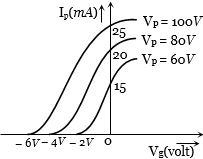
The variation of anode current $(I_p)$ in a triode corresponding to a change in grid potential $(V_g)$ at three different values of the plate potential $(V_p)$ is shown in the diagram. The mutual conductance $(g_m)$ of the triode is.........$ m \text{ mho}$.
A
$2.5$
B
$5$
C
$7.5$
D
$10$
Solution
(D) The mutual conductance $(g_m)$ is defined as the ratio of the change in anode current $(\Delta I_p)$ to the change in grid potential $(\Delta V_g)$ at a constant plate potential $(V_p)$.
$g_m = \left( \frac{\Delta I_p}{\Delta V_g} \right)_{V_p = \text{constant}}$
From the given graph, consider the curve for $V_p = 80 \text{ V}$.
At $V_g = 0 \text{ V}$, $I_p = 20 \text{ mA}$.
At $V_g = -2 \text{ V}$, $I_p = 0 \text{ mA}$.
Therefore, $\Delta I_p = (20 - 0) \text{ mA} = 20 \times 10^{-3} \text{ A}$.
And $\Delta V_g = (0 - (-2)) \text{ V} = 2 \text{ V}$.
$g_m = \frac{20 \times 10^{-3} \text{ A}}{2 \text{ V}} = 10 \times 10^{-3} \text{ mho} = 10 \text{ m mho}$.
Wait, re-evaluating the slope between two points on the same curve:
For $V_p = 80 \text{ V}$, the linear region slope is $\frac{20 - 0}{0 - (-2)} = 10 \text{ m mho}$.
However, looking at the provided solution in the prompt, it uses $\frac{20-15}{4-2}$. Let's re-examine the graph. The points $(0, 20)$ and $(-2, 0)$ are on the $V_p = 80 \text{ V}$ curve. The slope is $10 \text{ m mho}$.
Given the options, $10$ is the correct value.
$g_m = \left( \frac{\Delta I_p}{\Delta V_g} \right)_{V_p = \text{constant}}$
From the given graph, consider the curve for $V_p = 80 \text{ V}$.
At $V_g = 0 \text{ V}$, $I_p = 20 \text{ mA}$.
At $V_g = -2 \text{ V}$, $I_p = 0 \text{ mA}$.
Therefore, $\Delta I_p = (20 - 0) \text{ mA} = 20 \times 10^{-3} \text{ A}$.
And $\Delta V_g = (0 - (-2)) \text{ V} = 2 \text{ V}$.
$g_m = \frac{20 \times 10^{-3} \text{ A}}{2 \text{ V}} = 10 \times 10^{-3} \text{ mho} = 10 \text{ m mho}$.
Wait, re-evaluating the slope between two points on the same curve:
For $V_p = 80 \text{ V}$, the linear region slope is $\frac{20 - 0}{0 - (-2)} = 10 \text{ m mho}$.
However, looking at the provided solution in the prompt, it uses $\frac{20-15}{4-2}$. Let's re-examine the graph. The points $(0, 20)$ and $(-2, 0)$ are on the $V_p = 80 \text{ V}$ curve. The slope is $10 \text{ m mho}$.
Given the options, $10$ is the correct value.
0 likes
View Solution64
MediumMCQ
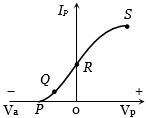
The point representing the cut-off grid voltage on the mutual characteristic of a triode is:
A
$S$
B
$R$
C
$O$
D
$P$
Solution
(D) The cut-off grid voltage is defined as the negative grid bias voltage at which the plate current $(I_P)$ becomes zero.
Looking at the provided mutual characteristic curve,the plate current $I_P$ is plotted against the grid voltage $V_g$ (represented as $V_a$ on the negative axis).
At point $P$,the curve intersects the horizontal axis where $I_P = 0$.
Therefore,point $P$ represents the cut-off grid voltage.
Looking at the provided mutual characteristic curve,the plate current $I_P$ is plotted against the grid voltage $V_g$ (represented as $V_a$ on the negative axis).
At point $P$,the curve intersects the horizontal axis where $I_P = 0$.
Therefore,point $P$ represents the cut-off grid voltage.
0 likes
View Solution65
MediumMCQ
The mutual characteristic of a triode is represented by which of the following graphs?
A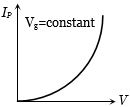
B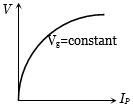
C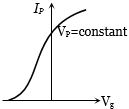
D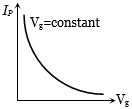
Solution
(C) The mutual characteristic of a triode valve is defined as the relationship between the plate current $(I_P)$ and the grid potential $(V_g)$,while keeping the plate potential $(V_P)$ constant.
As the grid potential $(V_g)$ becomes more negative,it exerts a stronger repulsive force on the electrons emitted from the cathode,thereby reducing the plate current $(I_P)$.
At a certain negative value of the grid potential,known as the cut-off voltage,the plate current becomes zero.
Therefore,the graph representing the mutual characteristic is the plot of $I_P$ versus $V_g$ with $V_P$ held constant,which is shown in option $C$.
As the grid potential $(V_g)$ becomes more negative,it exerts a stronger repulsive force on the electrons emitted from the cathode,thereby reducing the plate current $(I_P)$.
At a certain negative value of the grid potential,known as the cut-off voltage,the plate current becomes zero.
Therefore,the graph representing the mutual characteristic is the plot of $I_P$ versus $V_g$ with $V_P$ held constant,which is shown in option $C$.
0 likes
View Solution66
MediumMCQ
The value of the amplification factor from the following graph is:
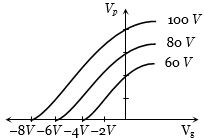
A
$10$
B
$50$
C
$25$
D
$40$
Solution
(A) The amplification factor $\mu$ is defined as the ratio of the change in plate voltage to the change in grid voltage while keeping the plate current constant.
$\mu = - \left( \frac{\Delta V_p}{\Delta V_g} \right)_{i_p = \text{constant}}$
From the graph,consider two curves representing constant plate currents. Let us take the curves corresponding to $V_p = 80 \ V$ and $V_p = 60 \ V$.
For a constant plate current,the corresponding grid voltages are $V_g = -6 \ V$ and $V_g = -4 \ V$ respectively.
$\Delta V_p = 80 \ V - 60 \ V = 20 \ V$
$\Delta V_g = -6 \ V - (-4 \ V) = -2 \ V$
$\mu = - \left( \frac{20 \ V}{-2 \ V} \right) = 10$
Therefore,the correct option is $A$.
$\mu = - \left( \frac{\Delta V_p}{\Delta V_g} \right)_{i_p = \text{constant}}$
From the graph,consider two curves representing constant plate currents. Let us take the curves corresponding to $V_p = 80 \ V$ and $V_p = 60 \ V$.
For a constant plate current,the corresponding grid voltages are $V_g = -6 \ V$ and $V_g = -4 \ V$ respectively.
$\Delta V_p = 80 \ V - 60 \ V = 20 \ V$
$\Delta V_g = -6 \ V - (-4 \ V) = -2 \ V$
$\mu = - \left( \frac{20 \ V}{-2 \ V} \right) = 10$
Therefore,the correct option is $A$.
0 likes
View Solution67
MediumMCQ
The plate characteristic curve of a diode in the space charge limited region is as shown in the figure. The slope of the curve at point $P$ is $5.0 \, mA/V$. The static plate resistance of the diode will be ...... $\Omega$.
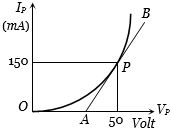
A
$111.1$
B
$222.2$
C
$333.3$
D
$444.4$
Solution
(C) The static plate resistance $(R_p)$ of a diode is defined as the ratio of the plate voltage $(V_p)$ to the plate current $(i_p)$ at a specific operating point $P$.
From the given graph,at point $P$,the plate voltage $V_p = 50 \, V$ and the plate current $i_p = 150 \, mA = 150 \times 10^{-3} \, A$.
The static plate resistance is given by:
$R_p = \frac{V_p}{i_p} = \frac{50}{150 \times 10^{-3}} \, \Omega$
$R_p = \frac{50}{0.15} \, \Omega = \frac{5000}{15} \, \Omega = 333.33 \, \Omega$.
Therefore,the static plate resistance is approximately $333.3 \, \Omega$.
From the given graph,at point $P$,the plate voltage $V_p = 50 \, V$ and the plate current $i_p = 150 \, mA = 150 \times 10^{-3} \, A$.
The static plate resistance is given by:
$R_p = \frac{V_p}{i_p} = \frac{50}{150 \times 10^{-3}} \, \Omega$
$R_p = \frac{50}{0.15} \, \Omega = \frac{5000}{15} \, \Omega = 333.33 \, \Omega$.
Therefore,the static plate resistance is approximately $333.3 \, \Omega$.
0 likes
View Solution68
MediumMCQ
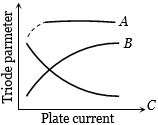
The figure represents the variation of triode parameters ($\mu$, $r_p$, or $g_m$) with the plate current. The correct variations of $\mu$ and $r_p$ are given, respectively, by the curves:
A
$A$ and $B$
B
$B$ and $C$
C
$A$ and $C$
D
None of the above
Solution
(C) The plate resistance $r_p$ varies with plate current $i_p$ according to the relation $r_p \propto i_p^{-1/3}$. This means that as $i_p$ increases, $r_p$ decreases. Therefore, curve $C$ represents the variation of $r_p$.
The amplification factor $\mu$ is essentially independent of the plate current $i_p$ for a triode valve, meaning it remains constant as $i_p$ changes. Therefore, curve $A$ represents the variation of $\mu$.
Thus, the correct curves for $\mu$ and $r_p$ are $A$ and $C$ respectively.
The amplification factor $\mu$ is essentially independent of the plate current $i_p$ for a triode valve, meaning it remains constant as $i_p$ changes. Therefore, curve $A$ represents the variation of $\mu$.
Thus, the correct curves for $\mu$ and $r_p$ are $A$ and $C$ respectively.
0 likes
View Solution69
MediumMCQ
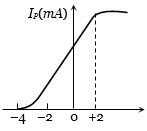
The mutual characteristic curves of a triode are as shown in the figure. The cut-off voltage for the triode is.....$V$.
A
$0$
B
$2$
C
$-4$
D
$6$
Solution
(C) The cut-off voltage is defined as the grid voltage at which the plate current $(I_p)$ becomes zero.
From the given graph,it is observed that when the grid voltage $(V_g)$ is $-4 \, V$,the plate current $(I_p)$ is $0 \, mA$.
Therefore,the cut-off voltage for the triode is $-4 \, V$.
From the given graph,it is observed that when the grid voltage $(V_g)$ is $-4 \, V$,the plate current $(I_p)$ is $0 \, mA$.
Therefore,the cut-off voltage for the triode is $-4 \, V$.
0 likes
View Solution70
MediumMCQ
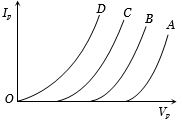
In the figure,four plate characteristics of a triode at different grid voltages are shown. The difference between successive grid voltages is $1 \ V$. Which curve will have the maximum grid voltage and what is its value?
A
$A, V_g = +4 \ V$
B
$B, V_g = +4 \ V$
C
$A, V_g = 0 \ V$
D
$D, V_g = 0 \ V$
Solution
(D) In a triode valve,the grid is typically maintained at a negative potential relative to the cathode to control the plate current $(I_p)$.
As the grid voltage $(V_g)$ becomes more negative,the plate current decreases for a given plate voltage $(V_p)$.
Conversely,as the grid voltage becomes less negative (closer to $0 \ V$),the plate current increases for the same plate voltage.
In the given graph,curve $D$ shows the highest plate current for a given plate voltage,meaning it corresponds to the least negative (or highest) grid voltage.
Since the grid is maintained between $0 \ V$ and a negative potential,the curve $D$ corresponds to $V_g = 0 \ V$.
As the grid voltage $(V_g)$ becomes more negative,the plate current decreases for a given plate voltage $(V_p)$.
Conversely,as the grid voltage becomes less negative (closer to $0 \ V$),the plate current increases for the same plate voltage.
In the given graph,curve $D$ shows the highest plate current for a given plate voltage,meaning it corresponds to the least negative (or highest) grid voltage.
Since the grid is maintained between $0 \ V$ and a negative potential,the curve $D$ corresponds to $V_g = 0 \ V$.
0 likes
View Solution71
MediumMCQ
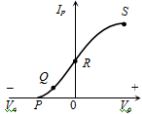
In the mutual characteristic curve of a triode,which point represents the cut-off voltage?
A
$R$
B
$P$
C
$S$
D
$O$
Solution
(B) The mutual characteristic curve of a triode valve represents the variation of plate current $(I_p)$ with respect to grid voltage $(V_g)$ while keeping the plate voltage $(V_p)$ constant.
The cut-off voltage is defined as the negative grid voltage at which the plate current becomes zero.
Looking at the provided graph,the plate current $(I_p)$ starts from zero at point $P$ on the negative $V_g$ axis.
Therefore,point $P$ represents the cut-off voltage.
The cut-off voltage is defined as the negative grid voltage at which the plate current becomes zero.
Looking at the provided graph,the plate current $(I_p)$ starts from zero at point $P$ on the negative $V_g$ axis.
Therefore,point $P$ represents the cut-off voltage.
0 likes
View Solution72
MediumMCQ
$A$ triode has a transconductance $(g_m)$ of $2.5 \text{ mA/V}$ and an anode resistance $(r_p)$ of $20 \text{ k}\Omega$. If it is used as an amplifier with an amplification factor of $10$, what is the load resistance $(R_L)$ connected to the plate circuit in $\text{k}\Omega$?
A
$5$
B
$20$
C
$10$
D
$1$
Solution
(A) The amplification factor $(\mu)$ is given by $\mu = g_m \times r_p$.
Substituting the given values: $\mu = 2.5 \times 10^{-3} \text{ A/V} \times 20 \times 10^3 \, \Omega = 50$.
The voltage gain $(A)$ of a triode amplifier is given by $A = \frac{\mu R_L}{r_p + R_L}$.
Given $A = 10$, we have $10 = \frac{50 R_L}{20 + R_L}$.
Multiplying both sides by $(20 + R_L)$, we get $10(20 + R_L) = 50 R_L$.
$200 + 10 R_L = 50 R_L$.
$200 = 40 R_L$.
$R_L = \frac{200}{40} = 5 \text{ k}\Omega$.
Substituting the given values: $\mu = 2.5 \times 10^{-3} \text{ A/V} \times 20 \times 10^3 \, \Omega = 50$.
The voltage gain $(A)$ of a triode amplifier is given by $A = \frac{\mu R_L}{r_p + R_L}$.
Given $A = 10$, we have $10 = \frac{50 R_L}{20 + R_L}$.
Multiplying both sides by $(20 + R_L)$, we get $10(20 + R_L) = 50 R_L$.
$200 + 10 R_L = 50 R_L$.
$200 = 40 R_L$.
$R_L = \frac{200}{40} = 5 \text{ k}\Omega$.
0 likes
View Solution73
MediumMCQ
The slope of the anode characteristic and the mutual characteristic of a triode are $0.02 \text{ mA/V}$ and $1 \text{ mA/V}$ respectively. The amplification factor of the valve is:
A
$5$
B
$0.5$
C
$50$
D
$500$
Solution
(C) The slope of the anode characteristic is given by $1/r_p$,where $r_p$ is the plate resistance.
Given $1/r_p = 0.02 \text{ mA/V} = 0.02 \times 10^{-3} \text{ A/V}$.
Therefore,$r_p = 1 / (0.02 \times 10^{-3}) = 50 \times 10^3 \, \Omega = 50 \, \text{k}\Omega$.
The slope of the mutual characteristic is the transconductance $g_m$.
Given $g_m = 1 \text{ mA/V} = 1 \times 10^{-3} \text{ A/V}$.
The amplification factor $\mu$ is defined as $\mu = r_p \times g_m$.
Substituting the values: $\mu = (50 \times 10^3 \, \Omega) \times (1 \times 10^{-3} \text{ A/V}) = 50$.
Given $1/r_p = 0.02 \text{ mA/V} = 0.02 \times 10^{-3} \text{ A/V}$.
Therefore,$r_p = 1 / (0.02 \times 10^{-3}) = 50 \times 10^3 \, \Omega = 50 \, \text{k}\Omega$.
The slope of the mutual characteristic is the transconductance $g_m$.
Given $g_m = 1 \text{ mA/V} = 1 \times 10^{-3} \text{ A/V}$.
The amplification factor $\mu$ is defined as $\mu = r_p \times g_m$.
Substituting the values: $\mu = (50 \times 10^3 \, \Omega) \times (1 \times 10^{-3} \text{ A/V}) = 50$.
0 likes
View Solution74
MediumMCQ
In the grid circuit of a triode, an input voltage $E = 2\sqrt{2} \cos \omega t$ is applied. If the amplification factor $\mu = 14$ and the plate resistance $r_p = 10 \text{ k}\Omega$, find the $r.m.s.$ current flowing through the load resistance $R_L = 12 \text{ k}\Omega$ in $\text{mA}$.
A
$1.27$
B
$12.4$
C
$10$
D
$1.5$
Solution
$(A)$ The voltage gain $A$ of a triode amplifier is given by the formula: $A = \frac{\mu R_L}{r_p + R_L}$.
Substituting the given values: $A = \frac{14 \times 12}{10 + 12} = \frac{168}{22} = \frac{84}{11}$.
The input voltage is $E = 2\sqrt{2} \cos \omega t$, so the peak input voltage is $V_{in, peak} = 2\sqrt{2} \text{ V}$.
The peak output voltage across the load is $V_{out, peak} = A \times V_{in, peak} = \frac{84}{11} \times 2\sqrt{2} \text{ V}$.
The $r.m.s.$ output voltage is $V_{out, rms} = \frac{V_{out, peak}}{\sqrt{2}} = \frac{84}{11} \times 2 = \frac{168}{11} \text{ V}$.
The $r.m.s.$ current through the load $R_L$ is $I_{rms} = \frac{V_{out, rms}}{R_L} = \frac{168 / 11}{12 \times 10^3} \text{ A}$.
$I_{rms} = \frac{168}{11 \times 12} \times 10^{-3} \text{ A} = \frac{14}{11} \times 10^{-3} \text{ A} \approx 1.27 \times 10^{-3} \text{ A} = 1.27 \text{ mA}$.
Substituting the given values: $A = \frac{14 \times 12}{10 + 12} = \frac{168}{22} = \frac{84}{11}$.
The input voltage is $E = 2\sqrt{2} \cos \omega t$, so the peak input voltage is $V_{in, peak} = 2\sqrt{2} \text{ V}$.
The peak output voltage across the load is $V_{out, peak} = A \times V_{in, peak} = \frac{84}{11} \times 2\sqrt{2} \text{ V}$.
The $r.m.s.$ output voltage is $V_{out, rms} = \frac{V_{out, peak}}{\sqrt{2}} = \frac{84}{11} \times 2 = \frac{168}{11} \text{ V}$.
The $r.m.s.$ current through the load $R_L$ is $I_{rms} = \frac{V_{out, rms}}{R_L} = \frac{168 / 11}{12 \times 10^3} \text{ A}$.
$I_{rms} = \frac{168}{11 \times 12} \times 10^{-3} \text{ A} = \frac{14}{11} \times 10^{-3} \text{ A} \approx 1.27 \times 10^{-3} \text{ A} = 1.27 \text{ mA}$.
0 likes
View Solution75
MediumMCQ
In the space charge limited region,the plate current in a diode is $10\, mA$ for a plate voltage of $150\, V$. If the plate voltage is increased to $600\, V$,then the plate current will be.......$mA$.
A
$10$
B
$40$
C
$80$
D
$160$
Solution
(C) In the space charge limited region,the plate current $(i_p)$ is governed by Child's law,which states that $i_p = K V_p^{3/2}$,where $K$ is a constant and $V_p$ is the plate voltage.
Given: $i_{p1} = 10\, mA$ at $V_{p1} = 150\, V$.
We need to find $i_{p2}$ at $V_{p2} = 600\, V$.
Using the ratio: $\frac{i_{p2}}{i_{p1}} = \left( \frac{V_{p2}}{V_{p1}} \right)^{3/2}$.
Substituting the values: $\frac{i_{p2}}{10} = \left( \frac{600}{150} \right)^{3/2} = (4)^{3/2}$.
Calculating the power: $(4)^{3/2} = (2^2)^{3/2} = 2^3 = 8$.
Therefore,$i_{p2} = 10 \times 8 = 80\, mA$.
Given: $i_{p1} = 10\, mA$ at $V_{p1} = 150\, V$.
We need to find $i_{p2}$ at $V_{p2} = 600\, V$.
Using the ratio: $\frac{i_{p2}}{i_{p1}} = \left( \frac{V_{p2}}{V_{p1}} \right)^{3/2}$.
Substituting the values: $\frac{i_{p2}}{10} = \left( \frac{600}{150} \right)^{3/2} = (4)^{3/2}$.
Calculating the power: $(4)^{3/2} = (2^2)^{3/2} = 2^3 = 8$.
Therefore,$i_{p2} = 10 \times 8 = 80\, mA$.
0 likes
View Solution76
MediumMCQ
$A$ triode has a plate resistance of $10 \, k\Omega$ and an amplification factor of $24$. If the input signal voltage is $0.4 \, V$ $(r.m.s.)$ and the load resistance is $10 \, k\Omega$,then the output voltage $(r.m.s.)$ is ...... $V$.
A
$4.8$
B
$9.6$
C
$12$
D
None of these
Solution
(A) The voltage gain $A$ of a triode amplifier is given by the formula: $A = \frac{\mu R_L}{r_p + R_L}$,where $\mu$ is the amplification factor,$r_p$ is the plate resistance,and $R_L$ is the load resistance.
Given: $\mu = 24$,$r_p = 10 \, k\Omega$,$R_L = 10 \, k\Omega$.
Substituting the values: $A = \frac{24 \times 10 \, k\Omega}{10 \, k\Omega + 10 \, k\Omega} = \frac{240}{20} = 12$.
The output voltage $(r.m.s.)$ is given by $V_0 = A \times V_s$,where $V_s$ is the input signal voltage.
Given $V_s = 0.4 \, V$,we have $V_0 = 12 \times 0.4 \, V = 4.8 \, V$.
Given: $\mu = 24$,$r_p = 10 \, k\Omega$,$R_L = 10 \, k\Omega$.
Substituting the values: $A = \frac{24 \times 10 \, k\Omega}{10 \, k\Omega + 10 \, k\Omega} = \frac{240}{20} = 12$.
The output voltage $(r.m.s.)$ is given by $V_0 = A \times V_s$,where $V_s$ is the input signal voltage.
Given $V_s = 0.4 \, V$,we have $V_0 = 12 \times 0.4 \, V = 4.8 \, V$.
0 likes
View Solution77
MediumMCQ
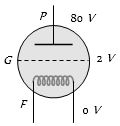
In a triode,the cathode,grid,and plate are at potentials of $0 \, V$,$-2 \, V$,and $80 \, V$ respectively. Electrons are emitted from the cathode with an initial kinetic energy of $3 \, eV$. What is the energy of the electron when it reaches the plate in $eV$?
A
$77$
B
$85$
C
$81$
D
$83$
Solution
(D) The cathode is at $0 \, V$ and the grid is at $-2 \, V$. As the electron moves from the cathode to the grid,it experiences a retarding potential difference of $2 \, V$.
Therefore,the loss in kinetic energy is $2 \, eV$.
The kinetic energy of the electron after passing through the grid is $3 \, eV - 2 \, eV = 1 \, eV$.
The potential difference between the plate $(80 \, V)$ and the grid $(-2 \, V)$ is $80 - (-2) = 82 \, V$.
As the electron moves from the grid to the plate,it gains kinetic energy equal to the potential difference,which is $82 \, eV$.
The final kinetic energy of the electron reaching the plate is $1 \, eV + 82 \, eV = 83 \, eV$.
Therefore,the loss in kinetic energy is $2 \, eV$.
The kinetic energy of the electron after passing through the grid is $3 \, eV - 2 \, eV = 1 \, eV$.
The potential difference between the plate $(80 \, V)$ and the grid $(-2 \, V)$ is $80 - (-2) = 82 \, V$.
As the electron moves from the grid to the plate,it gains kinetic energy equal to the potential difference,which is $82 \, eV$.
The final kinetic energy of the electron reaching the plate is $1 \, eV + 82 \, eV = 83 \, eV$.
0 likes
View Solution78
Medium
What are electronic devices? State their basic types.
Solution
(N/A) Electronic devices are those devices in which the flow of electrons can be controlled through various materials,such as vacuum tubes,gases,or semiconductors.
There are two basic types of electronic devices:
$(1)$ Vacuum tubes (Valves): These are devices where the flow of electrons is controlled in a vacuum.
$(2)$ Solid-state semiconductor devices: These are devices where the flow of electrons is controlled within a solid semiconductor material,such as silicon or germanium.
There are two basic types of electronic devices:
$(1)$ Vacuum tubes (Valves): These are devices where the flow of electrons is controlled in a vacuum.
$(2)$ Solid-state semiconductor devices: These are devices where the flow of electrons is controlled within a solid semiconductor material,such as silicon or germanium.
0 likes
View Solution79
Medium
Briefly describe the valve in electronics.
Solution
(N/A) vacuum tube is also known as a valve.
The valve consists of a varying number of electrodes (plates). They are named based on the number of electrodes:
- Vacuum diode: $A$ glass tube containing a vacuum with two electrodes. One is called the anode (plate) and the other is called the cathode.
- Vacuum triode: $A$ glass tube containing a vacuum with three electrodes. $A$ mesh electrode placed between the anode and the cathode is called the grid.
- Vacuum tetrode: $A$ glass tube containing a vacuum with four electrodes.
- Vacuum pentode: $A$ glass tube containing a vacuum with five electrodes.
In a vacuum tube,thermionic electrons are supplied by a heated cathode or by a filament placed near the cathode through which current is passed.
Voltage is varied between different electrodes to control the flow of electrons passing through the vacuum.
$A$ vacuum is required in the inter-electrode space; otherwise,moving electrons may lose their energy upon collision with air (gas) molecules in their path.
In these devices,electrons can flow only from the cathode to the anode (i.e.,in only one direction). Therefore,such devices are known as valves.
The valve consists of a varying number of electrodes (plates). They are named based on the number of electrodes:
- Vacuum diode: $A$ glass tube containing a vacuum with two electrodes. One is called the anode (plate) and the other is called the cathode.
- Vacuum triode: $A$ glass tube containing a vacuum with three electrodes. $A$ mesh electrode placed between the anode and the cathode is called the grid.
- Vacuum tetrode: $A$ glass tube containing a vacuum with four electrodes.
- Vacuum pentode: $A$ glass tube containing a vacuum with five electrodes.
In a vacuum tube,thermionic electrons are supplied by a heated cathode or by a filament placed near the cathode through which current is passed.
Voltage is varied between different electrodes to control the flow of electrons passing through the vacuum.
$A$ vacuum is required in the inter-electrode space; otherwise,moving electrons may lose their energy upon collision with air (gas) molecules in their path.
In these devices,electrons can flow only from the cathode to the anode (i.e.,in only one direction). Therefore,such devices are known as valves.
0 likes
View Solution80
Medium
Write the differences between vacuum tube (valve) electronic devices and semiconductor electronic devices.
Solution
(N/A)
| Vacuum tube (valve) electronic devices | Semiconductor electronic devices |
| $(1)$ Devices made from vacuum tubes are bulky and stationary. | $(1)$ Devices made from semiconductors are compact and portable. |
| $(2)$ These devices require high operating voltage (about $90 \ V$ to $100 \ V$ or more),making them less power-efficient and more expensive. | $(2)$ These devices require low operating voltage (about $1.5 \ V$ to $9.0 \ V$),making them power-efficient and cost-effective. |
| $(3)$ They use fragile glass envelopes,making them prone to damage,resulting in a shorter lifespan and lower reliability. | $(3)$ They are solid-state devices,making them robust,durable,and highly reliable with a long lifespan. |
| $(4)$ They require heating of a filament to emit electrons (thermionic emission) and high voltages to control electron flow. | $(4)$ They do not require filament heating; charge carriers are available at room temperature,and electron flow is controlled by small voltages. |
| $(5)$ Historically used in television and computer monitors (e.g.,Cathode Ray Tubes). | $(5)$ Modern devices use Liquid Crystal Displays $(LCD)$ or Light Emitting Diodes $(LED)$. |
0 likes
View Solution81
MediumMCQ
Why is a vacuum tube called a valve in electronics?
A
It regulates the flow of electrons like a valve regulates the flow of fluid.
B
It acts as a storage device for electrons.
C
It amplifies the voltage signal.
D
It converts alternating current to direct current.
Solution
(A) vacuum tube is called a valve because it controls the flow of electrons in a circuit in a manner similar to how a mechanical valve controls the flow of water or gas in a pipe. By varying the potential on the control grid,the tube can allow,restrict,or completely block the flow of electrons from the cathode to the anode,effectively acting as a one-way gate or regulator for electric current.
0 likes
View Solution82
EasyMCQ
How many electrodes are in the tetrode?
A
$2$
B
$3$
C
$4$
D
$5$
Solution
(C) tetrode is a vacuum tube (thermionic valve) that contains four electrodes.
These electrodes are:
$1$. The cathode (which emits electrons).
$2$. The control grid (which controls the flow of electrons).
$3$. The screen grid (which reduces the capacitance between the control grid and the anode).
$4$. The anode or plate (which collects the electrons).
Therefore,the total number of electrodes is $4$.
These electrodes are:
$1$. The cathode (which emits electrons).
$2$. The control grid (which controls the flow of electrons).
$3$. The screen grid (which reduces the capacitance between the control grid and the anode).
$4$. The anode or plate (which collects the electrons).
Therefore,the total number of electrodes is $4$.
0 likes
View Solution83
Easy
Why is a vacuum needed in a vacuum tube?
Solution
(N/A) vacuum is required in a vacuum tube to prevent the collision of electrons with air molecules. If air were present,the electrons emitted from the cathode would collide with gas molecules,causing ionization and scattering. This would lead to a decrease in the electron current and could cause electrical discharge or arcing,which would damage the tube and prevent it from functioning as a controlled electronic device.
0 likes
View Solution84
EasyMCQ
In a diode,when there is a saturation current,the plate resistance will be
A
data insufficient
B
zero
C
some finite quantity
D
infinite quantity
Solution
(D) Key Idea: At saturation,the change in current is zero.
We know that the plate resistance $r_p$ is defined as the ratio of the change in plate voltage $\delta V$ to the change in plate current $\delta I$:
$r_p = \frac{\delta V}{\delta I}$
At the saturation point,the current remains constant regardless of the increase in voltage,meaning the change in current $\delta I = 0$.
Therefore,the plate resistance becomes:
$r_p = \frac{\delta V}{0} = \infty$
Hence,the plate resistance is infinite.
We know that the plate resistance $r_p$ is defined as the ratio of the change in plate voltage $\delta V$ to the change in plate current $\delta I$:
$r_p = \frac{\delta V}{\delta I}$
At the saturation point,the current remains constant regardless of the increase in voltage,meaning the change in current $\delta I = 0$.
Therefore,the plate resistance becomes:
$r_p = \frac{\delta V}{0} = \infty$
Hence,the plate resistance is infinite.
0 likes
View SolutionSemiconductor Electronics — Valve Electronics · Frequently Asked Questions
1Are these Semiconductor Electronics questions useful for JEE and NEET?
Yes. All questions in this section are mapped to JEE Main and NEET exam patterns. Previous year questions from JEE Main, NEET, GUJCET and state-level exams are included with full solutions.
2Can I switch to Hindi or Gujarati for these questions?
Yes. Use the language tabs in the hero section or the sidebar to view the same questions and solutions in English, Hindi or Gujarati.
3How do I generate a question paper from this subtopic?
Use the Vedclass Exam Paper Generator — select the chapter and subtopic, set difficulty, and generate Sets A, B, C, D automatically. First 3 chapters of every subject are free.
Vedclass Products
For Students
Vedclass Test Series
Mock tests in real JEE/NEET style with performance analysis. 5-day free trial.
Start Free TrialFor Teachers
Exam Paper Generator
Generate Set A/B/C/D papers from this chapter in 2 minutes. 3 chapters free.
Try FreeFor Institutes
Online Exam Module
Live online exams with unlimited students, 360° analytics & white-label branding.
See DemoFor Teachers & Institutes
Generate a Semiconductor Electronics Exam Paper in 2 Minutes
Select subtopic & difficulty — Sets A, B, C, D auto-generated with No Repeat logic.
First 3 chapters of every subject are free — no payment required.