
An object is placed at a distance $u$ from a concave mirror of focal length $f$. $A$ real image is formed on a screen placed at a distance $v$ from the mirror. As $u$ changes,$v$ also changes. Which of the following graphs correctly represents the variation of $1/v$ with $1/u$?
- A$A$
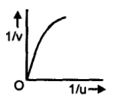
- B$B$
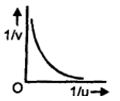
- C$C$
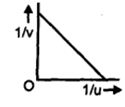
- D$D$
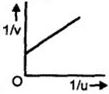
Explore More
Similar Questions
The separation between the screen and a concave mirror is $2r$. An isotropic point source of light is placed exactly midway between the mirror and the screen. The mirror has a radius of curvature $r$ and reflects $100\%$ of the incident light. Find the ratio of illuminances on the screen with and without the mirror.
Difficult
View Solution$A$ small linear object of length $b$ is placed on the axis of a concave mirror of focal length $f$ at a distance $u$ from its pole. What is the approximate length of the image?
Difficult
View Solution$A$ mirror is used to produce an image with magnification of $\frac{1}{4}$. If the distance between the object and its image is $40 \ cm$,then the focal length of the mirror is . . . . . . . (in $cm$)
DifficultJEE MAIN 2025
View SolutionDefine the following for curved mirrors: $(1)$ Radius of curvature,$(2)$ Centre of curvature,$(3)$ Pole,$(4)$ Principal axis,$(5)$ Aperture,$(6)$ Principal focus,$(7)$ Focal plane,$(8)$ Focal length,$(9)$ Paraxial rays.
Medium
View SolutionIf the lateral magnification is $-2$ for a virtual object in a spherical mirror,then:
Medium
View SolutionVedclass Products
For Students
Vedclass Test Series
Mock tests in real JEE/NEET style with performance analysis. 5-day free trial.
Start Free TrialFor Teachers
Exam Paper Generator
Generate Set A/B/C/D exam papers from 7.5L+ questions in 2 minutes. 3 chapters free.
Try FreeFor Institutes
Online Exam Module
Live online exams with unlimited students, 360° analytics & white-label branding.
See Demo